2025-26
Mitra FAMILY GRANT Recipient
“Ici on noie les Algériens”: Repression and French National Memory Surrounding the Events of October 17
Joy Hu
“Ici on noie les Algériens”:
Repression and French National Memory Surrounding the Events of October 17
Joy Hu
2026 Mitra Family Scholar
Mentors: Mr. Stevens and Ms. Hollin
April 28, 2026
In 2024, during the opening ceremony of the Paris Olympic Games, Algerian athletes tossed red roses into the Seine River as their delegation’s boat passed through the heart of the French capital. 1 The gesture commemorated an event that the French state had sought to minimize from the public psyche for decades: the killing of Algerian demonstrators in Paris on October 17, 1961.
The demonstration reflected longstanding irony regarding the events of October 17. 2 The Olympics, while a spectacle devoted to national pride, became a site of reckoning due to the Algerian athletes’ gesture. Similarly, the French government’s treatment of the events of 17 octobre attempted to emphasize national unity, while inadvertently furthering divisions in contemporary France. The gesture’s situational parallels with history revealed how the events of October 17, despite limited official recognition, continue to occupy domestic and international sentiment.
17 octobre, or the events of October 17, occurred during the final and most violent phase of the Algerian War for Independence, which began in 1954 and concluded in the summer of 1962 after French recognition of Algerian sovereignty. 3 As the conflict intensified, the war expanded from an overseas colonial conflict to a domestic crisis that mired metropolitan France. 4
1 "Algerians honor victims of colonial-era French crackdown at Paris Olympics ceremony," Associated Press, last modified July 26, 2024, accessed April 1, 2026, https://apnews.com/article/olympics-paris-2024-algeria-rosesa8fe1153a744894d0c9b2bb3475b1a50.
2 There is great semantic debate over how this event should be named. While many sources refer to the event as the “Paris Massacre,” this paper will use the more neutral “17 octobre” or “events of October 17” to refer to the demonstrations and violence without aiming to diminish the deaths of the Algerian protestors.
3 John Ruedy, "Algerian War of Independence," in Encyclopedia of the Modern Middle East and North Africa, 2nd ed., ed. Philip Mattar (New York, NY: Macmillan Reference USA, 2004), https://link.gale.com/apps/doc/CX3424600155/WHIC?u=harker&sid=bookmark-WHIC&xid=b01c1366.
4 "Algerian War," in Europe since 1914: Encyclopedia of the Age of War and Reconstruction, ed. John Merriman and Jay Winter (Detroit, MI: Charles Scribner's Sons, 2006), 1, https://link.gale.com/apps/doc/CX3447000030/WHIC?u=harker&sid=bookmark-WHIC&xid=f5de2922.
The state increasingly viewed the significant Algerian population in France as a threat to national security, subjecting them to surveillance, harsh policing, and administrative discrimination. 5 In Paris, in particular, tensions came to a head in 1961. On October 5th, Maurice Papon, the prefect of police, imposed a nighttime curfew that applied exclusively to “French Muslims of Algeria.” 6
The Front de libération nationale (FLN), the dominant political and military organization for Algerian independence, coordinated a demonstration to contest these discriminatory measures and raise political visibility. Leaders instructed participants to present themselves positively against the brutality of Parisian police by protesting “‘peacefully, with dignity and an absolute calm,’” requesting the attendance of women, children, and the elderly to emphasize the nonviolent nature of the demonstration. 7 On October 17, between twenty thousand and thirty thousand Algerians arrived at the protest as planned. 8 However, the demonstration quickly erupted with violence. Numerous eyewitness accounts testify that police beat protestors with clubs and fired shots into the crowd, pushing bodies—both alive and dead—into the Seine river. 9
In the aftermath, official records reported only a minimal number of deaths, a position that the state maintained for decades. 10 Independent historians and researchers, however, uncovered evidence of far greater loss of life. Jean-Luc Einaudi, whose seminal research through
5 Jim House and Neil MacMaster, Paris 1961: Algerians, State Terror, and Memory (Oxford: Oxford University Press, 2006), 34, PDF.
6 Assiya Hamza, "October 17, 1961: A Massacre of Algerians in the heart of Paris," France 24 (Paris), October 2021, accessed January 1, 2026, https://webdoc.france24.com/october-17-1961-massacre-algerians-paris-francepolice-history/index.html.
7 House and MacMaster, Paris 1961, 114.
8 House and MacMaster, 115.
9 "Témoignages et documents :" [Testimonies and Documents:], 17 octobre 1961 contre l'oubli, last modified October 1, 2001, accessed January 1, 2026, http://17octobre1961.free.fr/pages/Temoin-Docu.htm.
10 House and MacMaster, 8.
survivor testimonies fundamentally reshaped public understanding of the event, estimates that up to 200 Algerians were killed and many more injured. 11 Other historians, including Jim House and Neil MacMaster, emphasize that the precise death toll will likely never be known due to the extent of record destruction and suppression. 12 The event thus occupies a rare position in modern history as an occurrence whose existence is acknowledged, yet whose full extent remains unknown.
Scholarly attention has understandably concentrated on establishing the facts of the event itself, particularly the death toll. While this work has been essential, it has also produced the unintended effect of narrowing the analytical frame. Less examined is how the French government’s deliberate suppression of information through administrative control, policing methods, and media censorship reduced public awareness and delayed accountability. However, the prolonged silence surrounding the event did not erase it from collective memory. Recurring controversies during the twentieth and twenty-first centuries suggest that suppression failed to permanently eliminate the event’s impact, instead generating political unrest, exacerbating socioeconomic divides, and engendering international disputes.
The significance of October 17, 1961 lies not only in the violence of that night but in its concealment. The event occurred on French soil and targeted individuals who were, in many cases, French citizens, yet it was excluded for decades from official narratives. This absence constitutes a form of national amnesia that continues to influence contemporary debates about policing, education, and France’s colonial legacy. The persistence of contestation over whether and how the event should be taught and acknowledged demonstrates that the legacy of
11 Jean-Luc Einaudi, La Bataille De Paris : 17 Octobre 1961 (Éd. du Seuil, 1991), 268, PDF.
12 House and MacMaster, 8.
suppression and its subsequent impact on national memory and public sentiment destabilizes French society to this day.
Attempts at Repression: Policing Methods
Throughout the Algerian War, French police forces were granted considerable flexibility over the use of force and were later granted a blanket amnesty under the Evian Accords for any actions undertaken during the war. 13 Despite an entrenched culture of impunity, the scale and visibility of violence on October 17 generated unease within the police. Unlike routine acts of brutality carried out privately in detention centers or peripheral neighborhoods, the events of October 17 occurred in the center of the nation’s capital, a marked departure from previous practices.
In the following weeks, numerous police officers expressed unease about the policing methods utilized in the demonstration. Einaudi collects numerous accounts from officers such as René Bellanger, who criticized his fellow officers’ excessive use of force and intimidation during the night. 14 Other officers described bodies floating in the Seine and detainees beaten to death in police courtyards. While these accounts rarely reached official records, they circulated informally, generating a latent crisis of conscience within the force. 15
This unease manifested most clearly in the emergence of dissident groupings, most notably the self-named “groupe de policiers républicains” (group of Republican police officers). These anonymous officers criticize the apathy of police leadership, reflecting widespread malaise among members of the force:
13 William B. Cohen, "The Algerian War, the French State and Official Memory," Historical Reflections / Réflexions Historiques 28, no. 2 (2002): 222, http://www.jstor.org/stable/41299235.
14 Einaudi, La Bataille, 73.
15 Einaudi, La Bataille, 70.
Ce qui s’est passé le 17 octobre 1961 et les jours suivants contre les manifestants pacifiques, sur lesquels aucune arme n’a été trouvée, nous fait un devoir d’apporter notre témoignage et d’alerter l’opinion publique. Nous ne pouvons taire plus longtemps notre réprobation devant les actes odieux qui risquent de devenir monnaie courante et de rejaillir sur l’honneur du corps de police tout entier.
Aujourd’hui, quoique à des degrés différents, la presse fait état de révélations, publie des lettres de lecteurs, demande des explications. La révolte gagne les hommes honnêtes de toutes opinions. Dans nos rangs, ceux-là sont la grande majorité. Certains en arrivent à douter de la valeur de leur uniforme.
Tous les coupables doivent être punis. Le châtiment doit s’étendre à tous les responsables, ceux qui donnent les ordres, ceux qui feignent de laisser faire, si haut placés soient-ils. 16
Translation:
What happened on October 17, 1961, and the following days against peaceful protestors, on whom no weapons were found, compels us to bear witness and alert public opinion.
We can no longer be silent in the face of odious acts that risk becoming running money [idiom for “common”] and reflect negatively on the honor of the entire police force. Today, albeit to varying degrees, the press has made revelations, publishing letters to editors and demanding explanations. The revolt has won over [less literally, “the movement is spreading”] to honest men of all opinions. In our ranks, these are the grand majority. Certain men have begun doubting the value of their uniform.
16 Un groupe de policiers républicains déclare (1961), accessed January 31, 2026, http://17octobre1961.free.fr/pages/dossiers/Republicains.htm.
Everyone guilty must be punished. The punishment should extend to all those responsible, those who give the orders, those who pretend to let things happen, no matter how high their positions are. (author’s translation) 17
Importantly, this dissent did not amount to a categorical rejection of the war or the state. Most telling is the authors’ deliberate usage of the term “republican” in their self-designation to emphasize loyalty to the French Republic. However, this statement’s publication and dissemination challenged the notion that the police force was ideologically monolithic.
In addition to public statements, police unions became an internal battleground for officers to voice their dissent. Traditionally, police unions refrained from engaging in politics, instead focusing on professional action while remaining loyal to the state and prioritizing “défense de la profession” (defense of the profession). 18
However, major police unions began calling for the truth to be publicized. Leaders from the Syndicat CFTC de la police municipale (CFTC Union of the Municipal Police) and the Syndicat autonome des officiers de police (Autonomous Union of Police Officers) expressed their desire that “le linge sale soit lavé en famille” (the dirty linen is washed within the family, or less literally, that the corruption is purged from within). 19 The CFTC, in particular, composed a
17 Unless otherwise noted, all translations from French language sources in this paper are by the author.
18 "Présentation du Syndicat Général de la Police Force Ouvrière" [Presentation of the General Union of Police (SGP) Workers Force], Confédération générale du travail, accessed February 2, 2026, https://30.forceouvriere.org/HISTORIQUE.
19 Michel Legris, "Un profond malaise règne dans la police parisienne" [A profound unease reigns in the Parisian police], Le Monde (Paris), November 14, 1961, accessed January 31, 2026, https://www.lemonde.fr/archives/article/1961/11/14/un-profond-malaise-regne-dans-la-police-parisienne-bull-desdiscussions-ont-oppose-des-gardiens-a-propos-des-traitements-infliges-aux-algeriens-arretes-bull-le-principalsyndicat-d_3114411_1819218.html.
report titled “Face à la repression” (Against Repression) which compiled officers’ misdeeds. 20
Delegates from the Syndicat générale de la police (the General Police Union or the SGP), comprising roughly eleven thousand members or 75 percent of unionized Parisian officers, agreed that those responsible should bear the consequences, declaring that “violence had been encouraged by ‘the bosses.’” 21
In response, police leadership endeavored to suppress dissent within the rank-and-file officers. Maurice Papon, as prefect of police, played a central role in this process. He understood that an ideologically divided police force meant exposing sensitive information, resisting orders, and questioning the state’s legitimacy. To prevent such occurrences, Papon curtailed internal discussion, restricted union activities, and reinforced hierarchical discipline. 22
One of the most immediate measures was the curtailment of public and semi-public discussion of the event. When intellectuals attempted to organize meetings about police violence, Papon prohibited further protest meetings outright. Even initiatives framed as fact-finding, such as the proposed “centre de coordination des témoignages” (center for coordinating testimonies), were viewed as inflammatory and therefore subject to administrative crackdowns. 23 Within the police force, Papon emphasized unity through direct appeals to obedience. In a speech to officers, he warned against questioning superiors and stressed the dangers of internal conflict:
“Je vous demande de rester groupés encore mieux qu’avant et de faire attention à ne pas vous laisser emporter ni d’un côté ni d’un autre et surtout à éviter que les camarades en arrivent aux
20 Sylvie Thénault, "Ce que révèlent les collections de la BDIC de la guerre d'indépendance algérienne" [What is Revealed in the BDIC Collections about the War of Algerian Independence], Matériaux pour l'histoire de notre temps 125-126, no. 2 (2017), accessed February 2, 2026, https://doi.org/10.3917/mate.125.0040.
21 House and MacMaster, Paris 1961, 147.
22 House and MacMaster, Paris 1961, 146.
23 Einaudi, La Bataille, 234.
mains entre eux” (I ask you to stay unified even better than before and to be aware to not be swayed to one side or another, and above all, to prevent your comarades from coming to blows against one another) 24 By painting criticism as a form of betrayal, Papon and other high-level members of police leadership drastically reduced discussion surrounding police misconduct altogether.
Union activity posed a challenge to this strategy, as police unions offered a legitimate channel through which dissent could be articulated. For instance, the Syndicat général de la police (SGP) initially refused to pursue libel charges against the authors of the “groupe de policiers republicans” tract. In response, Papon exerted pressure on SGP leaders. In meetings with union delegates, Papon stated that he would do nothing to protect officers from ensuing investigations if the SGP maintained its position. 25 Ultimately, the SGP chose to join in the police prefecture’s libel charges. 26 This change effectively bound the union to the official narrative and limited its ability to speak independently, limiting avenues for collective, wellorganized opposition from within the police force.
Finally, police leadership reinforced hierarchical discipline through personal consequences. Officers who publicly protested against or later attempted to speak about October 17 faced professional retaliation and reputational damage. For instance, when Paul Rousseau expressed discomfort about the brutality of the event, he was forcibly transferred to a peripheral police station in “l’interêt du service” (the interest of service), subsequently labeled as a proxénète, or someone who organizes prostitution, without evidence, and investigated by
24 Einaudi, La Bataille, 247.
25 House and MacMaster, Paris 1961, 149.
26 House and MacMaster, Paris 1961, 149.
L’inspection génerale des services (General Inspectorate of Services) for months. 27 These incidents, among many others, reinforced conformity even among officers privately disturbed by the events of October 17.
Ultimately, the combination of discussion curtailment, union suppression, and hierarchical discipline successfully tamped down most resistance in the police force and ensured that the police—those well-aware of the repression whose words would be believed—could not speak out against the violence of their peers.
Attempts at Repression: Archival Records
Archives hold a special significance in historical study in that the classification, access, and interpretation of records determine whether an event remains administratively hidden or becomes public knowledge. Following the French Revolution, the National Archives (a publicly accessible collection of records) and smaller collections of municipal archives operated separately. In the late 19th century, the localized archives became absorbed into the National Archives, an action that, in theory, would have democratized access to information. 28 However, in 1959, the Gaullist government reconfigured the National Archives to rest under the jurisdiction of the Ministry of Culture as a subset of “Affaires culturelles.” 29 This action enabled greater central control over archives and framed record-keeping as an issue of cultural and national image rather than true preservation of information, setting the stage for archival controversies.
27 Einaudi, La Bataille, 244.
28 "Historique des archives publiques en France" [History of Public Archives in France], FranceArchives: Portail National des Archives de France, last modified September 16, 2025, accessed February 9, 2026, https://francearchives.gouv.fr/fr/article/37707.
29 Yann Potin, "Les archives et la matérialité différée du pouvoir: Titres, écrins ou substituts de la souveraineté ?" [Archives and the Deferred Materiality of Power: Titles, Containers, or Substitutes for Sovereignty?], Pouvoirs 153 (April 2014): 19, accessed February 9, 2026, https://revue-pouvoirs.fr/wpcontent/uploads/pdfs_articles/Pouvoirs153_archi.pdf.
Archival mismanagement became a crucial mechanism of long-term suppression of information regarding the events of October 17, 1961. Administrative officers and legal systems across multiple levels of government attempted to conceal the event’s occurrence through initial documentation processes and punitive measures, both formal and informal, toward archivists.
As journalist Shirli Sitbon reports, immediately following the massacre, official reports minimized casualties and employed imprecise language regarding the causes of death of discovered bodies. Death reports did not identify involved officers, and most victims remained unidentified except for a singular designation as an “FMA” (French Muslim from Algeria). 30
Such a lack of proper record-keeping significantly hampered the process for legal accountability. Although more than 150 judicial cases emerged, many of which included witness statements describing police violence, the police brigade that managed the Seine had no records for the date of October 17. All reports exchanged between Maurice Papon, the Ministry of the Interior, and the Director General of the police were also absent. 31 Due to the lack of records and the sparse informational content of existing records, judges threw out most of these cases, resulting in the inability to seek reparations for victims, establish institutional responsibility, or even simply know the full extent of the event’s fatality.
Over time, restricted access not just to police reports, but also to court proceedings with witness statements in judicial archives further limited accountability. In 1999, as the trial of Papon's libel suit against Einaudi occurred, the topic of October 17 reentered the public sphere.
30 Shirli Sitbon, "'We did our job, nothing more': The archivists who proved 1961 Paris massacre of Algerians," France24, accessed March 28, 2025, https://www.france24.com/en/france/20211016-we-did-our-job-nothing-morethe-archivists-who-proved-1961-paris-massacre-of-algerians.
31 "En mémoire du 17 octobre 1961" [In Memory of October 17, 1961], CGT-Enseignement Privé (CGT-EP), last modified October 17, 2018, accessed February 9, 2026, https://cgt-ep.syndicatcgt.fr/2018/10/en-memoire-du-17octobre-1961.
Simultaneously, François Gasnault, the director of the Archives de Paris (Paris Archives), began a sorting and “decluttering” of documents despite their evidentiary value. He mandated that the Paris Archives could only maintain one linear meter of archival records between the years 1960 and 1962—a time period that conveniently encompassed documents relevant to October 17. Only after archivists Brigitte Lainé and Philippe Grand intervened were those archives preserved. 32 In addition, the two archivists reported that around 45,000 folders dated around the Algerian War were improperly sorted and selectively preserved, raising concerns about the editorialization of history through archival appraisal bias. 33
The increasingly systemic nature of this informational repression became visible decades later through the punitive treatment of archivists. Brigitte Lainé and Philippe Grand, chief curators of the judicial archives of Paris, discovered the aforementioned discrepancies within the records. 34 When these materials became relevant during the 1997-1999 trials involving Maurice Papon and Jean-Luc Einaudi, specifically to prove that Einaudi’s designation of the event as a massacre was true and therefore not libel, the archivists provided testimonies and shared records in response to judicial requests. Although certain files within the National Archives were closed to the general public under statutory time restrictions, disclosure to a magistrate was allowed under a 1983 statute outlining exceptions to devoir de réserve (professional reserve). 35 Thus,
32 Fabrice Riceputi, "Archives et raison d'Etat: Retour sur l'affaire Einaudi-Grand-Lainé" [Archives and reasons of state: A Return to the Einaudi-Grand-Lainé affair], Les mots sont importants, last modified November 18, 2018, accessed February 9, 2026, https://lmsi.net/Archives-et-raison-d-Etat.
33 Riceputi, "Archives et raison," Les mots sont importants.
34 Françoise-Marie Santucci, "Une archiviste en disgrâce pour avoir éclairé la vérité." [An Archivist in Disgrace for Clearing Up the Truth], Libération, February 25, 1999, accessed February 9, 2026, https://www.liberation.fr/societe/1999/02/25/une-archiviste-en-disgrace-pour-avoir-eclaire-la-verite-brigitte-laine-atemoigne-sur-le-massacre-du_265957.
35 République Française, "Loi n° 83-634 du 13 juillet 1983 portant droits et obligations des fonctionnaires. Loi dite loi Le Pors." [Law No. 83-634 of July 13, 1983, concerning the rights and obligations of civil servants. Known as the Le Pors Law.], Légifrance, last modified February 1, 2025, accessed February 9, 2026,
Lainé and Grand’s testimonies and provision of supporting archives in the trial did not constitute a breach of secrecy.
Nevertheless, government leadership responded swiftly with a combination of formal and informal reprisal to suppress the archivists’ revelations. After participating in the hearing and discovery of their involvement in the maintenance of the 1961 archives, Lainé and Grand were called for a disciplinary hearing in May of 1999. There, the archivists were questioned and threatened with disciplinary and criminal charges with potential jail time. 36 Although no criminal prosecution ultimately materialized, the threat itself emphasized the severity with which the administration sought to reassert control. Instead of pursuing a public legal confrontation, authorities opted for internal administrative measures designed to reduce their future access to archival information and minimize both their institutional and public influence.
Following this hearing, Francois Gasnault issued two notes de service to suspend both archivists, terminating their managerial roles and dissolving their teams. The notes de service also excluded the pair from departmental meetings, banned them from speaking about the archives to the public, and revoked their power of la délégation de signature (signing privileges, which allowed archivists more autonomy to streamline administrative procedures without necessitating a direct signature from a delegator). 37 Even physical access was restricted: as Grand later recounted, Gasnault removed the magnetic lock of the first entrance to the scientific duty office and forbade the caretaker from giving Grand the key to the second entrance. 38 This https://www.legifrance.gouv.fr/loda/id/JORFTEXT000000504704; Odon Vallet, "Devoir De Réserve Et Liberté D'expression," La Revue Administrative 46, no. 276 (1993): 535, http://www.jstor.org.harker.idm.oclc.org/stable/40775150.
36 Santucci, "Une archiviste."
37 Riceputi, "Archives et raison," Les mots sont importants.
38 Riceputi, "Archives et raison," Les mots sont importants.
approach continued into 2002. On October 17—the anniversary of the event—both archivists received letters jointly signed by senior officials from the City of Paris and the National Archives proposing reassignment to fringe departments unrelated to their areas of expertise. This measure effectively sidelined the archivists and reduced their influence even further. Accompanying the official statement of reassignment was a letter that sarcastically linked the message to the archivists’ involvement in the events of October 17:
[Il] serait opportun de sensibiliser, sous couvert d’enquête, les militants associatifs aux enjeux de mémoire et de nouer des contacts informels par l’entremise d’un agent aussi peu conformiste, dans sa mise comme dans ses propos, que celui auquel il est prévu de confier cette mission. 39
Translation:
[It] would be appropriate to raise awareness, under the guise of an investigation, among community activists about the issues of memory and to establish informal contacts through an agent as unconventional, in his appearance as in his words, as the one to whom this mission is to be entrusted.
In this way, the upper levels of archival governance maintained administrative marginalization of the event both materially and socially.
By 2003, legal challenges began to curb the most overt aspects of this treatment. The Tribunal administratif de Paris (Paris Administrative Court) recognized that the withdrawal of their duties constituted an unwarranted “sanction disciplinaire déguisée” (disguised disciplinary
39 Riceputi, "Archives et raison," Les mots sont importants.
sanction), ruling that the memoranda ordering their professional exclusion should be annulled. 40 However, full reparations remained incomplete. Lainé regained her signing privileges and permission to publish only after a protracted legal battle that stretched into the mid-2000s. 41 By then, the window of opportunity to uncover the truth about October 17 and pursue reparations had seemingly already closed.
Attempts at Repression: Media Censorship
A robust press functions as a mechanism of accountability. By documenting state violence and disseminating independent information, journalists can generate public scrutiny. However, the French state and police effectively curtailed this function of the media. To reduce public awareness of the circumstances surrounding October 17, an organized media censorship campaign occurred across three stages: immediate obstruction during the event, systemic censorship and restriction following the event, and the gradual internalization of self-censorship among journalistic institutions.
Anticipating a potentially newsworthy demonstration, several journalists, filmmakers, and photographers attempted to cover the October 17 protest. As the scene became increasingly violent, police officers limited documentation. Joseph Babout, a reporter from the Associated Press, recounts that officers smashed his camera and beat him for attempting to photograph
40 Jean-Pierre Thibaudat, "L'honneur retrouvé des deux archivistes" [The Returned Honor of Two Archivists], Libération, April 18, 2003, accessed February 9, 2026, https://www.liberation.fr/societe/2003/04/18/l-honneurretrouve-des-deux-archivistes_462015.
41 Clémence Jost, "Brigitte Lainé : l'archiviste qui dérangeait Papon dérange-t-elle encore après sa mort ?" [Brigitte Lainé: Does the archivist who disturbed Papon still disturb people after his death?], Archimag: Stratégies et ressources de la mémoire et du savoir, November 13, 2018, accessed February 9, 2026, https://www.archimag.com/archives-patrimoine/2018/11/13/brigitte-laine-archiviste-derangeait-papon-encore-apresmort.
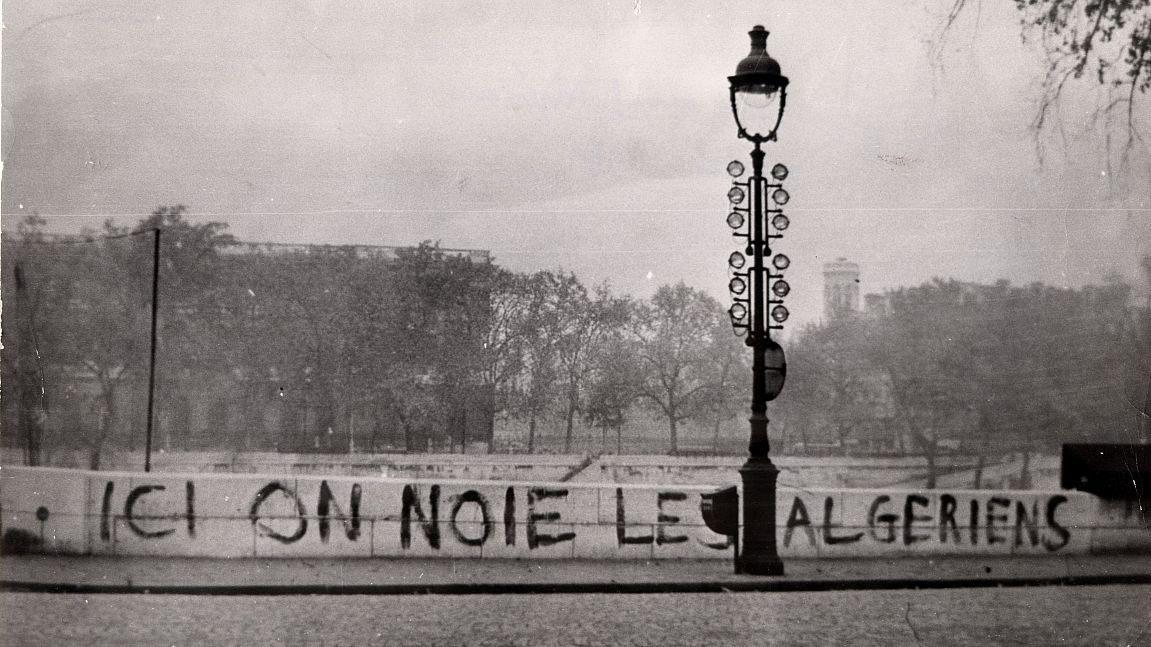
police violence against the protestors. 42 Photographers Jean Texier and Claude Angeli approached a bridge to document graffiti which read “Ici on noie les Algériens” (Here we drown Algerians), an inscription that sardonically criticized the state’s violent approach (see fig. 1). 43 Although the pair were not subject to physical attacks, police officers guarding the bridge attempted to stop them from photographing. 44
Figure 1: The original graffiti captured in a photograph by Texier and Angeli The severe reduction of independent coverage allowed the French government to advance its own narrative. In the following days, state-controlled French media either portrayed the event as a relatively minor disturbance or did not provide substantial coverage. A press release from
42 Einaudi, La Bataille, 187-188.
43 Jean Texier and Claude Angeli, Ici on noie les Algériens, 1961, photograph, accessed April 1, 2026, https://www.dokfest-muenchen.de/films/ici-on-noie-les-algeriens-17-octobre-1961?lang=en.
44 Elsa Mourgues, "'Ici on noie les Algériens' : la photo mémoire du massacre du 17 octobre 1961" ["Here we drown Algerians": the memorial photo of the massacre of October 17, 1961], Radio France, August 23, 2019, accessed February 11, 2026, https://www.radiofrance.fr/franceculture/ici-on-noie-les-algeriens-la-photo-memoire-dumassacre-du-17-octobre-1961-1333925.
the Parisian police stated that only two were killed, and that the FLN had forced protestors to gather against their will. 45 A news segment produced by Les Actualités Françaises, a wartime station acquired by the state news agency Office de Radiodiffusion Télévision Française, simply reported on demonstrations of October 17 by mentioning the Algerian shop strike and that “des groupes de femmes et d'enfants qui tentèrent de se former [...] devait être rapidement canalisés vers les centres sociaux de la préfecture de la Seine” (groups of women and children who tried to organize [...] were quickly directed to the social services centers of the Seine Prefecture), omitting the true fate of the protestors. 46 Alternatively, the daily news segment of the Radiodiffusion-Télévision Française (RTF), the national broadcasting organization, did not mention the demonstrations at all. As Joseph Pasteur, the presenter of that day’s segment, recalls: Elle nous avait été présentée comme un simple fait divers. [...] Pour expliquer l'absence de reportages, il faut se rappeler que nous étions en pleine guerre d'Algérie et que la télévision était placée sous la férule personnelle du général de Gaulle, qui en avait fait son porte-voix. 47
Translation:
45 Assiya Hamza, "October 17, 1961: A Massacre of Algerians in the heart of Paris," France 24 (Paris), October 2021, accessed January 1, 2026, https://webdoc.france24.com/october-17-1961-massacre-algerians-paris-francepolice-history/index.html.
46Institut national de l'audiovisuel, "Journal Les Actualités Françaises : émission du 25 octobre 1961," video, 09:16, Institut national de l'audiovisuel, October 25, 1961, accessed February 11, 2026, https://www.ina.fr/ina-eclaireactu/video/afe86003799/journal-les-actualites-francaises-emission-du-25-octobre-1961.
47 Eve Bonnivard, "Les manifestations musulmanes du 17 octobre 1961" [The Muslim Protests of October 17, 1961], Lumni Enseignement, https://enseignants.lumni.fr/fiche-media/00000000080/les-manifestationsmusulmanes-du-17-octobre-1961.html.
It was presented to us as a simple news item. [...] To explain the lack of reports, you have to remember that we were in the middle of the Algerian War and that television was under the personal control of General de Gaulle, who had made it his mouthpiece. The combination of scarce independent coverage and controlled state-approved reporting allowed official narratives to persist, as these state-disseminated reports were the only authoritative source available to journalists working on tight deadlines. As a result, many rightwing newspapers such as Le Parisien libéré, L'Aurore, Paris-Jour, Le Figaro, and France-Soir simply adhered to official narratives, and left-wing newspapers such as Libération, Témoignage
48
Chrétien, and France Observateur could not confidently challenge the state-approved position.
As the remaining evidence was revealed, the few sources that blatantly challenged official positions faced censorship. This pattern must be understood within the broader context of wartime policies during the Algerian War for Independence. By 1961, France had operated under emergency powers and extensive national security laws for years. 49 Publications perceived as sympathetic to Algerian nationalism or critical of state policy had already faced saisies judiciaires (judicial seizures, though conducted by police and non-judicial agencies) of specific news issues and books. 50
48 Mogniss H. Abdallah, "Le 17 octobre 1961 et les médias. De la couverture de l'histoire immédiate au 'travail de mémoire'" [October 17, 1961 and the media. From the immediate historical coverage to the "work of memory"], Hommes & Migrations 1228 (2000): 125-126, accessed February 11, 2026, https://www.persee.fr/doc/homig_1142852x_2000_num_1228_1_3617.
49 Rui Miguel Pereira, "L'état D'urgence: Une étude Constitutionnelle, Historique Et Critique," International Journal of Constitutional Law 17, no. 3 (2019): 1020, accessed February 11, 2026, https://doi.org/10.1093/icon/moz074.
50 Martin Harrison, "Government and Press in France during the Algerian War," American Political Science Review 58, no. 2 (1964): 273-274, https://doi.org/10.2307/1952862.
Applied to the October 17 demonstrations, the state’s policy was not necessarily an explicit order banning coverage of the event, but rather targeted censorship to intimidate outspoken media outlets and journalists. For instance, the judicial police seized Paulette Péju’s book Ratonnades à Paris, which thoroughly documented the events of October 17. 51 Jacques Panijel’s documentary Octobre à Paris provided visual evidence and witness testimonies of the event’s brutality. Similarly, the documentary was banned for more than a decade. 52 Numerous newspapers that published an anti-police account of the night’s event faced more systemic censorship: L’Humanité, one of the most outspoken in condemning state brutality, had 27 issues seized and faced 150 legal prosecutions regarding its coverage. 53 In addition to simpler procedures of seizure, the state utilized judicial mechanisms to suppress journalistic accounts. One key instance was Papon’s 1999 trial against Einaudi, in which Papon accused Einaudi of spreading libel by referring to the events of October 17 as a “massacre.” 54 Although Einaudi was not found guilty in this case, the threat of legal action against individuals like Einaudi and newspapers like L’Humanité created an environment that discouraged deviation from the official position.
Eventually, the immense risk posed by publishing accounts of October 17 normalized self-censorship within the press, one of the most enduring consequences of this media
51Paulette Péju, Ratonnades à Paris, Précédé de Les Harkis à Paris, la découverte & syros ed. (Paris: La Découverte, 2000),15, originally published as Ratonnades à Paris (François Maspero, 1961).
52 Assiya Hamza, "October 17, 1961: A Massacre of Algerians in the heart of Paris," France 24 (Paris), October 2021, accessed January 1, 2026, https://webdoc.france24.com/october-17-1961-massacre-algerians-paris-francepolice-history/index.html.
53 Elsa Mourgues, "'Ici on noie les Algériens' : la photo mémoire du massacre du 17 octobre 1961" ["Here we drown Algerians": the memorial photo of the massacre of October 17, 1961], Radio France, August 23, 2019, accessed February 11, 2026, https://www.radiofrance.fr/franceculture/ici-on-noie-les-algeriens-la-photo-memoire-dumassacre-du-17-octobre-1961-1333925.
54 House and MacMaster, Paris 1961, 313.
environment. EAs Gilles Manceron, a student in the 1960s and subsequent journalist and historian, recalls, “Nous avons su, mais nous nous sommes tus. [...] Je crois qu’il serait bon que les médias disent un jour que nous étions beaucoup à savoir et que la censure de l’époque n’avait pas tout effacé. Nous avons nous-mêmes, souvent, effacé ce qui nous embarrassait” (We knew, but we all stayed silent. [...] I believe it would be good if the media one day said that many of us knew and that the censorship of the time didn't erase everything. We ourselves often erased what embarrassed us). 55 Such a fear amongst publications meant that even when not directly censored, those aware of the event often exercised self-restraint. When Texier and Angeli offered their photograph to the newspaper L’Humanité, the editors expressed fears of censorship. 56 The paper could not afford any more legal challenges due to censorship, ultimately delaying the publication of the photograph by 24 years. 57 The gradual consolidation of the media sphere allowed the French state to shape the national psyche through information, broadening its systemic repression. Yet as clandestine and alternative outlets circulated suppressed information, attempts to preserve national unity through narrative control instead generated long-term skepticism and distrust. 58 The emergence of information led readers to question official accounts and doubt broader state authority. 59
55 Valérie Lehoux, "Retour sur le 17 octobre 1961 : 'Nous avons su, mais nous nous sommes tu'" [Returning to October 17, 1961: "We knew, but we stayed silent"], Télérama, October 31, 2021, accessed February 12, 2026, https://www.telerama.fr/debats-reportages/retour-sur-le-17-octobre-1961-nous-avons-su-mais-nous-nous-sommestu-6999020.php.
56 Mourgues, "'Ici on noie."
57 Mourgues, "'Ici on noie."
58 Henri Maler, "Il y a 60 ans, les médias et le massacre du 17 octobre 1961" [60 Years Ago: The Media and the Massacre of October 17, 1961], Acrimed, last modified October 17, 2021, accessed April 1, 2026, https://www.acrimed.org/Il-y-a-56-ans-les-medias-et-le-massacre-du-17.
59 Maler, "Il y a 60 ans," Acrimed.
Modern Repercussions: Domestic Political Unrest
Through a combination of loosening censorship policies, judicial proceedings against Maurice Papon for World War II crimes, and the emergence of personal narratives, the events of October 17 gradually re-entered national conversation. 60 This reemergence was reflected in growing media coverage of the event: one article was published in 1980, six in 1981, thirteen in 1991, and more than thirty a year by 2001. 61 The French public also seemed to become more aware, with 47% polled in October of 2001 having heard of the event. 62 In addition, the public also seemed to be receptive to commemoration. Fifty-six percent of citizens surveyed by the BVA, an opinion polling agency, wanted the government to officially apologize for the broad use of torture during the Algerian War. Still, a significant population was unaware of the events of October 17, and many who were aware of the event held polarized views. 63
Evidently, the decades of repression failed to erase the event from national memory. Instead, it made the event highly contested and politicized. The most notable example of this atmosphere emerged in 2001, when the city of Paris attempted to formally commemorate the event. Rather than producing national consensus, the initiative revealed the domestic political unrest created by decades of suppression.
Immediately, French politicians disagreed on the necessity of commemoration. Bertrand Delanoë, the Socialist mayor of Paris at the time, advocated for stronger recognition. He, alongside many left-wing politicians, viewed commemoration as a pathway to long-term peace
60 House and MacMaster, Paris 1961, 310.
61 Jelen, "17 octobre," 31.
62 House and MacMaster, Paris 1961, 319.
63 Réda Bensmaia and Jennifer C. Gage, "The War That Haunts France," L'Esprit Créateur 54, no. 4 (2014): 6, https://www.jstor.org/stable/26378923.
and reconciliation. 64 On the other hand, many others, particularly conservatives, openly opposed Delanoë’s proposal, arguing that commemoration reopened historical wounds and encouraged political radicalism among immigrant communities.
65 Even Jean-Pierre Chevènement, the center-left Interior Minister who had once advocated for the reopening of the archives, argued that official recognition of state misdeeds would harm national unity. 66 He expressed the common sentiment that “Il n'y a rien à gagner à sempiternellement gratter nos plaies. Le peuple français comme tout autre peuple a besoin de garder une raisonnable estime de lui-même pour pouvoir continuer son histoire” (There is nothing to be gained from eternally picking at our wounds. The French people, like any other people, need to maintain a reasonable sense of selfesteem in order to continue their history).
67 The disagreement culminated in a series of polemical debates during Paris City Council sessions in September of 2001. 68 On the national level, deputies of the National Assembly walked out in protest against the process of acknowledgment.
69
Ultimately, after a series of compromises and concessions, a memorial plaque was installed on the Pont Saint-Michel, the location where police brutalized protestors and pushed
64 Stuart Jeffries, "Paris recalls murder of Algerians," The Guardian, October 17, 2001, accessed January 2, 2026, https://www.theguardian.com/world/2001/oct/17/humanities.highereducation.
65 Jeffries, "Paris recalls."
66 "Question de Mme Bidard-Reydet à Jean-Pierre Chevènement" [Questions from Ms. Bidard-Reydet to JeanPierre Chevènement], 17 octobre contre l'oubli, accessed April 1, 2026, http://17octobre1961.free.fr/pages/dossiers/Senat.htm.
67 Jelen, "17 octobre," 34.
68 "Heated debate around a plaque commemorating 17 October 1961 in Paris," video, 1:02, Institut national de l'audiovisuel, September 25, 2001, accessed April 1, 2026, https://mediaclip.ina.fr/en/i21287488-heated-debatearound-a-plaque-commemorating-17-october-1961-in-paris.html.
69 "Paris marks Algerian protest 'massacre,'" BBC, last modified October 17, 2001, accessed April 1, 2026, http://news.bbc.co.uk/2/hi/world/monitoring/media_reports/1604970.stm.
them into the Seine. 70 However, the circumstances surrounding the plaque’s placement underscore the persisting tensions regarding commemoration. The plaque was erected on the riverbank along the fourth arrondissement, rather than the previously intended fifth arrondissement, due to opposition from leaders of the fifth arrondissement 71 In addition, rightwing members of the Parisian government refused to attend the ceremony, symbolically denying the efforts at acknowledgment and illustrating existing divisions. 72 Even the ambiguous text of the plaque proved contentious. The plaque reads: “À la memoire des nombreux Algériens tues lors de la sanglante repression de la manifestation pacifique du 17 octobre 1961” (In memory of the many Algerians killed during the bloody repression of the peaceful demonstration of October 17, 1961). 73 Notably, the text avoided explicitly identifying the perpetrators or attributing responsibility to the French state. As gleaned through interviews with individuals who visited the plaque, many interpreted the ambiguity as symptomatic of the broader politics of memory surrounding the event: even four decades later, official recognition remained constrained by the enduring sensitivity of assigning blame. 74
Not only did official government efforts create a sense of ambiguity with respect to commemoration, but also the reactions from various social groups also exacerbated instability. SGP and Alliance—the largest and most influential police union in Paris—publicly condemned
70 Amanda Morrow, "1961 - Algerians massacred on Paris streets," Radio France Internationale, last modified February 12, 2010, accessed April 1, 2026, https://www.rfi.fr/en/visiting-france/20101202-1961-algeriansmassacred-paris-streets.
71 Jelen, "17 octobre," 32.
72 House and MacMaster, Paris 1961, 310.
73 Algeria-SP, Memorial plaque next to the Pont Saint-Michel, photograph, Wikimedia Commons, March 7, 2023, accessed April 1, 2026, https://upload.wikimedia.org/wikipedia/commons/3/36/Memorial_plaque_next_to_the_Pont_Saint-Michel.jpg.
74 Jelen, "17 octobre," 32.
the plaque. 75 Union representatives argued that the memorial dishonored the police by presenting them solely as perpetrators while ignoring the deaths of French officers killed by the FLN during the broader Algerian War. 76 They also warned that commemoration would endanger modern
French society: Alliance stated that “l'évocation d’une période particulièrement douloureuse de notre Histoire ne peut avoir pour conséquence que d'éloigner la police nationale des Français” (the evocation of a particularly painful period of our history will only have consequences for the national French police). 77 The police unions’ responses echoed the long-standing institutional narrative that had developed during the original repression of the event, in which criticism of police conduct was framed as an attack on public order and national unity. Criticism against the memorial was met with equal fervor in support. Nearly forty pro-commemoration groups organized counter-demonstrations, marching along the Seine while demanding stronger reparations in the form of archival declassification and official recognition. 78 In addition, new social organizations such as 17 octobre 1961: contre l’oubli, alongside established groups like SOS Racisme and the Mouvement contre le Racisme et pour l’Amitié entre les Peuples (MRAP), began advocating for recognition of October 17 either as their primary focus or alongside their
75 Harrison Stetler, "France's Police Unions Are Gaining Power — and They're Denouncing the Left," Jacobin, last modified June 16, 2022, accessed April 1, 2026, https://jacobin.com/2022/06/french-police-unions-lefebvredarmanin-crime-nupes-election.
76 Philippe Bernard and Christine Garin, "Archives du 'Monde' (17 octobre 2001) – Le massacre du 17 octobre 1961 obtient un début de reconnaissance officielle" [Archives of "Le Monde" (October 17, 2001) – The massacre of October 17, 1961 obtains a first step towards official recognition.], Le Monde, October 17, 2001, accessed January 2, 2026, https://www.lemonde.fr/societe/article/2011/10/17/archives-du-monde-17-octobre-2001-le-massacre-du-17octobre-1961-obtient-un-debut-de-reconnaissance-officielle_1588198_3224.html.
77 Bernard and Garin, "Archives du 'Monde.'"
78 Bernard and Garin, "Archives du 'Monde."
broader agendas. 79 Each group brought its own priorities and perspectives, further complicating the national debate over recognition.
Quickly, political tensions seeped into the cultural sphere. On October 6, 2001, France and Algeria held their first football match since the end of the Algerian War. Dubbed the “match de réconciliation,” the game was intended to diffuse cultural tensions between the two nations. 80 Instead, during the match, protestors in the crowd—mostly young French men of Algerian descent—loudly booed the French national anthem and eventually invaded the pitch, forcing the game to be abandoned before its conclusion. 81 As Mohamed Ghoualmi, Algeria’s ambassador to France, interpreted, the youth who interrupted the match were “les descendants des centaines de morts du 17 octobre 1961” (the descendants of hundreds of those killed on October 17, 1961), and that disturbing the public order was the only way they could be heard in a society that promoted national amnesia. 82
Together, these controversies illustrate the long-term consequences of the state’s earlier strategy of repression. Since the event had not been openly acknowledged in the decades immediately following 1961, its eventual reemergence in public discourse occurred in a context marked by uncertainty, mistrust, and competing historical interpretations. As scholars of restorative justice have observed, unresolved historical injustices often generate recurring cycles
79 Jelen, "17 octobre," 32.
80 Jelen, "17 octobre," 40.
81 Gilles Verdez, "France-Algérie : pourquoi le match a dégénéré" [France-Algeria: Why the Match Devolved], Le Parisien, last modified October 8, 2001, accessed April 1, 2026, https://www.leparisien.fr/sports/france-algeriepourquoi-le-match-a-degenere-08-10-2001-2002494338.php.
82 Jelen, "17 octobre," 40.
of controversy when attempts at recognition finally occur. 83 The debates of 2001 demonstrate that the absence of early accountability transformed commemoration into a site of political struggle rather than remembrance.
In this sense, the repression of October 17 ultimately proved counterproductive to the state’s original objective of preserving social stability. While suppression delayed public knowledge, it also prevented the development of a coherent national narrative. When the event resurfaced in popular discourse, the ensuing debates exposed tensions within French society over colonial history and state-sanctioned violence. The controversies surrounding the 2001 commemorations therefore illustrate how the culture of denial generated by earlier repression continues to shape the contemporary French national psyche.
Modern Repercussions: Domestic Social Fracturing in Education
The long-term effects of the suppression of the events of October 17 are also evident in the national education system, where tension over instruction of the event exacerbated existing socioeconomic differences.
Educational policy holds a massive impact because its standardization at the national level allows the government to shape the public psyche. The Ministry of Education sets the official curriculum for every school, which is compulsory to follow. 84 The extent of standardization is so robust that many say that at any given time, the “French education minister could open the national curriculum—the programme d'enseignement obligatoire—and know
83 René Koekkoek, "Rethinking the History of Reparations for Historical Injustices: An Early Modern Perspective," The Journal of Modern History 96, no. 2 (2024): 254, accessed April 1, 2026, https://doi.org/10.1086/730043.
84 Pavan Mandavkar, "Education System in France," SSRN Electronic Journal 1 (April 2022): 13, accessed April 1, 2026, https://doi.org/10.2139/ssrn.4097711.
exactly what every pupil in the country was learning that day.” 85 In theory, this structure allowed the Ministry of Education to standardize historical knowledge across the country; in practice, it also meant that debates over curricula expanded to a national scale. In 2001, the Ministry of Education invited history teachers for an evening of discussion under the title “La journée du 17 octobre 1961 et l'enseignement de la guerre d’Algérie” (the day of October 17, 1961 and the teaching of the Algerian War). 86 However, when a teacher suggested teaching about the state’s complicity in the violence, the Inspector General of History and Geography cried, “Prouvez-le!” (Prove it!), and rejected any notion of including the full perspective of the event in the curriculum. 87 Given the power of the school curriculum to shape national opinion, the limited presence of October 17 within official curricula reflects the government’s reluctance to fully integrate the massacre into the narrative of French history. While the national curriculum itself is standardized, the French education system is divided into two main tracks: the lycée général (general high school) system and the lycée professionel (vocational school) system, who differ in their teaching of the events of October 17. 88 89 Among all approved textbooks in the lycée général systems, only four mention the
85 "France is experimenting with a radically different approach to education," World Governments Summit, last modified December 5, 2017, accessed April 1, 2026, https://www.worldgovernmentssummit.org/observer/articles/detail/france-is-experimenting-with-a-radicallydifferent-approach-to-education.
86 "17 octobre 1961 : Quand l'Éducation nationale aborde l'histoire..." [October 17, 1961: When the Ministry of Education Tackles History...], Lutte Ouvrière, last modified October 16, 2001, accessed January 2, 2026, https://www.lutte-ouvriere.org/journal/article/2001-10-26-17-octobre-1961-quand-leducation-nationale-abordelhistoire_3730.html.
87 "17 octobre," Lutte Ouvrière.
88 Mandavkar, "Education System," 14.
89 The lycée général system is sometimes grouped with the lycée technologique system into the lycée d’enseignement général et technologique (LEGT) system. Both systems ultimately focus on education geared towards university study, while the lycée professionel system focuses on practical education.
events of October 17 at all. 90 Teachers are permitted to introduce additional content which may include the event. 91 However, due to the lycée général system’s emphasis on preparation for the standardized baccalauréat exam, teachers are incentivized to adhere to given materials to maximize student success. 92 On the other hand, vocational schools are less constrained by examdriven priorities, allowing teachers more pedagogical flexibility. Some educators have independently included the event in their lessons. For instance, the vocational school René Cassin à Rive-de-Gier organized a research project and discussion about the event. 93
The implications of this divide are profound because the two tracks serve markedly different student demographics. Students in the lycée général track tend to come from more socioeconomically advantaged backgrounds than those of their lycée professionel counterparts. The average Indice de Position Sociale (IPS), a metric for socioeconomic well-being, of a lycée général student is 120 compared to that of a lycée professional student at only 90. 94 Moreover, the lycée général pathway is the primary route to grandes écoles and ultimately positions of political and administrative power that recruit disproportionately from these universities. 95 By
90 Aggiornamento, "Le 17 octobre 1961 : un événement oublié dans les programmes scolaires ?," Aggiornamento hist-geo (blog), August 5, 2011, accessed January 2, 2026, https://doi.org/10.58079/atk6.
91 Aggiornamento, "Le 17 octobre," Aggiornamento hist-geo (blog).
92 Regnault Elisabeth et al., "The PISA Effect on Education Reforms in Finland and France," Globalisation, Comparative Education and Policy Research, 2022, 43, accessed April 1, 2026, https://doi.org/10.1007/978-3-03071583-0_3.
93 "Un projet pédagogique autour du 17 octobre 1961" [A Pedagogical Project Centered Around October 17, 1961], Histoire coloniale et postcoloniale, last modified April 23, 2019, accessed January 2, 2026, https://histoirecoloniale.net/un-projet-pedagogique-autour-du-17-octobre-1961/.
94 DEPP, Quel est le profil social des lycées ?, by Louise Piquemal, report no. 25-21, 3, 2025, https://doi.org/10.48464/NI-25-21.
95 Stéphane Benveniste, "Les Grandes Écoles au 20ème siècle, le champ des élites françaises : reproduction sociale, dynasties, réseaux" (doctoral thesis, École d'Économie d'Aix-Marseille, 2021), 158, accessed April 1, 2026, https://hal.science/tel-04186673v1.
contrast, vocational tracks enroll a higher proportion of working-class and immigrantbackground students, including many of Algerian descent, and prepare students for technical professions. 96 Consequently, the populations most directly connected to the historical legacy of October 17 were more likely to encounter it in school, while those who would later shape national policy were the least systematically exposed to it.
More broadly, this pattern reflects a recurring pattern within French historical education where episodes of colonial history deemed unsavory are omitted from standard curricula. 97 However, this selective pedagogy exacerbates the existing rift between the lycée général and lycée professionnel systems, along with their corresponding socioeconomic divides. As former Prime Minister and education advocate Jean-Marc Ayrault remarked, “When we evade these questions, when we hide them, when we forget them, there’s a risk that they resurge. If we try to cover up this history, it comes back and it often comes back in a more violent manner.” 98
The consequences extend beyond education into contemporary political and social debates. Because a large proportion of France’s political and intellectual elite emerges from the lycée général system, their relative lack of exposure to events like October 17 contributes to an incomplete framework for addressing issues related to immigration, policing, and France’s colonial legacy. Politicians often legislate without full knowledge of the historical experiences of marginalized communities, reinforcing cycles of misunderstanding and tension. The lack of
96 "Les élèves d'origine étrangère : le poids des difficultés sociales" [Students of Foreign Origin: the Burden of Social Difficulties], Observatoire des inégalités, last modified August 21, 2007, accessed January 2, 2026, https://www.inegalites.fr/Les-eleves-d-origine-etrangere-le-poids-des-difficultes-sociales.
97 Lauren Collins, "The Haitian Revolution and the Hole in French High-School History," The New Yorker, December 30, 2020, accessed April 1, 2026, https://www.newyorker.com/culture/culture-desk/the-haitianrevolution-and-the-hole-in-french-high-school-history.
98 Collins, "The Haitian."
understanding caused by education led to missteps such as the 2005 law that mandated teaching the “positive aspects” of French colonialism. 99 The law drew criticism from educators and historians, and the suburbs erupted in riots to protest the measure, growing in intensity as individuals burnt vehicles and destroyed other property. 100 While the law was repealed in 2006, its passage demonstrated the failures of the French education system to clearly reckon with events like those of October 17, instead generating national conflict. By failing to teach the event’s history equally across educational pathways, the state created an incomplete national memory that was fragmented along the lines of existing social hierarchies. The suppression of October 17 through education did not eliminate its impact but instead transformed it into a lasting source of social division within French society.
Modern Repercussions: Foreign Relations
Since 1968, the Algerian state has commemorated October 17 as National Emigration Day, embedding the massacre within its official national narrative of anti-colonial struggle. 101 By contrast, in France, the issue did not enter mainstream political debate until the late 1990s, particularly following the work of Jean-Luc Einaudi and the 1999 defamation trial involving Maurice Papon. Moreover, while the Algerian state consistently organized the annual commemorations through its Cultural Center in Paris and its consular offices, France’s efforts
99 Jon Henley, "French angry at law to teach glory of colonialism," The Guardian, last modified April 15, 2005, accessed April 1, 2026, https://www.theguardian.com/world/2005/apr/15/highereducation.artsandhumanities.
100 Franziska Boehme, "Normative Expectations and the Colonial Past: Apologies and Art Restitution to Former Colonies in France and Germany," Global Studies Quarterly 2, no. 4 (2022): 7, accessed April 1, 2026, https://doi.org/10.1093/isagsq/ksac053.
101 "Commemoration of National emigration Day," Embassy of Algeria in Brussels, accessed April 1, 2026, https://embbrussels.mfa.gov.dz/embassys-activities/commemoration-of-national-emigration-day.
have been much less sustained. 102 This nearly four-decade delay and mismatch in effort in public recognition reinforced Algerian perceptions that France remained unwilling to confront its colonial past.
Algerian political leaders have repeatedly framed acknowledgment of October 17 as a prerequisite for genuine diplomatic normalization. Algerian President Abdelaziz Bouteflika stated that “the only way to heal the wounds caused by the Algerian war was to take an objective look at history.” 103 French responses, however, have consistently stopped short of this threshold. In 2012, President François Hollande acknowledged that “On October 17, 1961, Algerians who were protesting for independence were killed in a bloody repression. [...] I pay homage to victims fifty-one years later.” 104 In 2021, Emmanuel Macron condemned the events as an “unforgivable crime,” representing a significant step toward acknowledgment. 105 Yet both statements shied away from reocgnizing state culpability in the terms demanded by Algerian officials, with Macron stating that “It’s not up to me to ask forgiveness, that’s not what this is about. That word would break all of our ties. [...] Work on memory and history isn’t a settling of all accounts”. 106 This pattern of partial acknowledgment has perpetuated diplomatic ambiguity, satisfying neither domestic critics nor international expectations.
102 House and MacMaster, Paris 1961, 322.
103 "Algerians want colonial crimes recognised," Radio France Internationale, last modified October 31, 2012, accessed April 1, 2026, https://www.rfi.fr/en/africa/20121031-algerians-want-colonial-crimes-recognised.
104 "France's Hollande acknowledges 1961 massacre of Algerians," Reuters, last modified October 17, 2012, accessed April 1, 2026, https://www.reuters.com/article/world/frances-hollande-acknowledges-1961-massacre-ofalgerians-idUSBRE89G1NE/.
105 "France's Macron calls 1961 massacre of Algerians an 'unforgivable crime,'" Reuters, last modified October 16, 2021, accessed April 1, 2026, https://www.reuters.com/world/europe/frances-macron-calls-1961-massacrealgerians-an-unforgivable-crime-2021-10-16/
106 "Macron will not seek Algeria's 'forgiveness' for colonialism," Al Jazeera, last modified January 12, 2023, accessed April 1, 2026, https://www.aljazeera.com/news/2023/1/12/macron-will-not-ask-algeria-for-forgivenessover-colonialism.
Beyond official statements, the persistence of historical tensions has also shaped cultural and symbolic exchanges between the two nations. One particularly telling example is the longstanding Algerian reluctance to engage France in football, a highly visible arena of national identity. The uproar during the 2001 football match at the Stade de France strained the relationship between the two nations, so much so that Algeria maintained a de facto moratorium on matches against France until 2019. 107 The policy reflected that unresolved historical tensions resurfaced even in ostensibly apolitical contexts.
At the same time, these international dynamics were reinforced and complicated by divisions within activist communities in both France and Algeria, which developed divergent approaches to historical grievances. Early memory campaigns led by Algerian migrant activists, including groups such as Sans Frontière, did not prioritize state recognition of the massacre. 108 Instead, many sought to challenge portrayals of the immigrant generation as passive victims, emphasizing postcolonial agency and focusing on contemporary struggles such as immigration policy, labor rights, and religious freedoms. 109 These activists also worried that they would be excluded from ideas of French republicanism by tying present-day identity too closely with historical victimization; they viewed emphasizing forward-looking integration as a more effective strategy for inclusion within the French patrie 110 In contrast, other organizations centered their activism explicitly on historical reckoning. Groups such as Au nom de la mémoire
107 Mark Gleeson, "Algeria set to play friendly in France after 11 years," BBC, last modified September 23, 2019, accessed April 1, 2026, https://www.bbc.com/sport/football/49795127.
108 House and MacMaster, Paris 1961, 332.
109 Alina Sajed, "Securitised Migrants and Postcolonial (in)difference: The Politics of Activisms among North African Migrants in France," in Citizenship Migrant Activism and the Politics of Movement, by Peter Nyers and Kim Rygiel (Routledge, 2012), 22, accessed April 1, 2026, https://doi.org/10.4324/9780203125113.
110 Sajed, "Securitised Migrants," 23.
have demanded not only recognition of October 17, but also broader access to archives and public acknowledgment of state responsibility. 111 Their activism links the massacre directly to contemporary inequalities, arguing that present-day discrimination cannot be understood without confronting its colonial roots. 112 As House and MacMaster observe, these groups “ask uncomfortable questions about the genealogies of current forms of inequality in France and tie them in to the French state” and its historical actions. 113 The coexistence of these competing activist frameworks—one prioritizing integration within republican universalism, the other prioritizing historical accountability—has significant implications for foreign relations, weakening the possibility of a unified transnational solution to the issue of commemoration and reparations.
These tensions are not merely rhetorical; rather, they affect diplomatic relations in measurable ways. The failure to fully address colonial-era violence has regularly resurfaced in moments of political crisis, influencing negotiations over modern issues of migration and economic cooperation. As Macron himself stated, “the subject of colonization and the Algerian War has for too long hindered the construction of a common destiny in the Mediterranean for our two countries [Algeria and France].” 114 The absence of a clear, shared narrative has fueled diplomatic tension and divided activist movements across borders. Rather than fading from
111 "Au Nom de La Mémoire," Au Nom de La Mémoire, accessed April 1, 2026, https://aunomdelamemoire.overblog.com/.
112 "Au Nom de La Mémoire," Au Nom de La Mémoire.
113 House and MacMaster, Paris 1961, 332.
114 Constant Méheut, "Report Aims at 'Reconciling' France and Algeria, Its Former Colony," The New York Times, January 20, 2021, accessed April 1, 2026, https://www.nytimes.com/2021/01/20/world/europe/france-algeria-warreport.html.
relevance, the disparate memories of October 17 between Algeria and France have intensified disputes in seemingly unrelated domains.
The image of Algerian athletes casting red roses into the Seine during the 2024 Paris Olympics encapsulates the central paradox of October 17, 1961: an event once suppressed in the name of national unity now resurfaces in moments meant to celebrate it. The French state’s efforts to control the narrative across policing, record-keeping, and media failed to foster cohesion. Instead, suppression delayed collective reckoning, transforming October 17 into a persistent site of contestation across domestic politics, education, and international relations.
Ultimately, the events of October 17 reflect that the control of memory provides a form of power, but one whose effects cannot be permanently contained, as the repression of memory created conditions in which the event’s reemergence would be marred by conflict. In modern France, the legacy of October 17 persists and will continue to evolve as new generations reinterpret the past and challenge official narratives.
Bibliography
Abdallah, Mogniss H. "Le 17 octobre 1961 et les médias. De la couverture de l'histoire immédiate au 'travail de mémoire'" [October 17, 1961 and the media. From the immediate historical coverage to the "work of memory"]. Hommes & Migrations 1228 (2000): 125-33. Accessed February 11, 2026. https://www.persee.fr/doc/homig_1142852x_2000_num_1228_1_3617.
Aggiornamento. "Le 17 octobre 1961 : un événement oublié dans les programmes scolaires ?"
Aggiornamento hist-geo (blog), August 5, 2011. Accessed January 2, 2026. https://doi.org/10.58079/atk6.
"Algerians honor victims of colonial-era French crackdown at Paris Olympics ceremony."
Associated Press. Last modified July 26, 2024. Accessed April 1, 2026. https://apnews.com/article/olympics-paris-2024-algeria-rosesa8fe1153a744894d0c9b2bb3475b1a50.
"Algerians want colonial crimes recognised." Radio France Internationale. Last modified October 31, 2012. Accessed April 1, 2026. https://www.rfi.fr/en/africa/20121031-algerians-wantcolonial-crimes-recognised.
"Algerian War." In Europe since 1914: Encyclopedia of the Age of War and Reconstruction, edited by John Merriman and Jay Winter, 55-63. Vol. 1. Detroit, MI: Charles Scribner's Sons, 2006. https://link.gale.com/apps/doc/CX3447000030/WHIC?u=harker&sid=bookmarkWHIC&xid=f5de2922.
Algeria-SP. Memorial plaque next to the Pont Saint-Michel. Photograph. Wikimedia Commons, March 7, 2023. Accessed April 1, 2026. https://upload.wikimedia.org/wikipedia/commons/3/36/Memorial_plaque_next_to_the_P ont_Saint-Michel.jpg.
"Au Nom de La Mémoire." Au Nom de La Mémoire. Accessed April 1, 2026. https://aunomdelamemoire.over-blog.com/.
Bensmaia, Réda, and Jennifer C. Gage. "The War That Haunts France." L'Esprit Créateur 54, no. 4 (2014): 6-14. https://www.jstor.org/stable/26378923.
Benveniste, Stéphane. "Les Grandes Écoles au 20ème siècle, le champ des élites françaises : reproduction sociale, dynasties, réseaux." Doctoral thesis, École d'Économie d'AixMarseille, 2021. Accessed April 1, 2026. https://hal.science/tel-04186673v1.
Bernard, Philippe, and Christine Garin. "Archives du 'Monde' (17 octobre 2001) – Le massacre du 17 octobre 1961 obtient un début de reconnaissance officielle" [Archives of "Le Monde" (October 17, 2001) – The massacre of October 17, 1961 obtains a first step towards official recognition.] Le Monde, October 17, 2001. Accessed January 2, 2026. https://www.lemonde.fr/societe/article/2011/10/17/archives-du-monde-17-octobre-2001-
le-massacre-du-17-octobre-1961-obtient-un-debut-de-reconnaissanceofficielle_1588198_3224.html.
Boehme, Franziska. "Normative Expectations and the Colonial Past: Apologies and Art Restitution to Former Colonies in France and Germany." Global Studies Quarterly 2, no. 4 (2022): 1-12. Accessed April 1, 2026. https://doi.org/10.1093/isagsq/ksac053.
Bonnivard, Eve. "Les manifestations musulmanes du 17 octobre 1961" [The Muslim Protests of October 17, 1961]. Lumni Enseignement. https://enseignants.lumni.fr/fichemedia/00000000080/les-manifestations-musulmanes-du-17-octobre-1961.html.
Brunet, Jean-Paul. "POLICE VIOLENCE in PARIS, OCTOBER 1961: HISTORICAL SOURCES, METHODS, AND CONCLUSIONS." The Historical Journal 51, no. 1 (2008): 195-204. Accessed January 2, 2026. https://doi.org/10.1017/s0018246x07006632.
Cohen, William B. "The Algerian War, the French State and Official Memory." Historical Reflections / Réflexions Historiques 28, no. 2 (2002): 219-39. http://www.jstor.org/stable/41299235.
Collins, Lauren. "The Haitian Revolution and the Hole in French High-School History." The New Yorker, December 30, 2020. Accessed April 1, 2026. https://www.newyorker.com/culture/culture-desk/the-haitian-revolution-and-the-hole-infrench-high-school-history.
"Commemoration of National emigration Day." Embassy of Algeria in Brussels. Accessed April 1, 2026. https://embbrussels.mfa.gov.dz/embassys-activities/commemoration-of-nationalemigration-day.
DEPP. Quel est le profil social des lycées ? By Louise Piquemal. Report no. 25-21. 2025. https://doi.org/10.48464/NI-25-21.
Derogy, Jacques. "'Des gens courent en tous sens en hurlant' : le 17 octobre 1961 raconté par L'Express" ["People Run in Every Direction While Screaming": October 17th, 1961 as Recounted by the Express]. L'Express Française, October 17, 1961. Accessed March 28, 2025. https://www.lexpress.fr/politique/le-17-octobre-1961-raconte-par-jacquesderogy_1041367.html?cmp_redirect=true.
Einaudi, Jean-Luc. La Bataille De Paris : 17 Octobre 1961 Éd. du Seuil, 1991. PDF.
Elisabeth, Regnault, Copreaux Lucie, Landrier-Guéret Brigitte, and Mignot Romain-Bernard. "The PISA Effect on Education Reforms in Finland and France." Globalisation, Comparative Education and Policy Research, 2022, 25-52. Accessed April 1, 2026. https://doi.org/10.1007/978-3-030-71583-0_3.
"En mémoire du 17 octobre 1961" [In Memory of October 17, 1961]. CGT-Enseignement Privé (CGT-EP). Last modified October 17, 2018. Accessed February 9, 2026. https://cgtep.syndicatcgt.fr/2018/10/en-memoire-du-17-octobre-1961.
"France's Hollande acknowledges 1961 massacre of Algerians." Reuters. Last modified October 17, 2012. Accessed April 1, 2026. https://www.reuters.com/article/world/franceshollande-acknowledges-1961-massacre-of-algerians-idUSBRE89G1NE/.
"France's Macron calls 1961 massacre of Algerians an 'unforgivable crime.'" Reuters. Last modified October 16, 2021. Accessed April 1, 2026. https://www.reuters.com/world/europe/frances-macron-calls-1961-massacre-algeriansan-unforgivable-crime-2021-10-16/
"France is experimenting with a radically different approach to education." World Governments Summit. Last modified December 5, 2017. Accessed April 1, 2026. https://www.worldgovernmentssummit.org/observer/articles/detail/france-isexperimenting-with-a-radically-different-approach-to-education.
Gleeson, Mark. "Algeria set to play friendly in France after 11 years." BBC. Last modified September 23, 2019. Accessed April 1, 2026. https://www.bbc.com/sport/football/49795127.
Hamza, Assiya. "October 17, 1961: A Massacre of Algerians in the heart of Paris." France 24 (Paris), October 2021. Accessed January 1, 2026. https://webdoc.france24.com/october17-1961-massacre-algerians-paris-france-police-history/index.html.
Harrison, Martin. "Government and Press in France during the Algerian War." American Political Science Review 58, no. 2 (1964): 273-85. https://doi.org/10.2307/1952862.
"Heated debate around a plaque commemorating 17 October 1961 in Paris." Video, 1:02. Institut national de l'audiovisuel, September 25, 2001. Accessed April 1, 2026. https://mediaclip.ina.fr/en/i21287488-heated-debate-around-a-plaque-commemorating17-october-1961-in-paris.html.
Henley, Jon. "French angry at law to teach glory of colonialism." The Guardian. Last modified April 15, 2005. Accessed April 1, 2026. https://www.theguardian.com/world/2005/apr/15/highereducation.artsandhumanities.
House, Jim, and Neil MacMaster. Paris 1961: Algerians, State Terror, and Memory. Oxford: Oxford University Press, 2006. PDF.
Institut national de l'audiovisuel. "Journal Les Actualités Françaises : émission du 25 octobre 1961." Video, 09:16. Institut national de l'audiovisuel, October 25, 1961. Accessed February 11, 2026. https://www.ina.fr/ina-eclaire-actu/video/afe86003799/journal-lesactualites-francaises-emission-du-25-octobre-1961.
Jeffries, Stuart. "Paris recalls murder of Algerians." The Guardian, October 17, 2001. Accessed January 2, 2026. https://www.theguardian.com/world/2001/oct/17/humanities.highereducation.
Jelen, Brigitte. "17 octobre 1961 – 17 octobre 2001 Une commémoration ambiguë" [17 octobre 1961 – 17 octobre 2001 An Ambiguous Commemoration]. French Politics, Culture & Society 20, no. 1 (2002): 30-43. https://www.jstor.org/stable/42843206.
Jost, Clémence. "Brigitte Lainé : l'archiviste qui dérangeait Papon dérange-t-elle encore après sa mort ?" [Brigitte Lainé: Does the archivist who disturbed Papon still disturb people after his death?] Archimag: Stratégies et ressources de la mémoire et du savoir, November 13, 2018. Accessed February 9, 2026. https://www.archimag.com/archivespatrimoine/2018/11/13/brigitte-laine-archiviste-derangeait-papon-encore-apres-mort.
Koekkoek, René. "Rethinking the History of Reparations for Historical Injustices: An Early Modern Perspective." The Journal of Modern History 96, no. 2 (2024): 253-90. Accessed April 1, 2026. https://doi.org/10.1086/730043.
Lambert, Léopold. "Chrono-cartography of the October 17, 1961 Massacre of Algerians in Paris." Editorial. The Funambulist, May 22, 2017. Accessed January 1, 2026. https://thefunambulist.net/editorials/chrono-cartography-october-17-1961-massacrealgerians-paris.
Laronde, Michel. "Effets D'Histoire: Représenter L'Histoire Coloniale Forclose" [Effects of History: Representing Foreclosed Historical History]. International Journal of Francophone Studies 10, no. 1 (2007): 139-55. https://doi.org/10.1386/ijfs.10.1and2.139_1.
Legris, Michel. "Un profond malaise règne dans la police parisienne" [A profound unease reigns in the Parisian police]. Le Monde (Paris), November 14, 1961. Accessed January 31, 2026. https://www.lemonde.fr/archives/article/1961/11/14/un-profond-malaise-regnedans-la-police-parisienne-bull-des-discussions-ont-oppose-des-gardiens-a-propos-destraitements-infliges-aux-algeriens-arretes-bull-le-principal-syndicatd_3114411_1819218.html.
Lehoux, Valérie. "Retour sur le 17 octobre 1961 : 'Nous avons su, mais nous nous sommes tu'" [Returning to October 17, 1961: "We knew, but we stayed silent"]. Télérama, October 31, 2021. Accessed February 12, 2026. https://www.telerama.fr/debats-reportages/retoursur-le-17-octobre-1961-nous-avons-su-mais-nous-nous-sommes-tu-6999020.php.
"Le 17 octobre 1961 à Paris : une démonstration algérienne, un massacre colonial" [October 17, 1961 in Paris : An Algerian Demonstration, a Colonial Massacre]. Palais de la Porte Dorée. Accessed March 28, 2025. https://www.histoire-immigration.fr/integration-etxenophobie/le-17-octobre-1961-a-paris-une-demonstration-algerienne-un-massacrecolonial.
"Les élèves d'origine étrangère : le poids des difficultés sociales" [Students of Foreign Origin: the Burden of Social Difficulties]. Observatoire des inégalités. Last modified August 21, 2007. Accessed January 2, 2026. https://www.inegalites.fr/Les-eleves-d-origineetrangere-le-poids-des-difficultes-sociales.
"Macron will not seek Algeria's 'forgiveness' for colonialism." Al Jazeera. Last modified January 12, 2023. Accessed April 1, 2026. https://www.aljazeera.com/news/2023/1/12/macronwill-not-ask-algeria-for-forgiveness-over-colonialism.
Maler, Henri. "Il y a 60 ans, les médias et le massacre du 17 octobre 1961" [60 Years Ago: The Media and the Massacre of October 17, 1961]. Acrimed. Last modified October 17, 2021. Accessed April 1, 2026. https://www.acrimed.org/Il-y-a-56-ans-les-medias-et-lemassacre-du-17.
Mandavkar, Pavan. "Education System in France." SSRN Electronic Journal 1 (April 2022): 1215. Accessed April 1, 2026. https://doi.org/10.2139/ssrn.4097711.
Méheut, Constant. "Report Aims at 'Reconciling' France and Algeria, Its Former Colony." The New York Times, January 20, 2021. Accessed April 1, 2026. https://www.nytimes.com/2021/01/20/world/europe/france-algeria-war-report.html.
Memorandum, "TRIBUNAL DE GRANDE INSTANCE DE PARIS," n.d. Accessed March 28, 2025. https://archives.mrap.fr/mediawiki/images/f/fe/Jugement_1.pdf.
Morrow, Amanda. "1961 - Algerians massacred on Paris streets." Radio France Internationale. Last modified February 12, 2010. Accessed April 1, 2026. https://www.rfi.fr/en/visitingfrance/20101202-1961-algerians-massacred-paris-streets.
Mourgues, Elsa. "'Ici on noie les Algériens' : la photo mémoire du massacre du 17 octobre 1961" ["Here we drown Algerians": the memorial photo of the massacre of October 17, 1961]. Radio France, August 23, 2019. Accessed February 11, 2026. https://www.radiofrance.fr/franceculture/ici-on-noie-les-algeriens-la-photo-memoire-dumassacre-du-17-octobre-1961-1333925.
"Paris marks Algerian protest 'massacre.'" BBC. Last modified October 17, 2001. Accessed April 1, 2026. http://news.bbc.co.uk/2/hi/world/monitoring/media_reports/1604970.stm.
Péju, Paulette. Ratonnades à Paris, Précédé de Les Harkis à Paris. La Découverte & Syros ed. Paris: La Découverte, 2000. Originally published as Ratonnades à Paris (François Maspero, 1961).
Pereira, Rui Miguel. "L'état D'urgence: Une étude Constitutionnelle, Historique Et Critique." International Journal of Constitutional Law 17, no. 3 (2019): 1020-23. Accessed February 11, 2026. https://doi.org/10.1093/icon/moz074.
Potin, Yann. "Les archives et la matérialité différée du pouvoir: Titres, écrins ou substituts de la souveraineté ?" [Archives and the Deferred Materiality of Power: Titles, Containers, or Substitutes for Sovereignty?] Pouvoirs 153 (April 2014): 5-21. Accessed February 9, 2026. https://revue-pouvoirs.fr/wp-content/uploads/pdfs_articles/Pouvoirs153_archi.pdf.
"Présentation du Syndicat Général de la Police Force Ouvrière" [Presentation of the General Union of Police (SGP) Workers Force]. Confédération générale du travail. Accessed February 2, 2026. https://30.force-ouvriere.org/HISTORIQUE.
"Question de Mme Bidard-Reydet à Jean-Pierre Chevènement" [Questions from Ms. BidardReydet to Jean-Pierre Chevènement]. 17 octobre contre l'oubli. Accessed April 1, 2026. http://17octobre1961.free.fr/pages/dossiers/Senat.htm.
Riceputi, Fabrice. "Archives et raison d'Etat: Retour sur l'affaire Einaudi-Grand-Lainé" [Archives and reasons of state: A Return to the Einaudi-Grand-Lainé affair]. Les mots sont importants. Last modified November 18, 2018. Accessed February 9, 2026. https://lmsi.net/Archives-et-raison-d-Etat.
République Française. "Historique des archives publiques en France" [History of Public Archives in France]. FranceArchives: Portail National des Archives de France. Last modified September 16, 2025. Accessed February 9, 2026. https://francearchives.gouv.fr/fr/article/37707.
République Française. "Loi n° 83-634 du 13 juillet 1983 portant droits et obligations des fonctionnaires. Loi dite loi Le Pors." [Law No. 83-634 of July 13, 1983, concerning the rights and obligations of civil servants. Known as the Le Pors Law.] Légifrance. Last modified February 1, 2025. Accessed February 9, 2026.
Ruedy, John. "Algerian War of Independence." In Encyclopedia of the Modern Middle East and North Africa, 2nd ed., edited by Philip Mattar, 136-39. Vol. 1. New York, NY: Macmillan Reference USA, 2004. https://link.gale.com/apps/doc/CX3424600155/WHIC?u=harker&sid=bookmarkWHIC&xid=b01c1366.
Sajed, Alina. "Securitised Migrants and Postcolonial (in)difference: The Politics of Activisms among North African Migrants in France." In Citizenship Migrant Activism and the Politics of Movement, by Peter Nyers and Kim Rygiel. Routledge, 2012. Accessed April 1, 2026. https://doi.org/10.4324/9780203125113.
Santucci, Françoise-Marie. "Une archiviste en disgrâce pour avoir éclairé la vérité." [An Archivist in Disgrace for Clearing Up the Truth]. Libération, February 25, 1999. Accessed February 9, 2026. https://www.liberation.fr/societe/1999/02/25/une-archivisteen-disgrace-pour-avoir-eclaire-la-verite-brigitte-laine-a-temoigne-sur-le-massacredu_265957.
"17 octobre 1961 : Quand l'Éducation nationale aborde l'histoire..." [October 17, 1961: When the Ministry of Education Tackles History...] Lutte Ouvrière. Last modified October 16, 2001. Accessed January 2, 2026. https://www.lutte-ouvriere.org/journal/article/2001-1026-17-octobre-1961-quand-leducation-nationale-aborde-lhistoire_3730.html.
Sitbon, Shirli. "'We did our job, nothing more': The archivists who proved 1961 Paris massacre of Algerians." France24. Accessed March 28, 2025.
https://www.france24.com/en/france/20211016-we-did-our-job-nothing-more-thearchivists-who-proved-1961-paris-massacre-of-algerians.
Starnes, Brianna. "Ici on noie les algériens: France's Repression of the 1961 Algerian Massacre." Master's thesis, The University of Mississippi, 2018. Accessed December 28, 2025. https://egrove.olemiss.edu/hon_thesis/143/.
Stetler, Harrison. "France's Police Unions Are Gaining Power and They're Denouncing the Left." Jacobin. Last modified June 16, 2022. Accessed April 1, 2026. https://jacobin.com/2022/06/french-police-unions-lefebvre-darmanin-crime-nupeselection.
Texier, Jean, and Claude Angeli. Ici on noie les Algériens. 1961. Photograph. Accessed April 1, 2026. https://www.dokfest-muenchen.de/films/ici-on-noie-les-algeriens-17-octobre1961?lang=en.
Thénault, Sylvie. "Ce que révèlent les collections de la BDIC de la guerre d'indépendance algérienne" [What is Revealed in the BDIC Collections about the War of Algerian Independence]. Matériaux pour l'histoire de notre temps 125-126, no. 2 (2017): 40-44. Accessed February 2, 2026. https://doi.org/10.3917/mate.125.0040.
Thibaudat, Jean-Pierre. "L'honneur retrouvé des deux archivistes" [The Returned Honor of Two Archivists]. Libération, April 18, 2003. Accessed February 9, 2026. https://www.liberation.fr/societe/2003/04/18/l-honneur-retrouve-des-deuxarchivistes_462015.
"Témoignages et documents :" [Testimonies and Documents:]. 17 octobre 1961 contre l'oubli. Last modified October 1, 2001. Accessed January 1, 2026. http://17octobre1961.free.fr/pages/Temoin-Docu.htm.
Un groupe de policiers républicains déclare. 1961. Accessed January 31, 2026. http://17octobre1961.free.fr/pages/dossiers/Republicains.htm.
"Un projet pédagogique autour du 17 octobre 1961" [A Pedagogical Project Centered Around October 17, 1961]. Histoire coloniale et postcoloniale. Last modified April 23, 2019. Accessed January 2, 2026. https://histoirecoloniale.net/un-projet-pedagogique-autour-du17-octobre-1961/.
Vallet, Odon. "Devoir De Réserve Et Liberté D'expression." La Revue Administrative 46, no. 276 (1993): 533-37. http://www.jstor.org.harker.idm.oclc.org/stable/40775150.
Verdez, Gilles. "France-Algérie : pourquoi le match a dégénéré" [France-Algeria: Why the Match Devolved]. Le Parisien. Last modified October 8, 2001. Accessed April 1, 2026. https://www.leparisien.fr/sports/france-algerie-pourquoi-le-match-a-degenere-08-102001-2002494338.php.
The Harker School | 500 Saratoga Ave., San Jose CA 95129