
2025-26
Mitra FAMILY GRANT Recipient
Drawing a People’s History: Modern Hindu Supremacy and Hegemonic Identity in the Graphic Narratives of Amar Chitra Katha
Anoushka Chakravarty
Drawing a People’s History: Modern Hindu Supremacy and Hegemonic Identity in the Graphic
Narratives of Amar Chitra Katha
Anoushka Chakravarty
2026 Mitra Family Scholar
Mentors: Mr. Mark Janda and Ms. Amy Pelman
April 13, 2026
Introduction
India has long been at odds with its own cultural, religious, and ethnic identity. For most of the medieval period, it remained fractured into kingdoms and communities, never particularly uniting around one way of life or another. Although the Maurya and Gupta empires made significant steps in uniting the country around one identity, such attempts were often quelled by invaders from Central Asia.1 One particularly significant invasion was the creation of the Delhi Sultanate in 1206 CE by the Central Asian Turks, which established a strong Islamic influence in India.2 Islam would continue to influence Indian culture; in the early 1500s, the noble-born warrior Babur founded the Mughal Empire on Indian land.3 It grew to be one of the largest and most successful states in the world, due in part to its highly centralized bureaucracy and administrative system.4
Perhaps the largest threat to Indian identity was European colonialism. Portuguese explorer Vasco da Gama first “discovered” India in 1498, leading to the Dutch, the French, and most notably, the British, making their own expeditions later on.5 Consequently, the subcontinent was rendered an agricultural and laboral landscape for the Western powers to exploit; spices and cotton textiles among many more resources enriched the coffers of Europe as all Indians became subject to European rule.6
1 Hermann Kulke and Dietmar Rothermund, A History of India, 6th ed. (Routledge, 2016), 96, 101, 115, http://ebookcentral.proquest.com/lib/harker-ebooks/detail.action?docID=4757577.
2 Kulke and Rothermund, 99.
3 Barbara D. Metcalf and Thomas R. Metcalf, A Concise History of Modern India (Cambridge University Press, 2012), 14, https://www.proquest.com/legacydocview/EBC/977222?accountid=618
4 Kulke and Rothermund, A History, 244.
5 Kulke and Rothermund, 134, 270.
6 Fritz Blackwell, "The British Impact on India, 1700 - 1900," Education about Asia 13, no. 2 (2008), accessed March 26, 2026, https://www.asianstudies.org/publications/eaa/archives/the-british-impact-on-india-1700-1900/.
Eventually, the British bested its European rivals with influence over the state. Part of the success in colonizing India was the divide-and-rule strategy; by pitting Muslims and Hindus against one another, Great Britain could take control of the country easily. India was indirectly controlled by the British East India Company until the Rebellion of 1857 led to the Crown imposing direct influence over India and thus, the formation of the British Raj. Throughout British colonization, Indians saw their shared identity crumble through a loss of language, censorship, and famine.7
Hindu nationalism, then, could be seen as a deterrent to colonialism. Mahatma Gandhi and Jawaharlal Nehru, two key leaders of the Indian Independence Movement, utilized nationalism as a way to galvanize Indians against their colonial oppressors.8 Nationalism has many downsides, but it does give populations a love for their country and identity absent outside influence.9 However, Gandhi and Nehru’s words only spoke to those of the majoritarian religion of the country: Hinduism. In response, Muhammad Ali Jinnah and the All-Muslim League established a Muslim state separate from India: Pakistan.10 The ensuing Partition of 1947 was violent, unstable, and ushered in Indian independence along with a new era of postcolonial thought in the subcontinent.11
Post-Partition India was marked by a recovery from the socioeconomic and political effects of colonialism. Electoral chaos, Cold War diplomacy, and internal dissent continued until
7 Blackwell, "The British."
8 Dipesh Chakrabarty, "Subaltern Studies and Postcolonial Historiography," Nepantla 1, no. 1 (2000): 13, https://muse.jhu.edu/pub/4/article/23873/pdf
9 B.C. Upreti, "Nationalism in South Asia: Trends and Interpretations," The Indian Journal of Political Science 67, no. 3 (2006): 538, https://www.jstor.org/stable/41856240.
10 Metcalf and Metcalf, A Concise, 208.
11 Metcalf and Metcalf, 220.
the late twentieth century, sowing further tensions between religious groups. Steps were made to modernize the economy and integrate into the global market by the end of the twentieth century. Socially, however, India still appeared to be wrapped in British influence.12
One Indian man took particular offense that Indian students had lost the knowledge and history of their nation. In 1967, Anant Pai was inspired to found the comic book company Amar Chitra Katha (ACK) after he saw Indian college students on a game show fail to identify the mother of Lord Ram, a key figure in Hindu mythology, but succeed in naming the Hellenistic pantheon. He said it himself: “This is the trouble with our education system: children are getting alienated from their culture.”13 Amar Chitra Katha would go on to monopolize the comic book industry in India, publishing over four hundred original issues of Hindu mythology and history for pre-teen readers over their almost six decades in existence and becoming a mainstay in Indian middle-class homes.14
No venture is perfect, however; Amar Chitra Katha has faced significant criticism for their representations of women, religious minorities, and skin color. In 2017, American magazine
The Atlantic published an article by writer Shaan Amin decrying the comics as Islamophobic, misogynistic, colorist, and casteist.15 More recently, the comic book company demanded that a small Indian news Instagram account delete a portion of a post critiquing their representation of 12 Metcalf and Metcalf, 252, 284.
13 Karline Marie McLain, "Whose Immortal Picture Stories?: Amar Chitra Katha and the Construction of Indian Identities" (PhD diss., University of Texas at Austin, 2005), 48, accessed March 26, 2026, http://hdl.handle.net/2152/1631.
14 McLain, 2.
15 Shaan Amin, "The Dark Side of the Comics That Redefined Hinduism," The Atlantic, last modified December 30, 2017, accessed March 26, 2026, https://www.theatlantic.com/entertainment/archive/2017/12/the-comics-that-redefined-hinduism/539838/.
Indian women over the years, citing their new collections of celebrated Indian women in arts, sciences, and politics as justification for the removal.16
One criticism that Amar Chitra Katha refuses to contend with is Islamophobia and Hindu nationalism. The sensitive cultural and historical context surrounding anti-Muslim sentiments and the Partition is a possible cause of such inaction. However, as the depiction of women in comics affects the minds of impressionable Indian children, so does that of religious and ethnic minorities in India, particularly Muslims both issues hold weight in this modern, multipolar world. The overarching visual and narrative decisions in the Amar Chitra Katha comics construct Islam as the enduring adversary to a unified Hindu identity, transforming historical complexity into a moral dichotomy that ultimately supports the ideological framework of modern Hindu nationalism. However, it is also important to note where the comics themselves subvert that argument, and the following case demonstrates where ACK emphasizes the social and moral equality of Hindus and Muslims.
Jallianwala Bagh (1986)
The Jallianwala Bagh or Amritsar Massacre of 1919 marked a turning point in the Indian independence movement. On April 13th, thousands of Indians gathered in the Jallianwala Bagh garden to protest the passing of the Rowlatt Act, which significantly reduced civil liberties of the Indian people after the British uncovered several plots to overthrow the colonial government.17 The protesters were also concerned with the arrest of Muslim pro-home rule academic,
16 @amarchitrakatha, "Thank you, The Bharat Post, for sharing our story. However, we'd like to address the comment in the last slide," Instagram, last modified December 18, 2025, accessed March 26, 2026, https://www.instagram.com/p/DSboNmMD31h/?igsh=NjZiM2M3MzIxNA%3D%3D.
17 Arthur W. Helweg, "British Soldiers Massacre Indians at Amritsar," EBSCO, last modified 2023, https://www.ebsco.com/research-starters/history/british-soldiers-massacre-indians-amritsar
Saif-ud-Din Kitchlew.18 After several hours, British Raj troops surrounded the protesters in the garden and blocked the exits at the orders of General Harry Dyer. Dyer then ordered the troops to fire on the protesters, killing hundreds and wounding thousands more.19 Those who were able to dodge the initial gunfire either died by falling into the well in the middle of the garden or of their wounds.20 Dyer’s actions garnered criticism across India, sparking even more calls for independence.21
In the comic Jallianwala Bagh, Amar Chitra Katha highlights the unity between Hindus and Muslims during and after the massacre, never placing one group above another. One important example is the depiction of “Hindus publicly accept[ing] water from Muslims,” a representation of interfaith solidarity against the British (see fig. 1).22 Although the comic does not directly allude to a social norm or imposed rule preventing people of different faiths from sharing water, it can be assumed that the action was, in some way, defiance against oppressive colonial rule if it was significant enough to be mentioned both visually and narratively. During the demonstrations, the protesters are seen shouting “Hindu-Musalman ki jai,” a slogan alluding to unity between Hindus and Muslims (see fig. 1).23 Here, ACK places the two faiths on the same level, giving each group an equal voice in the effort to secure more autonomy from the British. It seems like the old adage, “the enemy of my enemy is my friend,” although Amar Chitra Katha
18 Helweg, "British Soldiers."
19 Helweg, "British Soldiers."
20 Helweg, "British Soldiers."
21 Helweg, "British Soldiers."
22 Toni Patel, Jallianwala Bagh, illus. Ram Waeerkar, ed. Anant Pai (Amar Chitra Katha, 1986), 5, accessed March 26, 2026, https://digital.amarchitrakatha.com/viewer/?id=005835162.
23 Patel and Waeerkar, 5.
does not comment on Hindu-Muslim relations in the aftermath of the massacre, only the British response to it.
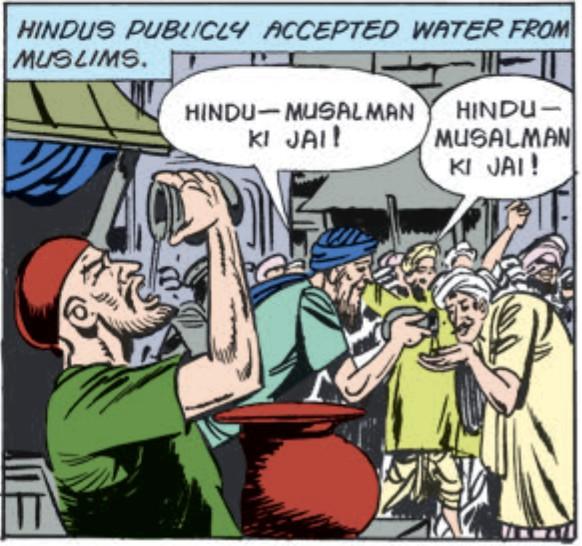
Figure 1. Hindus and Muslims protest together against colonial British rule.24
Said British response in the comics subverts Hindu nationalism, although in a more subtle way. V.D. Savarkar, one proponent of Hindu nationalism, defined his version of the ideology by the ultimate opposition to Islam, claiming that Hindutva rose not out of colonial rule but of repeated invasions of Muslim groups into Hindu life in his manifesto Essentials of Hindutva 25 Savarkar also contends that British society could not even compete with the complexities of Indian culture, rendering its attempts at assimilating Indians into colonial society ineffective in threatening the Indian identity.26 He minimizes the damage of British colonialism on India, and
24 Patel and Waeerkar, 5.
25 V.D. Savarkar, Essentials of Hindutva, 5th ed. (1922), 20, accessed March 26, 2026, https://savarkar.org/en/encyc/2017/5/23/2_12_12_04_essentials_of_hindutva.v001.pdf_1.pdf.
26 Savarkar, 26.
implicitly neutralizes the British Raj as a driving force in India’s social, economic, and political suffering during colonialism.
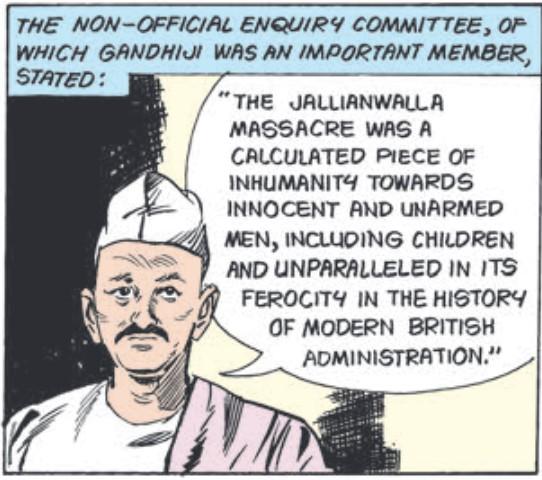
ACK defies Savarkar’s nationalism through a juxtaposition of Mahatma Gandhi’s commentary with Englishmen’s opinions. “Gandhiji,” the honorific he is called in Jallianwala Bagh, decries the massacre as an “inhumanity” and “unparalleled in its ferocity” (see fig. 2).
27
Adding -ji at the end of a person’s name signifies respect and humility in Indian culture. Placing this name alongside a panel criticizing the British indicates that Amar Chitra Katha supports Gandhi’s evaluation of the massacre. On the next page, the comic includes a panel of English people exclaiming that Dyer was “being made the scapegoat of politicians” and that he “saved the British empire!” (see fig. 3).
28 This dichotomy of opinion allows an inference that ACK is implicitly critiquing British policy during colonialism, directly contradicting Savarkar.
27 Patel and Waeerkar, Jallianwala Bagh, 28.
28 Patel and Waeerkar, 29.
29 Patel and Waeerkar, 28.
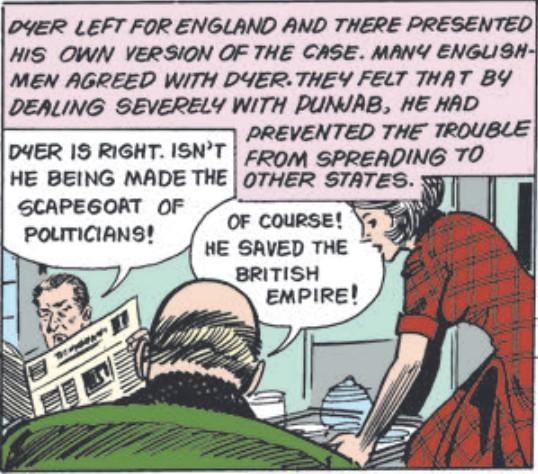
Figure 3. British citizens respond to Dyer’s actions in the massacre and the ensuing uproar.
30
In the face of a greater, dominant foe, Hindus and Muslims join together in Amar Chitra Katha. The comics intentionally very rarely depict non-South Asian peoples, connecting back to Pai’s goal of teaching Indian children about India. So, when the authors choose to use panel space to show non-South Asian opinions, it is for important narrative and ideological reasons; in this case, to affirm the company’s support of Indians during and after the Jallianwala Bagh massacre. The subversion of Hindu nationalism in Jallianwala Bagh is demonstrated by the emphasis of solidarity (the sharing of water) between Hindus and Muslims as well as the condemning of the British military’s actions during the massacre. Without these two important elements, Jallianwala Bagh would be Hindu nationalist and not truly support interreligious equality.
Despite this successful equalization of Hindus and Muslims, the comics of Amar Chitra Katha largely exist to support a narrative that seeks to undermine Islam in favor of Hinduism.
30 Patel and Waeerkar, 29.
These comics utilize the visual aspect of graphic narratives to present a pro-Hindu nationalist rhetoric, particularly through the inclusion of facial features to make a character less appealing or more.
Visuals and Storytelling
The first element of a comic the reader sees are the visuals. Comic panels allow the reader to view what may be more difficult to explain in prose: for example, emotions, particular actions, and expressions.31 Thus, comics provide a clearer picture of what exactly the author(s) intend to portray more so than prose. However, it also opens another line of interpretation for the reader to contend with alongside of prosaic dialogue and narration. In this sense, there is a certain balancing act that authors must take to ensure that panels portray what is required to understand the situation fully and also to allow interpretations of the panels.
Framing this within the context of Amar Chitra Katha’s comics, they do just that: present visual panels and allow interpretations of them. The artists utilize brightly colored inks and dramatic compositions to draw their intended audience of young, impressionable Indian children to open their comics to the first page. Beyond surface-level intention, however, exists a deeper issue with Islamophobia, Hindu nationalism, and depictions of marginalized groups.
Visually, the artistic choices of the ACK graphic artists reveal the comics’ biases through depicting Muslim characters with common stereotypes, and by making them significantly uglier than their Hindu counterparts.
The idea of “ugliness” in of itself holds political and social implications for the views of Indians on classical Muslim leaders. In her essay The Politics of Ugliness, Ela Przybyło
31 Gabriel Sealey-Morris, "The Rhetoric of the Paneled Page: Comics and Composition Pedagogy," Composition Studies 43, no. 1 (2015): 36, https://www.jstor.org/stable/43501877
discusses the idea of ugliness as representing the “irrational, evil, disorder, dissonance, irregularity, excess, deformity, the marginal: in short, the Other.”32 Instead of appearances being viewed as a spectrum within this definition, beauty and ugliness create a binary: one can only be beautiful or be ugly. Przybyło extends this to external forms of discrimination, including racism and classism. In the case of Amar Chitra Katha, the binary view of appearance creates a framework for what is “good” and what is “bad.” By presenting Muslim characters as ugly and violent individuals, Amar Chitra Katha presents its stance on Islam and its support of Hindu nationalism.
Shivaji (1971)
Chhatrapathi Shivaji (1627 - 1680 CE), colloquially known as Shivaji, was the emperor of the Hindu Maratha empire. He grew up under the Bijapur Sultanate and had several encounters with Mughal rulers such as Aurangzeb and Afzal Khan.33 Having defeated the oppressive Muslims as a Hindu, Shivaji is considered the champion of modern Hindus today, a designation that led to controversy when academic James Laine was arrested and given a death sentence for critiquing Shivaji in his novel Shivaji: Hindu King in Islamic India. 34 Shivaji holds cultural and religious significance for India today, both as a Hindu ruler and as an impressive military strategist.35
32 Ela Przybyło, The Politics of Ugliness, 4, accessed March 26, 2026, https://www.gla.ac.uk/media/Media_180322_smxx.pdf
33 Vinay Lal, "Shivaji and the Marathas," UCLA Social Sciences, accessed April 13, 2026, https://southasia.ucla.edu/history-politics/mughals-and-medieval/shivaji-and-the-marathas/.
34 Vinay Lal, "Shivaji and the Politics of History," UCLA Social Sciences, accessed April 13, 2026, https://southasia.ucla.edu/history-politics/mughals-and-medieval/shivaji-politics-history/
35 Lal, "Shivaji and the Politics."
Many Hindu scholars have cited him in their manifestos. Savarkar details his thoughts on the victorious Maratha emperor in Essentials of Hindutva, describing Shivaji as having “electrified the Hindu mind all over India.”
36 To him, Shivaji’s following is a “cult,” a group of people, Hindus, blindly following a man. However, Shivaji gives Hindutva followers a world in which these Hindus can maintain religious supremacy over Islam.
Amar Chitra Katha falls into this cultish following. Shivaji’s eponymous ACK comic details his rise from a young, principled noble to fearless leader of one of India’s most powerful modern empires, with his main conflicts against two of his greatest foes in the comic, Afzal Khan and Siddhi Johar. Both generals were dispatched by the head of the Bijapur Sultanate, Ali Adil Shah II, to quell Shivaji’s invasions of the sultanate, in different instances.
37
To put it succinctly, the illustrator of Shivaji, Pratap Mulick, depicts Khan and Johar as uglier than Shivaji. Shivaji’s beard is well-kept, dark, and thick, a symbol of the stately emperor he becomes (see fig. 4).
38 In contrast, Johar and Khan have thin, unkempt facial hair. Unlike the fit Shivaji, they are both heavyset (see figs. 5 and 6).39 Personality-wise, the generals are aggressive, temperamental, and in moments of shock, their ugliness is magnified (see figs. 7 and 8).
40 Following Przybyło’s earlier argument, Khan and Johar’s ugliness is not meant to accurately depict historical fact but instead imply their moral incorrectness compared to the Hindu Shivaji.
36 Savarkar, Essentials of Hindutva, 24.
37 B.R. Bhagwat, Shivaji, illus. Pratap Mulick, ed. Anant Pai (Amar Chitra Katha, 1971), 11, 17, accessed April 13, 2026, https://digital.amarchitrakatha.com/viewer/?id=005835067
38 Bhagwat, 24.
39 Bhagwat, 11, 18.
40 Bhagwat, 12, 17.
41
42 Bhagwat,
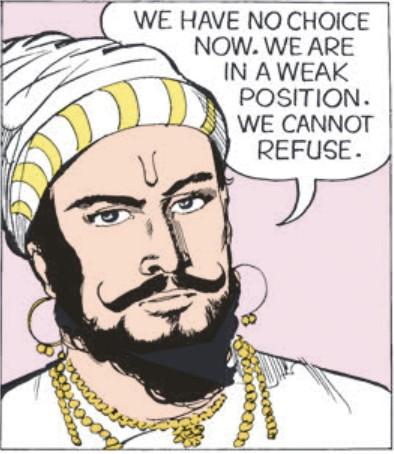
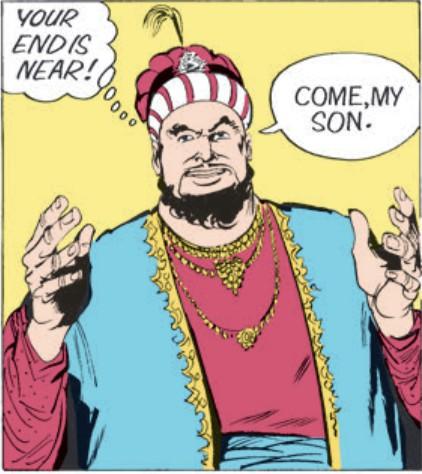
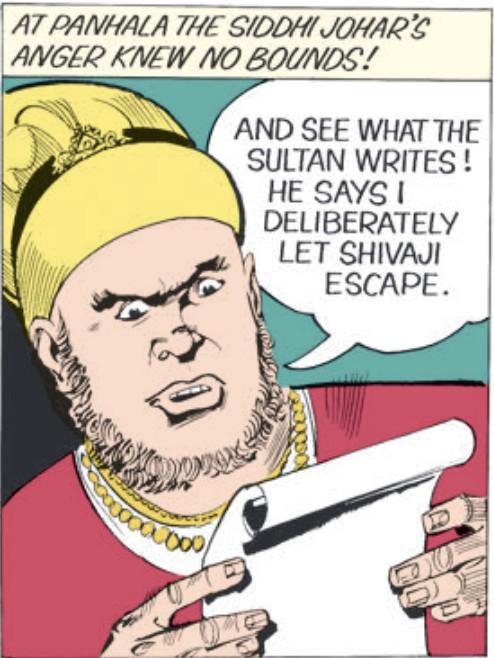
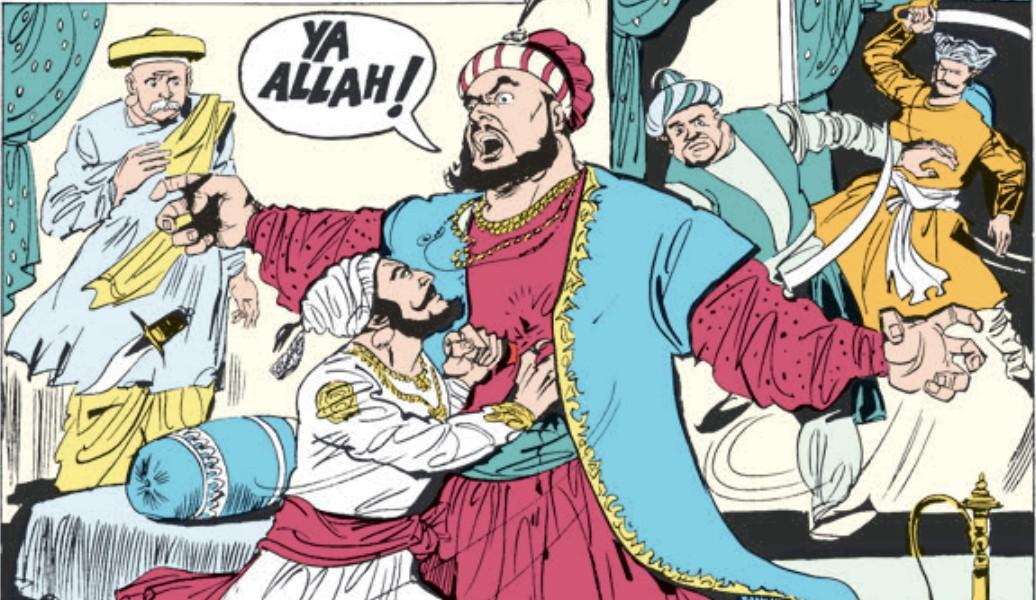
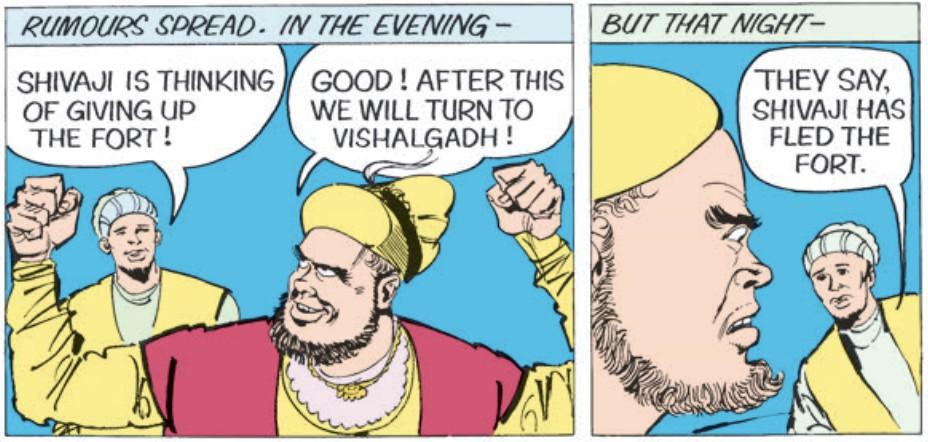
Figure 8. Siddhi Johar’s brief celebration, then anger at Shivaji’s escape from the Panhala Fort.45
Despite the beard traditionally stereotyped in the West as an inherently Islamic trait, ACK subverts such Orientalism yet resorts to the idea of intra-cultural supremacy, as the comic depicts Shivaji growing up in Bijapuri society.46 That Shivaji can conform to the same standard of appearance as Khan and Johar by having a mustache and beard, yet supersede them significantly in the quality of that characteristic, only further confirms his inherent ideological and religious supremacy to the two generals and the sultanate they vow to protect. Thus, there exists a binary within the comic, defined by parameters that even exist outside of the supposed standard of beauty itself. Those parameters are what differentiate Shivaji and his enemies; Shivaji, the courageous, young, dashing ruler ready to fight for his rightfully Hindu land versus the heavyset, cowardly Muslim leaders of the corrupt sultanate. The reason that Shivaji is handsome is because of his morality, just as the sultan’s generals is their lack thereof. This issue extends beyond
45 Bhagwat, 17.
46 Bhagwat, 5.
Shivaji and his foes, occurring even when there are no Hindus to compare to Muslims. For example, the comic Sultana Razia details the life of one Muslim leader of the Delhi Sultanate.
Sultana Razia (1976)
Razia (1205 - 1240 CE) was the first and only female ruler of the Muslim Delhi Sultanate. Though named heir apparent by her father, Iltutmish, Razia’s brother ascended to the throne after Iltutmish’s death. Subsequently, Razia rebelled against his rule to gain control of the sultanate.47 In her ACK comic, Razia’s foes in the palace Muslim nobles threatened by the influence of a powerful woman are given the same “villain treatment” as Ali Adil Shah II’s generals in Shivaji.
Here exists another example of the comic preemptively demonstrating to the readers the perspective ACK believes the reader ought to take through visual representations. The depiction of Nizam-ul-Mulk (the prime minister in the sultanate’s court) exemplifies the sheer amount of control that ACK’s artists have over audience perspectives. Through one frame, the illustrator removes all nuances behind the Nizam-ul-Mulk’s reasoning; his appearance determines his character instead of his actions in a manner like that of Afzal Khan and Siddhi Johar. Because he is not morally righteous, the Nizam has a negative outward appearance.48 Additionally, his commentary is kept somewhat vague, further emphasizing the dependence on visual appearance to determine Amar Chitra Katha’s perspective. He asks in response to the reading of the emperor’s will, “How could his Majesty do such a thing?” The issue is better clarified in the next
47 Peter Jackson, The Delhi Sultanate: A Political and Military History (Cambridge University Press, 1999), 46-7, accessed March 26, 2026, https://books.google.com/books?id=lt2tqOpVRKgC&lpg=PA3&ots=O6mS6mQDoX&dq=%22delhi%20sultanate% 22&lr&pg=PR5#v=onepage&q&f=false
48 Ram Waeerkar, illus., Sultana Razia, ed. Anant Pai (Amar Chitra Katha, 1976), 4, accessed April 13, 2026, https://digital.amarchitrakatha.com/viewer/?id=005835170.
panel, where the Nizam’s fellow courtiers explain their views in a more direct manner: “How can we swear allegiance to a woman?”49 Like Khan and Johar, the Nizam and the other courtiers are drawn ugly; they have pronounced wrinkles, sharply-drawn, bold eyebrows, and thin slits for eyes one is also drawn as heavyset (see fig. 9).50 Their appearances only reflect Amar Chitra Katha’s evaluation of them in the context of their rejection of Razia as the next ruler of the Delhi Sultanate. Because ACK considers them to be morally “bad,” they are ugly, and not for any attempt at historical accuracy. The comic does not even need to present a comparison in the form of a handsome, righteous, Hindu man like Shivaji because it is already made clear to the reader that the courtiers’ appearance is supposed to reflect their internal values, or more accurately, ACK’s evaluation of their morality.
49 Waeerkar, 4.
50 Waeerkar, 4.
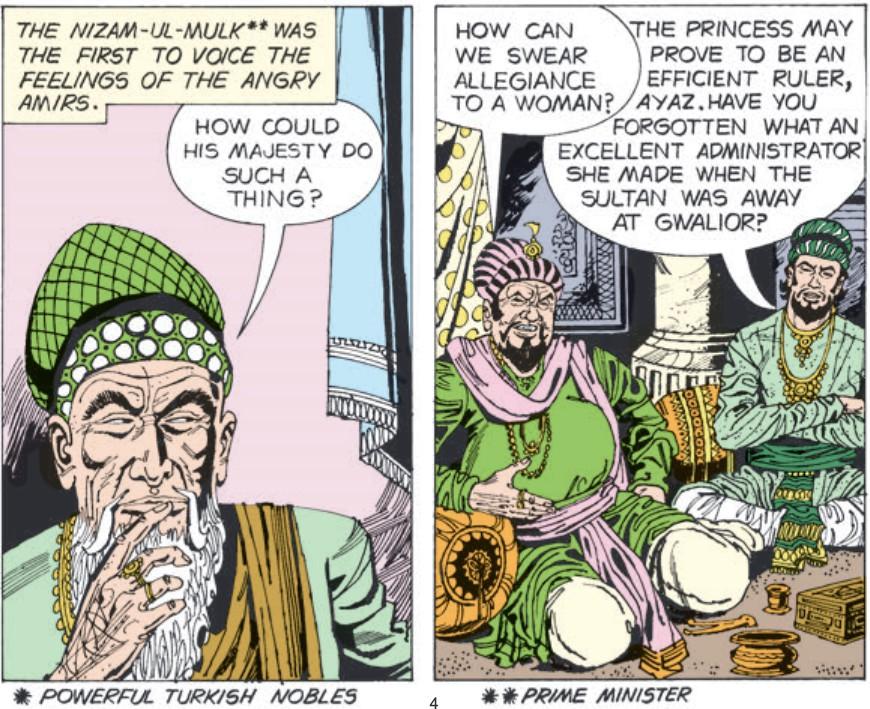
Figure 9. The courtiers of the Delhi Sultanate react to Iltumish naming Razia his successor.51
Such moral valuations act as a deterministic filter that Amar Chitra Katha can utilize to ensure that the reader believes what the company wants them to believe without even needing to incorporate any narrative elements. In fact, the ugliness of a character in a comic can have greater implications for the depiction of their actions and achievements later on in the narrative, as seen in the comic The Historic City of Delhi with the Muslim ruler Qutbuddin Aibak.
The Historic City of Delhi (1983)
The city of Delhi has a rich history rooted in past Hindu-Muslim conflict. Initially founded by the Rajputs, it was then invaded by Muhammad of Ghor and transferred through 51 Waeerkar, 4.
Mughal hands until the British colonized India.52 It remains the capital of modern India today, an architectural juxtaposition of the classical past and globalized present.
ACK’s comic The Historic City of Delhi details the Hindu-Muslim conflicts of Classical India up until British entry. After Muhammad of Ghor’s death, Qutbuddin Aibak inherited the city. The comic is accurate in that Aibak had been enslaved since childhood, and that his dynasty now more commonly known as the Mamluk Dynasty was named as a result of his origins.53 However, Aibak’s visual appearance presents to the reader a senile and weak ruler, not one who had the influence and power to found one of the most powerful kingdoms in India during the medieval period. In the panel, Aibak’s face is small, his eyes half-closed as though he is asleep; his mouth is half-open, giving the appearance that he is in a daze. The harshly drawn wrinkles on his face and the slight thinning of his beard further add to the king’s aged appearance (see fig. 10).54 Similar to other Muslim figures, Aibak’s appearance indicates ACK’s evaluation of his achievements and his morality.
52 Kulke and Rothermund, A History, 204-5.
53 Luis M. Fernandes, The Historic City of Delhi, illus. Arvind Mandrekar, ed. Anant Pai (Amar Chitra Katha, 1983), 3, accessed April 13, 2026, https://digital.amarchitrakatha.com/viewer/?id=005835155; Kulke and Rothermund, 199.
54 Fernandes, 3.
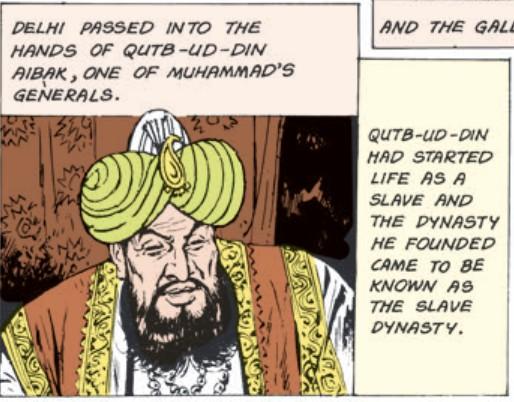
Figure 10. Qutbuddin Aibak, a monarch of the Delhi Sultanate, as depicted in The Historic City of Delhi.55
Qutbuddin Aibak’s contribution to Indian society, the architectural marvel of the Qutb Minar, is additionally overlooked. The only mention ACK makes of one of India’s most popular modern tourist destinations is “Some years later, the conqueror began to build the Qutb Minar, probably to commemorate his victories in India. But he did not live to see it finished” (see fig. 11).
56 The comic makes no attempt to separate the monument from its inherently Muslim origins. Consequently, they lessen the cultural impact the Qutb Minar has on India as a whole, and its value as part of a tapestry of the complex past of India’s capital.
55 Fernandes, 3.
56 Fernandes, 3.
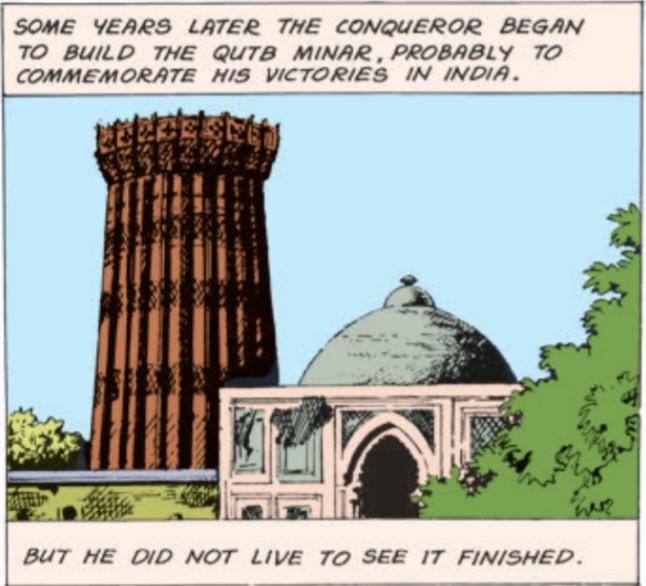
Figure 11. The comic’s commentary on Emperor Qutbuddin Aibak’s role in building the Qutb Minar.
57
This example demonstrates another issue beyond singular instances of negative depictions. The space that any kind of historical literature takes to explain a particular event compared to another skews the reader’s perspective of events. If, for example, in an anthology of famines the author takes twenty more pages to explain the English monarchy’s role in the Irish Potato Famine compared to explanation of the British Raj’s role in the Bengali famine, a neophyte to famines will glean the understanding that the injustice imposed on the Irish was more severe than that imposed on the Bengalis. To further this analogy, if the author utilizes a majority of their chapter on the Bengali famine to explain the Bengal population’s inadequacy for basic farming techniques, the neophyte reader will then glean that the Bengali famine can be partially blamed on the victims and that the Irish famine was solely caused by the oppressive actions of the English government. In the case of Amar Chitra Katha, the neophytes are not just
57 Fernandes, 3.
neophytes to history and comics but to reading in general the young, preteen children of India. What these children glean from reading ACK is more determined from the singular source of the comics than any nuanced view they could have from reading multiple perspectives of the same events.
This is all to say that one does not need to know how to read to understand what ACK wants them to believe; or, in the case of many Indian children, believe what ACK wants them to believe. Without incorporating some level of nuance, without making any attempt to remain neutral, ACK indoctrinates their audience into a particular mode of thinking one which they spend dozens of other issues convincing impressionable young children to align to further. That particular mode of thinking is Hindu nationalism; and, despite the concession made earlier, nationalism remains dominant throughout many of the comics.
Beyond visual choices, the narratives of comics also have a large influence on the reader. Because Amar Chitra Katha comics are proposed to be rooted in historical fact, decisions must be made as to what to include about a historical figure and what to omit. Such decisions, whether intentional or not, can influence the reader’s perspective on a figure, and consequently support or subvert Hindu nationalism.
Separating the Muslim From Islam
In the case of famous Mughals like Akbar and Shah Jahan, ACK avoids contending with their religious beliefs by framing their actions outside of Islam itself. The comics’ narrative strives to distance certain Muslim characters from the Islamic faith, thus implicitly justifying ACK’s support of them albeit the existence of a Hindu supremacist ideology. This directly plays into Hindu nationalism because Amar Chitra Katha is mostly unable to support Muslim historical
figures unless they do not appear to be very Muslim at all; that is, the only way they can support Muslims is by making them the least devout as possible. ACK gives the audience a reason to appreciate the protagonist by separating them from their own faith through particular narrative choices.
Akbar (1979) and Tales of Birbal (1977)
Akbar (r. 1556 - 1605) is considered the greatest Mughal emperor, having retained more control over India than any ruler before or after him. In reality, he was particularly tolerant of religions other than Islam, and organized a highly effective and centralized government.58 ACK’s eponymous comic Akbar depicts a strong emperor: his vulnerabilities are few and far between, and balanced out by his advisor Birbal, but his wisdom and affinity for religious tolerance, to such an extent that he would create his own religion, contribute to ACK’s overall favorable depiction of him.
Although Akbar was a Mughal and Muslim, he had a Hindu wife. ACK specifically points out that “Akbar even allowed his wife to celebrate her festivals in court and joined in them himself.” However, the “orthodox” mullahs (Muslim religious leaders) believe he had “taken the advice of the infidels” (see fig. 12).59 His ignorance of traditional Islamic law that requires non-Muslim spouses to convert to Islam before marrying into the faith is an infraction against the traditionalist views of the mullahs, or against Islamic doctrine in general. Here lies the first instance of Akbar “violating” Islam.
58 Metcalf and Metcalf, A Concise, 17.
59 Toni Patel and Souren Roy, Akbar, ed. Anant Pai (Amar Chitra Katha, 1979), 21, accessed April 13, 2026, https://digital.amarchitrakatha.com/id005835096
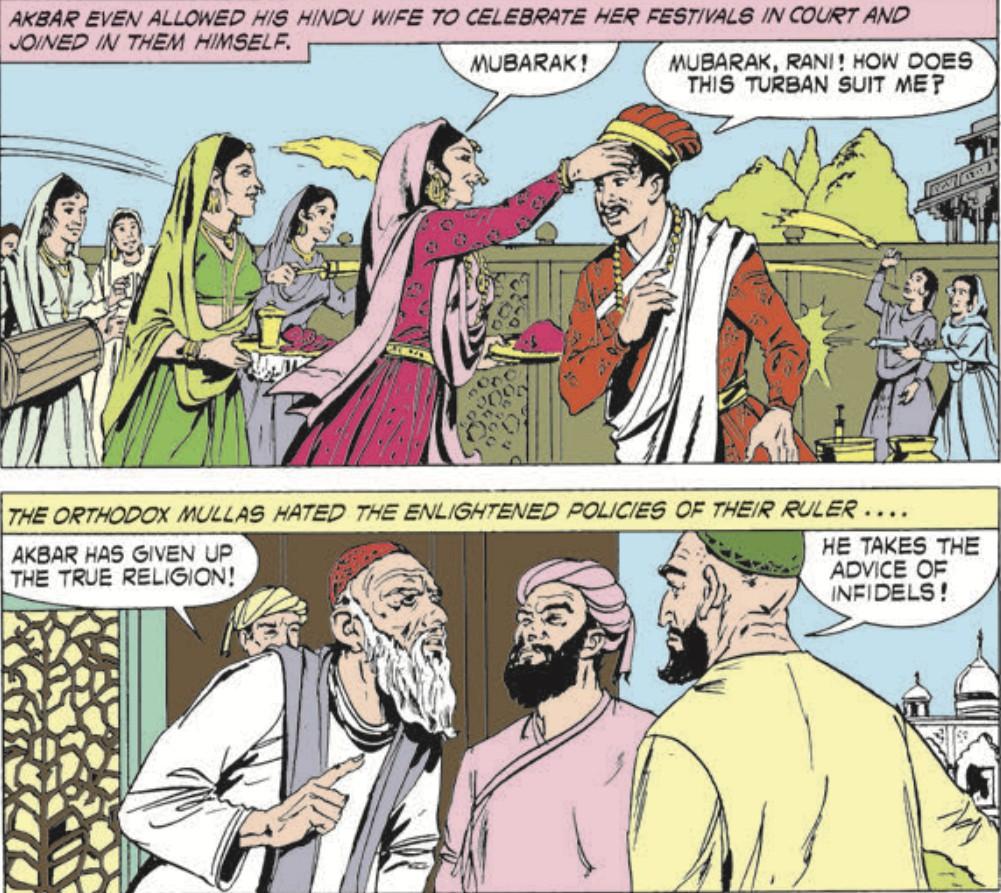
Figure 12. Orthodox religious leaders react to Akbar participating in Hindu festivals.60
One of Akbar’s reforms was implementing a tax (jizya) on conquered territories, which included people of many faiths. In the comic, a courtier compliments that Akbar had “abolished the hateful jizya tax,” and the footnote on jizya only mentions that it was levied on Hindus and not Muslims, despite the fact that in reality, the tax was levied on anyone not Muslim.61 In response, Akbar says, “[My subjects’] loyalty is more important to me than their faiths” (see fig. 13).62 Here, ACK utilizes their narrative power to emphasize to their mostly Hindu audience that
60 Patel and Roy, 21.
61 Patel and Roy, 21; Metcalf and Metcalf, A Concise, 18.
62 Patel and Roy, Akbar, 21.
Akbar, the benevolent ruler, went out of his way to rid the empire of a policy that, according to the comic itself, hurt Hindus specifically. Thus, Akbar not only internally distances himself from Islam, but also demonstrates open tolerance towards Hindus in his comic.
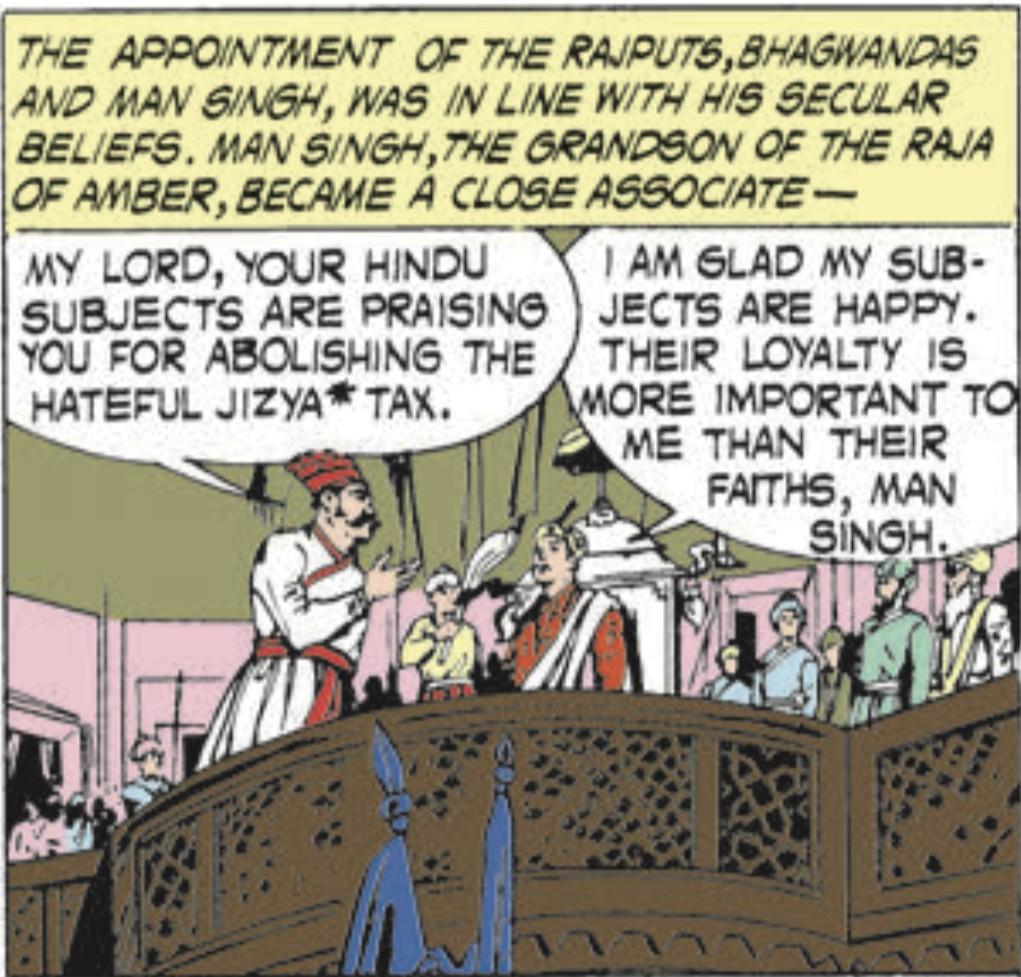
Figure 13. Akbar and his courtier, Man Singh, discuss Akbar’s abolition of the jizya tax in Akbar. 63
According to his comic, Akbar implements many policies throughout his reign, and ACK chooses to depict the Hindu orthodox response. One Hindu declares, “Akbar has decreed against child marriages,” and another’s response to this is, “It is really too bad that he interferes with our age-old customs!” (see fig. 14).64 Here, ACK props up Akbar’s own morality compared to the modern day, and gives a mechanism for the reader to believe that the comics are not Hindu
63 Patel and Roy, 21.
64 Patel and Roy, 22.
nationalist. Because ACK critiques the old doctrine and traditions of Hinduism, in this singular exception, they cannot support Hindu nationalism.
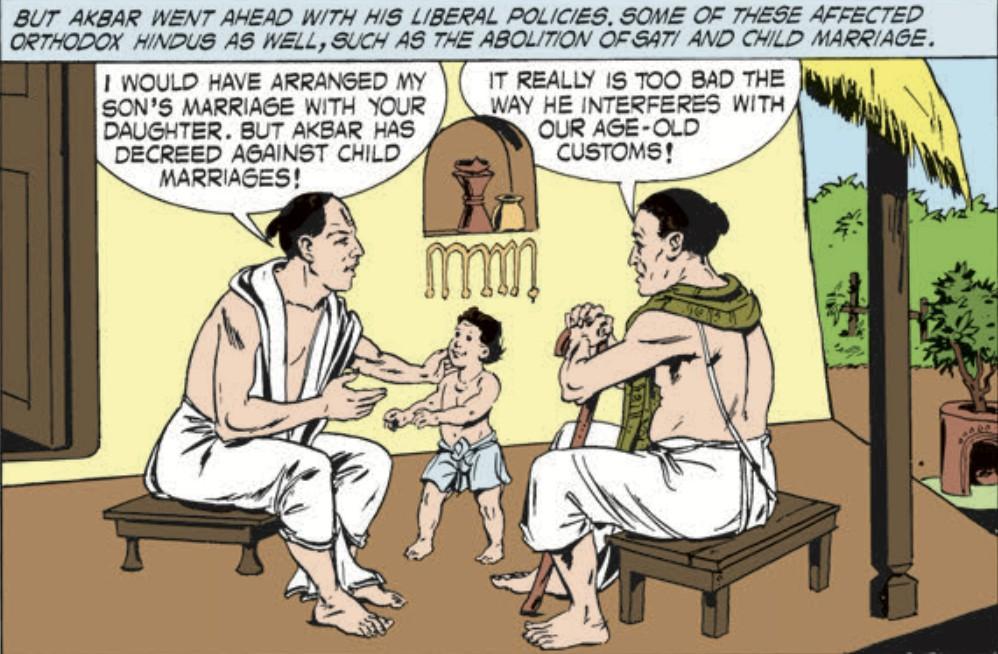
Figure 14. Orthodox Hindus criticize Akbar’s “liberal policies,” including child marriage.65
The most important piece of evidence to support that Akbar distanced himself from Islam in reality is that he created his own syncretic religion called the Din-e-Elahi. Its doctrine combines aspects of Islam, Hinduism, and other religions, but is arguably more of a cult of personality for Akbar, who handpicked followers himself.66 By creating his own religion, Akbar clearly could not reconcile his own moral values entirely with the Quran or with the Bhagavad Gita, which further supports his lack of belief in Islamic doctrine in reality.
Another aspect of Akbar is his relationship with Birbal, his chief advisor. Birbal has his own series of comics entitled Tales of Birbal, in which he aids the emperor in outwitting his
65 Patel and Roy, 22.
66 Kulke and Rothermund, A History, 248-9.
opponents and making just decisions for his people. ACK notes that Birbal considers himself Hindu, but emphasizes his wit, cleverness, and ability to aid the emperor with whatever he needs.
In the first installment of Tales of Birbal, Birbal foils a plot to kill Akbar entirely by himself, demonstrating his loyalty to the emperor over religious differences.67 But even those differences erode eventually; ACK notes that “of the followers of Dine-e-Elahi, the new faith preached by Akbar, there was only one Hindu Birbal.”68 ACK does not mention that the religion existed mostly as a cult of personality for Akbar, but suggests that Birbal, in all his cleverness, chose to follow the benevolent ruler’s new religious doctrine because he truly believed in its merits. Because Birbal a Hindu gives credibility to Akbar's distancing from Islam, readers can glean that although Akbar is a Mughal, he is a good emperor who can be trusted because he technically is not Muslim.
There are two justifications for Akbar’s lack of belief in Islam. The first is that Akbar commits many actions contrary to Quranic doctrine, including marrying a non-Muslim without converting and creating his own syncretic religion with aspects of Islam and Hinduism included.
The second is that his chief advisor, Birbal, a Hindu, gives credence to Akbar’s lack of Islamic-ness by choosing to follow the emperor’s new religion. Had Akbar decided to be Muslim in all forms, Birbal would remain in disagreement in the comics, but their shared religion bridges the gap between one and the other. Akbar remains credible because of his lack of Islamic-ness combined with his largely tolerant logic in his comic. Because he is apparently not Muslim, ACK can present him positively. Although Akbar appears to be a subversion to Hindu nationalism, his comic in fact supports it; the reason that Amar Chitra Katha can portray Akbar
67 Anant Pai, Birbal the Wise, illus. Ram Waeerkar, ed. Anant Pai (Amar Chitra Katha, 1977), 9, accessed April 13, 2026, https://digital.amarchitrakatha.com/viewer/?id=005835050.
68 Ram Waeerkar and Dev Nadkarni, Birbal the Wise (Amar Chitra Katha, 2008), 1.
positively is because the comic separates Akbar from his faith by emphasizing particular, more tolerant aspects of his life over others. The same portrayal of a lack of belief in Islam is true for his fellow Mughal leader, Shah Jahan, and impacts the comics’ evaluation of him in the same manner.
Shah Jahan (1979)
Shah Jahan (r. 1627 - 1658) was a ruler of the Mughal Empire.69 His most famous architectural accomplishment is arguably the Taj Mahal, which stands as a pride of India today. The emperor constructed the mausoleum as a dedication to one of his wives, Mumtaz.70 Of importance is that the building includes inscriptions of the entire Quran carved into its marble walls.71 Thus, the Taj Mahal is not only a cultural piece of art, but also holds religious significance within the context of the development of Islam in India.
Shah Jahan, despite being a Muslim ruler, has a positive portrayal in ACK as a result of the Taj Mahal. ACK distances the monument in of itself from its Muslim meaning, presenting it only as the result of the simple love that a man had for his wife. The Taj Mahal is an inherently religious structure, as Shah Jahan intentionally inscribed Quranic verses to demonstrate his faith a faith that while he sometimes had difficulty contending with, still believed wholeheartedly.72 Amar Chitra Katha, in their brief description of the monument, only mentions
69 Metcalf and Metcalf, A Concise, 1.
70 Kulke and Rothermund, A History, 252.
71 Michael D. Calabria, Language of the Taj Mahal: Islam, Prayer, and the Religion of Shah Jahan (I.B. TAURIS, 2021), 268, http://ebookcentral.proquest.com/lib/harker-ebooks/detail.action?docID=6793896
72 Calabria, 268.
that it is “the world’s greatest monument to true love” (see fig. 15).73 By separating the monument from its religiosity, ACK forces it to have a secular Indian identity as opposed to an Islamic, Mughal one. Although one could interpret this as the result of the Taj Mahal having been lauded as a tourist destination in India, not an Islamic one, the fact that ACK, a creator of historical comics, ignores this very important aspect of the Taj Mahal indicates that they are willing to select and discard particular aspects of Indian history when it serves an overarching Hindu supremacist narrative well.
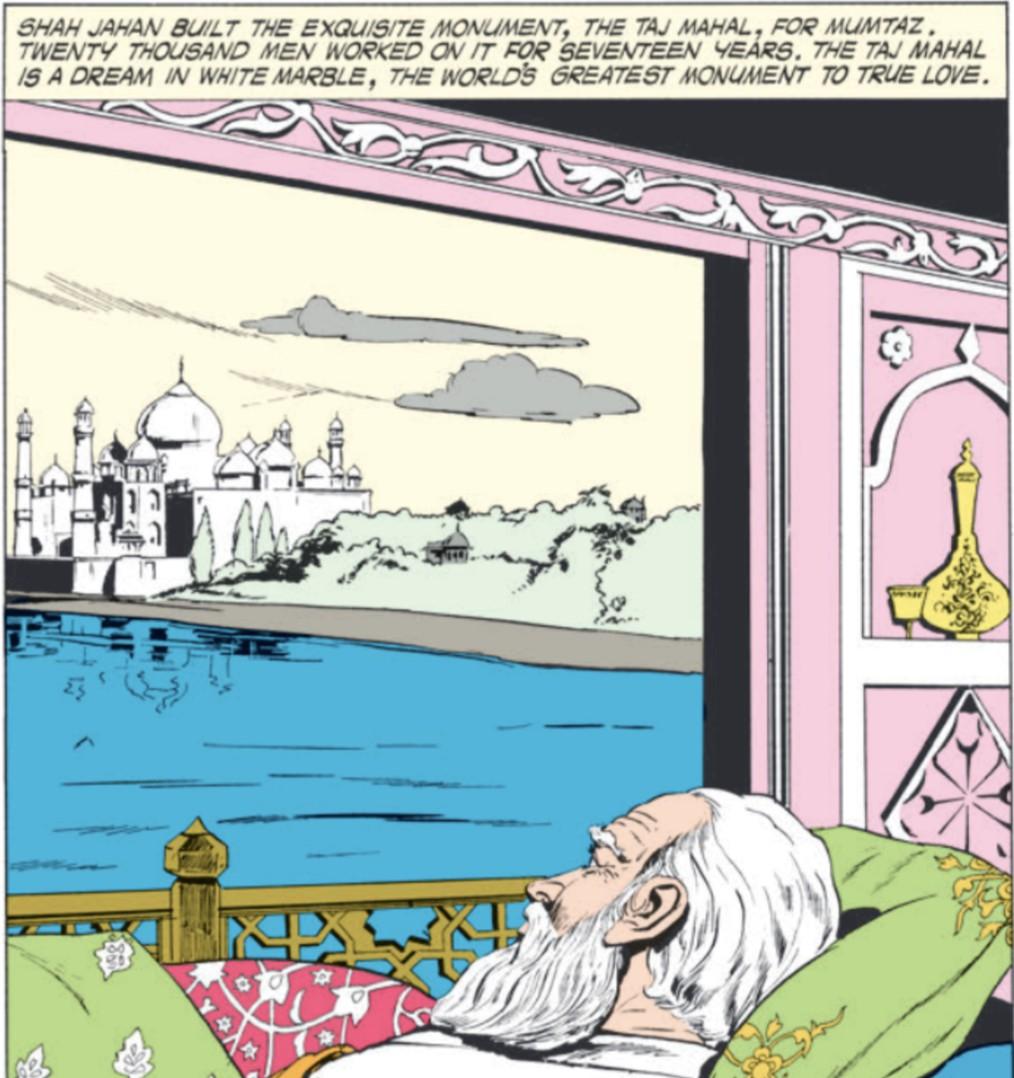
Figure 15. An aged Shah Jahan looks upon the Taj Mahal “the world’s greatest monument to true love.”74
73 Coomi B. Chinoy and Souren Roy, Shah Jahan, ed. Anant Pai (Amar Chitra Katha, 2015), 31, accessed April 13, 2026, https://digital.amarchitrakatha.com/id005835126/Shah-Jahan.
74 Chinoy and Roy, 31.
ACK’s depiction of the Taj Mahal contrasts with the earlier criticism of the Qutb Minar; both are monuments built by Muslim figures, after all. The disparity between ACK’s presentations of the Taj Mahal and the Qutb Minar can be explained by the comics’ depictions of their architects. Aibak appears the definition of incompetency: he is not noble-born and trained, and there lacks panel space in The Historic City of Delhi to display Aibak’s many military achievements. Shah Jahan, in comparison, has an entire comic dedicated to his romantic personality and inherent morality, culminating in his shrine to honor his wife nothing more than a dedication to the person he loved most. In the view of the comics, the Qutb Minar is Muslim first and Indian second, and the Taj Mahal vice versa.
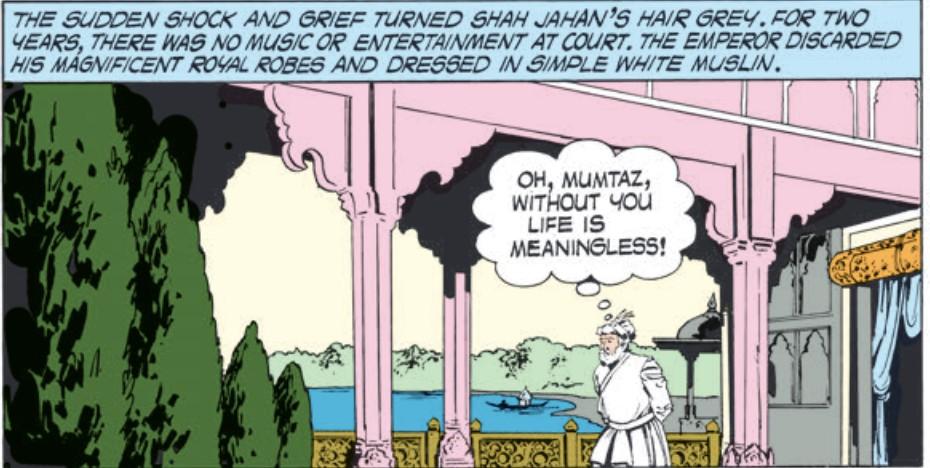
Additionally, Shah Jahan avoids the hyper-militant nature of South Asian empires during the classical period by framing the Mughal emperor through his devotion to one particular aforementioned wife, Mumtaz. Muslims in the Amar Chitra Katha comics are consistently depicted as violent and aggressive, so humanizing Shah Jahan further removes him from this stereotypical version of the Islamic identity. The comic focuses on the Shah’s grief after his wife’s passing, in particular his refusal of “music or entertainment at court” and that he “discarded his magnificent royal robes and dressed in simple white muslin” (see fig. 16).75 Shah Jahan becomes a regular human through his grief, exemplified by the avoidance of opulence in his court following his wife’s death. Amar Chitra Katha notes that although the emperor was once one of the most powerful men in the world, Shah Jahan still experiences grief just as commoner populations did. He is no longer the unattainable monarch, but the man in love, a story so universal it can speak to almost everyone.
75 Chinoy and Roy, 30.
76
Figure 16. Shah Jahan grieves the death of his wife, Mumtaz, as he walks around the Mughal palace.
Shah Jahan and Akbar are only depicted positively by Amar Chitra Katha because the comics do not contend with their Islamic background. By removing any personal trace of religiosity, Shah Jahan and Akbar can proudly proclaim the achievements of their eponymous rulers as India’s own and not restricted to the Islamic faith. In the case of Akbar, his comic emphasizes his circumvention of orthodox Islamic doctrine. With Shah Jahan, his monument is given no meaning beyond love, ignoring the obvious context of faith behind it; and, consequently, his character is humanized to such an extent that the audience sees the vulnerabilities in the unshakable ruler. Amar Chitra Katha should not need to do this in order to present Muslim leaders fairly in fact, it indicates that in the view of the company, it is almost impossible for a devout Muslim to be of good moral character if the protagonist’s comic must distance himself from his faith to present him in a positive light.
76 Chinoy and Roy, 30.
Amar Chitra Katha contends with its Muslim characters’ faiths by presenting particular actions, that, when viewed together, appear to support the argument that these Muslim characters lack faith almost entirely. This is just one narrative decision that ACK takes in regard to some protagonists. However, the comics also utilize the idea of the hero story to present certain historical figures in an idealized light, even some who are Muslim.
The Hero Story in Amar Chitra Katha
As a literary plot structure, the hero story serves to develop the transformation of the protagonist. Generally, heroes are a “source of hope and impetus for action … without requiring major recognition.”77 Their trajectories are inspiring to readers, and it is because of that inspiration that hero stories are also easily digestible propaganda. One example of this propagandizing, as philosopher Jimmy Mahardika puts it, is the Psychological Compensation Theory (PCT): that hero stories contain “stability fantasies,” “problems simplified to individual conflicts,” and “agency transferred to exceptional figures” to justify popular support of billionaire, elitist, superheroes. PCT answers the question as to why audiences feel alignment towards inherently oppressive superhero figures.78 By removing historical nuance from the narrative, the author directs readers towards a binary view of reality that forces them to align with the “good” ideology instead of the “bad” one. Although Mahardika contextualizes this theory within neoliberalist capitalism, it also applies to Amar Chitra Katha comics and nationalism.
77 Jimmy Y. Mahardika, Hero Narratives as Relational Fields: Ontology, Privilege Transmutation, and Platform Capitalism from Traditional Warriors to Algorithmic Heroes (PhilPapers, 2026), 6, https://philpapers.org/archive/MAHHNA.pdf.
78 Mahardika, 14.
Many ACK comics contain a hero story: a linear, rigid sequence of events that detail the rise of the protagonist to adulthood, and, sometimes, death. First, the protagonist experiences an inciting incident or absorbs a familial teaching that sparks an unwavering belief in a greater, moral mission for himself. Through interactions with others, his beliefs are outlined clearly, almost overt; however, because of the inherent morality of this mission, the protagonist avoids self-aggrandizement and remains relatively likeable. Over time, as the protagonist ages, his speech becomes more refined and his interactions more diplomatic. The initial beliefs and moral mission remain threaded through each and every one of the protagonist’s actions, with a clear sense of filial duty and piety behind his motives. Within this trajectory is an emphasis on war for peace, or the stability fantasy; a sole protagonist versus a sole antagonist, or the individual, binary conflict; and primacy of the protagonist in power and morality, or an exceptional figure.
ACK’s version of the hero story presents the idea that an inflated ideal of righteousness is present in all “good” children, and directly results in their success (or popular support) later in life. Childhood actions by historical figures are either cherrypicked or made up entirely to justify the protagonist’s actions in adulthood. There is always a clear winner, and the winner is always the protagonist. That is made clear not through the protagonist’s actions as an adult, but from the very moment they begin the narrative. Amar Chitra Katha presents history through a filter in the form of the hero story to give the audiences evaluations of Hindu and Muslim figures the company believes they should have. The Psychological Compensation Theory functions as a framework to view the Amar Chitra Katha hero story, and to evaluate its ability to propagandize historical fact through an idealized life trajectory of the protagonist.
Shivaji (1971)
Chhatrapathi Shivaji’s trajectory in his comic aligns exactly to the hero story, while also playing into Mahardika’s theory of psychological compensation. Instead of pledging fealty to the sultanate, Shivaji appears to grow up with the mindset that he has a right to the lands of the sultan, by way of his father. ACK’s narrative of Shivaji reveals that even as a child, he knows what is “right:” he believes his father is fighting the battles of another (as his father is under control by the Bijapur sultanate), and that that is categorically unfair as his father is a Hindu and on principle, cannot align himself to Islamic policies.79 “This beautiful land is ours!” Shivaji thinks, but ACK avoids painting him as an entitled brat instead, he believes these things because he sees the mistreatment of his Hindu father by the sultanate (see fig. 17).80 Here, Amar Chitra Katha develops Shivaji’s exceptionalness, or Mahardika’s third facet of this theory: his knowledge of what is truly right, even as an impressionable youth.
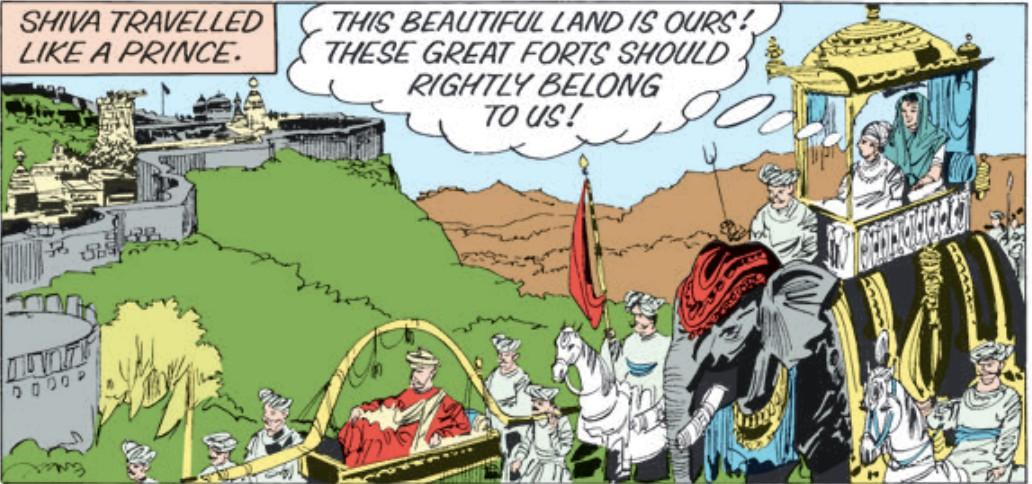
79 Bhagwat, Shivaji, 3.
80 Bhagwat, 5.
81 Bhagwat, 5.
Albeit his open disloyalty to the empire that has given his family their status, Shivaji is never chastised by his comic’s narrative. ACK frames the open rebellion he stages against the sultan not as insubordination, but as a man doing right by his family.82 Without an oppressor, Shivaji would be an incendiary. However, the comic’s construction of Shivaji’s childhood causes audiences to see that Ali Adil Shah II and the Delhi Sultanate are the villains in the story. Thus appears the second facet of Mahardika’s theory: a binary conflict between good and bad.
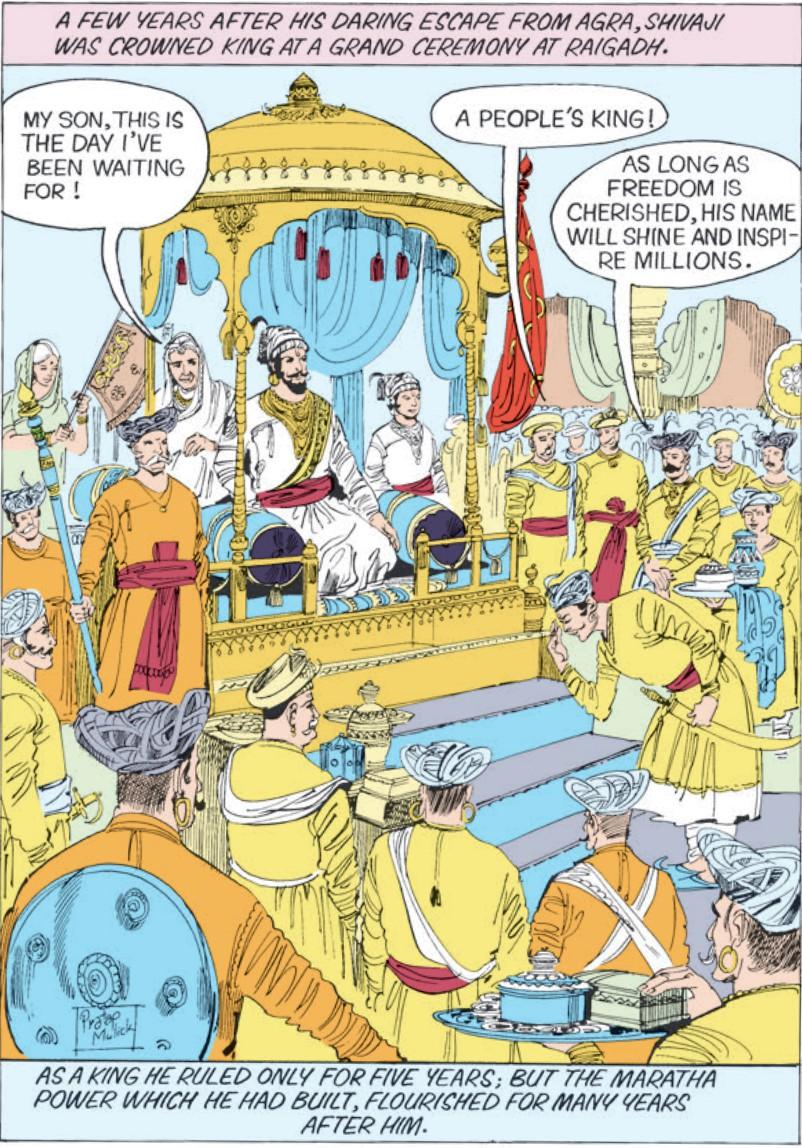
Shivaji fulfills the last facet of PCT, or the fantasy of stability. By the end of Shivaji, he has endured years of war against the sultanate, even going so far as to assassinate Afzal Khan himself. The very last panel of the comic is the picture of a perfect happy ending: the newly coronated emperor Shivaji, sitting on his throne thronged by courtiers with his mother behind him. They sing his praises: “A people’s king! As long as freedom is cherished, his name will shine and inspire millions” (see fig. 18).83 The Maratha emperor has finally seen his labor come to fruition, and the comic ends there. By not ending at Shivaji’s ruthless campaign in South India, or his betrayal against his half-brother, ACK imposes on the readers a sentiment of permanent peace surrounding Shivaji’s brief rule.84
82 Bhagwat, 8.
83 Bhagwat, 32.
84 Lal, "Shivaji and the Marathas," UCLA Social Sciences.
85
85
The Psychological Compensation Theory ultimately gives Shivaji’s hero story a layer of romanticized violence and superiority not necessarily seen by evaluating the comic independently. Mahardika calls out the idea that “the need for agency is fulfilled by fantasies of dependence on elites,”86 in that case being billionaire superheroes. However, outside a capitalist context, PCT can still function as a framework to view hero stories as propaganda. Amar Chitra Katha’s version of Shivaji fulfills the modern middle-class Indian’s need for agency by presenting Muslims as the “other.” Agency, in this context, is not economic, but is the social ideal that postcolonial Hindus themselves can assert their own supremacy over another demographic. Amar Chitra Katha’s presentation of Shivaji’s life trajectory ultimately serves one purpose: to ensure that the audience believes that Shivaji is a good person, and that his foes are morally bad. ACK also utilizes the hero story with some of its Muslim figures, including the Mughal emperor Shah Jahan.
Shah Jahan (1979)
Shah Jahan’s version of the hero story in Amar Chitra Katha affirms the argument that childhood actions depicted in comics are entirely dependent on ACK’s evaluation of the historical figure in adulthood. His life trajectory fits ACK’s hero story despite being a Mughal “invader.” Rather than facing adversity and growing from it, Shah Jahan or Khurram, as he was initially called is a natural born leader, with his grandfather declaring in the comics that he “will be king of the world!” (see fig. 19).87 Such boasts do not go to Khurram’s head; he commits brave acts, such as singlehandedly saving a courtier from a tiger (see fig. 20).88 Here emerges
86 Mahardika, Hero Narratives, 4.
87 Chinoy and Roy, Shah Jahan, 4.
88 Chinoy and Roy, 7.
Shah Jahan’s exceptionalness, which, similar to that of Shivaji, is realized in his youth and does not wane as he continues into adulthood.
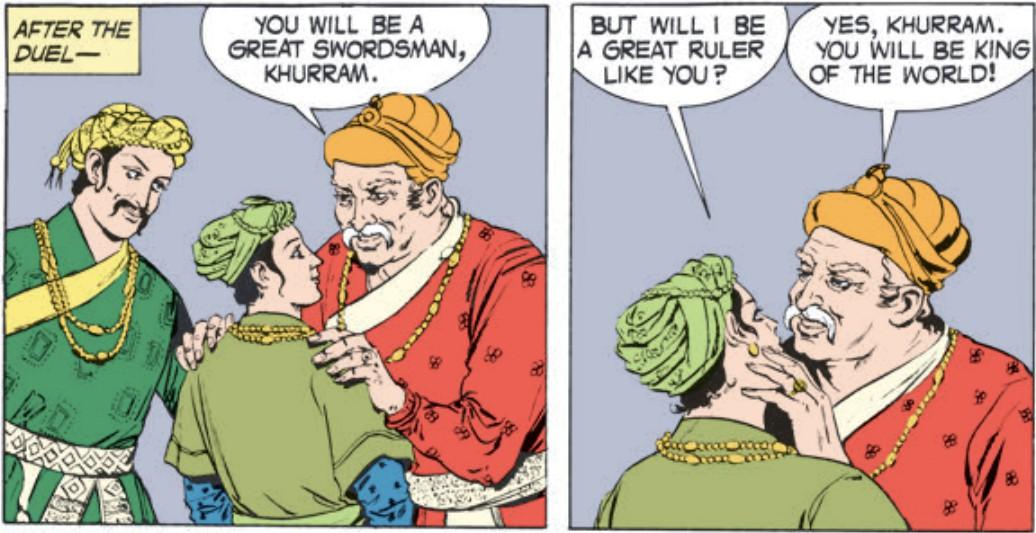
Figure 19. Khurram’s grandfather, the emperor of the Mughal Empire at the time, tells Khurram he will be a great ruler.89
There is a subtle deviation from the aforementioned hero story, however. As a child, Khurram does not have a particular inciting incident; his actions in his youth are only indicative of what ACK evaluates his adulthood as. That is, because Amar Chitra Katha presents Shah Jahan as a “good” ruler in his adulthood, he deserves and gets the ideal childhood fable of bravery and courage.
Shah Jahan continues his comic’s narrative in a similar fashion to Shivaji; after years of turmoil, stability returns to his life when he is coronated emperor at Agra. The comic ends at the Shah’s death as he looks upon the Taj Mahal, one of India’s greatest architectural achievements. Amar Chitra Katha’s final words on the emperor are “He was buried beside his beloved Mumtaz
89 Chinoy and Roy, Shah Jahan, 4.
Mahal.”90 By avoiding commentary on the tense future of the Mughal empire, which was wrought with internal invasions and the threat of colonialism, Shah Jahan fulfills the stability fantasy aspect of the Psychological Compensation Theory.91
Notably, Shah Jahan cannot meet the conditions for the second facet of PCT: a binary conflict between protagonist and antagonist. Over his time ruling the Mughal empire, Shah Jahan confronts many foes: the Rajputs of the kingdom of Mewar, the Ahmadnagar Sultanate, and his own stepmother, Noor Jahan. Amar Chitra Katha presents his military campaigns as non-ideological, Darwinian struggles for power and resources instead of anti-Hindu movements (see fig. 20).92 He goes to war because that is what is expected of his position. Shah Jahan’s role in his comic is anything but ideological; he does not war with the Mughal Empire’s neighbors because he believes Islam should be spread, but because he has a duty as a king to seek more resources for his empire. This aspect is particularly important because it allows Amar Chitra Katha to avoid being anti-Hindu while also supporting Shah Jahan’s rule, in theory. Had ACK chosen to present Shah Jahan’s campaigns against Hindu Mewar and the Deccan Plateau positively, they would not be aligning to Hindu nationalism.
90 Chinoy and Roy, 31.
91 Kulke and Rothermund, A History, 271.
92 Chinoy and Roy, Shah Jahan, 19.
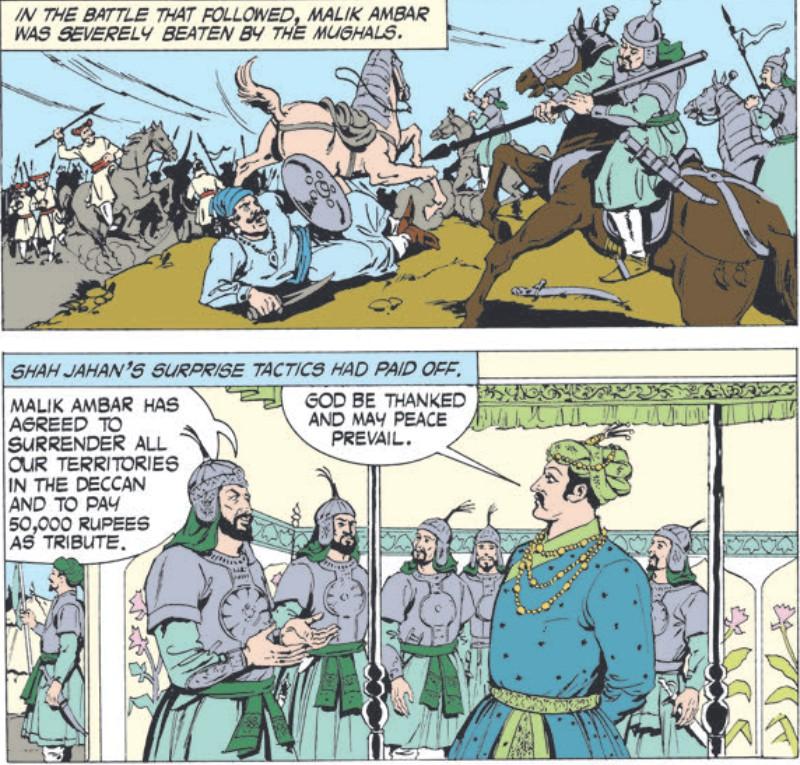
Figure 20. Upon defeating Malik Ambar of the Ahmadnagar Sultanate, Shah Jahan wishes “may peace prevail.”93
Shah Jahan’s hero story reveals that Amar Chitra Katha can make Muslim protagonists the heroes of their histories. Yet, the comic is able to circumvent the argument that it is pro-Muslim because it avoids presenting support of a particular ideology. Without the aspect of binary conflict, Shah Jahan may not fully align with the Psychological Compensation Theory, but it does reveal that Amar Chitra Katha uses ideological positioning when it serves the narrative. Muslim characters can be depicted negatively, like Siddhi Johar and Afzal Khan, or their portrayal can contain nuances that allow Amar Chitra Katha to support their actions without 93 Chinoy and Roy, 19.
having to directly concede that Islam is on the same level as Hinduism. Along with the Shah, Amar Chitra Katha published a comic about his fellow Mughal emperor Babur, whose narrative bears similarity to that of Shah Jahan’s.
Babur (1977)
Babur (1438 - 1530), Shah Jahan’s predecessor, founded the Mughal empire through a militarily successful and strategic conquest of the Afghan Muslim Lodhi kingdom in Delhi.94 In a similar manner to Shah Jahan, Amar Chitra Katha is able to present the Muslim “invader” in a positive light through his comic’s linear hero story, which largely aligns with the Psychological Compensation Theory.
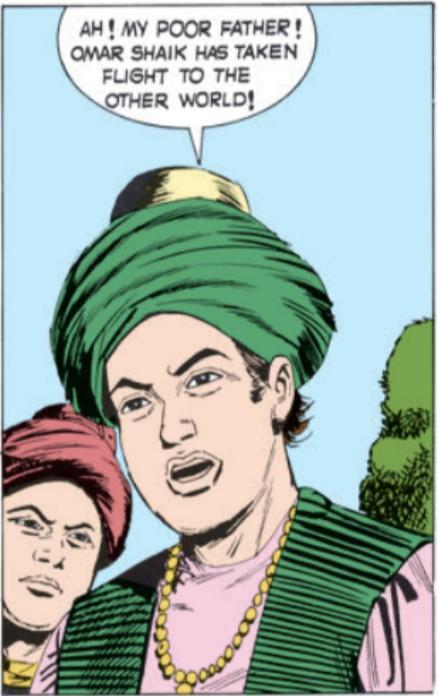
Babur’s inherent “goodness” begins as a child in his comic. When his father dies, the thirteen-year-old Babur wisely and calmly declares, “Omar Shaik has taken flight to the other world!” (see fig. 21).95 He does not react in an emotional or “weak” manner, predicting his similarly rational and dispassionate approach to rule that differentiates him from other Muslim leaders in the comics (e.g. Afzal Khan, Siddhi Johar, Akbar’s enemies). Like Shah Jahan, this is not necessarily an inciting incident, but demonstrates that Babur has a certain exceptionalness to him even at a young age.
94 Metcalf and Metcalf, A Concise, 14.
95 Toni Patel, Babur, illus. Ram Waeerkar, ed. Anant Pai (Amar Chitra Katha, 1977), 7, accessed April 13, 2026, https://digital.amarchitrakatha.com/viewer/?id=005835186
96
Babur then meets the “stability fantasy” aspect of PCT through the ending of his comic.
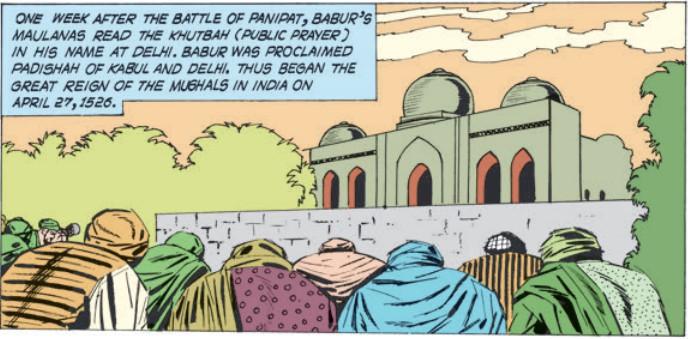
Much like Shivaji and Shah Jahan, the ending is kept intentionally vague, simply announcing that “Babur was proclaimed Padishah of Kabul and Delhi. Thus began the great reign of the Mughals in India on April 27, 1526” (see fig. 22).97 The ambiguousness of this commentary and the intentional omission of the disastrous end of the Mughal Empire creates that illusion of permanent peace seen in the Psychological Compensation Theory.
96 Patel and Waeerkar, 7.
97 Patel and Waeerkar, 31.
98
Figure 22. The ending of Babur’s comic, narrating the beginning of the emperor’s reign.
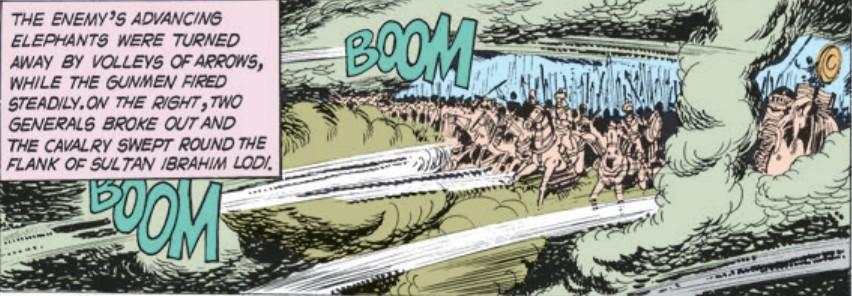
Importantly, Babur’s conquests are not framed in the context of his religious background or as an Islamic invasion of a Hindu India. Instead, they are neutrally presented as two-sided Darwinian conflicts for resources and strategic ploys (see fig. 23).99 ACK takes particular care to ensure that the reader understands Babur’s military stratagem and intelligence behind his choices, and that they do not glean a particular ideological position from his actions. This aligns with ACK’s depiction of Shah Jahan’s military campaigns, in that both rulers are presented as able leaders who go to war for resources, not for an ideological battle. Thus, like Shah Jahan, Babur cannot fulfill the element of a binary conflict between protagonist and antagonist in the PCT, because his campaigns are not presented as necessarily negative, only neutral. The comic focuses on the strategy of war when depicting battles, including descriptions such as “The enemy’s advancing elephants were turned away by volleys of arrows, while the gunmen fired
98 Patel and Waeerkar, 31.
99 Patel and Waeerkar, 11, 26.
steadily” (see fig. 24).100 The use of “enemy” in this case is largely descriptive and not indicative of any ideological position on religion, as Babur’s enemy was the Muslim Sultan of Delhi, Ibrahim Lodi.
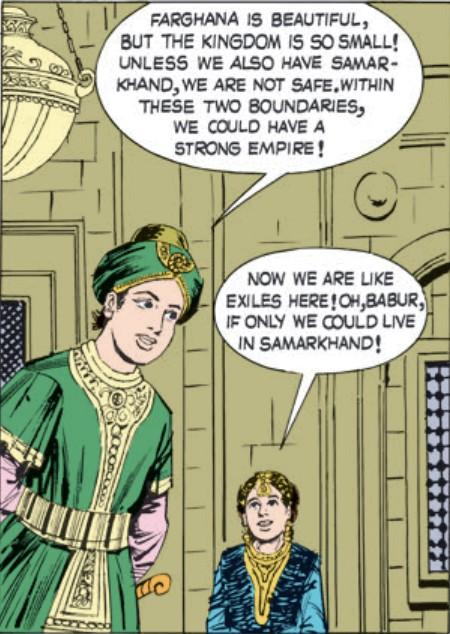
Figure 23. Babur considers the strategic advantages of invading Samarkhand for the empire.
101
100 Patel and Waeerkar, 31.
101 Patel and Waeerkar, 11.
Amar Chitra Katha circumvents the contradiction they encounter between nationalism and positively depicting Islam by avoiding binary conflict with a “good” side and a “bad” side. In some of the rare cases of nuance in these comics, ACK manages to affirm their nationalism by not presenting a binary vision of the culture, religion, and history of Muslim figures.
The adult protagonists’ actions, therefore, define the vignettes depicted during the protagonists’ childhoods; and Amar Chitra Katha makes the decision on how to evaluate those actions when presenting them to the reader. The comics lose whatever nuance about the original history of the protagonist when they choose to give the protagonist a hero’s trajectory or not, because their version of the hero’s story is such that it is impossible for a hero, once deemed a hero, to be anything but completely justified in their actions. Such lack of nuance requires a certain amount of revisionism to be reconciled with the reality of many of the protagonists ACK’s authors write about.
102 Patel and Waeerkar, 31.
Conclusion
Ultimately, Amar Chitra Katha upholds Hindu nationalism albeit with particular instances of “good” Muslims in the comics. The artistic choices of ACK illustrators give audiences a way to understand and absorb Hindu nationalism through utilizing appearance as an ideological weapon. The comics’ version of the linear hero story serves the same purpose, although through a different manner: revising protagonists’ stories based on ACK’s evaluation of them. And, in some cases, Amar Chitra Katha justifies its positive depictions of Muslims by removing these figures from their inward and outward connections to Islamic faith almost entirely.
Defining Hindu nationalism does require an examination of the history of Hindu-Muslim relations across several eras, but it is also important to note the influence that colonialism had on stoking these tensions. Anant Pai did not found Amar Chitra Katha because he hated Muslims; he founded it because he wanted to counter the influence the West had on the information students learned in schools. This is the way that the company can circumvent accusations of outward Islamophobia, but it also reveals how Western colonialism affects perceptions of national identity. Amar Chitra Katha comics are representative of colonial trauma, not in that they pander to Western stereotypes about India, but that they give a postcolonial populace a way to feel superior over a marginalized group.
Art and literature have always been channels for humans to express their emotions.
Taking the comic medium out of the individualized context of a single author and illustrator to a successful conglomerate depersonalizes the works and makes them far-reaching and more dangerous in their influence. Nationalism can be a form of catharsis against an oppressive, bigoted regime, but Amar Chitra Katha is not one scholar or a commune of like-minded people. It is ultimately a large, nationwide corporation, which makes this sort of propaganda even more
concerning when taken into account that businesses always market to an audience for profit, and never create for the mere sake of it. Thus, Amar Chitra Katha’s form of ideological nationalism is not meant to be a communal, cathartic search for an identity in a fractured homeland, but a commodified, homogeneous definition of the Indian self. In essence, a company is giving Indian children their primary audience a foundation for an identity defined by the negation and hatred of another.
Pai’s intentions behind creating Amar Chitra Katha were certainly honorable and well-reasoned, but what was once his altruistic mode of art has become a corporatized propaganda machine seeking profits over true, reliable education. One could argue that it was inevitable that Amar Chitra Katha, being a company and not one artist, would eventually fall victim to capitalism’s tainting of the literary genre.
However, to call these comics not “true” artistry is to deny the technical skill required to compose them. Graphic novels are not juvenile forms of consuming literature; they hold their own vast world of interpretation beyond just prose or picture. Amar Chitra Katha should be hailed as a cultural icon in modern India for its role in bringing the graphic narrative to the mainstream literature market, despite ideological concerns. The West suffers the same ailment of underestimating the power of mixed media literature. It is exactly this combination of visual and narrative elements that allows ACK to propagandize through historical and mythical retellings and expand their audience base from skilled prose readers to younger and less literate demographics.
Amar Chitra Katha ought to be viewed as a cautionary tale of the ramifications of combining a corporatized art medium with a subjective view of identity. Yet, the comics’ continuing popularity in twenty-first-century India only demonstrates that their business model is
successful. Its innocuous intentions paired with compelling, inspiring stories of Indian heroes make the comics very marketable to Indian youth. The trajectory of Amar Chitra Katha reveals the lasting effect of historical trauma on the modern identity of India in the literary market and the effective nature of graphic narratives as a form of cultural propaganda.
Bibliography
@amarchitrakatha. "Thank you, The Bharat Post, for sharing our story. However, we'd like to address the comment in the last slide." Instagram. Last modified December 18, 2025. Accessed March 26, 2026.
https://www.instagram.com/p/DSboNmMD31h/?igsh=NjZiM2M3MzIxNA%3D%3D.
Amin, Shaan. "The Dark Side of the Comics That Redefined Hinduism." The Atlantic. Last modified December 30, 2017. Accessed March 26, 2026.
https://www.theatlantic.com/entertainment/archive/2017/12/the-comics-that-redefined-hi nduism/539838/.
Bhagwat, B.R. Shivaji. Illustrated by Pratap Mulick. Edited by Anant Pai. Amar Chitra Katha, 1971. Accessed April 13, 2026.
https://digital.amarchitrakatha.com/viewer/?id=005835067.
Blackwell, Fritz. "The British Impact on India, 1700 - 1900." Education about Asia 13, no. 2 (2008). Accessed March 26, 2026.
https://www.asianstudies.org/publications/eaa/archives/the-british-impact-on-india-17001900/.
Calabria, Michael D. Language of the Taj Mahal: Islam, Prayer, and the Religion of Shah Jahan. I.B. TAURIS, 2021. http://ebookcentral.proquest.com/lib/harker-ebooks/detail.action?docID=6793896.
Chakrabarty, Dipesh. "Subaltern Studies and Postcolonial Historiography." Nepantla 1, no. 1 (2000). https://muse.jhu.edu/pub/4/article/23873/pdf.
Chinoy, Coomi B., and Souren Roy. Shah Jahan. Edited by Anant Pai. Amar Chitra Katha, 1979. Accessed April 13, 2026. https://digital.amarchitrakatha.com/id005835126/Shah-Jahan.
Fernandes, Luis M. The Historic City of Delhi. Illustrated by Arvind Mandrekar. Edited by Anant Pai. Amar Chitra Katha, 1983. Accessed April 13, 2026. https://digital.amarchitrakatha.com/viewer/?id=005835155.
Helweg, Arthur W. "British Soldiers Massacre Indians at Amritsar." EBSCO. Last modified 2023. https://www.ebsco.com/research-starters/history/british-soldiers-massacre-indians-amrits ar.
Jackson, Peter. The Delhi Sultanate: A Political and Military History. Cambridge University Press, 1999. Accessed March 26, 2026. https://books.google.com/books?id=lt2tqOpVRKgC&lpg=PA3&ots=O6mS6mQDoX&dq =%22delhi%20sultanate%22&lr&pg=PR5#v=onepage&q&f=false.
Kulke, Hermann, and Dietmar Rothermund. A History of India. 6th ed. Routledge, 2016. http://ebookcentral.proquest.com/lib/harker-ebooks/detail.action?docID=4757577.
Lal, Vinay. "Shivaji and the Marathas." UCLA Social Sciences. Accessed April 13, 2026. https://southasia.ucla.edu/history-politics/mughals-and-medieval/shivaji-and-the-maratha s/.
Lal, Vinay. "Shivaji and the Politics of History." UCLA Social Sciences. Accessed April 13, 2026. https://southasia.ucla.edu/history-politics/mughals-and-medieval/shivaji-politics-history/.
Mahardika, Jimmy Y. Hero Narratives as Relational Fields: Ontology, Privilege Transmutation, and Platform Capitalism from Traditional Warriors to Algorithmic Heroes. PhilPapers, 2026. https://philpapers.org/archive/MAHHNA.pdf.
McLain, Karline Marie. "Whose Immortal Picture Stories?: Amar Chitra Katha and the Construction of Indian Identities." PhD diss., University of Texas at Austin, 2005. Accessed March 26, 2026. http://hdl.handle.net/2152/1631.
Metcalf, Barbara D., and Thomas R. Metcalf. A Concise History of Modern India. Cambridge University Press, 2012. https://www.proquest.com/legacydocview/EBC/977222?accountid=618.
Pai, Anant. Birbal the Wise. Illustrated by Ram Waeerkar. Edited by Anant Pai. Amar Chitra Katha, 1977. Accessed April 13, 2026. https://digital.amarchitrakatha.com/viewer/?id=005835050.
Patel, Toni. Babur. Illustrated by Ram Waeerkar. Edited by Anant Pai. Amar Chitra Katha, 1977. Accessed April 13, 2026. https://digital.amarchitrakatha.com/viewer/?id=005835186.
Patel, Toni. Jallianwalla Bagh. Illustrated by Ram Waeerkar. Edited by Anant Pai. Amar Chitra Katha, 1986. Accessed April 13, 2026. https://digital.amarchitrakatha.com/viewer/?id=005835162.
Patel, Toni, and Souren Roy. Akbar. Edited by Anant Pai. Amar Chitra Katha, 1979. Accessed April 13, 2026. https://digital.amarchitrakatha.com/id005835096.
Przybyło, Ela. The Politics of Ugliness. Accessed March 26, 2026. https://www.gla.ac.uk/media/Media_180322_smxx.pdf.
Savarkar, V.D. Essentials of Hindutva. 5th ed. 1922. Accessed March 26, 2026. https://savarkar.org/en/encyc/2017/5/23/2_12_12_04_essentials_of_hindutva.v001.pdf_1. pdf.
Sealey-Morris, Gabriel. "The Rhetoric of the Paneled Page: Comics and Composition Pedagogy." Composition Studies 43, no. 1 (2015): 31-50. https://www.jstor.org/stable/43501877.
Sharma, Seema. "Folklore Through Popular Media – The Representation of the 'Subaltern.'" Indian Literature 62, no. 4 (2018): 214-19. https://www.jstor.org/stable/26792169.
Upreti, B.C. "Nationalism in South Asia: Trends and Interpretations." The Indian Journal of Political Science 67, no. 3 (2006): 535-44. https://www.jstor.org/stable/41856240.
Waeerkar, Ram, illus. Sultana Razia Edited by Anant Pai. Amar Chitra Katha, 1976. Accessed April 13, 2026. https://digital.amarchitrakatha.com/viewer/?id=005835170.
Waeerkar, Ram, and Dev Nadkarni. Birbal the Wise Amar Chitra Katha, 2008.