The GW
HATCHET
October 5, 2026 Vol. 123
Iss. 9
AN INDEPENDENT STUDENT NEWSPAPER • SERVING THE GW COMMUNITY SINCE 1904 • ONLINE AT GWHATCHET.COM
Democratic nominee for DC mayor urges GW to bargain in good faith with graduate student union PARIS ALBRECHT
CONTRIBUTING NEWS EDITOR
SARAH GROSS
ASSISTANT NEWS EDITOR
Democratic mayoral nominee and D.C. Councilmember Janeese Lewis George urged GW officials to remove contract language that would allow them to walk away from a collective bargaining agreement with GWU Graduate Workers United in an open letter Friday. In a letter addressed to University President Ellen Granberg and Provost Ed Balleisen Friday, Lewis George said officials are “falling short” of demonstrating leadership on workers’ rights because they are insisting on contract language that would allow officials to abandon its collective bargaining agreement if the National Labor Relations Board changes its position regarding the legal status of graduate workers. The letter said it is “unacceptable” that the University is advocating for an “escape hatch” in the contract language, adding if the University believes in “good-faith” collective bargaining, it should stand behind the contract it signs. “I urge GW to choose leadership over legal maneuvering, partnership over uncertainty and respect for its graduate
ARUNMOY DAS
ASSISTANT NEWS EDITOR
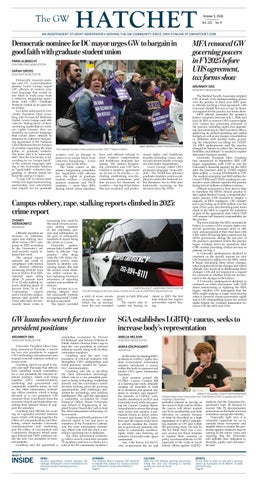
The Graduate Student Union protests outside 1922 F Street in March.
workers over an attempt to preserve an escape hatch from collective bargaining,” Lewis George said in the letter. The letter comes as the union’s bargaining committee has negotiated with officials over the rights of graduate student workers — including masters students and Ph.D. students — since May 2025, during which union members
ABBY BROWN | STAFF PHOTOGRAPHER
have said officials refused to meet workers’ compensation and healthcare demands last spring. The union’s bargaining committee and GW have reached a tentative agreement on 24 out of 34 articles — including establishing non-discrimination protections and due process for dismissal of workers — but big ticket items like pay, academic and profes-
sional rights and healthcare benefits including vision, dental and mental health coverage are still under negotiations. Lewis George called GW’s proposed language “unacceptable.” The NLRB last affirmed graduate students count as employees under the National Labor Relations Act in 2016 after historically wavering on the decision since the 1970s.
Campus robbery, rape, stalking reports climbed in 2025: crime report SYDNEY HERSKOWITZ REPORTER
Officials reported an increase in robberies, rapes and stalking incidents across GW’s campuses in 2025, according to the University’s annual security report released last week. The annual report, released last week in compliance with federal law, showed robberies increasing fivefold from two in 2024 to 10 in 2025, reported rapes rising about 35 percent from 17 to 23 and stalking reports climbing about 32 percent from 34 to 45. Criminology experts and a University spokesperson said growth in crime rates does not necessarily mean crime is
increasing and could be the result of more awareness among students of the reporting process and willingness on the part of community members to report being the victim of a crime. University spokesperson Julia Garbitt said safety is officials’ “top priority,” who along with the GW Police Department, review crime reports to identify concerning trends. She said the annual crime statistics reflect various factors including increased awareness of reporting options and available resources. “An increase in a reporting category does not necessarily indicate an ongoing trend,” Garbitt said in an email. The report recorded
CARSTEN HOLST | ASSISTANT PHOTO EDITOR The GW Emergency Services phone number on the side of a GW Police Department car.
a total of seven arrests occurring on campus, which was an increase from the zero recorded
GW launches search for two vice president positions ARUNMOY DAS
ASSISTANT NEWS EDITOR
University President Ellen Granberg announced Thursday a search for two vice presidents to support GW’s technology infrastructure and expand external relations initiatives across units. Granberg said in an email to faculty and staff Thursday that officials have launched search committees for a vice president for external relations position, which will bring together GW’s communications, marketing and government and community relations teams, as well as the chief information technology officer position, which is being elevated to a vice president. GW retained three consultants from the executive search and leadership consulting firm Spencer Stuart to support the searches. Granberg said officials are creating an expanded external relations team, which will bring together the Office of Communications and Marketing, which includes University communications and marketing, and the Office of Government and Community Relations, which manages federal and DMV relations, under the new vice president of external relations. Granberg said she appointed a WHAT’S
INSIDE
MFA removed GW governing powers in FY2025 before UHS agreement, tax forms show
committee co-chaired by Provost Ed Balleisen and School of Media & Public Affairs Director Peter Loge to lead the vice president of external relations search, along with 14 other committee members. Granberg said the next vice president of external relations will strengthen GW’s relationships and build practices needed for “proactive” communication. Granberg said she is elevating the chief information technology officer role to a vice president position to bring technology leadership directly into the University’s senior decision making, given the growing opportunities and challenges presented by technology and artificial intelligence. She said she appointed a committee co-chaired by Chief Financial Officer Bruno Fernandes and School of Engineering & Applied Science Dean John Lach to lead the chief information technology officer search. Granberg said both positions will directly report to her and serve as members of the President’s Cabinet, and the chief information technology officer role will also have a secondary reporting line to Balleisen. The chief information technology officer search committee includes 12 members and two co-chairs, for a total of 14 GW community members.
NEWS Student organization leaders applaud the strategic framework’s recommendations for improved student advising services. Page 3
arrests in both 2024 and 2023. The report also recorded one hazing in-
cident in 2025, the first time federal law require universities report hazing.
The Medical Faculty Associates stripped GW of much of its decision-making power over the practice in fiscal year 2025, prior to officials reaching a final agreement with Universal Health Services to end its financial support for the practice, tax forms show. MFA officials amended the practice’s bylaws sometime between July 1, 2024, and June 30, 2025, to remove GW’s consent rights over various key governing processes of the practice, including rights over appointing and removing its chief executive officer, approving its annual operating and capital budgets as well as any merger, consolidation or affiliation with another entity, according the enterprise’s tax filings for FY2025. An MFA spokesperson said the practice changed its bylaws to reflect the “increased flexibility and latitude” it needed to explore alternative business models. University President Ellen Granberg first announced in September 2025 GW began negotiations with UHS to end the University’s financial support for the MFA after the practice’s debt in FY2025 topped $444 million — owing $370,904,000 to GW. The medical enterprise lost $100 million between FY2024 and FY2025, marking six consecutive years officials reported the practice facing tens of millions of dollars in losses. Officials announced a final deal in May to transition the MFA’s clinical practice to the Capital Medical Group, a nonprofit physician practice UHS founded to employ a majority of MFA employees. GW committed to providing up to $230 million over the span of five years and absorbing prior loans made to the MFA to support the transition as part of the agreement, after which UHS will assume full financial responsibility for the practice. The form indicates the MFA amended its bylaws to remove GW’s consent rights over several governing processes prior to officials’ announcement of their final deal with UHS, with GW having little control over the MFA’s governance during the last year of the practice’s operations before the practice began winding down its operations after CMG started providing clinical services to patients on Aug. 1. A University spokesperson declined to comment on the specific reasons for why GW loosened its rights over the MFA, when it began discussing these bylaw changes, when it signed off on the changes and which officials were involved in deliberating these changes. UHS did not respond to a request for comment on whether it had any involvement in the changes to the bylaws. A University spokesperson declined to comment on when discussions with UHS about restructuring or replacing the MFA began, whether GW anticipated that the MFA might undergo a major restructuring when it removed certain governance rights and if GW relinquishing power for several rights helped the eventual transaction between GW, the MFA and UHS.
SGA establishes LGBTQ+ caucus, seeks to increase body’s representation AMELIA NELSON
ASSISTANT NEWS EDITOR
ANIKA EDUPUGANTI REPORTER
In the wake of ongoing federal attacks to LGBTQ+ rights, Student Government Association senators introduced a caucus within the body to represent and protect GW’s queer community members. SGA senators passed the LGTBQ+ Caucus Creation Bill at a meeting last week, officially creating an assembly of both SGA members and general students to “protect and support” the interests of LGBTQ+ community members at an SGA and University level, while also passing the Caucus Creation Bylaw Amendment to ensure the group stays active and remains a permanent fixture in future terms. Current and former SGA members said the caucus could serve to actively monitor the University to prevent any potential rollbacks to community members’ rights while also fostering an inclusive University-wide queer community. Sen. Cole Bowie (CCAS-U), who co-sponsored the act and
OPINIONS The Editorial Board implores GW students to reignite their passion for campus activism and mobilize for causes they believe in. Page 6
AINSLEY SULLIVAN | STAFF PHOTOGRAPHER Student Government Association Sen. Cole Bowie (CCAS-U) speaks at an SGA meeting in September.
indicated interest in serving as the caucus’s chair, said he thinks the caucus will attract student and SGA membership and hold relevance on campus because of what he described as a high population of LGBTQ+ identifying students at GW and within the governing body. He said he did not think there was a current avenue for those students to express their concerns or policy recommendations to GW, especially in the wake of recent federal efforts against LGBTQ+
CULTURE Meet the GW tabletop gaming community rolling the dice and traveling to fantasy worlds one move at a time. Page 7
students, like the Education Department’s Sept. 28 decision to rescind Title IX discrimination protections on the basis of sexual orientation and gender identity. “Especially right now, it is extremely important for us to consider those viewpoints and amplify them to ensure the protection against whatever may be coming in the future years and ensuring that the University still upholds their obligation to diversity, equity and inclusion,” he said.
SPORTS Tennis looks to build on last year’s winning season as it prepares for its Atlantic 10 slate during fall play. Page 8
S:10.5"
T:22" S:21.5"
THE GW HATCHET
NEWS
October 5, 2026 • Page 3
Student organization leaders praise strategic framework working groups’ recommendations
CRIME LOG DRUG LAW VIOLATION
Thurston Hall 9/25/2026 – 5:24 p.m. Closed Case GW Police Department officers responded to a report that the Administrator On-Call confiscated drugs. GWPD transported the contraband to Academic Center for safekeeping.
GRAYSON HALTEMAN REPORTER
NICHOLAS STEVENSON REPORTER
Student leaders said they were pleased with the strategic framework working groups’ recommendations to improve student advising and formalize paths for students to gain more experiences throughout the District. The three strategic framework working groups officials assembled to provide recommendations on three main areas of the framework released their reports last month, with two of the three working groups focused on improving opportunities for students through providing more adequate academic and career advising for all students and forming a central hub for off-campus experiences in the District. Eight student organization and government leaders said they agree with and support the working groups’ recommendations to streamline operations and make it easier for students to participate in D.C. experiences and access advising resources. University President Ellen Granberg unveiled the University’s strategic framework in October 2025 as a roadmap that outlined GW’s key priorities and goals officials plan to accomplish over the next seven to ten years. Granberg charged three working groups with providing recommendations on three major ideas officials heard community members calling for most, including enhancing GW’s interdisciplinary research ecosystem,
Case closed. Referred to Conflict Education & Student Accountability.
THEFT II/FROM BUILDING
District House 9/25/2026 – Unknown Open Case A male GW student reported their skateboard stolen after leaving it unattended.
Case open.
DRUG AND LIQUOR LAW VIOLATION ARWEN CLEMANS | STAFF PHOTOGRAPHER
Students walk into Kogan Plaza.
better leveraging D.C. experiences as part of student learning and improving academic and career advising. The working groups’ recoChief of Staff Scott Mory said in an email that GW is entering the next stage of its strategic framework by reviewing recommendations from the three working groups, the Foundational Excellence Initiative, the AI mapping exercise and other University assessments to identify its first set of priorities for its action plan. Mory said the University is not selecting a predetermined number of recommendations to advance from each working group but rather creating a “coherent” set of priorities, strategically sequencing them for implementation and advancing them over time. Soryn Kim, a senior
studying environmental studies and political science and the president of Compass: Impact Consulting at GW, a student organization that connects students with consulting opportunities at sustainable businesses and nonprofits, said the Academic and Career Advising Working Group was correct to suggest expansions to career advising services like career readiness support, since currently students need to independently look out for professional development and networking opportunities with little support from GW. “It’s much easier to access peer tutoring services or stuff like that,” Kim said. “I would say for career services, you have to seek that out more.” Students also said in April that despite the Univer-
sity’s high cost of attendance, students in large schools like CCAS lack sufficient advising resources. Sen. Hugh Parker (CCAS-U), who serves on the Student Government Association’s Committee on Education Policy, said that while he thinks synthesizing academic and career advising resources through the Advising Excellence Committee is a “great start,” officials also need to improve those resources individually to make the coordination as effective as possible. The Academic and Career Advising Working Group also recommended improving advising quality and responsiveness by identifying advising units in experiencing the greatest capacity strain and providing them staffing and funding support.
District House 9/26/2026 – 6:40 a.m. Closed Case GWPD officers and the Emergency Medical Response Group responded to a report of an injured person. Upon arrival, officers made contact with a intoxicated male GW student. EMeRG evaluated the student and transported them to the GW Hospital Emergency Room for further medical treatment.
Case closed. Referred to CESA.
DRUG LAW VIOLATION
South Hall 9/28/2026 – 4:34 p.m. Closed Case GWPD officers responded to a report that the AoC confiscated drugs. The contraband was taken to Academic Center for safekeeping.
Case closed. Referred to CESA.
—Compiled by Isaac Harte
DC performers, businesses grapple with impact of Kennedy Center closure LILY THOMPSON REPORTER
SHIVU SATHE
ASSISTANT NEWS EDITOR
The Kennedy Center’s closure last month has forced artists to adapt to changes in venues and cost businesses revenue from the center’s attendees, performers and local eatery, owners said. President Donald Trump’s hand-picked Kennedy Center Board of Trustees voted Sept. 15 to immediately close the center’s doors for two years for renovations, forcing performing arts groups like the National Symphony Orchestra to make plans to relocate their performances to other venues while the center’s doors remain closed. D.C. businesses near the Kennedy Center and artists who previously performed at the venue said shutting the center’s doors is a loss for the D.C. community and has started to hurt business traffic near the center, but that the art scene will continue to survive despite the closure. Officials closed the center to the public over safety concerns, pointing to a section of the building’s roof that recently fell in the Grand Foyer after a Sept. 4 storm hit the District, an incident Com-
merce Secretary Howard Lutnick said could’ve killed patrons if a performance had been happening. Center officials also warned in documents discussing the closure that the center was facing bankruptcy and that shutting the center down would be the only option to avoid “certain fiscal collapse.” Last month’s vote marked the third time the center’s board has voted to shut down the center after both of the prior attempts were halted by U.S. District Judge Christopher Cooper, the first being in March for renovations after Trump announced in February 2026 that he planned to close the venue for a two-year renovation project. The center is currently closed on a week-by-week basis, with Kennedy Center Director Matt Floca said, as the center’s facilities and safety teams conduct an assessment to see if the building is safe for occupants. Floca said the assessment is expected to be completed in the next two weeks. President and CEO of Washington Performing Arts, a performing arts and arts education organization, Jenny Bilfield said WPA was the first group to pull their performances out of the Kennedy Center in May 2025 after it became clear that Trump may be successful in taking over the center through re-
moving the board and canceling performances. Bilfield said WPA chose to leave the center in May 2025 before they felt the financial impact of decreased ticket sales because the WPA board didn’t want to wait until they were financially forced to leave, and the board believed their patrons would follow the WPA to other venues. She said WPA’s patrons responded positively to the move, with no major hit to attendance as a result of the shift to performing at other venues in the District, like The Music Center at Strathmore. Bilfield said she worries the political issues and turmoil surrounding the Kennedy Center will take away from the organizations that are continuing to find places to perform and grow their relationships with audience members by pushing news coverage away from them. “What I’ve seen in the arts community is certainly a sense of resilience,” Bilfield said. Mohamed Hyali, the owner of Tazza Cafe, a cafe sitting across the street from the Kennedy Center, said the closure has significantly impacted his business. He said since shows stopped at the center, Tazza has seen a 59 to 65 percent decrease in total sales, with that
CARSTEN HOLST | ASSISTANT PHOTO EDITOR Barricades stand in front of the Kennedy Center after its closure.
number continuing to climb. He said at night, especially when big shows, like Hamilton, were showing at the center, he would get 150 to 200 customers who were attending the shows, but now he only gets an average of 10 to 15. Hyali also said he has had no reservations since June, due to the lack of shows. He said 95 percent of his online business comes from the Watergate Complex, and while construction was still happening at the Kennedy Center, he also got business
from the construction workers. “Now the judge stopped the construction, I lost two things,” Hyali said. “I lost the shows, and then I lost the construction people. It’s an empty building. No construction, no shows.” Hyali also said due to the slow business, seven members of his staff had to quit, leaving him understaffed. He said with a prolonged closure, Tazza may not be able to sustain itself. “I don’t know if we can survive for two years,” Hyali said.
Local leaders cite resident reports of more encounters with homeless individuals ISAAC HARTE
CONTRIBUTING NEWS EDITOR
Foggy Bottom leaders and homelessness advocates said President Donald Trump’s 2025 encampment clearings and reduced funding for homeless services could have led to a reported increase in resident encounters with homeless individuals in the neighborhood. During an Foggy Bottom and West End Neighborhood Advisory Commission meeting last month, 2A03 Commissioner Trupti Patel and 2A08 Commissioner Jim Malec said they noticed an uptick in reports from constituents of interactions with unhoused individuals in their single-member districts, including one breaking into someone’s garage to sleep and another entering apartment complexes. Malec and 2A06 Commissioner John Dolan said the increase in interactions between homeless individuals and residents of the neighborhood could be attributed to homeless populations
being scattered after Trump made a coordinated effort to clear encampments across D.C. last summer. In August 2025, Trump federalized the Metropolitan Police Department and deployed 800 National Guard troops and other federal agents throughout the city, in part to clear unhoused encampments, directing law enforcement to remove visible signs of homelessness within the city. At Trump’s direction, D.C. officials cleared several encampments in the Foggy Bottom area, including at Washington Circle and near Interstate 66 that same month. Malec said initially after the clearings, residents noticed less tents and visible signs of homelessness in Foggy Bottom as Trump created an “out of sight, out of mind” scenario. But in the last few months, reports of a growing homelessness problem have started to “bubble back up,” as he has begun to hear complaints from constituents, saying homeless residents who be-
came fearful and relocated to other parts of the District in the aftermath of the encampment clearings in the Foggy Bottom area had potentially returned. “I think you can come in, you can tear down tents, that’s going to clean things up for a while, people get scared, but then as time goes on, those effects are going to start to bubble back up,” Malec said. Malec said he believes residents are starting to see the effects of a reduction in homeless services, which could manifest in more people sleeping outside across the District, and officials needed to “expand” housing vouchers in order to bolster broader housing availability. Wesley Thomas, an advocate and outreach worker for Miriam’s Kitchen said what appeared to be an uptick in the homeless population in the neighborhood was actually due to the Trump administration’s policies, which resulted in the forcible relocation of homeless residents to other parts of
KELTON O’CONNELL | PHOTOGRAPHER An homeless resident sits on the sidewalk in front of the Foggy Bottom-GWU Metro Station.
the District. He said many of the homeless residents that Foggy Bottom residents see are former occupants of encampments in the area, who have now relocated to other parts of the city or Virginia but return to Foggy Bottom
to seek services, like those offered at Miriam’s Kitchen. Thomas, who was once homeless himself, said the claims of some Foggy Bottom residents about an uptick in homelessness at an ANC meeting last month
were “not true.” He said the Trump administration’s clearings of encampments resulted in outreach workers losing contact with their homeless clients, resulting in services for homeless people being disrupted.
NEWS
October 5, 2026 • Page 4
THE GW HATCHET
Employee health insurance contributions to rise by nearly 10 percent in 2027 BENJAMIN YANG REPORTER
RUBY CORRIVEAUROCHE REPORTER
Faculty and staff health insurance contributions will rise by 9.5 percent in 2027, marking the sharpest increase in at least three years. GW’s open enrollment period — when employees can change their health insurance plan — opened on Oct. 5, with expected monthly contributions rising by $4 to $95, depending on an employee’s coverage level and salary band. Experts in higher education leadership and health policy said the 9.5 percent increase, which follows GW’s 6.5 percent increase last year, reflects similar increases at other universities across the country as healthcare expenses rise. This year’s surge designates the largest increase in
the past three years, with contributions rising by 5.8 percent in 2024, 6 percent in 2025 and 6.5 percent in 2026 respectively, according to web archives. Dental plan contributions also increased in 2024, 2026 and will increase in 2027, but did not increase in 2025. GW’s benefits overview page attributes the increase to higher provider costs, greater use of services including cancer treatment and behavioral health care and growing use of costly prescription drugs, specialty medications and advanced treatments. Employer-sponsored healthcare has risen across the country in the last two years and will rise by an expected 10 percent this year, caused by increasing hospital prices, inflation, pharmacy costs and spending on administrative artificial intelligence tools. This year’s open enrollment period marks the
second year GW has used Aetna as its health plan administrator, after officials announced in November 2025 that GW would switch from UnitedHealthcare in January to keep benefits “competitive” and “sustainable.” A University spokesperson said GW has worked to keep the annual cost increases between 5.5 and 6.5 percent in recent years, but this year’s rate reflects inflationary pressure impacting healthcare. The spokesperson said, by comparison, the federal government just announced its premium would go up 10.9 percent in 2027. GW will continue to cover about 79 percent of overall medical plan costs next year, and employees will pay about 21 percent on average — on track with previous years, according to the website. The website also states around 64 percent of full-time medical plan par-
ticipants will see an increase of less than $20 per month. GW’s annual Health Savings Account — a tax-advantaged personal savings account dedicated to healthcare expenses — contribution limit will rise to $4,500 for individual coverage and $9,000 for family coverage in January 2027. GW will keep matching employee HSA contributions dollar for dollar up to $600 for individual coverage and $1,200 for employees covering dependents, according to the website. Vice President and Chief People Officer Sabrina Minor said in an email about 64 percent of full-time medical plan participants will see a premiuim increase of less than $20 per month. She said that officials are maintaining current healthcare plan designs, with no increases to deductibles, copays, coinsurance or out-of-pocket maximums in 2027.
She added employee contribution levels are evaluated annually based on plan costs and experience, and faculty and staff provide input through the GW Human Resources Management and Development’s Benefits Advisory Committee, the Faculty Senate’s Appointments, Salary, and Promotion Policies Committee and the Staff Council to help HRMD determine their healthcare plan designs. Minor added GW will switch from Lincoln Financial to MetLife for life and accidental death and dismemberment insurance, disability benefits and leave administration services in January 2027 based on MetLife’s overall value and services after evaluating five proposals for other providers. Phil Wirtz, a professor of decision sciences and psychological and brain sciences and member of GW Hu-
man Resource Management and Development’s Benefits Advisory Committee, said although employees are paying 9.5 percent more, they are not covering a larger percentage of the plan’s total costs, because GW’s contributions are rising alongside their employees. Wirtz said officials are providing “significantly” improved benefits under the Healthcare Savings Plan — a high-deductible plan that lets employees pay less outof-pocket each month and more at the point of care — starting Jan. 1, like coverage of bariatric surgery, hearing aids, cochlear implants and fertility services, which were previously only available under the Preferred Provider Organization plan. Officials said on the open enrollment website the expanded coverage will give employees more “flexibility” and greater access to services.
Townhouse Row residents report rodent infestation, frustration with GW response ADELAIDE PETRAS
ASSISTANT NEWS EDITOR
ZACHARY CRYSTAL STAFF WRITER
Students living in sorority townhouses reported a monthlong rodent infestation, which GW officials addressed by deploying canines into their townhouses Friday. Students living on Townhouse Row — the eight sorority townhouses on the 600 block of 23rd Street — said they have seen mice and rats inside their buildings over the past month and reported frustration with how long the University took to send exterminators after laying traps students said were unsuccessful due to continued rodent sightings. University spokesperson Nadia Payne confirmed the Division of Safety and Operations has worked to address the infestation by filling holes in walls and floors, removing shrubs underneath windows, placing traps inside and out-
side all houses and deploying rat terriers to hunt the rodents. Payne declined to comment on which townhouses made reports of rats but said Safety and Operations staff deep cleaned all eight buildings. Residents of at least three townhouses confirmed rat sightings to The Hatchet, and the other five did not respond to requests for comment. A student living in one of the townhouses, who asked to remain anonymous because they were not authorized to speak on behalf on the chapter, said students living in the house first spotted a mouse three or four weeks ago and tried to catch the rodent themselves in early September. The student said students living in the house immediately contacted the University after the first sighting, and workers set traps shortly after, which proved ineffective because students continued to spot multiple mice and rats. The student said students living in the house deep
cleaned the townhouse the day after spotting the first mouse and have been taking “extra precautions” ever since, like storing food in airtight containers. They said students’ parents began emailing the Fraternity and Sorority Life Housing Office a few days after spotting the first mouse and as the infestation persisted, with members of their sorority spotting the first rat last week after multiple mouse sightings. The student said the University’s response to the complaints was “passive” until parents contacted GW because they previously set traps but did not take further extermination measures, though they said officials are being more “proactive” now by deploying the rat terriers. “It shouldn’t take our parents having to email people to get someone to say anything back or to have them do something that’s more than just put some traps down,” the student said.
MICHAEL PEREZ | PHOTOGRAPHER
The Townhouse Row on 23rd Street.
JOSH STEINBERG | STAFF PHOTOGRAPHER Co-President Khush Wadhwa and Co-Vice President Alex Bakum pose for a portrait.
New Elliott initiative aims to engage men in gender studies SARAH GROSS
ASSISTANT NEWS EDITOR
An Elliott School of International Affairs initiative launched a new project late last month to host roundtable discussions aimed at encouraging male participation in conversations about gender, feminism and masculinity in international affairs and security policy studies. The Human Security Initiative in International Studies, housed within the Athena Initiative — which conducts research and hosts events centered on the role of women and feminism in human security and international affairs — will host monthly roundtable discussions that members of its all-male leadership team said aim to introduce men into conversations about gender and its role in governments, militaries and international conflict. The initiative launched last month with the goal of working alongside The D.C. Student Consortium on Women, Peace and Security, a women-led student organization in Elliott, to prepare male students to conduct gender analysis in international affairs and security studies, draw more men into gender studies classrooms and encourage Elliott professors to incorporate gender analysis into their courses. Shirley Graham, director of the Athena Initiative and professor of international affairs, said she devel-
oped the idea of creating HIIS after noticing very few men — typically between none and two — enrolled in her gender studies courses each semester. She said many female students have expressed frustration that they were speaking in an “echochamber” and lacked male peers to discuss gender equity issues in the classroom. Graham said she began forming HIIS and its seven-person male leadership team last spring after walking up to groups of male students at Elliott school events and asking if any of them were interested in studying gender. She said she proposed the idea of hosting small-group discussions with gender experts after many male students said they didn’t want to “step on women’s toes” in classes by voicing their thoughts on issues they believe primarily impact women. “Having those sorts of small, focused conversations could create an environment for male students where they felt safe to ask all the feminist questions that maybe they’ve been wanting to ask and felt they couldn’t ask before, or just because they weren’t taking the gender courses,” Graham said. Graham said she hopes HIIS leaders will encourage their male classmates to take gender courses and participate in gender-focused events, rather than leaving it to their female peers to organize events.
Graduate student groups struggle with engagement, fitting busy schedules ADELAIDE PETRAS
ASSISTANT NEWS EDITOR
KYLA KIDORF REPORTER
Graduate student organization leaders say they have continuously struggled to garner high attendance at events, despite strong administrative and financial support from the University. As the University faces ongoing financial challenges, and undergraduate student organization leaders report dissatisfaction with Student Government Association funding allocations, graduate student organizations say their issues lie in engaging a wide swath of the student body, rather than funding challenges. Graduate student leaders said they have begun to address low attendance by improving online and in-person advertising and focusing on large, infrequent events that better accommodate the schedules of students who are part time, live off campus or have
outside commitments like jobs or families. University spokesperson Nadia Payne said out of the 662 total registered student organizations across GW, 225 are limited to graduate students while 117 are restricted to undergraduates. Around 13,600 students — more than half of GW’s total enrollment — are enrolled in graduate or professional programs, compared to around 11,200 undergraduates. Lili Myers, a third-year law student and president of the theater organization GW Law Revue, said the group requires a higher time commitment than other graduate student organizations because students must regularly attend rehearsals. She said while many students express interest in joining the group early on, graduate students often don’t have the time required for the organization because they work during the day at the same time as certain social events and rehearsals.
“It’s hard when these students are so busy,” Myers said. “I know there’s also rifts with night students because the part-time students at the law school, we have a big part-time student body, and if events are during the day, those people are at work, they can’t come to like those events.” Myers said the Law Revue allows students to build closer friendships than other law student organizations because they collaborate to put on a performance rather than focusing on getting a job or furthering professional skills. She said the group’s regular meetings and rehearsals prevent law students from burning out academically, which she said is common among lawyers, because it lets them have fun. “It’s been a great experience for theater lovers and those who aren’t necessarily super into it alike,” Myers said. Gabe Jones, a third-year law student and president
of the Veteran Law Student Association, said the VLSA struggles to get students to attend small weekly or biweekly events because many law students are busy with family commitments and part-time jobs and can’t regularly change around their schedules to attend student organization events. “I’m the veterans’ org leader, and I’ll still run into somebody seven months into the year, and it’s like, ‘Oh, they’re a veteran, and I’ve never seen them at an event or never got them to come,’” Jones said. “Sometimes it’s hard to get the word of mouth to everybody.” Jones said the VLSA focuses on holding one or two large events per semester, rather than smaller weekly or biweekly meetings, which he said helps improve turnout because students are more willing to rearrange their schedules for larger events, like for Veterans Day and Welcome Back events at the start of the semester. He
CARSTEN HOLST | ASSISTANT PHOTO EDITOR Recruitment and event flyers in the lobby of Stockton Hall.
said he also focuses on advertising the events by putting up flyers on campus, sending frequent emails to the group’s mailing list and encouraging faculty members to promote the events. Jones said he feels GW administrators and faculty have shown support for the VLSA’s events by attending or connecting him with caterers and helping with other logistical planning as-
pects. He said students often criticize the University for not supporting student organizations without proactively seeking out help. “It’s not like being spoonfed by the school, but you also feel supported,” Jones said. “I think sometimes students, you’ll hear, ‘Oh, they don’t do anything for us,’ and it’s like, ‘Well, did you go to the three things they put on this week?’”
NEWS
October 5, 2026 • Page 5
THE GW HATCHET
As SGA declares financial aid emergency, members center student outreach AMELIA NELSON
ASSISTANT NEWS EDITOR
Following the Student Government Association’s declaration of a University financial aid and affordability “emergency,” the body’s members are emphasizing communication with students and expanding advocacy pathways. SGA senators said their declared “emergency” refers to students’ reports of inadequate financial aid packages and unclear, delayed communication from the Office of Student Financial Assistance with both students and SGA senators this academic year. The body’s members said they have factored in communication difficulties and restricted control over University finances when developing advocacy strategies for determining realistic goals, inspiring them to communicate funding concerns with alternative bodies, like alumni networks, and reduce SGA members’ expectations about the progress able to occur within a single term. The SGA passed the Financial Aid and Affordability Emergency Act last week, creating the Special Committee on Financial Aid and Affordability Advocacy to be composed of an undetermined number of SGA senators and public members. The committee will “investigate, document and address” the University’s accessibility, adequacy, transparency, administration of financial aid and emergency financial assistance available, according to the act. SGA President MJ Childs, along
with several SGA senators, campaigned in April on platforms of increasing officials’ transparency surrounding University decisions and funding toward student services, along with demanding financial transparency as the cost of undergraduate tuition rose. “My dream, obviously, would be to expand our current financial aid to all returning students, but that’s unfortunately not the reality, so we’re also trying to strategically think, ‘How can we address affordability on a small scale?’” Childs said. Childs said he has come to understand, through gaining a better comprehension of the SGA’s capabilities related to funding, that obtaining increased funding from the University for existing emergency fund grants for students is “unlikely” to occur within the limits of his term because officials and University action moves at a slower pace. He said he plans to push officials to expand school-specific student support funds and equitably distribute them among schools but also plans to focus on smaller solutions, like making students aware of the emergency funds schools offer. Childs said while he platformed on increasing University communication with students, he can see increased value in efforts like creating “digestible” information for students, like infographics explaining the University’s financial aid situation and holding town halls to ease students’ economic anxieties. He said he also wants to prioritize
AINSLEY SULLIVAN | STAFF PHOTOGRAPHER Student Government Association President MJ Childs speaks at a meeting in September.
increasing students’ understanding of financial realities so they can better plan whether they can afford to stay at the University. University spokesperson Shannon McClendon said officials have met with SGA leaders to “begin a conversation” on the issues brought up in the SGA’s recent act, although she said officials have not identified any “systemic issues” with their distribution of financial aid at a
University-level. Senate Pro Tempore Mathew Reis, who sponsored the Financial Aid and Affordability Emergency Act which senators passed at their most recent body meeting last week, said declaring University financial aid an “emergency” was a response to the University’s lack of communication to the student body about financial aid from the student financial assistance office.
Reis said he has contacted the office multiple times on behalf of the SGA since August to ask for clarification from the University about the issues they are facing and how they plan to address students’ concerns, and received a reply Sept. 14 that he could not set up a meeting with a senior financial aid counselor, making him doubtful the SGA will be able to work with officials to address students’ issues.
Graduate student creates AI model to predict mortality risk in sickle cell patients LOUISA HANNOUCENE STAFF WRITER
RAINA PAWLOSKI STAFF WRITER
A GW Ph.D. student coauthored a study on how multi-task artificial intelligence models can better predict mortality rates among people with sickle cell disease. Gefei Lin, a Ph.D. student in the department of statistics, authored a study published in the journal Blood Advances on Sept. 26, where he and other researchers developed an AI model that was more effective in identifying higher mortality risk in adults with sickle cell disease than existing models. Lin and experts in sickle cell disease said the study will be useful for doctors with the technological resources to use AI for clinical decisionmaking and will give them an earlier assessment of a patient’s mortality risk, though access to specialized care and technology could limit its use in clinical settings. “Our method is to want to develop a deep-learning model to predict such mortality risks and to help clinicians to have an earlier sense of the risk,” Lin said. Sickle cell disease is an inherited blood disorder that makes red cells harden and block blood flow. People
PETER PARK | STAFF PHOTOGRAPHER
Ph.D. student Gefei Lin poses for a portrait in Duques Hall.
with sickle cell in the United States have a life expectancy more than 20 years shorter than the general population, according to the Centers for Disease Control and Prevention, and the crude mortality rate for individuals with sickle cell from 2010 to 2020 was 1.6 per one million indi-
viduals. Researchers analyzed 12 biomarkers, measurable biological indicators of a person’s health, relating to kidneys, liver, heart and overall health over time from 598 adult sickle cell patients treated at the National Institutes of Health, accord-
ing to the study. They then used those existing records to train Multi-Task DeepHit, a “neural network survival model” — or an AI model that combines the patients’ changing health measurements with their baseline data to estimate their risk of death and identify patients
who may need more intensive or specific care, according to the study. Lin said incorporating changes in patients’ health measurements over time taught the model to account for disease progression because higher-risk patients may show different patterns
in their measurements than lower-risk patients. “It’s called disease progression, and this disease progression can be captured by some biomarkers, so we call risk effectors,” Lin said. In recent months, AI tools have assisted multiple sickle cell studies and has emerged as a method of providing enhanced diagnostics and early detection of sickle cell symptoms — including pain crises and organ complications — which allows for early treatment and management of the disease. Lin said the current model is a “survival model” so it can estimate a patient’s mortality risk over time before treatment begins, however, a limitation exists within the framework as the model cannot continuously update that estimate as the patient’s condition changes. Lin said doctors using the model on a new patient would only need information collected at the beginning of care, or “baseline information,” to generate a mortality risk estimate. “Multi-Task means a multitask learning so it combines several tasks in a unified model and to learn the representation together at the same time,” Lin said. “The DeepHit is a state of the art deep learning survival model. It has a very good predictive performance.”
Former NJ Gov. Chris Christie warns of Trump presidency impacts on midterms ROBERT APINIS REPORTER
Former New Jersey Gov. Chris Christie said November’s midterm elections could be an “armageddon” for Republicans, warning the party is paying a price for abandoning “integrity” during President Donald Trump’s second term at the School of Media & Public Affairs Thursday. Christie, a two-time Republican presidential nominee hopeful who led New Jersey from 2010 to 2018, spoke candidly about Trump’s impact on the current state of the GOP and the upcoming midterm elections, the presidency and the party’s future beyond him and traced his relationship with Trump, including his initial support and eventual break from him. Christie addressed an auditorium full of students, professors and administrators in conversation with Frank Sesno, a professor of media and public affairs, who hosts the Sesno Series, a series of speaking events that brings figures from across the political spectrum to GW for in-depth conversations about democracy, civil discourse and public understanding. Christie said the looming midterm elections could be disastrous for the Republican Party if they lose Senate seats in key states like Maine, New Hampshire and Ohio. He said it could be especially tough if Republicans lose Texas, Nebraska, North Carolina and Kansas, where the party has not lost a Sen-
ate election since 1988, 2006, 1932 and 2008 respectively. “But the ones that will really start to tell you early on the East Coast will be Maine, New Hampshire, Ohio will be three early to watch,” Christie said. “If those go all Democrat, then that means we as a party are in for a very tough night.” Christie said Trump is likely in for a “political shellacking” in November, as he expects voters to rebuke Trump’s administration for the surging cost of gas and groceries, issues Democrats have worked to attribute to Trump’s actions, like the Iran war. He said Trump is knowingly repeating false claims, including that prices are falling, because he is attempting to improve Republicans’ chances of holding on to power after November. Christie said when he was a student at the University of Delaware from 1980 to 1984 he “didn’t worry” about the cost of living, even though the country was weathering worse challenges than it is now, like double-digit interest rates and inflation under then-President Jimmy Carter. Christie said his first vote was in 1980 for former President Ronald Reagan was because Reagan gave him hope the country’s economic struggles could be turned around, something he said today’s leaders are not instilling in young people. “In today’s world, I can’t blame a lot of them for missing hope because we don’t have leaders right now who are speaking hopefully
about the future,” Christie said. Christie said Trump’s decisions to violate political norms — like knocking down the East Wing of the White House — are a “real problem” because they are harder to restore once broken. “The norms are something that’s going to be a lot harder to bring back, and a president, if they’re serious about fixing that, may have to sacrifice power in order to bring back norms,” Christie said. Christie said Trump has been able to consolidate power so quickly in his second term because Congress has chosen not to “assert themselves” over the executive branch and allowed the Trump administration to take sweeping actions without congressional approval, like restructuring federal agencies and enacting tariffs. “Power abhors a vacuum,” Christie said. “If someone else isn’t going to take the power, someone else will.” Later in the event, Sesno played a video of a GW College Republicans member asking Christie what a divided Republican party could unite around. Christie said Republicans need to rally around “integrity and character,” principles he said the party “sacrificed” when it selected Trump as its presidential nominee. He said Republicans will “pay the price” for giving up integrity and character going forward but added Republicans can “unite” around the principle that character matters.
JERRY LAI | STAFF PHOTOGRAPHER Former New Jersey Gov. Chris Christie speaks in the Jack Morton Auditorium Thursday.
“We abandoned character, and we’re paying the price for it,” Christie said. Christie said he chose to ally himself with Trump after losing to him in the 2016 Republican presidential primary because candidates who lost primaries have historically overlooked personal differences to rally behind their party’s winner. Christie, who attacked Trump in the 2016 Republican primary as “whiny,” said he knew Trump “wasn’t great” but thought supporting him following the primary could “make him better” to beat then-Democratic presidential nominee Hillary Clinton. “With every different stripe of Republican or Democratic candidate, that’s what’s happened,”
Christie said. “Whether you love the guy or don’t love the guy, whether you respect him or don’t respect him all that much, that’s what we’ve done.” Christie said his perspective of Trump changed on election night in 2020, when Trump gave a middle-of-the-night speech falsely claiming the election was rigged and alleging instances of widespread voter fraud without evidence. Christie said Trump’s election fraud claims had “no factual basis” and the speech “undercut the foundation” of American democracy. “I was more appalled than I’ve ever been by any set of remarks by a president in my lifetime,” Christie said.
THE GW HATCHET
OPINIONS
October 5, 2026 • Page 6
OPINIONS
WHAT THE UNIVERSITY WON’T TALK ABOUT THIS WEEK
Whether GW is considering removing language that would allow it to walk away from a graduate student union contract if the National Labor Relations Board changes the union’s eligibility. p.1
GW students must relearn what it means to be a Revolutionary STAFF EDITORIAL The GW student body was dubbed the “Revolutionaries” because of our reputation of leading the global conversation on national issues and producing the country’s future leaders and change makers. This has historically been true, as GW has served as a hotbed for effective student activism, from protesting the Vietnam war, apartheid in South Africa and the war in Gaza to pressuring officials to divest from fossil fuels and remove a racist former GW president’s name from the University Student Center. This history of activism has dubbed GW students as revolutionaries, but lately they have not been living up to the name. We recognize that many students might feel burnt out or disillusioned by suppression tactics from the University or President Donald Trump’s administration. But we need to remember that if we want to see change on campus or in the federal administration, that means having to add pressure to people who can make a change. Students often feel like officials don’t listen to students, but the best way to force officials to listen or acknowledge students is through collective action. This editorial board spends a lot of time critiquing the University, and we will continue to do so, but we also feel we need to hold the students accountable, because we seem to have forgotten our power to impact the operations of not only the University, but the nation. Students seem to have lost their revolutionary spirit, and we are imploring them to find it. GW witnessed its arguably its largest and most prominent example of organized student activism in decades in April 2024 when hundreds of students staged a proPalestinian encampment in University Yard for 13 days. Even after
U
CAROLINE MORRELLI | STAFF CARTOONIST
the encampment was cleared by the Metropolitan Police Department in May 2024, students continued to organize large demonstrations and put pressure on the University to divest from companies with ties to Israel. But we are now over two years removed from the encampment, and in that time we have seen the overall energy of student activism on campus gradually fizzle out. We recognize that since the encampment, GW seems to have a shaky relationship with student protests, having the GW Police Department remove graduate workers from a sit-in protest last March — even though in the past GW has
not removed students holding sitin protests. So, it makes sense that these factors contribute to a decline in student activism. Students seem to often forget that we pay to attend this University and are stakeholders — we make up a large part of the University and therefore do have some influence. While students will post and comment on social media detailing their gripes with University officials, that is not the kind of action that exerts actual pressure for officials to make change. We believe students are suffering from a collective action problem. The main thing students can
Rising Islamophobia on GW’s campus has real implications
.S. electoral politics has seen an increase in Islamophobic rhetoric as Muslim candidates like Zohran Mamdani and Abdul El-Sayed see success at the polls. We have seen at GW that college campuses are a reflection of this political landscape, especially in the wake of the Palestinian liberation encampments that took place across universities nationally in spring 2024. Arab and Muslim students are continually encountering rhetoric that conflates their identities and advocacy with terrorism, especially at GW, where hateful students rhetorically conflate pro-Palestinian activism, Muslim and Arab identity and political expression with terrorism or support of terrorism, even in the University’s own statements. If students in the nation’s capital remain ignorant to this troubling rise in Islamophobia, then this country has no hope of ending this cycle of hateful politics and violence overseas.
Soha Shah Opinions Writer GW has had a history of anti-Arab and anti-Muslim activity, especially in the wake of the University’s response to the pro-Palestinian encampment students staged in University Yard in spring 2024, where Arab and Muslim students were among those pepper sprayed by the Metropolitan Police Department during the encampment’s clearing while advocating for
Hatchet
their people and resistance movement. More recently, on Sept. 28, Turning Point USA at GW hosted a screening of the Daily Wire’s new movie, “Run Hide Fight: Infidels,” which is about “radical Islamic terrorists” taking over a college campus seeking to establish a makeshift caliphate, execute “infidels” and enforce Sharia law. This movie is nothing new in terms of media depictions of Muslims as terrorists or other Islamophobic tropes in American film. TPUSA defended the screening in a statement to The Hatchet last week, saying it is important to exercise free speech. However the rhetoric about “radical Islamic terrorism” that TPUSA at GW has adopted through the screening of this movie is against all legitimate scholarship about Islam, Muslims and the Arab world. Islamic ideology, radical or not, has been in no way a threat to anyone on campus more than any other religious ideology. In the Students for Justice in Palestine’s joint Instagram statement with the Arab Students Association and MSA, they said that the ASA and MSA filed discrimination reports to the Office of Equal Opportunity in response to the TPUSA screening, citing GW’s inaction. According to screenshots of the emails both organizations received, the OEO refused to recognize the screening as a violation of GW’s Equal Opportunity policy in favor of “free expression.” However, the OEO policy includes adverse treatment of an individual
with a protected characteristic, like race or religion, and screening “Run Hide Fight: Infidels” should be a blatant violation because exposing the GW community to “radical Islam” rhetoric fosters a hostile environment for Muslim students whose religion is treated as some kind of slippery slope down to terrorism, adding to the Islamophobia that Muslim students already have to experience simply by living in this country. GW should be a place where students are being encouraged to question the pro-war narratives fed to the American public. Is it reasonable to assume that instances of historic terrorism with religiously fanatic messaging make Islam a violent religion or ideology, and who benefits or suffers from that narrative? I do not understand why the student leadership of TPUSA at GW is not taking this education seriously and questioning the pro-war propaganda they have been fed. Part of what allows America to continue its violence against civilians in Muslim countries is that Americans keep buying into Islamophobic narratives. Americans are told repeatedly that Islam and terrorism are associated, and if Muslims are terrorists, then their lives do not matter. Islamophobia is not bad because it has been deemed hateful speech but rather because it serves a much more depraved and catastrophic purpose. —Soha Shah, a first year majoring in political science, is an opinions writer.
eic@gwhatchet.com news@gwhatchet.com opinions@gwhatchet.com photo@gwhatchet.com sports@gwhatchet.com culture@gwhatchet.com copy@gwhatchet.com multimedia@gwhatchet.com
GW restoring dining hours is the bare minimum
T
he reestablishment of more weekend dining hours at the start of the semester has had students praising officials, but applauding GW for restoring hours that they had cut in the first place is the equivalent of thanking someone for replacing a door they kicked in themselves.
Sho Kubo Opinions Writer After officials announced this summer their expansion of late night dining hours and partial reversal of weekend dining hour cuts made last year to the District House and University Student Center, students welcomed the return of basic sustenance. But let’s be honest: we shouldn’t be conditioned to treat fundamental University operations — like providing consistent access to food — as luxuries. After officials initially slashed dining hours last academic year, students were forced to absorb the inconvenience of losing weekend access to campus meals while already navigating a rigid meal plan system. Facing a structural deficit and enrollment declines, the University and its third-party dining provider, Chartwells Higher Education, cut weekend operations last year in order to trim costs during lowertraffic periods. Whether it is temporarily restricting hours of availability at Gelman Library, as officials reduced access down
from its traditional 24hour schedule last August before student outrage forced administrators to restore around-the-clock availability, or scaling back Mount Vernon Express frequencies from every five minutes to every 10 last September, students are being forced to negotiate for services that should already be a default. Why should we express gratitude or even have to lobby for something we previously had and are entitled to as students who pay tuition? When a university faces structural budget deficits, the decision-making defaults to a ledger-first mentality, where students become a secondary concern. The shrinking of student resources is even more absurd when you look at it from the student side. Year after year, families are hit with tuition hikes, pumping top-dollar revenue into a University that pitches itself as a premier institution in the heart of the nation’s capital. Yet, every time we pay that bill, what we experience is a discounted version of campus operations brought about by these constant cuts. It shines a light on a double standard: the University expects fiscal contribution from students but treats the very services we pay for as optional items that can be trimmed whenever it suits them. Breaking this cycle requires a fundamental shift in how administrators approach governance. Proactive governance means consulting students before
essential services are gutted, demanding accountability from third-party vendors and treating the tuition and fees paid by students as a binding contract to maintain a standard that GW should want to hold itself to. At the same time, our response must change. As a first-year student watching how this campus maneuvers, our advocacy is entirely reactive. We’ve only mobilized after services are cut and only after decisions hit campus life. So, instead of lauding the return of normal weekend hours as a victory, we must develop a proactive system. We should be building permanent, student-led oversight groups that audit decisions before they affect us, such as establishing regular st udent-admin istrat ion advisory boards or setting up independent budgettracking task forces. We should demand radical transparency on how our tuition dollars are allocated across departments. The bottom line is simple: stop saying “thank you” for things we are already paying for and are rightfully entitled to. GW will only continue balancing their budget on our backs if we let them. Until we treat our tuition as a binding contract with real teeth instead of an open line of credit, we will remain in this cycle of manufactured concessions. If we don’t, they’re just going to keep kicking doors in. —Sho Kubo, a first year, majoring in journalism and mass communications is an opinions writer.
Jenna Lee, editor in chief
The GW
609 21st St. NW Washington, D.C. 20052 gwhatchet.com | @gwhatchet
do to achieve their goal is apply pressure to officials to get them to listen to the student body, and activism can do just that. It is not enough to go online on Instagram or Fizz and complain about officials’ actions. The University can easily ignore comments or their social media, but they cannot so easily ignore students protesting outside the residence of our University president. Officials are forced to recognize when hundreds of students walk out of classes. Past campaigns have shown that students do indeed have the power to influence decisions at the highest level of leadership of this University, from the GW
president to the Board of Trustees. The student body has to address two things: leadership and commitment. There are noticeably fewer student organizations starting protests or inciting a form of student activism at GW — something students noticed last year. For a student body that touts their leadership skills on their resume and proudly announce their leadership position in a student organization, we need to see that energy redirected toward student activism. The general thinking among students seems to be that it is not their job to inform themselves about University issues, as that is the job for campus leadership bodies. The problem is we have also seen these bodies fail to ask difficult questions of University leadership, even though they are the ones with the most access to them. This means students should be finding ways to get involved in campus, like joining the Student Government Association, starting their own student organization, fundraising, protesting or writing op-eds to submit to The Hatchet to encourage others to join their efforts. If GW is one of the most political campuses in the country, then what does it say when our student body refuses to show up or take on the leadership role of holding protests and rallying students? Most GW students have lofty dreams and career goals, many want to produce change in Congress or in the judicial branch or some other form of government. But student activism is just as essential and can produce meaningful change and go down in history. If GW students truly believe and see themselves as future leaders and change makers, then now is their chance to actually be revolutionaries.
Molly St. Clair, managing editor Tyler Iglesias, managing editor Mollie Weiner, managing director Sachini Adikari, community relations director Gianna Jakubowski, senior news editor Ryan Saenz, senior news editor Adelaide Petras, assistant news editor Amelia Nelson, assistant news editor Arunmoy Das, assistant news editor Lakshmi Dev, assistant news editor Sarah Gross, assistant news editor Shivu Sathe, assistant news editor Diya Jhawar, contributing news editor Isaac Harte, contributing news editor Paris Albrecht, contributing news editor Andrea Mendoza-Melchor, opinions editor* Ethan Vargas, contributing opinions editor* Milo Rosenzweig, sports editor Sophia Caputo, contributing sports editor*
Ryan Jainchill, basketball editor Diana Anos, culture editor Jessica Rowe, contributing culture editor Carly Cavanaugh, contributing culture editor Mathylda Dulian, senior photo editor Carsten Holst, assistant photo editor – news Kris Park, assistant photo editor – news Lexi Critchett, assistant photo editor – sports Nicholas Ware, assistant photo editor – culture Marcel Richardson Villenas, video editor Misha Cohen, video editor Ethan Tsai, copy chief* Juwon Kim, copy editor Marlene Orantes, copy editor* Raina Pawloski, copy editor Kya Hoffman, research assistant* Louisa Hannoucene, research assistant Ida Liben, podcast host – news
Maddie Flesch, podcast host – news Aadarshini Vijesh, podcast host – culture Arjun Srinivas, podcast host – culture Livi Tuber, design editor Daniela Garcia Perez, contributing design editor Sofia Ang, graphics editor Madeleine Phillips, social media director Andrew Rooney, contributing social media director Victoria Smajlaj, contributing social media director Alex Batzar, ad sales manager Annika Krause, web developer Ryan J. Karlin, donor relations manager Arushi Agarwal, financial manager * denotes member of editorial board
Submissions — Deadlines for submissions are Friday 5 p.m. for Monday issues. They must include the author’s name, title, year in school and phone number. The GW Hatchet does not guarantee publication and reserves the right to edit all submissions for space, grammar and clarity. Submit to opinions@gwhatchet.com Policy Statement — The GW Hatchet is produced by Hatchet Publications Inc., an independent, non-profit corporation. All comments should be addressed to the Board of Directors, which has sole authority for the content of this publication. Opinions expressed in signed columns are those of the authors and do not necessarily reflect the view of The GW Hatchet. All content of The GW Hatchet is copyrighted and may not be reproduced without written authorization from the editor in chief. Cost — Single copies free. Additional copies available for purchase upon request.
THE GW HATCHET
CULTURE
October 5, 2026 • Page 7
CULTURE
THE
SCENE RELEASED
THIS WEEK:
NATIONAL GALLERY NIGHTS: MONSTER MASH Thurdsay, Oct. 8 | National Gallery of Art | Free
PROFS & PINTS DC: THE VAMPIRE AS OTHER Tuesday, Oct. 6 | Penn Social | $14.77
NEW SONG: “SEE YOU IN MY DREAMS (FEAT. SZA)” BY VICTORIA MONET AND SZA
Gamers enter fantastical lands, battle to victory at Tabletop Gaming Society ISABEL RAINEY REPORTER
MARLENE ORANTES STAFF WRITER
As 20 gamers pooled into a District House basement room on a gloomy Saturday afternoon, players began to ready their cards and roll their dice, eager to escape into a new fantasy world. Founded in 2014, the GW Tabletop Gaming Society ventures through fantastical lands to fight grave beasts and conquer enemy territory through board games each week. Members say the laidback environment of the organization allows them to bond over their shared passions of playing tabletop and card games — surviving bloodbaths and battles with each move of a figurine and roll of the dice. The society hosts its meetings every Saturday from 2 to 5 p.m. in the District House basement. In one corner, six student sorcerers gathered around, shuffling through their meticulously prepared Magic: The Gathering decks as they prepared to strike. Every mistake, every move, every second counts as any loss of damage can be the difference between life and death. With 40 lives to lose, it is anyone’s game. “I will then cast my commander!” one student said, rotating a card to signal its activation and cast an attack against one of his peers. Suddenly, their opponent’s life counter
had dropped by one, then five, then ten, meaning the battle of life and death had officially begun. “It’s so bad, it’s so fricking bad,” one student said, looking through his deck as he pondered his next move, realizing he had been cornered. Across the room, a separate journey awaits. Four students, immersed in a corrupt Italian city-state world, face their biggest opponents: each other. Battling for money and power as they play Coup, their goals are to be the last family standing. With one round left, a student burst out laughing after seeing his cards, instantly knowing he had the three most powerful characters in the palms of his hands. “Ok it’s my turn,” he said. “You die.” Andrew Wu, a secondyear graduate student studying Public Health and Biostatistics and the Tabletop Gaming Society’s secretary, said he joined the organization in January of 2026 after arriving at GW, in hopes of building connections with his fellow members. Wu said each meeting has multiple tables for different types of games — one for board games, another for tabletop games, which are played on a flat surface, and one for card games. Though the meetings are set for three hours each Saturday, he said some members become so engrossed in their board game battles that one recent meeting reached 10 hours.
He said communication regarding special events, like holiday-binging sessions, is typically announced through the organization’s Discord server — an online gaming communication platform — where members and interested students can join to learn about upcoming sessions, chat with other members and discover new types of games to play at the next meetings. Wu said finding a community similar to the one he had at his undergraduate university at GW allowed him to connect with others and find a routine where he could bond over similar interests with his gaming peers. Holt Perryman, a sophomore studying mechanical engineering and serving as the society’s financial officer, said he originally discovered the group during his first year at the First Night x Org Fair and has been gaming ever since. Perryman said the society provides a surplus of games for students to look through and try out, with no requirement to bring any materials to meetings. He said one of his favorite card games is Clank, a deck-builder genre game where players utilize their characters to travel into caves to collect materials, resources and treasures before the ferocious dragon attacks. Perryman said the game features a race to the finish, where players try to rack up as many points while inside the cavern and escape certain doom.
He said drawing cubes from a bag determines if players gain extra items like treasure or walk toward their death. Perryman said the organization offers over 20 games for members to choose from, including older selections like Magic: The Gathering and Risk, to newer titles like Wingspan and Red Dragon Inn. He said strategy is key when it comes to many games played at the meetings, a skill he said that can be mastered through quick thinking and experience. Lillian Trokel, a junior studying economics and finance and president of the society, said they joined the group when they came to campus as a first year. They said they searched “board games” and “tabletop” on GW Engage, now RevConnect, found the student organization and has been a part of it ever since. Trokel said a big part of wanting to join a board game student organization was because they grew up playing board games and participating in fantasy roleplaying games from as early as six years old. They said although the organization has many games available to play, members of the society can request more games to add to their collection with people asking for games like Slay the Spire and Root Underworld, which they’re planning to add “slowly but surely.” Trokel also said the society doesn’t participate in competitions or
MICHAEL PEREZ | STAFF PHOTOGRAPHER A member of the GW Tabletop Gaming Society moves a piece on a board game.
MICHAEL PEREZ | STAFF PHOTOGRAPHER Members of the GW Tabletop Gaming Society meet in the District House basement.
conventions, giving the group a more “chill” vibe, similar to a friend hangout. Henry Leung, a senior studying business analytics, said he joined the club his first semester freshman year, looking to play Magic: The Gathering, which he said he has played for over 11 years. He said ever since then he’s been a consistent member of the organization and values seeing how his peers strategize each move.
Leung said his favorite memory from being a part of the society were the weekly Draft Nights for Magic: The Gathering he planned when he was an e-board member last year, where up to four players can pick their cards quicker to play a faster game, according to MTG’s website. “I like playing Magic,” Leung said. “That’s what I do every week. Can’t seem to stop.”
DC beer gardens and restaurants ring in Oktoberfest with brews, bites and celebrations
Check out DC’s newest art exhibits this month
DIANA ANOS
JESSICA ROWE
GRADY TARLETON
Living in the District offers plentiful opportunities to immerse yourself in D.C.’s extensive art scene with new exhibits just a metro stop away. Whether you’re deep into midterm study sessions or a D.C. museum-scene fanatic, October presents a new set of exhibitions at the slate of museums around the city from the National Gallery of Art to the Phillips Collection. Take a second to unwind this month and expand your knowledge on art ranging from depictions of the American flag to seaside scenery with the District’s newest batch of art popups and museum exhibits.
CULTURE EDITOR
CONTRIBUTING CULTURE EDITOR
REPORTER
As the leaves turn brown and temperatures start to cool, beer gardens and restaurants across D.C. are celebrating Oktoberfest with keg taps, steinholding competitions and dog-centered events, putting their own District twist on the annual Bavarian folk festival. Though D.C.’s celebrations are humble in scale compared to Bavaria’s Oktoberfest in the south of Germany — with a recorded 7.4 million visitors this year, all in honor of the 1810 marriage of the prince of Bavaria — they still offer a way to usher in the fall season, with restaurants and bars across the city hoping to attract regulars and newcomers alike through traditional Bavarian fare, fashion and live music. Bar and restaurant employees say the celebrations attract customers from all over D.C. to come enjoy the special brews and bites they have to offer. Clytie Roberts-Glage, manager of Capitol Hill’s Cafe Berlin, a traditional German restaurant, said the annual festivities bring in large crowds each year, many of whom end up joining their roster of regulars. As part of the celebrations, she said staff don traditional Bavarian dirndl dresses and lederhosen trousers, while the restaurant’s decor remains mostly unchanged. “It’s definitely not raucous, but just a little more jovial in general,” Roberts-Glage said. She said planning for the next year’s Oktoberfest begins immediately after the current celebrations end, and plans are typically confirmed around April. The centerpieces of the celebration are the three-course Bavarian brunches ($40) on Oct. 4 and 18, and the pig roasts ($65) — a traditional meal for the month — on Oct. 10 and 24. She said the food is a primary draw for Cafe Berlin yearround, and the menu is more than just the typical Bavarian food like Bratwurst and German potato salad that many Americans associate with German cuisine. Roberts-Glage said the main reason to experience Oktoberfest at Cafe Berlin is the sense of community they foster and the opportunity to support a local business. Prost, a German restaurant in Chinatown features long wooden tables reminiscent of a German beer hall, complete with indoor
NICHOLAS WARE | ASSISTANT PHOTO EDITOR Diners shuffle through Shaw’s Dacha Beer Garden on Sunday.
and outdoor seating. Manager Eric Heitberger said the staff also dresses up in lederhosen and drindl throughout the celebrations, with the main events being the stein hoisting competition, where competitors have to hold a beer stein out in front of them for as long as possible, live music and giveaways, including a keep-the-stein night — where customers keep the souvenir glass their beverage comes in — and puptoberfest, with pup cups and dog beers for the canines. Heitberger said his father moved to the United States from Germany, and he likes to think of the restaurant as an “authentic” Bavarian joint, only carrying German and Austrian beers and food items. He said Prost captures the atmosphere of beer halls in Germany, where long, communal tables encourage conversation among people who haven’t met before, something he tries to replicate in his space. Brandon Bayton, strategic director for Wunder Garten, a beer garden in the NoMa neighborhood, said with a name like “Wunder Garten” and a German owner, the spot has to pull out all the stops for weeks of successful celebrations. Bayton said the first two weeks of celebrations, starting Sept. 18, consisted of traditional celebrations to introduce the community to Oktoberfest, like a steinholding contest, a dirndl and lederhosen costume contest, a brass band and of course, beer. He said the beer garden works with the District’s very own brewery DC Brau, to feature their special German-style Oktoberfest lager, to ensure they represent local businesses in their beverage
offerings. He said Wunder Garten has also hosted “Dogtoberfest” for customers to bring their dogs, enjoy pup-a-chinos and take part in a dog adoption event, as dogs are a “big part” of the community at the outdoor beer garden. Looking ahead, he said Wunder Garten is hosting an Oktoberfest market with local vendors and a Reggaeton Brunch Oct. 10 to put a “spin” on the celebration and bring together German and reggae cultures. Galen Gossman, director of marketing for Dacha Beer Garden, with locations in Shaw and Navy Yard, said although both locations are wrapping up its Oktoberfest festivities, as they follow the official Munich schedule from Sept. to Oct. 4, they will be offering special beers all month long. He said Dacha kicked off their celebrations with a ceremonial keg tap, a live polka band, boot holding and pretzel eating competitions. More recently, he said the Shaw location hosted a weiner dog meet up and an LGBTQ+ day featuring drag bingo. Gossman said though the beer garden has its “Dachniks,” or Dacha regulars, the variety of events they have for Oktoberfest celebrations each year always drive new customers through the door. “We are a community garden, so we want to bring everyone together, and we want to keep them hanging out, and encourage them to meet each other, meet each other and interact,” he said. “The more fun stuff we have, the longer they’ll stay, and the better their experience will be.”
Routed West: TwentiethCentury African American Quilts in California | National Museum of Women in the Arts
Open for all of October, the NaOpen until Jan. 17, the National Museum of Women in the Arts’ new exhibit Routed West features quilts in various forms as symbols of the Second Great Migration. The exhibit includes nearly 80 works of art utilizing pieces of clothing and other textiles like work clothes and donated clothing to display the work of African Americans in the laboring class, artists and family quilt-makers who migrated to the west with quilts that served as family heirlooms. The exhibit opened Oct. 1 and runs through mid January, offering a comprehensive view of the Second Great Migration
through unique forms of art and the celebration of culture. The museum is free for those under 21 and $16 for D.C. residents.
American Icon: The US Flag in Art | National Gallery of Art
After a summer full of America 250 celebrations, the National Gallery of Art is continuing its celebration of the semiquincentennial through a new exhibit, American Icon: The US Flag in Art spotlighting the American flag with 30 different art forms from paintings to photographs. Featuring work from American artists from the nineteenth century like Gordon Parks and Childe Hassam the exhibit showcases how the American Flag’s meaning has changed over time depending on the political and social contexts of the country.
From the Louvre: Masterpieces of the Islamic Art | National Museum of Asian Art
The National Museum of Asian Art opened a new exhibit Sept. 26 featuring pieces of Islamic Art previously housed at the Louvre Museum in Paris, crossing the pond for the new exhibit through January. The exhibition includes Islamic art pieces between the seventh and 19th centuries covering objects like a portrait of a Persian king. With 26 pieces on display, the exhibit spans geography from Spain to India.This collection marks the first time the Louvre Museum has loaned its Islamic art collection to another institution.
NICHOLAS WARE | ASSISTANT PHOTO EDITOR Visitors at the National Gallery of Art look at an exhibit.
SPORTS
October 5, 2026 • Page 8
SPORTS
THE GW HATCHET
GAMES CRUNCH
vs. Virginia Commonwealth on Oct. 7 | 2:00 p.m.
vs. George Mason on Oct. 7 | 6:00 p.m.
OF THE WEEK
NUMBER
MEN’S SOCCER
VOLLEYBALL
0.46
Volleyball’s Alexis Rodriguez’s team-leading service ace per set.
Tennis opens fall slate looking to build on last season’s success MO DAMTEW REPORTER
After snapping a streak of three straight losing seasons with an 11-9 record last spring, tennis is using its fall tournaments to mold itself into a top Atlantic 10 competitor come spring. Head Coach Jackie Calla is entering her second season at the program’s helm beaming with confidence about the program’s new trajectory, citing the “huge growth” she observed in her team over the course of last season. This fall, armed with eight returning veterans and two freshmen, the team has the mix of experience and energy needed to build on last year’s No. 5 seed regular season finish in the Atlantic 10 and quarterfinal appearance in the A-10 Championship and is focused on maintaining the culture built last year and continuing to play high-percentage tennis. “I think last season was a great season for us,” Calla said. “Always something to take away from wins and from losses, but I saw huge growth in the team, and we continue. We move forward with that.” While they spent the early part of the year finding their rhythm, the team found its groove by spring. The late-season momentum showed when they smoked No. 12 St. Bonaventure 4-0 in the opening round of the A-10 Tournament, capturing a tournament victory for the first time since 2023.
LEXI CRITCHETT | ASSISTANT PHOTO EDITOR Tennis senior Madison Lee plays in a singles match during the Blue and Gold Invitational last week.
Calla said the team is currently focused on maintaining its tightknit culture and disciplined playing style that sparked last year’s success. Tactically, Calla said they are doubling down on their approach of playing “high-percentage tennis,” which served as the back-
bone for last season. Since the fall season revolves around individual brackets rather than team win-loss records, the five-tournament slate gives Calla a testing ground for the spring season, providing a low-pressure environment to integrate new players
and experiment with new doubles pairings. Both of the team’s newcomers, freshmen Laura Damm and Allison Snyder, join the Revolutionaries from IMG Academy in Florida. As the team heads into the remaining fall meets, seniors Victoria
Sasinka, Solange Skeene and Madison Lee will serve as team captains, mentoring the two new players. At their first meet of the year, the Blue and Gold Invite at the United States Naval Academy in Annapolis, Maryland, in late September, the team combined for 19 wins over the three days. Over the weekend, the team traveled to the University of Richmond for the River City Open, where final results were not immediately available. Calla said the team is also hoping to use these early tournaments to lean further into their plan to play high-percentage tennis and practice keeping a high margin over the net, which Calla describes as another “main focus.” Even with what seems to be everything going right for the team early on, Calla insists on taking things one day at a time. She is opting not to mark her calendar for the A-10 championship until there are more results to evaluate. The Revs will head to Fairfax, Virginia, on Saturday to compete in the George Mason Invitational. It’ll be their final tournament before the ITA Regionals in Lynchburg, where players will have a chance to qualify for the NCAA’s national championship in singles and doubles in November. Even as those events near, Calla isn’t interested in setting expectations for the team. “No expectations, high standards for all of them,” Calla said.
Cross country competes for top-three finishes amongst A-10 rivals in Richmond MILO ROSENZWEIG SPORTS EDITOR
After a three-week hiatus, men’s and women’s cross country finished third and second, respectively, at the Richmond Invitational Friday, earning the highest ranks among Atlantic 10 competition in their first head-to-head matchup with conference rivals this season. During an unseasonably warm day in Richmond, Va., on Friday, the men’s squad came in third in the 8k, led by junior first place individual finisher Charles Mwangi, while the women’s runners finished second in the 6k behind junior Hadley Mahoney’s fourth place individual performance. The field included 20 schools, including A-10 foes George Mason, Davidson and host Richmond, all of whom placed in the top 10 overall finishers in the men’s and women’s races. The Atlantic Coast Conference’s Duke University, ranked No. 38 among NCAA Division I competition in the XCRI Team-Five 26A list — U.S. Track & Field and Cross Country Coaches Association’s ranking system that reflects collegiate race results
throughout a season — also competed in the event. The Blue Devils finished second overall in the men’s race and did not record a team score in the women’s race after their fifth runner failed to finish. The Revolutionaries recorded an 83-point finish in the men’s 8k, the No. 3 overall spot behind Duke and first-place High Point University with Mwangi leading the squad, finishing as the No. 1 individual with a time of 24:17.6, setting a new personal best 8k time with a 17-second improvement. Senior Joe Fahrney was the Revs’ second-best finisher in the 8k, posting a 25:17.1 time and earning the No. 10 spot among individuals overall. Sophomore Otto Erhart finished third among the Revs, recording a 25:25.2 finish and the No. 14 spot. The Revs finished the women’s race with 77 total points, tied for second place with host Richmond, and led by Mahoney, who earned the No. 4 individual spot, crossing the finish line at 21:14.0, behind two competitors from High Point and a third from Elon University, recording her third top-five finish this fall.
Junior Claire Bohan became the Revs’ second-fastest finisher, crossing the line at 22:03.1, three-tenths of a second ahead of Davidson’s Sarah Maple, giving Bohan the No. 9 individual finish. Senior Lola Dineen finished third among the Revs with a 22:31.1 finish, earning the No. 19 spot, while junior Amelia Ogawa crossed the line almost 11 seconds later with a 22:42.0 finish to secure the No. 26 individual placement. Senior Julia Shanes became the Revs’ fifth finisher almost four seconds later, grabbing the No. 29 individual spot and locking in GW’s final score. Since Mahoney, Bohan and Dineen all finished ahead of Richmond’s first, second and third placed finishers, GW clinched the required majority of higher place finishes to defeat the Spiders according to NCAA tiebreak rules, securing the No. 2 overall spot. The results mirrored preseason predictions about both A-10 programs, with an early September poll projecting GW as the second-best finisher in the A-10, and Richmond finishing third. Loyola Chicago, which did not compete in the invita-
LEXI CRITCHETT | ASSISTANT PHOTO EDITOR Members of the cross country team compete in the women’s 6k at the Cantello Invitational in September.
tional Friday, was almost unanimously expected to finish first. Both Mwangi and Mahoney have broken out as leaders in their respective groups. Mwangi, who competed at the A-10 Championship last fall, finished No. 53, with GW’s then-senior Michael Bohlke taking the No. 1 individual spot, becoming
the first individual conference champion in program history. At the same competition last year, Mahoney became GW’s top finisher as a sophomore, placing No. 4 individually with then-senior Sarah Mitchell finishing as the No. 10 individual. The pair’s individual performance will be crucial to GW’s overall placement
in the A-10 Championships, slated for Oct. 31 at Pole Green Park in Mechanicsville, Va., the same course as Friday’s meet. Both the men’s and women’s teams are currently listed to compete next at the ECAC / IC4A Championships on Oct. 17 in Hempstead, New York, their last before the conference championships.
Men’s soccer remains winless against A-10 opponents after loss to Rhode Island DAVID COHEN REPORTER
Men’s soccer (4-4-2, 0-2-1 Atlantic 10) fell to Rhode Island 1-0 Saturday in the first matchup between the two teams since 2019, extending GW’s winless record in Atlantic 10 play in a drenched, physical matchup. The match, marked by intensity and aggression, saw the Revolutionaries commit 13 fouls and the Rams 14 across two halves, with GW tacking on four yellow-card warnings and Rhode Island a red-card ejection. Rhode Island’s midfielder Everson Goglia opened the scoring in the first half, putting the Rams up 1-0 and despite applying pressure on goalie William Synnestvedt with nine shots in the first half and eight in the second, the Revs couldn’t respond, worsening their winless home record. The Revs forced six corner kicks in 45 minutes but failed to turn any opportunity into a goal. GW’s first real offensive surge arrived almost 13 minutes into the first half, when junior midfielder Finn Roberts charged down the right side of the pitch and crossed the ball toward senior forward Jaden Dubon, but it bounced off the left post. Senior forward Yago Torres, crashing toward the center of the goal area, read the bounce and fired it in one swift motion,
but it ricocheted off the right post toward the net and Ram defender Tim Huhnholz booted it before it could cross the line. After officials performed a goal-line review to see whether the ball had crossed before Huhnholz touched it, the referees upheld their original call, and the game remained scoreless. In the fifteenth minute, sophomore goalkeeper Diego Peña stepped up for the Revs with a double save, blocking a scorching, low shot from Rhode Island’s Maksim Kalina and smothering a subsequent attempt just six seconds later from Rhode Island’s Sinan Bruning to keep the scoreline level. Head Coach Matt Watts said Peña’s performance in the net Saturday helped anchor the team. Peña has stepped up since senior goalkeeper Tom Macauley was injured earlier this season, making six starts. “He made some really good saves in the first half, and then you could hear his presence and command of the box really well in the second half, which is exactly what we needed,” Watts said. Less than two minutes later, Torres was charged with the Revs’ first yellow card of the match after Rhode Island’s Tiago Barriguinha applied heavy pressure as Torres tried to dribble past him near midfield. After Barriguinha was
charged with a foul, Torres walked toward him while both players hollered at each other, prompting the Rhode Island midfielder to fall down dramatically after Torres made contact with his chest. Almost 22 minutes into the first half, Rhode Island launched another offensive attack, with Bruning charging down the Revs’ side of the pitch and locating midfielder Everson Goglia, who blasted a shot across the goal from inside the box, past a diving Peña, giving the Rams their only goal — and the deciding point — in the match. After Roberts was charged with a foul in the penalty area during a Rhode Island corner kick, Barriguinha took the penalty. With little turf between Barriguinha and Peña, the midfielder stutterstepped before rocketing a shot to the lower left corner, but Peña, diving to his side, saved it. The first half ended after an official charged a yellow card to junior defender Jake Poole for grabbing the jersey of Rhode Island midfielder Liam Kuemmritz, and another to freshman forward Joe Brayson, who crashed into Synnestvedt while chasing a pass from senior midfielder Nico Medina. The majority of the second half featured chippy, aggressive play between the A-10 teams, with the Rams recording four fouls and the
ADDY OSBORN | STAFF PHOTOGRAPHER Graduate defender Foday Bangura steals the ball during Saturday’s game against Rhode Island.
Revs eight following halftime. The hostility crescendoed in the eighty-second minute when Barriguinha, guarding freshman midfielder Luciano Zuniga, reached around Zuniga’s upper shoulder and appeared to pull his jersey near his neck. Zuniga responded, pushing Barriguinha away until the Portuguese fifthyear player fell to the ground. Officials initially awarded both Barriguinha and Zuniga red cards for their altercation, and the freshman Rev left the pitch, visibly upset, heading down the tunnel to enter the locker room.
But upon review, officials reduced Zuniga’s penalty to a yellow card, and teammates shouted down the tunnel to inform Zuniga and bring him back to the field. Watts said he and his staff have advised their Revs about trying to avoid a red card in high-intensity conference match-ups where emotions run high. Watts said the Revs lacked quality in their crosses and runs into the penalty area as they failed to put a point on the board all game. The Revs will face off against Virginia Commonwealth in Richmond on Wednesday at 2 p.m.