The GW
HATCHET
August 31, 2026 Vol. 123
Iss. 5
AN INDEPENDENT STUDENT NEWSPAPER • SERVING THE GW COMMUNITY SINCE 1904 • ONLINE AT GWHATCHET.COM
Granberg says DOJ findings of SMHS admissions discrimination are ‘incorrect’ ISAAC HARTE
CONTRIBUTING NEWS EDITOR
LAKSHMI DEV
ASSISTANT NEWS EDITOR
University President Ellen Granberg disputed the Justice Department’s findings that the School of Medicine and Health Sciences illegally favored Black and Hispanic applicants in its admissions for its 2024 and 2025 incoming classes. Granberg, in a community message Friday, said GW received a letter with the DOJ’s findings on Thurs-
day, claiming that SMHS discriminated against white and Asian students based on their race, which she denied, saying the school’s admission process follows the law. The determination is the result of the second DOJ probe into GW in the past year, following August 2025 findings that the University violated federal civil rights law by failing to combat antisemitism on campus. “We are disappointed by the DOJ’s conclusions, which we firmly believe are incorrect,” Granberg said in the message.
Granberg said officials are “closely reviewing” the DOJ’s findings, which she said stemmed from a compliance review the department opened in January into diversity, equity and inclusion in GW’s admission practices. She said legal processes limit the amount of information officials are permitted to share to the public and updates will be made when possible. “The University has been and remains steadfastly committed to non-discrimination and Title VI compliance while advancing our academic mission and pursuing excellence
in preparing health care leaders,” Granberg said in Friday’s email. DOJ officials said in a release Thursday that its Civil Rights Division determined SMHS officials selected Black applicants for interviews at a significantly higher rate, gave Black applications “disproportionately” higher interview scores than comparable Asian applicants and admitted Black students who had significantly lower MCAT scores than white or Asian applicants in 2024 and 2025. See DOJ Page 5
LEXI CRITCHETT | ASSISTANT PHOTO EDITOR The Department of Justice building on Pennsylvania Avenue.
GW reviewing memo upping scrutiny on F-1 visa internship program SARAH GROSS
ASSISTANT NEWS EDITOR
People march through the National Mall during the annual March on Washington Friday.
NOAH RABER | PHOTOGRAPHER
Thousands march to ‘defend the vote’ as civil rights protections weaken under Trump ARUNMOY DAS
ASSISTANT NEWS EDITOR
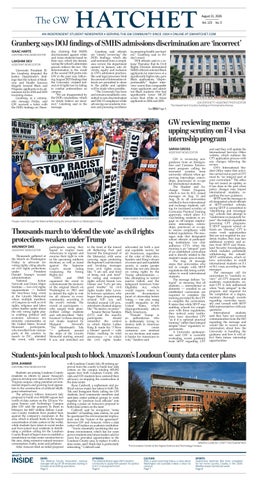
Thousands gathered at the March on Washington Friday to advocate for voting rights, citing attacks on civil rights protections under President Donald Trump’s second administration. National Action Network and Drum Major Institute — two civil rights organizations — hosted the four-hour long event at the Lincoln Memorial where multiple members of Congress as well as civil rights, religious and labor union leaders spoke about the role voting rights play in enabling political and economic advances for minority communities in the United States. Several thousand participants, who travelled from various parts of the country to march in D.C., attended the event, with several
participants saying they hoped to inspire more Americans to register and exercise their right to vote in the upcoming midterm elections, as well as stand against the Supreme Court’s recent ruling weakening the Voting Rights Act. NAN and DMI organized the event to commemorate the memory of the original March on Washington in 1963 and to defend the right to vote for all citizens in every community, according to the event’s website. The crowd of participants — who ranged from plainclothed college students and self-described “baby boomers” to those donning red cloaks inspired by Margaret Atwood’s “The Handmaid’s Tale “— gathered around the steps of the Lincoln Memorial starting around 8 a.m. and stretched out
to the front of the fenced off Reflecting Pool and beyond the foreground of the Memorial, with some carrying signs protesting the Supreme Court decision and invoking messages from civil rights icons, like “I am sick and tired of being sick and tired” by voting and women’s rights activist Fannie Lou Hamer and “Let’s get into good trouble” by civil rights leader John Lewis. In between speakers, who began their programming around 9:20 a.m and finished around 1:20 p.m., attendants chanted slogans like “No justice, no peace.” Senator Bernie Sanders (I-VT) said the march’s participants should remember the context in which Martin Luther King Jr. made his “I Have a Dream” speech — with Friday marking its 63rd anniversary — in which the civil rights leader
advocated for both a just and equitable society for all Americans, regardless of the color of their skin. Sanders said King’s dream of a more just and equitable society is under greater threat due not only attacks on voting rights by the Trump administration — like attempting to restrict mail-in ballots and the Safeguard American Voter Eligibility Act, which would require voters to provide documentary proof of citizenship before voting — but also rising wealth inequality in the United States, which disproportionately affects Black Americans. “Donald Trump is an authoritarian who is deliberately trying to destroy faith in American democracy, create confusion, sow mistrust in our elections and make it harder for Americans to vote,” Sanders said.
GW is reviewing new guidance from an Immigration and Customs Enforcement program calling for increased scrutiny from university officials when approving internships, externships, practicums or co-ops for international students. The Student and Exchange Visitor Program, which is run by ICE, issued messages on Aug. 12 and Aug. 24 to all universities certified to have international and exchange students, calling for increased scrutiny of Curricular Practical Training approvals, which allow F-1 visa-holding students to engage in off-campus employment, internships, externships, practicum or co-ops, to ensure compliance with federal regulations. The messages state that designated school officials at participating institutions can only authorize CPT’s when the training is an “integral” part of an established curriculum and is directly related to the student’s major area of study. The Aug. 24 message states that universities who fail to comply with SEVP regulations risk losing certification to enroll international students. The message defines “integral” as meaning that all students — international or domestic — enrolled in an established curriculum are required to complete the training provided by the CPT to complete the curriculum. It states that while SEVP was auditing schools for compliance with these regulations, they noticed some institutions have described CPT “as if it is optional practical training” rather than integral despite “clear” regulatory requirements. A University spokesperson said GW is currently evaluating recent guidance from SEVP regarding CPT
and said they will update the International Services Office website, which outlines the CPT application process with any changes following the review. GW’s International Student Office states that activities carried out as part of CPT must be “an integral part of your curriculum.” The office has not issued an update, as it has done in the past when policy changes may impact international students, regarding the new guidance. SEVP sent the messages to all designated school officials at SEVP-certified schools, saying SEVP is committed to “identifying and investigating” schools that attempt to “undermine or purposely bypass” the federal regulations governing CPT programs. If SEVP suspects school officials are “abusing” CPT to create work opportunities that are not required for academic studies, they may face additional scrutiny and action from SEVP and Homeland Security Investigations, which includes potentially withdrawing the schools’ SEVP certification, which allows universities to enroll international students on F-1 or M-1 visas, according to the messages. The messages call for universities to “carefully review” all CPT requests and academic requirements, ensure CPT is only authorized when “truly integral” to the program and required for the completion of a degree, maintain thorough records regarding curricular necessity and consult with SEVP field representatives with any questions. International students said they have not received communication from the ISO regarding the message and would like to receive more information about how the University is handling the guidance and how it will affect their future internship opportunities.
Students join local push to block Amazon’s Loudoun County data center plans DIYA JHAWAR
CONTRIBUTING NEWS EDITOR
Students are joining Loudoun County residents in efforts to pause Amazon’s plans to develop new data centers on GW’s Virginia campus, citing potential environmental impacts and growing local opposition to the construction of artificial intelligence infrastructure. The advocacy follows Amazon’s July proposal to build over 800,000 square feet worth of data centers on the 120-acre Virginia Science and Technology Campus after GW sold the property to them in February for $427 million dollars. Loudoun County residents have pushed back against the company’s expansion in the area, which is already home to the largest concentration of data centers in the world, while students have taken to social media and have joined local residents in distributing a petition calling for the Loudoun County Board of Supervisors to establish a moratorium on data center construction in the area, citing extensive natural resource consumption, traffic, noise and pollution. After Amazon filed an initial proposal WHAT’S
INSIDE
with Loudoun County July 28 seeking approval from the county to build four data centers on the campus totaling 805,092 square feet, both Loudoun County officials and GW students have centered their advocacy on stopping the construction of the data center. Ryan Caldwell, a sophomore and political science major, has taken to both TikTok and Instagram Reels calling for GW students, local community members and anti-data center political groups to work together to “pressure local officials” into putting a pause on Amazon’s proposal to build data centers on the land. Caldwell said he recognizes “some benefits” of building data centers, he said he questioned the environmental implications and the “nature of the agreement” between GW and Amazon, where a data center will replace an academic institution. “You’re essentially sacrificing this academic environment, which has for years grown students into future leaders and for years has provided opportunities in the Loudoun County area, to replace it with a data center, and I think that is particularly interesting,” Caldwell said.
NEWS The Medical Faculty Associates’ revenue manager will lay off 39 employees starting in October amid shifting operations. Page 3
ARWEN CLEMENS | STAFF PHOTOGRAPHER The Innovation Center at the Virginia Science and Technology Campus.
OPINIONS The Editorial Board urges GW’s student community to apply their passion for politics to D.C.’s local government. Page 6
CULTURE After a seven-year-long hiatus, a class about Washington sex scandals makes a return to campus. Page 7
SPORTS Sophomore swimmer Mia Hren competed for her home country, Croatia, in the 2026 Mediterranean Games last week. Page 8
Go off (text)book. Build real-world skills at AWS Builder Center for experience that you won’t find on a syllabus.
THE GW HATCHET
NEWS
August 31, 2026 • Page 3
Foggy Bottom businesses see increased traffic during America 250, tourist events NATALIE NOTE
LIQUOR LAW VIOLATION
FSK Hall 8/23/2026 – 2:56 a.m. Closed Case GWPD and American Medical Response responded to a report of an intoxicated male GW student. Upon arrival, AMR evaluated the student and transported him to Georgetown Hospital for further medical treatment.
SENIOR STAFF WRITER
Foggy Bottom businesses saw an uptick in consumer traffic this summer compared to previous years as tourists flocked to the nation’s capital to celebrate America’s semiquincentennial. With D.C. at center stage for the nation’s 250th anniversary celebration, large events like the Great American State Fair, Freedom 250 Grand Prix and the Freedom 250 UFC Fight, as well as watch parties for the FIFA World Cup this summer, attracted hundreds of thousands of visitors, with The Trust for the National Mall predicting in June that 50 million visitors would come to the nation’s capital by the end of 2026. Foggy Bottom business owners and managers said the influx of visitors to the city mostly spelled an increase in customers this summer compared with previous years, which they attributed to the myriad of summer events around D.C. Christopher Parla, managing partner at King Electric, a bike rental company in Foggy Bottom, said the business saw a “significant increase” in rental numbers this summer compared to last year. Parla said King Electric asks every customer what they are in town for and what they want to see to tailor recommendations to them, and most of the business this summer came from America 250 tourists. “I’ve seen a lot of people just coming in town wearing the sort of American flag apparel, and they’re renting bikes,” Parla said. Parla said King Electric had a recent management change in March and introduced new systems and upgraded bikes to the business, which they expected would increase customer traffic, but America 250 events contributed as well. “I’m positive that America 250, some of the travelers and the tourists that came in town, contributed to that in some capacity,” Parla said. Destination D.C., a marketing organization aiming to promote the city as a tourism destination, said in an email to The Hatchet it is difficult to determine the overall economic impact of America 250 events on the city immediately, as the celebrations are ongoing all year, but the preliminary evidence shows a potential for a “promising summer.” While Destination D.C. said total tourism numbers and their economic impact for 2026 won’t be available until May 2027, D.C. saw a
CRIME LOG
Case closed. Referred to Conflict Education & Student Accountability.
ASSAULT ON A POLICE OFFICER
Patrons eat at Tonic At Quigley’s on 21st Street.
slight increase in tourism in 2025 when the District welcomed more than 27.2 million total visitors, an increase of 20,000 from 2024. These visitors in 2025 spent a record $11.9 billion — a 4 percent increase from 2024 — and created over 114,000 jobs — up 2 percent from 2024. Destination D.C. said a number of factors are contributing to its projection for a successful summer in D.C., including major weekend events like the Freedom 250 Fourth of July celebration, Freedom 250 Grand Prix and museum openings, like the museum under the Lincoln Memorial and the National Geographic Museum of Exploration, which both opened in June. Though the total economic impact of this year’s events is not yet available, preliminary numbers show increases in revenue and hotel occupancy throughout the city. During the Freedom 250 Grand Prix, downtown D.C. hotels saw a 72.1 percent increase in occupancy on Aug. 21 and a 77.1 percent increase on Aug. 22, as compared to the same dates in 2025, according to the Washington Business Journal, an increase of 14.4 percent and 17.4 percent respectively from the same nights in 2025. As tourism began to ramp up for the District’s July 4 celebration, Foggy Bottom restaurants told The Hatchet they were preparing for more visitors to their businesses, despite road closures and a heat wave hitting the city. Restaurant managers and owners said they were already seeing an increase in business at the end of June and expected more throughout July and into August and planned to increase staffing to accommodate July 4 crowds.
LEXI CRITCHETT | ASSISTANT PHOTO EDITOR
Roza Nahar, co-owner of CharmThai, said her restaurant saw an influx in business this summer, which she attributed, in part, to the nearby FIFA World Cup Fan Zones on the National Mall, America 250 tourism and construction workers who regularly came into Foggy Bottom for lunch while working at the Lincoln Memorial and Reflecting Pool. Nahar said the consistent work for construction teams meant consumer traffic at CharmThai, the increased business a welcome sight during the normally slow summer for the restaurant due to students being away. Since the COVID-19 pandemic, restaurants and businesses in Foggy Bottom have struggled with decreased foot traffic and increased operating costs. Foggy Bottom eateries told The Hatchet in March that many were struggling with declining sales. This trend is not unique to Foggy Bottom, with D.C. restaurant closures surging in 2025. Restaurant closures in the city jumped 39 percent between 2024 and 2025, according to the Restaurant Association of Metropolitan Washington, amid federal workforce layoffs and D.C.’s rising tipped minimum wage. Nahar said increased tourism and foot traffic are always good for businesses, especially because Foggy Bottom and the West End corridor have struggled to attract customers and new businesses in recent years due to tariffs and rising labor costs. “There’s nothing to come to Foggy Bottom for,” Nahar said. “People go to either Georgetown, or they go to Dupont. There’s nothing in between, which is the sad little Foggy Bottom that we
have. So obviously, the more footwork, the better.” Jeremy Pollock, the owner of Tonic at Quigley’s Pharmacy, said he saw an increase in customers during the World Cup, but not during some of the Freedom 250 events like The Great American State Fair. He said the World Cup was the “biggest hit” of the summer, and Tonic got an increase in customers during that event, as well as during the IndyCar race. “We did get a lot of tourists coming to D.C. to just check out the city and watch games,” Pollock said. “So that was definitely a plus.” Pollock said he thinks if Tonic was closer to the main events on the National Mall, they would have seen more foot traffic. Pollock said a main reason he thinks the city did not see as big of an impact was because the event “got so politicized” and that the District could have had a great summer but that it “fizzled” because of that. Sunil Sehgal, the owner of Watergate Vintners & Spirits, located near the Kennedy Center, said his business has had one of its worst summers. Sehgal told The Hatchet in July that the shop was facing delays in receiving liquor deliveries due to short-staffed distributors cutting costs, and July 4 celebration road closures causing further delays. In July, Sehgal was optimistic customer traffic would increase but said that the expected uptick in customers didn’t happen. He said business is normally slow during the summer, when residents leave, but it was “particularly” slow this summer. “More residents may have departed in anticipation of the tourists coming in,” Sehgal said.
I Street Mall 8/23/2026 – 3:22 p.m. Closed Case GWPD officers responded to a reported of a disorderly subject who assaulted another GWPD officer during a high visibility patrol. The subject fled the scene after a GWPD officer pepper sprayed them. Shortly thereafter, GWPD located and arrested the subject.
Case closed. Subject arrested and barred.
BLACKMAIL
1957 E Street 8/24/2026 – 9:29 p.m. Open Case A male GW student reported receiving a spam email from an unknown subject who claimed to have the student’s personal information and photos. The sender demanded a cryptocurrency payment and threatened to release the student’s personal information and photos if the student didn’t pay.
Case open.
THEFT II/FROM BUILDING Lerner Health & Wellness Center 8/25/2026 – 4:30 p.m. Open Case A male GW student reported items were stolen from their backpack after they left it in an unsecured locker within the men’s locker room.
Case open.
LEWD, INDECENT OR OBSCENE ACTS
I Street Mall 8/27/2026 – 6:36 a.m. Closed Case GWPD officers responded to a report that a male subject indecently exposed themselves to another GWPD officer. Upon arrival, officers issued the subject a bar notice and escorted him off GW property.
Case closed. Subject barred.
DRUG LAW VIOLATION
Shenkman Hall 8/28/2026 – 2:24 a.m. Closed Case An administrator on-call reported they observed suspected drug paraphernalia during a health and safety inspection. GWPD responded to the report and transported the items to Academic Center, processed them and secured them for safekeeping.
Case closed. Referred to CESA.
—Compiled by Isaac Harte
Foggy Bottom landlord sues Bodega Taqueria y Tequila over unpaid rent, fees ISAAC HARTE
CONTRIBUTING NEWS EDITOR
Foggy Bottom landlord and developer BXP is suing its tenant, restaurant Bodega Taqueria y Tequila, for over $145,000 in overdue payments. BXP, the developer and owner of 2100 Pennsylvania Avenue, brought the suit in D.C. Superior Court against Bodega in May alleging the restaurant failed to pay its rent between September of last year and May of this year. Bodega — which sits on I Street adjacent to the GW Campus store — first opened in January 2025 but appears to have closed after the company removed its Foggy Bottom location from its website sometime this month,
announced the closure of the speakeasy inside the restaurant — Casta’s at Bodega — in an Instagram post on Aug. 12 and removed the signage from building’s facade this month. In the filing, BXP claims Bodega breached its commercial lease by failing to pay $145,129.54 in rent and other fees. In a separate filing, lawyers representing BXP alleged Bodega failed to pay rent despite the fact that operations appeared to be “thriving” while the restaurant was open. Neither BXP or the parent company of Bodega — Menin Hospitality — immediately returned requests for comment. “BXP 2100 Penn has reason to believe that Bodega has no legitimate defenses in this case,
but instead has been diverting its revenue to insiders and/or to other Bodega locations,” BXP’s lawyers wrote in the filing. A mediation session in the case has been scheduled for February, and a non-jury trial is scheduled for April. D.C. Magistrate Judge Risa Berkower granted BXP a protective order at the end of July, which ordered Bodega to pay the court registry $26,222.10 by Aug. 15 and continue making payments on the 15th of every month until the case is resolved. 2100 Pennsylvania Avenue — the office building which housed Bodega on its ground floor — is owned by BXP, however GW owns the land the building sits on.
CARSTEN HOLST | STAFF PHOTOGRAPHER Bodega Taqueria y Tequila’s Foggy Bottom location on I Street.
MFA’s revenue manager to lay off 39 employees amid transition to UHS nonprofit ARUNMOY DAS
ASSISTANT NEWS EDITOR
The Medical Faculty Associates’ revenue management contractor will lay off 39 employees starting in October, according to the Maryland Department of Labor’s website, as it shifts its operations to working with Universal Health Services’ new nonprofit physician group. Savista — a healthcare revenue cycle management company who has managed billing operations for the MFA since July 2020 — sent a notice to the Maryland Department of Labor on Aug. 14 stating the company will lay off
39 employees who work at the new nonprofit Capital Medical Group’s 4920 Elm St. location in Bethesda, Maryland, from Oct. 15 to Dec. 31. The notice comes after GW, the MFA and UHS closed their deal in July to transfer the MFA’s clinical enterprise to CMG, which employs a majority of the MFA’s clinical providers and staff. Savista told the Baltimore Banner in a statement that the layoffs are related to the MFA’s transition to CMG, with Savista moving some positions to the new practice and eliminating others. Savista, CMG and MFA did not immediately return The
Hatchet’s requests for comment. Savista sent the notice to the Maryland Department of Labor to comply with the Maryland Economic Stabilization Act, which requires employers with 50 or more employees in Maryland to provide written notice to affected employees and local government officials at least 60 days before a reduction in operations or planned closing. In May, officials announced the University and MFA reached an agreement with UHS to transition the MFA’s clinical operations to CMG, ending GW’s financial support for the practice after years of continued losses.
UHS will assume full financial responsibility for clinical practice operations at GW Hospital, Cedar Hill Regional Medical Center and affiliated outpatient sites after a five-year transition period, with GW providing up to $230 million in financial support during that period. Officials confirmed in July the MFA would begin permanently winding down its operations in September, laying off its 1,270 employees, about 85 percent of whom accepted contracts at CMG, according to a University official. Officials said in February 2025, the MFA entered into an
agreement with Savista after the MFA Board of Trustees’ Finance, Audit, Risk and Compliance Committee unanimously voted in November 2019 to choose Savista over three other options for the contract to manage the practice’s revenue cycles. University President Ellen Granberg told the Faculty Senate in February 2025 that officials renegotiated the MFA’s contract with Savista sometime after she began her tenure in July 2023 following reports that Savista’s billing processes were “less effective” than when the MFA managed them internally before Savista’s hiring.
NEWS
August 31, 2026 • Page 4
THE GW HATCHET
SGA international student office to expand outreach efforts in second year AMELIA NELSON
ASSISTANT NEWS EDITOR
As the Student Government Association’s International Student Office enters its second year of operations, it aims to bolster accessibility to University resources and expand its outreach to GW’s international student population. The SGA’s international student policy directors said last year they struggled to communicate with GW’s International Services Office due to the department’s delayed replies, while international students said they were unaware of the SGA ISO and wanted more information about University-wide resources and federal updates. SGA directors said in the office’s second year they will continue their goal of streamlining international students’ access to University resources, but plan to promote resources themselves and through international student organizations rather than through the University. Former SGA President Ethan Lynne — who ran on a platform of increasing international student representation in the SGA — established the SGA ISO in fall 2025 amid the Trump administration’s intensified visa restrictions, revocations and travel bans that increased international students’ requests to defer enrollment and decreased international student enrollment at GW and nation-
KRIS PARK | ASSISTANT PHOTO EDITOR Student Government Association International Student Office co-directors Dia Makhecha and Mateo Moya pose for a portrait in front of the SGA office.
wide. This summer, the Trump administration capped international student visas to four years, which officials have said will require additional hiring, training and legal support, potentially disrupt grant-funded projects and leave students filing for extensions in limbo. Last year, Lynne appointed two students as co-
policy directors of international students for the SGA ISO, both of whom will continue in their positions this academic year. Directors said the SGA ISO seeks to help international students by helping them navigate the University’s ISO and pushing GW to simplify the paths to resources. During their first year on campus, SGA directors said they posted online
forms to the SGA’s Instagram page in the fall and spring asking students for feedback about the University ISO and received 40 to 50 responses — around 1 percent of the 3,281 enrolled international students at the University in fall 2025, according to enrollment data. Based on feedback they received last year, the SGA ISO said they plan to urge GW’s ISO to
provide more employment assistance, clarify insurance coverage and create a student advisory board. Anindya Mishra, an international graduate student, said he would like more notifications about frequently updated requirements for visa and internship eligibility, which he said the University ISO publishes, but the SGA could further “amplify.”
He said although students see University-distributed updates, more alerts could help relieve the “mental duress” many international students feel due to uncertainty about their visa status and changing rules. “A rule might be something till yesterday, but it might have changed, you never know,” Mishra said. “So it’s also better to get the confirmation and make sure you understand everything, make sure there are no changes and then proceed.” Dia Makhecha, one of the SGA ISO’s co-directors for international students, said last year the office focused on asking GW’s ISO to better advertise the University’s existing resources, and the office was “receptive” but “extremely slow” to respond, which created a “need-based” relationship between the offices rather than consistent meetings. Makecha said the SGA ISO also wants to increase their direct outreach to the international student body, building connections with students instead of relying on a public form where students might hesitate to share negative information about the University for fear of affecting their visas. “I’m so disappointed that people don’t know we exist, because we want to put ourselves out there as much as we can and make sure that their voices are heard and that life gets simple and safer for them and for us,” Makhecha said.
Students report lack of awareness about campus sustainability initiatives ADELAIDE PETRAS
ASSISTANT NEWS EDITOR
JANIA NUÑEZ REPORTER
Students say while GW-run sustainability initiatives can be effective, they could benefit from increased marketing from the University to drive up student awareness. Officials have engaged in recent efforts to encourage sustainable practices among students, including eliminating the $5 deposit for OZZI reusable dining takeout containers in dining halls this semester, establishing the Sustainability Living Learning Community last year and returning to compostable dining containers in the University Student Center this semester after feedback from environmental student organizations. But more than 20 students told The Hatchet that while they have utilized some of the University’s sustainability programs — including OZZI, as well as Office of Sustainability-run programs like The Loop and the Reuse Market — they find the University does not advertise the opportunities well enough, leading to a lack of knowledge among students about their existence. GW Dining introduced the OZZI reusable takeout containers in 2024, which required a $5 refundable deposit. Starting this semester, students will receive their first token — which they exchange for to-go containers — free of cost this academic year, with any replacements requiring a $10 deposit. A University spokesperson said
the OZZI container program has helped GW make progress toward its 2021 commitment to eliminate single-use plastics. In addition to the OZZI containers, GW Dining introduced Dispatch Goods reusable containers in the University Student Center at the start of the spring 2026 semester, aiming to lower the environmental impact of its dining operations. But officials discontinued the program in May due to uncertainty from the Environmental Justice Action Network surrounding the containers’ sustainability impact and the University’s desire to maintain its sustainability goals. The USC’s dining locations now use its previous compostable to-go containers. Sonia Lerner, a junior and the president of EJAN, said the organization advocates for zero-waste dining, which compostable containers help with. But Lerner said GW makes composting difficult because there are not enough easily accessible compost collection sites on campus, forcing students to go out of their way to adopt sustainable behaviors like composting regularly. “I think it’s tricky when the foundation that these awesome initiatives are sitting on is rocky,” Lerner said. “So these initiatives are great, but they don’t have the fallbacks.” Lerner said while they are happy GW has prioritized sustainability by committing to eliminating single-use plastics, the University still lacks transparency about what it does to reduce waste. They said students should be able to see
A clothing collection bin at the entrance to Amsterdam Hall on H Street.
proof that the University no longer purchases single-use plastics. A University spokesperson said it is not possible to accurately calculate how much total waste is avoided by each sustainability initiative individually. The spokesperson said GW tracks the total amount of waste generated on campus and how much is recycled, composted or reused through programs like OZZI, The Loop and the Reuse Market, an annual no-cost
event where students can collect used household goods — though they did not share that data. Angela Melidosian, an assistant professor of sustainability, said initiatives like OZZI and supplying water bottle fillers across campus help establish lifelong sustainable habits among college students. She said while lack of access to recycling or compost bins can prevent people from adopting sustainable practices, GW’s initiatives make
JOSH STEINBERG | STAFF PHOTOGRAPHER
those behaviors more accessible because they make it easier for students to use reusable containers and water bottles. “The more initiatives we have on campus that are ingraining sustainability into our everyday life, as well as into our semesterly or yearly school cycle, really shows people that sustainability is a choice that you can make,” Melidosian said. “And sometimes it can be a very easy choice.”
Student Court says SGA’s goals to expand judiciary require structural changes AMELIA NELSON
ASSISTANT NEWS EDITOR
Student Government Association Student Court justices say the Senate’s plans to increase the court’s activity in the coming year hinge on resolving ongoing structural and accessibility issues in the court. Student Court justices said in order to carry out continued SGA goals of increased caseload and student participation within the court, the governing body must first consider larger issues of limited jurisdiction outlined in SGA governing documents and a history of limited collaboration between the branches. SGA Senators from the previous term revived the court at the end of last fall by filling over half of its vacancies, and senators the year prior used a referendum to instate term limits geared at increasing student participation, but the court’s chief justice said the Senate has yet to address larger structural barriers which limit the court’s ability to hear cases.
The Student Court sat vacant last fall until Senators confirmed five justices out of seven total seats in December — all of whom will continue to serve through the fall semester — enabling the court to meet regularly and hear cases throughout the spring semester, but the court did not hear any cases. According to the SGA constitution, the court has the jurisdiction to hear cases regarding the constitutionality of SGA members’ actions, appeals of decisions by the Joint Election Commission and disputes between student organizations and SGA — although the court has never heard a case of this nature. Sen. Mathew Reis (CCAS-U), the Senate pro tempore who wrote the Judicial Branch Bylaws Establishment Act as the Senate’s secretary last year, said he wants to increase the court’s functionality by raising the number of mandated meetings a semester, requiring the court to prepare an update for the Senate at every full body meeting and creating an annual report detail-
ing the court’s active and resolved cases as well as any recommendations to amend the SGA constitution or bylaws. Reis said because the Student Court will start the academic year with an operational court, he hopes SGA members will remember the judicial branch can serve as a “neutral arbitrator” to hold one another accountable, possibly increasing the SGA’s productivity. He said providing reminders to SGA members that bylaw violations — like the SGA’s Mental Health and Dining assemblies not conducting regular biweekly meetings last fall — could result in court cases might reduce infringements and make the Senate more productive. Reis added that the Student Court could also be tasked at resolving internal divisions between branches, something he said the SGA faced last year that slowed productivity. “Everyone was assuming that someone was doing the job of the Student Court, and it wasn’t really getting done,”
Reis said. “So over the years, people just stopped going to it, petitioning the court and just relied on the executive and legislator to check the balance on each other.” SGA Chief Justice Oliver Bates said he was not sure the extent to which the SGA could use the Student Court to monitor or increase its productivity and collaboration given the limited language in the current SGA constitution and bylaws. He said if senators wanted to use the judicial branch to enforce collaboration, they would need to first amend the SGA’s governing documents, a process that goes through the Senate. SGA bylaws require some executive and legislative positions to “collaborate” with their counterparts across branches as a listed duty, but there are no specific requirements for collaboration or details on whether unwilling collaboration would constitute a violation of bylaws, which would be needed for the court to hear a case on SGA members’ failed collaboration.
Bates also said he would not directly correlate the court’s ability to operate with an increase in casework, attributing the court’s low use throughout past years to the “narrow” jurisdiction outlined in the SGA constitution. Bates said the court’s scope is limited because it can only hear cases that are not “political” in nature — meaning they are strictly questions of adherence to the SGA bylaws and constitution — and cannot offer advisory opinions, which are non-binding interpretations of SGA bylaws given at a SGA members’ request. The SGA constitution explicitly prohibits “political” questions and advisory opinions, which he said is likely due to the Student Court being based off of the U.S. court system, which employs both of those measures to emphasize the federal judiciary’s impartiality and apolitical nature. The SGA constitution currently states that it considers a complaint to be a “political question” if the
constitution does not have a “workable legal framework” or a passed constitutional amendments to permit or prohibit the matter. Bates said Senators could amend the court’s duties and jurisdiction by eliminating the clause that says the Student Court cannot “render an advisory opinion,” which would allow members of the court to take on a more active role, specifically through non-binding advisory opinions. He said he would be more hesitant to give the Student Court jurisdiction on “political” questions — the ability to decide the verdict of whether an SGA members’ actions that comply with bylaw regulations “should” be permitted — because the court is composed of unelected officials who may not represent the student body as much as an elected member of the SGA would. “We’re not elected,” Bates said. “We’re not answerable to the people in the same way, so we shouldn’t be the ones making everyday decisions.”
NEWS
August 31, 2026 • Page 5
THE GW HATCHET
Students form organization chapter aiming to build schools in Honduras ADELAIDE PETRAS
ASSISTANT NEWS EDITOR
A group of GW students with ties to Latin America and a passion for education formed a student organization that aims to expand access to education in Honduras. One Thousand Schools is an international nonprofit organization that seeks to expand access to education in Honduras, where socioeconomic, infrastructure and safety barriers prevent a large portion of the youth population from attending school, through its goal of building 1,000 schools in the country. Members of GW’s chapter, which was established at the end of the spring semester, said they created the group on campus to raise money and awareness for a cause that couples their passion for education and their firsthand knowledge of limited access to education in Honduras and across Latin America. Gaby Lazo, a senior and the president of One Thousand Schools at GW, said she has become passionate about education in her family’s native country, Honduras, after seeing the limited access children have to schools while traveling to the region. Thirty-seven percent of Honduran children are out of school, including 62 percent of children in the poorest quintile, according to One Thousand Schools’ website. Honduras has a poverty rate over 60 per-
cent, with a lack of education limiting job opportunities, as public primary and secondary schools face a lack of infrastructure like electricity and furniture, according to a 2025 UNICEF report. “I have a lot of cousins still in Honduras and schools,” Lazo said. “I’ve seen it firsthand when I go and travel, and so it’s very important.” Lazo said she founded and led a chapter of One Thousand Schools at her high school and later decided to start a GW chapter alongside fellow senior Anna Valeria Arango, the group’s vice president. The One Thousand Schools organization, formerly known as Students Helping Honduras, was founded in 2006 and has completed over 60 school construction projects, including renovations and building brand new schools. As of 2019, the projects have impacted over 14,000 students, according to a report by the organization. Lazo said individual chapters of One Thousand Schools, including GW’s, tend to focus on small fundraisers benefiting the parent organization’s efforts to build schools, while the international organization hosts larger events, such as charity soccer matches where Latino social media influencers play. She said she represented the GW chapter at a charity match over the summer, where she
The executive board of the recently established GW chapter of One Thousand Schools.
helped raise money for the group’s mission. “All of the proceeds went to building schools in Honduras,” Lazo said. “And so I was a part of that, and I went to represent the GW chapter and basically just tried to get more money.” Lazo said while the GW chapter has yet to host any events since it’s still in its early days on campus, the group plans to hold fund-
raisers that tie in Honduran culture while raising awareness of the limited education opportunities in the country, like participating in the Latin Heritage Celebration beginning in September or holding a Honduran juice sale. Lazo said One Thousand Schools also plans to collaborate with cultural student organizations like the Latin dance team GW
CARSTEN HOLST | ASSISTANT PHOTO EDITOR
Fuego, League of United Latin American Citizens and Latinas Promoviendo Comunidad/Lambda Pi Chi Sorority, Inc., a Latinabased sorority. Juliana Romero, a senior and the secretary of One Thousand Schools at GW said One Thousand Schools recruited underclassmen to join the chapter at First Night x Org Fair event on Sunday, where students, es-
pecially underclassmen, expressed interest in traveling to Honduras and working on the organization’s projects. She said the chapter hopes to send some members to see the sites where their work is making an impact, if funding permits. “When a student has the opportunity to do something hands-on, I think it’s really important,” Romero said.
GWSB partners with Georgian university for dual AI master’s degree SARAH GROSS
ASSISTANT NEWS EDITOR
The School of Business is partnering with Georgian National University SEU to offer a dual master’s degree in artificial intelligence for business starting this fall. GWSB faculty will teach the 30-credit program on the SEU campus in Tbilisi, Georgia, which is accepting applications until Sept. 20 and starts this fall. The threesemester program is designed to help Georgia meet its “technical development objectives” as a country and train a “pipeline” of applied artificial intelligence experts who can build, deploy and govern AI-systems, according to the program’s website. The dual degree program follows GWSB’s announcement of a new master’s degree in AI for Business in June, which will begin offering classes next academic year. The MSAIB program combines the technical foundations of AI with business strategy and responsible AI governance, according to the programs website. Lia Kurtanidze, program coordinator and business and technology faculty member at SEU, said Georgian National University SEU already offers a master’s program in artificial intelligence and data science, which focuses on both theoretical and applied concepts. She said the development of the joint program between SEU and GW represents a “natural progression” of the existing program by teaching students about the application of AI inside organizations. “The dual-degree program is
A student walks through the halls of the GW School of Business.
distinctive in its interdisciplinary approach, integrating artificial intelligence with business and management,” Kurtanidze said in an email. “It is designed for students who seek to understand not only the technological foundations of AI but also its strategic and practical applications in business, management and decision-making.“ Kurtanidze said faculty members from both universities participated in the development of the
NICHOLAS WARE | ASSISTANT PHOTO EDITOR
program and its curriculum and it will be delivered primarily inperson in Georgia. She said most GWSB faculty members participating in the program will travel to Georgia for designated teaching periods at the SEU campus rather than permanently relocate, and existing SEU faculty members will also teach selected courses. Kurtanidze said the program is primarily structured for students who intend to complete the ma-
jority of their degree in Georgia, since most classes will be taught in person at the SEU campus, and U.S.-based students are not currently eligible to apply. She said the program also offers the possibility of Tbilisi-based students taking inperson courses in D.C. during their third and final semester of the degree, subject to visa approvals. Kurtanidze said the dual degree program intends to bolster graduate student’s academic and
professional profiles in an increasingly international and technology-driven labor market. She said graduates will develop “interdisciplinary competencies” in AI and business while also gaining academic experience associated with both a Georgian and a U.S.-based university. “The partnership responds to the increasing demand for professionals who possess interdisciplinary competencies in both artificial intelligence and business,” Kurtanidze said. SEU also partners with other U.S. universities, like the Massachusetts Institute of Technology, where they send lecturers each year to participate in an entrepreneurial training program on the MIT campus. Other partnerships include the University of California, Berkeley, the College of the Canyons and other universities in Europe. A University spokesperson said a shared recognition of the growing importance of artificial intelligence and commitment to developing “internationally competitive” educational opportunities for students in Georgia led to the partnership between GW and Georgian National University SEU. The spokesperson said an influential factor in the partnership was the “strong complementarity” between the two universities. They said GW offers a specialized AI for Business curriculum and global faculty resources while SEU contributes “deep knowledge” of the local educational landscape and workforce priorities.
DOJ alleges SMHS violated civil rights law in race-based admissions decisions From Page 1 DOJ officials said in the release GW’s practices violated Title VI of the Civil Rights Act of 1964, which prohibits discrimination based on race at institutions receiving federal financial assistance, as well as the Supreme Court’s 2023 decision in Students for Fair Admissions v. Harvard that banned affirmative action. The DOJ said the department is engaging in settlement negotiations with GW to bring SMHS’s admissions practices into compliance with federal law, but would file a suit if those negotiations fail. The release states that GW issued University-wide guidance stating admissions officers could not give preference based on racial or ethnic identity that was “selfreported” following the Supreme Court’s decision, but SMHS included essay questions designed to deduce information about applicants’ race or ethnicity, which admissions officers used when selecting applicants for interviews. The DOJ alleges SMHS also regularly denied admission to white and Asian applicants in favor of Black and His-
panic applicants with lower credentials. “GW Med’s admissions practices reveal an intent to prioritize racial diversity over merit, which is unlawful and poses legitimate public health consequences for the patients its future doctors will serve,” Assistant Attorney General for Civil Rights Harmeet Dhillon said in a press release Thursday. The Office of the Provost in 2023 updated its admissions guidelines following the Supreme Court decision, saying the University would continue to use its resilience rating — which determines how an applicant has overcome adversity — in the place of a race-conscious admissions process. The Provost’s Office also outlined additional strategies GW admissions officers should pursue to increase diversity on campus following the decision, including creating essay questions that allow students to share more about their identity in addition to prospective student interviews, which the admissions office did not offer at the time. A University spokesperson declined to comment on whether officials are planning to settle with the DOJ.
The findings come after the DOJ in January opened a University-wide Title VI compliance review into GW’s admissions practices in January, focusing on diversity, equity and inclusion practices used in admissions. GW officials said, at the time, it would cooperate with the review and demonstrate that its admissions practices comply with federal civil rights law. The DOJ declined to comment further on the investigation’s findings, whether the department was planning to investigate the admissions practices of other GW schools or if the findings were a result of the January DEI probe. After the Supreme Court effectively banned the practice of affirmative action within higher education admissions in 2023, Granberg, along with then-Interim President Mark Wrighton, issued a joint statement saying they were “deeply disappointed” by the court’s decision because it would make building a diverse community more of a challenge. They said officials were still committed to ensuring diversity within GW’s community. Vice President and Dean of Enrollment Management and Student Success Jay Goff in an enrollment update in December 2025 did not
mention the University’s sixth postpandemic goal to increase student diversity, even though it was one of the objectives officials were set to work on from 2021 through 2026. Goff in December 2024 said the University met all its enrollment targets for the 2024 admissions cycle despite delays in federal aid applications and the Supreme Court’s decision to ban race-conscious admissions policies, with admitted underrepresented minorities rising to comprise 25.7 percent of the Class of 2028. The probe into GW is part of President Donald Trump’s administration’s broader crackdown on DEI in higher education, with GW being one of more than 50 universities the DOJ is investigating over DEI practices in its programs and activities. Trump on his first day in office signed an executive order calling for the elimination of DEI positions in the federal government to the “maximum extent allowed by the law,” and the following day directed agencies to enforce civil rights laws against what he described as illegal DEI initiatives in the private sector. The DOJ announced earlier this month it found the Duke University School of Law had intentionally
and illegally used race as a factor in considering whether to admit applicants, accusing Duke of giving preferential treatment to Black and Hispanic applicants over Asian and white ones. In June, DOJ officials announced they were opening investigations into 15 medical schools, examining whether they had illegally considered race as a factor in making admissions decisions. DOJ officials did not disclose which medical schools were among the 15 or whether SMHS was one of the medical schools included within the scope of the investigation. In its first probe against GW in August 2025, the DOJ announced they found GW had acted with deliberate indifference to antisemitism on its campus and said it would seek “immediate remediation” from the University. Officials have since met with the Justice Department officials to discuss the investigation into complaints of antisemitic discrimination at GW that took place during the spring 2024 pro-Palestinian encampment. Granberg said officials shared with the DOJ a “full array” of measures GW has employed to combat antisemitism on its campus.
THE GW HATCHET
OPINIONS
August 31, 2026 • Page 6
OPINIONS
WHAT THE UNIVERSITY WON’T TALK ABOUT THIS WEEK
Whether GW plans to settle in the Justice Department’s probe into the School of Medicine and Health Science’s admissions decisions. p.1
GW students’ passion for politics must also apply to local DC government STAFF EDITORIAL At first glance, it may seem that the GW student body has earned its reputation as inordinately passionate about politics. Most GW students spend their summers working for their senators and representatives and spend their school semesters at Capitol Hill. But while our student body focuses on national politics and issues, there is one political arena that goes ignored by GW’s scores of political science students: local government. The evidence is clear: students are incredibly vocal in their opposition to President Donald Trump’s administration, with various student organizations holding countless protests and demonstrations since his second term began, but many GW students — even those who claim to be the most politically attuned — could not name more than two members on the D.C. Council or Foggy Bottom’s own Advisory Neighborhood Commission. Many of us came to GW hoping to make a change, but we as a student body have displayed a stunning disinterest in supporting the community that we chose to inhabit for four of our formative years. The energy and dedication that we bring for national politics has to be brought to local government. D.C.’s government is far more complicated than most municipal or city governments, but it’s also quite different from most state governments since we are considered simply a federal district. While most states have state legislatures and most cities have city councils, D.C. has a structure that in many ways combines the two: the D.C. Council. The Council is made up of 13 seats, one for each ward of the city, along with four at-large seats and a chairman and is the primary lawmaking body for the city. Councilmembers
CAROLINE MORRELLI | STAFF CARTOONIST
serve four year terms and are responsible for setting the city’s budget — which is subject to approval from Congress — passing laws and holding regular public hearings to oversee the city’s various government agencies. And perhaps the most unique feature of the D.C. government is its ANCs, of which there are 46 around the city governing over different neighborhoods. The Foggy Bottom and West End ANC, or ANC 2A, represents GW’s campus, and while they don’t have formal lawmaking power, they are resident’s most direct liaison to D.C.’s governmental apparatus. The ANC plays an advisory role to the
D.C. Council, passing resolutions to suggest changes to legislation they want to see, and the Council must give “great weight” to the ANC’s suggestions. This often directly impacts GW students, as when officials sought to open District House to the public, the ANC had to support that change. Even though these structures are the ones that are the most accessible to us as students and have the most power to influence our daily lives, GW students often fail to engage with them. This has not always been the case, as the ANC in the past has had student representatives, but the last students to
Cuts to my financial aid are forcing me to withdraw from GW
C
oming in as a student from a working-class family from Chicago, I thought that GW would make my career goals possible, but unfortunately, my hope of reaping the career and educational benefits GW promised to offer me, like networking and proximity to a strong hub for journalism, were shortlived because the University abruptly slashed my financial aid packages at the beginning of this year. The changes significantly increased the money I owed by thousands of dollars.. When GW officials continue to raise tuition, students who come from families without significant financial cushions cannot simply find thousands of dollars when an award changes — and this is something that the administration has to understand. We cannot ask our parents to write another check, take out another loan or cover unexpected expenses. For students from workingclass families, financial aid is not just a bonus — it is the reason we can attend. It is a necessity. Without it, GW becomes an institution essentially gatekept to the uber-wealthy, and as a school that prides itself in being accessible to all, this trend cannot continue.
Tiara Cirino Opinions Writer Since last semester, I have been struggling to deal with the financial issues that GW’s exorbitant costs exacThe GW
Hatchet 609 21st St. NW Washington, D.C. 20052 gwhatchet.com | @gwhatchet eic@gwhatchet.com news@gwhatchet.com opinions@gwhatchet.com photo@gwhatchet.com sports@gwhatchet.com culture@gwhatchet.com copy@gwhatchet.com multimedia@gwhatchet.com
erbated. Various financial aid advisors told me in June that my aid was cut because I no longer had a financial need, as I had received an outside scholarship, which was understandable, and I was able to use most of the scholarship to pay off the invoice. However, before I moved in I received another unexpected bill that was supposed to be covered by my aid, and when I called GW’s financial aid office, they told me via email and phone that they reduced my aid because the formula GW’s financial aid system uses had concluded that I no longer was in need of that aid. Once again, I submitted an appeal, in addition to a ticket explaining my situation as I have in the past, and since July, I have not gotten a reply. It is mindblowing how the office assigned to solve financial aid issues and spearhead one of the most important departments of the University is unreachable. Officials should be readily available to expedite issues and situations like these. Before this happened, I saw GW as a place where I could build a future. A place where I, along with many students, worked very hard to get to. I believed that if I did my part to get here, GW would do its part in providing the financial stability necessary for me to remain here. I was never expecting GW to cover every cost, but I did expect simple consistency in the amount of aid I would receive, so that my family could plan our yearly expenses. Instead, I learned how quickly that stability
can disappear. The battle for access to higher education institutions does not end when a student receives their acceptance letter. I am not asking GW to ignore their financial realities. I am asking the University to recognize its responsibility to the students entrusted enough to enroll. Financial aid should never be something students should have to fear a month before moving in. And working-class students should not have to wonder whether one unexpected change — like how they calculate aid — will determine if they can finish their degree or not. My experience has changed the way I’ve viewed GW. I still value education, and have cherished every friendship, every connection and the valuable lessons I have learned in my time here. But loving a university does not mean ignoring the way it fails its students, leaves students like me with no choice. I am not sure where I will continue my education next, but I hope I will be able to attend a place where they make education accessible, and where I can continue to grow in my journalistic pursuits. If GW wants to call itself an institution accessible to students from all backgrounds, it needs to ensure to do everything in its power to do so. Otherwise, the question is whether GW is accessible, but who is it accessible to? —Tiara Cirino, a sophomore majoring in journalism, is an opinions writer.
serve on Foggy Bottom’s ANC gave up her seat in 2024. And in the last few years, the ANC has struggled to maintain the quorum necessary to hold regular meetings. We have also seen students at Georgetown — whose ANC requires that two seats be filled by Georgetown students — and American University run for and serve on their respective ANCs. But even the national issues that GW students care so much about — the National Guard’s occupation of D.C., the surge of Immigration and Customs Enforcement operations across the country and Trump’s crackdown on unhoused
populations — have direct linkages to D.C.’s local government apparatus. Students often have the power to make more substantial change through local government avenues on these issues than national level advocacy, but they fail to do so. The ANC is always trying to raise capacity at the Aston unhoused shelter and has passed countless resolutions condemning the National Guard’s presence in D.C., and Ward 2 Councilmember Brooke Pinto has held a hearing with Metropolitan Police Department officials, at the request of ANC 2a, about their cooperation with ICE. And arguably, when we focus on hyper-local initiatives, it is easier to create actionable change. Election Day is just over two months away, and although there are several high profile Congressional and gubernatorial races that will dominate national headlines, D.C. Council, ANC and the D.C mayoral races will all be on the ballot this November. Change really does start from the bottom up. It’s local government officials who fill our school boards, pave our roads and determine which social programs get funding. And there are several things GW students can do to facilitate that process. Students who do not wish to get heavily involved with politics can simply attend meetings and speak out in them. But there is also the option to register to vote in D.C. to have voting power and direct influence. And finally, if you can, get directly involved. Candidates for the ANC only need 25 signatures to get on the ballot, a lower barrier to entry than almost any other public office. And if you don’t run directly, protest outside the Wilson Building instead of the White House. Make your voice heard.
It’s time to start making a five-year plan. I have too many.
A
fter being a college senior for just two short weeks, I have already found myself constantly bombarded with the question “What are your plans after graduation?” And I always dread having to answer. Not because I don’t have one — that would almost be easier. Instead, it’s because I have too many answers.. And any time I get this question, my anxiety spikes. It is easy to forget, in a place like GW where students have their five-year plan after graduation the moment they step onto campus, that not having an outlined path is not the norm. People seem to already know that they are going directly to law school, joining a think tank, working on Capitol Hill, going to grad school or moving to New York for a job on Wall Street. Everyone seems to have figured it out, and it makes me feel like I am sticking out like a sore thumb, and I feel pressured to develop an itinerary for the rest of my life at age 22. But as students, we need to give each other some grace and realize that it is completely normal to not have it all planned out and have a job waiting for us after graduation. Figuring it out as you go — and allowing yourself to try, fail and change — is part of the fun.w
Duaa Hussain Opinions Writer There tends to be an expectation from parents,
other students and even yourself that by the time you get to your senior year, your interests should have narrowed. But what happens when you genuinely don’t want to pick one? What if you do not have a definitive answer? In my experience, exploring multiple options has led me to only have my love for different subjects grow and has made it more difficult to choose one. My graduation is looming nearer, and I still do not have one specific position or career I want to apply to. And it doesn’t help when I look around at my peers who already have a cushy business job set up once they graduate, which makes me feel like I am behind or I need to have it figured out as everyone else does. But the reality is that many of us are in our early twenties and not knowing what to do after you graduate or loving multiple subjects is not the end of the world. Despite what GW culture might show, it is normal to have doubts or not have a set commitment when you are 22. Graduating just has a way of making things feel way more permanent than they probably are. Every class has to fit a narrative and contribute to my future career, and every extracurricular becomes evidence of what you are supposedly becoming. There’s this compulsion to tell a coherent story about ourselves, but I’m not sure real people are that coherent. You don’t need
to define your life before you’ve even had a chance to live it. We often forget that as humans we are allowed to have multiple interests and want to do many different things — that is normal, hence why you have to take seven general education classes at GW, each broadening our worldview and making us well rounded. Having one thing that you are passionate about and ready to commit to in your twenties for the next 30 years is rarer than many of us actually realize. We are allowed to change our minds. I think we sometimes confuse having a plan with having certainty. I know that as seniors, we have the whole world telling us to make a decision, choose a path and stick to it. But at the end of the day, it is our path and we are allowed to not even know where to start. Maybe I will choose law, or maybe I will write. Maybe I’ll end up somewhere I haven’t even considered yet. But for now, I’m trying to resist the idea that wanting several things means I am failing at adulthood or that I am somehow behind the rest of the world. Many of us forget that it is completely normal and part of growing up to not have it all figured out. As we start our senior year, let’s remember our path does not have to be a straight path to anywhere. It can still be undecided. —Duaa Hussain, a senior majoring in political science and creative writing, is an opinions writer.
Jenna Lee, editor in chief Molly St. Clair, managing editor Tyler Iglesias, managing editor Mollie Weiner, managing director Sachini Adikari, community relations director Gianna Jakubowski, senior news editor Ryan Saenz, senior news editor Adelaide Petras, assistant news editor Amelia Nelson, assistant news editor Arunmoy Das, assistant news editor Lakshmi Dev, assistant news editor Sarah Gross, assistant news editor Shivu Sathe, assistant news editor Diya Jhawar, contributing news editor Isaac Harte, contributing news editor Paris Albrecht, contributing news editor Andrea Mendoza-Melchor, opinions editor* Ethan Vargas, contributing opinions editor* Milo Rosenzweig, sports editor Sophia Caputo, contributing sports editor*
Ryan Jainchill, basketball editor Diana Anos, culture editor Jessica Rowe, contributing culture editor Carly Cavanaugh, contributing culture editor Mathylda Dulian, senior photo editor Carsten Holst, assistant photo editor – news Kris Park, assistant photo editor – news Lexi Critchett, assistant photo editor – sports Nicholas Ware, assistant photo editor – culture Marcel Richardson Villenas, video editor Misha Cohen, video editor Ethan Tsai, copy chief* Juwon Kim, copy editor Marlene Orantes, copy editor* Raina Pawloski, copy editor Kya Hoffman, research assistant* Louisa Hannoucene, research assistant Ida Liben, podcast host – news
Maddie Flesch, podcast host – news Aadarshini Vijesh, podcast host – culture Arjun Srinivas, podcast host – culture Livi Tuber, design editor Daniela Garcia Perez, contributing design editor Sofia Ang, graphics editor Madeleine Phillips, social media director Andrew Rooney, contributing social media director Victoria Smajlaj, contributing social media director Alex Batzar, ad sales manager Annika Krause, web developer Ryan J. Karlin, donor relations manager Arushi Agarwal, financial manager * denotes member of editorial board
Submissions — Deadlines for submissions are Friday 5 p.m. for Monday issues. They must include the author’s name, title, year in school and phone number. The GW Hatchet does not guarantee publication and reserves the right to edit all submissions for space, grammar and clarity. Submit to opinions@gwhatchet.com Policy Statement — The GW Hatchet is produced by Hatchet Publications Inc., an independent, non-profit corporation. All comments should be addressed to the Board of Directors, which has sole authority for the content of this publication. Opinions expressed in signed columns are those of the authors and do not necessarily reflect the view of The GW Hatchet. All content of The GW Hatchet is copyrighted and may not be reproduced without written authorization from the editor in chief. Cost — Single copies free. Additional copies available for purchase upon request.
THE GW HATCHET
CULTURE
August 31, 2026 • Page 7
CULTURE Course on sex scandals in the District makes a comeback to campus DIANA ANOS
CULTURE EDITOR
After seven years away, a course examining how D.C.’s most illicit affairs rocked the country is making its comeback at GW. Washington Sex Scandals, a Dean’s Seminar course in the American Studies Department, is returning to campus this fall after a years long hiatus. Taught by Associate Professor of American Studies, Chad Heap, the class examines how the most scandalous affairs of D.C.’s upper echelon throughout history have revealed Americans’ changing attitudes on sex and sexuality. Heap said he arrived at GW in 2000 and started teaching Washington Sex Scandals at GW in 2006, offering the class a total of five times until its last semester in 2019. After serving as the associate dean for graduate studies in the Columbian College of Arts & Sciences for six years and taking one year for a sabbatical, Heap is returning to the classroom this year. Heap said he got the idea for the course not from his own research, but from hearing about sex scandals in the news in 2006, highlighting the affair between President Bill Clinton and Monica Lewinsky, which prompted scholars to look into changing “sexual norms and worries” in the United States, as well as the separation of public and private life and the role of media plays in politics. As he read into the topic, Heap said some of the scandals were affairs he had never heard of, including allegations of President Andrew Jackson and his wife partaking in a bigamous and adulterous relationship, as his wife was not legally granted divorce from a previous marriage, draping his campaign in drama. Heap said while developing the course he made sure to include primary texts from the times of the scandals, as well as scholarly pieces across disciplines including newspapers and historical journal articles to examine the perspectives of individuals at the time of the scandal. Heap said his course is among the first classes
THE
SCENE RELEASED
THIS WEEK:
PASSPORT TO PATRIOTISM Tuesday, Sept. 1 | Art Museum of the Americas | Free
NEW SONG: “SERENA JOY” BY OLIVIA RODRIGO
Student performers tune into music ensemble auditions, look for a seat on the stage BRIANNA COBBS REPORTER
NORA PAYTON REPORTER
ABBY BROWN | STAFF PHOTOGRAPHER Associate Professor of American Studies Chad Heap poses for a portrait in his office.
students may take at their time at GW, and he hopes to help students strengthen skills like understanding complex academic writing through introducing them to varying scholarly disciplines, like political science and cultural sociology when analyzing sex scandals, to allow them to explore the full societal impact of the event. Heap said the main point of the course is to examine how the scandals students are learning about reflect what society considered scandalous at a point in time and how the definition of scandal has changed to become more normalized in the modern day. In addition to what was considered scandalous, Heap noted students will also work to examine other facets of American culture that sex scandals influenced, including how political ideology is shaped and how the media relayed information to the public at different times throughout history. “Looking at what the scandals tell us about the emergence of the mass media and its effect on molding public opinion, on the kind of changing configuration of the boundary between public and private and American life,” Heap said. Heap said he knows the title of the course may sound “racy” to some in an effort to draw interest, but over time, he hopes to get students to think about how the general topic relates back to “serious matters” in
American culture, like changing norms in sexual expression across recent decades and the evolving media landscape. While the course material is not new to him, Heap said this semester is his comeback to teaching after a seven-year-long hiatus, and he looks forward to seeing how concepts he discussed in the class years ago have changed and how today’s students will approach the course. He said thinking about the class in the modern day also made him wonder if sex scandals mattered to the American public anymore and whether or not they have as much of an impact on society as they once did. Recently, Heap said he’s seen scandals with Representative Tony Gonzalez, who had an affair with an aide, and Representative Bernie Moreno — who has called on his former son-in-law, Representative Max Miller to resign amid domestic abuse allegations — that have made headlines and impacted their political careers. He said he is eager to continue exploring the topic of U.S. sex scandals this semester to examine if more recent events reveal a “new transformation” in American politics and culture, and how changing social attitudes toward sex interact with those perspectives. “It seemed to me that looking at sex scandals was a good way of getting at a number of interesting questions about American life and culture,” Heap said.
2026 D.C. JAZZFEST Saturday, Sept. 5 | The Wharf | $29
Folders overflowing with sheet music, students nervously waiting to show off their skills and brass reverberations heard throughout the hallways of the Phillips Hall basement can only mean one thing: music ensemble auditions. As the school year kicked off last week, so did auditions for GW’s orchestra, symphonic band and Foghorns Pep Band ensembles, with over 100 students vying for spots in this year’s musical groups. Students say GW’s bands are not just a place to fine tune their musical abilities, but also a musical oasis to forge community among peers with similar interests. Michael Schmitz, director of bands at GW and adjunct music professor, said he has been the director of GW’s Wind Ensemble and Symphonic Band since the fall of 2019 after retiring from playing the trombone and conducting the Navy Band in D.C. for 30 years. He said GW is full of “talented and intellectually outstanding students,” and for many, being a part of a music ensemble gives them a break from the rigor of their academic lives. For most students in the musical groups, Schmitz said, they’ve been playing instruments almost their entire lives, and the ensembles give them a chance to continue playing music throughout college at a higher level, providing the opportunity to grow and learn through new ar-
rangements each year. For the symphonic band, Schmitz said students play pieces that are more “accessible” to all skill levels and all students who audition are accepted. Those auditioning for the orchestra and wind ensemble, he said, play longer and more demanding pieces, where students are invited to join based on their audition and the ensemble’s current needs. Scott Wood, director of orchestral activities at the George Washington University’s Corcoran School of Arts & Design and a member of the conducting faculty at the Washington Conservatory of Music, said auditions give him the rare opportunity to hear students perform individually, because once rehearsals start he’s typically in a group setting with the musicians. Flautist and sophomore business and music major Dylan Callahan said after spending his first year in symphonic band, he decided to audition for the more selective wind ensemble this year after seeing the group perform music from “Star Wars.” Callahan said he first picked up his instrument in the fourth grade, later adding alto saxophone to his repertoire and is currently learning trombone. Callahan said band was a major part of his life in high school, after participating in his school’s marching band, and he initially worried about how he would fill that absence after arriving at GW. “I was really worried about what’s going to fill the void,” Callahan said. “But I’m really lucky to have found a community here.”
ABBY BROWN | STAFF PHOTOGRAPHER GW Director of Bands and Adjunct Music Professor Michael Schmitz leads a GW Wind Ensemble and Symphonic Band open rehearsal at Phillips Hall.
The business of beauty: GW students turn cosmetic hobbies into profits JESSICA ROWE
CONTRIBUTING CULTURE EDITOR
In a city overflowing with expensive beauty service options, try booking your next refresh appointment with GW’s own student-run businesses. Ranging from custom henna designs to curated press-on nail sets, student beauty business owners are balancing their academic lives with clientele lists, providing services to classmates and friends alike. GW student entrepreneurs said building businesses have allowed them to meet new faces around campus while also developing essential entrepreneurial skills, turning their beauty centered hobbies into a profit. Isha Sinha, a sophomore studying economics, said she used to do henna body art for her friends at home, leading her to start a business offering her designs to a larger client base around GW. Sinha said last year she began taking her business more seriously when she started creating custom henna designs for students based on tattoo designs, expanding her offerings to designs like flowers and portraits rather than just traditional henna art. She said she drew inspiration for her designs from the tattoos of the character Mel from the animated Netflix TV show “Arcane.” “She had designs all over her arms, and I thought it would be cool to replicate that,” Sinha said. “So I spent hours, and I replicated the Mel from ‘Arcane’ designs all over, and then after that, I just started searching for
PHOTO ILLUSTRATION BY LEXI CRITCHETT
A student gets their nails painted.
tattoo styles on Pinterest.” Sinha said she has transformed her business to include selling stencils which she delivers to students on campus to do henna themselves. She said she visited the GW Innovation Center last spring where she spent several months experimenting with materials like acrylic and laser cutters to prototype henna stencil designs to sell. She said once she developed the designs, she found a vendor to print the designs to be manufactured at a warehouse in China. Sinha said majority of
her clients reach out to her through her Instagram account where she schedules henna appointments which range from $5 to $20 based on the complexity of the design. . Sinha said GW resources like the Innovation Center and her entrepreneurship classes have helped her think more seriously about how to run her business. She said beyond GW she hopes to develop her henna art into a more widespread stencil business as she takes inspiration from her entrepreneurship minor. Camila Arthur, a junior
studying photojournalism, runs Cami Hair Care, a hair business she started after doing her own hair from a young age and doing other girls’ hair while attending boarding school. She said she started her business at the beginning of her sophomore year, working primarily with people of color. Arthur said the appointments can be very time consuming, with complete hair appointments taking around five hours depending on the complexity of the style. Arthur said her pricing also depends on the styles requested with
add-ons of detailed styles increasing the price. Arthur said she tries to not take more than four clients a week because she wants to make sure she can follow through on every appointment and give each client equal time and attention. She said her favorite part of running the business is the relationships she builds with her clients and fellow students as hair can be an “intimate” part of someone’s identity. Marin Harvey, a sophomore studying exercise science, said after transferring from United
States Military Academy West Point to GW this semester she found a way to transform her hobby of doing nails into a business. She said at West Point she had to keep her nails short with clear nail polish because of the school’s rules and would spend time doing other students’ nails in line with the regulations, but now she has the opportunity to experiment with more creative nail designs and colors through her Manis by Mare business. As a member of the GW volleyball team, Harvey said she mainly works with members of her team as she just started the business this semester. She said she offers gel manicures, Gel-X extensions, nail art and presson sets to students, which she advertises through her Instagram account. Harvey said her business is still in the early stages with the page launching just a month ago, but she hopes that through her business she can reach more students, meet new people on campus and spread word about her services. Harvey said it has been fairly manageable to balance her business with school and volleyball as she has free time during the day for clients. She said doing students’ nails has allowed her to meet people on campus who she otherwise would not have interacted with. “I get to do what I love and make a little money doing it, and then you just meet new people from all over, like people you probably wouldn’t normally talk to or wouldn’t normally see around, just kind of broadening your scope,” Harvey said.
SPORTS
August 31, 2026 • Page 8
SPORTS
THE GW HATCHET
GAMES
vs. Colgate University on Sept. 6 | 1:00 p.m.
OF THE WEEK
NUMBER CRUNCH
WOMEN’S SOCCER
VOLLEYBALL
0.769
North Carolina State University on Sept. 4 | 6:00 p.m.
Senior men’s soccer goalkeeper Tom Macauley’s save percentage over three games.
Sophomore swimmer represents Croatia in international competition SOPHIA CAPUTO
CONTRIBUTING SPORTS EDITOR
For most of the year, Mia Hren swims under GW’s buff and blue. Last week, in Taranto, Italy, she traded it for Croatia’s red and white. Hren, a sophomore, competed for her home country, Croatia, in the women’s 50-meter, 100-meter and 200-meter freestyle at the 2026 Mediterranean Games. While swimming on the international stage brings a different level of pressure than Atlantic 10 meets, Hren said stepping up to represent Croatia is always an honor that she embraces to fuel her competition. “I would say that representing Croatia will always be very special to me and carries a bit more pressure, as I feel like I’m representing the whole country, but I’m always very excited to do so,” Hren said. Held every four years, the Mediterranean Games are a multi-sport competition for nations bordering the Mediterranean Sea across Europe, Africa and Asia. The competition is recognized by World Aquatics and serves as a premier international showcase and high-level competition for national team athletes outside the Olympic and World Championship cycles. Hren earned her spot on the Croatian national team after solidifying herself as one of the country’s top sprinters, having previous-
ly captured national titles in the 50-meter and 200-meter freestyle in 2024. In Italy, Hren tested her speed against veteran swimmers in three events. In the 50-meter freestyle, Hren clocked in at 26.54 seconds to finish 14th, touched the wall at 58.32 seconds in the 100-meter freestyle for a 12th place finish and finished out her slate with a 2:06.22 time for an 11th place finish in the 200-meter freestyle. While she posted competitive times, Hren did not qualify for the finals in any of her events, falling short of the top eight on the leaderboard. While the NCAA traditionally competes in 25yard short-course pools, international meets like the Mediterranean Games use 50-meter long-course pools. Since pools measured in meters are longer than those in yards, and the 50-meter pool offers just half as many walls to push off, swimmers spend significantly more time in continuous strokes rather than gliding underwater, requiring a major shift in endurance and training intensity. To train for the transition to longer swims this summer, Hren said she slightly modified her training regimen to a higher intensity. “To prepare for the longcourse part of the season, I did a lot more volume in practices, so they were generally longer,” Hren said. “I also did a bit more [individual medley] and aerobic
COURTESY OF MIA HREN
Sophomore swimmer Mia Hren at the Mediterranean Games in Taranto, Italy last week.
practices as I think they help with my endurance.” Hren balances a heavy mix of both events when competing for GW, proving she could excel in both during her freshman campaign. At the A-10 Championships in February, she was a crucial asset to the Revs relay teams, helping secure a silver medal in the
400-yard relay race. Hren was equally as lethal as a solo competitor, racking up 34 individual points at the championship, including a personal record, bronze medal finish in the 100-yard freestyle and a top-eight finish in the 200-yard freestyle, with her contributions earning her a spot on the A-10 All-Confer-
ence Second Team. Reflecting on her freshman campaign, Hren aims to elevate her tactical execution this year by finishing her races stronger and cultivating more confidence and excitement to fuel her individual performances. With the Revs’ season set to kick off in just over a month on Oct. 3 against the
College of William & Mary, Hren is ready to take her summer swimming experience into her sophomore year. “I have technical mistakes to work on, and some parts of my race, like the underwater sections, so I’m very excited to get into the new season and get better,” Hren said.
Women’s soccer falls 3-1 to Penn in early-season skid MILO ROSENZWEIG SPORTS EDITOR
Women’s soccer (1-2-2) fell to the University of Pennsylvania on Thursday 3-1, marking the team’s fourth consecutive non-win as the Revolutionaries look to find their footing in non-conference play. Following two draws earlier this month, the Revs squared off against Penn’s Quakers Thursday night on a sloshy pitch. The Ivy League squad bested the Revs offensively, outshooting the Revs 13-8. Forward Lily White sparked Penn’s first offensive surge 18 minutes into the match, launching a left-side corner kick to Quaker defender Casey Forman, who was crashing towards the goal. Forman shot, but Penn forward Abbey Cook got a cleat on the ball, nudging it past the Revs sophomore goalkeeper Jasmine Black, putting the Quakers on the board first. Nearing the end of the first half, Graves offered the Revs an offensive opportunity with a poorly-placed goal kick, which was recovered and passed to Kau. She shot straight on, but the ball sailed high. Head Coach Jeremy Williams said he felt the Revs’ offense had good opportunities Thursday night, but simply was unable to
RACHEL KURLANDSKY | STAFF PHOTOGRAPHER Senior defender Sophia Broz chases an opponent during an exhibition match against Howard University in April.
execute in key moments. “I do think our transition to attack has created a lot of dangerous situations,” Williams said in an email. “We weren’t able
to get a clean look at goal last night, but were able to get the ball into their box a number of times.” The Quakers reignited their offense almost four minutes into
the second half, when White connected with forward Mia Fuss, who dodged Revs’ freshman defender Kolby Moss and took a clean shot past Black, giving Penn
a 2-0 lead. The Quakers found a final spark in the final minutes when forward Magali Capdevila passed to Forman, who swiftly moved past the Revs’ defenders. She booted a shot past Black into the net, giving Penn a 3-0 lead. The Revs made a last-ditch effort to score less than a minute later, when freshman forward Ella Provost-Heron launched a corner kick and connected with junior defender Julia Bilal, who headed the ball into the net past the Quakers’ leaping goalkeeper, reducing the deficit to two goals. Despite a momentary burst of action for the Revs, the team was unable to catch up in the final minutes and fell 3-1. On the defensive side, Williams said his Revs gave the Quakers too many good looks at their goal. “Penn is very dangerous in transition, and we gave them a few too many opportunities to get out and attack our backline,” Williams said. The Revs’ next matchup is slated for Sunday against Colgate University. In the interim, Williams said his squad will focus on working out the kinks the coaching staff has identified thus far. “We have the benefit of a lot of training time to iron out some wrinkles,” Williams said.
Water polo battles deep pool of nationally ranked teams in opening tournament SOPHIA CAPUTO
CONTRIBUTING SPORTS EDITOR
MILO ROSENZWEIG SPORTS EDITOR
Water polo opened its season 2-2 at the University of California, Irvine Invitational over the weekend, facing nationally ranked competition. The Revolutionaries, who were not ranked in the top 20 but received votes in the Collegiate Water Polo Association Varsity Preseason Poll earlier this month, opened the season Friday morning with a 16-13 win over Biola University, before falling 13-9 to No. 13 UC Irvine. On Saturday, the Revs narrowly edged the University of Redlands, the No. 3 ranked program in NCAA Division III, in a 12-11 victory before concluding with a 15-12 loss to No. 16 Loyola Marymount University. “It is always best to find
out who you are and what you need to improve right from the start,” Head Coach Barry King said in an email after Friday’s matches. In the Revs’ first match against Biola, junior attackers Antonio Florena and Yam Kabakov paved the way offensively, with Florena racking up five goals and two assists, and Kabakov recording three goals and two assists of his own. The season opener also saw freshman goalkeeper Solt Horvath make his first start in the net. In the first quarter, Horvath kept the Eagles scoreless while the Revs racked up three goals. “To pitch a shutout in the first quarter of your first match in NCAA water polo is pretty special,” King said. Friday afternoon’s matchup against UC Irvine gave the Revs a chance to take on a top-tier Division I program. UC Irvine finished the first quarter ahead 5-3, and headed into halftime with
a 9-5 lead. The Revs fought back, finishing the third frame down just two goals, but three goals from the Anteaters in the final quarter gave the home team the 13-9 finish. King said the match showed his squad the importance of preventing high-level teams from creating early scoring deficits. “We can’t let a team of that kind of quality separate from us that early.” On Saturday, the Revs locked in for a close call 1211 win over the Division III Redlands Bulldogs. After falling behind in the first three quarters, GW brought the score to a 11-11 tie with just a minute left. Junior transfer Konstantinos Kapragkos netted the game-winning goal to separate GW from a tie with just 46 seconds remaining in the game. Kapragkos had another strong performance in the next match against Loyola
QUINN VAN MOURIK-RUDNICK | STAFF PHOTOGRAPHER The water polo team competes against Navy last season.
Marymount, leading the team in scoring with sophomore Andrea Forno, netting three goals each. The Revs managed 12 goals against
the Lions, with Kabakov, Florena, Gabriele Molfino and Anthony Ferneini all securing one goal and one assist. Though the Revs had a
stronger start against the Lions, Loyola took a 7-6 halftime lead, which eventually led to their 15-12 win over GW.