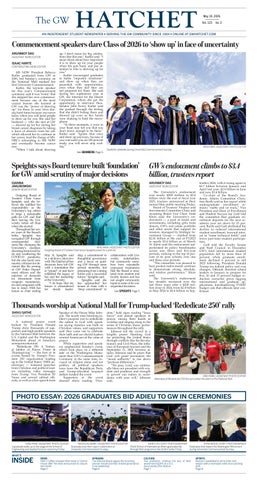
Commencement speakers dare Class of 2026 to ‘show up’ in face of uncertainty
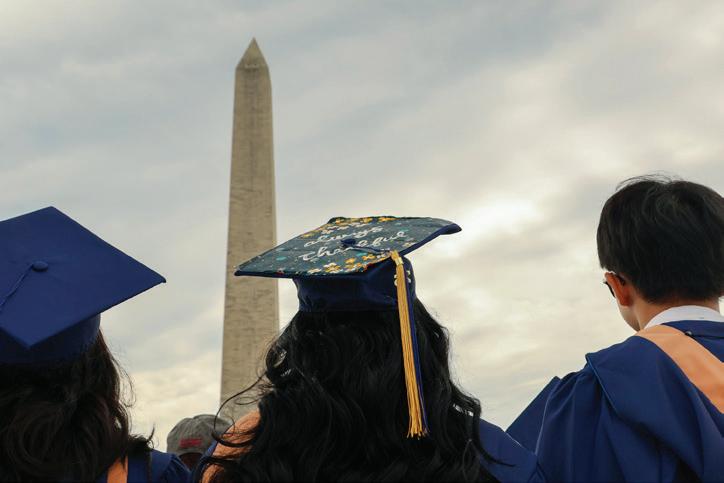
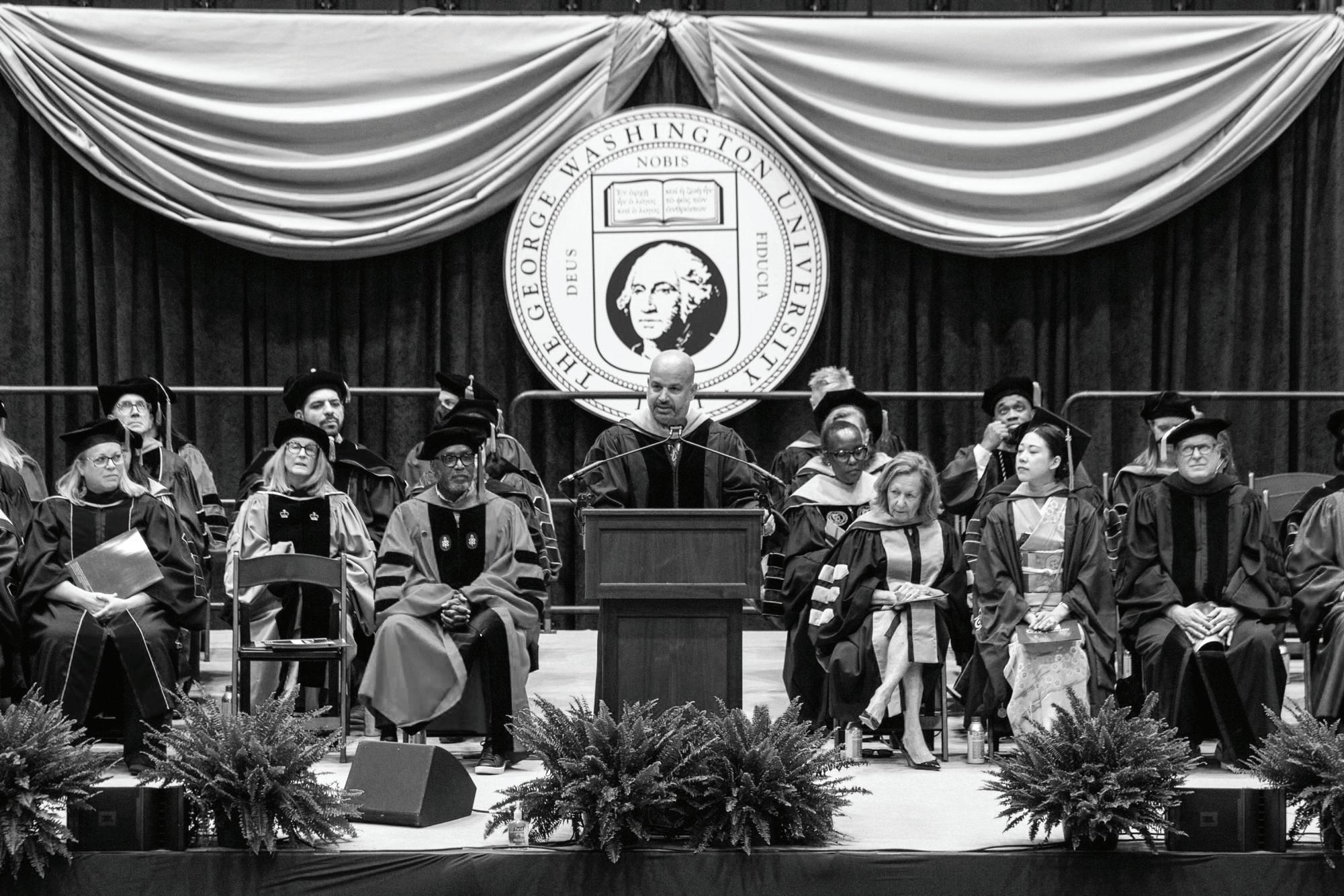
MS NOW President Rebecca Kutler graduated from GW in 2001, but Sunday’s ceremony on the National Mall marked her first University Commencement.
Kutler, the keynote speaker for this year’s Commencement ceremony, said it was ‘ironic’ that she skipped her own commencement because one of the most crucial lessons she learned at GW was the “power of showing up” for those in your lives during hard times because you never know when you will need people to show up for you. She said her husband — who she met at GW — showed up for her during her breast cancer diagnosis by taking a leave of absence from his job, which allowed her to continue in her career, lead the charge of MSNBC’s rebranding to MS NOW and eventually become cancer free.
“When I talk about showing
up, I don’t mean for big celebrations like this one,” Kutler said. “I mean think about how important it is to show up for your people when life gets hard, and pay attention to who is showing up for you.”
Kutler encouraged graduates to battle “impostor syndrome” and show up when they are presented with opportunities, even when they feel they are not prepared for them. She said during her sophomore year at GW, she interned for the Hearst Corporation, where she got the opportunity to interview thenSenator John Kerry. Kutler said she pushed through the feeling that she didn’t belong there and showed up even as her hands were shaking to hold the microphone.
“In these moments, a voice in your head may tell you that you don’t know enough to be there,” Kutler said. “Ignore that voice and show up anyways, because if you wait until you are 100 percent ready, you will never stop waiting.”
Speights says Board tenure built ‘foundation’ for GW amid scrutiny of major decisions
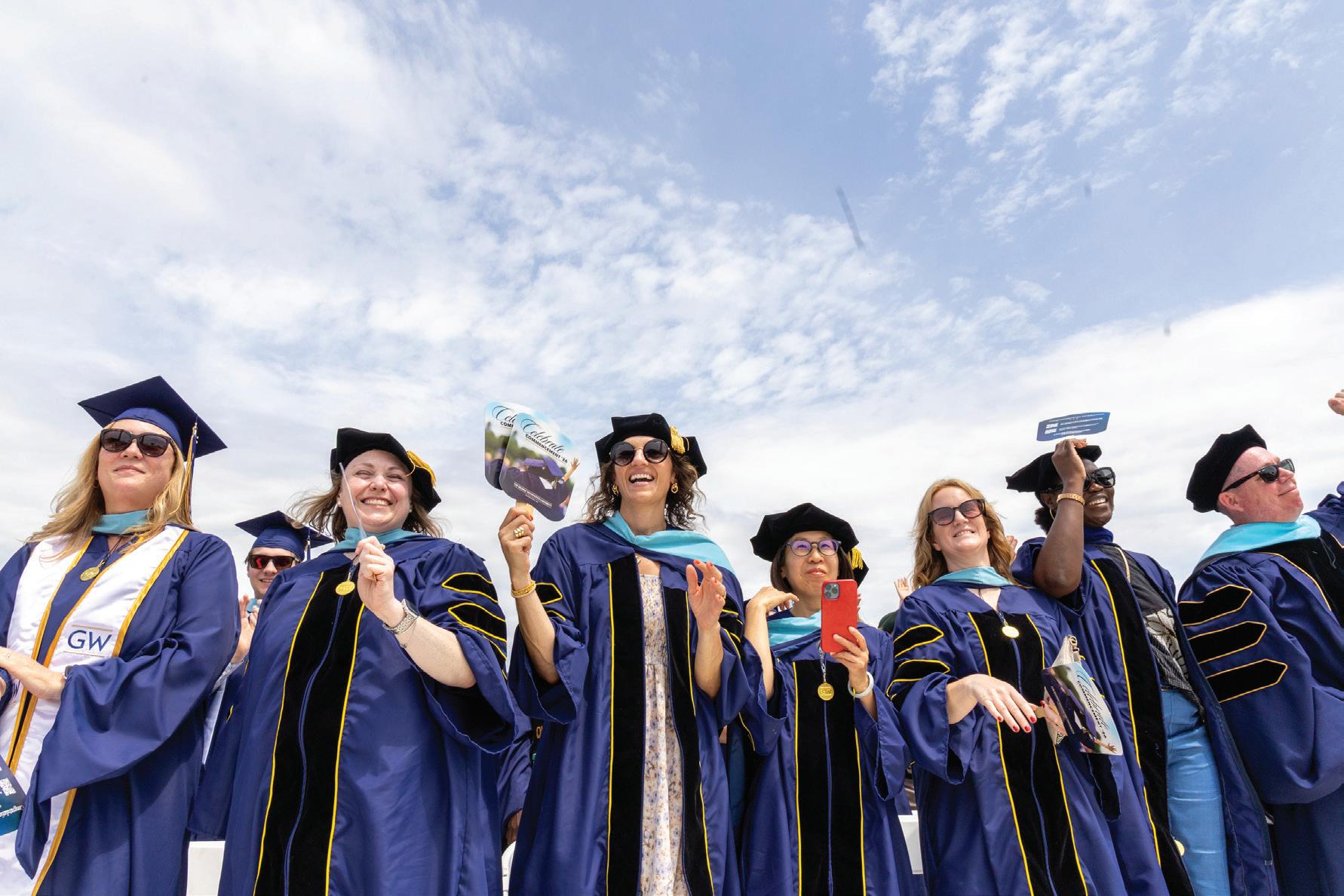
Outgoing Board of Trustees Chair Grace Speights said she believes she fulfilled her responsibility as the University’s top officer to forge a sustainable path for GW and that she’s leaving the University better off than when she started. Throughout her seven years at the Board’s helm, Speights has navigated GW through consequential decisions like changing the University’s moniker, divesting from fossil fuels and weathering the COVID-19 pandemic, but she also faced community criticism for decisions like the arming of GW Police Department officers and the rejection of demands for divestment from weapons manufacturers and companies with ties to Israel. With her tenure as chair ending
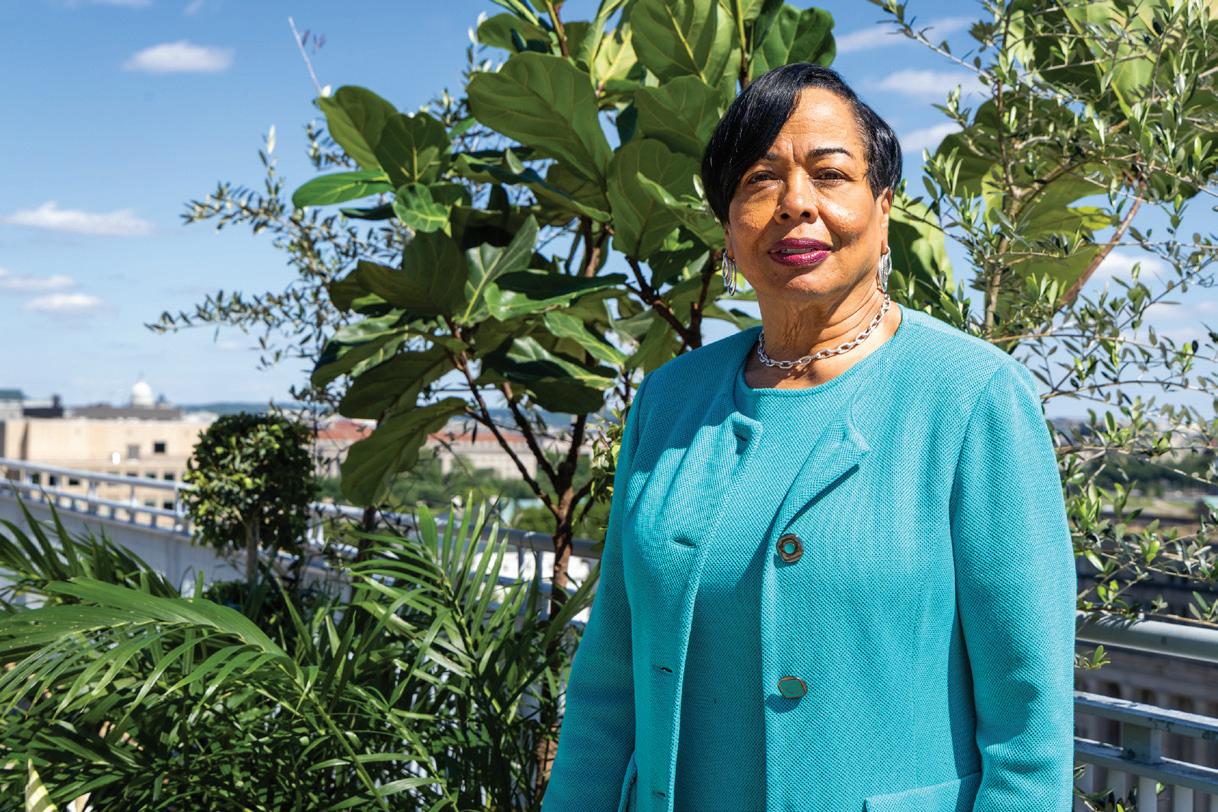
May 31, Speights said in a sit-down interview with The Hatchet all her decisions have left GW with a foundation she is “proud” of and have solidified the legacy of her and her leadership at the University.
“I do hope that my tenure is remembered for steady leader-
ship, a commitment to thoughtful governance and a focus on guiding GW through some pivotal moments, but preparing it for a strong future and a successful future,” Speights said. Speights said she has approached her tenure as chair with a “deep commitment” to
collaboration with University stakeholders, but community members have repeatedly expressed frustrations that the Board is insulated from student and faculty desires and has not sought community input in some of its consequential decisions.
GW’s endowment climbs to $3.4 billion, trustees report
The University’s endowment rose nearly $590 million to $3.4 billion since the end of fiscal year 2025, trustees announced at their annual May public meeting Friday.
Board of Trustees’ Finance and Investments Committee Chair and incoming Board Vice Chair Todd Klein said the University’s endowment — a pool of funds and investments, including gifts from donors, GW’s real estate portfolio and other assets that support its mission, managed by Strategic Investment Group — climbed from $2.81 billion at the end of FY2025 to nearly $3.4 billion as of March 31. Klein said the endowment outperformed its policy benchmarks across one, three and five-year periods, ranking in the top 10 percent of its peer schools over one and three-year periods.
“The committee was pleased to hear pooled endowments continue to demonstrate strong, absolute, and relative performance,” Klein said.
The University’s endowment has steadily increased over the last three years after a $200 million drop in 2024, from $2.8 billion in May 2024 to $2.6 billion in Sep -
tember 2024, with it rising again to $2.7 billion between January and April last year, $2.8 billion in June and now $3.4 billion.
Co-chair of the Board’s Academic Affairs Committee Christine Barth said in her report while undergraduate enrollment remains “stable and on track,” Vice President and Dean of Enrollment and Student Success Jay Goff told the committee that graduate enrollment deposits for the next academic year are down by 25 percent. Barth said Goff attributed the decline to reduced international student enrollment, lowered interest in “some technical fields” and lower part-time student participation. Goff told the Faculty Senate and Staff Council in December GW’s total international student population fell by more than 10 percent, while graduate enrollment declined 6 percent in fall 2025 following President Donald Trump-era federal policy and visa changes. Officials directed school leaders in January to prepare for five, 10 and 15 percent budget reduction scenarios given lagging international and graduate applications, foreshadowing FY2027 budget cuts that officials later confirmed.
Thousands worship at National Mall for Trump-backed ‘Rededicate 250’ rally
SHIVU SATHE ASSISTANT NEWS EDITOR
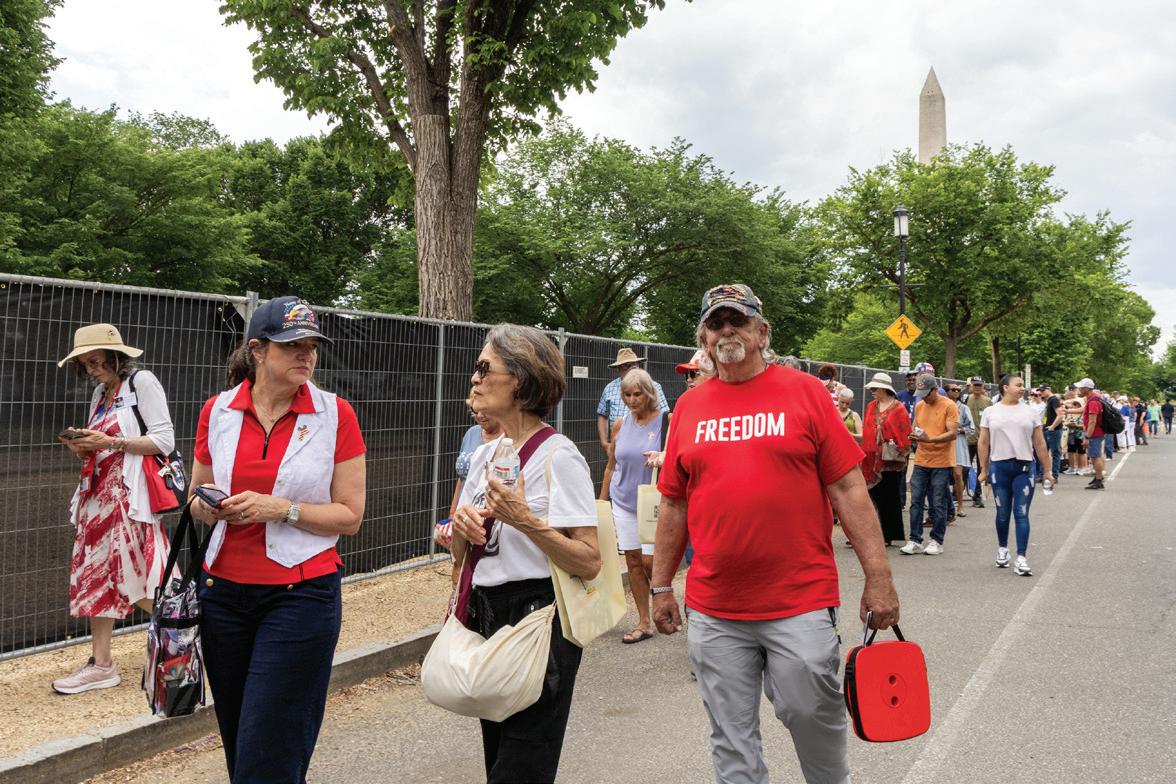
A national prayer event backed by President Donald Trump drew thousands of supporters and high-profile speakers to the National Mall between the U.S. Capitol and the Washington Monument ahead of America’s semiquincentennial.
“Rededicate 250: A National Jubilee of Prayer, Praise & Thanksgiving” — the first of 16 events hosted by Trump’s Freedom 250 organization leading up to the United States’ 250th anniversary — featured speeches from Christian and political leaders including video messages from Trump, Vice President JD Vance and several cabinet officials, as well as a live speech from
Speaker of the House Mike Johnson. The nearly nine hourlong jubilee’s purpose was to rededicate the nation to God with speakers saying America was built on Christian values, and supporters said they came out to celebrate their faith and see elected leaders remind Americans of the value of prayer. While supporters and speakers emphasized Sunday’s event, which took place on a different side of the Washington Monument than GW’s Commencement Ceremony at the same time, focused on religion alone and not politics, all political speakers were from the Republican Party and Trump-allocated taxpayer dollars funded the event. Supporters at the event donned shirts reading “Free-
dom,” held signs reading “Jesus Saves” and joined speakers in prayer, raising their hands in worship and singing along to the series of Christian music performances throughout the rally.
Johnson led the crowd in a lengthy prayer thanking God for protecting the United States through conflicts like the Revolutionary and Civil Wars, the influence of European fascism and the September 11, 2001 terrorist attacks. Johnson said he prays that God will grant lawmakers the “moral authority” to rise above “partisan differences.”
“We pray, Lord, you continually bless our president with wisdom and prudence and strength to govern our nation in accordance with your will,” Johnson said.
KRIS PARK | ASSISTANT PHOTO EDITOR
Outgoing Board of Trustees Chair Grace Speights poses for a portrait.
KRIS PARK | ASSISTANT PHOTO EDITOR
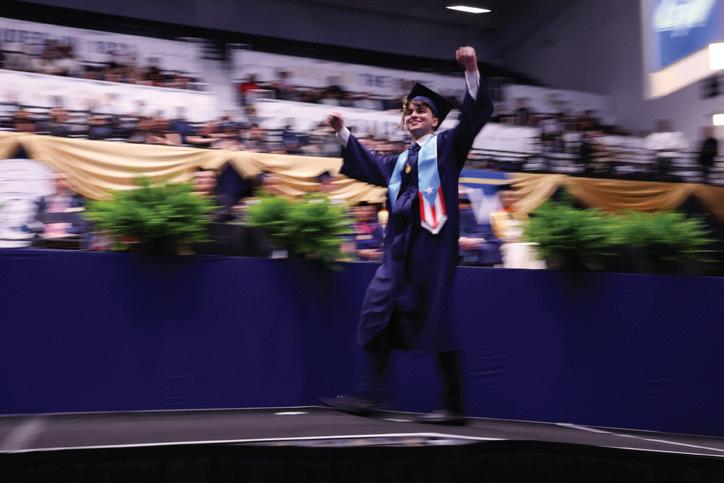
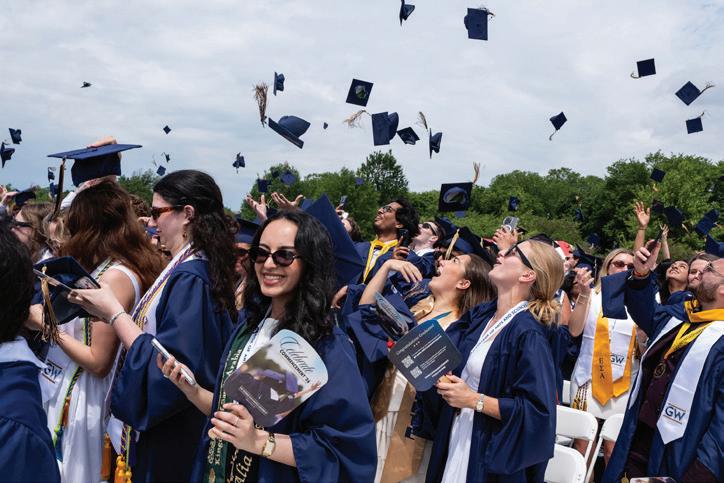
Students celebrate during University Commencement Sunday.
See GRANBERG Page 5
Outgoing general counsel focused on providing ‘candid’ guidance in evolving legal environment
As Vice President and General Counsel Charles Barber prepares to depart his role at the end of June, he said he is proud of building a legal team that has supported the University through a constantly-evolving higher education legal and regulatory environment.
Barber, who former University President Mark Wrighton appointed to the permanent vice president and general counsel position in May 2022 after he served in the interim role for nearly a year and as deputy general counsel for nearly 14 years, said in a statement to The Hatchet that legal difficulties the University faced during his tenure “invigorated” him to help GW grapple with those challenges. Amid heightened legal challenges, including Department of Justice probes into the University, the impacts of Trump administration policies on higher education and lawsuits filed by community members, Barber said he provided “candid” advice to help officials navigate constraints while remaining steadfast in the University’s mission and obligations.
“My office works hard to monitor legal developments in higher education generally, select knowledgeable outside counsel to assist in addressing issues most relevant to GW and present guidance that responds to the moment for University leadership,” Barber said in an email.
Barber said he made his
decision to step down based on personal and professional timing in order to ensure a “thoughtful handoff” to new leadership. He said he will transition into a short-term advisory role assisting University President Ellen Granberg and administrators as needed to oversee a “smooth” transition to his successor until Dec. 31.
Since serving as the University’s chief legal officer, Barber steered GW through a resolution agreement with the Department of Education’s Office for Civil Rights in January 2025, which ended investigations into Title VI complaints alleging anti-Palestinian discrimination and antisemitism at the University. Barber has also guided the
University’s legal response to the Trump administration’s policies, including its diversity, equity and inclusion crackdown, revocation of international student visas, student loan reform and withholding of federal research grants.
As federal pressure on GW and higher education has ramped up over the past year due to the Trump administration’s policies, Barber said that supporting the University’s adaptation to the changing legal climate required close coordination with his team in the Office of the General Counsel. He said he has also learned from colleagues at other universities facing similar challenges to GW, allowing him to better advise officials.
“Our role has been to help the university stay informed, remain in compliance and adapt as needed,” Barber said.
Barber said he and his office have worked closely with outside counsel to help GW present “strong and principled” responses to the DOJ’s investigations into campus antisemitism and diversity, equity and inclusion in its admission practices to show that GW is meeting its legal obligations.
“In both matters, the niversity has responded to requests for information, including providing documentation as part of the review process that demonstrates GW’s compliance with the law,” Barber said.
CRIME LOG
THREATS TO DO BODILY HARM
Duquès Hall
5/8/2026 – 12:30 p.m.
Open Case
A male GW contractor reported being threatened by a male co-worker. Case open.
THREATS
TO DO BODILY HARM
Off Campus
5/9/2026 – 2:36 a.m.
Closed Case
A male GW contractor reported receiving an anonymous text message threatening bodily harm. Case closed. Off campus incident.
SIMPLE ASSAULT
Shenkman Hall (Dining Services)
5/9/2026 – 11:24 a.m.
Closed Case
The GW Police Department responded to a report of a simple assault. Upon arrival, GWPD spoke with a female GW contractor who reported being pushed by a male co-worker during a verbal dispute. The complainant declined to pursue criminal charges. Case closed. No further action.
THEFT II/FROM BUILDING
Science and Engineering Hall
Unknown – Unknown
Closed Case
A male GW student reported their jacket stolen after leaving it unattended. Case closed. No suspects or witnesses.
—Compiled by Isaac Harte
GW’s blend of consultant, community input results in holistic decisions: experts
ARUNMOY
Amid a national trend of colleges relying on outside consulting firms for tasks like executive recruitment and financial management, experts say GW’s use of steering committees to work alongside consultants allows their recommendations to best reflect the community’s interest.
Since 2025, officials have used at least seven different consulting firms, which have often worked alongside steering or advisory committees of faculty, staff and students to help them in searching for a new provost and general counsel, revising the code of student conduct, conducting financial audits, refreshing its branding and designing the 2027 campus plan. While the majority of the five experts in
higher education interviewed said officials’ combining of outside consultants and internal steering committees allows them to better adjust consultant recommendations based on community feedback, some said officials should seek community input before they hire consultants in the first place and prioritize use of internal expertise.
A University spokesperson said hired consultants provide analysis and recommendations that inform leadership’s decision making, rather than making decisions on behalf of the University. Officials have created steering or advisory committees of faculty, staff and officials to lead major University projects and initiatives that officials have also hired consultants for, to advise leadership on financial planning and leadership searches.
The steering committee of the
University’s Foundational Excellence Initiative collects data, engages with and provides updates to the community and reviews recommendations before they are sent to leadership, according to the initiative’s website. Officials hired Huron, a firm with a history of recommending layoffs to its clients, in August to help support the steering committee in conducting listening sessions, analyzing data, benchmarking GW’s financial performance and practices to peer institutions and bringing insights from other universities, according to the Foundational Excellence Initiative’s website.
University spokesperson Julia Garbitt said GW uses external consultants to complement internal expertise and support projects like leadership searches, strategic planning, communications, cam-
Pro-Palestinian graduates gather near Commencement for ‘disruption’ event
RYAN
SAENZ SENIOR NEWS EDITOR
About 40 community members participated in a “disruption” hosted by the GW Left Coalition on the National Mall to counter the nearby official University Commencement ceremony Sunday.
After University President Ellen Granberg began her speech at Sunday’s ceremony on the National Mall, about 10 students rose from their chairs and left the ceremony, moving to an area near the corner of Constitution Avenue and 17th Street and joining a gathering of other community members, including about 10 other GW graduates and their families, for a brief ceremony. The graduates, who donned keffiyehs along with their regalia, said the purpose of the event was to allow students to physically protest the University’s ties to Israel one final time before becoming alumni, but they said they were also planning to withhold donations to GW as alums due to the University’s refusal to divest from companies tied
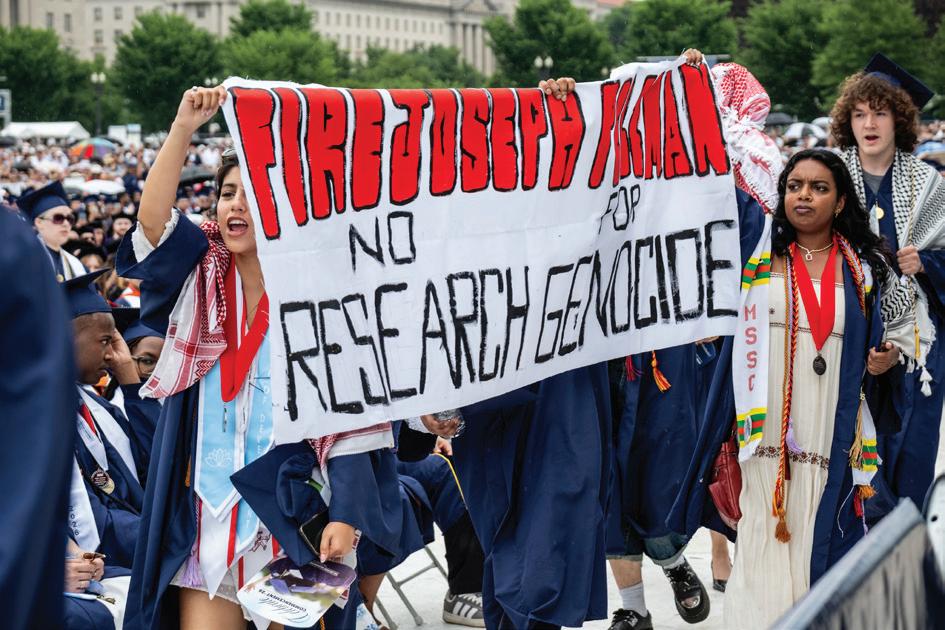
to Israel and fire economics professor Joseph Pelzman for his connection to the war in Gaza. The protest is a continuation of pro-Palestinian protesters’ repeated calls for the University to disclose its investments and divest from weapons manufacturers and companies with ties to Israel and the war in Gaza, calls that have dominated campus discourse since the onset of the war in Gaza in October 2023. Pro-Palestinian protesters demonstrated during
both the 2024 and 2025 commencement ceremonies, with students organizing a protest near the National Museum of African American History and Culture in 2024. About 40 students stood from their seats during the 2025 ceremony, unfurling banners and chanting phrases like “There is only one solution, a studentled revolution” and “Disclose, divest now,” before event staff and U.S. Park Police led them toward the back of the ceremony and out of the event.
pus planning, academic medical issues and operational support. She said officials consider the University’s budget and a consultant’s cost, scope and alignment with GW’s academic mission and strategic framework when hiring them.
Garbitt declined to comment on how many and which consultants GW is currently employing and how much they have spent on outside consultants this fiscal year. She said GW does not publicly share details on their engagement with specific consultants.
Phil Hill, a market analyst for higher education technology and policy consultancy firm Phil Hill & Associates, said steering committees that work with consultants should be representative of those who would be directly affected by a given initiative and have a clear decision-making structure, so that
officials can respond to a consultant’s work and adjust the consulting process to better fit GW’s needs. He said steering committees should have a small executive team or subcommittee that makes decisions based on feedback from the steering committee and the consultant.
While the Foundational Excellence Initiative’s steering committee continually reviews Huron’s work throughout the consultation process, Granberg, incoming Provost Edward Balleisen and Chief Financial Officer Bruno Fernandes make the ultimate decisions on how to implement recommendations for the Foundational Excellence Initiative,.
“One of the biggest red flags is if they say the whole committee is going to make a decision,” Hill said. “That means you are not being realistic.”
Peet’s Coffee renews District House lease following planned closure
PARIS ALBRECHT CONTRIBUTING NEWS EDITOR
The Peet’s Coffee located in District House agreed to renew their lease with GW following the store’s planned closure announced last month, a University spokesperson confirmed.
A University spokesperson said Peet’s and GW “mutually” decided to renew their lease, adding that officials are negotiating new lease terms, which they expect to finalize in the “near future.” The renewal comes after University spokesperson Claire Sabin told The Hatchet in April officials sought to replace Peet’s with Damor Chai Cafe next academic year after Peet’s declined to renew their lease.
Will Crawford, Peet’s District Leader for D.C., Maryland and Virginia declined to comment, saying he is not authorized to speak to the media. Store manager Merlin Arias did not immediately return a request for comment
about the new terms of the lease.
At a Student Government Association meeting in November, Associate Vice President of Business Services Seth Weinshel said officials were planning to bring a coffee shop similar to the Mount Vernon Campus’s Buff & Brew to Foggy Bottom in the next one to two years with meal swipe options.
Jamal Rasoully, owner of Damor Chai Cafe, did not immediately return a request to comment about whether Damor Chai pulled out of a contract with GW or if the University decided not to go through with the initial opening plans. Ellie Neal, a Peet’s barista who graduated from GW in 2024, said Arias told Peet’s staff Saturday the store would remain open, but did not provide any further information on the agreement with the University or the status of Damor Chai. Neal said baristas received transfer options and severance pay opportunities from the corpo -
ration’s human resources department, with Neal herself anticipating to receive severance payments after the store’s closure.
“It’s frustrating, because we started planning and anticipating not having a job. It’s back, which is good to have this back up and have a little bit more time here, but it’s ultimately still frustrating,” Neal said.
Laurel Hunnewell, a Peet’s barista who received her undergraduate degree from GW in 2024 and her masters this year, said communication from Peet’s and the University has been “extremely lackluster” and many of her coworkers are “frustrated” because there have been no formal updates on the status of the store and the terms of its lease.
“There doesn’t seem to be any incentive for them to update us, and it doesn’t really seem like they care that we’re not just employees, we’re also college students, we’re also people trying to plan out our lives,” Hunnewell said.
KRIS PARK | ASSISTANT PHOTO EDITOR
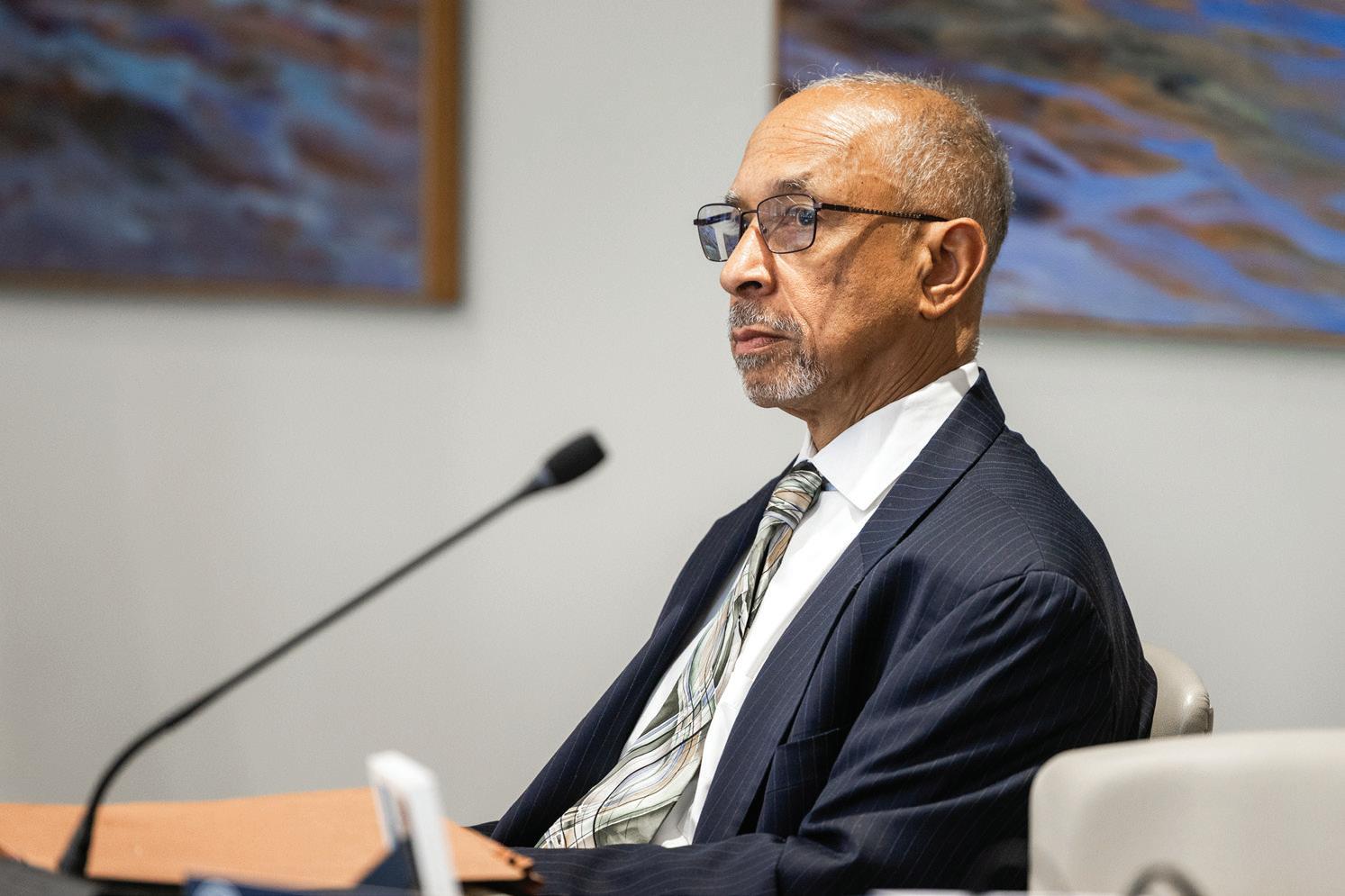
Vice President and General Counsel Charles Barber sits at Friday’s Board of Trustees meeting.
NICHOLAS WARE | ASSISTANT PHOTO EDITOR
Pro-Palestinian protesters walk out of University Commencement Sunday.
GW cultural leaders conflicted on whether ODECE’s rebrand signals DEI rollback
ADELAIDE
PETRAS ASSISTANT NEWS EDITOR
Cultural and diversity leaders at GW expressed mixed views on the rebranding of the University’s diversity office, with some saying officials have not demonstrated a retreat from its commitments to diversity, equity and inclusion and others maintaining officials need to do more to center diversity in their public messaging as federal pressure against DEI mounts.
Interim Provost John Lach said in an email May 1 the University dissolved the Office for Diversity, Equity and Community Engagement and established the Office of Community, Culture and Inclusion, a change that comes after officials renamed the annual Diversity Summit to the OneGW Community Summit earlier this year and students previously reported fearing that officials are rolling back commitments to DEI on campus.
Faculty and staff involved in diversity initiatives on campus said the rebrand does not reflect a retreat from GW’s values, but a logistical change aligned with the strategic framework, while some students in cultural organizations said the name change indicates GW is eliminating public-facing diversity language in response to President Donald Trump’s crackdown on DEI in higher education and elsewhere.
Deepti Pillai, a sophomore studying political science and international business and an incoming co-president of Indian Students’ Association, said she feels the name change is problematic because it signals that officials do not want to publicize language surrounding diversity in the names of their offices and initiatives, distancing the office from its original purpose of supporting diverse groups on campus.
Pillai said the name change indicates GW is joining a larger trend of colleges and universities nationwide considering diversity unnecessary or risky
in response to federal pressure after Trump threatened to pull federal funding from several universities with DEI programs last year.
Dozens of universities across the country have shuttered their DEI offices and eliminated inclusive language and policies following Trump’s crackdown, with eight of GW’s 12 peer schools closing or renaming their DEI offices since the beginning of Trump’s term.
A University spokesperson said GW remains committed to DEI, and OCCI marks a “positive evolution” in GW’s work fostering “inclusive excellence,” strengthening community and supporting individuals from different backgrounds. The spokesperson confirmed that GW’s values have not changed and officials have not retreated from their commitments to DEI.
Lach and Associate Vice Provost for Community, Culture and Inclusion Jordan Shelby West reaffirmed the University’s commitment to DEI in a message in March, and Lach said in a sit-down interview with The Hatchet earlier this month officials are focused on eliminating “illegal DEI,” rather than all DEI, to remain in compliance with a 2023 Supreme Court decision prohibiting the consideration of race in college admissions.
Dwayne Wright, an assistant professor of higher education administration and the director of DEI initiatives at the Graduate School of Education and Human Development, said he is more focused on the substance of the office’s initiatives than what it’s called, and the name should not change what the office does.
“I’ve been, as a DEI practitioner myself, as an expert in higher education, sort of baffled by the attention that has been put on what we will call these units and the lack of attention as to what these units are actually doing,” Wright said. Wright said GW community members should have some “healthy skepticism” about the
new office because it comes after other actions that make it appear like the University is “bending over” for the Trump administration, like renaming the Diversity Summit. But he said community members’ “obsession” with the rebranding is premature, and they should extend officials the “benefit of the doubt,” since they don’t know yet whether the office will perform the same functions as ODECE.
The University spokesperson said OEO’s creation motivated ODECE’s dissolution and prompted discussions on how to better support ODECE’s offices and activities in alignment with the community-focused strategic framework.
Student Government Association Vice President Aicha Sy, who previously chaired the SGA’s Committee on Community, Advocacy and Inclusion, said she does not think there will be any drastic changes in how OCCI functions compared to ODECE, and she does not anticipate any differences in how the office interacts with the SGA.
Sy said she and SGA President MJ Childs plan to meet with West and OCCI to strengthen relationships between the SGA and cultural student organizations, soliciting organization leaders’ feedback on cultural issues on campus and pushing for changes accordingly.
Staff Council Justice, Equity, Diversity and Inclusion Chair Tricia Greenstein said the change from ODECE to OCCI is an opportunity to continue supporting everyone on campus, during a time when there is a need to strengthen community in an environment that feels “hostile” toward people doing DEI work.
“Ultimately, I believe this shift positions us to continue supporting the campus community effectively in the current climate, while reinforcing the values that help both individuals and the broader community succeed,” Greenstein said in an email.
CCAS speakers call on graduates to embrace challenges, think critically
ISAAC HARTE CONTRIBUTING NEWS EDITOR
Speakers urged graduates to embrace future challenges they may face as opportunities for growth at the Columbian College of Arts & Sciences’ two graduation ceremonies for over 1,200 graduates in the Smith Center on Saturday.
Reena Ninan, a 2001 GW alum, the founder of media company Good Trouble Productions and former television journalist, gave the keynote address during both ceremonies and said CCAS graduates will succeed in a world where artificial intelligence technologies are expanding because their education has equipped them with the ability to “know what matters.” Other speakers also encouraged CCAS students to rely on one another for connection, spend time engaging in creative pursuits and view challenges as obstacles they can overcome and grow from.
Ninan said graduates are earning their degrees at a time when many people are questioning the value of college degrees as AI is rapidly advancing, but said getting a degree is even more relevant as the era of AI necessitates strong human judgment and critical thinking. She said decision-making and critical thinking are crucial skills that CCAS students will need to rely on after graduation, especially since AI can generate information, but it doesn’t know “what matters.”
Both ceremonies included demonstrations from pro-Palestinian students, including a student holding up a Palestinian flag overlaid with what appeared to be the tree from the Lebanese flag, before they walked off stage at the first ceremony. During the second ceremony, two students were met with cheers from the crowd as they held up a Palestinian flags when they walked across the stage.
Danny Hayes, the faculty speaker at the first cere-
Newly official student groups say status brings legitimacy
ADELAIDE PETRAS ASSISTANT NEWS EDITOR
New student organization leaders said achieving official status after operating unofficially for much of the academic year has provided increased legitimacy and access to University resources, allowing them to better support their groups’ ambitions.
Several student organizations formed without official recognition over the past academic year amid a 10-month freeze on applications, which students said stifled community building and prevented them from growing membership and hosting events without the support of other organizations. But after officials lifted the freeze this spring, student group leaders said their organizations’ receiving official status has helped them gain legitimacy to attract more members and hold larger, more frequent events through access to resources like Student Government Association funding and the ability to reserve meeting spaces.
Officials paused student organization applications in spring 2025 to “improve support structures” for existing organizations. The Division for Student Affairs reopened applications in March, creating a New Organization Committee of students and staff to review applications and updating the rubric groups are scored on for approval
mony and a professor of political science, said his battle with rectal cancer strengthened the relationships in his life because he came to see how much his family and friends sacrificed to help him during his illness and recovery. Hayes compared his battle with cancer to the future challenges that GW graduates may face, like romantic rejection or not being accepted to a graduate program, as they go out into the world, which he said will help to make them stronger individuals.
John Parel, a psychological and brain science graduate and the first ceremony’s student speaker, said the educational rigor of CCAS and GW made him and fellow students be the best versions of themselves by pushing them to think more deeply, work harder and grow through academic and personal challenges.
John Philbeck, the CCAS vice dean of faculty affairs, presented the Robert W. Kenny Prize for Innovation in Teaching of Introductory Courses at the first ceremony to Sharon Roosevelt, a teaching assistant professor of mathematics. Evangeline Downie, the CCAS associate dean of research, presented the Columbian Prize for Teaching and Mentoring Advanced Undergraduate Students at the second ceremony to Assistant Professor of Dance Anna Jayne Kimmel.
Olivia Nippe-Jeakins, an
astronomy and astrophysics student and student speaker at the second ceremony, said CCAS students were united by the unique experience of living in D.C. and attending GW like study sessions in Gelman Library or rushing to class after being held up by a motorcade. She said the commencement was a celebration of what the future holds for graduates and that they are ready for whatever paths they choose because they are Revolutionaries.
The faculty speaker at the second ceremony, Robert Baker, an associate professor of music and the director of performance studies, said graduates will feel “the post-show blues,” a feeling that theater actors get at the end of their shows, because once they are no longer with their “cohort” at GW, students may begin to question whether their experience mattered.
Baker, who is a singer, said the creative arts provide physical and mental health-related benefits for those who engage with them and encouraged graduates not to abandon their “creative” selves after graduating from GW.
“As you make your way to what is next, please celebrate now, and know that what you have accomplished matters,” Baker said. “It is not a mirage, and please be intentional about nurturing the creative, artful, beautiful human being that you are.”
to include risk management and resources categories.
Siyan Tekle-Habtegabir, a junior studying finance and statistics and a co-president of Black Students in Research, said the group applied to be official in March because operating without structural support from GW for almost a year hindered their ability to host events without financial support from other student groups they partnered with.
Raviya Suri, a sophomore studying international affairs and the CEO of the Washington Forum on India’s GW chapter, said becoming an official student organization provides legitimacy because their research production will now be affiliated with GW, hopefully making students more inclined to join WFI.
Ryan Van Slingerland, a junior studying international affairs and the president of Turning Point USA at GW, said being affiliated with GW shows the University is accepting of organizations across the political spectrum, like College Republicans and Youth Democratic Socialists of America, compared to other universities nationwide that have pushed back against TPUSA chapters.
“I don’t agree with really any of the policy options that some of those orgs might be having, but I think that’s still just kind of neat that we have this ability here at GW to have all these differing organizations and kind of coexist, so to speak,” he said.
GSEHD speakers implore graduates to seek joy, rely on their resolve
PARIS ALBRECHT CONTRIBUTING NEWS EDITOR
Speakers told the Graduate School of Education and Human Development’s Class of 2026 to prioritize optimism and continuous growth at the school’s graduation celebration in the Charles E. Smith Center Saturday.
Keynote speaker and Principal of South County High School in Fairfax, Virginia, Samuel Kambar Khoshaba, Interim GSEHD Dean Lionel Howard and student speaker Nanako Tojo encouraged over 330 graduates to remember that professions in education will bring positive impacts to future generations despite current uncertainty or difficulties. The speakers urged students to remember that they chose a profession in education because it motivated them and to carry that motivation into their future career pursuits.
Khoshaba, who earned his doctorate of education from GSEHD in 2004, encouraged graduates to “seek the joy” in difficult situations. He said while
students may not have chosen an easy path, they should see the struggle to achieve their goals as part of the joy of life. Khoshaba added that many of the graduates likely want to enter the education profession because of an experience they had with a mentor or teacher that gave them joy and showed them that they mattered, and now graduates have the opportunity to provide that experience to others.
“The struggle is not separate from the joy,” Khoshaba said. “The struggle is the pathway to difficult conversation, a problem without a need, a student who is struggling.”
Howard said GSEHD has grappled with exploring “uncharted” pathways — but did not specify what those alternative methods were — in order to sustain the school’s resources. He added that GSEHD faced an “unprecedented year,” but GSEHD leadership and officials’ internal assessment and evaluation of the school has emphasized its “full potential.” GSEHD has faced bud-
getary issues, like years of declining enrollment and recent layoffs of several GSEHD faculty as part of the school’s “right-sizing” initiatives, sparking student advocacy and faculty pushback to urge officials for more transparent communication about the school’s future. July 1 marks the end of Howard’s first year as interim dean after former Dean Michael Feuer stepped down and returned to a tenured professor position last year.
“Remind yourself of good, remind yourself of your resolve, capacity and your intentions,” Howard said.
Tojo, who earned her master of arts in education and human development in higher education administration, said students’ challenges may have seemed “endless” during “drastic” changes in the job market and higher education, but thanked GSEHD graduates for being fellow learners and praised their insights that “broadened horizons.”
“We not only survived, but also thrived on the journey,” Tojo said.
NICHOLAS WARE | ASSISTANT PHOTO EDITOR
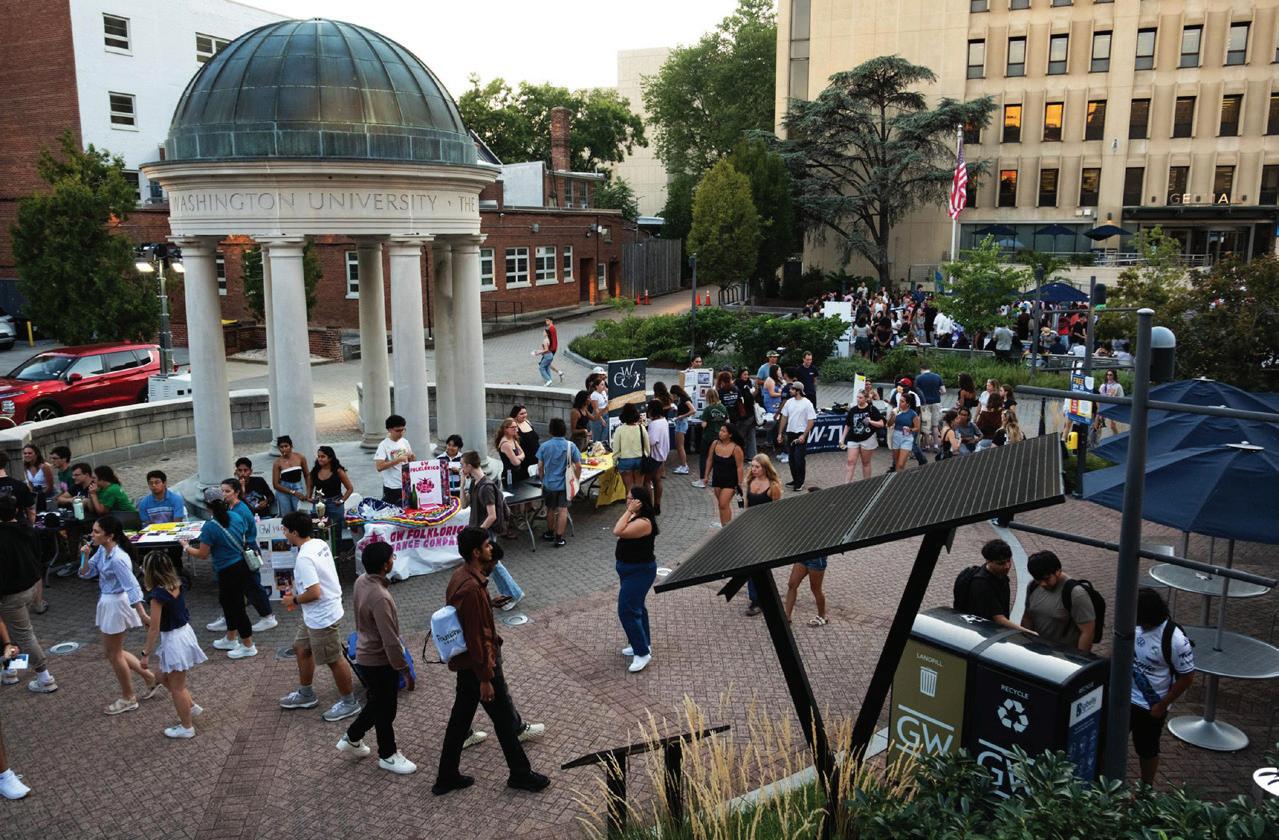
People walk through the Student Organization Fair in Kogan Plaza.
ERIKA LOPEZ-CEPERO | PHOTOGRAPHER
Keynote speaker Samuel Kambar Khoshaba speaks at the Graduate School of Education and Human Development ceremony Saturday.
NICHOLAS WARE | ASSISTANT PHOTO EDITOR
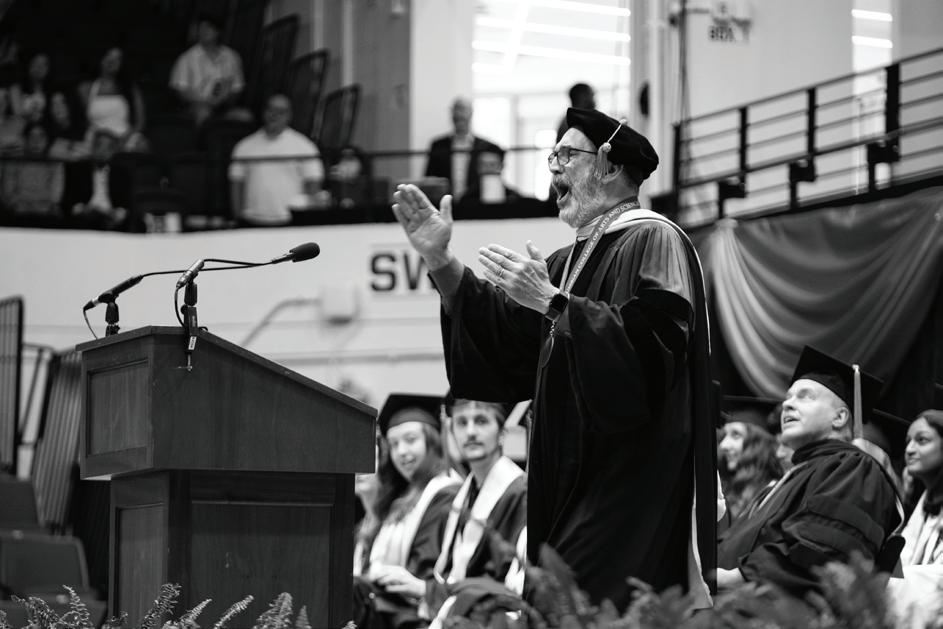
Professor Robert Baker leads the graduation audience in singing “We Are the Champions” by Queen in the Smith Center Saturday.
SGA makes advocacy push for students’ mental health following previous efforts
Student Government Association members said they are picking up former SGA bodies’ unfinished and unsuccessful efforts to revise University policies to support students’ mental health, including efforts to establish excused days. Chairs of the SGA’s Committee on Education Policy and Mental Health Assembly said they want to revise University policies to support students’ mental health in the coming year, with plans to consult faculty and officials throughout the process to ensure their plans are feasible and implementable. Committee chairs said they want to continue working on a resolution passed in April by the SGA’s most recent iteration, pushing the University to adopt excused mental health days by introducing it to the Faculty Senate following a previous attempt to do so in 2024, which led to a joint recommendation to GW to revise attendance policies but stopped short of changing them.
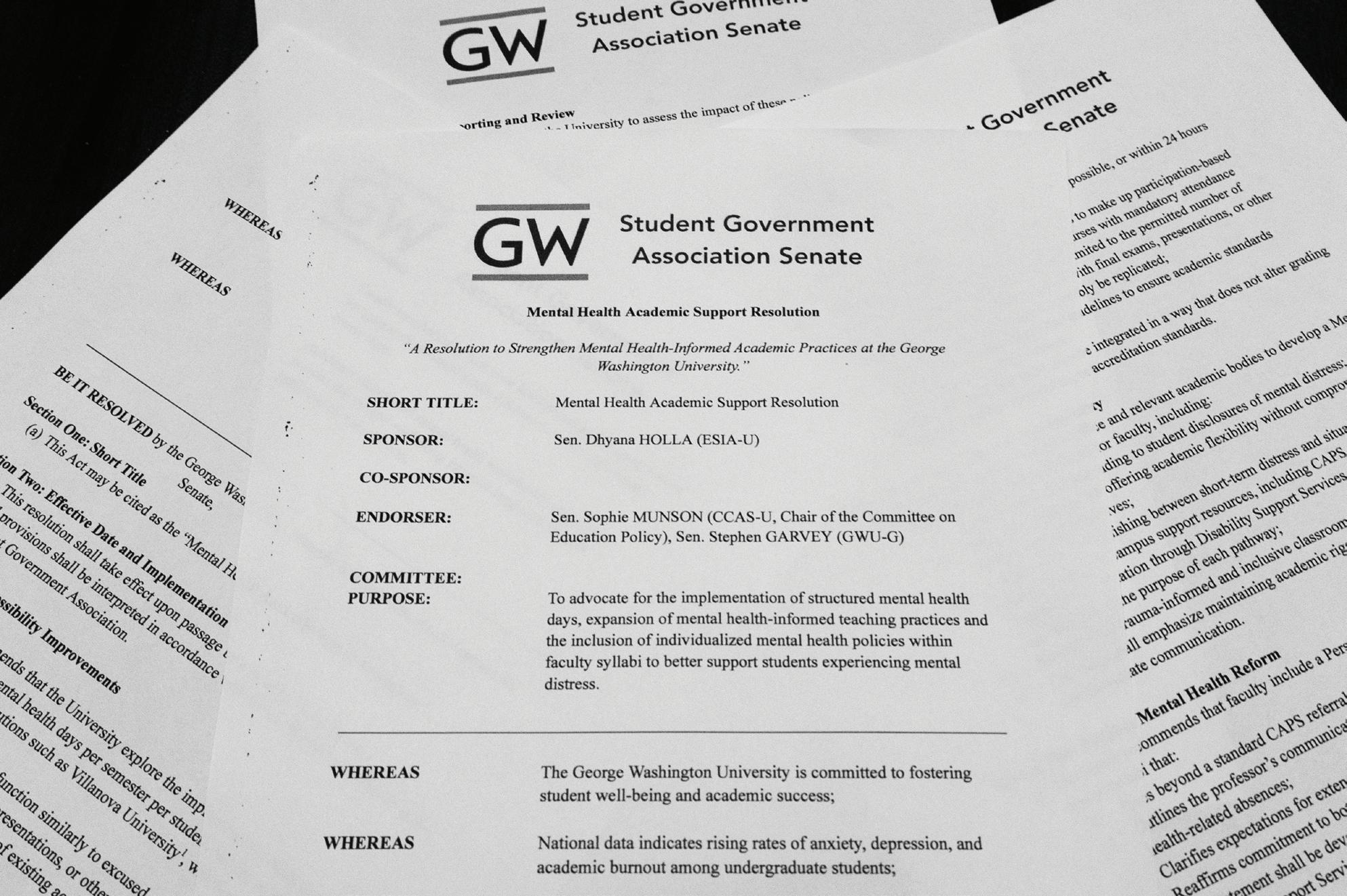
The SGA’s Mental Health Academic Support resolution would allow students to take up to two days off per semester without academic penalty if they notify professors in advance and absences did not conflict with major assignments or activities difficult to reschedule. Senators of this past academic year’s SGA body said national rises in undergraduate students’ mental health struggles were a driving factor for proposing the resolution, as 68 percent of students nationwide said emotional or mental difficulties hurt their academic performance, according to the University of Michigan’s Health Minds Study 2024-25 report.
GW’s policies currently allow for excused absences for “personal circumstances,” like religious observances or documented family and medical emergencies, but give faculty autonomy in setting guidelines for missing work and absences. The Faculty Handbook’s only mention of mental health advises faculty to refer “students in distress” to Counseling and Psychological Services.
The April resolution urges a policy requiring professors to include statements in syllabi for students facing mental health struggles, outlining their policies on flexibility or leniency for coursework and detailing
how students can communicate their struggles to them, rather than just referring students to CAPS.
Jivan Ramesh (Law-G), incoming co-chair of the MHA, said he plans to introduce the SGA’s resolution to the Faculty Senate’s Educational Policy & Technology Committee with hopes they will join him in recommending excused mental health days to University officials. Ramesh said he would also like to use his seat on the Faculty Senate’s Professional Ethics and Academic Freedom and Libraries committees to solicit more faculty and officials’ perspectives to revise the resolution and improve the chances officials
adopt it.
Former SGA President Ethan Fitzgerald brought a different resolution advocating for excused mental health days to the Faculty Senate in 2024, leading to the formation of a yearlong ad hoc subcommittee of EPT with SGA leaders, faculty and University officials to revise attendance policies, but it ultimately created no change in GW policies.
University spokesperson Julia Garbitt said the University has expanded student mental health and wellness efforts, including an increased number of counseling and student support offices for students facing “significant” mental health
DSA expands anti-hazing training to incoming students during orientation
The Division for Student Affairs is expanding its antihazing training to all incoming undergraduate students during New Student Orientation this summer.
All incoming undergraduate students will now complete a mandatory one-hour, in-person anti-hazing session when they visit campus in the summer during New Student Orientation to educate students on recognizing, preventing and reporting hazing before joining student organizations, a University spokesperson said. Current and incoming students said the expanded training will better prepare first-year students to identify unsafe behavior before they engage with campus life and participate in student organizations.
GW defines hazing as any act connected to joining or maintaining membership in an organization that creates an unreasonable risk of physical or psychological harm, regardless of whether a student voluntarily participates. A University spokesperson said the expanded training requirement is intended to align with Virginia’s Adam’s Law anti-hazing legislation, establish community expectations surrounding hazing and provide students with bystander intervention skills before they enter potentially high-risk situations on campus.
The spokesperson added
that the expansion of the training also reinforces the University’s message that hazing and dangerous alcohol-related behavior is not tolerated at GW.
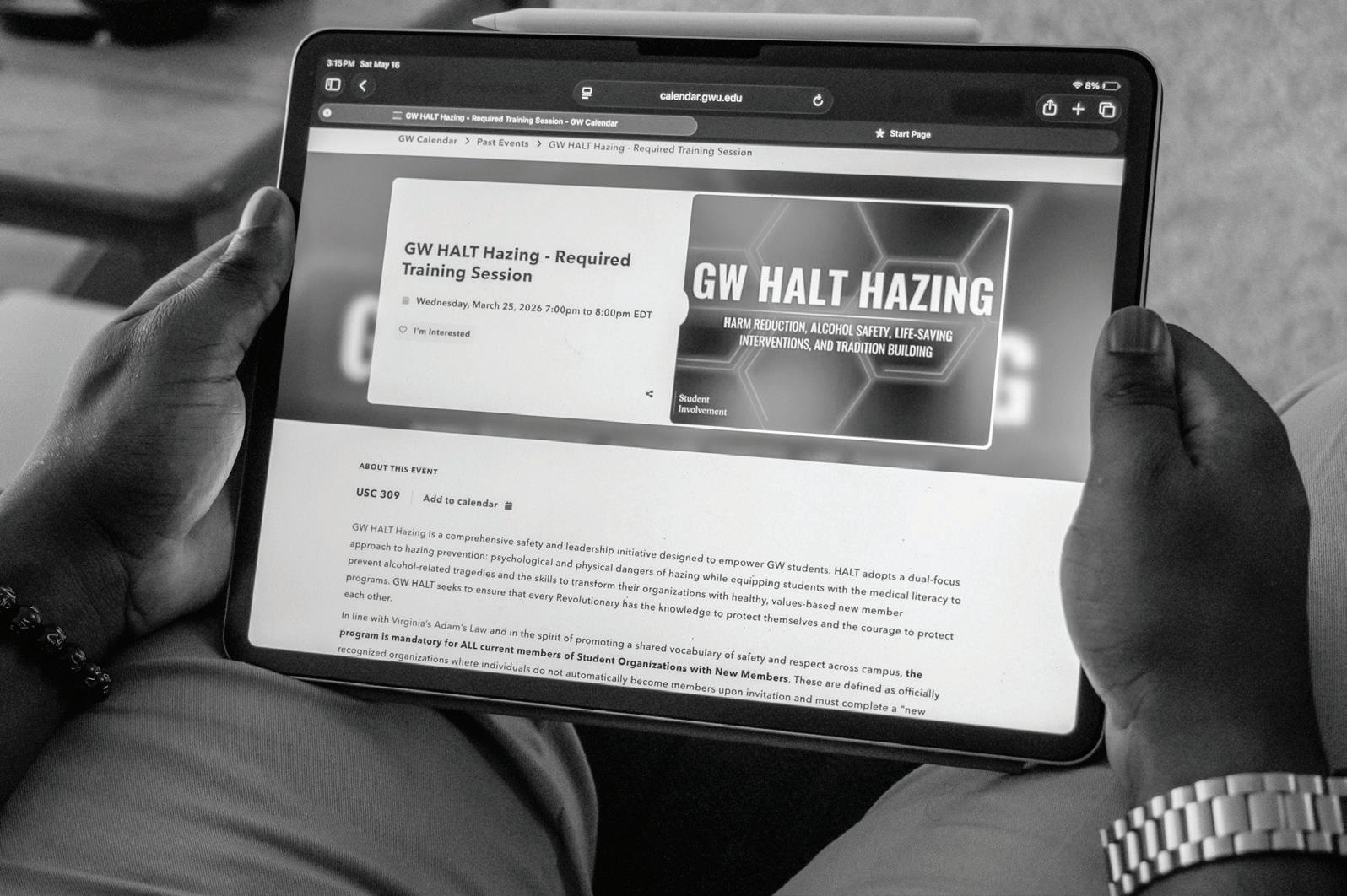
The new requirement expands the already existing Harm reduction, Alcohol safety, Life-saving interventions and Tradition building, or HALT, training officials previously only required organizations with “new member” initiation processes to complete. The spokesperson said the orientation requirement will now also apply to all incoming undergraduate students, including freshmen and transfer students.
“Integrating this training into New Student Orientation enables us to capture all potential new members, ensuring that students aren’t learning about hazing policies only after an incident has occurred or a high-risk situation has begun,” the spokesperson said in an email.
DSA has been mandating current members, potential new members and advisors in organizations with initiation processes to complete annual GW HALT Hazing training since 2023, when officials implemented the program in response to Virginia’s Adam’s Law — legislation requiring universities, even those with satellite campuses and academic centers in Virginia, like GW — to provide anti-hazing education and publicly report hazing violations.
If required members of an organization fail to complete the training, the organization can be placed on “frozen status” — unable to reserve campus spaces, access university funding or conduct official operations — until the remaining members do so, according to DSA policies.
Sophomore and President of Chi Omega Deepti Pillai said she received “overwhelmingly positive feedback” from members of the sorority regarding the HALT training. She said she likes that the sessions are held in person because attendees can anonymously answer questions through an online platform the officials running the sessions use, which she said encouraged greater honesty and openness during discussions about hazing.
She added that while it could be difficult to have all members of the sorority complete the training, incentives and deadlines, like completing the requirement before social events, along with the multitude of sessions available, encouraged members and allowed Chi Omega to reach their 100 percent completion rate.
“I think the idea of doing it at orientation before the school year has even begun is a really good idea, because then that’s like the baseline that sets the standard for Greek life, and every single freshman or new member in general has this idea going into rush and recruitment,” Pillai said.
University to adopt excused mental health days — recommended in May 2025 that GW revise attendance policies and present findings about considerations EPT and the SGA posed to the University, including what documentation students would need to provide faculty indicating they are facing mental health struggles and how students could request make-up times without burdening instructors, to EPT by April 30, 2026. EPT co-chair Jamie CohenCole said the University did not share updates with EPT during the 2025-26 academic year.
Sen. Zachary Brivio (ESIA-U), incoming SGA EP committee chair, said he is unsure if the EP committee would continue advocating for mental health days because he said he wants to further research student, faculty and University perspectives through speaking with each group. He said before implementing any policy, even if it addresses student needs, he wants to speak with administrators and faculty to understand whether it is feasible.
challenges. She said the University currently encourages students to seek assistance without needing to disclose sensitive personal information to faculty. She said the University discussed mental health days in a 2024-25 ad hoc subcommittee with representatives from EPT, Disability Support Services, CAPS and Associate Provost for Undergraduate Affairs and Special Programs Jeffrey Brand, but did not specify if the University took any further action on developing excused mental health days.
The ad hoc subcommittee — created by EPT and the SGA during Fitzgerald’s original attempts to persuade the
Cohen-Cole said EPT is also addressing students’ mental health distress at the “root” by trying to relieve financial pressures, which he said is one significant source of anxiety for college students. He said the Revolutionary Promise — full coverage of tuition for students with household incomes of less than $100,000, starting with the class of 2030 — may help students facing mental health struggles from financial stress amid rising tuition. “I think it’s important to recognize and address the root causes of mental health difficulties from anxiety to depression among students,” Cohen-Cole said in an email.
Title IX peer adviser program to shift focus after low demand
AMELIA NELSON ASSISTANT NEWS EDITOR
Officials said they plan to update the Title IX Office’s peer adviser program over the summer to include more peer education opportunities and reflect the new Office of Equal Opportunity’s scope after few students chose to pair with an adviser during the program’s inaugural year.
The peer adviser program, which began its pilot year in spring 2025, allows students undergoing Title IX processes to select a peer adviser from a pool of trained student and alumni volunteers who can provide emotional support and discuss Title IX Office resources. Current advisers said the program has experienced low demand in its first year, which has led them to hope to pivot toward educating students about Title IX resources and increasing attentiveness to sexual violence prevention around campus in addition to directly involving advisers in the conduct process, a plan a University spokesperson said officials are engaging advisers to implement.
The Title IX Office and the Student Government Association selected 11 volunteer advisers in fall 2024 to launch the peer adviser program in spring 2025 under the assumption students may feel more comfortable having a peer guide them through Title IX processes as opposed to friends or staff members. A University spokesperson said Title IX Office staff and returning program volunteers interviewed new volunteer candidates at the end of 2025 and selected five new students, who joined five returning advisers, in January 2026.
Former SGA executive staff and Title IX Office staff jointly developed the idea for the program in 2024, and the SGA sat on the original panel to select advisers, but current SGA President MJ Childs said he has not discussed
the program with the Title IX Office yet.
Peer advisers can help students submit Title IX reports, access resources and assist them in their requests for supportive measures — including requests for academic support or no-contact orders — or negotiated or investigative resolutions, after attending a daylong training session at the beginning of the semester, according to the program’s website.
Jaiden Bluth, a masters of public health candidate who has worked with one advisee since joining the program in spring 2025, said her role has been less “hands-on” than she expected because of students’ low demand for advisers.
The Title IX Office received 494 complaints during the 2024-25 reporting period — a 21 percent increase from the previous year — and the highest recorded number since GW began publishing annual reports in 2022. The Title IX Office follows up with all reports, and in 160 of the 494 cases, reporters requested support or a resolution, a 16.7 percent increase from the previous year.
The office also released its 2024 Sexual Harassment Climate Survey Report, which found 25 percent of the 6,000 students surveyed said they did not understand GW’s Title IX procedures, while 22 percent said they did not have faith in them.
Bluth said having the program host more tabling events for advisers to inform students of sexual violence on college campuses could make students more attentive to the topic because students tend to listen to other students more than staff. She said students often dismiss education on sexual violence because they feel it is not relevant to them, but she said reducing the high frequency of sexual violence on college campuses requires more student engagement.
PHOTO ILLUSTRATION BY JERRY LAI
A student views information about a GW HALT Hazing session.
NICHOLAS WARE | ASSISTANT PHOTO EDITOR
PHOTO ILLUSTRATION BY JERRY LAI
Copies of the Mental Health Academic Support resolution passed by Student Government Association in April.
Trump’s changes to DC architecture spark backlash among experts
President Donald Trump is implementing a slew of architectural changes and overhauls to D.C.’s buildings, monuments and landmarks, embracing designs that architects said often fail to take into account the city’s storied history.
With projects ranging from a massive sculpture garden along the Potomac River to the painting of the Lincoln Memorial Reflecting Pool to the planned renovations to the Kennedy Center, Foggy Bottom is at the center of many of the Trump administration’s proposed and ongoing changes to D.C.’s landscape. Experts in architecture and historical preservation said some of the president’s initiatives in D.C. are positive, like his effort to repair long-broken fountains around the city, but many of his changes to the District fail to preserve historic architecture, and the administration is undertaking them without providing the proper channels for experts to weigh in, a step they said contributes to the overall success of architectural designs.
The planned closure of the Kennedy Center for a two-year renovation, a proposed 250-foot-tall “Independence Arch,” a plan to develop a “National Garden of American Heroes,” the ongoing painting of the Lincoln Memorial Reflecting Pool and a push to coat the Eisenhower Executive Office Building in white paint, are just several changes in the series of projects, proposals and developments Trump has
undertaken in D.C. since returning to office in January 2025 to overhaul D.C.’s architectural scenery.
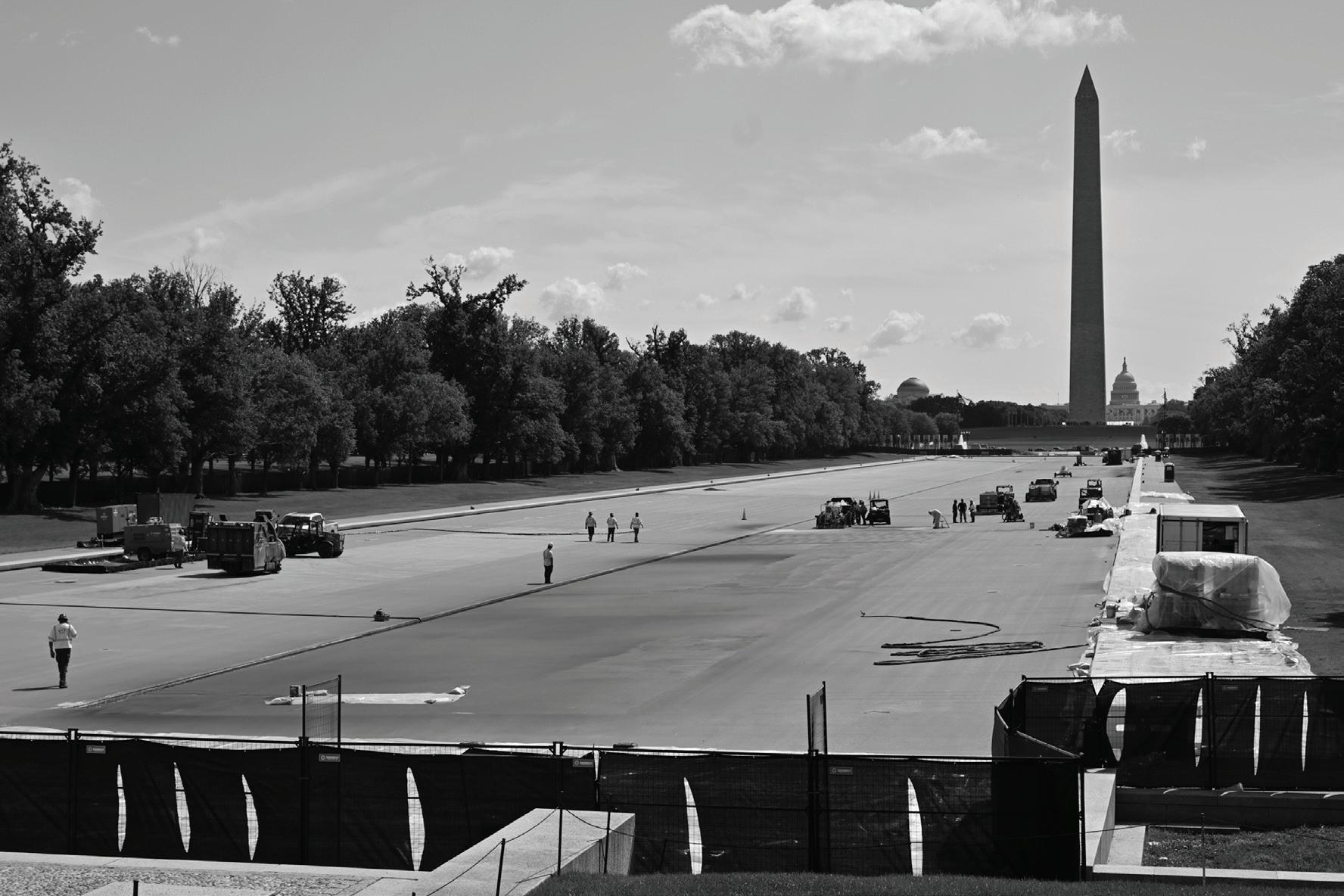
Trump announced last month his administration would paint the surface of the Lincoln Memorial Reflecting Pool “American flag blue,” saying the project was already underway. Federal records show the renovations will cost over $13 million after the government awarded the Virginia firm Atlantic Industrial Coatings a nobid contract, the New York Times reported.
Charles Birnbaum, the president of the Cultural Landscape Foundation, a nonprofit group that filed a lawsuit earlier this month over the painting of the reflecting pool, said the project could upend the reflective relationship between the Washington Monument and the Lincoln Memorial.
The lawsuit argues that the renovation process has not followed Congressionally-mandated procedures for altering historic landmarks, violating the National Historic Preservation Act, which requires agencies to engage in a process of consultation before making changes to historic properties
Martin Moeller, a former curator at the National Building Museum who said his opinions are his own and do not represent any groups he is associated with, said the proposal to paint the surface of the reflecting pool blue is emblematic of the same “cheap glitz” aesthetic that Moeller said is visible in Trump’s redecoration of the Oval
Philip Kennicott, a Washington Post culture critic focusing on architecture, said Trump appears to see making architectural and physical changes to D.C. as a way of establishing his legacy and leaving an imprint on the District that will last long after his presidential term. He said Trump’s desire to implement aspects of neoclassi-
cal architecture — a style used on structures like the White House and Jefferson Memorial that draws inspiration from ancient Greek and Roman forms — in federal buildings, as opposed to the existing brutalist tradition, is reflective Trump’s embrace of design styles that highlight power and wealth.
Foggy Bottom has seen a slew of architectural and design changes stemming from actions of the Trump administration. In December, the State Department added Trump’s name to the U.S. Institute of Peace Building and the board of the Kennedy Center voted to rename it to the Trump-Kennedy Center the same month, two months before Trump announced he would close the center for “complete rebuilding.”
GW researchers find unequal access to urban parks leads to chronic health risks
LAKSHMI DEV
GW researchers found access to urban parks is unequal within major U.S. cities, leading to higher risks of heat exposure, respiratory illness and other health disparities for residents in a study published late last month.
Greta Martin, one of the authors of the study and a postdoctoral associate at the Milken Institute School of Public Health, conducted the study analyzing park con-
ditions across the 24 most populous urban areas in the United States, including D.C., using spatial and environmental data to assess differences in park size, temperature, pollution exposure and air quality, publishing her findings in the Environmental Research Letters journal in late April. She said the study revealed that environmental inequalities can exist even in communities with access to parks as lowerincome areas often only have access to parks with fewer environmental and public
health benefits — like higher temperatures and greater pollution exposure — than wealthier neighborhoods.
“We should care about who has that privilege and who’s being deprived of those spaces that allow for these activities that are really important to humans,” she said.
Martin said the study found parks in higher-income neighborhoods were generally larger, greener and cooler than those in lower-income communities, reflecting broader patterns
Granberg urges graduates to
From Page 1
Kutler said “showing up” also means graduates should give back to their country and participate in democracy by volunteering, advocating and voting in November’s midterm elections. She urged graduates to remember the power they have to shape the future — citing the 2000 election, which was decided by just 537 votes — and reminded them that American democracy cannot function without the voices of the people.
“A government that is of, by and for the people, it only succeeds when we, the people, do our part,” Kutler said. “And, Class of 2026, your chance is now.” Student speaker Ethan Fitzgerald, a master’s of professional studies graduate and former Student Government Association president, said the Class of 2026 is living in a moment of profound cultural, technological and political change where education, research, science and free speech are under attack, making it easy to feel “overwhelmed” by the constant headlines. But he said having an education is a responsibility and a privilege, and graduates need to leverage their education to meet the difficult moments ahead by questioning authority and thinking independently.
“What you earned and learned
of environmental inequality within U.S. cities. The study also found park access and environmental quality varied sharply across metropolitan areas, with park space — the share of land dedicated to parks — ranging from less than 1 percent of land area in Indianapolis, Indiana, to 37.5 percent in the Seattle-Tacoma region in Washington.
Researchers defined park quality through environmental conditions such as park size, vegetation and tree cover, temperature levels and exposure to air pollu-
tion. The study found environmental disparities varied substantially within cities, with some metropolitan areas showing much larger gaps in park quality than others. In the WashingtonArlington-Alexandria metropolitan area, the study found relatively small differences in park size between neighborhoods compared to several other major U.S. cities.
She said unequal access to quality green space can have significant public health consequences, like higher rates
of chronic illness, heat-related health risks and poorer mental health outcomes, because parks often provide opportunities for exercise, social interaction and stress reduction.
“To be able to just see green spaces is calming and a reducer of stress,” she said.
“And also just having access to that means that you can do things like go on a run or meet up with friends in the park and all these activities that are really beneficial to your physical and mental health.”
channel ‘revolutionary’ spirit in challenging times
here cannot be taken from you, not by politicians, not by power, not by anyone who fears a generation that knows how to think,” Fitzgerald said. “Moments like today are proof, proof that you can question what’s in front of you, challenge what’s broken and think for your-
self.” Fitzgerald recalled coming to GWAs was the case during last year’s Commencement, audience members responded with a mixture of cheers and boos when Board of Trustees Chair Grace Speights called University President Ellen
Granberg to the stage. About 10 pro-Palestinian protesters walked out after Granberg began speaking, with several holding signs reading “Fire Joseph Pelzman, no research for genocide” and “Cut ties with Zionism.”
Speaking before an audience
that continued to boo at various points throughout her speech, Granberg encouraged graduates to draw on the strength and friendships they forged at GW in order to stand up for one another and causes they are passionate about.
Granberg, noting that 2026 marks the 250th anniversary of the signing of the Declaration of Independence, said graduates exemplified what it means to be a “revolutionary” during their time at GW. She said that being a revolutionary does not mean students will always agree with each other, but that they have the resolve to overcome those differences in pursuit of something “greater than ourselves,” like the Founding Fathers did when crafting America’s founding documents.
“The desire to make a difference defines the spirit I see in GW students every day,” Granberg said. “So many of you feel an enormous responsibility to make the world a better place.”
GW Alumni Council Chair Madeleine Jacobs welcomed graduates to a global network of over 350,000 alumni around the world.
During her speech, she highlighted that graduates can one day join the group of “monumental” alumni by making an impact on the world with their service and contribution.
“On behalf of the entire GW alumni community, congratulations Class of 2026 and raise high,” Jacobs said.
Speights stands by Board’s GWPD arming decision, refusal to divest from Israel
From Page 1
Speights said she understands the complaints that the Board has not engaged with the community on certain decisions and needs to be held more accountable, but she said the community has to understand the responsibility of the Board — which she said is not to manage the day-today responsibilities of the University but to exercise their fiduciary duty to GW. She said trustees’ responsibilities come with a lot of information that is “very confidential,” preventing them from sharing the full rationale behind certain de-
cisions.
Speights pointed to the Board’s 2023 decision to arm about 20 University police officers with 9mm handguns in response to recent shootings on college campuses in the United States as a decision that was solely the Board’s responsibility, only involving community input once it reached its implementation phase. The decision was met with widespread student protests, dissenting letters from faculty, criticism of the lack of community input from staff and faculty demands for the University to publicize the data that backed their decision.
Speights said the Board
is not rethinking the decision — a stance Granberg has communicated several times — adding that the Board didn’t make the decision alone, but rather with the consultation of experts and University leadership. She defended the idea that the decision was the Board’s responsibility because the body would be legally liable in the event someone at GW was injured or killed due to gun violence.
Speights said the Board was not responsible for the implementation of the arming, saying that it was an “administration decision.”
“Sitting here, I can’t say that I have any, or we as a Board, have any regrets,”
Speights said of the Board’s decision to arm GWPD. “But having said that, having made the decision and moving forward, as I said, we are constantly reviewing how it is implemented.”
Speights during her tenure also faced widespread campus protests after Hamas’ Oct. 7, 2023 attack on Israel, where students called on GW to divest from weapons manufacturers and companies tied to Israel.
“We understand that there are strong feelings about this issue,” Speights said about students’ divestment calls. “We hear it. I mean, we don’t have our heads in the sand. We listen and we do hear it.”
Office.
PHOTO COURTESY OF G. EDWARD JOHNSON/CREATIVE COMMONS Workers carry out renovations on the drained Reflecting Pool in late April.
Speights said the Board does not make investment decisions based on external political considerations.
NICHOLAS WARE | ASSISTANT PHOTO EDITOR
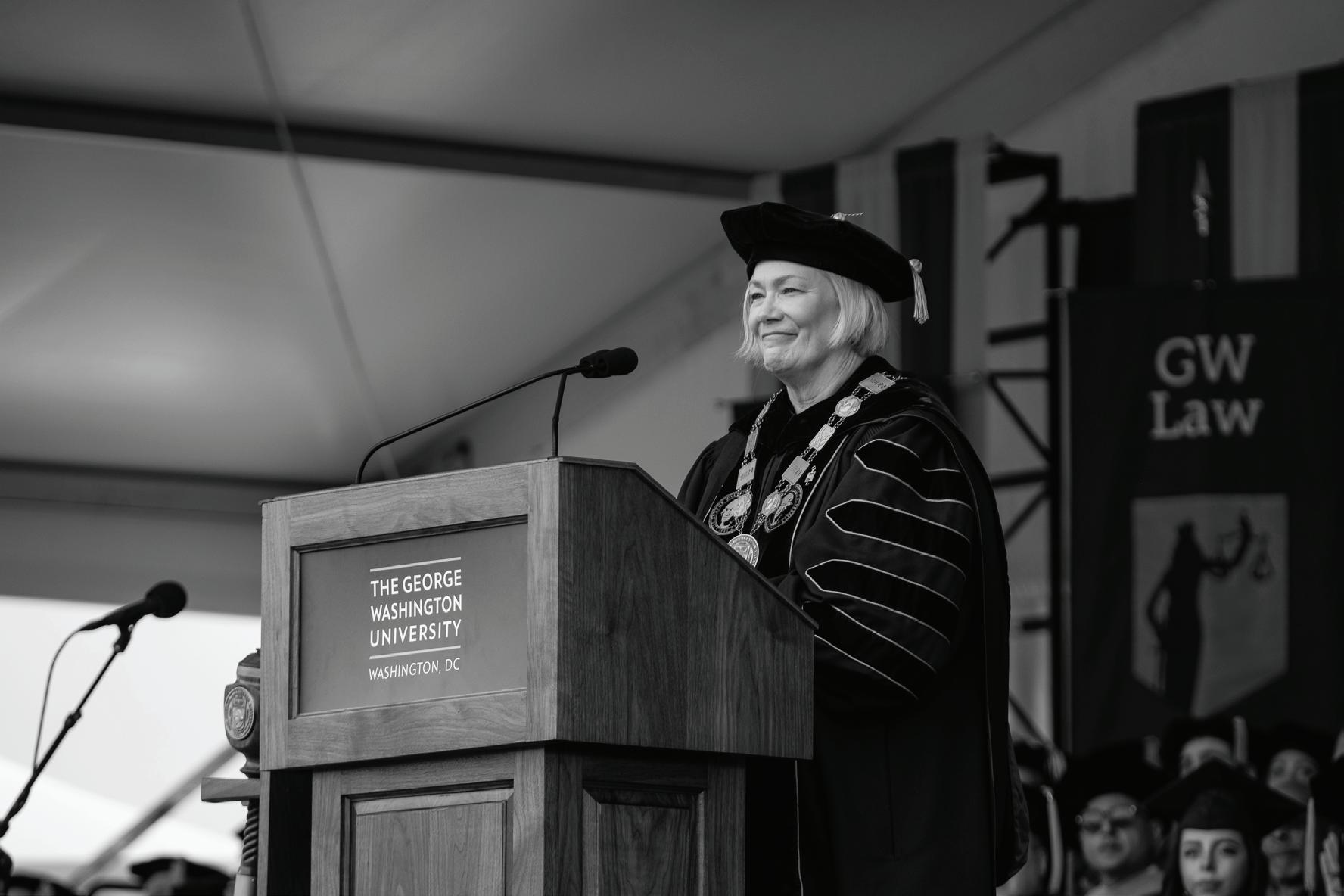
University President Ellen Granberg speaks at Commencement Sunday.
KRIS PARK
ASSISTANT
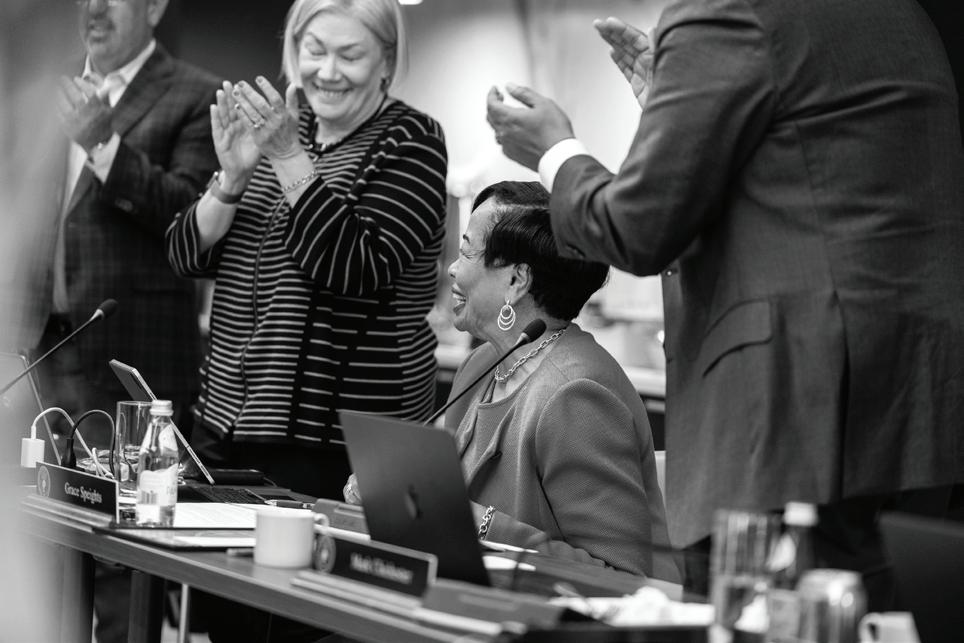
EDITOR Outgoing Board of Trustees Chair Grace Speights receives a standing ovation during Friday’s Board meeting.
OPINIONS
At pivotal moment, GW’s incoming provost must rise to the occasion
Our editorial board argued in January that GW’s new provost should be an internal hire, citing the University’s need for stable leadership that understands the convergence of challenges GW is facing. However, last month, officials announced they had hired Duke University historian Ed Balleisen to serve as the University’s next provost. While we are disappointed that GW took on an outside hire at a time when it is more crucial than ever that University leadership understands the University’s priorities and mission, we believe Balleisen’s experience in interdisciplinary education and stated dedication to University President Ellen Granberg’s strategic framework will serve him well at GW. That being said, as an outside hire, Balleisen must come in ready to prove to the community his understanding of and commitment to shared governance, transparency and the issues facing students and faculty. We believe that Interim Provost John Lach did an exceptional job at making himself available to students and serving as an advocate for faculty, while previous provosts have appeared distant and disengaged from the broader campus community. As he prepares to step into the role of GW’s chief academic officer in July, Balleisen should take a page out of Lach’s book, while also putting in the extra work to familiarize himself with GW’s institutions, governing bodies and values as he looks to take the helm of the University’s academic enterprise.
Balleisen is entering GW’s top academic post at a turbulent time for the University. Granberg is looking to execute her long-term vision for the institution through initiatives like the strategic framework and the new University budget model set to launch next fiscal year,
GW should
ASTAFF EDITORIAL

all while navigating a budget deficit, declining international enrollment, cuts to graduate programs and federal pressures from President Donald Trump’s administration. In order to do that, she needs to be able to rely on the provost to help her execute her mission. We are encouraged by the fact that in an interview with The Hatchet last month, Balleisen expressed enthusiasm for the strategic framework and said he had been briefed on the challenges facing the University and was ready to tackle them. Lach, in his short time at GW, has made a massive impact on the University’s direction moving forward, from guiding the
launch of the strategic framework alongside Granberg to steering the efforts to forge GW’s new budget model to dissolving the Office of Diversity, Equity and Community Engagement and replacing it with a new Office of Community, Culture and Inclusion. Faculty and students also reported Lach made a genuine effort to embed himself into the community with initiatives like his “Pizza with the Provost” series, contrasting him with former Provost Chris Bracey, who community members described as distant. Lach has been more transparent when it comes to GW’s diversity, equity and inclusion policies, like explain-
take initiative in closing the financial literacy gap
long with the cel-
ebratory air that comes with graduation season, students can also sense a lurking feeling of anxiety at what finishing their career at GW means: it’s time to enter the real world. Many universities aim to prepare students for the workforce and that is certainly the case for GW, where classes and programs often emphasize the skills they are equipping students with so they can succeed in their respective careers. But while many higher education institutions prioritize preparing students for the workforce — with good reason — they usually neglect the broader responsibilities that come with adulthood, like providing students with financial literacy or offering support as they try to gain these skills. While professional education is undeniably crucial for students transitioning to adulthood, GW should give equal time and weight to preparing students for financial independence. Many students are lucky to have families that are able to help them with things like credit scores, loans and taxes, but that privilege is not universal, and many students are left to graduate college with little to no knowledge about how to manage their finances.
Opinions Editor
GW already does a decent job of teaching stu-
dents valuable career skills like how to build their resume, write cover letters, network and conduct themselves in an interview — which are all essential to adulthood and the workforce. But adulthood, of course, comes with more than just landing a job; students in their post-graduate lives will need to navigate paying bills and taxes and building their credit scores. While I have found that some of these skills are more intuitive, and some students are able to ask their parents or family for help, that’s not always the case for everyone, especially for lower-income families who often have lower financial literacy. Lowerincome families are 42 percent likely to know a “fair amount” of personal finances, compared to those who are of higher-income families, whose confidence level is at a 72 percent, according to a St. Mary’s University study on economic disparities.
I understand that it shouldn’t be the sole responsibility of a university to teach students about everything there is to know about financial literacy or adulthood. However, GW should still offer students support by having advisors or staff members that are equipped to answer students’ financial questions as they go off into the real world. This is essential when Gen Z and lower-income families are the ones who struggle the most with financial literacy. As a higher education institution, GW should
be supporting students to increase their knowledge in financial literacy, especially when many people in our generation are also somewhat struggling with budgeting and planning to pay off debt — which highlights the need for a stronger financial education. This need is exacerbated by the current low confidence in the economy in the United States. There is no better time for students to learn more about financial responsibilities than in college, when they are in the cusp of adulthood and will be exercising their knowledge in finances more.
If GW offered and advertised these services, it would help inform students a lot more on their financial decisions during and after college. It would help close that gap that currently exists between our generation and those who, like myself, are from lower-income families. Financial education is essential for not only learning how to traverse adulthood, but for making smarter decisions with money, saving and budgeting and having lower or no debt. As someone who watched her family struggle with debt and finances, I know that having these resources or more explicit education available at GW would allow me to not struggle as much as my parents did.
—Andrea MendozaMelchor, a senior majoring in journalism and mass communication and creative writing, is the opinions editor.
Aing GW’s decision to rename the Diversity Summit to the OneGW Summit and sending out an email to the community reaffirming GW’s commitment to DEI, one of the most straightforward and transparent communication messages from the GW administration this school year. Lach’s only major shortfall as a provost was the brevity of his tenure. This, along with the departure of several other top University officials this academic year, has not allowed for the consistent leadership and cohesive messaging GW requires at this critical juncture. Balleisen must come into the position with the understanding that
he will need to remain in the post for the foreseeable future in order to oversee the ongoing implementation of these initiatives. Critically, Balleisen will be coming into GW, helming several initiatives shaped by previous provosts he had no part in creating, which doubles his responsibility to maintain the spirit of these efforts.
Students, faculty and staff have been clear about what they are seeking in an incoming provost: transparency and a commitment to shared governance following a perceived “lack of engagement” from Bracey.alleisen told The Hatchet that he wanted to work with faculty to make decisions reflective of shared governance, which bodes well for the community, as he is willing to work actively with them and hopefully let the community’s experiences and opinions influence their decisions. .
This feedback should be the driving force behind Balleisen’s leadership, and he should consistently work to solicit additional feedback from the community as he settles into the role. To that end, students and faculty also must pour their energy into providing Balleisen with comprehensive feedback and making an effort to engage with him on campus. While many students may not even know what a provost is, the people who serve in that position have significant power to materially improve the GW experience, power the community should be encouraging them to leverage. Just as Balleisen must work to advertise his initiatives and embed himself into the community, students and faculty must also pay attention to those initiatives and participate in all possible forums to provide input into the University’s governance.
My GPA is not my graduation takeaway
s my college experience comes to a close and the seemingly impending graduation walk looms, I will not be leaving GW with a perfected GPA nor academic honors of any kind. However, I could not be more proud of the substantive and impactful development and learning I acquired during my time as a college student. Many GW students spend their entire time in college obsessed with getting a perfect GPA, but the best career development opportunities are those outside the classroom. Through extracurriculars, ventures abroad and invaluable career experience, I am entering the “adult world” with multiple pathways at my fingertips and a versatile and adaptable mindset, both of which I acquired outside of the classroom. The most essential skills I learned were not the grades I received, but the well-rounded and multifaceted approach I had toward college, filled with extracurricular activities and travel. While many students worry about having a high or perfect GPA, it’s imperative for students to remember that it is only one aspect of college and that their time at GW offers many more experiences and opportunities that can be much more fruitful to them as they enter the workforce.
James Pomian Opinions Writer
The first place to start building valuable skills is on campus. Like most U.S. universities, GW houses a plethora of campus organizations, teams and societies. The different organizations available on campus can help bolster the identities and ideals of students, whether it is through activism, representation by voicing your opinion through the school newspaper or competition through teams like mock trial. All of these activities serve greater purposes of giving students long-term skills like leadership skills and public speaking, rather than filling gaps in a lackluster resume. During my time at GW, I indulged in a variety of these experiences. I secured a spot on the mock trial team in my freshman year, and I found myself in a rather small group of diverse and skilled individuals united by the simple yet rigorous goal to win. While professors often encourage students to spend more time on school work than extracurriculars or activities that are supposedly “just for fun,” I found that the value I extracted from spending time on mock trial was more beneficial than shutting myself up in Gelman Library with books.
Similarly, as an opinions writer for The Hatchet, I have had the opportunity to build my writing skills through topics and events that have personal importance to me, rather than fulfilling a degree requirement. It’s a different experience to write pieces I choose compared
to professors assigning me topics, allowing me to interact with them in a more passionate and dedicated way. I wrote pieces in the past two years urging voters to look at policies when voting rather than individuals, highlighting the risks of the internet following Charlie Kirk’s assassination and more. The tireless process of revisions, cuts and restructuring on real-time issues allowed me to develop argumentative, analytical and compositional skills, which are essential in today’s socio-political climate. Truly, my college experience is more fulfilling due to the efforts and ventures I pursued outside of the classroom. I may not have the 4.0, but my ability to navigate today’s world in my prospective career and as a contributing member of society is much more capable because I did not endlessly lock myself in Gelman. I am beyond proud of my accomplishments, which go beyond the numbers listed on my transcript. I encourage students to do the same — to not be weary of extending your skills, ambitions, and passions beyond the classroom to the endless possible ventures. While, academics remain the basis of your GW degree, your outcome as an alum should be virtuously holistic and amply prepared for the world beyond which cannot simply come from the classroom.
—James Pomian, a graduating senior majoring in history and political science, is an opinions writer.
CAROLINE MORRELLI | STAFF CARTOONIST
THE SCENE CULTURE
SMPA professors to bring documentary to DC/ DOX festival following Sundance screening
After touring film festivals and screenings around the world, two GW professors are bringing it back to the District to premiere their documentary at the DC/DOX documentary festival early next month.
“Who Killed Alex Odeh” is a documentary co-directed by School of Media & Public Affairs professors Jason Osder and William Youmans that explores a 1985 assassination in southern California, where a bombing killed Palestinian activist Alex Odeh. The film looks into the U.S. government’s investigation into the killing, how the Israel-Palestine conflict intersects with Odeh’s murder and why the case remained unsolved.
Osder, an associate professor of media and public affairs, said he had the idea for the documentary after he screened his film, “Let the Fire Burn,” in 2o13 about a police confrontation with a radical group in Philadelphia in 1985. Youmans, who attended a screening of the film, told Osder that the subject matter reminded him of Alex Odeh’s murder from 1985, as they were both “political acts of terrorism,” and the pair set out to make the film.
As a Philadelphia native, Osder said he was influenced to make his documentary “Let the Fire Burn” partly because he grew up around the area of the incident and was familiar with the event, while Youmans grew up in the Arab American community and was familiar with Alex Odeh’s death. Osder said he had never heard about Odeh’s assasination before speaking with Youmans, and he believed that his story needed to be told.
“That struck me as very vital that here we are, both Americans, both at an institution like GW, yet we didn’t fully share the same mythology,” he said. “We grew up with different stories around the kitchen table, different items of conversation, politically, and that seemed very vital to me in terms of something to collaborate on.”
Osder said that over 10 years, starting in 2013, he worked with Youmans to research Alex Odeh’s murder, developed a relationship with Odeh’s widow and daughters and followed journalist David Sheen’s investigation into the assasination. Osder said the case remains “officially unsolved,” but in the documentary, he and Youmans showcase known facts
DIANA ANOS CULTURE EDITOR
As the calendar nears July 4, states, counties and towns across the country are digging into their histories to celebrate 250 years of America, with D.C. at the center of the festivities, boasting national artifacts, artwork and parties to honor the American anniversary. Now that the academic year has wrapped up and summer is in full swing, so are celebrations of the country’s semiquincentennial as the anniversary of the signing of the Declaration of Independence looms. From block parties to dog contests, each event is carefully curated to celebrate the country, so take a quick break from your hillternship this summer and check out the exhibits and festivities around D.C.
“In Pursuit of Life, Liberty, and Happiness” exhibit at the National Museum of American History
In a museum-wide exhibition launched May 14, spanning the 250,000 square feet of the National Museum of American History’s three floors, museum curators chose 250 objects from 1776 through the modern day that depict how Americans “pursued the promises” of the nation’s founding.
Items range from a Special Olympics torch from the 2015 World Games in Los Angeles, representing how people with disabilities have participated in competitive sports on the world stage, to a pink “pussy hat” worn by a participant in the 2017 Women’s March in D.C. that
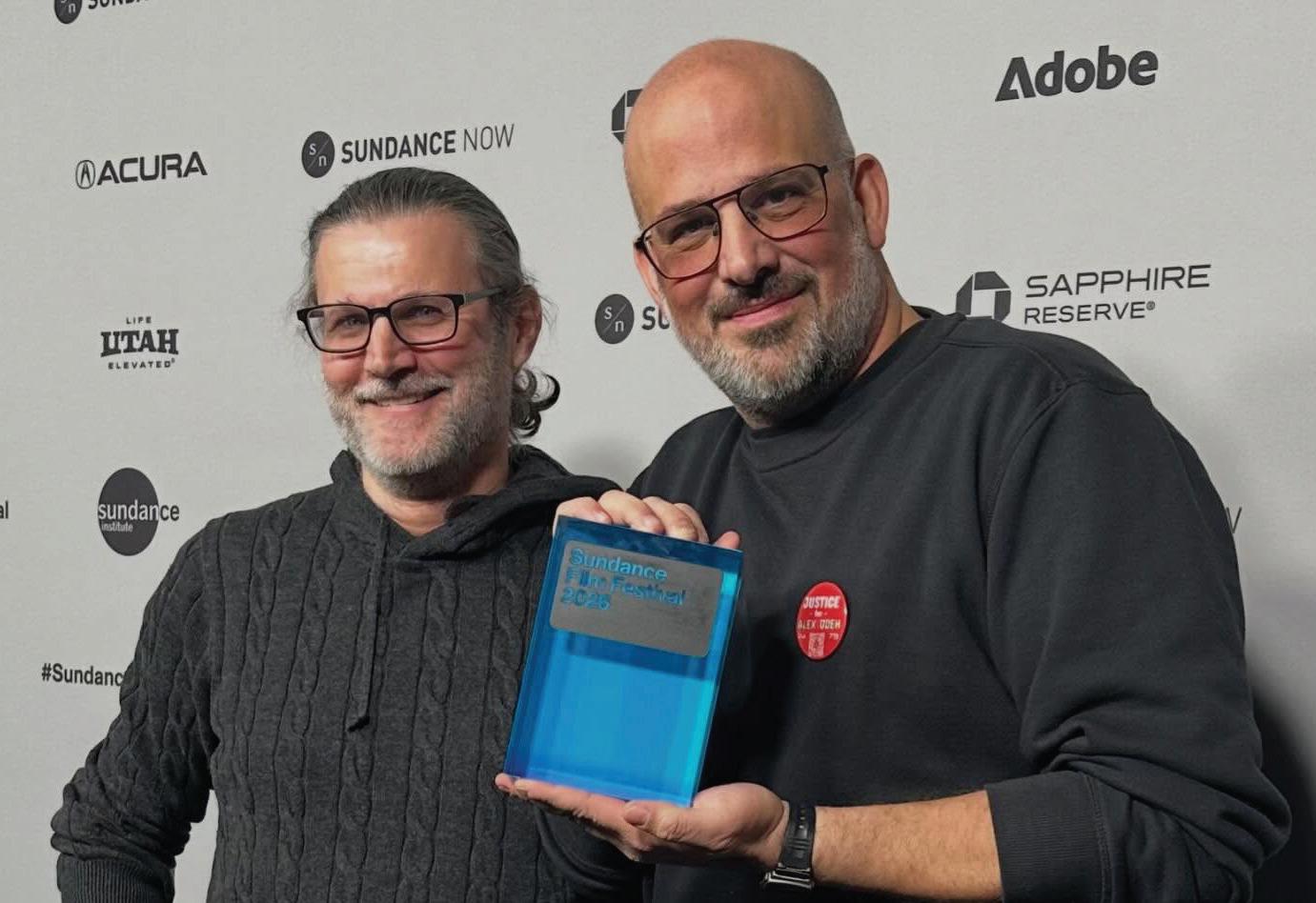
and information they discovered through their research.
After the duo completed the film earlier this year, Osder said they submitted “Who Killed Alex Odeh” to film festivals around the world and were chosen as one of the 100 films screened out of 1,600 submitted to the 2026 Sundance Festival, in the documentary competition. He said the film was awarded the Jury Prize for Journalistic Excellence at Sundance, and soon after, the film screened at the Berlin International Film Festival.
He said the film will continue to show around the world, including at festivals in Sao Paulo, Egypt and Newport Beach, California, where Odeh was murdered, and in D.C. at DC/DOX, a District documentary film festival from June 11-14.
Osder said because there is a “real political content” to the film, he believes D.C. is a place where audiences will be politically engaged and ask questions after the film, compared to other stops on the circuit. He said because he did much of the work for the documentary in and around D.C., he anticipates some personal friends and colleagues will be in attendance.
Although he said the awards and festival selections are gratifying, Osder said he wants to “temper” his pride surrounding the film because of its sensitive subject matter. He said working closely with Odeh’s family throughout the filmmaking process to tell a story that had never been shared with the public was a “gratifying” experience.
He said the most rewarding part of the process has been his
collaborative partnership with his co-director, Youmans, and the relationship and trust he has built with Odeh’s family.
“There’s kind of an adage of cliche that what you do when you make documentaries is you go out and form authentic relationships with people that you wouldn’t normally have relationships with, and what the film is is a record of those relationships,” Osder said.
DC/DOX will be returning to the District for its fourth year for four days of film screenings, filmmaker Q&A sessions and special guests, including Billie Jean King and Sara Bareilles, taking place in venues across D.C. like the Eaton Cinema and the Regal Gallery Place. Sky Sitney, festival co-founder and director, said of the 113 films screened at DC/DOX, each of the films is different from the next in terms of topics, themes and stylistic approaches — some with a more investigative, intervieworiented approach, while others are experimental with documentary.
Sitney said having “Who Killed Alex Odeh” in this year’s slate of films and seeing Osder at DC/DOX is a “full-circle” moment for her, recalling a viewing of his previous film, “Let the Fire Burn,” at AFI Docs and continuing to view her work in local documentary spaces.
“One of the things we want to do is both be a home for the field at large but also become a really fertile place for the filmmaking community that’s here in D.C. and celebrate that work and advance that work,” she said.
Morena pop-up explores Filipino flavors in Dupont
Amid the constant stream of additions to Dupont Circle’s restaurant scene emerges a new daytime cafe, Morena, the morning counterpart to a D.C. favorite Filipino restaurant Kayu.
Currently operating as a weekend-only pop-up that launched April 25, Morena serves as a test run as the team gauges community interest in the new joint, hoping to expand to a full-time schedule, including weekdays, in the near future. Morena’s opening on 17th Street marks owner and chef Paolo Dungca’s effort to expand Filipino cuisine within D.C.’s food scene while creating a relaxed daytime space to contrast Kayu’s formal evening dinner service, with the concept drawing strong support from the local community, hosting busy crowds each weekend.
Dungca said the idea for Morena was “long overdue” after guests from Hiraya, Dungca’s previous cafe that closed last June, mourned the cafe’s closure. The cafe closed after nearly two years of business following a dissolved partnership between Dungca and his former partners, Juan and Jeremy Canlas.
“I think our guests from the previous location have been wanting to see us bring this back to life, and it was one of those nights where Chef Julie and I were just brainstorming other ways we can continue to push our heritage to the forefront,” Dungca said.
As of now, Morena only operates on Saturdays and Sundays from 9 a.m. to 3 p.m. as the team tests the cafe concept and popularity among the Dupont Circle community. Rather than centering the menu around traditional Filipino dishes, Dungca said Morena brings a more modern Filipino-American perspective to each plate. He said that many restaurants still associate Filipino cuisine primarily with popular dishes like adobo, while Morena aims to showcase flavors from Filipino meals that are often overlooked in D.C.’s restaurant scene.
“I think Filipino cuisine is the ultimate fusion cuisine, it has a lot of inspirations from Spanish, Japanese, Chinese and even down south, the southern islands,” Dungca said. “There’s just different inspirations from Indonesia, Singapore and all that.”
Dungca said the specialty lattes represent nostalgic flavors from his childhood, transformed into drinks that have a modern and experimental feel. The drink menu also features the introduction of matcha and specialty lattes like an ube horchata latte and a bibingka latte, with flavors from the traditional Filipino baked rice cake of salted egg caramel.
“It teaches us to teach the guests of how we grew up here in America,” Dungca said. “At the end of the day, we are Filipino-American, and that is the kind of story that we would want to portray, and it’s never going to be the traditional dishes that you would often see in Filipino restaurants.”
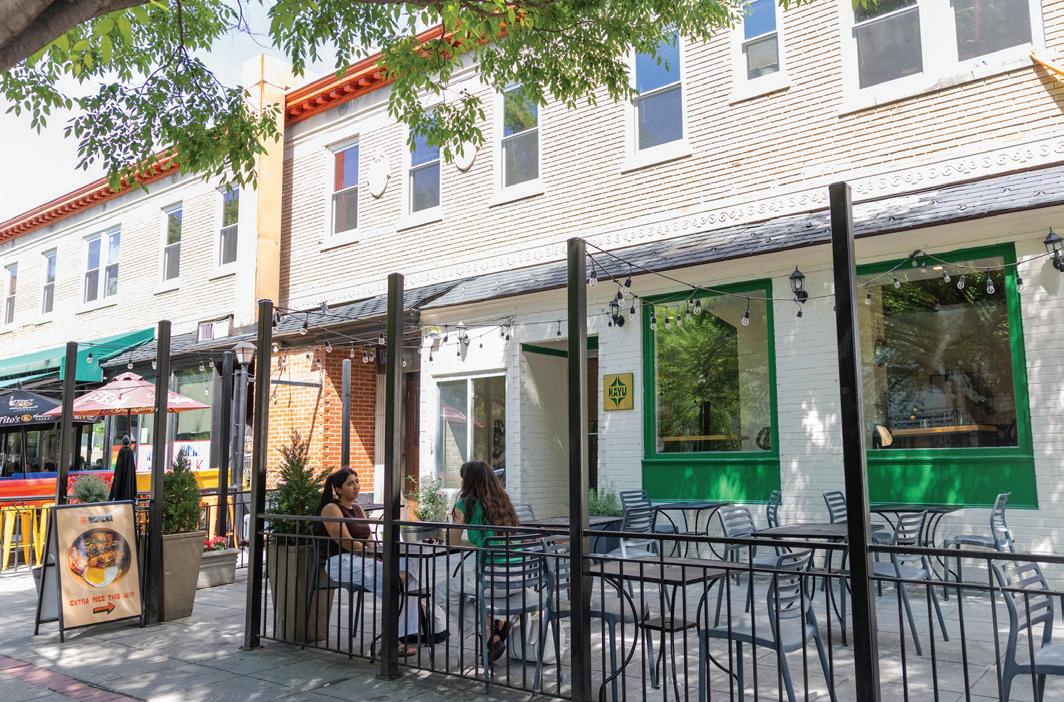
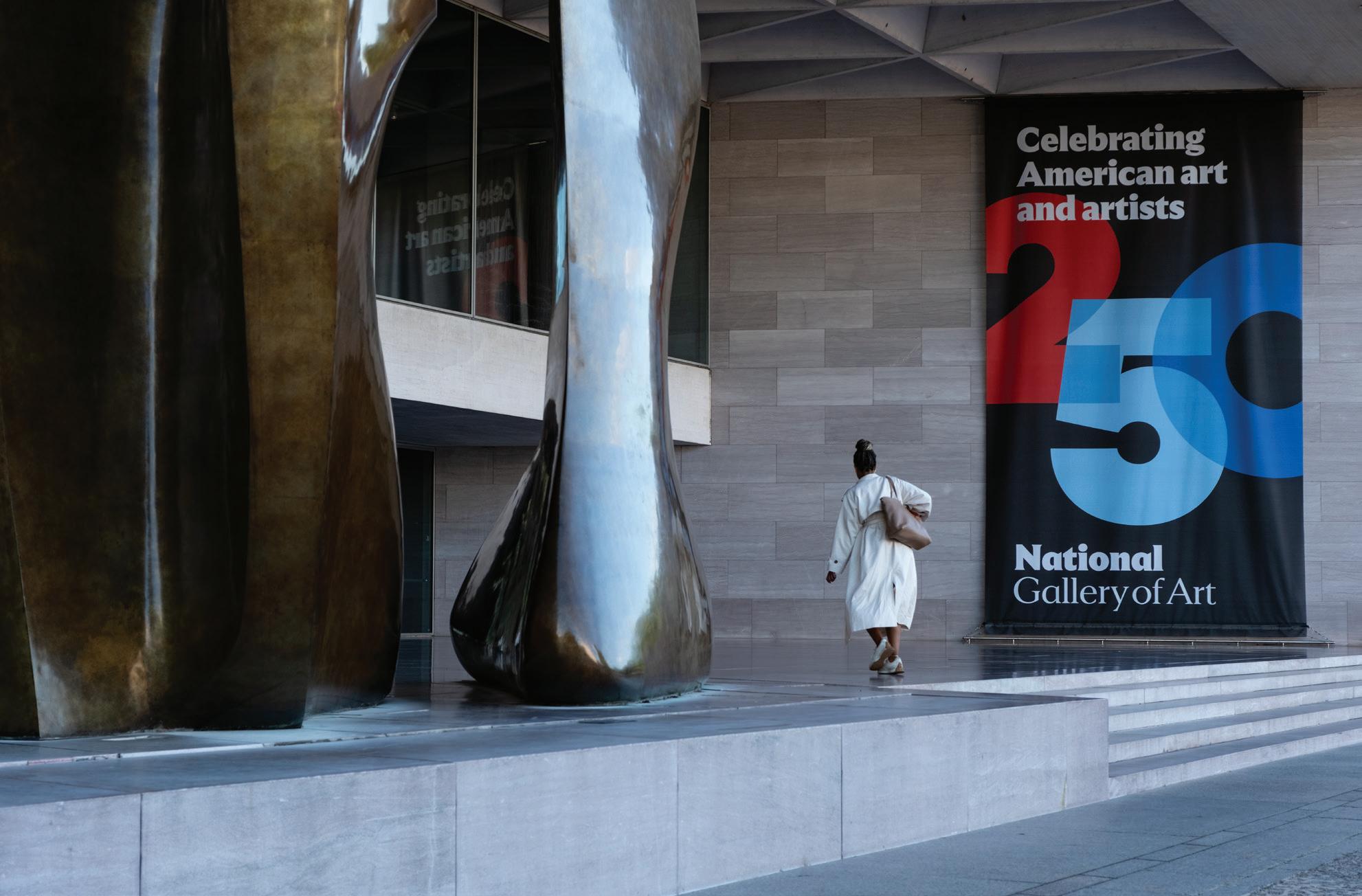
depicts how people hoped to revitalize the fight for social justice for women around the world. Dating back to 1776, the exhibit also displays Thomas Jefferson’s desk, where he wrote the Declaration of Independence, complete with a hinged writing board and a drawer for papers, pens and an inkwell. The exhibit is on display until the end of 2026.
Brew to the People: A Coffee House Conversation at Tudor Place Historic House & Garden
Among the residential streets of Georgetown lies Tudor Place, a mansion with sprawling gardens that was once the home of Thomas Peter and Martha Parke Custis Peter, descendants of Martha Washington. From 6:30 to 8 p.m. on July 2, Tudor Place will host an afterhours experience inspired by colonial coffeehouses catered exclusively to the Gen-Z crowd.
The event will provide coffee-flavored mocktails and treats, with an opportunity for attendees to deepen their historic knowledge of the Washington family
while exploring the featured exhibition, “Founding Fortunes: The Estate Sale of Martha Washington,” that follows the public sale of Washington’s household contents at Mount Vernon in 1802. Admission is $10 for nonmembers.
National Museum of Women in the Arts exhibits
Right in Penn Quarter, the National Museum of Women in the Arts is showing multiple exhibits to honor American womens’ artistic perspectives around
the country. In the museum’s Great Hall, “Ms. Americana” is on display from April until October 2027, featuring a selection of 10 works by American women, including still-life paintings, portraits and landscapes from the 18th to 20th centuries by artists like Miriam Peale, known as the first woman to make a profession of painting and Cecilia Beaux, who painted prominent writers and politicians.
On display from May 8 to September 27, “Burnished: Pueblo Pottery at NMWA” is the first time
the museum is displaying its pottery collection in a focus exhibition. The 24 clay vessels reflect varying material cultures and traditions across Pueblo communities in the southwestern regions of the United States, featuring Santa Clara artist Margaret Tafoya and Acoma potter Emma Lewis Mitchell. Museum admission is $13 for D.C. residents.
National Gallery of Art Block Party A self-proclaimed “biggest party ever,” the National Gallery of Art is hosting a block party on June 6 to celebrate the legacy of American art and creativity across the museum’s campus in the East and West Buildings as well as the Fourth Street Plaza that connects the two facilities. Visitors can get an inside look into the museum with art talks in the American galleries and special exhibitions, like “Dear America: Artists Explore the American Experience” that features over 100 works from the 18th century through the modern day, take part in creating a community collage quilt, make a zine and listen to a sound bath. Local groups like the Batalá Washington Drum Band, East of the River Steel Drum Band and the Eastern High School Marching Band will perform, and refreshments will be provided, with a full timed schedule to be released closer to the event date. Attendees must reserve free timed tickets to attend.
JESSICA ROWE CONTRIBUTING CULTURE EDITOR
COURTESY OF JASON OSDER
School of Media & Public Affairs professors Jason Osder and William Youmans accept an award at the Sundance Film Festival in January.
NICHOLAS WARE | ASSISTANT PHOTO EDITOR
A visitor walks into the National Gallery of Art.
DIANA ANOS CULTURE EDITOR
LEXI CRITCHETT | ASSISTANT PHOTO EDITOR Patrons sit outside Morena on 17th Street.
— University President Ellen Granberg on 5/15/2026
Women’s basektball bolsters roster, coaching staff as Adeduntan eyes next season
After a promising first season at the helm of women’s basketball, Head Coach Ganiyat Adeduntan has reinforced the roster with five new recruits from the transfer portal and reworked the coaching staff as the team looks to build on its success in the 2026-27 season.
Since the team concluded its 18-18, 7-11 Atlantic 10 season in March, including the program’s first Great Eight appearance in the Women’s National Invitation Tournament, Adeduntan has recruited five new players from the transfer portal and made changes to the coaching staff in response to losing four seniors and the departure of Assistant Coach Brianna Finch to the University of Massachusetts Lowell last month. The new additions on both the court and sideline look to support Adeduntan’s goals of improving on both ends of the floor and maintaining a competitive, defense-first identity to secure a higher spot in conference rankings next season.
The coaching staff underwent several changes earlier this month, including the promotion of Assistant Coach John Hampton to associate head coach and the addition of two new assistant coaches, Essence Baucom and Kindyll Dorsey.
Baucom joins the coaching staff after a five-year stint as an assistant coach and recruiting coordinator at Elon University. Baucom attended Elon from 2014 to
2017 and played 96 games for the Phoenix during her collegiate career, including helping the team earn its firstever NCAA Tournament bid in 2017.
Dorsey previously worked as the associate director of athletics at Buckingham Browne & Nichols High School in Cambridge, Mass., for eight years and served as head coach of the varsity women’s basketball team for two seasons from 2012 to 2014. Dorsey also worked as an assistant coach at Northeastern University for three seasons, from 2015 to 2018, helping guide the program to its first winning season in five years in 2018.
In addition to new faces on the sidelines, five new transfers are joining the roster following the graduation of four seniors, including guards Filipa Calisto and Natalia Sierra-Vargas and forwards Emma Theodorsson and Caia Loving. Among the new additions are three guards and two forwards, bringing both perimeter shooting and elite defensive skills to a team that excels at rebounding and baseline defense, but struggles with ball security and forcing turnovers.
Among the transfers is graduate guard Anne Bair from Colgate University, whom Adentuntan previously recruited to play for the Raiders from Manhattan College in 2024 in her last year as head coach for the program. Adentuntan coached Bair during her standout junior season in which she started in all 33 games, averaging 12.4 points, 3.5 assists and 2.3
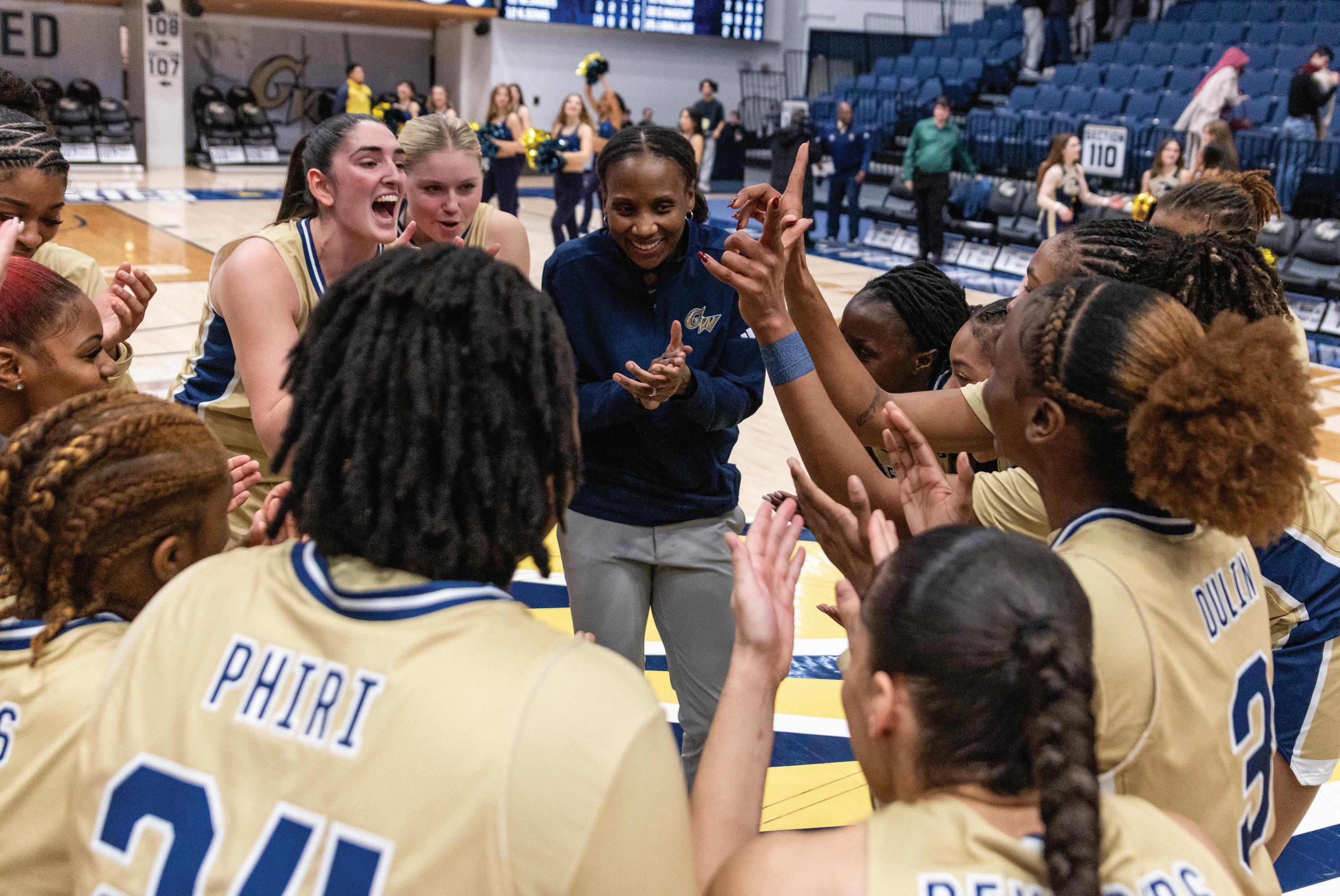
rebounds per game. During that season, she also led the Patriot League in free throws shooting at 88.7 percent and helped the team reach its second-ever WNIT appearance in 2025.
Senior guard Amor Harris, an Alexandria, Virginia native, joins the Revolutionaries from Longwood University, averaging 10.6 points per game, shooting 39.2 percent from the floor and making 24 starts in 31 games played last season.
Swiss native and sophomore forward N’na Konate transfers to Foggy Bottom from Campbell University and joins the team as a highly efficient shooter, shooting 50 percent from the field last season and securing 142 total rebounds. Her standout skill, though, in her freshman season was elite rim protection, making 51 blocks and ranking second in the Coastal Athletic Association and in the top 50 in the NCAA.
Junior guard Alicia
Baseball ends sluggish spring marked by slow offense, pitching woes after falling to Dayton
MILO ROSENZWEIG
SPORTS EDITOR
Baseball fell to Dayton in a sweep during their final series of the season last weekend, marking the conclusion to a disappointing spring riddled with both heartbreaking and blowout losses and recurring struggles against Atlantic 10 competitors.
The Revolutionaries finished the season with an overall record of 18-35, translating to a .340 winning percentage, and were 9-21 in A-10 play, landing at the No. 10 spot in conference standings in a twelve-team field. Despite a streaky start to the spring, which included a notable series sweep of Saint Peter’s University at the end of February, the Revs lost their footing in the second half of the season, getting swept in four straight conference series and missing the A-10 Championship as slower offensive production coincided with struggles on the mound and in the field.
The Revs lost the opening two series of the season to Western Carolina University and Lehigh University, before taking down Saint Peter’s and beating local rival Georgetown University in a 10-9 matchup in early March.
The Revs secured a series victory against Rhode Island in the first conference series of the season in mid-March, but their success quickly evaporated, falling to Saint Joseph’s in a sweep later that month. The Revs managed a series win over the A-10’s La Salle to close out the month, but the remainder of the spring brought few bright spots to the team.
GW opened April with a series loss to St. Bonaventure, and fell to Saint Louis the following week. A sweep of Virginia Commonwealth, their second and only other of the season, was drowned out after Davidson, George Mason and Richmond swept the Revs in consecutive A-10 series at the end of April into May. The Revs capped off the season this weekend against Dayton, but lost all three matchups, 9-1, 7-5 and 6-2 on Thursday, Friday and Saturday, respectively.
High-run tallies plagued the Revs’ pitchers all season, with a combined 6.54 earnedrun average, the sixth worst in the A-10. Junior starting pitcher Andrew Cutler led the team in ERA at 4.68, with sophomore
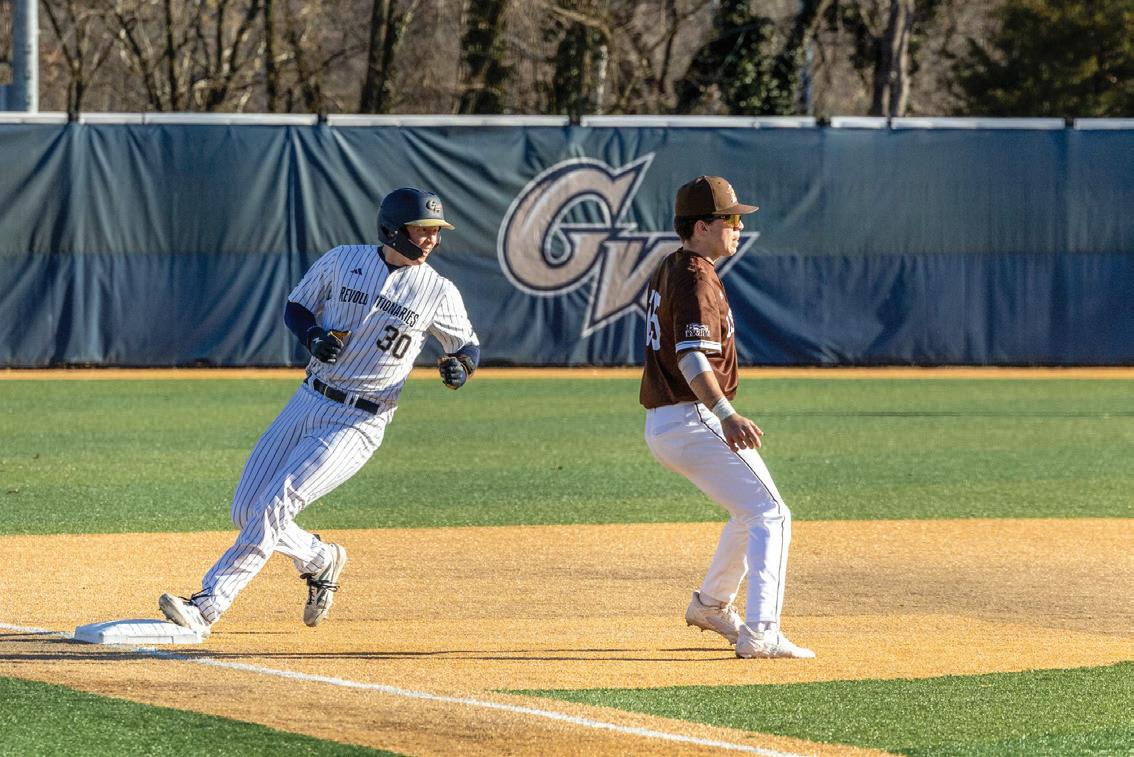
Declan Wywoda behind him at 5.64 and senior Max Haug with the third lowest, recording 5.99 on the season. Wywoda and Haug both finished the season with losing records, at 2-4 and 2-6, respectively, while Cutler boasted a 5-1 finish.
Relief pitching also proved to be a problem for the Revs, including struggles by sophomore Drew Harris, who finished with a 7.18 ERA in 22 relief appearances, and junior Matt Bruno, who marked a 6.39 ERA in 18 relief outings and one start. Freshman Colin Lebel was a bright spot in the bullpen with a 3.24 ERA in 17 relief appearances and one start.
The implications of the Revs’ defensive struggles were underscored by massive losses throughout the season. Western Carolina took the Revs down 13-4 in the second game of the Revs’ first series of the year, and an 11-0 loss to the University of Virginia, an 18-3 loss in the first game of a three-game series against Yale University, during which the Revs made two errors, and a 12-0 loss to Towson University — which saw the Revs make three errors — were reminders of the team’s defensive woes all season.
The team improved only marginally defensively from last season, recording 60 errors over 53 games, a slight improvement from last season’s 64, but turning fewer double plays, making fewer assists and recording fewer putouts than in 2025.
A handful of Revs posted impressive offensive numbers, with junior catcher Robbie Lavey leading nearly all offensive categories. Lavey finished the season with a team-best .339
batting average, .526 slugging percentage, 37 RBIs, eight home runs and 65 total hits, numbers that earned him the Team MVP award and a spot on the Buster Posey National Collegiate Catcher of the Year Award Midseason Watchlist. Junior third baseman Cristino Tufano hit .316 on the year, grabbing the secondhighest slugging percentage at .428, and trailing behind Lavey for the most walks and hits, with 28 and 48, respectively. Sophomore infielder Charlie Walsh hit four home runs, the second most behind Lavey, roped 11 doubles, the third most on the team, and mashed two triples, tied with Tufano.
Collectively, the Revs’ team batting average fell from .289 last season to .259, the second lowest in the A-10 ahead of only Saint Louis. The team’s slugging percentage also fell from .426 in 2025 to .384, again taking the No. 11 spot. The Revs’ performance marks a step back from last season’s 27-27 finish, which included a 14-16 finish in A-10 play. The departure of six graduating players — redshirt senior infielder Greg Marmo, graduate outfielder Jack Kent, redshirt junior first baseman Charlie Rogan, senior pitcher Reese Crochet, graduate pitcher Luke Lemond and Haug — leaves a gap that seven incoming freshmen players hope to fill. The crop includes three pitchers, two infielders and two outfielders. Notably, the list includes left-handed pitcher Owen Bourgeois, who hails from Surrey, United Kingdom — a rarity in a sport that lacks dominance in Europe.
Newell joins the roster as a defensive standout from Richmond, leading the team with 61 steals in her sophomore season and ranking second overall in the A-10. She averages 42.7 percent shooting from the floor and 33.3 percent from beyond the arc, while being incredibly reliable with the ball, averaging only 1 turnover per game last season. She was also a key contributor to the Spiders’ 28-7 record that propelled them to the Atlantic 10
Championship last season. Junior forward Cam Rust, transferring from Seton Hall, averaged two points per game as a sophomore and shot 56 percent from the floor as a freshman at Pennsylvania State University. While her transfer stats reflect limited minutes, she produces when she gets playing time. During her freshman campaign, she logged a 10-point, 10-rebound double-double against Canisius University in just 13 minutes of play.
Rowing takes second at A-10 Championship for second straight year
Rowing finished second at the Atlantic 10 Championship on Saturday, falling short of reigning champions Rhode Island for the second year in a row, earning 43 points compared to the Rams’ 48.
The Revolutionaries placed first in the varsity four finals — the team’s first victory in this category since 2003 — and the second varsity four finals, but fell short of the Rams in the varsity eight and second varsity eight finals, giving Rhode Island the five crucial points needed to secure victory. GW’s second place finish at the regatta, held on the Cooper River in Pennsauken, N.J., mirrors last year’s championship, when the Revolutionaries came up shy of the Rams by just four points. While Saturday’s silver-medal placement underscored the Revs’ perpetual challenges in besting the Rams at the championship, Head Coach Paul Allbright spoke highly of all five boats’ finishes and said the team’s season-long development, plus the incoming class of rowers, puts the program in a good spot heading into the 2026-27 season.
“Win, lose, or draw our main goal this year for A-10s was for everyone to compete at or near their best when it mattered the most,” Allbright said in an email. “Moreover, we wanted each student-athlete to be able to feel proud of their performance and we can confidently say that happened today.”
The Revs found themselves
ahead early, with the V4, V8 and 2V8 boats all comfortably placing first in their qualifying heats, with 07:46.949, 06:54.554 and 06:40.424 finishes, respectively. The varsity four final, the first six-team competition in a backand-forth contest between the Revs and La Salle, GW ultimately prevailed, gaining a slight lead just after the seven-minute marker and crossing the finish line with a 07:37.268 finish, earning 9 points. Allbright said the Revs’ four-person boats were prepared for their races from their preparation and competitions all season long. Despite their early success, GW failed to overcome Rhode Island in the 2V8 and V8 finals. The Revs and the Rams got out to an early lead in the 2V8 final, and were the clear front-runners by the 05:30 marker. Rhode Island took a clear lead shortly thereafter, earning the competition’s gold medal finish at 06:39.501 and earning 18 points, with the Revs finishing roughly four seconds later at 06:43.787, earning 16 points.
Entering the V8 final, GW had 25 points, leading Rhode Island, at 24, but the Rams prevailed again, with Fordham and GW duking it out for second place. The Revs fell into third place late, however, as Rhode Island cruised to a more than three-second victory over Fordham, giving them a four-point advantage over GW, securing the A-10 title and earning their third straight automatic bid to the NCAA Championship.
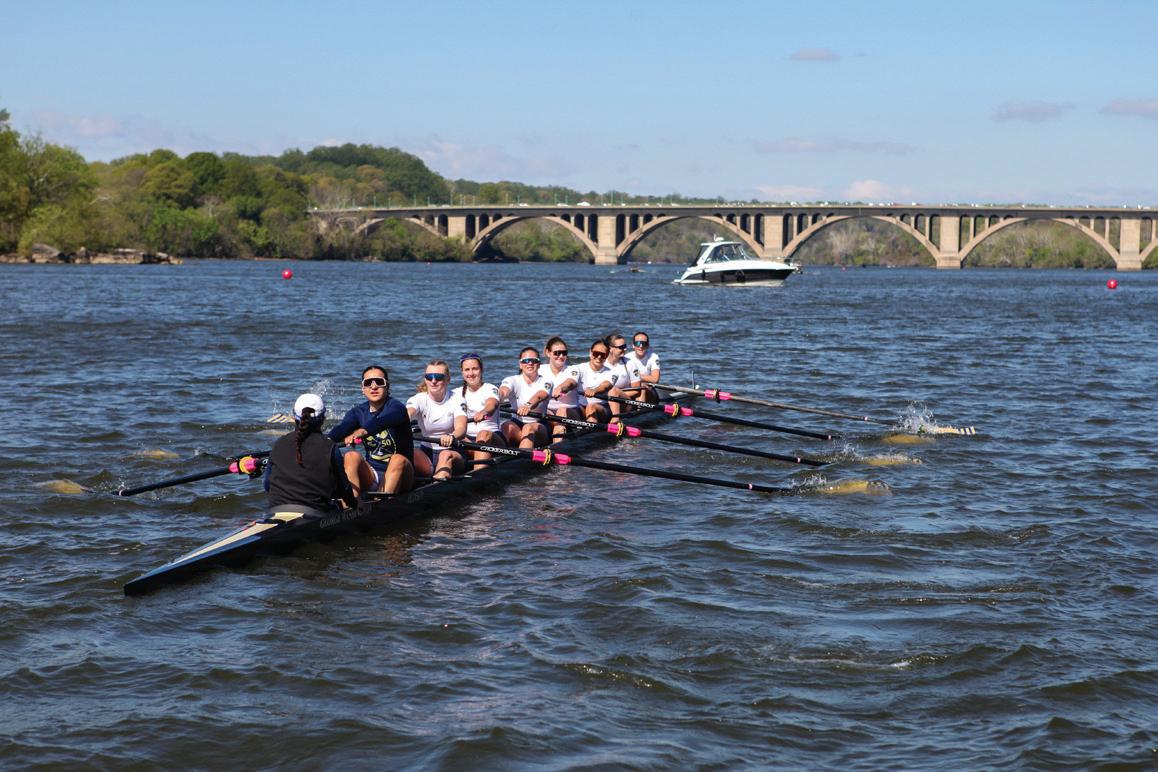
MILO ROSENZWEIG SPORTS EDITOR
KRIS PARK | ASSISTANT PHOTO EDITOR
Junior catcher and first baseman Robbie Lavey runs to third base.
LEXI CRITCHETT | ASSISTANT PHOTO EDITOR
Head Coach Ganiyat Adeduntan celebrates with the team after a win in January.