The GW
HATCHET
November 2, 2026 Vol. 123
Iss. 12
AN INDEPENDENT STUDENT NEWSPAPER • SERVING THE GW COMMUNITY SINCE 1904 • ONLINE AT GWHATCHET.COM
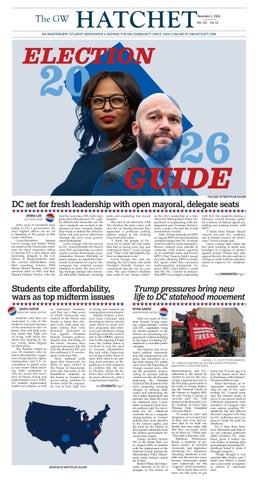
COLLAGE BY MATHYLDA DULIAN
DC set for fresh leadership with open mayoral, delegate seats JENNA LEE
EDITOR IN CHIEF
I VOT
ED
After years of consistent leadership in D.C.’s government, the city’s highest offices are set for a changing of the guard in this week’s elections. Councilmembers Janeese Lewis George and Robert White are slated as the Democratic nominees for their respective offices to become D.C.’s next mayor and nonvoting delegate to the U.S. House of Representatives after the current officeholders close their yearslong tenures. With Mayor Muriel Bowser, who first assumed office in 2015, and Rep. Eleanor Holmes Norton, who has
held her seat since 1991, both stepping down this January, D.C. public officials and advocates say the city’s residents are excited at the prospect of new, energetic leadership ready to defend the District’s home rule and govern effectively through the city’s local government institutions. Lewis George, who has served as D.C. councilmember for Ward 4 since 2021 and identifies as a democratic socialist, beat former councilmember Kenyan McDuffie in June’s primary to clinch the Democratic nomination for mayor. Her campaign has centered around promises to lower the cost of living through policies like universal affordable childcare, lowering
rents and expanding free transit benefits. She said in an interview with The Hatchet she feels voters will elect her on Tuesday because they appreciate a politician putting policies aimed at the working class front and center. “I think the people of D.C. want me to tackle the real issues that they’re facing every day and understand those,” Lewis George said. “That’s why affordability has been so important to me.” Lewis George also sees defending the city’s home rule amid President Donald Trump’s encroachment into the city as a priority. She said District residents also want to see “moral clarity”
Students cite a�ordability, wars as top midterm issues OT IV
ED
SHIVU SATHE
ASSISTANT NEWS EDITOR
Students said they are motivated to vote in the midterm elections because of the potential to elect officials who will help solve key issues like high cost of living, with many students also hoping to see key swing states flipped for their party. The Hatchet talked to over 50 students who labeled affordability, expansion of reproductive rights, immigration and U.S. involvement in global wars as key issues when deciding what candidates to vote for across this year’s slew of House, Senate and gubernatorial races. Political student organization leaders on campus, as well
as individual students, said they feel a blue wave in which Democrats win control of the House and Senate is likely this election cycle, with some students stating they were primarily motivated to vote against President Donald Trump’s policies, despite him not being on the ballot, because they opposed measures like the One Big Beautiful Bill and the continued U.S. involvement in the Iran War. Most national polls agree that Democrats are likely to gain control of the House of Representatives and chip away at the Republican majority in the Senate as Trump’s approval rating continues to decline amid the unpopular war in Iran, high cost
GRAPHIC BY MATHYLDA DULIAN
of living and ramped up immigration enforcement. Maddie Dubois, a firstyear from Colorado, said deciding on who to vote for came down to social welfare programs, like Medicaid and Medicare, losing funding across the country due to the OBBBA, opposition to the ongoing foreign wars the United States is involved in and the need to increase affordability. She said while Democrats are trying to solve these issues, they need to be putting more pressure on Republicans to find solutions to conflicts like the war in Ukraine, which she believes they will be able to do more effectively with a congressional majority. See STUDENTS Page 7
in the city’s leadership at a time when the Metropolitan Police Department is cooperating with Immigration and Customs Enforcement, a policy she said she would immediately rescind. After Trump federalized MPD in August 2025 and sent hundreds of federal troops into D.C. to tackle what he called a crime emergency, Bowser ordered local officials to cooperate with federal agencies on an indefinite basis and former MPD Chief Pamela Smith issued an order allowing MPD to notify ICE agents when they encounter undocumented immigrants. Interim MPD Chief Jeffery Carroll told the D.C. Council in January that MPD is no longer cooperating
with ICE, but residents during a February council hearing reported evidence of federal agents patrolling and making arrests with MPD. “I think these threats should concern not only D.C. residents, and it should concern all Americans,” Lewis George said. Lewis George said while she has been working to build relationships in Congress to protect against actions Trump may take against the city, she also said she is willing to work with his administration to improve D.C. residents’ lives. See CANDIDATES Page 7
Trump pressures bring new life to DC statehood movement RYAN SAENZ
SENIOR NEWS EDITOR
I VOT
ED
After two years of President Donald Trump exerting unprecedented control over D.C., candidates vying for elected positions in the District are prioritizing congressional coalition building in the hopes of making D.C. statehood a winnable political battle. The District’s lack of national political representation, like voting seats in Congress, has resurfaced as a top issue among D.C. politicians since the beginning of Trump’s second term, who say the president’s maneuvering to increase federal control over the city through deploying the National Guard for the duration of his term, proposing sweeping changes to national landmarks and federalizing the city’s police department last summer has made the need for statehood clear. Candidates running for local elected positions said the movement for D.C. statehood currently sits in a uniquely strong position as Trump’s policies draw more attention to the nation’s capital, and the need for the District to have greater autonomy from the federal government becomes more urgent. Trump invoked Section 740 of the Home Rule Act in August 2025, in tandem with his deployment of the National Guard, placing the Metropolitan Police Department under federal control for 30 days. Robert White, the Democratic nominee to be D.C.’s delegate to the House of
KAIDEN J. YU | STAFF PHOTOGRAPHER D.C. statehood supporters put up a flag in protest of the federal government’s control of the District.
Representatives, said D.C. autonomy is the reason he wanted to run for the nonvoting congressional seat in the first place, particularly in the wake of Trump deploying the National Guard to the District in August 2025. He said Trump is trying to “actively redo” D.C. with projects at the Kennedy Center, Institute of Peace, East Potomac Park, triumphal arch and others. “It would be naive and dangerous of us to just kind of duck and cover and believe that if we hold our breath and stay really still, that they you know won’t try to harm us,” White said. “The truth is that they will.” Robinson WoodwardBurns, a professor of political science at Howard University, said legislation advancing D.C. autonomy, including statehood, is feasible over the next few years because Democratic politicians nationwide see the “urgency” of the movement. “We’re closer than we’ve been, not only since we got
home rule 53 years ago, it is also the closest we’ve been in the history of the District,” Woodward-Burns said. Elissa Silverman, an independent candidate running for one of two open at-large D.C. Council seats, said the District needs to prove it can govern itself to withstand arguments from members of Congress that may oppose granting D.C. statehood but still believes the next Congress is the time for D.C. politicians and Congress to make the push for statehood. For a long time, however, Silverman said that local and national politicians didn’t prioritize D.C. statehood, given it lacked any real chance of passing after past attempts at passing D.C. statehood failed to make it through Congress. “People thought it was unachievable before, and I think now there’s a desire and a real sense of urgency to achieve it,” Silverman said.
NEWS
November 2, 2026 • Page 2
ANC chair, neighborhood leader face o� in local race OT IV
ED
Students knock on doors, run phone banks for midterms ADELAIDE PETRAS
NATALIE NOTE
ASSISTANT NEWS EDITOR
SENIOR STAFF WRITER
In the first contested race for the Foggy Bottom and West End Advisory Neighborhood Commission since 2022, Foggy Bottom Association President John George is seeking to unseat 2A03 Commissioner and ANC 2A Chair Trupti Patel. Patel, a GW alum who was first elected to the commission in 2018 and has served as chair since July 2024, is hoping that her experience navigating local government and her track record advocating for ANC 2A residents and asking difficult questions will carry her to victory against George. George is once again staging a bid for the seat after losing to Patel by 33 votes in 2020 and said he hopes to make the body more accessible to community members by bringing back in-person meetings, fostering more collaboration among commissioners and reducing contention on the commission if elected. Patel, who has lived in Foggy Bottom for 23 years and graduated from GW in 2005 with a master’s degree in political management, said she is running for a fifth term because she cares about the neighborhood and wants to build on the experience of her last four terms. Patel was elected to a Ward 2 Democratic Committeewoman position after running in the June primary as part of the Free D.C. Slate — a left-leaning group of candidates who ran for D.C. Democratic party leadership positions in the June primary. Patel has served as the chair of ANC 2A since being elected to the position in April 2024 and is not eligible to seek a fourth term as chair because ANC 2A’s bylaws stipulate a chair may only serve three consecutive terms. Patel said one accomplishment she is particularly proud of is her work in helping secure full funding for the Aston unhoused shelter — a transitional housing shelter in Foggy Bottom. Patel, who is the daughter of immigrants and the first woman of color to serve as chair of ANC 2A, said she feels affordability is the most pressing issue facing the Foggy Bottom community. She said residents should be able to live and age in the neighborhood without being forced to relocate due to rising costs.
THE GW HATCHET
COOPER TYSINSKI | STAFF PHOTOGRAPHER Chair of the Foggy Bottom and West End Advisory Neighborhood Commission Trupti Patel poses for a portrait.
KRIS PARK | ASSISTANT PHOTO EDITOR Foggy Bottom Association President John George poses for a portrait.
Patel also highlighted homelessness, deteriorating sidewalks and sanitation as areas in need of more attention, which she said could be accomplished through more ANC resolutions regarding either topic and follow-up on already passed ANC resolutions. But Patel in recent years has faced pushback from other commissioners to her leadership as chair. During a June meeting, three ANC commissioners and former commissioner Luke Chadwick called on Patel to resign as chair after she failed to call a special meeting to consider her removal after a majority of ANC 2A requested she do so, a violation of D.C. law. Patel declined to comment on concerns with her leadership raised by other commissioners, citing advice from her legal counsel. She said her commitment to the residents of 2A03 remains “unchanged” and her focus remains on advocating for the neighborhood. “I encourage voters to examine the record, follow the facts and judge my candidacy by my actions and the results of my service,” Patel said. George, who has served as president of the FBA since 2020, leads the local community association, which holds monthly meetings for
residents to stay informed on local issues and supports local businesses through Foggy Bottom and West End Main Street, an organization that seeks to spur business growth in the area. He said his number one priority if elected to the ANC would be working to address trash collection issues in his single-member district, which he said contributes to increased rat populations. George has called Foggy Bottom home for the last 30 years and said he decided to run for the seat after witnessing a tense exchange during the commission’s June meeting when several current commissioners called on Patel to resign.. George said residents of his district should vote for him over Patel, who has more experience within the ANC, because he can spur more collaboration between the commission and other entities that impact 2A03 residents, like GW or the Washington Metropolitan Transit Authority, something he said he gained experience with as FBA president. He said his commitment to Foggy Bottom and community building is well documented through his work in the FBA, and he wants to continue serving the community in that capacity on the ANC.
OT IV
ED
As a slate of contentious congressional races looms in this week’s midterm elections, students have crammed into buses and phoned voters across the country in hopes of shaping the congressional balance of power. Political student organizations on campus have led efforts to drive voters nationwide to the polls in the months leading up to Tuesday’s midterm elections by hosting canvassing trips and phone banks this semester with dozens of students in attendance. The organizations’ leaders said it is especially critical that young people, who will feel the most impact of future national policy decisions, encourage Americans to cast their votes for candidates who will fight for their interests. “We’re working on building a future we want to see,” Elyse Reznik, the president of Swing Left GWU, said. Swing Left took three canvassing trips to competitive congressional districts this semester — two to Virginia’s first district on Sept. 19 and Oct. 4, where Democrat Shannon Taylor is running for Congress, and one to Pennsylvania’s 10th district on Oct. 24, where Democrat Janelle Stelson is running. Both Taylor and Stelson are challenging Republican incumbents, with Cook Political Report labelling the Virginia race a tossup and the Pennsylvania race as leaning Democratic.
The national Swing Left organization compiles a set of target congressional races based on past electoral performance and political context, which Reznik said GW’s chapter uses to determine where to canvass. Virginia’s first district and Pennsylvania’s 10th district are both considered “mustflip” seats by the national organization, meaning they are some of the most competitive Republicanheld seats. Reznik said the group has prioritized canvassing because in-person door knocking is the most effective way to participate in grassroots advocacy and has historically reached disengaged voters. “It gets people out there to the ballot box,” Reznik said. “And it allows people to learn a lot more about what’s happening in these races that they’re voting in.” Reznik said it is necessary that GW students get involved with canvassing because of the University’s location in the nation’s capital and students’ heavy focus on politics — noting GW’s recent ranking by the Princeton Review as the college with the most politically active student body in the country. “I don’t think we’re gonna be in la la land, and everything’s gonna be perfect, but it’s about consistency and showing up again and again and again,” Reznik said. GW College Republicans has focused its efforts on phone banking leading up to the midterms, hosting at least five phone banks for
Republican congressional candidates, including Sen. Jon Husted from Ohio and Reps. Rob Wittman and Jen Kiggans from Virginia’s first and second districts, respectively. Raj Bishnoi, the College Republicans vice chair’s chief of staff, said the organization chose to phone bank for Husted due to the race’s competitiveness — Cook Political Report lists the race as a tossup — and the Virginia candidates due to their proximity to D.C. He said students in the organization have also shown up for Republican candidates in their home districts, with each phone bank lasting around three hours, showing the passion students have for congressional races back home. “Our members are not only Republicans, they’re proud Republicans from their state, and they care about the people in their state,” Bishnoi said. Bishnoi said phone banking is effective because students can help voters in their home districts understand national political races that impact people locally. He said each phone call reminds students what issues voters in their home districts care about, then allows students to help get candidates elected who will advance those issues. “They’re in the perfect place to really serve as a bridge between these two worlds that often feel incredibly disconnected,” Bishnoi said. “I can speak for my own family in Texas. Washington, D.C. could be on a different planet.”
COLLAGE BY KRIS PARK Students from GW College Democrats and GW College Republicans phone bank for the 2026 midterm elections.
Alum, former DC shadow representative seeks to reclaim post OT IV
ED
SYDNEY HERSKOWITZ REPORTER
Franklin Garcia, a GW alum and former D.C. shadow representative, is vying for his old position this election cycle, seeking to continue efforts to make the District the nation’s 51st state. Garcia, the Democratic nominee for D.C.’s shadow representative — an unpaid elected official with no legislative ability who is tasked solely with advocating for D.C. statehood — said he hopes to build on his previous efforts to advance statehood from when he served in the position between 2015 and 2021, which he argues is necessary to give District residents the same congressional representation as residents of other states. He said he wants to pursue statehood by helping elect members of Congress who will support it, organizing advocacy efforts outside of D.C. and building on relationships with voting members of Congress to ensure District residents have a voice in congressional decisions affecting their communities. “Even though I know it’s an uphill battle, and it feels like we’re a distance away from becoming a state, I feel that we need to continue the trajectory that I was in, and at a point where we truly were getting closer and closer,” Garcia said. Unlike D.C.’s nonvoting congressional delegate, who cannot vote on legislation but can participate in debates and sit on committees in the House of Representatives, the shadow representative does not hold a seat in Congress or have an official congressional office. Officeholders are unpaid
A GW alum and former D.C. shadow representative Franklin Garcia poses for a portrait.
but can raise private contributions to support their work, which primarily consists of advocating for statehood by informing members of Congress about the District’s qualifications for admission as a state and monitoring statehood efforts, according to D.C. law. Garcia said he wants to continue the advocacy of his previous tenure, including work on a District-wide statehood referendum. While serving as shadow representative, he helped draft in 2016
MATHYLDA DULIAN | SENIOR PHOTO EDITOR
a proposed state constitution and organized public meetings with residents to gather their input on how he could lobby members of Congress to support statehood legislation. Garcia said Latino communities — which make up about 11 percent of the District’s population — are currently underrepresented in local D.C. politics, and he said he wants to serve in office so these communities have a better representation in D.C. elected govern-
ment, alongside his broader focus on securing statehood. Garcia said he struggled to secure meetings with Republican lawmakers during most of his previous tenure, which led him to concentrate on more outreach to Democrats who were more likely to support statehood legislation. Republicans controlled both the House and Senate for the first three years of his term, while Democrats won control of the House in 2018. While Garcia has made state-
hood the central focus of his campaign, his Republican opponent Ciprian Ivanof, who unsuccessfully ran for the position in 2024, said he believes the shadow representative should prioritize government accountability and improving communication between D.C. officials and Congress. If elected, Ivanof would become the first Republican to hold a position in D.C.’s shadow delegation as no Republican has ever held the position of shadow representative or shadow senator. Ivanof, an attorney who grew up in Romania before immigrating to the United States, said his experiences under the country’s communist government shaped his skepticism of concentrated political power, which he said is a problem within the D.C. government because of the Democratic party’s grasp on local D.C. government. A Republican has never been elected mayor in D.C., and there has not been a Republican on the D.C. Council since At-Large Councilmember Carol Schwartz lost her 2008 re-election campaign in the Republican primary for her seat. Ivanof said one-party Democratic dominance has limited scrutiny of the D.C. Council and its decisions, and a lack of communication between the D.C. Council and Republican lawmakers in Congress have contributed to conflicts between the District and Congress. He said the shadow representative could help address those problems by raising concerns about local government decisions, like what he described as a failure to crack down on fare evasion within the Metro until recently.
NEWS
November 2, 2026 • Page 3
THE GW HATCHET
ANC slated to have four vacancies while incumbents seek reelection unopposed ISAAC HARTE
CONTRIBUTING NEWS EDITOR
I VOTED
With four Foggy Bottom and West End Advisory Neighborhood Commissioners running unopposed in this week’s elections and only one contested race, four of the ANC’s nine seats are set to become vacant starting in January. In the first competitive ANC 2A race since 2022, Chairperson Trupti Patel and Foggy Bottom Association President John George are competing for Patel’s seat in single member district 2A03, while four other ANC 2A districts have an incumbent candidate running unopposed, and another four have no candidate running at all. This year’s election marks a continuation of ANC 2A’s consistent struggles with vacancies, disputes between commissioners and non-competitive races, with the commission having no competitive races in 2024, only two in 2022 and one in both 2020 and 2018. 2A02 Commissioner Rob Gifford, 2A04 Commissioner Ed Comer, 2A06 Commissioner John Dolan and 2A08 Commissioner Jim Malec are running unopposed in their respective races, and there are no candidates running in the 2A01, 2A05, 2A07 and 2A09 single-member districts. The 2A09 single-member district is currently held by Commissioner Sean Youngstone, but it is set to become vacant after Youngstone opted against running for re-election. ANC 2A operated with six out of the commission’s nine seats filled for the majority of its current term, but the number of commissioners will drop to
PHOTO COLLAGE BY MATHYLDA DULIAN 2A02 Commissioner Rob Gifford, 2A04 Commissioner Ed Comer, 2A06 Commissioner John Dolan and 2A08 Commissioner Jim Malec are running unopposed in their respective races.
five in 2027 at the start of the new term because of Youngstone’s departure. Malec, who has never faced an opponent in any of his races, said community members would benefit from more competition in races to fill ANC seats because it would provide them with more choices for who represents them. Though he said he believes he would still win if his race was contested, he said he wishes someone would run against him for his seat because it would be a sign that there was more overall competition and interest in ANC elections.
Scott Seamon, a GW sophomore majoring in political communication, filed paperwork in August to run as a write-in candidate in 2A07 — which has sat vacant since student commissioner Dasia Bandy resigned in 2024 — but ended up withdrawing his candidacy after he said a D.C. Board of Elections official informed him he was ineligible to run because he only became an official D.C. resident in early August. He said the BOE official told him he would have needed to become an official D.C. resident 60 days prior to the Aug. 5 filing deadline, under D.C. Code.
Students report smooth mail-in ballot delivery during midterm election cycle OT IV
ED
BRYSON KLOESEL
SENIOR STAFF WRITER
SIENA BEDARD REPORTER
IV OT
ED
Amid national legal battles over mail-in voter eligibility, students said the University efficiently processed their ballots during this election cycle following reports in 2024 of GW mail services delaying or losing student ballots. Nearly all of the almost 20 students who spoke to The Hatchet said they cast their votes by mail smoothly this fall despite changing post office rules over who was able to receive a ballot, fears of National Guard presence near ballot boxes and the ongoing legal battle surrounding President Donald Trump’s attempts to restrict ballot delivery to certain voters. Election experts said the legal situation has not changed the process of mail-in voting, but a delayed postmark or slow processing at central mail locations can still cause state election officials to reject a student’s ballot. The concerns over mailin voting have been com-
GW alumni vie for House, Senate seats
PHOTO ILLUSTRATION BY LOGAN ROTUNNO A letter is placed in a United States Postal Service drop box.
pounded with fears of voter intimidation by federal agents. In October, Foggy Bottom and D.C. community members expressed concern over National Guard troops patrolling near a D.C. ballot drop box — which is used to drop off ballots in D.C. local elections — by the Foggy Bottom-GWU Metro station. Federal law prohibits federal troops, like the National Guard, from being stationed at any place where general or special elections are taking place, which includes ballot drop-off zones. Despite the national concerns, students voting by
mail in this week’s elections said the process of retrieving their ballots from the University’s package center was smooth, and they were unconcerned about threats to their ability to vote by mail. Students in 2024 reported GW Mail and Package Services had lost or delayed their ballots even after officials implemented several policies like processing updates and mailbox renovations to expedite the delivery of absentee ballots. University spokesperson Nadia Payne said GW MPS processes incoming mail by prioritizing ballots to ensure
rapid availability, and MPS has received and processed ballots over the last 30 days. She said students on campus must provide identity verification to get their ballot from the MPS center, and GW encourages students to mail their outgoing ballots directly through a USPS location to protect the chain of custody and prevent delivery delays. Caroline Rectanus, a sophomore studying international affairs from North Carolina, said she voted by mail for the first time on Oct. 23 by delivering her ballot to the Postal Service collection box next to the Foggy Bottom-GWU Metro station. She said the overall process was very long due to having to submit a lot of information to register and then send her ballot, but she felt it was not particularly difficult. Gavin Tramontozzi, a first-year studying psychology voting in Massachusetts, said GW MPS did not notify him that his ballot had arrived until three days after the state’s primary election ended on Sept. 1, precluding him from voting. He said he picked up his ballot the same day GW notified him.
Andrew Garbarino Incumbent
Darren Soto Incumbent
Running for: New York’s 2nd District Graduated in: 2006
Running for: Florida’s 9th District Graduated in: 2004
Erin Houchin Incumbent
Gil Cisneros Incumbent
Running for: Indiana’s 9th District Graduated in: 2012
Running for: California’s 31st District Graduated in: 1994
Jared Moskowitz Incumbent
Jill Tokuda Incumbent
Running for: Florida’s 25th District Graduated in: 2003
Running for: Hawaii’s 2nd District Graduated in: 1997
Johnny Olszewski Incumbent
William Timmons Incumbent
Running for: Maryland’s 2nd District Graduated in: 2006
Running for: South Carolina’s 4th District Graduated in: 2006
Dan Green Challenger
Dan Schwartz Challenger
Running for: Florida’s 9th District Graduated in: 2012
Running for: Maryland’s 1st District Graduated in: 2010
Niki Conforti Challenger
Rachel Wallace Challenger
Running for: Illinois’ 6th District Graduated in: 2012
Running for: Pennsylvania’s 9th District Graduated in: 2010
Mark Warner Incumbent
Brian Bengs Challenger
Running for: Virginia Senate Graduated in: 1977
Running for: South Dakota Senate Graduated in: 2007
GRAPHIC BY DANIELA GARCIA PEREZ AND MOLLIE WEINER
Students seeking to get involved in local politics vote in DC I VOTED
ZACHARY CRYSTAL STAFF WRITER
In the upcoming midterm elections, students said they chose to vote in D.C. rather than their home states because they wanted to be more politically active in the District, even though voting in the city forgoes their congressional representation. The D.C. Voter file, which is put together by the D.C. Board of Elections and which The Hatchet obtained through a Freedom of Information Act request, indicates as of Oct. 19 that 327 individuals — including students, staff members and faculty-in-residence — living in GW’s campus buildings are actively registered to vote in the District. While D.C.’s status as a federal district means it lacks voting representation in Congress, students said they wanted to change their voter registration because they wanted to be more politically engaged on local issues like D.C. Home Rule and have a say in local elections, as many plan to stay in D.C. beyond their time at GW. Voters in D.C.’s Ward 2 — which encompasses Foggy Bottom and West End — will cast their ballots this election for D.C. mayor, chairman of the D.C. Council, two seats for at-large councilmember, a seat for shadow senator, a seat for shadow representative, a non-voting delegate to the U.S. House of Represen-
tatives, D.C.’s attorney general and ballot measure Initiative 86, which, if passed, would ban the sale of foie gras, and other fattened bird liver, at D.C. restaurants. To register to vote in the District, students have to fill out the District of Columbia Board of Elections Voter Registration Application and provide personal information, like their current D.C. address, at least 21 days before the election. The Hatchet interviewed seven students, who said they chose to register to vote in D.C. because they considered the District their new home and wanted to promote D.C. home rule and vote in local political races that have the potential to impact their lives as they live in the city. Scott Seamon, a sophomore studying political communication who is also planning to file to fill the currently vacant Advisory Neighborhood Commission 2A07 seat in January, said he had the opportunity to register to vote in Texas, where he lived, or Ohio, where his mother recently moved — both states with “toss-up” Senate races. But Seamon said he chose to register to vote in D.C. to get involved in local political life by running for the ANC, which he can only do if he is a registered D.C. voter, and “claim” the District as his new home. “It was already going to be my intention to connect myself to nearby D.C. communities and local
political realms,” Seamon said. “But becoming a D.C. voter was, in my opinion, the first step in ensuring I have a voice that counts in those communities.” Seamon said that while changing his voter registration to D.C. meant he would lack a voice in Congress, he was particularly interested in pushing back against President Donald Trump’s administration’s actions, like deploying the National Guard to the city and protecting D.C. home rule, which he believes he can do most effectively by voting in D.C. Though the federal government retains ultimate authority over D.C.’s laws because it is not a state, D.C. derives its self-governance powers through the District of Columbia Home Rule Act of 1973, which allows the District to elect its own mayor and council. But the city’s laws are still subject to congressional approval, and the president maintains control of the D.C. National Guard. Seamon said he was voting for Janeese Lewis George for D.C. Mayor and Robert White for D.C.’s nonvoting delegate because he feels they will be best suited for combating the Trump administration’s attack on D.C. Home Rule. “President Trump has consistently threatened to take over,” Seamon said. “And I believe with candidates like Janeese Lewis George, that D.C. home rule would
be better protected.” In addition to backing Lewis George and White, Seamon said hopes to use his vote to support future candidates that he believes will push back on the Trump administration and protect home rule in D.C. “Home rule has been under constant attack from the White House, DHS and other arms of the federal government,” Seamon said. “I feel like I’m looking for candidates that support D.C. home rule and will not bend the knee to Trump.” Wessam Fathalla, a first-year studying political science, said he registered to vote in D.C. because he feels it is the best way to learn more about D.C.’s political environment and issues by voting, which now concern him since he lives in Foggy Bottom. He said he feels voting made him better understand the candidates and issues they stand for, particularly with the shadow senator ballot because he wanted to vote for some D.C. representation in the Senate. D.C. does not have official senators but voters in the District elect two shadow senators, unpaid elected officials with no legislative ability who is tasked solely with advocating for D.C. statehood. Fathalla said the National Guard presence since August 2025 and the renovation controversy over the Reflecting Pool this summer — where Trump repainted,
drained and fenced off the pool — were what he saw as the biggest issues concerning D.C. Fathalla also said he was also a big supporter of the D.C. statehood movement, and voting in D.C. would help the movement in the “long term,” which was part of why he chose to vote for the candidates he did. “I also think the more people who vote in D.C.,” Fathalla said. “Alone, it expands D.C.’s political power, which I think over time could convince people in Congress to move forward.” Ruth Kahn, a sophomore studying political science and data science, said despite being involved in politics in her hometown of Dallas, Texas, in high school, she chose to register to vote in D.C. due to challenges of voting in Texas while being a student at GW. She said Texas made it “really hard” to vote by mail because of the complicated process of registering for mail-in voting, which had an impact on her choice of where to register. “It’s gonna be kind of a pain to get them to send me the ballot because they make you fill out the form every year,” Kahn said. Kahn said that in addition to challenges with voting in Texas, she expects to live in the District for the next 10 to 15 years, during and after her time at GW, and she said registering to vote in D.C. was part of an overall transition to the city as her new home.
NEWS
November 2, 2026 • Page 4
THE GW HATCHET
GWSB dean reflects on AI initiatives, navigating higher education challenges in first year
CRIME LOG THEFT II/FROM BUILDING
SARAH GROSS
Thurston Hall 10/19/2026 – Unknown Open Case A female GW student reported money stolen from their wallet.
ASSISTANT NEWS EDITOR
One year into her tenure, School of Business Dean Sevin Yeltekin said she has found her footing, reenvisioning parts of the school’s curriculum by embracing artificial intelligence and experiential learning while navigating financial headwinds amid challenges to higher education. Yeltekin, who stepped into the role of GWSB dean in August 2025, said in a sitdown interview with The Hatchet she has prioritized AI initiatives in both undergraduate and graduate programs while working to implement experiential learning in the classroom, as part of a broader effort to redesign the school’s educational offerings based on conversations with students, faculty, staff and employers to prepare students for the workforce. Despite being optimistic about her new initiatives, Yeltekin said she’s also had to wrestle with decreased international and graduate student enrollment and take measures like layoffs and halting Ph.D. applications as a result of President Donald Trump’s policies reshaping higher education. “Everybody feels the pinch, whether it’s staff or faculty or our operational budget,” Yeltekin said. “But again, our north star has always been teaching, student experience and keeping our research mission going.” During her first year as dean, Yeltekin said she is proud of bolstering the school’s AI initiatives like an award system to recognize faculty research in AI — which she said has incentivized faculty and staff to incorporate the technology into their curriculum — and the creation of AI-focused graduate programs. She said AI is an “ubiquitous” part of business now and GWSB faculty have debated how to teach responsible use of technology in the classroom and workplace. Yeltekin said schools like the University of Chicago have approached AI by returning to “analog teaching pedagogies,” while other universities have adopted the technology with few re-
Case open.
LIQUOR LAW VIOLATION
Somers Hall 10/24/2026 – 1:12 a.m. Closed Case GW Police Department officers and the GW Emergency Medical Response Group responded to a report of an intoxicated female GW student. Upon arrival, EMeRG evaluated the student and transported them to the MedStar Georgetown University Hospital.
Case closed. Referred to Conflict Education & Student Accountability.
LIQUOR LAW VIOLATION School of Business Dean Sevin Yeltekin poses for a portrait.
strictions. She said GWSB does not plan to follow in the footsteps of schools like Chicago because AI knowledge has become “essential” for the work of many companies that hire GWSB graduates. Yeltekin said she began redesigning the undergraduate business curriculum to ensure a comprehensive understanding of core business principles while also incorporating experiential learning into the program moving forward. She said she wishes she had started developing the curriculum sooner, because the school has only incorporated some experiential learning project classes, which are in high demand among students. “If I had known that these things were coming pretty soon, I would have probably started them a little bit earlier,” Yeltekin said. “But then at the same time, I was a new dean and I wasn’t going to come in and start immediately giving 1,000 orders about what needs to be done.” As the University continues to face financial and enrollment struggles, Yeltekin said GWSB is facing the same shocks that higher education has felt across the United States, citing declining international and graduate student enrollment as a result of President Donald Trump’s administration’s restrictions on curricular practical training, optional prac-
MATHYLDA DULIAN | SENIOR PHOTO EDITOR
tical training and Grad PLUS loans. She said international students make up 30 to 60 percent of the school’s specialized master’s programs, causing the school to lose revenue and prompting discussions about reallocating resources away from those programs. GWSB overall graduate enrollment declined by nearly 24 percent while international graduate enrollment declined by 48 percent from 2025 to 2026, according to the enrollment dashboard. “People use the expression of spreading the peanut butter too thin,” Yeltekin said. “The peanut butter tub is a little emptier these days, so we have to think about how we continue to deliver a very rigorous education.” Despite the University’s broader financial struggles, Yeltekin said GWSB posted a financial surplus last year, and officials are projecting a smaller surplus at the end of this fiscal year because of continued enrollment struggles. She said the school still has to be “extremely judicious” about what it spends, though it did not lay off anyone this fiscal year after letting go “several” staff members in fiscal year 2026. Yeltekin said the school had “deep needs” in areas like advising, though demand in other areas had gone down “substantially,” largely due to a decrease in graduate students, so much
of her day-to-day job focused on reallocating resources, including last year’s layoffs. “When you shrink the certain sizes of things, you don’t need as many people doing the operational pieces, so that’s where it came from,” Yeltekin said. “A lot of our savings also came from just not filling some of the openings we had.” Yeltekin said GWSB was able to get three hiring lines for tenure-track faculty after being unable to hire them for “quite a while,” causing the number of faculty to become “thinned” at the junior level. She said GWSB is pausing Ph.D. applications for the second year in a row due to a lack of funding. Yeltekin said officials have continued to preserve faculty research despite ongoing budget challenges, though they are implementing measures to save money, like canceling data-set subscriptions that are no longer being used. She said faculty have continued to get the funds needed to attend conferences and access data sets they need despite the financial pressures facing GW. “Without the research base, you can’t attract great faculty,” Yeltekin said. “Without the great faculty, the research and the teaching that comes out of that research, you can’t attract great students and people don’t want to engage with you.”
Madison Hall 10/25/2026 – 12:03 a.m. Closed Case GWPD officers and EMeRG responded to a report of an intoxicated female GW student. Upon arrival, EMeRG evaluated the student and transported them to the GW Hospital emergency room for further medical treatment.
Case closed. Referred to CESA.
LIQUOR LAW VIOLATION
Thurston Hall 10/25/2026 – 1:56 a.m. Closed Case GWPD officers and EMeRG responded to a report of an intoxicated male GW student. Upon arrival, EMeRG evaluated the student and cleared them, concluding that further medical treatment was not necessary.
Case closed. Referred to CESA.
FALSE FIRE ALARM
Munson Hall 10/25/2026 – 3:04 a.m. Closed Case GWPD officers responded to a fire alarm activation in Munson Hall and determined an unknown individual activated a manual pull station with no apparent cause.
Case closed. No suspects or witnesses.
THEFT II/FROM BUILDING Guthridge Hall 10/29/2026 – 12:39 p.m. Closed Case A female GW student reported their package stolen from the lobby area of Guthridge Hall.
Case closed. Referred to CESA.
—Compiled by Isaac Harte
OCCI hosts first Community Summit since office’s creation GRADY TARLETON REPORTER
JUWON KIM STAFF WRITER
The Office of Community, Culture and Inclusion hosted the 11thannual OneGW Community Summit last week, the first since the office rebranded from the Office of Diversity, Equity and Community Engagement. Though the summit is the second iteration of the event after officials renamed it from the Diversity Summit in February and comes at a time of increased pressure from the federal government to eliminate diversity, equity and inclusion initiatives on college campuses, speakers said the summit’s mission has remained focused on unity and inclusion. Speakers at the summit — held at the University Student Center Oct. 28 through 30 — urged GW community members to seek out conversations with people from diverse backgrounds with differing viewpoints, using the summit to gather people who wouldn’t otherwise interact with each other. Officials last hosted the OneGW Community Summit — the first under the new name — in March after postponing the event twice, amid students’ worries that the event’s rebrand signaled a wavering commitment to DEI. Despite the backlash, officials reaffirmed GW’s commitment to DEI in April, marking the first time the University publicly addressed students’ concerns that officials’ removal of diversity language signaled they were rolling back DEI practices. The summit featured a slate of panels and presentations on how topics like antisemitism, intimate partner violence and artificial intelligence affect the broader GW community, along with other types of workshops — for a total of 42 inperson and virtual total sessions across three days, compared to last spring’s 16. Associate Vice Provost for Community, Culture and Inclusion Jordan Shelby West spoke to open the summit Wednesday — one of the
CARSTEN HOLST | ASSISTANT PHOTO EDITOR A banner for the OneGW Community Summit, formerly the Diversity Summit, hangs outside the University Student Center.
event’s 31 total presentations and panels. West said in her presentation the GW community’s diverse identities, lived experiences and viewpoints are “critical” for the University because it leads officials toward their goal of an “inclusive GW.” “You will hear ideas here that challenge you,” West said. “Stay in the room for those. Ask the question behind the position.” West encouraged the audience to leave the summit with a mission, whether that is starting a conversation, looking into a policy, taking on a mentee or changing a habit in their classroom, office or organization. She said most “injustices” remain because of “small habits” people have and do not question. Dwayne Kwaysee Wright, an assistant professor of higher education administration and the director of DEI initiatives at the Graduate School of Education and Human Development, hosted two sessions
at the summit — one about free speech and academic freedom at GW and one about navigating the intersections of faith and sexuality. Wright said in an interview he has participated in the summit since 2019, and despite officials removing diversity language from the title of the event and the office that hosted it, both the summit and OCCI have remained focused on creating a space where community members can interact and unite. Officials rebranded ODECE to OCCI in May, sparking worries that GW was succumbing to President Donald Trump administration’s pressures on universities nationwide. University spokesperson Julia Garbitt said pressure from the federal government did not factor into officials’ decision to rename the summit — echoing a spokesperson who said in May the rebrand was to align with the strategic framework, and the Justice Department’s Janu-
ary investigation into DEI practices in GW’s admissions played no role in the decision to dissolve ODECE. Garbitt said a committee of students, faculty and staff across GW’s schools and divisions planned the summit, seeking feedback from the broader GW community through an open call for session proposals. Wright said he thinks some students, faculty and staff who view DEI negatively may be more willing to attend the summit because of the name change. He said the goals of DEI or community, culture and inclusion — encouraging people from different backgrounds to challenge each other’s views — are more important than the name. “So if you say, ‘Well, Dr. Wright, how dare they change the name?’” Wright said. “If it gets us to the compromise, you can call it Timbuktu.” Wright said while the summit’s events were “remarkably robust,” due to the diversity of presentations, he wanted to see more people
attend the summit — citing sparse attendance from students at events this year. He said the summit presented an opportunity for community members to come together and have conversations across cultural and intellectual differences. The summit also included a session where attendees could browse and ask questions about a total of nine posters made by GW students and professors that highlighted their departments’ curriculum and research, with most focusing on themes of diversity or equity. Lucas Chandler, a sixth-year Ph.D. physics student and one of the poster presenters, said he wanted to feature several different student organizations within the physics department to show the community they have built despite being a small department. Chandler, who spoke at the then-Diversity Summit two years ago, said he thinks the University is “pivoting” by changing the name because of pressure from the Trump administration to limit DEI language in higher education through research funding cuts. He said with the Trump administration considering DEI a “dirty word,” GW is making the summit sound more “appealing” to the Trump administration by changing the language. Hanan Daqqa, a professional lecturer of writing who teaches University Writing classes for firstyears and hosted a workshop about personal storytelling, said she was happy with the new branding of the Community Summit and OCCI. She said she considers the language used more “honest” and hopes it can open conversations about the meaning of diversity. “I think people or the culture overuse the word diversity, and we don’t know what it really truly means,” Daqqa said. “OneGW definitely felt closer to the heart. If we have the same mission, if we want really to bring people together, maybe it’s an invitation to get out of the old stereotypes, the old thinking of looking at what diversity is, and again, re-examine what inclusion and what unity and oneness means.”
NEWS
November 2, 2026 • Page 5
THE GW HATCHET
Former MFA physicians open independent practices, join existing groups DANIELLE LYON REPORTER
LAKSHMI DEV
ASSISTANT NEWS EDITOR
Eleven former Medical Faculty Associates providers established or joined independent practices after their departments were excluded from Universal Health Services’ acquisition of MFA clinical operations during the group’s transition to the new Capital Medical Group. Three GW physicians transitioned the MFA’s emergency medicine practice into two independent, physicianled entities, while eight MFA oncologists moved to Maryland Oncology Hematology — a community-based cancer care practice that took over the MFA’s oncology and hematology practices — due to UHS’ decision not to incorporate the emergency medicine and oncology departments into its agreement with GW and the MFA. Some physicians maintained ties to GW, including retaining their faculty appointments and teaching responsibilities, despite moving to independent practices, while emergency medicine physicians will continue providing clinical services at GW Hospital through an agreement with CMG.
Spokespeople for UHS and CMG did not return requests for comment on why these MFA medical services and physicians were excluded from the transition. GW and the MFA in May announced they reached an agreement with UHS to transition the practice’s clinical operations to CMG, a new nonprofit physician group and to cap the University’s financial support for the practice after years of continued losses. Under the finalized agreement, UHS will take over full financial responsibility for clinical practice operations for GW Hospital, Cedar Hill Regional Medical Center and affiliated outpatient sites after a transition period of five years, with most MFA physicians transitioning to CMG and retaining their faculty appointments at the School of Medicine & Health Sciences. Three SMHS emergency medicine faculty members — chair Raymond Lucas, vice-chair Neal Sikka and assistant professor Randall Lee — formed two independent medical organizations after specialized programs previously operated through the MFA were excluded from UHS’ acquisition because they fell outside the clinical services covered by the transaction, according
to a regulatory filing submitted to D.C.’s State Health Planning and Development Agency. One of the groups, Greater Washington Academic Emergency Medicine Partners, has a contract with CMG and GW Hospital to provide clinical emergency medicine services and, with GW, to support teaching, research and academic activities, but it does not operate under CMG’s management and is owned by the three physicians, according to a regulatory filing. The second group, Greater Washington Medical Solutions, also owned by Lucas, Sikka and Lee, has no involvement with CMG and plans to continue operating emergency telehealth, event medicine, emergency medical services training and paramedic education programs at 2120 L St. NW, according to a September regulatory filing. Greater Washington Medical Solutions said in the filing that it plans to retain the programs’ existing staff and service contracts through an agreement with Greater Washington Academic Emergency Medicine Partners, which would provide physician and employee support. The regulatory filing states that the physicians
CARSTEN HOLST | ASSISTANT PHOTO EDITOR The entrance to the Capital Medical Group building, formerly the Medical Faculty Associates, in Foggy Bottom.
established the two organizations without objections from MFA, GW or UHS, allowing them to maintain emergency medicine services at GW Hospital and other regional facilities while continuing their academic responsibilities.Lucas, Sikka and Lee did not return a request for comment on their transition from the MFA to the new practices, or their ongoing relationship with GW.
The MFA’s oncology and hematology physicians also moved to an independent medical group following the transition to CMG as the MFA’s Oncology & Hematology practice announced in August it would join MOH, with the transition being finalized Sept. 1. Andrew Mener, a partner of MOH who oversaw the transition, said the partnership emerged after CMG decided not to incorporate MFA’s
oncology physicians into its new organization. “The new group, Capital Medical Group, that took on the majority of the MFA physicians had made clear that they were not planning to incorporate the oncology group, and some colleagues reached out to me to begin a conversation regarding whether Maryland Oncology Hematology could serve as a good partner,” Mener said.
Graduate student union wins pay increases, international worker protections paycheck at the beginning of the semester, which can go to their health insurance costs. The contract stipulates graduate assistants will be able to access $500 of their pay in advance no later than Sept. 1 in the fall and Feb. 1 in the spring.
PARIS ALBRECHT
CONTRIBUTING NEWS EDITOR
After 18 hours of final negotiations last week, GWU Graduate Workers United achieved thousands of dollars in increased pay, enforced working hours and international student worker protections in their first collective bargaining agreement with GW. GWU2’s bargaining committee, which released their initial contract on their website Thursday that will be ratified by the end of the semester and enforceable from the date of ratification to June 2030, participated in three days of closed door negotiation sessions with a subgroup of GW’s bargaining committee last week, where both parties moved the needle on the remaining contract stipulations, like pay and benefits, according to union co-chairs and bargaining committee members. Union members told The Hatchet that although they won significant pay increases, nondiscrimination protections and a letter of agreement with GW guaranteeing some international workers’ protections, they will continue to work to secure improvements in childcare and health insurance benefits. GWU2 co-chair Summer Harvey said GW officials asked if a subgroup of both GWU2’s and the University’s bargaining committees could spend a few days negotiating — rather than proceed with their previously scheduled November meetings — in an effort to expedite the bargaining process. Both parties participated in a threeday negotiation session on Monday, Tuesday and Wednesday last week, according to Harvey. Harvey said the contract establishes a labor management committee, which will include up to five GW officials and five union
International student worker protections
Aside from the contract, the union and officials also agreed to a letter — which Harvey said is enforceable with the same weight as the contract — protecting international graduate workers. The letter states that graduate assistants may request a leave of absence if they need time off for immigrationrelated reasons, GW will not discipline graduate workers solely due to an immigration-related arrest or detention and GW will notify graduate assistants of any worksite immigration-related enforcement action. GW will also not impose work authorization verification requirements outside of those required by law. KAIDEN J. YU | STAFF PHOTOGRAPHER Representatives from GW Graduate Workers United protest outside the University Student Center in October.
members, that will meet next semester to determine needs of both parties following the ratification of the contract. University spokesperson Julia Garbitt earlier this month declined to comment on why officials agreed to the increased pay, how officials reached particular numbers and if the increased pay will affect funded packages or Ph.D. cohort sizes. Garbitt declined to comment on the specific details of the bargaining sessions that led to the contract. Here’s a look at some of the most significant terms of the union’s contract:
Pay increases
Harvey said although the majority of the contract’s pay provisions are “incredible,” the pay stipulations are still not a “living wage.” She added GW officials would not agree to improvements on both pay and benefits, because officials said they had a fixed amount of money they were willing to move around for the purposes of the contract, so the union’s bargaining committee decided to prioritize pay over benefits after discussing possibilities with the union’s membership at an organizing committee meeting on Tuesday night. Per the contract, all in-unit graduate assistants will receive a $650 lump sum bonus no later
than Feb. 1, 2027, and each position will receive a pay increase by the beginning of the fall 2027 semester, according to the contract. GTAs employed for a nine month term will now receive $40,000 — as opposed to their previous total pay of $26,100 — with 12 month GTAs receiving $44,500, up from $34,800.
Benefits
Harvey said the union’s bargaining committee did not achieve an improvement on health, dental or vision insurance and childcare, but instead came to an agreement with GW that requires officials to grant workers a portion of their
Severability
The contract does not contain a provision that would allow GW to deem the collective bargaining agreement null and void and withdraw recognition of the union if the National Labor Relations Board rules graduate student workers are not employees.
Working hours
Rohn said one of the provisions the union’s membership was most “happy” to see was an enforcement on working hours. Graduate student workers — who hold either 10 hours or 20 hours a week positions — are often asked to work over their hourly limit to help with grading or other tasks, especially during midterms and finals seasons.
SGA Senate to create channel for students to bring legislation to body ELIJAH EDWARDS SENIOR STAFF WRITER
Student Government Association members are months into an endeavor of creating a policy-writing office with plans to introduce a bill this semester, although the legislation’s co-drafters still disagree on the proposed office’s staffing. Leaders of the Community, Advocacy and Inclusion Committee, known as CAIC, which SGA Vice President Aicha Sy chaired last year, plan to create a functional avenue for students outside the SGA to bring ideas to the body and partner with senators to turn them into legislation. The proposed policy-writing office — which Sy campaigned on creating during elections in April — comes after CAIC violated SGA bylaws, failing to hold a meeting or give a report to the Senate last spring and has remained largely inactive this academic year. Sy said CAIC and the Office of Senate Legal Counsel would lead the new office, while SGA Sen. Jivan Ramesh (Law-G), who is codrafting the bill, said last week CAIC members would not have leading roles in the office — instead having unelected SGA-ap-
pointed students lead the department. Sy said in a message Sunday that she and Ramesh would not be introducing the bill at the next body meeting on Nov. 2 but said they plan to complete it by next week. After Monday’s meeting, the Senate has two more body meetings on Nov. 16 and Nov. 30 before the body will on on break until the spring semester. Sy said in her plans, the new office would give CAIC a “sole purpose” and define more specific responsibilities for its members — an issue she said caused CAIC to remain largely inactive last semester. The SGA bylaws require every committee to meet at least twice a month in the fall and spring, and committee chairs must prepare a report for each full Senate meeting. Sy on Friday disputed records showing that CAIC did not meet or give reports last spring, saying she held meetings and gave “a couple” committee reports. A required report on the committee’s meetings Sy filed last spring stated the committee held no meetings between the start of the spring semester and spring break. Sy said the committee had
few members and “infrastructure” problems last spring though the members she had were responsive. Sy, in a quarterly report from Jan. 12 to Mar. 7, said CAIC did not meet in that time frame and gave no progress updates. Sy said at the vice presidential debate last spring there were times where she “could have put in more effort” leading the committee but asserted that unresponsive members of her committee also shared the blame for its inactivity. CAIC is tasked in the body’s bylaws with presenting an annual end-of-year report to the Senate with current issues of diversity and inclusion — like any “gaps” in representation or accessibility in the SGA and general student body. Sy did not respond to whether CAIC submitted their bylaw-required annual report last semester, although there are no public records of an end-of-year report. CAIC did not mention a policy writing committee or drafting any legislation to create the office in the minutes of either of its two October meetings or its quarterly report listing committee progress from Aug. 1 to Oct. 13. In the quarterly report, Larson wrote a “significant part” of CAIC’s discussions
LOGAN ROTUNNO | STAFF PHOTOGRAPHER Student Government Association Vice President Aicha Sy speaks at a SGA meeting in October.
have been about “brainstorming” events the committee could hold with other student organizations. Sy said the office would be separate from CAIC but led by the committees’ members and the Office of Senate Legal Counsel rather than by hires from outside the SGA. She said legal counsel would advise on the constitution and bylaws, while CAIC would connect students with senators and guide
them through legislative procedure. CAIC would consult with students before matching them to a senator with whom they would draft legislation and, when legislation was finished, the student could have the chance to speak on it at a full Senate meeting or during public comment as a way to be involved in the legislation process from start to end, Sy said.
NEWS
November 2, 2026 • Page 6
THE GW HATCHET
SGA departments praise new reporting requirement, half fail to submit updates BRIANNA NUZZO STAFF WRITER
Student Government Association directors say the body’s new guideline requiring its 28 departments to submit quarterly reports improved communication among branches and have motivated directors to continue working toward goals throughout the term. Fifteen departments — whose directors said this was the SGA’s first policy creating formal monitoring or a requirement to track progress — and three committees, who submitted their first report last spring, gave updates and goals for the next quarter in quarterly reports due Wednesday, though 13 departments and eight committees required to submit reports failed to do so. SGA directors who submitted their quarterly reports said they feel the measure will help improve communication within the body’s departments and branches, display progress to students who may not otherwise be aware of SGA efforts and create documentation of efforts to help members carry over goals into future terms. Quarterly reports list how many meetings a department held from Aug. 1 to Oct. 13, any funds spent from the SGA’s operational budget, total membership, a description of progress from the last quarter and plans for the remainder of the semester. SGA Senate Pro Tempore Mathew Reis said all 11 of the Senate’s committees, assemblies and caucuses and 28 departments in the executive and legislative branches were required to fill out the quarterly reports, though less than a third of the Senate’s groups and a little over half of the required departments submitted reports by the Oct. 28 deadline. Reis said in a message the Senate will compel departments who did not submit reports to testify to the Committee on Governance and Nominations — who reviews quarterly reports — where committee members will be able to ask the directors any questions, like their department’s progress and why they did not submit a report. He added that Senate committees’ failure to complete quarterly reports constitutes a bylaw violation, and he plans to meet with SGA Vice President Aicha Sy to discuss next steps. Reis, who chairs the Committee
GRACE LONG | PHOTOGRAPHER
Student Government Association Senate Pro Tempore Mathew Reis poses for a portrait.
on Governance and Nominations where departments submit their reports, said he hopes the newly instated requirement would highlight the contributions of all SGA groups that did not previously have a formalized reporting process, which he said lead to other SGA members and the general student body not recognizing their work. He said an “unexpected byproduct” of department reports has been increased communication between SGA members because reports included contact information of department leaders, which was not previously available in one place. “Now that we do all on one nice sheet, it’s really easy to know who to work with, who to reach out to, and multiple methods of communication,” Reis said. The new requirement comes after former senators amended bylaws in February to establish quarterly reports for Senate standing committees, an effort to improve SGA transparency and accountability. Reis said the SGA will use the reports to construct a “state of the union” style summary of the
body’s affairs, which the body will then advertise to students as a way to demonstrate its completed and ongoing efforts. “Something that a lot of people keep telling us is, ‘We don’t know what the executive is doing,’ ‘We don’t know what this department in the legislative branch does,’ so it’s harder for them to get involved in student government or know what student government is doing for them,” Reis said. Executive directors, who filled out department reports, currently do not have any outlined duties or requirements in SGA bylaws because their positions are not official — the result of former SGA President Ethan Lynne’s choice last year to appoint executive directors instead of executive secretaries. Reis said the governance and nominations committee, who will review the reports on Nov. 1 at their weekly committee meeting, plans to provide feedback to department directors, though the feedback will serve as “suggestions,” as opposed to formal directives. Ten executive directors, three legislative directors and two directors leading joint executive and legislative departments submitted re-
ports for their departments. Twelve departments met between one to four times in the quarter — with two leaving the space blank on the form and one meeting six times — none spent any funds and progress reports largely included planning and preparing events for later in the semester or year, according to reports. Siya Goswami, the executive director for health policy, said she thought quarterly reports could increase departments’ accountability, even if their reports are not evaluated against any formal rubric, because the process of selfreporting can help a director reflect on their completed and incomplete progress. She said executive directors previously only reported to the SGA president during monthly cabinet meetings, but she said that was an “informal” process that did not involve detailing a department’s work throughout the entire semester. Goswami said the reports could be helpful in allowing the student body to gain awareness of what the SGA is doing and increasing crosscollaboration between branches. “I think a lot of students don’t realize that we have the power
to do quite a bit for them, and so, just that information gap, and also what we have been doing for them isn’t necessarily properly communicated,” Goswami said. SGA bylaws mandate executive secretaries to attend corresponding legislative committee meetings, while directors are only encouraged to attend meetings because of a lack of outlined responsibilities in the body’s bylaws for executive directors. Former Vice President Liz Stoddard said in May Lynne’s appointment of executive directors sometimes strained communication between executive and legislative teams last term and said she hoped this year there would be measures to ensure communication between branches happened consistently. Jayden Yu, director of the Senate Legal Counsel, said by submitting the quarterly report, he hopes to get some insight on how senators would like the department to support senators who write the legislation the department reviews. He said that while the Senate legal counsel — which has been creating “portfolios” grouping together related bylaw and constitution sections to help counsel staff become “experts” in the body’s documents — has done what they think is best so far, they would like to hear advice from the SGA on their report. “At the end of the day, we’re also open to any sort of mistakes that can follow through with that, and with that in mind, getting advice from anyone on what we’re doing wrong that we might have missed is going to be incredibly helpful,” Yu said. Delia Liesenfeld, the SGA executive director of facilities, said while she reported the executive facilities team had a “late start” — the department first met at the end of September — and the team was not able to meet with GW Division of Safety and Operations until Oct. 30, knowing she will have to fill out reports going forward has “motivated” her to make sure the department continues to carry out goals the rest of the year. “It was like a helpful way to summarize what had been done during this quarter and think through what needs to be done in the next quarter, and also a way to keep me motivated, to ensure that I am actually accomplishing stuff in every quarter,” Liesenfeld said.
Reflecting Pool reopens after monthslong closure SHIVU SATHE
ASSISTANT NEWS EDITOR
The GW School of Medicine & Health Sciences.
CARSTEN HOLST | ASSISTANT PHOTO EDITOR
GW professor finds privacy issues limit hospitals’ ability to aid intimate partner violence survivors LAKSHMI DEV
ASSISTANT NEWS EDITOR
MAGGIE MCMILLEN REPORTER
A GW professor found patient outcomes improve when hospitals share patient information more securely, especially in cases of intimate partner violence. Lara CartwrightSmith, associate professor of health policy in the Milken Institute School of Public Health co-authored a study published Oct. 19 in Cambridge University Press that details the barriers present in patient information sharing systems due to dated federal regulations and a lack of overall clarity for patients and providers on what information is able to be shared. Cartwright-Smith found that when healthcare providers have a more clear understanding of their own discretion for sharing necessary health information, it gives pa-
tients access to better care and cultivates holistic understanding of patient priorities. The regulations present in the Health Insurance Portability and Accountability Act provide necessary protections to private patient information, however, these regulations are more in tune with a dated form of information keeping and sharing, Cartwright-Smith said. Cartwright-Smith said HIPAA gives patients certain rights to access their medical information, including mental health records, but providers may hesitate to share that information with outside organizations because they fear violating privacy regulations and facing potential legal consequences. She said this fear ultimately leads providers to not release patient information to external health resources. “It’s not that it actually is a barrier as much as it’s
perceived as a barrier,” Cartwright-Smith said. The study examines hospital-based violence intervention programs, which connect survivors of violent injuries with services addressing needs like housing, mental health care and other social factors affecting their recovery. Cartwright-Smith said hospitals could improve information sharing between existing HVIPs, healthcare providers and community organizations by developing systems that allow patients to authorize disclosures without repeatedly completing separate release forms. She said this broader information sharing can be accomplished more efficiently and safely by implementing trusted third parties who manage private health information to act as intermediaries between healthcare providers and organizations like HVIPs. Cartwright-Smith said that a part of streamlin-
ing information-sharing is ensuring patients are aware of the power they have over their own medical information and where it goes. Cartwright-Smith said producing a system where patients can more easily select what information is and isn’t shared with providers, along with being able to revoke information when necessary, would support patients to have more control over their sensitive information. She said a simpler system of disclosure opposed to making patients fill out forms or make information release requests each time they wish to have their information shared with a service provider would increase patients’ feeling of control over their medical information. “So there is technology that allows that kind of more granular consent, but you know it has to be kind of baked into the systems,” Cartwright-Smith said.
The Lincoln Memorial Reflecting Pool reopened to the public Thursday after months of closures due to renovation efforts. The Reflecting Pool closed in April for a restoration project led by President Donald Trump’s administration to repaint the pool “American flag blue,” a project the Trump administration anticipated would be finished prior to the nation’s semiquincentennial celebration in July. After officials completed the pool’s initial painting and refilled the landmark, persistent algae and allegations of vandalism plagued the renovation project, culminating in officials erecting fences and restricting pedestrian movement around the pool for the bulk of the summer and into fall. Though Trump’s April estimate for the cost of the renovations was between $1.5 and $2 million, the total cost is now estimated to be over $14 million. The National Park Service nor the Trump administration have made any statements regarding the reopened Reflecting Pool, with the fences quietly coming down and officials slowly refilling the pool since mid-October. In May, the Cultural Landscape Foundation, a nonprofit focused on historic preservation, filed a lawsuit against the admin-
istration because they felt the change in color would “fundamentally” alter the visual and experiential character of the pool. Charles Birnbaum, the foundation’s president, told The Hatchet in May that the project could upend the relationship between the Washington Monument and the Lincoln Memorial. “This is not a pool for recreation,” Birnbaum said in May. “This was intended to be a commemorative memorial gesture that honored, if you will, Washington at one end and Lincoln at the other.” Law enforcement officers arrested six people in relation to vandalism of the Reflecting Pool this summer. At the end of June, an NPS official said the liner at the bottom of the pool was cut with a razor blade, prompting the service to add fences along the exterior of the pool as a result, though the Trump administration has not released official evidence of the alleged vandalism. Officials arrested threetime U.S. Olympian David Hearn in late June for touching part of the chipped-off blue paint from the Reflecting Pool, and a D.C. Superior Court judge ultimately dismissed the case in late September. A spokesperson for NPS did not immediately respond to a request for comment on the pool’s reopening.
CARSTEN HOLST | ASSISTANT PHOTO EDITOR The reopened Lincoln Memorial Reflecting Pool on the National Mall..
NEWS
November 2, 2026 • Page 7
Milken initiative leads amicus brief challenging Medicaid work rule LAKSHMI DEV
ASSISTANT NEWS EDITOR
The Health Scholars Legal Initiative at the Milken Institute School of Public Health led a coalition of public health organizations and scholars in filing a federal court brief Tuesday challenging a Centers for Medicare & Medicaid Services rule that they argue could cause people with serious medical conditions to lose coverage. The Milken legal initiative, led by Hirsh Health Law and Policy Program Director Alison Barkoff, organized the Oct. 27 amicus brief supporting a lawsuit against CMS — a federal agency within the Department of Health and Human Services — arguing that the agency exceeded its authority by issuing a rule requiring certain Medicaid recipients with serious medical conditions to prove that their conditions significantly interfere with their ability to work, attend school or volunteer before qualifying for an exemption from new federal work requirements. The outcome of the legal battle against CMS could determine how states evaluate medical exemptions when the federal Medicaid work requirements take effect next year, potentially affecting access to coverage for people with serious health conditions, according to the brief. Five Medicaid beneficiaries, four medical associations and the City of Columbus, Ohio, brought the lawsuit against federal health officials, including
HHS Secretary Robert F. Kennedy Jr., in the U.S. District Court for the District of Maryland on Sept. 18. The plaintiffs argue that CMS violated the Administrative Procedure Act — a federal law governing how agencies develop and implement regulations — by imposing additional eligibility restrictions without adequately considering their consequences. Beyond the requirement to demonstrate significant impairment, the lawsuit challenges restrictions on the documentation states can use to determine whether Medicaid recipients qualify for medical exemptions. The lawsuit concerns new Medicaid work requirements scheduled to take effect Jan. 1, 2027 under a federal law enacted in July 2025. The law requires certain adults receiving Medicaid to complete at least 80 hours per month of work, community service or education to maintain their coverage, modifying the preexisting law that prohibited states from conditioning Medicaid eligibility on work or community engagement requirements. Congress included exemptions for people considered medically frail or having special medical needs, including those with serious or complex medical conditions, substance use disorders, disabling mental health conditions and certain disabilities. To implement the law, CMS issued an interim final rule in June outlining how states must enforce the work requirements and determine who
Pedestrians walk past the Milken Institute School of Public Health.
qualifies for exemptions. The rule requires individuals with qualifying medical conditions to demonstrate that their conditions significantly impair their ability to meet the monthly work requirements, a restriction the plaintiffs argue Congress did not authorize. The lawsuit challenges the additional standard and other restrictions on how Medicaid recipients can prove they qualify for the exemptions. Under the current rule, states generally cannot rely solely on a person’s medical diagnosis or Medicaid claims history to establish eligibility for an exemption, and the regulation also restricts the use of claims data older than 12 months and limits when individuals can certify their own qualifying medical conditions. The plaintiffs argue that these restrictions could force patients to obtain additional documentation from health care providers, even when their medical conditions are already established, creating barriers that could result in otherwise eligible individuals losing coverage. Barkoff said the Health Scholars Legal Initiative has spent more than a decade contributing research to legal cases with significant public health implications. She said an interdisciplinary team of lawyers, law students and public health students conduct research for the initiative’s briefs, which outside scholars and organizations can join.
KRIS PARK | ASSISTANT PHOTO EDITOR
THE GW HATCHET
Mayoral, delegate candidates aim to defend home rule amid Trump attacks From Page 1 “I am being proactive in protecting D.C. residents in our autonomy and also willing and open to meet with the president to make some really good things happen for D.C. residents as well,” Lewis George said. The coming change in city hall is a reflection of voters wanting more than the “status quo” of leadership the city has had for years, according to Lewis George, which is why she feels her promises to make childcare, utilities and housing more affordable resonated with voters. “This moment is about people saying ‘I want a government that puts me first, that centers me, that cares about me,’” Lewis George said. White, an at-large D.C. councilmember and who bested Ward 2 Councilmember Brooke Pinto in the June Democratic Primary, said he chose to run for a Congressional seat specifically because of Trump’s threats to D.C.’s autonomy. White unsuccessfully challenged Bowser in the 2022 race for D.C. mayor, and said he likely would have run for mayor again if not for the Trump administration’s attacks on the city’s home rule, but believes holding a Congressional seat would better allow him to defend D.C. from federal attacks on its autonomy. “I believe the biggest battle for the future of D.C. for the foreseeable future is federal and not local, and so I had to pivot my plan, which was to run for mayor again, to run for this seat to ensure that we actually have a mayor and elected council in the future,” he said. Holmes Norton has served as D.C.’s Congressional representative for 35 years before announcing her retirement in January. While the D.C. representative is unable to vote on the final passage of legislation, they can introduce and co-sponsor bills, serve on committees, participate in floor debates and vote on matters before their committee. Holmes Norton sits on the House Committee on Oversight and Government Reform and the House Committee on Transportation and Infrastructure, and she has also been granted senatorial privileges, including recommending federal judges, but the 89-year-old
Congresswoman has faced increased calls to step down amid criticism for her perceived inaction in defending the city during Trump’s takeover. White, who previously worked in Holmes Norton’s office prior to his stint on the D.C. Council, said he would use the office’s powers to lobby for support for D.C. statehood among representatives of other states and help fundraise for the party to ensure Democrats can gain and then maintain control of Congress. He said he has spent the months before the general election fundraising for Democratic candidates — while also working to unseat incumbent candidates who have introduced legislation attacking D.C.’s home rule like Pennsylvania Rep. Scott Perry — because a Democratic Congress is more likely to support initiatives like D.C. statehood. “I’m working even before winning the general election to start building some of that leverage and relationships that are going to help the city,” White said. White said the renewed political excitement among D.C. residents at the prospect of new leadership has the potential to be a “uniting and activating force” to get residents to volunteer and help elect members of Congress and support policies that would benefit the District. “I’m excited that when I go into Congress in January, I’m not going by myself. I have a city full of people who have my back and who are ready to help, and that’s really exciting for me,” White said. White announced Thursday that he will resign from his post on the D.C. Council on Monday after City Cast first reported that, according to D.C. law, he would be ineligible for the delegate position if he still sat on the council on election day. White’s campaign did not return a request for comment about his planned resignation. Paul Strauss, who serves as one of D.C.’s shadow senators — elected, unpaid advocates who lobby Congress to defend D.C.’s autonomy and secure statehood — said White may face some initial challenges in trying to accomplish his goals in Congress because, since the delegate position is nonvoting, a lot of its power comes from using seniority to make impacts in committees. He said Holmes Nor-
ton, despite not being able to vote, accomplished a lot and climbed the ranks of committees during her time in office. But he said what White may lack in seniority, he will likely make up for in energy. “We will have to see how Delegate-elect White is going to fill those big shoes,” Strauss said. “He’ll bring some energy and enthusiasm to the position, but he’s going to face some challenges from the beginning because the expectations for what Delegate Norton accomplished in the position is going to be pretty high.” Mary Cheh, a GW law professor who previously served on the D.C. Council from 2007 to 2023, said the council’s makeup is not set yet, with seven council seats up for reelection, and who is elected will largely determine the direction of the city’s governance. She said since the council is typically progressive, they will likely work cooperatively with Lewis George. Cheh said Bowser’s more cautious approach in dealing with the Trump administration “opened the door” for a figure like Lewis George to win the Democratic primary because residents wanted someone who would be a more vocal opponent to the federal encroachment on the District. “The people wanted to see more,” Cheh said. “If nothing else, they wanted to see a more vigorous voice for the discontent of people of the District of Columbia with what’s happening to them at the hands of Trump and the federal government.” George Derek Musgrove, an associate professor of history at the University of Maryland at Baltimore County and historian of race relations in D.C., said one of the biggest changes residents will likely see is the city’s relationship with the White House in that Lewis George will seek to end cooperation between local law enforcement and federal agencies and be a more vocal defender of home rule. He also said Lewis George will likely have more freedom to oppose the Trump administration since she will likely be operating with a Democratic Congress, an advantage Bowser has lacked in recent years. “It’ll be interesting to see how our fortunes are dictated by the national political picture, which for the city looks pretty bright right now,” Musgrove said.
Students disapprove of Trump’s economic performance, immigration crackdown From Page 1 A majority — 51 percent — of Americans think the Democratic Party will keep the country more “prosperous,” marking the first time since 2012 that Democrats have had an edge on the economic issue, according to a Gallup poll. The Senate Committee on Banking, Housing and Urban Affairs in October estimated inflation has increased 5.2 percent since December 2024, and each American household is paying about $3,388 more due to inflation under Trump. A Pew Research Center poll from October found 65 percent of Americans disapprove of the Iran war, which Trump launched in February, killing the country’s supreme leader. Another Pew poll from April found voters’ confidence in Trump’s ability to handle the war between Russia and Ukraine, which has stretched four years, has declined across the political spectrum. College Republicans Executive Director John Tober said through speaking to voters on and off campus, he has found that affordability has consistently been a major worry among Republican voters, driving their decisions in voting, which he also said was a big issue for him. He said he pointed voters he spoke to toward Trump’s initiatives like no tax on tips, no tax on overtime and Trump accounts — investment accounts for children under 18 — as policies the president has enacted aiming to increase affordability. Tober said, based on conversations with voters on campus
LOGAN ROTUNNO | STAFF PHOTOGRAPHER Speakers from GW College Democrats and GW College Republicans face off in a debate.
and nationally, he found most have been worried about “kitchen table issues” like the economy, crime, public safety and immigration this election. He said he feels like the House and Senate are still “in the game” for Republicans and that Republicans on and off campus aren’t feeling unease about the predicted “blue wave.” “They say the only poll that matters is the poll on election day, and I think we gotta embrace that philosophy,” Tober said. Nika Tarkian, a senior from
California, said being from California impacted her political views and led her to place immigration issues — including Trump’s use of Immigration and Customs Enforcement for mass deportations — and natural disaster relief at the top of her voting issues. ICE arrests reached record numbers this summer following a mandate in early October from ICE leadership to arrest over 2,000 people a day, a quota that has since increased to 3,000 people a day. She said she believes that political culture in the United
States has become “very extreme” and the midterms could be a step in the right direction because the potential for new congressional leadership represents hope for voters who didn’t see the outcomes they wanted last election. “I think our country is at a point where everyone should have voted in 2024 and should be voting in 2026,” Tarkian said. GW College Democrats President Eric Gitson said he has “never seen” political energy at GW like this before, through more students getting involved
in working on campaigns or engaging with political organizations. He said as the momentum for Democrats has been building up this year, he is seeing higher turnout at the organization’s events. “At a moment when people have hope again because they see the opportunity for us to take back power and roll back the harm this Trump administration has done toward a better future for our country in the process,” Gitson said. Gitson said affordability is one of the largest issues in this election, especially given high inflation, gas prices and increased cost of living as a result of Trump’s tariffs, the first of which the president enacted in January 2025. He said people across the country struggling to pay bills and cover costs have added to voters’ frustration with the current president. Gitson said Democrats are in a “really strong position” to take back the House of Representatives because the candidates in key swing districts, like Bob Harvie in Pennsylvania or Rebecca Bennett from New Jersey — both challenging incumbent Republican representatives — are some of the “strongest candidates” he has ever seen, in part due to younger candidates coming in place of older, legacy politicians in the Democratic Party. “We cannot be content with the Democratic Party we have now, and that was the case in 2024 very strongly last year, and even to this day,” Gitson said. “I think we have to be active in advocating for a party that is more able to respond to what the administration is doing.”
THE GW HATCHET
OPINIONS
November 2, 2026 • Page 8
OPINIONS
WHAT THE UNIVERSITY WON’T TALK ABOUT THIS WEEK
How officials reached the specific pay rates for graduate student workers during their latest contract negotiations with GWU Graduate Workers United. p.5
DC’s new mayor must balance defending home rule and tackling local issues STAFF EDITORIAL D.C. will be gaining new leadership for the first time in 11 years come January. That leadership, most likely, will come in the form of Janeese Lewis George, a current D.C. councilmember representing Ward 4 and a self-identified Democratic socialist who emerged victorious from June’s Democratic primary. After over a decade under the leadership of Mayor Muriel Bowser, who first assumed office in 2015, many of the city’s residents are eager for a change. We as an editorial board are also excited at the prospect of a fresh face in city hall, but we also recognize that Lewis George is stepping up at a time when the District is facing an unprecedented convergence of challenges. President Donald Trump in his first two years back in office has sought to increase federal oversight over the District, taking advantage of its lack of statehood by deploying hundreds of National Guard troops to the city last summer, making sweeping changes to the city’s landscape and temporarily federalizing the local police department. This, along with Congress’ renewed interest in utilizing its power of oversight over D.C.’s laws, creates a whole host of challenges for Lewis George to tackle along with local issues of rising cost of living, homelessness and struggling businesses. This editorial board recognizes that D.C. has far less autonomy and leverage to act without federal approval, which is why we suggest Lewis George strike a balance between resisting Trump’s policy at the national level while actualizing change for so many of the District’s most pressing systemic issues. Lewis George, who is running an energizing campaign on the platform of democratic socialism, must ensure she adequately meets the moment
CAROLINE MORRELLI | STAFF CARTOONIST
for locals who feel disillusioned by the problems facing the city. Her candidacy is exciting and makes promises of bold, progressive leadership that the city has long lacked, but in a difficult federal and local environment, Lewis George must strike a balance in using her political capital to ensure the federal government enacts policies favorable to the District without risking further encroachment from the Trump administration. If one thing is clear, it’s that Lewis George’s approach toward handling the Trump administration will likely look different from the Bowser administration’s. Bows-
er, while previously taking bold actions like painting a mural on “Black Lives Matter Plaza” outside the White House, has been more reserved in her criticisms since Trump took office, issuing an executive order in September 2025 paving the way for indefinite collaboration between local law enforcement and federal agencies, ordering the removal of Black Lives Matter Plaza once Trump took office and speeding up homeless encampment clearings at Trump’s request. Our editorial board believes that having a mayor who can take public stances against Trump is extremely valuable. However, we
For international students, the midterms are not a cause for hope
A
s an international student, I cannot vote in next month’s midterms, nor can most of the international students I know who have the most to lose from the election’s outcome. Around campus, I hear GW students energized by the possibility of a “blue wave,” but as an international student, I cannot share that excitement in the same way. It assumes a stake in the outcome that I do not have. This feeling of dread has stemmed from the deluge of executive orders targeting immigrants and international students over the last two years. Each new policy arrives not as a single blow but as an accumulation of a growing list of things that could end our time in this country, and that accumulation is exhausting in a way that is hard to explain to someone who has never had to check the news to find out if their visa still exists. However, as much as students might hope for a flip in the House of Representatives or the Senate, the policies that have hurt us most were never passed by Congress; they were enacted unilaterally through executive orders, meaning whoever controls the House has limited power to undo them.
Chiraura Trinity Mapendere Opinions Writer Over the past year, the current administration’s immigration stance has reshaped the landscape we came here seeking
Hatchet
to navigate. With the executive orders from the current administration, it’s becoming much more difficult for international students to justify attending a university in the United States and to successfully complete our education and find a job. But here is the harder truth: the policies that have hurt international students the most were not passed by Congress. They were largely executed unilaterally, through executive orders. USCIS — the agency responsible for visa processing, OPT and Curricular Practical Training authorization — answers to the executive, not to the House. A flipped Congress can investigate the executive’s actions, block legislation and apply political pressure. But it cannot reverse an executive order on day one. Whatever happens on Tuesday, the morning after will look roughly the same for most of us international students. The structural changes we actually need — legislation protecting OPT, bilateral agreements between the United States and international countries on student work authorization, a federal commitment to international education as a policy priority — require more than a midterm cycle. The only one who can attempt to do something is GW. The University that recruited us, collected our tuition and built a financial model that is dependent on tuition revenue, a significant portion of which comes
from international students, has largely not gone out of their way to protect international students. GW should use its position in the nation’s capital to do what peer institutions are already doing: lobby. GW should also expand its International Services Office beyond general visa guidance to include dedicated immigration legal advising — not referrals to outside counsel, but an in-house attorney who knows our specific visa categories. It should create an emergency fund for students whose academic progress has been disrupted by policy changes. Send administrators to Capitol Hill, coordinate with peer institutions. Officials might not know exactly what their international student community needs, but they can still include international students in these conversations to understand what are our concerns. For international students at GW and across the country, waiting for electoral salvation is a way of not asking the harder question: what are the institutions we trusted with our money, our time and our futures actually doing while we wait? That question will outlast November. So will we, but barely, and not without cost. —Chiraura Trinity Mapendere, a graduate student studying digital marketing analytics and environmental systems management, is an opinions writer.
eic@gwhatchet.com news@gwhatchet.com opinions@gwhatchet.com photo@gwhatchet.com sports@gwhatchet.com culture@gwhatchet.com copy@gwhatchet.com multimedia@gwhatchet.com
We cannot forgo our commitment to local politics this midterm season
T
omorrow night, millions of people across the nation will be glued to their screens, eagerly waiting to see which party will seize control of Congress in an election where some are projecting. Democrats to win both chambers in a blue wave of a midterm election. But, for some voters, the same ballot quietly decides something closer to home: who speaks for students in a city that has no voting congressional representation. GW students live under federal power and rely on the local government to answer to it. The Foggy Bottom and West End ANC, the body meant to speak for GW students, is set to have four vacancies this coming election, and a student has not held any of the body’s nine seats since 2024. A quiet change at the top of D.C.’s government and a thinning ANC will determine whether anyone speaks for students when policies on housing, transit and safety are written. Waiting for the results to decide whether D.C. residents’ voices matter is a bet we cannot afford, because the seats that could defend students here are the ones going empty.
Torrence Bansbach Opinions Writer Start with what the midterms decide. Congress has the last word over the District in almost every area: the city’s budget is
subject to Congressional approval, D.C.’s laws are subject to nullification, and its judiciary is subject to extreme oversight. President Donald Trump also threatened to “take back” the city if Janeese Lewis George won the Democratic mayoral primary, which she did in June. But ending D.C.’s home rule would require Congress, which we will know by tomorrow night if Republicans will still control. Students are already feeling the effects of Trump’s takeover. If Lewis George wins on Tuesday and Trump follows through, the strongest counterweight we have is a fully staffed local government that answers to us. We cannot bet everything on a bluer Congress and hope that rescues D.C., because Trump has rarely let Congress or the courts stop him before. The body built to carry student concerns to the D.C. Council and city agencies is the one least equipped to do so. D.C. law requires the Council to give ANC recommendations “great weight,” but a commission with fewer than five of its nine seats filled cannot pass resolutions at all. ANC 2A has landed there before: after the 2024 election it lost its ability to make formal recommendations, and it could not pass resolutions until March 2025. The next term opens with new gaps. Commissioner Sean Youngstone, whose district includes Amsterdam, Madison, Fulbright,
Munson and JBKO halls, did not file for reelection and no candidate filed in his place, which would leave District House as the only one of GW’s 19 foggy bottom residence halls with a sitting commissioner. The cost of that silence shows up in ordinary student life. The ANC’s support was required when officials sought to open District House to the public. And at its Oct. 21 meeting, the ANC voted on zoning cases for properties in the Foggy Bottom neighborhood, weighed a liquor license renewal for Whole Foods and questioned police about protecting voters at the ballot box. On street safety, the Oct. 21 meeting led with commissioner concerns about scooter safety after a fatal crash this month, with Pinto’s office asking commissioners and residents what regulations to pursue, a request students could answer if they were in the room. None of this requires abandoning national politics. It requires spending a fraction of that energy where it carries more weight. Students can attend the ANC’s next meeting on Nov. 18. We chose this neighborhood for four years of our lives, and the officials who will govern it are being chosen now. If we want leverage over what Congress and the next mayor do here, we need to hold the seats that give us a say. —Torrence Bansbach, a first-year majoring in political science, is an opinions writer.
Jenna Lee, editor in chief
The GW
609 21st St. NW Washington, D.C. 20052 gwhatchet.com | @gwhatchet
cannot forget that D.C. does not have any congressional representation, simply a non-voting delegate. The city in itself has extremely limited power — Congress mostly rules over D.C.’s government and has legislative power.. On top of this, Trump has taken notice to Lewis George’s more combative approach, threatening before her primary victory to “take over” the city if she became the next mayor. This leaves the District in the precarious position of being able to be taken over at any point by Congress or Trump. We are not arguing that Lewis George has to continue Bowser’s
approach, but that she has to find a balance when it comes to Trump to ensure she doesn’t place the city of D.C. and its residents in a vulnerable position. It is possible to express dissatisfaction with Trump’s national policies and his actions toward D.C. without bringing the fury of the federal administration to D.C.’s streets. This also means understanding what your constituents and community need. A hyperfocus on Trump and the federal administration will not address the other issues occurring in D.C. that need the attention and energy of the mayor. A poll conducted earlier this year by the Washington Post and George Mason University’s Schar School of Policy and Government showed that the majority of D.C. residents are unhappy with the direction that the city is headed. For Lewis George, this means continuing the focus her campaign maintained on increasing affordability for D.C. residents through lowering the cost of essential services like housing, childcare and utilities, while also ensuring the city’s economic landscape is one where local businesses can thrive. Currently, her campaign has focused on some of these issues — this is a good start, and she just needs to follow through on her campaign and not lose focus on it. The city has seen a lot of issues throughout the past couple of years, but right now is the time to capitalize on the hope that is building up with the midterm elections coming up. It signals an opportunity for real change and to turn things around for the city. Lewis George is coming into her role after D.C. has spent a long time with Bowser, and she should seize the moment to commit to D.C. and give her constituency what they need.
Molly St. Clair, managing editor Tyler Iglesias, managing editor Mollie Weiner, managing director Sachini Adikari, community relations director Gianna Jakubowski, senior news editor Ryan Saenz, senior news editor Adelaide Petras, assistant news editor Amelia Nelson, assistant news editor Arunmoy Das, assistant news editor Lakshmi Dev, assistant news editor Sarah Gross, assistant news editor Shivu Sathe, assistant news editor Diya Jhawar, contributing news editor Isaac Harte, contributing news editor Paris Albrecht, contributing news editor Andrea Mendoza-Melchor, opinions editor* Ethan Vargas, contributing opinions editor* Milo Rosenzweig, sports editor Sophia Caputo, contributing sports editor*
Ryan Jainchill, basketball editor Diana Anos, culture editor Jessica Rowe, contributing culture editor Carly Cavanaugh, contributing culture editor Mathylda Dulian, senior photo editor Carsten Holst, assistant photo editor – news Kris Park, assistant photo editor – news Lexi Critchett, assistant photo editor – sports Nicholas Ware, assistant photo editor – culture Marcel Richardson Villenas, video editor Misha Cohen, video editor Ethan Tsai, copy chief* Juwon Kim, copy editor Marlene Orantes, copy editor* Raina Pawloski, copy editor Kya Hoffman, research assistant* Louisa Hannoucene, research assistant Ida Liben, podcast host – news
Maddie Flesch, podcast host – news Aadarshini Vijesh, podcast host – culture Arjun Srinivas, podcast host – culture Livi Tuber, design editor Daniela Garcia Perez, contributing design editor Sofia Ang, graphics editor Madeleine Phillips, social media director Andrew Rooney, contributing social media director Victoria Smajlaj, contributing social media director Alex Batzar, ad sales manager Annika Krause, web developer Ryan J. Karlin, donor relations manager Arushi Agarwal, financial manager * denotes member of editorial board
Submissions — Deadlines for submissions are Friday 5 p.m. for Monday issues. They must include the author’s name, title, year in school and phone number. The GW Hatchet does not guarantee publication and reserves the right to edit all submissions for space, grammar and clarity. Submit to opinions@gwhatchet.com Policy Statement — The GW Hatchet is produced by Hatchet Publications Inc., an independent, non-profit corporation. All comments should be addressed to the Board of Directors, which has sole authority for the content of this publication. Opinions expressed in signed columns are those of the authors and do not necessarily reflect the view of The GW Hatchet. All content of The GW Hatchet is copyrighted and may not be reproduced without written authorization from the editor in chief. Cost — Single copies free. Additional copies available for purchase upon request.
THE GW HATCHET
CULTURE
November 2, 2026 • Page 9
CULTURE
THE
SCENE RELEASED
THIS WEEK:
ASIA AFTER DARK: DIWALI FESTIVAL Friday, Nov. 6 | National Museum of Asian Art | Free
ADAMS MORGAN FALL PORCH FEST Saturday, Nov. 7 | Adams Morgan | Free
NEW SONG: “HERE YOU COME, THERE YOU GO” BY GRACIE ABRAMS
Professor duo swap takes, talk political communication in revived podcast ALEX KENNEDY REPORTER
Two GW professors have joined the ranks of podcasting duos, making their mark with episodes ranging from political communications, soccer and daily news. Peter Loge, director of the School of Media & Public Affairs co-hosts the podcast “Office Hours with Karpf and Loge” with Dave Karpf, an associate professor at SMPA where the two discuss political communication, dissect weekly news and occasionally tease each other about their respective podcasting styles. After going on hiatus in October 2023, the podcast returned in May this year, now rolling out about two episodes each month. The two professors said the show grew out of the conversations they were already having in their offices with students and colleagues at SMPA about course readings, politics and whatever else was happening in the news. Loge said the idea for the podcast format came after he visited Karpf’s class one day and a student suggested they take their conversations to the world of podcasting. “We’re a couple of mid-
dle-aged white guys who think we’re smarter and funnier than we actually are,” Loge said. The name “Office Hours” was Karpf’s idea, Loge said. When the two were deciding what to call the podcast, he said Karpf suggested they use the name of the conversations that had inspired it in the first place. Karpf and Loge said they bring different experiences to their recorded conversations, with Loge spending more than three decades working in politics and communications before coming to GW, including time spent in the federal government working for members of Congress and in former President Barack Obama’s administration. Loge said the pair records roughly every two weeks, depending on their schedules and the news cycle. He said they keep a shared Google Doc of potential topics and email each other articles worth discussing, which they call the “podfodder.” He said his former student Yvonne Liccione, who designed the original logo, produces and edits the show. Loge said he is interested in looking beyond the conventional campaign coverage
they typically discuss on the podcast, and wants to explore the politics of FIFA, soccer’s international governing body, and FIDE, the global governing body of chess. “Office Hours” is not an official GW or SMPA production, Loge said. The hosts pay for all expenses like their URL, while Liccione handles production and editing. Ultimately, Loge said, stepping in the studio every few weeks and making the podcast is fun for both of them to do, even occasionally opening up the audience to students and others who want to watch them record, offering pizza to attendees. When it comes to recording the podcast, Karpf said he believes the show works best when the hosts do not rehearse extensively. Although Loge and producer Liccione sometimes discuss topics in advance, Karpf said he has learned that a looser approach makes for more natural conversations. The hosts often turn to the political stories dominating the news, though Karpf said they are more interested in analyzing political strategy than predicting outcomes. One of Karpf’s favorite subjects to discuss, he said,
NICHOLAS WARE | ASSISTANT PHOTO EDITOR School of Media & Public Affairs Director and Associate Professor Peter Loge poses with Associate Professor Dave Karpf at the school Wednesday.
is New York City Mayor Zohran Mamdani and his approach to municipal issues, like how filling potholes can become part of a broader political message about governing. The recording of “Office Hours” went on hiatus when Loge took on the demands of directing SMPA, starting in 2023. Karpf said he support-
ed Loge’s decision to become director, even if it meant losing their regular recording schedule. During the break, Karpf said he would occasionally point out stories they would have discussed on the podcast, jokingly reminding Loge that they no longer had a show to talk about them. He said the two even recorded a
few “emergency” episodes before eventually agreeing to bring the podcast back. Despite the pause, Karpf said the dynamic between the two has not changed. “I just want to make sure that you mention in the article — this is really important — that I’m both the younger one and the funnier one,” Karpf said.
Animal activists look to take foie gras off the menu in upcoming DC election DIANA ANOS
CULTURE EDITOR
Incumbent candidates aren’t the only thing on the chopping block this year in local D.C. elections — foie gras is, too. Initiative 86, or the Prohibit Force-Feeding Birds and Sale of Foie Gras and Other Fattened Bird Liver Products Initiative is on the ballot, ignited by the work of Pro Animal DC, an organization building a “political movement” in defense of farmed animals in the District. About 50 restaurants across the district serve foie gras, and the city is ranked one of the top consumers nationally of the product. Foie gras means “fatty liver” in French and is the fattened liver of ducks or geese. The product is banned in California and Pittsburgh. The measure is also on the ballot in Denver, Colorado, for the upcoming midterm elections. The Restaurant Association Metropolitan Washington said in a statement that they recognize voters have “different” views on foie gras, but the imposition of a citywide ban is a “significant response” to a product that only a few restaurants serve. The statement said decisions about menus should be left up to businesses, urging voters to consider if the ban is the “right approach” for D.C. “We encourage voters to carefully consider the broader implications for the District’s restaurant community during an already challenging time — as restaurants continue to experience increas-
A sign in support of Initiative 86 on I Street NW in Foggy Bottom.
ing costs, are impacted by federal policies and contend with strained consumer spending,” the statement said. Natalie Fulton, the media and content lead for Pro Animal DC, said the organization launched in 2025 to campaign and get the initiative on the ballot, which has been a local effort since 2023. She said other local animal groups, like DC Voters for Animals and the DC Coalition
Against Foie Gras, protested against the food product in 2023 but did not gain any “long-term” solutions to banning it in the District. The organization was motivated to get the initiative on the ballot because D.C. is the third-top consumer of foie gras in the country, she said, and believes the way foie gras is made is “cruel” to animals. Fulton said the campaign collected 31,000 signatures to get the initia-
JACOB CRISS | PHOTOGRAPHER
tive on the ballot. If the initiative is passed, Fulton said the D.C. Council has to allocate enforcement funds, which the organization is “confident” they will do, and enforcement would start six months from the election. She said enforcement would be “complaint-based,” meaning if a D.C. resident sees foie gras in an establishment, they can report it, and the restaurant can be fined.
Bart Hutchins, the chef and coowner of European restaurant Butterworth’s in Capitol Hill, is one of the District chefs leading the fight against the initiative. Hutchins said the restaurant changes their menu almost every week because he works with local producers and prioritizes using inseason ingredients, and foie gras appears in dishes “differently” each week. Hutchins said he has found “frustration” with the initiative because he does not see any biological evidence that ducks are “significantly harmed” in the process of making foie gras. In response to the ban, Hutchins said he developed a weeklong foie gras tasting menu at Butterworth’s to keep the debate “fun,” and proceeds will go to defense funds, to pay for fines, if the initiative passes. Hutchins said the Butterworth’s foie gras fixed tasting menu is made up of four courses, including a Waldorf salad with “foie gras snow,” a soup, a duck breast served with foie gras jus and a foie gras “twinkie.” Hutchins said because of President Donald Trump’s administration, many people feel discouraged by the political process, and the initiative is an issue that falls outside of typical binary politics, leading people to truly grapple with what they consider to be moral. “I do think it’s some sort of experiment for people to figure out what they believe on fundamental first-principle issues in a way that’s separate from the binary, so they don’t already have their answer spoon fed to them,” he said.
Dogs, owners compete in inaugural Woof Walk costume competition LISA YANG REPORTER
LUCY GIASI REPORTER
Poodles dressed as superheroes and pitbulls donning “Wicked” costumes pranced up and down Wisconsin Avenue Saturday afternoon for the inaugural Woof Walk costume contest. The Woof Walk’s costume contest brought a variety of creative costumes to Georgetown, with dogs and owners dressing up as TV characters, movie stars and themed pairs competing in three categories – Best Overall, Best Dog-and-Human Duo and Most Creative. Hosted by Milo and Mav’s dog-friendly cafe and Georgetown Main Street, over 100 canine participants strutted across the patio for an audience before getting their photo taken on a red carpet with a Georgetown Main Street-branded backdrop. Rachel Shank, the executive director at Georgetown Main Street, said the nonprofit has been looking for an opportunity to engage the Georgetown community and their dogs for a while. She said Milo and Mav hosted dog costume contests last year in their shop, but due to
expanded participation this year, they were not able to host the event. Hoping to continue the tradition, she said Georgetown Main Street took on the contest and expanded it into a trick-or-treating event along the Wisconsin Avenue corridor. Shank said Georgetown Main Street has worked to identify ways to build a bridge between neighbors and small businesses, hosting discovery events, a series of social events catering to a wide demographic of Georgetown residents, to engage the community. Always looking for new ways to work with the community, Shank said the Woof Walk allowed Georgetown Main Street to target dog owners and encourage them to discover small businesses in Georgetown by giving participants a route that takes them to visit 12 different shops, receiving free goodies along the way. Shank said the Woof Walk came together in a short amount of time, brainstorming the initial idea in August. She said Georgetown Main Street directly reached out to small businesses, like Shop Made in DC, to ask them if they wanted to participate. Bill Starrels, who was dressed as a caterpillar, and Elizabeth Starrels,
dressed as a self-proclaimed “#1 Butterfly Hunter,” outfitted their dog, Maxine, as a caterpillar sitting poised in a stroller decorated as a butterfly garden. Maxine the dog and her owners, Bill and Elizabeth Starrels, took home the prize of Best Dog-andHuman Duo. Bill Starrels said a lot of people who came to the Woof Walk knew each other because groups like Georgetown Main Street cater to small businesses that serve as spaces for people to form connections in the community. Allison Cooke, vice chair of Georgetown Main Street’s board, said she coordinated the event alongside Shank and two other board members. She said the local response from community members was overwhelmingly positive, particularly among pet-friendly storefronts, like Milo and Mav, that regularly feature outdoor water bowls and baskets of dog treats. Celina Perez and her husband, Aakash Perez, won Best Overall with a group costume featuring their four dogs dressed as a combination of gremlins and aliens. The costume included handmade onesies, while their UFO prop was constructed from a repurposed chil-
LIZ HELGESEN | PHOTOGRAPHER The winners of the inaugural Wisconsin Avenue Woof Walk costume contest in Georgetown Saturday.
dren’s bumper car decorated with lights and paired with a smoke machine. Perez said she began preparing the ensemble in September, gradually getting the dogs used to the costume and slowly constructing all of the elements from the lights to the hovering planet. Libby the dog and owner Jaqlyn Alderete took home the award for Most Creative with their handmade “Herbie: Fully Loaded“-in-
spired race car costume, from the race car-driving film. Alderete said the costume was derived from an ongoing joke, dating back to when Libby was a puppy and would race around their apartment full of energy. “Honestly, it was really heartwarming,” Alderete said. “To see that there were people crying over the cuteness or just their love for animals.”
SPORTS
November 2, 2026 • Page 10
SPORTS
THE GW HATCHET
GAMES
vs. Duquesne on Nov. 6 | 6 p.m.
OF THE WEEK
NUMBER CRUNCH
WOMEN’S SOCCER
VOLLEYBALL
1.19
vs. Dayton on Nov. 6 | 7 p.m.
Men’s soccer’s average goals scored per game through the end of the season
Cross country records top 10 finishes at A-10 Championships ETHAN TSAI STAFF WRITER
MADELEINE PHILLIPS STAFF WRITER
Women’s and men’s cross country finished third and eighth, respectively, at the Atlantic 10 Championships on Saturday in Mechanicsville, Virginia. The women’s team, competing in the 6K, was propelled by a No. 3 individual finish from junior Hadley Mahoney and a No. 7, personal-best finish from junior Claire Bohan, securing the Revolutionaries a third-place finish with 91 points, one spot below last year’s secondplace finish in the conference finale. In the men’s 8K, the Revs struggled to match their competition, finishing eighth overall with 235 points. The women’s seven competitors all placed in the top 40, with the five fastest individuals’ scores totaling 91 points and earning the team a No. 3 finish, behind No. 2 Saint Louis and Loyola Chicago, who finished first in the men’s and women’s races. Mahoney started the 6K strong, separating from the rest of the competition alongside Loyola Chicago runner and eventual winner Oliwia Wawrzyniak, maintaining
a gap of roughly 30 meters from the rest of the pack throughout the first kilometer. Mahoney dropped from Wawrzyniak in the second kilometer to rejoin the pack, sitting in fourth place for most of the race before ratcheting up in the final stretch to move back up to third, finishing with a time of 20:32.3. Junior Claire Bohan followed close behind Mahoney throughout, leading the pack in third place in the first kilometer before dropping to seventh for the rest of the race, improving on her last race by 20 seconds to finish in 20:48.2. Graduate student Alexandra Otto finished third among the Revs and No. 22 overall, and senior Lola Dineen posted a personal best, No. 27 finish, becoming the Revs’ fourth qualifying racer. Junior Amelia Ogawa earned the No. 32 individual spot, rounding out the Revs’ scoring crop. The men’s team struggled in the 8K on Saturday, with sophomore Otto Erhart finishing with a team-best No. 33 in 24:38.3, his personal best. Senior Joe Fahrney and junior Charles Mwangi started strong, in seventh and tenth place, respectively, for the first two kilometers, keeping
LEXI CRITCHETT | ASSISTANT PHOTO EDITOR Members of the cross country team lead the women’s 6K at the Navy Cantello Invitational in September.
the Revs in the fight in fifth place. However, as the runners rounded the curve into a straightaway with a tailwind, competitors passed Mwangi in the three-kilometer split,
then passed Fahrney at the four-kilometer mark, causing both to fall to 27th and 22nd and eventually finish 46th and 58th, respectively, their lowest placements of the sea-
son across four meets. Junior Jimmy Gildea finished as the Revs’ second-best performer, behind Erhart, in 44th place, with a personal best of 24:51.2. While Erhart
stayed around the middle of the pack throughout the race, Gildea improved from 93rd at the first kilometer and gradually moved up, passing 50 competitors to finish 42nd.
Despite early slump, standouts shine for swimming and diving ROWAN BISSETT REPORTER
SOPHIA CAPUTO
CONTRIBUTING SPORTS EDITOR
ADDY OSBORN | STAFF PHOTOGRAPHER Sophomore forward Joel Russ heads the ball during Saturday’s game against St. Bonaventure.
Men’s soccer forces draw with St. Bonaventure in season finale EMMA LAMICHHANE REPORTER
Men’s soccer (4-8-4, 0-53 Atlantic 10) fought St. Bonaventure (5-7-4, 2-4-2 A-10) to a scoreless draw in their final match of the season, marking the Revolutionaries’ 10th straight non-win and the close of Head Coach Matt Watts’ first season at the program’s helm. The Revs played an overtly physical game against the Bonnies, with 10 fouls on each team, numerous substitutions and multiple on-field appearances by the team’s athletic trainer to tend to injured players. Several players on the Revs’ 28-man roster sat along the bleachers instead of the bench, not dressed in their kits during the final match of the season, due to what Watts described as “private situations” among the team, as the first-year head coach looks to raise player standards and build a winning program. “As a program, we’re trying to push forward and get us in a better spot from not just what we’re seeing on the pitch, but what we’re seeing in terms of the standards and expectations of what’s expected,” Watts said. “And so, unfortunately, some guys missed out today.” Watts declined to share specific details as to why certain players, and not others, dressed for the match. The Revs battled the Bonnies with sophomore goalkeeper Diego Peña recording his fourth clean sheet of the season, saving two shots in the first half and an additional two in the second. Watts played just thirteen players in addition to
Peña, with only three substitutes —far fewer than in other matches throughout the season — during a lulling, dry afternoon on the Mount Vernon Campus. Both teams traded fouls in the first 10 minutes of the half. Graduate midfielder Webb Kosich failed to connect with junior midfielder Miguel Sosa on a pass at midfield, and St. Bonaventure gained possession, allowing Bonnie Callum Shillington to fire a shot toward the lower right corner of the goal, but Peña laid out to his left and blocked the ball as he hit the turf at the 12:15 mark. St. Bonaventure sought to capitalize on a corner kick at the 22:19 mark, taken from the left side by Bonnie Jack Steel. After shuffling around midfield, St. Bonaventure’s Manex Landa fired a shot from just beyond the penalty box on the right side of the pitch, with graduate and senior defenders Foday Bangura and Colin Prendergast crashing. The shot, however, bounced in front of the goal, and Peña slid left to snare the ball. Junior midfielder Finn Roberts and graduate midfielder Samy Kolby were charged with yellow cards after separate collisions with Landa before the half expired. Nearly four minutes into the second half, Prendergast elevated for a header, but the ball landed in the hands of Bonnie goalkeeper Maarten Schouten. At the 62:28 mark, Peña dropped to his knees to smother a bouncing attempt from midfielder Daniel Helle. Less than a minute later however, as forward Joel Russ competed
with Bonnie Harrison Nitz for possession, Nitz missed an attempt to connect with the ball off a towering bounce and swung his cleat into Russ’ chest, causing the 6-foot-3 sophomore to fall to the turf. Russ managed to walk off the pitch without assistance. In the final minutes of the half, St. Bonaventure’s Darien Martin, chasing a pass from midfielder Kyle Macfarlane, overran the goal line to the right of GW’s goal and crashed into the wall enclosing the turf. He received immediate medical attention on the sideline, but appeared alert as he was treated near the Bonnies’ bench. Neither team scored in the final minutes of the match, bringing the Revs’ and Bonnies’ seasons to a close. Despite Saturday’s match serving as the culmination of a season that started off strong but began to cave by midSeptember, Watts, who has spoken in the past about the value of rebuilding a program over multiple seasons, said he wasn’t expecting a sizable portion of his roster to transfer out of GW. He credited the University’s academic programs and prior conversations with players during recruitment cycles as incentives to weather rough seasons. “I think they know that they’ve got a coaching staff that gets behind them and wants to continue making this program better,” Watts said. “And we briefed them before they came in, ‘Hey guys, this is going to be a build for us, and I need people that are going to be part of that and are going to be the right characters to do that.’”
Men’s and women’s swimming and diving have hit an early-season slump, dropping four straight matchups, with the men’s team securing just one win this season, but individual swimmers have still delivered standout performances. Both teams’ skids continued in their meet Wednesday evening with a close loss to the United States Naval Academy, falling on the men’s side 153127 and 147-134 on the women’s side, though a sweep in the women’s diving events and standout finishes from individual swimmers like sophomore Andres Brooks kept the overall scores tight. Despite early-season team struggles, several individual swimmers have stood out, with three players earning separate Atlantic-10 awards last month and the diving team putting up strong numbers against Navy, including a total sweep on the women’s board. The women’s team has struggled to get ahead this season with a 174.0087.00 loss to The College of William & Mary on Oct. 3 and two losses at the Dual Meet Tournament against Pennsylvania State University and Auburn University on Oct. 16 in addition to a loss to Florida State University a day later. The men’s team has seen a slightly better record, securing the win against William & Mary 153.00-108.00, but also falling to all three teams at the Dual Meet Tournament. The men’s team followed a similar script last year, opening the season on a tough three-meet losing streak before coming back with a win in their fourth matchup. That late-season momentum carried into the postseason, culminating in the men’s sixth straight A-10 Championship and a runner-up finish for the women. Despite the recent losses, the team carried positive momentum into the Navy meet after securing three A-10 accolades at the Dual Meet Tournament two weeks earlier. Although each school beat GW as a whole, individually, three Revolutionary swimmers
stood out with wins and earned conference awards. Brooks won his second A-10 Top Performer of the Week award of the season last month and captured two race wins, including the 200-yard fly in a 1:46.39 time against Auburn and the 100-yard fly in 46.63 against Penn State. Another swimmer who landed herself an A-10 award is sophomore Tayla Erdogan. Winning her first Top Performer of the Week award for her double first-place finishes in the 500yard free against Penn State with a time of 4:53.80 and Auburn with a time of 4:57.27, Erdogan put up impressive numbers facing Navy. She finished second in the 1000yard freestyle in 10:19.53, losing by just over a second to Navy’s Marin Rose, and second in the 500-yard freestyle in 5:04.04, right behind her teammate, junior Merve Tuncel, in 5:02.00. The final Rev swimmer to receive recognition was freshman Carmen Bunt, who had a big win against Penn State in the 200-yard individual medley with a time of 2:02.35. Although she did not swim in the Wednesday meet in Annapolis, Bunt earned A-10 Rookie of the Week honors after the Dual Meet Tournament earlier this month. Other Revs stood out against Navy, including freshman Efe Isler and senior Daniel Choi, who held it down for the men’s team with two first-place finishes in the 1000-yard and 500-yard freestyle, while junior Merve Tuncel of the women’s team finished first in the 500-yard freestyle in 5:03.21. Freshman NamAnh Truong made waves by winning the 100-yard backstroke in 55:14. Outside of the lanes and on the board, GW diving put up strong numbers. The women’s team dominated Navy, scoring first place in all events. The men’s team also saw stellar performances from seniors Holden Wheeler and Michael Wood, with Wood taking first in the men’s 3-meter and Wheeler right behind him in second. The Revs have just three meets remaining this year, with six overall left in the season. They will need to post strong numbers against Towson, Georgetown, and the University of Delaware in January if they want to reclaim their A-10 Conference title in February.
NICHOLAS WARE | ASSISTANT PHOTO EDITOR A member of the swim and dive team competes in breaststroke at the Buff and Blue meet in September.