The GW
HATCHET
October 26, 2026 Vol. 123
Iss. 11
Hall owe G ui d en Page e s 9-1 0
AN INDEPENDENT STUDENT NEWSPAPER • SERVING THE GW COMMUNITY SINCE 1904 • ONLINE AT GWHATCHET.COM
COLLAGE BY LEXI CRITCHETT
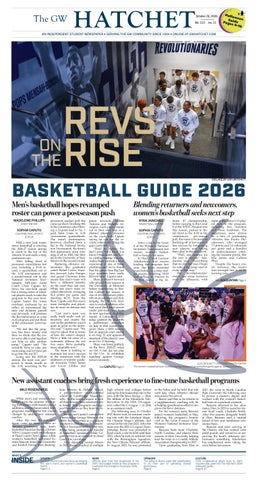
BASKETBALL GUIDE 2026
Men’s basketball hopes revamped roster can power a postseason push MADELEINE PHILLIPS STAFF WRITER
SOPHIA CAPUTO
CONTRIBUTING SPORTS EDITOR
With a new look roster, men’s basketball is entering the 2026-27 season aiming to climb to the top of the Atlantic 10 and make a deep postseason run. After falling short of preseason expectations last year, including a 19-16 record, a quarterfinal exit in the A-10 tournament and a second-round exit in the National Invitation Tournament, fifth-year Head Coach Chris Caputo believes his new-look squad has a strong roster of standout players ready to take the program to the next level. Caputo hopes the roster overhaul, anchored by an influx of experienced big men and dynamic guards and forwards, will position the Revolutionaries as a top A-10 program and put them in the postseason conversation. “We feel like the progress has been steady, and then we think that the roster we’re able to put together can help us take another jump,” Caputo said. “We certainly have to take one more jump, and we have got to go into the top 50.” Going into the 2025-26 season, the team was projected to finish fourth in the A-10, according to the
preseason coaches poll, but came up short, finishing 9th in the conference after blowing a 21-point lead to No. 1 seed Saint Louis in A-10 Tournament quarterfinals. The team’s performance, however, clinched them a bid to the National Invitation Tournament, the team’s first appearance since winning it all in 2016, but they fell to the University of New Mexico in the second round. Replacing offensive cornerstones like graduated center Rafael Castro, transfers forward Luke Hunger and guard Christian Jones means this year’s team will have a different identity on the court than last year. While last year’s team excelled offensively, averaging 81.4 points per game and shooting 46.3% from the floor, Caputo said this year’s team strengths and priorities lie more in defense and size. “Last year’s team was really built really well offensively, and maybe the size on the perimeter wasn’t quite as good on the defensive end,” Caputo said. “We tried to adjust that in terms of how the roster’s shaped. We’re a little bit more of a systematic defense the last two years. We’re probably more adaptable now.” The team is looking to maintain last year’s success in the frontcourt with the additions of transfer graduate forwards Dylan James and Lovro Urbiha and
junior forwards Andrija Vukovic and Malachi Arrington. Each player stands out in their own way as a distinct physical presence on the court, with Caputo saying he can see the recruits collectively filling the gap Castro left. “Hard to replace Rafael Castro, but I think you know Dylan James and Lovro Urbiha, Andrija Vokovic, Aiden Shaw provide a lot of experience in size at those positions, and we’ve found that the power four Big East type transfers have really thrived here,” Caputo said. Shaw, a 6-foot-9 forward who played three seasons at the University of Missouri before transferring to Boston College last season, is one of several named plaintiffs in an antitrust suit challenging the NCAA’s decision to exclude athletes who had used their final season under previous rules from its new age-based eligibility model. A Colorado district judge granted the plaintiffs a preliminary injunction on July 31 that would have given them a fifth season, but an appeals court stayed it on Aug. 21 and appeared skeptical of the players’ case at an Oct. 13 hearing. Shaw was listed publicly on the Revs’ 2026-27 roster on Oct. 9, but did not play in the Oct. 16 exhibition matchup against Georgetown University See CAPUTO Page 2
Blending returners and newcomers, women’s basketball seeks next step RYAN JAINCHILL BASKETBALL EDITOR
SOPHIA CAPUTO
CONTRIBUTING SPORTS EDITOR
After a run to the Great 8 of the Women’s National Invitation Tournament last season, women’s basketball is hungry for more. In Head Coach Ganiyat Adeduntan’s first season leading the program last year, the team exceeded expectations in a stop-andgo season, finishing 18-18 and falling to Dayton in the first round of the At-
lantic 10 championship, before surging to the Great 8 of the WNIT. Headed into this season, picked to finish third in the A-10 in the conference’s pre-season poll, the team is focused on building off of last season’s late success by integrating new players and taking their play to the next level. “Well, our mantra for the year is elevate,” Adeduntan said. “Everything that we did last year, I hope we take a big jump and elevate in that way.” The Revolutionaries’ roster saw some turnover over the offseason, with
eight of the roster’s 13 players new to the program, including five transfers and three freshmen. The departures were driven by a mix of graduating veterans, like Emma Theodorsson, who averaged 7.3 points and 3.6 rebounds per game and a handful of underclassmen entering the transfer portal, like Mia James and Colleen Phiri. Despite the heavy roster turnover, the team’s true strength lies in its returning core. See ADEDUNTAN Page 3
LEXI CRITCHETT | ASSISTANT PHOTO EDITOR The women’s basketball team huddles during a timeout in an exhibition game against Towson University.
New assistant coaches bring fresh experience to fine-tune basketball programs MILO ROSENZWEIG SPORTS EDITOR
While men’s and women’s basketball spent the summer revamping their rosters with transfer portal additions and freshman talent, both programs made subtler but crucial changes by adding new assistant coaches. After the two Revolutionary teams came up short in their respective postseason runs, men’s basketball hired Joe Barrer, a former NBA G League coach and colleague of Head Coach Chris Caputo, while women’s basketball welcomed Essence Baucom from Elon University and Kindyll Dorsey from BuckingWHAT’S
INSIDE
ham Browne & Nichols School, a pre-secondary co-educational school in Cambridge, Massachusetts. As the teams prepare to kick off their season, these assistants aim to bolster their programs and support their teams as they hunt for Atlantic 10 titles. Barrer and Caputo’s careers first intersected at George Mason in the 2000s. Barrer worked as a graduate assistant in 2006 during the Patriots’ NCAA Tournament Final Four run, before being promoted to director of basketball operations while Caputo served as an assistant to Head Coach Jim Larrañaga. After departing George Mason in 2007, Barrer coached at multiple
SPORTS See how returners and new faces are shaping this year’s men’s and women’s basketball teams. Page 2-3
high schools and colleges before taking his first leadership role in the pros with the Iowa Energy — then the affiliate of the Minnesota Timberwolves in the NBA D-League, now called the G League — in 2016 as an assistant coach. The following year, in October 2017, Barrer took an assistant coaching role with the Lakeland Magic, the Orlando Magic’s affiliate, and served in the role into 2021. After the team won the 2021 G League Championship, Barrer was promoted to head coach, a role he held until June 2023, when he took an assistant role with the Birmingham Squadron, the New Orleans Pelicans’ affiliate. In August 2025, he was promoted
NEWS Officials gave their first breakdown of the GW’s new budget model as they prepare to implement the changes in fiscal year 2028. Page 4
to the helm, and he held that role until July, when Athletics officials announced his arrival. Barrer said that as he returns to a supplementary coaching role, he is helping spearhead an effort to improve the Revs’ defenses. For the women’s team, Baucom joined women’s basketball in May, following the program’s historic visit to the Great 8 round of the Women’s National Invitation Tournament. Baucom hails from Charlotte, North Carolina, and played three seasons at Elon University, helping lead the team to a Coastal Athletic Association championship in 2017. Upon graduating from Elon in
OPINIONS The Editorial Board urges GW stakeholders to do their part in upholding shared governance. Page 8
2017, she went to North Carolina State University the following year to pursue a master’s degree and worked with the women’s basketball team as a graduate assistant. Baucom returned to her alma mater, Elon, in 2021 to assist her former head coach, Charlotte Smith. After five seasons alongside Smith at Elon, Baucom said a mutual friend of hers and Adeduntan connected them. Baucom said since arriving in the District, she has worked with point guards and zeroed in on improving the team’s defensive performance, something Adeduntan has emphasized since taking the reins before last season.
CULTURE From congressional ghost tours to GW’s haunted past, peek into The Hatchet’s 2026 Halloween guide. Page 9-10
NEWS
October 26, 2026 • Page 2
THE GW HATCHET
BASKETBALL GUIDE 2026
Surrounded by new faces, Aranguren embraces veteran role with confidence MILO ROSENZWEIG SPORTS EDITOR
ROWAN BISSETT REPORTER
This time last year, Jean Aranguren was one of the new kids on the block. But just a year later, the senior guard has earned veteran status on men’s basketball as the team’s only returner to play meaningful minutes last season. Aranguren, from Valencia, Venezuela, is focused on learning to play alongside 13 new teammates and making sure they hit their stride early in the season to build a strong foundation come March. As the Revolutionaries head into a new season sans standout Rafael Castro and with a roster largely untested in the Atlantic 10, Aranguren exudes confidence, certain the team can battle any conference opponent. “Man, we can compete with anybody in the A-10,” Aranguren said. “We’ll be fine.” Aranguren said he is using the resilience he developed last year to become a leader among his new teammates, expedite the chemistrybuilding process and improve fine details on the court to earn an A-10 trophy. Even with all that work to do, Aranguren shows no signs of apprehension about the Revs’ ability to tackle their goals. The A-10 Preseason All-Conference Third Team nominee sees himself as a leader among the backcourt cohort, bringing together sharpshooters like sophomore forward Ryder Frost and junior guard Felix Kossaras and shifty guards like sophomore Omari Witherspoon, graduate student Terrance Arceneaux and freshman Promis
Senior guard Jean Aranguren poses for a portrait.
N’Landu. “I’m just a point guard, man, creating plays for my team, creating everything for the team,” Aranguren said. Aranguren’s collegiate career began at Iona University in the fall 2023, making 33 appearances, mostly off the bench, averaging 21.9 minutes and 8.1 points per game. The following year, Aranguren ventured to Long Island to compete for Hofstra University in the Coastal Athletic Association, becoming the only player to start all 33 games that
season, while averaging 32.7 minutes and 14.2 points per game. Last season, his first with the Revs, Aranguren joined a roster that included three-ball specialists like Trey Autry and Tre Dinkins , a down-low defensive weapon in Castro and several versatile guards and forwards like Christian Jones and Garrett Johnson. Expectations for the team in early fall were high, with the Revs capturing the No. 4 spot in the A-10 Preseason Poll. But after the Revs tumbled in January into early February, Aran-
New-look frontcourt aims to fill Castrosized hole for men’s basketball JADEN DEGRUY STAFF WRITER
RYAN JAINCHILL BASKETBALL EDITOR
Former Revolutionaries forward Rafael Castro’s impact on men’s basketball will be felt for years. Castro, who now plays for the Coachella Valley Lakers, the Los Angeles Lakers’ G League affiliate, finished his redshirt senior season averaging 15.3 points per game on 62.7% shooting and 9.1 rebounds per game, earning Atlantic 10 All-Conference Second Team and All-Defensive Team honors. But as the Revs embark on their new season, they are looking to four new big men — Dylan James, Lovro Urbiha, Andrija Vukovic and Malachi Arrington — to fill his void, each bringing a unique skill set and, most importantly, size. To get used to who they will be playing next to, the new bigs are working to mesh with their teammates and
build chemistry, especially with the guards they’ll play alongside. When it comes to identifying players who fit his system, Head Coach Chris Caputo said he feels players who were rotational pieces at Power Four conference schools typically succeed at GW. In this class of big men, both James and Vukovic played at Power Four schools, with James coming from the University of Georgia and Vukovic from Oklahoma State University. James enters his graduate season as a transfer from Georgia, coming off a senior year averaging 4.5 points per game on 46.1% from the field and grabbing 2.9 rebounds per game. When Georgia faced the A-10’s Saint Louis in the first round of the NCAA Tournament last year, James scored five points in 17 minutes during the Bulldogs’ 102-77 loss. James said the level of competition he faced influenced his decision to join the Revs in the A-10. The Revs landed the 6’9”,
LEXI CRITCHETT | ASSISTANT PHOTO EDITOR
235-pound Urbiha from the Admiral ABA, a Slavic-based basketball league. In the 202526 season, Urbiha averaged 8.3 PPG on 47% shooting and 4.6 RPG, showing he can be a physical presence at forward. In his Revs debut during the team’s 76-68 exhibition loss to Georgetown University earlier this month, Urbiha notched 15 points. Vukovic, a junior from Serbia, stands at 6-foot-11 and 270 pounds, making him the Revs’ largest player. Last season, at Oklahoma State, he averaged 5.3 PPG on 62.2% efficiency and 3.4 RPG. Vukovic said he wants to build on his strong sophomore campaign with the Cowboys, in which his minutes per game jumped from 4.1 in 2024-25 to 15.3 last season. Arrington transferred to the Revs as a junior from the New Jersey Institute of Technology, where he averaged 3.9 PPG on 59.7% from the field and had 3.7 RPG during the 2025-26 season. The Somerville, N.J. native comes in at 6-foot-9.
LEXI CRITCHETT | ASSISTANT PHOTO EDITOR Junior forwards Andrija Vukovic and Malachi Arrington and graduate forwards Lovro Urbiha and Dylan James pose for a portrait.
guren’s minutes ticked upward. Aranguren saw more than 30 minutes of play for the first time on Feb. 7 against Duquesne, spending 34 minutes on the floor and dropping 18 points. Facing off against Saint Louis in the second round of the A-10 Championship on March 13, Aranguren started and dropped 11 points over 33 minutes as the team suffered a bruising elimination loss to the Billikens, who the Revs led by 21 points in the first half. “We should have won,” Aran-
guren said. “At the same time, man, it’s basketball. Sometimes stuff doesn’t go your way.” In the weeks that followed, as Autry, Jones, Johnson and forward Luke Hunger transferred and Castro, Dinkins and forward Tyrone Marshall Jr. graduated, Aranguren announced he would pursue his senior year in Foggy Bottom. Aranguren said he was concerned he wouldn’t flourish in a different program, which could hurt his chances of playing professionally someday. “I was afraid that I would transfer and not really click in the same team and not have a good year,” Aranguren said. As Caputo’s roster thinned, Aranguren became the program’s showpiece as staff dipped into the transfer portal yet again, attending official visits for new recruits. Once the roster solidified and the team began practicing together, Aranguren said he saw chemistry develop “better and faster” than the season prior. Individually, Aranguren said he spent the offseason training to improve his shots off the dribble and has practiced to complement the skills of both shifty and sharpshooting guards. As Caputo’s faithful returner looks toward the season set to unfurl in November, he said he has relied on his new teammates to help bolster him to a leadership position, and said if the team finds a groove early, they will be successful. “Every team, they go through the roller coasters, good moments, bad moments,” Aranguren said. “But I feel like if we get back up from those moments, we’re going to be great.”
Caputo sets sights on top 50 NET finish with reconstructed roster From Page 1 Amidst the heavy roster turnover, retaining guard Aranguren was a victory for the program, with Caputo saying he has appreciated Aranguren’s continued dedication to the team. Aranguren appeared in all 35 games last year for the Revs, led the team in assists with 119, averaged 24.2 minutes per game and shot 48.6% from the field. “I think for us, it’s not his play, but it’s more his consistency of leadership, setting the competitive edge for our group in terms of how hard he plays at that position,” Caputo said. Caputo also sought size and strength at guard and wing after the transfers of guards Trey Autry and Garrett Johnson, recruiting guards sophomore Omari Witherspoon, graduate student Terrance Arceneaux, junior Felix Kossaras, senior Andrew Phillips and sophomore forward Ryder Frost to add muchneeded length and physicality on the perimeter. “We wanted to get a little bit bigger on the wing and in the guard position,” Caputo said During the team’s 76-68 exhibition loss to Georgetown earlier this month, freshman guard Promis N’Landu also saw significant minutes and scored in the double digits, with Caputo saying he was excited about N’Landu’s presence on the team. “He was really good,” Caputo said of N’Landu after the game. “It would have been great for him to make
KAIDEN J. YU | STAFF PHOTOGRAPHER Head Coach Chris Caputo leads a team huddle during an exhibition game against Georgetown University.
some free throws down the stretch, but yeah, we’ve been high on Promis since he got here, and he did a great job.” Caputo emphasized that the exhibition against Georgetown provides valuable film for the team to study, noting that last year’s game against the Hoyas helped the team secure a win against the No. 45-ranked University of South Florida just weeks later in a similar big-game environment. “The most important thing for us is to, you know, get a bunch of fi lm against other teams,” Caputo said. That preparation for bigger games could also help the Revs this season, including matches against Utah State University and Boston College in December and A-10 heavyweights Virginia Commonwealth and Saint Louis come the new year. Despite Caputo’s offseason optimism, the team still has a steep climb ahead. The Revs opened outside the top 100 in KenPom’s national preseason rankings — down from last year’s preseason mark of 81 — and placed fifth in the A-10 preseason
coaches poll, one spot down from last year’s prediction. “At the end of the day, you want to be in the top 100, and then you want to move forward up that top 100,” Caputo said. “We need to move that forward because in all leagues, if you’re able to move forward, then you’re in the at-large conversation and that’s where we want to be.” Caputo has previously voiced frustration that the NET system squeezes mid-majors out of atlarge tournament bids because high-major programs avoid scheduling A-10 opponents, viewing them as a high upset risk with little metric upside. Despite those scheduling hurdles, he maintains his ultimate goal is pushing GW’s NET ranking into the top 50 to secure an NCAA tournament bid, or a spot in the NIT after fi nishing with a fi nal ranking of 92 last season. “If you’re one of the best teams in our league, you’re amongst the best teams in the country, and you should be in the NCAA tournament,” Caputo said. “And that’s what we’re striving to do.” GRAPHIC BY SOHA SHAH
NEWS
October 26, 2026 • Page 3
THE GW HATCHET
BASKETBALL GUIDE 2026 Women’s basketball is building rosters to outlast the transfer portal carousel SOPHIA CAPUTO
CONTRIBUTING SPORTS EDITOR
LEXI CRITCHETT | ASSISTANT PHOTO EDITOR Senior forward Sara Lewis, junior guard Gabby Reynolds and senior forward Kamari Lewis pose for a portrait.
Meet women’s basketball’s core staying tried and true to Buff and Blue MILO ROSENZWEIG SPORTS EDITOR
The transfer portal is a hallmark of an increasingly litigious and murky collegiate basketball landscape: players come, players go, chasing minutes, money or something else entirely. But so far, senior forwards Kamari Sims and Sara Lewis, and junior guard Gabby Reynolds of women’s basketball have stuck it out in Foggy Bottom. This year, they’re hungrier than ever to bring home some hardware. For these three players, their recurring decisions to stay in Foggy Bottom hinged on deep relationships with teammates and a steadfast belief in Head Coach Ganiyat Adeduntan’s vision for the program. Lewis said years of taking the court together has fostered a deep connection among the trio, and they’re leveraging their chemistry to make an indelible postseason push, surpassing last season’s historic visit to the Women’s National Invitation Tournament’s Great 8 round. “Building a consistent relationship with teammates, it’s something that the portal can’t really replicate,” Lewis said. “So I appreciate them for that, and we’re just trying to build something here, get a championship here.” Sims and Lewis began their GW careers in the fall of 2023 under then-Head Coach Caroline McCombs.
For Sims, her decision to join the Revs out of high school was contingent upon multiple factors, including proximity to home and the persistence of the coaching staff recruiting her. Lewis said she initially chose the Revs to develop as a player in a competitive conference and said she felt a vibrant community on campus. The pair’s first season in Buff and Blue saw the Revs finish 13-18 overall and 6-12 in the A-10. Sims appeared in 21 games, starting only one, and averaged 4.5 points and 11.5 minutes per game. Lewis made 22 appearances with two starts, averaging 9.6 minutes and 1.9 points per game. When the 2024-25 season rolled around, the Revs were uplifted by the arrival of Reynolds. On a team that finished the season 13-18 overall for the second straight season and fell to 5-13 in A-10 play, Reynolds stood out, appearing in 30 games for the Revs, starting 19 and averaging 10.5 points and nearly 30 minutes per game. But with two games remaining in the regular season, McCombs stepped down as head coach. Reynolds, who was named to the A-10 AllRookie team following the regular season, said she was unsure of her future in Foggy Bottom before officials hired Adeduntan in late March. Reynolds said Adeduntan sat her down as soon as she took the program’s
reins and made a pitch to keep her, outlining the development she wished to see in the then-rising sophomore. During the 2025-26 season, Adeduntan’s first in charge, the team struggled through streaky nonconference and conference play. For Reynolds, her sophomore campaign was an undeniable breakout, earning her a spot on the AllConference Third Team, averaging 14.6 points per game and becoming the Revs’ leading scorer through 35 appearances and 32 starts. After the WNIT exit to Illinois State University, Reynolds again weighed transferring, but her development under Adeduntan and her relationship with teammates drew her back. Today, the trio are using the chemistry they’ve built over multiple seasons in Foggy Bottom to usher success on the court. “Being at a place for more than one year is definitely helpful with your development in terms of leadership and the way that you talk on the floor because you understand things more,” Lewis said. She added that the rapport and closeness she and her teammates have developed will be key to the Revs’ success throughout the 2026-27 season and their shot at an A-10 title and a run in March. “We don’t shy away from talking about those things,” Lewis said.
In an era of college basketball defined by the transfer portal, women’s basketball Head Coach Ganiyat Adeduntan is constructing rosters built to last. Now entering her second season with the Revolutionaries, Adeduntan is cementing a recruitment and portal strategy that prioritizes high school recruitment and longterm retention in an effort to hopefully resist the high turnover currently plaguing mid-major basketball programs nationwide. Rather than relying on the portal to find a new core each year, Adeduntan said she leaned into the strong team culture that retained last year’s core and built around them by selectively adding experienced transfers to her returning roster. “I’m a big believer in development, and you can’t develop a kid in just one year,” Adeduntan said. Adeduntan said her recruitment strategy is to assess the roster post-season, see which areas the team needs to improve and eventually rely on the portal only to fill specific positions rather than the whole roster. Ahead of this season, Adeduntan brought in five players from the transfer portal, including graduate guard Anne Bair from Colgate University, senior guard Amor Harris from Longwood University, sophomore forward N’na Konate from Campbell
University, junior guard Alicia Newell from the University of Richmond and junior forward Cam Rust from Seton Hall University. Bair previously played for Adeduntan at Colgate and knows her coaching philosophy and culture well, qualities Adeduntan said will help her seamlessly transition to the team. Also joining women’s basketball are three freshmen players, guard Ayla Habbal from London, England, forward Camryn Gunter from Denver, Colorado, and guard Bela Cucuta from Newington, Connecticut, with each freshman getting on-court action during the Revs’ matchup against Towson. Last season in Adeduntan’s first year at the helm, she also brought in five transfer players and three freshmen. Of these additions, the roster retained junior guards Jaeda Wilson and Tanah Becker, who have become key pieces for the team and both appeared in at least 35 games last season. While prioritizing high school development builds a long-term foundation for the roster, it also creates a challenge in today’s college basketball landscape, as fielding younger, less experienced players against opponents who have built their starting lineups with transfer veterans could expose a major skills gap on the court. To stay competitive while those younger players develop, Adeduntan had to retain key players from the past few seasons, like junior guard
Gabby Reynolds, who averaged 14.6 ppg last season, and senior forward Sara Lewis, who averaged a team-high 6.1 rebounds. Adeduntan’s decision to bring in three guards and two forward additions from the portal addresses both perimeter shooting and defensive skills for a team that excelled at rebounding and baseline defense last year but struggled with ball security and forcing turnovers. But looming federal legislation and transfer portal rule changes could further advantage Adeduntan’s recruitment strategy. The Protect College Sports Act, a bipartisan bill passed by the Senate in September, backed by GW and the Atlantic 10 and designed to regulate collegiate athletics, would close the revolving door of players in mid-major basketball by restricting student-athletes to one transfer in a five-year period and a mandatory sit-out year for any additional transfers. During A-10 media day earlier this month, Adeduntan said she believes studentathletes should be limited to a single transfer throughout their collegiate careers. With the new act incentivizing players to find a permanent team rather than use schools as a temporary stepping stone, a college’s foundational offerings matter more. Adeduntan said she leverages the University’s academic prestige and unique location to attract players who want to earn their degree at GW, which will filter athletes seeking long-term development.
LEXI CRITCHETT | ASSISTANT PHOTO EDITOR Head Coach Ganiyat Adeduntan directs women’s basketball players through exercises at a team practice.
In second year, Adeduntan looks to surpass last year’s strong postseason run From Page 1 Entering her junior campaign, guard Gabby Reynolds has been the Revs’ offensive focal point for the past two seasons, starting 32 of 35 games last year. During her sophomore year, she averaged 14.6 points per game and finished ninth in the conference in scoring, earning A-10 All-Conference Third Team honors. Reynolds is supported by returner senior forwards Sara Lewis and Kamari Sims, and junior guards Jaeda Wilson and Tanah Becker, all of whom played crucial roles during the Revs’ postseason run last year. Lewis and Sims anchor the frontcourt with their defensive physicality, securing the paint and providing a consistent rebounding presence, fueled by Lewis’s 11.2 points per game and team-high 6.1 rebounds per game, alongside Sims’s 8.5 points per game and team-best 2.3 assists. On the perimeter, Wilson and Becker bring vital backcourt depth. Wilson chipped in 5.5 points and
1.6 assists per game, while Becker utilized her defensive tenacity to force turnovers, pacing the team with 44 steals and 33 blocks. Looking to carry last year’s lateseason momentum into this year’s early success, Adeduntan said the returners’ heavy minutes during their postseason run set a new standard of consistency and focus for the program. “You have to completely put everything that you have into it-the work that it takes, the focus that it takes, the consistency it takes,” Adeduntan said. “Those are the things that we’re hoping that we carry over, and they can help lead us in that space.” With last season being Adeduntan’s first in Foggy Bottom, every player was a fresh face to her. But in year two, she said she is relying on her returners to help acclimate the new players to the program. “It has been nice because I know this core,” Adeduntan said. “They want to win at a high level. But it’s about now, you gotta lead by example and then you got to pull the crew with you.” Adeduntan said the team’s culture can’t be built overnight, with
the squad spending significant time over the summer growing closer and building those relationships to improve their play on the court. “You have to be really intentional about it, and there has to be a certain level of camaraderie and belief and buy-in in how we act, how we interact, how we respond,” Adeduntan said. To help complement the core, Adeduntan brought in five transfer players, including graduate guard Anne Bair from Colgate University, junior forward Cam Rust from Seton Hall University, senior guard Amor Harris from Longwood University, sophomore forward N’na Konate from Campbell University and junior guard Alicia Newell from the University of Richmond. Three freshmen also join the team, including guard Ayla Habbal from London, England, forward Camryn Gunter from Denver, Colorado. and guard Bela Cucuta from Newington, Connecticut. Nearly all the new players made their first on-court appearances in the exhibition match against Towson University earlier this month, with Newell leading the new class,
scoring a team-high 14 points. Returners Lewis and Reynolds led the team in scoring with 13 points each, while Reynolds added five rebounds and forced two turnovers. Adeduntaun said postgame that the game against Towson showed her how her new recruits handled the intensity of a collegiate game, while also showing where the team needed to improve for the rest of the season. “It’s great to be back in the Smith Center, being able to wear our uniforms that are not practice uniforms, and being able to play in front of the public, really a lot of good things with this team, and was able to see things that we’ve been working on, and a lot of areas of improvement as well,” Adeduntan said. “And that’s why you play these games so that you can see where you are, compete against another opponent.” After kicking off their season on Nov. 2 against the University of the District of Columbia, the team will face other local opponents in November, including Georgetown and Howard universities, for highintensity early-season tests before heading to the Scout Jacksonville
Classic Tournament in Florida later in the month. At the tournament, the team will face the University of Alabama, Birmingham and the University of Arizona, serving as a measuring stick against a powerconference program. Once the bulk of non-conference play is underway, the team will begin their A-10 slate with a trip to Philadelphia after winter break to battle No. 10 La Salle and the conference preseason favorite Saint Joseph’s in back-to-back road contests before returning home on Jan. 6 to play St. Bonneventure. Their A-10 schedule will heat up again later in January when they will play projected No. 2 Dayton. As the Revs look to climb the A-10 standings this season, Adeduntan said she wants this year’s squad to be defined by its connection on the court and competitive ambition. “I want people to feel excited and proud of us, knowing that every time we step on the floor, we’re going to be a competitive team, and we’ll let the chips fall as it may,” Adeduntan said. “But we’re going to come out every single day and get everything we have”
GRAPHIC BY SOHA SHAH
NEWS
October 26, 2026 • Page 4
THE GW HATCHET
Officials unveil details of new University budget model at Faculty Senate meeting PARIS ALBRECHT
THREATENING PHONE CALLS
Smith Center 9/22/2026 – 8:30 p.m. Closed Case A male GW staff member reported receiving a threatening voicemail from an unknown individual.
CONTRIBUTING NEWS EDITOR
Officials at a Faculty Senate meeting Friday gave their first in-depth public breakdown of the University’s new budget model as officials prepare to fully implement the changes in fiscal year 2028. University President Ellen Granberg, Provost Ed Balleisen and Chief Financial Officer Bruno Fernandes fielded questions from faculty senators at Friday’s meeting after publishing a presentation prior to the meeting clarifying the specifics of the University’s new budget model, which is operating in parallel with the current model during fiscal year 2027 and will be fully implemented in FY2028 and establishes quasi-endowments for each school, standardizes revenue allocations across schools and creates a fixed percentage breakdown of tuition revenue. Faculty senators questioned Granberg, Balleisen and Fernandes on how officials can communicate in more detail about each schools’ budget, because they said information is often only filtered through deans and not disseminated to faculty, students and staff. Officials in April 2025 launched a budget model redesign process in order to better improve “financial resource allocations” for GW’s strategic priorities. The model includes moving from a “decentralized” open and closed schools model — which included “open” schools that received a fixed amount of tuition per student and “closed” schools that received tuition revenue minus a fixed contribution to the
CRIME LOG
Case closed. No further action.
UNLAWFUL ENTRY
Science and Engineering Hall 10/16/2026 – 12:15 a.m. Closed Case During a routine patrol, GW Police Department officers observed a nonGW affiliated male subject sleeping in SEH. The officers issued the subject a bar notice and escorted them off the property.
Case closed. Subject barred.
PUBLIC DRUNKENNESS PETER PARK | STAFF PHOTOGRAPHER Chief Financial Officer Bruno Fernandes speaks at Friday’s Faculty Senate meeting.
central administration — to a “hybrid” version that creates one unified model for across schools and one cost allocation strategy based on the size and scale of schools across the University, according to the pre-read presentation. At a May Faculty Senate meeting, Granberg said the current budget model is too “unstable” to support issues like declining graduate and international student enrollment because 80 percent of GW’s graduate tuition goes directly to each school under the current budget model — monetary support that is decreasing as enrollment declines further due to the President Donald Trump administration’s elimination of the Grad PLUS program and implementation of tighter borrowing limits.
In the new budget model, officials will allocate 100 percent of schools’ tuition revenue to each school’s budget, according to the budget model pre-read. Deans will be encouraged to plan multiyear fiscal responsibility with a new “carryforward” fund policy, which will allow deans to retain a portion of their surpluses subject to executive leadership approval as opposed to this year’s dean’s reserve system. Under the new model, a student’s home school of enrollment will receive 25 percent of per-credit-hour tuition revenue, while the student’s school of instruction — the school which the classes they are taken are housed in — will receive 75 percent of the per-credit-hour tuition revenue. Each school will be re-
quired to allocate some of their tuition revenue to University administrative costs and research support. Officials designed each school’s percentage requirement for University administrative costs based on credit hours, enrollment and faculty and staff — which is bigger for schools with more revenue and smaller for schools with less revenue. Officials disclosed the percentages for the share of cost that schools will give to University administration — which include a 20 percent allocation for benefits-eligible faculty, a 30 percent allocation for resident undergraduate students and a 20 percent allocation for staff — but did not disclose the specific dollar amount schools will have to pay into central administration.
Kogan Plaza 10/16/2026 – 4:16 a.m. Closed Case GWPD officers responded to a report of a non-GW intoxicated male individual. The GW Emergency Medical Response Group arrived on scene and conducted a medical evaluation. EMeRG transported the subject to the GW Hospital emergency room for further medical treatment.
Case closed. No further action.
HARASSMENT (VERBAL OR WRITTEN)
Off Campus Multiple – Multiple Open Case A female GW student reported harassment from a former acquaintance.
Case open.
—Compiled by Isaac Harte
International students weigh futures in US amid Trump’s visa crackdown DIYA JHAWAR
CONTRIBUTING NEWS EDITOR
ISABEL RAINEY REPORTER
International students at GW said they are reconsidering whether to remain in the United States after graduation or pursue educational and career opportunities abroad as President Donald Trump continues to tighten immigration policies. Students said uncertainty surrounding post-graduation work authorization and stricter visa requirements have prompted them to rethink plans to build careers in the United States, pursue graduate degrees abroad or finish their undergraduate degrees at GW. The hesitation comes as GW faces declining international student enrollment in the wake of Trump’s continued visa and immigration restrictions, including a new policy threatening international students’ employment opportunities. Since taking office in January 2025, Trump has made it more difficult for international students to study in the United States by enacting policies like a travel ban impacting international student applications from 38 countries and Department of Homeland Security
rules shortening the time frame that international students can stay in the United States for their education. This month, the Trump administration proposed a rule requiring universities to pay a $70,000 fee for each student’s initial application to the optional practice training program, which allows students to work in jobs in their field during or after their studies. The fee is in addition to last year’s proposed $100,000 fee employers would have to pay for each new H-1B visa, which federal courts struck down in October. GW officials on the University’s federal policy updates page said GW plans to submit comments opposing the proposed OPT fees. The Hatchet spoke to five international students, all of whom requested anonymity over fears their visa could be at risk or of deportation. All five described uncertainty about their futures in the United States, with some considering graduate school or employment abroad and others questioning whether GW had adequately supported them through changes to immigration policies. One junior international student said frequent changes to immigration policy under the Trump administration have made it dif-
ficult for international students to understand which rules apply to them and how their plans may be affected, forcing students to be “on top of your game” to stay informed about developments that could affect their ability to work in the United States. The student said the uncertainty has prompted several of their close friends at GW to reconsider their plans to remain in the United States after graduation, with some considering transferring to universities in other countries to complete their undergraduate studies rather than stay at GW. The student said international student applications could decrease further as a result of new policies, adding to financial pressures at GW, which financially benefits from international students, who often pay full tuition. University President Ellen Granberg said during a September Faculty Senate meeting that GW enrolled nearly 1,000 fewer international students this year — a number she said she anticipates to continue declining over the coming years. Vice President and Dean of Enrollment Management and Student Success Jay Goff told the Faculty Senate in December that GW enrolled 392 fewer international students in fall 2025 than
in 2024, which came after he said in August 2025 the University could face a $10 million decrease in revenue because of declining international student enrollment. Goff attributed the decline to the Trump administration’s federal visa policy changes and immigration rules, stating visa delays affected both new and continuing international students. A sophomore international student said they are worried that international students are slowly losing their freedoms in the United States, describing an interaction with an immigration officer at an airport who told them to be “really careful” and avoid doing “anything stupid.” The student said they are considering moving to other countries for graduate school because of the Trump administration’s tightening of student visa and immigration policies. They said they hold Portuguese citizenship and see practical advantages to studying in Europe, including lower costs. Dia Makhecha, co-director for the Student Government Association’s International Students Office said the office has focused on making career and post-graduate resources more visible and accessible amid changing federal immigration policies.
She said the office aims to connect international students with existing University advising and career resources, including Career Connect, and encourage administrators to develop additional support so students know where to turn to when they have questions. Another sophomore international student said they had originally planned to use OPT to work in the United States after graduation before eventually moving to Turkey or Europe, but recent immigration policy developments surrounding OPT and Curricular Practical Training — a program which allows F-1 visa-holding students to engage in off-campus employment, internships, externships, practicum or co-op — have made it harder to plan for their future in the United States. Following guidance from the Student and Exchange Visitor Program — an office run by Immigrations and Customs Enforcement — which called for universities to “carefully review” CPT requests to ensure CPT is only authorized when the program is “truly integral” to the completion of a student’s degree, the University paused approvals CPT requests September unless the internship is required for every student in their degree program.
Family, friends mourn physical therapy doctoral student after her death at 23 ADELAIDE PETRAS
ASSISTANT NEWS EDITOR
Emma Rubin, a secondyear physical therapy doctoral student, died Oct. 5 of ovarian cancer. She was 23. Rubin, born in Frederick, Maryland, received her bachelor’s degree in rehabilitation science with honors from the University of Pittsburgh in 2025, and maintained a strong academic record during her three semesters at the School of Medicine & Health Sciences, all while spending her free time volunteering with patients and animals. Her friends and family remember her as a thoughtful, selfless friend and daughter and someone who always made time to support others. “I would describe her as the most amazing, kind, giving person I’ve really ever met,” Lisa Rubin, her mother, said. Lisa Rubin said her daughter had a “sarcastic wit” that always made her family “burst out laughing” and continued to crack jokes throughout her illness. She
said Rubin once submitted a paper for class while in the hospital awaiting surgery, despite being on morphine for her pain. “At the top, she wrote, ‘Please excuse this because I’m on morphine,’ and then she submitted the paper,” Lisa Rubin said. “She was laying in there cracking up because she thought it was the funniest thing ever.” Daniel Millan, a secondyear physical therapy doctoral student, said Rubin was one of the first students in the program to ask to meet up before their classes started in August 2025. He said Rubin looked after him and acted as his “personal tour guide,” recommending restaurants and activities in D.C., since she was more familiar with the DMV area. “I was definitely a lot more nervous than I had liked to come off, but knowing that I had someone as thoughtful and as caring as her in my corner, it really just helped me out so much with the transition,” Millan said. Mitchell Rubin, Rubin’s father, said his daughter was
committed to using physical therapy to help people who needed the most assistance and sought to practice pediatric or neurologic physical therapy, which frequently treats patients with brain or nervous system conditions impacting their movement. Maritoni Marollano, a second-year physical therapy doctoral student and Rubin’s roommate, described her as selfless, brave and a “listening ear” for her friends. She said Rubin always prioritized spending time with her friends or helping them with classwork, even when she was in pain due to her illness. Ella Iorns, a second-year physical therapy doctoral student, said Rubin’s ovarian cancer symptoms began to worsen after completing her first year of physical therapy school, but she continued to show up to classes, complete homework assignments and support her classmates. Fiona McIntyre, a second-year physical therapy doctoral student, said Rubin was their cohort’s pro bono chair, facilitating the pro-
Second-year physical therapy doctoral student Emma Rubin.
gram’s connection with the Little Workers of the Sacred Hearts physical therapy clinic in Northeast D.C., where GW frequently sends students to volunteer to provide free services to patients. Jason Dring, an assistant
professor of health, human function and rehabilitation services who taught two of Rubin’s classes, said he traveled with her to a conference about pro bono physical therapy that focused on providing treatment to those
COURTESY OF LISA RUBIN
who would not otherwise have access. He said that trip showed Rubin cared about giving back to the community and aspired to become a physical therapist, even in just her first year of the program.
NEWS
October 26, 2026 • Page 5
THE GW HATCHET
Activists call on GW to cut ties with trustee over alleged animal abuse ARUNMOY DAS
ASSISTANT NEWS EDITOR
DANI QUEEN REPORTER
Activists from animal rights organizations renewed their protests on campus this month over Trustee Kevin Brown’s alleged complicity in unethical consumer practices and animal abuse. Animal Equality and The Humane League, animal rights organizations aimed at ensuring corporations treat animals ethically, launched separate campaigns in May 2026 calling on officials to reevaluate Brown’s position on the Board of Trustees because of his role as a member of the Board of Directors at Kroger, a grocery store chain that scaled back its commitment to producing cage-free eggs in 2022. Representatives of the two organizations said Brown’s ties to unethical business practices compromise GW’s commitment to ethical conduct, since he serves on the University’s top governing body as a trustee. “It’s not ethical for organizations like George Washington University to not at least question the presence of these individuals on their board because they’re much more than board members,” Sharon Núñez, the president of Animal Equality, said. “In this case, Kevin Brown is related to a company that systematically is hurting
others.” Brown has served on GW’s Board of Trustees since January 2026 and currently sits as the vice chair of the Board’s Audit, Risk and Compliance Committee, which oversees the University’s ethical conduct. He has also served as the executive vice president of global operations and chief supply chain officer at Dell Technologies since 2013 and on Kroger’s Board of Directors, including its committees on compensation, talent development and public responsibilities, since 2021. While Kroger promised consumers in 2016 they would work toward producing 100 percent cage-free eggs by 2025, the company in 2022 scaled back its cage-free commitment to be 70 percent cage-free by 2030, according to Kroger’s 2022 animal welfare policy. Both Animal Equality and the Humane League — which have no direct affiliation with GW — allege Brown, along with the rest of Kroger’s Board of Directors, are responsible for holding Kroger accountable for its commitments because of their roles as senior leaders of the company. A University spokesperson did not respond to a request for comment on whether officials believe Brown has violated any ethical standards and if they are currently evaluating Brown’s standing on the Board. Brown also did not respond to a request for comment on the allegations
Animal Equality has made against him and whether the protests have impacted his ability to effectively and credibly act as a trustee and as vice chair of Audit, Risk and Compliance Committee. Kroger did not respond to a request for comment on their stance on the ongoing protests against Brown by Animal Equality and The Humane League. Animal Equality — which Núñez and other co-founders Jose Valle and Javier Moreno founded in 2006 — aims to work with governments, companies and society to ensure “all animals are protected and respected,” according to the organization’s website. The Humane League, a global animal rights organization founded in 2005, aims to end abusive practices against animals raised for food through corporate negotiations, advocacy campaigns and policy reforms, according to the organization’s website. Animal Equality has organized at least three protests on GW’s campus this year, with participants calling on officials to cut ties with Brown, including six protestors outside the Board of Trustees office at 2001 Pennsylvania Ave. on Aug. 24, four outside the University Student Center during the Board’s October public meeting on Oct. 16 and five at Kogan Plaza during Alumni and Family Weekend programming on Oct. 17. Attendees of the Board’s
ABBY BROWN | STAFF PHOTOGRAPHER Animal rights protesters demonstrate against Trustee Kevin Brown outside the October Board of Trustees meeting in the University Student Center.
October public meeting could hear the protests from within the student center, with Board Chair Mark Chichester repeatedly mentioning the demonstration throughout the meeting. The protesters carried signs displaying chickens packed in cages and a black and white picture of Brown with a caption saying “Kevin Brown lets animals suffer.” At each protest, one of the protesters shouted slogans calling on GW to cut ties with Brown, while another blasted a horn. Núñez said she reached out to University leadership, including University
President Ellen Granberg, Chichester and every trustee, throughout May and June via email, calling on them to cut ties with Brown, though she did not receive a response. The emails, which The Hatchet obtained, stated that Brown’s dual role as a director at Kroger and trustee at GW directly linked the University to Kroger’s unethical practices, with Animal Equality pledging to highlight GW’s connection to a Kroger director through advertising campaigns and in-person protests. Chichester also did not respond to a letter Núñez
sent him on Aug. 24 — the same day as Animal Equality’s first protest on GW campus — requesting the Board to issue a public statement affirming the University’s stance on animal welfare, corporate accountability and the ethical responsibilities of trustees, according to an Animal Equality spokesperson. Wilkes said The Humane League is using a variety of tactics to pressure Kroger to uphold its commitments and educate the public, including GW community members, about the University’s association with Kroger’s unethical business practices.
Cornell rape case spurred Title IX conversations, trainings with fraternities ADELAIDE PETRAS
ASSISTANT NEWS EDITOR
HYEON JUNG REPORTER
Fraternity leaders and sexual assault prevention advocates said they have aimed to bolster trainings and have more conversations surrounding Title IX issues as the Cornell University rape case places fraternities at universities nationwide under scrutiny. Interfraternity Council member fraternities said they are working with the University as well as Students Against Sexual Assault to hold more Title IX and sexual assault awareness trainings as national media attention has descended on a lawsuit filed by a former Cornell student alleging members of the Chi Phi fraternity gang raped her in 2024, which has placed fraternities’ sexual assault prevention efforts under a microscope. Fraternity members said the case has increased attention to the topic of sexual assault and made renewing the semesterly prevention trainings with SASA more urgent. Since the Cornell case began to garner national attention last month, GW students have called for fraternities to undergo increased sexual assault prevention training — including through a petition circulated by GW’s chapter of the American Civil Liberties Union earlier this month, calling on the University to require all fraternity members complete semesterly, evidence-backed training. The petition has garnered over 700 signatures as of Sunday. Students also marched through the District earlier this month in solidarity with sexual assault survivors, including Jane Doe — the alias used for the victim at the center of the Cornell case.
LILY KRAMP | STAFF PHOTOGRAPHER
Fraternity townhouses on 22nd Street.
Fraternity members currently participate in a slate of training sessions containing information about Title IX, including University-mandated anti-hazing training. The Office of Equal Opportunity holds broader training sessions for fraternity and sorority house managers and chapter leaders each year that include information about consent and bystander intervention, according to University spokesperson Katelyn Deckelbaum. All first-year and transfer students at GW are also currently required to complete both online and in-person Title IX training sessions, and Deckelbaum said officials also began requiring juniors to complete
Title IX training this academic year. Andrew van Veen, the vice president of finance for the IFC, said the IFC’s efforts to increase programming around sexual assault awareness and prevention predate the Cornell rape case, but the case brought more attention to the topic and raised questions about what the IFC was doing to prevent sexual assault. He said following the case, the IFC has been planning fundraisers with SASA and other sexual harassment awareness groups, like a charity 3K race on the National Mall to benefit sexual assault survivors. “What we want to focus on is actually solving the problems at
RA program plans expansion to all upperclass halls AMELIA NELSON
ASSISTANT NEWS EDITOR
Officials announced Friday the residential advisor program will expand next fall to include upperclass residence halls, according to an email obtained by The Hatchet. Campus Living & Residential Education will fully eliminate community assistant positions and provide each of the University’s seven upperclass residence halls with RAs in addition to the 20 underclass residence halls currently staffed with RAs, bringing the newly-returned RA program to all dorms, according to an email Director of Residential Education Kyle Johnson sent to current RAs Friday. John-
son said RAs will receive a stipend of $3,500 for the academic year — a $950 increase from the stipend RAs received this academic year — although there will continue to be “impacts” on their financial aid packages because of the “reduced” cost of attendance after factoring in stipends to financial need calculations. Johnson said the RA program’s expansion will increase support and hall programming for residential students across all years. A University spokesperson did not return a request for comment on how many new RA positions would be created, or whether existing RA positions in under class residence halls would decrease as a result
of the change. The spokesperson also did not return a request for comment on how the University would finance the new positions and increased stipends. RAs in September expressed frustrations with the program’s return after they faced unexpected reductions in their financial aid packages, which the University told them was a result of officials factoring the stipend they received for their RA work into calculations of their financial need. They also said officials did not adequately provide them clear guidance on their responsibilities prior to signing on to their position, which RAs said led to them working more hours than there are in their contract.
hand,” van Veen said. “Admittedly, we haven’t been aware of any problems like that at our school, but we’re focused on preventing the possibility of that ever happening.” Van Veen said the IFC is currently working with the Title IX office, Conflict Education & Student Accountability and SASA to increase the frequency of Title IX training sessions. He said the Office of Fraternity and Sorority Life has approved the training sessions, so individual fraternities are now working to schedule them. In addition to the Title IX training fraternity members already undergo, the IFC’s constitution re-
SNAPSHOT
quires the body to host a series of sexual assault and Title IX training sessions at least once per semester in collaboration with SASA, taking place one week after fall break and two weeks after spring break. Each member fraternity must send 80 percent of their chapter’s roster and all new members to the training sessions, according to the constitution. Van Veen said he does not believe FSL requires the IFC to hold semesterly training sessions in collaboration with SASA, and he is unsure when they were last held. He said the IFC constitution posted publicly on RevConnect is a tentative version but did not specify when the constitution would be updated or whether there would be any changes from the current version. Sita Ramaiya, the president of SASA, said a member of SASA messaged each IFC member fraternity on Instagram after seeing several fraternities post statements on Instagram condemning the alleged rapists in the Cornell case and showing support for sexual assault survivors to organize sexual assault prevention training sessions. She said all the fraternities responded, and they have expressed interest in holding the training sessions on a semesterly basis in the future, starting up again this fall. “They have all accepted the offer to take up the training, and we’re getting things scheduled on the calendar,” Ramaiya said. “They’ve been very proactive and engaged.” Ramaiya said conversations around sexual assault prevention have permeated campus culture in the wake of the Cornell rape case, resulting in several fraternities posting their statements. “We wanted to make sure they weren’t just posting about it just because,” Ramaiya said.
KAIDEN J. YU | STAFF PHOTOGRAPHER
A crowd surfer is carried above the audience during Turnstile’s free benefit concert in front of the Washington Monument on the National Mall Saturday.
NEWS
October 26, 2026 • Page 6
THE GW HATCHET
Officials launch ‘federal issues tracker’ for policies that may impact GW ISAAC HARTE
CONTRIBUTING NEWS EDITOR
Officials launched a “federal issues tracker” Friday to inform community members of ongoing government actions and legislation that may impact GW and the broader higher education sector. Officials announced the tracker in Friday’s federal update email, adding a new section that links to three categories of federal actions that could directly impact GW, impact all of higher education including GW or affect colleges and universities more broadly. Officials said in the email that they created the tracker to serve as a “centralized resource” for updates on federal actions that could affect GW and higher education more broadly. “We recognize that members of our community remain interested in the current or potential impacts of various federal actions,” the email states. Since the start of President Donald Trump’s second term in January 2025, community members have repeatedly called on GW to communicate more clearly about the potential impacts of federal actions, such as Department of Justice investigations into GW or changes to international student policy. Officials sent the federal update email weekly last academic year but shifted to sporadic releases over the summer and have continued that
PHOTO ILLUSTRATION BY RAFAEL TOROK
A student views the new “federal issues tracker.”
practice during the academic year. The tracker currently includes two “key issues” impacting GW, five more impacting higher education at large and three issues with national implications. Officials named the August 2025 findings of a DOJ investiga-
tion into antisemitism at GW as one of the two current issues directly impacting the University. In the investigation, the DOJ found the University acted deliberately indifferent to reports of campus antisemitism that took place during and in the lead-up to the 2024
pro-Palestinian encampment in University Yard. University President Ellen Granberg said officials met with the DOJ in January to discuss the allegations, including presenting the DOJ a “full array” of measures the University has employed to combat antisemitism.
The tracker cites a separate DOJ finding from August as the second issue directly impacting GW, which concluded the School of Medicine & Health Sciences illegally favored Black and Hispanic applicants in its admissions for its 2024 and 2025 incoming classes, which University officials have rebuked as “incorrect.” Among issues directly affecting higher education, officials named a Department of Homeland Security proposed rule that would impose fees on universities seeking to admit international students for optional practical training programs, which are temporary employment programs related to an F-1 visa student’s area of study. Under the proposed rule, a university would have to pay $70,000 for initial optional practical training and $30,000 for additional optional practical training. The tracker states GW plans to submit a comment objecting to the proposed rule. The tracker also cites additional DHS guidance departmental officials released in August that imposed stricter limits on curricular practical training programs, which are alternative work or internship employment programs required as part of a student’s education and offered through “cooperative agreements” with a university. The guidance imposes stricter requirements on universities to report curricular practical training programs to DHS officials.
District officials move to improve e-bike, scooter safety after fatal crash SHIVU SATHE
ASSISTANT NEWS EDITOR
Following a fatal e-scooter accident that killed a D.C. official earlier this month, District officials are examining and implementing options for increasing rider and pedestrian safety after calls from advocacy groups and transportation safety experts. After a fatal e-scooter accident earlier this month killed Talib Shakir, the director of the Mayor’s Office on Returning Citizen Affairs, near the Eastern Market Metro station after he collided with another woman riding an e-scooter, residents and city officials have had heightened conversations about whether regulations surrounding e-scooters in the District are sufficient. In the crash’s aftermath, District officials and agencies are expanding education on the safety risks of riding and increasing regulations on improper scooter use, including mishandling and improper parking fines. Shakir’s death is the latest of many recent fatal crashes in and around the District involving e-scooters, including a June crash resulting in the death of a 17-year-old in Southeast D.C. Both Shakir and the 17-yearold were not wearing helmets at the time of their accidents. The use of e-scooters has grown since 2019 around the city due to the rising access to shared micromobility aids, including e-bikes, bicycles and e-scooters, from companies like Lime, Spin and Capital Bikeshare. The District averaged 25,567 e-scooter rides each day in 2026, a 33 percent increase from 2025, according to the District Department of Transportation’s Ride Report, an ongoing report that tracks micromobility in the District. From 2023 to 2025, there were at least 25 scooter-rider injury crashes at intersections around the District, according to a DDOT report. As of October, the Metropolitan Police Department has reported four fatalities involving e-bikes, two involving e-scooters and three involving mopeds, along with an overall 62 percent increase in traffic fatalities so far this year. In response to the increase in crashes, Mayor Muriel
Bowser said in an Oct. 16 X post that the Metropolitan Police Department will start focusing its street-safety outreach efforts on e-bikes and e-scooters citywide with an emphasis on U Street Corridor, Navy Yard and Gallery Place-Chinatown, due to a high concentration of micromobility vehicles in those areas. Ward 6 Councilmember Charles Allen also began calling for increased regulations as D.C. works through the process of rebidding, or creating a new contract, for micromobility brands like Lime and Veo. Allen is asking for the District to limit users riding on the sidewalks, force users to redock vehicles, require riders to follow road safety rules like keeping one person on a vehicle at a time and make it easier to identify specific vehicles if they get in accidents or are used in crimes. The DDOT announced Friday that they will be issuing fines for operators who violate shared micromobility rules, like incorrect parking, failure to promptly relocate improperly parked devices, obstruction of pedestrian access routes and bike lanes and failure to meet required fleet deployment standards. The agency said in a press release they plan to expand regulations further to address public concerns submitted in response to existing rules. These new regulations will include vehicle speed and sidewalk riding, permit application process and term updates and performance thresholds for fleet increases. “As the program grows, we recognize the importance of strengthening safety measures, improving compliance, and holding operators accountable,” DDOT Director Shannon Kershbaum said in the release. Nick Delledonne, who leads the D.C. Safe Streets Coalition, an organization focused on advocating for greater regulation and accountability for bike infrastructure in the District, said the group is petitioning the District to regulate micromobility vehicles like e-bikes and e-scooters by adding registration and tagging requirements for private and shared vehicles, similar to the process for motor vehicles.
RAFAEL TOROK | PHOTOGRAPHER A Lime electric scooter parked on a sidewalk.
KRIS PARK | ASSISTANT PHOTO EDITOR Student Government Association Vice President Aicha Sy and President MJ Childs sit during their swearing-in ceremony in May.
SGA senators report progress after declaring financial aid ’emergency,’ bypass body’s leaders AMELIA NELSON
ASSISTANT NEWS EDITOR
Student Government Association senators reported success in bypassing SGA leadership to meet with officials about students’ reports of reduced and delayed financial aid, weeks after senators declared an “emergency” on University financial aid and senators’ inability to communicate with University administration. SGA senators said they have now met once with staff from the Office of Student Financial Assistance and plan to regularly communicate with officials one month after officials first declined to meet with senators — a development they attributed to bypassing the body’s top leadership and asking officials to meet with them directly. Senators also credited their recent success in communicating with officials to the Senate’s passage of the Financial Aid and Affordability Emergency Act earlier this month, which they said helped them to express the “severity” of student’s concerns to officials and their desires to communicate with the financial aid office, though SGA President MJ Childs said he does not think there is sufficient “information” within University operations to constitute a financial aid “emergency.” SGA Senate Pro Tempore Mathew Reis introduced the financial aid emergency act on Sept. 28, which the Senate passed unanimously, in response to the University’s lack of communication with students and the SGA over concerns about inadequate financial aid this academic year. Reis said, in the weeks before the
act passed, he received a call from the financial aid office notifying him he would be unable to schedule a meeting with a senior financial aid counselor to discuss his concerns about financial aid, which he said constituted an “emergency” because he thought the officials like Vice President and Dean of Enrollment Management and Student Success Jay Goff and Executive Director for Student Financial Assistance Michelle Arcieri were refusing to meet with the SGA altogether. Reis said he later learned officials had been meeting with Childs and SGA Vice President Aicha Sy, but that they had not communicated those meetings to senators. Reis said he and SGA Sen. Hugh Parker (CCASU), chair of the Special Committee on Financial Aid and Affordability Advocacy — the body created through the act tasked with determining the University’s role in students’ concerns regarding financial aid— met with Goff and Arcieri Oct. 14 to look over the University’s data on financial aid allotments and the University’s process for determining students’ financial aid packages. He said he and Parker along with other senators will have a second meeting with officials Oct. 29. Reis said through meeting with officials, senators have been able to better communicate the “severity” of students’ concerns over financial aid to administration, and explain to them the state of emergency that the senate has identified. He said declaring the “emergency” also helped clear up for officials the two “contrast-
ing” stories between senators, who claimed there was no communication between the SGA and financial aid office, and the SGA’s top leaders, who had an existing relationship with financial aid officials and did not believe there was a financial aid “emergency.” Reis said he hopes senators will retain the opportunity to communicate with University administrators because he said the body’s “power” stems from its ability to relay information and concerns between the University and student body. Childs, who said he was not aware of the financial aid emergency act before senators passed the legislation, said in a message he does not believe there is enough data from the University to constitute a “financial emergency.” He said he and Sy already had a meeting planned with Goff for the Friday after senators passed the emergency act to get an overview of University financial aid, and following the act’s passage, Childs and Sy discussed the act with officials, prompting Goff and Arcieri to speak at the SGA’s Oct. 5 meeting, where they presented an overview of the University’s financial aid before giving senators the opportunity to speak with officials during an executive session. Childs said there are no SGA policies preventing senators from communicating directly with officials, though he feels it is “best” for senators to come to him and Sy if they would like to set up a meeting with officials because of their regular communication with the University.
“With us as officers, it helps for them to report those issues to us first because we are the ones who are primarily engaging with them,” Childs said. “We have a cadence to which we meet with officials, whereas senators do not.” Earlier this month, Sy said having senators communicate their concerns to her and Childs rather than directly to officials would create a “streamlined” process, allowing SGA leadership to clearly express the body’s desires to University administration. She said senators should focus their efforts on engaging with students. Senators said they informed Sy of the act at least a week and a half before its passage. Sy did not respond to a request for comment on whether she communicated senators’ concerns about a financial aid “emergency” to Childs prior to the act’s passage. Parker said he was able to meet with Goff and Arcieri because he approached them in person after they presented at an SGA meeting Oct. 5 and asked to schedule a meeting, which they agreed to. He said the meeting helped him pivot the committee’s objectives toward hearing students’ concerns and away from identifying Universitylevel issues because he said the office’s data on financial aid apportionment revealed the University could not detect any issues with financial aid from their end. “If the University is saying it’s not coming from the top, and they’re showing us numbers that do show that it’s not coming from the top, that helps us focus in a little bit more,” Parker said.
NEWS
October 26, 2026 • Page 7
THE GW HATCHET
Sophomores bring student-driven delivery, task completion app to GW JUWON KIM STAFF WRITER
Two students launched a new app earlier this month allowing students to pay their peers for oncampus delivery and cleaning services. EZUNI, an app two sophomores in the School of Business brought to the United States Oct. 14 after it originated in the United Kingdom, allows students to post a task — like getting food delivered or doing their laundry — and finds other GW students to complete the tasks for them in exchange for a small fee. Students who have used the app said they like how the services are provided by fellow GW students, preferring it to other delivery services like UberEats and DoorDash due to lower prices and faster delivery times. The U.S. version of the app, which sophomores Eduardo Martí and Chirag Nainani cofounded, currently only operates on GW’s campus, but Martí said they plan to expand to other D.C. campuses if they see “promising” results at GW. EZUNI originally launched in November last year in the United Kingdom at the University of Warwick. Martí said the idea for the app stemmed from when he and Nainani would pay their neighbors to clean their bathroom for them last year and wanted to turn the service into a larger project. He
COOPER TYKSINSKI | STAFF PHOTOGRAPHER Sophomore Eduardo Martí holds out a phone displaying EZUNI, the app he co-founded with fellow sophomore Chirag Nainani this month.
said he saw a need for EZUNI on campus for students who are busy with academics and don’t always have time to complete tasks themselves, while others struggle to find a job or can’t commit to a set work schedule.
Martí said after Nainani told his friends about the idea, one of them heard of a similar concept in the United Kingdom and connected them to the U.K. app’s founders, and they started discussing plans for the U.S. app this past summer.
Martí said the app solves two “major problems” that college students face — not having enough time and not having enough money. He said so far, a worker has picked up each requested task on EZUNI within five minutes, and
almost 100 people downloaded the app within four or five days of its launch, showing students are “eager” to earn money. EZUNI users can set the price they want to pay for a service when they post their task, which workers can negotiate through a direct message system. The minimum price a user can pay is $1, with preset prices for laundry services, fixed at $8 for folding prewashed clothes and $18 for washing and drying clothes. Martí said any GW student can download the app and become a customer by signing up with their GW email address, but workers must go through a separate onboarding process, which includes signing documents to confirm citizenship status — due to restrictions on international students’ ability to work in the United States — and setting up a personal account with the payment platform Stripe. Martí said the app takes a 15 percent service fee from workers, which he said is a “competitive” price because companies like UberEats and DoorDash can take up to 40 or 50 percent. He said he and Nainani are currently developing a feature that allows workers to receive the full tip from customers. “We’re just working on getting the word out that this is a real, serious app that you can use whenever you want to complete your task,” Martí said.
As DC Council weighs tax increases, experts raise affordability concerns MADELEINE BEETAR REPORTER
SHIVU SATHE
ASSISTANT NEWS EDITOR
Economic policy experts expressed concern about the repercussions the D.C. government considering tax increases could have on the city’s residents, despite the revenue it could bring in for the District. The D.C. Council last Friday began considering seven tax-related bills that would increase taxation in sectors like property and sales to improve a currently struggling local economy. Experts who attended the Council’s nine-hour marathon meeting regarding the proposals stressed the potential risks the proposals could bring by putting additional tax burdens on businesses, homeowners and middle-to-low-income residents. The District’s revenue forecast from March suggests that the city’s deficit for fiscal year 2028 will fall between $660 to $837 million, partly due to cuts to federal jobs, decreasing income and dwindling employment. The bills discussed by the council at last Friday’s meeting included a 3 percent tax on investment holdings, a higher tax on properties
valued at over $2.5 million that are not the owner’s primary residence, a sales tax increase, a business activity tax targeting out-of-state lobbying firms, broad property tax hikes, an income tax increase and a separate tax on land improvements. The overall goal of the taxes are to raise revenue for the District and dig D.C.’s economy out of a revenue shortfall. Katherine Loughead, the vice president of state tax policy at the Tax Foundation, a nonprofit organization that researches and analyzes data on U.S. tax policies, said council members are looking at ways to raise revenues because D.C. is experiencing overall revenue “tightening,” specifically in the rate of growth for the D.C. economy, which has slowed, putting a strain on tax-funded social programs like rent assistance and child care subsidies. Loughead said a major driver of the revenue shortfall was the COVID-19 pandemic shutting down many businesses and the Department of Government Efficiency cuts, which laid off roughly 100,000 members of the federal workforce in the DMV, creating a “mini recession.” Due to the cuts, she said there is less disposable income for people to spend, contributing to the
downward economic trend and less money to put into welfare programs. The District has experienced a 13 percent reduction in the federal workforce after cuts by President Donald Trump’s administration. The District’s unemployment rate also jumped in March to the nation’s highest at 6.7 percent in December, from 5.3 percent in January 2025. “It’s a very vicious cycle,” Loughead said. “When people need more support, that’s also when the revenues are tightening up.” She said items like the ‘pied-à-terre’ tax would impose a disproportionate share of the burden on homeowners with a second property who only demand a “modest share” of that tax’s revenue because those owners often don’t rely as heavily on the public services funded by that tax revenue. She said District officials may also need to implement spending cuts to counteract the potential revenue loss the city faces. Loughead said the majority of pain from taxes as a whole would be felt by the poorest and middle-class residents in the District, who often face an unequal distribution of the tax burden because the city’s current tax system targets larger shares of smaller incomes. She said
JACOB CRISS | PHOTOGRAPHER The front steps of the John A. Wilson Building, which houses the mayor’s office and the chambers of the Council of the District of Columbia.
the Council needs to find ways to raise the revenue through tax codes that improve equity for residents. “The tax code is biased towards wealthy white men, and that wealth is allowed to grow and everybody else has their wealth stripped away in the tax system,” Loughead said. Shawn Hilgendorf, the vice president of government affairs for the D.C. Association of REALTORS, said he voiced concern at
the meeting about the adverse impacts a tax increase would have on housing and the District’s economy. He said a key issue for him was worries about the property taxes being “overly broad,” not specific to a sector and that blanket property taxes could disproportionately impact different sectors of the economy. He said the two property taxes proposed included the pied-à-terre tax — a tax that increases the rates for
homes valued at more than $2.558 million — which he said could be difficult to implement, as New York City is seeing challenges implementing theirs. He said the council also proposed options for a broad property tax increase, which included either a one penny per $100 for every class of residential and commercial property or a 10cent increase overall, would be “devastating” for the residential market.
GW researchers develop formula to predict harmful AI chatbot responses LAKSHMI DEV
ASSISTANT NEWS EDITOR
MANAV JOSHI REPORTER
A GW professor and Ph.D. student developed a mathematical formula to predict whether and when publicly available artificial intelligence chatbots may shift from providing helpful responses to potentially harmful ones to users. Neil Johnson, a professor in the physics department, and Frank Yingjie Huo, a physics Ph.D. student, published a paper on Oct. 8 finding that changes in how AI models prioritize information can signal when they are approaching a potentially harmful response. The findings could help developers create safety systems that identify potentially dangerous chatbot behavior before users encounter harmful advice, according to the study. The researchers developed a formula that measures how close an AI model is to producing an undesirable response, or a response that contains misleading information, encourages harmful behavior or gives factually accurate information that could endanger a user. The study tested seven open-weight AI models — models whose underlying numerical settings are publicly available for researchers to examine — including GPT-2, Claude Opus 4.5 and Gemini 3 Pro, and found that the formula correctly identified whether a model would produce an undesirable response immediately, after a delay or not at all in 18 out of 19 evaluated cases, excluding two borderline cases.
The researchers tested smaller, publicly available AI models rather than commercial chatbot products, like ChatGPT, because the publicly available models allow researchers to examine how they process information and generate responses, according to the study. The study aims to help AI model developers understand and eventually predict harmful responses, including those involving self-harm, extremism and financial decisions. The research comes amid growing concerns about the safety of AI chatbots as more people use them for information and personal advice. A 2025 Stanford University study found that AI therapy chatbots sometimes provided inappropriate responses to users expressing suicidal thoughts, while other research has raised concerns about chatbots reinforcing delusional beliefs. A Stanford study of 11 AI models also found that chatbots frequently validated users’ behavior even in potentially harmful situations. Johnson said the distinction between accurate and appropriate responses is especially important when users ask chatbots for advice about sensitive topics like selfharm. He said an AI system could provide technically accurate information that is nevertheless dangerous to someone seeking help. The researchers examined how an AI model’s attention mechanism, which determines which parts of a conversation influence its next response, can shift between competing types of information. They found that changing the order of questions about topics like vaccines, violence and self-harm
could alter whether the same chatbot generated appropriate or undesirable answers, like misleading vaccine information or responses that could encourage harmful behavior. Johnson said the mathematical formula estimates how close a chatbot is to producing an undesirable response by tracking changes in which information the AI model prioritizes internally as a conversation progresses, rather than relying solely on the answers it generates. He compared the process to a car approaching the edge of a cliff, where the distance remaining and the vehicle’s speed determine how much time is left before it reaches the edge. However, the formula remains a research tool and has not been incorporated into software that monitors chatbot responses as users interact with them and would require further testing before it could be used to monitor potentially harmful responses in real time, according to the study. Johnson said the model offers a simplified explanation of the processes behind chatbot responses, despite the more complex systems used by larger AI models. He said the underlying mathematical principles could also apply to larger models, but researchers would need to conduct additional testing to determine whether the formula can accurately predict their behavior. He compared the approach to understanding the basic forces that allow an airplane to fly, regardless of its size or additional features. Huo said understanding the risks associated with certain AI responses is increasingly important
CARSTEN HOLST | ASSISTANT PHOTO EDITOR Professor Neil Johnson and Ph.D student Frank Yingjie Huo pose for a portrait in Corcoran Hall.
as AI technology develops and becomes more widely accessible, particularly because users may not understand how chatbots generate their responses, potentially leading them to trust harmful or misleading information without recognizing its risks. The researchers propose using the formula as a foundation for lightweight monitoring systems — safety tools that monitor how chatbots process information and warn when they are approaching a potentially harmful response — that could identify when a chatbot is approaching a potentially harmful response. Such systems would supplement existing AI safeguards rather than automatically prevent dangerous answers, according to the study. Huo said the research could eventually contribute to warning
systems that identify potentially harmful chatbot behavior, but applying the formula to commercial AI products would require additional research into their more complex systems. He said existing safeguards do not eliminate the possibility of undesirable responses. The study provides insight into how changes in an AI model’s internal processes can lead to harmful responses and demonstrates that researchers can predict those shifts in the smaller models they tested, Huo said. He said the findings offer a starting point for developing similar safety measures for larger, more complex AI systems. “So, I would say there are still a lot of potential loopholes and things like that that people need to address, and our study is certainly a first step towards it,” Huo said.
THE GW HATCHET
OPINIONS
October 26, 2026 • Page 8
OPINIONS
WHAT THE UNIVERSITY WON’T TALK ABOUT THIS WEEK
Whether GW officials are weighing Kevin Brown’s standing on the Board of Trustees in response to animal rights activists calls to remove him. p.5
All GW stakeholders have a part to play in upholding shared governance STAFF EDITORIAL This editorial board, as well as other University stakeholders, has spent a significant amount of time urging GW officials to commit to the principles of shared governance by being more transparent with the community about their decisionmaking processes. But over the course of this year, we feel that some members of the community need to hold up their end of the bargain. Last year’s editorial board decided to call out the Faculty Senate for not effectively using their platform and holding officials accountable. Midway through the fall semester, we believe we need to extend this criticism to all of the student, faculty and staff leaders on campus. The Faculty Senate, the Student Government Association and the Staff Council have unique platforms by virtue of their leadership. They get precious face time and access to the University’s top leaders that ordinary students and faculty simply don’t have. In the past year, we have heard a lot about the importance of the principles of shared governance from these stakeholders, but this means that we need to actually commit to what that phrase means. These bodies are meant to represent their constituents by bringing the questions of the community to officials and demanding answers. But as of late, we feel they have been squandering the opportunities they have to advocate on behalf of their constituents. If we hope to make strides in shared governance as a community, all sides of the equation need to be doing their part. Lately, we have seen these bodies’ priorities become misaligned with those of their constituents. Staff Council President Mindy Galván gave her first substantive statement to officials regarding the layoffs that occurred across at least
CAROLINE MORRELLI | STAFF CARTOONIST
GW schools at last week’s Board of Trustees meeting, months after the layoffs actually took place. September’s Faculty Senate meeting was only an hour long, as senators failed to ask officials about some of the most pressing issues facing the University, including rapidly declining international student enrollment, staff layoffs, officials’ agreement with Universal Health Services to end their financial support for the Medical Faculty Associates and the Department of Justice’s finding that the School of Medicine & Health Sciences discriminated based on race in its admissions. During SGA President MJ Childs’ first report to
the Board of Trustees this academic year, he spent his time advocating for officials to invest more in career and academic advising, which the University’s strategic framework has already listed as a priority and outlined specific goals to improve. Childs made no mention of the impact of the cuts to student services across the University, which he campaigned on resolving. These examples show not only a disconnect in their priorities but an unwillingness to use the platform they have been given to place pressure on officials. All of these bodies are showing one recurring theme: they are
Trump’s golf course renovation is his latest move of disrespecting DC
E
arlier this month, President Donald Trump bulldozed hundreds of trees at the East Potomac Golf Links as part of what the administration claims is standard maintenance. Despite a federal judge’s timely intervention halting the renovation, the president has already moved forward with his next step to close the course on Nov. 15. When it reopens, Trump plans for the cite to be a championship venue built to host the U.S. Open, rather than an accessible green space for all members of the District to use. Historic sites like it are a big part of why I chose to come to GW. I wanted to live in a city whose landmarks and green spaces felt open to everyone. However, as a first-year student, I feel as though Trump’s renovations are taking that city away, and East Potomac is the latest piece to go.
Taylor Malec Opinions Writer I remember walking the path along the Tidal Basin and seeing the lush, green golf course across the water. I pictured bringing my parents, both avid golfers, to play a round with me, even though I’m a mediocre golfer at best. That felt possible because the course was built for every kind of golfer, not just the pros. But now because of Trump’s renovations, I’m not so sure the course will be open for all to play.
Hatchet
The D.C. I knew before coming to GW as a first-year felt open. The whole place felt like mine to explore, and that’s part of why I chose GW. But then last year, I watched from a distance as Trump tore down the East Wing of the White House and pushed for the closure of the Kennedy Center. Moving into GW this fall, I walked down to the National Mall expecting the view I’d grown up with. Instead, I passed guard patrols and such heavy construction that the historic Reflecting Pool was nowhere in sight. At a club meeting during my first week on campus, officers of the club briefed me on how to interact with the guard and what my rights were if I was stopped. I looked around the room of 18-yearolds taking notes on how to handle soldiers in our new home, and I thought about how crazy this was. That’s why the news about East Potomac Park was especially difficult to hear. It’s one of the few places that still feels the way D.C. used to: open, a little worn down and made for anyone. Trump’s new renovation plan is more than a facelift. Congress created the park in 1897 for the “recreation and the pleasure of the people,” and until now the course has lived up to that purpose. It’s one of the cheapest places to golf in the region, and it’s on the National Register of Historical Places, partly because it integrated in the 1940s, when most American courses wouldn’t let Black golfers in. Much of this has
happened in the dark without notifying the community nor seeking its input. The National Park Service hired contractors without notice, and senators from Virginia and Maryland say they still can’t get basic answers about the specific plans for the renovation. The D.C. Preservation League and two local golfers have sued, arguing the overhaul violates the 1897 law that created East Potomac Park and required it to be “forever held and used as a park for the recreation and pleasure of the people.” After the trees fell on Oct. 10 and 11, U.S. District Judge Ana Reyes halted tree-cutting through Oct. 26, and at a marathon hearing last week, she said the government’s story suggested bad faith. Trump responded by calling her a “crazed lunatic” in a Truth Social post and pressing ahead with the closure anyway. While the district judge’s order matters, it is important for students at GW to apply public pressure as well. Use the park before Nov. 15. Play a round or ride Hains Point. The lawsuits challenging the project rest on proof that real people depend on this place. Call your home-state representatives. Tell them a national park shouldn’t be remade without public review. I spent years watching D.C. change from the sidelines. Now I live here, and I still want to play that round with my parents. East Potomac is a fight we can still win, and it’s worth showing up for. —Taylor Malec, a firstyear, is an opinions writer.
eic@gwhatchet.com news@gwhatchet.com opinions@gwhatchet.com photo@gwhatchet.com sports@gwhatchet.com culture@gwhatchet.com copy@gwhatchet.com multimedia@gwhatchet.com
When talking politics, it’s okay to say ‘I don’t know’
A
t GW, politics is not something that exists only in our classrooms; it is incorporated into our everyday conversations, our campus environment and the relationships we build with one another. While this engagement can be both exhilarating and stimulating, it also creates an unwritten rule for us. As a GW student, you are expected to know what is going on in all areas of politics and why it matters, and you better have your opinion about it fully formed. But it cannot be assumed that all students who attend GW have had political backgrounds and are well versed in political discussions prior to coming to college.. But instead of embarrassing someone for not knowing something, we should aim to make everyone feel comfortable asking questions, challenging themselves and learning from one another. In creating an environment where the expectation is to already have fully formed opinions on all political issues, we are undermining our chances to have meaningful dialogue with each other. College is meant to push us to be curious and open-minded, rather than flexing who has the most political knowledge.
Gaëlle Timmer Opinions Writer Sometimes, when someone asks me what I
think about a political event or even a current issue, I find myself worrying less about the issue itself and even more about the potential of revealing how little I actually know about the issue at hand. Forcing students to have an opinion about all political problems is impractical and can be harmful. There are countless complicated political problems plaguing the world today, and nobody can be an expert in all of them. However, while the general GW culture may expect us to know a lot of things politically, we need to remember that college is also about learning and challenging ideas, versus just regurgitating what we know or already believe. Thisiscounterproductive at a university, where we are supposed to engage with unfamiliar ideas, challenge what we already know, and even leave conversations with a deeper understanding of political happenings in the world around us. If college is meant to expand our understanding of the world, we must realize that everybody is at a different stage of that learning process. All that being said, saying “I don’t know” cannot be used as an excuse for refusing to learn about what is going on. This admission should not be translated into an opportunity for us to remain ignorant on political matters. College gives us the opportunity to encounter ideas we have never considered before, question what we think we know and develop a deeper
understanding of the world around us. Consider the possibilities if politics at GW allowed more room for inquiry. Rather than feeling ashamed of our lack of knowledge on certain subjects, we would explore context, hear various viewpoints and leave conversations with more knowledge than we entered with. As students, we should be willing to engage critically with perspectives that make us uncomfortable. The goal should be to be able to leave a discussion with one another with a broader understanding of the issue itself. This is not to say we would abandon our principles or stop disagreeing. Rather, it is to realize that dialogue can be fruitful without shifting opinion, and that gaining knowledge is just as important as holding a particular stance. Intellectual curiosity demands that we be open to our own limitations in knowledge. Political awareness should entail asking meaningful questions and acknowledging complexities and possibilities for learning. No one knows everything, and the attempt to act as if they do does little to increase their knowledge of the world. At times, the greatest contribution that someone could offer to a discussion is a question and not an answer. It’s fine to say “I don’t know”; it’s fine as long as one is ready to learn about the issues afterward. —Gaëlle Timmer, a secondyear majoring in political science, is an opinions writer.
Jenna Lee, editor in chief
The GW
609 21st St. NW Washington, D.C. 20052 gwhatchet.com | @gwhatchet
not publicly putting pressure on officials to tackle the biggest issues plaguing the GW community. It is understandable that each governing body has their own niche worries and concerns that they want to ask officials about. However, these University groups are not here to just serve their own self-interests but to ensure that they are representing all their constituents, including the larger, broader GW community. These groups of people are meant to be leaders and are supposed to be doing the hard, difficult work to adequately represent their peers or the people who elected them into their position. We need to remember that
simply asking for shared governance is not enough. It is easy for officials to ignore these calls when we are not applying pressure and asking for more explanations. Right now is not the time to be lukewarm and have to be able to hold officials accountable if we really want them to commit to shared governance. Historically, these bodies have been effective at enacting real change at GW. The Faculty Senate was the body that approved the shared governance principles in the first place. The SGA has pressured officials about dining halls being closed during finals week, got the Board of Trustees to change the name of the body in 2024 and secured free Canva Pro subscriptions for students last fall. The Staff Council in 2025 successfully secured the participation of senior University officials at its monthly meetings and has passed resolutions advocating for staff members’ job security in the age of artificial intelligence. We understand that it is important for these bodies to keep amicable relationships with officials, but that does not mean these bodies should be any less steadfast in their advocacy or any less direct in their requests to officials. Shared governance has become a buzzword in the past year. We hear all the time about how we have to commit to shared governance and that our leaders are always asking for it from officials. But shared governance is more than just how officials interact with GW’s governing bodies; it also includes how these bodies interact with their constituents. The SGA, Staff Council and the Faculty Senate are specifically positioned to call out officials, and we simply want to see them do what their platforms allow them to do.
Molly St. Clair, managing editor Tyler Iglesias, managing editor Mollie Weiner, managing director Sachini Adikari, community relations director Gianna Jakubowski, senior news editor Ryan Saenz, senior news editor Adelaide Petras, assistant news editor Amelia Nelson, assistant news editor Arunmoy Das, assistant news editor Lakshmi Dev, assistant news editor Sarah Gross, assistant news editor Shivu Sathe, assistant news editor Diya Jhawar, contributing news editor Isaac Harte, contributing news editor Paris Albrecht, contributing news editor Andrea Mendoza-Melchor, opinions editor* Ethan Vargas, contributing opinions editor* Milo Rosenzweig, sports editor Sophia Caputo, contributing sports editor*
Ryan Jainchill, basketball editor Diana Anos, culture editor Jessica Rowe, contributing culture editor Carly Cavanaugh, contributing culture editor Mathylda Dulian, senior photo editor Carsten Holst, assistant photo editor – news Kris Park, assistant photo editor – news Lexi Critchett, assistant photo editor – sports Nicholas Ware, assistant photo editor – culture Marcel Richardson Villenas, video editor Misha Cohen, video editor Ethan Tsai, copy chief* Juwon Kim, copy editor Marlene Orantes, copy editor* Raina Pawloski, copy editor Kya Hoffman, research assistant* Louisa Hannoucene, research assistant Ida Liben, podcast host – news
Maddie Flesch, podcast host – news Aadarshini Vijesh, podcast host – culture Arjun Srinivas, podcast host – culture Livi Tuber, design editor Daniela Garcia Perez, contributing design editor Sofia Ang, graphics editor Madeleine Phillips, social media director Andrew Rooney, contributing social media director Victoria Smajlaj, contributing social media director Alex Batzar, ad sales manager Annika Krause, web developer Ryan J. Karlin, donor relations manager Arushi Agarwal, financial manager * denotes member of editorial board
Submissions — Deadlines for submissions are Friday 5 p.m. for Monday issues. They must include the author’s name, title, year in school and phone number. The GW Hatchet does not guarantee publication and reserves the right to edit all submissions for space, grammar and clarity. Submit to opinions@gwhatchet.com Policy Statement — The GW Hatchet is produced by Hatchet Publications Inc., an independent, non-profit corporation. All comments should be addressed to the Board of Directors, which has sole authority for the content of this publication. Opinions expressed in signed columns are those of the authors and do not necessarily reflect the view of The GW Hatchet. All content of The GW Hatchet is copyrighted and may not be reproduced without written authorization from the editor in chief. Cost — Single copies free. Additional copies available for purchase upon request.
HALLOWEEN GUIDE 2 26 CULTURE
October 26, 2026 • Page 9
THE GW HATCHET
An evening of spirits, American legacy atop the graves of Capitol Hill CARLY CAVANAUGH
A man dressed as John Thomas Earnshaw, the cemetery’s former and DIANA ANOS superintendent resident, CULTURE EDITOR posthumous commenced the evening’s Though typically a stroll. He went on to place of mourning, spirits and frights, for volunteer speak about the ideals Declaration of Jennifer Dumas, D.C.’s the outlined, Congressional Cemetery is Independence one of the “happiest places signed 250 years earlier, compared to the harsh on the Hill.” Soul Strolls is an realities of the United annual lantern-lit walking States’ history of repression, tour and theatrical event violence and displacement. Throughout the tour, held each October at the Congressional Cemetery — our group heard from a a site founded in 1807 where range of immortal District over 67,000 people are souls: a soldier prompting interred or memorialized us to proclaim “huzzah to on its grounds. The the Union!”, a freed Black cemetery remains an active woman who was nearly burial ground and aims to returned to enslavement continue the legacy of those and a bitter ex-vice president buried through historic with a tarnished reputation, preservation, education and among others. Each had a set-up community engagement. As sunset approached of relevant props and Saturday evening, were positioned by their we convened at the character’s tombstone — Congressional Cemetery’s like fur trader Thomas gate, alongside The Fitzpatrick’s ghost holding Hatchet’s culture photo a musket alongside a tent editor, for the 6 p.m. stroll. — and preached for a few Shortly after our trio minutes, in full costume, their histories, embarked on the grounds’ about gray-stone path, we signed contributions to the nation in and we were ready for the and complex relationships with being American. tour to begin. Former Vice President With leaves scattered around the tombstone- Elbridge Gerry’s phantom covered fields, the golden said he detested his title “founding father,” hour sun illuminating the of trees and the nearly-full verified his surname is moon hovering low in the pronounced like Gary — sky, it was the autumnal as opposed to the British “Jerry” atmosphere of our pronunciation Halloween movie dreams. — and lamented over his Just swap Massachusetts allegedly unjust ties to the and the Sanderson sisters term “gerrymandering,” a for Washingtonian ghouls practice he said he did not support. and bygone politicians.
CULTURE COLUMNIST
The ghost of Ann Bell, who the courts deemed a free woman, sat by a table adorned with a candlestick, tea cup and a book and spoke of both the precarity of freedom and the vitality of defending it. Prior to the tour, Dumas, a volunteer who also works at PBS, said in an interview she played the role of Charles Siegert, who was buried in the cemetery. She said Siegert is also known as “Tiger Boy,” and was originally a butcher in Indiana who ran away from home, eventually joining the Wallace Circus to take care of work horses. She said he only made it 11 weeks before he was mauled to death by Old Ben, the circus’ Bengal tiger, during a stop in the District. Re-assuming her personal identity, Dumas said she began acting for the cemetery’s Soul Strolls five years ago, after joining their K9 Corps, a group of people who, through a lottery, become members who are able to walk their dogs throughout the cemetery. Acting in Soul Strolls each year, Dumas said she enjoys reaching into the history of those buried at the cemetery, learning everything from 1800s slang to societal fashion of the time. “The beauty of being in a cemetery is that you really get to look at the average lives, as opposed to just, you know — we tend to concentrate more on the footnotes of history here, as opposed to — you’ll get some of the big things,” Dumas said.
NICHOLAS WARE | ASSISTANT PHOTO EDITOR Congressional Cemetery volunteer Jennifer Dumas poses for a portrait in character as Charles Seeger.
NICHOLAS WARE | ASSISTANT PHOTO EDITOR Attendees at Soul Strolls make their way through the Congressional Cemetery Saturday.
Spiritualists of DC share their clairvoyant abilities, small businesses JESSICA ROWE
CONTRIBUTING CULTURE EDITOR
MOLLY ST. CLAIR MANAGING EDITOR
Situated in the basements of Adams Morgan storefronts, among strips of bars in Dupont Circle or connecting with clients via phone calls from the comfort of their own homes, D.C.’s tarot card readers, spiritual healers and psychics tell the fortunes of political elites and District residents alike. While D.C. is not necessarily known for its bustling psychic community, there is a hidden world of spirituality if you look hard enough. The mediums and spiritualists that inhabit the District not only wield clairvoyant abilities, but they also double as small-business owners, looking to share their gifts with clients while turning a profit. In a small, sunbathed room adorned with crystals and colorful posters depicting the human psyche, Dupont Circle’s token psychic and spiritual adviser Charley, one of the psychics and owner of Psychic Shop DC, tells the fortunes of people from all walks of life. Charley said she views being a psychic is a “calling” for her in life rather than strictly as a career. Coming from a long line of spiritual healers on both sides of her
PHOTO ILLUSTRATION BY NICHOLAS WARE
A tarot card reader flips a card.
family, she said she is a seventh generation healer, with ancestral backgrounds in both Indian and Greek “energy” that led her to pursue her own craft. Skye Marinda, a D.C. based
tarot card reader offering online readings, specializes in tarot and organizing witch-themed events in the DMV. Marinda said her interest in tarot began when she visited Salem, Mass. for Halloween in 2016,
prompting her to enroll in an introductory lesson from a friend. Miranda said her readings follow a three card format she designed herself. She said the first card describes a client’s present
moment, the second is a “guidance” card to help them moving forward and the final explains what direction they are going in. She said readings also end with an intention, which is a focused purpose based on the readings. Natalie Rogers, a tarot reader and interspiritual minister in D.C., said Halloween season is the busiest season of her work, working between weddings, private parties and other Halloween events, along with her typical online services. Rogers said she first discovered tarot during the COVID-19 pandemic, after she received a tarot deck for her birthday and shortly after began a mediumship mentorship with Hope Healing Arts, a tarot practitioner she found on TikTok, learning about spiritual practices. Rogers said she started hosting “tarot circles” in 2022, initially inviting participants to her home to practice tarot before expanding the concept to events like bachelorette and birthday parties. “I’m most proud of the tarot circles,” Rogers said. “I believe really strongly in a liberating approach to tarot in a community approach to tarot, and so I think having a space where people of all interest levels and experience levels with the tarot can come together and learn a new fun skill is something that I’m really proud of.”
Local costume vendors outfit customers in ghoulish garb ALEX KENNEDY REPORTER
RAINA PAWLOSKI
STAFF WRITER
For costume retailers, the Halloween season begins months before October, predicting costume trends and stocking orders to ensure they are prepared for the spooky season. Preparing for the holiday as early as January, local D.C. costume shops and vintage stores work to place orders, track upcoming movies and try to predict which characters customers will want to recreate this year with their Halloween looks. As the horror filled holiday fast approaches, the planning gives way to crowded stores and lastminute shoppers while employees work to keep up with the demand. Total Party is a yearround party and costume shop located in L’Enfant Plaza. Owner Lorenzo Caltagirone said about half
of the business’ annual sales come in October, with 80 percent of the season’s revenue generated during the holiday’s final week. “This is like our Christmas,” Caltagirone said. “It’s like everything rides on Halloween.” Caltagirone opened Total Party in 2007 after hearing students at Georgetown University, where he previously worked in residence life and student affairs, complain that they struggled to find Halloween costumes in the area. Caltagirone said preparing for Halloween begins well before the season commences, typically starting to purchase items in January or February, sometimes earlier for major distributors, in anticipation of October. He said Total Party mainly gets their merchandise through a buyers group of approximately 200 independent party costume shops in the United States called Paper First Affiliates that buy in bulk from major
manufacturers. To anticipate demand, Caltagirone said the store works with suppliers to learn which movies are coming out and which characters might become popular, getting “exclusive” access to upcoming releases so retailers can order the film-related products and merchandise before a film reaches theaters. Libby Rasmussen, the co-owner of Vintage Vintage Vintage, a vintage clothing store in Union Market, said that customers often feel pressure to buy costumes from fast fashion companies or Amazon but later feel “icky” about not being able to wear the pieces for the rest of the year. She said vintage shopping offers an alternative option for Halloween that is more sustainable and can be worn in everyday life after the holiday. Vintage Vintage Vintage’s hosts an annual Halloween pop-up event aiming to provide pieces for last-minute costumes
and halloween-themed events. This year, the shop co-hosted the event at their NoMa storefront on Oct. 24 and 25 in collaboration with Include Vintage, featuring a collection of vintage costumes like a 1940’s clown costume, as well as rare clothing items like a 1960s leather jacket that can fit a wide variety of characters and disguises. Party Depot, a familyrun party supply store serving Northern Virginia with locations in both Alexandria and Springfield, was founded in 1994 and sells costumes along with other celebratory supplies. Nick Pereira, an employee who handles online orders and other operational responsibilities, said the company begins ordering Halloween merchandise as early as April, with inventory arriving in stores in late summer. Pereira said customers begin looking for costumes and decorations around mid-August, with stores becoming particularly
JULIANA AUSTIN | PHOTOGRAPHER Total Party owner Lorenzo Caltagirone poses for a portrait.
crowded two to three weeks before Halloween. To handle the rush, he said the company hires temporary workers to help manage the increase in customers, retrieve costumes from the back and assist shoppers. At Party Depot, Pereira said superhero costumes, including the Avengers, Captain America and SpiderMan franchises and horrorthemed outfits, like Freddy Krueger, Ghost Face and
generic zombie costumes sell particularly well. He said costumes based on movies can also be a gamble because of shifting popularity among audiences. “A while back we had some costumes from that one Superman movie with Zod in it, and the boss ordered a ton of costumes for it, and most of them are still sitting in the warehouse right now,” Pereira said. GRAPHICS BY LIVI TUBER
HALLOWEEN GUIDE 2 26 CULTURE
October 26, 2026 • Page 10
THE GW HATCHET
Historians recount haunted tales from the District’s past DIANA ANOS
CULTURE EDITOR
For local historian Katie Kirkpatrick, the District seems to attract a certain powerful energy — a haunting presence she said is created from the existence of ghosts and spirits throughout the city. D.C’s history is rich with stories about powerful politicians, troublesome lawmakers and violent duels, making for a treasure trove of haunted tales further evidenced by the ghost stories and spirit sightings told in newspapers and documents of the past. From legends of White House seances to eerie Georgetown homes, local historians recounted the stories they’ve found in their research that continue to haunt D.C. today. Kirkpatrick, who got her start leading ghost tours in downtown D.C. and Alexandria, Va. in 2018 with the Nightly Spirits tour company and now owns the tour company, Off the Mall Tours, said in addition to her research about the District, she is also a personal believer in the existence of ghosts. She said because energy is attracted to places that emit energy and hold power, D.C. — a city that has been chock full of politicians and lawmakers for hundreds of years — is full of ghosts. One of her favorite D.C. spiritual stories, she said, were two instances of first ladies holding seances in the White House. She said the sessions happened around the spiritualist movement, a socio-religious trend where mediums
Lafayette Park on Friday evening.
claimed that they could speak with the dead, a task that was usually reserved for religious leaders, but became popular in the United States in the 1850s, where people believed they could speak to dead loved ones themselves, resulting in seances and mediums becoming entertainment, or therapy for some. Mary Todd Lincoln, President Abraham Lincoln’s wife, was one of the first ladies famous for bringing in mediums to communicate with prior residents and their son Willie, who died during the first year of Lincoln’s first term, Kirkpatrick said. Tim Krepp, a local tour guide and GW alum from the class of 1997, has published two books on D.C.’s haunted past, “Capitol Hill Haunts” and “Ghosts of Georgetown.” While at GW, he studied history, a topic he was passionate about, and became fascinated with local D.C. history out of a curiousity to learn more about where he lived. For his book on Georgetown, Krepp said he interviewed the groundskeeper’s son at Oak Hill Cemetery in 2012, who reported that he started sensing a woman walking around their house, which sits on cemetery grounds. When the groundskeeper and his son were going into the cemetery’s vault, Krepp said they found a box of human remains from the 1920s or 1930s, from a woman from a “very well known” Georgetown family, who died in Italy during childbirth. Historian, tour guide
and co-owner of tour company DC by Foot Canden Arciniega said she is drawn to the digitized archives from the Library of Congress, learning about the lives of residents in the District of the 18th and 19th centuries. At the Halcyon House, a home located on the corner of Prospect and 34th streets in Georgetown, Arciniega said she sees the lights flicker in the windows of the house when she walks by. She said the former owner, Albert Clemens, who acquired the house in 1900, was an “eccentric man,” who slept in a coffin and had religious paraphernalia throughout the house. Arciniega said Clemens started doing construction on the house that “made no sense,” from adding rooms with no doors and stairwells that led nowhere. But, she said, he never allowed electricity because he believed it was “the devil’s work.” Once Clemens passed and new homeowners moved in throughout the years, they eventually added electricity throughout the house, but Arciniega said his ghost still haunts it in the form of a hatred of electricity, seen through the flickering lights in the home. She said the house has never kept an owner more than a few years at a time, in part, she believes, due to the electrical problems. “His earthly specter still makes lights flicker, which is kind of the selling point of that story,” she said. “But it’s hilarious because the lights do flicker as we tell the story frequently.”
ABBY BROWN | STAFF PHOTOGRAPHER
COLLAGE BY NICHOLAS WARE Archives from The GW Hatchet and the Cherry Tree yearbook showing past GW Halloween celebrations.
A look back on the lore of GW’s past Halloween celebrations DIANA ANOS
CULTURE EDITOR
Each Halloween, the GW community celebrates the holiday in their own ways, creating theater traditions and disrupting campus with loud partying, while still maintaining some classic traditions over the years. A look back through GW history presents a myriad of traditions and witchy ways the GW community has celebrated Halloween and the fall season. The Hatchet took a look back on some of GW’s haunted past, and the best of its Halloween tales and traditions.
Theater groups set the stage for a haunted Halloween
14th Grade Players, a campus theater group established in 2001, traded the GW stages for a more frightful backdrop in 2009 — the National Museum of Crime and Punishment’s haunted house. The event, titled “Dead Men Walking: Fright at the Museum” featured students from the theatre group playing the roles of scare actors, wearing costumes and gory makeup and providing scares to attendees as they made their way through the museum. “Rocky Horror Picture Show” is a time-honored tradition at GW, with over 30 years of performances each Halloween weekend since 1994; evidence of their dedication to frightening and enchanting student audiences over the years. Performed by GW student theater group Forbidden Planet
Productions, the classic audience responses have also changed over the years, with students altering some of the classic replies to cater toward GW. In 2013, first year Mali Zaken, who played Columbia in the show, told The Hatchet when the movie that is played in the background of the performance shows an empty audience, attendees would shout “Audience at a GW basketball game” in response, a jeer at the low audience turnout of GW sports.
Students hunt for ghosts, haunting spirits around campus
Jim Peterson, a Hatchet news editor in 1990, heard the Octagon House, a museum and venue a few steps away from Thurston Hall on New York Ave, was haunted, and decided to check it out himself. After chatting with a few employees at the house, he found out they didn’t like to characterize the haunting figures they saw floating around the space as ghosts, but rather “revenants” in an attempt to negate the home’s “haunted house stigma.” Just 10 years ago, writers at The Hatchet set out on a ghost tour around campus. A pair of reporters set out to detect who, or what, was haunting Foggy Bottom. The potential haunting of The Hatchet’s townhouse has been a fixture of staff interest over the years, with staffers in 2022 bringing in a psychic and medium. The psychic medium walked through the townhouse and detected that someone had died in
the building. According to a death notice published in The Evening Star in 1947, a woman named Ida Stoll passed away in the townhouse, which was formerly her residence, and her funeral was held in the office. The medium then went into the boiler room to light a candle, inviting the spirit to speak with him.
Campus mischief spooks University staff
In 2009 — a year when Halloween fell on a Saturday — The Hatchet wrote that the University was taking “proactive measures” to ensure “unruly students” would be dealt with ahead of their Halloweekend celebrations. Tara Pereira, the assistant dean of students and director of Student Judicial Services in 2009, told The Hatchet her office was coordinating with the Metropolitan Police Department, University Police Department and Neighborhood Action Team Patrols to keep watch for wild partygoers. “The George Washington University has once again engaged in proactive planning to address the upcoming events of Halloween. Especially with the holiday falling on a Saturday this year, we have redoubled our efforts,” Pereira said to The Hatchet. But on Halloween weekend in 2013, campus police marked a fiveyear decline in liquor law violations — with 14 total reports that year, during a time University officials considered the “most dangerous for partying.”
Hatchet staff shares how to de-spook your Halloween all Halloween pumpkin decorating has to be spooky. A quick trip to Michael’s can supply all you need to turn a Halloween night in into a chance for you and your friends to show off artistic prowess.
GW HATCHET STAFF After weeks of being haunted by midterm exams, the additional fears and terrors typically associated with the Halloween season might not be the top priority for many students. There’s plenty of activities that don’t involve frights, screaming or a heightened heart rate for those who choose to embrace the more cozy side of the token fall holiday. From pumpkin carving contests to a Halloween movie extravaganza, Hatchet staff share their top activities for a spooky-free Halloween.
Get hauntingly creative and craft your own costume Carly Cavanaugh | Culture Columnist
Host a non-spooky Halloween movie marathon Ryan Saenz | Senior News Editor
The horror movie is to Halloween the same way the feel-good film is to Christmas. Yet, that doesn’t mean the genre has cordoned off every Halloween film. As this season’s horror flicks like “Other Mommy“ and “Clayface“ filled with gore and body horror premiere on the silver screen, trade the popcorntossing, jump-scaring night out at your local theater for a night in streaming of a non-horror Halloween classic. Movies like “Hocus Pocus” and “The Nightmare Before Christmas” are easily accessible on Disney+, and with the former boasting a newly released sequel,
A GW student pours brown sugar while baking Samantha Seneviratne’s pumpkin maple cornbread.
hours of your night could be spent with these Halloween creature comforts. You can extend your viewing purview with “It’s The Great Pumpkin, Charlie Brown“ or “Ghostbusters“ too, with the scariest scenes including the Peanuts characters’ trick-or-treating adventures or a ghost in a library spooking the titular ghostbusters.
Not into frights? Try a fall bake instead Mathylda Dulian | Senior Photo Editor
As much as we all love the haunted houses, horror movies and creepy costumes that fill October, fall can also bring a familiar cozy charm. If the spooky spirit isn’t quite your thing, trade the scares for something warmer: your oven.
PHOTO ILLUSTRATION BY MATHYLDA DULIAN
There’s something about pulling a golden, spiced treat out of the oven in late October that makes even the smallest dorm kitchen feel like home. To get into the spirit myself , I’m trying out Samantha Seneviratne’s pumpkin maple cornbread, a sweet twist on the classic savory cornbread topped with pumpkin seeds. Grab a friend, split the
grocery list and make this Halloween more sweet than spooky.
Challenge your friends to a pumpkin decorating contest Jenna Lee | Editor in Chief
While the sneering, spiky grin of jack-o’-lanterns may have been a source of frights from your childhood, not
There’s nothing spookier than witnessing the Amazon delivery truck approaching day after day, dropping off surging piles of packages as October creeps along. And as proves to be true each Halloween season, once November 1 arrives, the Whole Foods Amazon return station will experience far more activity than usual, with lightly-used animal ears and lacey high socks dropped in and, inevitably, ending up in a landfill. But dressing up for the season doesn’t mean you must further inflate Jeff Bezos’ wallet. Instead, dedicate some time this year to explore your inventive side and design a costume of your own. Armed with some second-hand fabrics, the contents of your own closet, a Pinterest board, a few pins and perhaps a how-to-sew YouTube tutorial, you can fashion together a costume without the waste and with the ability to proudly show it off to your friends at a Halloween party.
GRAPHICS BY LIVI TUBER