The GW
HATCHET
October 19, 2026 Vol. 123
Iss. 10
AN INDEPENDENT STUDENT NEWSPAPER • SERVING THE GW COMMUNITY SINCE 1904 • ONLINE AT GWHATCHET.COM
Trustees report GW ended FY2026 with $3.6 billion endowment ARUNMOY DAS
ASSISTANT NEWS EDITOR
GW’s endowment spiked roughly $200 million to $3.6 billion in the last quarter of fiscal year 2026, trustees announced at their annual October public meeting Friday. Board of Trustees’ Finance and Investments Committee Chair and Board Vice Chair Todd Klein said the University’s endowment — a pool of funds and investments, including gifts from donors, GW’s real estate portfolio and other assets that support its mission, managed by Strategic Investment Group — climbed from nearly $3.4 billion as of March 31 to $3.6 billion as of June 30. The University’s endowment has continued to increase
over the last three years following a $200 million drop in 2024, from $2.8 billion in May 2024 to $2.6 billion in September 2024, with it rising again to $2.7 billion between January and April 2025, $2.8 billion in June 2025 and $3.4 billion in March of this year. Klein also said, in his report, GW reduced leased space expenses — or costs the University pays to rent or maintain its physical properties — by $1.5 million last year, with the University having potential for greater savings in the future. Throughout the duration of the public meeting, four activists from Animal Equality, a nonprofit that advocates for animal welfare, chanted outside the University Student Center — where officials held the meeting — calling on officials
to remove Trustee Kevin Brown from the University’s Board for serving on the board of Kroger, a retail company that they allegedly stepped back from its cage-free egg commitment. Chichester acknowledged the protest as participants of the meeting could hear them within the building and said he respected the activist’s right to protest, but he repeatedly mentioned the demonstration throughout the meeting. “Here at George Washington University, named after our founding president, we have a deep and abiding respect and appreciation for our fellow citizens’ right of protest,” Chichester said. “And we’re especially welcoming and appreciative of students’ right included with that.”
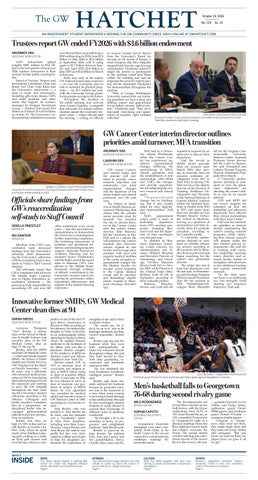
KRIS PARK | ASSISTANT PHOTO EDITOR Board of Trustees’ Finance and Investments Committee Chair and Board Vice Chair Todd Klein speaks during Friday’s meeting.
GW Cancer Center interim director outlines priorities amid turnover, MFA transition ARUNMOY DAS
ASSISTANT NEWS EDITOR
LAKSHMI DEV
ASSISTANT NEWS EDITOR
ARWEN CLEMENS | STAFF PHOTOGRAPHER Associate Provost for Academic Planning and Assessment Karen Froslid-Jones at a Faculty Senate meeting in 2024.
Officials share findings from GW’s reaccreditation self-study to Staff Council GISELLA PRIESTLEY REPORTER
MO DAMTEW REPORTER
Members from GW’s reaccreditation team discussed findings from the University’s self-study draft demonstrating the University’s adherence with its accrediting body’s standards at Friday’s Staff Council meeting. The self-study found that GW is compliant with all seven the Middle States Commission on Higher Education‘s accreditation standards — the governing body responsible for accrediting GW and over 500
other institutions every seven years — but also provided recommendations to demonstrate the University’s commitment to further improving compliance, like bolstering assessments of academic and operational initiatives and investing in faculty support. Associate Provost for Academic Planning and Assessment Karen Froslid-Jones told the Staff Council the report aims to illustrate GW’s compliance to the Middle States’ standards through evidence of officials’ commitment to the University’s mission and to improving its governance, ethics, educational effectiveness and support of the student learning experience.
GW Cancer Center’s new interim leader said the practice will continue to provide cancer research, education and community care amid organizational changes and the departure of top senior leaders and clinical professors over the past year. The School of Medicine & Health Sciences announced Wednesday that Alison Hall, the school’s senior associate dean for research, has assumed the role of interim director of the Cancer Center after the center’s former director, Julie Bauman, left the University in July. Hall said in a release she will prioritize the center’s research into discovery science, expand its core faculty and leverage partnerships with local and regional medical facilities as the center navigates organizational changes like the Medical Faculty Associates’ recent transition to the Capital Medical Group and its oncology and hematology departments’ transfer to Maryland Oncology Hematology.
Hall said in a University release Wednesday while the Cancer Center has experienced significant organizational changes following the restructuring of MFA’s clinical operations and the establishment of new partnerships with MOH and CMG, the changes also provide opportunities for enhancing the center’s research and clinical goals. “Orga n i zat ional change can be challenging, but it also creates space for new, high-impact opportunities,” Hall said. Hall’s appointment comes amid a series of leadership departures from GW’s oncology programs, including Bauman’s exit and the departure of four oncologists over the past year. In addition to Bauman’s departure, Associate Center Director for Administration and Finance Michael Benedict and Executive Director of Hematology and Oncology Division Maureen Bowers both left in October 2025, while Director of the Clinical Trials Office Richard Lush III left in September, according to their LinkedIn profiles. Bauman, Benedict, Bowers and Lush did not
respond to requests for an interview to discuss their departures. Hall has served as SMHS’ senior associate dean for research since March 2024, after serving as associate dean for research workforce development from 2017 to 2024. Prior to joining GW, Hall served as the deputy director of the Division of Training, Workforce Development and Diversity at the National Institute of General Medical Sciences within the National Institutes of Health from 2013 to 2017, and spent more than two decades at Case Western Reserve University School of Medicine, serving as a professor of neuroscience and later associate dean for graduate education, according to her LinkedIn profile. A University spokesperson declined to comment on whether officials are actively searching to fill vacancies left by Benedict, Bowers and Lush and began searching for the center’s new permanent director. The center also lost at least four physicians over the last year, as Hematology and Oncology Program Director Samah Nassereddine left her position in 2025, Hematologist-Oncologist Meric Mericliler
left for the Virginia Commonwealth University Medical Center, Assistant Professor Karan Jatwani left the center in September and Transplant and Cellular Therapy Program Director Amarendra Neppalli left in March. A University spokesperson declined to comment on how the physicians’ departures are affecting the center’s ability to care for its current patients. UHS and MOH did not return requests for comment on how the leadership and physician departures have affected their clinical partnerships with the Cancer Center. Hall said her immediate priorities as director include maintaining the center’s existing research programs while clarifying how clinical research will operate under the new medical practice arrangements. She said she is working with executive leadership, associate center directors and research facility leaders to strengthen infrastructure, secure additional funding and expand community outreach. “In the short term, our focus is on stabilizing our core strengths while charting our long-term trajectory,” Hall said.
Innovative former SMHS, GW Medical Center dean dies at 94 SARAH GROSS
ASSISTANT NEWS EDITOR
Lawrence Thompson “Tom” Bowles, a former dean of the School of Medicine & Health Sciences and executive dean of the GW Medical Center, died on Sept. 15. He was 94. Bowles, who led SMHS and later GW Medical Center — which previously housed SMHS, the School of Public Health and Health Services, GW Hospital and the Medical Faculty Associates — for 16 years, was a physician who advanced medical education at GW by introducing international perspectives to the classroom and working to grow the GW Hospital throughout his time leading the University’s medical enterprise, according to his obituary. Colleagues and family members remember him as a progressive, yet disciplined leader who encouraged patient-centered education and new perspectives on medicine. Bowles was born on Sept. 23, 1931, to Ray and Lucille Bowles in Garden City, New York, where he spent much of his childhood playing golf, working as a caddy on local golf courses and even having a stint as a com-
WHAT’S
INSIDE
petitor on one of the first TV quiz shows, Americana, in the fall of 1948, according to his obituary. He studied philosophy at Duke University as an undergraduate before attending its medical school, where he studied thoracic medicine in the footsteps of his father, who was also a physician. Bowles completed his residency at Bellevue Medical Center and Triboro Hospital in New York City. Bowles joined GW in 1973 as associate dean of curriculum and student affairs at SMHS, before rising to dean of academic affairs in 1975. A year later, in 1976, he was selected to serve as dean of medicine and professor of surgery at SMHS before he was appointed vice president for medical affairs and executive dean of GW Medical Center in 1988, according to a University release. Judy Bowles, who was married to Tom Bowles for 61 years, said her husband was a “wonderful” father to their three daughters, including actor Julia LouisDreyfus, Lauren Bowles and Amy Reyer. She said he was gentle but also very principled as a father and sought to help his daughters understand the importance of
NEWS D.C. Mayor Muriel Bowser is seeking $60 million for Cedar Hill Regional Medical Center GW Health amid financial losses. Page 2
discipline in life and in their academic studies. “He would say, ‘do it, do it, be up to it,’ and so he had high standards, but they weren’t impossible,” Bowles said. Bowles said she met her husband while they were both undergraduates at Duke and remained friends throughout college. She said they both moved to New York after graduating, reconnected and ultimately married in 1965. “He was absolutely the most handsome, wonderful, intelligent person,” Bowles said. Bowles said many students admired her husband because he promoted women’s role in the classroom at a time when many women were trying to break through in the medical field. She said he also encouraged medical students to study abroad to expand their knowledge of different types of medicine worldwide. “He brought a lot to his deanship in terms of progressive and enlightened medicine,” Judy Bowles said. Bowles is survived by Judy Bowles, his children Julia, Amy and Lauren, and five grandchildren, Henry, Charlie, Elias, Grace and Fia.
LEXI CRITCHETT | ASSISTANT PHOTO EDITOR Freshman guard Promis N’Landu shoots during Friday’s game against Georgetown University.
Men’s basketball falls to Georgetown 76-68 during second rivalry game MILO ROSENZWEIG SPORTS EDITOR
SOPHIA CAPUTO
CONTRIBUTING SPORTS EDITOR
Georgetown University triumphed over men’s basketball 76-68 Friday at the Smith Center in the second consecutive season-opening exhibition matchup between the teams.
OPINIONS The Editorial Board urges students and GW officials to speak up about the culture of sexual violence on college campuses. Page 5
The Revolutionaries led for just three minutes across both halves, with the Hoyas outshooting them 41.7% to 30% from beyond the arc, as GW committed 13 turnovers to Georgetown’s eight in a physical matchup where the Revs tightened narrow leads but couldn’t overcome the Hoyas. The second annual October matchup also introduced several of the newest Revs to the crowd, with four
CULTURE Meet the father-daughter, GW alum duo serving up sweet stroopwafels in downtown Georgetown. Page 6
— graduate forwards Lovro Urbiha and Dylan James, sophomore guard Omari Witherspoon and freshman guard Promis N’Landu — scoring in double figures. “Congrats to Georgetown, they went out there, they made tough shots and they came out on top,” James said postgame. “But you know, we went out there, we played hard, we gave it all we got.”
SPORTS Women’s basketball defeated Towson University 72-69 in their only exhibition match of the season on Sunday. Page 7
NEWS
October 19, 2026 • Page 2
NEWS CRIME LOG LIQUOR LAW VIOLATION Somers Hall 10/3/2026 – 12:19 a.m. Closed Case
THIS WEEK’S
EVENTS
THE GW HATCHET
ELECTION SECURITY Friday, Oct. 23 | 1 p.m. | School of Media & Public Affairs Attend an expert discussion about election security ahead of the midterm elections.
THIS WEEK IN HISTORY Oct. 21, 1996
UNITED STATES AND TAIWAN RELATIONS Tuesday, Oct. 20 | 12:45 p.m. | Elliott School of International Affairs Join an expert for a talk about the relationship between Taiwan and the United States.
Officials announce goals for the Mount Vernon College shortly after acquiring the school.
Bowser seeks $60 million to sustain Cedar Hill maternity services amid hospital’s financial losses LAKSHMI DEV
ASSISTANT NEWS EDITOR
Case closed. Referred to Conflict Education & Student Accountability.
LIQUOR LAW VIOLATION Fulbright Hall 10/3/2026 – 2:35 a.m. Closed Case
Case closed. Referred to CESA.
PUBLIC DRUNKENNESS
Public Property on Campus (1900 Block of F Street) 10/4/2026 – 2:38 a.m. Closed Case
Case closed. Referred to CESA.
LIQUOR LAW VIOLATION Potomac House 10/4/2026 – 2:57 a.m. Closed Case
Case closed. Referred to CESA.
LIQUOR LAW VIOLATION Madison Hall 10/4/2026 – 4:30 a.m. Closed Case
Case closed. Referred to CESA.
ASSAULT WITH A DANGEROUS WEAPON
Tonic at Quigley’s Bar and Restaurant 10/4/2026 – 5:24 p.m. Closed Case
Case closed. Referred to Metropolitan Police Department.
LIQUOR LAW VIOLATION Thurston Hall 10/6/2026 – 12:09 a.m. Closed Case
Case closed. Referred to CESA.
THEFT II/FROM BUILDING Elliott School of International Affairs 10/8/2026 – Unknown Closed Case
Case closed. No further action.
—Compiled by Isaac Harte
Mayor Muriel Bowser is seeking $60 million in additional D.C. government funding for Cedar Hill Regional Medical Center GW Health as the hospital faces mounting financial losses. Bowser requested up to $10 million annually for the Ward 8 hospital for six years to sustain its labor and delivery unit in an Oct. 6 letter to D.C. Council Chairman Phil Mendelson and At-Large Councilmember Christina Henderson. First reported by the Washington Sun, the request to aid the hospital comes as Cedar Hill — which opened in April 2025 and is operated by Universal Health Services in partnership with GW Hospital — has struggled over staffing shortages, patient safety concerns and questions over its ability to provide care to historically underserved communities east of the Anacostia River. “A critical aspect of Cedar Hill’s operations, and an important factor in addressing these disparities, is providing labor and delivery services and building a strong maternal and newborn health system for Wards 7 and 8,” Bowser wrote in the letter. Bowser wrote in the letter that Cedar Hill’s labor and delivery unit lost $8.6 million in 2025 and is projected to lose another $11.5 million in 2026. She attributed the losses partly to declining birth rates across D.C. and competition in maternal health from other hospitals, which have complicated efforts to attract patients to the facility. Cedar Hill’s opening restored hospital-based labor and delivery services east of the Anacostia River for the first time in eight years after United Medical
RAFAEL TOROK | PHOTOGRAPHER Protesters, including GW students, conclude the No Kings protest at the Supreme Court Saturday.
ARWEN CLEMANS | STAFF PHOTOGRAPHER D.C. Mayor Muriel Bowser at the Cedar Hill Regional Medical Center GW Health opening in April 2025.
Center temporarily then permanently closed its obstetrics unit in 2017 amid patient safety concerns including failures to properly treat pregnant patients and newborns. From January through July, Cedar Hill recorded 86 newborn admissions, representing 1.6 percent of all newborn admissions in D.C., according to D.C. Hospital Association data. In the letter, Bowser said the hospital’s labor and delivery services are essential to improving maternal and infant health outcomes in Wards 7 and 8, which have majority Black residents and have historically faced disparities in access to medical care. “This investment in maternal and newborn health will allow Cedar Hill to have the fiscal stability needed to withstand the financial and workforce pressures that are forcing closures elsewhere in the region and around the country,” Bowser wrote.
Cedar Hill opened in April 2025 as D.C.’s first new full-service hospital in more than 25 years, costing $434 million to construct as it replaced United Medical Center and expanded access to emergency, maternal and specialty care east of the Anacostia River. The proposed funding would add to the District’s existing financial commitments to Cedar Hill. Under its original hospital operations agreement with UHS signed September 2020, the District is committed to depositing $5 million annually for five fiscal years into a fund that can be used to cover qualifying hospital operating deficits — shortfalls that occur when the hospital’s operating expenses exceed its revenue and meet the agreement’s requirements for financial assistance. Bowser’s additional $60 million proposal would require D.C. Council approval, and she said her administration plans to submit requests to redirect
existing District funds and approve the necessary contracts in the coming weeks. Bowser said in the letter the proposed financial commitment from the District will not simply be a “blank check,” citing efforts to reduce operating expenses and improve the hospital’s financial stability. “The hospital has restructured its relationships with providers, settled issues with George Washington Medical Faculty Associates, and rightsized its operating costs,” Bowser wrote. Bowser also said Unity Health Care — a nonprofit health care provider operating community clinics across D.C. — had agreed to assume responsibility for Cedar Hill’s labor and delivery unit. The arrangement would aim to connect patients receiving prenatal care at clinics in Wards 7 and 8 with maternity services at Cedar Hill, potentially increasing the hospital’s delivery volume.
AINSLEY SULLIVAN | STAFF PHOTOGRAPHER GW Swing Left President Elyse Reznik speaks into a microphone at a gathering of demonstrators at Anniversary Park Saturday.
Students march in ‘No Kings’ protest, urging community to vote in midterms DIYA JHAWAR
CONTRIBUTING NEWS EDITOR
More than 150 protesters marched from campus to the Supreme Court Saturday in a “No Kings” demonstration to promote voter turnout ahead of the upcoming midterm elections and oppose President Donald Trump’s policies, including his attempts to limit mail-in voting. Five student groups — American Civil Liberties Union at GW, GW College Democrats, GW Democracy Matters, Swing Left GW and J Street U at GW — organized the rally, beginning at Anniversary Park on F Street at 1:30 p.m. before demonstrators passed the White House and U.S. Capitol on the way to the Supreme Court as part of a march calling for political accountability from all branches of government. Protesters decried the Trump administration’s immigration and international relations policies, calling for protections for immigrants and limits on executive power on a “No Kings” nationwide day of action, centered around the theme “Vote Early,” ahead of the midterm elections on Nov. 3. The nationwide demonstra-
tions mark the fourth round of “No Kings” protests, earlier versions of which chiefly criticized Trump’s immigration enforcement policies, military actions abroad and concentration of executive power. The over 3,000 nationwide demonstrations on Saturday — of which GW was a part of — shifted attention toward promoting early voting and election protection ahead of the midterm elections, with GW organizers urging eligible voters to make a plan to cast their ballots. The GW demonstration was separate from other No Kings rallies held across D.C. and drew a smaller crowd than previous protests, including a rally near the Capitol that drew hundreds of thousands of people in October 2025 and a GW protest that drew hundreds of students in March 2026. Although Saturday’s demonstration emphasized early voting ahead of the midterm elections, speakers and demonstrators also strongly criticized Trump’s immigration policies and use of executive power. Approximately 75 demonstrators gathered at Anniversary Park at 1:30 p.m., carrying signs reading “No Kings Since 1776,” “Hands
Off Our Vote” and “Love Not Hate Makes America Great,” as well as American flags. Elyse Reznik, the president of Swing Left GW, kicked off the event by encouraging attendees to continue organizing in the days leading up to the midterm elections and urging them to vote early, participate in phone banks, write letters to politicians and canvas the community. “There are 17 days until November 3. So let’s continue this momentum and make them count,” Reznik said. Eric Gitson, president of College Democrats, said he feels a sense of “hopelessness” as he sees how Trump has “brazenly disregarded” the values of the country, and Congress and the Supreme Court have enabled his actions by not utilizing their checks and balances powers. He urged the crowd to continue to take action and protest without fear, showing those in power that millions of Americans are “really pissed off” at the Trump administrations decisions and encouraging government officials to oppose the the Trump administration’s decisions. “It starts in the hearts of ev-
ery single American who has the courage to stand up for the things that they believe in, speak truth to power, and confront the existential threats we face as a country without fear,” Gitson said. Emma Sherman, co-president of GW’s ACLU chapter, said to the crowd the march symbolized more than opposition to the Trump administration and was meant to encourage political involvement and voting early in the midterm elections, allowing individuals to influence congressional decisions. The elections come as Democrats seek to regain control of Congress as Trump’s approval ratings continue to decline, while Republicans are aiming to maintain their majorities in both chambers. She criticized the presence of National Guard troops near ballot boxes, including troops stationed near the ballot box outside the Foggy Bottom-GWU Metro station, saying their presence could intimidate voters and undermine access to the ballot. “We cannot allow for this intimidation of voters, and we cannot allow fear to silence the people, and we cannot sit back and watch our democracy feed the right,”
Sherman said. “We must protect our elections and protect every voter’s right to be heard and to have a say.” The comments followed videos circulating on social media last week showing National Guard troops standing near a ballot drop box outside the Foggy BottomGWU Metro station ahead of the start of mail-in voting in D.C.’s 2026 local elections. The D.C. Board of Elections asked the National Guard to limit troops’ presence near ballot boxes and other voting locations, but National Guard officials said the troops were part of a larger patrol that had paused near the box and were not assigned to guard it. After approximately 15 minutes of speeches at Anniversary Park, the group, which had grown to over 120 protesters, marched to the White House led by a handful of Metropolitan Police Department cruisers, with several trailing behind and others assisting in enforcing rolling road closures. While marching, the group chanted, “No kings, no throne,” “Hey hey, ho ho, Donald Trump has got to go” and “No kings, no tyrants, the people won’t be silent.”
NEWS
October 19, 2026 • Page 3
THE GW HATCHET
GSEHD’s restructuring could pave way for improved decision-making: experts CAELA KUSHNER REPORTER
ISAAC SCHIEMER REPORTER
The Graduate School of Education and Human Development’s reorganization could help streamline officials’ decision-making processes, improve operational efficiencies and build toward a more sustainable future for the school, experts say. After GSEHD officials announced at a September faculty meeting that the school would eliminate its five-department structure and adopt a “faculty-of-thewhole” model by fall 2027 as part of its “right-sizing” efforts, spurred by years of financial, operational and enrollment constraints, experts in higher education said GSEHD’s move could reduce operational redundancies, speed up communication and grow collaboration efforts to improve the school’s programs. Experts warn, though, that the success of the school’s programs and efforts to boost enrollment depends on officials ensuring they adequately support and provide faculty resources under the new model. University spokesperson Nadia Payne confirmed last month the move to shift
away from GSEHD’s five departments and transition to a departmentless model. She added there will be no “major changes” to current academic program structures, although faculty members told The Hatchet in September that GSEHD eliminated three programs in the special education and disability studies department as part of the school’s “right-sizing” with plans to eliminate a fourth, and University Bulletin web archives showed three additional program eliminations in other departments. GSEHD’s overhaul began in June 2025 when former Provost Chris first announced that officials would begin implementing initiatives to address the school’s declining enrollment, including consolidating classes, cutting programs and laying off faculty and staff as part of the process. GSEHD’s enrollment declined 29 percent between 2020 and 2024, from 1,341 to 958 students, and declined from 836 to 753 students from 2025 to 2026, according to enrollment data. Scott Dolan, the executive dean of the college of liberal arts at Excelsior University with experience overseeing academic affairs and administrative operations, said he sees “exciting”
benefits of the faculty-ofthe-whole model, like centralizing decision-making about budgets and program courses, which he said could increase coordination and interdisciplinary learning. Todd Campbell, department chair of curriculum and instruction at the University of Connecticut’s Neag School of Education, said that although interdisciplinary collaboration may increase under a departmentless model by bridging departmental divides, officials need to ensure GSEHD’s new structure carries over the disciplinary expertise and research hubs that existed under the departmental model. Campbell said GSEHD’s decision to restructure could provide cost savings from redundancies in leadership because there won’t be department heads but warned a reduction in department chairs that have a strong, “nuanced” knowledge of their program and research needs could cause gaps in leadership understanding of how programs work and what suits them best. “If you had five department heads, now you don’t have five department heads,” Campbell said. “You might have two or three that get a new title that’s not department head, but some
KRIS PARK | ASSISTANT PHOTO EDITOR The GW Graduate School of Education and Human Development on G Street.
other leadership role in the school, so the biggest way is for savings and financial efficiencies is just that reduction in leaders in that way.” A faculty member in GSEHD told The Hatchet in September that officials added new administrator positions as a part of the restructuring that were not previously allocated to GSEHD, but the new positions are not “major modifications” to the way GSEHD is currently run. Rafael Lorente, dean of
the University of Maryland’s Philip Merrill College of Journalism — which operates under a departmentless structure because of its small size and program offerings — said a faculty-of-thewhole model helps reduce operational constraints like slow decision-making and fosters more open communication between administration, faculty and students. Lorente said because Merrill’s enrollment is on the smaller side — a total of 456 students, while GSEHD
has 753 — the departmentless structure lets him oversee issues within the college directly instead of having department heads and other administrators report to him. Lorente said that as higher education institutions across the country face broader headwinds, like declining enrollment and financial pressures, institutions must focus on solving budgetary issues with program quality and education in mind.
Patient sues MFA, GW for allegedly charging unlawful copayments ARUNMOY DAS
ASSISTANT NEWS EDITOR
A patient sued the Medical Faculty Associates and GW this month, alleging the practice unlawfully charged him copayments for preventive services covered by his public health insurance. In the lawsuit filed in the D.C. Superior Court on Oct. 9, Attorney Randolph Chen from Migliaccio & Rathod, LLP and Attorneys Hassan Zavareei and F. Peter Silva II from Tycko & Zavareei LLP argued the MFA unlawfully charged their client, Norman Propst, copayments for Pre-Exposure Prophylaxis shots, an HIV prevention medication the Affordable Care Act designated as a preventive service that almost all health insurance plans must cover without any patient cost-sharing, like copayments, deductibles and coinsurance. Propst and his counsel are seeking to certify the lawsuit as a class action, arguing the MFA and GW’s practice of charging copayments for services protected from cost-sharing violates the D.C. Consumer Protection Procedures Act, which prohibits goods and service providers from misleading consumers. “Defendants’ charging and collection of co-pays from Plaintiff for a Cost-Sharing-Protected Preventive Service is an unlawful, unfair and deceptive trade practice prohibited by the CPPA,” the suit states.
The suit states Propst received PrEP shots in February, April and June of this year at the GW Disease and Infection Clinic — for which the MFA charged him a $30 copayment for each shot — after a doctor at the clinic recommended he receive the medication due to an increased risk of HIV exposure. Propst, who was enrolled in a Medicare insurance plan with Aetna for his first two shots and then switched to a D.C. Medicaid plan with United HealthCare before his third shot in June. The Affordable Care Act prohibits insurance providers from imposing patients’ costsharing requirements for items and services the United States Preventive Services Task Force evaluates and rates A or B in its current recommendations—like PrEP, which the Task Force has rated A since 2023. In July, United HealthCare told him he was wrongly charged and it would refund his June 2026 copayment, according to the complaint. After learning this, Propst requested a refund for his February and April copayments, which he had paid directly to the MFA, from the MFA’s billing services department on July 28 through email, after which Support Services Specialist Shanna Kilgore confirmed the same day the MFA owed him a refund and told Propst to wait for the refund to process, according to excerpts of their email exchange
included in the complaint. The suit states Propst followed up with the MFA and GW multiple times about the status of his refund but had not been refunded as of the complaint date. The suit argues Propst suffered monetary injury due to the MFA unlawfully charging him copayments for his PrEP shots. The suit states that a disclosure from the practice that it could not legally charge him for PrEP shots before he received them would have been helpful, since he has “limited means” and depends on Social Security disability benefits as his primary source of income. Propst asked the court to certify the lawsuit as a class action on behalf of all insured patients whom a D.C. medical facility charged a copayment for receiving a cost-sharing-protected service over the past three years, according to the complaint. Propst and his counsel must establish the class — individuals on Medicaid, Medicare or private insurance whom a medical facility allegedly charged unlawful copayments within three years of the complaint— is large enough that naming all of them is impractical, all members of the class share common factual issues, Propst’s claims are typical of the class’s claims and Propst will fairly and adequately protect the class’s interests. The complaint states the lawsuit meets the requirements for a class action lawsuit since
Propst believes there are hundreds or thousands of members of the class since a 2021 study on HIV intervention in D.C. reported over 6,700 residents took PrEP. The complaint also states the MFA manages billing at GW Hospital, one of D.C. major hospitals, where a large number of residents could receive PrEP. “As defendants manage billing at one of major hospitals in the District that sees tens of thousands of patients annually, the number of class members meets the numerosity standard,” the suit states. The suit also alleges the GW and MFA have unjustly enriched themselves by unlawfully charging and retaining Propst and other patients’ copayments for preventive services protected against cost-sharing measures. “Plaintiff and the Class were injured by paying defendants money that defendants were not lawfully permitted to charge or collect, or charged and collected by deceptive means,” the suit states. The suit states Propst is suing GW in addition to the MFA because the University owned the MFA and included the practice in its consolidated financial statements when Propst received treatment at the MFA. GW and the MFA transferred the practice’s clinical operations to Capital Medical Group, a nonprofit subsidiary of Universal Health Services, in August af-
ter officials reached a deal with UHS to end the University’s financial support of the practice. The suit states Propst is seeking $1,500 per violation the MFA and GW inflicted upon its patient, or triple the monetary damages the patient experienced, whichever is greater, for himself and each patient who experienced damages because the MFA charged them copayments unlawfully. Propst is also seeking to stop the MFA from charging copayments for costsharing-protected preventive services, which the complaint says is against the law. Propst previously launched a class action lawsuit against his housing provider, Brookfield Properties Multifamily, LLC, in December 2024, alleging the company illegally charged him and other tenants illegal application fees, common area electric fees, trash fees and undisclosed service fees. Propst — represented by Chen, Silva and another lawyer from Tycko & Zavareei LLP, Anna Haac — settled the case with BPM on Aug. 8, with BPM agreeing to contribute to a $1.1 million settlement fund for the impacted tenants. The MFA and GW did not immediately return requests for comment on the allegations presented in the lawsuit and how they intend to respond. Chen, who signed the complaint, also did not return a request for further comment on his and his client’s position regarding the suit.
Disabled students say GW’s campus poses accessibility barriers ADELAIDE PETRAS
ASSISTANT NEWS EDITOR
Students say GW’s campus raises accessibility issues for those with physical disabilities, though many of them said the University has been receptive to their feedback and worked to resolve identified problems in a timely manner. Eight students involved with student organizations centered around disability advocacy noted accessibility concerns, with most focusing on physical features of the Foggy Bottom and Mount Vernon campuses, like buildings lacking elevators, uneven or hilly roads and difficulty accessing rooms on upper floors of residence halls during emergencies when elevator use is restricted. Most of the students said the University at large has been receptive to their feedback regarding accessibility, while others reported Disability Support Services has failed to provide sufficient housing accommodations in a timely manner in the past. University spokesperson Julia Garbitt said the University is continuously making improvements to accessibility on campus, prioritizing projects based on frequency of use and severity of the barrier to accessibility, following a comprehensive accessibil-
The International Symbol of Access on the entryway to the University Student Center Garage.
ity assessment conducted in 2021. Officials finished renovating Mitchell Hall over the summer and plan to close Strong Hall for renovations next academic year, adding elevator access to the
rooftops of both buildings, among other accessibilityfocused updates. The slate of renovations comes after students reported malfunctioning elevators in Mitchell Hall at a February 2025 town hall, where officials also said
CARSTEN HOLST | ASSISTANT PHOTO EDITOR
the residence did not comply with the Americans with Disabilities Act. Ry Bass, a sophomore and member of DSC and CHA, said they have an accommodation to live in a first or second-floor room
because they struggle to use stairs due to their Postural Orthostatic Tachycardia Syndrome, a chronic nervous system disorder, but they were assigned to a sixth-floor room as a first-year. Bass said after having
to live on the sixth floor as a first-year because officials told them it was the only room available, they were initially assigned a room on the 13th floor of District House for their sophomore year, leading them to reach out to the University and ultimately switch to a room on a lower floor. “It ultimately did get fixed,” Bass said. “But it was definitely something that left me feeling uncertain because it had happened before.” Samuel Hwang, a junior and a member of DSC, said some of GW’s older buildings pose accessibility problems, like the laundry room in Lafayette Hall being in the basement and difficult to reach compared to buildings like Thurston Hall that have laundry facilities on each floor. He said many townhouses where professors’ offices are located are also inaccessible because they often do not have elevators and require stairs to enter. Hwang said he is aware of some accessibility issues the University has resolved following student advocacy, like cracks in roads on campus that students using mobility aids could trip over. “It’s been not the best 10 out of 10,” Hwang said. “But definitely I could see GW working or trying to work with students.”
NEWS
October 19, 2026 • Page 4
THE GW HATCHET
Former members oppose elimination of SGA representatives on UWPF AMELIA NELSON
ASSISTANT NEWS EDITOR
The University-Wide Programs Fund unveiled a new structure removing Student Government Association input from allocation processes in September, which former SGA representatives oppose, saying student input provided vital insights about funding and students’ interests. The UWPF’s past student representatives said while they supported the remodeled UWPF’s clearer funding guidelines, the elimination of a joint committee — where SGA members and an SGAappointed student collaboratively made funding decisions with officials — reduces students’ ability to influence the distribution of University funds. Though past representatives said the SGA should advocate to have student seats on the UWPF reinstated, SGA President MJ Childs, who confirmed that officials told him the UWPF will no longer include SGA representatives, said he did not think the elimination of the committee would be an issue because the new structure ensures specified officials will allocate funds, making them a better fit to determine funding than SGA members. The UWPF — created in fall 2023 and previously managed by a joint committee of students, including SGA members and University officials — is a pool of
ERIKA LOPEZ-CEPERO | STAFF PHOTOGRAPHER The GW Student Government Association office located in the University Student Center.
approximately $220,000 to fund campus-wide and heritage events throughout the year. After a restructuring of the fund that officials initiated this academic year, control over allocations will be divided between two offices in
the Division for Student Affairs and the Multicultural Student Services Center, where administrators within each group will “directly” apportion funds, according to University spokesperson Nadia Payne last month.
Officials’ narrowing of funding parameters and elimination of the joint committee comes after the fund was depleted by March in both 2023 and 2026, leaving student organizations without funding for large-scale events planned for
late spring. Cheydon NaleimaileEvangelista, one of the UWPF’s SGA representatives last year, said in March he attributed the fund’s premature depletion in 2026 to unclear funding criteria and administrators’ ability to overstep student input, distributing excessive funds to certain events despite student pushback. Naleimaile-Evangelista, who also served as the finance chair last semester, said the SGA should advocate to administrators that the UWPF reestablish student representative positions to ensure students are included in decisions that may directly impact their organizations and the events they put on. “There’s no student advocating for their peers, and that’s something that I don’t agree with,” Naleimaile-Evangelista said. Last year, Naleimaile-Evangelista said he proposed the committee have an equal ratio of students to officials — a change from four administrators and three students — to give students “equal footing” when voting on allocation amounts after he noticed decisions typically went in favor of officials, although officials did not adopt the proposition. “Students are the ones that benefit from those events,” Naleimaile-Evangelista said. “So, without the student perspective, you’re not really able to understand how important the event is to the student population.”
GW researchers model how Formula 1 could reach net-zero emissions by 2030 JOHN YATSKO REPORTER
LAKSHMI DEV
ASSISTANT NEWS EDITOR
GW researchers found the motor racing organization Formula 1 would need to combine major overhauls to its operations with carbon offsets to reach its stated goal of net-zero carbon emissions by 2030. Sachi Nandurkar, a research associate in the Department of Engineering Management and System Engineering at the School of Engineering & Applied Science, and Caitlin Grady, an associate professor in the department, co-authored a study published Oct. 6 in the journal Frontiers in Climate that models different strategies for reducing Formula 1’s greenhouse gas emissions in line with the company’s goals. Nandurkar said the study and model are meant to show people that reducing carbon emissions is possible, even for massive organizations that rely heavily on fuel like Formula 1. Formula 1 — a global racing championship in which teams construct their own cars and compete in Grand Prix races across multiple continents — committed in 2019 to reaching net-zero carbon emissions by 2030, with a
minimum target of reducing by 50 percent before relying on offsets, or investments in projects intended to reduce or remove greenhouse gases elsewhere to compensate for emissions an organization continues to produce. In June 2026, Formula 1 reported it was on track to reaching its 2030 goal and that its carbon emissions had fallen 35 percent from 228,793 metric tons of carbon dioxide equivalent in 2018 to 148,805 metric tons in 2025, including reductions attributed to Sustainable Aviation Fuel certificates, which allow companies to account for emissions savings from lower-carbon aviation fuel even when it is not used on their own flights, meaning the reported decrease does not reflect only reductions from Formula 1’s own physical operations. Reaching its remaining targets will require further reductions across multiple areas of its operations, according to the study. The study displays its findings through an interactive dashboard to allow users, policymakers and Formula 1 stakeholders to explore how changes to transportation, energy use and carbon offsets could affect Formula 1’s emissions levels and evaluate which combinations of strategies could bring the organization closer
to its 2030 net-zero target. Users can adjust individual variables, including how much freight moves by rail or sea, the proportion of electricity supplied by renewable sources and how effective carbon offsets are, to compare potential outcomes rather than receive a single prediction. The researchers said they could also adapt the model to evaluate emissions-reduction strategies in other industries with complex transportation and operational demands. “We always want people to view it and play around with it, to be honest, and see how different levers, how big of a contributor they are in the entire emission process,” Nandurkar said. “And Formula 1 is just one example.” The on-track emissions from the cars themselves account for only 0.7 percent of Formula 1’s baseline emissions, which Nandurkar attributed to advances in racing-car engineering, including hybrid engines and the use of sustainable fuels. Instead, emissions from the company’s global grand prix series, operating facilities and powering race events represent larger shares of total emissions, and present the most opportunities for reductions. “They have, I think, maxed out their engineering
for the car engine and everything and they also use sustainable fuels right now for the car as well, and they have hybrid engines,” Nandurkar said. The study identifies logistics — the transportation of racing cars, equipment and other supplies between events — and business travel as major contributors to Formula 1’s emissions. The sport’s international calendar requires teams to use cargo planes, trucks and other freight transportation to transport cars, equipment and personnel between races across multiple continents in a very short time, creating substantial transportation demands. Formula 1’s original 2026 racing calendar included 24 races across 21 countries and five continents, requiring teams to repeatedly move personnel and equipment thousands of miles between events. Although Formula 1 has begun grouping some races geographically, partly to reduce transportation demands and emissions, the schedule still requires multiple long-distance intercontinental transfers. “It’s always the travel logistics and event operations as well, because not all the tracks that host the race, not all of them have a clean grid access,” Nandurkar added.
“So some countries might have tracks which are run on renewable energy, but some countries might have tracks which are powered by diesel generators.” The study suggests shifting freight methods from air transport to rail and sea, increasing the use of sustainable aviation fuel for both freight and travel purposes, expanding renewable electricity use and reducing some business travel through remote operations as methods to reduce their emissions. The study also suggests reorganizing the racing calendar to group geographically close events together as a strategy to reduce these demands, citing findings from 2024 that grouping races by region could reduce travel distances by up to 62 percent. Following the study’s publication, Nandurkar said Formula 1’s head of corporate relations, David Leslie, contacted the researchers and shared that he forwarded their work to the organization’s environmental, social and governance team. She said the organization is considering greater emphasis on the use of sustainable aviation fuel and rail and sea freight. Grady said the organization’s ability to reach net zero will also depend on how it accounts for emissions it can-
not eliminate. The study distinguishes between reducing emissions from Formula 1’s operations and purchasing carbon offsets — credits that compensate for remaining emissions through projects intended to reduce or remove greenhouse gases elsewhere. She said Formula 1 would be unable to reach net zero by 2030 through operational changes alone, even if it aggressively pursued every emissions-reduction strategy examined in the study. The researchers found that approximately 3,900 metric tons of annual emissions would remain under their most ambitious modeled combination of strategies, requiring offsets to cover the remainder. “They’re pretty clear in their reports that they also will will rely on some type of offset mechanism,” Grady said. But Grady said the effectiveness of those offsets is uncertain because different mechanisms may not deliver the same amount of emissions reductions. “The other thing that is super important is to think carefully about the types of offset mechanisms they’re going to use and to investigate the effectiveness of those mechanisms, because that’s going to be really, really important in the next few years,” Grady said.
Students form organization focused on global citizenship, cooperation DIYA JHAWAR
CONTRIBUTING NEWS EDITOR
A group of GW students established a chapter of a national student organization focused on promoting world citizenship and international cooperation through discussions on global governance, speaker events and workshops. GW World Citizen Club, currently an unofficial organization on campus, aims to encourage students to see themselves as members of a global community beyond their national identities. Members of the executive board said about 20 students have filled out a membership form for the organization, which submitted its application for official student organization status in early October and plans to connect students with policymakers and international institutions through speaker events, advocacy workshops and partnerships focused on global cooperation, pending University approval. Founder of the GW chapter and president, Kamryn Herrick, a senior majoring in international affairs, said founders of the World Citizen Club Network, a national network of university clubs with existing chapters at George Mason University and James Madison University, approached her last spring as they sought to expand the organization to campuses nationwide. Herrick said the organization aims to promote world citizenship, the idea that people belong to a global community beyond their national identities, and encourage students to consider how they can contribute to cross-border cooperation, both through international
institutions and social connections between people. Herrick said she recognizes the conflicting nature between world citizenship and nationalism, which emphasizes national identity and interests, and hopes the organization will bridge the gap between the two concepts, a value she doesn’t see represented in current GW organizations. “World citizenship is kind of a paradoxical phrase because the world is obviously universally outgoing and focusing on the planet as a whole, while citizenship usually focuses on restricted rights and duties within a social structure,” Herrick said. She said the group plans to host workshops exploring world citizenship and advocacy on international issues like human rights and nuclear nonproliferation, speaker events featuring policymakers and activities like writing policy briefs. “We want to encourage students to see themselves not only as members of individual nations or communities, but as members of a broader global community,” Herrick said. She said the organization is partnering with three D.C. organizations, including the Citizens for Global Solutions, a non-profit organization advocating for global cooperation, the World Service Authority, a non-profit that promotes world citizenship, and Young World Federalists, a youth movement supporting world federalism. Herrick said the club’s location in D.C. could help members gain professional experience in advocacy and connect with people
working on global issues. She said the club hopes to collaborate with other World Citizen Club chapters at GMU and JMU, and eventually expand opportunities for crosscampus cooperation. “Having a club that advocates for global cooperation in a place where policy is made gives us a stronger voice on these issues, and more advocacy experience than most university students,” Herrick said. Deren Eksinar, a sophomore majoring in political science and international affairs and the vice president of WCC, said his experience transporting medical equipment between Turkey, his home country, and Syria, for humanitarian work over the summer shaped his interest in international cooperation and inspired him to help make the world more interconnected, a goal he hopes to progress through his work in WCC. Eksinar said WCC aims to help students understand how international institutions, like the United Nations, serve to strengthen cooperation between countries. He said the group is considering organizing a visit to the UN headquarters in New York City in the spring to experience global governance in action and learn about UN reform efforts. Eksinar said their three partner organizations have offered to cover a large portion of the trip’s expenses, though official plans are still being developed. Charlotte Keyser, a sophomore majoring in peace studies and the event coordinator of WCC, said she hopes the organization will foster thoughtful disagreement
KRIS PARK | ASSISTANT PHOTO EDITOR GW World Citizen Club founder and President Kamryn Herrick and Vice President Deren Eksinar pose for a portrait in Phillips Hall.
among members and encourage students to discuss their perspectives on global issues to find common ground. “I think that is so important in today’s world where we can’t really have thoughtful disagreements anymore and I think international cooperation and disagreement is one of the reasons I joined this club,” Keyser said. Keyser said the group hopes to host a world culture night in Kogan Plaza in the spring, where cultural organizations could showcase their food, music and traditions. She said the event would provide students with opportunities to learn about cultures they may be less familiar with and build connections across campus. Keyser acknowledged the similarities between the proposed event and the Student Government As-
sociation’s Day for the Nations — an event which brings together 50 cultural organizations for tabling and performances — and said she wants world culture night to be an additional opportunity for students to explore culture. She said the organization’s speaker events will focus on policymakers’ personal experiences and how they have approached global issues in their work, rather than solely on specific policy concepts to provide real world examples of global governance and better engage members. “I think personal connection is a great way to inform people of what is happening in our world and what and how to connect issues across borders, while listening to people who have experienced firsthand problems,” Keyser said.
THE GW HATCHET
OPINIONS
October 19, 2026 • Page 5
OPINIONS
WHAT THE UNIVERSITY WON’T TALK ABOUT THIS WEEK
How physician and leadership turnover at the GW Cancer Center is affecting its ability to care for its current patients. p.1
GW should position itself as a leader in sexual assault prevention STAFF EDITORIAL The past few weeks have seen the conversation surrounding the culture of sexual violence and harassment on college campuses brought to the forefront of national attention following the reopening of a gang rape investigation at Cornell University. In the weeks since an anonymous student at Cornell, dubbed “Jane Doe” filed a civil lawsuit against seven members of the Chi Phi fraternity who she claims gang raped her while she was intoxicated in 2024, we have seen nationwide student protests, national news coverage and a reignited conversation about why these types of stories are so prevalent on college campuses. It seems that every college student across the country either knows someone who has been the victim of sexual assault, or is a victim themselves. GW is no exception. We have seen that in the last few years, there has been an increase in criminal reports of rape at GW, and this is congruent with national trends that show that sexual violence has been on an upward trend. We, as an editorial board, believe that as the Cornell investigation continues to dominate national news headlines and the nation takes a moment to reflect on how campus culture facilitates and often accepts sexual violence, GW should too. We urge students, staff, faculty and officials to first, acknowledge that we could be doing more to address and prevent sexual violence on our campus, and then seriously evaluate strategies we can all implement to remedy it. Our community positions itself as global leaders and as change makers, but being a leader is not exclusive to academia or politics; it includes speaking out. If we ever hope to be the kind of institution that creates change or influ-
ences other universities, then we need to remember that it extends to campus culture and the safety of our students. During this time, let us think about how GW can do its part to create more awareness and safety on campus. It is not just Cornell Un iversit y that has a problem — the prevalence of rape culture on college campuses nationwide has been well doc u mented. The first few months of college are often referred to as the “Red Zone” for students, where they experience the highest risks of sexual assault. A 2019 survey from the Association of American Universities found that more than one in four undergraduate women have experienced a form of sexual assault. That same survey found that about 7 percent of undergraduate men had experienced it and about 23 percent of undergraduate students who identified as transgender or nonbinary experienced a form of sexual assault as well. GW, in 2025, criminal reports of rape were up 35 percent, and in the 2024-2025 reporting period the Title IX office received 352 complaints of sexual harassment, 114 complaints of sexual assault, 97 complaints of stalking and 26 reports of domestic violence, all of which marked the highest number of complaints the office had seen since it began publicly releasing data in 2022. GW’s 2024 annual Sexual Har-
assment Climate Survey paints an even grimmer picture. In that survey, 28.5 percent of students said they either strongly agree or agree with the statement “I think sexual harassment is a problem at GW.” Perhaps more concerning is
If GW seeks to lead national conversations on political polarization, the state of democracy and the future of higher education, why then can officials not aim to lead the national conversation on sexual assault prevention?
the bureaucratic nature of the Title IX reporting process itself. The vast majority of Title IX reports do not result in a resolution, with 30 percent of cases in the 2024-2025 reporting period being resolved through supportive measures only, 33 percent resulting in the complainant not responding to initial outreach from the Title IX office and 21 percent resulting in students requesting no further action in the case. . While the University has claimed that increased reports do not necessarily reflect a rise in sexual assault incidents on campus, but rather increased awareness leading to more reporting, it is clear that the burden placed on victims to participate in live hearings and evidence gathering procedures discourage students from seeing their cases through, leading to a broad lack of accountability for perpetrators of sexual violence on our campus. This is an issue that demands
Following the Cornell case, Title IX services at GW are here to support
A
fter nearly 20 years of responding to reports involving violence and sexual violence through my roles as a student intern with criminal defense organizations, a prosecutor, a victims’ rights attorney and now a university Title IX Coordinator, I remain deeply concerned by the accounts of sexual violence emerging from Cornell University and always consider the impact that these situations can have on those involved. I entered this work because I care deeply about helping people navigate resolution processes during some of the most difficult periods of their lives. One thing that I have learned along the way is that when community members are offered clear guidance and access to meaningful support, it can make a profound difference in creating pathways to healing.
Asha Reynolds Guest Contributor These values shape the work of my colleagues in the Office of Equal Opportunity and across GW. Our staff brings backgrounds in advocacy, public health, law, student support and social work, united by a common purpose: to listen, explain options and respond to our community with care and respect. At this moment, it is important to reaffirm that GW stands firmly against sexual violence, and we are committed to supporting community members who
Hatchet
have experienced harassment and discrimination, including sexual harassment, sexual assault, dating and domestic violence and stalking. When incidents occur, our goal is to ensure community members understand their options and have access to resources. That commitment does not change in response to shifting federal regulations under different presidential administrations. OEO is here to provide individualized support to anyone impacted by harassment or discrimination. OEO assigns a Response Associate to each party to coordinate supportive measures including academic adjustments, a mutual no contact order, referrals to counseling and other support depending on need, regardless of whether the parties engage in a formal process. OEO prioritizes dignity, respect and fairness for all. OEO works closely with campus partners across the University to provide holistic support to those impacted by sexual misconduct. One important partner is the Office of Advocacy and Support, which provides confidential, trauma-informed and healing-centered support. OAS advocates offer ongoing emotional support, safety planning, accompaniments, academic and logistical support and connections to on- and off-campus resources. Community members may also report incidents to the GW Police Department or local law enforcement, including the Metropolitan Police Department. OEO can
help individuals understand their options and navigate the reporting process. Criminal and Title IX processes are separate, and community members may choose either or both. GWPD responds to immediate safety concerns but always connects individuals reporting sexual assault to the MPD Sexual Assault Unit. Our work also extends beyond response. OEO’s prevention staff hosts workshops and collaborates with student groups and University partners to build a culture grounded in consent, accountability and safety. A primary pillar of OEO’s prevention work is the Title IX peer advisor program, that the office created in 2025 in collaboration with the Student Government Association. I encourage all GW students to take an active role in sexual violence awareness and prevention on campus. One way to get involved is to apply for the Title IX peer advisor program to learn more about campus resources, provide peer-topeer support to those impacted by sexual violence and promote awareness through campus outreach and training (applications are now open). You can also get involved by joining student organizations like It’s On Us or Students Against Sexual Assault. Together, we can foster a safer, more supportive campus community where everyone plays a role in prevention, education and advocacy. —Asha Reynolds is the associate vice president of Equal Opportunity.
eic@gwhatchet.com news@gwhatchet.com opinions@gwhatchet.com photo@gwhatchet.com sports@gwhatchet.com culture@gwhatchet.com copy@gwhatchet.com multimedia@gwhatchet.com
IX Office’s website about all the resources available to students. Never do these responses come from a place of empathy and rarely do they provide concrete strategies for how to actively reduce sexual violence on campus or even acknowledge that rising reports should be a concern. During times like these, it also helps to hear from our top officials. The fact that we have not seen University President Ellen Granberg put out a public statement. While sexual assault is a national problem, does GW not always market itself as being a national leader? If GW seeks to lead national conversations on political polarization, the state of democracy and the future of higher education, why then can officials not aim to lead the national conversation on sexual assault prevention? We simply need officials to do more, whether that be through more consistent campuswide communications, providing increased spaces for dialogue surrounding these topics, more consistent mandated trainings or more targeted student outreach to ensure the student body is adequately informed about Title IX procedures. It can be easy to forget, as a community, that these matters have to be approached with humanity and not surgically. It requires us to think deeply and empathetically about sexual assault and what we can all do to put a stop to it. The responsibility does not just fall on GW but on the entire community. We all benefit from a safer and more aware GW. Right now, we should be taking the opportunity to contemplate what GW can learn from what is happening at other campuses and ensure that our University is heading in the right direction.
The SGA must focus its advocacy on addressing student priorities
G
W has a reputation for being filled with the most career-obsessed students, which is a symptom of a deep fear permeating the student body regarding our futures. This laser focus on securing the best possible career opportunities can typically make students a little tunnel-visioned, leading them to solely focus on how their contributions to the GW community may benefit their futures. Members of the Student Government Association should represent the group of students who are invested in the University and its community, rather than those who view serving in student government primarily as a resume booster or stepping stone to a career in politics. The SGA’s legitimacy should come from serving the student body, not from the credentials its members acquire or the professional development they receive. Currently, the SGA has demonstrated a focus on more public-facing efforts and has failed to properly analyze its place in the GW community, resulting in misguided attempts at “change.”
Soha Shah Opinions Writer Coming to GW as a first-year, I had hoped that GW students who sought student government positions would be genuinely interested in using their proximity
to power to enact shifts in University policy. However, my experience in my first few months at GW is that SGA primarily seeks to demonstrate its supposed commitment to students through superficial public-facing efforts like Instagram statements, while failing to understand what the student body actually wants. If the SGA must rely on infographics and Instagram statements, why not instead use its platform to direct the student body to the perpetrator of their financial concerns, the University, and attempt to mobilize the student body? The SGA should be asking students to help them apply pressure to the administration, calling out officials more for their inaction or lack of communication. When GW had lost their 24/7 access to Gelman Library, both students and the SGA came together to bring it back to the cuts to our financial aid packages or tuition increases. I recognize that the SGA has limited power, but they are able to apply pressure on the University and attempt to mobilize the student body. The SGA membership reflects the subset of GW students confident and willing enough to participate in student politics, rather than the full range of student experiences — just as there are no senators for certain schools, specifically in graduate schools, because no student ran for those seats. The natural bias in
representation toward those more motivated toward leadership roles means that SGA members should deeply consider the discrepancies between their perspectives and those of the general student body. Though it could be argued that students themselves need to engage more with the SGA, I would argue that the reason we students are disengaged with the SGA in the first place is that it doesn’t represent the subset of the student body that seeks to confront GW rather than be a cog in its machine. At last year’s SGA election, The Hatchet’s editorial board specifically chose to endorse MJ Childs, who was an SGA outsider, because they believed he would better serve the community and understand student perspectives more clearly than long-time SGA member Liz Stoddard. MJ wound up winning the election, showcasing that GW students feel the need to be represented by members who aren’t so SGA-focused and are more connected to the student body. The SGA is uniquely positioned to call out the University and pressure them for what students need. The primary purpose of the SGA is to advocate for the student body, and it can still do that institutionally independently. Students can advocate for themselves from the outside and motivate students to do so too. —Soha Shah, a first year majoring in political science, is an opinions writer.
Jenna Lee, editor in chief
The GW
609 21st St. NW Washington, D.C. 20052 gwhatchet.com | @gwhatchet
student attention. In order to dismantle a culture that is entrenched in universities nationally, every student needs to be cognizant. Students need to get comfortable with having uncomfortable conversations with their friends and partners about consent and call out unsettling behavior when they see it. The first step to dismantling rape culture is ack nowledging that it exists, even at GW. As much as meaningful change starts with the students themselves, GW officials must also make preventing sexual assault an institutional priority. It wouldn’t be difficult for GW to expand Title IX trainings to happen every year as a reminder for students or ensure that student organizations and fraternities and sororities are receiving these trainings, instead of having all GW students take these trainings just once at the beginning of their college experience. We find that GW’s response to sexual harassment and assault claims are often defensive and come off as trying to protect their image. Whenever The Hatchet asks officials for comment on rising reports of rape or sexual harassment, the University response is almost always to point out that GW’s numbers reflect national trends and rising complaints may be a result of students feeling more comfortable reporting to the Title IX office and then to reiterate the same jargon listed on the Title
Molly St. Clair, managing editor Tyler Iglesias, managing editor Mollie Weiner, managing director Sachini Adikari, community relations director Gianna Jakubowski, senior news editor Ryan Saenz, senior news editor Adelaide Petras, assistant news editor Amelia Nelson, assistant news editor Arunmoy Das, assistant news editor Lakshmi Dev, assistant news editor Sarah Gross, assistant news editor Shivu Sathe, assistant news editor Diya Jhawar, contributing news editor Isaac Harte, contributing news editor Paris Albrecht, contributing news editor Andrea Mendoza-Melchor, opinions editor* Ethan Vargas, contributing opinions editor* Milo Rosenzweig, sports editor Sophia Caputo, contributing sports editor*
Ryan Jainchill, basketball editor Diana Anos, culture editor Jessica Rowe, contributing culture editor Carly Cavanaugh, contributing culture editor Mathylda Dulian, senior photo editor Carsten Holst, assistant photo editor – news Kris Park, assistant photo editor – news Lexi Critchett, assistant photo editor – sports Nicholas Ware, assistant photo editor – culture Marcel Richardson Villenas, video editor Misha Cohen, video editor Ethan Tsai, copy chief* Juwon Kim, copy editor Marlene Orantes, copy editor* Raina Pawloski, copy editor Kya Hoffman, research assistant* Louisa Hannoucene, research assistant Ida Liben, podcast host – news
Maddie Flesch, podcast host – news Aadarshini Vijesh, podcast host – culture Arjun Srinivas, podcast host – culture Livi Tuber, design editor Daniela Garcia Perez, contributing design editor Sofia Ang, graphics editor Madeleine Phillips, social media director Andrew Rooney, contributing social media director Victoria Smajlaj, contributing social media director Alex Batzar, ad sales manager Annika Krause, web developer Ryan J. Karlin, donor relations manager Arushi Agarwal, financial manager * denotes member of editorial board
Submissions — Deadlines for submissions are Friday 5 p.m. for Monday issues. They must include the author’s name, title, year in school and phone number. The GW Hatchet does not guarantee publication and reserves the right to edit all submissions for space, grammar and clarity. Submit to opinions@gwhatchet.com Policy Statement — The GW Hatchet is produced by Hatchet Publications Inc., an independent, non-profit corporation. All comments should be addressed to the Board of Directors, which has sole authority for the content of this publication. Opinions expressed in signed columns are those of the authors and do not necessarily reflect the view of The GW Hatchet. All content of The GW Hatchet is copyrighted and may not be reproduced without written authorization from the editor in chief. Cost — Single copies free. Additional copies available for purchase upon request.
THE GW HATCHET
CULTURE
October 19, 2026 • Page 6
CULTURE
THE
SCENE RELEASED
THIS WEEK:
APPLE FESTIVAL Saturday, Oct. 24 | Adams Morgan | Free
DEADSTOCK: A VINTAGE YARD SALE Saturday, Oct. 24 | Femme Fatale D.C. | Free
NEW SONG: “HOUSEWIFE” BY TATE MCRAE
Father-daughter GW alums open stroopwafel sweet shop in Georgetown JESSICA ROWE
CONTRIBUTING CULTURE EDITOR
Among the many chain stores that inhabit Georgetown’s M Street, GW alums and father-daughter duo Hans and Maaike Ravesteijn’s small business is serving up fresh batches of Dutch stroopwafels at their newly opened Dutch Darlings shop. Dutch Darlings pays homage to the Ravesteijn’s Dutch heritage, selling a wide assortment of sweet stroopwafel flavors like maple pecan, s’mores and coffee. Graduating from GW in 1979 and 2014, respectively, and living in the D.C. area ever since, Hans and Maaike said opening Dutch Darlings felt like a full circle moment, honoring their dutch heritage in the community they’ve called home for nearly 50 years. Maaike said she graduated from GW with a degree in American Studies in 2014. She said she had the initial idea for the shop in 2023 and began selling stroopwafels at the Del Ray Farmers Market in Alexandria in the summer of 2024 while finding a permanent location. She said the idea came from the lack of Dutch shops in the D.C. area and missing the stroopwafels she would buy from vendors at markets in Amsterdam when visiting her father’s home country. Finding a permanent location in early 2025 in Georgetown at 1003 Wisconsin Ave, Maaike said they spent about a year renovating the shop to accommodate for the correct baking, refrigeration and sales equipment. She said Georgetown was their top location choice for the shop because of their family’s long-standing history with the neighborhood as her father lived there after moving to the United States in 1979 from the Netherlands. Hans said he graduated from GW with his MBA in 1979 while simultaneously working at an accounting firm for small businesses. He said the desire to open Dutch Darlings stemmed
GRACE LONG | PHOTOGRAPHER Stroopwafels on display at the Dutch Darlings shop in Georgetown.
from wanting to bring a taste of his Dutch heritage to the D.C. food scene, introducing new options and working alongside his daughter. Hans said working with his daughter has been one of the most rewarding experiences as she took the lead on creating the menu and
developing the shop’s brand. He said after graduating from both Georgetown and GW and living in the D.C. area, opening a shop has allowed them to become more involved in the community where he has spent so much time. Hans said with the shop being
GRACE LONG | PHOTOGRAPHER GW Class of 2014 alum Maaike Ravesteijn poses for a portrait at Dutch Darlings on Friday.
just off of Georgetown’s main road, M Street, Dutch Darling’s foot traffic and sales have been promising, and he believes in the treat’s established popularity in the Netherlands, hoping to bring the acclaim for stroopwafels to the District. “I mean Georgetown is a prime
location for this type of business, because it’s got a lot of foot traffic, but I also feel like on a personal level, it’s sort of like coming full circle,” Hans Ravesteijn said. “I started here in Georgetown, and it’s kind of fun to actually own a place in this area now.”
In Tompkins Hall’s basement, GW’s makers, menders house their creativity DIANA ANOS
CULTURE EDITOR
COURTESY OF KATELYNNE RAY Katelynne Ray works in the Corcoran School of Art’s screen printing studio.
Students showcase online exhibition on artist Chagall DAVID DEMAKOS REPORTER
RILEY MARTIN REPORTER
After a year of researching artworks, writing essays and building an online exhibition, GW students are preparing to share their work this week through a collection exploring artist Marc Chagall’s career. Hosted by the Luther W. Brady Art Gallery, the Hidden Treasures of Chagall in Washington D.C. exhibit allows audiences to explore the artist’s work online. The website features an interactive timeline of Chagall’s life, themed categories of artwork, including illustrations for Nikolai Gogol’s novel Dead Souls and studentwritten research on individual pieces. A symposium Tuesday will celebrate the launch of the exhibition, which brings together a year of research by 20 GW students and alumni and features 27 etchings from the GW Collection of Art, 14 of which Chagall created for a satirical novel by Russian writer Nikolai Gogol titled “Dead Souls,” as well one of Chagall’s silk scarves owned by The George Washington University Museum and The Textile Museum. Dr. Rachel Pollack, an adjunct professor of writing at GW, who curated the exhibition, said the idea grew out of an earlier project she worked on with the Brady Art Gallery, which is located in the Flagg building, called “Piranesi’s Rome: Views of the Eternal City.”
After learning that GW’s collection also held etchings by Chagall, she said she developed a university writing course entitled “Marc Chagall, An Artist in Exile,” in spring 2025 to explore the collection. Pollack said she wanted students to build on their strengths rather than simply assign them tasks, allowing them to contribute to the exhibition while gaining experience with research, curation and writing. Sandra Koretz, a master’s candidate in art history, said she helped oversee the creation of the collection accompanied by essays on individual artworks. Koretz said one of the most rewarding parts of the project was sharing what she had learned through her own studies at GW and helping students develop their understanding of art history. Tyler Lai, a sophomore studying biology who took Pollack’s university writing course in fall 2025, said Dr. Pollack invited him to contribute to the project by last spring. Lai said visitors do not need an art history background to appreciate Chagall’s work, and he encourages them to spend time looking closely at individual pieces and noticing details they might otherwise overlook. “I would say to anyone looking at a Chagall — or any other piece, for that matter — to just get lost within the artistry,” Lai said in an email. “Spend some time looking at one area, noticing all the intricacies: a paint stroke, a small figure, the effort that shows a master’s craft.”
On Friday afternoon, a handful of students gathered in the Innovation Center housed in the basement of Tompkins Hall, using heating machines and wire to refine their soldering skills at the workshop. The Innovation Center is a zerowaste student-run makerspace, free for students to craft projects for class and independently, making everything from handmade jewelry to Halloween costume pieces. Students say they appreciate the space on campus, where they are able to gather and use free resources to freely express their creativity. Ava Stewart, a senior studying interaction design, said she first went to the Innovation Center her first year to attend a lecture about artificial intelligence and quickly became “obsessed” with the space’s colorful interior and the center’s zero-waste mission. Stewart said she initially started volunteering at the center her first year and is now part of its staff. She said she feels like GW has a “defined culture,” of being business oriented, but she hopes students can
feel more comfortable embracing their individuality in spaces like the Innovation Center that serve to foster creativity. Stewart said she fits more on the arts side of the center, focusing on sewing and paper craft projects. Last year alone, she said there were about 6,000 individual signins to the space, as it gives people a space to explore ideas and projects either for classes or for their own creative purposes. She said the center hosts studentrun workshops almost every Friday, switching off between arts and engineering focused topics, from an introduction to sewing to introduction to soldering sessions. She said one of the center’s founding guidelines is human centered designing, encouraging students to think about how they can make the world better for humans through their various projects. Keya Solomon, a senior majoring in public health, works as a student assistant manager at the Innovation Center, where he teaches sewing workshops and assists in managing arts and crafts projects. He said he first started going to the center during his sophomore year, and
Students observe an Intro to Soldering workshop at the GW Innovation Center Friday.
became a volunteer, where he reorganized fabrics, formed ecobricks and helped to manage other student’s projects. Solomon said he was initially drawn to the center because he wanted to learn how to sew and craft his own garments and make smaller projects for his apartment. After learning how to sew through the resources at the center, he said he now instructs one of the introductory workshops for sewing, teaching students the basics, like threading a machine and the bobbin. Solomon said the center does one mutual aid market a semester, either in the center or at an outdoor space on campus. He said they reach out to artists on campus to sell their items, and encourage them to donate a portion of their proceeds to Ward 2 Mutual Aid, an organization that aims to support those experiencing homelessness in Ward 2. “I think that caring for the people around us and maybe individuals that we might not necessarily might first come to mind when we think of like a GW community or like the D.C. community,” he said. “It’s nice to sort of use our resources to also help them.”
KRIS PARK | ASSITANT PHOTO EDITOR
SPORTS
October 19, 2026 • Page 7
SPORTS
THE GW HATCHET
GAMES CRUNCH
vs. Fordham on Oct. 23 | 6:00 p.m.
vs. Saint Joseph’s on Oct. 20 | 2:00 p.m.
OF THE WEEK
NUMBER
VOLLEYBALL
MEN’S SOCCER
0.765
Women’s soccer sophomore goalkeeper Jasmine Black’s save percentage through 12 games played.
Women’s basketball edges past Towson 72-69 in exhibition game SOPHIA CAPUTO
CONTRIBUTING SPORTS EDITOR
Women’s basketball defeated Towson University 72-69 in the program’s first ever public exhibition match Sunday at the Smith Center. The Revolutionaries held close leads for most of the game, fueled by double-digit scoring from junior guards Alicia Newell and Gabby Reynolds and senior forward Sara Lewis, but allowed Towson to claw back in the second half, bringing the game down to last-minute plays. Head Coach Ganiyat Adeduntan said postgame that although the Revs were unable to match Towson’s aggressive defense, they capitalized on clutch plays and free throws late in the game to pull off the win. “I’m happy with some of our production offensively, being able to find each other, being able to knock down threes, happy and pleased there, but we’re very much a defensive-minded team, so my displeasure is because we didn’t defend at a high level,” Adeduntan said. Towson kicked off the scoring in the first quarter with a quick layup in the paint, but Reynolds quickly got the Revs on the board by popping a catchand-shoot three. Junior guard Jaeda Wilson followed with another three, bringing the score to 6-5. While GW saw early success from beyond the arc, Towson played tight inside the three-point line, keeping the game close. This interior pressure kept GW from building a solid advantage until six minutes into the first quarter, when the Revs finally took a 16-13 lead. After the Revs closed the first quarter up 28-21, Towson struggled with turnovers and fouls early, allowing GW to capitalize on their missteps and pull away in the second quarter. During an offensive run in the second, the Revs built a 12-point advantage at 39-27, with a clean layup from Wilson pushing the score to 41-33 at halftime. Coming out of halftime, Reynolds opened the second half much like the first, shooting a three-pointer to get the offense progressing and stretching the Revs’ lead into double digits, 44-
33. The Revs gave up a series of easy shots on their end, allowing Towson to tighten the deficit to 51-45 in a foulheavy third quarter. Reynolds, reflecting on the team’s overall performance, echoed her coach’s frustrations with the team’s defensive play. “I feel like if I would have been able to just come out with a lot more effort, especially on the defensive end, it would have maybe helped me better on the offensive end,” Reynolds said. The two teams traded baskets throughout the remainder of the third with Towson staying within five to six points behind GW until Newell secured the final point of the quarter with a layup, giving GW a 56-49 advantage heading into the final quarter. As the teams entered the fourth quarter, turnovers began to stall the Revs’ offensive momentum. Towson capitalized on those lost possessions, closing the Revs’ lead to four at 64-60 with just five minutes remaining. Adeduntan said her team struggled to control the pace of play, which further affected their defense throughout the game. “I felt like we were always a step slow,” Adeduntan said. “We were always reactionary as opposed to anticipating what was going on. We were trying to be disruptive, which then put us in situations where we had to scramble, and I felt like we never got to consistently able to get ourselves back neutral, which is what we want to do.” A three-pointer from Towson’s guard Ava Renninger shrank the gap to 64-63, before striking again with another three after a layup from senior forward Kamari Sims for GW, tying the game at 66-66 with three minutes left. Sims stepped up and made a layup to reclaim the lead at 68-66, then hit two critical free throws to stretch the gap to 70-66 with two minutes remaining. A three from Towson guard Zoli Khalil closed the gap to 70-69, but Reynolds finished the game with two free throws with a little over a minute left in the game to secure the victory. The Revs will officially open their season on Nov. 2 against Division II University of the District of Columbia.
LEXI CRITCHETT | ASSISTANT PHOTO EDITOR Junior guard Alicia Newell drives toward the hoop during Sunday’s game against Towson University.
LEXI CRITCHETT | ASSISTANT PHOTO EDITOR Freshman forward Sophia Michel dribbles during a game against Richmond in September.
Freshman forward shines as offensive trailblazer for women’s soccer MILO ROSENZWEIG SPORTS EDITOR
Sophia Michel is playing with confidence, and it’s hard to miss. The forward is enjoying a chart-topping freshman campaign with women’s soccer, leading the team in goals scored and ranking second in the Atlantic 10 in the same category, earning her a conference-wide Rookie of the Week award earlier this month. With three games remaining in A-10 regular season play and the Revolutionaries in the middle of conference standings, Michel is confident she can make an impact and give women’s soccer a late-season boon. “I’m going to be honest, I think my mindset coming into this was being confident because I know how I can play,” Michel said. Michel, a native of Bowie, Md., attended Elizabeth Seton High School in Bladensburg, just outside the District, where she earned Washington Catholic Athletic Conference AllConference honors three times, played at the varsity level for all four years and served as captain for three. Michel said that she took on a prominent leadership role during her high school career, guiding her teammates and setting a precedent of hard work in training and competition. As Michel progressed on the pitch and sought college recruitment, she transitioned club teams, switching from Baltimore Celtic Soccer Club to Bethesda Soccer Club, which Michel said was a better all-
around program and afforded her more college options. But she said GW staff had been eyeing her since her time with Baltimore Celtic, and continued to pursue her, prompting an official visit and her commitment in March 2025. “I just really was drawn to the coaching staff, the players, the practices they were having,” Michel said. “And I just really enjoyed being around that environment, and like a very competitive environment.” When Michel joined the Revs this summer, alongside five other freshmen and three transfers, Head Coach Jeremy Williams spent considerable time tinkering with roster combinations. “I think the new group has both players that will impact from the start, along with some that are going to have good careers here,” Williams said in July. During the team’s second regular season game against the University of Delaware on Aug. 15, Michel’s impact became palpable. Starting the game and logging 73 total minutes, Michel notched her first collegiate goal in the 72nd minute to tie it 2-2, though the Revs allowed a game-deciding goal just 14 minutes later. Michel returned on Sept. 16 in a face-off against District rival Georgetown University, recording 49 minutes off the bench and scoring the Revs’ lone goal in the team’s 4-1 loss to the Hoyas. Michel netted the team’s only goal in a 1-1 draw to Richmond to open conference play on Sept. 20, before scoring once in a 3-2 loss to Rhode Island on
Sept. 24 and again in a 3-2 loss to Saint Joseph’s on Sept. 27. Michel shone in a home, Senior Day matchup against George Mason on Oct. 8, scoring twice in the Revs’ 2-0 win and bringing Michel’s goal tally to seven and giving the Revs their fourth home victory of the season. “We wanted obviously for them to have a good senior day, but we also wanted us to be able to kick off our winning streak for the A-10, and I’m glad we could get that, it was a really big win for us,” Michel said. Four days later, Michel earned the A-10 Rookie of the Week award, as well as GW’s Student-Athlete of the Week award, for her performance against the Patriots. On Saturday, Michel helped the Revs even the score in their road matchup against Virginia Commonwealth after the Rams took a 2-1 lead to enter halftime, netting a shot in the sixty-eighth minute. The Revs trumped VCU 3-2 with a goal from sophomore forward Naomi Kim in the final minute of the second half, giving the team its first road victory of the fall. As she progresses towards the end of her freshman campaign, Michel acknowledged her role as an emerging leader on the roster and said she wants to keep bolstering her teammates for the rest of the fall. “Individually, I just want to obviously continue making an impact and just continue to lift my teammates up and get everyone on the same page,” Michel said. “Because I feel like we can be successful if that happens.”
Volleyball drops pair of road matches to Dayton MILO ROSENZWEIG SPORTS EDITOR
Volleyball (9-12, 4-5 Atlantic 10) fell to Dayton, the No. 1 team in the Atlantic 10, in consecutive matchups over the weekend, dropping below .500 with nine conference matches remaining. The Revolutionaries forced five sets with the Flyers on Friday, dropping the first, winning the second and third before tumbling in the fourth and fifth sets. On Saturday, Dayton swept the Revs in three sets. On Friday, the Flyers outnumbered the Revs in kills 70 to 56 and service aces 8 to 1. The Revs and Flyers kept the first set close early on, tied 7-7 before a six-point streak gave Dayton a 15-8 lead. After their lead shrank to 15-10, the Flyers capped the Revs’ momentum and maintained a four to seven point lead for the remainder of the set, finishing at 25-19. By the middle of the second set, the Revs had climbed to a 14-9 with kills from graduate pin hitter Nicanora Clarke and junior middle blocker Riley Samuel. Despite the momentum, the Flyers closed the gap and overtook the Revs late in the second set, taking a 23-20 lead. The Revs fought the Fly-
ers to a 26-26 tie, before a Dayton service error and a block gave the Revs a 28-26 set victory. Both teams traded leads throughout the third set. Tied 20-20, the Revs took a two point advantage. A Dayton kill narrowed the lead to a single point, but a kill from junior outside hitter Alexis Rodriguez and a Flyer error gave the Revs a 24-21 lead. The Flyers managed only one extra point before another attack error ended the set, giving GW a 2-1 match lead. The Revs’ momentum did not carry over to the fourth set, however, dropping 25-14 after the Flyers went on a six point run midway through the set. In the fifth, the Revs held an early 5-3 advantage, but after the Flyers took the lead, the Revs dropped the set 1510. Clarke led the team with 15 kills across the five sets, with Samuel and junior outside hitter Cayla Cogan closely behind with 13 each. On Saturday, the Revs fell to Dayton in three straight sets. The first set saw the Flyers go on a four-point run to take the lead 11-5, smashing two kills and a service ace and drawing two attack errors.
Volleyball players jump up to block a shot during a game against Saint Louis in September.
An attack error from Clarke later on moved the game to set point, and one more from the graduate pin hitter secured the Flyers’ first set win, 25-19.
The Revs wielded an early 7-4 lead in the second set, but the Flyers tied the Revs at 10-10 and took a two-point lead. A three-point run gave the Flyers a 22-16 advantage,
ADDY OSBORN | STAFF PHOTOGRAPHER
and the Revs couldn’t close the gap, falling 25-18. The final set saw the Flyers surge to an 8-3 lead. The Revs clawed back, but a fourpoint Dayton run gave them
a 19-13 advantage, surging to a 25-17 victory. Volleyball will look to take down Fordham next on Oct. 23 at 6 p.m. at the Smith Center.
TONIC TURNS 20!
THANK YOU! For the past two decades, Tonic has been feeding the GW community with an American style menu and a family vibe from burgers and pizza to our world famous tater tots, always curing what ails you. But what has truly made Tonic special is the community that has grown around us, along with the family culture we’ve built inside our doors. Over the years, that family has celebrated 8 Tonic employee marriages, 17 Tonic employee babies, and 376,000 tons of tots along with countless memories along the way. However that family wouldn’t be what it is today without you the GW students and staff, the Foggy Bottom community, and all of our amazing patrons. Thank you. Your support has made these 20 years possible, and we’re so happy to celebrate this milestone with all of you. We’re incredibly excited for the future of Tonic and the Foggy Bottom community, and we look forward to many more years of good food, good people, and good times. HERE’S TO 20 YEARS OF TONIC! As a small way of showing our appreciation, please enjoy the enclosed voucher at Tonic.
FREE ORDER OF TOTS WITH A PURCHASE OF $20 OR MORE.
Not redeemable for cash one coupon per table per visit. Not valid with any other offers. Valid for one use. Expires 12/31/26