Lach closes provost tenure proud of officials’ community engagement on DEI, strategic framework
GIANNA JAKUBOWSKI
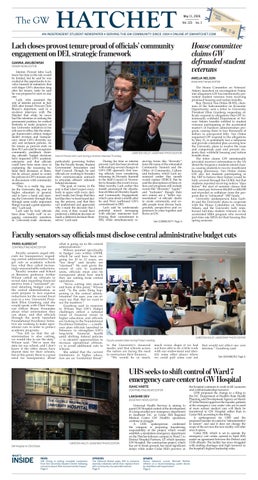
Interim Provost John Lach knew his time in the role would be limited, but he said he was excited at the opportunity to involve himself in initiatives that will shape GW’s direction long after his tenure, tasks he said he was prepared to start on day one.
Lach, who assumed the role of interim provost in July 2025 after former Provost Chris Bracey’s departure, said in a sit-down interview with The Hatchet that while he never had the intention of seeking the permanent position, he worked tirelessly to make progress on key University initiatives in his sole year in office, like the strategic framework’s rollout, budget model revision and transparency about GW’s diversity, equity and inclusion policies. As his tenure as provost ends on June 30, Lach said he recognizes community pushback claiming officials’ budget decisions have impacted GW’s academic enterprise and that officials could have been more clear in explaining the reasoning behind their decisions at times, but he always aimed to center his policies in GW’s mission and in discussions with community members.
“This is a really big year for the University, big year for higher education in general, and to have a hand and steering the University through that, through some really important things was just a great opportunity,” Lach said.
Lach said he feels officials have done “really well” in engaging community members in University-wide decisions,
particularly governing bodies like the Faculty Senate, Student Government Association and Staff Council. Though, he said officials are working to broaden their communication outreach to articulate officials’ rationale behind decisions.
“The goal, of course, in the end, is that I don’t expect everybody to agree with every decision I make, but I hope that they feel like they’ve been heard during the process, and that they can understand and appreciate why I made the decision that I did, even if they would have preferred a different decision or made a different decision themselves,” Lach said.
During his time as interim provost, Lach has been involved with making several changes to GW’s DEI approach, first teasing officials were considering renaming its Diversity Summit to the Staff Council in November to broaden the event’s focus. Most recently, Lach earlier this month announced the dissolution of Office of Diversity, Equity and Community Engagement, which came about a month after he and West reaffirmed GW’s commitment to DEI. Lach said he understands potential mixed messaging with officials’ statements reaffirming their commitment to DEI, while simultaneously re-
moving terms like “diversity” from the name of the rebranded Community Summit and the Office of Community, Culture and Inclusion, which Lach announced earlier this month would replace ODECE. But he said the descriptions of these offices and programs still include words like “diversity,” “equity” and “inclusion” though their new names are a “better representation” of officials’ desire to create community and enable people from diverse backgrounds, perspectives and experiences to come together and thrive at GW.
May 11, 2026
House committee claims GW defrauded student veterans
AMELIA NELSON ASSISTANT NEWS EDITOR
The House Committee on Veterans’ Affairs launched an investigation Friday into allegations GW has intentionally prevented student veterans from receiving promised housing and tuition benefits.
Rep. Derrick Van Orden (R-WI), chairman of the Subcommittee on Economic Opportunity, sent a letter to University President Ellen Granberg requesting officials respond to allegations that GW intentionally withheld Department of Veteran Affairs benefits entitled to student veterans participating in the accelerated master’s of business administration program, causing them to face thousands of dollars in unexpected bills. Van Orden requested GW respond to the allegations by May 13, or potentially face a subpoena and provide a detailed plan covering how the University plans to resolve the issue and compensate past and present students they withheld housing and tuition benefits from.
The letter claims GW intentionally provided incorrect information to the VA about the frequency students attend classes, causing students to receive insufficient housing allowances. Van Orden claims GW also led students participating in the YRP to believe their tuition would be fully covered through the GI Bill, but that students reported receiving notices “days before” the start of summer classes that they must pay between $14,000 or $20,000 out-of-pocket or withdraw from the program due to “exhausted” YRP funds.
University spokesperson Julia Garbitt said the University plans to cooperate with the House Committee on Veteran Affairs, and the University fully reimbursed full-time student veterans in the accelerated MBA program who received part-time rate MHA for their housing this spring semester.
Faculty senators say officials must disclose central administrative budget cuts
PARIS ALBRECHT
EDITOR
Faculty senators urged officials for transparency regarding central administrative budget cuts as academic schools face what they called increasingly unsustainable reductions.
Faculty senator and School of Business professor Arthur Wilson called on officials to reveal data regarding financial metrics from a “sustained” period detailing budget cuts to the central administration, as units prepare to face expense reductions for the second fiscal year in a row. University President Ellen Granberg said she would speak with Chief Financial Officer Bruno Fernandes about what information they can share, and that officials through the newly launched Foundational Excellence Initiative are working to make operational cuts in order to protect academic programs.
“You tell us that the administration is also cutting, we would like to see the data,” Wilson said. “We’ve seen the data for our school, and I don’t know if the other deans have shared data for their schools, but at this point, there is a great need for transparency about
what is going on in the central administration.”
Wilson pointed specifically to budget cuts within GWSB, which he said have been ongoing for 10 to 12 years, are “too deep” and faculty are “alarmed.” He said given the extent of cuts to academic units, officials must also be transparent about how much they are cutting from central operations.
“We’re cutting into muscle and bone at this point,” Wilson said. “Is the same thing happening in the central administration? I’m sure, you can always say that. But we want to see the numbers.”
Granberg said in response to Wilson that GW’s budget challenges reflect a national trend of financial strain in higher education, and officials are looking to the Foundational Excellence Initiative — a multiyear plan officials launched in February to strengthen GW’s long-term financial health amid shifting federal policies — to identify opportunities to increase operational efficiency to avoid additional cuts to schools.
She added that the current limitations in higher education are an “existential threat”
to the University’s financial model, and that schools across the nation are facing the need to restructure their finances.
“We would be in much,
much worse shape if we had not been able to do a little work with our endowment and identify some other places where we could pull some cost out
to shift control of Ward 7 emergency care center to GW Hospital
the hospital continues to work to fill vacancies and combat leadership turnover.
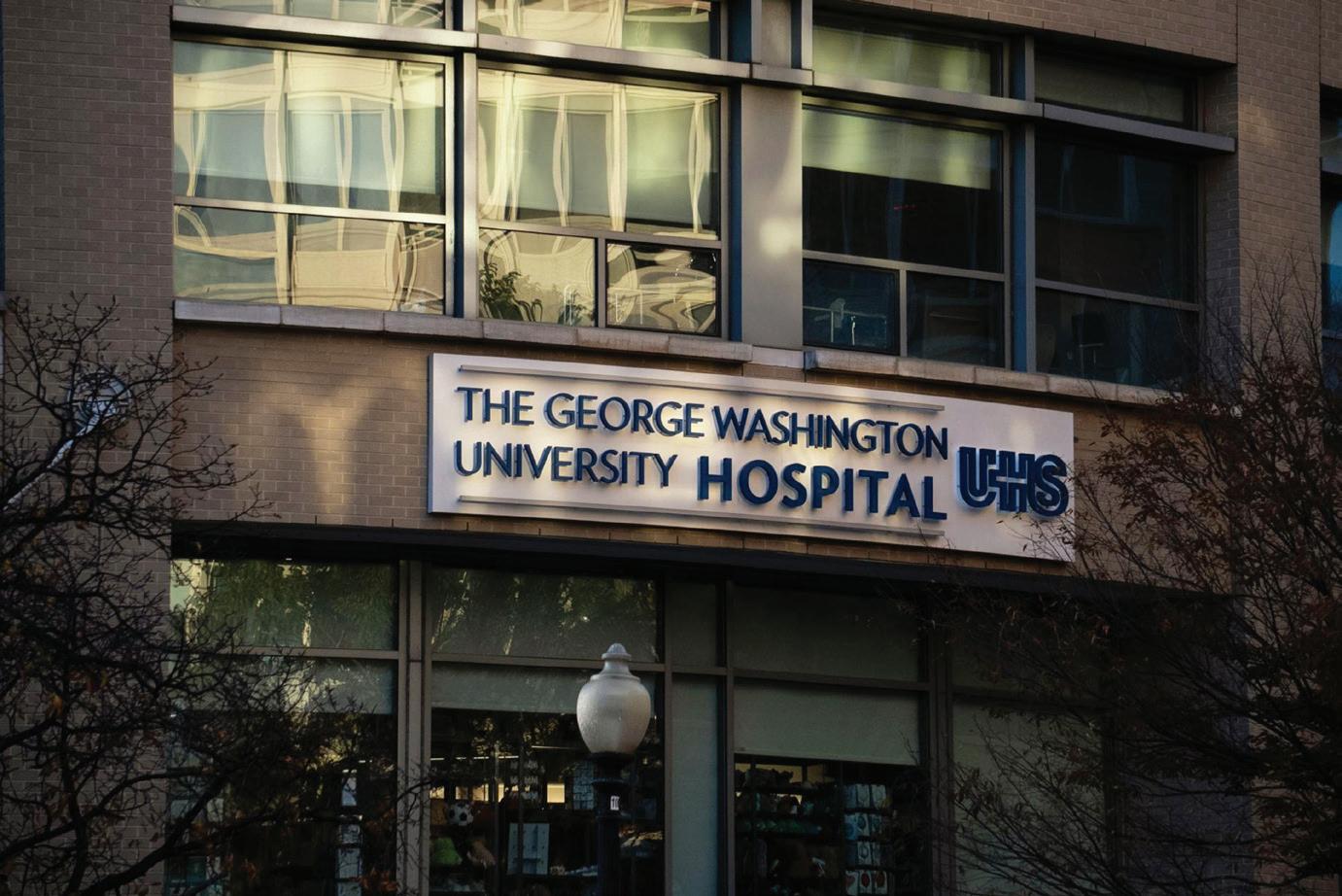
Universal Health Services is aiming to grant GW Hospital control of the development of a long-awaited new emergency department in Southeast D.C. as Cedar Hill Regional Medical Center GW Health’s operations continue to struggle.
A UHS spokesperson confirmed the company is proposing transferring responsibility of the project, which would establish a standalone emergency department on the Fletcher-Johnson campus in Ward 7, to District Hospital Partners, LP, which operates GW Hospital. The construction project, which has yet to break ground, has faced significant delays while under Cedar Hill’s purview as
UHS proposed the change in a filing to the D.C. Department of Health’s State Health Planning and Development Agency on March 27. If the District approves the transfer, patients at the emergency care center who are in need of more serious medical care will likely be transferred to GW Hospital rather than to Cedar Hill, according to the filing.
A spokesperson for UHS said the proposed transfer of control is “administrative in nature” and said it does not change the scope of the services the new facility will offer once it opens.
Cedar Hill, which is set to operate the emergency care center, opened in April 2025 under an agreement between the District and UHS officials. The facility has since struggled with staffing shortages and high turnover in the hospital’s highest leadership roles.
that would not affect our core mission,” Granberg said.
CARSTEN HOLST | ASSISTANT PHOTO EDITOR
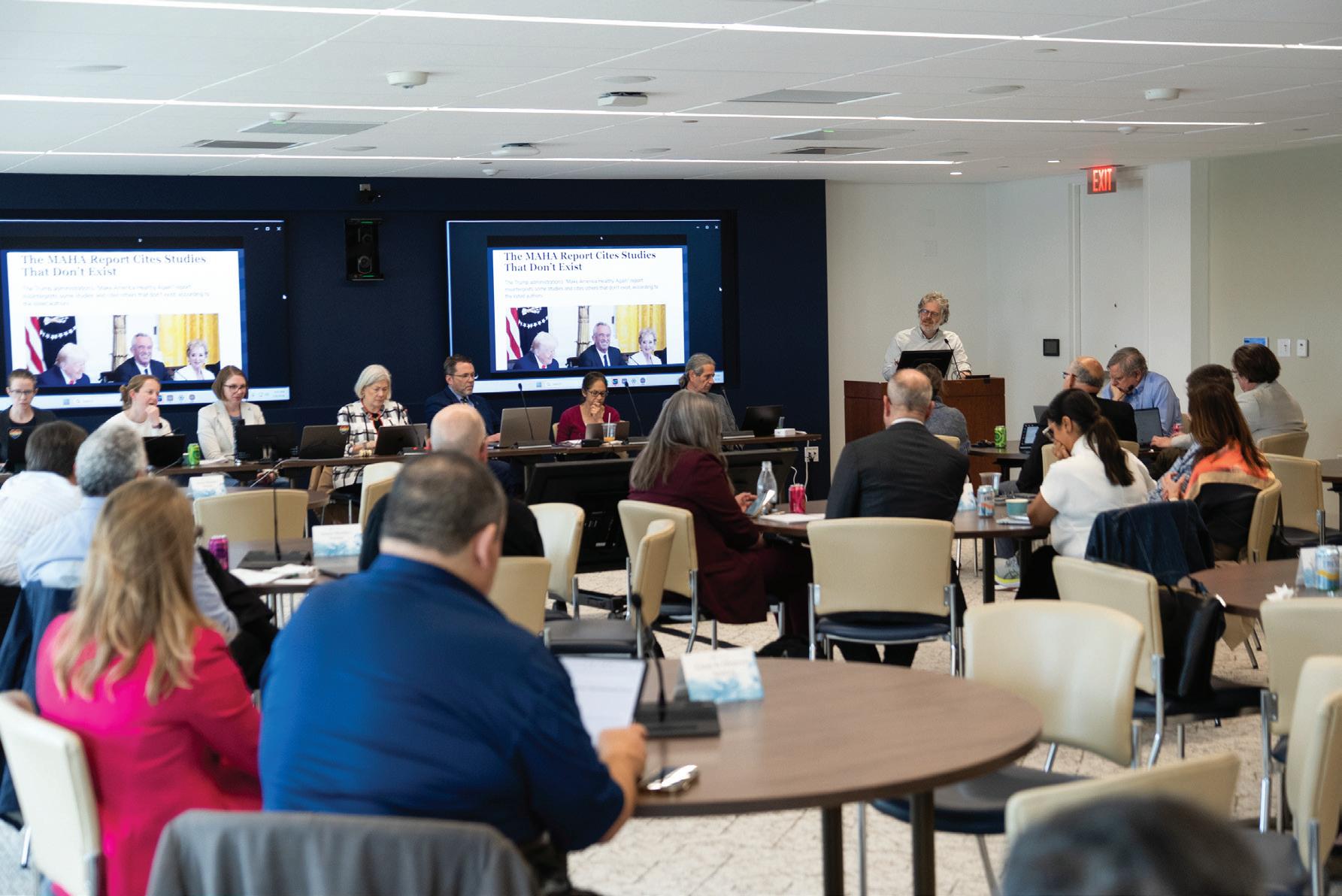
Faculty senators listen during Friday’s meeting.
CARSTEN HOLST | ASSISTANT PHOTO EDITOR
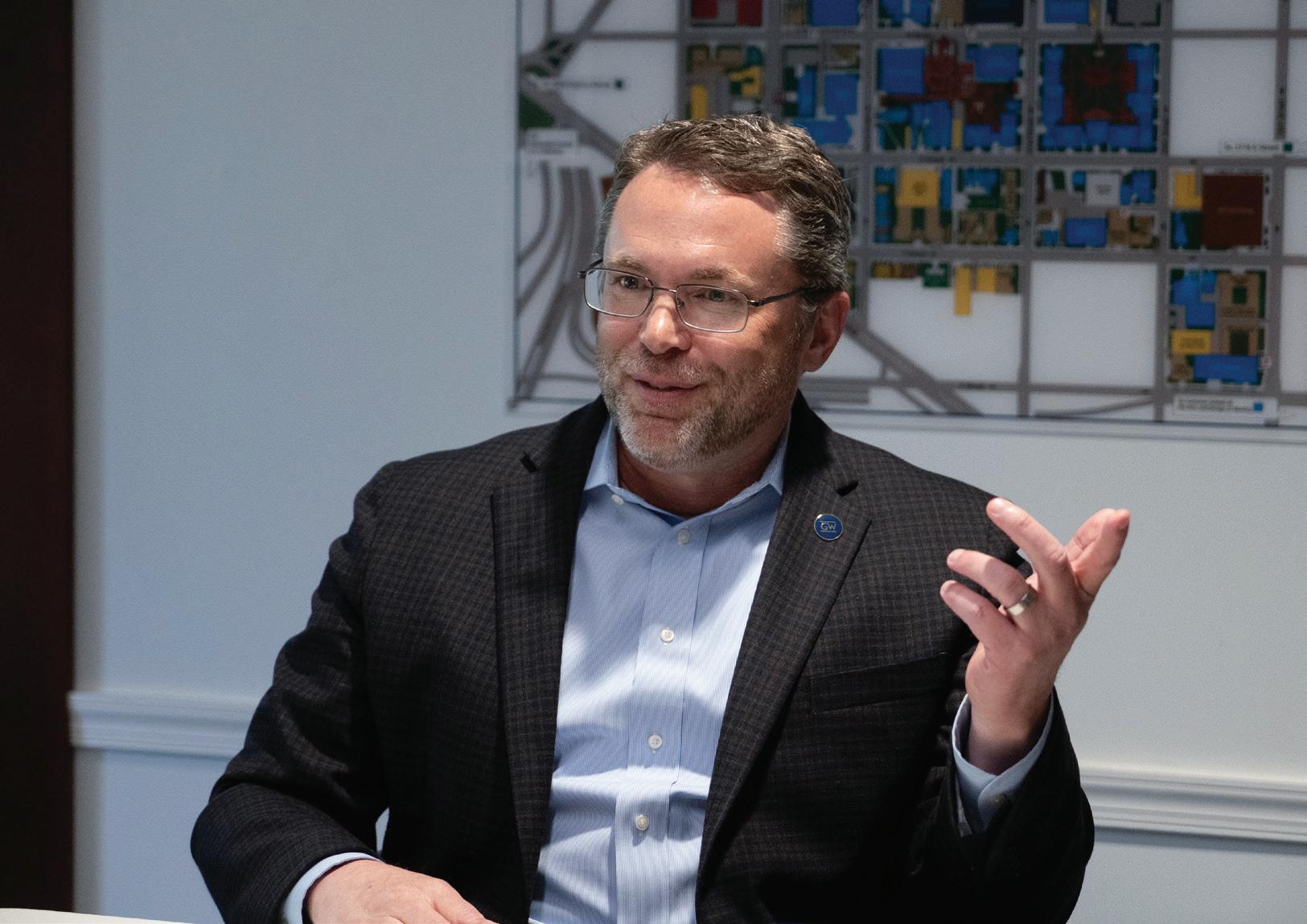
Interim Provost John Lach during a sit-down interview Thursday.
See COMMUNITY Page 4
See GRANBERG Page 4
CRIME LOG
FRAUD
Off Campus
4/28/2026 – Unknown
Closed Case
A GW staff member reported a payroll discrepancy involving direct deposit account fraud with their GW paycheck. Case closed. Referred to outside agency.
HARASSMENT: HARASSING TELEPHONE CALLS
Academic Center
Multiple – Multiple
Closed Case
A male GW staff member reported receiving harassing emails and phone calls from a non-GW affiliated subject after he issued a chargeback on an online order. Case closed. Referred to outside agency.
LIQUOR LAW VIOLATION
Lafayette Hall
5/2/2026 – 4:50 a.m.
Closed Case
The GW Police Department and the GW Emergency Medical Response Group responded to a report of an intoxicated female GW student. Upon arrival, EMeRG conducted a medical evaluation of the student and determined that further medical treatment was not necessary. Case closed. Referred to Conflict Education & Student Accountability.
—Compiled
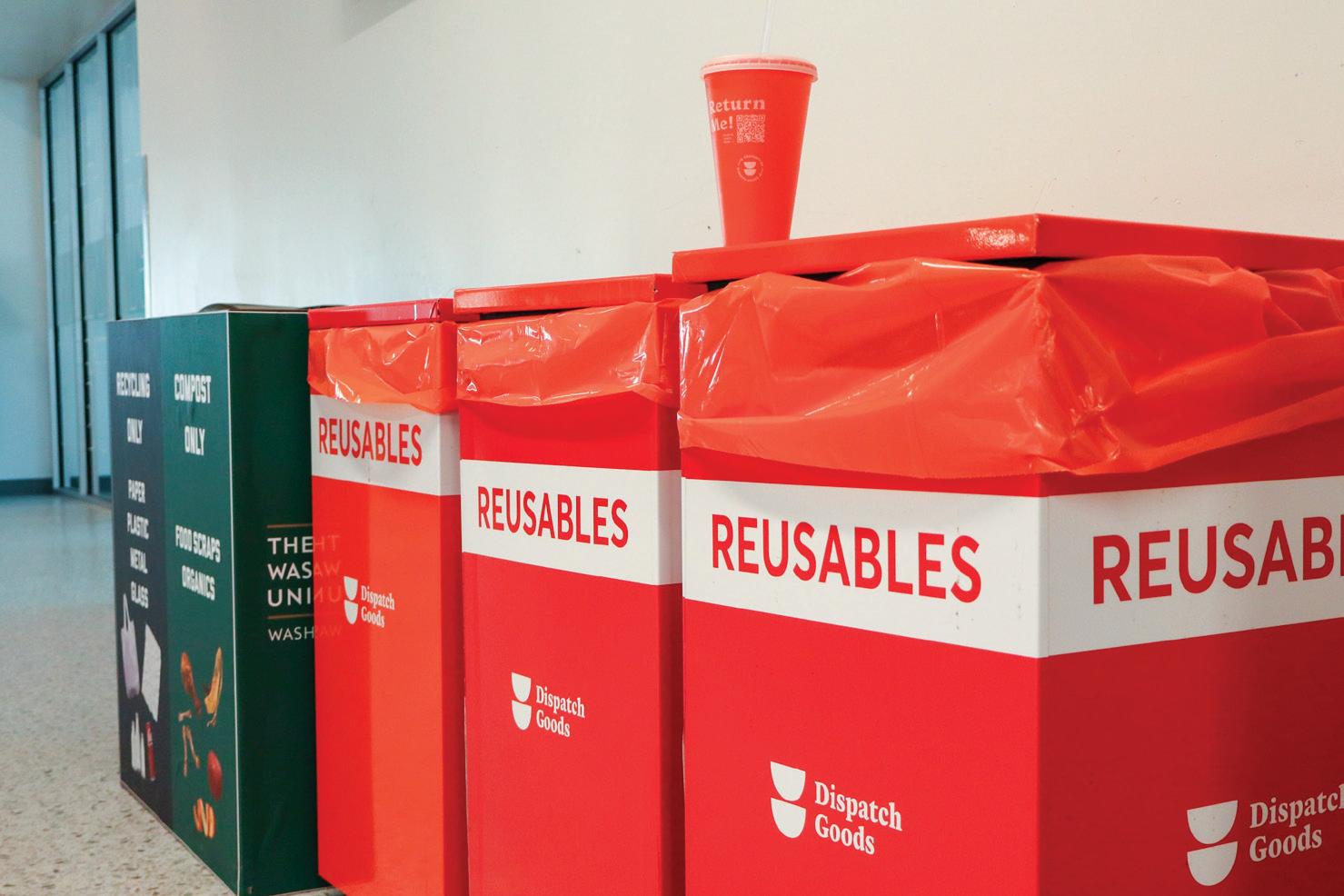
GW Dining is removing reusable containers from the University Student Center’s dining options just one semester after their implementation due to complaints from dining and environmental organizations that students were misusing the containers, a University spokesperson confirmed.
The USC’s dining locations, Absurd Bird and Chaat House, will discontinue their use of Dispatch Goods, a reusable packaging company, containers after GW Dining fielded concerns on the program’s sustainability impact from environmental and dining advocates who pushed for officials to
by Isaac Harte
end the program. Members of the Environmental Justice Action Network drafted a petition earlier this semester asking officials to remove the containers and replace them with a full compost system that includes a restriction on mixing waste and recyclables. Officials first introduced the Dispatch Goods program at the USC dining locations at the start of the spring 2026 semester, aiming to lower the environmental impact of its dining operations. But a University spokesperson confirmed officials are canceling the program at the end of its pilot semester due to uncertainty from EJAN
GW Dining discontinues reusable container program
SHIVU SATHE ASSISTANT NEWS EDITOR
surrounding the containers’ sustainability impact and the University’s desire to maintain its sustainability goals. The spokesperson said the USC will return to its previous compostable togo containers beginning in fall 2026.
“We believe this decision reflects our commitment to environmental responsibility and to listening to the voices of students deeply engaged in sustainability on campus,” the spokesperson said.
The spokesperson said GW Dining, along with the Division for Student Affairs, conducted a survey of students, faculty and staff meal plan holders at the conclusion of the pilot program at the end of the spring semester. 54 percent of respondents supported expanding the program beyond the USC, 23 percent supported expansion within the USC only and 23 percent favored discontinuing the program in its entirety, according to the spokesperson.
The spokesperson said GW Dining also received input through direct conversations with campus partners, including the participants on its Student Advisory Panel — a group that organizes and facilitates opportunities for students to advocate for their peers’ requests and opinions for GW Dining — and members of EJAN, who both raised concerns about the sustainability impact of students not returning the containers to the proper locations.
“While a majority of survey respondents expressed interest in expansion,” the spokesperson said in an email. “The substantive concerns raised by student environmental advocates and advisory partners were central to our decision-making process.”
EJAN Co-President Elias Theofilopoulos said GW sent
an email on May 1 to participants of the SAP informing students involved in the panel that officials planned to remove the Dispatch Goods products.
Theofilopoulos said EJAN was not involved in the initial decision to launch the Dispatch Goods system and EJAN was informed of its implementation after some of the group’s members attended a SAP meeting.
He said the main concern EJAN had with the Dispatch Goods program was that students would not return the containers to the appropriate return locations at the USC and would instead throw them away, preventing the containers from being reused and contributing to the growing carbon footprint of container production.
EJAN members, in their petition, said that while return rates for the Dispatch Goods container rose from 20 percent to 80 percent in February, the system still does not “adequately” reduce waste.
Theofilopoulos said students not wanting to return the containers and the difficulty of expanding the
drop-off zones across campus made GW not ready to handle the shift to the reusable container program.
Theofilopolous said EJAN plans to work with GW to fully establish an alternative option by identifying gaps in the current system and collaborating with GW Dining to ensure the University operates with “true sustainability” in mind.
EJAN Waste Reduction Chair Juliette Travassos said EJAN was not in support of the containers from the start and believed a fully compostable system would be “more beneficial” for GW’s sustainability effort. She said the containers officials previously used fit that model, but GW still used some singleuse plastics for container lids, despite the University saying it is committed to ending single-use plastic on campus.
Travassos said GW doesn’t pay a fine if they don’t return all the containers, meaning Dispatch Goods keeps shipping containers without a guarantee that they are receiving the same number back, leaving
Officials to launch updated advising system for student organizations
DIYA JHAWAR CONTRIBUTING NEWS EDITOR
Officials will implement an updated student organizations advising system effective fall 2026, two years after officials first introduced the current model, a University spokesperson confirmed.
Pathways, the Office of Student Life’s advising system for student organizations, will now place groups into one of six categories — yellow, silver, orange, blue, red and green — named after Metro lines and further differentiated by organizational activity, funding needs and operational requirements. The Office of Student Life first implemented the system in fall 2024, originally featuring four lines, though the changes, including the addition of the yellow line in the upcoming fall semester, will offer tailored resources and support to more clearly differentiate criteria for student organizations pathways, according to officials.
Officials announced the changes to student organization leaders at the beginning of May through the Org Help’s newsletter obtained by The Hatchet, outlining revised funding limits, advisor requirements and space booking access depending on an organization’s pathway designation.
The newsletter states the revisions followed months of “review, benchmarking and listening sessions” with students, staff and faculty to reevaluate how officials support student organizations and distribute resources across groups. The changes also come after the University paused the formation of new student organizations for the 2025-26 academic year to improve support systems for GW’s pre-existing slate of student groups and reform the application process for new groups. Under the updated pathways system, officials will categorize organizations with greater specificity based on factors like operational complexity, event activity, travel needs, funding usage and space reservations to tailor oversight and advising requirements. Officials
said in the newsletter organizations with more limited operational needs will face fewer administrative requirements under the yellow, silver and orange lines, like reduced advising obligations, training requirements or event oversight procedures, while organizations with larger budgets or specialized activities under the red and blue lines will receive greater oversight and support.
A University spokesperson said officials created the new yellow pathway specifically for organizations with “limited operational needs,” like those that do not manage finances through the Student Government Association and only require small meeting rooms.
“This ensures that even smaller, low-activity groups have a recognized space within the university community without unnecessary administrative requirements,” the spokesperson said in an email.
In the newsletter, officials said
all organizations will be able to apply to change pathways once per semester through the Office of Student Life, including an appeal period following the release of initial assignments in the next few weeks. The newsletter states officials are still finalizing “financial data” from the 2025-26 academic year before making official pathway determinations over the summer.
The revised model also changes how the office matches organizations with advisors. Under the current system, the Office of Student Life manages all advisor assignments, but the updated structure introduces a hybrid advising process that allows organizations under certain pathways to select their own advisors.
The spokesperson said officials identified challenges with the previous model, including “role confusion,” “duplicative responsibilities” and disconnects between organizations’ missions and an advisor’s
expertise.
“This change is designed to empower student leaders, leverage faculty and staff expertise and ensure our resources are aligned with organizational needs,” the spokesperson said. Under the updated model, officials will now require organizations classified under the orange pathway to identify an advisor through a mutual agreement process where student organization leaders and a faculty or staff member formally establish an advising partnership by Oct. 1, 2026. The newsletter states the Division for Student Affairs is developing a directory of interested faculty and staff members to help organizations that are unable to secure advisors independently.
The spokesperson said organizations classified under the blue or red pathway — those with “highlevel activity” or “specialized operations” like club sports, fraternities and sororities — will continue to re-
GW with no incentive to recover containers.
Travassos said she would see the containers entering “the waste stream” with them littered on the ground, benches or trash bins across campus, instead of being returned to the return bins only in the USC. She said EJAN also had questions about whether facilities workers had the resources to correctly send back the containers at the loading docks, and that they would still go to a landfill instead because the program required facilities workers to sort the containers into a separate dumpster.
Beatriz Salim (CCASU), co-chair of the Student Government Association’s Dining Assembly, said the return rate of the containers was too low to see the benefits of the reusable containers, and that, coupled with poor student response, could have been the officials’ motivation to discontinue the program.
“The facility that cleans it was only getting 20 percent of the bowls,” she said. “Meaning we were fabricating more plastic.”
ceive advisors assigned by the DSA to support “safe, efficient and effective operations.” The spokesperson said those organizations may also work with additional faculty or staff mentors under the revised model in addition to the assigned advisor. The newsletter states organizations under the yellow or silver pathway can choose to work with advisors, but are not required to do so.
Sophomore Eric Gitson, GW College Democrats’ incoming president, said the organization currently falls under the blue pathway, which he hopes will continue in the following year due to the organization’s sufficient funding and the positive relationship with their current advisor the designation provides them.
He also said he wants more communication from the University regarding the changes to pathways, pointing to Org Help’s newsletter — which he said just contained a chart providing “a couple basics” — as the only communication about the changes. He said he is unsure of how the GW College Democrats would be affected by the new system and thinks other student organization leaders may feel the same.
“I think when you’re going to make a change, it’s good to understand why this change is necessary, what the change is going to accomplish and then how our org is going to be affected,” Gitson said. “I don’t feel like that’s been communicated by the administration.”
Freshman Levi Lauer, the vice president of GW Club Running — an organization classified under the red pathway — said the organization typically receives informational updates from officials in the Club Sports Program, but has noticed a “lag” in receiving information about the impact of the pathway changes on club sports teams specifically.
“I think, personally, it would be helpful if we got a specific email from our advisor or from the person who leads each line, detailing a little bit more specifics for each organization and what will change,” Lauer said.
KRIS PARK | ASSISTANT PHOTO EDITOR
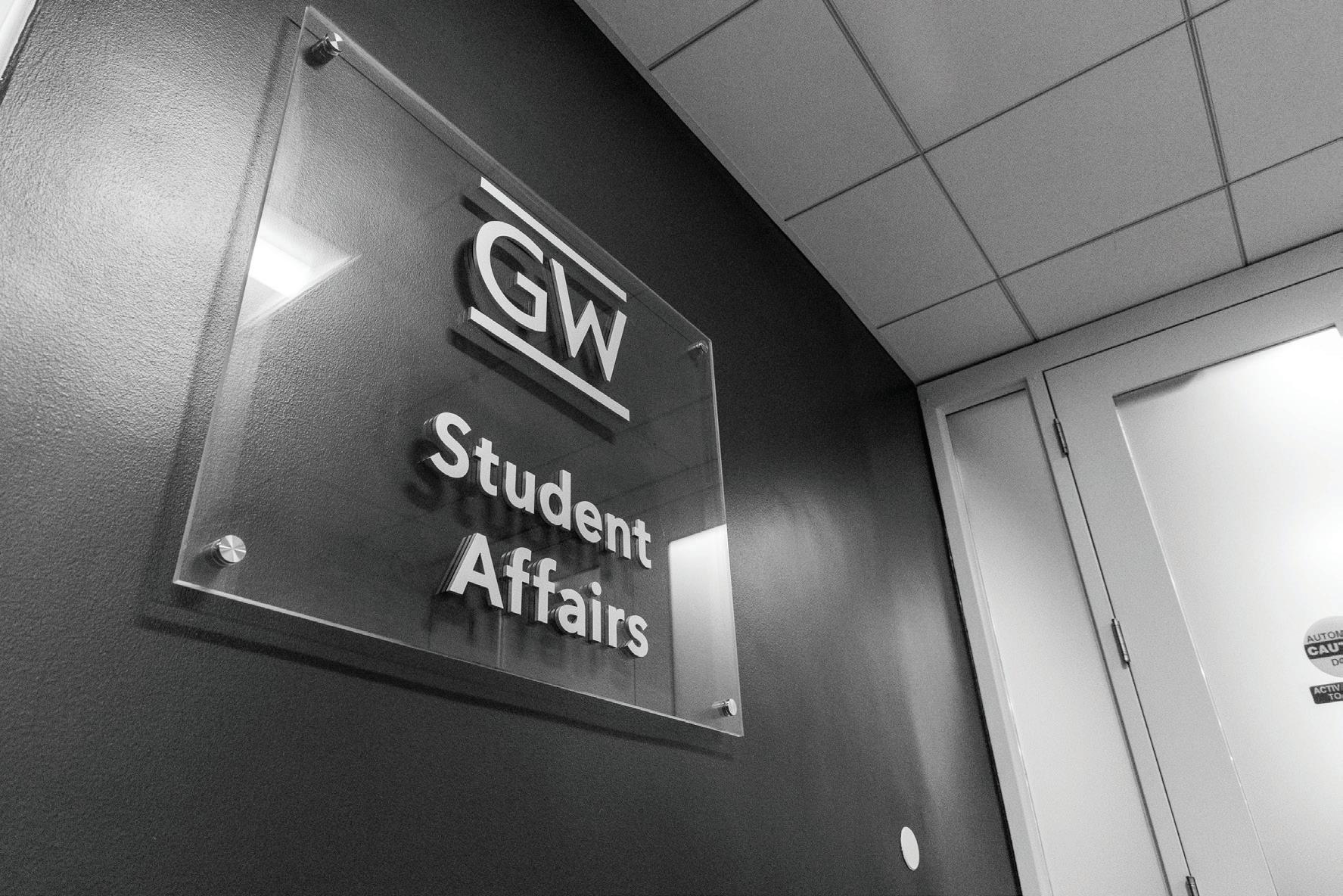
The Division forw Student Affairs office in the University Student Center.
JOSH STEINBERG | STAFF PHOTOGRAPHER
Dispatch Goods collection bins in the University Student Center.
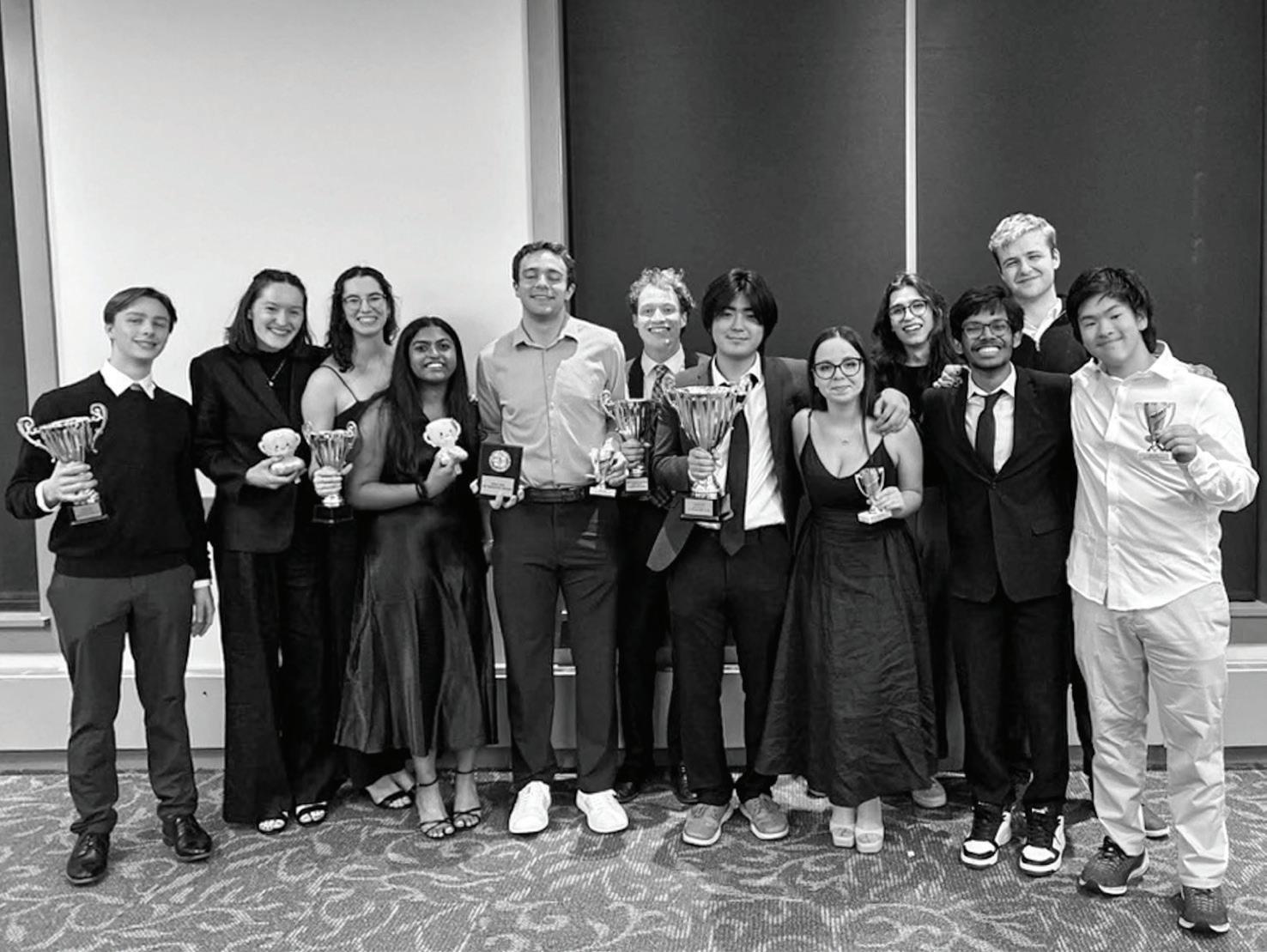
GW Parliamentary Debate Society wins national Club of the Year for first time
As the GW Parliamentary Debate Society began prepping for this academic year’s competitions last summer, they had one goal in mind — to win Club of the Year for the first time in the group’s history and join the ranks of elite universities like The University of Chicago and Yale University. The American Parliamentary Debate Association awarded GW the COTY accolade for accumulating the most points — which clubs earn when their members perform well in tournaments — of all the chapters throughout the academic year at 450.5, marking the first time in 16 years that Chicago, Yale or Harvard University did not win and becoming only the fifth team to win the award in the association’s history. Members said a combination of strong talent across the group, extra time spent preparing their debate topics throughout the year and strategically matching up debaters to maximize points contributed to their win.
Sophomore Mabel Rieger, GWPDS’ incoming president, said while in previous years the group had two or three strong debaters, this year’s club has “many, many” strong debaters — with three members reaching the 66-point-per-person limit for the season and six others surpassing 20 points — increasing the group’s depth
and helping them win more points across the board.
“We worked exceptionally hard for it,” she said. “It was a full-team push.”
Rieger said the group spent more time strategizing to maximize their points this year than in previous years, including participating in larger tournaments in the APDA’s central and northern regions, as tournaments with more teams allow debaters to earn more points. She said they would send different debaters to separate, larger competitions farther away on some weekends to increase their chances of earning points.
Debaters earn more points the higher they place in APDA-sanctioned tournaments and judges award “speaker points” by rating debaters based on criteria like argument quality and engagement with the other team’s material.
Rieger said GWPDS attended tournaments at other universities almost every weekend of the academic year and practiced twice a week for two hours each session, though some of the group’s strongest contributors practiced on their own almost daily.
Rieger said while there are multiple popular formats of debate, like British Parliamentary and Policy Debate, the group only does American Parliamentary, allowing them to tailor their training to a format that requires quick, logic-based thinking. She
said Chicago and Yale also compete in British Parliamentary debates, sometimes skipping APDA competitions, which limits the number of points they can earn in the COTY competition.
American Parliamentary debate involves two teams of two people, with one team representing the Government and the other the Opposition. The Government team picks a position on a topic like economics, philosophy and government and builds an argument defending their position on logic rather than evidence because the Opposition does not know about the Government’s case in advance.
She said GWPDS is hoping to win COTY again next year, along with other APDA awards at the end of next academic year, like Team of the Year, which recognizes the debating duo that earned the most points throughout the season, after GWPDS members Ryan Tiedemann and Yuki Nakano placed fourth this year, but is losing a few strong senior debaters.
Nakano, a junior and GWPDS’ outgoing president, said GW is the first school from the southern region to win since Johns Hopkins won in 2008, a feat that is more difficult because tournaments in the region tend to be smaller, with fewer opportunities to earn points.
“I think it was just, a good mix of some luck of talent, and then also we all collectively, really wanted it and
put in a lot of effort,” Nakano said.
Nakano said GWPDS had strong first-year talent this year, with four first-years, called novices in debate, qualifying for the APDA National Championship after achieving a minimum points threshold or ranking highly in certain tournaments throughout the season.
He said GWPDS used a strategy called “prepping them out,” where they would prepare arguments against Chicago’s cases in advance, since they knew most of their
Foundational Excellence Initiative will aim to reduce GW’s complicated, repetitive processes
ISAAC HARTE CONTRIBUTING NEWS EDITOR
Officials said community members feel the University’s key administrative processes are overly complicated and that there should be greater clarity around University decision-making, which will drive the Foundational Excellence Initiative’s priorities.
Health Policy and Management Professor Zoë Beckerman and Chief of Staff Scott Mory, who are leading the steering committee for the Foundational Excellence Initiative, said in a message Friday the group has heard through interviews and listening sessions with community members that GW’s administrative processes are too complicated, full of fragmented and repetitive systems and highly reliant on informal workarounds, which creates inefficiencies, unnecessary costs and burdens for community members. The committee’s findings come after officials launched the initiative earlier this year to identify opportunities for GW to manage costs, grow revenue for the University and improve the school’s overall operations.
“We have heard the need to simplify how GW operates — reducing unnecessary complexity, clarifying roles and decision pathways and strengthening opportunities for alignment across schools and units,” Beckerman and Mory said in the email.
GW’s Foundational Excellence Initiative is part of the strategic framework and is intended to help streamline GW’s internal processes and functions to improve the University’s long-term financial health. Officials launched the initiative to outline steps to clear the University’s current structural deficit and invest in the strategic framework, a move its website
hints could lead to additional layoffs.
University President Ellen Granberg said in her pre-read report for Friday’s Faculty Senate the Huron Consulting Group, which officials hired in summer 2025, has a reputation for recommending layoffs and is aiding the steering committee’s work, has completed more than 50 interviews and held listening sessions for the initiative with the Faculty Senate Executive Committee, Staff Council and Student Government Association. She also said Huron conducted a “tabletop exercise” with the GW Leaders Forum in April and will meet with assistant deans of research, finance directors and the Graduate Student Caucus in the coming weeks.
Beckerman and Mory said the committee has heard that GW relies too heavily on “informal workarounds” and “personal networks” to get things done across the University, which are difficult to maintain over time and can lead to burnout and low morale for faculty and staff. They said the committee has also found that several key administrative processes were unnecessarily complicated, which slows University decision-making.
Mory and Beckerman said community members have told the committee that GW has too many “fragmented” systems and data sources and “limited” access to information that can be used for planning and making administrative decisions. They said their findings also indicate that GW has “redundant” tools and platforms across divisions used for similar purposes, creating broader inefficiencies and unnecessary expenses.
“Taken together, we are hearing a strong desire for greater clarity and transparency of the finan-
cial, operational, and structural realities facing the university, so that decisions affecting our collective future are grounded in tested facts,” Beckerman and Mory said in the email.
Beckerman and Mory said the committee will be “testing” their ideas based on the feedback they’ve received with officials in early summer to ensure they align with the University’s goals and will work with the leaders of the units for which they are making recommendations to validate them and to understand barriers to their success. They said they will share their ideas with University leadership, the Faculty Senate, Staff Council and Student Government Association later in the summer for feedback before hosting community town halls on their proposed recommendations.
“As this work continues, we are focused on ensuring that decisions are grounded in evidence, aligned with GW’s long-term priorities, and considered through an institution-wide lens,” Beckerman and Mory said. “We remain committed to ongoing collaboration across the community, thoughtful stewardship of diverse perspectives, and clear, timely communication as opportunities are refined and decisions take shape.”
Granberg said during the initiative’s January launch that it came about as officials were developing the strategic framework, when they realized the University needed to improve its functions and strengthen GW’s financial health to meet the framework’s goals. Granberg said in an interview with The Hatchet at the time that officials added the strategic framework’s third priority — “Strengthening Our Foundation for Excellence” — after soliciting feedback from faculty and staff.
cases from previous tournaments and shared them with other schools’ teams who were debating Chicago, which Nakano said was GW’s main competitor throughout the season.
Tiedemann, a senior studying international affairs and philosophy who competed with GWPDS all four years of college, said winning COTY in his final year was “incredible” because it recognized the group’s increased efforts this year and allowed him to retire on a win.
Tiedemann said a few of
Chicago’s strongest debaters graduated last year, which worked to GWPDS’ advantage. He said even though GW lost some strong debaters last year, the group put more effort into practicing over the summer and spent more time strategizing which tournaments to send their debaters to.
“And then I think we just peaked at the right time,” he said. “It was kind of a watershed year where we had a lot of debaters take leaps in their ability and put on performances week in, week out.”
SGA leaders look to mend executive-legislative divide
AMELIA NELSON ASSISTANT NEWS EDITOR
Student Government Association leaders in their first weeks in office said they are implementing joint committees and working to instill a culture of collaboration between the SGA’s executive and legislative branches following communication struggles between the body’s branches last term.
SGA President MJ Childs said he plans to improve students’ dining and mental health services and GW’s physical facilities by centralizing communication between joint executive and legislative committees and encouraging SGA members to collaborate across branches. Members of the SGA last term said they struggled to accomplish their advocacy efforts due to structural barriers limiting communication between branches, and the new leadership needs to facilitate communication and relationship-building between executive and legislative members that work on similar issues so the body can be more efficient in their advocacy to officials.
Childs said his administration plans to promote a “culture of collaboration” after executive members of the last body told him their ability to implement initiatives was limited by difficulty communicating with the legislative branch for reasons he did not know.
The SGA contains a legislative branch, responsible for engaging with the student body and the executive branch, which houses the president and their executive cabinet, according to the SGA’s constitution. Senators can implement structural reforms to the SGA and University through committees where they draft legislation, while executive teams are able to more easily connect with University officials and act with more autonomy, according to SGA bylaws.
The SGA’s executive and legislative branches include advocacy groups focused on topics such as the University’s physical facilities, Mount Vernon Campus, dining, student life and mental health, according to the SGA website.
William O’Donnell, outgoing executive director of facilities, said he collaborated with his legislative counterpart — the chair of the Committee on Physical Facilities and Urban Affairs — to launch the Fix-It Scheduler program in the spring semester, allowing South and Lafayette hall residents to schedule Fix-It repair times, but that the collaboration only existed because he personally reached out to PFUA. He said information gaps like private Google Drives for duplicative executive and legislative branch teams did not inherently facilitate collaboration.
O’Donnell said he thought Childs’ and Sy’s plans to create a culture shift by encouraging SGA members to communicate their plans with their counterparts across branches are “well intentioned,” but believes they could go a “step further” by hosting more events for SGA members across branches to meet at the beginning
of the academic year and improving information sharing to help future SGAs realize duplicative teams are doing similar work separately and subsequently combine efforts quicker.
Former Vice President Liz Stoddard said legislative committees and executive teams struggled to communicate throughout the last SGA term due to former President Ethan Lynne’s choice to appoint executive directors instead of executive secretaries. SGA bylaws mandate secretaries attend corresponding legislative committee meetings, while the executive can only encourage directors to attend meetings, and committee chairs have discretion over whether directors are allowed to sit in as ex-officio members.
Stoddard said the shift from secretaries to directors created a “bottleneck” effect where senior staff, not lower-level members, became the principal bodies relaying information between branches. She said current leaders do not need to reinstate the role of secretaries, but need to ensure that communication between branches is happening at upper and lower levels to effectively encourage collaboration.
Lynne said he focused on boosting collaboration as SGA president and declined to comment on why he appointed executive directors instead of secretaries.
Carson Corona, who served as the Vern liaison during the previous SGA term said the Senate did not inform him of their creation of its Vern assembly with the same goals. Corona said he sees the incoming administration, where he will serve as deputy director of facilities, as the chance to re-introduce advocacy surrounding the Vern to SGA leaders. He added that he hopes to increase communication between bodies will help the branches coordinate efforts and accomplish more goals, like opening an SGA office on the Vern. Sen. Cole Bowie (CCAS-U), outgoing executive deputy director of facilities and incoming PFUA chair, said he wants the new administration to reduce what he dubbed a “credit claiming” culture, which he said was present in the previous SGA term where members did not want to share credit for initiatives and avoided collaboration, causing members to leave the SGA.
Sy said the executive and legislative directors of DEI will combine efforts and continue to work with the senate’s Committee on Advocacy, Inclusion and Community — a body which publishes an annual end-of-year report describing the issues of diversity and inclusion the student body and SGA face and documenting any SGA initiatives relating to DEI, according to SGA bylaws.
“A lot of times collaboration between the legislative and executive was a suggestion, but this year, we’re really looking to frame it as the standard, so making sure that when there are ideas that are being put through, both sides are aware, and then we can delegate tasks accordingly,” Sy said.
COURTESY OF MABEL RIEGER
Members of the GW Parliamentary Debate Society pose for a group photo.
NICHOLAS
GW report defends Affordable Care Act preventative care protections
GW researchers published a report defending the Affordable Care Act’s preventative services protections amid attempts by President Donald Trump’s administration to weaken the legislation’s provisions.
Researchers said the Democrats of the Senate Committee on Health, Education, Labor and Pensions commissioned the report published in April by the GW Geiger Gibson Program in Community Health, which found the ACA’s preventative services protections — which require most private insurers to cover recommended preventative services like cancer screenings, vaccines and routine checkups — save families more than $4,000 annually in out-of-pocket healthcare costs while reducing the need for more expensive treatment later in life.
Sara Rosenbaum, one of the report’s co-authors and emeritus professor of health law and policy at the Milken Institute School of Public Health, said the committee commissioned the report to show how the ACA’s preventative care requirements without cost sharing — out-of-pocket expenses like copays and deductibles — directly reduce household medical spending and expand access to routine care in response to ongoing political efforts to scale-back the ACA’s preventative care requirements.
Rosenbaum said researchers released the report amid concern over conservative efforts to weaken the ACA’s preventative services framework, particularly targeting the U.S. Preventive Services Task Force, which helps determine what services the ACA covers.
The U.S. Preventive Services Task Force is an independent panel of medical and public health
experts that reviews scientific evidence and issues recommendations on preventative services like cancer screenings, HIV prevention medication and cardiovascular disease screenings to federal health agencies, including the Department for Health and Human Services. The ACA expanded the task force’s authority by requiring providers to cover preventive services the task force recommends with no cost sharing from patients.
Trump in his first term moved to shorten ACA enrollment periods, reduce funding for programs that help people enroll in ACA health plans and support broader
deregulation of federal healthcare programs. Conservative legal challenges have likewise targeted preventative care mandates for covering HIV prevention medication and other services. Kennedy has also postponed multiple task force meetings and reportedly considered removing or replacing members of the panel as part of a broader effort to reshape federal preventive health recommendations.
The Supreme Court in June 2025 voted to uphold the ACA’s requirement that insurers and health plans cover preventive services without cost sharing based on the
task force’s recommendations after a lawsuit filed in 2020 claimed members of the task force were improperly appointed.
Rosenbaum said the report shows the ACA’s preventative service requirements and the task force play a central role in both public health outcomes and household cost savings, and weakening its authority, as she warned could occur under recent federal policy shifts, could significantly affect coverage decisions.
“The United States Preventive Services Task Force has been vital to health and vital as a fundamental economic matter to millions of
families,” Rosenbaum said.
An estimated 150 million Americans with private insurance benefit from the ACA’s coverage guarantee, and in 2024 alone roughly 100 million patients used at least one ACA-covered preventive service, according to the report. The report also says roughly four in 10 patients still received at least one preventive service even in states with the lowest utilization rates, suggesting widespread uptake across the country.
Rosenbaum said the goal of the report was to evaluate how the ACA’s preventive services protections function in practice, particularly in terms of reducing out-of-pocket costs and expanding access to care.
The report found these savings stem directly from ACA requirements that mandate coverage for preventive services without patient cost sharing. It also found when ACA requirements make preventive services free at the point of care, families are more likely to use them regularly, which leads to substantial annual savings that can reach thousands of dollars per household.
Researchers estimated savings using national insurance claims data from FAIR Health — an independent nonprofit that compiles and analyzes billions of commercial insurance billing records from across the United States — and analyzed how often patients use ACA-covered preventive services compared to typical out-of-pocket prices for the same services. They then calculated what families would have paid without the ACA’s coverage requirement by combining real utilization rates with actual service costs from commercial insurance billing records.
Community discussions informed decision-making throughout tenure, Lach says
From Page 1
“You’ll look at the descriptions of both of those, and those words, diversity, equity and inclusion, are all still there, but I do think that the name of OCCI is now a better representation of, well, ‘What are we actually doing and why?’” Lach said.
Lach said federal pressures did not factor into officials’ decision to remove the word “diversity” from specific events and offices. He said President Donald Trump’s administration is focused on “illegal DEI,” which relates to the Supreme Court’s 2023 decision to ban race as a factor in college admissions, but there is “nothing illegal” about DEI in general, which is why he felt confident putting out the statement reaffirming GW’s commitment to it.
Trump over the last year has challenged DEI policies and practices nationwide, including signing an executive order on his second day in office calling for the end of DEI practices at, among other places, universities that receive federal funding, and threatening to revoke funding from universities over their DEI practices. Lach said
Granberg
From Page 1
officials are ensuring they are following the law of not excluding people from certain opportunities, resources and experiences based on protected characteristics while also promoting DEI on campus. He said when considering the naming of offices and programs as well as the University’s messaging on DEI, he has consulted with stakeholders to help officials accurately define the work the University is doing to make GW more inclusive.
“Diversity itself is not the end goal,” Lach said. “It’s the creating that community, culture and inclusive excellence that enables people from lots of diverse backgrounds and perspectives and experiences that come together and thrive here.”
Students in November said they felt GW had subtly rolled back DEI initiatives since Trump launched a national crackdown on campus DEI, which coupled with officials omitting diversity terminology in messaging, indicated GW is yielding to federal pressure. Lach said to combat community concerns he regularly engages with students, like through his “Pizza with the Provost” events, to hear from students directly. He said his
first “Pizza with the Provost” event took place at the Multicultural Student Services Center because he wanted to hear from students there “right out of the gate” about their experiences at GW.
Lach said his two major goals coming into his tenure were to launch the strategic framework and the University’s new budget model, and that he is “excited” with officials’ progress on both of those initiatives. He said financial pressures specific to GW, like enrollment declines among international and graduate students, have forced officials to make “some difficult choices,” though he has made decisions on what to cut from the budget while taking into consideration the University’s overall mission and their priorities outlined in the strategic framework.
“It’s a really challenging process,” Lach said. “It’s the kind of thing that keeps me up at night. Those decisions are never easy, but we are making those decisions with the core mission as the priority.”
Faculty senators have called on officials to provide greater transparency around the process for budget-cut decisions and the broader im-
pact those moves could have on GW’s academic mission as officials foreshadowed budget cuts for a second year in a row. University President Ellen Granberg said in a sitdown interview last month officials would have to conduct additional budget cuts in FY2027, which she said are necessary to achieve broader goals in the strategic framework, like improving student financial aid and strengthening career and academic advising.
Lach said it’s “not surprising” when he hears from students or faculty that their experience or service level has changed, though he takes their experiences “to heart” as feedback. He added that he has prioritized being accessible to students in order to hear about their experiences and what they want officials to focus on addressing.
In response to questions about whether he feels budget cuts have hindered GW’s academic mission, Lach said GW’s mission statement — which officials updated in April and said reflects GW’s institutional priorities and community voices — is a “touchstone” to guide officials’ “hard decisions,” reminding them of GW’s core mission to stay true to its in-
stitutional priorities.
Still, Lach said he’s better able to engage with students, faculty and staff and academic programs on a deeper level as dean of the School of Engineering & Applied Science — something he said he’s “always loved” doing — and he is eager to return to that role for next academic year.
Permanent provost or president roles aren’t out of the picture, though, Lach said. He said there may be some day he would be interested in those roles, but he said he is “not done” being a dean yet.
Six faculty senators said they’ve admired Lach’s leadership over the past year, describing him as a provost who always listened and took their feedback into consideration. They said while they will miss Lach’s leadership, they are excited to welcome Edward Balleisen as GW’s next provost, who will assume the role July 1.
Tarek El-Ghazawi, a faculty senator and chair of the electrical and computer engineering department in SEAS, said Lach is an inclusive and open-minded leader, qualities that positioned him well in the provost role. He added that Lach was the right per-
son to lead the University during a critical period at GW because of his open and compassionate nature.
“He makes a lot of tough decisions, but he’s really always compassionate and clear, and is really willing to listen,” El-Ghazawi said. “I have seen that in the school. I’ve seen that very well in the bigger picture as well.”
The Faculty Senate unanimously passed a resolution at their Friday meeting in appreciation of Lach’s leadership. It said Lach over the last year displayed transparency, kindness and “good humor” while steering GW through difficult financial times, and that he earned the trust of community members because of his transparent and collaborative leadership style.
Granberg at the meeting Friday thanked Lach for taking on the role, where she said he was flexible and tirelessly advocated for and engaged community members in his decision-making. “What stands out to me the most, though, is his unfailing positivity and good humor,” Granberg said. “Whatever the ask, he looked for ways to make it happen and to motivate and bring along the people around him.”
says current budget model too ‘unstable’ to weather financial woes
After officials cut GW’s FY2026 budget by 3 percent and announced its structural deficit, officials have taken additional measures to reduce its budget, including putting a temporary hiring freeze in place that lasted until October and laying off 43 staff members in late September as GW navigates declining international and graduate enrollment amid Trump-era visa restrictions. The comments at Friday’s meeting come as another example of faculty senators pushing officials for budget transparency as they foreshadow continued cuts to academic departments in FY2027. Faculty senators in February pressed officials for greater transparency around the budget-cut decision process and the broader impacts those moves could have on GW’s academic mission, and senators in January said deans needed to consult faculty before making decisions like potentially eliminating programs.
Granberg said the current budget model is too “unstable” to support issues like declining graduate and international student enrollment because 80 percent of GW’s graduate tuition goes directly to each school under the current budget model — monetary support that
is decreasing as enrollment declines further due to the Trump administration’s elimination of the Grad PLUS program and implementation of tighter borrowing limits. She added that she will speak to Fernandes to determine what financial information regarding central budget cuts officials can share with the community.
“I don’t have a problem being transparent,” Granberg said.
Faculty senator and GWSB professor Phil Wirtz said he agreed with Wilson’s comments about GWSB’s budget cuts, calling the situation a “grave concern” to the school’s faculty. He said in an email after the meeting that officials are spending “a lot” of money on external consultants and personnel salaries amid GW’s structural deficit.
Wirtz at the meeting asked officials how much funding they will have left over after factoring in moving expenses associated with relocating GW’s Virginia Science and Technology Campus operations following the campus’s sale to Amazon Data Services in February for $427 million. He said he has heard officials and members of the committees he serves on cite the VSTC sale as a benefit to GW’s finances, but it is unclear how much GW will pocket after expenses are factored in.
Granberg said officials will
have at least $350 million left over after moving VSTC operations to the Foggy Bottom Campus, and the remaining funds now sit in an endowment fund. She said officials dedicated $200 million from the sale to student scholarships, and officials allocated $150 million into an endowment that will have a 4.5 to 5 percent payout meant to support strategic purposes with the “primary idea” to support research. Zoe Szajnfarber, a professor of engineering management and systems engineering and Granberg’s senior AI advisor, said in her presentation to the senate the initial feedback from GW’s strategic artificial intelligence mapping exercise showed several faculty members have been engaging in AI pedagogically. She added feedback also showed community members share anxiety about the future of AI at GW — primarily due to GW’s current infrastructure, which she said could restrict the growth of AI research — and a lack of awareness among faculty and students about AI resources.
Officials also tasked Szajnfarber with developing a University-wide AI research in order to bolster interdisciplinary research on AI models and societal benefit in December. Szajnfarber said as over 75 percent of units are now using AI, the strategic framework research working group recommends direction from
the “top” in order to implement AI in various disciplines. In response to Faculty Senate Executive Committee Chair Guillermo Orti’s report, faculty senator Melani McAlister asked officials to clarify the meaning of Friday’s Foundational Excellence Initiative update and if the initiative is differentiated from the rest of the strategic framework goals. Mory, in response to McAlister, said the initiative aims to develop a plan to strengthen GW’s financial foundation, adding officials will publish a set of recommendations
in the fall for community feedback. He said the recommendations center around three goals — to prioritize efficiency and reduce cost, generate new lines of revenue and to fix administrative processes. The senate also unanimously passed a Professional Ethics and Academic Freedom Committee resolution introduced by faculty senators Jamie Cohen-Cole and Shawneequa
KRIS PARK | ASSISTANT PHOTO EDITOR
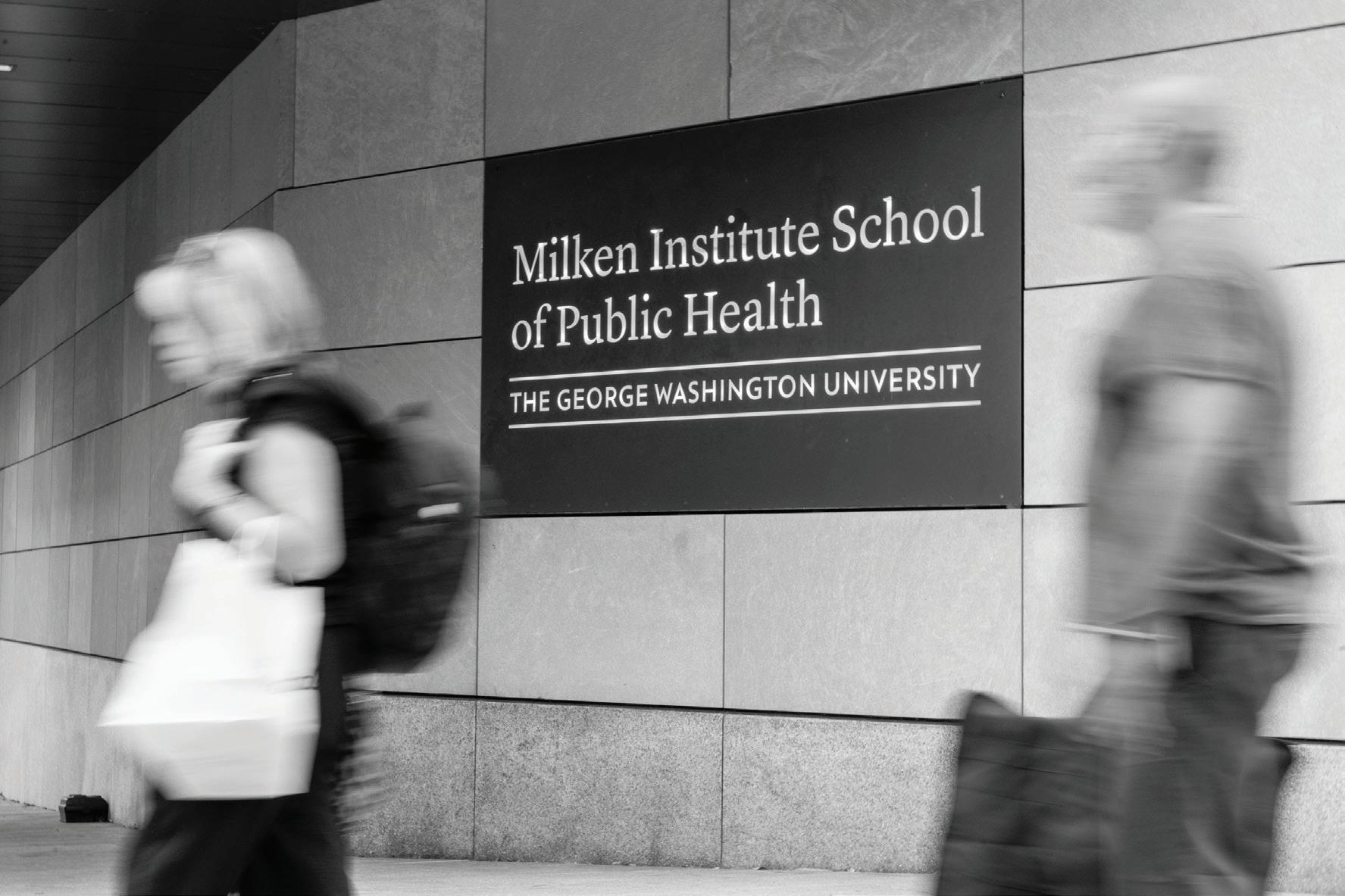
Pedestrians walk past the Milken Institute School of Public Health.
CARSTEN HOLST | ASSISTANT PHOTO EDITOR
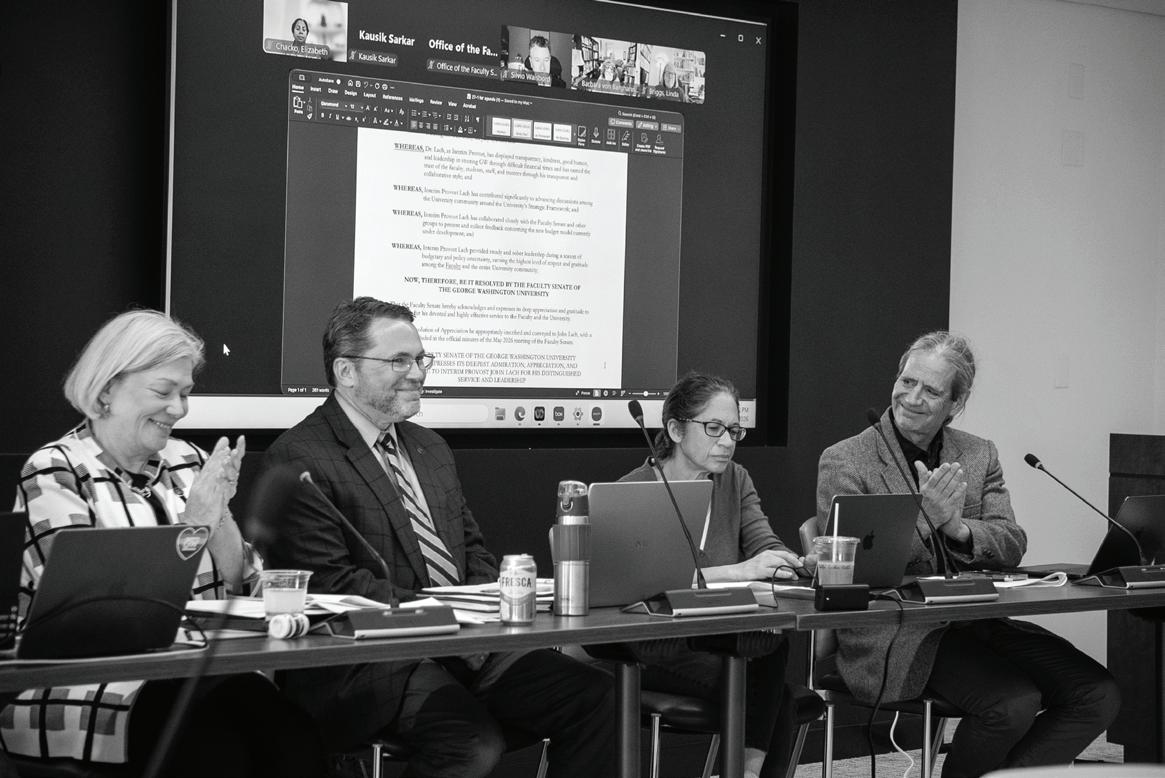
Officials during Friday’s Faculty Senate meeting.
GW is trying to replace diversity with community.
It’s not a fair
trade
STAFF EDITORIAL
Interim Provost John Lach and Associate Vice Provost for Community, Culture and Engagement Jordan Shelby West said in a community message in April they understood student fears that the University is retreating from diversity equity and inclusion amid federal pressure and confirmed the University is holding fast in its values. We, as an editorial board, gave the University due credit for this move, saying we appreciated them reaffirming their commitment to DEI at a time when many universities are retreating. But, a few weeks later, officials announced they would dissolve the Office of Diversity, Equity and Community Engagement and replace it with a new Office of Community, Culture and Inclusion, stating that they believed this would “best serve” GW’s broader commitments to DEI, but failed to explain how removing the word “diversity” from the University’s diversity office would accomplish that mission. While we commend the University for being transparent in their changes and acknowledging the difficult federal environment officials are navigating, those words fall flat when actions like renaming the annual Diversity Summit to the OneGW Community Summit and dissolving the University’s sole diversity office outline a different narrative. The story the University’s recent actions tell is one of de-emphasizing specific diversity initiatives in favor of broader commitments to community. When officials claim to be steadfast in their commitments to DEI, they must recognize that building community is not a substitute for tailored initiatives designed to uplift students of minority identities.
With the dissolution of ODECE, GW joins a host of universities na-
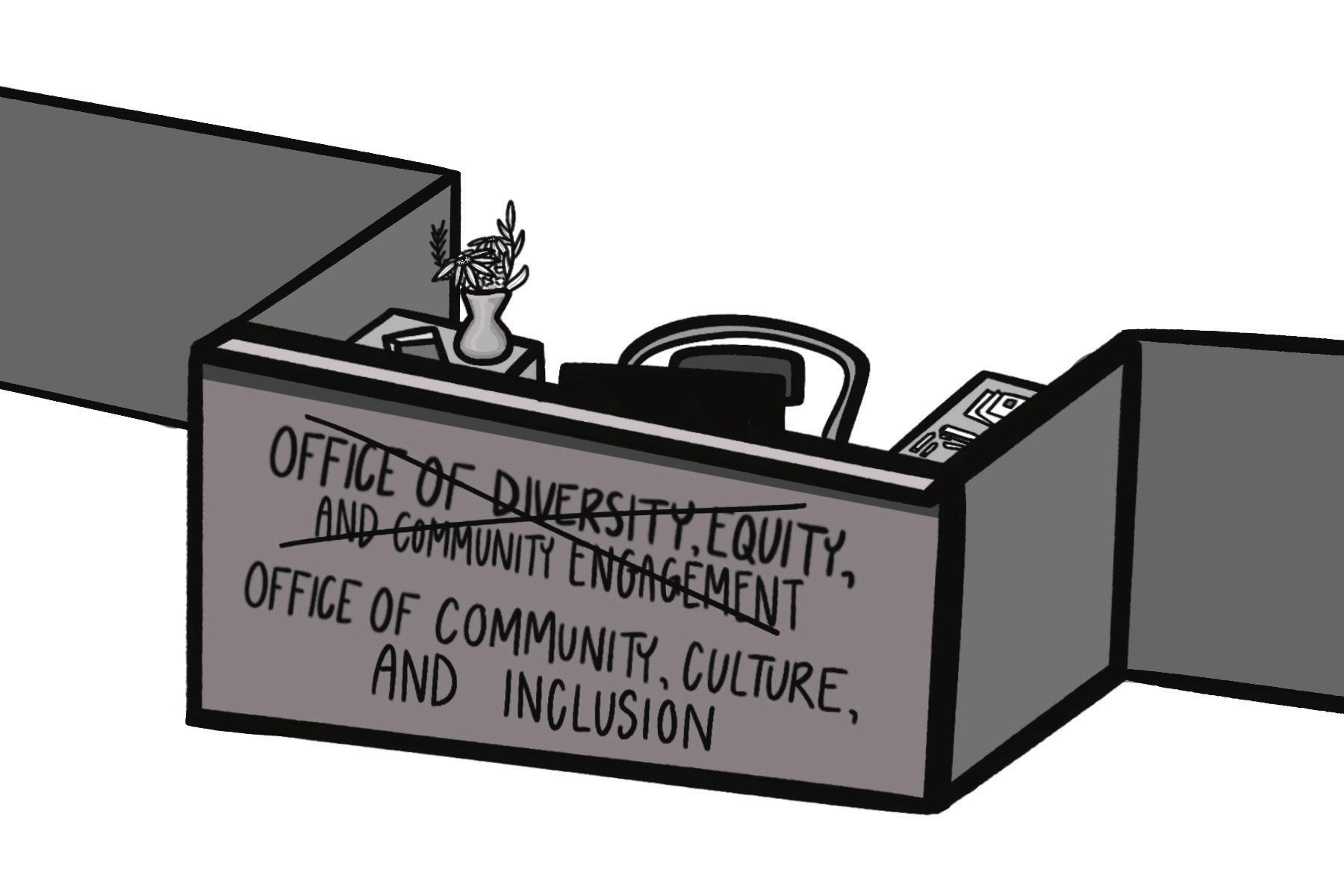
tionwide that have dismantled, renamed or downsized their diversity offices amid President Donald Trump’s promise to eliminate “illegal” DEI at universities that receive federal funding. Executive orders banning DEI and threats to cut federal funding from universities led three of GW’s peer schools to dissolve their diversity offices and five to rename them, opting for terminology like “Office of Belonging and Engagement” or “Academic Excellence and Opportunity.”
Our editorial board recognizes that under the current federal administration, there are several pressures to not advertise DEI offices
or programs at universities and keep the word diversity out of offices, programming and events, and as a result, the University will have to make difficult decisions. However, branding changes like those to the Diversity Summit and ODECE — which involve explicitly removing the word diversity from their titles — as rooted in the University’s commitment to DEI, is disingenuous. When Lach in November announced GW was considering renaming the Diversity Summit to broaden the event’s scope, he framed it as officials’ efforts to “reenvision” the event to support the entire community.
The honors program doesn’t deliver the academic rigor it advertises
GW’s University Honors Program advertises itself as an interdisciplinary, highly academic program that helps “bring together outstanding students” and aligns with the “highest academic aspirations” of GW’s schools and departments. The program has a cohort of around 125 students per year who take a wide range of liberal arts courses in order to graduate with honors. When I began the college search process, the UHP caught my attention for its promise of providing a smaller, more intimate connection with faculty and students within the wider University setting. However, as time progressed and I made my way through my freshman and sophomore years, I became increasingly frustrated with the UHP and how the program failed to live up to my expectations academically. I wanted to partake in a program that challenged me, but I didn’t find that in the UHP. While I was expecting to find an honors program that allowed me to pursue my academic interests, just at a higher level, I instead quickly discovered the program was overly rigid, prohibiting the flexibility that is so integral to many students’ college experiences.
Ava Hurwitz Opinions Writer
The first year of the UHP consists of two overarching courses — a philosophy class and a science class — both taken over the course
of two semesters. Yet, I had no need for a science class, let alone one that covered content which I had learned already just the year prior in my AP courses. They were just taking up space in my schedule that could have been used for classes that would go toward fulfilling my major requirements. While students in all colleges are required to take a science course, nonUHP colleges are allowed to opt out if they scored high enough on their AP tests. UHP, by contrast, has a strict curriculum that doesn’t allow students to switch out to classes that they may need more for their major, or simply not take classes they have no use for or may have already learned the content for in high school. If the entire point of the UHP is to intellectually challenge its students and prepare us for our future academic pursuits, they should allow for a more flexible experience, one that is more tailored to each student’s interests or careers. The program could easily allow for substitutions for first-year honors requirements, as they do for upperlevel classes in the program, without taking away from the academic rigor of the UHP. Meanwhile, I was particularly excited for the philosophy classes, since I had been a part of a twoyear honors cohort in high school. But the UHP failed to meet the expectations I had built up from the level of academic rigor required from my high school program. I found that although our philosophy course was
supposed to substitute the first-year University Writing class, the critiques and assignments did not even help me improve my writing skills because they were incredibly tailored to that specific professor’s style of prose.
During my sophomore year, I walked into my first upper-level honors classroom excited to see some familiar faces. But despite the UHP repeatedly advertising the program as providing smaller class sizes to facilitate an intimate environment, my first honors class as a sophomore was crowded with about 50 students. What I didn’t know is that many of the upper-level honors choices are available for any student to take. This defeats the point of the smaller, intimate cohort that the UHP loves to advertise. If some of the classes that UHP students can take are the same as upperclassmen, then there is nothing exclusively challenging about the program.
One of the main reasons that I chose GW was because of the UHP. I entered the program ready to be academically challenged in the close-knit group of students who cared just as much about philosophy and school as I did. Yet, I have been incredibly disillusioned so far in my journey. of UHP students are able to reap more benefits from the program than I could by creating a more academically rigorous environment. .
—Ava Hurwitz, a sophomore majoring in international affairs, is an opinions writer.
Similarly, when officials announced the creation of OCCI, they said the reorganization would allow GW to foster an “inclusive and respectful environment that enables everyone to thrive.” While these reasons sound good in theory, they fail to explain officials’ rationale for emphasizing community in these offices and initiatives at the expense of diversity. This leaves community members to wonder whether GW is actually retreating from their values or is simply seeking to comply with federal regulations. By acting like these changes in words have no impact on the office’s operations ignores the perception that GW is un-
interested in providing specific programming for minority students and instead wants its diversity offices to simply focus on promoting a welcoming community environment for everyone. While community is undeniably an essential part of students’ experience at GW, it is in no way a substitute for culturally informed resources that are specifically meant to uplift those with marginalized identities. As much as the University wants to emphasize the idea of community as a surrogate for diversity, these terms aren’t interchangeable, and it is a disservice to the University’s purported commitment to DEI to act as if they are. GW — a predominantly white institution with diversity as one of their values — saying they are committed to DEI values but not having an office specifically dedicated to diversity leaves the community to wonder how deep their commitments run. While our editorial board understands why diversity and equity are potentially being disguised or shrouded by words like community and culture, part of committing to diversity values is making sure students know where these resources are accessible. The whole point of a diversity office is to provide an easily accessible space for students with marginalized identities, but the name of the new office does not immediately make it clear that that is what the space is designed to do. “Community” and “culture” are ambiguous enough terms that students who are seeking diverse spaces may not know that is what OCCI is designed for. When our office commits to diversity, we need to see how the University will translate these resources to the rest of the GW community so they stay accessible and are upheld.
GW students must factor the human impact of politics into their studies
GW’s allure, for many students, is its unrivaled opportunities for political discussion deriving from its location at the heart of American government and its nationallyrecognized political science and international affairs programs. Much of the political science experience at GW consists of reading theory from textbooks, engaging in policy discussions and scrambling for internships in government. But while students are caught up in these class discussions and readings, it can be easy to lose sight of the reason we learn about politics in the first place: its effects on humans. The purpose of any policy position is to improve the quality of life of a certain group, and it is necessary to understand those origins — the wants, needs and grievances of people — when studying politics. Often, students in political science and international affairs are quick to give their opinion on a subject based on what they read in a textbook without understanding the consequences on the ground. But students who do this are ignoring one of the most tangible benefits of coming to GW: the ability to go beyond the classroom and engage with people at the heart of these political issues.
Ethan Vargas Contributing Opinions Editor
Politics is not a solely
academic pursuit, but rather an essential part of people’s lives and communities, whether they realize it or not. Politics is happening on the ground in everyday locations — grocery stores, gas stations and households. While GW classes offer extensive knowledge in the field, there are many facets of politics students cannot read in books. Stories from people’s everyday lives — everyday experiences — provide indispensable wisdom into the real-world impacts of policy and governance, which can only be taught through conversation with others. This is something that students at GW often forget, since studying policy in such a sterilized classroom environment can make people dismissive or misunderstand the personal experiences that influence someone’s politics. There’s no better place than GW to engage with foreign policy advocates, environmentalists, labor leaders and so many others to learn why they fight for their cause, but students rarely seek out these opportunities, instead opting to solely base their opinions on theory they’ve read in textbooks. The human consequences of policy that indirectly affects both foreign and domestic individuals can be seen every day. A few days ago, an Iranian organizer approached me to sign a petition, and, curious to know more, I asked what motivated their protest. I thought it would mainly be
about the recent strikes and stories from the war. But instead, I heard a powerful story of decades of resistance against an authoritarian regime by their family that informed me of the Iranian conflict on a far more human level. A simple 10-minute conversation gave me greater insight into the conflict than I have gotten in any of my class discussions. The conversation helped me to understand that Iran’s story ran deeper than the political gamesmanship of the Iranian and American governments but played out in homes, grocery stores and schools. The emotional power of a human story behind abstract policy decisions cannot be transferred onto pages; those stories must be sought and told, which is where Foggy Bottom holds a unique advantage. For a nation founded on free speech, it is necessary to keep politics in action through our words in the marketplace of ideas, and there are few places better than GW to advance that goal. Students must level up their education outside the classroom by seeking conversations with those most affected by politics. Only by listening to one another — seeking out the shared humanity in all of us — can students truly achieve a well-rounded political science education and improve their academic discourse around these topics.
—Ethan Vargas, a firstyear majoring in political science, is the contributing opinions editor.
ABBY TURNER | STAFF CARTOONIST
SPORTS
Senior distance runner strides out of GW with a legacy earned step by step
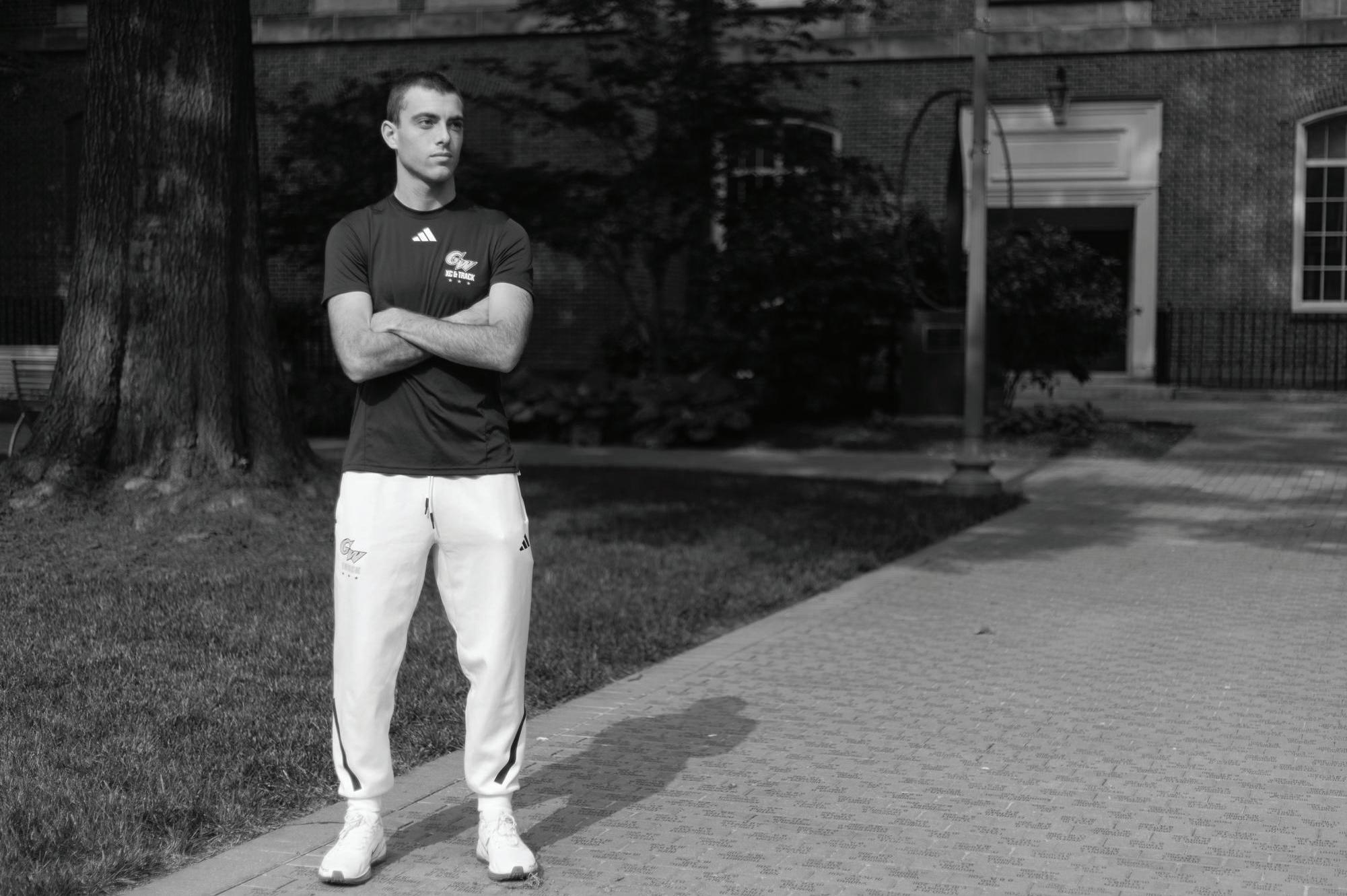
Michael Bohlke may be graduating as one of the most decorated track and field athletes in GW history, but he wasn’t always at the top of the leaderboard.
Bohlke leaves GW as the first student-athlete in track and field program history to claim backto-back conference titles in the same event at the Atlantic 10 Championships, winning the 1,500-meter race in both his junior and senior years. The distance runner’s conference dominance contrasts with his freshman and sophomore campaigns, where Bohlke laid a solid, consistent foundation but had yet to break out as a record-setting contender.
Bohlke said it took years of developing his race routine, like integrating swimming into recovery days and perfecting his diet and sleep schedule, to reach the A-10 Championship as a winner, though maintaining his place at the top of the conference was even more difficult. He said entering this season as a reigning A-10 champion brought a new level of competition, especially as four conference runners had already beaten his leading time from last year.
“I have to go in trusting my fitness and race instincts,” Bohlke said. “Knowing that I’m the one to beat will hopefully allow me to take more of a passive approach to these races, where people will cue off of my position in the race.”
Bohlke said he came into GW harboring high ambitions for performing at an elite level and not seeing them immediately materialize was “frustrating,” noting the heavy physical and emotional toll even minor injuries had on him in his early years.
“Knowing where I ended up makes those experiences seem ‘worth it’ in hindsight, but they
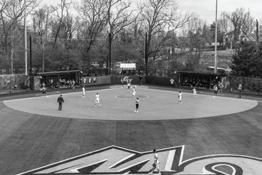
Softball bounced from A-10 Championship on first day
MILO
ROSENZWEIG
EDITOR
Softball (23-22, 12-12
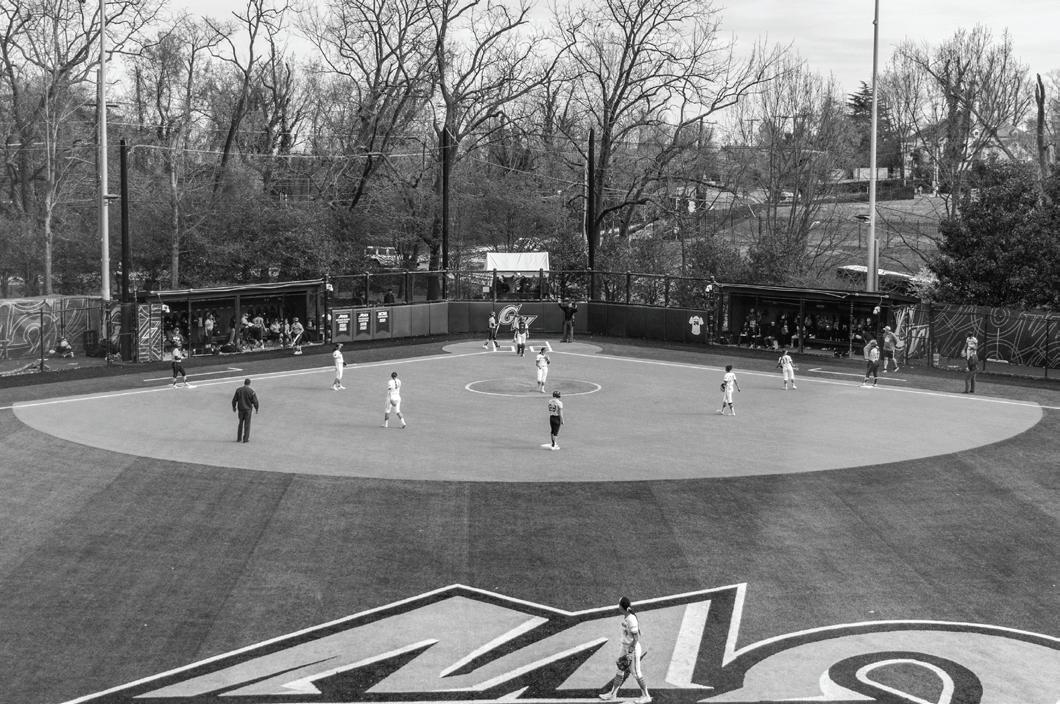
Atlantic 10) fell to Dayton and Saint Joseph’s universities in back-to-back matchups on Wednesday, the opening day of the A-10 Championship in St. Louis, Missouri, marking the conclusion of an up-and-down season for the Revolutionaries.
GW lost 3-2 to Dayton in a nail-biter early Wednesday afternoon, followed by an 8-4 loss to Saint Joseph’s that evening to seal the Revs’ fate in the double-elimination tournament, mirroring their 2025 postseason exit. While they finished this season with a middle-of-thepack .500 conference record and a .511 record overall, an impressive slate of four players earned prominent A-10 awards Thursday.
In Wednesday’s opener, Dayton kept the Revs’ offense silent through six innings, an effort led by the Flyers’ graduate student pitcher Kate Kastelic, who tossed four scoreless innings.
Dayton got the scoring started in the bottom of the third inning when sophomore first baseman Katelin Goodwin roped a line drive into right field that ricocheted off the fence, allowing her to reach second base. With two outs, Dayton’s freshman infielder Hayden Baird then punched a single past Revs’ senior second baseman Daniella Lew, allowing Goodwin to score.
Senior Emma Fales tried to spark offensive momentum for GW to start the fourth inning, reaching on an error and quickly advancing to second after freshman catcher Isabella Ruby drew a one-out walk. Junior shortstop Cadence Gilliland followed by casting a single into left-center field, allowing Fales to score.
The umpires quickly reversed the call, however, after determining that Fales had left second base early, leaving the Revs scoreless in the inning and stifling their momentum.
The Flyers tacked on a pair of home runs in the fourth and fifth innings, giving them a 3-0 lead over the Revs. Sophomore left fielder Ella Holman started the action with a solo shot. The following inning, junior catcher Deirdre Flaherty blasted another solo shot.
The Revs added two runs in the top of the sixth inning off doubles from Lew and senior left fielder Ashley Corpuz, but failed to take down the Flyers, leaving runners stranded in scoring position.
Later in the afternoon, the Revs faced off against Saint Joseph’s, who had lost their opening round 7-3 to Fordham. The Hawks started the scoring in the second inning with a tworun home run from freshman shortstop Grace Brown.
Revs senior Chloe Greene took over pitching in the next inning, but the Hawks tacked on five more runs, including an RBI single from redshirt sophomore Haley McMenamin and a tworun double from junior second baseman Morgan Lester. St. Joseph’s capped off the scoring run with a second two-run homer from Brown.
A solo home run from Lew put GW on the board in the top of the fifth inning, but the Hawks quickly answered back in the bottom of the inning with a single from Brown, putting them ahead 8-1 and giving Brown her fifth RBI on the day.
The Revs mustered a brief seventh inning two-out rally after a fielding error from the Hawks, scoring three runs off freshman Ava Farina, in relief of Shearer, but the Hawks held out, retiring the Revs and ending their 2026 season.
were certainly difficult to view that way in the moment,” Bohlke said.
In his freshman season, Bohlke finished sixth in the 1,500 meter at the A-10 Championships and fifth in the 5,000 meter as a sophomore.
Part of making those experiences “worth it” required a transformation of mental preparation, Bohlke said. While he said his race strategy mostly
Baseball
remained the same, he had to learn to manage his emotional energy throughout the long season.
“In terms of mental prep, I don’t come up emotionally as much for the smaller races which allows me to dial in on the larger races and opportunities,” Bohlke said.
Though he set many personal records and secured a firstplace finish in his freshman and
sophomore seasons it wasn’t until his junior season that he picked up his consistent winning momentum.
In the 2024-25 season, he began his winning run, claiming first place in the 1,500 meter at the James Madison University invitational in early April, igniting a late-season surge in momentum that culminated in his first A-10 title, where he shaved nearly five seconds off his JMU time to secure first place.
In addition to his personal races, Bohlke was part of the distance medley relay team that won the Penn Relays in late April 2025. While his solo victories that season established him as a leader in the conference, it was the relay that Bohlke points to as the turning point of his collegiate track career, giving him the confidence for his postseason run and final season.
With one A-10 Championship already under his belt, Bohlke stepped into his senior season as a proven veteran.
Bohlke went on May 3 to successfully defend his A-10 title in the 1,500 with a winning time of 4:03.61, capping off his GW regularseason career.
As Bohlke heads to Virginia as a vastly different athlete from the one who first arrived in Foggy Bottom, he said the biggest difference in his performance has been his growing confidence at GW each year.
“When I was a freshman, I wanted to compete at the level I’m at now, but that’s an ambitious goal for the athlete I was at the time,” Bohlke said.
falls to Richmond in series sweep
MILO ROSENZWEIG
SPORTS EDITOR
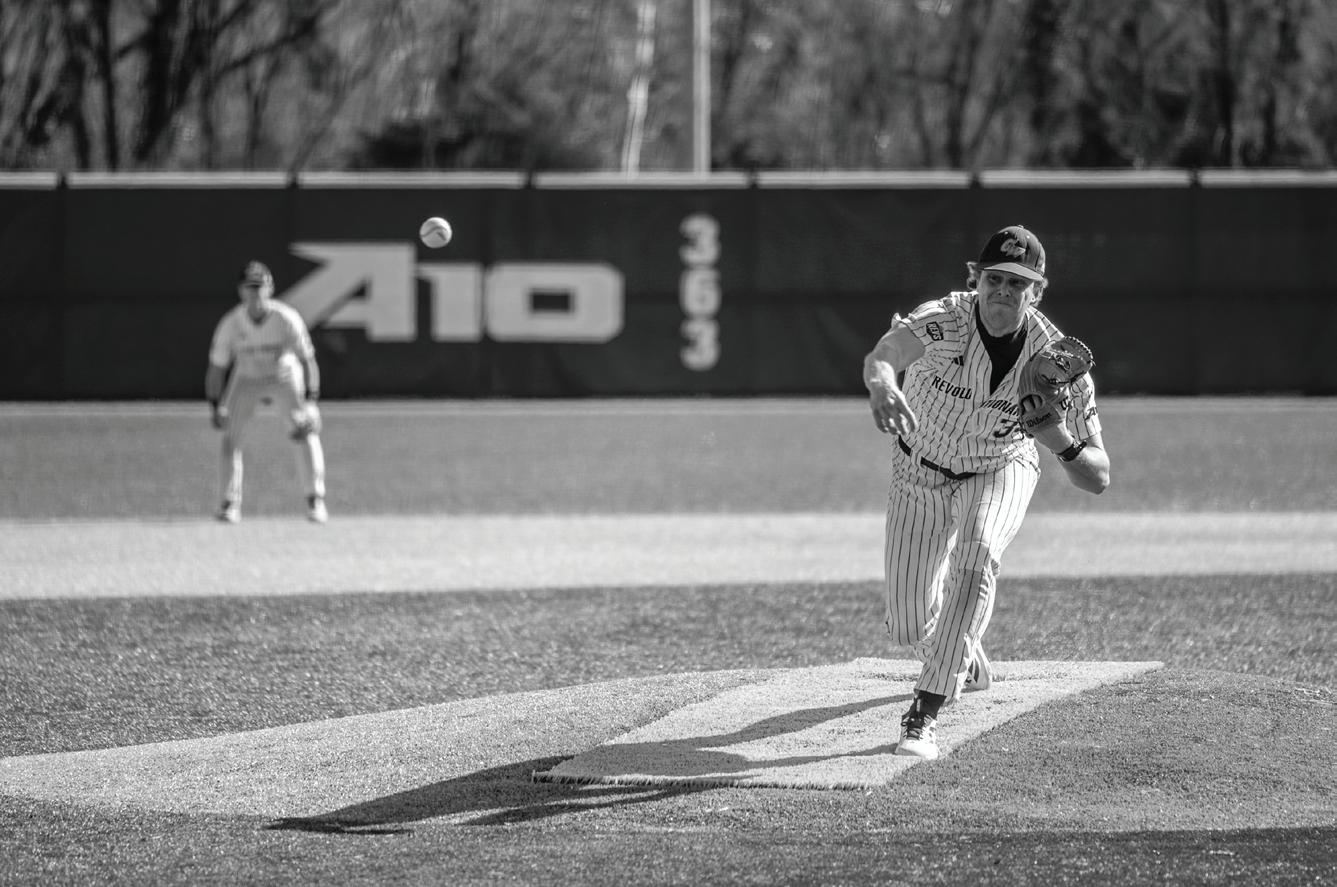
Baseball lost to Richmond this weekend in a series sweep, dropping the Revolutionaries to No. 10 in conference standings with one regular-season series left to play.
The Spiders took the opener Friday 8-5, pulling ahead late with two RBI singles in the eighth, before winning Saturday’s back-and-forth matchup 10-6 on a walk-off grand slam in the bottom of the 11th. Richmond completed the sweep Sunday with a 13-1 mercy-rule victory, cruising behind three home runs and 6.2 innings of one-run pitching from junior Jackson Hinchliffe.
Here’s a recap of this weekend’s action: Game 1: GW: 5, Richmond: 8 Richmond opened the series with a victory Friday, with a quality sixinning, three-run performance from senior Chase Topolski.
The Revs scored early with a first-inning double from junior third baseman Cristino Tufano scoring graduate outfielder Jack Kent. The Spiders answered back in the bottom half of the inning, however, with a two-run home run from graduate first baseman Dylan Winebrenner, putting Richmond ahead 2-1. Sophomore second baseman Charlie Walsh tied the game in the top of the fourth with an RBI groundout to Richmond’s shortstop Noah Haught, scoring junior catcher Robbie Lavey. In the bottom of the fifth, a single from Richmond’s second baseman Michael Elko scored Haught and put the Spiders back ahead, 3-2, before the Revs answered back in the top of the sixth with an RBI single from Walsh scoring Lavey. With the game tied, Richmond responded in the bottom half of the sixth with a solo homer from designated hitter Sean Scanlon, giving Richmond a 4-3 lead.
The Revs maintained the fight, however, as freshman Connor Jones, pinch hitting for Kent, smacked a double into left-center field, and was quickly brought home on a single from freshman
fielder Michael Bravette. A single from Tufano then scored Bravette before a strikeout ended the top of the seventh. An RBI single from Richmond’s catcher RJ Rickabaugh evened the score for the Spiders in the bottom of the seventh with their offense tacking on three more runs in the bottom of the eighth on two separate RBI singles. Sophomore pitcher Jasper Nadel took the loss, recording just two outs between the seventh and eighth innings, as Richmond held onto its 8-5 lead.
Game 2: GW: 6, Richmond: 10
Saturday’s matchup saw the two teams battle back and forth, forcing extra innings, with Richmond prevailing with a grand slam walk-off in the bottom of the 11th inning.
The Spiders got the scoring started in the bottom of the first inning with a solo home run from Elko. A single later in the inning from redshirt junior third baseman Aidan O’Keefe scored Winebrenner, giving Richmond an early 2-0 lead.
Richmond graduate outfielder RJ Johnson Jr. notched a single the following inning, scoring freshman center fielder Chris Schaller and Elko, putting the Spiders up 4-0. The Revs chipped away at the deficit in the top of the third inning with a solo home run from Lavey.
The Revs’ offense fell quiet until the top of the seventh, when Jones doubled, scoring junior first baseman Josh Wenz.
A groundout from Lavey then scored Jones, and the Revs took the field down 4-3 headed into the bottom of the seventh.
After a scoreless half inning, GW tied the Spiders in the top of the eighth with a solo homer off the bat of junior shortstop Nick Mullen.
In the top of the ninth inning, a bases-loaded walk to Tufano scored Jones, and a subsequent sacrifice bunt brought Bravette around to score, giving the Revs a tworun, 6-4 lead heading into the bottom of the ninth. But the Spiders answered back with a two-run, game-tying homer from Johnson Jr. off freshman pitcher Brad Marks, forcing the game into extras at 6-6. Both teams remained scoreless in the 10th inning, but the Spiders rallied in the bottom of the 11th with three walks.
Pinch hitter Evan Wilson then put the nail in the coffin, launching a grand slam into right-center field, winning the game 10-6 for the Spiders.
Game 3: GW: 1, Richmond: 13
The Spiders demolished the Revs in a mercy-rule shortened seven innings on Sunday, mashing three home runs and backed by 6.2 innings of one-run baseball from Hinchliffe.
Richmond got the scoring started in the bottom of the first inning, when Johnson Jr. drove a single into right center field, scoring Wilson. Rickabaugh then mashed a three-run home run the
following at bat, and a solo homer from graduate designated hitter Ryan Recio the following at-bat put the Spiders up 5-0 to head into the top of the second.
In the bottom of the second, a throwing error on a double-steal allowed Wilson to score. A single from Winebrenner then scored Elko, giving the Spiders a 7-0 lead, before O’Keefe tacked on two more runs the following inning with a home run to left field.
Richmond maintained momentum in the bottom of the fourth with a triple from Elko scoring Wilson. A Winebrenner single brought Elko around, and a one-out double from Recio put the Spiders up 12-0. A two-out RBI single from Haught in the bottom of the sixth inning gave the Spiders their 13th and final run. In the top of the seventh, the 10-run mercy rule in effect, Tufano lined a homer to center field, GW’s only run of the day. Hinchliffe quickly recorded two outs, but was pulled from the mound one out shy of a complete game, and relieved by junior Kellan Heney, who quickly recorded the Spiders’ final out, completing the sweep.
The series sweep marked the third straight series in which the Revs were swept by conference foes, a prominent sour trend in the latter half of the season. The Revs look to finish on a high note in their final regular-season series
left
RACHEL KURLANDSKY | STAFF PHOTOGRAPHER
Senior Max Haug pitches during a game against Saint Peter’s University in February.
LEXI CRITCHETT | ASSISTANT PHOTO EDITOR
Senior distance runner Michael Bohlke poses for a portrait in University Yard.


Commencement Guide
The Hatchet looks back on historic commencement speakers
DIANA ANOS CULTURE EDITOR
Each year, commencement speakers are a highly anticipated figure of the graduation ceremony — imparting final words of wisdom on the graduating class before they make their way into the real world.
Some schools host major celebrities as the annual keynote speaker at commencement ceremonies, like Hillary Duff at Northeastern University this year and Jennifer Coolidge at Washington University in St. Louis in 2024. But GW has stuck to hosting politicians, past presidents and powerful corporate figures alike to stand on the towering stage set against the backdrop of the National Mall.
From GW’s first commencement ceremony on December 15, 1824 with the Marquis de Lafayette and Henry Clay in attendance to President of MS NOW Rebecca Kutler delivering the 2026 address, The Hatchet took a look back at the inspirational figures and messages they left to each year’s graduating students.
Tim Cook – 2015
Despite a steady flow of product placement during his speech — holding his Apple phone up to take a picture of the graduates from the podium, instructing the audience to silence their cell phones and students in the crowd holding up emoji posters — Tim Cook chronicled his career, spoke of his influences, including Dr. Martin Luther King Jr. and
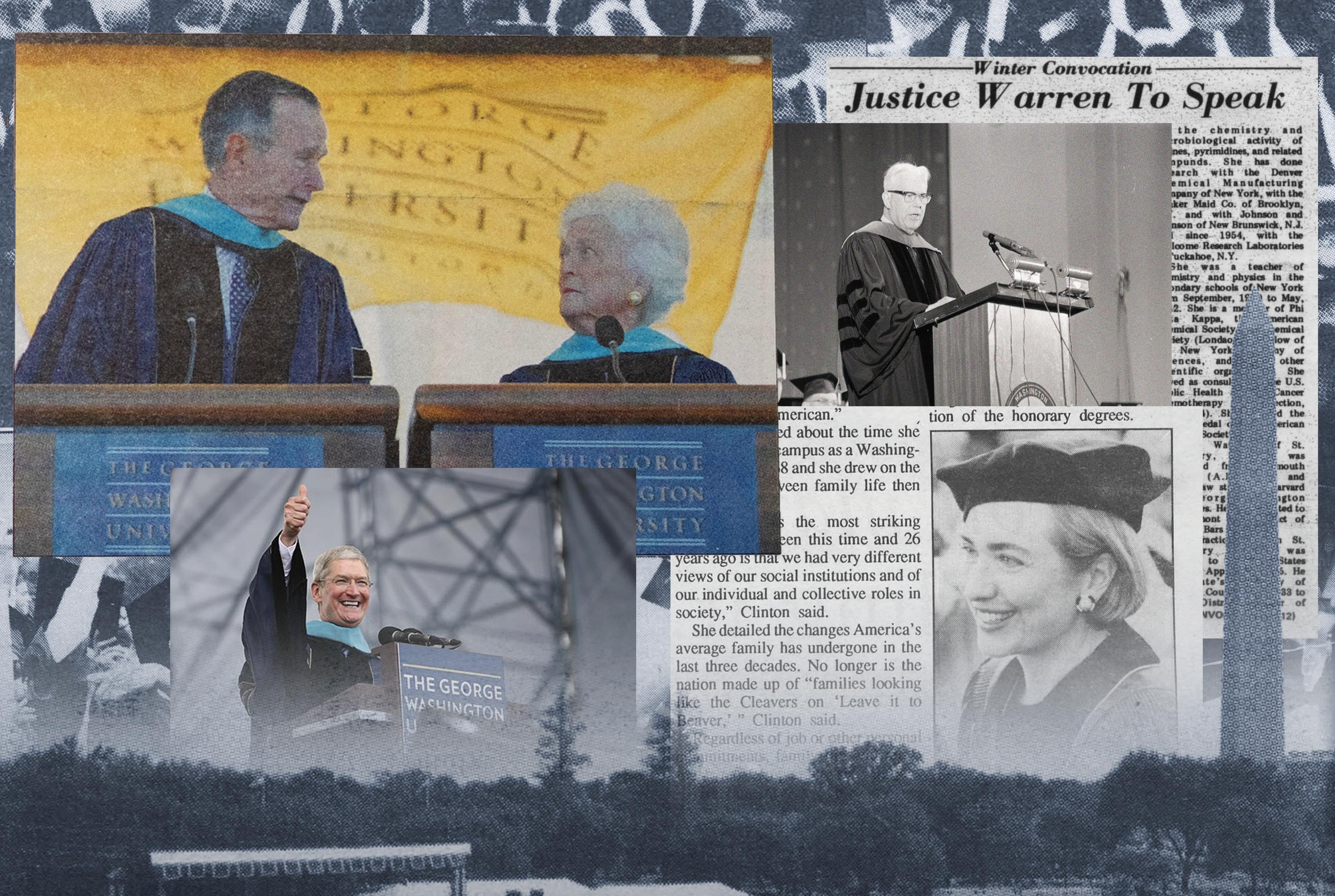
instructed audience members to find a “North Star” of values and commitments in life.
He ended his speech by reminding graduates to not live life on the sidelines but to solve problems themselves, put an end to injustices and to use their energy and passion to take action in whichever direction of their lives they’re headed.
“History rarely yields to one person, but think, and never forget, what happens when it does,” Cook
said, “That can be you. That should be you. That must be you.”
Hillary Clinton – 1994
In a letter inviting then First Lady Hillary Clinton to be the commencement speaker in 1994, former University president Stephen Joel Trachtenberg extended the invitation and encouraged Clinton to bring her mother to participate in presenting Clinton with an honorary Doctorate of Public Service — an award typically
GW professor vocalizes national anthem on mall
As the opening bars to the national anthem start, the lyrics Millicent Scarlett has sung countless times run through her head as she approaches the podium, looking headfirst at a familiar sight: the National Mall filled with thousands of graduates.
Scarlett, an adjunct voice professor and facilitator in the Corcoran School of the Arts & Design’s music program, will sing the national anthem at GW’s annual commencement ceremony on the National Mall May 17 after performing at graduation and other GW events for over 20 years. Scarlett has taught at GW for almost 28 years, starting her yearly performance of the national tune at GW at the GW Law graduation and the University Commencement ceremony on the Mall in 2003.

Scarlett said she takes “great pride” in singing the national anthem traditionally, with a clear and classic rendition of a song she said is one of the hardest pieces to sing because of its wide vocal range, forcing her to concentrate on each note.
On the day of commencement, Scarlett said her main focus is remembering the words to the anthem until she walks on stage. As she sits backstage in her regalia signifying her music degrees, even after 20 years, she said she still gets butterflies, but once she stands at the podium, it’s “go time.”
Scarlett said she enjoys chatting with faculty members backstage who she doesn’t regularly see around campus, like University President Ellen Granberg and each
year’s keynote speakers, highlighting some of her favorites like former First Lady Michelle Obama and the late jazz pianist and composer Dave Brubeck, both speakers from 2010.
In dress rehearsal on the day of the ceremony, Scarlett said she can hear her voice amplified throughout the National Mall before the official ceremony. In front of the Washington Monument, near the National Museum of African American History and Culture, her voice travels far, and passersby can hear her rehearse the tune from blocks away.
Scarlett said the ceremony is sometimes the first time her voice students hear her sing outside of a voice studio, and the opportunity makes them see her in a “different light” as a performer.
The prestige of the National Mall is not unfamiliar terrain to Scarlett.
After completing her undergraduate degree at Brandon University in Canada, she said she performed on stages in Italy, Austria, Germany and France. She said these experiences led her to win accolades including the Luciano Pavarotti International Competition and national semifinalist at the Metropolitan Opera for her vocal performance.
Scarlett will also sing at the Columbian College of Arts & Sciences Doctoral Hooding and master’s ceremonies, as well as the Business School’s graduate and undergraduate ceremonies this year. In the past, she’s sung for both the law and nursing schools as well.
given to commencement speakers — during the ceremony, as Mother’s Day and commencement fell on the same day.
Clinton discussed how society’s values had changed across generations, living on GW’s campus as a summer intern herself 26 years prior to the speech, and remarked on how societal views on family life and social institutions have shifted from the idea of a nuclear family to less traditional family models.
“But remember, as you go forth, no matter what a family unit looks like today, the family remains the essential ingredient in shaping our later lives — and you have no greater responsibility ahead of you,” Clinton said.
Chief Justice Earl Warren – 1969
Former United States Supreme Court Chief Justice Earl Warren delivered the University’s 148th winter convocation speech in Constitution Hall, discussing
generational changes, comparing his own college experience to that of the class of 1969 and telling graduates they were about to assume jobs that have the potential to change the country. He instructed graduates to keep George Washington’s “spirit” alive through maintaining faith in the pursuit of political freedom.
Warren concluded his speech by telling graduates he feels they will make the United States better through making themselves heard in large numbers and wanting a better country for their children and future generations to come.
George H.W. Bush and Barbara Bush – 2006 Standing behind two podiums, the Bushes received honorary Doctor of Public Service degrees and delivered a joint address to more than 25,000 graduates, faculty, staff and guests, with playful banter between the couple.
George H.W. Bush kicked off the speech by saying that he and Barbara had just used their GWorld cards to get coffees at Java City, a former GW coffee shop, telling Barbara she looked a bit like George Washington herself. George concluded the speech by defining a successful life as performing service for others, rather than spending time on material items like video games and expensive cars, and instead investing human ability to better the lives of others. “If you want to build a better America, now is the time to start,” George said.
Seniors turn graduation cords into showcases
of college journeys
For many GW graduates, cords and stoles don’t simply accessorize a cap and gown — they’re representations of achievements, identity and involvement on campus draped around their neck as they walk the stage during Commencement week.
From old climbing rope to colorful silver and burgundy, GW Club Climbing, the Honey W. Nashman Center for Civic Engagement and Public Service, the Black Student Union, Alliance for a Sustainable Future and Organization of Latin American Students are just some of the campus groups that have created personal cords and stoles for their students and members to wear on graduation day. Seniors said having unique cords allow them to showcase their involvement at GW, highlights from their collegiate journeys and what their campus community meant to them.
“I’ve sung the national anthem in very different places for very different people, but I still do it for the GW community,” Scarlett said. “That’s where it started. That’s where I work.”
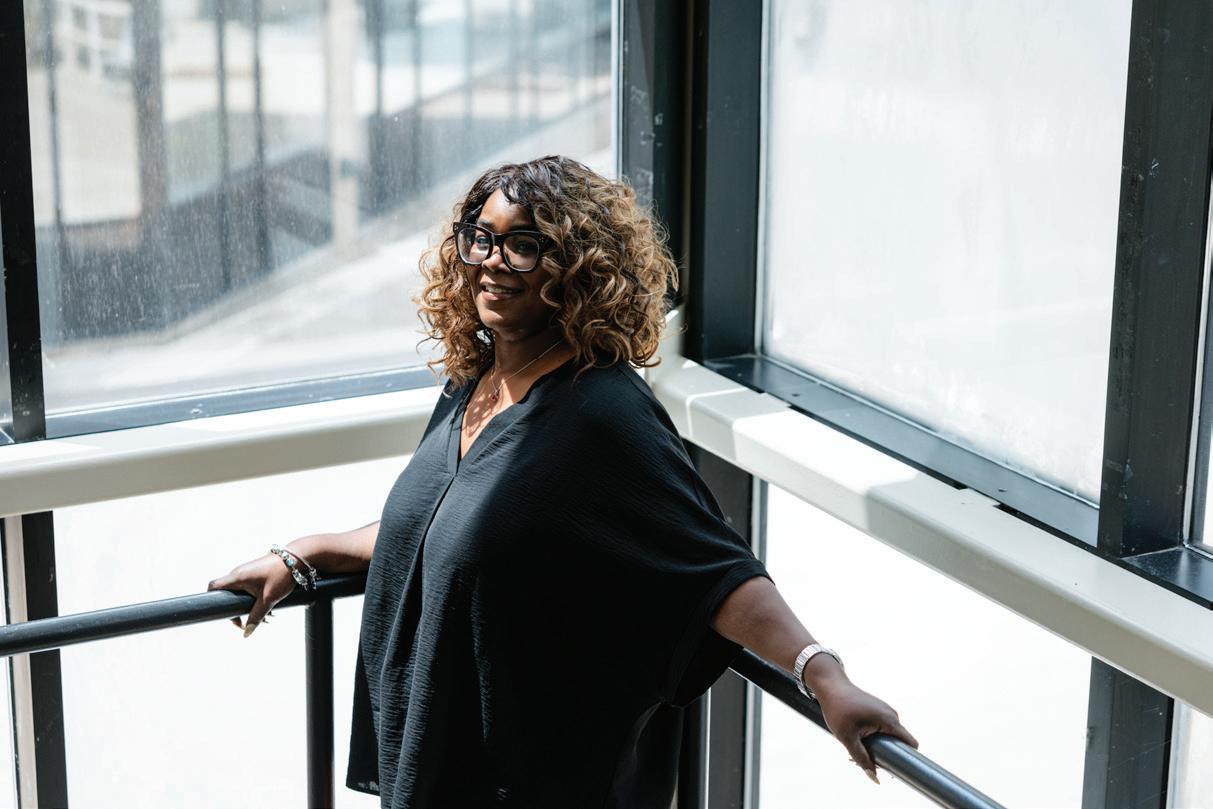
Lauryn Schumann, a political science and criminal justice double major, said she will graduate wearing the Nashman Center’s silver service cord, in recognition of her more than 100 hours of community service, including her work as the lead tutor with Math Matters, a tutoring program for public schools in the D.C. area.
Schumann said her experiences in Nashman shaped her college experience, allowing her to find community at GW and make lifelong friends through volunteering.
cords’ color compositions or designs looking exactly the same since they use recycled materials, Carlin said. Henry Scriven-Young, a political communication major and sustainability minor, said he wanted to wear the cord on graduation day to represent the hard work he put into completing the minor. He said the cord represents a “badge of honor” for his hard work in numerous projects and classes, as well as the people he met, who shaped his college experience and the minor he earned.
Erin Carlin, a program manager for academic sustainability programs at the Alliance for a Sustainable Future, said students in the sustainability minor program began wearing handmade cords made from recycled materials last year to reflect the work students are doing to study environmental issues and challenges at GW. Carlin said the cords are handmade from recycled textiles sourced through donations from staff and the Office of Sustainability, such as plaid shirts used as cord ties.

Scriven-Young said the cords are made by an Anacostia-based artist from Black Squirrel Company. He said the sustainability program was connected to the company through the Chesapeake Fibershed network from The George Washington University Museum and The Textile Museum after searching for a locally made supplier.

ate wearing cords made from retired climbing rope, repurposed from equipment previously used for lead climbing and outdoor trips. He said members of the organization shaped ropes that would have otherwise been thrown away into graduation cords as part of an effort to revive a club tradition that had faded in recent years.
Sheahen said the club wanted to revive the tradition to celebrate the sense of community it fosters as the process of making the cords by hand became a meaningful project for the group’s seniors ahead of graduation, including cutting the rope, burning the ends and tying figure-eight knots.
Kamila Andujar Lora, a sociology major, will adorn a burgundy stole during commencement week to represent her time in the Organization of Latin American Students.
The cord incorporates four colors – light blue, dark blue, green and beige – representing the program’s pillars: ecosystems, economies, communities and practices, with no two
Senior Devin Tennant, a public health and criminal justice major, will wear a red, black and green kente cloth stole on graduation representing his time in the Black Student Union. He said BSU became a source of community and connection throughout his time at GW, allowing him a space to connect with other Black students.

Andujar Lora said this year’s OLAS stoles feature the organization’s signature burgundy color, each member’s name, the group’s logo and each member’s position. She said that one of the most meaningful aspects of the organization was the sense of community that developed among Latinx student groups on campus, something she is proud to carry with her through graduation day as she wears the stole.
Sophomore Eli Sheahen, GW Club Climbing’s president, said the group’s seniors will gradu-
Tennant said BSU executive members wear Kente cloth stoles — a traditional Ghanaian textile — featuring black, red, green and gold colors traditionally associated with Black history and culture. He said active members in the group who attend at least one event a month receive gold cords.
“To me, it really feels like I’m wearing the weight of my ancestors on me, especially with me being Black American, with my roots being next to slavery and there being no opportunity for education, it really just means a lot for me,” Tennant said.
PHOTO ILLUSTRATION BY NICHOLAS WARE
GW stole and cords hang down on a graduating senior.
COLLAGE BY NICHOLAS WARE
Hatchet archives of past University Commencement ceremonies.
Diplomaof Graduation
LEANNA JOJU REPORTER Diplomaof Graduation
JULIA BOYD REPORTER Diplomaof Graduation

Commencement Guide2 0 2
Meet the 18-year-old walking the stage at GW Law’s graduation
While most 18-year-olds are starting their first year of college, finding roommates and changing their Instagram bios to add where they’ll spend the next four years, Shahab Gharib is preparing to walk the stage at GW Law’s commencement ceremony this weekend.
Gharib, who graduated from Pace University summa cum laude in two years at the age of 14 with a bachelor of arts in history, started his law school career at GW at 15 years old and completed his degree by the age of 18. He said he chose GW Law because he felt as though the faculty and administration were “genuinely excited to have him,” not focused on his young age, and instead embraced having the value of a young mind in the classroom, a “personal touch” distinctive from other law school programs that he appreciated.
Gharib said he had a “normal” school experience until sixth grade at the age of 12, when increased free time during the COVID-19 pandemic encouraged him to seek out further academic pursuits in chemistry, biology, physics, math and history at an accelerated pace. He completed 7th grade through senior year
of high school in one and a half years, which he said involved taking required courses online, including math, science and history classes, to get his high school diploma through the Florida Virtual School and College Board CLEP exams.
“Because I was so bored, I just took more and more and more, and I just didn’t have anything to do,” he said. “I was stuck inside all the time. It was either do school work, don’t do anything or do more school work.”
Throughout middle school, Gharib said his parents encouraged him to slow down, offering support every step of the way by making sure he wasn’t pushing himself too hard, telling him to take breaks and not overwork himself. In 2022, at the age of 13, Gharib said his family moved to New York, where he enrolled in Pace University as one of their youngest undergraduate students ever, and then to D.C. in 2024 where he began law school.
Though Gharib said he missed out on certain aspects of the typical high school experience, like school dances and football games, after completing four years of education in less than two years, he doesn’t feel “socially stunted,” instead he’s glad to have taken advantage of pursuing his
education at an accelerated pace.
Gharib said he knew he didn’t want to enter the workforce immediately after graduating from Pace with a degree in history at such a young age and, because he enjoyed academia and knew he had time to learn more about topics of interest like law, he ultimately decided to pursue another degree.
At 15, Gharib enrolled in GW Law, where he would attend classes for the next three years. After applying to several institutions, like Columbia University, Yale University and Villanova University, he said he applied to GW because his family friend attended GW Law and spoke highly of his experience.
Gharib said he is grateful for his parents’ support throughout his educational career, especially his mother, who moved locations and jobs from Florida to New York and finally to D.C., so he could pursue his academic goals.
Throughout his time at GW, Gharib said he did not have any negative interactions with students and faculty as a result of his young age, despite some normal first day jitters like fearing he’d forget a book, and he has felt accepted and integrated into the University community.
WRGW radio hosts reflect on
JESSICA ROWE
CONTRIBUTING CULTURE EDITOR
For seniors, saying goodbye to friends and a place that’s been a second home for four years is always the hardest part of graduation, but for WRGW seniors, the toughest farewell is the final sign off from their radio shows.
With weekly WRGW shows ranging from topics of music production to political controversies, the departing seniors of WRGW described their last show as a bittersweet finale to a major chapter of their college experience. For many senior hosts, the final shows featured special formats distinctive from their show’s typical routine, rehashing favorite on-air moments and covering topics they never got the chance to discuss as a goodbye to their loyal listeners.
Sophia DeThomas, a graduating political science major, hosted the show Geminisms, an astrologybased talk and music show centered around the weekly Gemini horoscope, where hosts play music matching the themes of the week, for three years. Alongside her fellow Geminis, Grace Cassineri and Aiden Milne, DeThomas has used the show to talk about her life, share music and discuss the longtime friendships among the hosts.
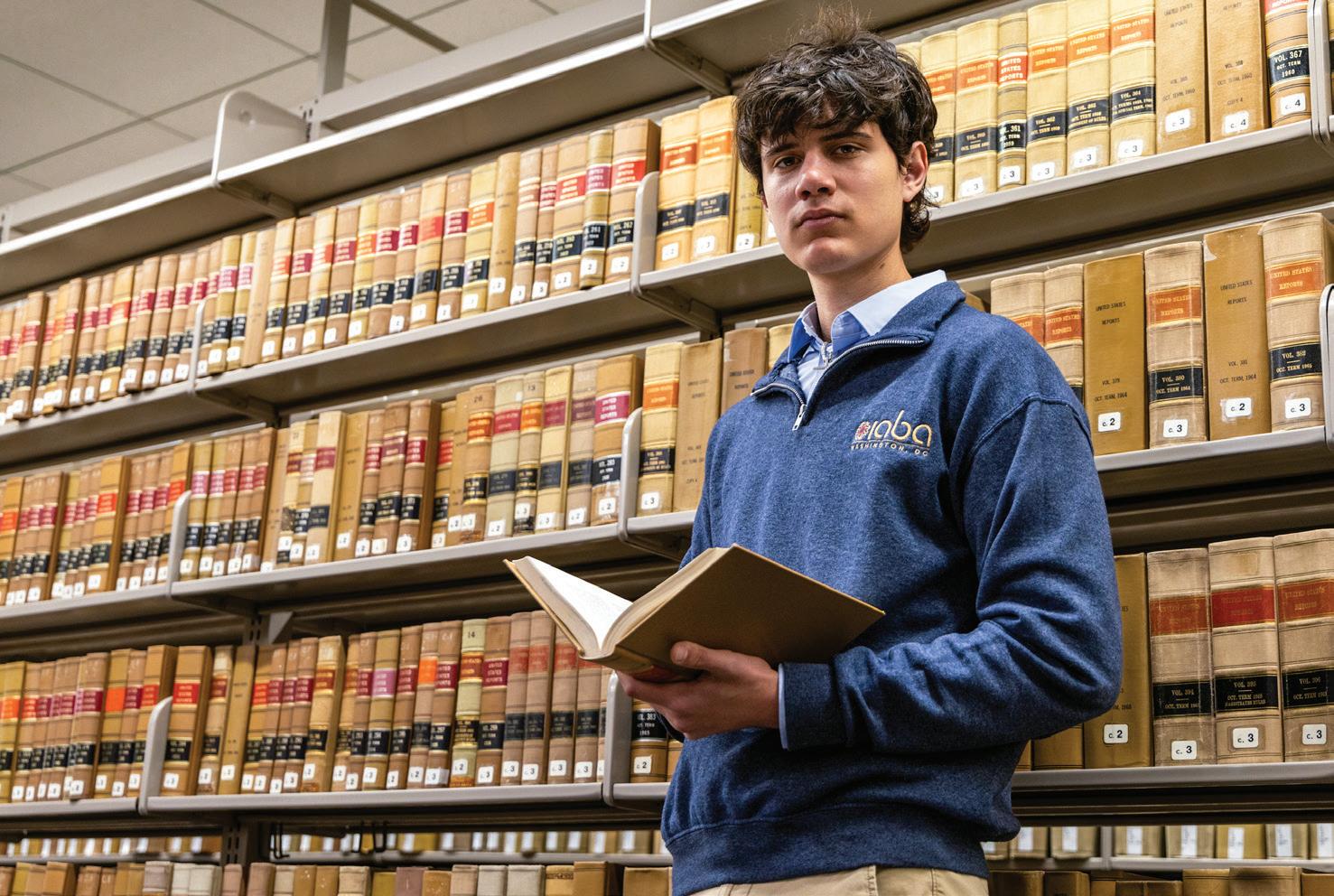
Apart from being a fulltime student, Gharib participated in several law student organizations like the GW’s Military Law Society and the Iranian American Bar Association throughout his time at GW Law.
Gharib said he has had the opportunity at GW to take a variety of classes apart from required courses, like Law of War, where he learned how international conflicts continue to evolve and shape law. He said his professors have been supportive to his educational
career and never treated him differently from his older classmates.
Gharib said he is currently studying for the bar exam in D.C., which is scheduled for July, and has a job lined up in Germany for a technological device company called Disconnect, which involves consulting, drafting and advising on contracts and employee relations. Originally from Bruchsal, Germany, he said he is looking forward to returning home and having the opportunity to be with family.
Gharib said that while being the youngest person in the room can have its challenges, like not being taken seriously in professional environments or having less experience than older colleagues, having a long future ahead of him puts his mind at ease, allowing him to explore careers in varying sectors, and giving him time to change his mind about what he wants to do in life.
“I can spend three years doing whatever I want and I’ll only be 21 and I can come back,” he said.
their final shows behind the mic
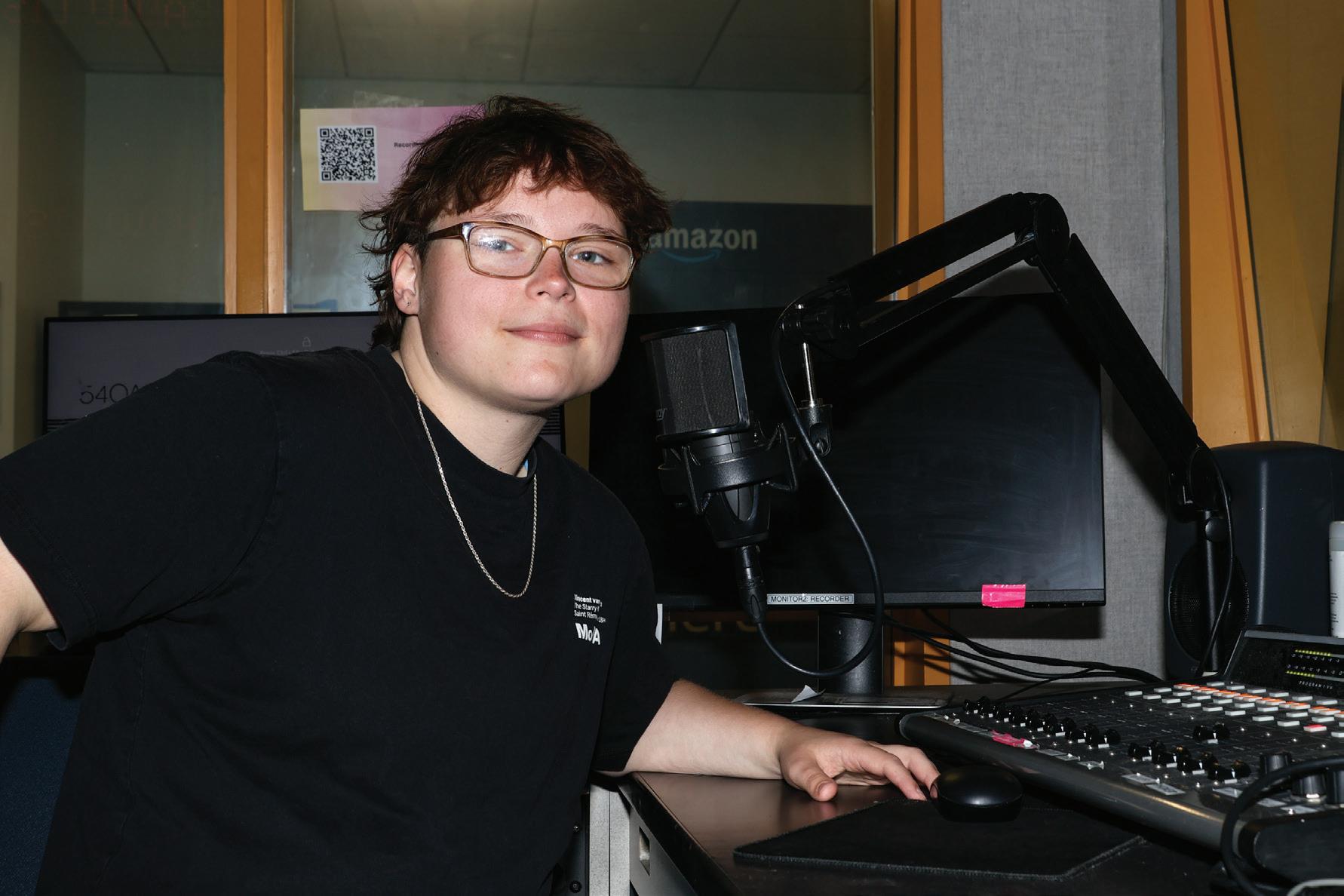
their

cates each episode to a music producer and their respective catalogs.
The Studio Sessions finale featured two episodes. For the first episode the hosts worked through a list of producers they’d never before featured. The second episode featured a DJ set from Karam, who DJs as a hobby, playing a mix of genres on air.
Sonia Howell, a senior majoring in political communication, has co-hosted Grab and Blab for nearly two years. The talk show covers the intersection of politics and pop culture, with hosts each week discussing topics such as cloning and unpopular opinions on genetic testing.
For the final episode, Howell and Gondesi brought back the old hosts — Lila Quinn, Cameron Johnson and Annie Gold — for a conversation on what Grab and Blab meant for all of them as hosts.
Howell said the show has helped to prepare her for post-grad job opportunities, as her ultimate career goal is to have her own talk show. After interning at SiriusXM this past semester, she said she was surprised by how much she learned from WRGW and how it can translate to a professional environment.
“The people that I’ve met through doing WRGW have totally changed the trajectory of my life,” Howell said. “Like, totally full stop.”
sta shares last to-do’s before bidding adieu to campus
While most of the University has packed up for the summer, seniors are still on campus for one last week to soak up the final moments of being a college student before heading off into the real world. While some soon-to-be graduates choose to spend the last week attending bottomless brunches and bar hopping, Hatchet staffers shared some last campus todo’s before the time of being a student comes to an end.
Sit outside Point Chaud and people watch Carly Cavanaugh | Columnist
GW spirit in the same way. Surrounded by business students, high school tour groups and friends recounting their latest gossip, you’ll quickly get quite a firm grasp on the zeitgeist of our campus community. I recommend sitting back, drinking your beverage, waving at the friends and foes you will soon say goodbye to and soaking it all in.
Take one more nap in a University Yard hammock
Ryan Saenz | Senior News Editor
Foggy Bottom campus to Western Market for lunch and throwing frisbees about.
Your naps would likely be more peaceful in an apartment or a non-city college campus, but still, take advantage of the last chances you have to nap in the heart of D.C. this week.
Walk from the Mount Vernon Campus to Foggy Bottom
Molly St. Clair | Managing Editor
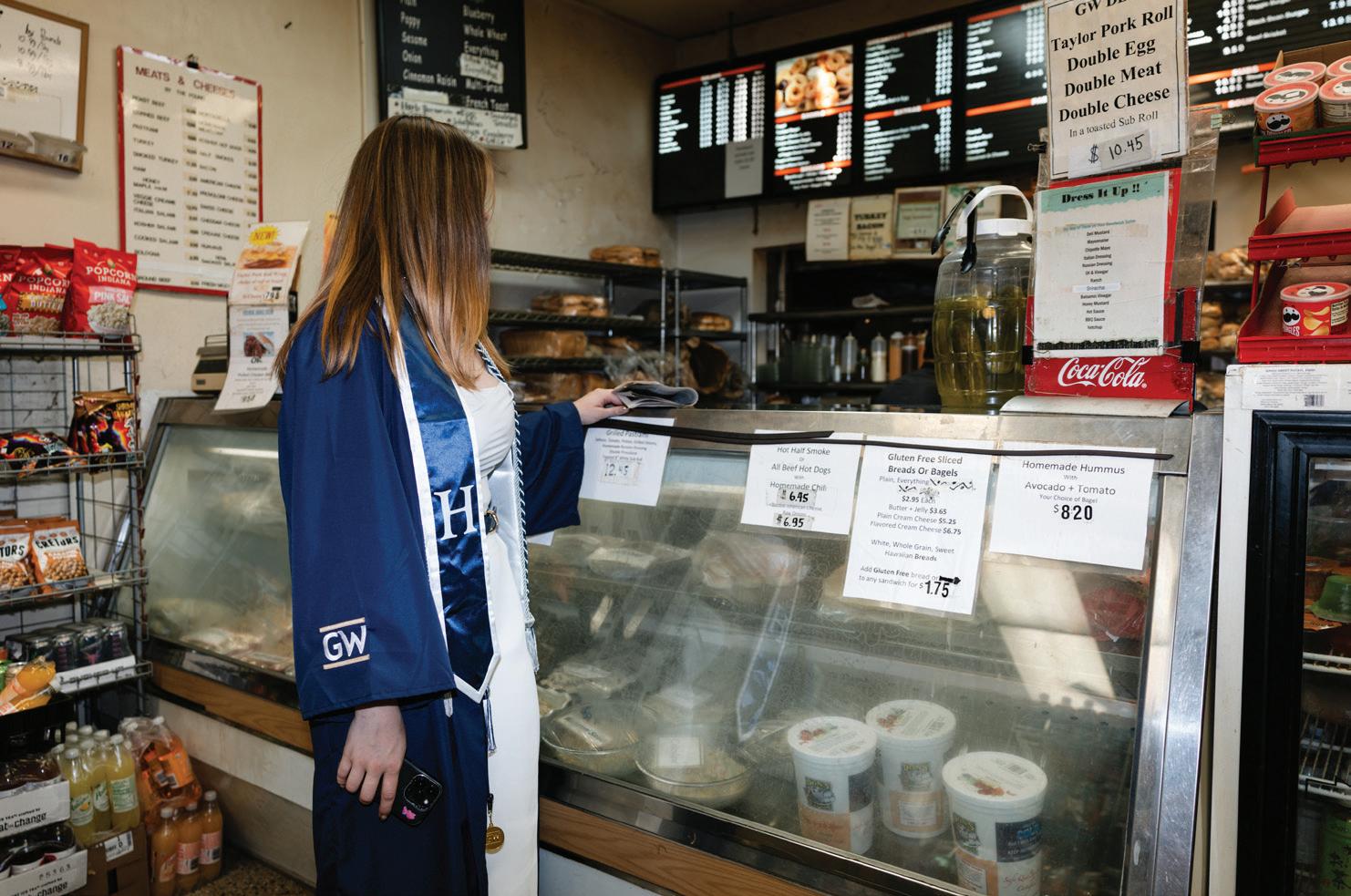
In theory, spots like University Yard and Kogan Plaza are the go-to hotspots for congregation and socialization, acting as the beating hearts of our urban campus. However, once you spend your first afternoon sitting on a metal chair outside Duques and Funger halls pretending to do work on your laptop, you realize there’s nowhere on campus that captures the
Ever since their arrival on campus this year, the U-Yard hammocks have become a go-to spot for a midafternoon rot. These brief periods of relaxation can, if the weather is right, turn into a mid-afternoon nap amid the hustle and bustle of the University’s largest patch of green space.
Although many GW students have already caught their trains, planes and automobiles back home for the summer, you can still expect to see the same pods of School Without Walls students marching from their

ence.
It was a sunny day in my sophomore year, and I had been waiting for the Mount Vernon Express Shuttle in front of Post Hall for about 30 minutes when I lost all hope. I was going to walk back to Foggy Bottom. Only a short 14 minute drive, the walk from GW’s Mount Vernon Campus takes a little over an hour to complete. With my headphones in and a vague idea of the general direction I needed to head in, I started my trek through the residential landscape of D.C.’s Foxhall neighborhood. The walk from the Vern to Foggy Bottom may be long, but in one’s final days at GW, it’s important to slow down and appreciate the


For
final episode, DeThomas and the Geminisms hosts abandoned the weekly horoscope format and instead took a trip down
memory lane, playing songs that felt meaningful to them and their show, including “Green Light” by Lorde.
Vincent Karam, a senior double majoring in biology and data science, co-hosts Studio Sessions with Arjun Srinivas, a show that dedi-
KYRA WOOD | STAFF PHOTOGRAPHER
Geminisms host Sophia DeThomas poses for a portrait in WRGW’s studio.
Diplomaof
Hatchet
LEXI CRITCHETT | ASSISTANT PHOTO EDITOR
VENNELA JAPA REPORTER