HATCHET

GIANNA JAKUBOWSKI
ASSISTANT NEWS EDITOR
Columbian College of Arts & Sciences faculty say the school is assessing doctoral enrollment and program funding after officials created an advisory group and asked programs to report student outcomes and minimum viable cohort sizes.
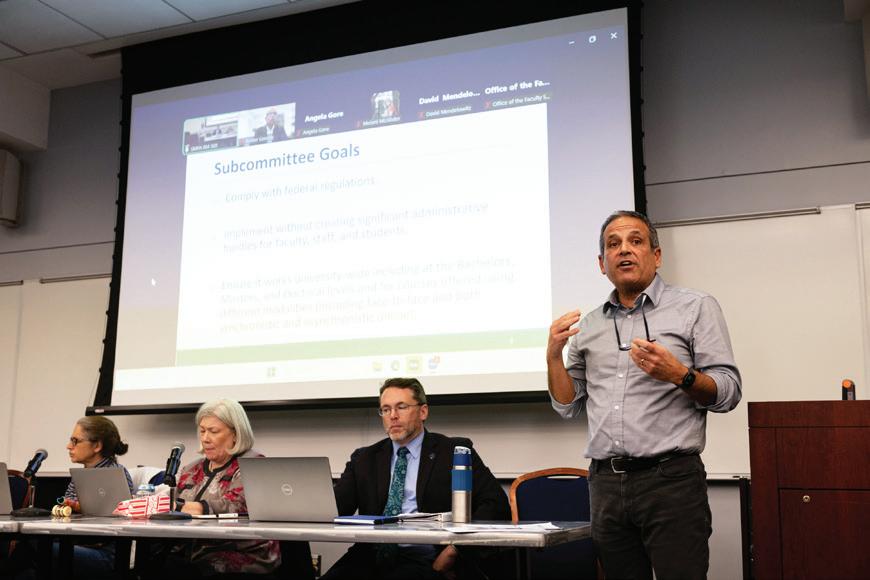
CCAS Vice Dean for Programs and Operations Kimberly Gross and Associate Dean for Graduate Studies Antonio López said in an email to department chairs and graduate-study directors last week that officials formed a faculty advisory group in August to conduct a “strategic review” of doctoral programs — a move they made as GW faces a budget deficit and universities nationwide curb PhD admissions and graduate funding. Faculty outside the advisory group predict CCAS is poised
to trim doctoral enrollment as programs define their minimum ideal PhD numbers, a step they expected but some argue requires broader faculty input.
Universities across the United States have paused humanities PhD admissions and cut some arts and sciences doctoral programs over the past year, citing rising costs from higher graduate stipends, decades of union activity, weak job prospects and broader economic uncertainty — including a decade-long contraction in the humanities job market.
Gross and López — who have led the group’s monthly discussions since August — said in last week’s email that they tasked the committee with reviewing and making recommendations on doctoral education in CCAS, a project they plan to complete by the end of the spring semester. They said the group will forward its advice to CCAS Dean Paul Wahlbeck’s office,
which will then present any proposals to the relevant college committees, including the Graduate Studies and Dean’s Council committees.
“We are looking at what we want PhD education to be, how to achieve excellence in PhD education, and how to meet those aspirations and reach excellence given available resources and the constraints of the current climate in higher education,” Gross and López said in the email.
Mathematics Associate Professor and Director of Graduate Studies Joel Lewis — one of five committee members — said Gross sent him an invitation to join the group in early August, and they held their first meeting on Aug. 14. He said the group has convened five or six times since they formed, meeting for roughly 90 minutes to two hours as CCAS deans look to members to “bounce ideas around.”
SAMANIEGO
Officials implemented a new grade notation for students professors consider unengaged, part of a broader policy clarifying how failing grades affect academic standing in response to updated federal Title IV guidelines.
The Faculty Senate last month unanimously approved a new policy introducing an “NE,” or “Never Engaged,” grade notation for students who remain on the roster but fail to participate, a measure intended to clarify non-passing grades and bring GW in line with updated federal Title IV regulations. Faculty say the measure preserves academic freedom, allowing professors to maintain their own course policies, including attendance and exam requirements, without mandating participation.
The Department of Education announced new





guidelines, effective July 1, 2026, requiring higher education institutions to verify student attendance before disbursing Title IV funds. If a student begins attending the school but drops out during the semester, officials are required to return a portion of the Title IV funds allocated to that student. GW does not award students credit hours for courses marked with an NE, Z — unauthorized withdrawal — or a W — authorized withdrawal, according to the resolution. Students who fall below the minimum credit hours required to maintain full-time status — 12 for undergraduates and 9 for graduate students — may be required to return a portion of their federal aid, meaning students who accumulate too many NE, Z or W notations could lose financial support.
The new policy defines a failing grade, or F, as an “earned grade” that is given to a student based on graded or incomplete assignments.
ELIJAH EDWARDS
ASSISTANT NEWS EDITOR
The Title IX Office received 494 complaints during the 2024-25 reporting period, the highest recorded number since GW began publishing annual reports in 2022.
The complaints, which span eight categories, including sexual harassment, sexual assault, stalking, dating and domestic violence,
retaliation and pregnancyrelated conditions, totaled 494 in 2024-25 — a 21-percent increase from 408 complaints the previous year and the highest number reported since the office began publishing reports in 2022. Reports of sexual assault alone rose 20 percent, and sexual harassment increased 29 percent, both reaching their highest levels since at least 2022.
A University spokesperson said greater awareness of campus resources and heightened confidence in the reporting process may have contributed to the overall rise in reports, which does not necessarily reflect an increase in incidents.
In 2024, the Title IX Office launched a peer adviser program in collaboration with the Student Government Association to expand resources
for students navigating the Title IX complaint process. The report states the office also worked with student organizations during the last academic year to plan programming and awareness campaigns.
Designated reporters, as in every year, marked the largest group of those reporting violations to the Title IX office and also the group with the greatest increase
in reports year-over-year.
Reports from designated reporters — including faculty and some staff members, who are legally required to report suspected or alleged instances of sexual harassment — rose 24 percent, from 262 reports in 2023-24 to 325 this year.
Reports of sexual harassment rose from 273 to 352 in 2024-25 — the largest spike across all categories. Sexual
assault reports rose from 95 to 114, instances of stalking increased from 91 to 97 and domestic violence reports increased from 20 to 26. Other types of complaints saw slight declines, like dating violence which dropped by about 22 percent — from 31 reports in 2023-24 to 24 this reporting period — and pregnancy, which dropped from 19 reports last year to 15 this year.



With the holiday season in full swing, Jeffrey Hill spends his early weekend mornings in a red fur suit with sleigh bells on his wrist and a dyed-white beard, offering a booming “ho, ho, ho” to crowds of eager children.
Children watch in awe, he said, as their faces brighten and that familiar spark of belief flickers to life. Whether at his Breakfast with Santa bookings — where families pile their plates with pancakes, share wish lists and pose for festive photos — or his appearances at private parties throughout the season, he gets a front-row seat to the wonder.
It’s a role he never expected to play. When a coworker first suggested he dress up as Santa for his new job’s Christmas program, Hill admits he was offended.
“I had just lost a couple pounds,” he said, laughing.
But 10 years later, “Santa Jeff” — who also goes by Kris Kringle and the DMV Santa Claus — has embraced the alter ego with gusto, stacking his end-of-year calendar with back-to-back appearances across the D.C. region.
Most December weekends, and plenty of weeknights, Hill zips himself into his jolly uniform to

work holiday parties, community events and Breakfast with Santas. What started as a workplace favor has become a side gig with purpose: a chance to build community among fellow Santa-aficionados
trust they put in me to carry out their vision of what they want Santa to be, to look like and to do.”
After his initial stint as Santa 10 years ago, Hill realized he loved making people happy and putting them in the holiday spirit. That affection pushed him to slowly begin dressing up as Kris Kringle for his family outside of work events, first renting a suit and beard to dress up for his now-10-year-old son and his friends.
Ten Christmastimes in, Hill’s Santa Claus has evolved over the years. He switched six years ago to growing out and dyeing his real beard and four years ago was able expanded his empire to a fullybooked calendar during the Christmas season.
started as early as September. He son too, for events like Christ-

This year, his seasonal bookings started as early as September. He said people hire him off-season too, for events like Christmas in July, and he hopes to begin doing off-season photoshoots in the fall and summer to spread joy yearlong.






“The people that book me trust that I’m going to come through and do exactly what I say I’m going to do,” Hill said. “And so I value the
and through groups, like the Santas of Color Coalition, to challenge narrow ideas of what Santa is supposed to look like. For Hill, spreading holiday magic means giving both children and adults in the DMV a Santa who looks and feels like theirs.





“It was one of the most rewarding things that had happened to me, particularly at that time,” Hill said. “So from that it was I rented a suit and dressed up for my son and some of his friends, and it just grew from there.”
warding things that had hapto that it was I rented a suit and dressed up for my son and some of his friends, and it


J. KARLIN SENIOR STAFF WRITER
Campus Living and Residential Education officials proposed bringing back the residential adviser program as soon as next year, which now awaits approval from the University, according to Residence Hall Association officers and student CLRE staff.
RHA President Urja Mehta said CLRE leadership, including Director of Residential Education Kyle Johnson, briefed RHA members last week on the proposed change, which would eliminate the current community engagement assistant and adviser positions and install a student RA in every dorm. Mehta and other student staff members said they are excited about the potential change — which now awaits approval from the University — but worry student staff will have to take on responsibilities typically assigned to professional community coordinators, like serving on call for emergencies.
Mehta said CLRE leadership told the RHA the proposed model, which GW last used in 2021, will include a return to a policy where student RAs reside in every residence hall to foster connections between the students. She said the University is aiming to strengthen community, particularly in

dorms where there are no residential student staff members under the current policy, like District, Fulbright and Amsterdam halls.
A University spokesperson did not return a request for comment on if or when officials plan to implement the new RA policy, plans for compensation, how officials would select the RAs
and what training they would receive.
Violet Sheehan, a sophomore CEAd living in West Hall, said her supervisor said officials will likely transition her position into an RA role next year.
“Having a clear definition of where that line is, is I think the primary concern for people at the moment,” Sheehan said.
Shenkman Hall
Reported – 12/2/2025
Open Case A GW student reported their clothing items stolen from the laundry room. Case open.
Residence on the Avenue
11/24/2025 – 4:00 a.m.
Open Case The GW Police Department responded to a reported theft. On arrival, officers made contact with a non-GW affiliated contractor who reported an individual stole an ATM from the building’s lobby. GWPD referred the case to the Metropolitan Police Department. Case open.
Elliott School of International Affairs
Multiple times and dates
Open Case A male GW faculty member reported harassment by an unknown male individual over social media. Case open.
Science and Engineering Hall Garage
11/30/2025 – 7:19 p.m.
Closed Case GWPD responded to a report of a nonGW affiliated individual pulling on car door handles. Upon arrival, officers made contact with the individual as he entered a vehicle. Police escorted the individual off GW property and issued a bar notice. Case closed.
Guthridge Hall
11/30/2025 – 9:51 a.m.
Closed Case GWPD responded to a report of a simple assault. Upon arrival, officers spoke with a GW faculty member who reported being assaulted by their non-GW affiliated partner. Police arrested the partner. Case closed.
South Hall 11/30/2025 – 1:33 a.m.
Closed Case GWPD and D.C. Fire and Emergency Medical Services responded to a report of a GW student experiencing a seizure. Upon arrival, officers made contact with the student and determined they had consumed several alcoholic beverages. D.C. FEMS medically evaluated the student and determined further treatment unnecessary. Case closed.
—Compiled by Bryson Kloesel
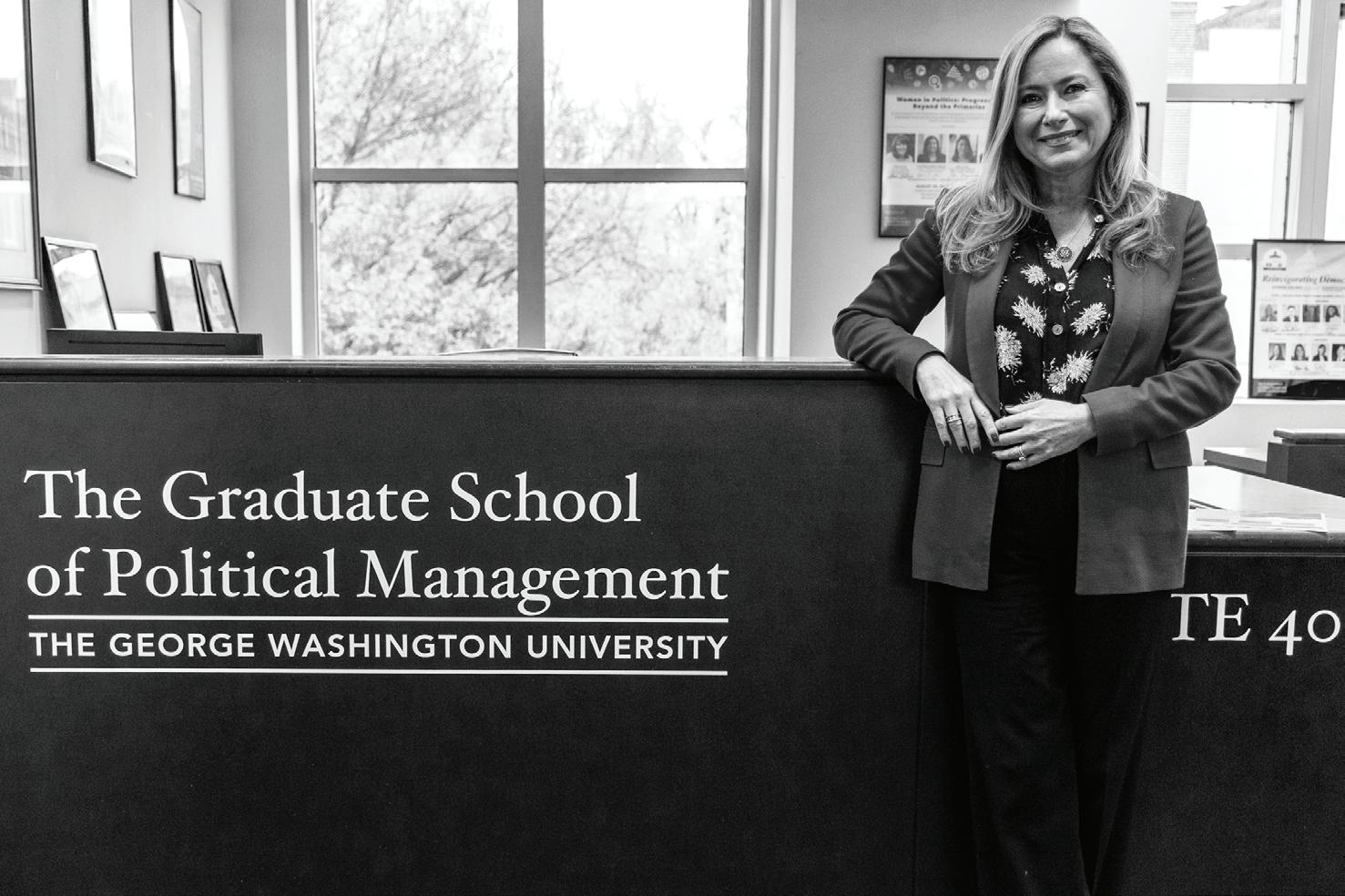
As she nears the end of her first semester leading the Graduate School for Political Management, Debbie Mucarsel-Powell is confronting years of declining enrollment against the backdrop of a turbulent political and higher education landscape.
Mucarsel-Powell said she has spent her first months as executive director launching a curriculum audit, including focus groups, to identify what she should add to GSPM’s coursework as she works to modernize the school and prepare graduates for political careers amid heightened polarization. She said rising challenges in politics — from rapid technological change and artificial intelligence to evolving media consumption patterns — underscore her goal of positioning GSPM as a premier program with a “cutting-edge” curriculum responsive to the modern political and media landscape.
“We are seeing other schools coming to Washington, D.C, trying to replicate what we’re doing,” MucarselPowell said. “So that’s a challenge for us that we need to keep an eye out for.”
Mucarsel-Powell said she’s working to boost the school’s enrollment and reviewing historical data to determine a target number. She said GSPM hired an alum to support this effort, who has been attending school-hosted happy hours and meeting with congressional offices to raise the school’s visibility and highlight career advancement opportunities.
“George Washington is not unique to those enrollment decreases, and we need to make sure that we are targeting prospective students the right way,” she said.
GSPM enrollment rose by one student in 2025, marking the first increase since 2017.
The school currently enrolls 157 students across its master’s and graduate certificate programs, compared to 156 last year and 189 in 2023 and is still well short of its peak of 430 students in 2017, according to enrollment data.
After Lara Brown, the school’s last permanent director from 2017 to 2022, left, the GSPM Advisory Council pushed for College of Professional Studies Dean Liesl
Mucarsel-Powell said GSPM’s key strength is that it was the first school in the country to offer an applied education in politics, though other D.C. programs, like Texas A&M University’s campus, which opened in 2021, now offer similar curricula. She said over half of GSPM’s alumni work in the District — a major selling point for the school — which is driving her to increase alumni engagement to benefit current students and attract more to the school.
Riddle to fill the role, in part so they could focus on increasing enrollment.
Officials hired Angela McMillen Ayres as interim executive director from January to July to boost the school’s visibility and enrollment and lay the foundation for a permanent director.
Mucarsel-Powell said she also wants to increase scholarship funding to help alleviate economic concerns as a potential reason for students not attending GSPM. Tuition for GSPM master’s programs sits at $1,935 per credit, with the school currently offering a limited number of meritbased scholarships covering tuition for one to four classes, according to the program website.
Graduate schools are grappling with the termination of the Graduate PLUS Loan Program going in effect July 2026, which accounted for 32 percent of all graduate federal student loan disbursements in 2024.
“If we are able to provide better and a larger pool of scholarships for our students, I think that would help as well,” Mucarsel-Powell said.
Mucarsel-Powell said Todd Belt, who leads the political management program, is overseeing the curriculum audit, which includes focus groups with students and an examination of past course offerings in an effort to bolster GSPM’s curriculum.
“Having those conversa-
tions with external stakeholders, not only our students but also other faculty members, our alumni and really, that’s how you have cutting-edge curriculum,” Mucarsel-Powell said.
Mucarsel-Powell said she’s interested in health policy and is pursuing conversations with the Milken Institute School of Public Health about potentially starting a program that combines health policy and politics.
“Especially now, when there’s a higher and higher rise in mistrust of the institution that provides public health for Americans here in
this country,” she said.
Mucarsel-Powell said today’s polarized political climate is deterring students from entering politics, so she wants to position GSPM as a place where students can find common ground and work together.
“This is a moment, actually a very critical moment, where we need more people to come into this arena to make sure that we unite the country, that we have tough and difficult conversations that can bring people together,” Mucarsel-Powell said. She said she encourages prospective students who
feel discouraged from studying politics because of polarization to meet with her and faculty members to discuss why they should consider GSPM.
“Even though it can be a challenge for us, I think that it’s also an opportunity for us to welcome students from all walks of life to come into the school and get into the arena,” Mucarsel-Powell said.
Mucarsel-Powell represented Florida’s 26th congressional district from 2019 to 2021 and ran for U.S. Senate in 2024, losing to Republican Senator Rick Scott.
Lakanwal, an Afghan National and resident of Washington state, with killing Sarah Beckstrom and critically injuring Andrew Wolfe.
NATALIE NOTE STAFF WRITER
Oren Shur — a partner at Democratic consulting firm SKDK and School of Media & Public Affairs lecturer — has taught his Political Campaign Communication course for four years, but it wasn’t until last semester that he found his leftleaning bias was unintentionally coloring his teaching.
To counter those concerns, Shur threw an idea out to fellow GW alum Joanna Rodriguez over the summer — who now works as the communications director at the National Republican Senatorial Committee — and asked if she would co-teach the course with him. That proposal piqued Rodriguez’s interest, who had already spoken to Shur’s class in past semesters about her work at the NRSC.

with differing opinions respecting each other and working together in a classroom will set an example for the next generation of political operatives.
message, spread it through advertising and use data and analytics to better disperse their message, according to the syllabus.
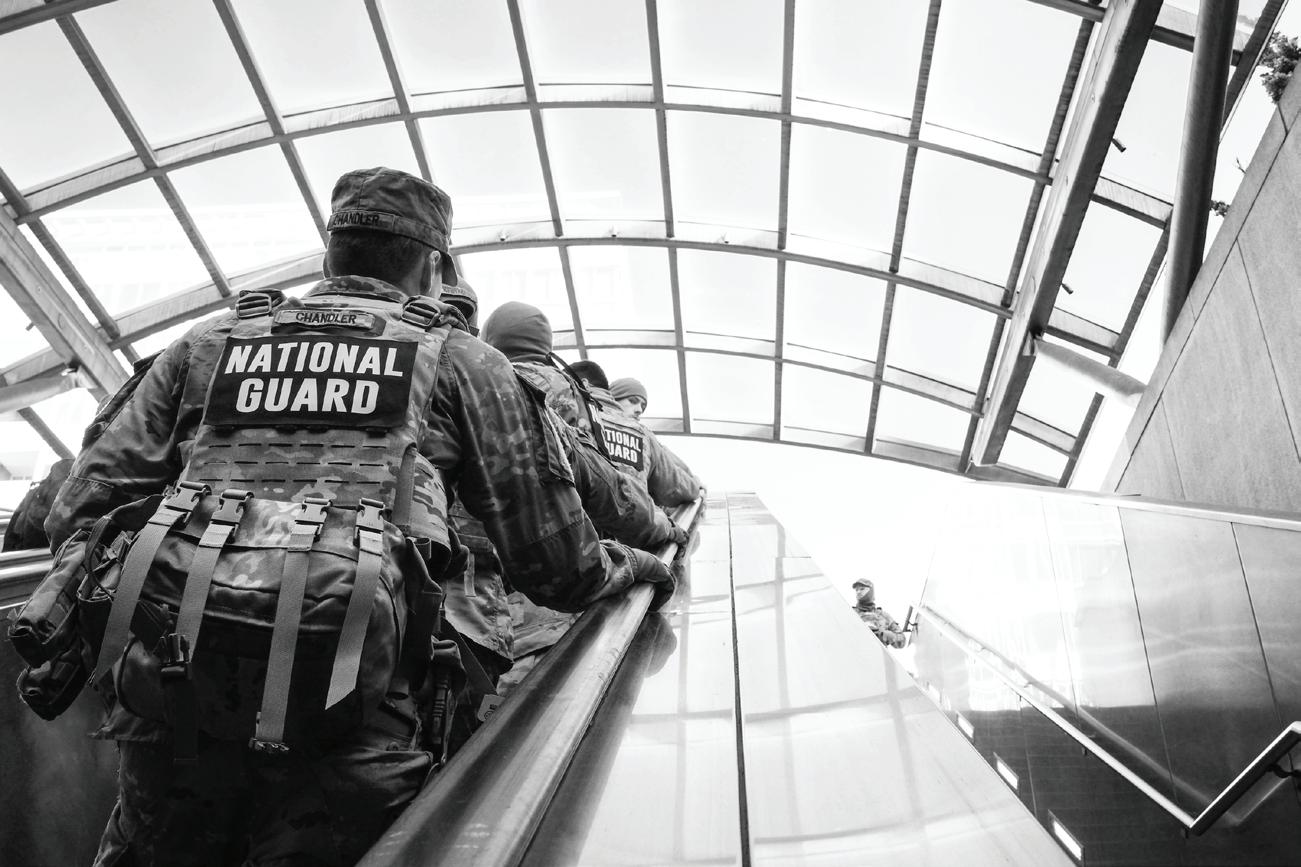
The U.S. Court of Appeals on Thursday said National Guard troops can remain in D.C. as they weigh the legality of an order requiring President Donald Trump to end the troops’ presence, three U.S. Court of Appeals judges said in a Friday order.
D.C. District Court judge Jia M. Cobb found the troops’ presence unlawful on Nov. 20 after D.C. Attorney General Brian Schwalb sued to end the deployment in September, but she delayed the effects of her order until Dec. 11 to allow the federal government to appeal the ruling. The D.C. Circuit Court of Appeals said in a ruling Friday it paused Cobb’s order temporarily to grant the judges time to hear additional arguments.
“The purpose of this administrative stay is to give the court sufficient opportunity to consider the motion for stay pending appeal and should not be construed in any way as a ruling on the merits of that motion,” the panel wrote.
The ruling means the guard troops can remain beyond the district court order’s Dec. 11 deadline.
The ruling comes eight days after a shooting near Farragut West Metro station left one West Virginia guard member dead and another gravely injured. The Justice Department Tuesday charged 29-year-old Rahmanullah
The shooting prompted Defense Secretary Pete Hegseth to deploy 500 additional National Guard troops to the district, who arrived in the days following. There are now about 2,700 troops in the city.
Both U.S. Assistant Attorney General Brett Shumate and Schwalb argued the shooting strengthened their respective positions on the deployment’s lawfulness in appeals court filings Tuesday and Wednesday. Schwalb said the incident illustrates the risk the deployment poses to both guard members and the public.
“The deployment impinges on the District’s home rule, requires the diversion of scarce police resources, and exposes both the public and Guard members to substantial public safety risks, as Defendants themselves acknowledged at the outset of the deployment, and as the horrific attack on two National Guard members last week tragically underscored,” Schwalb wrote in a Tuesday filing arguing against staying the lower court’s order to remove the troops.
Shumate said the shooting doesn’t prove the guard presents a danger to public safety and criticized Schwalb’s argument that the shooting justified an injunction barring the guard’s presence.
BRYSON KLOESEL
CONTRIBUTING NEWS EDITOR
The State Department added President Donald Trump’s name to the U.S. Institute of Peace building Wednesday morning, nearly nine months after the administration purged the institution’s staff and board.
Federal officials installed signage reading “Donald J. Trump” on the Foggy Bottom building in multiple locations directly above the institute’s former name before the president held a signing ceremony for a peace deal between the Democratic Republic of Congo and Rwanda. Former USIP employees, including GW professors, say the move — coming after the Department of Government Efficiency took control of the building in March and fired most of its staff — could signal Trump’s increased interest in its work.
“Now, the Donald J. Trump Institute of Peace, which is both beautifully and aptly named after a President who ended eight wars in less than a year, will stand as a powerful reminder of what strong leadership can accomplish for global stability,” White House Deputy Press Secretary Anna Kelly said in a statement to The Hatchet.
The Trump administration has faced ongoing legal battles with USIP leadership over who controls the building. In February, Trump issued an executive order seeking to dismantle the institute — founded in 1984 by President Ronald Reagan — but a federal judge blocked the order in May, allowing USIP leadership to regain control of the building. The D.C. Circuit Appeals court then reversed that decision in June, with a final decision pending in federal court. The State Department currently controls the building.
“The United States Institute of Peace was once a bloated, useless entity that blew $50 million per year while delivering no peace,” Kelly said.
School of Media & Public
Affairs Director Peter Loge, who served as vice president for external relations
She agreed almost immediately. As the end of the semester nears, Shur, Rodriguez and their students said having two professional perspectives influencing is a valuable addition to the course as students are able to understand how both sides of the political spectrum handle their campaigns.
“Co-teaching alongside a Republican operative would both bring some needed balance to the coursework but also show the students that even in today’s politics, a Democrat and a Republican can work together,” Shur said.
Rodriguez — who attended GW from 2010 to 2015 — emphasized the importance of the class’s bipartisan perspective, highlighting the responsibility that every person working on a campaign has to make sure their dialogue about the other side does not result in violence, like the assassination of conservative activist Charlie Kirk.
Shur said the level of hostility in American politics today has gotten to a “troubling” point, and he hopes allowing students to see two operatives

for USIP from 2013 and 2015, said the name change is less important than whether the institute continues to address and prevent global conflicts.
“Created by an act of Congress and signed into law by President Reagan, USIP is a testament to the United States’ commitment to peace,” Loge said in an email. “Hopefully that work can continue, regardless of what the organization doing that work is called.”
Matthew Levinger, a professor of practice of international affairs and former senior program officer at USIP, said Trump’s interest in the institute is a positive development, and he hopes it will translate into Congress and the former president providing USIP with greater funding and resources.
He said regardless of whether Trump or the USIP leadership succeed in the courts, USIP’s negotiators and conflict resolution experts will remain a vital resource to American national security.
“Congress and the Trump administration should unite to make USIP the centerpiece of American efforts on behalf of international peace,” Levinger said in an email.
George Foote, an attorney representing former USIP leadership and staff, said renaming the institute after Trump “adds insult to injury.” He said the action was only possible because the appeals court paused the District Court’s ruling, which shifted control of the
building away from USIP leadership once again.
“The rightful owners will ultimately prevail and will restore the U.S. Institute of Peace and the building to their statutory purposes,” Foote said in an email.
Trump terminated all presidentially appointed members of the board in March, leaving three ex-officio members: Defense Secretary Pete Hegseth, Secretary of State Marco Rubio and National Defense University President Peter Garvin. The board members then fired the president and chief executive officer of the institute.
Trump also floated eliminating the institute in 2017 — a proposal both the House and Senate rejected.
Rep. Steve Cohen (D-TN) said Thursday on the floor of the House Trump’s move to first dismantle and then rename the Institute are illegal.
“Today, I’ve learned that President Trump has had his name, in massive letters, put over the Peace Institute, calling it the Donald J. Trump Peace Institute, none of which is legal,” Cohen said.
The USIP website — once hosting a plethora of publicly available foreign policy analysis — has been wiped bare, containing a single page with four sentences — three of which describe Thursday’s peace deal, one directing viewers to check back for updates and a video of Trump signing the DRCCongo agreement. A banner visible on the browser tab indicates the site is under maintenance.
“One of the things we’re trying to show in our ability to teach this class together is we all have to be able to turn the temperature down and show respect for one another, even when we disagree on views, and treat each other civilly, even when we disagree on views,” Shur said.
Given their differing perspectives, both professors said they disagree during every class on the best way to approach aspects of campaign communication — though Rodriguez described their interactions as “fun banter.” She joked that 80 percent of what Shur says is, in her opinion, wrong, but she said that disagreement is what makes their class different from every other class at GW.
“Part of what makes what we’re doing special is that we are bringing two completely different life experiences, political experiences, professional experiences and sharing them with students in a way that kind of shows them a different perspective on these issues that they’re going to face in their careers,” Rodriguez said.
The course covers topics like how campaigns develop their
Shur pointed to the students’ recent assignment, which asked them to write up how they would prepare a candidate of their choosing for an appearance on NBC’s “Meet the Press” based on current events.
“We had it due at midnight on Saturday, and so it had to be timely to what was going to be talked about the next day,” Rodriguez said. “And then everyone was supposed to watch it and see how they were right or wrong.”
The class also features a variety of guest speakers that both Shur and Rodriguez bring in. The day after Election Day, the class welcomed communication operatives from both the Democratic and Republican Governors Associations to debrief the election and their campaigns’ communication strategy.
Shur said he sometimes had a hard time bringing in enough Republican operatives to speak to keep the class balanced when he was taught it solo because he is so immersed in Democratic politics. Shur said Rodriguez brings her rolodex of connections in the Republican campaign world to the class as guest speakers.
Officials remove FSK in-unit kitchens as part of deferred maintenance
NATALIE NOTE STAFF WRITER
Officials conducted lobby, HVAC and room renovations in Francis Scott Key, Guthridge and Amsterdam halls as part of deferred maintenance projects announced in 2023, according to an annual facilities report presented last month.
Vice President for Safety and Operations Baxter Goodly presented a facilities update to the Faculty Senate last month, outlining completed maintenance projects in Guthridge and FSK — removed in-room kitchens to make room for an added 80 beds, added an accessibility ramp and made lobby upgrades in FSK this summer and replaced the HVAC units and upgraded the lobby in Guthridge. Students currently living in these halls expressed frustration about the renovations, with Guthridge residents arguing they are still having issues with replaced in-unit HVAC systems not working properly and students in FSK saying they did not know officials removed their in-room kitchens until they moved in.
Goodly at a November 2023 Student Government Association meeting announced that the University budgeted $25 million to
complete deferred maintenance projects — repair and upgrade work that the University schedules for future years — in fiscal year 2024.
Officials planned to use the funds to remove kitchens in FSK Hall to make room for more beds, upgrade kitchens and rooms in Amsterdam Hall and replace a quarter of the kitchens on Townhouse Row, among other things, according to Goodly’s 2023 report.
University Spokesperson Claire Sabin said officials have completed many of the projects outlined in Goodly’s 2023 report, including adding beds and removing kitchens in FSK, upgrading in Amsterdam Hall kitchens and repairing the HVAC system in Guthridge.
Cristina Banda, a sophomore studying interior architecture, said she was disappointed when she moved into FSK and found officials had removed the kitchen in her room. Banda said the virtual walkthrough of a typical FSK room on the Campus Living and Residential Education website still shows the room having a kitchen, so she was expecting to have one in her room.
Even though students can still use the communal kitchens that officials installed over the summer, Banda said she has never
used them. FSK only has two communal kitchens, one on the third floor and one on the sixth floor, for the entire eight floor building to share.
“We have a lot of friends that live in District or in Fulbright, and they all have kitchens,” Banda said.
Benjamin Quintana, a sophomore studying international business, said he was expecting to have a kitchen in his room and selected a dining plan with more dining dollars rather than meal swipes, expecting to be able to cook. However, he said the other updates made to FSK’s rooms and bathrooms are “nice.”
Charlie Balderrama, a first-year studying marketing, said the outdated FSK room layout on the CLRE website, which features a kitchen in the room, influenced how she ranked residence halls when she was registering for housing. But now that she has lived in FSK for almost an entire semester, Balderrama said she appreciates the updates that officials completed over the summer.
“It is really nice. Compared to other people, I’m glad I’m here, but then at the same time, it’s like when I first got here, I was a little disappointed,” Balderrama said.

Over the last few months, officials have insisted they are “not letting fear dictate progress.” But their actions and shifting rhetoric surrounding diversity, equity and inclusion suggest a retreat from principles they once championed. Whether administrators fail to recognize the capitulation or assume the community will not notice is unclear. What is clear, from our perspective and that of the students we’ve spoken with, is that these changes carry real symbolic and material weight — and GW must confront them openly.
In October we urged officials to clearly communicate their reasoning behind decisions, like postponing the Diversity Summit and remaining silent on the search for a top diversity official. What particularly concerns us now is the shift in how officials are publicly talking about DEI. Interim Provost John Lach said last month that the University is working to make clear that its resources must be available to all students, noting that programs might only be considered unlawful if they are designed to help one segment of the community thrive “as opposed to all members.”
That framing is troubling. What does it mean to suggest there shouldn’t be programs designed to support a specific part of the community? Of course there should be — and historically, there have been. Many of us remember applying to GW and seeing the University proudly promote specialized programs for certain groups, like first-generation college students. We understood these initiatives as essential, built on the premise that different students need different forms of support to thrive. The fact that GW appears to be distancing itself from such programs and implying the very concept is misguided is deeply upsetting. The University has offered targeted support before

and should continue to do so.
We know GW pulls in substantial federal research money — roughly 80 percent of its external research funding in fiscal year 2024. But it remains a private university whose financial engine is tuition, and that distinction matters. GW is a tuition-dependent institution with a donor base that leans left and a campus community that values DEI as a central part of its identity.
We feel that in recent months GW’s commitment to DEI has begun to quietly unravel. By freezing the search for the head of the Office of Diversity, Equity and Community Engagement, shuttering the law school’s DEI website, postponing the annual Diversity Summit twice and softening its public language
around DEI, GW is sending signals that it is recalibrating, as opposed to reinforcing its equity commitments. Officials need to recognize the real consequences of their DEI rollbacks and the impact they will have on campus culture. Every decision the University makes shapes the experience not only of current students but of the next generation of applicants. If GW truly wants to safeguard its standing — both among its community and in a highly competitive higher-education market — it must recognize that equity and inclusion are core parts of the GW experience.
For years, the University promoted a range of initiatives designed to foster inclusion — from supporting multicultural student
Of all my experiences this fall, visiting the Martin Luther King Jr. Memorial Library — home to an incredible exhibition on the history of D.C. — left a lasting impression on me as a political science student. Seeing the enduring effects of a long history of maltreatment against the local Black population strengthened my belief that we as a city should push for statehood. D.C. would become the first state with a plurality of Black Americans — a significant step toward rectifying a history of disenfranchisement. Local autonomy also brings self-advocacy, giving D.C. a better chance at overcoming the modern issues it faces, like gentrification. For a University that boasts its “commitment to creating a greater world,” we should be actively fighting for this.
Students’ access to campus organizations and classes in D.C. history places them in the perfect position to push for self-governance against a deep-seated history of racism. With more and more federal troops moving into the city as mobilization is currently underway — already at 2,200 troops — let GW remind the nation that it has the right and ability to govern itself and will continue pushing against racial
injustice.
A subsequent political vacuum transformed in D.C. into one of the most segregated American cities as Jim Crow laws took over. The city has been ranked within the top 25 most segregated cities in the United States. It is easy for people, including myself as a white male, to remain ignorant of the forces of designed racial inequity: from education to housing and building generational wealth. But this fact should only embolden our resolve as an academic institution to fight for D.C. statehood, which would grant us more local autonomy to advocate for causes of similar importance. By 1957, D.C. became the first Black-majority city in the country due to the aforementioned Great Migration of freedmen. The issue of D.C. home rule would find new life as the Civil Rights Movement gained momentum in the 1950s, and Martin Luther King Jr. echoed the calls for returning Black power and self-governance to the city. Eventually, Congress got around to passing the Home Rule Act in 1973, establishing a complex structure of governance for the federal district. Nevertheless, the law was a monumental step in the fight for D.C. self-determination. The Home Rule Act reestablished the mayor’s office and city council, but many aspects of the city’s function — such as the budget — remained under federal control.
In the fight for local autonomy, Congress bent to the will of the Southern aristocracy in deciding the District’s fate. In doing so, the large Black presence in the city was set up for failure by their own government to keep the population beaten and repressed. As the authority of the federal government continues to usurp the powers of home rule today, it is a harrowing reminder that neither Congress nor the executive has defended the interests of locals.
We cannot reverse the history of sabotage against the people of Washington, D.C., at the hands of the federal government, but we at GW share in the responsibility to rectify these injustices. Before moving here, I was ignorant of the issue of home rule and attributed the lack of statehood to nothing more than a legal technicality. Now I understand how the federal district was meticulously designed to stunt Black power and exacerbate socioeconomic disparities. Our united voice in the heart of government could produce substantive change for the people of D.C., especially considering the current political climate. We cannot in good conscience let the powers of an ugly tyranny quench the flames of resistance that burn in hope of a better world.
—Ethan Vargas, a firstyear majoring in political science, is an opinions writer.
groups, like the South Asian, Latino and Native American communities, to being test-optional, aiding firstgeneration students and moving toward meeting the full financial needs of enrolled students. These programs are more than administrative policies: They are foundational elements of GW’s identity. Many current students chose GW because of these commitments, and scaling back or limiting them risks undermining the very equity that drew students to the University in the first place while depriving many of resources they rightly expect.
Remaining silent or burying these decisions will only deepen animosity and erode trust between the GW community and officials
at a moment when higher education is already navigating unprecedented pressures. Every failure to communicate makes it harder for community members to believe that leadership is working to uphold and value diversity at the University. But beyond questions of transparency, the University risks a far greater failure: ignoring the profound consequences of each decision and the ways these choices reshape the very identity of GW itself.
From the way Lach and others have communicated these decisions, it’s easy to conclude that the administration does not fully grasp, or at least does not fully acknowledge, their significance. These actions are symbolic, yes, but at a moment like this, symbolism carries deep meaning. How the University signals its priorities both publicly and internally shapes campus culture, student trust and the perception of GW’s commitment to equity. Minimizing or downplaying these decisions undermines the community’s confidence in the administration and the University’s stated values.
Officials must also publicly share the details of the federal funding GW receives and explain why it is necessary for the University’s operations. GW should map out this funding clearly on its financial website, showing not only totals but how these dollars are allocated — including how much goes directly to students. We understand the calculations are complex and incomplete and that federal funding often supports student aid rather than institutional priorities. But if the University is going to justify rolling back programs that lie at the very core of its identity, it owes its community a transparent, accessible explanation for the financial rationale behind these decisions.
My time at GW opened my eyes to a complex America
When I left Switzerland for GW, my life experiences up until that point had taught me how to “walk the walk.” I had studied more than fulltime at my home university, worked as a program manager, participated in six sports teams and filled my weeks with more projects than hours. But challenging myself is in my nature — I believe that if I’m not failing a little, I’m not pushing hard enough. Attending GW wasn’t exactly a step off that hamster wheel, but it helped me reflect on what I care most about while diving into new activities and learning about the American political system and culture. In learning about myself and America, I recognized that President Donald Trump seems to follow a similar approach of failing forward — with a different level of success, I would argue.
Academically, this semester exposed me to the United States in a moment of intense politics. I expected some turbulence with Trump back in office but witnessing the pace of his actions was still surprising. I am used to watching U.S. presidents try and make major changes in the long run, like Obamacare, and
hadn’t witnessed a president having such a quick pace and trying to win the short game rather than the long game. Trump moves faster than the media can breathe, pulling headlines behind him as he acts. To my surprise, many students I met in my time at GW seem to be falling for the shortterm reward of being up to date with the news and therefore being able to talk the talk but not necessarily the policies. Learning about the American way of studying gave me whiplash.
But Washington is still a bubble. D.C.’s worldview — influenced by think tanks, embassies, federal agencies and the constant hum of national politics — can feel detached from the rest of the country. I personally miss having friends around me that mirror a cross section of society instead of only academics, who see the world in their very own way. At GW, we are all students, which becomes an insulated environment very quickly. I’ve learned a lot about how Americans see the world but also about how Americans see themselves. Americans see everywhere as a national security concern, like the shooting of a National Guard member, and imply the right to take according actions if they feel to have to need to do so, whether it is through gun control or international actions, like the United States’ strikes against boats in Venezuela. GW taught me not
only the American way of “walk the walk” but how to “talk the talk” in a global environment, one shaped by misunderstandings, curiosity and sometimes uncomfortable truths, like weighing lives with economic interests, a mostly American phenomenon. Piece by piece, I found my way. First through the one-and-only GW hockey team, then by joining the squash club, taking virtual classes at my home university and eventually writing for The Hatchet. At the end of the semester, I let my girlfriend fly in with nearly 100 Swiss chocolates to give to all the people who made my time here memorable — and let them sign my away jersey for the hockey team as a souvenir. The jersey is messy now, crowded with signatures, but to me it looks perfect. And through my numerous activities at GW, I have noticed and learned quite a few things.
As I prepare to leave GW for my next chapter, I’m taking with me a clearer sense of myself and my place between two very different worlds. Exchange programs promise cultural understanding, but they also demand humility — the willingness to be wrong, surprised, challenged and changed. This semester at GW offered me exactly that.
—Gregor von Rohr, a sophomore studying International Affairs, is an opinions writer.
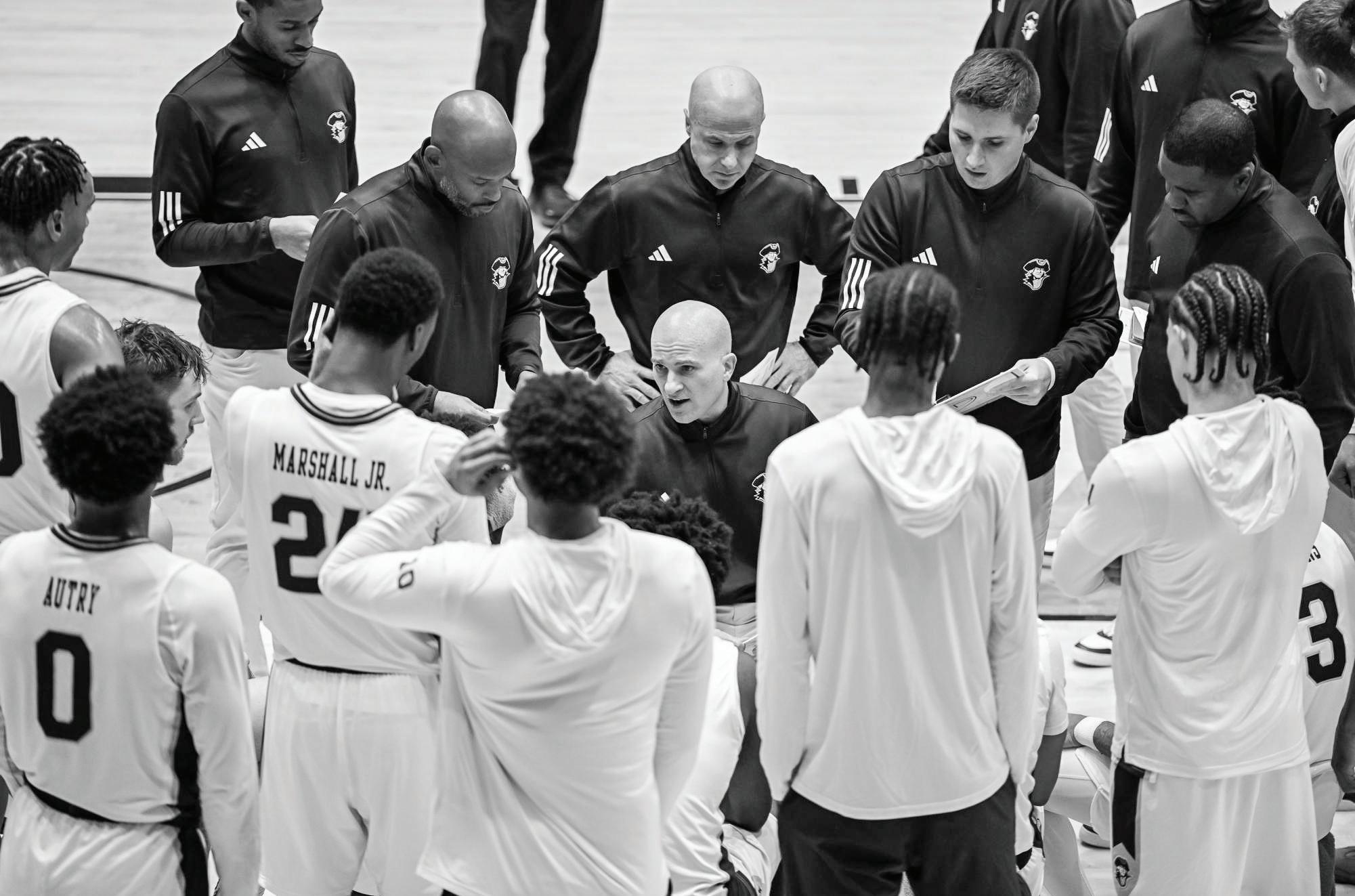
In the NET era, Caputo confronts a sport stacked against mid-majors
Men’s basketball Head Coach Chris Caputo hasn’t had an easy time scheduling the high-major matchups that once helped define the Revolutionaries’ nonconference slate.
GW’s home schedule a decade ago featured games against high major programs like the University of Virginia and Pennsylvania State University as part of a lineup that featured matchups against six power conference opponents. This year there’s only one: the reigning NCAA champions University of Florida.
For Caputo, top-level programs’ weariness to schedule GW and other Atlantic 10 opponents is indicative of a college basketball environment that’s attempting to squeeze smaller teams from nationally-relevant programming and NCAA tournament bids in favor of schools with bigger fanbases and greater name recognition.
“The combination of the metrics in how we’re being judged, while also the op-
portunities evaporating in scheduling makes it really difficult,” Caputo said in an interview with The Hatchet this week.
Caputo’s comments came after a clip of him lamenting “the fix is in” in reference to high majors’ unwillingness to schedule GW or A-10 opponents racked up over half a million views on X, formerly known as Twitter, after a fan posted it following the team’s Nov. 19 win over the University of Maryland, Baltimore County. In the clip, he explained how high major teams’ resistance in playing midmajors like GW has made tournament bids nearly impossible.
Instead, he suggested the NCAA expand their tournament to fit in more schools, allowing teams lower in the rankings to get in. In the seven seasons of the NET era, the A-10 has sent a maximum of two teams to the NCAA Tournament each year. In two of those seasons, the league earned only one bid.
As power conference teams have adjusted to the NET, their non-conference
schedules have shifted to almost exclusively fall into one of two buckets. Either Quadrant 1 opportunities against other high major teams where a win, or even a close loss, would boost their resume or Quadrant 4, where teams could count on blowouts against lowly squads that would also boost their rankings.
The NET divides games into Quadrants of 1 through 4 depending on the opposing team’s ranking and if the game is played at home, away or at a neutral site. Quadrants 1 games, the most valuable opportunities, are home games against teams ranked 1-30, away games against teams ranked 1-75 or neutral games against teams ranked 1-50.
As this year’s team currently stands at a 42 NET, their best since its introduction, in large part due to their dominant victories over Quadrant 4 opponents, the opportunity to schedule quality opponents and find Quadrant 1 or Quadrant 2 wins could have meant an at-large March Madness bid for the Revs.


Five decades in,
GRANT PACERNICK CONTRIBUTING SPORTS EDITOR
Fifty years ago Saturday, the Smith Center breathed its first crowd with thousands filling the arena’s untouched seats for a dedication night capped off by a men’s basketball game against Wake Forest University and the promise of hundreds more games, concerts and events to come.
The Smith Center’s debut in 1975 ended years of improvisation — teams practicing in the stuffy “Tin Tabernacle” on University Yard and shuttling to Uline Arena, their main “home” arena in the 1960’s located in the NoMa neighborhood or even sometimes assorted high school courts for games. Once those doors swung open, the building became the gravitational center of GW Athletics, packing five decades with NCAA tournament berths, improbable upsets and the rise of an NCAA record that still stands to this day.
To celebrate the Smith
Center’s semi-centennial birthday, The Hatchet took a look back at some of the top moments in the venue’s lifespan. Here’s what we found:
Women’s basketball
NCAA tournament
success
The Smith Center in the 1990s hosted six NCAA women’s basketball tournament games across four years where the program boasted an undefeated 6-0 record. Those were the glory days of women’s basketball, with the team going on a 22game win streak in 199697 before they lost in the A-10 Championship to Saint Joseph’s. It’s a high the program has been chasing ever since.
Athletics Hall of Fame
Coach Joe McKeown’s GW squad hosted their first NCAA tournament in 1992, defeating the University of Vermont 7069, who was undefeated going into the matchup. But the most memorable game for McKeown came during the 1995 tournament where his
team launched a spirited comeback against Drake University en route to a Sweet 16 bid, putting enough pressure on the team to hold them in the half court for the final three minutes of the game.
Men’s basketball ranked upsets
While the NCAA men’s basketball tournament doesn’t feature host schools, GW’s men have had some historic victories in the Smith Center as well. In perhaps the greatest game of all time at the Smith Center, GW took down Hall of Fame Coach John Calipari’s No. 1 nationally ranked Massachusetts team in front of then-President Bill Clinton on February 4, 1995.
A Hatchet story from the time reported that the win prompted a “frenzy” in the student section, leading the students to storm the court.
“This wasn’t home, this was heaven,” thenHead Coach Coach Mike Jarvis said after the game.

JADEN
SOPHIA
Men’s basketball (8-2) defeated the College of William & Mary (8-3) 99-86 at the Smith Center on Saturday night as the Revolutionaries eclipsed 95 points for the fifth time this season.
Leading by just 1 point at halftime, the Revs pulled away in the second half as the Tribe’s shooting percentage dropped to 32.3 percent
after they shot 63.6 percent in the first. The team commemorated the 50th anniversary of the Smith Center during a halftime ceremony that included the retiring of men’s basketball legend Yinka Darre’s 33 jersey.
“This is a great venue for college basketball, and since I’ve been here, we’ve had some great moments,” Head Coach Chris Caputo said of the Smith Center.
Junior guard Jean Aranguren led the Revs in scoring with 20 points. Aranguren, in addition to other bench players, contributed towards a dominant day from the Revs reserves, outscoring the Tribe’s bench 48-21.
Following Aranguren in
continue their legacies.
“One of the things we committed to before the season started was to make sure that we played hard for our alumni,” Adeduntan said.
Women’s basketball (55, 1-0 Atlantic 10) defeated Brown University (6-4, 0-0 Ivy League) 53-48 Saturday evening in comeback fashion.
The game saw guard Gabby Reynolds again lead the Revolutionaries with a team-high 20 points Saturday evening as the team rallied from an 11-0 deficit to a 53-48 thrilling comeback victory.
GW outscored the Bears 3419 in the second half and secured the win by limiting Brown to just 10 points in the final quarter.
Athletics honored the inaugural GW Women’s Basketball Team of 1975 for the foundation they laid for future players. Postgame, Head Coach Ganiyat Adeduntan said it is very important that the team honors those who came before them because it allows the current program to
Brown opened up the game with a 2-point basket from Olivia Young, who ignited an 11-0 run for the Bears, with the other 9 points coming from freshman guard Charlotte AdamsLopez, senior forward Alyssa Moreland and Brown’s lead scorer, senior guard Grace Arnolie.
GW’s offense struggled during the first quarter, as Brown’s defense stifled interior looks, forcing the Revs to take long-range shots with no success. Adeduntan changed strategy, calling Reynolds to the bench, who came back into play at 1:51 to add the first 2 points for GW, less than 30 seconds back into action. Junior forward Sara Lewis added 2 more points from the free-throw line, but the Revs trailed 11-4 with one field goal out of 16 attempts and 0-6 from beyond the arc.
scoring was redshirt senior center Rafael Castro netting 18 points and graduate student forward Tyrone Marshall, who earned 15 points.
Marshall recently returned from an undisclosed injury after being out for almost two weeks, playing just seven minutes in the loss to Murray State and missing the team’s previous game, a win against the United States Military Academy, West Point.
The Revs’ offense opened to a sloppy start as the Tribe opened the game to a 17-9 lead just over five minutes into the game. William & Mary’s fast-paced offense and aggressive defense proved difficult at first, but Castro said the team was able to adjust as the game
Despite the offensive struggles, the team maintained the ability to recover well, running after lost balls and fighting for offensive rebounds under their basket. In particular, freshman guard Mia James’ ball pressure and tenacity on the court helped spark GW’s comeback.
“It all started on the defensive side when James got that jump ball,” Reynolds said postgame.
In the second half, the Revs improved their offensive efficiency, cutting the deficit to 6 points by the end of the third quarter.
“I’m really proud of just our lock-in,” Adeduntan said.
By the end of the third quarter, the Revs found themselves within striking range, trailing 38-32, setting the stage for the comeback victory.
continued.
“We just had to settle down, calm down,” Castro said. “Just move the ball. They had a jumpy team.”
The Revs struggled from 3-point range throughout the game, going 6-27 from outside the arc but were able to make up for poor deep shooting by outmatching William & Mary on the inside, notching 62 points in the paint compared to 44 by the Tribe.
GW responded to the Tribe’s early lead with a 13-2 run to retake the driver’s seat and never let William & Mary lead by more than one possession throughout the rest of the half. Marshall scored 5 of GW’s last 7 points in the half as the
team maintained its narrow lead. They began to pull away in the second half, earning their largest lead of the game so far with 11 points halfway through the second. They secured their largest lead of the game of 19 points at 93-74 with four minutes left to play as the Tribe’s offense collapsed. Throughout the second half, the Revs began to match the Tribe’s tempo, quickly inbounding the ball after a made shot to initiate the offense. They also improved their ball movement to evade the high press. The Revs will face off next against the University of Delaware at the Smith Center on December 10.

The Revs went on a 6-0 run to open the final quarter that tied up the score 38-38 with a 2-point jumper coming from Reynolds. Brown’s Arnolie and Moreland quickly responded, adding 5 points for the Bears, but the lead was short-lived as senior guard and forward Emma Theodorsson fired up and connected back-to-back 3-point jumpers, putting GW ahead of the Bears for the first time this game, 44-43.













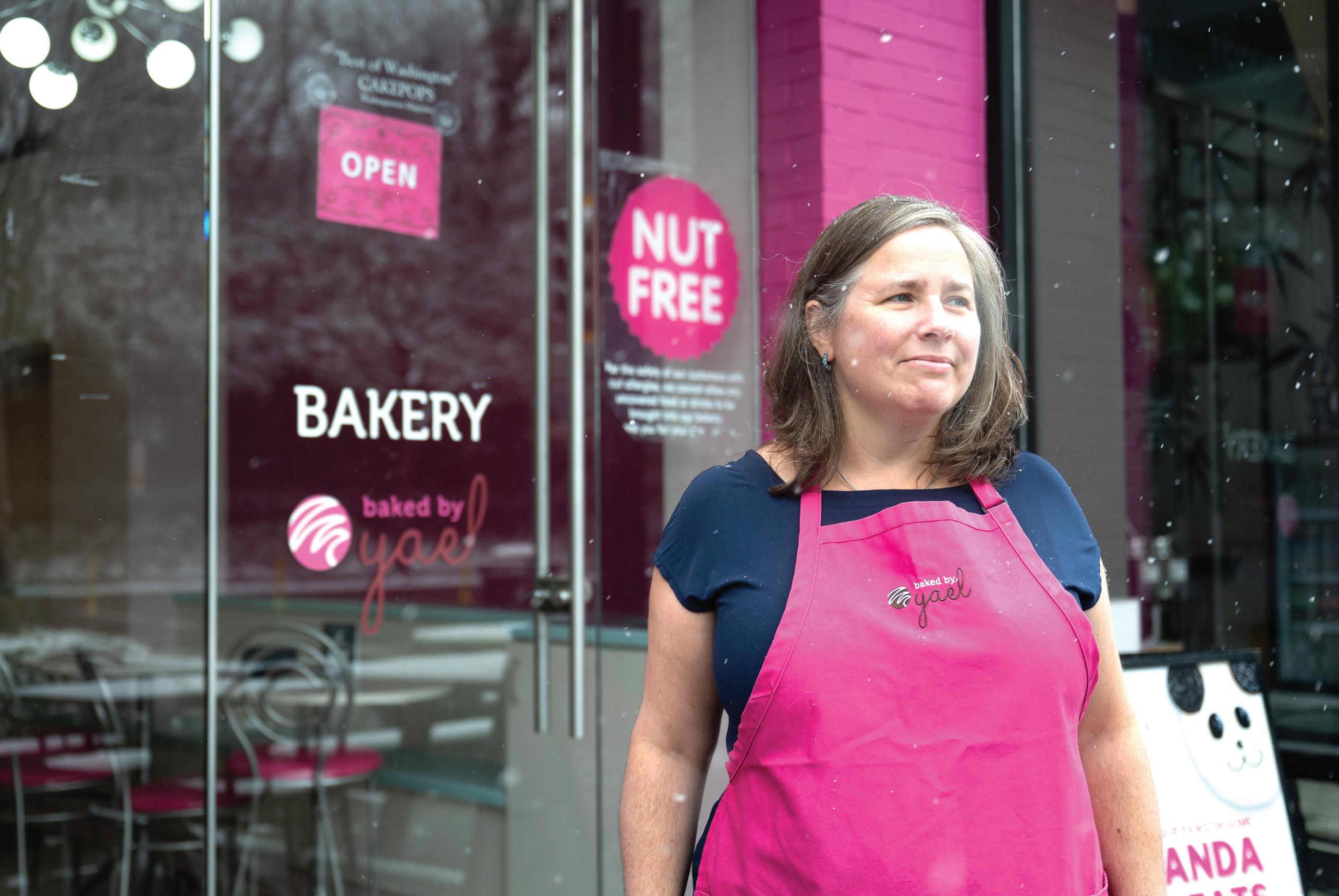
Then-GW Law student Yael Krigman was deep in barexam prep when a different kind of discipline began to pull her in: mixing, kneading and shaping bagels in her kitchen.



As Krigman worked toward her career in law her true passion, baking, took the center stage in her life. Fifteen years later, she’s known in D.C. not for legal briefs but for Baked by Yael, her nut-free, kosher bakery offering a 35-item holiday menu that ranges from Christmas jumbo cake pops to trays of rugelach, a Hanukkah classic.



But it would take her years to reach that point. After graduating from GW Law in 2009 and passing the bar exam, she spent eight years as an associate at White & Case. Even then, Krigman couldn’t stop baking, which pushed her to launch a side venture at farmers markets and a kiosk in an Annapolis, Maryland mall — effectively working two full-time jobs for more than a year.
“I was afraid that maybe I would not be successful,” Krigman said. “I was afraid that I would fail, and it was such a drastic change.”
Krigman said she realized she had to choose one position and solidified her decision to pursue entrepreneurship full-time after a now-defunct food blog Daily Candy rated her bagels as best in D.C. Early on, she said she carried the weight of the entire operation herself, including the baking, marketing, selling, even hiring her first employee, all while raising funds to avoid outside investors who might try to shape the business she was still learning to build.
“I cast aside the job that




























she then dropped off at various locations.

“When COVID started and Baked by Yael was really suffering, the community just came out in ways that, honestly, I couldn’t have expected,” Krigman said. “The way that they stepped up and made Baked by Yael part of their weekly and daily routine because they wanted to make sure that we stayed in business.”
Baked by Yael reaches different parts of D.C. by maintaining a presence at local farmers markets and also operating the cafe at the Edlavitch DC Jewish Community Center in Dupont Circle. Krigman said there are customers who come to her booth at farmers markets every single week, with some regulars being her former law school professors.
“It’s really funny to see them out of their natural environment, so that’s been an interesting experience,” Krigman said.
in there, and you can tell,” Krigman said. “Especially if you come in December. We had somebody refer to it yesterday as organized chaos.”








Farm owner and Christmas tree connoisseur Bryan Holler knows exactly what makes a prizewinning tree.


Judges, he said, look for three main qualities, amongst many — color, shape and density — but growing a standout tree also depends on patience and forces beyond any farmer’s control, from extreme weather to hungry animals. Holler and his co-owner Dan Taylor, who have been in the industry for over 30 years, know this all too well.
The duo, who first got their start in 1996 when they opened their own farms, are the proteges of Eric and Gloria Sundback who operated their own Christmas tree business for over 40 years in West Virginia as Sundback Trees. Today, Dan and Bryan Trees is one of just four Christmas tree vendors in the District, drawing customers ranging from lawmakers to longtime families across D.C., Maryland and its farm in Shepherdstown, West Virginia.
“Years of cheering and learning the ropes from Eric and Gloria Sundback and finally, I was able to rent a farm, plant my own trees and then finally purchase the farms,” he said. The Sundbacks — who sold trees to George H.W. Bush and Barbara Bush, the Obamas and Senator Edward Kennedy — passed the lots they once sold out of in a lot near the National Cathedral in D.C. and another in Chevy Chase, Maryland, to Dan and Bryan Trees. Holler’s journey in the tree business began, he said, when he started working for Sundback Trees as a part-time summer job in 1982.
After learning the ropes from the Sundbacks, he said the duo rented a farm, where they were able to plant and sell their own trees, which eventually allowed them to buy the







added that she sought kosher certification in August 2015 after realizing some Jewish customers couldn’t eat her products — including the very treats familiar from their own traditions — because they weren’t certified kosher.


are able to skip weeks, with an added discount for choosing to subscribe to the plan, amassing at least 60 weekly subscribers.


ary 2015, directly across from said the care poured into every made-from-scratch treat — the mixing, baking and decorating — has
Because of her Jewish roots, she said Baked by Yael also remains open on Christmas Day. Krigman said every year, she and her family run the store on Christmas Day — this year opening from 8 a.m. to 3 p.m. She said her family is involved with the business on a daily basis, with her dad renovating the front of the bakery and her mom processing orders.





I had for eight years with a huge salary and benefits and resources galore, and I put aside the degree that I had spent three years working on and basically said, I’m going to do something different,” Krigman said. After two years of planning and crowdfunding, Baked by Yael opened its brick-and-mortar shop on Connecticut Avenue in January 2015, directly across from the National Zoo. Krigman said the care poured into every made-from-scratch treat — the mixing, baking and decorating — has helped sustain a “small but mighty” team of two dozen employees working within her 1,100-square-foot space.




restaurant guide’s “Top Shops in America” in 2019. She said Baked by Yael’s kosher identity is rooted in
“My rabbi at the time at Adas Israel basically came in and inspected our facility and did some paperwork and certified us as kosher, so that just opened us up to a whole other group,” Krigman said.
And now that she’s built out the business, she said she does not do most of the baking — instead using her law degree for the business side of the store.


















“It’s a very small bakery, but we get a lot done

ery, but we get a lot done





recipes her Israeli aunt. Krigman
In order to make her baked goods accessible for all community members, Krigman said she decided to make Baked by Yael certified nut free later that same year in January 2015. The steps she has taken have won her the award of being part of Allergy Eats, a food allergy restaurant guide’s “Top 15 Allergy-Friendly Sweet Shops in America” in 2019. She said Baked by Yael’s kosher identity is rooted in her upbringing in a Conservative Jewish community in Annapolis, with many of the bakery’s recipes drawn from her Israeli aunt. Krigman

The demand for Krigman’s challah has grown so large over the years that she said she started a subscription service in order to keep up with the requests. Krigman said the plans are customizable and customers


West Virginia farm they had previously rented. Based in the farm in West Virginia, Abigail Taylor — Dan Taylor’s daughter — said she has been worked at the business’ home base as long as she can remember, with the earliest memories of starting to help her father out with work at 12 years old. Now, in addition to working a full-time job, Taylor said she sells trees during the Christmas season. She said some families come every year “religiously” to pick up their trees, and she watches babies grow up to young adults, cutting down the trees themselves, which she said is a “full-circle” moment from the memories she has shared with her father.
them to the National Championships where they won in 2009 and 2020. In 2009 when she was in Kindergarten, Taylor said she went to the White House for the presentation of the tree, where the tree is brought around in a horse and carriage and is presented to the First Lady.
She said the experience was one of her “core memories” because then-First Lady Michelle Obama approached her, saying she had remembered seeing her earlier that day. In her 2020 visit to the White House, Taylor said despite having to get tested for COVID-19 in the security area, she was still able to go on an extensive tour of the space.
Throughout her time as founder and owner, Krigman said she has given back to the community during the pandemic and multiple government shutdowns by donating baked goods to furloughed and laid off workers and giving free meals to zookeepers who could not work during the shutdown. Faced with laying off all of her staff due to COVID-19, Krigman said she combatted the challenges of operating a small business during the pandemic by allowing customers to purchase cake pops for seniors, first responders and health care workers, which



much we’ve grown since then,” Krigman

“It is funny to look back on how I used to make things and how I was making things when it was just me and how far we’ve come, and how much we’ve grown since then,” Krigman said.







She said Dan and Bryan’s Trees has gained accolades, being recognized for their prize-winning trees over the years through competing in competitions, including one in Elkins, West Virginia, where they have won the Queen’s Choice and Grand Champion multiple times. But, Taylor said, the competitions that help the business get to the national championships — where winners get their tree placed in the Blue Room of the White House — happen at the state competitions. She said they have competed at Maryland’s state competition multiple times, leading


There are only so many times a person can rewatch “Elf” or hear “Santa Baby” booming through supermarket speakers before growing altogether Scroogified.
Justin Vernon detailing staring out over a highway overpass of ice covering the distance for “miles, miles, miles.”

hear “Santa Baby” booming through
While classic holiday media can be nostalgic and psyche-brightening, sometimes it’s the movies and songs that slightly brush on wintery, festive themes — or those that avoid them entirely — that get you in the spirit of the season.
Members of The Hatchet’s staff shared some of their favorite non-holiday selections that remind them of the holiday season, from grotesque thrillers to superhero flicks.
“Saltburn”
Ryan Saenz | Assistant News Editor

“The Dark Knight” Fiona Riley | Editor in Chief


















Reenacting “The Dark Knight”’s opening bank heist makes for the perfect snow game. I have countless memories of my brothers and I running through empty streets at night, dodging behind cars with Nerf guns in the December air. Every winter break since leaving for college, I’ve returned to the house I grew up in and spent the weeks home running through the trilogy, almost always more than once.












The film has everything a Christmas story is supposed to have, only stripped of sentiment and the hollow cheer that turns me away from most holiday media. Nowhere is the season’s meaning more sharply felt than on the ferries. One boat of civilians, another of prisoners, each holding the detonator to the other. And yet nobody acts. They do nothing because even in fear, they refuse to surrender to it. It is proof that good exists when ordinary people act despite despair. The passengers embody that spirit.
“Lord of the Rings”






opening at 9 a.m. On the opening day this year, she said 40 people were lined up waiting for her to let them go into the field and pick

She said the farm opens for the season the Saturday after Thanksgiving and feels like Black Friday to her, with customers lined up an hour before opening at 9 a.m. On the opening day this year, she said 40 people were lined up waiting for her to let them go into the field and pick up their trees.


“Granted, the last two years, obviously, we’ve had the shortest amount of time possible between Thanksgiving and Christmas, so people are really eager to get their trees, but it’s crazy that day is like such a Its lyrics are broad and pensive, with winter break since leaving








“Granted, the last two years, obviously, we’ve had the shortest amount of time possible between Thanksgiving and Christmas, so people are really eager to get their trees, but it’s crazy that day is like such a blur,” Taylor said.
In the midst of a particularly bad “pretentious film bro” phase in December 2023, online chatter about “Saltburn,” the freaky flick starring Jacob Elordi, made its way across my social media feeds. “Whatcha watching?” my mother so innocently asked as she sat down on the couch while Barry Keoghan’s opening monologue played on the television. The heavy silence that lingered between my mother and I after Keoghan’s final triumphant dance throughout the titular mansion could not begin to explain the shock my mother and I had. I thought she and I would never watch that movie again, but when we found ourselves up late once again nearly a year later looking for a movie to watch, we agreed to watch it again. Suddenly, a strange new tradition was born.

strange new tradition was born.














“Holocene” by Bon Iver Ben Spitalny | Senior Sports Editor


An anthem of below-freezing weather, the chilling, indie-folk ballad “Holocene” off Bon Iver’s 2011 self-titled album might not be jolly or festive, but it fits the winter season. The plucky guitars, subdued clarinets and airy falsetto vocals evoke an ethereal, solemn sound that reflects a quiet, frigid winter night. The song, which references Halloween in the first verse and Christmas in the last, fits into the time of the year when the sun sets before 6 p.m., and 8:30 p.m. feels like midnight. Its lyrics are broad and pensive, with
GRAPHICS BY AN NGO, ANYA










Arwen Clemans | Senior Photo Editor In our family, Christmas is usually accompanied by whatever my dad’s assembled on the grill, a new puzzle for Mom to work on, a paint-by-number for my sister Aubrey and a card tournament for all of us. Someone — me, usually — always ends up crying over a game of spades. That’s our cue. When the emotions get high, Jack puts on “Lord of the Rings,” the binge begins, and peace is returned to the realm. No matter the holiday, the scenes never get old. We always stand and cheer when Aragorn and Legolas come sweeping onto the plain during the Battle of Gondor. I never miss a chance to say, “Hey look, it’s me,” when Arwen first comes on screen. Accompanied by eggnog and a plate of Costco taquitos, a Middle-earth binge is the best part of being home over break. For the Clemanses, home isn’t home without a little bit of J.R.R. Tolkien.






















ure Skating to recreate the sense of belonging she found on the ice as a kid.
On the first chilly nights of November, as holiday rinks glow to life across D.C. and families shuffle across the ice beneath strings of lights, GW’s figure skaters are already deep into their season, training year round while the rest of the city dusts off its skates for winter.


While most people treat skating as a seasonal outing at places, like the National Gallery of Art rink or Washington Harbour, the 46 members of GW Figure Skating spend the year practicing in indoor rinks at the Mount Vernon Rec Center. Skaters said the club has become a community where students of all skill levels support each other, share technique tips and stay connected to a sport many thought they’d leave behind after high school.
The team practices every Friday morning and is preparing for its first post-COVID collegiate competition, set for the end of January at Massachusetts Institute of Technology — a return to the competitive environment many members grew up with.
“I think it’s easy to stop skating when you get busy at college if you don’t have a team to practice with,” Latsis said. “Basically I wanted to help build this community here at GW.”
She said that similarity motivated her to join the GW team for the community and to find new friends to skate with, as college skating has more practices with the team, compared to high school where they typically practiced in their own time.



First-year Macaella Sikhoya, who is majoring in biology and serves as the competition coordinator for the team, said she got involved early with the team, attending the first practice of the year, decided to stick with the sport all the way into college because it’s been the only consistent aspect of her life.
Senior Elena Latsis, the club’s outgoing president, has skated since age 5 and competed throughout high school in Boston, Massachusetts. She said she joined — and later led — GW Fig-
Sikhoya said her love for figure skating comes from its role as an “expressive outlet,” giving her space to be creative while skating alongside a supportive, tight-knit team. She said she values being part of a community that shares her passion, adding that members often bond outside the rink, most recently by watching the Grand Prix Figure Skating Final together.
Margaret Macdonald, a soph-






As the air grows sharper and snowflakes begin to swirl through the District, Washingtonians instinctively turn toward the comforts that make winter feel magical. Few things embody that cozy seasonal ritual quite like a steaming cup of hot chocolate. Cafes across the city are leaning into the charm of the season. We set out to try the District’s hot cocoa offerings.
Bread and Chocolate’s Hot Chocolate (4.5/5)
Anya Malhotra | Reporter


Just a 10-minute walk from campus is Bread and Chocolate, a breakfast and lunch restaurant where I was immediately greeted by the

smell of fresh pastries oozing out of the display case. I ordered their medium hot chocolate, which cost a steep $6.59 and was served in a 16-ounce cup. The drink had a smooth, velvety texture with a rich chocolate flavor. The drink — which used milk-chocolate as the base — was complemented by a slight bitterness from dark chocolate that prevented it from becoming overly sweet. Though the price felt a bit high — something in the $4 to $5 range would be more appropriate given the size — this hot chocolate definitely satisfied my craving for something warm and sweet as the city grows colder.
Baked & Wired’s Hot Chocolate (4.5/5) Brady Eagan | Reporter


His Santa alter ego has led to custom framing company Framebridge featuring him and his family in their marketing campaign, promoting their portraits with Santa services, using a photo of him as Santa, his son and his wife, who works at the School Without Walls.
Charging $150 an hour with a two-hour minimum, Hill said he gets most of his business through websites like GigSalad, his Instagram and Facebook pages and word of mouth. He said he has regular families whose events he attends and will reach out to them once his calendar starts to fill up to ensure he can fit their events into his busy, wish-granting schedule.
A fifth-generation Washingtonian, Hill said he will be traveling from his home in D.C. to locations as far as Hagerstown, Maryland, this season, mostly for private parties. He said his weekends are “completely booked” for the rest of the year, doing multiple gigs each weekend and others throughout the week after work.

He said his biggest gig is his upcoming stint at Neiman Marcus in Tyson’s Corner on Dec. 13, a largescale Breakfast with Santa event, along with participating for the second time in an event called “Santa Looks Just Like Me” in Newport News, Virginia, on Dec. 20, where the organizers bring together Santas of different races and backgrounds.





“Children get to come and take pictures with Black Santa and Asian Santa and all different types of Santas from across the world,” he said. “And I think that is one of the most


exciting things just to see.”
omore majoring in international affairs and the club’s incoming co-president, said she came to figure skating later than most, picking up the sport in high school after discovering skating videos on YouTube.
Baked & Wired, an artsy and quaint cafe that has amassed a large following on Instagram because of its picture-perfect cupcakes, sits on Thomas Jefferson Street in Georgetown. The shop is a 20-minute bus ride and walk from campus, manageable for students, faculty and staff alike craving a quality hot chocolate.
Baked and Wired’s hot chocolate comes in two size options — 12 ounces ($6), which I ordered, and 16 ounces ($6.50).
My drink didn’t come out very hot, which was disappointing, so I drank it quickly before it went cold. There was a layer of chocolate froth sitting between the whipped cream and the drink, making for a fun textural experience as well. The hot chocolate went down very smoothly, as I found myself gulping it down eagerly.
She said skaters in the organization understand that everyone may be coming from different points in their careers and are supportive of each other’s advancements and skills.
“I’m so grateful to know them,
Dolcezza Hot Cocoa (5/5)
Maggie Crisp | Reporter
Dolcezza Gelato — with seven locations across the District, including its stylish Palmer Alley shop — has long been known for sourcing ingredients from local farmers and serving some of the city’s most decadent treats.
There was no wait when I went at around 5 p.m. on a Tuesday evening, and the friendly barista immediately took my order for a large hot chocolate with whipped cream ($8.70). Their hot cocoa, made with Valrhona chocolate, strikes a balanced taste that is thick and rich, without excessive sweetness. The generous amount of whipped cream was vel-
A member of the Santas of Color Coalition, Hill said he’s felt some people try to keep Santa in a “traditional box,” since he is often depicted as white. But the organization exists to challenge that norm, giving Santas of color the opportunity to market their services and build community. He said members expand their Santa pursuits through networking and sharing ideas — including one Santa of color in Tennessee who came up with the idea to rent an Airbnb and sell time slots for Breakfast with Santa. He said that, along with the Santas of Color Coalition,

vety, did not melt too quickly and added to the lusciousness of the drink. The larger size was ideal for savoring slowly for over an hour, a warm comfort at the end of a chilly day during finals season.
S’mores and More’s Hot Chocolate with a Mocha Marshmallow (4/5)
Kya Ho man | Reporter

groups like the Real Beard Santas of America also exist to bring jolly performers together. This year, he said he’s planning on attending a retreat in Florida at the end of the season where Santas get together to “decompress” and connect with one another after a hectic season of photo ops and wishlists.
“There will be vendors, they’ll be selling costumes, they’re selling all kinds of belts and things like that,” Hill said. “One of my friends said, ‘It’s an entire situation.’ It’s a whole situation.”
He said people at his job, where he works as a program manager for

















the D.C. government’s Family and Survivor Support division, often inquire about his gigs — especially when he comes in with his beard dyed white — and ask if his events are public and if they can come with their children. He said family members also get involved with his work, booking him for parties and other events, which gives them the opportunity to see him in a “different light.”
“I come through, and it is an explosion of joy and laughter and celebration, and so that’s the kind of thing that excites me, and I love to do that,” Hill said.










and they’re all so nice and so willing to help you, and they know there’s never any kind of superiority,” Macdonald said. “We’re all friends, it’s just a really nice community to be around, and it’s not toxic, not competitive at all.”
Smore’s and More is a mobile hot chocolate vendor known for its intricate dessert toppings and variety of flavors is lSmore’s and More is a mobile hot chocolate vendor known for its intricate dessert toppings and variety of flavors is located in the middle of the D.C. Holiday Market, outside the National Portrait Gallery. The silver van stands out with its flashy neon “Hot Chocolate” sign, disco lights and friendly workers. I ordered a small regular hot chocolate ($4), which came with whipped cream and sprinkles and added on a mega mocha marshmallow ($6.95) for a total of $10.95. I opted to add the marshmallow to make the drink more fun but was surprised by its price — my only guess was that it was because it was quite large. The hot chocolate tasted slightly burnt, which may have been because it was in the machines for a long amount of time. Despite the drink lacking in overall flavor, the generous sizing complete with the warm marshmallow, whipped cream and rainbow sprinkles more than made up for it.
Hill said he varies his services depending on what vision people have in mind between reading stories, singing, playing games and dancing. He added that children ask him for a range of presents, but new electronics are usually the “hottest” gifts, though a young child once asked him for an Atari, which caught him off guard due to the antiquity of the console.
He said, along with the fulfillment that comes from seeing children light up at the sight of Santa, he also enjoys witnessing the adults’ reactions. He said he often has to “calm the adults down,” as they seem just as excited to get photographs with him as their children are.
Hill noted one of the most memorable moments from his time as Santa came from a young girl asking him to deliver a message to her mother who recently died. He said, despite not being an emotional person, that message always stuck with him.
In terms of Santa naysayers, he said it’s important for people not to “snatch the joy” of believing in Saint Nick from anyone — especially children. However, he said he once got into a debate with a woman about Santa’s skin tone, where she argued that Santa is white. In response, he noted that Santa is not real, poking fun at the traditionalist view of Santa.





That’s what I take into and rainbow sprinkles









“The important thing is to not take anything personal,” Hill said. “I’m there to provide a service and to spread joy, support visions and make sure people have a good time. That’s what I do. That’s what I take into every gig.”
“The important thing is to not take anything personto spread joy, support visions and make sure