The Bulletin of The Frederick Gunn School Spring 2026
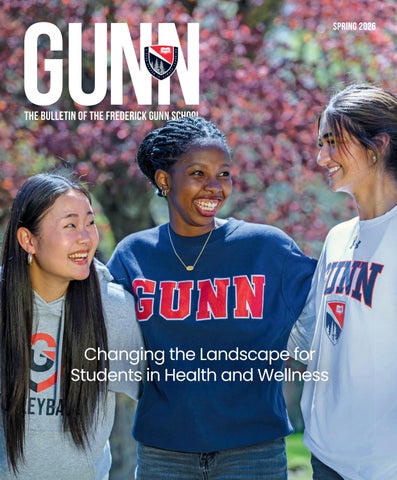
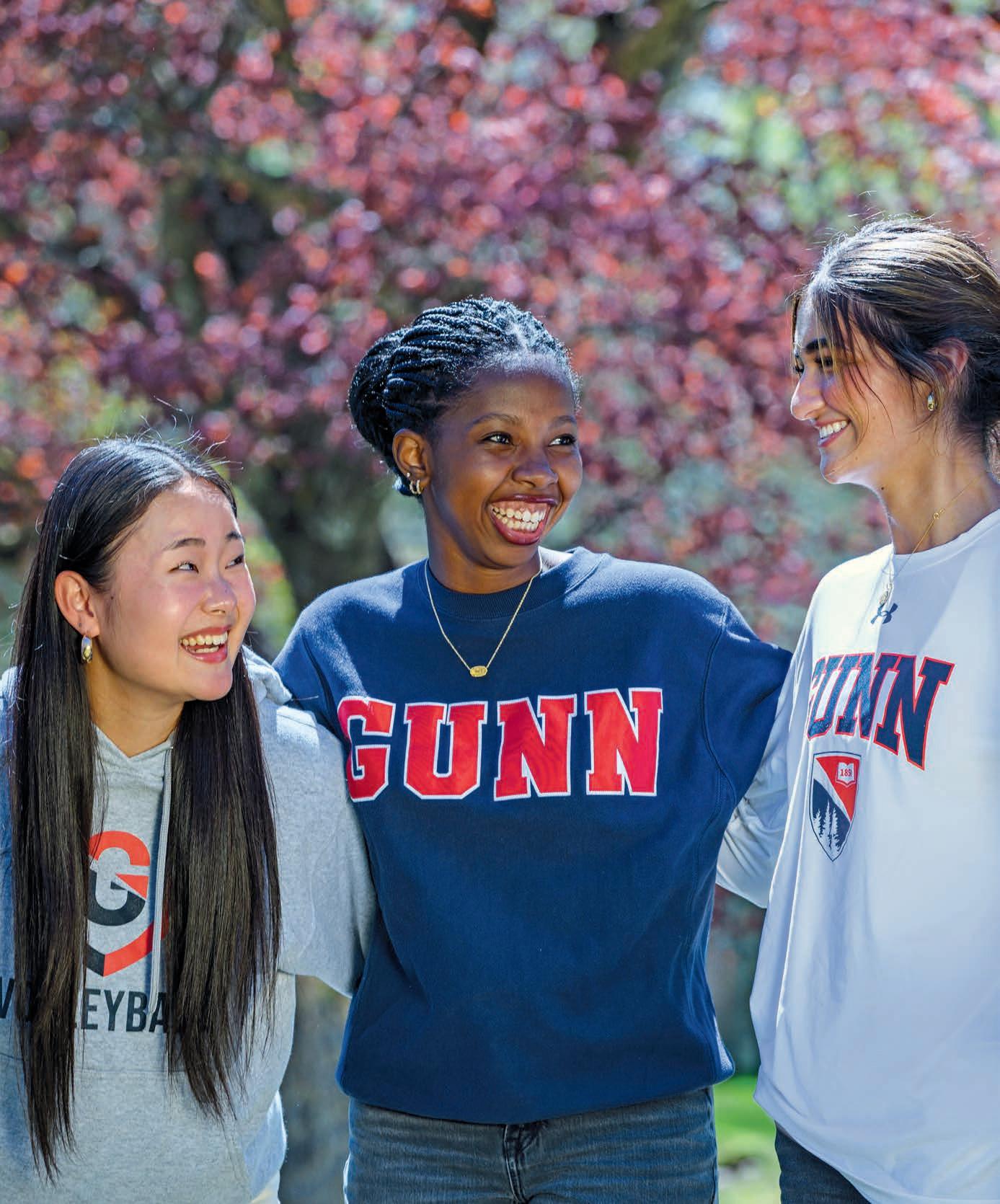
Changing the Landscape for Students in Health and Wellness
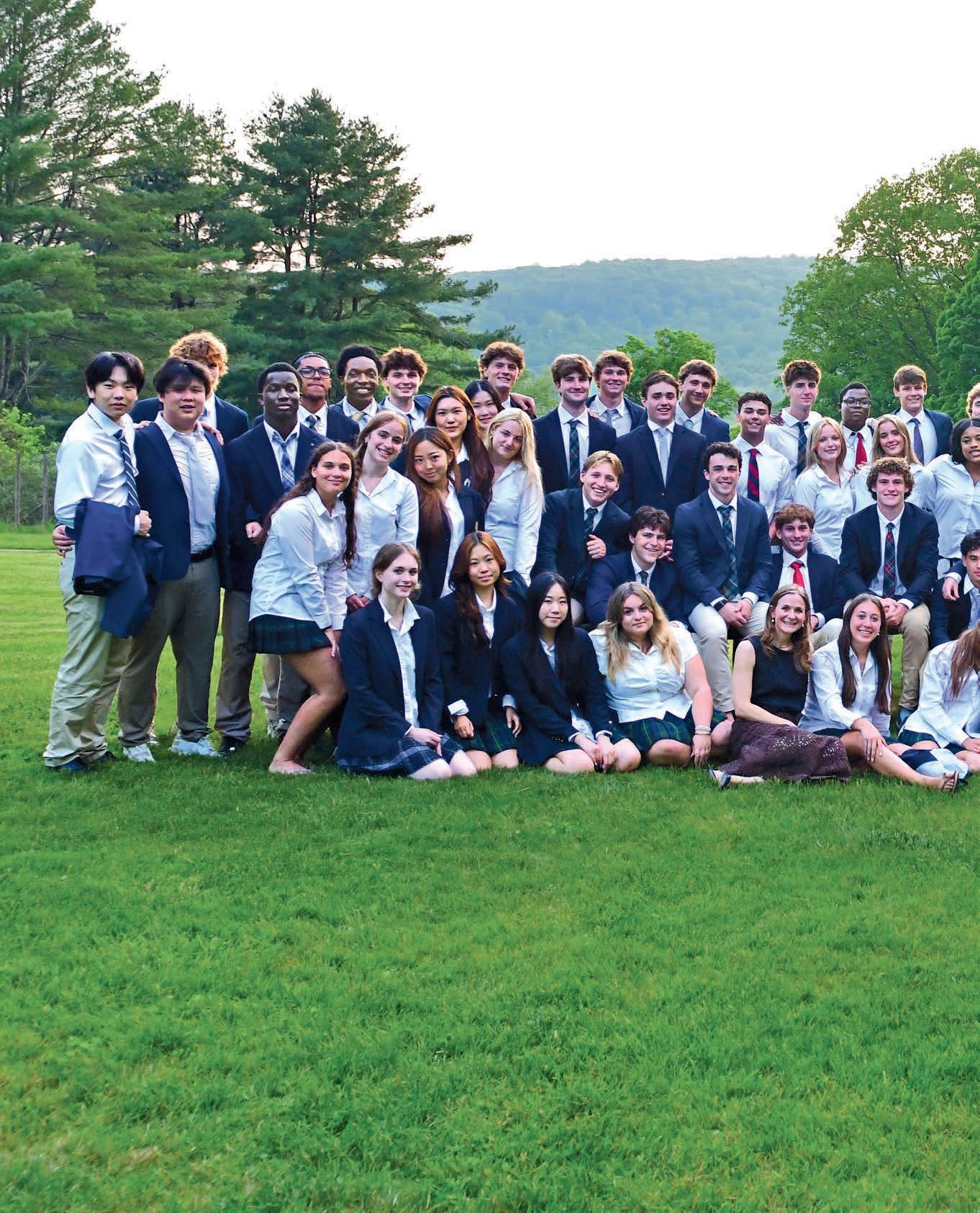
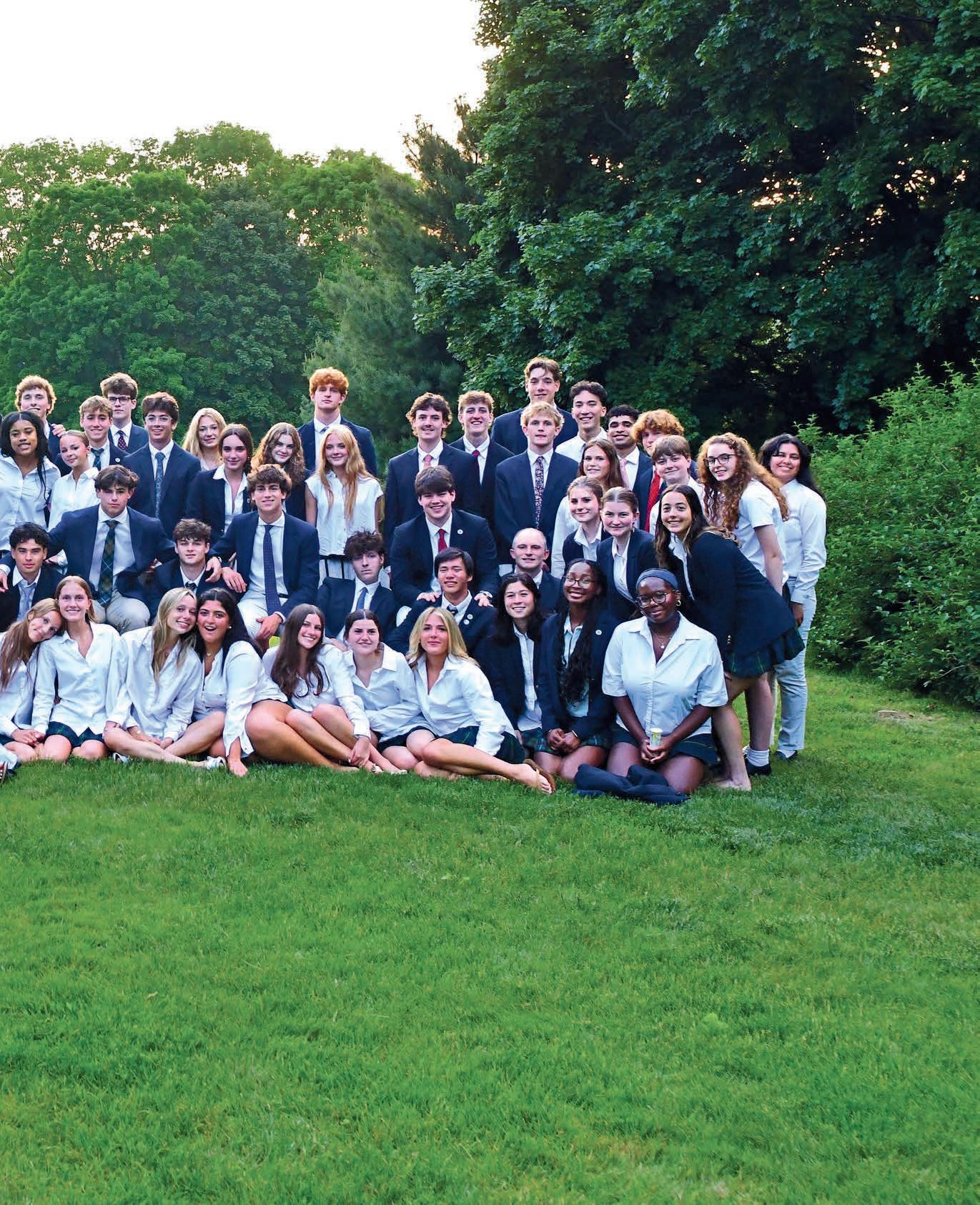
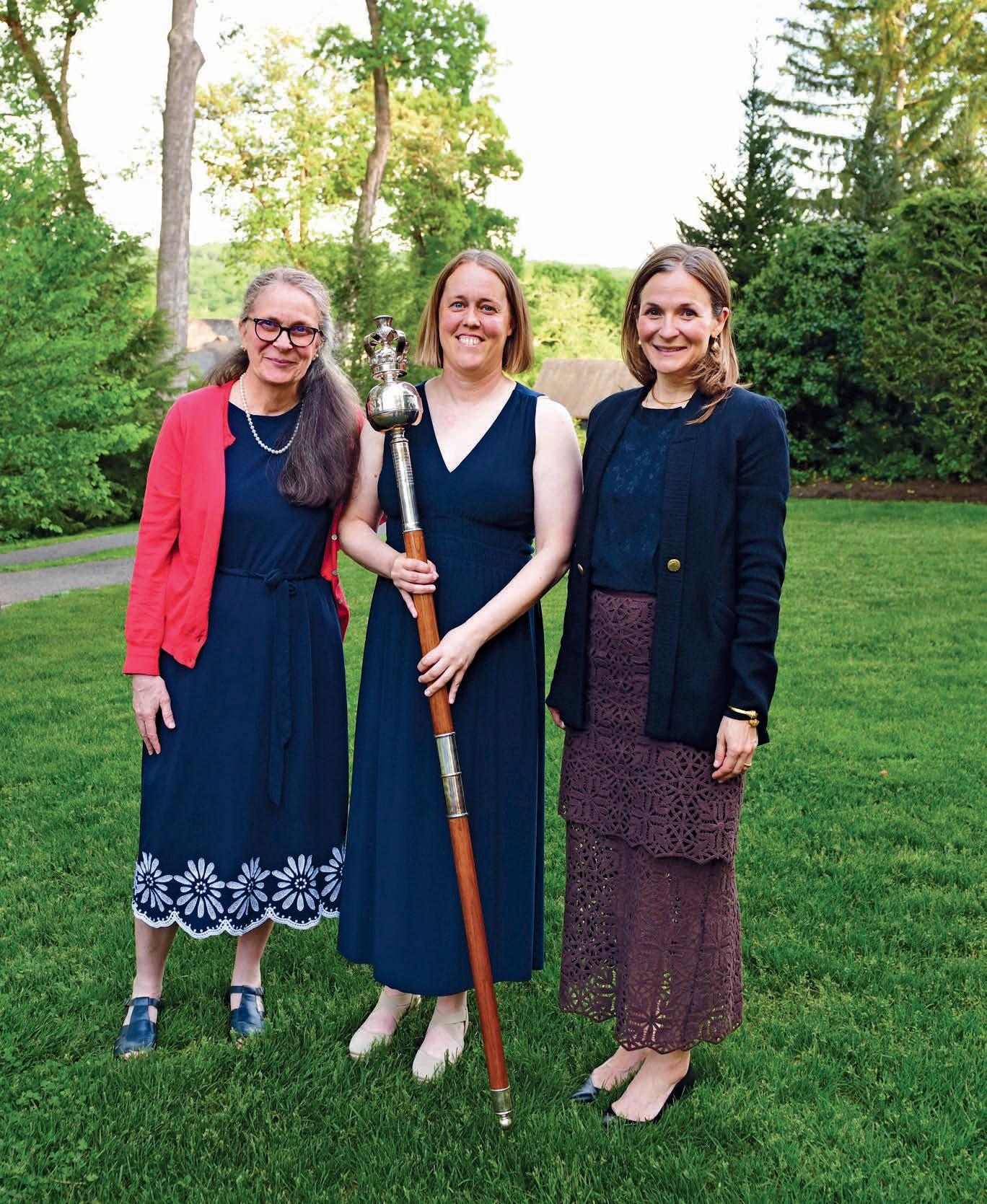
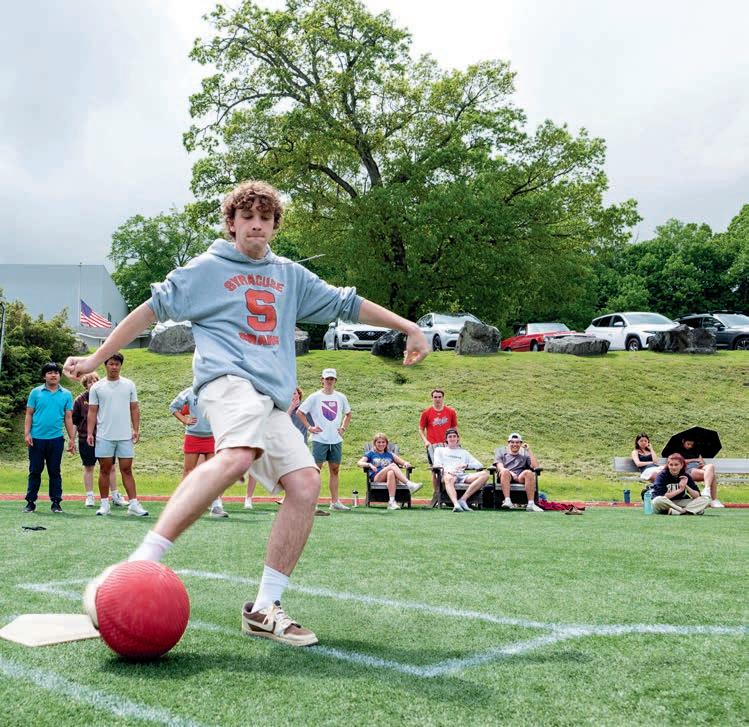
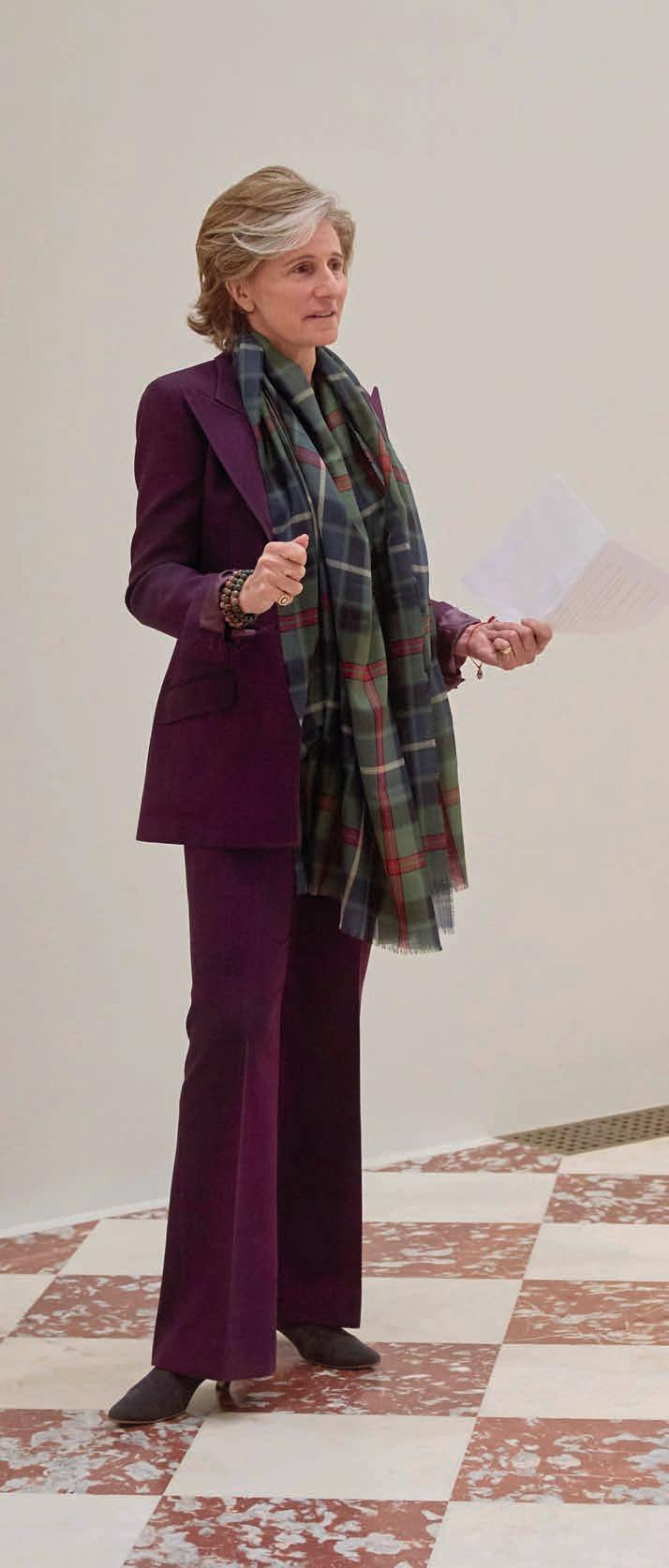
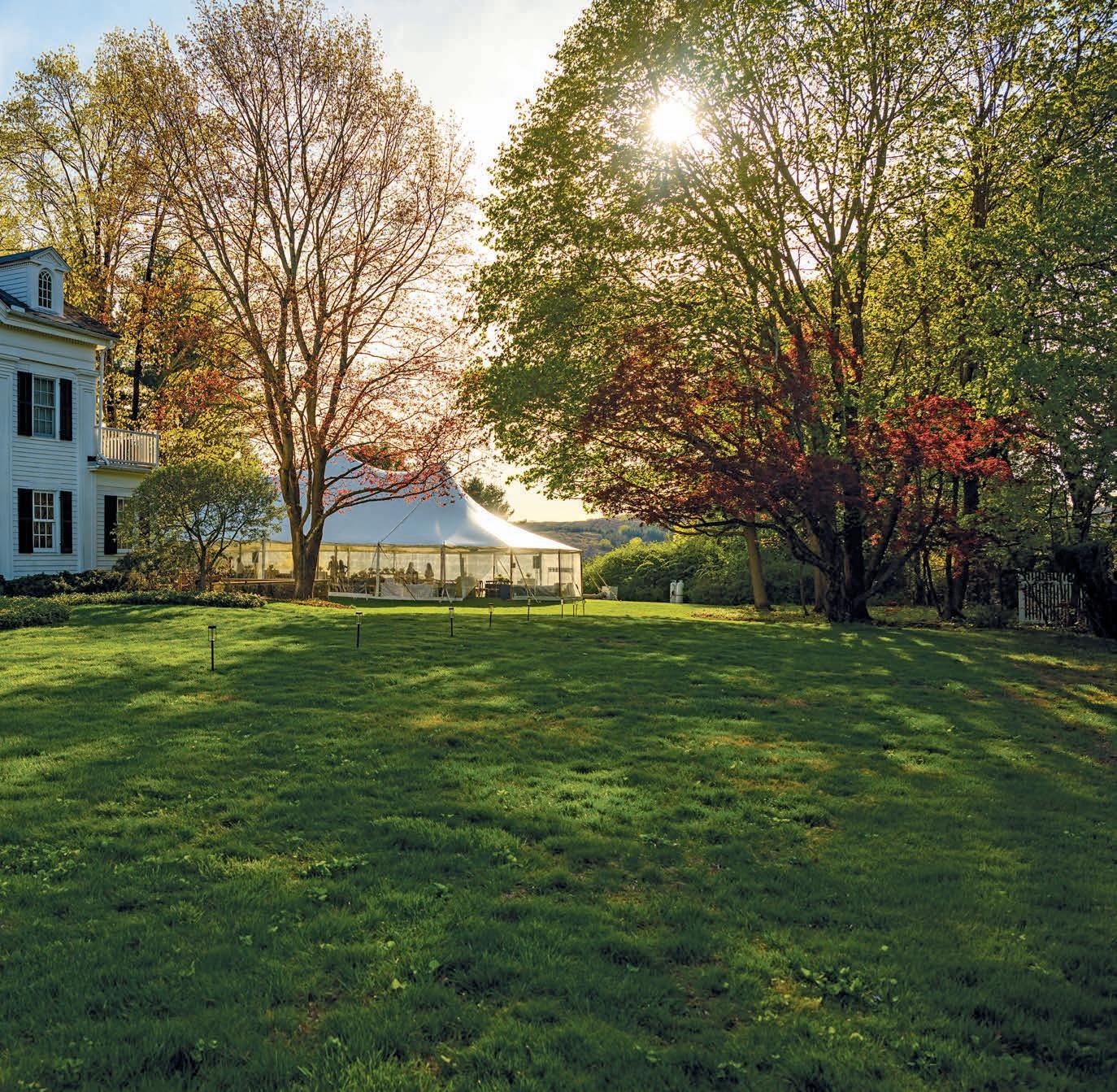
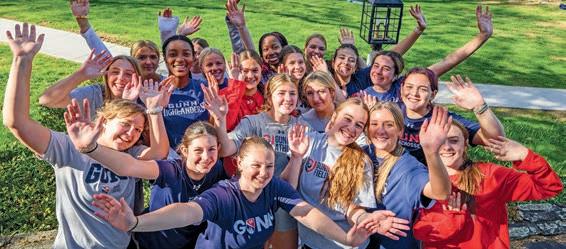
The Class of 2026 gathered with the faculty and Dr. Emily Raudenbush Gum, Bretter Family Head of School, (center) on the lawn behind Conroy House in May. It is a tradition for seniors to celebrate the beginning of Commencement Week with root beer floats after the Baccalaureate Service.
Dear Frederick Gunn School Community,
WITH OUR 176TH YEAR behind us, I have an invitation for you. Open this and every Bulletin looking out for the deep intentionality with which our school is remaining relevant for our students through purposeful change. You’ll find that we are staying true to our roots while modernizing facilities; we are embracing tradition while ushering in the cutting edge; we are championing deep character development while indulging in the purely fun aspects of boarding school; and the list goes on.
Every enrollment metric was again moving in the right direction this year. After years of calibration meant to target admissions ideals, ensuring a full and aligned school year after year is remarkable. The stepped changes we are making are continuing to resonate with families.
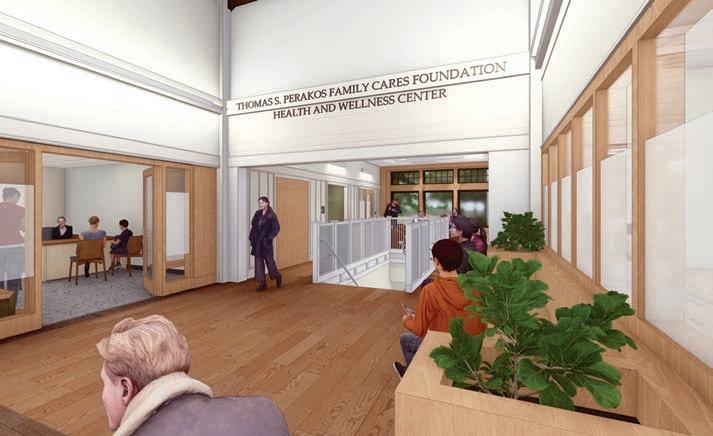
With future plans for updates to the east side of campus beginning, we made the strategic decision to move the health and wellness center, formerly in the Ogden D. Miller Memorial Athletic Center, to the Browne/Solley complex, leaning on efficient and highly effective plans for adaptive reuse (see page 8). Centrally locating the new Thomas S. Perakos Family Cares Health and Wellness Center, which was made possible in part due to the generosity of Thomas S. Perakos ’69 and will now be adjacent to our dining services, speaks to the high level of importance that we are continuing to place on, and invest in, community well-being.
The three priorities I charged the community with this past academic year were to pay attention, prioritize people, and do the right thing. For me that involved a round of ambitious hiring and diving into thoughts regarding the future of education. For others in The Center for Citizenship and Just Democracy that meant leaning into a new and tried-and-true characterdevelopment curriculum and programming. Learn more in The Path to Citizenship on page 12, which delves into RealTalk@ Gunn and Gunn@Work, two exciting initiatives that are focused on the importance of human connection and the power of faceto-face conversations. Ironically, and on trend, RealTalk@Gunn is underpinned by AI technology for recording, transcribing, and analyzing conversations for themes and insights. The technology was developed by our partners, MIT’s Center for Constructive Communication and its non-profit, Cortico.
As much as we evolve, of course, we are happy to stay rooted in the beloved place that is the Gunn campus. With A Tree Grows on Campus (page 18), we are happy to offer some insights
We are staying true to our roots while modernizing facilities; we are embracing tradition while ushering in the cutting edge; we are championing deep character development while indulging in the purely fun aspects of boarding school.”
about the past and current landscape, as well as the steadfast groundskeeper, who recently retired after four decades of carefully tending every inch of this campus.
As Assistant Head of School for Student Life and Wellness Ashley LeBlanc says in our feature story on wellness, “What our school does well — and what is written into our DNA, going all the way back to Frederick and Abigail Gunn — is the way we place wellness at the core of the student experience.” Read more on page 4 for a greater understanding of the myriad of mindful angles from which we approach overall wellness throughout the academic year.
With the past always in mind, especially in the continuation of Frederick Gunn’s search for an “ideal of a school,” we are clear-eyed and intent on the future. I will be eager to update you in these pages in the coming months.
Always learning,
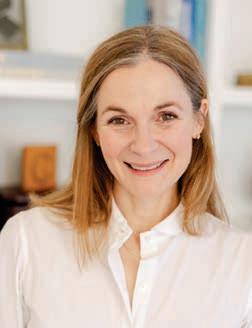
Dr. Emily Raudenbush Gum Bretter Family Head of School
PHOTO
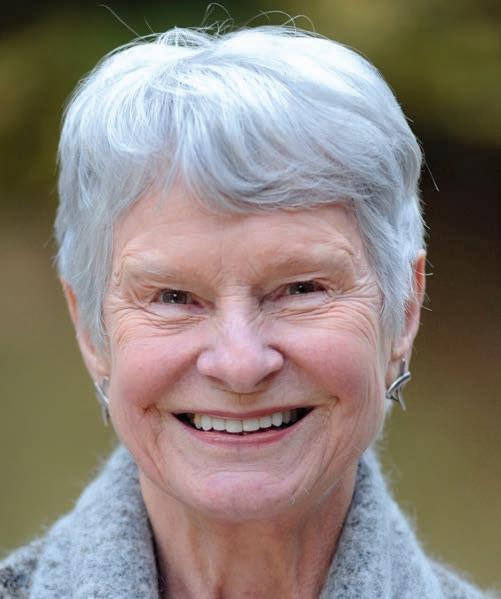
Dr. Raudenbush Gum with Karoline Theobald P’09 ’14, who gave this year’s Baccalaureate Address and passed the Gunn Mace to Alisa Croft, the new Anne S. and Ogden D. Miller Senior Master
Good Practice
Changing the Landscape for Students in Health and Wellness
By Ashley LeBlanc, Assistant Head of School for Health and Wellness
High school is a time when students are literally figuringthingsout whotheyare,howthey relatetoothers,andhowtheycancontributeto theircommunity.It’s a timetolearnaboutthemselves, topracticehowtosucceedacademicallyandsocially, andtolearnfromtheirmistakes.Aseducators,our hopeisthattheydiscoverthatwhentheywobble,they cangetbackupandtryagain,oftenwiththesupport of their peers and trusted adults who care aboutthem.
What our school does well — and what is written into our DNA, going all the way back to Frederick and Abigail Gunn — is the way we place wellness at the core of the student experience. Our role as residential life leaders is to help students develop the habits and behaviors that will support their physical, mental, and emotional health for life. It is also to set boundaries, hold students accountable, and encourage them to grow. Health and wellness are already integrated into our advisory program and our residential life curriculum as well as our Community Weekends. The Thomas S. Perakos Family Cares Health and Wellness Center, which is expected to open this fall, will allow us to take that holistic approach to the next level, bringing all of our resources together at the heart of campus. (See page 8.)
Tools for Life
The Frederick Gunn School is a preparatory school in the sense that we are preparing our students not only for college, but for life. The more students understand themselves, the better equipped they are to become more independent. As growing, young adults, they are learning to manage their time and make wise choices, and we work hard to scaffold that. Our first-year students intentionally have different routines, schedules, and boundaries than our seniors and PGs. For example, during evening study hall, first-year students are at their desks in their rooms, and their phones are placed outside. As seniors, they have access to their technology during study hall and can choose to study in multiple locations across our campus. By leaning into one of our pillars, Learning Yourself and How to Learn, we are helping students to create informed habits and good study skills that they can put into practice.
In terms of their mental and physical health, we are proactive with conversations about things we know they are experiencing or will be experiencing as young adults. We lean into conversations about healthy relationships, nutrition, sleep, technology, and
substance use. We talk about and destigmatize mental health issues, and work in partnership to provide holistic student care. Our Student Success Team is composed of administrators and faculty, who work collectively, behind the scenes, to support continued student growth. At times, it’s about helping students to navigate that feeling of being “comfortably uncomfortable,” pushing them forward and helping them grow, whether they are in the classroom, on the field, taking the stage, or with their friends.
For our student-athletes who play at the varsity level, Colleen Fink, our Athletic Director and Dean of Co-Curricular Activities, has launched a pilot program to emphasize mental performance based on the work of the Wharton Leadership Academy and Karen Reivich, Ph.D., of the University of Pennsylvania Positive Psychology Center. Coach Fink worked with the Boys Varsity Basketball team on meditation as a performance strategy, with the Boys Varsity Lacrosse team on how to get into flow state, and with the Girls Varsity Lacrosse team on how to reset by utilizing breathing techniques and positive self-talk. Our athletic program is designed to encourage students at all levels to be active, get outside, work in a team environment, develop confidence, and build resilience. It’s an opportunity to develop the skills they need to face future challenges, in sports and in life.
An Interdisciplinary Approach
One of the things that places Gunn ahead of the curve in terms of student wellness is the way our on-campus counseling services are uniquely structured. Brian Konik, Ph.D., joined Gunn a decade ago as our Director of Counseling. A clinical psychologist with over 20 years of experience working with adolescents and young adults, Dr. Konik’s primary role is to foster an interdisciplinary approach to wellness, by providing support for students, faculty, and coaches as needed. He is part of the Student Success Team, and works closely with Admissions, the Dean of Students, Health Center, Academics, and the Center for Academic Excellence. He is not a dedicated therapist for any of our students and instead serves as a steady bridge to further aid. Students who require therapeutic services are referred to trusted local practitioners, who can meet their needs. As such, Dr. Konik is afforded a certain autonomy that allows him to be accessible to students and support them whenever they need to check in about an issue or concern. He builds and maintains a rapport with students, and serves as a Prefect Advisor, which allows him to have a finger on the pulse of the community. Our school has found ways to break down traditional silos that might exist between the Health Center, student houses, and Dean of Students Office. We recognize that student life is not compartmentalized in that way, and communicating across these settings allows us to provide mindful, focused care.
Another way that Gunn differentiates itself is in accepting the reality that everyone has moments when they need support. We
help our students to recognize when they need a break and what they can do during that time — whether it’s taking a walk outside, spending time at the gym, completing an assignment, or catching up on sleep — so they can return as quickly as possible to their highest level of productivity. It’s like a rest and recovery model. Through this process, students learn what their limits are, what works best to help them to reset and resume being productive, and how to communicate what is going on in their lives.
In our 24/7 boarding school environment, we give students the space to practice how to excel in class, how to make good choices around sleep, exercise, and nutrition, and how to help friendships thrive. By using their time here to practice and learn about themselves, students become more likely to take risks safely, and realize the stakes are not as intense, which can help to reduce feelings of angst, depression, and anxiety around decision-making.
Building Connection and Community
One of the strongest aspects in our network of support is the advisory program. We want to make sure every student in our school has at least one trusted adult, someone who they define as accessible, boundaried, and caring, as outlined in Dr. Brooklyn Raney’s book, One Trusted Adult: How to Build Strong Connections & Healthy Boundaries with Young People. As Raney notes, the development of strong, boundaried relationships between trusted adult mentors and young adults can directly impact their psychological, emotional, and physical well-being. “Research shows that just one trusted adult can have a profound effect
on a child’s life, influencing that young person toward positive growth, greater engagement in school and community activities, better overall health, and prevention of risky and threatening behaviors,” she says.
A student’s trusted adult is often their advisor, who serves as the direct connection between school and home. Advisors formally check in with students at School Meetings, Advisor Lunch, and Advisor Meetings, monitor and support students’ academic and co-curricular progress, and serve as a sounding board. Our Student Progress Meetings, held six times each year, provide a 360-degree view of every student from the perspective of house parents, coaches, teachers, and advisors, who see students at different moments of the day. Our community dedicates a full day to discuss every student, how they are being supported, and how we can help them hit that next gear in a growth mindset.
This same holistic approach is woven into our residential life curriculum and our Community Weekends, which we view
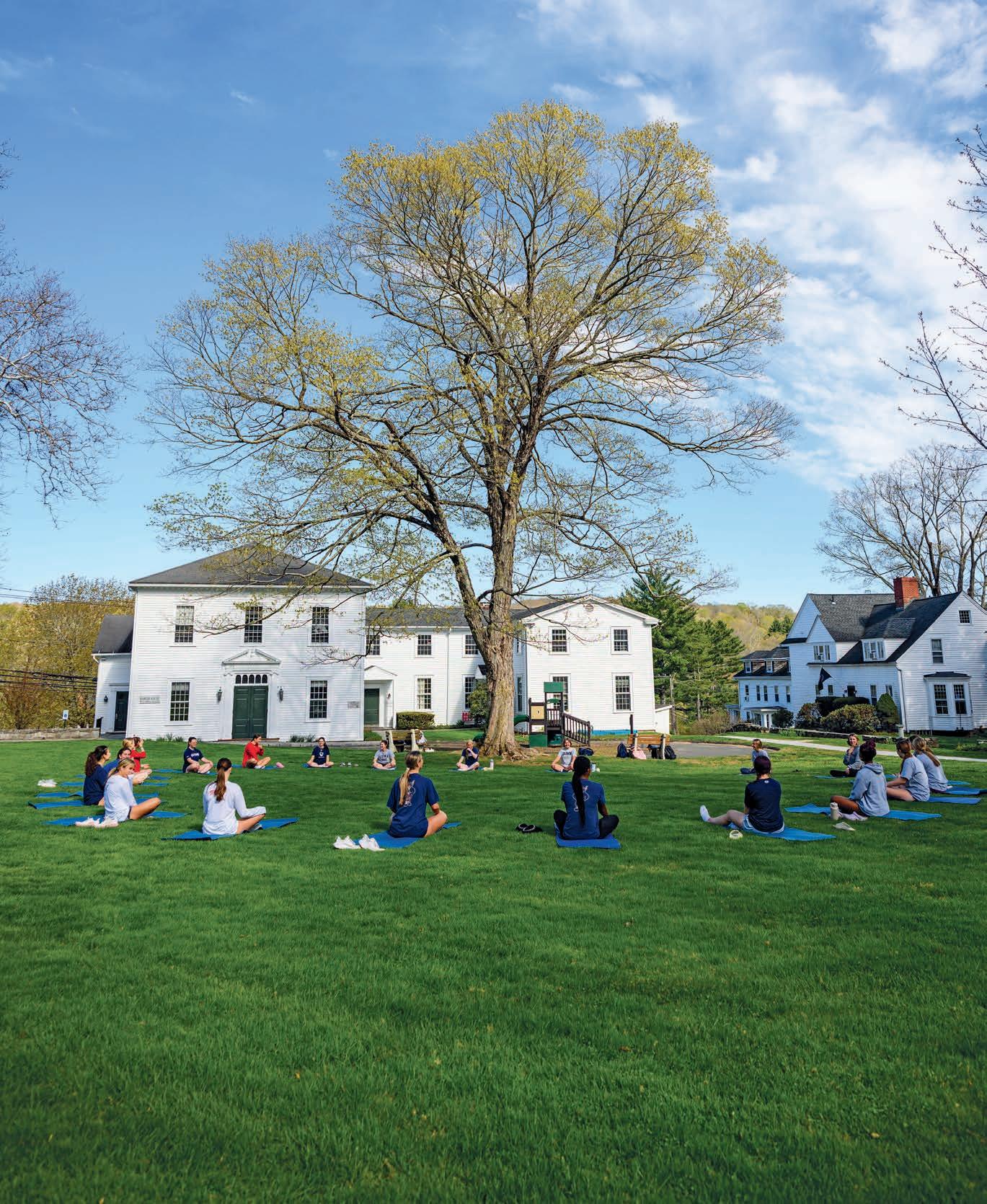
as intentional time for our community to have moments and connections outside of the classroom. By bringing in guest presenters, we create opportunities to talk with students about how they can support their own health and wellness. Dana White, who has practiced as a dual-credentialed certified athletic trainer and registered dietitian for nearly 20 years and works with DI athletes at Quinnipiac University, visited Gunn in 2025 to talk about basic nutrition. Her talk was so well received, she returned this year to talk about how to fuel your body pre- and post-game (or workout). Gunn also prioritizes uplifting programs such as Self-Care Saturday, one of the most popular Community Weekends, when students choose from activities such as guided meditation, animal therapy, yoga, and art therapy.
Often, Community Weekends facilitate moments when our faculty sit down and check in with students during what we call “dinner table conversations,” which intentionally replicate the warm, informal, and deeply connective environment of a family dinner. Instead of focusing strictly on academics, curriculum, or behavioral corrections, these conversations prioritize relationship-building, active listening, and mutual storytelling, and they are so important. Our new, centrally located Health and Wellness Center will create even more opportunities for us to naturally check in on students, listen to what they’re experiencing, and proactively support all aspects of their wellbeing. Health shouldn’t be something that is pushed to the periphery. Wellness is, after all, what supports us in being the best we can be each day at any age, and with good practice, our students are forming healthy habits to last a lifetime.
Centering Student Well-Being at the Heart of Campus Life
THE FREDERICK GUNN SCHOOL is thrilled to announce that construction has begun on the Thomas S. Perakos Family Cares Health and Wellness Center. This landmark project affirms Gunn’s decade-long standing as a pioneer in boarding school wellness by physically and philosophically placing student wellbeing at the heart of the campus.
Scheduled to open in the fall of 2026, the center advances Gunn’s leadership by integrating health services, nutrition, and counseling into a single, highperformance hub. These new spaces reinforce the school’s commitment to
mindfully placing student well-being at the core of the residential experience.
“The Campaign for The Frederick Gunn School is not just transforming our campus; it is elevating the very standard of care and experience we provide our students,” said Dr. Emily Raudenbush Gum, Bretter Family Head of School.
“By uniting these essential services in a single, central hub, we are advancing our commitment to whole-person wellness and solidifying an unprecedented prioritization of well-being for our student body. Thomas Perakos ’69 has once again stepped up to lead our community by example. Coming off his
inspiring message to our 2025 graduates, this gift further solidifies his incredible legacy and ensures that the excellence he championed in our arts program now extends to the health and wellness of every student on campus.”
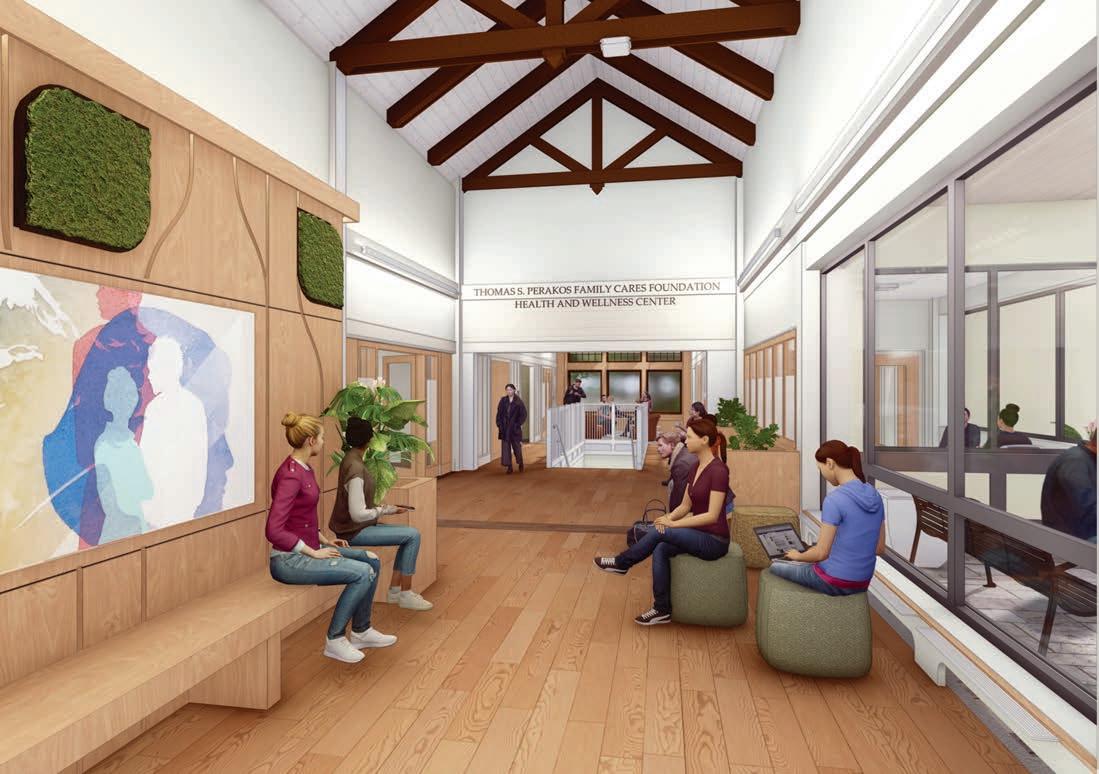
Spanning over 6,000 square feet of purposefully reimagined space, the facility will house a state-of-theart health center engineered to meet infirmary-level standards — a first in the school’s history. Alongside it will be dual counseling suites designed for tranquility and privacy, all supporting the school’s mission to foster lifelong well-being.
Facing page: the glass-filled wellness lobby is designed to foster natural interactions between students and student life leaders.
Above: the new center will create connections across the Glade with the Thomas S. Perakos Arts and Community Center.
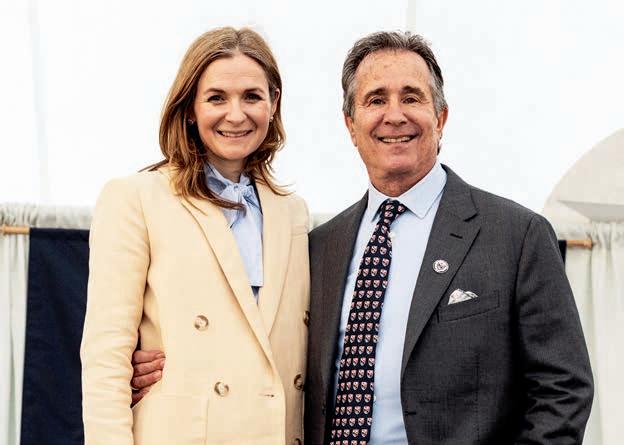
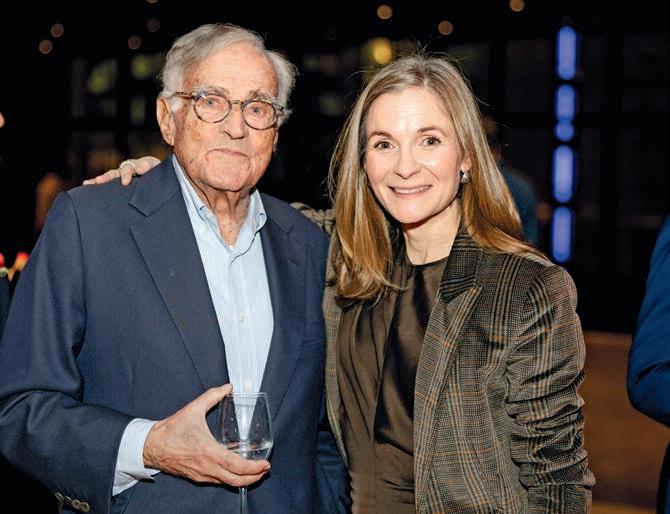
Right: Perakos, with Dr. Emily Raudenbush Gum at Commencement in 2025, has remained a steadfast “force for good” within the Gunn community.
Below: with its proximity to Solley Dining Hall, medical care, counseling, and daily nutrition will be seamlessly accessible.
“I am proud to support a project that brings student well-being to the forefront of campus life,” Perakos said. “This center advances Gunn’s leadership in wellness by providing a facility built to the highest standards.”
This gift from the Perakos Family Cares Foundation comes on the heels of the foundation’s pioneer grant to Broadway Cares, which focuses exclusively on funding for health care, insurance assistance, and mental health support to the Broadway community. These two gifts combined demonstrate the foundation’s unwavering commitment to the belief that all individuals have the
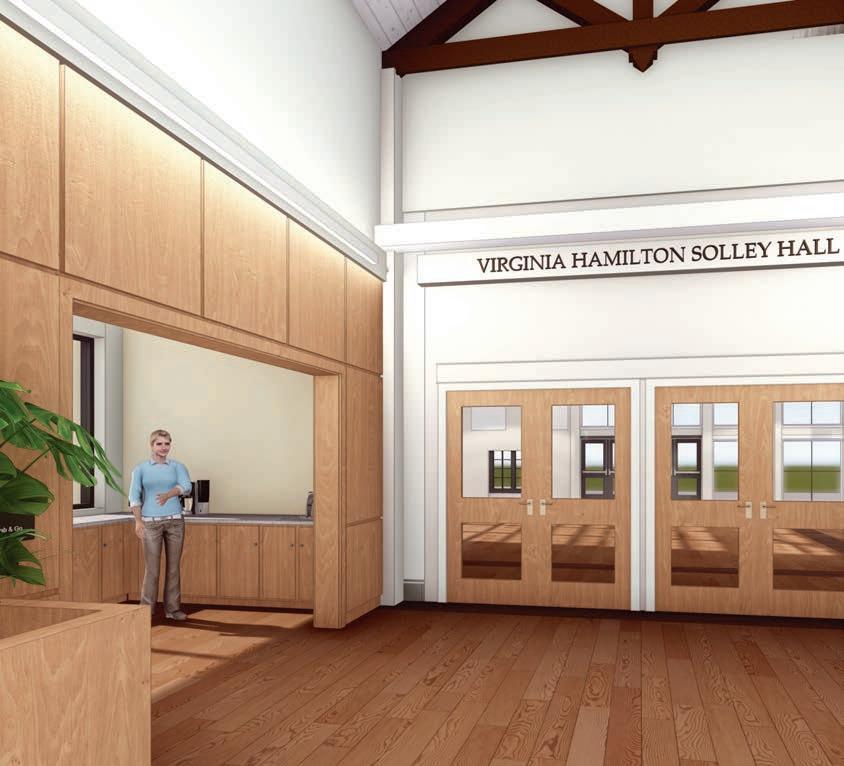
Below: the health center will be engineered to meet infirmary-level standards — a first in the school’s history. Inset: a new, glass-walled office for the Assistant Head of School for Student Life and Wellness will be centrally located across from the suites for the Dean of Students Office.
resources needed to overcome obstacles to good health and overall well-being.
Perakos is a multiple Tony and Olivier Award-winning producer and philanthropist whose career has spanned decades of excellence in the entertainment industry, from his early days as a standout student-performer on the Gunn stage to his recent success producing Broadway hits such as Sunset Blvd and The Band’s Visit Tom’s upcoming production of Sinatra — The Musical opened this summer in London’s West End at the Aldwych Theatre, prior to its upcoming run on Broadway.
With his previous landmark gift, the 32,000-square-foot Thomas S. Perakos Arts and Community Center (TPACC) has already become a vital hub for student
By creating a space that encourages natural interactions between students and mentors, we are helping to strengthen a community where every student has the support they need to thrive.”– Thomas S. Perakos ’69
talent and community gathering. Perakos is now expanding his philanthropic legacy beyond the arts and into the core of well-being as a vital component of the student experience. This extremely generous gift to our students has been a focus since the completion of TPACC, which he believes unequivocally is “the greatest accomplishment of my lifetime.”
Much like his work in the theater, which celebrates the power of human connection and resilience, this new commitment ensures that students have the medical, nutritional, and emotional
support systems to thrive and ensures that Gunn will remain a thought leader in the boarding school community.
“Gunn gave me the confidence to pursue my own path, and it remains a defining part of who I am to this day. Please always remember to keep Gunn close to your hearts — I have, and I will continue to do so,” concluded Perakos, echoing the heartfelt sentiments he expressed during his memorable 2025 “Razzle Dazzle” Commencement Address in celebration of the school’s 175th anniversary.
Historic Endowment Gift Establishes The Bretter Family Head of School
THE FREDERICK GUNN SCHOOL has announced a newly endowed faculty title, the Bretter Family Head of School, established through the leadership and generosity of Trustee Emeritus Leo Bretter ’52 P’88 and his family. His gift of $5 million is the single largest gift to the school’s endowment in Gunn history and was given to honor the Head of School.
Emily Raudenbush Gum, who has served as Gunn’s 12th Head of School since 2023, and earlier this year completed a Doctor of Philosophy (D.Phil.) in Theology and Religion from the University of Oxford, is the inaugural holder of this new title. Dr. Raudenbush Gum finalized her thesis, “The Place of Identity Formation in the Education of Children,” last fall. Her degree will be conferred at a graduation ceremony that she and her family will attend in July at Oriel College, one of Oxford’s oldest colleges, founded in 1326 and celebrating its 700th anniversary this year. She is the only Head of School in Gunn’s 175-year history to be awarded a doctoral degree during their tenure. The only other Head of School to hold a doctorate was Russell Bartlett, who led the school from 1942 to 1946 and was awarded a Ph.D. in physics from Yale University in 1924.
“What Leo has done through this historic gift to the endowment is extraordinary,” Dr. Raudenbush Gum said. “It is a testament to his belief in the past, present, and future of Gunn, and speaks to the longstanding generosity of his family as well as their enduring commitment to the school. We are so incredibly grateful for his decades of support, having served as a Trustee from 1971 to 2001, as a Trustee Emeritus since 2001, as a proud parent and engaged alumnus, and through his unwavering philanthropic support.”
As a student, alumnus, parent, and Trustee, Bretter has known seven Heads of School. When he joined the Board in 1971, at the behest of former Head of School Ogden D. Miller H’69 P’50 ’54 ’55 GP’84, he was one of the school’s youngest Trustees. During his tenure, Bretter served as Vice President of the Board, Chair of the Committee on Trustees, and as a member
of the Development Committee and the Finance Committee. As chair of the Nominating Committee, he made it a point to recommend to the Board fellow alumni, including his former classmate and Head Prefect Gus Kellogg III ’52, who served from 1982 to 2001, and Trustee Emeritus Jonathan Tisch ’72.
Over the course of five decades, Bretter’s particular passion has been to grow and support the school’s endowment, ensuring Gunn’s success for years to come. And while much has changed since he arrived in Washington, Connecticut, as a junior in the fall of 1950, Bretter sees Gunn as a school that has remained true to its roots, giving students opportunities to build confidence, to lead, and to become forces for good in the world.
“As in everything, there is a lot of change, but the basic tenets of The Frederick Gunn School have not changed at all. That’s why I’m still a big advocate of the school and I feel I can make a difference,” he said. “Clearly, Frederick Gunn was a very advanced-thinking individual, and fortunately, the school has adopted his philosophy, and it shows in whatever the school does.”
BY
David Low ’26 (left) and Michael Copen ’26 (right) worked with Bart McMann, Dean of Programmatic Innovation, on two new programs that demonstrate how the school is evolving to meet modern challenges in the age of AI.
PHOTO
MARK LIFLANDER
The Path to Citizenship
Artificial intelligence and our relationship to it remained sharply in focus throughout this school year. Discussions and decision-making around cell phones, gaming, social media, and how students use technology were led by the school’s first Tech Council. Faculty continued to lean into hard conversations about how technology is transforming education, while lessons around what AI is and how it is shaping the world today were driven largely by the school’s citizenship curriculum, and the new Gunn AI Forum.
At the same time, Dr. Emily Raudenbush Gum, Bretter Family Head of School, challenged students and faculty to pay attention and be present in classes and community spaces, to prioritize people, and to do what is right. Two innovative, new programs spearheaded by the Center for Citizenship and Just Democracy
— RealTalk@Gunn and Gunn@Work — highlighted the importance of human connection and the power of face-to-face conversations. These programs, which will both continue next year, demonstrate how the school is evolving to meet modern challenges while preparing students to step forward on the path to active citizenship.
RealTalk@Gunn: Enhancing Dialogue Through Structured Conversations
IN 2025, BART MCMANN , Dean of Programmatic Innovation and Director of the Center for Citizenship and Just Democracy, began working on a new partnership with MIT’s Center for Constructive Communication and its non-profit, Cortico. This transformational collaboration is intended to strengthen Gunn’s foundational commitment to citizenship education, by focusing on civic dialogue and community participation. “Fostering connection is something our school does well, through its advisory system, courses such as Citizen Gunn, and programs including RealTalk@Gunn and Gunn@Work,” McMann said.
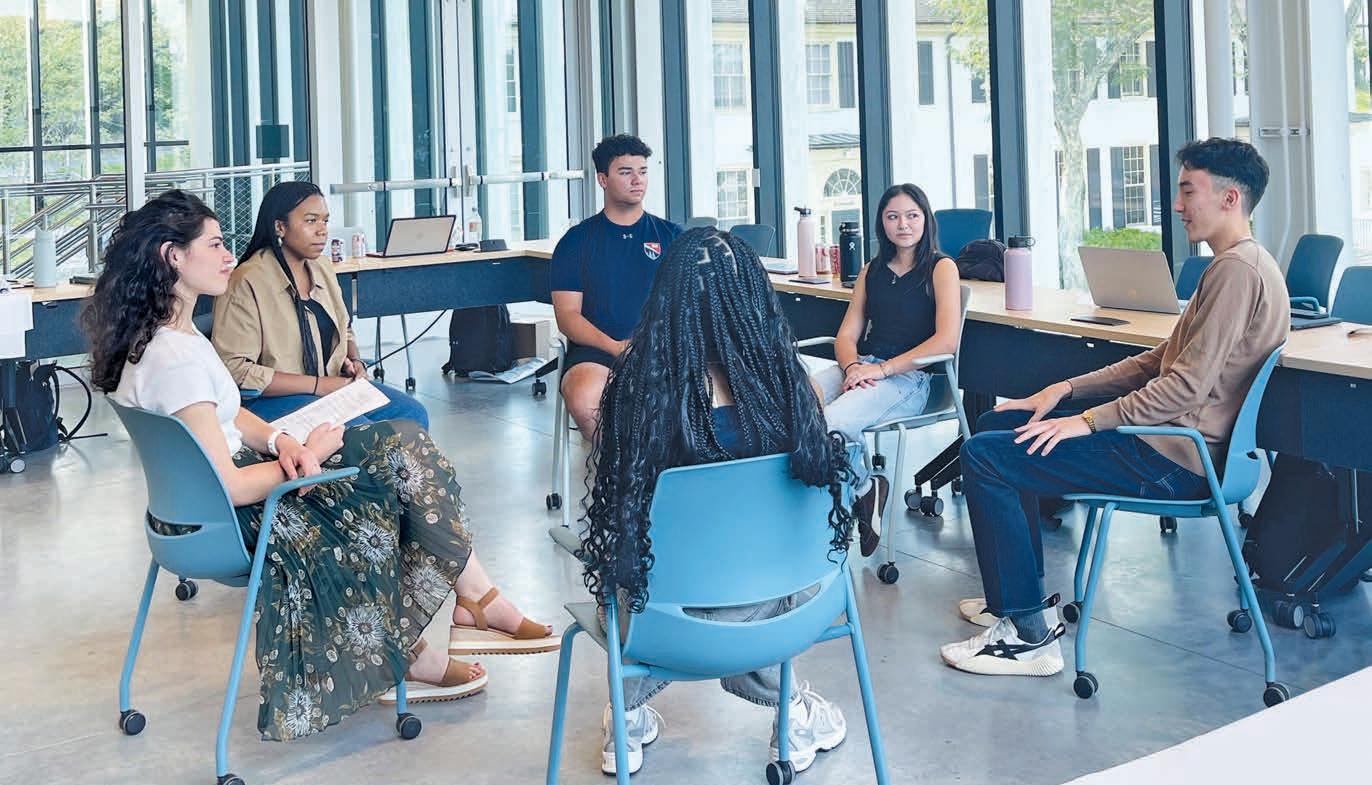
Four faculty members and 10 students participated in a two-day certificate training workshop in August to learn how to use Cortico’s AI technology for recording, transcribing, and analyzing conversations for themes and insights. These certified facilitators then led a series of conversations during the academic year, engaging community members on topics ranging from student belonging and AI’s role in education to mentorship and senior reflections on their Gunn experience.
McMann first learned about Cortico through the Project Liberty newsletter and met its founder, Deb Roy, at the Frontiers of Democracy conference at the Jonathan M. Tisch College of Civic Life at Tufts University. He invited Michael Copen ’26 to help him bring the technology to Gunn as part of his Civic Changemakers Project, a diploma requirement that represents the culmination of everything students learn in Gunn’s four-year citizenship curriculum. Copen, who was named a 2026 U.S. Presidential Scholars semifinalist in May and plans to attend Brown University in the fall, was an early adopter of AI and remains optimistic about its potential impact. Copen and McMann met with Cortico representatives in the spring and summer of 2025 and began planning the workshop for Highlanders.
“It was about conversation design, because that’s what Cortico is for, having better, more open conversations,” Copen explained. “We learned a lot about what they call universal prompt design, which is basically creating questions that lead to open discussion, rather than directed answers.”
PHOTO BY RACHEL DUFFY
Students and faculty participated in a two-day certificate training workshop last August, to learn how to use Cortico’s AI technology.
Powerful Insights Into How Students Think
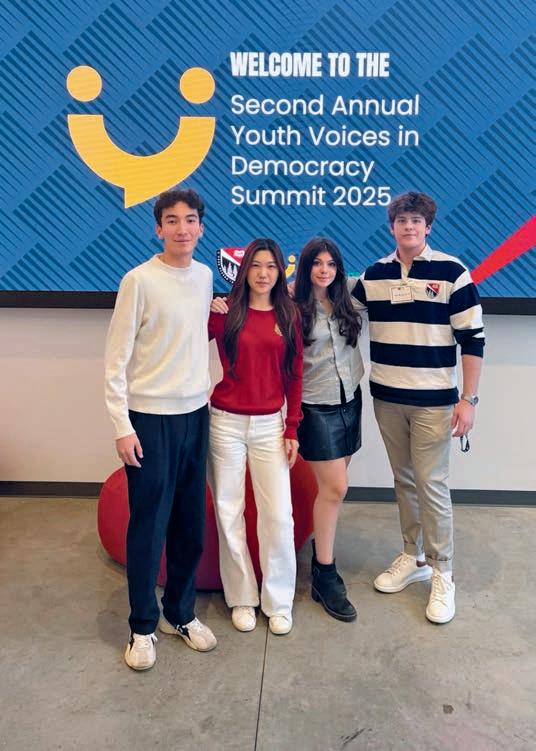
One of the first structured conversations, around AI and Ethics, took place in December 2025, at the second annual Youth Voices in Democracy Summit. High school students from across the region participated in the summit in The Lizzie & Jonathan Tisch Center for Innovation & Active Citizenship.
highlighting voices that aren’t always heard — student voices, faculty voices — to give everyone a voice, literally. It’s a recorded transcript. There is no editing to it,” he said. “It’s very authentic in that you’re using people’s real words, unscripted, unfiltered, so it’s a way of sharing what people really think.”
It’s very authentic in that you’re using people’s real words, unscripted, unfiltered, so it’s a way of sharing what people really think.” – MICHAEL COPEN ’26
“This year’s theme was Generous Listening — something we desperately need more of,” the organizers said via Instagram. “In an age of polarization and digital noise, watching high school students facilitate dialogue across differences with such maturity and skill was nothing short of inspiring. They proved that the next generation isn’t just inheriting democracy — they’re reimagining how to practice it with empathy, curiosity, and courage.”
The conference session with RealTalk@Gunn was actually part of the larger Youth Civic Voices Initiative led by Cortico, the MIT Center for Constructive Communication, and PBS FRONTLINE. Participants engaged in roundtable discussions, exploring personal values, the ethical challenges of AI, and its future role in society.
“These conversations generate powerful insights into how current students think about their education, their challenges, and their hopes for the future,” McMann said.
“The Cortico platform creates summary reports and audio highlights that authentically capture student voices while maintaining privacy and trust.”
Learning From Each Other Through Listening
Copen led additional RealTalk@Gunn sessions with students across grade levels, with faculty, and with department heads. “One really interesting part of that was that I asked the same questions and it led to two vastly different conversations with people who had strong, conflicting opinions,” he reflected.
“It’s all about having better conversations,” he said. “I think having the skill of being a quality listener, not interrupting people, or trying to press your opinion on someone else, but taking in their thoughts and crafting your thoughts around that, is important. You can have a discussion where not everyone agrees but that doesn’t make it an argument. You’re just learning from each other through listening.”
Other students led a RealTalk@Gunn conversation about belonging and inclusion, which Copen participated in as a member of one of Gunn’s affinity groups. “It’s about
This spring, McMann announced that rising seniors Finn Ritter ’27, Lilla Trotta ’27, and Sam Blackwell ’27 will lead RealTalk@Gunn in the new school year, and he is hoping to share current student voices with Gunn alumni, to demonstrate how today’s Highlanders think and speak about issues that matter to them.
“Through RealTalk@Gunn, we will create spaces for authentic conversations that cultivate the skills necessary for building strong relationships and addressing complex challenges together, demonstrating Gunn’s leadership in preparing students for active citizenship in an increasingly connected world,” McMann said.
The second annual Youth Voices in Democracy Summit was organized by four Gunn students, Zhanibek Bekov ’26, Jennifer Kim ’26, Bridget O’Hara ’27, and Peter Buchanan ’26, and featured a RealTalk@Gunn conversation about AI and Ethics.
T Gunn@Work: The Power of Alumni Connections
HE GUNN@WORK PROGRAM was also conceived by McMann and developed in partnership with the Center for Citizenship and Just Democracy and the Alumni & Development Office. In 2025, McMann invited David Low ’26 to serve as the student liaison for the pilot program, which ran as a 10-day intensive class during Highlander Term, from February 23 to March 4, 2026, and became the focus of Low’s Civic Changemakers Project. He and nine other seniors participated.
“The vision behind Gunn@Work is simple. Our alumni are doing extraordinary things, and our students deserve to see what that looks like up close. Frederick Gunn believed education should prepare young people for lives of purpose and action. This program is a direct expression of this founding idea,” McMann said.
Low helped to develop background materials, giving students a better understanding and familiarity with the work of six alumni professionals who signed on as partners, beginning with Eric Hansen ’96, the co-founder of Backstop, a sportstech start-up. In a recent whitepaper published on LinkedIn, Hansen explained that Backstop captures baseball game data and gives Major League Baseball pitching coaches and team trainers the information they need to surface injuries before they occur. “Our goal is to give coaches, trainers, and players actionable information that can keep players safe, on the field, and optimized,” the paper said.
Students studied Backstop’s social media and marketing strategy and were asked to develop content to help the company gain prominence and followers on Instagram. “He’s built an amazing platform that’s super comprehensive. I’m excited to see where it goes,” Low said.
Real-World, Hands-On Experience
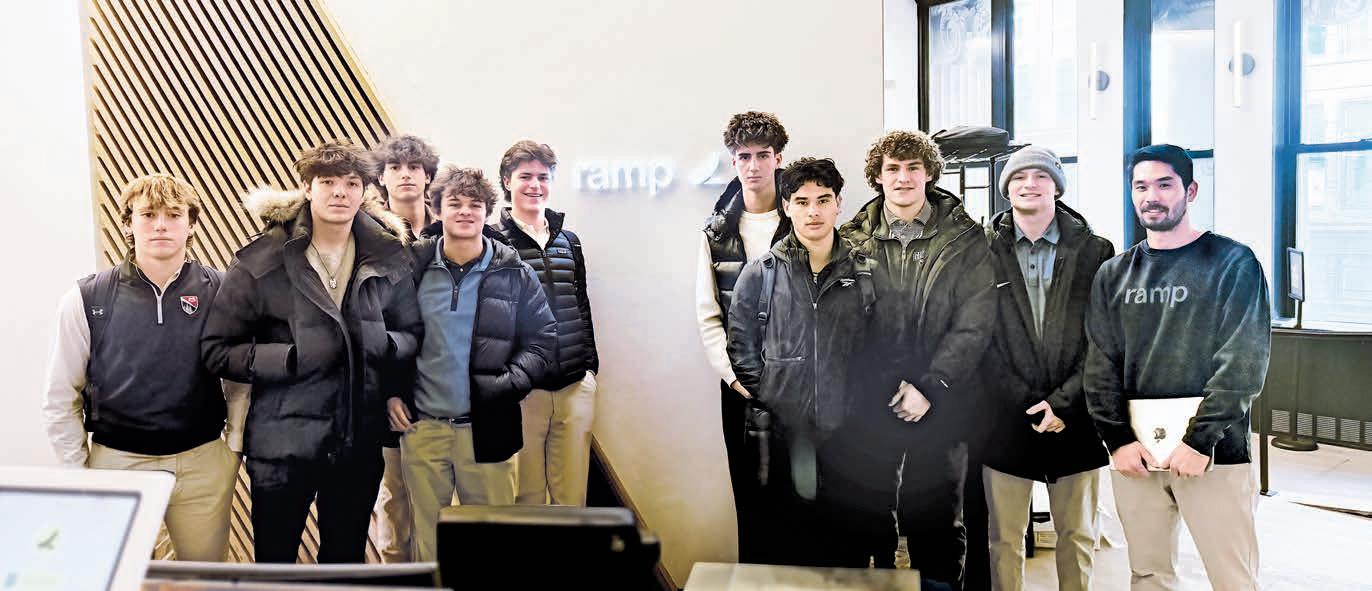
Gunn@Work traveled next to the headquarters of Ramp, a financial operations and spend management platform, based in New York City. The visit was hosted by Max Freeman ’13, Vice President of Sales, and Jaren Taenaka ’12, Manager of Customer Success, who provided students with an inside look at life at a high-growth fintech company. The fastest-growing start-up in New York City history, Ramp’s valuation soared to $32 billion in December, following a $300 million funding round.
“It’s just completely taken off, and they keep growing. They just signed Visa as a client,” Low said. “I think it speaks to the quality of the work they are putting into it and how they differentiate themselves from companies like Bill or American Express.”
Students toured the offices, participated in Q&A sessions with Ramp team members, and explored how technology is transforming corporate finance and expense management.
Back at Gunn, the students met via Zoom with alumni working in the fields of personal financial planning, venture capital, and private equity. Eli Dorf ’18, CFP®, a wealth advisor and Director of Financial Planning Services at Clearfront
PHOTOS
Jaren Taenaka ’12, Manager of Customer Success, (far right) welcomed David Low ’26 (far left) and fellow Highlanders to Ramp headquarters in New York during Highlander Term.
Gunn@Work is proof that when you trust students with real-world challenges and connect them with people who care, extraordinary things will happen.”– BART MCMANN
Advisory in Boston, walked them through a case study, featuring a hypothetical client’s complete financial profile, including income, expenses, 403(b) contributions, IRA, and planned savings.
“We plugged that into their system and their chance of making their retirement goal was 10 percent,” Low explained. “We looked at all the data, we found some red flags and tweaked some things, and we eventually changed that to a 94 percent chance of success.”
Next, students met with Caleb Dorf ’18, an associate with Cambridge Associates, who shared a case study in which students acted as investment consultants. They were tasked with recommending a hypothetical venture capital fund for a hypothetical school endowment portfolio. One was a large fund with a strong history and some late-stage growth that represented “the safer choice,” while the other was an emerging fund that worked with AI technology and offered the potential for higher returns. “We went through it by ourselves and tried to make our target percentages, and then we went over it with Caleb, and thankfully, we got it right,” Low said.
Finally, Whit Matthews ’98, a Managing Director and Partner at HighVista Strategies, invited students to review a real associate-level case study that his company uses in its hiring process. They analyzed factors, including new industry legislation, founder transitions, and EBITDA margin trends, and had to decide whether the company should invest.
“I think it’s super helpful for students to have this experience as a junior or senior going into college, when they are figuring out what they want to pursue in the future,” said Low, who plans to major in economics at Middlebury College this fall. “Getting real-world, hands-on experience in these industries is crucial to figuring out what you’re passionate about.”
Doing Something That Matters
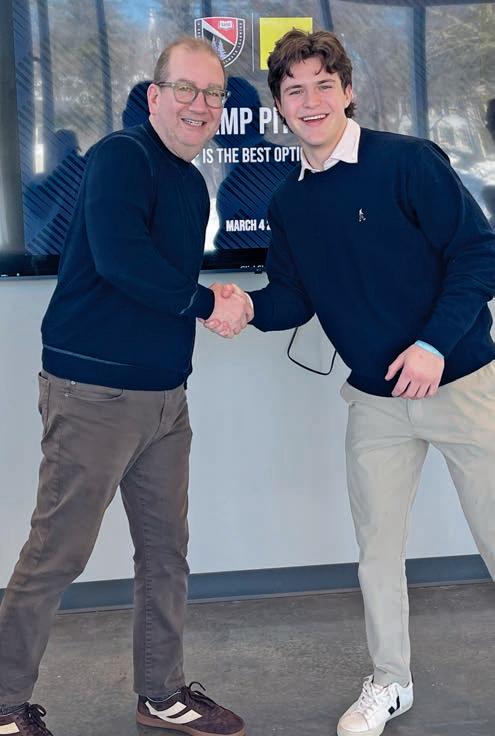
For their capstone project, Gunn@Work students prepared a formal presentation for Doug Day, Gunn’s Associate Head of School for Strategy & Finance, recommending that the school switch its accounts payable system from Bill to Ramp. The students drew on their first-hand experience at Ramp headquarters to make their case.
“Having our students pitch a real operational change to Day brought everything full circle. It wasn’t theoretical. They had
to understand the product, know the audience, anticipate objections, and deliver under pressure,” McMann said. “That’s what Frederick Gunn would have wanted: young people learning by doing something that actually matters.”
Looking ahead to next year, McMann is planning to expand the roster of Gunn@Work partners in collaboration with the Center for Entrepreneurship, deepen the case study rigor, and explore multi-day site visits to additional host companies. He believes that Gunn@Work is positioned to become a flagship program within the Center for Citizenship and Just Democracy, one that further distinguishes Gunn in the independent school landscape.
“This was just the beginning,” he said. “Gunn@Work is proof that when you trust students with real-world challenges and connect them with people who care, extraordinary things will happen.”
Doug Day, Associate Head of School for Strategy & Finance, shakes hands with Christopher Paolone ’26, after students made a pitch for the school to switch its accounts payable system to Ramp.
A Tree Grows on Campus
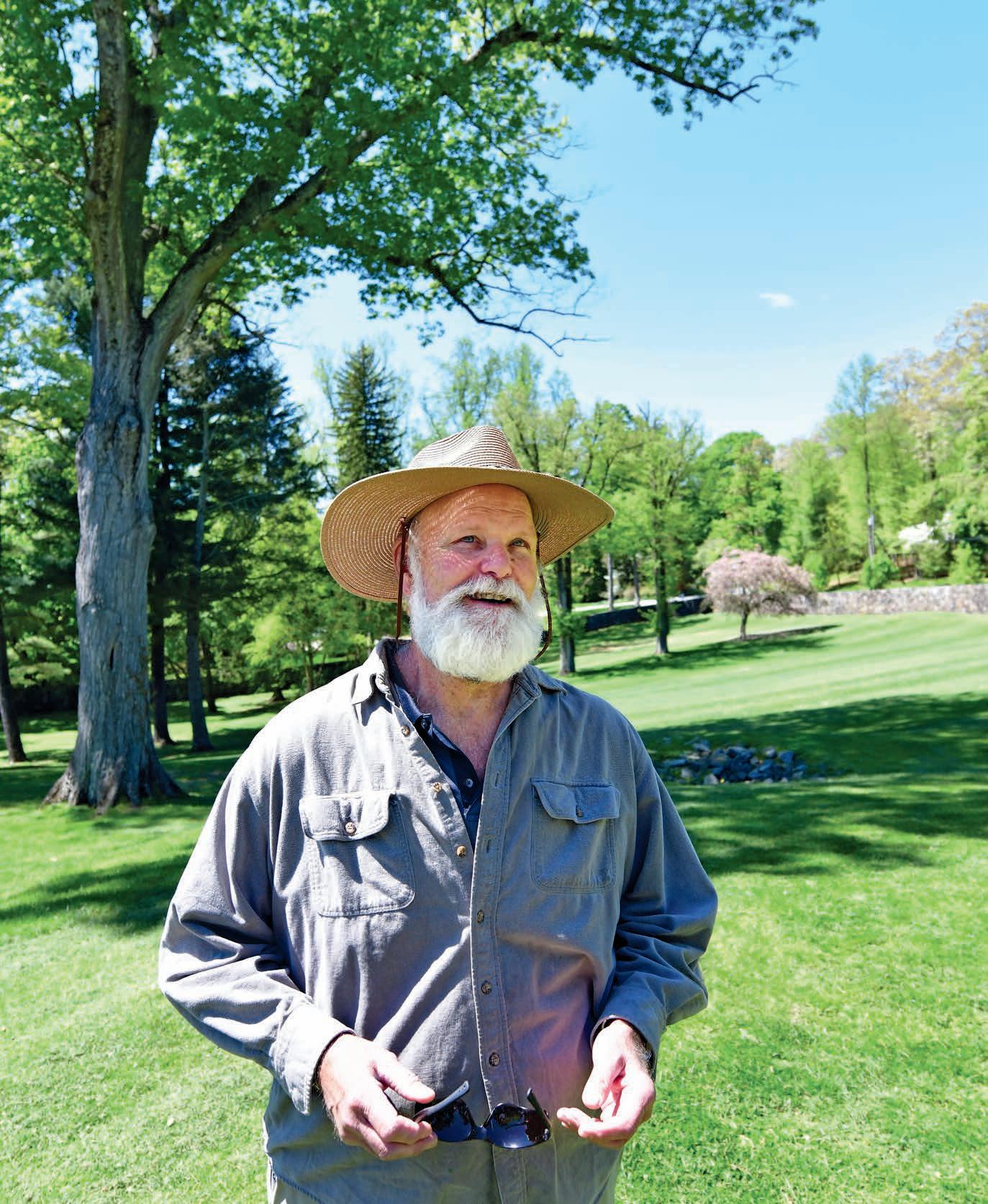
For 41 years, Glenn Hartz has kept a watchful eye on the trees that grow on our campus. He knows their names and has stories to tell about many of them. When he walks the grounds, he points them out, almost as if he is greeting old friends.
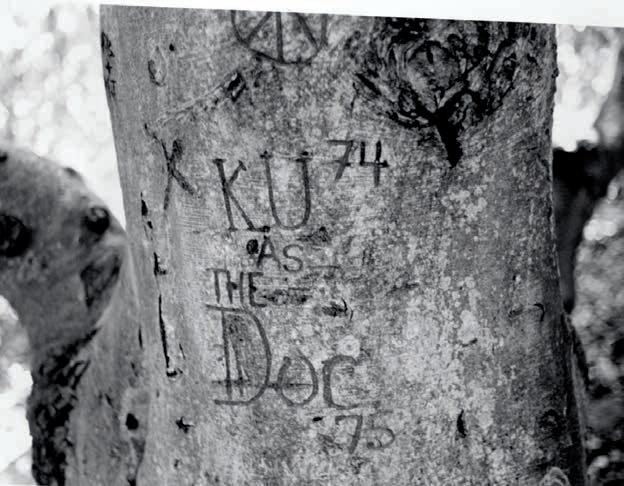
There’s the ginkgo tree outside the Head of School’s office in Bourne, whose fan-shaped leaves turn bright yellow in the fall; a paw paw, which produces beautiful, long leaves, behind 8 Kirby; Siberian elms and a weeping cherry tree near Teddy House; the horse chestnut by the Main Gate; and the last remaining apple trees at Morehouse. Certain alumni will remember the large weeping beech near Graham House. On Alumni Weekend, Highlanders would return and ask him where it was, so they could revisit the place where, as students, they carved their initials.
The large maple tree next to Gibson House was planted for Laura Eanes Martin ’90 P’20 ’23 ’25 when she was a faculty child, by her parents, former Head of School Michael Eanes H’90 P’90 GP’20 ’23 ’25 and Susan Eanes H’91 P’90 GP’20 ’23 ’25.
“That tree was a sapling in Bourne Garden when I was about five years old. I was the same height as the tree, so they moved it next to Gibson, where we were living,” confirmed Martin, who is now Director of Donor Relations and Stewardship at Gunn.
“Over the years I think Glenn came to know every blade of grass and tree on the campus,” her parents said. “His knowledge of the landscape and appreciation for the natural beauty of our grounds was deep and impressive. Moreover, he enjoyed sharing this knowledge with the faculty and staff. He was exceptionally kind to everyone, and patient with faculty children and dogs.”
Griffin Adams, the son of former Director of Admissions Tommy Adams P’15, would follow Glenn around with his toy leaf blower, former faculty member Michelle Sisk recalled.
Glenn adopted a particular method for pruning the large yew outside of Gibson House, and over the years he let it grow large, so faculty children, including Isabel ’20, Luke ’23, and Amelia Martin ’25, could play inside of it. “It’s a secret hiding place. They can see out, but you can’t see in,” Glenn said.
Trees have long been an important characteristic of our campus. The Master of The Gunnery is filled with stories about trees that figured prominently in the life of Frederick Gunn and the early years of the school. The identification of trees was part
of the “school walks” he led, and there were certain trees he was known to visit regularly — a tulip, a beech — for inspiration.
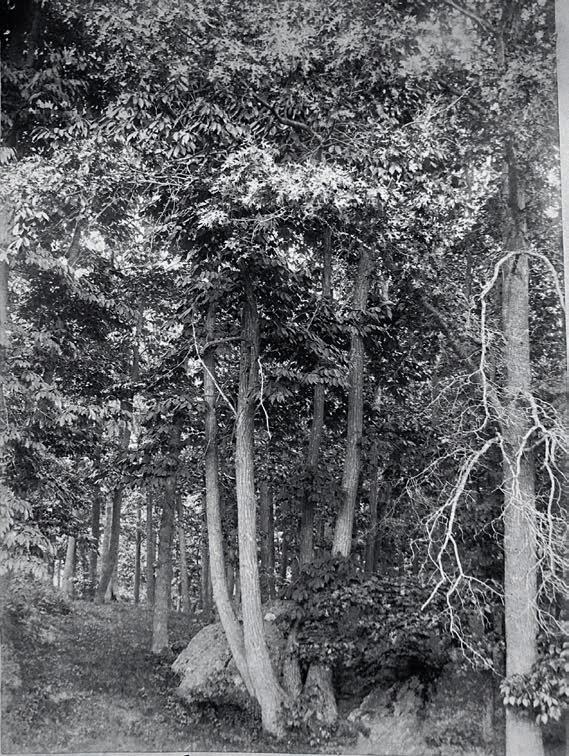
“The grove south of the house was a very important factor in the home life,” James P. Platt, Class of 1868, wrote in reference to the thick stand of trees that once grew behind what is now The Lizzie, and was favored by students and alumni: “Under its spreading chestnut-trees the boys were wont to walk and rehearse their parts for dramas and declamation, or grind into their memories pages of the books which they were studying. Under its fallen leaves, they searched for the hiding chestnut in the autumn. Under its dry moss, they rolled up in their blankets on warm summer nights and slept the sleep of unthinking boyhood, lulled by the music of the wind among its branches, guarded by the sentinel stars in its canopy above.”
At the beginning of this school year, Moira Conlan P’26, Director of Library and Archives, discovered a map of the campus dated 1926, before Gibson, Van Sinderen, or Gunn House were built. In addition to the buildings, the map showed the name and location of every tree — apple, maple, cherry, elm, Swedish elm, birch, beech, beechnut, and horse chestnut — as the future of our campus was being imagined.
At one time, the campus was filled with so many trees, “people used to say it was like being in the middle of the forest,” Glenn recalled this spring. “Emerson and Bache house were basically hidden. I used to get my suntan this time of year and I’d be white the whole rest of the summer, because there was no sunlight that made its way down through the canopy.”
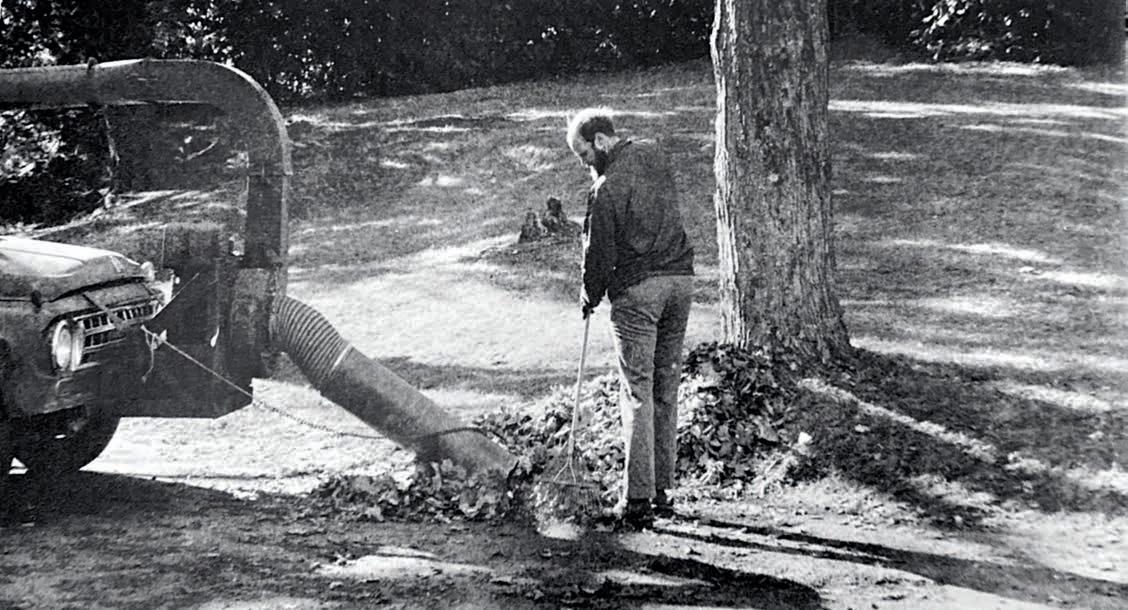
Glenn knew a little about trees when he joined the Maintenance Department on March 1, 1985. How did he learn so much? “I listened to people talk. Most people talk; I listen,” he said. As a groundskeeper, Glenn predominantly spent his days at Gunn mowing and pruning, and in the winters, he cleared the paths of snow and ice. His wife, Bonnie, has served as Housekeeping Supervisor since 1989, and their daughter, Amelia, also worked for the school.
DURING HIS FOUR DECADES with Building & Grounds, Glenn worked for four Heads of School. He cared for the massive tulip poplars and maples that once lined Kirby Road, and carefully pruned the magnificent rhododendron and azaleas that, at one time, grew as tall as 15 feet. They still bloom each spring, just in time for Commencement and Alumni Weekend. He remembers when the original Gunn Pine fell, during a blizzard in 1993. The late Paula Gibson Krimsky, the school’s former Director of Communications and archivist, said the Gunn Pine “was rumored to have been planted at the first Gunnery reunion in 1869 by Mr. Gunn,” and the tree’s rings indicated it was planted about that time. After it fell, its crown stretched all the way to the road. “It was a crime because it was perfectly healthy, but with all the snow and the wind, that was it,” Glenn said.
A specimen tree — a hemlock — that once stood to the right of Bourne was struck by lightning. “That was a monster tree,” Glenn recalled. A large oak next to Kempton was damaged
PHOTOS
Glenn raking leaves on campus, in a photo from the 1989 Red and Gray
when the building burned to the ground in 1986, and while the structure was rebuilt, the tree could not be saved.
Of course, some trees have naturally given way to age, progress, infestation, changing environmental conditions, or disease, but Glenn noted the school continues to plant new trees each year under the leadership of Associate Head of School Seth Low P’26 ’28. “Oaks are really the way to go; they’re kind of tough. They’ve put in a few London plane trees. They grow nice and straight and tall. They’re very, very forgiving when it comes to road salt,” Glenn said.
What I remember in my time, older alumni are going to remember. A lot of the trees weren’t cut because they were in the way, but because they have a lifespan.”
- Glenn Hartz
He professed a particular fondness for the trees that have lasted for generations, like the last two mature oaks, towering 100 feet tall, that stand inside the Bourne wall near Teddy House. He estimated the largest oak in that corner of campus, now gone, was 180 years old.
“What I remember in my time, older alumni are going to remember. A lot of the trees weren’t cut because they were in the way, but because they have a lifespan,” he added, turning his attention to the trees he would like to see planted for the future.
“I want to see some hybrid chestnuts. They actually produce chestnuts, they get 80-90 feet tall, they resist the blight, and they’re actually nicer than the original American chestnut, as far as taste goes. I’d also like some apple trees. Both would do well in our rocky soil and would last for generations,” he added.
Those who admire the stone wall surrounding the original Bourne estate have Glenn to thank for rescuing it from trailing euonymus vines that once obscured it from view. “You couldn’t see the wall from the inside of the campus. That’s how much it was covered,” Glenn said, recalling that one day, he pulled out his Swiss Army knife saw and began cutting the vines near the Main Gate. “Someone said to Michael Eanes, ‘Why do we have vines growing on that wall?’ John Varley and I spent the better part of two winters cutting the vines all the way around.”
Standing outside of Tisch Schoolhouse in mid-April, he spied honey locust trees, a Norway maple, sugar maples, Bradford pear trees, and a Douglas fir. Walking towards the location of The Grove from Mr. Gunn’s time, he pointed out newer dogwood trees, a white pine, and hemlocks, which are now, unfortunately, suffering from woolly adelgid. “It’s this little, cottony-looking bug that gets on the back of the leaves and sucks them dry,” Glenn said.
Continuing on toward Bourne, he took note of more oaks, sugar maples, a hickory tree, a black birch. The ash trees are almost all gone now, and the beeches are failing due to Beech Leaf Disease, caused by invasive nematode worm. “You’ve constantly got to keep your eyes open,” Glenn said sagely. “You watch trees if you’re out and you work around them.”
Left: The Grove, circa 1887, was a popular gathering spot for students and alumni during Mr. and Mrs. Gunn’s time. Above: Students carved their initials in this weeping beech, and would ask Glenn to help them find it when they returned as alumni.
DIVING INTO HIGHLANDER TERM
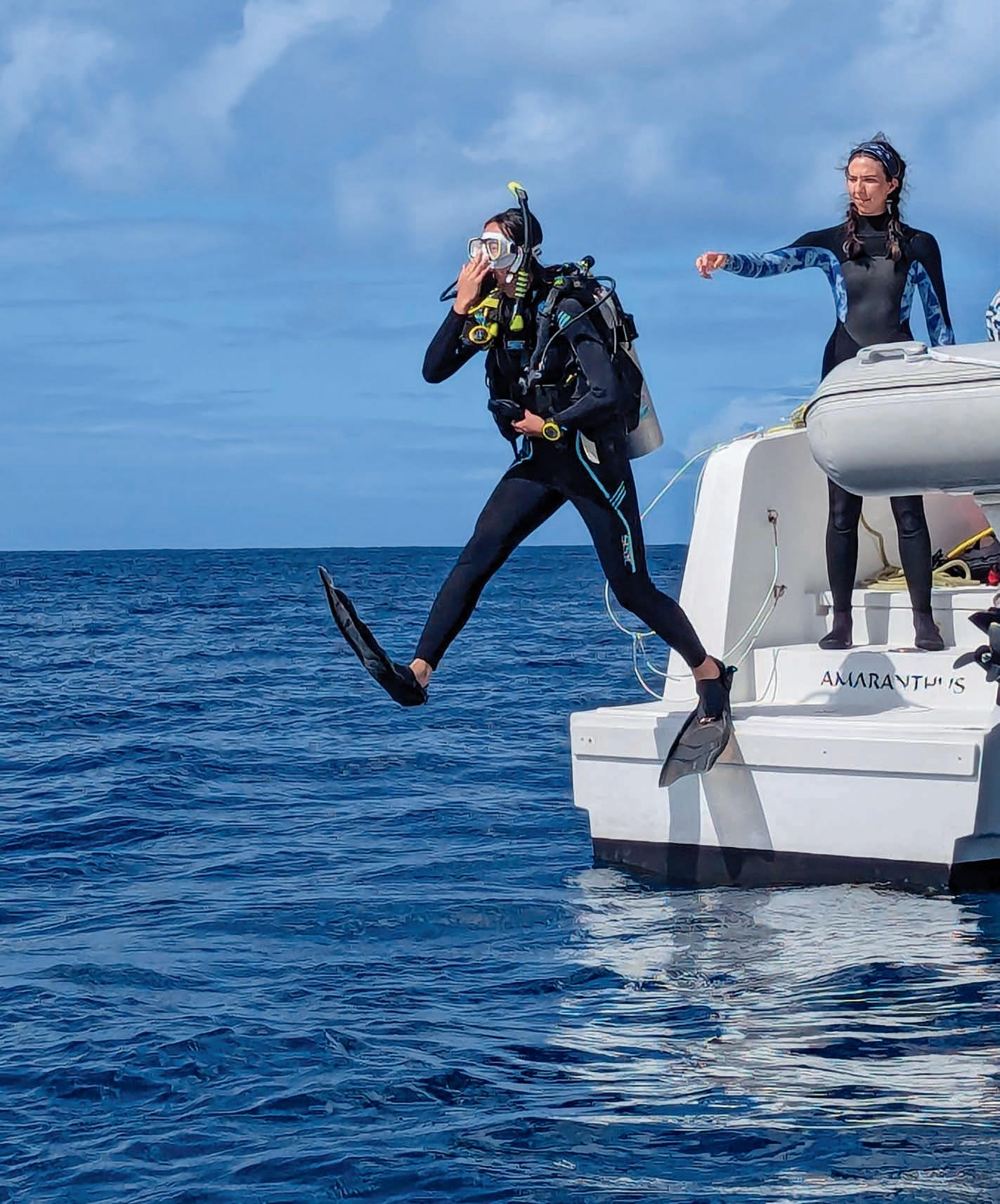
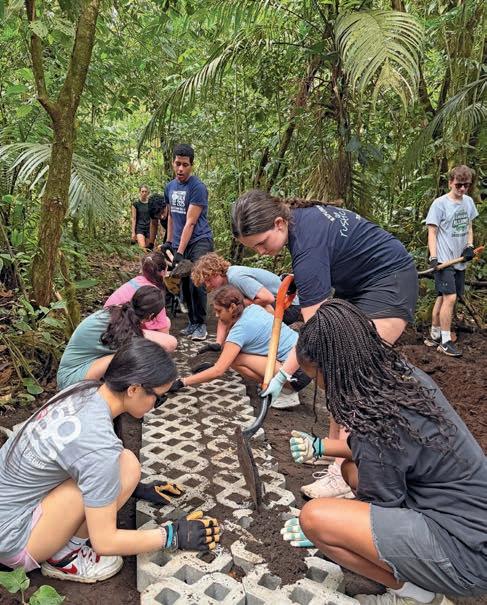
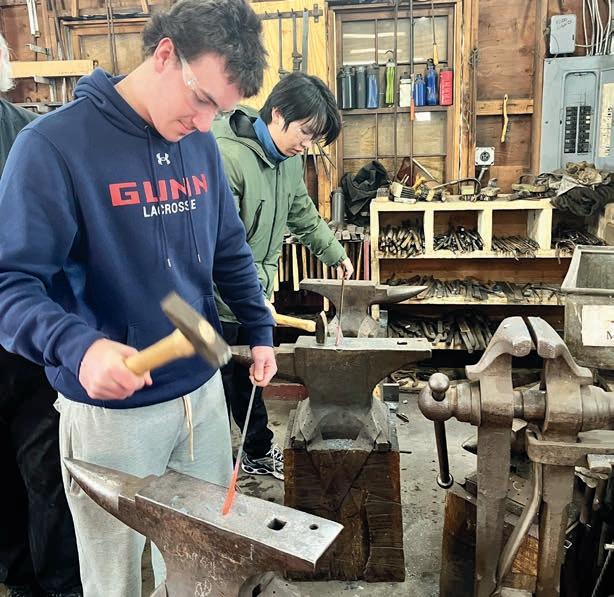
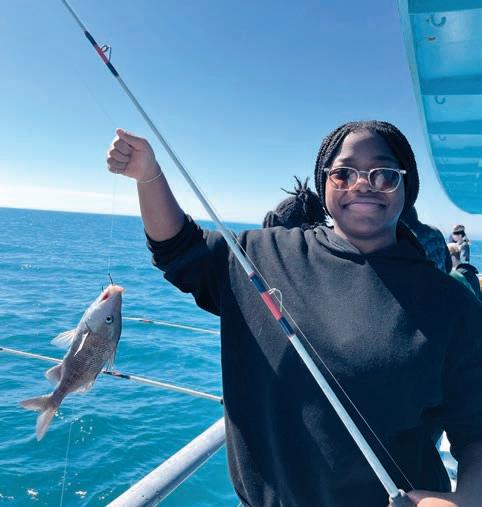
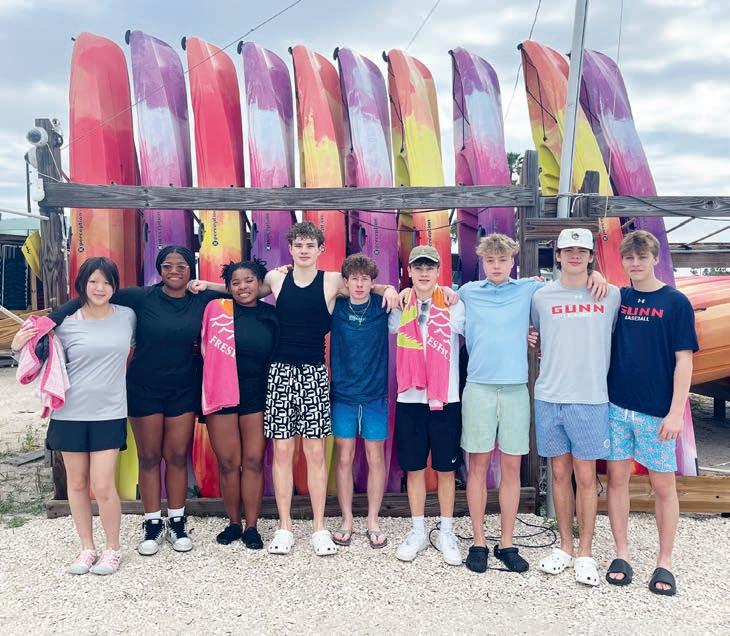
HIGHLANDER TERMMAY have been the perfect antidote to a cold and snowy winter, as students stepped away from traditional classwork for 10 days to explore big ideas and try something new. This year, Highlanders traveled to the Caribbean, Costa Rica, Florida, and New York City. They learned to fly and scuba dive, went sea kayaking and fishing in the clear waters off St. Petersburg. They helped a community in need through service projects, learned new skills in glassblowing, blacksmithing, watercolor painting, filmmaking, music production, and fashion design classes. They built RC cars and electric guitars, toured the Metropolitan Museum of Art, and took in Broadway shows. They completed impressive research at Stanford and Kyoto universities, and learned about the powerful connections between service dogs and humans. Oh, and did we mention the baby goats? Yes! Highlander Term had something for everyone this year.
The Frederick Gunn School Bulletin
from top: Highlanders hammered hot metal on an anvil to shape it into art in a blacksmithing class at Brookfield Craft Center; students worked together to install a concrete brick pathway in an area prone to flooding in the Parque
in Costa Rica; students ready for their sea kayaking adventure off St.
Clockwise
Nacional Volcán Arenal
Pete.
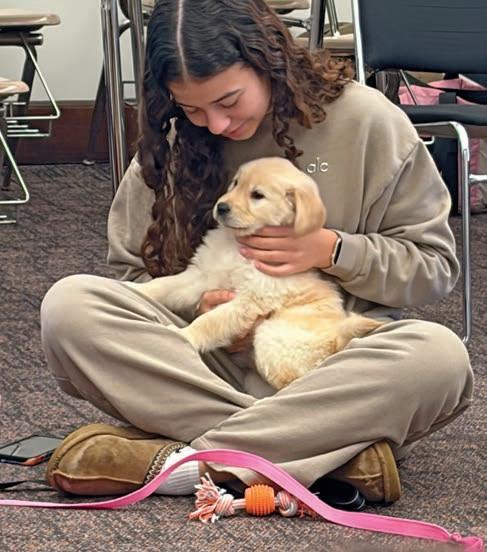
Facing page: A student jumps into the water off the coast of St. Barts to earn her PADI® scuba certification. Above: students could “catch and cook” their own dinner on a fishing charter off St. Petersburg. At right: cuddly pups like this one helped students learn about the therapeutic connection between animals and mental health.
The Dedication
The Gunn community honored longstanding faculty members
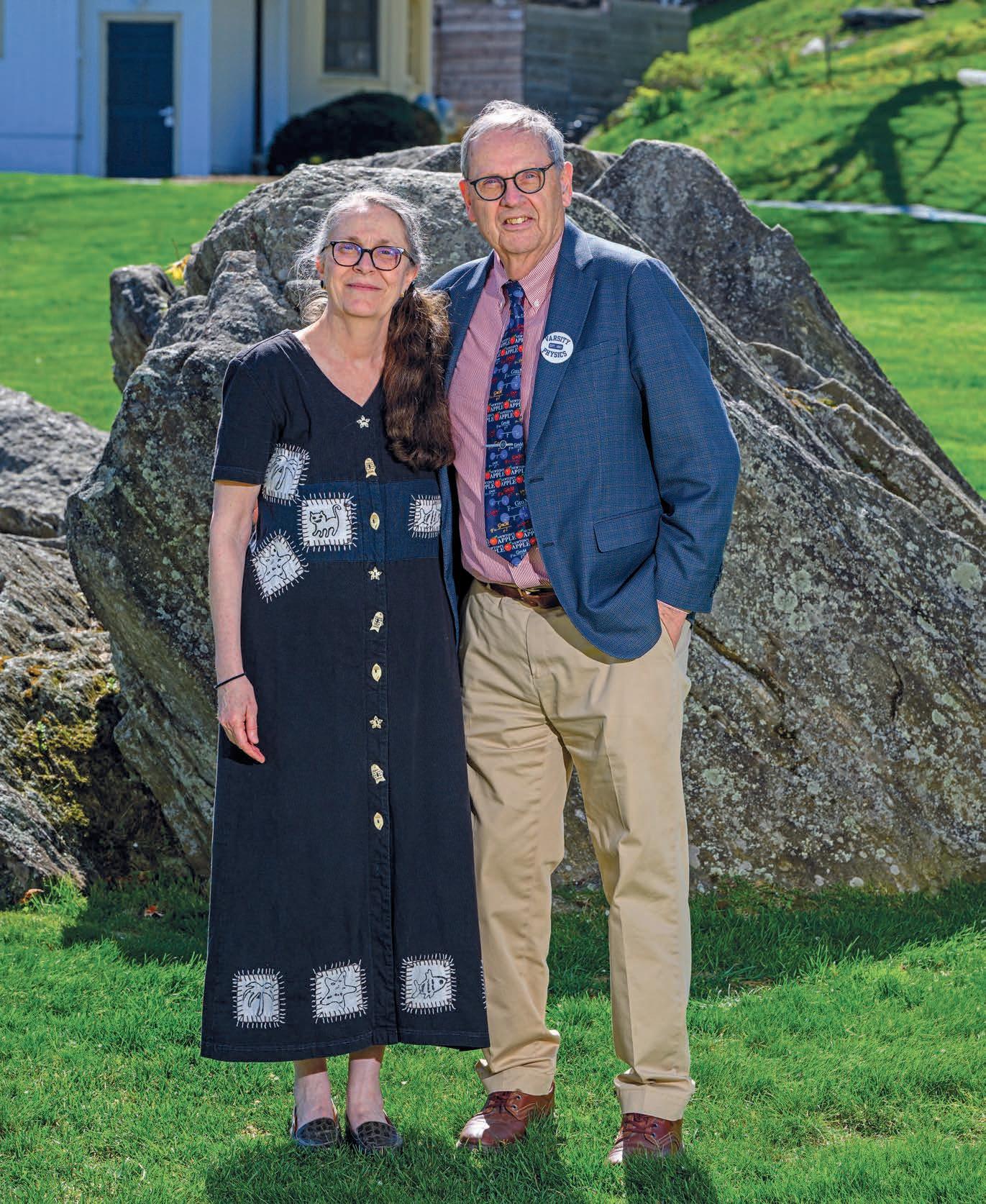
Karoline Theobald P’09 ’14 and Steve Bailey P’09 upon their retirements at the end of this school year.
Heartfelt tributes and best wishes poured in from current and former faculty, alumni, and parents, which were shared with them following a
champagne toast at the last full faculty meeting in May.
“Mrs. Theobald is an amazing teacher,” Marshall Millette ’14 wrote. “I will always remember reading Macbeth, The Odyssey, and many other great novels in her class and being able to dive deep as a class to truly understand the stories within them. She made English class fun … and she always made sure to bring out the best in each and every one of her students, even when they didn’t think they had it in them themselves.”
“My experience as a student was shaped by teachers like you,” said former faculty member Liz Dayton ’08. “Your love for the school and its community has always been so evident. It is one of the reasons I returned to campus as a young faculty member just a few short years after graduating.”
“I could not have wished for a better advisor, or English teacher,” Anna Damosy ’24 wrote. “I think back fondly to my time in Connecticut and the U.S., and that is also thanks to you, your kindness, and the care you took in my well-being.”
“Mr. Bailey was my advisor for three years during my time at The Frederick Gunn School. He was an advocate for me, a
constant force for good, and wonderful company at lunch,” recalled Jack Douglas ’12. “Mr. Bailey, I credit you with helping me overcome the challenges I faced … and truly thrive by the end of my high school experience.”
“I still think about your Winterim class, Scientific Thinking in the Real World, all the time,” wrote Aubrey Barnes ’22. “That class is what made everything click for me and helped me realize I wanted to go into pharmacy. I don’t think I would have figured that out without you.”
“In my first few days at Gunn, Steve was one of the most welcoming people in the Science Department,” reflected faculty member Betty Hagymasi P’28. “From his jokes to his check-ins, he cared deeply for the work we do here. He made a solid effort to make physics the best science at this school and challenged his colleagues to rise to his level … He not only wears physics ties and dresses the part, but he is also always doing something with his students that helps them connect the work they are doing to their lives.”
AT PRIZE NIGHT , Daniel Conlan ’26 read the dedication he wrote for the 2026 Red and Gray yearbook, to recognize “the boundless energy and care” Bailey has shared with Highlanders through the years.
Bailey joined the Science Department faculty following successful careers in the U.S. Navy and NASA. “During his 21 years at Gunn, he has provided opportunities for interested students to explore physics both inside and outside of the classroom,” Conlan wrote, citing as examples the national “Physics Bowl” and celestial observations that Bailey organized so students could witness a display of comets or a solar eclipse.
With his science-themed ties, pins, and puns, “he brings a kind of energy and thoughtfulness to everything he does, lifting others who need it,” Conlan said. “The Frederick Gunn School has been forever imprinted by his unwavering positivity.”
The 2026 Red and Gray also included a dedication to Theobald, with deep gratitude for her 28 years at Gunn, written by Ariane Rivanas ’27 and shared at Prize Night.
“Mrs. Theobald approaches every class like a new book. Every phrase and pause is an opportunity for connections to be made, both between the text and the reader, and between peers in the classroom. Whether contemplating Frankenstein’s existential crises, rooting for Odysseus’ return, or parsing a passage in Wide Sargasso Sea, every book read with Mrs. Theobald became a pivotal touchstone full of moral lessons we can refer back to,” the dedication said. “Stories shape who we become and there is no doubt in my mind that Mrs. Theobald’s time at The Frederick Gunn School is a story that will continue to shape this school, its students, and the faculty for decades to come.”
IN HOPES OF REVIVING A RIVER
Life Lessons Inspired Student’s Research
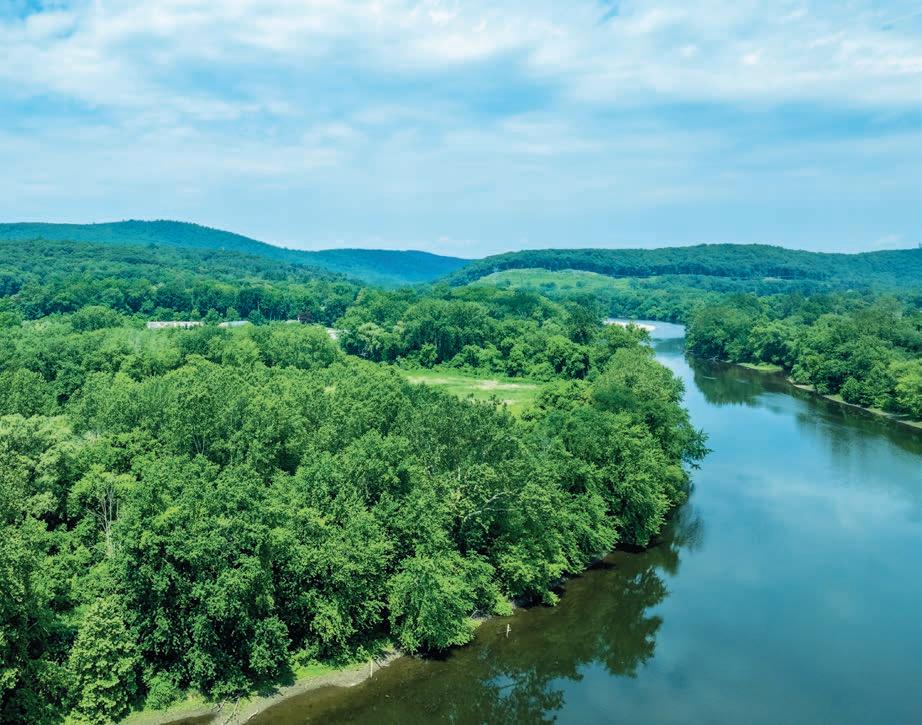
ISLA BECKSTROM ’26 first learned about the contamination of the Housatonic River in Connecticut over two years ago, when she was rowing in New Milford and her trainer cautioned her not to put her hands in the water.
“It is so polluted that when I was rowing on it, you could smell it. It was a stench that stuck in your nose. It made your sinuses hurt. The water was so polluted that dogs couldn’t swim in it because they would lick themselves after and get sick,” recalled Beckstrom, a member of the Girls Varsity Rowing team, who trained on the Housatonic in the off season.
According to the Environmental Protection Agency, the Housatonic and its floodplain are heavily contaminated with PCBs, stemming from the General Electric plant in Pittsfield, Massachusetts. GE manufactured and serviced electrical transformers containing PCBs at the site from 1932 to 1977, when the chemicals were banned. While remediation has been ongoing for years, and the highest concentrations of PCBs remain in Massachusetts, evidence of PCB contamination extends downstream, even into Connecticut, a distance of approximately 140 miles, the EPA has said.
Inspired by her experience, Beckstrom decided to pursue an independent study project at Gunn this year to determine whether a process called phytoremediation could filter contaminants from the river water. Specifically, she sought to evaluate whether rhizofiltration, a type of phytoremediation that uses plant roots to absorb and filter contaminants, would be a practical, low-cost, and effective method for improving water quality in environments like the Housatonic River.
Building on previous research, Beckstrom set out to compare four different plant species under controlled conditions over a 10-week period to determine which species most effectively removed contaminants from water.
“Phytoremediation is not applied enough,” said Beckstrom, who plans to study biomedical engineering at the University of Massachusetts, Amherst, Honors College this fall. “It’s very cost efficient, it’s pretty easy to do, yet in terms of environmental pollutant remediation, it’s not utilized very much. It’s sort of hidden away.”
In December, she had the opportunity to discuss her project with David Neale ’71, Ph.D.,Distinguished Professor Emeritus in the Department of Plant Sciences at the University of California, Davis. Dr. Neale retired in 2020, following a 36-year career with the U.S. Forest Service Institute of Forest Genetics and UC Davis. A leading expert in forest tree genomics, he is the former Board Chair of the Whitebark Pine Ecosystem Foundation. This spring, the foundation and UC Davis announced that a groundbreaking research study he led, to sequence the genome of the Great Basin bristlecone pine, “could help unlock the secrets of the tree’s exceptional longevity and provide insights for other species.” The study was published in the journal G3: Genes/Genomics/Genetics.
DURING A MEETING in The Lizzie & Jonathan Tisch Center for Innovation & Active Citizenship, Beckstrom explained that she had started her project using seeds and seedlings, and one of the challenges she faced early on was keeping them alive. The inspiration for her test tank design, which she built using 25-gallon HDX tubs, came from a study at Shivaji University
in India, where researchers analyzed the effectiveness of alligator weed in removing toxic dye effluent from water. Ultimately, she intended for the plants to float on the surface of the river water, allowing the roots to absorb and filter the contaminants. Periodically, the plants in the river could be changed out, like filters in a water pitcher, maintaining the system’s effectiveness over time.
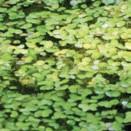
ONE OF THE PLANT species she chose for her research was duckweed, a native plant that can grow overabundantly, but has the ability to “suck up” coliform bacteria and heavy metals, such as manganese, she said. She also discussed with Dr. Neale the merits of water hyacinth, which is good at removing heavy metals and phosphorous; mustard plant, which is effective in the bioaccumulation of heavy metals; and sunflower, which she noted is “effective in the bioaccumulation of lead and cadmium, good for pollinators and insects, and drought resistant.”
During their discussion, she cited a study in Britain, where water hyacinth was used to filter a stream contaminated with copper, zinc, and lead. “It was really effective,” she told Dr. Neale, noting, “It was able to bioaccumulate a decent amount of contaminants.”
After 10 weeks, Beckstrom planned to measure the water levels and add Potassium Iodide to precipitate lead compounds
One of the plant species that Beckstrom chose for her research was duckweed, a native plant that can grow overabundantly, but has the ability to “suck up” coliform bacteria and heavy metals, such as manganese.
from the solution. “I’ve actually done that before in Honors Chemistry,” she told Dr. Neale. She was also able to apply what she learned in her engineering class at Gunn to build a monitor using Raspberry Pi that measured conditions in her test tank, such as salinity and temperature. She added lead to the water in the tank, in concentrations that were precisely determined to mimic the water quality of the Housatonic River.
Dr. Neale suggested adding a fifth test tank to her system, one without plants, as a control. He also talked with her about how to design the experiment so that it could be replicated later on. “Your intuition has served you well,” he told her. “Your experimental design is very important because if it’s not designed properly, you can’t interpret your results. Later in life, for publication, that’s what gets reviewed quite seriously.”
“It really does hit home with connecting your experiences and making a difference,” said Betty Hagymasi P’28, who teaches chemistry and served as Beckstrom’s faculty advisor for the project. “Making an observation and then taking that observation to a level of research is incredible.”
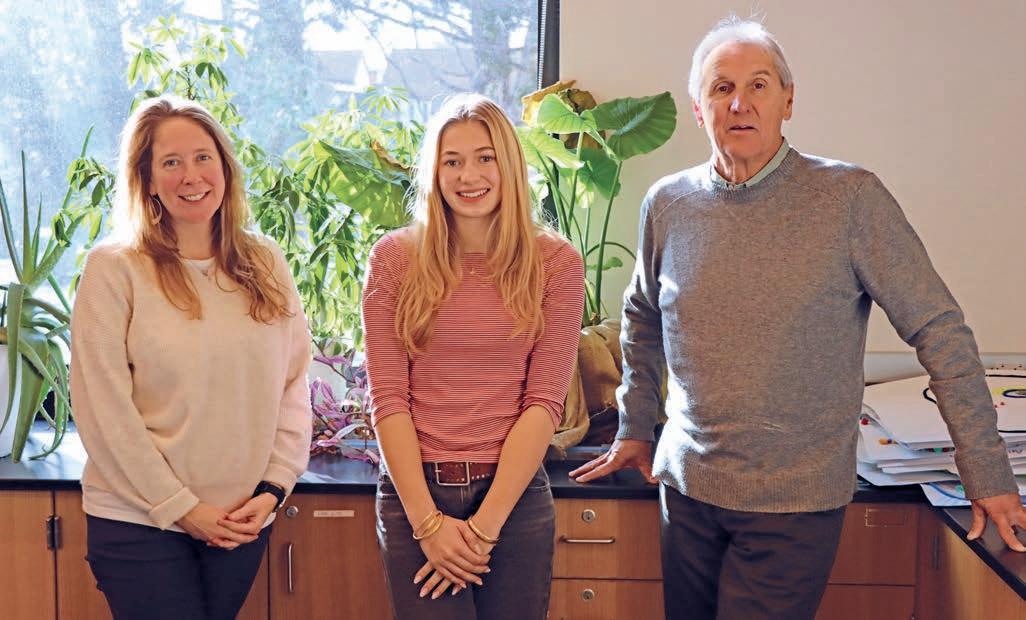
Left to right: Science teacher Betty Hagymasi P’28 with Isla Beckstrom ’26 and Dr. David Neale ’71 in the biology classroom of The Lizzie.
ON STAGE Matilda the musical
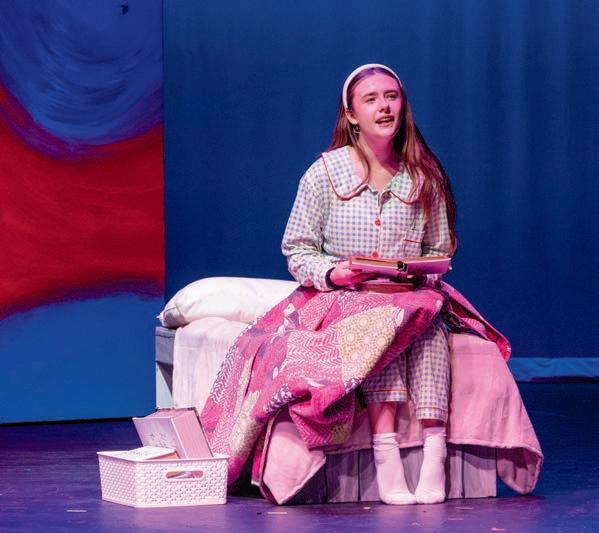
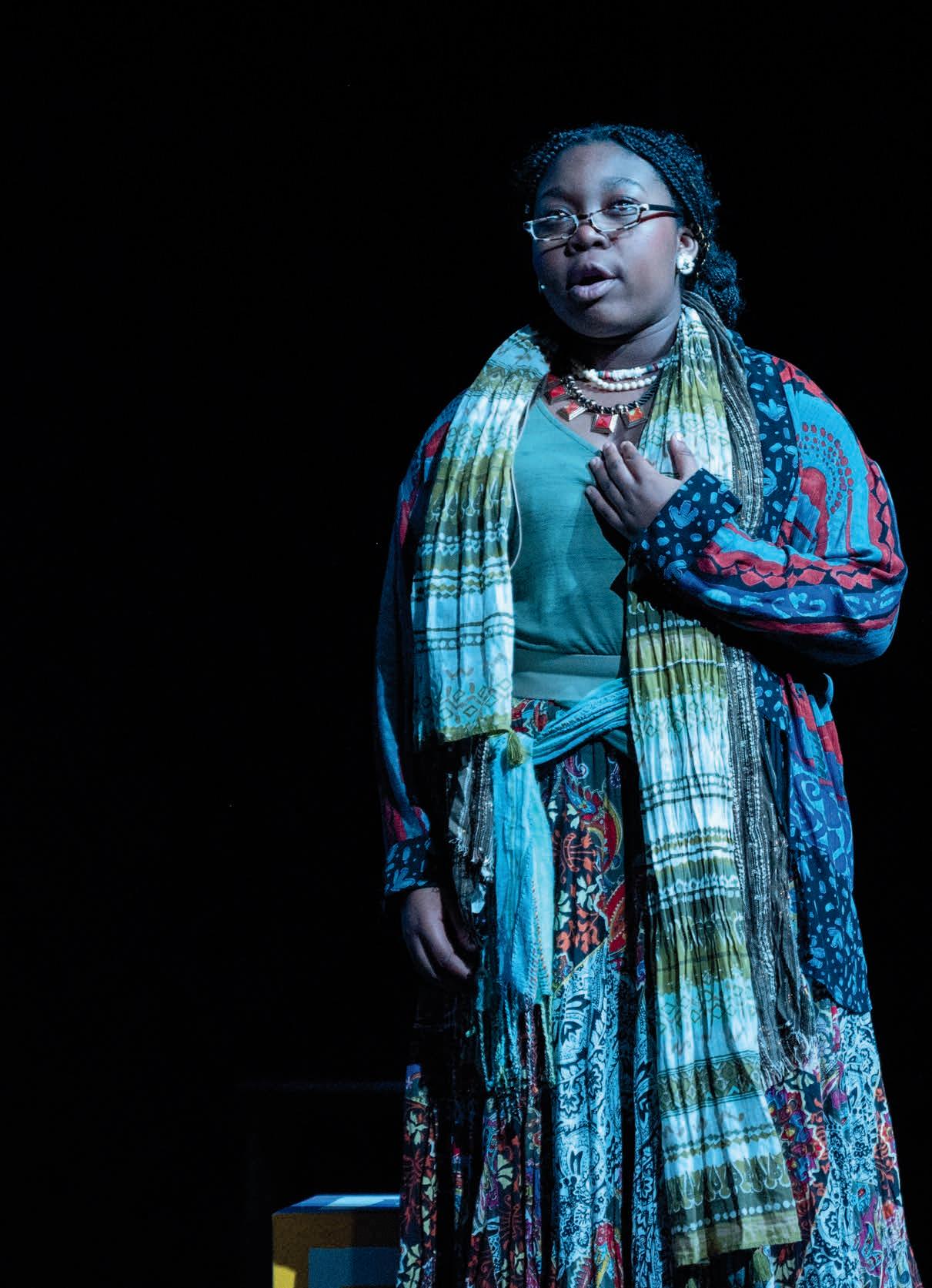
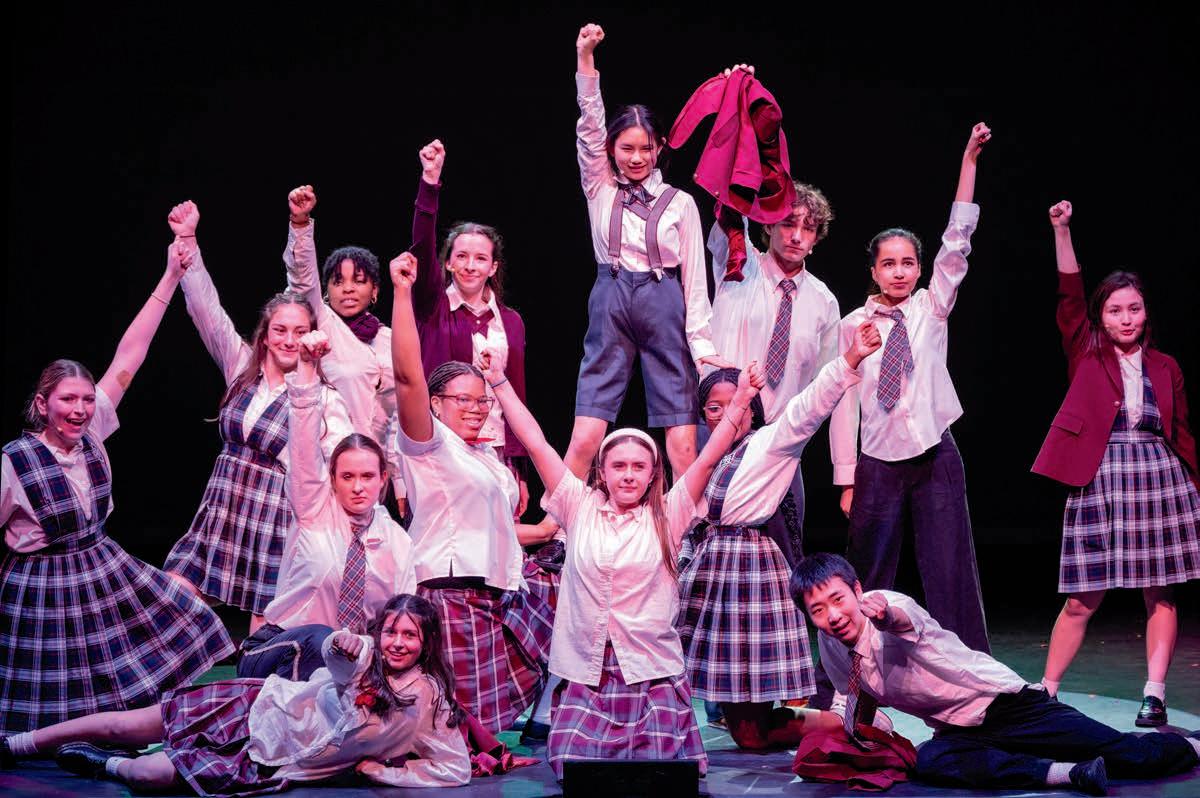
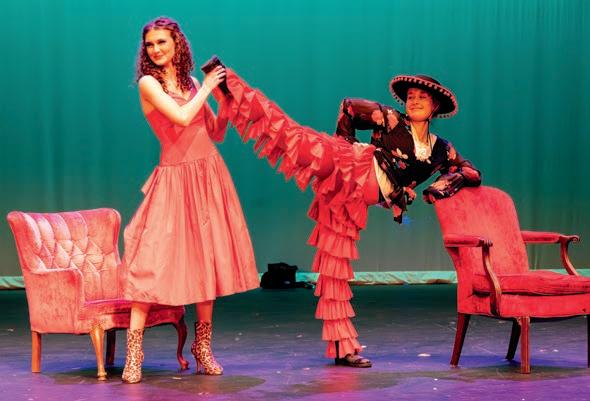
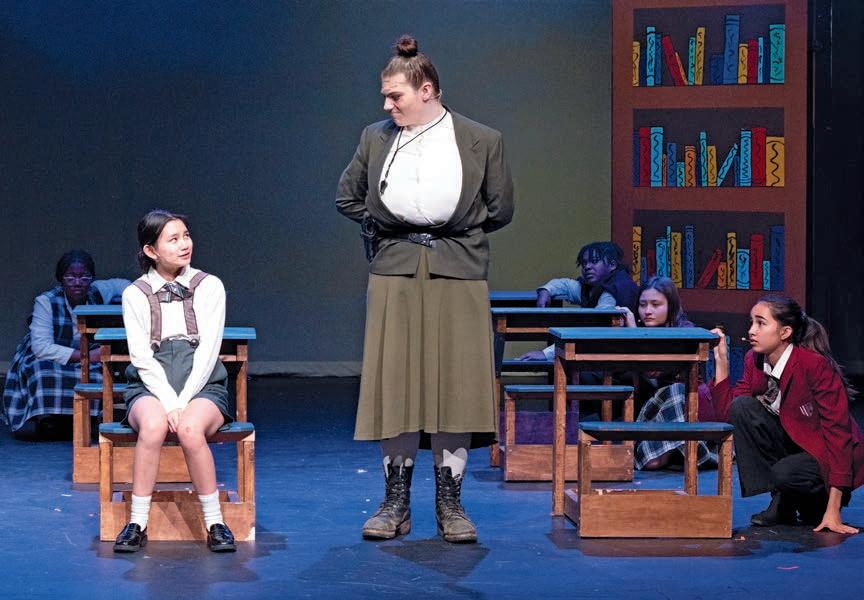
ROALD DAHL’S Matilda the Musical is a story about the power of imagination, betterment through reading, and the importance of standing up for what’s right. Matilda’s connection to a teacher, Miss Honey — who believes in her — gives her the courage to change her destiny, even in the face of Miss Trunchbull, who loves to punish children who don’t abide by her rules. Bravo to the cast and crew, who brought these memorable characters to life and invited us to explore the fantastical world of Matilda this winter. The musical was also nominated for six 2026 Halo Awards!
Facing page: Siena Castonguay ’27 in the lead role of Matilda Wormwood (inset); and Portia Ntem-Mensah ’28, who won a Halo Award and was nominated for a Stephen Sondheim Award, as Mrs. Phelps. This page (clockwise from top): the school children revolt; Gavin Forbes ’28, as the tyrannical Miss Trunchbull, looks down on Amelia Reighard ’29, who played the defiant Bruce; Vivian Burnham ’29, as Mrs. Wormwood, in a comedic exchange with Talulah Ryan ’27, as Rudolpho.
The play also shares insight into the strength that comes from having friends who will stand by you and with you when you say, ‘That’s not right.’”— KENT BURNHAM, DIRECTOR OF THEATRE ARTS
IN SEASON
A Spring Art Show
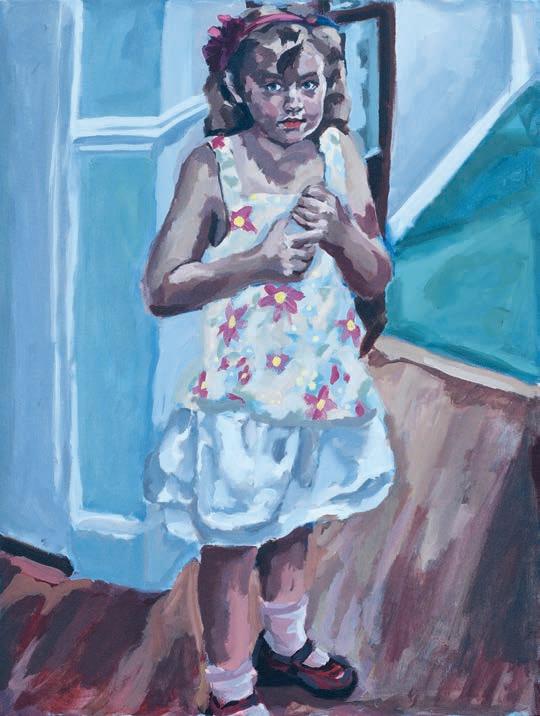
AT THE START OF THE SPRING TERM , the Perakos Family Cares Art Gallery blossomed with a new exhibit of recent work by students in our Visual Arts courses. From self-portraits of students as young children and finely detailed drawings to intriguing photographs and beautiful ceramic pieces, the exhibit showcased the unique points of view of our talented Highlanders.
Clockwise from top: a painting by Nina Dai ’26; ceramic vase by Heehu Kim ’27; and a self-portrait of the artist as a young child by Michal Schroeder ’26.
PHOTOS BY LINCOLN TURNER
From Campus to Broadway, Gunn Music’s All-Star Season
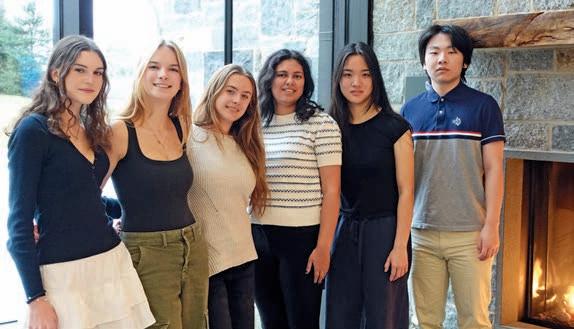
IN JANUARY, SIX GUNN MUSICIANS performed in the Connecticut Music Educators Association (CMEA) Northern Region Festival, joining select students in the Northern Region Symphonic Orchestra, Concert Band, Mixed Choir, and Women’s Choir. Following an additional round of auditions, Gabrielle Wang ’28, alto voice, was selected to perform with the top musicians in Connecticut at the CMEA All-State Music Festival in Hartford in March.
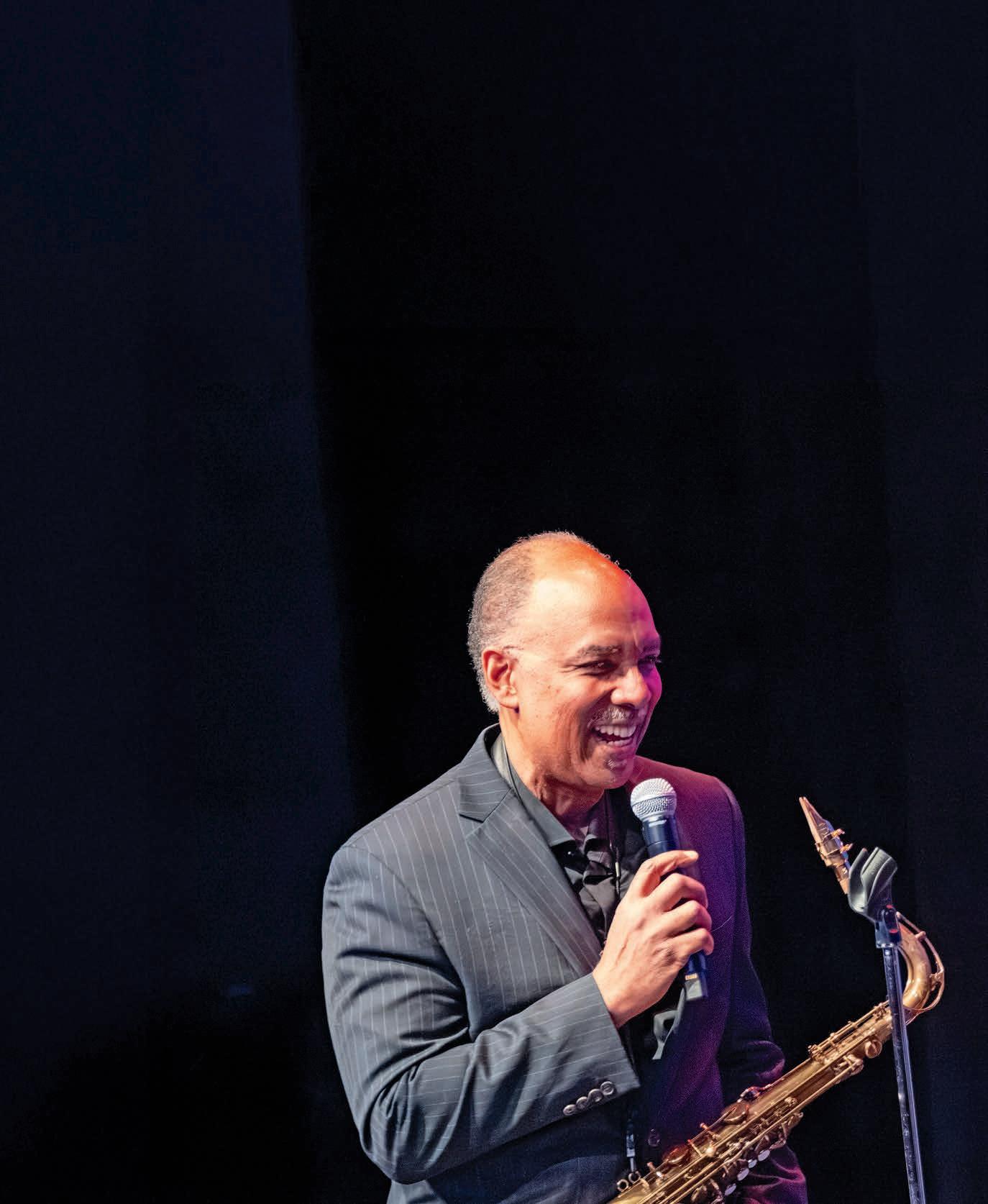
NEW YORK CITY’S JAZZ SCENE came to Gunn on April 3, when students in Jazz Band joined seven top jazz musicians for a workshop in the Tisch Family Auditorium of the Thomas S. Perakos Arts and Community Center. The workshop was followed by an amazing performance later that evening by the Litchfield Jazz All-Stars, presented by Litchfield Performing Arts. The concert was open to the public and featured: tenor saxophonist Don Braden; saxophonist and bandleader Albert Rivera; pianist Jen Allen; percussionist Richie Barshay; trombonist Peter McEachern; bassist Ryan Berg; and guitarist Mike Godette.
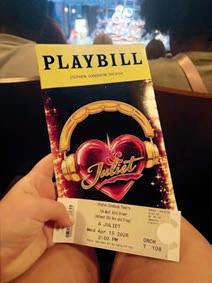
STUDENTS IN VOCAL ENSEMBLE participated in a Broadway workshop with the cast and crew of the hit musical & Juliet at Sony Hall on April 15. Highlanders worked directly with the musical’s vocal director and choreographer, interacted with cast members during a Q&A session, and had the chance to sing with the performers and fellow music students from other schools in Connecticut, New York, and New Jersey. After enjoying lunch in New York City, the students attended a matinee performance of the show at the Stephen Sondheim Theatre.
Clockwise from top: Anya Zigmont ’26, Poppy Mand ’27, Siena Castonguay ’27, Katherine Aguirre-Felipe ’26, Gabrielle Wang ’28, and Gavin Yin ’26 represented Gunn at the CMEA Northern Region Festival; the playbill for &Juliet ; and Don Braden performing with the Litchfield Jazz All-Stars in TPACC on April 3.
GIRLS VARSITY LACROSSE
Support for One Love Foundation
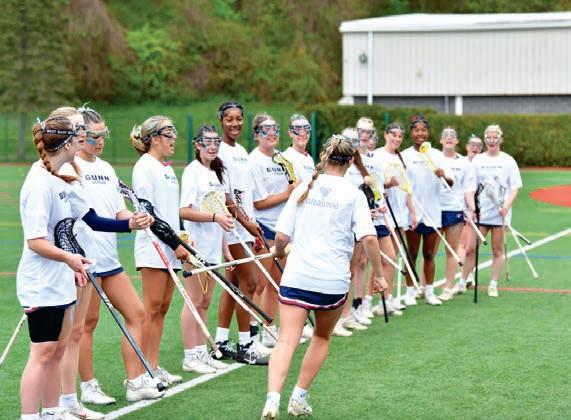
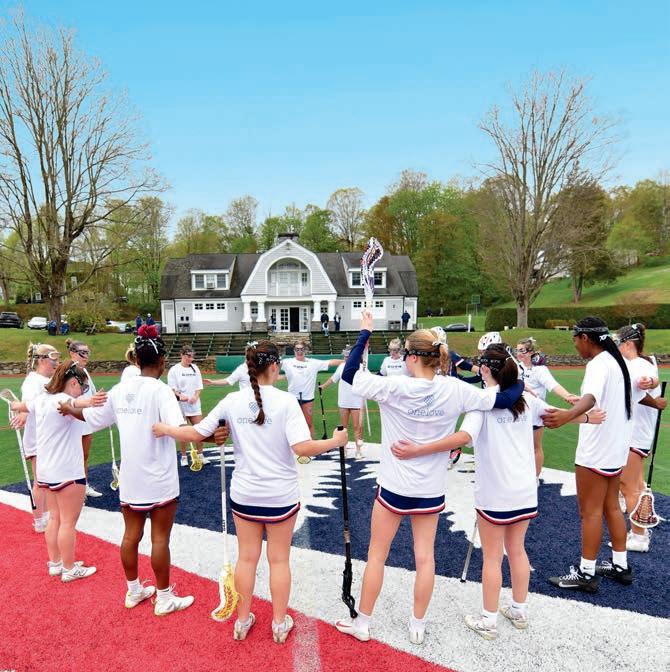
ON APRIL 25, Girls Varsity Lacrosse dedicated its game against Millbrook School to the One Love Foundation, a nonprofit organization working to end relationship abuse through prevention education. The foundation was created in honor of Yeardley Love, who studied political science and played for the women’s lacrosse team at the University of Virginia. She tragically lost her life at the hands of her ex-boyfriend just three weeks before her graduation. Today, her legacy continues to inspire change.
“The moment that stood out to me was everyone wearing light blue on the dress down day. Everyone took part in the fundraiser, and it was really special to see.”
– Ella Jumps ’27
This was the third consecutive year that Girls Varsity Lacrosse hosted a One Love game. Members of the lacrosse team hosted a bake sale and sold stickers and bracelets to raise awareness and funds for the One Love Foundation. They also made a promotional video that Gunn Athletics shared via social media. Through a collaboration between Gunn Athletics and the Dean of Students Office, all students participated in Community Weekend programming that included small-group conversations facilitated by faculty advisors around topics such as how to recognize healthy vs. unhealthy relationships in their lives.
Rachel Duffy, Head Coach for Girls Varsity Lacrosse, recalled that her mentor in her lacrosse career also coached Love when
she was in high school. “So it hits very close to home,” Duffy said. “I firmly believe in the foundation and the work that they do, and I’ve watched it grow. One of our team mottos is, ‘We can do hard things.’ I think learning about relationship violence and also stepping in for loved ones and friends when it comes to unhealthy relationships is a hard thing. It wasn’t talked about enough with my generation. I hope this next generation is more equipped to recognize the signs because it will legitimately save lives. One in three women and one in three men will experience relationship abuse in their lifetime.” Horrified, she added, “That is an incredible statistic.”
GIRLS ICE HOCKEY
Playoffs and a Goalie of the Year
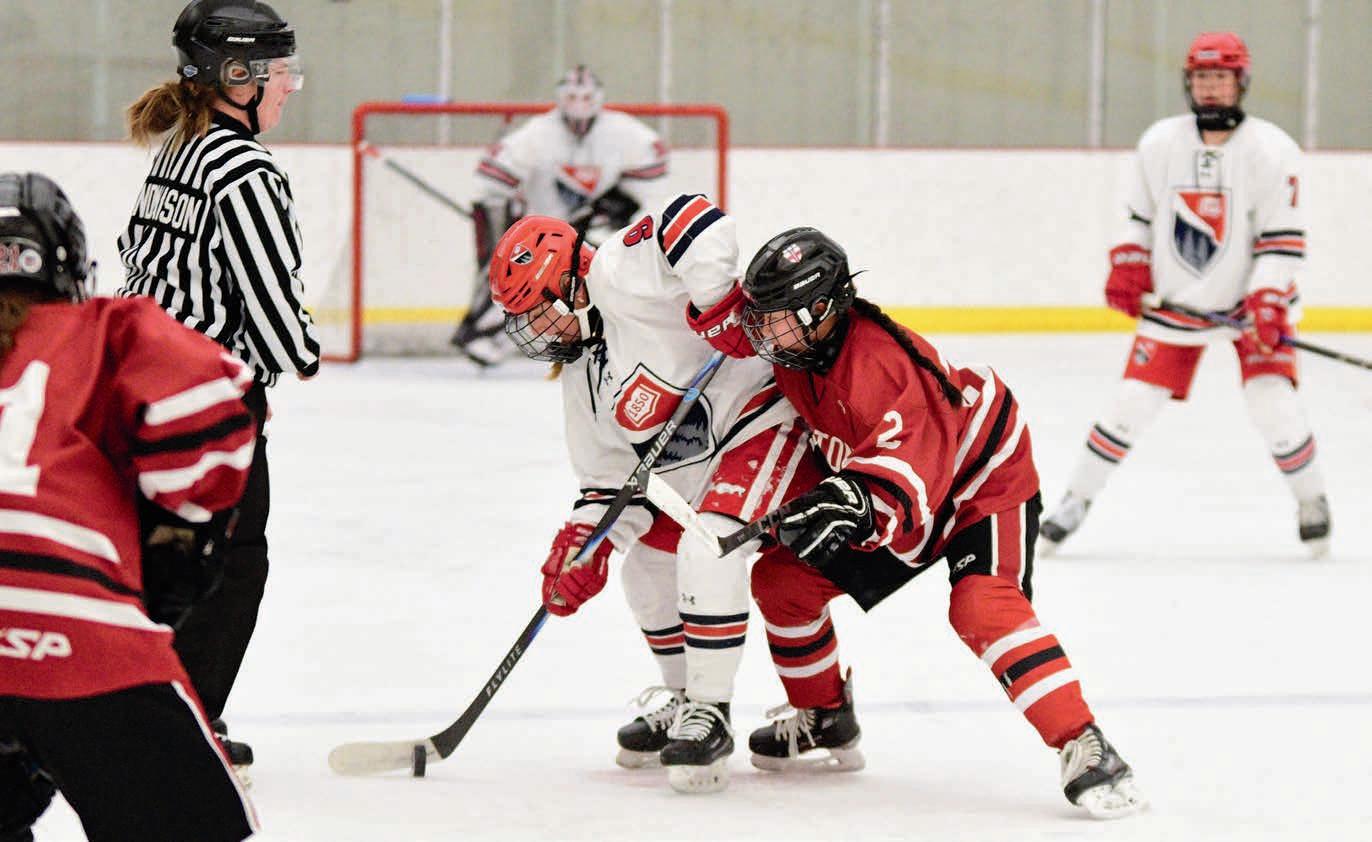
GIRLS VARSITY ICE HOCKEY concluded another successful season, facing No. 1 seed Groton School in the 2026 New England Championship Quarterfinal on March 4, while Moira Landsverk ’26 was named Girls Prep Hockey Goalie of the Year.
In the quarterfinal, the No. 8 seed Highlanders came out strong, with Brianna Boulanger ’26 driving the net to score the first goal 15 seconds into the first period. Groton responded with a power-play goal, and the score remained tied 1-1 for the remainder of the game. The New England Hockey Journal called it “a hard-fought overtime thriller,” which Groton won 2-1.
“It was definitely a gritty team. Everyone stepped up,” Assistant Coach Abby Weiss said of Gunn. “We rolled six forwards and 4D for close to 60 minutes of hockey with overtime. I think Groton was very surprised. I think they expected to walk right over the No. 8 seed, and they did not.”
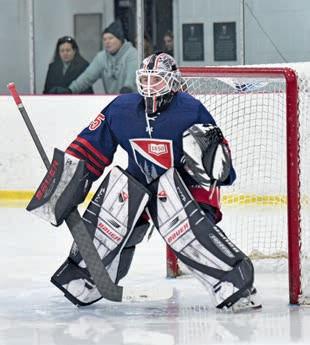
The New England Hockey Journal called Landsverk “the bedrock” of Gunn’s playoff effort, with 42 saves. During the season, Landsverk “posted a .945 save percentage with five shutouts, all while making the third-most saves (724) and facing the thirdmost shots (766) among NEPSAC goalies,” the journal said.
Landsverk earned All-NEPSAC honors, received the Most Valuable Player Award for Girls Ice Hockey at Gunn, and committed to play Division I women’s ice hockey at the University of New Hampshire. In the Edward G. Watkins Invitational at Cushing in December, she had 58 saves, giving up one goal with eight seconds left in double overtime.
Reflecting on the season, Head Coach Dan Allen said: “We continued to build on what we have done the last few years. We won 14 games for the third year in a row. We stayed consistent on the goal of making playoffs and getting better as the season went on.”
WINTER 2025
Highlanders Earn All-NEPSAC and All-League Honors
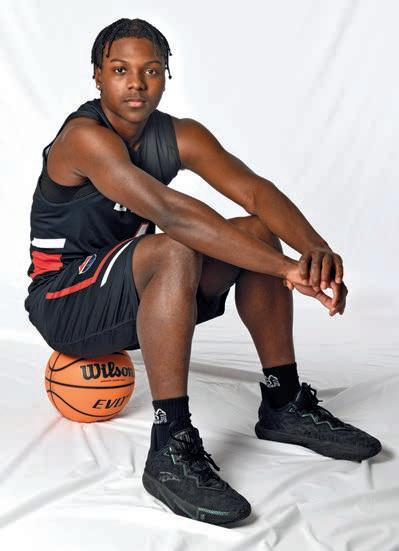
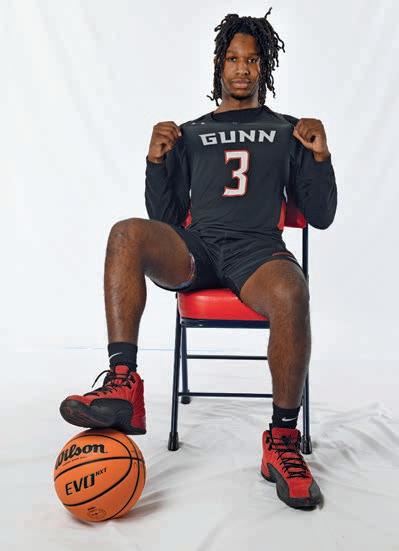
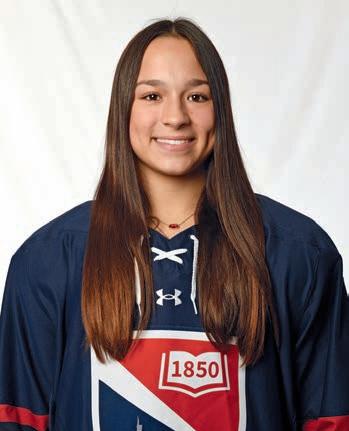
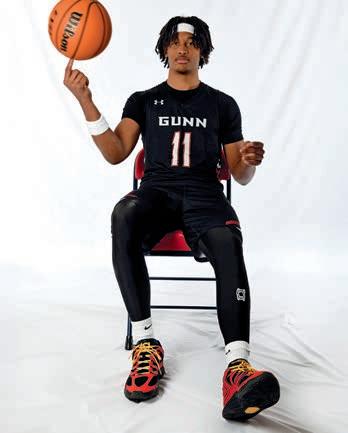
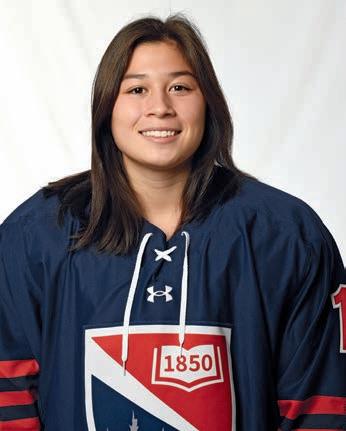
Congratulations to these eight Highlanders, who earned All-NEPSAC and All-NEPSAC Honorable Mention awards for outstanding performances in their respective winter sports. In addition, four members of the Boys Varsity Basketball team earned All-Western New England Prep honors. These awards are determined by a poll of the head coaches of eight schools: Berkshire, Canterbury, Gunn, Millbrook, Pomfret, Salisbury, Suffield, and Williston Northampton.
All-NEPSAC
Raven Bennett ’28, Girls Ice Hockey
Moira Landsverk ’26, Girls Ice Hockey
All-NEPSAC
Honorable Mention
Morgan Riley ’29, Girls Basketball
Justin Robinson ’27, Boys Basketball
Izzy Blake ’26, Girls Ice Hockey
Maria Gilshannon ’27, Girls Ice Hockey
Dylan Hall ’26, Boys Ice Hockey
Ely Steffen ’27, Boys Alpine Skiing, Class C
All-Defensive Team
All-Western New England
Jah Reaves ’28
Justin Robinson ’27
Second Team All-Western New England
Justin Robinson ’27
Honorable Mention
All-Western New England
Karell Brown ’27
Jah Reaves ’28
Zeb Runion ’26
The Frederick Gunn
Jah Reaves ’28
Justin Robinson ’27
PHOTOS BY LINCOLN TURNER
Dylan Hall ’26
Karell Brown ’27
Ely Steffen ’27
Zeb Runion ’26
Maria Gilshannon ’27
Izzy Blake ’26
Raven Bennett ’28
Morgan Riley ’29
Moira Landsverk ’26
Revolutionary Washington
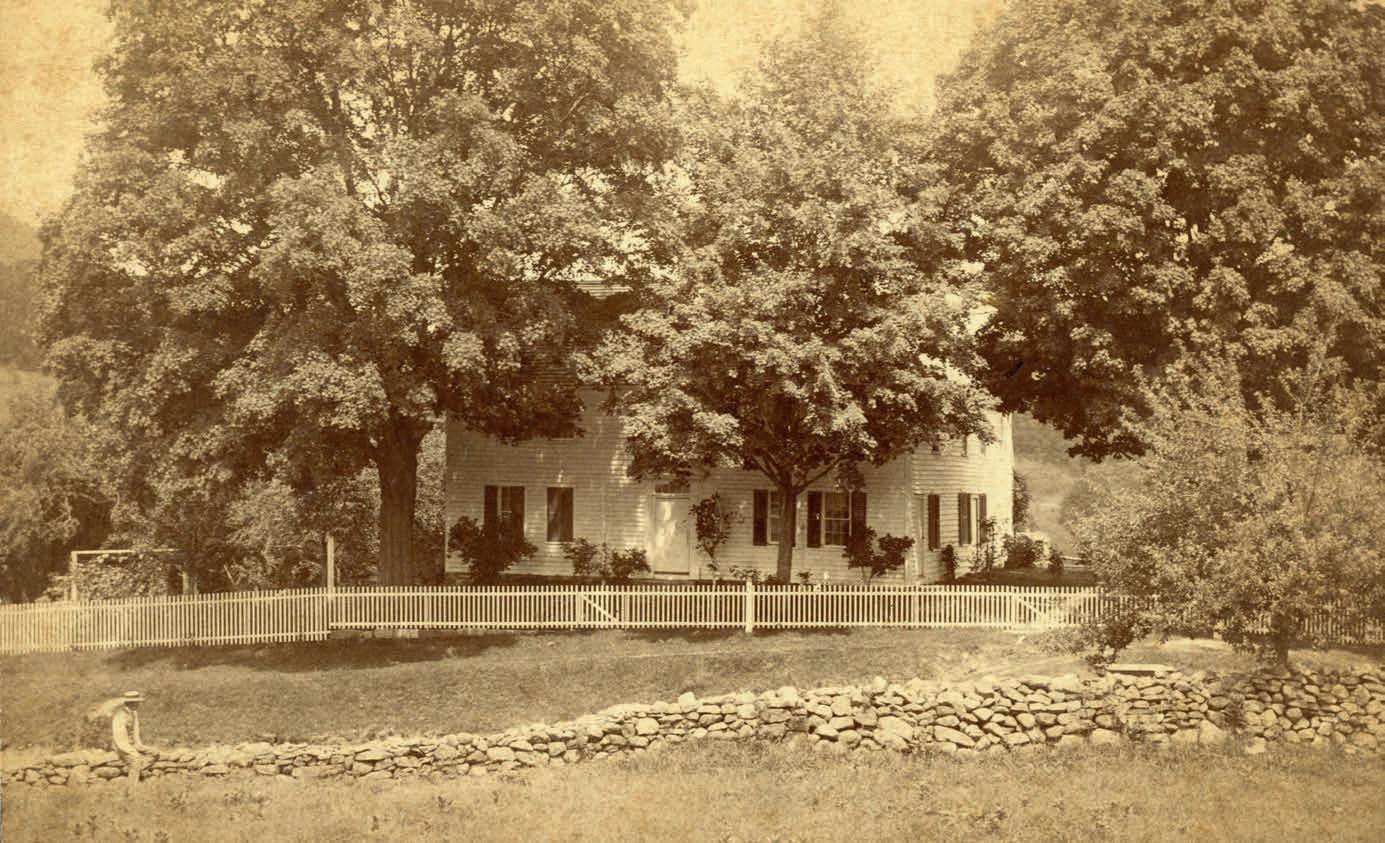
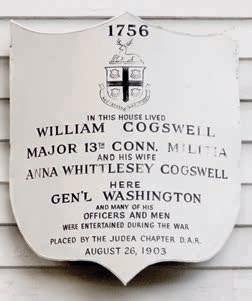
COGSWELL TAVERN in New Preston, where General George Washington stopped for breakfast in May 1781. Inset: the tablet placed by the Judea Chapter of the DAR, which in 1898 chose as their “heroine” Major Cogswell’s wife, Anna Whittlesey Cogswell.
n anticipation of the nation’s 250th anniversary celebration, we looked into the Paula and George Krimsky Archives and the Gunn Memorial Library & Museum to learn about the connections between our school’s history and the American Revolution.
The First Town Named for George Washington
Washington was the first town established in Connecticut after the signing of the Declaration of Independence, and is believed to be the first town in America named for George Washington, who passed through the area three times during the War for Independence.
“The most exciting event of the Revolutionary War for the Judea community was Washington’s journey through Litchfield
County to meet and confer with the French at Hartford. This meeting with Admiral de Ternay and General Rochambeau was to arrange a treaty between France and the colonies,” Wilbur Stone Deming wrote in the book, The Church on The Green: The First Two Centuries of the First Congregational Church at Washington, Connecticut. On September 18, 1780, Washington left his headquarters in the Dutch settlement of Tappan, now part of Rockland County, New York. “He was accompanied by his
secretary, Alexander Hamilton, and five other aides, including Marquis de Lafayette. Twenty-two dragoons went with him as a bodyguard. It is probable that the party made forty miles a day over rough roads.”
Washington and his aides crossed the Hudson River on a barge with Benedict Arnold, setting the stage for a traitorous plot. As Deming outlined it: “General Washington and Arnold discussed plans for the campaign at that meeting, after which Arnold began immediately to plot the betrayal of West Point.”
Sal Lilienthal, who has taught American history at Gunn and is the author of the book, Revolutionary Battles: Experience America’s Roads to Independence, provided further context for these events: “In an effort to monitor the Redcoats based in Manhattan and protect the Hudson River corridor from a British attack, Washington continuously surveyed American defensive positions by riding through the region. For the Colonists, failure to defend West Point would divide New England from the rest of the States, collapsing the fledgling nation’s hopes for independence. Arnold knew the importance of West Point to America’s survival.”
A page from Washington’s diary confirms that on May 25, 1781, he stopped for breakfast at Cogswell Tavern, now a private home in New Preston. It is owned by Sally Woodroofe, a Cogswell descendant whose family has lived there for 10 generations, and who has been a dedicated volunteer for more than two decades in the archives at Gunn.
A “well-preserved tradition among the Cogswell descendants,” shared by Woodroofe, was also retold in the book, Chapter Sketches: Connecticut Daughters of the American Revolution, Patron Saints, published in 1901. As editor Mary Philotheta Root recounted, Washington was enroute from Hartford to West Point on that May morning, when a courier roused the Cogswell family, informing them that “General Washington was not far behind and wished breakfast for himself and his staff. The entire household helped in the preparations and the meal was ready when the guests arrived. The anxious travelers halted only fifteen minutes and then hurried on their way. Washington was so agitated that he could not remain seated at table, but drank a bowl of milk as he walked the floor.”
The 13th Regiment
The Gunn Historical Museum’s special exhibit this year, “American Perspectives: Peril and Possibilities,” noted that Jonathan Trumbull, Governor of the Colony of Connecticut, was the only governor of all 13 colonies to support the revolutionary cause. When he called for soldiers, 3,700 Connecticut militiamen rushed to the Boston area. “The American colonists’ success at Lexington and Concord galvanized popular opinion to the revolutionary cause,” the museum said.
Forty-nine soldiers from Washington served in the American Revolution, according to Deming. Among them were:
• Colonel Increase Mosely, who led the 13th Regiment of Connecticut Militia for three years, beginning in 1776.
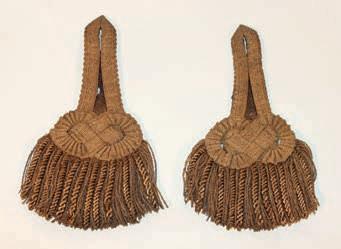
A PAIR OF GOLD braid epaulettes, worn by French General Marquis de LaFayette in the American Revolution and passed down through generations of the Brinsmade family, at the Gunn Museum.
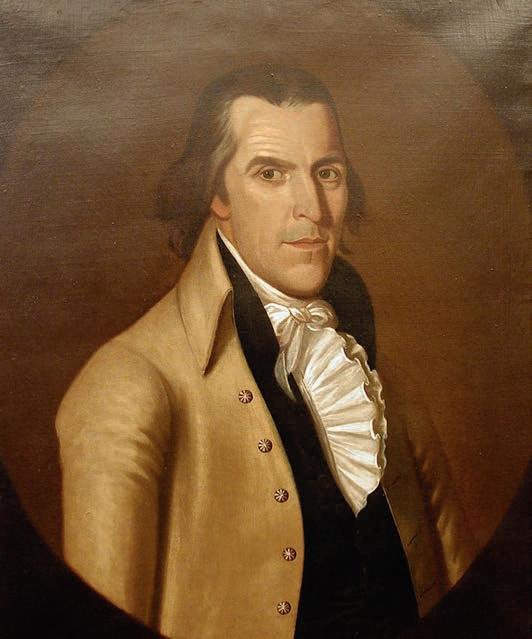
• Daniel N. Brinsmade, Abigail Gunn’s grandfather, who was appointed an adjutant by Mosely in 1776, according to his letter of commission in the Gunn Museum.
• Major William Cogswell, the tavern owner, who “was the first to initiate revolutionary measures in resistance of English oppression... [and] was in command under Gen. George Washington in the retreat from Long Island,” according to the Genealogy of the Whittelsey-Whittlesey Family, published in 1898 by Charles Barney Whittlesey.
• Captain Jonathan Farrand, Abigail’s great-grandfather, who with Moseley was a member of the local committee
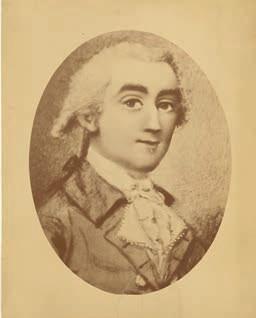
DANIEL N. BRINSMADE was an adjutant in the 13th Regiment and later served as a delegate to the State Convention, ratifying the Constitution of the United States. He was the grandfather of Abigail Gunn, and great-grandfather of Mary Brinsmade, who gifted this portrait to the Gunn Museum.
that sent food and supplies to aid Boston residents impacted by the British blockade of Boston Harbor.
• Private Jeffrey Liberty, an American Patriot of Color who enlisted in the Second Company of the Fourth Connecticut Regiment; an enslaved person, he was granted his freedom by Farrand in exchange for his military service.
History at our Doorstep
Three houses on Washington Green, which are part of our campus, stand as witnesses to our revolutionary past. “The Cottage,” built in 1775, was acquired by the school in 1935 and has served as faculty and student housing and the home of Heads of School C. Burgess Ayres and Michael Eanes H’90 P’90 GP ’20 ’23 ’25 and his family.
Next door is the most historic house on the Green, 8 Kirby Road, recently renamed Dorton House in honor of Board Chair Patrick Dorton ’86. Located directly across from the Congregational Church, it was called “Red House,” and at the time of the Revolution, was occupied by two brothers, Joel Stone, a Loyalist, Leman Stone, a Patriot, and their three sisters. As Deming recounted: “Many patriots in Judea made life miserable for Joel, who had refused military service in 1776. He lived in one part of the house and his brother in the other. It was literally a house divided against itself. Joel had to leave the community to avoid capture and his half of the house was confiscated. He joined the British army, was taken prisoner on Long Island, and placed in the Fairfield ‘gaol.’ Leman had an
upper chamber decorated with a design in which the head of an eagle was surrounded by thirteen stars. Joel had an upper chamber decorated with British warships and other British symbols.”
According to the Ontario Heritage Trust, Joel Stone made his way to Upper Canada by 1786 and was granted land on the west bank of the Gananoque River, where he established a settlement that is known today as the town of Gananoque. The Joel Stone Heritage Park is named for him.
A third faculty residence at 10 Kirby Road was recently renamed Chace House in honor of Malcolm Chace ’86. It was built in 1773 and owned by the Stone brothers, who operated a store there. After 1811, it was converted into a private home for Bennett Fenn and his wife, Phoebe Susannah Gunn Fenn, who was Mr. Gunn’s sister.
Daughters of the American Revolution
Abigail Gunn and her daughter, Mary Brinsmade, were both charter members of the local Judea Chapter of the Daughters of the American Revolution, according to Connecticut State History of the Daughters of the American Revolution, published in 1929 and edited by Emilie M. Mouat, then-Connecticut State Historian. Abigail served as the chapter’s first Regent in 1898, and Mary led the organization from 1911-1915, during the time that she and her husband, John C. Brinsmade, helmed The Gunnery. Under Abigail’s leadership, in 1899 the DAR opened the Judea Historical Room in the Canfield House on Washington Green, which evolved into what we know today as the Gunn Historical Museum.
Marie Louise Titus, another regent and historian, documented the DAR’s many accomplishments in the book. Members visited local schools, awarded prizes for “the best compositions on patriotic subjects,” and supported a “night school” that operated in The Gunnery from 1908-1909. They funded town projects, including Washington High School in 1905, a new “Memorial Town Hall” after World War I, and the “restoration and up-keep” of Old Judea Cemetery, starting in 1922. Also in the 1920s, the Connecticut Society of the Sons of the American Revolution (SAR) “erected a small iron
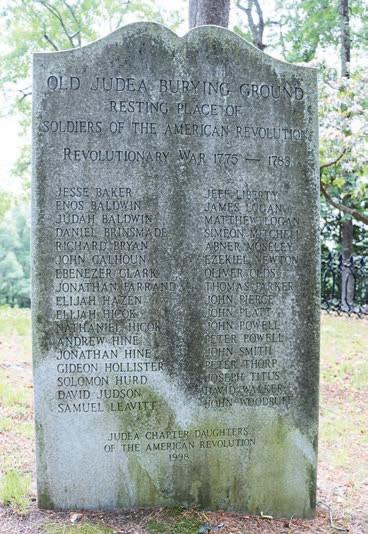
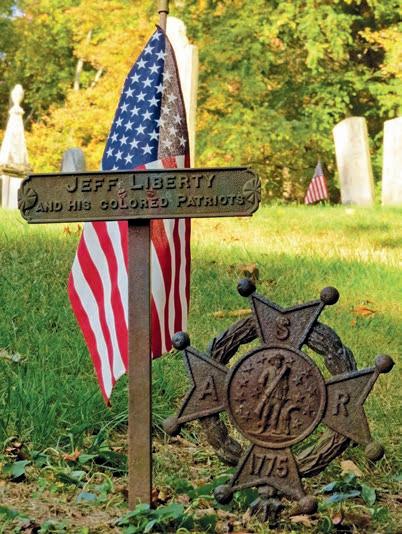
JEFF LIBERTY is listed among the 34 Revolutionary War soldiers who served from 1775 to 1783 and are buried at Old Judea Cemetery. The monument was erected by the DAR in 1998. Right: the historic markers on Liberty’s grave.
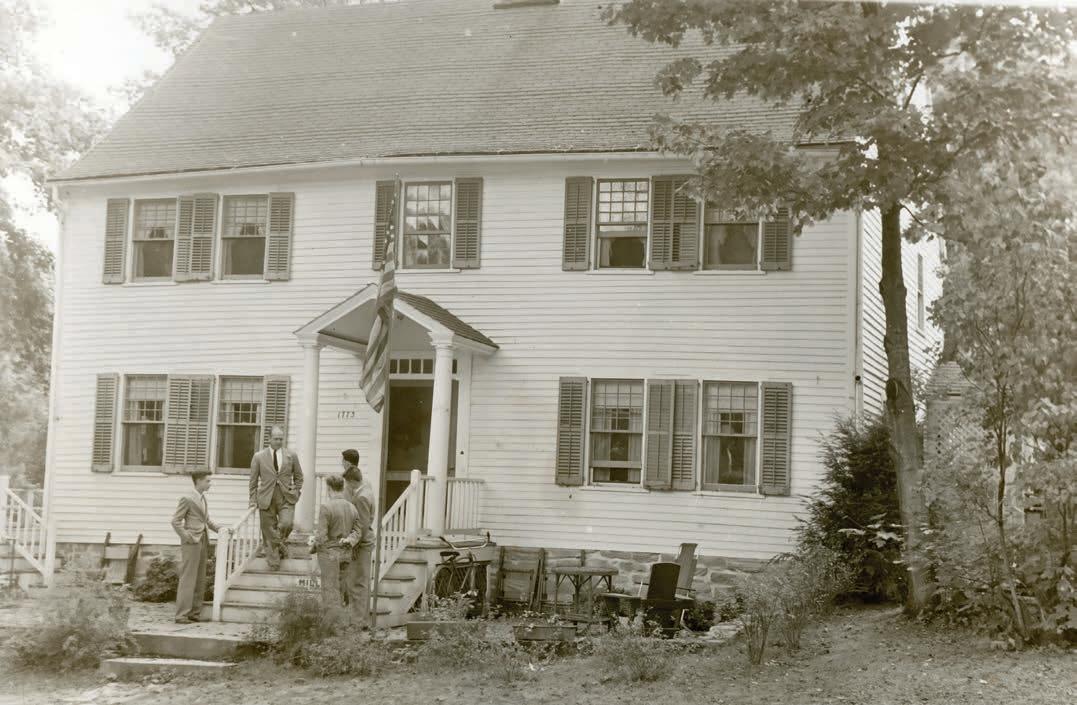
1773 HOUSE was the name given to the oldest house on the Green in 1948, when the school acquired it for Head of School Ogden D. Miller, Sr. H’69 P’50 ’54 ’55 GP’84 and his family. This photograph of Miller and his sons on the steps appeared on the front page of The Gunnery News.
marker over an area that was assumed to be” Jeff Liberty’s burial site in Judea Cemetery, according to a paper by Nicholas Bellantoni, emeritus state archaeologist with the Connecticut State Museum of Natural History.
“Jeff Liberty was born into slavery in 1725 and was offered his freedom if he would enlist, so at age 55 he did just that, joining the all-Black Second Company of the Fourth Connecticut Regiment of the Continental Line, and served until November of 1782. Following the war, Jeff was granted land in Washington, Connecticut, and farmed there until his death in 1797. He was survived by his wife and two daughters,” the Connecticut SAR Colorguard News reported at the time.
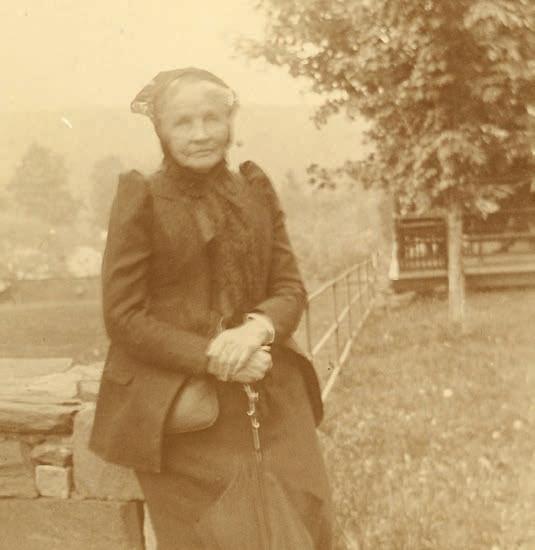
year she served
the DAR’s first Regent. Inset: Joel Stone, the Loyalist brother who lived in what was historically called “Red House.”
In 2019, the Gov. Oliver Wolcott, Sr. Branch of the SAR hosted a graveside service to honor Liberty. State Representative Pat
Wilson Pheanious was one of two legislators who delivered proclamations. “I know that some people don’t like to talk about slavery, because it is uncomfortable, painful, and because it happened so long ago. But if we do not listen to history, we cannot learn from it,” she said, estimating that 80 Connecticut towns are connected to Black Revolutionary War patriots.
“It pains me that men like Jeff Liberty, my fifth greatgrandfather [Sharper Rogers], and so many thousands of men have been so long forgotten. I am also gratified that those who keep the legacy of the American Revolution are now publicly recognizing the humanity of their nearly forgotten sons. But most importantly, an event like this recognizes my forefathers’ contribution to the birth of this nation, and cements in me an indelible sense of belonging and entitlement to this American land,” she said.
ABIGAIL GUNN appears in this photograph on Washington Green circa 1898, the same
as
STRONG ACADEMICS IN A SUPPORTIVE ENVIRONMENT
THIS SPRING , we asked Trustee Hugh Burns P’27, who lives in New York City with his wife, Molly P’27, and their children, Annabelle, and Sebastian ’27, to reflect on his experience as a Gunn Parent. Sebastian joined Gunn as a sophomore and quickly settled into the community. As a senior this fall, he will serve as President of Gunn Society and as a Residential Advisor while continuing to compete for Gunn Rowing and taking some exciting next steps in the college process. Here is an excerpt of our conversation.
How has Sebastian grown in his time at The Frederick Gunn School? Academically, Sebastian has continued to challenge himself and Gunn has challenged him, in a good way, and really supported his intellectual curiosity by allowing him to explore many different things — in the arts and Highlander Term, the Junior Speech, and Entrepreneurship. He’s really embraced that. Some of those classes have been the highlights of his time at Gunn. On a personal level, and maybe this is true of the boarding school experience in general, but when your child is living on their own, you can’t help but be impressed by the maturation and the independence that you see. That’s incredibly gratifying as a parent.
Q:
What has your experience been like as a Gunn Parent? It’s been great. There’s a tremendous warmth and positivity to the people we’ve met from Gunn. That starts with Emily Gum but extends through the faculty and the administration, the Board and in the development office. We’ve been able to cultivate relationships with other parents in New York City, so whether we’re on the campus or at home, we feel a real sense of connection. Also, since we have started the college process we’ve been very impressed with the College Counseling Office. They’ve been very transparent about what the process is, what the timelines are, being supportive and making sure that Sebastian is staying on track. We feel we have a strong partnership with Kate McMann ’05 and her group and that helps to defuse some of the inevitable stress that goes along with the process.
What advice do you have for families who are considering Gunn? The combination of strong academics in a supportive environment, within the small boarding school setting, is very compelling. There’s a lot of change today in education and in so many different areas given the technological revolution that we’re experiencing. I think Emily has set the tone and created a very dynamic, forward-looking atmosphere. Gunn is really thinking deeply about what the future of education is going to be like and how the school can best serve teenagers through this time of change. I truly value a head of school who is so focused on those issues and making sure the school is doing what it needs to do to serve teenagers for the future. Emily and her team are really doing that and, obviously, the trajectory of the school is upwards. That gives us a lot of confidence and excitement about Gunn.
What are your hopes and dreams for Sebastian?
We want him to go for it. Our philosophy with both of our kids is not to try to steer them in any particular direction other than to explore things to their fullest. We want them to figure out what it is that gets them excited and interested, and then pursue those things with real energy. We also want them not to be afraid to fail, or to find out that maybe the thing they thought they liked isn’t really the be-all and end-all, and then to jump in with both feet and try something else. Sebastian is finding many different ways to explore his interests at Gunn and, hopefully, will end up with something he’s truly excited about, both in terms of his career and his free time as well.
Molly and Hugh Burns P’27 with their son, Sebastian ’27
WARM WELCOME
The Frederick Gunn School is pleased to announce the appointment of a new Board member.
RAY HAPPY began his first term as a Trustee in January. Happy is the former Principal and Managing Director of the strategic fundraising firm, CCS. He planned, directed, and supervised fundraising campaigns throughout the United States and provided strategic advice to leading organizations around the globe. In his 31 years at CCS, his projects raised billions of dollars for some of the country’s preeminent artistic, cultural, and educational institutions, human and civil rights organizations, and other leading NGOs. Happy has conducted numerous feasibility and planning studies, building programs, endowment campaigns, and annual appeals. He helped institutions recruit new trustees, solicit transformational gifts, and develop strategic plans.
Happy is a graduate of Grinnell College in Iowa and serves as Vice Chair of the Board of Directors of Physicians for Human Rights. He and his wife, Carolyn, live in Litchfield County, Connecticut, and have generously supported education, human rights, and local arts and culture organizations. They have a daughter, Eleanor, and their nephew, Robbie Happy ’26, graduated from Gunn this spring.
FOND FAREWELL
This spring, the Board of Trustees expressed the admiration and gratitude of the entire Gunn family to Jon Deveaux for his service as a Trustee.
OVER THE PAST six years, Deveaux’s insight and voice were well respected among his fellow Trustees. Deveaux wisely contributed to multiple committees, including serving as the steadfast Chair of the Enrollment Management Committee. A graduate of Williams College and Columbia University, Teachers College, Deveaux has enjoyed a distinguished career in education. He began his career at Cheshire Academy, where he taught psychology and worked in the Admissions Office, and spent 26 years at Westminster School, where he fulfilled various roles, including Director of Admissions and Senior Advancement Director. Prior to joining the Board, Deveaux served as Head of School at Fairfield Country Day School and was a Trustee for The Enrollment Management Association. He also was a council member at The Erdmann Institute.
The Board extends to him best wishes for many happy endeavors and rewarding experiences in the years ahead.
PHIL DUTTON ’81 P’23
LINCOLN TURNER
W GUNN GOES TO FLORIDA!
E ENJOYED SOAKING up the Florida sunshine for a few days in March, and it was great to see alumni, families, and friends at three Gunn Gatherings! Highlanders enjoyed drinks and appetizers at Motek Brickell in Miami, and came out to support Gunn Varsity Baseball in a preseason game against St. Joseph’s School at the beautiful Lawnwood Fields in Fort Pierce. We rounded out the week by showing our Highlander pride as the Boston Red Sox took on the Tampa Bay Rays at JetBlue Field in Fort Myers.
>>> If you are interested in attending a Gunn Gathering in your area, please email engagement@frederickgunn.org. We’d love to hear from you!
PHOTOS BY CADEN CROWLEY ’28, MISSY CUELLO-REMLEY ’87, LAURA EANES
FORT PIERCE
Evan Bailey ’26 at bat for the Highlanders; spectators
John Fonte ’93
P’24 ’26, Laura Eanes Martin ’90
P’20 ’23 ’25, Sonia Bacon ’92, and Chris Fonte ’93; and pitcher
Tommy Hagymasi ’28 on the mound.
MIAMI Left: Isabel Martin ’20, Laura Eanes Martin ’90 P’20 ’23 ’25, Benjamin Constant-Galland ’21, Missy CuelloRemley ’87, and Ark Ayvazyan ’15
Above: Cuello-Remley and Martin at dinner in Delray Beach with Spencer Houldin ’87
FORT MYERS Highlanders in the stands at the Red Sox vs. Tampa Bay Rays game included: (second row) Andrew Littauer ’60 and guest; Allen Steiger ’76, his wife, Diane, and their friends; and (first row) Bill Curren, Laura Eanes Martin ’90 P’20 ’23 ’25, and Chloé Seales-Bailey P’26
TARTAN TAKEOVER CHALLENGE
THANK YOU TO EVERYONE who joined our first-ever Tartan Takeover Challenge during National Tartan Week in April and helped to make it a tremendous success. More than 520 alumni, families, friends, faculty, staff, and students made meaningful gifts and came together to celebrate our school and each other during this special moment for Gunn. Through your generosity, we exceeded our goal, raising over $320,000 for The 1850 Fund, including a $100,000 matching gift from the Board of Directors in support of the past, present, and future of Gunn. Your enthusiasm is inspiring and your love for Gunn is strong!
It was wonderful to see Highlanders celebrating together at Toast the Tartan events in Boston, New York City, Burlington, Vermont, and Washington, Connecticut. Students joined the festivities on campus with a formal dinner, special dress days (inspired by the colors of our tartan), and a visit from a cupcake truck. We are so grateful for your support as a community! As always, GO GUNN!!!
NYC
WASHINGTON, CT
BOSTON, MA
Our tartan, just like our school, is strongest when each of us adds our own thread to the weave, creating a community that is vibrant, resilient, and greater than the sum of its parts.”
MARTHA EWING ’26, HEAD PREFECT
BURLINGTON, VT
Celebrating Our Founders Society Members
ALUMNI, PARENTS, AND FRIENDS who contributed leadership gifts to The 1850 Fund throughout the year were honored at the annual Founders Society Celebratory Dinner on April 24. It was a beautiful evening for guests to gather under the tent behind Conroy House.
“I’ve been thinking about what ties our community together. I have a feeling that if you are a parent, these are the kinds of things that drew you to Gunn, and if you are an alum, they are
Thank you for continuing to invest in this school, for allowing us to nurture and grow the deep soul of this place, and to continue to be deeply ambitious about the impact we can have in an educational landscape that is really transforming.”
—
Dr. Emily Raudenbush Gum
the reason you are here tonight,” said Dr. Emily Raudenbush Gum, Bretter Family Head of School, who spoke about “the deep soul” of the school, and the enduring connection it creates between current students and alumni.
“Gunn has been a very human-scale community since its founding in a way that encourages faculty and students to have deep, meaningful connections that are all about the growth and
development of students. They look each other in the eye and they talk about what their hopes are, and what they are learning. That’s deeply humanizing; it’s also deeply good for the world,” Dr. Raudenbush Gum said.
In their remarks, Gunn Society Co-Presidents Isla Beckstrom ’26 and Ezekiel Hatcher ’26 highlighted the profound impact leadership gifts have on the student experience. Beckstrom reflected on her love for the school, a feeling she never expected to have about high school, while Hatcher reflected on the many “firsts” he experienced at Gunn.
“The first time I stepped on a stage and performed in a musical was in our TPACC auditorium. The first time I picked up a six-foot defensive lacrosse stick — which was, and still is, taller than me — was on our very own Barnes turf. Trying new things has been a core value encouraged during my time at Gunn, and I have embraced it,” Hatcher said. “Whether you are an alumnus or alumna, parent, or friend of the Gunn community, we all understand how special this place is, which is why we continue to show up. So thank you for everything that has made my journey so special.”
Board Chair Patrick Dorton ’86 reminded those in attendance that, together, our community has raised $120 million for the future of Gunn, and that number continues to grow. The increased interest in enrollment is outstanding and applications have grown more than 70% over five years. In April, construction was about to begin on The Thomas S. Perakos Family Cares Health and Wellness Center, and he noted that from their vantage point at Conroy, guests were facing the largest expansion of the campus since the Bourne estate in 1958. With plans to develop the Upper Commons, a dorm addition to The Cottage, and early conversations about the development of the east side of campus, the momentum is real.
“Because of what you, collectively, have made possible, we are very much looking ahead,” Dorton said.
If you are interested in becoming a Founders Society member, please visit gogunn.org/give or scan this QR code.
ALLIN TALLMADGE ’69 COMES HOME
THIS SPRING, Allin Tallmadge ’69 moved into his new home in Washington, Connecticut. It’s a short drive from the Gunn campus, where he arrived as a junior in the fall of 1967, and Lake Waramaug, where as a young boy, he spent idyllic summers with his extended family at his grandmother’s cottage.
“We all lived in New Jersey, so all the cousins knew each other. We went canoeing and swam and got sunburned. That was a rite of passage,” Tallmadge recalled.
He is a descendant of Revolutionary War spymaster Benjamin Tallmadge. “His father and my ancestor, Ezra Tallmadge, were brothers,” he shared. However, it was Allin Tallmadge’s greatgrandmother, Heloise Marie Allin, who brought the family to Lake Waramaug from Brooklyn, New York.
“Nana” and her husband, George Albert Allin, “bought a 20-acre hayfield with water frontage on West Shore Road, where she later built an Adirondack-style cottage with green shutters and cedar shingles,” Tallmadge’s brother, John, recalled in an article published in 2021, noting that the Allins helped to found the Lake Waramaug Association in 1917.
Their grandparents, Kate D. Weber GP’69 and the Rev. Herman C. Weber GP’69, who was a pastor at Presbyterian churches in Brooklyn and New York, “built a rustic Cape Cod cottage surrounded by wildflowers” on the hillside across the street. Their children, including Allin and John Tallmadge’s
mother, Kate D. Tallmadge P’69, spent summers there, as part of a tradition that has spanned six generations.
As John Tallmadge explained, their grandparents “wanted a house that reflected a rural, Eric Sloane aesthetic and seemed to have grown out of the land itself By 1960 we had three houses in the family but still shared most of our resources, including the garden, the well, the waterfront, and even the drive up the hill. We also shared the lake’s beauty and adventure with our neighbors and schoolmates, inviting them up for weekends of swimming, hiking, and cookouts by the shore. And in later years, we hosted rowers competing in the spring regatta, including the Cincinnati Junior Rowing Club and the Dartmouth Women’s Crew.”
From the Drama Barn to Dartmouth
After two years of high school in East Orange, New Jersey, Allin Tallmadge began looking at boarding schools with his parents. “I was maybe a B+ student. They thought it was better to put me in an educational environment where I would improve. They looked at Vermont Academy, where my father went for his senior year. Dad took me up there to interview. I didn’t particularly like it. I said, ‘The Gunnery is local to the lake. Why don’t we interview with them?’”
Allin Tallmadge ’69 on the deck of his greatgrandmother’s cottage. It is close to Point Beautiful, where Frederick and Abigail Gunn took the whole school camping in the 1870s.
As a junior, he lived in Van Sinderen (then called the Infirmary) with Ford Shaw ’69 and Val Prevedini ’69, who became a Trustee. Theatre was Tallmadge’s primary interest, earning him the Dramatics Prize in 1968. He became president of the Drama Club, which staged four productions in his senior year, including Summer and Smoke, which he directed and whose cast included Nancy Lemcke P’78 ’84, wife of beloved dean Norman R. Lemcke P’78 ’84.
“We were in the Drama Barn, which is now the fitness center. I had quite a production. I put up a scrim in the back to project fireworks on it. Sydney Eddison was the drama teacher at Wykeham. We did a series of one-acts with the Wykeham girls. I directed Seán O’Casey plays for that group. We also did a production of The Crucible over at the Washington Club Hall,” Tallmadge recalled.
After graduating, Tallmadge majored in drama at Dartmouth College. “I did some acting freshman year and the professors there were very good. But I spent so much time in the Hopkins theatre that I neglected my academics. They said, ‘We’re going to suspend you for three years and you decide whether you want to come back,’” he recalled.
Developing his Craft
In what would have been his sophomore year, he was recruited to a new theatre program at the Eugene O’Neill Theatre Center in Waterford, Connecticut, and was part of the inaugural National Theatre Institute semester program. He worked with professionals in acting and design alongside other Dartmouth students, including Barry Grove, now Executive Producer Emeritus of the Manhattan Theatre Club and an adjunct professor at Columbia University and Yale’s David Geffen School of Drama.
He continued to work on the technical side of theatrical productions, learning everything from set building to producing, with stops at the Alley Theatre in Houston, where he was a production manager, the National Playwrights Conference, Dartmouth Summer Rep, and the Hartt OperaTheatre Guild at the University of Hartford. He met a New York producer, Bill Gardner, who was starting a regional theatre program, the Academy Festival Theatre in Lake Forest, Illinois, and hired him as a technician and production manager. Among the well-known actors who appeared during the program’s 10-year run were Bernadette Peters, Colleen Dewhurst, and Jason Robards.
Tallmadge returned to Dartmouth, graduating in 1976 with a degree in drama. Through Gardner, he landed a job at the Spreckels Theatre in San Diego, where he worked on a production of Chekhov’s Uncle Vanya, starring Linda Lavin and Sam Waterston.
Tallmadge later earned an MBA from NYU Stern, launching a new career in computers and information technology. In 1991, he married Elizabeth “Libby” Floyd Hope, whom he had met 20 years earlier, when she was a student at Mount Holyoke College. They settled in Glen Ridge, New Jersey, where they raised two sons from his previous marriage, Zachary and Alex, and began traveling the world together.
An Amateur of Cheeses
A trip to Italy sparked a new passion. “We went to Tuscany. We were going to visit all the wineries and taste the wines in all the hilltop towns. Our lunch would be wine, a loaf of bread, a pâté, and a cheese, and I realized that every hilltop town had its own cheese.” A friend in Glen Ridge gave him books about cheese and connected him with the cheese buyer from Fairway Market in New York. “I became an amateur of cheeses,” Tallmadge said.
He enrolled in “cheese boot camp” at Murray’s Cheese in Greenwich Village. “It was six weeks of workshops, going through all the things that involved cheeses: milk — cow, sheep, goat — how cheese is made, what happens when you put rennet into it, how to form a curd, what to do with a curd, and how to flavor it. That led me to open my own gourmet food store, Tallmadge Cheese Market.”
He ran the shop in Upper Montclair, New Jersey, from 2008-2011, earning a mention in The New York Times. Stephen Colbert was a customer. Tallmadge even dabbled briefly in making cheese, and has made a hobby out of meeting cheese makers and learning about what they do on his travels.
Following the financial crisis, Tallmadge closed the shop and moved with his wife, who had a career in banking, to Atlanta, Georgia. In retirement, they continued traveling. She passed away in 2019.
Asked about his decision to come home to Washington this year, Tallmadge said, “This is where I grew up and where I went to school. It’s a nice place to live. I came back to my roots, basically. It’s lovely being up here and I hope to get more involved.”
Reflecting on his time as a Gunn student, he said: “The feeling of shared community was very important. It affected you for the rest of your life. That is what you left with, coming out of Gunn, a sense of community, and that community leads to greater learning in the world at large.”
Kirsten Peckerman
FORMER TRUSTEE Kirsten Peckerman, a loyal supporter and friend of The Frederick Gunn School, passed away on March 31. Friends and family gathered to remember her at a Celebration of Life service held on campus on May 9.
A longtime resident of Washington, Peckerman served on the Board of Trustees from 2003-2019. She was a respected voice and a valued member of the Alumni & Development Committee, the Governance Committee, the Building & Grounds Committee, and the Students & Faculty Committee.
“She enjoyed the Board discussions, the people, the students, the faculty, the Trustees, and just being on campus,” Trustee and former Board Chair Steve Baird ’68 recalled. “She also loved both Heads of School who were there during her time, Susie Graham H’12 and Peter Becker. Every so often, Kirsten would schedule a special one-on-one meeting, just to check-in with them and find out how she could be helpful. She cared deeply about the health of the school and our head of school. Kirsten was known for her positive can-do attitude. When she spoke, people would move closer and listen carefully. People liked being around her. She was a sort of culture carrier for our Board, keeping us on the right path.”
Peckerman took a special interest in attracting more female students to the school, and pushed successfully for a new girls dorm, to be called Graham House in honor of our 10th Head of School, Baird said. The goal was to achieve gender parity — which Gunn did last year, he noted, crediting the efforts of Dr. Emily Raudenbush Gum, the Bretter Family Head of School, and the enrollment team, in reaching this historic milestone.
Peckerman was influential in the creation of the South Street Fields Complex and the school’s Sesquicentennial celebration in 2000. She provided thoughtful commentary and valuable insight as a liaison to the town and advocate of the school, and lent her support in areas that were key to Gunn’s long-term planning efforts. As she was approaching her final years on the Board, she recruited her own replacement, Trustee and fellow Washington resident Ashleigh Fernandez, Baird said.
“The traditions which The Gunnery represents and sustains are vital to the character and distinctiveness of Washington, Connecticut,” Peckerman said in 2015. “Therefore, it is important for Washingtonians to support the school.”
In 2011, Peckerman was honored with the Friend of the Green Award in recognition of her contributions to the school and the
Steep Rock Association. Upon her retirement from the Board in 2019, she was warmly celebrated by the school at a dinner attended by many friends and supporters from Gunn and the Washington community.
OUTSIDE OF GUNN , Peckerman was known as a tireless and dedicated conservationist and quiet leader of community service in Northwest Connecticut. She served on the Board of Trustees of the Gunn Memorial Library and Museum, Steep Rock Association, Washington Garden Club, and the Weantinogue Heritage Land Trust, the largest land trust in Connecticut, now known as the Northwest Connecticut Land Conservancy. According to the obituary published in The New York Times in April, “Kirsten played a quiet but distinctive role in preserving the fields, farms, forests, and rivers that have made Litchfield County a nationally recognized leader in the effort to conserve land and natural habitat.”
Born in Copenhagen in 1936, she moved from New York City to Washington, Connecticut, in 1967 with her husband, Edward, who passed away in 1999.
“There is no doubt that Kirsten had a significant impact on our school,” Baird said. “She was a class act. There will never be anyone quite like her. She always mentioned how happy she was to have so many good friends here in Washington. She lived a wonderful life. We are going to miss her dearly.”
PHOTO BY PHIL DUTTON ’81 P’23
The Power of Planned Giving
FORMER TRUSTEE Jack Reynolds ’68 is unequivocal about the impact his years at The Frederick Gunn School had on his life and career. “It pretty much changed everything,” said Reynolds, who hails from a long line of Highlanders that includes his siblings, Tod Reynolds ’64 and Geoffrey Reynolds ’69, and their father, Alfred O. Reynolds, Sr. ’30.
When Reynolds arrived at Gunn as a junior, he quickly learned from the College Counseling Office that he would have to work harder academically to fulfill his expectations of attending an Ivy League college. He was, however, determined to succeed, and ultimately chose to attend the Wharton School of the University of Pennsylvania.
“I ended up at Penn and was very happy about it. That would not have happened had I not been at The Gunnery. The school has a reputation and a philosophy of helping students to be the best version of yourself that you can be,” said Reynolds, who went on from Penn to study at Columbia Business School and Columbia Law School concurrently, earning his MBA and JD in 1975.
After practicing corporate law in Boston, he became a management consultant at Bain & Company, a senior managing director of Cambridge Associates, and was the founder and managing partner of Reynolds Group, Private Investment Counselors, LLC. “I think you can see why I choose to support the school,” he said, explaining that one of the more thoughtful and practical ways to go about that is through a Donor-Advised Fund (DAF).
Like any other investment account that you set up with a custodian, a DAF can be funded whenever you choose, but with the DAF you receive a 100% tax deduction, immediately upon such funding. “Then you can recommend gifts from the DAF to
JOIN OUR LEGACY SOCIETY
charities that do good things in the world, such as The Frederick Gunn School,” Reynolds said.
A DAF streamlines the process for giving to multiple charities and making recurring gifts, and you can choose to make your gifts annually, or after you have allowed the funds in the DAF to grow.
“I like it because it permits me to make investment and tax decisions that are not necessarily connected with the moments at which I wish to make donations to my favorite charities,” Reynolds said, explaining: “One of the handy things about the DAF is you can transfer appreciated securities to it, thus avoiding paying any tax on the sale of the securities. If you have $100 worth of appreciated securities in your DAF, all $100 will eventually go to work for your chosen charitable purposes. So it’s very tax efficient.”
The process of recommending gifts to operating charities (such as Gunn) from your DAF is typically not operationally discretionary on the part of the custodian. “In my experience, so long as the chosen operating charity has a taxpayer identification number, the DAF custodian invariably approves the suggested grant,” he said.
By making a deferred estate gift from your will or trust, you become a member of the H. Willets and Samuel Jackson Underhill Bequest Society, which will help to ensure the future of The Frederick Gunn School for years to come.
For more information, please contact Bill Curren, Director of Planned Giving, by calling 860-350-0189 or emailing currenb@frederickgunn.org.
Be sure to speak with your financial advisor about a DAF or any other planned giving investment to make sure it’s right for you.
Ten Minutes With Shane Gorman ’10
AS ASSISTANT DEAN OF Students for Residential Life, Shane Gorman ’10 enjoys helping to shape the student experience outside of the classroom. Whether he is accompanying first-year students to Lake Placid, advising prefects, planning weekend activities — or the prom — he brings a unique perspective as an alumnus, house parent, and coach.
As a student, Gorman was a prefect and captain of the hockey team. He played varsity hockey and baseball, as did his father, Dan Gorman ’79 P’10, and he has coached both teams since 2015, when he returned to campus as Rink Manager and Assistant Athletic Director. Not surprisingly, one of his favorite places on campus is the home bench in Linen Rink. He and his wife, Emily, who is Associate Director of College Counseling, are also happily raising their son, Gibbs, on campus, and delight in seeing him interact with current Highlanders.
Education
> BS in communications Norwich University
Current Responsibilities
What is your favorite Gunn tradition? One of the things that I really love is Baccalaureate, Convocation, and Prize Night, when we celebrate everyone and their accomplishments. Seeing everyone walking to the church; kids are waiting outside and talking and having fun. Once we get in there, everyone is quiet. It’s just a good moment to take in.
What advice do you have for new students? Take advantage of all of the opportunities that you have here. It’s going to the gym at 6 a.m., getting breakfast in the dining hall, going to classes, working with your coaches in the afternoon, working with your teachers during study hall. You get everything under one roof.
> Assistant Dean of Students for Residential Life
> Assistant Coach, Boys Varsity Ice Hockey and Varsity Baseball
> Head House Parent, Teddy House
> Prefect Advisor
> Student Activities Coordinator
What is your favorite time of the academic year? My favorite time of the academic year is going to the Avon Old Farms Christmas Classic. There’s something about that time of the season. It’s bitter cold outside and maybe snowing. We all get on the bus and focus on playing hockey and trying to win a tournament. It’s something that we feel blessed to do every year.
Who has been your greatest influence? My parents [Dan and Mary Jane Gorman P’10] made a ton of sacrifices. My dad had coached me all my life and did a great job of holding me accountable. When I was a student, Shannon Baudo was my advisor, and Chris Baudo was the hockey coach. They both did a great job. There were moments when I had to learn and I give them a lot of credit for getting me through that and molding me into the person I am today. Craig Badger is another one. My first year on campus as a 14-year-old student was his first year as a faculty member. Ten years later, he became Head Coach and it was my first year back as a faculty member. Now he’s one of my best friends, and just sharing those moments with him, and winning a couple of championships, has been incredible.
What’s a fun fact people might not know about you? When I was working in athletics and the rink, I would team up with John McGrath [of Facilities] and help him build ice throughout the night. I asked him to teach me how to do it so I can jump in and help whenever needed. Last year was the first year that I didn’t drive the Zamboni at least once.
PHOTO
BOARD OF TRUSTEES
OFFICERS 2025-26
Patrick M. Dorton ’86
Board Chair
Wanji Walcott P’19
Vice Chair
Beth W. Glynn
Secretary
Ashleigh Fernandez
Treasurer
TRUSTEES 2025-26
Stephen W. Baird ’68
William G. Bardel
Robert Bellinger ’73
Kevin Bogardus ’89
Hugh Burns P’27
Sarah Scheel Cook ’82
Josh Feil ’98
Adam C. Gerry P’21
Dr. Emily Raudenbush Gum
Bretter Family Head of School
Ray Happy
Timothy Jackson P’24
Thomas R. King ’60
Jonathan S. Linen ’62
Matt Lucey P’27
Damien Marshall P’24
Paul M. McManus, Jr. ’87 P’21 ’23
Bonnie A. Pennell ’86
Krystalynn Schlegel ’96
Omar Slowe ’97
Holly Soroca ’93
Richard N. Tager ’56
Robert M. Tirschwell ’86
Rebecca Weisberg ’90
TRUSTEES
EMERITI
Leo D. Bretter ’52 P’88
Jonathan Estreich P’06
Edsel B. Ford II ’68
Joan Noto P’97
Jonathan Tisch ’72
Gerrit Vreeland ’61
BULLETIN Spring 2026
The Frederick Gunn School Bulletin is produced biannually (spring and fall) by the Marketing & Communications Department. Send alumni news to: classnotes@frederickgunn.org.
Editor
Jennifer Clement P’22 ’25
Director of Strategic Communications clementj@frederickgunn.org
Brand Strategist and Senior Director of Marketing & Communications
Stephanie Balben balbens@frederickgunn.org
Chief Advancement Officer Alumni & Development
Matthew Goetting goettingm@frederickgunn.org
Chief Enrollment Officer
Suzanne Day days@frederickgunn.org
Design
Alison Wilkes / alisonwilkes.com
Printing
David Emery ’73, GHP / ghpmedia.com
West Haven, Connecticut
Send address corrections to: alumni@frederickgunn.org or visit gogunn.org/alumni or write Alumni & Development
The Frederick Gunn School 99 Green Hill Road, Washington, CT 06793
99 Green Hill Road, Washington, CT 06793
Catch up with friends old and new in Cape Cod, Litchfield County, and The Hamptons.