NOVEMBER 2026
CANADA’S TRUSTED SOURCE FOR HORTICULTURAL NEWS
THEGROWER.ORG
STRESS TEST
Breeding resilience in the seed supply chain
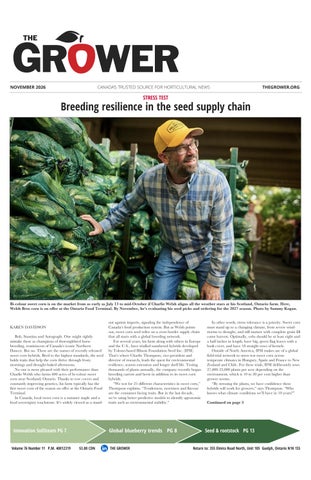
Bi-colour sweet corn is on the market from as early as July 13 to mid-October if Charlie Welsh aligns all the weather stars at his Scotland, Ontario farm. Here, Welsh Bros corn is on offer at the Ontario Food Terminal. By November, he’s evaluating his seed picks and ordering for the 2027 season. Photo by Sammy Kogan.
KAREN DAVIDSON Bolt, Stamina and Autograph. One might rightly mistake these as champions of thoroughbred horse breeding, reminiscent of Canada’s iconic Northern Dancer. But no. These are the names of recently released sweet corn hybrids. Bred to the highest standards, the seed holds traits that help the corn thrive through frosty mornings and drought-baked afternoons. No one is more pleased with their performance than Charlie Welsh who farms 600 acres of bi-colour sweet corn near Scotland, Ontario. Thanks to row covers and constantly improving genetics, his farm typically has the first sweet corn of the season on offer at the Ontario Food Terminal. In Canada, local sweet corn is a summer staple and a food sovereignty touchstone. It’s widely viewed as a stand-
Innovation SoilSteam PG 7 Volume 76 Number 11 P.M. 40012319
$3.00 CDN
out against imports, signaling the independence of Canada’s food production system. But as Welsh points out, sweet corn seed relies on a cross-border supply chain that all starts with a global breeding network. For several years, his farm along with others in Europe and the U.S., have trialled numbered hybrids developed by Tolono-based Illinois Foundation Seed Inc. (IFSI). That’s where Charlie Thompson, vice-president and director of research, leads the quest for environmental resilience, season extension and longer shelf life. Testing thousands of plants annually, the company recently began breeding carrots and beets in addition to its sweet corn hybrids. “We test for 25 different characteristics in sweet corn,” Thompson explains. “Tenderness, sweetness and flavour are the consumer-facing traits. But in the last decade, we’re using better predictive models to identify agronomic traits such as environmental stability.”
In other words, stress tolerance is a priority. Sweet corn must stand up to a changing climate, from severe windstorms to drought, and still mature with complete grain fill come harvest. Optimally, cobs should be at least eight and a half inches in length, have big, green flag leaves with a husk cover, and have 18 straight rows of kernels. Outside of North America, IFSI makes use of a global field-trial network to stress test sweet corn across temperate climates in Hungary, Spain and France to New Zealand and Chile. For these trials, IFSI deliberately sows 27,000-33,000 plants per acre depending on the environment, which is 10 to 20 per cent higher than grower norms. “By stressing the plants, we have confidence these hybrids will work for growers,” says Thompson. “Who knows what climate conditions we’ll have in 10 years?”
Global blueberry trends PG 8
Seed & rootstock PG 13
THE GROWER
Continued on page 3
Return to: 355 Elmira Road North, Unit 105 Guelph, Ontario N1K 1S5
PAGE 2 –– NOVEMBER 2026 THE GROWER
AT PRESS TIME… Windsor-Essex: frontline for invasive spotted lanternfly
As of October 8, 2026, 23 separate spotted lanternfly (SLF) detections have been confirmed in Windsor Essex by the the Canadian Food Inspection Agency (CFIA). According to its webpage, a detection is defined as the “presence of live spotted lanternfly, confirmed in the Canadian environment through official CFIA surveys.” Spotted lanternfly (Lycorma delicatula, Hemiptera: Fulgoridae) has been regulated in Canada since 2018. Grape Growers of Ontario (GGO) is working with provincial and federal governments to stress the impact this invasive insect could have on the grape and wine industry. GGO is emphasizing the importance of early detection and access to the necessary crop protection tools. Emergency use and label expansion applications have been submitted for products that support the insect’s management in vineyards. GGO remains vigilant and committed to advocating for growers’ needs and will continue to provide up-to-date information to help protect vineyards. Here are resources: • “Spotted lanternfly prevention practices for grape producers”, Ontario Ministry of Agriculture, Food and Agribusiness’ (OMAFA) • “Impacts and Management of SLF”, Dr. Wendy McFadden-Smith’s 2026 OFVC Presentation • “Preparing for the arrival of spotted lanternfly”, CFIA’’s 2026 OFVC Presentation
NEWSMAKERS These detections are very close to the vineyards of Essex County and spotted lanternflies are excellent hitchhikers. To prevent the spread of this insect, thoroughly check all personal and commercial vehicles and vessels traveling in and out the City of Windsor and the broader Essex County area for any life stages of spotted lanternfly. Items that have been stored outdoors, such as grape bins, should also be checked. At this time of year, be on the lookout for the adult phase of SLF; about 2-3 cm long, they have pinkishgrey wings with black spots and black veins at the tips. When the forewings are open, the bright red underwings become visible (for example in flight). Egg masses can be found year-round – look for 2.5 cmlong greyish, dried mud-looking secretions on natural and artificial surfaces outdoors If you think you have found the spotted lanternfly or its egg masses: 1. Take a photo or video. 2. Catch the insect or scrape the egg masses, and put it into a sealable container. 3. REPORT it to the CFIA immediately on their SLF webpage. Please contact Keara White at kwhite@ grapegrowersofontario.com or 289-929-7384 if you have any questions regarding spotted lanternfly.
The Parti Québécois won a minority government with 59 seats on October 5. Québec premier Paul St-Pierre Plamondon has named a new cabinet including minister of agriculture, fisheries and food, Bernard Sévigny. He is a former TV journalist and has served as mayor of Sherbrooke from 2009-2017. He is married to Marie-Claude Bibeau, who served the federal Liberal government as agriculture and agri-food minister from 2019-2023. She is now the mayor of Sherbrooke.
Source: Grape Growers of Ontario October 8, 2026 news release
The Canadian Agricultural Safety Association has welcomed one new board member for 2026-2027. Kendra Ulmer, manager and clinical director of the Agricultural Health and Safety Network at the Canadian Centre for Rural and Agricultural Health (CCRAH), University of Saskatchewan will serve on the seven-person Board of Directors. Trevor Whalley, program manager for AgSafe BC, was re-elected and will serve as chair for the 2026-2027 year. Neil Armer (AgriHub), will serve as vice-chair, Peter Sykanda (Ontario Federation of Agriculture) as secretary, and Bruce James (AGI) will continue as treasurer. Chad Koscielny (Vylor) and Cassandra Drieger (BASF Canada Agricultural Solutions) complete the Board of Directors.
It’s Royal time! The Royal Agricultural Winter Fair runs from November 6 to 15, 2026 at Exhibition Place, 100 Princes’ Boulevard in Toronto. The Ontario Fruit and Vegetable Growers’ Association will be present with a booth in Heritage Court of the Enercare Centre. See the schedule below. Nov. 6 Ontario Potato Board Nov. 7 Holland Marsh Growers Nov. 8 Fresh Vegetable Growers of Ontario Nov. 9 Ontario Apple Growers Nov. 10-11 Ontario Greenhouse Vegetable Growers Nov. 12-13 Berry Growers of Ontario Nov. 14-15 Ontario Fruit and Vegetable Growers’ Association
The University of Guelph has named Paul Hoekstra as its first executive director, agri-food strategy and partnerships. Most recently vice president of strategic development with Grain Farmers of Ontario, Hoekstra brings more than 20 years of experience in strategic leadership and stewardship roles across Ontario’s agri-food sector. His role is Paul Hoekstra to help build strategic connections between U of G expertise and industry and business priorities, creating new opportunities for collaboration and impact across the agri-food sector. Central to this work will be the continued advancement of the Ontario Agri-Food Innovation Alliance, a province-wide platform for agri-food research, training and innovation. He starts November 9.
On September 18, the Ontario Fruit and Vegetable Growers’ Association (OFVGA) met with a delegation from St. Lucia to deepen commitments on labour. In the middle is Hon. Emma Hippolyte, St. Lucia minister for equity, social justice, gender, older persons, labour, co-operatives and consumer affairs. On her left is Steven West, OFVGA director of national strategy and labour. On her right is Bill George, OFVGA chair labour committee.
Dr. Justine Taylor is in a new role as chief operating officer at Topline Farms, Leamington, ON. She will be overseeing the warehousing and transportation operations while continuing to lead sustainability across the greenhouse organization.
ORANGE FANCY F1 Long cylindrical carrot for cello or slicing. High quality due to it’s smoothness and straight roots.
Customer Service order@norseco.com 514 332-2275 | TFN 800 561-9693
450 682-4959
Sales Representatives
ORANGE SLICE F1 Smooth and long roots with a cylindrical shape. Vigorous and healthy foliage. Can be used for both the fresh market and the slicing segment.
Ontario Warren Peacock warren.peacock@norseco.com 519 427-7239
North Shore of Montreal Isabelle Dubé, Agr. isabelle.dube@norseco.com 514 295-7202
Greenhouse sector Keyur Patel keyur.patel@norseco.com 437 419-5337
Central and Eastern Quebec Stéphanie Gosselin, Agr. stephanie.gosselin@norseco.com 418 254-1469
MB, SK, AB & BC Ben Yurkiw ben.yurkiw@norseco.com 604 354-1830
Central & Eastern Québec Yves Thibault, Agr. yves.thibault@norseco.com 418 660-1498
Eastern Montérégie & Maritime Provinces Marie-Pierre Grimard, P. Tech marie-pierre.grimard@norseco.com 450 261-7468
Organic & Small-Scale Farms Katherine Jouvet, Agr. katherine.jouvet@norseco.com 514 386-0277
Western Montérégie Marie-Hélène Monchamp marie-helene.monchamp@norseco.com 514 968-2906
norseco.com
Proud of our roots since 1928 norseco_of昀ciel
Fox Seeds has hired Colin VanParys as the new general manager based in Simcoe, Ontario. He also manages Asparagus Farmers of Ontario. The Ontario Greenhouse Vegetable Colin VanParys Growers held its 69th annual general meeting on October 21, announcing its board of directors for the next year. District 1 directors include: Tony Coppola, Albert Mastronardi, Rick Mastronardi, Danny Mucci and Kevin Safrance. District 2 directors include: Marco Hoogenboom, Paul Mastronardi, Bert Mucci, Jan VanderHout and Tim Verbeek. Chair of the board is Steve Peters.
NOVEMBER 2026–– PAGE 3 THE GROWER
COVER STORY
Breeding resilience in the seed supply chain
Stamina is a late-maturing sweet corn variety with strong agronomic traits and disease resistance to common rust and leaf blight. Charlie Welsh expects yields of 1,200 to 1,400 dozen per acre.
Continued from page 1 When evaluating other desirable agronomic traits, seed breeders have season extension as top of mind. Growers place high value on having access to early-maturing, mid-season and late-maturing varieties. By example, over the last four years, Bolt has given growers the opportunity to be first to market but still offers a product that has the eating qualities expected in mid-season corn. As Charlie Welsh points out, “Texture is important in flavour, the kernels should pop.” A global model for seed development has identifiable merit, considering that a latitude of 43 degrees north runs through both Scotland, Ontario– having a warm-summer humid continental climate – and southern France where scorching dry summers have increasingly been the norm. IFSI’s ability to freely and efficiently test its hybrids across far-flung geographies plays a key role in seed development and a supply chain that extends to distributors such as Stokes Seeds, Seedway, and Rupp Seeds. A perennial optimist Charlie Welsh is unique because he grows both sweet corn, an annual crop, and asparagus, a perennial crop. Like sweet corn, asparagus seed breeding is a global effort but it’s different in that Canada has a starring role. Fox Seeds, based in Simcoe, Ontario, is one of the few North American-based breeders of asparagus. In 2023, Fox acquired the University of Guelph’s asparagus germplasm and took over its seed breeding program. “Crops are cyclical in nature. At Fox Seeds, we require some resiliency,” says Colin VanParys, general manager, “Our mission is to provide seed to our growers so that we’re not beholden to others.” Esteban Diaz Castro is Fox Seeds’ research and
Temporary foreign workers place ears of corn on a field conveyor belt. While in the field, they taste test. “The evaluations are very subjective,” says Charlie Welsh. “I ask the pickers and we’ll come to a consensus. They’ll eat the kernels raw in the field.”
breeding lead directing the company’s field trials and tissue culture laboratory located near Simcoe, Ontario. His current focus is on developing new asparagus varieties that will deliver higher marketable yields compared to Millennium and Equinox. Diaz Castro’s research is funded through Fox Seeds’ sales of hybrid asparagus to growers in Canada, Michigan and Washington states, and Europe. With only two or three new varieties coming to market in a breeder’s lifetime, success demands dedication and persistence. For example, Millennium, now the standard cold-hardy variety, was launched in 2000. Newer genetics such as Equinox support stable production throughout seasonal temperature fluctuations. Paul Banks, consultant to Fox Seeds, explains that asparagus is unusual in the plant world because it typically produces both male and female progeny. In the 1980s, rare super male plants that produce only male progeny were identified. Seed breeders all look for traits to increase yields but as Banks points out “What matters most in all horticultural crops is marketable yield.” He goes on to explain, “We want uniform spears that require less sorting and easier bundling. Because labour costs are so high, we need to make life easier for the pickers so that there’s longer shelf life.” A shorter chain Within the context of current international geopolitics, ongoing dialogue regarding Canada’s Next Agricultural Policy Framework will likely touch on the twin issues of food production resiliency and sovereignty. To not consider the seed and rootstock supply chain in such discussions could prove a serious oversight. That all plants come from seed is a basic fact of
It takes anywhere from 25 to 30 years to bring a new asparagus variety to market. Fox Seeds is one of the few commercial breeding programs in North America besides Rutgers University and University of California. According to asparagus grower Marc Wall, Sandy Shore Farms, Equinox is “the rose of asparagus varieties.” agriculture. It is also a fact that unfettered global collaboration has been critical to commercialize new seed varieties. And while seed breeders continue to thrive without borders today, it’s worth remembering that, as with any IP, rights reside with the owner.
A primer on new breeding techniques These days, any discussion about plant breeding will inevitably mention one or more of the following techniques. In the case of the non-browning Arctic apple, gene silencing was used through RNA interference. To date, these examples are rare in horticulture. Conventional breeding techniques are still relied upon for most crop improvement. • CRISPR-Cas9 genome editing: Uses molecular “scissors” to make targeted
changes, deletions, or swaps inside a plant’s existing DNA. This shortens development timelines from seven to 15 years down to a few months. For example, it has been used to engineer drought-resistant rice that uses up to 40 per cent less water.
• RNA interference (RNAi) & cisgenics: Regulates or silences specific gene expressions to block pests, viruses, or fungal infections without introducing foreign genetic material from unrelated species.
• Marker-assisted selection (MAS): Uses DNA-level molecular markers to test very young seedlings for desirable traits (such as disease resistance). This cuts breeding cycle times in half by avoiding the need to grow entire crops to maturity before testing.
• High-throughput phenotyping and Al platforms: Combines automated field scanning, genomics, and artificial intelligence (such as university tools guiding dry bean or staple crop breeding) to rapidly screen thousands of genetic
crosses for climate resilience and yield stability. • Pan-genomics & wild relatives’ integration: Maps the entire genetic variation of a crop species and its wild or “orphan” relatives to reintroduce lost traits such as extreme cold tolerance or disease resistance.
PAGE 4 –– NOVEMBER 2026 THE GROWER
CROSS COUNTRY DIGEST BRITISH COLUMBIA
BC Food & Beverage advances Pacific Gateway Food Terminal BC Food & Beverage (BCFB) is advancing plans for the Pacific Gateway Food Terminal (PGFT), a proposed worldclass food distribution, processing and innovation hub in Metro Vancouver designed to strengthen Canada’s food security and help Canadian food and agriculture businesses grow. The proposed terminal would be approximately 750,000 square feet on a site of roughly 50 acres, strategically located near the Port of Vancouver, Vancouver International Airport (YVR), the Fraser Valley and major transportation corridors. Designed as shared infrastructure for the food supply chain, the PGFT would bring together five key functions: a wholesale market and distribution space connecting BC farmers, producers and processors with retailers, foodservice and other buyers; cold, frozen and ambient warehousing; aggregation and distribution; shared-use processing and packing; and an innovation and commercialization centre supporting small and medium-sized food businesses. The vision is to create one of Canada’s
leading food infrastructure hubs and establish British Columbia as a gateway for food trade, innovation and distribution across Canada and around the world. “The Pacific Gateway Food Terminal is about building the infrastructure our food system will need for the next generation,” said James Donaldson, CEO of BC Food & Beverage. “British Columbia has extraordinary farmers, food manufacturers, seafood producers and entrepreneurs. This is an opportunity to give them the infrastructure needed to operate and grow at scale while strengthening Canada’s domestic food system.” BCFB is advancing the project in response to longstanding challenges facing the sector, including fragmented distribution, limited access to appropriately scaled processing and cold storage, transportation inefficiencies, barriers to reaching buyers and the significant cost of scaling food businesses. The opportunity aligns with the Government of Canada’s National Food Security Strategy and its Food Link Fund, created to strengthen regional food distribution systems and improve the
resilience and affordability of Canada’s food supply. For BCFB, the opportunity goes beyond constructing a single facility. It is about creating a more connected food ecosystem by better linking the businesses, infrastructure and organizations already operating across the province. The PGFT could help create stronger pathways from regional production through processing and distribution to larger domestic and global markets. The terminal would be designed to complement and strengthen existing infrastructure rather than duplicate it, creating stronger connections among producers, processors, distributors and buyers, as well as regional infrastructure including the BC Food Hub Network. BCFB is now undertaking industry engagement and feasibility work to ensure the terminal is built around real market needs. Farmers, processors, seafood companies, exporters, independent retailers, distributors and foodservice operators are being asked to identify challenges including cold storage, transportation, processing capacity, access
A mural on the current Produce Row on Malkin Avenue. to buyers, distribution costs and export logistics. The findings will help quantify demand, prioritize services and infrastructure, and shape the business case for the terminal. Source: BC Food & Beverage October 7, 2026 news release
NOVA SCOTIA
NSFGA launches Honeycrisp apple website The Nova Scotia Fruit Growers’ Association has launched a website devoted specifically to its signature Honeycrisp apples. The launch is timely! Rebounding after the 2025 drought, apple growers in the Annapolis Valley are heading into the 2026 harvest with bigger fruit, stronger yields and renewed optimism. Enthusiasm is high after exhibiting at Asia Fruit Logistica. Nova Scotia’s apple crop is expected to reach about 2.2 million bushels in 2026, up roughly 30 per cent from 1.7 million bushels last year. It’s worth reading the background history as written on the website.
The late 1990s was a turning point for Nova Scotia’s apple industry. With forward-thinking government support, orchard renewal programs helped farmers replace lower-value varieties with more profitable ones. The introduction of the Honeycrisp apple helped reignite the Nova Scotia apple industry by encouraging growers to shift toward high-quality products for a more competitive market. By prioritizing quality and modern production methods, the industry revitalized while building a reputation for premium products. Released in 1991 by the University of Minnesota, Honeycrisp apples were celebrated for their sweet flavour, juicy crunch, and vibrant colour,
setting them apart from the more traditional varieties. Highly versatile, Honeycrisp apples are perfect for fresh eating, baking, or adding a crisp texture to savoury dishes. A natural balance of sugars and acids supports their storage capacity, maintaining their signature crunch for significant time in controlled atmosphere storage. Despite Honeycrisp’s popularity, they are challenging to grow. Their delicate skin is prone to sunburn and puncture during harvest, and they can develop conditions such as bitterpit. These factors increase labour demands and contribute to high production costs. Combined with strong customer demand, this positions Honeycrisp apples
as a premium product in the marketplace. Despite Honeycrisp’s growing challenges, Nova Scotia’s terroir produces some of the finest Honeycrisp apples in the world. Fertile soil, coastal influence by the Bay of Fundy, and cool fall nights all contribute to exceptional growing conditions. These factors enhance the apple’s bright red colouring, firm
texture, and distinctive sweet-tart flavour– qualities that set Nova Scotia Honeycrisp apples apart and keep them in high demand year-round. Visit worldsbesthoneycrisp.ca Source: Nova Scotia Fruit Growers’ Association September 2026 newsletter
NOVA SCOTIA
45 million pounds of wild blueberries are forecasted The 2026 harvest was much improved for Nova Scotia wild blueberry growers. “We anticipate being at our five-year average value of 45 million pounds,” says Janette McDonald, executive director, Wild Blueberry Producers’ Association of Nova Scotia. “Our final numbers will be coming in by mid-December. There were some areas with drought impacts and some growers who had damages from frost received in late May during bloom. But, overall, the season was good with rainfall timely and adequate this year. In comparison, last year’s harvest was 32 million pounds.” Harvest weather was good for many regions. Harvest lasted about six weeks. However, as growers in Cape Breton and Antigonish areas were finishing up, a storm with high winds and heavy rain
damaged berries in the field, resulting in some loss and washed-out roads. Field conditions were challenging. Pricing paid to growers is staying strong this year. McDonald says the price range is between $0.85/lb to $1.10/lb. The average price for the past five years has been $0.73/lb not including the 2026 season. The global demand for wild blueberries is strong and inventory levels going into the harvest this year were low. The association’s annual general meeting and conference is scheduled for November 26 and 27, 2026 at the Best Western Glengarry Hotel in Truro. Nova Scotia will be hosting the Maritime Winter Grower meeting on April 1 and 2, 2027 in Truro as well.
NOVEMBER 2026–– PAGE 5 THE GROWER
CROSS COUNTRY DIGEST PRINCE EDWARD ISLAND
Dr. Nyiraneza’s recipe for greener and healthier potato fields When it comes to growing potatoes, small changes to farming practices can lead to big impacts. Sustainable potato production requires balancing productivity, greenhouse gas emissions reduction, soil health, and economic considerations. Dr. Judith Nyiraneza, a soil scientist with Agriculture and Agri-Food Canada on Prince Edward Island, has found a way to help farmers make their potato production more sustainable. Her research shows that farmers can cut the amount of nitrogen fertilizer they use by 25 per cent without sacrificing potato yield. Even better, these changes and choice of crop rotation, such as soybean and brown mustard, can help reduce the greenhouse gas emissions that contribute to climate change. Through a long-term research project that began in 2015, Dr. Nyiraneza and her team carried out an in-depth study to see how different crop rotations and nitrogen fertilizer choices affect potato growth and the environment. “We wanted to give farmers better tools to increase sustainability without hurting their productivity,” explains Dr. Nyiraneza. Crop rotations can boost yields by improving soil health and reducing pests and diseases. Of the various rotations that Dr. Nyiraneza tested, the ‘soybean – brown mustard – potato’ rotation consistently produced lower levels of nitrous oxide, a potent greenhouse gas. Meanwhile, the ‘barley under-seeded with forage legume – forage legume – potato’ rotation emitted more nitrous oxide. This suggested that growing a legume (plants that produce seeds in pods) for two consecutive years prior to potatoes provides additional nitrogen to soils, which needs to be accounted for when farmers are looking to reduce their fertilizer needs. Potato yields and quality were comparable among the various rotations that were studied. These findings highlight how the choice of rotation can influence a farm’s environmental footprint such as
Dr. Judith Nyiraneza, a soil scientist with Agriculture and Agri-Food Canada on Prince Edward Island, has found a way to help farmers make their potato production more sustainable. Her research shows that farmers can cut the amount of nitrogen fertilizer they use by 25 per cent without sacrificing potato yield. Even better, these changes and choice of crop rotation, such as soybean and brown mustard, can help reduce the greenhouse gas emissions that contribute to climate change. reducing greenhouse gas emissions or preventing unused nitrogen from entering groundwater. Dr. Nyiraneza’s team is now evaluating how the same rotations impact soil health. But the most impressive discovery came when Dr. Nyiraneza’s team started reducing nitrogen fertilizers. Dr. Nyiraneza and her team tested the performance of two types of nitrogen fertilizer. One was traditional fertilizer, and the second, an enhanced efficiency fertilizer, which is designed to provide nitrogen to plants as they need it over time. “Using less fertilizer doesn’t just save farmers money,” says Dr. Nyiraneza. “It also reduces the amount of nitrogen lost to the air as greenhouse gas emissions and into groundwater.”
At one field site, switching to an enhanced efficiency fertilizer and reducing nitrogen by 25 per cent slashed emissions by up to six times compared to standard fertilizer at the recommended rate. “Enhanced efficiency fertilizers are a game changer, and when applying them at a reduced rate, farmers could get the same or even better yields while protecting the environment,” says Dr. Nyiraneza. By applying just enough nitrogen to meet potato crops’ needs and choosing certain crop rotations, producers could see cost savings while reducing their greenhouse gas emissions. “We want farmers to know that small tweaks can go a long way,” Dr. Nyiraneza notes. “You don’t have to overhaul your operation to see meaningful results.”
THE FUTURE OF SPECIALTY CROPS IS AT THE GREAT LAKES EXPO Earn CEUs at must-attend education sessions New products & technologies Valuable connections
NEW for 2026: Thursday trade-show-only passes for $10. Walk the trade-show floor from 8:00 a.m. to 1:00 p.m.
DEC. 8-10, 2026 | GRAND RAPIDS, MI
REGISTER TODAY glexpo.com @glexpo
@glexpo
@great-lakes-expo
@great-lakes-expo
@theglexpo
@theglexpo
PAGE 6 –– NOVEMBER 2026 THE GROWER
GREENHOUSE GROWER
Ontario Greenhouse Vegetable Growers help to forge national voice KAREN DAVIDSON Ontario’s greenhouse vegetable sector continues to expand with farmgate receipts approaching $2 billion, based on 4,521 acres now in production. For context, the acreage number is up from 4,172 a year ago. The tomato category continues its upward trajectory with 17 per cent growth, fuelled by grape tomatoes and beefsteak. Peppers (+4%) are up modestly with consumer interest in seedless mini-sweets. Cucumbers (+3%) posted a rise thanks to mini-cukes. At the October 21 annual general meeting of the Ontario Greenhouse Vegetable Growers (OGVG), executive director Richard Lee reported that these achievements – exporting 85 per cent of production to the United States-- were despite trade uncertainty and tariffs. Provincial agriculture minister Sam Oosterhof was on the virtual call, complimenting greenhouse growers for their contributions to a sovereign and resilient agrifood sector. He is on record for acknowledging the importance of worker housing and the ongoing municipal issues around infrastructure. Steve Peters, OGVG chair, outlined the strategic plan for 2027-2029 under the new tag line: Stronger together, competitive forever. The challenges ahead include trade uncertainty, geopolitical risk, municipal constraints and the rising
Acreage
expectations for environmental performance and public trust. To meet those challenges, the priorities are multifold. The association wants to enhance trade resilience and risk preparedness as they relate to North American trade agreements. It wants to establish national leadership through stronger coordination across the Canadian greenhouse sector. Another goal is to address municipal and infrastructure barriers that are limiting sector growth. OGVG wants to position sustainability and ESG performance as a competitive advantage. Finally, it wants to support crop diversification into leafy greens and berries. One of the newsworthy developments
in 2026 was the launch of the Greenhouse Produce Alliance of Canada (GPAC) which encompasses the greenhouse growers of British Columbia, Alberta, Québec and the Maritimes. A coordinated national voice will have more gravitas in advocacy efforts with government leaders and their staff. This is a timely move given the stakes with U.S. trade. Peters noted the strong relationships with national organizations such as the Canadian Federation of Agriculture, Fruit and Vegetable Growers of Canada and the Canadian Produce Marketing Association, all of which are connected to the value chain. With the addition of more staff, the OGVG is developing a data analysis
Grow More, Worry Less HREZ is designed to actively limit the spread of ToBRFV in the plant and the roots; supporting stable crop performance over time. A long-term solution for optimal protection and performance; built on innovation, evolution, and proven resistance.
dashboard that can be customized by growers. This work in progress tracks many trends such as retail promotions and truck availability. Not only is this a powerful tool for grower members but provides credibility in statistics when meeting with decision-makers at all levels of government. Also bolstering future plans is the National Food Security Strategy, valued at $3.2 billion over the next decade. The prime minister’s call-out for expansion of controlled environment agriculture is heartening news and an opportunity for the sector to align needs. Peters concluded: “The opportunities remain significant, however, they will require active member engagement.”
Stay ahead of ToBRFV
NOVEMBER 2026–– PAGE 7 THE GROWER
GREENHOUSE GROWER
Nordic expertise promises pathogen-free, reusable substrate
KAREN DAVIDSON A year ago, no one could have imagined Innovation Norway with a booth at the Canadian Greenhouse Conference in October 2026. Yet the closer political ties between Canada and Norway are encouraging more business between the Arctic nations. Under the Innovation Norway umbrella, Hans Kristian Westrum shared entrepreneurial experience with his 2017 start-up of SoilSteam. It’s a machine that injects steam into soil or substrate, eliminating pathogens and invasive species with no chemicals. The genesis of the machine was 25 years ago in an effort to kill resistant weeds and soil-borne pathogens in field crops. “But what happens to fungi and microlife was a worry,” Westrum recalls. “In five to 10 hours, everything in the soil was dead. What we discovered was that in a couple weeks, there were signs of microlife.” As he points out, strawberry
growers consider energy-intensive systems to steam their soil at 90°C temperatures to ensure a good start to the field season. But it’s too expensive and labourious a process for potato growers. Ten years ago, one of Norway’s biggest road builders encountered a problem in removing Japanese knotweed from their diggings. The plant is extremely difficult to eradicate because of its massive underground root system, aggressive regeneration from tiny pieces, and resilience against standard removal methods. Instead of hauling the plant-infested soil to landfills, the company wanted to deal with the issue on site. That’s when the Norwegian Institute of Bioeconomy Research (NIBIO) suggested that Westrum might have a solution. With the appropriate temperature and treatment times, Westrum’s SteamSoil solved that problem, treating 20 tons of soil per hour at the roadside. Since then, the technology has been refined after trials by NIBIO. In July 2026, a machine was installed at the Headlands
L-R: Ken Roar, Innovation Norway in Canada; Hans Kristian Westrum, co-founder, SteamSoil, Norway. Environmental soil management facility in British Columbia where it’s handling contaminated soil from construction sites. “It’s the first in Canada,” says Westrum. And in fact, it’s the first mobile, soil-washing and thermal soil-steaming system in North America. The system has a water tank that when fuelled by diesel, natural gas or electricity can produce steam to “wash” the soil. The greenhouse sector is ripe for a similar application because growers must dispose of substrates, the growing media for their plants after the growing season. These substrates are commonly made of peat moss, coco fibre and stonewool. After the disruptions to deliveries of coco fibre from Sri Lanka during COVID-19, growers were incentivized to look for alterna-
tives. There’s another driver for change. Harvesting of peat moss causes the release of carbon that’s been stored for millennia and should stay put for obvious environmental reasons. For Europeans, the technology is appealing because by 2030, it will be illegal to use peat moss. In countries such as Belgium and the Netherlands, growers are switching from slabs of substrate to pots and then refilling with steamed soil. Westrum says, “In Belgium, growers might pay $100 euros for a cube of substrate. There’s a huge saving in steaming that cube for $10 euro. There, the new motto is: real growers reuse.” One believer is Peter Metis with Proefcentrum Hoogstraten, an independent agricultural research centre in Belgium
specializing in strawberries, tomatoes and peppers. The organization recently merged in July 2026 to become the Horticultural Applied Research Centre for Vegetables and Strawberries, Innovation and Science (HARVESTIS). Metis says that the SoilSteam apparatus “can reset a substrate to act as a fresh substrate.” Will the operating mindset change in Canada? That’s a question that Niagara College intends to answer with trials starting in 2027. European and Canadian funding is available to support the effort. Already, there’s interest from flower and cannabis growers. Niagara College is looking for a collaborator in greenhouse peppers and strawberries.
PAGE 8 –– NOVEMBER 2026 THE GROWER
GLOBAL PERSPECTIVE ON BLUEBERRIES
From supply expansion to value capture DAVID MAGANA Editor’s note: Four shifts are rewriting the economic playbook for blueberries says David Magana, senior analyst for RaboResearch Food & Agribusiness. He shared his findings at the U.S. Blueberry Council in September 2026 and with The Grower. The blueberry category has plenty of room to grow. The challenge is turning that growth into strong, lasting returns. Supply is expanding across more origins and weeks, while capital, labour, inputs, and logistics remain costly and volatile. Blueberries bring together healthfulness, convenience, taste, and versatility. Turning those strengths into returns means matching genetics and product specifications to a clear consumer occasion, the right production window, and a competitive delivered cost. The forces reshaping the category are familiar, but together they are changing how the market works. Higher financing costs leave less room for a weak investment case, while a fuller supply calendar is closing seasonal gaps. Health can bring consumers in; taste, texture, convenience, consistency, and trust determine whether blueberries become a regular choice. Differentiation creates value only when consumers can see it and the economics work for the occasion, production system,
and destination. Profitable growth has to work across the full operation. Genetics, inputs, production, and timing shape the fruit; logistics, shelf life, channel access, and presentation shape the experience. The opportunity is strongest when those choices deliver reliable quality, low waste, and keep consumers coming back. Growth opportunities exist across markets, but the path to value differs by region. In the U.S., blueberries’ mix of healthfulness, convenience, taste, and versatility creates room to reach more households, increase purchase frequency, and build more eating occasions, from snacking and breakfast to cooking and foodservice. Europe offers scale and room for further category growth, but success depends on local retail execution and the right product specifications. China is shifting from an import-led premium market to large-scale domestic production and regional exports, changing competition across Asia. The right portfolio will use different offers for different parts of the market rather than one approach for the whole category. Each growth platform needs a clear consumer promise, supported by the right genetics, production system, pack, channel, and return target. Relying too heavily on one product, market, customer, or historical window creates more risk as supply patterns and buyer needs change.
Four shifts rewriting the economic playbook Margin must be engineered
Higher financing, labour, input, and freight costs increase payback requirements. Build margin into the investment case before planting.
A window is no longer a strategy
More origins are supplying more weeks. Advantage shifts to defensible timing, reliable quality, shelf life, and delivered cost.
Demand must be earned
Health gets attention; eating quality, convenience, consistency, trust, and low waste keep consumers coming back.
“Better” must be defined
Differentiation only creates value when buyers and consumers can recognize it and the economics remain attractive.
Management question
Evidence required
Which consumer are we serving?
Clear occasion, price point, product specification, and repeat-purchase driver
Which weeks can we defend?
Competitive supply map, quality reliability, shelf life, logistics, and delivered-cost advantage
What visible difference justifies our price?
Buyer acceptance and measurable consumer value in taste, texture, convenience, consistency, or waste reduction
Does the investment still work when conditions change?
Downside cases for volume, timing, cost, price, currency, claims, and working capital
Catch Us at These Events! Green Industry Show & Conference | Red Deer, AB | Nov. 18-19, 2026
2027 TRADESHOW SCHEDULE
Journées Horticoles et Grandes Cultures | Saint-Rémi, QC | Nov. 24-26, 2026 Scotia Horticultural Congress | Greenwich, NS | January 25-26, 2027 Paci昀c Agriculture Show | Abbotsford, BC | January 21-23, 2027 Ontario Fruit & Vegetable Convention | Niagara Falls, ON | February 17-18. 2027
For future planning 1. Define the consumer and occasion. Specify the expected experience, pack format, price point, channel, and reason for repeat purchase. 2. Identify defensible weeks. Test production windows against competing origins, weather exposure, genetics, logistics, quality, and delivered cost.
Muck Vegetable Grower Information Days | Holland Marsh, ON | April 2027
3. Make differentiation visible. Require evidence that a premium leads to buyer acceptance, repeat purchases, lower waste, or stronger margins.
Earlton Farm Show | Earlton, ON | April 9-10, 2027
4. Stage and stress-test capital. Use realistic yield ramp-up, return targets, downside scenarios, early-warning indicators, and clear stop-loss criteria.
Seed Experts From Coast to Coast:
Paul Banks (ON) 905-688-4300
Alexandre Bisson (QC) 438-334-1996
Rob Hovius (ON) 519-580-3231
Marc André Laberge (QC) 514-984-4589
John Hart (BC) 778-908-0201 Darcy Leiter (AB, MB, SK) 306-491-6485
1-800-263-7233 │ www.stokeseeds.com
John Hattingh (ON) 289-257-1245 Amélie Lepage (QC) 514-984-0662
Ed Hovius (NB, NL, NS, PE) 902-314-2210 Emily Robins (ON) 905-308-4396
Follow us:
5. Keep options open. Reduce dependence on a single customer, market, or route, and keep the ability to redirect fruit as currency, trade, weather, or logistics change. 6. Protect trust and financial flexibility. Treat food safety,
traceability, consistency, clear communication, working capital, and borrowing capacity as connected business assets. In conclusion Blueberries may be close to the ideal fruit: healthy, convenient, tasty, and versatile. For industry leaders, the opportunity is bigger than selling more volume, it is about building a larger, more valuable, and more resilient category. That will require focused investment and steady fine-tuning from genetics and inputs through production, logistics, and market access, all aimed at an eating experience that can make blueberries the world’s favourite fruit. David Magaña is a senior analyst at Rabobank’s RaboResearch Food & Agribusiness Group.
NOVEMBER 2026–– PAGE 9 THE GROWER
CROSS COUNTRY DIGEST QUÉBEC
Federal funds support innovative monitoring system for lettuce production The Association des producteurs maraîchers du Québec (APMQ) will be receiving $497,562 through the AgriScience Program – Projects Component under the Sustainable Canadian Agricultural Partnership. This funding will support the development of a decision support system (DSS) that will help improve the efficiency, productivity and competitiveness of lettuce growers. The project supports the adoption of innovative agricultural technologies within the sector by integrating and optimizing digital tools to monitor crop growth. The DSS will combine forecasted weather data with data collected under commercial production conditions by a remote sensing tool developed by Agriculture and Agri-Food Canada researchers and VegForecast. By working with local producers to optimize predictive tools, the project aims to enable growers to make informed decisions, reduce labour costs and food waste, and maximize yield. “The challenges faced by our vegetable growers are complex, but innovation can provide practical solutions,” says Heath MacDonald, federal minister of agriculture and agri-food. “By continuing to invest in innovative projects, we are paving the way for a more sustainable, competitive and prosperous future for the sector.” “The APMQ enthusiastically welcomes any opportunity to push innovation in agriculture, where productivity and competitiveness issues are crucial,” said Catherine Lefebvre, president, APMQ. “We would like to thank Agriculture and Agri-Food Canada for its commitment to knowledge development, and we are confident that other opportunities for collaboration will emerge in the near future.” Founded in 1925, the APMQ is a Montreal-based non-profit organization that brings together Québec’s leading vegetable and horticultural producers. The APMQ manages the Place des producteurs, the largest wholesale fruit and vegetable market in Eastern Canada. More than 70 per cent of Québec’s vegetable production comes from APMQ members. AAFC researchers have developed a decision-making support tool that analyses drone imaging data to provide growth predictions of individual lettuce plants as well as forecasts of optimal harvest dates at least two weeks in advance under
commercial growing conditions. VegForecast is a commercially available crop intelligence platform developed by Canadian agtech company, Innoptech. Source: Agriculture and Agri-Food Canada October 13, 2026 news release
“The APMQ enthusiastically welcomes any opportunity to push innovation in agriculture.” ~ CATHERINE LEFEBVRE
PAGE 10 –– NOVEMBER 2026 THE GROWER
CHAIR’S PERSPECTIVE
Putting growers at the centre of Canada’s food policy
MIKE CHROMCZAK Canada currently has two important opportunities to strengthen our national food system. The federal government’s new National Food Security Strategy, announced in June, is putting a welcome focus on producing more food in Canada, including more fruits and vegetables. At the same time, federal, provincial and territorial governments are developing the Next Policy Framework, the fiveyear agreement that will replace the Sustainable Canadian Agricultural Partnership in 2028. Together, these initiatives represent a generational opportunity for Canadian agriculture after two decades of eroding government support
programs, increasing red tape, rising costs and growing risks that have steadily undermined our competitiveness. Now, we’re finally hearing strong signals that domestic food production and food security are moving to the forefront of government policy. There’s an opportunity to change that trajectory and give growers the support they need to remain competitive, invest in their businesses and produce more food here at home. But to make that happen, these two initiatives need to work together. If we want to increase domestic food production and strengthen Canada’s food security, the programs developed under the Next Policy Framework (NPF) should help us get there. That means making sure the people who actually produce our food have a strong voice in how those programs are designed and delivered. There is no shortage of organizations interested in agriculture and food policy, and while many groups have perspectives worth hearing, there is an important difference between having an interest in food and representing the growers whose businesses will
ultimately determine whether Canada can actually produce more of it – and do so profitably and competitively. As grower organizations, we know our sectors. We know what is preventing farms from expanding, where existing programs are falling short and what kinds of investments and policy changes can have real impact. And, as their representatives, we are accountable to our fellow growers. The National Food Security Strategy sets an ambitious direction for Canadian agriculture. Its recognition that Canada needs to increase domestic fruit and vegetable production is particularly important for our sector – but we also must create the conditions that let growers reach those targets. Fruit and vegetable production is incredibly diverse. Greenhouse growers face different challenges than apple, potato, tender fruit or field vegetable growers. Farm sizes and markets vary, as do production risks and capital requirements. Labour is a significant cost, many of our crops are highly perishable and growers compete against imported products that
can be produced under very different cost and regulatory conditions. Those realities need to be understood before programs are designed, not discovered after they are launched. The same is true for the Next Policy Framework. When I wrote about it earlier this year, I talked about the opportunity to rethink how governments support primary production. We need business risk management programs that are simpler, faster and more responsive. We need support for innovation that helps useful new technologies get onto farms sooner, which means growers have to have the financial ability and confidence to invest in adopting those technologies. And we need programs that recognize the differences between agricultural sectors instead of trying to fit everyone into the same box. The Halifax Statement released by federal, provincial and territorial agriculture ministers this summer sets out priorities for the next framework, including competitiveness, trade, resilience, research and innovation. Those priorities are closely connected to food security. What’s important now is making
sure that connection carries through into action. That starts by asking some basic questions. How can fruit or vegetable growers produce more competitively? What is stopping a farm business from expanding or investing? Are existing programs helping, or are their rules, timelines and paperwork getting in the way? And can we improve what already exists instead of creating another program to apply for? These are questions that the Ontario Fruit and Vegetable Growers’ Association and other agricultural organizations can help governments answer. Grower groups should be part of development, rollout and evaluation so problems can be identified early and programs adjusted if they aren’t delivering the intended results. Having the National Food Security Strategy and the Next Policy Framework work together and keeping growers part of the process means we can help turn the renewed focus on food security into lasting support for Canadian food production. Mike Chromczak is an asparagus and watermelon grower from the Tillsonburg area,chair of the Ontario Fruit & Vegetable Growers’ Assoc.
WEATHER VANE
Thanks to a drone, this aerial view captures the equipment and manpower required to store potatoes at 845 Spud Farms Ltd. Coaldale, Alberta. These potatoes are destined for hash browns and French fries. Photo courtesy of Michiel Buijsse. STAFF Publisher: Ontario Fruit and Vegetable Growers’ Association Editor: Karen Davidson, 416-557-6413, editor@thegrower.org Advertising: Carlie Melara 519-763-8728, advertising@thegrower.org The Grower reserves the right to refuse any advertising. Any errors that are the direct result of The Grower will be compensated at our discretion with a correction notice in the next issue. No compensation will be given after the first running of the ad. Client signature is required before insertion. The Ontario Fruit and Vegetable Growers’ Association is the sole owner of The Grower. All editorials and opinions expressed in The Grower are those of the newspaper’s editorial staff and/or contributor, and do not necessarily reflect the view of the association. All rights reserved. The contents of this publication may not be reproduced either whole or in part without the prior written consent of the publisher.
OFFICE 355 Elmira Road North, Unit 105 Guelph, Ontario N1K 1S5 CANADA Tel. 519-763-8728 • Fax 519-763-6604 The Grower is printed 12 times a year and sent to all members of the Ontario Fruit and Vegetable Growers’ Association who have paid $30.00 (plus G.S.T.) per year for the paper through their commodity group or container fees. Others may subscribe as follows by writing to the office:
$30.00 (+ HST) /year in Canada $40.00/year International
Subscribers must submit a claim for missing issues within four months. If the issue is claimed within four months, but not available, The Grower will extend the subscription by one month. No refunds on subscriptions. P.M. 40012319
ONTARIO FRUIT AND VEGETABLE GROWERS’ ASSOCIATION BOARD OF DIRECTORS 2025 EXECUTIVE COMMITTEE Chair Vice-chair Potatoes Fresh Veg Muck
Mike Chromczak, Brownsville Matthias Oppenlaender, NOTL Shawn Brenn Quinton Woods, Cookstown
BOARD OF DIRECTORS
Apples Fresh Veg other Tender Fruit Asparagus Grape Fresh Veg muck Potato Small Fruit/Berries Ginseng Greenhouse Greenhouse Processing Vegetables
Chris Hedges, Vanessa Joann Chechalk, St Anns Dave Enns, Niagara-on-the-Lake Mike Chromczak, Brownsville Matthias Oppenlaender Quinton Woods, Cookstown Shawn Brenn, Waterdown Morris Gervais, Springwater Joe Arva, Brant Jan VanderHout, Dundas Steve Peters, St. Thomas Tracy Gubbels, Mount Brydges
OFVGA POLICY COMMITTEE CHAIRS Crop Protection Environment and Conservation Labour Safety Nets Property, Infrastructure, Energy and Food Safety
Matt Sheppard Jan VanderHout Bill George Chris Hedges Brian Gilroy
NOVEMBER 2026–– PAGE 11 THE GROWER
URBAN COWBOY
Perfecting procurement amid a troubled trade environment
To students, a fractured trade environment is no excuse for hiccups in food services. OWEN ROBERTS Regardless of what side of the bed U.S. President Donald Trump wakes up on, people still have to eat. Trump’s tantrums and dalliances have made for a troubled trade environment overall. But nevertheless, at the University of Guelph, food service professionals such as food procurement manager Mark Kenny and his team must carry on – after all, they’re called on to serve 25,000 meals every day to hungry students and staff at the institution. The university clientele has high expectations of Kenny and the 15 Red Seal chefs, 30 cooks and hundreds of support staff in the Hospitality Services department. Guelph has a rich tradition of leadership, teaching and research in the agri-food sector, and a reputation as one of the top food universities in the country. Local food matters to his customers And Kenny knows that to those who purchase meals at the university, local food matters. About 93 per cent of Guelph’s enrolment consists of domestic students, primarily from Ontario, to whom local food has become a cultural affair thanks to programs such as Foodland Ontario. They arrive at the University of Guelph expecting to find the best local food on their plates. To them, a fractured trade environment is no excuse for hiccups in food services. That might be enough to keep some procurement managers up at night. But not Kenny. In fact, he seems downright unfazed by the challenge. Kenny views the current trade culture as an opportunity for the procurement supply chain to find new efficiencies so growers participating in the Canada Strong movement have reliable avenues to market their fruit and vegetables locally. Kenny, an early advocate of local Ontario food, says success in local food procurement has three main ingredients: producers’ passion for quality, their interest in promoting local food, and a network of local food champions such as chefs, business owners and procurement managers like
himself who put local food in front of a clientele. “These elements are in abundance in Ontario and elsewhere in Canada,” he says. “There should be no reason that I can think of for any organization to not support local food procurement in Ontario.” Storing fresh, local food is a big challenge Kenny’s biggest challenge is storing fresh, local, quality food. In 2012, the university purpose-built a fresh food processing facility, adjacent to its biggest food outlet, Creelman Hall. The facility opened the door for more local food offerings. But post-COVID, enrolment at the university has soared to record numbers, along with the volume of food the university food services teams procure to meet their guests’ needs. Today, the processing facility that was adequate a dozen or so years ago now only has room to store two days’ worth of fresh produce. So, Kenny’s on his phone or on his computer more than ever, sourcing food for upcoming menus. “Although we have limited storage, we still must have ample supply to serve thousands of meals every day,” he says. “Our chefs plan two weeks out and we’re placing orders five or six days a week, needing a quick turnaround.” And while it’s busy now, the demand for local fruit and vegetables is bound to intensify. The university is building a huge $275-million student residence that will house more than 1,200 students and feature a 500-seat dining hall. The facility will be ready for residents in September 2029. Kenny calls this a huge opportunity for local food producers who are connected to an effective distribution network that serves the university. Such networks have become imperative for dealing with him. “A producer may want to sell us six cases of produce, which is fine, but we need 60 cases a week,” he says. “I want and need the product but it’s difficult to deal with small volumes, and we can’t have so much delivery
traffic coming and going. So, it’s in both of our interests for producers to work with a distributor who supplies product to us. We are definitely open to working with new vendors who meet the high standards that our customers expect.” And those customers show no sign of abating. Owen Roberts is a Guelph-based agricultural journalist and a pastpresident of the International Federation of Agricultural Journalists. University of Guelph food procurement manager Mark Kenny shows off some of the locally sourced items in his giant pantry.
PAGE 12 –– NOVEMBER 2026 THE GROWER
BITS AND BITES
Canadians still positive about the food system
“
COMING EVENTS 2026
Trust is still there, but it’s operating in an environment shaped by affordability pressures, a more difficult information landscape, and rapid change.
Canadians continue to have considerable goodwill toward the country’s food system, but new research from the Canadian Centre for Food Integrity (CCFI) shows that the environment surrounding that trust is becoming more complex. The findings, released October 6 at CCFI’s 2026 Public Trust Summit, mark the 10th year of CCFI’s national public trust research. Most Canadians (57%) still have a positive impression of Canada’s food system, unchanged from 2025. But confidence in where the system is headed has weakened. Four in 10 Canadians, 40 per cent, believe the food system is moving in the right direction, down five percentage points from last year, while the proportion who are unsure has risen to 38 per cent. “Canadians haven’t lost confidence in the food system today, but they’re becoming more uncertain about what comes next,” said Lisa Bishop-Spencer, executive director of the Canadian Centre for Food Integrity. “Trust is still there, but it’s operating in an environment shaped by affordability pressures, a more difficult information landscape, and rapid change.” Affordability remains the clearest pressure. Nearly half of Canadians, (49%) rate the cost of food as a major concern, unchanged from 2025 and ahead of inflation, access to healthcare, availability of healthy food, and the Canadian economy. The research also points to growing challenges around the information Canadians receive about food.
Nov 3
Ontario Pest Management Conference, Victoria Park East Golf Club, Guelph, ON
Nov 6-15
Royal Agricultural Winter Fair, Toronto, ON
Nov 18
PEI Potato Board Annual General Meeting, Board Office, Charlottetown, PE
Nov 20
Ontario Produce Marketing Association Gala and Awards Ceremony, Bellvue Manor, Vaughan, ON
Nov 20
PEI Potato Board Annual Banquet, Delta Prince Edward, Charlottetown, PE
Nov 22-24
Advancing Women Conference, Sheraton Fallsview Hotel, Niagara Falls, ON
Nov 21-28
International Fruit Tree Association In the Alps Tour (Switzerland, Germany and Italy)
Nov 23-25
Potato Growers of Alberta 60th Annual Conference and Trade Show, Red Deer, AB
Nov 25-27
Interpoma, Bolzano, Italy
Nov 26
Ontario Harvest Gala, The Embassy Room, Bingemans, Kitchener, ON
Nov 26-27
Wild Blueberry Producers’ Association of Nova Scotia Annual General Meeting, Best Western Glengarry Hotel, Truro, NS
Nov 26-29
Canada’s Outstanding Young Farmers National Event, Vancouver, BC
~ LISA BISHOP-SPENCER Concern about food misinformation increased significantly, from 40 per cent in 2025 to 43 per cent in 2026. Canadians are also slightly more likely to say they find it difficult to determine whether food-related information is true or false, highlighting the challenge of navigating an increasingly crowded information environment. Against this backdrop, farmers remain Canadians’ most trusted stakeholders in the food system, with trust in them up five percentage points from last year. “Providing more information isn’t enough on its own,” said Ashley Bruner, director of research and stakeholder engagement at CCFI. “The challenge is making credible information easier for Canadians to recognize, understand, and verify, and ensuring the people and organizations providing it have earned their trust.” Artificial intelligence is emerging as another test of that trust. Daily use of AI tools for food-related information rose directionally, from 10 per cent to 12 per cent, while comfort with AI declined significantly across every area measured. The findings suggest that adoption of new technologies may be outpacing public comfort with how they’re being used. Taken together, the 2026 findings point to a public trust environment that’s becoming more complex and discerning. Canadians remain broadly positive about the food system, but affordability, uncertainty, information quality, and emerging technologies are placing new pressures on that trust.
“A strong and resilient food system depends on public trust,” said Bishop-Spencer. “The opportunity is to understand what’s underneath these shifts. That means paying attention not only to what Canadians think, but to what’s shaping those views, where uncertainty is emerging, and what organizations across the food system can do to strengthen confidence over time.” The full 2026 CCFI Public Trust Research explores these findings in greater depth, including affordability and value, trust and credibility, misinformation and transparency, Canadian food and resilience, and emerging technologies. The 2026 CCFI Public Trust Research is available at www.foodintegrity.ca/research/
Nov 29-Dec 1 Dec 2
Ontario Potato Board Annual General Meeting, Delta Hotel, Guelph, ON
Dec 3
CanAgPlus virtual Annual General Meeting
Dec 8-10
Great Lakes Expo Fruit Vegetables and Farm Market, Devos Place, Grand Rapids, MI
2027 Jan 5 – 7
Potato Expo, Gaylord Rockies Resort & Convention Center, Denver, CO
Jan 7-8
International Soft Fruit Conference, The Netherlands
Jan 21-23
Lower Mainland Horticultural Conference, Tradex, Abbotsford, BC
Jan 26-27
Québec Apple Growers Annual General Meeting, Holiday Inn, Laval, QC
Feb 3-5
Fruit Logistica, Berlin, Germany
Feb 7-10
International Fruit Tree Association Annual Conference & Tour, Grand Rapids, MI
Feb 7-10
North American Strawberry Symposium, Orlando, FL
Feb 10-11
Southern Interior Horticultural Show, Penticton Trade & Convention Centre, Penticton, BC
Feb 16
Ontario Fruit & Vegetable Growers’ Association Annual General Meeting, Hilton Hotel, Niagara Falls, ON
Feb 17-18
Ontario Fruit & Vegetable Convention, Niagara Falls Convention Centre, Niagara Falls, ON
Feb 18
British Columbia Fruit Growers’ Association Annual General Meeting, Penticton, BC
Methodology A national online survey was conducted via Ipsos Public Affairs from August 18 to August 31, 2026, among a representative sample of 2,853 Canadian adults aged 18 and older. Quotas and weighting were employed to ensure the sample composition reflects the overall population according to census information. The precision of online polls is measured using a credibility interval. In this case, the results are accurate to within +/- 2.2 percentage points, 19 times out of 20, of what the results would have been had all Canadian adults been polled. Source: Canadian Centre for Food Integrity October 6, 2026 news release
Interpom, Kortrijk, Belgium
NOVEMBER 2026–– PAGE 13 THE GROWER
FOCUS: SEED & ROOTSTOCK
Rhubarb: reviving a traditional crop KAREN DAVIDSON Rhubarb isn’t considered a core crop but the perennial has its place, tucked into a picking schedule between the end of May and mid-June. For that reason, more growers are considering buying crowns for an acre or two. Philip Keddy, C.O. Keddy Nursery, says rhubarb has been part of the Lakeville, Nova Scotia farm for more than 40 years. Varieties such as German Wine, known for its cherry-red stalks and Sutton, distinguished by pale red or red-and-green streaked stems, are standards. “We’re doing field plots on newer varieties for the best yields and colour,” notes Keddy. “These two characteristics are the most important for processing. High-yielding means 20 to 30 tons per acre.” For growers considering rhubarb, plan to order crowns as early as possible. C.O. Keddy Nursery digs its crowns in late winter and keeps them cool in storage until they’re shipped for planting. The recommendation is to plant 4,000 to 5,000 crowns per acre at 18-inch spacings on a six-foot centre row. The crowns are usually planted by hand in a trench. Rhubarb grows well on well-draining, loamy or sandy soil. While it has high fertilizer needs to keep it happy during the growing season, there’s little fall maintenance. “Interest in rhubarb exploded during COVID-9,” says Keddy. “Demand has evened out, but still, we do orders as small as 10 crowns up to 10,000 crowns.” Not far from Lakeville, another enterprising Nova Scotia grower is looking to expand into rhubarb. This past summer, East Coast Wild Blueberry Ltd. received $600,000 to establish commercial rhubarb production through the Nova Scotia Seafood and Agriculture Strategic Investment Fund. The announcement was made by Greg Morrow, the Nova Scotia agriculture minister. According to the provincial news release, the project is
German Wine rhubarb breaking dormancy
expected to generate about $7 million in additional annual sales. “We’re investing in companies that are making a strong contribution to our economy and to rural communities,” said Minister Morrow. “Through this fund, we’re helping them develop new markets, increase their revenue base and build value here in Nova Scotia.” Lynne Godlien, CEO of Perennia, says, “This has been such an exciting and rewarding program for us to administer for the province. It was a rigorous and
Brandon Millen, co-owner of East Coast Wild Blueberry Ltd. in Debert, Colchester County (left), and Nova Scotia Agriculture Minister Greg Morrow hold a container of frozen rhubarb. Photo courtesy of province of Nova Scotia. competitive application process and the agriculture industry showed up with progressive ideas, business acumen and passion, underscoring how bright the future is for their businesses, their communities and for Nova Scotia.” Officials say projects must be completed by January 2027.
PAGE 14 –– NOVEMBER 2026 THE GROWER
FOCUS: SEED & ROOTSTOCK
New seed varieties for 2027 NORSECO SEEDS
65-5766 SUNBERG Dark, glossy variety with a large upright frame and a uniform size and weight, that produces compact heads even through the heat. Strong against internal tip burn and fringe burn.
For more information visit www.norseco.com
65-3811 BOLDMAN F1 CMS version of the Minuteman variety. Medium-size plant with good vigour that carries a medium-domed head. Large, dense curds with a good colour. Uniform in maturity for a concentrated harvest.
SEMINOVA
MARQUEE Built to perform! A new 76-day, bi-color SH2 sweet corn well-suited to our region. It produces very uniform ears, well protected inside their husks and high sugar content. The harvest window is expandable over a few days.
For more information visit www.agrocentre.qc.ca
DERBYMA A good start to reliable yields! Derbyma’s outer leaf-layers will stay green, allowing long term storage potential. This variety offers flexible marketing options since it can be harvested earlier as compact heads or left longer in the field for sizing. The average weight will range from 2,2 to 3,0 kg. Resistant to Fusarium yellows.
STOKES SEEDS
NEW! HONEYBEE PUMPKIN 95 days maturity. Highly productive variety with a compact plant and attractive, smooth-rinded fruit. Fruits feature beautiful dark green stripes that transition to orange as they mature. Small, uniform fruit make an excellent addition to retail displays.
65-8065 BLUSHELLA F1 A beautiful, pinkish-white radish that stands out from the rest or makes a great addition to a radish assortment.
CASHOUT S10® This place-pack variety has a robust disease resistance and a dependable field performance. The fruits are produced on concentrated sets; they have a nice blocky shape and glossy finish.
For more information visit www.stokeseeds.com
NEW! GTO TOMATO 55-60 days maturity. First-early variety producing extralarge to jumbo fruit with a concentrated set and high yield potential. It features a compact plant habit and develops a full crimson colour with excellent internal colour and eating quality. Well suited for both open-field and hightunnel production.
NEW! LAURENTIAN ONION 100 days maturity. Laurentian is an early-maturing long-day yellow onion producing medium to large bulbs with small necks and medium brown skin. Its deep root system offers strong potential in deep muck soils, with good uniformity, quality, and long-term storage potential.
NOVEMBER 2026–– PAGE 15 THE GROWER
FOCUS: SEED & ROOTSTOCK
New seed varieties for 2027 RUPP SEEDS
COLORADO SUN – PUMPKIN Colorado Sun is just one of a number of new specialty pumpkins that Rupp Seeds added this year. Most are around 10 pounds and are ready to harvest in 90 – 100 days. Colours include light blue, pink, red, light green and more!
For more information visit www.ruppseeds.com
FIREBIRD – TOMATO Firebird is an impressive tomato. It is well-adapted, high yielding, has a robust disease resistance package, and excellent flavour. Fruit size large to extra-large. Firebird can be used for both mature green and vine-ripe markets. Ready in 73-75 days.
AGROHAITAI
TOMATO-HONEY PEARL F1 Ultra-sweet juicy yellow grape tomato with low acidity and a well-balanced flavour. Average fruit 15–18 g, bright, uniform colour and firm skin, crack tolerant. Indeterminate, vigorous vines set heavy trusses. Tolerant of heat. Ideal for snack packs and mixed clamshells.
For more information visit www.agrohaitai.com
SQUASH-GOLDEN HARVEST F1 90~95 days after sowing. Consistent in size and shape, the fruits are avg. 7~8” x 3.5~4”, weighing 2.5~3.5lb. Thick neck, small seed cavity and smooth tan exterior. Orange, sweet flesh with excellent eating quality. Vigorous and productive, typically setting 5~7 fruits per plant.
SEEDWAY
AWAKEN – 68 Day Bicolor Sh2 Seet Corn - Awaken the season with this early sweet corn! Early season variety with main season plant type. Main season ear appearance and husk package. Large ear size and good tip fill. HR: Ps(RpG)
MIDNIGHT – SWEET CORN If you’re looking for a new sweet corn that will take your fresh market or roadside stand to the next level, look no further than Midnight. It has high sugar content, tender texture, and consistent tip fill. It’s ready to harvest in 79 days.
BABY BROCCOLI-KALISPRIG F1 A cross between kale and broccoli. With kale-like savoy leaves. Produces leafy baby-broccoli spears with tender stems. Cut the main spear while under 4 in to avoid hollow stem and to trigger early side shoots. Harvest the side shoots promptly to maintain colour and tenderness.
For more information visit www.seedway.com
RUBYBOR – This exceptional kale features deep purplered foliage that develops early, even in warm weather. Compact plants with short internodes offer excellent ornamental appeal and yields comparable to Redbor. Tender leaves deliver mild flavor, while slender stems snap cleanly for attractive bunches. Plants regrow after harvesting.
BOCA – 73 Day Bell Pepper - This Seedway exclusive is impressing growers where Xcv 1-10 races are needed. The fruit is very dark green, with thick firm walls. Boca is unique in that it has TSWV in addition to Bacterial Leaf Spot resistance. HR: Xcv 1-10 / IR: TSWV
PAGE 16 –– NOVEMBER 2026 THE GROWER
FOCUS: SEED & ROOTSTOCK ENZA ZADEN
ORSENTI is an orange blocky pepper combining a strong generative plant with excellent fruit quality and reliable season-long production. This high yielding variety produces fruit sizes ideally suited for the bagging segment. HR: Tm:0-3 IR: MaMiMj
For more information visit www.enzazaden.com
BOCAS is a roma tomato developed for long cycles with strong vegetative vigor and excellent structure. Early and highly productive with excellent fruit quality and uniform size. HR: ToMV:0-2/ToANV/ToBRFV /Pf:A-E/ Va:0/ Vd:0/Fol:0/For
MAGNUS KAHL SEEDS
BASTION F1 A long day shallot, Bastion is highly uniform with an extremely vigorous root system. The root system allows the variety to excel in the changing growing conditions that many markets are experiencing. Bastion is high yielding and has a very attractive pink/bronze external color.
SUNYLISA is a mini cucumber with a strong and vigorous plant. Ideal for long crop cycles with consistent production and excellent fruit quality. High resistance to powdery mildew and CGMMV. HR: Ccu/Px/CGMMV IR: CMV/CVYV
For more information visit www..magnuskahl.com
MONIQUE F1 Monique is a high yielding long day shallot with an attractive external shine. The variety excels in longer day markets and is well adapted to both warm and cool climates. Monique offers long term storage and is used for both the retail and processing markets.
RODERIQUE A long day Banana shallot, Roderique performs well in all growing conditions. It is high yielding and offers the market a unique product. Producing exceptionally uniform pink/copper bulbs with a mild, sweet flavour, Roderique is well suited to high end retail stores as well as the processing market.
SCENE AT FARMER’S MARKETS
KAREN DAVIDSON For ideas on what to grow in 2027, look no further than farmers’ markets across Canada. Patty pan squash, Lethbridge Farmers’ Market, Alberta. Russian jumbo garlic, Nelson Farmers’ Market, British Columbia.
NOVEMBER 2026–– PAGE 17 THE GROWER
PAGE 18 –– NOVEMBER 2026 THE GROWER
FOCUS: SEED & ROOTSTOCK
PlantTape demonstrates automated transplanting in the Holland Marsh Canada from Saskatchewan to Nova Scotia. In 2026, we planted 80 million plants in Canada with majority of the volume coming from Québec. We have about 15 machines in Canada. All replacement parts are currently inventoried in the U.S. and any onsite equipment breakdowns are serviced out of the Québec office. During the busy spring planting season, this means a technician needs to be flown out with replacement parts to handle urgent service requests. Q.How is this planter an improvement for growers? L-R: PlantTape representatives Varinder Sidhu and Gustavo Pacheco adjust the machine to plant romaine lettuce.
A close-up of the romaine lettuce seedling.
KAREN DAVIDSON Stokes Seeds and PlantTape partnered for a demonstration on October 15 in Ontario’s Holland Marsh. Varinder Sidhu, Canadian sales manager for PlantTape, answers questions about the modifications to the system that offers faster transplanting. Q.PlantTape has been available for some years for broccoli. What physical changes have been made to accommodate onions?
The PlantTape machine travels at two to six km/hour. A diamond pattern is commercially available, allowing up to 50,000 plants per acre in romaine.
A. Broccoli is a low-density crop, 9.5 to 18 inches. For onions, we have developed high-density modules that allow tighter planting where spacing ranges between 2.5 inches to 9.5 inches.
Book Early. Grow with Con昀dence.
W NE
Meganova
Amazo
Maxton
Nembus
Medium maturity. Highperforming jumbo long carrot with broad adaptability across a wide range of growing conditions. It produces bulky, uniform roots with excellent shape and strong yield potential.
Midseason maturity. Light green background with wide, indistinct medium green stripes. Excellent 昀rmness and strong brix. Low frequency of hollow heart.
110 days maturity. Start your season strong with Maxton, an early maturing leek variety designed for speed and productivity. Rapid growth and high yield potential.
Early maturity. This exceptional variety o昀ers outstanding performance and versatility across multiple growing seasons. Fast growing, mediumthick oval, slightly savoyed leaves.
Seed Experts From Coast to Coast:
Paul Banks (ON) 905-688-4300
Alexandre Bisson (QC) 438-334-1996
Rob Hovius (ON) 519-580-3231
Marc André Laberge (QC) 514-984-4589
John Hart (BC) 778-908-0201 Darcy Leiter (AB, MB, SK) 306-491-6485
1-800-263-7233 │ www.stokeseeds.com
John Hattingh (ON) 289-257-1245 Amélie Lepage (QC) 514-984-0662
Ed Hovius (NB, NL, NS, PE) 902-314-2210 Emily Robins (ON) 905-308-4396
Follow us:
Additionally, growers can incorporate an injection system to apply water – with nutritional additives if needed -- during transplanting. Q.What are the features and benefits of the modified PlantTape? A. Since Canadian farmers have a tight growing window, PlantTape is an ideal system where they can put plants in the ground quickly as soon as weather permits and get a better price for their produce for early harvest. Some growers take advantage of our system to grow two to three crops from the same field. PlantTape is an automated transplanting system which allows growers to enhance their productivity without additional labour. Some remote farmers experience significant labour shortages and need an automation solution to solve their planting issues. They can potentially scale up their operations by adopting PlantTape. Our transplanter operates at higher speeds planting two to three acres per hour with three crew members including tractor driver whereas under conventional systems, you’d need 12-13 people on a carrousel planter to plant six to eight acres a day. We are adding new features such as a diamond pattern to add more plants per acre -- up to 50,000 romaine lettuce plants per acre -- and a blank skipper to benefit the farmers by skipping the empty pods for crops with lower germination rate such as celery, cauliflower and leek and consequently increasing stand count in the field. Q. Is this planter in commercial use? In Ontario? In Québec? On how many acres? A. Yes, we are commercially used in Canada since 2019 and currently PlantTape is used on more than 2,200 acres across
A. PlantTape represents a major technological improvement for growers, shifting the traditional labour-intensive transplanting process into a highly automated, efficient mechanical workflow. Consider a crew reduction from 12-13 to two to three. There is also a boost in speed of transplanting. It typically operates at 2-6 km/hour. Speed varies with each crop. Plant spacing is easily controllable from a computer screen. Planting depth can be controlled by a lever. There is also a new modification for deeper transplanting and hilling to accommodate leeks. Our planters are versatile; one can be used for multiple crops: lettuce, onions, brassicas, celery, cilantro, kale, cabbage. It’s adaptable to all soil conditions. There is a lightweight planter (3,500 lbs.) for muck soils and a heavy-duty planter (7,500 lbs.) for mineral soils. At the sowing line facility in Vineland, New Jersey, seed provided by the customer is sown into PlantTape proprietary tape that holds a peat mix substrate between two layers of biodegradable paper. Once sown, the PlantTape is cut, folded and placed into reusable plastic trays holding 840 seeds each, maximizing transportation and greenhouse efficiency. The trays are kept in dry and low-humidity environments to prevent seed germination until they reach desired propagation location and time. They are sent to a greenhouse for germination prior to the desired transplanting date. The trays holding the “plant tape” are returned to the customer ready for transplanting directly from the trays with no additional handling. Rooting and growth are comparable to propagation plugs.
NOVEMBER 2026–– PAGE 19 THE GROWER
FOCUS: SEED & ROOTSTOCK
Selecting superior grapevine material for cold resilience DR. JIM WILLWERTH Editor’s note: This is the report from the AgriScience Grape & Wine Cluster, 2025-2026 research. What is the overall focus of this research activity? Climate change is a threat to the Canadian grape and wine industry and adaptation strategies are urgently needed. The main objective of this research is to support the Canadian Grapevine Certification’s domestic clean plant program through accelerated selection of superior grapevine material for improved performance, cold resilience, and quality using traditional evaluations and genomic and metabolic signatures. What are the main progress updates/milestones in terms of work that was done on this research activity this year? In 2025-26, different Vitis genotypes of varying cultivars, clone and rootstock combinations were evaluated for their vine performance, fruit composition, cold hardiness and dormancy responses. Different cultivars such as Chardonnay, Cabernet Franc, Cabernet Sauvignon, Merlot and Sauvignon Blanc were used for these studies as well as different clones of each grafted to different rootstocks. While it is well understood that cultivar differences exist, we continue to find that rootstocks and clones can impact yields, fruit composition and cold hardiness of grapevines. However, there are some differences of performance based on the specific year and weather conditions as well as site characteristics. We also performed experiments using plant growth regulators including a cold hardiness promoter called Tetralone ABA which is an abscisic acid analogue. We examined the impacts of different types and timing of applications on dormant grapevines to help gain further understanding of how these compounds may delay cold deacclimation and bud break. We are also trying to learn more practical ways of applying these compounds for commercial applications. These were performed using grapevines with different cold tolerances including a more sensitive variety such as Merlot, and intermediate, Riesling, and a very cold-hardy variety that breaks bud early (Marquette). Metabolite analysis has helped us gain insight into what biochemical changes differ with respect to applications of a cold hardiness promoter such as Tetralone. From these analyses, we have found more than 100
metabolic signatures related to varietal differences and ABA analog cold hardiness promoters. Coupled with the metabolomics work, we are also examining gene expression to further examine specific cold hardiness-related markers that will help us understand more about cold hardiness and help identify more coldhardy and resilient grapevine selections. What is this research activity’s intended impact on the Canadian grape and wine
industry? What benefits could/will the growers, wineries, consumers, etc. see as a result of this research? Like all agriculture, the grape and wine industry is threatened by extreme weather and variability associated with climate change. Freeze injury is a continuous threat to the sustainability of the Canadian grape and wine industry even as other threats may exist, such as virus infection, freeze injury can result in significant fruit shortages and
economic losses across the entire value chain from one single cold event. Aside from plant material, the use of plant growth regulators is also a potential mitigation strategy to abiotic stress such as freezing stress. Abscisic acid analogs have been shown to act as a cold hardiness promoter and maintain hardiness in grapevines. Therefore, the goal is to improve the sustainability of grape production by greater cold tolerance resilience through identification of superior vine
material using cold hardiness markers discovered in this activity and develop new mitigation strategies such as the use of plant growth regulators, i.e. abscisic acid analogs. Commercialization and product registration are ongoing through our industry partners. Dr. Jim Willwerth, Brock University, was the principal investigator for this AgriScience Grape & Wine Cluster, 2025-2026 research.
PAGE 20 –– NOVEMBER 2026 THE GROWER
FOCUS: SEED & ROOTSTOCK
North vigour of early-generation seed valued by seed potato growers
Google Maps view of the newly cleared 160 acre farm, well isolated, surrounded by trees. DR. PETER VANDERZAAG Ivan Brubacher, an Old Order Mennonite family with four sons, opted to move to the great north to give opportunity for all of the family to be actively involved in homesteading and establishing various farming operations. In 2025 on the newly purchased farm of 160 acres, sufficient land was cleared, tile drained and buildings constructed to allow the family to move to Shillington, just west of Matheson. For perspective, that’s four hours’ drive north of Sudbury. This location at 48.5 degrees N latitude with little agricultural activity provides an ideal site for high-quality seed potato production. Aphids, the primary vector for spreading potato viruses are not known to be
present in that remote area. The farm, freshly cleared of the bush, is virgin land with no known existing soil-borne potato pathogens. The main crops now grown are oats, spring wheat and alfalfa/timothy mixed hay. A carefully developed plan was developed with certification from the Canadian Food Inspection Agency (CFIA) to have this farm only receive tissue-cultured plants or greenhouse-grown nuclear seed from the SPUD unit and multiply that material on this farm. This also included the pledge never to introduce fieldgrown tuber seed from outside sources on to this farm. In the spring of 2025, the farm constructed a large low-cost greenhouse that met all the requirements for producing nuclear seed potatoes. The CFIA
Greenhouse crop growth in early September.
inspector assisted in developing all the proper protocols and procedures for having a successful greenhouse operation. SPUD sold a large set of magenta jars, each containing 24 in vitro plants, in late May. These were transplanted in trays with a purchased recommended substrate. Apical cuttings were taken from the once established plants to fill more trays with plants. Approximately 400 trays were filled with 32 plants each. This same protocol was repeated in 2026. The harvests from the trays are excellent with the smaller sizes (8 to 20 gram) being sold while the larger and very small tubers are retained by the family to grow the next seed generations. There are some varietal differences in the number of
Harvest of nuclear seed from 6 greenhouse-grown trays.
Harvest of PreElite seed in the high organic matter soil of Brubacher farm. tubers and sizes/tray. The varieties grown are SP327, Gold Rush, Superior and Chieftain. Approximately 800 pounds of nuclear seed were produced in 2025 and similarly in 2026. Nuclear seed tubers from the SPUD greenhouse were planted to the field in 2025 and from their own greenhouse in 2026. With the high organic matter soil, a beautiful crop of clean PreElite fresh tubers were harvested in each year from the field along with some E1 from last year’s nuclear seed in 2026. Potatoes only comprise a small acreage of about eight acres in 2026. As seed multiplication continues this number will increase with a proper long crop rotation.
The Brubacher location and the quality seed produced are a valuable source of early generation seed for seed growers in southern Ontario as well as in other provinces. The northern vigour along with the clean growing conditions will benefit many seed and commercial growers. Dr. Peter VanderZaag serves as the secretary-treasurer of the Ontario Seed Potato Growers’ Association. He is a plant breeder who is developing varieties for the chipping industry with SP327 being one of his successful varieties. The SPUD and Ivan Brubacher are busy multiplying it for growers.
NOVEMBER 2026 –– PAGE 21 THE GROWER
FOCUS: SEED & ROOTSTOCK
2026 variety trials point to replacements for Colomba
EUGENIA BANKS The variety trial I conducted this past season was embedded in a commercial field of W.H. Dorsey Farms near Alliston, Ontario. After planting the trial, the grower handled fertilization, weed control, irrigation, pest control and top-killing. The field was infested with common scab, something that I find is helpful to rate new varieties’ susceptibility or tolerance/resistance to scab. This disease plays an important role in the sustainability of potato varieties. Little did I expect that there would be problems with Colomba seed this year that will take two years to correct. I put emphasis on getting seed of new varieties with traits that would fit in the same market as Colomba: Yellow flesh, round to round-oval shape, smooth skin,
early maturity, common scab tolerance, even set, medium-sized tubers, high yield, no second growth. According to the trial results, two new varieties could replace Colomba: Libra and Joany. Aron Derbidge, president of HZPC Americas, confirmed that Libra would be a good replacement of Colomba. I have tasted it boiled, and the flavour is superior to Colomba. Unfortunately, there are no commercial quantities of seed available yet. The Québec breeding program has released the variety Joany. There is commercial seed available of Joany from La Patate Lac- Saint-Jean. Since pictures are worth a thousand words, I have included pictures of Libra and Joany. They are both early, but they mature at least seven to 10 days later than Colomba. The yield of both varieties was high -- 350-400 cwt/acre -- but I don’t think they will
produce 500-600 cwt/acre, something we have seen with Colomba. The big surprise was Coravi, a new red variety developed in Québec with red skin and white flesh. The skin is not flaky. Tuber size was medium to large at the hill spacing I used. It is tolerant to scab. Pre-elite seed will be multiplied in 2027. There should be commercial seed available in two years. Dr. Peter Vander Zaag from Sunrise Produce developed SP 327. Although it is a white-fleshed variety intended for processing, SP 327 is tasty enough to be used for the table market. The tuber size is medium to small, and it is tolerant to scab. The acreage of SP327 has been increasing steadily over the last five years in Canada. Eugenia Banks is a consultant to the Ontario Potato Board.
Recent findings reinforce concerns about the risks associated with ToBRFV In recent years, the tomato industry has faced significant challenges from Tomato brown rugose fruit virus (ToBRFV). At the same time, discussions have emerged around the use of socalled “vaccination” or crossprotection approaches as a potential solution. A recently published article by the Dutch National Plant Protection Organization (NVWA) has brought renewed attention to this topic. The publication emphasizes the importance of maintaining low virus pressure in greenhouse production systems and notes that practices associated with cross-protection may increase virus pressure. According to the NVWA, higher virus pressure can create conditions that accelerate virus evolution, potentially putting the long-term effectiveness of genetic resistance at risk Experts warn the tomato industry regarding the risks posed by cross-protection. Research into cross-protection is based on the use of mild virus strains intended to protect plants against more aggressive variants. While this approach has been explored for other viruses, ToBRFV presents a fundamentally different risk profile. Scientists and researchers highlight that this virus is highly infectious and prone to mutation, making it extremely difficult to control or stabilize so-called “mild” strains. The recent NVWA publication also describes genetic changes observed in ToBRFV populations exposed to high virus pressure. While further research is needed to fully understand the biological significance of these findings, the
observations reinforce broader scientific concerns that increasing virus populations within production systems may create additional opportunities for virus adaptation. These findings underline the importance of strategies focused on minimizing virus pressure and limiting the spread of the virus. Concerns identified by experts As a result, there is no reliable evidence demonstrating that ToBRFV cross-protection provides consistent or safe benefits under commercial conditions. On the contrary, studies and expert observations indicate that such approaches may: • Lead to the emergence of new, more aggressive virus variants; • Increase the risk of unintended spread to neighbouring crops; • Potentially undermine the effectiveness of existing resistance in commercial varieties. The use of ToBRFV as a crop protection agent is not permitted in the European Union. It is essential to recognize that not all viruses behave the same. Comparisons with other viruses, such as pepino mosaic virus (PepMV), can be misleading. Unlike these cases, ToBRFV is considered more aggressive and less predictable, making crossprotection strategies significantly more complex and risk-prone. Proven approaches remain the best protection At the same time, the industry has made strong progress in managing ToBRFV through proven and science-based approaches. Resistant varieties,
combined with strict hygiene measures, are today the most effective way to reduce virus pressure and limit crop impact. Hygiene protects the resistance. Resistance protects the crop. However, resistance is not immunity. Like all plant viruses, ToBRFV continues to evolve. Preserving the effectiveness of resistance therefore requires responsible and consistent
practices across the entire industry. In this context, the use of unproven cross-protection approaches introduces avoidable risks that could impact not only individual growers, but the resilience of tomato production more broadly. At Enza Zaden, we therefore strongly encourage growers and industry stakeholders to rely on validated solutions and
to avoid the use of unapproved ToBRFV cross-protection methods. For more detail, consult the NVWA publication: “What does the genetic family tree of ToBRFV tell tomato growers?” Source: Enza Zaden October 19, 2026 news release
PAGE 22 –– NOVEMBER 2026 THE GROWER
Unraveling the complexity of Fusarium wilt in northern field strawberries
a
b
c
Figure 1. Crown rot suspected to be caused by Fusarium oxysporum cv. Albion
a
b
Figure 2. Fields showing severe wilt in raised plastic beds of Albion.
KATIE GOLDENHAR Strawberry growers are faced with many diseases throughout the season including crown rots. In Ontario, crown rot pathogens include Phytophthora cactorum, Colletotrichum species (spp.),
Neopestalotiopsis spp., Verticillium spp., Macrophomina phaseolina, Rhizoctonia solani, Pythium spp. and maybe . . . Fusarium oxysporum. Fusarium oxysporum is a common soil-dwelling fungus, often present in any sample of a root or crown but occasionally, it can be a primary pathogen.
THANKS FOR THE BERRY SWEET SEASON
Thanks to day-neutral varieties, strawberries are still available in mid-October when many farmers’ markets close for the year.
Fusarium oxysporum can colonize host vascular tissue causing a blockage of water flow, leading to plant collapse. Symptoms of Fusarium wilt in strawberries include stunting, wilting and eventually plant death. Older leaves are often first to die back (Figure 1a), followed by full plant death. In the crown, red marbling of the tissue can be seen (Figure 1b&c). Unlike Phytophthora, declining plants do not start in the lowest parts of the field but often in uneven patches in the field (Figure 2). Little is known about how this disease manifests in northern North America but is a major disease in California strawberries since 2008 (Koike et al., 2009) and has been reported in South Carolina (Williamson et al., 2012) and most recently described in the northeastern United States (Westrick et al., 2026). In two Ontario field cases (2023 & 2026), severe plant collapse was seen in late summer in Albion plantings. In both cases, the affected field was the second planting where there was no crop
rotation between strawberry crops and chloropicrin fumigation was used after bed formation between plantings. In both cases, there were no other crown rot pathogens identified, and symptoms matched those of Fusarium wilt. Fusarium oxysporum is a highly diverse fungal species, now classified as a species complex. We know that pathogenic strains are specific to hosts (and even parts of the host plant!), designated with a formae speciales (f. sp.). Fusarium oxysporum f. sp. fragariae (Fof) is the specialised pathogen causing Fusarium wilt in strawberries. There are genetic markers used to differentiate Fof from other Fusarium oxysporum strains but to ensure a pathogen isolated from a plant is pathogenic, one must inoculate the host and re-isolate the same pathogen, known as Koch’s postulates. To date, this has not been done in Ontario. To make things even more complicated, there are also races of Fof. Races of a pathogen are classified on how they interact with host resistance gene(s). Fof is known to have two races that are differentiated by how they respond to genetic resistance in certain cultivars. Westrick et al. (2026) described Fof strains from the eastern U.S. as race 1. Based on many screening studies conducted in California, cultivars with Fof race 1 resistance include Fronteras, Portola, and San Andreas. UC Golden Gate and UC Keystone are two newer day-neutral cultivars with race 1 Fof resistance from UC Davis Strawberry Breeding Program. Albion and Monterey are particularly susceptible to Fof. No resistance data for Fof is available on June-bearing cultivars. There are genetic markers that allow for host-specific identification of Fof – but many diagnostic labs only test to identify all F. oxysporum and this is a common soil organism with many non-pathogenic strains. A positive diagnostic report of just F. oxysporum does not confirm Fusarium wilt in the crop. Repeated crops of any species are not a good agricultural practice. Pathogens are able to build up in the first crop and persist in crop debris, especially in strawberry crowns, as they have not been able to break down in the soil with the help of soil microorganisms. Studies in California have shown that strawberry crowns can harbour Fof deep in the soil and need multiple years to break down. Crop rotation away from any strawberries (even Fof resistant cultivars) of at least three years is recommended and is especially important in more opportunistic pathogens such as Fusarium species. Pre-plant fumigation is used to supress plant pathogens when there is an economic incentive to plant in the same field where little to no crop rotation has occurred.
Historically, methyl-bromide has provided good control to suppress Fusarium wilt but is no longer used due to regulatory restrictions on its use. A recent study from California (Henry et al., 2025) evaluated chloropicrin and 1, 3-dichloropropene fumigation on their efficacy against Fusarium wilt and charcoal rot (Macrophomina phaseolina). With drip applications, the fumigant was not consistently effective against Fof. The study suggests that using drip fumigation does not get deep enough to have efficacy on crowns in the soil, and these serve as the primary inoculum once the crop roots are established in the soil. Any pathogen that causes asymptomatic colonization (like Fof) is challenging to detect and control in a nursery and thus provides a pathway for longdistance pathogen dispersal. Pastrana et al. (2019) showed that Fof can be transmitted from mother to daughter plants and remain asymptomatic. Given the interconnected trade of strawberry plants in North America, it is reasonable to assume that the pathogen has been present in our region for many years. There is still a lot we do not know about Fusarium wilt in strawberries, especially in our growing region. However, given that this pathogen has likely been present for many years, proper crop rotation seems particularly important to keep Fusarium wilt at bay in strawberries. Katie Goldenhar is pathologist – horticulture, Ontario Ministry of Agriculture, Food and Agribusiness. References Henry, P. M., Hewavitharana, S., Holmes, G. J., Miller, D. B., Gillis, M., Stanghellini, M., & Bolda, M. P. (2025). Field Efficacy of 1,3Dichloropropene and Chloropicrin on Disinfestation of Strawberry Crown Tissue Infected with Fusarium oxysporum f. sp. fragariae and Macrophomina phaseolina. Plant Health Progress, 26(3), 301–307. Koike, S. T., Kirkpatrick, S. C., & Gordon, T. R. (2009). Fusarium Wilt of Strawberry Caused by Fusarium oxysporum in California. Plant Disease, 93(10), 1077–1077. Pastrana, A. M., Watson, D. C., & Gordon, T. R. (2019). Transmission of Fusarium oxysporum f. sp. fragariae Through Stolons in Strawberry Plants. Plant Disease, 103(6), 1249–1251. Westrick, N. M., Marin, M. V., Henry, P. M., Hoffmann, M., & Peres, N. A. (2026). Emergence of Fusarium oxysporum f. sp. fragariae in the Eastern United States. Plant Disease, 110(9), 3640–3645. Williamson M, Fernández-Ortuño D, Schnabel G. First Report of Fusarium Wilt of Strawberry Caused by Fusarium oxysporum in South Carolina. Plant Dis. 2012 Jun;96(6):911.
NOVEMBER 2026–– PAGE 23 THE GROWER
BITS AND BITES
Canadian farmland values rose 3.8 per cent in first half of 2026 Canadian cultivated farmland values rose by an average of 3.8 per cent in the first half of 2026, according to the mid-year farmland values review by Farm Credit Canada (FCC). This marks a slower pace compared with the first half of 2025, which saw a 6.0 per cent increase. Over the 12 months from July 2025 to June 2026, there was a 7.0 per cent increase, representing a slower pace compared with the previous 12-month period (January to December 2025) with a 9.3 per cent increase. “The pace of growth has eased from last year, but Canadian farmland values continue to show resilience,” said Craig Johnston, FCC’s chief economist. “Higher production costs, tighter margins and uncertainty around trade, tariffs and international markets are contributing to a more cautious and selective market.” The sector across the country has not moved uniformly in the past and that continues to be
true, making local conditions increasingly important. Values continue to rise overall, but trends are more regional, selective and tied to the economics of individual farm operations. Prince Edward Island recorded the strongest increase in the first half of 2026 at 11.9 per cent, followed by Québec at 6.2 per cent, Alberta and Manitoba at 5.3 per cent, and Nova Scotia at 3.6 per cent. Saskatchewan rose 2.6 per cent, Ontario 2.4 per cent and New Brunswick 2.1 per cent, while British Columbia recorded a 1.9 per cent decline. The review also compares current growth with the latest upward cycle that began in 2020, showing that farmland value growth has not peaked at the same time across Canada. Overall, growth momentum has shifted from the provinces that led the post-pandemic surge toward the Prairies, particularly Alberta, while Ontario and British Columbia have experienced the sharpest
normalization. “Prairie farmland market growth preceded a difficult harvest season that has been marked by adverse weather and surging diesel prices,” Johnston
added. “Final crop quality and yields will shape the land market this fall and into next year.” The mid-year update provides an early outlook on farmland value trends, with FCC’s full-year
assessment to follow in the spring report. Source: Farm Credit Canada October 7, 2026 news release
Agtonomy adds autonomous capabilities to trusted farm equipment brands reduce the labour and cost required for data collection, and collect more precise, repeatable data across our operation.” Company representatives attended the recent FIRA USA 2026 event in Yakima, Washington, demonstrating an Agtonomy-enabled Kubota M5N and a Bobcat CT4045 in an orchard using different Agtonomy’s approach to farm automation starts with a simple premise: help growers take advantage of new technology without replacing the equipment, workflows and support systems they already rely on. Its software platform brings factory-integrated automation to equipment from trusted manufacturing partners such as Kubota and Bobcat. CEO Tim Bucher, working with established equipment manufacturers is central to the company’s approach. “We don’t believe a startup should be building tractors or building implements. You need the dealer network and the support and the parts and the service.” The company’s software platform is currently available on the Kubota M5N and Bobcat CT4045 units, with integration into additional equipment types underway. Growers can automate a wide range of tasks, including mowing, spraying, weeding and hauling. Operators can plan and manage tasks remotely from a single device, with real-time visibility and control. The software can also handle under-tree/under-vine care, airblast and herbicide application, rotary and flail operations using
multiple sources, including vision, GPS, and other inputs — all leveraging advancements in Agtonomy’s physical AI. “With some permanent crops, you can’t see the sky. We utilize computer vision to find the structure of the crop itself and do very precise work on fruit and nut trees, vines and things of that nature. It’s very different from a GPS-only approach,” Bucher said. The platform also supports data collection and management, giving farmers insights that can be used to improve efficiency and manage rising costs. “Agtonomy has completely changed the way we approach data collection in the orchard,” said Joel Carter, orchard operations manager at Okanagan Specialty Fruits. “We use Agtonomy-enabled equipment for 100 per cent of our crop data collection jobs. The data we collect supports yield counts, crop canopy management and other key orchard insights.” Carter added, “It can operate around the clock, including at night, covering every row at a consistent speed without requiring manual data collection. The consistency and accuracy have helped us improve fuel efficiency,
implements. The company also showcased its newest capability, fully autonomous multi-point turns. The FIRA USA annual event brought together growers, agtech developers and researchers for discussions, demos and discourse. This 2026 event focussed on specific needs of the Pacific Northwest and Western Canada,
including: irrigation, canopy management, tillage and more. For videos, link here: www.agricultural-robotics.com /news/agtonomy-addsautonomous-capabilities-totrusted-farm-equipment-brands Source: Agricultural Robotics News September 30, 2026 newsletter
is hereby given that the 168TH Annual Members and Directors’ Meeting of the Ontario Fruit and Vegetable Growers’ Association will be held in person at Hilton Niagara Falls/Fallsview Hotel & Suites on Tuesday, February 16, 2027
AWARD OF MERIT NOMINATION FORM AVAILABLE AT WWW.OFVGA.ORG/AGM
PAGE 24 –– NOVEMBER 2026 THE GROWER
UNITED STATES
USDA announces $8 billion for fuel relief The U.S. Department of Agriculture (USDA) will make $8 billion available for one-time payments to American farmers for the 2026 harvest season to provide relief during temporary market disruptions and increased input costs. According to the U.S. Energy Information Administration, the average cost of retail diesel is $6.276/gallon, up from $2.656 a year ago. Similar to the Farmer Bridge Assistance (FBA) program, the Harvest Fuel Relief (HFR) program will provide simple, proportional support to producers using a uniform formula to cover a portion of modeled losses during the 2026 crop year. This national loss average will be based on FSA reported planted acres, Economic Research Service cost of production estimates, and World Agricultural Supply and Demand Estimates yields and
prices. The $8 billion in payments provided through the Harvest Fuel Relief program are authorized under the Commodity Credit Corporation (CCC) Charter Act and will be administered by the Farm Service Agency (FSA). Commodity-specific payment rates for Title I commodities will be released in November 2026. Payment methodology for other eligible commodities will be announced at a later date. Producers of non-Title I commodities, including specialty crop growers and fishermen, are encouraged to provide data related to increased fuel costs to HarvestFuel@usda.gov for USDA’s consideration when determining payment rates. Source: USDA October 19, 2026 news release
California to raise H-2A worker wage to $19.75 per hour Western Growers, along with other California farm associations, strongly oppose the signing of a state bill which will increase the hourly minimum wage for H-2A and associated corresponding employees to $19.75 per hour beginning Jan. 1, 2027. In addition, the hourly wage will continue to be increased each January based on the cost-of-living adjustment for Social Security benefits. H-2A
employers must also provide housing and transportation. California employed about 38,000 H-2A workers in the last year. California is America’s leading producer of fresh fruits, vegetables and tree nuts. The farmgate value of fruits, nuts and vegetables total $43 billion. Western Growers, in their website statement, says: “However, net farm income (the key indicator of farm viability) is
decreasing in California as operating costs continue to spiral far beyond what farmers in other states and countries experience. Policies that make the production of these foods increasingly difficult deserve particularly careful consideration because their impacts extend well beyond individual farming operations.” Source: Western Growers October 1, 2026 statement
FDA announces 10-point plan to prevent future Cyclospora outbreaks In the wake of Cyclospora outbreaks in summer 2026, the Food and Drug Administration (FDA) has drafted a 10-point plan to mitigate and prevent future outbreaks. The largest of the outbreaks sickened almost 13,000 people, hospitalized 560 and killed two. The outbreak was associated with iceberg lettuce from a Taylor Farms growing and processing operation in Central Mexico. The FDA conducted an inspection of the facility and contract growers’ operations and found Cyclospora in water from the processing facility and a drainage ditch on one of the growers’ properties.
The activities the FDA plans to conduct in advance of the 2027 growing and harvesting season are focused on surveillance, outreach, and finding solutions to prevent Cyclospora contamination of fresh produce. The 10-point plant involves: 1. An Outbreak Investigation Report summarizing the investigation, the factors that may have contributed to contamination of the imported, shredded iceberg lettuce, and recommendations to prevent the next one. 2. More surveillance of the commodities historically associated with Cyclospora, and of how they are produced, to understand contamination levels and which sam-
2 3 2 2 3 2
# 4 5 # 4 5
1+
" # # +
$ %& ' * )&
,-
!
.
$ %& ' * )&
/
$ %& ' ( )&
0
pling strategies work. 3. More outreach, at home and abroad, on current and prospective food safety requirements, naming the Produce Safety Rule, the Preventive Controls rule and the Food Traceability Rule. 4. Laboratory capacity in Mexico to collect, analyze and process Cyclospora samples incountry, to cut the time to a final result. 5. New data sources and tools, including weather events, to monitor the environmental conditions that may spread Cyclospora. 6. Education and training for Mexico’s fresh produce industry, with Mexico’s Ministry of Agriculture, COFEPRIS and SENASICA. 7. Expert panels on worker
health and hygiene, on water and wastewater monitoring, and on the gaps in growing and processing practices for certain produce. 8. A single, replicable Cyclospora genotyping standard, developed with CDC, for the federal government, partner nations and industry. 9. More Foreign Supplier Verification Program inspections, so that importers treat
Cyclospora as a hazard in their hazard analyses and supplier verification. 10.Lessons from the investigation and any root cause analysis folded into an updated Cyclospora Prevention, Response and Research Action Plan. Source: Food and Drug Administration October 2, 2026 news release
Atlas, next-gen hybrid pallet is launched IFCO, a leading provider of reusable packaging solutions, announced the launch of Atlas, the reusable, next-generation hybrid pallet engineered to meet the evolving demands of modern North American supply chains. As supply chains become increasingly automated, every pallet needs to perform with greater precision and consistency. At the same time, businesses are placing greater emphasis on operational efficiency, facility safety, product protection, and the total cost of managing pallet programs.
Atlas has been designed around these demands. Made in the U.S., the IFCO reusable next-generation hybrid pallet incorporates a patented design, combining a hollow-steel deck with a durable HDPE frame
to provide the strength, consistency, and reliability required across production, warehousing, automation, transportation, and retail. Source: IFCO October 8, 2026 news release
NOVEMBER 2026 –– PAGE 25 THE GROWER
MARKETPLACE
advertising@thegrower.org 866-898-8488 x 221
WORKS SEED & ROOTSTOCK
REFRIGERATION
Providing quality apple trees for 50 years. • Bench graft • 9 month bench • KNIP tree • Call to enquire about the new variety Wild Pink. Call sooner and get what you want with better savings . . . contract work available.
BRIAN VAN BRENK 31760 Erin Line Fingal ON, N0L 1K0 519‐902‐6353 www.vanbrenk.ca brian@vanbrenk.ca
CLASSIFIED ADS
GROW TRAYS
TRIED & TESTED PUT THE LATEST INNOVATION IN HORTICULTURE TO WORK FOR YOU.
Hortiblock® Trays have Sealed Surface TechnologyTM (SST). The result? Improved plant growth, higher yields and a long service life.
LONG CANE raspberry grower offering high-quality Tulameen canes for spring planting 2027. Also seeking pre orders of any variety that a grower wishes for 2028. Small owner operation with all canes personally cared for by the owners. Please call or text Murray 705-492-0282 and give our canes a try.
Order online at
Greenhouse/Grower/Retailer For Sale: Grower Retail Garden Center. 10 Acres in Midland, Ontario. Located on major hwy access - zoned agricultural - well 0726TG_1:8 page print.indd 1 water. For full listing information visit www.farms.com/farm-realestate/ or call 705- 526-9610
CONTAINERS & STORAGE
ROWN
BIN & PALLET INC.
6/2/26 3:17 PM
HOPE YOU HAD A SUCCESSFUL HARVEST OUR WEBSITE HAS CURRENT PRICING, CROWNBINANDPALLET.CA
Sell your used farm equipment here. 519-763-6160 X 221 advertising@ thegrower.org
Please, do not hesitate to contact us! Office: 519-599-1224 Mike’s cell: 519-270-1145 mike@crownbin.ca
PRODUCE AUCTION Wholesale Produce Auction
THE GROWER’S
BUY OR SELL Local Produce & Flowers
GRAPES,VINEYARDS
733 Kairshea Ave. Holyrood, ON New Growers Welcome! The produce auction runs year-round.
& BERRIES FOCUS
Summer sales are every Monday, Wednesday and Friday at 3:00 pm ~ May ‘til Thanksgiving
JANUARY 2027
e-newsletter sign up
BOOK AD SPACE DECEMBER 14, 2026 advertising@thegrower.org
PAGE 26 –– NOVEMBER 2026 THE GROWER
CROP PROTECTION
Emerging crop protection approaches in the greenhouse vegetable sector Managing pests and diseases is a constant challenge for commercial greenhouse vegetable growers. As pests and plant diseases change, growers need approaches that support a safe food supply, protect people and the environment, and maintain healthy crops while reducing reliance on conventional pest control. Researchers and companies are evaluating crop protection products, including biological tools and methods that strengthen plant defences, as possible additions to existing greenhouse pest-management practices. Common greenhouse pests are harder to manage Spider mites, whiteflies, and thrips reproduce very quickly inside a greenhouse environment. They are notoriously tough to control unless growers start early and take action right away. No pest control products with entirely new modes of action have been registered for these pests in at least 10 years. With fewer choices, growers repeatedly rotate the same products, which can accelerate resistance and reduce the effectiveness of older treatments. This has increased interest in additional control methods. Two emerging technologies under review Two approaches are being studied as potential options for managing greenhouse pests that have developed resistance to existing treatments: • Spear T: Spear T is a new product made from a natural spider-venom molecule. Pests such as spider mites, thrips, and whiteflies are paralyzed or killed after contact with it. Because the active ingredient is a protein that breaks down quickly, the product is designed to leave little residue and limit effects on birds, mammals, fish, frogs, and beneficial insects. • RNAi: RNAi is a targeted treatment applied to crops to temporarily disrupt an essential biological process in specific pests. It does not genetically modify the
plant. The approach is intended to control pests that resist older chemicals while limiting effects on beneficial insects and other non-target organisms. Dr. Vojislava Grbić at Western University, supported by Ontario Greenhouse Vegetable Growers and others, helped develop the technology for two-spotted spider mites. Greenlight Biopesticides is preparing a submission to the Pest Management Regulatory Agency. Tomato bug emerges as a new threat The tomato bug (Nesidiocoris tenuis) is a type of omnivorous insect that usually preys on pests such as whiteflies, mites, and thrips. But when those food sources are hard to find, it starts feeding on the crop instead. Tomato bugs lived in Ontario greenhouses for more than a decade without major problems but recently began damaging commercial tomato and cucumber crops. By 2025, estimated grower losses ranged from $90 million to $288 million. The cause is unknown, but the shift coincides with year-round production under lights, putting major investments at risk. Research on tomato bug management Researchers and companies are assessing ways to control this emerging pest. Agriculture and Agri-Food Canada scientist Dr. Labbé and her team found that Pyganic, an insecticide made from pyrethrins extracted from chrysanthemum flowers, was effective against tomato bugs in their research. Growers gained access to Pyganic through a three-year emergency permit for greenhouse tomatoes and cucumbers running from April 17, 2026, to April 16, 2029. Work toward permanent registration is continuing during the permit period. Viral diseases affecting tomatoes and cucumbers Growers are also dealing with serious plant viruses, specifically the Tomato Brown Rugose Fruit
A banker plant that hosts beneficial insects is shown in this pepper greenhouse in Leamington, Ontario. Virus (Rugose) and Cucumber Green Mottle Mosaic Virus (CGMMV). • Tomato Brown Rugose Fruit Virus (Rugose): This aggressive virus hits tomatoes hard. When it first arrived in Canada in 2020, it wiped out 30 to 70 per cent of crops and cost the sector more than $150 million in lost money across 2020 and 2021. Things got even harder when the United States declared Rugose a quarantine disease, leading to delayed and rejected truck shipments at the border. • Cucumber Green Mottle Mosaic Virus (CGMMV): This virus targets cucumbers and is nearly impossible to stop once it takes hold, with some outbreaks wiping out up to half of a crop. Preventive products for plant viruses Because plant viruses are difficult to treat after infection, companies are developing preventive products commonly described as plant vaccines. These products are applied to plants and use mild virus strains to activate a plant’s natural defences against
more damaging strains. Dutch company Valto has developed a Rugose vaccine and is seeking Canadian approval, while Canadian company A & L Biologicals offers Cuc-Guard for CGMMV. An aggressive Fusarium wilt on peppers Back in 2021 and 2022, a new and aggressive root disease called Fusarium wilt showed up in Ontario pepper crops. Confirmed cases ticked up across Ontario and British Columbia by 2023, and by 2024 the disease destroyed more than 150 hectares of crops in Ontario alone. To prevent Fusarium, growers are testing products such as Trichoderma, a beneficial fungus added to soil or growing media early in the season. It colonizes the root zone and helps keep Fusarium from becoming established. Once peppers are infected, however, few curative options exist, underscoring the need for new treatments. What does the future hold? Pest and disease management is part of everyday greenhouse
production. Because pests can develop resistance when farms rely too heavily on the same products, growers use a combination of preventive practices, biological controls, monitoring, and selected treatments. Using multiple approaches can slow resistance and reduce dependence on any one control method. Approaches under consideration include Spear T, plant-based insecticides, preventive products for plant viruses, beneficial fungi, and RNAi technology. Each addresses a different pest or disease issue and remains subject to evidence, regulatory review, and appropriate use within a broader pest-management program. Provided by Greenhouse Produce Alliance of Canada.
NOVEMBER 2026–– PAGE 27 THE GROWER
CROP PROTECTION
Belchim Canada appointed new Canadian distributor of Allegro fungicide Belchim Crop Protection Canada has announced an agreement designating the company as the new exclusive distributor of Allegro fungicide across both the agriculture and horticulture sectors in Canada. This strategic addition expands Belchim Canada’s robust portfolio of innovative crop protection solutions, reinforcing its long-standing commitment to supporting Canadian growers. Allegro (active ingredient: fluazinam) is a highly trusted, premium protectant fungicide widely recognized by Canadian producers for its exceptional multi-site contact activity and reliable disease management. It offers excellent control and suppression of devastating fungal diseases across a broad spectrum of crops, ranging from potatoes, beans and field vegetables to orchard and specialty horticultural operations. “We are incredibly proud to bring Allegro into our distribution network,” said Nick Hubbard, national marketing manager for Belchim Crop Protection
Canada. “Allegro has earned a stellar reputation for performance and dependability in the field. Integrating this leading formulation into our portfolio aligns perfectly with our focus on providing elite, research-driven solutions tailored to the unique agronomic challenges faced by Canadian agriculture and horticulture producers.” Through this new arrangement, Canadian retailers and growers can count on seamless access to Allegro for the upcoming growing seasons, backed by Belchim Canada’s dedicated technical expertise, robust supply logistics, and customer-focused sales support. For more information on application guidelines, crop registrations, or commercial availability, please visit the official Belchim Crop Protection Canada website or contact your local representative. Source: Belchim Canada October 14, 2026 news release
Incipio foliar insecticide launched for potatoes and specialty crops Syngenta Canada Inc. is introducing Incipio foliar insecticide for potatoes and specialty crops featuring PLINAZOLIN technology, a novel active ingredient developed by Syngenta with a unique Group 30 mode of action. “Incipio brings something exciting to the market for potatoes and specialty crop growers as the only Group 30 with such a broad reach across crops and pests,” says Cheryl Trueman, Syngenta insecticide and fungicide technical lead for potato and specialty crops. “The novel active ingredient, PLINAZOLIN technology, is designed to deliver high efficacy and residual control of target pests in a fast-acting, dependable formulation.” Incipio is registered on potatoes, apples, brassica head and stem vegetables, brassica leafy greens, cucurbit vegetables, leafy vegetables (except head lettuce), fruiting vegetables, tuberous and corm vegetables, as well as pome and stone fruits, controlling a wide range of damaging pests. Its durable formulation remains on the leaf surface where it is needed, providing long-lasting residual activity, UV stability, and two-hour rainfastness. Trueman adds, “For growers concerned about insecticide resistance in their horticulture crops, Incipio has no known cross-resistance to other modes of action making it an excellent rotation partner
with Syngenta insecticides such as Minecto Pro in potatoes and Agri-Mek SC in apples.” For potato growers: Incipio eliminates common potato pests in their most damaging life stages, giving growers visible results against Colorado potato beetle in as little as two days. Incipio also controls potato leafhoppers and suppresses European corn borer. Incipio complements resistance management strategies by providing potato growers with a novel Group 30 mode of action for managing challenging pests including populations with resistance to other modes of action. It can be used in rotation with insecticides from different groups that control the same pests including Actara 240SC and Minecto Pro insecticides. Incipio has no rotational restrictions with key crops such as wheat, corn, and most vegetables. For specialty crop growers: Across specialty crops such as apples, cucurbits and brassicas, Incipio rapidly stops target pests from feeding within hours and provides control for up to 14 days. In brassicas, it controls key pests including flea beetle, diamondback moth, imported cabbageworm and cabbage looper. In apples, Incipio introduces a new mode of action for mite control, delivering
fast-acting control across multiple life stages, including eggs. With broad tank-mix compatibility, this Group 30 insecticide has no known cross-resistance with other modes of action and no known resistance. Incipio will be a valuable addition to insect-resistancemanagement programs for Ontario horticulture. Incipio will be available for the 2027 growing season in an SC formulation and sold in cases containing 4 x 0.81 L. Application rate varies with the crop and target pest. • In potatoes, one case treats 80 acres to
Pink rot potato samples wanted Wanted: potatoes infected with pink rot. With the rains in late August/early September 2026 leaving wet spots in the fields, pink rot is likely to increase. Dr. Rick Peters with Agriculture and Agri-Food Canada is running a national survey looking at pink rot samples from across the country to monitor for fungicide sensitivity. “We’re looking for harvest and storage samples so it would be relevant to send samples all winter as well,” says Dennis Van Dyk, vegetable crops specialist, Ontario Ministry of Agriculture, Food and Agribusiness. If you would like to participate, please contact your local specialist or Dennis Van Dyk
(dennis.vandyk@ontario.ca, 519-766-5337) to coordinate samples. Source: ONVegetables September 29, 2026 posting
control Colorado potato beetle or 53 acres when targeting European corn borer. • In apples, one case treats 53 acres. • In brassica crops, one case treats 80 acres. For more information about Incipio insecticide including additional crops and pests, please visit Syngenta.ca/Incipio, contact your local Syngenta Sales Representative, or call the Customer Interaction Centre at 1 87 SYNGENTA (1 877 964 3682). Source: Syngenta Canada October 1, 2026 news release
NOVEMBER 2026–– PAGE 28 THE GROWER
519-688-0605
|
office@deysequipment.com
|
185022 Cornell Rd, Tillsonburg ON
BUILT FOR NARROW ROWS. READY FOR DEMANDING WORK!
NEW
NEW
2026 Fendt 211F Orchard, 110 HP, 4WD, Overall width 57" $Please call
2026 Fendt 211P Orchard, 110 HP, 4WD, Overall width 68" $Please call
NEW
2024 Massey Ferguson 3VI.95 Orchard, Front hitch and PTO, 4WD $112,500
NEW
2024 Massey Ferguson 3GE.75 Orchard, 4WD $79,500
From Rough Ground to Fine Turf — One Stop at Dey’s!!