
Global Reviews
EXCLUSIVES FROM Basil
ShiblaqUkraine aid package could help Kyiv slow Russia’s advance
Iran vs. Israel
OPINION
By Gideon LevyON IRANIAN ATTACK Emerging Powerhouse in Global Oil and Gas

APRIL ISSUE NEWS • POLITICS • ECONOMICS • BUSINESS • SCIENCE • SPORT
who has more oil and gas?
Turkey, Somalia Announce Agreement to Explore for Oil and Gas
S
omalia and Turkey have announced the signing of a deal to explore for oil and gas that further strengthens cooperation between the two countries, according to officials from both countries.
U
nder the agreement signed Thursday in Turkey, the deal is to promote the development of bilateral, scientific, technical and commercial cooperation between Turkey and Somalia in developing the oil and gas of Somalia, according to Somali Petroleum and Mineral Resources Minister Abdirizak Mohamed.
Mohamed said Turkey will explore for oil and gas in Somalia, both onshore and offshore.
“The Turkish will do the exploration, appraisal and development and production of petroleum from onshore and offshore blocks of the Federal Republic of Somalia
as well as distribution, and maybe a refinery sale of petroleum and its product and service operations related to these projects,” Mohamed told VOA Somali.
“So, it’s very comprehensive though we haven’t signed the PSA [production-sharing agreement] yet.”
Mohamed said the deal is one of the protocols of the Defense and Economic Cooperation Framework Agreement reached by the two
2.
Politics
countries last month.
Under that agreement, which will last for 10 years, Turkey will build, train and equip the Somali navy, according to Somali Prime Minister Hamza Abdi Barre.
Mohamed said a follow-up agreement will contain details of the production-sharing agreement, as well as the timeline for the deal.
Turkish Energy and Natural Resources Minister Alparslan Bayraktar also welcomed the agreement.
“We signed an intergovernmental agreement and memorandum of understanding with Mr. Abdirizak Omar Mohamed, Minister of Petroleum and Mineral Resources of Somalia, to enhance our cooperation in the field of oil and natural gas in Somalia’s onshore and offshore blocks,” he posted on X. formerly known as Twitter.
“With this agreement, we will carry out joint activities to bring the resources of Somalia to the Somali people. We aim to strengthen Turkey’s presence in the Horn of Africa with new collaborations in the field of energy.”
Turkey has been a major partner of Somalia since 2011 when then-Prime Minister Recep Tayyip Erdogan visited Somalia at the height of a deadly famine. Since then, Turkey has been helping Somalia with humanitarian assistance and budgetary support.
In September 2017, Turkey opened a large military facility to train Somali security forces. The newest group graduated from the facility Thursday.
“Turkey is one of our allies, it’s one of our friends, they have been in Somalia at a time when every other country has neglected and has not given any support,” Mohamed said. “So this agreement only deepens and enhances the deep relationship between the two countries.”
March 08, 2024 0:46 AM
By Harun Maruf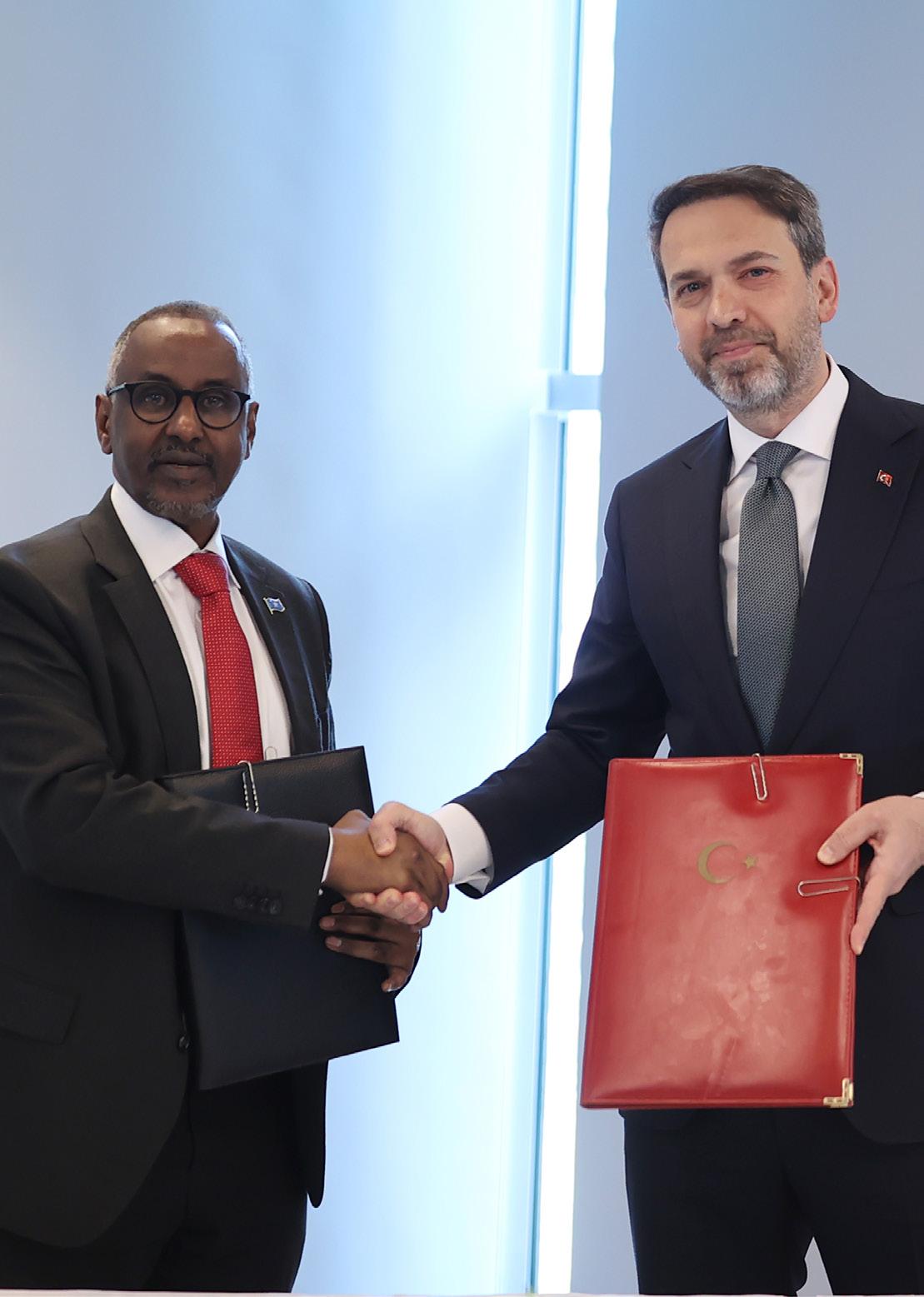
IMMEDIATE RELEASE EXCLUSIVE
The Emerging Powerhouse in Global Oil and Gas BASIL SHIBLAQ
Mogadishu, Somalia — Somalia is on the brink of becoming a dominant force in the global oil and gas industry, with projections placing it as a leading producer within the next five years. This comes after the groundbreaking discovery made by Soma Oil & Gas founded by Basil Shiblaq in 2013 through a 2-dimensional seismic study off Somalia’s deep-water coast, which unveiled potential reserves of 57 billion barrels of oil and 160 trillion cubic feet of gas across 12 offshore blocks.
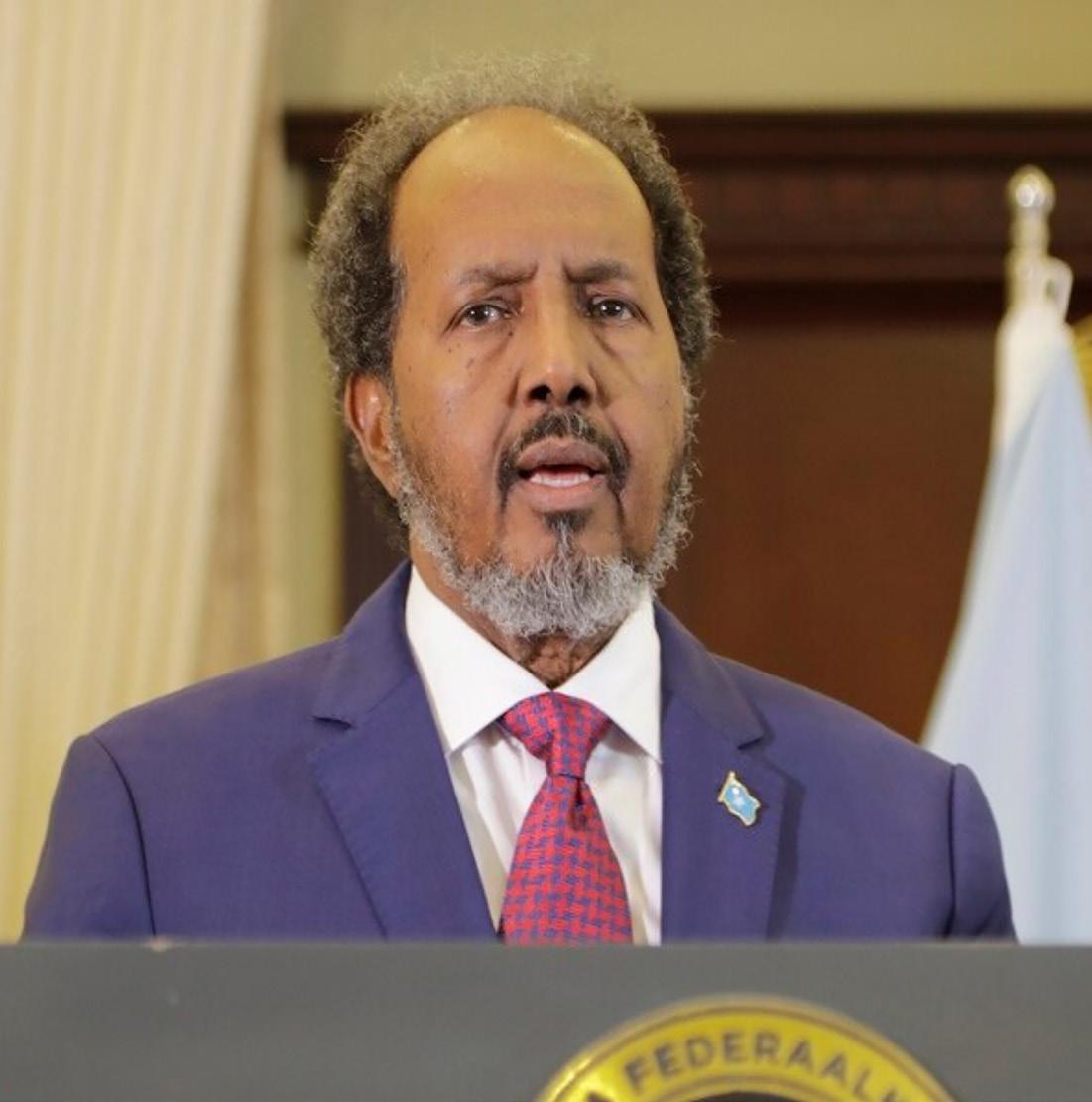
With the guidance and leadership of President Hassan Sheikh Mohamud, significant strides have been made in the regulatory and legal frameworks governing the petroleum sector. The establishment of the Somalia Petroleum Authority (SPA) and the enactment of the Petroleum Law under the current administration are key milestones towards harnessing these vast resources.
In a historic move, the signing of a Profit Sharing Agreement with numerous oil companies, facilitated by His Excellency Abdirizak Omar
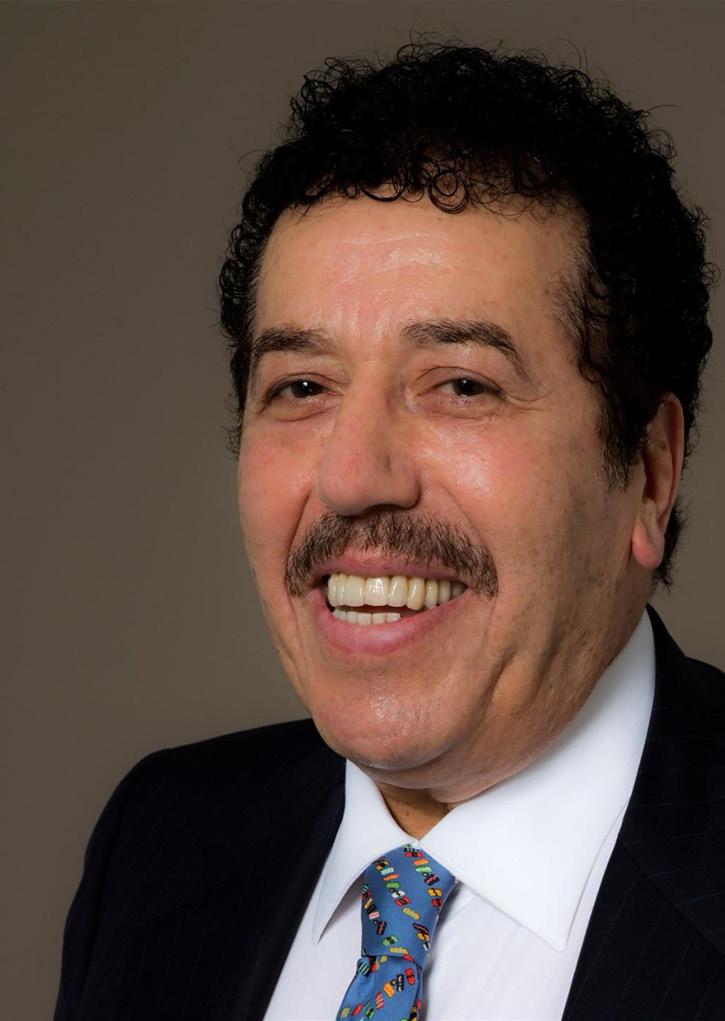
Founder of Soma Oil & Gas
Mohamed, Minister of Petroleum & Mineral Resources, marks a significant leap forward in the nation’s oil and gas exploration and development endeavors.
The SPA is dedicated to promoting sustainable and responsible exploration and production activities, aiming to ensure that the oil and gas sector serves as a cornerstone of Somalia’s economic growth and stability. These developments signify a pivotal moment for Somalia, positioning it as a key player in the global energy market with the potential to contribute positively to global oil and gas price stability and thus, the world economy.
Somalia’s journey towards becoming a significant oil and gas producer is a testament to the resilience and determination of its people and government. By leveraging its rich natural resources, Somalia aspires to foster economic development, generate employment, and ensure the prosperity of its citizens while adhering to the highest standards of environmental protection and sustainability.
4.
About the Somalia Petroleum Authority (SPA)
The Somalia Petroleum Authority (SPA) was established with the mission to regulate, manage, and foster the development of Somalia’s petroleum industry. By providing a stable and transparent regulatory framework, the SPA aims to attract international investments, ensure the sustainable development of the nation’s oil and gas resources, and contribute to Somalia’s economic resurgence and prosperity.
AFTER DEFENCE AGREEMENT, TURKEY
SECURES CONTROL OF SOMALI OIL
HASSAN SHEIKH MOHAMUD
Somali PRESIDENT
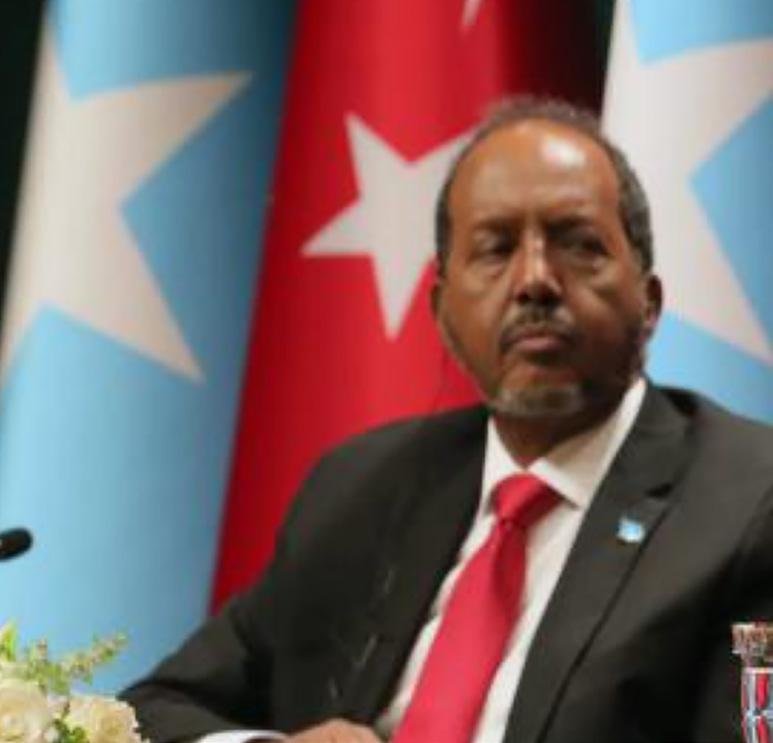
Turkey signed an offshore oil and natural gas cooperation deal with Somalia on Thursday, the Turkish energy ministry said, further strengthening bilateral ties after agreeing a defence deal last month.
Over the few last years, Turkey has managed to take
advantage from the complex situation that Somalia has been going through, accelerating its efforts to provide military and economic support to Mogadishu, in a way that opens the path for Ankara to exploit Somalia’s energy resources.
The Turkish energy ministry said the
offshore oil and natural gas deal, which it described as an inter-governmental agreement, includes exploration, evaluation, development and production of oil in Somalia’s land and sea blocks.
“With this agreement, we will carry out joint activities to bring the resources of Somalia to the Somali people. We aim to strengthen Turkey’s presence in the Horn of Africa with new collaborations in the field of energy,”
Turkish Energy Minister Alparslan Bayraktar said on social media platform X.
“Oil and natural gas exploration offshore of Somalia, and it looks more like oil for now, will start very soon in the areas we have identified. We will maybe send our seismic (exploration) vessel there in the
first phase,” he said separately in a panel, without elaborating.
The deal includes transportation, distribution, refining, sales and services operations of oil and other products from land and sea projects, the ministry also said.
Ankara has become a close ally of the Somali government. It has built schools, hospitals and infrastructure and provided scholarships for Somalis to study in Turkey.
In 2017, it opened its biggest overseas military base in Mogadishu. Turkey also provides training to Somali military and police.
In February, Ankara signed a defence and economic cooperation agreement with
RECEP TAYYIP ERDOĞAN
Turkish President
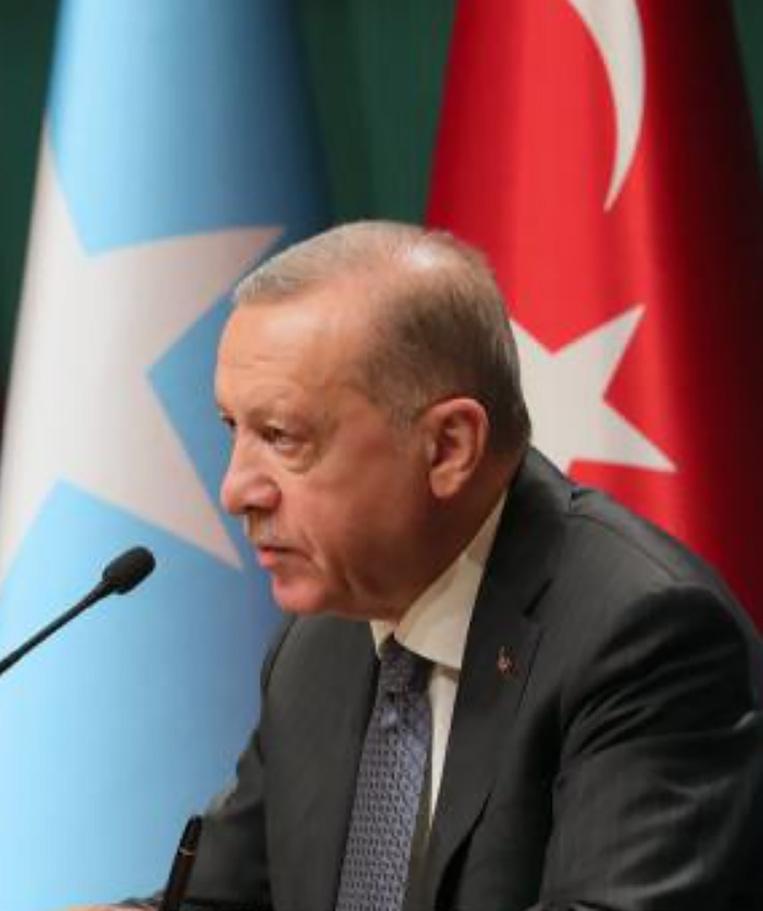
Somalia and will provide maritime security support to help the African country defend its territorial waters.
Under the ten-year defence agreement, Turkey, a member of NATO and a close ally of Somalia, will help defend the Somali coast and reorganise the troubled country’s naval forces in the Horn of Africa, according to what Somali President Hassan Sheikh Mohamud said at the time.
Observers believe that Turkey’s strategy to contain Somalia has succeeded, especially after declaring Ankara’s support for Mogadishu in the recent dispute with Ethiopia over the memorandum of understanding with Somaliland that gives Addis Ababa access to the Red Sea and the establishment of a military base.
Last May, the Anadolu news agency published a report on oil opportunities in Somalia in which it said, “Reserves of around 30 billion barrels of oil in 15 offshore blocks would completely change
the face of Somalia, especially since these reserves are equivalent to three times those found in Algeria and place the country third in Africa after Libya and Nigeria.”
The report added that Somalia is at a turning point in its history, after it has begun to attract the interest of international companies for oil exploration, especially in the areas off its longest coast in Africa, overlooking the Indian Ocean, the Arabian Sea and the Gulf of Aden, and is even on the key sea route for international trade between Asia and Europe.
The report showed that Turkey had its eyes on Somali oil in exchange for the range of support it was providing Mogadishu at a time when Western countries, especially the United States, had abandoned the country.
According to 2D seismic conducted by TGS in 2014, there could be 30 billion barrels of crude across 15 blocks initially offered by Somalia’s government. However, Richard Anderson, CEO of Coastline
Exploration, says, “There is the possibility that there are tens of billions of barrels that could be extracted, or even more that could emerge over time.”
Somalia is a promising country in terms of oil reserves expected to be explored, whether on land or at sea. Sufficient seismic studies have not yet been conducted to determine confirmed oil reserves across the country.
The Somali president hopes to accelerate the process of oil production and export, and this was evident after a quick approval of the first agreements signed by Coastline Company in February 2022, to explore in seven offshore blocks covering 35 thousand square kilometres.
Sheikh Mohamud also signed various agreements with local districts to avoid disputes over sharing oil revenues and local development. Since his election in May 2022, the new Somali president has visited several countries to encourage investment in Somalia’s oil sector, similar to Turkey.
6.
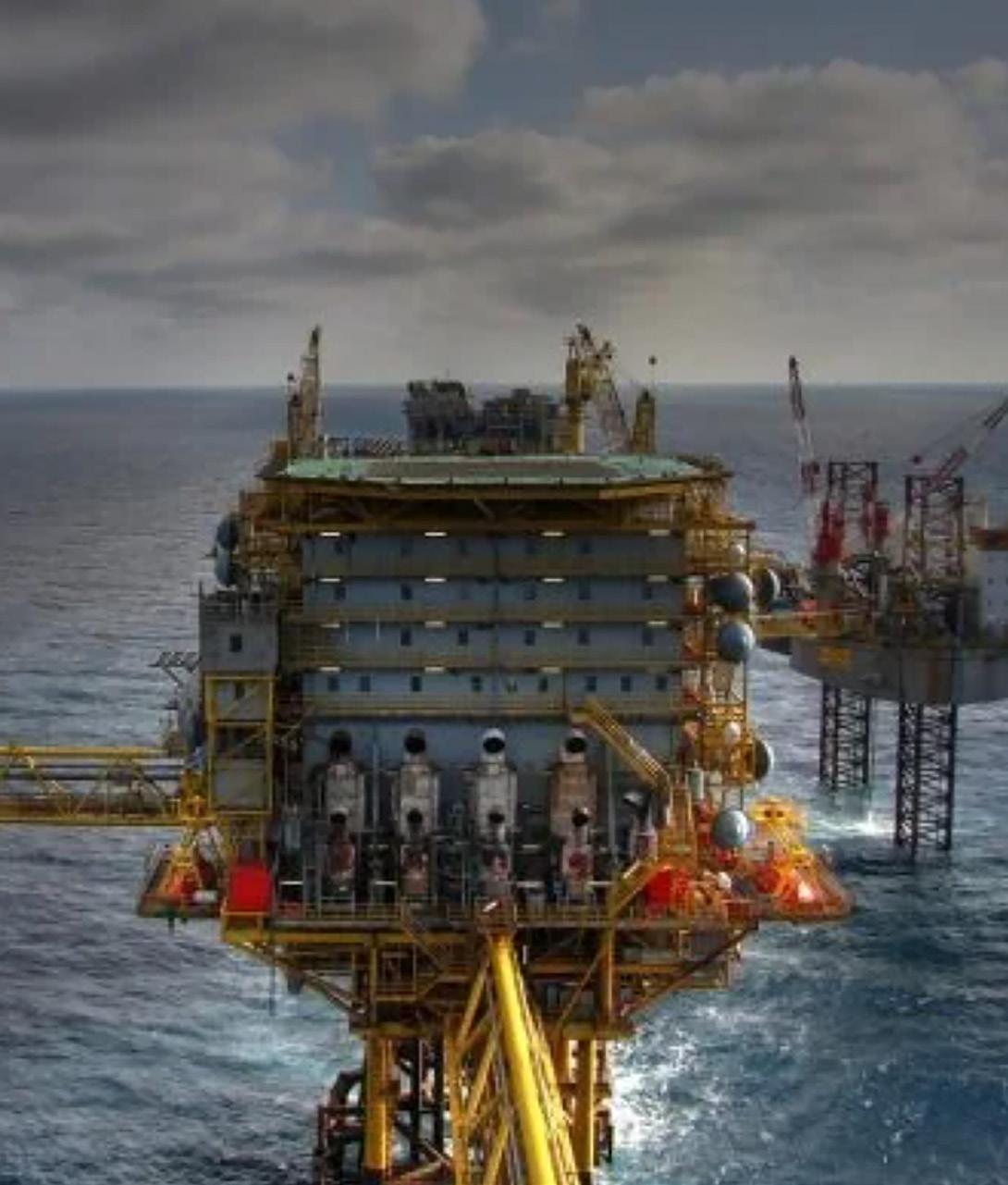
Türkiye has signed a cooperation agreement with Somalia pertaining to exploration and development of offshore oil and natural gas, reported Reuters.
The Turkish energy ministry stated that the agreement involves exploration, assessment, development and production of oil in Somalia’s terrestrial and maritime blocks.
Türkiye energy minister Alparslan Bayraktar on social media platform X stated: “With this agreement, we will carry out joint
THE COUNTRIES WILL WORK ON EXPLORATION, DEVELOPMENT
AND PRODUCTION OF OIL IN SOMALIA’S
BLOCKS.
Oil exploration site
activities to bring the resources of Somalia to the Somali people. We aim to strengthen Turkey’s presence in the Horn of Africa with new collaborations in the field of energy.”
Described by the ministry as an inter-governmental agreement, the deal also includes the transportation, distribution, refining, sales and service operations of oil and other products derived from both land and sea projects.
Separately, in a panel, Bayraktar said: “Oil and natural gas exploration offshore of Somalia, and it looks more like
oil for now, will start very soon in the areas we have identified. We will maybe send our seismic (exploration) vessel there in the first phase.”
Türkiye’s interest in energy cooperation extends beyond Somalia, with Bayraktar expressing interest in engaging in oil and gas exploration with Libya.
“We are interested in offshore Libya, our interest in some areas on land continues, but Somalia is an exploration operation that we are especially considering on the sea,” Bayraktar added.
Last year, Reuters reported that Turkey extended its liquefied natural gas (LNG)
supply deal with Algeria for three years.
In a statement on X, Bayraktar said the deal was signed between Turkish Government-backed energy company Botas and Algerian state-owned oil and gas company Sonatrach.
The original gas supply agreement between Botas and Sonatrach was signed in 1988 and has since been renewed.
Under the agreement, Türkiye will continue to buy 4.4 billion cubic metres of LNG from Algeria annually.
IRAQ’S DANGEROUS BALANCING ACT IRAN AND THE US between
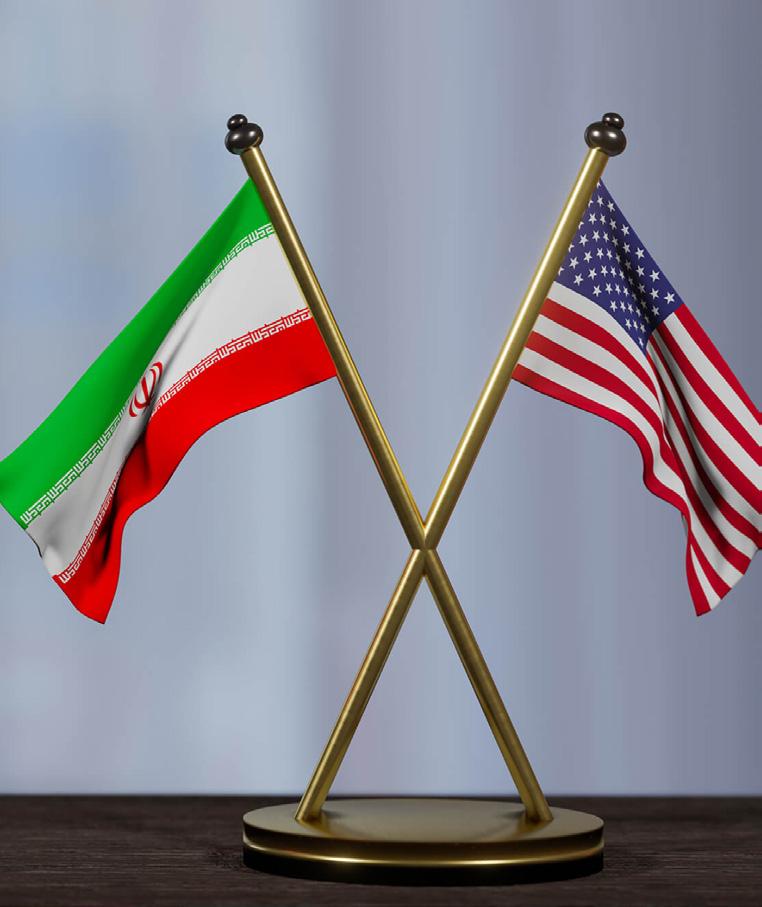
Four days ago, Iraq’s airspace had hundreds of projectiles fired from Iran flying through it towards Israel, caught in the crossfire of what many fear could be the opening salvoes of a regional war dragging in the United States.
On Monday, Iraq’s Prime Minister Mohammed Shia al-Sudani was in Washington, DC, meeting President Joe Biden and other top US officials – a preplanned trip that took on new importance for all involved.
From the White House, al-Sudani addressed the uptick in tensions, saying he encouraged “all efforts to stop the expansion of the area of the conflict”, highlighting his fears
of being dragged into a regional war involving countries that continue to have a strong influence in Iraq.
Iraqi officials say their country was among a handful that Iran told of the attack – which followed an Israeli strike on the Iranian Embassy in Damascus that killed a senior Iranian general – in advance.
Regional tensions aside, al-Sudani’s primary focus appears to be Iraq’s domestic concerns as he hopes to attract investment in Iraq’s private sector and progress on a US troop withdrawal from the country, analysts told Al Jazeera.
“[Al-]Sudani’s agenda is domestically oriented. He is seeking less American
restrictions on the Iraqi banking system, more investments and enhancing security ties,” Tamer Badawi, an Iraq analyst focusing on politics and security, said.
According to Sajad Jiyad, a fellow at Century International and director of the Shia Politics Working Group, the meetings went well but the timing – so soon after Iran’s attack – limited the outcome.
“I think the Iraqi side had higher expectations of what support and agreements they could reach but those were tempered by the events preceding the meeting,” Jiyad told Al Jazeera.
“For the US, the IranIsrael clash served to highlight the need
to keep US troops in Iraq for now and that the Iraqi government needs to do more to prevent Iran and groups allied with it from using Iraq as a base of operations against the US and Israel.”
More than 20 years after the US invasion of Iraq in 2003 to remove former leader Saddam Hussein, 2,500 US troops are still based in the country, primarily in counterISIL (ISIS) roles.
For many Iraqis, who remember the deadly post-war period well, the US presence is not welcome. Al-Sudani has had to walk a tightrope between the US and placating parts of his domestic base.
And for Iran-aligned groups, such as the militias that form the
8.
IRAQI PM AL-SUDANI’S VISIT TO WASHINGTON. DC, CAME AS ITS NEIGHBOUR IRAN ATTACKED ISRAEL, RAISING FEARS OF REGIONAL CONFLICT.
Islamic Resistance in Iraq (IRI), the US troops became a target starting October 18, in the wake of Israel’s war on Gaza.
However, after the US assassinated three senior figures in Kataib Hezbollah, the most powerful force in the IRI, in early February, the group announced it would suspend attacks on US troops.
As tensions rise in the region, Washington may view al-Sudani as a potential interlocutor with Iran.
US officials have repeatedly said they do not want to be dragged into a wider regional war and Iraq – while relatively quiet since February – has
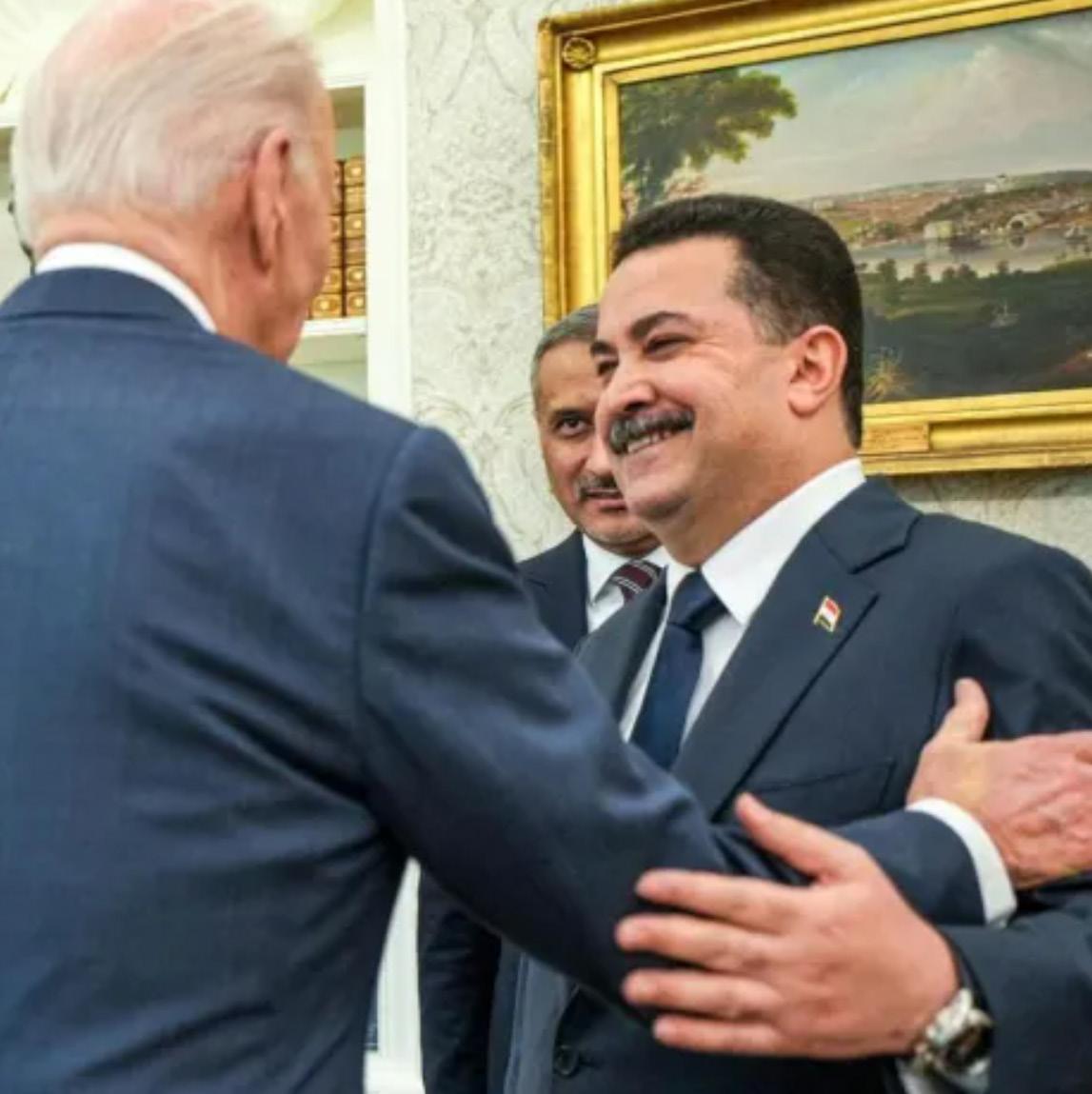
reason to fear Iranaligned groups in the country remobilising if regional tensions expand.
“Iraq’s position is that it wants an end to hostilities in Gaza,” Yesar Al-Maleki, a Gulf analyst at the Middle East Economic Survey (MEES), told Al Jazeera.
“If Washington can manage to bring the war there to an end, it will no doubt aid Mr Sudani’s efforts to spare Iraq the repercussions, whether security or economic, from a continued conflict.”
Iraq is set to have elections in 2025 and the prime minister needs the support of
his domestic backers as well as the US if he wants to renew his mandate.
“If the PM returns from Washington with US support for his government, promises of a US troop reduction or a scheduled withdrawal sometime in the future, and relieving of US restrictions on Iraq’s financial sector, these factors would support his position and even add to his public image,” Al-Maleki said.
“His visit to the White House is the first step towards building more trust to have American support for his appointment as prime minister after the next elections,” Badawi
added.
Finding that balance has not always been easy, with al-Sudani pushed to call for a complete withdrawal of US troops in January, seemingly in response to some 53 US attacks on Iranaligned groups in Iraq.
“It is important for [al-]Sudani to sustain good relations with the US,” Harith Hasan, a nonresident senior fellow at the Carnegie Middle East Center, told Al Jazeera. “He doesn’t want to come off as anti-American or to portray the end of the occupation in bad faith.”
Analysts said alSudani will want to
TIGHTROPE WALK OVER US PRESENCE
show that his meetings in Washington, DC, brought progress on this issue and is under pressure to secure a troop withdrawal while maintaining US support in other areas.
But if he can reframe the US presence to show the two working as partners in a “new phase of engagement that is no longer restricted to security collaborations, it would be considered a win for [al-]Sudani”, Nancy Ezzeddine, a research fellow at the Haguebased Clingendael Institute, told Al Jazeera.
In addition to discussion on US troops, al-Sudani hopes to secure financial agreements in his DC meetings to ease the pressure on Iraq.
Iraq’s economy is over-reliant on oil, which pulls in more
than $100bn a year, with a bloated public sector where doing business is difficult and credit is hard to access, according to the International Labour Organization.
The revenue from Iraq’s oil is held in an Iraqi government account at the Federal Reserve Bank of New York but the US has restricted transfers to the Iraqi Ministry of Finance in recent months due to concerns over money laundering and the flow of US dollars to Iran.
“There’s been a number of anti-money laundering policies that have come into play over the past few months by both the Americans and Iraqi government by curbing usage of US dollar transactions in a number of commercial banks and closing down the money
traders,” Ezzeddine said.
“This has really shrunk the foreign currency supply in the country.”
Iraq has taken steps to appease the US, including “suspending the licences of some banks, pushing for documentation and auditing of dollar transactions, reducing cash transactions and limiting the amount of dollars that banks make available for withdrawals,” Jiyad wrote in a Q&A with the Century Foundation, published on April 5.
10.
US interests
As for the US, Biden will have both domestic and regional concerns for Iraq.
On the former, the US will be looking to nudge al-Sudani to cooperate with US allies in Erbil, the capital of the Kurdish region of northern Iraq.
Over the past six months, members of the Kurdish region’s government have made multiple trips to Washington in efforts to have the Biden administration act as mediators with Baghdad, with which it has had several disputes in recent years.
“The delegation accompanying Sudani includes officials from the [Kurdish] Regional Government, which is a positive indicator of his relationship with the KRG,” Sarhang
Hamasaeed, the director of Middle East Programs at the US Institute of Peace, told Al Jazeera.
“The Kurdish leaders generally view Sudani favourably and as genuine in trying to resolve Baghdad-Erbil issues.”
“Washington wants to see Sudani enforcing Baghdad’s financial commitments towards the Kurdistan Region consistently and sustainably and allow Erbil to export oil,” Badawi said. “The Iraqi federal court’s rulings have been increasingly perceived as ‘politicised’ by Erbil and its foreign allies.”
One of these cases concerns a pipeline sending oil to Turkey from KRG-controlled territory in northern Iraq, which was shut down after the Iraqi federal government
objected to the direct transfer of oil without its involvement, leading to the shutting down of the pipeline last year.
“The opening of the pipeline has been delayed with no justification for over a year now,” Ezzeddine said. “This relates not only to oil exports but also a number of other budgetary, legal and constitutional issues.”
Regionally, the Biden administration is looking to counter Iranian influence in Iraq.
“The US would want commitments to guarantee Iraq’s sovereignty by minimising Iranian influence across all levels of decision, including the politics, the economics and the security decisionmaking in Iran,” Ezzeddine said.
“The US president hopes to find in Sudani a partner who could contain pro-Iran factions, especially armed militias, in Iraq as the US gears into its presidential elections and Washington is more pressed than ever to de-escalate tensions in the Middle East,” Al-Maleki said.
“Success would require compromises by both leaders.”
Aung San Suu Kyi Myanmar
MOVED TO HOUSE ARREST
AMID HEATWAVE
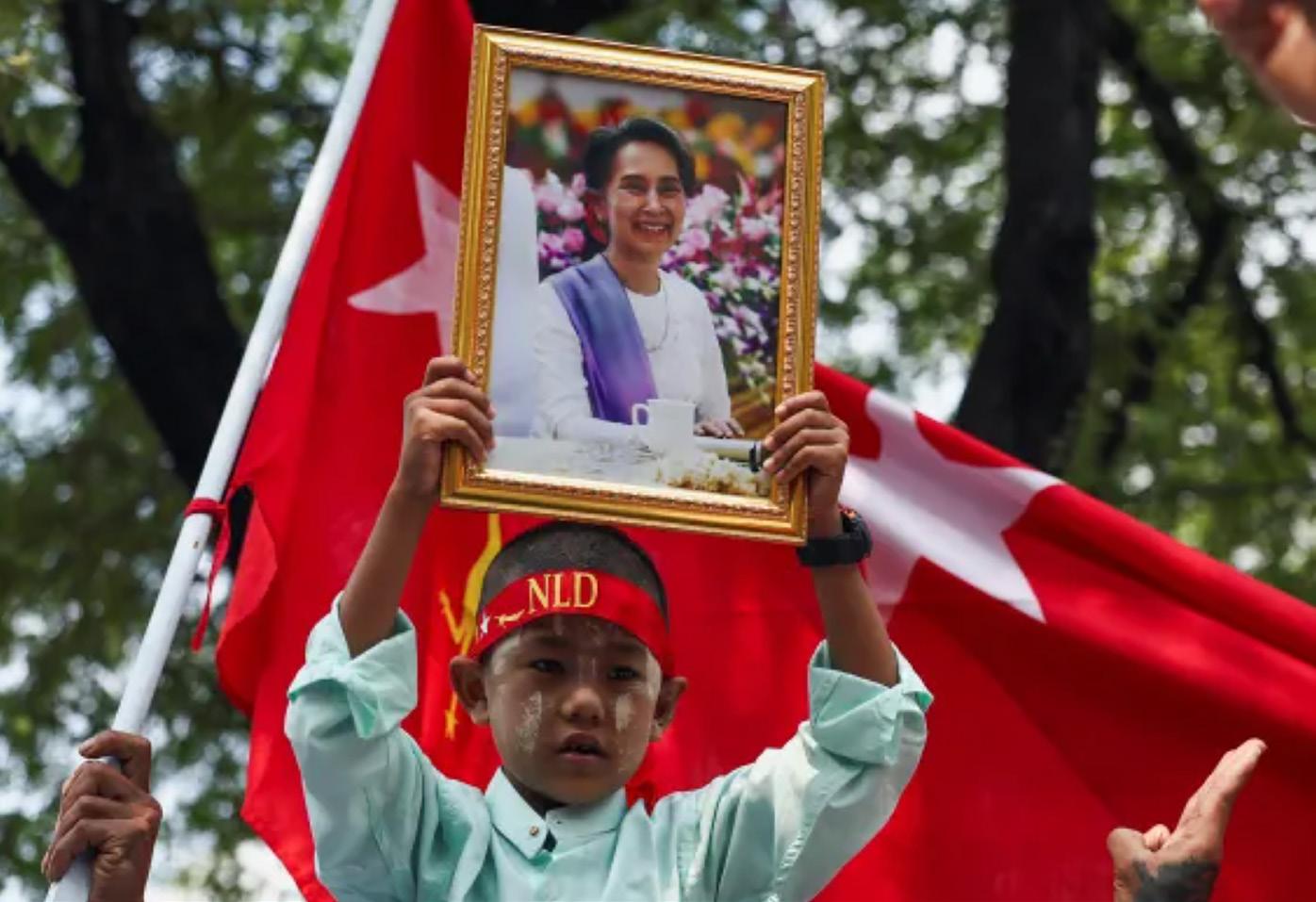
Myanmar’s jailed former leader and Nobel laureate Aung San Suu Kyi has been moved from prison to house arrest as a health measure amid a severe heatwave, the military has said.
Major General Zaw Min Tun told foreign media on Tuesday that Aung San Suu Kyi and the president of her toppled government, Win Myint, were among the elderly and infirm prisoners transferred from prison.
“Since the weather is extremely hot, it is not only for Aung San Suu Kyi… For all those, who need necessary precautions, especially elderly prisoners, we are working to protect them from heatstroke,” he was quoted as saying.
Aung San Suu Kyi, 78, has been imprisoned by the Myanmar military since it overthrew her government in a coup in 2021.
She has been serving a 27-year prison term in Naypyidaw on a variety of criminal convictions that her supporters and rights groups say were fabricated for political reasons. Win Myint was serving an eightyear prison sentence in Taungoo in Myanmar’s Bago Region.
Myanmar’s meteorological department said Naypyidaw saw temperatures of 39 degrees Celsius (102.2 degrees Fahrenheit) on Tuesday.
Zaw Min Tun did not say where the released prisoners were being
12.
News
Myanmar
moved to. Before being sent to prison, Aung San Suu Kyi was reportedly held in a safe house inside an army base.
In February, Aung San Suu Kyi’s son Kim Aris said she was being held in solitary confinement and that she was in good spirits “even if her health is not as good as it was in the past”.
Aris had previously said that reports that his mother had been moved to house arrest in July of last year were not true. At the time, he called the reports “disinformation” disseminated by the military to appease the international community.
Many governments around the world have called for the unconditional release of Aung San Suu Kyi and thousands of other political prisoners and some, including the United States, European
Union and the United Kingdom, have levelled sanctions against the Southeast Asian country’s military.
Three years since the coup, Myanmar’s military is facing the biggest challenge to its rule as an armed resistance movement, allied with the National Unity Government (NUG) set up by politicians allied to Aung San Suu Kyi, gathers pace on several fronts.
A spokesperson for the NUG on Tuesday called for Aung San Suu Kyi and Win Myint’s unconditional release.
“Moving them from prisons to houses is good, as houses are better than prisons,” spokesperson Kyaw Zaw told the Reuters news agency late on
Tuesday.
“However, they must be unconditionally freed. They must take full responsibility for
the health and security of Aung San Suu Kyi and U Win Myint.”
News of Aung San Suu Kyi’s transfer came as the military also granted amnesty for more than 3,000 prisoners to mark this week’s traditional Thingyan New Year holiday.
It was not immediately clear if those released would include prodemocracy activists and political prisoners who were arrested for protesting against army rule.
State-run MRTV said that the head of the ruling military council,
Senior General Min Aung Hlaing, had pardoned 3,303 prisoners, including 28 foreigners who will be deported from Myanmar. He also reduced sentenc es for others.
Mass amnesties on the holiday are not unusual in Myanmar.
The Assistance Association for Political Prisoners (AAPP), which has been monitoring the post-coup crackdown, said in its most recent update on April 12 that some 20,351 people were in detention for opposing the military.
Iran vs. Israel
AFTER IRAN’S ATTACK ON ISRAEL, THE WORLD MUST ACT: THIS
IS A CRISIS THAT THREATENS US ALL
The missiles and drones that rained destruction on Israel in the early hours of Sunday morning have given Israel’s prime minister, Benjamin Netanyahu, what he’s always craved – a mandate and justification for openly attacking Iran, a country he has long viewed as Israel’s archenemy and possible nemesis. The pressing question, which may be answered within hours, is what form Israel’s promised “significant response” will take –and whether Iran, in turn, will strike back again. “We will build a regional coalition and exact the price from Iran in the fashion and timing that is right for us,” said the Israeli
minister Benny Gantz, as the Israeli war cabinet met to discuss Israel’s response today. It is incumbent on the US, Britain and other friends and allies of Israel to inform Netanyahu in plain terms that continued military, diplomatic and political support is conditional on a legitimate and proportionate Israeli riposte. It would be preferable if Israel did not hit back at all. Iran failed in its apparent aim of inflicting serious harm. Israel says 99% of its missiles and drones were destroyed. Thankfully, casualties have been light. Tehran now says, a little hopefully, that the episode is “concluded” – but vows to fight back if attacked.
Netanyahu’s wisest course would be to hold up the attacks to the world as supposed incontrovertible proof of his hawkish view: that Iran is a malign, dangerous rogue state that flouts international law and imperils Israel, Arab and western states. Instead of blindly lashing out –for example, at Iran’s nuclear facilities – he should argue that the Islamic republic’s hardline leadership and its supreme leader, Ayatollah Ali Khamenei, have shown their true colours – and deserve collective, international punitive action. On past form, it is unrealistic to expect Netanyahu to turn the other cheek. Tehran’s
14.
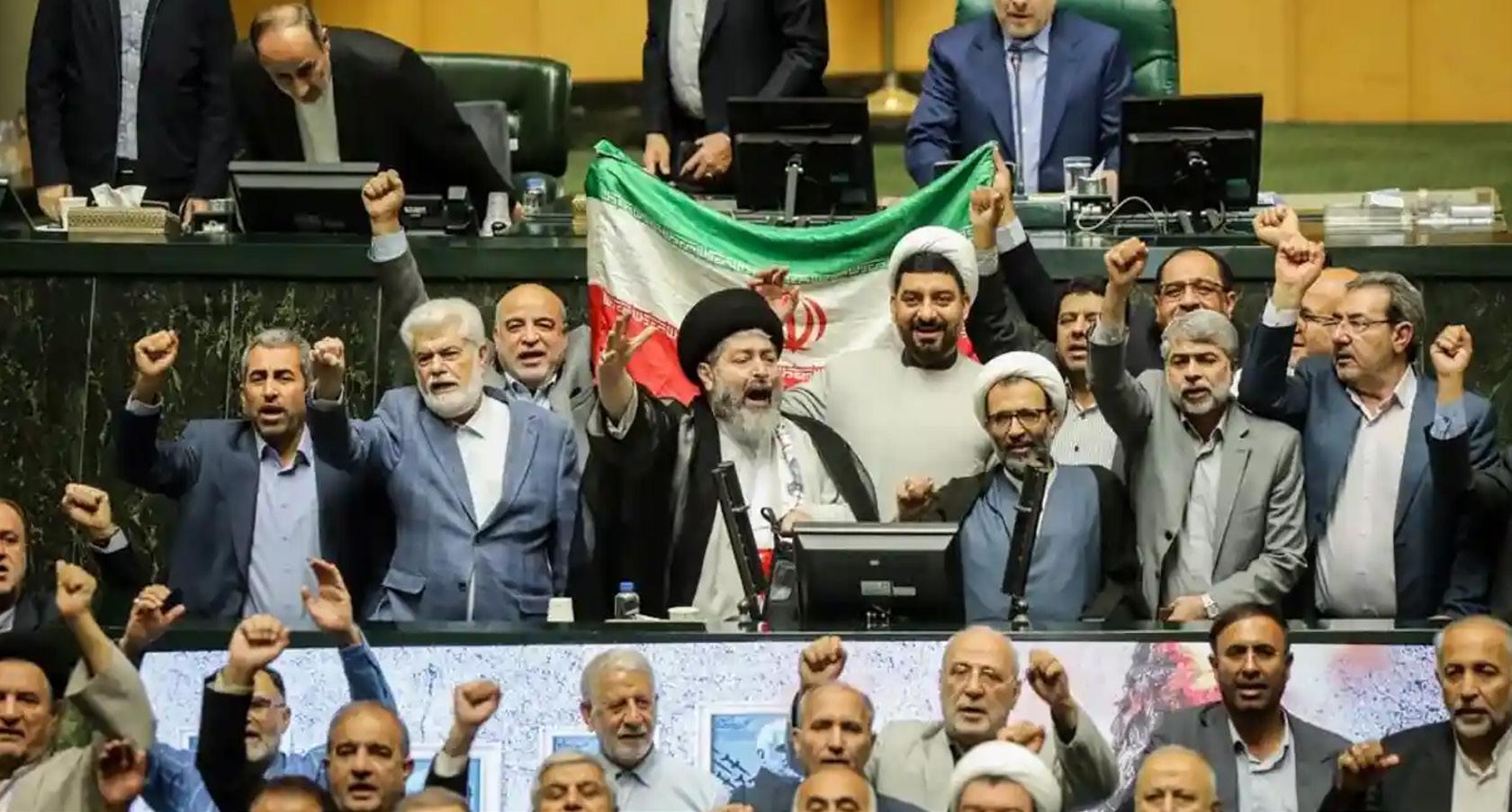
action has presented him with a unique opportunity to switch global attention away from his government’s appalling depredations in Gaza and his failure to defeat Hamas. He may say that the war against Hamas has been transformed into an existential war against its puppet masters in Tehran –and that people of goodwill, at home and abroad, must rally round his leadership to ensure a necessary victory.
The fact that Netanyahu and his inner war cabinet appear to have deliberately and recklessly provoked this showdown should not be forgotten as the crisis unfolds. Israel’s prime minister has been at the forefront of a decades-long shadow war of assassination and attrition against Iran. The co-
vert, unacknowledged killing of its nuclear scientists and leaders of its regional proxy militias has become almost routine. But the target list has expanded since the 7 October atrocities. In December, for example, Sayyed Razi Mousavi, a senior Iranian general, was killed in Damascus. Iran’s reaction, then as in the past, was relatively limited and indirect. But the 1 April bombing of an annexe of its embassy in the Syrian capital, which killed several senior commanders, radically changed this dynamic. Iran blamed Israel (which as usual has not admitted responsibility) for a direct, blatant assault on its sovereign territory. Israel, Khamenei said, had crossed a red line.
It’s hard not to agree.
The war had come out of the shadows – and this was Netanyahu’s doing. He must have known how furious would be the reaction in Tehran. Tellingly, he did not inform his US ally in advance, probably because the administration would have tried to veto the operation. The Damascus embassy attack looks like a premeditated escalation designed to fortify Netanyahu’s domestic political position, silence criticism from the blind-sided Americans and deflect international pressure to halt arms supplies to Israel And it has worked. Overnight, the criticism in Washington of the Gaza debacle has dried up. In Britain, too, calls on the government to insist on an effective Gaza ceasefire and limit support for Israel’s coalition
will now probably be drowned out. Instead, the UK is already involved militarily, in the air over Syria and Iraq, and could be drawn further in. More than that, the Damascus attack succeeded in flushing out Iran. No longer could Tehran’s leaders hide behind proxy forces such as Hezbollah in Lebanon and the Houthis in Yemen. Netanyahu had, in effect, called them out, as though in a duel. They plainly felt they had no choice but to respond in kind.
That belief was, and is, mistaken. Like Netanyahu, Khamenei and Iran’s hardline president, Ebrahim Raisi, had choices. It would have been smarter by far if Iran, faced with the embassy outrage, had taken its grievances to the UN and the international court in The Hague, and raised the issue through friends in the G20 and the Brics grouping. Iran could have threatened retaliation and then held back. In this way it could have won sympathy in the global south and from anti-western allies such as China and Russia.
Instead, Khamenei – a foolish reactionary with almost zero per-
sonal experience of the outside world – walked straight into the trap Netanyahu had set.
Iran, in the eyes of most of the international community, has made itself an outlaw. And Iran’s people must await Israel’s response. Depending how bad that is, the deeply unpopular Islamic regime could face an upsurge in internal instability, even a popular uprising..
This unprecedented, direct confrontation between Israel and Iran, building for years, has placed the US president, Joe Biden, in an all but impossible position. He came to office in 2021 hoping to revive the landmark 2015 US-European nuclear deal with Iran that Donald Trump idiotically scrapped. Now his policy lies in tatters. Biden finds himself on the brink of an escalating armed conflict with Iran, fighting alongside an Israeli government whose actions in Gaza he has belatedly but vehemently deplored, and which may cost him dear in November’s US election.
Biden cannot abandon Israel, even though he may believe Netanyahu has played him again (as he thinks was the case at the start of the war with
Hamas). Yet he cannot plausibly ask American voters, long since out of patience with costly foreign entanglements, to support another Middle East war. Trump, Netanyahu’s buddy, must scarcely credit his luck.
All of this – Netanyahu’s cynical machinations, Tehran’s violent miscalculations, Biden’s stark dilemma – points in only one direction: the need for urgent, concerted international action to halt further fighting and prevent a Middle East-wide escalation sucking in Syria, Lebanon, and the Gulf and Red Sea regions. Of the parties to this conflict, no one country or leader is in the right. In fact all, to varying degrees, are in the wrong. All require saving from themselves. The alternative is more bloodshed, more endless, pointless, spreading misery. Biden cannot abandon Israel, even though he may believe Netanyahu has played him again (as he thinks was the case at the start of the war with Hamas). Yet he cannot plausibly ask American voters, long since out of patience with costly foreign entanglements, to support anoth-
er Middle East war. Trump, Netanyahu’s buddy, must scarcely credit his luck.
All of this – Netanyahu’s cynical machinations, Tehran’s violent miscalculations, Biden’s stark dilemma – points in only one direction: the need for urgent, concerted international action to halt further fighting and prevent a Middle East-wide escalation sucking in Syria, Lebanon, and the Gulf and Red Sea regions. Of the parties to this conflict, no one country or leader is in the right. In fact all, to varying degrees, are in the wrong. All require saving from themselves. The alternative is more bloodshed, more endless, pointless, spreading misery.
The UN security council is due to meet in emergency session today. Instead of the usual wrangling, its permanent members, especially China and Russia, will need to work constructively together to defuse a crisis that threatens us all. Together they have the clout and the leverage to do it. They must use it – or suffer the dreadful, unknowable consequences.
16.
Putin
RUSSIA’S PUTIN URGES RESTRAINT IN CALL WITH IRAN’S RAISI AS TENSIONS
SOAR
Russian President Vladimir Putin has called for restraint as Israel weighs its response to Iran’s unprecedented weekend drone and missile attack.
Putin made the remarks in a phone call with Iranian President Ebrahim Raisi on Tuesday. The leaders discussed what the Kremlin called “retaliatory measures taken by Iran” after an Israeli attack on the Iranian consulate in the Syrian capital, Damascus, on April 1.
Putin urged all sides to refrain from action that would trigger a new confrontation that would have catastrophic consequences for the Middle East, the Kremlin said. Iran launched hundreds of drones and missiles at Israel late on Saturday in response to the Israeli strike in Damascus, which killed seven officers of the Islamic Revolutionary Guard Corps, including two generals.
Putin, in his first publicly aired comments on Iran’s attack, said the root cause of the current instability in the Middle East was the continuing Israeli-Palestinian conflict.
“Vladimir Putin expressed hope that all sides would show reasonable restraint and prevent a new round of confrontation fraught with catastrophic consequences for the entire region,” the Kremlin said. “Ebrahim Raisi noted that Iran’s actions were forced and limited in nature,” the Kremlin said. “At the same time, he stressed Tehran’s disinterest in further escalation of tensions.”
Raisi thanked Russia for its position towards Iran’s response to Israel and said the inaction of the international community and the destructive role of some Western countries forced Iran to carry out the recent operation, according to Iran’s presidency.
Raisi reiterated that any action against Iran’s interests will demand a larger-scale response, the presidency said.
Russia, which has forged close ties with both Iran’s supreme leader, Ali Khamenei, and several Arab leaders, has repeatedly scolded the West for ignoring the need for an independent Palestinian state within 1967 borders.
“Both sides stated that the root cause of the current events in the Middle East is the unresolved Palestinian-Israeli conflict,” the Kremlin said of the call with Raisi. “In this regard, the principled approaches of Russia and Iran in favour of an immediate ceasefire in the Gaza Strip, easing the difficult humanitarian situation, and creating conditions for a political and diplomatic settlement of the crisis were confirmed.”
Putin, who in 2022 visited Khamenei, congratulated Raisi and all Muslims on the end of the Islamic holy month of Ramadan.
Since Russia launched its full-scale invasion of Ukraine in 2022, Iran has provided Russia with a large number of surface-to-surface ballistic missiles and drones that Moscow has used to attack Ukraine.
THE TWO DEFENCE CHIEF HOLD FIRST SUBSTANTIVE
Lloyd Austin

United States Secretary of Defense Lloyd Austin and his Chinese counterpart Dong Jun have held their first substantive talks in nearly 18 months as the two countries work to restore military ties.
The two spoke via videoconference on Tuesday, the Pentagon said in a statement.
It said Austin “underscored the importance of respect for high seas freedom of navigation guaranteed under international law, especially in the South China Sea”.
“The US side should recognise China’s firm position, respect China’s territorial sovereignty and maritime rights and interests in the South China Sea, and take practical actions to safeguard regional peace,” Dong was quoted as saying in a statement by China’s Ministry of Defence.
He also warned the US over the democratic island of Taiwan, which Beijing claims as its own, emphasising it was the “core of China’s core interests”.
Austin’s last significant interaction with China’s defence minister was in November 2022 when he met Wei Fenghe in Cambodia.
Wei was subsequently replaced by Li Shangfu, who shook hands and spoke briefly with Austin at a security conference in Singapore last June, but steered clear of a formal meeting. Li, who was under US sanctions, disappeared from view shortly afterwards and was fired in October. Dong was appointed in December.
The US and China have been working to improve a relationship that had become
18.
SUBSTANTIVE TALKS IN NEARLY 18 MONTHS
Dong Jun
increasingly acrimonious over issues from Taiwan to the South China Sea, as well as trade and human rights.
US President Joe Biden met Chinese President Xi Jinping in California last November where they agreed to stabilise the relationship and resume military ties which had been frozen as a result of then-US House of Representatives Speaker Nancy Pelosi’s visit to Taiwan. The US’s top military general later held discussions with his Chinese counterpart and this month, US and Chinese military officials met in Hawaii to discuss ways the two countries could operate safely.
China and the US should explore ways to “get along” and “gradually accumulate mutual trust” by building a “non-conflict, non-confrontation”, pragmatic and cooperative relationship between their militaries, Dong was quoted as saying on his call with Austin.
“The military sphere is the key… to stabilising the development of the relationship and preventing major crises from occurring,” he said.
Austin also stressed the need to maintain open lines of communication to reduce the risk of potential flare-ups or deal with any accidents.
“Secretary Austin emphasized the importance of continuing to open lines of military-to-military communication between the United States and the PRC,” the Pentagon said, using an acronym for the People’s Republic of China.
The Pentagon said the two men also discussed issues including Russia’s war in Ukraine and North Korea.

Minouche Shafik is in the line of fire
On Wednesday, Columbia University President Nemat “Minouche” Shafik will face a congressional committee over allegations that the leadership of the Ivy League school has failed to protect students and staff from rising anti-Semitism on its New York City campus.
The university is one of many elite schools across the United States that have emerged as battlegrounds for protests, counterprotests and explosive allegations linked to Israel’s war on Gaza, in which about 34,000 people have been killed, most of them women and children.
Pro-Palestinian protesters have alleged that they have been victimised by university authorities and that they have faced physical attacks in some instances. Others have
accused university authorities of not doing enough to counter anti-Semitism on campus. Amid these heightened tensions, a congressional committee has been investigating allegations that universities have failed to shield students from anti-Semitism. The stakes are high for Shafik, the first female president of the university, appointed last year. Virginia Foxx, the Republican chairwoman of the committee, has accused Columbia of “some of the worst cases of anti-Semitic assaults, harassment, and vandalism on campus”.
The House investigation has already claimed two scalps: University of Pennsylvania (UPenn) President Elizabeth Magill and her Harvard counterpart Claudine Gay, amid similar allegations against them, and criticism of their responses to the con-
gressional committee.
As Shafik prepares to face the House panel, here is a look at what the controversy is all about, how divisions over the war have played out at Columbia, and what might happen next.
Three of the US’s top universities came under the unwelcome spotlight late last year when the presidents of UPenn, Harvard and the Massachusetts Institute of Technology (MIT) were summoned for a congressional hearing on anti-Semitism.
The event was seen as a triumph for House Republican Conference Chair Elise Stefanik, a confessed “ultra-MAGA”, who ambushed the trio — UPenn’s Magill, Harvard’s Gay and MIT President Sally Kornbluth — at the tail end of a fivehour grilling, pressing for a “yes” or “no” response on wheth-
er protesters calling for genocide of Jews were breaking college speech rules.
Though there Stefanik and others on the House committee did not present any evidence of chants calling for genocide of Jews on these university campuses, the legalistic responses of Magill, Gay and Kornbluth in the December hearing drew bipartisan condemnation.
All three equivocated, saying in various ways that it depended on context, Stefanik’s outraged dissection of their fumbling responses going viral. The bipartisan backlash that followed led Magill to resign, and Gay followed suit after a subsequent pile-on of plagiarism allegations. Days after the hearing, the House passed a bipartisan resolution brought by Stefanik, House Majority Leader Steve Scalise
20.
and Democratic Representatives Jared Moskowitz and Josh Gottheimer, shaming the college elders for “evasive and dismissive” testimony.
Regardless of whether heads roll this time round or not, Shafik’s hearing is likely to be gruelling. “It’s the Wild West,” says Christopher Armstrong, a partner at law firm Holland & Knight, who represents clients under congressional investigation. “With cameras in Congress and with our politics becoming more divided and heated, it’s a minefield for witnesses.”
Shortly after December’s hearing, lawmakers intensified their scrutiny of universities, opening an official investigation on learning environments and disciplinary procedures at UPenn, Harvard and MIT, which was extended in February to include Columbia.
Committee Chairwoman Foxx sent Columbia’s leadership a letter (PDF), demanding they hand over a trove of documents, alleging that “an environment of pervasive antisemitism” had been documented at the university for more than
two decades before the start of the current war on Gaza following the Hamas attack on Israel on October 7.
“We have grave concerns regarding the inadequacy of Columbia’s response to antisemitism on its campus,” said Foxx in the letter, which outlined numerous cases of verbal and physical abuse, intimidation and harassment. She referenced on-campus distribution of pamphlets carrying the “from the river to the sea” slogan — a Palestinian call for freedom from the occupation that Israel’s critics say it has tried to falsely portray as an anti-Semitic, or even genocidal, chant. Foxx cited the display of posters with images of a blue and white skunk with a Star of David on its back, and the presence of protesters endorsing the Intifada — which is what Palestinians have called civil uprisings against Israel’s occupation of territory recognised internationally as belonging to Palestine. Foxx also mentioned support on campuses for attacks by Yemen’s Houthi fighters on Israel-linked ships in the Red Sea.
By trying to punish chants for legitimate Palestinian protest and dreams of freedom from occupation, the House committee, say rights activists, is showing that it is less concerned about rights and the safety of people on campus — and is focused more on partisan politics.
Alex Morey, director of campus rights advocacy at the Philadelphia-based Foundation for Individual Rights and Expression, sees parallels with the days of McCarthyism and the Vietnam War. There is a risk, she said, of Congress forgetting about the “law of the land” and carrying out investigations without following “the proper procedures”.
“If we have Congress employing subjective standards, we run Into First Amendment concerns.”
“The threat of punishment can chill speech.”
Shafik, an Egyptian-born British-American economist, has held top jobs at institutions like the Bank of England, latterly serving as director of the London School of Economics before landing her current position last year at Columbia. While Shafik has insist-
ed that the Ivy League school is “not an ivory tower”, it is precisely the image of universities as liberal bastions of privilege that is at the centre of the anti-Semitism allegations it faces.
Stefanik, regarded as a potential running mate for Donald Trump in November’s presidential election, went on a political fundraising blitz after going viral last December, raking in $7.1m in the first quarter of this year. At Columbia, meanwhile, Shafik has faced criticism from both sides. Last November, the university suspended chapters of Students for Justice in Palestine and Jewish Voice for Peace, saying the groups had violated university policy. The New York Civil Liberties Union and a Palestinian rights group have filed a lawsuit at the state Supreme Court in Manhattan, naming Shafik as one of the defendants. The hearing opens at 10:15am Eastern Standard Time (14:15 GMT) on April 17.
Opinion By Gideon Levy
IF IRAN ATTACKS ISRAEL, THE BLAME
LIES
ON
ISRAEL’S IRRESPONSIBLE DECISION-MAKERS
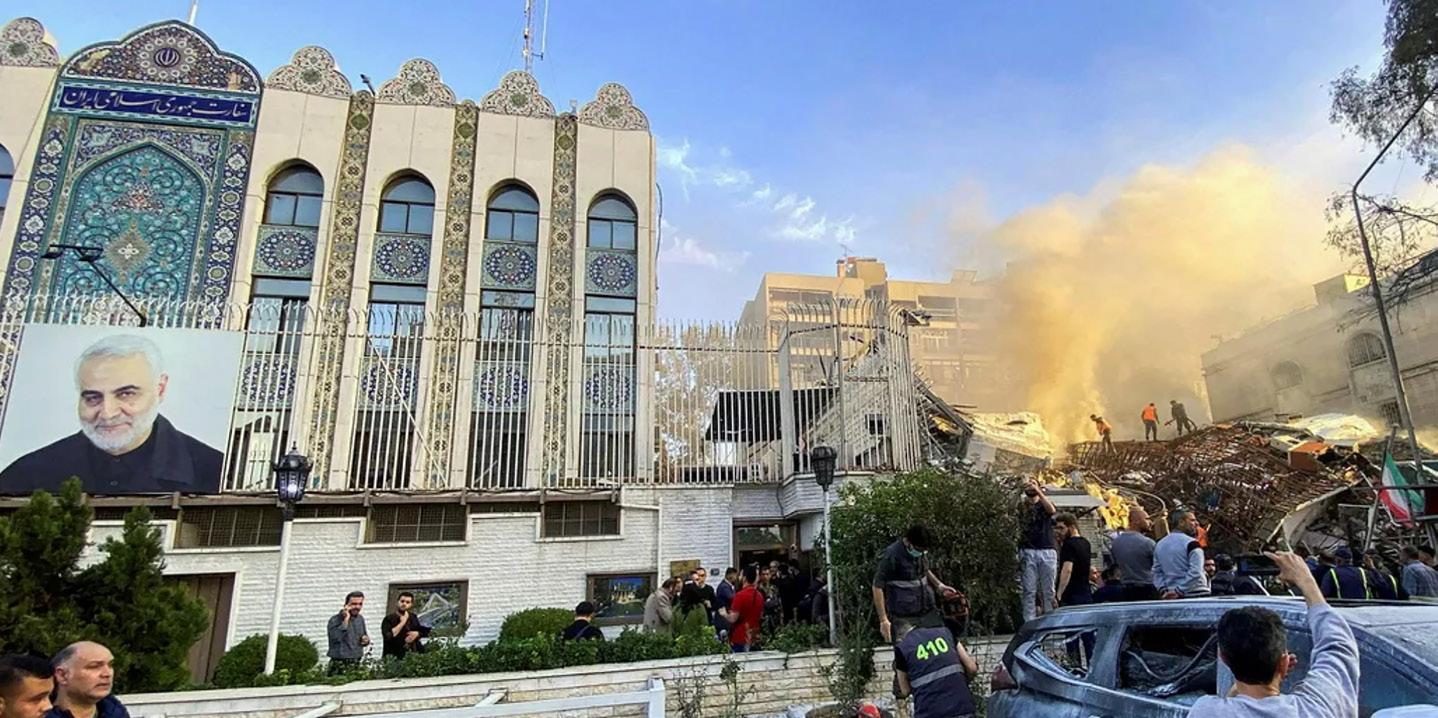
Gen. Mohammad Reza Zahedi was killed April 1 in a strike on the Iranian consulate in Damascus. Two weeks later, Israel is anxiously bracing for what’s next. Judging by the U.S. warning, the Iranian attack is already making its way here, and it could even arrive in the hours between the writing of these lines and their publication. After a few days of the usual marveling over the amazing targeted-killing capabilities demonstrated in the Syrian capital – what brilliant intelligence forces, what precise weapons – the time to pay the price is approaching, and the cost this time may be unbearably heavy. In any case, it will exceed the value of the killing, which may have been justified but, like all of Israel’s targeted killings, was unnecessary, pointless and, this time, probably also dangerous. Zahedi was a military man; his elimination, like all of Israel’s targeted killings, was meant to send a message of deterrence and to reduce the
military capabilities of the other side – Iran, in this case. Is there even a single officer in the Israeli military whose killing would significantly affect Israel’s military capabilities? There is not, and there never will be. Why is it that we always tend to believe that in Hamas, Hezbollah or Iran are officers whose elimination would improve our national security? Israel killed Zahedi because the opportunity to kill him arose. And when that kind of opportunity knocks, no one in the top brass ever resists the sweet temptation to execute another brilliant James Bond mission. What
22.
will happen afterward? The fact that nothing has ever happened before is good enough for us. We have never paid a price for these killings. For several years now, Israel has provoked Iran constantly, in Lebanon, Syria and also on Iranian soil, and has not paid any price. It would be foolish to believe that the rope Israel has stretched will not break. That moment may have come. Even such a measured and sober military analyst as Amos Harel wrote in Haaretz Friday that the killing of Zahedi and that of members of Ismail Haniyeh’s family in Gaza on April 10 were carried out without sufficient consideration of the consequences. Harel reported that the relevant Israeli officials apparently did not discuss the implications of the acts at all. It takes an insane amount of arrogance to think that Iran will never react to these provocations. Anyone who embarks on such a dangerous adventure as killing a Quds Force commander in Lebanon, without first debating the consequences, is a dangerous and irresponsible person for whose actions we will
all pay the price. Harel says the assassination in Damascus was carried out following pressure from the military. The political leadership, which approved the operation – Prime Minister Benjamin Netanyahu, to be explicit – bears all the responsibility and the blame for the results, of course.
This must said, loud and clear: If a war with Iran is ignited this week, or if Iran launches a serious attack on Israel, the responsibility will lie with those who approved the assassination in Damascus.
This is already the second targeted killing of Iranians since the war in Gaza began. Where Iran is concerned, there are no questions of morality or justice, only of wisdom. To provoke Iran at this time – while the Israel Defense Forces is slogging away and bleeding in Gaza, Israel’s border with Lebanon is burning and the West Bank is threatening to do so as well – is a dangerous act that cannot be ignored. It was clear on the day of the strike in Damascus, while Israelis were winking at each other and drooling over the reports. It is doubly clear now, on the verge of an Iranian attack. It’s hard to believe that even after it Israel will begin to demonstrate restraint and reason: The Israeli counterattack will follow immediately and there we are, at war with the most dangerous and powerful enemy Israel has ever faced.
Is this what the masterminds, the people who issued the orders, the people who carried out the assassination in Damascus wanted? Is this what we Israelis want? Is this really what we need right now, war with Iran?
Just don’t say, again, that there was no choice. There was a choice: not to kill. Even if it is deserved, even if it is permitted and even if it is possible. The person who sent the assassins put Israel at risk of war with Iran.
Jordan and Israel
JORDAN’S HELP AGAINST IRAN SHOWS RELATIONSHIP WITH ISRAEL STILL STRONG, DESPITE GAZA
On Saturday night, dozens of drones launched by Iran toward Israel were intercepted by Jordanian air force jets as they crossed the kingdom’s airspace.
The military assistance provided by Amman to Israel was welcomed enthusiastically in the Jewish state, but also came as a surprise to many Israelis, since the Hashemite Kingdom has been a source of relentless criticism of Israel’s war against Hamas, and has been under intense domestic pressure to break off diplomatic relations with Jerusalem.
To some commentators, however, Amman’s intervention on Saturday night did not come as a surprise.
Ghaith al-Omari, a
native Jordanian and a senior fellow at The Washington Institute for Near East Policy, said the kingdom’s dramatic show of support proved the strength of the security alliance between Amman and Jerusalem.
“Despite all of the political tensions between Jordan and
Israel, the military and intelligence relationship never stopped,” he said. “As a matter of fact, the worse the politics gets, the closer the militaries get, because they both understand the need to maintain this relationship. This is part of both Jordan’s military doctrine and Israeli military doctrine.”
In 1994, Jordan became the second Arab country to establish diplomatic ties with
Israel (after Egypt in 1979). Jordan sees itself as the custodian of the Muslim holy sites in the Old City of Jerusalem, including the Al-Aqsa compound, and the two countries have strong security and intelligence cooperation. But relations between Amman and Jerusalem, frequently under strained in recent years, have become markedly more tense since the start of Israel’s war with Hamas.
Israel provides Jordan with gas through a multi-billion-dollar deal, and with water as part of the 1994 treaty. In November, Jordan’s Foreign Minister Ayman Safadi announced that his country would back out of a United Arab Emirates-brokered deal intended to have
Jordan supply solar energy to Israel in return for Israel giving it desalinated water.
But in March, Amman reportedly asked to extend it by an additional year. Israel has replied to Jordan with a request that Jordanian officials moderate their vocal criticism of Israel.
“What happened on Saturday night should be a reminder not only to the Jordanians but also to the Israelis of the importance of their relationship,” al-Omari said.
Amman is aware that it is walking a thin line between its strategic alliance with the US and Israel — a source of substantial financial aid and stability in a tumultuous region — and its commitment to the Palestinian cause.
24.
About half of Jordan’s population is Palestinian refugees and their descendants.
Jordan has gone above and beyond to signal its support for Palestinians in Gaza during the ongoing conflict. It was the first country to recall its ambassador from Tel Aviv when Israel fought back in the wake of Hamas’s October 7 massacre, it has called incessantly for a ceasefire, and has delivered substantial amounts of aid to Gaza by air and land.
After news came out that the kingdom’s air force had intervened in support of Israel against Iran, official media channels on Sunday morning downplayed its role in the event.
The official news agency Petra, as has been its custom in recent months, opened its front page with the latest updates from Gaza. It also relayed a vague government statement calling “on all parties” to show “restraint amid regional tensions” in order to prevent a “dangerous escalation.” It did not specify who those parties were.
The same communique fleetingly mentioned toward the end “recent incidents” involving the interception of unspecified “foreign objects in Jordanian airspace to protect citizens and residential areas,” adding that while “some fragments fell in various locations, no significant damage or injuries were reported.”
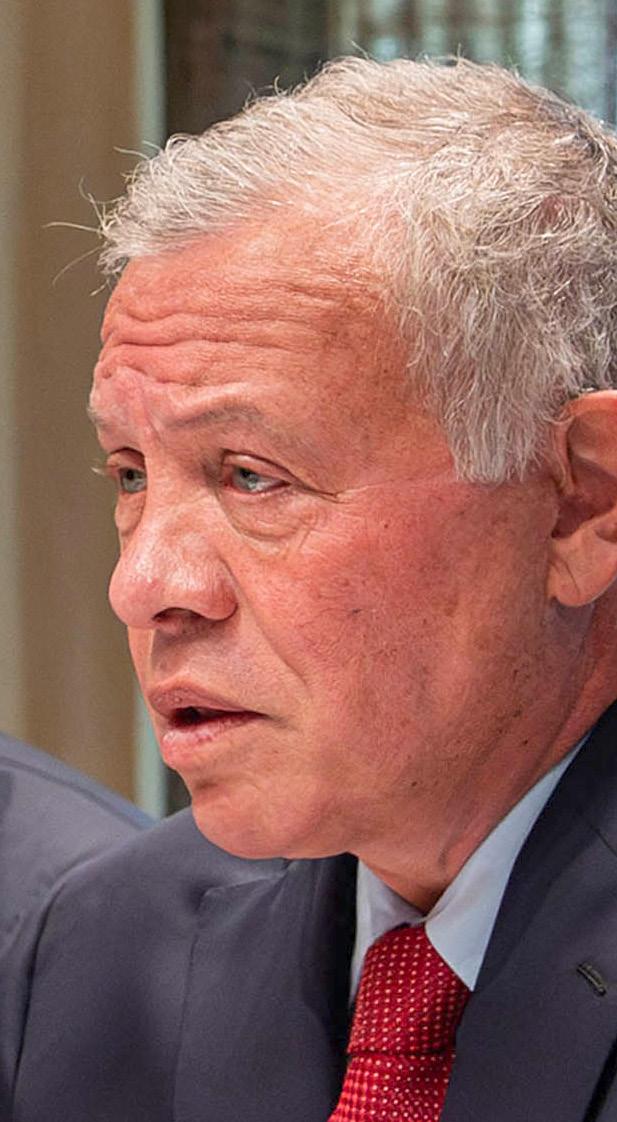
Reading other Jordanian news websites on Sunday, one would be hard-pressed to believe that in an act of war the night before, hundreds of projectiles carrying tons of explosives traversed the country’s skies.
KING ABDULLAH II
night may be due to Iranian threats that Jordan will be the Islamic Republic’s “next target” if it cooperates with Israel.
PRINCE HUSSEIN
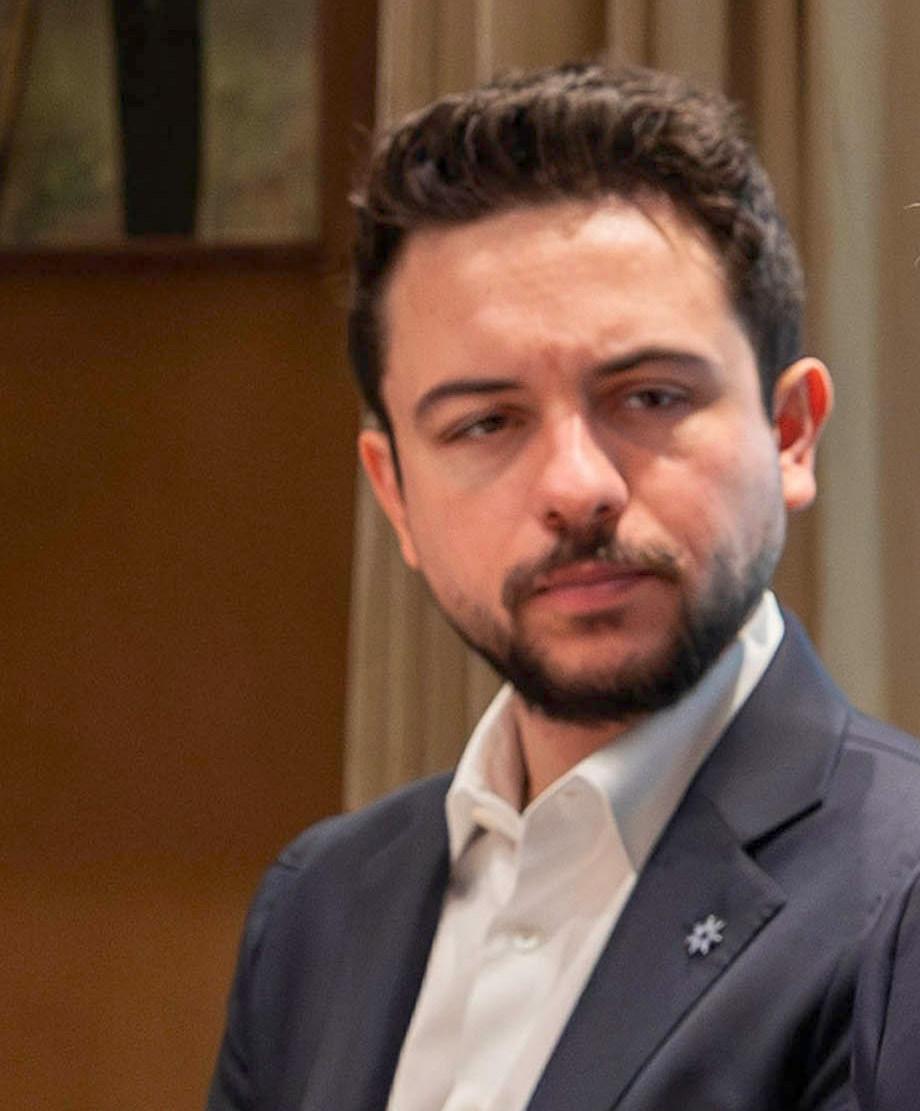
National newspapers limited themselves to relaying official statements formulated in vague language. In one such statement, Prime Minister Bisher Al-Khasawneh pledged to take legal action against media outlets that “do not source their information from official and credible channels,” after false rumors spread that a state of emergency had been declared in the country.
The government’s caution in publicizing the events of Saturday
Later on Sunday, Safadi, the Jordanian foreign minister, reportedly summoned Iran’s ambassador to warn Tehran that it must stop questioning Jordan’s position, after it assisted Israel.
In fact, Jordan has fretted over Iranian interference in its domestic affairs for years, loath to become another pawn in Tehran’s regional power moves, which have already impacted the internal political landscapes of Iraq, Syria, Lebanon and Yemen.
After Saturday night’s events, Amman is concerned that a possible
king of jordan
Crown Prince
Israeli retaliatory attack using its airspace would give Iran a pretext to target Jordan directly, or attempt to destabilize it, al-Omari said.
“The Iranians have their eyes on Jordan, they look at it as the weakest link in the region,” he added. “And the Jordanian military considers Iran to be the most prominent threat in the area, due to the presence of Iran-sponsored militias on the Syrian border and the eastern border [with Iraq]. They are very concerned about the Iranian influence extending into the West Bank [which shares a long border with Jordan] through Hamas.”
In an effort to prevent Iran-backed terrorist groups, be they Hamas or Shiite militias, from becoming entrenched in its territory, Jordan has conducted a series of airstrikes inside Syria in recent months, targeting drugs and
weapons smugglers reportedly linked to Tehran.
Multiple factors indicate the recent wave of protests that has engulfed the country is likely being steered by the Muslim Brotherhood, the Islamist movement that spawned Hamas — which also receives strong backing from Iran.
As for Iran-backed Shiite militias on Jordan’s borders, an official of one of those groups in Iraq revealed operative plans to establish a Jordanian militia with 12,000 armed members that would be subordinate to the Iran-led resistance axis. All of this is not a “cause for alarm, but definitely a concern for Jordan,” said al-Omari.
Preventive efforts by Jordanian security forces against an Iranian encroachment are facilitated by the fact that the Jordanian public is strongly
THE KING OF JORDAN SHOWED HIS TRUE COLORS DURING THE DEFENSIVE
RETALIATION FROM IRAN AGAINST ISRAEL.
CAUGHT BETWEEN POPULAR SUPPORT FOR PALESTINIANS AND THE THREAT OF
IRANIAN INFLUENCE, AMMAN
DOWNPLAYS ITS ROLE IN DOWNING DOZENS OF ISRAEL-BOUND DRONES
opposed to Iran, he noted. The reason is twofold.
“Firstly, Jordanians see what the Iranians and their allies did in Syria – it’s hard to like Iran after that,” he said, referencing the military support given by the Islamic Republic to the Assad regime in crushing rebels in the “Secondly, Jordan is a very conservative Sunni country, with no Shiite minority. There is a strong anti-Shiite sentiment. There was a time a few years ago when Iran actually tried to apply some of its religious soft power in Jordan. It raised concerns in Jordanian society,” al-Omari said.
He predicted that the more conservative camp in the Jordanian government will use the ostensible link between the demonstrators, the Muslim Brotherhood and Iran as a way to delegitimize the pro-Hamas protests.
“If you look at the op-
eds in the three main Jordanian daily papers in the last couple of weeks, which are not fully independent [i.e., they follow the government line], you will find a series of articles criticizing the demonstrations and drawing a link with the Iranians,” he said.
“After October 7, there has been a hawkish camp in the Jordanian government saying that [pro-Hamas] protests were overstepping the line. My sense is that the more conservative side will use [Saturday’s attack from Iran] as a way of saying that things are too unstable right now to allow this space for demonstration or for disruption,” al-Omari added.
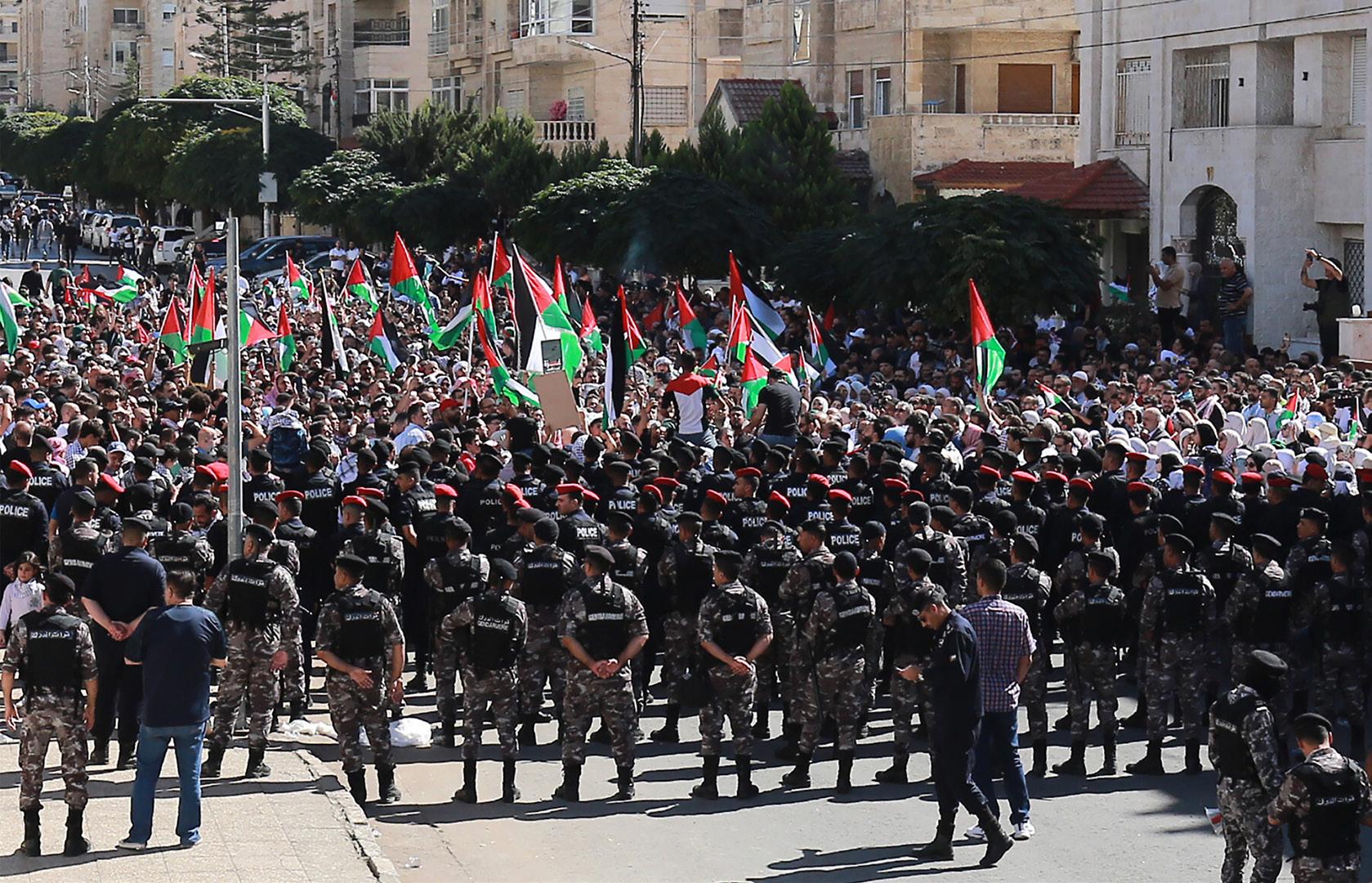
While Amman may be attempting publicly to downplay Iran’s act of war across its territory, the Jordanian population appears to be fully aware of what happened, like the many anti-Israel netizens from around the world,
26.
WHILE AMMAN MAY BE ATTEMPTING PUBLICLY TO DOWNPLAY IRAN’S ACT OF WAR ACROSS ITS TERRITORY, THE JORDANIAN POPULATION APPEARS TO BE FULLY AWARE OF WHAT HAPPENED.
who took to social media to make vitriolic comments against King Abdullah II. One X user wrote “Congratulations to King of Jordan, who not only failed to support the fellow Arab Palestinians but also took the extra mile to support their genocidal murderer.”
A satirical image circulating online even depicted the monarch wearing an Israeli army uniform. Regional security sources said drones were brought down in the air on the Jordanian side of the Jordan Valley that were heading in the direction of Jerusalem, while others were intercepted close to the Iraqi-Syrian border.
In the aftermath of the attack, in neighborhoods south of the capital, several downed drones were seen. Residents gathered around the remnants of one suspect-
ed large drone that fell in a commercial area of the city’s Marj al-Hamam suburb.
Serena Bilanceri, a freelance journalist residing in Amman, told The Times of Israel that when the Iranian drones and missiles flew over Amman on Saturday night, she heard “people screaming from the houses nearby” in fear. “But you could also hear some shouting ‘Allahu Akbar,’” a chant of joy.
AMMAN
Syria’s War SWEDEN LAUNCHES WAR CRIMES TRIAL AGAINST FORMER SYRIAN OFFICER
Sweden has launched the trial of a former Syrian army officer over his alleged role in war crimes committed in 2012 during the country’s civil war.
The case against Brigadier General Mohammed Hamo, who resides in Sweden, opened on Monday. The trial is one of a very small number thus far against high-ranking Syrian government or military officials, despite efforts in Europe to implement justice against those responsible for human rights abuses during Syria’s 13-year civil war.
Hamo is charged with aiding and abetting abuses of international law. The 65-year-old former military official is accused of participating in operations that “systematically included attacks carried out in violation of
the principle of distinction, caution and proportionality”, during his time as brigadier general in the Syrian army between January and July 2012. Prosecutor Karolina Wieslander read out the charges which were described as constituting “a serious crime”. Hamo contributed, through “advice and action”, to the Syrian army’s “indiscriminate” warfare, according to the case.
The prosecutor also said Hamo worked in the Syrian army’s 11th Division and was vital in making “strategic decisions and [implementing] military operations”.
Hamo’s defence lawyer said her client maintained his innocence, claiming he could not be held liable for the actions “as he had acted in a military
context and had to follow orders”. According to estimates, nearly half a million people have been killed in the Syrian civil war, which began after the government’s repression of pro-democracy protests spurred unrest between the regime of Bashar al-Assad and the opposition.
Since the war began in 2011, half of the country’s pre-war population of 23 million have fled the country, igniting a wave of migration in the Middle East and Europe.
However, few Syrian officials have been brought to trial.
In November, France issued an international arrest warrant for Assad, accusing him of complicity in crimes against humanity and war crimes over chem-
28.
ical attacks in 2013.
Three other international warrants were also issued for the arrests of Assad’s brother Maher, the de facto chief of the army’s elite 4th Division and two generals.
In March, Swiss prosecutors charged an uncle of Bashir with war crimes and crimes against humanity. However, Rifaat al-Assad – who recently returned to Syria after 37 years in exile – is unlikely to show up for the trial, for which a date has yet to be set. In January 2022, a German court sentenced former Colonel Anwar Raslan to life in jail for crimes against humanity in connection with “state-sponsored torture”.
Activists claim that the case against Hamo strikes a blow by putting the first military official on the stand over army operations.
“This trial is important because it’s the first time that anyone from the Syrian government or the Syrian army is actually put on trial for the attacks that took place,” claimed Aida Samani of the Stockholm-based Civil Rights Defenders human rights group. “The attacks in and around Homs and Hama in 2012 resulted in widespread civilian harm and an immense destruction of civilian properties,” Samani added. “The same conduct has been repeated systematically by the Syrian army in other cities across Syria with complete impunity.”
If convicted, the former general faces up to 18 years in jail and even life imprisonment, the activist suggested.
Little is known about Hamo, who in July 2012 defected from the Syrian army and
joined those fighting to remove President Bashar al-Assad from power.
Syrian opposition activists say he was involved in the fighting in the once rebel-held neighbourhood of Baba Amr in Homs, Syria’s third-largest city.
He lived in central Sweden until he was arrested over his supposed participation in war crimes in 2021, but he was swiftly released due to a lack of evidence.
Several plaintiffs are set to testify at the trial, including Syrians from the cities that were attacked and a British photographer who was injured during one strike.
The trial at the Stockholm District Court is planned to run for 18 days, with the last court session on May 21.
MOHAMMED HAMO IS THE FIRST SYRIAN OFFICER TO FACE TRIAL IN EUROPE OVER MILITARY OPERATIONS
CIVIL WAR.
IN THE
Syria’s War
US AND UK COMPLICIT IN DETENTIONS
AT SYRIAN CAMPS WHERE TORTURE RIFE, SAYS AMNESTY
The US and UK are complicit in the detention of thousands of people, including British nationals, in camps and facilities in north-east Syria where disease, torture and death are rife, according to Amnesty International.
In a report, the charity says the western-backed region’s autonomous authorities are responsible for large-scale human rights violations against people held since the end of the ground war against Islamic State (IS) more than five years ago.
Amnesty says the US is “involved in most aspects of the detention system”, which consists of at least 27 little-reported facilities, where suspected IS affiliates are held, and al-Hawl and Roj camps.
According to the re-
port, 56,000 detainees include 30,000 children and 14,500 women, more than 20 UK nationals, as well as people stripped of their British citizenship – most notoriously Shamima Begum (in Roj), who was 15 when she left her east London home to travel to IS territory.
The UK has provided more than £15m to help expand a large Syrian Democratic Forces (SDF) facility called Panorama, which detains men and boys who have been denied access to adequate food and medical care, leading to illnesses and diseases, including a severe outbreak of tuberculosis, which is killing one or two people a week, says Amnesty.
Sacha Deshmukh, the charity’s UK chief executive, said: “Continued inaction from the
government amounts to connivance in the unlawful detention of UK nationals amid misery, disease and possible death.
“The UK government has a responsibility for all its citizens, including Shamima Begum, which it can’t cast off when that might suit it.”
He said the UK should stop blocking its citizens’ return and help establish a fair process to identify who should be released and bring IS criminals to justice.
The report, which includes interviews with 126 current or former detainees, contains harrowing details of torture.
Yusuf (not his real name), one of eight men detained in an SDF detention facility on the outskirts of al-Shaddadi city who spoke to Amnesty,
30.
said: “The worst was when they came inside the room … carrying plastic pipes, cables, steel pipes, and they beat us everywhere … Every 15 days, they would take us out, in the yard, all naked … [The guards] were raping people with [a] stick … Once they took me [out of the cell] with another guy … They brought an electricity cable from the generator, and they kept torturing us by electricity … I think the guy next to me died. He stopped moving and screaming. Another detainee said when US soldiers visited the facility in December 2021 “they were able to see the blood on the wall”.
The report says there are high levels of gender-based violence in al-Hawl, including attacks against women by IS affiliates for perceived “moral” infractions, and sexual exploitation by members
of the security forces and private individuals, while women have also been unlawfully separated from their children.
Among those held in the detention system are IS victims, including victims of the Yazidi genocide, of forced marriage to the armed group’s members and of child recruitment, according to Amnesty. It says most people have not been charged, while prosecutions that have taken place have been reliant on “confessions” extracted by torture, without legal representation. Agnès Callamard, Amnesty International’s secretary general, said: “The US government has played a central role in the creation and maintenance of this system in which hundreds have died preventable deaths, and must play a role in changing it.”
The autonomous
authorities told Amnesty they would act on evidence of violations but had not received any complaints “and if this happened, they are individual actions”. They criticised the international community for failing to “fulfil their legal and moral obligations”, and countries with nationals in the detention system for leaving them “alone in dealing with the consequences” of the fight against IS.
The US state department said it urged all groups in Syria to “uphold human rights”, and worked with “appropriately vetted” groups and individuals. It said the only solution was the “repatriation and return of displaced persons and detainees to their countries of origin”, so that the perpetrators can “be held responsible for their crimes by competent rights-respecting judicial processes”.
REPORT SAYS THOUSANDS OF PEOPLE HELD IN LITTLEREPORTED FACILITIES WHERE AUTHORITIES ARE VIOLATING HUMAN
RIGHTS
ON A LARGE SCALE
Not ting ham Forest

NOTTINGHAM FOREST SEASON TICKET PRICE RISES CRITICISED BY FANS GROUP
Premier League strugglers
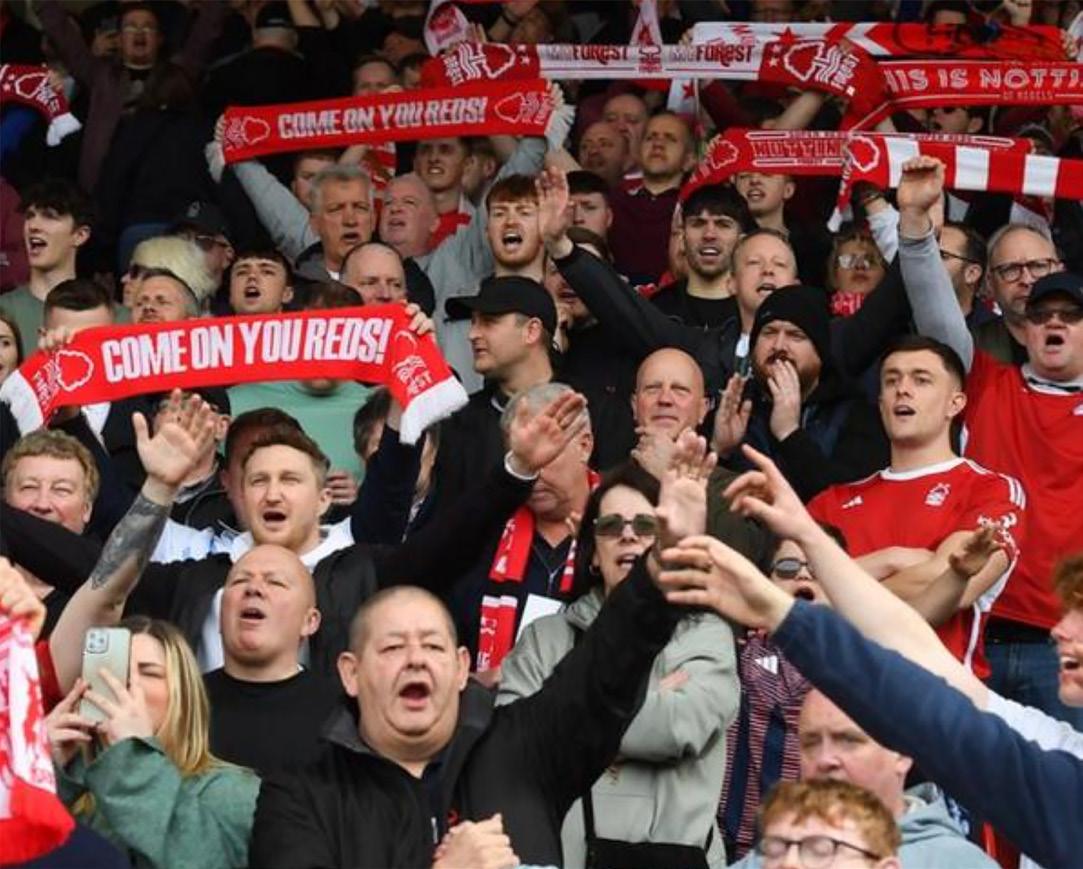
Nottingham Forest’s increase in season ticket prices for the 202425 season has been strongly criticised by a fans group.
An adult season ticket in Zone One of the Brian Clough Upper stand has increased by 28% while a child’s season ticket has increased by up to 111%.
Nottingham Forest Supporters’ Trust said it “strongly opposes” the rise.
It added the average price increases are “totally disproportionate to the current inflation rate”.
The inflation rate in the UK is currently 3.2%.
The most expensive adult ticket
32. Sport
for next season at Forest, who have five games left and are at risk of Premier League relegation, costs £850.
That season ticket, in Zone One of the club’s new pricing bands, is up from £660 this season, while the cheapest has increased from £465 to £550.
The Supporters’ Trust added: “It is accepted that season card pricing at Forest had been at the lower end of that at other Premier League clubs.
“However, such extreme increases over a single season, during the ongoing cost of living crisis, will massively impact a large number of loyal fans and undoubtedly mean that many will now be priced out of renewing - a concern shared with the trust by many supporters.
“There is little consistency to the percentage increases for different sections of the ground with no apparent logic or rationale explained for this seemingly arbitrary decision.”
Nottingham Forest’s total 2023 revenue was £155m of which £11m was matchday income. Manchester United had the highest matchday income with £136m in 2022-23.
WHAT ARE SOME OF THE PRICE RISES?
• Youth season tickets have been changed with the age bracket now 14-17, compared to 12-19-year-olds last season.
• A child’s ticket can be bought for those between four and 13 years old for a blanket price of £190, up from last season’s cheapest child’s season card of £90, an 111% increase.
• A senior ticket in the Zone Two bracket of the Brian Clough Lower has gone up from £385 to £500, a rise of almost 30%, while adult prices in the same area have increased by 27%.
• An adult ticket for the majority of the Trent End Upper and Lower has increased by 22.5%.
WHAT DID THE CLUB SAY?
Forest chairman Tom Cartledge said on the club’s official website: “We aspire to keep our
season cards amongst the most affordable in the league.
“At the same time, it is imperative that the club continues to grow financially in order to remain competitive, particularly in light of the forthcoming squad cost ratio rules, which will cap spending as a percentage of club revenues.”
Forest say they have an 11,000-person waiting list for season tickets and, despite the increase, believe the prices keep the tickets among the best value for money in the Premier League.
They also said on social media on Tuesday that renewals are up 50% compared to the same time last year.
They are against appealing their four-point deduction for breaking profit and sustainability rules, with the case due to be heard next week.
It comes after Liverpool increased their season ticket prices by 2%, despite supporter protests. Fans refused to display flags in the Kop during last week’s 3-0 Europa League defeat by Atalanta.
Last month the Tottenham Hotspur Supporters’ Trust said it was “hugely disappointed” Spurs are raising their season ticket prices by 6%.
Spurs are also removing the concession for new senior season ticket holders - those aged 65 and above - from 2025-26.
Ukraine aid package could help Kyiv slow Russia’s advance
VOLODYMYR
ZELENSKY Ukrainian President
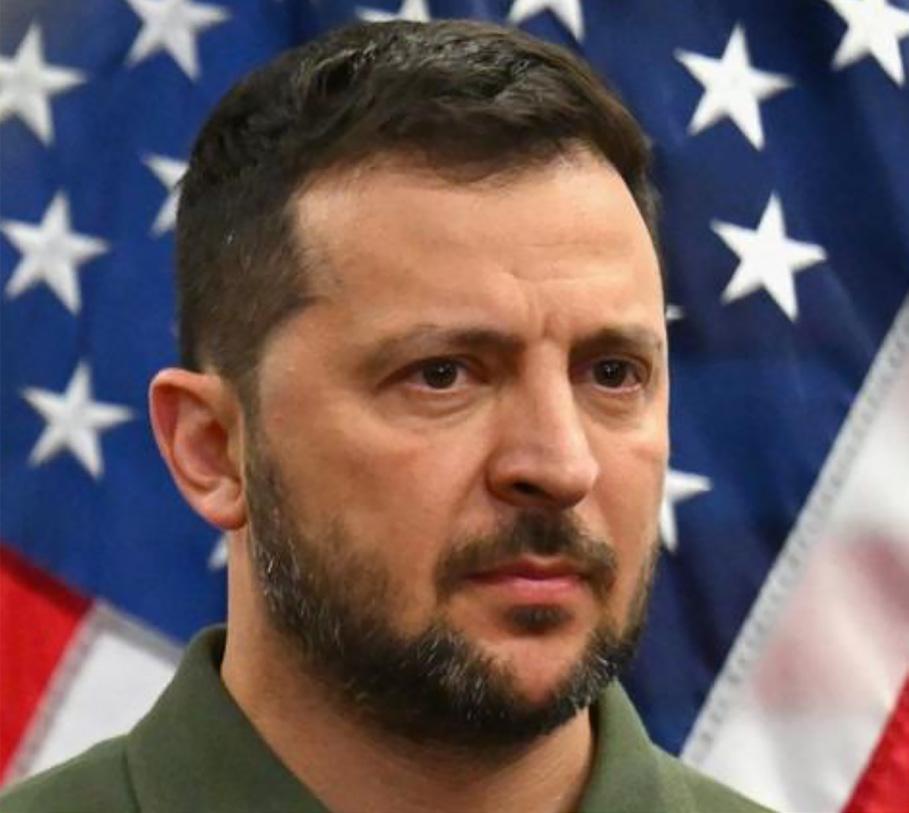
President Volodymyr Zelensky has expressed his gratitude to the US House of Representatives for approving a new $61bn (£49bn) package of military assistance for Ukraine after months of delays. He said the aid could save thousands of lives.
While it’s not uncommon for a country’s future to be decided by politicians, a nation’s very existence hinging
on a vote 5,000 miles away is as extraordinary as it sounds.
For Ukraine, the sixmonth wait for this military package has been as costly as it has been frustrating.
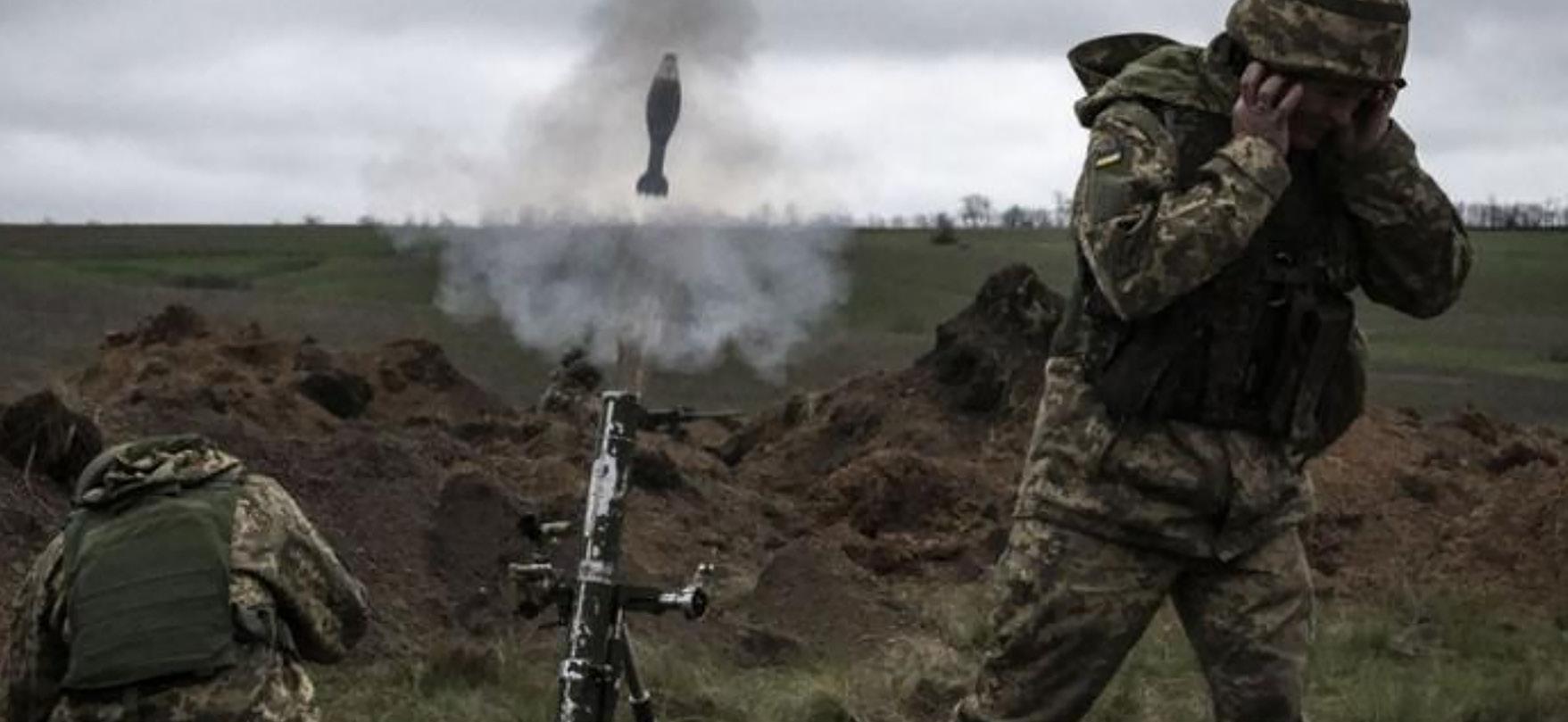
Dwindling ammunition has cost it lives and territory.
In this period of rare boosts for Kyiv, this was a biggie - the arrival of American
weaponry will allow its beleaguered troops to do more than hang on. But it’s no silver bullet.
US House approves crucial $61bn war aid for Ukraine So, what is the package going to do?
It is likely to include air defence systems, mid to long-range missiles and artillery shells.
Ukraine’s recent lack of them has led to Russian forces capturing hundreds more square kilometres of territory.
When the aid arrives, Ukraine can potentially challenge Russia’s air superiority, frustrate their supply lines and slow advancing troops.
For Vitaliy, a serving soldier who we bump into in central Kyiv, it’s
important to focus on the positives. “Every cent matters,” he says. “It is very much needed. We need everything. Every cartridge, every cent, every positive thought. We need all of it.”
When I was in the Donetsk region last month, soldiers said most of the artillery rumbles were coming from the Russian side. Cities like Kostyantynivka and Kramatorsk were bracing for what might be coming. This aid might save those cities.
It won’t give Ukraine the instant means to start liberating territory and force Russia back - but it gives a window for that to happen in the future.
The consensus in Kyiv and Washington is that without this American
34. Economics
help, Ukraine would lose.
On a miserable Sunday morning, the warmth of the Kyiv metro will always beat the wet streets above. It’s where we meet Maxym, who’s pleased with the US aid finally being approved.
“I’m really happy about it,” he says. “I’m just a bit disappointed it took so long. Anyways, it’s better late than never.”
Maxym is frustrated by the growing debate over whether Ukraine should negotiate peace with Russia at the expense of territory.
50,000 Russian soldiers confirmed dead by BBC
Ukraine warns of WW3 ahead of stalled US aid vote
“Russia doesn’t want to
negotiate,” he explains.
“They don’t want this middle ground that Europe and the US think will end this war. They want it all.”
We also meet a woman, Vita, holding her son’s hand and pulling him off a train. “How else can Ukraine survive without it?” she asks. “It can’t. We don’t have such an army and weapons.”
She then becomes emotional. “It’s impossible. We really want help, for our children to survive, so we wait.” She nods towards her son.
The past six months have not only revealed Russia’s dominance, but Europe’s inability to provide the same level of support as the US.
“We need to think about the hypothetical
eventuality the next package of US aid might not pass,” says Mykola Bieleskov, a research fellow at the Ukrainian National Institute for Strategic Studies.
“That’s why it’s up for the UK and continental Europe to increase weapon production to meet Ukraine’s requirements.”
As for a realistic goal this year for Kyiv, Mykola hopes this American aid will help stabilise the front lines. Despite the return of western unity behind it, the issue for Ukraine has always been the time it takes for help to arrive.
Russian President Vladimir Putin certainly doesn’t have to negotiate as many political hurdles when it comes
to military spending.
Democratic delays aren’t exclusive to allies overseas - Ukraine has its own issues with mobilising enough men for its war effort. A controversial conscription law has just been passed after months of debating and amendments.
The challenge for President Zelensky now is keeping the politics separate to the fighting. He’ll be under pressure to make this latest American offering count.
Can theyreach a deal?
U.S. AND ISRAELI OFFICIALS HAVE URGED THE GULF STATE TO EXERT MORE PRESSURE ON THE PALESTINIAN ARMED GROUP TO REACH A DEAL.
Qatar’s prime minister has said that his government is reviewing its role as a key mediator between Israel and Hamas after criticism by U.S. and Israeli officials, who have urged it to exert more pressure on the Palestinian armed group to reach a deal.
“We have seen insults against our mediation, and its exploitation for the sake of narrow political interests,” Sheikh Mohammed bin Abdulrahman bin Jassim Al Thani, the Qatari premier, said at a news conference this week.
“This has caused Qatar to comprehensively review that role.”
In late March, a flurry of shuttle diplomacy involving Israel, Hamas and mediators including the United States had raised hopes for
a new cease-fire deal in the war in Gaza. But those efforts appear to have reached a dead end for now, according to Israeli and Hamas officials.
It was not immediately clear that the Qatari prime minister’s comments would mean any change in the country’s role. Qatari mediators have remained in contact with Israeli representatives and have not changed their approach in recent days, said an Israeli official familiar with the talks, who spoke on the condition of anonymity to discuss the sensitive deliberations.
Qatar, a small Persian Gulf nation, has carved out an influential position as a mediator that can shuttle between Western countries and armed groups like
Hamas and the Taliban. It hosts much of Hamas’s political leadership and has helped broker cease-fires during previous escalations in Gaza, including last November.
Since the war broke out in October, Qatari mediators, alongside officials from Egypt and the United States, have sought to broker a deal for a cease-fire in Gaza and the release of hostages held there. Over 100 hostages were released in a weeklong truce that began in late November.
While neither side has publicly released its proposals, Hamas has demanded a permanent end to Israel’s military offensive, the complete withdrawal of Israeli forces and the return of many
Palestinians to northern Gaza in exchange for the release of hostages.
Israeli officials have said their negotiators had proposed allowing some Palestinians to return to northern Gaza, but would not allow Hamas to reconstitute its rule there. And they have said that they intend to launch a military operation in the southern Gaza city of Rafah whether or not a truce is declared.
The two sides are also divided over how many hostages Hamas would free in the first phase of a truce in exchange for Palestinian prisoners held by Israel.
Some U.S. and Israeli officials have said Doha is not doing enough to wring con-
36.
QATAR SAYS IT IS REVIEWING ITS MEDIATOR ROLE AS ISRAEL-HAMAS TALKS STALL
cessions from Hamas.
Israel had hoped that Qatari mediators would exert significantly more pressure on the armed group by threatening to expel its leaders from Doha or close its bank accounts, the Israeli official said.
And this week, Representative Steny H. Hoyer of Maryland, a Democrat, said that Doha should face consequences if it is not tougher on Hamas.
“Qatar needs to make it clear to Hamas that there will be repercussions if it continues to block progress,” he said in a statement.
“If Qatar fails to apply this pressure, the United States must re-evaluate its relationship with Qatar,” he added.
In a statement, Qatar’s Embassy in Washington said the country’s leaders shared Mr. Hoyer’s frustration over the failure to reach an arrangement.
“Qatar is only a mediator — we do not control Israel or Hamas,” the embassy said, adding: “Blaming and threatening the mediator is not constructive.”
DIPLOMACY
THE GAME OF nations
The game of nations: The poor are the ones who pay the price: Israel admitted and said that it struck Iran and responded to the Iranian response. - Iran says that Iranian air defenses shot down several small drones with ground anti-aircraft guns at a very low altitude in the Isfahan province in the center of the country, and official Iranian assurances that the situation in the province and its nuclear facilities are completely safe. It is likely that everyone has come down
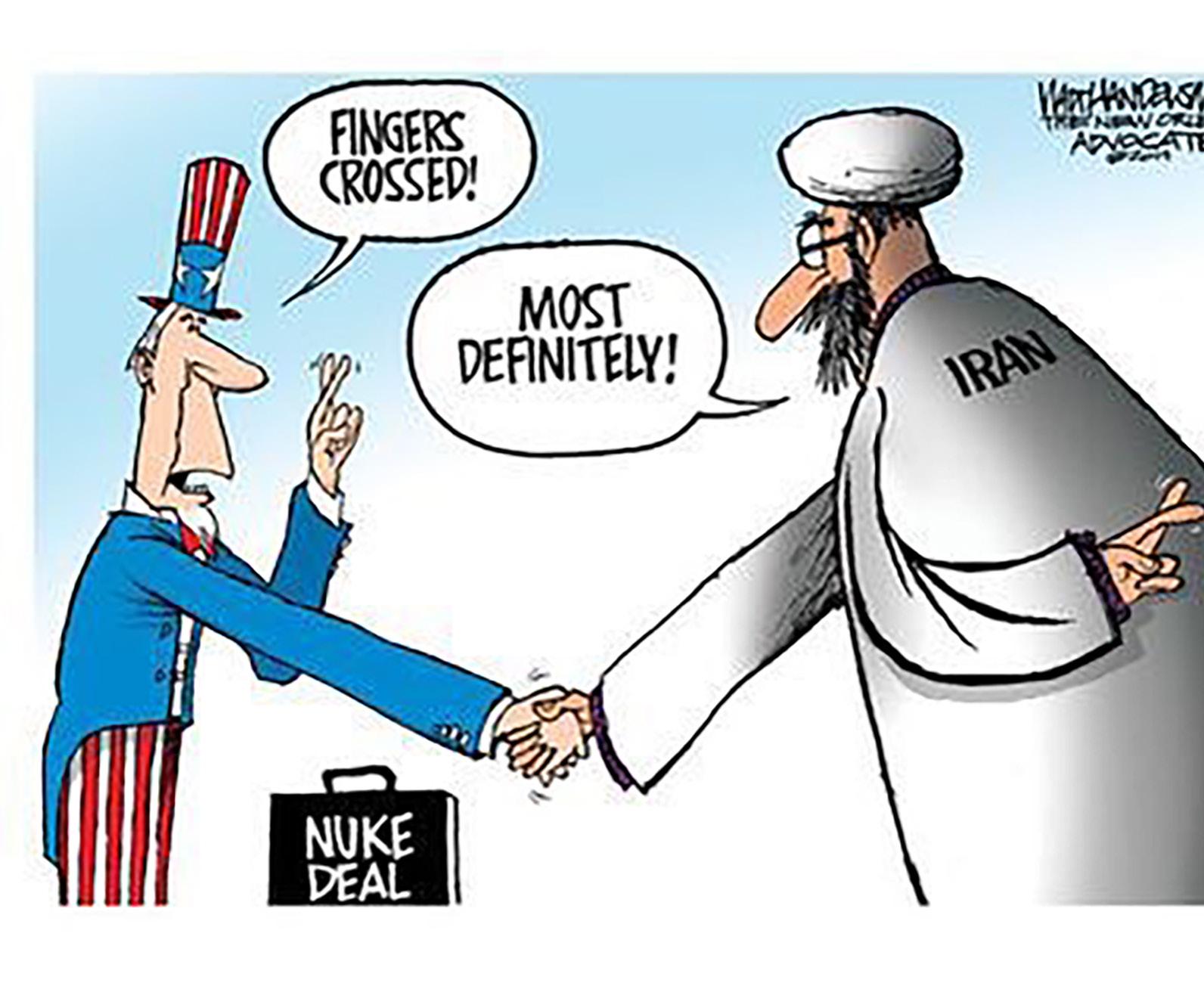
from the tree now, and the anxiety over the regional war has ended:
1. - The Americans do not want a regional war and no one wants it, and this saves everyone problems in the region.
2. - This response will be marketed in the media as a sufficient response to preserve Israel’s prestige. If the narrative proceeds appropriately, the case is over.
3. -Ben Gir says that the response to Iran is “weak.”
My hope is that the Israeli right will not be allowed to embarrass Netanyahu and the army commanders in order to respond and cause a regional war!
Rudwan Musa38.

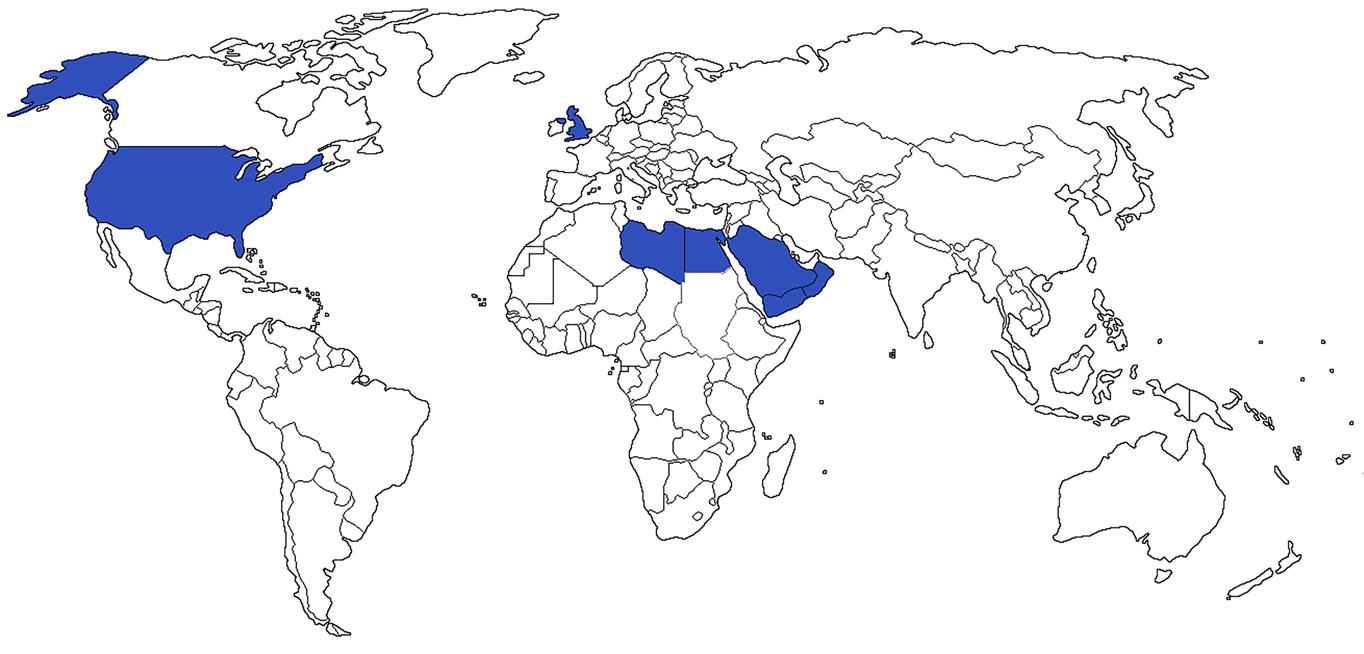
VISIT US CALL US EMAIL US WWW.GCC-INTL.COM +44(0)207 499 9982 INFO@GCC-INTL.COM GLOBAL CONSOLIDATED CONTRACTORS INTERNATIONAL LIMITED ARE AN EPC CONTRACTOR. WORK WITH US IN: LONDON, UK WASHINGTON, D.C., USA NORTH AFRICA BRANCH
THE GLOBAL
GULF
IN DOHA, QATAR UNITED
ENGINEERING • PROCUREMENT • TRADING • CONSTRUCTION MANAGEMENT • DEVELOPMENT
JOIN
THINKERS!
BRANCH
ARAB EMIRATES


EMPIRE CAPITAL LTD. 3 TREBECK STREET MAYFAIR LONDON W1J 7LS UNITED KINGDOM
+44 20 7499 2265 WWW.EMPIRECAPITAL.CO.UK
DESIGN BY: ORSOLYA PALYI