FR E E
The Serving Gettysburg College since 1897
Volume CXXIII, Issue No. 1· March 16, 2021
PAG E 9
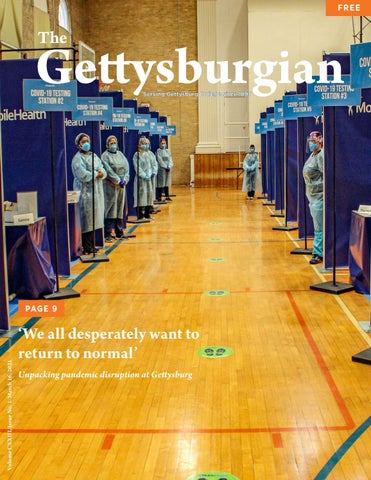
‘We all desperately want to return to normal’ Unpacking pandemic disruption at Gettysburg
THE GETTYSBURGIAN
1
A NOTE FROM THE EDITOR: On Storytelling and Taking Up Space BY ANNA CINCOTTA, EDITOR-IN-CHIEF
When I walked into The Gettysburgian office for the first time this semester, it felt a little too much like a museum. Old issues of the magazine were stacked up on the table we usually gather around during weekly editorial meetings, and a bowl of candy canes that were definitely too old to eat without at least a little bit of overthinking were still in the corner. Our staff meets on Zoom every Sunday now, but I still missed the office—and walking in felt a little like coming home. Initially, at least. It was seconds after walking in and flicking on the lights when I realized that it still felt like a museum because I was the only one there. That is, it’s the people that make the space so special for me. Still, it’s strange to think about how spaces have the power to hold memories— and how things that take up space can do the same. We haven’t printed The Gettysburgian since Feb. 27, 2020. Since then, our online presence has grown significantly and we’ve continued to amplify the stories that unfold at Gettysburg College, albeit from our respective homes and dorm rooms due to the ongoing risk of a virus that has forced us to reframe our lives. But there’s just something about print, isn’t there? Something that can’t be translated to a website or Facebook page. Creating a publication that we can hold in our hands lets us generate the kind of community that this pandemic often swallows up. This community is critical—especially when we can hold so little right now; when we watch and absorb so much through screens as a way to protect ourselves and each other. If this year has shown us anything, it’s that we need the kind of connection that instills a sense of togetherness, even if we’re physically apart. Providing a platform for openly voicing thoughts and concerns helps students feel less alone and more capable of building a campus environment that better reflects the values to which we collectively aspire. We are strongest and most effective in our change-making when we celebrate the identities and amplify the truths of our story-tellers in a way that demands attention. So here’s to a magazine that takes up space. Here’s to glossy photos and indepth stories and pages that actually turn. I hope this issue helps you feel like a part of something, because as isolated as we may be, I’m consistently and happily surprised by the amount that we share as members of this campus community. Happy reading!
Anna Cincotta ‘21 Editor-in-Chief The Gettysburgian
2
TABLE OF CONTENTS 4
Textbook Prices
Why do first-year students spend the most? Why are some departments more expensive than others? Our investigation unpacks these questions.
9
Sophomore Class
12
Unconventional Housing
The college decided to move students to single bedrooms in unique locations to mitigate the risk of the virus; here’s what we learned.
14
COVID Semester in Photos
20 Spring Sports Update We take a look at the Centennial Conference and analyze Gettysburg’s chances of returning to competition this spring.
22 NATS Singing Competition
The class of 2023 has yet to experience a full academic year on Gettysburg’s campus; we examine the effects of this disruption.
Gettysburg’s campus looks pretty different these days, so we captured some of the more striking changes to document this pandemic semester.
Students at the Sunderman Conservatory of Music placed as finalists and semifinalists in a singing competition this past semester.
10
18
23 Staff Editorial
Greek Life Changes
Four Gettysburgians spent the fall 2020 semester completing classes online in the Berkshires while constructing a tiny house.
Our staff makes the case for strengthening the college during the pandemic in order to ensure its longterm success.
(Photo Mary Frasier/The Gettysburgian)
Two chapters were suspended in the fall after violating health and safety protocols; we report on the implications for Greek Life as a whole.
Constructing Community
THE GETTYSBURGIAN
3
N E WS
Gettysburgian Investigation Finds Discrepancies in Textbook Prices Across Departments BY ANNA CINCOTTA
A
ny Gettysburg student who chooses to major or minor in chemistry must complete CHEM-107, or Chemical Structure and Bonding. According to data compiled by The Gettysburgian, more than 220 students took this course in the fall of 2019, and the cost of the required textbooks for this course, if they were purchased used from the college bookstore, amounted to $299.98, regardless of instructor. Conversations about the cost of higher education in the United States usually
4
turn to the skyrocketing tuition numbers affecting the accessibility of the undergraduate experience and promoting educational inequity. The average amount of debt acquired by student loan borrowers, according to the Federal Reserve, is now $32,731, and the annual cost of attendance at Gettysburg College eclipsed $70,000 after a 3.75 percent tuition bump was announced last summer amid the COVID-19 pandemic.
Textbooks, however, are an expensive part of the undergraduate experience that are often left out of the ‘total cost of attendance’ calculations made public by colleges and
universities across the country. The Bureau of Labor Statistics reports that textbook costs are increasing by more than four times the rate of inflation. An interactive chart published by the government agency also shows that, while tuition increased by 63 percent between 2006 and 2016, the cost of college textbooks rose by more than 87 percent. Gettysburg is no exception when it comes to high estimated textbook costs. Every year, enrolled students are expected to budget approximately $1,000 for ‘books and supplies,’ according to a breakdown of annual costs of attendance on the college website. Textbooks are also considered an ‘indirect cost,’ and not factored into the total
cost of tuition and fees.
for me,” said Emma Padrick ‘21.
“College already has a hefty price tag, and people forget that there are hidden costs from textbooks,” said Kate Delaney ‘21. “They create barriers for those who cannot afford them, and often low-price alternatives feel unacceptable for classes that require specific editions.”
Psychology major Rebecca Daly ‘22 also looks elsewhere in order to find more affordable course materials. “I tend to go for the cheapest options for textbooks,” Daly explained. “I also try to order early so I don’t have to worry about long shipping times, and use sites like ThriftBooks or secondhand sellers on Amazon.”
A survey conducted by Musselman Library found that over 30 percent of Gettysburg student respondents spent more than $400 on books and other supplies, including materials like lab manuals and clickers, during the 2019 fall semester.
(Photo Mary Frasier/The Gettysburgian)
Last spring, library employees published an executive summary of this report which indicates that more than half of the student respondents who reported receiving financial aid did not have enough funding left over to cover course materials. The survey results also showed that over 68 percent of Pell Grant recipients—students with the highest financial need—shared that they were paying for their books out of pocket. About 15 percent of respondents stated that they had struggled academically due to their inability to acquire course materials, and almost a quarter of respondents reported not purchasing the required books for their classes because of cost. Only 1 percent of students who responded to the survey indicated that they have not engaged in cost-saving strategies, like renting books from the bookstore or other sources and reselling course materials. “I buy or rent my textbooks used through sites like Chegg and Valore because the Gettysburg bookstore, while convenient, is far too expensive
Our Investigation In response to ongoing conversations about equity and hidden costs during students’ undergraduate experiences, The Gettysburgian’s team of editors began an investigation into the cost of textbooks at Gettysburg College. After breaking down the costs of the assigned textbooks across courses through the website for the campus bookstore, we were able to calculate the average cost of textbooks in different academic departments on campus. Our team used the ‘buy used’ costs of textbooks in the fall of 2019 in order to compile our data. The investigation found that certain departments on campus were more cost prohibitive than others in terms of textbook prices last fall. The average cost of a textbook for an introductory astronomy course in the fall of 2019, for example, was approximately $199. In the religious studies department, however, students spent an average of $48 on course materials per class. The cost of required materials for a biology course? About $150. Meanwhile, German studies students were only spending about $33.70 per class, on average. ‘ Padrick explained that she heard about high textbook costs prior to college, and researched cost-saving
alternatives. Still, certain parts of the process were surprising. “I was unprepared for how expensive some books were, and the disparity between disciplines,” she said. “I do think more STEM-based majors are much more cost prohibitive,” added Kate Delaney ‘21. “As an English major, a lot of the textbooks I purchase are classic literature or stories that can be found for very cheap or are even open access—I don’t spend nearly as much on textbooks as my roommates, because although I often have to buy more books, they are not as costly as most textbooks are.” Assistant Dean and Director of Scholarly Communications Janelle Wertzberger, who fielded the textbook costs survey last fall, indicated that the disparities in textbook costs across departments might be indicative of the cost of introductory course textbooks, which are often quite expensive in STEM and social science classes.
“The cost of tuition is outrageous. You can’t change that as a professor, but you can change what your books cost.” -Janelle Wertzberger “At the introductory level across the board, but especially in the sciences and social sciences, you will find expensive textbooks,” she said, citing last fall’s survey findings. “I think, in general, STEM classes—and a lot of classes at the 100-level—are more expensive classes than classes students take later on.” This makes courses more cost prohibitive for first-year students, who often enroll THE GETTYSBURGIAN
5
in multiple 100-level classes when they initially arrive on campus. Last year’s report also shows that they spend more on textbooks than students in the sophomore, junior, and senior classes. Currently, the campus bookstore at Gettysburg College does not make the ‘book list’ data, which consists of every book assigned each semester, available to Musselman Library staff. This complicates the picture for instructors and students, in that it often results in students spending money unnecessarily, particularly if they’re comfortable with reading a digital version through the library. Wertzberger explained that the ISBN numbers contained in the ‘book list’ allow librarians to cross-check
6
the library database to see how many assigned books they already have in their collection, and also provides the information they need to run the numbers through the library vendors database to see if they can purchase some of the materials and make them free for students. “Now there are some big exceptions there,” Wertzberger said. “STEM textbooks are really expensive, but those books are never available for library eBook licenses. The publishers don’t sell them that way because they recognize very clearly that it’s a revenue stream for them.” Still, Wertzberger expressed that students will often spend money on books that are available for free as digital eBooks because professors are
not aware that they are a part of the library’s collection.
Professor Perspectives The good news about textbook costs, specifically, is that solutions lie largely in the hands of college faculty who assign required reading materials for their courses. Open Educational Resources (OER) provide students with more opportunities for academic success free of charge. Research from the University of Georgia in 2018 also found that students with greater financial need see the most benefits from OER when it comes to measuring academic success. “The cost of tuition is outrageous,” said Wertzberger.
“You can’t change that as a professor, but you can change what your books cost—that’s within your control.” And moving to OER is “really doable,” according to Vice Provost and Dean of Arts and Humanities Jack Ryan. “It just requires a little legwork,” he added. This legwork might involve reorganizing a course’s structure around a new textbook, for example, or being more flexible about the books assigned for a course if they result in similar learning outcomes for students. Instructors at Gettysburg across all departments have access to zero-cost and lowcost materials made available through eBooks, the library’s digital reserve, and open educational resources on websites like OpenStax—an educational initiative at Rice University with peer-reviewed,
openly-licensed textbooks. “We have to continue to promote open source materials, and I know that the technology is out there to deliver course content in a much more effective way,” Ryan said. “There’s no reason why you can’t use digital documents in any class.” Political Science professor Bruce Larson explained that he decided to move to an open access textbook this year for his introductory American Government course after becoming uncomfortable with the notion of assigning costly reading materials. He didn’t want to be responsible for putting additional financial strain on families—especially during a pandemic. “If I’m spending my own money that’s fine, but in a way I’m spending for students— and that’s when it hit me,” he said. “It’s so strange that
I’m controlling the market. All of a sudden I got really uncomfortable with that.” Larson added that the open source textbook he’s using this semester through OpenStax is high quality and achieves his learning goals. He plans to use it when he teaches American Government next year in order to continue eliminating book costs for students who enroll in that 100-level course. Still, Larson noted that it’s more difficult to find more comprehensive texts that are open access. “If you’re going to use a textbook for a class, that’s what’s hard to find,” he said. Other professors have voiced concern over the quality of open access materials, and particularly textbooks. “I have reviewed some OER materials,” said Associate Professor of Economics Brendan Cushing-Daniels.
THE GETTYSBURGIAN
7
“They’re okay if not great.” He added that bigger publishing companies tend to have “more resources to spend and deeper market penetration” that allow them to “pay for high-quality graphics and illustrations.” Still, he noted that moving to lowcost and zero-cost classes is an important goal moving forward, and that professors should learn from colleagues who have successfully made the switch to more affordable course materials. Associate Professor of Environmental Studies Andy Wilson also indicated that he’s wary of the quality of open access materials for introductory classes. “I’m afraid my experience with open access textbooks is that they simply aren’t as good as the costly alternatives,” he said. “They are updated less often, if at all, and are generally less in-depth.” Wilson, like CushingDaniels, also noted that the graphics “are often terrible— which is a shame because STEM texts rely heavily on images.” Still, since he teaches more upper-level classes, he has found it easier to rely on alternatives like peer-reviewed articles to keep costs down. “There are more than enough [open access resources] for elective classes,” Wilson said.
Contextualizing Open Education: The COVID-19 Pandemic Ryan hopes that, given the uncertainty surrounding the pandemic and the abrupt instructional changes that forced many members of the faculty to engage in developing new technological skills, there will be more movment toward
8
open source materials for their courses. “I’m not sure that COVID is going to be the root cause of a lot of these changes, but one thing the pandemic did do was disrupt the normal approach to things,” he said. Wertzberger added that the pandemic and subsequent move to remote instruction last spring highlighted the reasons why she’s dedicated time and energy to ensuring the affordability of course materials for students. “COVID-19 really laid bare the inequities and discrepancies that were always there,” she said. “I do the work I do in open education because I think that it will fix the problem and its root.” Instructors who had already adopted open sources for their classes were more prepared last spring during the move to remote instruction—that is, all of their students could continue learning with the same course materials. Meanwhile, students who relied on library reserves because of affordability concerns when it came to buying expensive textbooks were left without the resources to succeed academically during remote learning, placing them at a distinct disadvantage.
Incentivizing the Use of Open Educational Resources In an effort to encourage parttime and full-time members of the Gettysburg College faculty to make the move toward zero and low-cost classes, Musselman Library and the Johnson Center for Creative Teaching and Learning teamed up to provide grant opportunities for individual
instructors who adopt open access materials, starting at about $500. “The real incentive would be to reward instructors for doing this [open education] work in the tenure and promotion system,” Wertzberger said. “Whatever is rewarded will be done, so if adopting an open textbook counted in the scoring for tenure and promotion, you better believe a lot more people would be doing it.” This change, if applied to the tenure and promotion process, would be structural, according to Wertzberger, and could result in real transformation when it comes to textbook affordability at Gettysburg College.
“ I’m afraid my experience with open access textbooks is that they simply aren’t as good as the costly alternatives.” - Andy Wilson More access to quality open access textbooks would also make it easier for professors concerned about learning outcomes to adopt more affordable materials. In addition to grants, tenure and promotion advantages, and higher quality materials, putting students first was also cited as an reason to prioritize OER. “Income inequality has grown substantially in the United States, and we can’t have this group of kids who can’t afford books,” Larson said. “We’re not going to be able to thrive as a country—we have to do our part as professors, and that’s an incentive.”
F E AT U R E S
Sophomores on Reflect on Disrupted College Experience BY PHOEBE DOSCHER At this time last year, first-year students had just reached the midpoint of their second semesters at Gettysburg. They had begun immersing themselves in college life by meeting friends, discovering areas of interest for possible majors, and getting engaged in activities.
(Photo Mary Frasier/The Gettysburgian )
In other words, when the pandemic hit and the college transitioned to remote instruction for the remainder of the spring 2020 semester, the Class of 2023 had only just begun at Gettysburg. A year later, they are approaching the halfway mark of their college careers, and many have hardly been back on campus since last spring after being sent home again this past fall. One such sophomore is psychology major Leah Millard ’23, who intends to pursue a career in research. She feels set back by the events of the past year: “This past year has made it seem like my future ambitions were going to be impossible,” she said. “I’ve lost so much lab experience and research opportunities— that makes it difficult to get internships now, and will affect graduate school later.” The timeline for course requirements and completing in-person labs, as Millard mentioned, have been shifted for these sophomores. They had not prepared for most of their experience thus far to be interrupted. Ziv Carmi ’23, who is currently studying remotely, also revamped his plans for the rest of his time at Gettysburg.
“Until a few months ago, I had intended to graduate within three and a half years to keep the costs down and begin graduate school earlier. I am now, however, very seriously considering and most likely going to take that final spring semester so I can have another chance to make up for the time lost due to COVID,” he said. Students like Carmi and Nicole Parisi ’23 have taken this interruption to their college experience as a sign to take full advantage of the time they get on campus. While opportunities are different, such as performances for theatre arts major Parisi, these offerings are some of the only chances left to continue pursuing their interests in college. Although Parisi is able to perform onstage this spring, her performance experience was cut short in the fall 2020 semester. “Within the theatre arts department last semester, I was working on two projects that I was not able to continue after being sent home,” she said. “Now that I’m back on campus, I am trying to savor every moment of it.” Aside from lost and strained opportunities to pursue extracurriculars and courses, sophomore students have also had less than a year at Gettysburg to immerse fully in the community, and have found it harder to forge connections with faculty and staff and grow closer with fellow students. “Although the pandemic has made it a little harder to feel as connected to the Gettysburg community, the professors and
administrators have done their best to make us feel welcomed and supported by Gettysburg,” Kay Brackett ’23 said. Current first-year students have also dealt with a similar loss when it comes to their normal college experiences; despite being able to stay on campus for the fall 2020 semester after the campus was de-densified, this class was the only one not allowed to return for the spring. “Starting college during a pandemic has been a struggle,” Anthony Sanchez ‘24 said. “My mind likes to wander during in-person classes, and even more so during online classes. Professors, however, have been lenient and very helpful, which has helped me transition from high school to college. So, I feel like the advantages and disadvantages of starting college during the pandemic are balanced.” Sophomore students have yet to experience campus life as normal for a full academic year, whether or not they have been allowed to remain on campus. Ethan Wilt ‘23, an RA, stayed on campus in the fall, but understands the frustration behind interruptions to the Gettysburg experience. “I have tried to keep a sense of normalcy by staying involved in activities and with people like I did before the pandemic, but that does not adequately fill the void felt during these times,” Wilt said. “We all desperately want to return to normal, whatever that now means, to make up for the loss that we have had to incur from being away from campus.”
THE GETTYSBURGIAN
9
N E WS
After the Susupension of Two Chapters, What’s Next for Greek Life? BY KATIE OGLESBY
T
he Gettysburg College chapters of Delta Gamma and Phi Gamma Delta (FIJI) were suspended for violations of COVID-19 protocols on campus during the fall 2020 semester, and these sanctions were issued following the de-densification process that ensued after 64 students tested positive for the virus. Around 1,300 of the students on campus were sent home after the outbreak—only firstyears and several other groups of students were permitted to stay in residence. This move to de-densify occurred the two weeks following rush week for Greek Organizations on campus.
10
FIJI will be suspended until Jan. 1, 2023 and Delta Gamma will be suspended until COVID-19 restrictions are no longer in place, according to Director of Student Activities and Greek Life (OSAGL) Jonathan Allen. These suspensions mean that the organizations cannot host gatherings, meetings, or participate in chapter operations like recruitment. Essentially, neither will be able to function at an organized level until the sanctions are lifted. FIJI members are not permitted to live in their chapter house either, and it is currently being used as general student housing. “On behalf of Delta Gamma Fraternity and the members of Beta Lambda-Gettysburg,
we look forward to resuming chapter operations upon the conclusion of this suspension,” said Delta Gamma President Jerienne Abercrombie ‘22. The former president of FIJI did not respond to a request for comment. Under current rules, the rest of the Greek organizations are required to abide by the college’s restrictions on gathering sizes and must complete training through OSAGL to be permitted to hold in-person events and meetings. According to the behavior rubric put in place by the college prior to the start of the spring semester, student organizations must follow guidelines that
require actively enforcing mask-wearing and six-foot distancing, among others. Violating these guidelines for the first time will result in the short-term suspension of in-person gatherings, and the consequence of a second violation would be suspension of the organization until COVID-19 restrictions are lifted. This is the sanction Delta Gamma is currently facing.
“Our chapter leaders understand how serious the pandemic is and are actively working with their organizations to make sure they are doing their part to keep the community safe,” said Allen.
proud of how [Sigma Chi] has responded and are confident that the College and the student body has noticed that we, as an organization, have been respectful and proactive with regard to the Better Together guidelines.”
Harsher penalties—like suspension until COVID-19 restrictions are lifted upon a first offense and suspension for an even longer period of time following a second offense— will occur if an organization hosts a gathering that exceeds room occupancies, takes place outside of the 5-mile radius, has alcohol present, or was planned with the intention of spreading the virus.
Minnie Holcomb ‘23, a new member of Alpha Delta Pi, explained that she still feels welcomed despite an atypical sorority experience thus far. “I have made so many wonderful friends in a safe and socially distanced way,” she said. “The members of Alpha Delta Pi have gotten so creative and have still been able to make me feel very involved in the sorority.”
Due to safety concerns, OSAGL plans to implement changes in the yearly Greek evaluation process. “We are also making adjustments to account for many members being part of the remote cohort,” said Allen. “While the evaluation looks different this year, its core tenants of encouraging the continued growth of the organizations and measuring the health of their operations are still the central focus,” he added.
(Photo Mary Frasier/The Gettysburgian)
President of Sigma Chi Giacomo Coppola ‘22 acknowledged that the COVID-19 restrictions have impacted his organization, but asserted that his fraternity is following college guidelines to ensure a safe campus environment.
Coppola indicated that this is a crucial moment for Greek Life on campus. “The manner in which we respond to the challenges within our community will determine the success and longevity of our organizations in the future,” he said. “Greek Organizations often get lumped together under the same assumptions and accusations, but we are
In the 2019 Greek Evaluations, FIJI scored the lowest of all the Greek organizations, ultimately earning a score of 19.8 out of 100. This score was deemed ‘underachieving’ by the evaluation parameters. Comparatively, Delta Gamma scored 44.3 out of 100, which was considered ‘satisfactory.’
“The year before the pandemic, we raised roughly $54,000 for cancer research during our annual philanthropy initiative,” Coppola said. “When we were sent home last spring, we were still able to raise roughly $30,000, but this year we hope to do even more. We have been maximizing our efficiency and productivity in online meetings by gathering our entire chapter via Zoom once a week, and have created a COVID chair role within our fraternity to ensure that our brothers are abiding by school policies and to seek ways in which we can help the community,” he added.
THE GETTYSBURGIAN
11
N E WS
New COVID Protocols Lead To Unconventional Student Housing BY ALLI DAYTON
I
n an effort to maintain a low residential density, the college has prioritized housing students in single bedrooms instead of doubles or triples. As a result of this change, many students are currently living in unconventional housing across campus—including rooms in hotels like the President’s Inn and the Gettysburg Hotel. Students also live in as well as the former fraternity house at 105 W. Water Street that used to house members of Phi Gamma Delta (FIJI), the Greek organization facing a two-year suspension after COVID-19 violations. Other additions to traditional housing include the Aberly and Heiges residence halls, which are located next to Baughman Hall on Seminary Ridge. Describing his experience residing at the President’s Inn, Antonio Giordano ’24, told The Gettysburgian that he’s enjoying the independence that comes with his new housing. He explained that his residential space is more “like an apartment…[with his] own bathroom and television.” He added that he has more space than he had in his first-year residence hall during the fall. Allie Charney ’22, a resident of the Seminary, echoed this sentiment, noting that she appreciates “the comfort of Seminary,” which “feels more like an apartment than a
12
college dorm.”
Some of Charney’s favorite aspects of living at the Seminary include the carpeted floors and wooden furniture. Jackson Dino ’24 shared that he also appreciates his unusual living situation. Dino, a resident of 105 W. Water St., noted that the windows, floor plan, and closet space have made his experience “preferable to living in Stine Hall last semester.”
“I’m grateful to be on campus, but being far away and not having a car is a struggle.” - Jackson Dino ‘24 Still, the residents of these new living communities have experienced some challenges with their living situations as well. The greater distance from campus, for example, has proven challenging for some. Giordano wakes up earlier this semester in order to account for the time it takes to get meals and attend his morning classes. “I’m grateful to be on campus, but being far away and not having a car is a struggle,” he said. Dino also noted the greater distance from dining halls, but he sees it as a minor inconvenience, describing the longer walk as an opportunity for exercise. An additional issue for residents of the Seminary is that the internet speed is
posing challenges for virtual learning, which is critical during the pandemic. “The WiFi is terrible,” said Charney. Although the college dropped off Ethernet cables to help the situation, she explained that they are only helpful about half the time. She finds this issue incredibly challenging due to her schedule, which includes online classes through Zoom. “If this were any other time, I would prefer to live closer to campus,” Charney said. The health and safety protocols, however, have made it a little easier. “It is nice to feel somewhat isolated,” she explained. Giordano said that there is also an internet problem at the President’s Inn. During the first week of classes, he was disconnected from several Zoom sessions with professors and fellow classmates. Another challenge experienced by residents of the President’s Inn is that they share one washer and dryer. This laundry room is not connected to the Speed Queen app, according to Giordano, which complicates things. Residents of these unique living communities are experiencing the benefits and challenges of adapting to a new environment. While this may be difficult, each student recognized the necessity of the changes, which have been made to provide opportunities for more students to live in-residence for the semester.
OPINIONS
PANDEMIC BURNOUT: IT’S NOT YOUR FAULT AND IT’S NOT JUST YOU BY PHOEBE DOSCHER
“How are you doing, really?”
his is the question that T precipitated a Gettysburgian editorial last fall deconstructing
stress culture at Gettysburg. We discovered that we were not, in fact, “good,” or even okay for that matter, and addressed the toxic behavior of letting our mental health slide during a busy semester. That was in 2019. Fast forward 14 months, and we find ourselves in the midst of what seems to be a neverending pandemic. The answer to that ever-looming “how are you” has not changed—our answers are often even more bleak than usual. A college semester can be overwhelming, but a pandemic only heightens any preexisting school and work stress. Many of us have begun to reside in a state of chronic lethargy while our brains attempt to reconcile with the disastrous state of the world. Truly, chronic burnout is real, and it has implications on our overall cognitive function. What does that mean for us this spring semester? Lots of burnt out students. Luckily, that burnout has a specific name, and can be squashed—but part of addressing it requires recognizing that it’s real, and that it’s not our fault it’s happening to us As humans, we only have the capacity for so much. Science journalist Tara Haelle writes in the Atlantic article “Your Surge Capacity is Depleted — It’s Why You Feel Awful,” that during the pandemic, our minds are in crisis mode, and the complete departure from normalcy coupled with everyday stressors legitimately cause us to burn out quicker and longer. Essentially, our surge capacity—or short term survival in stressful situations (i.e. a pandemic)—reaches its
limit. “‘The pandemic has demonstrated both what we can do with surge capacity and the limits of surge capacity,’ [says psychologist Ann Masten, PhD]. When it’s depleted, it has to be renewed. But what happens when you struggle to renew it because the emergency phase has now become chronic?” This semester, students are expected to not only maintain the demands of a regular course load, but to deal with the weight of additional anxieties, like navigating online classes, missing our friends and social interactions, and losing formative experiences. If our surge capacities are reaching chronic depletion, and, on top of that, our lives have turned upside down—from canceled abroad plans to postponed graduations—it’s no wonder our to-do lists have gotten longer and our energy for the things that used to make us tick have waned.
“Normalize the fact that everything you could do that day was enough.” The normalcy of our college semesters has slipped away, and as humans, we grieve this palpable loss. Haelle pinpoints this as “ambiguous loss,” or “any loss that’s unclear and lacks a resolution,” which is not unique to the loss of a person, but rather the loss of something we were attached to. Yes, we actually grieve the absence of formative experiences that were meant to fill our college careers. The psychologists cited in the Atlantic article found that the best ways to combat this loss—thus squandering, or at least coping with, the lack of productivity—are by recognizing that this grief is very real, expecting less from
yourself, building resilience, and filling your time with fulfilling activities. Okay, try telling college students to expect less of themselves, or to take up yoga and mindful breathing. Maybe a more attainable goal, rather than to expect less, is to dismantle and reframe expectations altogether. Instead, how about, at the end of each day, start thinking to yourself that even if you feel like you didn’t do everything you should’ve, remember that you did everything you could. Normalize the fact that everything you could do that day was enough. And be sure to catch yourself before you reach your breaking point. This pandemic has been long, and it’s hard to envision an end in sight. But legitimizing your stress, procrastination, and overall lethargy, recognizing that you’re certainly not alone, and picturing your mind-bodyenergy tank running on low for the past (almost) year make it a lot easier. So, next time you’re writing a to-do list for the day or setting goals, be kind to yourself. Be firm, hold expectations so that you end up doing something, especially if something extrinsic—a grade, a deadline, a salary— depends on it, but don’t run your circuits low. And don’t forget, our circuits are shorter than usual. So, if you notice yourself drifting into a productivity lull (seriously, don’t ask me how long it took to write this article), or just approaching a mental fog, remember that it’s not your fault. It’s a psychological symptom of the world right now. So, go on that walk, lay in bed and continue to binge Netflix, or even get up and bang out that essay. We’ll adapt to the ever-changing new normal, but don’t make the process harder on yourself than it already is.
THE GETTYSBURGIAN
13
F E AT U R E S
Snapshots from a Pandemic Semeste COMPILED BY MARY FRASIER AND PIPER METTENBURG We documented the various changes to campus since the COVID-19 pandemic hit. Here’s how life at Gettysburg looks during the spring 2021 semester, almost a year since the college halted in-person classes in March of 2020.
The statue of Reverend Parker B. Wagnild now dons a homemade facial covering. As part of the college’s COVID-19 action plan, all students must wear masks that cover their nose and mouth. Students can only remove their masks for specific reasons like eating meals or exercising outdoors alone.
A sign directs students towards the accessible entrance for COVID-19 testing at Plank Gym. The college tests students twice a week as part of their updated health guidelines. Students who do not attend their COVID-19 tests are subject to sanctions outlined in the behavior rubric, and may include reassignment to remote study.
14
er
Rachel Wert ‘21, receives her COVID-19 test in Plank Gym on Saturday, February, 27th. Healthcare workers collect nasal swabs from students twice a week which the college transfers via plane to a lab in Memphis, Tennessee. The lab checks samples for COVID-19 using Polymerase Chain Reaction (PCR) tests.
(Photos Mary Frasier/The Gettysburgian)
A sign in Glatfelter directs students to keep right while walking down the hallways. Signs like this encourage students to keep their distance from one another as they navigate through academic buildings.
Signs and one way stickers in Bullet help students maintain their distance from others as they pick up their meals.
THE GETTYSBURGIAN
15
In an effort to give students more spaces to congregate, the College Union Building Ballroom has been transformed into an overflow seating area. Students gather here to drink coffee, eat dinner, and do work together.
Hannah Lindert ‘22 works her shift at the CUB desk. Plastic dividers like the ones pictured above help are measures implemented with the goal of reducing the spread of COVID-19 on campus.
16
(Photos Mary Frasier/The Gettysburgian)
Daniel Janzow ‘21 does homework in the Junction. Despite the area’s reduced capacity, students still enjoy eating meals and doing work here.
Rachel Wert and Timothy Wilson ‘21 lounge in adirondack chairs on Stine Lake. In order to enforce social distance rules, the chairs are situated six feet apart from each other.
THE GETTYSBURGIAN
17
F E AT U R E S
Doing Great Work: Building a Tiny House in a Pandemic BY GAURI MANGALA After learning that studying abroad would likely not be an option for the fall semester due to the COVID-19 pandemic, environmental studies and music major Zach de Besche ‘22 decided to take on a unique project: building a tiny house on wheels. Tiny houses tend to hover around 100 to 400 square feet in terms of size, and promote sustainability and simple living. These independent structures are also affordable and known for promoting ecological health during a moment when society is being challenged by
18
the consequences of climate change. The construction process for a tiny house, however, takes a lot of love and time—especially if a busy college student decides it on. Luckily for de Besche, he was not alone. Shortly after the dedensification announcement in the fall following a virus outbreak on campus, Nicole Melnick ‘23, Julia Sharapi ‘22, and Diana Biesecker ‘22 decided to team up with de Besche in the Berkshires.
They began with a bare trailer and the construction of the sub floor, which “is like a frame floor with insulation,” said de Besche. “From there you can start building the walls.” Sharapi and de Besche both put this project toward their course requirements, using the experience as a foundation for their respective capstones in environmental studies. They read about the Tiny House Movement and learned about the benefits and consequences of these structures in order to contextualize their work. Sharapi spent a lot of the
online in classes, labs, and workshops, the students chose to devote their weekends to building. “I think it was kind of like an escape,” said Biesecker.
build filming the process and interviewing de Besche about his experience. She plans on creating a documentary with the footage she gathered during the construction process.
Melnick added that living together resulted in a strong bond and allowed for a social outlet during a moment that has been defined by loneliness and isolation. “Even though there was a pandemic and we weren’t even on campus— and that social aspect that’s normally there wasn’t—I still feel like it was a pretty social semester for me,” she said. Still, the pandemic was not completely avoidable. If friends
or family wanted to help out they needed to take proper precautions. Still, the students received plenty of visitors eager to assist them with their project. The tiny house is far from done and de Besche is currently studying abroad in Norway. The group plans to reconvene after the semester ends to continue their work. While reflecting on the experience, de Besche noted that the project allowed him to develop different perspectives. “It felt like I had a new sense of what is important in life and how those things will extend beyond when we’re in school,” he said.
The group is currently building the tiny house on the grounds of a Shakespeare theatre company. When the structure is complete, de Besche will have to work through the gray area of owning a tiny house.
(Photos courtesy of Julia Sharapi)
While the group was working on the tiny house, they were still also attending classes on Zoom and doing schoolwork. After spending their weekdays
THE GETTYSBURGIAN
19
A&E
CONSERVATORY STUDENTS QUALIFY FOR FINALS AND SEMIFINALS IN VIRTUAL SINGING COMPETITION By Julia Dortch
ettysburg College’s G Sunderman Conservatory students participate annually
in the National Association of Teachers Singing (NATS) auditions, with some advancing to the semifinals and finals on a national level. Students at Gettysburg took part in the fall 2020 Allegheny Mountain Chapter this past semester, which was virtual for the first time due to COVID-19 health and safety concerns. The participants, which range from high schoolers to adults, are judged by professors at colleges in the region. Dr. Susan Hochmiller is the Coordinator of Vocal Studies and Director of Opera Workshop at the Sunderman Conservatory of Music at Gettysburg College. She has been a member of NATS since 2007 and served as the president of the Allegheny Mountain chapter from 2016 to 2019. “I believe that this program is a foundational place where students can start to compete and gain experience,” said Dr. Hochmiller. In order for music students to compete in any of the voice competitions, they must be recommended to compete by a voice instructor who is a member of NATS. “I offer this to all of my students,” says Hochmiller. “I think it’s important for anybody to get an opportunity to prepare an audition and get feedback.” The categories that students may compete in differ for each competition. Students may choose between classical and musical theater for their audition piece. Typically, the students would drive to another school hosting the competition to compete on-site. However, under the circumstances with the pandemic, the students had to record an audition tape. “We had five winners in their categories [from the Conservatory] and we had three semi-finalists,” said
20
Hochmiller. Gettysburg College had students recommend three pieces that they would have to present, though only one was submitted for the audition process. Some students were able to record their auditions on campus, while others who had to record from their homes. Thomas Lynch ‘24, a music performance major, was one of the students on campus. “We would get together with our voice instructor, Dr. [Scott] Crowne would play the piano and we would record in the recital hall. Then we emailed our videos to Dr. Hochmiller, and she sent the videos off to the Allegheny Mountain judges for review,” said Lynch. Another student, music education major Zane Kazmarski ‘23 was also able to record on campus. “We had to record with our masks on and had to be distant,” she said. Kazmarski was one of the three winners in the classical section of the competition. She had a positive experience with the audition process this year. “As a music education major, we normally wouldn’t have time to do something like NATS, so this year it was easier for me to block out a time to record.” Since the audition process was fully online, the competition process for students was easier, barring time, transportation, and money. Some students, however, had a different experience with the competition. Music performance major Brittney Sedgwick ‘21 has previously competed in NATS her freshman, sophomore, and junior year of college. This year, she was studying remotely so she had to record her audition at home. This, according to Sedgwick, took some of the enjoyment out of making music and made the competition experience much different from previous years. “Virtually it wasn’t much of an experience. In the past it was more of an audition feel,” said Sedgwick. “I didn’t really feel the competition environment
this year.” Sedgwick noted that in a normal year, with the competition held in-person, it felt more formal and exciting. Students could participate alongside fellow music majors and hear feedback from other professors aside from their own. On the other hand, Sedgwick did recognize that the virtual form of NATS was more accessible for music majors who wouldn’t have time to compete otherwise. On Dec. 12, the chapter picked the top three participants in each category to perform a piece in a four hour-long concert. The concert was held on YouTube live, and all of the participants were able to stream and interact with one other through the comments section throughout the production. “Over the past six years Gettysburg has had students compete and win,” said Dr. Hochmiller. Winners are awarded a certificate and a $75 check. Conservatory students also plan to compete in the next competition, the Eastern Region Online NATS Student Auditions, which takes place this Feb. through March.
WINNERS: Fourth/Fifth Year Classical Treble Voice Winner - Brittney Sedgwick ‘21 Second Year Classical Treble Voice Winner - Zane Kazmarski ‘23 Semi-Finalist – Lily Zhou ‘23 Second Year Classical TBB Winner - Sebastian Garcia ‘23 First Year Classical Treble Voice Winner – Adela Holahan ‘24 First Year Classical TBB Winner – Thomas Lynch IV ‘24 Upper College Music Theater Semi-Finalists – Allie Charney ‘22 and Brian Buechele ‘22
SPORTS
SPRING SPORTS UPDATE By Jack Herr & Garrett Glaeser
The COVID-19 pandemic has had devastating effects on the sports world, for both Gettysburg College athletes and other collegiate programs nationwide. As the pandemic continues and vaccinations are being distributed, new virus variants are also appearing across the country, further complicating the ability to return to pre-pandemic normalcy within the sports context. Despite the ongoing effects of the pandemic, many athletes, coaches, and teams at Gettysburg College are beginning to see a light at the end of the tunnel as they anticipate reasonably uninhibited daily practicing, regular conference competition, and the potential to play in the postseason. On Feb. 8, the Centennial Conference released an update regarding the return of spring sports this semester. After extensive discussions, the President’s Council decided to defer any definitive judgment on whether spring sports will be played or not, opting to continue to evaluate the fluctuating conditions of the virus on college
campuses and in the country. In the meantime, Centennial Conference personnel are diligently planning for a potential return to competition by developing health and safety guidelines and reworking schedules for regular season and postseason play. If a season were to occur, it would likely begin in late March and feature a shortened schedule. The weekend of March 20 had been circulating as a potential first foray into travel competition. In response to the first update from the Conference, Gettysburg College’s Executive Director of Intercollegiate Athletics Mike Mattia recognized both the “importance of competition for our student-athletes” as well as the need to adhere to proper health and safety protocols. Mattia and his staff are evaluating several pandemic-related considerations “both with and independent of the league,” and are compiling a list of teams, in and out of conference, that would be “willing to compete if conditions allow.”
More recently, a newer update from the Centennial Conference posted the weekend of March 6 indicated a commitment to conference play. Though no specific schedules have been released yet for any sports, the possibility of conference play, barring the possibility of schools experiencing any COVID delays, is more realistic than ever. The announcement also indicated that it would be up to each member institution to decide on whether they return to play. However, that autonomy when it comes to the potential of fans attending contests was ruled out immediately. “Outside spectators will not be permitted at Centennial Conference contests,” the announcement said. Typical streaming and live stats will be available when possible. At this moment in time. no schedule has been released for any team. The possibility for out of conference play hasn’t been ruled out by the college, though it is likely that whatever nonCentennial team the Bullets play will be relatively local..
THE GETTYSBURGIAN
21
OPINIONS
Editorial: Strengthening Gettysburg College During the COVID-19 Pandemic By The Gettysburgian Editorial Board
L
ong before 2020, Gettysburg College faced serious financial challenges stemming from an impending demographic cliff that promises to complicate future class sizes at liberal arts institutions. This past October, in a prelude to the college’s next strategic plan, President Bob Iuliano underscored these economic uncertainties.
“Before COVID hit, national projections estimated that the college-bound population would decline by 16 percent beginning in 2025,” he said. “Given the economic displacement students are now experiencing, however, it seems clear that changes are already occurring.” In 2013, the Gettysburg student body numbered just over 2,700; this semester,
22
that number is down to about 2,400. Approximately 80 percent of Gettysburg’s operating budget relies on student tuition, room, and board, making lower enrollment numbers concerning. These smaller class sizes, combined with an average tuition discount rate of about 51 percent, leaves Gettysburg College in a strained fiscal situation due to our tuition-dependent model.
In other words, as the student body shrinks, so does our operating budget revenue. And now the college has increased expenditures in order to stop the spread of COVID-19 on campus—a necessary albeit expensive decision that has continued to intensify our financial realities across the board.
All of this boils down to the fact that Gettysburg College is running a significant deficit, in the millions of dollars, that poses a risk to our institutional sustainability. On top of these financial concerns, students are feeling increasingly disconnected from the community they thought they signed up for when they chose to attend Gettysburg College. So, what’s next? What can we do to ensure the college’s longterm success amid a pandemic that threatens to undermine the kind of connections at the heart of a liberal arts education? In other words, what can we do right now to move towards the kind of financial stability that will serve our institutional integrity in the long run?
At a minimum, we must use the pandemic as an opportunity to strengthen our values and tackle the challenges that we can no longer avoid as an institution. It’s easy for collective morale to sink amid the kind of division and struggle we see in the world right now, but in order to ensure our sustainability as a liberal arts college we must think of ways to go beyond merely staying afloat. The college must work to reframe this moment as a call to action—as a time to redefine our identity as members of the Gettysburg College community and move collectively towards a more secure financial future where our retention rate remains strong and our enrollment stays up.
(Photo Allyson Frantz/The Gettysburgian)
”Yes, we’re still in this pandemic. But that doesn’t mean we have to put our ambition on hold.” Achieving these goals starts with building trust between students and the administration in order to ensure that our community stays connected and committed to the shared responsibility of keeping the campus safe amid the COVID-19 pandemic. We see the development of this two-way trust as a means of ensuring the health and safety of the campus community, in that students who feel trusted will be more likely to act in a way that places more value on in-person education than a night of maskless gathering. Two-way trust would allow students to feel heard as important members of the campus community, and also provides more opportunities for the college to communicate
openly. Prioritizing transparency will allow for a greater focus on our long-term goals surrounding institutional sustainability.
should be no less ambitious than it would have been had it been drafted a year ago—if anything, it should be even stronger.
Yes, we’re still in this pandemic. But that doesn’t mean we have to put our ambition on hold. In fact, we believe that this is the moment for the kind of changes that will allow us to be steps ahead of our peer institutions in the years to come.
3. Greater diveristy within the President’s Council. This would demonstrate our commitment to diversity and inclusion at the administrative level and strengthen the college by making the administration more representative of the student body. A commitment to diversity at the highest levels of leadership would also result in more trust between the college and underrepresented groups on campus, allowing for higher retention rates and a greater sense of connection and community.
That said, here are some actions we believe would strengthen Gettysburg College during the COVID-19 pandemic and secure our place as a competitive liberal arts college in the future: 1. Greater efforts to support the mental health needs of students. We know more stress is being put on students due to the pandemic, so we should expect more mental health needs to arise. Instead of simply maintaining the counseling options we had prior to the move to remote learning last spring, Gettysburg should expand and strengthen the counseling available to students during this challenging time. Making the dates for this semester’s surprise Wellness Days available to students, for example, would allow for the development of more two-way trust between the college and the students when it comes to prioritizing mental health. 2. A bold strategic plan this spring. The college should use the development of a new strategic plan as an opportunity to be more aggressive when it comes to improving our national reputation, and our mission
4. More community-building events for both in-person and remote students. A greater emphasis on activities designed to engage the campus community safely, such as outdoor food festivals and hikes, would make Gettysburg feel more like home for students on campus. Students studying remotely would benefit from more frequent meetings with advisors and communication from the college about how to stay engaged as Gettysburg students studying virtually. 5. The creation of a COVIDspecific class. A course connecting the liberal arts to larger societal issues like the pandemic would highlight the power of critical thinking and interdisciplinary, discussionbased classes in solving global problems, in turn underscoring the power of a liberal arts education. If anything, COVID-19 has shown us that a commitment to challenging questions and complexity can take on an enormous role outside of the classroom.
THE GETTYSBURGIAN
23
The Gettysburgian Staff: Anna Cincotta, Editor-in-Chief Gauri Mangala, Managing Editor Maddie Neiman, Managing Editor Phoebe Doscher, Magazine Editor Katie Oglesby, News Editor Jane Fitzpatrick, Assistant News Editor Piper Mettenburg, Features Editor Lily Zhou, A&E Editor Carter Hanson, Opinions Editor Garrett Glaeser, Sports Editor Mary Frasier, Director of Photography & PR Dr. Scott Boddery, Advisor
24
Interested in joining us? Contact editors@gettysburgian.com for more information.