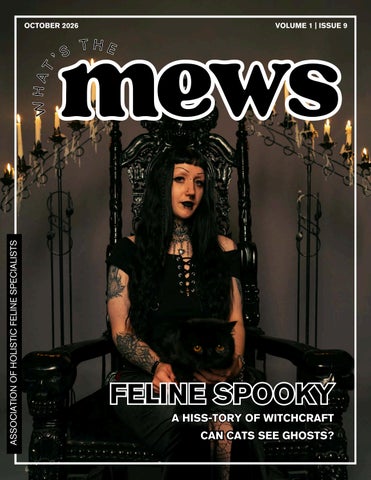
mews
OCTOBER 2026
T HH EE T S ’
VOLUME 1 | ISSUE 9
mews
W H AT
T A H W
’S
STSILAICEPS ENILEF CITSILOH FO NOITAICOSSA
FELINE SPOOKY A HISS-TORY OF WITCHCRAFT
CAN CATS SEE GHOSTS?
YOUR VOICE BELONGS IN THE CONVERSATION What’s The Mews Magazine is accepting article submissions from feline professionals, educators, advocates, creatives, and cat lovers with something meaningful to share. You do not have to be an experienced writer. If you have knowledge, a story, or a perspective that could educate or inspire, we want to hear from you. All articles are reviewed by the What’s The Mews Editorial Staff. No AI articles are permitted. To submit your article or photos, please contact: Mercedes Schenk HolisticFelines@gmail.com www.WhatsTheMews.com
W H AT
THE
mewscolumnists
’S
MERCEDES SCHENK CFMG Editor and Writer of What’s The Mews Magazine, Cat Groomer
SANDRA PORTER CFMG
SYDNEY BEERS CFMG
NCGI Certifier and Feline Exclusive Groomer at The Cat Spa, New York
Certified Feline Master Groomer and Highlander Breeder, GA
LAUREN FINN CFMG
ALEA MAROSE CFMG
Certified Feline Master Groomer in Clinton Township MI
Cover Model, Purrr Luxury Cat Grooming in Minnesota
TABLE OF CONTENTS A HISS-TORY OF WITCHCRAFT
06
Mercedes Schenk CFMG CAN CATS SEE GHOSTS?
14
Sandra Porter CFMG CAT SUPERSTITIONS
20
Mercedes Schenk CFMG SOMETHING WICKED THIS WAY COMES
24
Association of Holistic Feline Specialists WHISKERS IN THE SHADOWS
29
Sydney Beers CFMG THE HORROR OF THE LITTER BOX Lauren Finn CFMG
34
A HISS-TORY OF WITCHCRAFT
pg. 7
Thousands of years of religion, folklore, fear, superstition, and feline behavior have created one of history’s most enduring partnerships. Nothing, and I mean nothing, is more immediately iconic or recognizable than the image of a witch and her feline familiar.
seems almost self explanatory, as though cats have simply always belonged to witches. So why, out of all the imagery associated with witches, has the cat been the one we refuse to let go? Perhaps because the relationship between cats and the supernatural was never merely decorative. It was built slowly, across different cultures and different periods of history, from beliefs that originally had very little to do with one another. To understand how the cat eventually became one of the most recognizable symbols of witchcraft, we first have to separate the history from the imagery that came afterward.
The imagery of witchcraft is remarkably persistent. Across books, paintings, films, Halloween decorations, and centuries of folklore, time has stripped away many of its stereotypical elements, yet the cat remains. Modern portrayals have released the witch from her wooden broomstick, retired her pointed hat, and allowed her to leave the bubbling cauldron behind, but her feline companion has proven considerably harder to shake. From Salem in Sabrina the Teenage Witch to Binx in Hocus Pocus and Jiji in Kiki’s Delivery Service, the cat has followed the witch remarkably intact from centuries old folklore into contemporary popular culture. This association has become so familiar that it
AN OBJECTIVE LOOK AT CATS Let’s sit back for a second and pretend like we’ve never even seen a cat before. As a species, cats move comfortably through darkness, appear and disappear without explanation, react to sounds and movements imperceptible to humans, and possess an independence so different from dogs that they can seem unusually difficult to control. They move almost silently, their eyes appear to glow when they catch the light at night, and they can form an intensely close relationship with one person while remaining suspicious or completely indifferent toward another. None of this, is of course ‘supernatural’, but it didn’t need to be.
pg. 8
Depending on the culture and the century, those qualities could make the cat sacred, protective, suspicious, or supernatural. The significance came from the beliefs surrounding the animal, and humans have been assigning meaning to those behaviors for thousands of years.
A HISTORICAL OVERVIEW Witchcraft has an equally complicated history. It does not have a single birthplace, nor did the people we now describe as witches necessarily understand themselves that way. Beliefs involving magic, curses, spirits, divination, healing, and supernatural protection appear in some of humanity’s earliest written records and developed across cultures throughout the world. The witch we recognize today emerged much later, shaped by the collision of those older beliefs with religion, folklore, fear, and centuries of storytelling. Some of the earliest surviving written evidence comes from ancient Mesopotamia, where magic was not necessarily a secret practice existing outside accepted society. Ritual specialists performed incantations, interpreted supernatural signs, created protections against evil, and attempted to undo curses. One surviving body of texts, known as Maqlû, describes elaborate rituals intended to counter witchcraft and supernatural harm. The people performing these rites were for sure not hunting the the pointed hatted figure we would recognize today, but the underlying
fear is strikingly familiar: the belief that a another person might cause illness, misfortune, or suffering through powers that could not be seen. At roughly the same broad stretch of ancient history, humans were developing another relationship that would eventually become part of this story. We were living increasingly close with cats. In ancient Egypt, the cat acquired religious and symbolic significance that went far beyond its usefulness as a hunter of rodents and snakes. Feline characteristics became associated with divinity, particularly through Bastet, whose imagery eventually became closely connected with the domestic cat. Cats appeared in religious offerings, sculpture, artwork, and mummification practices, occupying a place in Egyptian culture that was both practical and deeply symbolic. This did not make Egyptian cats the first witch cats, as modern retellings sometimes suggest. There is no straight historical line connecting Bastet to the feline familiar of a seventeenth century European witch. What Egypt demonstrates is something broader and perhaps more important to this story: long before the cat became sinister in some European traditions, humans had already decided there was something about this animal worthy of supernatural meaning. And as I’m sure you already know, interpretation is dramatically dependent on who is making the rules.
pg. 9
UP TO INTER-PRRRRRR-ETATION Centuries later, European ideas about magic began developing into the particular concept of witchcraft that would dominate the late medieval and early modern periods. Beliefs in charms, curses, healing, divination, spirits, and folk magic were already well established, but Christian theologians increasingly connected certain forms of magic with demons and the Devil.
Cats were only one part of this much larger collection of supposed supernatural creatures, but they were particularly convincing ones. Cats aren’t the ones that changed. It was the way people started seeing them that did.
By the fifteenth century, ideas that had once existed somewhat separately began merging into a much more frightening picture of “The Witch” as someone who did not merely possess unusual knowledge or magical ability, but who had entered into a relationship with evil supernatural forces. It’s here within this changing world that animals assumed new significance. Accounts of witchcraft, particularly in Britain, began describing familiar spirits, supernatural beings believed to assist witches and sometimes appear in animal form. Despite what centuries of popular imagery might lead us to believe, these familiars were certainly not limited to cats. Historical records describe dogs, toads, birds, rodents, insects, and creatures that were difficult to classify at all. Some were given names and described almost like household companions, while others were portrayed explicitly as demons disguised as ordinary animals. Cats were only one part of this much larger collection of supposed supernatural creatures, but they were particularly convincing ones.
WOMEN AND CATS ACROSS CULTURES What becomes particularly interesting as the cat moves through history is how often it appears beside women. The reasons were not the same from one culture to another, and these traditions should not be treated as pieces of one continuous belief system. Still, the pattern is difficult to ignore. Cats repeatedly became connected with female divinities, fertility, sexuality, motherhood, domestic protection, prophecy, and women believed to possess knowledge or abilities beyond those of ordinary people.
pg. 10
In Norse mythology, Freyja provides one of the clearest examples. A goddess associated with love, fertility, sexuality, wealth, and the magical practice known as seiðr, Freyja traveled in a chariot drawn by two cats. The pairing is particularly striking because seiðr itself was strongly associated with women. Female practitioners known as völur occupied an unusual position within Norse society as seers capable of prophecy and supernatural work. In The Saga of Erik the Red, the seeress Thorbjorg arrives dressed for her role in clothing that includes catskin gloves and a catskin lined hood. These were not the familiars that would appear centuries later in European witchcraft accusations, and treating them as such would impose a much later idea onto Norse culture. What they show instead is another culture placing feline imagery alongside femininity, supernatural ability, fertility, prophecy, and access to knowledge that ordinary people did not possess. In Japan, cats became deeply embedded in folklore surrounding transformation and the supernatural. Stories of bakenekoand nekomata described cats capable of changing form, speaking, manipulating the dead, or assuming human appearance. Some tales specifically imagined cats transforming into women. In Edo period art and literature, the boundaries between the beautiful woman, the cat, and the supernatural could become deliberately uncertain. Here, the connection was not necessarily a woman possessing a magical cat. Sometimes the woman was the cat.
European culture developed its own complicated relationship between femininity and felines. Cats belonged comfortably within domestic life, a sphere overwhelmingly associated with women. Women fed them, lived alongside them, and benefited from their ability to control rodents invading household food stores, making cats particularly visible companions to women through the ordinary organization of daily life. the same time, both accumulated cultural associations with sexuality, independence, and unpredictability. Medieval and early modern writers used cats metaphorically when discussing female sexuality, while later European art repeatedly placed cats alongside women to suggest sensuality, intimacy, domesticity, or moral suspicion. The same animal could communicate affection in one image and sexual danger in another. That flexibility is probably one of the most important parts of this history. Neither women nor cats fit neatly into a single symbolic role. Both could represent nurture and motherhood while also being associated with sexuality. Both belonged within the household while possessing lives that extended beyond it. Both could be praised for gentleness and condemned for independence. Cultural expectations frequently valued each when compliant and became considerably less comfortable when they were not. There is a distinctly gendered history underneath the image we inherited. Women and cats were both valued when they
pg. 11
remained within the roles assigned to them: domestic, nurturing, useful, quiet, and controlled. Suspicion grew when either appeared to step outside those boundaries. The independent woman could become difficult, dangerous, or sexually suspect. The independent cat was mysterious, unpredictable, and impossible to completely possess.
Instead, they empowered us.
When European witchcraft accusations eventually brought the two together, those anxieties found an extraordinarily powerful image. When European witchcraft accusations eventually brought the two together, those anxieties found an extraordinarily powerful image...but gender absolutely mattered. Women constituted the majority of those prosecuted for witchcraft across much of early modern Europe, and accusations were shaped by contemporary expectations surrounding femininity, sexuality, motherhood, poverty, age, obedience, and women’s place within their communities. Perhaps that is why the witch and her cat have proven so easy for later generations of women to reclaim. Two figures once made suspicious for qualities that could not be comfortably controlled have become symbols of precisely those qualities: independence, intuition, knowledge, female companionship, and the refusal to make oneself smaller simply to appear harmless. The witch and her cat was supposed to frighten us.
MERCEDES SCHENK CFMG
You didn’t choose this work because it was easy. You chose working with live animals as challenging as cats because you have passion, brilliance, and refuse to settle for “good enough” when it comes to the way we interact with them. That level of dedication deserves special distinction, on a global level. The Association of Holistic Feline Specialists is compromised of individuals who are actively changing the narrative on feline care across the globe. This isn’t just about joining a club and printing out a piece of paper. It’s about committing to excellence and telling the world that you choose to be held accountable in an unregulated industry. And that they should too. We are where passion meets credibility. Memberships include: Certificate of Recognition, documenting official association as an AFHS Member and the professional pledge and code of ethics you’ve chosen to conduct yourself AHFS Directory Listing as Holistic Feline Professional so individuals can find you and the services you provide First access to educational summits and exclusive invitation to annual symposiums Discounted Classes/Seminars The Association of Holistic Feline Specialists is a non profit organization. 100% of Membership dues sustains our organization, including Pussy Talk the Podcast and our monthly free educational magazine “What’s The Mews”. Cats don’t have a voice in the standards we set, but they live with the results of them. This work is bigger than any one professional, and the cats who depend on us deserve more than individual effort, they deserve a unified standard, a collective commitment, and professionals who choose to stand together to do better. Are you ready to give it to them??
JOIN THE AHFS TODAY AHFS MEMBERSHIP $60 Annually Discounted Events + Classes Online Directory Listing
MAGAZINE SPONSORSHIP We are a free distribution magazine so that information is accessible for everyone.
CAN CATS SEE GHOSTS?
pg. 15
I have a sweet little tortie Persian named Esther, aka “Bean.” She is my constant shadow and follows me everywhere. So often, she will be sitting beside me, suddenly freeze, stare into space, and begin following movements that I can’t see. Her ears swivel. Her pupils widen. She is the only cat I have that I’ve really noticed doing this. I always ask her, “Is someone here with us, Bean?” I can be getting ready for work, and she’ll jump onto the counter beside me and suddenly start staring at the ceiling. Of course, I look too. I don’t see or hear anything. It’s strange, but it doesn’t bother or scare me. As a spiritual person, I’m open to the idea of having visitors, and I’ve personally experienced things I can’t easily explain. So, the question is... Can cats really see ghosts?
THE SCIENCE BEHIND THEIR SPOOKIEST BEHAVIORS There is no scientific evidence that cats can see ghosts. However, science can help explain some of these strange behaviors—and perhaps why people have believed for centuries that cats have a connection to a world we can’t see. Some beliefs take things a little further and regard cats as spiritual guardians. According to folklore, cats don’t just sense things we
can’t; they may actually protect us from negative spirits or energy. Some believe that simply having a cat in the home offers a kind of spiritual protection. There are even traditions that associate different coat colors with certain types of energy, luck, protection, or healing. Of course, there’s no science behind these beliefs either, but considering how mysterious cats can be, it’s not hard to understand how they came about. Cats experience the world very differently from the way we humans do. Things that are completely undetectable to us may be obvious to a cat. Remember, cats are both predators and prey. Being constantly aware of their surroundings is part of their built-in survival system. Their ancestors depended on their ability to detect the tiniest movements, sounds, and changes in the environment. So, what looks supernatural to us may be simply a cat being a cat.
“DID YOU HEAR THAT?” A Cat’s Extraordinary Hearing Sounds travel at frequencies and volumes that may be completely outside our range of hearing, but a cat can pick them up. Cats can hear high-pitched sounds up to around 64,000 Hz, while humans generally hear only up to about 20,000 Hz. Those upright ears aren’t just adorable,
either. Cats have muscles that allow them to rotate their ears independently, almost like having their own surround-sound system. This helps them pinpoint exactly where a sound is coming from. Watch your cat’s ears the next time she suddenly stops and seems to listen to “nothing.” Those swiveling ears may be telling you that she hears something you don’t. Her ears can also give us clues about how she’s feeling—curious, relaxed, nervous, or on high alert. I once had a mobile grooming client whose cat knew the sound of my truck. I actually had to stop several blocks away and text his owner so she could get him into his carrier. If I drove any closer, he would hear my truck coming and go into hiding. I would sit and wait for her to text me that she had corralled him before I dared to drive to the house. That’s how good their hearing can be. So, what is your cat hearing when she suddenly stares toward an empty wall? A mouse? An insect? Pipes making noise? Something moving outside? Maybe she’s listening to something happening elsewhere in the house. We hear nothing. To the cat, something is definitely going on.
THINGS THAT MOVE IN THE DARK? How Cats See At Night Science also tells us that cats are much better equipped than we are to see in low light. Cats can see about six times better than people in dim conditions. Behind the retina is a reflective layer called the tapetum lucidum. It helps bounce light back through the eye, giving cats an advantage when light is limited. It’s also what creates that wonderfully spooky glowing-eye effect when light catches a cat’s eyes at night. Their eyes are especially good at detecting small movements and subtle changes in light— a tiny insect, a shifting shadow, or even a dust particle that we might completely miss. Interestingly, research suggests that cats’ eyes allow some ultraviolet light to reach the retina—wavelengths that our human eyes filter out. This means cats may be able to see things in their environment that look very different to them or may not be visible to us at all. So, when your cat suddenly locks onto a blank wall or seems to follow something across the room with her eyes, it may not be quite as “blank” to her as it is to you. Imagine how mysterious these abilities must have seemed hundreds of years ago, before anyone understood the science behind feline vision.
pg. 17
THOSE WHISKERS KNOW SOMETHING
Perhaps she’d prefer that we didn’t ask too many questions.
Now, let’s talk about those cute whiskers. They’re actually sophisticated sensory tools. Whiskers help cats detect subtle changes in their surroundings, including air movement, and give them information about nearby objects—especially in dim conditions.
HOW CATS BECAME CREATURES OF MYSTERY When you really think about it, it’s pretty easy to understand how cats earned their mysterious reputation.
That means a cat may react to something happening around her that we simply haven’t noticed. Between their incredible hearing, low-light vision, and sensitive whiskers, cats take in information about their surroundings that we don’t have access to.
Cats are naturally most active around dawn and dusk, when the light is low and shadows start playing tricks on us. They can move almost silently, suddenly appearing in a room without you ever hearing them come in. Just as quickly, they seem to disappear again.
No wonder it sometimes looks like they’re seeing something we aren’t.
Then there are those eyes.
THE NIGHTTIME GUARDIAN There is a lovely bit of modern cat lore that says when a cat sleeps above your head, she is standing guard—protecting you from bad dreams, negative energy, and things that wander in the night. Science offers a somewhat less spooky explanation. Your head is warm, familiar, and relatively still. Sleeping beside someone she trusts may also help a cat feel safe during a time when she is vulnerable. So, is she protecting you…or are you protecting her?
Catch a cat’s eyes reflecting light in a dark room, and even today, it can be a little spooky. Imagine seeing that hundreds of years ago, when no one understood the science behind it. Cats also regularly stop and react to things we can’t see or hear. They’ll stare into an empty corner, swivel their ears toward something we can’t hear, or suddenly take off running for no apparent reason. Add to that their independent nature. Unlike many other domesticated animals, cats aren’t particularly interested in doing something simply because we ask them to. They seem to have their own agenda—and sometimes it feels like they know something we don’t. Today, we understand much more about feline vision, hearing, behavior, and instincts. But long before we had those explanations, it’s easy to
pg. 19
see why people looked at cats and thought there might be something just a little bit magical about them.
BUT CAN CATS ACTUALLY SEE GHOSTS? o, after all of this, we come back to the big question: can cats actually see ghosts? The truth is, we don’t know. There is no scientific evidence that cats can see ghosts or spirits. But science also can’t tell us exactly what your cat is looking at every time she suddenly stops, stares intently into an empty room, and seems to follow something with her eyes.
After everything we’ve learned about a cat’s hearing, vision, whiskers, and natural instincts, it’s perfectly reasonable to believe there’s a logical explanation for whatever has caught her attention. I just asked her again if we have company. She looked at me…and then looked back at the ceiling. That’s okay, Bean. I don’t need to know all your secrets.
What we do know is fascinating enough. Cats hear sounds we can’t hear. They see much better than we do in low light. They detect the tiniest movements. Their whiskers give them sensory information we don’t have. And they are constantly monitoring their surroundings, even when it looks like they’re doing absolutely nothing. So, chances are that when your cat is staring at “nothing,” there really is something there—a tiny insect, a faint sound, a shadow, a reflection, or a movement you didn’t notice. But a ghost? I’ll let you and your cat decide that one. And that brings me back to my little Esther Bean, who, as I write this, is sitting on my desk, staring at the ceiling.
SANDRA PORTER CFMG
CAT SUPERSTITIONS FROM AROUND THE WORLD MERCEDES SCHENK CFMG
pg. 21
English sailors believed a black cat on a ship was good luck, but if it walked off the ship and stayed ashore, the ship would sink. In Ireland, cats were linked to fairy lore — harming them could bring curses. In France, “Matagot cats” were magical cats that, if cared for well, brought their owners wealth. In Poland, a black cat at a funeral meant another family member would soon die. In Mexico, they believed that cats left alone at night could transform into nahuales (sorcerers in animal form). In Hoodoo Traditions, black cats were powerful charms — their bones or hair were used in love and protection spells. In Japan, stroking a cat was believed to cure illness or bring longevity. Farmers in Italy thought that a cat sleeping on a child’s bed would keep away fever. In parts of Europe, a cat given as a wedding gift symbolized prosperity and fertility. The Japanese beckoning cat figurine, Maneki-neko often placed at shop entrances, is believed to draw customers, wealth, and happiness. A raised right paw beckons money, while a raised left paw attracts customers. People in Hungary believed that cats born in May were considered unlucky and would bring snakes into the house. European sailors believed that a cat sneezing meant a storm, and erratic, restless behavior was taken as a sign of high winds. In Scotland, saucers of milk were left out on Samhain (Halloween) to appease fairy
cats and prevent curses. In Russia and parts of Europe, a cat must be the first to walk into a new house to bring prosperity and drive away evil. In Turkey and Middle Eastern cultures, a cat meowing or crying when someone leaves home was thought to be a warning of misfortune or danger awaiting the traveler. In Italy, if a cat sneezed near a child, it was considered a blessing of long life. Some cultures believed cats could see ghosts and protect the home from them. In parts of Europe, throwing a cat into a fire was a cruel ritual meant to change the weather. In Celtic folklore, the Cat-sìth could steal a soul by passing over a corpse before burial, which led to night-long “wakes” to guard bodies. European medicinal folklore believed rubbing a cat's tail on an eyelid would cure a stye. Egyptians believed cats guided souls to the afterlife. Mummified cats were often buried with their humans. In Romania and other Slavic regions, cats making unusual noises (especially at thresholds or during departures) were connected with spirits or death omens. In Poland, they believed that letting a cat sleep in a cradle before a baby was born protected the child from evil spirits. Fishermen’s wives in England kept black cats at home for their husbands’ safe return and good weather at sea. In parts of Europe, a cat given as a wedding gift symbolized prosperity and fertility. French farmers believed that if a cat
If a cat stares into an empty doorway and then looks back at you, someone who loved you has stopped by. @WhatsTheMews
pg. 23
cats and prevent curses. In Russia and parts of Europe, a cat must be the first to walk into a new house to bring prosperity and drive away evil. In Turkey and Middle Eastern cultures, a cat meowing or crying when someone leaves home was thought to be a warning of misfortune or danger awaiting the traveler. In Italy, if a cat sneezed near a child, it was considered a blessing of long life. Some cultures believed cats could see ghosts and protect the home from them. In parts of Europe, throwing a cat into a fire was a cruel ritual meant to change the weather. In Celtic folklore, the Cat-sìth could steal a soul by passing over a corpse before burial, which led to night-long “wakes” to guard bodies. European medicinal folklore believed rubbing a cat's tail on an eyelid would cure a stye. Egyptians believed cats guided souls to the afterlife. Mummified cats were often buried with their humans. In Romania and other Slavic regions, cats making unusual noises (especially at thresholds or during departures) were connected with spirits or death omens. In Poland, they believed that letting a cat sleep in a cradle before a baby was born protected the child from evil spirits. Fishermen’s wives in England kept black cats at home for their husbands’ safe return and good weather at sea. In parts of Europe, a cat given as a wedding gift symbolized prosperity and fertility. French farmers believed that if a cat
washed behind its ears, rain was on the way. Some people believe that placing discarded cat whiskers in your glove compartment will offer safe and good travels. In Egypt, a mother cat licking her kittens was seen as protection magic for pregnant women who witnessed it. In England and Scotland, a cat seen roaming at night was once thought to be a witch in disguise. In Italy, it was believed that if a black cat lay on the bed of a sick person, their death was imminent. European sailors believed that a cat falling overboard would bring bad luck. In Japan, a cat biting its owner’s toenails foretold financial loss. If a stray cat chooses you to be their owner, its bad luck to turn them away. In Turkey and the Middle East, cats were considered spiritually sensitive and able to see jinn (spirits). In Ancient Egypt, killing a cat, even accidentally, was punishable by death. The Chinese believed that black cats could signal poverty or misfortune, while golden cats symbolized wealth. In Bavaria, if a cat jumped over a corpse, the deceased would rise as a vampire. In Scottish folklore, a strange black cat on your porch meant prosperity was coming. In many cultures, calico cats are considered especially lucky.
SOMETHING
WICKED THIS WAY COMES
24
Become A Vendor
Bring your brand straight to the heart of the cat lover community, where cat lovers and professionals alike come eager to discover, learn, shop, connect, and celebrate everything feline.
VENDOR BENEFITS
AMOUNT
FULL BOOTH SETUP PROVIDED Your 10x10 vendor space will be fully assembled with pipe and drape, one table, and two chairs so you can walk in, merchandise your booth, and be ready for attendees.
INCLUDED
WEBSITE VENDOR FEATURE + DIRECT LINK Your business will be featured on the event website with your logo and a direct link, giving attendees an easy way to find, learn about, and shop with you before and after the convention.
INCLUDED
PRE EVENT SOCIAL MEDIA FEATURE We will introduce your business to our audience before the event through dedicated vendor promotion designed to help attendees recognize your brand before they ever reach the vendor floor.
INCLUDED
CLIMATE CONTROLLED + SECURED VENUE Keep your booth set up secured overnight between event days without packing everything away. The venue will be secured overnight so vendors can return the next morning ready to open. Did we mention the whole thing is air conditioned?
INCLUDED
OPTIONAL ELECTRICAL ACCESS Need power for your display, equipment, or checkout set up? Electrical access can be added to your booth in advance for an additional flat fee. Vendors will have access to set up Friday evening and early Saturday morning before the event .
$60
T his c o uld b e y o u ! !
Floors close Sunday at 5:00pm, with a breakdown time between 5:00pm and 7:00pm. Each 10x10 space is $350 for the entire weekend thanks to our Community Access Sponsor Les Poochs! Payment is due at time of reservation to secure your placement.
El Zaribah Shrine 552 N 40th St in Phoenix, AZ October 16 + 17, 2027
25
Contact Lauren Finn, CFMG | Sponsorship & Vendor Coordinator | info@catconciergemi.com | 248-792-1236
www.WhatsTheMews.com
There is something incredibly unsettling but exciting about planning an event nearly two years before anyone is supposed to walk through the doors. At first, Feline Superstitious existed mostly in my head. It was a collection of ideas, little tidbits I loved about conventions I had attended and wishes I made for things that didn’t exist. As an organization, the AHFS started off our educational seminars and community gatherings quite small, yet still just as nervously. There’s always this sense of ‘who am I’ or ‘why would anyone even want to come’ when you do something new like this, but what I realized over the years is that this isn’t just a dream I have by myself, but one the entire feline grooming industry shared with me. The name came very much before the rest of it, and once the name popped into my head the vibe just made itself. You see, here in the beautiful scape of the Sonoran Desert lies one of the most quintessential mountain ridge lines known as the Superstition Mountains. Paired with the pastel vibrancy of these Arizona sunsets in October, with her wild--feral even--nature scapes, well. She all but named herself. What is special about this convention is that it essentially features two events in one. Our main entrance leads into a sprawling foyer with a wide open auditorium complete with theater stage. Thanks to the incredible generosity and support of Les Poochs’, we are able offer free public entrance to the community and financially accessible booths for local and small businesses to share their wares . This means that anyone, cat lover, dog groomer, or curious individual can come inside and see all that our niche world has to offer. Throughout the main stage area we will have vendors, and main stage education throughout the day. Thanks to the generosity of Ryan’s Pet Supplies, it will also feature the United States’s first AHFS sanctioned cat competition. It’s an opportunity not to just showcase our professional skills
to one another but highlight and educate to the community the importance of feline hygiene and ethical handling.
someone to take valuable time away from their own personal and professional lives and speak at a rate that does not honor their time.
The entire property is gated, with plenty of parking all around the building. There will be a place for grooming trucks to park for prep work prior to the competition, and RV’rs to safely sleep should they make the trip.
Originally I reached out to a private Facebook group for Professional Cat Groomers and asked if there was anyone who was willing to basically bet on this event, bet on me. I needed a sum of almost $10,000 to simply launch this event and bring it into fruition. I divided that number by 26, and that is how our Founding 25 came to be. Twenty Five people, who next to me said we can do this, and did it, we did, indeed.
The South Entrance is for our private Professional Education. Before this event was even announced, I had it in my minds eye exactly what type of education I wanted to be shared. Not theory, but in the moment demonstrations with opportunities to ask questions and deepen skill sets and confidence. What were things that could benefit not just new cat groomers but support well seasoned experts as well? It’s for this reason that I am so incredibly proud to share the featured speakers we have for the first inaugral convention. And I’m going to tell you a little secret that I’ll only share here. I’ve already secured the dates for the 2028 Feline Superstitious Convention, and you can safely mark your calendars for October Friday the 13th, Saturday the 14th, and Sunday the 15th . At this time we are still securing additional sponsors to make this event as accessible as possible. I believe in full transparency as well as ethical payment for our teachers, which is why I want to publicly share that our educators start off at $250 an hour for speaking. It is unthinkable to me, as an educator and as a professional to ask
Currently PRESALE tickets are priced at $350 for Saturday and Sunday education with an optional third day on Monday exclusively for the Feline First Certification Program. The FFC has limited seating as it is an interactive course, and the price for that is currently set at $220. We are actively seeking out Educational Sponsors to help support these events and cover the cost of the venue as well as creation of this event, so that we can keep our prices at this lower pre-sale rate. Ethics is always great until you get the bill, but we are hoping for a company or two that will believe in us as well, to help ease the financial burden so that the groomers, the heart of our industry can have additional accessible education and networking. We are exactly a year away, with a third of the allotted education tickets already sold. So stay tuned, sign up, and we’ll see you next fall ya’ll!!
MEL BRINK CFMG
LYNN PAOLILLO CFMG
MELISSA HALL CFMG
ALEXANDRIA KORB CFMG
DR. JANELLE SCHENK
MERCEDES SCHENK CFMG
SEANDRIA DUCKWORTH CFMG
2 0 2 7 O C T O B E R
SCHEDULE
S A T U R D A Y
1 6
The Science of Sustainable Grooming
8:00am - 9:30am
with Dr. Janelle Schenk OTD, OTR/L
Technical Tune Up
Conference Room
10:00am - 11:30am
with Mel Brink, CFMG and NCGI Certifier
Creatures of the Catwalk
Conference Room
12:00pm - 2:00pm
Competitive Creative Cat Grooming
Main Stage
Creative Grooming: Color + Cuts
2:30pm - 4:30pm
with Alexandria Korb CFMG + SeAndria Duckworth
Conference Room
Comb Cut Demo + Q&A
5:00pm - 6:00pm Conference Room
with Melissa Hall, CFMG and NCGI Certifier
The Witching Hour
6:30pm - 9:30pm
Attendee Costume Party
S U N D A Y
Fiesta Room
1 7
Build a Better Boarding Business
8:00am - 9:00am
with Mel Brink, CFMG and NCGI Certifier
Smooshy Faced Masterclass
Conference Room
9:30am - 12:30pm
with Lynn Paolillo CFMG and NCGI Certifier
Colors and Coat Patterns with CFA Judge Emeritus Pat Jacobberger
The Feline Superstitious Open Open Cat Grooming Competition Raffle Winners Announced
Can You Handle It?
1:00pm - 1:30pm Main Stage
2:00pm - 4:00pm
Main Stage
4:30pm - 6:30pm
with assorted Certified Feline Master Groomers
M O N D A Y
Conference Room
Conference Room
1 8
Feline First Certification Course with Mercedes Schenk CFMG + The Association of Holistic Feline Specialists
8:00am - 2:00pm
WHISKERS IN THE SHADOWS Have you ever wondered why cats seem to fit Halloween so well? And I don't just mean black cats, witches and Halloween decorations. Cats have been showing up in strange stories, mythology and folklore for thousands of years. The more I started looking into it, the more interesting it got. Depending on where you look, cats have been protectors, companions to goddesses, symbols of good luck and, apparently, giant monsters that might eat you. So with October here, I thought this would be a fun rabbit hole, or maybe cat hole, to go down. Of course, we have to start with Ancient Egypt. Most of us have heard that Egyptians worshipped cats, but that's not exactly the whole story. Cats were incredibly useful. They protected homes and grain from rodents and could even help with snakes. Eventually, they also became closely connected with Bastet, a goddess associated with protection, motherhood and the home. Cats weren't simply little gods walking around Egypt, but they did have an important connection to the divine. Cat statues were given as offerings, and large numbers of cats
30
pg. 31
were even mummified as part of religious practices. Basically, cats had already figured out how to become important thousands of years ago. Then somehow they managed to sneak into Greek and Roman mythology too. There's a story about the monster Typhon, who was so terrifying that the gods fled to Egypt and hid by taking different animal forms. In the Roman poet Ovid's version, Diana, the Roman version of Artemis, takes the form of a cat. Which makes sense. If I had to hide from a monster, turning into something that can disappear into a room and somehow not be found for six hours seems like a solid choice. Then we head north to Norse mythology, where things get a little more magical. Freyja was a goddess associated with love, fertility, magic and battle, and she had one of the best modes of transportation in mythology, a chariot pulled by two cats. The old story doesn't tell us much about them. We don't know their names, their colors or what kind of cats they were supposed to be. They're just...two mysterious cats pulling a goddess's chariot. And I kind of love that it lets us pick the cat breed. If we keep heading north, we eventually get to Iceland, where apparently somebody decided cats weren't scary enough. Meet Jólakötturinn, the Yule Cat.
Imagine a giant cat wandering through the snowy Icelandic countryside around Christmas looking for people who didn't receive new clothes. Sounds weirdly cute, right? It's not. Because if the Yule Cat found you, there was a chance you where its Dinner. The story has ties to Iceland's old wool-working traditions. Finishing your work could mean receiving new clothing before Christmas, and somewhere along the way the giant Yule Cat became part of the warning. The version most people recognize today became especially well known through a 1932 poem by Jóhannes úr Kötlum. I don't know about you, but “finish your work or the giant Christmas cat might eat you” seems pretty effective. Thankfully, we're ending our trip with a much friendlier cat. In Japan, we find the maneki-neko, the little lucky cat you've probably seen sitting in the window of a restaurant or shop with one paw up. Funny enough, the cat isn't actually waving. It's beckoning. The raised paw is calling good fortune toward it. There are a few different stories about where the maneki-neko came from, but one of the best known is connected withGōtokuji Temple in Tokyo. The story tells of a cat that beckoned the lord Ii Naotaka toward the temple. He followed the cat, and a storm soon rolled through. The encounter came to be
31
were even mummified as part of religious practices. Basically, cats had already figured out how to become important thousands of years ago. Then somehow they managed to sneak into Greek and Roman mythology too. There's a story about the monster Typhon, who was so terrifying that the gods fled to Egypt and hid by taking different animal forms. In the Roman poet Ovid's version, Diana, the Roman version of Artemis, takes the form of a cat. Which makes sense. If I had to hide from a monster, turning into something that can disappear into a room and somehow not be found for six hours seems like a solid choice. Then we head north to Norse mythology, where things get a little more magical. Freyja was a goddess associated with love, fertility, magic and battle, and she had one of the best modes of transportation in mythology, a chariot pulled by two cats. The old story doesn't tell us much about them. We don't know their names, their colors or what kind of cats they were supposed to be. They're just...two mysterious cats pulling a goddess's chariot. And I kind of love that it lets us pick the cat breed. If we keep heading north, we eventually get to Iceland, where apparently somebody decided cats weren't scary enough. Meet Jólakötturinn, the Yule Cat.
Imagine a giant cat wandering through the snowy Icelandic countryside around Christmas looking for people who didn't receive new clothes. Sounds weirdly cute, right? It's not. Because if the Yule Cat found you, there was a chance you where its Dinner. The story has ties to Iceland's old wool-working traditions. Finishing your work could mean receiving new clothing before Christmas, and somewhere along the way the giant Yule Cat became part of the warning. The version most people recognize today became especially well known through a 1932 poem by Jóhannes úr Kötlum. I don't know about you, but “finish your work or the giant Christmas cat might eat you” seems pretty effective. Thankfully, we're ending our trip with a much friendlier cat. In Japan, we find the maneki-neko, the little lucky cat you've probably seen sitting in the window of a restaurant or shop with one paw up. Funny enough, the cat isn't actually waving. It's beckoning. The raised paw is calling good fortune toward it. There are a few different stories about where the maneki-neko came from, but one of the best known is connected withGōtokuji Temple in Tokyo. The story tells of a cat that beckoned the lord Ii Naotaka toward the temple. He followed the cat, and a storm soon rolled through. The encounter came to be
32
pg. 33
seen as an act of good fortune. And hundreds of years later, that little cat is still sitting in windows calling luck through the door. When you put all of these stories together, cats really have had quite the reputation. They've been connected with goddesses. They've represented protection. They've pulled magical chariots. They'vebrought good fortune. And one might eat you because you didn't get new clothes for Christmas. Honestly, that range feels very cat.
Maybe that's why we've been telling stories about them for so long. We can bring cats into our homes, give them ridiculous nicknames, buy them fancy beds they refuse to sleep in and spoil them completely... but there's still something a little mysterious about them. So this October, if you wake up in the middle of the night and your cat is sitting perfectly still, staring into a dark hallway at something you can't see... Don't investigate. Give them a treat and go back to bed. Whatever they're looking at is between them and the ghosts.
SYDNEY BEERS CFMG
THE
Horror OF THE
litter box AND THE POWER OF THE PUMPKIN
pg. 35
There are plenty of things that are supposed to be scary in October: ghosts, witches, haunted houses, things that go bump in the night. But if you live with cats, you know the real horror. It’s walking past the litter box and being hit by a smell so alarming that you immediately start looking around for the tiny, furry criminal responsible. Or maybe you scoop the box and realize—wait. Nobody has pooped. Now you’re taking attendance, watching every cat in the house, and trying to remember exactly who you saw in the litter box yesterday. Welcome to the Halloween story no cat parent wants to star in: feline bowel trouble. With a house full of cats, I’ve seen my share of tummy issues. Every cat is different. Some can eat practically anything without batting an eye like Blaze and BoBo my Maine Coons, while others require a little more supervision. In my house, that cat is Little Prince, my Persian, whose sensitive little tummy has made me unusually knowledgeable about appetite, bathroom habits, and, whether I wanted to learn it or not, poop. Welcome to cat ownership. And when things are suddenly moving far too quickly—or not moving enough —one simple ingredient fits the season perfectly: pumpkin.
PUMPKIN IS A TOOL, NOT A DIAGNOSIS Cats can have occasional digestive upset just like we can. Maybe there was a food change.
Maybe someone ate something they shouldn’t have. Maybe a sensitive tummy like Little Prince’s simply decided that today was the day to create absolute chaos. At one end of the spectrum is acute diarrhea: sudden, loose, and extraordinarily fragrant. At the other is acute constipation, with repeated litter-box visits, small hard stools, or an extended session that produces absolutely nothing. Neither situation is what a cat parent wants to see, but both can turn the litter box into its own little house of horrors. Plain pumpkin can feel like a tiny orange magic spell because it brings both fiber and moisture to the conversation. With loose stool, fiber can help hold on to some excess water and add bulk, helping the stool become more formed. With mild constipation, appropriate fiber combined with adequate hydration may help create softer, bulkier stool that is easier to move through the digestive tract. But pumpkin is a tool, not a diagnosis. There is a big difference between an otherwise happy, eating, drinking, normally behaving cat with an occasional mild upset and a cat who is actually sick. Knowing what is normal for your own cat matters. Important: Repeated straining in the litter box is not something I would simply treat with more pumpkin. This is especially important with male cats, because what looks like constipation can actually be straining caused by an inability to urinate. A urinary blockage is a true emergency and needs immediate
veterinary care. Call your veterinarian for vomiting, refusing food, lethargy, obvious pain, blood in the stool, dehydration, repeated straining, a swollen or painful abdomen, ongoing diarrhea, or an inability to pass stool. If your normally foodobsessed cat suddenly won’t eat, that can also signal more than a little tummy tantrum. Know your cat. Know what is normal for them. And when something doesn’t feel right, call your veterinarian.
pumpkin is a small, purposeful addition—not a reason to turn your cat into a tiny vegetarian for the season.
THE PUMPKIN TUMMY TAMER For an otherwise healthy adult cat experiencing a mild, short-lived bout of diarrhea or digestive upset, I make what I call my Pumpkin Tummy Tamer. The goal is deliberately boring food for an unhappy tummy.
INGREDIENT
Amount
Cats can have occasional digestive upset just like we can. Maybe there was a food change.
Plain cooked or raw lean protein
~4 ounces
If constipation is the problem, I think about hydration as much as fiber. Cats aren’t exactly famous for strolling over to the bowl and hydrating themselves all day. Felines obtain a very significant amount of moisture through what they eat.
Very soft, well-cooked plain white rice
~ 1 tablespoon
100% plain pumpkin purée
1-2 teaspoons
That may mean extra wet food, additional water mixed into a meal, or a plain catappropriate broth. I always check ingredients: broth should never contain onion or garlic, and I avoid added seasonings and unnecessary sodium.
Warm water, plain meat or bone broth
1-2 tablespoons
HYDRATION BELONGS IN THE PLAN
And when I say pumpkin, I mean 100% plain pumpkin—not pumpkin pie filling, Grandma’s pumpkin pie, or a pumpkin spice latte. Plain cooked pumpkin or 100% pumpkin purée should contain no added sugar, sweeteners, or spices. Cats are obligate carnivores, so
Chicken or turkey are my go to proteins, but chicken is certainly not the only option. For cats who don’t tolerate chicken, plain turkey, very lean beef with the fat drained well, or a mild white fish such as cod, haddock, or tilapia can work. Use no skin, butter, oil, salt, sauces, or seasonings. Mix everything until it has a soft, moist, almost pâté-like consistency. The meal
pg. 37
should remain overwhelmingly animal protein; the rice and pumpkin are supporting characters, not the stars of the show.
milk for the first time. Trying to tame an upset digestive system is not the moment to experiment with an unfamiliar food.
Serve in smaller portions rather than one large meal. An upset digestive system may handle several smaller meals throughout the day more easily. Keep the pumpkin modest. More pumpkin does not mean more magic, and too much fiber can make stool problems worse. We’re talking teaspoons, not giant scoops. Use it only short-term. Meat, rice, and pumpkin alone do not provide all the nutrients a cat requires. This is a shortterm supportive meal for an otherwise healthy adult cat with mild digestive upset—not a complete diet or a substitute for veterinary treatment.
For pumpkin-and-rice cubes, I cook plain white rice until it is very soft, combine small amounts with plain pumpkin, portion the mixture into silicone molds, and freeze it. When Little Prince’s tummy decides we’re having a bad day, I thaw a small portion and add it to the plain protein I’m using for him. Instant Pumpkin Tummy Tamer.
MY FELINE TUMMY FREEZER FIRST AID KIT The recipe is useful in the moment, but Little Prince has taught me that a little preparation makes those moments much easier. I don’t want to boil rice and open an entire can of pumpkin every time someone in the house develops an unhappy tummy, so I keep a small freezer kit ready. I use small silicone molds to freeze individual portions of the things I commonly reach for. I make cat-appropriate bone broth cubes for an easy moisture boost. I also freeze small cubes of raw goat’s milk made for pets—but only for my cats who already tolerate it well. I would not choose now to introduce goat’s
I also save some plain starchy rice water. I freeze small portions with just a little pumpkin when I want additional moisture without adding as much solid rice or pumpkin. For constipation in particular, I’m thinking about hydration rather than simply piling on more fiber. Everything gets clearly labeled and dated. I use small molds instead of giant ice-cube trays because when dealing with cats, tiny portions are much more practical. I thaw only what I need and serve it comfortably warm or at room temperature, never hot. It’s my own little freezer full of feline potions. With my full house of different cat tummies, it gets used.
is simply pumpkin + water for processing, and it is labeled for cats. The little pouches are also great because you don’t have to open an entire can.
A LITTLE PREPARATION, A LOT LESS PANIC My pumpkin, rice, broth, and freezer cubes are not meant to replace veterinary medicine. They are simply little tools I keep on hand for the mild, occasional digestive upsets that inevitably happen when you share your life— and your home—with a whole lot of cats. So this fall season, while you’re carving a face in your pumpkin and decorating with ghosts, witches, and black cats, save a little room in the freezer for a few tiny orange cubes. Keep them labeled, remember that hydration matters, and keep the litter box from becoming another horror that haunts you this season! Because sometimes the scariest thing you’ll meet on Halloween isn’t a ghost, a witch, or something lurking in the shadows. It’s the smell coming from the litter box at 2:00 a.m. And when Little Prince’s sensitive Persian tummy decides to summon that particular monster, I head straight for my freezer firstaid kit.
2.
3.
1.
Weruva Pumpkin Patch Up! Pureed Pumpkin: My favorite petspecific option. The plain version
Plain cooked/pureed pumpkin: Homemade is reasonable too; pumpkin only, with no sugar, salt, butter, spices, or seasoning.
TOP 3 BONE BROTH OPTIONS 1.
2.
Bring on the power of the pumpkin! Here are my Go-To brands for a cat GI Freezer Kit:
TOP 3 PUMPKIN OPTIONS
Libby’s 100% Pure Pumpkin: Excellent inexpensive grocery store option. It is 100% pumpkin; just make sure you buy Pure Pumpkin, never pumpkin pie filling.
3..
Primal Pet Foods Bone Broth: Chicken, turkey, beef, or pork varieties; specifically made as a topper/hydrator for cats and dogs. A great option for freezing into cubes. Reveal Pet Food Chicken Bone Broth: Made specifically for cats with a limited ingredient approach. A simple option for adding moisture and flavor. Nulo Bone Broth: Pet formulated broth that works well as a hydrating food topper and can be portioned and frozen into cubes for your GI freezer kit.
39
40
pg. 41
TOP 3 RAW GOAT’S MILK OPTIONS 1.
2.
3.
Primal Original Raw Goat Milk: My first choice. It’s formulated for cats and dogs, frozen/raw, and contains probiotics; Primal specifically recommends introducing it gradually. Solutions Pet Products Raw Goat Milk: Another pet-focused raw goat milk brand worth looking or at independent/raw pet food stores. Answers Pet Food/Kure Pet Food Fermented Raw Goat Milk: If available in your area, their fermented goat milk products are another pet specific option I’d consider.
Always introduce new foods gradually and consult your veterinarian if your cat has ongoing digestive issues.
Pure pumpkin supports healthy stool consistency, gut microbiome, and helps regulate digestion. Cat safe bone broth boosts hydration, makes food more appealing, and provides small amounts of nutrients. Raw goats milk adds hydration and calories, and provides moisture along with fat and protein. It’s a highly palatable topper and many cats love it!
LAUREN FINN CFMG
41
code of ethics I will prioritize the wellbeing, safety, and overall health of the cats in my care. I will strive to always conduct myself with honesty, integrity, and transparency. I will treat all cats with compassion, patience, kindness, and respect.
I will continue to seek knowledge and resources that will contribute to my skills and abilities, so that I may safely and better serve the cats in my care.
GET YOUR PRESALE TICKETS NOW FELINESUPERSTITIOUS.ORG