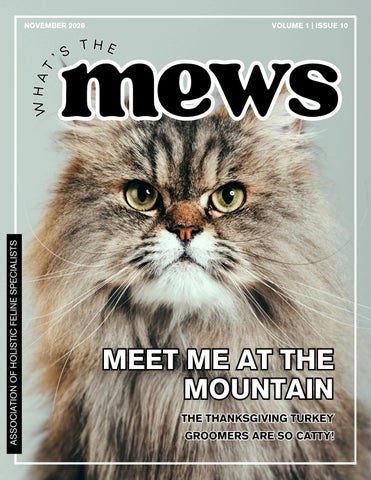
mews
NOVEMBER 2026
T HH EE T S ’
VOLUME 1 | ISSUE 10
mews
W H AT
T A H W
’S
STSILAICEPS ENILEF CITSILOH FO NOITAICOSSA
MEET ME AT THE MOUNTAIN THE THANKSGIVING TURKEY GROOMERS ARE SO CATTY!
YOUR VOICE BELONGS IN THE CONVERSATION What’s The Mews Magazine is accepting article submissions from feline professionals, educators, advocates, creatives, and cat lovers with something meaningful to share. You do not have to be an experienced writer. If you have knowledge, a story, or a perspective that could educate or inspire, we want to hear from you. All articles are reviewed by the What’s The Mews Editorial Staff. No AI articles are permitted. To submit your article or photos, please contact: Mercedes Schenk HolisticFelines@gmail.com www.WhatsTheMews.com
W H AT
THE
mewscolumnists
’S
MERCEDES SCHENK CFMG Editor and Writer of What’s The Mews Magazine, Cat Groomer
DENISE HEROUX Dog Groomer and Owner of the Dusty Puppy in Arizona
LAUREN FINN CFMG
GISELLE BAHENA
Certified Feline Master Groomer in Clinton Township MI
Dog Groomer and Owner of the Dusty Puppy in Arizona
DANIELLE ANDERSON Groomer at Purrfurred Pet Stying located in Naperville Illinois
TABLE OF CONTENTS THE THANKSGIVING TURKEY
06
Mercedes Schenk CFMG BURNOUT + COMPASSION FATIGUE
14
with Dr. Jennifer Mandigo TENDING YOUR DIGITAL GARDEN
24
Mercedes Schenk CFMG POLICIES ON COMPASSION
28
Giselle Bahena ITS GIVING THANKS
30
Arizona Professional Groomers Guild THE GIFT OF GRATITUDE
32
Denise Heroux MEET ME AT THE MOUNTAIN
36
Lauren Finn CFMG GROOMERS ARE SO BITCHY/CATTY! Danielle Anderson
46
THE THANKSGIVING TURKEY
pg. 7
Before you put that Thanksgiving turkey in the oven this year, make sure it isn’t purring.
When most people think about hairless cats, they’re usually thinking of the most popular of hairless breed here in the United States, which is the Sphynx. However, hairless cats come in different shapes, sizes, and degrees of nakedness. Some have wrinkles, some have a fine layer of fuzz, and all of them have origins and genetic traits that vary.
With their big ears, wrinkles, and bare little bellies, hairless cats can look like tiny turkeys who escaped the roasting pan. Between their so-ugly-its-cute bald body and ridiculously sweet personality, it’s an actual exercise of self control to not act out on that cute aggression. People are drawn to hairless cats for more than just their unusual looks. Their huge ears, prominent cheekbones, wrinkles, and expressive faces make them seem almost other worldly! Hairless cat skin is warm to the touch, and that close, soft feel is part of the appeal. Many are also outgoing, affectionate creatures who like to be near their people. And if you have ever met one or know one, then you already know with a hairless cat, “personal space” can become more of a theoretical concept.
One thing is for certain though, despite the name, all of these cats do still need some grooming. Skin oils build up without a coat to absorb and spread them, allowing sebum and gunk to sit on top of the skin sometimes leaving ruddy-brown red marks on furniture if not cleaned. Their bare skin needs protection from the cold and sun, and just because they don’t have hair doesn’t mean they’re automatically allergy friendly either.
pg. 9
MOST COMMON HAIRLESS BREEDS
SPHYNX
DONSKOY
PETERBALD
BREED
ORIGIN
DESCRIPTION
Sphynx
Toronto, Canada. The modern breed traces to a hairless kitten born in 1966, with later foundation of cats found in Canada and Minnesota.
Medium sized and muscular, with a rounded belly, prominent cheekbones, very large ears and lemon shaped eyes. Wrinkles are especially visible around the head and shoulders.
Donskoy (Don Sphynx)
Rostov on Don, Russia. The breed traces to a hair losing kitten found in 1987.
Medium sized and sturdy, with a more angular look, pronounced wrinkles, large ears, almond shaped eyes, and long toes.
Peterbald
Russia. Developed in the 1990s by crossing a Donskoy with an Oriental Shorthair.
Long, lean and graceful, with a wedge shaped head, large ears, and a more Oriental Shorthair look than the stockier Sphynx or Donskoy.
pg. 10
The Sphynx, Peterbald, and Donskoy do not get their hairless mutation from one shared mutation. Sphynx hairlessness is linked to a recessive mutiation in KRT71. Donskoy and Peterbald hair loss is dominant and genetically distinct; the exact molecular cause has not been established as clearly. Within each breed, coat texture and how much hair remains can vary.
OTHER HAIRLESS OR MOSTLY HAIRLESS TYPES
UKRAINIAN LEVKOY
BAMBINO
MINSKIN
ELF
DWELF
KOHANA
These newer types are not all recognized as established breeds by the same registries, and some individual catteries are trying to develop them into new breeds. The Lykoi cat originated in the United States and they have a naturally sparse, roaned coat. Their patchy, partly bare appearance can look hairless, but they are not a hairless breed.
OTHER HAIRLESS OR MOSTLY HAIRLESS TYPES
pg. 11
BREED
ORIGIN
DESCRIPTION
Ukrainian Levkoy
Developed in Ukraine in the early 2000s.
Angular face with ears that fold forward. May be bald or have a light covering of fuzz. It is less widely recognized by international cat registries.
Bambino
Developed in the United States from Sphynx and Munchkin cats.
Hairless or nearly hairless, with very short legs and large ears.
Minskin
Developed in Boston, United States. The breeding program combined Munchkin and Burmese cats, with Sphynx and Devon Rex also used.
Short legs and a sparse coat. Some have soft fur on the face, ears, legs and tail, so they are not always fully hairless.
Elf
Developed in the United States from Sphynx and American Curl cats.
Hairless or nearly hairless, with ears that curl backward.
Dwelf
Developed in the United States using Sphynx, Munchkin and American Curl ancestry.
Combines hairlessness, short legs and curled ears.
Kohana
Reportedly associated with Hawaii.
Described as having little or no hair, but it is very rare and its history and breed status are not well established.
You didn’t choose this work because it was easy. You chose working with live animals as challenging as cats because you have passion, brilliance, and refuse to settle for “good enough” when it comes to the way we interact with them. That level of dedication deserves special distinction, on a global level. The Association of Holistic Feline Specialists is compromised of individuals who are actively changing the narrative on feline care across the globe. This isn’t just about joining a club and printing out a piece of paper. It’s about committing to excellence and telling the world that you choose to be held accountable in an unregulated industry. And that they should too. We are where passion meets credibility. Memberships include: Certificate of Recognition, documenting official association as an AFHS Member and the professional pledge and code of ethics you’ve chosen to conduct yourself AHFS Directory Listing as Holistic Feline Professional so individuals can find you and the services you provide First access to educational summits and exclusive invitation to annual symposiums Discounted Classes/Seminars The Association of Holistic Feline Specialists is a non profit organization. 100% of Membership dues sustains our organization, including Pussy Talk the Podcast and our monthly free educational magazine “What’s The Mews”. Cats don’t have a voice in the standards we set, but they live with the results of them. This work is bigger than any one professional, and the cats who depend on us deserve more than individual effort, they deserve a unified standard, a collective commitment, and professionals who choose to stand together to do better. Are you ready to give it to them??
JOIN THE AHFS TODAY AHFS MEMBERSHIP $60 Annually Discounted Events + Classes Online Directory Listing
MAGAZINE SPONSORSHIP We are a free distribution magazine so that information is accessible for everyone.
BURNOUT AND COMPASSION FATIGUE
pg. 15
People hear that we work with animals and imagine a day spent surrounded by soft fur and grateful little faces. We know the version that includes a frightened cat, a painfully matted coat, and a client who cannot understand why the appointment costs so much, and a lunch we are apparently saving for dinner.
Organization describes three central features; exhaustion, growing distance or cynicism toward the job, and reduced professional effectiveness. For a groomer, that might look like feeling defeated before the first appointment or questioning whether work that once felt meaningful matters or makes any difference.
We love animals. We also work in a profession that asks a great deal from our bodies, attention, patience, and emotional energy.
The conditions surrounding the work matter. An overfilled schedule, inadequate support, limited control, financial pressure, and expectations that cannot reasonably be met can all become part of the problem. Owning the business does not automatically protect us. Sometimes it means we are both the exhausted employee and the person who keeps adding appointments.
That love can make it difficult to admit when the work has begun to hurt. We explain away exaustion because everyone is busy. We accept another appointment because the cat needs our help. We answer messages during dinner or as we’re putting our children to bed because disappointing someone feels worse than interrupting ourselves again. Over time, these exceptions become our normal routine, our accepted fate. Our every day existence. This year, during our 2026 Holistic Feline Summit in Sedona, the Association of Holistic Feline Specialists held a Burnout + Compassion Fatigue presentation with licensed psychologist Dr. Jennifer Mandigo, where we explored what happens when the demands of caring begin to exceed our capacity to recover. Recognizing that change gives us a chance to respond before exhaustion becomes the condition under which we all do our work. Burnout develops in the context of chronic workplace stress. The World Health
Compassion fatigue brings another kind of weight. The term describes the toll associated with repeated exposure to others’ suffering and distress. In animal care, we may encounter painful neglect, declining health, fear, and families struggling to provide what their animals need. We can leave the workplace while continuing to think about the animal we could only help for an hour. There is a particular frustration in making an animal comfortable, explaining what needs to change, and seeing the same preventable suffering at the next visit. Concern can become tangled with helplessness, resentment, or emotional numbness. A person may still care deeply while finding it increasingly difficult to access the patience and emotional energy the work requires.
15
WHAT IS BURNOUT? Burnout is something that develops gradually due to chronic workplace stress. A job that used to be fulfilling, over time, leads to feelings of cynicism, overwhelm, and frustration. This can manifest in many ways, such as emotional exhaustion, a negative attitude, social withdrawal, a reduced sense of meaning/accomplishment, and decreased productivity. This, in turn, leads to physical symptoms such as headaches, physical exhaustion, poor sleep, anxiety, and increased illness that affect your life outside work as well.
YAVE YOU EVER EXPERIENCED THE SUNDAY SCARIES? What symptoms did you have? Racing thoughts Anxiety, irritability, stress, overwhelm Sense of doom/dread
Feeling out of control Poor sleep Headache, stomach ache, racing heart, tight chest Difficulty enjoying your time off
WHAT CAUSES BURNOUT? Organizational and workload factors such as: Excessive demands Micromanaging Understaffing Lack of control Inadequate support Work-life imbalance mental and physical illnesses Difficult jobs, either physically or mentally demanding Difficult schedules like working long shifts/overnight shifts, long commute etc Difficult populations such as working with clients that are dangerous, demanding, fragile, etc
16
pg. 17 One of the most relatable starting points in our presentation was the Sunday scaries. Your day off is technically still happening, but tomorrow’s appointments have already moved into your head. You are rehearsing a difficult conversation, checking the schedule, or feeling your stomach tighten at a client’s name. An occasional difficult week deserves attention, too. The concern grows when dread becomes familiar, days off offer little relief, and irritability follows you home. Perhaps you withdraw from coworkers, struggle to concentrate, or feel strangely unmoved by a result that once would have made you proud. These changes are reasons to pause and seek support. They cannot, by themselves, tell you whether you are experiencing burnout, anxiety, depression, another health concern, or several things at once. Enjoying some parts of your work does not cancel out the parts that are harming you. Boundaries were a central focus of Dr. Mandigo’s presentation, including the distinction between what belongs to us and what belongs to someone else. That distinction becomes especially important in a profession where being helpful can slowly expand into being available for everything. We are responsible for working within our skills, communicating clearly, and making decisions that protect safety. We cannot personally resolve every financial limitation, undo years of neglect in one appointment, or guarantee that a client will follow our advice. When we take ownership of outcomes
beyond our control, we give ourselves responsibilities we have no realistic way to fulfill. At the grooming table, a boundary might sound like, “Continuing today would compromise safety, so we need to stop.” In scheduling, it might mean keeping a lunch break or declining an appointment that cannot fit without rushing the others. In client communication, it might mean answering during business hours and ending conversations that become abusive. These decisions can feel uncomfortable, particularly when we fear a bad review or know an animal needs care. Discomfort does not automatically mean the decision is wrong. Clear expectations help clients understand what we can provide and give us a standard to return to when guilt starts negotiating. Awareness also belongs in our handling practices. Notice the clenched jaw, raised shoulders, hurried movements, or urge to push through because you are behind. Those signals offer an opportunity to pause, assess the animal, and decide whether you can continue safely. Emotional regulation is part of professional judgment. When frustration is changing how we work, taking it seriously protects everyone involved. Of course, individual coping has limits. A walk, a journal, or a quiet evening may help us recover from a difficult day. An appointment book that repeatedly demands more than a person can safely give requires changes to the work itself.
17
HOW DO WE KNOW WHAT’S NORMAL AND WHAT’S NOT? Normal stress goes away when the stressor goes away. You feel relief after a long week or a sense of accomplishment after completing a difficult task. You are able to recover. A good night’s sleep. a vacation day, or time with your family doing something fun helps. Difficult days are balanced with good ones and you still enjoy parts of your job. You’re occasionally stressed or frustrated, but it’s only short lived and you are able to move on.
NOT NORMAL Burnout leaves you feeling mentally and physically exhausted most of the time for months Days off no longer feel restorative You frequently dread going to work which may lead to you taking more sick/vacation days to avoid it You feel cynical, irritable, or detached from your work/workplace Work tasks feel unbearable You feel ineffective or question the value of your work Your favorite parts of the job no longer feel rewarding
18
Employers share responsibility for manageable workloads, respectful communication, adequate support, and breaks people can actually take. Business owners need those same conditions, even when creating them involves difficult financial decisions. The presentation also addressed depression and anxiety, a reminder that we should be careful about labeling every struggle as burnout. Persistent changes in mood, sleep, concentration, or daily functioning deserve a conversation with a qualified healthcare professional. You can ask for help while you are still showing up, finishing appointments, and appearing capable to everyone around you.
burnout and compassion fatigue?
BOUNDARIES People talk about having boundaries all the time, but what does it mean? Boundaries are limits and guidelines you set to determine what is acceptable and unacceptable to you.
A BOUNDARY IS AN INVISIBLE LINE THAT COMMUNICATES: What you are comfortable with What you are not comfortable with How you expect to be treated What responsibilities belong to you versus someone else
As groomers, we understand maintenance. We know that waiting until a problem becomes severe makes the work harder and the options narrower. Our own wellbeing deserves that same ongoing attention. A sustainable grooming career needs room for a human body, a human mind, and a life outside the appointment book. When we talk about improving animal care, the conditions under which people provide that care belong in the conversation. We have dedicated so much of ourselves to helping animals feel better. We deserve working lives that allow us to feel well, too. So you might be asking yourself, what is the most important skill I can use to prevent
ASSOCIATION OF HOLISTIC FELINE SPECIALISTS 19
GET YOUR PRESALE TICKETS NOW FELINESUPERSTITIOUS.ORG
Become A Vendor
Bring your brand straight to the heart of the cat lover community, where cat lovers and professionals alike come eager to discover, learn, shop, connect, and celebrate everything feline.
VENDOR BENEFITS
AMOUNT
FULL BOOTH SETUP PROVIDED Your 10x10 vendor space will be fully assembled with pipe and drape, one table, and two chairs so you can walk in, merchandise your booth, and be ready for attendees.
INCLUDED
WEBSITE VENDOR FEATURE + DIRECT LINK Your business will be featured on the event website with your logo and a direct link, giving attendees an easy way to find, learn about, and shop with you before and after the convention.
INCLUDED
PRE EVENT SOCIAL MEDIA FEATURE We will introduce your business to our audience before the event through dedicated vendor promotion designed to help attendees recognize your brand before they ever reach the vendor floor.
INCLUDED
CLIMATE CONTROLLED + SECURED VENUE Keep your booth set up secured overnight between event days without packing everything away. The venue will be secured overnight so vendors can return the next morning ready to open. Did we mention the whole thing is air conditioned?
INCLUDED
OPTIONAL ELECTRICAL ACCESS Need power for your display, equipment, or checkout set up? Electrical access can be added to your booth in advance for an additional flat fee. Vendors will have access to set up Friday evening and early Saturday morning before the event .
$60
T his c o uld b e y o u ! !
Floors close Sunday at 5:00pm, with a breakdown time between 5:00pm and 7:00pm. Each 10x10 space is $350 for the entire weekend thanks to our Community Access Sponsor Les Poochs! Payment is due at time of reservation to secure your placement.
El Zaribah Shrine 552 N 40th St in Phoenix, AZ October 16 + 17, 2027
21
Contact Lauren Finn, CFMG | Sponsorship & Vendor Coordinator | info@catconciergemi.com | 248-792-1236
www.WhatsTheMews.com
MEL BRINK CFMG
LYNN PAOLILLO CFMG
MELISSA HALL CFMG
MERCEDES SCHENK CFMG
DR. JANELLE SCHENK
PAT JACOBBERGER CFA
2 0 2 7 O C T O B E R
SCHEDULE
S A T U R D A Y
1 6
The Science of Sustainable Grooming
8:00am - 9:30am
with Dr. Janelle Schenk OTD, OTR/L
Technical Tune Up
Conference Room
10:00am - 11:30am
with Mel Brink, CFMG and NCGI Certifier
Creatures of the Catwalk
Conference Room
12:00pm - 2:00pm
Competitive Creative Cat Grooming
Main Stage
Creative Grooming: Color + Cuts
2:30pm - 4:30pm
with Speakers TBA
Conference Room
Comb Cut Demo + Q&A
5:00pm - 6:00pm Conference Room
with Melissa Hall, CFMG and NCGI Certifier
The Witching Hour
6:30pm - 9:30pm
Attendee Costume Party
S U N D A Y
Fiesta Room
1 7
Build a Better Boarding Business
8:00am - 9:00am
with Mel Brink, CFMG and NCGI Certifier
Smooshy Faced Masterclass
Conference Room
9:30am - 12:30pm
with Lynn Paolillo CFMG and NCGI Certifier
Colors and Coat Patterns with CFA Judge Emeritus Pat Jacobberger
The Feline Superstitious Open Open Cat Grooming Competition Raffle Winners Announced
Can You Handle It?
1:00pm - 1:30pm Main Stage
2:00pm - 4:00pm
Main Stage
4:30pm - 6:30pm
with assorted Certified Feline Master Groomers
M O N D A Y
Conference Room
Conference Room
1 8
Feline First Certification Course with Mercedes Schenk CFMG + The Association of Holistic Feline Specialists
8:00am - 2:00pm
TENDING YOUR DIGITAL GARDEN
pg. 25 You can spend hours choosing the right logo, polishing your website, and making sure your finished groom photos have beautiful lighting. Then someone clicks your name in a comment section and meets a completely different version of your business. That interaction becomes part of your professional introduction. Before a potential client has spoken to you, before an educator has considered working with you, or before a colleague has referred someone your way, they may have already watched how you treat people online. You are your biggest brand ambassador. Every post, comment, and conversation gives people something to associate with your name. The question is whether those associations reflect what you actually want to grow. That is the foundation of my class that was held at this year’s 2026 Holistic Feline Summit in Sedona, Arizona. Tending Your Digital Garden. Imagine our industry as a community garden, with each of us tending a patch shaped by our specialties, experiences, and values. Our work grows alongside everyone else’s. What we contribute can nourish the people around us, and what we repeatedly encourage helps establish the conditions in which the whole community participates. We cannot control every conversation. We can decide what we plant, what we feed, and what we keep allowing into our own space. Before deciding what to post, it helps to look at the soil. In the workbook, I ask participants
to identify three values that guide their digital presence and describe how they want people to feel when interacting with them. Those questions sound simple until you compare the answers with your recent activity. If compassion is one of your values, how does it show up when someone asks a question you think they should already know the answer to? If education matters to you, what does your response actually help someone understand? If professionalism is important, does it carry through when you are frustrated? Your values become useful when they guide your behavior during the moments that test them. Anyone can sound patient beneath a photograph of a beautiful groom. Patience becomes more meaningful when the conversation is inconvenient. From there, we consider the seeds. The workbook explores five kinds of content: education, connection, business, beauty, and advocacy. A brushing demonstration can help a client care for their animal. An explanation of your services can clarify expectations. A finished groom, shared with permission, can celebrate your skills. A thoughtful discussion about comfort and handling can communicate the standards behind your work. Look at what you plant most often. Does your online presence give people an accurate sense of your work, or has frustration become its most consistent theme? A person visiting your page should have a chance to discover what you know, what you offer, and why you
25
care. This becomes more complicated when something genuinely upsetting happens. Animal professionals have strong feelings about safety, welfare, and the treatment of the animals in our care. There are real reasons to speak up. There are also moments when the intensity of our reaction begins to obscure the issue we wanted people to understand. As I tell my children, “Don’t let your message get lost in your mess.” If the conversation becomes consumed by insults, assumptions, and arguments about everything surrounding the concern, the original message can become difficult to find. Before responding, I ask three questions: Is it kind? Is it factual? Is it purposeful? Kindness can include a firm boundary. Factual communication requires separating what we observed from what we assumed. Purpose asks us to identify what we want to happen next. Are we requesting a correction, explaining a risk, answering a question, or looking for somewhere to unload our frustration?
situation and what they are inferring about the other person’s motives. That distinction matters. A repeated question may feel deliberately antagonistic. We can answer it clearly and establish a limit without claiming to know why it was asked. Another exercise addresses a sharp criticism of a handling method. The challenge is to identify the safety question beneath the delivery. If a concern deserves review, our irritation with the person raising it cannot become a reason to dismiss it. We can request a specific example, examine what happened, correct an error, and still set expectations for respectful communication. A pause gives us room to make those decisions. We can feel angry, disappointed, or defensive and take time to determine what response will serve the situation. We can also acknowledge someone else’s concern without agreeing with every part of their interpretation.
Venting has a place. Recognizing when we need that outlet helps us choose an appropriate audience before we turn a difficult moment into a public statement.
This is especially important when we call ourselves educators. Sharing information comes with a responsibility to consider whether we are making it understandable. Humiliation may communicate our disapproval very clearly while leaving the actual lesson buried beneath it. When I respond to a mistake, I want to consider whether I am giving someone a usable path toward doing better.
One workbook exercise asks participants to write the reply they initially want to send, then examine what they know about the
That does not require unlimited patience or constant availability. Some conversations need a moderator. Some behavior needs to be
26
pg. 27 reported. Some interactions need to end. People experiencing harassment or discrimination deserve protection, and responsibility for that mistreatment belongs to the person causing it. Protecting your garden includes deciding who has access to your attention. In the workbook, participants identify the pressures that drain them, including gossip, comparison, unwanted debates, misinformation, and the expectation of an immediate response. Then comes a useful question: What do you believe will happen if you disengage?
At the end of the class, I ask participants to choose one behavior to stop feeding, one behavior to start practicing, and one conversation worth tending. These are decisions we can carry into the next comment, the next disagreement, and the next opportunity to help someone understand. Our words give conversations life. Over time, the things we repeatedly contribute become part of what people expect from us and part of what our community accepts. Grow what you want to be known for.
Sometimes there is a practical reason to remain involved. Sometimes we have confused being accessible with being obligated. You can care about your community while having limits on the time and energy you give it. Pruning asks us to look at our own habits, too. An old post may need correcting. A joke may deserve reconsideration. A discussion may have revealed something we need to learn. Taking responsibility gives us an opportunity to turn a past misstep into future growth. That is the purpose of composting in the workbook: identifying what an experience can teach us and deciding how to use the lesson. The same care belongs in our posting schedule. A sustainable digital presence should fit within the life and business it represents. Consider what feels easy to create, what drains you, and how often you can participate with intention. Give yourself room to do the work you are sharing.
MERCEDES SCHENK CFMG27
POLICIES ON COMPASSION AND CREATIVE COLOR
pg. 29 Creative grooming is fun but it’s just as important as normal grooming when it comes to how we handle each pet on the table. Not every pet is a good candidate for creative grooming. While it may be exciting to give your clients colorful ears or tails, we need to put the animal first and ask ourselves if they are the right pup/cat to do so on. Creative grooming takes a patient and calm pet that is used to the grooming process and doesn’t get too anxious.
dog or cat’s new look we also need to advocate for their pets. Sometimes they are a little too nervous, anxious or even too elderly for the coloring process and that is OKAY. Color should be a fun, easy and stress free process. While it’s not a necessary addition to the grooming process, it is an amazing service that I am so happy to be able to provide for clients and their wonderful pups alike.
When I do my creative grooms I love to give a bath and haircut to them first and get to understand the pet before offering color right off the bat. It takes trust and communication between the pet and groomer. When coloring, the pet needs to be comfortable standing/sitting on the table for the color to process. When you’re familiar with the pet you’ll be able to make the process fun! I like to ask my clients to bring their favorite treat for their pup while they get color and I’m always right by them talking to them, reassuring them and hanging out while I wait for the color to process. Once they are done processing and get a bath I’ll let them roll around in a soft towel and get their jitters out or relax before we blow dry and complete the rest of the haircut. Breaks are super important when it comes to creative grooming. Some looks can take anywhere from an hour to five hours! I like to give my pup on the table time to decompress and take a potty break if they need to! Again not every pup is a candidate for creative grooming. While we want to please our clients and fulfill their wants with their
GISELLE BAHENA
IT’S GIVING
THANKS Appreciation isn’t an add-on to good leadership — it is good leadership.
When people feel seen, valued, and genuinely appreciated, everything about the workplace changes — not just productivity, but the spirit that fills the space. Appreciation isn’t about grand gestures or fancy titles; it’s about connection, belonging, and trust.
1
Handwritten Thank-You Notes A personal, heartfelt note still means the most. Mention specific moments — a time they went above and beyond, comforted a nervous cat, or helped a teammate. It shows you see their efforts.
2
Spotlight Their Strengths Publicly Feature team members in newsletters, social media, or internal posts. Share their story, what makes them special, or a recent success. Recognition in front of peers builds pride and belonging.
3
Host a “Gratitude Gathering”
Even a small lunch, coffee bar, or cookie-and-cocoa break can feel like a celebration. Take time to express appreciation verbally — not just through food but through words of affirmation.
4
pg. 31 Give Personalized Gifts Skip generic items and choose something meaningful — a favorite snack, a candle, a petthemed mug, or a tool that makes their workday easier. Small, thoughtful gifts show genuine care.
5
Offer Flexibility or Time Off A surprise “Thank-You Day” or an early-dismissal Friday can mean more than any gift. It tells employees you value their time and well-being, not just their productivity.
6
Create an Employee Recognition Board Dedicate a space (physical or digital) for peer-to-peer shoutouts and kind notes. It fosters community and reminds everyone that appreciation can come from every level of the team.
7
Provide Professional Growth Opportunities Pay for a workshop, certification, or continuing education course. Investing in their future says, “I believe in you and your potential.”
8
Surprise Treats or Lunches Bring in pastries, coffee, or lunch “just because.” It’s a simple gesture that breaks routine and brightens the workday, especially during busy seasons.
9
Celebrate Milestones Recognize birthdays, work anniversaries, or personal achievements (like adopting a pet or completing a course). It makes employees feel seen as whole people, not just staff.
10 Say It Often, Not Just on Holidays
Gratitude shouldn’t be seasonal. Make it a habit to express thanks in small ways — a quick message after a busy day, a smile, or a “great job today” as they leave. Consistent appreciation builds lasting loyalty.
When employees feel appreciated, they bring more purpose and pride to their work. They’re more likely to feel connected to the team and invested in what they do. In compassionate fields like grooming, pet care, and holistic services, it matters that the people who care for others feel cared for, too. Support shows up in the way a team serves its clients and handles animals. A simple thank you or a moment of recognition can remind someone that their effort hasn’t gone unnoticed. Appreciation is more than a kind gesture. It’s a way of leading that helps people feel their work matters and that they do, too.
ARIZONA PROFESSIONAL GROOMERS GUILD 31
THE GIFT OF GRATITUDE TAKING MY CAT TEAM TO THE FELINE HOLISTIC SUMMIT Thanksgiving is actually my favorite holiday, because it reminds us to slow down and look at what we must be thankful for. This year, one of the things I'm most thankful for is getting to take my cat team to the Feline
Holistic Summit in Sedona, Arizona. The Feline Holistic Summit was put on by Mercedes Schenk through the Association of Holistic Feline Specialists. It was a weekend retreat style learning opportunity where she pulled in
32
pg. 33 speakers that were actual doctors within their professions to talk about taking care of your body, compassion fatigue and burnout, taking care of yourself online, and taking masks off. I chose this because it brings together cat groomers across all spectrums. I never thought of going alone. The cat salon doesn't get the amount of education that the dog groomers do. There isn't as much available to them. Cat groomers spend a lot of their time working on their own, with fewer shows, fewer classes, and fewer people around them who do exactly what they do. I felt I owed it to them. I wanted them to be around other cat groomers, and I wanted to share travel with them. My experience was way different than theirs. I am used to going and traveling. They are not. One of them didn’t fly but got on a plane to go. She was 100% proud that she did and happy, and she said it was the best experience. They got to see the world, and I got to give them that gift.
Holistic Summit in Sedona, Arizona. The Feline Holistic Summit was put on by Mercedes Schenk through the Association of Holistic Feline Specialists. It was a weekend retreat style learning opportunity where she pulled in I planned a year ahead of time. I closed out the days and purchased tickets early, which allowed me to split up the cost. It also helped me know that we would be losing out on three days of sales, since they are my whole staff. I then reserved the hotel to find out what those costs were and then looked at flights. I knew which flight I had in mind. I just needed to price watch so that I could buy low. Unfortunately, I couldn’t hold off until prime purchase time, because I had three of us, not just myself, and I wanted to make sure the flight I wanted didn't sell out. My two groomers came with me, and the helper stayed behind because they were new. Low end cost was $6,850, and that includes the three days of lost sales. Spread over the year I had to plan, that comes out to about $570 a month, or roughly $285 a month per groomer. Groomers think of the number of pets groomed, so look at it that way. $285 per groomer equals one day of work each month for each of them. Keeping a good client costs less than getting in new ones, and the same applies to groomers. Education and business travel are usually deductible too, so check with your accountant. I knew they needed this as I started watching them through sessions. They were nodding in agreement and participating. The second day
33
they really opened up and started conversing with the other attendees. In person is connection, unlike online. We just got back, but any time you invest in being around likeminded people, there is always a renewed sense. I am already planning on taking them next year to the all-new Feline Superstitious Convention. If you want to do this for your own team, here's how I made it work: Pick the event a year out so you have time to plan and pay. Close out the days on your schedule before client’s book into them. Buy tickets early so you can split up the cost. Reserve the hotel next so you know exactly what that piece costs. Price watch flights, and when you're booking for more than one person, buy before the flight you want sells out. Figure out what you'll lose in sales while you're gone and count it as part of the cost. Divide the total by the months you have and by the number of groomers, then look at it in pets groomed. Build a CE budget into your numbers every year so this isn't a one-time stretch. Know your numbers and build in a Continuing Education budget. Employees are an investment. Figure out how to budget and allow investing in them, and your ROI will come back three-fold.
DENISE HEROUX
35
MEET ME AT THE MOUNTAIN
A REFLECTION ON THE AHFS WELLNESS SUMMIT IN SEDONA, ARIZONA
pg. 37 There is something special about finding your people—not just those who share your profession, but those who understand your passion, your challenges, your dedication, and your ability to turn almost any conversation into one about cats. This past week, I had the privilege of spending several days in beautiful Sedona, Arizona, with some of my favorite people in the feline community at the Association of Holistic Feline Specialists (AHFS) Wellness Summit. The scenery was breathtaking, the education exceptional, and the experience unforgettable. But I returned home with more than a collection of notes. I came away with a renewed appreciation for my profession, my friendships, and the importance of remembering that the people who spend their lives caring for others deserve care, too. As professional feline groomers, we spend countless hours learning about the cats entrusted to us. We study behavior, anatomy, coat health, handling techniques, nutrition, safety, and the many details that help us provide the best possible care. We invest in continuing education, better equipment, and improved techniques. But how often do we give ourselves that same attention? How often do we consider what years of repetitive movements, awkward positioning, and emotional stress are doing to our bodies and our minds?
That is what made this summit so valuable. Rather than focusing exclusively on the cats, AHFS created an educational experience centered on the health, wellness, and longevity of the professionals who care for them. What impressed me most was the quality and depth of the education. It felt more substantial than anything I have personally experienced at previous grooming expos offering continuing education. I have attended educational events and learned from talented professionals throughout my career. I value those experiences, but this summit felt different. We were learning directly from doctors who had dedicated their careers to the subjects they were teaching. Knowing the information came from specialists with extensive education and experience gave me a level of confidence in what I was learning. We weren’t simply receiving grooming tips or personal anecdotes; we were exploring the science, psychology, and physiology behind the challenges we face as professionals. Just as important, the experience never felt intimidating or overly clinical. Dr. Janelle Schenk, Dr. Jennifer Mandigo, and Dr. Noelle Young were exceptionally knowledgeable, articulate, and engaging, yet wonderfully relatable and unassuming.
37
pg. 39 Each brought impressive expertise to the classroom while remaining warm, down-toearth, and genuinely personable. They communicated complex subjects in ways that felt practical and relevant to our everyday lives. At times, it felt less like sitting in a classroom and more like having meaningful conversations with girlfriends who happened to be incredibly well-educated in their fields. That combination of expertise and human connection set this summit apart. The atmosphere encouraged curiosity, conversation, and reflection, and I felt comfortable asking questions and connecting the information to my own experiences. It was education grounded in true subjectmatter expertise, delivered with the warmth of a conversation among friends. Dr. Janelle Schenk presented sessions on injury prevention for groomers and adaptive grooming for chronic pain. Both were especially meaningful because grooming can be incredibly demanding on the human body. The way we position our tables, hold our clippers, brush a coat, or maneuver around a difficult cat can create significant strain over time. We discussed practical adjustments such as proper table height, keeping frequently used tools within comfortable reach, reducing repetitive wrist movements, and recognizing when our posture is placing unnecessary stress on our bodies. Even small changes—resetting our stance, stretching, or approaching a task differently—can make a difference.
One of my favorite takeaways was the importance of working with our bodies rather than constantly forcing them to accommodate our work. The conversation around chronic pain went deeper. We explored the biopsychosocial model of pain, which recognizes that physical health, psychological well-being, and social circumstances all influence how we experience and manage pain. The discussions also touched on strength and endurance, physical supports, nervous system regulation, breathing techniques, and mindfulness. It was education that felt immediately applicable both inside and outside the grooming salon. Dr. Jennifer Mandigo led a session on burnout and compassion fatigue, two subjects that deserve far more discussion within the animal care industry. Our work involves much more than the physical tasks we perform. We care deeply about our clients and their cats. We worry about senior cats experiencing age-related changes and frightened cats who find grooming overwhelming. We navigate difficult conversations with owners, manage demanding schedules, and sometimes carry the emotional weight of our work home with us. Because we love what we do, we may convince ourselves that we should simply keep pushing through.
39
40
pg. 41 But loving your profession does not make you immune to exhaustion. Passion for animal welfare does not create an unlimited emotional reserve, and dedication should never require sacrificing your health.
Your Digital Garden, offering another perspective on self-care and navigating our increasingly connected world. We also had the opportunity for thoughtful discussion through the panel Building Bridges.
Having a qualified specialist address burnout and compassion fatigue reinforced that these are legitimate concerns deserving thoughtful attention—not weaknesses to ignore.
Together, these sessions encouraged us to consider wellness from multiple perspectives —physical, emotional, spiritual, and social.
Dr. Noelle Young’s session, UnMasking Success, added another dimension to the weekend’s conversations about personal and professional well-being. She really opened my eyes to many aspects of masking and neurodiversity that I wasn’t aware of and how it relates to my personal and professional life. It felt so good to feel like I was finally understanding things about myself that were not clear to me before. I know I wasn’t the only one who was captivated by the vibrant and brilliant Dr. Young. I appreciated the way both presentations combined professional knowledge with genuine compassion. There was no judgment or expectation that we should have everything figured out. Instead, the conversations felt honest, accessible, and relevant to the lives we lead. The weekend also included opportunities for movement and mindfulness, including Awakening Your Whole Self and Calling Back Your Energy with yogi Diona Pelts. Mercedes Schenk, CFMG, presented Tending
It wasn’t about simply taking a break from work. It was about developing healthier, more sustainable ways to live and continue doing the work we love. As valuable as the education was, the women I shared it with were an equally important part of the experience. It is hard to believe that just one year ago, I had not met most of the women I now consider true friends. Our friendships began at the second annual AHFS event, the Disney Cat Groomer Meet Up. What started as a gathering of women from across the country, brought together by a shared passion for cats and feline grooming, quickly became something much more meaningful. We connected almost instantly. Over the past year, those initial connections have grown through conversations, shared experiences, professional encouragement, and staying connected despite the miles between us. To think that people who were strangers a year ago have become such an important part of my life is amazing.
41
This year’s summit also brought the opportunity to meet new women who hadn’t attended our previous gathering. Getting to know them, sharing experiences and conversations, and making new connections was another highlight of the weekend. That’s one of the things I love most about this community. There’s always room for another friendship, another perspective, and another person who shares this passion for cats. Of course, we were there for education, but some of my favorite moments were spent simply being together—laughing, catching up, sharing our challenges and successes, and enjoying one another’s company without the usual demands of daily life. And as always…yes, there was plenty of cat talk. But what made the time special was that it wasn’t only about cats or grooming. It was about us—women supporting women, groomers supporting groomers, old friends reconnecting, new friendships beginning, and people who understand one another both professionally and personally. All of this took place surrounded by Sedona’s beautiful landscape, during a weekend devoted to caring for ourselves. I couldn’t imagine a more fitting setting or a more meaningful group of people to share it with. I didn’t realize how much I needed that kind of girl time until I was right in the middle of it. Life gets busy. Between our businesses,
pg. 43 families, responsibilities, and everyday routines, it’s easy to lose sight of how important these connections are. There’s something incredibly restorative about spending time with friends who make you laugh, listen without judgment, and understand your world. I left those conversations feeling lighter, happier, more connected, and deeply grateful. The friendships and conversations outside the classroom turned out to be just as meaningful as the education inside it. I would be remiss if I didn’t recognize the woman whose creativity, thoughtfulness, and dedication brought this entire experience together: Mercedes Schenk, CFMG. Mercedes has a wonderful ability to envision these gatherings and turn them into something truly special. Anyone who has attended an AHFS event knows she doesn’t simply organize a schedule of classes and call it a day. She puts an incredible amount of thought, creativity, and personal care into every detail. And it shows. From the beautifully designed bags, tumblers, and sweatshirts to the thoughtfully prepared binders, everything felt intentional and special. My favorite little detail was the Play-Doh with a cat stamper, included to give us something to fidget with if needed. Such a simple, clever touch, and so perfectly suited to a summit
43
centered on wellness. Let’s be honest, more than a few of us are neurodivergent and love something to fidget with. It’s those thoughtful details that make an experience feel personal rather than simply organized. What stands out to me most about Mercedes, though, is how much she genuinely cares about this community and each individual member of AHFS. She understands that these gatherings are about more than education. They’re about connection, belonging, and creating an environment where people feel valued and empowered to be themselves as long as they are kind and respectful to each other. There’s a difference between organizing an event for a group of people and creating an experience because you truly care about those people. Mercedes does the latter. Her creativity and attention to detail are impressive, but it’s the heart she puts into everything that makes these events so meaningful. I’m incredibly grateful for the time and energy she invests in bringing us together, and I hope she knows just how much those efforts are appreciated. Gatherings like this offer a glimpse of how our profession continues to evolve. Feline grooming is a specialized profession
requiring education, patience, skill, compassion, and a deep understanding of the animals we serve. Learning from doctors and specialists demonstrated what is possible when we broaden our approach to continuing education. We can learn from one another as groomers while also benefiting from expertise in medicine, mental health, physical wellness, and other fields. Those perspectives don’t replace the knowledge within our industry. They strengthen it. I’m grateful to AHFS for recognizing that supporting the future of feline grooming means investing not only in our professional skills, but also in the people behind them. I’m equally grateful for the community of women who continue to encourage, support, and inspire one another along the way. Monday’s closing activities were appropriately titled Filling Your Cup, and I can’t think of a better way to describe this experience. I traveled to Sedona excited for an educational weekend and the chance to reconnect with friends. I returned with valuable knowledge, new friendships, wonderful memories, and a full heart. I’m grateful to Dr. Janelle Schenk, Dr. Jennifer Mandigo, and Dr. Noelle Young for sharing their expertise with such warmth and generosity; to Mercedes for the care she put into creating this experience; and to every
44
woman who memorable.
made
the
weekend
so
It’s remarkable how much can change in a year. From meeting at Disney as fellow feline professionals to reconnecting in Sedona as genuine friends, these relationships have become one of the most unexpected and rewarding parts of my journey in this industry. At 40 years old I took a leap into a new career and I finally found my tribe, my calling, my place and I have never felt more at peace and whole as I have in the last 3 years.
especially the amazing women I’m fortunate to call my friends—thank you for the laughter, conversations, memories, and for helping fill my cup. I didn’t realize how much I needed this weekend until I was there. Now I can’t wait until we’re all together again.
🐾
I am so happy that we already have something wonderful to look forward to. Next October, we’ll come together again at Feline Superstitious 2027, a feline-exclusive grooming and education convention in Phoenix, Arizona. I can’t wait to reunite with these incredible women, continue strengthening our friendships, welcome new faces, and make more memories together. Sedona reminded me that the connections we make through our love of cats can become so much more than professional relationships. They can become lifelong friendships. We spend so much of our lives making sure our cats are comfortable, healthy, and cared for. Isn’t it time we offered ourselves that same compassion? Until next time, Sedona. And to my wonderful cat community—
LAUREN FINN CFMG
GROOMERS ARE SO BITCHY/CATTY!
pg. 47 Now that I’ve grabbed your attention, let’s get real and dirty about finding community in our industry and careers. First, a little about myself. My name is Danielle, and I’ve been in the pet industry since 2009. I’ve worked as a bather, a pet stylist, and a boarding kennel lead. I’ve worked in both private and corporate settings. One thing I’ve always struggled to find is a community where I feel heard, and where my education and opinions matter. In the dog grooming world, I wasn’t a competition groomer or a speed groomer. I was the one who was always “annoying.” I loved what I did, and I knew way too much about animal behavior, skin, and coat. I loved talking to my clients and getting to know them and their pets. As the years went on, I was taught to groom cats through a little online portal at a corporate job. That was the training, and off I went on my own, trying all sorts of different methods. One day, I thought, This can’t be all there is to grooming cats. Why could we know so much about canines, but barely learn anything about felines? What I heard on repeat in every salon, and from every mentor I looked up to at the time, was that cats were “spicy” or ticking time bombs who needed to be groomed as quickly as possible.
Then I started searching for feline groomers and came across some amazing people: Lynn Paolillo and Zee Azmi. I found their TikToks, then started watching their Facebook posts. That was it! This was the push that started my journey. I loved seeing that there were safer holds and better ways to approach each step. I kept adapting the techniques I was learning through all those wonderful videos. As I did, I realized I was much happier and calmer while grooming cats. I talked to my bosses, made the change, and went cat exclusive. I only take dogs on a caseby-case basis. They either have to be geriatric, reactive, or have skin issues. But I still felt an emptiness. There wasn’t a space where I could talk about felines, education, or how little of it was in the spotlight. Then I had to reach out to my grooming friend and mentor, Meg Ioffredo. I told her about everything I was trying and learning, how amazing it was, and how much it was changing the cats and my own ability to groom them. She asked me to come to a summit for feline groomers, where I could meet some amazing, like-minded people. I turned her down a couple of times. I’ve had too many experiences where groomers saw me as too much because of my neurodivergence, or
47
didn’t think I had enough credentials to be heard.
when I ran into Mercedes. She asked how I was doing. I said, “Ehh.”
Meg reminded me that the feline grooming community was much more supportive and uplifting than what I had experienced in the canine world.
She asked, “Oh, were you up late?”
Meg asked one more time, and I said, “Okay, let’s see if this is real.” I was introduced to Mercedes Schenk and the summit she was holding. I gave her my whole neurodivergent word vomit about how passionate I am about affordable, compassionate, species-appropriate education—and how much I want to help teach it. Fast-forward to the summit. I walked in and saw all these amazing people I already admired: these glamazonian women leading the charge in feline grooming. I immediately got in my own head. I was extremely nervous, but also excited to be in the room and to have a say and share my feelings. Welp, as usual, it wasn’t the biggest hit for me at first. I word-vomited all over the place. I overshared. I talked a lot. About halfway through the first day, I started to feel a shift in the room. I realized that maybe I didn’t fit into this community. It’s me. I’m the problem. I’ll never find my place in this world. I ended up having an “all woe is me” night and cried. The next morning, I was getting coffee
I started to tear up and said no. I told her I was going to be more reserved that day and be less of myself so I wouldn’t be too hard to be around. I could tell I was rubbing people the wrong way, and I didn’t feel like it was a safe space for me to be myself. She let me know that wasn’t the case, and encouraged me to keep being who I am and to keep going. By the end of the second day, I still felt off. I still wasn’t sure I was hitting the mark, but I had made some friends for sure. On the last morning, a small group of us were getting coffee and talking. I mentioned that I was struggling because I felt like I had affected the mood in the room, but I wasn’t quite sure what I had done. Mercedes asked if I was open to feedback from her. She gave me great feedback. Yes, the vibe in the room was off, and I contributed to it, but I wasn’t the sole reason. I was trying too hard to be liked. I wanted to prove to the room that I was a good person and that they should listen to me. Instead, I needed to regulate myself and recognize that I was good enough and smart enough.
48
I was word-vomiting and oversharing to the point that it had been triggering for others in the room. I needed to be okay with myself first. There was nothing to prove. I could help keep the conversations flowing and contribute in that way. I took in the feedback, held myself accountable to the group, and apologized. I want grace as much as I give it. What was great was that when I apologized, the energy shifted. I could feel genuine love and respect right there in front of me—and directed toward me. One of the ladies hugged me and told me to just be myself. That was all I needed to hear. That was it for me. There were no snide remarks or shitty glares. We went to the Buddhist temple and then out to lunch. Leaving the summit made me realize I had some extra therapy I needed to dig into, which I plan on doing.
pg. 49 I truly feel—and see evidence—that our selfworth makes a difference in how cats react and respond to us as their groomer. But the real eye-opener was realizing that the feline grooming community is so small, and its members already feel judged and struggle with what they face from the outside world. They want the same thing I do: to help spread better education and teaching. They’re ready for newcomers, and they’re welcoming right from the start. If you love grooming and truly love cats, feline grooming might be for you. If you’re not sure, please reach out to one of these amazing certified feline specialists. They’ll welcome you with open arms and help you feel empowered. So, here’s my nerdiness. I can’t help myself. Thank you, ladies and Brett, for being so welcoming and just awesome! I can’t wait to see you all again—this time, more regulated and with more self-assurance.
If you see me in person, please ask me how that’s going. Hold me accountable, because I plan to hold myself accountable. I want to love myself enough that when I walk into a room full of people I don’t know, I don’t become so dysregulated that I shoot myself in the foot. I don’t want to have to gauge every moment of interaction as an act of war or a defensive move. I also want to see how this helps me as I continue my future in feline grooming.
DANIELLE ANDERSON
49
code of ethics I will prioritize the wellbeing, safety, and overall health of the cats in my care. I will strive to always conduct myself with honesty, integrity, and transparency. I will treat all cats with compassion, patience, kindness, and respect.
I will continue to seek knowledge and resources that will contribute to my skills and abilities, so that I may safely and better serve the cats in my care.