Volume 32 Issue 3
A Newsletter by and for the Residents of The Forest at Duke
December 2026
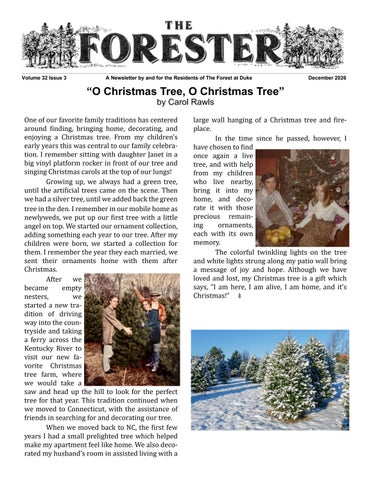
“O Christmas Tree, O Christmas Tree” by Carol Rawls One of our favorite family traditions has centered around �inding, bringing home, decorating, and enjoying a Christmas tree. From my children’s early years this was central to our family celebration. I remember sitting with daughter Janet in a big vinyl platform rocker in front of our tree and singing Christmas carols at the top of our lungs! Growing up, we always had a green tree, until the arti�icial trees came on the scene. Then we had a silver tree, until we added back the green tree in the den. I remember in our mobile home as newlyweds, we put up our �irst tree with a little angel on top. We started our ornament collection, adding something each year to our tree. After my children were born, we started a collection for them. I remember the year they each married, we sent their ornaments home with them after Christmas. After we became empty nesters, we started a new tradition of driving way into the countryside and taking a ferry across the Kentucky River to visit our new favorite Christmas tree farm, where we would take a saw and head up the hill to look for the perfect tree for that year. This tradition continued when we moved to Connecticut, with the assistance of friends in searching for and decorating our tree. When we moved back to NC, the �irst few years I had a small prelighted tree which helped make my apartment feel like home. We also decorated my husband’s room in assisted living with a
large wall hanging of a Christmas tree and �ireplace. In the time since he passed, however, I have chosen to �ind once again a live tree, and with help from my children who live nearby, bring it into my home, and decorate it with those precious remaining ornaments, each with its own memory. The colorful twinkling lights on the tree and white lights strung along my patio wall bring a message of joy and hope. Although we have loved and lost, my Christmas tree is a gift which says, “I am here, I am alive, I am home, and it’s Christmas!” ⸙
Page 2
December 2026
The Forester The newsletter of the Residents’ Association of The Forest at Duke, Inc., 2701 Pickett Rd., Durham NC 27705. Published monthly except July, August, and September by and for the residents. Beth Timson, Managing Editor Stephanie Seymour & Christine Huber, Copy Editors Dave Sloan, Layout Editor Linda Cushman & Louise Scribner, New-Resident Biographers Ken Parker, Proofreader Sanford Berg & Barbara Narcisco, Photographers Catherine & Sanford Berg, Couriers submit material to: theforestermanager@gmail.com
End of summer. End of year. End of daylight saving time. Ending, endings…and more endings. At this age, it’s quite common to be living amidst illness, decline, and the ends of lives as we’ve known them. But what we may be able to salvage and/or cultivate is the embrace and understanding that endings and ultimately death are all a part of life. We’re all part of the big, vast cycle of death and birth and lifetimes in between. It’s up to each of us to figure out where to find solace. How to invite and accept comfort. What brings us to serenity and peace? (Enduring And Embracing The Inevitable, Louise Applebome)
The Forester
R.A. President’s Podium by Elizabeth Gillis A little more than a year ago, The Forest at Duke grew into a much larger community than what it had been before. With the addition of the Terrace apartments, the number of residents increased to 410 in Independent Living and seventy-four in the Cohen Health Care Center. We also have new residents in several cottages and apartments in the Community Center building. The increased number of residents in Independent Living changed The Forest in many ways. We all wondered: How will we feed everyone? How will we be able to take the exercise classes we wish to take? How will we all fit in the auditorium? What about parking? All of the usual questions when there is a big change coming were asked. After a year most of these issues have been successfully dealt with. We all are able to eat, take exercise classes, park, and enjoy “new” and “old” residents. Of course we are all old residents essentially, or we would not be living here. All of us both “old and “new” are part of this wonderful place we live. It is up to each of us to remember to treat everyone, staff and other residents, with courtesy, respect, and kindness. Speak to others in the halls when you are out walking. Our staff members, those you see all the time and those who you only see occasionally, all deserve our respect. As I have often said, The Forest is a great place to live. We strive to be a friendly, considerate community of people who have chosen to live here. We as “old” and ”new” residents are still getting to know each other. It is a work in progress. Everyone who comes here comments on how friendly people are, and we do not want to lose that reputation. At The Forest, none of us is special, but still each of us is special in what we bring with us as an individual. What can you do to make another (continued on Page 6)
The Forester
December 2026
Page 3
Observations by Jack Gartner OK, I made my decision to apply to TFAD, and they agreed to take me. I chose my cottage, and since I had been coming to The Forest for many years from OLLI as a visitor and got to know several friends, I believed it would be an easy transition. Was it? The answer is Yes and No. I have been a Resident at TFAD for almost two years. I must say that even with all the difficulties of moving, it has been a most surprising and enjoyable journey. I would like to share some of my experiences with you which some of you might recognize. ● Did You Know that about a week after moving in, with floor to ceiling boxes, most people (including me) ask if you’re settled in yet? ● DYK that there are lithium battery and light bulb disposal containers in the Community Center coat room? I just recently found out. ● DYK that there are a multitude of secrets that might take a long time to discover? More on this later. ● DYK when you arrived that the number of events, activities, social meetings, exercise and swimming opportunities, speaker presentations, movies, and trips around the Triangle, is astounding? How do retirees keep up with all these activities? ● DYK that with a group of prominent lawyers, physicians, PhDs, and successful business people, the most important subject discussed at lunch and dinner is still food? “The chicken is too tough.” There was too much/not enough salt.” “The meat was too rare/too well done.” And these comments could actually occur at the same table! ● DYK that the residents I have met (and will meet) are among the smartest, most welcoming, and most caring people one could experience? I’m betting you do. ● DYK that when we first meet and do bios, backgrounds, and anecdotes, we have so many wonderful stories we can hear
about families, lives, careers, and travel amongst all our memories? This is among the most interesting of my experiences here Stories abound of people, who have never met until coming to TFAD, who find connections of working in the same place, of living in the same location close to each other or around the corner, or of being someone whose children or grandchildren knew each other at school or camp or at some time in the past. When I met Elizabeth Gillis, I found out her daughter and son-in-law knew my son and they both knew my son’s roommate at Duke. Then there are two residents, Steven Blank and Sally Nolin, who lived on Roosevelt Island in New York City for fourteen years in adjacent buildings. They met for the first time while joining me for lunch. I have been saying to folks whom I regale with these many tales that If we go back far enough, we are all related. SECRETS With so many means of communication when you first arrive at The Forest, e.g., mentors, caucuses, menus, weekly Forest Forwards, bulletins and bulletin boards, email, Cubigo, other residents, and Life at The Forest briefings. These are excellent, if one is able to keep up, but they still don’t cover all. I have partnered with Forrest Dixon to create our list for new arrivals to add to the above. I understand that not all apply to all residents, depending on their own interests, but I suspect many do: ● Addie’s Garden ● Community Gardens ● The Greenhouse ● The Pollinator Garden ● The Connections Room and all the miscellaneous information and Laughter Crafters ● A woodcraft workshop ● An art studio (continued on Page 4)
Page 4
December 2026
Welcome New Resident
The Forester
Observations. (continued from Page 3)
Anne Schmitt Apartment 1007 919-612-6210 Anne Luper Schmitt moved into The Forest in September. She and her husband Wally met while undergraduates at Duke. She says it was a “mixed marriage” because he was from Michigan and she was a North Carolinian born and bred. She went on to earn her law degree from The University of Detroit (now Detroit Mercy). The marriage lasted from 1973 until Wally’s sudden death in 2021. He was a noted chiropractor, specializing in applied kinesiology, nutrition and clinical neurology.
They loved to travel, and his lecture schedule allowed them to see much of the world: Komodo dragons, geishas on their way to work in Kyoto, sunrise in Haleakala, Norwegian fjords, Carnevale in Venice, the Fete des Lumieres in Lyon, and Paris many times, which was their favorite destination. They also loved to ski and were privileged to ski all over the western US, Canada, France, Austria, Italy, and Switzerland. Anne is proud to be a North Carolina native and thinks NC is the best state in the Union. (She also thinks Duke is the best
When I arrived, none of these were discussed with me. I must say the fact that they do exist does make our living here even more interesting. OPERATIONS Finally, among my observations of life at The Forest, is an appreciation of how difficult it is to manage and maintain an operation with large and varied functions seven days a week, twenty-four hours a day. There are thirteen functioning departments serving 480 or so “unique “ (aren’t we all?) individuals. From health, to security, to five meal venues and meals twice a day, to facility maintenance. All with a staff whose primary job is to try to serve and keep us safe and happy. It sure ain’t easy. I can connect this situation at The Forest to my own experience and perspective from over thirty years in aviation at Newark, LaGuardia, and Kennedy airports. Yes, there are normal administrative, staff, and budget responsibilities, and there is also the need for 24/7 availability due to a multitude of real and potential operational crises and responsibilities, many without precedent, which require staff response to keep the airports always open and safe. In summary, how has it been to live in The Forest? My favorite response Is: “It’s like being on a luxury cruise on the River Styx.” My hope for my friends and myself is that it be a very long river. ⸙ university in the state.) Although she is dog-less, Anne loves all dogs and is happy that The Forest is home to so many. Anne is currently volunteering at The Emily Krzyzewski Center two afternoons a week, assisting with the 6th graders. She is looking forward to getting completely unpacked and taking part in some of the many activities at The Forest, as long as they begin after 10 AM. ⸙
The Forester
December 2026
Page 5
“Why, to get a home!" by Judy M. Jensvold In May 1908, a month before her twenty-sixth birthday, Emma Jensvold of Canton SD established residence on a homestead about fourteen miles north of Roundup MT in the Lake Mason District. The Snowy Mountains formed its northern horizon, and South Yellow Creek ran through it. Emma was unmarried. Her three brothers, Chris, Olaf, and my grandfather Alfred, started homesteads nearby. To earn a living, Emma used her teaching degree to become one of Roundup’s first school teachers, teaching lower intermediate grades beginning the fall of 1908 In July 1910, Emma’s life changed in an unexpected way. A special agent from the U.S. Land Office, L. T. Hauberg, examined her claim and concluded her cabin was not habitable year-round. On September 6, 1910, Hauberg submitted an "adverse report" claiming Emma did not reside on her homestead and was not making the improvements required by the 1862 Homestead Act, which gave free land to homesteaders who lived on the land and improved it within five years. The hearing in U.S. v. Emma Jensvold was held December 16, 1910. Three government witnesses who lived near Emma’s homestead testified that she rarely resided on her land. One said he saw "no sign of habitation,” two others said they "never saw anyone living there." Her teaching in town during the winter months was used against her. Emma stated she "had to teach to make a living. I visited my homestead as often as weather conditions permitted." Emma's claim was supported by her brother Alfred, who said he'd seen Emma on her place “probably a dozen times" in the winter. Her brother Chris and another neighbor said they'd often eaten at Emma’s house. Her supporters
estimated she’d invested $450-$600 in her property. Agent Hauberg gave a damning account of her house and its contents. The special agent asserted there was no bed in the house in July when he inspected. Emma explained she was in town briefly in July getting a new bed after she’d returned a bed loaned to her. The special agent testified that he found her house completely unsatisfactory. “Attorney: You mean it was wholly unfit to live in, do you? Agent Hauberg: I mean it was not safe for a woman or for that matter a man to reside in that home during the extreme cold weather that we have in Montana.” Despite his detailed comments on the house, however, he didn't know what was growing in the fields and couldn't describe the fence. The exchange continued with Emma's lawyer Hamilton Wright asking her, “Would it be possible for you to reside continuously upon your homestead and make the improvements you have if you did not work away to earn money?” Emma: “No, sir.” Attorney Wright: “Do you have to depend on your own work for your livelihood?” Emma: “Yes, sir.” The lawyer for the government asked Emma, "Tell us how you happened to make that homestead entry, what your object was?” Stating what for her was obvious, Emma replied, “Why, to get a home!” Special Agent Hauberg’s further testimony revealed that this was not the way he saw things. He described one of Emma's absences from her homestead to visit her parents as her "going to her own home in Canton SD.” Was his use of “own” a way of stating that she belonged in her parents’ home, not alone on a Montana homestead? The hearing officer recommended cancellation of Emma’s Homestead Entry. Miss Jensvold appealed. Emma's lawyer this time was Edgar G. Worden. He wrote a spirited brief to appeal the decision. “[I]t is a sad comment (continued on Page 6)
Page 6
The Forester
December 2026
"Why, to get a home!" (continued from Page 5) that a spy should be allowed to break into the cabin of a settler” and that based on that "one visit" the settler’s claim should be open for cancellation. Attorney Worden went on to assert that Emma's "character for truth and veracity is not impeached" by any of her neighbors. Therefore, certainly her testimony was worth as much as that of the agent who admitted to going to the cabin when the claimant was away, removing the nails from the window sashes, standing on the window jam, and pushing aside "lace curtains" to examine "the cabin from that lofty perch.” Worden concluded "probably that is as high as he ever got or ever will get in life unless he practices tactics less underhanded and more honorable." Attorney Worden then asked, "how many unmarried men would be able to live for that length of time and place the improvements upon the land that this Claimant has? She has improved her claim as much as could be expected and more than many homesteaders of the sterner sex have done under similar circumstances.” Worden then suggested the motivation of Emma's attackers. “The attempt to have her entry canceled savors of either spite or the influence of some cowardly grafter, who has not the courage to come out in the open and contest her claim. If any neighbor desires this land, he should be required openly to contest the claim and not be allowed to hide behind the skirts of government special agents or spies." He concluded the statement by saying he had practiced before the Land Office in Montana for over twenty years, but had never seen a case more "unfounded” and could not imagine the government being "so unjust as to cancel
the entry of a poor girl when she is making as brave an attempt to comply with the law as the Claimant in the case." On June 18, 1912, a hearing decision concluded, "It is doubtful she will be able to make final five-year proof in view of her irregular residence, but it is possible the satisfactory commutation proof may be submitted.” Stating that the preponderance of the evidence failed to sustain the charges, and there was no evidence of bad faith on Emma's part, the proceedings were dismissed and Emma Jenvold’s Homestead Entry was allowed to stand. On September, 20, 1912, notice of her intention to make final commutation on her claim was posted in the newspaper of record, The Roundup Record-Tribune. Then on October 24, 1912, it was deemed that “Emma Jensvold having a house 12' x 20' (with lace curtains at the window), a barn 12' x 14', her whole claim fenced, 21 acres under cultivation, and $600 in improvements had made final proof and was entitled to receive a Patent for the lot above described." ⸙
R.A. President's Podium. (continued from Page 2)
person feel welcomed? What can you share with another resident? Do you say Hello when you pass in the hall? Do you introduce yourself if you don’t know the person? Do you sit with people you don’t know in the dining room? Each of us chose to come here, and it is up to each of us to maintain that feeling of friendliness and welcoming. We need to remember to speak respectfully to residents and staff alike. We are one Community. We can and will learn to live together as one community committed to helping each other and to growing as individuals. ⸙
The Forester
December 2026
Page 7
Welcome New Residents Jean Hurwitz
Patti McGinnity
Apartment 2121 Sally2907@yahoo.com 919 673-1515
Apartment 4021 Patti2246@gmail.com 850 240-2520
Our warm welcome to Jean, who has had a worldwide odyssey, having left South Africa in 1974, arriving at The Forest on September 1 of this year. She and her late husband, Barrie, went to New York City for his neurology training and then lived in Philadelphia before coming to Durham and Duke in 1978.
Patti comes from North Babylon (Long Island) NY and has been at The Forest since early October. She has also lived in White Plains and the Bronx NY as well as in Niceville and Melbourne FL. She attended Hofstra University and received a BA in Marketing, and she enjoyed music and performance as a cellist. She was married to Tony McGinnity in 1982, who passed away earlier this year. Her family includes Kelly McGinnity Avery of Durham, who is married to Matt Avery and has two children, Gus (five) and Abby (three). Megan McGinnity Saldana is married to Patrick Saldana and has two canine fur babies.
Jean was a pharmacist in South Africa, but since there was no reciprocity she decided to enroll in the pharmacy program at UNC Chapel Hill to be able to practice again. She worked at Duke for 30 years, as a hospital pharmacist and with her husband in his clinical research studies, then in pediatric clinical research. She feels privileged to have been part of the progress of treatment for several significant diseases affecting adults and children. Jean has three children and their spouses, and eight grandchildren. One daughter lives in Durham, one in Brookeville MD and a son in Jupiter FL. Jean says she is grateful to have them all in the same time zone, although her grandchildren are scattered across three time zones. Jean does some community volunteer work and enjoys meeting new people. Her hobbies include spending time with her family,
Primarily a “stay at home” mom, Patti worked for the New York Telephone Company, in various retail stores and in the Niceville Public Library. She worked as a volunteer in her daughters’ classrooms through elementary school and assisted the school band with uniforms and ran the concession stand during football games. Patti is busy unpacking her beautiful collection (close to one hundred of
(continued on Page 8)
(continued on Page 8)
Page 8
The Forester
December 2026
Hurwitz (continued from Page 7)
traveling, reading, playing bridge, attending theater and musical events, qi gong, and exercising in our pool. She plans to add yoga and line dancing. Fun fact: Jean has an interesting collection of mortars and pestles in her apartment, in many sizes, colors, materials and decorations, in celebration of her scientific and pharmaceutical career. Over many years, the Hurwitz family had three beloved cats as well as thirteen adored dogs, all Pembroke Welsh corgis. If you have a corgi, please contact Jean! ⸙
McGinnity
. (continued from Page 7)
them!) of bells in all shapes, sizes, and decoration, which she hopes to be able to display in the lobby at The Forest. Patti has been on over one hundred cruises and has travelled to such exotic places as St. Petersburg in Russia, New Zealand, Hawaii, Australia, Mexico, Colombia, Ireland, and Switzerland. She enjoys going to plays and concerts and enjoys dancing (she says “nothing fancy”), playing mahjongg and other board games, and she plans to try more of the many activities at The Forest. ⸙
Stuart and Martha (Mart) Pattison Apt. 3032 Stuart - stu.pattison@ieee.org Mart – martpatt@embarqmail.com (919) 435-4899 A warm welcome to the Pattisons, residents at The Forest since mid-August. Stu was born in New York City and grew up in White Plains NY and lived in Ithaca NY, San Bernardino, and Sacramento CA. He received a degree in Electrical Engineering from Cornell University and developed interests there in computers and the student-run classical music radio station and also joined ROTC. He entered the Air Force in 1964 as a second lieutenant, leaving as a captain in 1968 after installing electronic communications in the Pacific area. Stu’s primary career was in manufacturing test and quality management for computer and communications equipment. For twenty-seven years he has been a volunteer and staff member at Radio Station WCPE, the popular listener-supported classical music station based in Wake Forest. member of the Wake Forest Rotary Club.
Mart is from the San Francisco Bay area. She attended Whitworth College in Spokane WA and the University of CA Sacramento, where she graduated with a BA in Education with minors in Psychology and Art. She later earned a second credential in Academically Gifted Education and taught in CA, MN, and NC. As a volunteer she led an art appreciation program for grades K to 6. She also worked for the United Methodist Publishing House. Stu and Mart met in Sacramento and were married in 1968, relocating to Minneapolis. In 1984 they moved to Raleigh, then to Wake Forest in 1999. Their family includes son Gregory of Durham, a manufacturing engineer at Nugget Comfort in Butner NC, and daughter Kelly Peak who lives in Carrboro and is a System (continued on Page 9)
The Forester
December 2026
Page 9
Pattisons (continued from Page 8) Administrator for Advance Auto Parts in Raleigh. participating in a dance fitness class. Stu enjoys They have three grandchildren. woodworking, computers, reading, and puzzles, Mart enjoys reading, making pottery, and and has joined the Way Off Broadway group, card games, and looks forward to playing Forest Singers, and Resident Readers, as well Rummikub, a cardio strength balance class, and as enjoying our pool and gym. ⸙ walking at The Forest. She also looks forward to
Photograph 51 by Howard Goldsweig This month’s “innovations” snippet reaches into the past for its inspiration. It tells a story of what is certainly one of mankind’s greatest discoveries and of a name unspoken at a Nobel ceremony. In the winter of 1953, a photograph (see image) changed hands in a London laboratory without its maker's knowledge. It was a small, grainy, cross-shaped smear of dark spots on film, produced by firing X-rays through a single fiber of DNA. Its maker, Rosalind Franklin, a thirty-twoyear-old physical chemist at King's College, had already moved on to other scientific work on viruses. Her association with Photograph 51 came somewhat by chance. She was recruited to King's from a lab in Paris (Laboratoire Central des Services Chimiques de l'État), where she had mastered X-ray crystallography. As an expert in this field, she was assigned to further the preliminary work on DNA structure being done by a colleague, Maurice Wilkins, and a grad student, Raymond Gosling. Working with Gosling, she discovered that DNA existed in two forms, a drier "A" and a wetter (hydrated) "B." In May 1952, Gosling captured the B form in what the lab filed, unglamorously, as Photograph 51.
The X-shaped pattern is the signature of a helix. The spacing of the spots yielded the dimensions: a turn every thirty-four angstroms, with the repeating units stacked closely within it. The data also implied that the sugar-phosphate backbone sat on the outside, not the inside, which was a point on which the rival models of the day were badly wrong. Then came the handoffs. Wilkins, Franklin's colleague and a sometime antagonist, showed the image to his friend at Cambridge, James Watson, who later wrote that his pulse quickened at the sight. Soon afterward, Max Perutz, a member of a review committee of the Medical Research Council, (unbeknownst to Franklin) passed along a confidential internal King's report of her crystallography data to Francis Crick. With these in hand, Watson and Crick refined their double helix model of DNA. Their double helix paper was published in Nature in April 1953. The only acknowledgement of Franklin's own work was a footnote acknowledging the unpublished experimental results and ideas of Wilkins and Franklin. Franklin never knew the full story. She died of ovarian cancer in 1958, at thirty-seven. In 1962, the Nobel Prize went to Watson, Crick, and Wilkins; the prize is not awarded posthumously, and a maximum of three can share the prize. Her name went unspoken. Photo 51 became a crucial data source that led to the development of the DNA model. The photograph survives. It is the rare scientific image that has become a portrait, and the face in it is hers. ⸙
Page 10
December 2026
The Forester
Cohen Culture by Bill Harrington and Kaidy Lewis (Artist in Residence) You know you’re in the Cohen Health Center… If you’ve ever ordered breakfast through the bathroom door If someone has awakened you to see if you’re “OK” If you’ve ever ordered lunch through the bathroom door If you’ve ever been asked how many “moves” you’ve had today If you’ve ever ordered dinner through the bathroom door If you find yourself sitting and staring and wondering what comes next So, here is why it helps to develop a sense of humor. Lucky for me, humor has always been important. Etched on a gene somewhere on one of my chromosomes, my father left me a gift: the capacity to laugh, to have a good time, to make fun of myself. This fun is often created here through the Activities team led by Jaqueria Edmunds. And, sometimes it is serendipitous. Two years in the Health Center went by before I saw the hated insect we call a roach. I had chased several of these creatures around my apartment when I lived in Independent Living, but now I could not chase this bug for obvious reasons. I could only watch him while holding onto my rollator. Oops! This creepycrawly was not a roach; he was a water bug. How do I know? He took a shower with me the next morning. I had a roommate! Joking aside, a placement in the Cohen Health Center represents the most recent stop in a series of losses—examples of which may be losing driving privileges, giving up season tickets to concerts/sports events, becoming unable to travel, and possibly losing a spouse. Moving into Room 410 on 4 South meant starting over again—again. I had to re-learn how to take care of myself, to perform the most basic of skills while dealing with sometimes unbearable pain. I began spending more time than usual thinking about my past, because I
didn’t know if I had a future. When the daylight of rehab finally dawned, those future unknowns became more defined. When I retired at the age of sixty-four, my family and friends often asked, “Bill, what are you doing in retirement?” Answering this question inevitably led to the statement, “Well … that gives you something to do.” “No,” I said, “that gives me something meaningful to do.”
I needed to do something meaningful again. But what? Enter our artist in residence, Kaidy Lewis. Her job was to chase me out of my room, not literally, of course, but figuratively. Gradually, I embarked on my most recent meaningful journey. It has become much-liked life: an ongoing, mostly enjoyable, sometimes frustrating, trip without a map. Space does not permit me to include the contributions of all the Health Center staff to my recovery. Without everyone working together and doing their respective jobs, “meaningful” would have no chance. Going forward this Forester column called Cohen Culture, written by Kaidy and me, will share real stories of creativity and accomplishments of life here in all their various forms. The aim is to dispel the fear that often surrounds moving into and living in the Cohen Health Center and to replace this possible distress with realizing a life filled with more pleasure and less apprehension. ⸙
The Forester
December 2026
Page 11
WHY CONSIDER A GREEN BURIAL? byTom Farin What is a Green Burial? A Green Burial is an environmentally responsible method of laying a person to rest that returns the body naturally to the earth without toxic chemicals, metal caskets, or concrete vaults. Green Burials have grown steadily in popularity over the years, driven by rising environmental awareness, costconsciousness, and a shift toward sustainable, end-of-life choices. They are expected to continue to grow by about 8% per year. What are some of the key characteristics of a Green Burial? There is no embalming with toxic formaldehyde which poses health risks to workers and pollutes the soil. It skips highenergy cremation processes, thus significantly reducing carbon emissions into our atmosphere. Instead, the process uses refrigeration, cooling, or dry-ice preparation. The casket is made of biodegradable materials like untreated wood, bamboo, wicker, cardboard, or simply natural fiber shrouds. It avoids heavy-resource concrete vaults and metal liners that block soil contact and slow natural decomposition. Shallow graves, only 3-4 feet deep in the active soil layer, encourage oxygen-driven organic breakdown. The habitat of the burial location is also protected. Many natural and conservation burial grounds help preserve open land, restore native plant life, and protect wildlife habitats. Some conservation burial grounds offer ecologicallyprotected land managed by trusts that actively restore and preserve native habitats. Natural burial grounds are dedicated green spaces that feature native plants and simple natural or GPSbased markers instead of granite headstones. Hybrid cemeteries are conventional cemeteries that offer a designated area for vaultless, ecofriendly green burials. What about the cost? Because it eliminates expensive caskets, vaults, and embalming fees, a Green Burial is often thousands of dollars cheaper than a conventional burial. In the Raleigh-Durham area, a Green Burial typically costs between $3,000 and $6,000, whereas a conventional
(traditional) burial generally ranges from $7,000 to $15,000 (with a national average around $9,420). To conclude, a Green Burial offers a quiet, earthy, and values-aligned approach to honoring a life, a meaningful tribute to a conservationist loved one. It still allows families many options for casket styles and personal touches and a flexible option for any type of funeral or memorial service.
Additional information can easily be found by performing a Google search on “Green Burial Funeral Homes,” “Green Burial Service Providers,” and “Green Burial Grounds.” ⸙
Page 12
December 2026
The Forester
Our Trip to Sonoco by Susan Martin On September 23, 2026, five members of the TFAD Green Team (plus one guest) went to Raleigh for a tour of the Sonoco materials recycling facility. We wanted to know whether our recyclables are actually used or if they go straight to a landfill. The answer—they’re sorted, and then most get used! Sonoco is a private for-profit company, and it’s where the recyclables that GFL picks up from TFAD are taken for sorting and processing. It’s a big operation with trucks continually bringing recyclables to the facility and other trucks picking up processed, sorted materials such as glass or metal for reuse in new products.
The sorting floor is loud with multiple conveyer belts. Automation pulls some items such as glass or metal into separate streams, and workers pull out contaminated materials – most often plastic bags. Everything that gets dumped from trucks that pick up curbside
recyclables, such as those from TFAD, is bulldozed into a huge pile and then loaded onto the first conveyer belt to start the sorting process.
Sonoco handles between three hundred and five hundred tons of materials each day. Of that, an average of twenty percent is contaminated and is sent to a landfill. The rest is reused. Sonoco itself retains the cardboard for its own use making packaging for items such as Kleenex boxes, Pringles Chips cans, or Whiskas cat food boxes. Plastic goes to a company, Reprieve, which breaks down the polymers and turns them into carpets or clothing. Metals often go to soft drink companies, and glass goes to Strategic Materials, a glass recycling company recently acquired by Sibelco. (You can learn more about them at https://www.sibelco.com/en/ sustainability/glass-recycling-north-america ).
As things move along the conveyor belts, metals and glasses get separated out. Plastic too goes in its own direction. Cardboard and paper are bundled. Once sorted, everything is packaged into bundles, ready to be sent on for reuse. Want to see a video of how the whole thing works? Use this link: https://www.sonoco.com/na/products/services/ recycling-solutions/educational-resources (continued on Page 13)
The Forester
December 2026
Page 13
Sonoco (continued from Page 12) A few things we learned: · What can be recycled: o Think “Cans, tubs, bottles, jugs, jars, paper and cardboard.” o Don’t worry about the numbers on the plastic articles–they aren’t relevant anymore. · The two biggest no-no’s for recycling: o NO plastic bags or other films, o NO batteries. We took some items with us to ask if they could be recycled: Yes. The broken-down takeout container from the Bistro, as long as this is food free, is OK to recycle. The vitamin bottle is good; a large container considered a “tub” is good. Small paper items would not be OK on their own but attached to a larger sheet of paper they’re OK. Staples and tape do not need to be removed.
No: clamshell containers, berry containers, aluminum, plastic bags, thin paper such as receipts, soup containers. A brown paper bag would be OK, unless it has too many food stains. Sonoco offers tours for groups and for individuals. If you’re interested and would like to see the operation in person, here’s who to contact: Chelsea Arey, Environmental Education Program Coordinator, Wake County Government Community Services Department / Solid Waste Division Chelsea.arey@wake.gov. ⸙
Our Library: An Open Book (And More!) By Diane Strauss Shifty Business The library’s been extra shifty recently, and we’re proud of it. Our In-House Authors collection has been moved from the back hall to well-deserved prominence in the entrancefacing bookcase formerly housing large print and other new books. The new “large print” books are now located on the black cart also facing our entrance, and the other new books are in our “new” bookcase against the wall near the table that contains the public computer and magnifying equipment. We’re glad to help out if you have any questions.
Left to right: Lucy Grant, Sharron Parker, Adrienne Munich, Susan Martin, Diane Pahl
Something Old, Something New Our “new” bookcase is recycled from Duke’s surplus warehouse, thanks to the efforts of David Goldstein, Susan Radin, and other library volunteers. It was the perfect size and free, although not up to par with our library’s other bookcases. That’s where TFAD staff came in: they hauled our prize from the warehouse with (continued on Page 15)
Page 14
The Forester
December 2026
Darwin, Fitzroy, and Soapy Sam: A Great Science and History Series by John Staddon Critics of the BBC today argue that its journalists tend to share broadly progressive social and political assumptions, that conservative perspectives receive less sympathetic treatment, and that social issues are almost always framed in terms of contemporary progressive values. But the BBC used to make more aspirational shows, and one of its very best is the1978 series The Voyage of Charles Darwin which depicts Darwin’s five-year voyage around the world in the 1830s. For some reason this splendid sevenparter has never been re-issued by the Beeb. But you can see it on YouTube here. The series excels in every dimension. First is the experience of living and working on a small sailing vessel, HMS Beagle, a ninety-ft naval frigate played in the film by a suitably refitted threemasted brigantine (built 1919), the Marques. The ship looked tiny to me, but apparently the Marques was actually somewhat larger than the Beagle. This modest vessel was peopled by some seventy sailors, and you can see why there were so many when you observe the dozens of ropes and sails that must be reefed and luffed to keep the ship correctly aligned to changing winds. You can also understand the need for harsh discipline, when mistakes could lead to dismasting or worse. Twenty-two-year-old Darwin was not a sailor. He was on the ship simply as an unpaid companion for its captain James Fitzroy, only four years older, whose mission was to survey the coast of South America. Darwin was recommended not for his scientific acumen, which was modest, but mostly for his amiability and adaptability. He was supported by his Cambridge tutor and friend, botanist JM Henslow, and by future
father-in-law (and maternal grandfather) Josiah Wedgwood, of the wealthy pottery family. The need for a companion to the captain of a small ship on a long voyage was well understood. With a heavy responsibility and no one to confide in, sea captains in such a position were under much strain. Indeed, Fitzroy’s predecessor Pringle Stokes had committed suicide while in command. Darwin and Fitzroy usually got on well. But Fitzroy was a biblical fundamentalist and Darwin’s occasional mentions of facts hard to reconcile with biblical claims—about the age or permanence of the earth, for example— occasionally caused moody breakdowns by the Captain. Fitzroy was apparently not happy to
learn that Darwin had found sea fossils at thirteen thousand feet in the Andes, on one of his many land expeditions while the ship was being repaired. But perhaps the most striking feature of the series is its accurate and comprehensible account of the science. Darwin gathered stuff by (continued on Page 15)
The Forester
December 2026
Page 15
Darwin
Library
(continued from Page 14)
(continued from Page 13)
his own admission more or less at random, not limited by any disciplinary specialization. He puzzled over the noticeably different species in each of the Galapagos Islands, despite their proximity, similar climate, and vegetation. He speculated, correctly, on the origin of coral reefs. He puzzled about the origin of species, a problem he was not to solve until a few years after his return to England.
their truck and brought it in. Then they sanded and stained it and placed it in the library. Here’s something that resident organizations, committees, and TFAD staff may find beneficial. When David and Susan visited, they spotted desks and desk chairs, office supplies and school supplies, medical equipment, and even some upholstered furniture. Those in need should consider it an option. Visits for non-profit organizations are currently scheduled from 2:00-3:00 on Mondays and Thursdays. Only two members of the Forest are permitted in the surplus area at one time, and no parking in its lot is possible before 2:00. For clarification or additional information, email David Goldstein at david.austein@gmail.com.
Charles Darwin’s voyage around the world on the HMS Beagle The series ends with Darwin’s belated but still reluctant publication of The Origin of Species after being scooped by the young Alfred Russel Wallace. The final act is Thomas Huxley’s famous riposte to the Bishop of Oxford, “Soapy Sam,” Wilberforce’s ill-informed attack on an ailing and absent Darwin at an Oxford evolution debate. Was the event really that dramatic? Don’t know, but the scene makes its point. Go take a look. ⸙
Grateful Heartfelt thanks to those of you who filled out the library questionnaires deposited in your inhouse mail boxes. Your compliments, complaints, and suggestions are much appreciated. Library volunteer Linda McBride is presently tallying and analyzing them and will share her insights with the Library Committee, which will consider further action to be taken. This isn’t just a flash in the pan. To encourage further communication, a new suggestion box is now atop the front desk. Please contribute to it. Happy holidays to all. Drop in, settle down, read, puzzle or work on your New Year’s resolutions, and if the weather warrants, turn on our fireplace and get comfy. Enjoy. ⸙
Page 16
December 2026
Ruth Jane We meet at the table to work a new puzzle, But finding some pieces can be a real strain. So when we’re stuck and can’t go onward – What do we do? We call for Ruth Jane! Attuned to shapes, she locates edges Desperately needed to keep us sane. If we are flummoxed and can’t see a pattern Then who is our rescue? You know it’s Ruth Jane! Her sharp eyes spot a needed color Of a piece that’s been a major pain; Once again, we’ve called on our savior – The puzzling abilities of Ruth Jane! With hours spent bending over an image Her puzzle mastery is definitely our gain. We all enjoy her conversation Most of all we love our Ruth Jane! by Robyn Sloan
The Forester
The Forester
December 2026
Page 17
Page 18
December 2026
The Forester
The Forester
December 2026
Page 19
Page 20
December 2026
The Forester
The Forester
December 2026
Page 21
Page 22
December 2026
The Forester
The Forester
December 2026
Page 23
Page 24
December 2026
The Forester
Thr Forester
November 2026
Page 25
Page 26
December 2026
The Forester
The Forester
December 2026
Page 27
Page 28
December 2026
The Forester