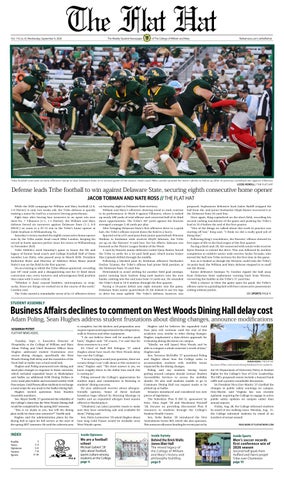
Vol. 116, Iss. 8 | Wednesday, September 9, 2026
The Flat Hat The Weekly Student Newspaper
of The College of William and Mary
flathatnews.com | @theflathat
Tribe football overcame an early offensive slump to beat Delaware State in its second game of the season. Head coach Mike London praised the team's ability to follow up after its previous comeback win against Villanova.
LIZZIE NOWELL / THE FLAT HAT
Defense leads Tribe football to win against Delaware State, securing eighth consecutive home opener JACOB TOBMAN AND NATE ROSS // THE FLAT HAT
While the 2026 campaign for William and Mary football (2-0, 1-0 Patriot) is only two weeks old, the Tribe defense is quickly making a name for itself as a turnover-forcing powerhouse. Eight days after forcing four turnovers in an upset win over then-No. 7 Villanova (1-1, 1-1 Patriot), the William and Mary defense forced six turnovers against Delaware State (1-1, 0-0 MEAC) en route to a 22-15 win in the Tribe’s home opener at Zable Stadium in Williamsburg, Va. Saturday’s victory marked the eighth consecutive home opener won by the Tribe under head coach Mike London, keeping his record in home openers perfect since his return to Williamsburg in November 2018. Tribe Athletics used Saturday’s game to honor the life and legacy of former head coach and College Football Hall of Fame member Lou Holtz, who passed away in March 2026. President Katherine Rowe and Director of Athletics Brian Mann joined Holtz’s son on the field in the first quarter. On an evening in which the Tribe offense sputtered, recording just 187 total yards and a disappointing one-for-12 third down conversion rate, every turnover and advantageous field position that came with it were critical. “Whether it [has] caused fumbles, interceptions or stripsacks, those are things we worked on in the course of the week,” London said. The Tribe started a remarkable seven of its 15 offensive drives
on Saturday night in Delaware State territory. William and Mary’s offensive showing stood in stark contrast to its performance in Week 0 against Villanova, where it racked up nearly 400 yards of total offense and converted half of its third down opportunities. The Tribe’s 187 yards against the Hornets averaged a meager 3.46 yards per play. After bringing Delaware State’s first offensive drive to a quick halt, the Tribe’s offense moved down the field in a hurry. Spurred on by a 63-yard pass from junior quarterback Winston Watkins to freshman wide receiver Khylil Johnson, the Tribe set up on the Hornets’ 6-yard line. For his efforts, Johnson was honored as the Patriot League Rookie of the Week. A sack by Hornets junior defensive tackle Quoy Rainey forced the Tribe to settle for a 25-yard field goal, which junior kicker Max Lipinski drilled through the middle. Following a blocked punt by freshman offensive linebacker Declan Ta’amai, the Tribe's offense had prime field position at the Delaware State 19-yard line. Determined to avoid settling for another field goal attempt, junior running back Andrew King took matters into his own hands, rushing into the end zone from 14 yards out. He extended the Tribe’s lead to 10-0 midway through the first quarter. Facing a 10-point deficit just eight minutes into the game, Delaware State senior quarterback Ui Ale looked to use his legs to drive his team upfield. The Tribe's defense, however, was
prepared. Sophomore defensive back Jaden Ratliff stripped the ball from Ale, and junior linebacker Elijah Rainer recovered it at the Delaware State 26-yard line. Once again, King capitalized on the short field, recording his second rushing touchdown of the game and pushing the Tribe's lead to 16-0 before the end of the first quarter. “One of the things we talked about this week in practice was starting off fast,” King said. “I think we did a really good job of doing that.” Following King’s touchdown, the Hornets’ offense showed its first signs of life in the final stages of the first quarter. Facing a third-and-20, Ale connected with senior wide receiver Kyree Benton to extend the drive. This was followed by another completion to redshirt senior wide receiver Jaylin Terzado, who moved the ball into Tribe territory for the first time in the game. Just as it looked as though the Hornets could trim the Tribe’s 16-point lead, the William and Mary defense stepped in to snuff out the threat. Junior defensive lineman Ty Gordon ripped the ball away from Delaware State sophomore running back Sean Weston, recovering the fumble at the Tribe’s 37-yard line. With a chance to blow the game open for good, the Tribe’s offense came to a grinding halt with four consecutive possessions ending without points. SEE SPORTS PAGE 9
STUDENT ASSEMBLY
Business Affairs declines to comment on West Woods Dining Hall delay cost
Adam Poling, Sean Hughes address student frustations about dining changes, announce modifications SUSANNAH POTEET FLAT HAT NEWS ASSOC.
Tuesday, Sept. 1, Executive Director of Hospitality at the College of William and Mary Adam Poling and Chief Business Officer Sean Hughes addressed student frustrations over recent dining changes, specifically the West Woods Dining Hall delay and the transition of the Food Hall at Sadler into a food retail hub. Hughes and Poling announced new dining and meal plan changes in response to those concerns, which included expanded hours to Marketplace and Sadler, an additional $100 Dining Dollars to every meal plan holder and increased weekly Gold Pass swipes. Gold Passes allow students to exchange a meal swipe for any meal in the Sadler dining hall. Hughes invited questions from Student Assembly members. Sen. Mayer Tawfik ’27 questioned the reliability of the College’s claim that the West Woods Dining Hall would be completed by the spring 2027 semester. “This is no shade to you, but will the dining plan really be done next semester?” Tawfik said. Hughes said the administration plans for the dining hall to open for full service at the start of the spring 2027 semester. He said the cafeteria area
INDEX Profile News Opinions Variety Sports
is complete, but the kitchen and preparation area require repairs and inspections for the refrigerators, walk-in freezers and other equipment. “I do not believe there will be another push back,” Hughes said. “Of course, I’ve said that for three semesters in a row.” SA Chief of Staff Elif Erdogan ’27 asked Hughes about how much the West Woods delay has cost the College. “I’m not trying to avoid your question, there are certain things I can’t talk about at this moment in time,” Hughes said. “The short answer is yes, we know roughly down to the dollar how much this is costing us.” Poling stressed the College’s appreciation for student input and commitment to listening to students’ dining concerns. He also addressed worries about allergenfriendly options. Some of these include breakfast bags offered by Morning Musings in Sadler and an expanded allergen food station offered at Marketplace. “[Students] can [also] preorder meals to make sure they have something safe and available for them,” Poling said. Sen. Daria Lesmerises ’29 asked Hughes about how long Gold Passes would be available once West Woods opens.
Inside Opinions 2 3-4 5-6 7-8 9-10
We are a football school
Michael Gabriel '28 talks about football, sports culture among students at the College page 6
Hughes said he believes the expanded Gold Pass plan will continue until the end of this academic year, similar to other dining changes. Hughes emphasized a data-driven approach for evaluating dining decisions on campus. “Ideally, we will [open] West Woods and be able to compare a whole semester's worth of data,” Hughes said. Sen. Terrence McDuffie ’27 questioned Poling and Hughes about how the College seeks to accommodate students with mobility issues impacted by the dining changes. Poling said any students having issues getting around campus should contact Student Accessibility Services to access the mobility shuttle. He also said students unable to go to Commons Dining Hall can request meals to be picked up at Sadler. Senators introduced and considered two new pieces of legislation. The Subsidize Plan B Bill II, sponsored by Sens. Nina Argel ’28 and Mackenna Wyckoff ’28, focuses on providing discounted Plan B resources to students through the College’s Student Health Center. Sen. Neha Baskar ’29 introduced the First Amendment Series Bill, which she also sponsors. This measure allocates funding for events put on by
NAMAN MISHRA / THE FLAT HAT
Business Affairs welcomed dining feedback from students.
the SA Department of University Policy & Student Rights for the College’s Year of Civic Leadership. The bill's proposed events include a banned book raffle and a protest roundtable discussion. SA President Nico Giro-Martin ’27 clarified the changes to public safety warnings on campus. Giro-Martin said Virginia law was recently updated, requiring the College to engage in active public safety updates on campus rather than annual reports. Friday, Aug. 28, the College informed students by email of two stalking cases. Monday, Aug. 31, the College informed students by email of an incident of sexual assault. READ MORE AT FLATHATNEWS.COM
Inside Variety
Inside Sports
The mixed legacy of the College of William and Mary's history and philosophy building page 8
Second-half goals from Huffard and Harris propel Tribe over Charleston page 10
Behind the Brick Walls: James Blair Hall
Men's soccer records first conference win of 2026 season
“
newsinsight news insight
News Editor Liam Glavin News Editor Naman Mishra News Editor Robin Perdue fhnews@gmail.com
THE FLAT HAT | Wednesday, September 9, 2026 | Page 2
THE BUZZ
“
In this increasingly digital world, itʼs important to go to live events and actually engage with people and hear them speak. -- Research professor at the University of the Free State Pamila Gupta FLAT HAT NEWS BRIEF
College announces changes to dining, meal swipes, Dining Dollars
Tuesday, Sept. 1, College of William and Mary Chief Business Officer Sean Hughes emailed the campus community about recent changes to dining operations. His message followed community members expressing frustrations with the delayed opening of the West Woods Dining Hall and the transition of the Food Hall at Sadler into a food retail hub. Hughes acknowledged these sentiments. Hughes announced the Marketplace at Campus Center would expand from serving all-you-can-eat lunch on weekdays to offering daily breakfast, lunch and dinner. This began Wednesday, Sept. 9. Morning Musings, a new grab-and-go breakfast spot, opened Thursday, Sept. 3 in the Sadler Center. Morning Musings and accepts meal swipes and operates Monday through Friday from 7-11 a.m. Hughes announced other changes to meal plans. Students with the All Access plan received five weekly Gold Passes ̶ which let students use meal swipes for retail vendors ̶ for the Sadler food hall, increased from two. Students with the Block 100 and Block 125 plans received two weekly Gold Pass swipes, increased from one. Every meal plan holder received an additional $100 Dining Dollars on top of the $100 Dining Dollars already transferred to students after the Aug. 8 West Woods Dining Hall delay announcement. He said the College is working to increase operating hours and portion sizes. READ MORE AT FLATHATNEWS.COM NAMAN MISHRA / FLAT HAT MANAGING EDITOR
A THOUSAND WORDS
COURTESY IMAGE / ADELIA PURCELL
Purcell is the Collegeʼs 13th recipient of the federally funded Harry S. Truman Scholarship. She was awarded
ROBIN PERDUE / THE FLAT HAT
CORRECTIONS
Truman Scholarship recipient Adelia Purcell ’27 discusses passion for sexual violence prevention Purcell connects academic interests with passion for public service, human rights advocacy
The Flat Hat wishes to correct any fact printed incorrectly. Corrections may be submitted in email to the editor of the section in which the incorrect information was printed. Requests for corrections will be accepted at any time.
THE FLAT HAT ʻSTABILITAS ET FIDESʼ | ESTABLISHED OCT. 3, 1911 Org #101 P.O. Box 8795, Williamsburg, VA 23187
Editor flathat.editor@gmail.com Managing flathat.managing@gmail.com Executive flathat.executive@gmail.com Magazine editor@flathatmagazine.com News fhnews@gmail.com Sports flathatsports@gmail.com Copy flathatcopy@gmail.com
Opinions fhopinions@gmail.com Variety flathat.variety@gmail.com Photos flathatphotos@gmail.com Online flathatonline@gmail.com Advertising flathatads@gmail.com Graphics flathat.art@gmail.com Ombudsman flathat.ombuds@gmail.com
Mona Garimella Editor-in-Chief Maddie Mohamadi Managing Editor Megan Rudacille Executive Editor Nate Ross Copy Chief Kylie Totten Digital Media Editor Ben McLoughlin Operations Coordinator Molly Martin Operations Coordinator Robin Perdue News Editor Liam Glavin News Editor Naman Mishra News Editor Emma Beelner Variety Editor DevYani Thakare Variety Editor Cara King Sports Editor Jacob Tobman Sports Editor Michael Gabriel Opinions Editor Ava Gravina Opinions Editor Liam McMahon Audio/Visual Editor Kenza Houhou Audio/Visual Editor Adelyn Skerik Copy Editor Clare Pacella Copy Editor Eden Leavey Copy Editor Elise Whitfield Copy Editor Emma Newill Copy Editor Irene Straw Copy Editor Jonathan Larkin Copy Editor Julia Peavey Copy Editor Kelsea Smith Copy Editor Kreilys Garcia Flores Copy Editor Lindsay Luberecki Copy Editor Lorelei Kelley Copy Editor Ruby Trainor Copy Editor Sophia Paradowski Copy Editor Lily Mansell Copy Editor Hannah Elysse Mayo Copy Editor Madigan Webb Chief Staff Writer Lila Reidy News Assoc. Editor Melania Frye News Assoc. Editor Nicole Zajac News Assoc. Editor Rebecca Fuchs News Assoc. Editor Sam Belmar News Assoc. Editor Sachi Pallem News Assoc. Editor Shannon Raymond News Assoc. Editor Susannah Poteet News Assoc. Editor Sanjana Manghnani News Assoc. Editor Bobby Mollan News Assoc. Editor Abigail Furcy Chief Variety Writer Aamnah Malik Variety Assoc. Editor Aditi Allam Variety Assoc. Editor
$30,000 for graduate school.
Eric Sohn Audio/Visual Editor Andrew Henrickson Data Editor Betty Yemane Social Media Editor Evie Corr Social Media Editor Kimberly McCann Photos Editor Isabel Editor Graphics Editor Gretta Anderson Graphics Editor Maeve Meyer Games Editor Ethan Auclair Ombudsman James Abruzzo Business Manager Sam Harrington Webmaster
Anna Wood Variety Assoc. Editor Brooke Lewis Variety Assoc. Editor Callie Laubacker Variety Assoc. Editor Ella Greene Variety Assoc. Editor Emma Beelner Variety Assoc. Editor Juliana Nelson Variety Assoc. Editor Maggie OʼKieffe Variety Assoc. Editor Patricija Pupine Variety Assoc. Editor Skylar Hartgerink Variety Assoc. Editor Skyler Cole Variety Assoc. Editor Tessa Darke Variety Assoc. Editor Maya Sakai-Chen Variety Assoc. Editor Gabriella Calcagno Variety Assoc. Editor Nora Yoon Chief Opinions Writer Abigail Crespin Opinions Assoc. Editor Alexandra Hill Opinions Assoc. Editor Carson Burch Opinions Assoc. Editor Cate Woodrum Opinions Assoc. Editor Charlotte Trodden Opinions Assoc. Editor Ella Grimes Opinions Assoc. Editor Eva Jaber Opinions Assoc. Editor Geronimo Ritcheson Opinions Assoc. Editor Isabella McNutt Opinions Assoc. Editor Lana Altunashvili Opinions Assoc. Editor Lucia Reyes Opinions Assoc. Editor Teddy Friesz Opinions Assoc. Editor Audrey Capone Opinions Assoc. Editor Carolyn Reid Photos Assoc. Editor Ethan de Guia Photos Assoc. Editor Jonah Peters Photos Assoc. Editor
Alina Schueman Videos Assoc. Editor Darius Bagherian Videos Assoc. Editor Enna Carbone Videos Assoc. Editor Jack Pegler Videos Assoc. Editor Landon Miles Videos Assoc. Editor Olivia Ives Bailey Videos Assoc. Editor Piper Gilly Videos Assoc. Editor Siddhita Krishnan Videos Assoc. Editor Sophie Frank Videos Assoc. Editor Virginia Fife Videos Assoc. Editor Sabry Tate Podcasts Editor Connor Pawliczak Podcasts Assoc. Editor Maricel Pucillo Podcasts Assoc. Editor Noa Wilson Podcasts Assoc. Editor Isabel Volden Graphics Editor Gretta Anderson Graphics Editor Alina Yang Graphics Assoc. Editor Maisie Curtin Graphics Assoc. Editor Aida Bekele Graphics Assoc. Editor Westley Jacanin Chief Sports Writer Eamonn McAloon Sports Assoc. Editor Henry OʼConnor Sports Assoc. Editor Katie Killagen Sports Assoc. Editor Ellie Laanisto Ombuds Assoc. Editor Naomi Linde Ombuds Assoc. Editor Rhys Runnels Ombuds Assoc. Editor Lauren Singer Social Assoc. Editor Hannah Sawyer Social Assoc. Editor Mira Deni Data Assoc. Editor Sienna Rankins Data Assoc. Editor
MEGAN RUDACILLE // EXECUTIVE EDITOR Adelia Purcell ’27 had an unconventional experience of finding out she had earned the Harry S. Truman Scholarship for public service. She was studying abroad in Valencia, Spain for the spring semester, and the time was around 2 a.m. While most universities break the news to recipients of the prestigious scholarship in person, the College of William and Mary had to notify Purcell over email. The Harry S. Truman Scholarship is a federally funded program that awards $30,000 to college juniors interested in pursuing careers in public service. Only one student from each state is selected annually for the scholarship. Originally from Westport, Conn., Purcell is this year’s Truman Scholar from the state. She is also the College’s 13th recipient.
Purcell — a government major — works for the College’s U.S. Democratic Erosion Event Database and has researched human rights and democracy through the Global Research Institute. Purcell said one of her passions, alongside academics and research, is sexual violence prevention. She said she has been actively involved with Someone You Know, a student-led sexual violence advocacy and education group on campus. Purcell also works at The Haven, the College’s confidential gender-based violence resource center. Purcell said these involvements inspired her to pursue her studies and future career in sexual violence prevention. “[My] freshman spring, [I realized] I can work on the things I care about with the degree I want to pursue,” she said. Purcell said she focused her Truman Scholarship application on sexual violence prevention policy, adding that she has long observed that most sexual violence initiatives respond to violence rather than working to prevent it. Therefore, the policy proposal Purcell outlined in her application was to use American foreign aid to create global leadership on sexual violence prevention. This would help set nations with previous human rights violations on a path forward. “It was a really special project for me because I got to bridge the work I do here on campus that’s very rooted in our campus community,” she said.
After Purcell submitted her application, she said it went to a committee of College faculty that was responsible for selecting candidates to interview. After learning she had been selected as a national finalist, she flew back to the United States for the final round of interviews in Boston, she said. Purcell described her final interview as an insane experience. Jet-lagged and finding her words in English after speaking Spanish for months, she and other applicants from the Northeast waited in a conference room high in Boston’s Federal Reserve Bank building, overlooking the whole city. Despite dreading the interview, which is notorious for unexpected questions and frequent topic shifts that force interviewees to think on their feet, Purcell said she ended up enjoying the rapid-fire questioning and found it to be a formative experience. “That was a really nice thing, having this huge fear looming over my head become one of the best experiences,” she said. Purcell said she attended Truman Scholars Leadership Week in Missouri with the other recipients after learning she had won. “I was just blown away by how passionate and how smart and how very forward-focused and oriented toward public service [the recipients] were,” she said. Now that she’s back on campus for the fall semester, Purcell said she has resumed her campus involvements, including working as a tour guide and being part of a social sorority. She also served as an Orientation Aide in August, welcoming the class of 2030. She is also continuing her work in SYK and at The Haven. After graduating this December, Purcell will remain in Williamsburg, Va. and continue her research involvements. She said she will then move to Washington, D.C. for the Truman Summer Institute, which provides housing for Truman Scholars while they work internships and jobs across the city. She said she hopes to eventually attend graduate school — partially funded by her scholarship — and continue studying issues she believes can have a positive impact. “I want to make sure that I am going to study something that I know is the right thing,” Purcell said.
Wednesday, September 9, 2026
Page 3
THE FLAT HAT
POLITICS
Reproductive rights advocates tout amendment on November ballot
Virginians for Reproductive Freedom describe efforts to protect healthcare access, providers with ballot measure
LILA REIDY FLAT HAT NEWS ASSOC.
Thursday, Sept. 3, Virginians for Reproductive Freedom held a press briefing with The Flat Hat, outlining its Right to Reproductive Freedom Amendment and upcoming campus events. With the amendment on the ballot this November, the organization is spreading awareness for reproductive rights across the state. Director of Communications and Marketing for Planned Parenthood Advocates of Virginia Kate Schulman, Executive Director of Planned Parenthood Advocates of Virginia Jamie Lockhart, Campaign Manager of Planned Parenthood Advocates of Virginia Han Jones and Campaign Communications Director Olivia Rentner attended. Jones explained the group’s position within Virginia’s political landscape. “We are a coalition of Virginia families, healthcare organizations and advocacy organizations that are coming together to work to ensure reproductive freedom for all Virginians,” they said. “We have over 25 groups in our coalition now, including groups like Planned Parenthood Advocates of Virginia, the ACLU of Virginia, Repro Rising Virginia, as well as a number of constituency groups and youth groups, such as [the] Feminist Majority [Foundation], [the National] Latina Institute [for Reproductive Justice] and a number of different groups like that.” Jones said part of the organization’s goal is to protect access to reproductive care.
COURTESY IMAGE / REBECCA KLINGER
Student activists are seen as essential partners to passing the fall ballot measure.
“What our amendment actually does is ensure that Virginians are able to make reproductive healthcare decisions for themselves,” Jones said. “So this protects a broad spectrum of care, including birth control, fertility treatment, miscarriage management, prenatal care, childbirth care, postpartum care and abortion care.” The advocates also seek to protect healthcare providers. “It also ensures that doctors and nurses don’t have to worry about being criminalized for providing medically appropriate care to their patients and does allow for restrictions on abortion in the third trimester of pregnancy, except in cases where the health of the patient is at risk or the pregnancy cannot survive,” Jones said. Lockhart commented on the importance of these freedoms in state law. “While currently in Virginia people have relatively good access to abortion and reproductive healthcare, it’s not constitutionally protected,” she said. “That’s why it's so important that we enshrine reproductive freedom in Virginia's Constitution so that we’re not at the whims of politicians and this healthcare is protected for years to come,” she said. Jones highlighted PPAV’s efforts to place the amendment on the ballot, which started in 2022. “It was a long process to get onto the ballot, including having to be passed through the legislature by both houses twice with an intervening election,” they said. They added that the amendment’s first passage was in the 2025 legislative session. Jones noted the opening of early voting Friday, Sept. 18 and federal Election Day Tuesday, Nov. 3. “All Virginians will have the opportunity to make their voices heard on reproductive freedom and ensure that this is the decision that is made between patients and their trusted healthcare providers and not politicians,” they said. Lockhart outlined Virginia’s existing legislation in relation to the states surrounding it. “We know that Virginia is a key access state for abortion because of the abortion bans we've seen across the South,” she said. “We’ve seen an influx of patients coming from out of state because Virginia is the only state in the South that has abortion access after 12 weeks and that doesn’t have a waiting period, which we see across the South with states that do have some access.” The College of William and Mary’s Planned Parenthood
COURTESY IMAGE / CALDER LOTH
Advocates hope to explicitly protect reproductive rights through the amendment.
Generation Action chapter, known as Vox, is getting involved in the effort to ratify this amendment. Lockhart cited Vox’s efforts, saying that tabling will occur throughout the semester. The chapter also plans to host a doorknocking day of action in neighborhoods around campus. Jones added that as of Saturday, Aug. 15, PPAV has officially started its outreach efforts, including door-knocking and phone banking. PPAV is also planning a Student Invasion Weekend, where advocates from the amendment’s campaign will be tabling at the College. This will occur the weekend of Saturday, Sept. 12. Jones emphasized the support the campaign hopes to inspire through its outreach efforts. “We know how important it can be for people to hear from a person who's had these experiences, and it can really change people’s minds,” they said. “While we know that this amendment is incredibly, incredibly popular, we also know that not ever yone knows about it yet, and people can be confused.” Jones reflected on potential pushback to the amendment’s campaign. “There's an active misinformation campaign from the antiabortion side about this amendment,” they said. “So we need to make sure that people understand what this amendment really does, what it is and why it’s so important to vote.”
STUDENT LIFE
Students awarded federally funded Gilman Scholarships for studying abroad Three undergraduates use merit-based grants to fund educational experiences in Lithuania, Chile, Germany
SACHI PALLEM FLAT HAT NEWS ASSOC.
Three students from the College of William and Mary recently won Benjamin A. Gilman International Scholarships for studying abroad. The scholarship program, run by the U.S. Department of State, is federally funded and awards up to $5,000 in merit-based scholarships to American undergraduate students, allowing them to pursue internships and academic studies abroad. Thelma Kestner ’29, Nayla Bonilla-Mendez ’28 and Shannon O’Hara Wiora ’27 were all awarded the scholarship money. Kestner is an international relations major. As a scholarship recipient, she traveled to Lithuania for the summer. Kestner said she learned about the scholarship opportunity through the College’s Russian, East European and Eurasian Studies program.
She said she believes she was best positioned to receive funding because of her background studying Russian, a language the U.S. government considers critical to national security. “I decided on [studying] Russian not only because I’m an IR major, but because I wanted something challenging,” Kestner said. “It’s been extremely fruitful so far.” Kestner said she engaged with Eastern European culture and history this summer through classes at European Humanities University in Lithuania. Kestner highlighted her positive experiences at EHU. “[The people from EHU will] always have a place in my heart as being some of the kindest people,” she said. “[They also] helped me tear down [the] stereotypical Eastern European thoughts I had about Belarus and Belarusian people.” Kestner said she aspires to work in
international diplomacy, resolving regional disputes and aiding countries that want to join the EU. She said she believes more must be done to address global violence and conflict. “We need more diplomats who are willing to take action,” Kestner said. Bonilla-Mendez is a public health major. She is currently studying in Chile with assistance from the Gilman Scholarship. Bonilla-Mendez said she is passionate about studying community health, specifically preventative medicine. “I really love the idea of helping people,” she said. While abroad, Bonilla-Mendez said she is interested in comparing U.S. and Chilean healthcare systems and studying Indigenous health. “[I am going to aim to] understand the history and the policies that come [from] within Chile,” she said. Bonilla-Mendez said she hopes to return to the Fairfax County Health Department after
graduating, where she was previously a public health youth ambassador. O’Hara Wiora is a neuroscience major. She will spend her upcoming winter in Germany, thanks to Gilman funding. “I’ve always wanted to study abroad, but I never felt like I got the chance to do it,” she said. “[When] I was introduced to the [Gilman] Scholarship program, I thought it was a great opportunity.” O’Hara Wiora said her interest in neuroscience stems from learning about brain biology and neurological diseases. While studying abroad in Germany, O’Hara Wiora said she will be conducting research on molecular imaging. “[The Gilman program] is a great opportunity for people who feel like they [can’t study abroad] due to financial limitations,” she said. “I personally didn’t [ever] think I would be able to study abroad because it’s so expensive.”
CAMPUS
College hosts joint faculty book launch with professors Ferrão, Mbure
Moderated conversation celebrates English faculty publications discussing culture, gender, global scholarship MELANIA FRYE FLAT HAT NEWS ASSOC.
Wednesday, Sept. 2, the College of William and Mary celebrated the launch of two books by faculty members published in the University of Michigan Press’ African Perspectives series. R. Benedito Ferrão, a professor of English and Asian & Pacific Islander American studies, wrote the first work. Senior Associate Dean for Academic Culture & Faculty Development and Associate Professor of English and Film & Media Studies Wanjir Mbure wrote the other. The books explored topics such as culture, identity, gender and connections to Africa in both geographic and cultural senses. The celebration was sponsored by William and Mary Libraries, the Reves Center for International Studies, the College of Arts and Sciences and the College of Arts and Sciences Dean’s Innovation Fund. The authors spoke of their research while answering questions in a moderated conversation and audience Q&A portion. Dean of Arts & Sciences and Chancellor Professor of English Suzanne Raitt provided opening remarks. She explained the
reasoning behind pairing both of the books into a joint launch. “[The books] exemplify the kind of innovative, interdisciplinary scholarship that enriches our understanding of the world and reflects the intellectual strength of William and Mary's faculty in English and everywhere else,” she said. After Raitt’s remarks, Mbure presented her book, titled “Out for Glamour in Africa: A History of Black Urban Femininities in Drum Magazine.” The literary work looks into the connections between African magazines and the lives of the women they feature. “The book is based on Drum magazine, which originated in South Africa in 1951 but gained pan-African prominence over the following 20 years,” she said. “I was inspired to uncover the untold stories of the women of Drum and the characters and places that were part of its success.” While researching, Mbure said she found that archival materials were not always available or sufficient for her work. She said she hopes that the stories of these influential figures will not fade into obscurity and that readers will be inspired to take advantage of publicly accessible resources.
“I hope that after reading my book, general readers, students and scholars will appreciate the richness of these sources and be inspired to engage with them,” Mbure said. Mbure added that she managed to piece together stories of political oppression, urbanization and female success throughout Africa and spanning decades through her research. Mbure said she plans to continue researching similar materials before drafting her next book. The conversation then shifted to Ferrão, who gave a rundown of his book, titled “Across Continents: Writing Goans, Making Worlds.” In the book, Ferrão said he interpreted fictional narratives surrounding Goa, a state on the southwestern coast of India, and their complex relationship with colonization and identity. “I write dually about the Goan presence in Africa and the African presence in Goa,” Ferrão said. “What did it mean to leave a familiar land behind, remake home in a new continent and then be exiled to yet another foreign place?” Ferrão said his book connects across various geographical contexts while also highlighting the nuances of the Goan identity, which has been shaped both by Portuguese
NAMAN MISHRA / THE FLAT HAT
Faculty authors hoped to advance academic discussions about culture and identity through their work.
colonization and Indian integration. Ferrão said he wishes to emphasize how various perspectives can blend and shift through generations. “Just because how a land identifies may change does not mean that those who exist in it are going to give up prior, and much older, ways of seeing themselves,” he said. Ferrão also said he plans to continue researching Portuguese postcolonialism and visual culture. The next section of the event was a conversation moderated by Pamila Gupta, a research professor at the University of the Free State in
South Africa. Gupta explained how she connected Mbure and Ferrão for the joint book launch. “I realized there were these two beautiful books that were coming out by two professors at William and Mary around the same time,” Gupta said. “So I proposed the idea to our other series editors.” After the event, Gupta said she hoped audience members found the discussion valuable. “In this increasingly digital world, it's important to go to live events and actually engage with people and hear them speak,” Gupta said.
Wednesday, September 9, 2026
THE FLAT HAT
Page 4
CAMPUS
Alumnus Rongbiao Wang details significance of symmetry in math PhD candidate explains manifolds, matrices, machines, connecting abstract, applied fields of study
GABRIELLE RYAN THE FLAT HAT
Friday, Sept. 4, Rongbiao Wang ’22 delivered a lecture on the application of symmetry in mathematics. Wang graduated from the College of William and Mary with a degree in mathematics and philosophy. He is currently pursuing a PhD in computational and applied mathematics at the University of Chicago.
COURTESY IMAGE / PXHERE
Wang discussed the importance of abstract concepts such as manifolds and models.
The event was a formal meeting of academics in which attendees shared research findings and ideas. This particular colloquium focused on Wang’s research about optimizing computer algorithms using symmetry. Wang began by introducing the universal nature of mathematics and symmetry. “Symmetry is something that exists everywhere,” he said. Wang then discussed his research, which explores how symmetry can be used intentionally to translate abstract concepts into optimized computer algorithms. While discussing computer algorithms, Wang touched on machine learning and artificial intelligence. He emphasized that AI extends beyond computer systems. “AI regulations involve everyone,” Wang said. “Philosophy, economics and the histories of technologies that we should understand are impacting how we should look at AI now.” Scott Ennen ’28, a mathematics major at the College, attended the colloquium. He emphasized Wang’s effective communication of his research. “I was surprised how simply he was able to convert [difficult concepts] into something usable,” Ennen said. Renee Brown ’28 also attended the event and admired how Wang connected the abstract field of mathematics to computer algorithms. “In a world where there are so many competing ideas and ways of spinning things, it’s just really refreshing and beautiful to see and hear about that simplicity,” Brown said. Brown added she felt Wang did an effective job communicating the ways math can express itself from a purely analytical context. “People think of math as a very nerdy thing, but I think that
COURTESY IMAGE / WM.EDU
The concept of symmetry can be found across all fields of study, Wang said.
it’s a very creative thing as well,” Brown said. “It requires a lot of problem solving, yes, but also a level of curiosity and design that [is often] overlooked.” Wang concluded his lecture by urging students to see the opportunities for innovation in mathematics. “There are a lot of opportunities for collaboration,” Wang said. Wang also encouraged students to reconsider the purpose of mathematics in light of newer AI models that can quickly solve computationally challenging issues. “What we see a lot in the news recently is people saying math is a dying subject because AI can prove theorems better than math,” Wang said. “But I don’t think the purpose of math ever lay in proving theorems themselves.”
CAMPUS
Experimental physicist Dave Mack delivers lecture on particle research
Mack details accelerator progress, search for dark matter, advocates JLab expansion at physics colloquium ELLA PROVISERO FLAT HAT NEWS ASSOC.
Friday, Sept. 4, the College of William and Mary’s School of Computing, Data Sciences and Physics hosted Dave Mack for its first colloquium this semester, titled “A New (Sideways) Look at Bhabha Scattering.” The event addressed developments in particle accelerator research. Mack currently studies experimental nuclear physics at the Thomas Jefferson National Accelerator Facility, or JLab. He will be joining the College’s physics department as an external affiliate. Wilson & Martha Claiborne Stephens Associate Professor of Physics Justin Stevens introduced Mack. “He’s been a collaborator of mine for many years, even before I came to William and Mary,” Stevens said. “We’re looking forward to having him.” JLab is currently home to the Continuous Electron Beam Accelerator Facility, or CEBAF. The massive racetrack-shaped accelerator lets scientists shoot electrons at near the speed of light and study their collisions with tiny atomic targets. The facility provides scientists with highly precise electron beams for experiments exploring the structure of matter. Mack hopes JLab can move beyond electrons and supplement this research with a polarized positron beam. If built, it will be the first in the United States. “A lot of my colleagues are looking for
interesting effects that you can only see by comparing electron beams scattering with positron beams scattering,” Mack said. Unlike an electron, which carries a negative electric charge, a positron is its antimatter counterpart and carries a positive charge. Producing these in large enough quantities, and with the desired polarization, is a significant challenge. The positron beam would, in theory, start with a high-energy polarized electron beam, send those electrons into a tungsten target, produce polarized photons through electromagnetic interactions, use those photons to create electron-positron pairs, select the polarized positrons and finally accelerate them into a usable beam. The beam, Mack explained, would allow JLab to study Bhabha scattering, the process that occurs when positrons and electrons scatter off of each other. The reaction is one of the simplest interactions physicists can study involving an electron and a positron. Its simplicity makes it particularly useful for searching for subtle effects that do not fit the predictions of the Standard Model of particle physics. These deviations could lead to discoveries in dark matter. Dark matter is, in theory, invisible, but could be observed through small irregularities in gravity. Mack pointed to galactic rotation curves as an example of these irregularities. “They looked at a complex system,” he said. “They applied known physical laws to
JAMIE HOLT / THE FLAT HAT (TOP) COURTESY IMAGE / RANDY READY (BOTTOM)
Mack said funding for many research labs, such as JLab, has become unpredictable in the past year due to political shifts.
COURTESY IMAGE / RANDY READY (TOP) SARAH SMITH / THE FLAT HAT (BOTTOM)
Mackʼs talk described developments in his work involving particle accelerators, gravity beams and the discovery of dark matter.
make sure that they understood, and nothing made sense.” Mack briefly covered alternative explanations for these gravitational irregularities, including modified theories of gravity. Regardless, he plans to continue assuming that dark matter exists. “Experimental science is a long game,” said Mack, pointing to papers and theories published before he was born, which still provide “breadcrumbs” for his research. Many of these theories were unprovable before. Now, technology is catching up. To Mack, these discoveries are as nebulous as they are exciting. “Once you’re a senior physicist, like after age 50, 55, then every few weeks you wake up in the morning and you pinch yourself, realizing the universe is so weird that we have quarks of fractional charge thirds or twothirds — but only where you can never see them,” he said. “We are clearly being trolled by the gods here.” Mack was candid about the timeline. He estimated that the injector alone would take at least several years of research and development and that a full experimental program could be at least a decade away. JLab faces several engineering challenges. Mack said the beam would generate enormous amounts of heat when it strikes the target. Even after producing the particles, researchers would still need to overcome the obstacle of getting them into the accelerator. Despite this, Mack believes the beam would create the opportunity for completely new
physics, as well as an exciting new life for JLab. JLab’s hurdles extend beyond engineering difficulties, however. According to Mack, conducting science today is extraordinarily difficult. “There are funding cuts in the research grants, there’s RIFs at national laboratories, there’s potential for final political appointee review of grants, legal challenges, scholarships, difficulties and impossibility of renewing visas, the $100K fee for H-1B visas,” he said. “How can universities survive that? And recently, the banning of our treasured mainland Chinese colleagues from the national lab, which is just going to be devastating for some of the Jefferson Lab process.” Mack also expressed concern about the U.S. Department of Energy’s goal to make the lab a “multi-purpose laboratory.” He said he believes this is the wrong direction. Derek Holmberg, a graduate student working at JLab, has similar concerns. He said he worries that the DOE and the Trump administration will want the lab to focus on commercial applications. “It’s just kind of a backwards way of approaching it,” Holmberg said. He added that most practical applications are found along the road to pure scientific discovery and that most technical applications of technology cannot be predicted from the outset. Despite the uncertainty, Mack is hopeful. “It’s a great idea,” he said. “It’s good physics. I haven’t heard of a better idea for Jefferson Lab’s future.”
opinions
Opinions Editor Ava Gravina Opinions Editor Michael Gabriel fhopinions@gmail.com // @theflathat | Wednesday, September 9, 2026 | Page 5 THE FL FLAT HAT
GUEST COLUMN
Examining the meaning of ‘Tribe’ Gwendolyn Hughes THE FLAT HAT
COURTESY IMAGE / SPORTSLOGO
Have you ever wondered why we call ourselves the Tribe? Perhaps it’s a suitable name for the College of William and Mary’s students and our strong community. Or maybe you’ve found the name troublesome, as I have, considering the university’s original objective to propagate Christianity among Indigenous populations of the New World. This history alone is enough to question the nickname’s underlying meaning, especially since that context is inscribed on campus in the form of the Brafferton building, which is now the president’s office but was once a school for Native students from across North America. However, when digging through old newspapers and yearbooks for my capstone seminar, I noticed an even more direct connection between the College’s current use of the nickname and the Brafferton Indian School. Online sources offer only small doses
of information about the College’s original mascot, the Indian. This is an unfavorable past that many sports teams share, but I find it crucial to keep digging into why the College adopted it. The school chose the name in the early 1900s, when sports became an identifier and source of pride for American universities. At the time, colleges began adopting descriptive yet “intimidating” characters. A few examples that arose before the College’s Indian include Hampden-Sydney College’s Tigers and the University of Richmond’s Spiders. As more colleges created their own unique identifiers, the College followed suit. In The Flat Hat’s first publication of the fall 1915 semester, athletic editor William D. Harris proposed implementing the “Indian” as the College’s mascot. In his article, he directly attributes his idea to the colonial era school for Native American boys at the College. Harris’ interest in this subject likely developed because he lived in the Brafferton, which was a dorm at the time. Residents of the building started the Brafferton Indian Club in 1906. They used sheets to dress up and covered their faces in “War Paint” while claiming they were inhabited by the spirit of the “Red Man.” As a member of this club, Harris took this enthusiasm for a “mythical” side of the College’s history and engraved it into the school’s culture. 1916 Brafferton Indian Club – Page 149 of the 1916 Colonial Echo Harris wrote another column in the Richmond
Times-Dispatch, spreading word of the new name, and by the 1916 yearbook publication, the athletics pages were introduced by a drawing of the new mascot. By 1917, the baseball team wore uniforms labeled “Indians,” which indicates the official implementation of the name by the athletic teams. Students at the College would embrace the identity of “Indians” for many years to come. It wasn’t until the early 1980s that the Indian started being phased out by the administration in favor of “Tribe.” This gradually transitioned students to a new, only slightly different identity, avoiding hostile reactions to the change. However, the Indian wasn’t officially eliminated until 2005. Before this, it lived on, occasionally through costume but often through vague imagery and vocabulary. Conversation over the name erupted in 1989. Students debated the nickname’s appropriateness, as many publications continued to use the term “Indian” and football games continued to include traditions such as the tomahawk chop. A few opinion articles in The Flat Hat came close to understanding the relevance of the Brafferton, but many used that to argue why the College should continue embracing its original mascot. In 2005, University President Gene Nichol chose to maintain the “Tribe” when the NCAA adopted a policy that eliminated mascots disrespectful to Native American culture. Nichol asserted that the school
STAFF COLUMN
Eva’s Apple #23: The aura farming bore fruit EVA JABER
FLAT HAT OPINIONS ASSOC
GRAPHIC BY GRETTA ANDERSON / THE FLAT HAT
Aura farming is a subject that has received a lot of attention lately, but not enough critical engagement. The Merriam-Webster Dictionary defines aura farming as “the act of doing something to look cool, impressive, stylish, etc., especially—and importantly— without trying too hard.” But what constitutes effective aura farming? If you go about it all the right ways but the social soil is arid, does that still count? And is farming even the right metaphor for nurturing aura when the act itself is supposed to be carried out with as little effort as possible? So many questions and so few answers. Until now. The question of the week is as follows: “Hi Eva! How does one cultivate, or rather, ‘farm’ aura?” The key to aura farming isn’t necessarily doing cool things without caring; it’s doing cool things without seeming like you care. Aura takes effort. Think about a hummingbird, for instance: their little wings move so fast that they’re practically invisible. They look like they’re floating, but they’re fighting for their life. That’s what it means to aura farm. This really pretty purple hummingbird called Costa’s hummingbird has a resting heart rate between 500 and 900 beats per minute. You never see them sweat, though (we can ignore the fact that it would be anatomically impossible for them to do so because they don’t have sweat glands). So, what we need is to put an inordinately large amount of effort into looking cool while destroying all evidence that we’ve tried at all. But how do we do that? For maybe the first time in Eva’s Apple history, every reader is going to get a singularly unique answer. To figure out the answer to this age-old question, you have to write it yourself. Welcome to the first ever (and probably only ever) Mad Libs edition of Eva’s Apple. If you don’t know how Mad Libs works, I’ve removed random chunks of the rest of this article and replaced them with prompts for adjectives, nouns, verbs, adverbs, etc. I’ll ask
you to come up with the first word that comes to mind for each of these, you can plug them in, and then you can read your unique step-by-step guide to aura farming. I’m not responsible for anything you readers and your minds, which may be generative to a fault, come up with. Alright. Let’s begin. Word Bank: [verb: _____ ], [adjective: _____ ], [verb: _____ ], [adjective: _____ ], [adverb: _____ ], [plural noun: _____ ], [adjective: _____ ], [noun: _____ ], [verb: _____ ], [name of person: _____ ], [name of a different person: _____ ], [plural noun: _____ ], [verb ending in ing: _____ ], [place: _____ ], [verb: _____ ], [verb: _____ ], [number: _____ ], [verb ending in ing: _____ ], [animal: _____ ], [verb: _____ ], [verb ending in ing: _____ ], [adjective: _____ ], [verb: _____ ], [adverb: _____ ], [adjective: _____ ], [idiom: _____ ], [verb: _____ ], [animal: _____ ], [adjective: _____ ], [noun: _____ ] A Farmer’s Guide to Fields of Aura Here’s a list of steps you can follow to [verb: _____ ] aura. Heed my every word, and everyone will be finding you [adjective: _____ ] in no time. To successfully farm aura, you first have to [verb: _____ ] the right field. See, the environment has to be [adjective: _____ ] in order for you to make a real impact. Otherwise, you’re wasting your efforts [adverb: _____ ] clowning around for undeserving [plural noun: _____ ]. Once you’ve identified a [adjective: _____ ] community to target with your performative [noun: _____ ], you have to [verb: _____ ] a person to emulate. Envision your favorite aura farmer, like [name of person: _____ ] or [name of a different person: _____ ], and then act exactly like them. I’m talking about buying the same [plural noun: _____ ], [verb ending in ing: _____ ] the same haircut and moving to [place: _____ ] like them. Now that you have your character locked down, you’ve got to learn to [verb: _____ ] a ridiculous amount of effort into everything you do and to subsequently [verb: _____ ] the evidence. Since looking cool takes effort, you’ve got to get your resting heart rate to an impressive [number: _____ ] beats per minute. Your heart should be [verb ending in ing: _____ ] so hard that it resembles that of a [animal: _____ ]. But what to do with the evidence of your effort? It’s simple. [verb: _____ ] it. So you look like you don’t care, but now you need to make sure people are [verb ending in ing: _____ ] about you. If your actions don’t generate any atten-
tion, it’s all [adjective: _____ ]. The best way to [verb: _____ ] lasting attention? You need a PR nightmare. Destroy the brand you’ve so [adverb: _____ ] built. Reinventing yourself is [adjective: _____ ] aura. You know what they all say…[idiom: _____ ]. So you’ve invented yourself and then destroyed your reputation for the opportunity to reinvent yourself. What now? [verb: _____ ] from square one. The general population has the memory of a [animal: _____ ]. This cycle of aura farming is akin to crop rotation; it keeps [adjective: _____ ] ideas around so you are constantly a [noun: _____ ] of conversation. And that... that’s aura. Make sense? Honestly, I don’t really care. I would sincerely thank you for reading, but that wouldn’t be very nonchalant, would it? And also, I didn’t write most of it — you did — so I have no idea if it’s any good. See you in two weeks.and moving to [place: _____ ] like them. Now that you have your character locked down, you’ve got to learn to [verb: _____ ] a ridiculous amount of effort into everything you do and to subsequently [verb: _____ ] the evidence. Since looking cool takes effort, you’ve got to get your resting heart rate to an impressive [number: _____ ] beats per minute. Your heart should be [verb ending in ing: _____ ] so hard that it resembles that of a [animal: _____ ]. But what to do with the evidence of your effort? It’s simple. [verb: _____ ] it. So you look like you don’t care, but now you need to make sure people are [verb ending in ing: _____ ] about you. If your actions don’t generate any attention, it’s all [adjective: _____ ]. The best way to [verb: _____ ] lasting attention? You need a PR nightmare. Destroy the brand you’ve so [adverb: _____ ] built. Reinventing yourself is [adjective: _____ ] aura. You know what they all say…[idiom: _____ ]. So you’ve invented yourself and then destroyed your reputation for the opportunity to reinvent yourself. What now? [verb: _____ ] from square one. The general population has the memory of a [animal: _____ ]. This cycle of aura farming is akin to crop rotation; it keeps [adjective: _____ ] ideas around so you are constantly a [noun: _____ ] of conversation. And that... that’s aura. Make sense? Honestly, I don’t really care. I would sincerely thank you for reading, but that wouldn’t be very nonchalant, would it? And also, I didn’t write most of it — you did — so I have no idea if it’s any good. See you in two weeks. Eva Jaber ’28 (she/her) is a prospective English or international relations major. She is a member of the Cleftomaniacs, an a cappella group, an ESL tutor and hopes to encourage peace-minded advocacy on campus. Contact her at ehjaber@wm.edu.
could continue to use the name in the broader sense of the word if they eliminated visual connections, such as the feathers in the College’s logo. In this same statement, he suggested that the nickname “appropriately highlighted the school’s historical connection to the education of Native Americans.” How can these two purposes of the “Tribe” coexist? How can we clearly understand the historical connotation of “Tribe” while also insinuating that the name has nothing to do with Native Americans? The nickname is in a strange limbo: One could say it promotes the school’s history, but that would mean admitting the nickname connects to Native identity. If you decide it doesn’t highlight the school’s history, you’d have to ignore a lot of historical context. Even outside of the basic context, the direct connection between the Tribe and its origins as a celebration of indoctrination is disturbing. There is no doubt that the word “Tribe” that we use today is a remnant of not just an outdated nickname, but the College’s original pride in Christianizing Native youth. Does this historical connection mean that our nickname actively disrespects Native culture? That’s not something I, or any other non-Native student at the College, can answer. The College could ultimately support Native communities in ways that would be more beneficial than eliminating the Tribe. What we can do as students is educate ourselves and have meaningful conversations about the words we use to identify our community. I’m not asking you to throw out all your Tribe gear; just consider what it means to you and what it might have meant to students years ago. As a student body, we should try to be independent, critical thinkers, and that means taking a closer look at our shared identity as the Tribe.live a moment and know, this mat-
ters, this is special, this is something I’ll carry with me forever. There’s something powerful about being present enough to feel both the joy and the ache at the same time. So maybe the answer isn’t to dwell on the ticking clock, but to let it sharpen everything instead of dimming it. Let it make the laughter louder, the conversations deeper, the memories more intentional. Let it push you to reach out first, to make the plan, to show up, even when it would be easier not to. Say “yes” to the sunset drive. Stay for one more song. Go get the ice cream, even if it’s late. Sit a little longer in the moments that feel ordinary because one day they won’t be. Because the truth is, this chapter doesn’t lose its meaning just because it ends. If anything, it gains meaning because it does. And while it won’t be the same next year, and it’s not supposed to be, that doesn’t mean it’s over. The friendships, the memories, the version of yourself you’ve built here, they don’t disappear. They evolve. They stretch into new places, new routines, new versions of life. So, instead of mourning what’s coming to an end, maybe the challenge is this: to live so fully in this moment that when it does pass, you don’t feel like you missed it. To let it be bittersweet, not because you’re losing something, but because you had something worth missing in the first place. Gwendolyn Hughes ’27 is a history major. She is involved in the National Institute of American History & Democracy program for Public History and Material Culture and is passionate about highlighting underrepresented stories and promoting them to larger audiences. Outside of classes, she is in the Spotswood Society, volunteers in Colonial Williamsburg and works as a tour guide at Bacon’s Castle. Contact her at gmhughes01@wm.edu.
GUEST COLUMN
Lessons from a farm upstat e Alexandra Hill
FLAT HAT OPINIONS ASSOC
GRAPHIC BY AIDA BEKELE / THE FLAT HAT
This summer, I went to a farm upstate — no, seriously. A real farm upstate. I’ll admit, even I was surprised about my decision to work there. Most of what I know about farming comes from a combination of the Old MacDonald song and cottagecore social media content. But before I knew it, I was in the car on my way to New York, passing cow crossing signs and the like. As you might imagine, I was a little out of my depth when it came to mucking the barn (more formally, scraping 70 cows’ doo-doo off the floor), feeding the pigs leftover dairy products (just like gym bros, they eat whey) and walking the sheep (they were very baadly behaved). For context, my primary role on the farm was being a camp counselor and leading groups of kids through farm life. I do not pretend to be an authority on farming. I did not like many aspects of the job. The hours were exhausting and classroom management is far from my strong suit. By the end of the summer, I was so sick from burnout I thought I had Lyme disease. Despite all of this, I felt that I was exactly where I needed to be. I found myself enjoying carrying buckets of water, feeding the chickens and cleaning the horse stalls. In these simple, concrete acts, I felt a quiet presence. The work was where my hands met the soil, not a keyboard. Instead of existing in the cyberspace of homework assignments, I existed where my feet were. When I spend too much time at a desk or on a device, I start to feel adrift. I get an eerie sensation of existing more in the digital world than the physical one. I become disconnected from my body and my sense of being a living, breathing animal. My days can feel like a treadmill of busywork, and a sense of impact
is fleeting if at all existent. One of the grounding aspects of the farm was how tangible the effects of my actions were. When I fed the sheep, they bleated and jumped up on the fence to beg for a molasses treat. When I collected chicken eggs in the morning, I knew they would be on the breakfast menu. When I mucked the barn, I was rewarded with the satisfaction of exhausted muscles. I was a small but significant part of the rhythms of farm life. As I worked, my sense of isolation from the environment fell away. I stewarded the land my food came from. I cared for the animals that nourished the local community. I composted my table scraps and let them return to the soil. I remembered my deep connection to this world as an animal in its vast ecosystem. I know I speak from a position of extraordinary privilege here — including the privilege of receiving a college education in a society that values its “intellectual” labor much more than its physical labor. I still am immensely grateful for my chance to receive an education here, and I continue to enjoy the classroom environment. At the same time, I underestimated the value of learning what a pig pen smells like. In other words, I underestimated the school of embodied experience. I have always been good at academics. I have always accepted that I will work a traditional desk job. I have always had a very hard time thinking outside of my box. I am beyond grateful for the opportunity to live outside of it. Back on campus, my routine looks pretty much the same. I haven’t turned the space under my twin XL bed into a greenhouse or smuggled a pet sheep into my dorm room (though I won’t pretend I haven’t thought about it). Yet, my life here has shifted ever so slightly. I now have the quiet reminder that I am a physical being, that I am part of this earth. Alexandra Hill ’28 is a prospective English major and creative writing minor. She does research at the IIC Conservation GIS lab and is a member of Vox. When she’s not submitting her columns late, you can find her yapping, daydreaming or dancing really badly. Contact her at abhill@wm.edu.
THE FLAT HAT
Wednesday, September 9, 2026
STAFF COLUMN
It’s time we ditch GroupMe
STAFF COLUMN
Page 6
We are a football school
LIAM GLAVIN
MICHAEL GABRIEL FLAT HAT OPINIONS EDITOR
FLAT HAT NEWS EDITOR
GRAPHIC BY DAVID OMITOGON / THE FLAT HAT
GroupMe, an online messaging app, has been a ubiquitous fixture of extracurricular involvement for a fairly long time. An overwhelming majority of campus clubs and organizations use it to communicate with their members, and I can understand why it’s become so widely adopted. The only requirement to use GroupMe is an email address. It’s free and allows for easy in-app discoverability for groups affiliated with a college campus. Furthermore, GroupMe is compatible with both iPhone and Android. It also allows organizations to put larger numbers of people into a chat than what may be feasible in a normal text messaging group. I acknowledge all of these factors and recognize they’re likely why GroupMe is so widely used around campus. With that being said, we have to be more honest about the less fun parts that have come with our ubiquitous use of this messaging app. First, the scam messages. Oh my God. They are so unbelievably annoying. I know everyone knows what I’m talking about because there seemingly isn’t a single GroupMe chat not plagued with this issue. The scam messages are everything from someone “giving away” their Olivia Rodgio tickets to a person “selling” their laptop or MacBook Pro. While most GroupMe owners are usually quick in removing these scammers, the messages never stop. I feel like I’ve been inundated with dozens of these scam messages per semester across multiple chats. The scammers also don’t simply limit themselves to main chats. I’ve gotten at least a handful of direct messages across multiple semesters from scambots pretending to be women asking for sex. The problem of scammers has become so annoyingly pervasive on GroupMe and seemingly nothing has been done to seriously crack down on it. I’m worried freshmen or other students not used to using GroupMe or seeing these messages may not understand they’re coming from scammers. I have already seen some people at the start of this semester respond to GroupMe scam messages, indicating they don’t actually understand they’re scams. I’m concerned that if we continue widely using GroupMe as we are around campus, students are going to get scammed. GroupMe messages are also not end-to-end encrypted. This means that our messages are not protected against Microsoft, the parent company of GroupMe, accessing them and handing them off to law enforcement. While law enforcement cooperation may not necessarily be bad on its face, I am particularly worried about what this lack of end-to-end encryption could mean for undocumented students on campus. In particular, Microsoft has a documented relationship with U.S. Immigration and Customs Enforcement. I don’t think it’s
COMIC
Nine Lives COMIC BY ISABEL VOLDEN / THE FLAT HAT
unreasonable to imagine a situation where ICE may be tracking a student and could get access to GroupMe chat messages to help find and detain them. The lack of any end-to-end encryption should also concern people generally concerned about their data privacy. Even those with relatively novice hacking experience can break into something that isn’t end-to-end encrypted. I don’t deny that accessibility should be something that we value as a community. In many ways, GroupMe does offer this to students interested in joining or belonging to campus organizations. If the accessibility GroupMe offers is something we want to continue to collectively prioritize, we should then be more mindful about acknowledging the risks to students that may come with continuing to use this messaging app. What can we do about our current GroupMe predicament? One solution could be to continue using the message app while switching all of our main organization chats to private, so members cannot join without admin approval. Some campus groups have already done this. While it does seem to solve the problem of scam messages, it does kind of go against the whole idea of accessibility that appears to have popularized the use of GroupMe on campus in the first place. Switching GroupMe chats to private also doesn’t address the fact that the messages themselves are still not end-to-end encrypted. I propose we explore using alternatives to GroupMe. In my opinion, the best alternative to GroupMe we all should consider would be Signal. Signal specifically addresses many of the problems with GroupMe. For one, all of its messages are end-to-end encrypted. This protects our data from being accessed or hacked by any third party and possibly being used against any students for nefarious purposes. Signal is also fairly accessible. It’s free to sign up for and only requires a phone number. Furthermore, it’s also easily compatible across iPhone and Android. The only downside I would see to switching to Signal would be its lack of in-app discovery for groups associated with a college campus. Overall, I would consider that relatively minor when you weigh that against all of the other benefits of Signal compared to GroupMe. Even if this opinion goes ignored and we all keep using GroupMe, I hope we can at the very least have more open discussions about the possible risks for students that could come from continuing to use this messaging app.
Liam Glavin ‘27 (he/him) is a government major from Falls Church, Va. He loves running, reading and spending time with friends and hopes to instill values of political and civic engagement across the community. Contact him at ljglavin@wm.edu.
GRAPHIC BY MICHAEL GABRIEL / THE FLAT HAT
My fellow students of the College of William and Mary, I want to let you all in on a little secret. Some people may scoff at the mere mention of this truth, but I think it is time that we as a college community come together and admit it. WE ARE A FOOTBALL SCHOOL. Whatever doubts I and many others had in our school’s football program were silenced on Aug. 28 when we made our Patriot League debut in an extraordinary fashion. With less than a minute to go and their backs against the wall, the Tribe scored 13 unanswered points to beat ranked Villanova (sorry Pope Leo XIV and Jalen Brunson). I think I can speak for a lot of people when I say that I’ve never been more excited about one of our football games than I was on that night. It was magical. If you want to read more about the actual team and our home opener win against Delaware State, flip the page. Now, if you want to see how we, yes, the College, is a football school, keep reading. When you think of college football, certain names obviously come to mind, but who needs Charlottesville, Va., Tuscaloosa, Ala., Ann Arbor, Mich. or Baton Rouge, La. anyway? Williamsburg, Va. is where it’s at! The Rose Bowl? Beaver Stadium? Lane Stadium? Never heard of them! Our Zable Stadium may hold just over 12,000 seated fans, but it’s a loud bunch even at 25% capacity with just the pep band in attendance! Now, if there are free shirts being handed out, that’s a whole different story. In that case, you know the student section will be packed ... for the first quarter at least. The Notre Dame Fighting Irish may have football Jesus on their side, but we have two (potentially related) married English monarchs and a mythical creature on ours! The griffin, who apparently has a name — Reveley — makes his rounds throughout the game, high-fiving fans and dancing with the dance team. He truly is a national treasure. The College’s alumni and members
of the Williamsburg community will also always show out, filling the grandstand opposite the student section. In short, at its best, Zable emits school spirit during every home game, T-shirt pending, but we can do better. Now, if you’re looking for something to do after the game, our night life is unmatched! Offcampus parties go till 11 p.m. (how late!) because the elderly couple 12 houses down thought that the students were feeling the rain on their skin a little too loudly. If there is noise even a second after 11 p.m., I am so sorry for you. A squadron of Williamsburg cops fit for Gotham City is already coming down the block. Whether it’s the Williamsburg retirees or the bored undercover cop who “ends” your night, fear not! A whole ‘nother world is waiting for you. There are four bars right off campus! Yes, that’s right. Four whole bars! Well, actually, two of them are delis (both spelled differently, of course), one is a cafe, and another’s a tavern, but for all intents and purposes, we have four bars! Are they all owned by the same person? Maybe. Do the different naming schemes cause a little confusion? Sometimes. But will your postgame celebration experience be unforgettable and uniquely “William and Mary”? Yes. All jokes aside, at Paul’s Deli in particular, you are literally surrounded by school spirit. There are old team photos, jerseys, plaques, autographed pictures and more, all dedicated to the College and the history of all its sports programs. Remember, our school’s football program is a storied one. We may not have the trophy room of the big teams, but we’ve gone toe to toe with football giants in our past. We’ve sent players to the NFL. Former longtime Steelers coach Mike Tomlin ’95, L.H.D. ’08 and Buffalo Bills coach Sean McDermott ’98 are both alumni of our program (both let go this offseason, unfortunately). McDermott’s successor in Buffalo, Joe Brady ’13, too, is an
alum! If you ever have the time, take a walk through the lobby of the Jimmye Laycock Football Center. There are trophies and memorabilia displayed, and the walls are covered in photos and information about the football program’s history. It will hype you up for the games. People, here and across the state, think that our school is solely an academically-driven environment. We don’t care about our athletics, they say, and they have precedent to say such things. According to a 1979 WAVY TV broadcast, the Board of Visitors was planning to expand the stadium at Carey Field from 14,000 to 30,600 seats ($2 million-plus price tag) but faced an organized student boycott of classes, resulting in roughly 75% of students skipping class and 80% of exams that day being canceled. All this was done out of concern that the funds for the stadium would have been diverted from academic areas towards the athletic department. If that isn’t the work of twamps, I don’t know what is. But just because we care about academics doesn’t mean we can’t care about our football team, too. People often forget or don’t even realize that we are a D1 program: a Football Championship Subdivision program, yes, but D1 is D1. There is untapped potential here, and I think we tapped into a little during that game against Villanova. Yes, attendance isn’t always the greatest, especially toward October, but we can change that. We have a fresh start. We’re in the Patriot League now. Here’s our chance as a program, a college and a fanbase to start a new chapter. Let’s seize the moment. This Saturday we play Lehigh University, another storied program who has won the Patriot League the last two seasons. It also happens to be where my sister attends (the Mountain Hawks are going down, Stavroula!). Yes, it is an away game, but that doesn’t mean we can’t have spirit. I want to see green and gold all over campus and eyes glued to every TV — from the dorm lounges to the bars. Even if Saturday doesn’t go our way, let’s treat every game for the rest of the season as if it is the playoffs. Let’s have fun with it. We are not Alabama. We are not Ohio State. And we sure as hell aren’t the University of Virginia. We are the College of William and Mary. We’re our own thing. GO TRIBE.
Michael Gabriel ’28 is a history major. Besides writing and editing opinion pieces, he contributes an issue of his Willy and Mary comic almost every edition. He is a big baseball fan, likes the outdoors and is always happy to talk to anyone about anything. Contact him at mdgabriel@wm.edu.
variety
Variety Editor Emma Beelner Variety Editor DevYani Thakare THE FLAT HAT | Wednesday, September 9, 2026 | Page 7
Style Wihout Rules Drag and Drop creates space for gender expression, drag performance ABIGAIL FURCY // CHEIF VARIETY WRITER
Drag and Drop, the College of William and Mary’s club dedicated to all things drag, is gearing up for another year of showcases and workshops. During its four years on campus, the club has proven to be a thriving resource for the queer community, providing an inclusive space for students to explore their gender identity. Drag and Drop hosts three shows per semester, each with a different format and theme. Its showcase has free entry for the public and is an opportunity for club members, called “droplets,” to display any and every performance that didn’t fit into the other two shows. “That’s where we really try to let people go wild, do really experimental drag,” performance manager Loki Vita ’28 said. “Last semester for showcase, we had someone sing for their drag number, which wasn’t really something we had before. We like to explore versions of drag that aren’t just lip syncing because drag is a really expansive art form.” The club’s second show of the year, Drag Bingo, features student drag performances between rounds of bingo, with chances for bingo victors to win prizes. The show’s theme switches from semester to semester.. Besides live performances, the club hosts workshops — with topics including the history of drag and clothing modification, makeup techniques and thrifting tips — to provide members
COURTESY IMAGE // LEANA GYALOKAY
Quinlan said. “That’s where I think a lot of the gender thing comes through. It can also be something very fun and funny, especially if you’re doing comedy drag.” The ability to express oneself in ways that might not usually be available has created a tight knit group and welcoming space for the queer community on campus, according to Vita. They plan to continue fostering this sense of belonging for the class of 2030. “I want to share the gift it’s given me with all these incoming students because as I see the new year coming in — and I know a few of the people coming in — I want to be able to welcome them in and feel the same sense of community that I felt for the first time when getting here,” they said. On a broader scale, the club fills its own important role for the queer community on campus. “Right now it serves as a safe space for queer people and queer expression. If you’re in the club, you don’t have to perform or do anything; you can just hang out and watch,” vice president Leana Gyalokay ’27 said. Prospective members do not need any past experience in performing or drag to join Drag and Drop, only the confidence to show people how they want to experiment with self-expression. In fact, people who don’t want to perform can help with lighting and tech during the shows or attend meetings purely to meet new people. “At first, I was super shy to show other people in the club my choreography because mine was pretty lacking because it was my first time,” Gyalokay said. “But seeing other people do theirs, it becomes really fun. I think upon seeing other people in the club do it, you’ll be like, ‘Oh, this isn’t that big of a deal.’” Drag and Drop is more than a performance club; to the club’s members, it is a space for finding friends and a supportive network that fosters safety and inclusivity. To learn more about the club and hear from current executive board members, interested students can attend general body meetings on Thursdays at 7 p.m. in Phi Beta Kappa Memorial Hall, room 162.
COURTESY IMAGE // LOKI VITA
with tools they can use for future performances. The club also hosts watch parties for TV shows or movies centered around drag. “We go on trips to Richmond to either go thrifting or go see a drag show there,” club president Harper Quinlan ’27 said. “Sometimes, if we can, we’ll try to get performers from Richmond that are professional, doing part time or full time, to come down and lead a workshop for us.” Richmond-based drag performers have also led stunt workshops with club members to help them hone the physical aspects of drag performance. “We learned different ways you can strut ; we learned a couple of dance steps that are pretty common in drag. We learned how to do a death drop, and we learned a 30-second choreo movement with all of the things we had learned in the class,” Quinlan said. The club prioritizes safety above all else, ensuring that members don’t injure themselves and only execute stunts they are comfortable with. “We had yoga mats. Safety is a big thing in our club because we have beginners. We don’t want anyone doing something they’re not going to be able to do and then they get themselves hurt,” Quinlan said. “So we’re not like, ‘You have to wear heels,’ especially because we have a lot of drag kings and drag things.” For each show, members experiment with creating a drag persona for themselves, a process that is very specific to each individual. “It can be very personal like that, kind of making it into a part of you that you don’t really have access to in the real world,”
HARPER QUINLAN // COURTESY PHOTO
COURTESY IMAGE // LEANA GYALOKAY
THE FLAT HAT
Wednesday, September 9, 2026
Page 8
B e h i n d t h e B r i c k Wa l l s : James Blair Hall Inside history, philosophy buildingʼs mixed legacy EMMA BEELNER // FLAT HAT VARIETY EDITOR
The College of William and Mary is the kind of place that stops visitors mid step, awestruck, before they can reach the Sunken Garden. Take the Sir Christopher Wren Building, for example. With restored Georgian architecture and a weathered cupola, it could take one back to the days of Thomas Jefferson in an instant. Or maybe the foliage in late October, turning the Crim Dell into a near-Thomas Kinkade painting of reds, oranges and browns. For me, however, I wasn’t truly struck by the College’s beauty until I first entered James Blair Hall. Blair Hall, home to the history and philosophy departments, is a perfect physical manifestation of the “dark academia” aesthetic. From the original walnut wood paneling lining the first floor’s walls to the blackand-white checkered marble floors and gilded light fixtures, the building evokes a sense of historic intrigue that has been lost in other, more recently renovated Old Campus buildings. Walking through Blair’s maze-like corridors of offices feels a bit like stepping into the shoes of the students who walked them almost a century before. Like most of the buildings surrounding the Sunken Garden, Blair Hall was constructed with funding from a Public Works Administration grant in the mid-1930s during the College’s period of rapid restoration and expansion. Originally called Marshall-Wythe Hall, it housed the economics, government, history and sociology departments as well as the College’s administrative offices and the School of Jurisprudence — later known as the Law School. Beyond its striking interior, part of what makes Blair Hall most significant is its status as the academic home of the College’s first Black graduate, law school student Edward Augustus Travis B.C.L. ’54. According to “‘The Inevitable Present’: Integration at William & Mary,” a 2013 exhibit at Earl Gregg Swem Library, the College began admitting small numbers of Black students to select professional and
graduate programs in 1950. This was in response to a federal court ruling that prevented public institutions from denying students admission into geographically limited programs purely because of their race. It’s important to note, however, that this decision to integrate was not a choice the College made all that willingly. In fact, an editorial in the October 1950 edition of the Alumni Gazette — the previous name for the alumni magazine — explicitly stated that “the University fought and lost” the integration ruling before admitting its first African
a weight and courage most of us have never had to know. Despite this, there is no plaque or marker outside Blair’s doors to commemorate their experience at a school that hardly wanted them there. What is present outside of Blair’s doors is the iconic James Blair statue between it and Chancellors Hall. The statue depicts the building’s current namesake, the founder and first president of the College. His statue, with its majestic, flowing robes and book in hand that signal the status of a clergyman and educator overlooking
American students. The weight of these students’ combined legacies only grows when you realize that Blair’s appearance has remained almost entirely unchanged since 1950, save for a 1996 renovation to upgrade heating, cooling, lighting and other technology systems. To walk through Blair Hall today is to walk through the same doorways, past the same walls and into the same classrooms that some of the College’s first students of color once did as they carried
the institution he founded centuries ago, is an unmissable piece of the Sunken Garden’s surrounding landscape. While Blair’s role in the College’s founding, especially the year in which he did so, is often remembered and recited by students and faculty alike, his reliance on enslaved people to not only build the campus’s three original structures but to maintain its day-to-day operations goes largely overlooked. In fact, according to a 1755 notice in the Virginia Gazette about a group of runaway enslaved people, Blair likely not only utilized
slavery but owned slaves as well. A building whose history is so inextricably entwined with the paths blazed by students of color on the College’s campus could be named after a man who both advocated for and perpetuated the practice of slavery is disappointing to say the least. As someone who has long admired Blair Hall for its architectural and historical significance, I struggle to reconcile its two deeply opposing legacies. Though the College has made a concerted effort over the last decade to rename any buildings with links to racists, slaveowners or Confederate figures, Blair Hall has been curiously left out of the reckoning. While efforts elsewhere across Williamsburg have been made to remove James Blair’s name, most notably a failed attempt to rename James Blair Middle School, there seems to be no indication that Blair Hall will lose its moniker anytime soon, nor that its neighboring statue will gain even so much as a marker noting its subject’s ties to slavery. Blair Hall was likely never meant to stay frozen in time, slowly watching the buildings around it get their original flooring swapped out for linoleum and their paneling for plaster. Yet it has, with its doorways and floors preserved just as Travis would have first seen them in 1951. That sense of permanence is part of what makes the building so remarkable and helps make silences especially notable. Its century-old walls bear no recognition of either the students who broke barriers within them or the cruelties of the man the building is named for. While I hope students continue to be impressed by Blair Hall’s original beauty for centuries to come, I also hope they can walk to their next history or philosophy class with a profound awareness of the conflicting legacies it holds as we continue to reckon with our deeply troubling history and look towards a brighter future. GRAPHIC BY ALINA YANG / THE FLAT HAT
Turning the page of time Hidden gem bookstore offers charming mix of new, used books BROOKE LEWIS // FLAT HAT VARIETY ASSOC.
BROOKE LEWIS / THE FLAT HAT
If just one word could describe Turn the Page Bookshop, it would be “timeless.” With its unique mix of modern and antique editions, Turn the Page allows customers to enjoy a varied selection that includes finds as rare as first edition copies of the “Lord of the Rings” series. A short ten minute bus ride from the College of William and Mary, tucked away in the Williamsburg Premium Outlets near White House Black Market and Banana Republic, a local legend lurks: Turn the Page Bookshop. The bookstore opened its doors in September 2023 and, according to owner Ralph Tedeschi, is proud to be the only
independent store selling both new and used books in the Williamsburg area. Hailing from Warwick, Rhode Island, Ralph Tedeschi has read and worked in bookstores for a large portion of his life. He worked in a bookstore in the outlets, Book Warehouse, for four years before it closed down. “It took me about a year and a half, but we opened up this store and it’s independent, no more corporate. We sell new, used and antique books,” Tedeschi said. According to Tedeschi, Turn the Page aims to activate customers’ sense of nostalgia once they walk through its doors with displays of antique battle figurines, ’80s vinyl records
and even a jukebox. “A lot of people say it’s like going through a time machine,” Tedeschi said. “We go for a Victorian English bookstore feel.” Though Turn the Page might aim for a vintage appearance, it still stocks up on the latest trending releases. They’ve even bought into a popular library and bookstore trend called “blind date with a book,” where customers pick out a wrapped-up title based only on a brief description of its genre and themes. One of Tedeschi’s employees initially proposed “blind date with a book” as a holiday-specific draw, but its popularity has kept it around even in September. “She suggested it right around Valentine’s Day,” he said. “We sold out in like three days. I decided, well, why don’t we do it year-round?” Turn the Page also makes an effort to help the local community through annual Thanksgiving and Christmas food drives, donations to the Heritage Humane Society, back-to-school book drives and a recent giveaway of free children’s books in remembrance of country singer Dolly Parton. “We gave out 95 books that day. And it went so well, I’m thinking about doing it maybe even once a month,” Tedeschi said. “The kids loved it, of course, and the parents loved it.” Tedeschi himself can often be found talking with customers about their literary niches on the bookstore floor. He enjoys interacting with the college students and locals who have become regulars at the store. “I have tons of people that I know by first name that come in, and I’ll pull a book for them,” he said.
While many customers learn about Turn the Page through word of mouth, some, like Richmond resident Tonya Fells, stumble upon it while shopping at the surrounding outlets. “I was walking around and I saw this bookstore, and I had to come in,” she said. “I love old books, and I don’t find a lot of places that have collections of old books, so I came in to see if they had anything, and they have some of everything: encyclopedias, art, vintage comics.” Michele Shave, a Williamsburg resident, also stumbled upon the store her first time visiting. Now, she dedicates her free time to volunteering at the store, acting as a guardian for its literary trove. She says that this role has given her an avenue to share her passion for literary adventures. Both Shave and Fells praised the store’s wide, somewhat unorthodox selection. Shave especially emphasized the versatility of the fiction, art, history and old books collections. “There’s something here for everyone,” she said. Given Williamsburg’s joint roles as a college town, retirement destination and tourist attraction, Turn the Page has begun to find ways to pull the area together, hosting local author visits, poetry slams and even speed dating events. Above all, Tedeschi emphasized the shop’s role as a center for the local community. “We’re a community-based store, so we’re not beholden to any corporation or anything like that,” he said. “So you have to help the community out and be part of the community.” Turn the Page is open on Richmond Road Monday through Saturday from 10 a.m. to 7 p.m. and Sunday from 10 a.m. to 6 p.m. The shop also offers a 15% discount for students, faculty and staff at the College.
sports
THE FLAT HAT | Wednesday, September 9, 2026 | Page 9
FOOTBALL
Tribe football holds off last-ditch Delaware State comeback
Behind six forced turnovers, William and Mary moves to 2-0 in 2026 campaign FOOTBALL from page 1
Key to the Tribe’s offensive struggles late in the first quarter was the Hornets’ defensive line, which recorded seven sacks over the course of the game. “He [Watkins] has got to get the ball out,” said London, who also praised the Delaware State defensive line’s athleticism and intensity. In the meantime, however, the Tribe defense continued doing what it does best: forcing turnovers. After sophomore defensive end Nathaniel McDonald took Ale down in the backfield, fifth-year defensive lineman and team captain Davin Dzidzienyo recovered the Tribe’s third fumble of the game with 10 minutes, 34 seconds remaining in the second quarter. “Mac [McDonald] probably took more plays than he normally would because we had two other guys go down,” said London, praising his player’s mentality. A missed 48-yard field goal from Delaware State senior kicker Patrick Fisher-Butler ensured the Tribe entered halftime ahead at 16-0. The Tribe finally broke out of its in-game offensive slump on the first drive of the second half, working the ball down the field behind Watkins and King, who combined for 42 yards on the ground. Unable to turn another red zone trip into six points, the Tribe once again turned to Lipinski, who extended the Tribe’s lead to 19-0. For Delaware State, the third quarter largely mirrored the first half, with drives derailed by turnovers — including an interception by Tribe sophomore linebacker Xavier Dillard. Dillard returned the interception back 67 yards down to the Hornets’ 4-yard line, giving the Tribe a chance to land a knockout punch. LIZZiE NOWELL / THE FLAT HAT On third-and-goal from the 1, Watkins coughed the ball up After entering the top-25 rankings following its upset victory on the road at Villanova, London and the entire team were focused on displaying another impressive performance. to Delaware State graduate defensive linebacker Jordan Banks, squandering a golden opportunity. first-quarter blitz sealed the victory after junior defensiveback position, bringing in former Tribe player and senior quarterback However, in a rapid exchange of possessions, Ale gave the Brendan Robinson deflected Brannock’s fourth-down pass. Noah Brannock. ball straight back to the Tribe with his second interception of “I thought defensively today it was an outstanding game,” said Facing a 22-point deficit with only 12:20 remaining in the fourth the evening, this time picked off by sophomore defensive back quarter, Brannock marched his team down the field in six plays London, pointing to the number of turnovers his team forced and Trevon Cannon. Delaware State’s two-for-11 third-down conversion rate. before scrambling for the 11-yard line and spoiling the shutout. Lipinski’s 51-yard field goal with 12 minutes, 20 seconds reEqually important for London and his squad was the ability Brannock would then get his second touchdown of the fourth maining in the fourth quarter pushed the Tribe lead to 22-0. quarter with a two-yard rush and a successful two-point conversion. to follow up an emotional upset win and the media attention “The level of confidence that they have in me gives me confiWhat was once a comfortable 22-point lead suddenly shrank to that came with it. dence in myself,” Lipinski said. “I think us as a team, we kind of have that 1-0 mindset,” Rainer seven, with all of the momentum on Delaware State’s side. Lipinski earned the Patriot League Special Teams Player of the said. “We never look ahead or look behind; we always just focus Under its first real spell of game pressure, the Tribe came up Week award following his three-for-four performance on field on the moment.” with the key defensive stop it needed. goals Saturday night. Having started the season playing two teams that finished On consecutive plays, McDonald made his way into the Just as the Tribe appeared to be cruising toward a shutout, the Hornets’ backfield, taking down Brannock for a sack on second the 2025 campaign with winning records, the road will not get game was turned on its head. down before breaking up a pass on third down to force a difficult any easier for London’s squad next week. The Tribe will look to Following two fumbles and two interceptions, Delaware State fourth-and-6 scenario for the Delaware State offense. keep rolling against No. 10 Lehigh (2-0, 2-0 Patriot) at Murray H. head coach DeSean Jackson made a change at the quarterback With the Zable Stadium crowd on its feet, it was fitting that the Goodman Stadium in Bethlehem, Pa.
CROSSWORD MAEVE MEYER FLAT HAT GAMES EDITOR
Vertical: 1. Study abroad scholarship 2. Woven art 3. Pool for pirates 4. Music 8. Alien 11. Greek introduction 12. Supreme 13. ̲̲̲̲ and greet 14. Prepare someone (for battle) 18. Historical holdings 19. Plan (a path) 22. Auditory anecdote 25. A goal 26. Queen of country 27. Seismic separation 30. Place (general)
Check our Instagram @theflathat for answers!
Horizontal:
2. Fall welcome 5. Manly 6. Lady who sings 7. Hard pass 9. One choice 10. Graduate service scholarship 15. Singular
16. Measurer 17. Business (shortened) 20. Combination of methods 21. City of Angels 22. Friend 23. Punch 24. Queer performance club
28. Star Wars robot 29. Personal 31. Religious centerpiece 32. Oh ̲̲̲! (exclamation) 33. Collection 34. Class leader
sports
THE FLAT HAT | Wednesday, September 9, 2026 | Page 10
WOMENʼS SOCCER
Womenʼs soccer fails to record first win of season
Sophomore forward Ellie Leffler helps Tribe salvage draw in weekend finale JACOB TOBMAN FLAT HAT SPORTS EDITOR
William and Mary women’s soccer (0-4-2, 0-0 CAA) remains winless after dropping a 0-2 match to Liberty (5-2-1, 0-0 CUSA) Thursday, Sept. 3 at Martin Family Stadium at Albert-Daly Field in Williamsburg, Va. The loss came before a 2-2 home draw to Virginia Commonwealth (0-5-2, 0-0 A-10) Sunday, Sept. 6. Under harsh conditions Thursday night, with feels-like temperatures reaching nearly 100 degrees, the Tribe looked to end a three-game losing streak stretching back to its season-opening draw. In the opening stages of the game, however, it was the visiting Flames who set the tempo. Through intricate build-up play and sharp passes in the final third, the Flames forced the Tribe defense into action early with multiple clearances in its own box. In the 5th minute, Tribe junior goalkeeper Mia Tegeris was forced into her first stop of the game after a looping header from Liberty fifth-year defender Sallie Garner. Directly following Garner’s shot on goal, the Tribe built its first tangible attack of the game, earning its first corner kick. Senior defender Ava Schultz found herself unmarked in the box on the corresponding corner kick delivery, but her header sailed over the bar.
ETHAN DE GUIA / THE FLAT HAT
Leffler recorded her second and third goals of the season on Sunday afternoon.
The visiting Flames continued to dominate possession through the middle of the first period, working the ball into the Tribe half with ease. Tegeris made another straightforward stop in the 12th minute, before fifth-year forward Halle Engle saw a deflected shot trickle just past the right post. Looking to turn around the one-way traffic that marked the first half of play, sophomore forward Ellie Leffler worked tirelessly to hold the ball up and give time for her teammates to get up the field — largely to no avail, however. William and Mary managed just one off-target shot in the first 45 minutes. Despite a clear 8-1 shot advantage for Liberty, the game remained scoreless heading into halftime. Schultz’s seventh-minute header stood as the best scoring opportunity for either side. “I think we did really well to keep them at ‘zeros’ for the half,” head coach Julie Shackford ’88 said. The Tribe began the second half with more pace, launching an attack in the first 90 seconds down the right side, which the Liberty defense cleared for a Tribe corner. However, the delivery failed to beat the first defender, squandering the opportunity. The Tribe continued to press forward, with sophomore midfielder Mia Abbey dribbling past multiple defenders to earn another corner that again yielded no results. After failing to capitalize on those early second-half chances, the Tribe was immediately punished. On the counterattack, Engle cut inside onto her right foot and drove a shot into the top right corner, beating Tegeris to give Liberty a 1-0 lead in the 50th minute. Shackford described the shot as “beautiful” and unsavable. The pressure on the Tribe defense intensified, forcing Tegeris into three saves over the next five minutes. As William and Mary searched for an equalizer, Liberty sixth-year goalkeeper Ainsley Leja constantly cut off any chances the Tribe could get. Playing as a sweeper-keeper, Leja repeatedly snuffed out footraces against the Tribe attack well outside her 18-yard box. With the clock winding down and no clear chances materializing, William and Mary pushed numbers forward into the box. Liberty took advantage of the exposed defense in the 86th minute, when junior defender Avery Paulson played junior forward Margaret Garner through for a one-on-one finish past Tegeris to secure the 2-0 victory. “It is a risk you take when you start throwing numbers forward that you are going to get caught on the counter,” Shackford said. “You just kind of have to go for it.” Despite conceding the two goals, Tegeris finished with nine saves, including multiple point-blank range stops on her goal line. After the match, Shackford acknowledged the physical gap between the teams. “If you put player for player, they outmatch us a little bit athletically,” she said. After recording just three shots over the full 90 minutes and zero attempts on target, Shackford focused on refining the attack for Sunday’s match against VCU. Within 17 minutes of that game, the Tribe matched its total shot count from Thursday, forcing a save from VCU redshirt junior goalkeeper Cameryn Nunn.
ETHAN DE GUIA / THE FLAT HAT
Shackfordʼs team will travel to Washington, D.C. Sunday, Sept. 13 to face American.
The Rams’ attack posed a challenge for Tribe sophomore goalkeeper Gwen Doughty, who returned to the starting lineup after sitting out Thursday night. Doughty recorded three first-half saves. Despite the improved offensive display, the halftime score read 0-0 for the second consecutive game. Immediately after the second half started, the game launched into back-and-forth action. After being denied space on Thursday, Leffler broke the deadlock in the 48th minute, slotting the ball past Nunn and recording her second goal of the season. Minutes later, the Tribe nearly doubled its lead when Abbey struck the left post. VCU responded in the 56th minute with an equalizer from sophomore midfielder/forward Jess Gotshall. The Tribe answered in the 63rd minute as Leffler converted a cross from junior defender Kenley Campbell for her second goal of the match and third of the season. The lead was short-lived, however. In the 66th minute, VCU freshman forward Monique McEnhimer found the net to tie the match at 2-2. Both goalkeepers made key saves over the final 24 minutes as the teams searched for a game-winner. The match ended in a draw, snapping William and Mary’s four-game losing streak. The Tribe will return to action Sunday, Sept. 13 in pursuit of its first win against American (0-4-2, 0-0 Patriot) at John M. Reeves Memorial Soccer Field in Washington, D.C.
MENʼS SOCCER
Menʼs soccer records first conference win of 2026 season
Second half goals from Huffard and Harris propel Tribe over Charleston HENRY OʼCONNOR FLAT HAT SPORTS ASSOC.
Saturday, Sept. 5, William and Mary men’s soccer (2-2-1, 1-0-1 CAA) captured a hard-fought 2-0 victory against Coastal Athletic Association rival Charleston (2-1-1, 1-1-0 CAA) at Martin Family Stadium at Albert-Daly Field in Williamsburg, Va. The win marked the Tribe’s first against the Cougars since 2021 and broke a three-game losing streak against Sunday’s visitors. Sunday’s win, however, was no surprise for Tribe head coach Chris Norris ’95. “A good performance last weekend on the road at Elon and having a week to train, we felt good about today,” he said. Moments before the planned 1 p.m. kickoff, the game was delayed due to weather, and the teams did not return to the field until 2:45 p.m.
KIMBERLY McCANN / THE FLAT HAT
Senior defender Alex Kochell helped the Tribe secure a clean sheet.
The delay seemingly sapped some of the Tribe’s pre-game momentum, and Norris’ team came out of the gates rather flat. Conversely, the delay seemed to have little impact on the Cougars, who started the game energetically and had the Tribe on the defensive early. The Cougars rallied off five shots to the Tribe’s one through the first 15 minutes. Despite facing early pressure, the Tribe defense stayed compact and fended off the Cougars to keep the game at 0-0 after the first 15 minutes. Senior goalkeeper Diego Garciarena made an important save on Cougars senior forward Matt Lenert’s header, allowing the Tribe to move the ball out of its defensive half. Tribe senior midfielder/forward Gabe Ruitenberg rallied off two shots during the Tribe’s first extended offensive possession, and while unable to truly test Charleston junior goalkeeper Marten Brink, the visiting team gave the Tribe much-needed momentum. The Tribe outshot the Cougars 6-2 for the remainder of the first half, which ended scoreless. After a dormant first half for both sides, the Tribe turned the tide in the 48th minute. Freshman forward Brown Huffard brought the game to life with the Tribe’s first goal on a quick backside touchin, assisted by a pass through the Cougar defense from freshman winger Sullivan Carter. Huffard’s opener marked his third goal of the campaign, placing him at the top of the team’s points chart as a true freshman with seven (three goals, one assist). Thanks to his efforts, Huffard earned CAA Rookie of the Week honors for the third consecutive week. 14 minutes later, William and Mary found itself with a golden opportunity to double its advantage after Cougars junior defender Ben Baldwin conceded a penalty kick. Tribe sophomore midfielder Beckham Harris converted the spot kick, his first collegiate goal. With a valuable two-goal advantage, the Tribe played more conservatively for the remainder of the second half.
The Cougars went on the offensive again, taking seven more shots through the remainder of the game — Lenert fired off three, and junior defender Ryan Watson took two. However, two yellow cards on the Cougars derailed any momentum the visitors attempted to generate. Garciarena made two saves in goal for the Tribe in the final 12 minutes to seal the game, one in the bottom corner by Lenert and one centrally from junior midfielder/forward Stian Bendvold. Garciarena’s second-half interventions also marked the Tribe’s first clean sheet of the season. Ruitenberg tested his luck once more in the final minutes, seeing his shot fly out just barely over the top bar. Junior midfielder Thor Sigurjonsson also came close to scoring another for the Tribe, but Brink saved his shot.
The game marked some considerable milestones for the Tribe after a challenging previous season. The win against the Cougars is William and Mary’s second of the season, equaling its win total from the entirety of last season. The Tribe also surpassed its goal total from 2025, which now tallies to 13 on the season through five games after only scoring 12 through 16 games last year. Norris attributed this to the team turnover during the offseason. “A lot of young guys have hit the ground running and are doing a really good job,” he said. “[It is] great to get some new blood in here, some guys that are hungry and some really good soccer players that have kind of raised our overall team soccer IQ.” The Tribe continues CAA action Saturday, Sept. 12 against North Carolina Wilmington (3-0-1, 1-0 CAA) at UNCW Soccer Stadium in Wilmington, N.C.
KIMBERLY McCANN / THE FLAT HAT
William and Maryʼs win on Sunday against Charleston, its second of the season, matched its win total from the 2025 campaign.