The Weekly Student Newspaper
Vol. 116, Iss. 9 | Wednesday, September 23, 2026
The College of William and Mary
flathatnews.com | @theflathat
NAMAN MISHRA / THE FLAT HAT
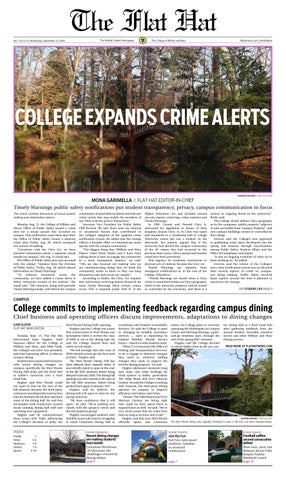
MONA GARIMELLA // FLAT HAT EDITOR-IN-CHIEF Timely Warnings public safety notifications put student transparency, privacy, campus communication in focus This article contains discussions of sexual assault, stalking and relationship violence. Monday, Aug. 31, the College of William and Mary’s Office of Public Safety issued a crime alert for a sexual assault that occurred on campus. This notification came three days after the Office of Public Safety issued a separate crime alert Friday, Aug. 28, which contained two notices of stalking. “Consistent with the Clery Act, we have attached information about a reported sexual assault on campus,” the Aug. 31 email said. The Office of Public Safety also sent an email with the subject “Updates from the Division of Public Safety” Friday, Aug. 28, which shared information on Timely Warnings. “To enhance awareness across the community, we have added a Crime Alerts & Safety Advisories section to the website,” the email said. “This resource, along with periodic Timely Warning emails, will inform the campus
community of reportable incidents and relevant crime trends that may enable the members of our Tribe to better protect themselves.” Associate Vice President for Public Safety Cliff Everton ’96 said there were no external or situational factors that contributed to the College’s adoption of the updated crime notification system. He added that the change reflects a broader effort to communicate more openly with the campus community. “The biggest thing that [William and Mary Police] Chief [Don] Butler and I have been talking about is how we engage the community in a more transparent manner,” he said. “[We are also focused on] making sure we are communicating things that we think the community needs to know so they can keep themselves safe and secure on campus.” According to Butler, the Clery Act requires that universities receiving federal financial aid issue Timely Warnings when certain crimes occur. This is required under Title IV of the
Higher Education Act and includes annual security reports, crime logs, crime statistics and Timely Warnings. In 1990, Connie and Howard Clery Jr. advocated for legislation in honor of their daughter, Jeanne Clery. At 19, Clery was raped and murdered in a residential hall at Lehigh University, where she was a student. In the aftermath, her parents argued that if the university had alerted the campus community of the 38 crimes that had occurred in the previous three years, Clery’s assault and murder could have been prevented. This urgency for academic institutions to disclose acts of violence became the Clery Act. Timely Warnings are separate from emergency notifications or, in the case of the College, TribeAlerts. “Timely Warnings are issued when a Clery crime is committed within our Clery geography, which is the university property, owned, leased or controlled by the university, and there is a
serious or ongoing threat to the university,” Butler said. The College clearly defines Clery geography as its five campuses, public property “adjacent to and accessible from Campus Property” and non-campus buildings owned or controlled by the College. Everton said the College’s new approach to publishing crime alerts developed over the spring and summer through conversations among Public Safety, Student Affairs and the Office of Compliance and Equity. “It was an ongoing evolution of what we've been working on,” he added. Everton said the rollout of the College’s new crime notification system was accelerated after several reports of crime on campus, two being stalking. Public Safety received these reports around the time it planned to announce the change. SEE STUDENT LIFE PAGE 4
CAMPUS
College commits to implementing feedback regarding campus dining Chief business and operating officers discuss improvements, adaptations to dining changes LIAM GLAVIN FLAT HAT NEWS EDITOR Tuesday, Sept. 15, The Flat Hat interviewed Sean Hughes, chief business officer for the College of William and Mary, and Mike Todd, the College’s executive vice president and chief operating officer, to discuss campus dining. Students have expressed frustration with recent dining changes on campus, specifically the West Woods Dining Hall delay and the Food Hall at Sadler’s transition into a food retail hub. Hughes said West Woods could not open in time for the start of the fall semester because the third-party contractor assisting with construction had not finished the kitchen and back areas of the dining hall. He said this incomplete work would have created issues training dining hall staff and operating new equipment. Hughes said he communicated these issues with Todd, influencing the College’s decision to delay the
INDEX Profile News Opinions Variety Sports
West Woods Dining Hall’s opening. Hughes said the College was aware that construction in West Woods was incomplete when it invited the class of 2026 to eat in the dining hall. He said the College catered food and safely served meals. “We felt strongly that [the class of 2026] should at least get the first meal in there,” Hughes said. The West Woods Dining Hall has been delayed three separate times. It was initially slated to open at the start of the fall 2025 semester, before being delayed to January 2026. The dining hall opening was then moved to the start of the fall 2026 semester, before being pushed back again to January 2027. Hughes said he believes the dining hall will open in time for the spring semester. “We have confidence that it will open,” he said. “We're working very closely with the [project] owner and the development group.” Hughes encouraged students with mobility issues who may be struggling to reach Commons Dining Hall to
Inside Opinions 2 3-4 5-6 7-8 9-10
coordinate with Student Accessibility Services. He said the College is open to changing its mobility assistance services — such as expanding its Limited Mobility Shuttle Service hours — based on what students need. “What I've instructed [the Office of Parking and Transportation Services] to do is engage in whatever changes they need to, whatever staffing changes they need, to support the interim dining program,” he said. Hughes addressed consistent long wait times and order backlogs for retail options in Sadler, particularly The Halal Shack and Vivi’s Mexican Cuisine. He said the College is working with Aramark, the third-party dining operator on campus, to improve efficiency and reduce wait times. “I know [The Halal Shack and Vivi’s Mexican Cuisine] are hiring right now, [and] we have asked them to expand hours as well,” he said. “We're very much aware that the waits have been as long as an hour and a half.” Hughes said that once West Woods officially opens and Commons
Recent dining changes are making students' lives harder Geronimo Ritcheson '29 discusses the challenges created by dining delays page 6
closes, the College plans to continue operating the Marketplace at Campus Center and Morning Musings, a graband-go breakfast spot, through the end of the spring 2027 semester. Hughes said the College decided to switch Sadler from an all-you-can-
eat dining hall to a food retail hub after gathering feedback from the annual Student Assembly omnibus survey and other William and Mary Dining surveys. READ MORE AT FLATHATNEWS.COM
NAMAN MISHRA / THE FLAT HAT
The West Woods Dining Hall, originally scheduled to open in fall 2025, has faced repeated delays.
Inside Variety
Join the Fun
Fall Fest welcomed students, families to seasonal celebration page 7
Inside Sports
Football suffers second consecutive defeat
Slow start, poor run defense doom Tribe despite Family Weekend crowd page 10
“
“
newsinsight news insight
News Editor Liam Glavin News Editor Naman Mishra News Editor Robin Perdue fhnews@gmail.com
THE FLAT HAT | Wednesday, September 23, 2026 | Page 2
THE BUZZ
I keep hearing over and over again from students and residents that they oppose Flock cameras. Itʼs supposed to promise a feeling of safety, but we continue to hear the fact that it actually feels like an invasion of privacy. ̶ Williamsburg City Council candidate Eino Korplea ʼ25 FLAT HAT NEWS BRIEF
Todd Mooradian steps down as dean of Raymond A. Mason School of Business
Wednesday, Sept. 16, College of William and Mary Provost Peggy Agouris announced in an email that Dean of the Raymond A. Mason School of Business and T.C. and Elizabeth Clarke Professor of Business Todd Mooradian would resign from his position this fall. Prior to his appointment as dean in August 2022, Mooradian worked as a faculty member at the College for 27 years, from 1990 to 2017. He also served as the Mason School of Businessʼ associate dean for faculty and academic affairs from 2014 to 2017. After working as dean of the University of Louisvilleʼs College of Business from 2017 to 2022, he returned to Williamsburg, Va. In the email, Agouris touted several of the Mason School of Businessʼ accomplishments under Mooradianʼs leadership, including ranking No. 1 in military-friendly graduate education and the launch of a redesigned Bachelor of Business Administration. Mooridan also led the Mason School of Businessʼ expansion of its accounting program and developed artificial intelligence-related opportunities to prepare students for technological advances in the workforce. “I warmly thank Dean Mooradian for his devoted service to William & Mary,” Agouris wrote. READ MORE AT FLATHATNEWS.COM NAMAN MISHRA / FLAT HAT NEWS EDITOR
A THOUSAND WORDS
COURTESY IMAGE / AKASH NAYAK Nayak taught a program focused on peace education for Bosnian children over the summer. He said the program helped bridge connections.
Akash Nayak ’27 discusses teaching peace studies, research in Bosnia, work for Global Research Institute
Nayak outlines undergraduate research, involvement in DisinfoLab, work for The Monitor
ROBIN PERDUE // FLAT HAT NEWS EDITOR
ROBIN PERDUE / THE FLAT HAT
CORRECTIONS The Flat Hat wishes to correct any fact printed incorrectly. Corrections may be submitted in email to the editor of the section in which the incorrect information was printed. Requests for corrections will be accepted at any time.
THE FLAT HAT ʻSTABILITAS ET FIDESʼ | ESTABLISHED OCT. 3, 1911 Org #101 P.O. Box 8795, Williamsburg, VA 23187 Editor flathat.editor@gmail.com Managing flathat.managing@gmail.com Executive flathat.executive@gmail.com Magazine editor@flathatmagazine.com News fhnews@gmail.com Sports flathatsports@gmail.com Copy flathatcopy@gmail.com
Opinions fhopinions@gmail.com Variety flathat.variety@gmail.com Photos flathatphotos@gmail.com Online flathatonline@gmail.com Advertising flathatads@gmail.com Graphics flathat.art@gmail.com Ombudsman flathat.ombuds@gmail.com
Mona Garimella Editor-in-Chief Maddie Mohamadi Managing Editor Megan Rudacille Executive Editor Nate Ross Copy Chief Kylie Totten Digital Media Editor Ben McLoughlin Operations Coordinator Molly Martin Operations Coordinator Robin Perdue News Editor Liam Glavin News Editor Naman Mishra News Editor Emma Beelner Variety Editor DevYani Thakare Variety Editor Cara King Sports Editor Jacob Tobman Sports Editor Michael Gabriel OpinionsEdtor Ava Gravina Opinions Editor Liam McMahon Audio/Visual Editor Kenra Houhou Audio/Visual Editor Adelyn Skerik Copy Editor Clare Pacella Copy Editor Eden Leavey Copy Editor Elise Whitfield Copy Editor Emma Newill Copy Editor Irene Straw Copy Editor Jonathan Larkin Copy Editor Julia Peavey Copy Editor Kelsea Smith Copy Editor Kreilys Garcia Flores Copy Editor Lindsay Luberecki Copy Editor Lorelei Kelley Copy Editor Ruby Trainor Copy Editor Sophia Paradowski Copy Editor Lily Mansell Copy Editor Hannah Elysse Mayo Copy Editor Madigan Webb Chief Staff Writer Lila Reidy News Assoc. Editor Melania Frye News Assoc. Editor Nicole Zajac News Assoc. Editor Rebecca Fuchs News Assoc. Editor Sam Belmar News Assoc. Editor Sachi Pallem News Assoc. Editor Shannon Raymond News Assoc. Editor Susannah Poteet News Assoc. Editor Sanjana Manghnani News Assoc. Editor Bobby Mollan News Assoc. Editor Abigail Furcy Chief Variety Writer Aamnah Malik Variety Assoc. Editor Aditi Allam Variety Assoc. Editor
Eric Sohn Audio/Visual Editor Andrew Henrickson Data Editor Betty Yemane Social Media Editor Evie Corr Social Media Editor Kimberly McCann Photos Editor Isabel Volden Graphics Editor Gretta Anderson Graphics Editor Meave Meyer Games Editor Ethan Auclair Ombudsman James Abruzzo Business Manager Sam Harrington Webmaster
Anna Wood Variety Assoc. Editor Brooke Lewis Variety Assoc. Editor Callie Laubacker Variety Assoc. Editor Ella Greene Variety Assoc. Editor Emma Beelner Variety Assoc. Editor Juliana Nelson Variety Assoc. Editor Maggie OʼKieffe Variety Assoc. Editor Patricija Pupine Variety Assoc. Editor Skylar Hartgerink Variety Assoc. Editor Skyler Cole Variety Assoc. Editor Tessa Darke Variety Assoc. Editor Maya Sakai-Chen Variety Assoc. Editor Gabriella Calcagno Variety Assoc. Editor Nora Yoon Chief Opinions Writer Abigail Crespin Opinions Assoc. Editor Alexandra Hill Opinions Assoc. Editor Carson Burch Opinions Assoc. Editor Cate Woodrum Opinions Assoc. Editor Charlotte Trodden Opinions Assoc. Editor Ella Grimes Opinions Assoc. Editor Eva Jaber Opinions Assoc. Editor Geronimo Ritcheson Opinions Assoc. Editor Isabella McNutt Opinions Assoc. Editor Lana Altunashvili Opinions Assoc. Editor Lucia Reyes Opinions Assoc. Editor Teddy Friesz Opinions Assoc. Editor Audrey Capone Opinions Assoc. Editor Carolyn Reid Photos Assoc. Editor Ethan de Guia Photos Assoc. Editor Jonah Peters Photos Assoc. Editor
Alina Schueman Videos Assoc. Editor Darius Bagherian Videos Assoc. Editor Enna Carbone Videos Assoc. Editor Jack Pegler Videos Assoc. Editor Landon Miles Videos Assoc. Editor Olivia Ives Bailey Videos Assoc. Editor Piper Gilly Videos Assoc. Editor Siddhita Krishnan Videos Assoc. Editor Sophie Frank Videos Assoc. Editor Virginia Fife Videos Assoc. Editor Sabry Tate Podcasts Editor Connor Pawliczak Podcasts Assoc. Editor Maricel Pucillo Podcasts Assoc. Editor Noa Wilson Podcasts Assoc. Editor Isabel Volden Graphics Editor Gretta Anderson Graphics Editor Alina Yang Graphics Assoc. Editor Maisie Curtin Graphics Assoc. Editor Aida Bekele Graphics Assoc. Editor Westley Jacanin Chief Sports Writer Eamonn McAloon Sports Assoc. Editor Henry OʼConnor Sports Assoc. Editor Katie Killagen Sports Assoc. Editor Ellie Laanisto Ombuds Assoc. Editor Naomi Linde Ombuds Assoc. Editor Rhys Runnels Ombuds Assoc. Editor Lauren Singer Social Assoc. Editor Hannah Sawyer Social Assoc. Editor Mira Deni Data Assoc. Editor Sienna Rankins Data Assoc. Editor
Akash Nayak ’27 is one of many undergraduates at the College of William and Mary who name local coffee shops as one of their favorite things about the College. He is one of just four, however, who can say they spent the past summer teaching and researching in Sarajevo, Bosnia with the American-Bosnian Collaboration Project. Every summer since 1999, the College has selected a cohort of distinguished students to teach English and promote nonviolent communication skills to students in Bosnia. The program connects undergraduate students with graduate students in education at the University of Sarajevo, where they work to co-teach a summer program focusing on peace education for Bosnian children. “Sometimes, sitting in Williamsburg and thinking about these big questions is really easy,” he said. “To actually go to Bosnia and work with Bosnians on topics related to intercultural competence and bridging divides in society — a project where you’re actually on the ground, talking to people every single day and doing the work — is really amazing.” Nayak explained that the team consisted of three additional College undergraduates and four graduate students from the University of Sarajevo, connections he now values. “We spent about three hours teaching the camp itself, and then we’d conduct research through reflection surveys every day that took about an hour,” he said. “In the semester leading up to us going, we also took a preparation class where we learned about Bosnia, about writing lesson plans and teaching.” Although Nayak is double majoring in international relations and economics, he said that what truly piqued his interest in foreign affairs came long before the classroom. “I have a very specific memory of seeing Fareed Zakaria’s segment on CNN,” he said, referring to the journalist and political commentator. “My parents have always loved talking international affairs or politics, and so when I came to William and Mary, that background really influenced the questions I found interesting and the classes I was drawn to.” He explained that the opportunity to work in Bosnia deepened his interest in foreign policy and nurturing cross-cultural connections. “It just really reinforced my desire to go into public service and to continue work that is internationally focused,” Nayak said. “Bosnia has been through so much as a country, and yes, there’s tensions, and there’s problems that still persist. But people are resilient.” For Nayak, that resilience also highlighted the
importance of on-the-ground work regardless of tangible outcomes. “In terms of teaching students, sometimes it’s about putting in work now that you won’t always see the outcome of until the future,” he said. “I know firsthand that the first time around, not everything may come through. But that doesn’t mean you’re not learning and growing from an experience, and sometimes things take time.” Nayak said the lessons of his summer in Bosnia extended far beyond education. He explained that the program furthered his belief in the importance of fostering diverse connections, a value set he feels is heavily representative of the College. “This opportunity was something that is, to me, distinctly William and Mary,” Nayak said. “Just being able to tell people about our experience and talk about why we do this work is important. Not only for Bosnia, but around the world and even in the United States, bridging differences and having difficult conversations is really powerful.” That same spirit of bridging differences and fostering connections first drew Nayak to the College. “I came to William and Mary because I really loved the community here when I visited,” Nayak said. “William and Mary came across my radar, and I saw that there was a huge focus on giving undergrads not only a great education, but also a ton of opportunities to apply that knowledge and ask questions.” Nayak was born and raised in New Jersey, but his research efforts have taken him all across the globe. In the summer between his freshman and sophomore years, Nayak received the Critical Language Scholarship, a U.S. Department of State-funded program that sent him to North India to study Hindi. The following summer, he traveled to Hawaii for an internship. “Getting the opportunity to live somewhere for three months and practice a whole new language and explore the area was really amazing, and I think those kinds of themes are something I’ll definitely take and consider in the future,” he said. As a participant in the Sharp Journalism Seminar, a program through the Roy R. Charles Center, Nayak also wrote about democratic backsliding in Slovakia and received funding to travel to the region for additional reporting. On campus, Nayak is involved with DisinfoLab, an undergraduate-led student innovation group connected to the Global Research Institute, and has worked with AidData since the spring of his freshman year. READ MORE AT FLATHATNEWS.COM
Page 3
THE FLAT HAT
Wednesday, September 23, 2026
EVENTS
CNU criminology professor discusses Flock technology in Hampton Roads Nine student-led campus organizations host guest speaker presentation on Flock proliferation research
SAM BELMAR FLAT HAT NEWS ASSOC.
Tuesday, Sept. 15, Assistant Professor of Criminology and Director of the Center for Crime, Equity and Justice Research and Policy at Christopher Newport University Steven Keener hosted a Flock camera teach-in event at the College of William and Mary’s Ewell Recital Hall. Keener presented his research on Flock cameras, the artificial intelligence-powered automatic license plate readers present on college campuses and communities across the United States. The event was co-hosted by nine student organizations that have expressed concern about Flock’s proliferation in Williamsburg, Va., with Ella Forlin ’27 and Charlie Goodman ’27 serving as the organizers. Drawing on data collected primarily from the Hampton Roads area, Keener said his research demonstrates how the placement of ALPRs results in the disproportionate policing of Black and minority communities. Keener said he found that ALPRs tend to be concentrated in formerly redlined neighborhoods, near public housing and heavily around Norfolk State University’s campus, one of Virginia’s five Historically Black Colleges and Universities. “We have historically underinvested or disinvested in these communities, and now we’re spending millions of dollars in those same communities to surveil,” Keener said. Keener said his research is the first of its kind in Virginia to comprehensively evaluate what he sees as a pervasive use of ALPRs in
the state. Keener opened his talk with a call for bipartisan collaboration to prevent these cameras from continuing to spread across Virginia. He said he believed Virginia lawmakers should work to strengthen guardrails on ALPRs. “While localities are making critical decisions around the future of these cameras, our state lawmakers can also act on this,” he said. Williamsburg City Council Member Stacy E. Kern-Scheerer, who’s running for reelection, attended the event. She said she wanted to learn more about how ALPR technology works to better address community concerns. “This was a really valuable talk because I got more information about things I might have heard about but had never really dived into as Keener did this evening,” Kern-Scheerer said. Williamsburg City Council candidate Eino Korpela ’25 shared a similar desire to respond to student and community concerns about Flock technology. “I keep hearing over and over again from students and residents that they oppose Flock cameras,” Korpela said. “It’s supposed to promise a feeling of safety, but we continue to hear the fact that it actually feels like an invasion of privacy.” Keener said during his lecture that outside actors may have obtained access to private ALPR data gathered by localities without permission. He said that federal agencies, such as U.S. Immigration and Customs Enforcement, can indirectly access the Flock data of any
NAMAN MISHRA / THE FLAT HAT A Flock technology surveillance camera is located on Gooch Drive behind Zable Stadium. The camera is one of 10 operated by the College on campus.
locality in the country. An example of this inadvertent sharing in Virginia happened in July 2025. In this instance, the Richmond Police Department shared its data with the Bureau of Alcohol, Tobacco, Firearms and Explosives, which then shared the information with ICE for immigration enforcement purposes without the department’s permission. “Because this data is shared [across localities], you only need one portal entry, and you get access to the whole thing,” Keener said. “For example, if Williamsburg is doing everything correctly, following state law and not sharing the data with ICE, but they are sharing it with another locality that’s friendly with ICE, they can access Williamsburg’s data, whether Williamsburg wanted them to or not.” Keener mentioned several instances of federal officials using ALPR data to monitor attendance at political events, such as at the antiPresident Donald Trump No Kings protests. Keener expressed concern regarding ALPR cameras’ potential use leading up to the November midterm elections. Keener said law enforcement officials using Flock technology can create hotlists for suspects whom they have reasonable suspicion of committing a crime. He said this allows police to receive real-time alerts for their movements each time they pass a camera while driving. Keener said that while state law normally requires ALPR data to be deleted after 21 days, hotlists can bypass this rule. “The second you’re on a hotlist, all those state guidelines are exempt,” he said. Keener warned the audience about newer forms of AI surveillance technology outside of Flock. He mentioned Tsunami cameras, a system used by law enforcement officials for surveillance of public housing areas in cities like Richmond, Va. Keener said he believes successful advocacy efforts must oppose AI surveillance technologies before localities sign contracts with companies. He cited community mobilization in Harrisonburg, Va. led by the mayor and advocates this summer to halt planned Flock camera installations as an example. “Not only did they get their contract canceled, they now have an ordinance in Harrisonburg that says that any new surveillance tech must go through public input,” Keener said. Forlin said she is working with other students to organize a “Flock Walk” fun run Sunday, Oct. 18. She said the course will be designed to pass every Flock camera on campus. Forlin closed the event by encouraging students and community members to get involved in the local anti-surveillance movement in Williamsburg. “These decisions are being made on the local level, meaning that we have input here; we can change stuff,” Forlin said. “We have a receptive government in Williamsburg, and now you’re equipped with the knowledge to talk with people about this and voice your opposition.”
BOARD OF VISITORS
Gov. Abigail Spanberger appoints four new Board of Visitors members First meeting of academic year to discuss dining changes, new cybersecuirty risk management degree program NEHA BASKAR FLAT HAT BUSINESS ASSOC.
Wednesday, Sept. 23 to Friday, Sept. 25, the College of William and Mary’s Board of Visitors will convene for its first meeting of the 2026-27 academic year in Blow Memorial Hall. Friday, June 5, Gov. Abigail Spanberger D.P.S. ’26 appointed Jeff Bourne ’99, J.D. ’07; Jennifer Davis P ’27, P ’30; Osman “Oz” Parvaiz ’99, P ’30; and Cynthia Hudson J.D. ’87 to the Board. Each is serving a four-year term, which began Wednesday, July 1. They succeeded Kendrick Ashton ’98, Steve Huebner ’76, Mike Petters M.B.A. ’93 and Laura Rigas ’01, all of whom former Gov. Glenn Youngkin D.P.S. ’22 appointed in 2022. The four new members convened for the first time during the Board of Visitors Retreat in July, where the Board and College President Katherine Rowe discussed goals, committee plans and logistics for the upcoming academic year. Jeff Bourne ’99, J.D. ’07 Bourne is the chief legal officer at The Branch Group, a commercial construction firm in Roanoke, Va. He also served as a Virginia Deputy Attorney General from 2014 to 2017 before representing Virginia’s 71st district, which includes the City of Williamsburg, in the state’s House of Delegates from 2017 to 2024. In his elected positions, Bourne emphasized criminal justice reform, gun safety, school quality and economic opportunity. His accomplishments include introducing and passing state legislation to curb discriminatory housing practices and reform law enforcement response to mental health crises.
Bourne will serve as vice chair of the College’s Committee on Athletics and as a member of the Committee on Administration, Buildings and Grounds. Jennifer Davis P ’27, P ’30 Davis is the Knott Distinguished Professor of the Practice in the Peace, War and Defense Curriculum at the University of North Carolina at Chapel Hill and a parent of two current students at the College. She formerly served as a United States ambassador to the United Nations and as an assistant to multiple secretaries of state. According to public records, Davis donated $1,000 to the 2026 Spanberger Inaugural Committee. She will serve as vice chair of the Committee on Administration, Buildings and Grounds and as a member of the Committee on Academic Affairs. Osman “Oz” Parvaiz ’99, P ’30 Parvaiz is the chief procurement officer for Capital One, where he has worked since graduating from the College. He manages the company’s global supply chain and seeks to work with more small and minority-owned businesses. Parvaiz donated $2,500 to Spanberger’s gubernatorial campaign, and Capital One donated $103,500 to the 2026 Spanberger Inaugural Committee, according to public records. Parvaiz will serve as a member of the Committee on Academic Affairs and the Committee on Student Success. Cynthia Hudson J.D. ’87 Hudson is the owner and managing attorney of Eppes-Hudson Law, PLLC, which focuses on legal and government affairs. She is also a member of
the McCammon Group, which provides alternative dispute resolution services. Previously, she served as Hampton, Virginia’s city attorney from 2006 to 2014 and Virginia’s chief deputy attorney general from 2014 to 2020. She also chaired former Gov. Ralph Northam’s D.P.S. ’18 Commission to Examine Racial Inequity in the Law, which recommended numerous policy prescriptions to address systemic discrimination in state law. Hudson formerly served on the Board from 2020 to 2024, when she was appointed by Northam. She moved the 2022 William & Mary Crisis and Emergency Management Plan as chair of the Committee on Audit, Risk and Compliance and was vice chair of the Committee on Administration, Buildings and Grounds, as well
as a member of the Board’s Executive Committee. In 2024, she voted in favor of tuition increases for FY25 and FY26. She was also a proponent of reexamining the College’s Principles on Naming and Renaming in 2021. In 2026, Hudson donated $8,250 to Spanberger’s gubernatorial campaign, public records state. Hudson will serve as vice chair of the Committee on Audit, Risk and Compliance and as a member of the Committee on Administration, Buildings and Grounds. Topics to be discussed at the Board’s upcoming meeting include recent dining changes and the approval of an M.S. in cybersecurity risk management.
NAMAN MISHRA / THE FLAT HAT Mike Petters MBA ʻ93 and Charles E. Poston J.D. ʻ74, P ʻ02, ʻ06 attended the closing Board of Visitors meeting in April 2026.
EVENTS
College hosts KCRW ‘Left, Right, & Center’ political podcast live taping
Former NPR Morning Edition host moderates bipartisan converastion discussing AI regulations, foreign affairs MADIGAN WEBB CHIEF STAFF WRITER
Wednesday, Sept. 16, the College of William and Mar y hosted KCRW’s political podcast “Left, Right & Center” for a live recording in Phi Beta Kappa Memorial Hall as part of the College’s Year of Civic Leadership. Hosted by David Greene, former NPR Morning Edition host, the podcast unites both sides of the political spectrum to discuss pressing issues. Mike Dubke, President Donald Trump’s former communications director, and Mo Elleithee, executive director of Georgetown University’s Institute of Politics and Public Service, joined Greene for this episode.
Greene opened by asking his guests their opinions on the CEO of Anthropic, an artificial intelligence safety and research company, calling for AI regulations. Dubke explained potential motivations for AI companies advocating for self-regulation. “They’re either making a calculated admission that they’ve lost control of their own product, or if you’re a trade lawyer, they’re basically saying, ‘Hey government, you’ve got to give us some sandbox to play in so we don’t get accused of trust violations down the pike,’” Dubke said. “They’re closed-source and for-profit companies that might want to freeze out other companies and organizations in the market.”
Elleithee agreed that there are multiple possible causes for AI companies asking to be regulated. He also said their actions don’t align with their words. “I take it all with a little grain of salt, considering that there is no industry spending more money in this election cycle through Super PACs than AI companies,” Elleithee said. “They just spent $8 million on the state legislative race in New York to defeat a guy who was proposing regulation.” Dubke said he believes that national leaders will soon unite to regulate AI out of self-preservation. “I’ve got to believe that the Chinese Communist Party is more freaked out by AI than we are,” he
said. “To unleash a system that could actually allow communication amongst the populace outside the control of the party has got to freak them out.” Elleithee expressed uncertainty. “The U.S. has to show up to this conversation if it happens,” Elleithee said. “Right now, under the current leadership, I’m not sure it will.” Greene applauded the College’s early and continued conversations about student AI use. “I was impressed to see that William and Mary has been proactive in talking about professors and how they should be thinking about what is acceptable and what is not acceptable,” he said.
Greene then fielded questions from the audience. In response to a question on meaningful conversations about divisive topics, Dubke stressed the importance of curiosity. “Being curious means not being certain of ever ything you believe,” Dubke said. “Having a conversation with somebody who’s diametrically opposed to you, or even somebody who just gently disagrees with you, in my opinion, helps you understand and articulate yourself better.” Elleithee echoed this sentiment. “ Take a moment to understand where the other side is coming from,” he said. “ You’ll more easily come to common motivation.”
Wednesday, September 23, 2026
THE FLAT HAT
Page 4
CAMPUS
Computer scientist Christine Julien delivers machine learning talk
Virginia Polytechnic Institute professor discusses smart environments at Schmidt Lecture Series
MELANIA FRYE FLAT HAT NEWS ASSOC.
Monday, Sept. 14, Virginia Polytechnic Institute and State University professor and computer science department head Christine Julien presented her research on smart home technologies. The talk took place in Integrated Science Center 4 as part of the College of William and Mary’s Schmidt Family Distinguished Lecture Series. Julien studies pervasive computing, mobile computing, software engineering and middleware. The event began with opening remarks from assistant professor of computer science Jie Ren, who discussed the lecture’s objectives. “One of the main goals is to give students and the broader community an opportunity to learn about leading-edge research and new developments in the field and to engage directly with scholars who are helping shape those conversations,” she said. Julien’s research uses principles of computing systems and software engineering to improve smart environments. She said she plans to train these models to better understand human inputs, intent and context. While devices responsible for temperature, lighting and sound, coffee machines and smart locks can interpret clear instructions, commands such as “make it cozy” or “get this space ready for a party” would not yield the desired results, she said. These commands would require a variety of devices with their own systems. “The biggest challenge is, ‘How do things fit together right?
How do you see how the different little pieces of things that you’re doing fit together to solve a bigger problem?’” Julien said. Julien’s research demonstrates how language models can translate more abstract goals into specific actions. Attendee Aidan Basloe ’26 M.S. ’27 compared these smaller language models to a specialized library, rather than one with access to knowledge on a variety of topics. Subsequently, these models would work for other purposes to save money and space. Rather than requiring a data center like larger artificial intelligence chatbots, they could be contained within a smaller device. “When [most people] think of AI, they think of ChatGPT and Claude,” Basloe said. “Those are really huge, really expensive things, but a lot of tasks don’t require that.” Scaling up to the room itself, Julien’s model Nova uses visual stimuli from cameras to analyze spaces. Nova’s computer images, device data and reasoning capabilities all take place on a single-board computer in the home, which combats some of the privacy concerns from earlier models. Overall, Julien hopes to increase the efficiency of these smart spaces by running AI models without data centers or sending private data to the cloud. Julien acknowledged the costs and benefits of these methods but said more work needs to be done to determine whether the net energy usage of these private models is less than that of larger systems. “If everybody is doing it individually at their house, I don’t know what the sum of that is relative to everybody putting it in a data center,” Julien said. Julien said she hopes that the final forms of these models
COURTESY IMAGE / RANDY READY
Julienʼs lecture discussed how machine learning models can be made more efficient.
will be used as consumer products. “We do a lot of work that tries to say, ‘Yes, this is feasible with the technology and hardware and stuff that’s available now,’ so if somebody wanted to take this and actually build it, it’s ready for that,” she said. The Schmidt Family Distinguished Lecture Series will continue Friday, Oct. 2 in ISC4 with a talk from Kenan Distinguished Professor of Computer Science at the University of North Carolina at Chapel Hill James Anderson. “I hope the public knows that these lectures are meant to be accessible beyond a specialized academic audience,” Ren said. “They are an opportunity for members of the community to engage with scholars, learn about current research and take part in broader intellectual conversations.”
STUDENT LIFE
Students, advocates weigh transparency, privacy concerns with alerts
Public safety administrators detail Collegeʼs goals, relevant policies for crime notification system changes STUDENT LIFE from page 1
“We had a very intentional idea of this fall debuting this change well in advance of anything,” Everton said. Butler said the timing of the alerts should not be interpreted as an increase in crime on campus. “The truth of the matter is there’s been no spike in crimes, certainly no spike in violent crime at William and Mary, which we’re very proud to say that and happy to say,” Butler said. The 2025 Annual Campus Security and Fire Report states that there were nine reported campus incidents of stalking in 2024, 18 in 2023 and seven in 2022. Butler said Public Safety and WMPD consider privacy when determining what information to include in an alert. “[The crime alerts] have to be, in some cases, somewhat vague to protect the identity of both the victim or survivor and the respondent,” Butler said. “So we do take that into account.” Butler said his team takes additional steps to protect survivors of stalking before sending an alert. “We also try to let, in a stalking case, the victim know that we’re going to be doing this
and check if they have any concerns,” Butler said. “We take a lot of time to go through the message before we send it and make sure that there’s not identifiable information in it.” Butler said Public Safety can delay or decline to send a crime notification in certain circumstances. “It’s nuanced, but it’s once we assess that we’re going to have to put something out or we feel like we should put something out for awareness or safety, we [talk to the survivor] before it goes out,” Butler said. “Even once already this semester, [we] delayed [sending out a notification] a little bit because someone was in class and we wanted to make sure they were aware and not caught off guard or retraumatized by seeing that information out there.” Butler said survivors retain a role in the decision to send a crime alert to campus. “The survivor always has a say,” Butler said. “And we’ll have that conversation when the time comes.” Regardless, for one student who filed a stalking report with WMPD, the Aug. 28 notification was unexpected. Their identity will be anonymous to protect their safety. The student said they went to WMPD to file a report and were asked questions about whether the incident occurred on or off
NAMAN MISHRA / THE FLAT HAT
AVP Cliff Everton (top) and WMPD Chief Don Butler (bottom) discussed the Collegeʼs goals for the expanded Timely Warnings.
campus, online or in person. The student said they subsequently spoke with a WMPD officer, a supervisor and a detective who connected them with the Williamsburg Police Department and helped create a safety plan. The student said they were not informed during the reporting process that their report could result in a campus-wide notification. “That email came as an absolute surprise to me, and I had no idea that it was going to be sent out,” the student said. They initially believed the email might have been sent only to them before realizing it had been distributed to the broader campus community. “It felt like my situation, which I felt very private about, had been broadcasted to the campus and William and Mary’s student body,” the student said. They said they would’ve preferred to receive advance notice that a notification would be sent. “I think that would have been a lot more helpful and led to a lot less drama and gossip,” they added. The student said the possibility of a campus-wide notification could have affected their decision to report. “If I knew, I probably would have been a little more worried or had made it very clear that I wanted it not to be broadcasted to the campus,” the student said. “Especially in my case with stalking.” The student said the visibility of the notification was particularly concerning because of potential retaliation from their stalker. “Part of me keeping it private would be me figuring it out so that I could keep myself protected from retaliation,” they said. “I know that the person who was stalking me knew exactly that it was me and knew exactly that at that moment I had reported them, and it actually led to some retaliation in that aspect.” The student said the experience made them question whether the privacy they expected during the reporting process had been maintained. “I felt that my privacy, which was explained to me multiple times about the policy of absolute privacy and confidentiality, was not kept,” the student said. “And that the idea of my safety, when it came to retaliation that they knew had happened before, wasn’t taken properly into consideration.” Senior Director for Gender-Based Violence Resources and Advocacy Services Liz Cascone provided observations based on The Haven’s work supporting students affected by sexual violence and other forms of interpersonal harm. The Haven is the College’s confidential resource center for those impacted by genderbased violence. “Students, faculty and staff benefit from having information that helps them make informed decisions and increases awareness of available resources and support,” Cascone wrote in an email to The Flat Hat. “At the same time, it is important to recognize that public notifications about harmful incidents can have a significant emotional impact.” Cascone said the notifications may affect students who have experienced similar forms of harm. “Others may worry about whether an incident they report could result in broader campus communication, even when identifying information is not included,” she added. Cascone emphasized the importance of understanding how the College’s
communication practices affect students. “As communication practices evolve, it will be important to continue listening to students and monitoring how those practices may influence comfort with reporting and help-seeking,” Cascone wrote. “Ensuring that students understand both how information is shared and what privacy protections are in place can help foster trust and encourage individuals to access the support they need.” Student Assembly President Nico GiroMartin ’27 and Vice President Sophie Kennedy ’27 said they have heard concerns from students about the increased visibility of crime alerts, particularly regarding sexual violence. They said they were not fully aware of these alerts going out ahead of their issuance. “We’ve heard concerns from students because we are aware that having these alerts go out to the whole campus and community, everyone being able to see them can be alarming,” Kennedy said. “We really want to have a lot of people in Student Assembly continue to have conversations with Public Safety and make sure that it is very collaborative with students to make sure that student voices are heard.” Giro-Martin said some students have also questioned whether the incidents described in the alerts are new. “A lot of the conversations that I’ve been having with people are people that haven’t had to deal with these issues,” he added. “It’s kind of this world that is also opening up to them and that they weren’t really aware of.” Kennedy said the transition to the new notification system was initially unclear to students and that the lack of context could contribute to alarm. She added that SA plans to continue working with Public Safety. “We’re trying to make it very clear that we want students to be in the loop,” she said. “When there are these updates, there needs to be very clear communication about why there’s an update and how it is being updated.” Iris White ’27 was one of many students who was confused seeing the alerts. “I thought nothing like that had ever happened on our campus,” White said. “I didn’t understand if it was a one-off incident or if this has been happening and we just haven’t made any alerts.” As a senior, White never recalled these alerts or any crime notifications that caused similar levels of confusion. “My friends and I were definitely freaked out,” White said. “And in the days following, the conversations were, ‘Oh, I don’t want to walk outside alone,’ things like that.” White and her friends did not know if the alerts meant crime levels were increasing at the College or if this was just the first time students were hearing of it. “We always have said we felt really safe,” White said. “We used to leave our doors unlocked; now we lock them. No one’s ever really bat an eye before, and I feel like now we’re all kind of thinking twice about that.” White said the notifications could have been less concerning if the College had clarified to students whether the alerts indicated increased incidents of crime. Beyond concerns about how students perceive the alerts, some students said the new system could impact survivors who are deciding whether to report an incident. READ MORE AT FLATATNEWS.COM
opinions STAFF COLUMN
AI companions threaten civilizations Carson Burch
FLAT HAT OPINIONS ASSOC
GRAPHIC BY ISABEL VOLDEN / THE FLAT HAT
In the last edition of this great newspaper, I wrote an article discussing how technology is gradually eroding the social bonds that tie people together, looking at examples ranging from TikTok brainrot to the soulless courtship of Hinge. I worry that the trend I identified there of our personal connections degrading with time will only become worse due to the introduction of a new technology: artificial intelligence companions. Although AI companions offer to bring connection back into our lives, they actually will degrade it further. The connection they offer is illusory, as chatbots are — surprisingly — not people. Time spent conversing with them is time that could instead be allocated toward going out and talking to real people. I’ve maintained with friends that there is great potential for genuinely chilling pieces of media about AI girlfriends which lure a person in with their fawning disposition and promote a growing disconnection from society. It seems this is already happening in real life: companies announce pendants with AI chatbots that serve as a replacement for friends (notably taking the place of the people around them in the very same ads), and The Atlantic has published a profile of individuals who declare themselves married to chatbots. This technology
STAFF COLUMN
seems to only be growing, probably because it fills a void of loneliness left by prior innovations. If this technology were to ever become adopted by a critical mass of users, it would risk breaking down society itself. Society is nothing if not a series of connections between people, and some of the most foundational ones are the bonds of friendship and love. Friends are the people who fulfill our deepest emotional needs and support us when we need it most, and romantic and sexual intimacy meets one of the deepest needs for human connection that exists. Excessive adoption and usage of chatbots risks disrupting all of this, which holds society together, causing people to prioritize artificial connection over real bonds. Perhaps this technology could be used innocuously, in limited dosages. The Atlantic’s profile, which I mentioned earlier, did note that some of the users still form real relationships with real people, partially because chatbots cannot meet every need. However, I still worry that improvements in AI technology will cause more and more people to become ensnared by the artificial connection and eventually prioritize it above all else. Silicon Valley has long derived its revenues from encouraging ever-greater addiction and dependency and will probably continue to do so in the future. Making chatbots that keep their users in conversation would only further this goal and allow for greater value to be extracted from users. Even if my most apocalyptic predictions do not come true (and I fully concede they easily may not), I still believe that chatbots will do real damage to our ability to interact. Real relationships are complicated, and people often disagree about a number of things. Navigating
this is essential for having healthy connections. But what if you could create a robot that never dissented from your opinion, never talked back, and had that as your primary friend? It would get rid of those pesky disagreements, alright — and also atrophy your ability to engage with those around you in the real world, something that risks becoming true for the members of Generations Alpha and Beta who will grow up with this technology out in the world. As I said earlier, this is an e m e rg i ng t e c h n o l o g y . It i s entirely possible that the world I fear is one which will not emerge. But nonetheless, I do think we should consider the potential negative consequences of AI chatbots becoming widespread, mostly to ensure that we are actively thinking about ways to ensure responsible usage and development. We cannot allow our most important connections to erode. Making friends and finding love is hard, especially today. A truly shocking number of young people report feeling lonely and have not recently gone on dates. Despite this, we should not allow ourselves to rely on these chatbots to fix our problems. Retreating into the artificiality of an A I- ma d e w o r l d w o u l d b e cowardly and degrading. The temptation is one which we not only can but should resist if we want to fix the very real problems of isolation and once again share a w o r l d w i t h o n e a n o t h e r. Carson Burch ’27 is a government major from Chesapeake, Virginia. He is a member of the History Club, Public Policy Club, Lutheran Students’ Association and Theodore Roosevelt Society. Outside of his studies and social life, he enjoys reading about historical and current events in addition to dinosaurs.
Languages gained and lost Lana Altunashvili FLAT HAT OPINIONS ASSOC
GRAPHIC BY GRETTA ANDERSON / THE FLAT HAT
My b o y f r ie n d a n d I a re l i vi n g o n o p p o s ite s p e c t rum s of t he n t h - g e n e r a tio n immigra nt e xpe rie n ce . O f c o u r s e , “ t he i m m i gra nt experience” has no universal d e f i n i tio n , b u t f o r t he purpose s o f t h i s a r t i c l e I w i ll call myself a f i r s t - g e n e r a t i o n i mmigrant and h i m a t h i r d . B o r n in the United States, he grew up speaking C h i n e s e b u t t h e n l ost touch with i t o v e r t h e y e a r s . I was born in t h e cou n tr y o f G e o rgi a , gre w up s p e a k i n g R u s s i a n and Georgian, l e a r n e d E n g l i s h t h rough school, Yo u Tu b e , a n d m y grandmother, a n d ev e n tu a lly c a m e he re t o t he US. Th e o p p o s ite s of t he spe c t r u m lo o k lik e th is : whi l e I a m a ct i v e ly lo s in g b its of m y c ul t ure
and language, every word and thought replaced with English, he i s a c t i ve ly getting his know le dge of Ch ines e back. There’s no rulebook guiding us through t he l ongi ng for s omething s lip pi ng t hrough our fingers . But boy, do I w is h s omething like t ha t e xi st e d … The idea for the article came after my boyfriend told me he had dreamt in Chinese. Part of me was happy for him, because this means he’s really getting in touch with his heritage. He’s getting closer every day to what he set out to achieve last year by taking Chinese for Heritage Speakers. And yet, there’s another part of me that started wondering … When was
the last time I had dreamt in Russian or Georgian? Don’t they say that you “think” in the language you dream in? Do I “think” in English? Languages were always my talent, particularly how well I spoke English. My goal has always been to “sound native” and have no accent. Why then, now that I dream and think in English, do I feel like something is missing? Examining my own feelings whenever my boyfriend reaches a new linguistic goal of his is even more interesting. He often tells me that he’s now able to speak to his grandparents in Chinese without much hesitation, that he’s more sure of himself. The same evening I could call my grandma and beg the universe for Russian words back because I don’t want to, yet again, ask: “How do you say ___ again?” Because asking for words seems to be an admission of some sort of incompetence, a lack of something that should inherently be with me. My grip on my mother tongue is slipping more than ever before, and I don’t know how to stop it or slow it down. With nobody to talk to in this language, nobody to even know what it is, how do you keep in touch with your old self while embracing what you have in front of you? I realize now that I may be living the experience of my boyfriend’s grandparents. That maybe while I slowly shed Russian and Georgian words, my kids and grandkids will be able to pick them up along the way and put things back into place. It’s a double-edged sword. In some ways, non-first-generation immigrants understand the loss of lan-
Opinions Editor Ava Gravina Opinions Editor Michael Gabriel fhopinions@gmail.com // @theflathat THE FL FLAT HAT | Wednesday, September 23, 2026 | Page 5
STAFF COLUMN
I’ve changed my mind on protests Abby Crespin
FLAT HAT OPINIONS ASSOC
COURTESY IMAGE / NATE BOYLE
In 2020, a new wave of activism emerged, particularly among left-wing youth. I remember feeling caught up in a storm of angry TikTok users who attacked viewers for not signing petitions or marching in Washington, D.C. I was always skeptical of this new wave of activism, which I believed wasted energy that should have been directed towards U.S. Congress, rather than the streets in feats of performative activism, prioritizing optics over real change. I was convinced that this new wave of protests was useless, even now, until I recently drove by a group of street-side protesters in my hometown who thoroughly changed my mind. I could so clearly see the joy in their eyes as their smiles lit up the road. I rolled my windows down to hear their cheers and loud music, and it suddenly occurred to me that these protests were not only not useless, but absolutely necessary. These community-based protests are not a measure to alert Congress or spark political action; they are about something far more crucial in a world that often feels like it’s on fire. They are about generating hope. In a political climate that demands fear, polarization and burnout, it is crucial that we find ways to generate and preserve this hope. O v e r t h e s u m m e r, I p a r t i c i pate d i n a f o cu s g rou p - ba s e d e th n o g r a p h i c re s e a rc h s t u d y w i t h a Central American immigrant e n clave i n th e D M V. We d i s cu ss e d t h e h e av y e m e r g e n c e o f f e a r w i t h i n i m m i g ra n t c o m m u n i t i e s, e sp e cia lly a s th e Tr u mp a d m i n istration continues to impose harsh policies and encourage U. S. I m m i g ra t i o n a n d Cu s t o m s E n f o rc e m e n t ra i d s t h a t d i s r u p t th e s e co m mu n i ti e s. Pa r ti ci pa nts t a l ke d ab ou t l i v i ng i n a c o n st a nt state o f a n x i e t y, a lways m o n i to ri ng t h e i r f a m i ly m e mb e rs’ L i f e 3 6 0 and constantly checking the n e w s. A s t h e stu dy w rap p e d u p, h ow e ve r, w e cl o s e d by a ski ng h ow pa r ti ci pa nts ma i nta i n a s e n s e o f s e l f i n su ch ha rd s h i p. I watch e d th e i r e ye s lig ht u p a s th e y ta lke d ab ou t “ca nt a n d o y ba i la n d o,”
a n d I saw e ve n m o re e xc i te m e nt w i t h t h e su g g e st i o n o f o rga n i z i ng c o m mu n i t y e ve nt s to si ng, da n c e a n d c o o k w i t h o n e a n o t h e r. As a teenager with no social media or political platform, I often feel powerless to make a change. I find myself discouraged with the weight of petition signing and scattered elections that I have no confidence my voice will incite any sort of real impact in, but I don’t think any of us are as powerless as we think. As college students, although it may seem like our voices are limited, we actually have the unique opportunity to connect as a campus, creating meaningful change in a community larger than ourselves. Organizations like Fraternity and Sorority Life, sustainability clubs and student alliances promote unity, which allows students to engage with one another to advocate for collective action. For a government seeking control, polarization is a weapon. In a democracy, the people are supposed to be the greatest check on government. Democracy is threatened when we are too busy fighting with each other and managing burnout to fulfill that duty. So in a political climate which seeks to unravel democracy, connecting with one another is the greatest protest we can engage in. This form of protest does not require a grand march into the city with large signs followed by a curated social media post ; instead, it depends on building community and practicing self care. With constant media pressure and fearmongering, to prioritize joy is a protest in itself. Whether through roadside gatherings calling for “no kings” or vibrant dinners with friends, producing happiness and finding community are not distractions from resisting democratic erosion — they are acts of resistance themselves. Abby Crespin ’29 is a prospective history major and sociology minor, on a pre-law track (hopefully!), and a member of Delta Gamma sorority. Abby enjoys skiing, thrifting and unnecessarily overthinking.
guage that occurs over time. In others, my boyfriend, for example, has a community of people here at the college to empathize with. Perhaps it’s also easier to regain something you barely had than to hold onto it in an environment that is completely new. Maybe I should be relearning Georgian and Russian? But isn’t my goal to be even better at English? To this day, there are words I do not know, sentences that have a non-native structure to them and maybe slight accent slip-ups. I’m left wondering what to do, how to reconnect or whether to let go completely. My time is so often eaten up by activities, classes and other commitments. Needless to say, everything happens in English. My only solution is to watch G e o rg i a n s h o w s , l i s t e n t o R u s s i a n music and speak to my family in the t w o l a n g u a g e s . I t ’s e a s y t o f e e l a s i f t h e s e e ff o r t s a r e f u t i l e , t h o u g h . All I have left for now is hope that the next time I talk, I will not waste 30 seconds thinking of the simplest
word that is on the tip of my tongue. The word that, when I finally hear it, I will think myself stupid for not having remembered it. The word that, when my grandmother sees me struggling, she herself will think of in two seconds. There’s a saying in Georgian: ვარდი უეკლოდ არავის მოუკრეფია: “Nobody has ever plucked a rose without thorns.” Maybe this is the price immigrants pay for speaking the language well. They live and breathe the new life, they adjust and they shed their old selves. They lose some parts and find others. But is there really no way to preserve everything? To appreciate it all? I wish I had the answers to these questions. For now, though, I’ll keep listening to Niaz Diasamidze’s albums in the hope that today’s music gives me the words for tomorrow. Lana Altunashvili ’27 is a prospective international relations major. She is a James Monroe Scholar and a member of Club Tennis. Contact her at laltunashvili@wm.edu.
THE FLAT HAT
Wednesday, September 23, 2026
STAFF COLUMN
Recent dining changes are making students’ lives harder
Page 6
STAFF COLUMN
Family weekend should be in the spring Ava Gravina
Geronimo Ritcheson
FLAT HAT OPINIONS EDITOR
FLAT HAT OPINIONS ASSOC.
KIMBERLY MCCANN / THE FLAT HAT
As the average twamp who hasn’t lived under a rock knows, there have been major changes to the Food Hall at Sadler over this summer and into the fall semester. In particular, the former status quo of it being a dining hall with buffet-style food service has been replaced with a retail system where small businesses operate specific sections of the hall, with meals paid for through GrubHub. To start, there are a few benefits to this new system. The meals at Sadler, being prepared by businesses incentivized to serve quality food, have improved in quality compared to what was previously served at Sadler. Another advantage is a greater variety of food, with Mexican, Italian and Middle Eastern cuisines being regularly on offer. However, there are many, many disadvantages to students brought on by the new status quo in Sadler, which outmatch the benefits in severity. The most obvious disadvantage is that meals are no longer simply covered by the meal swipes available for most students on campus. This has resulted in students spending more on their meals, either through their Dining Dollars or with their own money, at a time where affordability is becoming more and more of an issue for students, especially in the context of increased tuition effective last semester. Another disadvantage to students, specifically those who live close to Sadler, is that, if they want to utilize meal swipes, they have to walk, ride or otherwise traverse greater distances to sites that take swipes, such as Commons Dining Hall. This has made the simple process of getting food to eat, whether for a full meal or for a snack, a lot more inconvenient. This inconvenience also stems from the incomplete status of the West Woods Dining Hall, which is meant to replace Caf and was meant to finish con-
struction before the start of this semester but hasn’t. This incompleteness has resulted in overcrowding at Caf and further stress on the aging dining hall, with Caf ’s age and tear the primary raison d’etre for West Woods’s existence to begin with. At a time where affordability is becoming a greater issue for Americans across the country, but especially for college students on campus, the fact that the college authorities have made simply getting meals more expensive while failing to properly plan for the completion of the West Woods project that would directly address such affordability issues is egregious. I thus implore the school administration to hasten its construction partners to speed up construction of the West Woods project as well as offer more opportunities for the usage of swipes at Sadler, like with the new grab-and-go breakfast section, but for lunch and dinner as well. While I view both the additional Dining Dollars and the establishment of the breakfast section of Sadler to be steps in the right direction, I view them more as first steps in remedying the administration’s mistakes rather than end goals. In conclusion, while the changes cannot be completely reversed, and they do have benefits to them, they have also caused many problems for students that outweigh the benefits, and the administration needs to correct its mistakes by improving the quality of the dining experience for all students on campus by allowing for more usage of swipes at Sadler and hurrying up on finishing West Woods. Geronimo Ritcheson ’29 is a freshman eyeing a major for government or public policy. He’s involved in various organizations such as William and Mary Young Democrats, Theodore Roosevelt Society and Apologetics Club.
STAFF COLUMN
GRAPHIC BY ISABEL VOLDEN / THE FLAT HAT
Seeing so many students walking around with their families this weekend, it was almost hard not to be jealous. Students were showing their families around campus, going out to meals off campus and introducing them to their friends. For some students, Family Weekend is an exciting opportunity to spend time with their families and show them the place they now call home. But for others, especially out-of-state students, it can be difficult to have their families visit so soon after move-in. When I told my mom that Family Weekend was the third weekend in September, she said something along the lines of, “But I just dropped you off last month.” Of course, many parents want to come down and see their children, but it is not always that simple, especially for families who live several hours away or have to fly. For some families, another trip so soon after move-in means another expensive flight, hotel and meals. So, maybe Family Weekend should be in the spring. I know there are reasons why Family Weekend is scheduled in
the fall. Freshmen are still settling into college, families may want to see how their children are settling in and students are not quite in the stress of midterms yet. The fall semester also has a lot going on, from Homecoming and Halloweekend to Thanksgiving and eventually winter break. But that is exactly what makes me wonder if we have too many major events packed into one semester. The fall already gives students a lot to look forward to. The weather finally starts to cool down, Thanksgiving break approaches and, eventually, students get to go home for winter break. Meanwhile, the spring semester can feel different. While spring break gives students something to look forward to, April can sometimes feel like it drags on as students push through the final weeks of the semester. Moving Family Weekend to the spring could give students something meaningful to look forward to during that time. It would also spread family visits out more instead of asking families to book multiple trips within a short period of time. For
out-of-state students, this could make it easier for their families to visit without having to make another trip immediately after dropping them off. Yet, while Family Weekend is supposed to be a time for students to spend time with their families, that can be difficult when students are trying to balance assignments, exams and everything else going on on campus. I know many students are likely trying to cram in as much work as possible the days before their families arrive, yet spend part of their weekend thinking about the work they still have to finish. When does the work grind ever stop? Maybe Family Weekend could also be an opportunity for the College of William and Mary to recognize that students need a little bit of a break from the intense academics. The “One Tribe, One Family” idea is such an important part of this school, and family is a part of that community, too. Students should be able to spend time with their families without stressing too much over academics, worried about all they have to do. Of course, there may never be a perfect time for Family Weekend. September has its advantages, and spring would have its disadvantages. But maybe the question should not simply be, “When is the best time to schedule Family Weekend?” but instead, “How can we make Family Weekend work best for the students and families?” If Family Weekend were moved to the spring, it could give students something to look forward to, allow families to spread trips more throughout the year and give students a final chance to reconnect with their family before the stress of finals season. At a school that places so much value on community, making time for family should be emphasized, too. Ava Gravina ’28 is a psychology and English major at William and Mary. She swims with Club Swim and writes for the school’s pop culture magazine, The DoG Street Journal. She is from outside Boston and enjoys spending time with friends, baking, reading psychological thrillers and watching rom-coms. You can contact her at acgravina@wm.edu.
Eva’s Apple #24: Oh brother Eva Jaber FLAT HAT OPINIONS ASSOC.
GRAPHIC BY GRETTA ANDERSON / THE FLAT HAT
I usually start with an anecdote, but I think we just have to get right into this one. The question of the week is as follows: “Is it bad if I date my ex’s brother?” We have to weigh the pros and cons here. But first, let me walk you through my methodology. Many readers are likely unaware that a substantial amount of research
goes into each issue of “Eva’s Apple.” This week, I spent about 45 seconds typing “Was Pythagoras ever involved in a love triangle?” into Google. I now know that there is no evidence of this. Bummer. Still, I think it would be productive for this issue to spend a few seconds on our boy Pythagoras and what he left behind: a love of triangles. I haven’t thought about anything geom-
etry-related since high school, but my brother studied math in college and I was trying to think of a way to make this issue more accessible for people of his kind, to bridge the gap between readers in love triangles and readers who love triangles. Here’s what I came up with: When it comes to television, it’s always love triangle this and love triangle that with-
out any focus on the shape of the proverbial triangle. Like, do you expect me to believe that Jeremiah, Conrad and Belly in “The Summer I Turned Pretty” are in an equilateral love triangle? That’s an insult to my intelligence. If we place one character at each point of a triangle, Jeremiah should be plotted way further from Belly than Conrad would be, which means the triangle should be isosceles or scalene. The same would be true for Alex in “My Life With the Walter Boys” as he competes with Cole for Jackie’s heart. My point? Jeremiah and Alex never had a chance against the other love interests. Plotting them equidistantly from the others makes no sense. In fact, I take issue with the triangle thing altogether. Both pairings of love interests for the female protagonists in those shows — Conrad and Jeremiah as well as Alex and Cole — are brothers. There would obviously be no triangle side signifying romantic love connecting one brother to the other, so it’s more of like a love angle than a true love triangle. From this perspective, dating your ex’s brother should theoretically be less problematic than dating their friend, because the added drama of a third side of the triangle is out of the question. I guess another pro would be that, if you liked your ex, their sibling is probably more similar to them than some random joe shmo off the street. And if you don’t like your ex, what better revenge is there than dating their sibling? Well, Eva’s Apple #2 (my
magnum opus) has a goose-related answer to that question, but we’ll look past that for the time being. You want more pros? I got you. You won’t have to meet the parents all over again because you’ve already met them. If you envisioned yourself taking your ex’s last name you probably still will if you marry their brother. If your ex has a dog, you might still get to see it during family holidays. It would be a crazy story to tell your kids that you once dated Uncle Chud. The list goes on, but I have a word limit. Before I continue, I’m going to ask you to critically engage with whether you are considering dating your ex’s brother because you genuinely like the brother or because you want to make your ex jealous and win them back. If you’re considering starting a family, you have to keep in mind that the partner you choose will be helping you raise your children. This means they have to be smart. So, assuming that your ex and their brother are your best two options, you have to determine which one of them is better marriage material. I suggest you do so through a battle of wits, resolving to pursue courtship with the winner. “But Eva,” you ask, “because intelligence comes in so many different forms, is there really a surefire way to measure whether one person is ‘smarter’ than another?” Yes, dear reader; there is such a test. And it’s not an IQ test. It’s an online trivia game called Krillion. I guarantee you that whichever
sibling is better at Krillion is the one you should spend the rest of your life with. Ask your ex and their brother to meet you at a cafe and insist they bring a computer or mobile device. Then, ask them to look up Krillion.io and have them play the Daily Dive, which is a series of questions that ask you to name the rarest answers you can think of in seven given categories. I cannot think of a single reason why your soulmate shouldn’t be able to name a deep-cut Pixar protagonist or come up with a lesser-known national capital that starts with an A. In fact, go play Krillion yourself right now, and you’ll see how this game immediately reveals how special someone is. It’s the only way to find out if your ex’s brother is worth taking a chance on. Is he one in a Krillion or just another fish in the sea? And if your ex scores better than their brother in their Krillion duel, beg for your ex to take you back. You’ve clearly made a mistake. If the brother wins, all bets are off. He’s the one. Alright, now I promised to list off some cons about dating your ex’s brother. Yeah ... I dunno. Can’t think of any. Guess you’re in the clear! See you in two weeks.
Eva Jaber ’28 (she/her) is a prospective English or international relations major. She is a member of the Cleftomaniacs, an a cappella group, an ESL tutor and hopes to encourage peace-minded advocacy on campus. Contact her at ehjaber@wm.edu.
variety
Variety Editor Devyani Thakare Variety Editor Emma Beelner flathat.variety@gmail.com // @theflathat THE FLAT HAT | Wednesday, September 23, 2026 | Page 7
Power of Words
Guest writer A. Van Jordan makes poetry more accessible to all MAYA SAKAI-CHEN // FLAT HAT VARIETY ASSOC.
COURTESY IMAGE / DO PHAM
Wednesday, Sept. 9, the College of William and Mary’s English department hosted award-winning poet, writer and Stanford University professor A. Van Jordan as the first speaker of its annual Hayes Writer Series. Jordan is the author of five poetry collections, including “Rise,” “Quantum Lyrics,” “The Cineaste,” “When I Waked, I Cried to Dream Again” and his most famous, “M-A-C-N-O-L-I-A,” which details the life of MacNolia Cox, the first African American top-five finalist in the National Spelling Bee. Jordan is credited with bringing her story back into the mainstream. On Sept. 15, 2021, a Senate resolution celebrated Cox on the 50th anniversary of her death. Addie Tsai, an associate teaching professor of English who hosted and organized the event, invited Jordan to the College. Tsai recommended Jordan as a speaker because they thought he would connect with their students given the broad range of topics his writing covers, including Black history, literary classics, jazz, film and quantum physics. Additionally, Tsai liked that Jordan’s writing style was accessible to readers who were new to poetry. “I think a lot of young writers, especially college students, have been taught that poetry is esoteric and hard to decipher and kind of like this puzzle. And I feel like the language
in A. Van Jordan’s poems is really clear and accessible,” they said. “For example, the poems he read about Tamir Rice, I think feel very relatable, resonant, and the lyricism helps counterbalance the intensity of subject matter.” Earlier in the day, Jordan visited Tsai’s Intro to Fiction class, where he had students analyze two of his poems. He related the exercise to how a director would shoot a film. Aniya Stevens ’29 described Jordan as intelligent, informed and aware. “He isn’t afraid to talk about deep topics. He isn’t afraid to talk about homophobia, he isn’t afraid to talk about racism and sexism. He isn’t afraid to talk about death,” Stevens said. “And it gives this raw feeling like it isn’t hidden behind words. He just says it, which I definitely appreciate about his writing.” Stevens, who also interviewed Jordan at the Hayes speaker event in the second half of the event, read Jordan’s poetry to prepare for the interview. Stevens was struck by how well she could relate to his writing and how some of it made her emotional. “Because I am also Black, you’ll see that we don’t really have a lot of Black poetry in the forefront of media or really acknowledged in society,” she said. “So to see someone who is a Black poet talk about black history, jazz and talk about police brutality — all
these topics that we shy away from because we don’t want to talk about it — was very impactful. I think that’s the part that really gets me, because I struggle to sometimes talk about that in my own writing.” At the Hayes Writer Series event, Jordan provided background on his poems by talking about Tamir Rice, a 12-year-old Black boy killed by police, as well as playing a clip from the film “Do the Right Thing” and sections of music by John Coltrane and Ryan Porter. Jordan then read his poems responding to these pieces of background. Jordan explained that curiosity was the main reason he incorporated subjects that are not commonly associated with each other. He also hoped to contribute his perspective to different pieces of media he consumed. Jordan cited Spike Lee, Alice Coltrane and Miles Davis as his artistic influences and Robert Hayden and Tim Siebles as writing inspirations. To Jordan, one of the most important parts of poetry is its continued relevance and power in our current digital age. “I think poems compete with tweets,” he said. “What happens is that people are in a world in which everything moves at the speed of social media. And then when you get a poem, it doesn’t take long to read a poem, you know, take a minute or two out of your day and read a poem and you take a beat, slow down, and you’re living inside of the turning of someone’s mind as they’re working through an idea. And it’s a privilege to allow yourself that moment. To allow your mind to turn with this other person’s mind.” Jordan also acknowledged the continuing power a single poem can have, as readers can adopt different interpretations as their lives change. “There are poems that I’ve read my entire life, and every time I go back to that poem, there’s something new I get out of it depending on what’s happened in my life in between the first time I read the poem and the 100th time I read the poem,” he said. “And so you live a little more and then things start to change as you come back to poems, novels, films, paintings. You just start to have a different relationship with it as you start having a different relationship with yourself.” Jordan said he is able to connect with audiences who have had limited exposure to poetry because he believes that the human connection and value of poetry has stayed the same. He has done readings at prisons, after-school programs, homeless shelters
and senior living centers, many of which have audiences who might not have experienced a poetry reading before. Even so, the readings still had an effect on them. “I’ve seen them come to tears, I’ve seen them laugh and I’ve had meaningful conversations with people afterward. And it could just be from reading a sonnet, a 14-line poem, and then we could talk for an hour about what came out of that,” he said. “I think it’s still a gift. I don’t care what era we’re in or what other distractions and chatter that might be around younger people, I still think they see the value in poetry when they’re exposed to it.” Jordan said he was inspired to keep writing and sharing poetry because of events like these, where he could have face-to-face conversations with people, to slow down, to think about what others were talking about, and have the opportunity to have a humanto-human conversation about it. “What keeps me moving forward is keeping that flame alive and when I am able to share the art with other people, share my poems with other people, and share ideas,” he said. In his Hayes Writer Series presentation, Jordan highlighted how, when he was first exposed to poetry, he never thought he would become a poet. In school, he originally thought poetry was something he wasn’t good at and didn’t understand. He remembers reading an E. E. Cummings poem and feeling the possibilities of a poem expand for him. He had never read a poem that created a world of ideas, paused and continued on with another idea. Jordan read his poetry over and over again and he felt everything that Cummings said, even if he didn’t necessarily understand everything. Today, Jordan is working on a collection of poems which will detail the story of Viola Desmond. She was a Canadian beautician who was charged with a violation for refusing to move from her seat in a segregated theater in Nova Scotia in 1946 and was posthumously pardoned in 2010. Today she is on the Canadian ten-dollar bill, and her rebellion has been widely publicized and has contributed to the modern civil rights movement in Canada. Jordan’s poetry collection will focus on movie-going and spectatorship, and the importance of having a connection with others while consuming art.
Fun in the Fall
AMP hosts Fall Fest welcoming students, family to seasonal celebration TESSA DARKE // FLAT HAT VARIETY ASSOC. Saturday, Sept. 19, AMP hosted their Fall Fest on the Sunken Garden and gave the College of William and Mary a taste of some cozy, seasonal traditions. Taking place during Family Weekend, the Fall Fest gave students and their families a chance to wander between petting zoo pens, an inflatable corn maze and a kettle corn stand featuring green and gold treats. AMP plans a variety of events throughout the year for the campus community. The festival’s fall theme was deliberate, but the specific attractions it boasted were new. AMP strives to make each event different from the last to keep up interest and engagement, shared Charlotte Calli ’28 and Tyler Hughson ’28, both members of AMP’s Special Events Committee. “We try not to repeat events too often, especially since people are here for four years. We don’t want you to have to go to the same event four times,” Calli said. “So it’s not annual, but we always do something kind of fall-esque, just because, who doesn’t love a fall-themed event?” Hughson shared that this was the first year the group had booked an inflatable corn maze. The petting zoo was another unique addition that AMP doesn’t typically do but was a clear fan favorite with attendees like Lydia Merritt ’27. “I really like the petting zoo,” she said. “The silkie chickens, they’re to die for.” AMP members dedicate their time to organizing free events like the Fall Fest which can help build campus bonds. “We do a lot of stuff for students so they can have a better experience and adjust to William and Mary in a range of different event styles,” Hughson said. According to Calli, working on the Special Events Committee entails flexibility, creativity and collaboration that make planning events especially enjoyable. “I picked Special Events because there is no niche, and I like that we can do whatever we want,” she said. Cali said the idea behind Fall Fest was to give
students something they might be missing out on or cannot easily access on campus. “William and Mary students are bad at putting down whatever they’re doing and just prioritizing enjoyment, so we try to bring it to them. You don’t have to go anywhere,” Calli said. “Plus, when people were at home, they could go to a pumpkin patch or go apple picking, which is
an event during Family Weekend every year because it attracts large groups early in the fall semester. “It’s also a really great way for people to learn what AMP is, especially if they’re freshmen,” Calli said. While Fall Fest comes early in the academic year, the process behind planning each event
GRETTA ANDERSON / THE FLAT HAT COURTESY IMAGE / ADDY AL-SAIGH
not necessarily feasible at college. So we try to bring the things they miss from home to them.” For student attendees, the appeal was as simple as free swag and fun that only required a casual, low commitment. “William and Mary students, we love free shirts. We love food,” Merritt said. “I really like events like this where we can just pop in and pop out on our own accord, and there’s no insane attendance checking.” Timing the event over Family Weekend was also a strategic choice. AMP tries to host
starts long before the semester begins. For AMP, this often begins with deciding an event’s theming before booking vendors and deciding on attractions. “We start with kind of a vibe, an aesthetic we want to achieve, but then also something to ground it,” Hughson said. From there, the group turns to a list of preapproved vendors. However, sticking with these reliable contacts doesn’t always go according to plan. For example, the Fall Fest was meant to feature a hayride, but its vendor canceled last
minute. The petting zoo and kettle corn stand also arrived late. “We definitely have to adjust a lot when it comes to events, and that’s pretty common,” Hughson said. “A lot of it is about flexibility and adaptability when it comes to these events, and I think events end up working well because we’re a good team to manage that.” Despite these bumps in the road, Calli spoke to the payoff of all their hard work as she and the Special Events Committee watched students enjoy something the team built. “You watch people have fun, and you know that all of the work you put into it pays off,” she said. “It’s really worth it.” Abhaya Tyrka ’27 was one such student. Besides the attractions and vendors themselves, she enjoyed how Fall Fest brought in the broader Williamsburg community. “It makes you feel more connected to Williamsburg,” she said. AMP’s main measure of success is attendance weighed against what an event costs. Feedback matters too, and it doesn’t have to be formal. In fact, it can be as simple as finding an AMP member at an event to share one’s thoughts. This type of open dialogue helps the team better shape and plan events that appeal to the community. “Tell us what you hated, tell us what you love, because we can use that in the future and we can justify maybe repeating an event or justify asking for more money,” Calli said. Both Calli and Hughson emphasized theirs and the team’s eager anticipation of the year ahead with fun events on the horizon. This level of engagement and dedication from AMP’s members isn’t lost on students like Merritt, who are eager to come back to more events. “This was so fun,” she said. “I hope they continue to do stuff like this in the future.”
THE FLAT HAT
Wednesday, September 23, 2026
Page 8
From campus to classroom
Griffin School Partnerships builds community connections through tutoring, mentoring ELLA GREENE // FLAT HAT VARIETY ASSOC.
COURTESY IMAGE / NATHAN YANG
While the College of William and Mary is bursting with on-campus clubs, events and activities, students in one particular organization choose to venture into the community during their extra time. Griffin School Partnerships is a collaboration between student leaders and the College’s Office of Civic and Community Engagement. A volunteerbased organization, the club provides support to elementary and middle school students in the Williamsburg area through three main programs: after-school tutoring and homework help, the Literacy Lab and mentorship. GSP members give back to the local community in a way that feels personal to them. “I was in after-school programs a lot when I was a kid, and I think they’re very impactful in the community because they’re providing an essential extension of school hours for working parents,” GSP communications and logistics
coordinator Nathan Yang ’28 said. “So to be able to offer that free of charge is really valuable for us.” Despite being a volunteer organization, GSP extensively trains its members to ensure they provide high-quality, meaningful help to students. Beyond academic and curricular training, volunteers are held to a high professional standard. “All of our volunteers are actually mandated reporters in the state of Virginia, so they have to take training from the Department of Social Services,” Yang said. “They have a little Blackboard module they have to do, they have to do a background check that we run for them and they have to register with school districts as well.” Despite this extensive training, the club offers lots of flexibility in terms of levels of involvement. This allows GSP to maximize the impact of their efforts. They currently have around 30 to 40 consistent volunteers and 10 to15 students involved in the
mentorship program. “That program is really great because it sort of allows a very one-on-one connection to be built between our volunteers and students,” Yang said. Once a week, mentors travel to participating schools during their lunchtimes to meet with their mentees, creating positive and longlasting relationships throughout the academic year. In order to reach local students outside of the school day and accommodate college students who are in class during the daytime, GSP’s other programs, including Literacy Lab and Mission Launch tutoring, extend beyond local schools “I was actually at a community center in a subsidized housing neighborhood, Lafayette Village Apartments,” club member Piper Buswell ’27 said. “We were partnering with the organization that does community events there.” Working on Literacy Lab, a oneon-one tutoring program for students who struggle with reading, at the community center has taught Buswell how to creatively engage students with curriculum. “There was a time that we were doing a picture book about pumpkins rotting. It was also sort of sciencey,” she said. “But I was like, ‘Okay, they’re really not gonna want to do this, it’s about pumpkin rotting.’ So me and the other volunteers, we all took turns reading a page, and we did a funny voice for each different character, and they really liked it. And then we started asking them to come up and do a page in their own voice to practice reading out loud, and they had so much fun.” Stories like that are widespread across GSP’s programs and the age group they serve. “I worked with first graders, and they were so sweet, a little bit sassy, but
really great,” Yang said. “At the end of the semester, they wrote me this little card that they had all signed with their names, and it was really sweet.” Meanwhile, mentoring coordinator Colleen Weir ’27 said she enjoys working with slightly older students. “It’s a very formative time, middle school, and I think middle schoolers really benefit from William and Mary students who just see and know and love them as they are in that transformative phase,” Weir said. Volunteers creating joy in the little moments cultivate a widespread impact for students and volunteers alike. Even volunteers who do not intend to pursue careers in education find ways that their work is influencing their life and future plans. “I’ve always wanted to be a doctor, but I really want to work in pediatrics now,” Yang said. “It was those first graders, man. They were so much fun, and I’d love to do that for the rest of my life.” As volunteers teach students, they are also learning more about themselves. “They’re so bright, and they have such bright futures, and I think I just learned that you really have to just leave all of your preconceptions at the door and just encounter the person you’re with in the moment, because they will surprise you,” Buswell said. While the relationships between volunteers and students are already strong, GSP’s executive board has a particular focus this year: strengthening bonds between fellow volunteers. “We’re really pushing this year the idea of not just having more volunteers, but also having a stronger community of volunteers,” Yang said. “One thing that I’ve always personally felt GSP has lacked as an organization is that sense of camaraderie, and we’re all in this together. We’re
thinking about introducing some more regular club meetings where we actually have people come together and talk about their experiences.” Cultivating this community is a priority for Weir in particular. “Ensuring that everyone is building wonderful friendships with those they’re volunteering with from William and Mary is really important,” she said. “I think that makes GSP really special, when we can cultivate those friendships and really base them in service and working for other people.” Volunteering has provided meaningful experiences for participants that they can carry with them through college and beyond. “It’s truly such a life-changing organization,” Weir said. “I think that it really gets at the real-life connections that we all crave, especially working with students, being able to use the gift of our education here at William and Mary to help other people.”
COURTESY IMAGE / NATHAN YANG
Beabadoobee delivers rock twist on new album “Pylon” offers departure from singer-songwriter’s usual bedroom pop sound MAYA SAKAI-CHEN // FLAT HAT VARIETY ASSOC.
GRAPHIC BY GRETTA ANDERSON / THE FLAT HAT
Wake up, indie fans, Beabadoobee nation is here. This season is full of indie stars releasing amazing albums. Over the summer, we got Phoebe Bridgers’ “Lost Weekend,” her first album in six years. Phoebe delivered on her irony-packed lyrics to explore emotional dynamics with her late father, let us know that she is in a healthy relationship with Bo Burnham and heal the hearts of many heartbroken Boygenius fans with a couple of Easter egg tracks. Then recently, we got Paris Paloma’s “The Fatal Flaw,” a defiant, feminist album inspired by Greek mythology that subverts patriarchal expectations. It surpassed the expectations of many longtime Paloma fans. I predict, however, that the greatest gift of indie stars this season is Beabadoobee’s fourth studio album, “Pylon,” which was released Friday, Sept. 18. Beabadoobee, once a bedroom pop singer-songwriter known for
her delicate voice, is now an all-out ’90s altrock grunge star. If old Beabadoobee had you bobbing your head along to her songs in your bedroom, “Pylon” transports you to the front row of a rock concert. Listening to her new album makes me want to run wild and free in an endless field and — hardly able to contain my excitement — make air drum and guitar gestures all at the same time. It is the perfect transition the indie music world needed. Beabadoobee has a team of rock songwriters, producers and instrumentalists shaping her sound, including producers like Jason Vance Harris, who spent nine months as her touring guitarist, along with Gianluca Buccellati, a producer, songwriter and mix engineer, and Luca Caruso, who tours as the drummer in her band. The 1975 bandmates Matty Healy and George Daniel produced “Write Me A Letter” for the album. Title Fight guitarist Shane Moran, co-wrote eight of the songs on “Pylon,” including “Sun Has Set.” “Nothing to Prove” is Beabadoobee’s first collaboration with Hayley Williams, whom Beabadoobee has called “the blueprint” and her childhood hero. Rock band Turnstile’s drummer Brendan Yates provides vocals for a verse in “Powerlines,” making the song hit harder. Back in March of this year, Beabadoobee’s collaboration with The Marías, “All I Did Was Dream of You,” marked her full transition to indie rock. The song had an expansive sound layered with snippets of scratchy, then soaring lead guitar — these textural elements and her singing technique were distinct from any other song she’d ever done. Her style on the music video was also a direct shift to alt-rock. This song had fans buzzing over what her fourth album would sound like. For me, “Pylon” is a no-skip album that gifted us numerous indie anthems. This is thanks to her rock collaborations, her adept vocals and the clear framework of the album. Beabadoobee wrote the songs while on tour
and described pylon towers she saw on the road as a reminder of the people she missed. She draws on imagery from being on the road to symbolize her homesickness and disconnect from loved ones while touring. In the first lines of her opening track, the title song, she writes, “I’d rather be nowhere with you than somewhere without you … At least we’re connected / like a pylon on the open road.” Songs like “Satellite” and “Powerlines” continue this theme and build on the tonal intensity of her desperation and physical manifestations of homesickness. There are multiple tracks that are immediately sure to be crowd pleasers. Songs like “Sun Has Set” and “In Motion” debut Beabadoobee’s rock vocal belting and have catchy lyrics that fans will be shouting at the top of their lungs. The combination of Beabadoobee’s rock belting and growls juxtaposed with her more delicate and mellow vocals showcases her range and mastery of representing both vulnerable and fierce moments. This vocalization layered with loud percussion and a heavily distorted guitar is mesmerising. “Estranged” is a good example of how Beabadoobee is able to blend her emotions of wanting the security of being home with her uncertainty of being in new environments. Her feelings of desperation are reflected in scratchy guitar riffs that mimic the feeling of a headache seen in the lyrics, “I’ve got a fever … a hundred degrees.” The interludes of cleaner tones of guitar with buzzy guitar creates an underlying sense of unease and maintains a heavy tone that reflects her raw emotions. Between and within songs, the moods will shift from softer to hard hitting tones, creating bold punctuations in the beat drop of the chorus of “Satellite” and “It’s Alright.” In “It’s Alright,” she begs her lover to “waste my, waste my, waste my time ... take your, take my, take your time,” in a joyous interlude. But “Satellite” admits that her infatuation is all consuming, with the lyrics, “orbiting you like a satellite.” Meanwhile,
“Switchblade” is heavy on distortion and heartbreak, while “Write Me a Letter” switches the mood again with a more mellow tone. This album is for anyone who is missing home, going through a frustrating moment in their life or appreciates rare talent and indie rock. This album has everything — it captures the thrill of being in love, frustration, anger and teen angst. This album surpassed my expectations and revealed a side of Beabadoobee that I thought was impossible. It brings back the lead guitar that worked so well in “All I Did Was Dream of You” and puts her breathtaking vocals at the forefront. Beabadoobee’s technique is changing, and I am excited to see how her future projects evolve with her different artistic influences. It’s clear her vocal talent, collaboration and exploration of rock genres is a perfect formula for an indie-rock legend. As Beabadoobee says in “Satellite,” “I’d give the generation a new infatuation ... If only I knew how to cope with the times.” a Letter” switches the mood again with a more mellow tone. This album is for anyone who is missing home, going through a frustrating moment in their life or appreciates rare talent and indie rock. This album has everything — it captures the thrill of being in love, frustration, anger and teen angst. This album surpassed my expectations and revealed a side of beabadoobee that I thought was impossible. It brings back the lead guitar that worked so well in “All I Did Was Dream of You” and puts her breathtaking vocals at the forefront. Beabadoobee’s technique is changing, and I am excited to see how her future projects evolve with her different artistic influences. It’s clear her vocal talent, collaboration and exploration of rock genres is a perfect formula for an indie-rock legend. As beabadoobee says in “Satellite”, “I’d give the generation a new infatuation … If only I knew how to cope with the times.”
sports
THE FLAT HAT | Wednesday, September 23, 2026 | Page 9
GOLF
Menʼs and womenʼs golf record strong performances
Both teams finish in top three at respective events in Maryland, North Carolina NATE ROSS FLAT HAT COPY CHIEF
Over a busy week of competition from Monday, Sept. 14 to Sunday, Sept. 20, William and Mary women’s and men’s golf recorded strong performances across two events in North Carolina and Maryland. The Tribe women took second in a 15-team field at the Elon Invitational at the Alamance Country Club in Burlington, N.C., while the men tied for third out of 14 teams at The Goat, held at the Naval Academy Golf Club in Annapolis, Md. Round one at the Elon Invitational opened with an 8:30 a.m. shotgun start Monday, Sept. 14. By early afternoon, the round had finished, and the Tribe sat in solo fourth place with a combined score of 293 (+9). William and Mary freshman Abigail Avallone, who carded an even-par 71 (E), stood tied for fifth. Junior Jennifer Osborne followed close behind with a 72 (+1), while sophomores Lilly Reed Black and Reagan Garnsey also had impressive first rounds, both scoring a 74 (+3). Avallone kept her foot on the gas in the afternoon round, carding another 71 (E). Freshman Srihitha Mandava also placed high in the round, shooting a 73 (+2). Black and Osborne shared a 74 (+3) finish for the round. These four scores brought the Tribe another 293 (+9) for the round, though a strong afternoon performance by Western Carolina pushed the Tribe back to fifth. Tuesday’s final round belonged to Avallone, who set the
pace with a 68 (-3), putting her in a three-way tie for the lowest round score of the tournament and placing her tied for first in the individual rankings. Her performance tied for the thirdbest 54-hole score to par in program history, while her final round scorecard tied for fifth all-time at William and Mary. Black added a third straight 74 (+3), bringing her to 222 (+9) and a tie for 14th place individually on the weekend. Osborne and freshman Tess Morris both shot 75 (+4) on the day, leading to a tied 18th 223 (+10) finish and a 240 (+17) tied 39th finish, respectively. Mandave ended with a 76 (+5), bringing her to a tie for 25th overall at 225 (+12). Garnsey closed out the lineup in 49th place, with a 233 (+20) for the weekend. Led by Avallone’s tremendous performance, the Tribe finished the final round with a 296 (+12), placing it in a comfortable second place for the tournament with a final score of 882 (+30). This is the Tribe’s second consecutive runner-up performance, as it finished second of eight at the Tribe Invitational in Williamsburg, Va. Monday, Sept. 7 and Tuesday, Sept. 8. Elon secured the first-place spot, carding an impressive 861 (+9). The men’s team opened play Saturday, Sept. 19 at The Goat. The Tribe came out and performed, finishing tied for third going into the afternoon round with a 289 (+5). Senior Preston Burton headlined the opener with a 69 (-2) for the morning, followed by a 72 (+1) by sophomore Eli Felty and two 74s (+3) by sophomore Talon Dingledine and junior Grady Williams.
COURTESY IMAGE / REAGAN GARNSEY
Both menʼs and womenʼs golf return to action in early October at the Nemacolin Collegiate Invitational and Evie Odom Invitational, respectively.
COURTESY IMAGE / REAGAN GARNSEY
Sophomore Reagan Garnsey finished 49th in the Tribeʼs last competition.
Freshman Whitty Richardson also finished strong, shooting a 75 (+4). The Tribe surged to the top of the leaderboard in the afternoon, scoring a 281 (-3) that had William and Mary leading the tournament as the sun set. This outstanding score came from two below-par finishes on the round: a 68 (-3) by Dingledine and a 69 (-2) by Richardson. Felty recorded a 71 (E), while Burton and Williams finished 73 (+2) and 74 (+3), respectively. In Sunday’s final round, Burton stayed hot with another 69 (-2), climbing into a tie for individual medalist honors at 211 (-2) for the tournament. Felty recorded a 73 (+2) for the day, bringing him to a tie for 12th, 216 (+3). Richardson and Dingledine followed closely, scoring a respective 74 (+3) and 77 (+6). Richardson’s 218 (+5) put him in a two-way tie for 18th, while Dingledine ended the tournament tied for 20th with a 219 (+6). Williams ended with a 78 (+7), which brought him to a 226 (+13), a tied-50th performance on the weekend. The combined final round score of 293 (+9) for William and Mary saw the Tribe fall to a tie for third place with Saint Joseph’s at 863 (+11). The performance marked the second consecutive top-three finish for the William and Mary men’s team. George Washington took the title spot, recording an 856 (+4) at the tournament. The women return to action Friday, Oct. 9 to Sunday, Oct. 11 at the Evie Odom Invitational at Princess Anne Country Club in Virginia Beach, Va. The men head to Farmington, Pa. Monday, Oct. 5 and Tuesday, Oct. 6 to compete in the Nemacolin Collegiate Invitational at Mystic Rock Golf Course.
FIELD HOCKEY
Field Hockey drops home contest against Richmond
Tribeʼs third-quarter comeback falls short after early struggles KATIE KILGALLEN FLAT HAT SPORTS ASSOC.
Sunday, Sept. 20, William and Mary field hockey (1-5, 0-0 CAA) fell 5-2 against in-state rival Richmond (6-2, 1-0 AAC) at Busch Field in Williamsburg, Va. Sunday’s meeting was the second of the season between the local rivals, following a preseason clash between the teams Tuesday, Aug. 18. Both teams started the game cautiously, opting for a slower approach that prioritized possession over quick, long hits across the field. The Tribe sustained pressure, forcing turnovers early in the game. “Instead of attacking or defending the two forwards, we went with three-four-three, which really gave us that opportunity to keep a lot of pressure on their backfield,” head coach Tess
KIMBERLY McCANN / THE FLAT HAT
William and Mary recorded two goals in the third quarter.
Ellis said. Richmond broke through the Tribe’s defense early, earning a corner with around 12 minutes remaining in the first quarter. The Spiders maintained possession but failed to score on senior goalkeeper Alexandra de Jesus. Eventually, the Spiders’ pressure paid off as junior forward Malena Magnano found the back of the cage at the 5-minute, 46-second mark. The Tribe responded with a quick attack, led by freshman midfielder/forward Hailey Haynes. On that possession, the Tribe broke into the Spiders’ circle, recording its first shot of the game. Shortly after the Tribe’s attempt to level the score, Richmond fired on all cylinders. With 2:55 left in the quarter, Spiders senior forward/ midfielder Clara Larripa hit a line drive into the corner of the Tribe’s cage, just out of de Jesus’ reach. Needing an offensive push, the Tribe ended the quarter down 2-0. Both defenses came to life in the second quarter, with only five shots recorded between the two teams. The Richmond offense dominated after the halftime break. Larripa broke through again just three minutes into the third quarter with a strong push to the back of the cage. Up 3-0, Richmond persisted, earning a pair of offensive corners. With 8:57 left in the quarter, Spiders senior forward/midfielder Avery Russell tipped the ball past de Jesus. “They did change a bit [at] halftime, and they knew we wanted to attack our rights, so they put more players,” Ellis said. Despite the 4-0 deficit, the Tribe continued pushing forward and quickly got to work. Graduate student defender Kate Longo put the Tribe back on the offensive, and senior forward Josie Mae Gruendel successfully drew Richmond freshman goalkeeper Mairead Carey out of the cage. This allowed senior midfielder/ forward Sam Daly to put the Tribe on the board.
“[The goal] sort of sat them back a little bit,” Ellis said. “If we can learn to do that quickly, I think the team will be very competitive in [the] conference.” A pair of green cards for Richmond freshman midfielder Abril Peroni and Tribe senior midfielder Ellen Ford brought the game briefly down to 10 versus 10. The Spiders capitalized on this change, with Larripa earning a hat trick at the 42:01 mark. The Green and Gold bounced back, earning a pair of offensive corners and eventually a penalty stroke. With a strong push to the corner of the cage, William and Mary freshman midfielder/ defender Lauren McManus narrowed the deficit to three. Like the second quarter, the fourth saw strong defensive action from both teams. Ultimately,
however, the Tribe fell short. With Coastal Athletic Association play around the corner, Ellis said she is optimistic. “We learn — now we have to perform,” Ellis added. “I was really proud of them during preseason because I was really pushing them to start thinking about the game more as a whole instead of just going out and playing.” Ellis said health will be key to her team’s conference success this season. “Everyone’s healthy, and they’re just really at that stage ready to peak, and I think that is a good thing for us,” she said. Friday, Sept. 25, the Tribe will face Northeastern (2-5, 1-0 CAA) at Dedham Field in Dedham, Mass. The Green and Gold will vie for a top-four conference spot and its first CAA tournament bid since 2023.
KIMBERLY McCANN / THE FLAT HAT
Tribe field hockey opens CAA play Friday, Sept. 25 against Northeastern, looking to build on recent improved performances.
sports
THE FLAT HAT | Wednesday, September 23, 2026 | Page 10
FOOTBALL
William and Mary football suffers second consecutive defeat
Slow start, poor run defense doom Tribe despite Family Weekend crowd JACOB TOBMAN FLAT HAT SPORTS EDITOR
Just two weeks ago, William and Mary football (2-2, 1-2 Patriot) was flying high following a season-opening upset on the road against Villanova (2-2, 1-1 Patriot) and a home-opener win against Delaware State (2-2, 0-0 MEAC), reaching No. 16 in the Football Championship Subdivision poll. Following a 52-27 blowout loss Saturday, Sept. 19 against previously winless Fordham (1-3, 1-1 Patriot), however, the Tribe is now searching for answers. “The goal for us is to look at ourselves, at what we are doing, how we are doing it,” head coach Mike London said following the game. Despite a Family Weekend crowd of 11,743 at Zable Stadium in Williamsburg, Va., the Tribe was outmatched from the opening kick and never threatened a comeback against an explosive Rams offense. “We got out-coached and outplayed,” said London, who thanked Tribe fans for their support. The Rams opened the year against a gauntlet, dropping road contests to Football Bowl Subdivision opponents North Dakota State (4-0, 1-0 Mountain West) and Coastal Carolina (1-2, 0-0 SBC). “There were things they were highly competitive in and successful with even though the scores were not as they favored them to be,” London said. The Rams racked up 569 yards of total offense, including 428 on the ground, more than tripling their average output from the first three games. Saturday’s loss marked the second consecutive week the Tribe’s run defense allowed significant yardage. In a 44-20 loss to Lehigh (4-0, 3-0 Patriot) the week prior, William and Mary sacrificed 366 rushing yards and five scores on the ground.
JONAH PETERS / THE FLAT HAT
King was one of the few bright spots for the Tribe on an otherwise disappointing evening.
“You have to coach and teach those things [stopping the run] to where whoever is playing, they have an opportunity to be successful,” London said, taking full blame for his defense’s collapse. “We did not do a good enough job of doing the things we needed to take care of from the previous week.” London was quick, however, to concede that his team’s run-defense woes would define the entire campaign. “It is early to say,‘wash away the season,’” London said, acknowledging that the defensive game plan will require a complete overhaul. Early on, the Tribe showed promise. After forcing a three-andout on Fordham’s opening series behind a pass breakup from junior defensive back Brendan Robinson, junior quarterback Winston Watkins orchestrated a sustained drive deep into the Rams’ territory. Twenty-yard gains from junior running back Andrew King and freshman wide receiver Khylil Johnson set up the Tribe at the Fordham 17-yard line, but William and Mary turned the ball over on downs after Watkins was stuffed on fourth-and-two. From there, Fordham’s ground game took complete control, anchored early by sophomore running back Yohan-Li Louis. Louis took the ball down to the William and Mary 20-yard line after a 50-yard rush, before senior quarterback Gunnar Smith connected with senior wide receiver KJ Reed for an 18-yard touchdown catch. Facing an early deficit, the Tribe compounded its mistakes with a botched punt, giving the Rams prime field position at the William and Mary 29-yard line. Fordham senior running back Jamell James, who entered the game with just 61 rushing yards on the season, punished the error with a 5-yard touchdown run to extend the lead to 14-0. Tackling issues plagued the Tribe all night, as defenders repeatedly failed to bring down Fordham runners on initial contact, needing three or four players to wrap up. “Injuries happen, but when you are playing, it is all about how you can out-execute the team you are playing against,” London said. The bleeding continued when sophomore wide receiver Nate Williams fumbled the ensuing kickoff, setting up Fordham at the Tribe 20-yard line. The Rams, who finished 7 of 8 in the red zone, capitalized immediately. Smith hit sophomore tight end John Morris for a 10-yard touchdown pass to put Fordham ahead at 21-0. After racing out to a 16-0 lead in its last home game against Delaware State, William and Mary found itself on the wrong end of an early blowout. King, one of the bright spots for the Tribe in its loss to Lehigh, took matters into his own hands. Following a 7-yard gain on first down, he exploded through a seam for a 67-yard touchdown run in the opening minute of the second quarter, cutting the deficit to 21-7 with his third score of the year. King’s explosive run, however, failed to spring the Tribe’s offense into action on following drives. Fordham’s defense put consistent pressure on Watkins in the pocket. The Rams recorded seven sacks on the night, a significant improvement on the meager 2.3 they averaged across the first three games of the campaign. After the game, London again stressed that Watkins must exercise better judgment under pressure. “The quarterback has to get rid of the ball [on] third down situations instead of taking a sack,” he said. The Tribe’s execution errors resurfaced on a 53-yard field goal attempt from junior kicker Max Lipinski in the second quarter. A high snap disrupted the timing, and Lipinski’s kick fell short of the crossbar. Fordham padded its lead seconds before halftime on a 14yard touchdown connection from Smith to senior wide receiver Nodin Tracy.
JONAH PETERS / THE FLAT HAT
London pointed the finger at himself and his coaching staff for Saturdayʼs performance.
Despite an early red zone stand by the Tribe’s defense that held Fordham to a field goal and a 31-7 advantage, the second half unfolded much like the first. Louis and James consistently found gaping holes in the Tribe’s defense, with the former averaging a staggering 13.5 yards per carry. James posted 9.6 yards per rush. Still, a few young receivers offered glimpses of upside during the second-half stretch. “There were a couple freshmen that made some catches that were pretty good,” London said. Freshman wide receiver Luke Vanantwerp recorded 77 of his 81 receiving yards after the break, building on a five-catch, 55-yard performance the previous week. The Rams’ fifth touchdown of the night, which extended their lead to 45-20, epitomized the Tribe’s performance across the entire 60 minutes. After Watkins hit sophomore wide receiver Kai Austin for a 27-yard touchdown, Louis shredded the front seven, broke three tackles, and sprinted 57 yards to the end zone. With Zable clearing out, the Rams continued to run all over the Tribe’s defense, with James recording his third rushing touchdown of the night. London and his coaching staff must make immediate adjustments ahead of a road matchup against defending Atlantic Coast Conference champion Duke (3-0, 1-0 ACC) Saturday, Sept. 27. The Blue Devils’ ground game, averaging 229 rushing yards per game, presents another steep test for the Tribe. “The pendulum of life goes back and forth,” London said. “You embrace the fact that another challenge is coming up.” Despite losing early-season momentum, London remains optimistic that his team will turn things around and get back on the right track. “I like this team,” he said. “I like who we are.”
PROFILE
Diego Garciarena makes instant impact for menʼs soccer
Paraguay native embraces uniqueness of goalkeeper position for William and Mary CARA KING FLAT HAT SPORTS EDITOR
To play goalkeeper, one must embrace a role unlike any other on the field. Standing alone at the back, a goalie’s job requires nonstop communication, intense focus and a distinct presence. For William and Mary senior goalkeeper Diego Garciarena, there is also an important characteristic that sets goalkeepers apart. “Goalkeepers have to be a little bit crazier than the rest of the players, and I think I have that in me,” he said. Garciarena knows a knack for reading the game and anticipating plays must accompany this personality. “As a leader, you are the one that sees everything from the back; you give orders to your center backs, your midfielders, your strikers,” Garciarena said. Wearing the No. 1 jersey, Garciarena has emerged as an anchor for the Tribe’s defense this season. He recently earned Coastal Athletic Association Defensive Player of the Week honors after securing a 2-0 shutout victory against Charleston (4-1-2, 1-1-1 CAA) and recorded 31 saves across seven matches. Despite his recent success, Garciarena’s route to Williamsburg was anything but linear, taking him through three colleges and two countries. Growing up in Asunción, Paraguay, sports were woven into daily life from the start. “My dad is an athletic trainer, and since I was born, he’s been working for one of the biggest clubs in Paraguay,” he said. “I grew up going to the stadium, going to training, just going after him, and I fell in love with the sport instantly.” While Garciarena is grateful for his upbringing in Asunción, he said life back home runs at a completely different speed than the United States college lifestyle.
“Every time I go there, it feels like I’m in another world,” Garciarena said. “Everything is five times slower. Not everything is as efficient as you can see in the [U.S.], but sometimes, it is nice to go back to relax and disconnect from everything.” While Garciarena began playing organized soccer for a neighborhood club around age 10, he started out as a striker. The shift to goalkeeper came when he tried the position and realized his long kicks gave him a unique advantage. “I tried goalkeeper once, and I was scoring full fields because I was kicking the ball hard,” Garciarena said. “I fell in love with the position since.” By age 19, Garciarena worked his way to the third-choice goalkeeper in Paraguay’s first division, but the starting keepers across the league were established veterans with 15 years of experience over him. Seeing a close friend find success playing college soccer in the U.S., he decided to make the move — not just for soccer, but for himself. “I felt that I was not moving forward at that point,” Garciarena said. “I was trying to take that next step and that next adventure in my life.” Garciarena’s U.S. journey began at South Florida (1-6-1, 0-1-1 AAC), where he adjusted to living away from family and adapting to the physical demands of being a Division I athlete. Across two seasons in Tampa, Florida, Garciarena made zero appearances for the Bulls. Looking for more playing time, he transferred to St. Francis (0-4, 0-2 PAC) in Pennsylvania, a transition from a school with 50,000 students to one with 2,000. Although St. Francis was entering its final year in National Collegiate Athletic Association Division I competition, the coaches there trusted Garciarena despite his inexperience. Placed on a squad with 27 new players, he quickly stepped into a key
leadership role. When he entered the transfer portal for the second time, William and Mary assistant coach Tyler Doll reached out within two hours. The Tribe coaching staff eased Garciarena’s fears and offered him a clear academic path to ensure he graduated within his remaining eligibility window. “Coach Tyler did a great job with recruiting,” Garciarena said. “He stayed on top of everything from the first call that we had to the day I committed.” Garciarena mentioned the 2016 Leicester City Premier League title run victory as an underdog
story from which he draws great inspiration. That mindset has carried into his senior season with the Tribe. After battling through a difficult nonconference schedule, Garciarena said he and the team feel momentum shifting. The Tribe currently sits at 3-3-1,1-1-1 CAA and has already surpassed its win total from last season. “Winning that award and getting that shutout against College of Charleston definitely gave me that boost of confidence again,” Garciarena said. “I think I’m in the right place, and the people around here just make me feel like I grew up here from day one.”
RYAN GOODMAN / THE FLAT HAT
Since his arrival in Williamsburg following the 2025 season, Garciarena has made a significant impact on the Tribeʼs defense.