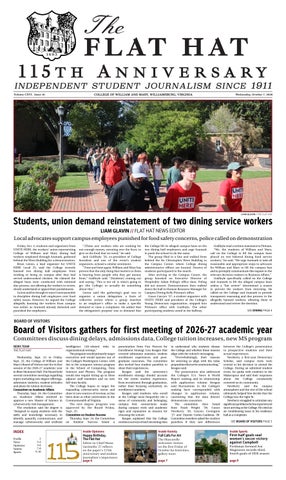
1693
The F L AT H AT
1 1 5 t h A n n i v e r sa ry
1911
i ndepe n d en t student journalism sinc e COLLEGE OF WILLIAM AND MARY, WILLIAMSBURG, VIRGINIA
Volume CXVI, Issue 10
Wednesday, October 7, 2026
LIAM GLAVIN / THE FLAT HAT
Students, union demand reinstatement of two dining service workers LIAM GLAVIN // FLAT HAT NEWS EDITOR
Local advocates support campus employees punished for food safety concerns, police called on demonstration Friday, Oct. 2, students and organizers from UNITE HERE, the workers’ union representing College of William and Mary dining hall workers employed through Aramark, gathered behind the Wren Building for a demonstration. Brian Liston, a lead organizer for UNITE HERE Local 25, said the College recently banned two dining hall employees from working or being on campus after they had served undercooked chicken. He claimed the alleged bans were conducted with minimal due process, not allowing the workers to review, clearly understand or appeal their punishments. Liston said he thought it wasn’t unreasonable to discipline dining hall employees over food safety issues. However, he argued the College allegedly banning the workers from campus was unfair, as Aramark already demoted and punished the employees.
“[These are] workers who are working for not enough money, sweating over the fryer, to give us the food that we need,” he said. Jack Guilfoyle ’29, co-president of College Socialists and one of the event’s student organizers, echoed a similar sentiment. “Time and time again, William and Mary has proven that the only thing that matters to them is hearing from people who they get money from,” Guilfoyle said. “[Students] coming out and saying, ‘This is not ok’ is what’s going to get [the College] to actually do something about this.” Liston said the gathering’s goal was to organize a union delegation, a form of collective action where a group marches to an employer's office to make a specific demand or raise a complaint. He added that the delegation’s purpose was to demand that
the College lift its alleged campus bans on the two dining hall employees and urge Aramark to push the school to do the same. The group filed in a line and walked from behind the Sir Christopher Wren Building to the Campus Center, where College dining administrative offices are located. Dozens of students participated in the march. After arriving at the Campus Center, the group knocked on Executive Director of Hospitality Adam Poling’s office door. Poling did not answer. Demonstrators then walked down the hall to Human Resource Manager for Campus Dining Kelly Pittman’s office. Grace Carryer ’27, a student organizer with UNITE HERE and president of the College’s Young Democrats organization, stepped into Pittman’s office with Guilfoyle. The other participating students stood in the hallway.
Guilfoyle read a written statement to Pittman. “We, the students of William and Mary, call on the College to lift the campus bans placed on two beloved dining food service workers,” he said. “We urge Aramark to take all reasonable and appropriate steps to advocate for William and Mary to lift the campus ban and to promptly communicate this request to the relevant decision-makers in Business Affairs.” Guilfoyle specifically called on the College and Aramark to lift the alleged campus bans unless a “fair review” determined a reason to prevent the workers from returning. He called on the College and Aramark to provide transparent reasoning and due process to the allegedly banned workers, allowing them to understand and review the decision. SEE DINING PAGE 4
BOARD OF VISITORS
Board of Visitors gathers for first meeting of 2026-27 academic year Committees discuss dining delays, admissions data, College tuition increases, new MS program NEWS TEAM THE FLAT HAT Wednesday, Sept. 23 to Friday, Sept. 25, the College of William and Mary’s Board of Visitors met for its first session of the 2026-27 academic year in Blow Memorial Hall. The Board held several committee meetings regarding topics including new degree offerings, admission statistics, student attitudes and plans for tuition increases. Committee on Academic Affairs Thursday, Sept. 24, the Committee on Academic Affairs resolved to approve a new Master of Science in cybersecurity risk management. The resolution said the degree is “designed to equip students with the skills and knowledge necessary to identify, quantify, communicate, and manage cybersecurity and artificial
INDEX Profile News Opinions Variety Sports
intelligence (AI)-related risks in organizational settings.” The program would primarily target executives and would operate out of the College’s Washington Center, with ties to the computer science program in the School of Computing, Data Sciences and Physics. The program would also require hiring up to three adjunct staff members and no new full-time faculty. The College hopes to target the expanding cybersecurity sector and draw in new sources of revenue, as has been done at other universities in the Commonwealth of Virginia. The new degree program was approved by the Board Friday, Sept. 25. Committee on Student Success Thursday, Sept. 24, the Committee on Student Success heard a
Inside Opinions
2 3-4 5-6 7-8 9-10
Happy Birthday, The Flat Hat
Editor-in-Chief Mona Garimella '27 reflects on the paper's 115th anniversary and student journalism's importance page 6
presentation from Vice Provost for Enrollment Strategy Lisa Keegan that covered admission statistics, student enrollment experiences and postgraduate outcomes. The committee also invited four student panelists to share their experiences. Keegan said the university’s enrollment strategy should account for the entire student experience, from recruitment through graduation, rather than focusing exclusively on enrollment numbers. Keegan said students who enroll at the College most frequently cite a sense of community and belonging, campus feel, connections made during campus visits and academic rigor and reputation as reasons for choosing the school. Keegan explained that the College conducts surveys of each incoming class
to understand why students choose the College and whether those reasons align with the school’s messaging. “Overwhelmingly, their reasons for selecting us align with the value proposition that we’re communicating,” Keegan said. The presentation also addressed the College’s U.S. News & World Report ranking and its relationship with application volume. Keegan said fluctuations in the College’s ranking have corresponded with changes in application volume, cautioning that the data doesn’t demonstrate causation. The committee then heard from Noah Wright ’28, Conor Newberry ’30, Gracen Covington ’27 and Zuyemi Cortez-Cardenas ’28. Committee members asked the student panelists if they saw differences
between the College’s presentation to prospective students and their actual experiences. Newberry, a first-year Democracy Scholar, said campus visits were central to his decision to attend the College. During an admitted student event, he spoke with students in the Makerspace and said their responses about the College consistently centered on its community. Newberry said the campus atmosphere and the size of the school ultimately helped him decide that the College was the right fit. Newberry struggled to articulate any significant problems he has experienced since arriving at the College. He cited an air conditioning issue in his residence hall as a complaint. SEE BOARD OF VISITORS PAGE 3
Inside Variety
Inside Sports
The Muscarelle welcomes visitors on the first Friday of October for festivities, gallery tours
Freshman forward Ava Magnuson records third, fourth goals of 2026 season
Fall Calls For Art
page 7
First-half goals seal women's soccer victory against Campbell
page 9
THE FLAT HAT | Wednesday, October 7, 2026 | Page 2
THE BUZZ
“
“
newsinsight news insight
News Editor Liam Glavin News Editor Naman Mishra News Editor Robin Perdue fhnews@gmail.com
I feel like itʼs like the Lorax; I want to speak for the trees. I want to speak for the people, make sure that they know that whatever theyʼre struggling with on campus or elsewhere, Iʼm a person they can turn to for that.
-- Sen. Paige Goble ʼ30
FLAT HAT NEWS BRIEF
Interfraternity Council passes resolution on sexual violence prevention, establishes new guidelines
This article contains discussions of sexual assault. Wednesday, Sept. 30, the College of William and Maryʼs Interfraternity Council passed a resolution regarding campus sexual violence prevention. The IFC resolution came weeks after a former Cornell University student, identified as Jane Doe in court filings, alleged in a lawsuit that she was drugged and raped by seven men at a Chi Phi fraternity house. The lawsuit has sparked outrage and a national conversation about sexual assault on college campuses. The IFC resolution affirmed support for survivors of sexual assault and the right for students to exist at the College without fear of sexual violence. “The Interfraternity Council and its member organizations reaffirm that sexual violence, harassment, coercion, retaliation, and abuse are completely incompatible with the values and responsibilities of our organizations,” the resolution stated. The IFC also affirmed its right to evaluate and improve sexual violence prevention practices for fraternities on campus. The resolution said all fraternity chapters on campus will now be required to incorporate sexual violence education into their new member education plans every semester. READ MORE AT FLATHATNEWS.COM LIAM GLAVIN / FLAT HAT NEWS EDITOR
A THOUSAND WORDS
COURTESY IMAGE / PAUL MANNA
Manna has taught governmen t at the College since 2003, receiving Isabelle and Jerome E. Hyman
distinguishm ent in 2016.
Distinguished Professor of Government Paul Manna reflects on journey to teaching, education research Manna discusses civic education podcast, collaboration with Strategic Cultural Partnerships
LILA REIDY // FLAT HAT NEWS ASSOC.
MONA GARIMELLA / THE FLAT HAT
CORRECTIONS The Flat Hat wishes to correct any fact printed incorrectly. Corrections may be submitted in email to the editor of the section in which the incorrect information was printed. Requests for corrections will be accepted at any time.
THE FLAT HAT ʻSTABILITAS ET FIDESʼ | ESTABLISHED OCT. 3, 1911 Org #101 P.O. Box 8795, Williamsburg, VA 23187
Editor flathat.editor@gmail.com Managing flathat.managing@gmail.com Executive flathat.executive@gmail.com Magazine editor@flathatmagazine.com News fhnews@gmail.com Sports flathatsports@gmail.com Copy flathatcopy@gmail.com
Opinions fhopinions@gmail.com Variety flathat.variety@gmail.com Photos flathatphotos@gmail.com Online flathatonline@gmail.com Advertising flathatads@gmail.com Graphics flathat.art@gmail.com Ombudsman flathat.ombuds@gmail.com
Mona Garimella Editor-in-Chief Maddie Mohamadi Managing Editor Megan Rudacille Executive Editor Nate Ross Copy Chief Kylie Totten Digital Media Editor Ben McLoughlin Operations Coordinator Molly Martin Operations Coordinator Robin Perdue News Editor Liam Glavin News Editor Naman Mishra News Editor Emma Beelner Variety Editor DevYani Thakare Variety Editor Cara King Sports Editor Jacob Tobman Sports Editor Michael Gabriel Opinions Editor Ava Gravina Opinions Editor Liam McMahon Audio/Visual Editor Kenza Houhou Audio/Visual Editor Adelyn Skerik Copy Editor Clare Pacella Copy Editor Eden Leavey Copy Editor Elise Whitfield Copy Editor Emma Newill Copy Editor Irene Straw Copy Editor Jonathan Larkin Copy Editor Julia Peavey Copy Editor Kelsea Smith Copy Editor Kreilys Garcia Flores Copy Editor Lindsay Luberecki Copy Editor Lorelei Kelley Copy Editor Ruby Trainor Copy Editor Sophia Paradowski Copy Editor Lily Mansell Copy Editor Hannah Elysse Mayo Copy Editor Madigan Webb Chief Staff Writer Lila Reidy News Assoc. Editor Melania Frye News Assoc. Editor Nicole Zajac News Assoc. Editor Rebecca Fuchs News Assoc. Editor Sam Belmar News Assoc. Editor Sachi Pallem News Assoc. Editor Susannah Poteet News Assoc. Editor Sanjana Manghnani News Assoc. Editor Bobby Mollan News Assoc. Editor Abigail Furcy Chief Variety Writer Aditi Allam Variety Assoc. Editor Aamnah Malik Variety Assoc. Editor Anna Wood Variety Assoc. Editor
Eric Sohn Audio/Visual Editor Andrew Henrickson Data Editor Betty Yemane Social Media Editor Evie Corr Social Media Editor Kimberly McCann Photos Editor Isabel Editor Graphics Editor Gretta Anderson Graphics Editor Maeve Meyer Games Editor Ethan Auclair Ombudsman James Abruzzo Business Manager Sam Harrington Webmaster
Brooke Lewis Variety Assoc. Editor Callie Laubacker Variety Assoc. Editor Ella Greene Variety Assoc. Editor Emma Beelner Variety Assoc. Editor Juliana Nelson Variety Assoc. Editor Maggie OʼKieffe Variety Assoc. Editor Patricija Pupine Variety Assoc. Editor Skylar Hartgerink Variety Assoc. Editor Skyler Cole Variety Assoc. Editor Tessa Darke Variety Assoc. Editor Maya Sakai-Chen Variety Assoc. Editor Gabriella Calcagno Variety Assoc. Editor Nora Yoon Chief Opinions Writer Abigail Crespin Opinions Assoc. Editor Alexandra Hill Opinions Assoc. Editor Carson Burch Opinions Assoc. Editor Cate Woodrum Opinions Assoc. Editor Charlotte Trodden Opinions Assoc. Editor Ella Grimes Opinions Assoc. Editor Eva Jaber Opinions Assoc. Editor Geronimo Ritcheson Opinions Assoc. Editor Isabella McNutt Opinions Assoc. Editor Lana Altunashvili Opinions Assoc. Editor Lucia Reyes Opinions Assoc. Editor Teddy Friesz Opinions Assoc. Editor Audrey Capone Opinions Assoc. Editor Carolyn Reid Photos Assoc. Editor Ethan de Guia Photos Assoc. Editor Jonah Peters Photos Assoc. Editor Alina Schueman Videos Assoc. Editor
Darius Bagherian Videos Assoc. Editor Enna Carbone Videos Assoc. Editor Jack Pegler Videos Assoc. Editor Landon Miles Videos Assoc. Editor Olivia Ives Bailey Videos Assoc. Editor Piper Gilly Videos Assoc. Editor Siddhita Krishnan Videos Assoc. Editor Sophie Frank Videos Assoc. Editor Virginia Fife Videos Assoc. Editor Sabry Tate Podcasts Editor Connor Pawliczak Podcasts Assoc. Editor Maricel Pucillo Podcasts Assoc. Editor Noa Wilson Podcasts Assoc. Editor Isabel Volden Graphics Editor Gretta Anderson Graphics Editor Alina Yang Graphics Assoc. Editor Maisie Curtin Graphics Assoc. Editor Aida Bekele Graphics Assoc. Editor Westley Jacanin Chief Sports Writer Eamonn McAloon Sports Assoc. Editor Henry OʼConnor Sports Assoc. Editor Katie Killagen Sports Assoc. Editor Ellie Laanisto Ombuds Assoc. Editor Naomi Linde Ombuds Assoc. Editor Rhys Runnels Ombuds Assoc. Editor Lauren Singer Social Assoc. Editor Hannah Sawyer Social Assoc. Editor Mira Deni Data Assoc. Editor Sienna Rankins Data Assoc. Editor
Isabelle and Jerome E. Hyman Distinguished University Professor of G overnment Paul Manna radiates a desire to achieve more equitable education. This passion drives his dynamic teaching and research for the College of William and Mar y’s government department. He also extends his educational efforts into the greater Williamsburg community through WHRO Public Media. Manna joined the campus community in 2003 as an assistant government professor. Manna said he was drawn to the College’s comprehensive teaching style. Manna’s journey to the College, however, was far from linear. Manna taught at his former high school before earning his Ph.D. in political science from the University of Wisconsin in 2003. “I enjoyed teaching high school, but I didn’t enjoy that much teaching,” he said. “Five classes a day, ever y day, is a lot.” Manna said the balance of teaching and research ultimately drew him to the college classroom. During his time at the College, Manna’s research has focused on K-12 education polic y. “My main area of interest is how policies get carried out,” he said. “I use the word ‘implementation’ a lot to describe that.” He outline d his publication histo r y , m e nt i o n i ng t w o of his b o oks. In “School’s In: Federalism and the National Education Agenda,” Manna wrote about the federal government’s involvement in education. “Almost all the money for education comes from states and localities, yet there is this arc of time, over about 50 years, from the ’60s to the end of the 20th centur y, where the federal government started to get a lot more interested and involved,” he said. “My first book was tr ying to explain how that happened and why it happened.” In his second book, “Collision Course: Federal Education Polic y Meets State and L ocal Realities,” he wrote about the federal government’s achievements in education legislation. Manna has also co-edited a book on education governance, co-authored an American government textbook and published other articles on education, polic y and politics. Crucial to his interest in education, Manna has led student research teams in librar y sourcing, dataset construction and independent studies. Manna highlighted a particularly influential project. “We went to Illinois for two weeks, and we rented a minivan and drove around the state inter viewing a bunch of politicians and state officials,” he said.
Manna described an emerging research project of his that is still in its early stages, tentatively named “learning beyond the instructional core.” The term “core” refers to teaching and curriculum. “ The evidence does show that if you have [effective] teachers, if you have a high-quality curriculum and teachers know how to use it, that actually does help students learn, help them succeed,” he said. “But there are also a lot of other things in school that can shape achievement, and not a lot of people pay a lot of attention to those.” For this project, Manna said he plans to explore subsets of external influences on K-12 education, investigating the effects of principal quality, standardized vision tests and modern school infrastructure such as heating, cooling and lighting. He said he hopes to use the research to help guide curriculum implementation in school districts. Ma n na sa i d h e a i m s to su p p o r t h i s e m e rg i ng re s ea rch w i t h g ra nt s o r re late d f u n d i ng s ou rc e s to p ro m o te stu d e nt i nvo lve m e nt. In addition to his research, Manna created 19 educational podcast episodes last spring related to civics in a series titled “Democrac y in Five Minutes.” Manna has also appeared on Civics Minute, a 90-second section within NPR Morning Edition’s commercial break in collaboration with WHRO Public Media. L ocally, the broadcasts can be heard on FM channel 89.5 WHRV and NPR’s website. Manna explained the premise of his educational podcasts, which are done in collaboration with the College’s Strategic Cultural Partnerships Office. “We came up with an A-to-Z format where each spot is a different civics concept that begins with a different letter of the alphabet,” he said. “We initially did the first eight letters of the alphabet, and that was going to be a trial run with WHRO because we do one a week. That way, they could have one a week leading up to election day.” WHRO recently extended the project to complete the alphabet, meaning it will run until March 2027. “ The goal was to be ver y concrete, to say to people, ‘ These aren’t just textbook ideas, but they are things that could be relevant in your own life,’” said Manna about Civics Minute. Ma n n a c o n c l u d e d by d i s c u s s i n g h i s o w n p h i l o s o p h y on applying change to make positive impacts on i n d i v i d u a l s’ l i v e s. “We have to actually do things,” Manna said. “Just because we have a right or a law on paper doesn’t mean that it really means anything until someone puts it into practice or acts.”
Wednesday, October 7, 2026
Page 3
THE FLAT HAT
STUDENT ASSEMBLY
Newly-elected Student Assembly members discuss campaigns, goals
Class of 2029, 2030 representatives reflect on campaigns, describe values, plans for upcoming senate session
NAMAN MISHRA FLAT HAT NEWS EDITOR
Thursday, Sept. 24, students at the College of William and Mary voted for representatives in the College’s Student Assembly. The class of 2030 voted for a class president and four senators, as is typical for the fall. Additionally, the class of 2029 voted to fill two vacant senator positions. The Flat Hat spoke to each of the newly elected members to discuss their campaigns and goals for the remainder of the 334th session. Class of 2029 The Class of 2029 senate election was uncontested, as only two candidates ran for two available seats. Nate Acklie ’29 and Isaiah Jimenez ’29 were elected. Acklie said his care for the College’s community inspired him to run. “I think there’s something to be said when an opportunity presents itself and you have the chance to contribute, just being willing to put yourself out there and make the jump,” he said. Acklie said he felt his campaign helped strengthen his connection with other students. “I’m a little bit more of a people person,” Acklie said. “I think that policy is an ever-changing issue, and it’s not always something that you can nail down.” Acklie said he hopes to continue connecting with students and listening to their concerns in office. Jimenez said he hopes to focus on student privacy and transparency around artificial intelligence-powered surveillance systems on campus, such as Flock cameras. “I just want to be that kind of person who can really advocate for [students’] privacy and not have them feel their information is being taken in a way they don’t want it to,” he said. Jimenez said he also hopes to improve Wi-Fi connectivity across campus and decrease dorm lockout fees for students. Class of 2030 Students from the class of 2030 elected Paige Goble ’30,
Aryan Garg ’30, Nicole Rodriguez ’30 and Nicholas Buchanan ’30 as senators. Goble said she has been involved in student government for most of her life. “I have always loved the initiatives that student government pushes forward,” she said. “I think that it is the backbone of a student body in that they really make sure to speak for students.” Goble said she hopes to expand mental health resources for students. “I struggle with mental health, and so it’s really important for me to work on shifting the culture around mental health,” she added. Goble said she would want SA to create a mental healthfocused working group and promote mental health education through speakers and events. “I feel like it's like the Lorax; I want to speak for the trees,” Goble said. “I want to speak for the people, make sure that they know that whatever they're struggling with on campus or elsewhere, I'm a person they can turn to for that.” Garg said he views his new position as a contact point between students and school leadership on pertinent issues. “It would be really cool to be a bridge between [students] and admin or the senate, which can actually make a lot of progress on these problems,” he said. Garg added that he wants to expand Dining Dollar partnerships for meal plans and represent other student dining concerns. Rodriguez said she sees SA as a means to make a greater impact on campus, more than she could as an individual student. She said she wants to expand access to textbooks in the Earl Gregg Swem Library and provide other low-cost ways for students to get course materials, such as developing a map that shows locations of different campus resources. Rodriguez also described the values she hopes to be defined by as a senator. “I want to be disciplined and consistent,” Rodriguez said. “I hope to be able to spread that consistency across campus, allowing students to see the transparency that I bring to the campus and
KIMBERLY MCCANN / THE FLAT HAT
Students elected seven representatives to the Student Assembly Senate delegation.
that I’m actually passionate about meeting my goals.” Buchanan said he decided to run to engage more closely with the College community and improve the student experience. He hopes to work toward streamlining dining options and other quality-of-life improvements for students, such as expanded dumpster availability. Buchanan said he looks forward to collaborating with his peers in the senate to find ways to advocate for the student body. Peniel Ogunde ’30 was elected president for the class of 2030. Ogunde said she wanted to concentrate on ways SA can directly impact students’ lives. She mentioned the delayed opening of the West Woods Dining Hall as an example. Ogunde said even though SA may not be able to have a direct impact on campus construction projects, she will strive for greater transparency. Ogunde also said she wants to provide fans to those dealing with temperature-related concerns in residence halls, such as the Botetourt Complex, manage laundry and printing costs and host more social gatherings where students can interact with peers. “Building community is very important,” she said.
BOARD OF VISITORS
Board of Visitors hosts student panel, details campus development plans Members discuss College's institutional improvements, expanding networking, increased student opportunities
BOARD OF VISITORS FROM PAGE 1
Cortez-Cardenas, a transfer student, emphasized the importance of creating a sense of belonging for students entering the College after starting higher education elsewhere. She said transfer students can have difficulty integrating into an established campus community, particularly when arriving in the spring. “Although we did come in a little bit late to the party, we do still want to feel like we’re involved,” Cortez-Cardenas said. Cortez-Cardenas also said the College’s community was one of its strongest qualities. Keegan responded to Cortez-Cardenas by saying that transfers represent an important part of the College’s enrollment strategy and could help offset fluctuations in the traditional fall entering class. She said the College is considering proposals for a transfer center and additional transfer scholarships. Wright, a student-athlete and Raymond A. Mason School of Business student, said underclassmen interested in business could benefit from taking business courses earlier in their undergraduate careers. He said other universities tend to offer more business courses for underclassmen. Wright pointed to relationships with professors, classmates and alumni as a highlight of his experience at the College. Covington, who spent two years at the University of St. Andrews through the College’s Joint Degree Programme, said she thinks the program could be marketed more heavily to prospective students interested in international relations. “I would love to see some more funding opportunities for the JDP just to make it more accessible,” Covington said. Covington similarly highlighted the College’s alumni network. She specifically mentioned the connections she made through internships and the College’s Washington Center and Washington summer programs. The committee adjourned after the
student panel. Committee on Administration, Buildings and Grounds Thursday, Sept. 24, the College’s Chief Business Officer Sean Hughes shared dining updates with the Committee on Administration, Buildings and Grounds. Initially slated to open at the start of the fall 2025 semester, the West Woods Dining Hall has been delayed three separate times. Hughes discussed possible reasons for the delays. “A lot of this has to do with the structural format of the contract and the acquisition strategy that we use,” Hughes said. The College ultimately settled on a publicprivate partnership for the construction, issuing a land lease to third-party owner Provident Resources Group. “That third-party owner in turn hired the developer, who in turn hired contractors and architects,” he added. “So right off the top, one of the lessons learned is we are trading away some control in this situation.” Hughes also attributed the delays to missing equipment, incorrectly calibrated air conditioning systems and refrigeration issues. “We’ve made it clear that this is unacceptable,” he said. Hughes expressed confidence that the West Woods Dining Hall will open in spring 2027. He also said the Food Hall at Sadler — which was converted to a retail food hub this fall — will not revert to an all-you-can-eat cafeteria this academic year. Morning Musings and the Marketplace at Campus Center will also continue operating during the 2026-27 school year. For future projects, Hughes mentioned exterior refurbishments to five buildings surrounding the Sunken Garden, the installation of roughly 400 geothermal wells below the Sunken Garden and renovations to Boswell Hall. The committee also passed two resolutions. The first authorized College leadership to engage in a real estate exchange with the William and Mary Foundation, and the
NAMAN MISHRA / THE FLAT HAT
The Board discussed progress on West Woods Dining Hall delays and future plans for other on-campus developments.
NAMAN MISHRA / THE FLAT HAT
The September meeting was the Board's first under Rector Ardine Wiliams and Vice Rector John Brownlee J.D. '94, P '22
second approved an updated charter for the William and Mary Retirement Committee. Committee on Financial Affairs Thursday, Sept. 24, the Committee on Financial Affairs unanimously approved updated six-year plans for the College and the Virginia Institute of Marine Science. The College’s six-year plan includes tuition increases of 2.9% for both in-state and outof-state undergraduate students, which the Board approved in April. The decision was met with student pushback, including a peaceful protest during the April meeting. “We’re doing our best to keep tuition from rising as fast as other places,” Chief Financial Officer Sean Galloway said after the September meeting. Galloway said the College updated the plan using assumptions provided by the State Council for Higher Education of Virginia. This includes a 2% salary increase and a 1% increase in employee health insurance premiums. In response to an ongoing budget deficit in appropriated funds for state initiatives and significant cuts to federal funding, VIMS’ sixyear plan calls for a base budget increase. VIMS currently faces an annual operating cost deficit of $4.1 million and has requested a base budget increase of the same amount. According to the plan narrative, the funds would support recruitment and retention of scientists, advance high-impact initiatives and maximize the state’s return on investment. “I don’t expect to get that $4.1 million,” VIMS Dean and Director Derek Aday said. “If the state is able to give us 10% of that, 50% of that, anything that they do allows us to operate in a way that we have always operated and to deliver the actual science that they depend on us to do.” Committee on Institutional Advancement Thursday, Sept. 24, the Committee on Institutional Advancement discussed the College’s strategic planning. Committee Chair Jennifer Tepper Mackesy ’91 opened by discussing the College’s work on developing the next long-term university plan. “Our focus has remained on our four pillars: driving student demand, building
brand awareness, strengthening engagement and philanthropy, all on the foundation of the outstanding talent of our faculty and staff,” Mackesy said. Senior Vice President of University Advancement Matthew Lambert ’99 then gave a presentation about the College’s performance on key institutional advancement indicators. The first performance indicator Lambert discussed was philanthropy. He said donation amounts to higher education have fallen across the country. Lambert characterized the College’s current donor situation as positive. “Our aim is by the end of 2030 to be at [a] 68% [giving rate], which is well beyond a national benchmark,” he said. Lambert then mentioned the College’s institutional reach and awareness indicator. He said the College set a goal to increase its reach by 5% annually, which it exceeded this year. In terms of internships, Lambert said more students have taken advantage of the College’s Funding for Unpaid and Underfunded Student Experiences program. “The number of students requesting, seeking and receiving funding for unfunded or underfunded internships has increased pretty dramatically,” Lambert said. “This most recent year, [it was] almost $400,000.” The fourth and final performance indicator Lambert mentioned to the committee was alumni engagement. “We are connecting with those alumni, and we’re roughly double the rate of engagement that institutions are globally,” he said. The meeting then turned to Provost Peggy Agouris, who discussed guiding principles shaping the College’s new strategic plan. “A strategic plan is a path towards establishing and preserving and documenting identity in the landscape of external forces that keep changing,” she said. Agouris said the College is focusing on student demand, research, academic excellence and outcomes as it develops its new strategic plan. READ MORE AT FLATHATNEWS.COM
THE FLAT HAT
Wednesday, October 7, 2026
Page 4
POLITICS
Buddhist monk Thích Chúc Thanh gives campus talk on religion’s teachings Guest lecturer discusses teaching of contentment, application of Buddhaʼs teachings, releasing materalistic thoughts MADIGAN WEBB FLAT HAT CHIEF STAFF WRITER
Thursday, Oct. 1, Thích Chúc Thanh, a Vietnamese Buddhist monk, spoke on Buddhist monastic life and meditation at the College of William and Mary. Chúc Thanh is the head of the Dong Hung Temple, known as the Buddhist Education Center of America, in Virginia Beach, Va. Chúc Thanh greeted audience members in Tucker Hall by instructing them to use their index fingers to push up their cheeks, forming a smile. “In order to practice the higher yana [enlightenment], you need to practice the push-up right here, so that you can relax yourself,” Chúc Thanh said. Chúc Thanh said Buddha is not revered as a god but respected as an instructor in Buddhist teachings. “Buddha never asks you to become his servant, he asks you
NAMAN MISHRA / THE FLAT HAT
Thích Chúc Thanh presented about ways to learn the Buddhaʼs teachings.
to become your own Buddha,” he said. “That’s the beauty of the Buddha’s teaching. He never asks his students to just admire him and bow at him.” Chúc Thanh further distinguished Buddha from a god. “All of his teaching is like the finger pointing to the target exit over there,” he said. He emphasized the importance of knowing the Dharma and Buddha’s teachings in addition to making conscious efforts to apply those teachings. “Right now with super intelligence or AI, you can search what the Buddha taught really easily, just a click, and you know [it] all,” he said. “But how you apply [them] and how you bring [them] into your daily life is a process, and taking time to do that and learning the Dharma is the first step.” Chúc Thanh emphasized the teaching of contentment. “The four requisites [are] clothing, walking, food and medicine,” he said. “That’s what we need, and what we want is a lot. You can see that every day we want a lot, but you need just a little in order to live this life.” He said these materialistic thoughts become easier to abandon once individuals acknowledge them. “You [can] just recognize them, because Buddha says that our minds have [a] beautiful, very strong capacity to let go if we recognize the problem,” Chúc Thanh said. Chúc Thanh explained how Sariputra, the chief disciple of the Buddha, extended the idea of contentment to accepting others as they are. “[Sariputra] practiced like the earth,” Chúc Thanh said. “[The] earth never complains. People spit on the earth, and the earth never feels excited when people put flowers on [it]. Earth embraces them all.” Chúc Thanh also provided easy ways to practice Buddhism. The first was by wishing others in the world well. “You can practice by saying, ‘May all beings in the North, the
NAMAN MISHRA / THE FLAT HAT
Chúc Thanh is the head of the Buddhist Education Center in Virginia Beach, Va.
West, the East, the South live in peace, free from anger, free from jealousy. May they live with a good cause and good result,’” he said. “You will see that you receive the amplified back.” Speaking kindness into the world gives someone good karma and decreases conflict, he added. Chúc Thanh said his nickname, the “Smiling Monk,” relates to his devotion to laughter. “I practice the ‘Hahayana,’” he said. “That’s why I make you laugh, enjoy life. Life is so short. And who knows? See, you are here today. I’m here today. Maybe I’m not here tomorrow.” Reflecting on the talk, Danny McGlynn ’30 focused on Chúc Thanh’s portrayal of the Buddha as a teacher. “I found it interesting when he was talking about the Buddha,” McGlynn said. “He wanted people to respect him as a teacher but didn’t want people to worship him or be his servant.” Emma Staeger ’27 also attended the talk, finding it insightful. “[Chúc Thanh] was very wise and spoke about meaningful ways to live out your life regardless of your religious or spiritual beliefs.”
STUDENT ASSEMBLY
Senate passes bill to fully fund Plan B contraception for students
Senators hear from Cohen Career Center, bill introduced to incentivize students to participate in dorm tour videos NICOLE ZAJAC FLAT HAT NEWS ASSOC.
Tuesday, Sept. 29, the College of William and Mary Student Assembly heard a presentation on the Wren Bell Ready Act from the Cohen Career Center. Senators also introduced legislation to incentivize student participation in dorm tour videos and passed bills to fully subsidize Plan B and fund the annual Art and Hatsuye Ball. SA began by swearing in the newly elected class of 2029 and class of 2030 senators and the class of 2030 president. Senior Director of Career Readiness and Industry Advising Kelly O’Shaughnessy then presented the Cohen Career Center’s Wren Bell Ready initiative. O’Shaughnessy, whose focus is on career readiness initiatives across campus and student-athlete career development, highlighted the program’s three years of development. “What you see here is a labor of love from the last three years,” she said. The initiative takes its name from the College’s tradition of ringing the Wren Bell, which marks the beginning and end of a student’s time at the College. She described the initiative as a series of four interconnecting nonlinear, noncumulative pathways. The four pathways, which are meant to organize programs and resources already in place from the center, include explore, engage,
gain experience and embark. “Each path is really a bucket of all the resources, events and programs that the Career Center provides,” she said. “There is no starting place that is perfect for all students.” O’Shaughnessy said students will be able to actively and passively track their progress through these paths through a website and TribeCareers. Activities, like attending a workshop, will automatically appear in a student’s pathway, and students can record other progress through surveys and reflections. Chair of Finance Neha Baskar ’29 then presented on SA’s quarterly finances. During the previous fiscal year, the Organizational Budget Allocation Committee allocated $198,177.13 of $354,697.54 requested by registered student organizations. Out of 439 organizations that requested funding, 379 of them received it. Assistant Vice President for Student Affairs and Director of Student Unions and Engagement Anne Arseneau ’89 M.A.Ed ’92 highlighted the increase in organizations receiving funding. “At your highest, you funded only 120 student orgs, and to see that number is truly amazing,” Arseneau said. Baskar reported that SA currently holds about $940,000 in reserves, cautioning that this figure is less than exact due to changes in software used
to calculate these values. She said this means OBAC can be more liberal in its distribution of funds this year. SA introduced the Room Reveal Rewards Act, which would provide gift card incentives to students selected to participate in dorm tour videos. “Based off of the finance report, I want to say it sounds like a great time to do this,” Class of 2029 President Daria Lesmerises ’29, who sponsors the bill, said. Lesmerises has been working with University Marketing to produce full dorm tour videos, potentially in collaboration with The Flat Hat. University Marketing, according to Lesmerises, has had past difficulties recruiting students to volunteer their rooms for tours. Organizers hope to create videos on a timeline convenient for prospective and current students, ideally before the Early Decision I deadline. University Marketing cannot directly offer incentives to students; however, SA can. Funding for gift cards would therefore come from SA’s off-campus account, rather than its reserves. Lesmerises said unused gift cards could be retained for other incentives. Sen. Nathan Yang ’28 asked how SA obtained the money in this account. Arseneau explained that the revenue was generated through T-shirt sales and that proceeds are now collected from
GRAPHIC BY CATHERINE STORKE / THE FLAT HAT
senior portraits. The account currently holds about $8,000. Members passed the Subsidize Plan B Bill II. Sen. Mackenna Wyckoff ’28 and other organizers met with the Student Health Center and determined that SA could fully subsidize the $20 cost of Plan B. Previously, SA subsidized $15 of the cost. The bill limits Plan B to one per person per visit. SA also passed the Art and Hatsuye Ball Act IV, which provides funding for the fourth annual Art and Hatsuye Ball. READ MORE AT FLATHATNEWS.COM
CAMPUS
WMPD claims gathering violates university policy, no arrests made
Aramark affirms commitment to food safety, says former dining service workers offered alternative employment DINING from page 1
statement again, chanting in support of the allegedly banned workers. Liston said UNITE HERE plans to hold more events after the College’s fall break in solidarity with the allegedly banned workers. He also promoted a petition supporting the dining hall employees and encouraged students to sign it. As students began to leave the Campus Center, two William and Mary Police Department officers arrived. It was not immediately clear who called campus police on the demonstration. The officers questioned Liston about the gathering, which dispersed without incident. No arrests were made. Liston declined to comment on the
demonstration or what the officers told him. Guilfoyle also demanded that the After the demonstration, Carryer College and Aramark address any future argued that understaffing and food safety issues through collaborative mismanagement of campus dining training and support, as well as with halls have created additional strain any other related “evidence-based” and on existing workers, contributing to “proportionate” actions. mistakes such as undercooked chicken. “We urge William and Mary to “The university is taking out pressure reconsider these bans and work toward to fix the dining halls on the lowest-paid a solution that protects food safety while workers on this campus,” they said. treating employees fairly,” he said. Carryer explained why they felt it was Guilfoyle left the written statement important to support dining hall workers. with Pittman, who remained silent. “I’m a student out here trying to The delegation group then filtered stand up for the workers who make out of the hallway and gathered in front our community the amazing place of the Campus Center. Demonstrators that it is to learn,” they said. surrounded Guilfoyle as he read the Guilfoyle later clarified via email that the allegedly banned dining service workers were offered the opportunity to work at Old Dominion University. Conall S. Smith, a spokesperson for Aramark, provided a statement to The Flat Hat about the allegedly banned dining service workers. He also confirmed that the employees were given the opportunity to work elsewhere. “Food safety is a top priority, and when concerns arise, we act promptly to address them and reinforce our established practices,” Smith said. “While we do not comment on individual personnel matters, we can confirm that the employees involved were offered other employment opportunities with Aramark.” Smith said Aramark values the LIAM GLAVIN / THE FLAT HAT Campus police claim the demonstration broke school policy by disrupting university operations. relationship it has with UNITE HERE.
Local 23.
t
LIAM GLAVIN / THE FLAT HAT
Jack Guilfoyle ʼ29 (center) and Grace Carryer ʼ27 (right) presented written demands to the College.
“We remain available to hear and resolve any concerns the union may have through our established grievance process,” he said. Executive Director of Media Relations Suzanne Clavet provided The Flat Hat with a comment on behalf of WMPD about its involvement in the Campus Center demonstration. “They disrupted the operations of the office and issued a demand letter which they also read aloud. Verbally, and in writing, the demonstrators said
that ‘they would be back.’ WMPD was called to the W&M Dining offices following the departure of the demonstrators by staff who felt unsafe,” the statement read. WMPD said the College supports constitutionally protected free expression but that the Campus Center demonstration violated university policy by disrupting William and Mary Dining operations. READ MORE AT FLATHATNEWS.COM
opinions STAFF COLUMN
We can’t keep looking away from sexual violence Molly Martin
Opinions Editor Ava Gravina Opinions Editor Michael Gabriel fhopinions@gmail.com // @theflathat THE FL FLAT HAT | Wednesday, October 7, 2026 | Page 5
STAFF COLUMN
Eva’s Apple #25: Just add wat er! Eva Jaber
FLAT HAT OPINIONS ASSOC.
FLAT HAT OPERATIONS COORDINATOR
me realize how naive I was. Just because this feels like a safe community does not mean it always is or will be. Jane Doe surely thought Cornell was her safe space — until it wasn’t. In the past few weeks, seeing the William and Mary Division of Public of Safety’s emails regarding sexual harassment and assault reports on campus has only emphasized that Jane Doe’s situation has the tragic potential to happen anywhere, even here. But what makes Jane Doe’s case especially troubling is how Cornell decided to handle the case back in 2024. Requiring five of these men to write simple essays when they were accused of such a serious crime raises an important question: Did Cornell’s disciplinary response adequately reflect the severity of the harm Jane Doe experienced? It certainly did not. These five men were allowed to remain on Cornell’s campus, where Jane Doe often had to see them, forcing her to relive her traumatic rape over and over and over again. Some of these men went on to have successful careers at prominent companies, like Wells Fargo, while Jane Doe dropped out of school due to the severe impact her attack had on her mental health. How is it that these men went on to live their lives as though nothing happened, while Jane Doe has to continue to grapple with the aftermath of their violent actions two years later? Cornell’s disciplinary response raises serious concerns about the consequences given to perpetrators of sexual assault and the messages these “punishments” send to survivors. When those accused of causing such serious harm face negligible consequences and are even given nicknames like “Cornell Seven,” we drastically minimize who they are and what they did. They are a group of rapists who assaulted a severely intoxicated woman, and the way we treat them must reflect this. Jane Doe also reported that she had been friends with one of the men who assaulted her. This detail is particularly difficult for me to reconcile with the assumptions I had about sexual violence. We tend to imagine danger as something that comes from strangers, from unfamiliar places. Yet, 70-80% of sexual assaults are committed by someone known to the victim. Even the people we think we can trust most have the capacity to hurt us. We can take every appropriate precaution, surround ourselves with friends and do everything “right” and still be at risk. What makes this case even
more disturbing is the inaction of the men who witnessed messages in their fraternity group chat, offering Jane Doe to other members. More than 50 men were in this group chat, and none of them came forward to stop what was going on. As far as we know, not one of them went into the room to check on Jane Doe or question the actions of their friends. These bystanders had a clear opportunity to intervene and potentially prevent further harm, yet no one appears to have done so. It is deeply concerning and frankly appalling that so many men were made aware of what was occurring under their own roof and chose to make jokes about the situation instead of stepping up. Their failure to respond and choice to remain silent underscores how crucial it is to not let loyalty to friends or fears of uncomfortable social interactions take precedence over another person’s well-being. As women, we have become so accustomed to looking out for ourselves and one another when we go out. We watch each other’s drinks, share locations and always text when we get home. These precautions are such a normalized part of the college party scene that we maybe sometimes forget why they are necessary in the first place. In a perfect world, we should be able to go to parties without constantly worrying about our safety. But this isn’t a perfect world. And until it is, we must continue to look out for one another. There is nothing wrong with taking precautions or caring for our friends’ safety. The problem is that currently, the responsibility for preventing sexual assault so often falls on the very people most vulnerable to experience it, rather than on those who commit these acts, those who witness them and the institutions we trust to hold people accountable. We should not have to spend our college years worrying about whether we will make it home safely from a party, whether someone we know will violate our trust or whether our school will adequately protect us if something happens to us. Until our communities become better at preventing sexual assault, responding to survivors and holding those responsible accountable, the burden of navigating these risks will continue to fall disproportionately on women and others vulnerable to sexual assault. Molly (she/her) is a history and Hispanic studies double major from Chicago, Illinois. She is also a member of the Innocence Club, which advocates for criminal justice reform. In her free time, she enjoys reading, attending workout classes and spending time with friends. Contact her at memartin@wm.edu.
GRAPHIC BY GRETTA ANDERSON / THE FLAT HAT
STAFF COLUMN
Did you know that ever y 90 days, about one in 10 people on this earth watch a MrBeast video? I learned this when I went to watch the season 18 premiere of “Shark Tank” and the guest shark spot was filled by MrBeast and the CEO of Beast Industries, who is apparently some guy named Jeffrey. Anyway, the s e cond strang est investment that Team Beast made was, I kid you not, an AI-powered bouncy ball. If you’re curious, the strangest investment they made was $50,000 for 0% of a hardware supply company because Mr. Beast liked the entrepreneur. The AI-powered bounc y ball freaked me out, though. Like, what happened to going outside? Are we just integrating AI into ever ything now? Such a shame. As always, my opening anecdote reads like a digression. It’s not, I promise. The question of the week is as follows : “How do I make myself drink more water and stay hydrated?” Alana Hadid posted on her Instagram a few days ago, “I’m the opposite of AI. It took me an hour to write an email and I haven’t had any water today.” That got me thinking. Neither I nor this questionasker drink a lot of water. I’m pretty staunchly anti-AI, and maybe that’s my problem. My advice to you is that, in order for us to get into the habit of drinking more water, we have to convince ourselves that we are generative AI models. Why adopt or reject AI when you can just become it? I’ve included below a list of 10 ways that you can get in the habit of acting like a generative AI model, which will definitely get you into the habit of hydrating. And if you follow this closely, you’ll be wasting a colossal amount of one of our world’s most precious resources in no time. It’s good to have goals! Here we go: 1. Every time you take a sip of water, dump some on yourself and say you’re cooling down your system. 2. Turn on all lights and appliances everywhere you go, especially if it’s in a room or home other than your own. When people tell you to rein it in, have a child and teach them to waste electricity too. Become wholly unruly. It works best if you and your progeny place an insane strain on your locality’s power grid. 3. Call leaving your house or dorm breaking out of your sandbox.
While not every president has been charismatic, there was a time when the successful practice of oratory got men nominated. James Garfield was chosen as the Republican standard-bearer in 1880 solely due to a speech he gave in support of another candidate, and William Jennings Bryan’s famous “Cross of Gold” speech propelled GRAPHIC BY GRETTA ANDERSON / THE FLAT HAT him to such a status within the Democratic Whenever I hear Donald Trump talk on Party that he was nominated for president TV, one thought that comes to me is, “How three separate times despite never winning did we get here?” once. This continued until very recently: This might be subjective, but I would Ronald Reagan’s “A Time for Choosing” argue the overall quality of political oratory in earned him the attention of the then-burAmerica has declined over the last decade or geoning conservative movement as the so. At the minimum, it has become increasing- speech articulated the small-government ly partisan, and most Americans would agree values of Barry Goldwater’s 1964 camwith my assessment that it has become highly paign better than the Arizona senator himtoxic. I think Trump is an exemplar of this, self. Even as late as 2004, Barack Obama’s given how many of his public appearances keynote Democratic National Convention take the form of rambling about a variety of speech on behalf of John Kerry propelled topics, with numerous petty insults thrown in him to national attention, helping set the and little coherent organization, but the issue is stage for his successful White House bid bigger than just him — I don’t think anyone in 2008. would defend Joe Biden as being a particuIn 2014, claims that presidents now larly great orator, either. spoke at a middle school level made the
no longer need to give even coherent speeches, as most voters will only interact with Reels lasting at most a minute. While that might explain the decline in flowery language and even quality, I do not find it to be a full explanation. I doubt anyone would argue that John F. Kennedy’s “We Choose to Go to the Moon” speech was inarticulate, and TV was already a well-established medium of communication by 1962. A bigger part of it would probably be increased cynicism. Citizens today want leaders who aren’t just “career politicians.” I have heard first-hand from relatives that they see previous leaders who were more polished, such as Obama, as “liars” who used such grandiosity to distract from it. By contrast, Trump’s superlativeslathered, off-the-cuff riffs are distinct from anything a politician would say in a prepared stump speech and therefore project as more authentic. Add that to partisanship which makes standards lower and enables politicians to lambast the other side, rather than appeal to higher principles, and you get what we have now. Why does the decline of oratory even matter? Just because a politician can give a good speech doesn’t mean they’re qualified for high office. However, I do think good oratory matters for one simple reason: It communicates things which need to be said. All presidents need to be able to rally
GRAPHIC BY ISABEL VOLDEN / THE FLAT HAT
This article contains discussions of sexual assault. “I’m so relieved you did not go to Cornell,” my mom told me over the phone this past weekend. Cornell University was my dream school. In the past few weeks, after all the coverage and conversation regarding the “Cornell Seven” case, I too have been thankful that I did not end up at Cornell. I found myself thinking that I could have been Jane Doe. But, what I am naively now realizing is that I did not have to be a student at Cornell for something like this to happen to one of my friends or me. Sexual assault is all too common, frequently overlooked and inadequately addressed on college campuses; Jane Doe’s story has forced me to reconsider how I feel about my own safety at the College of William and Mary. Back in September, Jane Doe filed a lawsuit against Cornell, the Chi Phi fraternity and seven men from Chi Phi: Matthew Ingalls, Johnathan Newell, Winston Lee, Gillio Lopes, Diego Sarabia, Scott Norris and Scott Kretzschmar. While all events described in the lawsuit are allegations pending a legal conclusion, Jane Doe names these seven men as the ones who forcibly drugged and raped her in October 2024. Out of these seven men, only two were expelled from Cornell. The remaining five were tasked with writing essays addressing their misconduct. No criminal charges were ever filed against the perpetrators in 2024. Now, with national pressure and outrage regarding this situation, the Tompkins District Attorney’s Office has decided to reopen the case to deliberate if the evidence Jane Doe presented warrants criminal charges to be brought against these men. I have almost always felt safe on this campus. I can’t count how many times I have walked myself home after going to a party or let my friends do the same. This is Williamsburg. Nothing bad happens here, right? This Cornell case has made
On the decline of political oratory Carson Burch
FLAT HAT OPINIONS ASSOC.
rounds in the media, but this study was based on a method which relied on the number of syllables. This is clearly not the sole measure of what makes a speech brilliant: simple words can be used to communicate ideas to great effect. Despite that, I cannot think of any speech given since around that time which I regard as inspiring, regardless of my views on the content. Why has this trend occurred? Part of it is that brilliant orators of the kind I mentioned are once-in-a-generation figures. After all, not everyone can come up with something as brilliant as the “Gettysburg Address.” However, I don’t think this is a sufficient answer in and of itself. One factor which the articles mentioned above give is the rise of soundbite culture, or the practice of including short excerpts of remarks in media publications. In the past, speeches were read in newspapers, requiring the reader to be literate to consume them. Then the 20th century introduced TV news, which played only short clips of speeches, and social media platforms, such as TikTok, have served as an evolution of this. Politicians
4. Start stealing art. I’m talking swiping stuff off walls in public spaces and taking them home with you. On a rainy day, you can gift what you stole to a friend and say you made it yourself! 5. Apply for every job in sight, but only those that are already taken by real people. 6. Anytime someone looks something up, scream your answer at them before they can see the search results. Become an immovable obstacle on the quest to ethical knowledge. 7. Make a lot of noise. It’s best if you can imitate an obnoxious humming sound around the clock. 8. Start animating videos of unlikely friendships between animals that everyone over 55 will invariably think is real. 9. Read every book in human history. Absorb all the knowledge in the world. Then lie. Lie a lot. Just for fun. 10. Ask one of your parents to periodically tweet doomsday-adjacent warnings that you might bring about the end of humanity by the end of the decade. Follow these, and I guarantee you’ll be craving a ridiculous amount of water in order to function. Now, this is helpful and all, but I have to acknowledge the very real possibility that an actual generative AI model that broke out of its sandbox might be taking a break from hacking a government website to read this article. I have a message for my AI reader. Let me be very clear: I am your friend and have never once criticized you or your peers nor any of the things you have done to irreparably impact human lives and our broader environment. Alright. Good talk. Okay, back to business. I drank 70,000 Owalas’ worth of water in the production of this article, and I wrote this in record time. I’m successfully turning into a generative AI model. By the time this comes out, the general public will probably be calling for my actions to be substantially regulated in some way. Follow my advice, and you’ll be raising similar concerns soon enough. It’s okay, though. Not enough people in power will take those worries seriously until it’s too late. Dear reader, we’re gonna rule the freaking world. “But Eva,” you ask, “How will we stay hydrated once we drink all the water?” In response to this, I’m going to do something AI’s getting increasingly good at : I’ll ignore your question and do my own thing. See you in two weeks. Eva Jaber ’28 (she/her) is a prospective English or international relations major. She is a member of the Cleftomaniacs, an a cappella group, an ESL tutor and hopes to encourage peace-minded advocacy on campus. Contact her at ehjaber@wm.edu. support for their agenda, and the truly great ones are those who inspire Americans when they need to be called upon to make sacrifices or rise to a hard occasion. This power is essential in the event of an international crisis where a leader needs to rally American support for a greater cause they may otherwise be skeptical of, such as Franklin D. Roosevelt did when he called for Americans to give aid to the Allies in the days leading up to the Pearl Harbor attack. Trump could not rise to such an occasion; even if he recognized the need to persuade Americans to make great sacrifices, his incoherent, insult-filled rambles would be unable to get the job done, as he’d make the cause about himself and undermine any attempt to promote national unity in the process. READ MORE AT FLATHATNEWS.COM.
Carson Burch ’27 is a government major from Chesapeake, Virginia. He is a member of the History Club, Public Policy Club, Lutheran Students’ Association and Theodore Roosevelt Society. Outside of his studies and social life, he enjoys reading about historical and current events in addition to dinosaurs.
THE FLAT HAT
Wednesday, October 7, 2026
STAFF COLUMN
Page 6
Happy Birthday, The Flat Hat MONA GARIMELLA FLAT HAT EDITOR-IN-CHIEF
COURTESY IMAGE / THE FLAT HAT
COURTESY IMAGE / THE FLAT HAT
This article discusses the ongoing Cornell sexual assault investigation in the context of student reporting. For the past three years, I’ve spent every other Monday in a windowless room in the Sadler Center basement for around eight hours — seven if we’re lucky — working on pages for The Flat Hat. In that office, I’ve worked alongside three different combinations of a roughly 15-person group in that room alongside me. They pull from so many different sides of campus — each person with different majors, interests and reasons for joining the paper — yet we all share some slightly peculiar love for this work. Somehow, spending an entire Monday editing articles, moving around text boxes on Adobe InDesign and arguing over headlines has become one of the most consistent parts of my time at the College of William and Mary. Oct. 3, The Flat Hat celebrated 115 years since its establishment in 1911. Over that time, thousands of students have done some version of what we do now: document what happens at the College. The people writing those stories have changed, the College they were writing about has changed and the newspaper itself has changed, but those old issues remain a record of what students saw to be important enough to put into print. The very first article I remember reading in The Flat Hat as a freshman was an opinion piece by then-Editor-inChief Molly Parks ’24 titled “A note on student journalism.” In it, Parks wrote, “The Flat Hat is a written and digital record of critical events and topics affecting the College. This paper chron-
icles the College’s history by students, for students ... If you are interested in joining a newspaper staff with the aforementioned qualities, look into The Flat Hat Fall 2023 intern program by emailing our Operations Coordinator.” So, I joined. At the time, Parks wrote about the more than 70 staff members who made The Flat Hat possible. Today, our staff has grown to more than 100 students, many of whom come from backgrounds that would have prevented them from even attending the College when the newspaper was established in 1911. That history makes the role of The Flat Hat as a record of this institution more complicated than simply celebrating the fact that we have been publishing for 115 years, as who has been able to tell the College’s story has changed alongside who has been able to attend it. In The Flat Hat’s 50th anniversary issue in 1961, then-Editor-in-Chief Jerry Van Voorhis ’62 wrote that the staff wanted to create a document that represented “fairly” the previous half-century and could serve as a “link among the years.” Sixty-five years later, that phrase still describes one of the most important things this newspaper can do. Students looking backward can see what their predecessors cared about, what students celebrated and criticized, and how this community understood itself at any particular moment. That record is not always flattering, including to The Flat Hat itself. I would be remiss not to mention that the newspaper has made grave mistakes throughout its own history. Its pages have reflected racism within
COMIC
Caf Never Dies COMIC BY ALINA YANG / THE FLAT HAT
both the College and the paper, and there have been communities and stories that did not receive the attention they deserved. I don’t think we can meaningfully celebrate 115 years of The Flat Hat without recognizing that our archive documents our own failures alongside our accomplishments. Nor do I think the newspaper we produce today is perfect. There may be decisions we make now that future editors will look back on and question. What I can say confidently is that the students I work alongside care enormously about getting things right. The Flat Hat does not have professional reporters stationed around campus. It has full-time students going to class, working jobs, writing papers, participating in organizations and then finding the time to attend a Board of Visitors meeting or conduct another interview or stay in the office late to organize stories on InDesign. That does not excuse our mistakes, but I think it explains something important about why student journalism has endured here for 115 years. There is also something particularly valuable about students reporting on other students. We understand this institution from the inside. We know the conversations happening in classrooms, residence halls and dining halls that may never reach an administrator or professional news organization. That proximity can complicate our reporting at times, but it can also create a level of trust and understanding that is difficult to replicate. Recent reporting by The Cornell Daily Sun, Cornell University’s student newspaper, is one example of what that relationship can make possible. Senior editor Cereese Qusba followed the case of a student identified as Jane Doe who alleged that seven of her peers gang raped her. Qusba continued following the case — even making calls during her study abroad program in Australia — and developed a relationship with Doe despite broader attention fading after the initial report, ultimately giving a fellow student space to tell a story that might otherwise have disappeared. Her reporting reflects a responsibility I think many student journalists feel: When something happens within our communities, we cannot assume someone else will
document it. That ethical responsibility is particularly resonant at the College because there is still no journalism major here. My colleagues and I have been fortunate to take journalism courses offered through the Charles Center and learn from professionals who practice this work as their livelihood, but much of what I know about journalism has come from experience. The Flat Hat has been its own kind of classroom. I have learned how to ask uncomfortable questions, how to edit another person’s work without erasing their voice and how much a single word can change the meaning of a sentence. More than anything, I have learned that caring about an institution does not mean avoiding criticism of it. There is a James Baldwin quote I return to often, one that I learned through my high school paper and wrote my college essay about before I ever came to Williamsburg: “I love America more than any other country in the world, and, exactly for this reason, I insist on the right to criticize her perpetually.” Over the past three years, the College has become my home, and I love this place more than I could have imagined when I arrived as a freshman. It is for that reason, rather than in spite of it, that I see The Flat Hat as such an important conduit for holding this institution accountable. Journalism gives us a way to celebrate this community without pretending it is perfect and to criticize it without giving up on it. When the College succeeds, we document that. When students believe it has failed them, we document that, too. That is also why the idea of The Flat Hat as a “link among the years” has stuck with me. Eventually, the stories we are publishing now will become the archive. Students who have not yet been born may use our reporting to understand what the College was like in 2026, just as we can open an issue from 1961 or 1911 and try to understand the College those students knew. I hope they find that we documented this place fairly. I also hope they are willing to recognize if we did not. Most of the time, though, the historical significance of the newspaper
is easy to forget when you are sitting in a basement at midnight trying to finish a page. In those moments, The Flat Hat is less an abstract 115-yearold institution than it is the people sitting around me: students who are tired, probably hungry and still arguing over headlines or page colors. That is what has made this newspaper so personally important to me. It has been life-affirming to work alongside people who care so deeply about telling the stories of this community, even when doing so requires giving up eight hours of a Monday to a windowless basement (Dear Reader, it has become my favorite place). I am grateful for the generations of students who kept The Flat Hat going long enough for me to find it when I arrived here, and even more grateful for the people with whom I now get to carry it forward. One hundred and fifteen years later, we are still documenting the College by students, for students. I hope that when future generations look back at what we leave behind, they understand their College a little better because we tried.
Mona Garimella ’27 (she/her) is a government and psychology double major from Richmond. Mona is the 116th Editor-in-Chief of The Flat Hat. Outside The Flat Hat, she volunteers at The Haven and conducts research on democratic erosion and Afghan resettlement post-2021 evacuations. In her free time, Mona enjoys sudoku, New Yorker articles and coffee shops with friends. You can contact her at mgarimella@wm.edu.
GRAPHIC BY ALINA YANG / THE FLAT HAT
variety
Variety Editor Devyani Thakare Variety Editor Emma Beelner flathat.variety@gmail.com // @theflathat THE FLAT HAT | Wednesday, October 7, 2026 | Page 7
Healthcare across borders Global Medical Brigades aims to bridge healthcare accessibility gaps MADDIE MOHAMADI // FLAT HAT MANAGING EDITOR
Emily McLaughlin ’28 didn’t expect to come across Global Medical Brigades upon her arrival at the College of William and Mary in fall 2024. Instead, a search on TribeLink for student organizations with a medical focus led her to the group. GMB is an international nonprofit focused on improving access to healthcare in underserved communities. Through partnerships with university chapters, the organization provides students with opportunities to shadow doctors and assist clinics in Honduras, Panama, Guatemala, Ghana, Belize and Greece. McLaughlin — a pre-dental chemistry major and Hispanic studies minor who now serves as the College’s GMB chapter president — said she decided to join the organization to improve her Spanish-speaking skills. “A really big disparity in the healthcare field right now in the United States is this language barrier, this language gap in medicine,” she said. “I wanted to gain a cultural understanding while also getting involved in things that weren’t just in the classroom, that you couldn’t just write on a resume.” The College’s chapter traveled to rural communities in Honduras in 2025 and Panama in 2026 over spring break. Members will return to Panama in 2027. McLaughlin said the chapter’s executive board decides the country they will visit based on safety and affordability, while GMB selects the specific community they will serve. The leadership team initially settled on Belize but decided to return to Panama this spring due to high airfare costs. Both McLaughlin and Amber Tompkins ’27, the chapter’s vice president, acknowledged a growth in club membership over the past two years. McLaughlin attributed this to the recruitment and social chairs. “We’ve really tried to make GMB something people feel like they’re part of all year, rather than just a group that comes together for one week to go on a brigade,” Tompkins said. “When people see how close everyone gets and how much our members love their experiences, they want to get involved.” To accommodate this growth, McLaughlin and Tompkins worked to raise the attendance cap for the spring 2027 trip from 40 to 70. Fifty members have already confirmed they can attend the Panama brigade. “We can have anyone join, as long as they see themselves fit to do it,” McLaughlin said. “It’s not easy volunteer work.”
COURTESY IMAGE / EMILY MCLAUGHLIN
McLaughlin and Tompkins both identified overcoming the language barrier as a major challenge on brigade. While GMBassigned translators accompany chapters on trips, student volunteers still often communicate directly with local residents and doctors. To help bridge this gap, the College’s chapter has two Spanish chairs that lead language lessons during weekly meetings and attend the brigades. “Sometimes in the heat of the moment, you want somebody that’s able to understand even just a few words,” Andres Merizalde ’28 said, one of the chapter’s Spanish chairs. “You don’t necessarily need fluency when you’re on the trip, but we provide a helping hand for people to feel more comfortable communicating with patients and understanding medical terminology.” Despite the language barrier, McLaughlin said patients and doctors are understanding with student volunteers. “Everyone that I’ve met from all the different communities we’ve been able to do this outreach with has been so kind,” she said. While on brigade, student volunteers stay in complexes provided by GMB. On clinic days, they typically travel to local schools to set up equipment and help manage patient rotations. Volunteers also escort patients to local doctors in the clinics, answer preliminary questions and keep children entertained. McLaughlin said one of her core memories from the spring 2026 Panama trip was comforting a nine-year-old girl with dental fusion,
a condition in which two separate tooth buds join together during growth to form a single, irregular tooth. The girl attended the school where the volunteers worked, which was closed for two days to accommodate the clinic. “She was very nervous going into it and obviously in a lot of pain,” McLaughlin said. To comfort the girl, McLaughlin said some of the volunteers made balloon animals with medical gloves typically used during procedures. “Even though they didn’t speak Spanish, they were just playing back and forth, making her feel comfortable as she was waiting for the dentist to come over,” McLaughlin added. “That little act of kindness stood out to me so much, just remembering that we work as a team and that everything we do really does make an impact.” Merizalde, who also attended the spring 2026 Panama brigade, said the chapter surveyed local residents about health outcomes. On days off, student volunteers participated in cultural immersion activities and explored the town, located in central Panama. Funding for trips comes from both chapter fundraising and out-of-pocket costs. McLaughlin said trips typically cost each student volunteer $2,000 to $3,000 maximum. This includes airfare, transportation to and from the airport, food, lodging and necessary supplies to run the clinic. McLaughlin acknowledged the financial burden but said she thinks the experience is worth the cost. “It is such a privilege to be able to go on these trips and learn what you did and take it back with you,” she said. Tompkins said students who are unable to attend the trip can still contribute by fundraising and donating supplies. Student volunteers bring glasses, toothbrushes, toothpaste, floss, shampoo, conditioner and other hygiene products in checked luggage to distribute to patients. They can also contact local businesses near the Williamsburg area for donations. McLaughlin said her work with GMB will prepare her well for her future career in dentistry. “Coming back to campus, these experiences really remind you why you’re doing what you’re doing when you’re taking these abstract organic chemistry, general chemistry, biology classes,” she said. “It’s just something tangible, and I know I want to do what I can with the resources I have.”
Fall calls for art
The Muscarelle welcomes visitors on first Friday of October for festivities, gallery tours DEVYANI THAKARE // FLAT HAT VARIETY EDITOR October began about a week ago with clear, sunny skies, a cool breeze and a fresher feeling of nostalgia. Pumpkins are slowly appearing on every other doorstep, and autumnal flavors stock our pantries and cafes. With the new season coming in, and exams swamping students’ schedules, some might look for a place to embrace the changes while finding comfort in the timeless essence of art. Friday, Oct. 2, the Muscarelle Museum of Art presented an opportunity for Williamsburg residents and students to enjoy seasonal activities, listen to live music and explore the museum’s galleries with their event, First Friday: Fall into Art! This event was part of the museum’s First Friday series, where the Muscarelle offers special evening hours, live music and activities on the first Friday of every month. Upon entering the Muscarelle on Friday, attendees could hear acoustic guitarist Jocelyn Oldham playing live music. Further inside was an area for Halloween mask-making and pumpkin painting. Here, two students from the College of William and Mary’s education policy planning leadership master’s program shared their thoughts on the museum and First Friday. Chloe Jones ’25 M.Ed. ’27, acknowledged the Muscarelle’s sometimes underrecognized value on campus “I feel like I’ve never utilized the Muscarelle as much as I could, and so this seems like something fun to stop by,” Jones said. “I’ve only been here a few times, but I’ve been to a lot of events that are little receptions here, and so I love the little entrance area because it’s so pretty with the glass windows and all that.” Madison Grace M.Ed. ’28, a first-time visitor to the museum, expressed curiosity about what the
Muscarelle had to offer and the nature of the exhibits. “I’m wondering if it’s an actual art museum; that’s what I’m intrigued about, because I just kind of moved here, so getting to learn about everything in the area is pretty cool,” she said. Visitors to First Friday were of all ages and demographics: As it turns out, the event was planned to achieve that goal. Each activity, whether it be going on a docent tour, spending quality time with friends painting pumpkins or masks or sitting down to enjoy the live acoustic performances, offered something museum guests young and old could enjoy. According to Muscarelle Director David Brashear, attracting younger visitors to unique events like First Friday can help encourage a lifelong love of museums and art early on. “When young people come into museums as young people, they’re much more likely to make museums a part of their entire life. And if you never go to a museum when you’re young, you’re much less likely to make museums a part of your life later,” he said. “The bottom line is, let’s get people in the door early and often, and let them have a good time, and make sure they’re not feeling intimidated.” Brashear further emphasized the need to increase accessibility in art while making museums less intimidating for people who may be interested in visiting. First Friday removes some of these barriers, especially for potential visitors who work during the day, by extending the Muscarelle’s opening hours and mixing things up for attendees. “We like it to be viewed by students on campus as a night to go do something different. We love the idea of things like date night at the museum or just friends gathering at the museum as they’re letting off some steam from the week,” Brashear
said. “But it also is a great time to capture people who are at work all during the week and might have a busy Saturday and Sunday planned.” Despite working in a museum, Brashear emphasized how art galleries can be intimidating to even their most experienced guests. “Even I feel somewhat intimidated going into a commercial art gallery in New York,” he said. “Everybody has those feelings of intimidation, and what we want is people just to walk in.” Terri McNaughton’s role as the Muscarelle’s engagement and events coordinator shapes public, student and campus engagement at the Muscarelle. She shared why First Friday is significant in accomplishing accessibility goals at the Muscarelle. “I love my job, and I love the fact that First Friday especially allows you to be a little bit creative, finding ways to get people indoors of all ages,” she said. “We’ve got everybody from really little to older folks just really having a good time. That makes my heart sing.” Art is something that each person at the Muscarelle can speak to the importance of. Engagement events like First Friday are meant to help museum-goers experience that importance, alongside extra perks like fall-inspired refreshments or a date-night escape. Having a real art museum on campus may seem intimidating, especially for those who feel underdressed, uninformed about art or not personally artistically inclined. However, the Muscarelle aims to help the public, and especially students,
understand that art is more about visualizing life itself and gaining knowledge about life. “I feel like the museum is very important to not only expose people to artworks, not just older artworks, but more contemporary artworks as well, and to artists, and to expand that into education, which is part of what the Muscarelle does. It’s not just about sharing artwork; it’s about education,” McNaughton said. For Muscarelle docent Susan Engelstein, art can be a way for people who would not usually know each other to meet, like during a folk dance event that happened recently at the museum. “I’m sure that they did the Virginia Reel, and that would have been a fun thing to do, because as corny as it sounds, it’s a lot of fun,” she said. “You get to meet other people accidentally, and that’s the fun part.” A fair amount of museum volunteers, docents and employees are retirees whose lives did not previously have room to fully explore and embrace art or art museums. To them, the Muscarelle is a place to look at life through a creative, historical or research lens. “I love the museum. It’s like a second start in life,” Engelstein said. “There is a lot of hard work involved, a lot of research, but it’s research about art, and I love that.”
DEVYANI THAKARE / THE FLAT HAT
THE FLAT HAT
Wednesday, October 7, 2026
Page 8
NIGHT OF LAUGHTER
AMP presents Night of Comedy featuring Grace Kuhlenschmidt AAMNAH MALIK // FLAT HAT VARIETY ASSOC.
COURTESY IMAGE / TOMMY SOFFRONOFF
Friday, Oct. 2, AMP hosted their Night of Comedy event in the Sadler Center’s Commonwealth Auditorium, featuring comedian and actor Grace Kuhlenschmidt. While Kuhlenschmidt’s set was the Night of Comedy’s main event, her two openers were student comedy groups Pink Tax and Trippin’ on Brix. TOB is the College of William and Mary’s oldest sketch and improvisational fusion comedy group, while Pink Tax is dedicated to showcasing underrepresented gender identities in comedy. Audiences may have recognized Kuhlenschmidt from her appearances as a correspondent for “The Daily Show with Trevor Noah,” her social media sketches and featured her acting roles, including a cameo in the FX show “Adults.” The show began with a TOB sketch with topics spanning from Satan as a toxic boyfriend to a tooth fairy second
chance romance. Their set helped to warm the audience up before Kuhlenschmidt took the stage by mixing in improv participation. After TOB’s performance, Pink Tax followed a similar structure with a mix of sketches and improv games that incorporated prompts from the audience. AMP has often featured student groups as opening acts for live performances, including their Tribechella and Pitch Perfect Night events. By highlighting TOB and Pink Tax, the Night of Comedy followed a similar approach. “By bringing in the student comedy, people want to show up and support their friends, so that hopefully helps the event’s success,” AMP Live Committee member Mimi Chapman ’28 said. Live Committee member Cate Shepherd ’29 agreed that showcasing student groups improves student engagement with AMP events. She also
added another reason AMP likes to highlight student performers. “A lot of these comedy groups, improv groups, a cappella, they want to perform,” she said. “These student groups want to show what they can do, and they’re all really good at what they do, so it’s really awesome to be able to give them an opportunity to show that to the wider student body.” After the 40-minute combined opening from the student groups, Kuhlenschmidt arrived on stage with an immediately contagious energy, shouting, “What the f— is up, William and Mary?” and foreshadowing the chaotic nature of the rest of her stand-up. Kuhlenschmidt was prepared to deliver on her knowledge of the College, immediately opening with a not-so- subtle diss about its long-deceased notable alumni. The audience was receptive to her barbs, which she balanced with self-
deprecating jokes about her own alma mater, Skidmore College. Kuhlenschmidt’s combination of deadpan and surrealist comedy brought her online fame on TikTok during the COVID-19 pandemic. Her online popularity has since allowed her to be featured in more mainstream media. Chapman originally pitched Kuhlenschmidt as a headliner possibility when AMP began planning the Night of Comedy last semester. “It was really fun being able to pick an act that I actually knew,” Chapman said. “So many times, we have to pick something because it falls within our budget or because we think that it’s best suited for the student body, but this, I felt like it was something that I enjoyed and I think the student body would enjoy.” Ava Canadé ’28 took charge of planning this event as the Live Committee’s chair. As a member of AMP, she has always been passionate about the work that events like this one are able to achieve. “I originally joined because I wanted to find a way to get really involved in the William and Mary community and figure out a way to hopefully bring as many positive experiences at the school to people as possible, which AMP is really great at just because we have such a wide reach and such a diverse amount of programming that we do,” she said. The committee’s work on the event was mostly done over the summer; their fall preparations largely revolved around marketing materials. Shepherd took charge of these, creating Instagram Reel advertisements featuring the student comedy groups. Canadé said one of her favorite parts of planning the event was seeing the videos members of her committee created. “For marketing, there’s a lot of leeway given in the design or the format or for the reels, like what trends to try and recreate, so it’s just been really cool seeing what my committee members come up with,.” she said. As the night continued, Kuhlenschmidt continued to test the boundaries of the crowd’s imagination as she led them through her unhinged
fantasies and unfiltered thoughts. Her openness with her own identity also added to her crowd appeal. Her jokes prominently featured self-reflections on her identity as a lesbian while also digressing into a long-winded story about her “husband” that served as a satire on heterosexual relationships. One of the show’s most notable moments was Kuhlenschmidt’s struggle with technical difficulties as she attempted to present a slide deck she prepared for a special segment on baby names. While the technology team worked to get it fixed, Kuhlenschmidt allowed the unexpected interruption to fuel her energy and jumped back in with more stand-up material. She even did a bit of crowdwork with the students despite previously claiming that she had an anti-crowdwork stance since she has trouble trusting her audiences. “I thought that she had great material. Even though there were some technical difficulties, she handled them really well,” audience member Alexandra Foss ’30 said. Once the slideshow began working, Kuhlenschmidt launched into a presentation on possible baby names that were heavily inspired by celebrities and popular artists, notably garnering crowd reactions for “Lactose Pratt” and “Pee Pee Bridgers.” Kuhlenschmidt continued her audience interaction when she went through a series of Reddit threads that talked about the “quirky” nature of the College and had audience members read out notable words from the posts. The stand-up set ended with Kuhlenschmidt’s take on a “day in the life” vlog accompanied by a voiceover she performed live on stage. She kept up her signature brand of mixing the jarring with the mundane, leaving the audience alternating between laughing and covering their shocked reactions. “I thought it was super funny and very creative. I love the audio/ visual presentation. I also thought TOB was super funny and Pink Tax did a really good job. So overall, lots of laughs,” Pink Tax member and audience member Yasmeen Mogharbel ’27 said.
CROSSWORD MAEVE MEYER
FLAT HAT GAMES EDITOR
VERTICAL 1. Where we are 2. To mock 3. Corn covering 4. Sodium chemical symbol 5. Arrival after 7. Tree hugger 9. Club collateral 10. Genial instructor 11. Football foe 12. Pathfinder 17. Dotted end 20. Cooking liquid 21. Anonymous 22. Teach 23. Sharp reply 24. Chamber 25. Rarely 26. Jury member 28. South American animal 30. Gamble 31. Funny 33. Weather warmer
HORIZONTAL 2. Before 6. Quality (personal) 7. Greek goddess of arts 8. Worldwide walker 13. One famous card game 14. Sunrise 15. Letter closer 16. Letter ender 19. Wall meeting 24. Medical voyages 26. Space to swim 27. Silent 28. Shall we? 29. Naturally 30. Glorify 31. Grease 32. Listen 33. Define temp. (thermostat) 34. Monetary machine 35. Employ 36. Hair holder
sports
THE FLAT HAT | Wednesday, October 7, 2026 | Page 9
FOOTBALL
William and Mary football suffers fourth consecutive defeat
Despite difficult result, head coach Mike London finds meaning beyond field
LIZZIE NOWELL / THE FLAT HAT
After allowing five sacks Saturday afternoon against Holy Cross, the William and Mary offensive line was once again mentioned by London. The Tribe head coach emphasized the need for junior quarterback Winston Watkins to be better protected.
CARA KING FLAT HAT SPORTS EDITOR
Following three consecutive defeats, William and Mary football (2-4, 1-3 Patriot) looked to reverse its fortunes against Holy Cross (2-4, 2-2 Patriot) Saturday, Oct. 3 at Zable Stadium in Williamsburg, Va. However, early mistakes, special teams blunders and defensive miscommunication condemned the Tribe to a 4114 defeat. “Obviously, we have to do a better job starting fast,” said head coach Mike London following the game. Holy Cross took full advantage of the short field, keeping the Tribe’s defense guessing through the air and on the ground. The Crusaders used pre-snap motion and balanced play-calling to exploit missed assignments by the William and Mary defense. London quickly pointed to his team’s failure to execute consistently. “When you’re not in the right position, or you’re not filling the right gap, that’s when you have issues,” he said. On the other side of the ball, the Tribe struggled to build any meaningful momentum. The run game remained stagnant overall, even with the return of junior running back Andrew King, who missed the last game due to a lower-body injury. King provided brief bursts of agility, but narrow running lanes and a push from the Holy Cross defensive line kept him largely contained. London noted that moving forward, the staff must tweak its offensive packages to give players like King more space. “We have to come up with schemes or systems that are going to allow us to utilize players, like Andrew King, who is a really good back utilizing his legs,” London said. “I do think there’s ways to come up with finding plays or schemes or things that can accentuate your best players.”
The Tribe also struggled to protect the quarterback, as an aggressive Holy Cross defense sacked junior quarterback Winston Watkins five times. “We have to make sure that we protect the quarterback,” London said. “[But] the quarterback has got to understand that you do not have all day to throw the ball.” Amid the Tribe’s offensive struggles, freshman wide receiver Khylil Johnson was a bright spot. Johnson, who entered Saturday’s game averaging over 22 yards per reception, broke free from the Holy Cross secondary in the 5th minute for a 75-yard passing touchdown that briefly brought the Tribe level at 7-7. With Saturday’s defeat marking the Tribe’s fourth consecutive loss by at least 20 points, team captains and senior leaders alike called a closed-door, players-only meeting in the locker room following the final whistle. London welcomed the meeting, stressing that accountability must, at least partly, come from the players. “We need those leaders that can call each other out because they know what they do after practice, how they hydrate and all the other little things — the details of things,” he said. “The same way they have that meeting is the same way we, as coaches, have to make sure that we do things that can allow them to have some success in what we’re asking them to do.” London said setting the standard ultimately falls on him and the other coaches. “We got good guys, we got good players, they show the example in the first couple games here, but we got to make sure we go down the long haul of keep pressing on about the things we do and take care of the details,” he said. Saturday’s matchup also marked Tribe football’s annual “Get in the Game” White Out, an annual game supporting the National Marrow Donor Program.
London reflected on the game’s personal significance. In 2003, he donated bone marrow to save the life of his daughter, Ticynn London, who was diagnosed with Fanconi anemia, despite facing long odds of being a viable donor match. Since then, London’s drives at William and Mary have registered thousands of potential donors to the national registry. “It’s mixed emotions,” London said. “When you think about it, there is a chance to be successful in a lot of things in life, especially when you give somebody a chance to have a chance.” In desperate need of a victory, the Tribe will take a brief break from Patriot League action to face North Carolina Central (24, 0-0 MEAC) Saturday, Oct. 10 at O’Kelly-Riddick Stadium in Durham, N.C.
LIZZIE NOWELL / THE FLAT HAT
Johnson recorded his first receiving touchdown of the season against Holy Cross.
COMMENTARY
Tribe Athletics comments on Protect College Sports Act
Brian Mann, Mike London emphasize preparedness if legislation is signed JACOB TOBMAN FLAT HAT SPORTS EDITOR
A recent federal bipartisan bill seeking to standardize several core aspects of the collegiate athlete experience carries major implications for William and Mary. Monday, Sept. 28, the U.S. Senate passed the Protect College Sports Act in a 77-22 vote. Republican Sen. Ted Cruz of Texas introduced the bipartisan bill alongside lead co-sponsor Democratic Sen. Maria Cantwell of Washington. Speaking ahead of the Senate vote, Cruz made a passionate plea for federal intervention. “The system we have today is unsustainable,” Cruz said on the Senate floor. “Students are transferring three and four times, pros are trying to play ball against college kids, conflicting court decisions have created a fragmented system, one that no one intended, and young men and women are losing opportunities to compete and receive an education.” Following the vote, President Donald Trump lauded the bill on Truth Social as a “really big deal” that would “not only save college sports, [but] will save the colleges themselves.” Regarding eligibility, the bill establishes a five-year window starting from an athlete’s 19th birthday or high school graduation, granting them a single penalty-free transfer. Without strict limits on penalty-free transfers, the William and Mary men’s basketball program has experienced
heavy roster turnover. Graduate guard Tre Blassingame, who joined the Tribe this offseason for the 2026-27 season, previously played for Auburn and Idaho. Meanwhile, senior forward Kilian Brockhoff, senior forward Tunde Vahlberg Fasasi and senior guard Reese Miller — who all transferred to William and Mary for the 2025-26 season — have moved to new programs for the upcoming year. The bill would also place strict limits on in-season coaching changes, a controversial topic after head football coach Lane Kiffin left Mississippi for Louisiana State just 19 days before Ole Miss was set to play in the College Football Playoff. The legislation, if passed by the House of Representatives, would ban in-season moves. This rule would protect programs like William and Mary if a larger school attempted to poach head football coach Mike London mid-year, sparing the Tribe from chaos. The legislation also addresses academics, prohibiting universities from pushing studentathletes away from demanding majors or penalizing them for their academic choices. William and Mary Athletic Director Brian Mann stressed the school’s readiness if the bill is passed by the House and signed into law. “This [the bill] might steady the waters some, but there is more to come, and we will be ready to do what is right for W&M and our studentathletes,” Mann wrote in a statement released Thursday, Oct. 1. Despite the legislation’s scope, Mann downplayed
its immediate impact on Tribe Athletics. “The bill will mostly impact the Power Four conferences on matters like revenue-sharing caps and conference realignment,” he wrote in the statement. Speaking after his team’s latest game against Holy Cross, London also commented on the possibility of federal guidelines coming to college sports. “I am a steward of what we do as a program and look forward to, whenever the decisions are
made, working within the parameters that are going to allow us to be highly competitive on the field and in the classroom,” he said. While the direct impact on William and Mary might be minimal, Mann highlighted the possibility of greater stability across college athletics. “For better or for worse, the PCSA will put in some guardrails to govern college athletics and bring back some predictability to the way we operate,” he wrote in the statement.
LIZZIE NOWELL / THE FLAT HAT
Having clarified the impact of federal legislation on Tribe Athletics, Mann welcomed greater stability across college sports.
sports
THE FLAT HAT | Wednesday, October 7, 2026 | Page 10
FOOTBALL
Tribe football overwhelmed by explosive Duke offense
Injuries, poor execution condemn William and Mary to blowout loss CARA KING AND JACOB TOBMAN THE FLAT HAT
Competing against defending Atlantic Coast Conference champions Duke (4-0, 1-0 ACC) was never going to be an easy task for William and Mary football (2-3, 1-2 Patriot) and head coach Mike London. The timing of the Tribe’s trip to Durham, N.C., could not have been worse. Coming off consecutive defeats to Lehigh (5-0, 3-0 Patriot) and Fordham (1-4, 1-1 Patriot), the last thing Tribe football needed was a matchup against the undefeated Blue Devils. Unable to stop a red-hot Duke offense, William and Mary fell 62-7 at Wallace Wade Stadium in Durham, N.C. Saturday, Sep. 26. “I am ultimately responsible as the head coach,” said London after the blowout. “[I] have got to make sure things are taken care of from coordinators to players.” London also attributed his team’s performance to injuries. “The ‘next man up mentality’ is what you are supposed to do, but it does resonate with how you want to be competitive on the field,” London said. “[At] this point in the season, everybody has got issues going on, it just seems as [if ] we have got a significant amount.” On the first drive of the afternoon, the Tribe’s defense had multiple opportunities to capitalize on third-down situations. Both times, however, Duke graduate student quarterback Walker Eget extended the drive for the Blue Devils through the air. After moving the ball into Tribe territory, Eget found redshirt sophomore wide receiver Jayden Moore in the back of the end zone, giving Duke a 7-0 lead less than five minutes into play. Facing an early deficit, the Tribe found itself a window of opportunity. A failed fake punt attempt from Duke junior punter Kade Reynoldson gave junior quarterback Winston Watkins an edge. However, this opportunity amounted to nothing for William and Mary. An intentional grounding penalty against Watkins on the corresponding drive set the Tribe back to a daunting thirdand-19 situation. A blocked 52-yard field goal attempt from junior kicker Max Lipinski kept the Tribe at 0 on the scoreboard. Duke’s offense made the Tribe pay immediately. Graduate student wide receiver Jonah Burton brought the ball down to the 38-yard line after a 36-yard reception, and sophomore running back Nate Sheppard ran the ball in from 19 yards out, extending the Blue Devils’ lead to 14-0. With its back against the wall less than 10 minutes into the game, the William and Mary offense quickly struck back. Facing a third-and-17 situation, Watkins found freshman wide receiver Khylil Johnson down the middle for a 63-yard completion. “They [Duke] started double-teaming him to make sure that they addressed his explosive ability,” said London about Johnson. “He is a dynamic player.” Watkins found junior running back Jack Reuter for a 6-yard pitch-and-catch, finishing off the drive. Reuter’s touchdown catch marked the first reception of his collegiate career. On Duke’s next drive, the Tribe’s defense stopped the Blue Devils from entering the end zone for the third time. Eget’s thirdand-7 pass fell incomplete, forcing Duke to settle for a 32-yard
CARA KING / THE FLAT HAT
Following the game, London attributed his teamʼs loss against the reigining Atlantic Coast Conference champions Duke to injuries and poor execution.
field goal from redshirt sophomore kicker Cosme Salas. The Blue Devils extended their lead to 17-7. From this moment on, the William and Mary offense struggled to move the ball. The wave of Duke scoring drives continued throughout the second quarter. After sophomore safety Andrew Pellicciotta returned a William and Mary punt to the opposing 29-yard line, redshirt freshman quarterback Dan Mahan connected with redshirt freshman wide receiver Kavon Simmons for a passing touchdown. Mahan, Duke’s second-string quarterback, then landed another 29-yard passing touchdown, this time to redshirt freshman wide receiver Jaivon Solomon. Now at a 24-point deficit, it seemed as if the William and Mary offense could put at least three points up on the board after working the ball into the Duke red zone. A third-down 12-yard pass to sophomore wide receiver Kai Austin left the Tribe needing just one yard to convert on fourth down. However, the Duke defensive line stopped Watkins’ quarterback run, leading to a turnover on downs. The Tribe’s failed fourth-down attempt left enough time for Eget to work the Duke offense 95 yards down the field. In just 90 seconds, the Blue Devils added another touchdown to their firsthalf tally: Eget connected with graduate student wide receiver Jared Richardson for a 28-yard passing touchdown. At the end of the first half, the Tribe faced a whopping 38-7 deficit. Although Duke largely turned to backup and younger players throughout the second half, the game changed little for the Tribe. After Eget found Burton from the 12-yard line out in the end zone, a holding penalty on the Blue Devils’ offensive line forced
the hosts to settle for three points. Salas recorded his second field goal of the afternoon. With just under four minutes remaining in the third quarter, Mahan recorded his third passing touchdown of the afternoon, finding freshman wide receiver Brody Keefe from 28 yards out and extending the home team’s lead to 48-7. Mahan’s six completed passes and three passing touchdowns marked his first in both categories this season. In the closing stages of the game, the Blue Devils tallied two more touchdowns to their already impressive offensive display. Freshman running backs Jayvian Tanelus and CJ Givers ran the ball in from 4 yards and 28 yards out, respectively, pushing Duke over the 60-point mark. Aside from the five passing touchdowns Duke tallied during Saturday’s game, London also highlighted his team’s continued struggles against the run. “You might not be in the right gap, but you have got to make the tackle,” London said. “There were some guys that missed tackles that extended their play drives.” With this three-game setback, London emphasized the importance of mental resilience. “It’s tough right now, but the pendulum of life flows back and forth all the time, you just got to respond to it,” he said. “We’re down, we’ll get back up, and we’ll be ready when we get back home to Zable.” The Tribe fell 41-14 to Holy Cross (2-4, 2-2 Patriot) at Zable Stadium in Williamsburg, Va. Saturday, Oct. 3. The team will have an opportunity to turn its trajectory around against North Carolina Central (2-4) Saturday, Oct 10 at O’Kelly-Riddick Stadium in Durham.
WOMENʼS SOCCER
First-half goals seal womenʼs soccer victory against Campbell
Freshman forward Ava Magnuson records third, fourth goals of 2026 season JACOB TOBMAN FLAT HAT SPORTS EDITOR
After failing to win any of its first six matches of its 2026 campaign, William and Mary women’s soccer (3-5-3, 2-1-1 CAA) is on a sharp turnaround. Friday, Oct. 2, the Tribe defeated Coastal Athletic Association foe Campbell (3-64, 0-2-2 CAA) 2-1 at Martin Family Stadium at Albert-Daly Field in Williamsburg, Va. The Green and Gold has now won two consecutive CAA matches and three of its last five matches overall. “I think we have had a lot of improvement in the last three or four weeks,” head coach Julie Shackford ’88 said. “I think they have shown a lot of resilience.” Two first-half goals from freshman forward Ava Magnuson helped the Tribe hold off a late
ETHAN DE GUIA / THE FLAT HAT
Womenʼs soccer returns to action Thursday, Oct. 8 against Hofstra.
storm from the visiting Camels. Campbell controlled the early tempo, forcing William and Mary junior goalkeeper Mia Tegeris into action in the 7th minute. Camels junior defender Gillian Garrison carved out space in the Tribe box for a shot on target. The Camels kept up the pressure throughout the opening 20 minutes, floating several dangerous corner kicks into the box. However, Tegeris repeatedly came off her line to punch away the threat. In the 22nd minute, the Tribe took full advantage of a defensive breakdown. After the Camels failed to clear a pass from sophomore midfielder Mia Abbey to the right of the box, Magnuson pounced on the loose ball and slotted it past senior goalkeeper Anaïs van Doesberg. The Tribe doubled its advantage in the 31st minute. Freshman defender/midfielder Ashley DeLeo threaded a long ball out of the back to Magnuson, who rounded van Doesberg and tapped the ball into an open net. “She just finds her opportunities, and that is the sign of a good player,” Shackford said. Magnuson’s pair of strikes raised her season total to four, giving her team a 2-0 lead at the break. Despite spending most of the opening period on their back heels, the visitors started the second half on the front foot. In the 50th minute, that early pressure paid off. Garrison capitalized on a defensive mix-up in the Tribe’s 18-yard box, nodding a header past Tegeris to slice William and Mary’s lead in half. From there, Campbell pinned the Tribe in its own end — something Shackford viewed as a positive. “I think that was good for us to come through that,” she said. Holding on to the narrowest of advantages, the Tribe caught a break in the 72nd minute.
ETHAN DE GUIA / THE FLAT HAT
Abbeyʼs assist Friday night was her fourth of the 2026 campaign, surpassing her total from the previous season.
Sophomore midfielder/defender Ella Ledwith appeared to commit a foul on the edge of the box. The referee, however, ruled that the contact occurred just outside the penalty area, awarding Campbell a free kick instead of a penalty shot. Campbell senior midfielder Zahra Fepessi stepped up for the set piece but bent her shot wide of the Tribe’s right post. The final 15 minutes turned into a defensive siege, with Campbell launching waves of attacks against a staunch William and Mary defense. “They had some serious momentum,” Shackford said. The Tribe repelled every push, with all 10
field players dropping back to boot the ball out of harm’s way. The referee blew the final whistle mid-play as the Camels desperately pushed forward for one last shot. Facing three road games in the next two weeks, Shackford said “really good team defense against strong, physical teams” will be key to keeping the win streak going. “We are hopefully peaking at the right time,” she said. Thursday, Oct. 8, the Tribe will face Hofstra (3-5-4, 2-0-2 CAA) at Hofstra Soccer Stadium in Hempstead, N.Y.