The Weekly Student Newspaper
Vol. 116, Iss. 12 | Wednesday, November 4, 2026
The College of William and Mary
flathatnews.com | @theflathat
KIMBERLY M C CANN / THE FLAT HAT
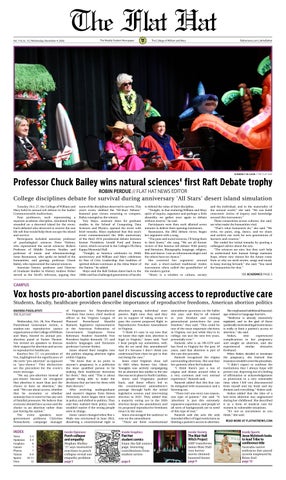
Professor Chuck Bailey wins natural sciences' first Raft Debate trophy ROBIN PERDUE // FLAT HAT NEWS EDITOR
College disciplines debate for survival during anniversary 'All Stars' desert island simulation Tuesday, Oct. 27, the College of William and Mary held its annual raft debate in the Sadler Commonwealth Auditorium. Four professors, each representing a separate academic discipline, simulated being stranded on a deserted island for the event. Each debated who deserved to receive the one life raft that would help them escape the island and survive. Participants included associate professor of psychological sciences Peter Vishton, who represented the social sciences; Bickers Professor of Middle Eastern Studies and professor of music and ethnomusicology Anne Rasmussen, who spoke on behalf of the humanities; and geology professor Chuck Bailey, who represented the natural sciences. Associate history professor and Director of Graduate Studies in History Andrew Fisher served as the Devil’s Advocate, arguing that
none of the disciplines deserved to survive. This year’s event, dubbed the “All-Stars Debate,” featured past victors returning to compete. Bailey emerged as the winner. Trey Mayo, assistant dean for graduate studies in the School of Computing, Data Sciences and Physics, opened the event with brief remarks. Mayo explained that this year’s event commemorated the 50th anniversary of the third 1976 presidential debate between former Presidents Gerald Ford and Jimmy Carter, which occurred in the College’s Phi Beta Kappa Memorial Hall. “Tonight, as America celebrates its 250th anniversary and William and Mary celebrates its Year of Civic Leadership, that tradition of spirited debate continues at the Alma Mater of the Nation,” he added. Mayo said the Raft Debate dates back to the 1960s and has challenged generations of faculty
to defend the value of their discipline. “Tonight, in that enduring William and Mary spirit of inquiry, argument and perhaps a little absurdity, we gather once again to debate without reserve,” he said. Participants were then each allotted seven minutes to deliver their opening statements. Rasmussen, the 2002 debate victor, began her argument with a song. “The pure and social sciences, I’ll bring them to their knees,” she sang. “We are all former victors of this famous raft debate. With poetry and literature, filmography, language, religion, film and dance: I am an ethnomusicologist and the others have no chance.” She centered her argument around the oud, a short-necked traditional Arabic instrument often called the grandfather of the modern guitar. “Music is a window to culture, society
and the individual, and to the materiality of the natural world,” she said. “We can build concentric circles of inquiry and knowledge around this instrument.” These connections across cultures, she said, are what make the humanities vital. “That’s what humanists do,” she said. “We write, we paint, sing, dance, and we share and archive our work for new generations of learners and creators.” She ended her initial remarks by quoting a colleague’s advice about the arts. “The sciences are nice, but they can’t help us understand how human beings maintain hope, where new visions for the future come from or why we need stories, songs and music to keep moving forward,” she said. “You need the humanities for that.” SEE ACADEMICS PAGE 3
CAMPUS
Vox hosts pro-abortion panel discussing access to reproductive care Students, faculty, healthcare providers describe importance of reproductive freedoms, American abortion politics MAHIMA PAKALAPATI THE FLAT HAT Wednesday, Oct. 28, Vox: Planned Parenthood Generation Action, a student-run reproductive justice organization at the College of William and Mary, hosted its annual proabortion panel at Tucker Theater. Vox invited six speakers to discuss their support for abortion and access to reproductive healthcare. Katelyn Yen ’27, co-president of Vox, highlighted the significance of the term “pro-abortion” as opposed to “pro-choice.” This distinction set the precedent for the event’s main message. “We say pro-abortion instead of pro-choice because we recognize that abortion is more than just the choice to have an abortion,” she said. “We care about access, whether that be economic or whether someone has to travel or has any sort of familial pressures. We believe that everyone should have access and the choice to an abortion rather than just having the option.” The event speakers were government professor Christine Nemacheck; campaign manager
of Virginians for Reproductive Freedom Han Jones; chief medical officer at the Virginia League of Planned Parenthood Shanthi Ramesh; legislative representative at the American Federation of Government Employees Fiona Kohrman; Student Assembly Vice President Sophie Kennedy ’27; and modern languages and literature professor Corinne Stokes. Jones shared their insights into the politics shaping abortion rights within Virginia. “We know that at no point in anyone's pregnancy is a politician the most qualified person to be making their healthcare decisions for them,” they said. “This is about people being able to make the decisions that are best for them with their doctors.” After receiving undergraduate and master’s degrees from Brown University, Jones began their career in policy and shifted to politics. They said they realized their policy work wouldn’t matter if the wrong people were in charge. Jones’ career changed when Roe v. Wade was overturned in June 2022, dissolving a constitutional right to
INDEX
Inside Opinions
Inside Graphics
Inside Variety
Inside Sports
News 2-3 Opinions 4-5 Graphics 6 Games 7 Photos 7 Variety 8-9 Sports 10-11 Data 12
Meghan Shelley '27 says insensitive reactions to porch collapse reveal our empathy problem page 5
Enjoy the fall comics page, featuring contributions from student artists
AMP transforms James Blair Hall into horror movie-themed haunted house page 9
Australia native embraces fast-paced system employed by Brian Earl page 10
Porch collapse and empathy
abortion among individual state powers. Right now, they said they are in support of taking action to pass the current proposed Right to Reproductive Freedom Amendment in Virginia. “I think it’s easy to say now that we know that right now, abortion is legal in Virginia,” Jones said. “And I hear people say sometimes, well, why do we need this amendment? And it's because I don't think you understand how close we got to that not being the case.” Jones cited Virginia’s close call in 2023 when former Gov. Glenn Youngkin was actively campaigning for an abortion ban similar to the one that was set in place in North Carolina. Jones said Virginians pushed back, and these efforts led to the constitutional amendment’s passage through both the initial legislative session and intervening election in 2025. They added that a majority voting yes in the 2026 election keeps the amendment and its proposed reproductive freedoms intact in the state. Jones encouraged the audience to vote on the amendment. “There are three constitutional
Flat Hat student comics
page 6
amendment questions on the ballot this year, and they're all related to your freedom and creating generational protections for your freedom,” they said. “This could be one of the most important elections in Virginia, not just while they're in college, not just the next few years, potentially ever.” Ramesh, who is an OB-GYN and has lived in Virginia for the past 10 years, said that abortion is part of the care she provides. Ramesh recognized the stigma surrounding abortions. She said that her patients often feel isolated. “I think there’s just a ton of stigma and shame around what is a very common and very normal experience,” Ramesh said. Ramesh added that this fear can be mitigated with reassurance and a listening ear. “There isn’t one story, one reason, one type of patient,” she said. “It [abortion] is just this extremely expansive experience, and people of all sorts of backgrounds are in need of this type of care.” Ramesh said she sees the only intended effect of legal restrictions as limiting a patient’s access to abortion.
The Blair Hall Witch Project
She emphasized additional financial, age-related or language barriers. “Medicine is already extensively regulated, and so the goal of those [politically motivated legal restrictions] is really to limit a patient's access to abortion,” she said. Stokes, who experienced complications in her pregnancy and sought an abortion, said she experienced similar obstacles firsthand. When Stokes decided to terminate the pregnancy, she learned that insurance wouldn’t cover the procedure. “I didn't expect to confront the institutions that I always hope will protect me, depriving me of a feeling of affirmation or acknowledgement or protection in a very vulnerable time, when I felt very disconnected from myself and my body and my dreams and everything,” Stokes said. Stokes added that the idea of a late-term abortion was stigmatized during her childhood. She described it as a form of medical care for women in vulnerable situations. “It’s not as uncommon as you think,” she said. READ MORE AT FLATHATNEWS.COM
Jesse McIntosh looks to lead Tribe to conference title
“
“
newsinsight news insight
News Editor Liam Glavin News Editor Naman Mishra News Editor Robin Perdue fhnews@gmail.com
THE FLAT HAT | Wednesday, November 4, 2026 | Page 2
THE BUZZ
Music is a window to culture, society and the individual, and to the materiality of the natural world. We can build concentric circles of inquiry and knowledge around this instrument.
Bickers Professor of Middle Eastern Studies and professor of music and ethnomusicology Anne Rasmussen
FLAT HAT NEWS BRIEF
Local sign company owner comments on Carolyn Murphy campaign donation
Monday, Nov. 2, Jason Hill, the owner of the local signage company Fine Signs & Graphics, responded to The Flat Hatʼs reporting about his companyʼs donation to Carolyn Murphyʼs campaign for Williamsburg City Council. According to public records, Fine Signs & Graphics donated $3,372 in-kind for sign printing and supplies for Murphyʼs campaign. Hill said he had worked with Murphy while she was the Cityʼs planning and codes compliance director. “She was a hundred times better than anyone whoʼs in there now,” Hill said. “Sheʼd talk to you, work with you [and] be accommodating. People now are incompetent [and] donʼt do their jobs.” Hill said he felt the current city councilʼs priorities are misaligned with residentsʼ needs. “Why is Midtown Row painted yellow?” he said. “Why do we have so many run-down houses?” Hill also criticized The Flat Hatʼs attention to his campaign donations. “Instead of focusing on donations to Carolyn Murphy, focus on how you can improve Williamsburg as a whole,” he said. “Focus on why people fell off a deck. I donʼt think Carolyn Murphy should be the main problem of what you guys should worry about.” READ MORE AT FLATHATNEWS.COM LIAM GLAVIN / FLAT HAT NEWS EDITOR
EWS.COM S EDITOR
A THOUSAND WORDS
COURTESY IMAGE / WILLIAM AND MARY McKinney has navigated teaching disruptions from the COVID-19 pandemic, meeting students where they are to foster a holistic education.
Professor of government, gender studies Claire McKinney discusses research, reproductive health
McKinney outlines growth in academia, experience teaching students over past decade
GRACE LOUGHRAN // THE FLAT HAT
MONA GARIMELLA / THE FLAT HAT
CORRECTIONS The Flat Hat wishes to correct any fact printed incorrectly. Corrections may be submitted in email to the editor of the section in which the incorrect information was printed. Requests for corrections will be accepted at any time.
THE FLAT HAT ʻSTABILITAS ET FIDESʼ | ESTABLISHED OCT. 3, 1911 Org #101 P.O. Box 8795, Williamsburg, VA 23187
Editor flathat.editor@gmail.com Managing flathat.managing@gmail.com Executive flathat.executive@gmail.com Magazine editor@flathatmagazine.com News fhnews@gmail.com Sports flathatsports@gmail.com Copy flathatcopy@gmail.com
Opinions fhopinions@gmail.com Variety flathat.variety@gmail.com Photos flathatphotos@gmail.com Online flathatonline@gmail.com Advertising flathatads@gmail.com Graphics flathat.art@gmail.com Ombudsman flathat.ombuds@gmail.com
Mona Garimella Editor-in-Chief
Maddie Mohamadi Managing Editor Megan Rudacille Executive Editor Nate Ross Copy Chief Kylie Totten Digital Media Editor
Ben McLoughlin Operations Coordinator Molly Martin Operations Coordinator Robin Perdue News Editor Liam Glavin News Editor Naman Mishra News Editor Emma Beelner Variety Editor DevYani Thakare Variety Editor Cara King Sports Editor Jacob Tobman Sports Editor Michael Gabriel OpinionsEdtor Ava Gravina Opinions Editor Liam McMahon Audio/Visual Editor Kenra Houhou Audio/Visual Editor Adelyn Skerik Copy Editor Clare Pacella Copy Editor Eden Leavey Copy Editor Elise Whitfield Copy Editor Emma Newill Copy Editor Irene Straw Copy Editor Jonathan Larkin Copy Editor Julia Peavey Copy Editor Kelsea Smith Copy Editor Kreilys Garcia Flores Copy Editor Lindsay Luberecki Copy Editor Lorelei Kelley Copy Editor Ruby Trainor Copy Editor Sophia Paradowski Copy Editor Lily Mansell Copy Editor Hannah Elysse Mayo Copy Editor Madigan Webb Chief Staff Writer Lila Reidy News Assoc. Editor Melania Frye News Assoc. Editor Nicole Zajac News Assoc. Editor Rebecca Fuchs News Assoc. Editor Sam Belmar News Assoc. Editor Sachi Pallem News Assoc. Editor Shannon Raymond News Assoc. Editor Susannah Poteet News Assoc. Editor Sanjana Manghnani News Assoc. Editor Bobby Mollan News Assoc. Editor Abigail Furcy Chief Variety Writer Aamnah Malik Variety Assoc. Editor Aditi Allam Variety Assoc. Editor
Eric Sohn Audio/Visual Editor Andrew Henrickson Data Editor Betty Yemane Social Media Editor Evie Corr Social Media Editor Kimberly McCann Photos Editor Isabel Volden Graphics Editor Gretta Anderson Graphics Editor Meave Meyer Games Editor Ethan Auclair Ombudsman James Abruzzo Business Manager Sam Harrington Webmaster
Anna Wood Variety Assoc. Editor Brooke Lewis Variety Assoc. Editor Callie Laubacker Variety Assoc. Editor Ella Greene Variety Assoc. Editor Emma Beelner Variety Assoc. Editor Juliana Nelson Variety Assoc. Editor Maggie OʼKieffe Variety Assoc. Editor Patricija Pupine Variety Assoc. Editor Skylar Hartgerink Variety Assoc. Editor Skyler Cole Variety Assoc. Editor Tessa Darke Variety Assoc. Editor Maya Sakai-Chen Variety Assoc. Editor Gabriella Calcagno Variety Assoc. Editor Nora Yoon Chief Opinions Writer Abigail Crespin Opinions Assoc. Editor Alexandra Hill Opinions Assoc. Editor Carson Burch Opinions Assoc. Editor Cate Woodrum Opinions Assoc. Editor Charlotte Trodden Opinions Assoc. Editor Ella Grimes Opinions Assoc. Editor Eva Jaber Opinions Assoc. Editor Geronimo Ritcheson Opinions Assoc. Editor Isabella McNutt Opinions Assoc. Editor Lana Altunashvili Opinions Assoc. Editor Lucia Reyes Opinions Assoc. Editor Teddy Friesz Opinions Assoc. Editor Audrey Capone Opinions Assoc. Editor Carolyn Reid Photos Assoc. Editor Ethan de Guia Photos Assoc. Editor Jonah Peters Photos Assoc. Editor
Alina Schueman Videos Assoc. Editor Darius Bagherian Videos Assoc. Editor Enna Carbone Videos Assoc. Editor Jack Pegler Videos Assoc. Editor Landon Miles Videos Assoc. Editor Olivia Ives Bailey Videos Assoc. Editor Piper Gilly Videos Assoc. Editor Siddhita Krishnan Videos Assoc. Editor Sophie Frank Videos Assoc. Editor Virginia Fife Videos Assoc. Editor Sabry Tate Podcasts Editor Connor Pawliczak Podcasts Assoc. Editor Maricel Pucillo Podcasts Assoc. Editor Noa Wilson Podcasts Assoc. Editor Isabel Volden Graphics Editor Gretta Anderson Graphics Editor Alina Yang Graphics Assoc. Editor Maisie Curtin Graphics Assoc. Editor Aida Bekele Graphics Assoc. Editor Westley Jacanin Chief Sports Writer Eamonn McAloon Sports Assoc. Editor Henry OʼConnor Sports Assoc. Editor Katie Killagen Sports Assoc. Editor Ellie Laanisto Ombuds Assoc. Editor Naomi Linde Ombuds Assoc. Editor Rhys Runnels Ombuds Assoc. Editor Lauren Singer Social Assoc. Editor Hannah Sawyer Social Assoc. Editor Mira Deni Data Assoc. Editor Sienna Rankins Data Assoc. Editor
Associate professor of government and gender, sexuality and women’s studies Claire McKinney’s office has become the physical manifestation of a decade of rigorous academic life: binders and papers stacked high, an accumulation of research and shelves crowded with books. This fall, McKinney celebrates her 10th year at the College of William and Mary. While a decade on campus has brought plenty of institutional shifts, she noted that one element has remained consistent: the students. “William and Mary students still remain incredibly driven, incredibly curious and really game to explore things that a professor puts in front of them,” McKinney said. McKinney said her last 10 years of teaching have not been completely smooth sailing. She pointed to disruption from the COVID-19 pandemic and the rise of large language models, alongside broader cultural shifts in education. Rather than blaming technology or pandemic learning gaps, McKinney said she sees her role as meeting students where they are, helping them cultivate their own independent voices. Her work has long centered on power dynamics, which she applied to political theory, identity and the body. McKinney said that while her research focus has not changed over the years, her approach has. “The question of power has always been central to how I approach topics of politics, political theory, thinking about identity and the body,” she said. “That has remained the same, but thinking about the ways that power creates its own contradictions and has its own unforeseen consequences when you’re able to wield power in particular ways really comes to the fore as I’ve theorized.” She encouraged bringing this analysis of power to conversations about reproductive justice, noting instances where physicians who may still be antiabortion are experiencing legal constraints. “There’s this irony in the use of power,” she said. “Dwelling with that kind of complexity really reveals that our institutions are, in some sense, malleable, that malleability requires really insight into thinking about their operation.” The nuance did not come naturally to McKinney. “I remember my advisor telling me repeatedly that I saw the world way too ‘black and white,’” she said. “It was a real challenge to me because I wanted to make these really strong, normative judgments and conclusions.” As she’s grown as a researcher, professor and advisor, McKinney said she feels this mindset has softened. “The sort of research that I’ve come to do is one
where that ‘black and white’ has really faded in favor of dwelling in the kind of ‘gray zones,’” she said. Her appreciation for individualistic thought is central to her scholarship. Her studies’ themes converge in her latest book, “A Womb of One’s Own: Abortion, Citizenship, and the Politics of Reproduction,” which was released in October. McKinney said she hopes readers, especially students, take away three things. The first is that abortion politics are not a periphery concern. “We should stop thinking about abortion politics as something that’s only on the periphery of politics, that [it] only matters for the real zealots on either side of the political spectrum,” she said. Access to abortion, she argued, is central to “gendered belonging” in America. She also hopes that readers note the medical field’s politicization. “We need to rethink the institutions that are ‘political,’” McKinney said. She said that medical textbooks, websites and the way that medicine is taught all shape politics and should be treated as such. Third, she urged attention to the present. “We really should pay attention to this moment where abortion has become a new political problem,” she said. Since the Supreme Court’s decision in Dobbs v. Jackson Women’s Health Organization, which overturned Roe v. Wade, McKinney said she sees institutional and structural instability, but also possible new paths for the country. “Hopefully, the book helps us think about what was happening in the past that we either do or do not want to revisit, and that opens up opportunities for us to innovate for new futures,” she said. Before entering academia, McKinney spent years coaching high school debate across diverse socioeconomic landscapes. She said that background deeply informs her current classroom philosophy. “How do I foster an environment that allows everybody to achieve the degree and type of learning that they desire?” she said. “It’s about actively fostering capacity both through very high, rigorous standards that I think everybody can meet.” Returning to campus after a year of research leave, McKinney is eager to reconnect with the student body. “I get a lot of joy seeing people being able to explore and to discover new capacities and new things that they had not encountered before,” she said. READ MORE AT FLATHATNEWS.COM
THE FLAT HAT
Wednesday, November 4, 2026
Page 3
ACADEMICS
Chuck Bailey wins anniversary edition Raft Debate for natural sciences Professors defend disciplines in ʻfight for survivalʼ during annual debate ACADEMICS from page 1
Bailey, the 2003 debate winner, spoke next. He joked that the faculty’s cruise crash that landed them on the deserted island was caused by someone “vibe coding” the ship’s GPS, where software developers build applications by prompting artificial intelligence models. “When someone tinkers around with something they don’t understand, bad things happen,” he said. “This is why we need information in real time, and correct information at that.” Bailey argued that humanity would have no path to slowing a rapidly changing climate without geology and the natural sciences. “If we want to regulate our climate, perhaps we need to learn how to make these rocks more efficiently in the future,” he said. “That is why science is the way forward, friends.” Vishton, victor of the 2015 debate, argued that scientific and artistic progress mean little without an understanding of human behavior. Vishton opened with his sarcastic critiques of the natural sciences discipline. “Thanks to natural sciences, we extract and burn billions of tons of fossil oil,” he said. “This is changing the climate to make it much warmer and cozier.” Vishton’s central point was that humanity’s biggest problems are not technical. “We already know about climate change. We don’t know how to make people care about climate change enough to change their behavior,” he said. “We know how to make safe and effective vaccines. We just don’t know how to convince people to use them.” Vishton also warned that AI could eliminate students’ future careers. “Who wants a career for the last 10 years you’re here on the planet?” he said. Vishton also attacked the arts, holding up two similar paintings, one a museum masterpiece and one made by a sixyear-old. He argued that beauty is plentiful and requires no mastery for its importance. Vishton noted that the College’s Muscarelle Museum of Art, like most museums, keeps the majority of its collection in storage. “How do we protect our democracy, address income inequality, navigate AI without being enslaved by it?” he said.
KIMBERLY McCANN / THE FLAT HAT Fisher won the debate on behalf of the social sciences in 2011 but returned for the anniversary edition to play the contrarian role of Devilʼs Advocate.
“These are social science questions.” Vishton ended with a parody of Harry Styles’ “Watermelon Sugar,” repeatedly asserting that social sciences are superior. Fisher, the 2011 victor for the social sciences, concluded the opening remarks. As the Devil’s Advocate, he opened by joking about his own situation. “I was promised that I could live the rest of my career in peace and obscurity, better known as being an associate professor,” he said. Fisher began with the natural sciences, arguing that scientists pursue what is possible without asking whether it is wise. “Scientists are always doing things because they can before considering whether they should,” he said. Fisher also took a jab at the AI boom. “Human intelligence goes down the drain faster than a data center can drain an aquifer,” he added. Fisher said the social sciences have grown “insecure” around the hard sciences, attacking their methods and their funding.
KIMBERLY McCANN / THE FLAT HAT Bailey used mathematical charts in his argument against the arts and social sciences, claiming they do not provide meaningful contributions.
Fisher saved his last barbs for the humanities, mocking academic jargon in paper titles and philosophy students who lecture about how “dumb” other disciplines are. He closed by borrowing from Shakespeare, acknowledging the irony of using a literary reference to criticize the humanities. “Full of sound and fury and jargon and MLA citations, signifying nothing,” Fisher said. After the arguments, each debater fielded one audience question before a lightning round began. When asked about climate change, Rasmussen said the humanities offer a different kind of contribution. “We don’t spend a lot of time drying our clothes in the dryer,” she said. “We are creating. We’re communicating, we’re learning, we’re reading. The humanities will feed your soul without killing the whole.” Bailey argued that the sciences extend to the arts and other fields, then asked whether those fields reach back. “It’s the scientists who have reached across to take on the challenges that we need,” he said. Bailey also revealed that he prepared for the shipwreck by bringing a life vest. “I am hoping that I can end up on that raft,” he said. “If I don’t, I’ve got a way out. If I do end up on this raft, I will save them all.” Vishton was asked if he believed his song could save humanity from climate change. “Singing is a way of communicating,” he said. “Using music to communicate with people is the sort of thing you see in the social sciences. We make use of all of the tools at our disposal to solve real-world problems.” Vishton was also asked how social scientists will strive to keep corrupt leaders out of office. “By educating people about the value of social science, by encouraging people to vote, we continue our march towards improving all these huge challenges we have,” he said. To conclude the debate, Mayo used a decibel meter to measure audience support for each participant. The debater who generated the most noise would be crowned the victor. Mayo gave his thanks to all those involved. Bailey was then declared the winner, and the natural sciences took home the first annual raft debate trophy.
STUDENT ASSEMBLY
Student Assembly introduces bill for sexual violence prevention event
Members approve allocation of funds for new van, free period products SACHI PALLEM FLAT HAT NEWS ASSOC.
Tu e s d ay , O c t. 2 7 , t h e C o l l e g e o f W i l l i a m a n d M a r y ’s S t u d e n t A s s e m b l y c o n v e n e d t o d i s c u s s t h e Ta k e B a c k t h e Night sexual violence awareness event, a new van purchase and funding for free period products. S e n . N e h a B a s k a r ’ 2 9 i n t r o d u c e d t h e Ta k e B a c k t h e Ni g h t A c t , w h i c h a l l o c a t e s f u n d i n g for an international event that seeks to raise awareness about sexual violence and support sur vivors. The event first occurred a t t h e C o l l e g e l a s t y e a r.
Baskar said Student Assembly funding w o u l d b e f o r a u d i o -v i s u a l s u p p o r t , c a t e r i n g and promotion. The bill was assigned to all committees. T h e VA N A c t I I , w h i c h a l l o c a t e s f u n d s to purchase a van for student organization use, passed unanimously. S e n a t o r s a l s o d i s c u s s e d t h e . A c t Pa r t VIII, which continues funding for free menstrual products around campus. Baskar h i g h l i g h t e d t h e b i l l ’s p o p u l a r i t y a m o n g students and said an issue with the QR code has been resolved. Class of 2029 President Daria Lesmerises
’29 said Baskar added five more maps to the bill. The total is now 20. “S t u d e n t E x p e r i e n c e s u g g e s t e d t h a t we put the maps in bathrooms without dispensers to spread awareness for the p r o j e c t ,” L e s m e r i s e s s a i d . The bill passed unanimously. SA President Nico Giro-Martin ’27 shared the finalized cabinet and announced a welcome meeting for Sunday, Nov. 1. He also mentioned information from the Office of Compliance and Equity regarding College policies. “The Office of Compliance and Equity is p u b l i s h i n g u p d a t e s t o t h e u n i v e r s i t y ’s Ti t l e
IX policy, discrimination policy, its crime p r o c e d u r e ,” h e s a i d . T h e u p d a t e s a r e n o w o n t h e C o l l e g e ’s website. A representative from the office w i l l j o i n S A Tu e s d a y , N o v. 1 7 t o a d d r e s s s e n a t o r s’ q u e s t i o n s a n d d i s c u s s t h e c h a n g e s . The Executive also shared that College President Katherine Rowe will a t t e n d t h e T u e s d a y , N o v. 1 0 S A m e e t i n g . Giro-Martin asked senators to consider possible questions. G i r o - Ma r t i n a l s o m e n t i o n e d t h e f a l l food drive on campus, which will run until F r i d a y , N o v. 6 .
ACADEMICS
Holocaust survivor George Rishfeld discusses purpose, memory
Talk emphasizes importance of remembering Holocaust, commemorating stories of victims MELANIA FRYE FLAT HAT NEWS ASSOC.
Sunday, Nov. 1, Chabad Williamsburg Virginia hosted Holocaust survivor George Rishfeld in the Integrated Science Center. Rishfeld spoke about his childhood, experience and rescue from the Vilna Ghetto established by Nazi Germany in Lithuania. Chabad Rabbi Mendy Heber gave the opening remarks. “If we just keep on reminding ourselves that we have to show up for one another despite our differences, despite how we think or how we look, and bring a shared purpose, we truly embrace the concept of tikkun olam, which is bringing goodness and
kindness into this world,” he said. Haber then introduced Rishfeld. Rishfeld’s story began when family friends rescued him from the Vilna Ghetto. They then raised Rishfeld as their own, hiding him from the Nazis until he was miraculously reunited with his parents years later. Once the war ended, Rishfeld and his parents relocated to the United States. He described witnessing antisemitism and racism. Rishfeld said this experience helped him understand the importance of sharing his story. Joseph Onanuga, Rishfeld’s nurse, cares for Rishfeld during such talks and events. Onanuga said the intention is also to dispel harmful narratives about
the Holocaust’s legitimacy. “The message is that people just have to be conscientious about the reality of what happened,” Onanuga said. “It’s not a myth, it’s not a fairy tale or Hollywood’s creation. It’s something that happens that people need to be aware of.” Rishfeld addressed the growing denial and skepticism surrounding the Holocaust. “When somebody says to you [that] it never happened, they’re just idiots,” he said. G ra c e Jaye ’ 2 8 sa i d s h e atte n d e d t h e e ve nt to b e tte r u n d e rst a n d s o c ia l att i tu d e s towa rd e xt re m i st v i e w s o f h i sto r y . “I really appreciated George
coming to share his story because I [can] only imagine how painful those memories are,” Jaye said. “I feel like going around and sharing is such a noble thing, especially in the face of things like the rise of antisemitism and current politics of the world.” Heber echoed a similar sentiment, highlighting the event’s ability to unite people. “You can’t walk a block and a half without seeing divisiveness in politics, compassion,” Heber said. “But the truth is, tonight is something beyond our differences. It is what brings us together. We all share a common goal, we’re all humans, and we all share in humanity, something very, very sacred.”
Rishfeld also mentioned other global struggles. “There are small Holocausts going on in the whole world, but not one that was documented, photographed and written about like this one,” he added. Rishfeld said he has struggled to explain why he survived the Holocaust but eventually came to see sharing his story and combating hate speech as his purpose. “I am grateful that I can stand here and speak, but I also know that the time is coming when fewer and fewer survivors will be able to tell their stories in person,” Rishfeld said. “The responsibility must pass to all of you.” Grace Jaye ’28 was formerly a Flat Hat intern but did not join staff.
opinions
Opinions Editor Ava Gravina Opinions Editor Michael Gabriel fhopinions@gmail.com // @theflathat THE FL FLAT HAT | Wednesday, November 4, 2026 | Page 4
STAFF COLUMN
GUEST COLUMN
Insensitive reactions to porch collapse reveal our empathy problem MEGHAN SHELLEY
Eva’s Apple #27: Halloweakened EVA JABER
FLAT HAT OPINIONS ASSOC.
THE FLAT HAT
MAYER TAWFIK / THE FLAT HAT
Homecoming has always been one of the things I’ve loved most about the College of William and Mary. It’s a time meant to bring us together as a campus community, to welcome back friends who have graduated, to have fun and remember why we love our school. 2026 marked 100 years of Homecomings at the College, making the weekend all the more exciting. For those in Fraternity and Sorority life, Homecoming is an opportunity to bring organizations closer as Fraternities and Sororities pair up and spend the week running events together. I still remember Homecoming my first year at the College two years ago as the highlight of my semester. After spending last year abroad, I was anticipating Homecoming more than ever. I never could have imagined it ending with my friends in the emergency room with concussions and broken bones. On the night of Friday, Oct. 23, I was standing on an off-campus fraternity house’s deck when it collapsed. In a matter of seconds, I watched as the floor beneath my friends disappeared and dozens of my peers fell to the ground below. Though I was on the deck, I was about 5 to 10 feet away from where the floor broke and very luckily uninjured. Still, it was difficult to process what I saw in front of me. I remember my friend behind me grabbing me and telling me that we needed to get off the deck, now. I remember the frantic shouts of my sorority president trying to move those of us who hadn’t fallen to a safer location. I remember my friend’s tears, immediately aware of something I hadn’t yet processed. Some of my best friends were on the side of the porch that collapsed, and I didn’t know if they were okay at all. Nobody who saw what happened knew how bad it was yet; none of us knew if our friends were alive. When I got out of the house and made my way to the backyard where the group had fallen, I immediately began calling people, unsure if I would get a response, unsure if I would hear anything over the
sirens, the screams of those in pain and the shouts of confusion. I saw my sorority sisters in tears, saw people being carried out of the wreckage from the porch, saw people bleeding. I found my ex-boyfriend first; he had fallen and hit his head, but he assured me he was okay. The relief I felt was immeasurable, but I still didn’t know where two of my best friends were. He offered to go back into the mess to look for them. My roommate appeared shortly after, and as we looked around us, we knew we needed to leave. My other roommate, who had been next to me during the collapse, had vanished, too. I found out soon after that she had run into the collapse to look for our friends. She comforted our friend as she breathed through the pain of a leg fractured in three places. It was all a blur. I hardly registered the firefighters and police officers yelling directions at us. All I knew was that I needed to know the people I loved were safe. We were some of the last people to leave the backyard, as our close friend was the last person carried out to an ambulance. My friends and I immediately made our way to the hospital, hoping to beat our friend there. I spent the entire night in the ER, waiting for friends and trying to help in any way that I could. The hospital became a revolving door of Delta Gammas and Kappa Alphas as the hours ticked by. Sitting in the Riverside Doctors’ Hospital until 7 in the morning, you can imagine there was not a lot to do. Although a part of me knew that I shouldn’t, I opened Yik Yak, the anonymous messaging platform organized by communities and popular at colleges, including ours. I was unsurprised to see that word had spread quickly about the incident, with it promptly being termed the “KAllapse.” I watched as the posts rolled in, most just seeking clarification within the first hour or two of the collapse. Some posts were straight-up fearmongering, reporting incorrect information regarding the severity of injuries. However, as the night went on, the tone shifted; people were already making jokes. None of these posts struck me as having come from anyone present at the event, at least not yet. Within comment sections, anonymous users were arguing, some angered that the event was being made light of so soon, others responding that they were being overly sensitive and dramatic, insisting that the fall wasn’t so bad. Eventually, I had to close the app. I hadn’t even begun to process what I had just lived through; I wasn’t in a place where I could read about how funny it was to some students on campus. When I checked the next morning,
it was even worse. One user wrote that “the ka incident is not a joke. that’s a very real traumatizing thing a lot of people in our community had to go through have some respect.” A reply to this that received over 400 likes states, “white b—tches be like ‘it changed my life’ like alright you fell bruh.” Another commenter wrote, “I dont think some of yall realize how traumatic the kallapse was ... we all genuinely thought our closest friends were dead.” To which someone responded, “They weren’t though so hopefully that makes you feel better.” These are just two comments in an ocean of insensitivity, with the platform being flooded with jokes downplaying the incident. We live in a moment in time where we have access to the world at our fingertips. We are constantly one notification or Google search away from another terrible headline, another violent video on our feeds. Has all of this desensitized us to the point that we can not take these calamities seriously, even when it transpires in our own community? A confirmed 28 students spent the Friday of their homecoming in the hospital seeking medical attention, and, at least online, they were not met with the empathy they deserved. Senior Vice President for Student Affairs and Public Safety Ginger Ambler ’88 Ph.D. ’06 issued a statement to students in the aftermath of this event. She wrote, “We recognize that such an experience may affect our students deeply and in different ways. They will need our help in the coming days as they recover and maintain momentum at William & Mary.” For a campus that was just recently voted by The Princeton Review as having the friendliest students, I had hoped for more empathy from my peers during this difficult and confusing time for those of who were there for the “KAllapse.” Of course, it is natural and even expected to cope with humor during difficult times, but I implore my fellow students who were not affected to consider the impact of their words. In the end, we got very lucky that no one was more severely hurt, as the doctors at Riverside hospital even confirmed this could have been a life threatening fall. I hope that going forward, if our campus is ever faced with a similar event, we can use it as an opportunity to come together and lend support to our peers who need it. It doesn’t hurt to think twice before posting; it does hurt to fall through a deck. Meghan Shelley ’27 is an English major in the JDP. She frequently contributes to the College’s’s literary magazine, The Gallery, and is a member of Delta Gamma. In her free time, she enjoys traveling, reading, going to the movies and spending time with friends.
GUEST COLUMN
It doesn’t matter where you go for undergrad MADELEINE CIGAN THE FLAT HAT
GRAPHIC BY MADELEINE CIGAN / THE FLAT HAT
I didn’t even need to read the letter to know that I wasn’t admitted; there was no congratulatory confetti, no email urging me to make my enrollment deposit. I buried my face in my hands as my dream of attending the University of Virginia slipped away. When I was a senior in high school, I was overconfident and a little pompous — I was fiercely competitive and wanted nothing more than to outperform my peers in any way. This mindset seeped into my
college application process, where my perception of what made a university “good” became extremely warped. I didn’t care about campus size, Greek life, location or even the strength of the offered programs; all I cared about was the acceptance rate. Thus, I pooled several hundred dollars down the drain and submitted applications to the most competitive and prestigious schools possible: Cornell University, Johns Hopkins University, University of North Carolina at Chapel Hill and UVA. I didn’t really have a “dream school” throughout high school; rather, I manufactured one in my senior year, which ended up being UVA. I am not alone in having this particular sentiment. All too often, a student’s intelligence and ambition are falsely tied to the list of universities they are admitted to, each of which is home to certain stereotypes. If you are admitted to Harvard, you may as well be Einstein’s apprentice; if you are admitted to James Madison University, you are supposedly an airhead who is only around for the parties. The college applications process has become a social competition of sorts that only validates individuals who are admitted to more selective institutions. As a result,
application rates of popularized institutions are at an all-time high, plunging acceptance rates to the single digits. Meanwhile, lesser-known institutions are frequently overlooked despite offering opportunities that are just as valuable. In retrospect, my attachment to UVA made little sense; ironically enough, I didn’t even like it that much. When I formally visited for the first time in my senior year of high school, I didn’t experience that profound connection some do when they find the school meant for them. I didn’t like the overwhelmingly large campus and had trouble fitting into the elitist culture. But somehow, my entire self-worth became tethered to whether I got into the school. I was devastated when I received the letter that I had been placed on the waitlist, which came after a streak of rejections from other schools. Several questions ran through my head in that moment: Why am I not as strong a candidate as everyone else? Am I not smart enough? Where do I go from here? I thought my entire future was shattered because I didn’t get into my “dream” school, and that I may as well submit an application to McDonald’s.
GRAPHIC BY GRETTA ANDERSON / THE FLAT HAT
On Thursday evening, I walked past a restaurant while dressed like the Lorax, and a group of diners on the patio applauded me. I think I peaked at that moment: Thursday, Oct. 29 at 9:44 p.m. Reaching a level of aura I will never again eclipse in this lifetime gave me some perspective. It’s all downhill from here. Who am I to try to satirically guide others through their college years? Who am I to play God? Every other week, I sift through wonderful questions, and I only answer one. I imbue one question with life while the others lie dead and destitute in my Instagram archive. The hubris. The audacity. The gall! No longer. I am not the girl I was yesterday; I am much worse (because, as we’ve already discussed, I peaked on Thursday — keep up). I don’t trust myself anymore to pick just one question. What if in the process of my gradual demise I overlook the best query of the bunch? I can’t have that happen, so I’m going to answer ten of the Halloweenthemed questions submitted this week. You know what they say: quantity over quality! Here we go... 1) “How to come up with good costume ideas no glue no borax?” Sorry, I don’t know how to do that without such essential ingredients. I’m a satire advice columnist, not a witch. 2) “Trick or treat?????” Justice for the tricks. We should normalize answering the door with lies instead of candy. I’ve heard that tomfoolery is the modern man’s treat. This year, instead of being like, “Happy Halloween! Here’s some candy,” you should be like, “Hey kiddo! Did you know that Shakira just got appointed attorney general?” 3) “Sustainability with costume ideas?” Are we talking about environmental sustainability or something versatile that can last you all three days of Halloweekend? For environmental sustainability, I’m thinking we go in the direction of all sticking our heads in our dorm recycling bins and wearing them as hats. For something to last you all three days, I always love a costume that’s so itchy it induces hives and some sort of cheap adhesive facial hair that causes a rash on my face. Then I can just show off my allergic reaction the second day and say I’m dressed as contact dermatitis. For the last day, I’d cover the irritation with over-the-counter creams and go as a ghost. Boom. Sustainability. 4) “Hi Eva! Can you give me some strange and/or unusual Halloween costume ideas?” No one ever dresses up as their neighbors. Like imagine you get a knock on your The school that did accept me, though, was Virginia Tech. Contrary to what I experienced visiting UVA, I absolutely fell in love with Virginia Tech: I loved the Hogwarts feel of the campus and was fascinated by its strong engineering program. However, I immediately wrote the school off simply because it wasn’t “competitive” enough in my eyes, discounting the innumerable positive qualities of the school. When I expressed my woes to my family and friends, I got advice that enraged me. My mom said, “Everything happens for a reason. UVA just isn’t meant for you, and that’s okay” (she was right; it wasn’t meant for me). My cousin had a different perspective that I also wasn’t able to hear at the time: The prestige of your undergraduate institution doesn’t matter as long as you make the most of it. My cousin attended Syracuse University, which wasn’t her dream school either. However, she applied herself throughout her entire four years at the school: She spent a year on the varsity swimming team, doublemajored and minored and joined numerous research groups. Years later, she would graduate from medical school and take part
door and it’s just your choppelgänger. Someone has to do it. 5) “How can I maximize my candy output if I’m too old to go trick or treating?” My favorite idiom is “like taking candy from a baby.” When you actually try it, the phrase makes so much more sense! It’s so stinking easy to steal stuff from babies. They also don’t have teeth yet, so they probably shouldn’t be eating candy anyway. By stealing from them, you’re doing the toothless thief magnets some good! 6) “Team Jacob or Team Edward?” Team Jacob all the way. Although I’m confused why someone submitted this in my call for queries. I don’t see where the question is here. 7) “How to effectively scare someone?” Tell them you’re Team Edward. They’ll be deeply disturbed. 8) “The nostalgia of making your own Halloween costume?” I don’t really get nostalgic about creative processes. When I was a child, I didn’t make my own Halloween costumes. Instead, I would barter my way to a crown jewel costume. Like Dwight from “The Office,” I’d show up to school with a thumbtack and trade it for things that were increasingly valuable until I went home with the ultimate prize, like a school bus or the principal’s ID. Imagine a 7-year-old driving a school bus to your home and demanding candy. That’s aura. It sounds so cool it’s almost unrealistic. But when have I ever lied to my readers? If you’ve got any concerns, you’ll have to take them up with Attorney General Shakira. 9) “What was your favorite Halloween thing to do when you were little?” Oh my gosh, this is such a good one. I would always try to guess which neighbors were part of our Homeowners Association so I could ask them to stop sending us citations to powerwash our siding. 10) “What’s the best candy for trick or treaters?” You know how everyone would get annoyed when the dentist that lived in their neighborhood passed out floss instead of candy? Those complainers are weak and unintelligent. Material things are so much more valuable than a fun size Milky Way bar or a box of Nerds the size of an adolescent hamster. The best candy for trick or treaters isn’t candy at all; it’s practical items that won’t expire in a year’s time. I’m talking about paper clips, cuff links, reusable sporks, etc. No to candy; yes to commodities. Alright. That’s all I’ve got for today. I was at my strongest at exactly 9:44 p.m. this Thursday. You could say my spirit has been Halloweakened since then. But like a phoenix from the ashes, trust I’ll rise. Everybody loves a comeback, and my regularly scheduled one is in exactly 14 days from now. See you in two weeks. Eva Jaber ’28 (she/her) is a prospective English or international relations major. She is a member of the Cleftomaniacs, an a cappella group, an ESL tutor and hopes to encourage peace-minded advocacy on campus. Contact her at ehjaber@wm.edu. in a residency at Johns Hopkins. This didn’t resonate with me until I saw it firsthand during a competitive summer internship program. All of the participants came from schools of varying national rankings — from Jacksonville State University to the University of Florida — and yet every single person was so extremely bright. There was little difference between someone who came from a top 10 school and another who went to a lesser-known school: Everyone was able to keep pace with their research because they used all the resources available to them at their home institution. This experience alone challenged my preconceived correlation between university selectivity and ambition. READ MORE AT FLATHATNEWS.COM
Madeleine Cigan ‘28 is a physics and math major from Springfield, Virginia. She spends half her time in the piano practice rooms, and the other half running with Team Blitz. Madeleine loves vintage music, binges Gilmore Girls once a year and enjoys meeting new people. Contact them at mrcigan@wm.edu.
THE FLAT HAT
Wednesday, November 4, 2026
GUEST COLUMN
Page 5
GUEST COLUMN
I lost my Southern accent. Am I smart enough for you now?
Stop calling Gen Z extreme: Start asking why ARI KASTELLO THE FLAT HAT
SAM EAGAN THE FLAT HAT
GRAPHIC BY GRETTA ANDERSON / THE FLAT HAT
“I’m from Alabama.” “Wait, seriously?” Their jaw literally dropped. It was orientation week, and I thought we were just doing the usual “Where are you from?” small talk. But then they dropped something along the lines of “I didn’t know Alabama had people like you.” People like me. I sat there wondering what they thought they’d learned about me in three minutes of talking, and why on Earth any of it felt completely impossible for where I grew up. Whatever they meant by it, I suddenly found myself in a weird spot where I had to explain how my hometown and I could even exist in the same sentence. I’ve mostly lost my Southern accent over time, so people don’t always hear Alabama when I speak. Sometimes I wonder what unfair assumptions that’s saved me from. But whenever I do say where I’m from, it still creates a strange gap I’m expected to bridge between the person standing right in front of me and whatever stereotype they’ve built in their head about the place I call home. It’s a bizarre feeling when someone treats you like you’re the exception to your own roots. When you accept that kind of compliment, you’re basically letting their underlying assumption go unchallenged, which is the idea that whatever they like about you couldn’t possibly belong back home. At the College of William and Mary, where we’re constantly told to question everything, I really wish telling people I’m from Alabama sparked actual curiosity instead of total disbelief. During class one day, a student brought up this idea that people in small Southern towns get all their information from local newspapers or news stations, sources they basically tossed off as always being wrong. I pushed back on that blanket assumption, but what really stuck with me was the picture it painted of Southern life. It implied people down there are stuck in a narrow little world, totally lacking the curiosity or ability to think beyond it. It’s worth asking how our surroundings shape what
GUEST COLUMN
we believe. But answering that takes real curiosity, not lazy generalizations. Which exact communities are we talking about? Whose actual lives count in that story? How much do we really know about the people whose limits we feel so qualified to judge? There’s definitely a comfort in placing ignorance somewhere far away from ourselves. If we can explain away someone else’s beliefs just by looking at their zip code, we don’t have to bother examining their actual reasoning, or our own for that matter. An accent just makes that lazy judgment even easier. As soon as someone opens their mouth, the listener starts filling in the blanks regarding their education, class, politics and overall intelligence. The speaker barely gets a full sentence out, and the listener thinks they’ve already got them totally figured out. Losing most of my accent didn’t make me any smarter, and it definitely didn’t make my relationship with Alabama any simpler. But it does make me wonder how differently my exact same words would be heard if I spoke in a voice that sounded unmistakably Southern. Why should an argument suddenly sound more legitimate just because the accent of home fades out of it? Politics is a huge part of this, too. A 2020 study in Social Science Quarterly showed that people from both major political parties were much more likely to label hypothetical political candidates with Southern accents as Republicans, even when those candidates were explicitly pushing Democratic policies. Listeners jumped straight to a political conclusion regardless of what was actually being said. We should be able to challenge someone’s politics without treating their birthplace as the sole explanation for everything they believe. Challenge their evidence. Question their logic. Honest disagreement loses its value the moment we assume someone holds a belief just because nobody in their hometown was smart enough to teach them better. Honestly, there’s a real class bias hiding underneath these judgments. When we say someone “sounds educated,” what are we actually saying? Are we reacting to the quality of their thinking, or are we just recognizing the speech patterns of people we already associate with authority? When the way people speak in rural or working-class communities is treated as something you have to overcome, knowing how to talk like an academic suddenly gets mistaken for actual intelligence. Some students get the benefit of the doubt automatically, while others have to prove they even belong in the room before anyone takes their ideas seriously.
Growing up in Alabama, the internet opened up a world of perspectives far beyond my immediate surroundings. It gave me access to conversations, communities and possibilities I might not otherwise have encountered. Those connections challenged my assumptions and expanded my sense of what my future could hold. But needing that connection doesn’t make Alabama some kind of intellectual wasteland. My feelings about home are a mix of deep affection and genuine frustration. I can acknowledge what made growing up there tough without accepting descriptions that erase everything else about the place. I shouldn’t have to choose between defending every single thing about Alabama or proving that I’m some rare exception to it. Forcing that choice also makes real criticism way less effective. Issues like racism, homophobia and exclusion need to be confronted directly. But painting the entire South as backward erases the huge differences between the people holding power, the people harmed by it and the people actively working to change things. Queer southerners and Black southerners aren’t outsiders. They are the South. Their lived experiences can’t just be an afterthought when we talk about the region. In fact, a 2023 report from the Williams Institute at UCLA School of Law found that about 35.9% of LGBT adults in the U.S. (roughly 5 million people) live in the South, which is more than any other region in the country. When we pretend that being Southern and being queer can’t exist together, we’re literally erasing millions of people from their own homes. We end up handing the mic to the very people trying to exclude them, letting them define what it means to be Southern. I know what it’s like to look for connections beyond where you grew up. But looking beyond home shouldn’t mean giving up the right to claim it. My love for Alabama has never meant turning a blind eye to its flaws, and leaving hasn’t magically untangled everything I feel about it. I think a lot of people, no matter where they’re from, get that exact mix of love and frustration. We should be able to recognize that complexity in each other. When I tell someone I’m from Alabama, I’m giving them a starting point to get to know me. I just wish they’d stay curious long enough to listen to the next sentence. Sam Eagan ‘30 is a prospective government major from Birmingham, Alabama. Outside of writing, he is a member of DoubleTake acapella. He loves listening to music, watching movies, going on runs and trying new coffee shops. You can contact him at sieagan@wm.edu.
Optimaxxing Confusion Corner PETER GLENSHAW THE FLAT HAT
I returned to the College of William and Mary recently for my 40th college reunion, and I have to admit, ye old schoole looked pretty good. There were lots of new academic buildings, dorms and athletic and student facilities. Some buildings were gone (including Yates Hall, my freshman dorm) and some were imaginatively redone. The city of Williamsburg has also changed for the better. Its many stores, restaurants and hotels are improvements from the time when I was a student. All in all, it was refreshing to see the capital improvements which have modernized the second-oldest college in the country and the town in which it resides. That noted, there is one place in the beloved ’burg that has not changed: Confusion Corner. On the edge of where the William and Mary campus meets Merchant Square, three roads converge — Boundary Street, Richmond Road and Jamestown Road — without a stop light to coordinate the flow of automobile traffic and pedestrians. How has this seemingly ill-designed intersection remained unchanged 40 years after I graduated? It boggles my mind that no one has bothered to install a traffic light or flashing pedestrian cross-walk signs, known formally as Rectangular Rapid Flashing Beacons. I live near Dartmouth College, and there are several of these pedestrian beacons on the streets of Hanover, New Hampshire — each of them designed to keep vehicles driven by older people with poor vision from getting into an accident with younger students with little contextual awareness. With no known plans to install a similar device, let alone a traffic light, I am forced to
consider another direction to bring attention to this matter. Instead of aiming to prevent an accident, maybe we should aim to optimize Confusion Corner for maximum messiness and disorientation. For instance, why not build a NASCARstyle banked turn for the automobiles and eliminate the speed limit (Autobahn-style) to encourage maximum acceleration into the corner? Or consider putting the three roads underground in unlit tunnels. Or, better yet, tunnels illuminated with strobe lights. A pedestrian crossing with lights might help, as noted above, but maybe a better alternative would be a rope bridge across the roadway which pedestrians must cross as the automobile traffic travels underneath their swaying feet? Maybe add a wind machine at the end of the bridge for more laughs. If these ideas ask too much of the City of Williamsburg and its planning staff, a better plan would be to relocate the roads themselves. I’ve long thought that the grounds in front of the Sir Christopher Wren Building are underused. Why not knock down the brick walls on Richmond Road and Jamestown Road and add a roundabout in the middle of the Wren lawn? Yes, it would likely mean removing the President’s House, the President’s Guest House (when was this a thing?) and the Brafferton, but is there not a high price to be paid for progress? The Wren Roundabout would be a smashing initiative, I think, and near guarantee of commotion. Finally, no white-boarding, blue-skying,
GRAPHIC BY MICHAEL GABRIEL / THE FLAT HAT
throwing-pasta-on-the-wall session would be complete unless I raised an idea dismissed for decades that, upon reflection, might have something worth our consideration. I speak, of course, of adding a few bike lanes to Confusion Corner. And maybe a lane for trailer tractors. And a lane for those weird skateboards with the tiny engines. Now that’s Confusion Corner! I can’t wait to see what develops at this beloved intersection when I return for my 50th reunion 10 years from now. Peter T. Glenshaw ’86 lives in Lyme, New Hampshire. He was a Flat Hat Opinions writer during his undergraduate years. You can contact him at pglenshaw@gmail.com
GRAPHIC BY GRETTA ANDERSON / THE FLAT HAT
Last Christmas, as I often do, I found myself in my grandma’s Nashville living room discussing politics. A Reagan Republican and devotee of Fox’s “Sean Hannity Show,” she and I hold profound political differences that often lead to spirited debates. During this particular one, she made an offhand comment along the lines of: “Your generation is all extremist.” Something about that remark struck me; that sentiment had been reflected by countless Instagram comment sections and columnists who try to pin down the ideology of my deeply mercurial generation. On the surface, these critiques have some degree of merit; Generation Z is incredibly distrustful of the status quo. A Harvard Institute of Politics youth poll found that only 15% of young people trusted the government to do the right thing all or most of the time, a record low. Even more interestingly, a poll from the Cato Institute, a free-market-focused think tank, shows that 57% of people aged 18-29 hold a favorable view of socialism. This polling data shows a clear picture of anger and distrust of the current system. This is not just a trend of the left; a Tufts Circle poll showed that 45% of young Republicans have shifted towards the right in recent years. These shifting political trends are unsurprising; in my lifetime, I have watched costs and debt rise, the climate worsen, forever wars persist and Washington gridlock. To us, the American Dream of prosperity seems to be just that: a dream ended by awakening to the reality of our society. A 2024 Pew Research poll states that only 39% of respondents aged 18-29 believe it is still possible to achieve the American Dream. This extreme pessimism becomes almost believable when one looks at the litany of challenges that face our generation. We face skyrocketing prices and crumbling economic prospects. Since 2020, the U.S. has experienced inflation rates approaching 30%, led by rent increases of almost 40% and college tuition prices almost doubling over the past 30 years. While new graduate wages have risen slightly, the gap between pay and costs is widening. All of this has been met with apathy in Washington, D.C., and our current Congress is on track to become the second least productive one in modern history. To a generation that sees dimming prospects, the establishment looks unable to address these growing crises. There is a reason, according to the same Harvard poll, a majority of adults aged 18-29 think that politicians prioritize the interests of the elites and special interests over their own. The social contract feels broken; the promises offered by decades of neoliberal moderates seem hollow. Our whole
lives, we have been offered a future where hard work offered reward, where we could meet the cascade of crises and create a better world. Yet, this future seems increasingly distant; a Harvard Youth Poll study found that only 26% of young people think they will be better off than their parents. Thus, it’s unsurprising that Gen Z has lost faith in an establishment that seems unable or unwilling to provide meaningful improvement. This wave of anti-establishment anger from young voters has finally started to show an effect. For better or worse, we have chosen candidates who offer a change from the flailing current system. This wave of antiestablishment sentiment has swept reformists like Zohran Mamdani into office with 75% of the youth vote, according to a Tufts Circle exit poll. Outlets like the New York Post were quick to dismiss Mamdani and his supporters as left-wing reactionaries, but they provide a clear example of young people voting for change. As long as material conditions continue to deteriorate, we will see young people continuing to vote for outsiders, and if establishment figures want to maintain their hold over the youth vote, they need to show a commitment to addressing the structural issues that affect young people. It is not as if Gen Z has suddenly embraced a form of militant radicalism; instead, we are reacting to a system that has failed to deliver on its promises. My generation increasingly feels unheard and unsupported by the current political establishment and is reacting in kind by choosing an alternative. While from an outside perspective it might seem like a sudden shift away from the center, it is a reaction to the perceived failures of our current system. I once again considered my grandmother’s line and assessed why she found so much of Gen Z to be extreme. To her, the system worked; the dream was alive. She built her life in the decades of postwar prosperity when the mythos of the American Dream was formed, and to her, the wild political swings of my generation seem unreasonable. To young people, it seems to be a system that’s crumbling and failing to meet the promises that it once did. That is the core difference: It is not that this generation is extreme; it is instead an unprecedented response to difficult times. Ari Kastello ‘30 is an intended government major from Charlottesville, VA. He is Voter Registration Chair of Young Democrats and enjoys spending time with friends, reading mysteries and photography. You can contact him at akastello@wm.edu.
Graphics Editor: Gretta Anderson Graphics Editor: Isabel Volden Want to see your comic here? Email or DM:
ǤCVJCV CTV"IOCKN EQO "VJGǤCVJCV THE FL FLAT HAT | Wednesday, November 4, 2026 | Page 6
Spot the Six Ducks BY GRETTA ANDERSON / THE FLAT HAT
BY DAVID OMITOGUN / THE FLAT HAT
Pumpkin Costume
BY AIDA BEKELE / THE FLAT HAT
Willy & Mary
The Most Wonderful Time of the Year
Nine Lives
BY ISABEL VOLDEN / THE FLAT HAT
BY AIDA BEKELE / THE FLAT HAT
BY EDEN HAIRSTON / THE FLAT HAT
BY MICHAEL GABRIEL / THE FLAT HAT
games
Games Editor Maeve Meyer
THE FLAT HAT | Wednesday, November 4, 2026 | Page 7
TIMELINE PUZZLE MAEVE MEYER FLAT HAT GAMES EDITOR
A
The first Greek letter society, Phi Beta Kappa, is created.
E
COURTESY IMAGE / U.S. CAPITOL
COURTESY IMAGE / WILLIAM AND MARY
B
The Daily Grind is built as a lodge for fraternity living.
F
COURTESY IMAGE / WILLIAM AND MARY
C
The Sir Christopher Wren building is used as a hospital for Union soldiers.
D
The first class of women enroll at the College. COURTESY IMAGE / WILLIAM AND MARY
G
The first honorary degree (Master of Arts) is given to Benjamin Franklin. COURTESY IMAGE / NATIONAL GALLERY
COURTESY IMAGE / WILLIAM AND MARY
The Crim Dell bridge is gifted to the College.
Classes are suspended due to the British invading Virginia.
H
King Louis XVI of France presents 200 volumes to the College library. COURTESY IMAGE / MUSEO DEL PRADO
COURTESY IMAGE / WILLIAM AND MARY
photos
Photos Editor Kimberly McCann flathatonline@gmail.com // @theflathat
Homecoming in Focus A look back at a weekend of school spirit, celebration, tradition
Alumni participated in floats at the Homecoming parade. KIMBERLY McCANN / THE FLAT HAT
Tribe Cheer fostered school spirit at the football game. GRAHAM ROBINSON / THE FLAT HAT
The Tribe put up a strong fight against Georgetown in the game. ETHAN DE GUIA / THE FLAT HAT
Students advertised their club involvements to onlookers. KIMBERLY McCANN / THE FLAT HAT
variety
Variety Editor DevYani Thakare Variety Editor Emma Beelner flathat.variety@gmail.com // @theflathat
THE FLAT HAT | Wednesday, November 4, 2026 | Page 8
Callouts and chaos Satanic Mechanics perform annual ʻRocky Horror Picture Showʼ with props, games GABRIELLA CALCAGNO // FLAT HAT VARIETY ASSOC. Friday, Oct. 30, the Sadler Center’s Commonwealth Auditorium shook with applause for Satanic Mechanics as they performed their annual “Rocky Horror Picture Show” Shadowcast. “Rocky Horror” is a 1975 musical comedy horror film directed by Jim Sharman, based on the 1973 stage musical by Richard O’Brien. The show is beloved by the queer community and has gained a cult following over the past 51 years. The College of William and Mary’s Satanic Mechanics have been putting on this production for multiple years, staging shadowcast performances and shining light on queer culture. The movie was projected behind the actors on stage as they lipsynced, acted and danced along to the movie. “Rocky Horror Picture Show” follows an innocent, newly engaged couple whose car breaks down in a storm, leading them to an eccentric mansion. The original movie was a box office flop before it cultivated a large following, popularizing its songs such as “The Time Warp.” Director of the show and long-time member of Satanic Mechanics Wen Rainey ’28 shared remarks on the importance of the show’s history. “As we go into our 51st year of recognizing this film, continuing to note and realize what is within our current accepted culture and what is more counterculture, seeing how that changes and seeing how a lot of the parts of the show are still counterculture is very important in recognizing both the places that we’ve made a lot of progress in and the places that have stayed the same even over this long period of time,” Rainey said. The event began while standing in line to enter the auditorium. Actors walked up to each attendee in character and asked if that person had seen the show or not. If not, the actor would draw a “V” on the attendee’s hand to represent a virgin to the show. Before the show started, the Satanic Mechanics staged multiple games
specifically for these virgins that emphasized the sexual nature of the show. In addition, before the show began, the audience recited the “Rocky Horror Pledge of Allegiance,” further priming the audience in anticipation of the show. Another dynamic part of the event was its participatory nature. Guests who purchased a prop bag received several items, such as a newspaper, rubber gloves and a party hat, that participants used throughout the show. The bag came with instructions to throw these props into the air or put them on during the parts of the movie when the same prop was shown.
it. The Satanic Mechanics’ shadowcast performance also provides a space for members of the queer community on campus to celebrate nonconformity and sexual freedom. Rainey commented on the influence the show has had. “What I hope is that people see people up here having fun and celebrating themselves and realize that it is just as easy to celebrate themselves,” Rainey said. The recent passing of Tim Curry, who portrayed Dr. Frank-nFurter in the film and original London West End stage production, influenced actors such as Viktor Parylak ’29, who played the character in the production this weekend. Parylak commented on how this show still commemorates Curry. “I think it’s such a beautiful way of making it clear that this production and every Rocky Horror is because of him and because of what he’s done for Rocky Horror and for the queer community in general because of this movie,” Parylak said. After the show, audience members greeted the cast and discussed their thoughts on the show. Students in the audience, such as Amanda Sobrado ’27, shared how this performance made them feel. “This is just so much fun,” Sobrado said. “It was really, really beautiful.” “Rocky Horror” has influenced the College’s campus over the years, as the show is seen to bring a sanctuary for many. Parylak expressed the message Satanic Mechanics wants to share, specifically with the queer community. “I think that it’s definitely a show about liberation of the self and kind of tossing aside societal expectations and things that are weighing you down and taking a minute to just be somebody else. In the context of the show, it’s definitely queer, and it’s definitely bold, and I think that is such a good message to send,” Parylak said.
COURTESY IMAGE / MACY BEST
COURTESY IMAGE / MACY BEST
A notable aspect of the show was the callbacks that the audience yelled out. “Rocky Horror” veterans and other actors scattered around the theater and shouted out comedically timed comments to the movie, adding to the immersive nature of the show. Jesse Hall ’27, who played Rocky, explained the show’s audience interaction. “You have your own lines in the movie, saying callbacks. Actors frequently come off stage and interact with the audience. That’s another way to participate. I think it helps bring everybody together,” Hall said. The costumes and makeup mirrored that of the movie: Many actors dressed in drag and had intricate costumes that replicated the outfits their characters wore in the film, highlighting the glam rock style. “Rocky horror” is often shadowcast because it allows a space where fans don’t simply watch the film, but they become a living part
COURTESY IMAGE / MACY BEST
Reaching new heights Aviation Club welcomes students interested in flight, debuts flight-simulator project MADELEINE CIGAN // THE FLAT HAT
MADELEINE CIGAN / THE FLAT HAT
Nearly a century after Amelia Earhart became an honorary member of the College of William and Mary’s Aviation Club, the organization continues to bring aviation enthusiasts together. The club delves into several different areas of aviation, including military, commercial and civil sectors. The club has gone through many variations, tracing its roots back to the 1930s. In fact, the College was the first university in the United States to incorporate a flight school into its academic program.
“We actually had our own airport and three planes,” club president Gabriel Cross ’29 said. “If you go to Special Collections in Swem, they’ll actually talk about it. Last year, we actually had an exhibit put out.” Aviation Club is home to members with a variety of majors, ranging from accounting to international relations. “I am studying to be an actuary,” Cross said. “I would like to do aviation as a recreational thing, which is why I’m working towards my private pilot’s license. So, I see the club as a
great way to actually work towards it.” On the other hand, club member Bryan Nguyen ’29 is considering a potential career as a pilot. “I kind of set myself up on the path to more or less immigration law, but flying really excites me,” Nguyen said. “I wanted to try and get my private pilot license, see if it’s something I really wanted to dedicate my life to before spending a couple of years of my life becoming a commercial pilot, for instance.” Meanwhile, member Cameron Sherr ’28 is not as interested in flying, and is instead pursuing a museum career. “My interest in aviation is more about historical stuff: World War II aviation, Cold War aviation, military, that kind of side,” Sherr said. Though the club’s passion for aviation is palpable, numerous challenges exist as a result of its presence in a liberal arts college. “A lot of people who come to a liberal arts school aren’t exactly looking to be professional aviators because there are schools or colleges for that. So, we’re more of an enthusiast or fan club for now,” Cross said. Nonetheless, the future of Aviation Club seems promising. Recently, the club has received funding from a donor, which could give them the opportunity to travel to the local airport and get in the air. Additionally, the club now meets in Small Hall, home to the physics department. “In the past, we were located in Washington [Hall] and didn’t have a very large connection to the physics hall, but this year I really worked on broadening a connection between physics,” Cross said. “I feel like this hall is more representative of what aviation actually is than just Washington, because here a lot of professors are actually interested in what we’re doing, and I find that the professors often inspire students to do it, as well.”
Cross elaborated on the connection between aviation and physics, noting that an interest in aviation displays concepts from physics classes in a hands-on context. The club debuted one of their ongoing projects — a flight simulator — at PhysicsFest, an open house during homecoming weekend. Cross explained what the simulator will offer the club. “The really cool thing about this is that it’s FAA-approved, and what that means is that without actually going onto the airfield and flying planes, which is usually expensive, we can still log hours towards our flight license. It’ll be done in early November,” Cross said. Once the flight simulator, which is currently run on a computer, is completed, the club intends to turn it into a VR experience. Members said they have gained a wider breadth of knowledge from Aviation Club by visiting local museums, participating in movie nights and assimilating with likeminded individuals who share their passion. Nguyen added that learning more about aviation helped him open his mind to the field’s interdisciplinary nature. “Academia is so well-regarded because it’s just a useful skill to have to think in different ways about a particular subject, and this could really help me develop that skill,” he said. Cross noted how the club helped him expand his aviation knowledge as well as his friendships on campus. “I definitely wasn’t as knowledgeable as some of the members here, and I found that I definitely improved on what I know,” Cross said. “Although I’m not an expert by any means, the club means a lot more to me than just planes and stuff. It’s a place where I go to make friends.”
THE FLAT HAT
Wednesday, November 4, 2026
Page 9
blair hall witch project AMP transforms James Blair Hall into horror movie-themed haunted house SAVANNAH GREENBAUM // THE FLAT HAT
Friday, Oct. 30, AMP hosted its Hollywood Horror Haunted House, featuring filminspired haunted paths and students as scare actors, in James Blair Hall at the College of William and Mary. The second and third floors of Blair were transformed into a series of rooms inspired by psychological thrillers and horror films, including “Obsession” and “Frankenstein.” Each room featured a distinct theme, allowing visitors to move between different horror settings as they made their way through the haunted house. Attendees began in a film room that AMP designed to introduce the concept of escaping horror movies. After watching a 30-second clip, the screen began to glitch, signaling the start of the haunted house experience. They then entered a room inspired by the psychological thriller “Obsession,” where Nikki, a character from the film, screamed at visitors. The experience continued with scenes depicting mad scientists and medical horror, drawing inspiration from films such as “Frankenstein,” “The Exorcist” and “Dracula.” Each setting offered a different atmosphere, giving visitors little time to anticipate what they might encounter next. On the third floor, eerie music led attendees into a room centered on killer clowns before
they reached the final section, which drew inspiration from slasher films. Throughout the attraction, student scare actors appeared from behind tables, emerged from dark corners and surprised visitors as they moved between rooms. The combination of themed sets, lighting, sound effects and live performances helped create an immersive experience that kept attendees on edge. Cameron Cooney ’29 is a member of AMP’s intern committee, which organizes the event as its first big academic project each year. Cooney explained that the different themes were designed to keep visitors guessing as they moved through the haunted house. “It’s sort of a different experience every time you walk from a new room to a new path or another room,” he said. According to intern committee member Nora Solomon ’29, the haunted house has been an event for many years, but to her knowledge, this is the first year that its theme has centered on horror films. “Last year, from what I was told, the theme was like an outbreak of a virus, or interns one year were actually affected by a zombie virus and chased students around,” she said. “We tried to do something different.” Along with planning the rooms, AMP members also recruited student actors through sign-ups shared with other student organizations and on social media. The performers took on different roles throughout
the haunted house, helping create the unexpected scares that visitors encountered as they moved between rooms. Scare actor Jaden Grant ’28, who frightened visitors by emerging from a dark room on a unicycle, said he decided to participate after seeing an email asking for actors. Grant explained that he enjoys acting after taking a course during his freshman year and participating in a recent production of “Anna in the Tropics” at the College. For attendees, the haunted house provided an opportunity to experience the work of AMP’s student organizers and performers. Elis Greenfield ’30, a first-time haunted house attendee, said the event exceeded her expectations. “I’d actually never been to a haunted house before, and I didn’t know how the AMP productions were, but I was genuinely scared,” she said. “The experience really got my adrenaline going. There was one room I refused to even walk through.” Despite the scares, Greenfield said the event encouraged her to attend future AMP and student-run activities. She said she was impressed by the commitment of the student performers and the effort put into the production. “All the actors were super committed to their roles, and the decorations and the lighting and everything was super good, so I’d definitely go to another event,” she said.
COURTESY IMAGES / TOMMY SOFFRONOFF
Ro ot e d i n we l l n e s s
Ecotherapy Club grounds students through connection with nature TESSA DARKE // FLAT HAT VARIETY ASSOC.
COURTESY IMAGE / ERIN SHANNON
During Homecoming weekend, alumni and current students wandered up to a table covered in leaves and were invited to add one to a growing nature mandala. Many did, and many stayed to chat. Ecotherapy Club member Alexander Betts ’27 enjoyed watching the unforced simplicity of these acts. “Ecotherapy is not trying hard to be something it’s not,” he said. The club works as a space to get people outside, off their phones and paying attention to the environment around them. The club grew out of an academic course. Founder and co-president Erin Shannon ’27, an environmental science major, took an ecotherapy capstone class last fall. Having taken science and lab-heavy courses for her degree, this capstone offered something new. She got to see the wellness side of her studies. The class, however, only has space for a few students.
“I wanted to start the club to bring ecotherapy practices to more students who couldn’t get into the class,” she said. Shannon worked diligently on launching the club, even while studying abroad. “I was dead set on getting it up and running for my senior year,” she said. Shannon was surprised by the club’s turnout. Many of the students who attend the club’s nature walks are freshmen who have never heard of the ecotherapy course. Shannon says this indicates the necessity of groups like this on campus. “I think it kind of shows that students want that,” Shannon said. Ecotherapy Club meetings tend to center around a nature walk or a hands-on activity. Member Madeline Gieser ’30 described taking time to slow down and notice her surroundings at meetings. “Sometimes we will take a
moment of silence to take it all in, and then afterwards we’ll talk about it,” she said. On other days, the group might enjoy making eco-art. The Crim Dell Meadow functions as the club’s typical meeting place, but longer walks follow the Matoaka Trail. Shannon created a mix of easier sessions, like visits with therapy dogs, with more advanced ones. Her favorite is forest bathing, otherwise known as shinrin-yoku. “It’s a Japanese term, and it means basically bathing in the forest using your five senses,” she said. “It’s a very good mindfulness practice, and I think it’s such a great way to take a break and really step into your own world away from everything.” Before a practice begins, she explains the science behind it so members can observe the effects. Afterward, they check in on how they feel. The results touch every member differently. Shannon pointed to a concept she took from her class: attention restoration. “Your brain uses this thing called soft fascination because it’s just so in awe of nature,” she said. She explained that this phenomenon gives the brain a rest from constant demands, something that students are severely lacking. “Especially at William and Mary, we’re very go, go, go,” she said. “I find breaks in the form of scrolling on my phone rather than actually giving my brain a break.” Instead of these habits, she suggested that modes of unplugging as simple as looking at nature on the walk to class can have significant impacts. Unplugging is part of the appeal
of Ecotherapy Club for its members. “We tend to put our phones away whenever we’re on a walk, and it’s always great to take a technology break and just connect in person,” Gieser said. Betts seconded this philosophy. “In a digital age where we’re all looking at our phones 24/7, it’s nice to unplug and have a third space where you can be with people that are friendly while also observing nature and appreciating it,” he said. Members described the effects they feel from ecotherapy plainly. “Afterward, I feel more relaxed and almost like my focus has reset for the day,” Gieser said. Betts has built skills he’s learned from the club’s activities into his own personal routines. “When I’m overwhelmed by my work, I will take the time to go on a 15-minute walk,” he said. “I will take the time to go outside and ground myself, and that is not something I used to do.” Gieser said the club has also encouraged her to see the bigger picture while on campus. “Ecotherapy has taught me that the world is much bigger than one specific class or one specific assignment,” she said. Betts noted his perspective shifting as well, sharing that he never used spots like the benches around the Sunken Garden until this year. “People just walk past them every day, but they’re beautiful, and they’re there for you,” he said. New to the campus as a freshman, Gieser said the club’s walks have also introduced her to unseen places. The club has also served as a social outlet for its members. Betts joined the club as a senior and
confirmed that it has far surpassed his expectations. He described the club as a welcoming space to appreciate nature and spend time with friends. Shannon acknowledged that the club’s activities can look or feel silly. Despite this, she encourages members to get over the initial feeling of self-consciousness to feel the full effects of their meetings and rebuild the relationship with nature she thinks many people lack. There are no particular qualifications for the club, and members do not even need to be outdoorsy people. Betts called himself a gamer who also loves to hike, and Gieser shared that she is not typically the nature-loving type. “As long as you can be observant of the world around you, can look inwards and don’t mind getting a little dirty, then I’d say you can have a positive experience in the club,” Gieser said. The club has no membership dues and no required attendance. Gieser noted that the drop-in basis of the club really allows it to work into students’ schedules. “It’s just about enjoying nature in a way that works for you,” she said. Shannon will graduate in the spring, and she hopes the club continues to function as a welcoming space to unplug and de-stress. Rain or shine, she noted the importance of spending time in nature and its tangible impacts on both mental health and general well-being. “Do the uncomfortable thing and just get outside at least once a day. It sounds so simple and very cliche, but it’s so true that it helps,” she said.
sports
THE FLAT HAT | Wednesday, November 4, 2026 | Page 10
PROFILE
Jesse McIntosh looks to lead Tribe to conference title
Australia native embraces fast-paced system employed by Brian Earl
ETHAN DE GUIA / THE FLAT HAT
Before coming to the United States for college basketball, McIntosh put together an accomplished youth career in his native Australia. McIntosh played at the U-18 level for the Australian national team and in the NBL for Melbourne United.
JACOB TOBMAN FLAT HAT SPORTS EDITOR
For transfer sophomore guard Jesse McIntosh, a basketball career was not always set in stone. Growing up in Australia, McIntosh initially split his time between Australian rules football and basketball. “[Australian rules football] was my main sport for many years until I was 13, and then I realized that I wanted to really just dive into basketball,” he said. After choosing to focus exclusively on basketball, McIntosh quickly found himself near the professional level. He competed for the Diamond Valley Eagles in the semi-professional Australian National Basketball League 1 and served as a practice player for Melbourne United, the country’s top domestic league in the NBL. “I used to be anxious before going to practice,” McIntosh said. “I used to be so scared because I was the youngest kid by seven years. Being able to hold my own some nights [were] some of the most fulfilling feelings.” While consistently playing against experienced players was no easy task, McIntosh said he is grateful. “I learned a lot from older guys,” he said. “Those are people you become friends with and then look up to.” Facing more experienced and physically mature teammates and opponents forced McIntosh to adapt to multiple positions on the court. “I feel like I can go out there and do whatever the coach needs me to do,” he said. After averaging just 4.9 points per game in his first season with the Diamond Valley Eagles in 2024, McIntosh more than
doubled his output to 11.1 points per game in 2025. McIntosh also represented his country at the under-18 level. McIntosh played in the 2024 International Basketball Federation U-18 Asia Cup, which Australia won decisively. “Winning a title with them, for your country, is a different feeling than winning a championship for a club,” he said. “You are representing who you are as a person.” Playing professionally did not come without its challenges, however. While McIntosh was on the roster for Melbourne United, he sat out during games. “I really just wanted to play,” said McIntosh about the end of his time in Australia. So McIntosh traveled with pathway program AUSA Hoops to the United States for a series of games. After his first matchup, McIntosh said he was inundated with texts from Division I coaches and eventually chose to attend South Dakota. Across 20 appearances during his freshman season with the Coyotes, McIntosh averaged 7.5 points per game and posted one of his best performances on the road against foe Kansas State. “Those big games kind of remind me of those pro games back [at] home,” McIntosh said. “I get really excited for those games.” McIntosh said he decided to enter the transfer portal after the 2025-26 season with his growth in mind. “I think I would have been in a good situation if I stayed at South Dakota to this day, but I also think I am in a good situation here,” he said. “I did not want to stay somewhere I was comfortable, and I feel like an opportunity like playing here under [head coach Brian] Earl has made me a better
basketball player.” Despite interest from competing programs, McIntosh said Earl’s fast-paced playing style drew him to Williamsburg, Va. “My highlights come from me playing fast, and I can help push us to a CAA [Coastal Athletic Association] championship,” McIntosh said. Despite McIntosh’s confidence that the Tribe has what it takes to accomplish something special, he said patience is key given the influx of new faces. This season, 13 newcomers have joined the roster. “Whether we start the season 5-0 or we start the season 0-5, I think we are going to be a completely different team by the end
ETHAN DE GUIA / THE FLAT HAT
McIntosh entered the transfer portal with growth in mind for the 2026-27 season.
FOOTBALL
William and Mary football falls convincingly on road
Tribe offense musters only 142 yards in fifth consecutive Patriot League loss
GRAHAM ROBINSON / THE FLAT HAT
After a 2-0 start to the season and rising to No. 16 in the national rankings, William and Mary football has won just one of its last seven games. Looking to reverse its fortunes, the Tribe will return to Zable Stadium for consecutive games.
CARA KING FLAT HAT SPORTS EDITOR
Off the back of a heartbreaking 28-27 Homecoming loss to Georgetown (3-4, 3-2 Patriot), William and Mary football (3-6, 1-5 Patriot) traveled to face conference foe Colgate (5-4, 4-2 Patriot) Saturday, Oct. 31 at Andy Kerr Stadium in Hamilton, N.Y. In its arguably most uninspiring performance of the campaign, the Tribe fell 37-0 to the Raiders. The shutout marked the Tribe’s fifth consecutive loss in the Patriot League, with its only conference win coming in its season opener against Villanova (5-4, 4-2 Patriot). While the Tribe mustered 142 yards of total offense Saturday afternoon, Colgate recorded
its season-high with 519 yards. The Raiders possessed the ball for nearly 39 of the 60 minutes. Colgate also limited William and Mary to just 66 rushing yards, well below the Tribe’s season average. Despite the outcome, the Tribe held its ground in the first quarter, keeping the score at 0-0. In the second quarter, however, Colgate took full control. Colgate freshman running back O’Shea Faison took advantage of a tired Tribe defense. He completed a 13-play, 90-yard drive with a four-yard touchdown run. After another quick three-and-out by the Tribe offense, the Raiders extended their lead to 14-0. Colgate senior quarterback Jake Stearney connected with freshman wide receiver Peyton
Way for a 27-yard touchdown reception. Way ended the day with 10 catches for 141 yards and two touchdowns, outperforming his previous 89 yards in seven games. William and Mary’s first-half drives on offense offered no answer. Junior quarterback Winston Watkins and sophomore quarterback Isaiah French spent the afternoon under constant pressure, taking five combined sacks for a loss of 28 yards. Any hopes of a second-half comeback quickly evaporated. Although the Tribe received the ball first, the visiting team stalled after only three plays. The quick three-and-out forced sophomore punter Carter Boyd back onto the field. Boyd — one of the few bright spots during an otherwise challenging afternoon — logged six punts for
230 yards, including a 54-yard boot that pinned Colgate inside its own 20-yard line. With the defense stuck on the field for long periods, however, solid punt coverage mattered little. Colgate ran 79 total plays on the afternoon, converting 10 of 15 third downs. Midway through the third quarter, Stearney connected with Way another time, extending the Raiders’ lead to 27-0. Stearney recorded his third passing touchdown at the start of the fourth quarter, finding sophomore wide receiver P.J. Holmes from nine yards out. A third field goal for senior kicker Luke Vogeler concluded a miserable afternoon for the visiting Tribe. The Tribe returns to action Saturday, Nov. 7 against Lafayette (3-5, 2-3 Patriot) at Zable Stadium in Williamsburg, Va.
sports
THE FLAT HAT | Wednesday, November 4, 2026 | Page 11
WOMENʼS BASKETBALL
Womenʼs basketball cruises in season-opening victory
Returners Geddes, Dance lead Tribe with 18, 17 points, respectively JACOB TOBMAN FLAT HAT SPORTS EDITOR
William and Mary women’s basketball (1-0) opened its regular season with a 89-48 win against Division II opponent Chowan (0-1) Monday, Nov. 2 at Kaplan Arena in Williamsburg, Va. The Tribe’s defense dominated Monday afternoon, holding the visitors to just 27.6% shooting from the field and 23.5% from the three-point line. William and Mary also suffocated Chowan in the paint, with the Hawks converting only four of 21 layups. On offense, senior starting guards Cassidy Geddes and Monet Dance recorded 18 and 17 points, respectively. Freshman guard Denver Carlton started in her collegiate debut, posting 11 points and five rebounds. The Tribe turned the ball over just 13 times while dishing out 18 assists. Despite the eventual 41-point blowout, William and Mary got off to a slow start and trailed 20-19 after the first quarter. Chowan converted nearly half its attempts in the opening
frame, while the Tribe shot just 33% from the floor and missed eight free throws. Needing a spark to turn the game around, William and Mary turned to Carlton. The freshman scored eight points in the second quarter, sending the Tribe into halftime with a 4030 lead. The Tribe blew the game open in the third quarter, outscoring Chowan 25-8. Dance took over, scoring 10 points in a fiveminute stretch. Alongside the Tribe’s efficient offense, its defense suffocated the visitors. Chowan shot just two of 13 in the third period and turned the ball over five times. The Tribe turned to its bench in the fourth quarter. Sophomore guard Jordyn Steindl made her debut after missing her entire freshman season due to injury. She scored six points in the final period. Although the Tribe controlled most of the night, William and Mary converted just 12 of its 22 free throws. William and Mary returns to action Thursday, Nov. 5 against Tennessee State (1-0) at Kaplan Arena in Williamsburg, Va.
ETHAN DE GUIA / THE FLAT HAT
Geddes led the Tribe with 18 points in its victory against Chowa n .
CROSS COUNTRY
William and Mary menʼs cross country claims 29th CAA title
Tribe set for NCAA Southeast Regional Championships in South Carolina CARA KING FLAT HAT SPORTS EDITOR
Friday, Oct. 30, William and Mary men’s cross country competed in the Coastal Athletic Association championships. The Tribe claimed the conference title — its 29th in program history — after finishing five seconds faster on average than second-place Stony Brook. Director of Track and Field and Cross Country Adam Smith secured the championship win in
“
All year we talked about how winning
conference championships was very important in setting the standard we would like to create for our program - Adam Smith
”
his first year with the Tribe. “All year we talked about how winning conference championships was very important in setting the standard that we would like to create for our program,” Smith wrote in a statement to The Flat Hat. “Having the guys do their jobs, step up for each other and take care of business to get our first one together was a special moment for our locker room, and I couldn’t be more proud.” Heading into Friday’s race, Smith kept his message to the team straightforward, emphasizing his trust in their training. “The message to the team was simple,” Smith said. “You’re all ready, you’re prepared, let’s go out there and run for each other and this program.” The Tribe took the message to heart. Graduate student Alex Jordan and senior Hayes Trapp set the standard in the 8K, finishing in the top three with times of 24:00.3 and 24:08.0, respectively. Four other runners recorded top-15 finishes. “Our consistency up front and our depth was what impressed me this weekend,” Smith said. “Hayes and Alex have been solid all season long as low sticks, and we’ve had about 5-7 guys all come through all season to be there on the back end.” The William and Mary standouts were recognized after the race, with Jordan, Trapp, junior Caleb Wilcox, sophomore Tristan Thurneysen, senior Eric Fagan and sophomore
Nolan Yeagle earning All-CAA honors. “Caleb, Eric, Tristan, and Nolan all had great days to be all-conference for us, and our guys did a great job of setting an aggressive tone early on and finishing the job,” Smith said. While Smith and the team celebrated Friday’s victory, the Tribe must now turn its attention toward postseason competition on the national stage.
At the upcoming National Collegiate Athletic Association Southeast Regional Championships in Spartanburg, S.C. Friday, Nov. 13, athletes will instead compete in the 10K. “The preparation is there,” Smith said. “We have gotten better as a group each week, and we will be ready for our toughest test of the season next week in South Carolina.”
COURTESY IMAGE / NOLAN YEAGLE
Six Tribe runners finished in the top 15 of the CAA championship and earned all-conference honors for their efforts.
MENʼS SOCCER
William and Mary menʼs soccer falls short in season finale Tribe misses key chances in first half, falls short of CAA tournament qualification
JACOB TOBMAN FLAT HAT SPORTS EDITOR
With a spot in the Coastal Athletic Association men’s soccer tournament on the line, William and Mary (7-8-2, 2-4-2 CAA) faced a tough test against No. 20 UNC Wilmington (11-2-2, 7-0-1 CAA) Saturday, Oct. 20 at Martin Family Stadium at AlbertDaly Field in Williamsburg, Va. The Tribe needed to avoid a loss to secure tournament qualification but ultimately fell to the Seahawks 2-0. “I just reminded the group that we have had a very good season and persevered
COURTESY IMAGE / TRIBE ATHLETICS
The Tribe needed to avoid defeat on Saturday afternoon.
through many challenges,” head coach Chris Norris ’95 wrote in a statement to The Flat Hat. The Tribe entered the matchup at fourth in the CAA South Division, following consecutive losses to Campbell (1-132, 1-7 CAA) and UNC Chapel Hill (8-2-5, 3-1-4 ACC). A win or a draw would have pushed William and Mary past Charleston (7-4-5, 2-3-3 CAA), securing the Tribe’s first conference tournament appearance since 2022. Looking to grab an early lead, William and Mary started on the front foot. In the first 10 minutes, the Tribe successfully worked the ball out wide to the wings, whipping deliveries into the box. The Seahawks, who entered the match tied for third in the CAA in fewest goals allowed, cleared every dangerous ball. The Tribe failed to test redshirt junior goalkeeper Alex Kron. Seahawks senior forward Grant Stewart cleared the Tribe’s closest initial scoring attempt, a dangerous cross into the box from freshman forward Brown Huffard. After the Tribe squandered several scoring opportunities in the first 25 minutes, the visitors launched their first true attacking sequences. In the 28th minute, the Tribe’s postseason hopes took a major blow. William and Mary’s defense failed to stop freshman forward Cameron Keay on the right wing, giving the Seahawks’ most potent attacker the time and space needed to drill a pinpoint cross in the box. Seahawks senior midfielder/forward Bryan Miralrio’s header off the cross put the visitors on the scoreboard. Just two minutes after the Seahawks took
COURTESY IMAGE / TRIBE ATHLETICS
William and Mary failed to convert a dangerous cross from freshman forward Brown Huffard in the first half.
the lead, the Tribe saw a massive opportunity. Huffard evaded multiple UNCW defenders and squared a pass to unmarked junior midfielder Thor Sigurjonsson. Sigurjonsson, however, sent the ball past the right post. “I think the effect of pressure and stress is most recognizable when players try to avoid being involved in the big moments,” Norris wrote. “We missed some chances today. That happens in our game, but nobody hid.” After the first half, the Tribe trailed 1-0 despite outshooting the visitors 4-2. Unlike its aggressive start, the Tribe’s attack was far more muted in the opening stages of the second half. It took until the 69th minute for the Tribe to record its first shot on target, which Kron
easily saved. The Tribe’s postseason hopes came crashing down for good in the 71st minute when UNCW doubled its lead. After the Tribe’s defense failed to clear a cross in the box, Keay’s shot deflected off sophomore defender Damen Burney for an own goal. While the Tribe launched a last-ditch comeback attempt, the home team ultimately fell short. Despite the loss, Norris said he was pleased with his team’s performance. “UNCW has proven themselves to be a very complete group this year and a legitimate top-25 team,” he wrote. “I thought we outperformed them in most aspects of the game.
data
Data Editor Andrew Henrickson
THE FLAT HAT | Wednesday, November 4, 2026 | Page 12
Williamsburg fall weather milder, more stable than other cities Atlantic Ocean, Chesapeake Bay insulate City from sudden changes in air masses MATEUS WITCZAK THE FLAT HAT
The Flat Hat analyzed data from 2016-26 and compared fall weather in Williamsburg with Washington, Philadelphia, New York, Chicago, Denver and San Francisco. Data came from the European Centre for Medium-Range Weather Forecasts, the Climate Data Store and Open-Meteo. The primary data point for measuring weather volatility is day-to-day temperature shifts, or the variation in yesterday’s high temperature from today’s. Across the United States, autumn brings cold fronts that can drop high temperatures by 20 to 30 degrees Fahrenheit in 24 hours. In contrast, the Atlantic Ocean and Chesapeake Bay help moderate the City’s temperatures, insulating it from sudden shifts in air masses. While Denver experiences daily temperature swings of 7.37 F and Chicago averages 5.55 F in the fall, Williamsburg’s shifts remain below 5 F, the second lowest of all cities measured. While Philadelphia and Washington both posted around 50 autumn days below freezing over the past decade, Williamsburg recorded just 16. Elizabeth Lawless ’27 said the first below-freezing day each academic year often comes as a surprise. “There’s a time it’ll just be really sudden drops in temperature,” she said. “I remember wearing my puffer jacket and being freezing and regretting that I didn’t bring any of my winter clothes from home.” Williamsburg also tops the list among measured cities in
MATEUS WITCZAK / THE FLAT HAT Williamsburg had the fewest fall days with below-freezing temperatures.
terms of consecutive days between rain events. During autumn months, Williamsburg averages 3.1 consecutive dry days between rainstorms, outperforming both New York and Philadelphia.
MATEUS WITCZAK / THE FLAT HAT Fall weather in Williamsburg is relatively stable, with limited daily swings.
Williamsburg also outpaces almost every city in sustained rainless weather. Over the last decade, Williamsburg recorded a maximum of 32 consecutive fall days without precipitation. Beyond day-to-day shifts and dry stretches, another key indicator of weather stability is diurnal spread, or the temperature gap between the daytime high and the nighttime low within the same 24-hour period. In high-altitude regions like Denver, fall intra-day swings average a 28.25 F difference between peak afternoon highs and midnight lows. In contrast, Williamsburg maintained an average daily temperature range of 15.81 F during the fall, less than cities like Washington, New York and Philadelphia. “[It’s] definitely completely inconsistent,” American studies professor Jay Jolles said. “If you’re mad about the weather in the morning, don’t worry; by the afternoon, it’ll be different.”
MATEUS WITCZAK / THE FLAT HAT Williamsburg had the smallest differences between daily highs and lows.
Poll examines what makes on-campus breakfast spots ʻthe bestʼ Factors influencing College studentsʼ favorite breakfast locations include hours, variety CARLY ADAMS THE FLAT HAT
The Flat Hat conducted an anonymous survey to assess the most popular on-campus breakfast options. 464 students at the College of William and Mary responded. “On-campus breakfast options” were defined as locations accepting meal swipes, Dining Dollars or both. Respondents were asked about their favorite on-campus breakfast option using a poll conducted via YikYak, an anonymous social media platform for university students. Respondents selected one of five popular campus breakfast options: Town Center Cold Pressed, The Bake Shop, Commons Dining
Hall, Morning Musings at the Sadler Center and Column 15 at Earl Gregg Swem Library. Town Center Cold Pressed, located in the basement of the Sadler Center, received 34% of all votes. The Bake Shop, which accepts Dining Dollars and is located on Armistead Avenue, finished second with approximately 28% of the total votes. Other breakfast options, including Morning Musings and Column 15, each received less than 10% of votes. Each location’s operating hours may influence student preferences. Morning Musings, which was ranked second lowest in the student opinion poll, is open for four hours each weekday. Commons Dining
CARLY ADAMS / THE FLAT HAT Town Center Cold Pressed was respondentsʼ favorite breakfast location, while Column 15 was their least favorite.
Hall is open for 17 hours each day of the week. Despite its longer operating hours, Commons Dining Hall serves breakfast between 7:00 a.m. and 10:00 a.m. each day. Unlike the four other on-campus breakfast options, which serve breakfast throughout their operating hours, Commons Dining Hall offers the fewest hours of breakfast service. Some of the College’s on-campus breakfast spots’ operating hours also differ on weekends. The two on-campus breakfast spots receiving the fewest votes — Column 15 and Morning Musings — have the most reduced weekend hours. The limited range of food items may also have influenced students’ responses. Sienna Balardeta ’29, a member of the women’s soccer team, said the lack of healthy on-campus breakfast options often forces
her to find alternatives off campus. She mentioned Hohl on N Boundary Street as a favorite spot. “Me and my teammates love going on walks there on our off days and love all the healthy options,” she said. Natalie Sayers ’30 said there are few glutenfree breakfast options at the College. “There is a gluten-free section at Caf [Commons Dining Hall], but they typically serve the same thing every day,” she said. Sayers said she often relies on Dining Dollars for breakfast, which can be difficult to sustain for a full semester. “It’s unrealistic to expect someone to only go to Caf if they have celiac,” she said. “You’re eating the same thing every day if you don’t want to run out of Dining Dollars.”
CARLY ADAMS / THE FLAT HAT Commons Dining Hall, open for 17 hours every day of the week, boasts the longest operating hours on campus.
Statistics reveal Virginia university alumni incomes after graduation
College survey data detail return on investment of different fields of study at College MADELYN PARKS THE FLAT HAT
The Flat Hat analyzed public data on median starting salaries one year after graduation to compare the early-career earning potential of graduates from several of Virginia’s leading institutions. According to the College of William and Mary’s Next Destination Survey for the class of 2024, graduates entering full-time employment earned an average starting yearly salary of $64,890. This exceeds the national average of $55,260 reported by U.S. News & World Report. The College ranks third in the state and 52nd nationally for overall ratings. While peer institutions report higher median starting salaries, a degree from the College holds significant value when it comes to career progression. The Flat Hat analyzed reports from voluntary submitters who attended Virginia universities more than 10 years into their careers. Virginia Tech alumni reported a mid-career median pay of $110,000, around a 49% increase. University of Virginia alumni reported a mid-career median pay between $100,000 and $130,000, an
approximately 50%-90% rise. Alumni from the College reported a midcareer median pay between $120,000 and $152,000, an 85%-135% increase. Kimberly Adams ’95, director of sales excellence at Microsoft, highlighted how the College aided her career progression. “I remember distinctly that William and Mary has an incredible career center, and they arranged lots of on-campus interviews,” she said. “I remember interviewing for a few positions on campus, which helped me jump-start my career.” Natalie Sayers ’30 echoed the sentiment, highlighting the College’s emphasis on career readiness. “As a freshman who isn’t very sure what they want to do, I attended a pre-law info session, and one of the pre-law professors talked about how we could efficiently prepare ourselves for the LSAT and how to use the alumni network that William and Mary provides,” she said. Sayers also stressed the College Curriculum as a potential advantage for alumni. “William and Mary establishes a liberal arts approach while still getting that level of intense rigor at the same time, allowing you to practice varying
interests and building towards your career,” she said. Career paths also impact starting salaries. Each career group reports starting salaries higher than its national average. For example, the national average salary for graduates with a bachelor’s degree in business administration starts at $62,856, significantly below the College’s average of $81,323. “While there is a wide gap within
the starting salaries for different majors, you could absolutely have a successful career in a humanitarian field by utilizing the many resources that William and Mary provides, such as the alumni network, the many career fairs or the career info sessions,” Sayers said. “I think William and Mary does a good job of providing resources for all majors and also establishing that it’s important to major in what you are passionate about.”
The College’s Student Assembly also passed a bill to increase the Office of Career Development and Professional Engagement’s accessibility through events this academic year. “[The] Office of Career Development & Professional Engagement provides valuable services and resources to support students as they explore career options . . . and embark on their career paths,” the Wren Bell Ready Act Part II reads.
MADELYN PARKS / THE FLAT HAT Business graduates reported the highest average salary out of all industries, nearly double that of education and human services graduates.