June 2026 - 249 The Fishing Paper and Hunting News
2am and I’m wide awake, my brain red lining its rev counter. I grit my teeth and try to convince myself, by means both fair and foul, that sleep is a good thing and imperative to my health and welfare.
Half an hour later the battle is won but not by the me who knows what’s best for body and brain. Nope - it’s won by the version of me who’s more concerned about the perilous state of the dog tucker freezer. The me who cares about my dogs’ health and wellbeing more than my own.
So, while most of the populace, including my Dearly Beloved, are stacking zeds in warm beds, I’m downing protein and ca eine and gathering essentials like a thief in the night. I silently source items essential for hunting in the dark then slip on a warm jacket, don my knife belt and lace my boots. I pack rifle, ammo, thermal and torch into my ute then ‘go west’.
Moon phase, wind direction, season and target species dictate my decision making now. Lack of sleep does not factor whatsoever, out in the wilds and under a quarter moon I am truly awake. My senses all heightened, my focus absolute. There is su cient light, courtesy of Mr Moon and a starspangled sky, to walk freestyle and undetected. The only pause is to scan the surrounding country with my thermal binoculars. They reveal many secrets.
There is a stag several hundred metres away. He is facing me, head up, ears erect. Perhaps a swirl of scent has accosted his nostrils. Perhaps the movement of my black shadow has caught his eye. It is his position which has caught my eye. He stands above a 4x4 track. Done right, he will topple onto the private thoroughfare dead. Done wrong, he will run.
Care and Share Alike
Kim Swan
No pressure.
I drop my well-padded derriere onto a knoll, prep my rifle and my scope- mounted-spotlight. I double check with the thermal then ‘assume the position’ before thumbing the light switch. A pair of cervine eyes are illuminated, a clear target area identified, a killing shot taken. ‘Done right’, the stag expires above the track.
A warm bed and stacking zeds hold even less appeal now I’m amongst Nature’s nighttime beauty.
The thermal assures me there are more opportunities to harvest bounty - my dogs are not the only ones who appreciate a venison meal - though I will now be aiming for tender and tasty morsels, not post-rut cull stags. And so, I walk, and stalk, and shoot. And all the while the darkness ever-so-slowly fades.
The visibility is neither here nor there as I point my nose towards the distant ute and begin the trek back via a circular route.
I have walked this steep and narrow ridge for years now and am familiar with every aspect
The Fishing Paper & Hunting News
Editor: editor@thefishingpaper.co.nz
Sub-Editor: Mike Brown
All Enquiries: Nicola Morris
0224 503 403 admin@thefishingpaper.co.nz
Printer: Inkwise
Advertising Enquiries: Lynda Balfour North Island
Lynda@thefishingpaper.co.nz
027 710 1510
Phil Claude South Island
Phil@thefishingpaper.co.nz
021 242 4202
of it. A vague dark shape in the tree edge piques my interest. I don’t recall seeing that tall narrow rock before.
Funnily enough there is a canny old stag peering at the vague dark shape which is me, and he is thinking the exact same thing!
Silent. Smooth. As smooth as a tired and broken old woman can be. I unsling the rifle and peer through the scope. The shape appears to be a stag looking directly at me. But is it?
“Let there be light” God had said, and I thought exactly that right now too. Apparently, God had been slower and more generous at making light - I just thumbed a button and created a single narrow beam.
The scope-mounted light illuminated the vague dark shape and then both the stag and I realised we were correct in our assumptions. Neither of us is cast in stone. One of us reacts more quickly than the other. Consequently, one of us dies nearby and the other does a little jump for joy.
By the time I return with my ute the day is becoming well established.
By the time I find, prep and load my various edible bounties the sun shines upon me. The blowflies, dopey in the early morning cold, buzz and crawl, slow and persistent. I am in a similar state. Sleep deprived and physically spent I am at the fumbling and mumbling stage. There are no regrets though. Not one. Sleep deprivation is small price to pay for freezers soon-to-be filled – meat to share proof of my care for friends twolegged and four-legged too. Of dogs there is a new family
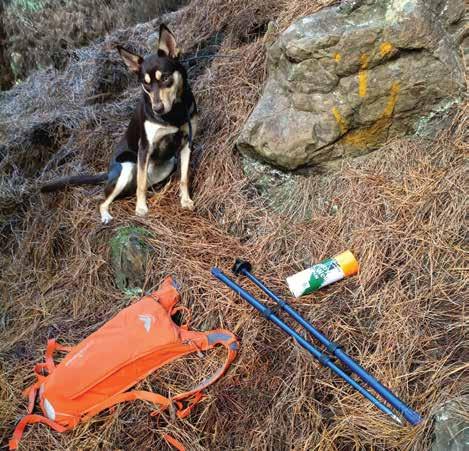
member. A townie youngster the equivalent of an extremely mouthy teenager. She talked a lot; day and night, indoors and out. Like a squeaky wheel the volume and rhythm of her high-pitched barks increased with speed. She disrespected authority and pretended her name was anything other than that nominated by her previous human.
Despite her attitude and disorderly behaviour, I saw a glimmer of potential and bought her home. There is something satisfying about teaching a young dog new tricks and crucial life skills. There is a joy in witnessing her joy at learning and becoming a beloved team member.
Today, as I worked in the forests of home, she came and went at will. And, before too long, she strutted by me with tail high, showing o her flash new get-up - oh yeah!
Pig shit. Soft, stinking pig shit. It was ground into her fur from cheek to shoulder. It was smeared on her tracking collar and packed into the buckle. It reeked. She reeked. She was so proud – ‘look at me, aren’t I special’.
And later, when I sat down for a quick snack, the teenagerwho now listens and respects authority - came by and showed her appreciation for her new life by being my best buddy. Before I could escape her attentions, she smooched me, rubbed herself bodily across my back, sharing her flash new perfume – Le Porcine Pou.
Sharing is caring. She reeks. I reek. We reek together.
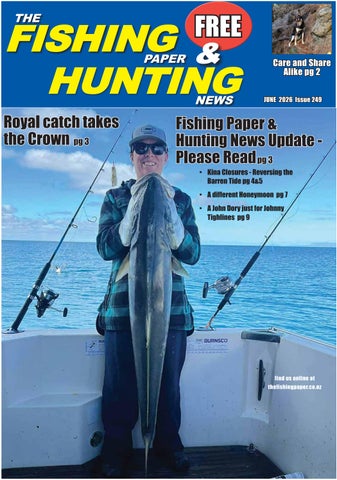
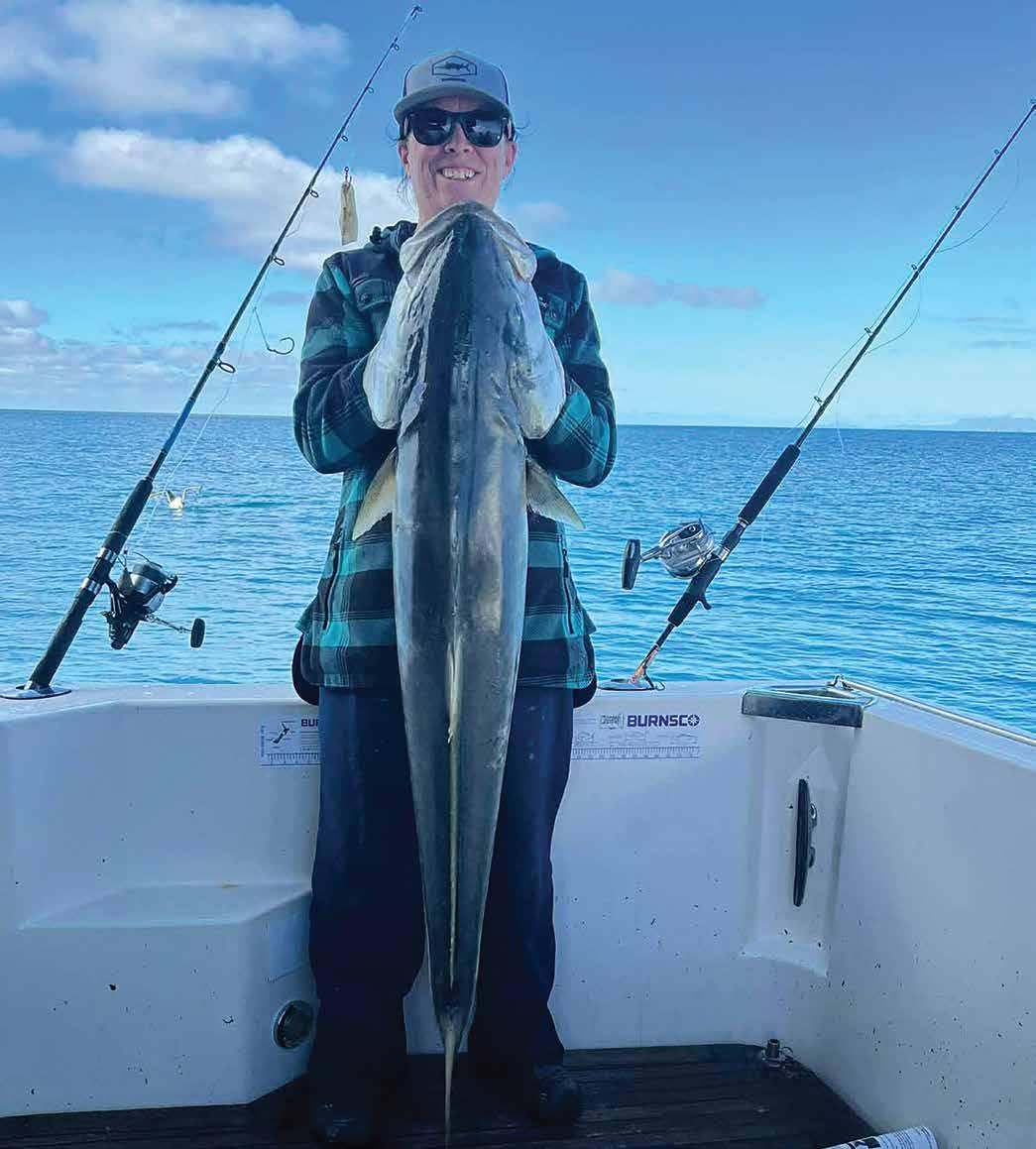
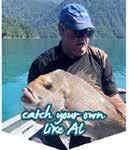
Royal Catch takes the crown
Dawnbreakers D’Urville
Island initial trip fishing trip may have been cancelled earlier due to weather but, the Members Mini Comp was extended and, we weren’t missing out — so we made the call to head up to D’Urville over ANZAC weekend with our mates Annie and Stu.
We left Havelock early ANZAC morning and pushed out, with Saturday shaping up as the best weather window. Straight to Stephen’s Passage we went — it just looked too good not to.
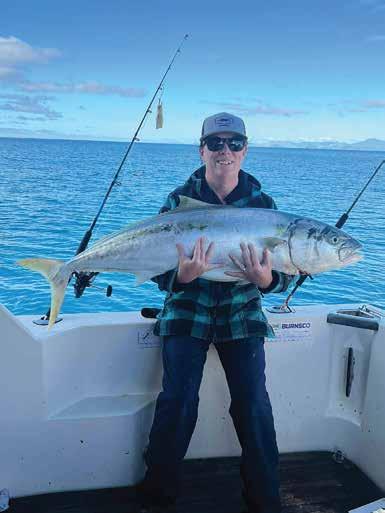
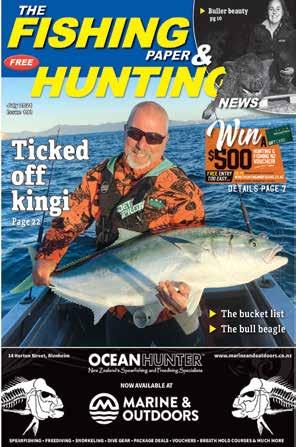
Now many a good yarn includes a long lead in – but not this one because before I knew it, Shannon yells out, “Lis, get your line down — there’s good sign!” So down it goes… one jig o the bottom… BOOM. Fish on before you could say ‘Tight lines’!
At first it felt light, like a barracuda mucking around — then suddenly, weight... Serious weight... Line peeling, drag screaming weight Even at max drag(18kg) it just kept going. Rod bent like I’ve never seen before. This was no small fish… shark maybe? What a battle.
Lisa Lamb
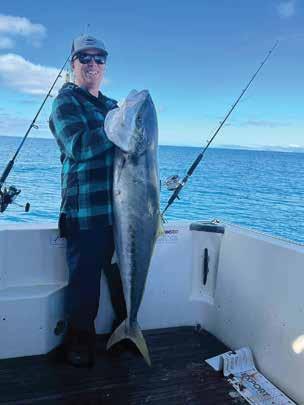
About 10 minutes later — colour. And as it came closer… it just kept getting bigger and bigger. Not a shark — a monster kingi.
Mum.”
Adrenaline pumping — because let’s be honest, it’s not real until it’s in the boat.
Raikkon spotted it, stepped aside and said, “Dad, you bring that in — if I lose that at the boat I’ll never hear the end of it from
Shannon pulled it in… and then the celebrations began.
Absolute best day on the water.
Personal best kingfish and still buzzing.
Update on The Fishing Paper & Hunting News
Anyone who is in business will understand that times are pretty tough ; every business expense is under the microscope and businesses are cutting every non essential cost.
Likewise if you are living anywhere in New Zealand you will be impacted by the current cost of living crisis, whether it is fuel prices, food pricing or power costs. To most of us, that means
we need to balance our own budget and dare i say sometimes that means that expenditure on our hobbies like fishing or hunting has to be reduced and in some cases stopped.
What this means for the Fishing Paper is that we have had increased costs (printing and delivery being our largest costs) and a real drop in revenue from advertisingwith advertisers going out
of business, deciding to only advertise on line and / or dropping their spend.
At the moment, the maths just doesn't work for the Fishing Paper with costs to print and distribute outweighing advertising revenue.
I have talked to a number of our contributors and to our advertisers to sound them out on options.
We have picked up some great writers and now have a really good mix of fishing fanatics as well as bow hunting and shooting. We also have some great long term writers, Kim, Ivan , Norm and Brian who are with us each month.
From the July 2026 issue we will be ONLINE ONLY during the winter months - so there will not be a paper available at your local supplier - the only way to access the Fishing Paper will be online.
The July, August and September issues will be online only.
We will use those month to continue seeking out new advertisers su cient to allow us to return to an "in print" paper.
If we can't secure su cient advertising revenue then we will make a call on staying online, or on closing down the paper.
I can assure you that closing down the paper will be the absolutely last option and is not one I want to have to take.
Please reach out if you have ideas as to who we can approach for additional support through advertising or sponsorship.
Thanks for your ongoing support
Nicola admin@thefishingpaper.co.nz
Kina and Closures - Reversing the Barren Tide A story for our time by rock lobster industry commentator Daryl Sykes
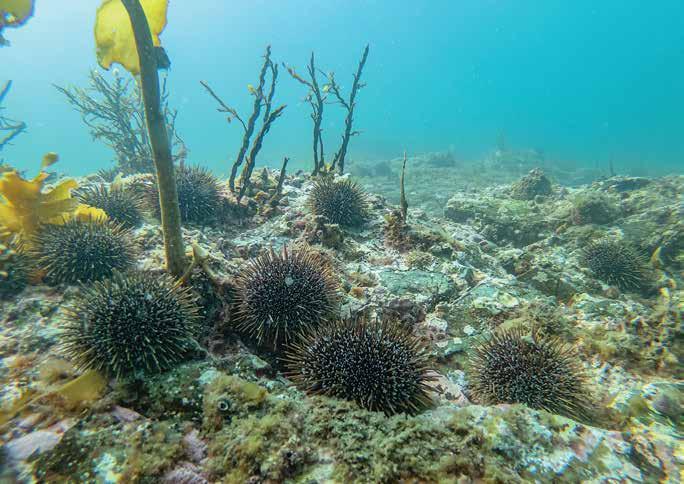
Over the last few years, kina barrens have become a potent symbol in arguments about the ecological status of Hauraki Gulf and the northeast coast. The simple version of the story is now familiar: fishers took out big snapper and lobsters, kina exploded, kelp forests vanished, and the only honest fix is to rebuild predators and close more coastlines to fishing. Or so it goes. Kina barrens are real, and in some places they are extensive and long-lived. Predators clearly matter in those systems. But when you read the recent science reviews and management advice side by side, it becomes hard to sustain the idea that this is a one-cause, one-solution problem. The evidence itself is much messier, and the management response so far has pushed hardest on the one lever fishers feel directly, while other levers sit largely untouched. What everyone broadly agrees on
• Across science agencies, fisheries managers, and industry, there is now broad agreement on some fundamentals.
• First, kina barrens exist, and in some regions they cover large areas of shallow rocky reef.
• Second, predators matter. Long-term marine research work on the northeast coast has shown that when fishing pressure is removed, key predators increase and kina-dominated patches can shift back towards kelp forests.
• Third, there is agreement that rock lobster abundance is genuinely low on the east coast of Northland and that kina barrens are a prominent feature in many of the shallow reefs.
Predator numbers, high kina, and lost kelp – has understandably driven concern and demands for action.
Where the real argument begins is not over whether kina barrens and predator e ects exist, but over how far we can stretch that particular story across all reefs, all regions and all management decisions.
The simple cascade – and how it became law
In the last few years, a strong version of the predator-loss story has not only entered public campaigns but has also been accepted in Court as “strong evidence”. Recent policy and
advocacy work frames kina as the main barren-forming urchin and says there is strong evidence that fishing of key predators –particularly snapper and red rock lobster – is a key driver of where barrens occur and how extensive they are.
In plain English, the accepted picture is: where rock lobsters are depleted, kina numbers increase, grazing pressure climbs, and kelp forests are destroyed, creating barrens. That sequence has been treated as a clearly operating trophic cascade on the northeastern coast.
Historical photographs and survey data show kina barrens were scarce in the 1940s and 1950s but common on many northeast reefs by the 1970s. Many scientific and policy documents interpret that shift, which happened alongside a rapid expansion of fishing for snapper and lobster, as strong support for a predator-driven cascade in the region.
But those same decades also saw rapid growth in farming and forestry, new coastal settlements, more earthworks, and much heavier recreational use of the shoreline. None of those changes is benign for kelp forests. Sediment, nutrients, coastal darkening, wave exposure and warming are all recognised in the science literature as important pressures on kelp and influencing urchin abundance, yet they feature far less prominently in the evidence put before the courts or in lobster-focused management advice than the fishing story does.
On the back of that predator-centred picture, recent advice to the Minister leaned heavily on rock-lobster measures which he subsequently implemented. From April 2026 year-around closures to commercial and recreational lobster fishing along a large stretch of the east coast of Northland, plus reductions in recreational bag limits for both spiny and packhorse lobsters, are the primary package to “help address urchin barrens”.
In short: the historical pattern, reserve studies and court findings have been read together as saying “predators, especially crayfish, explain the barrens”, and the most visible response has been to shut down lobster fishing over large areas and cut daily limits elsewhere.
Where the simple cascade frays
However, once you step away from a handful of iconic Hauraki Gulf marine reserves and look more widely, the same documents that support a simple cascade
story actually reveal a much more complicated picture.
Predators are more than lobsters
Recent work at the Poor Knights shows why a lobster-only story is too narrow. In the no-take reserve, kina barrens are said to be shrinking while remaining at an unprotected reference site, yet lobster numbers are low in both and have not recovered strongly despite decades of protection. Snapper, on the other hand, have increased dramatically inside the reserve. In that Poor Knights system, the main predator suppressing kina now appears to be finfish, not lobsters.
Reviews also note that while lobsters will eat kina, experiments here and overseas consistently rank them as low-preference prey when other food is available. Lobsters strongly favour soft-sediment shellfish and often avoid dense urchin barrens when given choices. Knowing that lobsters can eat kina is not the same as showing they are the dominant control on kina populations everywhere. Juvenile kina are eaten by a wide range of invertebrates and fish, and there is growing recognition that small crabs and other “micropredators” can strongly influence whether recruitment pulses turn into dense adult urchin beds.
Taken together, the evidence supports a predator story, but not a lobster-only story.
Regional and local variation What is true for one coast is not automatically true everywhere. Substantial barren habitat has been mapped in the Marlborough Sounds, and there are some barrens in Fiordland and Rakiura, but long time-series of data outside the northeast are sparse.
Even within the Hauraki Gulf, estimates of barren reefs vary sharply depending on data sources and mapping assumptions. For some islands, di erent base layers can halve or triple the calculated percentage of shallow reef that is barren, which is why more recent work has shifted to using “percentage of suitable coastline with barrens adjacent” as a more robust measure. Some studies describe large areas of shallow reef dominated by kina barrens, while others emphasise that much of the Gulf’s shallow reef remains macroalgal-dominated. There are stretches of coast with very low lobster abundance but little barren habitat, and places with significant barrens where land-based stressors or other factors are at least as plausible as a single
predator-loss explanation. Multiple stressors
Across the scientific literature, there is broad recognition that kelp forests and urchin barrens are shaped by a suite of interacting drivers: warming trends and more frequent marine heat waves; sediment and turbidity reducing light and altering juvenile survival; nutrient pulses; wave exposure, disease events and mass mortalities in both kelp and urchins; recruitment fluctuations and density-dependent behaviour in urchins.
In northern New Zealand, warming seas and increasingly frequent heat waves are also shifting the playing field. Recent work links temperature stress and coastal “darkening” to reduced kelp depth ranges, and to the southward and inshore spread of warm-water urchins such as Centrostephanus, which can create deep barrens in addition to the shallow depth kina problem already in play.
Experimental work elsewhere suggests that rebuilding a large lobster biomass can reduce incipient barrens and protect kelp beds, but has less e ect on extensive existing barrens without direct urchin removal.
In short, the research and science support predator loss as a major mechanism in some systems, alongside other stressors, with regional and local context heavily shaping outcomes. They do not support treating predator loss as the only established mechanism for kina barrens in northern New Zealand.
How we are managing – and what we are not
If the scientific picture is multi-driver and context-dependent, the management picture is much more one-sided.
The most recent ministerial advice paper on rock-lobster measures for northeastern New Zealand was driven largely by the need to respond to Court findings about trophic cascades in the CRA 1 lobster stock.
The Minister agreed to invoke year-round closure to commercial and recreational lobster fishing across a large east-coast stretch, plus reductions in recreational daily limits for lobsters, including national limits for packhorse, as the primary package to address kina barrens and rebuild lobster abundance.
Kina and Closures - Reversing the Barren Tide
A story for our time by rock lobster industry commentator Daryl Sykes
The same advice paper only nods towards other tools – kina removal, kelp reseeding, and considering snapper and other predators – and references a developing national strategy on urchin barrens, but in the immediate decision almost all of the regulatory weight is placed on lobster fishing.
By contrast, submissions from industry point out that commercial operators had already adopted a multi-year operating plan closing key east-coast areas to their own fishing, well ahead of regulation; that recreational catches dominate in precisely those areas of concern; that there are no studies showing lobster closures alone are enough to reduce existing kina barrens; and that direct urchin interventions, targeted closures around known barrens, and action on land-based sediment sources are more direct ways to address barren habitat without unnecessarily constraining utilisation elsewhere.
We have coast-wide lobster closures, reduced bag limits and court-driven pressure for further fishing cuts, but comparatively few examples of equally concrete measures aimed at the sediment and nutrient loads, coastal darkening, or local warming patterns that the same reports list as major stressors on kelp.
A more honest and useful framing
For lobster industry participants and serious recreational fishers, the choice is not between denying science and accepting sweeping predator-only management. It is between two ways of reading the same evidence.
One way, which has dominated recent debate, treats predator loss – with lobsters as the symbol – as the central, su cient explanation for kina barrens in the northeast, and then builds almost all near-term interventions around lobster fishing controls.
Another way takes the same body of work and asks three harder questions:
• Where is the evidence strong, and where is it thin?
Predator-driven shifts at a few well-studied reserves are robust; the exact role of lobsters versus other predators, and the relevance of those systems to every stretch of coast, is less certain.
• What else could be driving
or locking in barrens here?
Warming, sediment, coastal darkening, disease and recruitment dynamics are all documented but rarely form the basis of concrete management action.
• Are we testing those other mechanisms with the same
Where to from here?
For those who live with the consequences of decisions –commercial operators, customary and recreational fishers, and coastal communities – there is room to argue for a more balanced package without trying to rewrite the science.
actually are and where recovery is plausible, instead of applying broad coast-wide rules based on incomplete data.
• • Formal recognition of fisher knowledge, treating long-term observations of depth shifts, changing
seriousness as we regulate fishing? There is movement on mapping and on lobster rules; there is far less visible investment in depth-resolved predator surveys, fine-scale temperature and stratification monitoring on key reefs, kelp and urchin mortality after major floods or heat waves, or systematic integration of long-term fisher observations into formal hypotheses. An honest response to kina barrens on this coast should start from this latter approach. It should say, openly:
• In some places, particularly parts of the northeast, fishing and predator loss are clearly part of the problem and must be part of the solution.
• Elsewhere, and even on di erent reefs within the same region, other drivers may dominate, and pretending one cause applies everywhere will lead to blunt, contested and sometimes ine ective management.
A constructive set of asks could include:
• Region-specific investigations that explicitly test multiple drivers, designing monitoring and experiments that can distinguish the e ects of predator biomass (and di erent predators), temperature trends, sediment and turbidity, recruitment pulses and disease on kina and kelp, rather than assuming one driver and checking only that one.
• Matching management levers to local evidence, so that where predator loss seems to be central, predator-focused measures are accepted – but paired with commitments on direct urchin removal and catchment stressors, not treated as stand-alone fixes.
• Targeted, not blanket, closures for barrens, using improved fine-scale mapping to direct no-take zones or multi-species closures to places where barrens
temperature windows and specific reef histories as data that can guide and test scientific work, rather than anecdotes to be sidelined.
• Transparent communication about uncertainty, with agencies and scientists explicit about where mechanisms are well-established and where they are not, instead of presenting a single, neat cascade story as if all the other factors they themselves document were secondary.
Fishers are already carrying real costs in the name of kina-barren recovery. It is reasonable to expect that other players – including those responsible for land-based inputs and for climate-related planning – shoulder their share as well. A narrative that admits complexity but stays tied to evidence is harder to sell in a headline, but it is the only one likely to produce durable, fair and e ective management on a coast as varied as ours.
Kina Barren, Shaun Lee
A P&N Sort of a Day Coastlines
Ivan Wilson
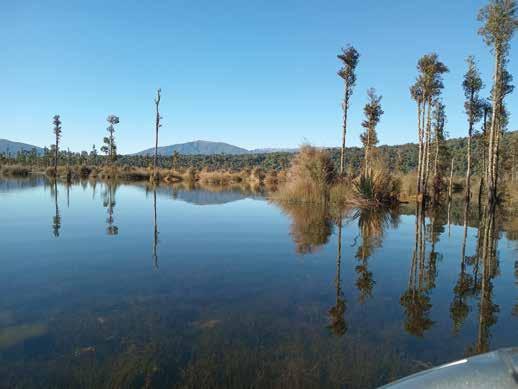
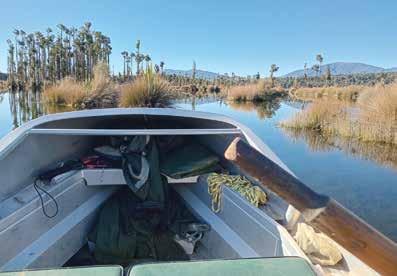
It was what I called a P&N sort of day-more on that shortly. Days had turned into weeks with less than ideal weather, after all it was Autumn and we always get some slightly dubious conditions in Autumn and again in Spring, just in time for white-baiting. The rest of the year is balmy, a bit like this writer at times. A sizeable high with a capital H was on the weather maps, so picking the day I headed up to the lake. On the drive up, for a start it was cold and clear, but this turned to cold and foggy as a fat slug of wet, thick mist, slimed it’s way down through the hills into the Grey Valley. It’s a c-c-c-cold katabatic system we call The Barber (it’ll shave yer beard o mate) Once in the Arnold Valley the mist became fog, but I knew that pointed to lovely blue and gold conditions at the lake. As I chugged on, the fog turned to mist then disappeared, so I
finished the run in the sun. I put 5 bucks in the ramp honesty box (it’s the best policy eh) and slid the Silver Fog er Frog into the drink. Yarmy started on only the 2nd attempt and I nudged the boat toward the entrance to the bay. Only other human on the water was a bloke on a paddle-board and I was stunned to note he was in shorts with a bare midri and torso. The temperature was still in the low, single figures, so why he chose to show o his figure and get almost naked was a puzzle. Perhaps it was only skin-toned lycra and I “shoulda gone to spec savers". I decided to head to familiar, favourite spots that have been kind to me before, but found the light air movement required me to make an up-wind move so I could catch the drift, something I’ve not always been good at! Making the Yamaha go to full noise, I went further out to another favoured location that would allow a good
drift along in the very light airs. Drifting in a floating stalk is a good way to operate when on your own in a the boat, as it needs only a few oar strokes to keep it in the right line for casting. There were hordes of black swan and for a start they regarded me with disdainful suspicion, but on getting a bit closer they began to exercise their “flapology” skills, flailing away until airborne and heading in an away direction. My optimism levels were sitting nicely at about medium to high and I was hopeful of getting my favoured fly, the “lady in red” in front of Salmo Trutta, but alas and alack there were none to be seen. This state of a airs went on for a while, then suddenly nothing happened. Oh hang on there’s a fish, or is it a stick? Yeah a stick, but yuh never know, so out went the fly, whereupon I lined the stick which hurriedly took o . Good, that was one, so lets find the next one around here somewhere. Look, there’s another, so I got the fly out ahead of the creature which came around for a look but there was no tell-take white flash of its mouth opening to eat the o ering and that one also went west. There must be a heap of
fish somewhere out there in the west
Only two fish sighted and it was stomach growling time, so I rowed into a sunny corner and broke out the comestibles. That is just one of the grand things about fishing, it takes you to very nice places, even if it’s just to have lunch. The water was flat calm, sun was shining, birds singing and all was well with the world, well here on Lake Brunner anyway. After lunch I fossicked around and saw but one other trout, so thought of a former mentor’s advice which went along the lines of “If you’re not seeing trout, move.” Well I’d moved a number of times and with the dearth of fish decided to give the boat a good run back to the ramp. This time of year once the sun sinks well into the west it gets cold quickly and I also didn’t want to get tangled up with the 9 school buses that go past our place each day. Once while reversing the boat up the odd angle of our driveway, I saw to my horror the buses were coming through and I held them up while manoeuvring in. The angry look on the lead bus drivers face was enough, so that was once and once was enough.
Why then did I call it a P&N day? There were both Positives and Negatives. but you probably guessed that-clever you!
Training is very important. After watching Facebook videos and seeing how some people in other countries act and handle firearms on ranges, it is very obvious that many of them do not have the same training standards that we do in New Zealand, or at least on Pistol New Zealand ranges Some do train similarly to us, and vice versa. Canada has a “Black Badge”, which is a qualification that allows the holder to compete in pistol competitions requiring the drawing of a pistol from a holster. In New Zealand, we have two di erent badges that give our members this privilege. One is for action-style shooting disciplines such as IPSC, Action, Service, Speed, or even Wild Bunch, which is cowboy-style shooting with 1911 .45 ACP pistols, based on the movie of the same name. I have
After getting married in March of this year and not really thinking too much about a honeymoon ,after having spent the previous year flat out saving for a wedding, this year we decided we would be saying “yes” to more trips.
So, while this isn’t a writeup of your stereotypical golden sand beach, 36-degree honeymoon, it’s a tale of redemption from my story last year titled “chasing ghosts’, where the only thing missing from our Chew Tobacco Bay, Stuart Island honeymoon was the 36 degrees!
The 6 of us, Sam, Cody, Goose, Donna, Ben and I set sail over from Blu thankful that today, Foveaux Strait was being relatively kind. We were super excited to see what the next 15 days of island paradise had in store for us.
After unloading and settling ourselves into our new home, we pointed to areas of interest on the map and took o in our various directions. A quick hunt to get the lay of the land and gain some practice in walking on debris that sounded like cornflakes. The evening consistied of reporting back to the crew with varying amounts of promising sign and big plans for the days ahead.
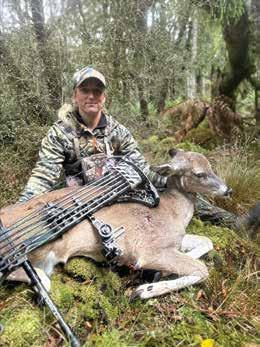
Day 2: Ben and I were up early and out and good luck to the others. We had a bit of walking and tide dependent rock hopping to get to where we intended to hunt for the day. Right away we encountered plenty of promising sign and got into stalk mode early in the piece. Less than an hour later we stumbled across our first deer, a doe feeding nicely amongst some windfall. We saw her at about the same time, with me thinking ‘is that what I think it is?’ and Ben saying ‘quick put an arrow on’ it was go time. She was
Firearms Usage
just engraved some badges for the next intake, and they are numbered over 6200. Pistol shooting here had been established for some time before the holster qualification became a requirement. The other qualification is for CAS (Cowboy Action Shooting), which uses single-action revolvers. These need to be cocked every time before they can be fired. The handling of these two di erent styles requires di erent skills to master, and we need to continue working on those skills, both to improve and, more importantly, to ensure we do not become complacent and develop bad habits that could lead to mistakes. This is something our club trainers and range o cers keep a close watch on, because it is far better to correct issues early rather than allow standards to deteriorate. As a requirement for holding a
Just Married
pistol licence, we must complete a minimum of 12 shoots a year. In my last submission, I suggested this should be reduced to 6 or 8, as circumstances have changed over time. Our weekends are no longer as free as they were 55-plus years ago, when most jobs were Monday to Friday and weekends were reserved for sport and family. That is without even considering the increasing costs of our sport. The requirement is still 12 shoots per year, and we will wait and see how the new ACT legislation unfolds. We have plenty of fellow shooters looking out for one another, as we all take our sport and safety seriously. This means safe firearm handling becomes second nature for most of us, but it is still reassuring to have those safety standards continually reinforced. For myself, this overview comes from my club members, and when
Libby Cooper
walking nicely along a game trail, and I knew that as she walked behind a tree, I’d be able to come back to full draw and she’d pop out at 20 metres. Full draw, but where is she? Living up to her name, she had ghosted us and disappeared.
We battled along a bit further, arguing with crown fern and fallen pungas until we came across an arrow sticking out of a tree, the plaque beneath it informed us that this arrow had belonged to a man named Greg Darrach who had unfortunately passed away 10 years ago. After thinking what a lovely message it was to find in the middle of nowhere I said “well mate, it looks like you’re the man who looks after these parts, could I please shoot my first whitetail deer this trip?” we mooched along a bit further and hilariously after my chat with Greg we spooked a deer! Ha! In good spirits we ventured on, and after a few more choice words with the crown fern, we popped up into a nice flat. Looking down we could see 3 very prominent game tracks and plenty of sign! I turned to range behind me and froze dead in my tracks, deer number 3 had snuck in behind and was challenging me to a staring competition. Back at the hut swapping tales it was clear everyone had had a good day, and Cody was on the board!
The next few days passed and consisted of a lot more of scoping out of areas, finding what sign was around, and taking some time to stand in the tree where the Doe had busted us on the first day. We saw deer (mostly bounding away) and to my excitement plenty of Kiwis. Goose had shot a deer and had an awesome encounter with a buck, Cody had shot another, and both Ben and I and Goose
and Donna had the pleasure of meeting Chew Tobacco’s famous sea lion Merve. For future reference he doesn’t appreciate being called “sea puppy” but will back down when called a “bad dog!”
Day 5 rolled around, and I was excited as I’d planned to stand up in the tree where we had seen all the sign on the first day. We arrived in good time and got ready,
ranging areas where I thought a deer might approach from and was confident when I saw the area with the most sign would be no more than a 15 metre shot. Now it was a waiting game, knowing the couple of hours before dark would likely be when something wondered along the game track. I think I hear something, look at Ben, and hear it again. Then out of nowhere a doe’s head pops out from amongst the crown ferns. My heart is pounding! She’s scoping out whether she’s wanting to step out into the open
PISTOL SHOOTING
Brian Bishop
I travel away for matches, I am checked by other o cials as well.
What this proves is how important our clubs and ranges are. The benefits they pass on to those who join help everyone become better and safer in the way they handle firearms. They also provide a safe, controlled environment where people can see the realities of the sport and learn how to shoot properly.
and I’m quietly having a panic attack. Have you ever tired slowing your breathing, by taking a deep breath and blowing it out slowly but also while making ZERO noise? It was tricky to say the least! Eventually she steps out but doesn’t give me the broadside shot I was hoping for, instead she’s quartering on. Deciding to be patient and wait for the broadside shot, I begin to worry this could be a repeat of my buck from Christmas , that the wind may swirl and blow my scent. Concerned about time, I say to myself ‘you can figure this out, if she gives you the quartering shot again be confident and take it, but if she doesn’t, there’s every chance she’ll be forced to give you the broadside shot as she walks away. But you need to be ready, and you need to be quick’. As if reading my mind, the doe starts to walk o . I draw my bow back as she’s looking in the other direction. Ben also reads what’s happening and lets out a perfectly timed doe call. It’s exactly as I’d thought it would happen and I’m ready! My arrow hits, and she’s down within 5 metres. A perfect heart shot! After some yahooing and fist bumps it was time for some photos before boning her out and heading back to camp to pop some bubbles and celebrate with the rest of the crew, followed by a couple of Sheep Dog whiskeys. After completing my goal of shooting my first whitetail deer within the first 5 days of the trip, it was time for my next goal: to shoot a buck, and preferably from the ground. However, with the yarn already this long, you all will have to wait until next month to read how we got on!
Exceptional Ute & Station Wagon Fit-outs
Whether you’re a skilled tradesperson, a DIY enthusiast, or just a fan of utes, our custom fit-outs are tailor-made to elevate your road transport experience. Our fit-outs not only meet but often exceed expectations in terms of quality and aesthetics.
We take pride in collaborating with you to design the perfect deck or canopy, whether it’s transforming your hand-drawn vision into reality or utilising our cutting-edge SolidWorks design system to bring your ideas to life.
Our fit-out solutions include toolboxes, fold-down sides,
hydraulic lifts, H-frames, slide out drawers and more to make the most of the space in your vehicle. We’re your one-stop solution for all your transportation needs.
Precise fit-outs, even before your Ute
Arrives
If you haven’t taken delivery of your ute yet, we can still get to work. With just the make and model information, we can now digitally import the specifications and design the perfect canopy in consultation with you. Our advanced technology allows us to create a vivid image, o ering you a clear preview of the final result. We meticulously check
tolerances to ensure a seamless fit between the body and cab while optimising wheel travel. When your ute finally arrives, we can e ortlessly install the canopy, making your vehicle road-ready in no time.
Rely on Aluminium Excellence
Our fit-outs are crafted from premium aluminium, the ideal material for utes. We utilise heavygauge aluminium to withstand the toughest challenges and work life. Lightweight yet incredibly robust, our fit-outs are built to last and engineered for their intended purpose. Moreover, aluminium is corrosion-resistant, ensuring that your fit-out remains impervious to various loads.
Wagons
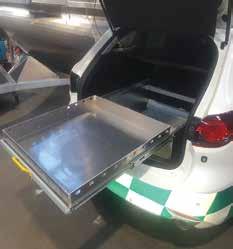
If a custom high quality sliding drawer for your wagon is what you’re after, we can do this for a side or back opening door. We use sturdy, customised parts so your drawer glides with ease, to make the most of hard to reach places. Game changer.
An example we’re very proud of is the drawers in a fleet of ambulance First-Responder utes to make access to key materials easier for paramedics.
Choose our fit-outs to enhance the functionality and durability of your ute. Contact us today to discuss your specific requirements and take your road transport to the next level.
St Peters’Thumb Print… or Johnny Tightlines’signature?
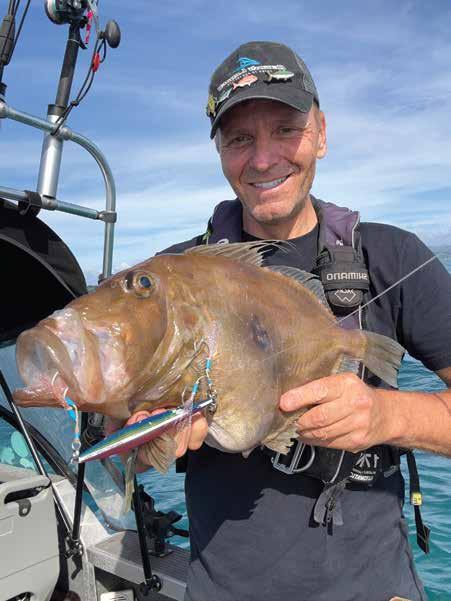
A Wellington John Dory delivered more than just dinner. It came with Johnny Tightlines stamped on the side.
There are fish you catch for the table… and then there are fish that hand you a story.
This John Dory did exactly that. It started as one of those classic Wellington sessions.
Calm enough to fish comfortably, enough current to keep things interesting, and the slow-pitch gear doing what it does best — hunting over structure and waiting for that unmistakable weight. No screaming kingfish run. No chaos. Just that heavy, stubborn nod that tells you something decent has climbed aboard.
When the fish rolled into view beside the boat, I knew straight away it was a proper John Dory. Big shoulders, prehistoric face, all attitude. They really are one of the strangest-looking fish in the ocean — like someone designed them after a long night at the pub. But this one had something else. The famous black spot.
Now most anglers know the old myth behind the John Dory mark. Legend says the black spot came from the thumbprint of St Peter. According to the story, Peter caught the fish while collecting tribute money, leaving behind the mark that still appears on the species today. That’s why John
Earth Sciences NZ is asking recreational fishers in the Marlborough sounds to help with a research project into what happens to blue cod after it has been returned to the sea.
The research, commissioned by Fisheries New Zealand, follows recent surveys showing several factors contributing to low levels of blue cod in the Sounds.
“Recent surveys show up to 70 per cent of blue cod caught by private boats are then released and a high proportion of fish in the fishery are undersized.
“Understanding, and if possible increasing, the survival rate of returned blue cod is therefore important for rebuilding the blue cod population,” Simon Lawrence, Fisheries New Zealand Director Science & Information says.
Earth Sciences NZ project coordinator Niki Davey says the support of recreational fishers is critical to the study’s success.
“The project aims to increase our understanding of what happens to blue cod after they are released, which requires good information from people actively fishing in the area,” Niki Davey says.
“By taking part, fishers will help ensure that this information, which may be important for managing the fishery, is based on real world fishing practices. Every trip
recorded helps build a more accurate picture of the fishery.”
Blue cod is one of the most sought-after species in the region, with recreational catches similar in size to the commercial fishery.
“Good fisheries management decisions are based on having the best possible information, and we thank fishers who take part in the survey for doing their bit to help support sustainability in this beloved fishery,” Simon Lawrence says.
Dory are sometimes linked with “St Peter’s fish.”
Good story. But this fish had other ideas. Because the spot on this one didn’t look round at all. It looked like a perfect “J.” A proper J! J for Johnny Tightlines! Now I’m not saying the fishing gods personally signed this fish for me before it climbed on my jig… but I’m also not, not saying that.
There is a saying that every fish you catch has your name on it, but this was taking it to the next level! The funny thing about fishing is how these little moments stick with you. You can catch bigger fish. Harder-fighting fish.
But every now and then one turns up with a bit of personality attached to it and suddenly the whole trip becomes memorable for reasons you never expected, John Dory have always fascinated me anyway. They’re ambush predators built completely di erently from most fish we chase here in NZ.
Thin as a dinner plate, giant eyes, huge extendable mouth, and capable of inhaling prey in a split second. Ugly? Maybe. E ective? Absolutely.
And on light slow pitch jig gear they are great sport and one of the finest eating fish in the ocean.
Tightlines!
on release, or was eaten by a shag (or other predator). There are two ways to record the data.
The Citizen Science App. The app is free and easy to use and works without mobile coverage. Data can be entered at sea and submitted once back at the ramp or at home. Fishers can use the app on multiple trips, with no need to manage paper forms or returns.
Secondly, waterproof paper forms will be available at Waikawa, Picton and Havelock boat ramps when sta are present. Measuring mats and clipboards will be provided, and sta can also show fishers how to download and use the app if they’re interested. Completed forms can be returned by photo, email, or dropped into collection boxes at the ramps.
The project will run for 12 months (May 2026 – April 2027) to capture seasonal patterns in fishing activity.
How fishers can help Fishers in the Marlborough Sounds Area are asked to record simple details about blue cod they catch, whether the fish is kept or released. This includes information such as fish length, capture depth, hook location, whether the fish was bleeding, whether it floated, swam away
Sta will be working on good weather fishing days at the boat ramps, mainly in the mornings when most fishing trips begin. Alternatively, fishers can contact Niki Davey at Earth Sciences New Zealand to arrange access to the form or app and a measuring mat: niki.davey@earthsciences.nz.
You can find out more information about Marlborough blue cod, including best practice for handling and release here: www.mpi.govt.nz/marlboroughblue-cod.
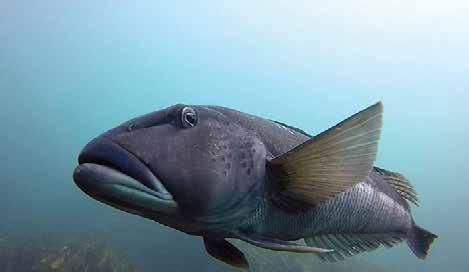
Blue cod [Rod Stewart / Earth Sciences NZ]
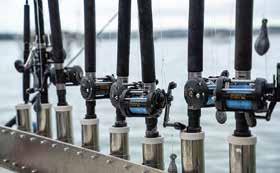
Fishing rods on a charter [Stu Mackay / Earth Sciences NZ]
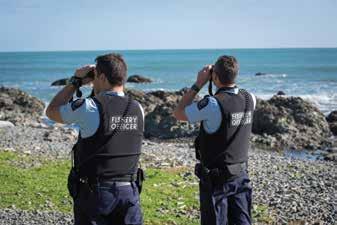
Recreational fishers who took too much shellfish including pāua, mussels, tuatua along with obstructing fishery o cers were ordered to pay thousands of dollars in fines.
“People who choose to ignore the fishing rules need to know there will be consequences. Our job is to protect fishing resources so that everyone can enjoy the opportunity to put fresh kaimoana on the dinner the table.
“Those who try to obstruct us in this work should know there will be consequences,” says Fisheries New Zealand Acting Director of Fisheries Compliance, Phil Tasker. The following cases were before the courts over the past month.
Five fishers from Waitara, aged between 31 and 47 were each fined $500 in the New Plymouth District Court for jointly taking pāua, kina, crab, octopus and cats’ eye from the closed Western Taranaki area. The group were stopped in December 2024 by Fishery O cers patrolling the coast. The area has been closed to gathering except for crayfish since 2022 and it was as result of a call to the MPI 0800 4 POACHER line that the fishers were caught. They had 50 pāua, 1 octopus, 15 kina and 1 cats’ eye.
Two Canterbury fishers aged 20 and 21 were sentenced in the Christchurch District Court on pāua charges. The 20-year-
old was fined $6000, and the 21-year-old was ordered to do 100 hours community work. Along with one other person who is still to be sentenced, the pair were in August last year, stopped by Fishery O cers at Paia Point on the Kaikōura Coast. They had 422 pāua and 232 were undersize. The daily limit for taking pāua in that area at the time was 3 pāua per person.
Two Northland fishers aged 26 and 44 have each been fined $1000 in the Kaitaia District Court for taking 643 tuatua from 90 Mile Beach. They were stopped by Fishery O cers in October last year. The daily limit per person for taking tuatua is 150.
A 28-year-old Auckland man was fined $975 for using three set nets in a prohibited area to protect Hecto’s and Maui dolphins. The man was sentenced in the Waitakere District Court. The man put a set net in at Cornwallis beach in October 2025. The set nets were set within the area from Maunganui Blu to Tirua Point. The construction of the set nets was also illegal.
A 40-year-old Hastings man was fined $2400 in the Hastings District Court for both obstructing a Fishery O cer from doing their work and taking 22 undersize pāua from Mangakuri beach in July last year.
A 51-year-old Northland man was fined $1200 in the Whangarei
District Court for taking 250 green lipped mussels from Sandy Bay. The man was stopped by Fishery O cers in December last year. The daily limit per gatherer is 50 green lipped mussels.
Two Auckland men, aged 66 and 60 were each fined $1000 in the North Harbour District Court. The men took 796 catseyes’, eight whelks and two limpets from Army Bay in Whangaparaoa in January this year before the closure. They were stopped by Fishery O cers and were unaware of the rules in place at the time. Taking shellfish in that area was banned for two years in March this year.
Two Auckland men aged 45 and 49 years old have each been fined $900 in the North Shore District Court for taking 385 green lipped mussels from Muriwai beach in December last year. The men had their vehicle inspected by Fishery O cer. The daily recreational limit for taking green lipped mussels in that area is 25 per person.
A 60-year-old Northland man was fined $500 in the Kaitaia District Court for taking 454 tuatua. The man was stopped by Honorary Fishery O cers in December last year
at 90 Mile Beach. The daily limit per person for taking tuatua is 150. And a 68-year-old Auckland man was fined $900 in the North Shore District Court for his part in taking 385 green-lipped mussels. The man and two others were stopped by Fishery O cers in December last year at Muiriwai Beach. The daily limit per person for gathering green-lipped mussels is 25. The two others with him are still before the court.
“If you’re unsure of the fishing rules in the area you plan to fish, get the most up-to-date fishing rules by downloading the free NZ Fishing Rules mobile app. It will also work if you are fishing in an area with limited mobile coverage,” says Mr Tasker.
We encourage people to report any suspected illegal activity through the Ministry for Primary Industries’ 0800 4 POACHER line (0800 476 224).
HUNT LIKE A PRO
Made in Europe
Chosen by professionals
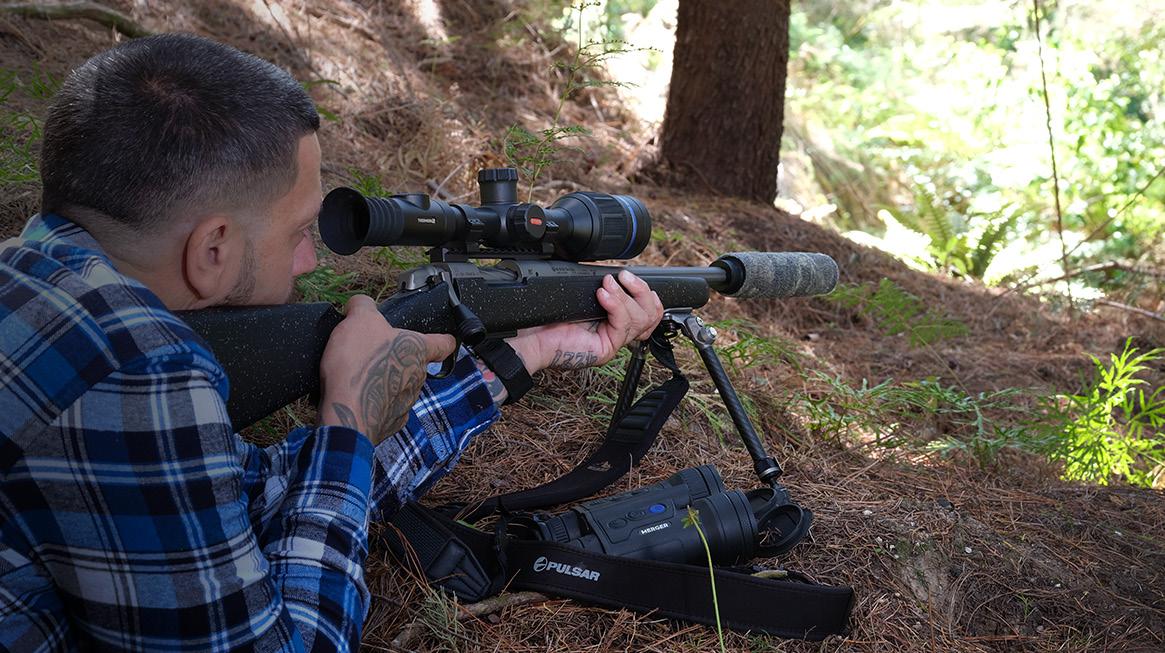
Pulsar thermals are the first choice amongst professionals.
Our great range starts at $2599, representing great value for high quality, proven, European made thermal optics with advanced Lynred sensors.
HAND-HELD THERMALS
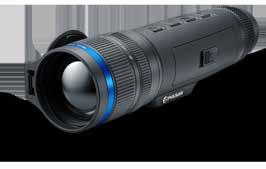
PULSAR AXION COMPACT
Lightweight, quick-change battery, robust and outstanding performance. Perfect for bush-stalking, forestry and general use. Great value.
Choice of 384x288 or 640x480 sensors.
From $2599.00
PULSAR TELOS
Outstanding performance at long and short distance.
High capacity quick-change battery very lightweight. Available with 1000m laser rangefinder.
Choice of 384x288, 640x480 or 1024x768 sensors.
From $3999.00
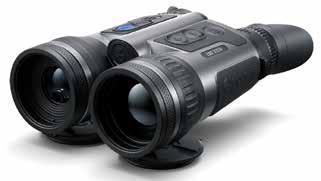
PULSAR MERGER LRF
Immersive, comfortable viewing experience, up to 1500m laser rangefinder, high capacity quick-change battery with internal back-up, delivers the very best performance.
Choice of 640x480 or 1280x1024 sensors.
From $6799.00
THERMALS RIFLESCOPES
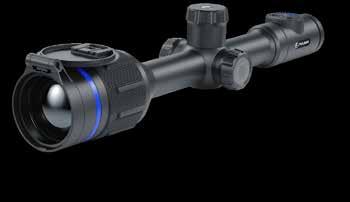
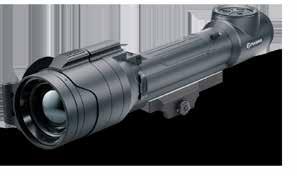
PULSAR THERMION
Professionals favourite. Quick-change battery with internal back-up, 30mm tube and integrates with Stream Vision Ballistics for reliable shot placement. Available with 1000m laser rangefinder.
Choice of 384x288, 640x480 or 1024x768 sensors.
From $5399.00
PULSAR TALION
Compact, quick-change battery, QD mount and integrates with Stream Vision Ballistics for reliable shot placement.