Female Crowntail Betta Fish Fin-Safe Tank Setup Guide
Female Crowntail Betta Fish Fin-Safe Tank Setup Guide
Female crowntail bettas (Betta splendens) carry the same spiky, ray-reduced "crown" fin structure as their more famous male counterparts, but in a smaller, shorter-finned package They're real, increasingly available in the hobby, and make excellent centerpiece fish for sorority tanks or well-planned community setups but their fin rays are more delicate than a plakat's and more prone to splitting or curling than a male's, which changes how you should scape the tank, cycle water, and handle the fish Sexing a young crowntail correctly (rather than assuming short fins = female) is the single most common mistake buyers make.
Key Takeaways
● Crowntail is a fin trait, not a sex. Both males and females can carry the crowntail gene; females simply express it on shorter fins.
● Females are generally calmer than males but not passive they still flare, chase, and establish pecking order, especially in sororities
● A 10-gallon (38 L) minimum is the realistic floor for a single female, and sorority setups need 20+ gallons (75+ L) with heavy visual breaks
● Crown rays are more prone to snagging and splitting than veiltail or plakat rays, so decor choices matter more with this fin type
● Egg-readiness and bloating are easy to confuse in females knowing the difference prevents unnecessary "treatment" of a healthy, gravid fish.
● Reliable sexing before 3 months of age is difficult, even for experienced keepers; the egg spot (ovipositor) is the most dependable early indicator
What Exactly Is a Female Crowntail Betta?
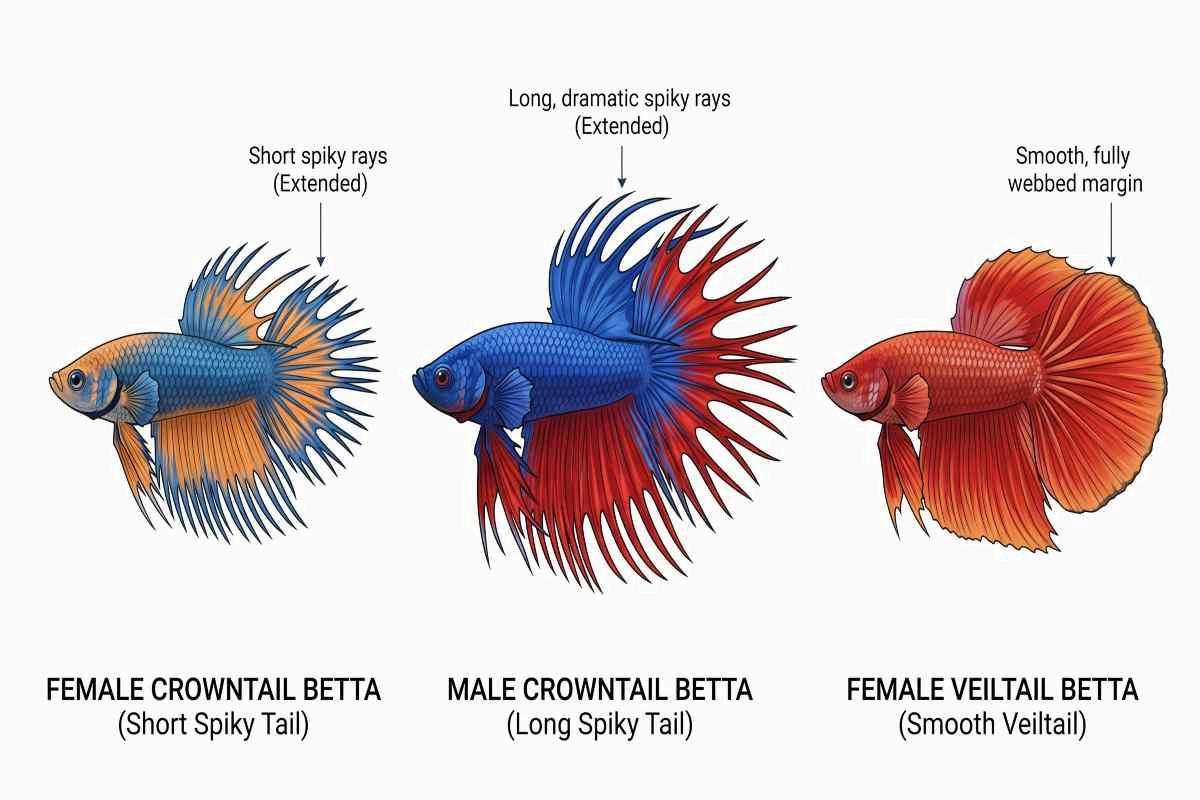
"Crowntail" describes a fin ray reduction mutation: the webbing between the fin rays doesn't grow out as far as the rays themselves, so the rays extend past the membrane and create a spiky, crown-like, or "spiderweb" edge. This trait shows up on the caudal (tail), dorsal, and anal fins, and critically it is inherited independently of sex A female betta can carry one or two copies of the crowntail-influencing genes just as easily as a male.
What confuses many first-time buyers is that female bettas of any fin type have naturally shorter fins than males, because fin length is itself a separate, sex-linked trait tied to hormone expression. So a female crowntail betta doesn't have the long, cascading rays you see on a show-quality male crowntail she has the same spiky ray structure, just scaled down to a shorter, more triangular or fan-shaped tail. This is why female crowntails are sometimes
mistaken for plakats (short-fin bettas) at a glance; the giveaway is the visible, uneven "spikes" at the fin edge rather than a smooth, rounded margin.
Why this matters: if a seller is calling a fish a "crowntail" but the tail edge is smooth and continuous, you're likely looking at a plakat or veiltail female, not a true crowntail. Reduction in webbing, not fin length, is the diagnostic feature
Crowntail Grading in Females
Breeders grade crowntail quality by ray extension and symmetry, and the same scale applies to females, just adjusted for their smaller fin size:
Grade
Ray Extension
Single Ray Rays split once past the webbing
Double Ray
Cross Ray / Overlapping Ray
Rays split twice, creating denser spikes
Rays cross each other as they extend
Crossed/King Crowntail Extreme, dense ray branching
What to Look For in a Female
Simplest, most common in pet-store stock
More defined "crown" look, still budget-friendly
Less common, considered more decorative
Rare in females; mostly seen in show males
For a pet keeper, grade is cosmetic and doesn't affect health or temperament it's worth knowing mainly so you're not overpaying for "show quality" when a pet-store double ray female will thrive just as well.
Is a "Female Crowntail" Actually Common in the Hobby?
Yes, though they're less frequently displayed than males Most retail betta fish bowls you see lined up in pet stores are males, because males are more visually dramatic and easier to keep singly in small cups. Females are typically sold in community "sorority" tanks or bins, which makes it harder to spot a specific fin type at a glance you have to look closely at each fish's tail edge.
Online betta breeders and specialty importers (particularly those sourcing from Thailand and Indonesia, where most ornamental bettas are farmed) regularly offer female crowntails, often at a lower price point than males of equivalent ray quality, since fin display matters less in the female market If your local pet store doesn't have any, it's worth checking dedicated betta breeders or aquatics forums rather than assuming the variety doesn't exist for females
Temperament: How Female Crowntails Actually Behave
Female bettas of any fin type are less territorially explosive than males, but "less aggressive" doesn't mean "non-aggressive " Female crowntails still:
● Flare at their reflection, other bettas, and sometimes at brightly colored tank mates
● Establish a hierarchy when housed with other females (this is normal and expected in sororities)
● Can nip fins including their own tank mates' when stressed, crowded, or under-fed
● Show individual variation; some are boisterous and food-driven, others are shy and spend time in cover
One nuance specific to crowntails: because their fin rays are already exposed past the webbing, minor fin nipping or snagging is more visually obvious than it would be on a veiltail, and can look more dramatic than it actually is A single missing ray tip is a cosmetic issue in most cases, not an emergency but repeated ray loss, redness at the base, or fraying that spreads toward the body warrants a closer look at water quality and tank mates.
Sorority Tanks: The Main Way Female Crowntails Are Kept
A "sorority" is a group of female bettas (typically 4–6 or more) housed together, which only works because females tolerate cohabitation in a way males generally don't If you're planning a sorority that includes a crowntail, a few adjustments matter more than they would for a single female or a smoother-finned variety:
Why Crowntails Need Extra Consideration in Groups
The exposed ray tips on a crowntail are more prone to catching on rough or sharp decor, and more visibly affected by fin-nipping from tank mates during hierarchy disputes This doesn't mean crowntails can't do sororities it means the tank needs to be set up with their fin structure in mind.
Sorority Setup Checklist
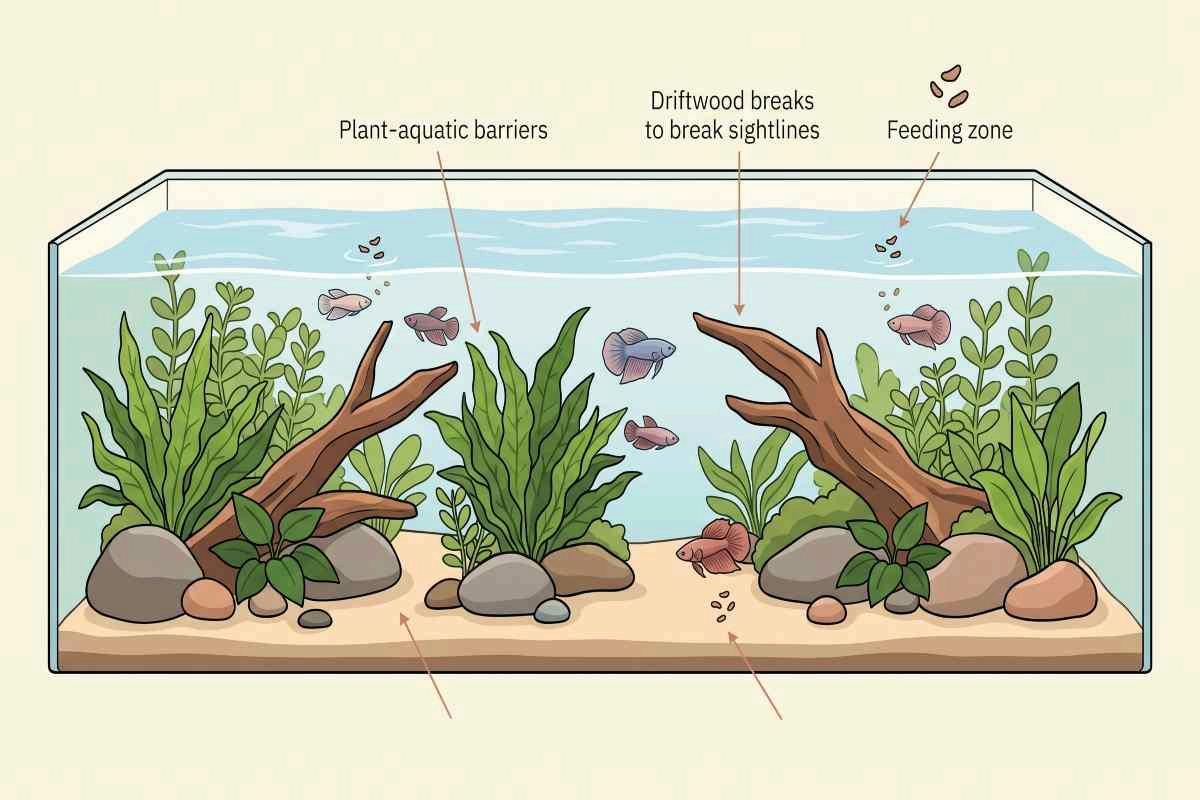
● Tank size: 20 gallons (75 L) minimum for 4–6 females; more surface area reduces confrontation
● Odd numbers of fish (5 or 7, not 4 or 6) to prevent one fish being ganged up on as a pair bond forms among others
● Heavy visual breaks dense planting (live or silk), driftwood, and tall decor to interrupt sightlines
● No sharp or rough-edged decor plastic plants with hard edges and unfinished ceramic can snag crown rays
● Introduce all females at once, ideally by rearranging decor at the same time, so no single fish claims territory first
● Multiple feeding points so lower-hierarchy fish (often including crowntails, if their fins slow them down slightly) still get fed
● A grow-out or observation period of 2–4 weeks before considering the group "settled"
● A backup tank or divider on hand in case one female is targeted and needs to be pulled
Water Parameters and Tank Conditions
Female crowntails don't need different water chemistry than any other betta variety but because their fin structure is more exposed, they're somewhat less forgiving of poor water quality, which is the leading cause of fin and ray deterioration in any betta.
Parameter Ideal Range Why It Matters More for Crowntails
Temperature 76–82°F (24–28°C)
pH 6 5–7 5
Ammonia / Nitrite 0 ppm
Nitrate Under 20 ppm
Cold water slows immune response, raising fin rot risk on exposed rays
Stable pH matters more than a "perfect" number
Even brief spikes irritate exposed ray tissue faster than webbed fins
Chronic low-grade nitrate stress is linked to slow ray fraying
Filtration Gentle flow, sponge or baffled filter
Water changes 25–30% weekly (more in sororities)
Strong currents fatigue and fray thin crown rays over time
Bioload is higher with multiple fish; consistency prevents fin stress
Feeding Female Crowntail Bettas
Diet doesn't differ by fin type, but it's worth restating because fin condition is directly tied to nutrition Bettas are carnivores and need protein-forward diets:
● Staple: High-quality betta pellets (look for fish meal or whole fish as the first ingredient, not fillers like wheat)
● Variety: Frozen or live bloodworms, brine shrimp, and daphnia 1–2 times a week
● Portion: Roughly what fits in the fish's eye, twice daily overfeeding is far more common than underfeeding and leads to bloating that's easily confused with egg-readiness (see below)
● Fasting: One fasting day per week supports digestion and reduces the risk of constipation-related swim bladder issues
Breeding: What's Different About Female Crowntails
If you're considering breeding, a female crowntail brings both an opportunity and a small technical consideration
The Opportunity
Because crowntail is a heritable trait, pairing a crowntail female with a crowntail (or even non-crowntail) male can produce crowntail offspring, following predictable but not perfectly simple genetics crowntail expression involves multiple interacting genes, so even crowntail-x-crowntail pairings won't produce 100% crowntail fry
Recognizing Breeding Readiness
Sign What It Looks Like Confuse With
Egg spot (ovipositor) Small white dot between ventral fins
Vertical breeding stripes Faint vertical bars appear when near a male
Not confused with anything this is the clearest sex indicator
Stress stripes (horizontal, duller, appear when scared)
Rounded, "pinecone" belly
Active interest in male's bubble nest
Visible egg mass, belly firm not squishy
Approaches, then retreats in a dance pattern
The Ray Consideration
Bloating from overfeeding (belly appears uneven, fish may be lethargic)
During spawning, the male wraps around the female in an embrace that puts real physical pressure on both fish's fins Crowntail rays, being more exposed, are slightly more prone to splitting or bending during this process than smoother fin types. This is a cosmetic risk, not typically a health-threatening one, and most rays recover or grow back over subsequent molts of fin tissue but it's a reason experienced breeders keep a close eye on a crowntail female post-spawn and ensure the spawning tank is free of anything with sharp edges.
After spawning, remove the female male bettas guard the bubble nest and fry alone, and a female left in the tank is at real risk of being attacked by a suddenly territorial male.
Male vs. Female Crowntail Betta: Side-by-Side
Comparison
Trait
Fin length
Male Crowntail
Long, dramatic, flowing rays
Body size Slightly smaller body, fins dominate silhouette
Female Crowntail
Short, compact, spiky fan
Slightly larger body relative to fins
Color intensity Typically more saturated/vivid Often more muted, can still be vibrant
Housing Must be kept alone (except brief breeding) Can be kept alone or in sororities
Aggression High, especially toward other males
Egg spot Absent
Fin damage risk
Typical price point
High visual impact when damaged
Higher for show-quality ray grades
Moderate, hierarchy-based in groups
Present (white dot near ventral fins)
Damage less visually dramatic but structurally similar risk
Generally lower, even at equivalent ray grade
Common Mistakes When Buying or Keeping a Female
Crowntail
1 Assuming short fins automatically mean female. Young males and plakats can be misread as crowntail females check for the egg spot and observe the fin's ray-to-webbing ratio, not just length
2 Housing a single female in a bowl "because she's calmer" Females still need filtered, heated water in at least 5 gallons (10+ for long-term single housing), same as males
3. Adding a new female to an established sorority without rearranging decor. This almost guarantees the newcomer is targeted; a full re-scape resets the territorial map for everyone
4. Mistaking a gravid (egg-carrying) belly for illness or overfeeding, and fasting a fish that actually needs stable feeding
5 Using sharp or unfinished decor, which catches on crown rays more than it would on rounder fin types.
6 Assuming pet-store "crowntail" labeling is always accurate. Mislabeling is common, particularly with young fish where ray development isn't fully expressed yet
Conclusion
Female crowntail bettas are often overlooked simply because they don't get the same spotlight as males in pet-store displays but once you know what to look for, they're one of the most rewarding varieties to keep. Getting the basics right accurate sexing, fin-safe decor, stable water quality, and a tank sized for how you plan to keep her (solo or sorority) is really all it takes to help her thrive and show off that distinctive spiky crown
At The Fish Care, our goal is to give you exactly this kind of practical, no-fluff guidance so you can make confident decisions for your fish, not just follow generic advice If you're building out a sorority tank, sourcing a healthy crowntail, or simply want to avoid the common mistakes covered above, bookmark this guide and check out our related articles on betta cohabitation and wild betta diet for a fuller picture of long-term care
Frequently Asked Questions
Are female crowntail bettas rarer than males?
Not genetically rarer the trait is inherited the same way regardless of sex but they're less commonly displayed individually in stores, since females are usually sold in group tanks where fin type is harder to spot at a glance
Can I keep a female crowntail alone instead of in a sorority?
Yes A single female does perfectly well alone in a properly filtered, heated tank of at least 5–10 gallons Sororities are optional, not required, and can actually be more work due to hierarchy management.
Do female crowntails get as much fin damage as males?
Proportionally, their rays are just as prone to splitting from rough decor or poor water quality, but because the fins are shorter, damage is often less visually dramatic and easier to overlook which means it's worth checking fin edges specifically during routine observation, not just glancing at overall appearance.
How can I tell a female crowntail apart from a female plakat with slightly frayed fins?
Look at the fin edge structure, not just the length A crowntail's rays extend visibly past the webbing in spiky points along the entire edge; a plakat with minor fraying will show uneven, irregular damage rather than a consistent, repeating spike pattern
Will a female crowntail's fins grow longer over time?
Fin length increases somewhat with maturity (most bettas aren't fully finned out until 4–6 months old), but females never develop the long fin length of males that difference is hormonal, not just a matter of age.
Is it true that crowntail females are more prone to fin rot?
Not inherently more prone, but exposed ray tips do show early-stage fin rot more visibly and faster than fins with more webbing, which is actually an advantage for catching problems early if you're checking regularly.