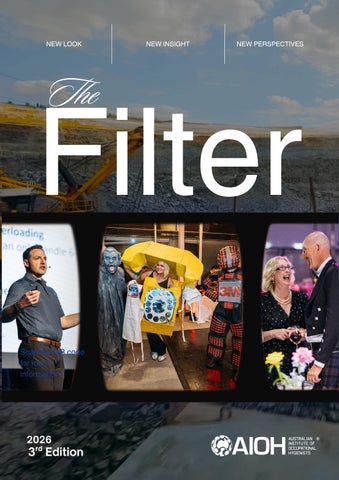
NEW LOOK
The
NEW INSIGHT
NEW PERSPECTIVES
Filter Scan the QR code for more information
2026
3rd Edition
TABLE of contents Section Welcome
Page
Content
4
Letter from the SRCMC
6
Thank you Council 2026
8
A message from the President Dr Kelly Johnstone
12
AIOH Foundation - Celebrating 10 years
14
AIOH26 Annual Scientific Conference & Exhibition
The Filter Feature
40
The Filter Feature - Indoor Air Quality Update
Accredited Universities
46
University of Queensland
48
University of Wollongong
52
AIOH Members Hub
56
Celebrating Members
58
Welcome to the AIOH
60
NSW Chapter
AIOH Awards
61
AIOH Young Leaders Acadmy (ALYA)
AIOH Events
63
2027 AIOH Courses
64
AIOH Webinar Series
65
AIOH Basic Principles Course
66
AIOH Awards - Celebrating Past Winners
72
RESP-FIT - The Fit Factory
78
A Dose of Research
78
Industry Updates
80
The world of Occupational Hygiene
AIOH Updates
AIOH Members Hub
Industry
Around the world
The
Filter SRCMC Chair Kelly Jaunzems
Marketing & Communications Sub Committee Lead
Stakeholder Relations SubCommittee Lead
Hamish Rae
Cecilia Mason
Claire Sandhu Le-récca Potgieter
Sarah Verry David Macgill Andrea Holloway Alex Britton Georgia Csorba With thanks to AIOH Team
We are now calling for content for the upcoming edition of The Filter and welcome submissions from across the occupational hygiene community. This includes articles, case studies, research insights, and practical experiences that support knowledge sharing and professional development. If you have a piece you would like to contribute, please submit your content or expression of interest to our Marcomms Lead, Hamish Rae MarComms@aioh.org.au
letter
from the SRCMC
As we approach the end of another year, this final edition of The Filter arrives at an exciting time for the occupational hygiene profession. In just a few weeks, many of us will gather for the AIOH Conference, the highlight of our professional calendar. The conference provides a valuable opportunity to reconnect with colleagues, share the latest research and practical innovations, and engage in the discussions that help shape the future of worker health protection. Whether you are attending for the technical program, professional development opportunities, networking, or all three, the conference promises to be a chance to learn, reflect and be inspired. In anticipation of the conference, this edition highlights some of the key themes and topics that continue to influence our profession. As workplaces evolve and new challenges emerge, occupational hygienists remain at the forefront of identifying risks, informing evidence-based decisions, and supporting healthier and safer work environments. Looking beyond the conference, December will bring the implementation of the revised Workplace Exposure Limits (WELs), representing a significant development for the profession. These updates will require many organisations to review their exposure monitoring programs, risk assessments, and control measures. As occupational hygienists, we have an important role to play in helping workplaces understand the changes and ensure effective management of worker exposures.
This edition also includes updates on several important developments from Safe Work Australia, reflecting ongoing efforts to strengthen workplace health and safety nationally. From evolving regulatory priorities to new guidance and resources, these changes underscore the growing focus on preventing occupational disease and addressing both established and emerging workplace hazards. As the year draws to a close, I would like to thank the many contributors, volunteers, committees and members who continue to support the AIOH and advance the practice of occupational hygiene across Australia. Your commitment, expertise and willingness to share knowledge are what make our profession such a strong and collaborative community. A special thank you goes to Alicia Gorman for her continued commitment to The Filter. Her creativity, professionalism, and meticulous attention to detail play a vital role in making each edition an informative, engaging, and visually appealing publication. As always, the expertise, ideas and commitment of the Communications and Marketing Committee are deeply appreciated, and their contributions continue to strengthen both The Filter and its connection with the wider occupational hygiene community. I hope you enjoy this final edition of The Filter, and best wishes for a safe and successful end to the year, and for a well-earned break over the holiday season.
Kelly Jaunzems
Through the Lens: Celebrating Our AIOH Photo Competition Winners! A big congratulations to the winners of the AIOH Photo Competition! Thank you to everyone who participated and shared their fantastic photos. It was wonderful to see the creativity and different perspectives from across our occupational hygiene community.
Image Sourse: AIOH Photo Competiton winner Josh Tagi - Welding in a Historic Rail Tunnel
Thank you to our 2026
Council
Thank You to Our 2026 Council!
A sincere thank you to our 2026 AIOH Council for their service and commitment throughout what has been an incredibly busy year. Council has progressed a significant amount of work across AIOH, and we thank each member for the time, expertise and contribution they have given to the Institute and our members.
President Dr Kelly Johnstone
President Elect Dr Ross Di Corleto
General Councillor Melanie Cox
Honorary Secretary Dr Adelle Liebenberg
General Councillor John Padgham
Honorary Treasurer Dustin Bennett
General Councillor Michael Eva
Voting is now open for President-Elect and two General Councillor positions. Eligible Full and Fellow Members, including Retired Full and Fellow Members, have been sent their ballot via Vero Voting, please check your email and cast your vote.
AIOH CORPORATE PARTNERS
Expressions of ineterest to membership@aioh.org.au
Two years, plenty of highlights, and a very, very big thank you A Message from 2026 President Dr Kelly Johnstone Apparently, time flies when you are surrounded by occupational hygienists! As my year as AIOH President comes to an end, I have been reflecting on my time as President-Elect and President. It has been busy, occasionally challenging, enormously rewarding and, above all, a lot of fun. The best part has undoubtedly been the people. I have loved the opportunities to meet and work with our members, staff, and volunteers, hear your ideas, and see just how much enthusiasm and expertise people bring to the Institute. There is an extraordinary amount happening across the AIOH, much of it quietly powered by people who already have very full calendars. To our Executive and Councillors, thank you for your support, thoughtful discussions, laughter and willingness to get things done. I could not have asked for a better President-Elect in Ross. Adelle has been a true workhorse as Secretary; Dusty has been a trusted and capable Treasurer; nothing is ever too much for Mel, who volunteers to assist wherever she can; Mike was always willing to help with a smile; and John always had a close eye on the details and gave his out-of-the-box, carefully considered thoughts on topics. To our staff, thank you for keeping the wheels turning while Council keeps coming up with more things to put on you! And to every volunteer contributing to a committee, sub-committee, working group, chapter event, training course, mentoring conversation or conference activity: thank you. Your contributions make the AIOH the organisation it is.
A Message from 2026 President Dr Kelly Johnstone
Reflecting on things I have done over the past 12 months, one of my personal highlights was representing the AIOH overseas. In June, I spoke at the BOHS Conference, followed in July by a webinar for BOHS members on occupational hygiene in Australia. These were wonderful opportunities to share what we do, exchange ideas and build connections with colleagues who share our passion for protecting workers’ health. They also reminded me how much we have to be proud of here at home. Attending both the AIHA and BOHS conferences was a fantastic experience. However, I came away even more convinced that there is something extra special about an AIOH conference. I may be slightly biased, but I personally believe we have the best occupational hygiene conference in the world. We have excellent, world-class scientific content and, hands-down, the very best social events. We take our science seriously, and we put a very respectable effort into enjoying each other’s company too! Alongside those highlights, Council has had a busy year progressing some important work for the Institute’s future. Rolling out Project Beyond 45 has been a major focus, putting our new committee structure into practice and supporting more members to contribute to the AIOH’s work. Structures on paper only get us so far; it is the people bringing them to life who make the difference. Thank you to everyone who has helped make that happen. We have also started the journey towards becoming a Company Limited by Guarantee. Governance may not compete with the conference social programme for excitement, but this is important work to support an organisation that continues to grow and evolve. Another significant achievement has been establishing the Occupational Hygiene Education Accreditation Board, supporting the quality and recognition of occupational hygiene education and the development of our future workforce. There are many other exciting changes that the 2026 Council has introduced, but I will leave it to the annual report to provide you with all the details.
A Message from 2026 President Dr Kelly Johnstone
This year we passed 1,700 members! That is a wonderful milestone, making us the secondlargest occupational hygiene association in the world. At a time when many professional associations are finding membership growth difficult, we are bucking the trend. Let’s keep that momentum going by continuing to make the AIOH a welcoming, useful and connected professional home. I have also valued the opportunity to liaise with Safe Work Australia. Over the years, we have established an excellent working relationship that gives us valuable opportunities to contribute our profession’s expertise. It is encouraging to see those connections strengthen, and I look forward to seeing them continue. If you have ever thought, “I might like to get more involved”, please consider this a friendly nudge. There are plenty of ways to contribute, whether you have a little time or a lot. Join a committee, help with a chapter activity, share your expertise, or consider putting your hand up for Council. And, if you are eligible, perhaps think about becoming President. You do not need to arrive with all the answers. You bring your own perspectives, ideas and willingness to contribute, and you work alongside others who care about the same things. I have learned a great deal, made wonderful connections and thoroughly enjoyed the experience. Thank you for the opportunity to serve as your President, for your support over the past two years, and for the many conversations, laughs and shared moments along the way. I look forward to seeing you at an AIOH event soon - hopefully AIOH26. Kelly Johnstone AIOH President 2026
A I O H
F O U N D A T I O N A D V A N C I N G
C E L E B R A T E S W O R K E R
1 0
Y E A R S
O F
H E A L T H
Jackii Shepherd, Chair, AIOH Foundation A decade strong, supporting research, raising awareness and helping prevent occupational disease in Australian workplaces. As Chair of the AIOH Foundation and on behalf of all our Directors past and present, we are proud to mark our 10th anniversary in 2026. 2026 gives us an opportunity to reflect on what the Foundation has achieved, recognise the people who have helped make that work possible, and look ahead to what more we can do to protect the health of Australian workers. Established on 23 August 2016, the Foundation was created as an independent charitable organisation to promote the principles of occupational hygiene in the prevention and control of workplace disease. Its establishment recognised an important challenge: while workplace safety and injuries are often visible and immediate, occupational diseases can remain hidden for years or decades before their impacts become apparent. At the heart of our work is a simple but meaningful objective: workers should never have to sacrifice their health to earn a living. We aim to improve understanding of workplace health hazards and risks, support evidence-based research, strengthen education and awareness, and encourage the practical application of occupational hygiene principles across Australian industries and occupations. At the heart of our work is a simple but meaningful objective: workers should never have to sacrifice their health to earn a living. We aim to improve understanding of workplace health hazards and risks, support evidence-based research, strengthen education and awareness, and encourage the practical application of occupational hygiene principles across Australian industries and occupations.
Translating research into action One of the most tangible ways the Foundation contributes its goal is through our grants program, supporting research and initiatives with aims to make a meaningful and measurable difference to worker health and benefit the broader Australian community. Since launching our inaugural grant round in 2020, we have supported projects addressing a range of occupational health challenges. These have included: Research by Professor Lin Fritschi and colleagues at Data Scientists Pty Ltd to develop a digital tool to help workers and occupational health professionals assess hearing loss risks associated with noise and ototoxic exposures; University of Wollongong investigating respiratory protection for volunteer fire fighters from bushfire smoke; The Cancer Council WA’s work on silica dust exposure in the engineered stone industry, alongside initiatives to improve understanding of diesel engine exhaust risks; GCG and the University of Queensland investigating exposure to quaternary ammonium compounds in cleaning occupations; University of Western Sydney investigating exposures in the hemp industry; and On-site, literal in the dirt testing of dust control by air and water. And we have even more to announce very shortly. Each of these projects addresses a different challenge, but they share a common purpose: improving our understanding of workplace exposures and finding practical ways to prevent harm. They also demonstrate why investment in occupational health research and research translation matters, particularly where evidence gaps may limit our ability to identify risks, evaluate controls and protect workers effectively.
A I O H F O U N D A T I O N C E L E B R A T E S 1 0 O F A D V A N C I N G W O R K E R H E A L T H
Y E A R S
Looking beyond the workplace
The next decade
Preventing occupational disease is complex. It requires more than technical expertise alone. We need more and better information about real-world exposures, a clearer understanding of how effectively control measures work and work in combination, stronger evidence about actual, measurable exposures and the burden of workplace illness, and greater awareness among employers, workers, decision makers and communities.
While our 10th anniversary is a milestone worth celebrating, it is also a reminder of how much work we still need to do and support. Occupational diseases continue to affect workers, families and communities, and important gaps in research, awareness and prevention persist.
These are significant challenges, and no single individual or organisation can address them alone. Progress needs collaboration across industry, government, research institutions and the occupational health and hygiene community. But, through advocacy, education, research funding and partnerships, the Foundation is helping to contribute to this collective effort. We are committed to supporting sound, reputable science and initiatives that translate evidence into meaningful improvements for workers and the wider community. None of this happens without the generosity and commitment of others. As a registered Health Promotion Charity and Deductible Gift Recipient, the Foundation relies on donations and the support of people and organisations who share our vision. I would like to acknowledge the ongoing voluntary contributions of our Board, the ongoing support of the AIOH and its members, and everyone who has helped advance the Foundation’s purpose over the past decade. .
As we look towards the next decade, our focus remains on strengthening the evidence base, supporting innovative research, raising awareness of occupational health hazards and promoting the effective application of occupational hygiene principles. I encourage our professional community, researchers, industry and the wider public to get involved. Whether through research partnerships, sharing knowledge, supporting our grants program or making a donation, every contribution can help us move closer to a future where preventable occupational disease is no longer an accepted part of working life. Again, I extend the biggest thank you to everyone who has been part of our journey so far. While we are 10 years’ strong, we are only just at the start of our journey towards making sure Australians return home from work healthy, every day. I’m glad for those who made the initial steps on this journey and I am honoured to be on a Board that continues this important work.
To learn more about the AIOH Foundation, explore our grant program or make a tax-deductible donation, come visit us at our stand at the AIOH 2026 Conference or visit aiohfoundation.org.au.
26
ANNUAL SCIENTIFIC CONFERENCE & EXHIBITION 26
Fe to the Fire: Strengthening Occupational Hygiene Iron
Conference Insights
CONTINUING EDUCATION SESSIONS
28 TH NOV 29 TH NOV
CONFERENCE
30 TH NOV 02 ND DEC
Brisbane Convention & Exhibition Centre
aioh.org.au
AIOH26 Conference The AIOH 2026 Conference is fast approaching, with a theme that is forged with purpose - Iron to the Fire Strengthening Occupational Hygiene, to be held in Brisbane, capital of the Sunshine State! Iron, the 26th element, aligns with the year 2026 and offers a powerful symbol of the strength, resilience, and evolution of our profession. Our profession has faced significant challenges - from new contaminants to shifting regulations and rapidly advancing technologies. Building on past themes of evolution, insight, and scientific storytelling, the 2026 conference invites us to explore how we continue to strengthen as a profession.
20 26
This conference will not just be a gathering of professionals but a forging ground of knowledge.
ANNUAL SCIENTIFIC CONFERENCE & EXHIBITION 26
Fe to the Fire: Strengthening Occupational Hygiene
Acknowledgement AIOH sincerely thanks the conference committee for their invaluable support and assistance in 2026. CONFERENCE CHAIR Noel Pinkerton, Director – Awareness, Engagement and Specialist Advice, Asbestos and Silica Safety and Eradication Agency SCIENTIFIC PROGRAMME CHAIR Anne Nissen – Corporate Occupational Hygiene Specialist, Anglo American
Iron
COMMITTEE MEMBERS Scientific Committee Mark Desira – Principal Health & Hygiene, Glencore Metals Australia Sidney Pierantozzi – Occupational Hygiene, Advisor, Rio Tinto Brandon Wentzel – Hygiene Specialist, BHP / BMA Dr Jane Whitelaw – Head of Discipline, Occupational Health and Safety, UOW Marketing & Communications Greg Dean – Managing Director, 5 Sticks Consulting Katherine Durie – Occupational Hygiene and Safety Consultant, KAD Hygiene and Safety Solutions Sponsorship & Exhibition Matt La Macchia – Occupational Hygienist, Boral With the invaluable support, dedication and expertise of our wonderful Events team Senior Events Manager Kelly Phypers and Event Coordinator Claire Phypers.
20 26
Message from the AIOH26 Chair The countdown to AIOH26 is on and with the program now shared, excitement is already starting to ignite. Its release marks a major milestone after months of reviewing abstracts, coordinating speakers and forging a program we can all be proud of. The program reflects the depth, diversity and strength of occupational hygiene, bringing together leading practitioners and speakers from Australia and overseas. Through fresh perspectives, practical insights and bold ideas, AIOH26 will explore the challenges shaping our work and the opportunities ahead. It promises to spark important conversations, fan the flames of new thinking and place the issues shaping our profession firmly on the anvil - while keeping the elemental purpose of our work - healthier, safer workplaces - at the centre of every conversation. Just as importantly, the conference will bring our community together - to reconnect, build new relationships and welcome those joining us for the first time. A range of social, networking and professional development activities will provide plenty of ways to share ideas, enjoy time together and add another valuable element to our professional connections. Thank you to everyone whose expertise, enthusiasm and care have brought AIOH26 to life. I look forward to celebrating with you in Brisbane as we strengthen our knowledge, networks and leadership, and forge an even stronger future for our profession. Noel Pinkerton AIOH26 Conference Chair
ANNUAL SCIENTIFIC CONFERENCE & EXHIBITION 26
Fe to the Fire: Strengthening Occupational Hygiene Iron
Conference Program CONTINUING EDUCATION SESSIONS
28 TH NOV 29 TH NOV
CONFERENCE
30 TH NOV 02 ND DEC
Brisbane Convention & Exhibition Centre
AIOH26 Program Step into the fire at AIOH26 With more than 40 speakers bringing together practical experience, technical expertise and fresh perspectives, AIOH26 is designed to challenge thinking, spark discussion and strengthen the way we approach occupational hygiene. From keynote and plenary sessions to technical presentations and shared experiences from across the profession, explore the knowledge, ideas and innovations shaping the future of occupational hygiene. Come ready to learn, connect and be inspired as we put our knowledge into action and strengthen our profession together. And when the sessions wind down, the AIOH26 program continues with a line-up of renowned social events designed to bring the occupational hygiene community together.
Register now and bring your expertise to the fire at AIOH26. DOWNLOAD CONFERENCE PROGRAM
Continuing Education Sessions Get closer to the action with AIOH26 Continuing Education Sessions (CES) - two days of practical, hands-on learning designed to sharpen your skills, expand your knowledge and strengthen your occupational hygiene practice. From real-time monitoring and AI in practice to biological monitoring, risk communication and advanced exposure assessment, CES brings current thinking and practical application together across all levels of the profession. Led by industry experts and aligned with the AIOH Career Development Pathway, these in-depth sessions are your opportunity to learn from those at the forefront of occupational hygiene, challenge your thinking and take new tools and techniques back to the workplace.
HALF DAY:
Build your capability. Fuel your professional development. Bring your knowledge to the fire. Earn valuable Certification Maintenance (CM) points while investing in the skills that will strengthen occupational hygiene - and your career.
The CES program will run on Saturday 28 November - Sunday 29 November at the BCEC.
DOWNLOAD CES PROGRAM
8:30am - 12:30pm and 1:00pm - 5:00pm Member $330 Non-Member $390
Morning or afternoon tea and lunch are included.
WORKSHOP:
1:00pm - 5:00pm Member: $130 Non-Member: $186 Lunch and afternoon tea are included.
Continuing Education Sessions Program BRISBANE CONVENTION & EXHIBITION CENTRE
28TH NOV – 29TH NOV
Meet our Keynote Speakers
Anthony Laye
Behaviour Expert & Keynote Speaker Tuesday 1 December: 9:00am – 10:00am
The Human Algorithm
Rachael Robertson
Author and Former Antarctic Expedition Leader Monday 30 November: 8:45am - 9:45am
Leading on the Edge Rachael takes you inside the harsh reality of Antarctic leadership - months of darkness, isolation, and unforgiving conditions where teamwork and safety are non negotiable. She draws powerful parallels to occupational hygiene, showing how influencing behaviour, managing risk, and fostering speak up culture are just as critical in a research station as they are in complex workplaces. Through real stories, humour, and practical tools like the “No Triangles” communication rule, she reveals why respect must trump harmony and how early intervention prevents hazards from escalating. Sponsored by:
What if the biggest factor shaping your success isn’t intelligence, experience or technical expertise… but how you communicate? Occupational hygienists work in a world where complex and often invisible risks need to be understood by very different people - workers, leaders, regulators, clients and stakeholders. And in those moments, communication becomes just as important as technical knowledge. In this high-energy and interactive keynote, behaviour expert and keynote speaker Anthony Laye reveals the hidden patterns that shape trust, influence, confidence and communication under pressure. Through powerful audience demonstrations and practical communication tools, Anthony shows how your internal dialogue, body language, tone of voice and presence shape every interaction, often before you even speak. Audiences will leave with actionable strategies to:
· Build trust and credibility faster · Communicate complex ideas more clearly and · · · ·
effectively Maintain composure when challenged or questioned Hold attention in meetings, presentations and conversations Adapt communication across different audiences and stakeholders Improve the way they show up professionally and personally
Blending psychology, human behaviour and interactive demonstrations, this session is designed to be practical, engaging and immediately useful across all levels of the profession. This is not just a keynote about communication. It’s about how you are turning up.
Meet our Plenary Speakers Megan Canright Racicot
Muthia Ashifa
How Growing Leaders Can Transform Hygiene
From Physical to Psychological Risk: Advancing Industrial Hygiene in the Mining Sector
Distinguished Professor Lidia Morawska
Cas Badenhorst
MPH, CIH, Executive Director of Water Services
Centre Director, ARC Training Centre for Advanced Building Systems Against Airborne Infection Transmission (THRIVE)
President, Indonesian Industrial Hygiene Association
Senior Manager Health, Gold Fields, Associate Professor, North West University, South Africa Design for Healthy Outcomes
Good Indoor Air Quality: Why it Matters and How to Achieve It
Angela Wallbank
Dr Cheri Marcham
New Workplace Exposure Limits for Airborne Contaminants in Australia – The Journey, Expectations, Guidance Material and Future Priorities
International Collaboration to Strengthen Industrial / Occupational Hygiene Practice
Group Manager, Policy & Engagement Group, Safe Work Australia
Kate Cole
PhD candidate, Sydney School of Public Health, The University of Sydney Silica Secrecy: Navigating Access to Silica Dust Data Under Freedom of Information Legislation
Associate Professor and MSOSM Program Chair, Embry-Riddle Aeronautical University – Worldwide (Vice President, AIHA)
Did Somebody Say Debate? Where would the profession of Occupational Hygiene be if it were not for vigorous debate? Fear not, back by popular demand, the members debate returns! The Topic? Forged With Iron: Be It Resolved, Occupational Hygienists Must Earn Their Stripes Through ‘Bread and Butter’ Field Sampling Before They Can Truly Call Themselves Competent Practitioners. Watch two teams battle it out in a lively showdown of opinions, persuasion, and (hopefully) professional composure. Affirmative Team: · Kate Atkinson (MAIOH, COH), Principal Advisor Hygiene, Rio Tinto Aluminium · John Snooks (MAIOH), Occupational Hygiene Specialist, Anglo American · Harry Tobin (MAIOH, COH), Senior Occupational Hygiene Consultant, GCG Health Safety & Hygiene Negative Team: · Tom Tobin (MAIOH, COH), Superintendent Environment & Hygiene, Boyne Smelters, Rio Tinto · Aleks Todorovic (MAIOH), Managing Director/Occupational Hygienist, Active Environmental Solutions · Rapael Lopez (MAIOH), Inspector of Mines, Health & Hygiene, Resources Safety & Health Queensland Guided by an impartial facilitator, Peter Aspinall, Principal Consultant, Halliwell Global, the debate promises strong arguments, spirited discussion, and plenty of entertainment. Most importantly, the power is in your hands attendees will vote to decide which team was the most convincing!
Panel Discussion The risks don’t work in silos. Why should we? Strengthening the Relationship Between Occupational Physicians and Hygienists – An Essential Partnership Workplace health risks rarely fit neatly into one discipline. So why should we tackle them that way? At AIOH26 - hear from leading voices across occupational hygiene, occupational medicine, health and regulation as they explore what happens when these disciplines work together. How can exposure assessment, medical surveillance and regulatory oversight come together to better protect worker health? This thought-provoking plenary panel will examine shared responsibilities, communication pathways and real-world experiences challenging us to look beyond our individual roles and strengthen the connections that underpin effective occupational health risk management. Panellists: · Moderator: Noel Pinkerton, Director, Awareness, Engagement and Specialist Advice, Asbestos and Silica Safety and Eradication Agency · Cas Badenhorst, Senior Manager, Occupational Health, Gold Fields · Tabitha Brennan (MAIOH, COH), Principal Advisor Occupational Health and Hygiene, Office of Industrial Relations · Dr David Cleveland, Specialist Occupational & Environmental Physician · Brett Young (MAIOH, COH), Principal Hygiene, BHP One profession. Multiple perspectives. One essential partnership. Join the conversation at AIOH26.
COH Points Do you need more COH points? Whether you’re new to the profession or a Certified Occupational Hygienist looking to maintain CPD points, the AIOH26 Continuing Education Sessions are a valuable opportunity to deepen your knowledge and expand your skills. Held over the weekend of 28 - 29 November, these sessions cover a broad range of practical and technical topics, making them ideal for those starting out in occupational hygiene, as well as seasoned professionals aiming to stay up to date with the latest developments in the field. Places are limited, so book now to secure your spot and make the most of your AIOH26 experience. COH members earn 0.5 CM points for a half-day.
COH Exam Preparation and Maintenance Workshop Thinking of becoming a COH? Join us for our COH Workshop available on Saturday the 28 November from 1pm – 5pm. Presented by Dr Jen Hines (FAIOH, COH), Certification Board Chair; Dr Adelle Liebenberg (FAIOH, COH), Hon. Secretary and Gavin Wellings (MAIOH, COH) Certification Board Member, this half-day workshop provides an overview of the Certified Occupational Hygienist (COH®) certification pathway, with a balanced focus on preparing for the COH examination and maintaining certification once achieved. Practical examples developed by the Certification Board, drawing on extensive experience gained through involvement in numerous COH examinations, will be shared throughout the session. Workshop materials have been prepared by the current Certification Board Jen Hines, Gavin Wellings, Linda Apthorpe, Naree Carton, Kerry McDougall, Zac Bentley and Adelle Liebenberg. Throughout the session, practical examples and discussion will be used to provide participants with strategies that can be applied to their own certification journey, whether they are preparing to sit the COH examination or maintaining an existing certification. To register for this workshop, please contact AIOH Events or add the workshop to your registration when registering for AIOH26.
REGISTER HERE
Last Chance to Register Last chance to register for conference social events! This is your last chance to register for these fantastic social activities at AIOH26. Make sure you don’t miss out on the fun, networking and memorable moments.
FOR FURTHER DETAILS AND TO REGISTER CLICK HERE
Networking Event Kick off the conference with the Opening Night Networking Event - the perfect first icebreaker to catch up with familiar faces, meet new ones and get the conversations flowing before the week gets underway. Grab a drink, say hello and start making the connections that make the AIOH conference such a great event. Date: Sunday 29 November Time: 5:45pm - 6:45pm
Venue: Plaza Terrace, Plaza Level (Level P), Brisbane Convention & Exhibition Centre Sponsored by:
AIOH Presidents Cup Virtual Golf Join us for the Presidents Golf Cup at X-Golf Southbank, a fun and social virtual golf session designed to bring together golf enthusiasts of all skill levels. Whether you’re a seasoned pro or a beginner, this event promises an enjoyable and engaging experience for everyone. Tickets are available for purchase during registration. Date: Sunday 29 November Time: 11:00am - 3:00pm Venue: X-Golf
Meeting Point: BCEC Grey Street, near Olio’s café (for an 11:15am walking departure) This year we are offering two ticket options:
» Full Ticket
Includes virtual golf, lunch and drinks
» Networking Ticket
Includes lunch and drinks, without golf participation
Tickets can be purchased upon registration. Sponsored by:
The Complete Hygiene Management Software Exposi brings the entire hygiene process together in one smart, scalable platform — helping teams make faster, smarter decisions to control risk, from assessment to control management.
Fit Test Management
Advanced Statistics
Sampling Management
Real-Time (VEM) Data Integration
Compliance Support
Control Management
Health Risk Assessment (HRA) Builder
Dashboard Reporting
BOOK A DEMO • INFO@EXPOSI.COM • 1300 397 674 • EXPOSI.COM
Social Run & Walk Date: Monday 30 November Time: 5:45am – 7:00am
Meeting Point: Front entrance of Rydges South Bank Hotel on Glenelg Street. Join fellow delegates for a relaxed social run or walk along the Brisbane River, South Bank. A great way to network, enjoy the fresh air and start your day before the conference. All fitness levels are welcome. No PBs required – just good company!
Welcome Dinner Join us for an evening of networking and delicious food at the AIOH26 Welcome Dinner, Sponsored by AES. This exclusive event is the perfect way to connect with fellow professionals and kick-start the conference in a fun, relaxed setting. Date: Sunday 29 November Time: 7:00pm - 10:30pm
Venue: Plaza Terrace Room, Plaza Level (Level P), Brisbane Convention & Exhibition Centre Dress Code: Smart Casual Sponsored by:
Then grab a coffee together afterwards, shouted by 5 Sticks Consulting, before heading off to kick-start your conference day.
REGISTER YOUR INTEREST HERE Disclaimer: Please make sure you’re comfortable and able to participate safely. Participation is at your own risk, so take it at your own pace and most importantly, have fun!
Trusted Monitoring for Safer Workplaces and Environments Specialist solutions for occupational health, safety and environmental monitoring across Australia and New Zealand.
Industrial Safety
Occupational Hygiene
Environmental Monitoring
Connected Solutions
Better Monitoring. Better Decisions.
What We Do
AES combines monitoring technology, specialist expertise and ongoing support to help organisations identify hazards, understand exposure and manage workplace risks. Turning reliable data into practical action for safer, more compliant workplaces.
Equipment Sales & Technical Solutions Equipment Hire
Connecting Technology, People and Expertise.
Service & Calibration
For 25 years, AES has supported the occupational hygiene community with monitoring technology, connected data and specialist expertise. Helping professionals turn measurements into meaningful insights, make informed decisions and create safer workplaces and environments.
Gas Detection
Heat Stress
AES Connected Solution
Dust Monitoring
Noise, Sound & Vibration
Respiratory Protection
Biological Monitoring
Melbourne
Perth
Sydney
Brisbane
03 9464 2300
08 9249 5663
02 9716 5966
07 3267 1433
@company/active-environmental-solutions
aesolutions.com.au
AIOH Themed Night The Science is Solid. The Theme is Elemental. The Night Will Be Legendary! Sponsored by 3M, this legendary social event is back - and this year we’re celebrating the elements that shape our world! Inspired by our 2026 conference theme, Iron to the Fire: Strengthening Occupational Hygiene, we invite you to embrace this year’s themed dinner… Elemental! From Element 26 - Iron to every element on the periodic table, it’s time to let your creativity shine. Whether you’re inspired by earth, air, fire or water, a favourite chemical element, or the wonders of the periodic table, this is your chance to bring science to life.
· · · ·
Will you channel the strength of Iron? Ignite the room as Fire? Shine as Carbon in all its forms? Or become one of the many elements that make our world extraordinary?
Every element forges new growth and inspiration… which one will you be? Sponsored by:
Dress to Impress Show off your most creative Elemental look and enter the Best Dressed Competition for your chance to win the coveted 3M apron! Categories:
· · · ·
Best Individual Costume Best Group Costume Most Creative Costume Best Use of 3M Products
Event Details: Date: Monday 30 November Time: 7:00pm – 11:00pm
Secret Venue: 10 minute walk from the Brisbane Convention & Exhibition Centre – location revealed on the day! The walking convoy departs at 6.40pm sharp from the BCEC ground floor main entrance, located on the corner of Merivale & Glenelg Streets, South Brisbane.
A Practical Guide to Re-evaluating Respirator Selection After Exposure Limit Changes Download our technical white paper to learn how reevaluating respiratory protection after an exposure limit change can help strengthen worker protection. Explore how Assigned protection factors (APF) inform respirator selection, and why a structured, holistic approach can support alignment with current workplace exposure limits and guidance, improve usability, and protect worker health under changing workplace regulatory requirements.
Key Benefits • Understand the impact of exposure limit changes on respirator selection • Learn the role of Assigned protection factors (APF) in respiratory protection selection See practical worked examples showing how to assess whether a respirator’s APF is adequate before and after exposure limit changes • Support stronger respiratory protection program outcomes • Improve worker protection, usability, and decision-making • Take a proactive approach to changing workplace conditions to maintain regulatory compliance
Click or scan to Download the white paper
3M Australia Pty Ltd Bld A, 1 Rivett Road North Ryde, NSW 2113 Customer Services: 1300 363 565 Email: 3msupport.safety.au@mmm.com 3M.com.au/ppesafety
QR-ELC-WP
White Paper:
A Practical Guide to Re-evaluating Respirator Selection After Exposure Limit Changes ID 2344802 RID 2344796
#3MScienceofSafety
Take a more informed approach to respirator selection.
© 3M 2026. All rights reserved. 3M, Secure Click, Aura, Cool Flow, Scott and Versaflo are trademarks of 3M Company. Product and Content accurate at the time of publication. Products and product information is subject to change. Application images may show product not available in ANZ. Note: 3M does not accept responsibility or liability, direct or consequential, arising fro reliance upon any information provided and the user should determine the suitability of the products for their intended use. Nothing in this statement will be deemed to exclude or restrict 3M's liability for death or personal injury arising from its negligence or fraudulent misrepresentation.
Emerging Hygienist Group (EHG) Date: Sunday 29 November Time: 4:00pm – 5:00pm Location: Room P11, Plaza Level, Brisbane Convention & Exhibition Centre Start your AIOH26 experience by joining the AIOH Emerging Hygienists Group to play the famous game of Family Feud. We’ve found the hot topics! We’ve polled the audience! We’ve got our game show moustache on! Come to play or cheer on the teams. Meet fellow delegates, make new connections, and settle into the conference in a relaxed and welcoming atmosphere.
Newcomers Speed Networking Date: Sunday 29 November Time: 5:00pm – 5:45pm
Location: Plaza North Terrace, Plaza Level, Brisbane Convention & Exhibition Centre Attending your first AIOH Conference? Looking to expand your professional network? The Newcomers Speed Networking Event is designed to help you make meaningful connections from the moment you arrive. In a relaxed and welcoming environment, you’ll have the opportunity to meet fellow delegates, connect with experienced professionals, and build relationships that can support your career for years to come. Whether you’re an emerging hygienist, student, early-career professional, or simply attending AIOH for the first time, this event provides the perfect introduction to the conference community.
Mentoring Program Workshop Date: Monday 30 November Time: 7:15am - 8:15am
Location: Room P6, Plaza Level, Brisbane Convention & Exhibition Centre Interested in getting more involved in the AIOH Mentoring Program? Join this session to explore how the program works, hear practical advice, and discover how mentoring can support your professional growth. Whether you’re considering becoming a mentor or mentee, or are already participating, this session is for you. Plus, you’ll have the chance to win some great lucky door prizes!
Gala Dinner An evening of celebration, connection and plenty of reasons to hit the dance floor! Join us as we recognise and celebrate the outstanding AIOH Professional Development Award winners - a special highlight of the conference and a night you won’t want to miss. Enjoy a delicious three-course dinner, celebrate alongside friends and industry peers, then get ready as the DJ turns up the energy and keeps the party going! Come dressed to impress and help us celebrate the achievements of our profession in style. Date: Tuesday 1 December Time: 7:00pm -11:00pm Location: Great Hall 3 & 4, Foyer Level (Level F), Brisbane Convention & Exhibition Centre Dress Code: Formal Attire
With thanks to our 2026 conference sponsors Welcome Dinner
Themed Night
Networking Event + Presidents Cup Virtual Golf
PLATINUM SOCIAL
KEYNOTE SPEAKER
SATCHEL
SILVER
BRONZE
SUPPORT
Conference App The Conference App will be your goto guide for everything AIOH26, with easy access to the program, speaker information, session details and networking opportunities. Download the AIOH26 Conference App by scanning the QR code or clicking the image below, then enter the event code AIOH26 to get started.
ANDROID APP
IOS APP
To log in, tap the Login icon and enter your email address and App PIN. Your App PIN can be found at the bottom of your conference lanyard, which you’ll receive when you register onsite. If you’d like to receive your App PIN before the conference, please contact AIOH Events. Please note: The app is still being updated. While it is fully functional, some content and features are still being finalised. Thank you for your understanding as we continue to make improvements ahead of the conference.
Additional Social Activities STORY BRIDGE ADVENTURE CLIMB For an unforgettable Brisbane experience, take on a scenic climb where every step reveals sweeping views, from the Glass House Mountains to Moreton Bay. Enjoy 20% off all Story Bridge Adventure Climb packages when you enter the promo code ‘AIOH26’ at checkout.
BOOK HERE
HAUNTED BRISBANE CBD GHOST TOUR Brisbane is haunted by 200 years of crime and tragedy. Discover the ghosts of The River City on a guided walk of the CBD. Hear ghost stories including the Haunted Hotel, Devil’s Trade & Spectre of Captain Logan. Use discount code GTA25HBCBD for 25% off.
BOOK HERE
BLOODY BRISBANE CBD CRIME TOUR Behind the modern façade discover the dark heart of the capital. Walk three city blocks through two centuries of Brisbane’s criminal history on a 2-hour guided tour and visit real true crime scenes. This is the True Crime Tour to begin with – Brisbane’s original and best – operating since 1998. Use discount code CTA25BBCBD for 25% off.
BOOK HERE
THE WHEEL OF BRISBANE
TANGALOOMA ISLAND RESORT
Take the opportunity to experience stunning panoramic views of the city and South Bank on the Wheel of Brisbane!
Escape to the natural beauty of Tangalooma Island Resort on Moreton Island - one of Brisbane’s most unique island destinations. Surrounded by pristine beaches, marine life and national park landscapes, Tangalooma offers unforgettable experiences and adventures for every traveller, making it easy to see why it’s known as nature’s theme park.
Enter the discount code AIOH26 at the checkout to enjoy an exclusive 20% discount on Adult tickets for the Brisbane Wheel from 25 November to Sunday 6 December. BOOK HERE
XXXX BREWERY Explore over 145 years of brewing history with a guided 90-minute tour of Queensland’s iconic XXXX Brewery, followed by a beer tasting in the XXXX Alehouse. Enjoy $10 off all XXXX brewery tours between 25 November until Sunday 6 December when you enter the promo code AIOH26 at checkout, applies only to: XXXX Brewery and Alehouse Tour.
AIOH Conference delegates can enjoy 10% off selected resort accommodation, day cruises and return transfers to Tangalooma Island Resort. Offer valid for travel between 20 November – 10 December 2026. BOOK HERE
HOWARD SMITH WHARVES Nestled beneath the Story Bridge, this vibrant waterfront precinct features 13 restaurants, cafés, bars and a hotel, all just a short ferry ride from the BCEC. Make sure to visit the iconic Howard Smith Wharves.
BOOK HERE MORE INFO
RIVERLIFE BRISBANE Discover Brisbane from a different perspective with Riverlife’s outdoor adventures. Choose from kayaking, abseiling, rock climbing, bike hire and more, with activities and equipment hire available to suit every level of adventure. Use discount code AIOH26 for 20% off.
BOOK HERE
See what's next. Meet the ETS team and our visiting partners.
PROUD TO SPONSOR THE SATCHELS
VISIT US AT BOOTHS
41 & 42
ALSO ON SHOW
HoneyWell & RAE Systems
Spot Noise & Noise Terminal
AEROQUAL
DUSTECH
Near Reference Quality Air Monitors
XPS Titan
VP Global Strategic Accounts, Aeroqual
Managing Director, DusTech
DPM monitor
With Paul Pickering
With Arnold Perez
AIOH26 Conference & Exhibition 30 NOV - 2 DEC Brisbane
LIVE DEMO AVAILABLE Experience the SmallTalk ST2 in action. See how it integrates with Sundström respirators and PAPR head-tops.
Visit us at Stand #44/47 Proud keynote sponsor
For more information contact Safety Equipment Australia
SEA.Enquiries@sea.com.au 1800 655 129 | +61 2 9910 7500
DEBUTING
Casella air sampling range
Accommodation Last-minute bookers – this one’s for you! Our preferred AIOH26 hotels are listed below, but with the conference getting closer, some of our original room blocks and discounted rates may now be limited or unavailable. Check the booking links below, and if your dates aren’t showing, contact the hotel directly to see what they can do.
» Rydges South Bank » Novotel South Bank » Adina Brisbane » W Brisbane » Mantra South Bank* *For Mantra South Bank Hotel Bookings, follow the steps below to secure your accommodation:
· · · · · ·
Enter hotel name, dates and number of guests Select the ‘Special Rates’ dropdown Under ‘Other Special Rates and Promo Code’ Select ‘Promo Code’ and enter ARGRP26 (case sensitive), then click search Discounted rates will display with a red ‘Special Offer’ banner Once your booking is complete, you will receive a confirmation email
Transport If you’re flying into Brisbane Airport for AIOH26, getting to the Brisbane Convention & Exhibition Centre is easier than you might think! Airtrain: Take the BDVL Train (Gold Coast line) directly from either the International or Domestic Airport stations straight to South Brisbane Station. The Brisbane Convention & Exhibition Centre is a short 4-minute walk from the station. The total journey takes approximately 32 minutes.
Thank You to our Award Sponsors Professional Development Awards will be presented at the AIOH Gala Dinner on Tuesday 1 December. Contact AIOH Events if you would like to purchase a ticket to the Gala Dinner only. AIOH PROFESSIONAL ADVANCEMENT AWARD Sponsored by
AIOH YOUNG HYGIENIST AWARD Sponsored by
AIOH POST-GRADUATE SCHOLARSHIP Sponsored by
AIOH CONFERENCE PACKAGE AWARD Sponsored by
AIOH BEST CONFERENCE POSTER Sponsored by
AIOH BEST CONFERENCE PAPER AWARD Sponsored by
AIOH RESEARCH & INNOVATION AWARD Sponsored by
2026 Exhibitors A big thank you to all our exhibitors for their support of AIOH26. Your involvement helps make the conference experience possible. Don’t miss the opportunity to connect with our exhibitors, explore innovative products and services, and have valuable conversations with organisations from across our industry.
Check out below who’ll be joining us at AIOH26! 01
CLEANSPACE TECHNOLOGY
31
CONTROL EQUIPMENT
02
SGS
33
MAXISAFE
03
AIOH
35
ALLENS INDUSTRIAL PRODUCTS
05
OCTFOLIO
37
CORITY
06
AUSTRALIAN LABORATORY SERVICES
38
AMAL ANALYTICAL (AUSTRALIA)
07
ECOSAFE INTERNATIONAL
39
RVT GROUP AUSTRALIA
09
5 STICKS CONSULTING
40
ALLIANCE SAFETY EQUIPMENT
10
ZXONIC
41
EXPERT TESTING SERVICES
11
PRYME AUSTRALIA
43
SAFETY EQUIPMENT AUSTRALIA
12
PACIFIC EARS
44
WELDCLASS
13
OCEANIC LABORATORY INITIATIVE
45
ENVIROLAB SERVICES (WA)
14
ATG GLOVE SOLUTIONS
47
GCG HEALTH SAFETY & HYGIENE
17
MYCOLOGIA
49
ACTIVE ENVIRONMENTAL SOLUTIONS
18
EUROFINS ENVIRONMENT TESTING AUSTRALIA
53
COTRAL LAB
19
PINSSAR
54
CAC GAS & INSTRUMENTATION
20
CONTROL HIRE
56
SIMTARS | RESOURCES SAFETY & HEALTH QUEENSLAND
21
APEX WELDING SAFETY
57
TEAM CARE INSURANCE BROKERS
22
INDUSTREE
58
DRAEGER AUSTRALIA
24
ID SERVICES
59
SAFE FIT
25
ACU-VIB ELECTRONICS
60
THERMO FISHER SCIENTIFIC
26
MY OCC HEALTH RECORD
62
KENELEC SCIENTIFIC
28
PIP GLOBAL SAFETY
64
AIMWELL
30
BECKER MINING AUSTRALIA
65
SAFEWORK NSW
2026 Exhibitors
(continued)
66
AIR-MET SCIENTIFIC
76
RED OHMS GROUP
67
3M AUSTRALIA
77
BLACKLINE SAFETY
70
NVMS
78
RMT GLOBAL
71
MITILABS
79
BREATHESAFE
72
PROFICIENCY TESTING AUSTRALIA
80
BIOSYMM
74
UNITED SAFETY AND SURVIVABILITY CORPORATION
81
ACL INDUSTRIAL TECHNOLOGY
75
THE PPE GROUP
6 53
8
11 SERVERY
_DR _08 20- 35
2095
COLONNADE
_ DR_ 09 20 -4 0
FHR
74
19
21
75
71
54
76
70
1
17
18
40
22
77
65
64
39
38
37
24
CORRIDOR
25
78
72 80
66 60
62
58
49
41 35 32
31
30
20
28
26
STAIRS
44
SERVERY
44
SERVERY BEVERAGE
44
44
5
44
44 44 44 44
LIFT No.
6
44 44
LOBBY LIFT
LIFT No.
STORE
FHR
44
STAIRS
STAIRS
44
44
FHR
_J 6D-0 0 _ 94T 2_ R _
44
BAR
60
44
LOBBY
700
44
FEMALE
Windows
44
UP
STAIRS
10 Windows
44
EXHIBITOR STORAGE
_J 6D-0 0 _ 94T 2_ R _
STAIRS
44
FHR
_DR _08 20- 35
9
FHR
COLONNADE
12
STAIRS
13
_J 6D-0 0 _ 94T 2_ R _
STAIRS
PWD
5 PWD
2 _J 6D-0 0 _ 94T 2_ R _
RK5D-51
AIOH
PREFUNCTION
44 45 42 43
2X10A DBL43 A-P4 RK
Nil
Through to foyer UP
Through to foyer
2026 Map 44
44 44
44 44
44 44
44 44 44
44 44 44
44
14 79
73
81
67 59
57
56 47 45
43
7
33
27
26
Fe to the Fire: Strengthening Occupational Hygiene Iron
aioh.org.au
Indoor Air Quality Update Brad Prezant, Dino Pisaniello, Claire Bird and Phil Turner While Indoor Air Quality (IAQ) has always been within the scope of occupational hygiene theory and practice, it is likely to be more prominent due to the specific inclusion of IAQ in two codes of practice, namely the forthcoming updated Workplace Facilities code and the Biological Hazards code. There is a burgeoning industry relating to building IAQ verification and restoration of contaminated buildings. For example, the roles of the WELL Performance Testing Agent and the RIA “Indoor environment professional” overlap with traditional occupational hygiene practice. Furthermore, in the space of only one month, the following conferences were held: 24-25 August: IAQ Association of Australia IAQ Conference (Gold Coast); 25-27 August: Restoration Industry Association (Aust) Conference (Gold Coast); 31 August- 4th September: AIRAH IAQ26 Conference (Cairns); 16-18 September: THRIVE Forum on dampness and mould (Darwin) In addition, the Clean Air Society of Australia and New Zealand held their biannual conference on the 31st August to the 2nd September (Cairns) which is important because much of what we are exposed to indoors starts outdoors. On the advocacy front, we’ve had the NSW Parliamentary Inquiry on Clean Indoor Air, and the “Safer shared air 2026” conference is scheduled for 28 October at Parliament House, Canberra. In parallel with the above-mentioned activities, the current survey of AIOH members will assist in understanding the current involvement of hygienists in the IAQ ecosystem. IAQ 26 Conference Summary The blockbuster event was the five-day IAQ 26 event organised by AIRAH in Cairns. It was an entire week of widely varying perspectives on topics from building science to psychrometry, from nanomaterials on buildings to reduce heat load, to reducing particle load in hospitals. Here is a short summary of the presentations. Warning: This annual conference run by AIRAH is not for the faint hearted. Most of the participants are mechanical engineers, building scientists and facility managers. However, it is a “must attend” Australian conference for hygienists interested in IAQ.
Indoor Air Quality Update Key takeaways: In the future IAQ criteria will likely be merged with acoustics, thermal comfort and lighting in the broader area of Indoor Environmental Quality. Dilution is not really the solution to pollution. Dragging in more outside air has energy impacts, may exacerbate humidity issues in some climate zones and may introduce air pollutants from bushfires etc. Climate change issues are interrelated with IAQ. Buildings need to be resilient to internal and external environmental insults, and reduce global warming impacts. This directs us to technologies that reduce exposure to airborne infective or harmful agents, bushfire particulate matter and odour. In this way we can make the most of standards like the ASHRAE 241 Infection Control standard to achieve healthy air without increasing our emissions. Work health and safety regulation is more sophisticated than public health regulation, and is now seen as a key pathway to controlling and improving IAQ. Building Science Workshop (Days 1 and 2) This was a 2-day workshop run by world leading building physicist Jospeh Lstirubek. What can you say about 2 days of amazing and brilliant insights into why buildings fail, and how to build them to avoid the all-to-common errors that predominate? Joe Lstiburek is an international wunderkind, known by many as the author of “The Perfect Wall” and a prolific writer on buildings of all kinds and descriptions.
Humidity and Dehumidification Workshop (Day 3) This was a multi-contributor panel on how we design and manage humidity in tropical climates run by Sonia Holtzheimer, a mechanical engineer. The Moisture Ultimatum – addressed the need for paying attention to dewpoint, and potential mechanisms for encouraging or mandating consideration in design. The “Silence of the Damp” – examining the health impacts of moisture by Brad Prezant demonstrated that indoor moisture is responsible for at least 15% of childhood and adult asthma, with the associated enormous cost and productivity burden. Prezant cited 15 other adverse health outcomes associated with indoor dampness, taking us through the mechanisms by which indoor dampness results in exposures to fungal and other biological particulate that impacts our health. “Houston, We Have a Problem”, narrated by Lew Harriman, focused on the need to keep the dew point below a reasonable setpoint, showing that when plotted on the psychrometric chart, Queensland and New South Wales climate data demonstrates that a very significant portion of the year requires dehumidification but not cooling in these climate zones to avoid excess ambient humidity. Sadly, our current approach does not provide such dehumidification, leading to the too common mould complaints we have seen, exacerbated by a changing climate. Grant Charles, the Moisture Whisperer, followed up with a summary of the various technologies available to manage moisture, leading us through an explanation that drew heavily on the psychrometric chart (good thing we had the PsychroBrew summary the night before). Brett Fairweather (expert in ventilation standards setting in Australia) and his counterpart, Sonia Holzheimer added more insight into the issue by reviewing existing standards and identifying mechanisms that we can use to rectify indoor moisture issues. Dr. Joe Lstiburek, “The Moisture Strikes Back”, fresh off 2 days of building science, gave us further insight into how buildings fail to manage moisture, while John Bourne, “Wet Hard”, gave us some good practical examples of moisture failures and successes. A robust discussion with the speakers, followed by a summary by Sonia Holzheimer rounded out the day.
Indoor Air Quality Update IAQ Core Conference (Days 4 and 5) The keynote speaker, Joe Lstiburek, started us off with a little Shakespeare: “To Vent or not to Vent…That is the question” Who knew that Shakespeare was going to lead us to examine the long-established basics of physics Joe reviewed, and explain why insulation can be a really bad thing? We learned that it was okay to wet a wall assembly as long as it could dry. Take away the energy flow with insulation, interrupt that drying, and you are in trouble. Even more so if the building materials are highly vulnerable to moisture. More Shakespeare: Tis better to separate the interior moisture from the exterior moisture with a vapor barrier, and tis better to keep the surfaces in contact with that moisture at a temperature to prevent condensation. The Lstiburek doth protest too much… but he always nails it when it comes to constructing wall, roof, and underfloor assemblies to properly manage airflow, energy, and moisture. Josiah Padget described Australia’s journey to measure building tightness over the last several decades, noting the absence of mandatory performance in Australia versus other countries. He highlighted the importance of room sealing in hospitals to control airflow to prevent infection. We next heard from Corey Metzger, remotely from the U.S., describing the ASHRAE Center for Excellence and their strategic plan to gather up all the IEQ-related portions of many different standards and begin the process of creating an IAQ Standard or Guideline. What can Australia learn from the U.S. experience? An important study from Victoria was described by Loukas Tsigaras (Burnet Institute) and Prof. Jason Monty (University of Melbourne). While final analysis is pending, the intervention study retrofitted schools throughout the state with a variety of ventilation technologies and measured their impact on air quality.
Geoff Hanmer reviewed the history of school ventilation and described preliminary results from his study comparing NAPLAN results in naturally ventilated schools in NSW with mechanically ventilated schools. After adjusting for socioeconomic factors, no differences were seen in the cognitive performance measures. Adrian Duff from Metro North, Queensland Health, described a hospital intervention study which used a multimode filtration technology, PlasmaShield, to massively reduce PM2.5 particulate load in Queensland hospitals. Fungal structures were also largely reduced, though recontamination from downstream ducting recontaminated the airflow, tempering the effect. He indicated that 20% of the mould contamination was associated with the clean air passing through the contaminated ductwork. The treatment technology was also highly effective on ultrafine particles. Mark Hooper from Echuca Regional Hospital presented another case study comparing PlasmaShield treatment technology with conventional media filters for both infection control and energy efficiency. During a bushfire incident, ozone, VOCs, and other contaminants were reduced for the traditional media filters versus the PlasmaShield treatment from 10% to less than 0.004% for particles 0.3 microns to 25 microns, and from 8% to less than 1% for the ultrafine particulate. We learned from Venkatesh Rongali that occupancy in a meeting room can be sensed more accurately, and outdoor air reduced by 14%, using AI-based person counting as compared with demand control CO2. Seems like this will be the future technology to provide a better match of ventilation need and energy efficiency with occupancy patterns.
Indoor Air Quality Update Gordon Lacey compared desiccant wheel reheat with refrigerant reheat in dedicated outdoor air systems (DOAS), showing us the energy savings of 32% that can be achieved with a desiccant approach. Dr Claire Bird took us through a Quality Control course in personnel providing indoor air quality consultation, laboratory services, and mould consulting. She described the role of standards, and difficulties in areas absent standards, providing a roadmap to overcome some of the difficulties. The moral? Caveat emptor. An exciting presentation by Prof. Browyn King on the various organisations providing advocacy worldwide to leverage our knowledge, science, and technology to implement societal change to improve indoor air quality came next. A new initiative within Australia to establish a National Healthy Air Strategy was described: establishment of an advisory group to plan a way forward and creation of a significant federal budget submission. Prof. Pawel Wargocki showed us the actions being taken in Europe to meld indoor air quality considerations into the Energy Performance of Buildings Directive (EPBD) for the first time in a meaningful way. Now it is up to each State to implement these requirements. He also described one of the measurement systems used for this purpose, TAIL. The first day wrapped up with Browyn King moderating a panel on IAQ Policy that included Plum Stone, Nathan Lee (SWA), Brad Prezant, and Brett Fairweather. Prof. Mat Santamouris (UNSW) opened the day with his keynote presentation. He showed the relentless increase of heat stress worldwide, and the sobering increase in demand for air conditioning worldwide, and its consequences. Then he presented an alternative to our current path. Intelligent management of cities and buildings to reduce heat gain can provide a massive reduction in both public health harm and energy use.
He showed us some remarkable materials from his laboratory capable of reducing cooling load, and described the technological advancements that will need to be incorporated into our buildings to choose the alternative path. Prof. Mat Santamouris (UNSW) opened the day with his keynote presentation. He showed the relentless increase of heat stress worldwide, and the sobering increase in demand for air conditioning worldwide, and its consequences. Then he presented an alternative to our current path. Intelligent management of cities and buildings to reduce heat gain can provide a massive reduction in both public health harm and energy use. He showed us some remarkable materials from his laboratory capable of reducing cooling load, and described the technological advancements that will need to be incorporated into our buildings to choose the alternative path. Joe Lstiburek returned for a second keynote, this time focusing on the importance of preventing airflow through wall assemblies. People need to breathe…walls do not. A remote presentation from Prof. Richard Shaughnessy (University of Tulsa) described the application of genetic technologies to create fungal community characterisation of dust samples from two groups of residences buildings with water damage and buildings without water damage. The goal is to differentiate these two groups by using the fungal community characteristics. Previous efforts have focused on single fungal species or total indicators of fungal load and have not been as successful as this novel approach.
Indoor Air Quality Update
Prof. Dino Pisaniello described the many health hazards associated with hospitals and health care workers. He presented practical solutions in four hospitals that do not necessarily rely on high outdoor intake levels to dilute contaminants. Jack Noonan led a panel session on return on investment for property owners and developers. Devan Valenti, Ron Pulido, and Ben Gill participated in the discussion Jeremy Stamkos described a highly engineered approach to designing indoor cigar lounges, relying on controlled airflow to minimise exposure of cigar smokers to second-hand smoke as well as condensed smoke particulate on surfaces. With recent changes to filter standards in Australia, and adoption of ISO/AS16890, Daniel McCaffrey took us through the changes and the energy implications of the various choices to meet those standards for filters ranging from coarse through molecular filtration, as well as introducing ISO1012-3 regarding hybrid filtration. A lively presentation in honour of Dolly Parton by Sonia Holzheimer and Brett Faiorweather reviewed the National Construction Code and Australian standards landscape, including AS1668 and AS3666.1. With the new AS1668.2 promulgated “From kitchens to carparks”, the changes were highlighted.
Philip Turner reminded us of the importance of air movement, but not too much air movement, to create comfort in office environments. He used examples from buildings with complaints and surveys of air velocities in multiple locations to illustrate the difficulties inherent in evaluating comfort. Vali Shishebori provided data from a residence impacted by bushfire smoke, demonstrating the infiltration through measurement of multiple parameters indoors and outdoors, while recording window operation. A summary by Claire Bird of the activities this past year of the AIRAH IAQ Special Technical Group followed. Much work has been accomplished this past year and the future looks even busier as we investigate how our special interests groups can work more closely together. AIRAH President Mikaila Ganado ended the conference, thanking the staff and conference organising committee for their efforts, and all of the sponsors who made the conference possible. Key scientific program organisers were Brad Prezant and Claire Bird.
We heard from Prof. Jim Cotter (remotely) on the comparisons between people and buildings on how we respond to temperature and humidity, and how we exchange thermal energy. We learned of the resilience of the human (our deadband, perhaps?) and the opportunities to take advantage of this resilience in future designs.
Brad Prezant, Dino Pisaniello, Claire Bird and Phil Turner
Apply now for Semester 1 or 2 Domestic deadline: 31 January International deadline: 30 November
Occupational hygiene update | End of 2026 For information about studying occupational hygiene at UQ, contact Program Director Associate Professor Kelly Johnstone: k.johnstone2@uq.edu.au As 2026 draws to a close, The University of Queensland (UQ) occupational hygiene team would like to thank all the fantastic OH professionals and industry partners who have supported our students throughout the year. We also congratulate our graduating students and share recent publications from the UQ team. Our sincere thanks go to Peter McGrarry, Ross Di Corleto, Mike Shephard, Noel Pinkerton, Brad Geinitz, Mark Russell and Michael Lewis, along with Paul Thomson from 3M, Wayne Hosier from Airmet and Craig Symes from Ansell, for volunteering their time and expertise to assist with teaching this year. Their contributions bring professional experience into the classroom and help students connect their learning with occupational hygiene practice. We greatly appreciate their generosity and continued support for the next generation of occupational hygienists.
A special thank you to Kerri Melkersson, John Pagham, Pieter van Zanten, Marli Tisdale, David Osborne, Inga Usher and the other staff at Simtars for hosting our students for a site visit for the 15th consecutive year. This longstanding relationship provides a valuable opportunity for students to see occupational hygiene science in practice and learn from the expertise of the Simtars team.
Warm congratulations to all students graduating at the end of 2026 from our Master of Occupational Hygiene and Dual Master of Occupational Hygiene and Occupational Health and Safety Science programs. Completing postgraduate study takes commitment and perseverance, often alongside work and family responsibilities. We wish our graduates every success as they take the next steps in their careers and look forward to seeing their contributions to the profession. Recent publications from our team Recent publications address chemical exposures in explosive ordnance disposal and noise in the veterinary sector, including: Collett, G., Johnstone, K., Bashford, T., Proud, W., Tazi, M., Hemelrijck, M. V., Bryan, R. T., & Fry, B. G. (2026). From Blast to Biological Uptake: Residual Dinitrotoluene as an Occupational Exposure Hazard in Explosive Ordnance Disposal. Toxics, 14(9), 812. https://doi.org/10.3390/toxics14090812
Fry, B. G., Johnstone, K., & Pizzino, S. (2026). Beyond Blast Injury: Occupational Hygiene, Safety, and Toxicology Considerations for Mixed-Metal and Energetic-Chemical Exposures to Explosive Ordnance Disposal Personnel. Toxics, 14(5), 379. https://doi.org/10.3390/toxics14050379 Johnson, L., Johnstone, K., & Cook, M. (2026). A silent hazard—noise in the veterinary sector: a scoping review. Occupational Medicine, 76(2), 123–131. https://doi.org/10.1093/occmed/kqag008
Forging the future of Occupational Hygiene: From Wollongong to the World: University of Wollongong by Dr Adèlle Liebenberg | E: liebenberg@uow.edu.au | University of Wollongong As 2026 draws to a close, it's a great opportunity to reflect on another busy and rewarding year for the Occupational Hygiene, Health and Safety team at the University of Wollongong (UOW). From international conferences and industry engagement to welcoming new colleagues and expanding our research activities, there's certainly been no shortage of things happening. And we're already looking forward to what 2027 might bring!
Sharing knowledge and connecting with industry Our team has been actively contributing to the profession, both nationally and overseas. Dr Jane Whitelaw presented research on firefighter exposures at the AIHA conference in New Orleans and SafeWork symposium in Adelaide. She also travelled to Montreal to showcase groundbreaking work on the 3D facial scanning fit testing of RPD at the IRSP conference, which will also be presented at AIOH26 in Brisbane. Linda Apthorpe presented at the online component of the 2026 International Remediation Technologies conference on behalf of the ALGA. The topic was: From investigation to analysis, understanding asbestos contamination in soil. Closer to home, Dr David Noi presented his research relating to real-time dust monitoring at the SafeWork symposium in Adelaide and Dr Adèlle Liebenberg presented at the WHS Showcase in Sydney, exploring how we might rethink occupational exposure and worker health across a working lifetime. Linda and Adèlle are also contributing to professional development by presenting Continuing Education Sessions (CES) at AIOH26 in Brisbane – sessions not to miss! We also had the pleasure of hosting the recent AIOH NSW Chapter meeting on issues with calibration of real time dust reading instruments at UOW coinciding with the release of the AIOH Technical Guide on Direct Reading Instruments, with a fantastic turnout and some excellent opportunities to reconnect with colleagues, share knowledge and strengthen industry relationships.
Forging the future of Occupational Hygiene: From Wollongong to the World
These activities are an important part of what we do: sharing the challenges facing the profession and bringing contemporary industry experience and emerging knowledge into our teaching and research.
From UOW graduate to colleague – welcome Carmen! We're delighted to welcome Dr Carmen Naylor to the UOW team who joined us in November. Many AIOH members will already know Carmen through her extensive involvement in the profession. A Certified Occupational Hygienist and Certified Radiation Safety Advisor, Carmen brings considerable industry and technical expertise to our team. What makes her arrival particularly special is that Carmen is also a UOW graduate, having completed her degree in Exercise Science, Master of Research, Master of Occupational Hygiene and PhD at UOW. Her journey from undergraduate student to experienced industry professional and now academic colleague is a wonderful example of the diverse career pathways that postgraduate education can open! We're thrilled to have her back at UOW on our academic team and look forward to the expertise, experience and fresh perspectives she'll bring to our teaching and research activities.
Forge your career at UOW! Whether you're relatively new to occupational hygiene or have years of experience under your belt, there's always something new to learn. Our postgraduate Occupational Hygiene and Work Health and Safety programs combine strong scientific foundations with practical, industryrelevant learning. We aim to develop professionals who can think critically, investigate complex workplace challenges and confidently apply their knowledge to protect worker health. We also recognise the enormous value of industry experience. Our students bring diverse professional backgrounds into the classroom, enriching discussions and connecting academic learning with real-world practice. If you've been considering further study, advancing your professional qualifications or are encouraging a colleague to pursue occupational hygiene, we'd love to hear from you.
Forging the future of Occupational Hygiene: From Wollongong to the World
Teaching and Learning On the teaching front, we hosted Aleks Todorovics (AES), Mark Reggers (3M) and Julien Kielt (AccuVib) as guest lecturers for two of our recent occupational hygiene subjects. They both provided real-world application of measurement technologies used to conduct workplace assessments. We are very grateful for their time to pass on their wealth of experience and knowledge to our post graduate students.
Student testimonials “As a student, I can confidently say that the lecturers at the University of Wollongong for the Masters program are absolutely incredible! They are industry leaders, world-renowned experts, and the best in the field of Occupational Hygiene. And not to mention, the guest lecturers during terms, they’re a great bonus! Their expertise is visible in every lecture and the content. In 2023, I had the privilege of joining the Occupational Hygiene Master’s program, and it’s been a total gamechanger. It’s made me a better hygienist and helped me connect with other local and regional hygienists. Some of them have become lifelong friends!” Aman K “I'm thrilled to announce that I have successfully completed my Master of Occupational Hygiene at the University of Wollongong! This journey has been an incredible opportunity for growth and learning, and I couldn't have done it without the support of some amazing individuals. A heartfelt thank you to the team from UOW for their guidance and encouragement throughout my studies. Your expertise and dedication made all the difference! Looking forward to applying what I’ve learned to make meaningful contributions in the field of occupational hygiene” Alex CV
Forging the future of Occupational Hygiene: From Wollongong to the World
Looking ahead to 2027 As another year draws to a close, we'd like to thank our students, industry colleagues, collaborators and the wider AIOH community for their continued engagement and support. We're looking forward to another year of learning, collaboration, inspiring the next generation of occupational hygienists and finding new ways to make a meaningful difference to worker health.
Curious minds wanted! We're also entering an exciting period of research development at UOW, with growing activities across occupational exposure science, worker health, epidemiology, data analytics and occupational disease prevention. As our research program expands, we're keen to connect with prospective PhD candidates and individuals interested in research assistant opportunities. We're particularly interested in people who enjoy asking questions, working with complex information and finding practical solutions to occupational health challenges. Whether your background is in occupational hygiene, health sciences, epidemiology, safety, statistics or data analytics, we'd welcome a conversation. We also encourage experienced industry professionals who have considered pursuing research, but aren't quite sure where to start, to get in touch. Sometimes the most interesting research ideas begin with a question arising from everyday practice. Or, if you want to just dip your toe into the waters, we have a few research assistant possibilities as well. And, of course, we're always keen to explore opportunities for industry and research collaboration.
Could research be your next career move? Interested in occupational hygiene, worker health or data-driven research? UOW is growing its research activities and welcomes expressions of interest from prospective PhD candidates, research assistants and industry collaborators. Get in touch and explore what's possible!
The AIOH Membership Update Members Hub Alicia Gorman Membership Manager
There is plenty happening in Membership as we head towards the end of 2026, including some exciting changes coming to our Professional Membership pathways in 2027. But first, a small favour from the Membership team... yes me! Have you looked at your member profile lately? I know, updating your member profile probably isn't at the top of your to-do list, but this one is particularly important for our Provisional, Full and Fellow Members, especially those working as consultants. AIOH has, for some time now, given you the power (scary, I know) to control what information is visible on your member profile. But with great power comes great responsibility... If you are a consultant and have chosen to make your profile visible, have a look at what people can actually see. If your details are out of date, your areas of expertise are missing, or you haven't selected the industry sectors you work across, how is someone looking for an occupational hygienist supposed to find the right person? and it goes beyond simply being found. The information in our member profiles helps AIOH better understand the skills, expertise and industry experience across our membership. It helps us see where our profession is working, where our expertise sits and where there may be gaps or opportunities. This information can help shape our professional development, technical resources, member services, industry engagement and the way AIOH represents the occupational hygiene profession more broadly. So, I'm asking everyone to take a few minutes to check not only your contact details, but also your areas of expertise and industry sectors. Changed jobs? Update it. New email address and forgot to update your profile? Uh-oh... “You're in big trouble, mister!” (Better email me so we can fix this )
🙂
Added a new area of expertise? Tell us. Working across industries that aren't showing on your profile? Tick those boxes. Can't remember the last time you looked at your profile? That's probably a sign you should. And if you're a consultant with a public profile that currently tells people almost nothing about what you actually do? We need to talk.
Membership Update Your profile isn't just an administrative record. It helps people find you and, collectively, our member information helps AIOH better understand and represent the profession. So please, log into MyAIOH and give your profile a little attention. Future you, potential clients, the profession and your Membership Manager will thank you.
New Membership Guidelines are coming! Now for the exciting stuff. AIOH is introducing updated Provisional and Full Membership Guidelines and a new application process for 2027. The changes will provide clearer guidance for applicants, additional pathways to Full Membership, new application forms, a confidential online reference process and a more structured approach to assessing qualifications, occupational hygiene experience and professional evidence. There is quite a bit happening behind the scenes to get everything ready, including new forms, assessment tools, supporting information and preparation for our Membership Development Sub-Committee. If you're thinking about Provisional or Full Membership, or you're an existing Provisional Member wondering whether it's time to progress to Full Membership (MAIOH), keep an eye on the new 2027 Membership Changes webpage. This will be the main place for important dates, new Guidelines, FAQs and updates as we move towards the new process opening in February. And importantly, if you meet the current requirements, you don't need to wait for the new process to apply. There's plenty more coming in 2027... Membership is only one part of what is shaping up to be a big year for AIOH. Stay tuned for updates through our monthly Pres Sez email, The Filter and other AIOH news and member notifications. There is lots to look forward to, and I'm excited to be part of it and to see where AIOH goes next. Exciting times ahead for AIOH in 2027! But before we get there... Go and update your profile. Yes, I am still talking to you.
AIOH Membership Renewals
A friendly reminder to pay your membership renewal within 90 days of your renewal date to stay active! Notifications are sent 2 weeks prior, with follow-ups every 30 days after the renewal date. You can check if you're up to date via the MYAIOH portal. If you're having trouble renewing, please refer to our user guide. Unfortunately, failure to pay the renewal will result in your membership becoming lapsed.
AIOH Logo & Post Nominals
Please take a moment to familiarise yourself with the AIOH Logo & Post Nominal requirements This policy covers the appropriate use of the AIOH logo and post-nominals for both individual members and companies. Adhering to these guidelines helps maintain the integrity and recognition of AIOH.
Your AIOH Profile Get Involved
A quick reminder to update your details via the MYAIOH portal to ensure everything is up to date. Don’t forget to add your industry sectors and occupational hygiene experiences to keep your profile complete and relevant!
Get involved with the AIOH by volunteering for a committee or working group! It’s a great opportunity to network with industry professionals, contribute to the growth of the occupational hygiene community, and gain valuable leadership experience. Your involvement helps shape the future of the profession while enhancing your own skills and knowledge.
Please note that the attachments can only be viewed by logging into the MYAIOH portal.
NEW AIOH POLICY & PROCEDURE Hot of the Press: AIOH Council has just approved a new Policy and Procedure to Recognise AQF7 (Bachelors) and AQF8 courses (Graduate Certificates). The AIOH Council with the support of the new AIOH Occupational Hygiene Education Accreditation Board (AIOH‑OHEAB) have developed a new policy and procedure for AQF7 and AQF8 courses. This will allow these courses to be recognised if the course content sufficiently meets the mapping requirements for graduates to be able to meet the knowledge requirements for AIOH Provisional and above membership. Further information can be obtained from any of the AIOH Occupational Hygiene Education Accreditation Board (AIOH‑OHEAB) members or by emailing the Board Chair (Dr Sue Reed AM) at OHEAB.Chair@aioh.org.au. READ HERE
2026 PROFESSIONAL DEVELOPMENT AWARDS
Thank you to our AIOH Award Sponsors PROFESSIONAL ADVANCEMENT AWARD
YOUNG HYGIENIST AWARD
Proudly Sponsored By
Proudly Sponsored By
POST-GRADUATE SCHOLARSHIP AWARD
AIOH CONFERENCE PACKAGE AWARD
Proudly Sponsored By
Proudly Sponsored By
RESEARCH & INNOVATION AWARD Proudly Sponsored By
BEST AIOH CONFERENCE PAPER AWARD Proudly Sponsored By
BEST AIOH CONFERENCE ELECTRONIC POSTER AWARD Proudly Sponsored By
Submissions for the 2027 AIOH Awards open March 2027.
CELEBRATING MEMBERS We are pleased to recognise and celebrate AIOH members who have reached significant membership milestones, from five through to 45 years. Each milestone reflects an ongoing commitment to AIOH and the occupational hygiene profession. We particularly acknowledge those reaching 40 and 45 years of membership, whose longstanding involvement, experience and contribution have helped shape AIOH and the profession over many decades. Thank you to all our milestone members for your continued support, contribution and connection with the AIOH community.
Member Milestones
40 Years with the AIOH Gary Foster Martin Jennings We also recognise our Retired Members, Dino Pisaniello, David Bromwich, Owen Bruhn, Bruce Vernon, Michael Pearce, Jeff Parsons, Stephen Brown and Carolyn Davis, who reached a significant membership milestone in 2026. Many continue to remain connected with AIOH and our community, and we thank them for their longstanding membership and contribution to the Institute.
45 Years with the AIOH We also proudly recognise Retired Members Jan Gardner and Janet Sowden, who each reached an incredible 45 years of AIOH membership in 2026. We thank them for their longstanding membership, contribution and continued connection with the AIOH community.
CELEBRATING MEMBERS
Alireza Ranjbar Brooke Dodds Craig Hatchard Evelyn Murray Jay Raval Jay Vyas Mehdi Jahangiri Robert Murray So Young Lee Steven Verpaele Troy Belshaw
Annette Cruse
Provisional Member
Full Member
We welcome and congratulate the members who took steps to progress to our Professional Levels. have had a high volume of applications come through, which is great to see. It also means processing is taking a little longer than usual. Thanks for your patience and a huge thank you to our Membership and Qualifications panel and all interviewers for the time and effort they are putting in.
Chaye Stern Damon Ashby Darshit Selarka Don Wijethilake Elizabeth Dalle Nogareu Isabel Kotzee Kaitlyn van Tienhoven Kefu Zhu Kyla Cresp Luke Brennan Melanie Grice Mitchell Royle William Choy
WELCOME
TO THE AIOH
A big welcome to our newest members of the AIOH
Associate Members
We love seeing our community grow. A big welcome to everyone joining us across Full, Provisional, Associate and Student membership, and to those stepping up into Professional levels.
Akila Urbi
Callum Prince
Jessica Pearse
Alaina Rogers
Carly Clifford
Jillian Hunter
Alex Buist
Carly Sutton
Jinhyuk Shin
Alex Moleirinho
Carmine Estrada
John Petherick
Alexander Carton
Colin McAllister
Jonathan Rimas
Alexandra Grose
Dale Blockey
Jordan Jones
Alison Hobbs
Danielle Shay
Jordan McDonnell
Alwin Soo
David Cleveland
Joseph Pak
Amanda Budd
David Willison
Joshua Pitman
Amanda Vesey
Dianne Cummin
Joshua Spalding
Amelia Hanns
Duc Vu
Julian Martin
Angie (Hanyi) Puerta
Ebenezer Ofori
Justin Runge
Anthony Hawton
Effi Liden
Justin Vohland
Aruna Poudel
Gary Chapple
Karl Grovenor
Austin Bailey
Graeme Johnstone
Karren Warren
Benil Paulose
Holly Griffiths
Kathryn Miller
Benjamin Edgeworth
Christopher Virtue
Keelia Kelly
Brandon Nyambiya
Ian Penford
Kelly Gabathuse
Brett Pascoe
Ilse-Marie Stockhoff
Kieran Mackowski
Brett Purcell
James Bracken
Laif Cross
Brian Mc Kane
Jaydn Giudici
Laura McKay
Caleb Breuer
Jean Felix Luetzenrath
Maeve Duggan
Students
Associate Members continued
WELCOME TO THE AIOH Majella Pearl
Pierre Ayoub
Tallara Clack
Yi-Ming Lee
Maria Camila Perez Martinez
Purevdorj Jigjidsuren
Taylor Rooney
Yuen Ying Chu
Matthew Richardson
Rebecca Norgate
Terry Suy
Yvan Contreras
Meg Traill
Renai Hogan
Thabang Banda
Michael Tierney
Riley Murtagh-Linnell
Tianhao Huang
Michelle Hudson
Rod Taylor
Tyler Stewart
Mukul Ravi Kumar
Rohan Last
Tyra Heaney
Nava Tiari
Sarah Hughes
Victor Vutliu
Noelyn Gayle Rodis
Shivani Ubhee
Vinuri De Silva
Omar Chowdhury
Sienna Cummins
William Li
Paige Meade
Sonita Thomas
Ximena Traslavina
Maeve Hoang
Nishant Jayaram
Mary Dark
Viyada Sayamoungkhoune
MEMBER SPOTLIGHT Professorial Inauguration of Mila Tejamaya. University of Indonesia, Jakarta, 7 October 2026 Mila Tejamaya is an Honorary Fellow of AIOH. She is a past President of the Indonesian Industrial Hygiene Association, and continues to be a stalwart of occupational hygiene within the Asian Network of Occupational Hygiene, which includes Australia. Becoming a full Professor at the University of Indonesia is not easy, requiring years of service, excellence in teaching and recognition by her international peers. We know that Mila is worthy of this achievement and congratulate her on her success.
Yifang Qin
NSW CHAPTER The September AIOH NSW Chapter meeting featured presentations from David Tettey Noi, PhD and Dr Brian Davies AM on direct-reading dust monitoring. The session explored aerosol behaviour, the uncertainty associated with realtime dust measurements, and the importance of site-specific calibration when using DirectReading Dust Monitoring (DRDMI).
The presentations highlighted practical considerations for improving measurement reliability and supporting better workplace exposure management decisions.
For more information see the free AIOH Technical Guide Published on this topic AIOH Technical Paper – MINIMISING UNCERTAINTIES WHEN USING DIRECT READING DUST MONITORING INSTRUMENTS – AIOH
DIRECT-READING DUST MONITORING The key points from the presentations were: Aerosol characteristics matter: Understanding particle size, density, composition and terminal velocity are important factors. User calibration is critical: Instruments need appropriate calibration against the specific workplace dust where possible, rather than relying solely on manufacturer calibration. Beware of surrogate reference materials used in manufacture calibration such as Arizona Road Dust (ARD) or Emery Oil, it is likely they do not accurately represent workplace aerosols. Comparison testing demonstrated substantial differences between DRDMI readings and traditional gravimetric respirable dust measurements. The flowrate of the pump in the DRDMI through the cyclone must be checked and adjusted as required, you may need a calibrator.
Principal Sponsor
YOUNG LEADERS ACADEMY
AIOH Young Leaders Academy Brisbane Convention & Exhibition Centre Friday 27th November - Sunday 29th November 2026
Scan the QR code for more information
YOUNG LEADERS ACADEMY
AIOH Young Leaders Academy
Developing the Next Generation of Occupational Hygiene Leaders The Australian Institute of Occupational Hygienists (AIOH) is proud to launch its inaugural AIOH Young Leaders Academy (AYLA) in 2026. This exciting new initiative is designed to inspire, empower and develop the next generation of leaders in occupational hygiene.
Through interactive workshops, practical learning experiences and engaging discussions, participants will explore leadership styles, selfawareness, communication, teamwork and the skills needed to navigate the evolving challenges of the occupational hygiene profession.
Taking place from 27–29 November 2026 at the Brisbane Convention & Exhibition Centre, immediately ahead of AIOH26, the Academy will bring together 25 emerging professionals from Australia and New Zealand for three days of leadership development, collaboration and networking.
Beyond the classroom, the Academy offers a unique opportunity for emerging leaders to build lasting professional relationships, exchange ideas and learn from experienced industry professionals.
AYLA has been designed to equip participants with the confidence, skills and connections to take the next step in their professional journeys.
AIOH is committed to investing in the future of the profession, and AYLA represents an important step towards fostering a connected, confident and capable community of future occupational hygiene leaders.
Thank You to Our Facilitators The success of this inaugural initiative would not be possible without the expertise, enthusiasm and generosity of our facilitators, who are helping bring the AYLA vision to life. A special thank you to: Megan Canright Racicot, FACs Dr Ross Di Corleto, Monitor Consulting Services Mitchell Thompson, Hypex Group Dr Holly Fletcher, AIOH Professional Development Sub-Committee Lead Michael Eva, Eva & Associates Dr Carmen Naylor, University of Wollongong Ash Boss-Handley, Boss Occupational Hygiene Austen Erickson, Hibbs & Associates As AYLA prepares to welcome its first cohort in November, we look forward to seeing the connections, ideas and leadership capabilities that emerge from this exciting new program.
The future of occupational hygiene starts with the leaders we develop today.
2027 Courses Now Available Registrations are now open for all 2027 Basic Principles of Occupational Hygiene (BPC) courses! Courses available across Melbourne, Sydney, Brisbane and Perth throughout 2027.
Enrol Now
Following the successful launch in Brisbane in 2026, AIOH is excited to bring the Occupational Hygiene in the Mining & Mineral Processing Industries Course (OHTA1001) to Perth in 2027! This specialised five-day course equips occupational hygienists, health and safety professionals, and those working in the mining industry with the practical knowledge and skills to identify, assess and manage workplace health risks.
Designed for professionals looking to build or strengthen their knowledge of occupational hygiene, this comprehensive five-day course provides essential skills in identifying, assessing and controlling workplace health hazards. Led by experienced occupational hygienists, the course combines theoretical learning, practical activities and real-world examples.
Meet the course facilitators This course is facilitated by Dr Ross Di Corleto (Monitor Consulting Services) and Ian Firth (IC Firth OHs Solutions). Together, they bring over 70 years of combined experience in the mining sector, offering participants practical insights and real-world knowledge drawn from extensive industry experience.
Led by experienced industry professionals, the course combines technical learning with realworld applications to support safer and healthier mining workplaces.
Dr Ross Di Corleto
Ian Firth
Perth, WA 15–19 February 2027
Enrol Now
Asbestos Awareness Week Join us for Asbestos Update 2026, bringing together leading regulators, government agencies and asbestos professionals for an important update on asbestos policy, regulation, compliance and management. Date: Thursday, 26 November 2026 Time: 4:00pm – 5:30pm (AEDT) Online: Via Microsoft Teams Register
Save the Dates for our 2027 Webinar Series Get ready for another exciting year of professional development! AIOH's 2027 webinar series will bring you expert insights, industry updates and engaging discussions on key topics in occupational hygiene. End of February 2027 IAQ Update Webinar
End of March 2027 AIOH26 3M Best Paper Award
Stay tuned for upcoming webinar dates, topics and registration details! AIOH Events
Share Your Webinar Topic Ideas What topics would you like us to cover in upcoming webinars? Were there any sessions from the AIOH25 Conference Program that you’d like to see revisited as a webinar?
Your feedback helps us create content that is valuable and relevant to our community. Please complete the Webinar Suggestions Form below to share your ideas. Share your ideas
Webinar recordings have a new home on the AIOH website! You can now find our webinar recordings under ‘Education’ on the AIOH website.
Webinar recordings
Another fabulous year of delivering the AIOH Basic Principles of Occupational Hygiene course has come to an end, with our final courses held in Victoria (July), NSW (August), Brisbane (September) and Perth (October). 2026 was another big year with eight Basic Principles of Occupational Hygiene courses presented to a total of 170 students across Australia. Congratulations to everyone who attended and passed the OHTA201 course! 2026 has seen some big changes, including moving most of our materials
and resources across to electronic form, including the student manual, presentation notes and feedback. On the subject of feedback, the student responses on the course are extremely important to the AIOH! We use the ratings and comments collated from each course to plan and update locations, venues, materials and information. It also tells us much about our students and the benefits they have obtained from the OHTA201 course. And the bottom line is, they love it!
99%
97%
95%
92%
Increased their knowledge
Improved practical understanding
Expert facilitator knowledge
Strong recommendation scores
The one thing we hear every course is the acknowledgement of our amazing presenters who take time out of their normal busy jobs to join us and provide students with their experience, stories and knowledge. Thanks again to all of our presenters this year for your continued support.
We would also like to acknowledge the tremendous effort that goes into planning and coordinating these courses. A special thank you to Claire Phypers from the AIOH office, as well as Kelly Phypers, Alicia Gorman and Sharann Johnson, for their ongoing support!
The AIOH Journey
Celebrating Our Award Winners, Their Journeys and Insights Each year, AIOH recognises individuals who are making a meaningful contribution to occupational hygiene through our awards program. Behind each award is a journey shaped by experience, challenges, and a commitment to protecting worker health. In this feature, we share insights from our award winners, highlighting their professional journeys, the work that led to their recognition, and the lessons they have gained along the way. From technical achievements to leadership and innovation, these stories reflect the breadth of the profession and the different paths taken within it. A common theme across all winners is the value of persistence, continuous learning, and collaboration. Their reflections offer practical takeaways for those at all stages of their careers, reinforcing that there is no single pathway in occupational hygiene, but rather a shared commitment to improving workplace health outcomes.
Let’s Celebrate
POSTGRADUATE SCHOLARSHIP AWARD WINNER 2024 Sponsored by Active Environmental Solutions (AES), the AIOH Postgraduate Scholarship supports members undertaking further study in occupational hygiene. In this edition, Aman Kaur shares her experience completing the Master of Occupational Hygiene at the University of Wollongong while working full-time as a Site Occupational Hygienist.
AMAN KAUR Course completed: Master of Occupational Hygiene, University of Wollongong Mode: Part-time, modular delivery, completed while working full-time as a Site Occupational Hygienist at Tomago Aluminium Company, Newcastle. Date of completion: December 2025 Introduction I am delighted to report the successful completion of my Master of Occupational Hygiene at the University of Wollongong, made possible in part through the generous support of the Active Environmental Solutions (AES) Postgraduate Scholarship in Occupational Hygiene. This report is submitted in fulfilment of the scholarship's closing requirement, and sets out the value of the course to my professional development, on behalf of the AIOH AES Scholarship Committee and for the information of other AIOH members considering postgraduate study in the field. Completing this degree part-time over three years while working full-time as a Site Occupational Hygienist at Tomago Aluminium has been demanding, but it has fundamentally strengthened the way I practise occupational hygiene, and I am very grateful to AES and the AIOH for backing that journey. Course Overview The Master of Occupational Hygiene at the University of Wollongong was undertaken part-time via modular (block-week) delivery, allowing me to continue working full-time while studying. Across the course I built a structured foundation in anticipating, recognising, evaluating and controlling chemical, physical and biological hazards, alongside the underlying science and engineering principles that support sound risk assessment and control selection. I was inspired to undertake my Masters journey after being inspired by leaders in the field of Occupational Hygiene in 2022 AIOH annual conference in Brisbane. One subject that stood out was LAW696, which covered the legal framework governing work health and safety in Australia, including key provisions of the Model Work Health and Safety Act 2011 and the Model Work Health and Safety Regulations 2012. This subject reinforced how much depth sits behind regulations and how it extends beyond the workforce to anyone who’s got cause to be engaged’, including any contractors onsite. I apply routinely on site, and it changed how carefully I now read and apply the legislative basis for my recommendations. For my final-year project, I conducted a multi-pathway exposure assessment for Polycyclic Aromatic Hydrocarbons (PAHs) among workers in the Paste Plant at my Site, examining dermal, biological and airborne exposure routes in combination rather than in isolation. This involved dermal tape stripping to assess skin-surface PAH contamination, biological monitoring (urinary metabolites) to capture total systemic uptake across all exposure routes, and airborne sampling for both particulate-bound and vapour-phase PAHs to characterise the inhalation pathway.
POSTGRADUATE SCHOLARSHIP AWARD WINNER 2024 Bringing these three methods together gave a much more complete picture of actual worker exposure than any single method alone — highlighting, in particular, the contribution of dermal absorption, which is easy to under-estimate when hygiene monitoring focuses on air sampling alone. The project reinforced how important a multi-route approach is for hazards like PAHs, where dermal and inhalation exposure can both be significant, and it directly shaped how I now think about exposure assessment design for similar hazards on site at Tomago.
Value to My Professional Practice The direct, on-the-job value of this qualification has been significant. As a Site Occupational Hygienist, I am responsible for identifying, evaluating and controlling workplace hazards across a wide monitoring scope — including noise, dust, vibration, radiation, ergonomics, heat, biological monitoring and chemical risk assessment. The knowledge gained through the Masters has sharpened the rigour of my risk assessments, improved how I communicate exposure risks to supervisors, front-line operators and management, and given me more confidence in tracking and driving the implementation of control measures on site. The course has also been a stepping stone toward formal professional certification. Completing this degree is a required step toward becoming a Certified Occupational Hygienist (COH), which I intend to pursue as the next stage of my professional development. Broader Professional Development Alongside the formal coursework, the scholarship period coincided with sustained engagement in the wider occupational hygiene community, which has been just as valuable to my development. I have remained active in the AIOH community, attended AIOH conferences (including Brisbane in 2022, which was the catalyst for enrolling in this Masters, and Perth in 2024 and Sydney in 2025), and maintained membership of the American Conference of Governmental Industrial Hygienists (ACGIH), giving me exposure to international standards and best practice alongside my formal studies. I have also been able to give back during this period: I have reached out to the University of Wollongong to place final-year Master of Occupational Hygiene students on-site at Tomago Aluminium for their projects, giving them real hands-on exposure while supporting our site's ongoing hygiene program. I plan to continue this arrangement now that I have completed the degree myself. Looking Forward With the Masters now complete, my focus turns to working toward Certified Occupational Hygienist (COH) status, continuing to mentor and support emerging hygienists through the AIOH and on my site, and applying what I have learned to keep improving outcomes at Tomago Aluminium. I remain committed to the AIOH's mission and to passing on to the next generation of hygienists, the same support that AES and the AIOH have given me. I am also looking forward to attending this year’s conference.
I would like to sincerely thank Active Environmental Solutions and the AIOH for their support throughout this scholarship. The financial contribution eased the cost of a degree I was otherwise self-funding, but just as importantly, the scholarship connected me to a committee and a professional body that clearly values the growth of its members. I am proud to be able to report this outcome back to the Institute.
YOUNG HYGIENISTS AWARD WINNER 2025 Nicola Power, winner of the 2025 Dräger Safety Pacific Young Hygienist Award, shares her professional development journey through the United Kingdom and Germany, taking in the BOHS OH2026 Conference and an impressive range of occupational hygiene site visits. From aerospace manufacturing and nuclear sites to research facilities and Dräger’s home base in Lübeck, the experience gave Nicola a unique opportunity to see occupational hygiene in practice across very different industries and environments, while building new knowledge, connections and perspectives to bring back to her work in Australia.
NICOLA POWER Winning the 2025 Dräger Safety Pacific Young Hygienist Award was an incredible experience: the opportunity to travel to the UK and Germany, a major conference, site visits that took me from aerospace factories to nuclear sites, and two days getting a behind-the-scenes look at how Dräger builds the gear so many people rely on. . BOHS OH2026 Conference The trip kicked off at the BOHS OH2026 Workplace Health Protection Conference in Glasgow, where hygienists and health professionals from across the UK and beyond came together for a few packed days. As well as a wide range of interesting sessions, the conference dinner with a Scottish Ceilidh band (and dancing!) was a real highlight. UK Site Visits Rolls-Royce, Inchinnan Walking into Rolls-Royce Inchinnan, the first thing that hit me was the sheer size of the place – the factory just seemed to go on forever. This site visit provided a fascinating insight into the scale and complexity of aerospace manufacturing and the occupational hygiene challenges associated with it. Sellafield Sellafield was one of the visits I was most looking forward to, and it didn't disappoint, though not quite in the way I expected. I went in thinking about radiation hazards and was surprised to learn how many other risks are managed onsite: asbestos, legionella, lead and other metals, RCS, mould, ergonomics, and an inventory of at least 7,000 legacy chemicals, some dating back to the site's earlier life as a munitions factory.
YOUNG HYGIENISTS AWARD WINNER 2025
NICOLA POWER HSE Science and Research Centre, Buxton The HSE Science and Research Centre in Buxton was overwhelming in the best possible way – I don't think I've ever packed so much learning into one day. I moved at a breakneck pace through labs covering everything from aerosols to RPE to biological monitoring, and I came away with an incredible appreciation for the research sitting behind the guidance HSE produces. University of Manchester At the University of Manchester, it was good to zoom out and think about the bigger picture – trends in work-related ill health, the Health and Occupation Research network, the Australian engineered stone ban, and where workplace exposure limits are heading. Hinkley Point C Nothing quite prepared me for the scale of Hinkley Point C. Cranes everywhere, including "Big Carl", one of the largest in the world. Many of the construction risks felt familiar from an Australian perspective, except… bigger. It was particularly interesting to talk about heat stress, which felt like a novel risk for the UK (but it was actually hot!). Dräger, Lübeck, Germany The trip wrapped up with two days at Dräger 's home base in Lübeck, and it felt like a fitting way to close out the award, getting to see where the equipment we use is designed, tested and manufactured. Seeing the full journey from product design and laboratory testing through to production and end-user application reinforced the amount of scientific and technical expertise required to develop reliable respiratory protection and gas detection equipment. The level of quality control was definitely what impressed me most. This award gave me a front-row seat to occupational hygiene at a scale and breadth I'd never experienced before, and plenty to bring back and apply at home. Thank you to the AIOH, Dräger and everyone I visited, who were all so generous with their time.
ADVERTISE WITH THE AIOH
Expressions of ineterest to membership@aioh.org.au
Work rate: The human factor behind the new respiratory protection standards Dr Jane Whitelaw, University of Wollongong, RESP-FIT Board member and Director of the Australasian section of the International Society for Respiratory Protection (ISRP). When occupational hygienists talk about Australia’s adoption of the ISO respiratory protection (RPD) standards, the conversation tends to start with filter classes, facepiece types and certification. Whilst this makes sense, the change I think will matter most in the workplace is a quieter one: the wearer is now part of the specification, and measurement (or at the very least, estimation) of work rate is a key factor in selecting appropriate RPD.
WHAT IS CHANGING Australia has adopted a suite of 30 international standards for respiratory equipment which will replace AS/NZS 1715:2009 and AS/NZS 1716:2012 by 2030, and both sets operate in parallel until then (Standards Australia 2025). Standards Australia describes the new suite as emphasising the performance required of the wearer, including work intensity and the work of breathing (Standards Australia 2025). The eight-part AS/NZS ISO 16976 series covers these human factors, from metabolic rates and physiological limitations through to thermal effects, psychophysiological effects and ergonomics.
WHY WORK RATE DOMINATES A respirator places an external obstruction on the wearer’s breathing, making it “harder to reach the desired volume at the end of inspiration”. Minute ventilation (amount breathed in a minute) falls as filter resistance rises, and breathing is no longer sinusoidal, with higher peak flows during harder work and talking. In my laboratory trial, the proportion of each breath spent inhaling increased and the curve shifted from sinusoidal to something closer to elliptical (Whitelaw 2024). Studies over the past 75 years consistently report that these effects are accentuated during heavy physical work (Silverman et al. 1951; Kuklane and Holmér 2002; Berndtsson 2004; Kaufman and Hastings 2005), and that higher resistance makes the respirator less comfortable (Johnson et al. 2005). That is a compliance problem as well as a comfort one. A rising sense of breathlessness can lead workers to remove their respirators even in hazardous situations (Johnson 2016), and a respirator hanging round the neck protects no one.
HOW THE STANDARDS USE IT
The eight metabolic rate classes in ISO 8996 “Ergonomics of the thermal environment — Determination of metabolic rate” (which you may be familiar with from work in thermal stress), are condensed into four work rate classes, WRC1 to WRC4, in SA/SNZ TS ISO 16973:2023. Manufacturers choose the class they certify to, and that choice sets the flows used in testing. AS/NZS 1716 tested at 30 and 95 L/min (Standards Australia/Standards New Zealand 2012), whereas the new suite tests particle filters at 85 to 255 L/min and gas and vapour filters at 110 to 340 L/min, depending on class (Standards Australia/Standards New Zealand 2021a). The designated minute volumes for the four classes are 35, 65, 105 and 135 L/min (Standards Australia/Standards New Zealand 2023a). The classes also carry time assumptions. WRC1 and WRC2 are averaged across full shifts including breaks, whereas the highest classes describe continuous work of minutes to two hours, typically rescue and firefighting. Workplaces have their own part to play. The first step of the suitability assessment in SA/SNZ TS ISO 16975.1:2023 is identifying the relevant work rate class. Because performance is now evaluated and classified by that class, including the estimated end of life for gas and vapour cartridges, underestimating matters (Whitelaw 2024).
Can we estimate Work Rate? Until recently, no one had published in-respirator breathing data from an Australian workplace to test the assumptions underpinning these classes. That was the gap my PhD set out to fill. I fitted a SEA respiratory data analyser to the respirator and measured breathing in smelter workers in far north Queensland as they did their normal jobs. Minute ventilation, heart rate and perceived dyspnoea (difficulty breathing) all rose with work rate. Workers reported dyspnoea ratings of up to 8 on a 0–10 scale, yet none exceeded 65 L/min, the upper limit of WRC2, and they could self-pace between tasks. For those activities, the respirators were physiologically acceptable. The harder question was whether a practitioner can classify work rate by observation alone. Using the ISO 8996 screening method, I underestimated metabolic rate class in six of ten activities, usually by one class (Whitelaw 2024). That is not surprising as the standard itself rates the observation method as carrying a “very great risk of error” (International Standards Organisation 2021, Table 1), and it makes no allowance for heat, heavy PPE or the physiological load of the respirator (Whitelaw 2024). The encouraging result is that when I used the work rate class descriptions in SA/SNZ TS ISO 16973:2023, combined with observation and conversations with the workers, I was able to classify every activity correctly. The caveat is real, though. That was one researcher, one workplace, and activities that all fell within WRC1 or WRC2.
Individuals vary Averages hide a lot. Mean dyspnoea ratings were 3 for WRC1 tasks and 6 for WRC2 tasks, a significant difference (p<0.0001). But even at WRC1, individual ratings reached 6, where talking became broken and breathing heavy. These were experienced, acclimatised respirator wearers.
When you can’t measure directly Direct measurement of in-respirator minute ventilation is the best option. Where that isn’t practical, heart rate and perceived dyspnoea are cheap surrogates. I would treat them as a guide, not a substitute. The standards acknowledge that work of breathing is “difficult to predict and calculate” and varies between individuals (Standards Australia/Standards New Zealand 2021b, clause 6.4.1), so the person must stay at the centre of the respiratory protection program.
Where this leaves us The transition period gives us time, and we need to use it. The practical message is simple: don’t underestimate work rate. Measure directly where you can with a real time in-respirator data anaylser. Check with the people who do the job, support it with heart rate and dyspnoea ratings, and then ask the wearer how it feels.
The free RESP-FIT RPD online selector tool, an AIOH initiative supported by an AIOH Foundation grant helps users work through selection factors such as mobility, communication and fit. The catch is that you must enter the work rate yourself, so the tool is only as good as your estimate. The new standards have put the human on the other side of the respirator, into the specification, and it is up to us to do the same in practice; after all, that’s who we’re trying to protect. References Berndtsson, G. (2004) ‘Peak inhalation air flow & minute volume during a controlled test performed on an ergometer’, Journal of the International Society for Respiratory Protection, 21, pp. 21–30. Caretti, D.M., Coyne, K., Johnson, A., Scott, W. and Koh, F. (2006) ‘Performance when breathing through different respirator inhalation and exhalation resistances during hard work’, Journal of Occupational and Environmental Hygiene, 3, pp. 214–224. Coyne, K., Caretti, D., Scott, W., Johnson, A. and Koh, F. (2006) ‘Inspiratory flow rates during hard work when breathing through different respirator inhalation and exhalation resistances’, Journal of Occupational and Environmental Hygiene, 3, pp. 490–500. International Standards Organisation (2021) ISO 8996:2021 Ergonomics of the thermal environment – Determination of metabolic rate. International Standards Organisation. Johnson, A., Scott, W., Phelps, S., Caretti, D. and Koh, F. (2005) ‘How is respirator comfort affected by respiratory resistance?’, Journal of the International Society for Respiratory Protection, 22, p. 38. Johnson, A.T. (2016) ‘Respirator masks protect health but impact performance: a review’, Journal of Biological Engineering, 10, p. 4. Kaufman, J.W. and Hastings, S. (2005) ‘Respiratory demand during rigorous physical work in a chemical protective ensemble’, Journal of Occupational and Environmental Hygiene, 2, pp. 98–110. Kuklane, K. and Holmér, I. (2002) Respiratory flow patterns during physical work with respirators. Solna: National Institute for Working Life. RESP-FIT (n.d.) RESP-FIT RPD Online: online respirator selector tool. Available at: https://rpd.respfit.org.au/ (Accessed: 16 October 2026). Silverman, L., Lee, G., Plotkin, T., Sawyers, L.A. and Yancey, A.R. (1951) ‘Air flow measurements on human subjects with and without respiratory resistance at several work rates’, Industrial Hygiene and Occupational Medicine, pp. 461–478. Standards Australia (2025) What you need to know: Australia’s new respiratory protection standards, 28 April. Available at: https://www.standards.org.au/blog/what-you-need-to-know-australias-new-respiratory-protection-standards (Accessed: 16 October 2026). Standards Australia/Standards New Zealand (2012) AS/NZS 1716:2012 Respiratory protective devices. Sydney: Standards Australia/Standards New Zealand. Standards Australia/Standards New Zealand (2021a) AS/NZS ISO 17420.2:2021 Respiratory protective devices – Performance requirements – Part 2: Requirements for filtering RPD. Sydney: Standards Australia/Standards New Zealand. Standards Australia/Standards New Zealand (2021b) SA/SNZ TS ISO 16976.4:2021 Respiratory protective devices – Human factors – Work of breathing and breathing resistance: Physiologically based limits. Sydney: Standards Australia/Standards New Zealand. Standards Australia/Standards New Zealand (2023a) SA/SNZ TS ISO 16973:2023 Respiratory protective devices – Classification for respiratory protective device (RPD), excluding RPD for underwater application. Sydney: Standards Australia/Standards New Zealand. Standards Australia/Standards New Zealand (2023b) SA/SNZ TS ISO 16975.1:2023 Respiratory protective devices – Selection, use and maintenance – Part 1: Establishing and implementing a respiratory protective device programme. Sydney: Standards Australia/Standards New Zealand. Whitelaw, J.L. (2024) The physiological effects of respiratory protection in an Australian smelter. PhD thesis. University of Wollongong. Available at: https://ro.uow.edu.au/articles/thesis/The_Physiological_Effects_of_Respiratory_Protection_in_an_Australian_Smelter/28701797 (Accessed: 16 October 2026). DOI: https://doi.org/10.71747/uow-r3gk326m.28701797.v1 Whitelaw, J. (2025) ISO respiratory protection standards: why work rate evaluation is important. Webinar presented to the Australian Institute of Occupational Hygienists, 29 August.
2027 RESP-FIT Exam Dates Released Friday 19th February Friday 19th March Friday 16th April Friday 21st May Friday 18th June Friday 16th July Friday 20th August Friday 17th September Friday 15th October Friday 19th November
Book Now
FREE ONLINE RESP-FIT Respirator Selector Tool RPD.RESPFIT.ORG.AU
LinkedIn Page
Join the Mailing List
RESP-FIT is getting a makeover with a new series of RESP-FIT videos, information sheets and via our newly created Newsletter and Linkedin page. Don’t miss a thing sign up to RESP-FIT
A DOSE OF RESEARCH Recent occupational hygiene research highlights evolving challenges in exposure assessment, control, and regulation.
The Role of Occupational Hygiene in Preventing Work-Related Illnesses: Systematic Literature Review Hafizah Hafni Siregar, Nabiila Annaufa, Mutiara Ayu Situmorang, Abdurrozaq Hasibuan http//doi.10.20473/mgk.v15i1.2026.179-186
INDUSTRY UPDATES 2026 Australian Worker Exposure Survey findings released SafeWork Australia Australian Worker Exposure Survey | dataswa New work health and safety data demands stronger action to prevent harm Safe Work Australia has published Key Work Health and Safety Statistics Australia 2026, revealing the latest national data on work-related fatalities, injuries and disease. Key Work Health and Safety Statistics Australia 2026 | dataswa Work health and safety prosecutions: new data now available New data released by Safe Work Australia shows that while the number of WHS prosecutions declined in 2025, the average financial penalty reached a record high. WHS prosecutions | dataswa
APVMA consideration of phosphine product labels following introduction of a reduced workplace exposure limit APVMA consideration of phosphine product labels following introduction of a reduced workplace exposure limit | Safe Work Australia
INDUSTRY UPDATES INDUSTRY UPDATES Best Practice Review of the model Work Health and Safety laws Safe Work Australia has published the Best Practice Review of the model Work Health and Safety (WHS) laws following agreement to publish the report by WHS ministers. The Review makes 21 recommendations to strengthen Australia's model WHS framework and drive consistent national action to protect workers from both longstanding and emerging workplace risks. Best Practice Review of the model Work Health and Safety laws | Safe Work Australia New Hazardous Chemical Information System (HCIS) now available Safe Work Australia has published a new Hazardous Chemical Information System (HCIS) to support the transition to workplace exposure limits (WELs), which come into effect on 1 December 2026. New guidance on managing workplace exposure to airborne contaminants Safe Work Australia has published 3 new guides to help workplaces manage exposure to airborne contaminants and prepare for the transition to workplace exposure limits. Technical guide: Air monitoring and the workplace exposure limits for airborne contaminants: Technical guide: Air monitoring and the workplace exposure limits for airborne contaminants | Safe Work Australia Guide to managing the risks of exposure to diesel engine emissions in the workplace: Guide to managing the risks of exposure to diesel engine emissions in the workplace | Safe Work Australia Guide for PCBUs: Air monitoring and the workplace exposure limits for airborne contaminants: Guide for PCBUs: Air monitoring and the workplace exposure limits for airborne contaminants | Safe Work Australia
Reflecting on 40 years of collaboration for a safe and healthy working environment for all, and innovating for the future. We look forward to welcoming you to Montreal. Montreal has a world-famous culinary scene and an exciting cultural calendar that never stops, with over 100 cutting-edge festivals. Montreal is home of Institut de recherche Robert-Sauvé en santé et en sécurité du travail (IRSST). A globally recognized research center dedicated to advancing and mobilizing scientific and technical knowledge in occupational hygiene. Composed of some 150 individuals, including a scientific corps of more than 80 expert researchers and technicians from various disciplines. Home to a unique occupational health and safety ecosystem grounded in a paritary model, with Associations sectorielles paritaires (ASP) supporting prevention through employer–worker collaboration across sectors. Montreal is a thriving manufacturing hub, an industry composed of several sectors including aerospace, agri-food, transportation, clean technologies, biotechnologies, and much more.
NEW LOOK
2026
NEW INSIGHT
NEW PERSPECTIVES
3rd Edition