URBAN GREENING


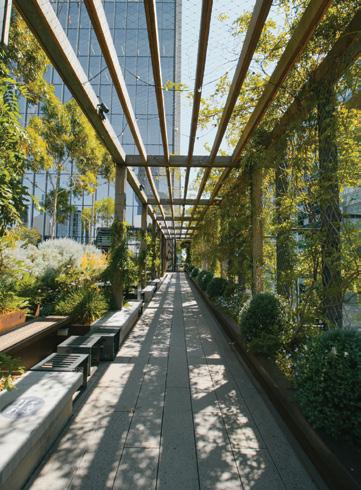
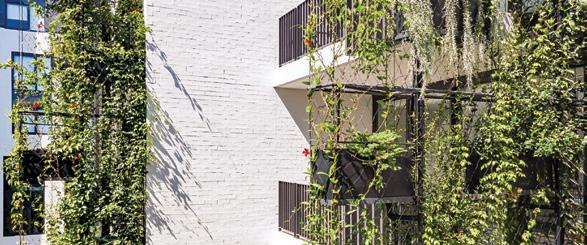






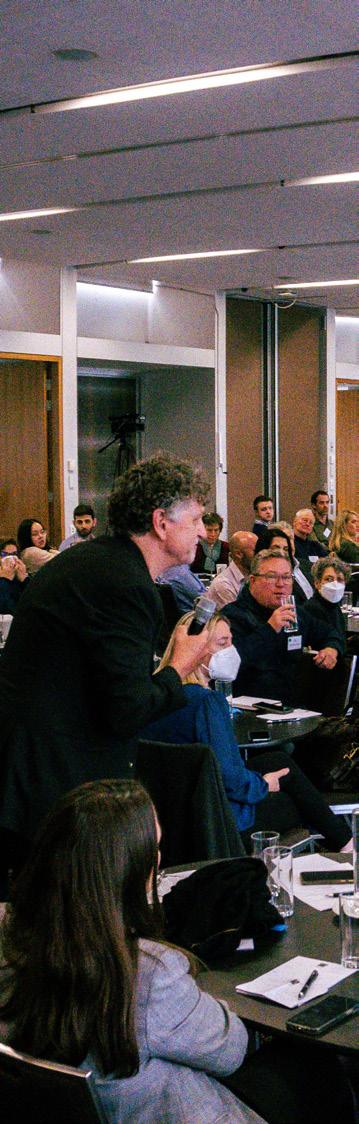
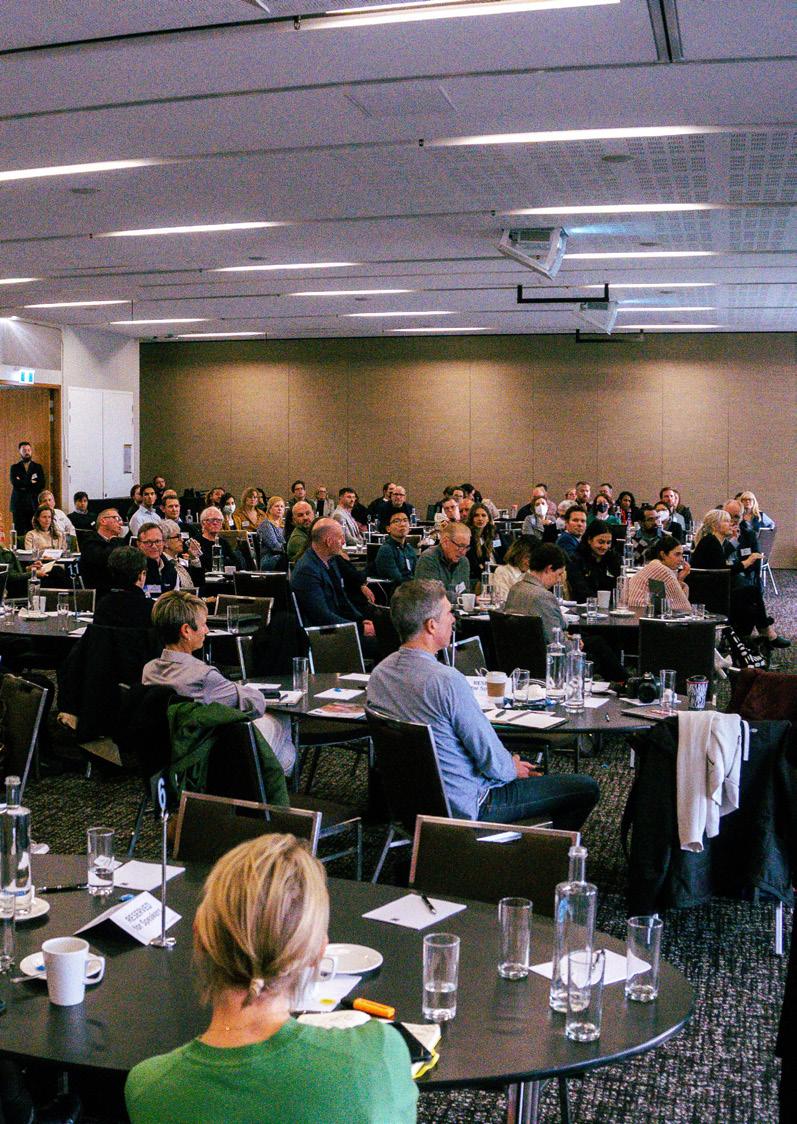
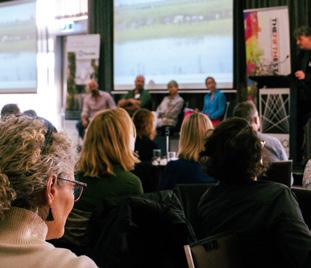
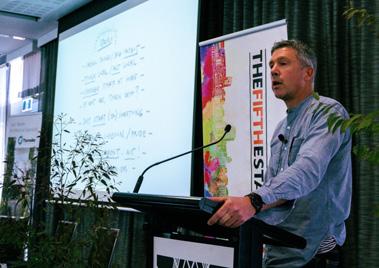
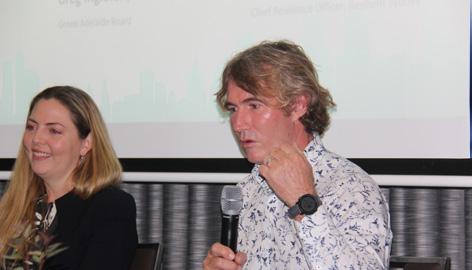
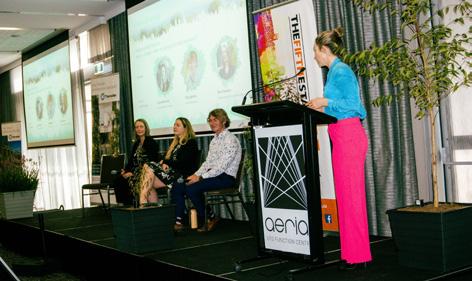
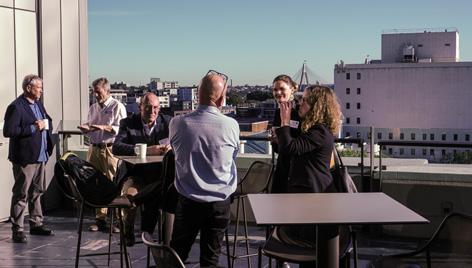
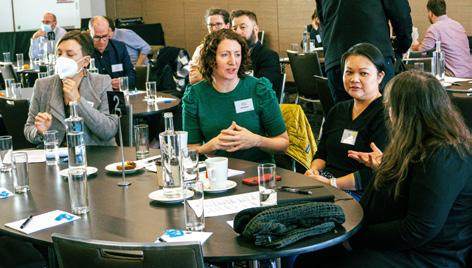
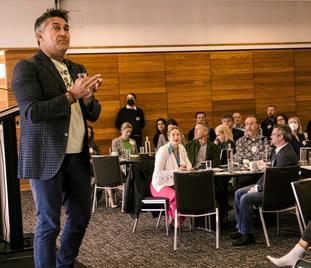
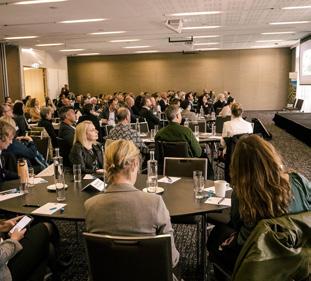
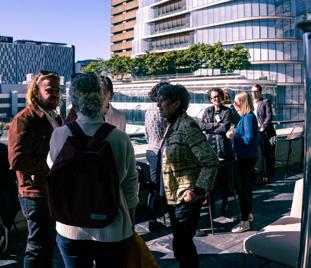
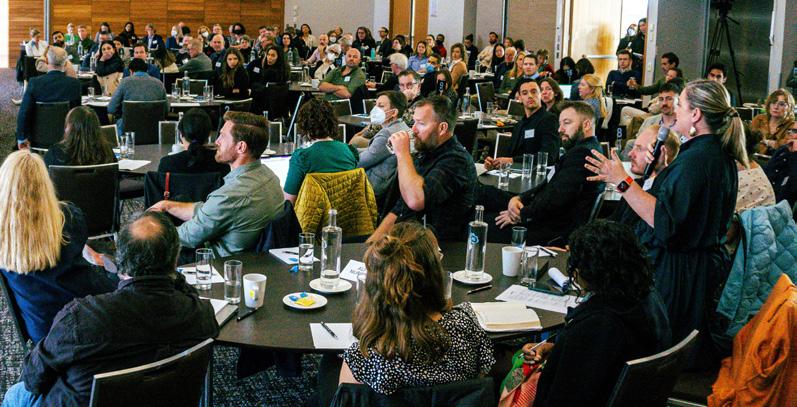
We launched our first Urban Greening summit on 28 July to roaring success.
It was our first collaboration with the University of Technology Sydney, the Australian Institute of Landscape Architects, and Living Future Institute of Australia and it showed.
A heartfelt thanks to our fantastic presenters, our MC Jess Miller and to our sponsors, Tensile, Mulpha Australia and WaterUps for making it all possible.
The event did many magical things, not the least because of the quality and leadership in these organisations and the urban greening space.
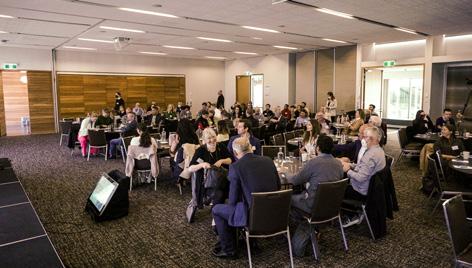
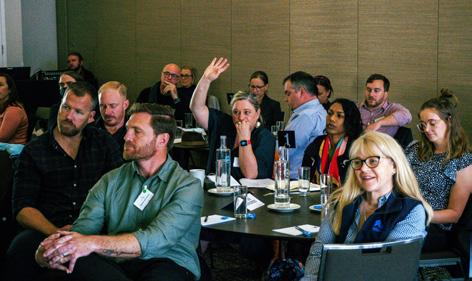
It reached an engaged audience who told us they were thrilled with the insights they picked up from some of Australia’s best experts in the field.
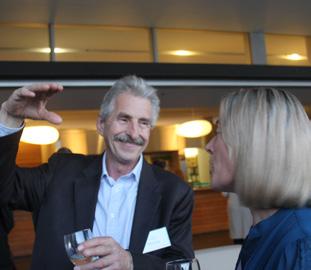
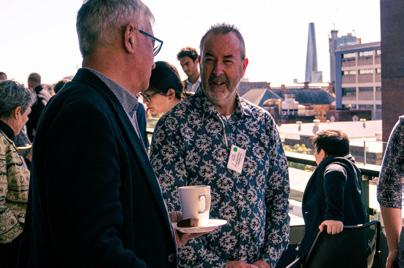
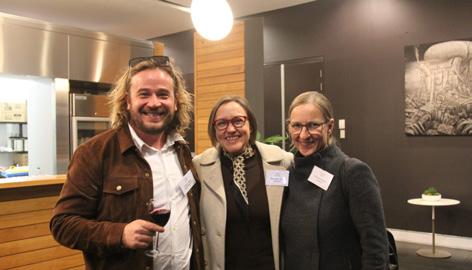
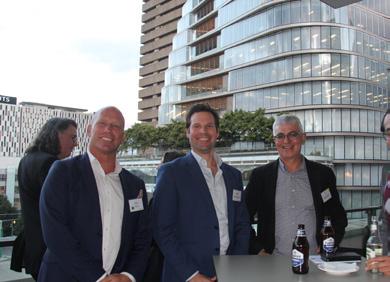
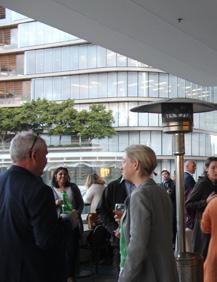
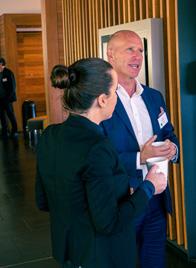
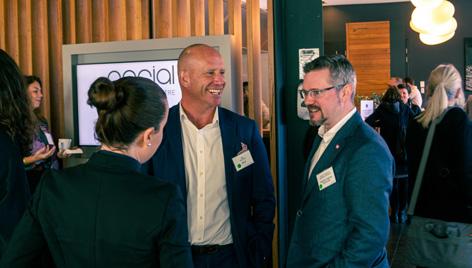
It fostered great networking opportunities among the relaxed and chatty crowd, in many cases yielding excellent business leads.
And that's perfect because we know that business can move the industry forward at the speed of light when it gets the right signals.
The summit spread our wings wider and deeper than ever before, into an area that has long slipped under the radar for many of us and (actually) most developers.
We wish we could continue to let nature slip under the radar and to take its beauty for granted.
But that’s yearning for times long past.

In the words of Professor Elizabeth Mossop, Dean of the School of Design Architecture and Building at UTS, who gave the welcome address to our biggest audience ever, striving for net zero is not enough to deliver a viable future.
“Even enormous success here will not get us to where we need to go to create the cities we want to live in, supported by Country that is healthy and symbiotic with our needs,” Professor Mossop said.
“This is one of the big lessons our Indigenous People have tried for so long to share with us. It’s now time to listen.
“Investors, developers and their armies of consultants and advisers are the people who in many ways hold the keys to changing our behaviour,” Professor Mossop said.
We are deeply honoured to be hosted by the university for six months as a way to better understand how universities can be a key part of our solutions to our climate and urban greening challenges.
Thank you to the presenters on the day, and again to the additional contributors to this ebook and to our sponsors, again!
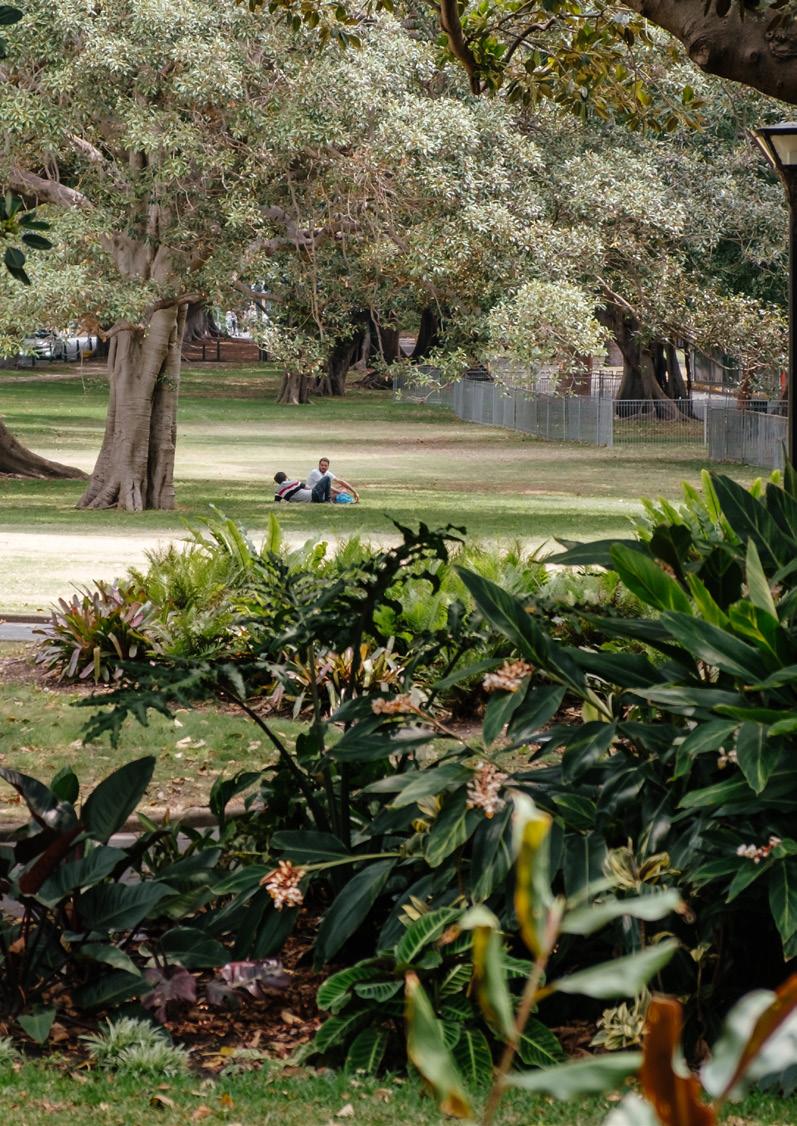 PHOTO BY JOHAN MOUCHET ON UNSPLASH

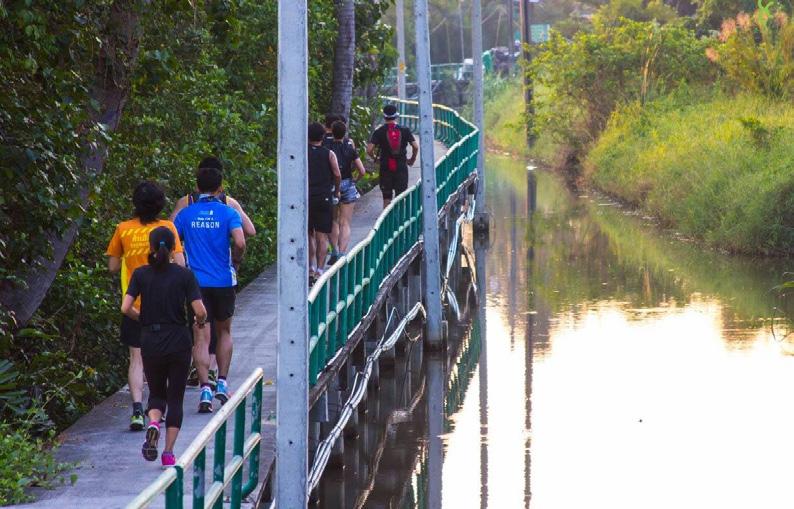 NICK CHAPMAN, WILLOUGHBY COUNCIL
Today 55 per cent of the world’s population lives in cities and the trend is expected to increase.

This means that community and health values of green spaces in cities (such as parks, community gardens and urban forests) are becoming ever more important.
More than 40 years of research worldwide shows that green spaces can generate a range of positive social outcomes, including improved physical and mental wellbeing, enhanced social
connections and a more active lifestyle. Good access to urban green spaces is just as important as the green spaces themselves. If the only way to get to a green space is by car, the value to the broader community can be compromised.
Green spaces need to be easily accessible on foot, by bike, or affordable public transport.
Urban greenways are a good alternative. These are a series of green public spaces connected by a network of well designed walking and cycle paths, local green streets or public transport routes. In Metropolitan Sydney, this emerging network has been called the Sydney Green Grid.
Greenways typically incorporate a mix of vegetation, open space, walking and cycle paths. They wind their way to and through parks in established urban areas.
They are often defined by a waterway or public transport route, such as a rail line. Many include public art and gathering places and connect directly to local centres or transport hubs. If designed and managed well, they provide a valuable alternative to car transit, easy access to a range of green spaces and support healthy, active, connected neighbourhoods.
They offer a valuable alternative to car transit, enhance access to existing green spaces, strengthen community resilience, increase urban biodiversity and support measurable community health outcomes
Despite the opportunities created by greenways, their planning and development often takes many years to complete. This is due to a range of factors including the complexities of multiple land ownership, inconsistent political support and poor collaboration amongst government stakeholders.
Experience shows that it can be very challenging to fund, design and implement a multi-purpose green corridor in a contested, car dominated urban environment subject to increasing land values.
However, as urban challenges increase in the 21st century due to population growth and climate change, it is likely that the importance of urban greenways will become increasingly apparent.

In Sydney there are encouraging signs that the value of urban greenways is finally being recognised with state and local government investing in them across Sydney, often in response to many years of community advocacy.
 URBAN
URBAN
Greenways underway or being planned in Sydney include:
Cooks River to Iron Cove GreenWay Ryde Green Links
Paddington Greenway Willoughby’s Artarmon to Tunks Park Track
Examples of greenways overseas include:

C3 project, Bangkok East Don Trail, Toronto Maxima Park, Utrecht, Netherlands Blue Greenway, San Francisco
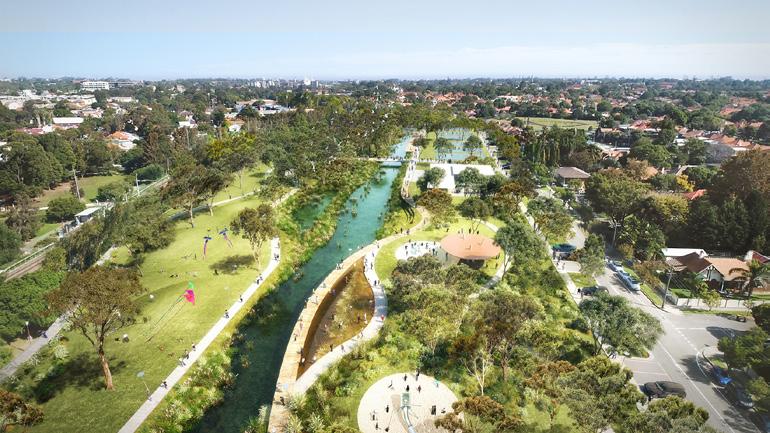
The Cooks River to Iron Cove GreenWay has been under development for 20 years. This six kilometres multi-purpose active transport and urban environmental corridor in Sydney’s Inner West connects two urban waterways, the Cooks River and Parramatta River (which flows into Sydney Harbour). In the late 1990s local activists saw the potential for this greenway to become an important inner city urban wildlife corridor and provide a vital missing link in Sydney’s regional cycle network.
The corridor is defined by Hawthorne Canal and the former Rozelle Goods Rail Line which was converted to the Inner West Light Rail in 2014, resulting in significant new mixed use and high density residential development along the corridor.
After many setbacks (brought on by postelection funding cuts, risk-averse public land owners and other challenges), the NSW state government and Inner West Council have now committed $31 million to complete the southern section of the GreenWay by 2024.
Not only will this provide a vital missing link in the regional cycle network and significantly enhance vegetation habitat along the corridor, it will also provide community facilities, arts and culture and an outdoor classroom for 22 primary schools along the corridor.
The Ryde - Eastwood - Macquarie Park (REM) Green Links are envisaged as three interconnected urban green corridors, which function as biodiversity corridors, continuous green transport connectivity (active and mass transport) along activated open spaces, and a platform for cultural engagement and recreation.
The draft Ryde Green Links Masterplan was exhibited by the City of Ryde in mid-2021. The finalised draft Masterplan will be submitted for consideration by Council in mid-2022.
The Paddington Greenway is envisaged as a Green Grid link, approximately 2.2 km long between Centennial Park and Rushcutters Bay Park.
Centennial Parklands at its southern end is a significant open space for the whole Sydney Region, with around 360 hectares of open space spanning three local government areas (LGAs), and 30 million visits per year.
Rushcutters Bay Park at its northern end spans both the Woollahra and City of Sydney LGAs and Woollahra Council identifies it as a regional open space in its Plan of Management for the park (Woollahra Municipal Council 2005).
The Paddington Greenway is located in a highdensity part of Sydney, where there is a need for new open space and better access to regional open space. The estimated population within the 10-minute catchment would be about 40,000.
The northern end of the Paddington Greenway will connect to a planned regional cycle route between the Sydney CBD and Edgecliff, while the southern end will connect to a planned regional route between the Sydney CBD and Bondi.
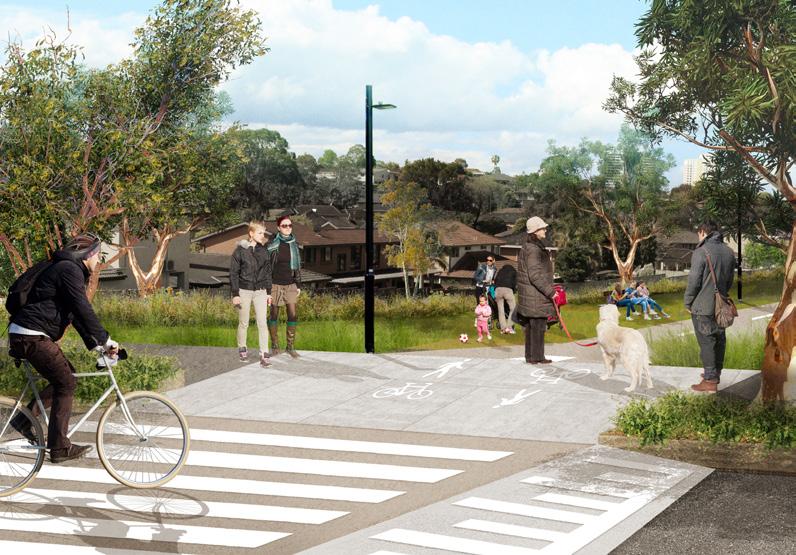
The route will form a link between the key destinations of Edgecliff and Bondi Junction.
The implementation of two urban greenways is identified as a priority project in the Resilient Willoughby Strategy and Action Plan adopted
by Willoughby City Council in 2021.
The Greater Sydney Commission’s North District Plan features several green grid links in the Willoughby LGA. Their potential for development as greenways is now being investigated by Council through a process of options analysis.
For 20 years, city authorities and local communities in Utrecht, have been developing Maxima Park, a multi-function, suburban park of approx. 150 Hectares.
It includes a dredged former meander of the Rhine River, formal parkland and sports facilities, wildflower meadows, an award-
winning 50 Hectare central garden and pergola, public art, a grand canal and other attractions. A shared walking and cycle path called the Lint (ribbon) loops through and around the park, linking it to surrounding suburbs, cycleways and transit stops.
With a total capital cost of more than €20 mil ($A30 million), one of the greatest challenges has been to maintain momentum through the global financial crisis, which resulted in a significant reduction in anticipated new housing development in Utrecht and a consequent loss of funding and public domain opportunities within and around the park.
Bangkok in Thailand has in the past been described as the “Venice of the East” due to its 2400 kilometres of canals. According to delegates from Bangkok’s Traffic and Transportation Department “most of the canals are now underused and trashed due to massive urban intensification and chronic car congestion”.
The C3 project in Bangkok’s Bang Mot Canal Area aims to reverse this process by rediscovering the canals and using them as off-road walking and cycling routes and places for community culture and growing and selling food.
With a $US3 million - $US5million ($A4.5 million - $A$7.5 million) budget, an existing five kilometre section of canal edge is being repurposed for cycling and walking and an additional seven km canal section has been identified as a “missing Link” to the Wutthakat BTS mass transit station. Project partners include Kink Mongkut University of Technology Thunburi, local residents and businesses along the canal and the district authority. One of the design challenges has been to retrofit a useable 1.8 to 2 metre wide shared path without
compromising the visual and structural integrity of the canal.

Toronto in Canada is known for its 300 kilometres of ravines leading through city suburbs to the CBD and Lake Ontario. Many ravines contain extensive vegetation and informal walking and mountain bike trails, which provide significant recreational, active transport and ecological benefits. They are also often used by city utilities to access hydro and sewerage infrastructure along the ravines.
The downside is that the trails often consist of a series of informal, meandering paths which generate erosion, help spread weeds and are not universally accessible.
One example is the 20 km East Don Trail, following the Don River through Toronto’s inner eastern suburbs to the Port. The federal government and City of Toronto have jointly invested $CAD23 million (A$25.8 million) to consolidate a number of informal paths into one rideable, accessible shared trail.
In parallel, some major infrastructure works are being undertaken to improve sewer overflow performance and melted snow drainage. One of the major challenges for this project is to minimise construction impacts in a highly constrained, steep-sided and sensitive ecological area.
The Blue Greenway is a multi-agency effort to create an interconnected system of trails and parks on San Francisco’s southeast waterfront. Once complete, it will transform this neglected resource into a premier series of public open spaces: 21 km of waterfront parks and trails running from AT&T Park south to Candlestick Point.
The project will complete San Francisco’s portions of the Bay Trail and Bay Water Trail, and provide active transportation routes connecting San Francisco’s growing eastern neighbourhoods with the employment centres of Mission Bay and downtown.
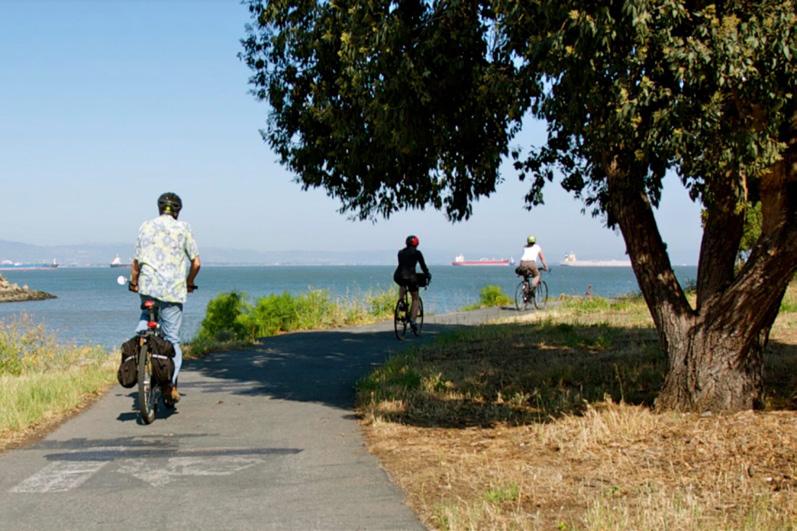
The Blue Greenway will also provide muchneeded open space, recreation, and active transportation opportunities to the city’s lowest income and most underserved neighbourhoods.
The new open space network will connect these neighbourhoods (slated to grow by more than 30,000 new residents over the next 20 years) to their waterfront and serve as a catalyst for high-quality development, employment opportunities and economic vitality.
The greenway brings together numerous government, private sector, and non-profit efforts to clean up toxic contaminants along the

waterfront and turn these formerly unusable parcels of land into areas for public enjoyment, active recreation, and economic activity.
Nick Chapman is resilience specialist at Willoughby City Council and an adjunct senior lecturer at the University of Sydney’s City Futures Research Centre.
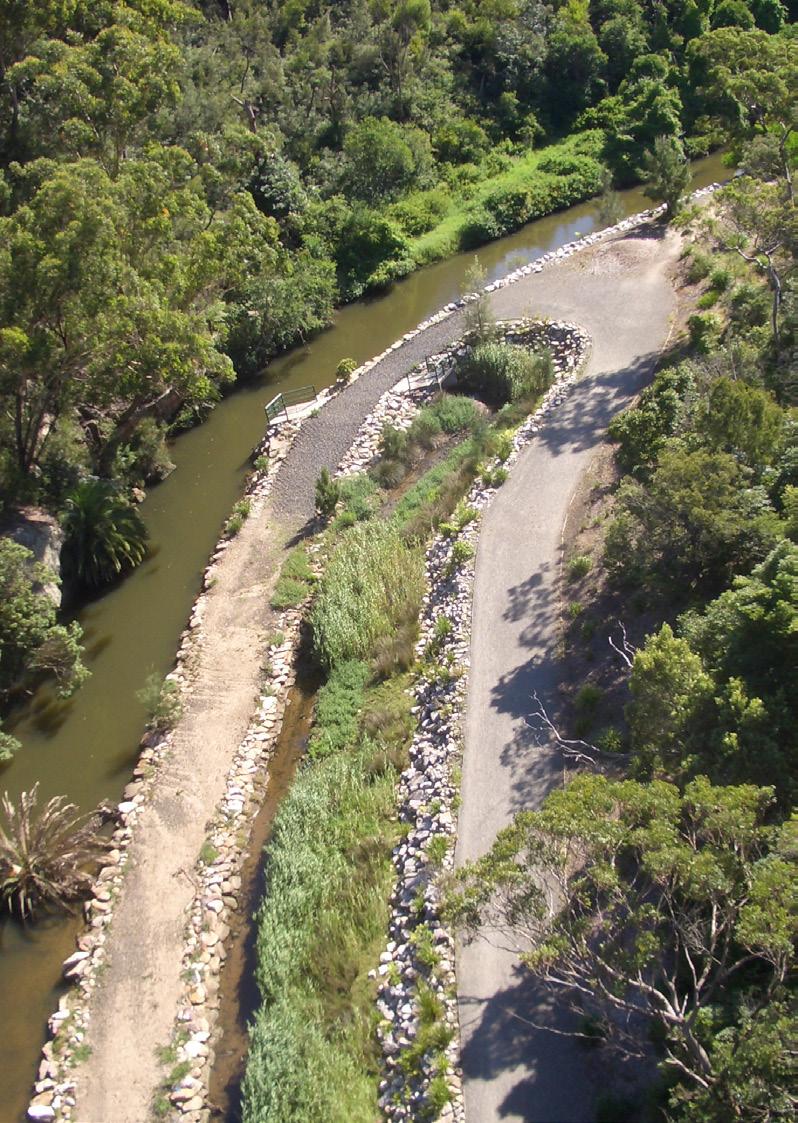 NORTHBRIDGE FLAT ROCK GULLY RESERVE.
PHOTO: J BAR
NORTHBRIDGE FLAT ROCK GULLY RESERVE.
PHOTO: J BAR
 DR JENNIFER KENT, DR PATRICK HARRIS AND PROFESSOR SUSAN THOMPSON
The influence of city form and function on human health is the subject of a prolific and sophisticated body of research.
Scholars in fields such as urbanism and engineering have joined forces with epidemiologists, psychologists and other public health researchers to explore and unpick the links between cities and health.
Their work is published in dedicated journals, such as Cities and Health, Health and Place and Transport and Health. They collaborate via specialised research centres, including RMIT’s world renown Healthy Liveable Cities Lab and the World Health Organisation’s WHO Collaborating Centre for Healthy Urban Environments.
Invaluable insights have subsequently emerged from analyses, experiments and reviews, all executed with meticulous attention to rigour, replicability and representativeness. For example, we now know that access to green open spaces has mental health benefits for children and that the closer adults live to a park the more likely they are to undertake adequate amounts of physical activity
We also know that people who live in neighbourhoods with well-designed street networks are more likely to have positive social interactions, and that these streets support walking and for transport.
While the body of evidence linking built environments to health is both rigorous and abundant, practical implementation of this science lags behind the enthusiasm of scholars.
Actual instances of change to the policies and practices of city planning are rare
Yet researchers in this space continue to call for more data, and more evidence We propose that action needs more than data, and it is time for a paradigm shift.
We base our proposal on three points.
Interpretation of the evidence linking city form to health will require changes to urban and transport systems. These systems are extremely vulnerable to the prevailing political economy which governs change.
Our ongoing obsession with compiling more quantitative evidence ignores the very real evidence demonstrating that while quantification is often necessary to provoke change, it is not sufficient.
In urban planning decision making there is obviously something more at play than data, and real-world examples abound of key actors in the policy making process selecting evidence
that supports political and institutional agendas.
Second, the institutionalised focus in public health discourse on the quantification of outcomes is not benign in its impact on the healthy and sustainable cities agenda.
It provides a busy detraction from action to promote the development of urban areas that are supportive of human health. The need for deeper understandings of the political, economic and regulatory barriers to change is urgent.
This genre of research, however, steeped as it is in traditions of political and policy science, is rarely funded by health agencies which continue to preference the collection of epidemiological data.
This endless search for quantifiable evidence provides a point of procrastination for those with the power to take action. It also prevents the development of a nuanced understanding of the dynamics of policy making amongst the healthy cities research community.
Third, the intense focus on measurement ignores the fact that some aspects of the way cities shape behaviour, and vice-versa, simply cannot be quantified. How can we model the motives of an exhausted and time pressured parent driving their child 800 metres to school on a rainy day? And how can we count the value of the interactions senior citizens have on their weekly community bus trip?
The existence of a rich data set does not make
it immediately worthy of our research time, nor does the absence of such data suggest its irrelevance.
We propose that this is particularly pertinent to the realisation of healthy built environments.
There are many and diverse effective and rigorous methods available to social and health scientists which can be deployed to understand complex problems. This has been recognised by practitioners in the implementation of cuttingedge concepts such as ‘wellbeing budgets’, which value qualitative and quantitative data.
The focus of the research discourse, however, is lagging behind. To limit our understandings through an overwhelming concentration on quantification limits our understandings to phenomena that can be measured. This misses the sheer complexity of lives lived in 21st Century urban spaces across the globe.
In summary, health research that promotes measurement alone as a legitimate pathway to decision making is problematic. Evidence is necessary, but it is just one component of policy decision making. Measuring gets published, but it does not necessarily get things done.
Dr Jennifer Kent is a senior research fellow in urbanism at the Sydney School of Architecture, Design and Planning.
Dr Patrick Harris a senior research fellow and deputy director at the Centre for Health Equity Training, Research and Evaluation at the University of NSW
Professor Susan Thompson is a University of New South Wales academic, who researches and teaches in urban planning and development.
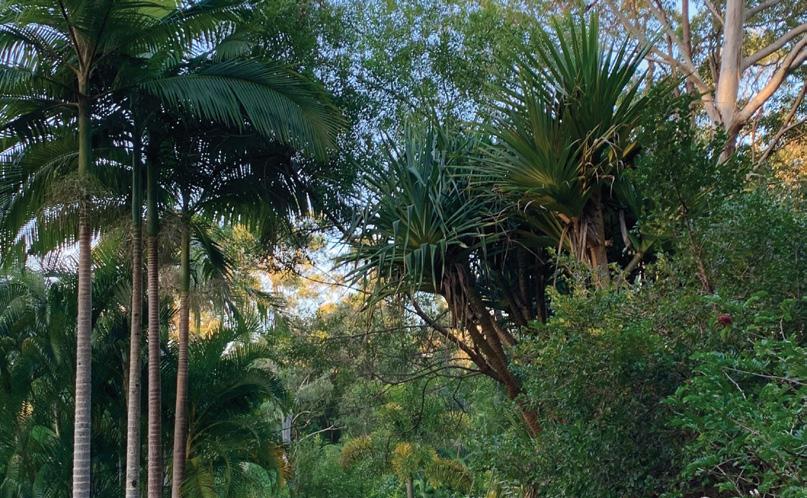
Lockdowns during the pandemic were daunting. However, some people seized the opportunity for some public gardening. Here's how one Melbourne group did it.
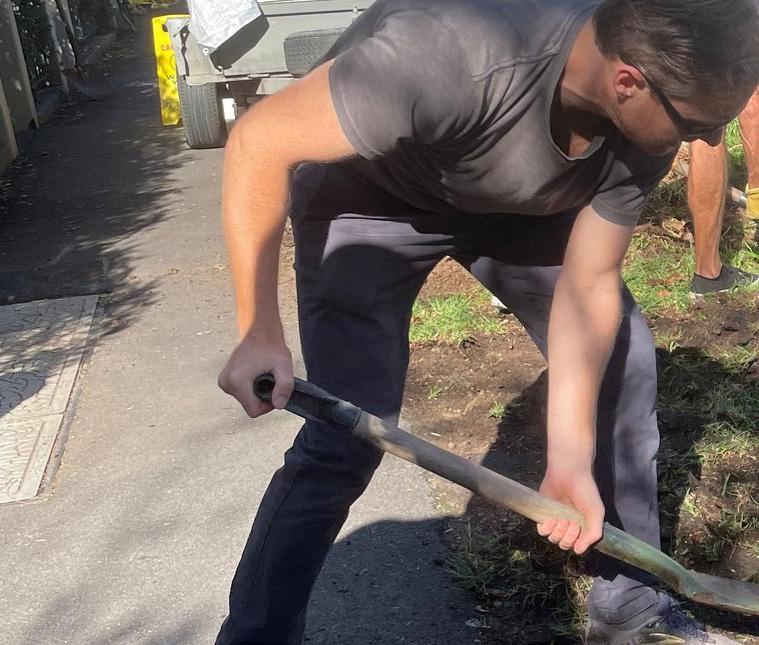
During the lockdowns, I was part of the Stonington Environmental Champions program, a new three month community initiative that was formed in the wake of the February 2020 Climate Emergency Declaration by Stonnington Council. Even though I had been living in Stonnington for over 34 years, I never connected much with locals who share the same interest in addressing climate change.
I was looking for more than just sustainable solutions – I wanted to forge a more biophilic and regenerative future. The program ended up running over zoom for 10 weeks, and this virtual space allowed me to connect with similarlyattuned locals.
From one breakout room on a winter evening, Rewilding Stonnington emerged.
The eight of us who joined this breakout room were all interested in biodiversity and keen to better our environment through practical activity. Unfortunately a 2019 study found that more than a third of public green space is road verge.
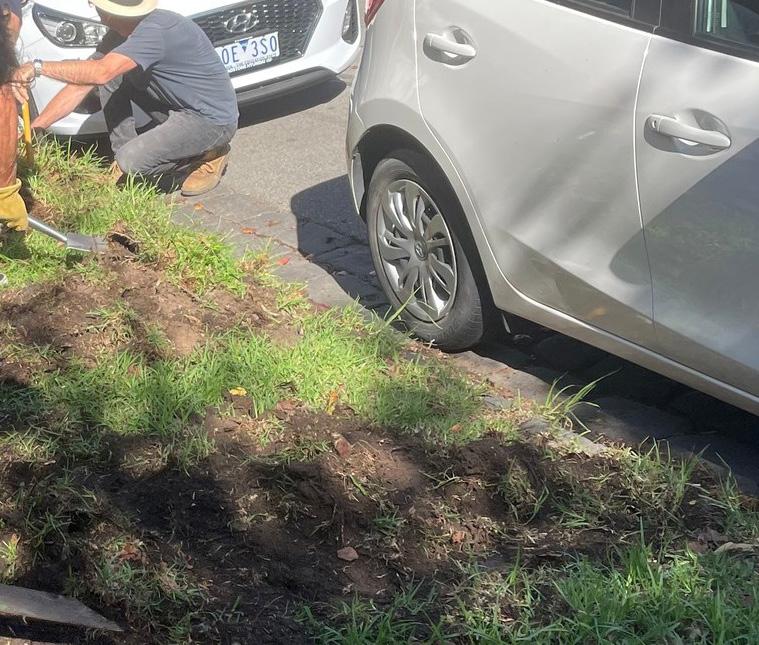
Someone suggested we rewild nature strips, while I and few others wanted to create pocket forests in line with the Akira Miyawaki method – a system of planting native tree species that is one of the most effective ways to reforest degraded land.
Using the method, tree species are selected that would naturally occur on the land, and placed in a way that they work together to create a dense forest and support the return of a thriving ecosystem.

However, to get things moving, I offered our nature strip on a busy road as our first pilot project.
As soon as restrictions were lifted, we met for our first working bee (community organised voluntary work) at our nature strip. We were still all in masks and it was surreal to meet finally in person.
Following a quick safety briefing, we set about removing the grass and preparing the soil. A couple of weekends later, we worked on removing roots and mulching. The third one was all about planting. However, after every working bee we made sure we celebrated over a brunch.
In between the multiple pandemic restrictions, through a hybrid mode, we began to define the purpose of the group, and how we will grow. We agreed on a name (Rewilding Stonnington) and articulated our aims.
We were lucky that our skills complemented each other. Of the core members, I am an architect and am good with design. Another member, Graham Ross, has a background in conservation and land management, and is knowledgeable about native and endemic vegetation. Alison Richards is a theatre maker and researcher and a great communicator. Others are good at admin, digital media or just
eager to help pick up a spade. The group was incorporated as Rewilding Stonnington in 2022.

Not all of the original group have persevered but we stay in touch.
We have also attracted new members through our project work, advocacy and networking at community events, and we are now at over 80 members.
To date we have rewilded three nature strips in different parts of Stonnington and revegetated a good portion of the barren areas of Tooronga Station. Keep Australia Beautiful approved our rewilding proposal in 2021 and we went ahead with the first stage, which we self-funded.
We completed the second stage early in 2022 and now we will be starting stage three. Both stages cover about 100 metres on both sides of the Tooronga Station car park.
The aim is to keep rewilding these areas stretching on both sides east and west, trying to create an Indigenous eco systems corridor as per the International Union of Architects
Indigenous eco systems corridors and nodes project at the Australian Institute of Architects Victorian Chapter.
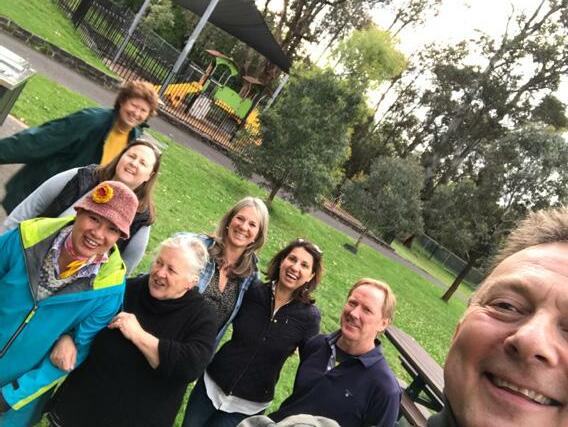
What we noticed while we were running these working bees was that we w ere creating more than just personal connections. We were creating caring communities, more connected to their own local environment. We’re always open to suggestions from other local residents.
Rewilding Stonnington’s purpose is to reintroduce Indigenous and endemic plants and to raise public awareness in our local community and connect with the pre-colonial heritage of our local Stonnington Council area.
Our intention in rewilding is to: boost biodiversity
• attract pollinators reduce the urban heat island effect reduce stormwater runoff
• add interest and diversity to the landscape

• improve mental and physical health
• reduce noise pollution from lawn mowers
• reduce the need for artificial fertilisers and weed killers
• improve our biophilic connection to nature
• respect and advocate for First Nations ways of caring for Country, in consultation with Traditional Owners
We are all about placemaking, regenerating and connecting – growing wilder but wiser!
Nadine Samaha is a senior principal architect and creative director at Level Architekture Konstrukt, a member of the Australian Institute of Architects and a councillor at the Victorian Chapter, chair of the Sustainable Architecture Forum, and lectures in environmental sustainable design at RMIT.
PHOTO: REWILDING STONNINGTON REWILDING STONNINGTON:There are so many issues to consider when you want to green an urban space. Take it from Peter Bottero, who founded Tensile in 2010 to help deliver solutions for what he saw as a growth industry – and hasn’t looked back.
The point of the company was to solve problems that were only just starting to emerge, as the appetite for greener spaces started to take root (so to speak) in our notion of how we want to live in our urban spaces.
We city dwellers knew we liked nature. And as climate change and sustainability grew in our collective sensibilities, and then the pandemic hit, our opinions of plants and trees slowly but surely turned from “nice to have” to “need to have”.
But plants and trees are living things and, like the rest of us, need the right environment and a lot of nurturing to thrive.
When you’re adding plants, shrubs or trees around or inside a building there are few things you need to get right, Peter says. The first thing to understand is the type of building materials you plan to use in your project, as this affects the plants that will work best in that context.
If you want a green façade you need to have clear in your mind the role you want it to serve.
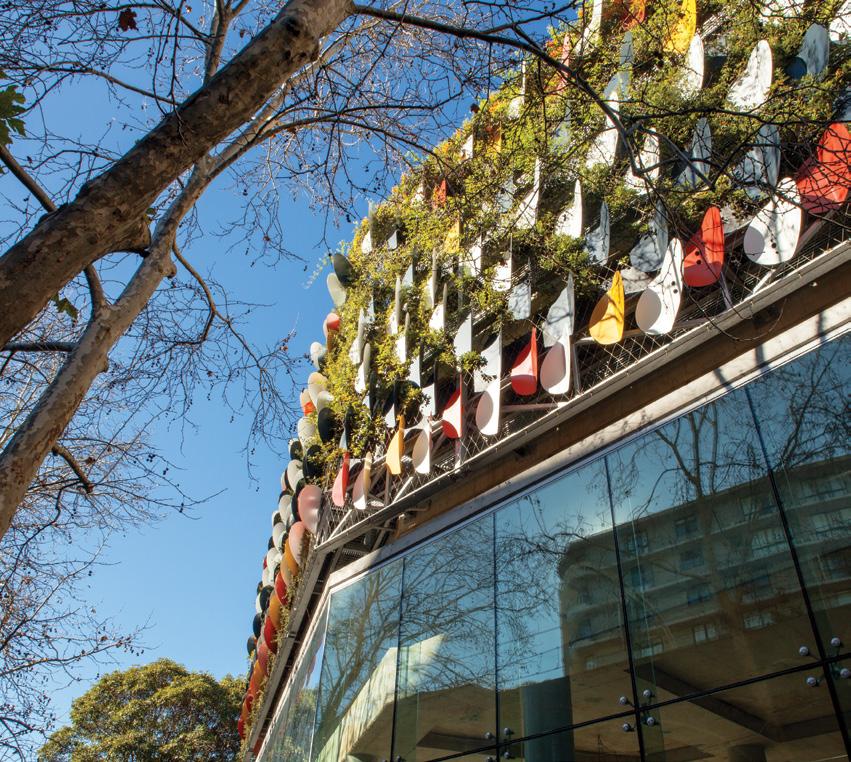
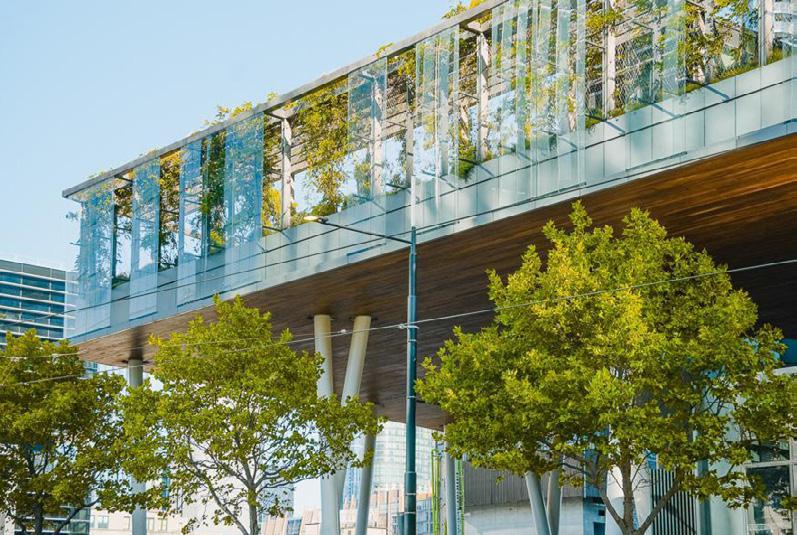
In one project, a car park in Sydney, a mesh façade was designed to creatively conceal an above ground car park. Plants selected not just to enhance aesthetics, but to add shade and reduce pollution at the same time.
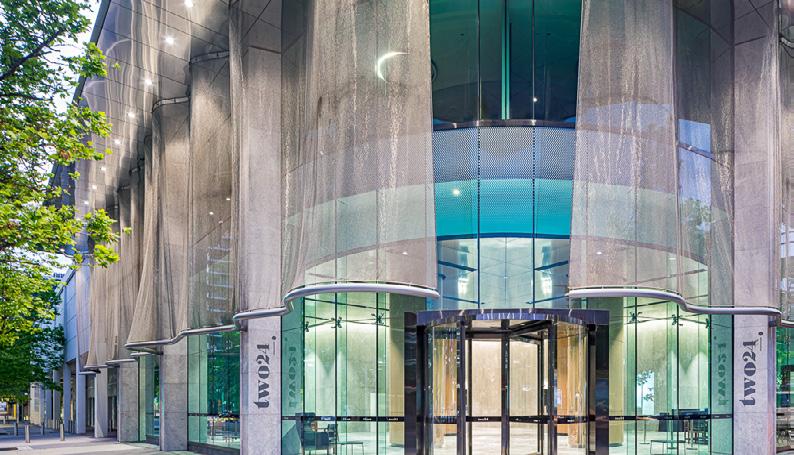
At an office building in Canberra, an installation gave the appearance of a “huge mesh curtain” hanging down in folds. The end result is a façade of cool shading provided by plants that still allow some light to penetrate.
But you need to know upfront what your
intention is, Peter says.
“Is it a complete blackout, or green out? Is it a dappled effect? Do you still want to maintain a certain amount of view? Is it privacy? And what is your expectation of growth over time?”

The answer will have a big impact on the design solution. And the choice of plants.
So will the local environment.
If you think that the biggest challenge in green infrastructure is access to sunlight, there’s something worse, Peter says: wind.
“Climbers come from a forest, their native habitat is forest, so they’re used to climbing up the trunk and then getting into the canopy, and once they’re into the canopy, they spread,” Peter says.
“So, they live a very sheltered life, and we’re taking them from that sheltered life and sticking them on the sides of buildings. In urban canyons, they can often be exposed to high wind areas.”
Wind was a big factor at SkyPark at Lendlease’s Melbourne Quarter development at Docklands.
Working with landscape architects Aspect Oculus, Peter’s team had to deal with a number of constraints to develop wind barriers and deliver what turned out to be a tranquil, secluded and wind-protected space for nearby city workers that includes lawn areas, seating, a perimeter walkway, a vertical garden and even a bookable meeting pod.
Wind was also a big factor in the firm’s work on One Central Park development near Central Station and UTS in Sydney.
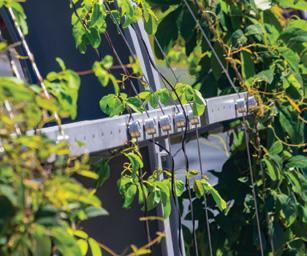
That project, a joint venture between Frasers Property and Sekisui House, needed 15 kilometres of stainless steel cables and rods, spanning 34 floors across three facades of the two buildings, to support more than 2500 climbers and vines.
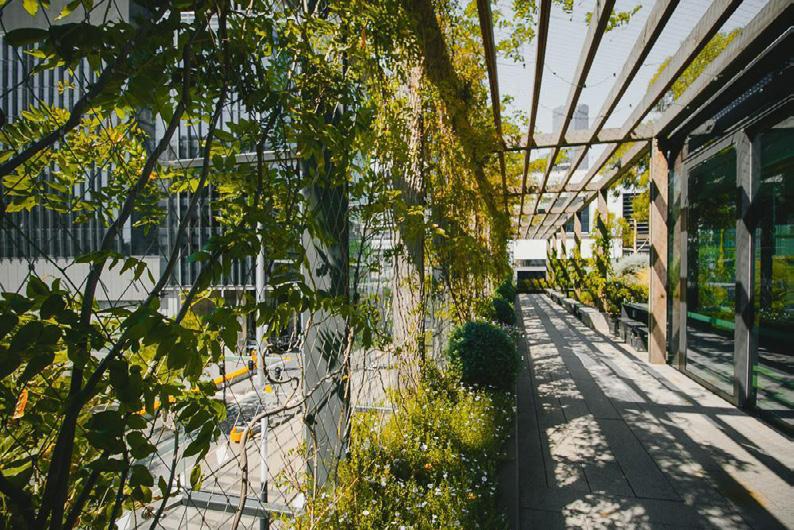
“At Central Park, the lower levels along Broadway were copping wind that would come off the harbour, funnelling all the way up George Street,” Peter says.
On the other hand, plants can flourish at an
 SKYPARK AT MELBOURNE CITY QUARTER
exponential rate in some environments. And being protected from wind is part of the story.
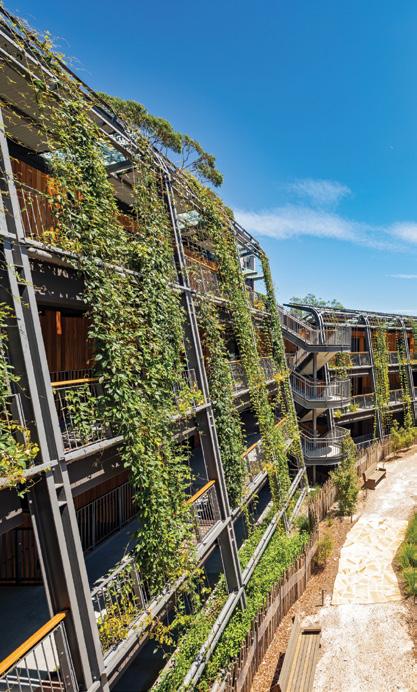
At Eve Apartments in Sydney’s Erskineville for instance, designed by DKO Architecture, Tensile used the 4mm stainless steel cables to hoist garden beds, designed by 360° Landscape Architecture, from the edges of the balconies to provide privacy for residents.
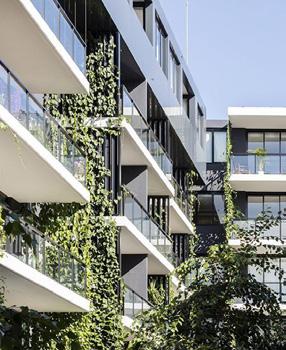
“In six months, the climbers grew four storeys. It’s just amazing,” Peter says. “But this is a complete enclosed courtyard space. So there’s very little wind, there is a microclimate set up through the heat gain during the day being released. It’s quite a nice little space in terms of the plants and their health.”
To achieve the best outcomes Peter works with a range of professionals who are each specialists in their respective fields. He likes to go for the best and he calls them the company’s “family” of experts – all with their own unique offerings that go to creating the ideal outcomes, whatever the intended outcomes happen to be and whatever the local conditions dictate.
A MESH CURTAIN HANGING ON A BUILDING CAN RESULT IN A FAÇADE OF COOL SHADINGPROVIDED BY PLANTS THAT STILL ALLOW SOME LIGHT TO PENETRATE.
It is widely accepted that we need more trees in our urban centres to combat the heat island effect that will only worsen due to climate change.
It’s an environmental necessity requiring unprecedented commitment from state and local governments, developers, local communities and homeowners.
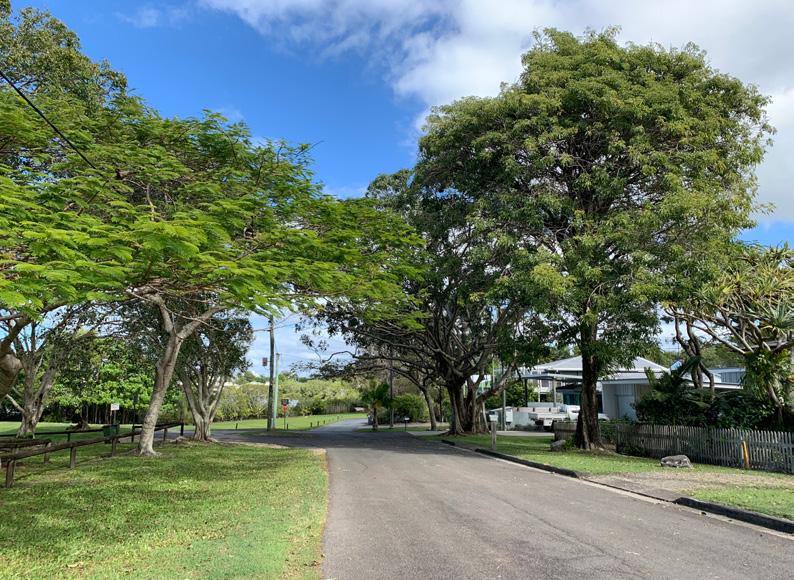
A 2017 report by the Centre for Urban Research, RMIT University, found that tree canopy and shrub cover had dropped 2.1 per cent since 2013, adding to the loss recorded in the five years prior. We went backwards!
This in part prompted the national Greener Spaces Better Places initiative and the NSW 5 million trees by 2030, increasing Sydney’s tree canopy from 16 to 40 per cent.
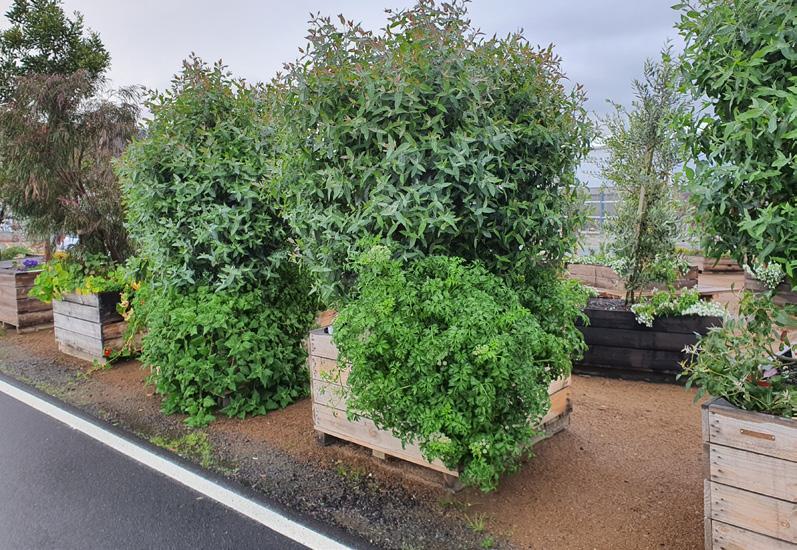
The 2022 target is 1 million trees. How many will survive?
These urban forest goals are ambitious, requiring huge investments in time, labour, tree stock and water. And, as it is with human babies, the early years are critical.
In 2016, Sydney company, WaterUps, reinvented the age-old concept of water wicking beds. Using recycled plastic for wicking cells and perlite we sought to create sustainable solutions for improving food security, urban greening, and water management.
Initially adopted by home garden and horticultural markets WaterUps has invested in research and development, including field trials to optimise its suitability for commercial, civic and other applications.
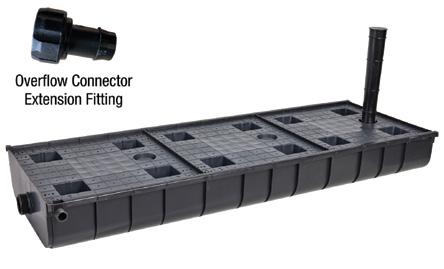
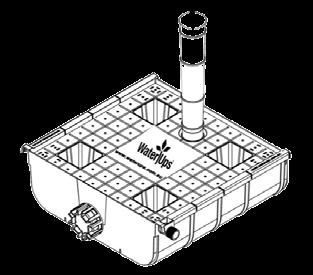
In 2022 we started working with two Sydney councils on two trials: (i) Street Trees – Verge Plantings and (ii) Canopy Trees – Built Environment using our sub-irrigation channels or SICs. These enclose wicking cells in a plastic casing creating a water reservoir. The purpose of these trials is to ascertain the optimal watering schedule for trees using the WaterUps SIC.
Gardens or plantings that use WaterUps require significantly less water and thus less watering –in certain applications 20 per cent of the water of top-down irrigation systems.
WaterUps draws water from its reservoir system that can hold 110 L for every 1 square metre. But it also provides optimal soil conditions by ensuring water is closer to where the plant needs it – the roots – thereby saving on evaporation and promoting stronger root growth. The wicking cells facilitate better soil aeration and less compaction, which is added benefit when it rains.
In the tree planting phase, a single WaterUps SIC is placed in the ground under the sapling, providing a water capacity of 17.5 litres. A capped pipe extends above the ground to facilitate topping up of the reservoir. This in an advance on the coiled tube many councils have used in the past because it delivers an inbuilt reservoir.
Gardens or plantings that use WaterUps For street trees, the NSW government recommends
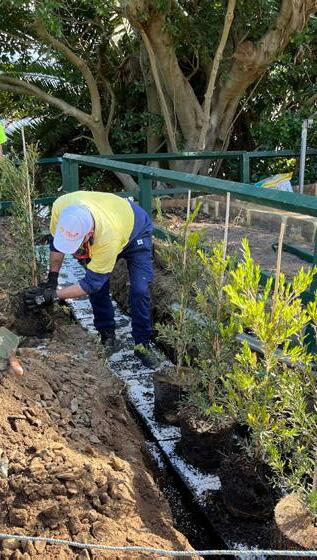
10L of water be applied over the first 18 months as follows:
• four times per week for month 1 (16 waterings)
• three times per week for months 2
• and 3 (27 waterings) two times a week for months 4 to 18
• (130 waterings)
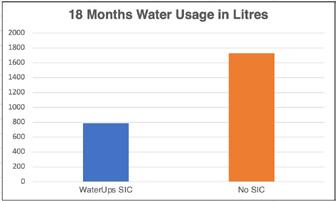
That’s 172 waterings (maintenance visits) in 18 months and 1730 litres of water per tree.)
WaterUps provides the means to decrease water usage and the watering schedule while improving canopy growth. This allows for more trees to be planted and maintained, fast tracking urban forests.
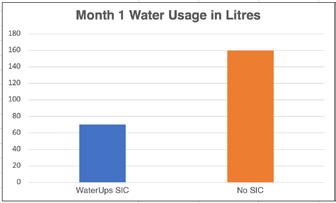
With WaterUps the 17.5 litre reservoir ensures the water lasts longer, using 70 litres, compared to 160 litres without, in the first month. Over 18 months the SICs use 787.5L compared to 1730 L. That’s a saving of 942.5 L or 54 per cent.
By being more water efficient a tree with a SIC requires 45 watering visits over its first 18 months. That’s 128 less visits and a huge saving of 74 per cent in maintenance costs.
These water and time savings correlate to $580 in the first 18 months of a single tree. That’s $580 million for 1 million trees! The savings continue...
With the wet La Niña weather event, the reservoir system will capture rainwater, a far superior water supply. It also enables the capture of any fertilisation applied, thereby minimising the eutrophication of nutrients in our waterways.
The biggest plus though is, by creating optimal growing conditions, saplings can grow an addition 30 per cent in canopy size each year for the first three years of their life. This is based on trials done on a variety of plants in
Sydney, Tasmania and South Australia and lived experience over the past five years.
As with most trees, the canopy size above is balanced by the root structure below. While the roots will grow beyond the WaterUps wicking SIC it will always be there to provide water immediately under the tree and to store water in periods of downpour.
Why is this important? Because the faster a tree is established the greater its ability to sustain itself during dry spells.
This sustainable watering solution can be used to create more resilient trees, however, different tree species in urban communities are also needed for greater biodiversity and resilience. Monocultures increase the risk of negative impacts from drought, pest and disease. Climate change will also alter our temperate zones, so we need to factor this into tree selection.
Because our cities are already built up, increasing the urban forest is going to require ground works of pavements. Our 1000L reservoir system will provide a lifetime water management tool for canopy trees in the built environment and our SIC can be used in rooftop gardens to create more shade.
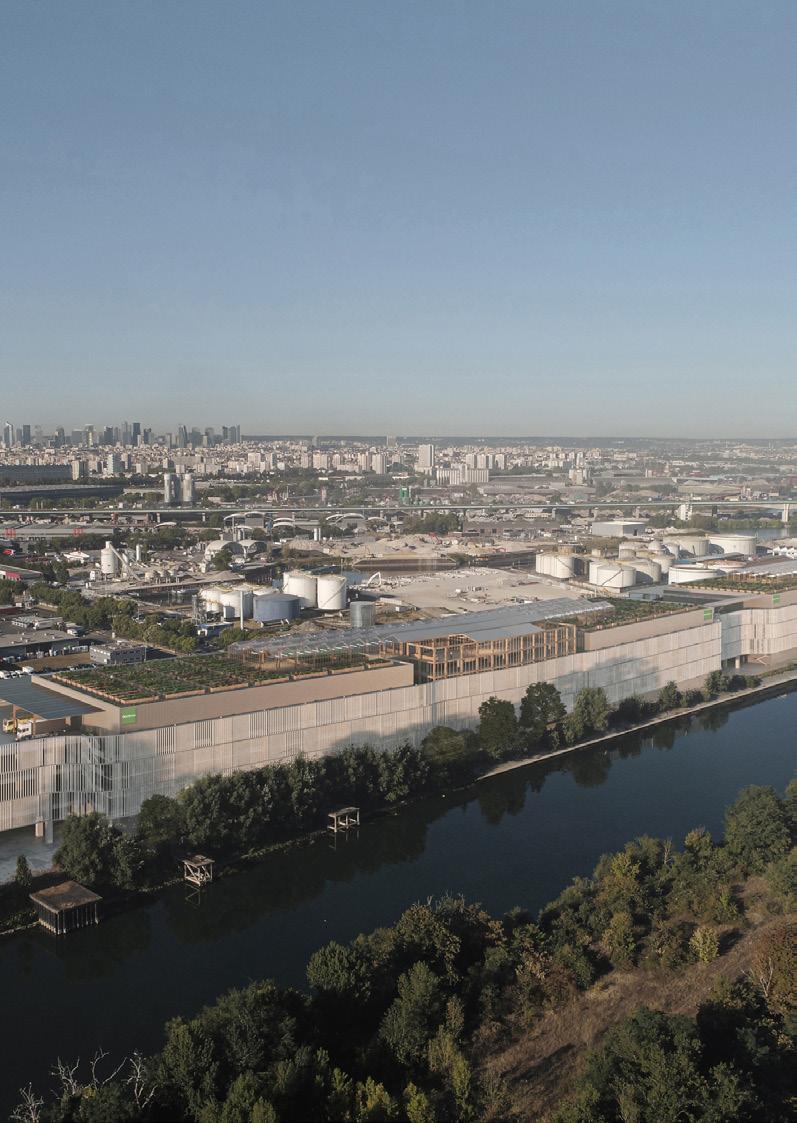 THE GREEN DOCK FACILITY IN GENNEVILLIERS, FRANCE WILL AIM FOR A BREEAM CERTIFICATION AT OUTSTANDING LEVEL PLUS BIODIVERCITY AND LOW-CARBON LABELS. ARTIST IMPRESSION: GOODMAN GROUP
Anyone who knows Greg Goodman, enigmatic co-founder of the giant Goodman Group, knows he’s keen to be a part of the global transformation under way to a low carbon and sustainable world.
Goodman is on the record saying, “We’re working with big customers around the world to make our buildings better and more regenerative. We’re trying to do more with less.”
It’s an ambition articulated in its 2021 Sustainability Report.
And with 170 buildings in Australia and nearly $70 billion under management globally Goodman knows his company can influence the market.
But there are also plenty of systemic shifts at play that have influenced Goodman to be part of the green revolution.
Today’s large institutional investors and financiers have been swept up in the global tide of the environmental social and corporate governance (ESG) revolution. The portfolios they invest in need to demonstrate how they will reach net zero. In recent times, they’ve added another requirement to the mix: the need for property investments to disclose not just how
they minimise damage to nature, but how they will restore and regenerate to a biodiverse and abundant natural environment.
In Australia, it’s early days but the company’s ambitions are strongly focused around greening the sites of its typically vast industrial buildings. It is landscaping the more visible public realms, with the addition of trees, abundant plants, garden beds – all focused around biodiversity.
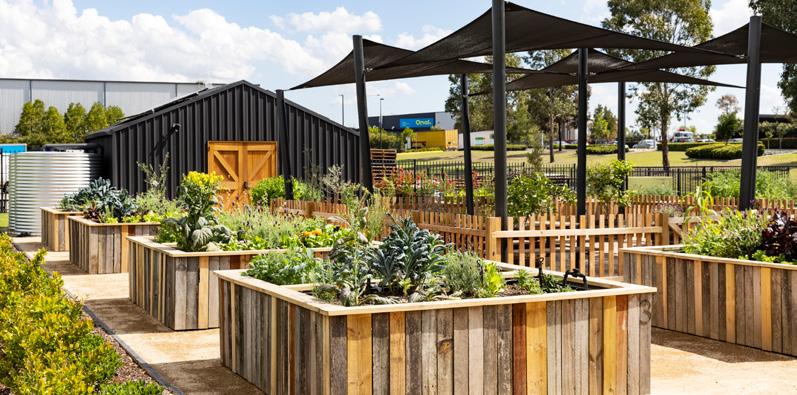
At the company’s Interchange Park at Eastern Creek estate in Sydney for example, it is staying a step ahead of the imperatives. It’s trialling an expansive array of more than 20 garden beds, mostly for the use of customers at the estate. It’s introduced beehives with native, stingless bees – resulting in increased garden productivity. So much so that the abundant harvest of herbs, fruit and vegetables grown at the site are donated to OzHarvest of which Goodman has been a long-time supporter.
The company is also committed to help support the health and wellbeing of Country by valuing,

respecting and being guided by the Indigenous community, with Indigenous designers consulted from the start of the project.
One of Goodman’s latest development sites in South Sydney is incidentally one of the country’s very few – and only modern – multi-storey logistics building, a response to the need to maximise the value of expensive inner city land and reduce carbon-producing transport for last mile distribution.
Leading the design thinking for Goodman in Australia is Kori Todd who joined the company in March last year, after more than 10 years with architects Woods Bagot. Kori’s strategy is to integrate sustainability into the essence of the company’s brand, in an echo of the way Apple and Google – brands she’s worked with in the past – are instantly recognisable as design leaders.

Kori says the City of Sydney’s 15 per cent canopy cover for the South Sydney site is a good start to greening, but the company wants to go further.
“Rather than think of canopy cover as a hindrance, we’ve been looking at the opportunities,” she says.
“Such as providing shading for our buildings,

which is helping the heat island effect of our sites. It’s creating a great place for people who work in these buildings, and that helps from a wellness perspective to break out to outside of their work.
“So green roofs, green walls and a lot of permeable paving is something that we’re implementing, which is an exciting opportunity to start to break up the austerity that naturally comes along with industrial development.”
Emma McMahon, head of sustainability (Australia) says tree planting is a major part of the broader sustainability strategy. The company employs a consultant arborist “who actually maintains and manages those trees; each of those trees are tagged so that we can understand their life expectancy, but also their carbon sequestration”.
Interestingly, the company also has a head of presentation who is in charge of how the company presents “from a landscaping point of view, and green space point of view”, Emma says. Kori says landscaping is important for the community.
“Our landscaping has always been an integral part of the presentation of our sites. We are now looking for it to be more prominent in the community and designing with Country,” she says.
“I think that’s where the landscaping component of our developments is starting to play such a prominent role. It’s our opportunity
to give back to the community – in that residual land that sits around the site and making sure that we’re really putting a lot of thought and effort into those pieces of land to make sure that they’re the best that they can be.”
In Paris the company has set a powerful benchmark in its Green Dock logistics project on the River Seine, a 90,000 square metre multimodal logistics site that aims to showcase best practice in decarbonised logistics. But even more impressive will be the planned green rooftop, an enormous 17,000 space, designed by Cultivate, that is expected to be the largest urban farm in Europe, producing hundreds of tonnes of herbs, vegetables, flowers, and fruit varieties.
The company says sustainability is key to its core activities and one of its four core values: innovation, integrity, determination and sustainability.
It targets renewable energy, with goals for 100 megawatts of solar installed across all of its properties by 2025; it wants carbon neutral operations, with 100 per cent renewable energy and it wants resilient properties as well.
Enabling these goals is the Goodman business model – holding property long term, which is unique in itself. This means it develops, owns and manages the properties long term.: it's got skin in the game.
It’s a model that enables a much longer term vision and engagement than might otherwise be the case. This means Goodman can plan for the long term – sustainably.

The earth is experiencing the largest wave of urbanisation in history, as humans migrate to ever-expanding cities by the millions. Why? One simple answer: Work. Human survival has increasingly centred on finding work and a better life in the city, transforming the earth’s landscape and human society in the process.
Then the pandemic hit.
We find ourselves now in a post-lockdown landscape where hybrid work is the accepted norm for many. However, a large contingent of business leaders believe there are deep disadvantages in disconnecting from the workplace altogether.
Many employers have concentrated on keeping “company culture alive” as a reason for not abandoning the office altogether.
They have a point.
Much of what constitutes “company culture” is difficult to translate and replicate remotely. The ability to cultivate personal and professional relationships, absorb ideas, collaborate, coach and congratulate all suffer to some degree
without the spontaneous interaction that happens sharing a physical workspace.
However, simply asking employees to return to the “old normal” doesn’t work if the positives are still outweighed by what working from home provides.
Company culture simply isn’t important to some people and can occasionally be a catalyst for conflict and stress. Many of us instinctively associate offices with stress. Poorly designed offices are well known for compounding feelings of stress at work.
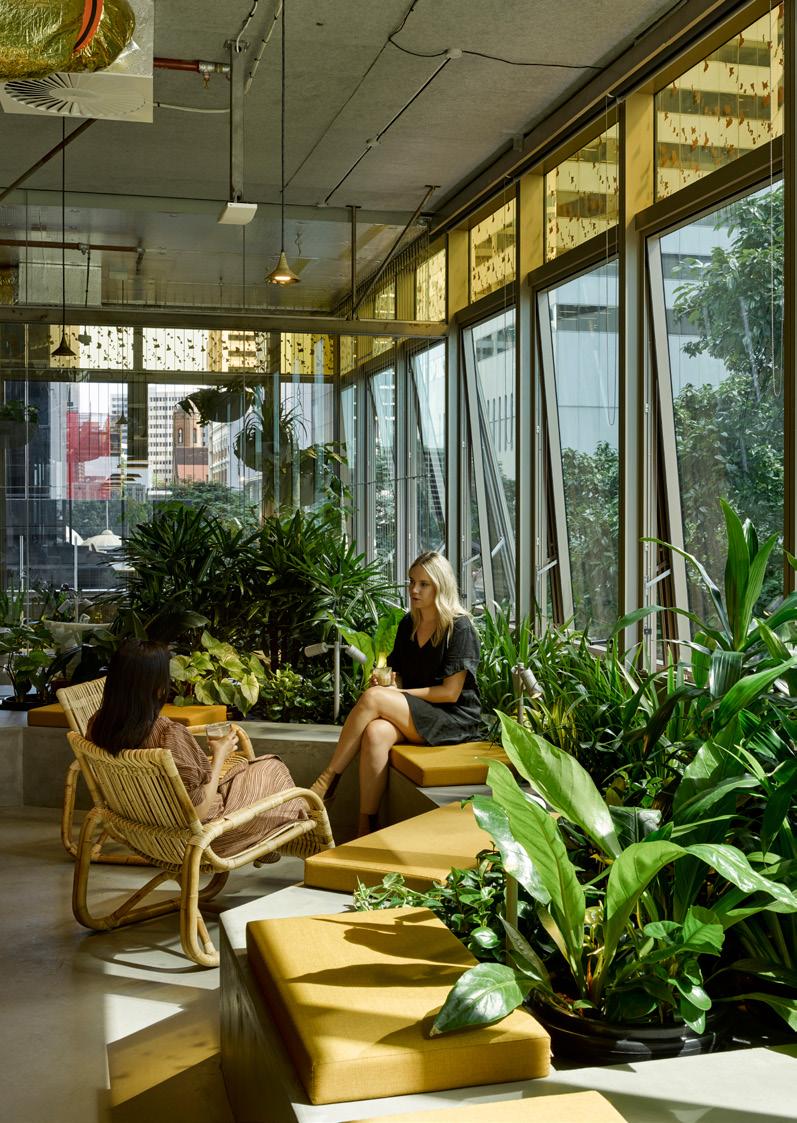
Look at the companies most renowned for their workplace culture and you’ll see these cultural values as tangible concepts, built into
the physical workspace to cater specifically to employee health, wellbeing and happiness, and increasingly, biophilic design plays a major role in achieving these goals.
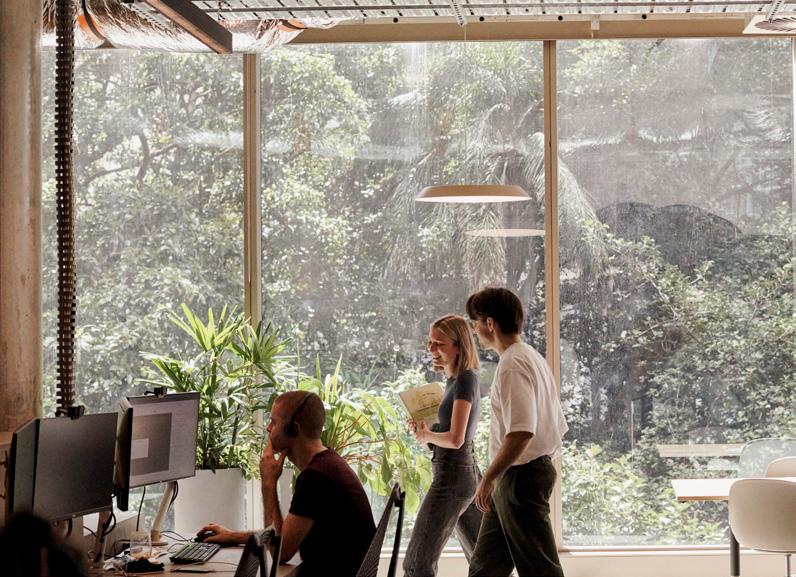
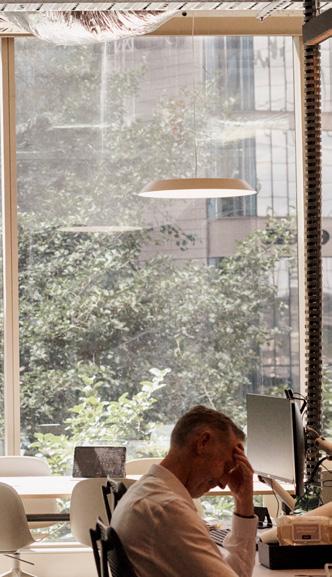
The forest of fig trees, planted at the corner of Creek and Eagle streets over 130 years ago was the perfect place to sow the first seeds of a pioneering project in biophilic city planning.
The Annex represents a landmark of Brisbane City Council’s ambitious urban greening project.
Essentially, it serves as an extension of the fig grove, visible from every level of the 12-storey commercial tower. The façade is draped in the lush greenery of vertical gardens, while unique
structures and fixtures create a sense of being beneath a vast subtropical canopy.
BVN’s Michelle Rehn was involved in much of the planning and implementation of what represented a fairly radical concept for its time.
Fortunately, the idea of the Annex as a living ecosystem aligned with Brisbane City Council’s masterplan. The vision was for the building to be a largely self-sustaining habitat for flora and fauna, making biodiversity fundamental to the building’s design.
The unconventional design did meet some resistance, Michele explains. Developers naturally want a guaranteed cost to benefit ratio on their investment.
Fortunately, studies like the Human Spaces report into the Global Impact of Biophilic Design in the Workplace backed up BVN’s belief that the Annex’s biophilia would make it an attractive prospect for tenants keen to capitalise on the reported gains in performance, productivity and creativity produced by biophilic elements – BVN even took up resistance in the Annex themselves, making the third and fourth storeys their “treehouse studio”.
Maintenance cost was another concern, particularly over the plants’ upkeep and effects on water and energy consumption.

From the outset, BVN considered another of its key tenets, Designing with Country, as essential to ensuring the Annex’s biophilic elements were highly localised and complementary to the surrounding landscape.
Plant species, many of them local natives, were carefully selected. Now established, they thrive year-round under the local conditions with minimal maintenance.
A north-east orientation and operable glass façade enclosing the Sky Terrace and garden balconies provide each level with plentiful natural light and ventilation, effectively eliminating air conditioning use for much of the year.
Pathways for optimal water catchment were also carefully considered.
The Annex achieved a 5 Star Green rating for its sustainability efforts.
The Annex is one of numerous biophilic buildings designed by BVN, with more in the pipeline as businesses use its appeal to bring back workers, and cities eagerly approve designs that drive their own biodiversity strategies.
The unconventional organic shapes, sundrenched conservatories and garden nooks of BCN’s B:Hive, a shared workspace in downtown Auckland, facilitate the crossing of paths between people, sparking conversation and the cross-pollination of ideas.
Biophilia can be seen as giving nature a helping hand in reclaiming the concrete jungle, and in some small, yet significant way, returning humans to their natural habitats – not just in the places they live and play, but where they work as well.
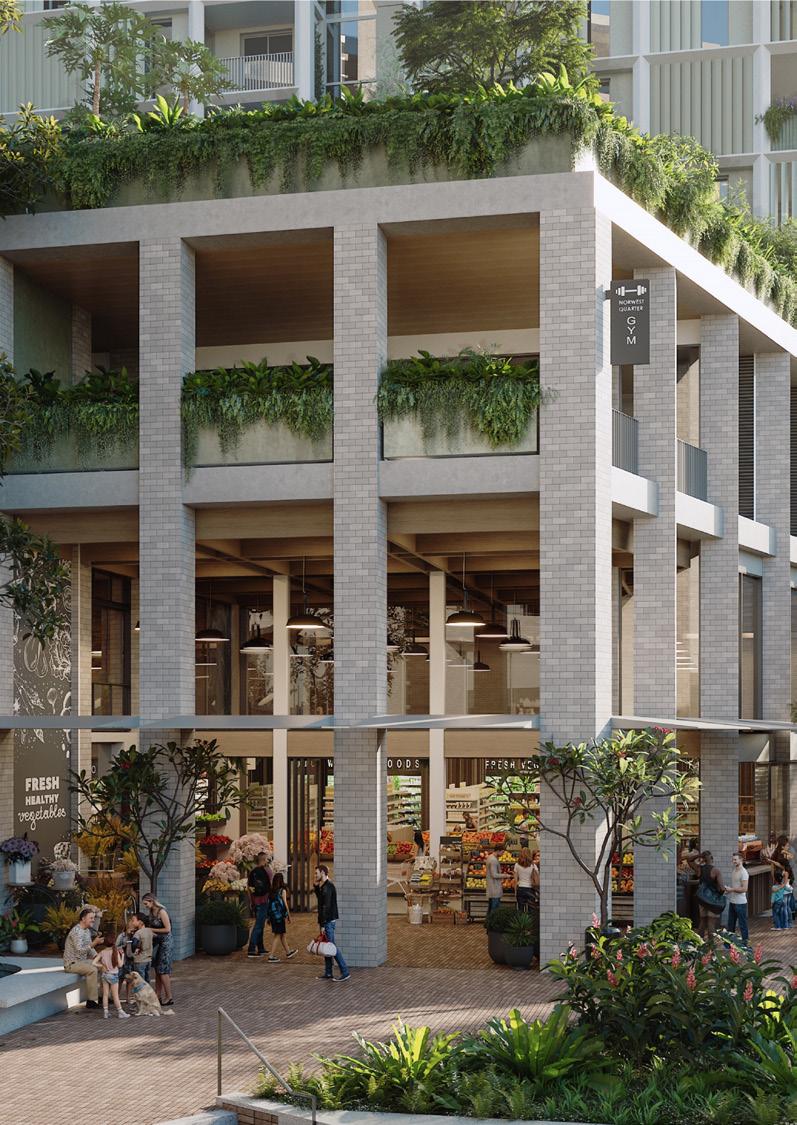 NORWEST QUARTER BY MULPHA
Mulpha Australia is one of those rare developers that plans projects for long term sustainable value instead of short-term gains. At Norwest in Sydney, which it has been developing for the past two decades, it's demonstrated that this thinking also pays economic dividends.
As a privately owned company Mulpha is free to think long term. The embedded values shore up trust with both investors and contractors. A handy asset to have in these times of great uncertainty.
“There’s a lot of pride in us being family owned,” says Jan van der Bergh, senior development manager of the Norwest Quarter, the latest project at Norwest. Designing for quality means ensuring that the project also has a positive social and environmental impact.
This “creates pleasant places that are more comfortable, healthy, have lower operating costs, and are ultimately more desirable. People are prepared to pay more for this.”
It’s an approach that’s turning heads.
Norwest, in what’s being called the “City of Tomorrow”, is a $1 billion 377 hectares master planned precinct of residential and commercial spaces with lush biodiverse landscaping and sustainability principles at its core.
It includes the Norwest Private Hospital, at Mulpha’s The Bond, that was recently acquired by Centuria Healthcare for $66.2 million.
The Norwest Quarter precinct consists of two residential buildings: the 115 apartment Banksia, designed by Bates Smart, and the 81 apartment Lacebark designed by Smart Design Studio.
In total that’s almost 200 apartment homes, plus gyms, grocery stores, medical services, restaurants and landscaped resident and community amenities.
“Mulpha ultimately wants Norwest to continue to evolve as a desirable place,” Jan says. “Retail performance is critically important in this strategy.”
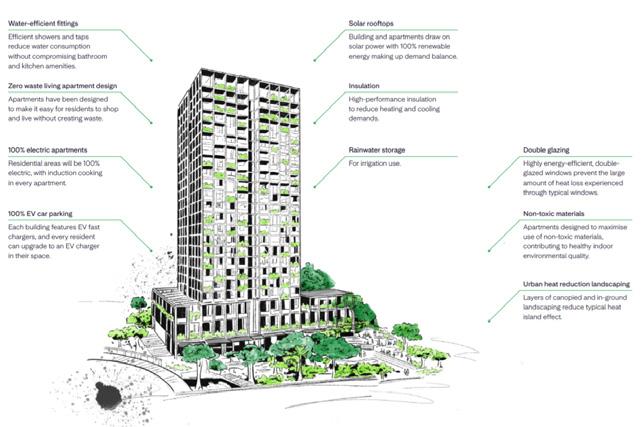
Consultant Ross Harding of Finding Infinity, said it was enriching to find a developer in Mulpha that was happy to go along with almost every sustainability initiative suggested: from allelectric energy, to rooftop solar and integrated waste systems.

“I don’t know of any more ambitious project anywhere in the world that’s doing these things,” Harding says. “It’s pretty impressive.”
Another sign that the developer is serious in its commitment to sustainability is its partnership with the Greater Sydney Commission that is working to align stakeholders to drive more action on urban heat. The aim is to galvanise state and local government, utility providers and developers to work together to mitigate urban heat.
“It’s a real challenge we have to deal with and will only get more important in the years to come,” Jan says. That’s why the Norwest development has such a strong focus not just on electrification and solar, but also on heatreducing landscaping.
Studies across the world’s major cities have found that temperatures in highly urbanised areas are an average of 2°C to 12°C higher compared with rural surroundings.
To mitigate heating, Mulpha looked to the Urban Cooling Guide by The Low Carbon Living Cooperative Research Centre (CRCLCL). The report has strategies for curbing urban heat,
including urban greening, running water and cool roofs.

“As much as we try to curb carbon emissions, we do acknowledge there will be an increase in ambient temperature, Jan says.
“The amount of hot days will triple in Sydney –especially in Western Sydney.
“This issue flows on from comfort to high cost of living, involving air conditioning costs, electric infrastructure upgrades to keep up with mechanical demand, higher mortality and lost productivity.
“We are already seeing higher numbers of warmer days, so let’s prepare ourselves to mitigate the ongoing challenges of global warming.”
In order to help other developers and investors understand the issue, Mulpha is collaborating with the University of New South Wales’ urban heat team to produce a thermal imaging “heatmap” of the precinct.
There’s an Urban Heat Assessment In Norwest City and an assessment of Neighbourhood Characteristic and Climatic Zones in Norwest City.
The team has deployed sensors across the precinct to monitor temperature, wind, elevation, shade, vegetation and water, to inform a Norwest-specific guide on what mitigation measures make sense for that local microclimate.
It will then launch a plan of heat mitigation measures based on the CRCLCL’s Guide to urban cooling strategies, in summer this year.
“Sharing information is important – the goal is to lower the precinct’s ambient temperatures –so you can’t work in silos.
“We want to make urban heat a higher priority for buyers. A lot of buyers don’t understand good passive design; so we are working on building awareness as there are so many homes
and precincts that don’t get it right.
“We want to make people aware of these small decisions that can make a big impact –many are easy to implement and have huge implications.”
But despite the clear environmental benefits of these strategies Mulpha also intends to reap financial dividends from the process. It’s recent move to a new upmarket office in Sydney’s CBD, within the Intercontinental Hotel, is a token of its success). And the company is also growing fast, Jan says, with a 20 per cent increase in staff

After three years of natural disasters and pandemic, there’s a groundswell of demand for greening our urban world.
And newfound respect for the terrible power of nature and the joy it can bestow when we get things right.
In this exciting event, we sought to uncover the emerging strength driving one of the most disruptive – and wonderful – influences coming our way: the elevation of nature to its rightful priority in our built environment.
There’s fast-growing consumer appetite for nature everywhere – from the workplace to home. And the corporate and investment world is starting to get the message.
We brought together some of Australia's leaders in the field of how to mitigate heat in our housing zones, how trees, tree canopy and plants can moderate the urban heat island effect and bring us resilience and calm, not mention higher property values!.
And we looked at the kinds of planning policies that can drive the outcomes we need.
Following is a summary and edited transcript of the day's learnings and insights.

Jess is a city leader and communicator focused on climate adaptive, regenerative and resilient places. She served for five years on the City of Sydney Council as Councillor, Deputy Lord Mayor and chair of the Environment Committee. She led the Greener Spaces Better Places program on behalf of Hort Innovation and the Nursery & Garden Industry as part of the Republic of Everyone, and is a member of the TEDxSydney and Newtown Neighbourhood Centre boards.
With her finger firmly on the pulse of societal and environmental trends, Belinda brings together diverse organisations around a shared goal for positive impact. Greener Spaces Better Places is a national initiative to ensure that as our cities and towns grow, so too do our green spaces.

Peter has been involved in tension structures for over 15 years and over that time has played a key role in the tensile architectural industry across Australia. In 2010 Peter founded Tensile Design & Construct to fulfil the growing need within the construction industry for a full service tensile
Martin is a landscape architecture academic and practitioner. He has been head of the School of Architecture and director of postgraduate studies at UTS, and course director of the landscape

Sacha is a design and strategy director of ASPECT Studios. As a global design influencer, Sacha’s record of excellence in leading projects of transformational change spans placemaking, infrastructure, play space, academic, civic institutions, and green infrastructure. He holds several advisory and board positions including the inaugural Adjunct Professor of landscape architecture at the UTS Faculty of Design, Architecture and Building, the UTS Faculty of Design, Architecture and Building Industry Advisory Board and the Inaugural NSW State Design Review Panel pilot program.
Angela is the national social sustainability manager at GPT. Angela is responsible for First Nations engagement, the GPT Foundation, and building strong social value within the Group’s broader ESG strategy through a human rights lens. Prior to the property industry Angela worked in the non-profit sector and as a private investigator.

Known as the “person paid to worry for Sydney”, Beck is the chief resilience officer of metropolitan Sydney at Resilient Sydney, a local government led program hosted by the City of Sydney and connected to the global Resilient Cities Network. Launched in July 2018, the program is a collaboration of state government, business and the community including all 33 local government councils in metropolitan Sydney.



International awardwinning landscape designer and horticulturalist Jamie Durie founded his international design practice in 1998. During this time, Jamie and his team have received over 38 international design awards in landscape architecture and design. Jamie is the author of 12 best-selling design books, contributor to multiple publications, regular guest on The Oprah Winfrey Show, host of over 56 television design shows across three continents, and an ambassador for Planet Ark’s National Tree day for over 21 years.


Jefa Greenaway is a Wailwan and Kamilaroi man and founding director of Greenaway Architects, a senior lecturer at the University of Melbourne, an Honorary Fellow of Design at Deakin University, and a cultural ambassador for the Australian Institute of Landscape Architects
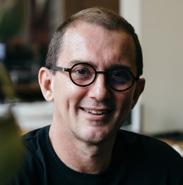
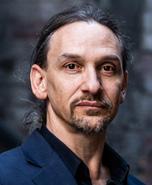

Jefa Greenaway is founding director of Greenaway Architects, a senior lecturer at the University of Melbourne, an Honorary Fellow of Design at Deakin University, and a cultural ambassador for the Australian Institute of Landscape Architects
Laura has two decades of industry experience working in environmental sustainability and social justice in Australia and South Africa. After several years in strategic roles at Taronga Zoo, Macquarie University and the Centre for Sustainability Leadership,

Richard is the co-founding director of WOHA. Born and raised in Australia, he has served on the Board of Design and the Board of Architects Singapore, as well as the Building and Construction Authority of Singapore. He has lectured at many universities, and served as an Adjunct Professor at the University of Technology Sydney, and
Greg was a city dweller who became a farmer prior to becoming an environmental scientist with a focus on water.

Greg has worked in the water industry for over 20 years, firstly in SA Water and now in Sydney Water.
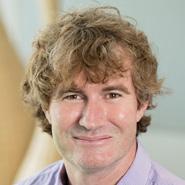
Greg is also a board member on the Green Adelaide Board, which focuses on providing strategic guidance for state and local government in Adelaide.

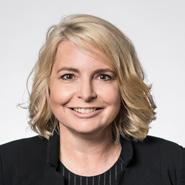
Renée Ingram is the head of Western Sydney development at Sydney Water. The area is in the midst of an exciting transformation: the creation of the new Western Parkland City. Water management is at the core of this new city, especially in light of the increasing urban heat the area is beginning to experience.
Nikos Kalogeropoulos is a director at Molonglo. Nikos has extensive experience in ACT government and was chief financial officer of Territory and Municipal Services and the ACTION Transport Authority. This strength in economics is balanced by a wealth of knowledge and deep interest in philosophy and ancient history.
Jennifer’s research interests are at the intersections between urban planning, transport and human health. She has experience working across institutions, including with the NSW Ministry of Health and with local health districts and transport agencies across NSW on several projects examining translation of health evidence.

Dr Steven Liaros is a polymath and futurist with expertise and qualifications in civil engineering, town planning, environmental law and political economy. He is an honorary associate at the University of Sydney and the director of strategic town planning consultancy, PolisPlan.

Steven is co-creating a new category of land development to enable a collaborative, affordable and sustainable mode of living in a connected network of Circular Economy Villages.
ELIZABETH MOSSOP PROFESSOR OF LANDSCAPE ARCHITECTURE AND DEAN OF THE UTS SCHOOL OF DESIGN, ARCHITECTURE AND BUILDING

Elizabeth Mossop is Professor of landscape architecture and Dean of the UTS School of Design, Architecture and Building. She has held leadership positions at Harvard GSD, the Robert Reich School of Landscape Architecture at LSU and the University of NSW. Founding principal of Spackman Mossop Michaels landscape architects, her research and practice is concerned with landscape’s role in urban revitalisation and resilient communities and cities in the face of climate change.
Sebastian is an Associate Professor in urban studies at Western Sydney University. He develops trans-disciplinary research around the complex issue of urban heat. He is the director of Smart Irrigation Management for Parks and Cool Towns (SIMPaCT) a large-scale research project that will result in AI-operated park irrigation systems for optimal cooling during hot summers. He sits on the panel of Greening our City, works as independent advisor for the NSW Chief Scientist and Engineer and co-developed the first Handbook for Urban Green Infrastructure (UGI) for Standards Australia. He is also a senior researcher at UWS with a focus on UGI.
John is director of urban horticulture at the Burnley Campus, University of Melbourne. John’s teaching and research interests centre on the design and use of plants, particularly in green infrastructure, public landscapes and in therapeutic horticulture. He helped establish the Green Infrastructure Research Group and recently published the Maintenance Guidelines for Australian Green Roofs and together with colleagues is completing the Australian Guide to Green Roof Plants.



Ben has worked at government bodies including Melbourne Water, the Committees of Management, the Department of Environment Land Water and Planning, Parks Victoria, the Councils and Catchment Management Authorities, Landcare and Zoos Victoria. He has been working for Darebin since 2019 in various conservation roles, and is currently coordinating the ReWilding project since July 2020.
Eric is a horticulturist and landscape architect with 25 years of experience, who started his career in large show gardens and high end nurseries before starting his own landscape and maintenance business. He was a coordinator for North Sydney Council’s volunteer gardening program, Streets Alive.



Kaylie is a Yuin Saltwater woman and founded Country Oriented Landscape Architecture Studio (COLA Studio) in 2021 as a response to landscape design and practice. The studio is one of very few Aboriginal owned studios in the Australian built environment industry. A passionate practitioner of Country-centred design, Kaylie’s work amplifies the voice of Country and First Nations people through the design process and into the life of projects. Kaylie advocates strongly for greater First Nations representation in the built environment industry.

Jan van der Bergh has worked in the development sector for over 15 years, leading residential, mixed use and master planned developments in Sydney and London. Jan leads the team on Norwest Quarter, a project which will transform 3.8 hectares of greenfield land into a vibrant village centre consisting of nine residential towers containing 864 apartments and 6000 square metres of space provided for cafes, restaurants, neighbourhood shops and childcare facilities.
Laura has experience in climate, energy and environmental law and policy at Pollination, a specialist climate change investment and advisory firm that is accelerating the transition to a net zero, nature positive future. Prior to joining Pollination, Laura was a lawyer at leading national and international law firms in Australia.
Marci is head of


Sara is a chartered building surveyor and Australia’s first female professor of property.



MARCI WEBSTERMANNISON HEAD ARCHITECT QUEENSLAND AND NEW SOUTH WALES, MELBOURNE DESIGN STUDIOS
In her welcome address at the summit, Professor Elizabeth Mossop, Dean of the UTS Faculty of Design, Architecture and Building highlighted the key issues facing the greening of our urban envi ronment, and the immense opportunity they offer.
But the fight for net zero was not our only problem, she noted.
“Even enormous success here will not get us to where we need to go to create the cities we want to live in, supported by Country that is healthy and symbiotic with our needs.
“This is one of the big lessons our Indigenous People have tried for so long to share with us. It’s now time to listen.
“While we humans have carelessly polluted the planet, we also have the opportunity now to rebal ance our impact on the world.

“Investors, developers and their armies of consultants and advisers are the people who in many ways hold the keys to changing our behaviour.
“Knowledge about landscape and greening historically has been held in the hands of a relatively small number of specialists and passionate individuals. And little understood by everyone else.
“Now connection to nature needs to be embraced by our entire community. It’s one of the reasons why this university is so interested in the issue, and why it is so deeply embedded in our research and teaching across all the disciplines.”

Jamie Durie, the international award winning designer, author, television host and regular on Oprah Winfrey’s show for four years, energised the room with his view of the big global trends and the zeitgeist around connecting to nature. With a background that includes 38 international design awards in landscape design, Jamie also shared his experience of how to communicate the value of greening and the critical importance of biodiversity.
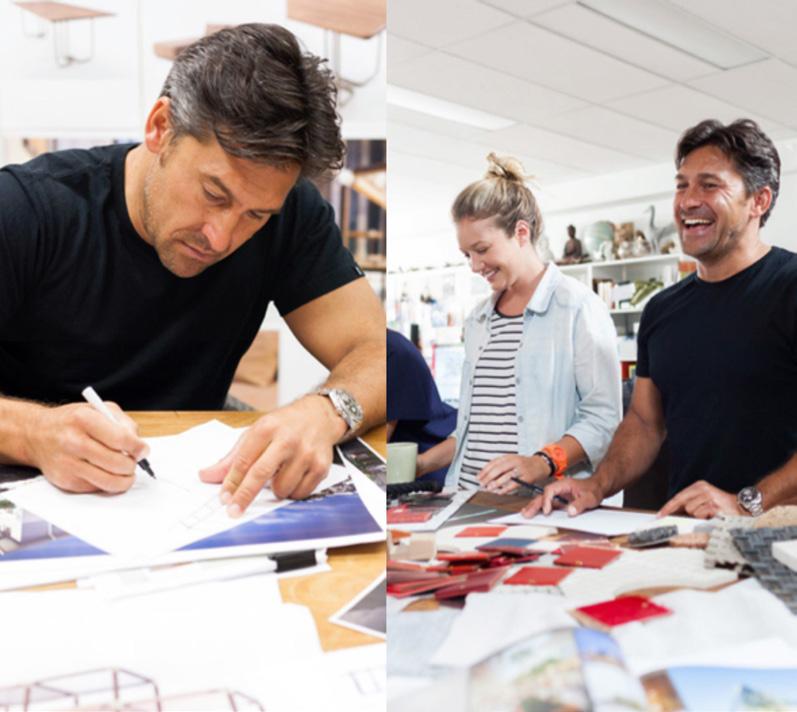
My training was originally in horticulture and landscape architecture. I’ve been in this industry for a long, long time – I was hugging trees long before it was cool!
Thinking back 25 years ago, architecture always came first – before landscaping. But now it seems that architecture and landscape actually join at the beginning of the project, instead of landscaping being just an afterthought.
Events like The Fifth Estate’s Urban Greening are a great example of how the two worlds of architecture and landscaping are now really colliding in a very dynamic way. It’s an example of how collaboration with industry can encourage more greenery in our urban areas. It’s a Green Revolution.
Haven’t you heard the news? Green is the New Black.
We’re going up, we’re going vertical, and rooftop gardens are on the agenda. How do we greenify our rooftops? How do we make them feel like part of the natural landscape?
Greening has an important effect on urban heat. We’ve seen this in high density cities like New York, where greenery is not just tokenistic.
Let’s look to vertical garden (mur végétal) inventor Patrick Blanc, who I’ve had the pleasure of working with, and green infrastructure specialist Fytogreen, who I also work with regularly. They are some examples of experts in vertical garden technology.
Blanc, who started as a botanist and then got into vertical landscapes, is the designer for Central Park in Sydney. His vertical gardens are a really clever way to plant because, no matter what level of the tower you live in, you always have a garden.
Another example is Bosco Verticale by Stefani Bueri: one of the best examples of green architecture on the planet. It fits 32 acres of landscape into two 21 storey buildings, and the way he did it was extraordinary.
But putting aesthetics aside for a moment, how does nature play a role in our landscape?

“Haven’t you heard the news? Green is the New Black”
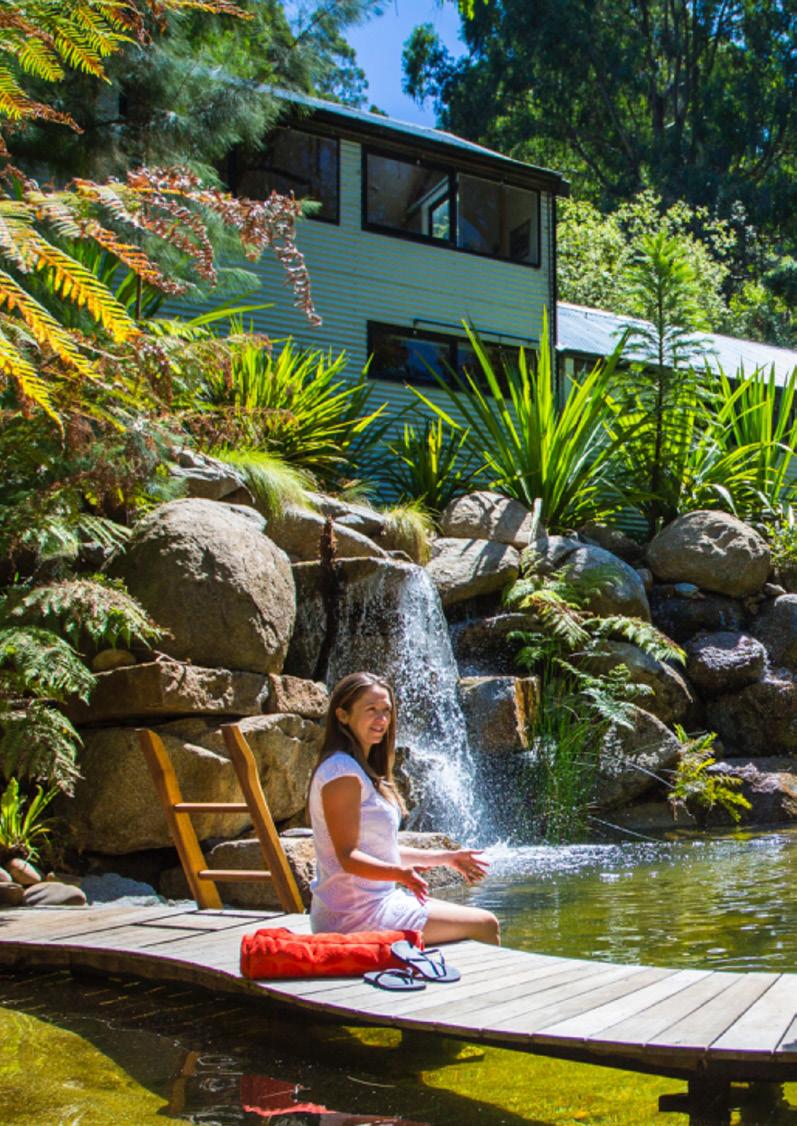
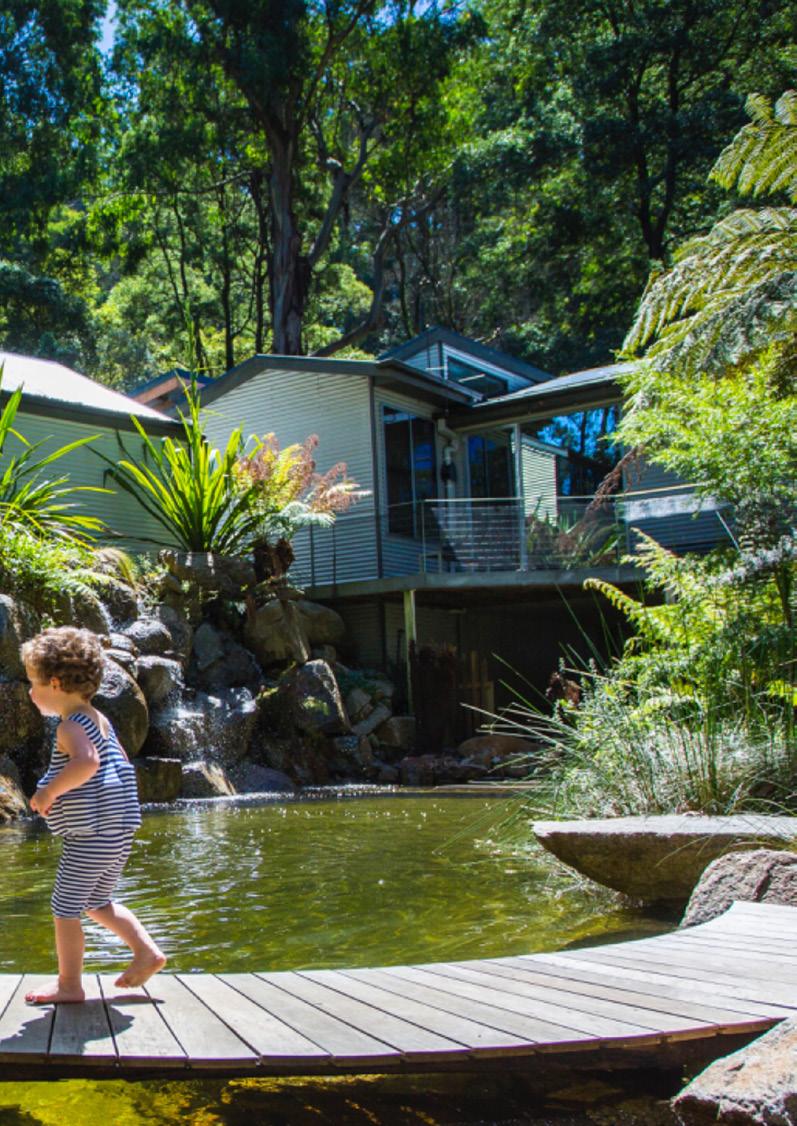
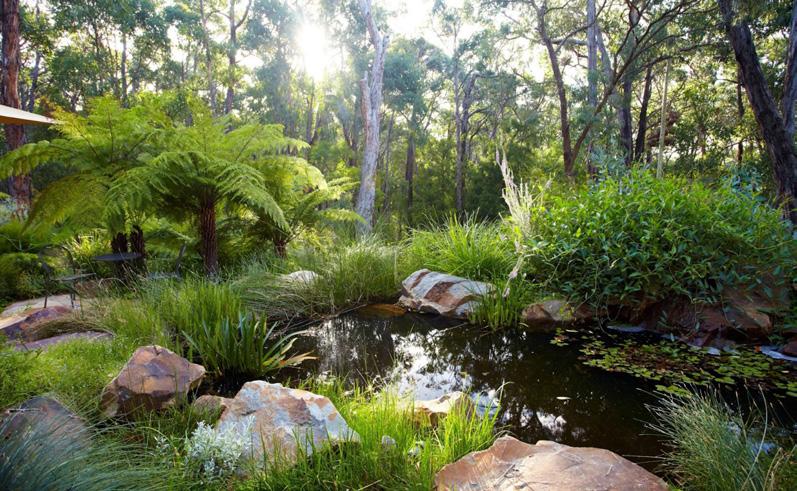
It’s time to call on the industry to start planting plants that can engage with and stimulate the biodiversity and ecosystem.
"We need to start turning our backyards into urban food bowls, not just ornamental landscapes”
In some areas of the world, bee populations have gotten as low as 18 per cent. In the US, they are now shipping bees from one side of the state to the other – a seven to 10 hour journey. By the time the bees get to the other side of the country to pollinate, they’re jet lagged. And of course, they’re doing half the job they’re meant to be doing.
The other side of it, of course, is food security.
Edible plants should replace the ornamental systems we favour now. We really need to start turning our backyards into urban food bowls, not just ornamental landscapes.
All this is very much more difficult than it looks. [Buildings need to be modified with thicker concrete and steel to hold large trees.] The balconies have to be offset to allow more light to infiltrate, because most plants need at least six hours of sunlight. And that’s how buildings start to breathe.
Over in China, it’s astonishing to see 400 kilogram trees being lifted to the top of buildings. It’s a tremendous weight the building has to bear: 25 to 35 foot trees, sitting on the perimeter of your balcony, in a 900 millimetres soil depths.
Then there’s Volatile Organic Compounds (VOCs), which are toxic to human health, and yet are found in the paint, the carpets, everywhere in the home.
Plants can help to absorb these toxic chemicals. They provide an added benefit to health and wellbeing. Just five plants in a bedroom clean the air.
Jacarandas, a native of Tanzania, are absolutely everywhere in Australian cities providing sanctuary to a myriad of people, plants and animals. They form part of an interactive landscape where humanity is giving and receiving in harmony with nature.
One important project I worked on was a residential area in the old Wrigley’s building, in Rosebery, Sydney. On the rooftop is a leisure area with curved seating, gardens and an outdoor cinema.
Another example was a building in Avalon, Sydney which has a rooftop garden and beach side vegetation.
Frank Lloyd Wright started this conversation in 1923, building his textile blocks and buildings that were integrated with the landscape, with the Millard House, also known as La Miniatura, California.
I recently spent three days in Cape York Peninsula working on a new eco resort project.
Stefano Bueri’s work in China is a series of green pyramids that can catch the sun at all times of the day.
Fairmont Hotel in Port Douglas uses a similar system with twisted floor plates. The floor plan is offset so that plants are able to grow on all sides of the building, while the structure still remains strong, like a tree.
Biomimicry has a big role in what we design, not just the buildings, but also the products that go in them.

If we start to look forward to 2040, how do we make the most of our land use? How do we incorporate solar and make our building solar passive? How do we start to use sustainable
building materials and have these buildings not just reduce waste, but start to soak up some of the solar systems, some of the solar energy?
Courage is always rewarded. Be a pioneer. If not for the environment, if not for the community, if not to set an example, if not to win awards…then why not do it simply for your children, and the future inhabitants of this planet?
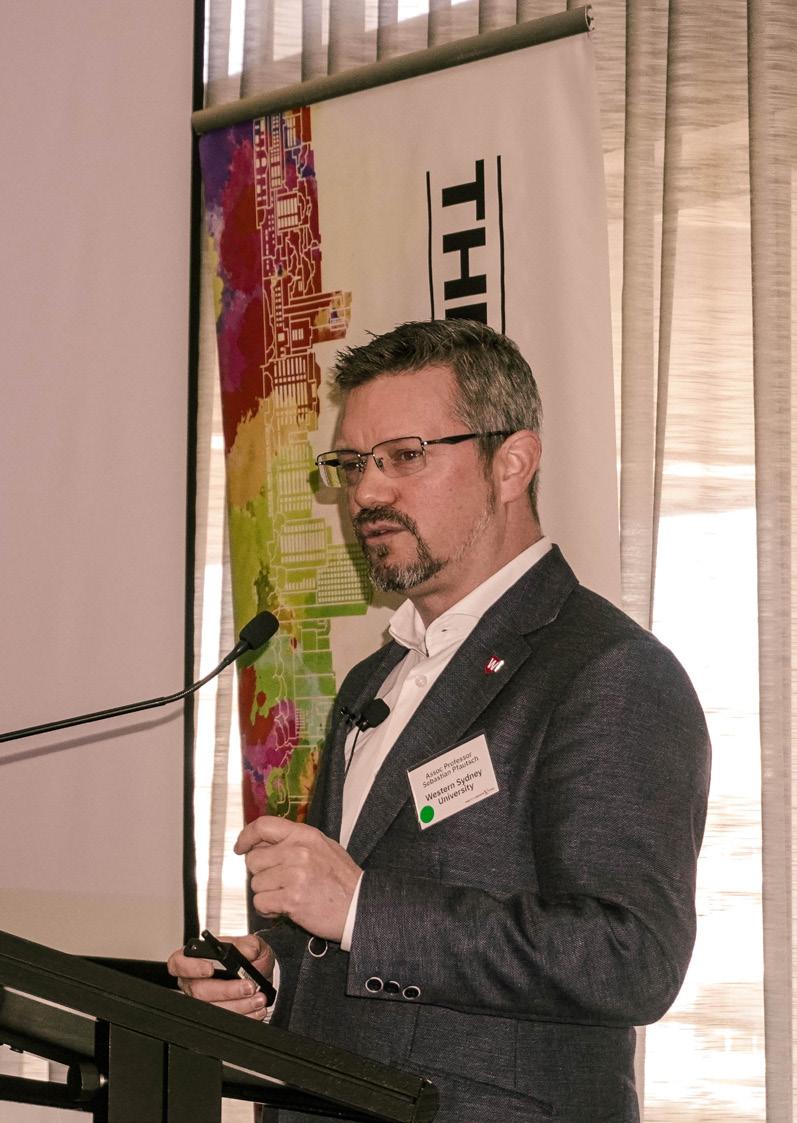
Sebastian Pfautsch is an Associate Professor in Urban Studies at Western Sydney University, well known for his extensive research into the complex issue of urban heat. At Urban Greening he shared his work on SIMPaCT, a largescale research project that will result in AI-operated park irrigation systems for optimal cooling during hot summers.
One of the problems I encounter is that some people simply don’t like plants.

One of the most effective ways we can overcome this is by reframing plants as an effective antidote to urban heat.
Technology and artificial intelligence are the best tools we have to better understand, manage and monitor heat in the urban environment.
I want the industry to integrate cooling as a function in urban environments, a huge opportunity that is currently not really utilised.
We all know that Australia is extremely urbanised. By 2022 we are expected to have reached a population of 26 million.
We get a new person into this country every one minute and 50 seconds. That’s a lot of people.
They’ve got to live somewhere.
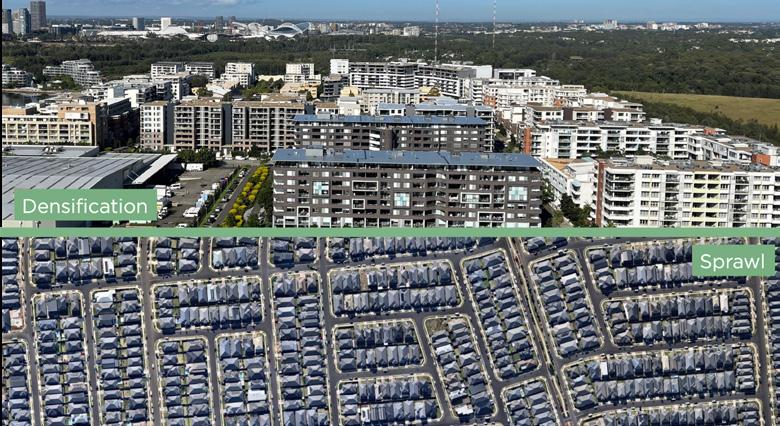
That’s why we do medium to high density in cities, and urban sprawl in both cities and regions. That, of course, comes at the cost of
open space and green space. It makes our cities hotter. Because in these high and medium density suburbs, we only have around one per cent of tree cover.
At the same time, only about one per cent of the globe’s land surface is covered by cities – but their contribution to global warming is immense. So now, for the first time, the United Nations have acknowledged the importance of cities and the Intergovernmental Panel on Climate Change has begun to report on urban spaces.
The two kinds of infrastructure types we have in cities that provide cooling is blue infrastructure (such as lakes, rivers, and creeks), and green infrastructure (such as parks, trees, etc).
Unfortunately, trees won’t be able to entirely eliminate urban heating, because all the buildings in these urban environments have a
lot of thermal mass.
However, when we look at surface temperature reductions, we can get up to 20, maybe even 25, degree surface temperature reduction when we introduce green infrastructure in our cities.
Let’s look at a case study – my work at Sydney’s Bicentennial Park.
Sydney Olympic Park and Bicentennial Park are important places for the community to picnic, socialise, exercise, and cool down on hot days.
When looking at the cooling effects of green infrastructure, it’s very important to look at the size of the park and what kind of plants you have in it, because that influences both the cooling effect distance and the cooling effect intensity.
Don’t think only big parks are important – it’s the small parks that we really need to look at, because that’s the one that we really have in our neighbourhoods.
In Bicentennial park, we have implemented a $6 million irrigation management system called SIMPaCT. This project incorporates blue infrastructure in the form of irrigated parks, and green infrastructure in the form of lawns, tree groves, mangroves, and a mix of deciduous trees and evergreens.
Often, it’s easy to irrigate too much when irrigating manually, because people get worried that their park will dry out too much.
To solve this problem, we’ve partnered with other research organisations, government and industry partners to set up a network of sensors that give us information from the local environment, and by checking with data from the Bureau of Meteorology, we are able to optimally hydrate the plants.
We have a digital twin of the park, we have machine learning. We have done a lot of model developments and reiterations.
We are able to wirelessly stream data out of the park to tell us exactly what the soil moisture status is, what the temperature is, what the relative humidity is, and so on – in all different locations within the park.
We then take that information into a geographic information system using spatial modelling, and look into the different park environments and what’s actually happening there.
We have trained our artificial intelligence or machine learning algorithms to pick up how the park actually works.
This means we now have more than 200 individual zones that we can control, each with different types of vegetation.
With large cost projects, there are a lot of risks and a lot of things can go wrong. But we really want to pave the way for the rest of the world to follow.
This irrigation system solves a lot of the headaches and hassles of taking care of plants in urban environments.
Watch this session
“We are able to wirelessly stream data out of the park to tell us exactly what the soil moisture status is, what the temperature is, what the relative humidity is, and so on – in all different locations within the park.”


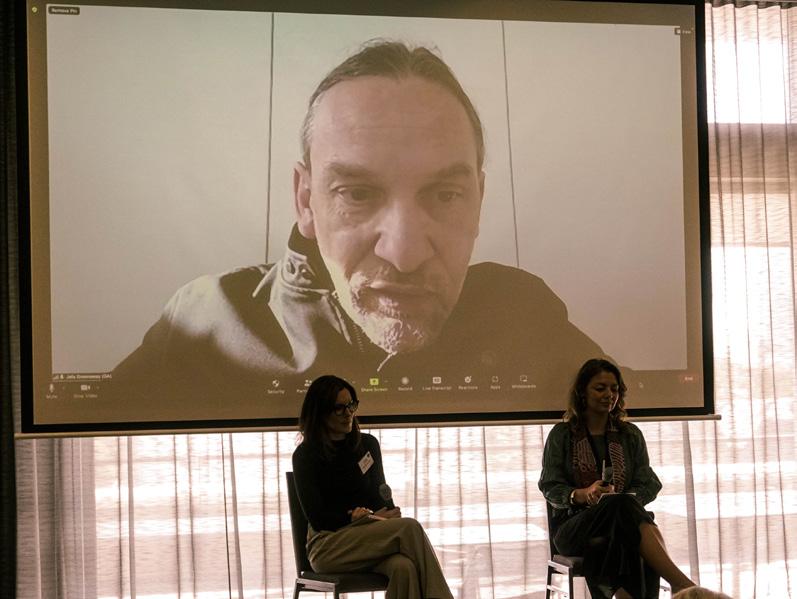
What can we learn from First Nations People about working with nature? How are developers, designers and planners collaborating with Indigenous thinkers and designers right now? In this session, two of Australia’s leading Indigenous architects share how they are making a big, practical impact on creating a greener built environment by applying Indigenous design principles to projects big and small. And how one of Australia's biggest property companies is working towards better incorporation of Indigenous thinking.
Jess Miller (moderator)
Jefa Greenaway, Greenaway Architects
Kaylie Salvatori, COLA Studio
Angela Crossland, GPT Group Watch this session
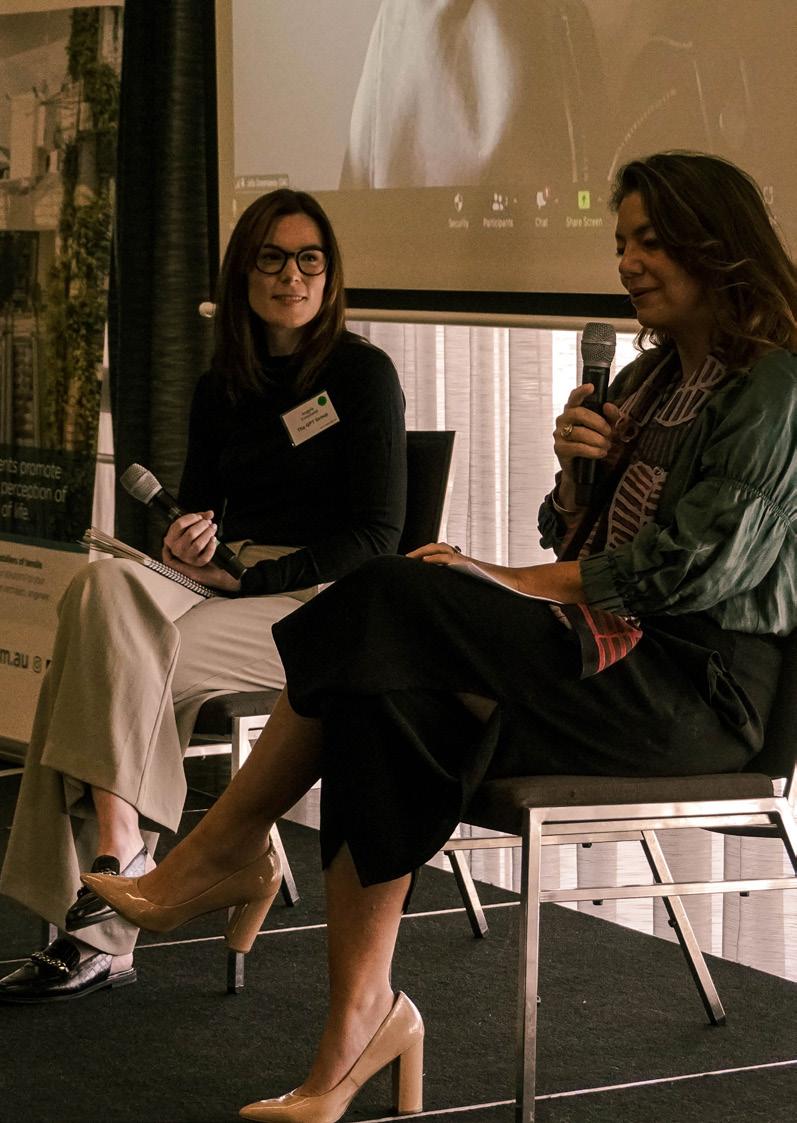 ANGELA CROSSLAND AND KAYLIE SALVATORI
JEFA GREENAWAY: Jefa, a Wailwan and Kamilaroi man, shared how to embed Indigenous design principles in projects at every scale – from CBD buildings to major state infrastructure projects. Key he said, was "to move beyond the tokenistic, the cliched, and the exotic plumage of grafting something on".
In one project Jefa collaborated with Wurundjeri people of the Eastern Kulin nation to understand how to reveal layers of history and memory of place through the installation of a fire pit at GPT Group’s building at the corner of Queen and Collins, in Melbourne, working with GPT.
Through conversations with Traditional Elders,
Custodians and Knowledge Keepers, we were able to embed a level of truth telling, and also a means to orient oneself to Country through a cultural lens. This embeds a level of cultural authenticity into the project.

What the fire pit enables is a place of pause and respite within a busy metropolis and it supplies a space for ceremony.
When we did the traditional welcome with Uncle Colin Hunter, a Wurundjeri Elder, he was disinclined to use the fire pit element that we designed and cast in bronze, because he thought it looked so precious, and so beautiful.
Importantly, interventions like this start to normalise the relationship to Country. They provide a moment where, through the course of the year, you can engage with culture, even within a commercial environment. It demonstrates that, regardless of the scale, we
can start to do this, and we can do it well.
As a counterpoint to that project, we’re also working on the North East Link, which is an $11 billion infrastructure project.
We looked at how we intersect with urban design, how we facilitate managing the heat island effect, and how we build canopy cover.
Our work was anchored in Indigenous design principles, mapped to the International Indigenous Design Charter.
Indigenous design principles can be applied at a very intimate scale, up to projects where we embed reconciliation at scale through design practice.
Importantly, we need to move beyond the tokenistic, the cliched, and the exotic plumage of grafting something on.
The only way we can really engage with Country, and the narratives of place, is to have conversations with Traditional Custodians. They are the knowledge keepers.

We need to support a mechanism, and processes, to enable those deep conversations.
That enables us to adhere to cultural protocol and supports design inspiration, because often we’re revealing layers of history and memory of place.
It gives us the opportunity to encode meaning to projects. It supports this notion of reciprocity and mutual benefit, where we can empower Indigenous enterprises and support the right to an Indigenous economy.
telling, and really start to demonstrate the value of Indigenous design thinking. Because, ultimately, there is great wisdom in 70,000 years of continuous connection to place.
The NSW Government Architect’s Office draft Connecting with Country framework is starting to shift the dial of how we undertake our social responsibilities as practitioners.
We can also delve deep to engage with truth
How we engage with the challenges that we’re confronting from biodiversity loss, climate change mitigation should be just core business.
When we embed a cultural lens, we can start to really tease that out even further.
This quote from the Indigenous Placemaking Council crystallises it in terms of the challenge and the call to arms: “If nothing of your culture, history, language, or art is visible in the streets, parks and buildings where you live, how can you ever feel welcome there?"
We always start with this idea of cultural mapping because often these places, ecologies, landscapes, and connections have been impacted by colonisation.
The other dimension is the importance of particular systems. We always talk about Indigenous knowledge systems, and that
“Importantly, we need to move beyond the tokenistic, the cliched, and the exotic plumage of grafting something on.”
“If nothing of your culture, history, language, or art is visible in the streets, parks and buildings where you live, how can you ever feel welcome there.”
everything is interconnected. It’s about starting to understand those relationships, and we need to find balance.
My approach has kind of been playing it by ear, for lack of better description. It’s a fluid and evolving approach.
It is always to start with Traditional Custodians of place, to start with Country.

Then to find out what the protocol is of collaboration and engagement, what characteristics of Country that I need to be aware of.
I then work around the non-Indigenous framework, to see how we can innovate it around the Indigenous framework of design and understandings of Country. I don’t really see the point so much in adding an additional layer to a business as usual approach. I think that we do need to change the framework in which we operate, in order to come up with different outcomes.
Then there’s truth-telling: understanding the impacts of pollution, manipulation of water systems and tributaries, and how we’re degrading the landscape.
What that enables us to do is to heal Country, to learn from Country, and to nourish Country in terms of the organising principles for the project.
Hopefully this gives you a bit of a taste of how we think about our responsibility and how we encode Country as part of the normative practice of design.
Kaylie Salvatori entered the conversation with a strong point: there’s not much value in simply adding an additional layer to a business as usual approach. We need to change the frameworks we operate in to create better outcomes for Indigenous communities, she said.
Aboriginal people have been designing things for 60,000 years or longer, so it’s not really new for us. But because Indigenous design frameworks are new to this industry, the approach is evolving, and there is no hard and fast way of going about things.
I’m quite lucky that in all my projects I’m working with Indigenous community members and Traditional Custodians.
We’re able to embed the principles of caring for Country, Indigenous place and knowledge, into our designs.
An example of the work we’re doing is Sydney Science Park, the largest private landholding in Western Sydney.
It’s a collaboration with Jiwah, a landscaping company run by Cudgenburra and Bundjalung man Clarence Slockee, as well as Danièle
“What that enables us to do is to heal Country, to learn from Country, and to nourish Country in terms of the organising principles for the project.”
“We’re able to embed the principles of caring for Country, Indigenous place and knowledge, into our designs.”
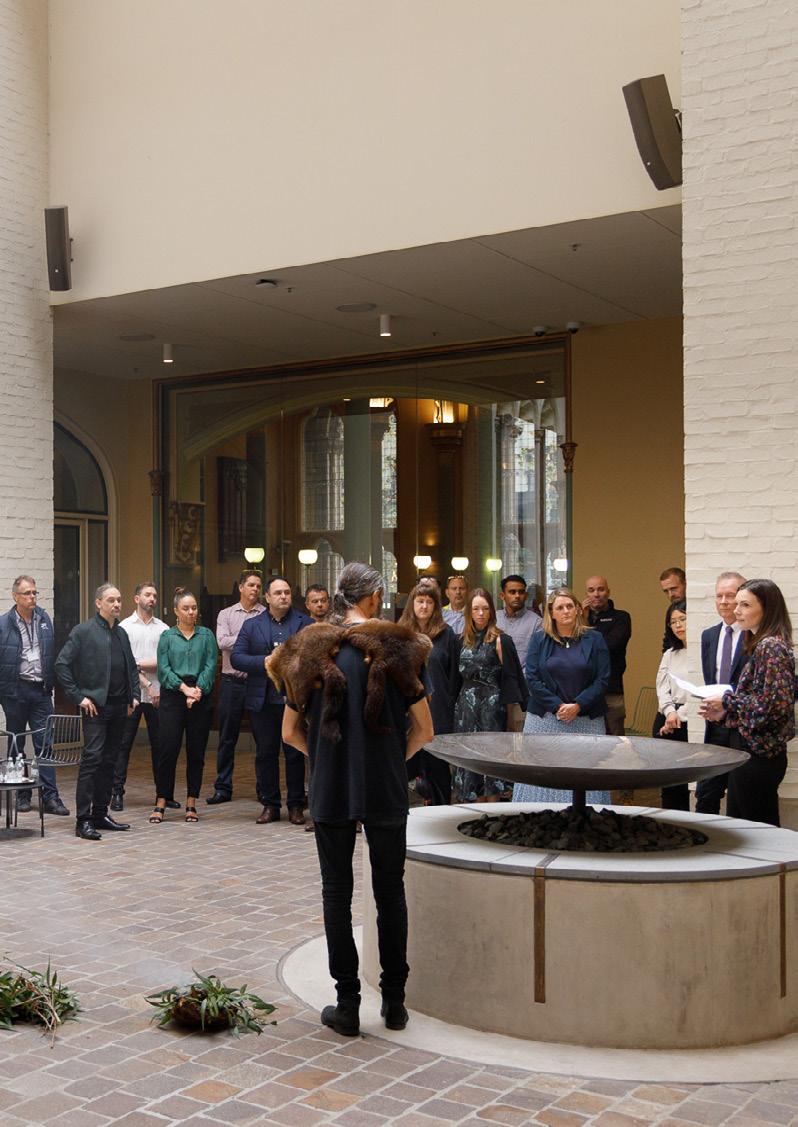
Hromek, a Saltwater woman of the Budawang tribe of the Yuin nation who runs Country centred cultural design and research consultancy Djinjama.
We’ve been collaborating with Traditional Custodians to come up with a suite of design principles that will help guide the urban design of place.
One of the Aunties, talked about biomimicry, and what we might be able to learn from Country.

We’ve always worked from Country in order to make the ways in which we build places more sustainable, and moving beyond sustainability to thinking about a regenerative future.
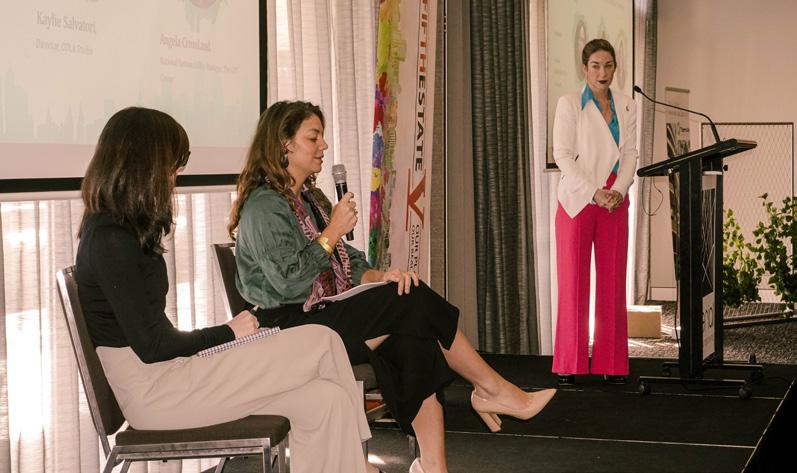
When we think about our obligations to place, we mean our obligations to ensure continuity of life for all. That’s not just ourselves, but also the plants and animals that belong to place.
Biomimicry means making sure that we’re taking inspiration in the architecture and the urban design of place, from the systems of Country.
That includes water systems, and the ways in which water needs to be filtered through soft, permeable surfaces.
What we’re looking at doing is maximising permeability, and we’ve suggested 100 per cent permeability across the site as a goal.
When we think about the role of water, it’s especially important that it is allowed to play its cultural role. The flooding, the ebb and flow of water in place, has a hugely significant cultural and environmental role to play.
Making sure that is honoured, as opposed to being engineered out of place, is something that has been really important for the traditional custodians of the area.
“Biomimicry means making sure that we’re taking inspiration in the architecture and the urban design of place, from the systems of Country.”
We’ve been excited about seeing the innovative ways and responses that the architects and urban designers are having to all of these principles going forwards.
It’s early days, we’ve just released the draft report for them, but we’re really looking forward to seeing the ways in which the designers respond to that too.
One of the things that we find with the Connecting to Country framework and the industry’s uptake of Indigenous knowledge and culture, is we see them wanting to know what our stories are, without really caring too much about what the lessons are.
happens takes place around that.
We also need to make sure, when we’re using Indigenous knowledge to create places and doing cultural placemaking, that it’s not just marketing – that we’re actually making space for us.
ANGELA CROSSLAND: Engaging with First Nations communities should be about building meaningful relationships and deep reciprocal partnerships that contribute ongoing socio economic benefits, said Angela in her contribution to the panel.
At a corporate level, we’re hearing from our investors that they are seeking more formalised processes to make sure ESG outcomes are achieved.
ESG is now, formally, part of corporate strategies.
We hear a lot about the environment, and carbon is a big part of that.

But there’s so much more. There’s the emergence of formal frameworks at a global level around reporting for biodiversity.
The narratives are important for us, but they’re already there.
All of our hills, our forests, every single plant that we’ve got in the Sydney basin and all around the continent, has a story and knowledge attached to it. All of the hills have stories, all of the water beings have stories.

When designing spaces and going through the process of engagement, we need to make sure we’re not implicating Indigenous peoples into their own colonisation.
We need to make sure that the stories that are attached to those places, to the plants and animals are honoured, and that their place remains, while all the development that
The big shift has been happening under the “S” of social. While there’s still a long way to go, we have made really wonderful progress.
And, particularly in Australia, a lot of work has been going on in the space around Indigenous design thinking, co-design and collaboration.
From a social perspective, we’re seeing corporates and investors really looking deep, and becoming more comfortable talking about human rights. With that comes Indigenous engagement.
There’s a push right from the top, to practise this well. People are becoming a lot more aware of the importance of genuine engagement.
"When designing spaces and going through the process of engagement, we need to make sure we’re not implicating Indigenous peoples into their own colonWisation."
That means going beyond those legal tick the box outcomes, and looking for deeper, more meaningful engagement that genuinely delivers returns.
What’s exciting is, as we’ve gotten to know and build better relationships with Traditional Owners across the country, they’re getting more comfortable in directing us on how we can work together to build better socioeconomic outcomes.
We’re moving far beyond a transactional relationship where we might end up with a beautiful piece of art and culture that’s on display.
Timing is an important thing. Where we have done really well is where we’ve had 10 months or a year ahead of any formal deliverables to build and grow relationships.
With Jefa and I, and our wider teams that have worked together on projects, it’s been great to start with something that’s meaningful and practical – what he refers to as a “small intervention”.
It’s important to show yourself and your team how this process works, and prove to Traditional Owners that you really are serious about your commitments.
We’re not just engaging with Traditional Owners to say, “hey, we’ve got this amazing open design project”.

We’re talking about place in a broader, holistic sense – you’re also committed to and talking about where this takes us in the future.
What we’re really looking for are opportunities where that relationship is reciprocal, and we’re able to support and contribute to ongoing socioeconomic benefits.
That can be through building capacity or by providing avenues for Aboriginal and Torres Strait Islander businesses to thrive.
I would encourage all practitioners in this space to take responsibility for your learning. Think about your responsibility to the community, and how you can really lift and elevate those opportunities.
How can we design so culture can continue to thrive, and enterprise can grow?
What’s exciting about starting with Country, Traditional Owners’ stories and engagement, is that we’re going beyond “plonk art” and creating something that’s meaningfully connected to place.
“I would encourage all practitioners in this space to take responsibility for your learning."
“Traditional Owners across the country are getting more comfortable in directing us on how we can work together to build better socioeconomic outcomes.”
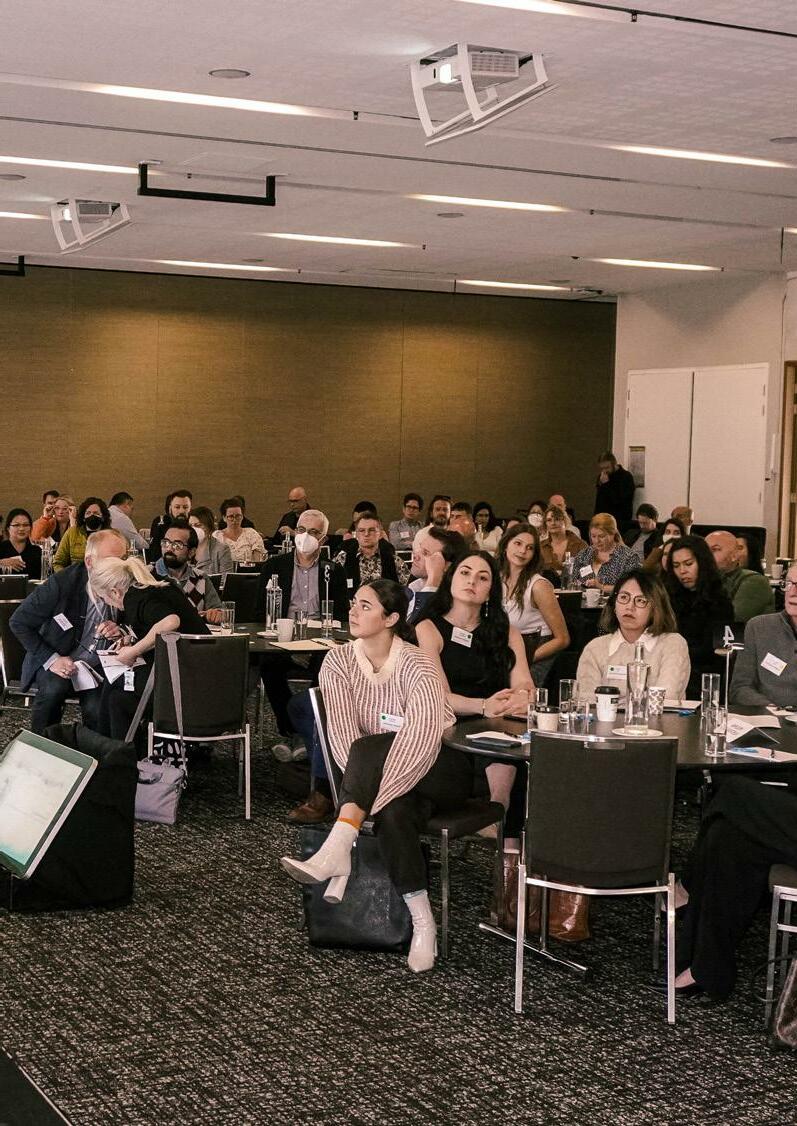
According to Renée Ingram, head of Western Sydney development, Sydney Water, the creation of the new Western Parkland City, which will provide “dynamic and culturally diverse with plenty of jobs and varied affordable housing is a great opportunity to improve how we manage water.
In this conversation with our MC Jess Miller, former deputy Lord Mayor from the City of Sydney, Renée discusses the challenges and opportunities that come from collaboration around water.
JESS MILLER: This is a very interesting time for water in Sydney, with the metropolitan water plan coming out in its final version.
New South Wales actually hasn’t had a proper water strategy since before the idea of the three metropolitan cities strategy came to the fore, so – notwithstanding the challenges – that seems to be quite significant.
What are the kinds of things that you’re hoping

might come out in the Metropolitan Water strategy? And, not just in Western Sydney but all over the world, we’re seeing people with either way too much, or way too little water.
How do you think Sydney Water is equipped to be able to confront these challenges?
RENÉE: My job at Sydney Water is to look at how we are servicing Western Sydney.
In Western Sydney, we have a once in a generation opportunity right now to shape the building of what will be a third CBD city for Sydney.
This brings with it a great responsibility when we look at the legacy we’ll be leaving for our children.
What we are working on is how we incorporate the protection and use of water into the development of the city, at these really early stages.
Covid has been a major reset for some of these principles, because people in Western Sydney were locked down into a five kilometre radius in a heat zone.
We weren’t necessarily locked down on the hottest days of the year, but on a summer day, people experience a life that is somewhere between four to 10 degrees hotter, particularly in Penrith [than the eastern suburbs and other
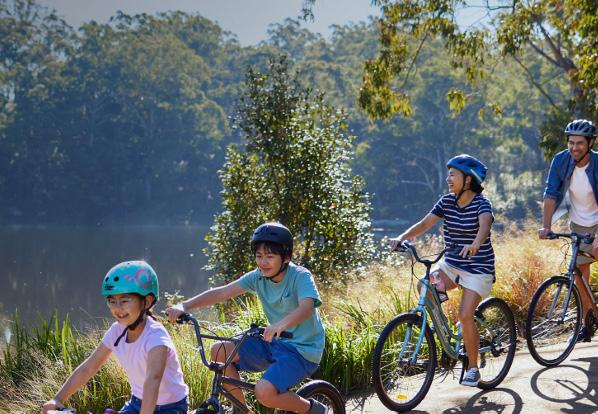
leafy areas of Sydney].
There are many different aspects to achieving great outcomes, such as recycled water. What is its use? Where are we using it? How are we planning reuse it, so that it is integrated into the natural environment to create cool zones.
We also need to know how to give back in terms of the resources so we can achieve a circular economy
Our population is increasing – we expect to see another million people living in Western Sydney.
We hope our stormwater can be locally reused, and that will create that source of water that will then feed our parks to create the greener urban spaces and parklands, which are not only great for your mental health, but also have a cooling impact as well.
In order to do that, what you will also see is a

restoration of the natural creek system that is out in Western Sydney.
Some of the stormwater harvesting concepts, when they come through, will help to repair and restore that natural creek system by holding back some of the water.
JESS: It sounds as though there are lots of small projects. Obviously, you can look at one new emerging development and go “we’re going to really look at figuring out recycled water there, we’ve got another development where water sensitive urban design is going to play a really key role”.
But, at the same time, you’ve got these really difficult relationships and governance frameworks to manage, because you’ve got local governments who are responsible for maintaining stormwater, and it’s expensive.
available. So our facilities will be quite large, in order to service a broader region.
JESS: There’s obviously things the government can do to set up the framework, and the responsibility that Sydney Water has. But, what kinds of things should the private sector be contributing to this conversation?
Everybody’s got to play a part. But, in my experience of local government, that was often very difficult. There were lots of IPART (Independent Pricing and Regulatory Tribunal) rulings that prevented the pricing that would enable innovation to happen.
What are the types of collaboration that can occur? What does that collaboration look like? And how can we get the most out of the contribution and innovation that the private sector has to offer?

It is important to maintain natural watercourses.
How do we develop around them and protect them so that they are performing that natural function, and also assisting with a connection to Country, and providing green open spaces?

Councils are incredibly keen to continue creating that connection to green and open spaces.
It’s about working with them around where we can open swim sites, because for Western Sydney, like you don’t want to be driving to Bondi to go for a swim.
How do we monitor the water quality and make

sure that we have safe spaces to swim? Our councils are really interested in those sorts of things.
Most of all, it’s about leveraging everybody’s experience and expertise.
Because at every level, if we all work together and collaborate, this can be achieved, and Western Sydney will actually be a great place to live.
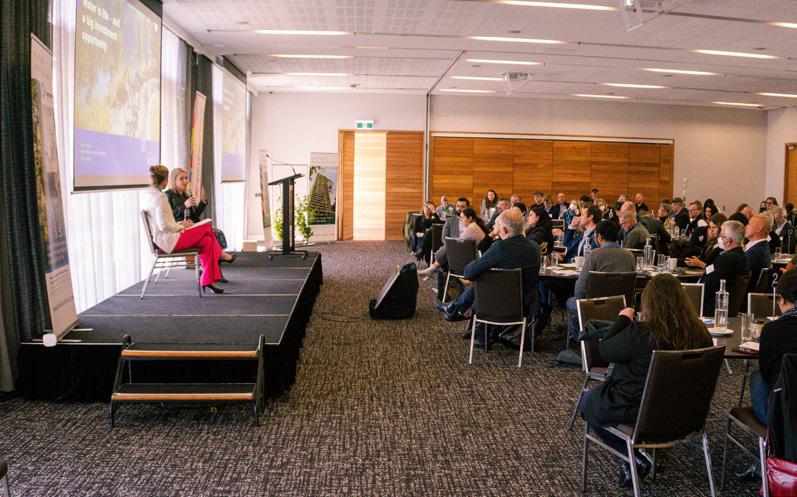
SPOTLIGHT: Melbourne Design Studios architect Marci Webster-Mannison discussed her work at Charles Sturt University’s Thurgoona campus at Wagga Wagga in southern New South Wales, and its innovative use of water for cooling, grey water and wetlands treatment. We have to reimagine our city, Marci said.
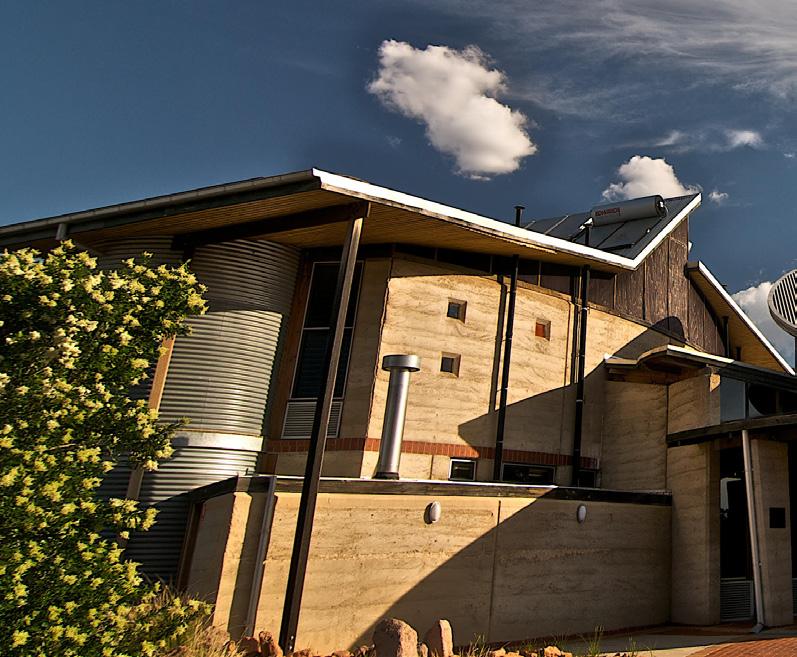
We are at a tipping point of our collective future.
I want to unfold a story of reimagining a city in a way that responds to increasing pressures of flood, food production, fire, ecological health, energy, and water.
Firstly, we will zoom in on how we might live in special places that uniquely fit their region and climate.
Secondly, we will explore how neighbourhoods may actually be enriched in responding to increasing pressures of climate chaos.
The buildings at Charles Sturt University’s Thurgoona campus at Wagga Wagga are articulated in rammed earth, and recycled
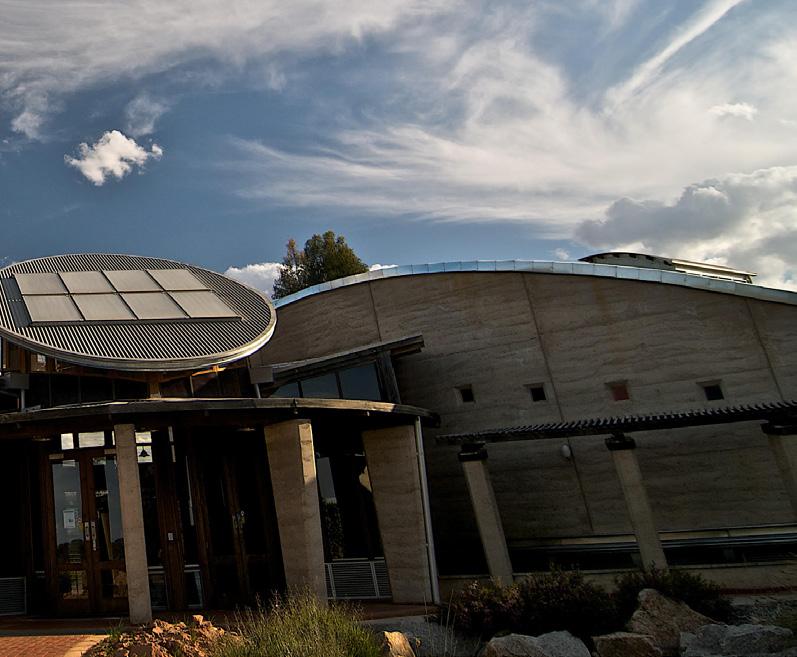
timber, glass, bricks, and steel. They invite questions about materials and construction.
The buildings are orientated for solar access, with kinky angled roofs collecting daylight and solar energy, earth thermal exchange, night cooling, natural ventilation and a windmill that speaks of renewable resources.
Careful use of space and materials, the exploitation of thermal mass to manage the building’s temperature, and 40 composting toilets teach about waste.
The integrated water tanks, the grey water treatment wetlands that provide drinking quality water, the meandering constructed creeks interspersed with cleansing wetlands,
recirculating water to keep the water clean and mosquito free, all animate the criticality of water in this dry region.
The reuse of rainwater for evaporative cooling, a geothermal loop for heat exchange, a unique solar hydronic heating and cooling system all supplement the passive design.
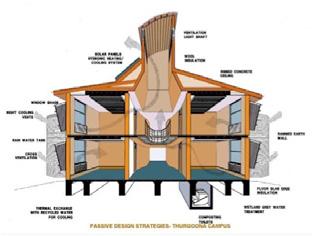
The formation of vistas of the future stands of remnant trees and the living museum of endemic planting along the waterways give a voice to biodiversity. There’s 100 per cent fresh air, abundance of natural light, and non toxic materials breathe comfort and health. The place is abuzz.
We hear people thriving in the surroundings. We see how the built environment influences how people live in this learning laboratory.
And 500 kilometres to the north, four passive evaporative shower towers provide cooling to this naturally ventilated building using rainwater collected from the roof and stored under the building.
Outside air is induced at a high level into the shower towers through the inertia of falling rainfall sized droplets cooling the incoming air to 25 degrees when it’s 38 degrees outside.
Meanwhile, 850 kilometers northeast, the strategies for summer and winter comfort are radically different, calling for the houses to behave like a Queenslander in the summer and a solar passives home in the winter.
The natural stormwater flow paths are designed as creek beds, and greywater is treated.
The water supply is 22,000 litres of rainwater collected in four interconnected tanks. This home’s not air conditioned or heated, but provides comfort through passive means and the addition of an innovative thermally massive shaft at its core.
This nearby school and its surrounds became a learning journey approached by a path that bridges over a bioswale winding its way to the veranda and beyond where you may continue
your journey along Sheep Station Gully to remnant wetlands.
The landscape setting is for learning and play comprising an artificial gully fed by a hand pump and header tank that also acts as part of the stormwater system.
Water supply is for interlinked water tanks 64,000 litre capacity and power is from a five kilowatt photovoltaic system.
In addition to the architecture of placemaking, this building is a veritable science experiment itself, which reveals how building materials affect thermal performance of our built environment.
But what might a neighbourhood in harmony with the natural world, where we see ourselves as part of nature, be like?
Let’s look at the buried creek of an Inner Meeanjin (Brisbane) suburb, raising urban creeks, creating buffered flood zones that provide cooling to the local area.
Food, gardens, water management, wildlife habitat, art, recreation, and transport opportunities are both a physical and social response to increased climate change events.
Weston Creek is located in a 416 hectare catchment of the Brisbane River, about three kilometres from the CBD. The city plan is for this area to double its population over the next 10 years.
One of our first principles was retrieval. That is to ensure all new development is outside of the flood extent. Then specific green infrastructure for water retention, treatment and reuse was proposed, resulting in excess water.
Then urban agriculture was integrated into the heart of the community to solve this problem.
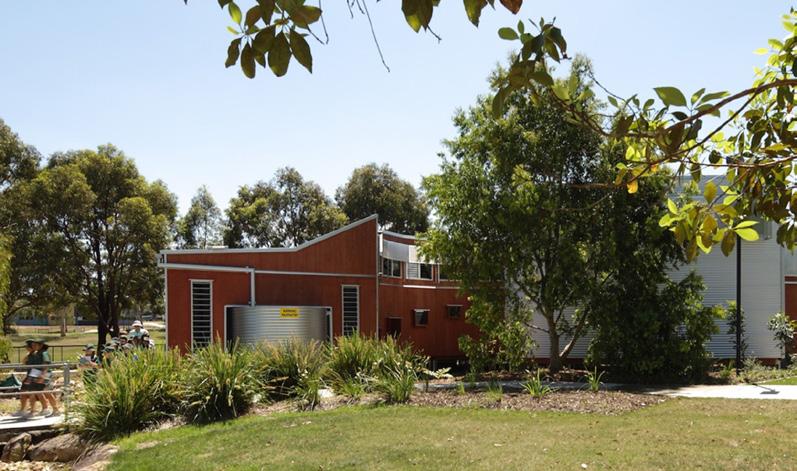
Hydrological modelling of the strategies showed the population may be doubled and achieve 30 per cent reduction in stormwater flows, 70 per cent reduced pollutant loads, and 30 per cent reduced demand on potable water.
So, in the face of climate chaos, ecological collapse, and species extinction, will we keep cranking up the aircon as we watch our planet burn? I’m asking questions about the nature of cities, what we want cities to be, and how we can remake the city.
 SHEEPSTATION GULLY ENVIRONMENT CENTRE, YUGGERA, UGARAPUL AND TURRBAL COUNTRY (ALGESTER, QLD) PHOTO: SCOTT BURROWS
Trees are the enigma of our green world. Understanding the nature of plants, the requirements to grow and sustain vegetation and research on the factors affecting plant success.
In this section of the event, we discovered how to integrate strong plantings with buildings (not as easy as it sounds), how to manage fierce wind tunnels (especially in Melbourne), and how to select the right species for a nine-storey atrium or shopping centre. The session started with a presentation by Dr John Rayner, followed by a spotlight by Peter Bottero and a panel discussion.
Dr John Rayner, University of Melbourne
Peter Bottero, Tensile Design & Construct

Professor Sara Wilkinson, UTS School of Built Environment
Watch this session
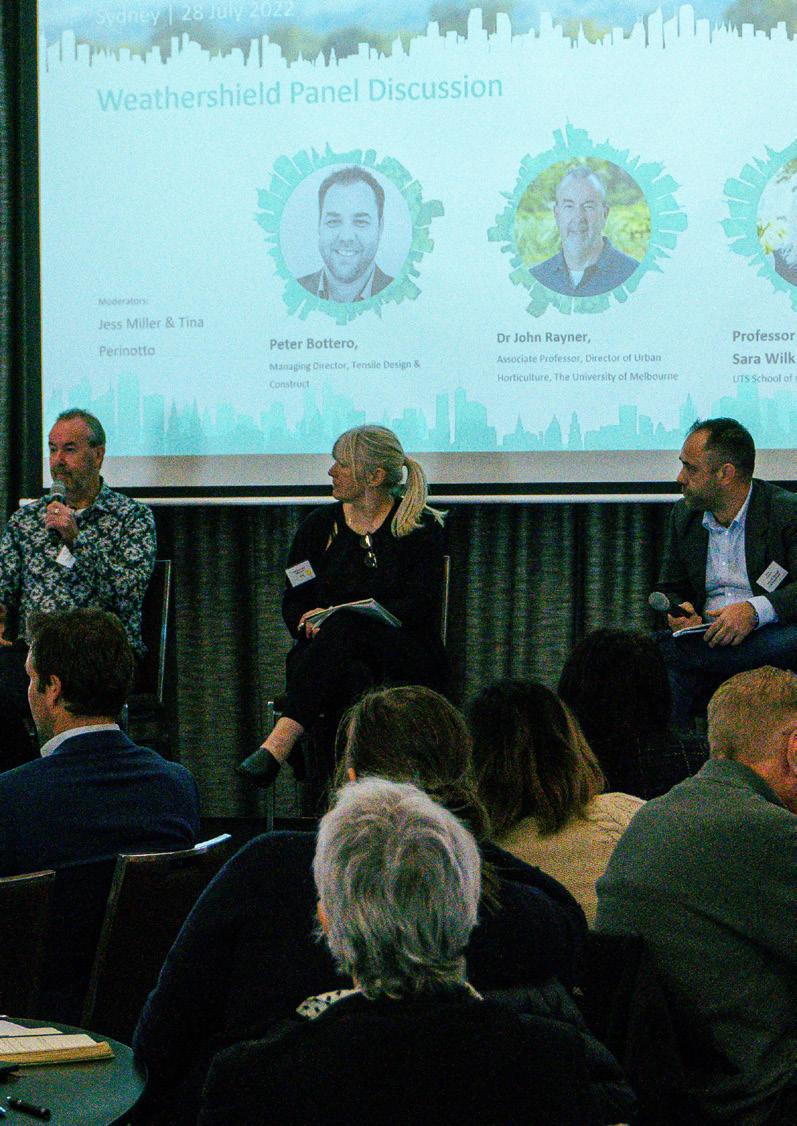 DR JOHN RAYNER
PRESENTATION: Dr John Rayner, Associate Professor in Urban Horticulture, University of Melbourne, is one of Australia’s leading horticulture researchers. At Urban Greening, he shared his wisdom about the nature of plants, the requirements to grow and sustain vegetation and research on the factors affecting plant success.
I do a lot of work with landscape architects. They’re wonderfully creative people, but sometimes the basics around how to grow and sustain plants – and I emphasise the word “sustain” – are not well understood.
A few years ago, I was in the Croatian city of Dubrovnik, and heard about this amazing ancient tree that was planted about 10 kilometres away. I drove out there to have a look. It is an extraordinary tree. There are written records of the tree being planted.
To see a 500-plus year-old tree, still pretty healthy, in an urban environment is amazing.
I’m always looking at plants. I’ve been teaching plants at Burnley for 32 years, and I haven’t stopped that interest.
For anyone who is interested in trying to understand how vegetation can be sustained in cities, observation and curiosity are pretty important.
Cities can be really hostile for plants. It’s not just heat. A lot of the time it’s about really changed environments.
We know about climate change, but we’ve also got micro-climatic changes that can dramatically affect the success of plants. But you see plants that do their thing in a whole lot of different places, you think: “wow, okay”.
Wisteria is one of my hero plants after seeing it growing five or six storeys, directly out of asphalt in Copenhagen. But it’s a terrifying thing to behold on the side of a building if it’s not maintained. All these plants are examples of plants that find a spot in a hostile, urban environment and are able to grow successfully.
But this is perhaps more common: I take all my landscape students on a failed landscapes tour
“I take my students on a failed landscapes tour of Melbourne"
of Melbourne, so we can look at award-winning projects and see how those plants have failed and that this is tough.
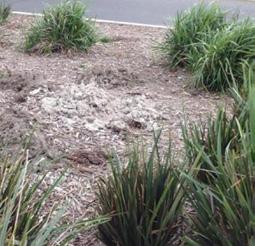
I’ve made mistakes. I look at the Burnley green roof and it’s a horror show. These are not easy environments in which to sustain plants.
We need to ask the question: why does a plant die?
Failure is also not just about death. It’s also a lack of performance, or function, or diversity, or even just visual amenity. I think we should be looking at vegetation that really connects to people and the environment.
We talk a lot about biodiversity in Melbourne. But biodiversity starts with plant diversity. To get plant diversity in urban vegetation and urban environments can be challenging, particularly Indigenous vegetation, surprisingly.
One of the questions I am asked a lot when I’m involved in projects is: what’s the maintainability of this design?
We have strongly modified environments and climates, particularly micro-climates. We’ve got strongly modified soils, obviously in a containerised setting on a structure like a green roof, or a living wall.
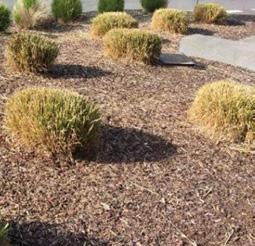
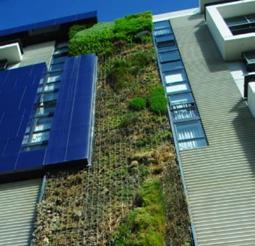
We have available resources to sustain plant growth successfully. We often think about water and irrigation, but it’s more than that. It includes light and space and, below ground, the root zone conditions.
Wind can be a factor that’s difficult to predict, because wind patterns change. A lot of woody plants need between two to 10 cubic metres of volume to be sustained for 20 to 25 years, yet sometimes we’re giving them less than half a cubic metre.
A lot of the time, it’s about using plant traits that are known or going for solutions that are achievable in the design frame of the project.
There are sub-specific, cultivar variations in plants as well, not necessarily so much around biological tolerances, but around their physical traits and how they present.
Understanding plants is about understanding how far you can push them in terms of their suitability to achieve design outcomes on a project, and that relates to their tolerances. What you really want to know is how far can you push this beggar, on a wall, on a roof, in a park.
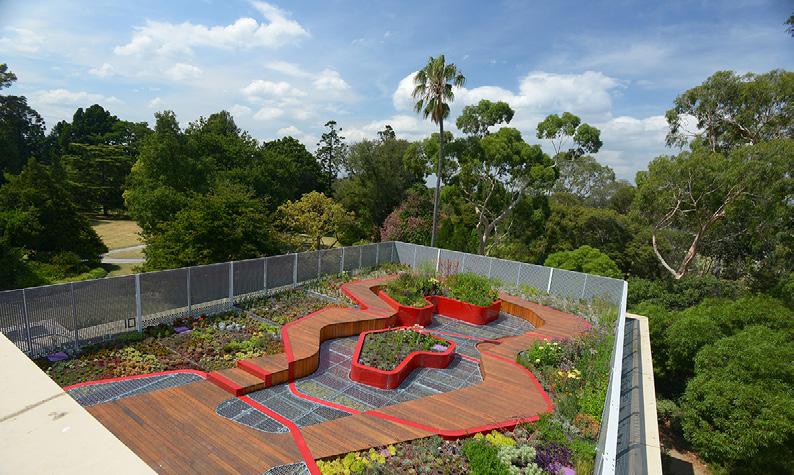
Fantastic work has been done on trees in the last few decades, but very little on every other sort of plants.

The other thing is that planting is iterative: as more information becomes available, you go back and you say to the landscape architect, “actually, there’s not enough light to sustain that vegetation”. Or “you need more volume if you want those plants to get to that height over time”.
And ideally, this uses horticultural knowledge, because horticulture should be able to provide this information to participate in the process.
THE BURNLEY GREEN ROOFS PROJECT AT THE UNIVERSITY OF MELBOURNE’S BURNLEY CAMPUS HALL IS AUSTRALIA’S FIRST DEDICATED GREEN ROOF DEMONSTRATION, TRAINING AND RESEARCH FACILITY. PHOTO: CITY OF MELBOURNE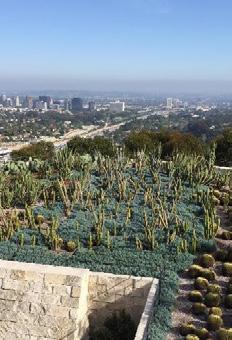
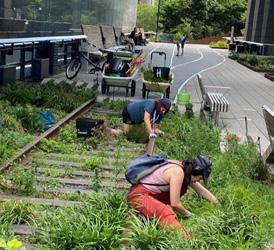
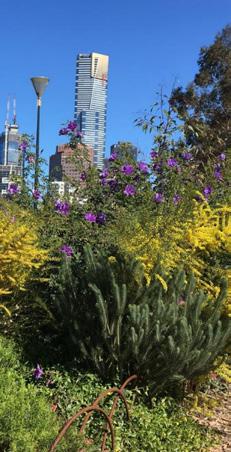
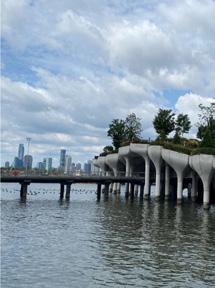
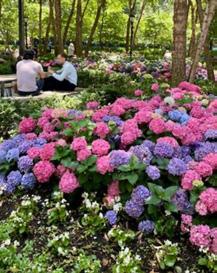
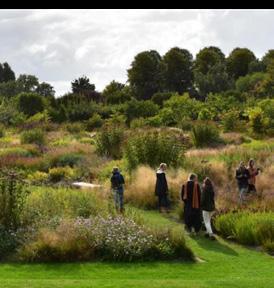

need the right plant for the right place
Peter Bottero, founder and director of Tensile Design & Construct, presented the audience with some harsh realities. Despite our sometimes idealised notions of nature, trees and plants, urban greening in fact deals with diverse and complex systems, he said. "Nature is not simple and it’s not linear."
Before starting an urban greening project is it's critical to understand what your objective is.
Before we start a project we need to guide our clients through a process to consider key success factors.
Are the ingredients for success there? The sun, the wind, shade, water, buildability? Can the builder and the team realise the vision and the long-term maintenance? Will it still be there 10 or 20 years from now?
An example is the advanced apartments project that we did with Mirvac, down near the tram sheds [in Sydney] a series of green facades suspended off the sides of the building. About nine storeys high, these facades sometimes span out to five metres off our structural solution.
We integrated everything into the base structure, the whole system hangs — it does not touch the ground — planters, irrigation, the whole works are all up there.
Tensile worked through all the maintenance issues: we worked through how it was going to be maintained; what would happen at various scenarios; the whole bit, so Mirvac could rest assured that this system would last until the end.
Another example is the atrium in an office building in Pyrmont. When we started on this project, we received nothing but a hand sketch from the landscape architects.
There was a glass ceiling over the top and they wanted to suspend a series of planters down nine storeys.
The total weight of this system was about nine tonnes. We first figured out a structural solution to make that work over the glass facade. Then we worked closely with Fytogreen to find plant solutions.
We’re effectively planting into a nine storey deep canyon – the plants at the top were going to have more light than those at the bottom, and that’s all the way down.
Beyond that, the challenge is the longevity of those plants: what happens when the upper

storey starts to prosper and grow and it’s going to create more shading? We deal with these life cycle issues on a day-to-day basis.
Like any garden, or building element for that matter, these systems will always require ongoing care and maintenance. I’ve not seen a garden yet that will survive with none, especially in a harsh environment of a building facade 10 storeys up.
What we are often given by our clients are romantic ideals of green. On more than one occasion when posing the question of “why”, the client has simply responded with, “I just want it green”. From experience, it’s these jobs that fail the most.
For the past 12 years there’s been the same discussions around these issues for almost every single project.
Such as: no, a green façade on a south façade with no solar access will not be successful. And, yes, you do need a watering system — these are examples of actual conversations we have had with clients.
Over a decade of experience, I’ve learnt most failures in green infrastructure come down to poor process and lack of planning, compromising longevity, or poor ongoing maintenance.
We are happy to show what works but more importantly, we’re happy to show what didn’t.
“I've not seen a garden yet that will survive [with no ongoing care and maintenance]"
wisteria is such a vigorous climber that it will snap that mesh.
There was a meeting with the client the next day, and we’ve since gone on sharing what we know.
Let me finish up by saying there are over two decades of green facades, walls and roofs to learn from in Australia, and the industry in Australia is maturing with many seasoned
to a robust green solution that can provide protection for all the building users and avoid the common pitfalls and provide certainty of outcome, a true scaling and growth of the industry to have a positive impact on the environmental problems we face.

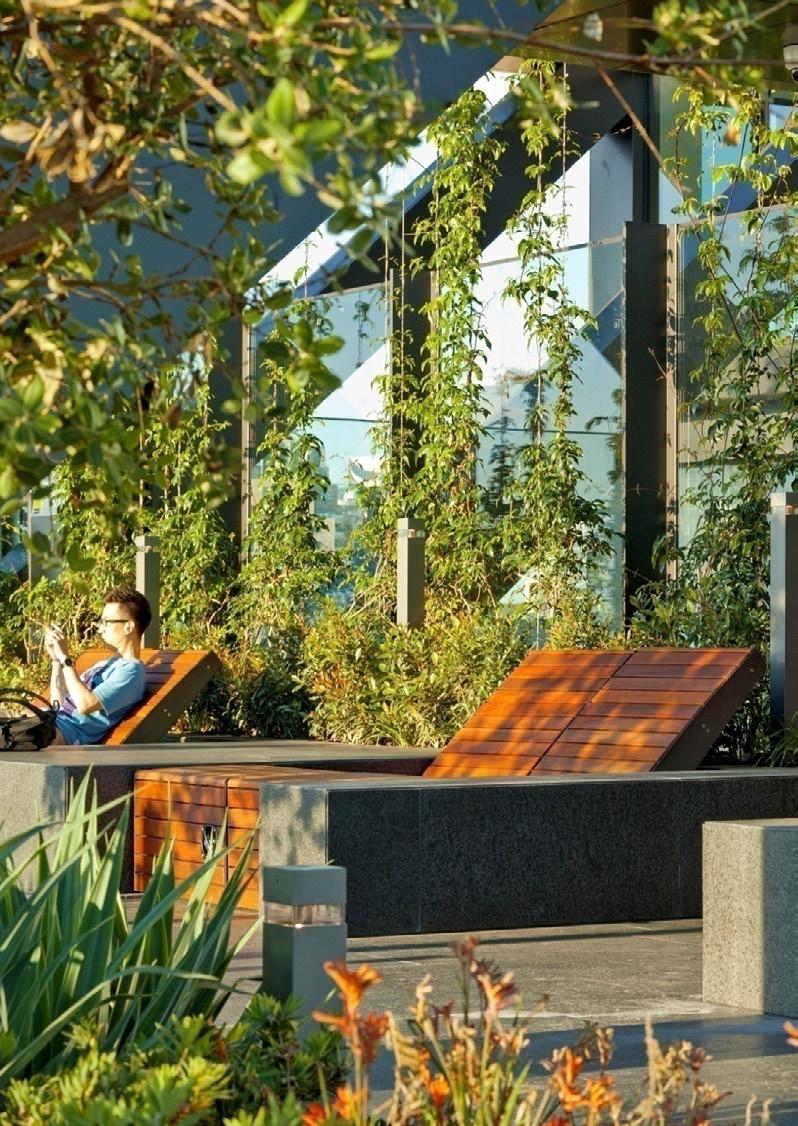


guidance notes].
In terms of premiums for green infrastructure, data from Sweden shows there is a premium accepted for green infrastructure, but in Sydney the results are not in.
The panel session kicked off with some lively discussion including questions from the audience.
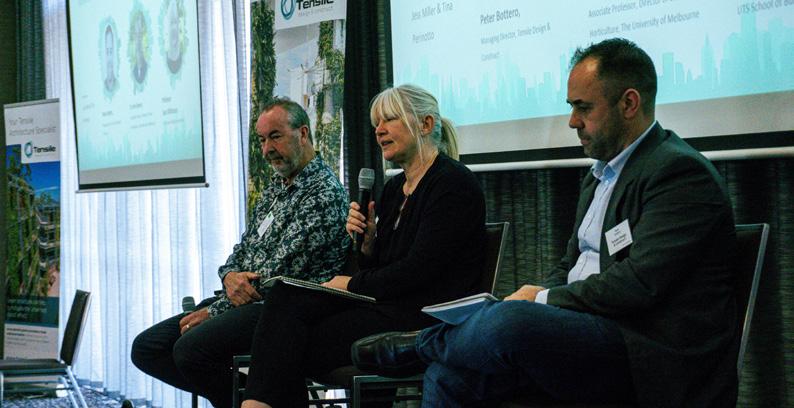
Panel:
• Jess Miller (moderator)
• Dr John Rayner, University of Melbourne
• Peter Bottero, Tensile Design & Construct
• Professor Sara Wilkinson, UTS School of Built Environment
SARA WILKINSON: [Sara said she long ago saw the benefits of green roofs for air quality, thermal performance, stormwater attenuation, biodiversity, habitat and urban heat.] We need to retrofit our existing buildings because we typically only add one to two per cent to the total stock of buildings every year. But there was a major lack of education in green infrastructure for professionals so she produced a maintenance guide and retrofit best practice
IAN COLLINS, WaterUps [audience member]: Ian wanted to know if the panel had seen much innovation in the irrigation systems used in urban environments.
PETER BOTTERO: I’m not an irrigation professional. But in terms of what is going in now, it has changed. Whereas before, it was just a simple irrigation system set on a timer, nowadays, they’ll be sensor driven. So, there will be sensors located across the building to measure moisture levels, etc. There’s one that we did at Westfield Warringah Mall where parts of [the green infrastructure] were exposed to rain, parts were under a clear roof.
So, we had to monitor those systems. And we had to understand when the rain had come, what effect that would have and then adjust the watering system to suit.
Those systems tend to be all linked up by a WiFi system and go back to base, so you can monitor it minute by minute. Certainly, the technology that’s going into it, and the depth of how far the
JOHN RAYNER, SARA WILKINSON, AND PETER BOTTEROsystem is going, has progressed quite a lot.
TINA PERINOTTO [ The Fifth Estate]: We know that green roofs bring down the need for airconditioning in a building. Is there data on that?
PETER: There’s a couple of parts to this: These are natural system so there are variables. But buildings tend to operate on single numbers and single items. The temperature in the room is a single reading and the airconditioning system cuts in to adjust the temperatures.
However, with a green facade or a green wall it’s not that way. It’s going to depend upon the leaf area index; it’s going to depend upon the season; it’s going to depend on the hydration level; it’s going to depend on multiple factors, such as disease and pests. So, there’s variables in the system from an environmental point of view that can’t be accounted for in the mechanical system.

PETER BRUECK, Water Wise Consulting [audience member]: These are expensive items and it's sometimes difficult to convince clients of their value. Often, they can be uneconomic because they cover a lot of little pockets that need to be irrigated differently" Planting similar
species together is therefore very important.
Another problem is the soil type to meet engineers' requirements for lightweight soil on roofs that drain quickly because they’re worried about weight. Moisture retention is important because a green roof will use a lot more water.
SEAN MCARDLE Mac Point [audience member]: from the audience noted most of the examples were of warmer climates than Hobart.
"How much more challenging is it to achieve these outcomes in a cooler climate with less sunlight?"
PETER: It’s understanding that climate, understanding the species selection, and doing a good process to start.
JOHN RAYNER: Most of the green roofs in the world are in cooler climates than Tassie, so there’s no problem with that.
SARA: With the changing climate, what we’re going to have to appreciate is that in the future, things that once thrived in one area may no longer do so well … looking at what grows locally and thrives locally would [enable good plant selection].
JOHN: A robust analytical, systematic plant selection process is needed for all urban greening. I’m doing that with [landscape architects] working through and saying: "Is that going to work in the next climate? ‘Is that going to work in the southern, eastern, northernwestern part of the green roof" or "‘there’s not enough depth for that." I want all these things to thrive. I argue strongly about really rigorous plant selection. Because it’s great for the nursery industry to have stuff dying every few years and producing more plants. [Sometimes green roofs can be hostile.] Our green roof was 69 degrees Celsius last summer, which was a mild summer.

The lethal root temperature of many species is 60C. Yes, that’s tough.
SUZIE BARNETT, Junglefy [audience member]: How valued is research in the industry, and how much more should we probably value it?
SARA: When I first came across green infrastructure and realised the benefits that come from it, whether it’s improvements to air quality, improved thermal performance of the building, stormwater attenuation, habitat for biodiversity, all those things, I was really surprised there wasn’t more of it.
The problem that we have in any construction project is the landscaping typically comes at the end of the project, by which time you’ve had the overspend, and they’re looking to make savings. [Also, when] the building gets passed over and it’s the property manager or the facility manager who become responsible for it, they need to be educated. They need to have the tools and the information to keep it looking as good as it should do.

MICHAEL ROSE, Greater Sydney Parklands [audience member]: Can you talk about species selection and fire?
JOHN: It’s a really vexed question. It involves both design and plant selection. The design solutions are out there in terms of reducing fuel load. There is research out there that indicates rating scales of flammability for different species.
I was involved in helping to write the landscaping for bushfire guidelines 10 years ago in Victoria that the Country Fire Authority) put out, they’ve just been recently updated...I work with some fire ecologists who basically said, "Listen, you’re not going to get vegetation in [your buildings with] these guidelines, because any plant can burn and here’s the research to prove it." But there are human health benefits in having shade and cooling.
And so, it is about trying to maximise and maintain these green spaces to reduce fire risk, as much as species selection can.
TINA: One final question, how big is the demand for this industry? Are we at the beginning?
JOHN: We’re not at the beginning, I think we’re halfway through. There are well-developed markets that have got much better supply chains, in terms of product.
We’re a little odd in Australia, we’ve got a couple of companies that really dominate a lot of the green infrastructure market.
SARA: I think we’re at a sea change. I think the acceptance of climate change happening, change of government. I think we’re really changing now. I think there’ll be a much faster uptake. COVID has taught us about indoor air quality. I think we’re going see a lot more plants inside buildings as well.
PETER: We’re long past the beginning. We’re at the point of becoming more than just looking pretty. And that’s the steps that we need to take, that this doesn’t become purely an aesthetic thing to sell an apartment, it now becomes a functional part of the building.

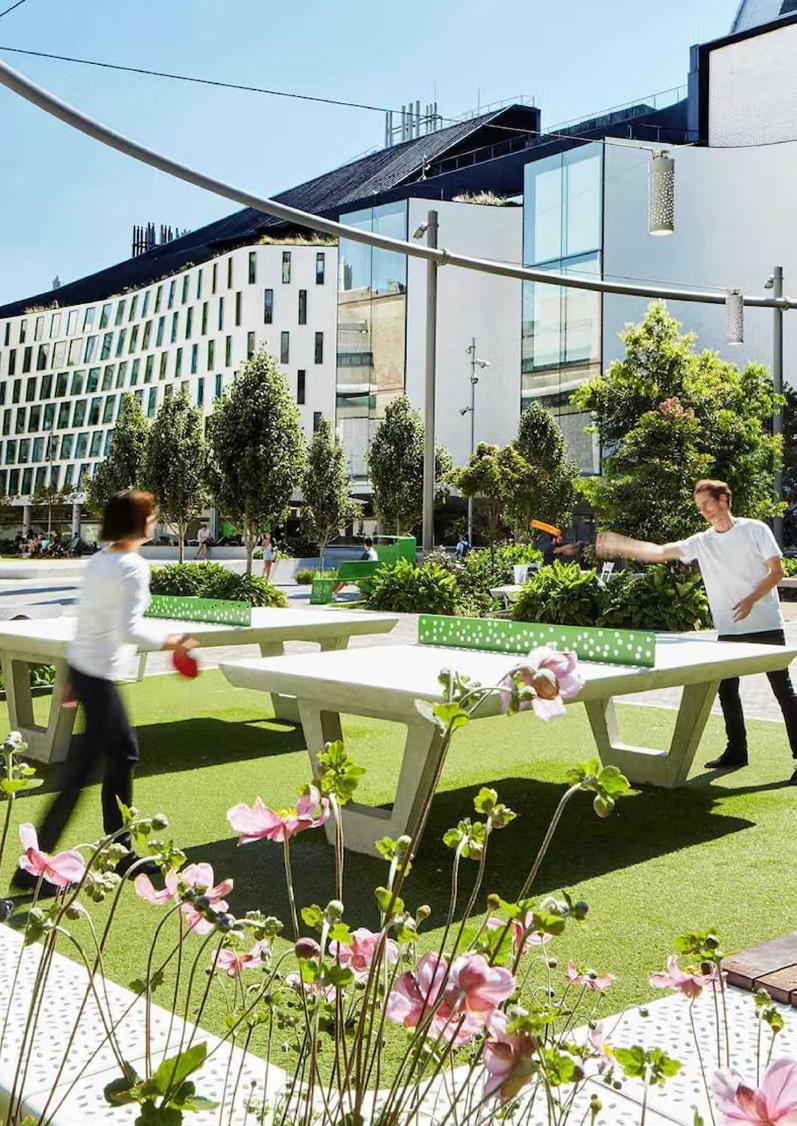

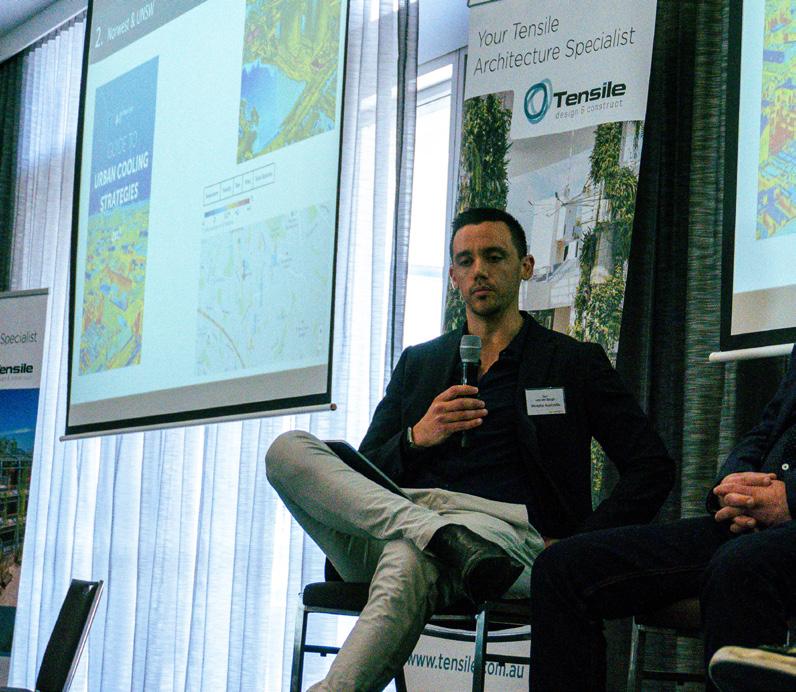
We can create physical, environmental and emotional resilience with our urban greening – and add to our food security at the same time. This session provided three views that lead the field in imagination and leadership in greening.
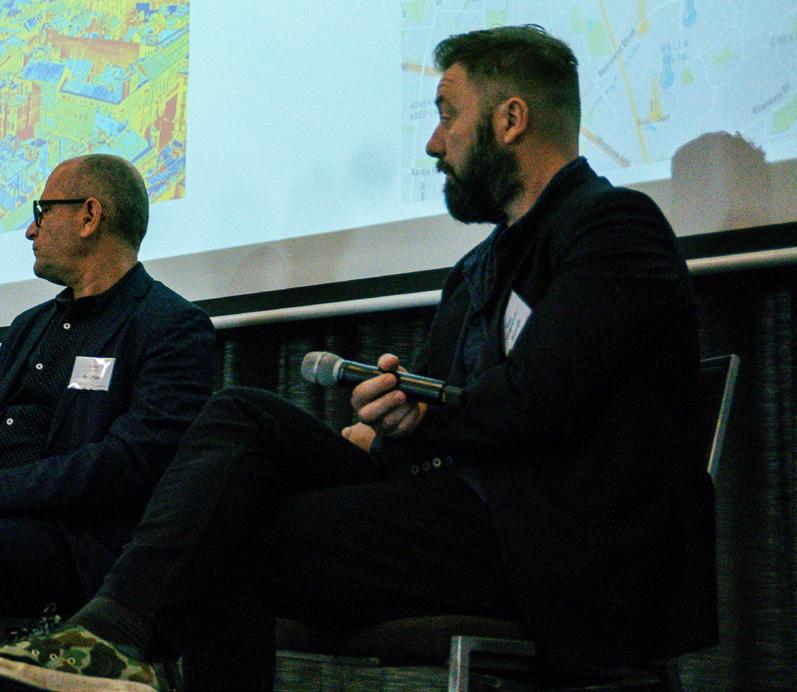
Tina Perinotto, The Fifth Estate (moderator)
Jan Van der Bergh, Mulpha Australia
Nikos Kalogeropoulos, Molonglo Group
Steve Liaros, PolisPlan
JAN VAN DER BERGH: Jan leads a development team at Mulpha's Norwest Quarter, part of the company's huge Norwest project that it's been developing for the past 25 years. It’s a huge 360 hectare precinct, "with a lot of beautiful natural aspects including waterways and remnant Cumberland Plains – a type of woodland habitat native to the area, which is now critically endangered", Jan shared with the audience.
Until now, a lot of the urban development has been characterised by more manicured landscapes.
What we’ve been working on over the past few years is how we can merge beautiful landscapes with native habitats to make a more biodiverse landscape, and bring the fauna back into the area.
Norwest Quarter is a 3.8 hectare site, with nine tall, slender buildings to liberate our ground plane, and 70 per cent open space.
We’ve started our first two buildings with Smart Design, Bates Smart and Sacha Coles’ team at ASPECT Studios.
This project was conceived right in the middle of the pandemic, at a time when people were really longing for that connection to people and to nature. It’s a very unstructured landscape that is biodiverse and wild, with a 100 per cent native ground plane.
It’s a zero carbon development in construction and operation. Think water sensitive urban design, 100 per cent electric, with a strong focus on waste.
There’s a level of sophistication that’s growing in the marketplace. People are now asking for more than just solar panels and EV charging. They are asking about passive design.
We compared a typical minimum code compliance building to what we were able to achieve on Norwest Quarter, and showed significant reductions in energy, water, waste, and carbon.
For the residents’ cost of living in Norwest Quarter, that means the running costs for their apartments are 25 per cent lower.
The last component, and what we’ll be solving for, is community. We’ve really worked hard to engage with the community. We’ve been there for 25 years, we’re still going to be there for a long time.
So how can we bring residents on the journey with us?
Just by living there, you’ll go a long way to being more sustainable, but there’s a lot of behaviour change that needs to come with that as well.
Engaging with the likes of Oz Harvest and Pocket City Farms, as well by demystifying what sustainability is, has been really important to helping our community become more sustainable.
Sustainability can cost more to implement, but we’ve tried to do it in a way where we can pull out costs. By going all electric, you can pull out all the gas reticulation.
Capital is looking to align with more sustainable development. For residential mortgages, banks want to put their money into developments that are more sustainable and resilient.
People purchasing into our development are able to get green mortgages, which also costs them less money.

He explained that this company's reputation for developments that deliver superior quality started with the notion to make Canberra "really interesting, so our kids wouldn’t leave!" "The first movement of this 'development symphony' was the award winning New Acton precinct," he says.
"We have now begun the second movement – the slowly emerging neighbourhood of Dairy Road at Canberra's East Lake, a 15 hectare, former light industrial site."
In our developments, we want to manage the public realm. Councils generally don’t have the money. They also don’t have a vested interest and, to be frank, they can’t care as much as the people who live there.
We were pretty specific at our Dairy Road development that the body corporates only manage their building, they don’t have any control over the public realm.
Otherwise, what happens is the different body corporates across an estate all have their own interests. For instance there might be an 85 year old retired public servant who just wants to put fences up and have a gated community.
People are becoming really focused on green buildings. We’ve done that, and we get it.
But there’s nothing as visceral as being connected to the earth.
I think we need to step back as developers, as planners, as people who are building cities, and say: “We don’t want to get to put people in 20 storey towers, because as much as the greening of the facade is great, we’ve got other choices, we don’t have to do that”.
The ACT government allowed us to develop eight storeys for our residential apartments.
WEATHERSHIELD - THE DEVELOPERSWe’ve seen studies showing children who live in buildings taller than four storeys experience the outdoors at a later age than those at four storeys and below. There’s something about a building of more than four storeys in terms of its mass and sizing that stalls the engagement with the outdoors.
We basically told the government: “I don’t know what your expectations are, we’re only going to be developing three and four storeys."
Other developers focus on maximising yield because they don’t understand that there is another way.
We’re not altruists here. We’re not throwing away money just for the sake of it. The strategy of making places that matter generates long term value for us, for the people that live there, and the people that work there. And that there is an economic model that underpins all of this.
In this 15 hectare neighbourhood, the first design response is a hydrological response.

We’re adjacent to the Jerrabomberra wetlands, we’re adjacent to an industrial suburb called Fyshwick.
And the response is one about how it fits within
“This is generating long term value for us, for the people that live there, and the people that work there. And that is an economic model that underpins all of this.”
"The buildings are going to be vessels to capture the water, slow it down and put it into this natural filtration"
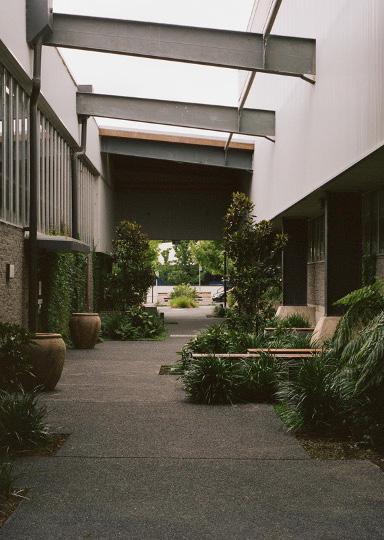
the environmental context that it’s sitting in.
It elevates the landscape architecture as the primary design response to place making.
Dairy Road is, first and foremost, a landscape.
We’re designing buildings to sit on the landscape, and they will all form part of something that is going to be really powerful.
Water is the most valuable resource that we have. We have the Jerrabomberra wetlands, and we’re working through the process of how we can slow down the water.
There’s a creek, and there’s an internal wetland that we’re designing. The buildings are going to be vessels to capture the water, slow it down and put it into this natural filtration.
There’ll be hydrophytes planted to manage all the overland flows to discharge in the wetlands. That’s how we’re designing a neighbourhood – by designing an ecology. This isn’t about just designing apartments to make a profit.
Sustainability can cost more but it shouldn't. But sometimes designing something really badly costs more, because then you have to go to mechanical engineers to repair the bad design.
When we acquired the site, there was lawn everywhere. I don’t know what was going on, but the Commonwealth [the former owner] decided to have lawns everywhere. There’s someone who fertilises it, irrigates it, mows it.
But why do you want a lawn? We’ve got a little bit of lawn for people to sit and play with their children. But the extent of it was ridiculous.
We’ve started an experiment with a group of highly energised, local horticulturists to get rid of most of that lawn, and rewild.
We did not even bring any topsoil in.
We started off with the idea of letting it happen by itself. That meant sitting down and actually looking at the journey from that little water
droplet in the sky and and trying to slow it so it could better nourish the land.

We removed lawns, effectively regenerating a new landscape with endemic species.
The best way to change the status quo, to create new protoypes is simple - get your hands dirty and do something.
STEVEN LIAROS: Steven started with a provocation – a concept of a network of circular economy villages to deal with climate challenges and affordability.
We have this really strong division between the idea of the urban and the rural. I spent the first 20 years of my career working in urban areas and much of it around south Sydney, and the old South Sydney council area, when it was being converted from the old industrial and warehouse region that it was, into apartment buildings.
We went through this process of creating pocket parks and planting trees along the streets. Effectively, what we were doing was retrofitting greenery into the urban environment.
Now I really want to flip this around and ask: how do we embed the human habitat within the natural habitat, rather than trying to bring the greening in?
A lot of that has to do with bringing food systems into and around human habitat.
A really big learning experience for me was this idea of a shift from industrial agriculture towards regenerative agriculture.
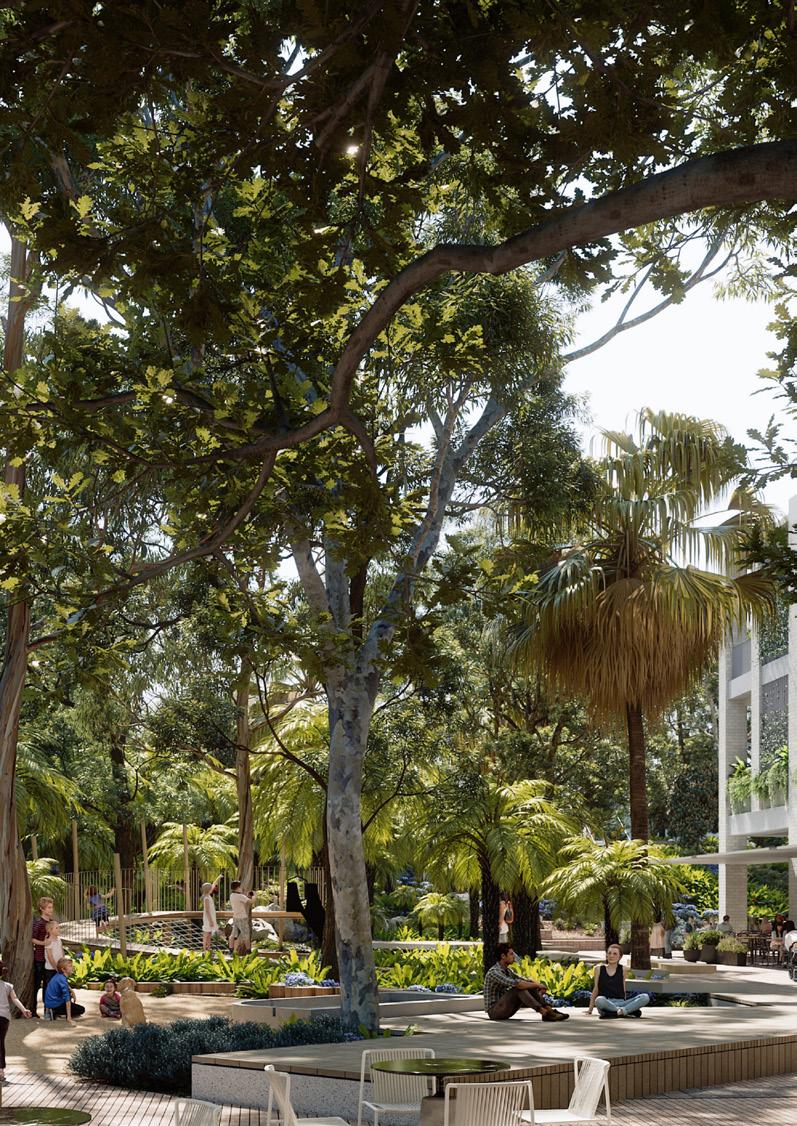 NORWEST QUARTER, SYDNEY. IMAGE: MULPHA AUSTRALIA
A book Call of The Reed Warbler, by Charles Massy, is probably the best book on urban planning that I’ve ever come across.
Essentially, he talks about a number of principles, including his first idea – of capturing as much solar energy as we can. The second principle is to manage the water cycle. And the third is to maximise diversity.
If we apply those principles to the built environment, then we’re creating a fundamentally different approach to what we have been living with.
We start to think in systems, rather than silos.
We have been thinking about all these issues as separate, but that needs to change. Thinking in silos leads to us finding individual solutions for each individual issue, without considering the implications or solutions in other areas.
The idea – and this goes back to Charles Massy – is a shift from an extractive mindset to a regenerative mindset.
What an extractive mindset means, is that farmers are operating by extracting value out of the land. Conversely, when we regenerate, we’re creating an interrelationship with the landscape.
Regenerating the land means that the land can be provided back to us.
If you think of that in terms of food systems, this means improving soil health and water systems to produce more food and provide sustenance.
This idea of a systems based solution is about integrating a whole range of different things.
An energy microgrid, for example, can power our houses. It can also power shared electric vehicles. It can cycle water through the precinct, when we have more water, we can produce more food.
And so all of these start to be far more efficient if we’re working in systems rather than thinking of each of those individually.
Passive architectural design can minimise energy demand, so your water can store energy, and so on.
It’s a much more integrated system, thinking in terms of integration of energy, water, food, transport, and buildings.
An example from South Australia is a project by Renewal SA at Lochiel Park. It has a constructed wetland. Above the residential precinct, there’s a reservoir, where the water is cycled through.
This has resulted in a 74 per cent saving in terms of potable water. They also have an energy system, so there’s reduction in energy use and greenhouse gas emissions.
The difference made in the natural habitat is that about 60-70 per cent of the land is green, and the human habitat is a much smaller portion of that.
A Bellingen [NSW] project we're working on will take this further, with around 15 per cent built environment. To enhance the natural habitat the buildings will also be embedded in the landscape, with green roofs and so on.
There is a dry gully we will use to create a chain of ponds. The last one would be a constructed wetland for cleaning the water, and then you can cycle the water through the precinct.
Those ponds can provide aquaculture as well as swimming.
We’re using the language of the circular economy: recycling water, recycling the organics.
But we’re also talking about things like waste resource micro factories in there so that you can have the inorganic materials being cycled.
In terms of the financial structures, we talk about lifecycle costing. In the shift from the build-to-sell to build-to-rent model, you’re creating an incentive where the developer is building durable, low maintenance, buildings that can be maintained for a long time, at a lower cost, and therefore lower living costs for the residents going forward.
This builds on an Indigenous way of seeing the landscape as a network of water holes connected by songlines – so it’s not an individual village, it’s about how we create a network.

The planning processes we're working on with the council is about creating a replicable planning process, and a replicable financing process, to enable a pipeline of projects to occur.
[Steven also flagged a micro ownership model of property investment so that people living in a community might also be able to take part in the capital appreciation of their homes.]
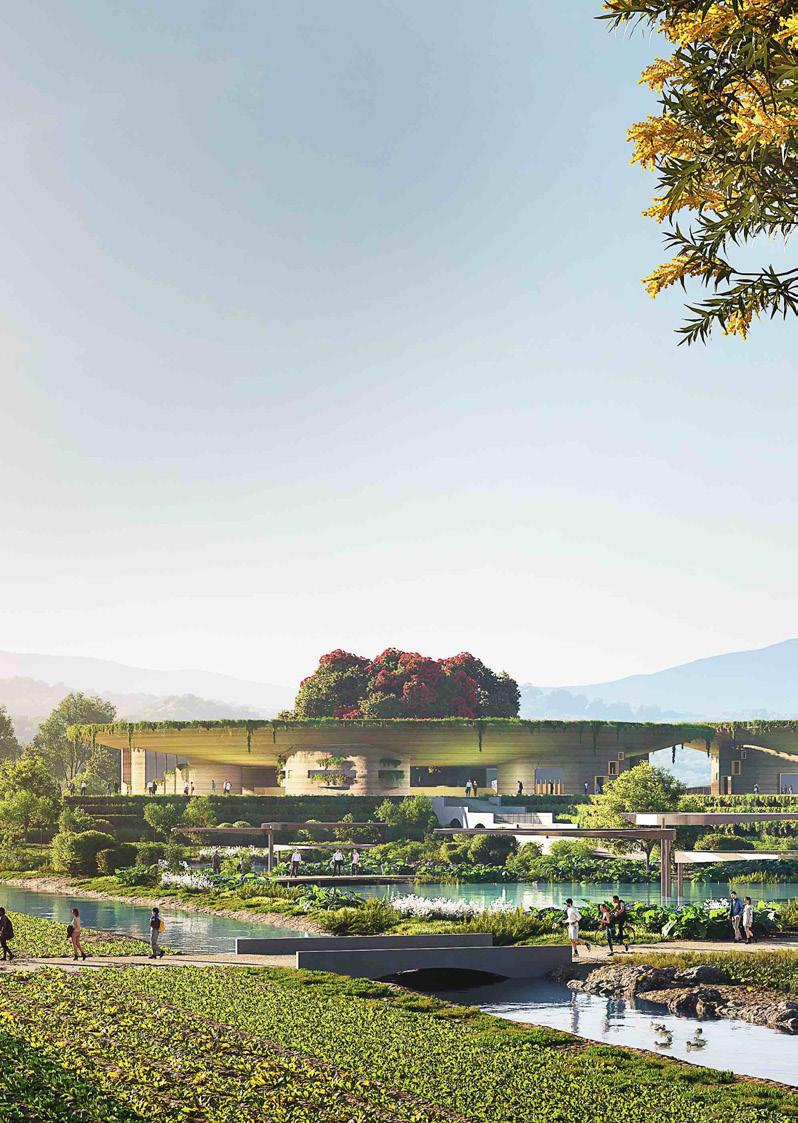
THE CIRCULAR ECONOMY VILLAGES CONCEPT. ILLUSTRATION: VALENTINO GARERI ATELIER
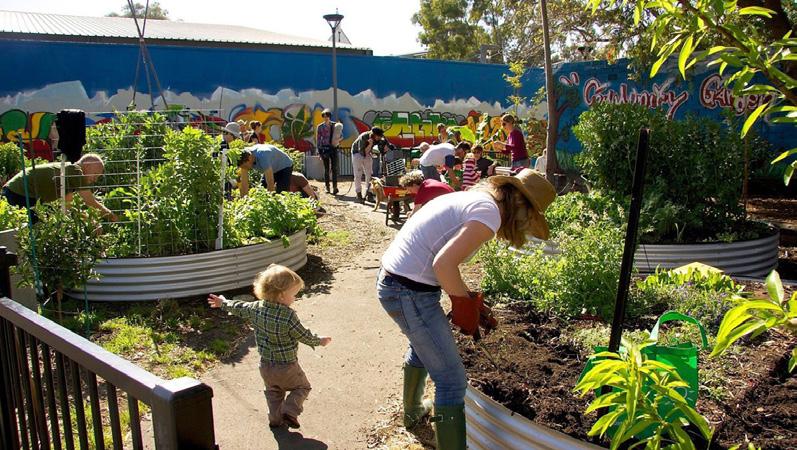
PRESENTATION: Sacha Coles, director of design and strategy, Aspect Studios, is a globally-renowned design leader with a record of excellence in creating projects of transformational change. In this presentation, he talked about “frugal abundance” and the magic of community gardens.
I didn’t invent the term “frugal abundance”. Some of you who listen to Phillip Adams on ABC’s Late Night Live may have heard this term. It resonates, from a social and ethical angle, and what we’re talking about, climate-induced stress, and the ability of all of our natural systems to address that in a positive way. What I like about the words “frugal abundance” is the fact that it’s doing a lot with not much.
Across the world, people and governments are asking what is really essential, what matters and how we might easily satisfy our basic needs. This is something that I’m really interested in.
We [at Aspect Studios] get the ability to work on amazing projects with very big budgets, and they can be thrilling, and they can shift the
needle in terms of society if done well. We’re involved in a lot of massive projects, actually. Around the world there’s over 200 of us, we’ve got eight offices with a large spread. We have small business mentality, in that we like to be nimble, creative, and collaborate a lot with experts.
But it’s the ground-up urbanism stuff that really gets me out of bed. It’s the community projects where I see ownership taken by people who don’t have the capacity to go through all the steps in terms of process governance and planning that are required — that stuff is hard.
I love doing that, but also love the nimble stuff that gets shit done, basically.
These are the things that I think about:
• Small things, big impact
Think local, act local
• Cange starts at home
If not me, who?
• Do something – anything
A lot of the developers in the room will know that community gardens were a big thing for a while. We needed a community garden on a rooftop or in the mall. Great! There is absolutely a need for community gardens, but only if the community wants them.
Because in five year s, 10 years, they might be one of those pieces of land that’s not looked after.
So, it’s all about ground-up green urbanism is the thing I’m interested in.

We did the first funded community garden in the inner Sydney, using a grant from the City of Sydney. Getting grants takes skills that goes beyond my skills as a landscape architect. It requires a doer. It requires collaboration with other community members.
So we came together as a crew, put a proposal together, got the council funding, and got the first community garden funded.
Some of you who studied at UNSW in the 70s, 80s, and 90s, will recall Ted Trainer – this crazy, sustainability visionary.
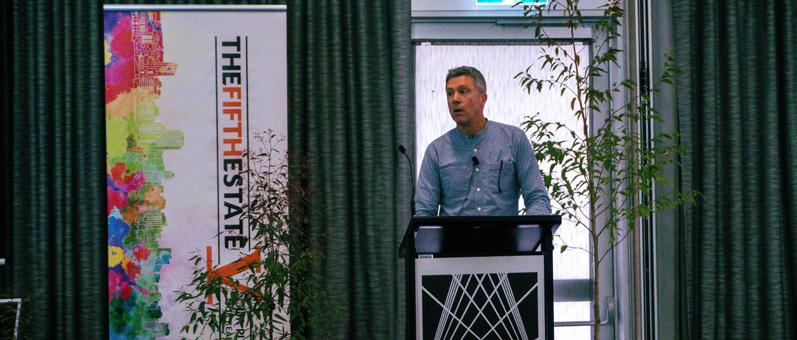
People thought he was crazy. But he was just advocating this localisation of communities and resources. We look to that vision now, and try to implement it.
But when we look at public spaces, you can’t really see that very well. The percentage of open space in Sydney, in these dense areas around the city centre is 14 per cent. It gets more in the leafy green suburbs, or in the hills, of course.
A low-hanging fruit would be to attack this.
Attack the grids, the streets, the lazy space that’s around all of us. It’s time to start really thinking about that critically, and take action. And don’t wait for your government or local council or whoever to do it.
You’ve got to get in there and start it.
And then you’ll end up with this beautiful space like I have on a Sunday, sitting in our lane.
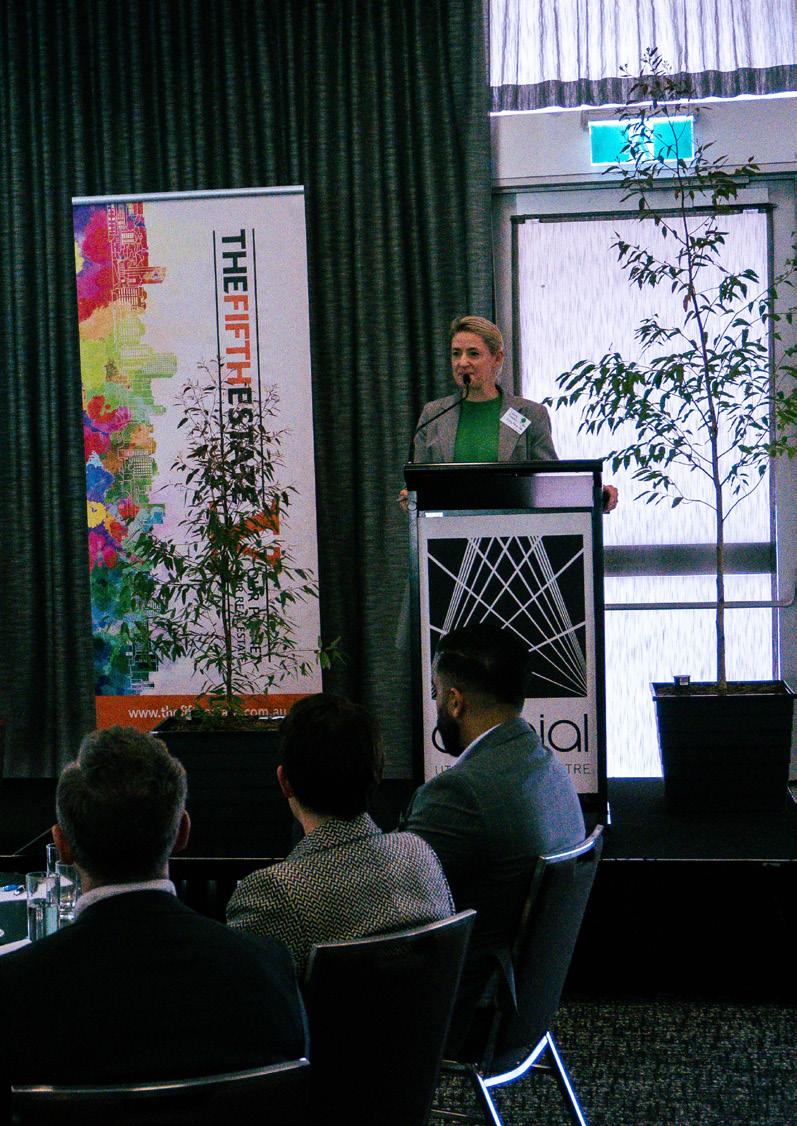 Laura Hamilton-O'Hara

Laura Hamilton-O'Hara, who moderated this session brings a deep knowledge and respect for trees. She started the session with some background on Johannesburg in South Africa, where she grew up.
Some parts of the city have 60 to 70 per cent tree canopy cover, Laura said in her introduction.
"The residents there enjoy cleaner air, better water quality, lower temperatures, better resilience in terms of climate, disasters, and better mental and physical health outcomes.
"There are also areas with less than two per cent canopy cover. They are often the informal settlements, a legacy of the apartheid era – what’s known as the green divide.
"The residents on the other side of the divide don’t enjoy the same level of health and wellbeing and climate resilience benefits. Now, if you think that the link between trees and social equity is reserved for a country where inequity was really embedded in segregation planning policies, you’d be wrong.
What about here in Australia? I'm joined by a wonderful panel of three amazing humans to explore this topic."
BELINDA BEAN: Belinda told the audience she has a vision of seeing an “abundant, green, beautiful city” wherever she goes. The reality is it’s challenging. Urban greening, she said, is “a really wicked problem”.
Greener Spaces Better Places has been tracking forest canopy in local government areas around Australia since 2013. And canopy has decreased since we first started tracking in 2013. However, in the 2017 to 2020 report we’ve seen that trend is starting to reverse.
I want to dive into that 2017 report, because that’s where we delved into the relationship between heat health and canopy. What we found in the big national overview is that Australia is huge (who knew?) and most people live in a very small part of it.
Therefore, it’s pretty smart to prioritise where green space should go to where it’s most needed. We do that by understanding where it’s being lost, where it’s hot, and where people need it the most.
That led to the central question of this report, which is: in what LGAs do residents have a high chance of poor health outcomes, economic hardship, exposure to far too high temperatures and low levels of canopy cover?
So, where should all the trees go? Well, in the most vulnerable places first.
For example, Melbourne’s eastern areas are cooler compared to the south and west; and in Sydney the upper north shore is cooler compared to the south and west of Sydney.
Even in a highly urbanised context, river corridors and large areas of green space have a clear cooling effect on heat patterns. This highlighted the importance of having corridors of native bush, both in the urban and rural areas. To break up urban heat islands, it really does require a concentrated green-grid approach.
RMIT speculated the result of this green cover loss was from a variety of processes, such as bushfire mitigation policies, like the 1050 rule in NSW; the subdivision of large suburban blocks, the disappearance of the backyard; consumer and or developer trends in housing with smaller yards and greenfield development, and natural forces were also found to account for large changes.
The project has been unprecedented in Australia in demonstrating that a relationship does exist between urban heat islands and the percentage of tree canopy cover, which guides and underscores the need for further research in this area.
BEN SMITH: In 2019, Ben’s council embarked on a new open space strategy. There was a renewed focus on greening, giving back to the community, supplying access, addressing urban heat islands effect, removing vulnerabilities, and focusing on biodiversity outcomes and rewilding.
At Darebin, we’re surrounded by two creek lines, with three populations of kangaroos on one side of the creek line, and populations of swamp wallabies on the other. These never met,
nor do they meet north-south currently.
But we have an opportunity to increase the potential for this to occur, and increase the bird populations to move across the municipality. The last thing that really would drive home our open space strategy is connecting people to the environment.
[The rewilding] is large scale indigenous plantings, we’ve also started direct seeding. We’re working with partnerships all over the place, local indigenous nurseries supply chains, state and federal government information bodies to truly try and provide a holistic approach to what we’re doing.
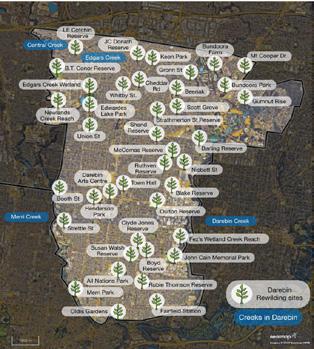
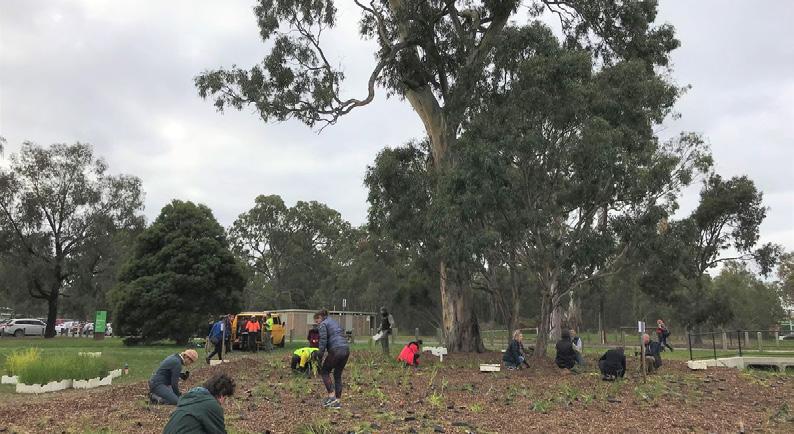
We’re looking at multi-year plantings – you can’t instill an ecosystem or at least a holistic approach in one go.

We need to assess the outcome of each planting each season, depending on the species. Our urban environments are highly variable – some species survive while others don’t.
This gives us an opportunity to use more robust indicator species to devise options for infill planting diversity. To get that triple-layer effect occurring gives us an opportunity to engage our
community and educate them, especially on planting days.
So far, we’ve put in 300,000 indigenous plants that cover 18 hectares, and we’ve removed large chunks of environmental weeds.
We’ve started the progression and substitution towards indigenous spaces across our entire municipality.
ERIC STURMAN: Eric's background with councils is where he discovered the huge investment that planting trees requires. But also the value of community participation in the task. At a council he worked at there were 1500 volunteers over 150 sites, which included community gardens.
How do we implement community gardens? How do we make this happen on the ground?
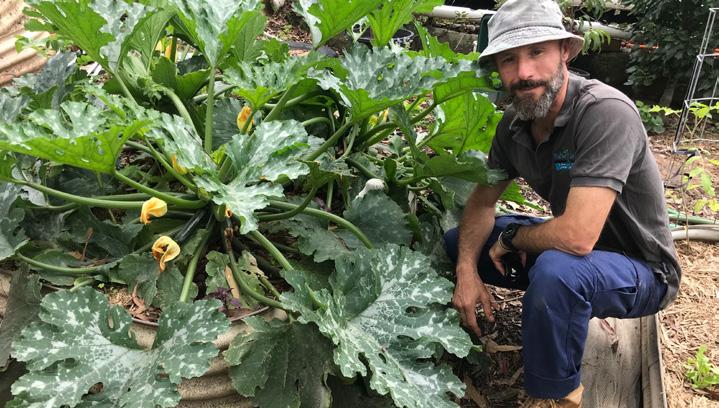
North Sydney Council was a fantastic council for their residents. They were very supportive. The Streets Alive program that I ran cost the council about $200,000 a year in wages and budget but netted them about $750,000 a year worth of [voluntary] labour.
[This in the context of the many hours of work needed to plant a tree, keep it watered several times a week during its early growth period and
replace the sometimes high rates of failure of young trees, necessitating replacements.]
So, it’s a matter of getting everybody involved and everybody aligned to the same goal. Now, it’s very hard when we tell them what trees to plant, what plants to plant, where to put them.
That’s when North Sydney Council let things go a little bit and gave a little bit of power back to the residents and said: “You know what, these guys are just going to pull the trees out that they don’t want anyway.” And yes, that does happen even in affluent suburbs – mostly because of water views.
So why not let the community grow something that’s maybe a little bit shorter like a Callistemon? At least that’s better than nothing.
In a community garden, I’d have to get there early in the morning, because I needed to share information with them, I needed to inspire them, I needed to get them started. Then
There's a certain sort of charm and joy when you see something like a lemon tree and a couple of Bromeliads underneathERIC STURMAN
they could carry on that learning. It’s all about passing that information and that knowledge on to the next person.

I can tell everybody how to do stuff, I can give you all my opinion and tell you the right way that I think it should be done. But ultimately, we live in a community and that decision has to be made by everybody, or you’re just going to be stuck in discussion the whole time.
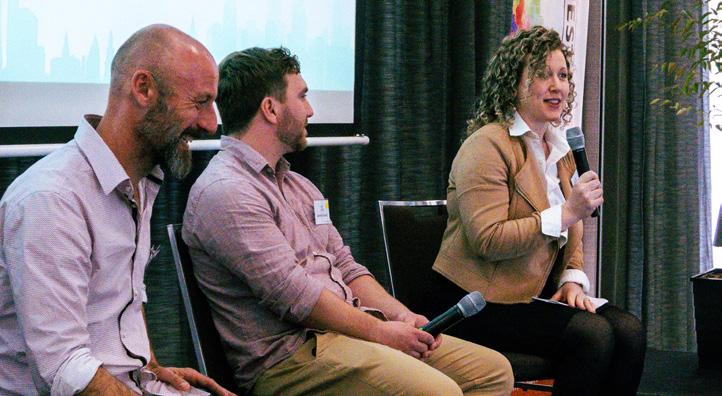
By allowing small groups to make their own decisions, they care for the plants, they water them. It might not end up being a whole street of plane trees, which looks lovely, and gives the street a sense of place, but there’s a certain sort of charm and joy when you see something like a lemon tree and a couple of Bromeliads underneath. No designer would ever put those two together.
But the person in the house really loves them. And that is better than no garden at all. And that’s how we get stuff done.
And by bringing these communities together and giving them a little bit of
power, not only are they growing trees, but they’re getting to know each other, and their communities become safer when you know who your neighbours are.
Now, you can’t put a big bushy tree right on the corner, because kids are gonna get hit by cars when they come around the corner. There were a few little bits and pieces we had to do to keep it safe and make sure no one was growing illegal stuff out the front.
But ultimately, when you give power back to people, you know that they own it, they embrace it, and it gets stuff done.
Green infrastructure is long term. But who will pay for it and how?
Three experts in the field moderated by Jess Miller discuss the financial, governance and policy mechanisms that are helping our best ideas to thrive— and some of the barriers that stand in the way.
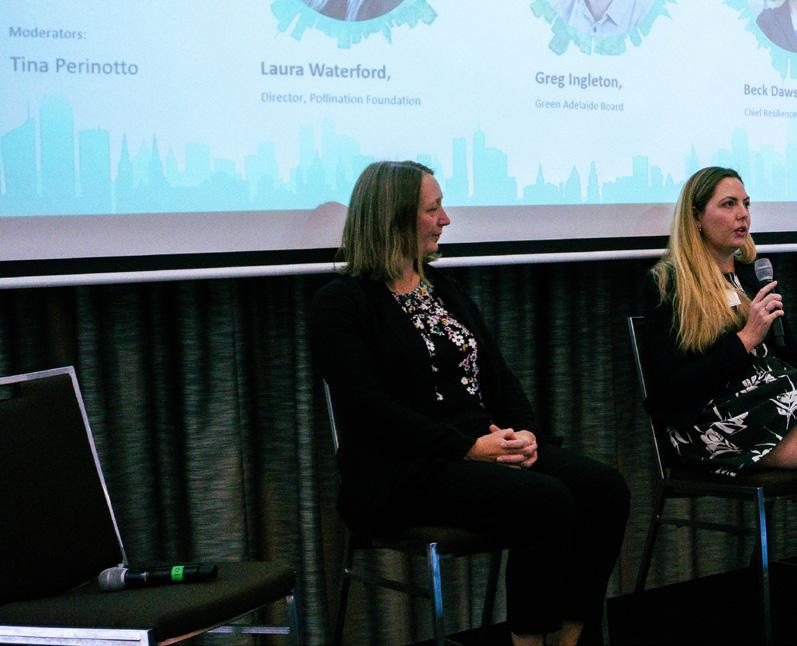
Laura Waterford, Pollination
Greg Ingleton, Green Adelaide Board
Beck Dawson, Resilient Sydney
Watch this session

LAURA WATERFORD: Laura shared thinking from the top end of town, where the institutional investment community is starting to pay growing attention to the Taskforce on Nature-related Financial Disclosures (TNFD) and the "nature positive" movement, which looks to be more disruptive than net zero, she said.
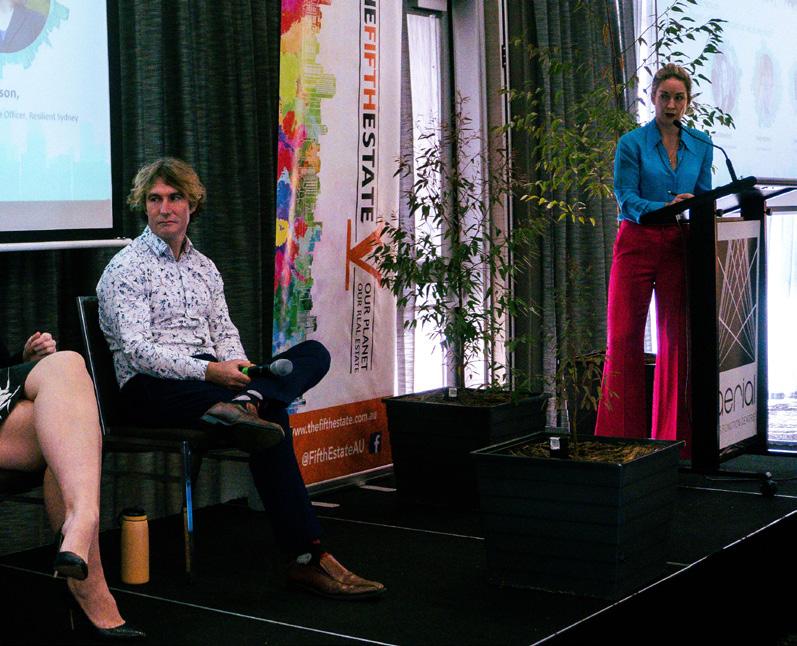
The TCFD has been really influential in Australia and other jurisdictions in terms of increasing corporate engagement around understanding climate risks, and ultimately reporting on them.
What we’re seeing at the moment is a huge push in parallel to start thinking about not
just climate risks, but a broader set of risks that are related to nature, including climate risk. But beyond that, all of the other drivers of biodiversity loss that are creating risks that, historically, our economic systems haven’t accounted for.
We’ve all heard for a really long time that those are things that are ultimately responsible for the degradation of nature.
“The big push is to start to actually grapple with how the private sector contributes to that risk.”POWER AND PASSION: FINANCE
But we haven’t really tried to price that into the system until quite recently.
There have been some really big headline reports in the past couple of years that have just made it impossible to ignore the biodiversity crisis.
One million species are at risk of extinction, and something like 84 per cent of all mammal life has been lost in terms of diversity in the past couple of decades.
I think that increased awareness of just how huge the biodiversity loss crisis is, has spurred this recognition that nature loss represents a risk to the global financial system.
The big push is to start to actually grapple with how the private sector contributes to that risk.
On an individual company level, what is your exposure? What’s your risk profile?
But on the flip side of that, what are the opportunities that you have in this world to transition to a nature-positive future, to rethink your business model and to get ahead of that curve?
What we’ve been doing with several companies is starting to actually apply the initial guidance from the TNFD, and to answer some of those questions. It’s really challenging for a few reasons.
But the overarching message is that now is a really good time to start grappling with those challenges and answering some of those questions.
Risk, from a built environment perspective, doesn’t just come at the location where we might be building or constructing something, but along the entire value chain and supply chain that’s led to that point.
It’s not just thinking about direct impacts –
which I think is the mindset that we’ve been in for a really long time in the built environment space – but thinking more broadly about the entire supply chain.
Complex supply chains are still a bit of a mystery to most of us.
We need to get our heads around where the goods that we use and rely on are coming from globally.
It’s a challenge that we know is there from the climate space. But I think this focus on nature now is intensifying that.
Even if you know where you’re getting your goods and services from along that value chain, it’s quite difficult to get really good data on what that means.
TFND is an important step towards overcoming these challenges.
GREG INGLETON: Greg told the audience that Adelaide was leading the nation on greening innovation with a focus on cooler, greener spaces, including. Key is a landscape levy, hidden in the rates.
I’m a farmer and environmental scientist, and I’ve been in the water industry for 20 years –18 in Adelaide and two in Sydney. I still live in Adelaide, and while I work for Sydney Water, I am also on the Green Adelaide Board.
It gives me a really good perspective of what’s happening across those two states
The interesting thing with the Green Adelaide Board is that it’s independent from the government, in a way. It is a governmentappointed board, but it’s supposed to try and bring all the agencies, local governments and the community together to try and get us all on the same track, and have the same outcome. Because everybody wants the same outcome, which is a green Adelaide – a cooler, greener, wilder environment.
It’s a really multi-pronged approach, I suppose.
The way it works in Adelaide is that hidden in your rates is this little landscape levy. It’s only $20 to $30 a year for each household. That money is collected by the councils and then given to the Green Adelaide team.
The levy funds projects such as directives from the minister, including some really large coastal protection projects. But then there’s a bunch of projects that the Green Adelaide Board is allowed to put money towards, matched dollar for dollar by the councils.
There’s a team within Green Adelaide of 40 practitioners that just goes out and get stuff done.
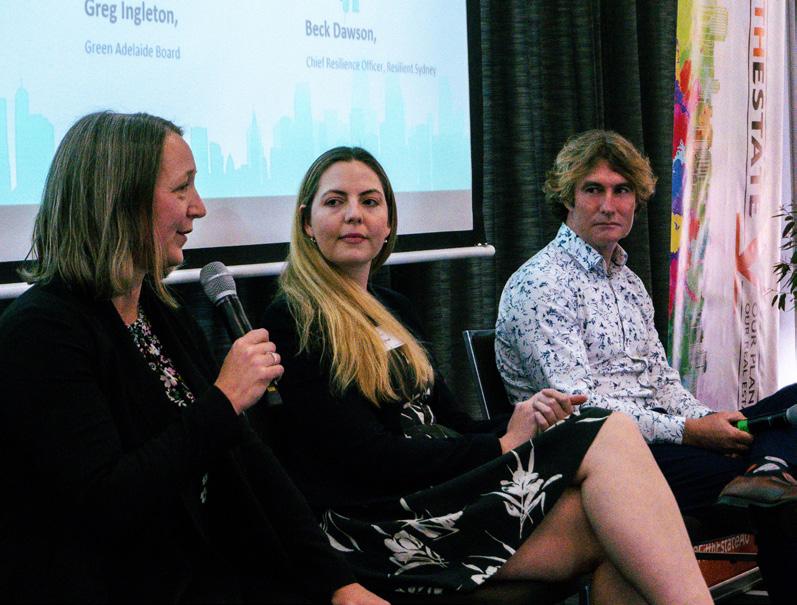
A lot of that money is also used for grant funding and for allowing councils and
nonprofits to come up and say: “We want to get this done. Here is how it aligns with your five year business plan, and your annual business plan”.
They do their homework, and they work out where Green Adelaide needs to go, aligning with their desires. We fund them if it passes through all the gates, and away they go.
The interesting thing in Adelaide, compared to Sydney, is that we don’t get flooded as much. It always rains about the same volume every year, for three months, and then it’s pretty

“It's only $20 to $30 a year for each household. That money is collected by councils and then given to Green Adelaide
much sunny for the rest of the year.
While I was in SA Water, I had the opportunity to go out and just do things. They gave me a bucket of money and said just go and do stuff.
So I put air temperature sensors in 250 parks around Adelaide, and did smart irrigation. We’ve had that running for about five years now – and we’re doing that in Sydney now as well.
From that, we can gather this data from inside the parks and people can look at that data and say, “This park is really hot, and that park is really quite cool. On this warm day, I’m going to take my family there”.
Then they go to that park and they ask: “I wonder why it’s actually so cool?”
It’s cool because it’s irrigated, it’s green, it’s nice, and it’s well looked after.

If we can get them to use water effectively, and get the benefit from it, then everybody benefits.
Green Adelaide are there to do these iconic demonstrative projects on ground. But it’s not about just that one project. It’s about the education that you get from it.
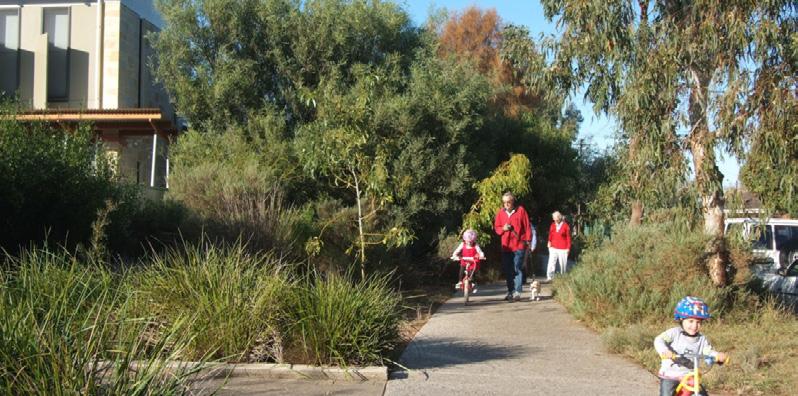
I’ve got an old house in Adelaide. I asked myself, how did they keep this home cool 100 years ago
on a 45 degree days?
The answer is they had a green lawn and a green garden. That can reduce your electricity bill by $200 a year. It’s that simple.
But you need to get that information out.
BECK DAWSON: Sometimes referred to a the "person paid to worry for Sydney" Beck's team at Resilient Sydney is trying to become a centre for creating the new generation of environmental accountants across Sydney. "If we can’t measure those risks and start to monetise each part of those challenges across the city, we can’t ask for investment or money to go against them", she says.
Resilient Sydney has been running since 2015. We bring together all 33 councils of metropolitan Sydney, in a program to understand the big risks that our communities and our places face.
Many of them are climate related – and heat is a really big one.
We’ve done broad macro risk assessments to understand what the environmental issues or
risks and impacts are that sit both on nature, on our infrastructure, and on our people across the city. And it doesn’t play out evenly.
We’re trying to measure and understand those risks in different places of the city in different geographies, but also in different types of communities.
One of the things that’s come along the way is talking about heat, and mitigating it.
Canopy and green infrastructure is super important in helping our city start to breathe a little better, but also to actually really fundamentally try and structure a cooler and greener place to live.
That’s true everywhere across the city. But not all parts of the city are created equal.
A big challenge for local councils and governments has been not having the information that they need to be able to understand that those decisions are those risks in place.
We’re trying to become a centre for creating the new generation of environmental accountants across Sydney. If we can’t measure those risks and start to monetise each part of those challenges across the city, we can’t ask for investment or money to go against them.
In the same way, as many of you will have done in property companies or in investments or in developments, you actually need to structurally make business cases.
We need to do the same for all of this type of infrastructure, but we need to measure it, it’d be able to report against it to be able to do that really well.
That enabled us to talk to every mayor, and every group of councillors and general managers across the city on the same basis, and make comparisons between different parts of the city.
We can start to ask them: “Is it okay that this part of your city has a canopy cover level of less than five per cent? And is it okay that this other part of your city has something closer to 40 per cent, which is what the target is for the whole of the metropolitan area?”
We’ve created a canopy cover data set across the whole city that every council now has access to. We then start to be able to use this information to tell the political story.
We’ve spent four years building and then sharing a quite sophisticated resilience data platform across the whole of the city.
For the first time, it provides standardised whole of city consistent metrics down to suburb level, and in some cases, precinct level, for councils in every part of the city.
It is the first time we’ve all had the same data, in the same way in the same structure.

My team of three is supporting those councils to understand the data and start to use it.
The result is that the Department of Premier and Cabinet has worked with us to put out a paper with some guideline instructions on 22 March, which is now available publicly on its website. And they’re working with the Treasury to put the real numbers and the business cases around exactly how you do that.
That’s how you value green infrastructure.
“In the same way as many of you will have done in property companies, in investments or developments, you actually need to structurally make business cases.”
Part B of Power and the Passion focused on the tension between “natural order" and "the rule of law.”
It started with a fabulous view of Singapore, known globally as a City in a Garden, and what happened when when Covid struck and maintenance of the pristine gardens could not be carried out. Singapore's gardens went a bit wild, said presenter Richard Hassell from WOHA architects, speaking remotely and in a recorded session.
Richard explained how nervous authorities worried about the reaction from the citizens to the long grass
and abundant flora and fauna that flourished after so many months of lockdown. The big surprise, though, was that this “rewilding” was embraced.
It was a different story in Sydney when Martin Bryant, a UTS academic and his students proposed rewilding part of Moore Park.
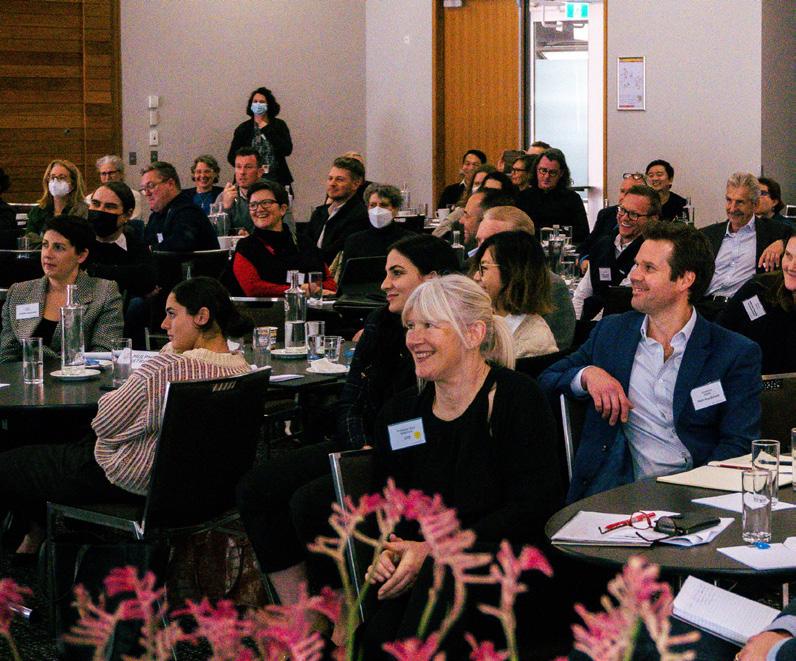
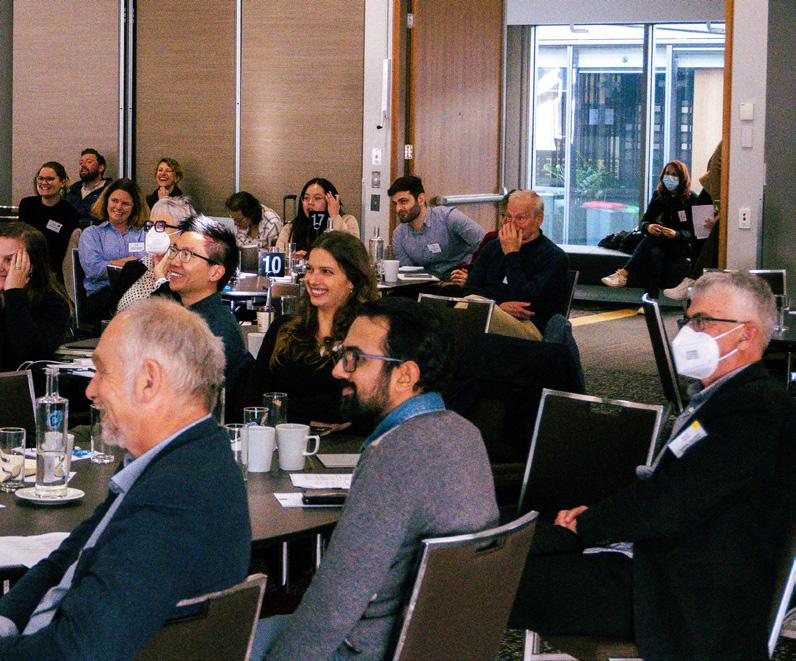

PRESENTATION: Richard Hassell, founding director, WOHA, discusses his company’s role in the impressive long term project of the greening of Singapore that has impressed so many observers.
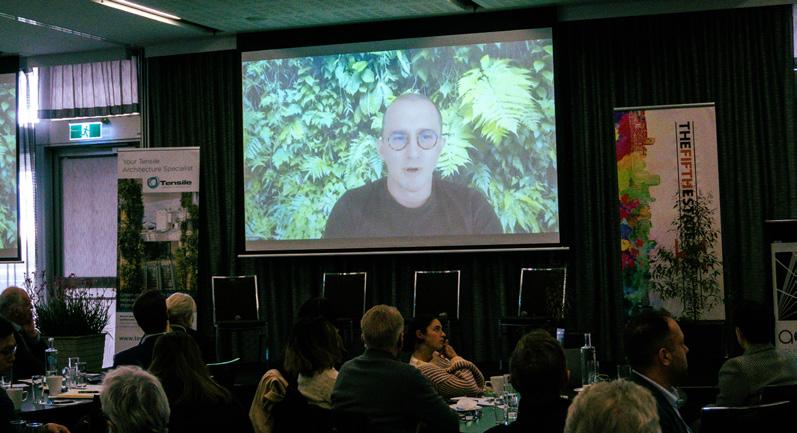
My presentation is called, From Biophilic to Biocentric. It’s an overview of Singapore’s conversation around this topic over the last 20 years or so, and how we’ve been interacting with that in our practice over the time.
I’ll start with this picture of Lee Kuan Yew planting trees in the 60s and the last one was in the 2000s. I think this one man is the person behind Singapore’s green character. He saw landscape as a tool for promoting Singapore internationally, especially when it was a young country without any real track record in government. And his theory was that you can’t fake a well-tended garden, and a garden will communicate an ability to put in place longterm plans and look after them.
So, it’s sort of a proxy for institutional integrity and longevity. And it’s something that’s continued through the whole history of Singapore.
Between 1986 and 2007, despite the population growing by 68 per cent, the green cover in Singapore grew from 35.7 to 46.5 per cent. Quite amazing! As Singapore developed, as it grew a bigger and bigger economy, it turned over more land to greenery.
The Gardens by the Bay, an enormous garden on very expensive land in the middle of downtown, demonstrates a vision of a futuristic garden city that is totally what Singapore is about.
I think it creates this shared vision of a sort of ecological future.


The government’s central planning authority introduced the policy of 100 per cent replacement green. So now, every building in Singapore must, apart from industrial buildings, I think, need to create 100 per cent replacement of the site as green area on the projects.
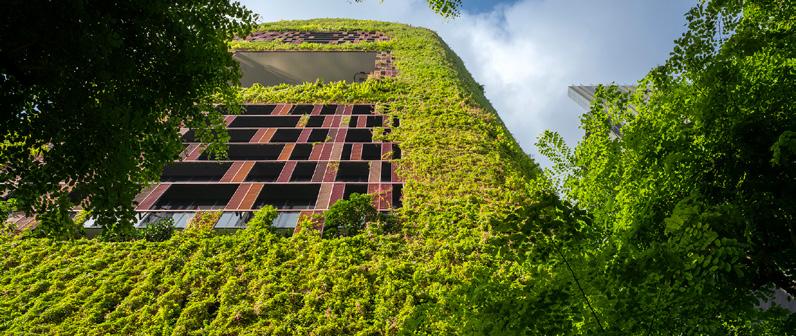
Five ministries, very important ministries in Singapore have joined together as part of the Singapore 2030 Green Plan.
They are making some commitments: to set aside 50 per cent more land and 200 hectares for nature parks; that every household will be within a 10-minute walk of a park, and they’re going to plant a million more trees across the island.
By 2030, Singapore will be a green and beautiful city in nature.
Previously Singapore’s garden roadside planting were very groomed and artificial. But over Covid, all these areas ended up getting very wild because of a five-month shutdown.
Singapore became this wildflower meadow, which was really interesting because it had never been unkempt. And people were amazed how many flowers and butterflies and birds appeared. This helped the national parks which had been toying with this idea of having much
monkeys because these langur monkeys are very endangered. These bridges have allowed them to colonise new areas and start increasing in numbers.
After that success, really big eco-links were put across the highways because a lot of the highways were put through forested areas.
There’s been some amazing camera track footage of deer and pangolin and all kinds of interesting and rare animals crossing the bridges and starting to spread across. A number of other projects also really prove that designing for biodiversity works.
POWER AND PASSION: POLICY AND POLITICS OASIA HOTEL BY WOHA. PHOTO: DARREN SOH Watch this presentation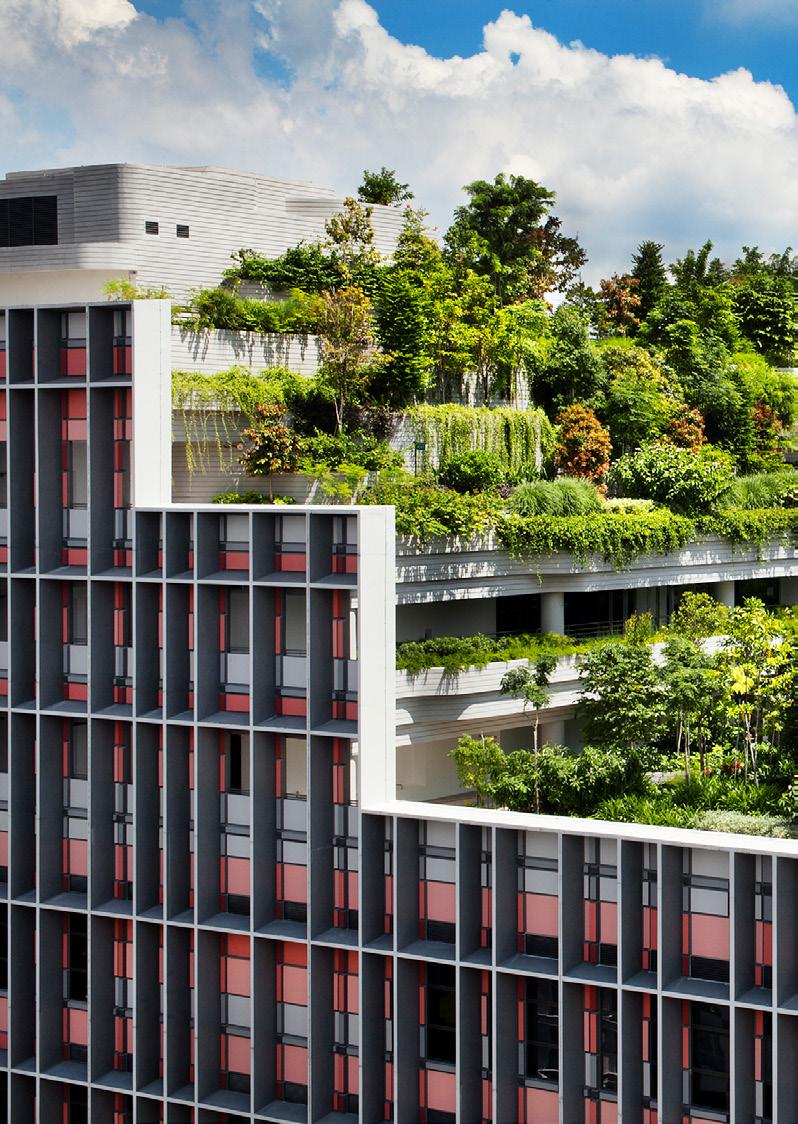
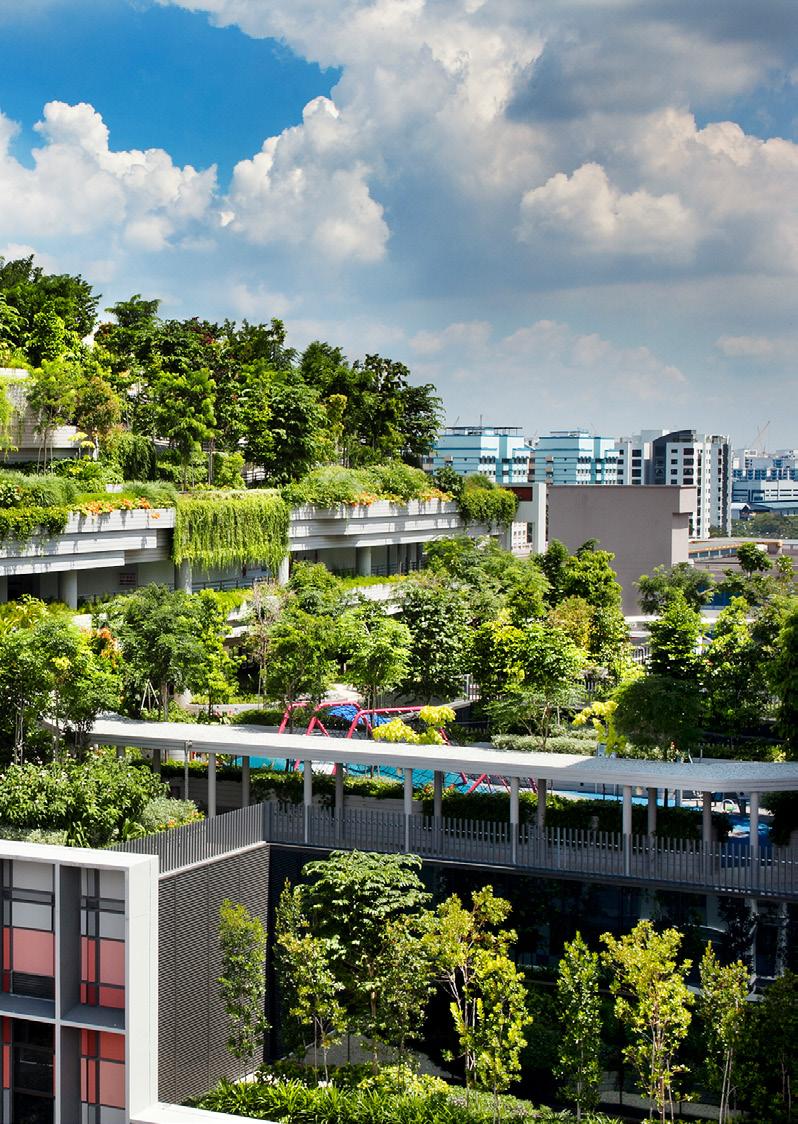 KAMPUNG ADMIRALTY BY WOHA. IMAGE: PATRICK BINGHAM-HALL

JESS MILLER: I’d like to introduce myself – I’ve just given myself a promotion. I am now the mayor, as you can clearly see. “Let’s not beat around the bush… some councillors have just disclosed their conflicts of interest, hence why we only have four councillors. Half of them had to leave, because, you know, they make money off plants and trees.”
Jess Miller, our MC for the day, was inspired by the proposal from UTS academic Professor Martin Bryant to rewild parts of Moore Park in Sydney.
A a mock council meeting might be an effective way for businesses to understand the inner workings of local government, she thought.
It was also the most hilarious way!
Jess was joined on stage by urban greening expert Gwilym Griffiths, urbanism research lead Dr Jennifer Kent, and landscape architect and horticulture expert Eric Sturman went head to head to debate the ultimate question.
Facing the assembled "councillors" and "public gallery", our audience, Professor Martin Bryant offered his proposal: “Should we remove golf courses, and turn them into public rewilded nature reserves?”
Please keep in mind that the debate is purely humorous and may not reflect the actual views of the speakers or their organisations.
Council is now in session. I would like to call upon Councillor Bryant. I hear that you have a notice of motion that you would like to put forward to the Council for endorsement. You have the floor now for five minutes to put forward your idea about rewilding Sydney.
MARTIN BRYANT: According to Indigenous researcher Alan Cattell, [wild] is where there is no commercialisation, and no commodification of land or property or sea…
Rewilding is different, because it embraces experimentation and innovation…and a new optimism for environmentalism.
The proposal is to rewild Moore Park Golf Course in Sydney. To take it away from private ownership and return it to the hands of the public. To restore biodiversity and create a habitat for native species to return.
This will help engage citizens in observing, tracking and interacting with nature. It involves relinquishing control of what nature looks like. It offers a way for urbanism to restore primacy to natural functions.
This is not a revolution, but it is a new paradigm of thinking.
JESS MILLER: So, just to clarify…we are getting rid of not just nine holes, but all 18 holes of the golf course, devolving all management and ownership to anarchy in the public realm, in an effort to forgo all power over Moore Park and turn it into a wild reserve. Is that correct?
MARTIN BRYANT: I wouldn’t call it anarchy… and we’ll save the world while we’re doing it.
GWILYM GRIFFITHS: I’ve got a lot of things to say. But I forgot which side I’m supposed to be on?
Oh, I’m on the opposing side? Okay, then… segmenting that area off just for wildlife is ridiculous.
The concept of rewilding is a really fantastic one. But the reality of planting trees is extremely difficult especially in urban environments.
On the one hand, councils believe that when segmenting off land to be public space you need to ensure that it is quality public space.
Turning it into wildlife parks could be perceived as ridiculous. Trees take a lot of work, a lot of planning, and a lot of cost: to get a tree in the ground is $1000 to $1500, not including maintenance.
The concept of rewilding and creating these wild spaces is wonderful, but the reality of implementing it is a challenge.”
ERIC STURMAN: I like the idea that I could go bow and arrow hunting close to my house.
Living closer to the wild is inspiring, and the need to engage with nature far outstrips the want to chase a little white ball around a golf course.
[On the economic side of it.] we could probably charge people an entry fee as they do in South Africa, or charge the Council rent, which would mitigate the loss of income from golf.
Anything that brings people closer to nature (and potentially we might lose a few idiots who get lost and drowned along the way), would be a fantastic thing for the City of Sydney.
DR JENNIFER KENT: I have done some community consultation…I got objections from Electricity Australia, the NBN, a couple of gas companies, the College of General Practitioners, the Rural Fire Service, New South Wales Police, Ambulance Australia, and the Moore Park Golf Course Committee of course.
And just to make it real, I’d like to bring to your
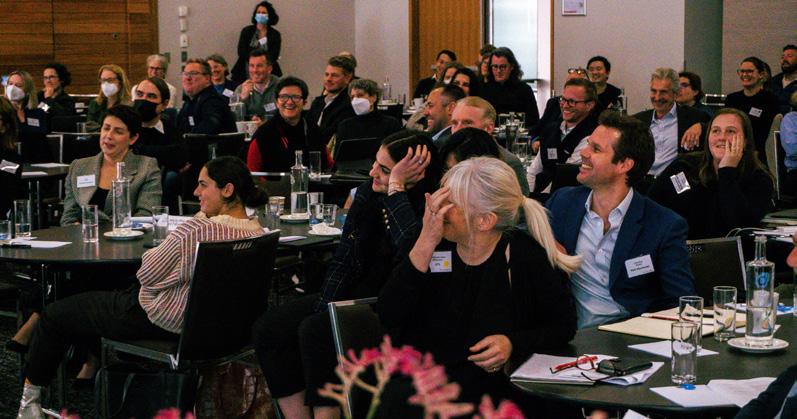
attention the plight of Ms Porter, who happens to own a 10 year old miniature dachshund by the name of Olive, who just loves romping through that part of the park. And to be honest, it has become part of the fabric of her life. It keeps her going.
She’s just an example of one member of this community, an upstanding member. And I wonder, can we really take that away from the community at this stage, given the precarity that the community is facing? Do we need more disruption?
JESS MILLER: Councillor Martin, we’ve heard some very important points raised…I’ve got a couple of questions that I’d like to ask about this motion.
Specifically, how much will it cost? Have you done any community consultation? Is there a real need coming from the community that’s driving this?”
MARTIN BRYANT: The cost? I don’t know.
[But] yes, we have spoken to quite a lot of people in the community. And no, we didn’t speak to the New South Wales Government lackeys, who all want to do what the Minister for Housing says.
But certainly we’ve got a fairly big groundswell of people who are interested in this because in their heart is the future of the earth. Not so much what their doggy can do and where they have to go to pick up the poo for their doggy.
ERIC STURMAN: I’d like to stand up in support of you.
Whether you think you’re going to lose your kids or your dachshund down in this horribly wild place, I wonder whether Ms Porter would like to adopt a bush turkey, there’ll be plenty of those.
But there’s no doubt that our city does need healing, and whilst this might seem a little extreme (it is taking away what appears to be a very big and popular piece of public infrastructure) what are the golfers going to say to us all in 30 years? When we can’t walk the streets anymore because they’re too hot, and our dachshunds have melted into just a leash with a little puddle at the end of it.
So really, whilst it might seem a little bit extreme… if you told my grandparents that one day I’d be living in a building that looked like a tree, they’d probably think that was pretty crazy, too.
I think this could be an ingenious solution for climate change.
JESS MILLER: We’ve heard people say that cities are no place for trees. People can’t just plant a tree anywhere they like and expect it to grow.
There are important rules to follow, rules as important as our dachshunds.
How might we adapt this mad proposal to turn a golf course into a wild reserve, and turn it into something the whole community will support?
MARTIN BRYANT: I’m putting the big picture out there… we don’t have time to waste.

There are actually 81 golf courses in Sydney – that’s 5000 hectares of land, which could be rewilded across Sydney to provide wildlife corridors. The aim is not to knock down existing trees – it is to plant additional endemic species to create a biodiverse natural ecosystem in the park.
Through consultation with Indigenous communities in the area, we have learned that some of these areas are important Corroboree
sites. They see returning it to its rewilded value actually respects the land far more than a golf course does.
JESS MILLER: Jenny says it’s ugly, unkempt, messy, and she doesn’t like snakes. And bears? Exactly. Thank you.

MARTIN BRYANT: [Ignoring such wild accusations as roaming bears in the Australian bush]
The particular golf course in question – there’s 60,000 people who live next door in Surry Hills. There’s only 822 golfers who are members of the course.
So the benefit of rewilding to the local community would far outweigh the benefit that the existing golf course currently has.
AUDIENCE MEMBER: “Yeah, hi. I’m just a casual developer who just happened to be at this meeting. And have you considered the fact that we are in a housing crisis at the moment? Have you considered perhaps that we could have, you know, a nice, lovely development on that site to alleviate that crisis?”
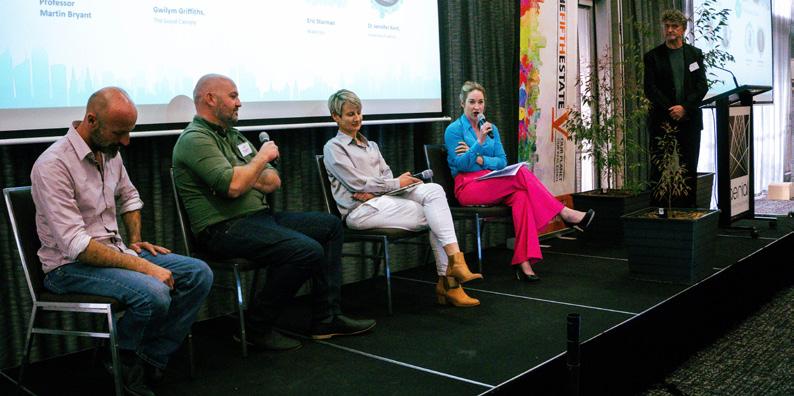
DR JENNIFER KENT: Can I just add something there? I mean, just while we’re talking about policy based evidence, the whole idea of the
cost benefit of this kind of proposal is just absolutely preposterous. When you think about the money that we could get from developing that space.
I mean, it’s 20-storey height limit, it’s very prime real estate, surely that could be pumped back into supporting the health of the community.
Jobs, jobs, absolutely. The jobs that will grow from it, the growth, we have a growing population here, and it is our responsibility to ensure that our city areas densify, as opposed to spreading out on the suburban fringe.
How can you be so selfish, really?
[Audience laughs]
JESS MILLER: Will the old trees be cleared to plant new trees? So just pure anarchy. That’s what you’re proposing, isn’t it. Anarchy? What’s
POWER AND PASSION: POLICY AND POLITICS ERIC STURMAN, GWILYM GRIFFITHS, JENNIFER KENT, AND JESS MILLER. PHOTO: TÚLIO CARNEIROMARTIN BRYANT: The essence of rewilding is we don’t knock trees down. We don’t really mind if they’re not endemic. We are there to use whatever is there.
JESS MILLER: You’ve got one minute to make your final plea.
MARTIN BRYANT: Ladies and gentlemen, we can’t compromise. This is the most important decision, we are at the most critical time in the history of the planet Earth.
We now need to make decisions which have never been made before.
And those decisions about how we reintroduce nature are the only way we will have the capacity to start to save ourselves.
Because nature will still be here when we’re all extinct.
But if we want to still be here, we need to help nature to get the job done.
And that’s why rewilding is so essential.
[Audience applauds].
JESS MILLER: Okay, councillor, councillors, members of the public. I put the motion to the vote. All those in favour, raise your hands and say “Aye”.
AUDIENCE: Aye.
JESS MILLER: “All those opposed? Okay, the ‘Ayes’ have it. Congratulations, Councillor Martin. Watch this session