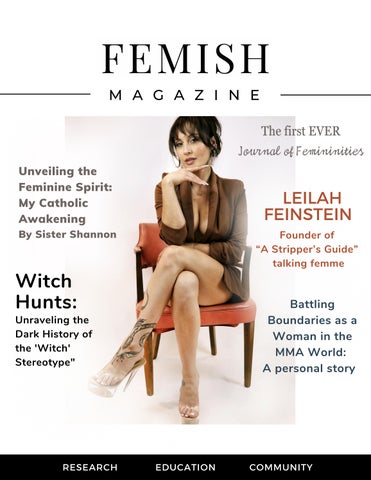
FEMISH M A G A Z I N E
Unveiling the Feminine Spirit: My Catholic Awakening
LEILAH FEINSTEIN
By Sister Shannon
Founder of “A Stripper’s Guide” talking femme
Witch Hunts:
Battling Boundaries as a Woman in the MMA World: A personal story
Unraveling the Dark History of the 'Witch' Stereotype"
A 501(c)3 nonprofit RESEARCH
EDUCATION
COMMUNITY
"We’ve realized that women can do what men can do. The next leap? Realizing men can do what women can do." GLORIA STEINEM
@THEFEMISHORG
TABLE OF CONTENTS
FEMISH Letter from the Founder
04
Contributors Battling Boundaries in the MMA By Alicia Mendoza Witch Hunts: The Dark History of a Stereotype
05 06 09
Unveiling the Feminine Spirit: A Catholic Awakening By Sister Shannon
10
Journal Of Femininities!
12
Person of the Month: Leilah Feinstein Navigating Relationships as a Femme Sex Worker What’s Up With FEMISH Watch, Read, Listen
20
Be A Contributor!
21
Sources
22
Visit FEMISH.ORG/MAGAZINE
to download this current issue
13 14
18
DONT FORGET! THIS ENTIRE MAGAZINE IS INTERACTIVE, THERE ARE LINKS EVERYWHERE!
A Letter From The Founder Welcome!
Thank you for checking out our e-magazine! This is our 5th Issue, and it’s a sexy one with “A Stripper’s Guide” Founder Leilah Feinstein and Sister Shannon sharing different issues around being and feeling sexy. FEMISH has so much to share, from research, organizational updates, personal experiences, and more. We want to bring it to you in a fun and interactive way. FEMISH is a 501(c)3 nonprofit organization, currently running on volunteer & intern fuel. If you would like to assist with the creation of this monthly magazine, we are looking for editors, writers, marketing, you name it! Have a story to share? Found a relevant news article we should talk about? Know someone we should interview? Let us know by reaching out to
FOUNDER OF THE FEMISH ORGANIZATION,
Samantha Martin
info@femish.org and check out our Contributor Form linked on the last page. Don’t forget to subscribe to our website and follow our social media accounts: Instagram, Facebook, Tiktok. Thank you for all your support! Together we can create a welcoming and inclusive world. Our next issue will be out in December!
04 | FEMISH MAGAZINE
Leilah Feinstein
Sister Shannon
Samantha Martin
Leilah Feinstein is a stripper, writer and musician. She’s the founder of A Stripper's Guide, a multimedia support platform for sex workers and femmes, as well as sex workerinclusive feminist education for the general public. Her forthcoming book, A Stripper’s Guide to Love, is a relationship manifesto for the communities she serves. She’s also working on a documentary about the love lives of sex workers. Check out her podcast, blog, YouTube, and Instagram, and join her newsletter for updates and ongoing content!
FEMISH MAG | CONTRIBUTORS
Alicia Mendoza
FEMISH Intern Alicia Mendoza is a first-year master's student. She is working toward her master’s in Clinical Mental Health Counseling at Adler University. She aims to become a mental health counselor and work with LGBTQ+ individuals, athletes, and women. Alicia is a social justice advocate and strongly values women's empowerment. She also loves to box, spray-paint, and listen to music!
Sister Shannon is a sex coach for people raised in Catholicism, who helps people create luscious sexual lives even if they were handed pretty sex-negative conditioning growing up. (Let’s be honest, who wasn’t.) You can find her @sister.shannon on Instagram.
Founder of The FEMISH Organization, Femme Equity Activist, and attorney who was fed up with gender bias and discrimination. She stumbled upon the term "femmephobia" and saw the need for this loop-hole in society to be closed. @femmeesq
05 | FEMISH MAGAZINE
BATTLING BOUNDARIES: THRIVING AS A WOMAN IN THE MALE-DOMINATED REALM By:O Becca F Schneider MMA By: Alicia Mendoza
To me, femininity means being authentic and not apologizing for participating in different activities, styles, and hobbies that stray from the status quo. I am a huge advocate for self-expression, self-love, and women's empowerment. I have always pushed myself to do what I am passionate about, even if it doesn’t fit the typical gender norm. I have participated in many sports throughout my life, specifically male-dominated sports such as boxing, mixed martial arts, and powerlifting. Participating in these sports has opened my eyes to femmephobia and the discrimination we face as women when put in maledominated environments. As a young girl growing up in a predominantly conservative environment, I struggled to fit into the typical “girly girl” activities and was always drawn to more masculineassociated hobbies. When I entered high school, 06 | FEMISH MAGAZINE
I decided to start boxing and join my Catholic school’s wrestling team. The school I attended valued conservative beliefs and emphasized societal gender norms throughout the curriculum. Being the first and only girl on the wrestling team was extremely challenging, and I faced multiple microaggressions and judgments because of it. Others convinced me that I was emasculating the sport by being there and was portrayed as an imposter. My boxing and mixed martial arts experience outside of school was much better; however, I constantly felt like I had to prove myself to earn the respect of the other men around me. Women in male-dominated sports often face gender stereotypes, such as being perceived as less capable or physically weaker. In my experience, I had to work much harder than my male counterparts just to be seen and taken seriously.
This is problematic because women are given fewer opportunities, training, and attention needed to improve within the sport. I also noticed that many male fighters were hesitant to train with women unless they were advanced or “willing to work with them.” It gave off the impression that their willingness to hold pads for a girl was an act of service and a way to validate themselves. As I’ve grown and become better at the sport, I’ve started to see the shift in respect and acceptance of my presence in the gym, but this was due to years of hard work and determination. I quickly realized that I would have automatically gained the other male fighter's respect as a man instead of having to fight my way as a woman. Even after gaining their respect, I would receive comments like “Wow, you hit pretty hard for a girl” or “She hits like a man.” I took this as a backhanded compliment that invalidated my skills and strength. These experiences have motivated me to encourage more women to participate in male-dominated sports if they so choose. I know many women who are interested in starting boxing, MMA, wrestling, etc., but are hesitant due to the intimidation of the male presence and fear of being judged.
I want to be an advocate and source of support for new female fighters and female athletes in general. I had a recent experience with a young girl who just started boxing. I approached her as I do to all new female boxers in the gym and introduced myself so she would feel welcome. She appreciated the simple act of introducing myself and getting to know her. She expressed her concerns as a young girl in a boxing gym and how intimidating it can be to participate in this environment. I commended her bravery for showing up and hope to see more women of all ages and backgrounds participate in their passions, regardless of gender norms.
07 | FEMISH MAGAZINE
I’d like to see more women’s representation within fighting organizations like the UFC (Ultimate Fighting Championship) and WBA (World Boxing Association) that prioritize skill and athleticism instead of physical attributes and beauty. These fighting organizations are notorious for using and recruiting female fighters who are more conventionally attractive to gain more media traction and money. Addressing issues of discrimination, stereotypes, and sexualization of women in male-dominated industries is something I’m very passionate about and hope to see improve. Female athletics have made progress but still have a long way to go. I believe standing up and embracing femininity in sports will create an inclusive, fair, and supportive environment for women and end femmephobia in male-dominated sports.
08 | FEMISH MAGAZINE
Introducing FEMISH Intern Alicia Mendoza
FEMISH Intern Alicia Mendoza is a first-year master's student. She is working toward her master’s in Clinical Mental Health Counseling at Adler University. She aims to become a mental health counselor and work with LGBTQ+ individuals, athletes, and women. Alicia is a social justice advocate and strongly values women's empowerment. She also loves to box, spray-paint, and listen to music!
WITCH HUNTS
Unraveling the Dark History of the 'Witch' Stereotype" By: Samantha Martin The term "witch" conjures up images of pointy hats, broomsticks, and cauldrons, often associated with Halloween rather than historical atrocities. However, beneath this whimsical façade lies a dark chapter in human history, where accusations of witchcraft led to the persecution and often gruesome execution of thousands, predominantly women. This article delves into the roots of this stereotype, the hysteria it fueled, and the devastating consequences that followed. The Origin of the Witch Stereotype The witch stereotype finds its roots in deeply ingrained cultural fears and prejudices. Throughout history, women who deviated from societal norms were often labeled as witches. These women were typically healers, herbalists, or those with knowledge of natural remedies. The fear of the unknown, coupled with a desire to maintain the status quo, led to the stigmatization of these women as practitioners of dark magic. Religious and Political Machinations The witch hunts reached their zenith between the 15th and 18th centuries, a period marked by religious turmoil, particularly within Christianity. The Catholic Church, as well as various Protestant sects, saw the perceived threat of witchcraft as a means to solidify their authority. This was fueled by publications like the infamous Malleus Maleficarum (The Hammer of Witches), a treatise on identifying and prosecuting witches, which perpetuated fear and mistrust. Gender Bias and Control The witch hunts were, fundamentally, a manifestation of gender bias. Women who did not conform to societal norms or wielded any form of power were easy targets. The stereotype of the witch became a tool for controlling women and suppressing their agency. This deeply ingrained bias played a pivotal role in the perpetuation of the witch hunts. Hysteria and Accusations The witch hunts created a culture of fear and paranoia. Accusations were often made based on flimsy evidence, hearsay, or personal vendettas. Once accused, a woman faced a perilous journey through a legal system that was heavily stacked against her. Torture was frequently used to extract confessions, leading to a chilling cycle of false admissions and further accusations. The Grim Toll The consequences of being accused of witchcraft were severe and often fatal. Thousands of women (and some men) were subjected to public trials, torture, and execution. Methods of execution ranged from hanging and burning to drowning, all carried out under the auspices of purging society of perceived evil. Families were torn apart, communities were divided, and countless lives were lost. Legacy and Lessons The witch hunts remain a stark reminder of the dangers of prejudice, fear, and the misuse of power. They serve as a testament to the resilience of women throughout history who dared to challenge societal norms. Today, the witch stereotype has evolved into a symbol of empowerment for some, reclaiming the narrative and celebrating the strength and wisdom of those who were once unjustly persecuted. The witch hunts stand as a haunting testament to the depths of human folly and the dangers of unchecked prejudice. The stereotype of the witch, born from ignorance and fear, led to unimaginable suffering and loss. Remembering this dark chapter in history is essential to ensure that such atrocities are never repeated, and that we continue to challenge stereotypes that perpetuate bias and discrimination in our modern world.
09 | FEMISH MAGAZINE
UNVEILING THE FEMININE SPIRIT: MY CATHOLIC AWAKENING BY ASHLYN ALLEMAND
By Sister Shannon I was born into Catholicism but I didn’t have a penis. That’s where this story begins. Growing up Catholic is like wading through a pool of sludge, where you’re flooded with ritual after ritual after ritual. Baptism and creeds. Genuflection and novenas. Hail Marys and Reconciliation. It feels like the more rituals you learn the more Catholic you are, until the weight of every ritual rests like a bulky sack of potatoes on your shoulders and you feel so paralyzed you can’t tell WHICH rituals make you feel connected to God and which ones make you feel like you belong to the community. Sometimes they’re the same thing. A lot of the time…they’re not. Once in a while you rise to the surface of the sludge and see “oh THAT’S where this tradition came from.” The religion does have 2000 years of messy complex people, and spiritual practices that developed from their need to deal with the historical moments they found themselves in, after all.
10 | FEMISH MAGAZINE
But when you’re seven, and a girl, and just found out you were baptized naked, you don’t have that context. All you have is a childhood of being told to cover your private parts. The judgment of private parts shows up in family’s quiet comments about a teenager’s top being “too revealing”. Or their gossip at a barbecue about one cousin’s girlfriend who had the audacity to mention she wore a thong. How SCANDALOUS. Doesn’t she know the more skin your underwear covers the better? It was a childhood like this, where we repeated the “Our Father” and referred to God with he/him pronouns, that bleached out the impact of women or femininity on the very religion to which my family clung. But for me, it sparked an ongoing obsession with figuring out the answer to the following question: “Why do we have such a hard time with women’s bodies? Especially when the people in my family who feel STRONGEST about us going to church…have those same bodies?”
Those women didn’t have penises. And yet, they were quick to serve the needs of the penised-people in the family. Their more-stereotypicallyfeminine joys and frivolities, if they dared to explore them, received smirks and teasing. I remember packing my suitcase for summer visits, and intentionally choosing boys shorts and boring T-shirts over the pinker, frillier, tighter clothes I owned. I wanted to fit into the crowd. The way I was going to do that was by wearing the same outfits my girl cousins wore: boys basketball shorts. Even though I know femininity and masculinity are a construct, and not determined by genitals, I have to consider the impact the constructed tie between the two had on my own lived experience as a child. Mine was a childhood where femininity and the physical genitalia on bodies were not separated or explored. For the purposes of this essay, I describe femininity as it got applied to my own body – a body with breasts, a clitoris, vagina, and uterus.
“I was deep in the experience of reclaiming my femininity and woman-hood for ME, instead of for Catholicism, which would have preferred that if I were going to be feminine, I be as much like the virgin Mary as possible.”
As I grew and developed my own sense of agency beyond the heavyhanded feminine-fearful norms I was handed from my Catholic family, I started looking at the history of the religion we all bowed to on Sundays. Perhaps the most important historical lesson I received was listening to the Gospel of John at Easter mass. There are four gospels in the Bible, each with a different story describing the experience of Jesus’s resurrection. In the Gospel of John, Mary Magdalene (who all Catholics know as the “whore”) is the first person to realize Jesus is alive. She is the one who went to take care of his body. She is the one who stayed by his side after death. She is the one who told the male disciples about his resurrection. Some strains of Catholicism refer to Mary Magdalene as the Apostle to the Apostles. But mainstream Catholicism judges her for her sexuality, even though an entire liturgical season exists because she was the first to realize Jesus had come back to life. The enormity of that realization stirred something RECLAMATORY within me. I wanted to know where else women and non-men had played a pivotal role in the development of the Catholic tradition, and then been demonized. I started reading books by non-Catholics about Catholic history. I started exploring Catholicism’s intimate ties to the Holy Roman Empire, and its connections to dehumanization and private property rights.
I joined programs run by modern womanist legends like Lyvonne Briggs and EbonyJanice Moore. I was deep in the experience of reclaiming my femininity and woman-hood for ME, instead of for Catholicism, which would have preferred that if I were going to be feminine, I be as much like the virgin Mary as possible. Demure, ever-giving, and certainly above sex. Sometimes I’m those things. But goddangit, I’m raucous and love getting gifts and think sex is one of the best things about being human too. Learning about womanism from Lyvonne Briggs and EbonyJanice Moore in particular gave me a space and community to put my gender and my religion back together. It was in Patreon threads and Zoom calls with them that I learned scribes and clerics stripped women, and people who identify as something other than “man”, out of the biblical texts as they made translations from Greek, to Latin, to the English I’m writing this essay in today. I learned that Aristotle thought women were “deformed men”…and the Catholic tradition grabbed hold of that concept and ran with it for 2 millennia. I learned that the Holy Spirit in the Greek text is pneuma. A feminineended being. And that the Book of Wisdom regularly refers to wisdom with she/her pronouns. I learned that the priestess Junia became Junius in later translations of the Bible. And that up to 25% of the women in Jesus’s time were named Mary, so there’s a lot more Marys mentioned in the New Testament than just Mary his mother, or Mary Magedalene.
It was in these spaces I found women and MYSELF in Catholicism, after decades of praying to a Father, who loved the world so much He gave his only Son. It was a transformational shift after Sundays filled with stories of Peter, denying Jesus three times, and Paul, the archetype of what a “good evangelist” should be. Stories of Moses, who found God in a burning bush, and Abraham, who benefitted from the sexual energy of the women around him, and is heralded as a patriarch. I’d been trying to fit a ridiculous amount of dude-ness into my psyche for decades because those were the models I was given. I’m been trying to emulate a lot of “masculine” traits to be closer to God. The thing is, I didn’t want to BE masculine. As I grew out of that traumatized seven year old and into my confident femininity, I started to uncover just how GOOD it feels to be stereotypically feminine. To swing my hips more confidently as I walk down the street (or down the church aisle for communion). To wear pink and flowing skirts to work. To gaze quietly and thoughtfully when a misogynist calls at me from a car window, offering him a supremely feminine challenge: I exist and I am feminine. If you feel so strongly about it that you have to yell at me from your car… that’s your problem to handle. I’m centered.
11 | FEMISH MAGAZINE
Announcement: New in 2024 - Journal of Femininities We are thrilled to introduce the Journal of Femininities, a groundbreaking academic journal dedicated exclusively to the study of Femininities. Led by Editors-in-Chief Dr. Rhea Ashley Hoskin, a FEMISH Board Member, and Dr. Karen L. Blair, this journal promises to be a pivotal platform for the exploration of femininity in contemporary scholarship.
@journal_of_femininities
The Journal of Femininities is poised to revolutionize the field by offering a unique outlet for research on femininity. By cultivating and uniting the domain of Femininities, it aims to propel theories and methodologies that underpin the study of femininity. This journal matches our mission to challenge conventional norms and associations related to femininity, treating it as a rigorous academic discipline akin to other specialized social dimensions. Articles featured in the Journal of Femininities will contribute to profound and intricate insights into the multifaceted concept of femininity.
As an international, peer-reviewed journal, this Journal welcomes high-caliber submissions from diverse disciplines including sociology, psychology, gender studies, business, public health, education, political science, media studies, legal studies, family science, and more. Furthermore, it is particularly supportive of interdisciplinary, multidisciplinary, and transdisciplinary work from feminist perspectives. This Journal encourages the submission of both qualitatively and quantitatively rigorous empirical articles, as well as critical essays, theoretical papers, and book reviews. The Journal of Femininities leverages a wide array of methodologies to explore perceptions and constructions of femininity, as well as to deliberately examine femininity as a framework or intersectional axis. The Journal of Femininities places a strong emphasis on intersectionality, encouraging submissions that scrutinize femininity across various axes including race, sexuality, disability, class, body size, religion, culture, and gender/sex. For those interested in shaping special issues or features, we invite you to reach out to either editor for collaborative opportunities. It is crucial to note that The Journal, like FEMISH, defines "femininity" as a construct distinct but overlapping with "woman" or "female." Consequently, it does not treat women and femininity as synonymous concepts. For a limited time, individuals will have the opportunity to access our journal for free directly at brill.com/fem. Recommend this Journal for your Library HERE! We are immensely excited about this new venture and look forward to the valuable contributions that will enrich the discourse surrounding femininity.
For mor info, including how to submit to the Journal, CLICK HERE 12 | FEMISH MAGAZINE
Inspiring Person Of the Month
INSPIRING PERSON
Leilah Feinstein
Meet Leilah Feinstein, this Issue’s Inspiring Person Of the Month! Leilah Feinstein is a stripper, writer and musician. She’s the founder of A Stripper's Guide, a multimedia support platform for sex workers and femmes, as well as sex worker-inclusive feminist education for the general public. Her forthcoming book, A Stripper’s Guide to Love, is a relationship manifesto for the communities she serves. She’s also working on a documentary about the love lives of sex workers. Check out her podcast, blog, YouTube, and Instagram, and join her newsletter for updates and ongoing content! Continue reading to check out her personal story.
A Stripper’s Guide
@asg.headquarters
@astrippersguide 13 | FEMISH MAGAZINE
RELATIONSHIPS AS
A
SEX
FEMME WORKER
I’m a stripper. One day, I asked my partner to put my lunchbox in my work bag. When they opened my duffel, they noticed a piece of lacey, green lingerie inside. For most strippers, this would be normal; however, at my club, the dress code requires we wear cocktail dresses. Some dancers don lingerie underneath, so that, as they strip down on stage, there’s an extra layer of spiciness before they get topless. I’d been in the worst financial streak of my career and had packed the lingerie with the intention of experimenting to see whether that approach might help me make money. My partner confronted me. “Why is that in your bag? I thought you can’t wear lingerie at work.” I sensed tension mounting. I calmly explained why it was in there, but even doing so felt like a tedious and futile task; as a femme, I know the feeling too well when a lover has made up their mind that I am up to something shady. Then, my partner said something that floored me: “If you’re going to wear lingerie at work, don’t bother wearing it at home for me anymore!”
14 | FEMISH MAGAZINE
By Leilah Feinstein
NAVIGATING
Photography by Syra Sparkle
First of all, this was not a special outfit I’m not mentioning all of this to defend that I wore in my personal life. It was left them for the lingerie argument. I’m over from a photoshoot to promote my mentioning it because too many femmes writing and podcast – a photoshoot they Women The Issues Stillwhat Face it’s like to feel deeply know attended. Pictures of me in that little By Samantha Martin misunderstood in our relationships and, if green outfit had already been plastered our partners aren’t femme themselves, all over the internet for months. they may need to put in the work to close Secondly, and more importantly: my that gap in order for the relationship to partner’s demands were really a request progress. that I censor my self-expression to make them comfortable. When I wear lingerie, When it comes to romance, everyone is or anything else, at the strip club, it’s a faced with their lovers’ insecurities from money-making strategy. When I wear it time to time. That’s normal, and a at home, it’s a channel for me to necessary growth edge to explore in order experience and express my powerful, to deepen intimacy and connection. femme energy. However, femmes (especially if they are A massive argument ensued, and I nearly ended our relationship. The reason I didn’t is because my partner took full accountability, even going so far as to come onto my podcast to discuss the incident. They were open and honest about their own insecurities having been triggered, and, since that day, they’ve never done anything like that again.
sex workers) often come up against a unique roadblock in their love lives. Sometimes, their partners cannot, or will not, account for some very important context: femmes’ work-related gender performances are often something they are forced to do, as oppressed people.
As a stripper and femme, I generally feel affirmed in my relationship, so this experience completely took me aback. Though my partner had never dated a sex worker before me, they’ve put in a ton of work, in therapy and on their own, to learn how to be supportive. I typically feel free to share my stories from the club – the good, the bad, and the totally bizarre. My partner laughs with me, cries with me, and earnestly tries to help shoulder the load. Often, I even find little money spells and love notes from them in my work bag, and I observe them actively working to disrupt antifemme/anti-sex worker stigma in the world around them. Photography by Syra Sparkle
15 | FEMISH MAGAZINE
As a stripper, I must perform a certain version of femininity if I expect to get paid. Most femmes, across many industries, know what that’s like, from food servers and bartenders to scientists and lawyers. The ways we choose to perform femininity at work sometimes include being nice, polite, and funny, even with male customers, colleagues, and bosses who make us deeply uncomfortable. The logic behind this behavior is often rooted in a harsh, hard truth: when men feel rejected, judged, or ignored by us, we know their potential retaliation is something that could cost us our tips, our mental stability at work, our jobs, or even our lives. Unfortunately for femmes, the people we date don’t always understand the difference between the femininity we perform for money (or physical safety) and our own innate gender expression. Oftentimes, the two scenarios can look almost identical; wearing lingerie both at work and at home, for example. Sometimes, the difference between performative femininity and femme selfexpression comes down to less tangible factors, like situation, context, and intention.
Photography by Syra Sparkle
“The unspoken expectation that I be “charming” has followed me everywhere I’ve ever worked” I’ve encountered many strippers who wish they could give lap dances to their lovers, but their lovers won’t let them, on the grounds that it’s not “special” because they perform those services for customers at the club. Attempting to prevent your partner from freely expressing their sensuality, sexuality, or gender is a form of gender-based discrimination. Imagine the scenario I just described, applied to other forms of work: if your partner were a barista, would you throw a fit if they tried to make you a cup of coffee in the morning? If your partner were a nurse, would you reject their care when you are sick? If they were a flight attendant, would you refuse to go on trips with them? Femme sex workers aren’t just discriminated against because of our jobs; we’re discriminated against because of our gender performance at work. This is capitalism, and, unfortunately, we all gotta work. “Flirting” with hetero men can be emotionally taxing, but, for me, it’s also an expert level skill that has been evolving since I was eleven, when a grown man catcalled me for the first time. A lifetime of having to read men in order to survive means I’m really good at charming them, and the unspoken expectation that I be “charming” has followed me everywhere I’ve ever worked, from my waitressing days up til now.
16 | FEMISH MAGAZINE
At the strip club, at all times, I am making minute adjustments to my personality, tone, energy, and appearance, in order to fool the customers, bouncers, and management into thinking I am naught but a simple wench. As tremendously tedious as this may be, patriarchal femininity is a commodity in which many femmes trade, and, for a lot of us, our gender performance at work is absolutely necessary if we’re to keep the bills paid. If I presented aesthetically as more androgynous or masculine outside of the club, it would be easier for most outsiders to distinguish between my work persona and my true personality. The line between my performance and my authentic self would be more clearly visible. As a femme, however, that line can look impossibly blurry. That’s why it’s essential that the people I love don’t try to use visual cues to see it. Instead, my lovers, friends, and family, should rely on a much more accurate measure: my word. When I provide my loved ones with accounts of my own experience, I deserve their trust that what I say about myself is correct. How many femmes out there know what it’s like to be sexually harassed at work or out in the world? And how many of you have gone through one of these automated scripts in your head?: “Thank goodness my partner didn’t see that. They’d use it as an excuse not to trust me.” “I wish I could tell my partner about what just happened to me, because I need support. But I know it’s probably going to cause an argument where the reality of my experience will be ignored.”
17 | FEMISH MAGAZINE
“Femmes’ gender expression makes us a target in this world, and we can’t ever forget it. The people who love us shouldn’t forget it, either.”
When our partners refuse to believe or understand that there is a difference between who we truly are, versus instances where we are forced into feminized gender performance, they deny both our individual experiences and our collective reality as femmes. I live with an ever-present awareness that any time, anywhere, some random man might decide to murder me based on my femme presentation, especially if he knows I’m a sex worker. This reality is a constant source of anxiety in my life, and it has a huge impact on how I think and what I do with my everyday existence (I mean, hello? I’m literally writing this article rn). Femmes’ gender expression makes us a target in this world, and we can’t ever forget it. The people who love us shouldn’t forget it, either. Because life on Earth is currently so cruel for all marginalized people, it’s essential that our home lives be a place where we can retreat. We all deserve relationships where we feel understood. To truly understand each other, though, means accounting for the fact that power and privilege are so unevenly distributed in our society. When we look at the people we love, we must do so through 3D glasses, in order to see the layers of the picture that don’t meet our naked eye.
What's up with femish The Journal of Feminini.es is the first academic journal devoted to the study of Feminini;es and uniquely offers an outlet for scholarship on femininity. The Journal of Feminini.es cul;vates and unifies the field of Feminini;es by publishing content that advances theories and methods in the study of femininity. The journal seeks to challenge and re-examine the taken-for-granted norms and associa;ons of femininity and to treat Feminini;es as an academic discipline similar to others that focus on par;cular social dimensions. Ar;cles that appear in the Journal of Feminini.es contribute to deeper and more complex understandings of femininity.
FALL INTERNS Need a passion project to fill your credits or your soul? FEMISH has remote interns and tons to work on from writing & editing, photography, social media content, research, event planning, and community organization. Join the interns already on our team for fall! Apply Here!
18| FEMISH MAGAZINE
What's up with femish Join companies like U.S. Foods and CDW and have FEMSIH present about Femmephobia to your employees to encourage a culture of self-reflection and inclusivity. Available in-person or virtual. Interested? Send us an e-mail at info@femish.org
DON'T FORGET TO FOLLOW US ON IG FOR ALL OUR EDUCATIONAL CONTENT
19 | FEMISH MAGAZINE
Watch, Read, Listen PRACTICAL MAGIC
IT’S HALLOWEEN MONTH! THIS MOVE STARRING SANDRA BULLOCK AND NICOLE KIDMAN SHOWS HOW THE FEAR OF WITCHES PLAYS OUT IN A MODERN WORLD. Our advice when watching any film: keey an eye out for femmephobia, and let us know if and when you spot any!
THE BAD FEMINIST BY ROXANNE GAY THIS BOOK IS A FUN AND GENTLE REMINDER THAT FEMINISM IS NOT ABOUT CRITIQUING EVERYONE INTO PERFECTION, INCLUDING YOURSELF.
A STRIPPER’S PODCAST
“A STRIPPER’S GUIDE PODCAST HIGHLIGHTS THE WAYS THAT SEX WORKERS, FEMMES, QUEER FOLKS, AND WOMEN HAVE TO CONTEND WITH SYSTEMIC OPPRESSORS IN OUR DAILY LIVES, AND HOW THAT AFFECTS EVERYTHING FROM OUR INTIMATE RELATIONSHIPS AND OUR CAREERS TO OUR MENTAL HEALTH AND OUR PHYSICAL SAFETY. THIS SHOW ALSO PROVIDES EDUCATION ON THE ONGOING FIGHT FOR SEX WORKERS' HUMAN & LABOR RIGHTS. I DO TACKLE SOME HEADY TOPICS IN HERE, BUT DON'T WORRY; I ALSO KNOW HOW TO KEEP YOU ENTERTAINED. I’M A STRIPPER, AFTER ALL ;)”
DONT FORGET! THIS ENTIRE MAGAZINE IS INTERACTIVE, THERE ARE LINKS EVERYWHERE! 20 | FEMISH MAGAZINE
Be A Contributor
We will never stop sharing research and stories to create a bonded community of change makers. Femmephobia & Gender-policing are prohibiting true equality, and we have had enough. Fill out our Contributor form below and see how you can add your voice to our nonprofit organization's platforms.
Issue No. 5
Oct 2023
Sources Throughout this magazine you will find links in articles and descriptions to the sources of that information. In addition, we will list sources and credits here. Resources from A Stripper’s Guide: So, You Wanna Date a Stripper? Spotify playlist of podcast episodes offering relationship support for sex workers and their partners Femme Solidarity - Spotify playlist of podcast episodes offering support for femmes. Photo credit: Syra Sparkle
The Journal of Femininities Dr. Rhea Ashley Hoskin Dr. Karen Blair
WWW.FEMSISH.ORG