,l
Tf
I
he
Tnllfllloo
f II
lf ellGlenKrears
I
f,
\
I
I
I
)ourna[
T
I I
I
I
I -l
I
I I
t I
L
I
I
I
f
I
I I
I
I
II
I I
r I
I l'
, I
t la
I I
I
I
ISSIJE #2 N,flARTTIAL ARTS & FELDEN$KRAIS
I
II IT I
t I
I I
I
I
I
I
I
I {I
L
_5 -
a\
I
I
,t I
J ll
1
\
\
t
I
F
1 I
I
I
FI L I .tr
I
I rl
-r
I
/
I
I I
\
\
\ \
I
I
I
EALL E6
a
Copyright @ 1986 by The Fel.denkrais fournal. All rights revert to authors on publication.
Feldenkrais Journal 1
Issue #2
trDTT@R'S PAGtr Dear Colleagues,
Welcome to the second issue of the Feldenkrais Journal. ln this issue almost all the adicles focus on the martial arts. We had planned to include articles on other subjects, but so many articles concerning the martial arts were submitted that we decided to devote this issue to that topic. We found the response very heartening. Many people in our community are involved with a martial arts practice in an ongoing way and feel it to be integrally
connected with their Feldenkrais practice. ln this issue we have articles speaking to the martial arts/Feldenkrais connection from a wide variety of perspectives. We are especially pleased to be able to include an interview with Moshe on martial arts that has not been published elsewhere. The subject for the next issue will be working with homogeneous groups, for example, dancers, those with spine injury or back pain, children, etc. lf you have an interest in contributing an article on any of
those subjects, or any other subject, please contact us. We are particularly interested in receiving some case studies. We would also welcomepoems, pictures or other inspirations! But please, do not submit articles thatweresubmitted
elsewhere or were written for a general audience ignorant of our work. lt's tiresome to read yet another introduction the Feldenkrais Method directed towards laypeople.
Although we are the'official' editors of the Journal, Dennis Leri has done a majority of the work on this issue which we greatly appreciate. This issue was formatted on Dennis' Macintosh computer and it was quite a task to get it all running smoothly. Hopefully this labor will make the whole process more efficient in the future. Please send any comments or feedback that you have to any one of us. We are esPeciallY
interested in "letters to the editors" commenting on the content of specific articles so we can begin to generate dialogue in an ongoing fashion.
deploy defensive and offensive strategies. The various schools,
styles, or systems of martial arts developed unique ways of training body, mind, and spirit dependent on the needs of their times and the visions of their founders.
Sincerely, Elizabeth Beringer Yvan Joly
Real combat can produce an altered state of mind -- time slows down and almost stops and one can traverse space almost like it's not
The second issue of the Feldenkrais Journal is now complete and in the interest of a fuller presentation of the martial arts I would like to add a few more words and thoughts. When
there. The science of combat is in knowing the principles, the art is in knowing how and when to apply them. But when they take as their avowed aim the liberation of the human spirit and when they recognize and cultivate altered states of body/mind then an art is transformed into a Way. And which arts
evaluating any specific martial art a
do that best?
From the Guest Editor
couple of things are needed: 1) in an attempt to evaluate the benefits or functionality of a particular martial art style there must be some understanding of the function and purpose of martial arts in general and how the style in question fits into the general scheme; and, 2) what are a student's intentions in
desiring to study martial arts. And now for a little background. Make no mistake about it, the martial arts were developed to deal with the experience of human violence. Moshe's own path to Judo was born out of a very real need to
protect his people, his communitY, himself. ln the process of creating the means for self-defense, martial artistry arose from the close attention to what worked and what didn't in actual combat. But, it was not solely by trial and error that the really high arts evolved. No, schools and systems were created through the recognition of the most efficient principles of movement, Plus the discernment of effective fighting tactics and the ability to employ and
There is in America as in the Feldenkrais community, a commonly held belief that certain of the "softer" martial arts, specifically Aikido and T'ai Chi, are the ultimate martial arts or that they are not
really martial arts at all but rather moving meditation systems. Partly this is because of the time they "arrived" in America -- the late sixties and early seventies -- and partly it is due to the cosmological and philosophical stances they espouse plus a lot of aPocrYPhal stories of the exploits of the various masters of these arts. Two of the most eminent teachers
and historians of Chinese martial arts now living in America, Adam Hsu and Xu Guo Ming, have stated
that many, maybe even most kung fu masters have studied or do, in fact,
regularly practice T'ai Chi Chuan. They also point out that no one solely trained in T'ai Chi ever placed in a
national competition in preCultural Revolution China. And further, they claim that the best
at
Feldenkraislournal 2
Issue #2
trDTT@R'S PAGtr T'ai Chi fighters either have studied other arts or practice secret power techniques that they withold from the general public. When China sends Tai Chi masters to Japan to teach and demonstrate, the teachers they send must be able to dealwith any challenge. As such, those teachers who excel at another more
highly regarded fighting art are sent so that face will not be lost if they are challenged. As Awareness Through Movement@ is to daily life so T'ai Chi is to these masters. They use T'ai Chi to learn the invaluable skills of sensitivity, continuity, contact, and circularity just as we use ATM:to help reorganize and
reconstitute learning processes. But, ATM is not the way of daily life just as T'ai Chi alone is not for fighting. Yang style Tai Chi was spread throughout China and is also the most well known form taught here. However, it is now widely accepted that the T'ai chi that Grandmaster Yang -- originator of Yang style T'ai Chi -- learned from the Chen family
out attack or to be able to control drunken uncle Charlie on Saturday night without killing him. ln other words, no matter the situation, the goal was to effectively end the conflict in a manner that would not lead to further conflict. The Chinese have a term, Chih Ke, which means if you are forced into a conflict to fight is wrong and to not fight is wrong, i.e., one must not do anything more or less than is necessary to resolve the hostilities. All the established schools and styles in China trace their lineages through Taoist, Buddhist or lslamic sources and all
looking for the right school, style, and instructor is better than time spent with the wrong instructor. When looking to join a school take notice of the students and ask yourself : (1) would you want to
spend years in their company and (2) have they learned anything?
meditational practices connected to them. So what? So, the belief that in practicing Aikido or T'ai Chi one is practicing the ultimate martial art
Finally, a note on "translation." ln all the articles, but especially
or that it possesses a superior moral or ethical base is unfounded in fact. Actually, Aikido and T'ai Chi are very
alone except to clean up some obvious and non-elusive errors. Moshe's and Doron's interviews are based upon
beautiful movement arts and can be first rate martial arts with the right instructor. They do emphasize from the beginning ethical attitudes that most other systems don't mention
transcriptions of tape recordings and the "conversational" style in which they are rendered contains the usual difficulties and pleasures one encounters with non-native speakers of English. As such, read them with
until much later.
was not what he taught and definitely
As Feldenkrais practitioners we
not what he fought with. The second set in the Chen style has moves that are specifically designed to be very devastating and all those were suppressed by Grandmaster Yang. AIso, to develop fighting power and effectiveness, there are solo practices using weapons, other training devices and specific moves not practiced in the forms. Yang T'ai Chi is promoted for its health and exercise benefits which are real.
would not claim to be the most effective intervention for everyone. Most of us believe some clients have conditions where western or eastern approaches, medical or not, would be more effective or appropriate than ours would be and it is a sign not of our failure but of our intelligence to refer those people elsewhere. The analogy holds true for the martial arts as well. Some arts more
moral superiority over the "cruder" hard arts. What such a belief overlooks is that all the other systems were broad enough to protect a village or a practitioner from an all
echoing Moshe, that time spent
have so-called "internal" or
-- the originators of T'ai Chi --
Many adherents of T'ai Chi and Aikido claim their arts possess some
practically effective only after years of training, if ever. However, outside of the quick'n dirty self defense schools, almost all schools proclaim, with complete sincerity, to be paths of self discovery and self realization. With that in mind I would say,
effectively meet the goals of an individual than do others. I know self-defense teachers here in San Francisco who produce in a very short time people who are able to effectively deal with most attacks one might encounter. Other people wanting a more spiritual orientation might choose an art that would be
Moshe's and Doron Navon's interviews, I left the grammar and syntax
the ear more so than the eye. ln Moshe's article there is some strong language and I bear sole responsibility for leaving it in. Like it or not, Moshe was who he was. I believe the context justifies the usage.
I want to thank: Barry Levine for his encouragement and advice; Doron Navon for showing us another side of Moshe, Moshe the Sensei;Elizabeth Beringer for practical and
impractical martial arts lessons; and to Moshe, a man of action as well as words, who at the conclusion of our interview rested his hands so lightly on my shoulders,
confirmed that I knew how to
fall and threw me thirty feet. DL
Feldenkraislournal 3
Issue #2
FtrLDtr rKRA/S trCIWR rAL nSSWtr NUTNIBtrR TW@ Elizabeth Beringer--Editor Yvan Joly -- Editor Dennis Leri --Special Guest Editor Tara Avery -- assistance with proofing and data entry Liza Weaver & Michael Brickey -proof readers
The Feldenkrais@ Journal is published by the Feldenkrais Guild@. Materials for publication can be sent to: Feldenkrais Guild office, P.O. Box 11145, San Francisco, CA 94101 USA. Additional copies of issues number one and number two are available from the Guild office for $5.00 US funds each plus $1.00 US for postage and handling. Bulk rate fees upon request.
CON$TTEN$TTS Beyond Technique Martin Weiner
2
Adaptation Carolyn Sue Albin
.........4
The Martial Art of Not Changing Elizabeth Dickinson
5
Awareness Through Movement & Karate Jack Heggie
7
Moshe on Moshe on the Martial Arts Interview
11
Aikido & The Feldenktais Work Cheryl S. Reinhardt
25
The Balance of Power Paul Linden
28
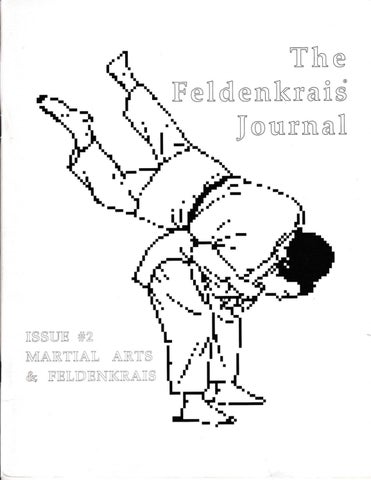
Feldenkrais@, the Feldenkrais T'ai Chi and Feldenkrais ", Method Feldenkrais Guild@, the Ralph Strauch Functional lntegration@ and Awareness ThrOugh MOvement@ Dreams in the Warrior's Wake are registered service marks Dennis Leri the Feldenkrais Guild. Line drawing used through out this Poem Moshe issue is of Nancy Denenberg and Mr. Kawaishi, Sensei, adapted from A Common Thread Moshe's book lllQQ, Elizabeth Beringer .. Frederick Warne & Co. Ltd. London Another Side of Moshe and New York. Doron Navon Interview
of
30
34
35
36
....... 40
401 Edgewater Place, Suite 600 Wakefield, MA 01880 www.feldenkrais.com
As a benefit of membership, Feldenkrais Guild® of North America (FGNA) members enjoy full access to all editions of The Feldenkrais JournalTM. Members can conveniently view the journals online by visiting the following link: online.
If you are not an FGNA member but would like to access the Feldenkrais Journal, you have two options: 1. Become a member of FGNA 2. Purchase the journal separately
The following are service marks, trademarks, or certification marks of the Feldenkrais Guild of North America: Feldenkrais®, Feldenkrais Method®, Functional Integration®, Awareness Through Movement®, ATM®, FI®, Guild Certified Feldenkrais Teacher®, and Guild Certified Feldenkrais PractitionerCM.