Research has shown that study skills programmes increase student achievement and study skills diminish academic stress, however, study skills are not a mandatory part of student curricula in Ireland. This analysis investigates the impact of targeted educational workshops on students’ study skills, learning, memory and wellbeing across thirty one schools and five year groups. Using pre- and post-workshop surveys, the research assessed confidence, concerns, and qualitative feedback from students participating in workshops on Understanding Learning, CBA Key Skills, Junior Cycle Action Planning and Study Skills, Senior Cycle Study Skills, and Leadership. Results indicate that while confidence varied across workshops, all workshops produced measurable improvements in student confidence, particularly in areas such as referencing, organisation, motivation and communication. Workbooks and facilitation were rated positively; feedback consistently highlighted the workshops as helpful, enjoyable and engaging.
The Super Generation’s research focuses on four key areas: study skills, learning, memory and wellbeing. These domains form the foundation of our educational approach and resource development. The Super Generation integrates these insights into our school resources and initiatives to help foster student development. Previous research into study skills, learning, memory and wellbeing highlights the necessity for study skills supports and has helped to improve The Super Generations resources.
Despite growing evidence that explicit instruction in study skills and learning strategies improves academic performance, motivation and stress management, these competencies are rarely embedded within second-level education on an on-going basis. As a result, many students progress through secondary school without being taught how to learn or ‘study’, how to manage motivation or regulate stress effectively.
Research into learning and study skills highlights the importance of student beliefs and learning environments. Students who view school and the practice of learning/studying as personal growth, rather than obligation, perform better academically. Additionally, flexible and well-structured study environments that consider factors like lighting, noise and routine support engagement and learning. This suggests that student’s ability to understand their role in providing a suitable learning environment is key.
Memory studies suggest that cognitive control, interference control (the ability to filter out distractions), and mastery (a sense of control and competence with tasks) are strong predictors of academic success, with subject-specific links to performance in areas like science and languages.
It is widely acknowledge, that students today, report both a struggle with their ability to remain focused as well as confusion towards how to study in general and for specific subjects.
Whilst efforts are being made to raise awareness surrounding wellbeing, there is a lack of targeted supports surrounding the topic of learning. Students and teachers report limited access to relevant resources, with students seeking support on managing friendships, technology and academic stress. Teachers state that curriculum pressures are barriers to prioritising time for wellbeing and addressing learning and study skills.
Across all areas of research, motivation, working memory, interference control and organisation emerge as significant predictors of academic success. The Super Generation incorporates these findings within the resources available to parents, teachers and students.
These findings among previous research suggests that study skills interventions for students may improve their knowledge and abilities within learning, study skills, memory and wellbeing. In order to confirm this theory, data was collected from schools who participated in our workshops. Following the completion of said study skills workshops across multiple year groups, this report presents the impact of targeted workshops on students learning, study skills, memory and wellbeing. It also identifies emerging challenges that students face and highlights areas for future development and support. Impact is assessed through a combination of student feedback and selfreported changes in confidence and learning.
Thirty one schools participated in the research across all workshop surveys. Five year groups took part in the surveys: 1st, 2nd, 3rd, 5th and 6th. Data was collected from the following workshops: Understanding Learning workshop (1st years), CBA Key skills workshop (2nd years), Junior Cycle Action Plan (3rd years), Senior Cycle Study Skills (5th and 6th years) and The Leadership Workshop. Below is the table for the participation numbers for each workshop’s pre and post survey.
Table 1
Participation numbers for each pre and post workshop survey
Method
Students completed a cross-sectional online pre-workshop and postworkshop survey. Pre-workshop surveys were sent out via email to our school contact one week prior to the workshop and post-workshop surveys were sent out immediately after the workshop and distributed by the school staff via email. Both surveys had the same questions surrounding the skills in the workshop (Appendix 1). The surveys consisted of 3-4 questions asked in a Likert-scale style. Students were given confidence statements (e.g. “I am confident in my ability to…”) and five answer options ranging from Strongly Disagree to Strongly Agree. The post-workshop surveys also included questions on the facilitation and equipment used in the workshop. Pre and post surveys also had space for students to write any concerns they had surrounding the workshop topic both before and after the workshop. This was the same format for all workshop surveys. As the surveys were anonymous, data was analysed separately. The research was completed using a cross-sectional design.
Understanding Learning for First Years Workshop
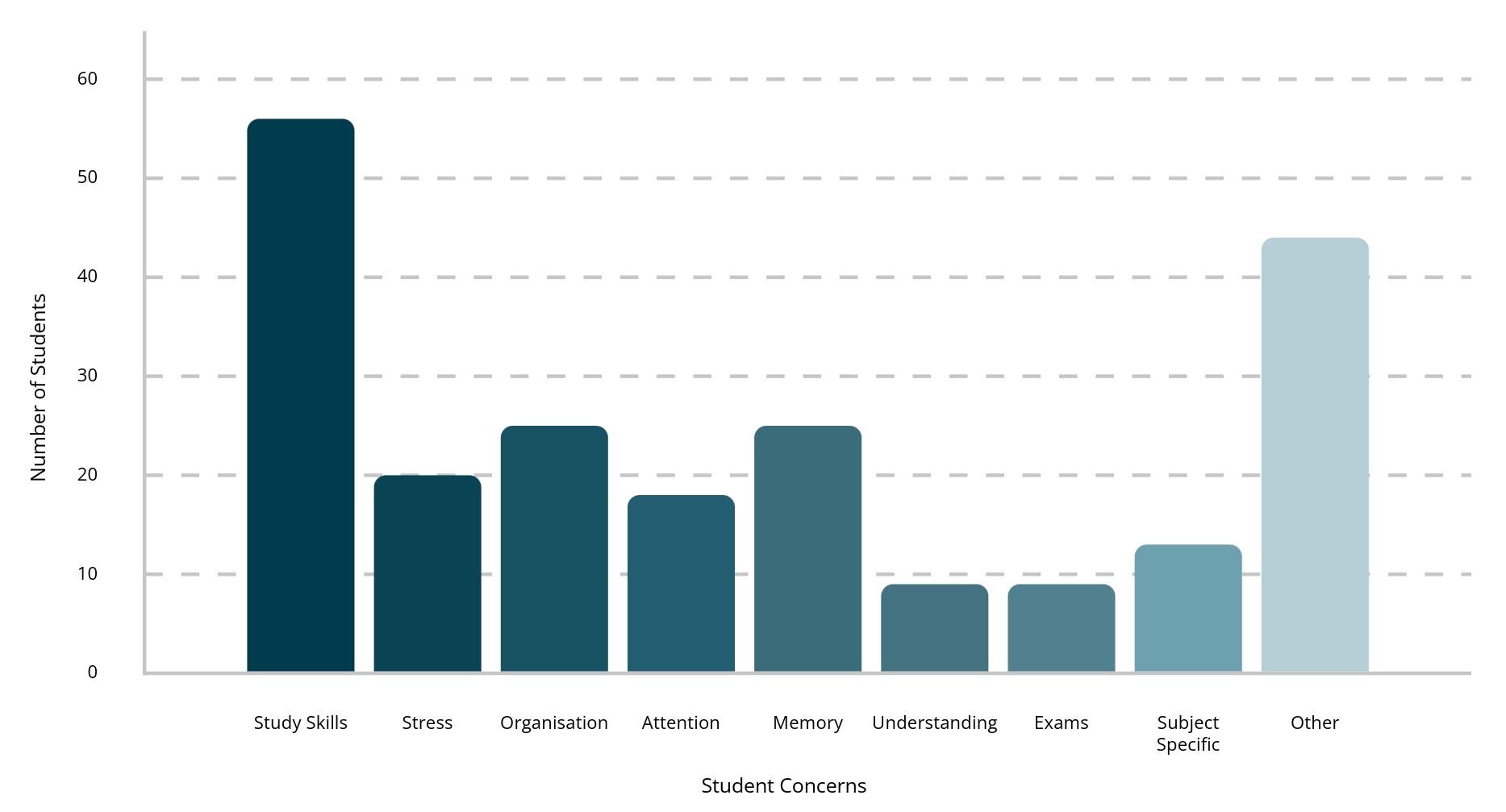
Before attending the Understanding Learning for First Years Workshop, students reported concerns regarding study skills, stress, organisation, attention, memory, understanding, exams and subject-specific skills (Appendix 2, Graph 1). Before the workshop, students showed high confidence with learning, homework and exams (Table 2). After the workshop, average confidence scores increased across all areas. (Table 3). Additionally, 50% of students also said the workshop was enjoyable, 63% said it was helpful and 74% said the workshop was understandable.
Students responded positively to the Understanding Learning for First Years Workshop, noting both its overall usefulness and the practical strategies it introduced. Several described the workshop as “good” overall, while one student highlighted a specific study technique, they found effective: “I liked the study method of taking words out of a paragraph rather than taking long sentences.” This feedback demonstrates that the workshop successfully provided students with simple approaches to studying, helping them feel more confident and capable in managing their learning.
Student Confidence Before Workshop
*1=Strongly Disagree, 2=Disagree, 3=Neither Agree or Disagree, 4=Agree, 5=Strongly Agree
Table 2
Table 3
Student Confidence After Workshop
*1=Strongly Disagree, 2=Disagree, 3=Neither Agree or Disagree, 4=Agree, 5=Strongly Agree
CBA Key Skills Workshop
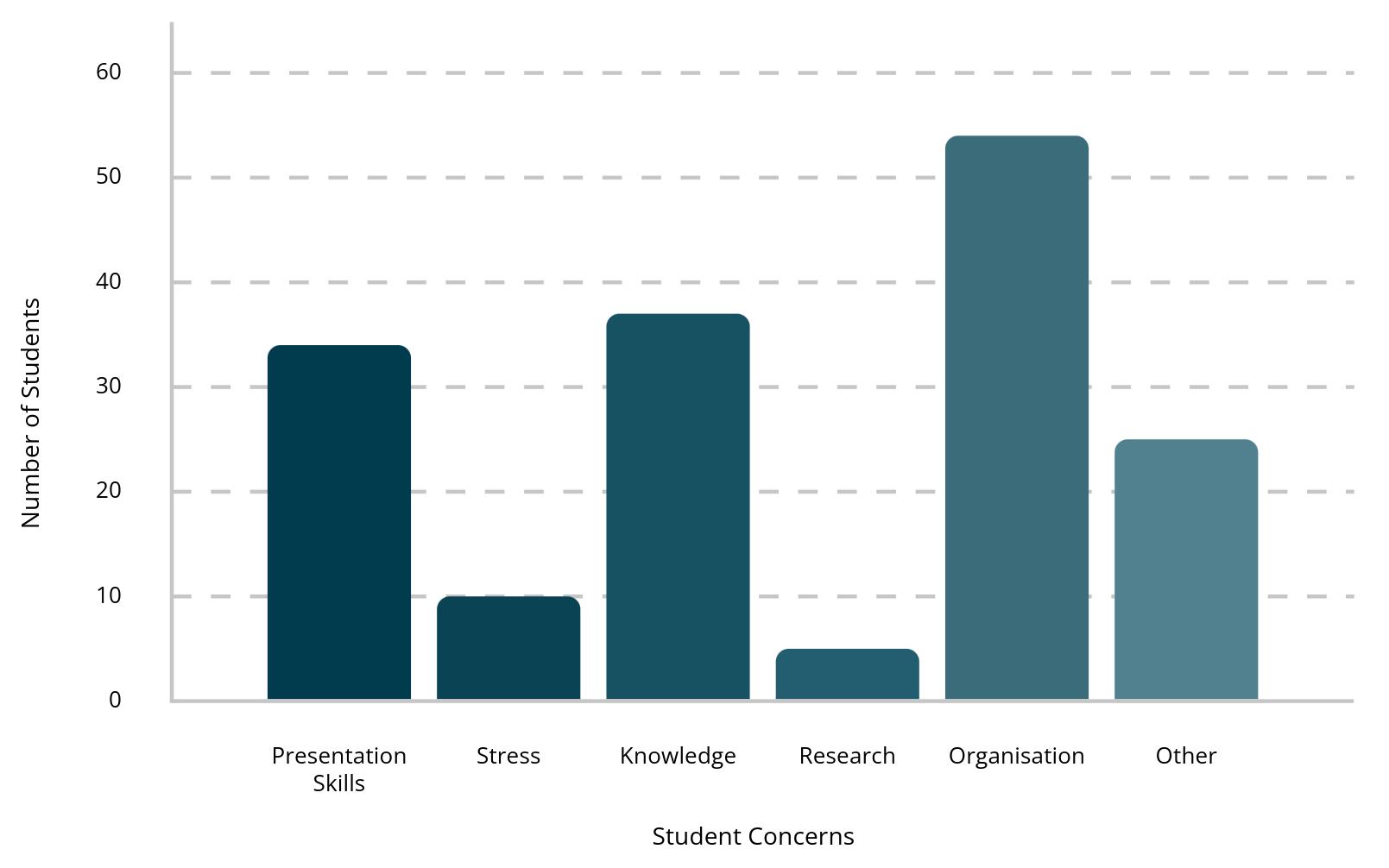
Students entered the CBA Key Skills workshop with concerns regarding presentation skills, stress, knowledge of CBAs, research and organisation (Appendix 2, Graph 2). Before the workshop, students scored low in confidence with CBA knowledge, skills and referencing. Average confidence scores were below 3, showing significant uncertainty in key areas (Table 4). After the workshop, student confidence scores increased significantly, with referencing rising from 2.6 to 3.8 and overall skill improving to 3.6 (Table 5). Additionally, 56% of students also said the workbook was helpful and 47% of students stated the workshop improved their skills.
Students gave highly positive feedback on the CBA Key Skills workshop, emphasising both its clarity and practical usefulness. Many noted that the session helped to resolve uncertainties, with one student reflecting, “The CBA workshop explained a lot of unanswered questions”.
Others highlighted how the workshop improved collective “understanding of CBAs and the skills required for the Junior Cert”, particularly appreciating the guidance on “how CBAs are graded and what should be included” in their work. The trainer was consistently praised for being positive, engaging and supportive, with one student stating, “The workshop was very beneficial and engaging… Overall, this workshop was very fun, and I would gladly do it again or do something similar”. The feedback demonstrates that the workshop not only clarified information but also provided students with practical strategies to approach and succeed in their CBAs.
Table 4
Student Confidence Before Workshop
*1=Strongly Disagree, 2=Disagree, 3=Neither Agree or Disagree, 4=Agree, 5=Strongly Agree
Table 5
Student Confidence After Workshop
*1=Strongly Disagree, 2=Disagree, 3=Neither Agree or Disagree, 4=Agree, 5=Strongly Agree
Junior Cycle Action Plan
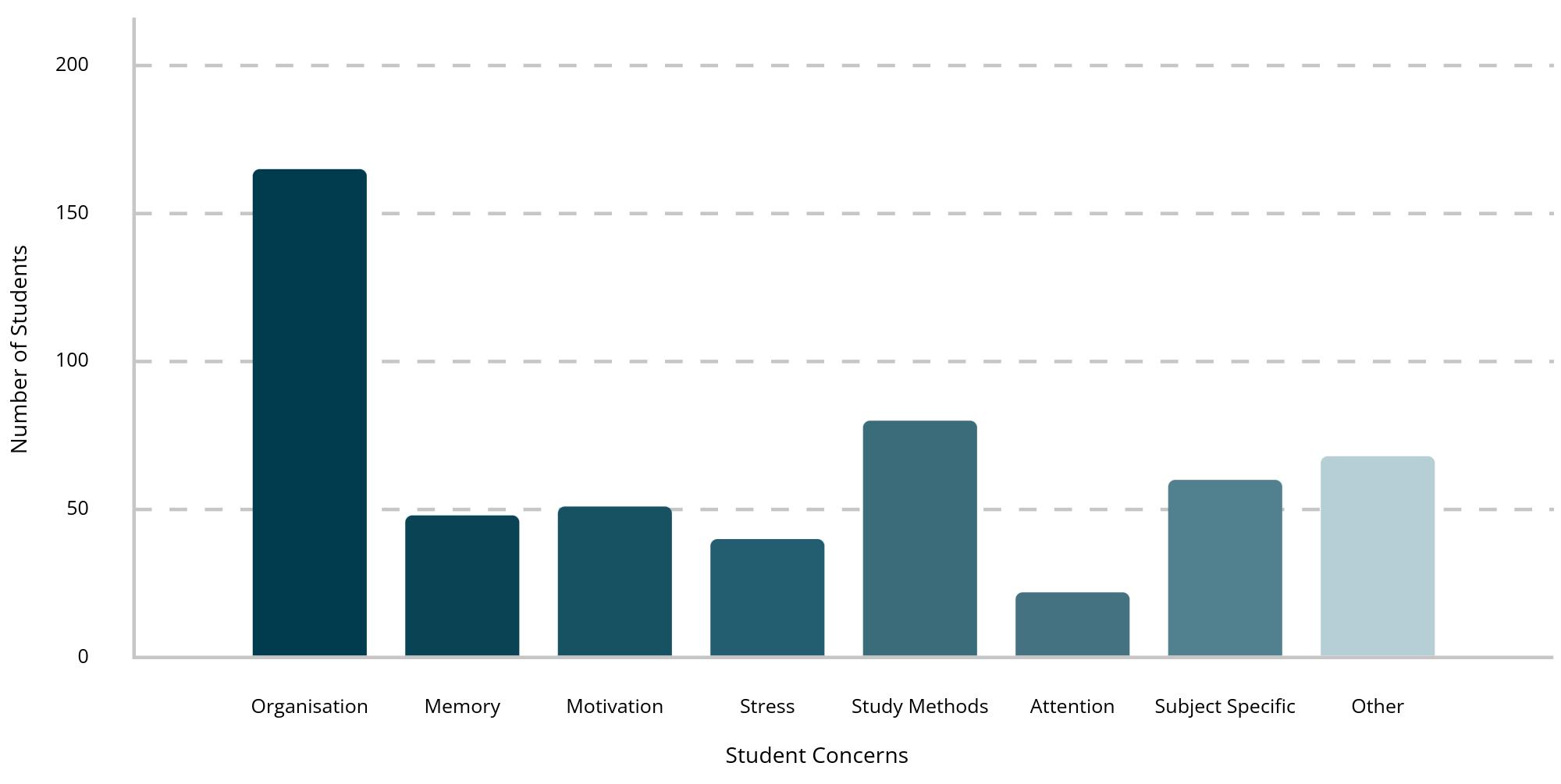
Students who participated in the Junior Cycle Action Plan workshop had concerns regarding attention, subject-specific, study methods, organisation, memory, motivation and stress (Appendix 2, Graph 3). Before the workshop, students already showed relatively high confidence in their ability to study, create a study plan, motivation to study and balancing study and hobbies (Table 6). However, 30% of students were not confident in creating a study plan - with an additional 30% unsure. After the workshop, student confidence scores rose further across all areas (Table 7). Furthermore, 70% of students also said the workshop was helpful and 57% of students stated the workshop improved their skills.
Students shared highly encouraging feedback about the Junior Cycle Action Plan workshop, emphasising both its practical value and its role in improving study habits. Many noted that the session gave them greater self-awareness and confidence in their ability to manage learning, with one student reflecting, “I now know more about helping myself study and this will improve my study skills in the future.” Others described the workshop as informative and supportive, highlighting its usefulness in changing their approach to study: “This study workshop made me realise everything that I can do differently.”
A recurring theme in the feedback was the benefit of learning how to create and follow a study plan, with students commenting, “Really helped me make my study plan” and “The workshop helped me a lot on planning my study and balancing my time.”
Overall, the feedback demonstrates that the workshop not only provided practical tools but also empowered students to take control of their learning and motivated them to get started.
Table 6
Student Confidence Before Workshop
*1=Strongly Disagree, 2=Disagree, 3=Neither Agree or Disagree, 4=Agree, 5=Strongly Agree
Table 7
Student Confidence After Workshop
*1=Strongly Disagree, 2=Disagree, 3=Neither Agree or Disagree, 4=Agree, 5=Strongly Agree
Senior Cycle Study Skills
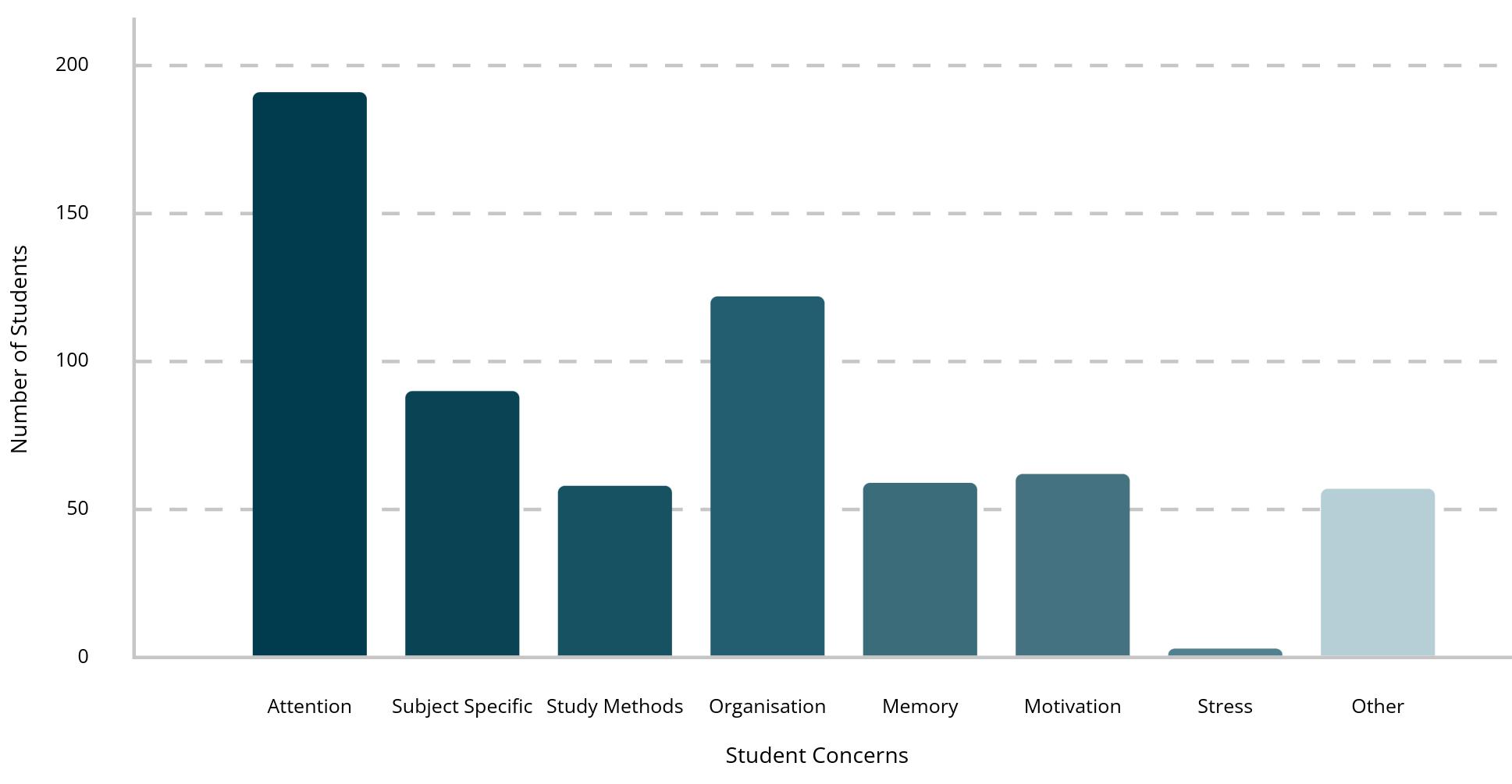
Students preparing for participation in the Senior Cycle Study Skills workshop had highlighted concerns regarding organisation, memory, motivation, subject-specific, study methods, attention and stress (Appendix 2, Graph 4). Before the workshop, students scored high in confidence with ability to study, organisation, balancing study and hobbies and motivation to study (Table 8). After the workshop, student confidence scores increased across all areas (Table 9). Encouragingly, 74% of students also said the workbook was helpful and 57% of students stated the workshop improved their skills.
Students responded positively to the Senior Cycle Study Skills workshop, emphasising both its usefulness and the supportive delivery. Many described the session as a great help, with one student noting, “I really enjoyed the workshop, and I hope every other year gets to experience this.” Importantly, the workshop had a motivational impact, helping students overcome worries and approach study with confidence: “This really motivated me to try harder with study… this changed my perspective on the LC and studying and I’m so glad that we spoke about all topics and it wasn’t presented in a daunting way.” Overall, the feedback demonstrates that the workshop not only provided practical strategies but also inspired students, leaving them more confident, motivated and positive about their academic journey.
Table 8
Student Confidence Before Workshop
*1=Strongly Disagree, 2=Disagree, 3=Neither Agree or Disagree, 4=Agree, 5=Strongly Agree
Table 8
Student Confidence After Workshop
*1=Strongly Disagree, 2=Disagree, 3=Neither Agree or Disagree, 4=Agree, 5=Strongly Agree
Results
Leadership Workshop
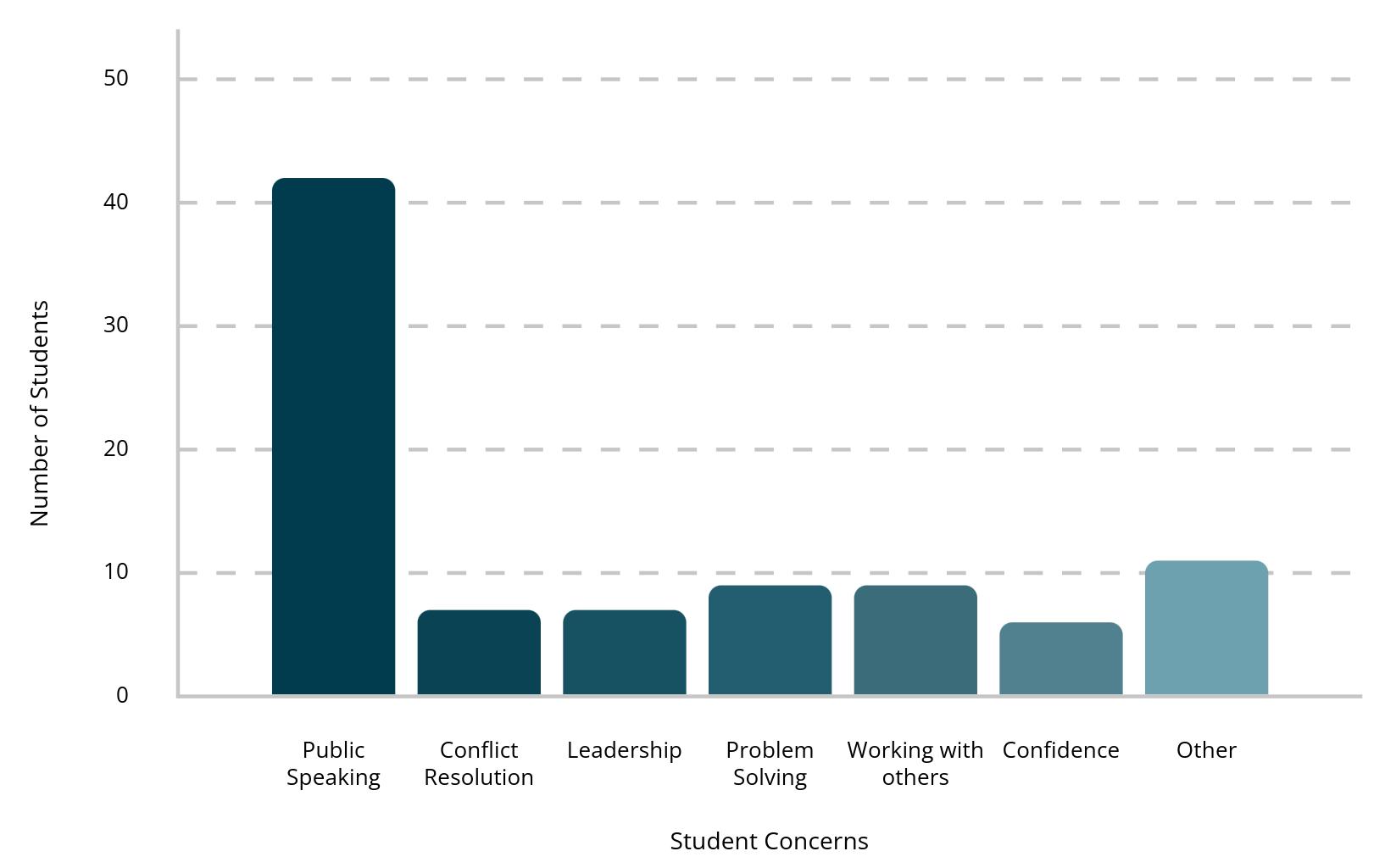
Students entered the Leadership workshop with concerns regarding public speaking, conflict resolutions, leadership, problem-solving, working with others and confidence (Appendix2, Graph 5). Before the workshop, students already showed high confidence with being a leader, teamwork and working on their own, but lower confidence in public speaking (Table 10). After the workshop, student confidence scores increased across all areas, with the most notable increase in public speaking (mean rising from 3.3 to 4.1) (Table 11). Moreover, 9% of students also said the workbook was helpful and 82% of students stated the workshop improved their skills.
Students provided positive feedback on the Leadership Workshop, highlighting both its engaging delivery and practical value. Many described the session as enjoyable and fun, with one student noting, “I really enjoyed every part of the workshop, and our trainer made it fun and enjoyable.” Others emphasised the insight it offered into the responsibilities of leadership roles, with comments such as, “It provided a great insight into the different parts of being in the role of Prefect and some responsibilities that I wouldn’t have known otherwise if not for this workshop.”
Feedback also highlighted the interactive nature of the workshop, with activities described as “highly enjoyable”. Overall, students felt the workshop was both beneficial and motivating, leaving them with new skills, greater confidence and insight into what “being a leader means”.
Table 10
Student Confidence Before Workshop
*1=Strongly Disagree, 2=Disagree, 3=Neither Agree or Disagree, 4=Agree, 5=Strongly Agree
Table 11
Student Confidence After Workshop
*1=Strongly Disagree, 2=Disagree, 3=Neither Agree or Disagree, 4=Agree, 5=Strongly Agree
Qualitative Feedback
Secondary school students are navigating an increasingly complex educational system with heightened academic expectations, continuous assessments, technological distractions and social pressures. Over the course of collecting qualitative research from the workshops, we have discovered some of the significant issues across all year groups regarding second-level education.
Organisation
Across all workshops, organisation emerged as the most significant and consistently reported challenge for students at every stage of secondary education. Difficulties related to time management, workload planning, balancing subjects and developing effective study routines were evident among students. While the specific pressures varied by year group, the overarching concern was students perceived inability to manage academic responsibilities alongside personal and extracurricular commitments.
For first-year students, organisational challenges were closely linked to the transition into secondary school and the sudden increase in workload. Students described feeling overwhelmed by the volume of homework and assessments, particularly when tasks were assigned simultaneously across multiple subjects. One student expressed anxiety about workload accumulation, stating: “I won’t get all my homework and studying done in time because we get a lot of it all at once.”
This sense of pressure is corroborated by students’ uncertainty around how to study effectively. Several first-year students highlighted difficulties in allocating time to different subjects and identifying suitable study strategies, as reflected in the comment: “Managing how long I need to study for different subjects and finding out what the best way of studying is for me.”
Underlying these concerns was a fear of falling behind academically, with one student noting: “I am worried that I will fall behind on my work.”
Among Junior Cycle students, organisational struggles became more complex, extending beyond workload volume to include balancing study with hobbies, relaxing and personal wellbeing. Many students expressed a desire for support in planning and structuring their time. One participant stated: “I wish to get help with creating a study plan and how to balance study and hobbies.”
Time constraints was a recurring theme, with students describing difficulty fitting both academic work and personal activities into a single day. As one Junior Cycle student explained: “Finding time to do my own things and study in the same day.”
Students also reported challenges in maintaining focus and working efficiently, particularly when managing multiple subjects. This was evident in comments about staying on task and avoiding overinvestment in one area at the expense of others: “Staying on track with my work, making sure that I don’t spend too long on one topic.”
The pressure of simultaneous homework deadlines across subjects further emphasised organisational stress. One student articulated this: “Time management – it’s very difficult to find time to study when you’ve also got lots of homework in multiple subjects on the same day.”
In addition, Junior Cycle students identified motivation and technology as barriers to effective organisation, particularly in balancing screen time with study: “Making an effective study plan and getting motivation to study. Also balancing extracurricular, screentime and studying.” (Junior Cycle students)
Qualitative Feedback
Organisation (cont.)
For Senior Cycle students, organisational difficulties were strongly associated with increased academic pressure and broader life demands. Students described the challenge of maintaining a healthy work-life balance while preparing for high-stakes examinations. One student summarised this: “Being able to balance the amount of time being put into each subject and my home life and work life balance.” (Senior Cycle student)
Busy schedules, often involving extracurricular activities, part-time work and exam preparation, made it difficult for students to establish consistent study routines. This was reflected in comments such as: “Trying to fit in study with a busy schedule.” and “Organisation, making time to study, having a routine.”
Overall, the findings indicate that organisational difficulties are a consistent challenge throughout secondary school. While younger students struggle with adjusting to increased workload and developing study skills, older students face pressures related to time pressures, motivation and competing responsibilities. The consistency of these concerns across year groups highlights organisation as a critical area for support, with a clear need for structured support in time management, study planning and routine-building to support students’ academic engagement and wellbeing.
Study Skills
The second significant challenge that emerged across the workshops related to students’ concerns surrounding study skills. Many students expressed uncertainty about how to study effectively, frequently questioning whether the methods they were using were efficient or suited to their individual learning styles.
A recurring theme across responses was a lack of confidence in knowing how to “actually” study and how to get information to “stay in their head”.
Students demonstrated anxiety around the effectiveness of their study approaches, often surrounding exam preparation. Several students explicitly questioned whether their current methods were optimal, with one asking: “Am I studying the best possible way for myself?”
This uncertainty was emphasised by others who described a fundamental lack of “knowing how to study”.
Concerns about memory and retention were especially prominent. Students frequently sought strategies for transferring information from short-term to longterm memory, reflecting a desire for techniques that were both effective and time efficient. One senior cycle student highlighted this need clearly: “Better techniques for long term but quick memorising.”
Similarly, another student showed frustration with the perceived inefficiency of their current study efforts, noting: “I always feel that after spending hours on study, my study has not been fully effective so, I would probably like to do precise study and do it effectively.”
Qualitative Feedback
Study Skills (cont.)
A strong theme across the data was the desire for personalised study strategies. Students were aware that commonly promoted study techniques may not suit all learners and expressed concern that many study skills workshops cater to a narrow range of learning styles. One participant provided a reflection on this issue: “How to study that benefits me. Many study skills workshops benefit one type of student. I’m a student who learns in class and finds learning off challenging. Tips on how to memorise and move content from short term memory to long term would be great.”
Students also voiced concerns about efficiency and time management in relation to study skills, seeking approaches that would maximise outcomes. One student described struggling to identify an effective and manageable approach, stating: “One thing I struggle with studying is to know what way the easiest and less time-consuming way for me is to learn the information.”
Additionally, several students expressed concern regarding whether their study methods would adequately prepare them for exams, reinforcing the link between study skills and academic confidence: “I am most concerned about if the study method that I am currently using is actually helping me.”
“I would say I’m concerned about whether the study methods I am using will work and preparation for exams.”
Overall, the findings suggest that a lack of efficient study skills is not limited to a lack of effort or motivation but is rooted in uncertainty, inefficiency and a lack of personalised guidance. Students demonstrated a strong desire for practical instruction on how to study effectively, retain information and tailor methods to their own learning preferences.
Attention
A further significant challenge identified across the workshops related to students’ difficulties with attention, focus and distraction during study. Students consistently reported struggling to maintain concentration, particularly when attempting to engage in independent study outside of the classroom. Distractions were frequently related to both external factors, such as peers and phones and internal factors, including boredom and motivation.
Many students described difficulty sustaining attention long enough to begin or maintain effective study sessions. The act of sitting down to study itself was identified as a major obstacle, with students expressing frustration at how easily they lost focus. One student explained: “Trying to sit down and study without getting distracted.”
Similarly, another participant noted a struggle with sustained concentration: “I struggle with sitting down and like properly studying and I just get distracted easily.”
Technological distractions, particularly from phones, emerged as a prominent theme. Students acknowledged that their devices often interfered with their ability to focus, even when they intended to study. As one student described: “Trying to focus and not get distracted with other people or my phone.”
The challenge of maintaining attention was not limited to the study environment itself but also with time management. Some students reported that distractions made study feel more time-consuming and harder to prioritise. One participant highlighted this dual challenge, stating: “I struggle with finding the time to sit down and do it and not getting easily distracted by something else.”
Qualitative Feedback
Attention (cont.)
Several students described a cycle of distraction in which a brief lapse in focus significantly disrupted their study momentum. One student stated: “Getting distracted 20% of the time and can’t focus after. I would like to combat this issue as it puts me out of the study mood.”
In addition to external distractions, students also identified boredom as a barrier to sustained attention.
Maintaining engagement over longer study periods was perceived as particularly challenging, with students seeking strategies to remain focused without losing interest: “Focusing on studying without getting bored.”
As a result, many students explicitly requested guidance on how to manage distractions and improve concentration during study. One student captured this need: “How to effectively study without getting distracted.”
Overall, these findings highlight attention and distraction as key obstacles to effective learning for secondary school students. The prevalence of devices, combined with difficulties sustaining motivation and focus, suggests a need for explicit instruction in attention management strategies.
Teacher and Parent Feedback
In order to gain a comprehensive view of workshop impact, feedback was also collected from both educators and parents. Their observations focused on student engagements, practical application, facilitation and the environments within workshops.
Both educators and parents noted that the workshops moved beyond theory and provided students with effective tools for development throughout secondary school and continuous motivation. One teacher noted this regarding the Leadership Workshop: “The session on developing leadership skills was truly inspiring - engaging, thoughtful, and perfectly suited to our students”. (Teacher)
This perspective was corroborated by a parent who also commented on the engagement, practicality and motivation of the workshops: “This was by far the most practical and engaging session I’ve been to and I believe it will be a powerful and reassuring workshop for students!” (Parent)
Both parents and teachers also commented on the approach and facilitation of the workshops. With one parent focusing on the holistic and student-centred approach: “I valued the holistic approach and thoughtful explanation of students’ learning, wellbeing and health.” (Parent)
The engaging and clear facilitation of workshops was also considered with one teacher noting: “Facilitation was outstanding - the group was kept involved throughout, and a message that was both clear and impactful was delivered. We’ll definitely be booking again in the future.” (Teacher)
Teacher and Parent Feedback (cont.)
Another teacher also commented on this engaging, practicality of the workshops: “The instructors provided tailored sessions for our students and engaged with the classes in a practical, informative and approachable manner.” (Teacher)
Educators also highlighted how the workshops do not act as “standalone” events, but rather as a symbiotic addition to the existing supports within schools: “The Study Skills workshops with The Super Generation have been a very positive addition to our school calendar for all year groups. They complement the school’s existing Motivation and Study Skills Programme and enhance our in-school structures to support student achievement.” (School Management)
Limitations
Analysis was not reported for the TY Build Your Portfolio workshop or the Emotional Resilience workshop as there was not enough data to create a sufficient analysis. It is also of note that there is a large drop between pre and post survey responses, specifically in the Senior Cycle (531 – 147) and Junior Cycle (642 – 243) surveys, which resulted in the exclusion of data.
Overall, across all workshops, students reported measurable increases in confidence scores. Workshops significantly improved study skills, organisation, motivation, leadership and communication. Students, parents and teachers consistently described workshops as enjoyable, engaging and beneficial. Feedback also indicated that workshops not only addressed immediate concerns but also provided strategies students can apply throughout their academic journey.
Within the First Year Understanding Learning Workshop, students gained practical study strategies and reassurance during their transition into secondary school. The workshop allowed students to gain confidence with their learning and approach academic tasks with greater assurance. The workshop provided tangible improvements in confidence, helping students feel more prepared for the demands of secondary school. Beyond measurable outcomes, students valued the practical techniques and supportive environment, which reduced stress and encouraged more effective learning habits. “I liked the study methods and overall, it was good!”
Within the CBA workshop, students developed clarity on assessment expectations and improved research and referencing skills. This demonstrates that the workshop directly addressed knowledge gaps that are clear from the pre-workshop survey in which students had significant confusion surrounding knowledge of the CBAs. “I am not entirely sure what the CBAs will actually entail”.
The workshop had a significant effect on student confidence and preparedness for CBAs. By demystifying assessment criteria, strengthening research and referencing skills and gaining practical knowledge, students left with a clearer understanding of expectations and practical strategies to succeed in their CBAs. “It had useful information and helped me understand more about the CBAs”.
Within the Junior Cycle workshop, students gained tools to manage workload balance study with personal life and sustain motivation. These increases highlight the workshop’s role in strengthening existing skills and providing practical strategies for sustainable study habits. “The workshop was very helpful and informative”. By reinforcing confidence and introducing new study techniques, the workshop empowered students to take ownership of their learning journey. “I learned a lot of mindset related skills”. The positive feedback demonstrates that students left with a clearer sense of control, motivation and practical tools to succeed both academically and personally. “This really helped me plan my study and balance my time”.
Within the Senior Cycle workshop, students felt empowered to approach the Leaving Cert with renewed confidence and practical strategies. “This really motivated me to try harder with study”. These improvements show that the workshop strengthened existing skills while providing reassurance and practical tools for exam readiness. Beyond measurable improvements in study ability and organisation, the workshop had a transformative effect on mindset, helping students shift from anxiety and self-doubt to a more positive, motivated outlook. “This really changed my outlook”. The engaging delivery and supportive environment ensured that students left not only better prepared academically but also more motivated and resilient in facing the challenges of Senior Cycle.
Within the Leadership Workshop, students developed leadership qualities, teamwork skills and communication skills. “I found it helpful in improving my leadership and communication skills”. These improvements demonstrate that the workshop not only reinforced existing strengths but also addressed weaker areas, equipping students with practical leadership and communication skills.
The Leadership Workshop had a significant impact on student confidence, communication and leadership readiness. “I took a lot from today and learned a lot of tips!”. By combining practical skill-building with engaging activities, the workshop empowered students to take on leadership roles with greater assurance. The strong improvements in public speaking and independent work highlight its effectiveness in preparing students for responsibilities such as Prefect roles, group projects, and future leadership opportunities.
Students left not only more skilled but also more motivated, with a clearer understanding of their strengths and responsibilities as leaders. The impacts of this workshop highlight the suitability for student council and prefects. “It provided great insight into the different parts of being in the role of prefect”.
Reflection
Based on this mixed-method research, The Super Generation is committed to continuous development of new and improved resources. By aligning our supports with current student data, we ensure our interventions remain both relevant and high impact.
Our research identified attention as a significant challenge students face a topic not discussed at length within workshops nor was it asked in the surveys. In response, we have created a dedicated ‘Attention’ section within our Senior Cycle and Junior Cycle journals for 2026/2027 workshops. These modules provide evidence-based strategies to combat distractions and multitasking as well as allow students to gain information on sustaining focus.
To address the issue of organisation, we have expanded our resources. Our monthly Student Study Skills Calendar provides visual tools for students to use for time management and organisation. Within each of our workshops, we also discuss at length – how to create a study plan that balances both studying and wellbeing.
In regard to the significant issue of Study skills/methods, our primary study method (POKER) specifically provides help regarding study skills. This method caters to a range of issues students face regarding studying;
• Timing: Designed to produce effective notes in approximately 25 minutes.
• Memory: Utilizes pre- and post-testing alongside colourful, structured notetaking to optimise long-term memory.
Regarding student concerns about specific subjects, we have collaborated with our sister company, The Tuition Centre, to create comprehensive subject factsheets. These are embedded in our Junior and Senior cycle study workbooks.
These are a resource to help students who need resources/support within various subjects.
To address the motivational barriers to learning, we have recently introduced an additional motivation workshop. This session is designed to focus on motivation/motivating students. It supports them in rediscovering their goals and driving sustained academic effort.
We believe that support shouldn’t end when the facilitator leaves the room. Thus, in order to continuously support students, we also have resources outside of the workshops. Our Monthly Student Study Skills Calendar is a resource sent to all schools who participate in our workshops. It is our way of helping students to practice and enhance the skills taught in workshops throughout the academic year (study skills, wellbeing, memory and learning). We also create blogs and online resources available on our website that focus on the observations of our facilitators, addressing emerging issues faced by both students and educators.
The Super Generation does not rely on fixed supports. We periodically analyse our workshop data and feedback to ensure our resources support the “real time” needs of Irish students. By consistently developing and staying research-driven, we strive to provide the most effective support system for the modern classroom.
This analysis and impact report demonstrates that The Super Generation’s workshops consistently enhance student confidence across key areas of study skills, learning, memory and wellbeing. While improvements varied by workshop; with the CBA workshop having a larger impact in comparison to the first-year workshop, each workshop improved student confidence through practical, interactive approaches that directly addressed students’ concerns. Feedback across all workshops highlights the importance of engaging and interactive sessions. Qualitative feedback highlighted significant issues for students such as attention, organisation and study methods. The Super Generation takes into account the findings and feedback from this research and have subsequently updated and added additional supports to counter the issues that arose. Overall, the findings suggest that our workshops improve student confidence and support sustained student development.
Appendices
Appendix 1
Workshop Survey Questions
Understanding Learning for First Years Survey Questions
Pre
• I am confident in doing secondary school homework.
• I am confident in my learning in class.
• I am confident studying for secondary school exams.
• Can you list at least one concern you have about your learning or studying?
Post
• My trainer was helpful.
• My trainer was easy understand.
• The workshop was enjoyable.
• The workbook is useful.
• I am confident in doing secondary school homework.
• I am confident in my learning in class.
• I am confident studying for secondary school exams.
• Any other comment or suggestions? Please let us know here.
Appendices
Appendix 1 (cont.)
Workshop Survey Questions
CBA Key Skills Survey Questions
Pre
• I am confident in my knowledge of CBAs.
• I know what referencing is.
• I know the skills I will need for my CBAs.
• Can you name at 1 thing you are concerned about with your CBAs or what you wish to get help with?
Post
• My trainer was engaging.
• My trainer was well prepared.
• The workbook was helpful.
• The workshop improved my skills.
• I am confident in my knowledge of CBAs.
• I know what referencing is.
• I know the skills I will need for my CBAs.
• Any other comments or suggestions? Please let us know here.
Appendix
1 (cont.)
Workshop Survey Questions
3rd Year Action Plan Survey Questions
Pre
• I am confident in my ability to study.
• I am confident in creating a study plan.
• I am motivated to learn and study.
• I am confident in my ability to balance study and hobbies.
• Can you name at least 1 thing you struggle with related to studying and learning or what you wish to get help with?
Post
• My trainer was engaging.
• My trainer was well prepared.
• The workshop improved my skills.
• The workbook was helpful.
• I am confident in my ability to study.
• I am confident in creating a study plan.
• I am motivated to learn and study.
• I am confident in my ability to balance study and hobbies.
• Any other feedback or suggestion? Please let us know here.
Appendices
Appendix 1 (cont.)
Workshop Survey Questions
Senior Cycle Study Skills Survey Questions
Pre
• I am confident in my ability to study.
• I am confident in my organisational skills.
• I am confident in balancing study and my hobbies.
• I am motivated to study for the LC.
• Can you name at least 1 thing you are concerned about regarding exams/ learning/study methods or what you wish to get help with?
Post
• My trainer was engaging.
• My trainer was well prepared.
• The workbook was helpful.
• The workshop improved my skills.
• I am confident in my ability to study.
• I am confident in my organisational skills.
• I am confident in balancing study and my hobbies.
• I am motivated to study for the LC.
• Any other comments or suggestions? Please let us know here.
Appendix 1 (cont.)
Workshop Survey Questions
Leadership Survey Questions
Pre
• I am confident in being a leader.
• I am confident working as part of a team.
• I am confident working on my own.
• I am confident in my public speaking skills.
• Can you name at least one thing about leadership that you struggle with and would like to get help with?
Post
• My trainer was engaging.
• My trainer was well prepared.
• The workbook was helpful.
• The workshop improved my skills.
• I am confident in being a leader.
• I am confident working as part of a team.
• I am confident working on my own.
• I am confident in my public speaking skills.
• Any other comments on today’s workshop? Pleaselet us know here.
Appendices
Appendix 2
Students concerns within each year group participating in workshops
Graph 1
Students Concerns Regarding First Year (pre)
*“other” consists of students who did not answer, said they had no concerns or gave comments that were not applicable to the workshop*
Students Concerns Regarding CBAs (pre)
Graph 2
Appendix 2 (cont.)
Students concerns within each year group participating in workshops
Graph 3
Students Concerns Regarding Junior Cycle (pre)
Graph 4
Students Concerns Regarding Leaving Cert (pre)
Appendix 2 (cont.)
Students concerns within each year group participating in workshops
Graph 5
Students Concerns Regarding Leadership (pre)
Thank You
Thank you to all our schools who enrolled in a Super Generation program this year. If you would like to enroll your school for the upcoming year, please see our details on the back page.