aith and politics have always shared a complicated relationship in the United States, a nation founded on both religious freedom and the separation of church and state. Today, that relationship is more visible and contested than ever.
Religious groups on campus foster faith
BY VANESSA YAP
AAgape Christian Club and the Muslim Student Association have several unique ways of practicing their respective faiths, from hosting speaker sessions about the gospel to holding discussions about Islamic culture.
Editors’ Picks
Religion in U.S. politics through the ages pg. 11
New bilingual paraeducator to assist ELD classes pg. 2
A ban cannot replace a lesson pg. 5
Students fnd footing on the glittering runway pg. 13
The hidden journey behind secondhand clothing pg. 15
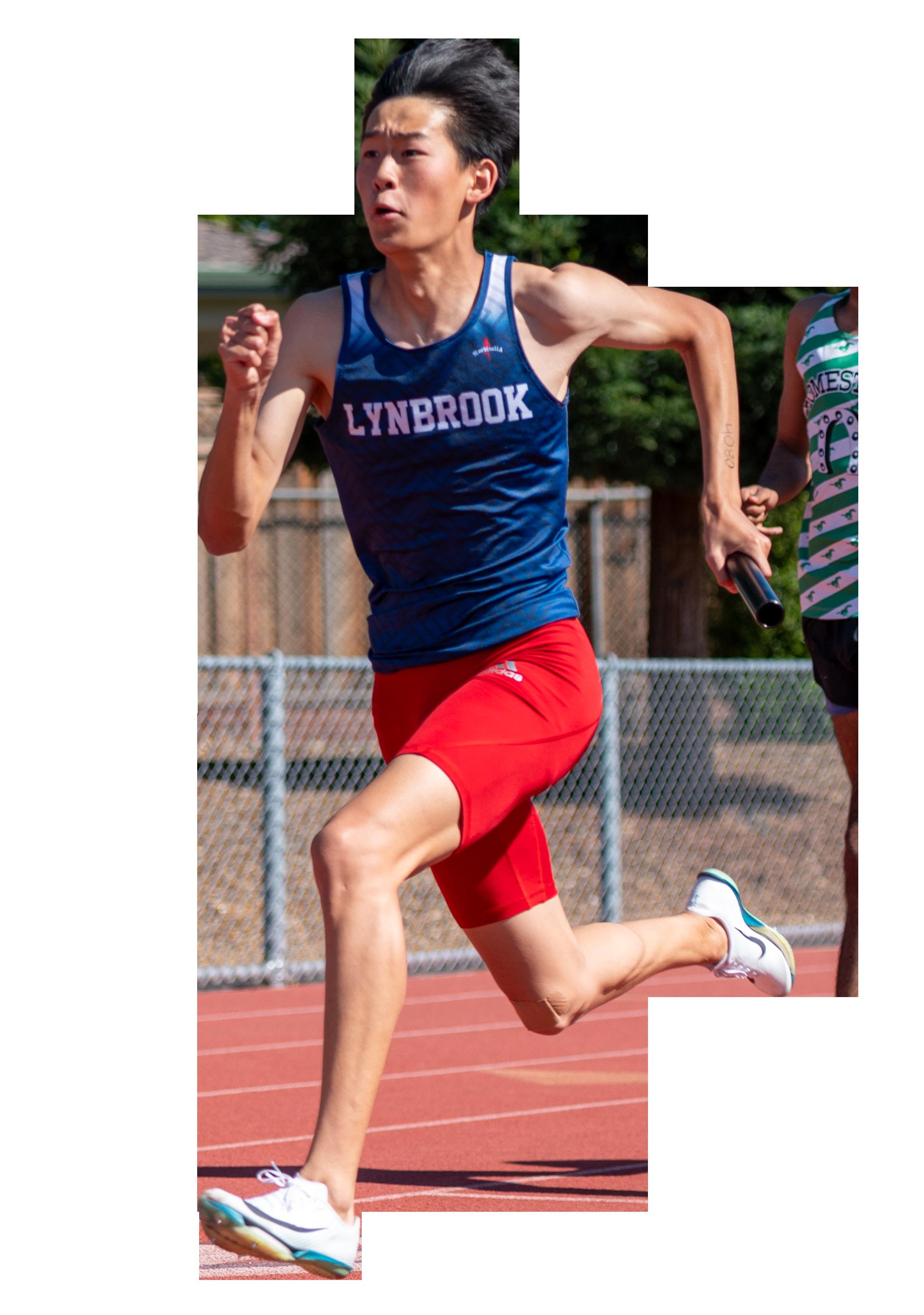
Jason Wu leaps into Claremont McKenna for track and feld pg. 18
Modern faiths rest on ancient foundations
BY EMILY CHEAH AND PRISHA PULYASTA
The word “cult” conjures images of secret rituals, robed ceremonies and devotion to an oddly charismatic leader. But in ancient Greece 3,000 years ago, cults were not extremist groups. Instead, they were ordinary religious communities, woven into daily life and civic tradition.
Page by Anna Cen and Rohan Kakhandiki
Spring is creeping in, and the weather warms up. Relax in the shade and open up Issue 6 of the Epic! In our second centerspread of the year, explore religion and its role in our lives, from ancient Greek cults to modern American politics, student groups on campus to local centers of faith. Also, refect on staffers’ personal connections to religion. On our website and YouTube channel, check out student conversations surrounding different beliefs.
Look into our other sections, where you can learn about the new bilingual paraeducator in News; how the potential social media ban would hinder safety in Opinion; in Features, students stride onto the pageant runway; follow secondhand clothing’s journey from donations to Global South markets in In-Depth; lastly in Sports, ballroom dance, cheerlead and wrestle with Tiantian Chai’s athletic journey.
ASB Spirit hosted its frst-ever St. Patrick’s Day event in the quad on March 17. At the wish-writing event, students could write down their hopes and wishes on paper four-leaf clovers in exchange for chocolate gold coins.
Turnout was strong despite the heat and the timing of Tuesday lunch, when many students without a 7th period leave campus. The commission plans to return with the event in future years.
“This affected the student body positively since it allowed people to introspect what they wanted to do and their goals,” junior and ASB Spirit commissioner Rohin Saharoy said.
School Community National International
Hawaii Island’s Kilauea volcano erupted on March 10, launching lava 1,000 feet high in its 43rd episode since December 2024. The eruption prompted temporary closures at Hawaii Volcanoes National Park and portions of Highway 11. The spread of volcanic tephra — glassy fragments that can irritate eyes, skin and respiratory systems — prompted Hawaii County to open an emergency shelter for affected residents and tourists. The National Weather Service warned of ash accumulation exceeding a quarter of an inch across the park.
by Ktkvtsh/Wikimedia Commons
On March 12, the San José Unifed School District’s Schools of Tomorrow Committee voted to recommend closing fve elementary schools — Canoas, Empire Gardens, Gardner, Lowell and Terrell — and relocating Hammer Montessori School at Galarza Elementary to Gardner, pivoting from their initial plan to shutter nine schools. The 23-member committee was formed to address an enrollment drop of more than 6,000 students since the 2017-18 school year. On March 26, the board of trustees will decide whether to close all nine schools as initially planned or follow the committee’s recommendation.
The People’s Republic of China approved a sweeping “ethnic unity” law on March 12, requiring all children to learn Mandarin from pre-kindergarten through high school. Passed by the National People’s Congress, the law also allows the prosecution of parents who instill views deemed harmful to ethnic harmony. While the Chinese government argues the policy will improve job prospects for minority groups, scholars warn the legislation cements a push to assimilate China’s 55 recognized minority ethnic groups into dominant Han culture.
New bilingual paraeducator to support ELD classes
BY JOANNA CHEN
Starting in April, a new bilingual paraeducator will join Lynbrook staff to support English Language Development students in sheltered classes by acting as an assistant to the teacher and supporting students in hopes of easing the language barrier.
Prior to this initiative, Lynbrook had 35 paraeducators that all specialized in supporting special education students by instructing them daily and working in small groups with them. Bilingual paraeducators, on the other hand, will work specifcally to guide ELD students by assisting ELD teachers with translation support.
‘‘ ‘‘
ELD student population includes a large number of Mandarin-speaking students, Chen hopes that the new bilingual paraeducator will assist that subset of students. If the ELD program expands or the need for another bilingual paraeducator grows, the school could hire more paraeducators.
It’s really important for ELD students, because there’s another person to provide academic support and to connect with on campus especially if that person is able to speak their home language.
“People are at different stages in their learning and English acquisition,” ELD coordinator Tania Yang said. “So ideally, a paraeducator would be able to provide more individualized support with repeating, clarifying, scaffolding.”
Janice Chen Principal
Inspired by her previous work experience at Monta Vista High School, Principal Janice Chen pushed to bring bilingual paraeducators to the Lynbrook campus. She felt that the ELD program was a student group that could use additional support, so she pitched the idea to staff at the FUHSD district offce who work with the ELD department.
“The district was very supportive of it,” Chen said. “At the end of the day, everybody recognizes that the intention behind adding a bilingual paraprofessional at Lynbrook is to help provide additional support for one of our student groups that needs it. Everyone was on board, recognizing that it was a need, wanting to support that need for our ELD students and to make it happen.”
After a round of interviews conducted by Assistant Principal Yukari Salazar, one Mandarin-speaking candidate was selected for the position. Since Lynbrook’s
“It’s really important to have this support position for ELD students because there’s another person to provide academic support in the classroom especially if that person is able to speak their home language,” Chen said. “ It helps with understanding and communicating with parents and families too. It’s very helpful in classes, being able to support not just the students, but also the teacher.”
Beyond the bilingual paraeducator initiative, Chen has introduced a new shadow day on Jan. 23 for ELD students from Miller Middle School. Seeing that Cupertino Union School District lacked sheltered courses, Chen wanted incoming Lynbrook students to understand how a sheltered curriculum runs.
“We discovered that CUSD does not offer sheltered classes, so CUSD families didn’t really understand what sheltered classes were and the purpose of a sheltered class,” Chen said. “Families were trying to opt out because they didn’t know what it was, so the shadow day helped students see frsthand what ELD support looks like.”
Currently, around 50 ELD students
participate in sheltered learning classes for subjects including social studies, english and science, which consists of scaffolded material to ensure that ELD students can optimize learning both content knowledge and English.
“Sheltered classes, for me, were good for gaining confdence and being able to talk with the teacher more because there are less students,” senior and former ELD student Jaewan Lim said.
Chen hopes that ELD students will feel more supported by having another person on campus to build connections with. Her future vision consists of an English Learning Center where ELD students have a designated safe environment to call their own.
“My vision, in a way, is a place where ELD students can feel like this is their home if they want to be there,” Chen
Photo
Photo by Boaworm/Wikimedia Commons
Photo by N509FZ/Wikimedia Commons
Graphic illustration by Ashley Hein
So ware for Society brings websites to clubs
BY JENNY SUH
Software for Society Club has started building websites for clubs to use.
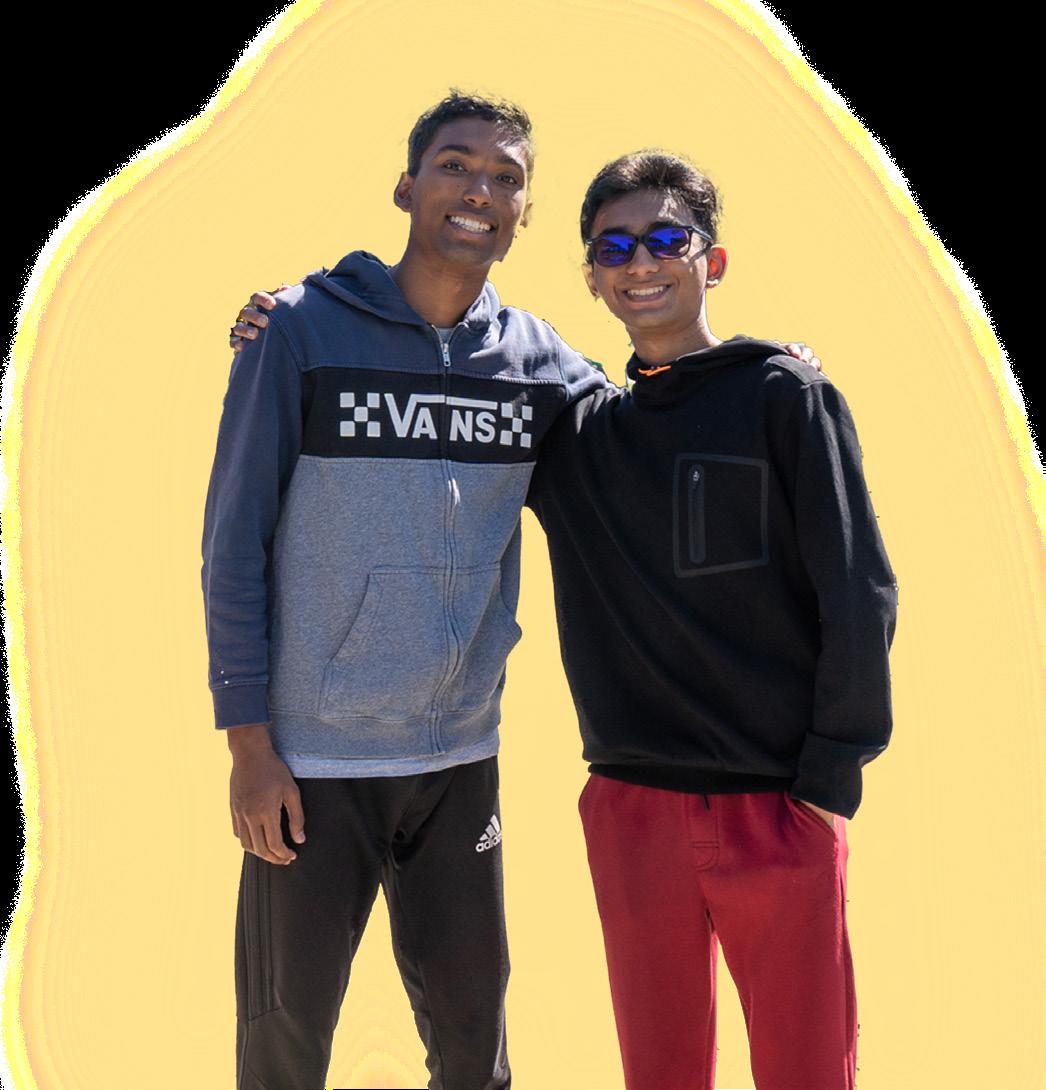
Led by co-presidents senior Rohan Fernandes and junior Aarush Tiwari, the project aims to provide clubs with a centralized space to display upcoming events and offcer information.
The project began in July 2025, when Fernandes and Tiwari discussed ways to apply their club’s skills to support the Lynbrook community. In previous years, club meetings consisted of discussions led by offcers about website design and development.
“We really wanted to do something that was beyond presentations,” Tiwari said. “By
building actual websites for clubs, we’re helping members share their work and giving them a chance to apply what they learned in a meaningful way.”
Through late January and early February, the co-presidents began reaching out to clubs to see if they would be interested in having a website created for them. They were asked to submit materials such as logos, offcer biographies and descriptions of club activities. Submissions were due in February, and development is currently underway as Software for Society members organize the materials and begin constructing the websites. Members
Co-presidents Rohan Fernandes and Aarush
Tiwari pose before mockups of club websites. Graphic illustrations by Anushka Deshmukh
Photos used with permission of clubs
created visual layouts through Figma before translating their designs into fully coded webpages with HTML and CSS. One such club that received a website from Software for Society Club was Poetry Club.
“We’re kind of a newer club, and a lot of Lynbrook people don’t know that we even have a poetry club or don’t think they’d be interested,” senior and Poetry Club co-president Alessandra Wong said. “With a website, they could explore more about what we do and events we host, like our slam poetry open mic, which could help bring more outreach to people.”
Once the layout is fnalized, teams of four to fve members work together to build each website from scratch, overseen by Fernandes and Tiwari. With careful attention and organization, they help ensure that each website displays accurate information.
“It was defnitely a little overwhelming at frst,” Tiwari said. “But at the same time, it was really exciting to see something we imagined start to come together despite having to fgure everything out along the way.”
The frst group of websites is expected to be completed and released within 2 weeks. As development continues, Software for Society, the club hopes to eventually provide websites for all Lynbrook clubs, giving student organizations a consistent and accessible platform to provide information, share events and connect with students.
Upcoming Viking Events
Project Cornerstone Workshop, March 30
Young Men’s Christian Association’s Project Cornerstone is offering two workshops in March for FUHSD parents, guardians and staff at Fremont High School from 6 - 7:30 p.m. The March 30 workshop will be on managing stress and anxiety and learning strategies for family communication. It will be hosted in English and Spanish.
Spring Break April 13-17
Guidance Special Topics Night April 21
The counselors will be hosting a guidance night for sophomores and junior students and parents.
FUHSD Earth Day April 22
FUHSD is collaborating with their Climate Collective to host the 3rd annual Earth Day from 4 - 8 p.m. at the Computer History Museum, Mountain View.
End of Grading Period April 24
Students give back at American Red Cross Club blood drive
BY CLAIRE GUO
As part of an ongoing effort to donate fresh supplies of blood for the Red Cross, the American Red Cross Club hosted its frst blood donation drive in four years on March 12 in the library study rooms. Students and staff who signed up to donate blood received a T-shirt and a $15 Amazon gift card as a thankyou. ARCC collected 23 pints of blood from around 23 donors.
“As part of the Red Cross, having blood drives is really important because that’s one of the main goals,” copresident Shwetha Mukkamala said. “Hearing a Red Cross representative’s personal experience with surgeries and her story and how blood drives really supported her made me want to continue doing this at Lynbrook.”
which included volunteer training for interested students to prepare for any adverse reactions.
“If there’s one thing that the American Red Cross is identifed with besides disaster relief, it’s blood donations, and they did it,” adviser and Voyager teacher James Lohmeier said. “I’ve been looking forward to restoring the donation drive after COVID. Getting that done is awesome. I’m really, really happy with the students, the leadership team and the volunteers who made it happen.”
individuals from Lynbrook took part in the American Red Cross club’s blood donation drive - six of which were staff members. 23
The club was founded to raise awareness about the importance of blood donation and encourage the school community to support patients in need. They conducted donation drives previously, but the effort stopped for four years due to the COVID-19 pandemic and other factors. This year, the team offered gift cards for participants as an incentive.
“It was pretty cool how a lot of people were really enthusiastic about donating,” Mukkamala said. “Donating can be scary to do in the middle of school, too, but it was nice to see people willing to participate.”
The donation drive’s planning began in November 2025 and ramped up in January and February this year. The offcer team contacted Assistant Principal Tara Grande to receive approval for the event, then booked the library room facility. A Red Cross representative came to Lynbrook to walk the offcer team through the process,
Lohmeier, who has been donating blood since he was 16, was greatly inspired by ARCC’s mission.
“When the American Red Cross Club came as an opportunity, I said, ‘Hey, you know what?’” Lohmeir said.
“‘I’ve been donating for years. This is something I believe in. Their mission is critical, and I’d like to be a part of it.’”
Participants in the donation drive included both students and teachers. Many were frst-time blood donors who found the library’s location accessible.
“I’ve always wanted to donate blood,” senior Maulik Agrawal said. “I think it’s a really good way to give back to hospitals and help other people. Across the world, there are so many places with shortages in blood packs to treat patients, so if donating blood can help someone, I would be more than happy to give it.”
The ARCC plans to continue hosting annual blood drives and fundraisers in the future, continuing the tradition of blood donation opportunities at Lynbrook.
“We’re defnitely thinking about doing more donation drives because we can have a lot of time to plan it this time around,” Mukkamala said. “We wanted to get more people involved because this time we only contacted students and teachers, but we found out that many other people in the community were also interested.”
Photo by Ashley Hein. Reporting by Anushka Deshmukh.
Graphic illustration by
Anushka Deshmukh
New club application process greenlights clubs
BY AMANDA JIN
This school year, ASB Community Link implemented new changes to the club application process to feature a trial period for new clubs. Following the changes, CLink passed seven new clubs for the upcoming 2026-27 school year.
In the past, CLink conducted initial screenings of the prospective club applicants before sending off a selected few for the ASB Legislative Council to look over. After these approvals from the Legislative Council, clubs became offcial. However, junior and CLink head commissioner Ojas Kothari saw a problem with this process after being part of the commission since his freshman year.
‘‘With the plethora of clubs we have on campus, we always want to create spaces where students feel like they have a community.
Samay Sikri Senior and ASB president
“Last year, CLink accepted one club,” Kothari said. “We felt that other potential clubs should get a better chance at becoming offcial.”
Working with other commissioners, Kothari proposed a new trial period for clubs during their frst year of establishment. After receiving approval, the clubs will be monitored by CLink for attendance and must maintain at least 15 members for at least six meetings in the frst semester. The clubs will also be required to complete administrative tasks, and will not be offcially classifed as a club yet.
“This allows us to accept more new clubs,” ASB adviser Anna Kirsh said. “So, instead of saying we’re only taking the clubs that we were 100% confdent in, we can take clubs that we see a lot of potential in as well and have them prove to us that they can maintain member interest.”
Another reason for this extra monitoring is that many larger, well-established clubs may struggle to fnd new advisers if their original adviser drops them. Advisers may not want to stack on additional responsibilities, while others are already working with smaller clubs. CLink wants to ensure that these larger clubs, which have already built up their own communities, are maintained.
“Clubs with overlapping topics may struggle with attendance,” Kothari said. “It doesn’t just hurt them, but it also hurts the other clubs that already exist.”
‘‘
CLink also noticed that many new applicants had similar concepts to existing clubs, so by merging similar clubs, commissioners took steps to allow these students to fnd community while avoiding repetition.
“With the plethora of clubs we have on campus, we always want to create spaces where students feel like they have a community,” senior and ASB president Samay Sikri said. “We don’t want to risk students starting clubs that have a hard time getting members or can’t complete required administrative tasks.”
For the 2026-27 school year, the newly approved clubs are Pickleball Club, Chess Club, Philosophy Club and Ethics Bowl, Vietnamese Student Association, Nutrition Club and Filopino American Club. The pre-existing Go Club and Mahjong Club will merge to form Chinese Board Games Club.
Filipino American Club
“Our Filipino American Club aims to create a welcoming space where students can celebrate Filipino culture, appreciate Filipino heritage, build community and share traditions,” junior and founder Chanelle Aragones said. “Next school year, we’re planning to host fun activities and cultural celebrations that give everyone the opportunity to experience and connect with Filipino culture.”
Nutrition Club
“The Nutrition Club focuses on helping students understand how their everyday food choices connect to energy, focus and overall well-being,” junior and founder Aditi Skandan said. “Through interactive activities and discussions, we hope to make nutrition more approachable and relevant to students’ lives.”
Club Application Process
Informational Meeting
Prospective clubs will attend the Club Application Informational Meeting, which is usually held in September. This is mandatory in order for students to apply to start a club in the upcoming school year.
Written Application
Students can detail why they should be chosen to begin a club and the activities they’re planning. They should also have a teacher who has already agreed to serve as an adviser if their club gets chosen. CLink will review all the applications and greenlight a select few to move forward.
Club Presentation
Applicants will give a 10-minute presentation, which will include an example of a potential club presentation and their event ideas. CLink, the ASB adviser and the ASB president will have the opportunity to question and grade them on the creativity and potential of their ideas.
ASB Legislative Council
The Legislative Council will vote on the clubs that they’re personally interested in. CLink will take their vote into consideration to decide which clubs will be approved. While approving applications, CLink may also merge clubs depending on overlapping topics and student interest.
Trial Period
After CLink has decided what clubs to accept, they will offer a one-year trial period where the club can function as an unoffcial club.
Chess Club
The Chess Club will be a place for interested students to sharpen their chess skills and fnd like-minded peers. The Chess Club prevoiusly operated in the 2024-25 school year. It is now set to resume in the 2026-27 school year, under the leadership of Pratyush Bhingarkar as the president.
Vietnamese Student Association
Chinese Board Game Club
“The Chinese Board Games Club will be a fun and welcoming place where students can learn and play games like Mahjong and Go while connecting with others,” junior and founder Owen Huang. “It is an amazing way to build skills, experience Chinese culture, and a place to just relax with friends.”
“The Vietnamese Student Association brings Vietnamese culture to Lynbrook by sharing history, traditions, food, clothing, music and more,” sophomore and founder Hiep Nguyen said. “VSA welcomes students who want to build relationships with peers and are interested in what Vietnamese culture has to offer.”
Philosophy Club & Ethics Bowl
“Philosophy Club is the culmination of the intellectual curiosity that is offered at Lynbrook High School,” junior and founder Rohin Saharoy said. “Students can expect to have deeply warranted, substantive and intellectual conversations about issues that plague our society.”
Graphic illustrations by Ashley Hein and Rachel Martin
Banning social media isn’t the solution
BY SUNNIE WU
Afreshman posts a Homecoming photo. A sophomore shares a meme with a friend across the country. For students at Lynbrook and across California, social media is woven into daily life. As concerns grow over its effect on teenage mental health, California Gov. Gavin Newsom is backing a statewide bill that would prohibit children under 16 from accessing mainstream platforms such as Instagram, TikTok, Snapchat, YouTube and X. Although the bill’s intention to protect children is admirable, an outright ban falls short of addressing the cause.
Shielding teens from social media only postpones the moment they will have to face it without proper habits or support. Instead of an outright ban, California should invest in better options they already have on the table.
Assembly Bill 1709, introduced by Assembly member Josh Lowenthal, would set a minimum age requirement for social media accounts, with the cutoff likely at 16. Modeled after Australia’s 2024 nationwide ban, the bill has received bipartisan support from both Democratic and Republican assembly members.
Passing a law and enforcing a law are very different. If they don’t actually enforce it, nothing is going to happen.
Nhat Ngyuen
Social studies teacher
‘‘ ‘‘
“We have a generation that’s never been more anxious, less free, more stressed,” Newsom said in a Sacramento Bee interview. “We have to address this issue.”
Research linking social media to teen anxiety and declining mental health has been circulating for years — the Surgeon General’s advisory found that teenagers who spend more than three hours daily on social media face double the risk of depression and anxiety symptoms. AB 1709 refects a widespread fear among parents and lawmakers. Yet the leap from acknowledging harm to banning the source of it skips over a fundamental question: when teenagers eventually do get on social media, who will have taught them how to use it? Without structured guidance, they will encounter the same predators and the same addictive design, except they will have had no practice recognizing any of it.
Currently, California's ability to keep teenagers off
is a smaller country with a centralized online safety commission built specifcally to enforce its ban. California operates in a different legal environment. User engagement-dependent tech giants like Google, TikTok and Meta are already suing to block a 2024 state law that requires parental consent to view personalized content feeds, arguing that curating an algorithmic feed is a form of protected speech under the First Amendment. A broader age ban would face even fercer opposition. When Australia rolled out its ban, workarounds inevitably appeared, from VPNs to fake birthdates. In a poll of more than 17,000 Australian teenagers conducted ahead of the ban, 75% said that they had no intention of stopping their social media use. There is little reason to believe that California teens would respond any differently. A study of more than 10,000 U.S. adolescents found that 63.8% of children under 13 were already using social media despite the existing age requirement, proving that age restrictions do not keep determined teenagers offine.
“Passing a law and enforcing a law are very different,” social studies teacher Nhat Nguyen said. “If they don’t actually enforce it, nothing is going to happen.”
The bill also overlooks how embedded social media has become in students’ daily lives. At Lynbrook, incoming students connect with classmates before the school year begins, clubs announce meetings and ASB candidates campaign on Instagram. For many students, social media is more than a leisure activity separate from school life.
“Social media isn't just brain rot,” sophomore Alicia Daeun Yoon said. "It's a way for others to connect with people outside their circle.”
That connection extends beyond socializing. Students use these platforms to stay informed, build skills and expand their breadth of knowledge.
“I’ve gained a lot of information from social media — things I wouldn’t normally learn at school or anywhere else,” freshman Emily Kilpatrick said. “If anything, they should just put privacy and content restrictions for people under 18, rather than just banning it for people under 16.”
unrestricted access the moment they turn 16. Without years of practice setting boundaries and building healthy habits, newly unrestricted teenagers are not protected by the ban. They are just older.
“I am in support of children gaining gradual, developmentally appropriate access to technology and social media, not prohibiting all social media based on an age threshold,” Stanford Center for Youth Mental Health director Vicki Harrison said.
The focus should instead be platform accountability, which is missing in the current bill. Rather than pushing for platforms to change harmful systems, AB 1709 simply removes users from them, leaving the same systems intact when teenagers return. Several existing California laws already attempt to demand platform accountability. Assembly Bill 56, signed into law in October 2025, requires platforms to display a warning to users each day they initially open social media, again after three hours of use and at least once every hour after that. Senate Bill 976 goes further, making chronological feeds the default for minors and prohibiting platforms from sending notifcations during school hours and late at night. These are the kinds of interventions that make social media safer without pretending it does not exist.
“An age requirement doesn’t really do anything to curb the amount of time that a student is on the actual apps,” English teacher Vanessa Otto said. “It's more the time spent and what they're using it for that's a greater concern than the age.”
By age 14, most students are entering high school and taking on a multitude of responsibilities, including extracurricular activities, homework and increasing independence. A governmentmandated cutoff at 16 does not match the maturity and autonomy teenagers are already expected to demonstrate in every other area of their lives.
The harms of online bullying and addictive scrolling are evidence that children need opportunities to develop awareness and boundaries earlier, rather than being handed
editors-in-chief — olivia yuan, crystal zhu
managing editor
— claire guo
copy editor — david zhu
design editors
— amanda jin, rohan kakhandiki
adviser
— josh miller
news editor — brian lee
opinion editors — maddy chang, saavan saraf
sports editor
stafers
samanvi bandugula
audrey cabaltica
Social media is not going anywhere, and neither are the predators, cyberbullying, addictive algorithms or online pressure. Every year spent off social media under a government mandate is a year not spent learning how to use it responsibly. Those are not lessons teenagers can pick up overnight at 16. Instead of an outright ban, California should shift the momentum from AB 1709 to building on the progress of AB 56 and SB 976, holding platforms accountable for the systems they deliberately design to maximize engagement and embedding digital literacy into school curricula. Teenagers do not need the government deciding when they are ready. They deserve adults who trust them enough to teach them.
“It’s better to learn to live with the existence of something than to pretend like it doesn’t exist,” Nguyen said.
nicolas cheng
david dai
anushka deshmukh
alyssa lin
tristan lo
rachel martin
sunnie wu
catherine yang
— alexandra wu
— anna cen
business/pr manager features editor — isabella chiu
rebecca cai
emily cheah
joanna chen web editors
— akash anand, cecilia wu
jenny suh
social media manager — ethan wong
ashley hein
stuti jain
eunice leung
prisha pulastya
katie shang
olivia tu
vanessa yap amy yuan
Room for reform in ASB elections
BY RACHEL MARTIN AND AMY YUAN
“It’s a popularity contest” is the age-old tale told about ASB and class offce elections. Although it’s impossible to fully remove the infuence of popularity on students’ voting decisions, Lynbrook should consider implementing a two-step application process for candidates and more inperson election activities to ensure that candidates are qualifed and foster more student body engagement with their campaigns.
Currently, in-person campaigning is limited to candidates walking from
table to table, sharing posters with lengthy speeches. Many students are indifferent to who is elected and would often rather focus on their lunches than a rushed presentation.
Different interactive activities, like Q-and-A sessions or debates, would allow candidates to promote themselves while reaching a larger and more interested audience.
“If a lot of people go, then it would be an interesting debate that could defnitely, at minimum, raise awareness for elections going on,” Class of 2028 president-elect Justin Jung said.
A Q-and-A session would provide a way for students to voice their concerns and for candidates to adjust their campaigns based on student input, building mutual understanding.
Additionally, debates where candidates respond to questions about their future goals would give an opportunity for candidates to showcase solid ideas that they can defend and explain, similar to the United States’ current presidential elections. The benefts of having a unique, defendable campaign would also impel candidates to run on more specifc platforms.
“I don’t know what the turnout of those events would be, but I’d be supportive of them,” junior and ASB treasurerelect Erin Chen said.
would make online campaigning not only fairer but also more authentic.
Previously, ASB adviser Anna Kirsh and ASB offcers discussed having candidates fll out an application about why they are running for their position and what their qualifcations are, instead of being allowed to run right away.
‘‘
It’s important that we keep the elections as having a student voice.
Anna Kirsh ASB adviser
However, the problem of low student turnout remains an issue. One solution is to place the interactive activities in the quad, where frequent student traffc would increase participation and visibility.
If students want offcers who will speak for them well, they also need to take responsibility for being informed about the candidates. Locating big events like debates in the quad would make it easier for students to do so, promoting both campaigns and voter education.
While social media is a key factor in spreading election awareness, online campaigns can distance voters and candidates, especially when candidates are not making their own posts — some candidates pay more experienced students to create graphics, videos and other materials for them.
This disadvantages those with limited budgets and those who simply don’t want to spend large sums of money on their campaigns. Restricting candidates from outsourcing work for their campaigns
‘‘
The proposal was ultimately rejected to avoid extinguishing the voice of the student body, but combining applications with student votes would ensure winning candidates are both qualifed and chosen with student input. In this two-step process, adviser and current ASB offcers could use written applications to select serious and capable candidates for the ballot. This way, students would still be allowed to vote for their representatives.
“It’s important that we keep the elections as having a student voice,” Kirsh said.
If chosen candidates have solid backgrounds in leadership and students take the responsibility to educate themselves and learn about their campaigns, ASB elections will be more effective.
“In-person connections are genuine,” junior and ASB vice president-elect Amie Wu said. “Those connections are something really special.”
the Epic staff voted 26-0 in favor of this stance with 10 abstaining.
Don’t believe your dream college’s financial aid promise
BY REBECCA CAI
College financial aid is the worst humiliationship you’ll ever be in as a young adult
“Approximately two-thirds of our students receive some form of fnancial aid.” “Need blind.” “100% of need met.” Those are just a few of the promises that colleges make to students seeking fnancial aid. But there’s a lot they’re not disclosing.
In a landscape where it now costs well over $90,000 for an out-of-state private education at top schools like Columbia University and the University of Chicago, many colleges make false or misleading claims about fnancial aid each application cycle. To better prepare students for affordable lives in college, schools should steer clear of misleading marketing tactics and provide full transparency to students they are trying to recruit.
“The big-name schools all have their own defnition of what fnancial need is,” college and career adviser Shveta Bagade said. “We talk about college admissions and we’ll always say, ‘Well, it depends.’ It’s worse for college fnancial aid because it will depend on the college, what they’re willing to do and what they feel is needed versus what is not needed.”
unaffordable for the average American middle class family. How can both statements be true at once?
The calculation for “demonstrated need” varies between fnancial aid applications, such as the College Scholarship Service profle or the Free Application for Federal Student Aid. It also varies from school to school, as universities like Brown, Harvard and Princeton choose to disregard home equity, a major difference that helps families in the Bay Area, with its expensive real estate market, receive more aid.
“A lot of schools say they meet 100% of demonstrated fnancial aid,” senior Shreya Somani said. “But what I was really shocked at is what they consider demonstrated fnancial aid.”
Another issue with college fnancial aid is the lack of consistency. The phrase “100% demonstrated need met” reigns many college websites proudly, including the websites of Yale University and New York University. At the same time, those two colleges are considered wildly
Given the lack of standardization around how much aid is given to students, many families struggle to receive money from universities if they aren’t considered to be low-income. The CSS profle essentially ensures this to be true, tracking home equity and retirement investment funds as part of the lengthy application. It’ll also cost you an additional $25 for every school receiving your CSS application unless you fall below the income threshold for a waiver. This is deeply discouraging, as college is
already so expensive. While it is necessary for colleges to thoroughly evaluate students applying for fnancial aid to make sure they are giving the suitable amount, evaluating the primary residence value of any applicant does not indicate how much wealth their family is truly able to put toward their child’s college education.
Another promise most top schools make to domestic applicants is the evaluation of applications in a “needblind” context. Yet every school in the Common Application requires the student to check a mandatory box if they wish to apply for fnancial aid. In 2022, 16 top colleges, including those in the Ivy League, were accused of making false claims of need-blind admissions that they weren’t following through with. The lawsuit revealed clear patterns of admissions at select schools: students who didn’t apply for aid had better results compared to students who did apply for aid.
“When colleges say they are need-blind, they are saying they will not consider your ability to pay during the admissions process,” college and career adviser Kathy Tang said. “Keep in mind that what you think you can afford and what they think you can afford may not be the same.”
Students applying for fnancial aid are disadvantaged in this process. As much as colleges promise to expand diversity and make sure every student can afford an education, it seems telling that they can turn away applicants hoping for fnancial aid before they even get into the school.
My Instagram reels were probably the funniest things on earth, I found games infnitely more entertaining than homework and my insanely fast response times on Slack might make me seem like the ideal person to work with. But after hours of scrolling, I was always hit with a brutal reality: I got no work done.
My screen addictions made me feel burnt out, stressed and most importantly, shamefully unproductive. When the second semester of junior year rolled around, I couldn’t stand it anymore: too many AP classes, endless
BY ASHLEY HEIN
Silicon Valley is home to the largest density of data centers per square mile in the United States, with more than 120 data centers in Mountain View, Palo Alto, Santa Clara and San José.
As residents are forced to contend with dirtier air and a shrinking supply of buildable land, we must question in whose best interest it is to build more AI data centers. These centers are a massive investment, fnanced by the utility companies that build them and the customers that pay those companies. The speed of that growth may come at the expense of the environment and already-high housing costs. We need to push city leaders to regulate data center construction more tightly until secure housing safeguards and environmental protections are established.
Within data centers are thousands of computer chips that enable the rapid processing of artifcial intelligence tasks for everything from large language model training, image recognition and recommendation systems to applications in biotechnology, banks and government agencies. Additionally, San José dominates PG&E’s ambitious internal pipeline of proposed electricity construction projects. Offcials have actively promoted the city as a “launchpad” for AI economic development, emphasizing that data centers will boost local job opportunities. However, they are a massive use of energy and electricity that could otherwise go to residents in the form of more community resources, such as affordable housing and green spaces. Data centers statewide have requested 18.7 gigawatts of capacity — more than enough to power every household in California. Plus, unlike a retail center or park, a data center may employ as few as 25 permanent staff, meaning these facilities aren’t as effcient in creating jobs for as many people as they may seem.
Data center emissions have nearly tripled from 2019 to 2023 in a stark contradiction to the clean energy goals that San José supposedly stands for. Diesel backup generators in these centers produce large amounts of
articles to write and stashes of instant coffee depleting at concerning rates, coupled with a dysfunctional sleep schedule and stacks of books I desperately wanted to bury myself in for escape… but never could because of how tired I was from everything else. Something had to go.
And so, one night, I declared war on my addictions.
I moved swiftly, wiping an entourage of apps from my phone. Instagram, Reddit, Youtube and even entire video games (goodbye, years of progress!). I began strategizing ways to physically distance myself from my phone by chucking it across my room when I did schoolwork, and I turned my phone screen to black and white to prevent me from enjoying my favorite Netfix shows.
It was a long-overdue cleanse.
But after just one week, I found myself returning to that long-dreaded (but desired) environment. Even then, I continued to catch myself, to try and improve. Eventually, I deleted my Instagram account altogether, and I’ve set up screen time limits so I can’t open my favorite apps in moments of weakness.
I’m still working on several apps, though — email and Slack continue to haunt me to this day. However, I’ve found that the key to staying offine is keeping myself immersed in the real world. Now, I ask my friends to go on hikes spontaneously, or fsh out a rusting book to delve into. I might go on a long walk around my neighborhood, enjoying the velvety pink sky at sunset. It’s always still a battle to pick between nature and my phone because it’s
so convenient to just fick on that little rectangle. But I’ll always choose to progress, however small, over entirely acquiescing.
What I’m trying to say is that it’s not a waiting game. In my junior year, I desperately felt like it would just be fne if I just endured my burnout with inaction — and my decision to not do so was probably the best thing I ever did for myself (that, and not taking AP U.S. History — phew!).
With the onset of the digital age, our generation has been tragically trained to be receptive, not active. That has to go. Wake up. Running from them can work for now, but you’ll have to eventually turn around and face your problems head-on.
Then, do whatever you need to fx it — even if it means declaring war.
Note: this is not a one-size-fts-all solution. If you or someone you know is having serious mental health issues, seek help. Resources on campus include our school therapist; book an appointment or see other local services at our school’s website. See FUHSD’s compiled list of mental health resources. If those options don’t feel feasible, look through Santa Clara County’s resources or reach out to the 988 Lifeline or The Trevor Project’s hotline.
fne particulate matter, nitrogen oxides, carbon monoxide and other pollutants linked to respiratory and cardiovascular disease. The Bay Area Air Quality Management District has already fagged multiple areas of Santa Clara County as having high diesel particulate burdens, demonstrating increasingly valid concerns around data centers’ impact on environmental health.
“AI data centers use an enormous amount of energy since these AI chips run continuously,” Conservation Action Association activities coordinator Jaahnavi Tirumala said. “Unfortunately, this energy often comes from fossil fuels rather than sustainable energy sources because the data
centers require extremely stable power.”
Data centers take up a large amount of land for development and water infrastructure, even though affordable housing is already an issue in San José. Activists in multiple cities have petitioned against their continued construction, highlighting the fact that they may be simply fulflling the aims of corporate tech giants rather than the opinion of local residents.
In San José, this land could otherwise be dedicated to tackling the community’s housing problems, alleviating issues such as highdensity affordable housing near transit, lowincome homeownership projects or mixed-use apartment buildings over shops.
Without transparency and communication about who exactly will shoulder the burden of paying for grid updates or electricity rates, data center construction is bound to generate distrust.
While initiatives such as San José Clean Energy have made energy more affordable for residents, more discussion between the city and the public is necessary.
As AI companies expand and more data is stored and processed, so does the need to impose proper regulations that consider how to support technological advancement while prioritizing local needs.
Currently, electricity consumption from data centers constitutes over 1.5% of global electricity consumption. 56% of the energy used to power data centers is from fossil fuels.
“As AI becomes more integrated into everyday systems, the computing infrastructure behind it will become just as important as other core infrastructure that supports society,” software engineering and executive consulting expert Bob Singh said. “At the same time, data centers can require signifcant electricity and cooling resources, so cities like San José need to think carefully about sustainability, energy sourcing and long-term environmental impact. The goal shouldn’t be to stop technological progress, but to guide it responsibly with thoughtful policies and effcient technologies.”
Graphic illustrations by Prisha Pulastya
FEATURES the Epic |
Alumnus Alan Lee amplifies stories through voice
BY OLIVIA YUAN
You may not recognize his name, but there’s a good chance you’ve heard his voice. Maybe you know him as the sinister Shang Tsung from “Mortal Kombat 1,” the lavender-haired Mystery Saja from “K-Pop Demon Hunters” or the haughty Naoya Zenin from “Jujutsu Kaisen.” Now aged 35, Class of 2008 alumnus Alan Lee has worked as a professional voice actor for 18 years, breathing life into beloved video games, movies and anime.
A Santa Clara County native, Lee was drawn to storytelling at a young age. He consumed TV and video
But it wasn’t until his junior year at Lynbrook that he found the thread that connected all his interests: the art of playing pretend. He started commuting to San Francisco every week for class at a voiceover conservatory.
“I remember going up in front of the podium, where they give you scripts at the very last part of the class,” Lee said. “The moment I stayed up there, I was like, ‘All right, I’m doing this for the rest of my life.’”
During the rest of his time at Lynbrook, Lee also launched a voice acting club. Members created their own voiceovers and even raised money to buy a high-quality
Ledo, the main character in the animated sci-f series “Gargantia on the Verdurous Planet.”
“I got really lucky and I booked the very frst lead that I got, which was baptism by fre because I was way in over my head,” Lee said. “The pressure of carrying an anime on your back was immense.”
Nearly two decades later, Lee has taken on such challenges to land many memorable roles. A personal highlight is voicing protagonist Makoto Edamura in the action show “Great Pretender,” which had what was hailed as one of the best English dubs of all time.
“Because it was the frst anime that we were recording during the pandemic, we had to do things remotely,” Lee said. “So my director said, ‘Screw it; let’s just take as much time as we need per line.’ If I walked away from anime after doing ‘Pretender,’ I would walk away happy.”
Amid a fckle industry where upheavals are frequent and success rare, Lee navigated the frst 13 years of his career without an agent. He cites self-conviction and persistence as instrumental to his journey.
“You have to have confdence in your own work, and you have to believe that you’re good enough,” Lee said. “I learned really quickly that it’s not about getting your foot in the door. It’s about how long you can stay in. If you have the mental perspective that it’ll happen eventually, then you can probably weather the storm.”
While Lee’s career has naturally stabilized with more frequent roles and clients, the recent popularity of “K-Pop Demon Hunters” has resulted in another shift. With convention appearances now offering more fnancial security, he’s taken the opportunity to adjust his
“This is the frst time in my career that I’ve been able to reject work,” Lee said. “Before, I would just say yes to everything and burn myself out. I can breathe now, and pick and choose what I want to do.”
Through all the ups and downs, voice acting remains a true passion for Lee, from weekly classes up in San Francisco as a high schooler to recording sessions in Los Angeles today.
“Voice acting is a dream job,” Lee said. “How could I really complain? It’s not butterfies and rainbows, no. It’s a struggle. It’s a pain. But if I had to have a job, this would be the job. A hundred lifetimes in a row, it would be this
Film photography through Ayden Jeong’s lens
BY DAVID DAI
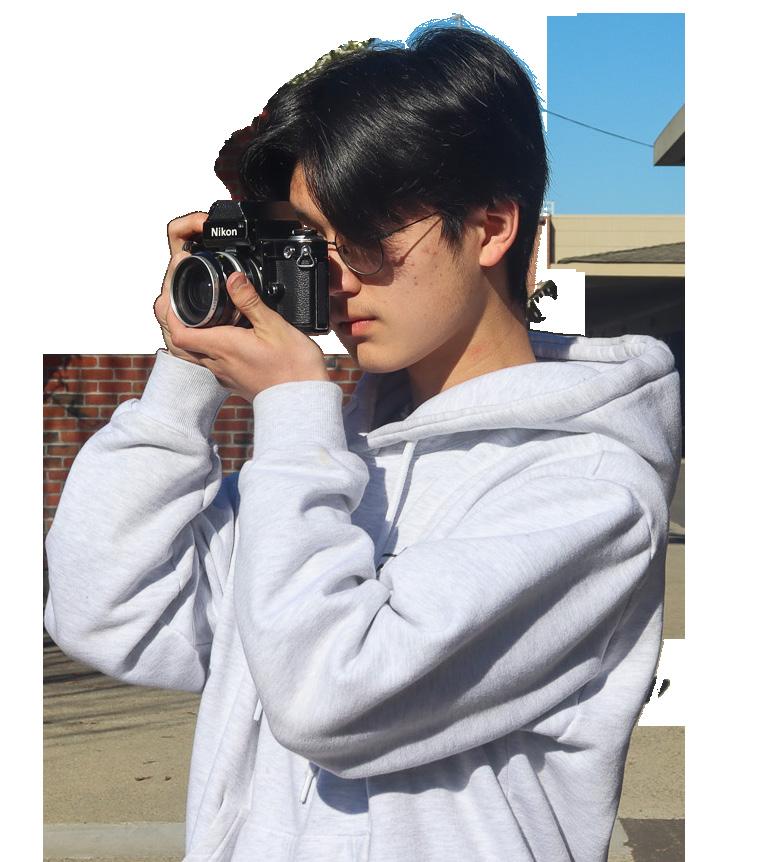
On a plane thousands of feet in the air, junior Ayden Jeong captures the view outside with a click of his camera shutter: Utah’s Great Salt Lake and the surrounding desert. In the darkroom, he winds a roll of flm, anticipating how the scene will look once developed. For Jeong, photography is a way to capture moments in time, turning ordinary sights into objects worth physically holding onto.
Jeong’s interest in photography began in middle school, where he learned digital photography. In his freshman year, Jeong began experimenting with a flm camera he found in his parents’ closet and began experimenting with it. To learn more about the development process, he read “The Darkroom Cookbook” by Steve Anchell.
Jeong specializes in flm photography, the traditional process of capturing images on lightsensitive flm. The flm is developed in a darkroom, where it is treated with chemicals that turn it into a negative: an inverted image of the original scene.
“I fnd the analog process more enjoyable,” Jeong said. “Printing and developing photos in the darkroom is a lot more fun than editing digital photos for hours on end.”
Because of the slower pace of flm photography, Jeong focuses on landscapes, giving him more time and a broader subject for his photos. Jeong carefully considers lighting, focus and composition within the camera, as not much alteration can be done after development.
“Getting my negatives back for the frst time sparked my interest in photography,” Jeong said. “Up until then, I was just clicking buttons, but seeing photos as a physical medium was pretty magical.”
Since flm photography is now relatively obsolete and new lenses are expensive, Jeong often works with old or broken equipment, buying and collecting vintage cameras and camera parts from eBay
and relatives. Once Jeong began collecting, he became interested in the history of optical design and how cameras work. Currently, Jeong uses a Nikon F2 flm camera, which was in production from 1971 to 1980.
Jeong has learned to look at problems from different perspectives. Jeong once had a camera that he couldn’t fx for six months. At frst, the problem looked like an issue with the light seals, but it turned out to be thorium that had faked off the lens assembly and exposed the flm.
“Photography has really shaped Ayden as a person.” junior and friend Richard Chen said. “He is always happiest when talking about his most recent camera purchase or new set of pictures that he took.”
Additionally, the
process of developing flm has inspired Jeong to study chemistry and pursue a job as an engineer at a flm company such as Kodak or Ilford. Although photography itself will remain only a hobby, Jeong hopes to grow a community of flm photographers, reviving a dying art.
“Film is just plastic, but you can record an image and you have the actual light from that scene,” Jeong said. “You’re keeping a part of the scene with every photo.”
Graphic illustrations by Emily Cheah Photo used with permission from Alan Lee
Photos by David Dai and used with permission from Ayden Jeong
Ayden Jeong snaps a photo with his flm camera to capture the scenery.
CENTERSPREAD the Epic | 09
BY CRYSTAL ZHU
A visual record of the community’s religious centers
A. A biker prays at the Cathedral Basilica of St. Joseph in downtown San José. The building serves as the Roman Catholic cathedral of the city’s diocese. It bears the name of Saint Joseph, the patron saint of pioneers and travelers. The original El Pueblo de San José de Guadalupe — named for the saint and its proximity to the Guadalupe River — was simplifed to San José in the 1800s.
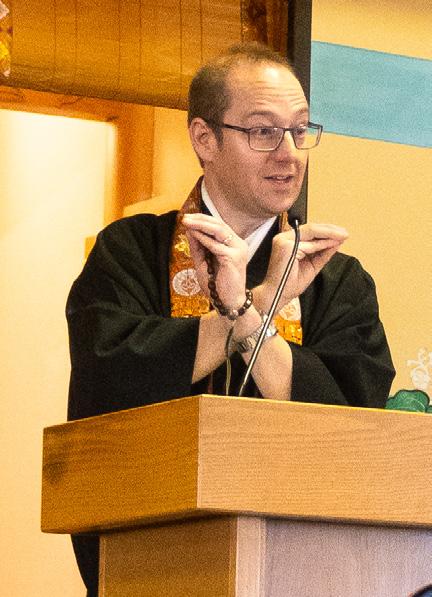
B. Rinban Henry Adams tells the Buddhist story of Gumyocho, a two-headed bird whose name means “shared life” in Japanese, imparting a lesson on the need for harmony at the San José Buddhist Church Betsuin. Adams leads Dharma talks — spoken teachings on Buddhist principles — and services.
C. Women pray Zuhr — the second of fve daily mandatory prayers — at the Muslim Community Center in Santa Clara, led by the imam, or prayer leader. The carpet diagonals indicate the direction of the Kaaba, which Muslims face in their prayers — and make pilgrimages to at least once in their lives.
D. Visitors line up at the Buddhist Church Betsuin at the end of a Sunday morning service to pray and ofer shoko, or incense, at the altar. Located in San José’s Japantown, the temple is a gathering place for local Japanese Americans; many templegoers are descendants of those imprisoned in internment camps during World War II.
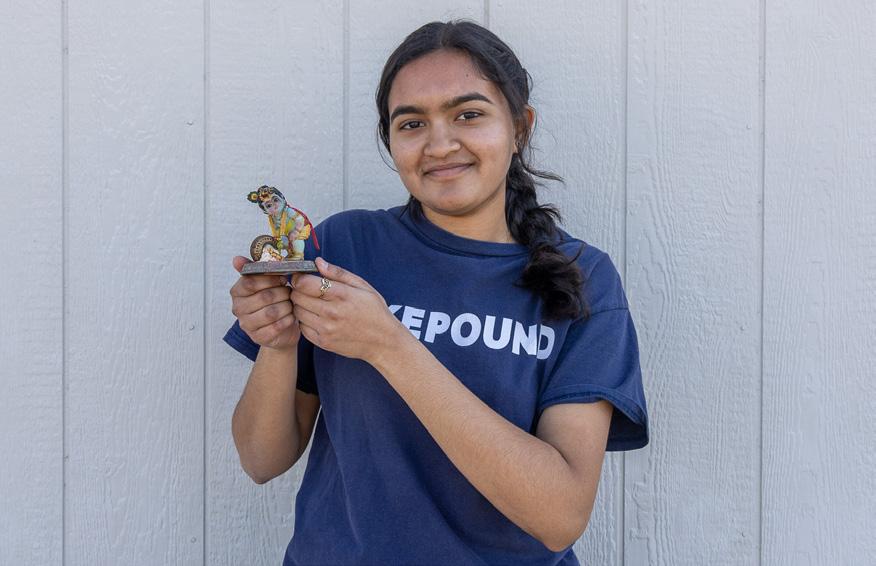
E. An idol of the Hindu warrior goddess Durga — the temple’s main deity — sits at the Shiv Durga Temple of Bay Area in Santa Clara. The temple was founded in 2012 and has since held many festival celebrations and community activities.
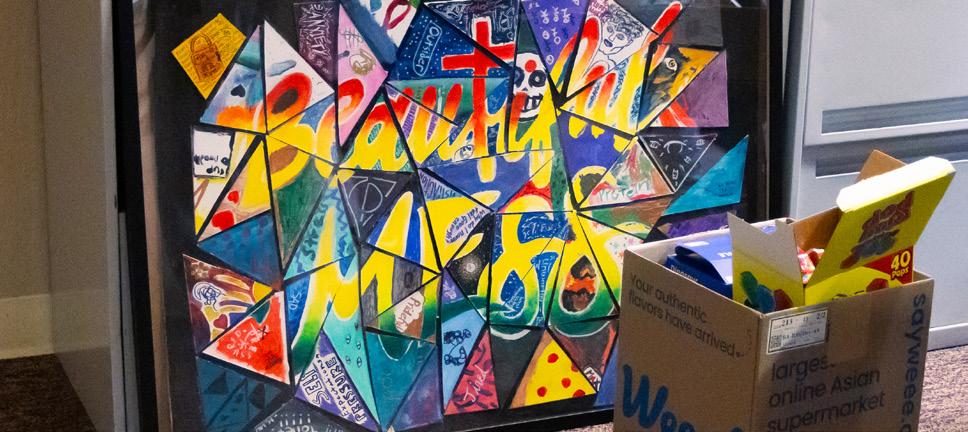
F. A mosaic of painted cardboard pieces forms a “Beautiful Mess.” The piece was created in February 2025 at the annual retreat of the Cupertino branch of the Chinese Church in Christ youth group.
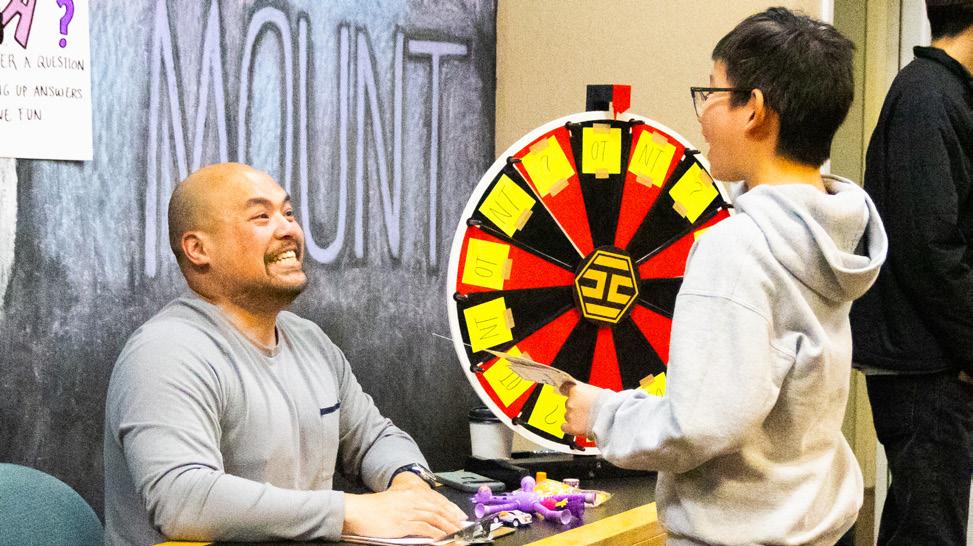
G. Youth pastor Peter Hwang quizzes church members on Bible trivia at CCIC Cupertino. After quitting his job at Google, Hwang fnds his current career much more fulflling. He hopes to become a permanent church director once he completes his master’s degree at Western Seminary in April.
H. Sunlight shines through a ceiling window in the Muslim Community Association in Santa Clara. The mosque is one of the largest in California and ofers Islamic classes, counseling, outreach and social services.
I. Afternoon light shines through a stained glass window outside the Congregation Beth David in Saratoga. The synagogue, founded in 1963, ofers regular classes on Judaism, community gatherings and Shabbat services.
Garvin Young deepens his faith through gospel music
BY DAVID ZHU
On Friday evenings, freshman Garvin Young packs his microphone and heads to Cupertino’s Chinese Church in Christ. On arrival, he meets with a collective of young futists, pianists, cajon players and guitarists to practice their worship set. As a singer in the church’s youth group worship team, he guides the team through classical hymns and contemporary Christian hits. Young has been singing in the youth group for almost four years.
Young’s connection to Christin music blossomed long before he joined the worship team. He grew up attending CCIC with his older brother and parents. Attending the children’s ministry and Sunday school, Young was quickly introduced to popular worship songs such as Matt Redman’s “10000 Reasons.”
familiar with. With encouragement from his brother, Young joined the worship team as a singer in the same year despite lacking singing experience.
“At frst, I was kind of nervous,” Young said. “But when I just sang, a lot of people said I did good, and my brother said that I’m better at singing than him. I just thought about the words I sang and sang like I would usually do at home.”
When I listen to Christian music, I get reminded about God and what he’s done.
Garvin Young Freshman
It wasn’t until ffth grade when his brother, Edwin, introduced him to a Spotify playlist with hundreds of Christian songs that Young started exploring Christian music. He was drawn to its breadth and depth.
“I like how some songs are pretty calm and how there are different types of moods,” Young said. “If you want hype songs, they have them, or if you’re feeling anxious or sad, there’s also songs about that.”
He built his own playlist of Christian music, and started listening and singing along while completing homework or chores. Young joined his church’s youth group in sixth grade. Friday night gatherings began with a time of singing worship songs, followed by a sermon, then more worship. Young was immediately drawn to the worship team, who sang many of the songs he was
Adapting to the song rhythm and harmonizations with the other vocalists was initially hard for Young, but improved with practice.
‘‘
“His singing defnitely got way better as he was on stage more, and he got less nervous as he sang more,” Edwin Young said. “Just having that calmness around, just learning how to be calm when you’re always on stage is a very good thing.”
One of Young’s favorite memories was creating his own worship song with a team. Ahead of their annual youth group retreat in February 2025, a youth group counselor suggested the idea. Young worked with another team member to write the lyrics of the song two months before. They practiced singing the song with his team, which they named “We Are Yours,” a few weeks before the retreat.
In times of personal strife, Young listens to Christian music to be reminded that he is not alone.
“When I feel sad, I listen to it,” Young said. “I listen to the words and some lyrics stick out. Some of them say that God is with you. It’s played a big role
in my life because when I listen to Christian music, I get reminded about God and what he’s done.”
Graphic illustration by Eunice Leung. Photo by David Zhu
Photos by Crystal Zhu
A. B.
C.
D.
E.
F.
G.
H.
I.
Modern faiths on ancient foundations
R L
Greek cults are one of many types of paganism, an originally derogatory term used to describe non-Christians up until the 19th century. Today, it is an umbrella term for nature-oriented spiritual religions inspired by preChristian practices.
Although specifc values vary from one pagan religion to another, they are typically dedicated to similar principles: a strong connection to nature, personal accountability and the freedom for individuals to choose which deities to follow. Pagan worship often takes place within smaller communities, rather than hierarchical institutions.
These communities formed in ancient Greece are commonly referred to as mystery cults. The Eleusinian Mysteries are well-known, centered around the myth of Demeter and Persephone: after Persephone was taken by Hades to the underworld, Demeter’s grief made the Earth barren. This was seen as fall and winter. Eventually, a compromise allowed Persephone to return for half of the year, and Demeter made the earth bloom. This was seen as spring and summer.
Followers of the Eleusinian Mysteries believed that the rituals offered deeper spiritual insight into life and the afterlife. They maintained the ideology that death was not an end, but a transformation. The cult attracted followers across the Greek world for nearly 2,000 years.
BY MADDY CHANG AND SAAVAN SARAF
F“In the ancient world, most were not that interested in issues of belief,” Stanford University religious studies professor Michael Penn said. “Gods didn’t care what you believed. They cared what you did through rituals.”
Many of these ancient communities faded as Christianity and other major world religions expanded. However, in recent decades, revival movements reignited interest in pagan religions. For example, paganism
became popular in the 1960s within hippie communities who rejected mainstream societal ideals.
A widely known modern paganism movement is neopaganism, which attempts to revive and re-interpret ancient spiritual practices for contemporary society, such as Wicca, which emerged in the mid-20th century. Wiccan rituals include an altar and a casting circle, which invite the Wiccan God and Goddess to join with chanting and dancing. The Goddess serves as a mother, symbolizing fertility and growth, while the God represents strength and protection.
“Spiritual religious practices with nature, including paganism, are innate to human beings,” said Olga LouchakovaSchwartz, professor and researcher of religion, culture and society at the University of California, Davis. “It is only when religions considerably age that a theoretical structure emerges which is separate from those very organic practices.”
Paganism allows for highly individualistic belief systems. Major religions such as Christianity and Islam have central texts and authority fgures, while paganism has no single scripture or deity. Some individuals believe that its lack of hierarchy encourages them to nurture their faith at their own pace.
“With the existence of paganism, where you’re allowed some freedom, it attracts more people because they can keep the aspects of the religion that they align with, while
rom abortion and LGBTQ+ rights to immigrants and foreign identity increasingly shapes how Americans vote and which
also adding their own identity,”
junior Ethan Zang said.
The word “cult” has been associated with paganism because of its stereotypical non-mainstream beliefs and practices. But the word didn’t always come with negative connotations. The term “cult” became pejorative over time, coming to describe hierarchical groups that engaged in controversial or exploitative activities.
“When I think of the word cult, I think of something that is religion-like,” junior Raghav Shrivastava said. “It is devotion to a single person rather than a set of ideas.”
High-profle tragedies in the 20th century, like the Jonestown Massacre, reinforced public fear of cults, leading to anti-cult movements. In 1960s America, many opposed radical ideas, afraid that their friends and families would be recruited and manipulated. The Cult Awareness Network was founded in the 1970s to provide information and support families concerned about loved ones in cults. It offered hotline services and worked to reverse members’ beliefs through intensive interventions.
The founding fathers envisioned a nation with robust Christians and deists themselves, but had empathy for almost every autobiography, Thomas Jefferson expanded that religious freedom Gentile, the Christian and [Muslim], the Hindu and Infdel of every U.S. founders not only wrote religious freedom into law through the Constitution, but encouraged the participation of diverse cultures society.
“America as a country was founded, at least in part, based freedom,” social studies teacher Luca Signore said. played a big role in political discourse. probably diminished from 1900 until America has become more diverse.” Today, religious
“I feel people are drawn to non-mainstream religions because they are vulnerable and want something or someone to believe in,” sophomore Saanvi Kakani said. “There are so many religions out there to satisfy
Gwhatever needs In some modern movements concept Astrology, even yoga rituals, and those connection. routines emotional communities pagan Despite thousands belief provide world.
BY EMILY CHEAH AND PRISHA PULASTYA
Graphic illustrations by Amanda Jin and Vanessa Yap
Story continued from front page.
Story continued from front page.
foreign policy, religious which laws get passed. religious liberty. They were every background. In his freedom to include “the Jew, the every denomination.” The through the First Amendment of cultures and perspectives in
based on the values of religious said. “Religion has always However, I would say it’s until today, especially as diverse.”
religious tolerance can feel like a spectrum, with many right-wing politicians emphasizing the preservation of Christian beliefs over assimilation with other religions, while most left-wing politicians push messages entirely unrelated to religion.
The MAGA movement is heavily centered around Christian nationalism, an ideology that seeks to merge
American identity with conservative Christian identity. Christian nationalists maintain that America was founded as a Christian nation, and that the government should actively promote Christian values.
“There’s been a big movement in this country in recent years toward white Christians as being the norm for the nation,” San José State University political scientist Larry Gerston said. “We’ve seen anti-immigrant issues raised considerably.”
President Donald Trump has fully embraced Christian nationalism. The White House holds worship services, prayer gatherings and discussions of religious liberty. The Trump administration said they created the Religious Liberty Commission to protect religious freedom, but concerns have been raised about the Commission being staffed by Christian nationalist politicians with little representation from other religions. Many conservatives have criticized Muslim presence in America and the election of a Muslim mayor in New York City. Critics say that Trump’s heavy emphasis on Christian values ignores the needs of atheists and members of other religions.
“I don’t think you can necessarily divorce American values from Judeo-Christian values, because a lot of them originate from that,”
immigration pathways and borders.
“On immigration, at frst I thought, ‘Wait, these people are literally just human beings, why are we deporting them?’” said Ashley Louie, junior and treasurer of Agape Christian Club. “But on further thought, in the Old Testament of the Bible, God heavily emphasizes the borders between each Israelite tribes’ land.”
How much do you think religion should have an infuence on public policy?
Signore said. “A lot of Western civilization kind of originates from this JudeoChristian worldview. So while ideas like equality or helping people in need might not be considered religious ideas today, many of them ultimately have roots in religious thinking.”
Religious communities have also been among the most consistent critics of restrictive immigration policies. But the religious consensus on immigration is not absolute. Some conservative evangelicals and Catholics voice that national sovereignty and borders are themselves consistent with Christian teaching, as the state has a God-given responsibility to protect its citizens and that borders don’t stop compassion.
G whatever they require.” some ways, modern wellness movements echo the concept of traditional cults.
Astrology, tarot reading and yoga revolve around shared rituals, personal guidance teachers those seeking self-growth and connection. Individuals use these routines as tools for self-refection, emotional grounding and creating communities with shared values, similar to systems.
Many Christians also
Despite dramatic changes in society over thousands of years, the motivations behind spiritual remain consistent. Modern alternative religions now provide meaning and connection in a rapidly changing
Oentered the American political mainstream
Abortion is often considered the policy issue that has been most thoroughly shaped by religious infuence, particularly the Catholic church. The United States Conference of Catholic Bishops spent decades building legal infrastructure and lobbying state legislatures toward fetal personhood. The politics are more complicated than they appear, though. Following the 2022 Dobbs v. Jackson decision, 59% of Catholics support legal abortions in some form. According to a Pew Research study done in 2020, roughly twothirds of Catholics said they would not want the Supreme Court to overturn the ruling entirely. This number was similar to overall public opinion, with 70% of Americans not wanting the decision to be overturned.
Since the resurgence of MAGA Republicanism in the 2024 presidential election, many Democrats have started using religion to draw more moderate voters to the left. Texas State Rep. James Talarico recently won the Democratic Senate nomination in Texas. Talarico uses his Christian faith to affrm almost all of his political stances; some describe him like a pastor to his supporters. He has used the Bible to defend abortion and transgender rights. Talarico’s far-left policies — criticizing the existence of billionaires and advocating for universal healthcare — which would normally be unpopular with Texans, are shielded by his Biblical messaging that speaks to voters.
Texas Republicans have successfully campaigned for a “Bible-infused” curriculum for kindergarten through ffth grade curriculums. Lessons include narratives directly from the Bible. This is coupled with a 2025 Louisiana law that mandates all public school classrooms have a poster of the Ten Commandments on the wall. These states along with Arkansas and Oklahoma have been heavily campaigning for more religious infuence in schools. Former Oklahoma State Superintendent of Public Instruction Ryan Walters has justifed inclusion of these texts into the curriculum by arguing that the Bible is fundamental to understanding American history and the foundation of the Constitution.
The importance of distinguishing between teaching about religion and teaching from religion has been at the forefront of modern political dialogue. All American students learn about different world religions and their practices, but rarely are students instructed to follow the teaching from any given religious text.
“In the early 60s, they made it pretty clear that that religion really doesn’t belong in the schools,” Gerston said. “Clearly, that interpretation of the First Amendment is very different from the interpretation that is running through the courts right now.”
NThe intersection of religion and U.S. politics reveals our diversity, as well as the constant debate over our constitution. As the United States becomes increasingly polarized, it is more important than ever to understand how religion affects us and the policies that shape our lives.
Religious groups on campus foster faith
BY VANESSA YAP
Agape Christian Club preach and prays
Students eat salad and pizza as a club member reads out a Bible verse on the projector, discussing the verse’s signifcance and meaning.
Agape Christian Club began in the 201415 school year, with their current members amounting to around 15-20 students. They meet every Wednesday in Room 606. Agape also holds the tradition of gathering in the quad for prayer furnaces every Friday at 7:30 a.m.
“When I joined my freshman year, everyone was pretty welcoming and cool,” senior and president Jacob Sit said. “I wanted to continue pursuing my own faith and helping other Christians continue developing their faith.”
Agape remains open to new believers and anyone curious about the religion. Students are free to walk in whenever they want during the school year to sit in the meeting and
learn.
“Our goal is to be really inclusive, because I think Christianity in particular gets a bad rap for being very judgmental,” Sit said. “We have to emphasize that we love everyone — hate the sin, but not the sinner.”
This year, Agape has organized several speaker events on various aspects of the Bible, from the New Testament gospels to marriage and dating.
A few weeks ago, pastor Daniel Kim from the Sunnyvale branch of the Chinese Church in Christ came and talked about salvation and deliverance of humanity to the club. When Agape is not hosting speaker events, the club bonds over Bible verses and passage analysis, the latter of which takes place every other week.
The club hopes to continue fostering an inclusive community for its members and a welcoming platform for Christian faith.
“The easiest way to clear up any doubt is just to ask questions,” freshman and club member Ryan Huang said. “So if you come in with any doubts, chances are you can ask someone in the club, and they’ll answer.”
Muslim AssociationStudentshares the Quran’s teachings
Members chatter in delight as they scoop Dubai chocolate into rectangular molds, breaking the ice with sweets and an introduction to Islam in the frst Muslim Student Association meeting of the year. MSA started in the 2012-13 school year. The club quickly turned into a space where Lynbrook’s Muslim community could band together. The club holds meetings every Tuesday in Room 303. “Islam is a religion that preaches being a good person and just being open to everyone,” senior and vice president Hashim Mahmood said.“Even though it is a gathering space for Muslims, it’s also for anyone who wishes to learn about religion in general.” Due to the relatively small Muslim demogrphic at Lynbrook, MSA has struggled to garner enough members. The offcers have attempted to hold prayers during club
meetings, but sparse attendance as well as a lack of understanding for Islam makes it diffcult. “There are some occasions where people came to our meetings and started making a racket, because they didn’t know what Islam was about,” senior and president Muhaab Syed said.“They started making jokes about Osama bin Laden, and it’s pretty hurtful to see that because we don’t try to spread our religion like that. We just want to be peaceful.”
Despite the challenges, the club strives to remain an inclusive environment and a place where members can walk in anytime. MSA also hopes to collaborate with other clubs on campus to spread cultural awareness of Islam to students.
“No matter who you are, you’re still welcome, because even if you’re not Muslim, we’d still accept you,” sophomore and club member Varisha Mahmood said.“At the end of the day, it should feel like a community. While Islam wants you to be a part of the religion, we’d like you to join with the friends you made along the way.”
The struggles of an ABCD
BY SAMANVI BANDUGULA
PAUSE,” I yelled. “So Arjuna didn’t know he was fghting his half-brother?”
Confused, I looked away from the glowin-the-dark galaxy on my bedroom ceiling toward my dad, who was sitting beside my bed. He nodded.
“It was one of his greatest regrets and the most tragic part of the Mahabharata.”
One of my favorite childhood memories is lying
in bed while my parents told me and my sister stories of the Hindu gods we worship. The tales of strong warriors conquering ferocious demons sparked my imagination and curiosity as I tried to picture the mythological battles.
One of the two major Hindu epics, the Mahabharata has always been my favorite tale because it showcases the value of family and, more importantly, duty. Known as dharma, it’s the idea that you must do what is right even when it is diffcult. But how do you know what is right and wrong?
When I was younger, this was one of the many confusions I had as an “American-born confused desi” — an ABCD. My emotions took the form of complaints about going to the temple and being forced to wear itchy clothes, though I was actually feeling out of place, guilty that I didn’t have the same reverence for the gods as my parents. Although they never compelled me to learn prayers and memorize the details of every festival, I couldn’t help wondering if it was wrong to have a different relationship with religion than my parents. When I look back on my childhood, my connection to Hinduism came from a combination of community and beliefs.
Besides the fact that I have known one group for far longer than the other, the only substantial contrast
between my school friends and family friends is religion. Hanging out for sleepovers and bowling nights is completely different from family get-togethers for religious ceremonies, known as poojas, or lighting sparklers for Diwali. There is a nonverbal connection that comes from knowing you have heard the same stories and have the same principles. No matter my confusion, this understanding of community has always felt complete.
Every Hindu story has a moral. Although they are divine beings, deities are portrayed with human-like emotions and faws. For example, the king of the gods, Indra, disrespects a powerful sage who, in turn, casts a curse to make the gods lose their power and immortality. This illustrates the consequences of pride and the value of respect toward your elders. These stories proved that even the gods make mistakes, but they, too, must learn to make better decisions.
I have realized that religion is not meant to be a source of confusion, but rather a way to guide you to answers you already know are there. The “right” choice, your dharma, is merely subjective, and you must look within yourself to fnd it.
Photo by Amanda Jin
PhotosusedwithpermissionfromMuhaabSyed
PhotobyVanessaYap
Graphgic illustrations by Eunice Leung and Vanessa Yap
Students find footing on the gli ering runway
BY ANNA CEN AND OLIVIA TU
Chelsea Li blooms with talent
Senior Chelsea Li never considered herself the type to compete in beauty pageants before sophomore year, perceiving them through social media as toxic and socially intimidating environments. Yet, when she signed up for Miss Teen Chinatown at her mother’s request, she never would have guessed that she would emerge with a trophy in hand and a new perspective on confdence and beauty.
“Beauty pageants aren’t about how pretty of a dress you wear or what sort of makeup you wear,” Li said. “Beauty goes deeper, as it’s more about how you present yourself and how you make others feel.”
Preparing was no small commitment. In addition to rehearsing a group K-Pop dance, the competition also included a talent showcase and a question-and-answer segment where a question was drawn from a pool of 20 prompts. Li found the latter segment particularly daunting, as she only had a day in advance to prepare responses. Li shined the brightest in the talent portion, singing the Italian ballad “Santa Lucia.” She selected the song because of the joy it conveys, understanding emotion behind a song matters just as much as technical skill.
Focusing on concrete actions like expanding her diaphragm or using her cheeks, she pushed past her nerves and earned the title of Miss Talent 2024.
“I was sweating under the lights while singing, but when they called my name and I got my trophy, I felt like it was all really worth it,” Li said. “I made so many great friends and broke out of my shell.”
Having enjoyed the experience immensely, Li joined another pageant: Miss Sing Tao, also hosted in San Francisco, where she performed a traditional Chinese Dunhuang dance. Her family and friends rallied for her every step of the way, helping her shop for dresses, motivating her and buying raffe tickets on the competition day. Once again, it was the sense of community among contestants that made the experience so worthwhile.
“I didn’t expect all the girls to be so supportive,” Li said. “The people I thought were stereotypically pretty are like me in many ways, each having their own insecurities and niche interests. It shattered any negative preconceptions I had about pageantry.”
Shannon Zhang stitches skills
Junior Shannon Zhang joined pageant competitions to establish her own self-trust and identity. Earning the title of 2025 June Sing Tao Covergirl, Zhang loves pageantry for its ability to compel someone to recognize and accept themselves, complete with the good and the bad.
“Pageantry is about confdence and fnding yourself, embracing not just your appearance, but also the way you carry yourself, your tone of voice and your speech,” Zhang said. “It really makes it a comfortable truth that you are yourself. You have to face yourself head-on.”
FZhang began learning pageantry when she entered high school. Stepping into a new environment, Zhang wanted to grow her confdence At frst she was excited — and nervous. But with plenty of support from those around her, she eventually competed in her frst beauty
“Through this experience, I believe she developed comfortable presenting herself on stage,” Zhang’s
Lily Yang struts with confidence
or junior Lily Yang, beauty pageants are an opportunity for improvement.
For the June Sing Tao Covergirl pageant, Zhang competed in multiple categories, including a design category that required her to design her
“I’ve always been kind of shy throughout elementary and middle school, and I wanted to leave my comfort zone,” Zhang said. “I thought of it less of a public appearance and more of an individual representation, because I really wasn’t confdent in anything that I did, and the whole process just really inspired me to
Despite having no design experience, Zhang created a gown complete with lights and circuit board patterns inspired by futuristic technology.
“The dress that I made myself was pretty fun, but I had to learn, because I’m not in any design clubs,” Zhang said. “I didn’t know how to generate this stuff. It was a
B. Shannon Zhang models for a magazine.
C. Lily Yang strikes a pose.
Despite having little experience stepping into her frst pageant, Yang managed to build both her skills and her confdence in public speaking during the 2025 Miss Sing Tao competition as the January Sing Tao Covergirl.
Yang began competing in pageants after she was inspired by watching her friends’ pageant performances. Initially hesitant, Yang eventually warmed up to the idea with encouragement from her parents and dance teacher.
“I think my parents are the most supportive people,” Yang said. “Whenever I’m doing something, they’re always on the side. Especially during the pageant, I’ll be walking down the stage, and I could just hear them screaming.” Yang’s modeling runway wasn’t completely unobstructed. While competing, she faced the challenge of building public speaking skills, especially in giving impromptu speeches on stage. Through dedicated practice, she overcame this challenge and built her self-confdence.
“It was nerve-racking to be on stage and give on-the-go speeches to everyone,” Yang said. “ I did a lot of practicing, facing the walls and the mirrors. Right before we went on stage, I was super nervous.”
With a wide variety of competitors from ages 16 to college graduates, the beauty pageant serves as an opportunity for Yang to meet new people.
“I enjoyed getting to know their stories, how they progressed and what they want to do with their futures,” Yang said.
Graphic illustrations by Emily Cheah and Joanna Chen Photos used with permission from Chelsea Li, Lily Yang and Shannon Zhang
A. Chelsea Li sings into the microphone.
A.
OSTUDENTS IN THE SPOTLIGHT
BY ETHAN WONG AND CECILIA WU
JPLAYBILL
Shalaka Dolas
n a dimly-lit stage before an audience of nearly 800 people at Los Alto Hill’s Smithwick Theater, junior Shalaka Dolas steps into the spotlight as one of the six main cast members in “Avagha Rang Ekachi Zala,” an Indian musical produced in the Bay Area. Performing in the Marathi language, Dolas portrays Jenny, a teenage girl from the United States who arrives eager to learn a traditional Indian storytelling form called kirtan.
Dolas’ entrance occurs during an intense confict in the story, just after a heated argument between a father and son over the future of their family’s musician careers — the son pushing for modernization to appeal to wider audiences while the father insists on preserving tradition. The moment marks a dramatic shift in the production, which blends theater with traditional Marathi music.
“I was excited,” Dolas said. “I heard the audience react so much to everything that happened before my entry that I felt comfortable with them. It was really fun to interact with them and respond to their responses.”
When she learned about casting calls for the musical through the Marathi cultural organization Maharashtra Mandal Bay Area, Dolas saw it as a chance to combine two aspects of her upbringing: familial ties to the Marathi community and years of Hindustani classical singing.
“My character is really passionate about music and curious
PLAYBILL
unior Akshara Israni sits in the audience, bracing herself for disappointment as the judges begin announcing the results of the monologue awards at Lenaea. Israni’s name was not among the bronze winners, nor the silver awards. By the time the gold winners were announced, she had nearly lost all hope.
“I thought there was no way in hell I would get gold,”Israni said. “And then they called my name,and I started crying even more.”
APLAYBILL
fter several years in Lynbrook’s drama program, senior Alden James has grown from a newcomer in the cast to winning gold at the 2026 Lenaea High School Theatre Festival — a competitive three-day theater event that brings together roughly 120 schools from across California — for his monologue performance.
James has performed in several Studio 74 productions, including “Clue,” “Fiddler on the Roof” and “Laughing Stock.” Through the demanding process, James credits drama teacher Larry Wenner as a key infuence on his growth as an actor.
“He’s almost like a secondary parent to me,” James said. “He has such a deep history with drama and he’s someone I really look up to.”
More recently, James has also begun exploring opportunities outside of school theater. This February, James appeared in a commercial for the Peace Corps, portraying a software engineer. In March, he was a background actor in “Too Done,” an upcoming short flm shot in San Francisco.
“I got to practice sitting in the background and understanding what’s going on on set, rather than actually physically acting, which is also an interesting experience,” James said.
For James, acting is not only about performing, but also about understanding himself more deeply to successfully adapt to different roles.
“As an actor, your job is to know yourself more than anyone else,” James said. “I’m discovering more about myself every day.”
After graduating, James hopes to study theater or business in college while staying close to major acting hubs, such as Los Angeles or New York. Wherever he ends up, James plans to continue pursuing the same passion he has harbored since elementary school.
“I just want to tell stories and connect with people,” James said. “That’s what acting is about for me.”
In February, Israni earned a gold medal for her monologue performance at Lenaea. For Israni, the moment marked the culmination of months of preparation and years of growth in Israni performed the piece“Clear Glass Marbles,” depicting a young woman refecting on the loss of her mother. Holding a bowl of marbles throughout the monologue, she recounts small memories of her mother while gradually building toward the climax of her mother’s fnal moments. At the climax of the piece, Israni spills the marbles across the stage, flling the room with their clatter.
“Suddenly,everything gets very quiet,and you can just hear the marbles rolling everywhere,” Israni said.“It’s a very strong moment.”
After exploring theater through drama classes in middle school, Israni lost momentum during the COVID-19 pandemic. Her interest returned during her freshman year at Lynbrook when she decided to audition for “Ranked.”
The Lenaea monologue marked a new challenge for Israni, who previously gravitated toward comedic or dramatic roles rather than emotional performance. In the months leading up to the festival, Israni spent much time refning the piece, experimenting with different interpretations and staging choices.
“I wanted to do something a little different,”Israni said.“I’d never really done emotional monologues before, so this gave me a chance to explore that.”
Photo used with permission from Shalaka Dolas
Alden James
Akshara Israni
Photo used with permission from Alden James
Photo used with permission from Akshara Israni
A. Shalaka Dolas stars in an Indian musical in the Bay Area.
B. Alden James performs a monologue on stage.
C. Akshara Israni sits on a wheelchair as part of her character. Graphic illustrations by Joanna Chen and Stuti Jain B.
C. A.
The hidden journey behind secondhand cloth
BY AUDREY CALBATICA
Donating clothes is often seen as an easy, environmentally-friendly way to declutter one’s closet. However, only around 25% of donated clothes end up in thrift stores: the large amount of clothing donated, which often includes damaged and unsellable pieces, outweighs the number of secondhand buyers. The rest are exported to countries in the Global South, where they infuence local markets and environments. As secondhand fashion continues to grow in popularity, the journey of donated clothing extends far beyond local thrift store shelves.
Thrifting emerged in the late 19th century during the Industrial Revolution, when people gained access to machines to
mass-produce clothing. At frst, reselling clothes was seen as disgraceful because it was associated with fnancial hardship.
But when Christian missionaries were searching for ways to support the poor and unemployed, they resorted to collecting unwanted clothing and selling it to those in need. Two of the earliest charity organizations include the Salvation Army and Goodwill, which were both established by Methodist ministers shortly after the Industrial Revolution.
Over the years, thrifting has become increasingly popular among consumers.
Secondhand clothing can be more affordable than buying new clothing, especially during times of rising prices and economic uncertainty. It can also be effcient to buy clothes through online secondhand retail platforms such as Depop and Poshmark, and reemerging vintage
fashion trends, such as 2000s-inspired babydoll tops, are gaining infuence among younger generations.
“Fast fashion has enabled people to purchase more, bringing down the pricing of clothing and making it accessible for more people at a quicker rate and a cheaper price,” said Amy Williams, adjunct professor of sustainability management at the University of Southern California.
“This has driven more people into purchasing secondhand clothing, because they’re looking for better value at a lower price than what could be found at the retail market for a frst price.”
Some thrifters also search for wellknown brands and high-quality garments, as well as unique pieces that are no longer sold frsthand. This allows many consumers to save money and build a personalized wardrobe and style.
“I thrift because it’s more sustainable, prices are way better and I usually fnd a lot of cool
Scan for the full story.
pieces that I can’t fnd anywhere else,” sophomore Ingrid Mehus said.
Every year, billions of secondhand clothes are donated globally. In 2021, Goodwill received 5.7 billion pounds of donations.
However, 50% of clothes that donation centers receive are of poor quality or somewhat damaged, according to the Washington Post.
After the pieces are collected, they are sorted, with only those in the best condition sold in thrift stores. These clothes make up about a quarter of the total donations. The rest is sent off to recycling and landfll facilities, which can be located overseas.
Photos from Wikimedia Commons
Graphic illustrations by Nicolas Cheng and Olivia Tu
Betting on the future with prediction markets
BY AKASH ANAND AND TRISTAN LO
From two friends predicting the outcome of a test to shoppers guessing how many people will be in the line at the supermarket, small bets have always found their way into everyday life. Today, similar predictions are appearing online, but with much higher stakes: prediction markets like Kalshi and Polymarket allow users to wager on virtually any event, from sports games to elections.
an exchange-based market to forecast outcomes, and eventually resulted in the creation of prediction markets in the early 2010s.
‘‘
I don’t think prediction markets are going to replace traditional polling, Polling industries will push polls, even as prediction markets do a better job of forecasting election outcomes. However, as the popularity of prediction markets grows, the infuence of traditional polling methods will wane.
Polymarket defnes a prediction market as a platform where people can bet on the outcome of future events — similar to traditional betting mediums, but with a wider range of topics and fexible wager sizes. Though prediction markets may appear simple in theory, their structure is more complex than traditional betting.
Hersh Shefrin Professor of Finance at Santa Clara University
Participants of prediction markets trade specifc contracts that function as assets, with payoffs determined at the end of the event. For example, if a contract predicting that a candidate will win an election is trading at 50 cents, the market interprets this as approximately a 50% chance that the candidate will win. The success probability from these contracts is based on what users themselves believe.
The concept of wagering money on high-stakes events has existed long before the internet. Even in the 1880s, it was considered a common pastime to bet on big political and sporting events. In 1988, the Iowa Electronic Market experiment showed that prediction markets could forecast elections more accurately than traditional polling methods. This led to an increasing number of people using
In 2018, the landmark Supreme Court case Murphy v. NCAA allowed companies like Kalshi to operate in the United States with less regulation than before. Recently, prediction markets have exploded into mainstream media through endorsements from athletes, celebrities and even billiondollar sports leagues. Their broad scope and accessibility appeal to users, who are drawn to the ability to wager on a wide range of outcomes.
‘‘
“There’s this newfound fascination with prediction markets,” sophomore Adam Salme said, “Recently, there’s been a destigmatization and normalization of gambling-adjacent activities due to their associations with popular fgures and organizations.”
Companies like Kalshi and Polymarket coordinate betting markets among users and corporations, then create the initial contracts. They proft by simply charging a fee both to enter a bet into the market and to make contract trades.
Due to its accessibility and perceived accuracy, information taken from prediction markets is also valued by other organizations, who use certain event statistics to gain insight into consumer sentiment or to evaluate future risk. For example, companies like Google and Microsoft use them to forecast changes in demand for their products. As a result, prediction market companies allow different organizations to use their data for a fee. A major concern about traditional polling is the risk of inaccuracy or bias. On the other hand, prediction markets use data-based statistics with objective probabilities for each event. In the 2024 presidential
election, polls like Gallup and CNN indicated that the lead between the two candidates was almost even. However, Polymarket assigned a value of 60 cents per wager to Donald Trump winning the election, predicting an approximately 60% chance of victory for him.
“I don’t think prediction markets are going to replace traditional polling,” professor of Finance at Santa Clara University Hersh Shefrin said. “Polling industries will push polls, even as prediction markets do a better job of forecasting election outcomes. However, as the popularity of prediction markets grows, the infuence of traditional polling methods will wane.”
Although supporters argue that prediction markets offer valuable insights, critics raise ethical concerns. They warn that betting on important topics such as political elections can undermine the legitimacy of important issues, while betting on life-threatening events like wars and national disasters can be dehumanizing and minimize human suffering for the sake of proft.
Kalshi and Polymarket are two of the largest prediction markets currently used by people worldwide
prediction markets as dangerously addictive, especially among younger generations, as 18 to 20-year-olds are contributing most to the rapid growth of prediction markets.
400% increase in global prediction market value in the last two years
“The stock market has the SEC that has many safeguards for insider trading, whereas I feel like there aren’t many safeguards for these prediction markets,” math teacher Norman Tsai said. “Insider trading could be a big problem, as it could be disadvantageous to the normal trader.”
According to fnance.yahoo.com
“The percentage of people who become gambling addicts is three times higher in Gen Z than the rest of the population,” Shefrin said. “The result of growing up with social media as the frst generation to really do so makes it more extreme.”
Their legality is also widely debated: some argue that, although they are not classifed as such, prediction markets are merely another form of gambling, which is either heavily regulated or completely banned in many parts of the United States. In comparison, platforms like Kalshi operate in a legal gray area under loose oversight from the Commodity Futures Trading Commission, though they are facing increasing scrutiny from regulators in different jurisdictions. Its similarity to gambling, along with its easy accessibility, has led many to view
Industry data suggests that global prediction market volume has increased by more than 400% in the last two years alone, refecting broader interest in alternative forecasting tools. Whether prediction markets become a widely accepted format for forecasting events or remain a controversial medium of online wagering will likely depend on how the public eye and policymakers respond to these concerns in the years ahead.
Graphic illustrations by Katie Shang and Alexandra Wu
Transactions transition to card, crypto and beyond
BY KATIE SHANG AND OLIVIA YUAN
In checkout lines at a Stockholm store, neither the jingle of coins nor the rustling of paper bills flls the air. Instead, customers hear an electronic beep, confrming an entirely cashless transaction.
In 2024, 85% of global transactions were reportedly cashless. Countries like Sweden have even begun to refuse it entirely: many shops no longer accept physical money, instead opting for mobile payment apps like Swish. At Lynbrook, contactless payments began to gain popularity in 2022, when the administration approved new software.
“We have tap-to-pay in the offce,” ASB fnancial specialist Supriya Lawrence said. “We have GoFan, a type of payment software. We also have Square and our student store. There’s quite a few options available for students, so by this school year, almost 68.6% will come from cashless transactions.”
At its core, a cashless transaction is a ledger system that symbolically records a reduction on one side and an
“The idea of cashless payments, in a sense, is actually really old technology,” said Chenzi Xu, assistant professor of economics at the University of California, Berkeley. “It’s just that our communication has become suffciently better and integrated so that you can use them for daily transactions instead of just the really big ones.”
However, it was only in the 20th century that integrated visions of a cashless world emerged. Researchers and consultants proposed a “checkless society” in which digital networks replace paper checks. In the 1950s, United States banks began issuing credit cards en masse, following in the footsteps of department stores, gas stations and other merchants that had been issuing them since 1914.
“It’s remarkable how I never have to take cash out of foreign ATMs,” said Kris James Mitchener, professor of economics at Santa Clara University. “Credit cards were kind of the intermediary step. They’re still ultimately tied to a bank account somewhere, but the physical manifestation of currency trading hands is on its way out.”
The same time period also saw the advent of cash-dispensing networks. In Sweden, coin-sorting machines for
crashes and regulatory scrutiny, their daily global market caps now climb into the trillions.
“Many cashless societies tend to be countries that don’t rely very much on their local currency,” Xu said. “In many Latin American countries — Argentina, for instance — people transact in Bitcoin or in other forms of crypto because their local currency is so unstable.”
The COVID-19 pandemic caused another global surge in contactless transactions.
adults under 50, according to a 2022 Pew Research Center poll.
85% of global transactions were reportedly cashless
During quarantines, physical cash became risky due to its potential to spread disease. In the U.S. alone, the use of cashless payments increased by 150% from 2019 to 2020, according to iMin.
Supporters embrace the ease and effciency of cashless transactions, which also leave a trail for consumers, businesses and governments to track spending, revenue and even fnancial theft. Unlike
A cashless civilization also raises issues of privacy and availability. Cashless accounts can tempt hackers, who may disrupt the network, take money and steal personal information. Poor internet connections or IT failures risk blocking access in underserved areas. Relying on contactless payments also means users spend extra money, as some businesses charge for tap-to-pay transactions.
“Credit card transactions will involve a fee,” Lawrence said. “We have to pay those fees to the issuing banks and payment processors; that’s what makes it secure. Since it’s a fxed component, when it’s a very small transaction, the fee becomes disproportionately large.”
Growing digital dependency is creating new ways to process transactions. Artifcial intelligence had a 70% success
AWire transfers travel across the web
Wire transfers quickly move money between people or businesses through electronic channels, passing between institutions like banks. Encryption technology like Secure Socket Layer and its successor Transport Layer Security, which also protects communications like HTTPS websites, keeps payment information private.
Credit cards run on magnetsandchips
traditional credit card encodes cardholder information in its magnetic stripe, the line of black flm on the back. When the card is swiped, voltage fows through thousands of magnetized particles in the magstripe to be recorded. Today, many cards contain Europay, Mastercard and Visa, or EMV, computer chips, which are inserted into electronic readers that process a code generated by the chip.
Biometricpaymentsat yourfingertips
Since they’re unique to individuals, biometric payments are harder to forge than traditional transactions. To register characteristics like one’s iris, voice or even vein patterns, electronic readers scan and record point-to-point measurements in a database. When buyers make biometric payments like Apple Pay, readers authenticate them by referencing measurements at checkout with the database.
Cryptocurrencyoffers digitalcapital
ach crypto transaction forms a digital “block,” or ledger, which links to create a shared, unchangeable “chain,” or record. Data is stored across multiple computers, offering more security. Every user has a pair of digital “keys”: strings of data that encrypt information. Senders use one of their keys to scramble a transaction, while receivers use another to decipher it.
Graphic illustrations
by Alyssa Lin and Alexandra Wu
Jason Wu leaps into Claremont McKenna for track and field
BY ANUSHKA DESHMUKH
COMMITTED
Senior Jason Wu shifts his feet, kicking up dust. At the edge of the track, his family, friends and coaches cheer him on. Wu will continue his journey in track and feld at Claremont McKenna College. Wu was inspired to start track and feld by his older brother. Though he originally competed as a jumper in middle school track and feld, Wu discovered his love for sprinting and hurdling during the pre-season before freshman year. However, Wu struggled with changing his events as a freshman. Without proper experience in hurdling, he was disadvantaged.
“He came in as a triple jumper and took on the challenge of trying something new and diffcult,” track and feld coach Bernie Ramos said. “During his freshman year, he was only able to compete in the 300-meter hurdles event, but after a full year of preparation, he was able to improve his technique and confdence to run the 110-meter high hurdles at the varsity level.”
Wu worked tirelessly through high school, attending almost every practice during weekdays and competing in tournaments on the
weekends.
However, Wu’s constant practice put him at risk for injury. In his sophomore year, Wu injured his foot right before the Central Coast Section meet, preventing him from placing in the hurdling events. One year later, Wu suffered a hamstring injury, stopping him from competing in CCS altogether.
“You can get any injury from just running because it takes a big toll on your body,” Wu said. “This year, I’m aiming to get through the whole season without any injuries.”
Wu attributes his success to the support he received from his friends. His attachment to the sport and team drove him to continue track and feld in college.
for college. Claremont McKenna College was one of the frst to reply. As a Division III school, it allowed Wu the room to balance his athletic and academic career. After visiting the campus, Wu applied early decision to Claremont McKenna and received an offer to attend this fall.
“Since I’ve done track and feld for so long, I wanted to use that opportunity to help me get into a better college and take that advantage,” Wu said.
Since I’ve done track and feld for so long, I wanted to use that opportunity to help me get into a better college and take that advantage.
Wu Senior
“His work ethic and his strive to improve allow him to be a good role model for the team,” senior and teammate Joyce Li said. “People see him working hard, and that just makes the team environment more competitive, and makes people want to do better.”
At the beginning of his junior year, Wu began emailing universities in the hopes of being recruited
On March 7 at the Rustbusters Invitational, Wu broke the meet record for the 110-meter high hurdles with a time of 15.05 seconds. Wu hopes to end his senior year by attending the annual Arcadia Invitational in April. As he prepares to graduate, he’s excited to see the future of the track and feld team and what they’re going to accomplish.
“After watching the frst few track meets this season, I can tell a lot of my teammates have the work ethic and talent to be great,” Wu said. “I think we’re going to go on a pretty good run for the next few years. When there’s a lot of experienced members, every year will just get better and better.”
Summer Comprehensive SAT Courses
• 45 hours of class time
• Covers all sections of the the Digital SAT
• Includes 4 diagnostic Digital SATs w/ progress tracking
• Multiple schedules from which to choose
SAT/ACT Individual Tutoring
• One-on-one sessions tailored to your strengths
• Targeted strategies for Reading/Writing and Math
• Score tracking with diagnostics & practice tests
Please refer to the website for detailed schedules and fees.
Jason
Graphic illustration by Rebecca Cai
Photos used with permission from Jason Wu
Figure skating in Winter Olympics redefines rivalry
BY EUNICE LEUNG
When Alysa Liu won the gold medal in women’s fgure skating at this year’s Winter Olympic Games, her frst reaction was to embrace the bronze medalist winner, Ami Nakai: a show of sportsmanship once rare in the elite fgure skating scene. For cutthroat competitive sports, athletes like Liu set the standard for progress — healthier practices, more individuality and better sportsmanship.
In the past, competitive fgure skating has been tainted with unhealthy toxicity. During the 2022 Beijing Winter Olympics, 15-year-old Russian skater Kamila Valieva tested positive for trimetazidine, a banned enduranceenhancing drug that poses negative side effects like diffculty walking. Skaters neglected their health in their quests for the podium, executing physically taxing jumps and ignoring injuries. Liu, who said she was restricted from drinking water during long practices, announced her retirement from fgure skating at merely 16 as a result. Her lack of autonomy refects the unfortunate
reality many young athletes face.
“When I had a long mental block and there was so much pressure from my coaches and parents, I hated skating,” sophomore and fgure skater Katelyn Wang said. “I had to take a step back. Now, I enjoy it so much more. My practice sessions are a lot more productive because I actually like what I’m doing.”
As an individual sport, fgure skating can be very isolating. Upon hearing that she had won gold in women’s fgure skating at the 2022 Winter Olympics, Anna Shcherbakova sat alone. Her teammates and coaches, who should have been congratulating her, were nowhere near. Even with victories, the lack of sportsmanship meant skaters struggled to gain support.
‘‘ ‘‘
Figure skaters themselves should make more of their own decisions, rather than being forced under coaches’ control.
Ankita Ramabadran Senior and fgure skater
“I competed against a friend who was in the same level and had the same coach as me,” Wang said. “Our parents wanted us to be really competitive with each other, but that pressure was too much for both of us. We decided to support each other, no matter the result.”
The 2026 Winter Olympics saw a muchneeded cultural shift. To lessen strain on prepubescent bodies, the International Skating Union raised the minimum age for senior fgure skaters from 15 to 17. They cited burnout, disordered eating and
Tiantian Chai
dances
BY ISABELLA CHIU
Whether she’s slicking back her hair for ballroom dancing glam, putting on her All-Star cheerleading outft before a major competition or preparing for a wrestling match, senior Tiantian Chai has one thing in mind: having fun and trying new things. Throughout these sports, Chai’s perseverance and athleticism shine in all her pursuits.
Chai’s athletic journey began with childhood lessons at Starlite Ballroom. Observing her failing arms during the introductory lessons, her coaches encouraged her to do push-ups to build arm strength.
injury as risks to teenage skaters like Valieva, who pushed to hit higher diffculty levels with multiple quadruple jumps.
This year, skaters displayed more individuality through stylistic choices. Spanish skater Tomas-Llorenc Guarino Sabate’s “Minions”-themed program left a unique, creative mark on the ice: an example that athletes’ legacies can be more than their technical ability. When Liu returned to fgure skating on her own terms, involved in the costuming, music and choreography processes, the visible joy on her face as she skated made her therapeutic to watch after years of strained expressions.
“Figure skaters themselves should make more of their own decisions, rather than being forced under coaches’ control,” senior and fgure skater Ankita Ramabadran said. “Recently, I skated to ‘Speechless’ from ‘Aladdin,’ which was really fun. I got to wear a purple dress that I chose. Performing a routine I helped create made me happier when performing.”
Displays of sportsmanship pushed the sport into a more supportive environment: Ilia Malinin, the projected frontrunner
for gold in men’s fgure skating, congratulated the gold medalist Mikhail Shaidorov after ultimately placing eighth. Fifth place winner Amber Glenn shielded silver medalist Kaori Sakamoto from cameras when they attempted to flm her crying. These instances show that competitive sports do not have to be defned by intense pressure and rivalry. Rather, they can be a celebration of all athletes.
“Seeing those moments made me feel very warm-hearted,” junior and fgure skater Eileen Zhao said. “Even though they’re from different countries and competitors, they were able to communicate with and protect each other.”
Other sports need to follow this example. Support systems, selfdetermination and prioritizing personal well-being over constant success are tenets of what competitive sports should be: sustainable spaces where positivity and achievement can co-exist.
off in formal gowns and pleated skirts
new strength carried over into cheerleading, which she joined on a whim in her freshman year.
“Ballroom dancing made translating into cheer a lot easier,” Chai said. “Doing the jumps, like the toe touches or hurdler jumps, and tumbling, like back walkovers and cartwheels, was a lot easier.”
Chai’s
In Chai’s junior year, the Lynbrook cheer team’s stunt limitations led her to audition for the All-Star program. The program created a more challenging environment, allowing Chai to hone her jumps, techniques and commitment.
“All-Star cheer is more selective, so the people there are just a lot more passionate about it.” Chai said, “There’s a lot more creative freedom regarding the routines themselves. I feel more challenged. I feel like I’ve become better at the sport since joining, but I also feel sad about leaving the school team because I love my teammates.”
While Chai loved cheerleading, she decided to rejoin ballroom dancing in junior year after a two-year hiatus. Switching to private classes in international Latin dance, Chai swiftly began to relearn the moves to steps like the cha-cha and paso doble. She now competes in the professional-amateur division of ballroom dancing.
“I was kind of nervous during my frst lesson back because I had no clue whether the muscle memory was still there after taking a break for two years,” Chai said.
In the pro-am division, Chai danced with her coach. During her frst competition, the ballroom look — gelled hair, tall heels and heavy makeup — surprised her. Perhaps an even bigger surprise, however, was that she placed as a fnalist for that competition.
“Part of dancing is making it look easy,” Chai said. “The judges are not only looking at your body; they’re also looking at your face, how you’re presenting yourself. It’s a performative sport, so you want them to think that you’re having fun.”
In contrast, wrestling’s primary objective is to win, regardless of looks. Though she only joined
the school team as a senior, Chai quickly picked up the skills and settled into the community. Yet balancing multiple time-consuming sports has affected her life beyond just a few practices and tournaments. One of the hardest decisions that Chai made was to miss the second of the three qualifying wrestling tournaments for the Central Coast Section to compete in a major cheerleading competition that same day.
“Cheerleading is a team sport,” Chai said. “We practiced for many months, so I knew I couldn’t just leave a week before the competition. I could have done really well and qualifed for states for wrestling, but wrestling is an individual sport, and missing it only impacts myself.”
While the grace of ballroom dancing, ferociousness of wrestling and excitement of cheerleading may seem to have nothing in common, all three sports have helped shape who she is.
“The type of people I met allowed me to become a better communicator because of the different demographics between each sport,” Chai said. “There are some people my age, a few adults and also people in middle school.”
Photos used with permission from from Tiantian Chai
Graphic illustration by Rebecca Cai and Anna Cen
Mia Gonzales and Abigail Lee wrestle their way to the state stage
BY ALEXANDRA WU
The roar of the crowd, the friction of wrestling shoes on the mat and the fnal whistle marked a defning moment for girls wrestling: junior Mia Gonzales, freshly crowned Central Coast Section champion, and freshman Abigail Lee, the CCS runner-up, both qualifed for the California Interscholastic Federation state tournament after standout performances this season. CCS took place from Feb. 26 to Feb. 28. The tournament gathers together some of the strongest wrestlers from across the West Coast to compete through a bracket of matches against top-ranked opponents. For many wrestlers, the tournament represents one of the most competitive stages of the season. Only the top fnishers in each weight class advance to the CIF state tournament, making every match critical. The pressure of the environment in crowded gyms, intense matches and the stakes of qualifying for states makes advancing beyond CCS a signifcant achievement.
Anza Middle College. Wanting to take more courses that would align with her STEM-focused goals, she left a familiar environment, but soon adjusted to her new schedule. Balancing faster-paced schoolwork with practices required discipline, but Gonzales remained focused on improvement.
Her efforts led her to secure the CCS title and a place at the state tournament this year. Last season, when she won 4th place, Gonzales felt like she fell short of the podium
While Gonzales captured the championship, Lee also delivered a standout performance, fnishing as the frst runner-up in her weight bracket. Lee began her athletic career in jiu-jitsu, but was introduced to wrestling by a teammate.
‘‘
When I frst started wrestling, I never wanted to try anything new. Wrestling taught me how to persevere through diffcult things and be more disciplined.
Abigail Lee Freshman
As a freshman competing in her frst high school season, Lee faced the challenge of a new sport and cultivating the patience to push through challenges.
“When I frst started wrestling, I never wanted to try anything new,” Lee said. “Wrestling taught me how to persevere through diffcult things and be more
opponent looked a whole weight class heavier and was certainly stronger and more experienced, but Abigail followed her training and made it look easy.” Although she did not make it as far as she wished in the CIF state tournament, Lee saw attending states as an invaluable experience to interact with fellow wrestlers.
‘‘
“I think I’ve improved a lot over the years,” Lee said. “When I look back at my videos from when I frst started, there’s defnitely a huge improvement. I owe that a lot to Mia, my teammates and my coaches.”
Among the competitors this season, Gonzales emerged as the CCS champion after a series of intense matches in the tournament.
Over the course of the season, Lee steadily improved her
Both Gonzales and Lee credit their triumphs at CCS to months of training and preparation through the season. Wrestling demands consistent conditioning, technical repetition and the ability to stay focused through diffcult matches.
Growing up, wrestling was a familiar part of her life; her father, Sergio Gonzales, coaches wrestling at Miller Middle School. Being around the sport early on helped introduce her to the discipline and mindset required to get in the zone and compete.
“I actually didn’t know how much I was going to like wrestling until a bit later into my career, around my freshman year,” Gonzales said. “But once I really fell in love with it, I just trained hard and really dedicated myself to this sport.”
‘‘
As she continued wrestling throughout high school, Gonzales developed the consistency to push herself to compete at higher levels. Practices during the season included intense conditioning to prepare for the physical demands of matches. At the start of junior year, Gonzales decided to enroll at De
because of her selfdoubt when approaching her matches. This season, she advanced by maintaining composure and relying on the techniques she had consistently practiced. Winning CCS, where she competed against some of the strongest wrestlers in California, marked a major personal accomplishment.
I had a gut feeling that I was going to win it no matter what. When I got on the mat, I was really calm, and it just felt like me wrestling.
Mia Gonzales Junior
“I had a gut feeling that I was going to win it, no matter what,”
Gonzales said.
‘‘
“When I got on the mat, I was really calm, and it just felt like me wrestling. When I won, it was taking this big goal that I’d been working for and actually achieving it. I proved to myself that all the hard work I put into the sport paid off.”
technique and confdence on the mat through encouragement from teammates and her father, Jeff Lee. Eventually, she advanced through CCS to reach the fnals, scoring her spot at the CIF state tournament.
“She had an amazing performance, staying disciplined and active without rushing into things carelessly, even in the face of adversity,” Jeff Lee said. “Her
“States was a bit more overwhelming just because I had never been there before,” Lee said. “It was good. I didn’t get that far, but I didn’t really expect to. I was able to stay for the rest of the tournament as a spectator and watch the high-level wrestlers. I think that was a good experience, because next year if I make it again, I’ll know what to expect.” As both students learn from this season’s demanding matches and steady progress, they hope to continue building their confdence and stay consistent in both physical and mental preparation. Next season, they aim to compete in CCS once more with the experience and determination that have carried them thus far.
“My goal next year is really just to have as much fun as I possibly can both on and off the mat,” Gonzales said. “If you’re having fun in the sport, you’re going to do your best. You can’t fail being happy; that’s just not possible. I know I can succeed as long as I can enjoy time spent with my team and friends from other teams. As long as I’m with them, that’s the happiest I can be, and the best season I can have.”
Graphic illustrations by Catherine Yang
Photos used with permission from Mia Gonzales and Abigail Lee