Byond Media Solutions Pvt Ltd. is the proud publisher of Franchisee First Magazine, a premier publication dedicated to serving the franchising community with valuable insights and resources. As stewards of this esteemed platform, we uphold the highest standards of integrity and professionalism in our content creation and dissemination. Please be advised that any unauthorized copying, reproduction, or distribution of Franchisee First Magazine's content, including articles, images, and other materials, without explicit permission from Byond Media Solutions Pvt Ltd. is strictly prohibited. All rights reserved.
Follow Us On: LinkedIn https://www.linkedin.com/c ompany/franchisee-rstmagazine/ Facebook https://www.facebook.com/ people/Franchisee-FirstMagazine/61557691663706/ Instagram https://www.instagram.com /franchiseerstmagazine/
Furthermore, contributors to Franchisee First Magazine retain ownership of their intellectual property, including articles and any accompanying materials. By submitting content for publication in Franchisee First Magazine, contributors grant Byond Media Solutions the non-exclusive right to publish, distribute, and promote the content in print and digital formats. We kindly request all potential contributors to adhere to these terms and respect the intellectual property rights of Byond Media Solutions and our valued contributors. If you have any questions or require clarication regarding these terms, please contact us at info@franchiseerstmagazine.com. Thank you for your understanding and cooperation.
Partnerships Managers: Kiran Jaiswal Gaurav Salve Sam White Sangmeshwar Biradar Mark Lee Amit Kakade Aady Sonwane Jay Thorat
Jeff Gargi Dan Lewis Tom Reiser Pruthviraj Aware Amit Galande Pruthviraj Aware Shivraj Thombare
Designs and Graphics: Rajrshi Bhilare
Aparna Shinde
Editorial & Partnerships Enquiry: info@franchiseefirstmagazine.com
Editors note
A
s we move through 2026, the franchise landscape is evolving beyond the pursuit of rapid expansion. Today, sustainable franchise growth depends on strong foundations, proven business models, operational discipline, effective leadership, and the ability to maintain consistency while adapting to new markets. In this special edition, Most Inuential Emerging Franchise Leaders in 2026, we spotlight leaders who are redening what responsible and sustainable growth can look like.
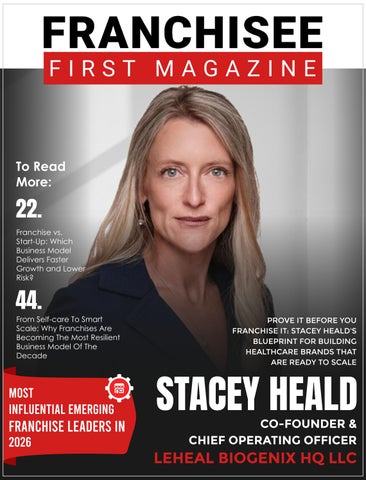
Our cover story this month features Stacey Heald, Co-Founder and Chief Operating Ofcer of LEHEAL BIOGENIX HQ LLC, a physician-led regenerative medicine company focused on patient education, transparency, accessibility, and individualized care. With more than two decades of experience across healthcare, wellness, franchising, multi-unit operations, consulting, training, and executive leadership, Heald brings a distinctive perspective to building organizations that are genuinely prepared to scale. At the heart of her philosophy is a straightforward principle: prove it before you franchise it. Rather than viewing franchising as an automatic next step, Heald believes a business must rst demonstrate that its economics, systems, training, leadership, and customer experience can be successfully replicated. For her, the second location is not simply another growth milestone. It is a test of whether the business model can truly operate beyond the founders. This philosophy is particularly meaningful within healthcare, where scalability must coexist with personalization and trust. Through LeHeal Biogenix®, Heald is working to standardize the experience without depersonalizing care. Clinical decisions remain individualized, while processes surrounding patient intake, education, documentation, scheduling, training, follow-up, and quality can be structured for greater consistency. Her leadership approach is equally focused on people. Heald believes strong systems are only effective when the people using them are properly trained, empowered, and equipped to make sound decisions. Clear accountability, practical training, communication, and operational discipline form the foundation for teams capable of growing with the organization. The planned Orlando-area expansion represents an important next chapter for LeHeal Biogenix®, providing an opportunity to test its model beyond its existing Tampa footprint. Recruitment, training, patient acquisition, systems, culture, and community relationships will all help demonstrate what works, what needs renement, and what can ultimately be replicated. While future licensing, strategic alliances, joint ventures, and franchising may become part of the company's development, Heald remains intentional about the sequence: rst proof, then replication, then responsible expansion. Her vision extends beyond simply adding locations, with opportunities to connect complementary healthcare organizations through shared resources, technology, talent, and operational expertise. Across this edition, we celebrate emerging franchise leaders who understand that lasting inuence is not dened solely by how quickly a business expands. It is also reected in the strength of its foundation, the people it develops, the communities it serves, and the systems it builds for the future. We hope this edition offers valuable perspective on the evolving world of franchising and inspires you to look beyond growth alone toward the principles that make growth sustainable. Thank you for being a valued part of our community. Warm regards, Rohit Shinde Editor-in-Chief Franchisee First Magazine
Contents
8.
STACEY HEALD
CO-FOUNDER AND CHIEF OPERATING OFFICER LEHEAL BIOGENIX HQ LLC
22. Franchise vs. Start-Up: Which Business Model Delivers Faster Growth and Lower Risk?
34. 44.
From Self-care To Smart Scale: Why Franchises Are Becoming The Most Resilient Business Model Of The Decade
Articles
The Franchise Advantage: Why Proven Business Models Outperform Traditional Start-Ups
8
Franchisee First Magazine www.franchiseefirstmagazine.com
Cover Story
STACEY HEALD PROVE IT BEFORE YOU FRANCHISE IT: STACEY HEALD'S BLUEPRINT FOR BUILDING HEALTHCARE
BRANDS THAT ARE READY TO SCALE CO-FOUNDER & CHIEF OPERATING OFFICER
LEHEAL BIOGENIX HQ LLC 9
Franchisee First Magazine www.franchiseefirstmagazine.com
10
Franchisee First Magazine www.franchiseefirstmagazine.com
11
Franchisee First Magazine www.franchiseefirstmagazine.com
12
Franchisee First Magazine www.franchiseefirstmagazine.com
13
Franchisee First Magazine www.franchiseefirstmagazine.com
14
Franchisee First Magazine www.franchiseefirstmagazine.com
15
Franchisee First Magazine www.franchiseefirstmagazine.com
16
Franchisee First Magazine www.franchiseefirstmagazine.com
17
Franchisee First Magazine www.franchiseefirstmagazine.com
18
Franchisee First Magazine www.franchiseefirstmagazine.com
Building Something Stronger Than One Brand The next phase of Heald's vision extends beyond adding individual locations. LeHeal Biogenix® is preparing to participate in a broader healthcare network designed to bring complementary brands, experienced operators, and shared resources together. The concept is intended to create efficiencies while allowing individual organizations to retain their identity and expertise. Shared technology, talent, operational resources, best practices, and strategic support could allow independent healthcare organizations to benefit from scale without surrendering what makes them distinctive. For Heald, that model reflects where healthcare growth may be heading. Organizations do not necessarily have to become larger by becoming less individual. They can become stronger by collaborating intelligently. The opportunity is to create an ecosystem in which independent organizations can share infrastructure, manage costs more effectively, improve the patient journey, and strengthen their collective capabilities. It is a different interpretation of scale. Not bigger for the sake of being bigger, but stronger because the right resources are connected. The Discipline Behind Influence Heald's recognition as one of the Most Influential Emerging Franchise Leaders in 2026 is particularly fitting because her philosophy challenges one of the industry's most persistent assumptions: that influence is measured by how quickly someone expands. Her influence is rooted elsewhere.
19
It is found in the discipline to question whether expansion is appropriate. In the willingness to examine the economics before celebrating the concept. In the insistence that systems must be teachable rather than merely documented. In the belief that capable leaders should be developed rather than micromanaged. And in the understanding that healthcare can scale without losing the human connection at its center. Her career has given her the perspective of an operator, executive, consultant, owner, and builder. Now, through LeHeal Biogenix®, those experiences are converging into a model of her own. The next chapter will test that model. Orlando will provide one measure. Strategic partnerships will provide another. Future licensing and franchise opportunities may eventually offer an even greater test. But Heald is not measuring success by the number of locations she can put on a map. She is measuring it by whether each new market can deliver the same level of trust, discipline, quality, and purpose that defined the organization at the beginning. That may be the more difficult path. It may also be the more enduring one. “Growth should never simply make an organization bigger. Done well, it should make the organization stronger, extend its impact and create greater opportunities for the people and communities it serves.” For Stacey Heald, that is not simply a philosophy about franchising. It is a philosophy about building. And in an era that often rewards speed, her willingness to prioritize proof over pace may ultimately become one of her greatest competitive advantages. Franchisee First Magazine www.franchiseefirstmagazine.com
22
Franchisee First Magazine www.franchiseefirstmagazine.com
23
Franchisee First Magazine www.franchiseefirstmagazine.com
24
Franchisee First Magazine www.franchiseefirstmagazine.com
25
Franchisee First Magazine www.franchiseefirstmagazine.com
26
Franchisee First Magazine www.franchiseefirstmagazine.com
27
Franchisee First Magazine www.franchiseefirstmagazine.com
28
Franchisee First Magazine www.franchiseefirstmagazine.com
29
Franchisee First Magazine www.franchiseefirstmagazine.com
Which Model Is Better for Different Types of Entrepreneurs? There is no single answer to the franchise versus start-up debate because entrepreneurial success depends largely on personality, goals, risk tolerance, and longterm vision. Franchising Is Ideal For Franchising tends to appeal to entrepreneurs who prefer structure, predictability, and lower levels of operational risk. It is often well-suited for individuals seeking proven systems and faster pathways to profitability. Entrepreneurs who value operational guidance, established branding, and scalable business models may find franchising particularly attractive. Likewise, investors interested in multi-location ownership often favor franchise opportunities because of their repeatable systems and expansion potential. Franchising is generally a strong choice for entrepreneurs seeking financial stability, proven operational frameworks, and reduced uncertainty. Start-Ups Are Ideal For Start-ups, on the other hand, often attract visionary founders and creative innovators who are passionate about building something entirely original. Entrepreneurs comfortable with uncertainty and willing to take calculated risks may thrive in the start-up environment. These individuals are often driven by innovation, disruption, and the excitement of creating unique products, services, or market solutions.
30
Leaders who enjoy experimenting, solving new problems, and shaping company culture from the ground up often find start-ups deeply rewarding despite the higher risks involved. Final Verdict: Faster Growth or Lower Risk? If the goal is faster growth with lower operational risk, franchising often delivers a stronger advantage. Its proven systems, established branding, customer trust, and operational support reduce uncertainty and accelerate market entry. For entrepreneurs seeking financial stability and predictable scalability, franchising presents a compelling opportunity. However, if the goal is unlimited innovation and potentially massive financial upside, start-ups offer unmatched possibilities. While risk is significantly higher, successful start-ups can generate transformational returns and industry influence. Conclusion The debate between franchises and start-ups ultimately comes down to one critical question: What kind of entrepreneur are you? Some entrepreneurs thrive within proven systems, leveraging tested models to scale efficiently and build sustainable wealth. Others are driven by innovation, creativity, and the challenge of building something entirely original. Franchises provide structure, support, and lower risk, making them ideal for entrepreneurs seeking faster entry into business ownership. Start-ups, meanwhile, reward bold visionaries willing to embrace uncertainty in pursuit of extraordinary growth. Neither path is inherently better than the other. Success lies in choosing the business model that aligns with your risk tolerance, financial goals, leadership style, and long-term ambitions. In the end, smart entrepreneurship is not about following trends; it is about choosing the strategy that positions you for lasting success. Franchisee First Magazine www.franchiseefirstmagazine.com
31
Franchisee First Magazine www.franchiseefirstmagazine.com
34
Franchisee First Magazine www.franchiseefirstmagazine.com
35
Franchisee First Magazine www.franchiseefirstmagazine.com
36
Franchisee First Magazine www.franchiseefirstmagazine.com
37
Franchisee First Magazine www.franchiseefirstmagazine.com
38
Franchisee First Magazine www.franchiseefirstmagazine.com
39
Franchisee First Magazine www.franchiseefirstmagazine.com
having access to strong systems and brand recognition. In reality, franchising rewards disciplined execution just as much as traditional entrepreneurship. Systems can provide direction, but outcomes still rely heavily on leadership, accountability, and everyday decision-making. Simply purchasing a franchise does not automatically guarantee profitability or sustainable growth. Equally important, not every franchise opportunity performs at the same level. Entrepreneurs must carefully evaluate opportunities by examining market demand, operational complexity, franchise fees, profitability potential, brand stability, leadership reputation, and the quality of long-term support structures provided by the franchisor. Due diligence matters deeply because even strong systems require thoughtful alignment. Why Franchising Continues Gaining Momentum Economic uncertainty has fundamentally changed how many entrepreneurs evaluate business risk. Rather than pursuing opportunities built entirely around uncertainty, aspiring business owners increasingly seek models capable of balancing independence with greater predictability. Franchising often delivers this balance by allowing entrepreneurs to step into business ownership while reducing many of the unknown variables traditionally associated with starting from scratch. Entrepreneurs gain the opportunity to build and manage their own businesses while benefiting from operational guidance, proven systems, brand recognition, and established frameworks capable of reducing costly trial and error. As industries continue evolving, franchise models increasingly appeal to professionals seeking business ownership without assuming
40
unnecessary operational risk. Healthcare services, wellness, education, hospitality, home services, fitness, food service, and professional consulting continue expanding rapidly through franchise growth worldwide. At the same time, consumers increasingly value consistency, reliability, and recognizable experiences, qualities franchise systems are often well positioned to deliver. For many entrepreneurs, franchising no longer feels like a compromise between ambition and security; instead, it increasingly represents a strategic approach to entrepreneurship grounded in both opportunity and practicality. The Future of Entrepreneurship May Look Different Entrepreneurship will always celebrate innovation. Start-ups will continue disrupting industries, introducing groundbreaking ideas, and shaping economic progress. Yet increasingly, entrepreneurs are recognizing that success does not always require building from zero. Sometimes, building smarter matters more than building alone. The future of entrepreneurship may increasingly belong to individuals capable of balancing ambition with practicality, leaders willing to leverage proven systems while still bringing personal leadership, operational excellence, and local market insight into business ownership. Because ultimately, successful entrepreneurship is rarely about ego. It is about results. And in many cases, proven business models outperform traditional start-ups because they allow entrepreneurs to focus less on survival and more on sustainable growth, customer value, and long-term success. In a marketplace where uncertainty continues rising, perhaps the greatest competitive advantage is not starting from scratch. It is starting from strength.
Franchisee First Magazine www.franchiseefirstmagazine.com
41
Franchisee First Magazine www.franchiseefirstmagazine.com
44
Franchisee First Magazine www.franchiseefirstmagazine.com
45
Franchisee First Magazine www.franchiseefirstmagazine.com
THE WELLNESS ECONOMY: A BUSINESS BUILT ON NECESSITY, NOT TRENDS 46
Franchisee First Magazine www.franchiseefirstmagazine.com
47
Franchisee First Magazine www.franchiseefirstmagazine.com
The Business Case: Why Investors Are Paying Attention
Challenges and Realities Franchise Owners Must Consider
From an investment perspective, wellness franchises offer an attractive mix of stability and growth. Many operate on membership or package-based pricing, which smooths revenue volatility and improves forecasting. Customer acquisition costs are often lower due to strong word of mouth and community engagement.
While the opportunity is compelling, wellness franchising is not without challenges. Regulatory requirements vary by region, particularly in health-adjacent services. Talent acquisition and retention can be demanding, as qualified practitioners are central to service quality. Additionally, local market education may be required in regions where certain wellness modalities are still emerging.
Operationally, wellness franchises tend to have lean staffing models and manageable inventory requirements. Compared to food or retail franchises, they often face fewer supply-chain risks and lower waste. When combined with rising demand and strong brand loyalty, the result is a business model that performs well even during economic uncertainty.
Successful franchisees are those who treat wellness as both a business and a discipline, committing to operational excellence, continuous learning, and community engagement.
Purpose Meets Profit: The Intangible Advantage The Future of Wellness Franchising One of the most compelling aspects of wellness franchising is its alignment with purpose-driven entrepreneurship. Franchise owners are not just selling a product; they are improving lives. Whether helping clients manage stress, regain mobility, or build healthier habits, wellness franchises create tangible social impact alongside financial returns. This sense of purpose has proven to be a powerful motivator for operators and staff alike. It also strengthens brand authenticity, an increasingly important factor for modern consumers who choose brands aligned with their values. Technology and Data: Elevating the Franchise Experience
Looking ahead, wellness franchises are poised to play a central role in how societies approach health and performance. As healthcare systems strain under the burden of chronic disease, preventive and lifestyle-based solutions will continue to gain relevance. Franchises that position themselves at the intersection of science, sustainability, and human connection will lead the next wave of expansion. In many ways, wellness franchising represents the future of entrepreneurship itself, scalable yet personal, profitable yet purposeful, standardized yet deeply human. Final Thought
The next phase of wellness franchising is being shaped by technology. Wearables, performance tracking apps, AI-driven personalization, and CRM platforms are enabling franchises to deliver more tailored experiences at scale. Data allows operators to measure progress, optimize programs, and deepen client engagement. Franchises that successfully integrate technology without losing the human touch are emerging as category leaders. The combination of empathy, expertise, and analytics is redefining what “premium wellness” looks like.
48
The rise of wellness franchises signals a fundamental shift in consumer priorities and business strategy. This is not a passing trend driven by aesthetics or aspiration. It is a structural transformation rooted in how people want to live, work, and age. For entrepreneurs and investors alike, wellness franchising offers more than a business opportunity; it offers a chance to build something enduring, impactful, and aligned with the future of well-being. Franchisee First Magazine www.franchiseefirstmagazine.com
49
Franchisee First Magazine www.franchiseefirstmagazine.com
Follow Us On: LinkedIn https://www.linkedin.com/company/franchisee-rst-magazine/ Facebook https://www.facebook.com/people/Franchisee-FirstMagazine/61557691663706/ Instagram https://www.instagram.com/franchiseerstmagazine/
Editorial & Partnerships Enquiry: info@franchiseefirstmagazine.com