THE
HURON EMERY CLEARING THE AIR @THEHURONEMERY
HURON HIGH SCHOOL, 2727 FULLER RD., ANN ARBOR MI 48105
NOV 2026 VOL. 12, ISSUE 2
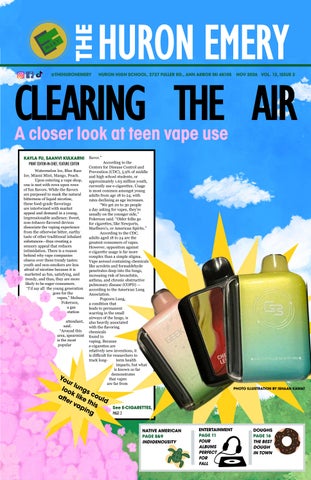
A closer look at teen vape use KAYLA FU, SAANVI KULKARNI flavor.” According to the PRINT EDITOR-IN-CHIEF, FEATURE EDITOR Watermelon Ice, Blue Razz Ice, Miami Mint, Mango, Peach. Upon entering a vape shop, one is met with rows upon rows of fun flavors. While the flavors are purposed to mask the natural bitterness of liquid nicotine, these food-grade flavorings are intertwined with market appeal and demand in a young, impressionable audience. Sweet, non-tobacco flavored devices dissociate the vaping experience from the otherwise bitter, earthy taste of other traditional inhalant substances—thus creating a sensory appeal that reduces intimidation. There is a reason behind why vape companies obsess over these trendy tastes: youth and non-smokers are less afraid of nicotine because it is marketed as fun, satisfying, and trendy, and thus, they are more likely to be eager consumers. “I’d say all the young generation goes for the vapes,” Melissa Fokerson, a gas station attendant, said. “Around this area, spearmint is the most popular
Centers for Disease Control and Prevention (CDC), 5.9% of middle and high school students, or approximately 1.63 million youth, currently use e-cigarettes. Usage is most common amongst young adults from age 18 to 24, with rates declining as age increases. “We get 20 to 30 people a day asking for vapes, they’re usually on the younger side,” Fokerson said. “Older folks go for cigarettes, like Newports, Marlboro’s, or American Spirits.” According to the CDC, adults aged 18 to 24 are the greatest consumers of vapes. However, opposition against e-cigarette usage is far more complex than a simple stigma. Vape aerosol containing chemicals like acrolein and formaldehyde penetrates deep into the lungs, increasing risk of bronchitis, asthma, and chronic obstructive pulmonary disease (COPD) — according to the American Lung Association. Popcorn Lung, a condition that leads to permanent scarring in the small airways of the lungs, is also heavily associated with the flavoring chemicals found in vaping. Because e-cigarettes are relatively new inventions, it is difficult for researchers to track longterm health impacts, but what is known so far demonstrates that vapes are far from
Yo ur l loo ungs aft k like coul er d va this pin g
PHOTO ILLUSTRATION BY ISHAAN KAMAT
See E-CIGARETTES, PAGE 2
NATIVE AMERICAN PAGE 8&9 INDIGENOUSITY
ENTERTAINMENT PAGE 11 FOUR ALBUMS PERFECT FOR FALL
DOUGHS PAGE 16 THE BEST DOUGH IN TOWN
THE HURON EMERY | ISSUE 2: NOVEMBER
2 | NEWS
Ann Arbor Public Schools’ visions for the future AAPS families discuss resource distribution during a strategic plan meeting JOSEPH SUNG NEWS EDITOR On Oct. 14, 2026, district leaders, families, and school faculty gathered at Huron High School to discuss further developments within the Ann Arbor Public Schools (AAPS) system. Prior to the meeting, a newsletter was released on the Sunday of that week, informing faculty and families across the district that the meetings would take place on two dates: October 13 at Pioneer High School and October 14 at Huron High School. The purpose was to hear directly from families and staff within the Ann Arbor public school community and develop strategies for future plans. The event began at 6:30 p.m., with Jade McLaughlin opening by going over the purpose of the meeting. “We are here tonight to gather community input,” Senior Director of District Management Jade McLaughlin said. “But overall, we are going to create a draft.” Slides and graphs displayed district budgeting, monetary distribution, and results from the
previous meeting at Pioneer High School. Following McLaughlin’s opening, the microphone was handed to Performance Coach Michelle Sumter, who provided an overview of parents’ input. “The first would be community involvement. Listening to it and honoring it,” Performance Coach Michelle Sumter said. “The second is finance and operations—making sure district funds are reported. And finally, opportunities for all students. Highly diverse students… making sure all students have access to equal opportunity.” After her presentation, Sumter opened the floor for group discussions. Different sections of the cafeteria were labeled with various district issues, and attendees were separated into groups based on which issues they considered most urgent for the AAPS district. These included teacher well-being and safety and security. Parents, staff, and students within each group began writing problems and potential solutions on sticky notes and placing them on large sheets of paper. “So far, I have outdated
and unsafe facilities, equity among schools, transparency within funding, too much funding towards administration, teacher salary, and too much reliance on support,” Seth Payne said. During discussions concerning public funding, participants brought attention to disparities in funding among schools within the district. For example, Pioneer High School receives significant benefits from the University of Michigan, while Huron High School is excluded from such thirdparty university funding. After discussing new ideas and concerns, each group selected a spokesperson to present its findings. The microphone was handed to students, teachers, and parents who represented their respective groups. “There were a lot of comments, like, floating around about staff retention,” student Malik Hijazi said. “And some reasons I saw for that were personal hiring, equitable hiring. Like, there were some comments I saw about your lack of knowing your colleagues, feeling like they weren’t working with people. They weren’t working
alongside people. They just happened to be, you know, coworkers, which isn’t exactly a favorable environment when teaching.” Additionally, several participants in the financial group reported that equipment and facilities were inadequate for safe usage. “I definitely think that our group had a lot, a lot of emphasis on the facilities themselves,” student Seth Payne said. “As a football player myself, I would love to go play a game without worrying about my back breaking, or go practice on a grass field without worrying
about stepping out for a night. That’s a really big concern of mine every time I go out there.” Overall, a recurring theme was the distribution of resources and how they are managed, as parents who spoke up pointed out. “The things that sort of caught my attention seem to be sort of the theme of distributing resources,” an AAPS parent said. “A specific example is, you know, like an actual violent student disrupting class and hardly
Peope in attendence putting down sticy notes during the event on Oct. 14. PHOTOS BY LEBRON.
Ben Tepfer said. “It’s annoying for other students who don’t do it because it gets the bathroom all foggy and kids breathe that in. You never know who has asthma and what risks there are with that.” The bathrooms are seldom free from the lingering, distinct smell of vapor, a reminder of this vaping prevalence. From monitoring school bathrooms to responding to reports of students vaping on campus, administrators face the challenge of addressing a problem that can be difficult not just to prevent but detect in the first place. “If we see someone with a vape, we’ll take them to an admin and get that figured out,” Tepfer
said. “I really try to talk to the kids that I know do it and try to get them to stop.” Under the Ann Arbor Public Schools Rights and Responsibilities policy and standard Michigan educational guidelines, vaping is strictly prohibited on campus grounds. Upon a first offense, the device is confiscated and parents are notified immediately. In some cases, a school recovery coach may be assigned to work with the student. Subsequent offenses may result in inschool suspension of multiday out-of-school suspension. For student athletes, getting caught may result in temporary suspension or removal from sports team. The consequences, however, extend beyond the students caught vaping. As the school works to curb e-cigarette use, students who do not vape can also face disruptions and restrictions intended to deter the behavior. Measures intended to address vaping can affect the larger student body, shown through select bathrooms closing down, raising concerns about how schools can hold students accountable without having to penalize those who have no involvement. For students who vape, meanwhile, punishment
addresses the behavior without necessarily addressing its underlying causes. Understanding why students turn to it in the first place is essential to understanding why the problem persists. Substance usage is not solely the result of young people choosing to indulge in usage of a fun ‘beginner drug.’ For many, vaping is used as a coping mechanism against mental turmoils like anxiety, stress, and depression. According to the Newport Institute, around 81% of young vapers report they started vaping to combat stress, anxiety, or sadness. “I started in middle school when I was hanging out with my cousin and we found a vape on the street,” Jane Doe said whose name has been changed due to privacy. “At the time, I had ADHD, but I didn’t know. But it helped control my symptoms, so I kept on getting more.” The short-term relief from these stressors comes from the nicotine within the vape. However, when nicotine leaves the body, dopamine levels drop, triggering irritability, anxiety, and low mood, often known as the trap of withdrawal. Vaping can bring one this temporary satisfaction, but its absence
READ THE FULL STORY ON THEHURONEMERY.COM
E-CIGARETTES | FROM PAGE ONE harmless. Prevalence of vape usage in the teen age group also creates a large additional problem: e-cigarette abuse on school campuses. In Huron, this abuse has increased within the past years, severity of punishment following along closely. As the prevalence of e-cigarette usage rises on the grounds of Huron, so has monitoring of the issue and movement against it. “I know a lot of kids are addicted and I think they get addicted in middle school,” community assistant
1.63
millions of youth currently use e-cigarettes according to the CDC
GRAPHIC BY KAYLA FU
will always leave one craving for more, becoming a cycle that can be incredibly difficult for many--especially longterm users--to break. “It’s just too inconvenient to stop and go through the process of withdrawal,” Jane Doe said. “It’s so integrated into my daily life that I don’t know what else I would do.” The reality of vaping is that the moments of brief relief, when repeated consistently over a long period of time, will raise a person’s baseline anxiety, according to the Baylor College of Medicine. From studies conducted by the Truth Initiative, about 90% of young people who quit claim to feel less stressed, anxious, or depressed following the period of withdrawal from the substance. The evidence suggests that there are real dangers to habitual vaping, and for young, developing brains the consequences are more severe. Unfortunately, these populations are the most vulnerable to developing this habit. When underage substance abuse reaches near epidemic levels of popularity, investigating what lies beneath this trend of teenage rebellion is imperative.
THE HURON EMERY | ISSUE 2: NOVEMBER
3 | NEWS
Cheating spree continues in advanced math classes JAEWON LEE PRODUCTION MANAGER Academic integrity concerns in advanced math classes at Huron have continued into the 2026-2027 school year, after teachers learned of widespread cheating and the circulation of tests on social media during the 2025-2026 school year. “I feel disheartened and frustrated to go into the weekend needing to write this message,” BC Calculus teacher Abbey Wolford wrote in an Oct. 2 communication to students’ families. “There has been discussion that students are following this same pattern of poor decision making yet again this year in this class, and frankly, I’m at a complete loss.” According to Wolford, the math department has been told that many of the test-takers in BC Calc were using old tests to study for the recent exam, which follows a similar incident that took place during the previous school year. On March 18, 2026, then-AP Precalculus Plus teacher Stephen Wheeler notified students that a test administered days earlier had been compromised. “Unfortunately, while we were able to identify who compromised it I can not be certain of the validity of any of the tests taken that day,” Wheeler wrote on the 18th. Because Wheeler could not verify the validity of the assessments, the compromised test affected all of the AP Precalculus Plus
Huron AP Calculus BC teacher Abbey Wolford teaches her fourth period class. COURTESY OF JAEWON LEE classes. “I will need to have all students take a new test which will be given this Thursday [March 19],” Wheeler wrote. “This test will fully replace the previous test, which I will not be scoring.” Despite the structured response plan last year, the cheating had not yet died down following the first two BC Calc assessments handed out this school year. While Wolford said she had already addressed academic dishonesty with several students, which involved interim principal Claire Federhofer dropping in recently, she is afraid that no single fix that is lenient will be enough. “Trust has been broken,” Wolford wrote. “I have taken many measures to
ensure this does not happen, but clearly, more needs to be done.” In an interview with The Emery, Wolford said that studying using old tests is a “decent tool.” However, Wolford said that it should not become the main focal point of preparation. “What we don’t want and what shouldn’t be the goal is memorizing old tests,” Wolford said. “Learning is not memorizing. Mastery is demonstrating deep understanding in new scenarios.” Despite Wolford’s teaching, many students are still committing academic dishonesty not by memorizing old tests, but by circulating them on social media. This makes Wolford worry that the cheating problem is more than just skin deep.
“Students are under a number of stressors including but not limited to their own intrinsic desire to always achieve a high mark, a competitive nature to outscore friends, pressure to do well from other sources, how grades will look on transcripts, fear of how difficult a test will be, and this list goes on,” Wolford said. “Sometimes, at this age, students cannot even see that the choice they are making is so deeply flawed because they become blinded by so many other factors.” In response to the student’s continued decision of academic dishonesty, Wolford explained how she would rewrite the tests without making it unfair to academically upright students. “Tests will be rewritten from scratch,” Wolford said. “As we [all know], mathematics is an age-old language. Although they will be new tests, they must assess the same material. Thus, fairness and opportunity are still intact.” While rewriting the tests may help the problem, Wolford thinks the issue is deeper. Wolford says that people who already commit academic dishonesty during high school will continue toward the same path throughout their life, including college. Chang Kim, a professor at the University of Michigan, shared similar
concerns about the long-term consequences of cheating. “Academic dishonesty offers no meaningful long-term benefit,” Kim said. “Such practices can establish harmful habits and may eventually lead to more serious mistakes in students’ personal and professional lives.” According to Kim, the consequences of academic dishonesty go beyond just grades and test scores, potentially affecting the student’s credibility and opportunity in professional fields. “Academic integrity is essential in scientific research and other professional fields because progress depends on trust, honesty, and reliable work,” Kim said. “Without integrity, students may damage their credibility and limit their ability to advance after college.” Kim also emphasizes how the high school foundation could develop strong, or negative, academic habits that will affect them later in life. “Many fundamental skills, particularly in mathematics and science, are developed in high school,” Kim said. “Building a solid academic foundation and strong study habits during READ THE FULL STORY ON THEHURONEMERY.COM
THE EMERY STAFF ADVISERS Sara-Beth Badalamente Theresa McKelvey EDITORIAL BOARD: Annabella Mi 403008@aaps. k12.mi.us Ishaan Kamat 435293@aaps. k12.mi.us Kayla Fu 321984@aaps.k12. mi.us Lakshya Jaiganesh, Mia Lin Website Editors-in-Chief Johnathan Pryor-Mcadam Social Media Editor-in-Chief Amelia Bai Chief Content Editor Amy Yang Managing Editor EDITORS Jenny Zhang Copy Editor Jaewon Lee Production Manager Joseph Sung, Andrew EtchIll News Editors Will Ye, Saanvi Kulkarni Feature Editors Esmie Salinas Opinion Editor Sofia Reyes, Yara Al Qahwaji Arts and Entertainment Editors Anaya Spero Maloney, Max Fine Sports Editors STAFF WRITERS: Ali Abufarha Ahmed Aboelnaser Abeda Ahmadi
Huma Ahmadi Christopher Albright Nyshaun Anderson Naidelyn Ayala-Martinez Francis Badalamente Maelle Bautista Alvarez Benson Barry Ameena Briggs Dylan Brown Juan’ye Brown Alexis Callejas Lazo Alexandra Carcamo Antunez Jefferson Castellon-Lazo Miyah Carter Brame Ximena Chaves-Gutierrez Mya Clay Travis Cole Elber Cordon Perdomo Johanan Coward William Cronin Na’Riyah Cross Maberick Cruz Martinez Alexa Diaz-Vasquez Yusuf Derani LaMarr Eddins Johnny Epps Christopher Escobar-Villalobos Maverick Flagg Liam Flaherty Elijah Franks Tyce Frye Angie Funez
Theo Gadepalli Eliza Gallippo Gabriella Garcia Fernanda Lucia Garcia Perez Nicolas Garduno-Klynsta Mindi Garduno-Ronquillo Alex Gebhardt Kaliyah Glasgow Kaliyah Glenn Cesar Gomez Castillo Elliot Gray Cobe Greer Dohjun Ha Mikael Hamilton Aiden Hathaway Aaron Head Jordan Head Anthony Hernandez Hailey Herrera-Cartagena Leopold Heskia Everton Holness Ji Fu Huang Demarion Hudson Jackson Hutchings Janan Ishteiteh Karma Ismail Tarun Iyer Aaron Jackson Dannyale Jackson Noah Jackson Cora Keech Noah Kenyon
Talal Khan Amelia King Edin Linic Shayla Ly Emily Mencia-Valle Annabella Mi Jessica Milner Saulo Monroy Rivera Jessica Moore Michael Moye Ruhani Nagrath Bryan Nava-Nava Madison Okere Juan Pacheco-Mendoza Marley Palma Gutierrez Zaida Pelzer Avani Pen Andrea Perez Bermudez Daniel Pritts Aditri Rajendiran Jasper Randall Kelis Reed Omar Reyes-Galindo Annika Richards Silas Rodeffer Christhofper Rubio Cruz Rihanna Ruff Douglas Sabillon-Fernandez A’Rayia Sanders Omar Sandoval Enamorado Miles Sasatani Yesenia Sanchez
Jetten Shah Thalys Shiue Aeris Simpson Mahi Singh ShaMari Singleton TayKwon Smith Alexandra St John Isabella Stone Dakota Suire Joseph Sung Pili Talam Jayani Tavane Paavani Tewari Syrrhian Thomas Jelani Thompson Tymya Thompson DeVon Thurman Liam Torreano Phoenix Turman Alexander Traicoff Sequoia Vetter Jonah Wagner Miles Walden Marcus Walker Keenan Waller Violet Wellington Darius Whetstone Kayla White-Bey Leon Williams
THE HURON EMERY | ISSUE 2: NOVEMBER
Daniel
Crowley’s
ZAHRA SYED STAFF WRITER For Huron High School English teacher Daniel Crowley, learning doesn’t stop when the school day ends. Instead, it can continue hundreds of feet above the ground, climbing Colorado’s rocky peaks or helping students discover a new hobby through our school’s Rock Climbing Club. Crowley, who primarily teaches English nine along with journalism,
personal project, and digital media production, has been rock climbing for about 12 years. What started as a new experience after moving to Colorado has become a regular part of his life “[In Colorado,] when the workday would end, you would have friends text you like, ‘Who wants to go for a hike? Who wants to go watch a sunset? Who wants to go fishing?’” Crowley said. “People were just kind of always going outside to do things.” Although Crowley visited climbing gyms while
Huron English teacher Daniel Crowley rock climbing. PHOTO COURTESY OF CROWLEY
passion growing up in Michigan, he didn’t get seriously involved in the sport until he moved to Colorado, where a friend helped him take the next step in his climbing journey. Mark Freed, a college professor who taught Crowley as an undergraduate, had been a professional cyclist before a cycling accident kept him from continuing, and he prompted Crowley to start rock climbing with him. “One year he had a cycling accident,” Crowley said. “He was like a professional cyclist, and he called me and said, ‘I’ve always wanted to get into rock climbing. I can’t cycle anymore. How do you feel about going on a climbing trip?’ So I started training, and we went on our first trip to the mountains.” Today, Crowley enjoys many types of climbing, including indoor climbing and bouldering, but his favorite styles are sport climbing and traditional climbing. He also enjoys multi-pitch climbing, where climbers ascend taller rock faces in sections, bringing their rope and equipment along with them as they climb. “It’s really technical, and it’s kind of scary, but it’s fun,” Crowley said. One of his most memorable experiences happened this past summer
for
4 | FEATURE
rock
climbing
when he and his climbing partner reached the summit of a challenging mountain. The accomplishment marked an important milestone in his climbing experience. “So there’s all sorts of rock climbing you can do, but there are certain mountains that are so tall they have names, and we got to the top, the very tip top of our first named peak this last summer,” Crowley said. “Technically, our second, but the first one was so easy we didn’t really count it. Although climbing mountains is more of an individual challenge, Crowley says the sport’s community is one of the main reasons he enjoys it. “There’s a more welcoming and inclusive community than I’ve ever found in sports,” Crowley said. “So many sports are kind of toxic and competitive, but rock climbing is all about welcoming people in, no matter their ability level, age, race, gender, or, you know, level of physical ability.” That inclusiveness also connects to Crowley’s work with students. Before coming to Huron, he started a climbing club at a school in Denver, where he taught at a
predominantly Black school. “I learned that the vast majority of my students had never been to the mountains before,” Crowley said. “They were only maybe a 30-minute drive, and you can see them right outside the school window, but most of our kids had never gone. So I started that club as a way to expose students of color and students who had not had opportunities to go to the mountains to, like, get outside and go try these new sports.” Since then, Crowley has started climbing clubs at every school where he has taught, continuing to introduce students to the sport, and at Huron, the club gives students an opportunity to explore climbing and connect with others outside of the classroom. Crowley encourages students of all experience levels to give it a try. Crowley hopes more Huron students will take advantage of the club and experience climbing for themselves. “Come join Rock Climbing Club. We meet every Friday at three.”
More than just a meal: the family-owned restaurant Banditos Fresh Mexican KHILA GLASGOW, EVERTON HOLNESS STAFF WRITERS Behind every owned family restaurant is a passionate group of people who love sharing their recipes, culture and family experiences with their community, but which restaurants are worth visiting. One local family-owned restaurant we visited was Banditos Fresh Mex in Ann Arbor, Michigan, about ten minutes away from Huron
High School. Banditos was opened in 1987 by Jay Singh. Interestingly, the restaurant is owned by the family of Ken Singh, a Huron graduate from the class of 1994. This is not the first restaurant they have owned, as their previous restaurant in downtown Ann Arbor closed due to competition arriving, which led them to purchasing Banditos. “We had the first Indian restaurant in Michigan, and then 20 families started coming in to open an Indian
A Cheese quesadilla at Banditos. PHOTOS BY KHILA GLASGOW
restaurant. 20 families in Ann Arbor–that’s too many Indian restaurants,” Signh said. During our visit we decided to try a few items from the menu, to get a better understanding of the restaurant’s food and what it has to offer. We ordered a Mexican pizza and a quesadilla meal, which gave us the chance to try different flavors and see what the restaurant does best. In total we individually paid $18.95 and $20.90, including tips. To gain another view on the restaurant we also asked a customer about their experience. The customer chose to remain anonymous but still shared their thoughts on the food and service: “I felt like the servers were very attentive and the food was really good and authentic.” This allowed us to compare our own experience with other customers. One thing that stood out to us was the vibe and that they brought us complimentary chips and salsa before our meal was served. It gave us something to snack on while we waited for our food. Although it was
Decor inside Banditos. PHOTO BY KHILA GLASGOW a small and kind gesture, it showed an extra level of hospitality and made our visit more enjoyable. The vibe when we went was very calming and inviting, there were unique designs on the furniture and walls. Which really showed they wanted to create a welcoming environment. Our experience at Banditos was a positive one. Between the food, the friendly service and the vibe, Banditos gave us a good impression of what they had to offer the area. Banditos Fresh Mex located at 3395 Plymouth Rd, Ann Arbor, MI 48105 .
A Mexican pizza at Banditos. PHOTO BY KHILA GLASGOW
Drinks at Banditos. PHOTO BY KHILA GLASGOW
THE HURON EMERY | ISSUE 2: NOVEMBER
5 | FEATURE
Huron senior turns up the volume for his passion in music AMELIA BAI CHIEF CONTENT EDITOR When senior Daniel Kim is DJing, he feels electric. There is something about the thrill of music pulsing through one’s veins — the bass of the speakers echoing throughout a room, the satisfaction of a slow fade into the next song, the rhythmic thumping of feet against the dance floor to the beat of the music. Kim was first introduced to DJing by a friend, Huron alumni Ethan Yung. Kim and Yung have now DJed multiple events together, including homecoming and prom at Huron. Although he’s DJed dozens of events now — ranging from self-hosted pregames amongst friends to
school events with hundreds in attendance — he still remembers the trouble he had in the beginning, more than a year ago. “When I started, I had no clue what I was doing,” Kim said. Kim describes DJing as having a difficult learning curve. Even having been raised in a musical family and growing up playing instruments, Kim had difficulty adapting to the technique of DJing. “I remember when I first started, I was like, ‘dude, this is so hard. Like I’m never going to be able to do anything good with this,’’’ Kim said. More than a year later, Kim is more confident in both his creative process
and live performances. While some DJs like to premake setlists and know exactly what they’re going to spin, Kim likes to build what he calls a “skeleton” before DJing — a brief structure or outline of the setlist. Kim describes his skeleton as following a formula: fluctuation in energy. “It’s all about just building up energy for the crowd, and then bringing it back down, and then bringing it back up just over and over again,” Kim said. The process sounds simple, but live DJing isn’t always so simple. A crowd’s moods and preferences can change drastically depending on the time and event. Even though he has a setlist, Kim relies largely on improvisation and understanding of the crowd on stage. “You just read the crowd,” Kim said. “Let’s say you have two different types of songs, you play one, the crowd’s dead. So you play the other one, and everyone loves it. You just keep playing until they get bored of it, and then you play something else.” When choosing the next song, Kim focuses on matching the songs and the effect on the crowd’s energy. “I just kind of figure it out in my head,” Kim said. “Like, okay, this [song’s] a little lower in energy, but it sounds really similar… the energy builds up here. So if I transition here into whatever next song [then] I can build up that energy.” According to Kim, live DJing relies on two important aspects: reading the room and energy. “Anyone can turn knobs and make it sound good, but you have to know
how to read the room and play the right songs,” Kim said. “If you chop a really bad song, [then] the energy is just going to die. Everyone’s like, ‘dude, what is this? Get off the dance floor.’” He hasn’t had to get off the dance floor yet, but Kim has had his fair share of struggles and failures. He emphasizes that especially in a high pressure, live activity like DJing, messing up is inevitable — it’s the recovery that matters. “It’s hard to mess up and then keep going,” Kim said. “But that’s the trick. You have to pick up again, just from practicing. It’s all experience, really.” He believes that practice is crucial, and there are no shortcuts that one can take to get better at DJing. It takes time and effort, but that’s what makes finally getting an effect right or smooth remix all the more worth it. “Nothing is gonna ever change it super fast,” Kim said. “It’s just practice…You’ll pick up these little tricks that you don’t even realize. You’ll just do it subconsciously, and then eventually, like you won’t even realize it, but you’re like 1000 times better than when you started.” Despite everything, Kim continues to DJ for the love of the game. “It’s just so fun,” Kim said. “You get up there and you play music. When I play the right music and it gets everyone hyped and I can get hyped with them too. It’s just a blast. And after I’m done, when I’m packing up, I’m like, ‘dude, I’m never gonna stop this.’”
A large part of his love for DJing lies in the flexibility and creative freedom. “You can do whatever you want,” Kim said. “You can take the weirdest songs and you can transition them into the coolest stuff. Add the coolest effects…there’s no one telling you what to do, right? It’s just you, so it’s fun.” As a current senior in high school, Kim hopes to transform his passion for DJing into something more in the future. Kim has already begun to move past DJing by making his own music, something he hopes will set him apart from others in a saturated environment. “I make music too because I want to take DJing further than just a hobby,” Kim said. “Anyone can turn knobs and play music on it, but what really sets you apart and gets you viral is your own music.”
Scan the QR code to view Daniel Kim’s SoundCloud account.
Daniel Kim DJing at a party. PHOTO COURTESY OF KIM
Shaping more than clay: the impact of art education AMY YANG MANAGING EDITOR A part of the multitude of art classes offered at Huron, the Huron Ceramics and Sculpture class provides students a chance to experiment and work with different types of three-dimensional mediums through clay and mixed media projects. The hands-on approach is often times able to produce tangible works of art that students are able to to bring home or exhibit in galleries throughout the school year. This is one of the reasons that class is appealing to many students when deciding between art classes. “I chose to take this class because the art of creating
something tangible and 3D with my own hands sounded really fun, and it’s a nice way to take a break from my usual academic schedule,” junior Selina Tang said. In fact, according to the National Endowment for the Arts, “art education is linked to positive academic outcomes and social and emotional development.” While art education is an important contributor to one’s academic success, it is so much more, playing its own independent and crucial role. “I believe the arts are more important than ever in a student’s overall education, especially as AI and technology become a larger part of daily life,” Arts and Humanities teacher Jonathan
Smigell said in an interview with the AAPS District News. “The arts support human qualities that can’t be recreated by machines.” Uniquely, previously, the class has collaborated with the Humanities class that is offered by Huron’s International Baccalaureate (IB) Diploma Program (DP). A big focus of many DP programs, specifically Humanities, is the application of learned material in real life, and many students have had the opportunity to apply historical and culturally significant artistic methods within the ceramics studio at Huron. “Through making and responding to art, students learn to observe life more
closely, interpret meaning, and connect with their own life experiences as well as others,” Smigell said. The process of brainstorming and designing ideas, deciding between artistic mediums, executing, evaluating, then refining until a finished product is complete can sometimes feel strenuous and tedious, but focusing on every little step counts. In creating sculptures and ceramic art, consistency matters and is crucial in one’s ability to not only learn but to grow. For Tang, this triumphs inherited talent. “Rather than being ‘talented’ or inherently better, your success is dependent on whether or not you showed up and tried,” Tang said.
Student work that exemplifies the outcome of consistent hard work in the Huron art classes can often be viewed during Huron Art Night and other exhibitions throughout the school year.
Mohammed Karim, Dan Bozeman, and Seoungeun Moon(left to right) work on an enlargement print cutout for photography class. PHOTO BY KAYLA FU
THE HURON EMERY | ISSUE 2: NOVEMBER
6 | ADS
FINE COFFEES AND TEAS IN NICKELS ARCADE
Looking to adverstise? Reach out to thehuronemery@gmail.com for details.
2026-2027 HURON HIGH SCHOOL
IT’S MORE THAN A
YEARBOOK
ORDER YOUR COPY TODAY!
It’s a collection of moments that define the year.
Scan the code, or go to: jostens.com/ybkhp +1 (877) 767-5217
BE IN THE YEARBOOK MORE. A LOT MORE.
UPLOAD YOUR FAVORITE PHOTOS photos.jostens.com/hpshare
©2026 Jostens, Inc. 260428
THE HURON EMERY | ISSUE 2: NOVEMBER
Obsession, directed by Curry Barker, is a psychological horror film surrounding a music store employee named Bear and his co-worker and friend, Nikki. Bear, hopelessly in love with Nikki, uses a cursed object called the One Wish Willow to wish that Nikki will love him more than anyone else in the world--spurring the events of the movie into place. Nikki is taken over by a possessive “entity,” turning what was supposed to be a sweet romance into a nightmare. Nikki Freeman is the central character in Obsession, where her fate is a symbol of male entitlement. After the wish is made, Nikki is stripped of her bodily autonomy, forced to watch helplessly in a purgatory state as her body wastes away, controlled by a force she does not know.
GRAPHICS BY KAYLA FU AND JESSICA MILNER
Backrooms, directed by Kane Parsons, is a horror film following Clark, a struggling furniture store owner who discovers a portal to a surreal, infinite dimension behind his store’s basement wall: the Backrooms. When he goes missing, his therapist, Mary, ventures into the nightmare dimension to find him and bring him back. As the two explore the space, they are stalked by entities mimicking the real world. Clark is the central character of Backrooms, where his experience navigating the subliminal dimension reflects trauma, grief, and unresolved feelings. The realm is a physical manifestation of Clark’s inner turmoil, acting as a graveyard of blurry memories that Clark must confront and defeat.
7 | 2026 HORROR MOVIES
Resident Evil, directed by Zach Cregger, follows Bryan, a medical courier taking a package to Raccoon City General Hospital. Unbeknownst to him, Raccoon City has been taken over by a catastrophic viral outbreak, turning infected into flesh-eating monsters. On his way to the hospital, Bryan hits an infected woman, damaging his car and setting off the events to his fight for survival as he is forced to find a way to deliver his package. Bryan Hodukavich is the central character of Resident evil. He is an anxious, ordinary man, unlike other protagonists of similar movies. He misses easy shots, panics, and is utterly unequipped for the crisis, making him both realistic and human enough to be relatable.
THE HURON EMERY | ISSUE 2: NOVEMBER
8 | NATIVE AMERICAN HERITAGE MONTH
‘One of the very few’: being Native American JESSICA MILNER STAFF WRITER
It sucks being one of the very few Native Americans in my school. I am a tribal member of the Little Traverse bay band of Odawa Indians (LTBB). Despite being a fully recognized tribe, we do not have a reservation. Due to a federal court ruling in 2021, it was decided that the historical 1855 Treaty of Detroit established an arrangement closer to individual land allotments to tribal members instead of one unified stretch of land, which would be a traditional reservation. Today the LTBB owns disjointed pieces of land that are entitled to government protection. This fragmentation of tribal land means that our tribe is uniquely diasporic. A lot of LTBB members are scattered across Michigan. My tribe is unique in this way, and so my experiences as an indigenous person do not fit within the typical idea of reservation based natives. Additionally, I am an urban Native, where I am further disconnected from my cultural community because of my city residence. Altogether these factors make my cultural identity hard to identify externally. The way that Native Americans are often represented in the dominant culture makes it seem like we are a monolith. And my experience of being Native American does not fit within the confines set by these
stereotypes. Regardless, I am no less Native than my cousins who live up north; where the population of Indigenous people is higher. Though, because I am not surrounded by other native people, and it is not affirmed by the typical understanding of native identities, my identity has to be grounded by my own assurance. To be so separate from my cultural community can be a massive disadvantage, as the values and practices I was raised with as an indigenous person are so often misinterpreted by institutions. My culturally backed ideas and understandings can be read as unnecessarily eccentric or difficult. My confusion and intuitive processes can be read as stubborn and nonconforming. All of the features that come from my cultural upbringing are associated with negative character traits. Because to these institutions, my heritage is unrecognizable. Leading to subtle limitations in accessing opportunities and prestige, which for so long, I associated with a fundamental issue in my personhood rather than a cultural mismatch. This invisibility coupled with little communal support makes it unbelievably difficult to reconcile the disparities between my efforts and the resulting outcomes. It has always seemed like I have had to expend a disproportionate amount of energy towards the structures that come so naturally to my peers. Last summer, I took a trip to Illinois to participate in an indigenous pathways summer camp. Where Natives from all over the United States came to do workshops and college prep. This was the first time I had an opportunity to interact with other natives outside of family gatherings, my older siblings’ friends, and powwows. There I met Natives from Wisconsin, Chicago, New Mexico, Oklahoma, and Michigan–all from different tribal backgrounds. Each of them presented their cultural heritage in vastly different ways, but we could all relate to the shared understanding READ THE FULL STORY ON THEHURONEMERY.COM GRAPHICS BY ANNABELLA MI
THE HURON EMERY | ISSUE 2: NOVEMBER
9 | NATIVE AMERICAN HERITAGE MONTH
The 12 federally recognized tribes
‘It’s not just a history class’: Native Studies at Huron ANNABELLA MI PRINT EDITOR-IN-CHIEF It’s the place where myths are broken. There’s a class at Huron that just began last spring; in its return for the second semester, Huron government teacher Allison Echlin instructs this Native Studies elective, but she doesn’t necessarily categorize it as a class. “The goal is to help our social studies teachers include material in the classes we already teach,” Echlin said. “To be more conscious and more intentional of telling more stories.” Last year, Native Studies had 18 students for the elective’s debut. Behind it, Echlin had undergone over a year of professional development
(PD), initiated by social studies secondary district chair, Jared Aumen, who created this program that held Echlin and 25 other teachers. Right after the last day of the 2025-24 school year, the PD began. The curriculum for Echlin involved an excursion to former Indigenous boarding school sites, the Ziibiwig Center, River Raisin from the War of 1812, and numerous guest speakers. A memorable one was a districtwide symposium with Angeline Boulley, author of English 9 novel “Firekeeper’s Daughter.” “I think the emphasis was on reflecting, and that was my favorite part. They gave us space as a staff and as a person to reflect on the things we were learning,” Echlin said. “And
to truly think about how we could incorporate things into our classes of value and storytelling.” In Powerschool, she started the school year with over 20 students in her one section of Native Studies elective for semester two. Currently, it has decreased to nine. “The biggest hope is that it gets to continue,” Echlin said. And in the prospective second semesters, she also hopes for two sections of 24 students. “There are these myths that occur that have become part of normalizing this idea that Native nations aren’t nations, or this idea that Indigenous people all live on reservations,” Echlin said. “But each individual person has a story. Let alone each individual nation has a
story.” In the curriculum Echlin has curated, it is based on what students want to learn more about. For example, it was the medicine wheel last year. Because after the first two units of Native Studies, the way she teaches is a circular timeline to be intent with what 50 minutes of the hour are given. “And I honestly wish the class would be an entire year because I still as a teacher had to often choose right. I try to be purposeful in all of my classes, but even more so in that class because of all the myths that occur,” Echlin said. “It’s not just a history class.”
THE HURON EMERY | ISSUE 2: NOVEMBER
10 | OPINION
The difference between a dog and a cow KAYLA FU PRINT EDITOR-IN-CHIEF What is the difference between eating a dog and a cow? Who gets to decide the rules of what is the “correct” thing to eat? What lies behind the moral meaning societies attach to certain foods and eating habits? Should there be a moral code to what we eat at all? In Western culture, dogs are family. They are cuddly companions, special status children, and trophies to parade around by selfproclaimed “dogparents.” They have emotions, feel pain, feel pleasure, and can, similarly to humans, be perceived as intelligent. Above all, they are worthy of life and a certain pedestal that places them above all other animals deemed less useful to humanity. It is wrong to eat a dog. It’s also wrong to eat a cockroach - that’s disgusting. Horses too, they’re far too intelligent and are better for other uses. Don’t eat bunnies either - they’re cute, and someone might feel bad. You eat pig intestine? Okay, it’s
okay to like pork, but that’s way too far. And yet, there is no consensus to determine whether any of the above statements are based on factual evidence. In reality, there is no morality tied to what we eat. We do not have a true reason to refrain from eating a dog, cat, cockroach, bunny, grasshopper, alligator - so what is telling us that
large-scale industrial agricultural facilities that confine animals indoors or in feedlots, impose severe welfare impacts on animals. Animals are kept in close quarters that restrict natural movement and social behaviors, leading to chronic stress, injuries, and high susceptibility to disease. Dense living spaces breed pathogens, viruses, and
The meat industry produces... 14-18% of global greenhouse gas emissions
32% of methane gas emissions worldwide
there is a “right” way to eat if animal consumption has no moral compass attached to it? The truth is, there is no such thing as the “wrong” thing to eat. While critics often point out that the meat trade for so-called exotic animals is inhumane, often involving the theft of pets, inhumane conditions, and cruel slaughter practices, these nuances exist in every facet of animal consumption. Concentrated Animal Feeding Operations (CAFOs),
for the purpose of creating pastures and monoculture feed crops, fragmenting habitats and killing the animals within them. And yet, we turn to cultures that consume different forms of meat and find their practices harder to palate than the impacts our own meatconsumption culture has created. Justifying this moral line with the ethical debate of animal suffering must also be applied to all sentient livestock. Logical consistency, which we seem to lack, would claim that eating any other sentient animal, including a pig, cow, or chicken, would also be morally unjust. Thus, this distinction between eating a cow and a dog is based on morality that does not actually exist. Nobody gets to decide whether there is a “right” animal to consume. The only moral code behind what we eat should only come from the methods in which our food is resourced and placed on our plates. There is no line that determines which animal gets to be a part of our diet, and which must stay out of it.
Beef emits 99.48 kg of CO2 per kg of meat
bacteria due to unsanitary conditions exacerbated by poor air quality. The meat industry— even for just cows, pigs, chickens, and whatever other animals are deemed “suitable for human consumption” by western standards—produces 14-18% of global greenhouse gas emissions and 32% of methane gas emissions worldwide. Beef alone emits roughly 99.48 kg of CO2 per kilogram of meat. Massive amounts of land are destroyed
GRAPHIC BY JESSICA MILNER
Bathrooms are often locked throughout Huron. PHOTO BY LEON WILLIAMS
Staff editorial: bathrooms shut down This year at Huron High School, it takes twice the amount of time to get to the bathroom. Not because students are wasting their passing time and bathroom passes—but because bathrooms are slowly being shut down one by one each day. Bathrooms placed conveniently near entrances and intersections remain locked even during the busiest times in between classes, adding an additional two to three minutes to a students’ trek if their original path has been compromised. The issue, though, is actually an attempted solution to a larger problem: e-cigarette usage on school campuses. What seems like a simple inconvenience, though, builds up over time. Locked bathrooms minimize the places that students can find to vape— but they also increase the time spent travelling from class to bathroom to class, ultimately impairing productivity during passing time and becoming a hassle for both students and staff. Students in a rush often find themselves going to the bathroom nearest to them, only to find the door locked and the only open bathroom available being across the school. The solution to the vaping issue is often more of an issue to the student body than it is a solution, proving a weak fix to a problem much more vast than simply locking a door.
I learned how to hate this year ALEX GEBHART STAFF WRITER In school and on the internet, the things you will hear the most are always negative. Whether it be about something or someone, negativity is always instantly latched onto by the masses. Putting others down for who they are or something they do that isn’t hurting anyone has become so overwhelmingly popular that it feels like you can’t find a single nonjudgmental face in a crowd. Now, I am not a hateful person. I put in extra effort to understand those around me and make sure I’m not defining anyone by their
mistakes. Despite this, I will always think less of you if you’re judgmental toward people who aren’t hurting anyone. As I’ve grown, I’ve noticed a significant increase in people who are judgmental in this way, and I can’t stand it. The thing I see the most around school is the culture of being “nonchalant.” I have often been ragged on for being too “chalant,” but let me just say, the people who will make fun of you for being “chalant” are always the saddest people you have ever met in your life. Their efforts to hide their interests or the things that excite them have exhausted them to the point that I can
see the sorrow in their eyes just looking at them, and they have my endless sympathy. This “chalance” is often correlated with being “cringe.” Whenever someone acts differently than expected, they are labelled as “cringe” or “weird.” This has always bothered me to no end because they are, more often than not, not doing anything to hurt anyone. True passion and emotion are always put down by the public because of cringe culture, and innocent people are hurt by it. Most people this culture targets tend to be minority groups: LGBTQ+, people with accents, neurodivergent people, etc. I can’t even begin to explain
how unfair that is; so many people have been hurt just because someone won’t have an open mind. The thing that gives these people the confidence they have is oftentimes mob mentality. When they’re with their friends, they can easily put people down with no repercussions and a group of people backing them up. When one person has a group of people to back them up, they gain an amount of confidence that allows them to hurt the people they deem as lesser. I don’t hate the people around me. I don’t think it’s possible for me to. What I do hate is how accepted and
normalized it is to put people down. There is no reason why so many people should be so scared to express the emotions that make them human.
GRAPHIC BY JESSICA MILNER
THE HURON EMERY | ISSUE 2: NOVEMBER
11 | ENTERTAINMENT
“Primetime” and commercialization of social justice JOHNATHAN PRYOR MCADAM SOCIAL MEDIA EDITOR-IN-CHIEF
“You know how this looks, right?” Sound familiar? If you recognize that line, you’ve probably heard of “To Catch a Predator.” A series
created by Chris Hansen that would eventually evolve into its own subcategory on big platforms today, like YouTube and TikTok. ‘Primetime,’ an A24 film, is based on Hansen and the downfall of his series. The big debate around the movie is whether
Primetime (2026) is a dramatization of Chris Hansen’s “To Catch a Predator.” POSTER COURTESY OF A24
it paints Chris Hansen as an infamous host and humanizes these predators. The conflict stems from ethics itself: does it make sense to humiliate and “ruin” these predators’ lives after creating a fake scenario you’ve lured them into? What light is Primetime really trying to cast on Chris Hansen? Well, we have some clues throughout the movie that help the viewer decide. The movie starts with Hansen busting a predator who had sexual intentions with one of the decoys. After the predator is busted, a big deal is made that “To Catch a Predator” is gaining some traction and will be played during ‘primetime,’ which is when most families gather near to watch TV at night. Already, you start to paint a picture that Hansen has a big ego; he feels he’s somewhat of a superhero. When recognized on a plane, he says that he believes what he does to the predators is worse than them being beaten. When Dan, the deuteragonist, who plays Hansen’s new decoy, appears and nails his less-than-aminute screen time, he’s praised by Hansen, and we even start to see a mockery of a son-and-father relationship after Hansen invites him to throw and catch a baseball outside their motel. A very important part of the movie takes place during this event; Hansen admits to spending some time in India during a conflict where kids are going missing
Four picks for fall listening Freudian by Daniel Caesar AMELIA BAI, LEON WILLIAMS CHIEF CONTENT EDITOR, STAFF WRITER
Daniel Caesar is an R&B artist and a great fall artist. Freudian has many hit songs like “Get You,” “Hold Me Down,” “Loose” and “We Find Love.” Each starting off with a slower vibe and speeding up a few seconds into the songs. With these mellow vibes, this album is perfect to listen to while strolling with orange and yellow leaves in the fall.
Bewitched by Laufey Laufey is a modern pop jazz artist largely inspired by bossa nova, who is known for songs like “Bewitched,” “From the Start,”and “A Night to Remember” with beabadoobee. Laufey transitions her songs with each season matching an album or specific songs. “Bewitched,” released in 2023, is one of the perfect albums for fall due to each song’s slow and jazzy vibes while also being about love at the same time.
and dying. He spends time trying to get to the bottom of this; the cause of these missing kids ends up being because of a wolf but because of a little girl, Hansen is in his head that he missed a sighting of a monster that was taking the kids. He has to return with a story that isn’t popular or thrilling enough. Throughout the movie, you see this monster he missed in India following him around. The symbolism behind this is that he missed out on this big opportunity, so now he’s craving to make up for this huge mess-up. Grasping at ‘To Catch a Predator’ to mean something and be big. This is why, when Hansen hears of this predator, who might be part of the government, he completely disregards his female producer, Andie Bender, and moves the team to Texas so he can finally capture this dramatic and crazy moment. In Texas, this bigshot predator Hansen was counting on wouldn’t meet his decoy; they lure another predator that Hansen doesn’t end up exposing because he’s too busy sulking, so Decoy Dan does it. It was at this moment we were able to see the effect the show is having on Decoy Dan; Dan always wanted more lines. He wanted to be able to recite the messages from the predators, but Hansen wouldn’t let him see them, so once he saw the opportunity, he grabbed it, and before you knew it, he copied Hansen
and busted the predator single-handedly. Dan is satisfied with the outcome, but not Hansen; he gets the same producer he disregarded earlier to persuade the cops to let him catch this really important predator. So they show up to this big Predator house. Hansen is getting ready to bust him, and so he has Decoy Dan try to lure him out by talking to him. The Predator ended up taking his own life, and Hansen is seen disappointed, as well as this same monster from India making an appearance, where it is seen wandering off in bushes. The movie suggests Hansen busting these predators is more for his own gain, but it’s up to you as the viewer to decide whether that’s necessarily wrong. Commercializing social justice can go very south because you are profiting off of mentally ill people who need real help and shouldn’t just be minimized to entertainment. But it really all comes down to whether you, as a person, believe that Hansen busting predators for himself is worth the humiliation and shame the predators endure because he’s still doing something about the conflict. I encourage you to watch Primetime for yourself so you’re able to decide if that’s a value you care about. Where do you draw the line? What did you get from the film? How do you think they’re trying to portray Hansen? It all comes down to you as the consumer!
Either/or by Elliott Smith
This classic 90s album by folk singer songwriter Elliott Smith is another good addition to the fall album lineup. Filled with soft guitar strums and gentle vocals, “Either/or” has a perfect balance of melancholy and coziness to soundtrack the changing seasons. The album consists of notable tracks like “Say Yes,” “Ballad of Big Nothing,” and “Angeles.” Elliot Smith is worth checking out for fans of artists like Nick Drake and Fiona Apple.
American Football by American Football American Football’s first album is a quintessential album for melancholic fall. The album is cemented as a midwest emo classic, but also takes influences from various other genres including jazz and rock. Through songs like “Never Meant,” and “I’ll See You When We’re Both Not So Emotional,” American Football largely focuses on the rush of emotions after the end of a failed relationship.
THE HURON EMERY | ISSUE 2: NOVEMBER
Fast
fashion
THEO GADEPALLI STAFF WRITER We have all seen the hauls. You open TikTok or Instagram, and a creator is showing off a plastic bag stuffed with twenty brandnew items that somehow cost less than a single ticket to the movies. In high school, fashion is how we test out who we are. Platforms like Shein, Temu and Zara make it easy to chase the newest microtrend by keeping clothing cheap, fast and constantly changing. But while fast fashion promises infinite variety, it actually forces a strange uniformity. It flattens personal style into a mass-produced algorithm, where everyone ends up dressing like the same corporate mood-board. Behind every $5 top is a heavy cost that does not show up on the digital receipt. “I think a butterfly would represent me best because of how many small teeny tiny details go into what I wear,” said Mercury Baker, a student who draws inspiration from iconic designer Vivienne Westwood rather than online fast-fashion hauls. “The thoughts behind them all come together into one big pattern and form.” Baker’s deliberate focus on tiny details highlights what we lose when we let algorithms dictate our style. Fast fashion is an environmental crisis disguised as a bargain. The fashion industry accounts for about 10% of global carbon emissions, which is more than
forces
all international flights and maritime shipping combined. When brands rush to make clothes as cheaply as possible, they rely heavily on synthetic petroleum-based fibers like polyester. Every time those clothes are washed, they shed tiny plastic particles called microplastics into our water systems. In fact, synthetic clothing is responsible for roughly 35% of all microplastics in the ocean. Because these cheap garments are poorly made to match fleeting trends, they are built to fall apart, meaning most of these items end up sitting in landfills within a single year. “My least favorite trend as of recent is office/business casual making a comeback,” Baker shares, pointing out how fast-fashion trends push a forced, identical aesthetic onto students. “It is just society trying to call back into (especially women’s fashionwise) ‘effortless is best,’ and I hate that in general, especially with clothing. Let people know you try — it makes any hard work so much more worth it. Never have a statement piece be an excuse to become lazy with your outfit.” Breaking away from this lazy, effortless uniformity does not require a massive bank account. Sustainable, ethically made clothing brands are expensive, and when you are on a high school budget, $100 organic cotton jeans are simply not an option. Fortunately, the best alternative to corporate trend cycles is already local, affordable, and popular.
12 | ENTERTAINMENT
conformity
Students are increasingly reclaiming their individuality by sourcing unique wardrobes from secondhand apps and local thrift stores rather than buying mass-produced garments online. “I primarily get my clothes from Depop, or go to the Salvation Army in Ann Arbor or Value World in Ypsilanti,” senior Maya Alexander said, proving that hunting for distinct styles like 2000s-era Natalie Portman vibes is entirely possible on a budget. Trend cycles come and go every single week, leaving a trail of identical wardrobes and environmental destruction in their wake. Our planet and our personal individuality deserve better than a wardrobe built to last for a single Instagram post. Rejecting fast fashion means slowing down and changing how we think about what we wear.
in
expression
“Thrifting is better anyway,” Alexander notes. “There is so much more clothing on this earth that we don’t need to make new matter and trash.”
Freshman Francis Badalamente looking at the effects of fast fashion. PHOTO BY ANNABELLA MI
Creator of the anime, Black Clover. GRAPHIC BY YUKI TABATA
Black Clover Season 2: a review EDIN LINIC STAFF WRITER Black Clover is back! After the five-year hiatus, Black Clover has made its long awaited return with a second season. Twelve episodes are set to debut from Oct. 3 to Dec. 19 2026. With some of the legends in animation and choreography working on the fights, this season is expected to be one of the best anime seasons this year. Five episodes are currently out, with new episodes releasing every Saturday. So far, the animation and story telling has been brilliant, but the most appealing part by far are the fights and choreography. Magna v. Dante was the most recent fight, and it was one of the greatest fights in all of anime history. Magna, a peasant with low-tier magic ability faced off against one of the most powerful characters in the show, Dante. Magna has always been one of the weaker magic knights and
has had a hard time doing anything to help the Black Bulls (his magic knight squad). After the captain of the squad is defeated and taken by the spade kingdom, Magna faces a crossroad. Get stronger and learn the ins and outs of magic or stay the same and be a below-average magic knight. He persists and gets as strong as he can in order to defeat Dante and take his captain back. Through his determination, he learns new magic that is able to balance the power difference between him and Dante. The lead up to the fight and the fight itself are absolutely beautiful, and its lessons can apply to the real world. This Black Clover season has been an absolute masterpiece so far, and I would highly recommend starting Black Clover and watching the new season.
THE HURON EMERY | ISSUE 2: NOVEMBER
1 mouse vs 20 cats|Surrounded
Huron Spirit Week
ANNABELLA MI PRINT EDITOR-IN-CHIEF
LAKSHYA JAIGANESH WEBSITE EDITOR-IN-CHIEF
13 | COMICS
THE HURON EMERY | ISSUE 2: NOVEMBER
14 | SPORTS
Poised: Laschelle Lord balances her leadership positions SYRRHIAN THOMAS STAFF WRITER Not everyone is a natural born leader. Laschelle Lord, a senior at Huron, starts her day around 5 a.m. and goes to almost 11 p.m., but that’s the reality for a leader like her. From freshman year, Lord had joined the cheer team during basketball season, and later in junior year, she joined Black Student Union (BSU). For both of these clubs, she was just a member, a club member and a cheerleader that didn’t take on the leading positions, but later on that had changed. “The last set of cheer captains left in 2025, and we just needed new people to step up, start teaching cheers, start helping the girls, and I was one of many to step up,” Lord said. “BSU presidents last year had a bit of difficulties with organization. It was just unorganized in a lot of ways, and that’s what
pushed me to say I wanted to be the BSU president.” With her busy schedule of being a choir student, cheer captain and BSU president, she likes to take her time for herself when she’s free. She likes baking,
cooking, watching movies, scrolling on TikTok or reading her favorite genre of books: romance. With her being the leader or a part of these communities, she has lots of peers, and lots of friends because of them.
“I do feel loved from the communities I’m a part of, because if I didn’t I wouldn’t have continued,” Lord said. “I actually really love my cheer community, choir community, BSU community and even African Student
Senior Lachelle Lord balancing her school work and extracurriculars. PHOTO ILLUSTRATION BY SYRRHIAN THOMAS
Union community. I’m so glad I decided to be a part of these things.” If Lord would give advice to her younger self, it would be to continue to be who she is and to stop being scared. The more she’s been able to speak, the more friends she has been able to make, the better experiences she’s had by not being afraid anymore. With this advice, she was able to have the right advice for her members she’d be leaving behind. “Have patience,” Lord said. “To have fun while you’re doing everything else. You can be stern, but you don’t have to be so serious because at the end of the day, you aren’t gonna be doing this for the rest of your life. Set boundaries, but don’t be too controlling of stuff. If stuff doesn’t go your way, it’s okay. But always be respectful, because respect can carry you a long way from where you started.”
Huron women’s golf team competes in regional tournament MAX FINE SPORTS EDITOR 1. The Huron women’s golf team at their regional match on Oct. 7. 2. Freshman Harper Snell during her shot attempting to her pitch on the green. 3. Senior Kailey Patterson finishing a close putt. Patterson is one of the four seniors on the team and has experience at the state level from previous seasons. 4. Following through on her shot is junior Deborah Song, an experienced member of the River Rat golf team. 5. Hitting a long putt is senior Ellise Baidel, who co-led the team with the best score at regionals with a score of 88. She was the other top five finish along with senior Tia Tarnal. 6. Tarnal after her shot on the green. She was one of two top five performances from Huron at regionals.
1
2
PHOTOS BY GABE BELL
3
4
5
6
THE HURON EMERY | ISSUE 2: NOVEMBER
15 | SPORTS
Varsity men’s water polo team faces against Pioneer MYRNA FLAHERTY AND SHARON LEE STAFF WRITERS 1. Senior Christian Grudzinski throws the ball. “My favorite game was senior night vs. Mason,” Grudzinski said. “We had a big student section, and I played well.” 2. Junior Thalys Shiue keeps the ball away from a defender. “The hardest position is probably set D because they have to fight for position and try to steal the ball,” Shiue said. 3. Holding his hands up, junior Esad Ozdemir blocks the ball from coming into the net. “My favorite game was our second time playing Pioneer because the team played really good defense, which helped me as a goalie,” Ozdemir said. 4. Sophomore Liam Dooley gets ready to throw the ball to his teammate. “My favorite game was probably the
Huron-Skyline game,” Dooley said. “I think it was the first time I scored on TV.” 5. Senior Ayaan Patel shoots the ball in the goal. “My favorite memory about the season is when we played Saline at home and almost beat them,” he said.
2
PHOTOS BY MYRNA FLAHERTY AND SHARON LEE
3
1
5
4
Men’s JV White soccer team goes undefeated with a 13-0 record MAX FINE SPORTS EDITOR After the Huron Varsity men’s soccer team made it all the way to the state championship last year, a slight change was made to how the Huron soccer program operated; they decided to only have three teams the next season compared to the four they previously had. This allows for these three teams to be much deeper in talent, but it wasn’t expected how much this would help the JV White squad. Through 13 games, they went undefeated beating both Pioneer and Skyline twice, showing that they are the dominant force in the Ann Arbor area. The success this season didn’t just appear in their regular season. Huron soccer hosted open play and conditioning sessions all throughout the summer until Aug. 1, when the MHSAA dead week began. This was a chance for the coaches to evaluate players for the upcoming tryouts
and for players to stay in soccer shape and continue to play against or get used to high level competition. Tryouts started on Aug. 10 and were held twice a day for three days, split up into upperclassmen and underclassmen. Once the teams were set, all three teams started to have formal practice throughout August before kicking off the season at home against Pioneer on Aug. 25. JV White won their first game 3-0 against a
competitive crosstown rival. “My favorite part of the season has been the high energy during practices and game days,” freshman midfielder Daniel Ashida said. “The atmosphere has been amazing so far and seeing all the hard work we put in pay off during the games has been great.” Huron faced their first road trip that same Friday the 28th by traveling all the way to East Kentwood High School on the west side of the state, and were still able to
The JV White team after their first game of the season, where they beat Pioneer 3-0. PHOTO BY SARA-BETH BADALAMENTE
By the Numbers
come home with a 3-0 win. School started on Monday the 31, and with that came an adjustment that had to be made across all Huron athletics, where players now had to balance their schoolwork and energy levels to be able to perform well in practice. The next scheduled match for JV White was supposed to be on Thursday, Sept. 3, but had to be rescheduled due to a tornado in the Ann Arbor area that afternoon. It was instead played on the following Tuesday, where the potential speedbump of adjusting to school didn’t seem to bother the JV White squad and they won against Saline 2-0. “A huge factor to our success has been our team chemistry and trust in one another. We push each other every day in practice and coach OC has done a great job keeping us focused and prepared for every opponent,” Ashida said. At this point in the season after the Saline win, the team was starting to build lots of confidence
12 1 55 44%
in their playing and were hoping to keep the winning streak going playing by Skyline on Sept. 10, where they cruised to a 6-0 win. Now that the wins were really starting to pile up, it wasn’t crazy to assume that River Rats would have another winning week, going across town and beating Pioneer for the second time this season. The next game for the rolling JV White team was against Groves high school, where they improved their record to 6-0 in a dominant 8-0 win on Sept. 22. “My main goal for the rest of the season is to stay focused game by game, and to leave everything out on the line with my teammates,” Ashida said. “I want to make sure we finish the season strong and build a strong foundation for Huron Soccer in the future.” The Huron JV White team went on to go undefeated the rest of the season, finishing with a perfect 13-0 record, a great sign for the future of the Huron soccer program.
ELIJAH MORROW STAFF WRITER
“I actually wanted to be #6, but someone from last year took the jersey. I got #12 instead, but it works out because that’s Tom Brady’s number.”
“Last year, Aaron Weiner, a D1 D-tackle, wore #55, and so did a guy named Bruce four years ago who was a 3-star, so it’s a legacy that I hope to carry on by wearing #55.”
“I chose #1 because the number 1 has always been my favorite number, and I always feel like #1 is usually the best player on the field, so I am very proud to be able to wear it.
- Seth Payne (11th)
- Nathan Phillips (11th)
- D’Real Smith (12th)
THE HURON EMERY | ISSUE 2: NOVEMBER
16 | DOUGHS
The best dough in town FRANCIS BADALAMENTE STAFF WRITER
DJ’s
I usually pick Dom’s over DJ’s but some donut textures are better than Dom’s donuts. The chocolate glaze donut was a typical donut and hard to mess up. It was very tasty and had a lot of chocolate. The custard filled donut had a ton of custard which isn’t bad it was just coming out of the back with every bite. The custard donut was very fresh and had a nice flavor to it. I would recommend it. Located at 3031 Packard St, Ann Arbor, MI 48108.
Bagel Fragel I have been going to Bagel Fragel for two years. The bagels were really good and they tasted really fresh. They were also a good size. The chocolate chip bagel was very good, I recommend with the chocolate chip and cinnamon chip you should get the vanilla chip cream cheese. I would recommend it. Located at 3500I Washtenaw Ave, Ann Arbor MI. Hours are 6:30 a.m. to 2:30 p.m. They offer many different cream cheese spreads and sandwiches. They also have the famous “fragel” which is a deep fried cinnamon raisin bagel rolled in cinnamon sugar.
Washtenaw Barry’s This was my first time at Barry’s Bagel’s. I chose the Asiago cheese bagel with cream cheese and it had a nice taste to it. The cheese wasn’t too strong and the bagels were fresh. They were a decent size and had a good flavor. However, the bagels I took home with me got flimsy after toasting them and they pretty much fell apart. I still recommend eating there. Barry’s is located at 2515 Jackson Ave, Ann Arbor MI.
I usually never go to the Washtenaw Dairy, due to the location being downtown 602 S Ashley St, Ann Arbor, MI 48103. For someone who likes cake donuts I would say at least try them, they are not my favorite and are pretty greasy. My honest opinion is just skip the donuts and try their ice cream which is two-times better.
Dom’s I have been going to this place for a while. They always have such nice workers and the donuts are typically pretty cheap. The custard filled donut had a good ratio between donut and the custard so it was very flavorful. The strawberry jelly filled donut was also very good, the ratio of jelly and donut wasn’t very good, there were a lot of donuts that weren’t filled with jelly. I would recommend it. Located at 1305 Washtenaw Ave, Ypsilanti, MI 48197. (They are closed on Tuesdays)
Students’ favorite donut places. 185 students surveyed on Instagram. INFOGRAPHICS BY LAKSHYA JAIGANESH
Bo’s I didn’t know about Bo’s until I looked up local bagel shops. Located in the heart of downtown 1116 South University Ave, Suite D, Ann Arbor, MI 48104. This place was truly amazing. The bagels were humongous for a cheap price. They were perfectly toasted and had tons of cream cheese which made it taste amazing. It was super filling and fresh. I would definitely recommend this place to eat breakfast at.
Students’ favorite bagel places. 122 students surveyed on Instagram.