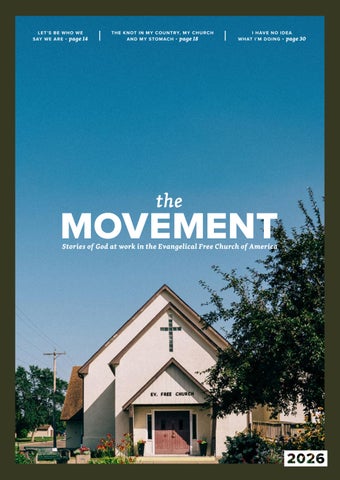
LET’S BE W HO W E SAY W E A RE • page 14
THE K N OT IN M Y C O U N T RY, M Y C H U R C H AN D MY STO M AC H • page 18
I H AV E N O I DE A W H AT I ’M D O I N G • page 30
the Stories of God at work in the Evangelical Free Church of America
Letter From the Editor: An Unexpected Encouragement The Movement is a relatively new publication— and only distributed once a year—so you likely weren’t expecting it. And that’s perfect. Not long ago, I woke up to an unexpected text message from a former co-worker and friend. We hadn’t spoken in almost a decade, but when his name popped up on my phone, the memories flooded back. In just a few short years together on staff at a local church, we’d road tripped together, pilgrimaged to the Holy Land, spent weekdays full of ministry planning and shared countless all-you-can-eat sushi lunches, courtesy of Groupon. What transpired that morning wasn’t a particularly long or deep conversation—some might not call it a conversation at all—but in those 12 back-and-forth text messages, I heard about God’s faithfulness to my friend and saw God’s faithfulness as I reflected on my own life and ministry journey. That encouraged me. God has an uncanny way of meeting us when we least expect it, often through something out of the blue: a text or phone call, a song or sunset, time in nature or time in the Bible. I pray this edition of The Movement provides an unexpected encouragement to you—that the stories it contains resonate with your heart, affirm your relationship with the EFCA and give you courage to navigate the days ahead. As you read, you’ll hear some familiar voices, but you’ll also likely hear some new ones. Whether it’s the wisdom of a seasoned pastor reflecting on the unity of our movement, a reminder to rest from a district leader wrestling with burnout or a challenge from our acting EFCA president to remember the fundamentals, may these brief glimpses into the lives and ministries of others draw you nearer to the brothers and sisters with whom your share a denominational home. God knows our need, and wherever you find yourself in life and ministry today, I pray He blesses and encourages you through these stories of His work in the EFCA.
NAT E T HOM P SON
Director of EFCA Communications
COVE R P HOTO : Sandstone Evangelicali Free Church (EFCA) in Sandstone, Minnesota.i
CONTENTS 4
EFCA Tagline: Revisited
9
Lisa Baracskai: I Love the EFCA Statement of Faith
40
Jason Gupta: Missions Is About God’s Goodness
42
From a New York Dairy Farm to Malawi
10
46
14
48
Meet the EFCA Board of Directors
Let’s Be Who We Say We Are
18
The Knot in My Country, My Church and My Stomach
24
Celebrating New Churches
26
Don’t Kill the Horse
30
I Have No Idea What I’m Doing
36
Neema Njenga: I Gave My Life to Jesus at Challenge
37
Celebrating New Missionaries
Shige Nakazawa: A Missionary Brought Me to Christ
50
Beauty That Breaks Through
54
Gabe Gutierrez: I Thought God Had the Wrong Guy
55
Together, Among the Giants
60
EFCA Ministry Directory
62
Why We Serve: Faces of the EFCA National Office
EFCA GATEWAY Exposed My Pride (and Softened My Heart)
The articles and stories in this magazine were originally published on the EFCA Blog in 2025-2026, with several pieces being published for the first time in print. You can find more EFCA stories at blogs.efca.org.
AC T I N G E F CA P R E S ID E N T CA R LTO N H A R R I S I NT R O D U C E S T HE N E W E F CA TAG L I N E AT E F CA ON E 20 25 I N W E ST D E S M OIN E S , IOWA .
EFCA Tagline: Revisited
One year after its introduction, four EFCA leaders unpack the significance of “Biblical and missional. United and free.”
4
REMEMBERING OUR HISTORY
At EFCA One 2025 in West Des Moines, Iowa, Acting EFCA President Carlton Harris unveiled the new tagline of the EFCA: “Biblical and missional. United and free”: “Since my introduction to the EFCA, I have known two things to be abundantly clear. First, we are a people of the Book; we love and cherish the Word of God. Second, we are a people who live out our evangelical heritage with an unwavering commitment to the Great Commission. Free Church people are biblical and missional...These core traits keep the EFCA united doctrinally, relationally and missionally. They provide a solid foundation, which frees each pastor, each congregation, each community to bring the gospel to their unique context. God, in His providence, has knit together a movement of churches who value the gift of our freedom—spiritually and organizationally—but our unity is a choice. One of our favorite words as a movement is ‘autonomy.’ However, coupled with autonomy is the importance of “interdependence.” We willingly and joyfully choose to unite around our theological convictions to fulfill the mandate of the Great Commission. This summarizes what we all know about the EFCA: We are biblical and missional, united and free.” To help articulate the value and nuances of this EFCA ethos, we invited four EFCA leaders, from across our movement, to dive deeper into each of these four key words.
We Are Biblical: Michael Shields, EFCA Central District Superintendent “For I delivered to you as of first importance what I also received: that Christ died for our sins in accordance with the Scriptures, that he was buried, that he was raised on the third day in accordance with the Scriptures” (1 Cor 15:3-4, ESV). Growing up in a mainline church, I had the opportunity to hear the Scriptures communicated on a regular basis. However, something was missing. The Word was primarily proclaimed as guideposts for a happy life, not as God’s true, inerrant and authoritative Word for our lives. When I was 13, my father’s death propelled me on a journey for truth and purpose. With a limited biblical foundation, it’s no wonder that, as a teen, I went through life guessing at everything—and when a young man guesses at life, he gets almost everything wrong. By the grace of God, at age 17, I heard the gospel clearly for the first time, and my life was transformed in Christ. As a young believer attending Trinity Evangelical Divinity School (TEDS), I was introduced to the EFCA and its high view of Scripture. As Walter Kaiser Jr. (former TEDS academic dean) often said: “Keep your finger on the Text.” Or, as the Scandinavian
founders of the EFCA would say: “Where stands it written?” God used the EFCA’s commitment to the Bible to prepare me for pastoral ministry. If there was one thing I knew, it was that I wanted to be a part of a movement known for “rightly handling the word of truth” (2 Tim 2:15). Several years later, while leading a new church attendee class, I met a man who’d begun attending our church a few weeks earlier with his family. As I walked through the Scriptures, shared the gospel and detailed our identity as an EFCA church, he became agitated. He slammed his hand down and said, “My family has been going to church my entire life, and I’ve never heard this. We were never encouraged to read our Bibles. I need to hear more.” A few weeks later, he and his entire family were baptized together.
I’ve been blessed to be a part of the EFCA for 30 years, and in my current role, I’ve attended more than 150 of our churches. God is drawing people from both legalism and liberalism—people starving for truth—to EFCA churches. We are not perfect, by any means, but we are a people committed to the right understanding and teaching of the Word of God. I’ve been blessed to be a part of the EFCA for 30 years, and in my current role, I’ve attended more than 150 of our churches. God is drawing refugees from both legalism and liberalism—people starving for truth— to EFCA churches. We are not perfect, by any means, but we are a people committed to the right understanding and teaching of the Word of God. We are a people committed to the gospel of Jesus Christ. In this next season, may the Lord continue to keep us tethered to the Text as people of the Book.
We Are Missional: Scott Sterner, EFCA Executive Vice President of National Ministries From our earliest days as immigrant congregations to the merger of two denominations in 1950, Free Churches have organized for two primary reasons: 1) to anchor ourselves in a shared Statement of Faith and 2) to link arms in a common mission. From the beginning, mission collaboration was more than a strategy— it was our identity. At our core, the EFCA is a missional movement of churches that exists to multiply disciples and churches for the glory of God. In the EFCA, our missional identity as disciplemakers is rooted in the reality that we are sent to send others (John 20:21). Jesus was sent so that we might believe and have life in His name. This gospel doesn’t just save us from sin; it transforms us into a
5
new creation. Now, we are the ones sent to proclaim it. We do this by following the Great Commission: making disciples of all nations, baptizing them in the name of the Father, Son and Spirit, and teaching them to obey everything He commanded. This is the very definition of multiplying the gospel through missional disciplemaking, and it will always be at the heart of the EFCA.
From the beginning, mission collaboration was more than a strategy—it was our identity. At our core, the EFCA is a missional movement of churches that exists to multiply disciples and churches for the glory of God. The outflow of disciplemaking is missional church planting. EFCA churches exist to glorify God by multiplying transformational churches among all people. A few years ago, our district church planting leaders gathered to answer a central question: “How can we best help EFCA churches live into this mission?” The conviction that emerged was clear: no matter its size or context, every local church can vitally contribute to planting missional churches in one of three ways: partnering, sending or multiplying. To PARTNER is to commit to pray for, promote and celebrate every new church plant in your region. Practically, it can look like financial support, sending teams to serve new communities, or even donating time and resources to help planters get established. To SEND is to embody the culture of the church in Antioch, where raising up and releasing leaders was viewed as normal and healthy. Sending churches intentionally develop leadership pipelines. They invite emerging leaders from all people into apprenticeships, internships and residencies, preparing them to be sent out as missionaries, leaders and planters in the U.S. and across the globe. To MULTIPLY is to cultivate multiplication at every level, from small groups to broader ministries to entire congregations. Multiplying churches continually prepare to launch new campuses, second-language ministries and fully autonomous faith communities. The shared hope of our missional identity is to fulfill the original vision of the churches that created our association: to multiply disciples and churches, together. When we do this, our members and churches become living testimonies of the gospel’s transforming power. They show a watching world what it means to be missional—to see the lost found, the vulnerable loved and the diverse become one in Christ.
6
We Are United: Amy Richey, Director of ReachGlobal Global Equipping People can unite around a variety of things—such as a project or a cause—but often this unity is temporary. The EFCA has long been united in a shared commitment to the authority of Scripture, the urgency of the gospel and the mission of God in the world. As an affinity of churches united around theological clarity and missional purpose, the EFCA exists not merely as an institution, but as a movement—sent, connected, collaborative. At its best, our movement reflects the reality that the Church is strongest when it serves together. The EFCA is, at its core, a unified movement—families, churches and leaders working together for the sake of the gospel. From the earliest stirrings of a missionary calling within the life of a local church to the careful preparation and global deployment through ReachGlobal, this work has always been shared. No part stands alone. Families disciple their children by modeling and teaching biblical principles. Local churches cultivate a heart for the nations and affirm and call out the missionary vocation. Prayer, financial generosity, spiritual formation and discernment all converge as churches respond to God’s call to send their own. Missionaries are not outsourced; they are raised from within the local church.
In a fragmented world, serving in unity offers a compelling witness. It reflects the heart of Jesus’ prayer in John 17—that His people would be one so that the world may believe. ReachGlobal then steps in as a trusted partner to faithfully steward that calling. Through assessment, training and preparation, ReachGlobal equips missionaries to serve cross culturally with wisdom, resilience and gospel clarity. They are trained not only for effectiveness in ministry but also for longterm faithfulness—spiritually, emotionally and relationally. Once prepared, ReachGlobal deploys missionaries into strategic contexts around the world, partnering with local leaders and churches to make disciples and develop sustainable expressions of the Church. ReachGlobal is not a parallel mission to EFCA—it is an international extension of the same organization, ensuring churches, missionaries and leaders are equipped with a shared framework, aligned practices and common missional language. This process becomes connective tissue, helping EFCA churches and ReachGlobal teams remain united at every stage of the sending journey.
REMEMBERING OUR HISTORY
This is what it means to be united. Churches and missionaries each carry distinct responsibilities, yet none operate in isolation. Unity is expressed through collaboration, trust and mutual submission to the mission God has entrusted to us. Strategies are shaped together. Resources are stewarded faithfully. Learning flows both ways—from the field to the church, the church to the field. In a fragmented world, serving in unity offers a compelling witness. It reflects the heart of Jesus’ prayer in John 17—that His people would be one so that the world may believe. As the EFCA continues to send missionaries and ReachGlobal serves globally, we strengthen the whole body for the sake of the gospel.
We Are Free: Frank Lanier, Associate Pastor at Christ Community Church (EFCA) in Pinehurst, North Carolina The word “free” is a simple term, but its meaning is multifaceted and complex. Free can refer to anything from a favorable transaction to a fundamental characteristic of being human. People are made in the image of God, and part of this reality is reflecting the attributes of God in creation for His glory. The capacity for freedom—the ability to think and act as one wishes—is one of those shared attributes. The Bible describes the Church as the body of Christ, comprised of free people who freely come together as a spiritual family. The local spiritual families affiliated with the EFCA descended from a movement that freed itself from government control, as well as a formal ecclesial hierarchy. We are biblical and missional, united and free.
The EFCA aspires to fulfill its mission to glorify God by multiplying transformational churches among all people. If we commit to being biblical and missional, united and free, we will make great inroads in achieving that goal.
1. PURSUE RELATIONSHIP. In Romans 12:5, Paul reminds the Church, “in the same way we who are many are one body in Christ and individually members of one another” (CSB). Intimacy frays in a formal, coerced relationship, but interaction between two free parties increases the likelihood of relational closeness. Churches who become part of the EFCA do so freely and are thus more likely to openly pursue relationship with other Free Churches. 2. ENGAGE SINCERELY. According to Augustine, genuine actions stem from freedom rather than compulsion. Integrity is only possible in freedom. If you’ve been around children, you know the difference between a child who is forced to obey and one who freely chooses obedience. Galatians 5:13 encourages the Church, “For you were called to be free, brothers and sisters; only don’t use this freedom as an opportunity for the flesh, but serve one another through love” (CSB). Loving service is best expressed by a free church. 3. ENCOURAGE DIVERSITY. The kaleidoscope of the world is best served by a church that is free. God created our world with precise intentionality, yet He is as much an artist as an engineer. From the moment the world was founded, God knew the palette He would use to create His image-bearers. The universal Church is more of a tapestry than a spreadsheet. A free church seeks unity in diversity. 4. EXPRESS GOD’S GLORY. In Matthew 16:18, Jesus promised, “I will build my church.” The Kingdom of God advances by multiplying biblically sound, disciplemaking churches. These churches operate in the freedom Christ won for the saints. They are free from reliance on or coercion by state government, and from the spiritual constraints imposed by denominational hierarchy. A truly free church is composed of redeemed people growing in Christian maturity, serving God faithfully and participating in the mission that Christ entrusted to the disciples. They do this in association with other free churches, reflecting the oneness for which Jesus prayed, for which He died, which we are eager to maintain. This type of church exhibits God’s glory to the world. The EFCA aspires to fulfill its mission to glorify God by multiplying transformational churches among all people. If we commit to being biblical and missional, united and free, we will make great inroads in achieving that goal.
At first glance, “united and free” seems contradictory. But a deeper look uncovers a blessed tension only achieved by God’s grace. We are an association of interdependent churches united by our common beliefs and convictions, yet each local body of believers is autonomous as it pertains to church polity. And a church that freely chooses to affiliate with the EFCA is more likely to 1) pursue relationship with other churches, 2) engage sincerely when serving other churches, 3) encourage diversity in the Great Commission and 4) corporately express God’s glory.
7
The EFCA Theology Conference exists to encourage and equip EFCA pastors and leaders in their personal lives and local ministries through biblical and theological education. In February 2026, we gathered at The Compass Church (EFCA) in Naperville, Illinois, to explore the theme of “Evangelical Convictions of Eternal Realities.” Along with times of worship and connection—and a Preconference on “Contemporary Christian Apologetics”— our speakers unpacked Article 10 (“Response and Eternal Destiny”) of the EFCA Statement of Faith through a biblical, historical and pastoral lens.
Registration for the 2027 EFCA Theology Conference— February 3-5, 2027, at Valley Church (EFCA) in West Des Moines, Iowa—opens Fall 2026.
Watch the 2026 Theology Conference Recap Video:
8
“I love to learn, and since I lead Bible studies, I knew I would learn things [at Theology Conference] that would help me. Being in connections ministry, I’ve been through all the membership classes, and I’ve come to love the EFCA Statement of Faith. One of our pastors calls it ‘the banks of the river.’ I love that these are the [core doctrines] and that we’re not going to divide over the other things. In Bible studies, as women bring up [secondary] topics, we can talk about those things, study them and have views on them, but they’re not something we need to divide over. I really appreciate that about the EFCA.”
L ISA BA R ACSK A I Director of Women’s Ministry Providence Church (Avon, Ohio)
9
Who’s on the Board Learn more about the governing body that guides the direction, vision and spiritual oversight of the EFCA. When I was first asked to consider serving on the EFCA Board of Directors, I had no idea what that meant—and I know I’m not alone. In fact, I think one of the questions I hear
present bylaw amendments. One of the most important functions of our Board is to choose a candidate to be presented to serve as our president, and we get to call that vote at EFCA One 2027. 1
The Board of Directors is made up of people from across the EFCA—from varying churches, districts and regions. A third of the Board must be credentialed lead/senior pastors in EFCA churches. The rest includes people who work in a variety of fields—bringing their experience and expertise—as well as some ministry staff.
Since EFCA One 2025, the Board of Directors has worked with the Board of Ministerial Standing and the district superintendents to explore how we can all work together to continue to build on the unity and excitement we sense across the EFCA. While we all know that our churches are glad to be “free,” we also believe that our interdependence—working together and being reliant on each other—will be best for every EFCA church, district, ministry, pastor and missionary.
most often is: “Who’s on the Board and what do you even do?” As fun as it is to immerse yourself in bylaws, it remains a mystery to most. So, let’s get some clarity.
The EFCA Board of Directors is tasked to oversee the work of the EFCA by ensuring compliance with the EFCA Statement of Faith, our bylaws and our policies. A major aspect of that oversight is praying for the EFCA and for our churches, pastors and missionaries. Our primary oversight is through policy governance and reports on all EFCA ministries through the EFCA president. What that means is that we consistently monitor what is happening across the EFCA, primarily by hearing reports from the president or senior staff on everything from financial metrics to national and global ministry initiatives. The Board is careful to leave the management and operations to EFCA staff so it can focus on vision and strategic initiatives. It’s the responsibility of the Board to maintain the theological and doctrinal fidelity of the EFCA, protecting its ethos and emphases, while also looking to the future with prayerful hope for where God continues to lead us as a whole movement. We do that work primarily by setting the “ends” or goals of the EFCA, and by setting and maintaining policies. The Board meets at least quarterly, and generally in person, though committees and task forces meet between the quarterly meetings. In all of this, the Board of Directors works to represent the EFCA as a whole and the decisions made by the whole EFCA at our biennial EFCA One Conference. We primarily work on a two-year timeline between EFCA One Conferences. The Board hosts the Conference Business Session, setting the agenda and presenting reports and any decisions that the Conference needs to make or approve. If you have attended a recent EFCA One, you have seen me hold the exciting privilege to
10
Amid all of this, the best part of serving on the Board—at least for me—is having a front row seat to hear about what God is doing throughout the EFCA. Like all of life and ministry, there are hard things we hear about and act on, but we also get to hear about churches being planted and people coming to Christ in our churches and across the world through ReachGlobal. God has shaped the EFCA to be a movement that is truly “Biblical and missional. United and free,” and He is working by the Spirit to shine the light of Christ through the EFCA. Grateful in your service,
BIL L RIE DE L Chair, EFCA Board of Directors
a th
REMEMBERING OUR HISTORY
A DA M K A N E
Northeast Bible Church (San Antonio, Texas)
CY NDI L EAM ON Trinity Church (South Bend, Indiana)
Q: What is the role of the Board and how do you view your individual role? ADA M: The role of the Board is to provide prayerful and biblical oversight for the work of the EFCA on behalf of our churches. That includes helping ensure the ministry of the EFCA remains faithful to its mission, watching carefully over fiscal stewardship, giving attention to doctrine and direction, and providing accountability and support for the president as he leads according to the responsibilities entrusted to him. At its best, the Board serves as a steadying presence—helping the movement stay grounded in its calling while remaining attentive to the needs of our churches and districts. Personally, as an executive pastor in the EFCA, serving on the Board means bringing my God-given gifts, experiences and perspective into that shared work with humility and care. I see my role as collaborative, discerning and pastoral—listening carefully, asking thoughtful questions and working with others toward wise decisions that strengthen the Church. Prayer is also a significant part of this responsibility, because the complexity of serving a movement like the EFCA continually reminds me how much we need the Lord’s wisdom. One of the beauties of the EFCA ethos—Biblical and missional. United and free.—is that we are learning how to hold together both freedom and shared mission: Churches and districts are free to govern themselves, yet we are stronger when we pursue together what it means to be biblical and missional for the sake of Christ and His Church. From a local church perspective, that kind of partnership is both challenging and deeply valuable, because we truly are better together.
E D AL L IE
River of Life Church (Cincinnati, Ohio)
One of the beauties of the EFCA ethos—Biblical and missional. United and free.—is that we are learning how to hold together both freedom and shared mission: Churches and districts are free to govern themselves, yet we are stronger when we pursue together what it means to be biblical and missional for the sake of Christ and His Church. CYN DI : With a spirit of wisdom and care, the Board provides guidance through policies to the EFCA president and encourages practices that nurture both financial integrity and the overall health of the organization. My role within the Board is to help represent a diverse, Spirit-led, unified voice in wise governance of the EFCA. I have also helped serve on sub-committees in the areas of credentialing, Clause B districts and presidential search. E D : I serve on the Audit Committee, where we select and recommend an external audit for presentation to the full Board. Also, as a member who’s a lay leader in my local church—not in vocational ministry—I see myself as someone who first and foremost can engage in prayer for the national office and districts, and also offer my own unique skills from a strategy and insight perspective.
and what do hey even do? 11
Q: Why do you choose to serve on the Board? CYN DI : I didn’t set out to serve on the Board—I wasn’t even aware it was possible. When I was approached, my first thought was, “There are others far more experienced and gifted than I am.” Yet in prayer, I sensed that if I didn’t step forward to discern whether the Lord was in this, I would miss an opportunity to walk in faith. Looking back, I see a pattern in how God has written my story— He often chooses what feels like the “least likely” option and uses it for His glory. After a 21-year career in business, I stepped into church staff ministry. During the past 17 years, I’ve had the joy of leading and growing disciplemaking ministries for women, children and adults. Today, I serve as director for women in ministry with the EFCA Great Lakes District, supporting women leaders in more than 150 churches. At the heart of it all is a simple desire to glorify God through faithful, sacrificial service. In this season, that means stewarding this opportunity with humility and wisdom and serving in a way that helps strengthen and represent the EFCA as we pursue gospel transformation, multiplied, for all people. ADA M: I serve partly because others believed my gifts, experience and temperament could be useful on the Board—and I’ve tried to receive that with humility—but I also serve because I genuinely believe in the EFCA mission, vision and values. In a landscape filled with many denominations and church movements, I see the EFCA as a gift—an expression of the Church that holds firmly to core theological convictions while making room for thoughtful freedom and healthy discussion in secondary and tertiary matters. That commitment to unity around what matters most has strengthened my appreciation for our movement. We are not united by uniformity, but by a shared desire to know God, glorify God, live under the authority of Scripture, proclaim the gospel and join in Christ’s mission through healthy churches and church planting among all people. From my local church perspective, that balance of conviction and humility is both rare and deeply worth serving.
In a landscape filled with many denominations and church movements, I see the EFCA as a gift—an expression of the Church that holds firmly to core theological convictions while making room for thoughtful freedom and healthy discussion in secondary and tertiary matters.
1
E D : I serve because it’s a way for me to use my gifts to serve the EFCA, but I often feel I receive way more from the Board than I give. I leave every meeting—even when we deal with difficult matters—so encouraged by the other members. It’s such a blessing to see the men and women God has called to help shepherd the movement—pastors and district leaders, lay leaders and former missionaries. It’s also a real privilege to interact with and serve alongside the national staff and see how God is building His kingdom with such amazing and humble servants.
Q: What’s one thing you’d want EFCA churches and leaders to know about the Board? E D: The Board is not some ivory tower group far removed from the day-to-day life of the EFCA. It’s a body that reflects our movement and deeply yearns for God’s favor to be poured out on the EFCA, for His Name’s sake. It’s made up of pastors who have churches large and small, of people from the east coast to the west, of folks whose EFCA heritage runs generations deep to those who call the EFCA their spiritual home after years of searching. The same issues you’re dealing with in your church, workplace or neighborhood are the issues Board members deal with every day.
The desire of the Board is to serve EFCA churches faithfully, leaning on the Lord’s strength and wisdom as we seek to govern well the beautiful diversity of our churches. CYN D I : The desire of the Board is to serve EFCA churches faithfully, leaning on the Lord’s strength and wisdom as we seek to govern well the beautiful diversity of our churches. We ask for your prayers as we aim to steward well—with unity and Spirit-led courage, surrendered to God—so that, together, we might glorify Him and see His Kingdom grow through ministries that multiply disciples and transform lives with the gospel. A DA M : One of the things I’ve appreciated most about serving on the Board is that, unlike some boards, it does not exist for itself. The real vision of the Board is to serve the EFCA by strengthening our districts and local churches. Because the EFCA is not a top-down organization but an association of churches, our posture is intentionally bottom-up. We are continually listening for what is happening across churches and districts so we can help serve where support is most needed. The Board is not designed to direct local churches, but to come alongside them— helping provide what many churches would struggle to sustain on their own. If there is one thing I would want our pastors to know, it’s that this kind of partnership can bring long-term strength, continuity and perspective to a local church by helping it remain connected to something larger than itself and durable enough to serve future generations.
Following a rigorous and targeted search process, the Board is excited to formally present Rev. Carlton P. Harris as the candidate to serve as the next president of the EFCA. The presidential affirmation vote by credentialed delegates will take place during the Business Session at EFCA One 2027—June 22-24, 2027, at The Compass Church (EFCA) in Naperville, Illinois. Learn more about Carlton and the nomination process at efca.org/presidential-nominee.
12
REMEMBERING OUR HISTORY
The Board is not some ivory tower group far removed from the day-today life of the EFCA. It’s a body that reflects our movement and deeply yearns for God’s favor to be poured out on the EFCA, for His Name’s sake. – E D AL L I E
VIEW THE COMPLETE LIST OF THE EFCA BOARD OF DIRECTORS
13
Let’s Be Who We Say We Are For the sake of the lost, the EFCA must reclaim our First Love, reinforce our unity and remember our purpose. BY CARLTON P. HA R R I S
14
REMEMBERING OUR HISTORY
In July 1961, just six months after blowing a fourthquarter lead to the Philadelphia Eagles in the 1960 NFL Championship (the precursor to the Super Bowl),
legendary Green Bay Packers head coach Vince Lombardi gathered his team to kick off training camp. With many of the highly skilled players returning from the previous season, expectations were high. What new scheme will Coach Lombardi implement this season? What new trick plays will he diagram to give us an extra edge? What new player will he sign to get us over the hump? Holding up a football in his right hand, Coach Lombardi began with a simple quote. You might know it. “Gentlemen, this is a football.” Standing before a team of future Pro Bowlers, Coach Lombardi shocked them all by returning to the basics. He flipped back to page one of the playbook and reintroduced the fundamentals of the game, leaving his team of near-champions speechless. Now, don’t get me wrong. I don’t share that story to rile up my Wisconsinite brothers and sisters. I share it because I believe it offers wisdom for where we are as a movement. Five months later, after finishing the regular season 11-3, the Packers dominated the New York Giants (37-0) to claim the 1961 NFL Championship. Since I assumed the role of acting EFCA president in April 2024, much has been clarified for me. And as I think about the future of our movement, I keep going back to the fundamentals. While there are many potential paths for the EFCA—new ministry strategies to implement, new players to bring in—I believe the most important thing for us is to be who we say we are and do what we say we will do.
While there are many potential paths for the EFCA—new ministry strategies to implement, new players to bring in—I believe the most important thing for us is to be who we say we are and do what we say we will do. It’s not that new things are inherently bad, but in this season, I’m convinced that we, as a movement, don’t need the “new.” Instead, if we’re willing to flip back to page one of the playbook and execute on the fundamentals of our movement—together— I think we’ll realize that we already have everything we need. R E C LA I M I N G O U R F I R ST LOV E Early last year, Carol and I visited the doctor for our annual checkups. By all accounts, they began as expected. We each sat on the exam table. We went through the normal battery of tests. We answered questions about diet and exercise. You know the drill. But as we concluded our visit, our new primary care physician— after learning my profession—posed an unexpected question. “Can your churches do something about the increasing division and animosity in our world?” “Dr. S” was concerned—and rightly so. Our home state of Minnesota had just experienced the politically motivated shootings of multiple state legislators and their families, and similar tensions were rising across the country. Still, I answered Dr. S without hesitation: “Absolutely, yes.” I shared Dr. S’s question as part of my message at EFCA One 2025, but it bears repeating. Why? Because the problem persists— lost, hurting people in our communities are navigating a broken,
15
divided and sin-filled world without the hope of our Savior— and EFCA churches can do something about it. Put simply, the EFCA exists because lost people need Jesus. Friends, this is our football. From the earliest days of our movement, our forebearers were characterized by their zeal to share the gospel with lost and hurting people. To flip back the EFCA playbook is to be a movement of churches whose evangelical DNA is never compromised and who are known in our spheres of influence as heralds of the good news of Jesus Christ. EFCA churches, church leaders, congregants, national and international ministry leaders: The people around us are hungry for all the gospel offers, and we have the privilege—and responsibility—to introduce them to Jesus. This is who we are as His disciples and as evangelicals. The clarity of the Great Commission solidifies our common purpose as a movement. It starts with us—as individuals. Before we call our congregations to act, we must personally review the posture of our own hearts. A first step—as churches who want to see the gospel transform individuals and communities—is to ask ourselves, “Do I personally reflect the heart of Jesus for the lost?”
I just don’t want us to forget who we are. I don’t want us to miss the fundamentals. Rather, I want us to be known as a movement who are actively reaching the lost, living out our biblical and missional traits to their fullest extent. In the last year since sharing Dr. S’s question, you may have heard me ask the question—on several occasions—”Who are your three?” Put another way, I challenged individuals within our movement to identify three people for whom they would pray and lovingly pursue for the sake of sharing the gospel. At our core, this is what the EFCA is all about. Our founding documents— specifically, the EFCA Articles of Incorporation—clearly state our purpose: “to glorify God through obedience to the Great Commission of our Lord Jesus Christ by bringing individuals to personal faith in Christ and helping them toward maturity in Him.” For me, I need constant reminders of my purpose as a disciple of Christ. I need the not-so-subtle prompts to move toward the lost. I need the clear instruction that my life is a living sacrifice to be spent as acts of worship in service to God’s kingdom. Rightly prioritizing and acting on my responsibility as a herald of the good news is evidence that my loves are in proper order. To be clear, I believe that as a movement—and as individuals— our First Love is Jesus. In my time as acting president, I have seen your devotion to our Lord displayed in your prayers, your generosity, your sacrificial service toward others, among many other things. I just don’t want us to forget who we are. I don’t want us to miss the fundamentals. Rather, I want us to be known as a movement who are actively reaching the lost, living out our biblical and missional traits to their fullest extent. R EI N FORC I N G OUR UN ITY Back to Dr. S’s question: What role does the local church serve as we consider the division and polarization in our world today? Like Coach Lombardi holding up the football, I think the answer is staring us in the face.
16
For decades, the people of the EFCA have used different catchphrases to describe our ethos—the unwritten, but distinct spirit of our movement. I have no doubt you’ve heard many of them, but a few have special significance to the question at hand. • “In essentials, unity; in non-essentials, liberty; in all things, charity.” • “Debate but not divide.” • “Major on the majors and minor on the minors.” Each of these phrases points to the importance of two core values: 1) our unity and 2) our ability to navigate disagreement. The essence of these fundamental traits is also captured in the EFCA tagline: Biblical and missional. United and free. Our movement is united, first and foremost, by the good news of Jesus. Let’s not lose sight of this. The foundational work of Jesus Christ transforms enemies into siblings—uniting us as members of one body, one faith, one baptism. We call people to a kingdom where one thing matters: our devotion to Jesus. If we can get that right, if the pursuit and proclamation of the saving work of Jesus becomes the foundation of our lives and the central message of our movement, if we take Jesus at His word that He has overcome the world and all its troubles, our unity will serve as a unique emblem of hope in a divided and fractured world. Organizationally, we are united by our shared Statement of Faith, Articles of Incorporation and Bylaws. These guiding documents and convictions of our movement ground us in the gospel and reinforce our central purpose to reach the lost. They tether us to the truths of Scripture, which serve as the lens through which we see and interpret our world today, and orient us around the Great Commission. I believe these statements and the unity they describe are critical for us on two levels. First, we must be united as a movement of 1,600 autonomous congregations as we seek to reach entire communities and regions where there is significant gospel need. But we must also reflect that unity within each of our unique local churches. It isn’t hard to find division in our world today. Politics, immigration, gender, racial justice, economic policy, use of force, school curriculum—the list goes on and on. There’s always another reason to disagree, consistently elevated on the nightly news and social media. Sadly, many people see the same division evidenced in churches today—or they see churches as places to reinforce political or cultural alliances. Both sides of that spectrum tarnish our witness to our polarized society. To a world that now expects any difference of opinion to drive people away from each other, our unity as believers and as a movement of churches offers a unique and appealing witness. But we must protect it and invest in it. Are there issues of theology and ministry practice where EFCA congregants, pastors, ministry leaders, missionaries and national leaders disagree? As my friends from the upper Midwest will say, “You betcha.” But how we navigate those disagreements impacts our witness to a broken and fractured world. We can remain unwavering in our commitment to the Bible while also navigating differences with charity and grace. If we get it right, our skill to “debate but not divide” may become one of the defining characteristics of the Free Church as we navigate the days of ministry before us. Does this pursuit keep us from holding firm convictions? Absolutely not. Are there important issues we must navigate where there are significant differences of opinion? Yes. Will we need to navigate serious theological or moral issues that require
REMEMBERING OUR HISTORY
us to sever ties with a brother or sister in error? Sadly, yes—though with deep sorrow and after much prayer. Churches and our movement as a whole have navigated many challenges throughout our history, and still, the defining characteristic of unity remains a vital part of the EFCA ethos. To reach a divided and diverse world, we must be a united and diverse Church. Reinforcing our unity as a movement will propel us—together—toward the fulfillment of our mission. R E M E M B E R I N G O U R PU R PO S E
In this season of my life and ministry, I’m growing even more convinced that the local church— specifically EFCA churches—offer something unique and needed in our world today. It’s not anything new or complex—it’s being who we say we are and doing what we say we’ll do.
I think about the end of my life almost every day—not in a morbid sense, but in a way that motivates and clarifies what is most important in my life. Death has a way of waking us up. It keeps us focused on what really matters. In this season of my life and ministry, I’m growing even more convinced that the local church—specifically EFCA churches— offer something unique and needed in our world today. It’s not anything new or complex—it’s being who we say we are and doing what we say we’ll do. I recently visited a vibrant, multiethnic, intergenerational EFCA church in a college town with incredibly diverse demographics. What I saw gave me great hope. This church—and the gospel truths they proclaim—was bringing together people who normally gravitate in different directions. I saw a congregation hungry for the Word of God, being drawn into greater love and appreciation for their Savior and for one another, and tangibly living it out with compassion and conviction in their community. Friends, as I think about the world today, despite its challenges, I have hope. I have hope because EFCA churches can do something about the brokenness we see. The unity we have as believers and as a movement are gifts to our broken and divided world. With a firm foundation in the truth of God’s Word, anchored in the fundamentals of our movement, EFCA churches have a clear purpose to reach the lost and raise them as disciplemakers. Our churches are the means through which gospel transformation can happen in our country. How will you and your church respond to the gospel need in your community? I know you want to see God work in and through your churches. Let’s be who God has called us to be. Let’s do what God has commanded us to do. Let’s live out fully what it means for us to be the Free Church. Biblical and missional. United and free.
Carlton started ministry in 1981 as a pastoral intern at First Evangelical Free Church (EFCA) in Wichita, Kansas, and has spent 40 years in church leadership. He began his role at the EFCA national office leading the ReachNational division in September 2021 and was named acting president of the EFCA in April 2024. He and his wife, Carol, are members at New Hope Church (EFCA) in New Hope, Minnesota.
17
The Knot in My Country, My Church and My Stomach One EFCA pastor is addressing complex cultural tensions by following Jesus’ example of surrendering, learning and serving. BY J OE H E N SE L E R
18
E N G A G I N G C U LT U R E
I pastor a church in Allentown, Pennsylvania, a swing state for national elections for the past decade. I joke that
if I publicly endorsed a presidential candidate from the stage on a Sunday morning, a brawl would break out before the closing song. But it hasn't always been this way. Our region was once known for farming and steel. Faith Church (EFCA) was founded by Pennsylvania Dutch believers who loved Jesus and wanted to share His gospel with their neighbors and the nations. In the early 1960s, they bought a cornfield and built a small country church with their own hands. It was a bluecollar congregation in a blue-collar town with a vision to reach the world with the love of Jesus. Then the Lehigh Valley became one of the fastest-growing regions in the country. Allentown grew more diverse—racially, economically and politically. If Faith Church was going to remain committed to sharing the love of Christ with its neighbors, we also had to change. When I transitioned into the role of lead pastor in 2009, something Jesus said in Mark arrested my thinking: "My house will be called a house of prayer for all nations” (Mark 11:17, emphasis mine) If God's house is meant to hold every nation and ethnicity, then certainly it’s meant to hold every economic and political conviction, too. As Pennsylvania turned into a battleground state, Faith Church was becoming a house of prayer for all nations—and convictions. And I had to learn how to pastor people through the knotted-up mess we were experiencing.
If God's house is meant to hold every nation and ethnicity, then certainly it’s meant to hold every economic and political conviction, too. A few weeks before the 2020 election, a member of our church sat across from me, visibly worked up. He loved this church. He served faithfully. He was invested in his small group. But he'd hit a wall. Another member of his small group kept steering their gatherings into partisan territory—not occasionally, regularly. And this member who sat across from me, who genuinely respected his brother causing the friction, had finally run out of patience: "How am I supposed to grow in Christ next to people who think like this?” These are the moments in pastoral ministry where you pray hard before you say anything. The man sitting across from me was hurt and angry—and hurt, angry people tend to make broad generalizations. I understood that. But I also know the tendency of Christ-followers who, gripped by fear, struggle to separate their faith from their politics. In that moment, I felt the knot—two brothers in Christ, who genuinely loved each other, being pulled apart by politics. That story has played on repeat across our churches for the better part of a decade. What do you do when your country, your church and your stomach are all tangled up in knots? U NDERSTA N DIN G K N OTS All of us know the unique frustration of knots. You're moving fast through life, and all of a sudden, your shoelace gets tangled, slowing you down and causing frustration.
When something gets knotted up, you have three basic options: • First, do nothing. Live life with the annoyance and hope it doesn’t get worse. • Second, grab a pair of scissors and cut it out—and, in the process, lose the shoelace altogether. • The third option is the hardest: Slow down and work the knot. While all may be reasonable approaches, there is only one— in my opinion—that leads to preservation and peace. Physical knots demand a response—ignore them, cut them or work them out—so does the tangled mess of life in the U.S. today. Tension is everywhere. On every front. Within every population and subpopulation. In every corner of society. While there have always been seasons of tension and injustice in our country, most of us can remember moments of greater national unity—times when public, private and spiritual lives were flawed yet still flowing. Moments when we could collectively name the problems and civilly discuss solutions. Today, those three dimensions of life are so knotted together we're not sure where one ends and another begins. Consider the murder of George Floyd in the summer of 2020 or the assassination of Charlie Kirk in the fall of 2025. Pastors and churches on every side of the issue were demonized for their responses—or lack thereof. Or think of the polarizing topic of immigration, where law interpretation and enforcement are constantly changing, leaving many frustrated and fearful. These are just three examples of the complex knots that can twist up our public, private and spiritual lives, and cause tension in real congregations among real Christians who love Jesus. All of us feel the growing tightness—and for many, it has become a knot that never leaves our stomachs. The question is the same one we face with any knot: Do we ignore it and hope it loosens on its own? Do we cut through it, disregarding nuance, and in doing so, cause irreparable damage? Or do we have the patience—the Holy Spirit-empowered stamina—to slow down and work it out, thread by thread? AC KN OW LE DG E T H E KN OT First, let's stop and try to describe the knot we feel—because we can only understand it by examining its individual threads. There's the thread of economics: inflation, a living wage, the crushing cost of healthcare, the quiet dread of retirement. There's the thread of immigration, mass migration and fears associated with globalization. There are liberals and progressives, socialists and capitalists, Democrats and Republicans—all promising change, all pulling in different directions. There are vast beliefs and behaviors regarding sexuality and gender. There’s a string of isms—racism, sexism, ageism and classism. A thread of mental illness, substance abuse, food insecurity, homelessness and suicide that runs through every community, regardless of zip code or political affiliation. There's technology—artificial intelligence and algorithms quietly shaping what we see and believe. Entertainment, sports betting, social media. International affairs, foreign wars, trade wars and the low hum of nuclear anxiety that never quite goes away. Each thread on its own is significant. Complex. Worthy of careful, deliberate attention. Throw them all together— ball them up haphazardly—and you get the knot we see in our country today. The one we feel in our stomachs.
19
Here's what makes it harder: If you ask Christians from across the country what they think about any single thread—let alone the whole tangled mess—you will get wildly different answers. Christians on every side of every issue will open the same Bible, claim the same Holy Spirit and vehemently disagree with the brother or sister in their very own small group. Some Christians will go further—justifying slander, dismissing churches as heretical and cutting off whole swaths of Christ-followers entirely. So, how do we move forward? How do we slow down individually, seek to understand the complexity of each thread collectively and work patiently together to untie the knot in our stomachs, even if our country remains a knotted mess?
Each thread on its own is significant. Complex. Worthy of careful, deliberate attention. Throw them all together— ball them up haphazardly—and you get the knot we see in our country today. The one we feel in our stomachs. S LOW DOW N A N D SURRE N D E R When everything feels knotted up, the impulse is to fix it—fast. Reach for the scissors. Cut something. This is a black-and-white issue that must be solved now! But that gut reaction to simplify, cut or declare something “easy to solve” is often a symptom of something deeper: our need for control. Take law enforcement agencies, for example. You might believe current law enforcement is 100 percent effective or 100 percent ineffective. And if you can convince yourself—or your neighbors—of this, you feel you have a grip on your world. But honestly, is any institution entirely perfect or entirely corrupt? Are the actions of any law enforcement officer ever all right or all wrong? If you demonize the police today, will you also turn them away when they show up to help in an emergency? These polarizing postures toward complex problems ebb and flow with the political tide, creating the illusion of control while delivering no lasting peace. Jesus modeled something different. When His public, private and spiritual lives were threatened by sinful men, He didn't ignore it or reach for the scissors. He prayed: Not my will, but Yours be done. He surrendered control of His circumstances to embrace His Father's perspective—not as defeat, but as the pathway to peace within Himself and service to humanity. One of the strengths of the EFCA is the diversity of people within our movement. In our churches right now, ICE agents and police officers are honoring civil authority and worshipping Jesus next to immigrants who are being dehumanized. Both were made in the image of God. Both are praying for direction and peace. Both are trying to honor Christ in this knotted-up world.
20
What if we surrendered control over these complex knots to God? • God, what is Your heart for the immigrant and the law enforcement officer? • God, how should I respond to this person or policy that seems to contradict what I believe? • God, I am afraid. Keep me from simplifying or controlling these complex problems. Teach me to love and listen rather than hate and rant. At the heart of our faith is a lifetime of choosing to surrender to a suffering Servant. To follow Christ means to surrender your thoughts and your will—not as a loss, but as the only true pathway to personal peace and service to others. S LOW D OW N A N D LE A R N As humans, our default setting is simple: I'm right. Everyone else is wrong. As Christians, we can take it a step further: My interpretation of the Bible is right. Everyone else is a heretic. But what if there isn't always a clean, simple, distinctly “Christian” answer to every cultural question? What if my “right” or “biblical” opinion is a symptom of laziness, where I choose the broad highway of silencing opposing views over the narrow path of learning from differences? I can already hear the critics: This pastor in Allentown is soft. Maybe even “woke.” Like you, I embrace one of the greatest strengths of the EFCA: our unwavering commitment to Scripture: “…the Bible is without error in the original writings, the complete revelation of God's will for salvation and the ultimate authority by which every realm of human knowledge and endeavor should be judged. It is to be believed in all that it teaches, obeyed in all that it requires, and trusted in all that it promises” (EFCA Statement of Faith, Article 2). Indeed, the Bible is crystal clear about the sinful condition of humanity, the provision of the crucified and risen Savior, and salvation that comes by grace alone, through faith alone, in Christ alone. Our love for Christ and His Word requires unwavering loyalty to matters taught, required and promised. But to imply there is a specific candidate or political party that represents “true Christianity” is a gross misunderstanding of orthodox Christianity. The biblical authors never endorse a specific governmental policy but instead command us to promote justice, mercy and humility—and to love fellow Christians despite differences. Where the Bible speaks, we obey. Where the Bible is silent— and it is silent on more than we'd like to admit—the EFCA has long encouraged believers to study the Bible in community and— guided by the Holy Spirit—make humble, faithful decisions to follow Christ and honor God. Which brings me to a practical question that has many Christians in knots: Can a God-exalting, Christ-centered, Spiritempowered believer who obeys the clear teaching of Scripture
E N G A G I N G C U LT U R E
be a Democrat? Can that same kind of believer be a Republican? Can Christians be libertarians or independents? Or even abstain from voting altogether? I had to sit with those questions, personally and pastorally. The knot in my stomach couldn't be ignored, and black-and-white answers sold to me by internet pundits kept failing to deliver peace. So, I started my research—not with Google, but inside my own congregation. A PATH TO PROD UCTIVE CON VE RSATION S To start, I began asking people—in the right moments, in the right settings—“Who did you vote for in the last election and why?” And people started to share. What I found surprised me. There were people in my congregation who loved Jesus and voted Democrat. People who loved Jesus and voted Republican. People who loved Jesus and defended immigrants. People who loved Jesus and wanted stronger immigration enforcement. And others who loved both the immigrant and the enforcement of immigration laws. This is not to say, “Anything goes as long as we love Jesus,” but here’s the reality: They read the same Bible and followed the same Christ, yet they arrived at different conclusions on some of the most complex, tangled questions in our society.
Maybe the most honest thing we can do is recognize our limitations and seek to learn from those who are different from us. Talk to the person next to you. Maybe you’ll discover that not everyone thinks, acts or votes the way you do—and yet, they love the same Jesus, trust the same Scriptures and are trying to faithfully follow same God in this knotted-up world. To help our congregation slow down and think well during the last presidential election, we created a “Productive Conversation Guide.” We encouraged people to have constructive, curious conversations with those from different backgrounds—the kind that interrupt the reflex toward blanket statements (e.g., “All Democrats are...”, “All Republicans are...”, etc.). Remember the frustrated church member during the 2020 election? These conversations helped him lean in and learn from his politically minded friend rather than hit the eject button—and vice versa. Years later, I'm encouraged to watch these two very different men still serving side by side in our church. These conversations have helped our Guest Services team serve people who attend our church from different backgrounds
and who speak different languages. They give our small group leaders the tools to navigate friction without avoiding it, to honor differences without being derailed by them. These conversations do real work in the real world, too. They help a barber engage whoever sits in his chair, a teacher serve every student and a nurse care for each patient—Democrat or Republican, progressive or conservative—with the grace and truth of Jesus. Both grace and truth are essential ingredients to our Christian life and witness. And protecting the unity of God’s family against the divisiveness of partisanship is itself a witness to the radical love of Jesus. This, again, is a strength of the EFCA. We are biblical and missional, united and free. Anchored in Scripture and on mission to act justly, love mercy and walk humbly with God (Micah 6:8). United in the same churches. Growing in the same small groups. Obeying the same Bible. And embracing the freedom of believers to think differently on matters of biblical silence. In the EFCA, I have experienced a movement of diverse Christ-followers who lovingly debate and humbly disagree on the most complex knots. Maybe the most honest thing we can do is recognize our limitations and seek to learn from those who are different from us. Talk to the person next to you. Maybe you’ll discover that not everyone thinks, acts or votes the way you do—and yet, they love the same Jesus, trust the same Scriptures and are trying to faithfully follow same God in this knotted-up world. You’ll realize that most people are on a journey to understand, and they don’t have all the answers, either. Perhaps your authentic conversation will challenge mutual growth toward a Christ-honoring lifestyle. If you take this challenge to slow down and learn from real people, rather than internet caricatures supplied by your algorithm, the knot in your stomach may just subside. S LOW DOW N A N D S E RV E The last shift in how we handle knots has everything to do with how we see people—not as physical, emotional or political problems to fix or eliminate, but as eternal image bearers who will live either with God or apart from Him forever. That one change in perspective completely rewires my attitudes and actions. It's why Jesus didn't overthrow the Roman government or dismantle the economic systems of His day. He advanced a different kingdom entirely, loving and serving everyone He encountered with grace and truth. No exceptions. No preconditions. Maybe the reason so many Christians feel knotted up right now is that we've been fighting for a physical kingdom at the expense of an eternal one. When I remind myself that every person— regardless of what she/he thinks, votes or does—is made in the image of God, every person becomes worthy of my respect and worthy of hearing the good news of Jesus. But when I reduce people to a problem to ignore or a threat to cut out, I move fast to
21
dismiss, cancel and write off. I may have cut out the knot, but in doing so, I also lose the opportunity to share the love of Jesus with a soul that will never die! James offers us this emphatic command without conditions: “Christ follower! Be quick to listen, slow to speak, and slow to become angry” (Jas 1:19, emphasis mine). When I see someone as a policy position or a political obstacle, I can justify tuning them out, talking over them or staying angry. But when I see a person with an eternal soul—someone Christ died for—something shifts. My ears open, my critique slows, and my curiosity quickens. Anger gives way to compassion. To help our church family during these knotted-up times, our worship team wrote a song that reminds us of the supremacy of the Kingdom of God over the kingdom of now. You can listen to the song on Spotify or Apple Music. Here’s what the chorus declares: United as one Church singing One true Gospel, one God and Father of all. One King reigning, one hope rising, all for the Kingdom of God. The Kingdom of God (be gentle and humble); The Kingdom of God (be patient and joyful). These lyrics remind our church what we are seeking— the Kingdom of God established by the sacrifice of Christ, where everyone is invited into His family. And our role in the advancement of this Kingdom is simple: Be gentle and humble, be patient and joyful, toward everyone.
The last shift in how we handle knots has everything to do with how we see people—not as physical, emotional or political problems to fix or eliminate, but as eternal image bearers who will live either with God or apart from Him forever.
“He looked out over the city He loved and wept: ‘If you, even you, had only known on this day what would bring you peace—but now it is hidden from your eyes’” (Luke 19:41-42). He saw the tangled and fractured mess of people's private, public and spiritual lives. He had the power to undo every knot in an instant—and He chose, instead, to secure something no earthly revolution could ever produce: an eternal kingdom. Jesus saw things clearly. He loved unconditionally. And yet the knot in His country remained. His sacrificial death, His victorious resurrection and His sovereign ascension to the right hand of God secure for us the promise that this is not the end of the story. One day He will return and undo every knot. Every injustice untangled. Every fracture healed. Every tear dried. Until then, we live in the tension. When we choose to surrender control—when we approach the complexity of our moment with humble curiosity rather than hardened certainty—when we choose to see the person standing in front of us rather than the political position they represent— something shifts. The knot in our stomach loosens. And we become what we were always meant to be: ambassadors of a kingdom where peace, love and justice reign together, forever. Jesus is coming back to finish what He started. Until He does, we get to live—and love—as people of faith, not sight.
As God's sons and daughters, we are called to serve everyone—no exceptions—in the hope they might see Jesus in us and, by faith in Christ, join the family of God forever. To the praise of His glory. J ESUS UN DERSTAN D S K N OTS Jesus understands our humanity. He came to usher in the Kingdom of God by seeking and saving lost people, and He felt the weight of this responsibility. On His final journey to Jerusalem, His stomach was in knots:
22
Joe has served three EFCA churches and has been the lead pastor of Faith Church (EFCA) in Allentown, Pennsylvania, for 17 years. He holds a Master of Nonprofit Leadership from the University of Pennsylvania and is passionate about equipping leaders for Christlike service in complex times. He and his wife, Karine, have three adults sons.
Multiplying Ministry Space on Route 66: After more than a decade of ministry, Journey Church (EFCA) in Kingman, Arizona, ran out of seats. Despite four services, their building couldn’t provide the necessary space for their growing congregation. Through much prayer, the leadership team decided to pursue a new, 24,000-square-foot building project. Because of their existing partnership, Journey chose CIF as their lending partner, preferring CIF’s relational approach over the retail approach of a bank.
“The process with CIF could not have been smoother,” REX RUGE, Journey elder chair and architect
After raising nearly $1 million and borrowing $3.4 million from CIF, Journey’s new facility more than doubled their sanctuary space. Today, they continue to praise God for the work He’s doing to make disciples in northwest Arizona. LEARN MORE about how CIF can partner with your church at christianinvestors.org.
“As ReachGlobal missionaries, FCMM provided invaluable guidance for us as we hit retirement age, helping us understand the unique opportunities for missionaries. The flexibility of investment options is equal to or better than many retirement plans, and options for withdrawal after retirement are easy to manage and set up. Why would you not choose to work with FCMM?”
JOHN AND JUDY WESTRUM Retired EFCA ReachGlobal missionaries
“An often-overlooked aspect of being a pastor is planning for your financial future. This is where FCMM plays a vital role for all of us who serve in the EFCA. Years ago, our church established a relationship with FCMM to handle our retirement accounts, and we’re so delighted we did! The relationships have been encouraging, clarifying, helpful and respectful. And truth is, our return on investment has been outstanding.”
ROB HARRELL
Pastor Emeritus, Austin Oaks Church (EFCA), Austin, Texas
Pastors, missionaries and church staff: Learn more about how FCMM can equip you to serve Christ throughout your life at fcmmbenefits.org or by calling (800) 995-5357.
23
EFCA churches planted with ReachNetwork in partnership with districts from 2025-2026.
cele brating new
24
EPICENTER CHURCH OC TRINITY FAMILIA REVIVAL COLLECTIVE NEW BREATH MAYWOOD BIBLE HISPANIC REDBY COMMUNITY CHURCH NORTH COAST CHURCH - EL DORADO HILLS HAVEN COMMUNITY CHURCH LIVING OAKS COMMUNITY CHURCH I CARE INTERNATIONAL CHURCH LIVING HOPE EVANGELICAL FREE CHURCH BRIDGES CHRISTIAN FELLOWSHIP VALLEYLIGHT COMMUNITY CHURCH RESTORATION BIBLE CHURCH E-FREE CHURCH ALPENA CAMPUS HOPE COMMUNITY CHURCH - NORTH LAKES HERITAGE FELLOWSHIP BROOKSIDE CHURCH - ESPANOL EMMANUEL EVANGELICAL FREE CHURCH CENTRO DE FE ALFA Y OMEGA HARVEST CITY CHURCH BRIDGE TO LIFE COMMON FAITH CHURCH CITIZENS CHURCH ENCUENTRO
EFCA churches
PLANTING CHURCHES
church plant highlight:
GRACE CHURCH RIO RICO RICK VOGELER was born in Missouri and raised between there and Oklahoma. After serving 10 years in the U.S. Navy, he worked for seven years as a biomedical field engineer. In 2007, Rick transitioned to ministry at a church in Texas, and in 2014, he joined the pastoral staff at Grace Church Sahuarita (EFCA) in Sahuarita, Arizona. In 2020, the leaders of Grace Church Sahuarita sensed God calling them to plant a church. After visiting, assessing and praying about three neighboring communities, they chose Rio Rico, Arizona— a small, rural town about 20 minutes north of the Mexican border—and in 2021, Rick and Minerva left Sahuarita to lead the new church: GRACE CHURCH RIO RICO. For the past five years, Rick and Minerva have built relationships and shared the love of Jesus in the Rio Rico community. Although they currently meet in the local high school, their goal is to establish a permanent presence in Rio Rico and better reflect the community they serve. At Challenge 2026 in Kansas City, Missouri, more than 3,500 EFCA students and youth leaders gave an offering for Grace Church Rio Rico—raising more than $52,000, the largest church plant offering in the history of Challenge Conference. This financial blessing will help Grace Church find a long-term home in Rio Rico and, ultimately, help the community experience the abundant life Jesus has to offer.
WATCH R I CK AN D M I N E RVA’ S F U L L STO RY:
25
“God gave me a message to deliver and a horse to ride. Alas, I have killed the horse, and now I can’t deliver the message.”
One EFCA pastor’s cautionary tale of spiritual blindness, pastoral burnout and recovery. BY STEVE M C CAUS L AN D In 2014, five years into full-time ministry, I noticed my health beginning to decline. I gained weight, struggled to
sleep and slowly watched as my blood pressure rose to levels of hypertension. I was emotionally thin—nagged by a constant, vague sense of restlessness and urgency. My marriage was deteriorating. As my health continued to break, I scheduled a doctor’s appointment. “Physically, you’re fine,” the doctor said. “I can’t find any cause for your symptoms.” He paused. “But how is your work treating you?” “Way too busy,” I said without thinking. To that point, I’d served at the same church for my entire ministry career—a militarypopulated congregation near Joint Base Lewis-McChord, just south of Tacoma, Washington. “Tell me more about your rhythms of work and rest,” the doctor said. Carefully, the doctor began to pry behind my guarded disposition, and, in doing so, he exposed a reality I didn’t want to accept: My life was out of balance. I worked too much. I had little to no time to spend with my wife or my kids. The white noise of people’s issues, unrealistic expectations and poor self-care had drained any sense of joy from my life. Before he let me go, he asked one more question: “Do you feel taken advantage of by work?” Again, my soul spoke before my head could catch up. “Yes!” I said. R E C O G N I Z I N G M Y B LI N DN E S S
(attributed to Scottish pastor Robert Murray M’Cheyne, age 29, on his deathbed)
26
My father was a military vet—as were my brothers, my grandfather and his father before him. For as long as I can remember, I felt at home in systems with clear structure, rigid rules and demanding expectations. My wife, Amy, grew up in a similar environment, which is partially why we felt drawn to that first ministry post in Washington.
LEADING CHURCHES When we arrived, I was optimistic, naïve and chock full of energy. Life felt too slow, so I worked 60- to 80-hour weeks, took minimal Sabbaths and rarely used vacation time. As my mentor at the time told me, “Busyness is our dutiful response to God’s call.” And the results spoke for themselves (rapid growth, baptisms)— or so I thought. As my pace of ministry quickened, Amy’s spiritual health took a negative turn. Unresolved wounds from her childhood began to manifest in her life. In my ignorance, I plodded forward, dragging her along and asking God to “fix” her so I could focus on “real ministry” and “fulfill the call.” The more I worked, the more “successful” the ministry, the more was expected of us. Everything had to be faster, bigger and better. Two years after my doctor’s visit—when the consequences of my ignorance and immaturity began to surface—I was assigned to preach on John 9, about the man born blind and the Pool of Siloam (“sending”). As I prepared my sermon, God revealed to me a deeper story—one that went beyond just an ocular healing. The more I studied, the more I saw John giving us a real-life parable of Jesus on spiritual blindness. The man born blind saw who Jesus was, but the Pharisees— impelled by their heritage (John 8:39) and compelled by the fear of man (John 12:43)—remained blind to the glory of God, even as it looked them in the eyes. After I preached, the church leaders put me on leave without warning. Three months later, they terminated my employment, knocking the slow train wreck of my health totally off the tracks. The weeks and months that followed were filled with confusion, rumination and festering wounds. The disciple’s question in John 9 (“Lord, who sinned that this man was born blind?”) became my own life-question: “Lord, who sinned that I was born so blind?” My heart wanted to blame the church leaders. My soul was suspicious that I was culpable. Conventional wisdom pointed to my family of origin. This is where, I believe, my true ministry calling (or “sending”) began. God began to use my blindness to display His work. BEGI N N IN G TO HE AL In 2016, still shell-shocked from my termination, Amy and I stumbled to Trinity Evangelical Divinity School (TEDS) to heal and regroup. We wanted rest but still wanted to stay “in the industry.” I pursued my Master of Divinity while Amy pursued a master’s degree in mental health counseling. In my blindness, I attempted to ignore the effects of our previous season. To try to erase the
pain, I returned to busyness. Along with the MDiv, I opened a small business and joined the staff at TEDS. My mind refused to let go of my need to perform—until God stopped me in my tracks. During our first year at TEDS, our youngest son, Sam, was born with DiGeorge Syndrome, a life-threatening genetic disorder. For a year, our young family lived in and out of the pediatric ICU in downtown Chicago. Despite my best efforts, God was telling me to slow down and give Him my full attention. It was time to look in the mirror, do the hard work to understand who I was and finally begin to see. Amy’s graduate studies on trauma gave us a launchpad to start the healing process. We learned that, as adults, we tend to subconsciously replicate our family of origin systems and codify our childhood coping mechanisms. For me, this helped explain my pathological performance for the approval of authority. But that was just the beginning. The MDiv flew by too quickly. I knew I had plenty of healing left, so I jumped into my PhD to study the rising phenomenon of pastoral burnout. I wanted to understand not just what had happened to me, but what was happening to so many other pastors around the country—and I had a hunch it wasn’t just pastors, either. As I researched, one overarching truth became increasingly apparent: God made humans according to His specific design, but in our blindness, we try to live by our own. To bear the image of God means to intentionally mature into the fullness of His design, not abiding by our own ancestral traditions and flawed intuition. In His grace, God also gave us a perfect example of His image to imitate: His Son. For a lifelong Christian, all of that may sound pretty basic, but a symptom of spiritual blindness is to gloss over small, foundational truths, which—if we’re not careful—can carry monumental consequences. ST E WA R DI N G W I T H S E LF - CA R E A key piece of living into God’s design is understanding and stewarding the bodies God has given us—i.e., the practice of selfcare (think: sleep, diet, exercise). Our culture tends to view selfcare along a continuum of two errors: 1) idolizing and worshiping the body, or 2) minimizing and neglecting it. Like many pastors, I chose the second camp‚ even growing suspicious that self-care equated to selfishness. Except in doing so, I neglected the fact that, without adequate self-care, we cannot function. The human brain is truly magnificent. Using just 2 percent of our body weight, it utilizes 20 percent of our body’s resources. Several things are unique to humans because of our giant brains, but the costliest cognitive load humans undertake is mentalization: our ability to perceive what others are thinking or feeling. No other task drains the brain so quickly. If it seems like the hardest part of pastoring is working with people, there’s a reason for that. When we encounter interpersonal friction while mentalizing, our brain classifies it as physical pain. It’s like God programmed a giant flashing sign in our brains to say, “This is the most important part of life! Be vigilant!”
27
This is why people-helping professions (clergy, education, healthcare etc.) are the most prone to burnout. You won’t find “burnout” in a list of mental health disorders, but you can self-diagnose if you experience these ongoing symptoms: 1. Physical exhaustion 2. Cynicism and/or emotional distress 3. Long hours with low productivity For me, I suddenly lost all motivation and—despite working long hours and isolating myself from my wife and kids —saw no tangible fruit. Pain and stress are essential for growth, but only if we listen to them. If we ignore our bodies’ God-given feedback systems, we strip the pain of its purpose. As humans, our gut reaction to feedback is often to repel or avoid, but when avoidance becomes a coping mechanism, we open the door for spiritual blindness. And if we muscle past these symptoms long enough, our bodies eventually shut down. We kill the horse. Sociality—living in community, relating with each other, pursuing God—is the apex of human design. Or, in the words of Jesus, the “greatest commandment” (Matt 22:36-40). We were designed for relationships, but if we let ourselves burn out, we end up neglecting the most important people in our lives. We busy ourselves preparing sermons while turning blind eyes to the ministry opportunities right in front of us. When we ignore the critical importance of relationships to ministry, we miss the whole point.
As humans, our gut reaction to feedback is often to repel or avoid, but when avoidance becomes a coping mechanism, we open the door for spiritual blindness. And if we muscle past these symptoms long enough, our bodies eventually shut down. We kill the horse. WHAT MA K ES A MATURE E FCA PASTOR? Once I had these ideas framing my dissertation, I traveled to the Midwest to conduct ethnographic interviews with real pastors and record the relevant themes. I asked EFCA district superintendents to recommend pastors who had flourishing ministries, healthy families and intact self-efficacy, and they gave me a list of 30 names. One by one, I asked those pastors to define “maturity” and explain how they got there. Their responses were surprisingly simple:
28
LEADING CHURCHES
1. “You need to be grounded and centered in Christ.” To shepherd God’s sheep without a life-giving relationship with the Great Shepherd is hypocrisy. We know this intuitively; however, many pastors reported having phases of life where that became the case. Ministry demands can become so pressing that we inadvertently lose connection with the Source of Life. When this happens, our work becomes a painful slog in an arid desert, a fast track to cynicism and burnout. Flourishing pastors universally reported staying connected to Christ, no matter the trials. 2. “You need trait conscientiousness (discipline, organization, work ethic) paired with chronic self-awareness moving toward specific goals.” There’s a specific contour to our human design that, in order for flourishing to happen, requires us to apply self-discipline and understanding of ourselves to move toward specific goals. Essentially, pastors—and all of us— must use our training and intelligence to make a strategic plan and move toward it, all while listening for relevant feedback to consider and incorporate. Those who shun feedback wash out; those who are paralyzed by feedback never move forward. Self-awareness leading to transformation is the indicator that the pastor has incorporated wisdom effectively. 3. “You need interdependence with good people.” Each one of the 30 EFCA pastors reported having strong key relationships, beginning with their spouse and children and extending to their elders, staff, colleagues, mentors and church families. Interdependence—rather than solo heroism—is what ensures strength and longevity both for the pastor and the church. More specifically, here are some of the habits these pastors practiced to help facilitate these three truths: • They had thoughtful, flexible personal devotions and scheduled extra time for walking and reflection. • They practiced a weekly Sabbath and took a month off preaching and public ministry every year (typically July or February). • If married, they honored daily family dinners and celebrated weekly date nights. • They invested in hobbies with tangible, enjoyable outcomes. • They exercised regularly and made time to enjoy God’s creation. One final thing these pastors had in common: They’d been there before. Most of the pastors I interviewed had also suffered an early career burnout—but they learned from their mistakes. Becoming a healthy, flourishing pastor—or human being— doesn’t mean never making mistakes or pushing past your boundaries. Experiencing a burnout can be pivotal for growth. It teaches us where our limits are, reminds us to live as nefesh chaya (“living soul”) and forces slow-learners to keep a closer watch on their life and doctrine. The key question is not whether we’ll experience burnout or not—it’s how we’ll respond when we do. L IV I N G AS IMAGE -B E ARE RS After finishing my research, I joined staff with the EFCA Great Lakes District and was asked to preach on burnout at a church in the district. I covered some of the theological origins of burnout, showed examples and offered some suggestions for how to heal. When I finished, the congregation applauded. I was shocked.
After the service, as I engaged with the line of congregants that formed in front of the pulpit, I realized that burnout isn’t just a topic for overworked pastors. The gods of the American dream have many American Christians on the ropes with anxious overwork, desperate for God’s model of rest and maturity. As pastors, you shape the cultures of your churches. In the words of Scott Barber (EFCA director of pastoral theology and care), “You are the immune system of our movement.” If we’re immature in how we apply our work ethic, it will inevitably filter down to the people we disciple. If we model Exodus-style slavery or Cretan-like apathy, they will imitate us, thinking our behavior reflects the character of God. But if we model balance between work, family and rest, our congregations will be free to flourish in the fullness of their human design.
An excerpt from Pastors, You Are the Immune System of Our Movement by Scott Barber: Pastors, you are the immune system of our movement. Just as our immune system works together to protect us from germs and disease, the interconnectedness and interdependence of pastors facilitate the health and protection of the entire body of Christ. When pastors gather in vulnerability and honesty— to heal from our sin and individual wounds—the Holy Spirit extends that redemptive (healing) work of Christ to our local congregations and the broader movement of the gospel. Scan to read the full article on the EFCA Blog.
For those of us not in vocational ministry, who are the people in your life who need to be reminded of these truths? Who are the pastors or missionaries you could pray for and encourage? In what ways could you help give them more space to remember their finiteness, practice self-care and reconnect to their true Source of Life? In Deuteronomy 5, when God gave us the Sabbath, He commanded the household heads to protect nuach (rest) for everyone in their care, down to the animals. As such, pastors must ensure their families, their staff and their congregations rest like our Father in Heaven and resist the desire to live by our own design. In the end, the goal is to say, “Come to Jesus all who are weary and find rest” (Matt 11:28), with the sincerity of having lived it out.
Steve McCausland is the regional superintendent for the Chicagoland churches in the EFCA Great Lakes District and oversees church planter assessment for EFCA ReachNetwork. Amy is a licensed trauma-therapist and helps lead women’s ministries for the GLD. Amy, Steve and their four kids attend Bethel Community Church (EFCA) in Chicago, Illinois, where Amy helps lead worship.
29
I have no idea what I’m doing How the EFCA became a lifeline when our church outgrew my experience. BY C HR IS D OLSON
30
LEADING CHURCHES
B L ACKH AWK CH U RCH I N T H E LAT E 1 9 9 0S.
That was a defining moment. We were clinging to old forms while praying for new fruit. Soon after that, I walked into one of our children’s ministry rooms. I laid down flat on the cold floor and complained to a good friend. “I am a small‑church pastor,” I said. “I have no idea what I’m doing.” That’s not the kind of thing I’d say from the platform; but I felt like everyone knew it was true, and they were all talking about me behind closed doors. I could feel the demands of the role had outgrown my skills. My experience and training had prepared me to make disciples and preach sermons—important work—but not to lead a complex, rapidly growing organization through conflict and change.
I walked into one of our children’s ministry rooms. I laid down flat on the cold floor and complained to a good friend. “I am a small‑church pastor,” I said. “I have no idea what I’m doing.”
I came to Blackhawk Church (EFCA) in Madison, Wisconsin, in 1994 as a small church pastor. For 10 years
before that, I’d pastored an independent church in Shreveport, Louisiana, of around 120 people. It was a classic small‑church environment: simple structures, modest growth, strong relationships. I preached, visited the sick, led a few meetings, and while life was full, it still felt manageable. I loved my time in Shreveport. When I arrived at Blackhawk, attendance was about 300. That still felt like “small church” to me. I assumed I could more or less do what I’d always done—preach, care for people, keep things moving—and the church would be fine. I was wrong. Within a few years, Blackhawk grew rapidly. Our 12,000‑ square‑foot building suddenly felt way too small. Services were full; hallways were crowded; children’s ministry was bursting; parking was a nightmare; and the hallway conversations were increasingly about change, frustration and confusion. I knew something about pastoring a small church, but I knew nothing about how to lead a rapidly growing church through complexity and change. I was in over my head—big time. What follows is not a story about how I figured everything out. It’s a story about how God used people outside our church— through the EFCA and various networks—to help me when I didn’t know what I was doing.
I knew something about pastoring a small church, but I knew nothing about how to lead a rapidly growing church through complexity and change. MY C OLD-FLOOR CON FE SSION One moment from that season is etched in my memory. We’d just gone through a period of intense growth and stress. An outside consultant—recommended to us by the EFCA—came for a weekend visit. He was brutally honest with us: “God is clearly up to something in your church, and all of you are resisting what He is doing.”
It was a moment of deep vulnerability. People were paying me to “be the guy,” and internally I was thinking, “I don’t know how much longer I can keep this up.” We’d just moved to Madison— was it time to move again? Looking back, that confession was a turning point. Not because it solved anything, but because it pushed me toward a simple, humbling step: asking for help. LE A R N I N G TO T R U ST A DE N O M I N AT I O N I D I DN’ T F U LLY T R U ST I did not come into the EFCA as a denominational enthusiast. I arrived with a built-in suspicion of denominations. My early experiences with EFCA meetings did not exactly calm my fears. At one gathering, we had to vote on who would pass out ballots so we could then vote on something else. I remember thinking, This is the strangest thing I’ve ever seen. Just grab five people and hand out the ballots. When Blackhawk started to grow and my inadequacy became painfully obvious, my first thought wasn’t, The denomination will rescue us. But I needed help. So, I picked up the phone and called our district superintendent. To his credit, he responded immediately. He contacted other leaders in the denomination, and soon, leaders from the national office came to Madison. They sat in our conference room, listened to our story, asked questions and gave us honest feedback. They didn’t arrive with a prepackaged program. They came as co-laborers, with experience we lacked. I felt like I was part of a big family. They also sent a consultant to help us think about our building constraints and overall direction. He talked about square footage, yes—but also about vision and what growth would require of us structurally and spiritually. Together, we framed what became our “Everyone’s Project,” which was really about more than a building; it was about embracing the fact that God was doing something, and we needed to cooperate. In those days, the EFCA stopped being an abstract label to me. It became a set of faces and names—people God had sent to walk with us when we didn’t know what we were doing. F I N DI N G PASTO R S A H E A D O F M E The official help from the EFCA national office was crucial, but some of the most important support I received came through friendships with other EFCA pastors.
31
Early on, I connected with a small circle of EFCA pastors who led churches in the area. We met for coffee and pancakes once a month. We all faced problems and formed a tight bond because of it. Later, I started to meet with pastors who led churches larger and more complex than Blackhawk. Over time, those relationships deepened through phone calls, visits, and shared experiences at retreats and conferences. What they gave me wasn’t a growth formula. It was something simpler and more human: • Perspective I didn’t have • Honesty I needed • Companionship in a role that can be lonely Around tables with coffee and donuts, we talked about elder boards, staff issues, worship conflicts and personal discouragement. They told me the truth about their own missteps. They reassured me that the confusion and fatigue I felt were not unique. Not long ago, at one of these EFCA gatherings, a pastor blurted out in the middle of a conversation, “Where else can we share stuff like this?” He wasn’t trying to be profound. He was simply grateful—grateful to be in a small group of like‑minded pastors who could spend a few days together, eat together and help one another carry burdens that we weren’t meant to carry alone. His question summed up what those relationships had meant to me for years. One particular network of larger‑church EFCA pastors became a lifeline. Pastors named Larry, Tom, Rob, Jimmy and many more became colleagues I could trust. I could call them at any time and talk about anything. I didn’t feel like I was alone on a cold floor anymore. I would come back from those gatherings with pages of notes. Our staff would sit down and sort through them: “This might help us. That doesn’t fit us. This we should pray about.” Not everything transferred to Madison, and that was fine. The real gift was knowing I wasn’t crazy, and I wasn’t alone. O UTSI DE IN SI GHT, IN SID E CHAN G E S Our hardest challenges at Blackhawk weren’t just about space. They were about identity and structure. When I arrived, we had a very traditional, congregational model: • We projected the entire budget on a screen at congregational meetings, line by line. • Salaries were public, and we voted on things as small as whether to rent or buy a copier.
32
• From committees to ministry teams with clearer purpose and responsibility • From a culture where “being involved” meant voting at meetings to a culture where “being involved” meant serving and making disciples • From simply filling roles to developing people, including future leaders None of this was smooth. Some long‑time members felt like they were losing “their church.” In one gathering in a member’s home, we listened as people expressed different complaints. Underneath them all was grief: “What happened to the church I knew?”
The outside voices God brought into my life— consultants, denominational leaders, seasoned EFCA pastors—helped us see what we couldn’t easily see from the inside: If we kept our old structures, we would hit a ceiling and stay there. Without outside help, I might have taken that as a sign we should stop leading change. The people walking with us reminded me that, when deep patterns change, grief is normal. They encouraged us to listen well, love people sincerely and keep moving toward the kind of church we believed God was calling us to be. A STA F F DE C I S I O N S H A PE D BY O U TS I D E W I S DOM Looking back, my role in that season was mostly, by God’s grace, to keep admitting what I didn’t know and to let other people speak into our situation. One of the clearest examples of that came in a hiring decision that, at first, felt wrong. As we grew, it was obvious our worship needed to change. Younger people were already there; our services weren’t. I went to the elders and said, “We should hire a worship pastor.” Their response was honest: “If the music gets better, we’ll really grow— and then we’ll be in trouble. We’re already stretched.” After much discussion, the elders decided to hold off on hiring a worship pastor. Instead, we chose to hire someone who could help us organize small groups and strengthen our disciplemaking. If we were going to keep growing, we needed a better way to care for people and share leadership. At the time, it felt like the wrong thing to do. In hindsight, it turned out to be a significant gift from God to our church. The person we hired to lead small groups did far more than schedule meetings:
• Committees, rather than teams, handled much of the church’s work and decision‑making.
• He knew how to build structures that could bear weight.
That model had served the church for a long time. But as we grew, it began to creak under the weight. We were spending enormous energy on institutional mechanics and not nearly enough on disciplemaking. The outside voices God brought into my life—consultants, denominational leaders, seasoned EFCA pastors—helped us see what we couldn’t easily see from the inside: If we kept our old structures, we would hit a ceiling and stay there. With a lot of help from others—and a lot of trial and error—we started shifting:
• He could shepherd people through transition, not just manage logistics.
• He helped our small staff tackle change rather than avoid it.
• He nudged us toward a more team‑based way of doing ministry. Many of the instincts behind that hire had been shaped by conversations with EFCA leaders and other pastors. They had seen what happens when a church improves its platform (like worship) without building the relational and structural capacity to care for people. Their stories made us cautious in a good way and steered us toward this quieter, but wiser, decision.
B L ACKH AWK CH U RCH D U RI N G A WO RSH I P N I GH T I N 2026 .
LEADING CHURCHES
Looking back, that small‑groups pastor became one of the most important staff decisions we ever made as a church, and I don’t think we would have made it without the outside perspective we’d been given. A WORD FROM SOME ON E W HO WAS OVE RW HE LM E D If you’re reading this and you feel in over your head, I don’t know your story. I don’t know if your church is growing or shrinking, if your elders are supportive or difficult, if you have staff or if it’s just you. I also know how easily a story like mine can sound like, “Here’s what we did; now go do likewise.” That’s not what I intend. Much of what happened at Blackhawk was outside my control. I didn’t engineer the growth. I didn’t create the networks that eventually included me. I felt like I was stumbling backwards through a maze wearing a blindfold. I either could pretend I knew what I was doing, or admit I didn’t and ask for help. Over time, God gradually taught me to lean more into that second option. And when I did, He repeatedly met me through people:
Not everyone will have the same connections or story. But I have yet to meet a pastor who doesn’t, at some point, need to say, “I have no idea what I’m doing,” and then let God answer that confession—not with lightning bolts, but with people.
• Denominational leaders who showed up and listened • Consultants who told us the truth and gave us tools • Pastors who were a few steps ahead and were willing to share their scars • Staff and lay leaders who brought gifts I didn’t have Not everyone will have the same connections or story. But I have yet to meet a pastor who doesn’t, at some point, need to say, “I have no idea what I’m doing,” and then let God answer that confession—not with lightning bolts, but with people. For me, one of the main ways He did that was through the Evangelical Free Church of America. I’m grateful. And I’m still learning.
Chris Dolson has been in pastoral ministry for more than 40 years, including serving a small church in Shreveport, Louisiana, and as senior pastor of Blackhawk Church (EFCA) in Madison, Wisconsin, where he now serves as pastor emeritus. Chris is also co-founder of Didasko Seminars, a ministry helping pastors become better preachers, and an avid fan of the Chicago Cubs.
33
CHALLENGE is the EFCA’s biennial national gathering for students entering 7th grade through completion of 12th grade, designed to build disciplemaking momentum in EFCA youth groups across the country. In July 2026, more than 3,500 EFCA students and youth leaders met in Kansas City, Missouri, to explore the Book of Psalms. For five days, we entered into this ancient collection of prayers and songs to encounter the life-changing reality of God’s nearness. As students returned home, our hope is that they carried with them the deep assurance that, no matter where they are or what they face, God is even here.
34
SCAN TO WATCH THE CHALLENGE 2026 REWIND VIDEO:
35
“I gave my life to Jesus this week [at Challenge]. It was Tuesday night. I forgot what song it was, but I started crying. They told us to close our eyes and imagine God was opening His arms. I felt Him there with me. I’ve always been a Christian, but a lot has distracted my focus from God. Hearing Eric Rivera talk about sin and how God is always going to forgive us — that just changed how I see things. I don’t want to worship other stuff that’s not godly. I want to live for God. I want to share my experience with my friends— I want to share how Jesus changes you.”
NEEMA NJENGA
Grace Church (EFCA), Marshalltown, Iowa
36
U N D E R STA N D I N G S C R I P T U R E
EFCA GATEWAY Exposed My Pride (and Softened My Heart) I joined the cohort looking for the right doctrine, but it showed me how to have a right heart. BY AL EX R AUC H
I remember my first EFCA GATEWAY cohort meeting.
For those who don’t know, GATEWAY is a theology and ministry training program using guided independent study and cohort meetings facilitated by an EFCA-credentialed ministry leader. It’s an accessible training ground that helps pass the baton of ministry leadership from one generation to the next. According to the syllabus, I’d done everything required to prepare for the program. I’d read the assigned pages in Grudem’s Bible Doctrine and the EFCA-published Evangelical Convictions. I’d written my rough draft paper on Article 1 (God) of the EFCA Statement of Faith. I’d read my cohort-mates’ rough draft papers ahead of time, noting what I liked as well as what I thought needed some tweaking. That’s the GATEWAY learning cycle: study, distill, discuss, apply—I wanted to give my all to the process. I remember being surprised by everyone’s unique viewpoints about God in Article 1. Though I’d written plenty of papers in my lifetime, my educational methodologies hadn’t emphasized reading the papers of my peers and having group discussions about each other's work. In that first meeting, I vocalized a few places where I thought my cohort-mates' papers could be improved—how they should say something differently or use “stronger” verse references to support their statements—but, to my surprise, our cohort facilitators didn’t agree with me, saying the other person’s perspective, and supporting Scripture, were perfectly acceptable. In our next cohort meeting, I again critiqued my peers' way of expressing truth and its implications. While some critiques were truly appreciated, others were found to be unpersuasive.
I’d always been a great student–I'd received excellent grades on my writing throughout my schooling–so, why were more than a few of my suggestions being flat-out rejected? Was my way of thinking about things wrong? What was I missing?
I’d always been a great student–I’d received excellent grades on my writing throughout my schooling–so, why were more than a few of my suggestions being flat-out rejected? Was my way of thinking about things wrong? S E N S I N G A CA LL In 2015, I sensed a specific call to ministry at a fall retreat. The preacher shared a moment of his own journey, saying, “It was at that moment that I knew I’d work in full-time ministry for the rest of my life.” I’ll always remember those words. I can picture right where I was standing in the retreat center gymnasium. I felt a tangible jolt of the Spirit. Despite my conviction, a job in ministry didn’t present itself. I worked as a “sandwich artist” after undergrad while interviewing for youth pastor positions. I didn’t think I’d even make a good youth pastor, but where else could I start? In God’s graciousness to those students (and myself), each church politely turned me down. God instead handed me a contract job in college admissions,
37
The truths of God are often multi-faced diamonds that are uniquely beautiful from varied perspectives. and almost a year later, I married my wonderful bride and took a six-month contract at a Fortune 500 company’s call center. My college-friend-turned-recruiter found it for me while my wife and I were on our honeymoon, and while it wasn’t a job in ministry, it was a job. I hadn’t lost that conviction, though. My wife and I explored seminary, but feeling uncomfortable with taking on more debt, I took a job at a Christian university so that I could pursue a master's degree alongside full-time work. It again felt like the path God’s hand had guided. The degree took a couple of years, then we had our first son. A few more years passed, and I still wasn’t using the degree. With each passing year, I increasingly wondered whether I’d heard God wrong in that retreat center gymnasium. If God had called me, wouldn’t I be there by now? A RIGHT HEA RT In July 2023, I accepted a role at the EFCA national office coordinating EFCA GATEWAY. This position seemed to bring together all my educational and vocational experience up to that point. The winding path now made more sense; a dream finally realized. Not quite a year later, I joined GATEWAY’s EFCA Doctrinal Essentials course myself. The Doctrinal Essentials program guides participants through articulating their defense of the EFCA Statement of Faith. While I thought my prior schooling would make much of the content redundant, the cohort offered other benefits: I could learn about the GATEWAY student experience first-hand, it’d help me understand how the EFCA frames theology in its Statement of Faith, and it was an ordered way to complete the thesis paper required for the EFCA’s Christian Ministry License credential (three-year renewable). I finished the cohort a year later, having accomplished exactly what I intended. Yet none of those initial motivations are
38
what I will remember most about participating. Instead, I will look back and remember how God used that time to irrevocably transform my understanding of what it means to have a right heart, through Christ. In Evangelical Convictions, EFCA President Emeritus Kevin Kompelien states: “I am grateful the EFCA remains committed to the inerrancy and authority of the Scriptures (2 Tim 3:16-17) and grounded in the gospel of Jesus Christ (Mk 1:14-15). We affirm the centrality of the gospel in doctrine and life (cf. 1 Tim 4:16), orthodoxy and orthopraxy. In this day, it is important to add a third, orthocardia, a right heart. This is created by the power of the gospel (Rom 1:16) to transform lives (2 Cor 3:18), which is manifested in love for God and love for others (Matt 22:37-39).” A “right heart” suggests that we must be rightly oriented toward God and others within our inner state of being to know the gospel. It's less about having the right position, and more about having the right disposition. Consider Paul’s opening to Romans 8: “Now about food sacrificed to idols: We know that ‘We all possess knowledge.’ But knowledge puffs up while love builds up. Those who think they know something do not yet know as they ought to know. But whoever loves God is known by God.” A true knowledge of the gospel knits Christ’s heart to one’s own; its fruit isn’t that of conceit or self-justification, but that of a humble love for God and others. Transformation to holiness comes through our inward yielding to Christ in us (2 Cor 3:16-18; Phil 2:1213), not our outward displays of “rightness.”
U N D E R STA N D I N G S C R I P T U R E
T RUTH DI A MON DS
T H E H E A RT O F T H E G O S PE L ( A N D T H E E F CA )
For my GATEWAY cohort’s meeting on Article 5: The Work of Christ, I wrote the following in my rough draft paper:
In my GATEWAY cohort, I learned the heart of the gospel isn't about knowing or doing what’s right as much as it’s about perpetually relying on Jesus to know and do rightly. We are all in that same boat, rowing forward the best we can from our own unique vantage point. It’s easy enough to measure the surface of our orthodoxy and orthopraxy. As more positional things, it's natural and reasonable to quantify the “rightness” of our test answers and actions. Orthocardia, however, is much harder to measure. “They show a lot of heart” is something that we say (and value), even though it doesn’t show up on a resume. As a more dispositional thing, rightheartedness requires us to know something. To sit and seek by reflectively gazing upon our Lord—by perceiving, beholding and delighting in the perfections of God. As Paul puts it in 2 Corinthians 3:18, “And we all, who with unveiled faces contemplate the Lord’s glory, are being transformed into his image with ever-increasing glory, which comes from the Lord, who is the Spirit.” When we look in the mirror, inevitably evaluating our worth, do we focus on ourselves or do we focus on the reflection of Christ in us? Who do we focus on when we look at whoever is across the table from us? God, through an EFCA GATEWAY cohort, changed my understanding of being united to Christ and united in Christ. The people I wrestled through the Scriptures with had a significant impact. People like Ryan and his beautifully nuanced way of articulating truth with clarity. Or Jessica and her philosophically rich approach to understanding God and His relationship to mankind. And Luke with his straightforward way of stating the truth of the Scriptures we’d all come to know and love, despite our different paths to vocational ministry. One of us a pastor, two of us missionaries, and myself, a coordinator at the EFCA national office. I am grateful to my facilitators and for the EFCA’s ethos of leadership, an ethos that highlights the Church’s need for confidently humble hearts. Hearts more concerned with uniting rightly around the gospel essentials than with having their views on non-essential issues affirmed as exclusive. Hearts that proclaim dependency on Christ in all things, continually longing to know what it means to reflect Christ in their doctrine and life. Hearts that continually and humbly seek to learn from people different them themselves, believing that the Spirit of Christ is working through them, too. Since assuming my position with EFCA GATEWAY, I’ve learned that heart work is slow work. You can have conviction in what God is calling you to and still need transformation to accomplish the call. Our hearts are desperate for a tighter knitting to Christ’s. In addition, Christ uses the image-bearers around us to inform our understanding of His kaleidoscopic love for all people, including ourselves. Heart work is slow, but it’s also right.
“Jesus’ act of sacrificial atonement on the cross was an act of penal substitution…other theories of atonement have been offered but should be rejected.” I then listed numerous other theories of atonement, explaining what each was lacking. Two of my peers wrote this section exactly like I did. The fourth participant in our cohort wrote: “Over the centuries, the Church has articulated several orthodox theories of the atonement to explain what Jesus’ life, death, and resurrection have accomplished for us. Each expression, like the facet of a diamond, shines with its own unique light (Matt 13:52; 2 Cor 4:6).” During our group discussion they further described penal substitution—their “most essential” theory—as the “largest face on the diamond.” They successfully highlighted one theory without minimizing the value within the others. Our facilitators liked that version, and so did the rest of us. We all revised our papers to include a “diamond” approach to atonement. We had found that the truth of Christ’s atoning work has a kaleidoscopic beauty to it, but it was only by looking at how all of its faces contributed to understanding that we could admire it completely. The ancient theory of Christus Victor highlighted Jesus’ victory over Satan, spiritual evil and death (Col 2:15; 1 John 3:8). The moral influence theory highlighted how God showed His perfect love for us in the sacrifice of His Son, and how that love should persuade His followers to moral change (Eph 5:1–2; Titus 2:11–12). The example theory highlighted how Jesus’ submission to undeserved death serves as an example for how His followers should act self-sacrificially (2 Cor 5:14–15; John 15:13). While these theories may not sufficiently describe atonement on their own, each brings a uniquely beautiful insight to gaze upon. Writing this article, I again contemplated why a number of my suggestions were dismissed in our cohort meetings. Looking back, the answer feels much less elusive: The truths of God are often multi-faced diamonds that are uniquely beautiful from varied perspectives. Where I first sought to have a definitive—and ultimately self-justifying—grasp on truth, my cohort experience taught me to see, love and value the reflection of Christ in the face of each person that sat around the table. There can be multiple ways to say the same thing; not every question has only one right answer; not every situation demands the same action. I think of my very differently tempered boys: Each seems to need a different mixture of truth and grace to receive my fatherly instruction in love. Black-and-white answers do exist, and it’s essential to affirm them as such. In the non-essentials, we sometimes need to live in gray. Yet still, I think it’s when we can see God’s loving instruction through the eyes of others that we get to see the world in color.
Alex Rauch serves as EFCA GATEWAY’s program manager. He lives in Bloomington, Minnesota, with his wife and three kids and attends Oxboro Evangelical Free Church (EFCA), also in Bloomington. He loves a good reflective conversation, and his favorite outing is a walk to the park with his family.
39
Jason Gupta:
Missions Is About God’s Goodness
40
REACHING ALL PEOPLE
Humans of the EFCA with Jason Gupta, EFCA executive vice president of international ministries. I grew up overseas as a missionary kid but ended up back in the States as an engineer in Colorado Springs. At some
point, I realized that ministry was much more important to me than engineering. Just months after I got married, I resigned from my engineering job to attend Dallas Theological Seminary. While there, I was also a pastor and preparing to be a church planter. The first seminary class I signed up for was on missions—not because it was my heartbeat, but because I thought it would be easy. I thought, “I’ve been a missionary kid. I’ve even taught on missions. I know about this.” Turns out, it was not an easy class. It challenged my whole perspective. It shifted my thinking from missions being primarily driven by the needs of the world to being drawn into the overwhelming goodness of God and His purposes. He wants us to join Him in what He cares about. Missions became much more God-centric for me. That was a paradigm shift.
It challenged my whole perspective. It shifted my thinking from missions being primarily driven by the needs of the world to being drawn into the overwhelming goodness of God and His purposes. I still wasn’t planning to go into missions, but during my senior year, things began to change. Through mentors, trusted friends and my church, God led me to reconsider my plan, so my wife and I took a weekend away to seek God’s direction. We decided to see how God could use us in missions. Some wise advisors asked me, “Where do you think God could use your gifts the most?” We started looking into theological education in an intercultural context. We wanted to find a place where there were still needs to which we could contribute, so I took a trip with my professor to eastern and central Europe. I journaled— which I don’t typically do—took extensive video and came back to process it all with my wife. We took another weekend away to understand where God was leading us. It didn’t take long. We were quickly pulled toward Ukraine. Within a few months, I was ordained, graduated from seminary, accepted by a mission and preparing to head to Ukraine. In 2005, we moved to Kyiv to help train Ukrainians to be a part of the Great Commission. I had the opportunity to mentor young people in a local church, and they asked me to help them start a missions ministry. I also led the missions department at Kyiv Theological Seminary.
We had deep relationships in Ukraine. We were part of a Ukrainian church for years. We watched the youth group teenagers become the church leaders after the war began. Two of them were the daughters of our pastor. One was a leader of the missions ministry at the church, and the other, Anna, became my assistant at the seminary. When we returned to Ukraine in 2023, I was feeling sorry for myself and guilty about having left. I was honestly afraid to go back because I thought they’d be disappointed in me. I tried to apologize to them at a church picnic, but they turned it around and encouraged me. They told me stories about my former students—where they were, what they were doing, the impact they were making—but they also told me about themselves. Anna told me how—when she first came to work as my assistant—she didn’t care about missions. She just needed a job and had the administrative skills I needed. We worked together for years. A few months ago, when the previous dean at the seminary was called to the front lines of the war, the new dean decided to cancel the missions class that I taught in the fall for graduating seniors. It was seminary’s only mandatory missions class. Anna went into the dean’s office and asked, “Why are you canceling this class?” He said, “The country is at war. We’re not thinking about sending people anywhere else. Why do we need to teach about missions?” She said, “If you think that, you don’t understand what missions is.” As she was telling me this story, I heard my own words coming out of her mouth. What she explained to the dean was what I’d been lecturing on for years. “Okay,” the dean said to Anna. “You can have the class, but who’s going to teach it? Jason’s not here.” Anna thought for just a second and said, “I’ll teach it.” The dean agreed. Anna recruited her sister, and the two of them taught the class together. That was so encouraging because I realized my work there mattered. At the very least, these two lives were dramatically changed, and now they’re having an ongoing impact.
41
From a New York Dairy Farm to Malawi How Chuck and Diane Phippen gave up an idyllic American life to serve God on the mission field. BY AM Y M E DI N A
Christians make sacrifices. But most don’t leave behind 10 children, 16 grandchildren (with another on the way), 65 cows and a 250-acre dairy farm to become missionaries in Malawi. But that’s just what Chuck and Diane Phippen did in 2023. Before that, some might say the Phippens lived an idyllic life on an organic, grass-fed dairy farm; they homeschooled their 12 kids and were deeply embedded in their community and church. Two of their kids had even married two of their pastor’s kids. So why do it? Instead of slowing down, why did Chuck, Diane and their two youngest kids pack their belongings into 12 suitcases and leave behind a comfortable, rewarding life they all loved? Why board a plane on a beautiful spring day in New York and enter a rainy, muggy city in one of the poorest countries in the world? G ROW IN G UP I N FRE E CHURCH MISSION S CULT U R E Chuck and Diane both grew up at Wethersfield Evangelical Free Church (EFCA) in Connecticut, participating in Free Church Bible quizzing and leading in the Christian Service Brigade. Their church celebrated missionaries, and their families regularly hosted them. “In my home, missionaries from ReachGlobal were held in the highest esteem!” Chuck says. From a young age, God used these experiences to give them a passion to take the gospel to the nations. When Chuck and Diane met as teenagers, both already had a strong sense God might be calling them into overseas missions someday. They married in 1984, and Chuck became an aircraft engineer and Diane a teacher. Ten years later, the Phippens felt God nudging them toward a change. They had four kids at this point and gave serious consideration to the overseas mission field. But Wethersfield Church had just sent out four other homegrown missionary families, and Chuck and Diane felt like adding another would've been too big a burden on the congregation. Instead, the Phippens bought a 250-acre dairy farm in upstate New York. And they focused on living with a missionary mindset, right where they were. They joined a church near the farm so they could reach out to their community and became deeply involved in both. They raised their 12 children to love Jesus. They led a large homeschool co-op, and they started and led a weekly evangelistic outreach to kids. In the summers, they ran a homemade ice cream shop, which became known in their community as the place to go if you needed prayer or advice on finding a church.
42
“We opened our ice cream shop with the express purpose to make new contacts for Jesus,” says Diane. “Ice cream crosses all cultural barriers!” Chuck laughs when he remembers how Ken and Judy Landrud, long-time ReachGlobal missionaries to Congo and friends of the Phippens, told them, “A dairy farm is a great place to raise missionary kids.” That assessment turned out to be true—Chuck and many of their children participated in short-term missions over the years; a couple of the kids became long-term missionaries. Still, Chuck and Diane could never shake the sense that God was calling them to go all-in and serve as full-time, long-term missionaries themselves. Periodically, Chuck would check out EFCA Serves for missions job postings. He didn’t see himself as a pastor or a church planter; he just wanted to mentor others and serve in a practical way. Nothing ever seemed like a good fit. A R O U N DA B O U T WAY TO A PE R F E C T F I T In 2021, Chuck found a ReachGlobal job posting for a facilities manager in Cameroon. By this time, eight of their kids were married and settled, and two more were close to being independent. Finally, it felt like the right opportunity at the right time. Chuck and Diane submitted their applications to ReachGlobal. They sold the cows and equipment and put the farm up for sale. For their kids, this meant losing both their idyllic childhood home and the proximity to their own children’s wonderful grandparents. But the kids were all on board and enthusiastically supported Chuck and Diane in this transition. After all, they'd been raised to love missions, too.
CHU CK , DI A N E A N D T HE IR T WO YO U N G E ST K IDS, SIL AS A N D SAVA N N A H, I N 20 23 .
PLANTING CHURCHES
When Chuck and Diane met as teenagers, both already had a strong sense God might be calling them into overseas missions someday.
Amy Medina spent almost half her life on the continent of Africa, first as an MK in Liberia and then 16 years in Dar es Salaam, Tanzania, as a ReachGlobal missionary. Amy (and family) relocated to southern California in 2020, and she now serves with the ReachGlobal Engage team as a pre-deployed missionary coach and placement specialist.
43
More information revealed the position in Cameroon wasn’t what they had hoped. By the time the Phippens realized this, they had been accepted as missionaries with ReachGlobal and were making plans to upend their lives. Meanwhile, another opportunity rose to the surface in Lilongwe, Malawi—a ministry role on a new team. Though it took a roundabout way to get there, they found their perfect ministry fit—discipleship while training young people in practical skills. In 2023, Chuck, Diane and their two youngest kids (at the time, Silas was 13 and Savannah was 10) moved to Malawi to join the ministry of ReachGlobal missionaries, Fred and Cindy Cressman. Chuck teaches mechanics to young men with no education or job prospects. He has three requirements: Attend class every weekday for six months, pay a small fee and study the Bible every morning at 7:30 a.m. Chuck says, “In the beginning, the Bible study starts with 30 minutes, but as time goes on and they become more engaged, it stretches to an hour.”
asked to join in, and it grew into a weekly gathering with more than 100 people attending. Suddenly the leaders realized: We need to plant a church. We already have the people! The Well church launched on April 24, 2026. Four Malawians lead The Well with the Cressmans and the Phippens mentoring them behind the scenes. Though Chuck and Diane never considered themselves church planters, it turns out, God does. The Phippens rejoice in the fruit they are seeing, but they also feel the sacrifices. Leaving behind 10 children and 16 grandchildren—now there are 21 grandchildren (some they’ve never met yet)—was (and is) painful. They also left behind two widowed moms—both of them well cared for—but one of them struggled to accept their decision. Chuck and Diane have no regrets. They insist that obeying God’s call is always worth the sacrifice. And though they assumed they'd be the ones pouring out their lives for Malawians, they’ve learned they are getting just as much back, if not more. Diane regularly tells the teachers she is training, “I am learning just as much from you!” In fact, the Phippens encourage others to follow their example—especially other “mid-lifers” like themselves. After spending a few years overseas, they have a front-row view of the urgent task to take the gospel to the nations, and their passion for missions has continued to grow.
C HUC K P HIPPE N (CE NT E R) WIT H HIS ST UD E NTS IN MA L AW I.
Each young man also receives one-on-one mentoring by Chuck, Fred or local trained leaders. They are already seeing change: Graduates get jobs at motorcycle shops or start their own car part shops. Several students have been baptized. Families of the students personally thank Chuck for the transformation they see in their sons. Chuck is currently training a young man to coteach the next cohort so Chuck can expand the course to a nearby refugee camp. Meanwhile, Diane has found her own group of young women to invest in. Another ministry the Cressmans helped to start was a Tabitha Center—a place where at-risk young women could learn marketable skills while being discipled. Because a lot of women had small children running around, an idea sparked: Could they start a preschool? The Cressmans already knew several quality young women who had the potential to be excellent teachers. So Diane, with her extensive educational background, began training and mentoring them. She does a Bible study with them every morning before school starts, and when the teachers face a challenge, Diane coaches them through it. She wrote a curriculum for preschool, and then the following year, she wrote a curriculum for kindergarten. Parents wanted more, so they added first grade—and now, Diane is writing a plan for second grade. Fifty kids are registered, and they have a waiting list. AN UN EX PEC TED SURP RISE : CHURCH P L AN TIN G Several years ago, the young men in the training program, women from the Tabitha Center and other interns gathered once a month for worship. As others from the community heard about it, they
44
T HE W E L L CHU RCH SE RV ICE I N M A L AW I .
Chuck and Diane have no regrets. They insist that obeying God’s call is always worth the sacrifice. And though they assumed they’d be the ones pouring out their lives for Malawians, they’ve learned they are getting just as much back, if not more. “There’s such a tremendous need here for more people to come,” Diane says. “Do it! It’s worth it!” They emphasize that God can use any skill on the mission field. If he can use an engineer and a teacher (turned dairy farmers) to build His church, he can use you, too. If you feel called to serve, visit serves.efca.org.
PLANTING CHURCHES
3 Ways to Help Make the Most of Missionaries’ Experience When They Visit Your Church
1
IN VITE THE M TO THE TA B LE The churches who understood how to humanize our experiences often invited us to attend their elder meetings and sit with their staff, along with the Sunday morning update and small group meetings. They intentionally asked us, “What have you learned that we can learn from you? What are three things you do to share the gospel that we could utilize here? Where are we blind?” Missionaries often see the cultural trends before others do. They know how trust is earned when cultural Christianity is gone. Instead of treating missionary visit as just a field report, try viewing it as a consultation.
2
L E T THE M TRAIN YO U R C H U R C H Inspiration fades by Monday, but equipping reshapes culture. Missionaries spend their life navigating skepticism, initiating awkward conversations and enduring long seasons where nothing seems to move. That experience is gold for people learning to build relationships with not-yet-believers. Invite your missionary to host a workshop, share at your young adults gathering or share with your small group leaders about how to live missionally where they already are. We call this “daring to be awkward,” stepping into relational risk for the sake of long-term trust.
3
IN TE G RATE THE IR K NOW LE D G E Start to build missionary insights into your evangelistic systems, pastoral care and life of the church. Identify the evangelists in your congregation, ask them what missionary techniques they already practice and challenge them to think about what new ones they could develop. Set up quarterly video calls where missionaries can meet with a dedicated small group of congregants who desire to live missionally. When the goal is to live like a missionary, those calls will make the distance between the zip codes smaller, and accountability will keep the momentum going. EFCA churches, I want to encourage you to give missionaries space to shape your church’s imagination for how the gospel can be shared in your own community. Challenge your congregation to move beyond being mere supporters of the missionaries to participants in the mission. The Great Commission isn’t just a calling for full-time missionaries—it’s for all of us.
Scan to read the full article –What Most Churches Miss When Missionaries Visit by Brittany Bruns–on the EFCA Blog.
45
CELEBRATING NEW REACHGLOBAL MISSIONARIES
AFRICA
OLIVIA HEATHER MENA
ABIGAIL* COLIN * 46
ASIA
CYNTHIA DAVID NOAH
C R I S I S R E S PO N S E
RUTH BRENNAN SHELLI BRADY JORDAN
COLE HARRY KEVIN SHARON CRYSTAL
THOMAS RENAE MARK SHERRI
*Names changed for security purposes.
EXTENDING MINISTRIES
Across the globe, dozens of missionaries deploy each year with ReachGlobal Crisis Response– organizing and mobilizing believers to share the love of Christ in mission fields that follow crises. Through the help of donors, prayer partners and volunteers, Crisis Response focuses on physical and spiritual transformation, working to rebuild lives and communities by sharing the hope of Jesus, all through the ministry of the local church. Since July 2025, Crisis Response has opened several new responses, including:
T E XAS H I LL COUNT RY FLOOD JULY 2025 Following devastating flash floods in central Texas, God opened doors to establish a long-term response in partnership with a local church in Hunt, Texas.
P H I LI P P I NE S E ART H QUAKE JUN E 2026 After a 7.8 magnitude earthquake struck the island of Mindanao, Philippines, Crisis Response has worked with long-term partners at the Evangelical Free Church of the Philippines to support local churches.
VE NE Z UE LA E ART H QUAKE JUN E 2026 Following twin earthquakes that struck northern Venezuela, Crisis Response has partnered with the ReachGlobal Latin America and Caribbean Division to connect with local leaders and identify immediate needs and ministry opportunities.
Learn how you and your church can get involved at efca.org/crisis-response.
EUROPE
STEVE YOON PAUL G LOBA LEQUI PPING
STEPHEN
G LOB AL FIN G E RP R I N TS
CLARK
RE ACHN ATION AL
ANTHONY
Transform lives and build the church through child sponsorship. By caring for vulnerable children, GlobalFingerprints helps open doors to plant, strengthen and revitalize churches in hard-to-reach places around the world. Learn how you and your church can get involved at globalfingerprints.org
47
SHIGE NAKAZAWA: A MISSIONARY BROUGHT ME TO CHRIST
48
REACHING ALL PEOPLE
Humans of the EFCA with Shige Nakazawa, ReachGlobal Tokyo City Team (Tokyo, Japan).
I was born and raised in a non-Christian Japanese family in central Tokyo, Japan. I had no Christian exposure until
college when an American missionary reached out to me. I wasn't seeking, but the missionary invited me for English conversation practice. English is my second language, and I really didn't have native friends to practice my English, so I jumped on it. His testimony was so strong and impressive. It blew me away. We read the Gospel of John in English and talked about it in English. That was my English practice. Ultimately, the Word of God persuaded me about my sinfulness and slavery to those sins, and five months later, I surrendered my life to Christ. A couple months after that, I met my wife. She was teaching English in Tokyo. I was her student, and one day, I was talking about my missionary friend in the classroom, and so she asked me, “Are you Christian?” At that point, I was in a confused state of my faith journey. God really used her to bring me back to Jesus and become passionate about sharing my faith. My first job was in the Sultanate of Oman in the Arabian Peninsula, but I didn't think it was the kind of work that I would do for the rest of my life. So I prayed, and God led me to study the Bible at Biola University. While attending Biola, my wife and I got married in Iowa, where she’s from. As a Bible college student, I got connected to Nova Community Church (EFCA). That was my first connection to a Free Church. My wife and I were thinking about going back to Japan to serve as missionaries full-time. One night, God showed up. I couldn't sleep, and He clearly talked to me that I was supposed to go to an unreached part of the world. Japan today is an unreached country—if you go by the Joshua Project’s 2 percent threshold— but I felt like God was leading us somewhere else. About a month later, I met an American missionary at a Biola missions conference who'd been serving in another unreached country. I learned there were way less believers there than in Japan. We prayed for about six months, and God opened the door. We joined ReachGlobal in 2001 to help plant churches there. Several years into ministry there, people were coming to Christ, but back in my own country, most people did not know the Lord
or have eternal life. I started questioning, “What am I doing here?” I prayed for God to open the door to Japan, but it wouldn't open. Then, during a home assignment in 2010, the whole year shifted our hearts' burden, everything converged, and God gave us a clear sense that now was the time to go to Japan. Every door flung open.
Our vision statement is for God to transform Tokyo through an ever-increasing presence and influence of people who treasure Jesus above all else. In November 2011, we moved to Japan and decided to put prayer at the center of everything we do. As we were praying, it exposed us to the reality of Tokyo—its speed, its immensity, its density. Tokyo is the largest metropolis in the world, with 38 million people, and the cultural epicenter. That led to the birth of what we call the Tokyo Small Church Network. It’s a network of house churches that meet in homes of Tokyo. Tokyo is expensive to build a large church building, but there are a lot of small spaces, either homes or cafes or karaoke boxes, that can be filled with the life of Christ. It’s like a sponge. If you try to put an entire marble inside it, there’s no space for the marble to fit. But when you look a little closer, there’s a whole bunch of small holes. Each one of the holes can be filled with the life of Christ. Eventually, the whole sponge can be saturated. So, we started meeting in our living room, and today we’re a network of four small churches. Our vision statement is for God to transform Tokyo through an ever-increasing presence and influence of people who treasure Jesus above all else. So, please pray that we can love Christ above all things. May Christ be our greatest treasure.
At Challenge 2026, Shige and Luann partnered with ReachGlobal, the EFC of Japan and two EFCA churches in Iowa to bring a group of youth from the EFCJ to Kansas City to experience Challenge. One of the students, Koko, from Rakushi Kamisato Chapel in Kyoto, shared his story with the Challenge team:
KO KO
Rakusai Kamisato Chapel Kyoto, Japan
“My pastor found out about Challenge through the Evangelical Free Church of Japan (EFCJ). He told us that people from all over America come to this big conference. [The EFCJ] wanted a group of Japanese youth to go, and he invited me. I’ve never been outside of the country, and I wanted to experience other countries and cultures. Challenge showed me that even though there are different cultures and languages, we all worship the same God.”
49
beauty that breaks through A ReachGlobal missionary reflects on cancer, interrupted plans and the faithfulness of the body of Christ. BY NAO M I SM I T H
Naomi Smith has served with ReachGlobal in Spain and Mexico City for the past 25 years. She loves God’s plan to make Himself known through the local church and is convinced that one of the best ways to love your neighbors is to have them over for dinner. She currently serves as a member of the ReachGlobal Madrid City Team.
50
E N G A G I N G C U LT U R E
Joshua and I had just settled into our little corner of the cancer center when one of my favorite nurses rolled over the little metal table loaded with needles and Band-Aids that went along with the day’s treatment.
Instead, the God who conquered death revealed Himself to me in a different way: In the subsequent path of chemo and radiation, in the nausea and weakness and loneliness and disappointment and mental fog, the Church stepped up and cared for me.
“Hey,” she said, both troubled and teasing, “so, before you leave for Spain, we need to talk…because I have a hard time believing in a God who lets this happen. How can there be so much suffering in this world?”
Jennifer cleared her calendar so that every third Wednesday on chemo treatment day, she could take our eight-year-old daughter, Roma, for a sleepover. Bridget came and sat with me on postchemo Sundays and watched the church livestream with me. Heather helped me make sense of my biopsy and lab results when the oncologist couldn’t see me till the following week. Ruth brought me flowers, all the ginger ale I could ever dream of and helpful suggestions for how to manage radiation burns.
Kate had seen a lot of suffering. A lot. ••• Last March, Joshua and I were just a few months away from our move to Madrid—our next chapter of international ministry. I was ready. I made sure my girl was listening to Spanish audiobooks every single day; I had farmed out my favorite items to my favorite people (my sweet little 70s Schwinn bike, our favorite midcentury modern chair, my XL cast-iron skillet); I had even—on multiple occasions—refused to buy a coneflower for that bare spot in my front garden, because we wouldn’t be around long enough to see it establish itself and flower in late summer. We were heading to Madrid, and I was so ready. And then I had a mammogram (indicating that maybe things didn’t look quite right),
On the weekend we drove to Kentucky to drop our 17-year-old daughter, Selma, off at college, my home was scrubbed clean by a team of skilled women. My fridge was constantly filled with dinners—meatballs, salads, chopped watermelon. Day after day, I received cards filled with prayers and words of life, visits from friends from faraway places, and care packages dropped off on my porch. The body of Christ faithfully dying to themselves: their time, their affection, their grocery budget, their comfort, their skills, their prayers, poured out for me. •••
then a biopsy (“It’ll be fine!” I kept telling my friends. “I’m sure it’s nothing”),
The suffering that intertwines itself in the fabric of this world is a shadow that hangs heavily over us all. I experienced only a drop of it this past year with my cancer diagnosis.
then a partial mastectomy and more bad news (and our concrete plans were slipping, like a million grains of sand, through my fingers).
I don’t have the perfect answer for Kate—and other men and women, more brilliant and articulate than myself have given good answers to her age-old question.
Then, with chemo and radiation on the horizon, we canceled our summer flights to Madrid. Sigh. ••• God gave us a beautiful spring that year. Joshua and I would sit on our side porch in the morning, looking up at the light filtering through the leaves of the maple tree above us, silently—like our brains and bodies were on pause. We weren’t sure what the next medical exam would reveal. We weren’t exactly sure what the implications were or would be—for me, for us, for our four kids, for our next year, our next 10 years. We sat quietly—confident in the goodness of our God, but also aching—because this wasn’t the way things were supposed to be. Sometimes Joshua would reach over and lay his hand on my chest and pray that God would completely heal me, that the cancer would be gone. Gone, gone. So gone that the scar from my lumpectomy would disappear. A God who conquered death could do that. We knew He didn’t have to. But we knew He could, and so we asked. I would look down at my chest. The scar never disappeared. •••
As the body of Christ cares for the suffering in simple, humble, selfless service, light breaks through the darkness—and the beauty we experience points us to a God who conquers death. But when I fumbled through a foggy-brained answer to Kate, this is what I kept coming back to: As the body of Christ cares for the suffering in simple, humble, selfless service, light breaks through the darkness—and the beauty we experience points us to a God who conquers death. And that is reason enough. ••• In December 2025, doctors declared Naomi cancer-free. The following week, Naomi and Joshua (with their youngest daughter, Roma) moved to Madrid, Spain, to relaunch the EFCA ReachGlobal Madrid City Team.
51
EFCA ONE is the EFCA’s biennial national conference, created to bring EFCA pastors, ministry leaders and missionaries together to affirm and encourage one another in our mission to glorify God by multiplying transformational churches among all people. In June 2025, more than 1,000 EFCA leaders and congregants gathered at Valley Church (EFCA) in West Des Moines, Iowa, to worship, learn and grow together—and to celebrate the 75th anniversary of our movement. Registration for EFCA One 2027—June 22-24, 2027, at The Compass Church (EFCA) in Naperville, Illinois—opens January 2027.
52
Watch the EFCA One 2025 Recap Video:
53
gabe gutierrez:
I Thought God Had the Wrong Guy Humans of the EFCA with Gabe Gutierrez, youth pastor at Ohana Christian Fellowship (EFCA) in Kaua’i, Hawai’i.
I came from Calvary [Chapel Association]. That’s where I built my roots. But the church I’m at now—Ohana Christian
Fellowship (EFCA) in Kapa’a, Kaua’i, Hawai’i—has always been a part of my walk. My parents, my family, they all go there. I used to go, but I tuned it out—in one ear, out the other. But the day God finally got through to me, it happened at that church. I knew “what God said” regarding homosexuality, but I took a blind eye. 18 years. I was that typical prodigal—running away, running from God, feeling like I was made differently. Why would He make me this way? But God. After running into wall after wall after wall, I finally came to a point—August 18, 2021—where I said, “I give up” and surrendered all. I started doing Bible studies with my mom. I went to church for the first time in years. The senior pastor was preaching on Romans 1, and it hit me like a ton of bricks. By this time, I had already developed a relationship with Jesus, and in my mind, I thought I could have my cake and eat it too. I wept the entire service. I knew God was speaking to me. Of course, my flesh fought it, but then a couple days later, I did a Bible study with my mom. It was on 1 Corinthians 6, and when I hit verse nine, it was very evident. In that moment, I left everything. I was going to get married. I had a fiancé. I had a house, a career, everything. I left it all in one fell swoop and trusted that what God had for me was better. Since then, He’s just made it ever so clear that it’s not going to stop with just that. He wanted me to be able to be used and give hope, at the very least. Now looking back, I don’t know why I would ever doubt. It’s been incredible, incomparable to anything I ever hoped for myself. I think 1 Corinthians 2:9 is so true: “’What no eye has seen, what no ear has heard, and what no human mind has conceived’—the things God has prepared for those who love him.” And we get to experience that now. We get to taste it now. I am such an advocate for that because I’m living it. It’s funny how God works. I didn’t like the church. I despised the senior pastor. I never saw myself living on the island of Kauai. I hated it. Everything I thought I didn’t like, God showed me it was actually what I wanted and what brought me joy. Now, I have this incredible relationship with my senior pastor. He’s like my mentor, my big brother. I can confide in him for anything. Funny how a few years can go by, and God gives me a new heart. After I gave my life to Christ, I knew I’d eventually end up in some form of ministry. I made this declaration, “Lord, I give my life to You. Do what You want. Do what You please.” I never thought it was going to be youth ministry. When the call came, I was like, “You have the wrong guy.” I was never in youth group. I knew nothing. I still don’t know anything. I wrestled with it for a while, and God took me to
54
Jeremiah. When Jeremiah was called as a prophet, Jeremiah 1, he used that same argument, “But Lord, I’m but a youth. What do I know?” And He’s like, “No, I will put the words in your mouth. You will stand before men and not be afraid.” So, I said, “Okay, I’ll go. I’ll walk.” Ever since then, it has been an incredible journey. I truly believe God gives you a heart for the things He’s called you to, and He gave me a heart for these kids—to see them develop and grow from not having any clue, to seeing God pour His Spirit upon them, and eventually seeing them flourish and thrive. This year was the first moment where I got to see, from beginning to end, a student coming to faith, developing and growing, becoming a leader, and then graduating. And it hit me. I had this moment like, “Wow. That’s incredible that I got to witness that.” That was all Him.
I truly believe God gives you a heart for the things He’s called you to, and He gave me a heart for these kids—to see them develop and grow from not having any clue, to seeing God pour His Spirit upon them, and eventually seeing them flourish and thrive. That’s what brings me joy, getting a front row seat to see it all happen. It all comes full circle in just one moment. Because admittedly, there are a lot of times when I’m like, “What am I doing? Are they even listening? Do they even get it?” They’re nodding, and the next thing you know, they’re just right back to doing exactly what we talked about not doing. So I really, really appreciate those few in-between moments where I see the evidence that God’s doing something. Those “But God” moments. At the center of it all, it’s just the love of Christ. That’s the foundation. That’s what we all lack. And through that love of Christ, we find our true identity, which is in Christ. It doesn’t matter whether it’s the deception of LGBTQ or the deception of the world. We all, prior to Christ, found our identity in something untrue, until we realized our identity is actually founded in Him and who He says we are. No matter who’s in front of me, whether they’re a youth struggling in life or an adult who believed their entire life that they were made differently, at the end of the day, it’s the love of Christ.
MAKING DISCIPLES
together, among the giants An EFCA district superintendent reflects on the pastoral discipleship trip of a lifetime. BY B R IAN FAR O N E
55
I can’t believe we’re actually doing this. It was late June
2024. The mid-afternoon sun warmed my face as we walked along the narrow trail of the renowned Tour Du Mont Blanc (TMB), enveloped in every direction by breathtaking mountain vistas. The day’s journey had begun in an Italian valley, weaving us up and over a high mountain pass before dropping us into a small Swiss village—the moments in-between filled with conversation, laughter and stillness. All of it in the company of fellow EFCA pastors. In the summer of 2024, I was blessed to be part of what I often think of as “the pastoral discipleship trip of a lifetime.” Our group included 10 EFCA pastors, a TEDS church history professor and a ReachGlobal medical officer. Together, we spent two weeks exploring pastoral ministry against the backdrop of two sets of giants—the “Reformation Giants” of Calvin’s Geneva and the gigantic mountains of the TMB. Like so many days along the trail, that warm June day was filled with challenge, relief, awe and joy. As we approached the hiker’s lodge—and our much-needed meal and shelter for the night—I knew deep in my soul that I would never forget our time together “among the giants.” As an EFCA district superintendent with a heart for encouraging and shepherding pastors, walking alongside pastors is what I do—and this was the walk of a lifetime.
france
TOGETHER I N CA LVIN ’ S G E N E VA AN D ALON G T H E T M B
56
italy
M A P OF T H E TO U R D U M O NT B L A NC ( T BM ) .
Our adventure began in Switzerland where—under the guidance of Dr. Scott Manetsch—we explored Calvin’s Geneva in search of wisdom for pastoral ministry. Like many of the pastors on this trip, I studied Church history with Dr. Manetsch during my time at TEDS. In seminary—and much to my surprise—I learned the giants of Church history had much to teach me about shepherding God’s people. While opinions differ on Calvin’s theology and legacy, most agree the major elements of pastoral life and ministry can be sharpened when viewed against the backdrop of the Protestant Reformation in Geneva. This is especially true when considering pastoral health, growth and fruit across a lifetime of ministry. During the first part of our trip, we stayed at the Geneva Bible Institute. We listened to lectures from Dr. Manetsch and walked alongside him as we explored Geneva’s historic churches and streets. We wandered through the International Museum of the Reformation, ascended the tower of St. Pierre Cathedral where Calvin preached and walked the cobbled streets where he pastored. We learned much about pastoral training and the care of ministers within Calvin’s “company of pastors.” As we climbed the 157 narrow, spiraling steps of the cathedral tower and listened to story after story about pastoral training and care, I was struck by two seemingly conflicting thoughts. On one hand, the 16th century world of this company of pastors seemed so very distant—and yet, the basics of their pastoral life felt so very familiar to each of us. They preached, counseled, cared, corrected, taught, trained, wept and sang—just like us. They were like a “Reformation era mirror,” helping us reflect afresh on pastoral ministry with our people, in our day, in our own places. After a few days in Geneva, we set out for Chamonix, France, to begin our 11-day hike around Mont Blanc, the tallest peak in the Alps. On the short bus ride to the trailhead, the mixture of excitement and apprehension revealed our unspoken questions. Would we all finish the hike? Would anyone get injured? Would we even get along? Would it live up to our expectations? As it is with any hike, short or long, the only way to find out was to start walking. After that first grueling day, I’ll never forget sitting in that grassy meadow, discussing prayer and pastoral ministry among our own “company of pastors.” We were all physically spent. A part of each of us, I’m sure, wanted to simply lie down and rest until morning.
MAKING DISCIPLES
switzerland
57
But another part of us knew this discussion on prayer—hearing the wisdom of our brothers, wrestling with our own practice and priorities—was vital to the day’s calling. I remember one pastor sharing about his struggle to find time to pray amid the pressing demands of ministry, another sharing answers to pastoral prayer, and all of us thinking aloud about how we might invest more time and energy into this simple practice that God has put at the center of all genuine Christian service. I am so thankful that we pressed on with our discussion. After all, we were in those mountains to grow in service toward Christ. So it went, day after day. We crossed ice bridges over rushing waterfalls. We strapped crampons to our boots to traverse icy trails. We walked along mountain lakes and through mossy forests. And when the trail ran into a tall rock wall, we climbed iron ladders bolted to the mountains themselves. We stayed in everything from primitive mountain lodges (called “refuges” on the TMB) to beautiful village hotels. Most days on the trail would ascend and descend around 3,000 vertical feet. For 11 days, we walked around that mountain. We ate together, hiked together, suffered the climbs, savored the vistas and recovered on the descents together. I can still feel the trail beneath my feet and the breeze at my back as I recall listening to those ahead and behind me share about raising up church leaders, preaching at funerals, practicing personal evangelism and navigating congregational conflict. Most of all, we thanked God for the opportunity to learn and grow alongside others who shared our calling.
A part of each of us, I’m sure, wanted to simply lie down and rest until morning. But another part of us knew this discussion on prayer—hearing the wisdom of our brothers, wrestling with our own practice and priorities— was vital to the day’s calling. After so many days of rich fellowship and unforgettable experiences, I felt both spent and full. In my experience, times like these allow for both deep reflection and genuine growth. When I think back on this trip of a lifetime, there are a few themes that stand out: 1. Strengthening our convictions and practices During our trip, each of us grew in our biblical convictions and sharpened our pastoral practices. Each day brought a new opportunity to discuss a different component of pastoral ministry. One day, we shared about our ministry mentors; on another, we discussed the hard shepherding realities of church discipline. On one ascent, a group of us unpacked the future of pastoral training, and another brought all of us together for honest reflection on the challenge of pastoral longevity. On the evening of one of those discussions—this time, on church discipline—we entered a crowded hiker’s lodge after a long day on the trail. It proved challenging to even find a place for the 12 of us to sit together. We finally found a spot near
58
MAKING DISCIPLES the entrance—not exactly ideal with so many people coming and going.Personally, I felt hesitant having such a sensitive conversation in a place that felt so public—and I knew I wasn’t alone. Still, we pressed forward, believing it was important to wrestle with the Bible’s good, hard teaching on shepherding in the toughest of situations. Sometimes through hushed tones—and other times, maybe a bit too loudly (we are pastors, after all)—we navigated the nuances of the complex conversation. As different pastors shared their experiences and practices, I sensed myself growing as a Christian leader. This discussion—and a hundred others—functioned like an anvil that fortified our biblical commitments and a grindstone that honed our practice of pastoral ministry. 2. Building pastoral friendships Many of us knew each other before the trip, but going in, I was hopeful our shared experience would deepen these friendships even further. In this area, our time together exceeded my expectations. We learned again the axiom that all seasoned pastors know: pastoral ministry is best when it happens together; pastoral burdens are lighter when shared. Day by day, I watched the pastors grow more open with each other. At first, stories and sharing were more guarded. But as the trip progressed, the sharing expanded on top of newfound foundations of trust and friendship. I watched with joy as pastors found time along the trail or at meals to have personal conversations, to listen to calling stories, to share about their time in the trenches of church ministry. In the two years since our adventure, from coffee shops to kitchen tables, I’ve personally experienced the blessing of closer relationships with all the men on this trip—and I’m confident these friendships will last. In vocational ministry, it’s tempting to isolate, to hide, to go it alone. This trip was a timely reminder for us that deep pastoral friendships are possible, necessary and available. And you don’t need to go all the way to Mont Blanc to find them (but, truth be told, a shared adventure like this really does help).
In vocational ministry, it’s tempting to isolate, to hide, to go it alone. This trip was a timely reminder for us that deep pastoral friendships are possible, necessary and available. 3. Bridging the gaps between rural, suburban and urban pastors One of the surprises of the trip was the way it brought together pastors who live in very different ministry contexts. I wish I could say this was something I intentionally planned, but it wasn’t. In God’s good providence, our trip included pastors from urban, suburban and rural contexts. In our culture, people from these different places don’t often mix and tend to have conflicting perspectives. We noticed some of these differences within our group, too, but as the days passed, and the shared experiences began to stack, the gaps began to shrink, and genuine bonds began to form. In the years since the trip, the closeness has remained for many of us. I recently asked one of the rural pastors on the trip what stood out to him from our time together. He shared about
his present-tense, life-giving friendship with a pastor who lives in the suburbs. He spoke of the real support and encouragement he continues to receive from this relationship, forged during our time together among the giants. I can certainly relate. My ministry journey has taken me from pastoral ministry in a local Free Church on the central coast of California to district leadership in the “promised land of the EFCA” (Minnesota). Along the way, I've been blessed to form deep friendships with pastors and congregations in so many different places. I often wish every pastor could get a taste of district ministry, where in the same week you might preach in a large suburban congregation, meet with elders in a quiet rural town and share a cup of coffee with an urban pastor in the heart of the city. These ministry experiences—and this trip—remind me that the gospel brings together the people that our world says should stay apart. G R OW I N G TO G E T H E R O N T H E PASTO R A L DI S C I PLE S H I P T R I P O F A LI F E T I M E As I look back at the summer of 2024, I’m filled with gratitude for this wonderful experience. I never could’ve imagined how God would use this trip to bless me. My heart is full. Today, when I look around our corner of the EFCA, I marvel at the way these pastors love one another, serve together and invest in our broader district family. The churches that first came together to form the EFCA believed that pastors and congregations are “better together.” This trip helped me gain an even stronger taste for this and reminded me that our districts are intended to nurture relationships among pastors, church leaders and churches. And when I look forward, with a holy expectation born out of God’s faithfulness, I’m filled with confidence in how the Lord will use these pastors, so many like them and others yet trained, to shepherd gospel-shaped congregations with humility, faith and boldness in Christ.
Brian Farone has served as district superintendent for the EFCA North Central District since 2017. He is a first-generation Christian who came to faith through the ministry of Young Life. Brian is a graduate of Arizona Christian University and Trinity Evangelical Divinity School. Prior to joining the NCD, he served in pastoral ministry in Arizona and California and spent four years serving in district leadership with EFCA West.
59
EFCA NATIONAL OFFICE
REACHNATIONAL
DISTRICTS
Office of the President officeofthepresident@efca.org
All People Initiative
Allegheny Kerry Doyal – Superintendent allegheny@efca.org | allegheny.districts.efca.org
Theology, Credentialing and Care theology@efca.org | credentialing.efca.org Chaplains chaplains@efca.org | efca.org/chaplains Pastoral Care pastoralcare@efca.org Placement Services placement@efca.org | pastorsearch.efca.org Communications communications@efca.org Ministry Advancement ministryadvancement@efca.org efca.org/ministry-advancement Donor Services give@efca.org | give.efca.org Human Resources jobs@efca.org | jobs.efca.org
Multicultural Ministries efca.org/all-people-initiative Disability and Special Needs Ministry efca.org/all-people-initiative GATEWAY efcagateway.org ReachNetwork (church planting) reachnetwork@efca.org efca.org/reachnetwork ReachStudents reachstudents@efca.org efca.org/reachstudents Apex apex@efca.org | apexmissions.org Women's Equipping Prepared prepared@efca.org | efca.org/prepared
Administration and Building Services adminfin@efca.org
REACHGLOBAL
Missionary Personnel engageteam@efca.org
Africa africa@efca.org | efca.org/africa
Archives archives@efca.org
Asia asia@efca.org | efca.org/asia
Events events@efca.org | events.efca.org
Europe europe@efca.org | efca.org/europe
INSTITUTIONS
Latin America and Caribbean latinamerica@efca.org | efca.org/lac
Trinity Evangelical Divinity School twu.ca/teds
Middle East and North Africa mena@efca.org | efca.org/mena
Trinity Western University twu.ca
Crisis Response crisisresponse@efca.org efca.org/crisis-response
PARTNERS
Global Equipping globalequipping@efca.org efca.org/global-equipping
Christian Investors Financial (CIF) christianinvestors.org FCMM fcmmbenefits.org Immigrant Hope immigranthope.org NextStep Resources nextstepresources.com
GlobalFingerprints (child sponsorship) globalfingerprints@efca.org globalfingerprints.org
EFCA Central Mike Shields – Superintendent office@efcacentral.org | efcacentral.org EFCA East Tony Balsamo – Superintendent Cedrick Brown – Superintendent efcaeast@efca.org | efcaeast.com EFCA Southeast Marc Ramirez – Superintendent southeast@efca.org | efca-southeast.districts.efca.org EFCA Texas-Oklahoma District Brent Burckart – Superintendent multiply@efcatxok.org | efcatxok.org EFCA West Tim Jacobs – Superintendent efcawest@efca.org | efcawest.org Forest Lakes District Jon Payne – Superintendent info@forestlakes-efca.org | forestlakes-efca.org Great Lakes District Brett Gleason – Superintendent gld@gld-efca.org | gld-efca.org Hawaii District Matt Dirks – Superintendent matt@harborhawaii.org Inland Mountain District Rick Weinert – Superintendent admin@inlandmtn.org | inland-mountain.districts.efca.org Midwest District Colby Kinser – Superintendent mwd@efcamidwest.org | efcamidwest.org North Central District Brian Farone – Superintendent ncd@ncdefca.org | ncdefca.org Northern Plains District Brian Wright – Superintendent office@npdefca.com | npdefca.com New England District Sam Huggard – Superintendent office@efcneda.org | efcneda.org Pacific Northwest District Rob Chadwick – Superintendent info@efcapnw.org | efcapnw.org Rocky Mountain District Barry Vetger – Superintendent bvetger@rockymountaindistrict.org rockymountaindistrict.org
EFCA M I N I S T RY D I R E C TO RY
Western District Matt Moore – Superintendent matt@westerndistrict.org | westerndistrict.org
60
Partner with us in glorifying God by multiplying transformational churches among all people. Gifts to the EFCA FUND offer practical support to churches, districts and missionaries as we fulfill our shared mission.
YOUR GIFTS HELP US:
Fulfill the Great Commission through church planting
Develop well-equipped leaders for EFCA churches
Pave pathways for disciplemaking and church planting through global missions
Reach and release the next generation with the gospel
Join hundreds of others making a kingdom impact through prayer and financial support.
GIVE TO THE EFCA FUND:
61
why we serve:
Faces of the EFCA National Office I serve at the EFCA national office as the manager of administrative services, supporting the EFCA in miscellaneous background tasks: insurance, compliance, governance support, data maintenance, etc. I wear many hats in my role, but it’s a great combination of operational support and relational connection. My team and I get to work with the national office, districts, churches and EFCA ministries. In our roles, we help bring greater unity to our movement and assist others with tricky behind-the-scenes necessities. By working diligently to cross the t’s and dot the i’s, we do our part to multiply transformational churches among all people. I’m grateful to work alongside brothers and sisters in Christ and navigate this complex world together.
TA L I S R U D Z I T I S
Manager of Administrative Services
When my children were babies, I began praying that they would deeply know God’s love through the gospel and respond with joyful obedience and lives of service. Over time, that prayer became my own—that I, too, would be shaped by the love of Christ and faithfully join His mission. This is why I serve. I’ve experienced God’s love in both profound and ordinary ways—in joy and sorrow, in seasons of strength and weakness. Out of that abundance, it is a privilege to serve the Church by encouraging and equipping women for ministry leadership, trusting the Lord to multiply His work through them. Though I am new to this role, it is clear that God has long been at work throughout the EFCA, as men and women co-labor in the gospel, united in Christ and advancing His mission together far beyond what any of us could accomplish alone.
K E R I E A R LY
Director of Equipping for Women
As the son of missionaries and pastors, my life has always revolved around building up the Church. Church is where I developed into the person I’ve become and has been the source of most of my significant relationships. At its best, I’ve seen the Church as the family of God, the hands and feet of Christ, but I’ve also seen the Church hurt a lot of people—myself and my family included. It’s so easy for us to drift off mission, get caught up in Pharisaism, syncretize with cultural or national identity, and/or use the Church to ensure our own power and privilege. There is so much in our world, nation, communities and ourselves that the Church is uniquely positioned and Godordained to address. I serve at the national office because it is the best platform I have to help the Church be its best self and seize these missional opportunities.
BEN JOHNSON
Director of Immigrant Hope
62
From all of us at the EFCA national office, we are grateful and honored to serve you and your church – with projects like The Movement – as we all seek to glorify God by multiplying transformational churches among all people.
O F FICE OF THE PR ESIDENT
M INIST RY ADVANC E M E NT
Carlton Harris, Acting President
Greg Gibbs, Fractional Chief Development Officer
Jason Gupta, Executive Vice President of International Ministries
Katie Arnold, Director of Strategic Engagement
Carole Lehn, Executive Vice President of Operations
Zachary Gelineau, Director of Annual Fund and Gift Planning
Rae Phillips, Chief Strategy Officer
Denise Heskin, Development Administration Manager
Scott Sterner, Executive Vice President of National Ministries
Saryn May, Administrative Assistant
Kate Downs, Executive Assistant to the President James Petersen, Special Assignment Missy Moore, Executive Assistant
NATION AL MIN ISTRIES
DO NO R SE RVIC E S Kari Berglund, Director of Donor Services Andrea Roskoski, Senior Donor Services Associate Cara Weier, Senior Donor Services Associate
April Warfield, Director of Multicultural Ministries
Jean DuBay, Donor Services Associate
Paul Miller, Director of ReachStudents
Vlad Shvedchikov, Donor Services Associate
Grace Gould, National Ministries and ReachNetwork Manager and Executive Assistant
Darya Easter, Donor Services Associate
Maria Linn, ReachNetwork Ministry Coordinator Keri Early, Director of Equipping for Women Ben Johnson, Director of Immigrant Hope Alex Rauch, GATEWAY Ministry Coordinator Claudia Ruiz, Executive Administrative Assistant David Boerema, Director of Apex
T HE O LO GY AND C RE DE NT IAL ING Greg Strand, Executive Director of Biblical Theology and Credentialing Scott Barber, Director of Pastoral Theology and Care Dani Richards, Administrative Assistant
Molly Brant, ReachStudents Administrative Associate Ashley Haferman, Equipping for Women Administrative Assistant
ARC HIVE S Tom Cairns, Archivist
EVEN TS Laurie Seay, Events Director Tracy Maas, Events Coordinator
M ISSIO NARY P E RSO NNE L Drew Pederson, Executive Director of Personnel Mike Davis, Director of Mobilization
F I NA NCE, HU MAN R ESOU R C ES, A D MI NI STRATION AND BU ILDIN G SERVIC E S Courtney Blesi, Director of Accounting Kayla Carter, Trust and Payables Supervisor Heide Becker, Accounting Assistant Curt Swanson, Accounting Assistant Becky Anderson, Financial Operations Accountant Becky Dahlen, Purchase Card Administrator Angel Bird, Manager of Financial Planning and Analysis Allina Shvedchikov, HR Administrator Tilly Plunger, HR Administrator Jaci Suarez, Senior Payroll Specialist Talis Rudzitis, Manager of Administrative Services Magna McSpedon, Administrative Assistant Sarah St. Julien, Front Desk Receptionist Randy Smith, Building Maintenance Coordinator Terry LaPlante, Copy and Graphics Coordinator Michael Thompson, Mail Center and Copy Center Coordinator
I NF ORMATION TEC HN OLOGY Jason Blanchard, Director of Information Technology Chris Rogan, Senior Technical Support Analyst Peter Olson, Technical Support Analyst
James Lauderdale, Director of Member Care Stewart Humphry, Director of Connect John Westrum, IMA Special Projects Mark Long, Director of Engage Sandy Sindelar, Candidate Coach Amy Medina, Associate Director of Engage Emily Schomers, Pre-Deployed Staff Coach and Explore ReachGlobal Coordinator Judy Westrum, Resource Specialist Megan Musick, Pre-Deployed Staff Manager Liz Blancke, Associate Director of IMA Support and Transitions Connie Winston, Administrative Assistant and Events Coordinator Deonna Mitchem, Administrative Assistant Kimberly Nagel, Administrative Assistant Harold Golden, Director of Transitions Rick Stigen, Associate Director of Finance Jodi Revell, Child Safety Advocate and Family Resource Specialist Andy Gilbert, Pastor to Missionaries Mandy Rodger, Associate Director of Ministry Effectiveness
C O M M U NICAT IO NS Nate Thompson, Director of Communications Kevin Horner, Content Strategist Jason Ingolfsland, Staff Writer Natalie Kuhl, Senior Graphic Designer Kendall Soderstrom, Graphic Designer Josiah Barrett, Video Producer
May God bless the work you are doing in your local congregation and around the EFCA. If you or your church has a story to share with the movement, let us know at communications@efca.org.
63
Biblical and missional. United and free. Follow us on
SOCIAL MEDIA
901 East 78th Street Minneapolis, MN 55420-1300 efca.org (800) 745-2202 ©2026 Evangelical Free Church of America. All rights reserved.