THE
MAGAZINE
AUGUST 2026
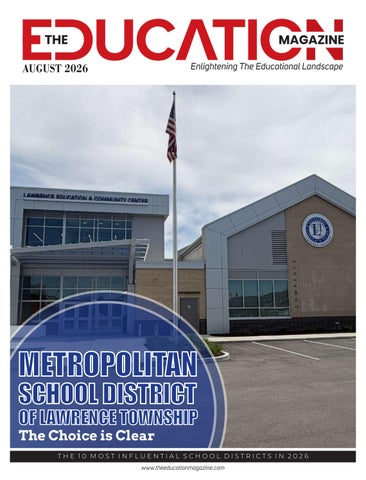
METROPOLITAN SCHOOL DISTRICT OF LAWRENCE TOWNSHIP THE 10 MOST INFLUENTIAL SCHOOL DISTRICTS IN 2026
Influence That Starts in the Classroom and Never Stops Growing! Dear Reader, Education rarely announces its greatest achievements with fanfare. More often, it grows quietly, inside classrooms and communities, until its impact becomes impossible to overlook. That quiet, cumulative, and often overlooked power is the subject of this issue, “The 10 Most Influential School Districts in 2026,” which turns its attention to the institutions shaping how an entire generation of students learns, grows, and prepares for what comes next. These are not districts merely chasing headlines. They are places where deliberate investment, community partnership and daily commitment to students have combined to produce something genuinely worth national attention. This issue’s cover feature belongs to the Metropolitan School District of Lawrence Township, on the northeast side of Indianapolis. Serving around 17,000 students from one of Indiana’s most culturally and linguistically diverse communities, the district has grown over generations from a traditional K-12 system into a full learning ecosystem that stretches from early childhood through graduation. Nearly one billion dollars invested in facilities now supports advanced academics, dual-language immersion, and the McKenzie Center for Innovation and Technology, the largest secondary career and technical education programme in the state of Indiana. Under Superintendent Dr. Shawn A. Smith, the district has also built a reputation for financial discipline, standing as one of only two districts in Marion County without an operating referendum, proof that academic ambition and fiscal responsibility can grow side by side. Joining Lawrence Township on this year’s list of influential districts are Chartiers Valley School District, Duquesne City School District, Westinghouse Arts Academy Charter School and Palestine-Wheatley School District, each recognised for the distinct and determined ways they continue to shape outcomes for the students, families and communities they serve. Together, these institutions offer a portrait of what influence in education actually looks like: not one dramatic breakthrough, but sustained investment in people, programmes and possibility. They remind us that the most consequential decisions about a nation's future are often made not in boardrooms, but in classrooms, hallways and communities working quietly toward something larger than themselves. This issue is a tribute to that work, to the educators who sustain it day after day, and to the students who will carry it forward. Sincerely,
Simran Khan Managing Editor
Publisher: Archana Ghule Editor–in–Chief: Vikram Suryawanshi
Art Director: Priyanka Patil Graphic Designer: Tejaswini Tandale
Managing Editor: Simran Khan
Marketing Head: Robert Smith
Project Editor: Shadab Mestri
Research Team: Daisy, Rahul, Maranda, Rocky
Sales & Marketing Project Head: Aakash Mahajan Sales Co-ordinators: Maria Smith Swati Kumari Project Manager: Rakesh Yadav, Nehal Nagpure, Nathan Fernandez
The Education Magazine is published by Pericles Ventures Pvt Ltd. This magazine contains material protected under International and Federal Copyright Laws and Treaties. You may not publish, display, disclose, rent, lease, modify, loan, distribute, or create derivative works based on the magazine contents or any part thereof, whether by yourself or as a consultant, employee, partner or in any other role unless authorised in writing by the creator/publisher of the article/, video, audio or any content contained herein. We, the team of The Education Magazine put all the efforts to keep up with the content accuracy. The publisher assumes no responsibility of any part of the content of any advertisement in this publication, including any errors or omissions therein. All rights reserved by Pericles Ventures Pvt Ltd.
10 Metropolitan School District of Lawrence Township
PROFILES
22. Chartiers Valley School District 34. Duquesne City School District 52. Palestine-Wheatley School District 70. Westinghouse Arts Academy Charter School articles 5 MUST-READ Digital Literacy Books 30. for Modern Learners AI in the Classroom: 44. More Than a Trend, a Revolution Best Self Development Books: 62. Power Up Your Mind With These
Metropolitan School District of Lawrence Township
Chartiers Valley School District
www.ltschools.org
www.cvsd.net
Chilton Independent School District
Duquesne City School District
www.chiltonisd.org
www.dukecitysd.org
East Cleveland City Schools
Palestine-Wheatley School District
www.eastclevelandschools.org
www.pwsd.k12.ar.us
Selma Unified School District
Trinity Area School District
www.selmausd.org
LinkedIn-Trinity Area School District
Ventura Unified School District
Westinghouse Arts Academy Charter School
www.venturausd.org
www.westinghousearts.org
10 I AUGUST 2026
THE EDUCATION MAGAZINE I 11
O
n the northeast side of Indianapolis, where one neighborhood gives way to the next and families from dozens of different countries have planted roots alongside one another, there is a school district that has been growing alongside its community for generations. It is not the kind of story that announces itself loudly. It builds gradually, almost quietly, and then at some point you realize you are looking at something genuinely significant.
The Metropolitan School District of Lawrence Township serves approximately 17,000 students across one of Indiana’s most culturally and linguistically diverse communities. It is recognized as one of the largest and most innovative public school districts in the state. And in a season when public education finds itself at the center of intense national debate, Lawrence Township represents a certain kind of answer: a district that has simply gotten on with the work. Generations in the Making Lawrence Township has served families on the northeast side of Indianapolis for generations, and its evolution over that time tells a particular kind of story. It began as a traditional K-12 school system and developed, with deliberateness and sustained investment, into what is now a comprehensive educational ecosystem that reaches children from age three through high school graduation. That ecosystem today includes high-quality early childhood education, advanced academics spanning dual-credit, Advanced Placement, and International Baccalaureate coursework, career and technical education, dual-language programming, work-based learning, and nationally recognized arts and athletics programming. Underwriting all of it is a physical infrastructure built on a nearly $1 billion investment in facilities and learning environments, designed to ensure that where students learn is as thoughtfully considered as what they learn. The mission guiding Lawrence Township is concise and unsparing: to support all students along their educational pathways toward graduation, college, and career readiness. Its vision is that of a district of destination, one that prepares students to thrive and reach their full potential in an ever-changing world. These are not marketing phrases. They are, in the life of this district, operational commitments. 12 I AUGUST 2026
A School for Every Stage The structural reach of Lawrence Township is particularly noteworthy. The district includes four Early Learning Centers serving children from pre-kindergarten through kindergarten, eleven elementary schools configured as kindergarten through sixth grade or first through sixth grade, two middle schools for seventh and eighth grade, and two comprehensive high schools for grades nine through twelve. There is also an alternative high school setting that serves students from both of the district’s home high schools, extending the district’s reach to students who require a different kind of learning environment to succeed. Beyond these schools sits the McKenzie Center for Innovation and Technology, which holds the distinction of being the largest secondary career and technical education program in the entire state of Indiana. Available exclusively to students from the MSD of Lawrence Township, the McKenzie Center is not merely a supplement to the district’s academic identity; it has become one of the defining pillars of the district’s college and career readiness strategy. The community these schools serve reflects the genuine diversity of urban and suburban Indianapolis, with families representing a wide range of cultural, linguistic, and socioeconomic backgrounds. That breadth of experience is not treated as a complication. It is, by the district’s own account, what makes the learning environment especially dynamic and enriching. Learning That Goes All the Way At the elementary level, Lawrence Township grounds students in strong foundational literacy and numeracy while offering enrichment in STEM, music, art, physical education, and world languages. Evidence-based literacy instruction sits alongside high-ability programming, a combination that signals the district’s intention to meet students across the full range of academic readiness without sacrificing rigor at any point on the spectrum. Middle school students move into rigorous core academics paired with electives in fine arts, technology, and engineering. They also begin earning high school credits while developing individualized pathways that connect their emerging interests to future academic and career goals. The decision to extend high school credit opportunities into middle school reflects a broader philosophy: students should begin exploring purposeful academic pathways as early as possible.
THE EDUCATION MAGAZINE I 13
14 I AUGUST 2026
THE EDUCATION MAGAZINE I 15
At the high school level, the breadth of options expands considerably. Students can pursue Advanced Placement, dual-credit, and International Baccalaureate coursework alongside career and technical education pathways, internships, work-based learning experiences, and industry-recognized credentials. Through the McKenzie Center, students have access to fields including healthcare, engineering, information technology, advanced manufacturing, education, business, transportation, and construction. The district’s goal for every graduate is clear: to leave with a diploma and a defined next step, whether that is college enrollment, military service, an apprenticeship, or direct entry into the workforce.
A Classroom That Fits Every Child In a district where students arrive from dozens of different linguistic and cultural backgrounds, the question of how to serve every learner is not abstract. Lawrence Township uses differentiated instruction, personalized learning strategies, and targeted supports to reach English learners, students with disabilities, high-ability learners, and those who require additional academic intervention. The goal is a learning environment where every student feels valued, connected, and genuinely challenged. Central to that goal is the district’s nationally recognized dual-language immersion program, which responds to both the linguistic diversity already present in the community and the growing demand from families for biliteracy and global competency. Students develop proficiency in multiple languages while mastering rigorous academic standards, building the kind of preparation that an increasingly interconnected world requires.
Excellence, Defined on Their Own Terms Lawrence Township does not define educational excellence in narrow terms. While academic outcomes matter deeply, the district holds a broader conception of what it means for a student to succeed, one that includes developing critical thinking, communication, collaboration, leadership, and resilience. Excellence, in this district’s understanding, also requires attracting, developing, and retaining the educators who make those outcomes possible, the teachers and staff who create meaningful learning experiences and build lasting relationships with students. The district’s strategic priorities reflect this wider view. Academic achievement, talent development, workforce recruitment and retention, operational excellence, and college and career readiness all share space at the planning table. Lawrence Township operates without an operating referendum, a distinction it holds as one of only two districts in all of Marion County, making its financial soundness particularly noteworthy. Competitive educator compensation, professional growth opportunities, and a collaborative culture reflect the district’s investment in its people. Continuous improvement and data-informed decision-making are how it holds itself accountable.
16 I AUGUST 2026
Lawrence Township also functions as a 1:1 technology district, ensuring every student has access to a device for learning both inside and outside the classroom. Through the Community Eligibility Provision, all students receive free breakfast and lunch each school day. The district continuously monitors student outcomes and invests resources where they are needed most, turning the language of equity into actual policy. These are the practical expressions of a belief that every student deserves access to excellent educational opportunities regardless of background, circumstance, language, or learning need. The Safety Net That Holds Beyond the academic day, Lawrence Township has built a support network designed to address the full range of challenges students and families encounter. Through its partnership with Communities In Schools, the district places a Family Liaison in every school building, connecting students and families to academic, social, emotional, and community resources while strengthening the relationship between home and school. The district partners with Jane Pauley Community Health Center and Adult and Child to provide access to mental health services and supports, understanding that a student’s capacity to learn is shaped by far more than what happens in the classroom. At the secondary level, school counselors guide students through academic planning, college admissions, career exploration, scholarships, and postsecondary opportunities. Career exploration begins early and continues to expand throughout middle and high school, expanding to include job shadowing, work-based learning, employer partnerships, industry certifications, and career networking experiences that connect what students are learning to the lives they are preparing to lead.
Life Beyond the Last Bell Student life in Lawrence Township is broad and genuinely active. Athletic programs compete at the highest levels in Indiana as members of the Metropolitan Interscholastic Conference, one of the state’s premier athletic associations. Fine arts programs offer opportunities in music, theater, visual arts, dance, and media production. Beyond athletics and fine arts, students can participate in academic teams, robotics, student government, service organizations, cultural clubs, leadership programs, and career-focused organizations. Beginning at the elementary level, every school features a makerspace and robotics opportunities, creating early and repeated exposure to creativity, problem-solving, and collaborative work. These activities unfold across a campus network that has been systematically modernized: every school building in Lawrence Township has been renovated or significantly improved within the past decade, the physical embodiment of the district’s long-term investment in the student experience. The Village Behind the Vision Lawrence Township’s partnerships extend well beyond the walls of its schools. The district actively collaborates with parents, nonprofit organizations, higher education institutions, local employers, healthcare providers, faith-based organizations, realtors, legislators, and the cities of Lawrence and Indianapolis. Families are engaged through digital communication platforms, community meetings, advisory groups, and school-based events, keeping the connection between the district and its communities active and reciprocal.
These partnerships generate tangible outcomes: mentorships, internships, scholarships, career exploration opportunities, student support services, and advocacy for public education. They rest on a shared understanding that preparing students for the future is not the exclusive responsibility of any single institution, and that the district’s goals are most fully realized when the broader community is genuinely invested in achieving them. The People Who Keep the Engine Running Lawrence Township operates through a collaborative leadership structure anchored by the Board of Education and the Superintendent. At the center of the district’s administrative life is the Lawrence Education and Community Center, known as the LECC, which serves as the central office. The LECC exists, by explicit institutional philosophy, to support principals, teachers, staff, students, and families, providing the resources, expertise, and services that schools need to succeed. The school is the heart of the organization. The central office is there to serve it. Key divisions include Teaching and Learning, Student Services, Exceptional Learners, Finance, Human Resources, Operations, Technology, and Communications, each playing a specific supporting role in the functioning of the district’s schools.
THE EDUCATION MAGAZINE I 17
18 I AUGUST 2026
Guiding the organization is Superintendent Dr. Shawn A. Smith, whose leadership has become associated with innovation, academic growth, fiscal responsibility, and decision-making anchored in student outcomes. His emphasis on relationships, service, and continuous improvement has shaped a culture that is, in many ways, defined by the quality of its people. “Lawrence Township is a place where every student belongs, every student is challenged, and every student has the opportunity to succeed,” Dr. Smith says. “Our schools are committed to helping students discover their strengths, pursue their passions, and build a future filled with possibility.” Over the past thirteen years, Dr. Smith has prioritized not only student achievement but financial strength. The MSD of Lawrence Township is one of two school districts in Marion County without an operating referendum. In 2019, the district passed its first-ever capital referendum, totaling $220M and passing with almost 70% voting yes. What Comes Next Lawrence Township’s forward agenda is as considered as its history. The district is preparing to expand early literacy efforts, strengthen college and career pathways, increase student engagement opportunities, enhance technology integration, and deepen its workforce partnerships. It is also actively preparing for Indiana’s evolving graduation requirements, while maintaining its investment in high-quality instruction and the professional learning of its educators. At the same time, Lawrence Township has positioned itself as a deliberate advocate for locally controlled public education, asserting the role that public schools play in strengthening communities and expanding opportunity for all students. In a district that serves 17,000 students across one of the Midwest’s most dynamic cities, that advocacy is not incidental. It is, in every meaningful sense, part of the mission. The work continues. In Lawrence Township, it always has, and for the students who fill these schools each morning, that constancy is perhaps the most important thing of all. THE EDUCATION MAGAZINE I 19
CHARTIERS VALLEY SCHOOL DISTRICT
Where Four Communities Became One Extraordinary Promise
22 I AUGUST 2026
THE EDUCATION MAGAZINE I 23
T
Those are not decorative words. At Chartiers Valley, they function as an operating principle, the standard against which every decision gets measured.
here is something quietly remarkable about a school district that begins not with a single, sweeping vision announced from on high, but with a decision made collectively, by neighbors who looked at one another and agreed that their children deserved something better than what anyone of them could build alone. In 1965, four communities in southwestern Pennsylvania made exactly that kind of decision.
Today, Chartiers Valley serves approximately 3,500 students across four schools, each shaped to meet the developmental needs of students at a specific stage of their lives.
Bridgeville Borough, Collier Township, Heidelberg Borough, and Scott Township consolidated their smaller, separate school systems into one unified institution: Chartiers Valley School District. It was, in the way most lasting things are, a practical choice that turned out to be something much larger than practicality. More than sixty years later, that decision looks like wisdom.
Chartiers Valley Primary School opens the journey for Kindergarten through Grade 2. The Intermediate School carries students through Grades 3 to 5. The Middle School bridges Grades 6 through 8, a period that anyone who has ever been twelve years old understands requires a particular kind of attentiveness. And Chartiers Valley High School guides students through Grades 9 to 12, toward graduation and whatever comes next.
Born of Unity, Built for Growth
The structure is intentional. Each school is designed not only for age-appropriate programming but for seamless transitions across grade levels, so that a child who enters Kindergarten in Scott Township or Bridgeville Borough moves through a coherent, connected educational experience, all the way to a diploma.
The consolidation of 1965 had straightforward objectives: pool resources, expand opportunities, and develop a unified educational vision for the children of four distinct communities. What it actually created, across the decades that followed, was a district with a particular kind of identity. One rooted in the understanding that different communities, brought together with shared purpose, can build something stronger than any of them could alone.
Four Schools, One Direction
The four communities the district serves bring with them diverse backgrounds, experiences, and perspectives. That diversity, the district believes, is not a complication to be managed. It is an asset to be valued.
Chartiers Valley has not stood still since those early years. The district has modernized its facilities, expanded its academic programming, deepened its commitment to technology integration, and made student wellness and safety central, structural priorities. It has grown, quietly and persistently, into what its leadership describes as a forward-thinking district that balances tradition with innovation.
Step inside a Chartiers Valley elementary school, and you find students building foundational skills in literacy, mathematics, science, and social studies. But there is considerably more happening than core instruction.
The mission is stated plainly: Chartiers Valley School District, a community dedicated to shared leadership, aims to graduate students who achieve personal success by providing an exceptional academic foundation in a safe, nurturing environment that inspires creativity and innovation while embracing diversity.
STEM opportunities are available to every student from the earliest grades, and hands-on, curiosity-driven learning is woven into the daily rhythm of the classroom. Art, music, physical education, library services, and technology instruction are part of every child’s school experience, not electives available only to some.
24 I AUGUST 2026
A Curriculum That Meets Every Student Where They Are
PBIS teams, Positive Behavioral Interventions and Supports, are embedded across the elementary level, building the kind of safe, predictable school climates where genuine learning becomes possible. The district also supports students who need more, in both directions. Intervention programs reach those who require additional assistance. Enrichment programs reach those ready for advanced challenge. No child is expected to simply keep pace and hope for the best.
A partnership with Parkway CTC opens robust career and technical pathways for students whose ambitions and strengths lead in that direction. STEM programs, business education, and arts programming give students room to discover what they are actually good at and what they care about. Internships, mentorships, and real-world learning experiences are built into the high school model because the district takes seriously its responsibility not just to educate students, but to launch them. The People Who Hold It Together
By the time students reach middle school, the curriculum expands deliberately and thoughtfully. Core academic subjects are joined by world languages, technology education, music, and fine arts. Interdisciplinary learning opportunities invite students to connect ideas across subjects in ways that mirror how the world actually works. And social-emotional development becomes an explicit priority, because a student navigating the turbulence of early adolescence is not fully available for academic growth unless someone is paying attention to the whole person. At the high school level, the scope of offerings is genuinely impressive. Advanced Placement courses, honors courses, and dual enrollment opportunities with local colleges give academically ambitious students the depth of challenge they need.
Every effective school district has a leadership structure that functions, at its best, like a well-tuned instrument. Each section has a distinct role, and the music they make together is either harmonious or it is not. At Chartiers Valley, it is. Superintendent Dr. Daniel Castagna carries the overarching strategic vision for the district. His role encompasses executing School Board policy, managing the day-to-day operations of the entire system, ensuring fiscal responsibility, and sustaining high academic standards across all four schools. “Chartiers Valley is committed to providing a safe, supportive, and challenging learning environment where every student has the opportunity to succeed.” THE EDUCATION MAGAZINE I 25
Working closely alongside him is Assistant Superintendent Dr. Michael Sable, whose focused domain is curriculum, instruction, and assessment. Dr. Sable is responsible for developing and implementing educational programs, driving professional development for instructional staff, and ensuring compliance with state and federal academic guidelines. He is the person who asks, every day, whether the teaching is actually working. The Building Principals of the four schools, Primary, Intermediate, Middle, and High School, are the instructional leaders closest to students and families. They supervise teachers, manage student affairs, foster positive school culture, and serve as the primary liaison between each school and its parent community. Behind these visible roles are departments that make the entire enterprise function. The Pupil Services and Special Education leadership oversees all services for students with Individualized Education Programs, ensuring that every student who requires accommodations, support, and resources receives them fully and in compliance with every applicable requirement. The Business and Finance Department manages budgeting, payroll, purchasing, facility financing, and financial reporting. Their work ensures that taxpayer resources are used responsibly and purposefully in the service of students. The Technology Department maintains the district’s entire IT infrastructure, including student and staff devices, network security, educational software, and data systems. In a district that has made technology integration a core strategic priority, this is not background work. It is central to everything. And the Facilities and Operations team oversees maintenance, safety, custodial services, groundskeeping, and facility planning. These are the people who ensure that every building is safe, clean, and ready to receive students every single morning. 26 I AUGUST 2026
Strategic planning at Chartiers Valley, notably, is not conducted behind closed doors. It is driven by collaboration among administrators, teachers, families, and community stakeholders. That collaborative instinct is not incidental. It is the same instinct that founded this district in the first place. No Student at the Margins If there is a philosophy that runs beneath everything Chartiers Valley does, it is this: every student deserves access to everything the district has to offer. Not most students. Not the easiest students to serve. Everyone. This means that K-12 STEM education is available to all students, not as a specialty program reserved for a select few. It means targeted academic interventions are provided to meet individual needs. It means special education services, gifted programming, and English language learner support are all in place and operational. It means personalized learning, differentiated instruction, small group work, and technology-enhanced learning are strategies teachers use across the district, not in isolated pockets of good practice.
Culturally responsive approaches and social-emotional learning are embedded in the classroom experience. The goal is simple in its statement and ambitious in its execution: every student should feel welcome and valued in this district. Beyond the classroom, Chartiers Valley offers a full spectrum of support services. School counseling services and career and college planning help students navigate what comes after graduation. The Student Assistance Program, known as SAP, reaches students dealing with personal challenges that could otherwise quietly derail their education. And then there is AHN Chill, the district’s dedicated mental health services program. Its presence reflects a clear-eyed understanding: in 2026, a school that does not take student mental health seriously is not fully serving its students. Chartiers Valley takes it seriously. Mentorship opportunities and internship and career exploration programs round out a support structure designed to ensure that no student, regardless of background or circumstance, disappears through the cracks.
A Life Beyond the Classroom There is a version of education that stops at the classroom door. It is a limited one, and Chartiers Valley has never been interested in it. Student life at Chartiers Valley is, by any reasonable measure, vibrant and full. The district offers 38 athletics programs for students in Grades 7 through 12, a number that speaks to a genuine, institutional commitment to sport as a space where teamwork, leadership, and school pride are built in ways that classrooms alone cannot replicate. The performing arts are equally robust. Dance, band, chorus, and theater give students who find their voice in performance a place to develop it, and an audience to share it with. Academic clubs, student leadership organizations, and community service programs create pathways for students whose engagement with the world takes a different form. STEM and technology clubs are available at every level, from the youngest elementary students all the way through to seniors in high school.
THE EDUCATION MAGAZINE I 27
28 I AUGUST 2026
The philosophy behind this breadth of opportunity is straightforward. Students who are engaged beyond the classroom tend to be more engaged within it. Chartiers Valley builds both worlds and trusts students to find where they belong. Partnerships That Extend the District’s Reach A school district does not exist in a sealed environment. It exists inside communities, and Chartiers Valley has always understood that its strength is inseparable from the strength of those communities around it. The district builds active partnerships with local businesses, connecting students to internship and career exploration opportunities before they ever collect a diploma. Community organizations extend the district’s reach into student support services, providing resources that no school building can provide entirely on its own. Law enforcement and emergency services are engaged partners in school safety planning, a reflection of the district’s seriousness about protecting every student and staff member. Higher education institutions are partners in dual enrollment opportunities, giving high school students access to college-level coursework and the confidence that comes from succeeding in it, long before they ever set foot on a college campus full-time.
The district’s leadership is clear-eyed and specific about the road ahead. The priorities for the future include expanding career pathways and workforce readiness, enhancing STEM and technology integration across all levels, continuing improvements to facilities, expanding community partnerships, and deepening student engagement opportunities throughout the district. These are not vague aspirations printed in a strategic plan and filed away. They are the next chapter of a story that began in 1965, when four communities decided that their children deserved something better than what any one of them could offer alone. That original instinct, to come together, to pool what they had, to build something worthy of the children they were responsible for, has never left this district. Through innovation, dedication, and community support, Chartiers Valley School District continues to prepare students for success in an ever-changing world. And in southwestern Pennsylvania, where four communities chose each other more than sixty years ago, that preparation is not a promise. It is a daily practice.
These partnerships are not symbolic. They are functional, deliberate, and woven into the operational fabric of the district.
THE EDUCATION MAGAZINE I 29
30 I AUGUST 2026
H
ello, future of the world. Have you had any sneak peek in the past? Any conversation about those black-andwhite days when the greats studied through books in the light of a candle, not a bulb. It sounds like your father is talking to you about his time, during which you have absolutely ZERO interest, right? Well, I am asking all this just to tell you how quickly we are moving ahead. And being digital nowadays, (including this blog), we can understand how much we are into this digital world than a real one. But have you heard about Digital Literacy? Sounds boring? Don’t worry, you can read this whole blog as I am not going to discuss the theory of it. Instead, I will be telling you some paperwork you need to get your hands on to understand how a piece of paper can enlighten your digital life. Here are the 5 best picks on Digital Literacy 1. Algorithms of Oppression: How Search Engines Reinforce Racism ● Ratings: 4.7/5 ● Author: Safiya Umoja Noble ● Published: 2018 Algorithms of Oppression the book, it reveals the insidious ways algorithms duplicate and amplify systemic racism in fact, specifically targeting Black women. It exposes the hidden biases deep inside these algorithms that further marginalize already vulnerable communities. Moreover, the book argues against results where available information is used to strengthen stereotypes. The more this is done, the fewer choices most people have when considering contradicting information that could upset the power balance. As a result, Noble finds more into the hurts these problems have on the individual, community, and society at large. She shows how technology can at once be an empowerment tool or a mechanism of oppression.
Noble thus challenges the notion of an objective internet. She argues that this vision serves instead to define public discourse and supports the inequities that already exist there. In doing so, she effectively shows the complexities and nuances to which these issues lend themselves. She argues for more transparency and accountability in the design of algorithms and champions a more equitable, fairer digital landscape. Algorithms of Oppression is an essential read for those looking to understand the intricate relationship between technology and social justice. The book reveals how algorithms, which are often thought of as neutral, actually are paths of reinforcement of already existing inequalities. This book is invaluable in encouraging digital literacy-challenging readers to question biases within everyday tools. Being aware of these biases would aid readers in evolving into more knowledgeable digital citizens in an effort to push for a fairer online world. 2. The Age Of Surveillance Capitalism ● Ratings: 4.5/5 ● Author: Shoshana Zuboff ● Published: 2018 That is, The Age of Surveillance Capitalism, Shoshana Zuboff, reveals the digital economy-led mainstream corporations like Google and THE EDUCATION MAGAZINE I 31
The author writes a new capitalism, which she calls “surveillance capitalism.” This system extracts data of the owner without permission from the owner. Furthermore, it makes this data available to the market for sale, which raises major ethical questions concerning privacy and autonomy.
Each of the techniques is discussed with proper emphasis on their practical applications, which means that readers can easily get concepts. Further, all very important topics such as data structures and the analysis of algorithms are discussed in detail for better comprehension of the subject.
Zuboff explores how such companies benefit from our digital lives. She tracks how algorithms predict and control our actions. And thus, serious issues arise with this degree of capability. On her watch list are the possibilities: erosion of privacy, manipulation of opinion, and now, a threat to democracy itself. She calls for better regulation and greater awareness to protect these freedoms and the future that technology may take.
The second half, titled The Hitchhiker’s Guide to Algorithms, is a reference manual; it catalogues an enormous number of the most significant algorithmic problems, along with their solutions and applicable resources. There are also “war stories” that will give life to the practice of algorithms in real-life situations. In a nutshell, The Algorithm Design Manual is an outstanding source for anyone eager to delve into the world of algorithms and their multiple uses. It provides a well-understood and accessible introduction to the topic and practical guidance for solving complex problems.
The Age of Surveillance Capitalism is an important read for students of digital literacy: It offers profound insights into the foundational mechanisms and ethical ramifications of the digital economy. In precise detail Zuboff illuminates the subtle machinations by which companies extract, analyze, and monetize personal data. That knowledge empowers digital citizens to be aware of their online actions. This helps protect their privacy and critically evaluate the role of technology in society. Third, it informs readers that through digital literacy, more just and democratic digital worlds might be nurtured. 3. The Algorithm Design Manual ● Ratings: 4.5/5 ● Author: Steven S Skiena ● Published: 1997 The Algorithm Design Manual by Steven S. Skiena, an intensive guide to the details of algorithm design and analysis. It is practical in nature. Such clarification of understanding and application of algorithmic methods is useful for all, whether students or professionals. It provides insight into the effective use of these methods to solve real-life problems. The book is basically divided into two parts. The first part is “Practical Algorithm Design.” Here, the most pertinent techniques in algorithms are dealt with. It consists of a few very important topics: divide-and-conquer, dynamic programming, greedy algorithms, and graph algorithms. 32 I AUGUST 2026
The Algorithm Design Manual is unavoidable reading when it comes to digital literacy, because one gets a basic understanding of many of the algorithms that form the backbone of many digital technologies. It is by understanding algorithms that peoples become savvy consumers of digital content and services. Understanding allows the individual to make wise decisions about what they do on the internet. It enables them to critically evaluate the validity of information and hence protect themselves appropriately from online threats. Additionally, a better understanding of algorithms is particularly helpful to a student who is serious about studying computer science, data science, or any other technological discipline. They are both better decision-makers and better prepared for future academic and professional studies. 4. Digital Minimalism ● Ratings: 4.4/5 ● Author: Cal Newport ● Published: 2019 In “Digital Minimalism,” Cal Newport invites readers to embrace a philosophy of technology centered on intentional engagement with digital tools, which emphasizes the importance of selecting a few personally meaningful activities.
By concentrating on these chosen pursuits, people effectively regain their focus. This shift in focus not only redirects attention but contributes to an overall improvement in one’s well-being. In this regard, Newport portrays that digital minimalism is rather something instead of merely taking away a source of distrainment in order to lead a more fulfilled life. The book offers a 30-day challenge with the intent of helping readers disconnect from unnecessary technology. This digital declutter pushes them out of the distraction zone. As the author puts it, this period of intentional disconnection gives one a greater capacity to know what part it plays in one’s life—to whether it is adding value or detracting from life’s richer moments. Solitude and mindfulness are considered an important feature of building a life that’s meaningful and centered, he believes. “Digital Minimalism” is an absolute must-read for anyone who has a passion for digital literacy. In other words, it challenges the assumption that a constant digital presence must be maintained. Instead, it challenges individuals to interact more deliberately with their digital devices. It encourages you to think about it, weigh your pros and cons, and develop effective strategies for managing your own digital behaviors. This way, readers achieve a greater level of control, becoming a more discriminating and knowledgeable consumer of technology. The process, ultimately, leads to a richer and more meaningful digital experience. 5. Shallows ● Ratings: 4.4/5 ● Author: Nicholas Carr ● Published: 2010 Nicholas Carr’s The Shallows offers a strong argument that the internet is fundamentally changing our cognitive capacities. Relying on a mix of historical examples and scientific studies, Carr argues that the constant stream of information and distractions provided by the internet creates a breakdown in deep thinking and concentration. According to his argument, the very architecture of the internet breeds superficial engagement and quick information absorption, making it difficult for individuals to sustain attentive attention.
While recognizing the advantages that technology brings, Carr underscores the necessity of being aware of the possible detrimental effects stemming from excessive internet usage. His book stands as a thought-provoking exploration of how technology influences our minds and prompts us to reflect on the significance of maintaining a balance between our online engagements and offline pursuits. An absolute must-read within the spectrum of digital literacy, The Shallows facilitates a thoughtful exploration of how the internet influences our capacities for cognition. As Carr delves into the potential negative consequences of overindulging in online activities, he urges his readers to take a more mindful approach to the reception of digital information. The book emphasizes the development of a range of digital literacy skills into critical thinking, assessment of information, and proficient online communication. Awareness of the potential risks involved with the use of digital technology helps readers understand what is at stake when using and engaging with the internet; thus, this allows for a more reflective and active attitude towards digital citizenship. Closing Chapter In today’s rapidly advancing digital age, understanding digital literacy is crucial for navigating the online world. From how algorithms shape our experiences to the importance of mindful technology use, digital literacy empowers us to critically engage with the digital landscape. The books discussed above provide invaluable insights into the ethical, social, and cognitive implications of digital tools. By becoming more informed and intentional users of technology, students can protect their privacy, foster deep thinking, and contribute to a more equitable and thoughtful digital future. THE EDUCATION MAGAZINE I 33
34 I AUGUST 2026
In
the towns that line Pennsylvania’s Mon Valley, the story of public education often follows the rise and fall of industry. Steel once shaped daily life here. When that foundation weakened, schools felt the shift just as deeply as families did. Districts had to make hard choices, not just about budgets, but about what kind of future they could still offer their students.
Within that setting, the Duquesne City School District has had to rethink its role more than once. It began as a full K–12 system, serving generations of students in a tight-knit community. In 2007, after years of economic strain, the state assumed responsibility for high school students in grades 9–12, shifting the district to a K–8 model. The transition continued in 2012, when grades 7 and 8 were also moved out, further narrowing the district’s scope. Nearly a decade later, a gradual rebuilding began. Seventh grade returned in 2021, followed by eighth grade in 2022, restoring a more complete middle school experience. This phased approach helped minimize disruption for students and families, ensuring that no one was forced to make a sudden transition at a critical stage in their education. Change did not stop there. In 2021, middle school grades returned, reopening pathways that had once been limited. That move signaled more than expansion. It reflected a district finding its footing again, choosing to invest in continuity for its students. Today, its mission centers on strong, student-focused teaching paired with attention to social and emotional growth. Classrooms aim to challenge students while also supporting them as individuals. The vision looks ahead, with an emphasis on equity, new ideas, and preparing students for life beyond school through personalized learning and ties to the community. THE EDUCATION MAGAZINE I 35
Over time, the district has not simply adjusted to change. It has learned how to work within it. What stands now is a system shaped by its past, but not held back by it, focused on giving its students a clearer path forward.
The district sits in the city of Duquesne, a place that carries the traits of a small urban system. Many families face economic challenges, which shape how the district approaches its work. Academic instruction does not stand alone. Equal weight is given to social and emotional support, with staff paying close attention to what students need beyond textbooks and tests.
Building Strong Foundations and Early Pathways Inside the district, academic programming reflects both necessity and intent. With all grades housed under one roof, the district has shaped a K–8 model that feels connected rather than segmented. Younger and older students share the same environment, which creates a steady sense of progression as children move through each stage of learning. At the elementary level, the focus stays on getting the basics right. Literacy and mathematics take center stage, supported by close tracking of student progress and timely interventions when gaps appear, reducing learning gaps. Teachers adjust their approach based on what students need in real time, rather than waiting for problems to grow. Social-emotional learning is not treated as a separate subject. It is woven into daily instruction, helping students build confidence alongside academic skills. Career awareness begins earlier than one might expect. Even in kindergarten, students start exploring interests through simple, structured exposure to different fields. As they move into middle school, those early ideas take clearer shape. Students gain access to STEM-based electives such as coding, robotics, drone technology, and podcasting. Project-based learning becomes more common, encouraging them to apply knowledge in practical ways. Beyond the classroom, arts programs, clubs, and athletics add another layer, keeping students engaged while broadening their sense of what is possible. A Single-School System with a Close-Knit Reach What sets Duquesne City apart begins with its scale. The entire district operates within a single school building, serving roughly 475 students from kindergarten through eighth grade. In a community that spans just about two square miles, that structure creates a setting where familiarity is hard to avoid. Students grow up in the same space, often with the same peers and many of the same adults guiding them along the way. 36 I AUGUST 2026
Early learning begins even before kindergarten. Programs like Head Start and preschool, supported by the Allegheny Intermediate Unit, operate within the same building. This brings younger children into the system early and helps ease the transition into formal schooling. After eighth grade, students move on to nearby districts for high school, choosing the path that fits them best. Throughout it all, partnerships within the community help extend learning beyond the classroom, keeping support consistent as students prepare for what comes next. Leadership That Stays Close to the Work The district is guided by Superintendent Dr. Sue A. Mariani, Principal Erica Slobodnik, and Director of Curriculum Ryan Matsook, who together bring a clear and steady approach to leadership. They maintain high expectations while staying equally focused on how students are supported along the way. Their work depends on collaboration that feels active rather than symbolic, involving teachers, support staff, families, and students in meaningful ways. While the district does have a Board of School Directors, its authority is limited to specific functions such as reorganization, setting the tax levy, and approving new debt. Broader decisions are overseen by the Court Appointed Receiver, Dr. William Kerr, under state control. This structure keeps the district grounded in what is actually happening inside the building, ensuring that planning and decision-making remain closely tied to student needs. When challenges arise, the response tends to be direct and collective. There is also a consistent effort to build an environment that feels safe and respectful without losing academic focus. Students are expected to take their work seriously, but they are also encouraged to speak up, ask questions, and stay engaged in their own progress. The message to families is straightforward and consistent. Every student is capable of growth and deserves real opportunity. The district’s role is to provide both structure and support so that potential does not remain theoretical, but turns into something visible over time.
Dening Excellence Beyond Test Scores At Duquesne City, educational excellence is not reduced to a single number or ranking. It is understood through a broader lens, one that looks at how students grow as learners and as individuals. Academic progress matters, but it sits alongside social-emotional well-being and a student’s readiness for life after school. Classrooms are expected to deliver strong, standards-aligned instruction, supported by regular use of data to guide teaching decisions. At the same time, learning is shaped around the student, not the system. Adjustments are made to match pace, interest, and need, allowing students to stay engaged without being left behind. Relationships carry equal weight. A consistent effort is made to ensure students feel safe, known, and supported within the school environment. That sense of belonging often becomes the foundation for stronger academic outcomes. Strategic priorities reflect this balance. Improving achievement, closing learning gaps, strengthening attendance, and expanding STEM and career exposure all move in tandem. Partnerships with families and the wider community help reinforce these efforts, keeping progress steady and shared. THE EDUCATION MAGAZINE I 37
38 I AUGUST 2026
Meeting Students Where They Are
Building a Network Around Each Student
Walk into a classroom at the district, and it becomes clear that students are not expected to learn in the same way or at the same pace. Instruction is shaped around that reality. Teachers adjust their methods through small group work, differentiated lessons, and targeted interventions, allowing each student to engage with material in a way that fits.
In a district such as Duquesne City, progress depends on more than what happens inside the building. The district treats relationships with families, community groups, and local partners as part of its daily work, not as an added effort.
Support extends beyond academics. Social-emotional learning is built into daily routines, helping students manage challenges, build confidence, and stay connected to their learning. This is further strengthened through Tier I support, with the school counselor providing weekly engagement to reinforce these skills. At the same time, lessons reflect the backgrounds and experiences students bring with them. Culturally responsive teaching ensures that what happens in the classroom feels relevant and familiar, not distant. Systems like the Multi-Tiered System of Supports provide structure, offering additional help when needed without delay. Families and community partners remain part of that support network, reinforcing progress outside school walls. The result is a learning environment that feels both structured and flexible, where students are recognized as individuals and given room to succeed on their own terms.
Parents are kept close to the process. Communication is steady and clear, whether through school events, direct outreach, or opportunities to share feedback. Families are not only informed but included, which helps build a sense of shared responsibility for student growth. Partnerships across the community bring added depth to student experiences. Local organizations and businesses support programs tied to STEM learning, career awareness, and enrichment. These connections give students a clearer sense of how classroom lessons translate into real-world settings. Civic partners also contribute by helping address social and emotional needs that can affect learning. Over time, these relationships form a reliable network. Trust builds through consistency, and that trust allows the district to extend its reach. Students benefit from a system where support comes from many directions, all working toward the same goal. THE EDUCATION MAGAZINE I 39
A School Day That Extends Beyond the Classroom Life inside the district does not end when lessons are over. The school day carries into a range of activities that keep students involved, active, and connected to one another. Athletics play a steady role, with sports such as basketball, volleyball, and football giving students a chance to build teamwork and school spirit. For others, clubs offer a different kind of engagement. Robotics, Lego League, drone soccer, podcasting, and student leadership groups allow students to explore interests that often stretch beyond traditional subjects. Creative outlets are part of the mix as well. Music and arts programs give students space to express themselves and develop confidence in quieter ways.
Special Education and Student Support Services address individual student needs, while Curriculum and Instruction keep teaching aligned and consistent. Operations run alongside academics. Business and operations teams manage finances, facilities, and transportation, ensuring the system functions smoothly with a focus on cost-effective operations. Technology staff support digital tools that have become part of everyday learning. Teachers and support staff bring these efforts to life in classrooms and hallways. Working together, this structure helps maintain a school environment that stays organized, responsive, and centered on students. Creating Fair Access, Not Just Equal Access
These experiences do more than fill time. They help students form friendships, discover new strengths, and feel a stronger sense of belonging within the school community. A Structure That Keeps the System Moving Behind the day-to-day rhythm of Duquesne City is a leadership structure designed to stay coordinated and practical. Each role carries a clear responsibility, but the work remains closely connected. The superintendent sets direction and long-term priorities, while the principal manages daily operations and guides instruction inside the building. Around them, key departments handle focused areas of support. 40 I AUGUST 2026
Equity inside the district is approached with a clear understanding that students do not all begin at the same point. Support is shaped accordingly, with resources directed where they are needed most rather than spread evenly without context. Targeted academic help, social-emotional support, and access to technology form the base of that effort. Frameworks such as the Multi-Tiered System of Supports guide how interventions are delivered, ensuring students receive help early and consistently. Teaching practices also reflect the backgrounds students bring, making learning feel more relevant and inclusive.
Relationships play a central role. Staff work to create an environment where students feel secure and recognized. Opportunities in STEM, career awareness, and enrichment are kept open to all, not limited by circumstance. Ongoing data review and community partnerships help identify barriers and address them, keeping progress steady and grounded in real student needs. Support That Extends Beyond Academics At Duquesne City, student support is built as a network rather than a single service. Academic learning is paired with systems that address emotional well-being, behavior, and future planning. School counselors and psychological services provide consistent guidance, while access to mental health support helps students manage challenges that can affect learning. Career awareness begins early and continues through eighth grade, with students introduced to different paths through guest speakers and real-world exposure. THE EDUCATION MAGAZINE I 41
42 I AUGUST 2026
Mentorship and community partnerships add another layer, giving students role models and connections outside the classroom. Behavioral support is structured through frameworks like Multi-Tiered System of Supports and PBIS, helping students stay on track in a positive way. The district also uses the House System, inspired by the Ron Clark Academy, to build belonging and accountability. Strengthening Outcomes and Expanding Opportunity The next phase for Duquesne City School District builds on steady progress while sharpening its academic focus. Strengthening core instruction remains a priority, supported by closer use of data and timely interventions that address gaps before they widen. Improvement in English language arts, mathematics, and science outcomes sits at the center of these efforts. At the same time, learning is becoming more personalized, giving students clearer pathways based on their pace and interests. Career awareness will continue to grow from kindergarten through eighth grade, helping students connect classroom learning to future possibilities. New initiatives include expanding STEM programs, integrating updated technologies, and creating more real-world learning experiences through community partnerships. Attendance, family engagement, and social-emotional support will also remain key areas of attention. For staff, ongoing professional development ensures teaching practices stay current and effective, keeping the district aligned with the demands students will face beyond school.
THE EDUCATION MAGAZINE I 43
● A. Personalized Learning at Scale: ○ Adaptive Learning Paths AI tools now adjust the way lessons are taught based on how each student performs. The system changes speed, content, and teaching methods to fit individual needs. This helps every learner move at their own pace, without feeling left behind. ● Students learn better because the content matches their level. ● It fills knowledge gaps and supports strengths at the same time.
A
rtificial Intelligence is no longer just a futuristic idea—it’s already reshaping how students learn and how teachers teach. From lesson planning to adaptive tools, AI in the classroom is now part of everyday education. But beyond the buzzwords, this shift is more than just using a chatbot or grading software. It’s about building smart, responsive systems that help educators save time, support every learner’s needs, and improve outcomes at scale. However, the real power of AI depends on how wisely we use it. Responsible use means clear rules, strong ethics, and thoughtful planning. In this blog, you’ll explore how AI is transforming learning, how schools can use it effectively, what ethical challenges lie ahead, and why educators—not algorithms—must stay at the center of it all. The goal isn’t just smarter classrooms. It’s more inclusive, efficient, and human-centered education through the right use of AI in the classroom.
The Transformative Power of AI in the Classroom
● 25% of educators say personalized learning is the biggest benefit of AI in the classroom. ○ Addressing Diverse Needs AI tools now support students with different challenges. For example: ● Text-to-speech helps struggling readers ● Live translation supports non-English speakers ● Simplified content makes tough topics easier to understand These tools promote inclusion. According to UNESCO, AI must ensure equal learning chances for all. With AI in the classroom, education becomes more fair and accessible. ● B. Empowering Educators: Streamlining Tasks and Enhancing Instruction: ○ Automated Administrative Support AI saves time by handling common classroom tasks: ● Grading
Artificial Intelligence is no longer just a buzzword in education—it’s now part of everyday learning. From simplifying tasks to personalizing learning, AI in the classroom is helping both students and teachers in real, practical ways. As of 2025, almost every student interacts with AI tools daily, while many teachers depend on them for planning, grading, and instruction. 44 I AUGUST 2026
● Feedback ● Attendance ● Timetables 42% of teachers say this is the most helpful part of using AI. It allows them to focus more on teaching, not paperwork.
THE EDUCATION MAGAZINE I 45
○ Intelligent Content Creation
○ Fostering 21st-Century Skills
Teachers now use AI to:
AI prepares students for the future by building:
● Build lesson plans
● Problem-solving
● Create quizzes and assignments
● Creativity
● Design classroom activities
● Digital literacy
In 2023:
● Critical thinking
● 38% of teachers used AI to plan lessons
58% of high school teachers noticed students became more confident.
● 37% created classroom materials using AI ● 44% said AI made their jobs easier by reducing workload
49% of college professors saw students learn faster with AI’s help. ○ Research and Revision Aids
○ Data-Driven Insights Students now use AI to: AI helps track and analyze student performance. It identifies who’s at risk, what’s working, and how to improve.
● Research topics ● Write drafts
● Teachers get clear data for smarter teaching choices ● Fix grammar and structure ● They can support each student with the right plan ● 47% of education leaders now use AI daily to make better decisions This is how AI in the classroom empowers teachers while improving outcomes. ● C. Boosting Student Engagement and Skill Development:
73.6% of students and researchers say AI makes writing and reviewing faster and easier. It acts like a smart guide that helps without doing the work for them. Navigating the Challenges and Ethical Landscape AI’s integration into classrooms brings transformative benefits, but also raises complex challenges around academic integrity, data privacy, fairness, equity, and the preservation of human-centered learning.
○ Interactive Learning Experiences ● A. Academic Integrity and the Challenge of Misuse: More than 51% of educators now use: 1. The Plagiarism Dilemma ● AI chatbots for Q&A, debates, and storytelling ● Games powered by AI to make lessons fun ● VR and AR tools to help students “experience” learning These tools increase attention and make learning more active. 46 I AUGUST 2026
AI tools like ChatGPT are now used by 89% of students for homework. This change is reshaping academic honesty. At the same time, 68% of teachers rely on AI to catch plagiarism. Interestingly, while AI-generated content rose 76%, plagiarism rates dropped 51%. That shift suggests students are using AI in new ways.
Still, most teachers believe using AI for homework counts as cheating. As a result, discipline cases for dishonesty increased—from 48% to 64% this year.
This builds trust while staying compliant with privacy laws. ● C. Algorithmic Bias and Fairness:
2. Cultivating Originality 1. Understanding Inherent Biases Traditional plagiarism detectors can’t catch everything AI produces. So, many educators now encourage students to critically engage with AI outputs. They’re assigning: ● Personal reflections
AI systems can repeat the biases they learn from data. This can unfairly affect students, especially those from marginalized backgrounds. That’s why ongoing review of data sets and results is critical in classrooms using AI.
● Process journals 2. Promoting Equity ● Oral presentations Schools are adopting these fairness strategies: These assignments make it harder to depend only on AI in the classroom. Students learn to think for themselves while still using tech as a support tool.
● Diverse teams in AI design ● Regular audits for bias
● B. Data Privacy and Security Concerns: 1. Safeguarding Sensitive Information Schools have become major targets for cybercrime. In 2025, weekly cyberattacks on schools rose by 75%. Ransomware demands now average $6.6 million in lower education and $4.4 million in higher education.
● Clear, explainable recommendations from AI These practices help AI in the classroom serve every student fairly. ● D. The Digital Divide: Ensuring Equitable Access:
Educators are worried: 1. Bridging the Gap ● 51% feel uneasy about personal data safety Many students still lack access to: ● 63% are very concerned about AI-driven attacks ● AI tools AI in the classroom must include strict privacy protections for everyone involved.
● Reliable internet
2. Compliance and Transparency
● Personal learning devices
In 2025, 53% of schools have a cybersecurity plan—up from 34% in 2022. They now:
This gap creates deeper learning inequalities.
● Run regular security checks
Governments now fund:
● Encrypt student data
● Low-cost devices
● Explain how that data is used
● Subsidized connectivity
2. Policy and Infrastructure
THE EDUCATION MAGAZINE I 47
● Targeted help for underserved communities
● Define how students and teachers can use AI Set standards for honesty and fairness
These steps aim to bring the full benefits of AI in the classroom to all learners, not just a privileged few.
● Explain consequences for misuse
● E. Over-reliance and Preserving the Human Element:
In fact, many schools with strong AI policies report fewer cheating cases.
1. Maintaining Critical Thinking
2. Stakeholder Collaboration
If students depend too much on AI, their creativity may suffer. Teachers are now focusing on:
Great policies come from listening to everyone—students, parents, teachers, and staff.
● Open-ended questions
● Include all voices in discussions
● Projects with real-world applications
● Update rules often as AI tools evolve
● Personal storytelling
● Build trust and make everyone feel heard
This helps students build skills, not shortcuts.
This creates stronger support for AI in the classroom.
2. The Irreplaceable Role of the Educator
● B. Empowering Educators Through Professional Development:
AI can help with teaching. But it can’t replace a teacher’s: 1. Beyond Basic Training ● Empathy ● Motivation
Teachers need more than a quick guide. They need real, hands-on training with experts and peers.
● Judgment
● Offer regular workshops
The best schools in 2025 don’t replace teachers with AI. Instead, they use AI in the classroom to support deeper, more human-centered learning.
● Build peer learning groups
Strategic Implementation: Best Practices for Schools
Even in 2025, more than 50% of teachers say they don’t get enough AI training.
Successfully leveraging AI in education requires more than just adopting new technologies—it demands thoughtful planning, inclusive policy-making, and a commitment to continuous improvement. Here's a roadmap for schools to ensure responsible, impactful, and equitable AI integration. ● A. Developing Comprehensive AI Policies and Guidelines:
● Invite guest educators for demos
2. Cultivating AI Literacy Teachers must know what AI can and cannot do. This helps them use it the right way in class. ● Teach AI strengths and limits ● Show how to blend AI with real teaching
1. Clear Expectations ● Encourage thoughtful use, not overuse Schools must set clear rules for using AI in learning. These rules should explain what is allowed and what is not. 48 I AUGUST 2026
This builds confidence in using AI in the classroom the right way.
● C. Fostering Student AI Literacy and Agency:
That’s how schools keep AI in the classroom effective and meaningful.
1. Critical Evaluation Skills Students should learn how to think about what AI gives them—not just accept it.
● E. Engaging Parents and the Wider Community: 1. Transparent Communication
● Question AI answers ● Compare with trusted sources
Tell parents what’s happening. Be honest and clear about goals and safety steps.
● Spot bias and errors ● Share updates on school websites Many students in AI-literate schools are better at evaluating sources.
● Show real classroom examples
2. Responsible Creation
● Explain how data stays private
Encourage students to use AI to build new ideas, not just copy.
2. Addressing Concerns
● Let them create AI tools or apps
Open the door for questions. Let parents feel involved.
● Use AI in projects and presentations ● Host Q&A sessions ● Teach them to design with ethics in mind ● Share guides or videos This makes AI in the classroom a tool for thinking, not just clicking. ● D. Measuring Impact and Iterative Improvement: 1. Assessing Effectiveness Schools should track what works and what doesn't. Use numbers and stories to get a full picture.
● Listen to their worries More than half of the parents say they support AI more when they feel included. The Future of AI in Education 1. Emerging Trends
● Monitor test scores and attendance ● Collect teacher and student feedback ● Watch how often AI is used
AI tools now customize lessons to match every student’s pace, interest, and skill level. This ensures no learner falls behind.
2. Continuous Adaptation Stay open to change. Review and revise your strategies often. ● Hold review meetings
● Students get lessons based on how they learn best ● Progress becomes faster, smoother, and more confident
● Ask for input from all users ● Improve based on real feedback
● Everyone learns at their own pace without pressure. THE EDUCATION MAGAZINE I 49
This shift shows how AI in the classroom is making education more personal and student-focused.
3. Continuous Adaptation
AI-Driven Collaborative Learning
Schools must stay flexible. As AI changes, so should policies and teaching tools.
Classrooms are becoming more interactive thanks to AI.
● Update training for teachers regularly
● AI forms study groups based on student strengths
● Ask for feedback from students and parents
● It suggests group projects and moderates online chats
● Keep improving based on what works
● Teamwork and sharing ideas become easier and more fun
By doing this, schools can use AI wisely, safely, and fairly. The future of AI in the classroom is not just about tools—it’s about smarter, kinder, and more effective learning for all.
This helps students connect, both in-person and online. Predictive Analytics
Key Takeaways AI now spots trends in how students perform. It predicts: ● Who may need extra help ● What topics are harder for certain students ● When to offer support before problems grow These tools let teachers take action early. That’s another smart use of AI in the classroom. 2. AI as a Collaborative Partner In the future, AI and teachers will work side by side. AI handles:
What’s clear is that we’ve already stepped into a world where AI is part of how we learn—and there’s no turning back. But that doesn’t mean we treat it like magic. It means we understand what’s at stake. AI in the classroom is powerful, but only when it’s used with intent. It can bring efficiency, personalization, and creativity. But if left unchecked, it can also create dependence, bias, and even widen existing gaps.
● Giving custom content
What really matters is the mindset. Schools that treat AI as a partner—not a shortcut—are already seeing better engagement and deeper learning. Teachers who see AI as an assistant, not a threat, are reclaiming time to do what machines never will—build trust, inspire, and connect.
This frees teachers to focus on what matters most—talking to students, understanding emotions, and building thinking skills. With AI in the classroom, learning becomes deeper and more human.
This shift isn’t just technical. It’s cultural. It’s about rethinking what great education looks like in a world that’s evolving fast—and making sure every learner benefits from it.
● Planning lessons ● Tracking progress
50 I AUGUST 2026
THE EDUCATION MAGAZINE I 51
Palestine-Wheatley School District Strengthening the Delta through Choice, Community, and Opportunity 52 I AUGUST 2026
THE EDUCATION MAGAZINE I 53
I
n the Arkansas Delta, schools have always been more than places of instruction. They are gathering points for families, anchors for towns, and quiet drivers of change. Over time, as communities shifted and expectations grew, the need for stronger, more connected educational systems became clear. Out of that need, the Palestine-Wheatley School District took shape.
The district was formed through the consolidation of two long-standing Delta communities, Palestine and Wheatley. Each brought its own history, traditions, and pride in local schools. Together, they created a single district with a shared purpose and a wider reach. What began as a practical decision has since grown into something more ambitious. Today, Palestine-Wheatley operates as a student-centered district that serves not only its immediate area but families from across the broader Arkansas Delta. School choice has played a major role in that evolution. More students now come to Palestine-Wheatley from outside the district’s geographic boundaries than from within them. Families make that choice deliberately. They are drawn by the district’s close-knit culture, its focus on strong academics, and its reputation for preparing students for life beyond graduation. Over time, this steady inflow has turned Palestine-Wheatley into a regional hub, one where opportunity feels tangible rather than abstract. At its core, the district’s mission is clear. Palestine-Wheatley aims to strengthen the Delta through education by building foundational literacy, developing character, and teaching practical skills that matter in college, careers, and everyday life. The vision extends beyond test scores or graduation rates. Leaders and educators want every student to be known, supported, and challenged, with multiple pathways open when they walk across the stage. In a region often defined by its challenges, Palestine-Wheatley School District has chosen to define itself by possibility and by the families who continue to place their trust in it. A Unified PK–12 District Built on Connection Palestine-Wheatley School District operates with a structure that is simple by design and intentional in practice. The district runs two campuses that function as one unified PK–12 system. Palestine-Wheatley Elementary School, located in Palestine, serves students from prekindergarten through sixth grade. Palestine-Wheatley High School, also in Palestine, serves students in grades seven through twelve. Together, these schools create a continuous learning pathway rather than functioning as separate, disconnected entities. 54 I AUGUST 2026
Although the district’s geographic footprint is small, its reach is not. Through Arkansas’s school choice framework, Palestine-Wheatley enrolls students from communities across the Delta, including Caldwell, Goodwin, Forrest City, Brinkley, and nearby towns. Most students arrive by choice, not proximity, which shapes how the district operates and how it is perceived. This two-campus model allows leaders and educators to align instruction from early learning through graduation. It also supports personalized attention, consistent expectations, and strong relationships that carry forward year after year. In practice, the structure helps the district stay cohesive while serving a broad and diverse student population. Academic Pathways Designed to Grow With Students Academic programming at Palestine-Wheatley is built to meet students where they are and move them forward with purpose. At the elementary level, the district grounds instruction in the Science of Reading and structured literacy. Teachers provide explicit phonics instruction, daily intervention blocks, and targeted dyslexia support, while enrichment keeps strong readers engaged. Technology plays a supporting role, with adaptive reading tools offering real-time data that helps teachers adjust instruction for each child. Early numeracy, hands-on science, and active classrooms remain central to the learning experience. In middle school, the focus shifts to growth and exploration. Students receive strong core instruction paired with hands-on science, digital literacy, and career awareness activities. Structured academic support helps students build confidence as they transition toward high school expectations. At the high school level, choice expands. Students can pursue college-ready coursework, career and technical pathways, or both. Through a close partnership with the University of Arkansas–East Arkansas Community College, many graduate with associate degrees, industry certificates, or even a CDL, leaving school prepared for real opportunities on day one.
THE EDUCATION MAGAZINE I 55
Leadership Rooted in Service and Belief
Meeting Students Where They Are
Leadership at Palestine-Wheatley reflects the values the community expects from its schools. The district’s leaders operate with a student-centered mindset and a strong sense of responsibility to the families they serve. They believe rural schools should never limit opportunity. Instead, they should expand it through strong instruction, clear accountability, and leadership that listens before it directs.
The school district serves a student population shaped by the diversity of the Arkansas Delta, and its approach to learning reflects that reality. Teachers use differentiated instruction and small-group learning to reach students with different strengths, learning styles, and starting points. Early intervention and response-to-intervention structures help identify needs quickly, allowing support to begin before challenges become barriers.
Relationships sit at the center of how leaders approach their work. Administrators, teachers, and staff see themselves as partners with families, not distant decision-makers. This servantleadership approach shapes daily interactions and long-term planning alike. Expectations are high, but support is consistent, and progress is measured thoughtfully rather than rushed. When leaders speak to families, the message remains direct and reassuring. Every child, they believe, brings limitless potential into the classroom. The district commits to preparing students for futures that fit their goals, whether that path leads to college, a skilled trade, the workforce, or military service. Along the way, students are challenged, supported, and celebrated, not as numbers, but as individuals whose success matters to the entire community. Defining Excellence by Outcomes, Not Labels At Palestine-Wheatley, educational excellence is measured by what students gain, not by the district’s size or location. Leaders define excellence as consistent access to high-quality instruction, meaningful classroom engagement, and opportunities that translate into real growth over time. The focus stays on results that students can carry with them long after graduation. Early literacy sits at the foundation of that work. Strong Tier 1 instruction ensures all students receive clear, effective teaching from the start, while targeted supports help close gaps before they widen. Teachers are not expected to do this work alone. Ongoing coaching and professional support strengthen instruction and encourage continuous improvement across classrooms. Engagement also matters. Lessons connect to real-world applications so learning feels relevant rather than abstract. At the same time, data guides decisions, helping educators respond quickly to student needs and track progress with purpose. For Palestine-Wheatley, excellence means students leave school prepared and confident, with multiple pathways open. Success is defined by outcomes and options, not assumptions about what a rural district can or cannot achieve. 56 I AUGUST 2026
The district places strong emphasis on literacy supports, including dyslexia screening and structured literacy instruction grounded in best practices. Special education services are thoughtfully aligned to ensure students receive appropriate accommodations while remaining connected to inclusive classroom environments. Social-emotional support systems further reinforce student well-being, recognizing that learning does not happen in isolation. Culturally responsive teaching plays an important role in daily instruction. Educators work to create classrooms where students see themselves reflected and respected. Because of its size, the district knows students personally. That familiarity allows staff to respond with care and precision, ensuring individual needs are met and no student is overlooked.
‘‘
Your children have limitless potential, and we are committed to preparing them for a successful, meaningful future, whether they pursue college, a skilled trade, the workforce, or the military.
THE EDUCATION MAGAZINE I 57
Partnerships that Extend Beyond the Classroom In a rural Delta district, schools and the community are closely connected, and Palestine-Wheatley treats those relationships as essential rather than optional. The district actively collaborates with a wide range of partners who support students both academically and personally. Its most impactful academic partnership is with the University of Arkansas–East Arkansas Community College, which helps expand college and career opportunities for high school students. Beyond higher education, the district works closely with local churches, regional businesses, agricultural partners, civic organizations, and local and county agencies. These relationships strengthen trust and create a shared sense of responsibility for student success. Connection also happens through regular gatherings. Family nights, open houses, athletic events, and community celebrations invite families onto campus. Patriot Roundtable meetings provide space for open dialogue and collaboration with stakeholders. Together, these efforts ensure students are supported not only during the school day, but by a network that extends well beyond the classroom walls. Student Life Built on Pride and Participation Student life at Palestine-Wheatley extends well beyond the classroom. Campuses stay active with a wide range of extracurricular and enrichment opportunities that give students space to explore interests and build confidence.
58 I AUGUST 2026
Athletics play a visible role, with competitive programs in football, basketball, baseball, softball, track, volleyball, and cheer bringing students and families together throughout the year. Creative and technical outlets are equally important. Students participate in band, choir, fine arts, agriculture, and FFA, while programs like EAST and esports introduce hands-on learning and emerging skills. Leadership clubs, academic competitions, STEM activities, and community service projects encourage students to step forward and contribute. School spirit ties it all together. Students take pride in being Patriots, and that identity shows up at games, performances, and events across the district. Through these experiences, students learn teamwork, responsibility, and perseverance, shaping character in ways that last long after the final bell rings.
‘‘
We will challenge them, support them, and celebrate them every step of the way.
A Leadership Team that Keeps the District Moving
Ensuring Access through Intentional Equity
Behind the daily rhythm of Palestine-Wheatley School District is a leadership structure designed to keep students supported and schools running smoothly. At the center is the superintendent Ryan Halbert, who works closely with building principals to guide instruction, operations, and long-term planning across both campuses.
Equity at Palestine-Wheatley is approached with purpose and attention to detail. Leaders and educators regularly examine data related to participation, access, and student outcomes to understand where support is working and where adjustments are needed. This ongoing review allows the district to respond thoughtfully rather than rely on assumptions.
Instructional specialists support teachers in the classroom, while the special education director and counselors ensure students receive the services and guidance they need. Several roles focus on systems that often operate behind the scenes but remain critical to success. The federal programs and assessment coordinator oversees compliance and accountability. The technology director supports digital learning and infrastructure. Child nutrition, transportation, and facilities directors manage services that shape students’ daily experiences, from meals to safe buildings and reliable transportation. Safety and stability are further supported by a school resource officer and a dedicated finance and human resources team. Together, these departments work collaboratively, aligning operations, instruction, and student services so the district functions with consistency, care, and purpose.
Resources are allocated based on need, not convenience. Technology access, academic interventions, enrichment opportunities, dyslexia services, and specialized programs are designed to reach students who will benefit most from them. Workforce and career pathways follow the same principle, ensuring opportunities remain open to all students, regardless of background or circumstance. This intentional approach helps create classrooms where inclusion feels genuine and support feels timely. By pairing data with personal knowledge of students, the district works to remove barriers before they limit progress. The goal remains consistent across campuses: to ensure every student has the opportunity to grow, succeed, and thrive within a system that recognizes and responds to individual needs. THE EDUCATION MAGAZINE I 59
Supporting Students from Planning to Purpose
Looking Ahead With Purpose and Delta Pride
Student support at Palestine-Wheatley is designed to help students move forward with clarity and confidence. Academic counseling and course planning begin early, giving students structure as they make decisions about their futures. As graduation approaches, support expands to include ACT and WorkKeys preparation, college advising, and guidance through the financial aid process.
Palestine-Wheatley School District approaches the future with clear priorities and a steady sense of direction. One major focus is expanding early literacy success in kindergarten through third grade, building on work already underway. At the same time, the district plans to grow micro-school opportunities that support homeschool partnerships, creating additional points of access for families across the Delta.
Career and technical education pathways play a central role in this support system. Students can earn industryrecognized certifications, build workforce connections through regional partnerships, and access concurrent credit opportunities through the University of Arkansas–East Arkansas Community College. These experiences allow students to leave high school with credentials that hold real value.
Innovation will continue to guide instructional growth. Leaders are strengthening AI-driven intervention tools to better personalize learning and respond to student needs. Efforts are also underway to increase the number of students earning college credit, workforce certificates, and industry credentials before graduation. Workforce readiness programs will expand alongside deeper partnerships with the University of Arkansas–East Arkansas Community College and regional employers.
Support also extends beyond academics. Mental health counseling and mentoring help students navigate personal challenges, while career readiness pathways, including skilled trades and CDL options, provide practical direction. The district’s goal is clear. Every graduate should leave with a plan, a sense of purpose, and a pathway that leads to meaningful next steps. 60 I AUGUST 2026
Beyond academics, the district is investing in enhanced safety systems, improved ADA accessibility, and increased teacher coaching and professional development. Together, these initiatives reflect a future focused on innovation, opportunity, and a strong sense of Delta pride that continues to shape the district’s identity.
THE EDUCATION MAGAZINE I 61
62 I AUGUST 2026
• Your Epic Adventure Kicks Off:
W
hat if one book could change your entire life? Now imagine ten.
Okay, so picture this: a young shepherd, Santiago, has this wild dream. And what does he do? He actually goes for it! He heads off from Spain on this massive adventure, chasing a hidden treasure near the legendary Egyptian pyramids. • Way More Than a Treasure Hunt:
Welcome to the ultimate mental upgrade—a handpicked list of the 10 best self development books that don’t just sit pretty on your shelf—they reprogram your mindset, spark transformation, and turn potential into power. This isn’t fluff. This is fire.
But here’s the thing – this journey? It’s about so much more than just finding gold. It’s a deep dive into life’s biggest, most beautiful mysteries. • Wisdom, Love, and a Dash of Magic:
If you’ve ever felt a deep pull toward becoming more—more-focused, more fulfilled, more fearless—you’re exactly where you need to be. These aren’t just books; they’re your new mentors, silent motivators, and mind-expanding allies. Crafted by legendary thinkers, psychologists, and entrepreneurs, each one holds a blueprint to mastering your thoughts, habits, emotions, and purpose. Forget temporary motivation. We’re talking about lasting inner shifts. Whether you’re a student leveling up, a leader realigning, or a seeker on a mission to evolve, this list delivers the tools, truths, and tactics you need to rise.
Along his dusty travels, Santiago bumps into these incredibly wise mentors, experiences love that’ll make your heart soar, and uncovers the mind-blowing secrets of alchemy and the ‘Soul of the World.’ Seriously, can you feel the shivers? • Finding Your ‘Personal Legend’: These aren’t just enchanting tales; they’re powerful clues that lead him (and nudge you!) toward his Personal Legend – that thing he was truly born to do, his unique destiny. • Live the Story, Don’t Just Read It:
Ready to step into the strongest version of you? Let’s crack open the wisdom that’s already changed millions of lives—and now, it’s your turn.
Trust me on this, The Alchemist isn’t a book you just skim through. It’s an adventure you practically live and breathe, a journey into yourself that’ll leave you buzzing with inspiration, ready to chase down your own big dreams.
1. The Alchemist
• That Little Voice in Your Heart:
Oh, this book! It’s like a direct line to your heart, pure magic on paper. Paulo Coelho’s The Alchemist isn’t just one of the best self development books; for many, it’s THE one that changes everything. It’s not just a story you read; it’s something you feel.
This masterpiece will light a fire under you, pushing you to finally listen to that inner voice, to pursue what truly makes your soul sing. That whole idea of the Personal Legend? It’s incredibly empowering – it’s your unique mark on the world!
THE EDUCATION MAGAZINE I 63
• Facing Down Those Fears:
• Dream It, Do It:
It shows you, with such warmth and smarts, how to stare your fears right in the face and kick those obstacles to the curb.
These principles? They’re your ticket to smashing through any barrier and turning those big, audacious dreams into your everyday reality. How cool does that sound?
• Spotting the Universe’s Winks: • More Than a Book – It’s a Life Plan: It brilliantly teaches you to notice the signs, those little winks and nudges the universe sends your way. Start paying attention, and watch the magic happen! • Big Names Love It Too: It’s no surprise that millions, including the one-and-only Will Smith, have been totally captivated. He even said, “It’s the most impactful book I’ve ever read in my life.” Now that’s a five-star review!
Think and Grow Rich is so much more than just pages with words; it’s a whole philosophy for living a life packed with achievement and meaning. You’ll feel that ambition bubbling up! • Why It’s Still a Bestseller: It just plain delivers. Those 13 principles are the nuts and bolts you need to build a life that genuinely overflows with success.
2. Think and Grow Rich • Changed Countless Lives: Alright, let’s talk about a true giant in the self-help world, a book whose wisdom from 1937 still hits like a lightning bolt today! Think and Grow Rich is a cornerstone for a very simple reason: it works. Napoleon Hill didn’t just pull these ideas out of thin air; he spent twenty solid years digging deep, studying 500 of the wealthiest, most successful self-made folks of his era. Can you imagine that kind of dedication? • Your Personal Roadmap to Riches (Not Just Money!): Think of this book as your own detailed map to achieving amazing things. And nope, it’s not just about piling up cash; it’s about creating true richness in every part of your life.
The impact has been HUGE! Millions of readers and some of the biggest names in leadership have been totally fired up by it. Just listen to the legendary Og Mandino: “During the past twenty-five years I have been blessed with more good fortune than any individual deserves, but I shudder to think where I’d be today, or what I’d be doing if I had not been exposed to Napoleon Hill’s philosophy. It changed my life.” Goosebumps! That’s the kind of earth-shattering impact we’re talking about here. 3. The 7 Habits of Highly Effective People
It teaches you the incredible power of mastering your thoughts and how to laser-focus your mind to nail pretty much any goal you set your sights on.
Let me ask you something straight up: Are you after success that sticks, and happiness that’s the real deal, not just fleeting moments? If you’re nodding like crazy, then you need to meet The 7 Habits of Highly Effective People. This book isn’t just famous; it’s a life-changing blueprint.
• The 13 Keys to the Kingdom:
● Not Just Ideas, It’s a How-To:
Hill breaks down 13 core principles for success – we’re talking about things like a white-hot Desire; an unshakeable Faith; a vibrant, colorful Imagination; and good old-fashioned, stubborn Persistence. These aren’t just nice words; they’re your actual power tools!
This isn’t one of those books you read and forget. It's a practical, down-to-earth guide that shows you exactly how to build seven powerful habits that can totally reshape your character and the way you see everything.
• Get Your Mind Right, Get Your Goals:
64 I AUGUST 2026
● The Big Shift: Dependence to Interdependence:
4. The Four Agreements
Covey maps out this amazing journey: starting from dependence (where you rely on others or circumstances), moving to independence (where you're self-reliant), and then leveling up to interdependence (where you team up with others to create something even bigger). Think about that power shift!
Are you hunting for that sweet spot in life – you know, more joy, more peace, that awesome feeling of being truly content? If your heart just did a little leap, then you’ve GOT to check out The Four Agreements by Don Miguel Ruiz. This little book is a powerhouse, packed with ancient Toltec wisdom that’s both incredibly deep and refreshingly simple.
● Grab the Wheel & Make a Dent: ● Ancient Secrets, Made Easy: So, what’s in it for you? It means you get to be in the driver’s seat of your own life, build awesome relationships, and actually make a positive impact on the world around you. This book is your guide!
Don Miguel Ruiz, a true spiritual guide, shares four beautifully simple principles that can totally rock your world, in the best way possible. These aren’t complicated rules; they’re like life commitments:
● Living with Purpose: It’s a timeless classic for a reason. It doesn't just show you how to tick off goals; it teaches you how to live a life bursting with integrity, honesty, and genuine dignity. Pretty impressive, huh? ● It All Starts with Character: Covey believed that true success and happiness come from what he called the ‘character ethic’ – it’s about who you are deep down. ● Habits That Revolutionize: The seven habits themselves? Total game-changers. We're talking about things like being proactive (not reactive!), starting with a clear vision of what you want, putting first things first, and really listening to understand others. ● An All-Around Upgrade: When you start living these habits, you won’t just see your work life improve; your relationships will get better, you’ll feel healthier, and your sense of purpose will get a serious boost. It's a full-life makeover! ● Leaders Love It: The praise comes from all corners! Arianna Huffington put it so well: “Dr. Covey’s emphasis on self-renewal and his understanding that leadership and creativity require us to tap into our own physical, mental, and spiritual resources are exactly what we need now.” She totally hit the nail on the head!
○ 1. Be Impeccable With Your Word: Speak truthfully and with integrity. Say what you mean, and mean what you say. Don’t use your words to tear yourself or others down. ○ 2. Don’t Take Anything Personally: Seriously, nothing other people do is because of you. It’s all about their own stuff, their own reality. When you get this, you stop suffering needlessly. ○ 3. Don’t Make Assumptions: Got a question? Ask it! Want something? Say so! Clear communication stops misunderstandings and drama before they even start. ○ 4. Always Do Your Best: Look, your ‘best’ changes day by day, moment by moment. Just do your best in any given situation, and you'll steer clear of self-judgment and regret. ● Feel That Weight Lift? Just reading those can make you feel lighter, right? When you actually start living these agreements, you begin to smash those sneaky self-limiting beliefs and negative vibes that have been dragging you down. ● Your Compass to Love & Peace: Think of them as your personal compass, always pointing you towards a life filled with unconditional love and a real, solid sense of peace. THE EDUCATION MAGAZINE I 65
● Freedom in Your Pocket:
● The ‘Big Four’ of World-Changers:
The Four Agreements isn’t just some book; it’s like a practical toolkit for unlocking your own personal freedom. How amazing does that sound?
This revolutionary routine is built on what Sharma calls the ‘four focuses’ of the greats:
● Tiny Book, Massive Change:
○ Freedom from Distraction (unplugging to think, create, and plan).
This gem will genuinely set you on a path to feeling free and truly happy. These four little agreements? They have the power to reshape your entire world.
○ Capitalization IQ (sharpening and using your best talents).
○ Personal Mastery (committing to daily self-improvement). ○ Day Stacking (making small, smart choices daily that add up to huge wins).
● Millions Swear By It: ● Tap Into Your Hidden Power: And it’s not just us saying so! Millions of folks, including the awesome Ellen DeGeneres, absolutely adore it. She once said, “It’s such an easy book to read... I was reading the book on an airplane for about the seventh time.” That tells you it’s both incredibly simple and profoundly impactful! 5. The 5 AM Club Ever get that feeling that the super successful people, the ones who really make history, have some kind of secret? What if a huge chunk of that secret sauce is brewed before most of us even dream of waking up? If that just perked you up, then The 5 AM Club by Robin Sharma is about to blow your mind! This isn’t just a book about setting your alarm early; it’s an invitation to a whole new level of living. ● Want to Join the Elite? Fancy being part of that crew who greet the sunrise at 5 AM, totally pumped and ready to own their day with laser focus and unstoppable energy? This book lays out the red carpet.
When you weave this routine into your life, you’re not just waking up early; you’re stepping into your A-game, crushing those limiting beliefs, and systematically knocking down your biggest goals. ● It’s a Lifestyle, Not Just a Book: The 5 AM Club is way more than ink on paper; it’s a commitment to a habit that will change everything. Are you ready to experience the magic of those early hours? ● Grab Your Dreams by the Horns: This book is a treasure chest, plain and simple, designed to help you snatch those big dreams and build a life that truly makes you jump out of bed. Sharma is convinced: Own your morning, own your life! ● Master Your Inner & Outer World: You’ll learn to craft a morning ritual that dials up your focus, ignites your energy, and unleashes your creative genius, helping you master your mind, energize your body, and feed your soul. ● Kick Doubts to the Curb: Imagine finally silencing those nagging fears and doubts, freeing yourself up to chase your passions like your hair’s on fire!
● Supercharge Your Day (And Life!): ● Experts Recommend It: It brilliantly unpacks how to create a morning routine so rock-solid it’ll send your productivity through the roof, make you genuinely happier, and seriously upgrade your overall well-being. Sounds pretty good, right? 66 I AUGUST 2026
The well-known blogger Bjorn sums it up nicely: “I recommend this book to people who are new to personal development or if you need a reminder of the principles that lead to long-term success.” Can’t beat that!
6. Atomic Habits
● Build Good Ones, Ditch Bad Ones:
Let’s cut to the chase: if you’re serious about leveling up your life and actually hitting those big, hairy, audacious goals, it all comes down to one thing–your habits. And when it comes to becoming a total habit ninja, Atomic Habits by James Clear is THE book you need. It’s a runaway bestseller for a very, very good reason!
He doesn’t just talk about habits; he gives you a super clear, yet incredibly powerful, step-by-step plan to build the habits you want and finally kick the ones you don't. ● Science-Backed & Actionable:
● Tiny Tweaks, Massive Impact: This book is all about the mind-blowing power of small changes. James Clear brilliantly shows how making tiny, almost invisible ‘atomic’ improvements consistently can lead to truly remarkable, life-rocking results.
And here’s the really cool part–this isn’t just a bunch of good ideas. His framework is packed with the most effective methods straight from behavioral science. How awesome is that? THE EDUCATION MAGAZINE I 67
68 I AUGUST 2026
THE EDUCATION MAGAZINE I 69
70 I AUGUST 2026
WESTINGHOUSE Arts Academy Charter School Where Creativity Shapes the Classroom
THE EDUCATION MAGAZINE I 71
IIn
many public schools, the arts sit on the sidelines. A student might get a period of music or a weekly art class, but the real focus stays on textbooks and tests. That model has held for decades. Still, a quiet shift has been building across parts of the country. Some educators have started asking a simple question. What happens when creativity is not treated as an extra but as the core of learning? Westinghouse Arts Academy Charter School stands as one answer to that question. Opened in 2018, the school was built with a clear idea in mind. Artistic practice and academic rigor do not need to compete. They can strengthen each other when placed side by side. The school’s mission reflects that balance. It aims to prepare students for college, careers, and the arts through a program that blends strong academics with focused creative training. Classrooms do not separate thinking from making. Students study, perform, design, and build as part of the same learning process. The vision goes a step further. It is not only about helping students graduate. It is about shaping young people who see themselves as creators and problem solvers. Whether they step into a studio, a stage, or a business setting, they carry the confidence to contribute in meaningful ways. What began as a start-up charter school has grown into something more defined. Over time, the focus has sharpened. Today, the school is working to become a place where artistic talent is refined with intention, and where students begin to see real pathways into creative industries.
The result is a campus that feels both focused and diverse. One hallway might echo with rehearsal, while another hums with design work. Together, these experiences shape a culture where students learn from each other as much as from the classroom. Where Study Meets Practice At Westinghouse Arts Academy Charter School, the school day does not split into “academic time” and “creative time.” Both move together. Students follow core coursework aligned with state standards while stepping into focused arts pathways that shape how they think and work. The options are wide but intentional. Some students lean into theatre and performing arts. Others focus on music, dance, visual arts, or digital media and production. What matters is not just exposure, but depth. Students rehearse, produce, and present their work as part of daily life. A project is not finished when it is graded. It often ends on a stage, a gallery wall, or a screen. By graduation, students carry more than transcripts. They leave with a body of work that shows how far they have come and where they might go next. A Message Rooted in Opportunity Leadership at Westinghouse carries a clear belief. Creativity is not a side path. It is central to how students grow, think, and see themselves. Dr. Anne Clark, Chief School Administrator at Westinghouse, often brings that idea back to something personal. Her own journey began in a school cafeteria, far from a leadership office. That path shaped how she sees access and possibility inside a school.
A School Without Boundaries Unlike traditional districts that spread across multiple campuses, Westinghouse operates as a single-site high school serving grades 9 through 12. That choice shapes everything. Students arrive from more than 40 surrounding districts across the Greater Pittsburgh region, each bringing a different background, set of skills, and creative voice.
“My message to students and families is simple,” she says. “This is a place where your creativity matters.” For her, the arts do more than teach technique. They build discipline, confidence, and a sense of voice. When students are given both strong academics and space to create, she believes they begin to see a future that once felt out of reach. Redefining What Success Looks Like
This structure gives the school unusual freedom. Programs are not built to fit into a rigid system. Instead, the day is designed around the arts as a central thread. Theatre, music, dance, digital media, and visual arts are not treated as separate tracks. They are woven into daily learning, side by side with academic study. 72 I AUGUST 2026
At WAA, excellence is not measured by test scores alone. It takes shape in how students think, create, and apply what they learn. A strong student here is not only academically capable but also willing to take creative risks and follow ideas through to completion.
The school’s priorities reflect that balance. Academic growth sits alongside artistic development. Engagement and attendance matter because they signal connection. School culture is shaped with equal care, built on creativity and mutual respect. Success, then, shows up in more than numbers. It appears in a finished performance, a curated exhibition, or a student project that carries both skill and personal voice. These outcomes offer a fuller picture of learning, one that values both mastery and expression. Learning That Meets Students Where They Are Inside the school, the arts often become the doorway through which students begin to engage more deeply with school. Not every student connects first with a textbook. Some find their footing on a stage, behind a camera, or through a sketch. That entry point matters. To support that range of learners, the school uses a Multi-Tiered System of Support along with dedicated student services. These structures help ensure that each student, regardless of background or ability, can access both strong academics and meaningful arts experiences. The impact goes beyond skill development. Creative work gives students space to express identity, culture, and personal perspective. In doing so, the classroom becomes more inclusive, and learning begins to feel relevant in a way that students can see and feel every day. Extending the Classroom Into the City A strong arts education rarely grows in isolation. It needs exposure, collaboration, and a connection to people who are actively shaping the field. That idea sits at the center of how Westinghouse Arts Academy approaches partnerships. The school works closely with local artists, arts organizations, and industry professionals to expand what students can access. These relationships bring real-world context into the learning process, allowing students to see how creative work lives beyond assignments and classrooms. Across the Pittsburgh arts community, students find opportunities to attend performances, learn through mentorship, and step into professional spaces. Over time, those experiences begin to shape both skill and perspective. The exchange runs both ways. Students contribute fresh ideas and energy, while the community offers guidance and experience, strengthening a shared creative ecosystem. THE EDUCATION MAGAZINE I 73
Creativity is not an addition to education; it is a powerful way for students to think, express, and shape their future.
“
74 I AUGUST 2026
Where Student Life Takes the Stage Walk through the building on any given day, and it feels less like a typical school and more like a working creative space. Rehearsals spill into hallways, studio work fills classrooms, and somewhere, something is always being prepared for an audience. That rhythm shapes daily life at Westinghouse. Students take part in school-wide productions, exhibitions, and performances that ask them to step forward and present their work. Whether it is a stage show, an art installation, or a digital project, the expectation is the same. Create something real and share it. These experiences do more than showcase talent. They build confidence, encourage collaboration, and teach students how to work toward a final outcome. Over time, students begin to trust their voice, not just in their art, but in how they carry themselves beyond it. Opening Doors Through the Arts Access often decides who gets to explore the arts and who does not. For many students, talent is not the barrier. Opportunity is. That reality shapes how the school approaches equity and inclusion. Every student, regardless of background, deserves access to high-quality arts programming. This is not treated as an ideal. It is built into how the school functions each day. Efforts to remove barriers take different forms. Some students need academic support to stay on track. Others benefit from access to materials, guidance, or structured opportunities to participate. Programs are designed to meet those needs so that no student is left watching from the sidelines. The impact reaches beyond skill-building. When students are given space to create, they begin to share parts of themselves that might otherwise remain hidden. Identity, culture, and personal experience find expression through their work. In that environment, students are not only taught. They are seen, heard, and valued in ways that shape how they view themselves and their place in the world.
Aligned by Design
Support That Extends Beyond the Classroom
Strong schools rarely run on isolated teams. They depend on alignment, especially when the goal is to balance rigorous academics with serious arts training. That balance has shaped how Westinghouse Arts Academy organizes its leadership.
A student’s growth rarely follows a straight line. It moves through moments of progress, doubt, discovery, and change. Recognizing that, WAA has built a support system that looks at the whole student, not just grades or performance. School counseling and academic advising form the foundation. Students have access to guidance that helps them stay on track, make informed decisions, and navigate both challenges and opportunities as they arise.
The structure brings together several key areas that work in close coordination. Academic leadership focuses on curriculum and student progress. Arts department leaders guide each discipline, ensuring that training remains focused and intentional. Student services teams support learners across different needs, while operations and safety staff keep the environment steady and secure. Oversight sits with the Chief School Administrator, whose role is to keep these moving parts connected rather than separate. This approach avoids silos. Decisions are made with a shared purpose in mind, allowing the arts to remain fully integrated into the school’s direction instead of existing on the margins.
Beyond that, the school places a strong emphasis on career exploration, particularly within the arts and creative industries. Students begin to understand what their interests could look like in the real world. Conversations shift from “What do you like?” to “Where can this take you?” Mentorship plays a key role in that process. Through connections with artists and working professionals, students gain insight that goes beyond textbooks. They hear real stories, learn practical skills, and begin to see pathways that feel tangible.
THE EDUCATION MAGAZINE I 75
Social and emotional support remains just as important. Creative work can be personal, and growth often requires vulnerability. Having systems in place to support that journey helps students build resilience. Taken together, these services create a structure where students are guided, challenged, and supported as they develop both academically and artistically. Expanding Access, Deepening Impact The next chapter is less about change in direction and more about building on what already works. For Westinghouse Arts Academy Charter School, the focus now turns to widening access while sharpening the quality of each student's experience. One priority is enrollment growth, not as a metric alone, but as a way to reach students who may not yet see the arts as a real option in public education. Expanding access means more young people can step into an environment where creativity is taken seriously. At the same time, there is a deliberate effort to strengthen pathways into creative fields. Students are guided toward opportunities that connect their interests to real careers, making the transition beyond high school feel less uncertain. Partnerships will continue to expand, bringing in artists and media professionals who can offer practical insight and exposure. Alongside this, investments in facilities and resources will help match the level of training to the expectations of today's creative industries. The direction is clear. Students graduate prepared, not only with academic grounding, but with the confidence and capability to contribute as artists in the world beyond school.
76 I AUGUST 2026
THE EDUCATION MAGAZINE I 77