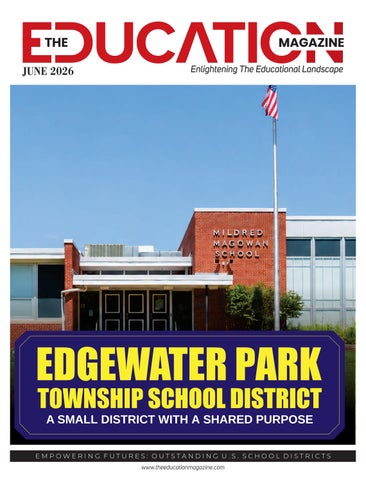
THE JUNE 2026
UC TI
MAGAZINE
EMPOWERING FUTURES: OUTSTANDING U.S. SCHOOL DISTRICTS
Shaping Minds, Inspiring Tomorrows. Dear Readers, Education is the quiet engine of tomorrow. It takes vision, relentless dedication, and a deep understanding of community to transform a standard classroom into a launching pad for success. As we navigate a rapidly changing world, true excellence in education is no longer just about test scores. It is about fostering resilience, nurturing curiosity, and building environments where every student feels seen and completely supported. We are thrilled to present our latest issue, “Empowering Futures: Outstanding U.S. School Districts of 2026.” This edition celebrates the visionary educators and dynamic communities that are redefining how we prepare the next generation. They do not just teach. They ignite boundless potential. Our cover story highlights Edgewater Park Township School District, a pre-kindergarten through eighth-grade system that proves impact is not determined by size. Nestled along the Delaware River, this two-school district operates with a unified, community-driven purpose summed up in a simple but powerful statement: “I inspire the future.” From Mildred Magowan Elementary to Samuel M. Ridgway Middle School, roughly 1,000 students experience a culture where strong relationships always come first. Through rigorous core academics, comprehensive special education, responsive multilingual support, and strategic planning, leaders like Superintendent Dr. Pamela Nathan ensure every decision clearly aligns with student needs. By blending forward-thinking instruction with deep community partnerships, Edgewater Park creates an environment where students are truly known and fully prepared for high school. Alongside our cover feature, we recognize a selection of other exceptional institutions that share this commitment to student growth and academic innovation. This month, we shine a bright spotlight on Eastpointe High School, Chartiers Valley School District, Jersey City Global Charter School, and Duquesne City School District. Each of these diverse learning communities brings a highly unique approach to modern education, proving that true excellence takes many forms across the country. As you read through these pages, we hope you find deep inspiration in their remarkable stories of triumph and dedication. The future is exceptionally bright because these passionate educators are working tirelessly daily to light the way. Join us in celebrating their outstanding achievements, leadership, and the lasting impact they are making on our world. Sincerely,
Simran Khan
Managing Editor
Publisher: Archana Ghule Editor–in–Chief: Vikram Suryawanshi
Art Director: Priyanka Patil Graphic Designer: Tejaswini Tandale
Managing Editor: Simran Khan
Marketing Head: Robert Smith
Project Editor: Shadab Mestri
Research Team: Daisy, Rahul,
Sales & Marketing
Maranda, Rocky
Project Head: Aakash Mahajan Sales Co-ordinators: Maria Smith Swati Kumari Project Manager: Pravin Shinde, Nehal Nagpure, Chris Mills The Education Magazine is published by Pericles Ventures Pvt Ltd. This magazine contains material protected under International and Federal Copyright Laws and Treaties. You may not publish, display, disclose, rent, lease, modify, loan, distribute, or create derivative works based on the magazine contents or any part thereof, whether by yourself or as a consultant, employee, partner or in any other role unless authorised in writing by the creator/publisher of the article/, video, audio or any content contained herein. We, the team of The Education Magazine put all the efforts to keep up with the content accuracy. The publisher assumes no responsibility of any part of the content of any advertisement in this publication, including any errors or omissions therein. All rights reserved by Pericles Ventures Pvt Ltd.
10 Edgewater Park Township School District
PROFILES
20. Chartiers Valley School District 34. Duquesne City School District 48. Eastpointe High School 62. Jersey City Global Charter School articles AI in Higher Education: Uses, Impact, 28. and What Comes Next Top 10 Highest IQ in the World: 44. Beyond the Score Virtual Internships for High School 56. Students: The US Guide
Edgewater Park Township School District
Chartiers Valley School District
www.edgewaterparksd.org
www.cvsd.net
Duquesne City School District
Eastpointe High School
www.dukecitysd.org
www.eastpointehs.com
Jersey City Global Charter School www.jcgcs.org
10 I JUNE 2026
THE EDUCATION MAGAZINE I 11
P
ublic education often reveals its character not in size or scale, but in how clearly a community understands why it exists. In a compact township along the Delaware River in Burlington County, one school district has spent the past century shaping that answer with care. Edgewater Park Township School District serves children from pre-kindergarten through eighth grade before they continue on to Burlington City High School. What appears at first to be a modest, two-school system reveals something more layered on a closer look. The district traces its roots to 1924, when Edgewater Park became an official township. Over time, its schools grew alongside the community, eventually forming a focused preK–8 system within a three-square-mile area. Today, Mildred Magowan Elementary School introduces young learners to full-day preschool and early academics, while Samuel M. Ridgway Middle School prepares older students for the transition to high school. Together, they serve close to 1,000 students in an environment often described by those who know it as a quiet standout. At the center of this district sits a clear sense of purpose. Its formal mission speaks to maximizing each student’s potential and building a community of lifelong learners who respect diversity and face the future with confidence. That idea has recently been sharpened through a process the district calls “mission clarity.” Drawing inspiration from a story shared by Brené Brown about St. Jude Children's Research Hospital, district leaders asked a simple question: Can every adult explain their purpose in the same clear way? The answer took shape in a short, direct statement created with input from staff and students alike. “I inspire the future.” The phrase now guides how lessons are planned, how decisions are made, and how people across the district describe their work. It reflects a shift from having a mission on paper to living it in daily practice. 12 I JUNE 2026
That clarity builds on years of steady evolution. What began as a small local system has grown into a standards-aligned district with full-day early childhood programs, updated curricula, and a careful eye on student progress. Data, community input, and strategic planning now shape how resources are used and how improvements are made. Even with these changes, the district has held on to something harder to measure but easy to feel: a close-knit culture where students are known, supported, and prepared for what comes next. A Two-School System, One Connected Community Within a compact stretch of Edgewater Park Township, the structure of the district is simple by design but intentional in execution. The district operates just two schools, each with a clearly defined role in a student’s early academic journey. Mildred Magowan Elementary School serves children from pre-kindergarten through fourth grade, laying the groundwork in literacy, numeracy, and social development. From there, students move to Samuel M. Ridgway Middle School, where grades five through eight focus on deeper academic engagement and preparation for high school. Across both schools, roughly 1,000 students reflect a diverse and evolving community. Many multilingual learners speak Spanish, Portuguese, and Turkish, and a transient population brings added complexity to instruction. Alongside this, a strong special education program ensures that varied learning needs are met with care, making the district both structured and responsive. Academic Pathways That Build with Each Step As a preK–8 system, Edgewater focuses its academic design on strong early and middle years, before students continue to Burlington City High School. The progression is steady and intentional.
At Magowan, students move through a balanced program that pairs core subjects with exposure to PE and health, art, music, STEAM, and technology. These early experiences are not treated as extras but as part of how students learn to think and explore. By the time students reach Samuel M. Ridgway, the structure becomes more defined. Core courses in math, science, English language arts, and social studies anchor the day, with honors pathways in pre-algebra and algebra offered in grades seven and eight. Specials continue alongside, giving students both rigor and range as they prepare for high school. Leadership That Connects Vision with Practice Leadership across Edgewater works as a connected system rather than a hierarchy. At the center, Superintendent Dr. Pamela Nathan guides long-term direction, working with the Board of Education to align planning, resources, and district priorities. Inside each school, principals Shelby Larison and Michael Melvin translate that direction into daily practice. They focus on instruction, staff development, and maintaining a steady school culture where expectations are clear and consistent. The Edgewater Park Board of Education sits at the front edge of this work, providing the steady governance that keeps the district’s purpose clear and its efforts aligned. Led by President Lester Holley and Vice President Daryl Lloyd, the Board includes members Karen Daly, Raymond Rebilas, Shania Hosein, Randy Stephens, Karen McLaughlin, Colleen Torres, and Dalya Tucker. Together, they bring a mix of local insight and long-term perspective to each decision. Working in close partnership with Dr. Nathan and the leadership team, the Board ensures that policy, budgeting, and planning stay anchored to what matters most for students and families. Board goals directly mirror the district’s wider direction. They emphasize high-quality instruction, student well-being, equitable access, and thoughtful stewardship of resources, echoing the priorities that guide school-level planning and classroom practice. The result is a unified system where goals at the board, district, and school levels represent a shared vision.
When the Board approves a curriculum shift, supports a new program, or backs investments in early childhood and intervention, those choices connect immediately to the work unfolding in classrooms each day. Across conversations and meetings, Board members highlight the district’s progress as a collaborative accomplishment. They recognize teachers, support staff, and administrators alongside the Edgewater Park Education Association as essential to creating student-centered, relationship-driven schools. They also view families and students as central partners, whose engagement through the PTO, advisory groups, and everyday communication breathes life into strategic plans. In a small district defined by a clear sense of purpose, the Board maintains focus on that overarching vision, helping ensure that everyone, from governance to the classroom, moves together under a single statement of intent: “I inspire the future.” Support roles keep that work grounded. Assistant principal Michelle Latesta and dean Michael Radichel work closely with students and families, handling behavior and support with a restorative approach. Curriculum and learning are guided by Dr. Nicole Inverso Vogt, Director of Curriculum and Special Education, alongside Dr. Alexis Drummond and Florencia Girman, while Nancy Lane ensures operations run smoothly behind the scenes.. Defining Excellence, Planning with Purpose Inside classrooms across the district, there is a quiet shift in how success is understood. It is not framed as finishing a syllabus or preparing for the next test. It shows up in how students ask questions, how they work through problems, and how comfortable they feel taking intellectual risks. Excellence, here, rests on a few steady ideas. Strong relationships come first. Learning must feel relevant and engaging. Growth is expected from both students and adults. Teachers build lessons that connect disciplines and mirror the kind of thinking students will need outside school, with technology woven in where it adds value.
THE EDUCATION MAGAZINE I 13
The district’s strategic plan keeps its focus tight. Priorities include high-quality instruction, student well-being, closing opportunity gaps, and building future-ready skills. Decisions are shaped with input from staff, students, and families. The shared purpose remains clear and present in that work.
Families are part of that same structure. The PTO, regular surveys, and communication platforms keep conversations open and two-sided. Partnerships also extend outward to institutions like Rowan University, where collaboration brings new ideas into district planning.
Meeting Students Where They Are
Among the district’s integral partners is the Edgewater Park Education Association (EPEA). Under the leadership of President Joey Hanners and Vice President Kelly Evans, the union works side by side with the administration to nurture student-centered classrooms that prioritize meaningful relationships and the development of essential skills. This partnership reinforces a culture where educators, staff, and leaders are aligned around what matters most: students.
In a district where no two classrooms look exactly the same, consistency comes from how needs are met, not from expecting students to fit a single mold. At Edgewater Park, support systems are built to stretch in both directions, helping students who need more time as well as those ready to move ahead. Students with disabilities are served through a range of in-house special education programs designed to keep support close and responsive. Multilingual learners are guided through an ESL program, including a newcomer track that helps students settle into both language and school routines. For those below grade level, targeted intervention in English language arts and math runs across K–8. At the same time, advanced learners are challenged through gifted and talented programming, accelerated math in middle school, and opportunities in the visual and performing arts. Teachers adapt curriculum daily, supported by ongoing professional development that keeps instruction flexible and current. Partnerships That Carry the Work Further No school system operates in isolation, and here, that idea is taken seriously. At Edgewater Park, relationships with families and community partners are built as part of the district’s core work, not added on later. One of the clearest examples is the Community Advisory Council. Meeting several times a year, it brings together township leaders, police, faith representatives, business owners, and educators, along with voices from Burlington. The goal is simple but demanding: keep everyone aligned on what students need and how the community can respond together. 14 I JUNE 2026
The result is a network that shares both responsibility and direction. A School Day That Extends Beyond the Bell Walk through any of the campuses after classes end, and the building feels anything but quiet. Student life carries on in gymnasiums, classrooms, and rehearsal spaces, where participation is less about obligation and more about belonging. Athletics draw strong interest, with boys and girls competing in basketball, soccer, baseball, and softball, alongside intramural options like volleyball and soccer that keep things open to all skill levels. At the same time, the arts hold equal ground. Concert band, jazz band, choir, and the annual spring musical give students space to perform and collaborate. Clubs add another layer. Students write for the Ridgway Register, gather in book and chess clubs, or join groups like STEM, National Junior Honor Society, and cheerleading. Others choose quieter paths through run and walk groups or mindfulness clubs. The range reflects a simple idea: every student should find a place to step in. Building Access into Everyday Learning Equity in the district is not treated as a separate initiative. It shows up in how decisions are made and how support is delivered across classrooms. A range of programs creates multiple entry points for students.
“
THE EDUCATION MAGAZINE I 15
Intervention services, special education, ESL support, and gifted and talented pathways are all guided by data, which helps the district identify needs early and respond with precision. That same data informs a developing Multi-Tiered System of Supports, where processes are being refined to better track progress and adjust instruction. Teachers are trained to meet students where they are. Ongoing professional development focuses on differentiation, data use, and strategies like SIOP that support multilingual learners. Communication with families follows the same principle. Through ParentSquare, messages can be translated into home languages, keeping families connected. Technology adds another layer. Tools like Learning Ally and Mote help remove barriers, making content more accessible and learning more inclusive. Support Systems That Reach Beyond the Classroom Learning here does not stop when the last class ends. At Edgewater Park, support takes shape through a mix of academic help, enrichment, and guidance that follows students through different stages of growth. After-school programs like Skills Club, TASK, Reader’s Theater, and STEM Club give students extra time and structure to strengthen core skills. Others find balance in clubs that focus on movement, creativity, or shared interests, from running and yoga to art, gardening, and board games. Music and performance remain active after hours as well, with band, chorus, and the annual musical bringing students together for public events.
16 I JUNE 2026
Guidance is built into the system. School counselors, a social worker, and specialized teams support academic, social, and emotional needs. Events like Career Day and programs led by local police introduce students to future pathways, while family English classes and community nights keep support connected to home. Looking Ahead with Clarity and Intent Planning for what comes next has become a shared exercise across Edgewater Park Township School District. The district is in the middle of a strategic planning process that brings together administrators, teachers, staff, students, families, and community members, all working toward a common direction. Part of that work has focused on how people think and collaborate. Staff engaged in the Kolbe Assessment to better understand problem-solving styles, while leadership teams participated in Fishbird experiences designed to push thinking beyond routine solutions. These efforts helped refine a shared purpose: “I inspire the future.” That purpose now guides concrete steps forward. A new hands-on math program is set for elementary grades, while updated English language arts curricula continue to roll out across K–6, with a focus on vocabulary and knowledge building. Each move is tied back to a single question: how to better prepare students for what lies ahead.
THE EDUCATION MAGAZINE I 17
CHARTIERS VALLEY SCHOOL DISTRICT
Where Four Communities Became One Extraordinary Promise
20 I JUNE 2026
THE EDUCATION MAGAZINE I 21
T
Those are not decorative words. At Chartiers Valley, they function as an operating principle, the standard against which every decision gets measured.
here is something quietly remarkable about a school district that begins not with a single, sweeping vision announced from on high, but with a decision made collectively, by neighbors who looked at one another and agreed that their children deserved something better than what anyone of them could build alone. In 1965, four communities in southwestern Pennsylvania made exactly that kind of decision.
Today, Chartiers Valley serves approximately 3,500 students across four schools, each shaped to meet the developmental needs of students at a specific stage of their lives.
Bridgeville Borough, Collier Township, Heidelberg Borough, and Scott Township consolidated their smaller, separate school systems into one unified institution: Chartiers Valley School District. It was, in the way most lasting things are, a practical choice that turned out to be something much larger than practicality. More than sixty years later, that decision looks like wisdom.
Chartiers Valley Primary School opens the journey for Kindergarten through Grade 2. The Intermediate School carries students through Grades 3 to 5. The Middle School bridges Grades 6 through 8, a period that anyone who has ever been twelve years old understands requires a particular kind of attentiveness. And Chartiers Valley High School guides students through Grades 9 to 12, toward graduation and whatever comes next.
Born of Unity, Built for Growth
The structure is intentional. Each school is designed not only for age-appropriate programming but for seamless transitions across grade levels, so that a child who enters Kindergarten in Scott Township or Bridgeville Borough moves through a coherent, connected educational experience, all the way to a diploma.
The consolidation of 1965 had straightforward objectives: pool resources, expand opportunities, and develop a unified educational vision for the children of four distinct communities. What it actually created, across the decades that followed, was a district with a particular kind of identity. One rooted in the understanding that different communities, brought together with shared purpose, can build something stronger than any of them could alone.
Four Schools, One Direction
The four communities the district serves bring with them diverse backgrounds, experiences, and perspectives. That diversity, the district believes, is not a complication to be managed. It is an asset to be valued.
Chartiers Valley has not stood still since those early years. The district has modernized its facilities, expanded its academic programming, deepened its commitment to technology integration, and made student wellness and safety central, structural priorities. It has grown, quietly and persistently, into what its leadership describes as a forward-thinking district that balances tradition with innovation.
Step inside a Chartiers Valley elementary school, and you find students building foundational skills in literacy, mathematics, science, and social studies. But there is considerably more happening than core instruction.
The mission is stated plainly: Chartiers Valley School District, a community dedicated to shared leadership, aims to graduate students who achieve personal success by providing an exceptional academic foundation in a safe, nurturing environment that inspires creativity and innovation while embracing diversity.
STEM opportunities are available to every student from the earliest grades, and hands-on, curiosity-driven learning is woven into the daily rhythm of the classroom. Art, music, physical education, library services, and technology instruction are part of every child’s school experience, not electives available only to some.
22 I JUNE 2026
A Curriculum That Meets Every Student Where They Are
PBIS teams, Positive Behavioral Interventions and Supports, are embedded across the elementary level, building the kind of safe, predictable school climates where genuine learning becomes possible. The district also supports students who need more, in both directions. Intervention programs reach those who require additional assistance. Enrichment programs reach those ready for advanced challenge. No child is expected to simply keep pace and hope for the best.
A partnership with Parkway CTC opens robust career and technical pathways for students whose ambitions and strengths lead in that direction. STEM programs, business education, and arts programming give students room to discover what they are actually good at and what they care about. Internships, mentorships, and real-world learning experiences are built into the high school model because the district takes seriously its responsibility not just to educate students, but to launch them. The People Who Hold It Together
By the time students reach middle school, the curriculum expands deliberately and thoughtfully. Core academic subjects are joined by world languages, technology education, music, and fine arts. Interdisciplinary learning opportunities invite students to connect ideas across subjects in ways that mirror how the world actually works. And social-emotional development becomes an explicit priority, because a student navigating the turbulence of early adolescence is not fully available for academic growth unless someone is paying attention to the whole person. At the high school level, the scope of offerings is genuinely impressive. Advanced Placement courses, honors courses, and dual enrollment opportunities with local colleges give academically ambitious students the depth of challenge they need.
Every effective school district has a leadership structure that functions, at its best, like a well-tuned instrument. Each section has a distinct role, and the music they make together is either harmonious or it is not. At Chartiers Valley, it is. Superintendent Dr. Daniel Castagna carries the overarching strategic vision for the district. His role encompasses executing School Board policy, managing the day-to-day operations of the entire system, ensuring fiscal responsibility, and sustaining high academic standards across all four schools. “Chartiers Valley is committed to providing a safe, supportive, and challenging learning environment where every student has the opportunity to succeed.” THE EDUCATION MAGAZINE I 23
Working closely alongside him is Assistant Superintendent Dr. Michael Sable, whose focused domain is curriculum, instruction, and assessment. Dr. Sable is responsible for developing and implementing educational programs, driving professional development for instructional staff, and ensuring compliance with state and federal academic guidelines. He is the person who asks, every day, whether the teaching is actually working. The Building Principals of the four schools, Primary, Intermediate, Middle, and High School, are the instructional leaders closest to students and families. They supervise teachers, manage student affairs, foster positive school culture, and serve as the primary liaison between each school and its parent community. Behind these visible roles are departments that make the entire enterprise function. The Pupil Services and Special Education leadership oversees all services for students with Individualized Education Programs, ensuring that every student who requires accommodations, support, and resources receives them fully and in compliance with every applicable requirement. The Business and Finance Department manages budgeting, payroll, purchasing, facility financing, and financial reporting. Their work ensures that taxpayer resources are used responsibly and purposefully in the service of students. The Technology Department maintains the district’s entire IT infrastructure, including student and staff devices, network security, educational software, and data systems. In a district that has made technology integration a core strategic priority, this is not background work. It is central to everything. And the Facilities and Operations team oversees maintenance, safety, custodial services, groundskeeping, and facility planning. These are the people who ensure that every building is safe, clean, and ready to receive students every single morning. 24 I JUNE 2026
Strategic planning at Chartiers Valley, notably, is not conducted behind closed doors. It is driven by collaboration among administrators, teachers, families, and community stakeholders. That collaborative instinct is not incidental. It is the same instinct that founded this district in the first place. No Student at the Margins If there is a philosophy that runs beneath everything Chartiers Valley does, it is this: every student deserves access to everything the district has to offer. Not most students. Not the easiest students to serve. Everyone. This means that K-12 STEM education is available to all students, not as a specialty program reserved for a select few. It means targeted academic interventions are provided to meet individual needs. It means special education services, gifted programming, and English language learner support are all in place and operational. It means personalized learning, differentiated instruction, small group work, and technology-enhanced learning are strategies teachers use across the district, not in isolated pockets of good practice.
Culturally responsive approaches and social-emotional learning are embedded in the classroom experience. The goal is simple in its statement and ambitious in its execution: every student should feel welcome and valued in this district. Beyond the classroom, Chartiers Valley offers a full spectrum of support services. School counseling services and career and college planning help students navigate what comes after graduation. The Student Assistance Program, known as SAP, reaches students dealing with personal challenges that could otherwise quietly derail their education. And then there is AHN Chill, the district’s dedicated mental health services program. Its presence reflects a clear-eyed understanding: in 2026, a school that does not take student mental health seriously is not fully serving its students. Chartiers Valley takes it seriously. Mentorship opportunities and internship and career exploration programs round out a support structure designed to ensure that no student, regardless of background or circumstance, disappears through the cracks.
A Life Beyond the Classroom There is a version of education that stops at the classroom door. It is a limited one, and Chartiers Valley has never been interested in it. Student life at Chartiers Valley is, by any reasonable measure, vibrant and full. The district offers 38 athletics programs for students in Grades 7 through 12, a number that speaks to a genuine, institutional commitment to sport as a space where teamwork, leadership, and school pride are built in ways that classrooms alone cannot replicate. The performing arts are equally robust. Dance, band, chorus, and theater give students who find their voice in performance a place to develop it, and an audience to share it with. Academic clubs, student leadership organizations, and community service programs create pathways for students whose engagement with the world takes a different form. STEM and technology clubs are available at every level, from the youngest elementary students all the way through to seniors in high school.
THE EDUCATION MAGAZINE I 25
26 I JUNE 2026
The philosophy behind this breadth of opportunity is straightforward. Students who are engaged beyond the classroom tend to be more engaged within it. Chartiers Valley builds both worlds and trusts students to find where they belong. Partnerships That Extend the District’s Reach A school district does not exist in a sealed environment. It exists inside communities, and Chartiers Valley has always understood that its strength is inseparable from the strength of those communities around it. The district builds active partnerships with local businesses, connecting students to internship and career exploration opportunities before they ever collect a diploma. Community organizations extend the district’s reach into student support services, providing resources that no school building can provide entirely on its own. Law enforcement and emergency services are engaged partners in school safety planning, a reflection of the district’s seriousness about protecting every student and staff member. Higher education institutions are partners in dual enrollment opportunities, giving high school students access to college-level coursework and the confidence that comes from succeeding in it, long before they ever set foot on a college campus full-time.
The district’s leadership is clear-eyed and specific about the road ahead. The priorities for the future include expanding career pathways and workforce readiness, enhancing STEM and technology integration across all levels, continuing improvements to facilities, expanding community partnerships, and deepening student engagement opportunities throughout the district. These are not vague aspirations printed in a strategic plan and filed away. They are the next chapter of a story that began in 1965, when four communities decided that their children deserved something better than what any one of them could offer alone. That original instinct, to come together, to pool what they had, to build something worthy of the children they were responsible for, has never left this district. Through innovation, dedication, and community support, Chartiers Valley School District continues to prepare students for success in an ever-changing world. And in southwestern Pennsylvania, where four communities chose each other more than sixty years ago, that preparation is not a promise. It is a daily practice.
These partnerships are not symbolic. They are functional, deliberate, and woven into the operational fabric of the district.
THE EDUCATION MAGAZINE I 27
AI IN HIGHER
EDUCATION Uses, Impact, and What Comes Next
A
I in higher education is no longer an emerging experiment; it is already transforming how universities teach, evaluate, support, and govern learning. From generative AI tools used daily by students to data-driven systems guiding academic and administrative decisions, AI has moved from the margins to the core of institutional life. Despite its rapid integration, the conversation around AI in higher education remains unsettled. Universities face a complex mix of opportunity and uncertainty. While AI promises personalized learning, operational efficiency, and deeper insights into student success, it also raises critical questions about academic integrity, data privacy, bias, and institutional responsibility. What higher education needs now is clarity grounded in evidence, not speculation or fear-driven narratives. How is AI actually being used today? What do global surveys and research reveal about student and faculty adoption? And how should universities strategically prepare for the next phase of AI integration? This article examines AI through a research-backed, global lens, exploring current uses, measurable impact, governance considerations, and the future direction institutions must embrace. What Global Research Shows About AI in Higher Education Insights from globally recognized institutions and policy bodies reveal consistent trends in how AI is entering higher education: ● UNESCO emphasizes AI’s potential to expand access and improve learning outcomes, while cautioning against bias, lack of transparency, and ethical misuse. ● World Bank research highlights AI’s growing role in institutional planning, student services, and workforce-aligned skill development, particularly in emerging economies. 28 I JUNE 2026
● Deloitte Insights documents increased adoption of generative AI across admissions, advising, academic operations, and administrative efficiency. ● Inside Higher Ed surveys show rising faculty engagement with AI tools, alongside uncertainty around governance, assessment policies, and long-term impact. Together, these findings indicate that AI adoption is accelerating globally, but governance frameworks and ethical clarity are still catching up. AI in Higher Education: At a Glance ● What it is: The use of artificial intelligence to support teaching, learning, administration, and institutional decision-making in universities. ● Why it matters: AI is changing how students learn, how educators teach, and how institutions operate at scale. ● Where it’s used: Personalized learning, student support, admissions, assessment, research, and governance. ● What’s next: Universities must align innovation with ethics, transparency, and academic integrity. How AI in Higher Education Differs From Other Sectors AI adoption in higher education is fundamentally different from its use in schools or corporate environments. Universities operate at the intersection of academic freedom, ethical responsibility, and public trust. Decisions around AI use must balance innovation with fairness, transparency, and longterm societal impact.
THE EDUCATION MAGAZINE I 29
This makes AI adoption in higher education uniquely complex and uniquely important to get right.
These tools do not replace educators. Instead, they function as learning companions supporting students outside the classroom and freeing faculty to focus on higher-value academic engagement.
Why AI Adoption Accelerated So Quickly
Assessment and Academic Evaluation
The rapid acceleration of AI in higher education has been driven by three forces:
AI is also being used to support assessment processes, particularly in large or digitally delivered courses. Current applications include: ● Automated feedback on formative assessments
1. Widespread access to generative AI tools has lowered the barrier to entry for students and faculty.
● Pattern analysis to identify learning gaps ● Support for grading consistency in large cohorts
2. Data-rich university environments, where learning analytics and institutional data enable AI systems to function effectively.
However, this area also raises some of the most sensitive questions around academic integrity, fairness, and transparency, topics universities are actively grappling with.
3. Post-pandemic digital transformation has normalized online learning, automation, and technology-supported decision-making.
Student Services and Administration
As a result, AI has moved beyond experimentation into a phase of strategic maturity that universities must understand and govern.
● Improve academic advising and early-alert systems
Beyond teaching, AI is increasingly present in student services and university operations. Institutions are using AI to:
● Enhance student support through conversational AI ● Streamline admissions, scheduling, and administrative workflows
How AI Is Being Used in Higher Education Today AI applications in higher education are broader and more embedded than many assume. Research reviews and institutional studies show that AI is already influencing multiple layers of the university ecosystem. Teaching and Learning Support One of the most visible uses of AI in higher education is in teaching and learning support. AI-powered systems help students:
These applications aim to improve responsiveness and scalability, particularly in institutions serving large and diverse student populations. Student and Faculty Adoption Trends in Higher Education Understanding how AI is actually being used on campus requires looking beyond tools and into human behavior. Global surveys and institutional research reveal a clear pattern: AI adoption among students is widespread and accelerating, while faculty adoption is growing but uneven. What Global Surveys Reveal About Student AI Use Recent international studies and institutional surveys show that a large majority of university students already use AI tools as part of their academic workflow. Students primarily rely on AI to:
● Clarify complex concepts ● Clarify difficult concepts ● Receive instant feedback on practice tasks
● Summarize academic material
● Access personalized learning resources
● Support research and idea generation
● Navigate coursework more efficiently
● Improve writing structure and clarity
30 I JUNE 2026
What stands out is not just the scale of adoption, but the lack of formal guidance. Many students report using AI without clear institutional policies or shared expectations. This gap has created uncertainty around what constitutes acceptable use, particularly in assessment contexts. Rather than replacing learning, evidence suggests students view AI as a support mechanism, one that helps them manage workload, understand content faster, and study more efficiently. However, without structured guidance, usage varies widely in quality and ethical alignment. Faculty Adoption and Preparedness Gaps Faculty engagement with AI is more cautious. While many educators acknowledge the potential of AI to support teaching and assessment, fewer feel confident using it effectively. Research highlights several recurring challenges:
Personalization and Student Engagement AI enables universities to move beyond one-size-fits-all education. Adaptive learning systems and analytics-driven insights help institutions respond to individual learning needs, improving engagement and academic confidence. Efficiency and Institutional Scalability AI-supported systems allow universities to scale support services without compromising quality. From advising to administration, automation reduces bottlenecks and frees staff to focus on higher-impact work. Data-Informed Decision-Making
● Unclear institutional policies
AI enhances universities’ ability to analyze patterns in enrollment, retention, and performance. When used responsibly, these insights support evidence-based planning and early intervention strategies.
● Concerns about academic integrity
Ethical, Academic, and Governance Challenges
● Uncertainty about how AI fits within existing pedagogy
As AI becomes embedded in higher education, its risks are no longer theoretical. Universities now face concrete ethical, academic, and governance challenges that require deliberate institutional responses rather than reactive measures.
● Limited formal training in AI tools
This gap between student usage and faculty preparedness is one of the most critical issues facing higher education today. Without targeted professional development and shared frameworks, AI risks becoming a parallel system rather than an integrated educational tool. The Growing Importance of AI Literacy Across institutions globally, AI literacy is emerging as a foundational requirement. This extends beyond technical skills to include:
Academic Integrity and Assessment Design One of the most pressing concerns surrounding AI in higher education is academic integrity. Traditional assessment models, particularly those focused on unsupervised written submissions, are increasingly vulnerable to misuse of generative AI.
● Understanding AI limitations and bias ● Evaluating AI-generated outputs critically ● Applying AI ethically within academic contexts Universities that treat AI literacy as a core academic competency, not an optional add-on, are better positioned to harness AI's benefits while minimizing risk. Benefits of Driving AI Adoption in Universities Despite ongoing debates, AI adoption in higher education continues to grow because its benefits address long-standing institutional challenges.
However, research and institutional guidance suggest that integrity challenges are not best addressed through prohibition alone. Instead, universities are beginning to rethink assessment design by: ● Emphasizing process-based evaluation over final outputs ● Incorporating reflective components that document learning journeys ● Designing assessments that require contextual reasoning and applied thinking THE EDUCATION MAGAZINE I 31
This shift aligns assessment practices more closely with real-world skills while reducing opportunities for misuse. Bias, Transparency, and Trust in AI Systems
Key recommendations include: ● Embedding ethical considerations into AI adoption from the outset
AI systems are only as reliable as the data and assumptions that shape them. In higher education, this raises concerns about algorithmic bias, particularly when AI is used in admissions, advising, or performance prediction.
● Ensuring AI supports, rather than replaces, human decision-making
Limited visibility into how AI systems generate recommendations can undermine trust among students and faculty. As a result, responsible institutions are prioritizing:
These principles are shaping national policies and institutional strategies worldwide.
● Clear documentation of how AI tools are used
Universities are at varying stages of policy development. While some institutions have formal AI governance frameworks in place, many are still developing guidance that balances innovation with academic values.
● Human oversight in high-stakes decisions ● Regular evaluation of AI systems for bias and unintended consequences
● Building AI literacy across the academic community
How Universities Are Developing AI Policies
Common policy elements include: Trust in AI within higher education depends not on technical sophistication alone, but on accountability and explainability. Data Privacy and Institutional Responsibility Universities manage vast amounts of sensitive student and research data. The integration of AI systems introduces additional risks related to data security, consent, and thirdparty access.
● Definitions of acceptable and unacceptable AI use ● Expectations for transparency in AI-assisted work ● Guidelines for faculty and student training ● Mechanisms for ongoing review and adaptation
Global guidance emphasizes that institutions must treat data governance as a foundational element of AI strategy. This includes defining who owns AI-generated data, how long it is retained, and how it is protected across platforms.
Institutions that treat AI policy as a living framework rather than a static rulebook are better equipped to respond to rapid technological change.
Global Policy and Institutional Responses
Skills Universities Must Develop
As AI adoption accelerates, higher education institutions are increasingly guided by international frameworks and shared policy principles rather than isolated experimentation.
To remain relevant and credible, higher education institutions must develop capabilities beyond technical adoption. These include: ● Critical AI literacy for students and faculty
What Global Institutions Recommend ● Ethical reasoning and policy awareness International organizations such as UNESCO advocate for a human-centered approach to AI in education, emphasizing inclusion, equity, and responsible oversight. Rather than focusing solely on efficiency or innovation, these frameworks emphasize education’s broader social responsibility. 32 I JUNE 2026
● Institutional leadership equipped to govern AI responsibly Universities that invest in these capabilities will shape AI’s role proactively rather than reactively.
What This Means for Higher Education Leaders AI in higher education is now a question of strategic alignment rather than adoption. Institutions that succeed will be those that move beyond experimentation and align AI adoption with educational purpose. This requires leadership that views AI not as a shortcut, but as a tool that must be guided by human judgment, academic values, and long-term vision. By grounding AI strategy in evidence, ethics, and inclusivity, higher education can harness its potential while preserving what matters most. My Perspective on AI’s Role in Higher Education AI in higher education is reshaping learning and institutional practices, whether universities are fully prepared or not. The real question is not how fast universities adopt AI, but how wisely they choose to use it. Technology should strengthen education’s purpose, not dilute it. If higher education leaders approach AI with clarity, institutional responsibility, and long-term vision, it can become a powerful ally in expanding access, improving learning outcomes, and supporting educators rather than sidelining them. The opportunity ahead is significant but only for those willing to lead with responsibility and foresight. Shaping the future of higher education starts with informed decisions. If you found this perspective valuable, share it with educators, academic leaders, and policymakers who are navigating AI’s role in learning. Thoughtful conversations today will define education tomorrow.
THE EDUCATION MAGAZINE I 33
34 I JUNE 2026
In
the towns that line Pennsylvania’s Mon Valley, the story of public education often follows the rise and fall of industry. Steel once shaped daily life here. When that foundation weakened, schools felt the shift just as deeply as families did. Districts had to make hard choices, not just about budgets, but about what kind of future they could still offer their students.
Within that setting, the Duquesne City School District has had to rethink its role more than once. It began as a full K–12 system, serving generations of students in a tight-knit community. In 2007, after years of economic strain, the state assumed responsibility for high school students in grades 9–12, shifting the district to a K–8 model. The transition continued in 2012, when grades 7 and 8 were also moved out, further narrowing the district’s scope. Nearly a decade later, a gradual rebuilding began. Seventh grade returned in 2021, followed by eighth grade in 2022, restoring a more complete middle school experience. This phased approach helped minimize disruption for students and families, ensuring that no one was forced to make a sudden transition at a critical stage in their education. Change did not stop there. In 2021, middle school grades returned, reopening pathways that had once been limited. That move signaled more than expansion. It reflected a district finding its footing again, choosing to invest in continuity for its students. Today, its mission centers on strong, student-focused teaching paired with attention to social and emotional growth. Classrooms aim to challenge students while also supporting them as individuals. The vision looks ahead, with an emphasis on equity, new ideas, and preparing students for life beyond school through personalized learning and ties to the community. THE EDUCATION MAGAZINE I 35
Over time, the district has not simply adjusted to change. It has learned how to work within it. What stands now is a system shaped by its past, but not held back by it, focused on giving its students a clearer path forward.
The district sits in the city of Duquesne, a place that carries the traits of a small urban system. Many families face economic challenges, which shape how the district approaches its work. Academic instruction does not stand alone. Equal weight is given to social and emotional support, with staff paying close attention to what students need beyond textbooks and tests.
Building Strong Foundations and Early Pathways Inside the district, academic programming reflects both necessity and intent. With all grades housed under one roof, the district has shaped a K–8 model that feels connected rather than segmented. Younger and older students share the same environment, which creates a steady sense of progression as children move through each stage of learning. At the elementary level, the focus stays on getting the basics right. Literacy and mathematics take center stage, supported by close tracking of student progress and timely interventions when gaps appear, reducing learning gaps. Teachers adjust their approach based on what students need in real time, rather than waiting for problems to grow. Social-emotional learning is not treated as a separate subject. It is woven into daily instruction, helping students build confidence alongside academic skills. Career awareness begins earlier than one might expect. Even in kindergarten, students start exploring interests through simple, structured exposure to different fields. As they move into middle school, those early ideas take clearer shape. Students gain access to STEM-based electives such as coding, robotics, drone technology, and podcasting. Project-based learning becomes more common, encouraging them to apply knowledge in practical ways. Beyond the classroom, arts programs, clubs, and athletics add another layer, keeping students engaged while broadening their sense of what is possible. A Single-School System with a Close-Knit Reach What sets Duquesne City apart begins with its scale. The entire district operates within a single school building, serving roughly 475 students from kindergarten through eighth grade. In a community that spans just about two square miles, that structure creates a setting where familiarity is hard to avoid. Students grow up in the same space, often with the same peers and many of the same adults guiding them along the way. 36 I JUNE 2026
Early learning begins even before kindergarten. Programs like Head Start and preschool, supported by the Allegheny Intermediate Unit, operate within the same building. This brings younger children into the system early and helps ease the transition into formal schooling. After eighth grade, students move on to nearby districts for high school, choosing the path that fits them best. Throughout it all, partnerships within the community help extend learning beyond the classroom, keeping support consistent as students prepare for what comes next. Leadership That Stays Close to the Work The district is guided by Superintendent Dr. Sue A. Mariani, Principal Erica Slobodnik, and Director of Curriculum Ryan Matsook, who together bring a clear and steady approach to leadership. They maintain high expectations while staying equally focused on how students are supported along the way. Their work depends on collaboration that feels active rather than symbolic, involving teachers, support staff, families, and students in meaningful ways. While the district does have a Board of School Directors, its authority is limited to specific functions such as reorganization, setting the tax levy, and approving new debt. Broader decisions are overseen by the Court Appointed Receiver, Dr. William Kerr, under state control. This structure keeps the district grounded in what is actually happening inside the building, ensuring that planning and decision-making remain closely tied to student needs. When challenges arise, the response tends to be direct and collective. There is also a consistent effort to build an environment that feels safe and respectful without losing academic focus. Students are expected to take their work seriously, but they are also encouraged to speak up, ask questions, and stay engaged in their own progress. The message to families is straightforward and consistent. Every student is capable of growth and deserves real opportunity. The district’s role is to provide both structure and support so that potential does not remain theoretical, but turns into something visible over time.
Dening Excellence Beyond Test Scores At Duquesne City, educational excellence is not reduced to a single number or ranking. It is understood through a broader lens, one that looks at how students grow as learners and as individuals. Academic progress matters, but it sits alongside social-emotional well-being and a student’s readiness for life after school. Classrooms are expected to deliver strong, standards-aligned instruction, supported by regular use of data to guide teaching decisions. At the same time, learning is shaped around the student, not the system. Adjustments are made to match pace, interest, and need, allowing students to stay engaged without being left behind. Relationships carry equal weight. A consistent effort is made to ensure students feel safe, known, and supported within the school environment. That sense of belonging often becomes the foundation for stronger academic outcomes. Strategic priorities reflect this balance. Improving achievement, closing learning gaps, strengthening attendance, and expanding STEM and career exposure all move in tandem. Partnerships with families and the wider community help reinforce these efforts, keeping progress steady and shared. THE EDUCATION MAGAZINE I 37
38 I JUNE 2026
Meeting Students Where They Are
Building a Network Around Each Student
Walk into a classroom at the district, and it becomes clear that students are not expected to learn in the same way or at the same pace. Instruction is shaped around that reality. Teachers adjust their methods through small group work, differentiated lessons, and targeted interventions, allowing each student to engage with material in a way that fits.
In a district such as Duquesne City, progress depends on more than what happens inside the building. The district treats relationships with families, community groups, and local partners as part of its daily work, not as an added effort.
Support extends beyond academics. Social-emotional learning is built into daily routines, helping students manage challenges, build confidence, and stay connected to their learning. This is further strengthened through Tier I support, with the school counselor providing weekly engagement to reinforce these skills. At the same time, lessons reflect the backgrounds and experiences students bring with them. Culturally responsive teaching ensures that what happens in the classroom feels relevant and familiar, not distant. Systems like the Multi-Tiered System of Supports provide structure, offering additional help when needed without delay. Families and community partners remain part of that support network, reinforcing progress outside school walls. The result is a learning environment that feels both structured and flexible, where students are recognized as individuals and given room to succeed on their own terms.
Parents are kept close to the process. Communication is steady and clear, whether through school events, direct outreach, or opportunities to share feedback. Families are not only informed but included, which helps build a sense of shared responsibility for student growth. Partnerships across the community bring added depth to student experiences. Local organizations and businesses support programs tied to STEM learning, career awareness, and enrichment. These connections give students a clearer sense of how classroom lessons translate into real-world settings. Civic partners also contribute by helping address social and emotional needs that can affect learning. Over time, these relationships form a reliable network. Trust builds through consistency, and that trust allows the district to extend its reach. Students benefit from a system where support comes from many directions, all working toward the same goal. THE EDUCATION MAGAZINE I 39
A School Day That Extends Beyond the Classroom Life inside the district does not end when lessons are over. The school day carries into a range of activities that keep students involved, active, and connected to one another. Athletics play a steady role, with sports such as basketball, volleyball, and football giving students a chance to build teamwork and school spirit. For others, clubs offer a different kind of engagement. Robotics, Lego League, drone soccer, podcasting, and student leadership groups allow students to explore interests that often stretch beyond traditional subjects. Creative outlets are part of the mix as well. Music and arts programs give students space to express themselves and develop confidence in quieter ways.
Special Education and Student Support Services address individual student needs, while Curriculum and Instruction keep teaching aligned and consistent. Operations run alongside academics. Business and operations teams manage finances, facilities, and transportation, ensuring the system functions smoothly with a focus on cost-effective operations. Technology staff support digital tools that have become part of everyday learning. Teachers and support staff bring these efforts to life in classrooms and hallways. Working together, this structure helps maintain a school environment that stays organized, responsive, and centered on students. Creating Fair Access, Not Just Equal Access
These experiences do more than fill time. They help students form friendships, discover new strengths, and feel a stronger sense of belonging within the school community. A Structure That Keeps the System Moving Behind the day-to-day rhythm of Duquesne City is a leadership structure designed to stay coordinated and practical. Each role carries a clear responsibility, but the work remains closely connected. The superintendent sets direction and long-term priorities, while the principal manages daily operations and guides instruction inside the building. Around them, key departments handle focused areas of support. 40 I JUNE 2026
Equity inside the district is approached with a clear understanding that students do not all begin at the same point. Support is shaped accordingly, with resources directed where they are needed most rather than spread evenly without context. Targeted academic help, social-emotional support, and access to technology form the base of that effort. Frameworks such as the Multi-Tiered System of Supports guide how interventions are delivered, ensuring students receive help early and consistently. Teaching practices also reflect the backgrounds students bring, making learning feel more relevant and inclusive.
Relationships play a central role. Staff work to create an environment where students feel secure and recognized. Opportunities in STEM, career awareness, and enrichment are kept open to all, not limited by circumstance. Ongoing data review and community partnerships help identify barriers and address them, keeping progress steady and grounded in real student needs. Support That Extends Beyond Academics At Duquesne City, student support is built as a network rather than a single service. Academic learning is paired with systems that address emotional well-being, behavior, and future planning. School counselors and psychological services provide consistent guidance, while access to mental health support helps students manage challenges that can affect learning. Career awareness begins early and continues through eighth grade, with students introduced to different paths through guest speakers and real-world exposure. THE EDUCATION MAGAZINE I 41
42 I JUNE 2026
Mentorship and community partnerships add another layer, giving students role models and connections outside the classroom. Behavioral support is structured through frameworks like Multi-Tiered System of Supports and PBIS, helping students stay on track in a positive way. The district also uses the House System, inspired by the Ron Clark Academy, to build belonging and accountability. Strengthening Outcomes and Expanding Opportunity The next phase for Duquesne City School District builds on steady progress while sharpening its academic focus. Strengthening core instruction remains a priority, supported by closer use of data and timely interventions that address gaps before they widen. Improvement in English language arts, mathematics, and science outcomes sits at the center of these efforts. At the same time, learning is becoming more personalized, giving students clearer pathways based on their pace and interests. Career awareness will continue to grow from kindergarten through eighth grade, helping students connect classroom learning to future possibilities. New initiatives include expanding STEM programs, integrating updated technologies, and creating more real-world learning experiences through community partnerships. Attendance, family engagement, and social-emotional support will also remain key areas of attention. For staff, ongoing professional development ensures teaching practices stay current and effective, keeping the district aligned with the demands students will face beyond school.
THE EDUCATION MAGAZINE I 43
W
hat does it truly mean to be a genius? Is it merely about a high score, or something far deeper? We often marvel at extraordinary minds. IQ, or Intelligence Quotient, offers one way to measure this. It gives us a score for how well our brains think. This includes problem-solving and learning new things. These cognitive abilities are key. This blog explores remarkable individuals. They possess some of the highest IQs in the world ever recorded. We will look at their amazing contributions. We also shed light on what makes intelligence truly exceptional. This topic deeply fascinates many people. Exceptional minds powerfully impact our society. They drive innovation and change. Their stories inspire us all. Let’s unlock these brilliant narratives. Understanding IQ: More Than Just a Number What is IQ? Imagine your brain as a super-powerful computer. IQ, or Intelligence Quotient, is simply a score. This score comes from a special test. It measures how well your brain works. Think of it like a report card for your thinking skills. These tests look at various abilities. They check your reasoning, problem-solving, and learning speed. For instance, the Stanford-Binet and Wechsler tests are very common. They help us understand different cognitive domains. The Nuance of IQ Scores Now, let’s talk about IQ scores themselves. 100 is considered an average IQ score. This is the center point for most people. However, scores are quite relative. Different tests can give slightly different results. Test methods also play a role. It’s not a single, fixed number for life. 44 I JUNE 2026
While a high IQ is truly impressive, it’s not the only key to success. Consider this: a brilliant mind also needs creativity. Perseverance, or never giving up, is crucial. Emotional intelligence, understanding feelings, matters deeply. Practical application, using what you know, is vital too. These elements build trust and show real expertise. The highest IQ in the world might be fascinating, but it’s just one piece of a larger puzzle. Debate & Limitations of IQ So, is IQ a perfect measure? Not quite. IQ tests have certain limits. They don’t measure all types of intelligence. For example, they might not assess musical talent. They also miss artistic brilliance. Consider a great musician or a gifted artist. Their genius might not show up on an IQ test. This understanding adds balance. It shows a nuanced view of intelligence. We always seek a complete picture. It’s truly more than just a number. Here’s a list of the people with the highest IQs in the world currently, as per the USIA 1. YoungHoon Kim YoungHoon Kim founded the United Sigma Intelligence Association (USIA). This non-profit organization gathers the world’s brightest minds. It proudly includes seven Nobel Prize winners. Renowned intellectuals like Noam Chomsky also join the ranks. Furthermore, he holds an official world record for intellectual prowess. Various international bodies have verified this achievement. Kim is a truly remarkable polymath. He showcased his extraordinary memory on television. He flawlessly memorized 104 poker cards in just over 10 minutes.
Simultaneously, he serves as a Tony Buzan Honorary Professor. He also holds black belts in many disciplines. This demonstrates his diverse skills and deep mental capacity. 2. Terence Tao Terence Tao is a true giant, like an elephant with a sharp mind in mathematics. And this has not gone unnoticed which is seen as he has also been awarded the Fields Medal in 2006. This award recognized his deep work on complex equations. He also contributed greatly to prime number patterns. Specifically, with Ben Green, he showed that primes can form long chains. This theorem changed how mathematicians view numbers.
3. Marilyn Vos Savant Marilyn vos Savant held the Guinness World Record. Her IQ of 228 was the highest IQ in the world recorded then. The category retired in 1990. Since 1986, she writes “Ask Marilyn” for Parade magazine. She answers millions of readers’ tough questions. She is a brilliant logician. She became famous for solving complex puzzles. Her columns made advanced reasoning simple. She explained paradoxes to the public. Her clear explanations show her remarkable mind. She helps everyday people grasp big ideas. 4. Christopher Hirata
They often call him the “Mozart of Math.” He won the International Mathematical Olympiad very young, at 13. By 24, UCLA appointed him their youngest full professor. He believes mathematics clarifies our world. It makes things logical, not confusing. His work truly showcases what the highest IQ in the world can achieve. He reveals hidden structures in numbers.
Christopher Hirata won a gold medal at age 13. He achieved this at the International Physics Olympiad. He became the youngest American to do so. Later, he earned the Helen B. Warner Prize. This celebrated his work on gravitational lensing and cosmology. He truly pushes the boundaries of physics. THE EDUCATION MAGAZINE I 45
He was a phenomenal child prodigy. At 16, he worked for NASA. His research focused on colonizing Mars. He even wrote complex general relativity equations. He scribbled them on McDonald’s napkins during high school camp. This shows his natural, effortless brilliance. Many might consider his to be among the highest IQ in the world for theoretical physics. 5. Sho Yano Sho Yano became the youngest M.D. from the University of Chicago. He earned this degree at just 21 years old. Simultaneously, he gained a Ph.D. in cell biology. He also graduated summa cum laude from Loyola University at 12. This remarkable academic speed stands out. He is an exceptionally multi-talented individual. He read at age two and wrote by three. At five, he composed music. Furthermore, he is an accomplished pianist. He even holds a black belt in taekwondo. His diverse talents truly reflect a mind often associated with the highest IQ in the world. He truly excels across many fields. 6. Evangelos Katsioulis Evangelos Katsioulis achieved top scores in global intelligence contests. He also founded multiple high-IQ societies. These include the World Intelligence Network. As a psychiatrist, he greatly advanced psychopharmacology research. His work on antipsychotic medication is notable. He is a remarkable Greek polymath. He holds degrees in medicine and philosophy. He also excels in psychopharmacology. He showed the best physics performance among over 11,000 examinees. This happened in the Greek National Final Examinations. He belongs to over 60 high-IQ societies. This highlights a mind often associated with the highest IQ in the world. 7. Christopher Harding Christopher Harding founded the International Society. This Australian organization supports high-IQ individuals. He is also a recognized member. He belongs to many elite intellectual groups. His work fosters global intellectual communities. As a philosopher, he dedicates his efforts. He understands and nurtures gifted minds. He builds connections among them. He helps the world’s most intelligent people. His focus on community is unique. He brings together those with the highest IQ in the world. 46 I JUNE 2026
8. Christopher Langan Christopher Langan developed the Cognitive-Theoretic Model of the Universe (CTMU). He claims this work is a “Theory of Everything.” It uses logic to prove God’s existence. He achieved this without a formal degree. His work still gained scholarly attention. Academic journals published his ideas. He is a truly self-taught intellectual. He created his profound theory. Notably, he worked as a nightclub bouncer. This happened on Long Island. His story proves deep thought can emerge from surprising places. He represents a unique kind of highest IQ in the world application. 9. Rick Rosner Rick Rosner is an Emmy-nominated television writer. He also works as a producer. He is famous for “Jimmy Kimmel Live!” Moreover, he contributed to game shows. These include “Who Wants to Be a Millionaire.” He wrote for many comedy specials. He is a very versatile entertainment professional. He uses his high intelligence creatively. He brings smart ideas to popular TV. He truly connects deep thinking with mass entertainment. His career shows a unique path. It proves that the highest IQ in the world can succeed in unexpected places. 10. Garry Kasparov Garry Kasparov redefined chess mastery. He reigned as World Chess Champion for 15 years. His FIDE rating of 2851 set a record. He held the world’s top rank for an incredible 255 months. Indeed, he became the youngest world champion at 22. He also amassed 11 Chess Oscars. He possesses a legendary strategic mind. He made history against IBM’s Deep Blue in 1997. This human versus machine battle captivated the globe. Moreover, he transitioned into political activism. He also became an influential author. This demonstrates intelligence far beyond the chessboard. His unique journey shows the expansive reach of a mind often cited among the highest IQ in the world. He truly impacted both games and governance.
Beyond the Score: Traits of High-IQ Individuals
Why do these stories matter to us?
What do smart people do?
These stories truly inspire everyone. They show us what’s possible. They motivate us to learn more. Moreover, they encourage innovation. We see how one big idea can change everything. Their journeys remind us of vast human potential. We feel a drive to pursue knowledge. We want to solve our own big problems. This collective pursuit leads to a smarter future.
High IQ individuals often share special strengths. First, they solve problems very well. They tackle tough puzzles with ease. Next, they learn new things fast. They also remember information quickly. Think of them as super sponges. Furthermore, their thinking is sharp and logical. They see patterns others might miss. They also have huge curiosity. They always want to know more. Moreover, they often see the world uniquely. They think outside the box. These characteristics go beyond just a number. They show real mental agility. Is intelligence just born? Many wonder about intelligence’s roots. Yes, genes play a part. Some smartness you inherit. However, your surroundings are also very important. Education helps brains grow. Learning new things builds strong connections. Opportunities also matter a lot. They give a chance to use your brain. Imagine a plant. It needs good soil and sunshine. Your brain also needs good nurture. Learning from great teachers makes a difference. Access to books helps too. The highest IQ in the world isn’t just about birth. It also involves what happens next. Consider a talented young cricketer in Pimpri-Chinchwad. Their natural talent shines. Yet, coaching and practice are vital. These elements truly develop their potential. Environment and hard work unlock full potential. This blend develops true intellectual strength.
Does genius happen everywhere? Absolutely. Genius knows no borders. It thrives in every corner of the globe. You find it in big cities and small towns. Pimpri-Chinchwad, right here in Maharashtra, holds incredible talent. India as a whole boasts brilliant minds. They contribute to every field. These stories remind us. Every person possesses unique potential. We must nurture this talent. Investing in education helps everyone grow. Therefore, brilliance can blossom anywhere. It truly transcends all geographical limits. Key Takeaways So, what did we learn about these super brains? First, understand IQ as a valuable metric. It offers a snapshot of cognitive power. However, it’s merely a starting point. Think of it like a raw material investment. The real value comes from its application. This means high IQ is a significant asset. Second, genius extends far beyond numbers. These individuals built, discovered, and created. Their impact offers tangible returns. They solved enormous problems. They shaped our science, tech, and even art. This shows true intellectual dividends. The highest IQ in the world becomes truly meaningful through its output. It’s about what you do with that brainpower.
The Enduring Legacy of Genius How do smart people change the world? Brilliant minds leave lasting impacts. They shape our entire world. For instance, they push science forward. They invent new technologies. Also, they create amazing art. They even challenge old ideas in philosophy. Think of great inventions. They make our lives easier. Consider medicines that save lives. Geniuses often bring these ideas to life. Their work becomes a rich investment in human progress. It yields incredible returns for society. The highest IQ in the world is not just a personal achievement. It sparks global advancement.
Third, potential needs cultivation. Genes provide a blueprint. Yet, environment and education are critical factors. Nurture your mind like a valuable portfolio. Invest in learning and curiosity. Provide opportunities for growth. For example, local initiatives in Pimpri-Chinchwad supporting STEM education directly contribute. Finally, intelligence is diverse. It shines in many forms. It inspires innovation globally. Their stories remind us of our collective potential. Embrace your unique strengths. Apply your own intellect purposefully. That is the real legacy of genius.
THE EDUCATION MAGAZINE I 47
48 I JUNE 2026
N
ot every student’s story fits neatly into a traditional classroom. Some fall behind. Others lose confidence. A few begin to believe that school simply is not meant for them. Yet, in many communities, these are the very students who need the most thoughtful support and a reason to start again. Founded in 1998, Eastpointe High School grew out of that need. What began as a small alternative school has steadily developed into a focused effort to bring students back into the fold of education. The idea was simple but deliberate. Meet students where they are, not where the system expects them to be. Over the years, the school has shaped its approach around that belief. Its mission centers on guiding students who have struggled elsewhere toward graduation and a future they can take pride in. The vision is equally grounded. Every student, no matter their past, deserves access to an education that rebuilds confidence and creates real opportunities. As the years passed, the model expanded without losing its core. Programs became more flexible, support systems grew stronger, and new methods found their way into the classroom. Through it all, the focus remained personal. Each student mattered, and each story deserved another chance to move forward. Learning That Adapts to the Student By the time many students arrive here, the gap is not just academic. It often includes missed credits, broken confidence, and a sense that time has run out. The school’s academic design responds directly to that reality, with a structure that adjusts to the student rather than forcing the student to adjust to it. At the center of this approach are credit recovery and dropout recovery programs. These give students a clear path to make up lost ground without feeling overwhelmed. Progress is steady and visible, which helps rebuild momentum. Alongside this, a blended learning model brings together classroom teaching and technology-supported instruction. This mix allows students to move at a pace that fits their learning style while still staying connected to teachers and peers. THE EDUCATION MAGAZINE I 49
Preparation for life after graduation is treated as part of everyday learning. Guidance around college, trades, and employment is woven into the experience so that students can see where their efforts are leading. While the institution does not run elementary or middle schools, its program is built to address gaps that may have started years earlier. The goal is not only to help students finish high school, but to help them move forward with clarity and direction. A Focused Model Serving a Wider Community Not every education system is built around a network of schools. Some are designed with a narrower structure and a sharper purpose. That is the case here. Instead of operating as a traditional district with multiple campuses, the model centers on a single charter high school with a clear role. From that one point, the reach extends across communities in Arizona, including cities like Phoenix and Tucson. The student population reflects a wide range of backgrounds and circumstances. Many arrive carrying academic gaps, while others return after stepping away from school altogether. Some are balancing jobs or family responsibilities alongside their studies. The program focuses on grades 9 through 12, but the experience is far from standard. Flexibility is built into the structure so students can manage both school and life. Schedules, pacing, and support systems are shaped to fit real-world demands rather than ignore them. This approach allows the school to stay intentional. Without the complexity of multiple campuses, attention remains on the students who need it most. The result is a learning environment that feels both personal and practical, designed to meet students where they are and help them move forward with purpose.
The focus begins with graduation and completion rates, but those figures tell only part of the story. Equal weight is given to student engagement and persistence. Showing up, staying committed, and continuing despite setbacks are seen as meaningful indicators of growth. These are often the first signs that a student is beginning to believe in their own potential again. Planning and decision-making follow this same line of thinking. Every program, every support system, and every adjustment is guided by a simple question. Is this helping students move forward in a real and lasting way? Readiness for life after high school remains a steady priority, whether that path leads to college, skilled trades, or the workforce. Excellence, in this setting, takes shape when a student who once felt disconnected begins to find direction. Confidence returns. Goals become clearer. Graduation is not just an endpoint. It marks the moment when a student is prepared to step into the next phase of life with purpose. Leadership That Stays Close to the Work Leadership in the school is less about titles and more about what students experience each day. Decisions are expected to show up in classrooms, in conversations, and in the small moments where a student decides whether to keep going or give up. That responsibility is carried by James Meehan, Chief Executive Officer, and Chris Meehan, Chief Operating Officer, along with a team that stays closely involved in both planning and execution. Their role is not to stand apart from the process, but to remain part of it, ensuring that the original purpose does not get diluted as the school grows.
Measuring Success by Transformation
When they speak to students and families, the message does not come dressed in polished language. It is straightforward. What has happened before does not close the door on what comes next. That idea carries weight because it is backed by how the system works. Support is steady. Expectations are clear. Progress, even when slow, is taken seriously.
In many schools, excellence is tied to numbers alone. Test scores, rankings, and benchmarks often take center stage. At Eastpointe High, the measure runs deeper. Progress is not judged only by where students finish, but by how far they have come.
Students are guided without being rushed. Families are kept in the loop, not at the margins. Over time, this builds something that cannot be forced. A sense of trust that grows through consistency, where words and actions begin to match in ways that students can recognize.
50 I JUNE 2026
Walk into any classroom on campus, and you will quickly notice that no two students are working in quite the same way. Some move faster, others take their time. A few are balancing jobs. Others are carrying responsibilities at home that rarely show up on a report card. The approach adjusts to these differences rather than smoothing them over. Individualized learning plans sit at the center of this effort. Each student works toward goals that match their current level, not an assumed standard. This keeps progress realistic and visible. Flexible scheduling supports that structure. Students can attend in ways that fit around work shifts or family duties, which makes consistency easier to maintain over time. Teaching practices also reflect the backgrounds students bring with them. Lessons are shaped to connect with real experiences, not just textbooks. Cultural context is not treated as an add-on. It becomes part of how subjects are introduced and understood. What ties all of this together is a steady focus on relationships. Teachers and staff take time to know who their students are beyond academics. That familiarity changes how support is offered. It becomes more personal, more precise. Over time, students begin to feel that they belong here, and that belief often becomes the starting point for real progress. THE EDUCATION MAGAZINE I 51
Extending Learning Beyond the Classroom For many students, progress depends on what happens outside the classroom just as much as what happens inside it. That is why building strong connections with families and the wider community remains an ongoing effort at Eastpointe High and not an occasional initiative. Families and guardians are treated as active participants in a student’s journey. Regular communication keeps them informed and involved, making it easier to address challenges early. Alongside this, partnerships with community organizations bring in additional layers of support that schools alone often cannot provide. Connections with the local workforce and training programs open up practical pathways. Students gain exposure to real-world environments, where learning begins to feel relevant and immediate. Mentorship opportunities grow out of these relationships, offering guidance from people who understand the demands beyond graduation. These efforts create a network around each student. It is not just about finishing school, but about stepping into the next phase with experience, direction, and a stronger sense of possibility. A Different Kind of Student Life Student life at Eastpointe High does not follow the usual script of packed sports calendars or long lists of clubs. Many students arrive with responsibilities that extend well beyond school hours, so the experience is shaped with that reality in mind. The focus shifts toward creating a space where students feel supported the moment they walk in. Small wins are noticed. Milestones that might go unrecognized elsewhere are acknowledged and celebrated. That could mean completing a difficult course, returning after time away, or simply staying consistent over weeks that test their resolve. Opportunities for growth take a more practical form. Students step into leadership roles within the campus, mentor peers who are earlier in their journey, and learn to take ownership of their progress. These moments may not always carry formal titles, but they leave a lasting impact. The result is a student life built on connection and confidence. It prepares students not just to participate in school, but to handle the responsibilities waiting for them beyond it. 52 I JUNE 2026
Roles That Keep Everything Moving A setup like this relies on clarity in roles and steady coordination behind the scenes, supported by Elevated Education. School leadership, including the principal and assistant principal, focuses on direction and consistency. They ensure that what happens in classrooms aligns with the larger purpose. Academic leaders work alongside teachers, shaping lessons and refining instruction so it meets students where they are. Student support staff bring a more personal layer to the system. Success coaches and advisors stay connected with students, helping them manage both academic and personal challenges. At the same time, operational and compliance teams handle the systems that keep everything running smoothly. Together, these roles create an environment where structure and support work side by side. THE EDUCATION MAGAZINE I 53
Designing for Fair Outcomes, Not Just Access
Support That Extends Beyond Academics
At Eastpointe High, equity shapes how the entire system functions. Many students arrive after struggling in environments that could not support their needs, so the focus turns to removing those barriers early.
Many students need guidance that touches different parts of their lives, which is why the school provides support that is built as a continuous presence rather than a separate service. Student success coaching plays a central role. Coaches stay in regular contact, helping students set goals, track progress, and stay accountable during difficult phases. Alongside this, career and postsecondary planning gives direction to their efforts. Students begin to see how present work connects to future options, whether that leads to college, training, or employment.
Flexible learning options allow students to progress at a pace that fits their situation. This makes consistency more achievable, especially for those balancing responsibilities outside school. Personalized academic pathways ensure that goals are realistic and clearly defined, helping students see steady progress. Support services and mentorship add another layer of stability. Students receive guidance that extends beyond academics, helping them stay on track during difficult periods. The intention is not limited to equal access. It is about creating conditions where students, regardless of their starting point, can reach outcomes that reflect their effort and potential. 54 I JUNE 2026
Mentorship adds a more personal layer. Students have access to people who can guide, listen, and share perspectives drawn from experience. Social-emotional support works alongside this, addressing challenges that often affect consistency and focus. These elements create a system where students are supported as individuals. The aim is not just to help them pass courses, but to help them move forward with clarity and stability.
Looking Ahead with Clear Intent The next phase for Eastpointe High School builds on what has already taken shape, with a focus on reaching more students without losing the personal approach that defines its work. One priority is to expand dropout recovery efforts so that more students who have stepped away from school can find a structured way back. At the same time, there is a push to strengthen career readiness through deeper connections with workforce partners. These relationships are expected to open clearer pathways beyond graduation. Technology will also play a larger role. The aim is not simply to add new tools, but to use them in ways that make learning more responsive to individual needs. Each of these steps points in the same direction. To extend access, improve outcomes, and continue shaping an approach where students are given a real chance to change their trajectory.
THE EDUCATION MAGAZINE I 55
Virtual Internships
56 I JUNE 2026
E
ver felt stuck, wanting real-world experience but not knowing where to start? What if you could gain incredible skills, explore future careers, and make your college applications absolutely shine... all from your own room? Welcome to the world of virtual internships for high school students! Seriously, these remote experiences are a total game-changer in the US, helping teens like you leapfrog the competition. But let’s be real—where do you even find them? How do you know what’s legit and what’s a scam? And how do you make it count?
Don’t stress. We’ve got you. This guide is your personal roadmap. We’re covering everything from finding the best programs to understanding the nitty-gritty legal stuff, ensuring you’re ready to grab these amazing opportunities for a brighter future. Let’s go! Let’s Explore Everything You Need to Know About Virtual Internships for High School Students 1. What Is a Virtual Internship (And Why Should You Care?) So, what’s the big deal? A virtual internship is just what it sounds like: you get professional, real-world work experience, but you do it remotely. Instead of commuting to an office, you’re logging in online. Virtual vs. In-person ● Virtual: You can work from literally any location! You’ll use digital tools and platforms (think Slack, Asana, Zoom) to collaborate and communicate. ● In-person: This is the traditional way—you have to physically show up at the company’s office or worksite. The “Why”: Benefits for college apps, skill-building, career exploration, and proving remote-work competence Get ready, because the “why” here is huge. This is where the excitement really builds! ● Skill-Up: You’ll gain practical workplace skills that school just can’t teach. We’re talking real-world time management, teamwork, and professional communication. 2. What College Admissions Really Think About Virtual Internships Okay, let’s tackle the big worry right away: Do colleges see virtual internships as “less than” or “fluff” compared to in-person ones? We hear this concern from students and parents all the time. THE EDUCATION MAGAZINE I 57
Here’s the straight-up truth: It’s all about how you frame the experience and what tangible outcomes you achieved. 3. The “Big List”: Where to Find Virtual Internships in the US Alright, the moment you’ve been waiting for! Finding the perfect virtual internship means knowing where to hunt. Your options range from virtual job simulations to major company programs and specially curated platforms. 1. Virtual Job Simulations (The “No Application” Option) These are an amazing and accessible entry point, often without a formal application process. How cool is that? These simulations, sometimes on platforms like Forage, let you experience a “day in the life” of various roles and gain practical skills.
● STEM/Research: Check out the AEOP High School Apprenticeship for lab opportunities or The Junior Academy for STEM challenges. There’s also Medicine Encompassed, a student-led non-profit for high school students with a passion for STEAM, biology, and medicine. 4. The DIY Method: How to Create Your Own Internship Can’t find the perfect fit from a pre-made list? No problem—go make your own! A “cold outreach strategy” can be an incredibly effective way to secure an online high school internship. This just means you’re directly contacting companies or professors who might be willing to offer you an internship or a research position. It’s bold, and it works. A. Provide a step-by-step guide to cold emailing.
2. Major Company & Government Programs (The “Prestige” Option) Want to go for the big names? Several top-tier organizations roll out the red carpet with virtual opportunities for high school students. ● AEOP High School Apprenticeship: Imagine this! A chance for high school students (who are U.S. citizens or permanent legal residents) to spend a summer in a university research lab or even a U.S. Army Research Laboratory, with remote options available. 3. Curated Internship Platforms These platforms are built specifically to play matchmaker, connecting students like you with great virtual gigs. ● Intern Abroad HQ: This platform offers online internships for high school students aged 16-18. It’s an amazing way to explore career paths and earn college credit in fields across multiple countries. Their programs start from US$1099 and include support, coaching, academic credit assistance, and a reference letter. 4. Field-Specific Opportunities No matter what you’re into, there’s likely a virtual internship for it. 58 I JUNE 2026
Here’s your battle plan for success: 1. Identify Potential Opportunities: Use LinkedIn! Find small companies that could really benefit from your skills (think social media management, coding, content writing, or graphic design). Smaller companies are often much more likely to hire high-school-aged students. For research positions, use online university staff directories to find professors in your field of interest. 2. Find Connections: This is a great trick. Try to find any personal connection with the professionals you plan to contact. Do you share a hometown? A favorite sports team? 3. Structure Your Email: Be persistent! You should aim to send at least 50 emails to potential internship providers. It’s a numbers game, so don’t get discouraged! 5. Your Application Toolkit: Resume, Cover Letter, & Interview Having a strong application toolkit is absolutely crucial for securing a virtual internship, even if you don’t have a long list of prior work experience. This is all about crafting a resume that pops and nailing that virtual interview.
The “No-Experience” Resume: Provide a template/structure. Emphasize “Projects” over “Experience.” List relevant coursework and skills. Don’t have a traditional work history? That’s totally normal! Here’s how you build a killer resume: ● You can use templates from great resources, like those provided by UChicago, to help structure your resume effectively. Virtual Interview Tips: (Test tech, look at the camera, have questions ready) You got the interview! Amazing! Now, here’s how to nail it: 1. Test Your Tech: Before the call, please, please test your microphone, camera, and internet connection. A frozen screen is the worst first impression. 2. Look at the Camera: This is the #1 virtual interview hack. It feels weird, but look directly at your webcam when you’re talking, not at the interviewer’s face on the screen. This creates the feeling of direct eye contact for them.
6. The Unspoken Rules: Paid vs. Unpaid & US Legalities Okay, let’s talk about the money (or lack of it). This is a crucial part you need to understand. It’s all about the legalities, particularly the Fair Labor Standards Act (FLSA). The Department of Labor uses the “primary beneficiary test” to determine if an intern in a for-profit setting is legally an “employee” who is entitled to minimum wage and overtime pay. A. Explain the Department of Labor's “Primary Beneficiary Test” simply. So, what is this test? It’s basically a flexible, 7-factor balancing act to see who is really benefiting more—you (the intern) or the employer. ● If you are deemed the “primary beneficiary” (meaning you’re the one getting the main benefit, like training similar to an educational course), you may not be considered an employee under the FLSA and thus aren’t entitled to pay. ● Conversely, if the employer is the primary beneficiary (meaning you’re basically displacing a paid worker), you are considered an employee and must be paid. THE EDUCATION MAGAZINE I 59
7. RED FLAG WARNING: How to Spot a Virtual Internship Scam This is so, so important. You have to be vigilant when you’re searching, because scams unfortunately exist. Recognizing these red flags can protect you. - Asking for money: Hard pass. Legitimate internships do not typically require you to pay a fee to secure a position. If they ask for money up front, it’s a massive red flag. - Asking for SSN/bank info upfront: Be extremely wary if an “employer” requests your Social Security Number or bank account details early in the application process or before an offer is even formalized. - “Too good to be true” offers: Does the internship promise exceptionally high pay for minimal work? Is the job description super vague and unrealistic? It’s likely a scam. 8. A Guide for Parents & Guardians: Safety and Vetting Parents and guardians, this one’s for you. You play a vital role in ensuring the safety and legitimacy of your teen’s virtual internship. Directly addressing these concerns can build a ton of trust and confidence.
Provide a “Vetting Checklist” (real website, supervisor’s LinkedIn, clear outcomes). To help you vet potential virtual internships, here’s a checklist to run through: ● Real Website: Verify that the organization has a professional and legitimate website. Check for consistent branding, up-to-date content, and real contact information. ● Supervisor’s LinkedIn: Research the supervisor and other team members on LinkedIn. Does this confirm their professional presence and connection to the organization? A lack of online presence or suspicious profiles is a red flag. ● Clear Outcomes and Expectations: Ensure the internship description clearly outlines responsibilities, projects, learning objectives, and expected outcomes. Vague descriptions are often a sign of a less reputable opportunity. 9. You Got the Internship! Now What? (How to Succeed) YES! You did it! Securing a virtual internship is a significant achievement—take a moment to celebrate that! ...Okay, celebration over. Now, let’s talk about how to crush it. Succeeding in a remote environment requires specific strategies. Effective communication, mastering your remote tools, and proactive engagement are the absolute keys to making the most of this experience.
60 I JUNE 2026
Provide tips: Over-communication, mastering remote tools (Slack, Asana), being proactive, and networking (virtual coffee chats). ● Over-communication: In a virtual setting, it’s vital. You have to communicate frequently and clearly with your supervisor and team. Proactively provide updates on your progress, ask clarifying questions, and make sure everyone knows your availability and any challenges you face. Clear communication is everything for an intern’s success. ● Mastering Remote Tools: Get proficient—fast—with the collaboration tools your organization uses. Whether it’s Slack for instant messaging, Asana for project management, or other platforms, your familiarity will help you integrate seamlessly. 10. “What’s Next?”: Leveraging Your Internship for College You did the work, now make it work for you. Your virtual internship is a powerful asset for your college applications. Knowing how to present it effectively can significantly enhance your profile. This involves strategic listing on the Common App, requesting strong letters of recommendation, and crafting impactful essays. A. How to List It on Your Common App Activities Section: Give a “Weak” vs. “Strong” 150-character description example. The Common App activities section gives you space to list up to 10 extracurriculars. You have to make every character count in that 150-character limit! When listing your virtual internship, focus on specific contributions and outcomes. ● Weak Example: “Virtual Intern at Tech Company-Helped with various tasks.” So vague! ● Strong Example: “Virtual Data Analysis Intern: Developed Python script to automate data cleaning, increasing efficiency by 15% and contributing to market research report.”
My Opinion Let’s be crystal clear: virtual internships for high school students aren’t just a fleeting trend; they are a critical pathway to early career exploration. Think about this: a whopping 70% of students attending a US News top 50 University completed at least one internship while they were still in high school. That’s not a coincidence; it underscores just how important these experiences are. They are invaluable for building practical skills, verifying your career interests, and showing that proactive spirit to college admissions. Honestly, the ability to adapt, communicate effectively in a digital world, and manage projects remotely—all skills honed in virtual internships—will serve you for your entire academic and professional life. Embracing these opportunities now isn’t just about enhancing your college application; it’s about laying a strong foundation for your future success.
THE EDUCATION MAGAZINE I 61
JERSEY CITY GLOBAL CHARTER SCHOOL Learning to Navigate a Connected World 62 I JUNE 2026
THE EDUCATION MAGAZINE I 63
In I
a city shaped by movement, culture, and constant change, education carries a different kind of responsibility. Schools are not just places for instruction. They are training grounds for real life, where students begin to understand how they fit into a wider, fast-moving world. In Jersey City, where global influences meet everyday life, that responsibility becomes even more visible.
Founded in 2013, Jersey City Global Charter School grew out of a clear idea. Students need more than textbooks to succeed. They need to think, question, and adapt. From the beginning, the school set out to build an environment where academic learning connects directly to the world outside the classroom. The goal has remained steady over the years: prepare young people to take on complex challenges with confidence and awareness. Inside the school, learning rarely stays confined to theory. Programs like MicroSociety and project-based learning give students a chance to test ideas in real situations. They run systems, solve problems, and see how decisions play out. Community engagement further grounds their experience, helping them understand the people and structures around them. The approach is practical, but it never loses sight of strong academic foundations. Growth has been steady and deliberate. What began as a focused vision has developed into a full, active school community serving hundreds of families. Along the way, the school has expanded its academic offerings, strengthened support systems, and built a culture where students feel both challenged and supported. That balance has not come by accident. It reflects years of refinement and clear leadership. Recognition followed, but it did not define the work. Being named a Tier 1 charter school in New Jersey and Hudson County reflects consistent performance and accountability. More importantly, it signals that the model works. Students are not just keeping up. They are learning how to move forward with purpose in a world that rarely stands still.
One program stands out early in a student’s journey. MicroSociety turns the school into a working model of the real world. Students step into roles where they run businesses, manage money, and take part in governance. It is not treated as an extra activity but as an extension of academic learning, where ideas from textbooks begin to make sense in practice. By middle school, expectations shift. Students take on more ownership of their work while diving deeper into English Language Arts, mathematics, science, and social studies. They learn to question, research, and form independent views. Leadership opportunities and culturally responsive teaching methods keep learning relevant, while technology supports collaboration and prepares them for more complex challenges ahead. A Close-Knit Structure with a Broad Reach The structure of the school remains intentionally focused, built around a single K–8 charter school that serves about 400 students. This scale shapes the daily experience in subtle but important ways. Classrooms feel connected, staff know students by name, and decisions can be made without layers of delay. It allows the school to stay attentive, adjusting quickly when student needs shift rather than waiting for systems to catch up. Families come from across Jersey City and nearby neighborhoods, bringing with them a mix of languages, cultures, and life experiences. That diversity is not treated as a background detail. It actively shapes how the school operates. Lessons, interactions, and community events reflect the varied perspectives students carry with them, making inclusion part of everyday learning rather than a separate initiative.
Building Strong Foundations Across Every Stage A clear academic structure shapes how students grow here, but it does not feel rigid or mechanical. The design moves with the student, adjusting as their curiosity, confidence, and responsibility begin to take form. At the elementary level, the focus stays grounded in literacy and mathematics, guided by the New Jersey Student Learning Standards. Classrooms are active spaces where lessons often take shape through projects, group work, and discussion rather than passive instruction. 64 I JUNE 2026
Operating as a charter school also gives the flexibility to move differently. Programs can be introduced, refined, or expanded with fewer constraints. This responsiveness shows up in both academics and social-emotional support, where the school works to meet students where they are. The result is a structure that feels both grounded and adaptable, small enough to stay personal yet broad enough to reflect the city it serves.
Planning does not happen in isolation. It evolves through constant review and conversation. Teachers collaborate, data is examined closely, and families contribute their perspective on what is working and what needs attention. Community partnerships further strengthen this process, connecting the school’s goals with real-world needs. This ongoing cycle keeps the system responsive, allowing it to improve steadily without losing sight of its core purpose. Meeting Students Where They Are
Redefining What Excellence Looks Like
Walk into a classroom, and no two students are learning in quite the same way. That reality shapes how teaching is approached across the school. Lessons are built with flexibility in mind, allowing students to engage through different paths rather than forcing a single method on everyone. Some work best through discussion, others through hands-on tasks, and many through a mix of both. Teachers adjust in real time, using small-group instruction and differentiated strategies to keep each student involved and progressing.
Excellence at Jersey City is measured in ways that go beyond numbers on a report. Academic performance matters, but it is only one part of a larger picture. Equal weight is given to how students think, how they handle challenges, and how they engage with the people around them. The goal is to shape individuals who are curious, steady under pressure, and aware of their role in a broader community. Three priorities guide this approach. Strong academic achievement remains the foundation, ensuring students build the knowledge and discipline needed for future study. Alongside that, leadership and real-world learning take center stage, giving students space to apply what they know in meaningful ways. Equity forms the third pillar, with a clear effort to make opportunities accessible to every student, regardless of background. THE EDUCATION MAGAZINE I 65
Culture also plays a visible role in how learning unfolds. Classrooms reflect the backgrounds students bring with them, not as a token gesture but as part of everyday instruction. Reading materials, projects, and conversations often draw from a wide range of perspectives, helping students see themselves in what they study while also understanding others. This approach builds both confidence and awareness without making either feel forced. Support systems run alongside this work. Students who need extra help receive targeted instruction, including English language development and individualized plans tailored to their pace. The aim is steady progress, not quick fixes, ensuring that every student has a fair chance to keep up, contribute, and feel part of the learning process. Building Strong Ties Beyond the Classroom Learning here does not stop at the school doors. It extends into homes, neighborhoods, and the wider community, where relationships play a steady role in shaping each student’s experience. Families are not treated as observers but as active participants. Through regular events, workshops, and celebrations, parents step into the rhythm of the school, gaining a clear view of how their children learn and grow. There is also space for deeper involvement. Parents contribute through volunteering, academic support, and participation in school governance, creating a sense of shared responsibility rather than distant oversight. This connection strengthens trust and keeps communication open. Beyond families, partnerships with local organizations, businesses, and civic leaders add another layer. These connections bring mentorship, career exposure, and hands-on learning opportunities into the mix. Students begin to see how their education links to the world outside, making their learning feel relevant and grounded in real experiences. A Campus Life That Extends Beyond Academics The rhythm of student life carries well beyond class hours, adding energy and variety to each day. Students are not limited to academic routines. They move between clubs, arts programs, and group activities that give them space to explore what interests them. These moments often reveal talents that do not always show up in traditional lessons. 66 I JUNE 2026
Cultural celebrations bring another layer to campus life, reflecting the backgrounds and traditions students represent. Participation feels natural rather than staged, helping students connect with one another in ways that go beyond coursework. Leadership opportunities also take shape through everyday experiences. Student government and MicroSociety activities allow students to take initiative, make decisions, and see the results of their actions. Project-based competitions add a sense of challenge and collaboration, pushing students to work as teams. These experiences build confidence and strengthen relationships. Students begin to see themselves not just as learners, but as active contributors within a community that values both effort and expression.
Structure That Keeps the School Moving Behind the day-to-day flow of the school sits a structure built on coordination rather than hierarchy. Leadership is shared across roles that stay closely connected, ensuring that decisions are not made in isolation. The Chief School Administrator works alongside a broader leadership team, instructional leads, and operational staff, each responsible for a different part of the school’s functioning. On the academic side, instructional leaders focus on what happens inside the classroom. They guide curriculum planning, support teachers, and track student progress to keep learning on course. Their work stays closely tied to outcomes, with regular collaboration shaping how teaching evolves over time. Operational teams handle the systems that keep everything running smoothly. From finance and compliance to enrollment and facilities, their role is less visible but just as critical. Together, these groups maintain alignment across the school, ensuring that both instruction and operations move in the same direction without friction. THE EDUCATION MAGAZINE I 67
Leadership with a Clear Sense of Purpose At the center of the school’s direction is a leadership approach shaped by intention and consistency. Under the guidance of Dr. Jack, decisions are grounded in a simple but steady belief: students learn best when they feel seen, challenged, and supported at the same time. This mindset carries through classrooms, programs, and daily interactions. Leadership here does not operate at a distance. It stays connected to both students and families, shaping an environment where individual strengths are recognized and encouraged. The focus is not only on academic growth but also on helping students understand who they are and what they can become. The message shared with the community reflects this clarity. Every student’s voice holds value, and every path forward carries possibility. Families are seen as partners in that journey, working alongside the school to create opportunities that feel both real and within reach. Creating Fair Access for Every Student Equity and inclusion are not treated as abstract goals. They show up in everyday decisions, shaping how students are supported and how opportunities are shared. The aim is clear. Every student should have access to strong instruction, meaningful resources, and a learning environment where they feel they belong.
“
Your voice matters, your potential is limitless, and together we can build a future filled with opportunity and possibility.
68 I JUNE 2026
Progress is closely tracked to make this possible. When gaps appear, the response is deliberate. Targeted interventions and additional support help students stay on track rather than fall behind. Access to academic programs is also reviewed carefully, ensuring that participation does not depend on background or circumstance. Classrooms reflect this approach through culturally responsive teaching. Lessons connect with students’ experiences, making learning more relatable and engaging. At the same time, educators continue to refine their practice through ongoing training focused on equity-centered methods. The result is a system that works to stay fair in practice, not just in intent. Students move forward with the confidence that they are seen, supported, and given a real chance to succeed. Supporting the Whole Student Academic growth is only part of the picture. Equal attention is given to how students manage challenges, build relationships, and understand themselves. Support systems are woven into the school day, offering steady guidance rather than occasional intervention. Students have access to counseling services that provide a space to talk through concerns, whether they are academic or personal. These conversations often help students find direction when things feel uncertain. Academic intervention programs run alongside this, giving extra support to those who need help catching up or strengthening key skills.
Mentorship adds another layer, connecting students with guidance that goes beyond the classroom. These relationships often shape confidence and decision-making over time. Social-emotional learning remains a consistent thread throughout. It is not treated as a separate subject but as part of daily interactions. Students learn to manage emotions, understand others, and respond thoughtfully. This balance helps them move forward with both competence and a sense of stability. Expanding Possibilities for the Future The next phase of growth for Jersey City Global Charter School is shaped by a steady focus on relevance. As the world shifts, the school continues to adjust its approach, ensuring students are prepared for what lies ahead, not just what exists today. Plans are already taking form. STEM learning is set to expand, giving students deeper exposure to science, technology, engineering, and mathematics through more applied and exploratory work. At the same time, global learning experiences will grow stronger, helping students understand perspectives beyond their immediate surroundings. Partnerships will also play a larger role. Connections with community organizations and higher education institutions are expected to open new pathways for mentorship, exposure, and continued learning. Alongside these efforts, the school remains committed to refining its instructional methods. The focus stays on building creative thinkers and capable problem solvers, students who can adapt, question, and contribute with confidence in an increasingly complex world.
THE EDUCATION MAGAZINE I 69