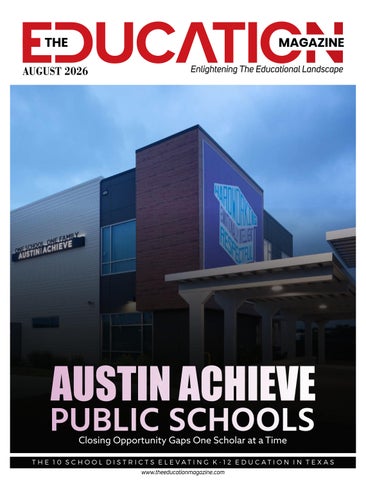
THE AUGUST 2026
UC TI
MAGAZINE
Enlightening The Educational Landscape
AUSTIN ACHIEVE
PUBLIC SCHOOLS
T H E 1 0 S C H OO L D I S T R I C T S E L E VAT I N G K - 1 2 E D U CAT I O N I N T E X AS www.theeducationmagazine.com
Where Zip Codes End and Possibility Begins: Texas Schools Rewriting the Rules of Opportunity
Dear Reader, Texas has always thought big, and nowhere is that more visible than in its classrooms. Across the state, a quiet transformation is under way, led not by policy alone but by educators who refuse to accept that a child’s postcode should decide their future. From bustling metro districts to small-town systems with outsized ambition, these are the places proving that excellence in K-12 education is not a privilege reserved for the few. This issue, “The 10 School Districts Elevating K-12 Education in Texas,” celebrates ten such institutions, each one reshaping what public education can achieve when equity, rigour and heart are placed at the centre of the mission. Leading this year’s list is Austin Achieve Public Schools, a tuition-free charter district founded in 2012 in one of Northeast Austin’s most underserved zip codes, an area where poverty rates run far above the metro average. What began with 104 sixth graders has grown into a five-campus district serving over 3,300 scholars, nearly all from low-income, BIPOC households. Guided by the belief that there is no achievement gap, only an opportunity gap, Austin Achieve has built a whole-child model blending rigorous academics with arts, athletics, and social-emotional learning, all measured through steady, individual growth rather than a single fixed benchmark. Every single graduate of its high school has earned at least one college acceptance, a remarkable feat sustained through its College Access Program, alumni support and a culture rooted in community. Alongside Austin Achieve, this issue also honours the achievements of Pawnee Independent School District, Cypress-Fairbanks Independent School District, Chilton Independent School District and San Diego Independent School District. Together, these ten districts show what is possible when belief in every child is matched with bold, sustained action. They are proof that opportunity can be built deliberately, classroom by classroom and campus by campus, until it reaches every corner of the state, from its largest cities to its smallest towns. As Texas continues to grow, so too does the promise these districts represent for the scholars walking through their doors each morning, ready to be seen, supported, and set on a path towards a future that once felt entirely out of reach. Sincerely,
Simran Khan Managing Editor
From The Editor’s Desk People Behind This Issue Publisher: Archana Ghule Editor–in–Chief: Vikram Suryawanshi
Art Director: Priyanka Patil Graphic Designer: Omkar Uravane
Managing Editor: Simran Khan
Marketing Head: Robert Smith
Project Editor: Shadab Mestri
Research Team: Daisy, Rahul,
Sales & Marketing
Maranda, Rocky
Project Head: Aakash Mahajan Sales Co-ordinators: Maria Smith Swati Kumari Project Manager: Nehal Nagpure, Kevin Gonsalves
The Education Magazine is published by Pericles Ventures Pvt Ltd. This magazine contains material protected under International and Federal Copyright Laws and Treaties. You may not publish, display, disclose, rent, lease, modify, loan, distribute, or create derivative works based on the magazine contents or any part thereof, whether by yourself or as a consultant, employee, partner or in any other role unless authorised in writing by the creator/publisher of the article/, video, audio or any content contained herein. We, the team of The Education Magazine put all the efforts to keep up with the content accuracy. The publisher assumes no responsibility of any part of the content of any advertisement in this publication, including any errors or omissions therein. All rights reserved by Pericles Ventures Pvt Ltd.
Cover Story 10 Austin Achieve Public Schools
CONTENT PROFILES
18. Chilton Independent School District 32. Cypress-Fairbanks Independent School District 48. Pawnee Independent School District 64. San Diego Independent School District articles AI Governance in Higher Education: The 26. 2026 Framework for Policy & Risk Classroom Relay: Active Learning Meets 42. Digital Control Online Schools K-12 Texas: How Virtual 56. Learning Really Works
Austin Achieve Public Schools www.austinachieve.org
Carroll Independent School District
www.southlakecarroll.edu
Chilton Independent School District
Cypress-Fairbanks Independent School District
Katy Independent School District
Keene Independent School District
Pawnee Independent School District
Plano Independent School District
San Diego Independent School District
Tomball Independent School District
www.chiltonisd.org
www.katyisd.org
www.pawneeisd.net
www.sdisd.us
www.cfisd.net
www.oit.edu
www.pisd.edu
www.tomballisd.net
AUSTIN ACHIEVE
PUBLIC SCHOOLS
10 I AUGUST 2026
THE EDUCATION MAGAZINE I 11
IN
the northeast corner of Austin, Texas, in a ZIP code that statisticians would flag as a place where the odds are stacked against the residents, something unusual has been happening since 2012. A charter school that started with just 104 6th graders has grown into a five-campus district serving 3300+ scholars from PreKindergarten through high school graduation. Local children from some of the lowest-income neighborhoods in Austin are becoming the first members of their families to go to college; with each diploma earned, they are rewriting the narrative of what public charter schools can accomplish in Texas’s most underserved communities. A School Built on a Vision for Equity Every origin story needs a person who noticed something everyone else had learned to walk past. For Austin Achieve, that person is, John Armbrust a native Austinite who studied engineering at Duke University before joining Teach For America in Atlanta in 2004. He worked inside traditional school districts and public charter schools across the country before returning to Austin with a vision for expanding educational opportunity. What he found when he returned to Austin unsettled him. The educational inequalities in his own hometown were, in his words, more severe than he had realized. So he did what engineers sometimes do when they encounter a broken system: he tried to build a better one. He chose to plant the district’s roots in the 78723 ZIP code, a stretch of Northeast Austin that a Brookings Institution and Federal Reserve System study identified as a place where 45.6 percent of residents lived in poverty, compared to 11.1 percent across the greater Austin metropolitan area. The location reflected the district’s commitment to serving Austin’s most underserved children and closing the opportunity gap where it was greatest.
Austin Achieve Public Schools describes its founding mission plainly: this was to be a tuition-free, open-enrollment public charter school district preparing Austin and Pflugerville youth to attend and excel at top universities. Fourteen years later, that founding mission has become an operating reality across five campuses. 12 I AUGUST 2026
The Shape of the District Today Austin Achieve now educates more than 3,300 scholars each school year from PreK through 12th grade, spread across five campuses in Austin and Pflugerville. The structure is deliberately feeder-based: two elementary schools carry scholars from PreK through fourth grade, two middle schools take them through eighth grade, and one high school carries them to graduation. The demographics give you a snapshot of who Austin Achieve serves. 98% of scholars are BIPOC (80% are Hispanic, 13.5% Black, 3.5% Asian, and 1% multiracial). 90% of scholars come from low-income households. 8% receive special education services, a figure the district points to proudly, noting that its special education offerings have become well-known and well-respected among parents in Austin. This is, by design, a district serving families who have historically been left behind by traditional public school options. The district’s mission and the communities it serves remain closely intertwined. Growth Measured in Ground Gained, Not Just Ground Covered Ask Austin Achieve how it defines educational excellence, and the answer begins with measuring scholar growth. Most scholars arrive already behind in literacy and math, sometimes as early as kindergarten. Rather than measure success against some fixed external bar, the district leans heavily on the NWEA MAP Growth Assessment, a test that tracks a student’s academic growth over time in math, reading, language usage, and science. This philosophy is reflected in one of the district’s core beliefs: there is no such thing as an achievement gap, only an opportunity gap. That belief shows up in the curriculum, too. Austin Achieve runs a STEAM-forward academic program layered with social-emotional learning, and according to the Texas Education Agency’s Accountability Score, the district is outperforming 100 percent of its peers in its zone.
The Whole Child, Not Just the Test Score Academics are only part of the picture Austin Achieve wants to tell. The district describes its approach as a “whole child” model, one that treats arts, athletics, and extracurriculars as being just as essential as reading levels and growth percentiles.
“
We view our educational model not just as a service, but as a proven, holistic model designed for transformational results. ~Chair of the Board of Directors, BiNi Scoor
Walk the halls, and you might find scholars in robotics, gardening, chess, or guitar club. Arts electives include visual arts, band, and theatre. The district also places a strong emphasis on athletics. Austin Achieve is UIL-competitive, something that is a rarity among charter schools. Its high school boys’ soccer team has won back-to-back district championships and, in 2025, brought home a state championship. Culture also gets its own dedicated calendar. Heritage months come with reading lists, classroom celebrations, history lessons, and sometimes field days or parades. Last year’s Hispanic Heritage Month, for instance, included mariachi bands and folklorico dancers. A District That Leans on Its Neighbors No school district thrives in isolation, and Austin Achieve has built deep relationships with hundreds of local businesses, charities, service providers, and civic leaders. The district receives in-kind donations of food, clothing, transportation, vaccinations, vision care, and hearing care, services that help remove barriers to learning for scholars and their families. There is also a staff member whose job is dedicated to advocacy work, someone who shows up regularly at City Council meetings to represent the district’s interests. The district’s advocacy efforts reflect its belief that supporting scholars extends beyond the classroom.
The Team Behind the Numbers Behind every statistic in this story sits a leadership structure built for scale. John Armbrust, Founder and CEO, sets the district’s overall strategic direction and manages board relations and growth. Mackee Mason, Chief Academic Officer, oversees scholar achievement, curriculum, teacher development, and alignment across all five campuses. Joseph Riggs, Chief Financial Officer, manages budgeting, financial compliance, and long-term sustainability. Tyler Heath, Chief Operations Officer, runs facilities, technology, and two in-house teams that rarely get headlines but keep everything running: Child Nutrition and Transportation. And Ashcon Habibi, Chief Support Services Officer, manages the systems that support scholars, families, campuses, and staff, while continuing to ensure strong compliance, service delivery, and cross-team coordination. Together, this leadership team provides the academic, operational, and financial oversight needed to support the district’s continued growth. THE EDUCATION MAGAZINE I 13
All Scholars, College Ready If there is a single statistic Austin Achieve leans on hardest, it may be this one: every single Austin Achieve High School graduate has received at least one college acceptance. It is the product of their College Access Program and a daily College Seminar course required of juniors and seniors, covering ACT preparation, financial literacy, and college application guidance. The support does not end at graduation. College Completion Counselors stay in touch with alumni through their college years, and the district runs something called the Polar Partners program, an employee-initiated, employee-funded emergency fund. When alumni run into unexpected expenses that threaten to derail their college journey, a small one-time grant can be the difference between finishing a semester and dropping out. The program reflects the staff’s commitment to supporting scholars not only through high school graduation but throughout their college journey. What Comes Next Austin Achieve is not treating its current size as a ceiling. Over the next decade, the district expects enrollment to climb past 7,000 scholars. The plan involves opening another PreK-8 feeder school and relocating and expanding the high school to a new site. At full scale, the district envisions three PreK-8 feeder schools all funneling into one state-of-the-art Austin Achieve High School. As the district grows, maintaining a strong school culture and a sense of belonging remains one of its highest priorities. In the nearer term, Austin Achieve is exploring how artificial intelligence might be woven into classrooms and daily workflow, not to replace teachers, but to relieve them of rote administrative tasks and free up more space for the human connection and pedagogy that first drew many of them into the profession. A Founder’s Closing Word John Armbrust’s journey was shaped by the realization that his own hometown had failed so many of its children. It has become a mission built around a stubborn refusal to accept that a ZIP code should determine a child’s future. Fourteen years after opening its doors to 104 6th graders, Austin Achieve now stands as a five-campus district serving more than 3,300 scholars, with a state championship-winning athletics program, a record in which every graduate has earned at least one college acceptance, and a continued commitment to ensuring that every scholar has access to a college-ready education regardless of ZIP code. 14 I AUGUST 2026
“
Over the years, we haven’t just built a team; we’ve become a family unto ourselves, united by a shared, fierce determination to serve.
THE EDUCATION MAGAZINE I 15
Chilton Independent School District Building Students Who Are Ready to Lead, Serve, and Thrive
18 I AUGUST 2026
THE EDUCATION MAGAZINE I 19
I
n many small communities, the local school district is more than a place where children learn. It is where values are passed on, expectations are set, and the future quietly takes shape, one classroom at a time. In Central Texas, Chilton Independent School District plays that role with intention and care. The district has spent decades shaping an educational environment that reflects both the needs of its students today and the demands they will face tomorrow. Chilton ISD was built on a strong sense of community pride and a clear belief in student-centered learning. From its early years to its present-day structure, the district has focused on creating a culture grounded in HEART, which stands for High Expectations, Accountability, Respect, and Trust. These principles are not slogans on a wall. They guide decisions, influence teaching practices, and shape how students, educators, and families work together every day. At its core, Chilton ISD holds a simple but ambitious vision. Every student, regardless of background, should have the opportunity to rise above socio-economic barriers and find success in an evolving world. The district works toward this vision by encouraging students to discover their passions and develop practical skills that matter beyond the classroom. Communication, creativity, critical thinking, logical reasoning, and global awareness are treated as essential tools, not optional extras. Chilton ISD balances tradition with progress by staying rooted in its community while actively embracing innovation. District leadership believes growth is not optional. It is necessary. Guided by the idea that organizations must evolve to remain relevant, Chilton ISD continues to adapt its strategies, programs, and priorities in ways that benefit both students and the broader community. This mindset has shaped the district’s reputation as a forward-thinking system that prepares students not just to graduate, but to lead, serve, and thrive in a changing world. A Close-Knit District Built on One Campus Chilton ISD operates with a structure that reflects its rural roots and its strong sense of connection. The district serves students from pre-kindergarten through 12th grade on a single campus that brings together both elementary and secondary schools. This setup creates a rare continuity in learning, where students grow up in a familiar environment supported by educators who know them well. 20 I AUGUST 2026
The district serves families from the Chilton community and nearby areas, spanning roughly 89 square miles and five small communities. While the geographic footprint is wide, the culture remains close and personal. Teachers and administrators place a strong emphasis on knowing each student by name, strengths, and individual needs. Despite its size, Chilton ISD draws students from beyond its boundaries. About 30 percent of the student population transfers in from other districts, a reflection of the trust families place in its approach to education. Chilton ISD takes pride in being a small district that consistently creates meaningful opportunities for its students. Academic Programs that Connect Learning to Life Across all grade levels, Chilton ISD builds its academic programs around rigor, relevance, and strong personal connections. The goal is not only to teach content, but to help students understand how learning applies beyond the classroom. At the elementary level, instruction centers on a strong academic core. Early literacy and numerical fluency receive focused attention, laying a solid foundation for future learning. Students also participate in enrichment opportunities that include fine arts, technology, and social-emotional learning. These experiences support creativity, confidence, and healthy development from an early age. As students move into junior high and high school, academic offerings expand with a clear focus on future readiness. Chilton ISD provides a range of Career and Technical Education programs such as Cosmetology, Business, Digital Media, Health Science, Law Enforcement, and Welding. Students can also earn non-IBC certifications in areas like sports officiating, food handling, financial literacy, and personnel services. Through a growing partnership with McLennan Community College, students may enroll in dual credit courses, allowing them to earn college credit while still in high school.
Leadership Grounded in Culture and Purpose Chilton ISD is led by Superintendent Dr. Brandon K. Hubbard, whose approach blends respect for tradition with a clear, student-focused vision. Under his leadership, the district has continued to grow while remaining anchored in the values that define its community. Dr. Hubbard believes student success begins with the culture of the learning environment, long before test scores or outcomes are measured. He emphasizes the importance of creating spaces where students, staff, and families feel safe, supported, challenged, and valued. This belief shapes how decisions are made across the district. Dr. Hubbard also champions a holistic approach to education, one that prioritizes not only academic growth, but also the physical, social, emotional, and mental well-being of students and staff. While Chilton ISD has consistently exceeded academic expectations, Dr. Hubbard points to culture as the district’s most meaningful achievement. Mutual respect, collegiality, and active engagement define daily life across the campus. His message to families is clear: Excellence begins with strong relationships and leads to real opportunity. Every student deserves both challenge and support as they pursue what matters most to them.
‘‘
Students, at any level, are most successful when the culture of the learning community is such that students, staff and all other stakeholders feel safe, challenged, supported, and valued.
THE EDUCATION MAGAZINE I 21
Defining Excellence through Growth and Balance At Chilton ISD, educational excellence is measured less by scores and more by progress. The district defines success through student growth, character development, and access to meaningful opportunities. Leaders often return to a simple idea. If every student improves by just one percent each day, long-term results will follow. Accountability, in this view, becomes a byproduct of steady, intentional growth rather than the primary goal. Chilton ISD does not rely solely on standardized assessments to measure student achievement. Instead, the focus is on whether students meet their individual growth goals. This approach is based on the belief that challenge and support must go hand in hand. Too many challenges without adequate support can lead to frustration, while too much support without enough challenge can stifle potential. The district strives to maintain a balance that promotes learning without causing burnout. This philosophy shapes the district’s strategic planning, which is organized around four priorities. These include student achievement and postsecondary readiness, faculty and staff development, family and community engagement, and responsible financial stewardship. Each priority includes specific performance indicators that guide decision-making. Practices that align with these goals are strengthened, while those that do not are carefully reconsidered. 22 I AUGUST 2026
Creating Inclusive Pathways for Every Learner The school district approaches student diversity with intention and care. District leaders recognize that students bring different learning styles, cultural backgrounds, strengths, and challenges into the classroom. To meet those needs, educators use differentiated instructional strategies, targeted intervention programs, and bilingual support services that help remove barriers to learning. Ongoing professional development ensures teachers stay grounded in research-based practices, student engagement strategies, and social-emotional learning. Beyond programs and strategies, Chilton ISD places its strongest emphasis on connection. The district believes students succeed when they feel seen, valued, and represented. Every student and family is encouraged to take part in the learning community, with open communication and shared responsibility for success. Chilton ISD promotes a culture where each child has a support system that includes encouragement, guidance, and accountability. Educators act as cheerleaders, counselors, and coaches, helping students navigate challenges while pushing them toward growth. This philosophy is reinforced through the district’s Pirate Promise, which commits to knowing every student by name, by strength, and by need. Strong relationships remain the foundation of equitable opportunity and lasting success.
Strengthening Schools through Community Connection
‘‘
Chilton ISD is a place where excellence begins with relationships and ends with opportunity.
Relationships with families and community partners sit at the center of Chilton Independent School District’s work. The district actively collaborates with parents, civic organizations, local businesses, and alumni to create partnerships that strengthen student experiences and support shared goals. These relationships extend learning beyond the classroom and reinforce the idea that education is a community effort. Chilton ISD brings this commitment to life through a range of signature events designed to welcome people of all ages onto campus. Programs like Platinum Pirates invite community members aged 55 and older to engage with student performances, academic programs, and campus life. The district also hosts family-focused events that introduce young children and families to the school environment early, building excitement for learning and connection. Annual celebrations include Hispanic Heritage Month, the Chilton ISD Homecoming Parade and Block Party, Trunk or Treat, the Pirate Wonderland Christmas Fair, and the Black History Program. Each event honors culture, tradition, and local business while bringing people together. These efforts reflect a shared belief that schools are strongest when the community stands together. At Chilton ISD, the guiding mindset is simple. We are connected, and that connection makes the difference.
THE EDUCATION MAGAZINE I 23
Student Life Beyond the Classroom Student life at Chilton ISD is built around connection, participation, and purpose. The district encourages students to explore their interests both inside and outside the classroom, guided by a simple belief. When students feel connected, they become more engaged, and engagement leads to success. Chilton ISD offers a wide range of co-curricular and extracurricular opportunities designed to meet diverse interests. Students can choose from 23 athletic programs that promote teamwork, discipline, and school pride. Beyond sports, the district is home to a nationally ranked BBQ club, fine arts programs, and hands-on enrichment activities that allow students to learn in creative and practical ways. Career-focused opportunities also play a strong role in student life. Through Career and Technical Education pathways, students can pursue 19 industry-connected certifications or licensures in addition to 3 non-industry-connected options. The Early Start Dual Enrollment program gives motivated students the chance to begin earning college credit early. Whether competing on the field, working in a lab, or performing on stage, Chilton students develop confidence, perseverance, and character. These experiences help shape graduates who are prepared for both the challenges and opportunities ahead. Leadership and Departments that Work in Sync The day-to-day success of Chilton ISD is supported by a leadership structure designed for collaboration and clarity. Each department plays a defined role while working closely with others to keep the district running smoothly and focused on students. Key departments include Curriculum and Instruction, Student Services, Athletics, Operations, Business Services, and Media and Marketing. Together, these teams support academic quality, student well-being, extracurricular programming, facilities, financial responsibility, and clear communication. Their coordinated efforts allow the district to respond efficiently to both immediate needs and long-term goals. 24 I AUGUST 2026
Dr. Brandon K. Hubbard Superintendent | Chilton ISD
What ties these departments together is a shared leadership mindset rooted in High Expectations, Accountability, Respect, and Trust. These values guide decision-making at every level and help ensure consistency across programs and initiatives. District leaders emphasize alignment, making sure each effort supports the broader mission of serving students and families. By fostering open communication and shared responsibility, Chilton ISD creates an environment where leadership is not siloed, but connected. This approach allows the district to operate with purpose, stability, and a clear focus on student success. Ensuring Equity through Access and Belonging At Chilton ISD, equity begins with access to opportunity. The district is intentional about ensuring that meaningful experiences are part of everyday student life. Faculty are encouraged to upskill and adapt their practices so they can better meet student needs and support individual passions. Chilton ISD also builds strong partnerships with organizations and institutions such as Wiley University, Baylor University, McLennan Community College, Scinary Cybersecurity, the Heart of Texas Council of Governments, and the Greater Waco Chamber of Commerce to expand exposure to higher education and careers. To remove barriers to success, the district provides academic interventions, special education services, social and emotional supports, crisis response, mentorship, and access to technology. Cultural celebrations and student voice initiatives help ensure every learner feels represented, supported, and empowered.
Support Services That Guide Students Forward The school district supports students beyond academics through a comprehensive network of services focused on future readiness. Career counseling helps students identify interests and align coursework with long-term goals. College readiness and FAFSA workshops provide clear guidance on postsecondary planning and financial aid. Mentorship programs connect students with trusted adults who offer direction, encouragement, and accountability. Partnerships with local colleges and workforce organizations expose students to real-world expectations and career pathways. Together, these supports help students build confidence, develop practical life skills, and make informed decisions. Chilton ISD’s goal is to ensure students graduate prepared not only for what comes next, but for lasting success. Looking Ahead With Purpose and Possibility Looking ahead, Chilton Independent School District remains focused on delivering what it calls a big-time education within a small-school environment. District leaders believe that choosing a rural education should never limit opportunity. Future plans include expanding Career and Technical Education programs through a school-within-a-school model, while introducing career exploration and foundational technology skills at the middle grades level.
‘‘
Every student must be challenged and supported toward their passion. The district is also working to eliminate dead-end pathways. By 2026, the goal is for every student to graduate with a diploma and either an industry certification or at least nine hours of dual credit. Investments in digital learning, including Prisms Virtual Reality, will bring real-world relevance to complex concepts. Chilton ISD also plans to strengthen community engagement through a data empowerment center that supports digital literacy, continuing education, and essential community services. THE EDUCATION MAGAZINE I 25
AI GOVERNANCE
IN HIGHER EDUCATION The 2026 Framework for Policy & Risk AI
governance in higher education is the structured system of policies, oversight committees, ethical standards, and risk controls universities use to manage AI across teaching, research, and administration, going beyond IT policy to address accountability, data privacy, and academic integrity.
Three forces are making AI governance in higher education urgent in 2026.
Artificial intelligence is advancing in higher education faster than institutional policy can keep pace. Faculty are experimenting with generative AI tools, students are submitting AI-assisted work, and administrative departments are automating everything from admissions to advising.
The EU AI Act, which came into force in August 2024, classifies several AI applications common in universities, including AI-assisted admissions systems and student performance analytics, as “high-risk.” European universities must now demonstrate compliance or face penalties.
Yet most universities are facing a governance gap. According to EDUCAUSE’s 2024 AI Landscape Study, 80% of faculty and staff use AI tools, yet fewer than one in four are aware of a formal institutional policy. The result is rapidly growing shadow AI unsanctioned tools operating entirely outside institutional oversight. For university leaders, the question is no longer whether AI will shape higher education; it is whether institutions will govern it responsibly before a data breach, regulatory violation, or integrity crisis forces their hand. That is precisely what AI governance in higher education is designed to prevent. Why AI Governance Is Becoming Critical for Universities Universities are inherently open environments built for experimentation and academic freedom. These values drive innovation, but they also create governance blind spots when powerful technologies enter the ecosystem without structure. a tension explored in depth in our look at how AI is already reshaping university teaching, research, and governance. 26 I AUGUST 2026
1. Regulatory Pressure is Accelerating
In the United States, the Department of Education’s 2023 guidance on AI explicitly calls on institutions to develop ethical frameworks for AI use in student services and assessment. FERPA, meanwhile, imposes strict constraints on how student data can be processed by third-party AI systems. 2. Adoption has Outpaced Policy Generative AI platforms are now embedded across research workflows, automated grading, tutoring systems, and administrative automation. Without governance, practices become inconsistent and unauditable across departments, creating compliance risks that institutions may not discover until audited.
THE EDUCATION MAGAZINE I 27
3. Public Trust is at Stake
Core Pillars of an AI Governance Framework
UNESCO’s Recommendation on the Ethics of AI warns that institutions failing to govern AI transparently risk eroding the public legitimacy that universities depend on. That trust, once lost in a high-profile AI incident, is difficult to recover.
Effective AI governance in higher education is not an IT function; it is an institutional one. Guidance from UNESCO, the OECD’s AI Principles, and the UK’s Higher Education Policy Institute (HEPI) consistently identifies four pillars that distinguish mature governance frameworks from ad hoc policy responses.
The “Shadow AI” Problem on Campus 1. Institutional AI Steering Committees Shadow AI–AI tools adopted by faculty, staff, or students without institutional approval represent one of the most underestimated risk vectors in higher education today. EDUCAUSE research consistently finds that universities have far more AI tools operating across their campuses than IT departments are aware of. These include AI writing assistants, research automation tools, coding copilots, data analysis platforms, and AI tutoring systems, many of which operate entirely outside the university’s data governance perimeter.
Governance must begin at the leadership level. Universities, including the University of Edinburgh, published one of the first comprehensive institutional AI governance frameworks in UK higher education in 2024. Structured oversight around cross-functional committees composed of academic leadership, IT, legal, research ethics, and faculty representatives. These committees are responsible for defining acceptable use policies, reviewing AI vendors, monitoring emerging risks, and advising senior leadership. Critically, they prevent AI decisions from defaulting entirely to IT departments, ensuring academic values remain central to governance.
The risks are concrete: 2. Ethical AI Principles in Practice ● Data Leakage: When a professor uploads an unpublished research dataset to a commercial AI platform, that data may be stored, logged, or used for model training. The university loses control of its intellectual property with no audit trail. ● FERPA Violations: If student performance records are processed by an unapproved AI system, the institution may violate federal privacy law even if the faculty member had no intent to breach compliance. ● Cybersecurity Exposure: AI tools connected informally to campus systems bypass the security reviews that approved enterprise software undergoes. The governance lesson is clear: awareness campaigns alone are insufficient. Institutions need active monitoring, not just policy documents. 28 I AUGUST 2026
Ethical governance goes beyond publishing principles; it operationalises them: A. Transparency Students and faculty must know when AI is involved in academic or administrative decisions. AI-assisted grading, automated feedback, and algorithmic admissions screening should be disclosed. The EU AI Act makes transparency mandatory for high-risk AI applications; institutions operating in Europe have no choice. B. Fairness and Bias Auditing AI systems trained on historical datasets can reproduce structural inequalities. Arizona State University’s AI Task Force, established in 2023, requires bias testing before any AI tool is deployed in student-facing applications, a model that other institutions are beginning to adopt.
C. Accountability Final decisions involving students or staff must remain under human authority. AI informs; humans decide. This principle is embedded in most leading governance frameworks and is a baseline requirement under EU AI Act provisions for high-risk systems.
This is one of the most visible places where AI governance in higher education directly shapes the student experience. Traditional plagiarism detection looked for copied text. AI-generated content is original by definition, rendering tools like Turnitin insufficient as standalone solutions.
3. Human-in-the-Loop (HITL) Oversight Rather than permitting AI systems to operate autonomously, HITL governance requires human review at every critical decision point.
The University of Oxford’s Academic Integrity Framework, revised in 2024, explicitly acknowledges this, pivoting from detection-first approaches toward assessment redesign and transparent disclosure policies.
An AI system might analyse student engagement patterns and flag students at risk of dropping out, but advisors retain full decision-making authority over any intervention.
Leading institutions are responding across three fronts: 1. Assessment Redesign
MIT’s published AI Policy Principles identify HITL oversight as a foundational standard for AI systems that affect student outcomes, a position reflected in the broader governance frameworks many research universities are now formalising. This approach allows institutions to gain AI-driven insights while preserving academic accountability and legal defensibility. 4. Continuous Monitoring Over Static Policy Traditional IT policies are approved once and periodically reviewed. AI governance cannot work this way. AI models are updated, training data changes, and new capabilities emerge on timelines that annual policy reviews cannot match. The OECD’s Framework for the Classification of AI Systems recommends “continuous assurance” models, ongoing monitoring of AI behaviour rather than one-time approval. Universities adopting this approach build audit mechanisms directly into their AI procurement contracts.
Oral examinations, project-based work, and in-class analytical tasks evaluate understanding that AI cannot simulate. Stanford’s Hasso Plattner Institute of Design has piloted process documentation approaches in select courses, where students submit drafts, annotations, and reflective journals that demonstrate the thinking behind outputs, not just the outputs themselves. 2. Disclosure-Based Policies Rather than attempting blanket bans, which EDUCAUSE notes are largely unenforceable, institutions like University College London now require students to declare when and how AI tools were used, treating transparency as an academic skill in itself. 3. Faculty Development Separate EDUCAUSE faculty readiness findings indicate that fewer than 30% of faculty feel confident designing AI-resilient assessments.
AI Governance and Academic Integrity Generative AI has transformed academic integrity from a plagiarism problem into an authorship problem, and the two require fundamentally different responses.
Governance frameworks that invest in faculty training, not just student-facing policies, produce more consistent and defensible integrity standards. THE EDUCATION MAGAZINE I 29
The EU AI Act: What Universities Cannot Ignore
Stage 1: AI Inventory
The EU AI Act introduces the most significant regulatory change for universities operating in or with European institutions since GDPR.
Map every AI tool currently in use across teaching, research, administration, and student services. Most universities discover significantly more tools than anticipated.
Key implications for higher education: ● High-risk classification: AI systems used for student assessment, admissions screening, and performance monitoring fall under the Act’s high-risk category. These systems require conformity assessments, bias testing, human oversight mechanisms, and full auditability before deployment. ● Prohibited practices: AI systems that use subliminal techniques or exploit student vulnerabilities relevant in the context of adaptive learning platforms are prohibited outright. ● Extraterritorial reach: Universities outside the EU that process data from EU-based students or partner with EU institutions may still fall under the Act’s scope.
This inventory process is typically when the full scale of unsanctioned AI adoption becomes visible for the first time. Stage 2: Policy Development Draft acceptable use policies, research ethics guidelines, procurement standards, and data governance rules. Policies should define what is permitted, what requires approval, and what is prohibited, with clarity on consequences. Stage 3: Governance Structures Establish the AI steering committee, data governance board, and ethics review panel. Define decision rights clearly: who approves new AI tools, who monitors deployed systems, and who escalates concerns. Stage 4: AI Literacy Programs
Institutions that have not begun EU AI Act compliance assessments are already behind. The Act’s high-risk provisions apply from August 2026 for most use cases.
Governance fails if faculty and staff lack the knowledge to apply it. Training should cover responsible AI use in teaching, algorithmic bias recognition, and the practical implications of institutional policy, not just the existence of that policy.
AI Vendor Risk: A Governance Checklist
Stage 5: Continuous Monitoring
Every AI tool adopted by a university carries institutional risk. A structured vendor assessment protects against shadow AI entering through procurement channels.
Build review cycles into governance from day one. AI systems change. Regulations change. Institutional risk profiles change.
Universities increasingly apply zero-trust security principles to AI vendor evaluation, treating every external system as a potential risk until verified, rather than trusted by default.
Annual audits of deployed AI systems, quarterly vendor reviews, and real-time monitoring of high-risk applications should be standard by the time a university reaches governance maturity.
Building an Institutional AI Governance Roadmap
Preparing for Agentic AI: The Next Governance Frontier
Policy without implementation is a document, not a governance framework. Institutions building AI governance in higher education from the ground up should move through five stages sequentially rather than simultaneously.
Generative AI is already a governance challenge. Agentic AI systems capable of taking autonomous actions across research databases, scheduling systems, administrative workflows, and communication platforms will be substantially harder to govern.
30 I AUGUST 2026
Multi-agent architectures, where multiple AI systems collaborate and delegate tasks to one another, are moving from research labs to enterprise software. Several major edtech vendors are already piloting agentic tools for student advising and course personalisation. For universities, this raises governance questions that current frameworks are not designed to answer. Early guidance from the World Economic Forum’s AI Governance Alliance and emerging institutional practice points toward three priority areas: 1. Accountability chains When an autonomous AI agent makes a decision that harms a student, current frameworks built around individual human decision-makers do not map cleanly onto multi-step automated pipelines. Leading institutions are beginning to designate a named human “AI accountability owner” for each deployed agentic system, ensuring that every automated workflow traces back to an identifiable individual with review authority.
Universities building agentic governance policies are prioritising end-to-end logging requirements, mandating that every agent action, handoff, and decision point is recorded in an immutable audit trail that human reviewers can interrogate after the fact. The World Economic Forum’s AI Governance Alliance recommends that institutions begin developing agentic AI governance policies now, before deployment pressure forces universities into reactive policymaking. The Future of Responsible AI in Higher Education AI will reshape every function of the modern university, learning, research, operations, and student support, but the shape it takes will not be determined by the technology alone. It will be determined by the choices institutions make now about accountability, oversight, and whose interests governance is designed to protect. Strong AI governance in higher education is not a constraint on innovation. It is the condition that makes innovation defensible: to students whose data is at stake, to regulators who are watching, and to the public that grants universities their social license to operate. The universities that will define the next era of higher education are not necessarily the earliest adopters. They are the ones building the institutional infrastructure to ensure that every AI system they deploy can be explained, audited, and, if necessary, stopped. If you found this insight valuable, share it with academic leaders and colleagues who are shaping the future of responsible AI in higher education.
2. Access governance. Agentic systems require dynamic, scoped permissions rather than static access grants. The emerging best practice aligned with zero-trust principles already applied to vendor evaluation is to grant agentic AI the minimum permissions required for a specific task, with automatic expiration and human-triggered re-authorisation for sensitive data environments, including student records and research repositories. 3. Pipeline auditability Multi-agent systems can obscure the origin of individual decisions across layers of automated delegation. THE EDUCATION MAGAZINE I 31
CYPRESS FAIRBANKS Independent School District
Educating Today, Shaping Tomorrow
Our Mission
Equip students today to impact tomorrow. 32 I AUGUST 2026
THE EDUCATION MAGAZINE I 33
Public school districts often reflect the communities they serve. Their priorities, pace of growth and values tend to mirror the people who built them and the students who pass through their classrooms. Cypress-Fairbanks Independent School District is no exception. What began as a small, community-led effort to provide organized education in rural Texas has grown into one of the nation’s most forward-thinking public school systems, without losing sight of where it started or why it exists.
The roots of education in the Cypress and Fairbanks communities stretch back to the late 1800s, when local families came together to create learning opportunities for their children. That spirit of shared responsibility became formalized in December 1939. Voters from both communities approved the creation of the Cypress-Fairbanks Consolidated School District, setting the foundation for what would eventually become the Cypress-Fairbanks Independent School District. From the beginning, the district was shaped by local voices and collective commitment, not by scale or ambition alone. Over the decades, Cypress-Fairbanks ISD evolved alongside a rapidly changing region. What was once a largely rural area is now home to a diverse and growing population. Today, the district serves 114,820 students across 96 campuses, supported by more than 16,000 employees. Despite its size, the district continues to operate with a clear sense of purpose. Its mission is straightforward: equip students today to impact tomorrow. That focus is reinforced by a vision centered on cultivating each student’s full potential and preparing them for lifelong success. 34 I AUGUST 2026
Today, Cypress-Fairbanks ISD stands as a modern example of public education done with intention. It balances innovation with tradition, growth with community, and academic rigor with student-centered values. While the district is recognized nationally for its progress and scale, its strength remains grounded in the same principle that guided its earliest days. Education works best when it grows from strong roots and remains focused on the future. Academic Pathways That Grow With the Student Academic planning at Cypress-Fairbanks ISD starts early and builds with intention. The district introduces structured learning in pre-kindergarten, where students begin developing foundational skills that support long-term academic growth. At the elementary level, programs such as the Two-Way Dual Language Program and Spanish Action-Based Learning Labs encourage language development, cultural awareness, and hands-on learning from an early age. As students move into middle and high school, the curriculum expands to reflect both college and career readiness. Cypress-Fairbanks ISD has earned a reputation as a destination district for its academic depth and program variety. Career and technical education plays a central role, offering more than 30 programs of study and over 70 industry-recognized certifications. Students graduate with practical skills alongside academic knowledge. At the high school level, opportunity reaches another tier through the CFISD College Academy. Students from all 12 high schools can earn an associate degree by graduation, leaving them prepared for college, careers, and life beyond the classroom. A District Designed to Serve a Growing Region The school district operates at a scale that reflects both the size and diversity of the communities it serves. Spanning 186 square miles in northwest Harris County, the district reaches across suburban Houston, Jersey Village, and Cypress, Texas. Its footprint enables CFISD to remain closely connected to local neighborhoods while supporting a broad and varied student population. THE EDUCATION MAGAZINE I 35
Doug Killian, Ph.D. | Superintendent The district serves students from pre-kindergarten through 12th grade across 96 campuses. Those schools include 59 elementary schools, 20 middle schools, 12 high schools, and five special program facilities. Each campus plays a distinct role within the larger system, designed to support students at every stage of their academic journey.
Academic performance remains a central focus. The district aims to raise student achievement across all STAAR and End-of-Course levels, with steady gains targeted at the Approaches, Meets, and Masters standards by 2029. Just as important is readiness beyond graduation. Cypress-Fairbanks ISD seeks to ensure that more students leave high school equipped with the skills and knowledge needed for their chosen post-secondary paths, while also increasing the four-year graduation rate.
This structure allows Cypress-Fairbanks ISD to balance consistency with flexibility. While all schools operate under a shared mission and academic framework, they remain responsive to the needs of their individual communities. The result is a district built to grow, adapt, and serve students where they are.
Early literacy and numeracy form another cornerstone of the plan. The district prioritizes reading and math proficiency in the early grades, using consistent assessments to monitor growth and intervene where needed. Together, these goals reflect a district that defines excellence through accountability, clarity, and long-term student success.
Defining Excellence Through Clear, Measurable Outcomes
Leadership Grounded in Presence and Purpose
Educational excellence at Cypress-Fairbanks ISD is defined by progress that can be seen, measured, and sustained. Rather than relying on abstract ideals, the district anchors its work in a clear set of benchmarks outlined in its Strategic Plan for 2024 through 2029. These goals guide decision-making across classrooms, campuses, and leadership teams. 36 I AUGUST 2026
Leadership at Cypress-Fairbanks ISD is defined by visibility, trust, and a deep belief in the people who make the district work each day. Superintendent Doug Killian, Ph.D., leads with a hands-on approach. During the last school year, he visited all 96 campuses, taking time to observe classrooms, meet staff, and experience school culture firsthand. What stood out was consistency. From front office teams to classroom teachers, he saw care, professionalism, and pride across every campus.
That confidence shows in the message shared with families. Students at every grade level engage in learning that goes beyond textbooks, including action-based labs, dual-language instruction, robotics, and career-focused pathways. Outcomes reflect that investment. Hundreds of seniors earned associate’s degrees through the CFISD College Academy, while CTE students secured thousands of industry certifications. At the same time, educators received meaningful recognition through the Teacher Incentive Allotment program. Under this leadership, Cypress-Fairbanks ISD positions itself as a district moving forward with clarity, momentum, and a strong commitment to student success. Supporting Every Learner through Intentional Design
Support services are layered and flexible. Students receive assistance through in-class support, resource settings, and speech and language services, depending on individual needs. For younger learners, early childhood special education and adaptive behavior programs provide targeted intervention. Life Skills classes and other specialized programs operate across many campuses, ensuring access without unnecessary disruption. The district also offers focused support for students with sensory and physical needs. Services for students who are deaf or hard of hearing, visual impairment support, adaptive physical education, and homebound instruction are available through dedicated campuses and centers. Together, these systems reflect a district designed to help every student learn, participate, and progress. Building Strong Partnerships beyond the Classroom
Cypress-Fairbanks ISD approaches student diversity with structure, planning, and accountability. Oversight begins with the Curriculum and Instruction and Accountability department, which guides learning from pre-kindergarten through 12th grade. The department supports core academics alongside career and technical education, fine arts, physical education, and district wide accountability efforts. This centralized approach allows the district to align instruction while remaining responsive to student needs.
Cypress-Fairbanks ISD views education as a shared effort that extends well beyond school walls. The district creates multiple entry points for parents and community members to engage in meaningful ways. Districtwide and campus-based committees offer families a voice in planning and decision-making, while parent-teacher organizations and booster clubs support students at the school level. These groups help ensure communication stays open and priorities remain aligned.
THE EDUCATION MAGAZINE I 37
Partnerships with local businesses play an equally important role. A strong business community supports the district through advertising and campus adoption programs, with many companies forming direct relationships with individual schools. Regular business partner meetings and mentor training help maintain consistency and shared understanding across these collaborations. Community involvement continues through a robust Volunteers in Public Schools (VIPS) program. Volunteers contribute time and skills through tutoring, library support, fundraising efforts, and staff appreciation activities. Together, these partnerships strengthen trust, expand resources, and reinforce the district’s goals across the community it serves. Student Life Enriched by Choice and Participation Student life at Cypress-Fairbanks ISD reflects a balance between academics and meaningful enrichment. Across middle and high school campuses, students have access to a wide range of extracurricular opportunities that encourage teamwork, discipline, and personal growth. During the 2024–25 school year, more than 18,000 students participated in athletics, representing sports programs that emphasize both competition and character development. The district’s fine arts programs reach even further. Nearly 89,000 students took part in music, visual arts, theater, and related disciplines, making creative expression a central part of campus life. That commitment has earned Cypress-Fairbanks ISD national and state recognition, including multiple years as a Best Community for Music Education and a District of Distinction in art education. Beyond traditional programs, offerings such as agricultural education connect learning to real-world experience. Student participation in the Livestock Show and Sale generated more than $700,000 for projects, highlighting how enrichment at CFISD often extends beyond the classroom and into the community. Leadership That Keeps the District Moving Forward The day-to-day operations of Cypress-Fairbanks ISD are guided by a leadership structure designed for clarity and coordination. At the center is the superintendent’s cabinet, a team of seven chief officers who oversee the district’s most critical functions. Each role brings focused expertise while working together to support schools, staff, and students. 38 I AUGUST 2026
The cabinet includes the chief of staff, chief financial officer, and chief academic officer, who collectively guide planning, budgeting, and instructional priorities. Support for people and campuses comes through the chief of employee and student services and the chief officer for school leadership, ensuring both staff development and campus leadership remain strong. Operational needs, from facilities to transportation, fall under the chief operations officer, while legal oversight and governance are managed by general counsel. This structure allows Cypress-Fairbanks ISD to operate with consistency and accountability. By clearly defining leadership roles, the district creates a system where decisions align with strategy and schools receive the support they need to function effectively. Creating Access and Opportunity for Every Student Equity at Cypress-Fairbanks ISD is addressed through practical programs that remove barriers and support student success. Alongside its special education services, the district operates New Arrival Centers for elementary, middle, and high school students who are new to the United States. These centers focus on accelerated English language development, helping students gain the skills they need to transition into mainstream classrooms within a year. Support also extends beyond academics. The district’s nutrition services department plays an important role in student well-being by participating in the federal free and reduced meal program. This ensures that students from underserved backgrounds have access to healthy breakfast and lunch options during the school day. At select high school campuses, after-school feeding programs provide additional support for students who remain on campus for activities and events. Together, these efforts reflect a district that approaches inclusion through access, consistency, and care, ensuring students receive the resources they need to participate fully in school life.
THE EDUCATION MAGAZINE I 39
Our Vision Create a thriving educational community where each student’s full potential is cultivated, realized and celebrated to ensure lifelong success. 40 I AUGUST 2026
Preparing Students for Life after Graduation Student support at Cypress-Fairbanks ISD extends well beyond the classroom. Every campus has a dedicated guidance and counseling staff to support academic planning and personal development. At the high school level, student support includes Career and Technical Education counselors, Dual Credit Advisors and College Academy Mentors who work closely with students to explore postgraduation options, from college pathways to workforce entry. Career and technical education programs strengthen this support through real-world exposure. Health science students gain part-time work experience in the healthcare field, allowing them to apply classroom learning in professional settings. Other programs, such as audio video production and journalism, connect directly with the district’s communication department, giving students a platform to share their work at a professional level. These experiences help students build confidence, skills, and clarity as they plan their next steps. Expanding Learning through Flexible Pathways Cypress-Fairbanks ISD continues to plan for learning environments that reflect how students live and learn today. Beginning in the 2026–27 school year, the district will launch its Virtual Pathways program, offering an online curriculum designed for students who need greater control over time, pace, and setting. The program allows students to move through coursework at a speed that matches their readiness, rather than a fixed calendar. Learning can take place from home or on the road, making it possible for students to remain enrolled while traveling, competing, or performing. Students also have the flexibility to shape daily schedules that leave room for interests beyond school. Virtual Pathways adds another option to the district’s academic landscape, recognizing that learning does not follow a single path for every student.
THE EDUCATION MAGAZINE I 41
CLASSROOM RELAY Active Learning Meets Digital Control 42 I AUGUST 2026
W
alk into any modern classroom, and you will notice two competing forces. On one side, students need movement, interaction, and collaboration to learn truly. On the other hand, devices demand structure, supervision, and digital focus.
This is where the idea of the classroom relay becomes powerful and often misunderstood. For some educators, a classroom relay is a high-energy learning strategy that turns academic concepts into team-based challenges. For others, it refers to digital classroom management tools once branded under “Relay.” The confusion is real, and so is the opportunity. In 2026 classrooms, the most effective schools are not choosing between movement and monitoring. They are blending both. This guide brings clarity. We will explore the research behind movement-integrated instruction, examine inclusive relay models across grade levels, and explain how digital tools support structured, active learning environments. Let’s begin by defining what a classroom relay truly is. What Is a Classroom Relay? A classroom relay is a structured, team-based instructional strategy where students physically move between designated stations to complete academic tasks, reinforcing content and collaboration before passing responsibility to a peer. In education, this model is used to: ● Reinforce academic content ● Encourage collaboration ● Increase physical engagement ● Improve focus through structured movement The format can vary. In elementary classrooms, it may involve vocabulary cards placed at stations. In high school settings, it could mean rotating through complex case-study checkpoints. The structure remains consistent: movement, accountability, and shared responsibility. Much like other classroom management games, the relay transforms routine tasks into high-engagement opportunities. However, the term “classroom relay” also appears in digital education contexts. The edtech company Lightspeed Systems previously used “Relay” in its product branding for classroom device management. Today, the company’s tools focus on filtering, monitoring, and real-time student visibility in 1:1 environments. THE EDUCATION MAGAZINE I 43
Understanding this distinction is important. One refers to pedagogy. The other refers to digital oversight.
Types of Classroom Relay Activities Across Grade Levels
This article addresses both because modern classrooms require both.
A classroom relay is not limited to elementary school. When designed intentionally, it scales across age groups and subject areas. The key is aligning movement with cognitive demand.
Why Movement Improves Learning The effectiveness of relay-style learning is not based on enthusiasm alone. It is grounded in research on movement-integrated instruction. Recent studies published in peer-reviewed journals such as Frontiers in Psychology and indexed in the National Center for Biotechnology Information (PMC) show that structured physical activity during instruction improves: ● Executive function ● Selective attention ● Working memory ● Cognitive flexibility Executive function is especially critical in K–12 education. It governs planning, focus, and impulse control. When students move with purpose during learning tasks, the brain increases oxygen flow and neural activation patterns linked to memory retention. Instructional coaches consistently report that swapping passive reading for physical relays actively lowers behavioral disruptions. Research on neuroplasticity further supports this. Movement stimulates neural pathway development, strengthening the brain’s ability to encode and retrieve information. In practical terms, students are more likely to remember what they learn when the body is engaged alongside the mind. Movement also reduces cognitive fatigue. Instead of sitting passively, students alternate between physical activation and mental processing. This pattern sustains attention over longer instructional periods. A classroom relay is not simply a game. It is a structured cognitive strategy aligned with how the brain processes information. This mirrors the broader shift from passively receiving information to actively exploring it that defines modern active learning approaches. 44 I AUGUST 2026
1. Elementary School Relays At the elementary level, relays focus on foundational skill reinforcement and gross motor engagement. Common formats include: ● Vocabulary Relays: Students run to retrieve word cards and match them with definitions. ● Math Fact Stations: Teams rotate through quick problem-solving checkpoints. ● Spelling Board Runs: One student writes a letter at a time before tagging the next teammate. ● Sensory Path Relays: Integrated movement paths that support focus before answering academic prompts. For younger learners, structured movement supports attention regulation. Studies on movement-integrated instruction show improvements in selective attention and on-task behavior when physical activity is embedded into academic routines. The emphasis at this level is rhythm: move, think, return, repeat. Suggested Time: 15–20 minutes | Group Size: 3–5 students | Materials: Task cards, timer, answer sheets 2. Middle School Relays In middle school, the relay format shifts from recall to reasoning.
Examples include: ● Science Concept Circuits: Students rotate between experiment summaries and analysis questions. ● History Timeline Relays: Teams assemble chronological sequences at stations. ● Problem-Solving Relays: Multi-step math problems completed collaboratively.
When designed well, high school relays reduce passive note-taking and increase accountability within peer groups. Suggested Time: 25–35 minutes | Group Size: 4–6 students | Materials: Case study packets, analytical rubrics, digital submission tools Designing an Inclusive Classroom Relay
● Brain Break Relays: Short movement tasks followed by reflection prompts.
Movement-based learning must be adaptable. Not every student experiences stimulation in the same way.
Adolescents benefit from collaborative movement because it activates executive function while maintaining social engagement. Research in cognitive development highlights that structured peer interaction strengthens working memory and cognitive flexibility.
Research on ADHD and sensory processing emphasizes that students with ADHD or sensory sensitivities benefit from structured movement but only when predictability and choice are built into the environment.
At this stage, relays should include strategic thinking, not just speed.
Similarly, reporting from Education Week highlights the importance of flexibility in movement-based instruction.
Suggested Time: 20–25 minutes | Group Size: 4–6 students | Materials: Station folders, reflection cards, optional QR codes 3. High School and Higher Education Relays
Practical inclusion strategies include: ● Choice Boards: Allow students to select between movement intensity levels.
This is where most competitors fail to provide guidance. Relay learning at advanced levels focuses on complex reasoning, debate, and synthesis. Effective models include:
● Sensory Walk Options: Provide calm movement pathways instead of competitive sprints. ● Timed Transitions: Clear auditory or visual cues for station shifts.
● Case Study Rotations: Teams analyze different components of a real-world scenario before presenting integrated findings.
● Defined Roles: Timekeeper, recorder, presenter, so not every student is required to run.
● STEM Challenge Relays: Each station adds a layer of complexity to an engineering or data-analysis task.
Inclusion is not about slowing the relay. It is about designing structured access points.
● Literary Analysis Rotations: Students build interpretive arguments across checkpoints.
When thoughtfully implemented, relay activities can improve executive function while supporting emotional regulation.
● AP Review Circuits: Timed concept reinforcement aligned with exam standards.
The Rise of the “Phygital” Classroom Relay
Older students do not need simplified games. They need structured collaboration with intellectual depth. Movement remains purposeful but secondary to analytical rigor.
The modern classroom operates in a 1:1 device environment. Movement does not replace technology; it coexists with it. THE EDUCATION MAGAZINE I 45
Educational leaders are increasingly describing this blended environment as “phygital,” where physical learning experiences are supported by digital infrastructure.
For example, AI-assisted features such as SmartPlay filtering allow schools to manage YouTube content dynamically, while structured policy systems enable differentiated permissions by grade or role.
In practical terms, this may look like: ● QR codes at relay stations linking to problem sets
In a relay-based classroom, these tools serve a supporting function. They allow teachers to maintain digital focus while students rotate physically between learning stations.
● Chromebook submissions at each checkpoint ● Real-time digital quizzes embedded into movement cycles
The goal is not surveillance. It is instructional alignment. Managing Movement Without Losing Digital Focus
● AI-generated prompts adjusting task difficulty between rounds
Movement energizes learning. Devices can either support that energy or disrupt it.
The difference in 2026 is not just movement. It is visibility. The challenge in modern classrooms is balance. Teachers are now able to combine active learning with structured digital oversight. This ensures that devices enhance instruction rather than distract from it. Classroom Relay Software Explained As classroom relays evolve in 1:1 environments, digital management becomes part of the conversation.
When students rotate between relay stations with devices in hand, teachers need clear guardrails. Research on attention shows that divided focus reduces task performance. This means digital boundaries must be defined before movement begins. Practical strategies include:
Some educators encounter the term “classroom relay” through legacy product branding from Lightspeed Systems, a company known for K–12 filtering and classroom management tools.
● Pre-setting approved sites before the relay starts
While the company’s flagship product today is Lightspeed Filter, earlier branding included “Relay,” which still appears in search behavior.
● Assigning a digital monitor role within each team
It is important to clarify the distinction. A classroom relay activity refers to a movement-based instructional model. Classroom management software refers to tools that provide:
● Locking devices into a single-task mode during timed rounds
● Using timed submission windows for accountability Real-time visibility tools allow teachers to intervene quickly if students drift off task. But structure should not replace trust. Students must understand why digital expectations exist.
● Real-time student screen visibility
A classroom relay works best when autonomy and accountability coexist.
● Website filtering
Measuring Impact: Assessment in Relay Models
● AI-supported video monitoring
Many relay activities fail for one reason: they measure excitement instead of learning.
● Policy-based access control ● Hierarchical management across schools and districts 46 I AUGUST 2026
To align relays with academic outcomes, assessment must be embedded into the structure.
Effective relay-based assessment strategies include: ● Formative Checkpoints: Quick-response prompts at each station ● Cumulative Problem Chains: Each team builds on the previous group’s answer ● Peer Explanation Rounds: Students explain reasoning before moving forward ● Digital Exit Submissions: Short reflective responses submitted at the end Research on executive function shows that structured retrieval strengthens memory consolidation. When relays include reflective checkpoints, they move beyond activity and become cognitive reinforcement systems. Data collected during relays can inform: ● Instructional pacing ● Misconception patterns ● Group collaboration dynamics ● Differentiation needs A well-designed classroom relay is measurable, not chaotic. Quick-Start Classroom Relay Template Not sure where to begin? Use this simple framework to build your first relay this week. 1. Pick your content: Choose 4–6 concepts, questions, or problems from your current unit. 2. Set up your stations: Place one task at each station. Label them clearly. Include a timer at each point. 3. Assign roles: Every student gets a role: runner, recorder, timekeeper, or presenter. 4. Set digital expectations: If devices are in use, define which sites or tools are approved before the relay begins. 5. Run and reflect: After the relay, spend 5 minutes on a whole-class debrief or digital exit slip.
The Future of Classroom Relays Starts With You The classroom relay is no longer just a game. It is a strategic response to a changing educational landscape. In 2026, students need movement to strengthen attention, collaboration to build reasoning, and digital structure to protect focus. Schools that succeed are not choosing between physical engagement and technological oversight. They are integrating both with intention. Whether you are a classroom teacher designing your next lesson or a school leader evaluating digital infrastructure, the opportunity is clear. Movement and management are not opposing forces. They are complementary tools in a well-designed learning ecosystem. If this guide clarified the modern classroom relay for you, share it with a colleague who is rethinking engagement in today’s classrooms. Conversations like this shape better schools.
That’s it. Your first relay does not need to be perfect. It needs to happen. THE EDUCATION MAGAZINE I 47
PAWNEE INDEPENDENT SCHOOL DISTRICT
48 I AUGUST 2026
THE EDUCATION MAGAZINE I 49
P
awnee, Texas, did not emerge from grand plans or rapid growth. It took shape slowly, guided by necessity and sustained by the people who chose to remain. Situated at the intersection of Farm Roads 673 and 798 in northwestern Bee County, about twenty-two miles northwest of Beeville, Pawnee developed as a practical stop in an otherwise open stretch of South Texas. Its name, according to local accounts, came from a wooden board marked “Pawnee,” fastened to a tree to orient travelers moving through the area. The detail is modest, but fitting. From the beginning, Pawnee was defined less by appearance and more by function. Long before permanent settlement, the land carried signs of earlier movement. Arrowheads discovered along Sulphur Creek suggest that Pawnee Indians once passed through or used the area, leaving quite a bit of evidence of a deeper history. By the late nineteenth century, that history gave way to homesteads and families seeking stability. In 1890, Fred Hoff and his family settled on land purchased from the Lott ranch, a few miles southwest of what would become the town center. Others followed, including D. C. Benham in 1900, and Pawnee began to grow, not outward, but inward.
Purpose, Principles, and Progress At the center of Pawnee Independent School District is a clear sense of purpose shaped by the same perseverance that has long defined the town it serves. The district’s mission is captured in a simple but deliberate framework built around the word PAWNEE. It begins with a commitment to positively impact the destiny of students and the broader community, followed by an expectation to aim high, work hard, and persist even when progress feels slow. Just as important is the emphasis on encouragement and lifelong learning, values that extend beyond classrooms and into daily interactions. That mission is reinforced by a forward-looking vision. Pawnee ISD sees itself as a destination for future leaders, a place where opportunity, excellence, and innovation guide rigorous learning. The district strives to create an environment where students and staff learn, lead, and succeed every day, adapting to an ever-changing world without losing sight of local roots. It is a vision grounded in preparation, not prediction, focused on equipping students with the skills and confidence needed for life beyond graduation. The district’s values reflect a belief that opportunity should be personal and inclusive. Pawnee ISD holds that every student and staff member deserves the chance to pursue individual goals through a well-rounded education. Innovation programs and project-based learning play a key role in this approach, supporting engagement while maintaining high expectations. Excellence is not reserved for a select few but pursued across classrooms, programs, and roles.
The town’s early development reflected a clear set of priorities. In 1910, residents built a one-room schoolhouse that opened its doors to thirteen students. It was a small number, but the decision carried weight. Education was not postponed until the town was larger or more established. It was built early, alongside the first store opened by M. Carson around the same time, giving Pawnee both a place to learn and a place to gather.
To turn belief into action, the Board of Trustees has adopted clear performance goals. These include exceeding state and federal standards through a balanced curriculum, offering innovative instructional programs that prepare students for post-secondary paths, and maintaining a safe, drug-free learning environment. Equal attention is given to the responsible use of resources and the recruitment and retention of dedicated, highly qualified staff.
From these beginnings emerged Pawnee Independent School District, an institution shaped by the same steady resolve that defined the town itself. The district’s identity is inseparable from Pawnee’s history. It reflects a community that values continuity, responsibility, and the belief that education is not an accessory to growth, but its foundation.
This focus on steady improvement mirrors Pawnee’s broader history. From its agricultural beginnings and early businesses to the completion of a new school facility in 2009, the town has evolved while remaining small and close-knit. Through population shifts and economic change, education has remained constant. Pawnee ISD continues to serve as both a reflection of the community’s past and a practical investment in its future.
50 I AUGUST 2026
Expanding Opportunity through Education Today, Pawnee ISD stands in the midst of one of the most significant chapters in its modern history. The district currently serves students from Pre-K through twelfth grade, with the reestablishment of its high school program in 2022 marking a turning point not seen in decades. For the first time since 1985, Pawnee ISD will graduate a senior class in 2026. Though small in number, just five students, the impact of this milestone extends far beyond enrollment figures. The achievements of this inaugural graduating class reflect the district’s emphasis on meaningful preparation. Two seniors are on track to complete high school with an associate’s degree, while two others will graduate with college coursework nearly complete. These outcomes speak to the district’s Early College High School designation and its belief that advanced opportunities should be accessible, even in a small rural setting. Academic growth at Pawnee ISD is closely tied to hands-on learning. Students can pursue pathways in Industrial Mechanics, Welding, and Agriculture, programs designed to build practical skills alongside classroom instruction. Agriculture, in particular, has become a defining strength.
From kindergarten through twelfth grade, students take part in greenhouse production and large-scale planting projects. During the current year alone, more than nine thousand strawberry plants were established in the field, turning coursework into lived experience. The district also offers one of the most distinctive programs in the state: an Equine Assisted Learning and Therapy program. This initiative blends emotional development, responsibility, and experiential learning, reinforcing the district’s broader commitment to educating the whole student. Leadership has played a central role in this progress. With the return of high school grades, the Pawnee ISD School Board reaffirmed the district’s mission, vision, values, and goals, aligning governance with long-term student success. Working alongside district leadership, including the superintendent, the board has committed to expanding opportunity while preserving the close-knit culture that defines Pawnee. In reestablishing its high school and broadening its programs, Pawnee ISD has not simply revived the past. It has reshaped its future, proving that scale does not limit ambition, and that purposeful education can thrive in any community willing to invest in its students. THE EDUCATION MAGAZINE I 51
Leadership, Accountability, and Strategic Partnerships Strong leadership has been a defining factor in the district’s recent progress. Under the direction of Principal Dulce Annis and Assistant Principal Mark Baker, the school district has moved with focus and intention. The administration inherited a district that had been rated in the low “C” range and guided it to a sustained “B” rating, a shift driven by consistency rather than quick fixes. The emphasis has remained on building systems that support long-term student success instead of short-term gains. Academic improvement at Pawnee ISD is closely tied to clarity of purpose. District leadership has worked to shape an educational program that offers students real outcomes upon graduation. The goal is not simply to earn a diploma, but to leave high school prepared with either an associate’s degree, an industry-based certification, or both. This approach reflects an understanding of the realities students face after graduation and a commitment to meeting them with practical, achievable pathways. Classroom instruction is supported by careful alignment with standards and expectations set by the Texas Education Agency. Curriculum decisions are guided by accountability, data, and an awareness of how early academic foundations influence later outcomes. Teachers are supported with clear instructional frameworks and leadership that values both structure and professional judgment. One of the district’s more distinctive efforts extends beyond its own campuses. Pawnee ISD has formed partnerships with several daycare centers and early learning academies across the state. Through these collaborations, the district provides guidance on delivering structured, TEA-approved curriculum at the earliest stages of education. This work reflects a broader view of student development, one that recognizes learning does not begin at kindergarten, but much earlier. These partnerships also strengthen continuity for families and students, helping align expectations before children ever enter a Pawnee ISD classroom. By investing in early learning and maintaining high standards throughout the grade levels, the district reinforces a culture of readiness and consistency. Through steady leadership, academic accountability, and forward-looking partnerships, Pawnee ISD continues to strengthen its educational foundation. The progress achieved so far reflects disciplined planning and a belief that meaningful improvement is built one deliberate step at a time. 52 I AUGUST 2026
A Whole-Student Approach to Learning and Growth Educational excellence at Pawnee ISD is grounded in the belief that students learn best when learning feels purposeful and personal. Across grade levels, the administration, teachers, and staff emphasize project-based learning as a core instructional approach. Lessons are designed to move beyond textbooks, giving students opportunities to apply knowledge, solve problems, and see the relevance of their work in realworld settings. Academic rigor is paired with access, ensuring students are exposed to as many educational pathways as possible. The district’s philosophy extends beyond academics. Pawnee ISD recognizes that student success depends on meeting social, emotional, and basic life needs alongside classroom instruction. When students feel supported, they are better positioned to learn. This belief is reflected in programs that focus on confidence, resilience, and emotional well-being. Among the most impactful is the district’s Equine Assisted Learning program. Through structured work with horses, students develop coping skills, responsibility, and selfawareness. Over time, this program has reshaped the school’s culture, fostering calmer learning environments and stronger relationships among students and staff. Equity remains a guiding principle. Pawnee ISD is committed to providing a well-rounded educational experience for every student, regardless of socioeconomic status, race, or disability. To ensure no student is overlooked, campus leadership has implemented a Multi-Tiered System of Supports. This framework identifies learning gaps early and delivers targeted academic and behavioral interventions, allowing staff to respond with precision rather than assumption. Student engagement also extends beyond the classroom. Pawnee ISD has officially joined the University Interscholastic League, opening the door for competitive athletics. Students now participate in six-man football, basketball, volleyball, golf, tennis, track, and powerlifting. These programs reinforce teamwork, discipline, and sportsmanship while strengthening school pride. After the school day ends, learning continues through a robust ACE after-school program that blends academic reinforcement with recreational activities. Looking ahead, the district envisions serving as a model for other rural school systems seeking balanced approaches to education and student wellness. Future plans include developing adult education programs to further strengthen community ties and extend learning beyond the classroom walls. THE EDUCATION MAGAZINE I 53
Community at the Core In Pawnee, the school district has always carried a role larger than instruction alone. For Pawnee ISD, the superintendent’s view is clear and consistent. The school system sits at the center of community life, not as a symbol, but as a working presence in the everyday rhythm of the town. This belief comes from lived experience rather than theory. In a rural community, schools often become the place where people gather, exchange ideas, and find stability. The superintendent holds that education shapes not only students, but families as a whole. When learning opportunities are present and accessible, they influence how families plan their futures, how young people see their options, and how a community sustains itself over time. The often-quoted idea that it takes a village to raise a child is treated seriously in Pawnee. It is understood as shared responsibility rather than sentiment. Progress is measured through relationships, trust, and willingness to support one another. A student’s success reflects the effort of teachers who remain invested, families who stay engaged, and a community that pays attention. Achievement, in this context, is rarely individual. It is collective and visible in small, steady ways.
P - Positively impact the destiny of our students and community. A - Achieve the impossible! W - Work hard. N - Never give up! E - Encourage those around you! E - Engage in lifelong learning. “Pawnee ISD believes every student and staff member should be given the opportunity to pursue their individual dreams by receiving a well-rounded education.”
54 I AUGUST 2026
This perspective shapes how leadership thinks about opportunity. Education is not confined to childhood or graduation milestones. It remains open-ended, meant to serve students today and community members at every stage of life. Conversations around adult learning, career advancement, and community engagement stem from the belief that education continues long after a diploma is earned. Pawnee ISD operates with an understanding that schools influence quality of life. The district's role extends into how people connect with one another, how goals are shared, and how progress is sustained. The superintendent views success as something people build together, often quietly, through consistency and care. In Pawnee, the school district does not stand apart from the community. It reflects it. The work is rooted in cooperation, mutual respect, and the belief that when people help one another move forward, the entire community advances with them.
THE EDUCATION MAGAZINE I 55
56 I AUGUST 2026
Online Schools
K-12 TEXAS
How Virtual Learning Really Works
A
cross Texas, more families are searching for K-12 online schools in Texas that they can rely on, as parents seek flexible alternatives to traditional classrooms. What began as a limited option for credit recovery or remote learners has developed into a structured ecosystem of public virtual schools, university-run programs, and accredited private academies.
Understanding Online K–12 Education in Texas Online education in Texas is not a single program but a network of virtual learning models that allow students to complete coursework outside a traditional school building. These programs combine digital curriculum platforms, certified teachers, and structured schedules to deliver full academic instruction remotely.
Today, students can complete their entire K–12 education online while still meeting state academic standards. Public virtual programs operate under the oversight of the Texas Education Agency, ensuring that students follow the same curriculum expectations as those in physical classrooms.
The system is overseen by the Texas Education Agency (TEA), which ensures that public virtual schools meet the same accountability standards as brick-and-mortar campuses.
This includes attendance tracking through instructional minutes and participation in statewide assessments.
● Texas-aligned curriculum standards ● Certified teachers ● Graded coursework and progress monitoring ● State testing requirements
Major statewide programs such as Texas Virtual Academy at Hallsville, Texas Connections Academy at Houston ISD, and iUniversity Prep have made full-time virtual learning accessible to thousands of students. Yet choosing the right option can be complex. Programs differ in accreditation, teaching format, enrollment rules, and cost. For parents beginning this research, understanding these differences is the first step toward finding a program that truly fits their child’s learning needs.
For families, this means online schooling can still provide:
What differs is how learning is delivered. Most online programs use a mix of two instructional formats: 1. Synchronous learning Students attend live online classes where teachers deliver lessons in real time. These sessions allow interaction, discussion, and direct instruction similar to a physical classroom. THE EDUCATION MAGAZINE I 57
2. Asynchronous learning Students complete lessons at their own pace through recorded lectures, assignments, and digital learning modules. Teachers monitor progress and provide feedback through the learning platform. Many programs blend both approaches to balance flexibility with academic structure. Texas Laws Governing Virtual Schools Online K–12 education in Texas operates within a defined legal and policy framework designed to maintain academic accountability while expanding digital learning opportunities. The central regulatory authority is the TEA, which oversees public virtual school operations, funding eligibility, and academic performance requirements. Virtual programs must follow state standards related to: ● Curriculum alignment with Texas Essential Knowledge and Skills (TEKS) ● Certified teacher instruction ● Attendance verification through instructional minutes ● Participation in statewide assessments This framework ensures that students enrolled in online programs receive an education comparable to that of traditional public schools. 1. The Role of the Texas Education Agency The TEA is responsible for: ● Approving virtual campus operations ● Monitoring academic outcomes ● Verifying accreditation status ● Ensuring compliance with state testing requirements For parents evaluating online schools in Texas, TEA oversight is an important indicator of program legitimacy and quality. 58 I AUGUST 2026
2. Transition to Chapter 30B Virtual Education Texas has recently modernized its approach to digital learning through updated legislation governing full-time virtual campuses. The new framework expands the authorization process for school districts to operate virtual programs while clarifying expectations around funding, attendance, and instructional delivery. Under this model, virtual schools must document student engagement through instructional minutes and coursework completion, which are used to calculate Average Daily Attendance (ADA) for funding purposes. Accredited Online K–12 Schools in Texas When parents search for Texas K-12 online schools, the most important factor to verify is accreditation, which ensures that the school follows state academic standards, hires qualified teachers, and issues diplomas recognized by colleges and employers.
Operated through the Hallsville Independent School District and powered by the digital curriculum provider Stride Inc., the academy serves students from kindergarten through high school across Texas. Key features include: ● Tuition-free public enrollment for Texas residents ● State-certified teachers ● Structured live and self-paced learning sessions ● College and career readiness pathways The program follows Texas curriculum standards and requires participation in state assessments administered under the supervision of the Texas Education Agency. For many families, this program offers the closest experience to a traditional public school delivered virtually. 2. Texas Connections Academy at Houston ISD Another major tuition-free option is Texas Connections Academy at Houston ISD. This program operates through the Houston Independent School District and uses digital learning systems developed by Pearson. The academy serves students in grades K-12 and focuses on a structured schedule of live classes combined with independent coursework. Public virtual programs in Texas operate under the oversight of the Texas Education Agency, while some private or independent programs hold accreditation through organizations such as Cognia or the Texas Private School Accreditation Commission. For families, this means that not every online school is equal. Some are tuition-free public programs, while others operate as private academies with separate tuition structures.
Students benefit from: ● Real-time teacher instruction ● Interactive digital curriculum ● College preparation pathways ● Student clubs and virtual extracurriculars Programs like this highlight how Texas districts are expanding access to full-time virtual public education. 3. iUniversity Prep
Below are some of the most recognized accredited online programs available to Texas students.
For academically driven students seeking advanced coursework, iUniversity Prep is widely recognized as one of the most rigorous virtual schools in Texas.
1. Texas Virtual Academy at Hallsville One of the largest public online schools in the state is Texas Virtual Academy at Hallsville.
Operated by the Grapevine-Colleyville Independent School District, the program serves grades 5–12 and emphasizes college readiness. THE EDUCATION MAGAZINE I 59
Distinctive features include:
1. Tuition-Free Public Virtual Schools
● Extensive Advanced Placement (AP) course offerings ● Dual-credit opportunities with universities ● Competitive academic admissions criteria
These schools operate through public school districts and are funded by the state. Texas residents generally do not pay tuition, though enrollment may be limited by capacity and eligibility requirements.
4. Texas Tech K-12 2. Private or Independent Online Schools University-based online programs are another pathway for Texas students. Texas Tech K-12, operated by Texas Tech University, offers flexible online instruction for students worldwide, including Texas residents. Unlike district-run virtual schools, this program allows students to: ● Enroll at any time of year ● Work through courses at their own pace ● Recover credits or accelerate graduation The program is accredited through Cognia and provides a fully recognized high school diploma.
Private programs operate independently from the public school system. Examples include: ● Texas Tech K-12 ● UT High School These schools typically charge tuition but offer advantages such as: ● flexible enrollment schedules ● individualized pacing ● global student access How Online K–12 School Works in Texas
This flexibility makes it popular among students balancing academics with athletics, performing arts, or travel schedules.
For many parents researching K-12 online schools in Texas, the biggest question is simple:
5. UT High School Online
What does a normal school day actually look like?
Another university-operated option is UT High School, part of The University of Texas at Austin.
While every virtual program has its own structure, most follow a predictable routine that combines live instruction, independent learning, and teacher interaction. Public programs operating under the oversight of the Texas Education Agency must still meet the academic expectations required of traditional schools.
UT High School provides full-time online diploma programs as well as individual course enrollments. Students benefit from: ● Accredited online curriculum ● Certified teachers ● Flexible pacing options ● College preparatory courses Tuition-Free vs Private Online Schools in Texas A common misconception among families researching online schools in K–12 Texas is that all programs require tuition. In reality, Texas offers two primary categories of virtual schools. 60 I AUGUST 2026
Students complete their coursework through secure digital learning platforms where teachers assign lessons, track attendance, and monitor academic progress. A typical virtual school day usually includes three components. 1. Live Virtual Classes Many online schools schedule real-time classes with certified teachers several times per week. These sessions function similarly to traditional classroom instruction.
Students log in to: ● Attend lectures ● Participate in discussions ● Ask questions ● Collaborate with classmates Programs such as Texas Connections Academy at Houston ISD and Texas Virtual Academy at Hallsville rely heavily on this format to maintain structured learning. 2. Independent Coursework Outside of scheduled classes, students complete assignments independently. Lessons typically include: ● Recorded lectures ● Digital reading materials ● Quizzes and assessments ● Project-based assignments
For parents who want a deeper comparison between virtual school and a fully parent-led approach, our guide on how to homeschool outlines the key differences in structure, cost, and daily commitment. Most virtual schools ask parents to support their children by: ● Ensuring students attend live classes ● Monitoring assignment completion ● Helping maintain daily learning schedules ● Communicating with teachers when needed For younger students in elementary grades, the Learning Coach role can require more involvement, while older students in high school generally manage their schedules more independently. Most programs provide orientation resources and onboarding sessions to help parents understand this responsibility before the academic year begins. STAAR Testing for Online Students
This asynchronous learning model allows students to work at their own pace while still meeting weekly academic expectations.
Even though instruction happens remotely, online students in Texas must still participate in statewide assessments.
3. Teacher Support and Feedback Although instruction takes place online, teacher interaction remains central to the learning process. Teachers provide support through: ● Virtual office hours ● Discussion boards ● Email communication ● One-on-one tutoring sessions Programs such as iUniversity Prep emphasize regular teacher interaction to ensure students remain academically engaged. The Role of Parents as Learning Coaches One of the defining characteristics of online K–12 education is the role of parents or guardians as Learning Coaches. A Learning Coach is not the primary instructor. Instead, they help students stay organized, motivated, and accountable throughout the school day. THE EDUCATION MAGAZINE I 61
The primary testing program is the State of Texas Assessments of Academic Readiness (STAAR) administered under the supervision of the Texas Education Agency. Students enrolled in public virtual schools are typically required to complete STAAR exams at approved testing locations or designated school campuses. These assessments measure progress in subjects such as: ● Mathematics ● Reading and writing ● Science ● Social studies
The enrollment process usually includes the following steps. Step 1: Verify Eligibility Public virtual programs generally require students to be Texas residents. Families must submit proof of residency and previous academic transcripts. Schools may also request: ● Birth certificate or student identification ● Immunization records ● Previous report cards or transcripts Programs with competitive admissions, such as iUniversity Prep, may also review academic performance before accepting applicants. Step 2: Submit the Online Application
This requirement ensures that virtual school students are held to identical academic standards as their peers in traditional campuses. Comparison of Top Online K–12 Schools in Texas Parents comparing online schools often struggle to evaluate programs side by side. The table below highlights key differences among some of the most recognized virtual schools available to Texas students. Each of these schools offers a different learning environment, which is why parents should evaluate options based on their child’s academic goals, schedule needs, and learning style. How to Enroll in Online K–12 Schools in Texas Enrollment procedures vary depending on the type of program, but most K-12 online schools in Texas follow a structured application process. Public virtual schools operate through school districts and must follow enrollment policies established by the Texas Education Agency. This means families must verify residency, submit academic records, and confirm eligibility before a student can begin classes. 62 I AUGUST 2026
Families complete an online application through the school’s enrollment portal. Large programs such as Texas Virtual Academy at Hallsville and Texas Connections Academy at Houston ISD allow parents to upload documents, select grade levels, and track application progress digitally. Step 3: Attend Orientation Once accepted, families typically participate in a virtual orientation session. These sessions introduce students and parents to: ● The learning platform ● Daily schedules ● Teacher communication systems ● The responsibilities of the Learning Coach Orientation ensures that both students and parents understand how the virtual school environment works before the academic year begins. Enrollment Windows Parents Should Know Many Texas virtual programs open applications for the upcoming school year in the spring, though timelines vary by district. Because many programs have limited seats, early application is strongly recommended. University-based programs such as Texas Tech K-12 and UT High School often provide more flexible enrollment schedules, allowing students to begin courses at multiple points throughout the year.
Parents researching online schools should always confirm: ● Application opening dates ● Grade-level availability ● Documentation requirements Planning early significantly increases the chances of securing a seat in high-demand programs.
Programs like iUniversity Prep are known for advanced academic offerings, while university-based programs like Texas Tech K-12 focus on flexible pacing. 4. Student Support Services Virtual schools increasingly provide support systems similar to traditional campuses, including:
How to Choose the Right Online School in Texas
● Academic counseling ● Tutoring services ● Virtual clubs and activities
Selecting the right virtual school is not just about convenience. The best choice depends on how well a program aligns with a student’s academic needs and learning style.
These services help ensure students remain engaged and socially connected while learning online. The Future of Virtual Education in Texas
Parents evaluating options should focus on several key factors. 1. Accreditation and State Oversight Always confirm that the program is recognized by the Texas Education Agency or accredited through reputable organizations such as Cognia. For parents also weighing traditional options, our guide to the best public schools in the USA outlines what strong academic benchmarks look like across school types. Accreditation ensures that diplomas are recognized by colleges and employers. 2. Teaching Format Different schools balance live instruction and independent learning differently. Some programs emphasize daily live classes, while others allow students to work at a more flexible pace. Understanding this structure helps families choose a format that matches their child’s learning preferences. 3. Academic Pathways Many online schools now offer specialized programs such as: ● Advanced Placement courses ● Dual-credit college classes ● Career and technical education pathways
Online learning has moved far beyond its early role as a niche option for credit recovery or remote learners. Today, it represents an expanding segment of Texas education policy and innovation. State oversight from the Texas Education Agency continues to shape how virtual campuses operate, while school districts and universities are investing in digital learning platforms that provide greater flexibility for students. As technology evolves, virtual education will likely play an even greater role in expanding access to personalized learning pathways across Texas. A Smarter Way to Explore Online Schools in Texas The virtual learning landscape in Texas is broad, well-regulated, and growing. For families navigating the K-12 online schools in Texas, the options have never been more structured or accessible. Whether a family is drawn to the structure of a district-run public program or the flexibility of a university-affiliated school, there is a verified, accredited option to fit nearly every student’s goals. The key is to evaluate programs based on accreditation, instructional format, and support services and to apply early, as seats in high-demand programs fill quickly. If you found this guide helpful, share it with other parents exploring online education in Texas and help them make confident, informed decisions.
THE EDUCATION MAGAZINE I 63
64 I AUGUST 2026
SAN DIEGO Independent
School District Shaping a Stronger Future through Steady Progress and Purpose THE EDUCATION MAGAZINE I 65
P
ublic education has always carried the weight of community hopes, and every district has its own story of how it rises to meet those expectations. In South Texas, one district has spent more than a century learning, adjusting, and building the kind of momentum that turns small steps into visible progress. The San Diego Independent School District began shaping young learners long before modern classrooms existed. Established in 1893, it has grown through different eras of education, each one bringing new challenges and new chances to improve. Over time, the district learned how to shift its focus toward stronger academics and a clearer purpose. What once struggled for recognition now works with a steady confidence. The district holds a vision to become a model school system, and that vision guides every decision. Today, all three campuses and the district hold B-plus ratings, a sign that the work happening inside these classrooms is moving in the right direction. The community sees the change, and the district aims even higher. San Diego ISD now sets its sights on becoming an A-rated district while giving every student an opportunity to reach their full potential. The mission is simple and steady. It seeks to offer educational excellence to all students and continue building on the progress already made. The district’s story is still being written, but its direction is clear.
66 I AUGUST 2026
A Closer Look at the District’s Structure San Diego Independent School District serves a close-knit community with a little more than 1,400 students across three campuses. Collins Parr Elementary guides learners from PK to grade 5 and includes the EduCare Learning Center for infants through Pre K. Bernarda Jaime Junior High supports students in grades 6 to 8, and San Diego High School prepares students in grades 9 to 12. The district builds a strong learning environment through teamwork, solid instructional tools, PLC time, and focused intervention periods. San Diego ISD serves the families of San Diego, Texas, with a clear goal to help every student grow to their highest potential.
Academic Programs That Support Every Stage of Learning San Diego ISD builds a strong academic path that begins at Collins Parr Elementary, where students receive core instruction from Pre K to grade 5, along with early-childhood programs that prepare them for school. Differentiated instruction and intervention services help meet varied learning needs. The Vaquero STEM Academy begins in grade 4 and continues through junior high, giving students early exposure to science and technology. Bernarda Jaime Junior High adds gifted services, fine arts, UIL Academics, and STEM pathways. At San Diego High School, students access graduation coursework, dual credit options, and a growing CTE program highlighted by the district's thriving Medical Academy.
Supporting Diverse Learners and Backgrounds San Diego ISD meets the needs of its students by using a student-centered approach that respects different learning styles and cultural backgrounds. Teachers provide differentiated instruction and targeted interventions beginning in early childhood, which helps each student move forward at the right pace. Classrooms focus on hands-on, meaningful learning that builds thinking and problemsolving skills. The Vaquero Learning Academy adds tutoring and enrichment after school for students who need extra support. PLCs, intervention periods, and strong instructional tools help personalize learning. With a largely Hispanic community, the district prioritizes culturally responsive teaching so all students feel valued and understood. Leadership That Inspires Confidence and Progress Dr. Rodrigo H. Pena, the Superintendent of San Diego ISD, leads with a clear sense of pride and purpose, guiding the district toward stronger outcomes for every student. His message to current students is simple and heartfelt. He is proud of their accomplishments and the steady growth they continue to show.
THE EDUCATION MAGAZINE I 67
“
San Diego ISD will inspire, educate, and empower all students to be responsible, ethical, productive citizens of a global society by providing students with a positive safe learning environment.
68 I AUGUST 2026
To prospective students and families, he offers a warm invitation. He believes that choosing San Diego ISD can be one of the best decisions they make. The district provides a well-rounded education that prepares learners for success in college, career pathways, and military service, giving every student a strong start for the future. Building Strong Community and Family Partnerships San Diego ISD strengthens its goals by working closely with families, community groups, and local partners who share a commitment to student success. The district keeps communication open and encourages parents to stay involved in school life. Campus principals host events that celebrate progress and bring families together, including perfect attendance breakfasts and academic nights focused on math and literacy. These gatherings create a welcoming space where parents can connect with teachers and learn more about their child’s growth. By involving community organizations and local businesses, the district builds supportive relationships that help students feel encouraged both inside and outside the classroom. A Student Experience Full of Energy and Opportunity
Leadership Roles That Keep the District Moving Forward San Diego ISD relies on a clear leadership structure that supports smooth operations across all campuses. The Superintendent sets the district’s vision and works closely with the Director of Academic Services and the Director of Finance and Support Services. Together, they guide principals and department leaders to keep expectations aligned with the district’s goal of becoming a model school system. The district maintains clean, well-designed classrooms and provides one-to-one devices that support modern learning. Students also benefit from strong extracurricular facilities, including turf fields, updated lighting, and an Agriculture Barn that keeps student projects safe and well cared for. Ensuring Equity, Inclusion, and Opportunity for Every Learner San Diego ISD creates an inclusive environment by focusing on student-centered support and equitable access to learning. Teachers use data-driven interventions, differentiated instruction, and scheduled PLC and intervention periods to meet students where they are. Programs such as the Vaquero Learning Academy and the Vaquero STEM Program open doors to enrichment, hands-on activities, and extended academic help, especially for underserved students. The district also provides services for special education, gifted learners, and emergent bilingual students. With a largely Hispanic population, culturally responsive teaching and strong relationships help every student feel valued, understood, and supported. Student Support Services That Guide Future Success
Student life at San Diego ISD feels lively and connected, with traditions that bring the district together. Students wear uniforms that reflect district pride, with royal blue polos during the week and spirit shirts on Fridays. Each campus offers a variety of activities that help students discover their interests. Athletics play a strong role, with teams in football, volleyball, basketball, track, cross country, softball, and baseball. In addition, academic and creative programs add balance through STEM activities, science fairs, Destination Imagination, band, and campus clubs. The Vaquero Learning Academy supports students after school with tutoring and enrichment that extends learning in meaningful ways.
San Diego ISD offers support services that help students plan for life beyond school. The Vaquero Mentor Program pairs secondary students with caring adults who provide guidance and encouragement. Career counseling helps learners explore pathways and understand workforce needs. Through strong CTE programs, students gain certifications, networking opportunities, and real-world experiences that strengthen their future readiness. Preparing for Stronger Outcomes in the Years Ahead San Diego ISD looks toward the future with a goal to become a model school system. The district plans to raise all campuses to an A rating by strengthening instruction, improving core curriculum, and expanding intervention and enrichment. It also aims to graduate students fully ready for college and careers by enhancing CTE pathways, increasing advanced coursework, and growing extended learning programs. THE EDUCATION MAGAZINE I 69