New strategic plan will emphasize civic engagement, AI literacy, career readiness
RACING TO REBRAND RACING TO REBRAND
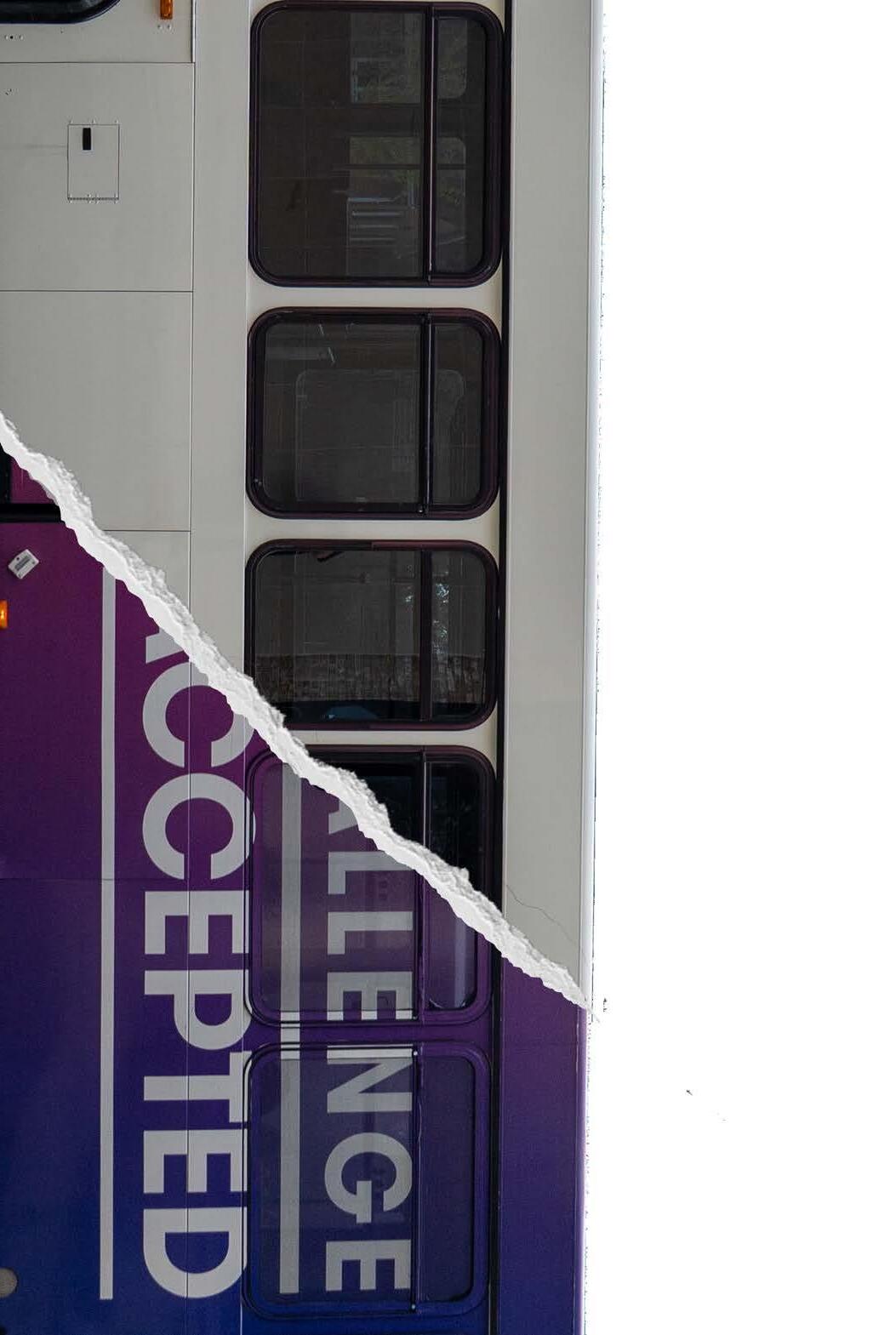
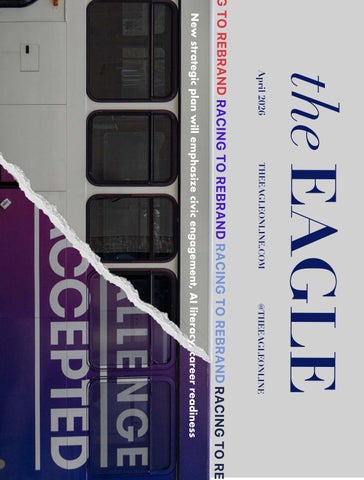
New strategic plan will emphasize civic engagement, AI literacy, career readiness
RACING TO REBRAND RACING TO REBRAND
Editor‑in‑Chief
Walker Whalen
DEI and Community Engagement
Editor
Isabella Polak
BUSINESS
Business Manager
Braden Miller
Business Team Members
Rohan Phadnis ONLINE
Managing Editor for Online
Ridha Rayani
Assistant Online Editor
Wallace Lau
Social Media Editors
Sofia Mangano
Bethany Evans
Litzi Guzman Martinez
Alexa Barbosa Leizan COPY
Managing Editor for Copy
Avery Grossman
Assistant Copy Editors
Arin Burrell
Ava Stuzin
Paige Caron
Jaden Maitland Anderson
Nicole Kariuki
Ryan Sieve
Mattie Lupo
Fact Checker and Researchers
Luca Palma Poth
Andrew Kummeth
MULTIMEDIA
Managing Editor of Multimedia
Gavin O’Malley
Graphic Design Editors
Imaan Hassan
Sam Noll
Elizabeth Hopper
Photographers
Aubree Yokota
Daisy Bateman
Delivering American University’s news and views since
Gabe Zakaib
Josh Markowitz
Mia Colaizzi
Sonia Laughlin
Sydney Affolter
Aaron Butler, Jr.
Maggie Fitzgerald
Lilly Barnett
Kathryn Squyres
Andrew Beauchamp
Maestro Joyner
Videographer
Tasia Mallombasang NEWS
Managing Editor for News
Payton Anderson
Administration Editor
Abigail Hatting
Campus Life Editor
Natalie Hausmann
Features Editor
Madeleine Olive Beal Redd
Local News Editor
Gabrielle McNamee
Investigations and Data Editor
Owen Auston-Babcock
News Staff Writers
Sela Quiniones
Adaobi (Myles) Nwatu
Jumana Alsaadoon
Yuri Perelman
Hannah Pietropaolo
Ella Altman
Kadie Fishman
Siobhan Stubbe
Sophia Cooper
Vishnnu Rajaram
Anaha Prabhakaran
Norah Aycock
Unity Jirkovsky-Gual
Justin Greenberg
Samantha Epner
Managing Editor for Life
Jessica Ackerman
Arts and Entertainment Editor
Mina O'Dell
Environment Editor
Conor Gillingham
Food, Wellness and Style Editor
Sydney Hemmer
Silver Screen Editor
Alfie Pritchard
Life Staff Writers
Abby Chamberlin
Max Grillo
Taylor Meredith Keirah Chen
Thomas Weaverling
Lincoln Smith
Olivia Gamez
Ginger Friedman
Caroline Shinney
EK Thomas
Layne Moughan
Edeline Wence
Ryann Rodney
Zoya Ali
Thomas Stein
Preston Lee SPORTS
Managing Editor for Sports
Jack Stashower
Sports Beat Editor
Connor Sturniolo
Sports Feature Editor
Matthias Jaylen Sandoval
Sports Columnist
Cameron Harris
Sports Staff Writers
James Paponetti
Ben Epstein
Penelope Jennings
Max Ralph
Daphne Klose
Ella Wilson
Daire Lydon
Tinotenda Chimusoro
OPINION
Managing Editor for Opinion
Addie DiPaolo
Assistant Opinion Editor
Harry Walton
Satire Editor
Aidan Dowell
Domenic DiPietro
Satire Columnists
India Siecke
Eric Steinberg
Theodora Papish
Faiza Mujahid
Jasmine Shi
Staff Columnists
Sara Shibata
Ava DiGiacomo
Adria Liwewe
Maddie Ogletree
Ryann Rodney Jasmine Shi
EL ÁGUILA
Managing Editor for El Águila
Marina Caraballo
Assistant El Águila Editor
Jeronimo Freydell-Cristancho
El Águila Staff Writers
Alejandra Mora Ortega
Adan Mandelbaum
Eleanor Young
Sabrina Solares
Nicole Eisner
Tobias Monteagudo Jackson
Ben Parr
Anna Vega
Tatiana Rivera-Solá
Paulina Quiñones
El Águila Copy Editors
Diana Melgar
The Eagle has a commitment to accuracy and clarity and will publish corrections or clarifications. To report a mistake, email the editor-in-chief at editor@theeagleonline.com.
The Eagle, a student-run newspaper at American University, reports news involving the campus community and surrounding area. The Eagle strives to be impartial in its reporting and believes firmly in its First Amendment rights.
@theeagleau
To listen to The Eagle's podcasts, "Section 202," and "Couch Potatoes" visit our website or find us through any podcast streaming service.
4. AU students find their herd on YikYak
5. D.C. LGBTQ+ community support amid rise in hate
5. Long desired renovations meet mixed student reviews
6. Racing to rebrand: Inside ‘Meet Our Moment’
9. Little-known conflict-resolution team in limbo after quiet launch LIFE
10. Zero Waste expands initiatives for 2025-2026 school year
11. What happened to movie theaters post-COVID?
12. Istanbul, Constantinople collage inspires at Katzen Arts Center
13. How AU teaches stress management SPORTS
14. Sammy Schulman finds his calling on the Eagles’ sidelines
15. David Aldridge talks sports, storytelling and democracy
16. Column: No days off
17. Construyendo puentes para estudiantes latinos
18. CLEAR: Más allá de la gramática
18. Entre casa y salón OPINION
20. Defining 250+, a conversation with President Alger 21. Weighing AU’s climate reputation with Kogod’s AI obsession
21. A New Epidemic: Putting Yourself First 22. Expectations in college have plummeted
23. The Seagle launches an even better AU strategic plan 24. Crossword/Crucigrama
COVER GRAPHIC:
IMAAN HASSAN/THE EAGLE GAVIN O'MALLEY/THE EAGLE
Every Tuesday night at 8:15 p.m. for the last four academic years, I’ve packed into a classroom with dozens of other Eagle staff members. Our editorial board meetings are one of the more interesting enduring traditions we’ve held through our 100year history. I confess that as a newly minted staff writer my freshman year, I didn’t understand the value of having our staff talk about the news we’d just reported that week.
After years of participation, and now a year of leading these meetings, I’ve come to look forward to them. I now see how impactful it is to have a crosssection of the University community discuss the issues confronting our campus. In watching various topics unfold through our coverage — from arming campus police to integrating AI — I’ve gained a greater appreciation for how journalism shapes dialogue.
This edition of The Eagle’s print magazine picks up
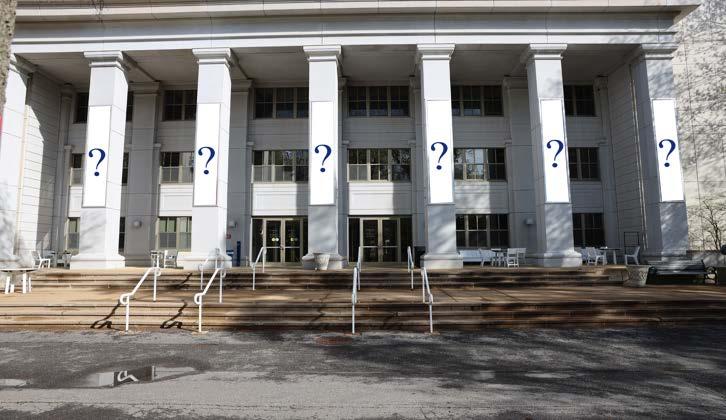
on those themes. Our cover story, “Racing to Rebrand,” investigates the changes across campus that aim to define our university for the coming years. Eagle reporters set out to discover whose voices are informing those decisions and what we know about the trajectory of American University.
While these conversations are taking place, there are events occurring across the country that signal a worsening information ecosystem. Just this semester, The Washington Post laid off an unprecedented number of its journalists and massively shrunk its Metro desk. From the perspective of our paper, the local coverage we provide to Tenleytown and Friendship Heights is more important than ever. Even further, the role we play in combating misinformation and disinformation on campus is increasingly vital.
The state of journalism can be daunting in the face of looming graduation. Yet, the commitment I’ve observed in our editorial board meetings to engage,
even when difficult or uncomfortable, has assured me journalists will always have people to write for.
I would be remiss to close this letter without thanking our partners in student media for their equal role in keeping the campus community informed. Thank you to AWOL Editor-in-chief Caleb Ogilvie and former Editor-in-chief Kalie Walker for working with me to interrogate information sharing systems on our campus.
Thank you to my amazing editors: Payton Anderson, Isabella Polak, Avery Grossman, Mariana Caraballo, Ridha Rayani, Gavin O’Malley, Addie DiPaolo, Jack Stashower and Jessica Ackerman. They are the dedicated minds that keep this paper running, along with our incoming Editor-in-chief Gabrielle McNamee, whose energy and dedication will drive The Eagle to new successes.
I want to be sure to thank Wendy Melillo, Amy Eisman, John Watson, Terry Bryant, The Eagle’s advisory board and the many Eagle editors who’ve guided me through the years.
In a few weeks I will graduate as a journalist and leader who was shaped by The Eagle more than anything else. It’s been an indescribable honor to know this paper and community as I’ve known it.
At the risk of sounding generic, it really has been a blast.
Thank you for everything.
Walker Whalen Editor-in-Chief 2025-2026 wwhalen@theeagleonline.com
By Ella Altman, Student Government Beat Reporter and Yuri Perelman, Local News Reporter
When Erek Williams, a freshman in the School of International Service, ran for president of the Residence Hall Association, he thought he could distinguish himself from the competition by creating an on-campus parody of President Donald Trump’s outspoken campaign.
That all changed the day his roommate showed him a social media post. An anonymous student had written, “That Erek weird as F—.”
The platform housing the anonymous comments made about Williams was YikYak, an app primarily targeted toward and used by college students.
“It can be a good thing,” Illa Benson, a senior in the School of Public Affairs, said. “It can also be a tool that can cause a lot of harm. There’s no real consequences to your actions and you don’t need to back up what you’re saying.”
Holland Swan, a freshman in SIS, said she noticed the platform’s anonymity allows for antagonism to spread more easily.

“The majority of stuff I read on there is people sniping back at one another — which is totally fair, because it’s anonymous,” Swan said. “But I think it also creates a space that’s a little bit unsteady.”
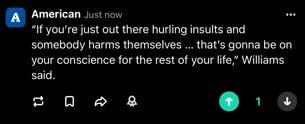
YikYak allows unlimited anonymous communication between students with no way to identify posters or commenters. It also includes group chats, a trending tab, a popularity measurement system called Yakarma and the capability for users to upvote or downvote a post.
Williams said he was less affected by the targeted post, but worried about how others might react if something similar happened to them. He said YikYak’s promotion of anonymous online trolling could have serious effects on student mental health.
“If you’re just out there hurling insults and somebody harms themselves … that’s gonna be on your conscience for the rest of your life,” Williams said. YikYak’s community guidelines prohibit users from naming students but doesn’t immediately ban these posts. Often, the posts stay on the platform for hours before being taken down.
Consequently, some students have found themselves weighing whether the platform is truly safe.

Zoe Likely, a freshman in the College of Arts and Sciences, said YikYak would not be as popular an app if users could be identified.
“I think if it wasn’t anonymous, no one would post on it,” Likely said.
Ali Azhar, a freshman in CAS, thinks the anonymity of YikYak allows ample discourse to fester.
“It encourages people to talk more and give more news out,” Azhar said.
When a user signs into YikYak with their AU email address, they are given access to a feed available only among their fellow students.
This allows for discussion of niche topics specific to American Univesity. When it was revealed that SIS professor Earl Anthony Wayne was mentioned in the Epstein files, many students said they learned about it through YikYak.
“He’s not famous, so I wouldn’t find it out from the internet,” Azhar said.
“We thought there’d be twenty people, but there were like, three hundred,” Erfani said.
Erfani said that, for days after the contest, YikYak was still flooded with audience input. Attendees talked about their favorite outfits and complimented the contestants, judges and her job as host.
“I saw so many people say the host was so good,” Efrani said. “I was really flattered.”
Dylan Sapienza, a freshman in SPA, recalled that this time was a period of bonding for the freshman class.
“The first week when everyone moved in, everyone was kind of relating to each other,” Sapienza said. “It was a shared experience between all the freshmen.”
The anonymity of the app makes it easy for posters and commenters to hide. But for some, like Erfani, it is a valuable resource that enhances the University’s campus culture and keeps them up to date.
“I found out from YikYak, because it’s specifically towards American University.”
Students have also found it to be a capable platform for building community on campus.
During freshman orientation in August, a group of friends took to Instagram to promote a performative male contest — a satirical competition mocking men who performatively adopt certain aesthetics to attract women.
The flyer found its way to YikYak. The contest’s moderator and one of its organizers was Lily Erfani, a freshman in CAS. She recalled being surprised by the attention the event garnered after it was promoted on YikYak.
“Even though your name isn’t with it, I think it’s actually kind of refreshing because it detaches who you are with what you have to say,” Erfani said.
“People are just upvoting or downvoting based on your thoughts, opinions and what you’ve written. It becomes a thing separate from your physical or public identity.”
features@theeagleonline.com
By Jumana Alsaadoon, News Staff Writer
Washington, D.C.’s LGBTQ population represents 14.3 percent of the city, but from 2024-2025, hateful acts against the community nearly doubled.
GLAAD, a LGBTQ+ nonprofit, reported anti-LGBTQ+ acts increased by 170 percent in the past year. Sarah Moore, the anti-LGBTQ+ extremism analyst at GLAAD ALERT Desk, noted the difference in hate-crime data reports from the Metropolitan Police Department and GLAAD.
Moore said GLAAD also includes social media reports, anti-LGBTQ+ protests, self-reported incidents and partnerrelated violence data from state agencies, corroborated by journalistic articles, extremist forums and the Public Access

to Court Electronic Records system.
“There’s really no other mechanism outside of nonprofits like ours that will allow us to keep tabs on what’s actually happening to our community,” Moore said. “Especially at a time when our federal institutions like the FBI started to pull back on publicizing numbers on things like hate crimes.”

Moore said the transition to President Donald Trump’s administration encouraged the use of hateful language and actions against LGBTQ+ individuals.
“People will explicitly use the same language that has been condoned by lawmakers and by the Trump administration in justifying these acts of really, really horrific and tragic violence against queer and trans people,” Moore said.
Anti-Violence Program Director and Psychotherapist for the D.C. LGBTQ+ Community Center Jocelyn Jacob said its traumainformed therapy resource received requests for online appointments over immigration concerns.
Since the Making the District of Columbia Safe and Beautiful Act passed to “beautify” D.C. by preventing crime and removing homeless encampments on federal land, Jacob said more people are arriving at the center after being uprooted.

“I’m seeing more folks coming in who are in an acute state of crisis and folks whose encampments where they were staying were swept away and they didn’t have a place to stay or had to move continuously,” Jacob said.
With the deployment of the National Guard and the longest government shutdown in history starting two days before opening in October 2025, queerowned music venue and nightclub Transmission also experienced the effects of federal policy.
“We try to make sure that people have access to drug testing kits, have access to Narcan, have access to resources that they would need, that they perhaps
wouldn’t otherwise get into those spaces,” said Co-owner Kabir Khanna on Transmission providing resources and community.
Another queer safe space is Spark Social House, which Co-Founder Nick Tsusaki opened in early 2025, offering morning and night services.
“Even just the term safe space implies that everywhere else is unsafe. And it’s really kind of sad, almost, that we have to call it that,” Tsusaki said. “But it is a need for our community, and we’re glad to provide that.”
localnews@theeagleonline.com
The University created new spaces, students say resources could’ve been better allocated
By Gabrielle McNamee, Local News Editor
In April 2024, the general managers of WVAU told Rebbeca Haghnegahdar and other club members that they likely wouldn’t have a studio next year. Haghnegahdar, an e-board member and DJ, would have no studio, no media space and no communication from American University administration moving forward.
“I loved being in the studio, and they kind of just got rid of it without telling us where we were going to be for the next year,” Haghnegahdar, a junior in the School of Communication, said.
Since the summer of 2023, the University has renovated Leonard and McDowell Hall, Roper and
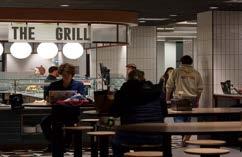
Clark Hall, the Terrace Dining Room and the Mary Grayden Student Center. In the spring of 2023, the University announced plans for the Student Thriving Complex, costing approximately $89 million for both the Meltzer Center for Athletic Performance and renovations in MGSC.
Prior to the renovations, the Asian American Student Union maintained a storage space on MGSC’s second floor. But over the summer of 2024, AASU lost access to the space and their materials were thrown away by the University, Haghnegahdar said.
Reactions to the MGSC renovations reflected the alleged lack of communication between student clubs and administration. While they offered new spaces on campus, Haghnegahdar and others suggested the University could’ve invested its resources into renovations elsewhere on campus.
“It’s nice we have so many spaces in MGSC, but SOC could use some renovations inside, or one of the other academic buildings that are pretty old,” Haghnegahdar said. “I think [MGSC] and the TDR renovations were very much just like a facelift, and they didn’t change that much.”
However, renovations to living spaces on campus seem to provide more than a fresh coat of paint and new furniture. Charlie Murphy, a junior in the School of International Service, found McDowell Hall noticeably improved, with updates including pod-style bathrooms.

Now, Murphy says the University should allocate its resources to ensuring students have access to necessary equipment. A recent flood in the Anderson Hall basement ruined half of the computers in a lab students used for homework assignments, and the printer in the McDowell lobby is frequently broken, according to Murphy.
Printers in the library basement often find lines of students waiting to print last-minute papers, but flooding and pipe troubles forced the floor to close for repair earlier in the year. Without library printers, meeting deadlines for printed submissions leaves students like Murphy at a loss.
“We should really focus on making sure that all the students can have proper access to resources on campus whenever they need them,” Murphy said.
news@theeagleonline.com
New strategic plan will emphasize civic engagment, AI literacy and career readiness
by Abigail Hatting, Madeleine Olive Beal Redd and Sophia Cooper, News Staff
Out with “Changemakers for a Changing World,” in with “Meet our Moment.” With the expiration of former American University President Sylvia Burwell’s seven-year strategic plan, President Jonathan Alger is ushering in a new era of civic life.
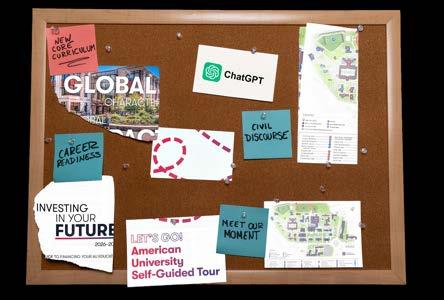
In January, President Alger announced the new fiveyear strategic plan that emphasizes career readiness, community and curiosity. Through various forms of feedback, some still being collected from students and faculty, the University will also launch a new image. This will include reimagining its core curriculum and branding, integrating more AI and launching programming initiatives aimed at fostering civic engagement.
The new five-year plan will introduce curriculum changes in two parts: First, the 90-day-sprint, which is currently in progress, then, structural changes — the longer marathon.
“This is what we’re promising to do so we can meet our moment,” Matt Bennett, University vice president and chief communications officer, said in an interview with The Eagle.
Priya Doshi, a Hurst senior professorial lecturer in the School of Communication, said a strategic plan is essential for a University to illustrate where it aspires to go and how it plans to get there.
“It’s a glue, it’s a vision, it’s an aspirational roadmap,” Doshi said.
For the last seven years, American University’s strategic plan, Changemakers for a Changing World, has shaped the University by emphasizing scholarship, leadership and community. With that wrapping up in 2026, it was time to implement a new guide for the University’s brand.
“You’ve heard of the wonk campaign from a long time ago. You’ve heard of ‘challenge accepted.’ This is the next iteration of that work,” Bennett said. “It is foundational to how we operate and how we engage our audiences.”
The strategic plan notes research for a new branding campaign began in August 2025 and creative development in January 2026, which will be fully
implemented by July. Faculty Senate Co-Chair Stephen Silvia said more community input will be implemented throughout the process.
According to the plan, this initiative will produce a new brand message, visual identity and strategy for the University. Ideally, the new slogan will stand out in a crowded marketplace, Silvia said.
According to Bennett, advisory groups of students, faculty, staff and alumni gave input on what brand presentation the University should follow.
an undergraduate degree or an early start on graduate school.
The brand development is in its creative development phase, which will assess different ideas and creative opportunities. According to Bennett, this phase involves analyzing color, design, font, photography, videography and iconography.
Bennett said the way the University presents itself has become too similar to other Universities, so it is trying to come up with something more unique but still authentic to American University.
“It has to be who we are. It has to be true to our nature, our DNA,” Bennett said.
According to Bennett, the brand is not one of the plan’s strategic pillars but rather a supporting element.
“You add on this kind of work to help elevate the uniqueness of the plan and help it make you stand out in the audiences that you’re targeting,” Bennett said.
Meet Our Moment will also establish AU90, a 90-credit degree pilot program designed for students
Additionally, the AU Ready internship program will provide every undergraduate with access to a $4,500 resource for a funded internship or research opportunity starting in their sophomore year.
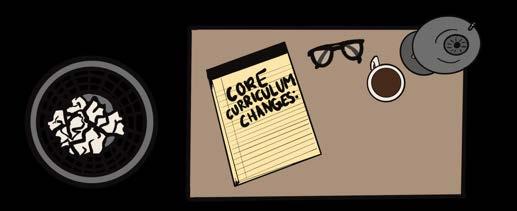
The core curriculum, classes all students are required to take in addition to their major courses, currently encompasses three parts: foundation courses, Habits of Mind courses and integrative courses. The foundation courses include Encounters I and II, Complex Problems Seminar, Quantitative Literacy I and Written Communication and Information Literacy I.
The Habits of Mind courses are Creative-Aesthetic Inquiry, Cultural Inquiry, Ethical Reasoning, NaturalScientific Inquiry and Socio-Historical Inquiry, and students must take one of each.
The final core requirement, the Integrative Courses, includes Diversity & Equity, Quantitative Literacy II, Written Communication and Information Literacy II and Capstone.
Martyn Oliver, the Faculty Chair for the AU Core said he and involved faculty will change the core so students can more efficiently take core credits while making progress in their degree. Changes could range from small alterations to a complete overhaul.
“The different groups that we’ve organized to look at this are tasked with articulating the vision for what an AU education means,” Oliver said.
Oliver will lead the implementation of the new curriculum. He said being in the early stages requires a comprehensive evaluation of what’s going well and what needs improvement.
Oliver and other professors who spoke to The Eagle expressed concerns about the rapid pace of change, worrying that the heart of a liberal arts education will be lost. Others underscore the need for the core not to stall students from graduating.
“We’re trying to take a holistic look at [the core revisions] and say, are our rules and regulations sound and efficient?” Oliver said. “Or are they unnecessarily an impediment?”
Patrick Thaddeus Jackson, the chair of the Department of Global Inquiry in the School of International Service, said faculty are working to simplify the decision-making process for which classes count for core credits.
Silvia said the selection of which courses fulfill which credit requirements has made it difficult for students to move through the core when met with their major requirements. Silvia, also a professor in SIS, noted that SIS first-year seminars don’t count as a complex problems core credit.
“It really upset the way the major was structured,” Silvia said. “And so SIS would like to see that changed.”
Still, Jackson said the University needs to ensure it’s not making premature changes.
“There’s the stuff we can do in 90 days, and then there’s broader, longer-term things,” Jackson said. “And major things, like changes to the number and definition of habit[s] of mind are not going to get done in 90 days.”
Jeffrie Chambers IV, outgoing AU Student Government president and a junior in the Kogod School of Business, said curriculum changes should be driven by student input.
“Students will be more likely to buy into a program that they feel is equipping them to make sure they have everything they need,” Chambers said.
Silvia said much of the core curriculum change is being driven by student and faculty feedback. Keith Leonard, associate professor of literature and AU Encounters, added that student feedback from Student Evaluation of Teaching responses will also continue to influence the process.
There are eight strategic plan working groups, ranging from civic pluralism and experiential learning to operational infrastructure and more.
The new core curriculum will also promote education on AI usage – building on the strategic plan, which says all students will complete a required course on AI literacy. According to the plan, which cited a study by the Sine Institute of Policy and Politics, 72 percent of young Americans identify the responsible use of AI as an important part of career preparation.
AI has been a part of the curriculum in Kogod
difference between embedding AI in the curriculum as a topic and using it in the classroom.
“I don’t think there’s any appetite among the faculty for the second one,” Jackson said.
He added that the University must consider the impact AI has on different career fields, many of which students want to enter.
Oliver said, though many faculty members are excited about AI being addressed in the curriculum, others are skeptical.
“We need to bring those people together to articulate what AI literacy is going to mean for us and for our students,” Oliver said. “And then design the courses that will help us get there.”
Michael Robinson, a professor in the College of Arts and Sciences who teaches Exploring AI Scientific Method, said students must understand how to navigate AI today.
“AI systems are not magic black boxes. They’re technologies that we humans have created,” Robinson said. “And we can and should study them with the tools that we have built for studying the world. That involves careful, skeptical, critical, methodological scientific study, and we should not shy away from that task.”
CAS Professorial Lecturer Aref Zahed developed a humanoid AI robot named Iris. Zahed compared AI to the creation of computers and cellphones, adding that it will inevitably become part of our daily lives. He said integrating some AI courses into the core curriculum
“[If] we want to catch up, we have to do more,” Zahed said. “We have to bring new technologies. We have to introduce different techniques, different systems, so we can narrow this gap.”
Understanding how to integrate new classes like AI literacy into the proposed core curriculum is one of the larger objectives of the five-year plan. Oliver said he hopes the working groups will provide clarity about how artificial intelligence and civics will look by fall 2026.
CAS may also play a role in integrating technology into the liberal arts and sciences by emphasizing the study of AI ethics. Doshi said teaching students how to use it ethically is critical when finding the balance between education and risk.
“By ignoring it or by not giving it the proper attention, you risk falling behind,” Doshi said. In addition to bringing more AI into the curriculum, the strategic plan reemphasizes the University’s continued focus on civic engagement.
Bennett emphasized that civic engagement was a big theme that came out of the listening sessions Alger did when he started out and dates back to the founding of the University, which was designed to train future generations of public servants. Civic engagement is part of American University’s DNA, he said.
President Alger introduced the Civic Life Series in September 2024, and according to the press release announcing Meet our Moment, the plan is a

continuation of the University’s democracy and Civic Life initiatives to promote student engagement. This includes the Student Civic Life Fellows program, the Democracy Innovation Lab, the 250+ initiative and the Sine Institute of Policy and Politics.
“Across our strategic imperatives, we will advance the skills to engage civically, solve problems, and enhance democracy,” Alger wrote in the January press release.
Katharine Kravetz, assistant professor emerita in the School of Education, said civic engagement is a methodology for students to study issues and determine implementable solutions in their community. Students often come to college with preestablished goals and values, but not many understand the value of civic engagement, she said.
According to Kravetz, civic engagement is woven into the fabric of American University, and the University has been doing a good job of giving students opportunities to participate in civic engagement programming.
“Leaders like President Alger are rare,” Kravetz said. “To have the kind of success that he’s had and to maintain the level of integrity and humility that he has is very rare … They don’t make them very often.”
James Madison University’s Madison Center for Civic Engagement was established in 2017 during Alger’s tenure as JMU’s president. David Kirkpatrick, the vice president and chief of staff at JMU, worked closely with Alger and said that he was instrumental in creating an ecosystem to support civic engagement.
“There is no one in American higher education who had more impact on civic engagement than Jon Alger,” Kirkpatrick said.
JMU is opening Alger Hall in fall 2026, which will house a living-learning community of student democracy fellows and offices for the Madison Center for Civic Engagement.
Kara Dillard, the executive director of the Madison Center, described the student body at JMU as one-
third liberal, one-third conservative and one-third moderate. In contrast, American University has been ranked by Niche as the most liberal college campus in the U.S.
Dillard said that in order to solve problems, we need bridge builders and people who can connect others across political, geographic and ideological divides. Civic engagement is more important than ever, especially for a university based in Washington, D.C. that can offer students so many opportunities in politics, according to Doshi.
“We’ve had real concerns about some of our national institutions struggling, crumbling, [feeling] vulnerable, etc.,” Doshi said. “I think it’s really important that … we’re teaching our students here not to retreat from that,” Doshi said. “Education and an involved electorate, they go hand in hand.”
The University offered programming related to civic engagement before Alger became president.
The Project on Civic Dialogue, formerly the Project on Civil Discourse, was founded in 2018 by Lara Schwartz, a senior professorial lecturer in the School of Public Affairs.
The project’s focus is to teach dialogue skills by providing opportunities for students to practice inquiry, disagreement and dispute resolution.
“Our goals aren’t to win. Our goals are to understand, and hopefully, as we understand better, we
can explore problem-solving together,” Schwartz said.
Schwartz said polarization is a national issue, but at American University, she has yet to meet anyone unwilling to have a conversation with someone with a differing opinion. She hopes to provide students with the skills they need to effectively communicate — whether it’s with their family, roommates or their community.
To her and Dillard, finding compromise in disagreement is practicing democracy.
“If we refuse to talk to our neighbors, if our neighbors refuse to talk to us, we can’t have a functioning democracy,” Dillard said.
news@theeagleonline.com
by Sela Quiniones, News Staff Writer and Kadie Fishman, Local News Reporter
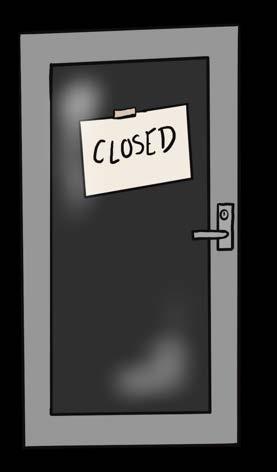
American University launched its Campus Climate Action Response Team two years ago with no official announcement. With the program now on hiatus, some students and staff remain confused.
Following several protests regarding the IsraelHamas war, CART launched in 2024 with the Office of Inclusive Excellence to address “campus climate concerns,” which the University defines as meaningful conduct or harmful to the campus community but is not a formal policy violation.
As of spring 2026, CART no longer works as a group. If students or faculty were to reach out, they would be redirected to the Title IX office.
If a report is submitted to CART, the group would address safety concerns, provide student support and define next steps. Potential outcomes from a report include an educational or training initiative, facilitated dialogue or a connection to resources.
According to the website, CART would meet with those who reported the issue and campus leadership to develop policy and other recommendations.
Although created after a slew of student protests, protest-related policy decisions fall to Dayne Hutchinson, vice president for the Office of Student Engagement and Success, not CART. If a report filed with CART addressed a policy violation, it would be directed to the Office of Title IX, according to the
website.
Regina Curran, the director of privacy and cyber policy in the Office of Information Technology, was part of the CART planning and pilot phases for the 2024-2025 academic year under thenAssistant Vice President for Diversity, Equity and Inclusion Amanda Taylor. Curran said training focused on dealing with issues outside of policy violations through restorative justice.
Restorative justice practices include collaborative conversations, community circles and connection to further resources.
Curran said CART would address issues similar to the 2017 case when American University investigated a racially discriminatory act against a former Student Government president. If the program existed then, CART would work with the student to address the situation and subsequent emotional and physical safety concerns.
with student organizations reported for misconduct. However, CART’s website states it does not work personally with student organizations.
The RSO manual lists CART initiatives as “a formal

acknowledgment of harm, restorative dialogue circle, and/or initiatives aimed at building trust with affected communities or groups.”
“[CART] was imagined as a group that could do community level response to harms like that,” Curran said.
CART does not have an active office, and no records show there ever was. Curran said the team met monthly to review reports, but by the end of the pilot phase, individual members worked on specific cases.
Now, the only members tackling CART-related issues are Zaibis Munoz-Isme, assistant vice president of inclusive leadership and learning, Lisa Taylor, assistant dean of inclusive excellence and leadership and Andrew Toczydlowski, director of graduate student success and office management.
Previously active members are waiting for CART to reconvene. Curran is one of them.
“I’m frustrated as someone who was there from the beginning, understanding what this group could be and really feeling like it was a missing resource on our campus,” Curran said.
The stalling of CART, according to Curran, happened for several reasons, including a change in administration and large staff turnover. Taylor left for a position at the American Association for State Colleges and Universities, prompting many staff members working on CART to leave as well.
The University’s Communication and Marketing Team declined The Eagle’s request for an interview with Munoz-Isme, providing a statement largely taken from the CART website.
According to its website, CART faculty would undergo three training sessions per year on how to engage in collaborative communication with students filing reports.
Phase one of CART’s development would involve staff members with prior experience in mediation, conflict resolution, DEI, trauma-informed practices and educational development.
Despite CART no longer being a running program, it is still listed as a student resource on the OIE’s website, which does not have information about its closure or when and if it will resume.
CART is mentioned in the revised 2025 Registered Student Organization Manual, saying it will work
Whether CART is still available has created confusion amongst some students.
This semester, the AU College Democrats club listed CART as a resource for its statement against the AU College Republicans hosting an event with a controversial speaker, Paul Ingrassa.
Asher Heisten, a junior in the School of Public Affairs and member of AU Rise Up, said he did not know about CART until speaking with The Eagle. Even if CART was active, he said he would not see it as a reliable group to resolve conflict due to his distrust toward administration.
“I don’t know if I necessarily have faith that another AU administration branch would be able to do any different than what AU itself has already done,” Heisten said. “It would take a lot to build trust between these [students and administration] groups.”
Sierra Gray, a sophomore in SPA and co-director of Guns Down D.C. at AU, said she was also unaware of the program. Gray echoed Heisten’s statement that administration is often one-sided with campus issues.
Gray said if the University is going to create programs such as CART for students to “feel that they’re protected,” the administration must do more in creating an inclusive campus environment.
“All they had to do was send an email to student leaders and be like, ‘Hey this is a thing, this is how you use it,’” Gray said.
Along with communication, Heisten said he wants CART to be a way for the University to better represent students.
“Maybe CART could be a group that extends a representative to hear out students and see what it is they really want,” Heisten said. “I think that would do a lot to build, or start to build trust between these groups.”
In a statement to The Eagle, Silvana Gutierrez, director of strategic internal communications and engagement, said that more information regarding CART will be available in six months.
investigations@theeagleonline.com
By Abigail Chamberlin, Life Staff Writer
Before 2024, American University averaged about 50 tons of compost each year. In 2025, that number surged to 214 tons.
Behind that increase is the Zero Waste Department, which has expanded its composting initiatives and sustainability programs during the 2025-2026 school year.
Zero Waste is responsible for the operational side of sustainability management on campus. In practice, this often looks like waste and facility handling. There are around 20 different waste streams at American University, including trash, batteries, electronic waste, leaves and compost.
Zero Waste is a separate department from the Office of Sustainability, which focuses on University policy. Zero Waste’s labor is completed by only 10 full-time staff and 20 student employees who work a combined 250 hours a week.
“It wouldn’t happen without them,” Caroline Boone, the manager of Zero Waste, said.
Boone started as the manager in January 2024, working to improve operations and logistics. This work included an initiative to increase the composting program, expand plastic film disposal, adopt American University’s Food Recovery Network and engage with residence halls.
Plastic film disposal is not new to
American University, but until the 2025-2026 school year, it had not been a major focus of Zero Waste, according to Zero Waste management.
Grocery bags, plastic bags and bubble wrap are all made of plastic film. This material is very recyclable, but not in most single-stream recycling receptacles because it tends to clog machines. Thus, it can not be recycled in the recycling bins found in residence hall lounges.
Zero Waste has expanded the number of specific plastic film disposal bins around campus. Boone said ease is one of the most valuable aspects of Zero Waste.
“The way to make something more convenient is to make bins for that thing everywhere,” Boone said.
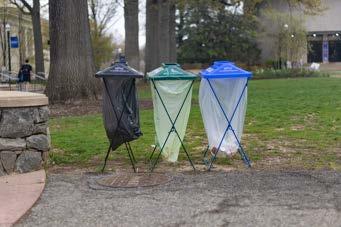
Thus, plastic film disposal bins are now located in the lobbies of each residence building, the first floor of Mary Graydon Student Center, the basement of Bender Arena, the lobby of the Spring Valley Building, in mail rooms and in athletic training facilities.
With an increase in bins around campus and promotions on signage and social media, American University’s output of plastic film has greatly increased, according to Boone.
“It has been super successful,” Boone said, “I’m extremely proud.”
Where it used to be picked up once every three months, it is now collected every three weeks.
The University’s plastic film goes to Trex, a company that uses it to produce synthetic timber for park benches and
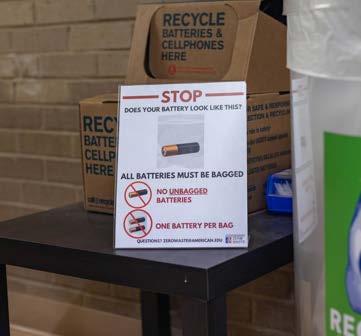
decking boards. Typically, institutions contract with a waste management company that collects their waste for them, but the University self-hauls its waste to ensure its destination is compliant with Zero Waste’s goals, according to Boone.
“We have confidence and can guarantee where our waste is going,” Boone said. “We can figure out what the most reliable recycling facility is. We can distinguish where we want it to go.”
The destinations of food waste, in particular, have been a recent focus for Zero Waste. The Terrace Dining Room, along with other campus restaurants, aims to produce a little bit more than enough food each day, according to Boone. Responsibly handling that food waste has been a goal for many years.
In continuing to expand that effort, Zero Waste recently adopted American University’s student-run chapter of the Food Recovery Network, a nationwide movement that recovers surplus food and redistributes it to local communities.
“I’ve essentially absorbed the food recovery program into official university-run programs,” Boone said.
In the Fall 2025 semester, 6,700 pounds of food were recovered from TDR and delivered directly to local organizations, including Friendship Place, James Creek Residence Council, So Others Might Eat and Northwest Community Food. So far, in the Spring 2026 semester, 2,300 pounds have been redistributed.
“Expansion isn’t necessarily the goal,” Boone said. “The ideal is for the amount of food we donate to eventually plateau.”
Addy Plummer, a freshman in the School of Public Affairs, eats at TDR frequently.
“I usually eat dinner pretty late, and I have noticed that there are usually a lot of leftovers,” she said.
Plummer noted that there was always extra food and that she had never seen TDR run out of options.
“I wasn’t aware of that program, but that sounds amazing,” Plummer said. “I’m sure there are many people in the D.C. area who really rely on that food, so that’s great that AU can be a source that provides it for them.”
Boone noted a similar purpose found in the food redistribution programs.
“You’re not just looking at aluminum cans,” Boone said. “You’re looking at edible food being given to people who need it in our community.”
These programs have generated great success that Zero Waste is very proud of, according to Zero Waste management. Now, the focus must shift to student and faculty engagement and behavior.
“You can have a perfect system on the back-of-house side, but if people aren’t contributing on the front-of-house side, it doesn’t matter,” Boone said.
Successful community engagement, according to Boone, depends on three steps: letting people know that their actions have a sizable impact, getting them to care about sorting things correctly and educating them on how to do it.
Vivian Osborne is a first-year American University student in the SPA living in Letts Hall, one of the residence halls included in Zero Waste’s most recent waste audits. Osborne was surprised to learn the statistics from the most recent waste audit. Before sorting, 72 percent of waste was trash, 15 percent was recycling and 14 percent was compost. After, 25 percent truly belonged in the garbage, while 32 percent belonged in recycling and 43 percent belonged in compost.
Osborne said if she had known it made that much of a difference, she would sort
more of her compost.
“I find that if I don’t know where something goes, I err on the side of throwing it away,” Osborne said. “It feels worse to put trash in the compost than it does to put compost in the trash.”
This sentiment aligns with what Boone has noted in waste audits from buildings all over campus. Compost and recycling bins aren’t commonly contaminated with trash, but trash is frequently found with compost and recycling that wasn’t sorted.
Over 70 percent of campus waste comes from sorting bins, according to Zero
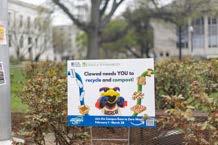
Waste management, so encouraging people to correctly sort their waste will have a sizable impact on American University’s environmental footprint. This often comes down to education, Boone said, which is why Zero Waste has made efforts to improve signage on the bins themselves, around campus and on social media.
“People come from all over the country, and are used to all different waste sorting programs,” Boone said, and getting everyone on the same page is one of the department’s main goals.
Zero Waste is currently focused on the nationwide Race to Zero Campus Waste,
where American University placed fourth in the 20242025 school year. However, the University was only 0.05 percent away from first place, and this year, Boone said she hopes to place even higher.
Zero Waste works hard to ensure that the back-of-house side does their part to meet this goal, but a large part of their success depends on the actions of individuals around campus.
“I really hope people are able to learn, believe, and trust that their actions matter as individuals,” Boone said.
Environment@theeagleonline.com
Movie theaters hold a new sentiment for DMV film lovers six years following the pandemic.
By Layne Moughan, Life Staff Writer
The bright, shiny screens, the smell of buttery popcorn and candy-smuggling that defined the pre-COVID movie era is nostalgically remembered in 2026. Still devastated by the COVID-19 pandemic, even 2023’s smash-hit phenomenon of “Barbenheimer” couldn’t fully restore the industry to its pre-2019 vitality.
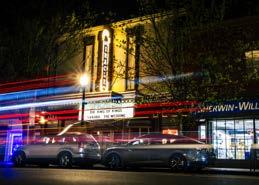
The impacts of the pandemic are felt hard on the silver screen, even locally in the D.C. area. In 2025, the iconic E Street Cinema downtown closed its doors, sparking widespread sorrow among the local film-buff community.
Filmmaker and American University professor Claudia Myers has seen the erosion of local movie theaters continue to take a toll on D.C’s arts community.
“I grew up in Paris,” Myers said. “And going to the movies was always kind of a family outing. I have wonderful memories of ‘Lawrence of Arabia’ (1962) and ‘Some Like it Hot’ (1959).”
During her years as a filmmaker, Myers has witnessed the decline in movie theaters’ popularity and attendance.
“There’s no question that the landscape of film distribution has changed dramatically in the last 10 years,” she
said. “As someone who lives in D.C., the erosion of small, independent movie chains is very visible.”
Although E Street Cinema is one of the most well-known movie theater casualties from the COVID-19 pandemic, the Uptown Theater, once D.C.’s oldest and largest movie theater, shut down in March of 2020.
In spite of these closings, Myers still has hope.
“I hesitate to say that movie theaters are dead or dying,” she said. “I think they're struggling. I think people are exploring different methods of movie-going.”
While some might dislike the streaming system, Myers believes it has its benefits, even if some films are being made for shorter attention spans.
“I think there are some really beautiful, powerful, interesting stories being told. So I don’t view it as an either/or,” she said.
Myers sees streaming as a way to empower smaller filmmakers, offering previously hard-to-come-by reach and exposure. One of Myers’ own movies, “The Bad Guardian” (2024), originally made as a TV film, was recently added to Netflix and quickly reached the platform’s top 10 films.
Sky Sitney, co-founder and festival director of DC/DOX film festival and Film and Media Studies professor at Georgetown University, feels similarly about the possibilities of streaming services.
“I think that streaming, on the one hand, [perceptually] has a kind of infinite amount of space,” she said.
Despite this, Sitney said, while it seems there is infinite content, there is a company
that decides what reaches streamers.
“The reality is [that] it’s not truly all content. They, too, have to navigate a lot of complex decision making,” she said. “some of it being very political.”

Sitney said that with this, the lack of theater traffic in favor of streaming is not only a COVID-resultant problem. Sitney said that it was exacerbated by lockdown, but that technological advancement in film would one day lead to fewer theater-goers.
“That’s been essentially part of the industry since the day it started,” she said. “You know, one could look at the origin of the VHS tape, video stores, cable, and then streaming.”
In terms of revitalizing the theater industry, Sitney is unsure of the best avenue for independent venues. She ponders the idea of independent theaters moving to non-profit and philanthropic models to maintain funding while still showing niche or foreign films.
“That’s an interesting kind of model, but that’s not easy,” she said. “And certainly there’s a gutting of any kind of government support that might have come in the past from the National Endowment for the Arts.”
Myers, though, said reviving the in-person movie theater industry starts with small contributions from patrons. She believes that something can be done to help reignite
them, even if it is just buying a ticket for an evening showing at these independent theaters.
Movie theater culture does still exist in D.C. Alamo and AMC theaters around the DMV in Arlington, Georgetown and Brentwood hold $5 movie nights on Tuesdays, and the independent Suns Cinema still holds its own in Mount Pleasant. The Kennedy Center also occasionally holds showings of classics on its REACH lawn.
“I think it is really important for people who care about seeing films in theaters to really walk the walk and support those theaters [by] buying tickets and going to see the movies that are showing in the few independent movie theaters that remain in D.C,” Myers said.
movies@theeagleonline.com
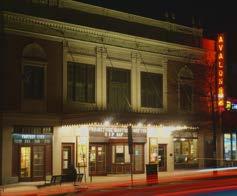
By Mina O’Dell, Life Staff Writer
Artwork displaying the rich history of the city of Constantinople — now Istanbul — filled the halls of Katzen Arts Center earlier this year. The exhibition, assembled by Professor Joanne Allen, a senior professorial lecturer of art history, showcased the city’s history of drastic changes in power and religious practice, and outlined a timeline on the walls of the center’s rotunda.
In her exhibition, Allen took audiences through the collapse of the Western Roman Empire and the surviving Eastern Roman Empire, the Crusades, the city’s fall to the Ottoman Empire and the gradual evolution into the more modern architecture of today’s Istanbul.
“My art history is focused on medieval Renaissance art, specifically Italy, but I use my own artwork to educate about other things,” she said.
Allen created each component of the exhibit herself, bringing the city’s longstanding historical influence on
ASSORTED WORKS BY JOANNE ALLEN
religious artwork into her teachings at American University. Further, the exhibition was also a diary piece chronicling Allen’s visits to the city, showcasing her skills of recreating some of the traditional styles used in mosques and churches.
For example, Allen learned the technique to create the geometric patterns commonly used in Islamic art for mosques.
“If you look online … you can see a lot of computer-generated ones and they look flat and empty. [But] when you see them created by a real person, they just speak to you on a deeper level,” she said. “So I like it when my edges are a little crooked and so I don’t use the straight edge when I’m finishing off.”
Allen led a tour of the exhibition in early February, bringing a further personal touch to the exhibit for viewers. She concluded by reiterating why she chose Istanbul as a topic.
“The idea here is to have an educational display,” Allen said. “I thought Istanbul would be a great topic because you can hit the Roman, Byzantine and the Ottoman and all the shifts between them, and it’s
still such a vibrant city.”
The exhibition plays out like a mini-lecture on the history of Constantinople and Istanbul, sprinkled with colorful pictures of churches and mosques, intricate acrylics of mosaics, textured ceramic tileworks and drawings of religious figures and patrons.
Now, it is available to view online via American University’s College of Arts and Sciences page on past Katzen exhibitions.
entertainment@ theeagleonline.com


By Sasha Dafkova, Life Staff Writer
Between jobs, internships, extracurriculars and course loads, students have a lot on their plates.
American University recognizes this and is making an effort to help students learn to cope in healthy ways with courses in stress management offered by the College of Arts and Sciences.
Susan Comfort is an adjunct professor teaching Strategies in Stress Management. She said stress can lead to consequences if not addressed. “When human beings are on their own, sometimes they don’t make good choices because they don’t know the consequences of their actions,” she said.
Comfort said that stress management is achieved through practice and learning about the habits we develop throughout our lives in response to stressful situations. College is where students can develop these skills, as it is often their first time living independently, according to Comfort.
Comfort finds that stressors within college may be innate to a campus environment. The stress can be generated from a variety of outside factors.
These factors include not getting enough sleep or eating enough greens, according to Comfort.
Courses such as Strategies in Stress Management give students the opportunity to explore different stress
important work in this world,” Benitez said.
Benitez teaches Strategies in Health Management, a student-run course where debates, interviews and group projects encourage students to explore different stress management strategies and engage with each other.
“The [students] want to hear about each other's lives, and then I can bring in the science, the case studies, what's happening now, and make it relevant to them,” she said. “They like learning from one another.”
Although many people have experienced stress, there are different types according to Comfort.
Comfort said stress is positive has a purpose. It from our bodies doing something important and that we care about.

“When you’re stressed about getting a degree — awesome. That’s the
“Exercise is the best strategy, because it has the most compelling research regarding protecting your brain, building your immune system, building resilience and preparing your body for more challenges,” she said.
A second strategy is breathing. When Comfort teaches box breathing, she directs the first few rounds of breath and then lets students regulate to a pace that is most comfortable to them for the remaining rounds.
The technique involves breathing in for six seconds, holding for six seconds, exhaling for six holding again for six seconds. Repeating this pattern can help bring a sense of calm and relaxation by focusing on the breath.
In Benitez’s classroom, she utilizes journaling as a tool for reflection and learning. She said it’s a great way for her to get to know some of her more introverted students.

“[They] come alive when I read their journals,” Benitez said.
For students who are not enrolled in the class but want to journal as a form of reflection, Benitez suggests creating a routine around journaling.

“Our environment plays a tremendous role on your habit forming and how you feel,” she said. “So have a ritual, maybe five to 10 minutes, in a specific place. Light a candle, it will really get you back in that routine.”
Brigid Rauch, who teaches Introduction to Yoga, recommends meditation as another stress management tool.
“All forms of meditation have to do with focusing on something,” she said. “You have a point of focus, and the whole point is to eventually stop your mind.”
Meditation is a central part of the yoga practice. Rauch said it aligns with Dhyana, meaning uninterrupted focus and reflection, one of the limbs of yoga emphasized in her course.
Similar to practicing things like piano or ballet,
these classes and strategies, Benitez said students can begin to change the way they think about and respond to stress.
“If your cup’s not full,” she asked. “What are you pouring from?”

By Jack Stashower, Sports Managing Editor
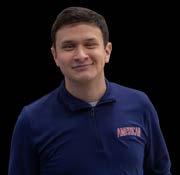
After a heartbreaking loss in Dayton, Ohio, Sammy Schulman thought his time working with the men’s basketball team had come to an end. Then studentmanager Schulman, like many graduating from college last spring, began the search for his next opportunity. He didn’t expect it to come from his recent alma mater. “I was applying for jobs and doing some traveling, and then I got a call from [assistant coach] Isaiah Tate, and he asked if I would have any interest in joining the coaching staff,” Schulman said. “I didn’t even know that was an option, or I would’ve been all over that.”
Now, Schulman is in his first year as the team’s video, scouting and analytics coordinator. On most days, he puts his Kogod School of Business degree to use, using data analytics to study the team and find areas for improvement.
Tate described Schulman as a willing sponge, praising his ability to adapt and learn things quickly.
“He’s got a great inquisitive and intelligent outlook on everything, so I think that’s what’s allowed him to grow tremendously with us,” Tate said.
Schulman didn’t come into college with coaching experience, but his love for basketball has been there since he was around eight years old. He remembers doing his first March Madness bracket in 2010 and falling in love with the sport after correctly picking the Duke Blue Devils to win the tournament.
Schulman’s first year as a student manager coincided with head coach Duane Simpkins’ first year on the team. Schulman said he found out about the job through social media.
“People don’t really understand how much student managers are asked to do,” Schulman said. “You really have to have the proper motivation.”
Motivation is something Schulman had plenty of, as in his last year as a student manager, he began to carve out his own path as an analytics coordinator.
“He put together an in-depth PowerPoint based on some of our game goals and our numbers from a team standpoint,” Tate said. “And he essentially said that if we hit this number in all of these categories, we’ll get X amount of wins.”
The PowerPoint included stats ranging from turnover rates, offensive and defensive rebounds, and amount of locks – three or more stops in a row –per game. Tate credited Schulman for the team’s adjustments that eventually led the Eagles to a Patriot League championship.
Now, Schulman uses his knowledge to propel the team and students forward in the new analytical age of sports.
“This coaching staff has given me an opportunity to show how numbers can be used to tell stories and show what needs to be changed,” Schulman said. “I’ve had the opportunity to work with students in Kogod on basketball analytics projects, and being able to give them that platform and use it on basketball has been a lot of fun.”
sports@theeagleonline.com

by Daire Lydon, Sports Managing Editor
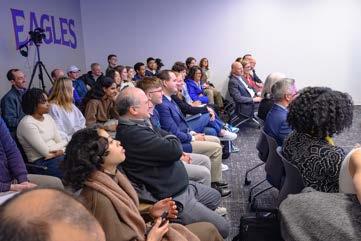
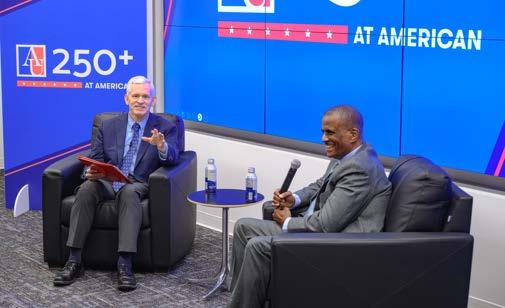
American University is celebrating the 250th anniversary of the United States with its “250+ at American” conversation series. On Feb. 24, President Jonathan Alger sat down with University alum and The Athletic senior columnist David Aldridge.
Aldridge is a Curt Gowdy Media Award recipient and NBA2K’s sideline reporter. He spoke at length about his experience at American University and how it led to a long-lasting career in sports journalism.
Aldridge grew up in the heart of Washington, D.C., and like many who grew up in the nation's capital, he grew up an avid reader of the Washington Post. He was 9 years old when the Watergate scandal broke, and despite not being old enough to understand it, he described it as being life-altering.
“I didn’t know all the details,” Aldridge said. “But I knew it was important. It was always on the front page.”
He saw the consequences of such a monumental event play out in front of his eyes with Nixon’s resignation. He said he remembered thinking that those journalists must have been really important.
The lesson stayed with him throughout his youth, and when a teacher praised his writing skills and
encouraged him to pursue a career in journalism, that’s exactly what he did.
Aldridge joined American University and enrolled in a double major in history and print journalism. A professor encouraged him to run for editor-in-chief at The Eagle.
“When someone you respect tells you you’re ready, you run through walls for them,” he said.
Journalism is a career where talent often isn’t enough. Aldridge described one of the proudest moments of his career as one where he was rewarded for his hard work rather than his talent.
He told a story of sitting alone in an NFL press room around 11 p.m., making his last call of the night when he saw an executive walking past. The executive decided to give Aldridge the information that he was looking for. When Aldridge asked why, the executive told him he worked harder than everyone else in the room.
“It was the best compliment I ever got,” Aldridge said.
In a city deeply divided and defined by the hustle and bustle of politics, sports are a unifier.
During the Washington Commanders’, formerly named Washington Redskins, championship run in the 1980s, the entire city got behind the team. At the
Kennedy Center's Christmas concert, the biggest cheer of the night came when the orchestra played the team’s fight song, showing how, through sports, the city could be united.
Another point Aldridge made was that sports now offer something that is increasingly rare: certainty.
“Facts are being attacked every day,” Aldridge said. “But I can tell you beyond a doubt who runs the fastest 100 meters.”
If sports offer certainty, today’s journalism operates in much murkier conditions.
“Journalism is the first occupation mentioned in the First Amendment,” Aldridge reminded the audience. “That shows just how important it is.”
However, legacy media newsrooms are shrinking, with entire sports sections being hollowed out. The institutions that used to back journalists for big stories like Watergate are now under political and financial strain.
“Who’s going to back the next generation when they go after the truth?” Aldridge asked the audience. He alluded to two defining moments at The Washington Post, where he once worked, the decision to publish the Pentagon papers and the decision to pursue Watergate.
Both times, leaders decided to take a risk and say yes. The policy Aldirdge learned under was to find out the truth, and in return he’d be backed by his superiors no matter what.
That policy, he argued, is what gives journalism its spine.
He still remains cautiously optimistic, as legacy
newsrooms shrink, a new opportunity rises to fill the void. That is, of course, the supercomputer we all carry around in our pockets.
“You can do anything with those phones,” Aldridge said. “That’s power.”
He said the challenge isn’t the tools for storytelling, but the importance of backing and empowering young people to become the next generation of storytellers.
As the evening drew to a close, Aldridge reflected on the significance of 250 years in a democratic America.
Aldridge picked apart the most familiar song to all Americans, “The Star Spangled Banner.”
“The last line of the anthem is a question, not a statement. It doesn’t mean the country is perfect,” he said. “But it means we’re still moving forward, trying to get better. It means we are not going backwards.”
sports@theeagleonline.com
By Connor Sturniolo, Sports Staff Beat Editor

Ahen Kim knew he had something special on his hands at the beginning of October 2025. The American University women’s volleyball team had just beaten the Lehigh Mountain Hawks in convincing straight sets in Bethlehem, Lehigh was the bane of Kim’s previous year as the head coach of the Eagles, ending the team’s season on two straight five-set losses. Doing this well against a team that always gave him trouble gave Kim confidence. This season would be different because this team was different.
American posted a 24-5 record, sweeping the Patriot League postseason awards en route to a conference championship — the school’s 17th.
Duke University hired Kim as the school’s
next volleyball coach on Jan. 12. His record with the Eagles over three seasons was 64-25. Kim said that he’ll take a lot of lessons from his time at American.
“[I learned] how important team chemistry is, and you also learn how, as a coach, sometimes it’s really out of your hands,” he said.
Kim also noted the multiple national championship contenders in Duke’s conference, the ACC. Trusting his philosophy will be a key to the Blue Devils’ success.
Building up a roster and having chemistry was hard enough for the Eagles, but Kim said he’s excited to take on that challenge again in Durham. He admitted that he has no clue what Duke’s team will look like for the coming season, but said he is excited to get to know them as students, people and players.
Junior middle blocker Prinzez Zeck credits Kim for giving her the opportunity to join the team in 2024.
“Just playing with the other girls and him teaching me how to be a higher level volleyball player was a huge difference in comparison to what I had been playing,” Zeck said.
A year later, Zeck played in all 29 matches for the team and led the Patriot League in hitting percentage with a .409. She was named First Team All-Patriot League in November.
“He has a vision for his players, he has a goal in mind. And he’ll do whatever it takes to achieve that goal,” Zeck said.
Kim said he planned to stay at American, if not for a few select jobs. Duke was one of them.
“Down the road, when I’m done with coach-
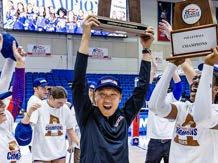
ing, I think this is going to be one of those really, really memorable inflection points just in my career, and probably has one of the most meaning to me thus far,” Kim said.
Duke also hired Eagles assistant coach Maggie Catherina to be their assistant coach and director of operations. Kim credits Catherina for playing a key part in the development of some of American’s top players this season. He said he is optimistic for the future of American’s program, and plans to cheer the team on, just not from the coaching seat.
American hired Division II national champion head coach Jenny Glenn as the school’s next volleyball coach on March 5.
sports@theeagleonline.com
By Cameron Harris, Sports Staff Columnist
It’s 6:15 a.m. While most students are sleeping, including me, American University swimmers are already in the pool, and they will be for at least three more hours that day. That makes for a busy week, every week, for these athletes.
“It’s a lot of time,” American University head swim and dive coach Garland Bartlett said. “It shows just how dedicated they are to the team and the sport.”
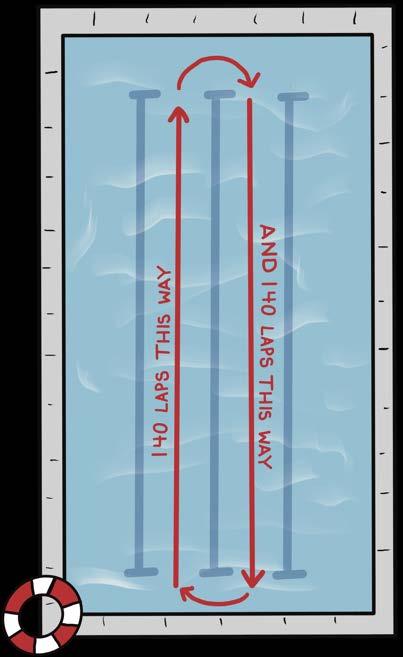
A swimmer at American University will swim anywhere from 3,500 to 4,000 yards per practice — and that’s just for the sprinters. For long-distance swimmers, upwards of 7,000 yards can be swam each practice.
These are not insignificant numbers, and they can take a toll on swimmers as they compete and fulfill their role as students.
Swimming is a sport that gets overlooked by a lot of people, including myself. However, from youth programs to the Olympics, swimming is much more than a simple exercise.
What gets underappreciated and underestimated the most, perhaps, is the process that goes into being an elite swimmer. The amount of time spent in the pool and the weight room in preparation for competition is remarkable.
American University swimmers begin practice with a 6:15-8 a.m. workout in the pool three days a week. They have daily practice from 2:30-4:30 p.m. and Saturday morning practices.
Outside of time management skills that student-athletes are forced to build because of their sport, they also have to deal with the physical toll. Extreme hours in the pool cause many
“It’s just another layer of — I don’t want say crappiness — but it’s just another thing that kind of stinks.”
This was not a surprise to hear, because even when I go swimming for one week during the summer, my skin dries up. Imagine doing it multiple times a day or week.
Aside from the physical toll, swimming is also a very mental sport. Despite their training, swimmers can become fatigued and feel like they cannot make it through. This is where the coaching staff comes in.
“I think it’s really important to create a positive environment on deck, from all the coaching staff,” Bartlett said. “We just try to make practices very positive, high energy.”
What truly shows how great the coaching staff handles these situations is the athletes themselves, who find themselves thankful for the support they have around them.
“Coach Matt [McKenney] is really good at rallying us and getting us to the end of the set, even when we start to hurt,” sophomore swimmer Luke Martens said. “The coach can see it, and they’re really good at that.”
The coaching staff is important, but the swimmers themselves also play a role in supporting each other. This is important for any team, no matter the sport, because when you have teammates by your side cheering you on, it makes the finish line seem much closer.
“There’s always somebody in the pool who’s got a good smile that you can turn to when you are feeling negative,” sophomore swimmer Piper Crosby said.
One thing that surprised me when talking to these athletes was the difference in their workloads from high school versus college. I expected them to be relatively similar, but there are different aspects of the sport that change as you get more advanced.

still appreciates what being on a collegiate team does for her.
“Here, the practices are a lot more curtailed to my distance swimming specifically,” Rees said. “I know [what] I’m working on and working towards, and it just feels a lot more detailoriented.”
The same sentiment was shared by other swimmers.
“Now in college, it’s definitely a lot more race relevant than it was in high school,” St. Louis said.
It is hard to articulate a comparison between swimming and other sports. I think it is so different in the way they train versus how any other sport trains.
Swimming athletes and their coaches seem to agree that it would be difficult for an athlete from another sport to train for swimming.
“Even if you spend a couple days out of the water, it’s just crazy how long it takes to get back into it,” Bartlett said. “One day off, it’s like a week in another sport.”
The hours and work that go into being a good swimmer are unmatched. It is truly impressive and shows the grit that these athletes have to continue going to practices so early in the morning and for so many more hours during the day.
sports@theeagleonline.com
By Nicole Eisner and Alejandra Mora Ortega, El Águila Staff Writers
En 2019, American University lanzó un piloto del AU Latino and Hispanic Mentorship Program, una iniciativa creada para conectar a estudiantes hispanos con mentores, profesores y miembros del personal que los acompañaban y les guiaban durante su experiencia académica en la universidad. Según materiales presentados a los participantes el año pasado, el objetivo del programa era construir una comunidad dentro de la universidad que promueve el desarrollo profesional y personal de los estudiantes.
Muchos de estos mentores pertenecen al llamado Latino and Hispanic Faculty and Staff Affinity Group, cuyo objetivo es organizar y fortalecer la comunidad latina en el campus mediante apoyo, educación y proyectos de impacto. Entre las metas principales del programa estaban: formar relaciones entre estudiantes de pregrado y postgrado hispanos con docentes y profesionales latinos, así como promover la inclusión, la excelencia académica y la equidad dentro de la comunidad de AU.
Este año, el programa regresó bajo un nuevo nombre: Puente Mentorship Program, que ahora se gestiona junto con el Immigration Lab y el Center for Latino and Latin American Studies. El cambio ha generado preguntas sobre cómo funcionará esta nueva etapa.
Para estudiantes como Kare Coley, estudiante de segundo año en la School of International Service y una antigua participante del programa de mentoría, el Latino and Hispanic Mentorship Program, significó mucho ya que tuvo
un inicio poco tradicional en su vida universitaria.
“Regrese en el semestre de primavera, un momento incómodo porque te pierdes todas las actividades divertidas de los freshmen”, dijo Coley.
Con la motivación de encontrar una comunidad latina en el campus, Coley tomó la decisión de postular al programa, con la esperanza de encontrar personas que la guiaran en su trayectoria universitaria.
El AU Latino and Hispanic Mentorship Program le ofreció a Coley la oportunidad de formar una relación de mentoría, algo por lo cual está muy agradecida. Su mentora, de nacionalidad peruana, era una recién graduada de AU, por lo cual ambas lograron conectar a través de experiencias similares.
“Aprecié lo intencional que fue el programa al crear una relación mentormentee”, dijo Coley. Ella resalta la gran esperanza que sintió al verse reflejada en su mentora.
“Pensé: esa voy a ser yo en dos años”, dijo Coley.
Coley habló de las dificultades que enfrentan los latinos al momento de sentirse representados, como si los lugares siempre fueran limitados para ellos, porque muchas veces los son. Sin embargo, el poder de sentirse representado con ayuda del programa contribuye a creer que es posible, dijo Coley.
“Verme reflejada en mi mentora, me ayudó a entender que merezco estar aquí”, dijo Coley.
Coley opinó sobre los cambios del programa, contando que pensó que el
programa había terminado. El cambio de nombre le resultaba confuso y no sabía si se trataba de una iniciativa similar o del mismo programa.
Los cambios de nombre se dieron tras una serie de modificaciones en la universidad, incluyendo la transformación del viejo Center for Diversity and Inclusion al Center for Student Belonging. La oficina de Comunicaciones y Marketing de la universidad se negó a realizar una entrevista con El Águila. Sin embargo, la oficina proporcionó un comunicado escrito.
Se expresó que el Puente Mentorship Program fue creado por esfuerzos de parte de la comunidad Latina de la universidad, el Hispanic Faculty & Staff Affinity Group, el centro de Latinos y estudios Latino Americanos y la Oficina de Excelencia Inclusiva. “Puente, en español, refleja exactamente lo que este programa está dispuesto para hacer: conectar estudiantes universitarios y estudiantes graduados con facultad que ha caminado un camino similar, creando conexiones profesionales significativas y un sentido profundo de pertenencia dentro la comunidad de AU”, escribió la Universidad en el comunicado.
La declaración agregó que, desde su inicio en 2019, el programa había emparejado a 84 mentores con 137 estudiantes y qué Puente representa “el próximo capítulo de la dedicación de LHFSA hacia la tutoría”, con su primera cohorte comenzando en otoño de 2026.
Katheryn Olmos, la coordinadora del Immigration Lab y estudiante de posgrado de Investigación de Sociologíca trabaja como una de las mentoras en el programa.
“Lanzamos el programa el semestre
pasado e hicimos un panel con diferentes personas de la universidad”, dijo Olmos. “El programa está abierto a quien quiera participar. Creo que en el primer evento que tuvimos”.
Uno de los primeros eventos del programa se trata del aprendizaje de networking.
“Me alegra poder crear un entorno donde la gente pueda venir y sienta que es fácil aprender algo”, dijo Olmos. “Estoy muy emocionado por los próximos eventos. Siento que a veces es muy fácil sentirse aislado, especialmente siendo estudiante de primera generación”. El cambio de nombre y formato ha dejado a antiguos participantes con dudas sobre la continuidad del programa o si el Puente mantiene la misma estructura y objetivos que el AU Latino & Hispanic Mentorship Program, mientras que otros destacan que aún representa una oportunidad para construir conexiones y recibir mentoría.
“A las cosas se les debe llamar por lo que son”, dijo Coley. “En un campus predominantemente blanco, se necesitan espacios para alumnos de minorías”.
elaguila@theeagleonline.com
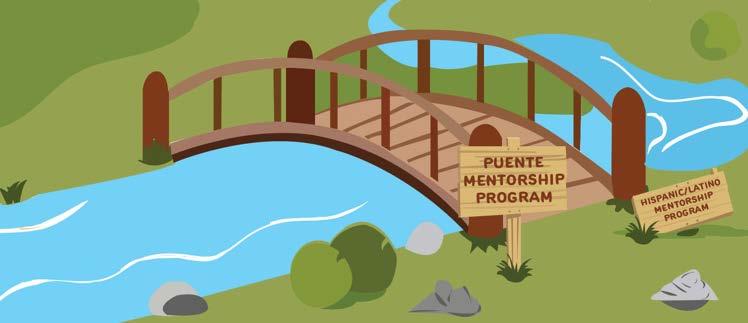
By Diana C. Rojas Hernandez, El Águila Staff Writer
Aprender un nuevo idioma puede ser una tarea intensiva, difícil y angustiante. En American University, el Center for Language Exploration, Acquisition, and Research (CLEAR) ofrece recursos a estudiantes inscritos en un curso con este propósito.
CLEAR ofrece tutorías gratis para el fortalecimiento de las habilidades lingísticas y la comprensión cultural.
Alondra Nieves Rivera, una estudiante de segundo año en el School of International Service e instructora en CLEAR, conoce el programa desde ambos lados. Empezó como una estudiante buscando más ayuda con el francés y la experiencia positiva la motivó a unirse como instructora.
“Los coaches aquí tratan de en verdad ayudar a los demás estudiantes”, dijo Nieves.
Uno de sus aspectos favoritos como instructora es “poder tener esa [...] oportunidad de compartir [su cultura] con otras personas, pero entre [los instructores] al mismo tiempo. Pues es algo súper lindo.”
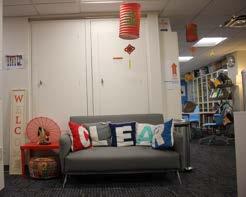
“Aquí pues todos tenemos coaches de todos lados”, explica Nives.
Moises More Verde, un estudiante de cuarto año en SIS e instructor de español, coincide en que disfruta poder compartir su cultura peruana a través de CLEAR.
Para More, que los estudiantes puedan “conocer un poco de mi
lengua, que es parte de mi identidad también creo que es una de las razones principales por las cuales decidí estar en CLEAR”.
Diego Mendoza Casas, estudiante de segundo año en School of Public Affairs e instructor de español y alemán, habla cuatro idiomas y continúa aprendiendo. “Tengo una pasión por los idiomas”, explicó Mendoza.

“Yo sé qué tan importante es tener a alguien que te apoye y a alguien que en realidad quiera ayudarte a aprender el idioma porque es un proceso difícil”, dijo Mendoza.
Para Nives Rivera, el proceso comienza con la actitud correcta, afirmando que ir “con la mente abierta a aprender.”
Los instructores en CLEAR entienden completamente qué hablar en otro idioma puede dar miedo al principio, pero enfatizan la importancia de hablar. Mendoza Casas compartió su propia experiencia con este miedo. “Al llegar a Alemania me dio mucho miedo
hablar con mi familia de intercambio en alemán”, dijo Mendoza Casas. Se dio cuenta que si no vencía ese miedo para practicar con ellos hablar, nunca iba a poder progresar.
Insiste que “el único consejo que les tengo es que sigan hablando”. Promete, que aunque es importante al principio, no es suficiente estudiar gramática y vocabulario para aprender un idioma.
elaguila@theeagleonline.com
Mientras el mundo habla de progreso, la infancia sigue siendo uno de los sectores más olvidados
By Isabella Celis Reina, Sin Corbata Staff Writer
Nota de la Editora: El siguiente artículo es una colaboración especial entre El Águila y Sin Corbata de Universidad de Los Andes en Bogotá, Colombia.
¿Existe realmente el progreso para toda la población en un mundo que condena a millones de niños incluso antes de su nacimiento?
Actualmente, algunas de las noticias que se desarrollan incluyen componentes relacionados con avances tecnológicos, crecimiento económico y promesas de un mejor futuro como pan de cada día. Sin embargo, al hablar de proyecciones futuristas, una de las líneas que debería abordarse como punto focal y de inicio para lograr el tan anhelado desarrollo es la infancia, la cual continúa siendo un sector de la sociedad donde las desigualdades se evidencian con mayor facilidad. Lo irónico es que entendemos
la niñez como el eje de la sociedad futura y, aun así, es uno de los grupos más desprotegidos en nuestra sociedad.
¿De dónde surge esta apreciación? Para empezar, es necesario entender que la vida de ningún niño parte del mismo punto. Es decir, no todos tienen las mismas oportunidades. Para algunos, la infancia está asociada al juego, la educación y la protección; para otros, se reduce a sobrevivir, a pesar de su corta edad.
Situaciones como comer una vez al día, (en los casos que es posible), trabajar desde edades tempranas para ayudar con los gastos del hogar implica, en muchos casos, abandonar la escuela sin dudarlo un segundo. Según datos del Fondo de las Naciones Unidas para la Infancia, más de 400 millones de niños alrededor del mundo sufren privaciones de servicios básicos como el acceso al agua, la salud, la alimentación y, por supuesto, la educación. Esto evidencia que las desigualdades no
son únicamente circunstanciales, sino también estructurales.
Actualmente, cuando se habla de derechos de infancia, se puede decir que en la mayoría de los casos se habla de derechos vulnerados. El derecho a la vida, a la protección y a la educación siguen siendo, para muchos, un privilegio.
Un niño que nace en un contexto de pobreza no accede a las mismas oportunidades académicas que alguien con privilegios. Muchos aprenden a trabajar antes que a leer o escribir y a resistir antes que a soñar.
Estas brechas no pueden explicarse únicamente por decisiones individuales de los adultos, sino también por un sistema que no cuenta con políticas estructurales que garanticen la asignación efectiva de recursos y los mecanismos de protección adecuados.
Las crisis globales aumentan y prolongan estas desigualdades. Las migraciones
forzadas, la pobreza estructural y los conflictos armados configuran el panorama del mundo actual. Sin embargo, sus consecuencias no se distribuyen de manera equitativa. Los niños y las niñas son los más afectados. Según datos de la Organización de las Naciones Unidas, uno de cada seis niños en el mundo vive en zonas de conflicto, y más de 40 millones han sido desplazados por guerras, violencia y desastres climáticos. Estas no son solo cifras preocupantes, sino infancias pausadas, y en muchos casos, destruidas. Teniendo en cuenta este contexto, las cifras son cada vez más alarmantes: la desnutrición infantil, el analfabetismo, el trabajo infantil, los matrimonios y los abusos infantiles siguen siendo una realidad tranquila en muchas partes del mundo.
La UNICEF ha reportado que millones de niñas son obligadas a contraer matrimonio incluso antes de alcanzar los 18 años de edad, una práctica que
limita la educación y perpetúa ciclos de violencia. Razón por la cual, los niños dejan de jugar y empiezan a sobrevivir en entornos hostiles para un adecuado desarrollo físico, emocional y mental.
Las dimensiones más injustas de esta realidad, en su mayoría, resultan ser políticas. Los niños no votan, no hacen parte de los procesos de decisión, y tampoco pueden influir en políticas públicas, pero sí sufren las consecuencias de las malas decisiones de adultos, gobiernos e instituciones en los cuales la falta de gobernabilidad y gobernanza para estas poblaciones es mínima.
El adulto centrismo domina las prioridades: invertir en guerras y acumular riquezas parece ser más importante que asegurar infancias dignas. Las decisiones tomadas pensando en el largo plazo terminan afectando directamente el presente de las infancias.
Y no me malinterpreten, la responsabilidad no debería recaer únicamente en los Estados Unidos.
Como sociedad hemos normalizado expresiones como “usted no sirve para nada” o “¿usted siendo médico? No sea tonto, usted no va a poder”, y también miramos con indiferencia el matrimonio y el trabajo infantil siempre y cuando sucedan lejos de nuestras burbujas de privilegio.
La falta de acción y de conciencia permite que estos comportamientos se expandan en silencio.
Cuestionar este modelo de desigualdad,
más allá de ser un acto de rebeldía, es un acto de responsabilidad social y ética. Un progreso que excluye y minimiza a las infancias no debería llamarse progreso, porque no se trata de cuidar a los niños para cuidar el futuro, sino de reconocerlos como parte fundamental de nuestro presente para lograr un mejor futuro.
Al final, no se trata de lo que pensamos,
sino de lo que hacemos frente a esta realidad. Los niños no necesitan salvadores; necesitan adultos que crean en ellos y caminen a su lado. Actuar significa dejar de ser espectadores: cuestionar las desigualdades que tanto hemos normalizado, exigir que la educación y la seguridad infantil sean las bases de nuestra sociedad y entender que las decisiones colectivas o
individuales ayudan a la perpetuación o transformación de nuestra realidad. Porque abandonar a nuestra infancia no es algo inevitable, es resultado de todo aquello que como sociedad hemos decidido ignorar. elaguila@theeagleonline.com
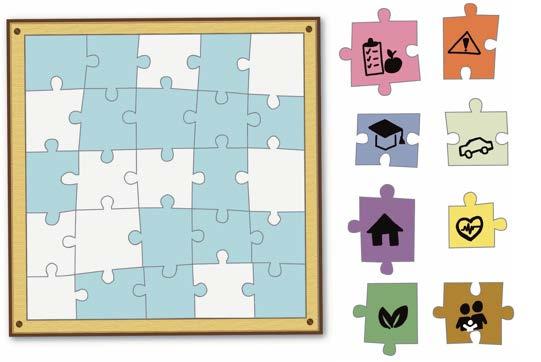
Estudiantes de herencia hispana encuentran confianza y comunidad en Heritage Spanish Studies
By Sabrina Solares and Nicole Eisner, El Águila Staff Writers
Según la página de Spanish Heritage Studies de American University, la mayoría de estudiantes de herencia hispana, crecieron en hogares donde el español estaba presente como lengua principal. Sin embargo, la inseguridad por su pronunciación o el miedo a ser juzgados suele limitar su participación en español dentro del entorno académico.
La página dice que los estudiantes de herencia hispana no siempre se adaptan a cursos tradicionales de aprendizaje del idioma como segunda lengua, enfocados en gramática y estructuras formales. En cambio, suelen beneficiarse más de clases interactivas que priorizan la conversación, lectura y escritura en contextos reales.
Para atender a estas necesidades, American University ofrece el programa Spanish Heritage Studies, diseñado específicamente para hablantes de herencia hispana. El programa se divide en tres cursos: Heritage Spanish I, II y III.
“La gramática siempre va a ser gramática, el subjuntivo siempre va a ser subjuntivo, y el pretérito imperfecto no cambia”, dijo Lilian Baeza-Mendoza, profesora dentro del Department of World Languages and Cultures y directora de Heritage Spanish Language Programs.
“Lo que cambia es la manera a través de la cual se presentan estos conceptos gramaticales”.
La pasión por ayudar a estos estudiantes a encontrar sus caminos y su espacio dentro de la universidad fue lo que motivó a Baeza-Mendoza.
“Lo más satisfactorio para mí es poder experimentar el momento en que estos estudiantes, muchos de ellos, se dan cuenta que su bilingüismo y su competencia multicultural es un talento y no una desventaja”, dijo Baeza-Mendoza.
Los cursos de Spanish Heritage buscan atender a cada estudiante basado en su nivel de fluidez en español y fortalecer tanto habilidades gramaticales como de lectura, escritura y habla.
Lucía Casas, estudiante de segundo año en la School of International Service y una alumna del curso de herencia hispana del año pasado, tomó la clase al darse cuenta de que un curso tradicional de español, con metodologías diseñadas para hablantes extranjeros, no iba a funcionar para ella.
“Me tengo que sentir cómoda hablando. Me di cuenta que español de herencia era la mejor opción para hacerlo”, explicó Casas.
Casas dice que las metodologías entre un curso tradicional de español y español de herencia son muy diferentes. Ella dijo que en español de herencia, uno
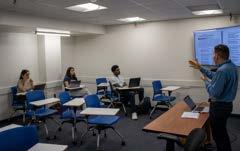
no se enfoca en la gramática o el vocabulario, sino en cómo hablar en un contexto con otras personas.
“En español de herencia no te enfocas en la gramática o el vocabulario, sino en cómo hablar en un contexto con otras personas”, dijo Casas.
Casa dijo que el curso le ayudó no solo a desarrollarse a nivel académico, sino también cultural.
“Me sentía muy hispana en casa y cuando vine a la universidad, en algunos lugares me sentía demasiado americana”, agregó Casas.
“Decidir cuánto te quieres relacionar con tu cultura es tu decisión”, dijo Casas. elaguila@theeagleonline.com
Defining 250+, a conversation with
Our nation’s anniversary should come with a hard look at our moment
By Harry Walton, Assistant Opinion Editor
Editor’s note: The following piece is an opinion and does not reflect the views of The Eagle and its staff. All opinions are edited for grammar, style and argument structure and fact-checked, but the opinions are the writer’s own.
The Declaration of Independence celebrates its 250th birthday this July 4. Festivities began as early as June of last year with the United States Army 250th Anniversary Parade, which President Donald J. Trump presided over. Slightly under 10 years ago, President Barack Obama presided over the United States Semiquincentennial Commission. At the time, we were anticipating a President Hillary Clinton.
Presidents past, present and perhaps permanent are not the only ones excited for the occasion. Our American University joined a legion of elite institutions in rolling out 250th anniversary programming, including extensive speaker events and luncheons. Notably, however, our banners read 250+.
But what are we celebrating? Beyond a great year for banner salesmen, what does America’s 250th birthday mean?
These thoughts and others weighed on me as I sat down with yet another President excited about America at 250: American University President Jonathan Alger.
Alger opened with America’s history in his rearview.
“As you know, it’s 250 plus at American, right?” he said. “And the plus is really
important because we want to talk about what comes next.”
His framing compellingly emphasized that our vision for our nation is in our interest. But I wanted to press him on the past. I mentioned the 14th Amendment, and how it is an excellent example of progress, but also evidence that foundational ideals may not apply to an evolving nation.
“The founders were imperfect” and “creatures of their time,” he said. “So, what do we do with that? … I think what [250+] tells us is, no, we need to be looking at ourselves.”
Our country and its issues, stemming from inception up till now, are up to us to fix, Alger said. He highlighted the importance of students in the effort to imagine a better future.
I then asked him about our founders’ desire for respect in governance and if our responsibility to one another as citizens increases when leaders sow division. President Alger noted the lack of respectful discourse today. In his perspective, the University’s unique environment can address this issue, letting us model a better way of debate, disagreement and compromise. Developing this better way on campus, through programming like 250+, would conceivably build on this vision.
I then asked more directly about expression on campus, probing at American University’s role — as President Alger put it — in improving the tensions in our greater political community. My question specifically asked about institutional faith to the First Amendment.
“We’re grounded in an educational mission … that’s got to be our North Star,” he said.
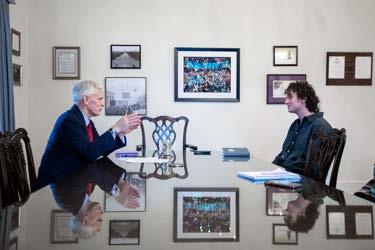
Moreover, he added that Americans have been really good at talking about rights, but less so about collective responsibilities. Alger argued that community requires balancing your rights with other members of the community, and that the ultimate goal on campus is to foster the best learning environment.
My last question got at the heart of the issue: whether there is any value in our nation’s 250th beyond gesturing toward unity.
President Alger distinguished respect from reverence.
“I’ve always said we should respect … the founding and the people who did this great work, but not treat them as gods,” he said.
The 250th gives us at American and beyond an opportunity to reset, ask what we are and what we have taken for granted, Alger said. Considering these questions enables us to chart a better way forward — with an ear for learning — as we build on civic engagement skills.
“I’m really determined for American University to be [a more inclusive] exemplar of the ideals on which our country was founded,” Alger said.
Readers and community members should come to their own conclusions about President Alger’s responses. But I appreciated much of his perspective. I left our conversation feeling more personally capable of the project for “a more perfect union,” distinguishing it from abstractly upholding dead men’s designs.
This said, I find myself overall more pessimistic than I would like to be.
In the face of our moment, our founders would tell us to affirm popular sovereignty and the inalienable rights of men. American University’s 250+ initiative tells us to evolve these ideals to the present and work toward a better future. I agree, but we should accept neither of these answers passively.
By intent or lack of regard, our United States Supreme Court found corporations equivalent to individuals for First Amendment purposes in 2010, thereby protecting corporate dollar signs as speech and enabling the existence of today’s Super PACs that confer massive political influence to the ultrawealthy.
GABE ZAKAIB/THE EAGLE
from everyday interests, causing just 17 percent of Americans as of September 2025 to believe in Washington’s ability to do the right thing almost always/most of the time, per Pew Research.
Our founding does carry a meaning that is applicable now. But in our practical evolving of founding ideals to the present, we have demonstrably watered them down.
The founders’ vision for liberty against the backdrop of an insular monarch remains resonant. As the semiquincentennial approaches, we would do well to accompany reflection with a vigorous evaluation of what America still means to us.
The founders gave us an argument about liberty and self-government through the Declaration, not a self-fulfilling, everlasting premise for a nation. We can only sustain that argument — and therefore our nation — if we earnestly insist on renewing it.
American University students have a unique opportunity this July. Whether you desire a role in politics, law or any occupation that affords systemic might, it is imperative you consider what makes up the system you work under.
Consider whether you still believe in the ideals that made our nation and revolution possible. Consider also what acting on these ideals means in the present.
Harry Walton is a sophomore in the School of Public Affairs and the assistant opinion editor for The Eagle.
opinion@theeagleonline.com
By Quinn Volpe, Staff Columnist
Editor's note: The following piece is an opinion and does not reflect the views of The Eagle and its staff. All opinions are edited for grammar, style and argument structure and fact-checked, but the opinions are the writer’s own.
American University has spent nearly two decades turning its campus into an exemplar of climate-conscious operations. It became the first United States university to reach carbon neutrality in 2018, powered by a massive solar partnership in North Carolina and aggressive energy-efficiency work on campus.
Now, at the Kogod School of Business, a different kind of climate transformation is underway. Kogod brands itself as both a leading sustainable business school and AI-first, with AI in the DNA of [its] education. Side by side, those narratives are in tension.
Kogod calls itself a leader in sustainable business and impact, while aggressively branding itself as an AI pioneer. Since March 2025, every Kogod student has access to Perplexity AI’s Enterprise Pro, and the school is continuously offering more AI-related business classes.
Kogod’s AI page reads that, as it works toward a more sustainable AI infrastructure, it also believes AI is essential to scaling organizations’ sustainability impact and helping
business leaders build a better world. These inclusions suggest some recognition that AI may pose environmental and sustainability issues.
What is largely missing, though, is the kind of concrete, operational language that defines the broader University’s sustainability plan. The AI information from Kogod does not spell out measurable goals for AI-related energy use, data center emissions or procurement standards for AI-related infrastructure. There are no targets to limit the carbon footprint of large-scale model training, nor guidance on when it might be environmentally preferable not to use computationally intensive tools like Perplexity.
The University said in a statement to The Eagle that, “At Kogod, the tension between AI growth and environmental responsibility is both an academic and operational imperative.” While the University may say exploring and addressing this conflict is its goal, the outcome is that Kogod’s largescale use of AI is indirectly harming the environment and defying the University’s climate commitments.
The University said that “measuring AI’s environmental
impact is still an emerging field, especially in a university context,” and noted that data center emissions occur off-campus and fall outside its greenhouse gas inventory.
Over half of the electricity powering data centers in the United States comes from fossil fuels, and the centers use billions of gallons of water every year.
American University’s sustainability plan does not treat digital infrastructure — such as data centers and AI tools — as its own environmental category. The University does not seem to consider how a rapid expansion of AI-driven computing might complicate and render futile its energy-reduction goals.
The result is a clear dissonance.
American University has gone to great lengths to achieve carbon neutrality, and Kogod has spent years publicly building out sustainability programs and research. Today, Kogod is rushing to become an AI-first institution, offering paid, enterprise-level access to generative tools and saturating its curriculum with AIbased courses without communicating the environmental costs of that shift.
Kogod acknowledges the overlap between AI and sustainability, suggesting awareness that AI tech should be included in conversations of climate infrastructure. Yet that awareness is not thoroughly reflected in Kogod, campus-wide sustainability goals or public AI-related strategy documents.
Kogod presents sustainability as a problem AI can solve. But AI creates its own problem, one which the school shirks in favor of economic efficiency and competitive advantage.
American University has made its name on climate progress. It should not forget that mission now. The next sustainability metric must factor in the University’s AI-related ambitions.
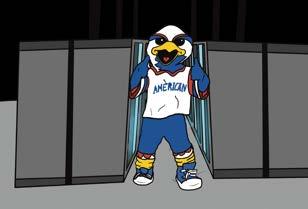
By Sara Shibata, Staff Columnist
Editor's note: The following piece is an opinion and does not reflect the views of The Eagle and its staff. All opinions are edited for grammar, style and argument structure and fact-checked, but the opinions are the writer’s own.
Affirmation after affirmation on TikTok tells me to always put myself first before anyone else and make myself my number one priority. Because in the end, all you have is yourself, right?
By that logic, I didn’t need to show up to my friend’s birthday last week because I was busy, I didn’t have to help out the other overwhelmed intern with their workload and I definitely shouldn’t have completed my struggling friend’s portion of our study guide.
But I did do those things. Not because I am a saint, but because it
is basic consideration and empathy — characteristics that Americans are on the path to losing if we do not stop the “me first” propaganda.
Putting yourself first is another trending term in the wave of self-care and mental health awareness — to prioritize one’s wellbeing before caring for others. Often, the metaphor of putting on your oxygen mask first before helping others is used to describe this act of self-prioritization. Many Americans, especially younger generations, are abusing this to justify selfish actions and defaulting to it as an excuse. It is now an epidemic of how American culture has turned hyperindividualistic; many of us frequently lack empathy for others and assume the worst in people.
Whether it is on TikTok or on any other social platform, many users justify not showing up for their business, social events and friends as necessary to put themselves first. This visceral reaction to putting others before your needs is one symptom of people self-therapizing on
social media, being chronically online or having their lives dominated by internet culture.
The rise of therapy-culture on social media, mostly due to Generation Z, has normalized therapy and made it more accessible. But its downside is the oversimplification of mental health issues without their proper clinical context, causing users to selfdiagnose and self-therapize themselves incorrectly.
Social media algorithms validate these feelings, reinforcing harmful selfdiagnosis and incorrect treatment of behaviors. One of these incorrect treatments is putting yourself first. Therapy-speak floats around social media at all times; daily usage of psychological phrases have become a norm. This leads many to incorrectly apply self-prioritization at the expense of others — justifying inconsideration.
Even outside of social media, a New York University study on Americans’ core values showed a new shift in
Kogod must consider whether it can make good on both halves of its goals: sustainable business as good business, and AI-powered business that is sustainably built.
Quinn Volpe is a senior in the School of Communication and Kogod School of Business and a staff columnist for The Eagle.
opinion@theeagleonline.com
people valuing themselves first over the historic trend of valuing family first.
According to the study, across nearly every demographic, Americans consistently ranked two self-focused values — eudemonia and voice. Eudemonia is a Greek term encapsulating things that feel good such as self-care, leisure and pleasure. Voice is a term used to describe the desire for authentic and individualistic self-expression. It is most important to note that younger generations specifically gave both values high priority.
However, some experts argue that this moral decline is an illusion, where many believe that people were more moral in the past, regardless of what data suggests.
Abigail Marsh, a Georgetown University professor in the Department of Psychology and the Interdisciplinary Program in Neuroscience, says that data suggests people are getting less selfish over time, with some exceptions.
Marsh researches altruistic behavior and supports her theory based on people
donating money, giving organs, helping strangers, giving blood, helping animals, etc. However, she also recognizes that the online world distorts this reality.
“The problem is that our ability to see the world reflected accurately has definitely been getting worse,” Marsh said. “The incentives of both traditional media and social media is to paint a really, really distorted image of the world.”
While Marsh’s research reveals surprising data on the reality of selfishness, her data focuses on formal acts of altruism that can be measured, while small specific acts such as showing up for others cannot.
Even if altruism may not be on the decline in reality, as Marsh said, it’s a problem when videos on social media emphasize people constantly focusing on themselves. This in turn, may cause people to act selfish in the future under that pretense.
Doctor Yael Margolin-Rice, a licensed psychologist in New York, says the notion of self-predomination is another pandemic, and that social connections are arguably more important than anything else.
She says you cannot be somebody without somebody else.
While the circulation of selfprioritizing terms is partly driven by social media, it reflects a larger systemic theme: social media is just amplifying increasing tendencies of a me-first, individualistic culture and reinforcing the instinct to believe that others will not show up for us.
Self-prioritization can be seen as a micro-level issue that only affects individuals, but it also translates to macro-level examples, such as President Donald Trump’s America’first campaign. Trump pushes the rhetoric that American allies should not reap any benefits from American power, instead of tolerating some freeriding as unavoidable.
This America-first mentality is eerily similar to the scaled-down version of putting yourself first with the assumption that others would do the same.
When individuals, especially newer generations, are building up a culture to prioritize themselves no matter what and larger systems in society also share the same perspective, the trends become mutually reinforcing, making the country vulnerable to increasing divides in the future.
Although taking care of your well being is incredibly important to protect your capacity and limits, it is important not to use it to extremes when practicing selfprioritization.
This article is not for those who are saying, “I’m finally putting myself first,” but for those who say, “I always put myself first.” It isn’t for those who struggle with setting boundaries, and it certainly does not advocate sacrificing your every need to put others before you.

culture of solely focusing on yourself to relearning empathy for others, even if it is partly at your expense. You cannot always put yourself first and expect a community to thrive in that mindset. This can look like increasing mindfulness about empathy, appreciating self care but putting yourself first in moderation or spending a day off from social media’s distorted perception of the world. You must be willing to put others before you at times and trust they will return the
These issues must be tackled now, while some people still know life before algorithms that distort reality, or the future of America is bleak.
Sara Shibata is a senior in the School of Public Affairs and the School of Communication and a columnist for The Eagle.
opinion@theeagleonline.com
By Ava DiGiacomo, Staff Columnist
Editor's Note: The following piece is an opinion and does not reflect the views of The Eagle and its staff. All opinions are edited for grammar, style and argument structure and fact-checked, but the opinions are the writer’s own.
We are seeing a crisis in higher education. We could point fingers at an over-reliance on our cellphones or the growing monster of generative AI. We can blame students for skipping class, or we can blame teachers for failing to engage students. It would be most productive, however, to look to the American K-12 education system for failing to adequately prepare students for higher education. There is an undeniably poor allocation of funds and resources around student-centered growth.
Unfortunately, as students, there are few things we can do about this during our

four years in undergrad. But regardless of our scope of influence, it is imperative to our development that we reject the mindset of prioritizing efficiency over intellect.
Students are no longer expected to excel. A college degree, which used to represent mastery in one’s field, now represents mere relative competence. The diploma received after four years in undergrad is no longer a testament to late nights of research, hardened work ethic and excellence: it is a mere baseline for employment.
Grades have also significantly decreased in value. An A stands for excellent, per our University and others’ grading standards. Nationwide, however, overall student GPA in public and non-profit universities has increased 21.5 percent from the years 19902020. This would be great if it were due to a stunning increase in academic performance — but it’s not. It is the result of lower expectations and a decrease in academic rigor, and weaker foundations to build upon.
A mix of students gravitating towards less rigorous courses and teachers responding to demands for high marks, has led to an A representing proficiency, and at times, mere basic understanding of a concept or skill. We see this on sites such as ratemyprofessors.com, where professors get bad reviews for assigning too many readings or being a tough grader.
Higher education is meant to challenge young adults — giving them the advanced writing, research and communication skills necessary to broadly excel in the workforce. So why have expectations in college dropped so drastically?
I began questioning this when I took a comparative politics class the first semester of my sophomore year. This course was nothing short of eye-opening. It was the most difficult class I had taken at the University. It was also the most rewarding.
I was pushed outside of my comfort zone, and was required to understand concepts at a remarkably high level in order to succeed. I worked closely with academic articles that were more complex than any material I had ever studied. In a single semester, my comfortability with dense material and my ability to narrow down arguments improved exponentially.
This class and the professor’s high standards equipped me with tools to succeed in any class — tools that, up until that point, had not been provided to me.
This is not a critique on professors, but rather commentary on what is expected of us as college students and what we expect from ourselves.
The ever-growing presence of AI in academia has only made it easier to reward efficiency over disciplined analysis. Having a software that can spit out a superficial essay in seconds has empowered students to not hold themselves to a high standard in academic pursuits, easily conflating a generative AI summary with true understanding. However, it is difficult to solely blame AI or student laziness. We must continue to sound the alarm on the academic backsliding that has taken place following
the pandemic. Students deprived of a comprehensive curriculum in high school are likely to fill gaps in their knowledge with quick blurbs from ChatGPT rather than spend significant time outside of class having to learn complex concepts on their own.
This is especially true when students are outside their academic comfort zones. A political science student required to take a chemistry class may feel that having a solid understanding of the lessons at hand is unnecessary — leading them to feel even less motivated to add to their workload. Yet, the ability to take on challenges that may not serve a primary interest is a skill that serves both you and your resume.
By the time I graduate, it is improbable that the American education system will be reformed. The presence of AI will only have grown, and the job market will only require more experience with software that can complete a task in seconds. However, as students, we cannot lose our ability to engage with long-form works and think critically about the subjects at hand.
We should not expect college level courses to be easy — the point of higher education is in the name. We are meant to excel and heighten our understanding and abilities, and our professors are here to facilitate that growth. Professors must feel emboldened to require more from their students, and students must feel compelled to take on these challenges with determination.
Ava DiGiacomo is a Sophomore in the School of Public Affairs and a columnist for the Eagle opinion@theeagleonline.com

by The Seagle Staff
The following piece is satire and should not be misconstrued for actual reporting. Any resemblance to a student, staff or faculty member is coincidental.
Here at the Seagle, we’re elated to announce this semester’s strategic plan! Eagle-eyed (haha, get it?) readers might say “Hey, aren’t these plans supposed to last longer than a standard pregnancy?” Well, yes. But they haven’t worked yet, so them’s the breaks.
The strategic plan started from seven unique challenges facing our university. And to those challenges, we say “Challenge Accepted”:
1. Reducing inefficiency
2. Getting rid of unneeded resources
3. Streamlining operations
4. Finetuning experiences
5. Refining redundancies
6. Cutting shit down
7. Strategic gaslighting
From there, we were able to refine macrodata into actionable insights and, actually, for real this time, make a plan.
Changing Our Reputation
Somehow people have come to associate our university with being “nerdy,” but that’s not true at all. We party so hard. We slept with three (3) girls last year. And one of them was even straight! Furthermore, we’ve invested heavily in the media of our future: landlines. We’ve sunk millions of your non-refundable tuition dollars into this fruitful investment. Soon every school — hell, every house — will have a phone. The name AU will be synonymous with the mighty phone. Yeah, that’ll make the cool kids want to stick around for sure!
Tenleytown Centered Learning
Since American University’s genesis, we’ve tried selling ourselves as the premier higher learning institution

in Washington, D.C. But who the hell are we kidding? In our century and some of existence, not one person has honestly believed that. That’s why we’re going all in on good ol’ Tenley. From hands-on internships at Guapo’s to elite research opportunities at the Mattress Warehouse, we’ll make sure our students are best equipped for the reality of the higher education bubble. Select students will be named Tenleytown fellows and receive priority access to the Target parking lot.
Focus on Our Four “X”s
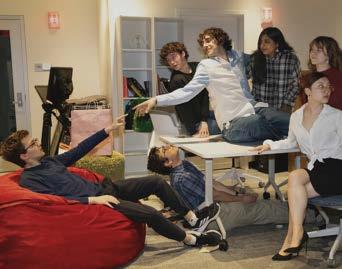
Xcellancy: Making our academy gooder and more better.
Xploring Each Other’s Bodies: We are an R1 research school after all.
X men: …where they at?
Xenon: Refining precious xenon gas has the potential to not only turn our debt situation on its head, but to foster new relationships and maybe even love (?) at our state of the art xenon refinement facility. The state of the art xenon refinement facility will replace McKinley School of Communication.
Conflicts between the People’s Republic of China and Taiwan (formally referred to as Taiwan: Republic of China) in the South China Sea There’s bad people on both sides.
To show our commitment to this permanent change, we will be introducing new living-learning communities for the following groups
North and Central Jersey: In a radical change to the north vs. south Jersey dichotomy, we will be acknowledging only North and Central Jersey. Unfortunately, due to a mistake with housing, they will live on the south side of campus. Please do not let this distract from our message.
People graduating in five years: Enough of the Global Scholars and the Public Policy. Whatever nerds, let’s give the slackers and the financially secure their own on-campus palace.
Mock Trial: It’s important whatever mess they’ve got going on doesn’t spread to the general public, so for the good of everyone involved, we’ve decided to segregate quarantine segregate them.
White passing Irish: No explanation needed.
Nepo babies: Treasured descendants of donors and those who were really worried about the Epstein List shouldn’t be confined with the heathens that inhabit this campus. The exclusive Nepo floor includes housing with significantly fewer insects.
Wonk core enthusiasts: Mandatory blazer storage
and a copy of the Economist no one reads. Debt and Finances None. It’s fine.
Timeline
Our plan will be finalized over the next five-to-seven business years, which will be followed by an exploratory committee of groundbreaking trailblazers. Unless we come up with a better plan that has a catchier name. Thank you for your attention to this matter satire@theeagleonline.com


ACROSS
1. A los ‘no sabo’ les encanta decir “donde esta la___”
5. restaurante mexicano en Tenleytown
7. necesario en la mañana
8. Estación en la cual los cerezos florecen
10. East Campus restaurant, reopened with new name
12. Acrónimo de una universidad chilena que tiene unprograma de intercambio con AU
14. Nuevo edificio de deportes en campus
15. Superbowl singer's first name
17. Un opción de desayuno en TDR
18. País conocido como la “Inglaterra de AméricaLatina” DOWN
1. Que vende “call your mother”
2. Lo que hacen los estudiantes en lal biblioteca
3. “Eagle” en español
4. Vergara actriz principal en la serie Griselda en Netflix
6. Nombre de pila del cantante del Superbowl
7. Apellido del primer latino superestrella en la MLB
9. Paz presidente boliviano que estudió en AU
10. A lo que los americanos le dicen “soccer”
11. Café en el campus (en inglés)
13. "Si se ____"
14. Apellido del presidente actual de Argentina
16. Acrónimo del departamento dentro CAS que sededica a los idiomas (en inglés)
ACROSS
1. Why did this place get the works? That’s nobody’s business but the Turks
6. Did you know each episode of “The ____” is one hour of the shift?
7. Monday night trivia and Wednesday all-day happy hour, quick walk from 18 across
9. Movie that won Michael B. Jordan his first Oscar 11. Campus dining option with notorious Grubhub wait times
12. Social media used to brag your accomplishments to people from high school
13. Live comedy sketch show that recently debuted a UK version 14. Dorm hall that shares name with a “The Big Bang Theory” character
16. Former women’s basketball beat reporter and local news editor; incoming editor-in-chief
18. An AU institution home to Karaoke Tuesdays, short walk from 7 across
20. First American woman to win individual Olympic figure skating gold in over 20 years
22. Campus climate organization on hiatus or a grocery shopping vehicle
23. *Bill Hader voice* AU’s new hottest club for buying alcohol in Bender Arena
DOWN
1.Sweet treat handed out by Kay Spiritual Life Center on Tuesdays
2. Baseball team that relocated to D.C. in 2005
3. Term popularized by ‘alpha male’ content creators, often categorized by bone smashing
4. Washington Post slogan, "Democracy dies in ____”
5. Sport in which AU claims to be historically undefeated
8. AU’s theater in Tenleytown
10.“Thank Clawed it’s _____ "
17. New athletic building named after former AU wrestler
19. On-campus gym closed this semester


21. Federation that organizes international soccer tournament coming to North America this summer