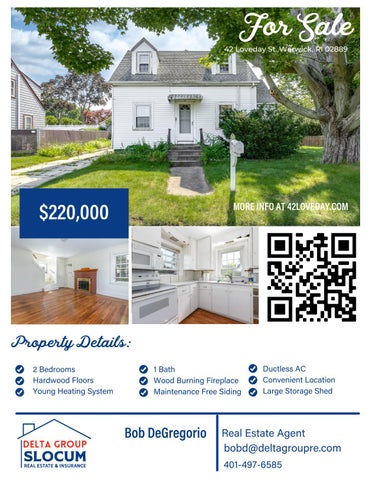
For Sale
42 Loveday St. Warwick, RI 02889
$220,000
MORE INFO AT 42LOVEDAY.COM
Property Details: 2 Bedrooms Hardwood Floors Young Heating System
1 Bath Wood Burning Fireplace Maintenance Free Siding
Bob DeGregorio
Ductless AC Convenient Location Large Storage Shed
Real Estate Agent bobd@deltagroupre.com 401-497-6585
7/20/2021
Matrix MLS#: 1288654
42 Loveday St
Single Family
Active
Hoxsie
List Price: $220,000
Warwick, Rhode Island
Affordable Cape in the Hoxsie section of Warwick offers hardwood floors, living room with fireplace, enclosed porch, young heating system, and 2 generous sized bedrooms. Exterior offers maintenance free siding, storage shed, and a comfortable yard . This home does need TLC but certainly worth the effort at this affordable price. Assessor Plat: Assessor Lot: Assessor Block: Zoning: Year Built: Fireplace: Garages/OnSite Parking: Under Construction: Beds Total: Foundation Type: Type: Kitchen Dining Room Living Room Porch Bedrm1 Bedrm2 Bath w/Shw
Client Flyer
REO Bank Owned: Assessment: Real Estate Taxes: Fire District Tax: Asso Fee: Number Of Levels: Number Of Rooms: Baths Full: Baths Half:
1950 1 0/2 No 2 Concrete Cape Cod 1st 1st 1st 1st 2nd 2nd 2nd
Type: Garage Spaces/Desc: Basement: Basement Type: Basement Access: Basement Finish: Bsmt % Finished: Bsmt Rooms Type: Hot Water: Heating System: Cooling: Terms Available: Finished Floor: Water Amenities: Lot Description: Exterior: Equipment: Near:
312 225
Level
Cape Cod 0 / None Full Interior Only Unfinished Electric, Tank Steam Ductless AC Ceramic, Hardwood
Length
Width
No $177,900 $3,332 $0 5 1 0
Short Sale: Lot SqFt: Site Acres: Leased Land: Lot Frontage: RE License Owner: Abv Grade Liv SF: Blw Grade Liv SF: Total Living Area: Undergrd Tank Size: Undergrd Tank Type:
No 5,200.0 0.12 No No 910 0 910 Unknown Unknown
Ceiling Height
Fireplace: Wall: Insulation: Electric: Water Supply: Sewer: Plumbing: Interior: Heating Fuel: Heating Fuel Usage: Handicap Access: Occupancy Close:
Brick Unknown 100 Amps Connected Connected Mixed Oil Unknown Negotiable
Aluminum Siding, Insulated Glass Windows, Needs Work, Porch, Screened Pch/Patio/Dck/Brzwy Cable TV, Ceiling Fan, Oven/Range, Refrigerator Bus, Commuter Bus, Highway Access, Interstate, Private School, Public School, Recreational Facilities, Schools, Shopping, Swimming, Tennis
Listed By: SLOCUM REALTY Information Deemed Reliable, but is neither guaranteed nor independently verified. Interested parties must make their own inquiries.
07/20/2021 2:22 PM
https://stwmls.mlsmatrix.com/Matrix/Printing/PrintOptions.aspx?c=AAEAAAD*****AQAAAAAAAAARAQAAAEMAAAAGAgAAAAQyNzIyBgMAAAABO…
1/1
dotloop signature verification: dtlp.us/LRF1-Pig5-cp8Y
SELLER’S LEAD DISCLOSURE Rhode Island Association of REALTORS® Disclosure of Information about Lead-Based Paint and Lead-Based Hazards required by Federal and Rhode Island law. LOVEDAY Property Address: 42 ____________________________________________________________________________________________________ 02889 Unit # (if applicable) ___________, Town/City WARWICK _______________________________________, State of Rhode Island, Zip code ___________
Federal Lead Warning Statement Federal Law: 42 U.S.C. 4852(d) "Every purchaser of any interest in residential real property on which a residential dwelling was built prior to 1978 is notified that such property may present exposure to lead from lead-based paint that may place young children at risk of developing lead poisoning. Lead poisoning in young children may produce permanent neurological damage, including learning disabilities, reduced intelligence quotient, behavioral problems, and impaired memory. Lead poisoning also poses a particular risk to pregnant women. The Seller of any interest in residential real property is required to provide the Buyer with any information on lead-based paint hazards from risk assessments or inspections in the Seller's possession and notify the Buyer of any known lead-based paint hazards. A risk assessment or inspection for possible lead-based paint hazards is recommended prior to purchase." Rhode Island State Disclosure Requirements Rhode Island State Law: 216-RICR-50-15-3 Section 3.8 of the Rules and Regulations of the R.I. Department of Health and Lead Hazard Mitigation Standards requires the Seller of any interest in residential property on which a residential dwelling was built prior to 1978 to disclose to the Buyer any known information on lead-based paint or lead-based hazards in paint, interior dust, soil, or water, or potential lead-based paint or lead-based hazards and their location(s), or potential location(s). Such information includes (1) any records or reports which are in Seller’s possession or reasonably obtainable regarding such hazards or potential exposure to such hazards in the property; (2) a copy of any current lead certificate(s) for the dwelling or dwelling unit and common areas; and (3) a chronological listing of all available lead inspection reports and certificates for the property being sold. The Seller shall provide Buyer with an Environmental Protection Agency educational pamphlet entitled “Protect Your Family from Lead in Your Home” containing the insert "What You Should Know About the R.I. Lead Law." Seller’s Disclosure [Seller(s) complete and initial each section below]
NEE ___________ (a) Presence of lead in paint, interior dust, soil or water and/or lead-based hazards in paint, interior dust, soil, or water: (check one below) Seller discloses that the following known lead-based paint and/or lead-based hazards are present in the housing (explain).
07/18/21 5:24 PM EDT dotloop verified
Seller has no knowledge of lead-based paint and/or lead-based hazards in the housing.
NEE ___________ (b)
07/18/21 5:24 PM EDT dotloop verified
Records and reports available to Seller (check all that apply below): Seller has provided Buyer, the Listing Licensee and Cooperating Licensee, if any, with a copy of the most current lead certificate dated: ___________________________________________________________________________________. Rhode Island law requires Seller to provide, at no charge, copies of all available reports and certificates to which Seller has access within seven (7) days of a request by Buyer. Seller has access to the following reports and records relating to lead: (Seller: List in chronological order all available lead inspection reports and certificates for the property being sold.) Date of document:
Type of lead certificate or report:
Buyer may obtain copies of all such documents by contacting: _______________________________________________ _________________________________________________________________________________________________ Seller has no lead certificates, reports or records pertaining to lead-based paint and/or lead-based hazards in the dwelling or dwelling unit and common areas for the property being sold. NEE BUYER’S INITIALS __________ SELLER’S
07/18/21 5:24 PM EDT verified INITIALSdotloop ___________
Copyright© 2018 Rhode Island Association of REALTORS®
Rev. 01/18
Page 1 of 2
dotloop signature verification: dtlp.us/LRF1-Pig5-cp8Y
Buyer’s Acknowledgment [Buyer(s) initial each section that applies] ___________ (c) Buyer has received copies of all information listed above. ___________ (d) Buyer has received the pamphlet "Protect Your Family from Lead in Your Home" that includes the R.I. section "What You Should Know About the R.I. Lead Law." ___________ (e) Buyer has (check one below): Received a 10-day opportunity (or mutually agreed upon period) to conduct a risk assessment or inspection for the presence of lead-based paint and/or lead-based hazards; or Waived the opportunity to conduct a risk assessment or inspection for the presence of lead-based paint and/or lead-based hazards. Agent's Acknowledgment (initial)
RSD ___________ (f)
07/19/21 11:41 AM EDT dotloop verified
Agent has informed Seller of Seller's obligations under 42 U.S.C. 4852(d) and 216-RICR-50-15-3 Section 3.8 of the Rules and Regulations of the R.I. Department of Health and Lead Hazard Mitigation Standards, and is aware of his/her responsibility to ensure compliance.
Certification of Accuracy The following parties have reviewed the information above and certify, to the best of their knowledge, that the information provided by the signatory is true and accurate. Nancy E. Evans
dotloop verified 07/18/21 5:24 PM EDT
__________________________________________ ___________________ Buyer Date
__________________________________________ _________________ 1D03-QAU0-D2OM-JYBF Seller Date
__________________________________________ ___________________ Buyer Date
__________________________________________ _________________ Seller Date
__________________________________________ ___________________ Buyer Date
__________________________________________ _________________ Seller Date
__________________________________________ ___________________ Buyer Date
__________________________________________ _________________ Seller Date
__________________________________________ ___________________ Cooperating Licensee Date
07/19/21 11:41 AM Robert S. DeGregorio __________________________________________ _________________ EDT Listing Licensee Date
This entire form is licensed for the exclusive use of members in good standing of the Rhode Island Association of REALTORS® and is protected by federal and state copyright law. Unauthorized use of this form is prohibited and can result in civil and criminal penalties. All rights reserved. Copyright© 2018.
dotloop verified
Rev. 01/18
Page 2 of 2
dotloop signature verification: dtlp.us/KzVq-c2SK-f7r3
RHODE ISLAND MANDATORY REAL ESTATE RELATIONSHIP DISCLOSURE R.I.G.L. § 5-20.6 allows a real estate broker or salesperson to provide real estate services to you whether you are a buyer, seller, tenant, or landlord. The minimum level of service required by law will depend on the type of relationship that you wish to have with a real estate licensee. These relationships are defined on this form. Although it is not legally required, you may also choose to sign a written contract to further define your relationship. The principal broker of the real estate brokerage or a person designated by him or her must also agree to the type of relationship that you choose to have with the licensee.
Types of Real Estate Relationships TRANSACTION FACILITATOR A Transaction Facilitator is a real estate licensee who provides assistance to a buyer, seller, tenant, or landlord, or both, in a real estate transaction but does not represent you. A Transaction Facilitator owes the following duties to you as a customer: to perform agreed upon ministerial acts timely and competently; to perform these acts with honesty, good faith, reasonable skill and care; and properly account for money or property placed in the care and responsibility of the principal broker. A licensee acting as a transaction facilitator does not owe confidentiality or any other fiduciary duties to a customer. A Transaction Facilitator does not represent you and cannot negotiate on your behalf. DESIGNATED CLIENT REPRESENTATIVE A Designated Client Representative is a real estate licensee who represents a buyer, seller, tenant, or landlord in a real estate transaction and advocates on your behalf. A Designated Client Representative owes the following duties to you as a client: to perform the terms of the client representation contract, if any, with reasonable skill and care; promote the client's best interest in good faith and honesty; protect the client's confidential information during the relationship and after its termination; perform agreed upon ministerial acts timely and competently; perform these acts with honesty, good faith, reasonable care and skill; and to properly account for money or property placed in the care and responsibility of the principal broker. Only the real estate licensee(s) who have been specifically appointed by the principal broker or the principal broker’s designee may represent you as a client. The other real estate licensees who are affiliated with the brokerage owe no duty to you except for confidentiality. If another licensee who is affiliated with the same brokerage becomes a Designated Client Representative for another party in a transaction with you, then that other affiliated licensee has no duty to protect any confidential information about you learned after he or she begins to represent the other party. In order for a real estate licensee to represent you as a Designated Client Representative, the licensee must obtain your informed written consent and provide you with a written notice. NEUTRAL DUAL FACILITATOR A neutral Dual Facilitator is an individual real estate licensee who assists a buyer and seller or tenant and landlord in the same transaction and must be neutral as to any conflicting interests between the parties to the transaction. A neutral Dual Facilitator relationship exists solely for a specific transaction between the parties. A Dual Facilitator must be neutral as to any conflicting interests between the parties to the transaction. A Dual Facilitator owes the following duties to all parties: protecting the confidential information of you and the other party except where disclosure is required or permitted by state law; and accounting for funds. This Mandatory Real Estate Relationship Form cannot be used to obtain your consent to a Dual Facilitator relationship. In order for a real estate licensee to assist you as a neutral Dual Facilitator, the licensee must obtain the informed, written consent from you, the other party and the principal broker on a separate Dual Facilitator consent form. TRANSACTION COORDINATOR A Transaction Coordinator is a principal broker or his or her designee who supervises a real estate transaction. The principal broker or his or her designee assumes this role in a transaction in which one affiliated licensee represents a buyer or tenant as a designated client representative and another affiliated licensee represents a seller or landlord as a designated client representative in the same transaction or if one affiliated licensee is assisting both the buyer and seller or landlord and tenant in the same transaction as a dual facilitator. A transaction coordinator does not owe any fiduciary duties to any party in a transaction except the duties to protect the confidential information of the parties and to properly account for money placed in his or her care. A principal broker or his or her designee becomes a Transaction Coordinator automatically, so a customer or client is not required to sign an additional disclosure form.
NEE
07/18/21 5:23 PM EDT
verified BUYER’S/TENANT’S INITIALS __________ SELLER’S/LANDLORD’S INITIALS dotloop ___________
Rev. 11/15 Page 1 of 2
dotloop signature verification: dtlp.us/KzVq-c2SK-f7r3
Real Estate Licensee’s Responsibilities R.I.G.L. § 5-20.6-8 requires any real estate licensee who assists you to present this form to you prior to the disclosure of any confidential information. A real estate licensee must also disclose which party they represent, and obtain your written acknowledgement of that relationship. The law also requires real estate licensees to fulfill the duties of their relationship with you as defined by state law and/or in a written contract. Failure to comply with this law is a violation of Rhode Island license law and can result in disciplinary action to the licensee. Consumer Information and Responsibilities If you wish to have a real estate licensee represent you, this relationship must be established no later than the preparation of an offer to purchase, purchase and sales agreement or lease. Rhode Island law presumes that all real estate licensees are acting as Transaction Facilitators unless otherwise stated on this form. A real estate licensee can act as your designated client representative only if that real estate licensee obtains your informed written consent to that relationship on this form. A principal broker may only appoint a real estate licensee to represent you as a Designated Client Representative with your informed, written consent acknowledged on this Mandatory Relationship Disclosure Form. This designation as your representative applies only to the real estate licensee listed below. An inherent conflict of interest may exist if you as a buyer choose a designated client representative affiliated with the same principal broker as the seller’s designated client representative. Other licensees affiliated with the company do not represent you or owe you any duties unless disclosed to you in writing. Also, these other licensees may represent or assist another party in your real estate transaction. The duties of a real estate licensee do not relieve consumers of the responsibility to protect their own interests. If you need advice on specialized issues, such as legal, tax, or insurance, consumers are advised to refer specialized questions to the proper expert, including, but not limited to, a home inspector, attorney, tax advisor, appraiser or appropriate government official. Consumer and Broker Acknowledgement By signing below, I, the consumer, acknowledge that I have received and read the information in this Rhode Island Mandatory Relationship Disclosure Form. I understand and agree that the real estate licensee has disclosed that he or she will be working with me in the following capacity. (Check all that apply.) Seller/Landlord Transaction Facilitator Designated Client Representative __________________________________________
Buyer/Tenant Transaction Facilitator Designated Client Representative NANCY E. EVANS ____________________________________________ Printed Name
_____________________
Consumer Signature
__________________________________________
____________________________________________
_____________________
Consumer Signature
Printed Name
Date
__________________________________________
____________________________________________
_____________________
Consumer Signature
Printed Name
Date
Date
By signing below, I, the real estate licensee, acknowledge that I have provided this disclosure form to the above consumer(s) as required by Rhode Island law. ________________________________________________________________________________________________________________ Name of Brokerage Firm dotloop verified
Robert S. DeGregorio 07/19/21 11:39 AM EDT ROBERT S. DEGREGORIO REB.0018180 ______________________________________ ______________________________________ ______________ ______________________ G5H3-QZ2F-IWEL-AG7K
Licensee Signature
Printed Name
License #
Date
_______ Licensee: please initial here if the consumer declines to sign this notice and state the consumer’s reason for refusal:
Rev. 11/15 Page 2 of 2
7/19/2021
City of Warwick, Rhode Island Selected Parcel: 42 LOVEDAY ST ID: 312-0225 Printed on 7/19/2021
10 m 50 ft
MainStreetGIS, LLC
www.mainstreetgis.com
This map is for informational purposes only. It is not for appraisal of, description of, or conveyance of land. The City of Warwick, Rhode Island and MainStreetGIS, LLC assume no legal responsibility for the information contained herein.
1/1
7/19/2021
City of Warwick, Rhode Island Selected Parcel: 42 LOVEDAY ST ID: 312-0225 Printed on 7/19/2021
100 m 200 ft
MainStreetGIS, LLC
www.mainstreetgis.com
This map is for informational purposes only. It is not for appraisal of, description of, or conveyance of land. The City of Warwick, Rhode Island and MainStreetGIS, LLC assume no legal responsibility for the information contained herein.
1/1
Protect Your Family From Lead in Your Home United States Environmental Protection Agency
United States Consumer Product Safety Commission
United States Department of Housing and Urban Development December 2012 This copyright protected form was produced using Instanet Solutions' Instanet Forms service.
Are You Planning to Buy or Rent a Home Built Before 1978? Did you know that many homes built before 1978 have lead-based paint? Lead from paint, chips, and dust can pose serious health hazards. Read this entire brochure to learn: t How lead gets into the body t About health effects of lead t What you can do to protect your family t Where to go for more information Before renting or buying a pre-1978 home or apartment, federal law requires: t Sellers must disclose known information on lead-based paint or leadbased paint hazards before selling a house. t Real estate sales contracts must include a specific warning statement about lead-based paint. Buyers have up to 10 days to check for lead. t Landlords must disclose known information on lead-based paint and lead-based paint hazards before leases take effect. Leases must include a specific warning statement about lead-based paint. If undertaking renovations, repairs, or painting (RRP) projects in your pre-1978 home or apartment: t Read EPA’s pamphlet, The Lead-Safe Certified Guide to Renovate Right, to learn about the lead-safe work practices that contractors are required to follow when working in your home (see page 12).
This copyright protected form was produced using Instanet Solutions' Instanet Forms service.
Simple Steps to Protect Your Family from Lead Hazards If you think your home has lead-based paint: t Don’t try to remove lead-based paint yourself. t Always keep painted surfaces in good condition to minimize deterioration. t Get your home checked for lead hazards. Find a certified inspector or risk assessor at epa.gov/lead. t Talk to your landlord about fixing surfaces with peeling or chipping paint. t Regularly clean floors, window sills, and other surfaces. t Take precautions to avoid exposure to lead dust when remodeling. t When renovating, repairing, or painting, hire only EPA- or stateapproved Lead-Safe certified renovation firms. t Before buying, renting, or renovating your home, have it checked for lead-based paint. t Consult your health care provider about testing your children for lead. Your pediatrician can check for lead with a simple blood test. t Wash children’s hands, bottles, pacifiers, and toys often. t Make sure children eat healthy, low-fat foods high in iron, calcium, and vitamin C. t Remove shoes or wipe soil off shoes before entering your house.
1 This copyright protected form was produced using Instanet Solutions' Instanet Forms service.
Lead Gets into the Body in Many Ways Adults and children can get lead into their bodies if they: t Breathe in lead dust (especially during activities such as renovations, repairs, or painting that disturb painted surfaces). t Swallow lead dust that has settled on food, food preparation surfaces, and other places. t Eat paint chips or soil that contains lead. Lead is especially dangerous to children under the age of 6. t At this age, children’s brains and nervous systems are more sensitive to the damaging effects of lead. t Children’s growing bodies absorb more lead. t Babies and young children often put their hands and other objects in their mouths. These objects can have lead dust on them. Women of childbearing age should know that lead is dangerous to a developing fetus. t Women with a high lead level in their system before or during pregnancy risk exposing the fetus to lead through the placenta during fetal development.
2 This copyright protected form was produced using Instanet Solutions' Instanet Forms service.
Health Effects of Lead Lead affects the body in many ways. It is important to know that even exposure to low levels of lead can severely harm children. In children, exposure to lead can cause: t Nervous system and kidney damage t Learning disabilities, attention deficit disorder, and decreased intelligence t Speech, language, and behavior problems t Poor muscle coordination t Decreased muscle and bone growth t Hearing damage While low-lead exposure is most common, exposure to high amounts of lead can have devastating effects on children, including seizures, unconsciousness, and, in some cases, death. Although children are especially susceptible to lead exposure, lead can be dangerous for adults, too. In adults, exposure to lead can cause: t Harm to a developing fetus t Increased chance of high blood pressure during pregnancy t Fertility problems (in men and women) t High blood pressure t Digestive problems t Nerve disorders t Memory and concentration problems 3
t Muscle and joint pain
This copyright protected form was produced using Instanet Solutions' Instanet Forms service.
Check Your Family for Lead Get your children and home tested if you think your home has lead. Children’s blood lead levels tend to increase rapidly from 6 to 12 months of age, and tend to peak at 18 to 24 months of age. Consult your doctor for advice on testing your children. A simple blood test can detect lead. Blood lead tests are usually recommended for: t Children at ages 1 and 2 t Children or other family members who have been exposed to high levels of lead t Children who should be tested under your state or local health screening plan Your doctor can explain what the test results mean and if more testing will be needed.
4 This copyright protected form was produced using Instanet Solutions' Instanet Forms service.
Where Lead-Based Paint Is Found In general, the older your home or childcare facility, the more likely it has lead-based paint.1 Many homes, including private, federally-assisted, federallyowned housing, and childcare facilities built before 1978 have lead-based paint. In 1978, the federal government banned consumer uses of lead-containing paint.2 Learn how to determine if paint is lead-based paint on page 7. Lead can be found: t In homes and childcare facilities in the city, country, or suburbs, t In private and public single-family homes and apartments, t On surfaces inside and outside of the house, and t In soil around a home. (Soil can pick up lead from exterior paint or other sources, such as past use of leaded gas in cars.) Learn more about where lead is found at epa.gov/lead.
1
“Lead-based paint” is currently defined by the federal government as paint with lead levels greater than or equal to 1.0 milligram per square centimeter (mg/cm), or more than 0.5% by weight.
2
“Lead-containing paint” is currently defined by the federal government as lead in new dried paint in excess of 90 parts per million (ppm) by weight.
5 This copyright protected form was produced using Instanet Solutions' Instanet Forms service.
Identifying Lead-Based Paint and Lead-Based Paint Hazards Deteriorating lead-based paint (peeling, chipping, chalking, cracking, or damaged paint) is a hazard and needs immediate attention. Lead-based paint may also be a hazard when found on surfaces that children can chew or that get a lot of wear and tear, such as: t On windows and window sills t Doors and door frames t Stairs, railings, banisters, and porches Lead-based paint is usually not a hazard if it is in good condition and if it is not on an impact or friction surface like a window. Lead dust can form when lead-based paint is scraped, sanded, or heated. Lead dust also forms when painted surfaces containing lead bump or rub together. Lead paint chips and dust can get on surfaces and objects that people touch. Settled lead dust can reenter the air when the home is vacuumed or swept, or when people walk through it. EPA currently defines the following levels of lead in dust as hazardous: t 40 micrograms per square foot (μg/ft2) and higher for floors, including carpeted floors t 250 μg/ft2 and higher for interior window sills Lead in soil can be a hazard when children play in bare soil or when people bring soil into the house on their shoes. EPA currently defines the following levels of lead in soil as hazardous: t 400 parts per million (ppm) and higher in play areas of bare soil t 1,200 ppm (average) and higher in bare soil in the remainder of the yard Remember, lead from paint chips—which you can see—and lead dust—which you may not be able to see—both can be hazards. The only way to find out if paint, dust, or soil lead hazards exist is to test for them. The next page describes how to do this. This copyright protected form was produced using Instanet Solutions' Instanet Forms service.
6
Checking Your Home for Lead You can get your home tested for lead in several different ways: t A lead-based paint inspection tells you if your home has leadbased paint and where it is located. It won’t tell you whether your home currently has lead hazards. A trained and certified testing professional, called a lead-based paint inspector, will conduct a paint inspection using methods, such as: t Portable x-ray fluorescence (XRF) machine t Lab tests of paint samples t A risk assessment tells you if your home currently has any lead hazards from lead in paint, dust, or soil. It also tells you what actions to take to address any hazards. A trained and certified testing professional, called a risk assessor, will: t Sample paint that is deteriorated on doors, windows, floors, stairs, and walls t Sample dust near painted surfaces and sample bare soil in the yard t Get lab tests of paint, dust, and soil samples t A combination inspection and risk assessment tells you if your home has any lead-based paint and if your home has any lead hazards, and where both are located. Be sure to read the report provided to you after your inspection or risk assessment is completed, and ask questions about anything you do not understand.
7 This copyright protected form was produced using Instanet Solutions' Instanet Forms service.
Checking Your Home for Lead, continued In preparing for renovation, repair, or painting work in a pre-1978 home, Lead-Safe Certified renovators (see page 12) may: t Take paint chip samples to determine if lead-based paint is present in the area planned for renovation and send them to an EPA-recognized lead lab for analysis. In housing receiving federal assistance, the person collecting these samples must be a certified lead-based paint inspector or risk assessor t Use EPA-recognized tests kits to determine if lead-based paint is absent (but not in housing receiving federal assistance) t Presume that lead-based paint is present and use lead-safe work practices There are state and federal programs in place to ensure that testing is done safely, reliably, and effectively. Contact your state or local agency for more information, visit epa.gov/lead, or call 1-800-424-LEAD (5323) for a list of contacts in your area.3
3
Hearing- or speech-challenged individuals may access this number through TTY by calling the Federal Relay Service at 1-800-877-8399.
8 This copyright protected form was produced using Instanet Solutions' Instanet Forms service.
What You Can Do Now to Protect Your Family If you suspect that your house has lead-based paint hazards, you can take some immediate steps to reduce your family’s risk: t If you rent, notify your landlord of peeling or chipping paint. t Keep painted surfaces clean and free of dust. Clean floors, window frames, window sills, and other surfaces weekly. Use a mop or sponge with warm water and a general all-purpose cleaner. (Remember: never mix ammonia and bleach products together because they can form a dangerous gas.) t Carefully clean up paint chips immediately without creating dust. t Thoroughly rinse sponges and mop heads often during cleaning of dirty or dusty areas, and again afterward. t Wash your hands and your children’s hands often, especially before they eat and before nap time and bed time. t Keep play areas clean. Wash bottles, pacifiers, toys, and stuffed animals regularly. t Keep children from chewing window sills or other painted surfaces, or eating soil. t When renovating, repairing, or painting, hire only EPA- or stateapproved Lead-Safe Certified renovation firms (see page 12). t Clean or remove shoes before entering your home to avoid tracking in lead from soil. t Make sure children eat nutritious, low-fat meals high in iron, and calcium, such as spinach and dairy products. Children with good diets absorb less lead.
9 This copyright protected form was produced using Instanet Solutions' Instanet Forms service.
Reducing Lead Hazards Disturbing lead-based paint or removing lead improperly can increase the hazard to your family by spreading even more lead dust around the house. t In addition to day-to-day cleaning and good nutrition, you can temporarily reduce lead-based paint hazards by taking actions, such as repairing damaged painted surfaces and planting grass to cover leadcontaminated soil. These actions are not permanent solutions and will need ongoing attention. t You can minimize exposure to lead when renovating, repairing, or painting by hiring an EPA- or statecertified renovator who is trained in the use of lead-safe work practices. If you are a do-it-yourselfer, learn how to use lead–safe work practices in your home. t To remove lead hazards permanently, you should hire a certified lead abatement contractor. Abatement (or permanent hazard elimination) methods include removing, sealing, or enclosing lead-based paint with special materials. Just painting over the hazard with regular paint is not permanent control. Always use a certified contractor who is trained to address lead hazards safely. t Hire a Lead-Safe Certified firm (see page 12) to perform renovation, repair, or painting (RRP) projects that disturb painted surfaces. t To correct lead hazards permanently, hire a certified lead abatement professional. This will ensure your contractor knows how to work safely and has the proper equipment to clean up thoroughly. Certified contractors will employ qualified workers and follow strict safety rules as set by their state or by the federal government.
10 This copyright protected form was produced using Instanet Solutions' Instanet Forms service.
Reducing Lead Hazards, continued If your home has had lead abatement work done or if the housing is receiving federal assistance, once the work is completed, dust cleanup activities must be conducted until clearance testing indicates that lead dust levels are below the following levels: t 40 micrograms per square foot (μg/ft2) for floors, including carpeted floors t 250 μg/ft2 for interior windows sills t 400 μg/ft2 for window troughs For help in locating certified lead abatement professionals in your area, call your state or local agency (see pages 14 and 15), or visit epa.gov/lead, or call 1-800-424-LEAD.
11 This copyright protected form was produced using Instanet Solutions' Instanet Forms service.
Renovating, Remodeling, or Repairing (RRP) a Home with Lead-Based Paint If you hire a contractor to conduct renovation, repair, or painting (RRP) projects in your pre-1978 home or childcare facility (such as pre-school and kindergarten), your contractor must: t Be a Lead-Safe Certified firm approved by EPA or an EPA-authorized state program t Use qualified trained individuals (Lead-Safe Certified renovators) who follow specific lead-safe work practices to prevent lead contamination t Provide a copy of EPA’s lead hazard information document, The Lead-Safe Certified Guide to Renovate Right RRP contractors working in pre-1978 homes and childcare facilities must follow lead-safe work practices that: t Contain the work area. The area must be contained so that dust and debris do not escape from the work area. Warning signs must be put up, and plastic or other impermeable material and tape must be used. t Avoid renovation methods that generate large amounts of lead-contaminated dust. Some methods generate so much leadcontaminated dust that their use is prohibited. They are: t Open-flame burning or torching t Sanding, grinding, planing, needle gunning, or blasting with power tools and equipment not equipped with a shroud and HEPA vacuum attachment and t Using a heat gun at temperatures greater than 1100°F t Clean up thoroughly. The work area should be cleaned up daily. When all the work is done, the area must be cleaned up using special cleaning methods. t Dispose of waste properly. Collect and seal waste in a heavy duty bag or sheeting. When transported, ensure that waste is contained to prevent release of dust and debris.
This
To learn more about EPA’s requirements for RRP projects visit epa.gov/getleadsafe, or read The Lead-Safe Certified Guide to Renovate Right. copyright protected form was produced using Instanet Solutions' Instanet Forms service.
12
Other Sources of Lead While paint, dust, and soil are the most common sources of lead, other lead sources also exist: t Drinking water. Your home might have plumbing with lead or lead solder. You cannot see, smell, or taste lead, and boiling your water will not get rid of lead. If you think your plumbing might contain lead: t Use only cold water for drinking and cooking. t Run water for 15 to 30 seconds before drinking it, especially if you have not used your water for a few hours. Call your local health department or water supplier to find out about testing your water, or visit epa.gov/lead for EPA’s lead in drinking water information. t Lead smelters or other industries that release lead into the air. t Your job. If you work with lead, you could bring it home on your body or clothes. Shower and change clothes before coming home. Launder your work clothes separately from the rest of your family’s clothes. t Hobbies that use lead, such as making pottery or stained glass, or refinishing furniture. Call your local health department for information about hobbies that may use lead. t Old toys and furniture may have been painted with lead-containing paint. Older toys and other children’s products may have parts that contain lead.4 t Food and liquids cooked or stored in lead crystal or lead-glazed pottery or porcelain may contain lead. t Folk remedies, such as “greta” and “azarcon,” used to treat an upset stomach.
4
In 1978, the federal government banned toys, other children’s products, and furniture with lead-containing paint (16 CFR 1303). In 2008, the federal government banned lead in most children’s products. The federal government currently bans lead in excess of 100 ppm by weight in most children’s products (76 FR 44463).
13 This copyright protected form was produced using Instanet Solutions' Instanet Forms service.
For More Information The National Lead Information Center Learn how to protect children from lead poisoning and get other information about lead hazards on the Web at epa.gov/lead and hud.gov/lead, or call 1-800-424-LEAD (5323). EPA’s Safe Drinking Water Hotline For information about lead in drinking water, call 1-800-426-4791, or visit epa.gov/lead for information about lead in drinking water. Consumer Product Safety Commission (CPSC) Hotline For information on lead in toys and other consumer products, or to report an unsafe consumer product or a product-related injury, call 1-800-638-2772, or visit CPSC’s website at cpsc.gov or saferproducts.gov. State and Local Health and Environmental Agencies Some states, tribes, and cities have their own rules related to leadbased paint. Check with your local agency to see which laws apply to you. Most agencies can also provide information on finding a lead abatement firm in your area, and on possible sources of financial aid for reducing lead hazards. Receive up-to-date address and phone information for your state or local contacts on the Web at epa.gov/lead, or contact the National Lead Information Center at 1-800-424-LEAD.
Hearing- or speech-challenged individuals may access any of the phone numbers in this brochure through TTY by calling the tollfree Federal Relay Service at 1-800-877-8339.
14 This copyright protected form was produced using Instanet Solutions' Instanet Forms service.
U. S. Environmental Protection Agency (EPA) Regional Offices The mission of EPA is to protect human health and the environment. Your Regional EPA Office can provide further information regarding regulations and lead protection programs. Region 1 (Connecticut, Massachusetts, Maine, New Hampshire, Rhode Island, Vermont)
Region 6 (Arkansas, Louisiana, New Mexico, Oklahoma, Texas, and 66 Tribes)
Regional Lead Contact U.S. EPA Region 1 Suite 1100 (CPT) One Congress Street Boston, MA 02114-2023 (617) 918-1524
Regional Lead Contact U.S. EPA Region 6 1445 Ross Avenue, 12th Floor Dallas, TX 75202-2733 (214) 665-2704
Region 2 (New Jersey, New York, Puerto Rico, Virgin Islands)
Region 7 (Iowa, Kansas, Missouri, Nebraska)
Regional Lead Contact U.S. EPA Region 2 2890 Woodbridge Avenue Building 205, Mail Stop 225 Edison, NJ 08837-3679 (732) 321-6671 Region 3 (Delaware, Maryland, Pennsylvania, Virginia, DC, West Virginia) Regional Lead Contact U.S. EPA Region 3 1650 Arch Street Philadelphia, PA 19103 (215) 814-2088 Region 4 (Alabama, Florida, Georgia, Kentucky, Mississippi, North Carolina, South Carolina, Tennessee) Regional Lead Contact U.S. EPA Region 4 AFC Tower, 12th Floor, Air, Pesticides & Toxics 61 Forsyth Street, SW Atlanta, GA 30303 (404) 562-8998 Region 5 (Illinois, Indiana, Michigan, Minnesota, Ohio, Wisconsin) Regional Lead Contact U.S. EPA Region 5 (DT-8J) 77 West Jackson Boulevard Chicago, IL 60604-3666 (312) 886-7836
Regional Lead Contact U.S. EPA Region 7 11201 Renner Blvd. WWPD/TOPE Lenexa, KS 66219 (800) 223-0425 Region 8 (Colorado, Montana, North Dakota, South Dakota, Utah, Wyoming) Regional Lead Contact U.S. EPA Region 8 1595 Wynkoop St. Denver, CO 80202 (303) 312-6966 Region 9 (Arizona, California, Hawaii, Nevada) Regional Lead Contact U.S. EPA Region 9 (CMD-4-2) 75 Hawthorne Street San Francisco, CA 94105 (415) 947-4280 Region 10 (Alaska, Idaho, Oregon, Washington) Regional Lead Contact U.S. EPA Region 10 Solid Waste & Toxics Unit (WCM-128) 1200 Sixth Avenue, Suite 900 Seattle, WA 98101 (206) 553-1200
15 This copyright protected form was produced using Instanet Solutions' Instanet Forms service.
Consumer Product Safety Commission (CPSC) The CPSC protects the public against unreasonable risk of injury from consumer products through education, safety standards activities, and enforcement. Contact CPSC for further information regarding consumer product safety and regulations. CPSC 4330 East West Highway Bethesda, MD 20814-4421 1-800-638-2772 cpsc.gov or saferproducts.gov
U. S. Department of Housing and Urban Development (HUD) HUD’s mission is to create strong, sustainable, inclusive communities and quality affordable homes for all. Contact HUD’s Office of Healthy Homes and Lead Hazard Control for further information regarding the Lead Safe Housing Rule, which protects families in pre-1978 assisted housing, and for the lead hazard control and research grant programs. HUD 451 Seventh Street, SW, Room 8236 Washington, DC 20410-3000 (202) 402-7698 hud.gov/offices/lead/ This document is in the public domain. It may be produced by an individual or organization without permission. Information provided in this booklet is based upon current scientific and technical understanding of the issues presented and is reflective of the jurisdictional boundaries established by the statutes governing the co-authoring agencies. Following the advice given will not necessarily provide complete protection in all situations or against all health hazards that can be caused by lead exposure.
U. S. EPA Washington DC 20460 U. S. CPSC Bethesda MD 20814 U. S. HUD Washington DC 20410
EPA-747-K-12-001 December 2012
16 This copyright protected form was produced using Instanet Solutions' Instanet Forms service.
Rhode Island Contact Information The Rhode Island Department of Environmental Management (DEM) Information about DEM Air Pollution Control Regulation No. 24: Removal of Lead-Based Paint from Exterior Surfaces Office of Air Resources (401) 222-2808 Ext. 7013 www.dem.ri.gov Exterior Lead Paint Removal Complaints Office of Compliance & Inspection (401) 222-1360 Ext. 7268 The Rhode Island Department of Health (HEALTH) Information about lead training courses, licensing requirements for lead professionals, lead safe work practices, and childhood lead poisoning prevention Healthy Homes & Lead Poisoning Prevention Program Health Information Line (401) 222-5960 www.health.ri.gov Housing Resources Commission (HRC) Information about the Lead Hazard Mitigation Law, HRC Lead Mitigation Regulations, landlord responsibilities, and tenant rights (401) 222-LEAD (5323) www.hrc.ri.gov
17 This copyright protected form was produced using Instanet Solutions' Instanet Forms service.
What You Should Know About the Rhode Island Lead Law Childhood Lead Poisoning Screening Rhode Island children must be screened for blood lead two times, at least 12 months apart, before the age of 36 months. Lead Hazard Reduction Lead hazard reduction (LHR) is required in the homes of lead poisoned children and properties classified by HEALTH as having multiple poisonings or as high-risk premises. Lists of these properties are available on HEALTH’s website at: http://www.health.ri.gov/find/property/index.php In addition, LHR may be required by a notice or order from HEALTH, or by a funding agency, such as a HUD-grantee (e.g., RI Housing). Only a lead contractor licensed by HEALTH can do LHR work. Before beginning the work, lead contractors must provide owners and tenants with the EPA pamphlet Protect your Family from Lead in Your Home containing the Rhode Island insert, available on HEALTH’s website at: http://www.health.ri.gov/materialbyothers/LeadPoisoningProtectYourFamily.p df A clearance inspection by a licensed lead inspector which results in a Certification of Lead Free or Lead Safe Status is required at the conclusion of all LHR projects. Lists of licensed lead professionals and a lead certificate search are available on HEALTH’s website at: http://www.health.ri.gov/find/environmentallead/firms/ Lead Hazard Control Lead hazard control (LHC) is required to correct known or presumed environmental lead exposure hazards. Only a lead renovation firm licensed by HEALTH can do LHC work. Before beginning the work, lead renovation firms must provide owners and tenants with the EPA pamphlet Renovate Right containing the Rhode Island insert, available on HEALTH’s website at: http://www.health.ri.gov/publications/brochures/RenovateRight.pdf
18 This copyright protected form was produced using Instanet Solutions' Instanet Forms service.
A clearance inspection by a licensed lead inspector, lead technician, or lead assessor which results in a Certification of Lead Free or Lead Safe Status, Certification of Acceptable Clearance Status, or an HRC Certificate of Conformance is required at the conclusion of all LHC projects. Lists of licensed lead professionals and a lead certificate search are available on HEALTH’s website at: http://www.health.ri.gov/find/environmentallead/firms/ Renovation, Repair, and Painting Renovation, repair, and painting (RRP) activities are not intended to address environmental lead hazards but may incidentally result in the removal of lead paint or the elimination of lead hazards. RRP requirements apply to construction and related work, such as carpentry, plumbing or electrical work, that impact painted surfaces or building components which are known to contain lead or must be presumed to contain lead in pre-1978 buildings. Only a lead renovation firm licensed by HEALTH may do RRP work in a regulated facility. (HEALTH regulates all residential rental units, residences of children younger than six years of age, and child care facilities.) Before beginning the work, lead renovation firms must provide owners and tenants with the EPA pamphlet Renovate Right containing the Rhode Island insert, available on HEALTH’s website at: http://www.health.ri.gov/publications/brochures/RenovateRight.pdf A clearance inspection by a licensed lead inspector, lead technician, or lead assessor which results in a Certification of Acceptable Clearance Status is required at the conclusion of all interior RRP projects. Lists of licensed lead professionals and a certificate search are available on HEALTH’s website at: http://www.health.ri.gov/find/environmentallead/firms/ Lead Hazard Mitigation The Lead Hazard Mitigation Law requires landlords to complete a lead hazard awareness seminar and correct lead hazards in most residential rental units. The landlord may do some of the lead work, but a lead renovation firm licensed by HEALTH is required for window replacement or work that is more than “spot removal”. A clearance inspection by a licensed lead inspector or lead technician which results in a Certificate of Conformance is required at the conclusion of the mitigation project. A list of approved seminars and a lead certificate search are available on HRC’s website at: http://www.hrc.ri.gov/misc/lead_mitigation.php
19 This copyright protected form was produced using Instanet Solutions' Instanet Forms service.
Spot Removal Both the HRC and HEALTH “spot removal” limits are the same as the EPA de minimus of 6 square feet of lead paint per interior room or 20 square feet of exterior lead paint, provided that no prohibited work methods are used. DEM has no de minimus; Regulation No. 24: Removal of Lead Based Paint from Exterior Surfaces always applies to any exterior paint removal. Prohibited Work Methods Rhode Island has additional prohibitions for disturbing lead paint. For interior work, HEALTH prohibits the use of chemical strippers that are flammable or contain methylene chloride and mechanical paint removal, except when done as LHR in a vacant dwelling. For exterior work, DEM prohibits dry scraping or sanding, the use of chemical strippers that are flammable or contain methylene chloride, and uncontained power washing. Lead Inspections Lead contractors and renovators are not qualified to test for lead in Rhode Island. (Lead contractors and renovators may presume that lead is present and use lead safe work practices.) Only lead inspectors, lead technicians, and lead assessors licensed by HEALTH can test for lead. Only lead inspectors can issue Certifications of Lead Free and Lead Safe Status, which require a comprehensive environmental lead inspection and/or an LHR or LHC clearance inspection that includes paint, dust, water, and soil testing. Only lead inspectors and lead technicians can issue Certificates of Conformance, which require an HRC clearance inspection that includes dust testing. Lead inspectors, lead technicians, and lead assessors can issue Certifications of Acceptable Clearance Status, which require an RRP clearance inspection that includes dust testing. Lists of licensed lead professionals and a lead certificate search are available on HEALTH’s website at: http://www.health.ri.gov/find/environmentallead/firms/ Lead Standards HEALTH’s lead standards differ from the federal EPA/HUD standards. Only paint chip sampling by a licensed lead inspector or assessor can determine that painted surfaces or building components in pre-1978 construction do not contain lead. XRF readings less than 1.0 mg/cm2 or “negative” (no reaction) test kit results are considered inconclusive in Rhode Island.
20 This copyright protected form was produced using Instanet Solutions' Instanet Forms service.
The following test results for damaged paint are considered hazardous: x 1.0 mg/cm2 or greater by XRF analysis x “Positive” reaction (pink or red) with sodium rhodizonate test kit x 600 parts per million (ppm) or greater by laboratory analysis The following levels of lead in exposed soil are considered hazardous: x 400 ppm and higher in areas of bare soil x 1,200 ppm and higher in areas of soil covered by grass, mulch, or stone Lead Disclosure In addition to the federal disclosure requirements, property owners must keep copies of all lead inspection reports and records for as long as they own a residential property in Rhode Island. This requirement includes all records and reports received as part of a lead disclosure from previous owners. In addition, landlords must provide tenants with the HRC Notice of Deteriorating Conditions and the name and contact information of the person responsible for maintaining the property. Tenants should notify their landlord of damaged paint using this notice, also available on HRC’s website at: http://www.hrc.ri.gov/misc/lead_mitigation.php Financial Assistance Grant and loan programs are available to help property owners eliminate lead hazards. A list of resources is available on HRC’s website. A Rhode Island personal income tax credit is available for expenses incurred for fixing lead hazards, up to $5,000 per dwelling unit for work resulting in a Certification of Lead Free or Lead Safe Status or up to $1,500 per dwelling unit for work resulting in a Certificate of Conformance. The Residential Lead Abatement Income Tax Credit Form RI-6238 is available at http://www.tax.ri.gov/taxforms/. For education, advocacy, and parent support, call the Childhood Lead Action Project at (401) 785-1310 or visit www.leadsafekids.org
21 This copyright protected form was produced using Instanet Solutions' Instanet Forms service.
IMPORTANT! Lead From Paint, Dust, and Soil in and Around Your Home Can Be Dangerous if Not Managed Properly t Children under 6 years old are most at risk for lead
poisoning in your home. t Lead exposure can harm young children and babies even
before they are born. t Homes, schools, and child care facilities built before 1978
are likely to contain lead-based paint. t Even children who seem healthy may have dangerous
levels of lead in their bodies. t Disturbing surfaces with lead-based paint or removing
lead-based paint improperly can increase the danger to your family. t People can get lead into their bodies by breathing or
swallowing lead dust, or by eating soil or paint chips containing lead. t People have many options for reducing lead hazards.
Generally, lead-based paint that is in good condition is not a hazard (see page 10).
This copyright protected form was produced using Instanet Solutions' Instanet Forms service.