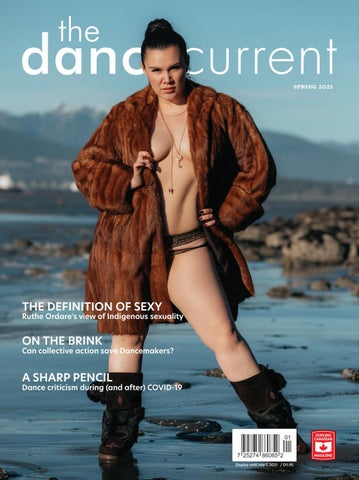
spring 2021
THE DEFINITION OF SEXY
Ruthe Ordare's view of Indigenous sexuality
ON THE BRINK
Can collective action save Dancemakers?
A SHARP PENCIL
Dance criticism during (and after) COVID-19
Display until July 7, 2021 / $11.95
FROM THE DANCE CURRENT TEAM
THANK YOU TO ALL OUR 2020 DONORS Your generosity allowed us to continue producing stories that matter to dance communities across Canada, even during a tumultuous year. We value your support and dedicated readership.
We couldn't have done it without you $100+
Lorne Fox Suzanne M Jaeger Selma Odom Up to $99
Anonymous Laurie Burrett-Loeppky Caroline Caire Susanne Chui Susan Colbert Wright Jane Deluzio Aviva Fleising
Danae Li Kallee Lins Sarah Lochhead Crystal Melville Davida Monk Lynne Mullings Lorna Reddick Dylan Schoenmakers Dr. Lee Slinger Timea Wharton-Suri Adam White Valerie Wilder Perry
Charitable registration number: 85356 1538 RR0001
2
the dance current
SPRING 2021
contents
Photo courtesy of Unsplash; Dance artist Molly Johnson officiates a wedding / Photo by Melissa Sung; Dancemakers company (1976/77) / Photo courtesy of Dance Collection Danse; On the cover: Ordare / Photo by Kate Whyte
Volume 24 Issue 2 spring 2021
17
15
38
DEPARTMENTS
CURRENTS
FEATURES
4
Masthead
W HAT’ S O N ?
PH OTO ESSAY
6
Your Notes
9
22
7
Editor's Letter
8
Contributors
Event Previews
C HEC K IT O U T
12
CoLABendirect
This new video app allows for more control while digitally collaborating by anne dion P RO F IL E
13
Can Everything Just End?
Martin Faucher’s final year as artistic director of Festival TransAmériques by stephen low S HO RT STO RIE S
15
The Career Chronicles
Dance artists find unique ways to boost their income by emily pettet ON THE COVE R
B O DY
of Sexy
Decrease the risk of injury while dancing on concrete by surabhi veitch
19 The Definition Ruthe Ordare empowers Indigenous women to reclaim their sexuality through burlesque by robyn grant-moran
spring 2021
17
Hard Landings
T IP S
18
Leap [Digitally] Forward
Social media marketing for dance artists by laura murray and brian paterson
Even Though No One Is Watching
Adrien Barrieau captures the performer/audience relationship when one half is removed CRITICS TA L K
29
Writing With A Sharp Pencil
On top of fraught politics, dance critics have to figure out how to fit into the fold during – and after – the pandemic by grace wells-smith AT TH E MOMENT
38
On the Brink
Can collective action save Dancemakers, one of Canada's most influential contemporary dance companies? by dylan schoenmakers
POSTSCRIPTS H EA LTH
47
Just What the Therapist Ordered
By accident, I discovered how Bollywood and bhangra dance can help manage Parkinson’s disease by gina fernandez A DV ERTISEMENT
49
Summer Dance Directory
F IRST PERSON
51
Living in the Movement
My relationship with hoop dance by sandra lamouche POETRY THE DEFINITION OF SEXY Ruthe Ordare on Indigenous sexuality
53
the value of our form
54
my body remembers
by elizabeth emond-stevenson
ON THE BRINK
Can collective action save Dancemakers?
A SHARP PENCIL
Dance criticism during (and after) COVID-19
Display until July 7, 2021 / $11.95
by alex mah
thedancecurrent.com
3
photo essay
Even Though No One Is Watching Adrien Barrieau captures the performer/audience relationship when one half is removed photography by adrien barrieau
Dancer: Megan Rogers
22
the dance current
SPRING 2021
Dancer: Cindy Kimove
Adrien J. Barrieau is a digital and film photographer living in Yellowknife. He is the founder of Through The Glass Photography and began collaborating with the Yellowknife dance community following his son’s interest in dance. The following photo shoot was organized in collaboration with Bella Dance Academy and took place at the Northern Arts and Cultural Centre. Observing the significant impacts the COVID-19 pandemic had on performances, Barrieau became curious about the performer/audience relationship when one half is removed: “When performers dance even though no one is watching,” he says. “That dialogue [between performer and audience] is the crux of live performance, the spark that animates and elevates the experience to an almost spiritual level,” Barrieau says. The photo shoot was an attempt to understand and capture what happens in the absence of that dialogue – what Barrieau calls “live performance stripped bare.” The shoot took place in one marathon day in early December 2020. Working with Phoenix Smith, studio director at Bella Dance, Barrieau sent out a call for dancers and found an enthusiastic response. “Looking at the photos as a whole, I can see that there is not only a relationship between performer and audience but also between performer and the stage itself,” says Barrieau. “This project showcased more than just a dance troupe; it was a community that showed up that day.”
Sommaire Adrien J. Barrieau est un photographe qui travaille et sur pellicule et en numérique. Il vit à Yellowknife où il fonde la compagnie Through the Glass. Il commence à collaborer avec la communauté de danse à Yellowknife lorsqu’on son fils s’intéresse à la danse. Cette séance de photo a été organisée en collaboration avec la Bella Dance Academy et s’est tenu au Northern Arts and Cultural Centre. En observant les impacts considérables de la COVID-19 sur les spectacles, Barrieau s’est intéressé à la relation entre l’interprète et le public en l’absence d’une des deux parties. « Quand les interprètes dansent même s’il n’y a personne pour les voir danser », explique-t-il. « Le dialogue entre interprète et public est au cœur du spectacle vivant, c’est l’étincelle qui anime et élève l’expérience à un niveau presque spirituel. » Les photos étaient une tentative de comprendre et de capter la danse en l’absence de ce dialogue, ce que Barrieau nomme « le spectacle mis à nu ». Toutes les photos ont été prises lors d’une séance marathon d’un jour en décembre 2020. En collaboration avec Phoenix Smith, directrice de l’académie de danse, il a lancé un appel aux interprètes en danse. La réponse était enthousiaste. « En regardant l’ensemble des photos, je note qu’il y a non seulement une relation entre l’interprète et le public, mais aussi l’interprète et la scène », constate le photographe. « Ce projet a mis en vedette plus qu’une troupe de danse ; c’est toute une communauté qui s’est présentée ce jour-là. »
thedancecurrent.com
23
at the moment
On the Brink Can collective action save Dancemakers, one of Canada’s most influential contemporary dance companies? by dylan schoenmakers
I
n 2014, Michael Trent, artistic director of Dancemakers at the time, had a big big task ahead of himself: a full weekend of digging through the company’s 40 years worth of files and records. Instead of going it alone, he turned the work into a celebration of sorts by inviting former company members to participate. Dancers from all eras sprawled across the studio, wading through stacks of newspaper clippings, programs, posters and pictures, trading stories and memories, as they organized the material that would preserve the story of Dancemakers. They carefully renamed materials, removed staples and moved them into acid-free folders to be considered and curated by Dance Collection Danse, Canada’s dance archive. Three years later, the costumes had to be dealt with. Amelia Ehrhardt, Dancemakers’ most recent curator, was cleaning out the company’s storage room. It was stuffed with costumes, some that had been with the company for more than 40 years. After sorting through the decades of accumulation — Ehrhardt too would spend the entire weekend in the studio — the clutter was tamed. Once again, former company members returned home to Dancemakers’ Distillery District studios to pick through old costumes, set pieces and other memorabilia. Among them was Carol Anderson, an original founding member. She flipped through clothing tags, recalling which dancers had worn the costumes, while describing the performances. At one point Ehrhardt examined a pair of shoes and saw a dancer’s name scrawled in the sole: Susie. And another pair: Julia. “I don’t know why I feel so emotional right now,” Ehrhardt told Anderson. “This isn’t my history. I wasn’t here for these things.” But Anderson said of course this was Ehrhardt’s
38
the dance current
SPRING 2021
history. “You’re the curator of this space now,” Ehrhardt remembers Anderson saying. “These are your teachers. These are your mentors.” Anderson is one of these mentors: in 2010 Ehrhardt performed Polyhymnia Muses in MOonhORsE Dance Theatre’s Older & Reckless presented at Dancemakers, a solo that Anderson created in 1988. been a foundational institution for contemporary dance in Toronto. In its current form, the company hosts multi-year artist residences, alongside presentations and other programming that supports artistic development. For decades previous, it functioned as one of the city’s most innovative performance-based dance companies. Dancemakers and its history are, of course, important not only to its artistic leaders and collaborators but also to its wider dance community. This is true now more than ever, as the organization is in the midst of another critical self-assessment: to consider its past and future. In November 2020, the organization’s board of directors announced the company’s permanent closure effective July 31st, 2021, after a final season of programming. Dancemakers is one of the oldest dance organizations in Toronto, and the losses associated with its closure are multiple. It marks the loss of rehearsal and performance spaces, the loss of a dedicated hub for creation and research and the loss of hardwon organizational structures and financial resources that provide security and growth opportunities for Canada’s dance artists. It would ultimately be the loss of an institutional voice that shaped dance in the city. Importantly, the closure has raised questions about the protection and stewardship of valued FOR 46 YEARS, DANCEMAKERS HAS
institutions that sustain dance artists in the country. These losses are so great that they inspired collective action from many unwilling to accept them as inevitable. SINCE THE BEGINNING,
Dancemakers has always sought to explore the possibilities of dance, which is part of the reason why the announcement of its closure was so painful. Not just for the loss of an institution – a home for countless dance artists – but for an organization that has always prioritized creative inquiry, even if its methods for accomplishing this evolved over the years. “I have a theory that things go on as they begin, that there’s an energy or a shape around things creatively as they begin,” says Anderson. “In that first curious creativity, there really was a seed of something that has sustained throughout the life of the company.” Dancemakers, established in April 1974, was originally the concept of Marcy Radler and Andraya Ciel Smith, two graduates of York University’s then fresh dance program. They were soon joined by additional members (many from York) including Anderson, Peggy Baker, Patricia Fraser and Patricia Miner. “We came out of York with the idea that we were dancers and we could do whatever we wanted to,” Anderson says. They were inspired by the program founder Grant Strate’s idea of the “thinking dancer,” described as “a dance artist who had many dimensions,” Anderson explains. Intended to be a summer project, Dancemakers was encouraged to continue after an eclectic and well-received performance in the fall of that year. The idea of a collective was integral to those early days, and the group decided together what repertory they wanted to keep and commission. In the ’70s, it was common for
1
2
6 7
3 5
4
Photos courtesy of Dance Collection Danse. 1 James Kudelka's unfinished business (1984); 2 Andraya Ciel Smith in her work What is One Hand When Placed Against a Mountain (1985) / Photo by Lorne Clarke; 3 Julia Sasso, Carolyn Woods, Marie Josee Chartier, Julia Aplin, Gary Tai and Gerry Trentham in Serge Bennathan's Chronicles of a Simple Life (1993) / Photo by Cylla vin Tiedemann; 4 Carol Anderson in her work Windhover (1982) / Photo by Frank Richards; 5 Francisco Alvarez, Conrad Alexandrowicz, Danielle Belec, Michael Conway, Kim Renders, and Julia Sasso in Patricia Fraser's When the Bough Breaks (1984) / Photo by Cylla von Tiedemann; 6 Julia Sasso in Serge Bennathan's Few Thousand Miles... (2000); 7 newspaper clipping
thedancecurrent.com
39
poetry
the value of our form by elizabeth emond-stevenson painting by jessie huggett
it is about shapes and also bigger than shapes.
you are more than a shape
it disappears and it has lasted for time eternal.
if it imposes
you are here and enduring
it starves us but it feeds us.
if it shrinks you
you are nourished
it brings us together
belittles you
you are whole
it is an empty space that we fill with ideas
tells you
you take up space
it is bodies and experiential knowledge
you do not belong
you are knowing
it shifts and we are shape-shifters
that isn’t it
you move
that is something else
Elizabeth Emond-Stevenson is an emerging Franco-Ontarian dance artist and writer from the traditional unceded territory of the Algonquin Anishnaabeg people (Orléans, O.N.).
thedancecurrent.com
53