PRODUCED BY
OCTOBER 2026
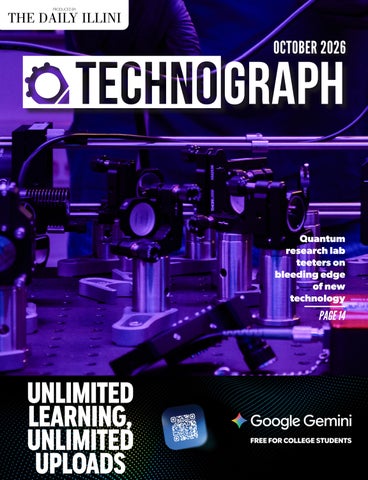
Quantum research lab teeters on bleeding edge of new technology
PAGE 14
THE DAILY ILLINI Editor’s note 1001 S. Wright St., Champaign, IL 61820 || 217-337-8300
The Daily Illini is the independent student newspaper at the University of Illinois UrbanaChampaign. The newspaper is published by the Illini Media Company. The Daily Illini does not necessarily represent, in whole or in part, the views of the University of Illinois’ administration, faculty, staff or students. All Illini Media Company and The Daily Illini’s articles, photos and graphics are the property of Illini Media Company and may not be reproduced or published without written permission from the publisher.
Contact us
Editorial Board
Visit us in the basement of the University YMCA at 1001 S. Wright St. from 9 a.m. to 5 p.m., Monday through Friday.
Editor-in-Chief: Chloe Barbarise
Front Desk: Advertising: Newsroom:
217-337-8300 217-337-8382 217-337-8345
editor@dailyillini.com
Managing Editor:
Annisyn Krebs-Carr reporting@dailyillini.com
Visual Director:
Rikkie Gunawan
Newsroom Reporting: If you have a question about a story or notice an error, email our Managing Editor at reporting@dailyillini.com. Visuals: For questions about photos, graphics or The DI’s social media, email our Visual Director at visuals@dailyillini.com. Employment: The DI’s staff are current students at the University of Illinois. Visit dailyillini.com/applyto-the-di/ to learn more about our hiring process. Tips: To submit a tip, email our News Editor at news@dailyillini.com or submit a confidential tip online at dailyillini.com/contact/. Corrections: When we make a mistake, we will acknowledge it with a correction. We strive for accuracy, so if you notice an error, please email our Editorin-Chief, Chloe Barbarise, at editor@dailyillini.com. Letters to the editor: Letters are limited to 800 words. Contributions must include the author’s name, address and phone number. University students must include their year in school and college. The DI reserves the right to edit or reject any contributions. To submit a letter, email opinions@dailyillini.com with the subject line: “Letter to the Editor.”
visuals@dailyillini.com
Special Sections Editor:
Felicity Abbott specialsections@dailyillini.com
News Editor: Avery Paterson news@dailyillini.com
Arts & Entertainment Editor: Olivia Dvorak entertainment@dailyillini.com
Sports Editor: Evy York sports@dailyillini.com
Copy Chief: Amartya Nalluri copy@dailyillini.com
Photo Editor: Sam Rink photo@dailyillini.com
Graphics Editor: Anjali Wadhwa graphics@dailyillini.com
Design Editor: Shannon Moser
editor@dailyillini.com
I
f you’ve read our past several editions — or even if you’ve only caught a glimpse of them — you’ve likely noticed a front-page banner and a back cover advertising Google Gemini’s artificial intelligence. AI continues to strengthen daily, whether through search engines, chatbots or other types. The desire of local governments to construct data centers has become the new normal. However, AI also has nuances, like its application in AI for Future Agricultural Resilience, Management, and Sustainability (page 9). Since its growth in common use, though, we — as an editorial board — disagree with that function and its everyday promotion on our paper’s pages. Yet, there is something to be said about the resilience we have as humans
design@dailyillini.com EMILY NNODI THE DAILY ILLINI
social@dailyillini.com
Video Director: Josh Fine video@dailyillini.com
Follow on Instagram @thedailyillini | @thedailyillinisports
Follow on Facebook
Advertising
2
CHLOE BARBARISE
Audience Director: Maja Nawrocka
@thedailyillini
Placing an ad: If you would like to place an ad in our next print edition or on our website, call our advertising department at 217-337-8382 or email advertise@illinimedia.com.
EDITOR-IN-CHIEF
and the wonder we create through endless exploration of topics. At the University, our strength is the people behind the research. Features throughout these pages include the Anderson Lab (14-15), Antoinette Burton (16) and Asif Wilson (19). This year’s Technograph edition also continues last year’s tradition of encompassing all forms of study at the University. By turning the next page, you’ll discover how the University plans to keep inventors in-state with the Illinois Quantum and Microelectronics Park alongside a story about biomedical research on zebrafish. The largest video board in college history and the behind-the-scenes technology can be found on page 34, preceding the research linking a possible connection between fan identification and campus belonging on page 35. To inspire your own research mind, find the return of The Daily Illini’s crossword puzzle on page 30 — just don’t use AI to solve it!
Follow on X @TheDailyIllini | @DI_Sports
Follow on TikTok
The DI || Volume 156 Issue 03 || October 2026
@thedailyillini
ON THE
COVER
Nathaniel Irwin, a graduate student studying electrical and computer engineering, works at the laser lab in the Engineering Sciences Building on Oct. 7, 2026. Members of the lab study photonic materials and their applications in quantum information research.
ISSUE 03 ISSUE
IN THIS
VOLUME 156
DESIGNERS Rikkie Gunawan Shannon Moser Ieva Darvidas Emalee Alsman Kamilla Alimzhanova
Emma Qian Santos Medina
Aliana Arifi Renata Gomes Deirdre Neale Tanvee Athavale Timothy James Sophie Cotner Haley Rael
TECHNOGRAPH Dean Bashir: IQMP will keep UI inventors
4 in state
zebrafish replace mouse 5 Can models in microbiome research? Nuclear Power Institute 6 Illinois energizes UI nuclear advancement
4
Cultivating intelligence: Inside
8 AIFARMS
Cornell collaborate on labor action 12 UI, research
13 8
Lab interprets nature to inform 13 ABC technology Quantum research lab teeters on
14 bleeding edge of new technology Burton exemplifies that 16 Antoinette ‘humanists do research,’ too professor brings justice-centered 19 UI lens to education research psychology 20 Undergraduate research programs: Bridging the gap
19
24
Space Society’s Micro-g 22 Illinois NExT team goes above and beyond Hop Lab brings music technology 24 Hip to CU youth UI professors prove dogs can lend
31 a paw for research, too
Gies Memorial Stadium’s new video
34 board packs technological punch
34
Researching connection between
35 fan identification, campus belonging The DI || October 2026
3
Dean Bashir: IQMP will keep UI inventors in state NEWS EDITOR
AVERY PATERSON averyep2@dailyillini.com
T
he University has a storied history of producing impactful inventors and creators, from the students who built the first popular graphical browser to the alum who co-founded PayPal. But while the University clearly has the infrastructure to train these changemakers, many left the state after finding success with their creations. Rashid Bashir, dean of Engineering and vice chancellor for Chicago strategic partnerships, said he is done watching Illinois inventors take their innovations to the coasts. He spoke with The Daily Illini about how the in-progress Illinois Quantum and Microelectronics Park will help the state hold on to its talent. “I keep up with many of these alums, and they say, if the opportunities were there, they would have liked to stay in Chicago, or in the state,” Bashir said. In 2024, Gov. JB Pritzker secured $500 million in funding for quantum development. Part of the funding will go to the IQMP, a facility on Chicago’s South Side that will house infrastructure for quantum development. Bashir said Pritzker’s team asked the University to lead the project, with involvement from other schools like the University of Chicago, North-
There are some problems that will take literally hundreds of years to calculate if you do it by today’s (technology); you’ll be able to do that in minutes in quantum computing. Rashid Bashir, dean of Engineering
4
JAMES LIU THE DAILY ILLINI
western University and the University of Illinois Chicago. At the IQMP, Bashir is vice chair of the Board of Managers, while professor and former associate dean of research in Engineering Harley Johnson is executive director and CEO. Bashir said many University graduates, especially in engineering and technology, move to the San Francisco Bay Area or Boston, where capital and jobs are more available. In August, CRBE found that New York City had surpassed the Bay Area to become the top city for tech jobs. The race to build an error-free quantum computer is underway worldwide, Bashir said, and the team at the IQMP hopes to make Chicago a hub for quantum development. Quantum computers use qubits, or quantum bits, instead of the bits used in other computers. Qubits expand the number of problems a computer can solve and make its problem-solving exponentially faster. Bashir said that quantum computers won’t replace regular computers, but will be used to solve advanced problems across various fields. He said they can be used for material design, drug discovery and complicated financial logistics, among other uses. “Rather than doing one calculation and a second calculation and third calculation,
The DI || Volume 156 Issue 03 || October 2026
I could do the three calculations at the same time,” Bashir said. “There are some problems that will take literally hundreds of years to calculate if you do it by today’s (technology); you’ll be able to do that in minutes in quantum computing.” Bashir said the University was chosen to lead the project due to its strength in quantum research. He said over 60 faculty members are working in quantum science across campus. “Since we are the state’s land-grant flagship, and we’re not in Chicago, there is this desire from Chicago to bring (in) UIUC, the strengths of it,” Bashir said. PsiQuantum and IBM, two of the main competitors in the quantum race, will have facilities in the IQMP. According to the IQMP website, the project will create thousands of jobs and could have an economic impact on the Chicago area totaling over $20 billion. Developers broke ground on the facility in September 2025. As of now, construction has begun on the PsiQuantum building in the park, and Bashir said the team believes it will be ready to occupy within a year. Within two years, Bashir said the team expects tenant companies to move in and work to begin at the site. “We want to keep more of what comes out of our University, or (is) connected to the University, (to) stay in the state,” Bashir said.
Can zebrafish replace mouse models in microbiome research? Here’s how UI researchers are advancing the organism’s lifespan, research potential
SENIOR NEWS REPORTER
MACY MEDENDORP macym3@dailyillini.com
M
ouse models, lab rats, even guinea pigs: For centuries, rodents have served as test subjects for scientists advancing biomedical research. But another organism may soon dethrone the rodents — and could come as a surprise. It’s the zebrafish. Zebrafish, with their horizontal blue and gold (or silver) stripes, share about 70% of their DNA with humans. That’s less than what humans have in common with mice, but zebrafish offer other benefits as research models. They cost less to buy and maintain, as well as reproduce at a much faster rate. Zebrafish can also be easily genetically modified and have transparent larvae. Lydia Okyere, a graduate student studying pathobiology, explained that transparency makes understanding the organism’s development much easier, since you can see it happen. However, zebrafish have some disadvantages for biomedical research. Okyere said that because the fish live at lower temperatures than humans, it can be difficult to get some human-affecting bacteria to grow within the zebrafish. Another problem is raising the fish to adulthood — which expands their research potential, according to Okyere. Lab organisms, like the zebrafish, need to be germ-free animals when studying microbes. That means they can’t have microorganisms in them to be sterile. Okyere explained that germ-free animals are key to understanding bacteria and other microbes’ effects without outside interference. Keeping the zebrafish germ-free poses an issue, though. They need to eat sterile food to remain germ-free, but the standard method of feeding zebrafish is live food — which is difficult to sterilize. Okyere said that this feeding also causes the fish to die before reaching adulthood, limiting their research
CLARK ANDERSON THE DAILY ILLINI
Christopher Gaulke, professor in Veterinary Medicine, and Lydia Okyere, a graduate student studying pathobiology, work with plates of microbial cultures on Oct. 21, 2026.
potential. It’s what Okyere and Christopher Gaulke, professor in Veterinary Medicine, aimed to fix in a recent study. To do so, Okyere and Gaulke researched gamma irradiation, a sterilization method that uses high-energy rays to kill microorganisms. “It’s not a new method that is out of the blue,” Okyere said. “It is something that has already been adopted, like how (researchers) were sterilizing the food for mice.” The method had not yet been adapted to create germ-free fish food at the time of the study. To make the sterile fish food Okyere and Gaulke wanted to test, Angela Di Fulvio, professor in Engineering, carried out the gamma irradiation. “When the radiation interacts with the organisms, it may cause the disruption of the double chain of the DNA,” Di Fulvio said. “Essentially, it has a killing effect.” She further explained that the radiation machine uses rods made of cobalt-60 to achieve that result. Cobalt-60 is a radioactive isotope, meaning it emits gamma rays as it decays. Di Fulvio said she did various trials with the radiation. For some, she left the fish food in the radiation chamber for about five hours, while other times, the food was in the chamber for two days.
Okyere said they tested the method and saw no harmful side effects from the newly created food. She said they supplemented the zebrafish with vitamins to help their growth. Okyere and Gaulke investigated the effects of the various gamma irradiation doses. They compared the development of the germ-free zebrafish with normal zebrafish to see if the sterilized fish food had any harmful effects. They said they fed the zebrafish the new food twice a day during their research and got the zebrafish to reach their juvenile stage. “It’s a big thing,” Okyere said. “When you get them past the larval stage, it means there is also a chance for us to get these germ-free zebrafish all the way to adult zebrafish.” Once the fish reach adulthood, they can reproduce. According to Okyere, reaching the adult stage would be a breakthrough in the field of zebrafish and microbiome research. Okyere and Gaulke said despite how exciting their current findings are, they can still build on the research. “Adulthood is sort of the ultimate goal,” Gaulke said. In the future, Okyere said she hopes to stimulate the zebrafish’s guts to better absorb nutrients and improve their growth. The DI || October 2026
5
Illinois Nuclear Power Institute energizes UI nuclear advancement STAFF WRITER
NINA ISSEL
nissel2@dailyillini.com
T
he Grainger College of Engineering took a major step in ushering in a new era of energy with the launch of its most recent affiliate, the Illinois Nuclear Power Institute, in April. According to its mission statement, the INPI strives to advance “nuclear science, engineering, technology, and policy through integrated research, education, and partnerships.” Specific interest areas include combined nuclear-renewable energy systems, nuclear licensing and policy and reactor technologies. The institute aims to help realize these initiatives through the University’s micro modular reactor project. But the Illini are no strangers to nuclear investigations and initiatives. The University owned and operated its own nuclear reactor for 38 years before TRIGA Mark II was shut down in 1998. NANO Nuclear Energy Inc.’s KRONOS MMR is scheduled to begin construction in 2027, revitalizing the historical legacy of the TRIGA reactor. “Nuclear energy has been a major part of the US energy strategy, and in particular the Illinois generation portfolio, for a long time,” wrote INPI Director and professor in Engineering Caleb Brooks in an email to The Daily Illini. Brooks wrote that the global energy market’s rapid evolution has spurred a new generation of nuclear technologies. According to him, the University aims to position itself as a leader in the field. The official budget for the project has not been made publicly available, but NANO Nuclear planned to invest $12 million in the initiative in 2025. Under Gov. JB Pritzker, Illinois also pledged $6.8 million in state funds, according to the American Nuclear Society. Fifty percent of Illinois’ electricity comes from nuclear power, according to the state’s Emergency Management Agency, and it generated more nuclear energy than any other state in 2019.
6
Despite advancements in technology over the last two decades, roughly a quarter of Americans still oppose nuclear as an energy source, according to the World Nuclear Association. Brooks wrote that stereotypes and assumptions about nuclear power can evoke catastrophizing thoughts when people are not familiar with it. “For people who don’t think about the technology all day every day, nuclear can conjure up images of nuclear weapons, Three Mile Island, Chernobyl, Fukushima, and various movies and tv shows,” Brooks wrote. “The reality is that nuclear is already much safer than practically every energy source due to the rigorous way we design and operate the technology.” He explained that passive measures, which leave no room for human error, have been impactful in transforming nuclear energy into a reliable, secure resource. “While nothing is completely risk free, nuclear has a strong case that it is safer than the energy sources it displaces,” Brooks wrote. The United States Nuclear Regulatory Commission is currently reviewing plans for the MMR and will complete its safety evaluation in Fall 2027, according to NANO Nuclear. NANO Nuclear is a publicly traded nuclear technology company and the organization behind the MMR’s design. The microreactor will be capable of producing 45 MWth and 15 MWe — or, if converted to electricity, enough energy each day to power over 30 American homes for a year. James Walker, CEO of NANO Nuclear, said the company hopes this technology can be used to benefit a wide range of communities. To do this, the University’s KRONOS MMR is being developed, in part, as a demonstration of the model’s readiness to be rolled out internationally, according to Walker. “The overall organizational mission is to provide clean base-load power across the world in diverse locations,” Walker said.
The DI || Volume 156 Issue 03 || October 2026
He explained that remote communities across the world experience massive challenges related to energy accessibility, producing an overreliance on fossil fuels. “There are places like the Philippines and Thailand that have large population centers scattered across archipelagos of islands, and it’s very difficult to get power to those communities,” Walker said. “So you end up with this system where you are trucking diesel to all of these locations, and it’s logistically complicated, it’s very expensive, and it’s very polluting.” NANO Nuclear has not expanded projects beyond U.S. borders yet, but it is working toward licensing for a KRONOS MMR project in Canada, where Walker said isolated communities experience similar energy concerns. There are also discussions about the reactor’s deployment in West Africa. According to Brooks, these nuclear
While nothing is completely risk free, nuclear has a strong case that it is safer than the energy sources it displaces. Caleb Brooks, INPI director and professor in Engineering
plants hold unique potential for resilience and infrastructure, thanks to their ability to operate for months and potentially years without major refueling or maintenance efforts. While the University lists education and research as its core missions in producing the microreactor, NANO Nuclear proposes that the energy from the reactor could be converted to electricity. In addition to aiding remote communities, the other purposes for this electricity
VISUAL CREDIT THE DAILY ILLINI
This is a caption for a photo. This caption is very good and it is able to be quite long when it spans across the entirety of the page. We can provide quite a bit of details
COURTESY OF HEATHER COIT/ILLINOIS GRAINGER ENGINEERING
Caleb Brooks, director of the Illinois Nuclear Power Institute and professor in Engineering, speaks at a drilling event for NANO Nuclear Energy Inc.’s KRONOS MMR project on Sept. 24, 2025, six months before the launch of the INPI.
include powering artificial intelligence data centers, mining projects and military installations. “What’s happened recently is that data centers have become incredibly controversial,” Walker said. “Because of their demands, they are spiking energy costs for domestic users of the electrical grid.” Walker said opposition to data centers voiced by affected communities has prompted AI companies to move toward off-the-grid energy sources like nuclear power to repair their reputations. Opposition to AI data centers and their environmental implications remains a contested issue, especially among the University student body. In late September, students across colleges gathered in a rally to protest the operation and expansion of these facilities in Champaign County. Arnav Goyal, president of the University’s ANS chapter and senior in Engineering, said it makes sense that an increase in AI has corresponded with increased interest in nuclear energy. “What we’ve seen with these centers is this push for more energy, and a lot of the companies that are pushing for more energy have also made commitments to the net-zero (initiative),”
Goyal said. “So with those two things in mind — that they need more energy and they need more clean energy — nuclear becomes a really good option.” On an atom-to-atom basis, nuclear fission of uranium generates 83 million times more energy than combustion of organic compounds — like fossil fuels — per oxygen atom, according to a Los Alamos National Laboratory study. Goyal also mentioned the financial burden of building reactors may incentivize nuclear companies to turn to the AI industry for funding. He said that large reactor projects typically demand billions in upfront investment. The licensing process alone for these plants ranges from $180 million to $240 million by design per country, according to the World Nuclear Association. “From an economics point of view, that becomes very hard when there are other, more exciting investments that will give you returns much quicker,” Goyal said. “So if a boom in AI can bring in capital to be able to build some of these smaller reactors … that’s exciting.” Goyal said ANS and other student organizations like the University’s Women in Nuclear chapter have toured the reactor site during the project’s geologi-
cal examination. “There’s a difference between seeing something in a textbook and seeing it on a whiteboard, and then seeing it in person,” Goyal said. According to Brooks, open meetings continue to be well-attended, as the INPI aims to “provide students a first hand look at the regulatory process, demystifying some of the key hurdles to deployment in the industry.” In addition to the development of the University’s MMR, which will use conventional fission technologies, Brooks said that more ambitious nuclear sectors may eventually fall under the scope of INPI as well. Nuclear fusion involves combining two atoms to produce a single, heavier nucleus, massive amounts of energy and limited nuclear waste. This technology is far from full-scale deployment, but the INPI is fostering a research environment to support both current fission and future fusion exploration, according to Brooks. “We need a lot of people to make nuclear a reality,” Goyal said. “I think that, hopefully with the institute on campus, we’ll get some of that crossed off, where we have people from all backgrounds involved.” The DI || October 2026
7
Cultivating intelligence: Inside AIFARMS STAFF WRITER
BLAKE NOBLE
benoble2@dailyillini.com
W
ith more than 40 faculty affiliates spanning many disciplines across the University, Artificial Intelligence for Future Agricultural Resilience, Management, and Sustainability — which is housed in the Center for Digital Agriculture— aims to address the major agricultural challenges of tomorrow. AIFARMS’ interdisciplinary approach to problem-solving is embedded into the structure of each project. According to AIFARMS Executive Director Jessica Wedow, each endeavor pairs an AI researcher with a domain science researcher, typically in agriculture. One of the most broadly accessible technologies AIFARMS has developed is CropWizard, an AI chatbot that allows users to ask detailed agricultural questions and receive reliable answers. According to Wedow, this project was built on extension documents from around the United States and generative AI. One of the biggest challenges Wedow described was making sure the information was precise and relevant for members of the community. “Is the information you get not
Is the information you get not only accurate, but timely and actionable? Jessica Wedow, AIFARMS executive director
8
only accurate, but timely and actionable?” Wedow said. “The answer could be very accurate, but the feasibility of that is not necessarily something that a farmer could do, so that’s a component.” On campus, Carl Bernacchi, professor in LAS, works as a plant environmental physiologist at AIFARMS. Bernacchi said he is currently examining how crops respond to climate change and other shifting growing conditions. “Part of envisioning the future of agriculture is going to be how do we adapt crops to be more resilient or to be more productive in future environments,” Bernacchi said. “One of the big ways to do that is not only looking at ways to either breed the crops or genetically modify the crops but also plant them under field conditions and understand how they’re responding to a range of conditions.” To better grasp how crops respond to these changing conditions, Bernacchi’s lab uses a range of technologies, including lidar, hyperspectral imaging, thermal imaging and a spidercam system, to generate terabytes of data per day. Hyperspectral cameras, for example, can measure up to 1,000 distinct wavebands of light. By comparison, standard smartphone cameras only track three basic colors. While the human eye is limited to visible light, these sensors scan a massive range of ultraviolet and infrared wavelengths. The resulting data creates a highly detailed reflective spectrum of vegetation, giving insights into crop health, moisture levels and plant stress. According to Bernacchi, these technologies are oftentimes less destructive to plants than traditional methods, like uprooting crops for laboratory analysis. However, with more data being collected, it becomes vital to integrate engineering and computational
The DI || Volume 156 Issue 03 || October 2026
technology into the lab by building relationships with faculty, researchers and scientists in those fields. The large volume of sensor data allows researchers to use AI for identifying patterns in how plants grow and respond to different conditions. One of the biggest challenges to Bernacchi’s research thus far has been understanding how machine learning models use data to make predictions about plant physiology. “We see that we’re able to measure hundreds, thousands, tens of thousands of plants in two hours, and we’re able to apply that to an AI model,” Bernacchi said. “But why is the model actually coming up with this really good representation of underlying physiology?” Another focus area of Bernacchi’s is understanding the limits of technology utilized in data collection to determine if they can be used in a variety of areas. For example, the Department of Defense is interested in applying these technologies to better understand agricultural terrorism events, which haven’t occurred but are now a legitimate concern. “Once we know where the limits lie, how can we then apply that to create more resilient, safe, nutritious food and other agricultural outputs that you know that society needs?” Bernacchi said. Bernacchi also noted that while this technology is currently being implemented at and around the University, which is located in one of the most agriculturally productive regions on the planet, it could be expanded to overcome challenges faced globally. One of the most vital ways to distribute these technologies is through connection to industry. Drawing on a 19-year career at John Deere, CDA Executive Director John Reid utilizes his experience to develop agricultural solutions for farmers, like smart weed management for horseradish.
WHITMAN KOSAK THE DAILY ILLINI
The Illinois Autonomous Farm’s Solinftec Solix, a solar powered autonomous agricultural robot for large-scale food production, works in a radish field on display for people interested in the farm on Oct. 8, 2026. The autonomous farm is one of AIFARMS’s research facilities.
“I was involved in deploying most of what is today’s modern precision agriculture, which was kind of evolving in John Deere during the time that I was there,” Reid said. “I got to see how that took place in the commercial world, and I learned innovation at Deere that brought together technology, marketing, business and development to try and understand opportunities.” AIFARMS researchers connect with professionals to develop practical farming solutions, like weed control for horseradish growers and computer-vision and sensing approaches for precision livestock applications, according to Reid. The research team took its work to the Horseradish Growers Conference. According to Wedow, the horseradish weeding robot project thrived because it was born directly out of community feedback. “(Farmers) were having issues with weed control,” Wedow said. “So they came to our extension partner looking for solutions there, and so this project was really brought up from the farmers themselves and the needs they saw.”
Beyond that, the AIFARMS Industry Advisory Board and other collaborations have helped researchers think about issues like deployment, scalability, economics and adoption. For instance, to understand adoption of robotic cover-crop planting technology, AIFARMS surveyed nearly 6,000 Midwestern corn farmers across 12 states. Wedow emphasized the importance of making sure research directly benefits communities outside of academia. “Some of the very foundational work might not impact the farmer for another 15 years,” Wedow said. “That’s a whole level of research that takes multiple additional years to act on to make sure that, you know, this autonomous leading robot will actually serve the needs of the farmers without causing more headaches than they already have to deal with from day to day.” However, optimizing AI for sustainability presents its own challenges, particularly given the inputs this technology requires. As AI models become more sophisticated, they often require larger amounts of data and greater computing power, raising ques-
tions about whether the benefits of these systems outweigh their resource demands. For agricultural applications, this creates the need to consider both what AI can do for farmers and the resources required to make this possible. “The question is related to the impact of data centers on society, and so you have to balance that payout with the benefit to farmers,” Reid said. “What’s promising is to look for opportunities for smaller-scale models instead of having these large models and big data centers. How do we look at more efficient models that use less energy and consume less natural resources?” For agriculture, this could mean developing models tailored to specific crops, regions or tasks, allowing researchers to use AI more efficiently without increasing the computational demands behind it. While the National Artificial Intelligence Institute’s core grant to AIFARMS is ending this year, the organization still plans to continue many of the projects in different capacities. According to Wedow, the organization is applying for other federal grants, other foundations and sources throughout the University to continue some of its work. The DI || October 2026
9
10
The DI || Volume 156 Issue 03 || October 2026
The DI || October 2026
11
UI, Cornell collaborate on labor action research STAFF WRITER
ELIZABETH BICHKOFF emb10@dailyillini.com
F
rom large union strikes to small walkouts involving just a handful of workers, the Labor Action Tracker documents strikes and protests across the United States. The research project, a collaboration between Cornell University and the University, tracks who is striking, why they are striking and how those actions unfold. Johnnie Kallas, professor in Labor and Employment Relations, said the project grew out of an increase in protests during the pandemic. Kallas said the Labor Action Tracker began as a project at Cornell — where he received his doctorate — before becoming a collaboration between Cornell and the University in 2024. The project uses an interactive map to document labor actions across the U.S., including details about employers, union or labor organization involved, number of workers, dates and workers’ demands. “We want to amplify the voices of striking workers on the picket line,” Kallas said. “That’s really the bottom line.” Kallas said the average person should be aware of labor actions because of the impact it can have on their own community. Labor disputes can feel like a foreign concept until they involve people in your own community, Kallas said, like teachers or nurses. According to Kallas, the tracker’s research has also informed efforts to pass legislation. Kallas said the Economic Policy Institute used the tracker’s data to analyze the potential cost of extending unemployment insurance to workers on strike. Project Coordinator Deepa Kylasam Iyer said the number of strikes and protests recorded each year under the Labor Action Tracker’s standards is higher than what is reported by the Bureau of Labor Statistics.
12
Kylasam Iyer said BLS only reports work stoppages involving 1,000 or more workers and excludes stoppages that occur on federal holidays and weekends. She said the vast majority of strikes involve fewer than 100 workers. Kylasam Iyer said the project’s scale is notable because of the number of graduate and undergraduate students involved. “For a project of this magnitude, the fact that it’s run by graduate students and undergraduate students is pretty amazing,” Kylasam Iyer said. Approximately 90% of the U.S. workforce is nonunion, Kallas said, yet labor actions by nonunion workers often receive less attention because they are primarily carried out by smaller groups that lack the organizational support and resources unions provide. While searching through the map’s filters, Kallas said he found his “favorite” strike, involving eight nonunion movie theater workers in Utah. He said the two-week strike is an example of the tracker’s comprehensiveness because traditional labor databases would not likely capture an action involving such a small group. “Is this extremely impactful to
The DI || Volume 156 Issue 03 || October 2026
RIKKIE GUNAWAN THE DAILY ILLINI
the economy?” Kallas said. “Maybe not, but I think it’s still important to demonstrate what workers are doing across the U.S.” Kallas said documenting smaller actions shows the different ways workers across the U.S. organize and take action. Anh Dao Truc Lam, a graduate student studying labor and employment relations who is working on the project, said most researchers target their research to one small population, while the Labor Action Tracker allows her to feel like she is contributing to society. Lam said she feels like she is making an impact and benefits from the hands-on element of the research. “It allows me to feel a sense of purpose and still interact with society rather than just locking myself in a room working on an academic paper,” Lam said. After discussing how the tracker has grown from a project he started as a graduate student, Kallas said seeing the project develop has been fulfilling. “It’s work, obviously, but in terms of all the work I have to do, it’s among my favorite for sure,” Kallas said. “It feels really rewarding to see that come to life.”
ABC Lab interprets nature to inform technology RENEE CHOE THE DAILY ILLINI
STAFF WRITER
SHALINI R. MANCHI smanchi2@dailyillini.com
R
esearchers at the Alleyne Bioinspiration Col-LAB-orative are utilizing engineering tools to study the structures found in various arthropods and use what they learn to create new technologies. The lab is a collaboration between entomologists and engineers at the University. Marianne Alleyne, principal investigator of the lab and professor in LAS, said she created the lab because of her interest in understanding how insect structures could be useful to human technology. “I always had this idea that insects can do things that would be great if we could do the same,” Alleyne said. Alleyne said that the University’s extensive engineering resources allow the lab to fabricate and model insect functions. At the same time, Alleyne said the lab’s work isn’t new. “Famously, Leonardo da Vinci was inspired by birds to come up with flying machines,” Alleyne said. “Of course, he never built them. He never was able to try them out. But this is not new thinking.” Alleyne said engineering technology has helped advance the lab’s study of insect physiology and systems. “I think we’re living at an age where we can study, we can image things,” Alleyne said. “We can study at that small, small level where insects do amazing things.” Alleyne works with four graduate students in the lab, helping them develop project ideas and resources to advance their research.
Elizabeth Bello, an alum of the entomology graduate program, worked on leafhopper brochosomes. According to Bello, brochosomes are microscopic hollow particles produced exclusively by leafhoppers. Bello said these brochosomes are waterproof, anti-reflective and help in camouflage and predator evasion. Bello said that she believes these functions can be recreated and applied by using bioinspired design. “You can apply synthetic brochosome applications to the health industry or the food industry for protective coatings, like military vehicles or anti-glare technology, camera lenses, iPhone screens,” Bello said. “The list goes on and on and on.” According to Bello, bio-inspired design provides a unique perspective on how insects, like leafhoppers, adapt to extreme conditions. “It’s focusing on insects that have been on Earth for almost 400 million years,” Bello said. “They’ve adapted to all sorts of situations and environments, and they’ve learned a lot and overcome a lot in their existence on Earth.” Yutao Chen, a graduate student studying entomology, is researching cicada wing surface structures in the lab. Chen said cicada wings contain nanostructures that resemble a microscopic bed of needles. These structures can kill bacteria. “Since bacteria is micron-sized and the nanostructures are smaller than bacteria in comparison, the bacteria’s membrane can get sheared due to the existence of these nanostructures,” Chen said. “That’s how cicada wings are actually anti-bacterial.”
Chen said she was interested in understanding these nanostructures and discovering how that knowledge can be used to design technology. She said this technology can be used to prevent problems like biofouling. “Biofouling is basically when bacteria start colonizing a surface and eventually develop into a population that causes the surface to become in need
We’re living at an age where we can study ... at that small, small level where insects do amazing things. Marianne Alleyne, professor in LAS
of cleaning,” Chen said. Typically, people use surface coatings to prevent this, but Chen said using designs inspired by nanostructures can combat bacterial buildup in the first place. Through the lab, Chen said she has been able to learn and think creatively to explore solutions to create impactful bioinspired designs. “I think you have to slowly build up your ability in that area,” Chen said. “I’m proud to say I might have built up a little bit of that ability, just trying to come up with different ways to solve the problem.” The DI || October 2026
13
Quantum research lab teeters on bleeding edge of new technology
EMILY NNODI THE DAILY ILLINI
SPECIAL SECTIONS EDITOR
FELICITY ABBOTT fabbott2@dailyillini.com
F
or some, quantum is just one of those words thrown around because it sounds smart — and no one actually knows what it means, right? Wrong. Quantum research is advancing not only at the University but also at the state level through partnerships with other universities and research labs. “(The state of) Illinois is the place to be for quantum, or at least it’s one of the main places to be for quantum … there’s a lot of energy and excitement and investment here,” said Chris Anderson, professor in Engineering. Anderson is among those delving into this hot topic at the University. As a member of the Illinois Quantum Information Science and Technology Center, Anderson said he started the Anderson Lab at the University in 2024. The lab focuses on advancing quantum infor-
14
Nathaniel Irwin, a graduate student studying electrical and computer engineering, works at the laser lab in the Engineering Sciences Building on Oct. 7, 2026. Irwin is one of the team members in the Anderson Lab that focuses on research in quantum photonics.
mation applications by researching photonic materials. While he currently focuses on quantum engineering, Anderson said he began with a physics background and was drawn to quantum due to its potential applications. “I got exposed to this world of what I would call quantum engineering of like, ‘Oh, you’re using physics, but you’re using it for a purpose,’” Anderson said. “You’re not discovering new particles. You’re building things that could impact society using physics.” Its future utilization is not entirely certain at the moment, but the list of possibilities is expansive. While there are several research avenues, Anderson said increased quantum power and information applications appeal to numerous audiences. He describes the functions as members of three distinct
The DI || Volume 156 Issue 03 || October 2026
pillars. The first of these pillars involves improving quantum computers to create a quantum internet. The second is to enable distributed quantum sensing, which would connect and improve quantum sensors, including technology like MRIs. The final pillar is quantum-secure communication, which would prevent hacking of government, medical or financial communications. “There is no way to decrypt any message sent along this quantum-encrypted channel unless you suddenly discover that Einstein was wrong,” said Santiago Vargas-Daniels, member of the Anderson Lab and a graduate student studying physics. The Anderson Lab is working on the first pillar, hoping to create what is known as the quantum internet, which, according to Vargas-Daniels, would
let quantum computers communicate even when spatially separated. To do this, the group is looking at silicon carbide, a material already commonly used in the semiconductor industry, according to Anastasiya Osher, member of the Anderson Lab and a graduate student studying materials science and engineering. By using silicon carbide and focusing on a divacancy — or the absence — of silicon and carbon atoms, the group is able to work toward their goal of building a quantum internet. The materials studied were one of the reasons that Osher said she was drawn to the Anderson Lab. “Our samples themselves are relatively simple, and I thought that was an interesting platform because I saw, ‘Oh, there could be a lot of potential here for some really cool technologies and applications,’ and to be able to do something that can make a difference in the course of five years with this, I thought it was a platform that could be rapidly developed,” Osher said. From there, when the divacancies are arranged in a particular way, they can trap electrons’ spin — or intrinsic movement. Researchers can then manipulate this energy with laser and microwave pulses applied to the spin, creating spin-photon entanglement. “The core connective tissue for us is manipulating light, like this concept of photonics and photonic circuits, and that’s because light is a really good carrier of information,” Anderson said. Two of these spin-photon entanglements can be routed together through fiber-optic cables. When this interference occurs, the photon portion becomes entangled and then collapses, creating a spin-spin state. By repeating this process, chains of entanglement can be formed, creating the ability to link spatially separated quantum computers. The hope is that this can be used to get two distant quantum computers to talk to each other, thus creating the quantum internet. This knowledge serves as a base for the lab to explore applications and optimization of this reaction. Given this,
graduate students were interested in participating in the lab because of its apparent, established work. “There was a pretty clear, I think, roadmap for where the future was, given some of the past work, and I think that was kind of a big pull,” said Nathaniel Irwin, member of the Anderson Lab and a graduate student studying electrical and computer engineering. “I was like, ‘There’s a device that could be made and could be scaled into something that would actually make the quantum internet real.’” For Vargas-Daniels, he said it wasn’t just the roadmap of research that captured his attention, but rather the end goal and the sense of having something to work toward. The eventual application of the quantum internet was enough to spark his passion, Vargas-Daniels said.
“It’s a pretty rare thing to have as broad of a and as diverse of a set of people,” Anderson said. “But there’s three departments strongly represented, and so I think that is nice from sort of a science culture point of view.” Additionally, Osher said she believes the group camaraderie stems from a shared passion for the research conducted. Although each member may have different areas of expertise, “everyone in the room is really interested and passionate about research,” according to Osher. The shared dedication not only fuels the lab’s ability to research but also to connect and mentor each other. According to Irwin, with almost as many undergraduate students as there are graduate students, there is no shortage of people to look up to. “(It) makes you better acclimat-
The core connective tissue for us is manipulating light, like this concept of photonics and photonic circuits, and that’s because light is a really good carrier of information. Chris Anderson, professor in Engineering “I get to play with lasers and cryostats and do all this cool science while still having this end goal of some technological application in mind, as opposed to just doing something for the sake of doing science,” Vargas-Daniels said. The subject matter isn’t the only thing contributing to this group’s magnetism and individuality. The Anderson Lab website details its current research but also displays images of the group hanging out socially, playing mini-golf at Parcadia, rock climbing and kayaking. Anderson attributes this group culture to a variety of factors. According to Anderson, one of the most unique is the almost even division of academic backgrounds among physics, materials science and engineering and electrical and computer engineering.
ed with your research, it’s benefiting someone else, it gives them a chance to develop these skills … I think that’s been a really good experience, and I don’t think you always see that in every lab,” Irwin said. Despite extensive research and a foundational understanding, the future of quantum technology remains somewhat unclear, even to those working with it daily. The group plans to continue researching and discovering ways to improve quantum technology, with the goal of one day reaching applications like the quantum internet. “We can make promises, but the truth is, when you’re inventing the technology, and you’re on the bleeding edge, trying to predict the future is kind of a fool’s gambit,” Vargas-Daniels said. The DI || October 2026
15
Antoinette Burton exemplifies that ‘humanists do research,’ too EDITOR-IN-CHIEF
CHLOE BARBARISE chloeb4@dailyillini.com
A
ntoinette Burton has plenty of affiliations, honors and grants under her belt. Serving as the director of the Humanities Research Institute was just one of them. For over a decade, Burton completed two five-year terms as the HRI director and spearheaded the institute’s renaming and official Illinois Board of Higher Education status. She also received funding for various programs, like the Odyssey Project and Humanities Without Walls. Now a professor in LAS, Swanlund endowed professor and professor in the Center for Advanced Study, Burton said it felt like the right moment “to pass the baton.” Her work, she said, had consisted of carrying through promises and supporting the humanities within campus and beyond. “At a very difficult moment in the history of the world, in a STEM university, increasingly and in an AI-dominated landscape, I think we’ve shown that we have a lot of conviction about what we do,” Burton said. “And that in spite of the headlines of crisis and decline, at Illinois anyway, the humanities are very vibrant.” Odyssey can be considered one example of that vibrancy, according to Burton. In its 20th year, the project provides free tuition for income-eligible adults in east central Illinois for humanities-based courses. “I just can’t tell you how amazing our Odyssey students are and how much they teach us about what’s really important when it comes to education,” Burton said. “And what incredible ambassadors and champions they are of their own community, of their own families and of the lifelong learning possibilities that the humanities can inspire.” Teresa Barnes, professor in LAS, said she met Burton around 2007 during the interview process for a position in the Department of History. Barnes said she had heard of Burton before because of their overlapping research spheres: Barnes has
16
ODESSA WINN THE DAILY ILLINI
Books line a shelf in the University archives in the Main Library on Oct. 20, 2026. Antoinette Burton’s research involves history and the humanities, which often involves accessing archival materials.
a joint appointment in history and gender and women’s studies, while Burton specializes in 19th- and 20th-century Britain with a focus on colonial India, alongside feminism and gender history. Not only did Burton materialize her vision of including arts with the humanities by bringing prize-winning poets to campus, but she also fundraised for people to take time away from teaching, according to Barnes. “Antoinette is a wonderful administrator in the sense that she always does what she says she’s going to do,” Barnes said. “And she does it on time, and she does it well, and all the T’s will be crossed, and all the I’s will be dotted.” Having stepped away from her directorial position in August, Burton said it has offered her headspace and time to tackle writing projects she’s put aside. She said she plans to dig into her role as the principal investigator of Humanities Without Walls, op-eds and the British Empire. Burton said she was no stranger to an interest in history. After her father fought in World War II, he went to college and graduate school on the GI Bill before becoming a historian, according to Burton. Referring to herself as “always pretty bookish,” Burton said she developed a similar historical passion and found her path through earning her doctorate at the University of Chicago in 1990. Twenty-five years later, Burton became the director of HRI, where she said she
The DI || Volume 156 Issue 03 || October 2026
couldn’t pinpoint one accomplishment she’s most proud of. But HRI’s crux lies with the inclusion of the “R,” and she said that’s for a reason. “I hope that anyone reading the story will remember that humanists do research,” Burton said. “It’s not the same kind of research as scientists or other practitioners on campus, but it’s really important. We produce new knowledge, and we are active on the research front. We’re not just teachers or interpreters of old knowledge. … So the humanities belong at the table at the center of campus, right next to its STEM friend.”
COURTESY OF ANTOINETTE BURTON
The DI || October 2026
17
18
The DI || Volume 156 Issue 03 || October 2026
UI professor brings justice-centered lens to education research SENIOR COPY EDITOR
ABBY TIMM
abbyt3@dailyillini.com
S
ocial science research may look different from what some people typically expect. Instead of white lab coats and chemicals, this form of research allows researchers to understand human behaviors and societal conditions. Asif Wilson, professor in Education, said he researches educational justice. Specifically, he focuses on implementing justice-based interactions between teachers and students of all grade levels. According to Wilson, these interactions involve sharing power between teachers and students and replacing punishment with repairing relationships. Wilson said he was hired at the University in 2021 — 20 years after he first started his undergraduate experience at the University. Before joining as a professor, he served as dean of instruction at Harold Washington College. According to Wilson, he also taught at the middle school level before moving to higher education. He said one of the main factors that led to his interest in educational justice was his time spent as a teacher in Chicago. “I learned about power in the classroom,” Wilson said. “There was this really important relationship that I needed to cultivate as a teacher between myself and my students, but also myself and students’ families and myself and the community surrounding the school.” Wilson said there are three main factors he considers when advancing justice in the classroom: the interactions between educators and students, the spaces they converge and create in and the curriculum educators utilize. “For me, the questions I start to ask people are, ‘Well, how do we start to move and interact with each other in ways that show we care about each other, that we love each other?’” Wil-
SIDARTH SUBRAMANIAN THE DAILY ILLINI
Asif Wilson, professor in Education, stands outside the Education Building on Oct. 14, 2026. Wilson’s research focuses on bringing educational justice to classrooms of all age levels.
son said. “‘And if we don’t love each other, how do we build towards that so we’re united?’” Wilson said his research is based on the lived experiences of people in classrooms, including his own experience as an educator and former student. He said over the past five years, he’s had the chance to interview hundreds of people and visit hundreds of places to help foster these justice-based experiences. “I’ve learned that research does not have to stay in an academic setting and that there are creative ways to share information with people who may not normally seek it out themselves,” said Aliviyah Allen, one of Wilson’s research assistants and senior in Education. In addition to his research, which intends to address systemic disparities in the classroom, Wilson said he also teaches EDUC 202: Social Justice, School and Society. The course examines the nature of justice and asks how schools function to perpetuate, or remediate, social injustice. Wilson said he aims to help students understand the systems and structures in the world. Student perspectives in Wilson’s course have added to his own understanding of edu-
cational justice, he said, including the methods behind it. “It doesn’t matter where you are — if you’re on the west side of Chicago or in Champaign — you (have) to engage people,” Wilson said. The course also provided new perspectives for students, according to Mariela Reynaga, senior in LAS. Reynaga works with Wilson as one of his research assistants and said taking Wilson’s class made her more interested in his research. “(I was surprised to see) Wilson’s emphasis on action, not just theory, when it comes to social justice,” Reynaga said. “As I was working with him, I saw that was something he really valued, so it’s something I’ve started to really care about as well.” Since joining the University, Wilson said he founded the Social Studies Network, a research resource and professional learning hub for Illinois teachers. According to Wilson, roughly 7,000 teachers in the network are aiming to advance justice in K-12 education. “Teachers want to build a more just world through their classrooms,” Wilson said. “And they so desperately are asking for the tools, the resources and the support to do that. And that’s why I take up the research that I do.” The DI || October 2026
19
Undergraduate psychology research programs: Bridging the gap STAFF WRITER
ALEX MURPHY
alexm10@dailyillini.com
D
espite the University having numerous research opportunities for undergraduates, many students may not know of their existence or how to get involved, or they may not feel that research is for them, according to Chadly Stern, professor in LAS. To fix this and close the gap in research, Stern said he and his colleagues created the Bridging Online Coursework and Research Experience program, also known as BOCARE. Stern said the motivation for BOCARE dates back to 2021, when the College of Liberal Arts & Sciences released a call for proposals that would be approved in 2022, focused on student success. The program was designed to engage underrepresented racial and ethnic minority students in University research. BOCARE’s initial findings report from 2024 found that individuals who experience marginalization are less likely to engage with and remain involved in research. Stern and other faculty in the Department of Psychology looked to address these issues by providing hands-on research experience for students in the program. The report cited that BOCARE has various benefits, including fostering relationships with research mentors, creating a space for connection and belonging and raising levels of engagement within research. “Our goal was really to expand that scope, cast a wide net and say, ‘Hey, research is for everybody,’” Stern said. Since the program began, many students have reaped its benefits. Charlie Cervenka, a graduate student studying psychology, said he participated in the program in Spring 2024. Cervenka said he first learned about BOCARE when Stern came into his freshman year psychology class to advertise the program. Stern said he occasionally visits psychology classes to give
a short pitch about BOCARE. Cervenka said there were many reasons why he first wanted to join BOCARE but that the program’s diversity was one of its main appeals. Now, looking back, Cervenka said he is grateful he participated. “What people often don’t realize is that to figure out ‘your thing,’ you have to do things,” Cervenka said. “You have to try something to figure out if you like it or not. And so BOCARE just really taught me that. You just have to try.” According to Stern, all students in BOCARE take a research methods course with him. He said the course takes many approaches, one of which is teaching students about everyday research. Stern said students are required to go through ethics training and submit an ethics protocol for their research project to the University’s Institutional Review Board. After receiving approval, he said students begin to collect data through surveys and are taught how to analyze it.
To figure out ‘your thing,’ you have to do things. You have to try something to figure out if you like it or not. ... BOCARE just really taught me that. Charlie Cervenka, graduate student studying psychology
To showcase their work, Stern said students put together a poster presentation displaying what they learned and present it at the Undergraduate Research Symposium. Over the past few years, he said students have also been able to present at the Midwestern Psychological Association Conference in Chicago. “(The MPA Conference is) a very stu-
20 The DI || Volume 156 Issue 03 || October 2026
dent-focused conference,” Stern said. “A lot of undergraduate students are there presenting their work for the first time. So it’s a really strong fit for the students to learn what a conference looks like and to really gain confidence and competencies and connect with other researchers and present on their own scholarship.” Cervenka said when he attended the conference in Chicago, he realized research was what he wanted to do professionally. “Standing there in that room full of scholars, I just felt something in me, in my heart, that I had never felt before in my entire life,” Cervenka said. “It was, ‘I am in the space I’m meant to be.’” Cervenka said he went on to work in Stern’s lab for around a year and a half. He later applied to be a doctoral student under Stern in Fall 2025 and was accepted, and now, Stern is his doctoral adviser. Stern said that, after students complete the program, he will usually ask them to come back and connect with a new cohort of students. Many students say yes, he said, because they gained so much from the program that they want to pay it forward. “We’ve worked with a lot of students who, when they start off, they’ll say, ‘I have no idea what this whole world of research is,’” Stern said. “Some of these students who didn’t even know what research was are now in competitive doctoral programs, and they’ve personally experienced that benefit.” After three years of BOCARE, Stern said he and his colleagues began to brainstorm how they could expand the program to help even more students. He said they ultimately decided to focus the program on Parkland College students transferring to the University. Hoping to address the gap in research involvement among students who transferred to the University, Stern and his team created PIONEER — the Parkland-Illinois Network for Equitable Experiences in Research program.
MAYA DE SANTIAGO MORENO THE DAILY ILLINI
After collaborating with Sarah Grison, professor of psychology at Parkland, and the LAS Office of Research, the PIONEER team secured funding from the Chancellor’s Research Program and launched in 2025. Grison said Parkland transfer students first attended an orientation to understand the research processes at the University. In the fall semester, she said they took Stern’s online research methods course before beginning to analyze novel data. PIONEER students then put together a poster presentation analyzing the data in the spring semester, which was accepted for the MPA Conference in Spring 2026, according to Grison. Like BOCARE students, PIONEER students presented their posters at the MPA Conference. Grison recalled the moment she got to see her students stand up and present their work. “I wish I could describe for you the joy on their faces of having gone through a full year of a research experience from start to finish through Professor Stern’s PIONEER program,” Grison said. “They were overwhelmed with joy at how much they had learned and the excitement of the process and being able to
We’ve worked with a lot of students who, when they start off, they’ll say, ‘I have no idea what this whole world of research is.’ Some of these students ... are now in competitive doctoral programs, and they’ve personally experienced that benefit. Chadly Stern, professor in LAS
present the poster.” After completing the PIONEER program, Grison said several students have gone on to pursue research and honors opportunities through the University’s psychology department, as well as graduate school. After seeing the tremendous impact on students in both BOCARE and PIONEER, Stern said he wanted to continue to break barriers for students. He said his latest project is the Parkland-Illinois Network for Nurturing Academic Collaborations & Learning Excellence program, or PINNACLE, which will include both Parkland and University students.
Launching in Spring 2027, Stern said PINNACLE aims to make research as accessible as possible. Taking inspiration from its predecessors, PINNACLE will cast a wider net, allowing for both University students and Parkland transfer students to participate, according to Stern. Through PINNACLE, Stern said every person who is interested in research can have the opportunity to participate. “The unique aspect of BOCARE and PIONEER, and what will be PINNACLE, is really the demystifying of academic cultures, because oftentimes, the research world can feel like a bit of an enigma,” Stern said. The DI || October 2026
21
Illinois Space Society’s Micro-g NExT team goes above and beyond neering students choose to be on the technical writing team. proewe2@dailyillini.com Saanvi Kunisetty, junior in LAS, is an astronomy and data science major. She ach year, college students was on the technical writing team and around the country design, said her background as a hard STEM build and test a device that will major helped her in the role. aid NASA’s future Artemis missions “I think that’s something I can contribas a part of the agency’s Micro-g NExT ute to really well because I’ve done a lot challenge. For the past 12 years, the Ilof scientific reading, literature review, et linois Space Society has participated in cetera,” Kunisetty said. the challenge. The team found out its proposal For the 2025-26 challenge, students qualified for the next round in January had to build an adjustable tool cart hanand began its preliminary design redle that astronauts of all heights would view, which is a video presentation. It be able to use comfortably. ISS’s team then continued to build prototypes bewas one of six selected to test its models fore building its final model. at NASA’s Neutral Buoyancy Laboratory But just a week before presenting in Houston last June. its Micro-g NExT project to NASA engiLillian Hunt, Micro-g NExT project neers, Hunt said disaster struck for the manager and junior in Engineering, team: Its ATCH broke irrevocably. said emotions were high leading up to The team had to take apart the entire the test in Houston. device to fix the issue. It ended up making the device modular, meaning it could easily be taken apart and put back together in case of another malfunction. Hunt said the mishap taught her the most important lesson from the whole experience. “Things don’t happen just because they happen,” Hunt said. “There’s not just luck that is changing things. And so SARAH SLATTERY THE DAILY ILLINI I think when Lillian Hunt, junior in Engineering, holds Illinois Space Society’s tool that it built for NASA’s Micro-g NExT’s competition on s o m e t h i n g Sept. 26, 2026, in the University’s Laboratory for Optical Physics and Engineering. Hunt served as the RSO’s project manag- goes wrong, er for the 2025-26 school year. you need to go STAFF WRITER
PENELOPE ROEWE
E
“Athena, our tool, was like my baby,” Hunt said. “I had seen this thing develop through all of its phases; I was directly responsible for overseeing the concept of it and then building the actual tool. And so I was super nervous … I was praying to literally everything that it wouldn’t break in the pool.” Over the course of a school year, ISS’s Micro-g NExT team, which is one of the RSO’s six teams, had to do a lot to ensure its ATCH was safe enough for astronauts to test. The project starts with a proposal: The design team creates a visual aid to sketch out the project, the verification team ensures that the physics behind the device is correct and the technical writing team explains why the design works. While ISS is predominantly an aerospace engineering RSO, it’s open to any major. Hunt said many of the nonengi-
22 The DI || Volume 156 Issue 03 || October 2026
the device in the buoyancy lab — essentially a giant pool. “Leading up to that was incredibly
back and look at the inherent issue behind the issue and solve that before moving on.” A select group from the Micro-g NExT team traveled to Houston, including Max Alchin, sophomore in Engineering. At the time, Alchin was a freshman but served as a project lead. Once the team got to Houston, Alchin said he was given the role of communicating with the diver as they tested
tition, but ISS ended up receiving an outreach award for its initiative to spread community awareness of NASA’s Artemis mission. The ISS team has already started planning for this year’s Micro-g NExT challenge to build a lunar multipurpose adjustable stand.
nerve-wracking,” Alchin said. “It felt like a really, really big deal, especially because of how serious everything was and knowing what they do at this facility. … It felt almost like I shouldn’t be the one to do this, but once I actually was going through it and telling (the diver) the steps to do, it was fine.” Micro-g NExT is not a compe-
The DI || October 2026
23
Hip Hop Lab brings music technology to CU youth PHOTO EDITOR
SAM RINK
serink2@dailyillini.com
T
he Dr. William Patterson Hip Hop Innovation Center was founded in 2023 as a collective home for community and University-based projects centering Hip Hop
music and engagement. After Patterson died in 2024, co-directors and professors in FAA Lamont Holden, Pete Shungu and Adam Kruse continued to develop his vision by expanding the center’s programming. “I think it’s our responsibility to both share the material resources of the University but also to engage with the
cultural resources of the community as well,” Kruse said. “Everyone has so much to offer one another.” One resource is Studio Saturdays, a free program for youth ages 8-18 held in the Hip Hop Lab, located in the basement of the Music Building. Studio Saturdays is in partnership with Street College, a nonprofit Patterson founded.
Josiah Ware, 9, uses Play-Doh to make a connection between two wires while working on a project in the lab. Activities available for children who participate in Studio Saturdays often combine tactile elements, like circuits and Legos, with music and sound design.
Demarco Diggs and Joe Meador-Gobbo, both 9, work together on a song at one of the four beatmaking stations in the lab. They use music production software to create and layer tracks using premade loops and sounds they create on their own.
Meador-Gobbo and Diggs layer premade loops to produce a track.
A rack of MIDI keyboards stands against one of the walls in the Hip Hop Lab. The classroom and lab space is full of music production and beatmaking technology available to students at the University to use during open lab hours or classes. Children who come to Studio Saturdays use the equipment with help from instructors.
Eric Brown, a graduate student studying music education, plays music and mixes tracks using the DJ equipment in the Hip Hop Lab during a Studio Saturdays session on Oct. 17, 2026. Brown is one of several graduate and undergraduate students who work in the lab, running Studio Saturdays and open lab hours for students taking beatmaking, DJing or other music production-related classes.
Nekaybaw Blunt, senior in FAA, helps Ware with his project. Blunt is studying music education with a concentration in technology and said she started working at Studio Saturdays in 2024. She said she’s seen growth from students who regularly come into the lab, with some even going on to release music they’ve created in the space. “I’ve seen some students that come up with these beautiful beats, and it’s like they’re really thinking about the way that the sounds coexist,” Blunt said. The DI || October 2026
25
Andy Ngyuen, 9, creates loops of his own vocals at a beatmaking station while instructor Dean Dominowski, freshman in FAA, watches. Dominowski is studying music technology and said he was primarily self-taught when he started learning how to make music. “I wish I had something like this when I was younger,” Dominowski said. “It’s just a really wonderful experience to be here.” Joshua Williams, a senior at Urbana High School, uses one of the beatmaking stations and a keyboard to develop melodies and synth tracks for a song he is producing. Williams said he has been producing music with his friends for a while but started coming to the lab in August. He said he likes learning to use specific pieces of equipment in the lab. “Everyone’s here to help support me,” Williams said. “They’re probably the main reason why I want to come here.”
Ware and Meador-Gobbo dance and laugh as they listen to a song they worked on together in the lab. Ware provided vocals, and Meador-Gobbo put together the track. Kruse said he hopes the children who come to Studio Saturdays get to explore and innovate hip-hop in new ways. “They are invited into something that already exists but then immediately expected to make it their own,” Kruse said. “What hip-hop has to offer young people is the valuing of being themselves and the expectation of expressing yourself fully.”
I wish I had something like this when I was younger. It’s just a really wonderful experience to be here.
Dean Dominowski, freshman in FAA
The DI || October 2026
27
28 The DI || Volume 156 Issue 03 || October 2026
The DI || October 2026
29
That’s a great idea!
1
PUZZLE DESIGNER
PEYTON WEBER
2
3
1. Common government grant for undergrads 2. Four in Roman numerals, incorrectly 3. One hundred C-notes 4. Leaping track event
6
7
8
9
15
16
17
18
19
20
21
25
10
11
12
13
27
28
29
30
53
54
22
24
23
ACROSS
DOWN
5
14
peytonw2@dailyillini.com
1. Impactful, to-the-point prose 6. Government monthly income, abbr. 9. Make __ ___ (flirt) 14. “Old MacDonald had a farm, _____” 15. The CW, previously 16. Agency of the DOD, abbr. 17. Language prefix 18. Five are used in Yahtzee 19. 365 days 20. The “L” in LED* 21. Entering the interstate 23. Genetic material on vacation, say? 25. Famous red-soled stilettos brand 27. That stupid emu in those commercials 31. Male fish-people 32. High-tech medical scanning tool* 33. Didn’t do school for a year, __ __ year 34. Dangerous bacteria occasionally in romaine lettuce 37. Red-billed hornbill from “The Lion King” 38. Park your keister 39. Related to keyboards 41. “Keep it” in publishing lingo 43. Tiny integrated circuit* 46. Is stumped 48. See 30-Down 51. “____ and Punishment” 55. Counterpart to prose 56. Mine yield 57. Target 58. Where a British person might be in the afternoon 59. Dennings of “Two Broke Girls” 60. Brag, or be boastful 61. The “D” in LED* 62. ___-mo (replay effect) 63. Where one would watch college football
4
26
31
32 34
33
35
36
38
39 42
41
46 48
49
43
44
40
45
47
50
51
55
56
57
58
59
60
61
62
63
5. Most popular video-sharing platform* 6. A numbers game without any math 7. Small harpsichord 8. Resistance forces of a fluid to change motion states 9. End of famous “Gone with the Wind” quote 10. Online payment service* 11. “Whose woods these ___ ___ think...” Frost quote 12. Length of a bridge 13. Famous puppeteer Tony 22. “When you’re ready,” in text lingo 24. Less than some 25. Real, actual 26. To give a speech 28. Singer-songwriter Coppola 29. 1960s USPS mascot 30. With 48-Across, what the founders of the starred clue’s answers have in common 31. Catholic church service 35. Type of military, two-rotor helicopters 36. Retired Apple music-listening device line
30 The DI || Volume 156 Issue 03 || October 2026
37
52
37. Historic 1930s American female multisport athlete 40. Where the Wampa took Luke in “Star Wars: The Empire Strikes Back” 42. What most crosswords are 43. Rocky Mountain Time Zone in the winter, abbr. 44. Cattle pen 45. “___ ___ the occasion” 47. Handles: Lat. 48. Apple tablet line 49. What the lazy animals say 50. President’s rejecting power 52. “It’s my turn!” 53. Aimee, American pop singer 54. Caesar’s famous last words
Solve more puzzles online!
UI professors prove dogs can lend a paw for research, too MANAGING EDITOR
ANNISYN KREBS-CARR annisyn2@dailyillini.com
T
he University is no stranger to research. With a long history of innovation and Research Park right on campus, it’s almost impossible to overlook the contributions of its faculty. But what about the contributions of furry friends? Whether for conservation work, personal side projects or discovering cancer treatments, some professors at the University use companion animals as part of their research. Timothy Fan is a professor in Veterinary Medicine and evaluates potential new cancer therapies for humans using dogs and cats. Fan said these therapies are either anticancer drugs or new types of immunotherapies that stimulate the immune system to fight cancer. He evaluates whether these methods are effective in slowing or fighting cancers in dogs and cats with similar tumors that affect people, according to Fan. “The ability to provide potential hope for finding a new treatment that is better for dogs and cats with cancer, that … really keeps me going and drives me,” Fan said. Pet owners whose dog or cat receives a cancer diagnosis will contact him after consulting with their vet to explore other treatment options, Fan said. He said the clinical trials can take anywhere from several months to three years, but he’s had patients enrolled whom he’s continued to follow even after the trial is finished. “Those are obviously the great stories we’d like to have,” Fan said. “We’d like our patients to really benefit from the therapies that we evaluate, and we can follow them long term and almost consider them to be cured of their cancer.” But companion animals serve purposes beyond just fighting cancer. They can also partake in conservation projects — or simply be part of your hobbies.
ODESSA WINN THE DAILY ILLINI
Luke Sherrill, professor in LAS, and his German shepherd-Belgian Malinois mix, Mario, kneel in front of a tree at Illini Grove on Oct. 2, 2026. Sherrill has trained Mario in scent detection.
Luke Sherrill is a professor in LAS, but outside of his faculty position, he said he spends much of his time with his dog, Mario. Sherrill said Mario is a mix between a German shepherd and Belgian Malinois, both high-maintenance breeds. According to Sherrill, Mario is trained to find endangered bat and turtle species and hunt for mushrooms. “I usually do give a disclaimer to people: If you don’t have a tremendous amount of time, a Malinois is not probably a dog for you,” Sherrill said. “You got to give them something to do all the time. I say it’s like having a pet monkey and a toddler at home all the time.” Sherrill said he’s taught classes on animal and human behavior, and though his research with Mario is not related to his faculty position, his psychology background gave him an advantage in training. But Sherrill said that you don’t need a psychology degree to train your dog. He said he started training Mario to find bats in 2024 using scent detection, and it only took a few months of Pavlovian conditioning. “They’re animals with a great capacity for learning and doing things,” Sherrill said. “You just have to be con-
sistent about it.” According to Sherrill, hunting for mushrooms is something he likes to do for fun, and he wanted to train Mario to help him. But finding endangered species like bats or turtles is a job for Sherrill, and he said he is employed by Western EcoSystems Technology to pinpoint habitat distribution. Worldwide, 87 bat species are endangered, and 25 are critically endangered. Mario is trained that when he comes across something, he’ll lie down and look at Sherrill, he said. After that, Sherrill said he’ll take notes on the species, its age and the location. Sherrill said the goal is to identify habitat distribution, which is then published by the Illinois Department of Natural Resources and the United States Department of Energy. According to Sherrill, this information is important to better understand how ecosystems change long-term. Sherrill said he encourages other people to train and cognitively challenge their dog, even if it’s not for research. “Give them something to do besides just sit at home and stare at the wall,” Sherrill said. “If you can work with your dog, I think they can help you out emotionally and with your day-to-day activities.” The DI || October 2026
31
32 The DI || Volume 156 Issue 03 || October 2026
The DI || October 2026
33
Gies Memorial Stadium’s new video board packs technological punch SENIOR SPORTS REPORTER
BEN SOMERVILLE bens4@dailyillini.com
G
ies Memorial Stadium’s new video board — the largest in college football — made plenty of headlines this year. The technology behind the board is just as impressive as its size. The University announced plans to build the new video board in January. The board measures approximately 70 feet high by 250 feet wide, totaling over 17,000 square feet. That makes it just under 14,000 square feet bigger than the previous video board. Jeremy Lomax, senior project manager at Anthony James Partners, the University’s technology consultant for the project, wrote to The Daily Illini that the new video board requires more electrical capacity than the old video board. Lomax wrote that the new board uses over 3,200 amps, compared to the old board’s 800 amps, and displays over 16 million pixels. Brock Wallen, senior project manager at Daktronics, said it all started with the planning stage. Wallen said the manufacturer and installer of the video board, Daktronics, took stock of the site and planned how to install the structure for the board. He said since there’s not much space behind the south side of the stadium, it required careful planning. “As far as the design ahead of time, making sure everything fit, how deep we had to go with the footings, how the structure was going to work with matching up to the existing structure,” Wallen said. “There was a lot of work that was done ahead of time to make sure that everything would work out in the end.” According to Lomax, the stadium’s existing structure had to be considered when designing the new board. Lomax wrote that the engineering included strengthening some of the preexisting concrete. Once the frame was complete, Wallen said the work on the screen itself began. He said the video board consists
of 315 panels, each measuring roughly 8 feet by 8 feet, and those panels are made up of smaller LED modules. Each module is a square tile, which Wallen said is stacked together alongside others within each panel to form the screen. In total, Wallen said the video board contains 10,070 modules. To put this in perspective, he said it would take roughly 1,621 60-inch TVs to cover the entire screen. “It really gives you an idea of the size of it,” said Ryan Kuzman, a regional salesperson at Daktronics. “When you see those 8-foot sections go in, and they get smaller and smaller as they get higher and higher in the air, you start to figure out (that) this is a massive display.” Wallen said multiple people work together to operate the over 17,000-square-foot video board. He said one team operates in a control room located on the stadium’s eighth f loor, where they manage what appears on the board during games, including hype videos, statistics and scores. Bielfeldt Athletics Administration
Building houses a second control room for the board, which was updated in 2025 prior to its construction. According to Wallen and Kuzman, the video board can show videos across the entire board, which is utilized before games for hype videos. However, they said the production team splits the screen into three sections during the game. For maintenance, Kuzman said Daktronics provides spare materials in case of any problems. “Obviously, we want the display to operate 100% of the time, but it’s an electronics piece of equipment,” Kuzman said. “So we know there are going to be things that need to be repaired or things that need to be replaced.” Wallen said the video board has several interior catwalks, with ladders and stairs that allow technicians to access any part of the screen. Although the board is still new, Kuzman said that a field service technician based near Champaign can be on site “in a moment’s notice” if maintenance is needed.
ADAM EDWARDS THE DAILY ILLINI
The video board control room inside Bielfeldt Athletics Administration Building, shown on Oct. 8, 2026, was built in 2025 in anticipation of the new over 17,000-square-foot video board at Gies Memorial Stadium.
34 The DI || Volume 156 Issue 03 || October 2026
SAM RINK THE DAILY ILLINI
The Illinois student section shakes their keys at the start of Illinois’ Homecoming football game versus Purdue on Oct. 3, 2026.
Researching connection between fan identification, campus belonging SENIOR ARTS & ENTERTAINMENT REPORTER
SONALI KHANNA sonalik4@dailyillini.com
S
ports are no small deal at the University. From tailgates to gameday cheers to roaring student sections, the University’s fan spirit is alive and well. Being one among many cheering for those wearing orange and blue may have a greater impact on one’s sense of belonging than expected. That’s what Reed Haas, a graduate student studying statistics and data science, said he hopes to uncover in the long run. According to Haas, his work currently focuses on the differences in fan behavior in college athletics and professional athletics. However, he said, eventually, the study will aim to determine any relationship between sports fan identification and a sense of belonging in students on campus. “We have those celebrations for first downs, you have the marching bands, you go to basketball games, you kind of get the same vibe,” Haas said. “I feel like there’s a much bigger … (reliance) on those traditions, especially with people your same age at these games. I wanted to see … does us partaking in these traditions altogether actually differ in how we root for our team compared to just regular sports fans?”
V.N. Vimal Rao, professor in LAS, has mentored Haas throughout this project. He said he believes the University is an ideal place to conduct this research, due to its strong athletic presence and fanbase. “I did my undergrad here back in the day, and I’ve had a lot of fun going to all these sporting events as well,” Rao said. “I still show up as a professor now, but I’m not sitting in Block I anymore. It makes you proud almost, and it’s a lot of fun.” To conduct this study, Haas said he sent a survey to students enrolled in statistics courses in the fall and spring. According to Haas, the survey prompted students to rate how strongly they agree with statements like: “I sometimes watch sports in the middle of class or lecture,” “I’ll put off homework if my favorite team is playing” and “I bond well with other people in my class over a shared sports fan identification.” Haas said the survey answers indicated no difference — so the study shifted gears yet again. This time, it’s to see if the survey questions function in a valid way or not. As per Haas, he is now analyzing how different demographics responded to the survey, ensuring that all questions behave the same way across groups. For instance, for a question like “I often put off homework to watch my sports team,” Haas said it’s important to con-
sider confounding variables. “My thought is that I’m assuming that this is measuring sports fan identification or how strongly you are a sports fan because you’re willing to put off your homework, but maybe it’s measuring something else,” Haas said. “Maybe it’s measuring just procrastination or something completely different.” To verify all survey questions are properly measuring what Haas wants to measure, he said he uses a statistical method called item response theory. The ultimate goal for this research would be to spread it to other universities, according to Rao, so they can use its results to better advise students on how to feel more in tune with their campus. Rao said he believes that when the study meets its eventual goal, its results could greatly aid students. He connected students feeling accepted to lower dropout rates, higher retention rates and better grades. “At the end of the day, it’s about helping students,” Rao said. “So the sports fan identification on its own, to me, isn’t as important as the fact that this might actually help students feel a part of our community. … I think that this ultimately is going to be a part of the activities that we, as the faculty and staff of a university, use to be able to best support our students, and that is our job.” The DI || October 2026
35