


1001 S. Wright St., Champaign, IL 61820 || 217-337-8300
The Daily Illini is the independent student newspaper at the University of Illinois UrbanaChampaign. The newspaper is published by the Illini Media Company. The Daily Illini does not necessarily represent, in whole or in part, the views of the University of Illinois’ administration, faculty, staff or students.
All Illini Media Company and The Daily Illini’s articles, photos and graphics are the property of Illini Media Company and may not be reproduced or published without written permission from the publisher.
Visit us in the basement of the University YMCA at 1001 S. Wright St. from 9 a.m. to 5 p.m., Monday through Friday.
Front Desk: 217-337-8300
Advertising: 217-337-8382
Newsroom: 217-337-8345
Reporting: If you have a question about a story or notice an error, email our Managing Editor at reporting@dailyillini.com
Visuals: For questions about photos, graphics or The DI’s social media, email our Visual Director at visuals@dailyillini.com
Employment: The DI’s staff are current students at the University of Illinois. Visit dailyillini.com/applyto-the-di/ to learn more about our hiring process.
Tips: To submit a tip, email our News Editor at news@dailyillini.com or submit a confidential tip online at dailyillini.com/contact/
Corrections: When we make a mistake, we will acknowledge it with a correction. We strive for accuracy, so if you notice an error, please email our Editorin-Chief, Chloe Barbarise, at editor@dailyillini.com
Letters to the editor: Letters are limited to 800 words. Contributions must include the author’s name, address and phone number. University students must include their year in school and college. The DI reserves the right to edit or reject any contributions. To submit a letter, email opinions@dailyillini.com with the subject line: “Letter to the Editor.”
Placing an ad: If you would like to place an ad in our next print edition or on our website, call our advertising department at 217-337-8382 or email advertise@illinimedia.com
Editor-in-Chief: Chloe Barbarise editor@dailyillini.com
Managing Editor: Annisyn Krebs-Carr reporting@dailyillini.com
Visual Director: Rikkie Gunawan visuals@dailyillini.com
Special Sections Editor: Anna Ceja specialsections@dailyillini.com
News Editor: Avery Paterson news@dailyillini.com
Arts & Entertainment Editor: Olivia Dvorak entertainment@dailyillini.com
Sports Editor: Evy York sports@dailyillini.com
Copy Chief: Amartya Nalluri copy@dailyillini.com
Photo Editor: Sam Rink photo@dailyillini.com
Graphics Editor: Anjali Wadhwa graphics@dailyillini.com
Design Editor: Shannon Moser design@dailyillini.com
Audience Director: Maja Nawrocka social@dailyillini.com
Video Director: Josh Fine video@dailyillini.com


Follow on Instagram @thedailyillini | @thedailyillinisports
Follow on Facebook @thedailyillini
Follow on X @TheDailyIllini | @DI_Sports
Follow on TikTok @thedailyillini
EDITOR-IN-CHIEF
Attending the University wasn’t my first choice. That was for one reason: its considerable size made me feel inconsequential, like I’d be long forgotten before I even had the chance to make a name for myself.
I bet a handful of students feel similarly, especially freshmen caught between balancing who they are and who they want to become. How can we assimilate into the University’s culture, one that boasts over 60,000 unfamiliar faces in uncharted territory?
Yet, I’m not afraid to concede to this ant-like feeling any longer. I find myself actually valuing this sentiment to this day because I have over 250 Daily Illini staff members who surround me — and are quite remarkable individuals.
It’s nice to feel small. It’s also nice to know you matter. However, I can honestly say that what used to define you likely no longer will, and what you do now holds more weight than ever before.
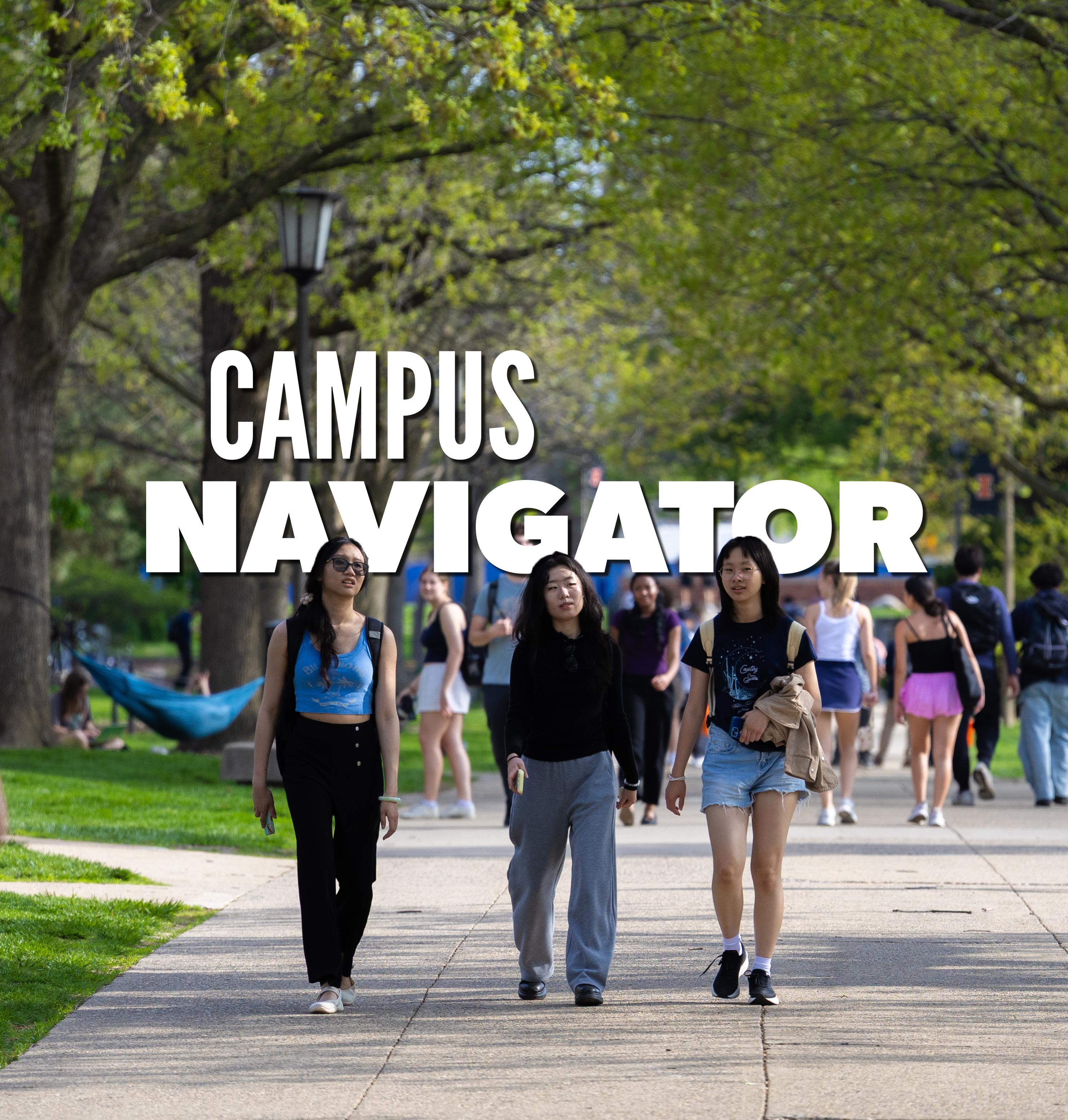
Here at The DI, we’ve compiled an edition focused on locating opportunities throughout our expansive University and seizing them, whether academically, socially or athletically. Campus Navigator is a resource for all students.
Page 8 explores the services offered to first-generation students, and page 24 goes beyond Campustown’s boundaries to identify new businesses in Champaign-Urbana. There are also ways to restart your athletic career at the University (see pages 26-27). Or if you want to maintain the endless connections you’ll make here, learn how to do so — spoiler alert, by saying “Hi” — on page 34.
The DI navigated through campus so you don’t have to, or at least aren’t alone in doing so.
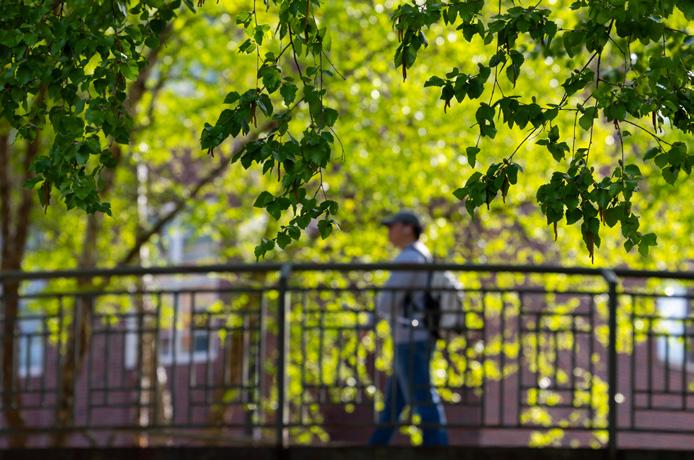
Students, faculty and community members walk on campus sidewalks on April 22. The concrete pathways cross over quads and parks and line the streets of Champaign-Urbana, allowing hundreds of pedestrians to navigate campus every day.

Shannon Moser
Kamilla Alimzhanova
Emalee Alsman
Aliana Arifi
Tanvee Athavale



Abby Jacobs
Santos Medina
Hadyn Nuttall
Cultural centers create diverse spaces for comfort
IDEA Lab offers collaborative spaces, innovative technology
Campus resources support first-generation students
UI students connect with culture through language

Experience CU ramps up fight for accessibility
UI clinics unite to support mental health in CU
What’s in a name? Stories behind UI residence halls
Discovering the ARC’s hidden gems
CU businesses create space for everyone
Athletics on students’ terms
The time to buy is now for Illinois
Athletics
Opinion | Cut the crap. Say ‘Hi.’
Passion drives RSO leaders to create change 4 5 6 8 9 14 16 18 20 24 26 28 33 34 35
Opinion | Are cold deli sandwiches a ‘drunk food?’
Haley Rael 28 24 18 16 14 9
Opinion | ‘Finding yourself’ in college is a myth
STAFF WRITER
QYLER BOWIE qbowie2@dailyillini.com
Being away from home can be daunting, especially for freshmen. Luckily, the cultural centers are here to provide a home away from home.
Here on campus, Nevada Street acts as a cultural melting pot. There reside four of the five cultural centers: the Asian American Cultural Center, the Bruce D. Nesbitt African American Cultural Center, La Casa Cultural Latina and the Native American House.
The fifth, Salaam Middle East & North Africa Cultural Center, is on South Gregory Street. It’s the newest of the cultural centers and was established in 2022 after students advocated for a center for Middle Eastern and North African students.
After pushing to secure a place on campus, the Salaam MENA Cultural Center is here to stay.
Although each cultural center caters to a different demographic, they have two things in common. For one, all cultural centers aim to provide a safe place for students.
At La Casa, those in need are accepted with a door that reads “Refugees Welcome.”
The cultural centers can also offer a sense of familiarity for homesick students. Instead of visiting home, one might consider visiting the cultural centers instead. This way, students are surrounded by peers who understand their background a little better.
Those involved with the cultural centers also share the experience of being a minority on a predominantly white campus.
Through that commonality, the cultural centers recently collaborated with the Illinois Student Council to present the first Crossroads of Cultures event. Kanittha Fay, program coordinator at AACC, said bringing the cultural centers closer together was beneficial.
“We need all of us to share our cul-
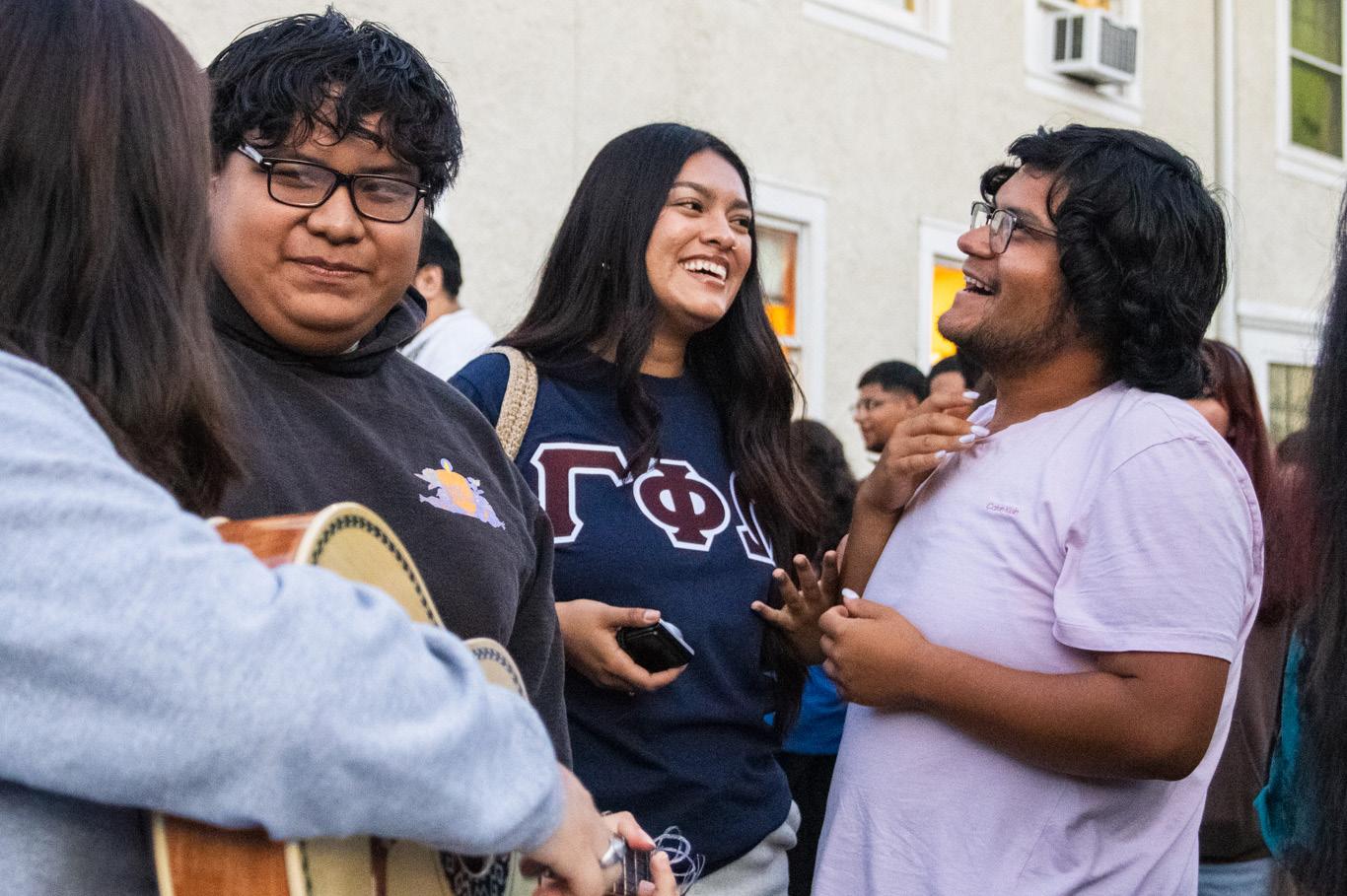
ture so we can be less afraid of the shadows,” Fay said.
Fay recalled a time when her students were in the “shadows” and scared to speak up. During the COVID-19 pandemic, a time with a surge of Asian hate, her students approached her with concerns about anti-Asian rhetoric and visions of changes they wanted to see on and around campus.
Conversations like that can be hard, but the cultural centers are there to offer support. Alena Lu, AACC arts and culture intern and freshman in Business, said she appreciates the space the AACC offers to talk about all topics, both easy and hard.
“It’s having a space for people to come in and kind of communicate and share ideas,” Lu said.
Lu especially appreciates the AACC’s diversity, considering she comes from a small town with little representation.
She said those two factors, along with the longing for togetherness, drew her in.
“I didn’t see a lot of representation in high school, but coming to U of I, that
was something I was initially interested in, just finding community here,” Lu said. “AACC stood out specifically because it’s a very dedicated space for that kind of connection to happen and for those conversations that happen. It felt a little bit more intentional for me, rather than my other moments on campus.”
For Olasheni Giwa, freshman in Media, her cousin initially got her interested in BNAACC. After seeing all it had to offer, she started frequenting the center. Giwa has visited BNAACC daily for almost a year and said that, similar to the AACC, it radiates a sense of belonging.
“My favorite part of BNAACC would probably have to be the shared sense of community,” Giwa said. “So whenever you walk in, it feels so familiar. Everyone is open, everyone is friendly.”
Whether someone is looking for a community, a snack or a place to relax, the cultural centers have numerous resources to meet their needs.
Fay wishes she could tell all students one thing that applies to all cultural houses.
“Please, come visit,” Fay said.
STAFF WRITER
PENELOPE ROEWE proewe2@dailyillini.com
With over 1,000 registered student organizations on campus, there is a place for everybody. Because of that, every successful RSO requires a strong leadership foundation.
RSOs across campus vary greatly, and each leadership board has its own goals. However, they all have one thing in common: passion.
Emilia Mancero, senior in Media, is president of the Illinois-Coalition Assisting Undocumented Students’ Education.
“(Leaders) definitely have to have a lot of heart,” Mancero said. “I notice my strongest leaders in my team are definitely people who have the passion for it. Because when you lack the passion for something, you start to let things slip away.”
I-CAUSE educates students about undocumented immigrants and empowers them to ignite campus change. It also hosts workshops for other RSOs and has organized protests.
Mancero manages the communication between all the committees in I-CAUSE and leads each general meeting. She joined her freshman year because of her personal relationship with the mission.
“I have an immigrant family, so I’ve always been really passionate about these things because it affects a lot of the people that I care about,” Mancero said. “So I really wanted to find a space on campus to let me do that … It makes me feel a little less helpless with everything going on in the world.”
Despite the amount of passion a leader may have, leadership does not come without its challenges. Membership attendance, the University’s policies and budgeting are common struggles among RSO leaders.
Emily Panczyk, senior in LAS, has been president of the Illinois chapter of 4 Paws for Ability for the past two years.


The national 501(c)(3) nonprofit assists children, adults and veterans with disabilities in getting service dogs. The campus RSO provides training and education to members on how to take care of these animals.
Panczyk has a number of responsibilities in the club: leading meetings of over 150 general members, organizing collaborations with other RSOs and making sure members are taking proper care of the dogs, just to name a few. Though her responsibilities stack high, she is able to rely on her vice president, Kadence Perry, graduate student studying agricultural leadership, education and communication.
“I know if I need help, I can always reach out to her, and if she needs help, she’s always reaching out to me,” Panczyk said. “So it’s a really nice balance that way.”
But even when things get difficult, the community she’s built through the RSO is what drives her to keep going.
“It’s just been such a rewarding experience for me,” Panczyk said. “We’ve created such an awesome community of people within the exec board and our general members and primaries. Every-
one is very tight-knit. It’s a very welcoming community, and we’re all doing it for a really great cause.”
A welcoming RSO environment can also encourage members to become strong future leaders. Brynn Arnott, junior in LAS and ACES, described herself as a shy freshman before joining the University’s National Alliance on Mental Illness chapter. Two years later, she became the RSO’s president.
“(NAMI members) adopted me,” Arnott said. “They were like, ‘No, you have a place here’ … I really wanted to increase the club, so I joined leadership. And then just what kept me going is the people. Everyone’s just so nice and understanding.”
Arnott believes that any student, with the right amount of passion, can become a leader on campus.
“If you don’t think you can be a leader, you really do learn,” Arnott said. “Just make sure you’re surrounded by people that really do help instead of harm and have a shared goal or shared mission. It’s a very rewarding experience. You learn a lot about yourself, and then you kind of naturally grow into that leader role without realizing it.”
SENIOR ARTS & ENTERTAINMENT REPORTER
JORDAN FIKIS jfikis2@dailyillini.com
Students often spend time in Grainger Engineering Library cramming for exams and finishing homework. But tucked in the corner of Grainger’s basement is the Innovation and Design in Engineering and the Arts Lab — a space for creation, teamwork and fun.
Despite the name, the IDEA Lab is open to all majors. Anyone with an i-card can access the lab seven days a week from 1-10 p.m.
Stuart Turner, IDEA Lab coordinator, said that a common misconception about the IDEA Lab is that it is only for engineers but assured that anyone can try it out.
“It does not matter what your major is, we are welcome and open for anybody that is interested to come in, even if it’s just to take a peek,” Turner said. “Try out a headset, rent it out for a week, play around with it. There’s no cost. There’s really no downside to just giving it a shot.”
According to Turner, the lab has three pillars of service it provides. The first pillar is loanable technology, including virtual reality headsets and drawing tablets. The second is lab resources, like study rooms, and the third is the makerspace 3D printing resources.
Celenia Graves, experimental learning & engagement librarian, said they have enjoyed exploring the endless possibilities these lab resources provide. Using the lab’s 360 cameras and drawing tablets, Graves loves seeing what visitors can create.
Above all, Graves said the VR technology has been their favorite to engage with and watch others explore.
“Last year, there was a very interesting presentation from someone who was using VR for preparation for emergency situations, which I found fascinating,” Graves said. “So VR for me is something that I find really exciting.”
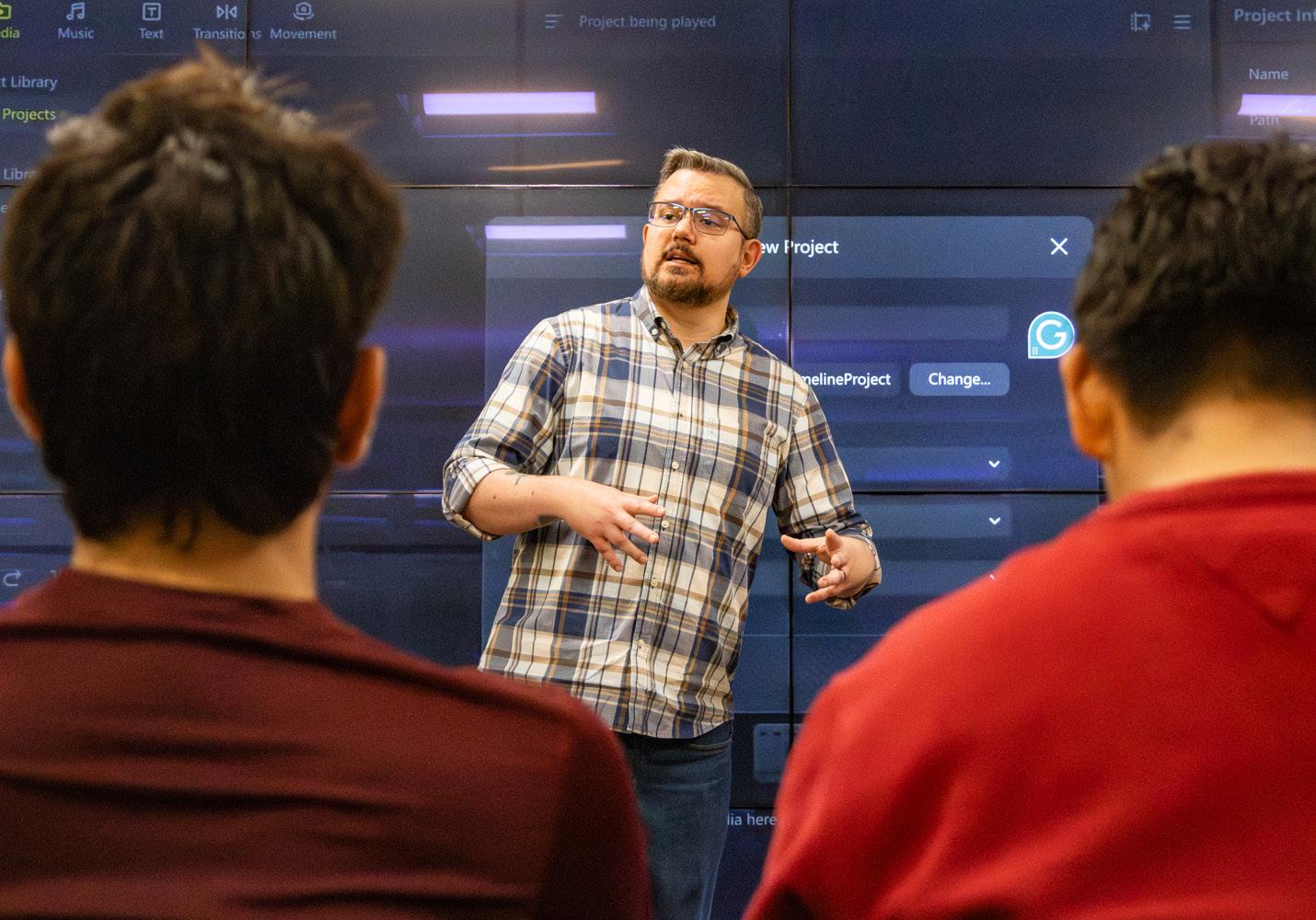
The VR resources have proved to be especially helpful for Christopher Ball, professor in Media. Ball uses the IDEA Lab to lead his class, JOUR 430: Augmented and Virtual Reality.
The lab’s VR equipment aids Ball in teaching students about how technologies may shape the journalism field in the future. Ball said he is constantly adapting his course to explore new experiences, which is where the IDEA Lab team has been most influential.
“The IDEA Lab has been instrumental, because it’s not just a place, and it’s not just the equipment,” Ball said. “It’s the people that are there that help me pull this off every semester, and that’s where it’s really been invaluable to me and my students.”
While the lab’s resources can be used for homework and classes, they also offer equipment for entertainment purposes. According to Turner, the lab now offers gaming consoles like Xbox, Nintendo Switch and PlayStation.
There are currently RSOs that use the equipment for gaming and
entertainment purposes, but Turner also hopes to create a third space within the lab for people to destress from college and spend time with their friends.
“We do know that we are in the same building as one of the most stressful rooms on campus ... the Computer-Based Testing Facility, which I’m sure everybody has their horror stories about,” Turner said. “Having that sort of counterbalance at the other side of the building where you can then come and unwind, I feel like that’s very valuable.”
When Ball was in college, he said he and his friends were forced to create their own third spaces to hang out. He wishes he had a space like the IDEA Lab then.
Now, Ball said he hopes students will recognize the resources the lab provides and use them to their advantage.
“You could also book The IDEA Lab to play some games with some friends one night, and I think that is also valuable,” Ball said. “That’s the kind of thing that makes college really worth it, right? When you get to try out new things, have fun and make friends.”
STAFF WRITER
TABITHA SMITH tlsmith3@dailyillini.com
Being a first-generation student means more than just earning a degree. It also entails navigating unfamiliarity without a guidebook.
More than 8,500 undergraduate students at the University identify as first-generation, making up over 20% of the undergraduate population. There is a wide variety of campus resources to help them navigate academic, social and professional challenges.
Eleeana Aranda, sophomore in LAS, recalled the uneasiness she felt when she first arrived on campus as a first-generation student.
“It was very overwhelming coming to university and being the first one to move away to college, even if it is in the same state,” Aranda said. “No one has done that in my family.”
Aranda said she needed assistance with how to balance scholarships, courses and campus life. Her academic adviser is her favorite resource at the University and has connected her with career guidance.
Additionally, FOCUS — Fostering Opportunity, Community, and Unwavering Support — offers a semester-long
program for postgraduate career development aimed at closing the first-generation gap.
About 40 undergraduate students are selected each semester out of a pool of applicants. FOCUS scholars gain access to workshops, professional networks and financial support to help them in their college journey.
Finding a sense of community on such a large campus can be equally important as academic guidance. The First Gen Directory is an online tool designed to connect students with staff, faculty, alumni and current students who identify as first-generation.
One person listed in the directory is Amie Baumeister, assistant director of gender equity at the Women’s Resources Center. As a first-generation student and University alum, she works closely with other first-generation students as a resource for them.
“Build your connections and create a community of care,” Baumeister said as advice for first-generation students. “Getting involved is the best thing (I’ve) ever (done), so find a community to invest in, and if you want to switch that community, that’s fine, too. I think it’s so important to just get connected.”
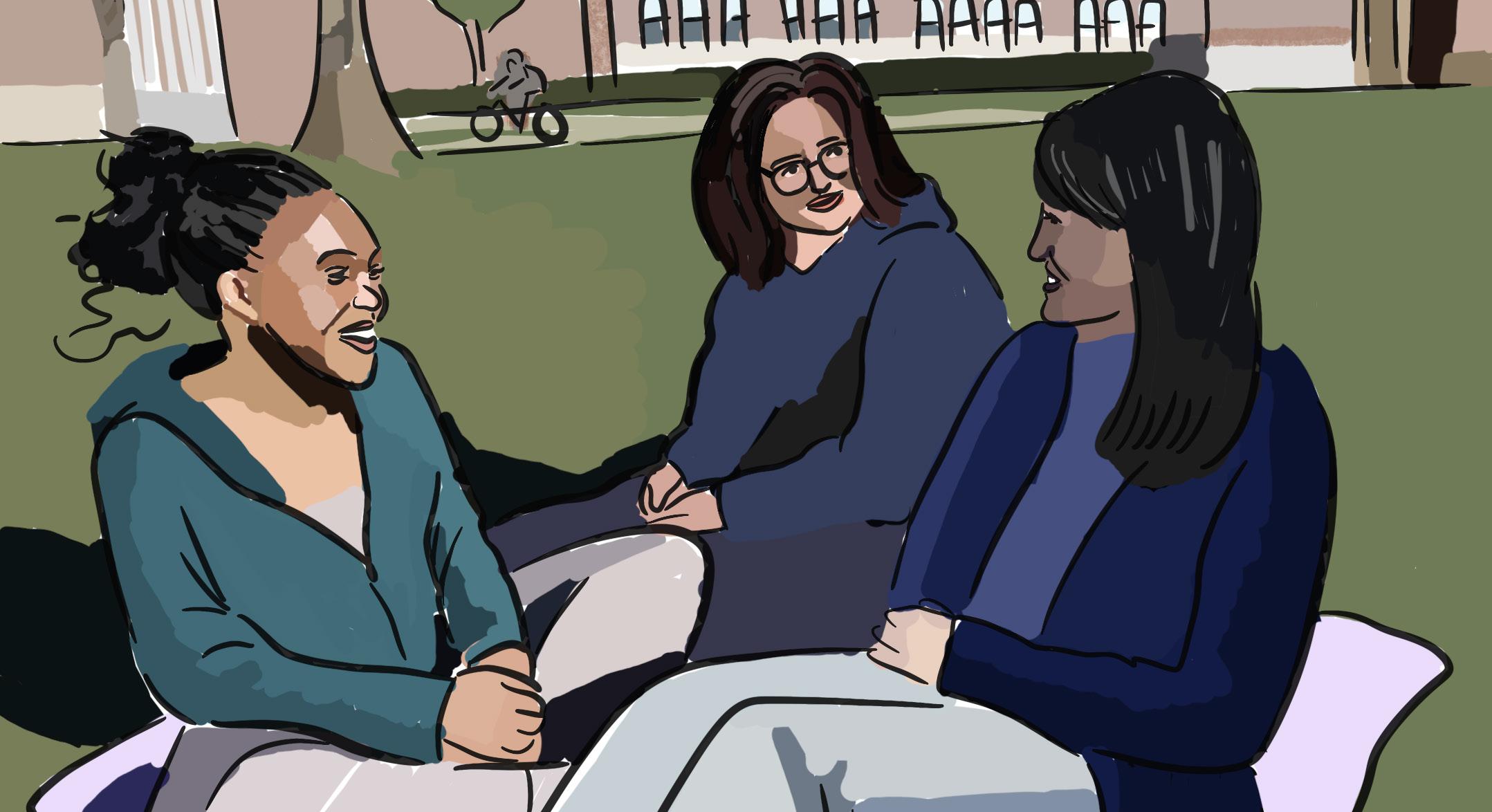
Keemia Zandiani, junior in AHS, also discussed how important it was for her to build a community of support. She said she had to navigate most of college herself, especially when it came to networking and finding graduate programs.
Zandiani joined the University’s Pre-Physician Assistant Club and met friends there who have helped her.
Pre-PA has opened doors to career resources like panels and professional headshots. Zandiani said the club has also helped her connect with people working in or hoping to work in her future field.
“My mom didn’t know much about the education system or any graduate programs, so I definitely had to research to figure everything out,” Zandiani said. “(Pre-PA club is) really helpful, kind and supportive to always guide me through everything I’ve needed.”
In addition to programs and people, The Jeffries Center is a physical space that first-generation students can rely on. It offers numerous events, including study sessions and mentoring.
“I would encourage everyone to go to The Jeffries Center,” Baumeister said. “One thing that I think a lot of students don’t realize about Illinois is that not only do we want to get you connected to people and networks, but we also want to share physical resources.”
Another space is located on the fourth floor of the Turner Student Services Building. First-Generation Student Initiatives is an office dedicated to first-generation student success. From events to advising appointments, the FGSI office is a safe space for first-generation students.
As the first-generation student population increases, access to services and community remains essential. This tailored support helps first-generation students foster a sense of belonging.
“When anyone asks what my biggest accomplishment is, it is just being able to have a seat here,” Aranda said.




STAFF WRITER
SHALINI R MANCHI smanchi2@dailyillini.com
The English as a second language and other language programs at the University offer various classes, which allow students to learn and interact with languages and cultures from around the world.
The language programs at the University reflect the diversity of its student body. These range from Swahili and Arabic to Czech, Polish and Greek, among others.
Students have the opportunity to learn commonly taught languages like French and Spanish, but they can also explore other languages like Wolof and Turkish through the Less Commonly Taught Languages program under the linguistics department.
Students interested in learning languages do not necessarily have to come in with prior experience. Ali Saeedi, an Arabic instructor at the University, said that his classes have a mix of students who have a background in Arabic and others who are completely new to it.
The University provides language programs starting from the most basic level. At the elementary level, students learn the script or the alphabet and basic conversation skills. As students learn and engage deeper with the language at the intermediate levels, they learn grammar, sentence structure and creative writing.
Many of the language departments offer elective courses as well. Saeedi said that for Arabic, students can take spe-
cialized classes like ARAB 412: Business Arabic, which teaches students how to apply the language in business settings.
Apart from the classroom, students can engage in activities like movie nights, game nights and workshops.
“Culture is integrated in all our language classes and all our language programs, and for that purpose, we offer a lot of activities,” said Eman Saadah, director of the LCTL program and professor in LAS.
Saadah said that learning languages is useful for every major.
“Learning a new language will complement (students’) field of study,” Saadah said. “It can also be for pleasure or for their own interests, that they are interested in learning the language, and this is actually great, because these are some of the more successful students that we have in our classes.”
Saadah said new students feel worried about learning a new language due to previous experiences or feeling overwhelmed by the structure.
“Our University instructors are trained to start with the students from the basics,” Saadah said. “They take you throughout the process of learning a new language. It’s a script — how to converse in it and learn different aspects and skills.”
The ESL program also offers classes on academic writing for students who are already familiar with the English language. These courses are equivalent to the rhetoric classes that satisfy the general education requirement for Composition I, said Susan Faivre, director of ESL programs.
In addition to academic writing, the ESL program offers pronunciation classes and courses for international teaching assistants, international visiting scholars, faculty and staff.
“I feel we’re very lucky to get to work with such a talented and dedicated student body that we have here in ESL,” Faivre said. “Usually, the international student population is particularly motivated and driven because they’re coming to another country, and they’re going to be competing against their domestic peers.”
We’re very lucky to get to work with such a talented and dedicated student body that we have here in ESL.

director of ESL programs
Despite the program’s positives, Faivre said she has noticed that some ESL students are anxious about communicating in English because it’s not their first language.
“I would say, compared to academic challenges, maybe those social challenges are the bigger thing for students: meeting people, being able to spend time with students that are native speakers of English and to have opportunities for conversation,” Faivre said.

STAFF WRITER
KAYLA HUTTON
hutton4@dailyillini.com
No matter where you are with writing, speaking or studying, the University’s tutoring resources are here to help. These free, peer-centered programs provide an environment to build confidence and sharpen skills across disciplines.
The University offers 11 distinct academic support resources tailored to students’ needs, from the Writers Workshop — which supports students in all stages of their writing process — to the Speakers Workshop, which coaches in public speaking and presenting.
Writers Workshop consultant Lydia Oesterling, junior in AHS and LAS, emphasized that students build confidence and agency in their writing through appointments.
“Something that people misunderstand is that we just critique and move on,” Oesterling said. “It’s about learning and helping people feel more confident in their writing.”
When asked to advise students hesitant to seek out writing support,
Oesterling encourages students to “just do it.”
“A lot of people are scared because they think we’re authority figures, but we’re all peers,” Oesterling said. “Oftentimes, I learn from writers, too. It’s much more casual than people think.”
Another consultant, Ekangika Mahanti, junior in LAS, highlighted the diversity of writers in various disciplines that the workshop serves.
“Many people think it’s just for English majors, but we have consultants from many different fields that see all types of writing,” Mahanti said. “People should just come in with whatever they have, whatever stage they’re at.”
The Writers Workshop offers drop-in hours and appointments on Zoom or at the Main Library.
The Speakers Workshop offers oneon-one and group consultations for a variety of speaking needs, from class presentations and speeches to conference talks.
Laura Stengrim, the Speaker Workshop’s director, said students feel more confident
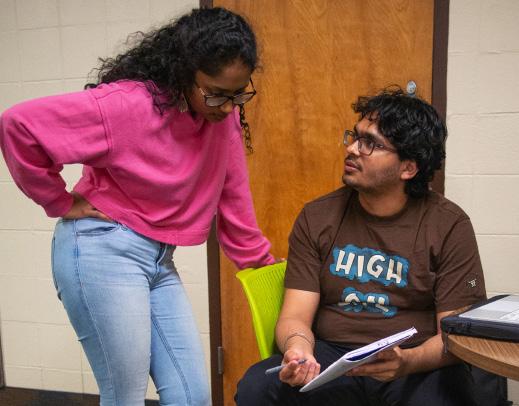
and prepared to present after appointments. Stengrim notes how the peer-topeer aspect of these sessions is crucial to student success.
“There is no one-size-fits-all idea of a good speaker,” Stengrim said. “Good speaking is about communicating effectively with your audience.”
Margaret Rose Dobson, senior in Engineering, emphasizes tailoring presentations to the audience and creating a supportive space for students to practice as key facets of the workshop.
Dobson, who primarily works with engineering students, stresses balancing technical content with clear communication to engage the audience.
“Many students don’t know what to expect,” Dobson said. “Having someone who understands their experience is especially important for engineers and first-generation students.”
Additional campus resources include the Library Research Consultations, The Jeffries Center and The Career Center. Together, these resources create a support system to help students build their academic and professional skills.

STAFF WRITER
ALEX MURPHY alexm10@dailyillini.com
The dean’s list at the University is a distinction earned every semester by students whose GPA is in the top 20% of their college’s class or curriculum. To meet the eligibility for dean’s list consideration, students must complete a minimum of 12 academic semester hours, which must be taken for a letter grade (A through F).
If a student meets these standards and the minimum GPA requirement set by their college, they will be on the dean’s list for that given semester.
The semesterly GPA requirement varies by college. For example, the largest college, the College of Liberal Arts & Sciences, requires that students have a minimum GPA of 3.95 for the 2025-26 school year.
“I think it’s fair in a way to compare yourself to your peers,” said Abrielle Kapoor, sophomore in Engineering. “A lot of engineering majors and classes will be similar, so to group them together and compare those GPAs (rather than) to the GPAs in LAS makes a bit more sense.”
Students are notified by email that they made the dean’s list after final grades are posted at the end of the semester. Then, approximately three months after the term is completed, the Illinois News Bureau recognizes all students on their college’s dean’s list by publishing a complete list on a searchable database.
Other than receiving a certificate and having their name in the database, students don’t receive anything else directly for being on the dean’s list. This leaves some students to wonder if being on the list is beneficial or not. Does it really matter, or is it merely another line on a resume?
“I don’t think it’s much more than a line under your resume,” Kapoor said. “It boils down to another measure of your GPA.”
Christopher Suarez, senior in LAS and Engineering, has been on the dean’s list four times after transferring to the University in his sophomore

year. Suarez’s input on the recognition was similar to Kapoor’s.
“I mean, it’s nice to get the recognition for doing well academically, and I think it’s something (the University) should continue to do, even if it doesn’t have any benefit to the students,” Suarez said. “It was nice to get the certificate to send to my parents, because they like that kind of stuff, but it’s not changing my world or anything like that.”
While the dean’s list recognition may
I don’t think it’s much more than a line under your resume. It boils down to another measure of your GPA.
Abrielle Kapoor, sophomore in Engineering
not mean much to some students, other accomplishments, like the Bronze Tablet, can carry more significance when
awarded to students.
The Bronze Tablet recognition is awarded by the University to students who rank in the top 3% of students in their graduating class. Recognized students have their names inscribed on Bronze Tablets that hang in the Main Library, showcasing their achievement for years after they graduate.
Tom Drabik, junior in LAS, was recently notified he received the Bronze Tablet distinction; he has also been on the dean’s list all six semesters in his college career and is graduating in May.
“For me, personally, it’s a big deal because my grandpa was on the Bronze Tablet … so it’s important to keep that tradition going,” Drabik said. “I think that’s a great achievement.”
While Drabik is proud of his accomplishments, he, like others, is not sure there are any profound benefits to being on the dean’s list.
“I think it’s good that the school recognizes students who do well academically, but to me, it doesn’t matter as much,” Drabik said. “I’m just glad that I personally dedicate a lot of time to the stuff that I love doing, and being recognized is pretty nice. But at the end of the day, it’s just something that I love to do, and I’m glad that I’m able to study here at the University.”

STAFF WRITER
ÁEDAN KNEE-MUELLER aidanmm4@dailyillini.com
The University has earned itself a reputation as a leading example of an institution shaped by accessibility. Where permitted, the grounds have been cut, sloped, smoothed or raised to meet the needs of students with physical disabilities, bringing brilliant minds into the classroom instead of leaving them at the doorstep.
The Main Quad is no stranger to change. It has seen significant development over its history, not just for wheelchair users or otherwise physically disabled students. The space has also grown to accommodate other sets of wheels: Bikes, skates and scooters are popular choices for students on the go, and the campus has adapted to electric vehicles by providing special lanes for travel.
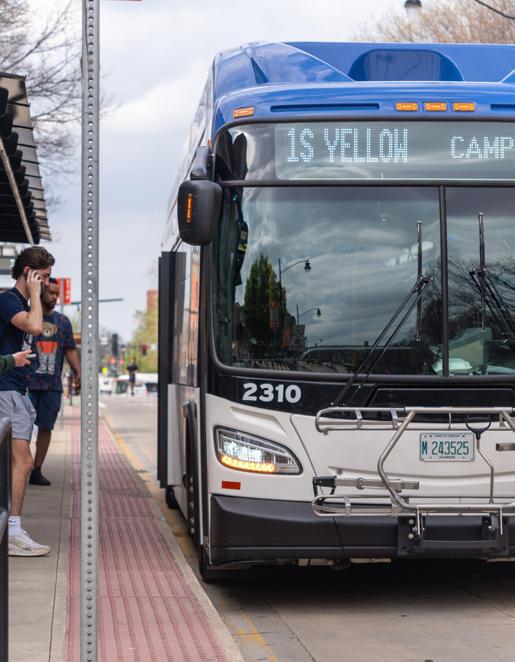
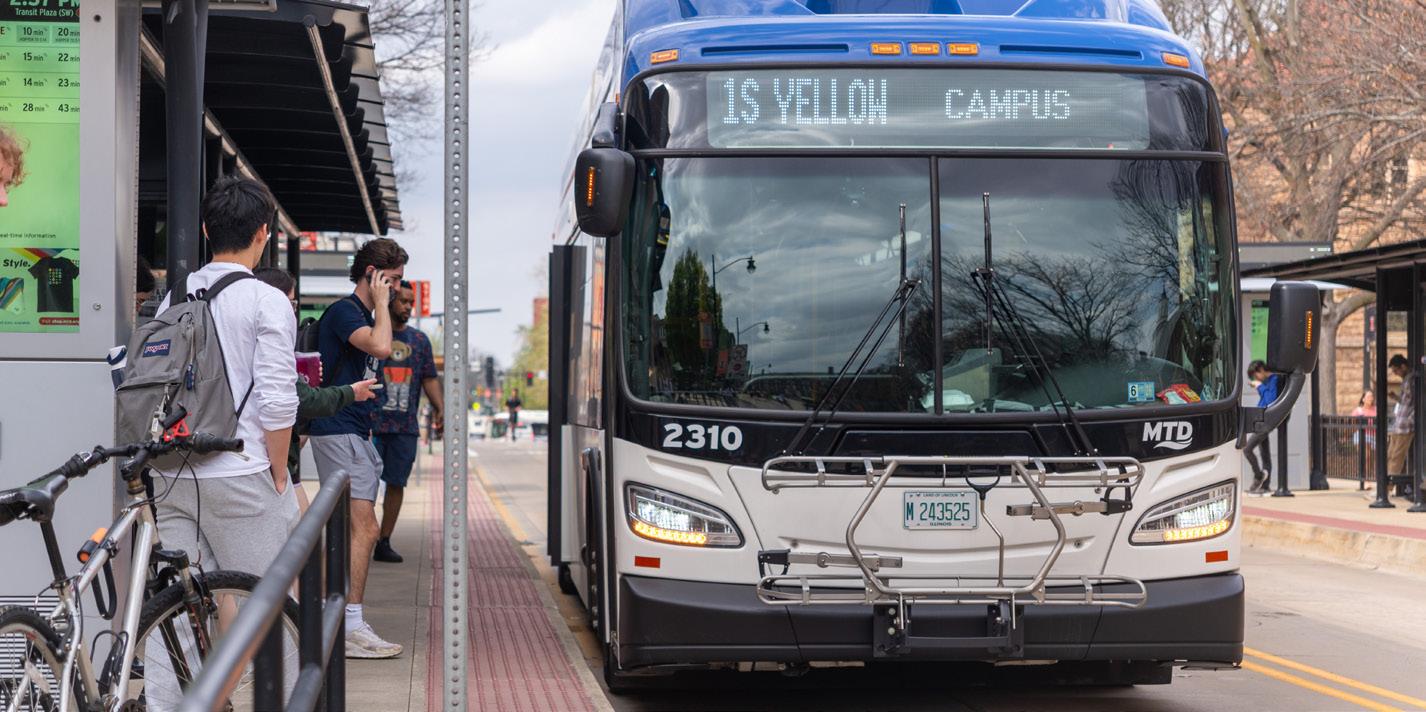
The additional availability of inter-city transportation, provided by the Champaign-Urbana Mass Transit District, has fostered a culture of accessibility. Public transport allows students to quickly board and hurtle toward their destination in half an hour, which satisfies Marchetti’s constant irrespective of whether they are accommodated with a bus ramp or a service animal.
“The MTD is phenomenal as a service,” said Terri Reifsteck, vice president of destination branding and development for Experience Champaign-Urbana. “What they do is terrific.”
However, with any culture comes its critiques, and for some at the University, there is still much to be desired from communal efforts in addressing residents’ needs.
Reifsteck, in collaboration with Emily Tarconish, professor in Education, has organized a way to collect information about accessibility around Champaign-Urbana. According to Reifsteck, a board member of the MTD is among the few staff members at Accessible CU, an extension of Experience Cham-
paign-Urbana. Accessible CU evaluates businesses for their physical, cognitive and sensory accessibility.
Together, Reifsteck and Tarconish have built upon a rubric system devised by Community Choices, a nonprofit organization that promotes disability education and welfare for people with disabilities.
This rubric asks volunteers over 200 yes or no questions of the conditions inside a business: noise, brightness, seating and more. The collected data is sent to the College of Education for evaluation, then displayed in the directory, where users can search for their preferred amenities and accommodations.
“Barriers in the community are designed for able-bodied minds,” Tarconish said. “(Disabled people) have things we’re going through; it just so happens that environments aren’t built for us.”
According to Tarconish, an app is in development in cooperation with the National Center for Supercomputing Applications. Though there is no official release date, it would provide users with convenient access to both the directory and the rubric, allowing them to submit their own evaluations.
Reifsteck said the purpose of lending students the ability to evaluate places of business is to identify areas where they could adapt.
In October 2024, The Daily Illini shed light on The Walk & Roll March, where students protested ableism on campus. Their claim against the University was its inconsistent accommodations: improper signage for accessible entrances, ramps fashioned at awkward angles and the declining integrity of existing accessible architecture.
“I came to the school because it’s known to be the most accessible, and I just saw things starting to just break and break and break,” said Alyx Bibbs, then-senior in AHS. “It just kind of all led up to the point where I just can’t take it. What if I get injured?”
Bibbs was not alone in their concern. According to Reifsteck, Community Choices compiled Accessible CU's website directory after the COVID-19 pandemic stalled an earlier 2020 forum on disability.
After the directory's launch in 2022, Accessible CU standardized its process, specifically looking to address needs outside those stipulated by the Americans with Disabilities Act.
“As a disabled woman myself, we’re not struggling with anything,” Tarconish said. “We’re just trying to use this project to inform the community, ‘Hey look, here’s the needs that you might not have thought of that we have.’”


students on campus. The department
night when awareness matters most.
Milinkovic said that sometimes a single request can grow into a group.
“Before you know it, they’ve got like eight to 10 people walking,” Milinkovic said. “It just shows how catchy it is once you realize (you) can just be in this group and walk and not have to worry about, ‘Is this a well-lit path, and is this group ahead of me going to try to provoke me into anything?’”

inkovic, Student Patrol officers do more than escort. They monitor activity, respond to minor incidents and serve as an extra set of eyes and ears — especially at
For trips that are farther away or when buses are not running, SafeRides offers another option. This on-demand service from Champaign-Urbana Mass Transit District provides transportation within designated campus areas at night, giving students an alternative to walking alone.
Maya Strong, sophomore in LAS, fre quently uses SafeRides to get home af ter late-night study sessions.
“Say you’re drunk and trying to drive yourself home or trying to walk yourself home, (SafeRides) is just a safer alternative where someone else is driving, and then you can communi cate with them,” Strong said.
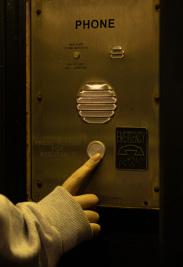
Emergency phones are another safety tool available on campus. Locat ed inside buildings as flat panels and outside as blue-light towers across ar eas like the Main Quad, they connect directly to UIPD dispatchers 24/7 and help officers locate potential danger.
Milinkovic said students can engage with preventative resources through the Community Outreach and Support Team. The group offers safety presentations, self-defense classes and campus events. This also includes UIPD’s therapy K-9 dogs, which students can interact with during times of high stress, like finals week.
With all of these safety resources in place, Milinkovic said one of the biggest barriers UIPD sees to safety is student hesitation. He said some students hold off on calling 911 because they worry a situation isn’t serious enough.
“Just do it,” Milinkovic said. “We don’t care about the false alarms. We would rather come to a hundred calls on something that could be happening,

making these systems work.
Valerie Marcotte, UIPD officer, said if students think they’re being followed, they should use these phones to make noise at each one along their way.
“I always tell our students to be like, ‘Help! I need help,’ and just keep mov ing,” Marcotte said. “Then hit the next one you see, and do the same thing so we can establish a flight pattern.”

Beyond physical safety, the Univer sity also provides support for mental health emergencies. The Response, Evaluation, and Crisis Help initiative pairs police officers with social workers to respond to individuals in crisis and connect them with follow-up care.


SONALI KHANNA sonalik4@dailyillini.com
For students, coming to college brings on many challenges. Moving here could mean adjusting to independent living, meeting high academic expectations and building a fruitful social life — all while trying to take care of yourself and your mental health. But as hard as balancing these aspects of life can be, the University has resources to help students ease their time here.
The Counseling Center allows students to book one-on-one counseling appointments with a professional. It also offers group counseling sessions, outreach programs and hosts workshops to spread information about mental health management skills. The center aims to provide students with one semester’s worth of counseling, but it holds no limit on the number of sessions per student.
The McKinley Health Center provides a 24/7 hotline, therapy and
psychiatric evaluations for University students. Eight free therapy appointments come included with the tuition fee for all students, but McKinley’s therapists can also help contact long-term professionals to continue treatment.
McKinley also helps students get in touch with a psychiatrist to determine if prescription medications are needed to facilitate their mental health treatment. According to primary care provider and Medical Director Robert Woodward, students using prescription medication are allowed unlimited visits with a psychiatrist to accompany their treatment.
Woodward said that his favorite part of the program is watching students figure life out for themselves and improve their mental health.
“(Students) really are very easy to teach and to educate, and you can kind of see the light shine in their eyes when they finally … have a realization, and that’s very rewarding,” Woodward said.
The University also aims to provide resources for faculty and staff. Through Faculty/Staff Assistance and

Well-Being Services, employees of the University, as well as their families, can receive counseling services, well-being services, crisis support and various other resources.
Christopher Ochs, director of FSAWS, said the program seeks to help professionals perform at their best.
“When people are taking better care of themselves with their mental health, they’re better able to show up for their students,” Ochs said. “Because we encourage our employees to take care of themselves, we’re better able to show up for the people that we serve.”
For those in the Champaign-Urbana area who aren’t students or faculty, there are still resources available.
The College of Education recently opened its Healing, Training, and Research Clinic, which offers mental health services during spring semesters to anyone who is not a student or employee of the University community.
Lisa Kinderman, director of the master’s in mental health counseling program, said she sees these services going a long way for the C-U community.
“Our hope for the clinic is that it can continue to grow as a community agency that can provide not only oneon-one counseling but group counseling services, too … and to have greater reach for social services in the community overall,” Kinderman said.
The College of Education’s Counseling Psychology program provides patients with services from student clinicians who are enrolled in a master’s or doctoral program related to mental health and counseling. All programs operate under the supervision of licensed faculty.
Mental health struggles don’t belong to any one group, and in C-U, help is always within reach. The University provides mental health resources for anyone whose life intersects with campus. The first step is just knowing where to look.

SENIOR NEWS REPORTER
VANESSA TURNER vturner4@dailyillini.com
Wassaja, Snyder, Bousfield, Nugent — these words might mean nothing to non-Illini, but students recognize these as names of residence halls on campus.
The people these structures are named after — Wassaja (Carlos Montezuma), Capt. Edward Snyder, Maudelle Brown Bousfield and Timothy J. Nugent — were all impactful alumni or staff and trailblazers in their own right.
University historian Ryan Ross, director of history and traditions programs at the University Alumni Association and deputy editor of the Illinois Alumni Magazine, said that the naming of a place after a person is a “highly visible form of recognition.”
According to Ross, less than 30 buildings in the University’s 159 years of history have been completely torn down.
“Having a building named after you on this campus is as close to … a very public, permanent recognition as you’re going to get,” Ross said. “The faculty and alumni who have had buildings named after them in their honor because of something they did are all extremely deserving.”
Voted the best dorm on campus for multiple years in a row, Wassaja Hall opened in 2016 and is named in honor of Carlos Montezuma, also known as Wassaja. He was the University’s first Native American graduate in 1884.
Born in Arizona to the Yavapai circa 1867, Wassaja was taken captive by Pima raiders in 1871 and eventually ended up in the care of an Urbana pastor by age 11. He continued his education in the area and eventually enrolled at the University as a chemistry major.
After graduation, Wassaja attended Chicago Medical College and became
a physician before turning his focus to Indigenous activism and a lifelong fight to preserve Yavapai rights. He died at home in Arizona after returning to the Yavapai in 1922.
Outside of Wassaja Hall, three sculptures shaped to resemble Yavapai baskets, titled “The Long Way Home,” represent Wassaja’s life story.
Lynn Basa, the artist who was commissioned to create these pieces, said she was in communication with the Yavapai tribe during her design process.
“I got permission from the Yavapai leaders to use the silhouette from their most famous basket,” Basa wrote in an email to The Daily Illini. “It was one of the most special moments of my life when a contingent of dancers and elders traveled from Fort McDowell, where they live, for the dedication of the artwork and opening of the residence hall.”
Basa also said the sculptures were created from stone she imported from Yavapai land in a gesture to honor Wassaja’s life.
“I had the stone brought from a quarry near Fort McDowell to symbolically (and literally) bring a bit of his homeland back to what must’ve been a very foreign land to him,” Basa wrote. “To me, it feels like bringing his journey full circle. It’s one of the most favorite artworks that I’ve done.”
Snyder Hall opened in 1960 and is named for Capt. Edward Snyder, a Civil War veteran and University professor in German, French and military science.
Snyder was also commandant of the University’s military program at a time when “military instruction was a huge part of University education,” according to Ross.
Male students were required to participate in compulsory military training from the University’s founding until the late 1950s. Snyder helped establish the
program in its early years, solidifying its structure and use of student officers.
Under his command, 157 University cadets were dispatched to the Great Chicago Fire of 1871, where their services to the city were later recognized by Gov. John Palmer.
Born in Austria in 1835, Snyder entered the Austrian army after the revolution of 1848 against the Habsburg monarchy. After moving to the United States in 1862, he was a soldier for the Union Army in a New York regiment and served until the end of the war.
Snyder came to the University as a professor in 1868, teaching and overseeing campus military operations until his resignation in 1896. He then moved to California, where he died in 1903.
According to a 1903 article from the Urbana Daily Courier, “Nearly his whole life of 68 years had been given up to instructing youthful minds and many are the old grads of the ’varsity who look back with pleasure to the time they were members of Prof. Snyder’s classes.”
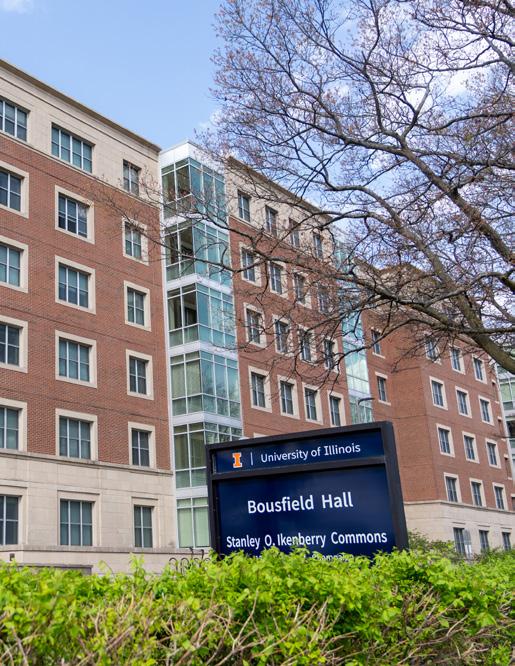
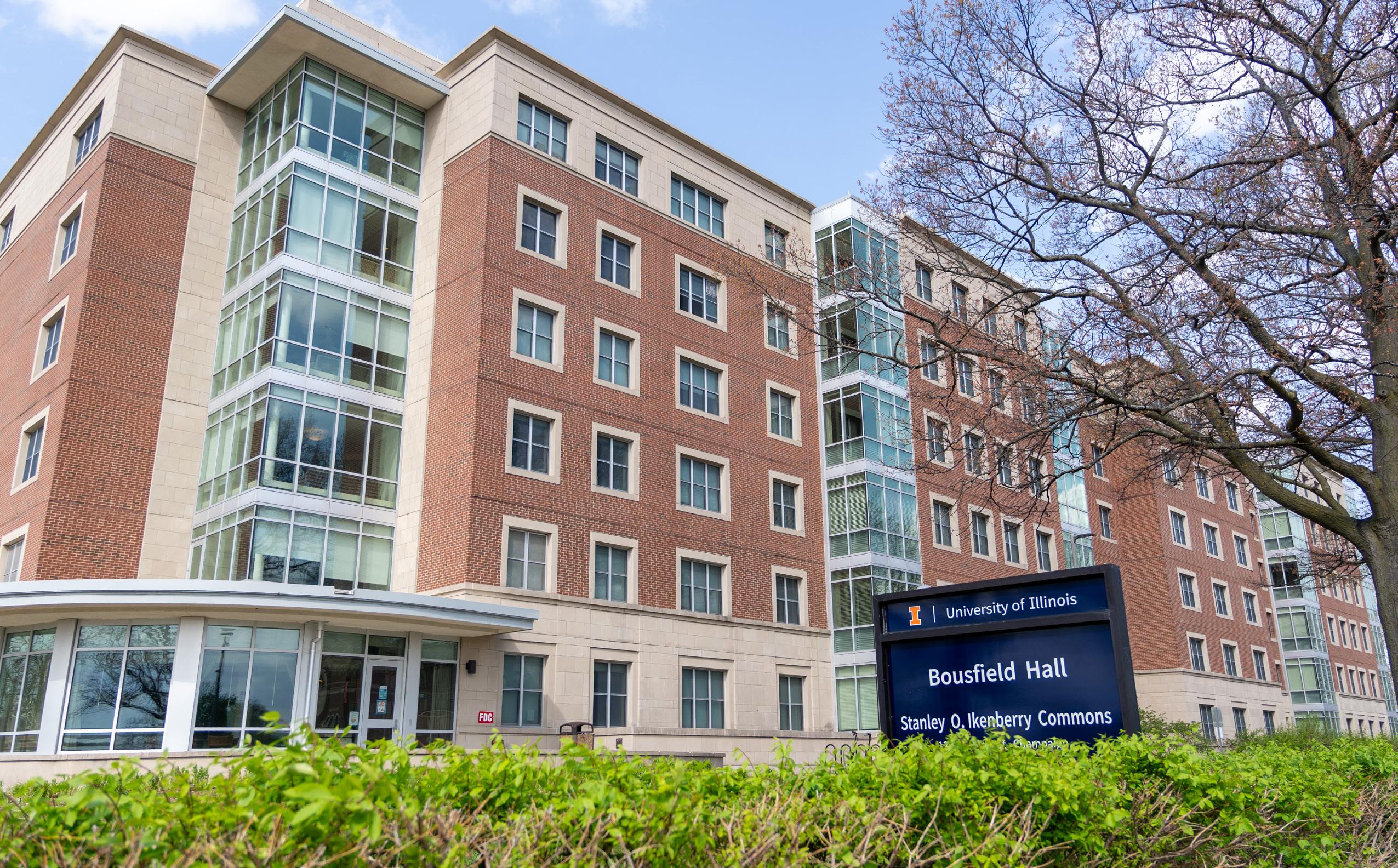
Named after Maudelle Brown Bousfield, the first African American woman to graduate from the University, Bousfield Hall opened its doors in 2013.
Bousfield was born in 1885 and came to the University in 1903 before graduating with honors three years later with degrees in astronomy and mathematics.
When Bousfield was a student, African Americans were barred from residence halls and only able to live in the private homes of local Black families.
“When she was a student here, there was nowhere for Black students to live,” Ross said. “It was a pretty isolating experience for her being here.”
Despite discrimination, Bousfield continued to break barriers. As part of a lifelong career in education, she became the first African American
principal in the Chicago Public School system in 1927.
After retiring in 1950, Bousfield died in Chicago in 1971.
In an article written for the Chicago Defender in 1928, Bousfield expressed her gratitude for her line of work and the opportunities made available to women.
“I am furthermore thankful that out of my work grows that satisfaction of having been some small service to someone else,” Bousfield wrote. “I am glad to be a woman and to enjoy the freedom and emancipation that womankind is winning.”
Ross said the impact of figures like Bousfield and the reason her name is honored with a residence hall goes beyond her status as the first African American female graduate.
“Not only was she the first Black woman to graduate from the University, but then she continued to be a trailblazer for the rest of her life,” Ross said.
Opened in 2010, Nugent Hall bears the name of Timothy Nugent, often called the “father of accessibility.” Nugent was the first director of disability services at the University, now entitled Disability Resources and Educational Services.
“The work that the University has done related to disability is one of the most impactful things that has come out of this institution,” Ross said. “It wouldn’t have happened without Nugent.”
Born in 1923, Nugent’s experiences growing up with family members with disabilities and serving in the army during World War II sparked an interest in rehabilitation and accessibility.
Under the G.I. Bill, veterans with disabilities were provided funds for higher education and could receive rehabilitation training. In 1947, the University opened a satellite campus in Galesburg, Illinois, to accommodate this increase of veteran students.
Nugent began his work in Galesburg as the first in the country to direct a
college program serving students with disabilities. His program and leadership transitioned a year later to the Urbana-Champaign campus.
“In many cases, the students who were there (had) become paralyzed through war injuries,” Ross said. “Society wrote them off … that they weren’t capable of having full lives moving forward. And Nugent just didn’t believe that.”
Nugent pioneered advances like accessible bus systems and curb cuts, along with founding the National Wheelchair Basketball Association.
His work also set standards for wheelchair ramp angles and hallway widths — criteria that would later influence the Americans with Disabilities Act.
Nugent retired from the University in 1985 and died in 2015. In line with his legacy, Nugent Hall houses the Beckwith Residential Community on its first floor, a joint venture with DRES to accommodate students with physical disabilities.

SENIOR NEWS REPORTER MACY MEDENDORP
macym3@dailyillini.com
he ARC’s towering arch of windows is a familiar sight for most students. Many venture through its doors to work out, but some don’t know about the various gems that hide within its walls.
“Our current vision is a place for everyone,” said Lauren Wheeler, assistant director of member services for the ARC, about the facility. “We know not everybody works out. That’s where these other kinds of hidden gems come to play.”
Let’s explore some of its secrets.
Tucked away on the concourse level — where the main locker rooms are — the Instructional Kitchen boasts cooking classes designed for all levels.
Ranging from $15 to $25 per class, participants follow the guidance of student instructors to create tasty dishes. Some previous classes include “Chipotle Copycat,” “Vietnamese Delights” and “Stardew Valley Kitchen.”
The ARC also provides the necessary ingredients and materials.
“Being able to cook with other people and also meeting new people is something that everybody would enjoy,” said Avisha Yerramilli, junior in LAS, who recently took a class. “Everyone should try it at least once.”

Adjacent to the Instructional Kitchen and recently revamped, the Recovery and Reflection Room is now outfitted with massage chairs, zero-gravity chairs, massage guns and air compression boots, alongside its older mats
for prayer or meditation.
“It’s kind of a cool little perk if you want to come and just do that, or (go) after your workout,” Wheeler said.
To use the chairs, students must reserve a 30-minute time slot. They can do this online or at the Member Services front desk.
Designed for self-defense and martial arts enthusiasts, the combat room is a popular place for various RSOs, but anybody is welcome to use the space when not reserved. Turn right before the badminton courts on the entrance level to check it out.
James Albarracin, senior in Business, is the president and founder of the Muay Thai club at the University. To him, the combat room acts as a safe space and second home — he’s there about five times a week, either for his RSO or in his free time.
Some may feel intimidated if they have never been in the room or practiced a martial art before, but Albarracin said not to worry. Just two years ago, he was a beginner, and everybody was helpful.
“I would always ask them questions,” Albaraccin said. “Everyone is really collaborative, and they love what (martial arts) has done for them, so they want to share it.”
Just around the corner from the weights on the lower level are three
performance pods.
Initially racquetball courts, the pods serve as destinations for activities like HIIT or functional fitness. The UIUC Calisthenics Club can often be found in the HIIT Pod, and some fitness classes meet in the Power Pod.

The Olympic Pod is the only place in the ARC where students can perform Olympic lifts, including hang cleans and power snatches.
Hidden behind the performance pods is the Bouldering Cave.
It features a Kilter Board — an adjustable climbing wall. People can choose different routes to light up and adjust the board’s angle.
It’s “really hard,” according to Yerramilli, who also rock climbs, but she encourages everyone to try it.
“Rock climbing gave me confidence,” Yerramilli said. “It’s cool finding a new way to work out that’s also really fun.”
Try out any group fitness class at the ARC during the first or final week of any semester for free.
To take unlimited classes, students can purchase a group fitness membership for $60 a semester. Otherwise, they can buy a one-class pass for $5.
From yoga and cycling to water aerobics or pilates, the ARC offers multiple classes a day. Find one that fits into your schedule.
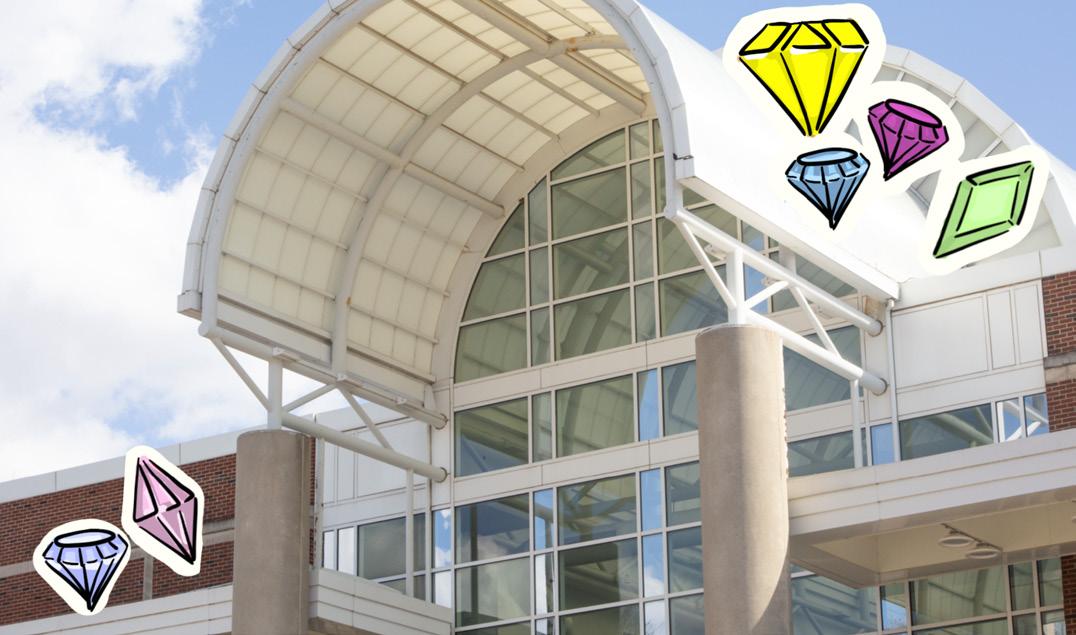
The sun shines on the front windows of the ARC on April 16. The facility houses three gyms, two pools, three strength and conditioning spaces, a rock climbing wall, an indoor track and more.



STAFF WRITER
KELSEY HOEVEL khoev2@dailyillini.com
When you don’t have much time between classes, you need a place that’s fast, affordable and located right on campus. If you’re not sure where to go, stop at one of these six eateries.
The Illini Union Bookstore is directly across from the Main Quad, making it an easy place to get your caffeine fix before a dreadful 8 a.m. class.
This location has a separate counter for mobile orders. This means you can even order your breakfast or beverage on your way there if you’re running late. Whether you like your coffee with a little bit of sugar or your sugar with a little bit of coffee, Starbucks’ expansive menu is guaranteed to have what you need.
There is a large seating area as well, so you can knock out some assignments while you sit. Then, after 15 minutes or so, you can just leave your laptop open while you scroll on your phone.
If it’s a little late in the day for breakfast food, go to the first floor of the SDRP and check out 57 North.
It’s a small convenience store with tons of snacks and a handful of fresh food options like burgers, wings, sub sandwiches and wraps. Grab a sandwich, pair it with a bag of chips and a drink and you’ve got yourself a scrumptious lunch. The best part is, you didn’t even have to cook it in an illegal dorm microwave.
While contraband can be delicious, it can also be nice to eat a meal that doesn’t come with a side of resident-adviser-induced anxiety.

The Caffeinator is Ikenberry Dining Hall’s hidden gem. At this cozy coffee shop, you can purchase drinks and food by i-card, credit card or debit card.
The menu features all the typical coffee drinks, as well as breakfast sandwiches, muffins, donuts and more.
If you don’t have time to go to the actual dining hall, The Caffeinator is the way to go. It’s just the place for a student who’s hungry, tired and on the move.
It’s fun to stay at the University YMCA — but it’s even more fun to eat there. A quaint Thai restaurant can be found on the main floor, acting as the perfect place to carbo-load before walking up flights of stairs to get to class.
There are several different stir-fry, soup and fried rice options, along with other dishes like pad thai, green curry, egg rolls and mango sticky rice with coconut ice cream. You can even sit outside on a nice day (you know — like when it’s over 40 degrees).
57 North, located within the Ikenberry Commons, offers various quick pickme-up snacks, drinks and hot food options for students. Pictured here are tater tots and a side of ranch, offered in their hot food line.
If you have classes at Bevier Hall, stop by Bevier Café on the second floor for a balanced, sit-down meal. It’s a warm and inviting little shop with lots of choices. The café has burgers, tacos, chicken tenders, desserts and salads galore.
The next time you realize you haven’t eaten a vegetable in a while, check out this student-run café. It’s “Awesome Sauce,” which is also the name of the eatery’s signature dressing.
If anyone needs a chain coffee shop inside their library, it’s the engineering students. When building bridges starts to feel a little tedious, stop by Espresso Royale for a royally needed pick-me-up. If you still fall asleep in class, go back for another coffee. If that doesn’t work, you can always drop out and become a social media influencer instead.
But seriously, try Espresso Royale first. From the Caramel Oat Toffee Nut Latte to the Oatchata to dirty soda, it has every drink under the sun — you just might not see the sun for a while.
MANAGING EDITOR
ANNISYN KREBS-CARR annisyn2@dailyillini.com
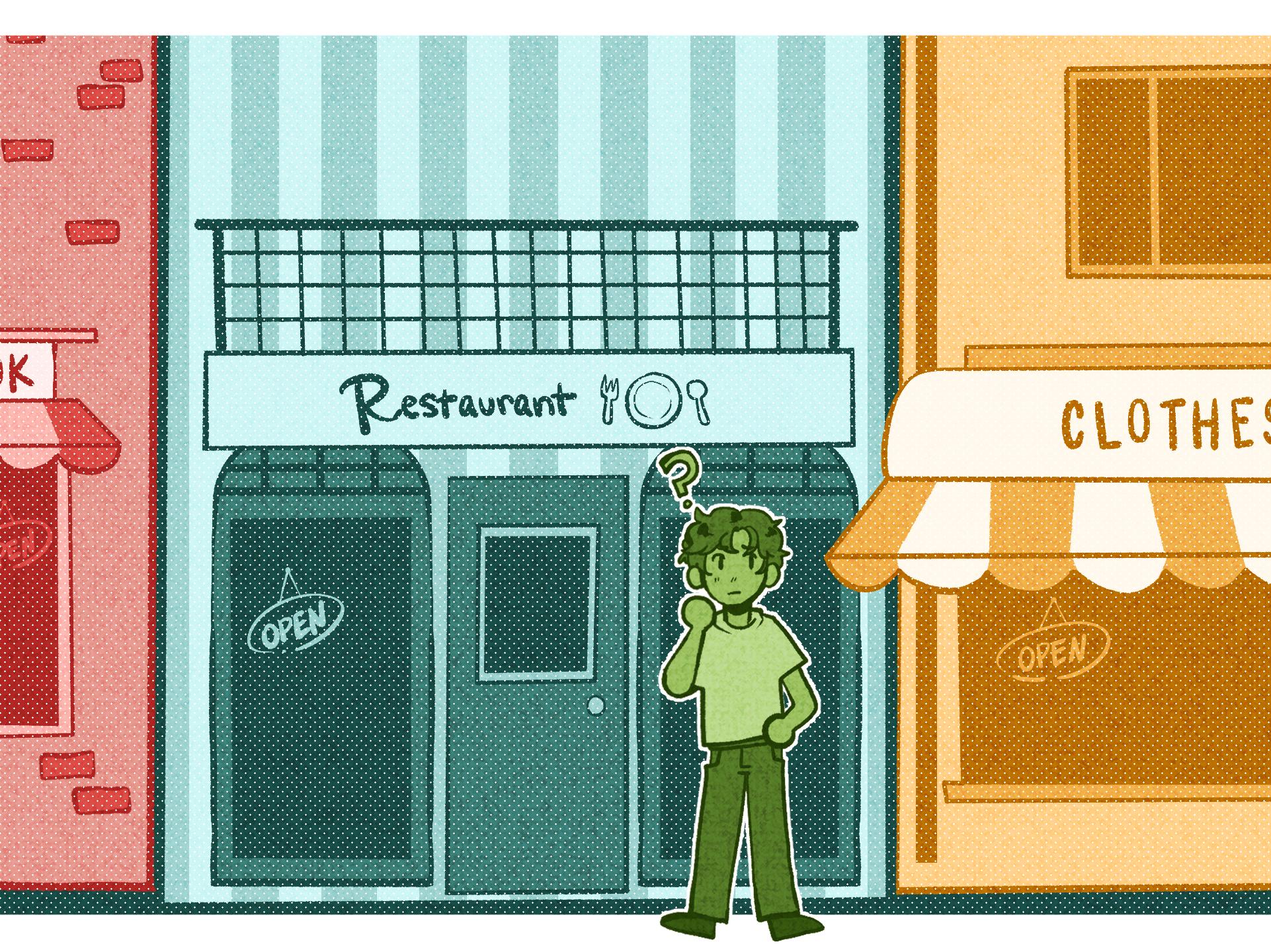
Navigating Champaign-Urbana isn’t easy. With restaurants lining Green Street and shops spanning into downtown Urbana, it can be difficult to decide where to eat, shop and find entertainment.
This decision is made even more complicated by the rising number of new businesses. One of these businesses is Parcadia, an immersive indoor mini-golf tavern for those seeking a different kind of entertainment in C-U.
Anne and Chris Lukeman are the owners of Parcadia and a local escape room, Champaign-Urbana Adventures in Time and Space. The Lukemans are University alumni, and Anne Lukeman said their love for the town overlaps with the type of environment they hope to create with their businesses.
“We have a really soft spot for campus and students — being at the age that you guys are when you’re here in town is very special to us,” Anne Lukeman said. “I certainly hope we see lots of students come visit us during their time here.”
Anne Lukeman said she sees Parcadia as a one-of-a-kind form of entertainment in C-U and hopes to provide a welcoming community space for both students and locals.
“I think Champaign-Urbana is a really special place,” Anne Lukeman said. “I think we have a lot of really cool people in Champaign-Urbana from all walks of life, and I’m excited to see them here.”
For those looking for a bite to eat after an intense round of mini-golf, JM’s Texas Craft BBQ sits only a short bus ride away in Lincoln Square Mall.
The family-owned and operated business offers Texas-style barbecue straight from someone who knows it — James Mullins.
Mullins explained that he lived in Austin, Texas, for over 50 years and has smoked meats for about 20 years. It wasn’t until last April that Mullins decided it was time to make a move, relocating his family to Urbana.
“I want to make this our home, and (barbecue) is what I want to do,” Mullins said.
A year later, he opened JM’s Texas Craft BBQ, serving the works of Texas-style barbecue — brisket, sausage, pulled pork and turkey breast.
Mullins said he takes pride in his work and is looking to share it with the C-U community.
“It’s for everybody,” Mullins said. “I want people to come and talk and ask questions.”
Just as barbecue can be for everyone, so can coffee. Elm City Coffee, a roastery in downtown Urbana, is here to prove it.
According to Derek Herbster, general manager of Elm City Coffee, the shop specializes in sourcing single-origin coffees and showcasing where they come from.
Elm City Coffee has something for
those who want a blended coffee or cold brew, but also for those looking to try something new.
“I think that everyone who drinks coffee has something … they want to geek out about,” Herbster said. “That’s kind of what we’re all about.”
The shop caters both to students and community residents, offering everything from matcha lemonades to espresso shots. Herbster knows there are numerous coffee shop options in C-U, some closer to campus and more convenient for students. For those who are willing to make the trip, Herbster said specialty coffee awaits.
“There’s enough coffee on campus to where you don’t have to travel to Main Street, Urbana, to get a cup of coffee,” Herbster said. “But if you do, you’d be pleasantly surprised.”
So if you’re looking for something to do on a Friday night, a place to grab coffee in between classes or a spot to eat at the end of a long week, maybe take a look somewhere different. As Herbster said, you might be pleasantly surprised.

STAFF WRITER
SOFIA BODDY
sgboddy@dailyillini.com
Intramural sports have a simple goal: to be accepting of all levels of experience and support students who want to play casually. This effectively puts the game in the hands of the players and helps to reclaim a sport or former lifestyle that may have been lost in the bustling life of college.
Club sports focus more on skill development, have tryouts and compete against teams from other universities. They have a higher time commitment and even include traveling.
Alternatively, intramural teams require no tryout process and have a shorter time commitment. All games are on campus, and all teams and opponents can be personally handpicked and created.
Intramurals are run through the ARC and managed by Campus Recreation staff on an operations basis. Melina Campbell, competitive sports & community programs coordinator, said that her passion for intramural sports originated from her own participation and love for them in college.
“I’m super competitive with five siblings, so when I got to Truman (State University), I wondered how I could have that outlet without having to do varsity athletics,” Campbell said. “With intramurals, I got to do lots of different sports, like Spikeball and badminton, and I really got to be an athlete in different ways instead of just one.”
For some, the appeal of intramurals comes in this flexibility of choice. It mashes together laid-back and competitive styles of play across numerous athletic pursuits.
At the University, spring semester intramural sports include flag football, outdoor soccer, sand volleyball and
ANJALI
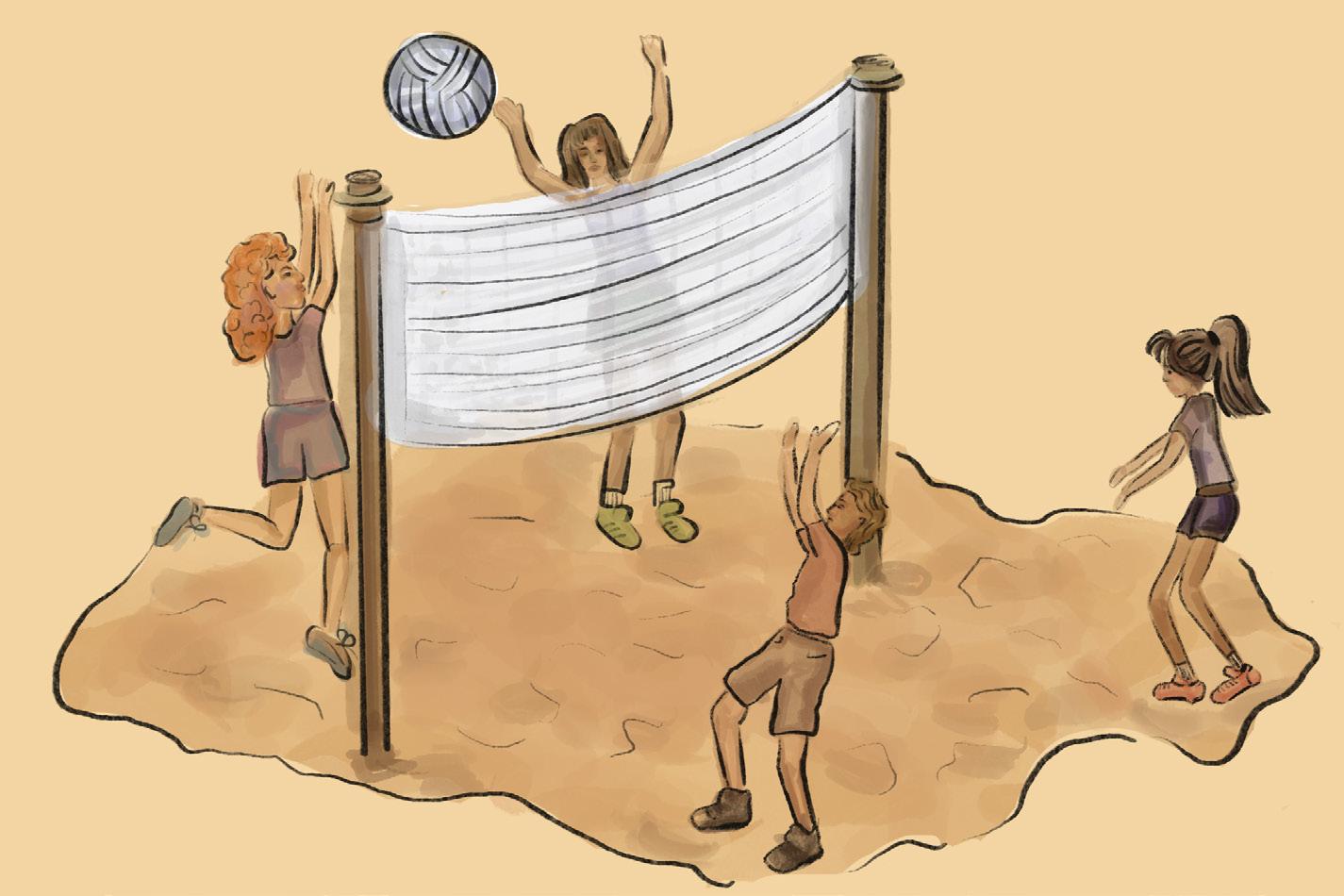
floor hockey. These options are diverse by design, according to Campbell, so students can experiment athletically during their four years in college.
Campbell said that whenever students have time to play, her staff will make it happen. The students are in control of their own experience, and her team simply facilitates.
“If you’re only free at (7 p.m.) on Wednesdays or (9 p.m.) on Thursday(s), we have a spot for you to get in there and do it,” Campbell said. “Meet your opponents, and make friends with the other students on the other teams.”
The elements of community and teamwork are hallmarks of intramural sports, according to Campbell, who said she’s fortunate to do this for work.
“I found out I could do this for a living, and I was like, ‘Heck yeah,’” Campbell said. “I’m so lucky I get to run this program at Illinois because we have so much to offer, and there’s nothing you really can’t find.”
Despite the easygoing nature of intramurals, they still require leaders on and off the field who can organize, plan matches and set goals for the teams.
Nathan Gordeuk, senior in AHS who coaches intramural soccer, began playing intramural flag football his sophomore year through InterVarsity at Illinois, a Christian-based RSO. Gordeuk acknowledged that the leadership position was unnatural to him at first due to his self-described awkwardness in front of large groups. However, he believes that he has grown as a person since accepting a captain position.
“My second semester playing was the first time I was asked to captain,” Gordeuk said. “Having the practice to call together a team and tell them what to do … has been invaluable. A big thing for me has been leading selflessly because, ultimately, there’s a responsibility as the leader to keep it fun and make it about the people and really magnify them.”
This transition happened typically as Gordeuk moved through his college years and developed his confidence. Now, he focuses on treating everyone as equals so that students join intramural sports and experience a positive impact.
“As I’ve grown through junior and senior years, I’m considering how (un-
derclassmen) might view me as a senior from the lens of how I viewed seniors as a freshman,” Gordeuk said. “They might be scared or nervous to play, so I try to put myself in their shoes and am intentional about being welcoming, encouraging them and just being normal.”
There are many appeals to intramural sports that can draw students to participate. One example: Being physically active releases endorphins that can increase happiness and destress the mind and body.
For Cameron Szwec, junior in LAS, playing soccer has been something he’s loved his whole life and has provided him that mood stabilizer.
However, after tearing his ACL in his junior year of high school in a noncontact injury, Szwec had to redefine the relationship between him and the sport.
“Coming to college, I didn’t have much time at first, and then when I was a sophomore, I decided to join soccer intramurals with my friends,” Szwec said. “We had a really great time competing until I ended up tearing my other ACL in my right knee.”
In shock and disbelief, Szwec tried
to stay as positive as possible but knew right away what it was. In a way, it felt like he was being kicked while he was already down, even though it had been four years since the initial tear.
Despite refusing to play soccer in any organized way again, Szwec said he still loves the sport — he just must avoid it and any other sports with quick pivoting movements.
He’d recommend that any student try out intramural sports and try to either challenge themselves or relive their childhood passions like himself.
“I really desired to get back into that competitiveness where I can perform at something I know I’m good at, and that’s what specifically drew me into wanting to get back into soccer,” Szwec said. “I would say join it. Try it.
“Intramurals are almost synonymous with dorm life, where you can meet and make so many friends and connections. The University truly has so much to offer, and intramurals is one of those things.”
Tattooed on Szwec’s arm are the words, “Ordo Ab Chao,” which translates from Latin to “Order out of
Chaos.” Szwec said it’s something that doesn’t just directly relate to his injuries but something that applies to his general life.
For Gordeuk, Szwec and Campbell, intramurals have been outlets for them. They’re activities that provide them with a space to escape or a chance to bring out the competitive intensity within them.
Campbell said a goal of hers has been to knock down any barriers that might prevent students from participating, which includes providing emphasis on the diversity of options available. This encompasses many things, like Texas Hold’em and cooking competitions, under the intramural umbrella.
“We truly want there to be something for everyone in this space,” Campbell said. “We train our staff like customer service, where this is truly for the participants, because if we didn’t have them, we wouldn’t have these jobs. It’s about making sure that every time we’re interacting with them, that it’s fun, exciting and accommodating in whatever way that is.”

SENIOR SPORTS REPORTER
BEN SOMERVILLE bens4@dailyillini.com
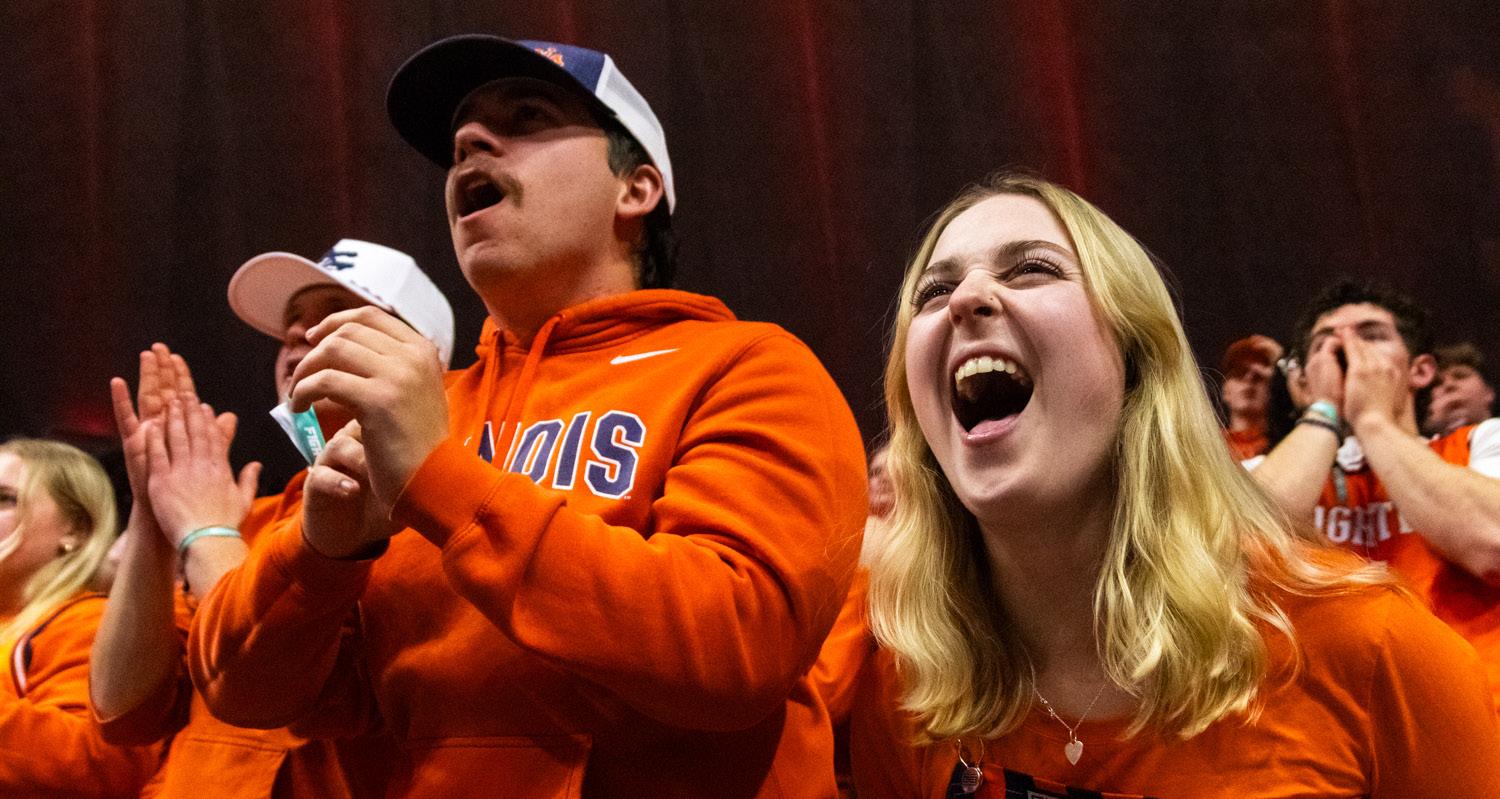
To say this year has been a success for Illinois Athletics would be an understatement.
The football team won the Music City Bowl, marking back-to-back bowl wins for the first time since 2010-11. The men’s and women’s basketball teams both made the NCAA tournament, with the men’s program reaching the Final Four for the first time since 2005.
It’s not just the big-ticket programs, either.
Men’s tennis beat five ranked teams in a strong regular season. The women’s track & field team had six athletes win events at the Big Ten indoor championships. The team as a whole finished No. 2.
Junior Sophia Beckmon won the indoor national title for the long jump, and the Illini placed No. 3 overall in the tournament.
Illinois Athletics are booming this year, and there’s certainly no reason to sell.
While the program lost its starting quarterback, senior Luke Altmyer, it brought in a veteran presence and highly ranked transfer: senior Katin Houser.
The new quarterback brings four years of experience, two of them with a Big Ten program. Last season with East Carolina, Houser started 12 games and threw for 3,300 yards and 19 touchdowns.
He’s quickly settling in, and coaches are noticing his efforts.
“He’s got great work habits,” said pass game coordinator Mike Neu. “(Houser’s) got a great process about himself on how he attacks learning the offense, taking notes, watching tape and then getting out here on the field and building a relationship with each and every one of his guys.”
The Illini added a handful of talent on both sides of the ball through the trans-
fer portal and with incoming freshmen. While they’re slated to lose impactful players, the incoming players should fill the holes they left.
The men’s program reached new heights under head coach Brad Underwood with its Final Four berth. A roster made up of freshmen, veterans and overseas players did something no other Illinois roster has since 2005.
Now, Underwood and the Illini are trying to retool the roster for another deep run. Nearly everyone on the roster is eligible to return next season. The biggest losses are freshman guard Keaton Wagler and senior guard Kylan Boswell, both of whom will head to the next level in the NBA.
Illinois has added a top name from the transfer portal, freshman Stefan Vaaks, a 6-foot-7 guard, to replace Wagler.
A similar roster — with more talent from the portal — has a chance to return to the Final Four. Multiple media outlets already placed the Illini in the top-10 of their too-early top-25 rankings. One list, from The Athletic, has them at No. 1.
Sights are set high for the Illini as they look to build on their historic success from this year.
The women’s team has high expectations of their own. Illinois is coming off an-
other NCAA tournament win, and a large part of its roster is retainable.
The star trio of sophomore forward Berry Wallace, freshman guard Destiny Jackson and freshman forward Cearah Parchment was hugely impactful for the Illini all season.
With most of its roster returning, Illinois should have no trouble getting back to March Madness. They’re in a similar spot to the men’s team, coming in at No. 16 in ESPN’s too-early top-25 rankings.
“The one thing about this team, we’re never going to give up,” said head coach Shauna Green in a press conference after their second-round loss. “We’re never going to stop fighting.”
The rest of Illinois sports also continue to impress. Women’s track & field is ranked No. 1 and had success in the indoor season. Men’s golf keeps dominating its competition, finishing in the top three in seven tournaments and winning three of them.
Brad Dancer, men’s tennis head coach, remains one of the best recruiters in the sport, bringing in top talent from across the globe.
Illinois may not be known for its sports, but that is sure to change soon.

STAFF WRITER MAYA BRITO mpbrito2@dailyillini.com
When spectators are enjoying a sporting event, their attention is usually focused on the players, the ball or the scoreboard. Another presence on the playing field is the referees, whose role can be taken for granted. At the University, club sports rely on officials who devote their time to making the competition possible.
Club sports officials come from a wide range of backgrounds. Those with proper certification, from college students to retired adults, can work as a club sports official. These referees juggle their officiating responsibilities with other careers, academic commitments and their personal lives, often sacrificing nights and weekends to ensure the games are played.
D Ray Tucker, retired from the University’s printing department, is an official for men’s club hockey, baseball and lacrosse. In addition to refereeing, he said he serves as an assigner for club baseball and hockey referees, coordinating schedules and staffing games.
Tucker said he has been involved in the University’s club sports community for decades. His officiating career began at just 16 years old, when he started umpiring baseball games. Over time, he said his involvement expanded beyond the diamond. In 1988, he became a hockey official, and then a lacrosse official in 1992.
“(Refereeing) was something that I definitely did seek out,” Tucker said. “I enjoyed it.”
For Tucker, officiating was a way to stay involved in sports when playing was no longer an option. Although hockey was his primary passion growing up, he said he knew his time as a player would have to come to an end. Refereeing allowed him to stay connected with the game while contributing in another way, giving him a different sense of fulfillment.
“You have to have a passion for the challenge of getting a game right,” Tucker said. “We all say that we have never called a perfect game.”

Tucker’s days of balancing officiating and assigning require preparation long before the first whistle blows. Referees are scheduled weeks — if not months — in advance. For hockey games, they’re expected to arrive 45 minutes to an hour before warmups. That time is used to check in with fellow officials, review assignments and reset mentally from the day before stepping onto the ice.
Despite these games being at a club level, Tucker said officials aim to treat them like actual varsity contests. They do so by emphasizing fairness, structure and communication during gameplay. Referees must be prepared to manage a multitude of different aspects of the game. They have to think about watching the players, maintaining game flow and making informed decisions.
Gregg Guenther is another long-time referee for Illinois men’s club hockey. He has 30 years of experience under his belt and spent the past two decades on the ice for Illinois games.
Like Tucker, Guenther said he found his passion for the game when he started playing hockey at a young age. He played all the way up until he went to college before transitioning to coaching and eventually officiating. He said the love he has built for the game over the years has kept him on the ice long after his jersey came off for the last time.
“I don’t get to play anymore, so it’s a good way to stay in the game at a high competitive level,” Guenther said.
For both Guenther and Tucker, refereeing has gone beyond enforcing the rules. Over time, their roles have expanded to leadership and relationship building within the refereeing community. Tucker said the community is one of the main reasons why he has stuck with officiating for so long.
“I certainly have established a lot of friendships in multiple officiating communities over the years,” Tucker said. “It’s the fraternal element of it that certainly keeps it appealing.”
The close-knit community also plays an important role in supporting officials through the more difficult aspects of the job. Tucker said referees often face a lot of criticism from fans and players. Learning to manage that criticism without letting it affect decision-making is a skill learned through the experience.
“Very early on as an official, you realize that you’re not going to make everybody happy all of the time,” Tucker said.
One of the newer faces in the Illinois club refereeing community is Alexa Milz, sophomore in AHS and a member of the Illinois women’s club hockey team. Milz told The Daily Illini that hockey has been a huge part of her life, as she has been playing since she was 7 years old and has been officiating since the age of 14.
“It was definitely scary at first because I’ve been a player all my life, and I had seen sometimes the parents yell at the refs, the coaches yell at the refs,” Milz said. “Especially being young and being a female, I was like, ‘Oh, this is kind of scary.’”
Despite the initial intimidation of calling the game, Milz continued officiating and has reached a level 4 certification, the highest level possible. She has continued her role at the University, spending her time as a linesman for the men’s club hockey games. Milz said the men’s club hockey games are fast-paced and intense, creating a high-pressure environment for the officials.
Guenther said maintaining control and consistency throughout an entire game is one of the biggest challenges as an official.
“The hardest part of it is being consistent for a whole game,” Guenther said. “Calling what you called in the first part of the game also in the last part of the game.”
Even with experience and knowledge of the game, Milz said she still gets pregame nerves. However, her years as a player give her an advantage in understanding the ins and outs of the game.
“I’m hoping that I can continue to build my confidence (as a referee),” Milz said. “I definitely have — I’ve noticed growth. But I definitely do feel like I have a long way to go.”
As Milz gets further into her officiating career, she said she has realized how perfectly this job fits into her life as a college student. Between academic responsibilities, financial pressures and her passion for hockey, refereeing allows her to earn some money while also being connected to the sport she loves.
Milz said she takes pride in serving as a representation for younger women in sports. Little girls have come up to her after watching her officiate a game and expressed how much her role has influenced them.
“Little girls will see a female ref on the ice and say, ‘Oh my gosh, I can do that, too,’” Milz said.
The crowd at the hockey arena also plays a big role in shaping the refereeing experience at Illinois club hockey games. While reactions are both positive and negative, the fans’ energy contributes to the environment of the arena.
“I love the crowd being involved in the game,” Guenther said. “Illinois is
known for good crowds, and that makes it more fun.”
Officiating comes with its ups and downs. Despite the challenges, all three officials said refereeing is a rewarding experience. Milz said that anyone interested in becoming a club sports referee at the University, whether it be a student, someone looking for extra money or even someone who is just invested in sports, should take the initiative.
“If you’re interested, you have to go for it because I feel like it’s the best way to spend your time making money or just being around a sport you enjoy,” Milz said.
While referees may not always be appreciated, their presence is essential. Behind every club sports game at the University are officials who show up early and make difficult game-time decisions.
For Tucker, Guenther and Milz, refereeing is more than enforcing the rules. It’s about passion, relationships and staying connected to the game and club sports community.
“A bigger validation than a paycheck … is when the players appreciate the effort,” Tucker said.


SENIOR COLUMNIST
GRACE
DOUGLAS graced5@dailyillini.com
You may or may not know the origin story of Jimmy John’s: In 1983, 19-year-old Jimmy John Liautaud opened his first sandwich store in Charleston, Illinois. Another store soon opened in Macomb, and in 1987, the then-local chain set up shop in Champaign.
Today, Jimmy John’s has over 2,600 locations nationwide, and the “Freaky Fast” sandwich chain remains a staple in the Champaign-Urbana community. What I find most interesting about Jimmy John’s is not the founder himself, who has heavily invested in central Illinois farmland and whose past trophy hunting in Africa led to public scrutiny, but the campus culture around Jimmy John’s as a late-night bite.
Is Jimmy John’s a “drunk food?” The idea had never occurred to me until I heard it come out of the mouths of my friends who have lived in C-U since they were 18 years old. They are fierce advocates for the 2 a.m. Jimmy John’s runs, but when I speak with non-University friends, they tend to agree with me that the late-night Jimmy John’s hype is abnormal. Cold deli sandwiches for lunch, sure, but after a night out drinking? Hot and greasy is the only way to go — or so I thought.
To get to the bottom of this debate, I conducted a survey with the goal of exposing the Jimmy John’s industrial complex at the University. My theory was this: The reason University students find Jimmy John’s to be an acceptable drunk food is that all three of their locations near campus are open until 3 a.m., leading students to regard the brand as a late-night spot.
It should be noted that Liautaud’s original Charleston location was stra-
tegically positioned near the bars surrounding Eastern Illinois University, and Liautaud would hand-deliver sandwiches to students’ dorm rooms for a fee. His student-focused business strategy may have inspired the late operating hours in C-U, helping boost the chain’s early growth by targeting areas with high student populations.
But things have changed — I would say somewhere around the creation of the “Unwich,” the market demographic of Jimmy John’s globalized. Most Jimmy John’s locations are not in college towns and close around 9 or 10 p.m.
Even locations in other college towns don’t have the same late-night influence as in Champaign. I examined the density and operating hours of Jimmy John’s locations in Ann Arbor, Michigan; Bloomington, Indiana; and Madison, Wisconsin, and I found that they had fewer on-campus locations and earlier closing hours.
My data support my hypothesis. I surveyed dozens of University students and compared this with a non-University control group. Sixty-two percent of students said that Jimmy John’s was a suitable or really good drunk food, versus 33% of non-University respondents, who said that a cold deli sandwich was suitable after a night out.
While 10.8% of students said Jimmy John’s was their top choice after a night out, only 1% of non-University respondents claimed a cold deli sandwich as their top choice. In fact, 80% of non-University respondents said they had never gotten a cold deli sandwich after a night out.
For non-University respondents, their top drunk food choices are Taco Bell/ Mexican (44%) and pizza (43%). University students said their top locations for drunk food are Taco Bell (27%), Raising Cane’s (18.9%) and Chopstix (16.2%). Jimmy John’s came in fourth at 10.8%.
This is not to diss the Jimmy John’s stans within the University’s student population, but to say that we are all affected by our environments. In most other contexts, drunk people aren’t flocking to Jimmy John’s after a night out.
That phenomenon is unique to the University — and it’s such a strange, sweet homage to the chain’s beginnings in central Illinois that even I can appreciate it.
Just don’t expect to see me at Jimmy John’s on a Saturday at 2 a.m. When I’m out and about at that hour, you’ll have more luck looking for me at Chopstix.
Grace is a graduate student studying urban planning.
SENIOR COLUMNIST
ALEXANDER FAKO
afako2@dailyillini.com
AirPods in both ears and Spotify open, you’re minding your business, walking to the Illini Union. You finally find the right song, so you slip the phone into your pocket and glance upwards.
Big mistake. Houston, we have an “opp” ahead of us.
Freshman year was all about making friends. You joined clubs, frolicked on the Main Quad with your multicultural friend group and went to rush parties that violated various fire codes.
Through all of that, you probably made a few enemies. Or maybe not even enemies — you just met so many people that it’s difficult to determine who’s a friend and who’s merely a familiar face.
Case in point, there’s a bogey approaching on the sidewalk, and you either don’t remember their name or don’t want them to know you remember them.
The classic move is to reach back into your pocket and deeply analyze the 10-day forecast on the weather app. Or to stare down at the sidewalk and look up right after you nearly brush shoulders.
Let’s cut the crap.
We’re living in a “loneliness epidemic.”
Half of U.S. adults reported feelings of emotional disconnection in the 2025 Stress in America survey. This can result from multiple factors, including our increasing dependence on technology for communication and stimulation.
Loneliness has serious mental and physical health effects. It’s been “associated with a 29% increased risk of heart disease and a 32% risk of stroke,” according to Dr. Frank Clark, adult outpatient psychiatrist at Prisma Health.
A thriving society requires two kinds of social capital: bonding and bridging. While phones and social media may effectively lead to bonding, bridging is a major concern.
Bridging “forges connections across groups,” according to Stephanie Dutchen of Harvard Medicine Magazine. It’s
challenging because it requires individuals to interact with people of different social classes, backgrounds and identities.
You may assume that greeting a friend of a friend or striking up a conversation with the student sitting next to you at Caffe Bene would be awkward.
“In reality, most people find (impromptu) conversations to be incredibly pleasant, they feel happier afterward,” according to Vanessa LoBue, professor of psychology at Rutgers University-Newark.
If you’re walking by that person you only ever dap up at the bar or are stuck in the elevator with that girl who left you on “opened” for three weeks, muster up the courage, bridge the friendship gap and give ’em a “Sup bro” or “Hey girl.”
Granted, this seems like a risky move. While exchanging head nods can “soft launch” a friendship, you also run the risk of being ego’d: “Why is this person not pretending to not remember who I am?”
Here’s the thing: You’re saying “Hi.” You’re the good guy.
What if this in-between friend turns out to be the tender at KAMS
tomorrow night? Or in your group for a class project?
Behavior and motivation scientist Heidi Grant discussed how people who reject you are actually more likely to be helpful in the future. Asking for something — in this case, greeting someone — may not trigger anything from the other person at first.
However, getting “snubbed” actually serves to your benefit: “the likelihood of saying yes to a smaller, second request after the first is rejected nearly triple(s),” according to Grant. If they don’t greet you back, you’ve actually just gained a secret social advantage.
A casual chin-flick nod is low risk, high reward. The only thing you’re risking is a reputation for being too friendly.
The rewards? Friendlier interactions, happier moods and chances of benefiting in social and professional settings down the road.
Next time you’re walking to class and staring at the sidewalk, say “Hi” to people you recognize. You’ll feel better, and you’ll be making the world a better place, too.
Alex is a sophomore in LAS.
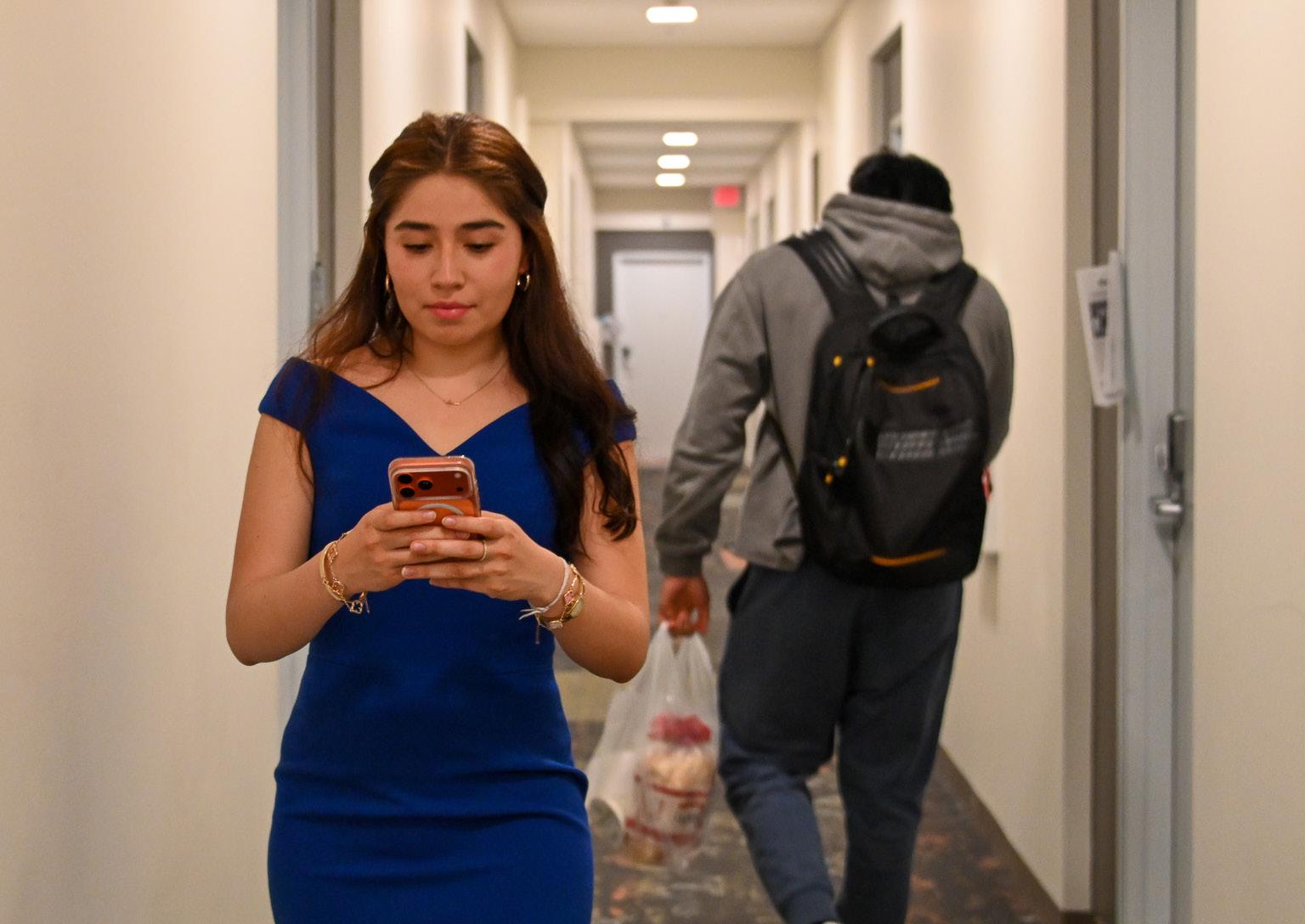
COLUMNIST
MARY-AUDREY MATTHEWS mlm27@dailyillini.com
Freshman year: It’s the year you will find your people, map out your future and finally become the person you always wanted to be.
At least, that’s what we are told.
I will never forget how I felt walking into my first college class. I was so nervous I felt sick, and I was halfway convinced I was lost.
The next class became easier because I knew what to expect, and after that week, I pretty much had a routine down. But it made me question certain things about myself: How do I appear to those around me? Will I actually be good at this?
My freshman experience was not nearly as groundbreaking as that of typical students. I don’t live on campus; I’m a townie.
I’m fully ignorant of what it would be like to sleep in a residence hall on the first night of my freshman year or have my primary food source be the dining hall and, most importantly, be without my family.
Though I have not had the normal freshman experience, living off campus has shown me a lot about what first-year students encounter.
As big as the University’s campus is, I will never be able to understand the overwhelming size, not only of the student body but also of campus. I did not leave home.
But from where I stand, watching

and participating at the edges of the first-year experience, the existential crisis seems to be a common occur rence for people.

For the students living on campus, that feeling must be even more intense. Being placed in a residence hall — with someone you very well may have never met — navigating shared spaces, making new routines, eating dining hall meals and so much more, I can’t relate.
In American media, we tend to talk about college in a very specific way; it is supposed to be transformative. College is the place to create yourself and become anew.
Think of “Gilmore Girls.” Rory works hard in the first three seasons to get into an Ivy League school. Her identity and most scenes she was in revolved around getting into Harvard University.
Once Rory leaves for college, that identity and expectation fracture because of a lack of structure. Her whole identity was focused on getting into college, and once she got to college, she didn’t have anything to work toward.
Similarly, I have seen University students with more freedom than they had ever experienced before and watched as their identities crumbled. No one told them who they were and where they ought to be.
The existentialist philosopher Jean-Paul Sartre offered a paradigm
for this phenomenon. Sartre argued that “existence precedes essence,” which means that we are not born with a fixed identity or purpose. We exist first, then later define who we are through our choices.
That idea sounds empowering, but Sartre argued the opposite. He wrote that we are “condemned to be free.” In other words, we must create our identities in a world with no answers.
Freshman year is existential in my eyes. Freedom is the ability to choose and, by extension, the pressure to choose correctly, often without reassurance.
Like Rory, people enter college with these fixed identities that turn out to be a clean slate. The promise of “finding yourself” suggests that identity is hidden somewhere, and through some digging, you will eventually find what you’re looking for.
What freshman year has revealed to me is something much more uncomfortable than the regular narrative — there may be nothing to find yet. When there is no fixed self to uncover, one can only grieve and start to construct a new identity.
Mary-Audrey is a freshman in LAS.