VOLUME 140: JANUARY 2026
See more content on dailyillini.com
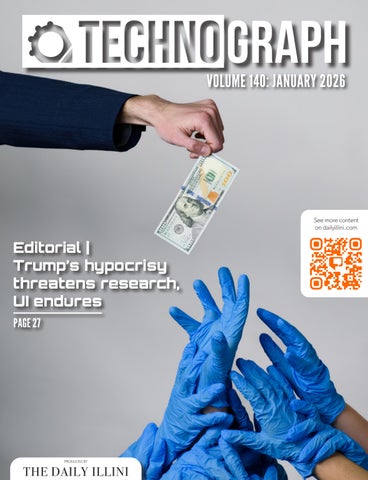
Editorial | Trump’s hypocrisy threatens research, UI endures PAGE 27
PRODUCED BY
THE DAILY ILLINI
THE DAILY ILLINI Editor’s note 1001 S. Wright St., Champaign, IL 61820 || 217-337-8300
The Daily Illini is the independent student newspaper at the University of Illinois UrbanaChampaign. The newspaper is published by the Illini Media Company. The Daily Illini does not necessarily represent, in whole or in part, the views of the University of Illinois’ administration, faculty, staff or students. All Illini Media Company and The Daily Illini’s articles, photos and graphics are the property of Illini Media Company and may not be reproduced or published without written permission from the publisher.
Contact us
Editorial Team
Visit us in the basement of the University YMCA at 1001 S. Wright St. from 9 a.m. to 5 p.m., Monday through Friday.
Editor-in-Chief: Sam Gregerman
Front Desk: Advertising: Newsroom:
editor@dailyillini.com
Managing Editor:
217-337-8300 217-337-8382 217-337-8345
Maaike Niekerk reporting@dailyillini.com
Visual Director:
Matt Stepp
Newsroom
visuals@dailyillini.com
Special Sections Editor:
Reporting: If you have a question about a story or notice an error, email our Managing Editor at reporting@dailyillini.com. Visuals: For questions about photos, graphics or The DI’s social media, email our Visual Director at visuals@dailyillini.com.
Chloe Barbarise specialsections@dailyillini.com
News Editor: Qaasim Jatoi news@dailyillini.com
Arts & Entertainment Editor: Annisyn Krebs-Carr
Employment: The DI’s staff are current students at the University of Illinois. Visit dailyillini.com/applyto-the-di/ to learn more about our hiring process. Tips: To submit a tip, email our News Editor at news@dailyillini.com or submit a confidential tip online at dailyillini.com/contact/. Corrections: When we make a mistake, we will acknowledge it with a correction. We strive for accuracy, so if you notice an error, please email our Editorin-Chief, Sam Gregerman, at editor@dailyillini.com. Letters to the editor: Letters are limited to 800 words. Contributions must include the author’s name, address and phone number. University students must include their year in school and college. The DI reserves the right to edit or reject any contributions. To submit a letter, email opinions@dailyillini.com with the subject line: “Letter to the Editor.”
Advertising Placing an ad: If you would like to place an ad in our next print edition or on our website, call our advertising department at 217-337-8382 or email advertise@illinimedia.com.
2
Technograph || Volume 140 || January 2026
entertainment@dailyillini.com
Sports Editor: Brendan Gallian sports@dailyillini.com
Copy Chief: Helen Maurer copy@dailyillini.com
Photo Editor: Sam Rink photo@dailyillini.com
Graphics Editor: Rikkie Gunawan graphics@dailyillini.com
Design Editor: Hadyn Nuttall
EDITOR-IN-CHIEF
SAM GREGERMAN editor@dailyillini.com
T
he word “Technograph” is made up of two affixes: the prefix “techno,” which Merriam-Webster defines as “technial or technologic,” and the suffix “graph,” which is defined as “something written or drawn.” In years past, Technograph has covered the vast array of research within The Grainger College of Engineering. It was first published in 1885 by and for engineering students, and The Daily Illini pays homage to its legacy with an annual publication. Federal funding cuts to University research sparked a renewed conversation about the importance of R1 universities like our own. With cuts impacting research in every discipline — not just engineering — the Editorial Board decided to adjust our angle.
We aimed to use this year’s edition of Technograph to spotlight research that spans across the entire University. As an institution that spends over $755 million annually on research efforts, we felt it was imperative to change the criteria of what research we cover in Technograph. In a climate of uncertainty, we stand firm in our belief that every researcher deserves an opportunity to share their story about the projects they’re part of. With that being said, page 6 dives into the ins and outs of biohybrid robotics in Engineering, and page 4 features the Chan Zuckerberg Biohub Chicago. If you’re looking to explore humanities research at the University, check out page 26 for a deep dive into a professor in FAA’s use of body mapping to analyze women’s reproductive health. We pride ourselves on all research at this University, and this edition of Technograph highlights that.
design@dailyillini.com
Audience Director: Audrey Lutz
LILY BLODGETT THE DAILY ILLINI
social@dailyillini.com
dailyillini.com @thedailyillini @thedailyillinisports @thedailyillini @thedailyillinisports The Daily Illini @TheDailyIllini @DI_Sports u/TheDailyIllini
ON THE
COVER
Gloved hands reach up to grab a singular $100 bill that is just out of reach. The withdrawal of federal funding for University projects leaves researchers scrambling to find a way to continue to do the important work we all rely on.
IN THIS
ISSUE
VOLUME
140
DESIGNERS Josh Fine Matt Stepp Hadyn Nuttall
Allison Lee Melody Smith Angelina Rutkowski
Destiny Plata
Katarina Smith Cody O’Malley Aliana Arifi Santos Medina Abigail Jacobs Shannon Moser
Biohub Chicago revolutionizes 4 CZ biomedical research with AI, engineering engineers reimagine society 6 Grainger through biohybrid robotics strives to advance national 7 Kriven geopolymer research
08
group develops retainers 8 UIforresearch tracking grind Plots revitalization strives for 11 Morrow visibility
26 07
quantum networking research opens 1 2 UIdoors unleashes antibody research 1 3 oPool+ potential professor reinforce accessibility 1 4 UIwithstudents, 3D-printed breast prostheses
cancer drug enters human trials 20 UIfollowing success in pets
25
14
Latino activism at UI 21 Researching through the decades talk wayfinding in new 23 UIplayprofessors development local AIDS history for a better 25 Archiving future professor designs her way to 26 UIreproductive justice
13
| Trump’s hypocrisy threatens 27 Editorial research, UI endures
Technograph || January 2026
3
CZ Biohub Chicago revolutionizes biomedical research with AI, engineering ASSISTANT NEWS EDITOR
ANNA CEJA aceja4@dailyillini.com
S
ince Priscilla Chan and Mark Zuckerberg unveiled their plan in 2016 to cure, prevent and manage all disease before the end of the century, the co-founders’ Biohub initiative has expanded to locations nationwide. Now, the initiative utilizes advancements in artificial intelligence to achieve this long-term mission. After reviewing applications from institutions across the country, in 2023, the for-profit philanthropy organization selected Chicago as the location for the second Biohub. There, experts across disciplines from the University, Northwestern University and the University of Chicago work together to redefine biomedical research. “We were the one team that they funded nationally out of over 50 teams across the country,” said Rashid Bashir, dean of The Grainger College of Engineering. “There is some history of the three of these great universities working together … and this was a great reason to come together to submit a proposal.” Researchers at the Chan Zuckerberg Biohub Chicago focus on inflammatory responses, as 50% of all deaths are attributed to inflammation-related diseases. This includes forms of heart disease, stroke, cancer, chronic kidney disease and autoimmune and neurodegenerative conditions. Gene Robinson, director of the Carl R. Woese Institute for Genomic Biology, said that despite differences in research culture, Biohub promotes crossdisciplinary collaboration between
4
Technograph || Volume 140 || January 2026
engineers, physicians and biologists. “There (are) ... different research backgrounds, and it requires some very specific forms of interaction to put the individuals together so that they can learn from each other and develop common goals and a common language ... to be able to achieve those goals,” Robinson said. Genomics, Robinson said, can provide researchers with early indicators about genes and molecular pathways involved in a particular biological process. Biohub then uses this information to develop a more targeted, engineering-based approach. “(The hub) builds on traditional ge-
to perform the tests incrementally over time. The final goal is for the technology to perform spatial measurements. This means the technology could measure several parts of the same tissue. “The idea is to move in that dimension, to be able to achieve these four characteristics,” Bashir said. “This will really help advance the understanding of inflammation … and if (researchers) understand inflammation, then (researchers) can do something to mitigate it.” Since its inception, Biohub expanded its research techniques to include AI, a crucial step, according to Bashir. He explained that the researchers’ goal is to develop AI that can perform PHOTO COURTESY measurements and OF THE CHAN provide data, then anZUCKERBERG INITIATIVE alyze inflammation Chan Zuckerberg on live tissue. Initiative Co-FoundIn a November 2025 er and Co-CEO press release, Biohub Priscilla Chan, Gov. also announced the JB Pritzker and Chan launch of the Virtual Zuckerberg Biohub Immune System projChicago President ect, a flagship effort Shana Kelley at the to model the human CZ Biohub Chicago immune system using launch on Oct. 5, breakthroughs in AI 2023. and immunology. “I think AI is certainly a tool that is critical to helping to nomic research ... but there’s the engi- advance understanding of biology as neering flavor to be able to work at scale well,” Bashir said. “AI is now truly inand to be able to create devices, new tegrated across the technologies in the kinds of sensors, to be able to measure hub already, and a lot of work needs to these phenomena and quantify them,” happen in that dimension.” Robinson said. Simulating immune therapies, reFrom there, researchers work to ma- programming dysfunctional cells and nipulate and change the functioning of preventing diseases before they arise those biological phenomena. are just a few of Biohub’s objectives. In According to Bashir, hub researchers another November 2025 press release, are working on technology that could Zuckerberg said AI could accelerate simultaneously analyze tissue in four these achievements. different ways. “When we started, our goal was to The first objective, Bashir said, is help scientists cure or prevent all disfor the technology to be able to test on eases this century,” Zuckerberg said. living tissue. He then emphasized the “With advances in AI, we now believe importance of accuracy for researchers this may be possible much sooner.”
Technograph || January 2026
5
Grainger engineers reimagine society through biohybrid robotics CONTRIBUTING WRITER
KARA PESCARU pescaru2@dailyillini.com
STAFF WRITER
PENELOPE ROEWE proewe2@dailyillini.com
T
oday, artificial intelligence is a billion-dollar industry and seems to be the future of technology, science and engineering. However, according to Rashid Bashir, dean of The Grainger College of Engineering, the most impressive supercomputer lives between your ears and runs on sugar: the brain. His fascination with biology and a knowledge of engineering have led Bashir to spend the past 12 years creating biohybrid robots that could change the way scientists study diseases. “If you look at so many of the systems in nature, like animals, trees (and) human beings, we’re all made of living cells,” Bashir said. “The idea is that we could take cells and use them as basic building blocks for building systems and machines, and learn the design rules of building systems with cells.” Over 10 years ago, the United States National Science Foundation partnered with the University, the Massachusetts Institute of Technology and the Georgia Institute of Technology to develop living machines. Bashir and his lab have engineered these biohybrid robots to mimic a human muscle to better understand muscle contraction, also known as tetany. While analyzing muscle contractions in the robots, the researchers are also studying inflammation between neuromuscular junctions — where neurons connect to muscle fibers. It’s an exploration that could help future scientists in various ways, according to Bashir. This focus could help scientists study diseases like Alzheimer’s and ALS at a much smaller scale. Tarun Rao, senior in Engineering, has been part of the project since his freshman year. He conducts his own exper-
6
Technograph || Volume 140 || January 2026
iments regarding the research and 3D prints the robot skeletons. “The goal of this project is to take the muscle actuation within the body and take it in an in vitro environment,” Rao said. Hyegi Min, postdoctoral researcher, works on the neurological side of the biohybrid robots to move them in different ways and measure neurological junctions. In a human muscle, neurons control the muscle fibers and send a chemical signal, which stimulates the muscle to contract. “We demonstrated neuromuscular junction, the junction between muscle and neurons,” Min said. “Neurons have a lot of functionality; they can learn, memorize stimulation and adapt. This junction can simulate the several stages of the (muscle) operating mechanisms.” Rao helps 3D print these robots, which can crawl across a table like inchworms due to their neural training. Now that the robots can move and develop patterns neurons can replicate, Katy Wolhaupter, graduate student studying bioengineering, is working to maximize the speed and force output of the robots. That task, however, isn’t easy. “One of the struggles in biology, in general, is that it’s very finicky,” Wolhaupter said. “The cells sometimes
have a mind of their own, and sometimes, things just stop working, and we just don’t know why. And it takes a long time to figure out why, and we haven’t exactly found solutions.” Since the robots can biologically decompose, they are environmentally sustainable and usable for water and agriculture. Bashir said they could one day monitor water supplies for viruses and bacteria and detect toxins. Teamwork within this project is especially essential due to the interdisciplinary nature of the field. “I have students and (postdoctoral fellows) with backgrounds from bioengineering, mechanical engineering (and) cell biology, that have to come together and work with each other and understand each other’s language,” Bashir said. Superheroes like Wolverine and Deadpool have always fascinated Rao, he said. Their healing capabilities to regrow a limb pulled Rao into the world of bioengineering. Now, Rao and his colleagues use their own superpowers to transform and improve society with their robots. “(Bioengineering) could help so many people with so many diseases, so that’s why I was drawn into bioengineering in the first place,” Rao said. RUHI HARYADI
THE DAILY ILLINI
Jerry Xu, postdoctoral research fellow, performs a test during a weekly meeting with other graduate students in the Holonyak Micro & Nanotechnology Lab on Nov. 21, 2025.
Kriven strives to advance national geopolymer research SENIOR SPORTS REPORTER
BEN SOMERVILLE bens4@dailyillini.com
T
he Kriven Research Group, based at the University and led by Waltraud Kriven, professor in Engineering, is one of the world’s leading research teams in ceramics. Kriven has six United States patents and two more in the works. The group has been funded by the U.S. government and has discovered ways to make ceramics with less energy. It has also worked with high-profile clients like Microsoft. However, the most impressive thing the group has done might just be its work with geopolymers, which, for the last 25 years, Kriven and her team researched. “They’re inorganic polymers,” Kriven said. “Normal organic polymers are organics, but these are inorganic polymers. They’re a potential partial solution to global warming.” A polymer is a large molecule made up of many smaller subunits, called monomers, that make up a chain. Geopolymers are diverse building blocks for an assortment of different materials. Microsoft employed Kriven to help design a cloud building, a structure housing large arrays of computers. Microsoft wanted to use geopolymers for the walls because they can stop electromagnetic pulses, protecting the computers. Geopolymers can help create fire-resistant coatings, and they can shield against nuclear radiation, gamma rays and neutron rays. “Gamma is hard to stop, and that’s what we’ve managed to achieve,” Kriven said. The applications don’t stop there. Geopolymers can be used to encapsulate radioactive waste and store molten salt to create thermal energy, which can be used instead of burning coal. They can stop metal from eroding and be used to stick different metals together.
Porous geopolymers, which are treated with a foam agent to create pores, can remove arsenic from water, helping developing countries get safer water. The most prevalent application — and perhaps the most beneficial — is how geopolymers can be used as a concrete. Kriven thinks it could replace Portland cement — the most common type of cement made from limestone and clay — in the future. “Don’t tell them where my office is,” Kriven said. “But Portland cement could be replaced by geopolymers.” Producing cement releases carbon dioxide, harming the environment. One ton of Portland cement releases one ton of CO2. One ton of geopolymer production releases just a quarter of a ton. Kriven and her team are working to get that to zero. As it stands, 8% of the world’s CO2 emissions come from cement manufacturing. Postdoctoral research associate Pozhhan Mokhtari believes geopolymers can fix that problem. “What we are making out of the geopolymer can perform better than cement, with, I believe, zero CO2 emission,” Mokhtari said. That’s not the only benefit of the geopolymer cement. Mokhtari said the cement used for buildings now can last around 100 years; the geopolymers can stand for thousands. However, there are problems with getting geopolymers standardized. Kriven said the cement industry likely doesn’t want to be disturbed. It could take time for it to come around. “That industry needs to be a bit more developed and nudged along,” Kriven said. The biggest problem is the cost. According to Kriven, the cost of the alkalis sodium hydroxide and potassium hydroxide — ingredients for geopolymers — is what’s holding the technology back. Since the cement industry is large, it’s easy for companies to manufacture the product. They make money, so they likely won’t change their ways, according
COOPER WITEK THE DAILY ILLINI
Waltraud Kriven, professor in Engineering, explains the new applications of geopolymers and the goals of her research group Nov. 18.
to Mokhtari. However, he said, if researchers can get geopolymers on a production line, they would be able to make it more affordable. It’s easier said than done. Cement manufacturers won’t be easily convinced to halt their production and make a change. It could dig into their profits. “It’s possible to make it more accessible and more affordable than cement, but we need someone … (to) invest in this material,” Mokhtari said. For now, Kriven and her research team continue to find ways to reduce the CO2 levels from geopolymers. They are still trying to find ways to get the cost down. Even so, it could be sooner rather than later that geopolymers replace cement as a household name. “I guess, in 20 years’ time, the geopolymer (is) going to take its place,” Mokhtari said. “This is what I hope.” Technograph || January 2026
7
RISHAB SAKALKALE THE DAILY ILLINI
Oscar Kaplon, senior in Engineering, demonstrates how to collect data from a smart wireless retainer, which is part of a project in professor in Engineering Yang Zhao’s Bionanophotonics Lab, on Nov. 18, 2025.
UI research group develops retainers for tracking grind STAFF WRITER
ALEX MURPHY alexm10@dailyillini.com
S
oon, you won’t be able to lie to your dentist about wearing your retainer. A research group at the University is currently developing a smart retainer that will track wear and grinding on teeth. The smart retainer will use sensors to track data, like a force sensor that tracks grind by detecting when a bite is made. In addition, it will have a temperature control, which determines if the patient is wearing it or not. Dr. Phimon Atsawasuwan, professor of orthodontics at the University of Illinois Chicago, first came up with the idea for a smart retainer. Atsawasuwan shared there is no evidence on whether patients are wearing their retainers, because, in rare cases, teeth can still shift. With this smart retainer, however, dentists will have evidence on whether the patient is wearing it or not. “Most of the time, you have to ask the patient to wear the retainer
8
Technograph || Volume 140 || January 2026
because, if the patient does not wear the retainer, the teeth relapse, so that’s a major problem,” Atsawasuwan said. He then reached out to Yang Zhao, professor in Engineering at the University, to help him develop the retainer. Zhao leads the Bionanophotonics Lab, which focuses on wearable metasurfaces, a surface that allows for the manipulation of electromagnetic waves. After connecting with Atsawasuwan, Zhao organized a research group at the University to work on the retainer, led by Xiaodong Ye, graduate student studying electrical and computer engineering. According to Ye, the collaboration between the two universities is essential to developing this retainer. “I think that dentists actually need this device to work on their patients, and our labs have this facility and this target scale to develop such a kind of work,” Ye said. The retainer will keep its standard design but will be sealed in polydimethylsiloxane, a silicone polymer, to keep it waterproof and durable. Additionally, the smart retainer will be controlled with a printed circuit board. The PCB will have many different
parts. In addition to the force and temperature sensor, it will also have a microcontroller and potentially an accelerometer. The force sensor’s goal is to track the resistance of a patient’s bite. This will allow dentists to track their patients’ grinding for correction. Oscar Kaplon, senior in Engineering, and Kevin Zhang, sophomore in Engineering, are two undergraduates in the research group currently working to develop their own force sensor. Each is researching a unique type of sensor for use in the retainer. Kaplon is focusing his research on a resistance-based sensor, commonly known as a piezoelectric sensor. The sensor has a top and bottom metal plate with a middle medium. “It’s like a sandwich,” Ye wrote in an email to The Daily Illini. “When you squeeze it, the top and bottom plates have more area contacting. Then, (there is) more area for the current to pass through, and the resistance becomes smaller.” The current passing through the area allows the retainer to measure the
resistance. This allows the sensor to determine the voltage, and, finally, it can correlate that to the force of one’s bite. However, the group is still unsure what material is best to make the middle of the sensor out of. The medium needs to be malleable enough so that the top and bottom plates can connect. In addition, many materials that are plausible are too toxic for the human body. “I spend a lot of my time researching different kinds of materials that play possible mixed with carbon black or carbon black on its own,” Kaplon said. “Currently, I’m studying a little bit more on graphene specifically … because that seems conductive enough for it to be applied and used as a force sensor.” Currently, graphene is the most promising material for the group to use, but Kaplon hopes to keep researching to find a material safer for human use. Meanwhile, Zhang is researching a capacitance-based sensor. This sensor has easier-to-find materials than Kaplon’s, but it is also much more difficult to measure grind. The capacitance-based sensor is structured very similarly to Kaplon’s sensor. The medium in this sensor is firm yet flexible and is called a dielectric. However, in this sensor, the top and the bottom plate never make contact. Instead, Zhang explains, charges move between the plates depending on how close together they are. This rate can then be used to determine the force of a bite. Currently, that capacitance value is very small, which makes measuring capacitance very challenging. “So, from a research standpoint and designing, we want to figure out how to increase the capacity so that we can actually measure it for a force sensor, but also keep it within the size constraints of not being too thick,” Zhang said. Kaplon and Zhang are using previous literature on similar sensors to learn and develop their own, although it is unclear yet which sensor will best fit the retainer. The group will also use a commercial temperature sensor in the retainer as further evidence for patient use. “It’s detecting whether or not the patient is wearing (the retainer),” said Joanna Li, junior in Engineering. “If it’s at room temperature, then you know
it’s not on, but the human body temperature is around 90 degrees Fahrenheit, so once it’s worn, (the sensor) will detect that spike in temperature.” The accelerometer is a bonus feature that tracks how the patient moves around at night. Using different position values, the sensor tracks acceleration and can determine velocity and position. However, the group is still unsure if the accelerometer will be in the final product. All the sensors then connect to the microcontroller, which is a type of mini computer. This sends the data to the phone to be viewed. The group has established a Bluetooth connection between the microcontroller and phone, but the data is coming in too rapidly and continuously. “So currently, I’m working on being able to slow down the rate of transmissions, so that we only want to collect data once every minute or once every couple of seconds, and that we don’t overload the storage,” Li said. The other issue Li is working on fixing right now is getting the microcontroller to store the values more efficiently. The data is transmitted to the phone once the retainer is in the case and charges. However, it is extremely power-heavy to continuously transmit data. “It’s probably going to be a couple
hundred kilobytes of data at once,” Li said. “So the memory needs to be able to handle that, and it also needs to be able to read it correctly without the data getting overwritten or corrupted.” The last aspect of the smart retainer is the case, which will have a metasurface on it for more efficient charging. “It’s used to focus or manipulate the magnetic field generated by the retainer case and then focus the energy to the retainer,” Ye said. “It acts like a relay between the transmitter and the retainer.” The group still has much more research to do on this retainer, and they are excited to continue to develop it. Kaplon and Zhang’s next step is to design a small PCB that will fit in a retainer, as, currently, the commercial one the group is using is too big. Li will also work to develop an app, which will display the data the retainer collects. The app can be used by both patients and their dentists. Li is optimistic about the lab’s ability to continue to develop the retainer and its future in commercial opportunities. “We’re just hoping this is a design that’ll eventually be able to secure a patent and then be able to be more widely used, because I think it would be very helpful and (help) dentists treat patients’ grinding,” Li said.
RISHAB SAKALKALE THE DAILY ILLINI
Yang Zhao, professor in Engineering, and members of her Bionanophotonics Lab pose with circuits and retainer molds, components of their smart wireless retainer, on Nov. 18, 2025. Technograph || January 2026
9
10
Technograph || Volume 140 || January 2026
Morrow Plots revitalization strives for visibility SENIOR COPY EDITOR
AMARTYA NALLURI nalluri4@dailyillini.com
N
estled behind tall yew hedges, the Morrow Plots are hard to miss on campus. The imposing bush and myths of expulsion for trespassers contribute to a sense of mystery surrounding one of campus’s oldest landmarks. However, a new project aims to make the obscure fields more accessible to students, scientists and visitors alike. “We’re trying to revitalize how we communicate, how we show literally but also digitally … the really high value to science of the Morrow Plots,” said Andrew Margenot, director of the Morrow Plots and professor in ACES. The revitalization, partially funded by the Bayer Crop Science Innovation Center, is planned for completion by this year’s 150th anniversary celebrations, with renovations taking place over winter and spring. The Morrow Plots were established in 1876 and were originally meant to observe the effects of crop rotation on yield. Over time, new treatments were added as agricultural research around the world grew, but its main experimental questions have remained the same. As Sara Marston, junior in ACES, explained, this kind of research isn’t just interesting — it’s necessary. “Agronomy is really important because it focuses on food, fuel, fiber and feed for animals, and all of those are literally important to every single one of
RIKKIE GUNAWAN THE DAILY ILLINI
our lives,” Marston said. One of the most significant changes to be made is the removal of the hedges encircling the plots. Its purpose is twofold: to make the plots more visible and to remove squirrel habitats that affect the crop yields. “One of the things that has been a longstanding problem for the Morrow Plots is that tall hedge,” said Adam Davis, head of the Department of Crop Sciences and professor in ACES. “(It) both obscures the plots from passersby but also provides a safe haven for squirrels who’ve been basically obliterating our corn yields.” In its place, a wrought-iron fence will be installed, creating more visibility for the community while still keeping the plots themselves protected. According to Davis, this was the original focus of the collaboration with Bayer, and the company’s gift will help support this renovation over the next year. Additionally, live monitors, including sensors and webcams, will be added across the plot to create new data and analysis opportunities. “You’ll be able to watch the temperature, the moisture of the soils,” Margenot said. “You can do time lapses and look at the different crops growing throughout the years.” The project isn’t just physical in nature, however. It also involves making the past century and a half’s data accessible to all. In collaboration with the University Library, Margenot is working to create a compiled database for the Morrow Plots. This includes all past data and research connected to the plots. The Illinois Digital Environment for Access to Learning and Scholarship website will house the records, which will be open to members of the public for their perusal and use. “It’s really a trove of old photos, stories about it, data, descriptions of the experiment,” Davis said. “You could learn a ton, as a scholar or a student, just going there.”
PHOTO COURTESY OF THE UNIVERSITY OF ILLINOIS
The Morrow Plots, seen in 1937 (above) and on Nov. 14, 2025 (below), were established in 1876 and are undergoing revitalization efforts to preserve the historic fields and improve visibility ahead of its 150th anniversary this year.
CONNOR STOLMAN THE DAILY ILLINI
Marston also emphasized that anyone can study agriculture regardless of where they live or what experience they have with farming. This sentiment is shared by the team behind the Morrow Plots, who continue to open their research to campus and beyond. “(We’re) really thinking about it as an opportunity for a living classroom in a way,” Davis said. The Morrow Plots may seem like a redundancy in a state where approximately 75% of land is used for agriculture, but it’s the long-term impact that makes it a globally important research center. As Margenot noted, the plots provide plenty to be excited about. “This is the world’s second-oldest continuous experiment,” Margenot said. “That is a big deal … It is a piece of living history, and we should not take that for granted.” Technograph || January 2026
11
UI quantum networking research opens doors SENIOR COPY EDITOR
ANIKA KHANDAVALLI
ANNA WILLIAMS
THE DAILY ILLINI
akw5@dailyillini.com
An optical fiber array brightens a dark lab in the Engineering Sciences building on Nov. 18, 2025. This process helps image atom-photon entanglement in an ongoing University research study.
R
esearchers at The Grainger College of Engineering have made a major breakthrough toward building future quantum networks. In a paper published in the research journal Nature in September, researchers in the lab of Jacob Covey, professor in Engineering, detail their work with quantum networking. Quantum networking is a communication technology that works by sending quantum information, or “qubits,” between nodes. Quantum networks have a level of capability and security not possible with conventional networks. “Quantum communication generally deals with exchanging information,” said Simon Hu, graduate student studying physics and one of three lead authors on the paper. “It takes a specific protocol, specific setups, to actually distribute our information over long distances, and so … our paper here sort of demonstrated a more efficient way, and perhaps a more scalable way, to implement networking between different places over long distances.” The research focused on “high-fidelity entanglement” between optical photons and ytterbium-171 atoms. Ytterbium, a rare earth metal in the lanthanide series, is instrumental in much of quantum physics due to its unique atomic properties. “The problem of all the old-fashioned experiments, basically what they do is generate a pair of entangled photons, and … there’s nothing more,” said Lintao Li, postdoctoral research associate and lead co-author. “So what we really want to do is to further get some kind of interaction between the photon and our system. So, basically, you can make use of the entanglement on the photon states.” After generating entanglement, the arrays of atoms were then imaged on an
12
Technograph || Volume 140 || January 2026
optical fiber array to show a networking protocol that could eventually be integrated into scalable quantum networks. The parallelized setup of the atom arrays meant that multiple entangled atom-photon pairs could be used at once, which is a key ingredient for scaling up to larger networks. Many quantum systems use photons in the visible or ultraviolet spectrum, but long-distance networks operate best in the telecommunication band — a specific range of radio frequencies. Converting between wavelengths usually leads to information loss, introduces noise and limits performance. Covey’s team avoided that by generating the entanglement directly in the telecom band, preserving the coherence of some qubits meant for memory, while others meant for communication were free for their own tasks. “It’s related to the two core parts of distributed quantum computing,” said Gloria Jia, postdoctoral research fellow and co-lead author. “First, you have to have good nodes, and second, you have to have good, high-value connections between nodes. So we’re sort of done with the connection part, and now, we’re focusing on the single setup. How can we achieve good performance of the qubits trapped within a single system?” The publication acknowledges there
were some limitations within their work. One is low photon collection efficiency, which slows down the rate at which researchers can build entangled links. The researchers suggested that, in further experiments, this rate could be improved by adding an optical cavity to the process. The experiment discussed in the research paper, known as YB1, is being succeeded by further trials on a YB2 array — also hosted in the college’s labs but led by other researchers — which plans to include an optical cavity. “There are major hardware upgrades,” Hu said of YB2. “They have this optical cavity set up to really enhance the rate at which the photons can be collected out of the system, which ultimately leads to an increased rate of communication between different nodes. That’s sort of the future outlook of this. And that second setup is also happening here.” As for further applications of the research, the team said that they hope their work can be used in future quantum computing, going toward scaling larger quantum networks. “In the end, hopefully we can get … many good quantum processors and between any of them are connections by high-fidelity entanglement,” Jia said. “Just to have a good, big distribution on a computer.”
oPool+ unleashes antibody research potential STAFF WRITER
ELLA NARAG mnarag2@dailyillini.com
T
iny proteins called antibodies line every person’s immune system, making them crucial to vaccine and therapeutic developments. However, there hasn’t been a cost-effective way to study multiple types of antibodies simultaneously, which has limited researchers’ understanding of the disease-fighting potential of these molecules. Enter oPool+, a technique University scientists created that allows for the mass production of these proteins. Under this method, researchers can develop and test thousands of antibodies at once, bypassing old protocols that only allowed for one or a couple to be tested at a time. “We simply have way too many antibodies that the current approach we use is perhaps a bit too slow for us to fully understand how exactly these molecules work,” said Owen Ouyang, graduate student studying biochemistry and first author of the study. Antibody discovery is crucial for testing immune responses, but there hasn’t been a cheap, efficient way to create multiple identical proteins that scientists can test. Now, the oPool+ display allows researchers to do exactly that. “We wanted to really unlock the potential behind these molecules,” Ouyang said. “And perhaps use all of these lessons we learned for our advantage in
the combat against infectious diseases and cancer, so on and so forth.” Nicholas Wu, professor in LAS and principal investigator of the study, noted that this project, from idea conception to paper publication, was a two-year-long endeavor — the first 18 months of which were unpromising. “I asked Owen, ‘OK, maybe we should think about having another project, since this seems to be a bit too difficult,’” Wu said. However, noting Ouyang’s persistence, Wu said once the results started working, everything else was smooth
sailing. The wrap-up took roughly six to eight months, and now the paper detailing the technique is published in Science Translational Medicine. Wu’s support was particularly notable to the success of the display, Ouyang said, especially after over a year with no promising results. “Nicholas really greenlighted (and) was fully supportive on a lot of things,” Ouyang said. “I think, because of the support that Nicholas gave us, we (were) able to persevere and really make things happen.” Meixuan Tong, junior in LAS, joined the lab in Spring 2024. She joined Ouy-
ang on the project after the success of the display and helped validate the experimental results. “It was actually really satisfying, because it was, like, actually everything aligns with the screening,” Tong said. oPool+ is named for the biochemical processes that created the antibodies in the display. Oligopol DNA synthesis, the specific technique they used, generated a pool of genomic material that the display uses. With the potential new antibodies from oPool+’s experimental platform, Wu hopes different areas of research can come together to create a large data set that is EMILY NNODI widely available. THE DAILY ILLINI Wu wishes to Owen Ouy- integrate AI into ang, graduate the oPool+ disstudent study- play by creating ing biochem- antibody predicistry and first tions through author of the simulations and oPool+ study, using oPool+ to holds up part develop the preof the oPool+ dicted antiboddisplay at the ies. The experWu lab in Bur- imental results rill Hall on Nov. then feed back 19, 2025. into the computer database for an expanded dataset it can pull from, leading to a more comprehensive understanding of the proteins. “The key to having a good AI model is to have a lot of data,” Wu said. “So we really need some high-throughput way (and) some fast, easy, cheap and scalable methods to generate data.” Because of the study’s recent publication, Wu said the implications of the technique aren’t quite yet known, but he has received emails from both the private and public sectors regarding the work. “We do believe that it will make an impact,” Wu said. Technograph || January 2026
13
UI students, professor reinforce accessibility with 3D-printed breast prostheses
ELENA BAKER THE DAILY ILLINI
The team uses silicone chest models for 3D scanning; they can remove and swap each component with another to create a customizable prosthetic fit. They hope this process can help cancer patients through their journey.
14
Technograph || Volume 140 || January 2026
ELENA BAKER THE DAILY ILLINI
SPECIAL SECTIONS EDITOR
CHLOE BARBARISE
Dr. Victor Stams, Carle Foundation Hospital plastic surgeon, speaks with the team working on developing 3D-printed custom-fit breast prostheses at the Medical Sciences Building on Nov. 21, 2025.
chloeb4@dailyillini.com
L
ocated within the Carle Illinois College of Medicine are several 3D printers produced by the mind of Rand Kittani, graduate student studying Medicine. She established “the world’s first business school 3D printing lab,” and her ideas continued to flow from there. Kittani encountered REALETEE, a company based in France that used similar 3D printers to create high-end breast prosthetics. She knew the same thing could be done at the University, but her focus was different: She wanted the prostheses to prioritize those wearing them. “I have a lot of empathy for patients going through cancer,” Kittani said. “It’s devastating. It’s not easy for any member of the family to get it, but let alone, if you’re a mother … it’s even more amplified for their families, and women go through a lot just by nature.” As the student lead on this project, Kittani works closely with Dr. Victor Stams — the project’s clinical lead, professor in Medicine and Carle Foundation Hospital plastic surgeon — and a team of four students. Kittani and her team conduct studies in his clinic to gather patient input. After an interview with a patient, the team learned about the waiting period between getting a mastectomy and an implant. Most plastic surgeons recommend that patients wait until around six months after they’ve undergone radiation treatment to consider breast reconstruction surgery, providing ample time for the skin to heal. To alleviate the psychological effects, like depression, anxiety and stress, that this period can have on patients, the team is working to bridge this gap in time. “Vision matters,” Kittani said. “Everybody’s on the same page in terms of where this is going, and we all kind of realize how this will be important for patients … It’s been amazing to see how different expertise can come together to build this.” The team first uses a 3D scanner to examine the breast before the operation. Once the scanner forms the image, they place it into their developing software, where doctors can minimally manip-
ulate the depiction and print a 3D custom-fit breast prosthesis. “One of the challenges we have is: How do we make a unique software with all the technologies out there?” Kittani said. “How do you come up with something that is not out there, but it’s easy to use, but it’s keeping up with the technology and having it done in six months or less than a year?” Despite Kittani’s questions, Stams noted how Kittani came up with an idea “that was right in front of our eyes.” He has watched her constantly ask what more they could do with the device. “She had the ingenuity to sort of say … ‘Can we not take this device, create a mirror image of a patient’s breast and then deliver them a prosthesis that actually fits, restoring their dignity (and) integrity in a sense of pride?’” Stams said. “And she’s been able to achieve that. Pretty remarkable.” Stams further mentioned that even though the product remains in a development phase — as they look at what materials work best, how to produce on a mass scale and several other unanswered questions — the reactions have been overwhelming. Patients whom he’s never met before have reached out to him about the device. The team has questioned how they’d market the prostheses, and Kittani and Stams said they’ve decidedly focused on underserved areas and patients without access to care. Simultaneously, they’ll collaborate with doctors so that patients receive adequate information about the options ahead of them. “If we understand that, for many patients, prostheses are not a cosmetic luxury, they’re part of restoring a patient’s well-being,” Stams said. “We’re trying to bridge that gap by creating a device that’s cost-affordable and effec-
tive for patients, not only (those who) are underserved but for all patients.” High-quality breast prostheses can cost anywhere between $100 and $500. Custom-made prostheses can increase that price by thousands. The Women’s Health and Cancer Rights Act of 1998 requires that health insurance issuers that cover benefits for mastectomies must also provide coverage for certain benefits post-mastectomy. However, the law excludes Medicare, and individuals hold responsibility for co-payments and deductibles as a result of their breast prostheses. Kittani created a product meant to be easily accessible for patients: something quick and low-cost to aid them through their battle against cancer, even if it’s only a fractional support along their journey. “My goal (with) this technology is not just to come up with something and put it out there,” Kittani said. “I actually want it to be patient-centered and desired by patients.” To Stams, the project also holds significant meaning for the Champaign-Urbana community. He said that his patients get to witness a remarkable idea coming to fruition, and they don’t have to travel far to do so. “Oftentimes, we’re looked at as a very small medical college … but the students that we have at this college are just worldclass,” Stams said. “We have the best and brightest students in the nation, students from all over — from the East Coast, from the West Coast, like Rand — and they all come here to this think tank.” Since the team has a proof of concept, the next step is to establish more elaborate processing. They’ll work toward using a computer-aided design software to facilitate going from scans to prints, alongside ensuring the product follows government regulations. Technograph || January 2026
15
1 16
Technograph || Volume 140 || January 2026 2025
Technograph || January 2026
17
18
Technograph || Volume 140 || January 2026
UI cancer drug enters human trials following success in pets SENIOR ARTS & ENTERTAINMENT REPORTER
BRYANA PEREZ bkperez2@dailyillini.com
W
hen a veterinarian delivers a cancer diagnosis, the news can bring a harsh reality that effective treatments could cost thousands of dollars, or may not even exist. Here, at the University, the Anticancer Discovery from Pets to People theme challenges that reality. The ACPP research theme operates within the Carl R. Woese Institute for Genomic Biology, involving several professors from the College of Veterinary Medicine, and is designed to accelerate drug discovery. This initiative offers fully funded experimental anticancer treatments to dogs and cats with naturally occurring tumors that translate to clinical trials in humans. Leading this work is Paul J. Hergenrother, ACPP theme leader and professor in LAS, and Dr. Timothy Fan, professor in Veterinary Medicine. A mix of empathy for pet owners and curiosity fuels Fan’s drive to find an effective drug. “As a veterinarian, there is a lot about compassion in helping that pet and, more importantly, really trying to provide hope and realistic expectations for pet owners,” Fan said. “The scientist piece is where intellectually I get stimulated. The ability to think about what are ways to … develop new therapies to fight this disease.” Standard drug development often relies on mouse models that fail to predict how drugs behave in humans, according to Fan. In contrast to mice, Fan further mentioned that dogs and cats develop cancer spontaneously, mimicking the way tumors form in people. Fan said this biological similarity makes them supe-
20 Technograph || Volume 140 || January 2026
NOAH MARKUNAS THE DAILY ILLINI
Kyle Abo, graduate student studying chemistry, gestures to the research lab’s rotary evaporator Nov 13, 2025. This machine is used to evaporate and remove the organic solvents, then is condensed and stored in a reception flask.
rior “pre-translational models” because they offer a more accurate prediction of whether a therapy will work in a real-life setting. Because of this physiological similarity, ACPP can identify effective compounds in pets first. These compounds — small molecules with anticancer activities identified by high-throughput screening — are then tested for their safety in dogs and cats. Fan said the team ensures that only the treatments with the “greatest promise” advance to human trials. The program is already producing results. Researchers like Kyle Abo, graduate student studying chemistry, are developing these next-generation compounds. “I actually took (a) compound and tested it against cancer cells and was actually able to see it kill cancer cells,” Abo said. “It was pretty inspiring for me to see a molecule that was made by my colleagues … and see it exert its anticancer effect and killing.” The research team has treated more than 50 pet dogs with cancer through the discovery of PAC-1, a procaspase-3 activator. PAC-1 works by targeting a protein called procaspase-3 that is often abundant but dormant inside cancer cells. The drug acts as a molecular key, unlocking a hidden self-destruct sequence that causes the tumor to die
from the inside out while sparing healthy tissue. Today, human cancer patients are actively taking PAC-1 in a Phase I clinical trial. While the science focuses on compounds and data, the theme focuses on the pet owners themselves. The ACPP theme covers the cost of the experimental treatments, providing an option for owners who might otherwise face expensive veterinary bills. Before any pet joins a study, researchers walk owners through the purpose of the trial, the evidence behind the therapy and the limits of the drug’s power. Fan said this honesty allows the team to set realistic expectations and ensures that owners don’t expect a cure. “We are very careful and very deliberate in outlining to pet owners to be fully ethical that this is an investigational therapy,” Fan said. “We believe that it is safe, we have shown that it works … we just don’t know how well it is going to work, and we tell (pet owners) that.” Although scientific advancement drives the research, Fan notes that many owners join the trials simply out of altruism. They understand that even if a cure isn’t guaranteed for their pet, their participation could unlock better treatments for future pets and people. Because pets experience cancer in the same environments humans do, Fan said their findings provide data that is difficult to replicate elsewhere. The team plans to use this specific data to investigate how experimental drugs function across diverse tumor types and disease stages to improve the quality of life in both pets and humans. “I’m excited about the opportunity to see the maturation of these technologies that can hold promise for people,” Fan said. “It’s all about curiosity, hope and realization that something new and exciting is at our fingertips that could ultimately be impactful to treat humans with cancers that are affecting dogs and cats, too.”
Researching Latino activism at UI through the decades STAFF WRITER
SOFÍA BODDY sgboddy2@dailyillini.com
T
he cultural spaces on campus are longtime establishments with the goal of providing students a sense of belonging, home and family. However, beginning in the 1950s, students had to fight and bargain with the University for these spaces, including La Casa Cultural Latina. Activism on campus today has evolved for Latino students, who only began to attend the school in extensive numbers in 1968, following a University-wide effort called Project 500. Introduced following the assassination of Martin Luther King Jr., efforts were made to enroll minority students in greater numbers than ever before. However, once students arrived on campus, according to Mirelsie Velázquez, professor in LAS, many still felt marginalized in community and education spaces, not seeing themselves in faculty, studies or clubs. Velázquez is currently writing her second research book focused on the topic of on-campus activism, which came about following an invitation to speak at the Spurlock Museum in 2020 about a mural on display centered on Latino successes. A main theme of the novel, which is still untitled, is an exploration of Latino students’ internal feelings of displacement and how it can negatively impact them on campus. Velázquez would later find in her research that students on campus began to express themselves through art, including elaborate murals on the walls of the Latino House, which would later become La Casa. These murals embodied feelings of displacement, brainwashing and conforming — things that Latino students wanted to reject. “When they’re here in the early ’70s, they don’t have a space for themselves, and so they start little by little,” Velázquez
CELIA FUENTES THE DAILY ILLINI
Mirelsie Velázquez, professor in LAS, in her office at the Department of Latina/Latino Studies on Nov. 17, 2025. Velázquez explained her perspective as a scholar on activism at the University.
said. “They start creating, and they don’t wait for the institution to start doing programming for them. They start doing it themselves (by bringing) speakers and throwing dances.” The buildup of these struggles continued to compound, culminating in protests on campus by Latino students in the early 1990s in an effort to force the administration to make a change. Students compiled a list of issues and held up signs with phrases like, “If God can listen, why can’t you?” marching for hours around the quad. Demands included greater diversity in administration, the creation of a Latina/Latino Studies department, increased support for Indigenous students and increased funding and recruitment efforts for Latino students, which had only made up 0.002% of the student body since 1973. “In 1992, the immediate response following the protests was that you start seeing some courses in Latino studies, but it’s more of a ‘Here you go,’” Velázquez said. “You still have the racist mascot, you don’t have a clear
development of a retention program, and so it’s not just about recruitment, it’s retention as well.” One of the positive changes that has occurred out of this decade of struggle was better housing for La Casa, with the center and its movement having developed heavily throughout the decades. Stephanie Cardoza-Cruz, assistant and interim director of La Casa, said it’s in a strong transitional period, looking ahead toward the future. “I hope to see a continued future of the great momentum that we have now,” Cardoza-Cruz said. “You see such strong and dedicated student leaders who take up spaces not only within La Casa but far beyond.” Still, Cardoza-Cruz said, La Casa only has one staff member who works full-time today, demonstrating the lack of resources provided. “I hope that students feel the longevity of the space and remember the fight that came for us to have what we have now,” Cardoza-Cruz said. “None of it is a result of chance or luck, but rather the good fight that really keeps us going.” Technograph || January 2026
21
22 Technograph || Volume 140 || January 2026
UI professors talk wayfinding in new play development SENIOR COPY EDITOR
ALEXA LIS arlis3@dailyillini.com
W
hen discussing the genre of straight plays — staged performances relying solely on speech rather than on song or dance — the names of long-dead playwrights, like Arthur Miller or William Shakespeare, pop up time and time again. Without question, these and other classic playwrights have played a role in shaping the genre into what it is today; however, the genre is far from reaching its final form. To some, manufacturing a new play means stepping into a fascinating world of opportunities, creativity and collaboration. The creative drive for developing new plays persists at full strength in the University’s Department of Theatre. “I have always been curious about how actors, as well as directors, can best serve the creative process,” said Kim McKean, professor in FAA. “My research
began with making new work from the beginning stages to the end and exploring how to give students agency in creating their own work (and) how to encourage actors to find their voice in making their own work.” McKean is writing a book that compiles best practices in new play development. She has been interviewing theater-makers of all kinds nationwide about their experiences producing new plays. “(McKean and her co-writer are) hoping to publish something that other universities can go to as a guide, like, ‘I want to make something new with a professional playwright; how do I do that?’” McKean said. “(The university environment) is a fertile ground for developing new work because of the resources of space and time to really generate an idea and sit with an idea.” McKean is not currently focused on creating new plays herself, but her research permeates her experience as an instructor. She often brings new ideas from her research to class, guiding students as they learn to follow their instincts and make strong choices when working with new material. McKean’s research focuses on the process of creating new works; the research of Nisi Sturgis, professor in FAA, focuses more on new material. StMICHAEL SLIGTING urgis spoke at length THE DAILY ILLINI about her ongoing Above Two interest in adapting students engage in a warm-up activity classical works into in an acting class innovative pieces. led by Kim McKean, The revamping of professor in FAA, Shakespeare plays Nov. 20, 2025. Left McKean has fascinated Stpraises a student urgis for years. She for correctly mentioned an origresponding to a inal play based on prompt.
“The Taming of the Shrew” that incorporated student-actors’ opinions and feelings about the strictly Shakespearean version into the final performance. Integrating the cast’s opinions on the centuries-old play made room for modern interpretations of old themes, allowing the material to shine in a new light. “(It’s) always thrilling to me when students are a part of the process,” Sturgis said. “It reveals more about the text and a contemporary mindset … Students are going to have the questions that we’re really interested in right now.” McKean and Sturgis both highlighted the Daniel J. Sullivan Playwright-in-Residence Program as an exciting, handson opportunity for students from the theater department to interact with the process of creating new works. The program invites a playwright to develop a new play to include in that season’s performances. Throughout the process, from brainstorming to performance, the playwright workshops and revises their concept and script in real time with students. The 2025-26 season brought a slight alteration to the typical form of this program: The theater department invited Third Rail Projects to the University as Artists-in-Residence. The professional theater company, known for its original collaborative works, began a series of visits to the University in Fall 2025. For a few weeks, Third Rail rehearsed with students to experiment and explore concepts for a new work. After developing these ideas back home in New York City, Third Rail will return in the spring for another round of exploration and collaboration while developing this new piece with students. “I think there’s a great deal of risk in new play development,” Sturgis said. “It is a process of real vulnerability for the artists who engage in it. (That’s) why I think (the development of new work) really deserves as much support and attention as we’re trying to give it here at Illinois theater.” Technograph || January 2026
23
24 Technograph || Volume 140 || January 2026
Archiving local AIDS history for a better future ADAM EDWARDS
THE DAILY ILLINI
SENIOR NEWS REPORTER
AVERY PATERSON
Daniel Rodriguez, graduate student studying history, holds a box of files from the Greater Community AIDS Project’s archives inside the Main Library on Nov. 21.
averyep2@dailyillini.com
T
he preservation of AIDS history in the Champaign-Urbana area nearly disappeared years ago after its archivist died in 2022. Now, Daniel Rodriguez is committed to finishing what was started. As a graduate student studying 20th-century LGBTQ+ history with a focus on transgender history, Rodriguez said the opportunity to work on an archiving project with the Greater Community AIDS Project felt “like fate.” The organization provides housing, financial services and other support to individuals living with HIV and AIDS in central Illinois. AIDS, or acquired immunodeficiency syndrome, is a disease whose victims have suffered stigmatization and inadequate governmental responses since its appearance in 1981. The disease became associated with gay men, who have a higher risk of contracting its precursor, HIV, or human immunodeficiency virus. By 1999, it had killed 14 million people worldwide. Today, 40.8 million people across the globe live with HIV. Though no cure exists, numerous prevention and treatment methods have decreased its mortality. Before Rodriguez’s involvement with the archiving project, Kathryn Oberdeck, professor in LAS, led the archiving of AIDS-related historical documents housed at GCAP. When she died from
ADAM EDWARDS THE DAILY ILLINI
cancer in 2022, GCAP lost its access to the archiving she had done. Rodriguez, who had taken one of Oberdeck’s graduate seminars, decided to restart the archiving process from scratch. Ultimately, Rodriguez aims to create an online database on GCAP’s website, where each piece would be archived according to decade and subject matter. “Whatever we produce, I want it to be research-legible,” Rodriguez said. “I want a researcher who’s curious about the history of AIDS, the history of community organizing, nonprofit work around AIDS … I want them to be able to pull up these documents and use them, because it doesn’t have to be me.” In his work, Rodriguez sorts and digitizes newspaper clippings, photos and more that relate to GCAP’s work and other AIDS-related events. Archival projects like this one allow historians to analyze trends, attitudes and events that have occurred across time. “The entire discipline of history is based on boxes like that,” Rodriguez said, pointing to a box of archived documents. “Every history textbook that you’ve ever read, its primary foundation is just a collection of documents that historians will then look through and create narratives about.” Rodriguez spoke about the importance of local history in telling national and global stories.
“We piece together narratives based on these smaller-scale archives, and we then start to zoom out slowly until we have a sense of that big picture,” Rodriguez said. Darya Shahgheibi, executive director of GCAP, said the archiving project is important for ensuring local AIDS history is not forgotten. “We don’t want this history to be lost and buried, especially in a time right now when that’s exactly what the government is trying to do,” Shahgheibi said. “They’re trying to bury this very important issue, and people forget that AIDS is still here, and AIDS still kills.” Shahgheibi noted that Rodriguez is also archiving new documents and photos from GCAP as they come. “This archival work is continuing because history is always being made,” Shahgheibi said. “AIDS is still here, and we’re still fighting against it.” Between being a graduate student, teaching assistant and Writers Workshop consultant, Rodriguez has limited time to devote to his archiving project. Still, he hopes to write a research article using the archive in the future. “Maybe when I finish my dissertation, and I have an opportunity to think about new directions in my research, I’ll have some time to reflect on some of these documents,” Rodriguez said. “Maybe there will be an article someday. I would really love to do it.” Technograph || January 2026
25
UI professor designs her way to reproductive justice COPY CHIEF
HELEN MAURER hmaurer2@dailyillini.com
F
or years, women’s reproductive health research has primarily focused on the medical and anatomical spaces, limiting the psychological and emotional spheres that women’s health explores. Catalina Alzate, professor in FAA, is changing the narrative, merging her passion for art and design with her drive for community-based healthcare. Her research emerges in the form of body mapping. During Alzate’s research events, participants can create their own body representations through collages, scan art, illustration and texturing. Participants draw and visualize sensations they feel in their body onto paper maps, exploring how physical sensations can outwardly appear through art. Alzate works with doulas and home visitors in the Champaign-Urbana community to create body maps, producing tangible outputs of how bodies feel while working in those professions. “I (have) already seen it every time we finish and we conclude with a participatory body mapping session, and people are in tears,” Alzate said. “They’re like, ‘I never imagined that my body had so much to say … and thank you for making me aware of that complexity.’” Alzate, and one of her undergraduate research assistants, Maya Westbrook, senior in LAS, conduct qualitative research together, gathering insight and creating body maps with women’s health workers from the Champaign-Urbana Public Health District. Westbrook’s research team works with the CUPHD’s GREAT Start program’s doulas and home visitors, who are intended for low-income fami-
26 Technograph || Volume 140 || January 2026
lies, as insurance typically doesn’t cover this service. She traveled with the doulas and home visitors to gain insight into the lived experience of these workers. Westbrook said the project took her four days to complete. First, the doulas and home visitors drew their own individual body maps, representing the sensations in their bodies they feel while working. One participant drew their heart emitting gold on their body map to symbolize the emotional toll and weight that being a doula takes on their body, according to Westbrook. While Alzate’s research group doesn’t strictly focus on doulas, they tailor their body mapping to each group of participants. “Professor Alzate has already done a lot of this body mapping work,” Westbrook said. “So it was kind of seeing how we could adjust that to be more useful for the group that we were working with in the moment.” The next day of research, participants worked together to draw a geographical map that showed how their bodies felt jumping between spaces. For Westbrook’s research, this meant documenting how the participant’s body and mind can shift, moving from
offices at the CUPHD to a client’s home. Westbrook also detailed how workers like these aren’t always respected in professional settings, because they reside in a middle ground between a social worker and a health provider. “What we talked about on (the second) day also was the doulas saying, ‘When we show up to the hospital with our clients, we’re not really taken seriously,’” Westbrook said. “‘Some nurse midwives or obstetricians feel like we are kind of more of a nuisance when, really, we’re just part of the birthing team.’” Alzate wants her research to help health professionals in the women’s health and reproductive justice field understand how their bodies work in nuanced settings, like being a doula or home visitor. She also emphasized that academic research should have a large focus on the communities that it serves, creating meaningful impact. “Supporting them … dedicating University resources to make the experiences meaningful to (the doulas and home visitors), making sure that the research is not only helping me publish my papers, but that they see the value,” Alzate said. “That’s what I want to see academia doing.” STEPHANIE GAO THE DAILY ILLINI
Catalina Alzate, professor in FAA, poses in front of her postercovered office wall on Nov. 14, 2025. Her research uses art to create body maps, which are visual representations of internal experiences and sensations.
EDITORIAL
Trump’s hypocrisy threatens research, UI endures the Department of opinions@dailyillini.com Defense — have athen President Donald t e m p t e d Trump was hospital- to cut the ized with COVID-19 in i n d i r e c t October 2020, his survival was not cost reimguaranteed. At 74, clinically obese and bursements experiencing dangerous drops in blood that keep oxygen, he fit the profile of a patient at u n i v e r s i serious risk of deterioration. ty research His recovery depended on rapid ac- running. cess to the most advanced medical treatThese reimbursements pay for the ments the United States could offer. basic infrastructure of research, and reTrump was treated with an experi- ducing them immediately weakens the mental monoclonal antibody, the steroid ability of universities to carry out federdexamethasone and remdesivir — a drug ally-funded work. that only existed because federally-fundWe have already seen multiple feded university researchers had spent eral cuts reach nearly every corner of years developing and testing it. our campus. Trump benefited directly from a The federal government stripped Soyscientific infrastructure built through bean Innovation Lab of its funding; federal grants and university-based it halted support for Prairie Research basic science research long before Institute’s core environmental and enCOVID-19 emerged. ergy monitoring; it cut funding for Foreign Language and Arts Studies and reduced Fulbright Fellowships; it squeezed our library budgets; and it curtailed the Supplemental Nutritional Assistance Program-Education initiative. We could go on, but we hope we do Peter Goldsmith, director of the SIL and professor in ACES not have to. It is no small irony that Trump is “I think it’s a dark day on a number now gutting vast amounts of fund- of levels,” said Peter Goldsmith, director ing from the very system that protected of the SIL and professor in ACES, in an him. And it is a mistake to assume the interview with The Daily Illini on Feb. consequences of such cuts will be ab- 25, 2025. “The enterprise of an R1 unistract. Universities like ours can already versity like the University of Illinois — measure them. it is about research, it is about the long In the past year, multiple federal term. If we don’t value the long term, agencies — including the National Insti- we’re just a teaching college here.” tutes of Health, the Department of EnerOur University’s research programs gy, the National Science Foundation and are consistently producing ground-
THE DAILY ILLINI EDITORIAL BOARD
W
The enterprise of an R1 university like the University of Illinois — it is about research, it is about the long term. If we don’t value the long term, we’re just a teaching college here.
LILY BLODGETT
THE DAILY ILLINI
Gloved hands reach for a singular $100 bill. The Editorial Board speaks on the impact of funding cuts to research at the University.
breaking discoveries and leading in their fields. Twelve University scientists were recently celebrated and named to a list of the most widely cited researchers in the world. They were honored for “demonstrating exceptional influence, as reflected through their publication of multiple papers frequently cited by their peers during the last decade.” Hundreds of research groups across campus, studying everything from hard sciences to humanities to engineering and everything in between, are devoting their lives to improving our understanding of the world around us. The Trump administration’s forceful attempt to rewrite academia in its name should teach us to never again take this pursuit of knowledge for granted. Now, more than ever, it is critical that we advocate for continued research funding for all disciplines.
“We have students who decided to leave the University because they didn’t know if they were going to have funding or not,” said Kasia Szremski, associate director of the Center for Latin American and Caribbean Studies, in an interview with The DI on Sept. 30, 2025.
We are unable to reverse the Trump administration’s cuts to university research, so we must focus our efforts locally. The Editorial Board hopes that, amid this uncertainty, readers take time to appreciate researchers innovating for the betterment of humanity. Technograph || January 2026
27
28 Technograph || Volume 140 || January 2026