UNIVERSITY OF SOUTH CAROLINA
NOVEMBER 2026 | RIVALRY EDITION
EDITORIALLY INDEPENDENT SINCE 1908
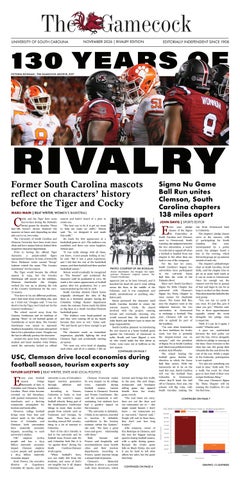
130 YEARS OF
VICTORIA RICHMAN - THE GAMECOCK ARCHIVE, 2017
RIVALRY
Former South Carolina mascots reflect on characters’ history before the Tiger and Cocky MARLI MAIN | BEAT WRITER, WOMEN’S BASKETBALL
C
ocky and the Tiger have come face-to-face during the Palmetto Series games for decades. Those face-offs haven’t always featured the mascots we know and, depending on what side you’re on, love today. The University of South Carolina and Clemson University have been rivals since 1896 and have unique history behind their respective character figureheads. Prior to having the official Tiger character, a purple-suited figure represented Clemson. In 1930, a Greenville News Piedmont writer named “Scoop” Latimer coined the name “The Country Gentlemen” for the mascot. The Tiger would become the official mascot in 1954, but the Country Gentleman still stayed on the sidelines. Clemson cheerleader Jim Douglas worked his way up to playing the role of the Country Gentleman for the 197172 season. “You have to try out different positions, and I had done most everything else, and so, I tried out,” Douglas said. “I was too short to be the Tiger, but I tried out for the Country Gentleman.” The school moved away from the Country Gentleman and its tradition of playing “Dixie” to rid football games of Confederate or racist ideas. The Country Gentleman was meant to represent Southern hospitality, but some interpreted him to be a plantation owner. Douglas was the last to officially portray the character. Around the same time, South Carolina student and band member John Nelson noted the university lacked an official
mascot and hadn’t heard of a plan to create one. “The best way to do it is get my mom to help me make an outfit,” Nelson said. “So, we designed it and made this outfit.” He made his first appearance at a basketball game in 1971. The audience was mystified, and there was some laughter, Nelson said. “It was really strange with all these, you know, 17,000 people looking at me,” he said. “But it was a great experience, and I did that the rest of the basketball season, and then football and then another basketball season.” Nelson would eventually be recognized as “The Rooster” and continued the character until he graduated in 1973. He made a few cameo appearances at football games after his graduation, but a new mascot picked up the role in 1978. South Carolina student Chuck Eaton originally developed the idea of Big Spur as a fraternity project, having the Columbia College theater department create the costume. Eaton made his debut as Big Spur at a South Carolina-Clemson basketball game. “The feathers were hand-painted on and they were coming off on my hands because they were so wet,” Eaton said. “We just barely got it done enough to get it there.” The character made an immediate impression, playfully fighting the rival Clemson Tiger and accidentally starting an uproar. “We went out, we’re kind of slapping each other, and all of a sudden, I did an
JOHN DAVIS | SPORTS EDITOR
E
PHOTO: COURTESY OF JIM DOUGLAS Senior cheerleader Jim Douglas (far right) portrays Clemson’s original mascot, the Country Gentleman.
uppercut just as he bent forward, and it knocked his head off, and it went rolling across the floor, in the middle of the Coliseum, and it was completely and totally unintentional or anything else,” Eaton said. Eaton portrayed the character until South Carolina decided to create the current mascot, Cocky. He stayed involved with the project, running tryouts and eventually choosing who would succeed him. He selected both John Routh and Robert Lane to share the large responsibility. South Carolina planned on introducing the new mascot at a home football game against the University of Cincinnati in 1980. Routh and Lane flipped a coin on who would make the first debut as Cocky. Lane came out at halftime as the new mascot.
CONTINUED ON PAGE 7
USC, Clemson drive local economies during football season, tourism experts say TAYLOR LUCZYWO | BEAT WRITER, STATE AND LOCAL POLITICS
E
very year, football season brings thousands of fans to Columbia and Clemson, South Carolina. These cities become crowded on fall Saturdays, with packed restaurants, busy storefronts and a thriving community atmosphere for tourists and locals alike. However, college football brings more than fans and school spirit to the college towns of Columbia and Clemson; both universities have statewide economic impacts, according to each university’s studies. USC employs 50,814 people and has a $5.9 billion statewide economic impact. Clemson employs 11,200 people and generates a $6.4 billion statewide economic impact. Scott Powers, the executive director of Experience Columbia SC Sports, said the
university is one of Columbia’s largest tourism generators through athletics and academics. According to Powers, Columbia is lucky to host one of the country’s major football schools. Being part of the Southeastern Conference brings in more than 10,000 people from schools such as Tennessee and Georgia, he said. These fans, who are traveling around SEC country, bring in a lot of tourism to Columbia. Part of the city’s identity is tied to the university and its football team, Powers said. He said Columbia feels like it is “us against them” during the South Carolina-Clemson rivalry game. “When football’s here, you can really feel from the students, and some of that’s not tangible but it all shapes Columbia,” Powers said.
Sigma Nu Game Ball Run unites Clemson, South Carolina chapters 138 miles apart
Clemson University makes its own impact on its college town, especially during football season. Lauren Gamrat is Clemson’s Tourism and Events Coordinator. She said the community is selfsustaining, but students have had a positive impact on the economy. “The university is definitely, I think, in my opinion, essential to tourism. It definitely contributes to the tourism industry within the Upstate,” she said. “We have a great town-and-gown relationship with them.” Both Gamrat and Powers said hospitality and accommodation taxes benefit cities and their tourism departments. According to Powers, sports tourism brings a unique kind of passion. Clemson’s Memorial Stadium is about a 15-minute walk from downtown, which
Gamrat said brings foot traffic to the area. She said shops, restaurants and boutiques selling game day apparel benefit from the rivalry game crowds. “The wait times are crazy, lines are out the door and our restaurants are so — this might sound biased, I don’t know — our restaurants are so top-notch,” Gamrat said..” People will wait in those lines; they don’t care how long it takes.” Allie Ammons, owner of Fizz Boutique in Clemson, said she sees her biggest earning quarter during football season, with a spike during games. Because the rivalry game falls on Black Friday, she said it can be hard to tell what affects her sales, but the game does help.
CONTINUED ON PAGE 4
very year, pledge classes of the Sigma Nu fraternities at South Carolina and Clemson meet in Greenwood, South Carolina, the midpoint between the two universities. A nearly 70-mile trek is capped off when a football is handed from one chapter to the other then ran back to one of the campuses. For the last 60 years, South Carolina’s largest two universities have participated in the 138-mile Game Ball Run the week of the Palmetto Bowl. Since 1977, South Carolina’s Sigma Nu Delta Chapter has partnered with Clemson’s Sigma Nu Theta Chapter to raise money for charitable causes. The Game Ball Run sees the chapters meet at the midpoint between the two universities in Greenwood to exchange a football. This year, Clemson will not be able to uphold its part of the tradition. “I’m sure other fraternities do have traditions for rivalry week, but this is probably the deepest-rooted one on campus,” said vice president of Sigma Nu at South Carolina and third-year political science student Jack Wheeler. The school hosting the football game decides the direction in which the Game Ball Run occurs. With the Gamecocks set to be on the road this year, South Carolina will run the football from Columbia to Greenwood, where they’ll hand the ball off to Clemson. Next year, the schools will flip roles, with South Carolina making the
run from Greenwood back to Columbia. The chapters’ pledge classes serve as the runners, with 37 participating for South Carolina this year. Accompanied by a police escort, the pledges board a bus in the evening, which drives the group 30-45 minutes outside of each city. The chapter’s philanthropic chair at South Carolina, Grant Kelly, said the chapter tries to get on as many back roads as it can en route to Greenwood. Once far enough out, the runners exit the bus in groups of four and begin to run for as long or as short as they choose. They then hand the ball off to the next group. “You can run 10 yards if you want. It’s just like, give it what you got,” Wheeler said. Two or three upperclassmen typically attend the event alongside the pledge class to supervise. “Hell, if I can do it again, I would,” Wheeler said. A pace car, sandwiched between the lead police car and the bus, drives alongside whichever pledge is running at the time. Once everyone in the class has run, the group then reboards the bus and drives the rest of the way. While a staple of the fraternity, participation is not required. “It’s just not something you want to miss,” Kelly said. “It’s a really fun event for those guys to have kind of their own unique freshman thing.” This year, Clemson’s Sigma Nu Theta Chapter will be missing the tradition. It’s not the first time.
CONTINUED ON PAGE 7
GRAPHIC: CJ LEATHERS
THE GAMECOCK| 2
How location impacts student experience at USC, Clemson MAGGIE HARMON | ASSISTANT ARTS & CULTURE EDITOR Second-year biological sciences student Satine Storer spent her freshman year at Clemson before transferring to USC in fall 2026. Storer had originally thought Clemson would be a good fit for her, but she quickly realized the smalltown life wasn’t for her. “It was too small,” Storer said. “I missed the city, and there’s not really anything to do there.” A huge factor in deciding which college to attend is the location. USC, located in the heart of Columbia, has a city feel since it is surrounded by the South Carolina State House and many major businesses. On the other hand, Clemson offers a more small-town charm with its iconic downtown area and secluded nature. Storer said she appreciates that there is a wider variety of restaurants and stores in Columbia than in Clemson. In Clemson, Storer said it felt like it took so long to get to anywhere that resembled a city. “There’s so much more here than in Clemson,” Storer said. “Like if you want to go to like a sit down restaurant or something like there’s really nothing.” Storer said while many Clemson lovers argue that Greenville is only a 45 minute drive from campus, it isn’t reasonable to drive that far everyday. Despite Storer’s love for Columbia’s food, shops and city-feel, she still prefers some parts of Clemson’s campus. For example, Storer said she likes Clemson’s reflection pond, architecture and library more than USC’s. This is one of the reasons Clemson first-year chemistry student Mary Austin prefers the town of Clemson. Austin grew up in Columbia and attended Ben Lippen School. She chose to go to school in Clemson since it wasn’t as close to home as USC. She also wanted to be less reliant on her parents, she said. Austin prefers Clemson because the environment is isolated. “It is primarily a college town, and USC has that, but it’s also right downtown in the middle
of everything,” Austin said. “It’s just very busy, and so I liked that in Clemson. Most people there are college students, honestly.” Storer also found Clemson’s campus to beisolating, but in a negative way. “Sometimes Clemson can feel kind of dead,” Storer said. “There’s not that many people out and about, and you really are just in the middle of nowhere. It’s kind of scary to drive at night because you’re just in the dark and surrounded by farms.” This can be particularly hard for firstyear students such as Austin since Clemson doesn’t allow freshmen to have cars on campus. “That has been kind of annoying since it’s more rural, and so you can’t really get far without a ride,” Austin said. However, Austin said Clemson is compact, which helps make up for the lack of car usage. Students spend most of their time downtown which sits directly beside the Clemson campus. From the center of campus, it is about a 15 minute walk to College Avenue, the heart of downtown Clemson. This iconic road features popular shops, restaurants and bars. “Everything is right around each other. It’s a big campus, so walking to class might take 15 minutes,” Austin said. “But you don’t have to cross any roads or anything to get there.” Storer noticed the difference in proximity while being on USC’s campus. Students at USC can be found all over Columbia. Many head to Five Points on the weekends, a 17-minute walk from the center of campus. However For those who live in dorms like Campus Village, this walk can take up to 25 minutes. Another common spot for students is the Vista. Similar to Five Points, this is a 20-minute walk from the center of campus. “I feel like it was always so fast to get to my classes, which here, I guess it depends on your schedule, but sometimes that 20-minute gap between classes is cutting it really close,”
PHOTO: BRILEY BRYSON Students walking around in Campus Village on Apr. 4, 2025. The four buildings serve as a residence hall for 1,800 students.
Students walking on Library Bridge on Clemson campus in Clemson, South Carolina. Storer said. This also affects the going-out scene at both institutions. Third-year graphic communications student Cadance Dawkins transferred from USC to Clemson after her freshman year. Dawkins said going out is less stressful at Clemson. “It’s easier to go from bar to bar in Clemson than it is in Carolina just because they’re a little bit further away,” Dawkins said. “It’s a little bit dangerous for some of the bars at Carolina. Five Points is fun for sure ... I feel like Clemson’s is a little bit more low-key, and it’s easier to find your friends at certain places.” Some popular college bars in Columbia are Jake’s on Devine, TLC Sports Bar and Grill and Tin Roof. On the other hand, in Clemson you’ll find college students at ROAR Clemson, Tigertown Tavern and Study Hall. Third-year BARSC-MD student AnnaCully was raised a die-hard Clemson fan. Both of her parents and her grandparents attended Clemson. Additionally, her great-grandfather graduated from Clemson in 1936.Cully ended up deciding to go to USC after receiving her BARSCMD acceptance letter. Cully said USC’s biggest advantage is being in the city since it presents many opportunities for college students. “If you’re a business student, there are so many businesses because you’re in the capital of the state, or any sort of pre-law, the Capitol building is right there,” Cully said. “Or for medicine, you have both Prisma and Lexington Medical Center. Where Clemson, you really have none of that at all. So I really feel like it’s what surrounds it that makes it more important.” Similar to Austin, Cully said Clemson is more of the ideal college town. “Their cute little downtown area, with all the T-shirt shops and everything, is something that we just don’t have,” Cully said. “There are thousands and thousands of people here who would buy all of the things, and I feel like that’s a market that it’s strange we don’t have anything for.” Despite the charm of the Clemson’s atmosphere, Cully still thinks Columbia has more to offer college students.
PHOTO: BELLA BUZZELL, THE TIGER
“I think Clemson’s definitely more of a college town, but I think Columbia is a better town to go to college in,” Cully said. One thing USC has to offer that Clemson lacks is Greek life houses. The majority of Clemson sororities and fraternities have residence halls on campus instead of the traditional houses. Cully is a member of USC’s Chi Omega sorority. “A big loss for their Greek life organizations is not really having a place to meet at all because with how big chapters are now,” Cully said. “If we weren’t eating together, having random ‘Dancing with the Stars’ watch parties and things like that, I think I would know so many less people.” As a member of Clemson’s Alpha Omicron Pi sorority,Austin feels similarly. “I know my friend is in ‘G Phi’ at USC, and I think she’s going to live in the house next year, and it just seems really cool,” Austin said.”It would be nice, but oh well.” On the other hand, a positive of Clemson is that there are cheaper recreational activities than in Columbia, according to Austin. “It’s easy to have fun here, I’d say. You don’t have to pay to do activities,” Austin said.”You can just go on a walk or go swimming. That’s pretty fun.” Storer agreed and said it is more expensive to live in Columbia than in Clemson. “Rent is obviously higher here,” Storer said.”I feel like you have to Uber more places because it is in the city and it’s a bigger campus, so everything is more spread out.” Another big difference between Clemson and USC is the stadium location. Memorial Stadium is located right on Clemson’s campus, however Williams-Brice is a little over a mile from USC’s campus. Dawkins said one of her least favorite memories from her time at USC was the walk to the stadium. “I remember going over the train tracks, and it was just really dangerous, and that’s what half of the student body does because the buses take forever,” Dawkins said. Dawkins said it is much easier to find shuttles and parking at Clemson on game day. Mitchel Colebank, an assistant professor in the USC mathematics department, has a special connection with both campuses since he
Balancing rivalry and respect: Shane Beamer and Dabo Swinney’s relationship KATIE DIKES | ASSISTANT SPORTS EDITOR Shane Beamer, Dabo Swinney and their teams have experienced ups and downs throughout the past couple of years with tough losses, injuries and jobs up in the air. However, one thing both football head coaches can agree is the impact of the rivalry between the Tigers and Gamecocks on the state of South Carolina. “It’s an awesome rivalry, not just in football, as you guys know,” Beamer said. “But I think what makes this thing unique is the rivalry in all the sports that no matter what sport we’re playing Clemson in, it’s a big deal to South Carolina fans and Clemson fans.” Swinney, who previously coached at Alabama for seven years and experienced the intensity of the Alabama-Auburn rivalry game, noted how important this game is to South Carolina football fans after assuming the position of football head coach at Clemson in 2008. “Everywhere I went, people were either really happy to see me, or they just kinda looked at me like I had, I don’t know, a big wart on my nose or something, I don’t know. And I just say ‘Hey, I’m the guy from Clemson,’” Swinney said. “It didn’t take me long to figure out that this rivalry is as intense as there is anywhere in the country.” The 123rd matchup of the Palmetto Bowl on Nov. 28. will mark yet another rivalry matchup that both coaches look to win.
LOOKING BACK ON A LONGSTANDING RELATIONSHIP Beamer and Swinney were familiar with one another long before earning their jobs as head coaches of a rivalry matchup that dates back to 1896. Beamer served as an assistant coach at South Carolina from 2007-2010 under then-head coach Steve Spurrier, while Swinney served as an assistant coach from 2003 to 2008 at Clemson. Before that, both Beamer and Swinney knew each other through Woody McCorvey, the current chief of staff for Clemson’s football team. McCorvey coached at Tennessee when Beamer worked as a graduate assistant from 2001-03, and the two established a relationship.McCorvey also previously worked with Swinney at Alabama as his positions coach in the early 1990s, then as
his offensive coordinator after Swinney became a full-time assistant coach in 1996 for tight ends and wide receivers. Naturally, it was only a matter of time before Beamer’s and Swinney’s paths crossed through their connection to McCorvey. Without considering football and the rivalry, both coaches have the utmost respect for each other and their respective families on and off the field. Swinney has been in the coaching business longer than Beamer, but that’s not to say he didn’t know of Beamer and his abilities, especially since he is the son of legendary coach Frank Beamer. “I’ve always liked Shane. Shane’s, he’s a great coach. He’s a great family. Love his family, love his dad,” Swinney said. “I’ve always had a great relationship with his mom and dad. And so, I got a lot of respect for him.” Beamer noted that Swinney personally reached out to him prior to his official hiring as head coach at South Carolina, passing along the same words of encouragement and kindness the elder Beamer had to Swinney years prior. “I’ve just enjoyed getting to know Dabo over the years. I’ve always had a ton of respect for him,” Beamer said. “And then throughout this process, he was, you know, fantastic to me, reached out to me when my name was getting mentioned for this job, you know to say ‘I hope you get it’ and ‘it would be great.’”
HOT SEAT? Far more recently, both head coaches have been under intense scrutiny from their fan bases. Large marginal losses have found the Tigers this season; their first game resulted in a 51-10 defeat to LSU on Sept. 5, and against Miami on Oct. 3, they fell 41-13. While Swinney and his team were able to seal wins against Georgia Southern, North Carolina and California, all games were plagued by slow starts that saw the Tigers play catchup or try to further solidify their lead. After trailing Virginia Tech 10-3 at halftime on Oct. 24, Swinney was visibly frustrated during a halftime interview.
PHOTO: SAM SCHORR Clemson University head coach Dabo Swinney hugs University of South Carolina head coach Shane Beamer after a 16-7 Tiger victory over the Gamecocks at Williams-Brice Stadium on Nov. 25, 2023.
“Oh, it’s all coaching. That’s 100% coaching. Pitiful. Pitiful. 100% coaching. That ain’t the players. That’s us,” Swinney said. “We’re fixin’ to fix it.” Swinney’s buyout sits at $57 million. Entering this season, Clemson had 14 straight winning seasons. The 2024 season also saw the Tigers win the ACC Championship Game, earning them an appearance in the College Football Playoff. On the other hand, Beamer, who arrived in Columbia in 2021, has only seen three winning seasons despite having an overall winning record. 2024 was by far the best season for Beamer and the Gamecocks as they earned a 9-4 record, wins over three ranked teams and an appearance in the Cheez-It Citrus Bowl. However, the team finished the 2025 season with a 4-8 record, winning only one conference game. Heading into the 2026 season, South Carolina went 2-0, but losses to Mississippi State and Kentucky fell hard after blowing double-digit leads. With a then-2-3 record and an additional loss to Alabama, chatter stirred about the future of
Beamer as head coach, whose buyout is $23.9 million. Beamer later admitted he knew things aren’t where they should be following their loss to the Wildcats. “We got the right kind of people in our locker room right now, players and coaches, but it’s uh, it’s not good enough right now,” Beamer said. “I’m well aware of that.” Shaking off this loss, the Gamecocks traveled to Gainesville, Florida where they beat the No. 20 Gators 38-19 on Oct. 10. Following a bye week, South Carolina went on to defeat the No. 11 Tennessee Volunteers 27-24, rising to a winning record. The Gamecocks then beat the Oklahoma Sooners 42-25 on Oct. 31, subsequently rising up to no. 23 in the AP Top 25 Poll. Optimism is a feeling that can fluctuate in football, and this feeling is more than applicable when it comes to South Carolina and Clemson. Waves of negativity come and go, but at the end of the day, it’s all about who wins the Palmetto Bowl.
THE GAMECOCK| 3
cocky rooster Hand-breaded wings, tenders and sandwiches. Fried. Smoked. Tossed your way.
BEAT CLEMSON!
Clemson Enrollment 2019
20,195 undergraduate students Out-of-state 24.6%
Out of state enrollment is up at USC, Clemson. What’s bringing students to South Carolina? In-state 75.4%
Clemson University Interactive Facebook
KELLY GRADY | NEWS EDITOR Finley Humpherson discovered the University of South Carolina randomly, through the mail. When he was applying to colleges, the Chicagoarea native said USC wasn’t on his radar. But after receiving a letter informing him he qualified for merit-based scholarships, he started doing more research. He said what he found, including USC’s international business program and Honors College, blew him away. Now, Humpherson is a first-year international business student at USC. He said his college experience has been full of community so far. “Being out of state, you’re really looking for comfort,” Humpherson said. “Having people to talk to and making you feel at home, I think South Carolina does a great job of that, and I think that really draws a lot of out-of-state students.” Humpherson isn’t alone in his experience — Southeastern Conference schools are increasingly attracting high school graduates from the north. A 2024 Wall Street Journal analysis
found South Carolina to be the fourth-most popular state attracting Northern students. As the two largest South Carolina universities, outof-state enrollment at USC and Clemson University has steadily increased over the past decade.
COMPARING SOUTH CAROLINA SCHOOLS, SCHOLARSHIPS
Warmer weather, the grandiosity of Southeastern Conference football and the prominent Greek life scene are among many factors behind the surging popularity of Southeastern schools coming out of the COVID-19 pandemic, the Wall Street Journal reported. This nationwide, postCOVID-19 flight south was reflected at Clemson, which experienced a 12% jump in out-of-state enrollment between 2020 and 2021. While USC experienced much smaller growth between those years, only a quarter of a percent, its total out-of-state population is higher than Clemson’s, boasting nearly 15,000 outof-state undergraduates to Clemson’s 9,565 in 2025.
Several first-year students cited low tuition, strong academic programs and generous scholarships as their main reasons for enrolling. First-year international studies student Nolan Tanner, from Savannah, Georgia, applied to USC and Clemson. Both schools accepted him and offered him merit-based aid. However, he said even with the scholarship Clemson offered, it was still financially and academically better for him to attend USC. “In terms of scholarship, it was just not even close,” he said. “South Carolina was by far the best and, additionally, had a very, very strong program that I was very interested in.” Humpherson applied to several Midwestern schools, including the University of Illinois at Urbana-Champaign and the University of Indiana, but said it was still cheaper for him to attend USC than his other options. “It ended up being tens of thousands of dollars cheaper, and that was kind of uniform across the board compared to a lot of other
Clemson Enrollment 2025 24,060 undergraduate students
31,328 undergraduate students
Out-of-state 28.2%
Out-of-state 29.3%
In-state 70.7%
In-state 71.8% Clemson University Interactive Facebook
USC Institutional Research, Assessment, and Analytics
GRAPHIC: SIMONE MEYER colleges I’d applied to,” Humpherson said. Clemson’s 2026 outof state tuition comes in at an estimated $21,010 per semester — nearly $170,000 for a four-year degree. USC’s out-ofstate tuition is slightly less expensive at $19,050 a semester, which would run students $152,400 for four years without aid. USC offers a range of merit-based scholarships to both in-state and out-ofstate students, according to the university website. The Academic Scholar Awards offer qualifying out-ofstate students between $6,500 and $30,000 a year in scholarships and tuition reduction. Clemson offers merit scholarships to out-ofstate students with an exceptional high school academic record, but does not advertise specific numbers on its website.
ACADEMICS AND STUDENT EXPERIENCE
GRAPHIC: KELLY GRADY
USC Enrollment 2025
First-year international business student Jackson Martin came to USC from San Antonio, Texas. Martin said both the
USC Enrollment amazing. 2019 The Southern Honors College and Darla hospitality, I students love it.” Moore school of business 24,514 undergraduate Elizabeth Orehovec, influenced his decision USC’s assistant vice to enroll. Out-of-state 26.5% “I do believe it’s going to president for enrollment prepare me for the future, management and executive yes, because I feel like it director of undergraduate presents a great plethora admissions, said the bulk USC’s out-of-state of opportunities for me of beyond college,” he said population comes from east about the international coast states. Students from northeastern states, such business program. Martin looked into as New York, Pennsylvania and New Jersey, have Clemson but ended In-state up not applying. 73.5% However, increasingly flocked to USC Aubrie Ruyle, a second- in recent years, according Institutional Assessment,data. and Analytics to university year nutrition USC student at Research, While in-state students Clemson, had her sights set on attending the school still make up the majority share of both USC and since she was young. Ruyle also applied Clemson’s enrollment, the to Colorado University increasing applicants to Boulder, the University USC have made admission of Miami, Notre Dame more competitive, Orehovec and USC. While applying, said. She does not believe she said she received the demographic cliff that is promotional materials in predicted to hit universities the mail from both USC and across the country with Clemson, but the “vibes” a drop in enrollment will from Clemson, along with impact USC as strongly. its location, ultimately led “We feel like we’re really in a her to enroll there. wonderful position in order to “It is literally just such a continue to be able to attract home away from home, and and enroll the number of it makes me so sad anytime students that the university I have to go home because wants to, even in a time when I just miss it,” Ruyle said. high school graduates are “The people out here are declining,” Orehovec said.
THE GAMECOCK| 4
DESIGN: JOHN DAVIS CONTRIBUTORS: SAM CANCILLA, JOHN DAVIS
CAMPUS CONTINUED FROM PAGE 2 completed his undergraduate degree at Clemson in 2016. Colebank said one of the positives of the Clemson campus is that the town’s environment revolves around campus life and the university. “It makes it kind of a romantic thing to think about, that here is this university that everything runs and focuses on the university,” Colebank said. Colebank said being at both institutions has given him a new perspective and appreciation for the rivalry and college athletics. “Seeing what the student bodies are like and how hard both universities work to be excellent, that I think you don’t appreciate when you’ve only been to one,” Colebank said.
Colebank said he has love for both schools. He also said his experiences have helped him realize how special public institutions are in the Palmetto State. “Both institutions make up what is a very strong public school setting in the state of South Carolina,” Colebank said. “And I think it would be great for everyone to be able to spend time — academics, athletics, just the culture — at both institutions because it really gives you a feel that there is sort of something special about being in the state and being at a public institution here.”
ECONOMIES CONTINUED FROM PAGE 3 The boutique has a range of clothes and accessories. Ammons said there is always a Clemson section, but the store itself isn’t centered on the school. She noted that for past rivalry games, many Gamecock shoppers have come. According to Gamrat, attendance at Clemson increases significantly for the South Carolina rivalry game. Gamrat’s data compared the number of Clemson visitors at the 2025 LSU and South Carolina games. Around 9,000 more people were in and around Memorial Stadium for the South Carolina rivalry game. Powers, however, said even with more people in the city, Columbia doesn’t see as much economic impact unless people stay overnight. Unlike the Michigan-Ohio State rivalry, the Gamecocks and Clemson share a state, so communities’ loyalties are more diverse, Powers said. “An overnight guest spends quite a bit more money per visit than somebody that just comes for the day,” Powers said. “So, that’s why the Clemson game doesn’t necessarily have as high an economic impact as Tennessee or Georgia will.” He said the buzz of a home football game weekend is tangible and exciting. Starting in January, after next season’s football schedule is released, hotels will start booking, he said. According to Powers, even with 12,000 to 13,000 hotel rooms in the city, football season requires balancing city and university events. He said this has made it hard to book hotels for other sporting events during big games. However, he said Columbia has the resources, such as parking, restaurants, hotels and interstates, needed to handle the influx of people during football season. The City of Clemson also sees advantages and disadvantages to the influx of people during football weekends. According to Bree Sanders, public information officer of the City of Clemson,
locals face trade-offs when more people are in town. “It’s always going to come with increased traffic, more people downtown, more people in stores,” Sanders said. “But then, there’s benefits and the payoff of the energy they’re bringing, the money they’re bringing.” Students also bring economic influence beyond football weekends. Gamrat said she has noticed a lot of restaurants have to change hours and employee schedules to adapt to students being out of town during the summer. “So the students, if you really think about it, they are very essential to the workforce.” Gamrat said. Looking beyond football weekends’ influence on Columbia, Powers said an increase in offcampus student housing has had the biggest impact on the local economy. Over the last 10-15 years, private housing has increased, and with those facilities paying taxes and students dining out locally, the economy has changed. Powers said for the Clemson rivalry game, more people will leave their homes and go to bars, restaurants and tailgates. He said people want to be around others, even if it’s not in the stadium. “It generates a passion that those people are going to be more apt to want to go out amongst their friends, even if they’re here locally,” Powers said. Gamrat said Clemson is similar. Memorial Stadium seats about 86,000 people,_ while area visitor numbers surpass 123,000, she said. Gamrat said the community enjoys getting in on the rivalry spirit through yard signs, decorations and Solid Orange Fridays, when everyone wears orange all day. “I know in general, the community is excited,” Gamrat said. “And we love welcoming our counterparts to the area and enjoying a good old game of football.”
Y O UR
e Vot d’s n mo to Red st Au t e es B in B ! for r i a a Rep arolin C f o
FULL-SERVICE
AUTOMOTIVE REPAIR SHOP
THE GAMECOCK| 5
When love conquers ball: USC-Clemson couples MILES SHEA | OUTREACH DIRECTOR The road from Columbia to Clemson is paved with animosity, but in South Carolina, there’s plenty of cracks for love to seep through. Second-year USC sport and entertainment management student Pauline Perdrix grew up in Clemson before moving to Greenville. She and Coleman Burnett, a second-year construction science management student at Clemson, met and began dating right
before graduating high school, spending time together in Greenville before moving to their respective, rival colleges. Though South Carolina and Clemson have a fierce rivalry on the field and court, many students are able to maintain personal relationships with attendees of the other institution. Knowing that, Perdrix said comedic comments about their star-crossed schools still came early and often.
“It would shock me if it wasn’t brought up,” Perdrix said. “It’s kind of the thing we just brush off our shoulders at the point.” Perdrix’s college decision was clear. “It was just always something I knew I wanted,” Perdrix said. “It was a little bit of a drastic change because of how different the towns are, but I think it was the right fit for me.” Burnett’s destination was just as certain.
PHOTO: COURTESY OF PAULINE PERDRIX DESIGNS: ISABELLA HUFFINES Second-year USC sport and entertainment management student Pauline Perdrix and Coleman Burnett, a secondyear construction science management student at Clemson, attend South Carolina’s football game against Kentucky at Williams-Brice Stadium on Sept. 27, 2025.
“Pretty much my whole bloodline goes to Clemson,” Burnett said. “So, I feel like I was born into that.” Though the two schools are close enough for visits, the 2.5-hour drive means time together requires planning and travel. Burnett and Perdrix said they knew longdistance wouldn’t be as easy, but both said they were committed. They say they’ve maintained a strong, healthy relationship, feeling connected but also comfortable living independent lives in their slice of the state. Burnett said while it was initially tough to get used to being hours apart from his girlfriend, the modern world has solutions. “Having phones are nice,” Burnett said. “I can still talk to her every day and communicate throughout the day, just see what we’re up to.” Second-year USC public health student Josie Sebok and second-year Clemson marketing student Will Singletary’s story is strikingly similar. Both from Greenville, they hit it off after their senior prom and have continued their relationship through college. Just like Perdrix and Burnett, Sebok and Singletary went into the relationship knowing they needed to make longdistance work. Two years later, they’ve done just that. Sebok said communication has been just as key for them, with one notable, annual exception. “We went to the USCClemson game together,” Sebok said. “We barely talked the whole time.” Singletary said knowing when they’ll be together has also been valuable. “Right before we’re about to leave or when we’re with each other, we always make a plan for the next time,” Singletary said. “So we have something to look forward to.”
PHOTO: COURTESY OF PAULINE PERDRIX Second-year USC sport and entertainment management student Pauline Perdrix and Coleman Burnett, a second-year construction science management student at Clemson, attend Clemson’s football game against LSU at Memorial Stadium on Aug. 30, 2025.
That motivation is kept in mind on Sebok’s trips to Pickens County. “I’m like, ugh, I don’t like it here, but I’m here for you,” Sebok said. All four said they could see the pros of the other’s campus, but obviously preferred and stuck up for their own. Singletary said having no choice but to visit Columbia helped put that aspect of the rivalry in perspective. “When you talk about Columbia and Clemson they’re like, ‘Oh I hate that place,’” Singletary said. “That shouldn’t really matter, you know? It’s really just the person that you love that matters.” One of Singletary’s criticisms likely wouldn’t get much pushback, even from a USC diehard. “The trains suck,” Singletary said. Burnett said that in addition to family fandom, Clemson being the only school in the state that offered his major informed his pick. If he ever had
kids making the decision between the two schools, he said he’d put most of his personal bias aside in favor of practicality. “Obviously, I’m going to want them to go to Clemson,” Burnett said. “But I think at the end of the day it’s, what are they looking to do, what are they looking to study?” Perdrix plans to travel to Clemson to watch this year’s Palmetto Bowl with Burnett. It’ll be the first time they watch it together. She said she was excited for the experience. “That’ll be fun, to try and navigate how, if we will get mad at each other during the game or not,” Perdrix said. Sebok said she and Singletary discussed predictions. “He was like, ‘I think USC is gonna win this year’,” Sebok said. “Ok, don’t jinx it though.” Whoever wins, these couples will carry on together.
Navigating friendship from behind enemy lines JULIA BEYERS | NEWS WRITER Clemson and South Carolina have been rival universities for over 130 years, but do they remain your biggest rival when your best friend is the one wearing orange? Whether students have grown up as separate fans, or have recently committed to their school, the rivalry still runs deep. First-year USC early childhood education student Abby McCutcheon and first-year Clemson University student Carlie Anne Smith have been hometown friends for the past six years. Their friendship started when McCutcheon joined Smith at The Carolina Academy in Lake City, South Carolina. “Obviously, I would love to beat USC, but it’s fun because everyone from USC is coming. I get to see people I don’t get to see every day,” Smith said. “But also, that’s an important game that I want to win.”
McCutcheon and Smith have grown up as fans of the respective universities they now attend. This will not be the first South CarolinaClemson football game they will watch together. “In high school, our friends would have a watch party, and we were divided as Clemson and South Carolina fans,” Smith said. Even though McCutcheon and Smith were cheering for different teams, they were spending time with each other doing something they both enjoyed. “We would all watch the game together, and in a way, it brought us closer,” Smith said.” Banter about which team is better can be lighthearted. This helped build Smith and McCutcheon’s friendship. “There was some like smack talk but ... nothing like ‘I hate you’ or anything,” McCutcheon said. The number of out-ofstate students coming to the south has increased
KAMILA MELKO - THE GAMECOCK ARCHIVES, 2016
in the last couple of years. This means the rivalry is new between first-year sports media student James Harris, and firstyear Clemson student Alex Jackson, his childhood best friend. Harris and Jackson are from New Jersey and have been inseparable since elementary school. “We became very close, his family became my second family,” Harris said. The pair toured a lot of universities together and thought they might commit to the same school. “The second that we both committed we knew that we were rivals,” Harris said. Harris and Jackson immediately began their rivalry, but it took off once the South Carolina football schedule was released. “We’ve had the game circled since we got the dates for them,” Harris said. ” This will be the first rivalry game they will watch
together, and Harris and Jackson’s families will be renting an Airbnb for the weekend. Harris said he is excited because this is the first time he will see his best friend since they both moved to college. “It’s going to be fun seeing them and hanging out and the vibe of it all, but I want to beat him” Harris said. “I want to beat him really bad, and have those bragging rights for a year.” Students from South Carolina are often left with the decision to choose between Clemson and USC. The decision can be influenced by a lot of factors, but some students choose the school that feels like home. This was the case for first-year Clemson student Daniel Maklogin. He had considered committing to his rival school, USC, but ultimately chose Clemson because of the campus and his desired major, engineering.
“I toured Clemson, I thought the campus was beautiful,” he said.”I’m a small-town mountains guy, and I’m an engineering major so I feel like it caters towards that.” Maklogin said he thinks playing against your friends can make the week more tense. “A lot of our friends are coming up here, especially ones who go to USC, It’s going to be really exciting to watch the game,” he said. “We’ve been talking about it for a while now, talking smack and whatever.” Maklogin should have no fear or nerves wearing his school colors at the game, since it will take place in his home field, Memorial Stadium at Clemson. Unlike Maklogin, firstyear exercise science student Allie LeVasseur said she was nervous to be a USC fan in Clemson territory. LeVasseur also said she is excited to see her longtime friend, first-
JOSH WARNER - THE GAMECOCK ARCHIVES, 2015
year Clemson University student Tyson Curtis, even though she takes the game very seriously. “I’m excited to see him,” LeVasseur said. “But for the game, I’m a little bit scared that USC is not going to pull through.” Many students are nervous to be in enemy territory wearing their garnet and black but are more excited to see their friends they have not been able to see since moving in for their freshman year. LeVasseur expressed her nerves for being a Gamecock fan in Clemson, but also her fears of wearing USC colors in the stadium for the game. Visiting Curtis, her friend from high school, could bring more tension to the weekend because of the colors they are wearing. “The hatred runs deep, and I’m just a girl,” LeVasseur said. Game day will look a little different for USC students in Clemson when they are not celebrating a Carolina touchdown with a rally towel and “Sandstorm.” Even though the rivalry will continue to run deep, it will never run deeper than the friendships that are shared between the universities, LeVasseur said. “During the week we are rivals first,” LeVasseursaid. “He is my friend, but that week we are rivals.”
THE GAMECOCK| 6
1975 Palmetto Bowl: When South Carolina achieved perfection KOFI AYIKU | BEAT WRITER, SOCCER The all-time record of the Clemson-South Carolina rivalry is tilted in favor of the Tigers, as they have won 74 Palmetto Bowl games to South Carolina’s 44. They also have the largest margin of victory in the series, winning 51-0 in 1900. There was a day, though, when all of the typical dynamics of the rivalry were reversed; South Carolina dominated the game, and the Tigers’ tails were between their legs. That day was Nov. 22, 1975. Ahead of the game, the 6-4 Gamecocks were getting ready to face off against the 2-8 Clemson Tigers. It was then-head coach Jim Carlen’s first Palmetto Bowl, who arrived and brought immediate success in Columbia after making three straight bowl games at Texas Tech. On the other side of the rivalry, Red Parker’s Clemson team crashed and burned after being a preseason favorite in the Atlantic Coast Conference. South Carolina was largely favored to win. Parker didn’t try to deny it. “They appear to have the advantage,” Parker said to The Charleston Evening Post. “I’m sure they’ll be favored, but this is a game of emotion.” The sports writers at The Columbia Record favored South Carolina for the win. The most optimistic outcome for the Gamecocks was predicted by writer Dick Huguley, who thought the home advantage would power South Carolina to a 20-point victory. Another prediction came from writer Pat McGovern, who favored South Carolina to win by 6 points. “Neither defense is much and USC’s offense is best,” McGovern said. Going into its rivalry game, South Carolina’s
offense was at its best, with quarterback Jeff Grantz leading the unit with 22 total touchdowns — 11 passing and 11 rushing — prior to the clash with the Tigers, and junior running back Kevin Long led the rushing attack with 1,037 yards. Long became the first Gamecock to rush for 1,000 yards in a single season. One of his partners in the backfield, running back Clarence Williams, came close to joining him over the 1,000 yard mark. Offensive backfield coach Bob Gatling attributed the successful season to the team’s ability to run the ball. “The blocking has to be extremely good when you have one kid over 1,000 yards and one with the potential to get 1,000,” Gatling said. In front of 57,197 fans at Williams-Brice Stadium, the second-largest crowd in the history of the rivalry at the time, the Gamecocks continued their domination of the line of scrimmage and scored on Clemson at will. “The line sliced holes in the Tigers’ defense for running backs Clarence Williams and Kevin Long and gave Grantz plenty of time to find his receivers,” said Bill Greene, Charleston News and Courier executive sports editor. Against the Tigers, Grantz threw for 158 yards and five touchdowns and rushed for 122 yards and one touchdown. Williams rushed for 160 yards, joining Long, who had 77 yards on the day, in the single-season 1,000-yards club. “After that first touchdown I realized that we could do anything we wanted against them,” Williams said to The Charleston Evening Post.
PHOTO: DANIEL HOU - THE GAMECOCK ARCHIVES, 2015
“It didn’t look like they could stop us on the ground or in the air.” Williams was right. South Carolina’s offense never needed to punt and scored on eight of its nine possessions. At the time, this created a school-record of eight PATs, 616 total yards and a Palmetto Bowl record of 56 points. To get to that figure, Grantz threw a touchdown pass on fourth down with 54 seconds left, a score that angered Parker. “I read that last touchdown as an insult,” Parker said to The Charleston Evening Post. “And I’ll never forget it.” The late touchdown also pushed South Carolina’s margin of victory to 36 points, South Carolina’s largest ever in a Palmetto Bowl to date. It was a margin that even surprised Carlen. “There’s no way I thought we would win 5620,” Carlen said to The Charleston Evening Post. “The line worked real hard, and we played very well.” The win also put South Carolina in a good position at 7-4 to be selected for the Tangerine Bowl, the team’s first bowl game since the 1969 Peach Bowl. “If we get the bid, we’ll accept. The team has already voted to go if they ask us,” Carlen said to The State. “I feel that our performance today justified us as a good bowl team. If they need convincing, I can send them the film.” Every once in a while, South Carolina has a nearperfect Palmetto Bowl day. This was certainly one of the most perfect of them, as the 1975 Palmetto Bowl currently ranks first in school history total yardage against Clemson, sixth in school history among Power Four opponents and 11th overall against all opponents.
1896
Nov. 12
First-ever Palmetto Bowl South Carolina and Clemson faced each other for the first time. South Carolina captured a 12-6 win in Columbia. This would be the only time the Gamecocks held the lead in the series.
1954
Tiger unveiled The Tiger mascot made its debut at Clemson, made from an orange bodysuit, stripes and a papier-mâché head. Student Gabby Hayes was the first to play the mascot.
1963
Nov. 22
2000
Nov. 18
2004
Nov. 4
Postponed kickoff The game was postponed after the assassination of President John F. Kennedy. Clemson’s buses departed to Columbia an hour before Kennedy got shot. Later that night, both schools announced the game would be played on Thanksgiving Day.
“The Catch II / The Push-Off Game” Clemson was trailing at home 14-13, with seconds to go. Junior quarterback Woody Dantzler launched a 50-yard bomb down the sideline to senior receiver Rod Gardner, whose catch set up freshman kicker Aaron Hunt’s 25-yard game-winning field goal. While Clemson celebrates this as “The Catch II,” Gamecock fans remember it as the “PushOff Game,” as photos came out that showed Gardner with his hand on Goodman’s shoulder.
Rivalry Brawl at Memorial Stadium Early tensions before the game boiled over as South Carolina sophomore quarterback Syvelle Newton was knocked to the ground after an incomplete pass in the fourth quarter. Clemson players continued to lay on top of Newton, which resulted in a massive brawl that required state troopers and police to break up.
THE GAMECOCK| 7 MASCOT CONTINUED FROM PAGE 1
Nov. 1
1900
Record victory Clemson won 51-0, the largest margin of victory in the series.
Nov. 12
1960
First game in Clemson In meeting No. 58, Clemson hosted the Palmetto Bowl for the first time. The Tigers earned a 12-2 win at Memorial Stadium.
Nov. 22
1975
Gamecock’s biggest win South Carolina earned its largest series win against Clemson 56-20.
Nov. 1
1980
Cocky’s first appearance South Carolina debuted its mascot, Cocky, for the first time at its homecoming game against Cincinnati.
Nov. 24
1984
Mike Hold vs. William “The Refrigerator” Perry In South Carolina’s 22-21 win over Clemson, senior quarterback Mike Hold took the snap in the victory formation to kill the clock, taking a hit from William “The Refrigerator” Perry. Hold got up after the whistle blew and dropped the ball at Perry’s feet, cementing another iconic rivalry moment.
Nov. 27
2021
Return from COVID-19 The Palmetto Bowl saw the Tigers shut out the Gamecocks after the series returned following no game in 2020 due to the COVID-19 pandemic. The loss marked Shane Beamer’s first Palmetto Bowl loss as head coach.
“They brought out Cocky and he was literally booed off the field. People didn’t like him,” Eaton said. After the poor reaction, South Carolina put the mascot back on the shelf until Linda Singer, the assistant athletic director at the time, found a new purpose for the Cocky suit. “She came up with the idea of, well, ‘Let’s put the lipstick,’ and she made a little blue, silvery -kind-of-looking eyelashes,” Routh said. “She said, ‘Let’s call it super chick.’” Routh went on to play Super Chick in 1980 for the women’s basketball team as Lane personified Big Spur for men’s basketball. By the spring 1981, fans became accustomed to the idea of a new mascot, giving Routh the chance to play Cocky during the baseball season. The team made it to the College World Series that year and Routh’s performance as the South Carolina mascot resulted in Cocky being invited to be the official mascot of the series the following year. By the fall 1981, Cocky was the official and only mascot of South Carolina. When Routh graduated, he started the tradition of wearing Cocky’s feet across the stage, making headlines and the front page of The State Newspaper the next day. As the modern mascots represent the Palmetto Series today, the historic characters showcase the unique history of both the rivalry and the mascots in the state of South Carolina. After moving back to Clemson, Douglas earned a job at the front desk of the football facility. He is still a season ticket holder and Clemson fan.
“I’ve stayed very involved in Clemson, after Clemson, and, and I learned a lot cheerleading,” Douglas said. “ I learned a positive attitude is very important in life.” Nelson returned to South Carolina in 1990 as a professor of botany and eventual long-term curator of the A.C. Moore Herbarium. He still holds an office in the Coker Life Sciences Center as his original homemade costume is on display at the McKissick Museum. Eaton moved to North Carolina and pursued a career in photojournalism, while still recognizing what his founding project has done for the university. “It’s kind of a cool thing looking at what Cocky has become over the years and knowing that I had something to do with, you know, getting it started,” Eaton said. Routh was quickly recruited by the University of Miami to portray their mascot, Sebastian the Ibis and has stayed involved with the university since. He became the University of Miami Sports Hall of Fame & Museum’s executive director in 2009. Routh is widely considered the first Cocky. “I did it longest and helped to create the character and the image of the character,” Routh said of developing the modern mascot. In August 2026, the beloved mascot was inducted into the Mascot Hall of Fame where Routh holds a place on the board.
SIGMA NU CONTINUED FROM PAGE 1 When Wheeler and Kelly participated in the Ball Run in 2024, Clemson’s chapter could not participate. On Oct. 1, 2024, the Clemson Student Affairs opened an investigation regarding hazing allegations against the school’s Sigma Nu chapter. Officially charged the following spring, the chapter was given four years of disciplinary probation through Dec. 31, 2028. They will have the ability to protest the fourth year beginning Jan. 1, 2028 if no other incidents are committed in the first three years. The school placed the chapter on social probation for the spring 2025 semester, preventing the fraternity from hosting events, excluding those with philanthropic intentions. This fall, the chapter is once again under investigation, a circumstance that has also left the chapter unable to meet as a group. Kelly said there are no issues on the Gamecocks’ side of things. Even when Clemson has not participated, the chapter still makes its financial contribution. “It brings the Clemson and South Carolina Sigma Nu chapters together despite one of the biggest rivalries in the state,” fourth-year biochemistry student Walker Hussey said in a statement provided to The Daily Gamecock. “It gives both chapters the opportunity to raise money for meaningful causes while building a stronger sense of brotherhood across South Carolina.” Wheeler said the tradition is one of the campus’ most unique philanthropic events. Spearheading those philanthropic efforts are the two chapters’ philanthropic chairs. Alongside Kelly, Hussey serves as philanthropic chair at Clemson. “When I took over, the last philanthropy chair told me, he said, ‘There’s no pressure to do anything,’ but he was like, ‘But you cannot mess up the Game Ball Run,” Kelly said.
The chapters’ philanthropy chairs are in charge of setting up the event. Their responsibilities include coordinating buses, deciding where exactly the chapters will meet, and in Columbia, working alongside the Richland County Police Department. “We’ve been doing this so long,” Kelly said. “When I went to look for the bus, I already knew the bus company. I had his personal phone number to text him.” Kelly also said the police department expects the event annually, which makes the chapter’s job easy. “You’re not pulling teeth to be like, ‘Hey, come let a bunch of 18-year-old college kids run on the side of the road,’” Kelly said. “They just know what it is, and they, luckily, they allow us to continue to do it…It’s just kind of snowballed into this thing where it’s easy to set up, and it’s crucial to have it every year.” This year, the money South Carolina’s chapter raises will go to the Fisher House, a free lodging facility for families and caregivers of veterans receiving care at the Columbia VA Health Care System. Guests can stay at the Fisher House free of charge as long as their loved one is hospitalized. “A lot of people that are in Greek life are in a fairly good position to give back to the community,” Wheeler said. “So, just we try to do as much as we can.” Kelly encouraged those who can help to donate and spread the word. “The really important aspect is that we’re sending money to this veteran’s hospital,” Wheeler said. “They’re definitely in need of help.” USC Sigma Nu has set a donation goal of $2,500 ahead of the event.
THE GAMECOCK| 8
‘The Gamecock Album’: Patrick Davis’ love letter to South Carolina ANASTON BELL | ASSISTANT SPORTS EDITOR There are plenty of things that inspire artists’ work: heartaches, memories and loved ones. For Patrick Davis, his third studio album was inspired by something a little more unique than what typically kickstarts the songwriting process for most artists. Released on Aug. 23, 2013, “The Gamecock Album” is a collection of 12 songs written by Davis, comprised of what are essentially love letters to not only the University of South Carolina’s athletic programs and history, but to the entire state. From the opening track of “Big Ole (Game) Cock” all the way to the finale “Where I’m From,” Davis uses witty lyrics that describe feelings only lifelong fans would understand alongside detailed imagery of the Palmetto State to close out the 47-minute body of work.
BORN AND BRED GAMECOCK
A native of Camden, South Carolina, being a Gamecock was integral to Davis’ identity from childhood. He described listening to Bob Fulton calling football
games on the radio as a child and becoming acquainted with the heartache of being a Gamecock fan. While poking fun at the lifelong heartache so many Gamecock fans experience, he described Gamecock pride as a beautiful thing that fans never give up believing in and supporting. As a songwriter, Davis enjoys writing stories, both fictional and nonfictional. He noted his inspiration from Bob Dylan and Woody Guthrie. These inspirations were the framework for “The Gamecock Album.” Davis said he had fun creating it, tapping into his love of South Carolina as a whole as well as its athletics.
SILLY SONG TO GAME DAY ANTHEM
The creation of the album started as a joke between Davis and some friends. That joke would eventually become the album’s opening track, “Big Ole (Game) Cock.” “That was not meant to be heard by anyone other than me and my friends,” Davis said. “One thing kinda led to another, and my buddies were
like, ‘You got to record this,’ and I recorded it and just kinda sent it out to a few of my friends, never thinking anyone would hear it.” The song was not hidden for long. Sports-talk radios started playing the track, and it slowly made its way into tailgate soundtracks. Davis said the song has now become a cult thing. Davis believes the reason the song became so popular and has such a special place among fans is because of the pride it brings them. “It’s not just about the University of South Carolina Gamecocks,” Davis said. “It’s about South Carolina, and it’s about where we’re from, and I think that that’s the magic of music.” A country album in 2013 about a college in South Carolina lends itself to a small demographic of listeners. Davis, however, believes that is what makes this album so special to fans. “Not every song has to be ‘Let It Be’ or, you know, some incredible, you know — the message can be very focused on a very small, particular group of people and be just as powerful for those folks,” Davis said. There was no personal gain for Davis when creating the album, just a story and history to tell.
THE BIRTH OF “THE GAMECOCK ALBUM”
Even after Davis released “Big Ole (Game) Cock,” there was still no intent of ever making an actual album with the song. It wasn’t until the success of another athletic program at the university that Davis found more opportunities to write. After the 2011 baseball team won its second straight national
championship in Omaha, fans began asking if Davis would write a song about the most dominant college baseball program at the time. “Wingo & His Yardcocks” closely resembled “Big Ole (Game) Cock” with its upbeat country tempo and mention of Gamecock greats. It quickly went viral around the state after Davis posted it on the internet. “It was just a way to celebrate our team winning,” Davis said. “It was just meant to bring happiness, and I laughed when I wrote them; I thought it was cute and funny.” In light of both songs’ popularity, Davis had conversations with the athletic department about creating a project for the school. Davis agreed to write a few more “Gamecock” songs alongside some less sport-centered tracks as a compromise. From there, “The Gamecock Album” was born. “I was kinda trying to capture that feeling we all have about the state,” Davis said. “Where it could kind of be something that wasn’t just for Gamecock nation. It was for everybody.” No matter if someone listens to the album every game day or has never heard of his work, Davis wants all listeners to know that his music comes straight from the heart. With AI and the commercialization of modern music, he said his work is honest and from a place of personal experience. It is so personal, the line “Cause though we’ve had heartbreak and oh so many tears, I know one day I won’t have to say, ‘Wait until next year,’” speaks to any true Gamecock fan.
AN IMPACT BEYOND COLUMBIA
Gamecock fans, he wrote a song in 2023 that became an anthem for all South Carolinians: “Carolina When I Die.” “I think we all kinda knew as soon as we got it done that it was a beautiful song, and it was something that could resonate with folks,” Davis said. Davis wrote the song with not only South Carolinians in mind, but anyone who has been to the state or wishes to go someday. Slowly, more people began to listen to the song. He even found out it was being played at weddings and funerals. After writing the song, Davis new Darius Rucker and Edwin McCain, both longtime friends of Davis, needed to be included as well. Eventually, the song had made its way to state politicians who wanted to push for the song to become an official state song of South Carolina. On May 18, 2026, “Carolina When I Die” was approved as an official state song, encasing the song in history forever. He described the experience as quite humbling. “It was quite the honor,” Davis said. “It’s a beautiful feeling, and I never expected anything like that from writing songs.” For him, music and poetry give people the opportunity to express feelings that people do not say out loud. For Davis, “Carolina When I Die” is a song that he believes lives on after they are gone. Patrick Davis does it all. He is a singer, songwriter, performer, television host and even the poet laureate of South Carolina. Davis appreciates and is thankful for all of the accolades, but there is nothing more important to him than being a part of Gamecock nation.
While Davis was known by
PHOTO: COURTESY OF LAUREN JENKINS Patrick Davis, South Carolina singer-songwriter and creator of “The Gamecock Album,” plays his guitar while reflecting on his music career and connection to the Palmetto State. Davis’ song “Carolina When I Die” was named an official South Carolina state song on May 18, 2026, celebrating his lasting impact on the state’s musical history.
Coastal research connects rivals through collaborative science KATE DURDEN | BEAT WRITER, ENVIRONMENT Chirping sea birds and rustling spartina grass are not sounds associated with rivalry month. Cheering crowds and the blare of trumpets usually fill the air on game day, but this relationship doesn’t follow the stereotypical Gamecocks vs. Tigers dynamic. It is a partnership that meets in the marsh. The Belle W. Baruch Foundation is a 16,000-acre research facility used by several universities statewide, including USC and Clemson. Located on the coast in Georgetown, the undeveloped and protected land has provided both universities opportunities to study this ecosystem for over 50 years. Belle Baruch was an avid conservationist who fell in love with her family’s marshcovered land. It was her passion for the land that led her to establish a private educational trust for conservation. Today, leading faculty, such as director of USC’s Institute for Marine and Coastal Sciences Jill Stewart, continue this stewardship. “For these larger issues, including understanding watersheds, coastal water quality, coastal ecosystem science, we all need to work together,” Stewart said.
COASTAL COLLABORATION
With land left in perpetuity for research and conservation comes the opportunity to conduct long-term research. Jim Anderson is the director of Clemson’s Institute of Coastal Ecology and Forest Science. He said Baruch’s location on the coast opens a whole new side of research. “Our main goal, I think it’s to better understand our coastal systems,” Anderson said. “So, we can be adaptable to the future changes, whether that’s climate change or, again, development and all the associated actors that go along with that.” Both universities each have their own facilities only 2.5 miles apart and focus on different research areas. While Clemson specializes in forestry, wetlands and wildlife research, USC focuses on marine and estuary research. Stewart said both interests complement each other. “If you did a Venn diagram, there’s areas where we’re more specialized in areas and where they’re more specialized, but there’s also a lot of areas in between,” Stewart
said. “It’s great having both institutions out here because then we can study all of the different kinds of sub-ecosystems throughout the coast, all the way up from the maritime forest, out to the salt marshes and the fisheries that are here.” Bill Strosnider is the assistant director of academics at Baruch and an associate professor with the School of Earth, Ocean and the Environment at USC. In his time studying the ecosystem, he said he’s made some of his closest collegiate relationships through his partnership with Clemson. “A lot of the professors at the coast are nerds that don’t pay enough attention to sports. So, the rivalry thing isn’t much of a thing,” Strosnider said. “If anything, there’s a rivalry about who got more resources, either from the state or from the federal government, to do the research and the work that we do.” Louisa Mai is a USC alumna and technician in Strosnider’s Ecological Engineering Lab at Baruch. While completing her honors thesis as an undergraduate, Mai had the unique experience of collaborating with both universities’ faculty. Despite their different research topics, she said both institutions are working to conserve and support coastal ecosystems. Stewart said USC has been able to gather decades’ worth of time-series measurements to chart changes in the water, such as temperature, salinity and sea level rise. This includes the longest zooplankton data set in the world. Stewart said having this data on basic water quality helps researchers understand what responses may result from different stressors or changes. Clemson also conducts ongoing longterm research that is unique to its protected location. Greenhouse gas studies to understand the significance of forests as carbon sinks and research on historic rice fields are just a few of the topics Clemson investigates. “Once you develop these properties, there’s no going back,” Anderson said. “It’s never going to go back to what it was. So, I think if you are concerned with the environment and want to learn about how the environment is reacting to all the
PHOTO: KATE DURDEN Researchers collect samples for environmental studies at the Belle W. Baruch Institute for Marine and Coastal Sciences in Georgetown, South Carolina.
perturbations around it, this is the perfect situation to do it in.”
ECOLOGICAL EDUCATION
Along with research opportunities, Baruch hosts course field trips for a variety of undergraduate experiences. Before her visit to the marsh, Mai was a global studies major. She said her experiences there completely changed her future after she fell in love with field work. “You can see the grass. You can see the mud, the birds, the crabs, the fish and everything that goes into the marsh ecosystem,” she said. “I think it’s a really good reminder of why you’re doing the work that you’re doing.” Stewart said experiences like Mai’s are why Baruch continues its educational mission. When students get their boots dirty in the pluff mud and experience an estuary firsthand, they get a chance to understand the importance of the ecosystem. “To sit in a classroom or even in a laboratory and try to understand environmental systems, environmental processes and the wildlife in them and how all these things interact would be impossible,” Stewart said. “You actually have to get out into the field, and having the field lab out here makes that possible.” Often serving as an educational playground for environmental sciencebased students, Stewart said she wants this outreach to expand beyond the traditional
STEM student. “We have a very long history of producing leaders in this area, but I do want it to become more interdisciplinary,” she said. “I think a lot of the larger issues that society is facing now will need interdisciplinary approaches, and so we’re trying to expand programs where more students will come out from different backgrounds.” While the garnet vs. orange feud may run deep on game day, Baruch represents a partnership that coexists with an overarching effort to care for coastal environments, Stewart said. The relationship goes beyond science and extends to become a community, Anderson said. “I’m sure each of us have a little rivalry when we’re watching football, so on game day, we might each know what side we’re on, but when we collaborate on science, not so much,” Stewart said. “We are absolutely collaborators when it comes to the coast and coastal ecosystem science ... The marsh does not care what color you’re wearing on game day.”
THE GAMECOCK| 9
Blood drive hopes to help healthcare facilities amid budget cuts, shortages EMILEE DAVIS | ASSISTANT NEWS EDITOR When students think of November at USC, they might think of the Palmetto Bowl, the Tiger Burn and a pure hatred for the color orange. However, one of the rivalry’s most impactful traditions is the Carolina-Clemson Blood Drive. Claire Seabrook, a fourth-year biological sciences student and president of the Carolina-Clemson Blood Drive, is hoping to provide some help to healthcare facilities through this year’s rivalry blood drive. Seabrook said no matter what issues the healthcare system is facing, donating blood is important because it can save a person’s life. “Regardless of their situation, you know, everyone deserves to have healthcare and deserves to be treated, and, you know, the doctors and nurses, PAs, everyone in the healthcare system needs the resources to be able to help them,” Seabrook said. The Carolina-Clemson Blood Drive has been operating at both universities for the past 42 years, liaising with the American Red Cross Association and Blood Connection. Seabrook said while Clemson has won the past couple years, USC is hoping to regain the title this year. While the organizations hold multiple blood drives on their respective campuses, the rivalry one in November is the biggest, according to Seabrook. With the blood drive, Seabrook said the organization offers a fun way to try and beat Clemson while also boosting community morale with blood donation and saving lives. This year looks a little different following a nationwide blood shortage reported by the Red Cross.
BLOOD SHORTAGE
In July, the American Red Cross Association declared its second-ever nationwide blood shortage, with the first occurring in 2022. There has been no follow-up from the organization that the shortage has been resolved. The organization reported that donations fell to a four-year low, and while thousands were still donating, it was not enough
to keep pace with hospital demand. It reported having less than a one-day supply of O+ blood nationally, the most commonly transfused blood type. Seabrook said this shortage has heavily influenced this year’s rivalry blood drive. “Right now, we’re in a countrywide blood shortage, so just spreading awareness about that and the importance of donating blood and where that goes to and how it helps save people’s lives,” Seabrook said. According to Seabrook, even if a person were to donate once a year, one pint of blood can save up to three lives. She said during last year’s rivalry, 2,000 people donated, but they are hoping to increase that number this year. Bridget Miller, associate dean for undergraduate affairs in the Arnold School of Public Health said she believes donating blood requires very little while being very personally rewarding. “It can take as little as 20 or 30 minutes, you know, but it can give you a sense of kind of accomplishment and feel like you’re part of the greater community and doing something good for the health of others,” Miller said. Seabrook said until a synthetic substitute arises, hospitals will always need blood. She said shadowing in an emergency department and surgery has shown her how crucial blood donation is to the American healthcare system. “There’s, unfortunately, always someone who’s going to get into some sort of accident, whether it’s at work, whether it’s driving to work, if it’s, you know, sports,” Seabrook said. “There’s always going to be a need for healthcare. There’s always going to be a need for blood.”
FEDERAL BUDGET CUTS
Recently, the federal government has made significant budget cuts that have impacted patient access and hospital resources. President Donald Trump signed the One Big Beautiful Bill Act into law on July 4, 2025. This bill included several healthcare provisions, such as over $900 billion in Medicaid cuts over the next
decade. Millions of Americans have also gone uninsured following the increase in premium costs for the Affordable Care Act, according to The Wall Street Journal. According to a November 2025 article from The New York Times, these budget cuts put urban hospitals most at risk for closure, as many serve vulnerable communities who rely on Medicaid. In July, they reported that thenumber of uninsured patients at hospitals saw a sharp increase following the loss of insurance under the ACA. Hospitals are also facing issues with rising drug and supply prices, as well as staffing shortages, according to the American Hospital Association. According to the South Carolina Hospital Association, South Carolina hospitals will face a ‘budget cliff’ in 2028 when Medicaid State Directed payments are reduced. Miller doesn’t believe blood donation will be a fix-all for these issues, but believes it’s an example of how continuous community investment can contribute to overall wellness. “Being able to get a broad swath of the community involved in the process and to keep it consistent and ongoing means that it’s available when it is most needed,” Miller said. One of the core philosophies of public health is protection, prevention and promotion, according to Miller. She said while blood donation might not save underfunded hospitals, it can serve to teach community members that philosophy for their own implementation. “It maybe makes it easier to understand other examples of that, where investing in infrastructure within a community, before things become emergent, is beneficial,” Miller said. “Rather than waiting until something is at a level 10, let’s do small investments along the way to keep things usable and accessible.”
BEYOND POLITICS
While healthcare often ends up in the middle of political partisan battles, Seabrook said when a loved one is in the hospital in need of blood, political beliefs
don’t matter and that’s hard for someone to understand until they’re in that situation. “People are dying, and they need blood, and there’s nothing political about that,” Seabrook said. Miller said in a time of political polarization, it’s important to get through to people in whatever ways are most effective to get people the treatment they need, whether it’s through economics or early screenings. She said it’s vital to keep reminding people of the importance of smaller investments, such as blood donation. “A rising tide raises all boats, and, as a community, we benefit from having timely healthcare, timely treatments, effective treatments for everybody in the community,” Miller said. For Seabrook, blood donation goes beyond the healthcare system itself, giving ordinary citizens the opportunity to get involved. “You don’t have to be a nurse. You don’t have to be a doctor. You don’t have to be a PA, PT,” Seabrook said. “You don’t have to be in the healthcare system to make a difference in the healthcare system.” Miller believes that the best way blood donation can help communities is through the psychological impact it has on donors, as well as those who volunteer their time to help with blood drives. “There’s research out there that talks about the benefits of volunteering and giving back and the sense of pride that those who donate and volunteer and give back that they have from that process,” Miller said. According to Miller, donation often encourages people to start thinking of others and how they can pay something forward, which helps community members provide comfort and support to each other. “The world functions better when people can think about also what they can do to help their neighbors in any way, whether it’s through a health donation or other ways,” Miller said.
STORE DIVIDED Scan our QR code to see all merchandise!
Open Monday-Saturday 10 a.m. - 6 p.m.
THE GAMECOCK| 10
Column: A hatred for the Clemson Tigers unites the Gamecocks SYDNEY WHITKINS | OPINION WRITER
PHOTO: ISABELLA HUFFINES A dart board decorated with the Clemson paw made of orange paper with darts thrown towards its center.
A University of South Carolina student can find a home in more than 650 different clubs and organizations, in the spirit of Greek life or in the lifelong friendships forged over the years. Even in a large lecture hall where you do not know a single name or face, you can turn to the person sitting beside you and bond over a mutual hatred for Clemson. Hating a Clemson Tiger is more than just belief. It is a shared value that unites the Gamecock community. As the two top ranked public universities in South Carolina, there exists more than just a battle for who has the best academics,
campus or sports teams. There is a challenge to identity that exists purely within a rivalry — a natural competition that puts pride and spirit on the line. With over 55,000 students acrossUSC’s campuses, we have a lot at stake. Statistically speaking, the University of South Carolina is more demographically diverse than Clemson. It has more clubs and organizations supporting a miscellaneous range of interests and around 20,000 more students. And, when it comes to the Carolina-Clemson rivalry, we all bleed garnet and black.
The Carolina-Clemson rivalry is more than just another Saturday in South Carolina, and it certainly means more than a feud that revolves around winning a single game each year. It fosters a sense of belonging, rooted in deep, long-lasting tradition. It is a legacy left behind as students leave the university to start their lives across the nation and a piece of their spirit they can carry on when they become alumni. While USC has various rivalry traditions, the predominant exemplar of long-lasting legacy is the Tiger Burn. It is an event where current students can form friendships and memories for life and an experience that alumni can bring to their future endeavors. Every year, USC engineering students build a 30-foot-tall wooden tiger structure so Gamecocks can gather together and cheer as it burns to the ground. Since the start of the tradition in 1902, Gamecock students, alumni and faculty have united to participate in a ritual unique to USC. In fact, the Gamecock nation’s ability to rally around a cause with such intense spirit was so inspiring, Clemson copied us years later in 1940 with Cocky’s Funeral. Yet, it becomes apparent that our passion for each other, football and the hatred of orange is impossible to duplicate.
In return, Clemson’s tradition of Cocky’s Funeral burns a smaller paper version of Cocky. While a respectable tradition is an integral part of our long-standing rivalry, it is lackluster in comparison to the Tiger Burn. It will be in Gamecock spirit to never like a Clemson Tiger as long as the saying ‘a tiger never changes its stripes’ stays true. It is no surprise that our spirit takes that of Clemson’s by storm, because we identify as the “Sandstorm.” Gamecocks across the nation come home to Williams-Brice Stadium to show South Carolina pride by waving their rally towels in the air in a chaotic frenzy. Despite the chaos that comes with a storm, we find unity within it. We are one storm together. Side by side, swaying along to “Hold my Hand” by Hootie and the Blowfish, all the individual fans across the stadium are brought together. It is a bond so tight that in a stadium full of thousands of people when you hear a ‘Game’ from one side of the field, you can be sure to hear the ‘Cock’ from the other. “Forever to Thee” means more than being a Gamecock for life; it signifies a lifetime of hatred for Clemson. Win or lose, young or old, student or alum, a Gamecock is a Gamecock. Even in divided households and friendships, a Gamecock won’t trade spurs for stripes.
Guest column: The true feeling of winning it all in college football KANE FOX | ASSISTANT SPORTS EDITOR, THE TIGER It’s rare to ever find a rival fan agreeable, especially in South Carolina. Down here, it’s a cardinal sin to wear garnet in the Upstate or orange in the Midlands. And yet, fashion choices aside, both sides of the Palmetto Bowl share one thing in common: they want to win it all. Regardless, only Clemson has claimed a national title. But in the spirit of giving this holiday season, allow me to share that amazing national championshipwinning feeling with all you Gamecocks out there. Now, no two title teams are created equal, and every celebration brings a different feeling. Clemson fans everywhere have enjoyed this phenomenon three times, but we’ll just focus on the most recent Tiger championship. The 2018 college football season was possibly the most anticipated year in Clemson football history, as it introduced Trevor Lawrence to Death Valley. The 6-foot-6, Georgianative quarterback was not only the highest-ranked recruit to ever commit to Clemson, but also the highest-ranked quarterback recruit in history. After four games splitting reps with the incumbent Kelly Bryant, Lawrence was handed the keys to the offense and never looked back. What followed was utter domination. Led by future NFL superstars Dexter Lawrence
and A.J. Terrell Jr., the Tiger defense emerged as the nation’s best, suffocating every opponent. The offense wasn’t far behind, ranked fourth in the nation in scoring and averaging around 44 points per game. When it came time for the Palmetto Bowl, Clemson was on top of the world. Ranked No. 2 in the country with an 11-0 record and set to face a 5-3 South Carolina team at home, everyone knew what was going to happen next. The Tigers ran all over the Gamecocks that day. Lawrence accounted for over 400 total yards of offense and tossed a touchdown while Clemson rushed for seven scores on the ground, including one by star defensive tackle Christian Wilkins. When all was said and done, the Tigers were on top, 56-35. But a perfect regular season wasn’t enough; Clemson kept winning. The Tigers blew past Pitt in the ACC Championship, 42-10, and punched their ticket to the College Football Playoff. Clemson didn’t waver when it matched up against fellow undefeated Notre Dame in the Cotton Bowl. Lawrence threw for 327 yards and a trio of touchdowns, two of which went to Justyn Ross, as the Tigers topped the Fighting Irish, 30-3. And then came the championship game. With so much on the line, it’s hard as a fan to quiet
that nagging doubt in the back of your mind — the one that says your team might lose. After a quick three-and-out on the first offensive series against No. 1 Alabama, that voice grew quite loud. That is, until Terrell picked off Tua Tagovailoa’s third pass of the game and returned it for a 44-yard pick-six. The Crimson Tide made it a back-and-forth game and took a 16-14 lead to start the second quarter with a 25yard field goal. Alabama did not score again for the rest of the contest, and Clemson scored 30 unanswered points to claim its third national championship. There is truly no better feeling than watching confetti in your team’s colors rain down upon champions. While some time has passed since then, and neither the Gamecocks nor Tigers are in their glory days, that doesn’t mean it’s unattainable. After all, if this 24-team playoff really does come to fruition, maybe even the laughingstock of the SEC can make it to the postseason. Personally, I hope that you all get to have that championship feeling one day. But not really. Go Tigers. Kane Fox is an assistant sports editor for The Tiger. He can be reached at tkfox@clemson.edu.
DESIGN: ISABELLA HUFFINES
COMIC: TEANDRA JOHNSON
THE GAMECOCK| 11
Column: Cocky is the best mascot in collegiate athletics SAMUEL CANCILLA | OPINION EDITOR He has a broad smiling yellow beak, a white gloved hand raising a spur, and two big yellow feet. We all know this guy. It’s Cocky, the University of South Carolina’s beloved mascot. But it took him a while to reach his full glory. South Carolina’s Gamecock stands out among countless tigers and bulldogs in college athletics, and its name has a legendary origin story dating back to the Revolutionary War. Long before the Gamecock became an iconic symbol for South Carolina athletics, it was the nickname of a Revolutionary War general in South Carolina: Thomas Sumter, who earned this name for his tenacious and daring spirit. However, the Gamecock did not solidify its spot as South Carolina’s mascot until it claimed a decisive victory over the Clemson Tigers in 1902. South Carolina was the underdog in this matchup. After defeating their rival, South Carolina students celebrated by parading around an illustration showing a gamecock crowing over a defeated tiger. This illustration created tension between the two schools and ended in a potentially deadly standoff between South Carolina students and Clemson students who were both armed with pistols, knives and swords. What began as a symbol during a major victory for South Carolina in the early 20th century would end up as one of the most important pieces of the university’s identity. However, the beloved mascot that fans know today didn’t truly manifest until 1980, when Cocky made his first appearance at a South Carolina homecoming football game against Cincinnati. Cocky has taken home numerous trophies and has won multiple competitions over the years. In 1986, he won the Universal Cheerleading Association Mascot Championship. He won the same competition in 1994 before winning the Capital One Mascot Challenge in 2004. Then, in 2019, Cocky ranked among the top 10 collegiate mascots by Sports Illustrated. For his most recent and impressive award, Cocky was inducted into the 2026 Mascot Hall of Fame class. Cocky clearly has a lengthy history of winning awards as a mascot, but winning awards isn’t the only thing that matters. It
PHOTO: THE GAMECOCK ARCHIVES, 2003 A picture of five students sitting on a bench and reading newspapers with Cocky. fades. For example, look at Clemson. Sure, they’ve won plenty of national championships, but the state of their team speaks for itself. Cocky, on the other hand, has the special ability to capture the spirit of a school in ways other mascots cannot. This has rocketed Cocky’s popularity and solidified him as a legend. Whether he’s bursting out of the Magic Box during the iconic “2001: A Space Odyssey” entrance, dancing to music, watching performances from the sideline or taking pictures with fans, Cocky has become an essential part of the Gamecock experience. What’s even better is when the lights go out and the game is over, Cocky is still making an impact on the fans and the
community. Cocky’s Reading Express is one of the largest impacts that Cocky has on the local community. Cocky’s Reading Express is a youth reading initiative that USC describes as “inspiring young readers across South Carolina.” The program provides free books while also inspiring students to read in a fun way through guided readings with Cocky. That’s what truly makes a mascot great. It isn’t about having the fiercest animal or the meanest-looking costume. It’s about creating a character that students, alumni and fans can connect with in a meaningful way. Cocky has done exactly that, which is why he will forever remain a legend in collegiate history.
Column: Clemson has an originality problem ABBIGAIL CHANDLER | NEWS WRITER Choosing a school means choosing more than just where you will spend the next four years. It also means choosing a team and a mascot to align with for the rest of your life. A tiger mascot represents 963 high school, college and professional sports teams nationwide, 61 one of those being colleges. Gamecocks, by comparison, represent only four teams: two colleges and two high schools. Representing collegiate teams, that makes the gamecock 30 times less common than the tigers. College athletics rely on mascots for their identity. A mascot without unique history, such as the Clemson Tiger, doesn’t bring much to the fan base. It is often outmatched by a unique mascot with a lengthy history such as Cocky. Three of the most popular schools with tiger mascots are Clemson University, Auburn University and Louisiana State University, all established between the 1850s and the 1880s. Their football programs came along later: Auburn’s in 1891, five years before Clemson’s program began in 1896. Clemson founder Walter Riggs, a former Auburn player, started the program using old, faded Auburn jerseys, which
influenced Clemson’s signature purple and orange colors. For a school that prides itself on being the “Clemson Tigers,” it is ironic that their identity was forged by other schools. While borrowing ideas in college athletics is certainly not uncommon, it does raise the question of how much of Clemson’s identity is actually its own. In fact, Clemson is often called “Auburn with a lake” because several of its buildings and campus
layout choices were modeled after Auburn’s. Unlike Clemson, Auburn has a tradition that sets it apart: its War Eagle. “War Eagle,” Auburn’s famous battle cry, dates to the team’s first game in 1892, when a Civil War veteran and Auburn graduate brought his pet eagle to the game. Since the 1930s, Auburn has featured a live eagle at its games. Auburn’s War Eagle tradition is similar to the University of South
Carolina’s use of Sir Big Spur on the sidelines. Having a live animal that fans can see and pose with is something Clemson cannot offer. Unlike LSU, the other “Death Valley,” Clemson does not have a live tiger on campus. Clemson has few traditions that are just its own. To its credit, Clemson has one of the more memorable college football entrances. However, one memorable tradition does
not mean it has an original identity. At The University of South Carolina, traditions are more than just stolen ideas from other colleges. When the opening notes of “Sandstorm play” at Williams-Brice Stadium, every fan knows to get loud, shake their rally towel and start jumping. The “2001” intro for each game gives fans chills as they wait for Cocky to jump up from the Cockaboose. You can
hear the stadium begin to scream the second those red lights turn on. Fans stomp their feet and lift their hands in the shape of a spur for each third down. You can’t walk past the stadium on game day without hearing people scream “game” or “cocks.” The Mighty Sound of the Southeast graces the ears of fans during the game and before at the Gamecock Walk. There are so many different ways Gamecocks choose to celebrate their team. Traditions are what turn universities into communities, keeping fanbases alive and well even after they graduate. They help alumni and students feel connected no matter where they are in the world. The Clemson Tigers may have their college football championship trophies, the rock they pat or the hill they run down, but the University of South Carolina has something that Clemson will never have: tradition and community. That’s why year after year the Carolina Gamecocks continue to sell out crowds every season.
DESIGN: LANDON SHOCKLEY
The Daily Gamecock sits down with The Tiger JOHN DAVIS | SPORTS EDITOR In 1896, the Gamecocks and Tigers faced off in the Palmetto Bowl for the first time. Twelve years later, both universities had established student-run newspapers. For nearly 120 years, The Daily Gamecock and The Tiger have served the USC and Clemson campuses. From South Carolina’s series-best five-game win streak under head coach Steve Spurrier to Clemson’s series-best seven-game win streak that was snapped in 2021, the two newspapers have covered it all. The Daily Gamecock’s sports editor sat down with The Tiger’s sports editor, Brett Porter, a third-year English student, to talk sports coverage 130 years after the first game.
What has it been like at The Tiger covering South Carolina vs. Clemson sports this fall? “I think the crazy aspect is, and I know probably similar for you from out of state, for this game, it almost feels like, you know, it doesn’t matter how the season’s gone, right? I mean, end of the day, you know, if you lose every game but you beat South Carolina, like you know, that’s still a good enough year. So, I kind of found it, like, I found it really interesting how hard people around here, like, die on this hill of Clemson versus South Carolina, and just how much, like, this one game means for the whole season,” Porter said.
As a sports editor covering a losing football team, what is that like? What
approaches do you take, and how much weight do you put on this rivalry, even though Clemson hasn’t had the best of seasons?
“It’s honestly tough when most of the season you’re not playing for anything, right? I mean, we’ve had a rough go of it, and the problem is you still try to put out good content, but it’s hard not to make the content negative, right? When your quarterback’s thrown a singular touchdown pass, when your offense is ranked worst in the FBS, it’s hard to have much positives out of that. But what I like that this rivalry gives us as journalists is it gives us some things people still care about, right? People still are still going to care about Clemson football, in this game, no matter how bad they are, right?” Porter said.
Given that South Carolina has won the last two matchups in Clemson, how much would it mean to Clemson students to see a Palmetto Bowl victory on their home turf? “Oh, absolutely, so much. I mean, because the students here, right? The one game we’ve seen in Death Valley, USC-Clemson, as a student, was just a heartbreaking loss. I mean, we ended up still getting into the playoffs, but it was, you know, driving at the end, last-second pick from Cade (Clubnik), and I just remember the feeling in that stadium, like I’ve never felt, you know, air got sucked out of a place
so much, right? And then, I think especially for seniors and for students who were there for that game, even though it hasn’t been the best four years of Clemson football there’s ever been, there’d be some satisfaction in your last game leaving with the victory versus South Carolina,” Porter said.
Is there any weight you put on how bad Clemson has been this year or how up-anddown South Carolina has been this year? Does any of that matter when it comes to the Palmetto Bowl? Can all of that go out the window, and you can expect the completely unexpected? “Here’s the deal, right? You’re going to have players playing their best game, right? Like, this is going to be pretty random. I mean, I know we haven’t seen much on our side from tape, but you better believe Sammy Brown, Gideon Davidson, TJ Moore — this is their game to really, really show themselves. And then, you also have the other aspect, just for both USC and for Clemson. They’re leaving that final taste in their mouths for NFL draft, right? You know, this is the last film they’ll have on them. And, I mean, it’s kind of like you don’t want to put a sour taste in the scout smells of a bad, bad last game, right? Especially in your rivalry game,” Porter said.
Non dairy
Gluten free
Organic
No added sugar
Nature’s best in every bowl.
Full of
Flav o r
Order now Surfsupacai.com
@Surfsupacai
(803) 586-1649
504 1/2 Gervais St.