STUDENT MAGAZINE OF THE UNIVERSITY OF SOUTH CAROLINA
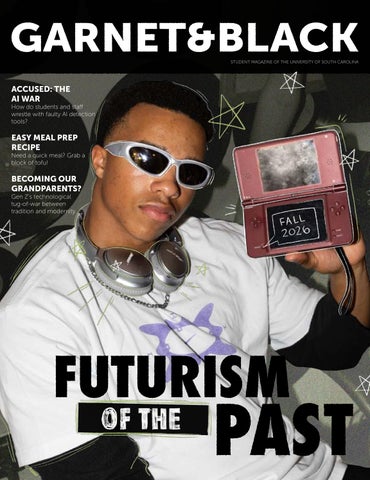
ACCUSED: THE AI WAR How do students and staff wrestle with faulty AI detection tools?
EASY MEAL PREP RECIPE Need a quick meal? Grab a block of tofu!
BECOMING OUR GRANDPARENTS? Gen Z’s technological tug-of-war between tradition and modernity.
10% OFF All Gamecocks! Students, faculty & staff — show your valid USC ID Walk-ins welcome • Appointments available Services Offered: Manicures Pedicures Dip Gel & Nail Art Wax Fillings Head Spa
Complimentary Beverages: Margaritas Beers Sodas
Book Today! 2231 Augusta Rd, West Columbia, SC 803-550-9211 Monday to Saturday: 10 a.m. – 7:30 p.m. Sunday: noon – 6 p.m.
**10% off one service with valid USC student, faculty, or staff ID. Cannot be combined with other offers. Mention this ad.
ST UDENT MAGAZINE O F THE UNIVERS IT Y OF S O UTH CARO LINA ED ITOR-IN-CHIE F M A NAGING ED ITO RS C REATIVE D IRECTO R ENGAGEM ENT D IRECTO R
AUDRE Y MILLE R RO BIN ADAMS & ALE E NA CHAT T H A E RIN KE LLY CIARA ANN PURDAY
WRITTEN ARTICLES EDITORS Olivia Cyr Caleb Hargrove Shivani Patel COPY DESK CHIEFS Jada Landrum
ARTICLES WRITERS Alyssa Culver-Draper, Tara McGee, Nicole Mease, Sohaila Moemen, Allyson Phillips, Samantha Ringgold, Sarah Katherine Rogers, Anahita Sawhney, Sarai Winkler, Margo Wiser COPY EDITORS Ramsey Albergotti, Claire Gantzer, Naureen Hasan, Ainsley Hoffmann, Myla Mershon, Allyson Phillips, Kyrstin Tison
VISUAL PHOTO EDITOR Sarah Romero
PHOTOGRAPHERS Ella Barnett, Katie Faustmann, Greyson Hardin, James Hedrick, Hallie Kraft, Kayla Jenkins, Lauren McKay, Ciara McNeil, Callie Osborne, Jalencia Pouge, Julia Spies, Asia Spigner, Logan Stullenbarger
ART DIRECTOR Hanaa Jatoi
DESIGNERS Jade Cameron, Brad Campbell, Javon Chick, Bella Cipparone, Allison DuBon, Madison Gissendanner, Hailey Koerber, Isabel Schreier, Caroline Smith, Na’Haley Wiley, Caleb Williams
MULTIMEDIA DIRECTOR Aydann Turner
STYLE DIRECTOR Lucy Dixon ASSISTANT STYLE DIRECTOR Hunar Gill
MULTIMEDIA CREATORS Patrick Chea STYLISTS Karinne Alleyne, Marley Gillespie, Anna Le, Olivia Neal, Moyinoluwa Okunbanjo, Rezzie Omoigui, Marissa Roach, Asia Spigner GARNET & BLACK | 1
ENGAGEMENT SOCIAL MEDIA DIRECTOR Cat Lahr ASSISTANT SOCIAL MEDIA DIRECTOR Taylor Manwaring PUBLIC RELATIONS DIRECTOR Jack Aicher
SOCIAL MEDIA MANAGERS Karlie Kim, Melissa Ngwane, Callie Osborne, Elaina Valentine PUBLIC RELATIONS MANAGERS Sophia Catalano, Madeleine Grenier, Rylee Potter, Audra Schaafsma
GARNET MEDIA GROUP ADVERTISING TEAM Treesa Abraham, Julia Austin, Clare Donovan, Sarah Frasson, Morgan Guynn, Juliana Marie Ordonio, Sophia Schlauch, Isabella Sepe
CREATIVE SERVICES Ivy Gao, James Graves, Abbie Lucas, Abby Short, Tyler Sperry Advertising: (803) 777-3018 To contact G&B, email sagandbe@mailbox.sc.edu or visit www. gandbmagazine.com. Garnet & Black Magazine is printed twice a year by students of the University of South Carolina and is distributed for free to members of the university community. All editors can be reached via email on our website. The office is located in Russell House University Union Room 339.
DIRECTOR OF STUDENT MEDIA
ASSISTANT DIRECTOR OF STUDENT MEDIA
Sarah Scarborough
Sydney Cranmer
ART DIRECTOR OF STUDENT MEDIA
Krista Larson
ADVERTISING ADVISOR
John Burbage
FACULTY ADVISOR
Tara Mortensen
COVER PHOTO JAMES HEDRICK DESIGN HANAA JATOI MODELS WILL BUSH
2 | GARNET & BLACK
CONTENTS 05 08 10 13 14 18
‘WE HAVE A HISTORY’: LGBTQ+ ARCHIVE AT USC LIBRARIES An LGBTQ+ archive at Thomas Cooper Library preserves the history of Columbia’s queer community.
THE NEW OUTLAWS IN TOWN How a new wave of country artists are reviving the genre’s roots.
SKY-HIGH, THIGH-HIGH Strut through fall in the city with a boot-y skirt attitude.
DILATION & A KISS Two short poems by Editor-in-Chief Audrey Miller.
ACCUSED: THE AI WAR BETWEEN STUDENTS AND UNIVERSITIES As AI creeps in higher education, where’s the line between good faith and academic integrity?
FUTURISM OF THE PAST Jump into a new fashion millennium, one unbothered by time and space.
23 24 27 30 33 38
EASY MEAL PREP RECIPE: MARINATED TOFU A quick, four-step guide for this popular Asian dish.
HISTORY, REVISED In Charleston, a call has been mounting for the relocation of historical and culturally-sensitive artifacts.
BEHIND THE CONCUSSION CURTAIN What emerging CTE research means for college football.
ARE WE BECOMING OUR GRANDPARENTS? Reaction or return: dissecting Gen Z’s relationship with privacy and intimacy.
WE’LL BRING THE CINCHES How the liberation of women’s fashion is embodied in modern corset culture.
THE LOST ART OF ATTENTION A resurgence in physical media may counter-act attention spans dominated by doomscrolling.
GARNET & BLACK | 3
LETTER FROM THE
EDITOR
AUTHOR AND PHOTO AUDREY MILLER DESIGN HANAA JATOI
M
ost of my life has been spent hunched over a notebook, etching ramblings of a madman in old tree bark. That’s to say, I’m a writer. I’ve dipped my pen in many different inks — poetry open mics to unfinished novels to magazine articles — indulging in a regurgitation of language and thought. The weird part about being a writer is this tug-of-war between yourself and your story. Who has control? After twelve years, I’d say it’s a mix of both. And stepping into the hot seat and taking on this role as editor-in-chief is proof of this. It’s both a dream yet something I never expected. As we move into fall — and the weather clings to summer — it’s hard not to reflect on my first semester here on campus, which also coincides with my first semester with Garnet & Black. For the past four years, the magazine has become intertwined with this university. They can’t be parted. My connection with UofSC, and Columbia at large, stems from the work I’ve done, the people I’ve met and the community I’ve built with Garnet & Black. And this semester marks the beginning of the end, a bittersweet realization, but one I’m determined to make the most of. But there’s still a whole year ahead, and many more for some of you. Already we’ve seen some big changes on and off campus. The constant drone of construction zones and back-to-back record-breaking freshmen classes are pushing against the university’s seams. And in a surprising stand of solidarity, national news networks united in September to defend their roots: the freedom of the press.
With such uncertain times, leaning on the voices of our local community is bound to push us through the present day and forward into our future. But not every voice is treated equally — some have the means of projection that others are barred from. At Garnet & Black, we strive to be a stage to stand on, a microphone to hold and a crowd to speak to for those who are ignored or silenced. Whether it’s students falsely accused of using AI, the university’s growing collection of LGBTQ+ archival literature or CTE research for young, student athletes across American universities, Garnet & Black is dedicated to not only being a means of projection, but also someone willing to listen. Stitching this magazine together as a writer, a creator, a voice was a satisfying game of tug-of-war teaching me when to pull and when to let go. And this story couldn’t be written without Garnet & Black’s staff, who graciously supplied us with their own regurgitation of language and thought, a vulnerable and honorable donation. And special thanks to our section leaders, who grip the same rope and helped pull the flag to our side of the line. Think of this issue as a story, a voice and an opportunity. Remember to always lend an ear — there’s nothing kinder than stopping and listening.
Best wishes,
4 | GARNET & BLACK
LGBTQ+ Archive at USC Libraries AUTHOR ALYSSA CULVER-DRAPER DESIGN JADE CAMERON
Thousands of materials are contained within the University of South Carolina library system, spanning from textbooks and novels to comic books and stickers. There is something for every knowledgeseeker to discover, whether they’re browsing the special collections or combing through digitized resources. “The reason we value things in archives isn’t just because of the things they tell us, but because of the traces of human beings that are on those documents,” Ed Madden, PhD (he/him), a professor of English at USC, said. It was this value that inspired an LGBTQ+ archive in the heart of South Carolina. The LGBTQ Columbia History Initiative began in 2019 as a collaboration between USC University Libraries, Historic Columbia and the USC Department of Oral History, with help from Richland Library and local queerfocused organizations such as the Harriet Hancock Center and the Queer Cola Oral History and Digital Archive Project. The initiative was started with a clear goal in mind: to document “the often unseen and untold stories of the LGBTQ+ community through the creation and dissemination of oral histories, historic site interpretation and archival collections,” according to Historic Columbia. Over time, the archive grew to contain various periodicals, novels, memoirs and other publications that recount the history of Columbia’s queer community, accessible online or at certain USC University Libraries. The items were contributed for digitization by donors, many of them affiliated with USC. Madden served on the Initiative’s
steering committee and is credited for a significant number of contributions to the archive. “I’m one of a number of people who donated materials for that collection, and I helped to coordinate some donations from the Harriet Hancock Center, as well,” said Madden of his contributions to the Initiative. “So, lots and lots of materials about South Carolina LGBTQ organizations, or related materials.” The significance of these archived items and stories is plentiful. “They remind us we have a history. They remind us what that history was. You know, we are not a community without a history,” Madden said. Madden also taught a class on LGBTQ literature, which was most recently offered in the spring of 2026. It was in this course that current graduate student Abby Still (she/they) began their research using the queer archive at Hollings Special Collections Library. “I wouldn’t have done my research this past spring if it weren’t for his class because he really gave us a deep dive into a lot of what [Hollings] has that I don’t think I would have noticed,” Still said. Using the Hollings Library collection
of LGBTQ+ media, they were able to find a periodical titled The Ladder. This magazine broke barriers, as it was the first publication by a lesbian organization to be distributed across the U.S. The publication ran from October 1956 to September 1972 — spanning nearly 16 years — and the Hollings Library currently contains 36 different issues of the magazine published during its run. In this magazine, there is a section titled “Readers Respond,” where readers could write into the magazine to provide their feedback and opinions. They still concentrated their research on this section, focusing on the contributions and reactions from Southern women. “I just talked about how identity and our queer society has come a long way, but then at the same time, it’s also really funnily similar,” Still said. “It’s like you read these periodicals from the ‘60s and you’re like, ‘Oh, we really haven’t changed much.’” Not only was Still’s work academically significant, winning an award for undergraduate research, it also held personal importance. “I’m finding there is an intersection between southern queer archives that is
GARNET & BLACK | 5
very small,” Still said. “But it’s something I really appreciate, as a queer woman from the South.” South Carolina has been reported as one of the least safe states for the LGBTQ+ community according to the 2026 LGBTQ+ State Safety Report Card. But Columbia’s queer history is extensive, and for the archive, preserving this history is vital. And the efforts are not stopping anytime soon, as local groups like the Harriet Hancock Center advocate and provide resources for the LGBTQ+ community. Beyond the publications and memorabilia preserved, there are also 33 oral histories recorded and available on the website for the LGBTQ Columbia archive. These immortalize both past and present stories and accounts from queer individuals. Much of this work is done by the USC Department of Oral History, led by Andrea L’Hommedieu (she/her). “It started in the mid-2000s, maybe 2007 or ‘08, by a student here at the university,” L’Hommedieu said about the collection of the archived oral histories. “And, so then they sort of got set aside, and then Historic Columbia picked up the ball and did all these more recent interviews in the early 2020s.” These recordings cover a vast number of topics that are relevant to the histories of both the LGBTQ+ community and South Carolina. Commonly discussed topics in the interviews are the HIV/ AIDS crisis, religion and the experience of POC within the LGBTQ+ community. There are also discussions of more niche aspects of queer culture, such as drag and ballroom culture, the LGBTQ+ bar and club scene and mentorship and parenting LGBTQ+ children. First-hand stories from queer people in Columbia preserve many aspects of LGBTQ+ culture that can easily be lost in written histories. “We are a community with a difficult and often invisible history because of just the lack of evidence of our daily lives,
6 | GARNET & BLACK
right?” Madden said. While many stories of the past are no longer available, generations of LGBTQ+ people are working to preserve stories from their time and times prior, keeping the history alive through means like interviews. This human connection and preservation of people’s memories is one of the most rewarding parts of working with oral histories, says L’Hommedieu. “I really like to sit down with somebody and listen to them tell their story and feel like I’ve helped them preserve
something important to them, but also to the generations ahead of them: their family, their friends, future people in their fields that are going to learn from their experiences,” L’Hommedieu said. “I think that’s what I like most, that we know that we’re pushing these stories forward for other people in the future.” Beyond the historical and academic significance, these oral histories contribute to community and acceptance as well. “The personal stories are so important because they’re affirming for people. They can feel like they can relate,” L’Hommedieu said. “There’s somebody they can relate to their story, relate to their experience.”
And that is much of the importance of the entire LGBTQ+ archive; not only does it preserve histories that may be censored, watered down or lost over time, it also shows people that the LGBTQ+ community has always existed. Regardless of hardships, inequality and barriers, queer culture and queer voices have been essential to Columbia and its history, and that will continue to be true as future generations of queer people make history. “When you’re in an archive and you’re looking at things that people held years ago and things, it’s not just that they own them: it’s that they were part of how they understood who they are or who they were,” Madden said. “These things were part of how people came to understand who they were, came to understand what an [LGBTQ] community could look like, came to understand what an LGBTQ politics could be and do. There’s just something really powerful about that.”
GARNET & BLACK | 7
The New
Outlaws In Town
AUTHOR SYDNEY LEWIS DESIGN CAROLINE SMITH
How indie country artists – the likes of Wednesday, Jesse Welles and Waxahatchee – could save the country music industry (and Gen Z) from itself.
In the many, many tributes and eulogies to the late great Dolly Parton that have (appropriately) rolled in since the country music star’s death, her journey from poverty in the cradle of the Smoky Mountains to high-rise riches has been remarked upon with great awe. In a time where upward mobility has never seemed more out of reach for many Americans – wealth inequality reached its widest gap at the end of last year since the Federal Reserve began tracking household wealth in 1989 – Parton represented an American icon who never forgot her working class roots nor left anyone behind. When a shell-shocked student in one of my classes broke the news of the star’s death, the first thing I did was call my sister, who has kept a Dolly Parton quote book beside her bed like a hotel Bible for years. The second was mourn not only Parton herself and her legacy, but the kind of country 8 | GARNET & BLACK
music she represented to me. I was raised on Parton, Johnny Cash and Woody Guthrie back when the iPod reigned supreme, and I later discovered the joys of John Prine, Willie Nelson and Patsy Cline. Country music and I go way back. When I first picked up a guitar 13 years ago, it was to learn Cash’s “Ring of Fire,” however clumsy my imitation may have been. For many years, I indulged in a deep sort of cynicism about the future of country music, remotely appalled that the Morgan Wallens of the world seemed to be getting more attention than the Tyler Childers. Just as country seemed to be getting more mainstream, the storytelling, blues influences and downto-earth songwriting I love seemed to become rarer. There’s only so many red-white-and-blue, pick-up-truck driving artists a girl can listen to, especially when those artists can afford to party on a yacht. I longed for the political
undertones of songs like “Man in Black” or The Chicks’ “Not Ready to Make Nice,” as well as the storytelling tradition in songs like Kenny Rogers’ “The Gambler.” But as I’m writing this, I’ve never been more hopeful about the direction country might be headed, and the new lease on life it could have with Gen Z, disillusioned and uncertain as we are. Instruments like the banjo and slide guitar have flooded my timeline post “Sinners,” an instant horror classic that highlighted the Black roots of the blues and bluegrass music inextricable from the country sound. Singer-songwriters like Jesse Welles are gaining traction with a mix of Appalachian sound and pitch-perfect expressions of the political moment. And folk-country groups such as Waxahatchee and Wednesday are ushering in a new sound while leaning on classic harmonies. Ashford King, a University of South Carolina Southern Studies and Spanish
professor and country musician, has seen love for alternative country artists blossom in recent years as people have become frustrated with an increasingly corporate world. “This is an oligarchic moment that we’re in, and that is naturally stoking a lot of, you know, opposition from the ground up,” King said. “The kind of polished, like mainstream radio country that you hear is driven by industry, it’s driven by the old seats of capital. That’s still in place in places like Nashville, L.A., New York, but there are new centers of musical production – to put it in like, an economic framework – that are escaping the influence
“There is kind of the desire to learn how to recreate or reinvent those interpersonal spaces” - Ashford King
the issues facing America today, and making a particular appeal to young people, many of whom are frustrated by a lack of authenticity in today’s algorithmdriven world. “Younger people, Gen Z included, are like yourself taking a look back at the origins and kind of trying to–I don’t know if it’s a return to or like reinterpret the origins of both country music broadly speaking and more traditional music,” King said. “There is kind of the desire to learn how to recreate or reinvent those interpersonal spaces, like the front porch jam I heard my grandparents talk about – to, you know, go back to creating things in this way that’s more tactile or real.” Listening to Orville Peck’s “In the Dead of Night” or Sierra Ferrell’s “West Virginia Waltz,” I’m reminded that though the world may look different now, for many, country’s storytelling tradition plays on.
of big money, whether intentional or not.” King specifically considers our neighbor, North Carolina, as a hotspot for this creative collaboration – Wednesday in particular emerged from the grassroots venues of Asheville. But artists in cities from Birmingham, Alabama to Charleston, West Virginia are riding the wave of a newfound populism to speak candidly about life in the American South and Appalachia, including the impact of the opioid epidemic and cost-of-living crisis. King, who was raised in Central Kentucky, said that this countercultural shift is a recurring movement within the genre, starting with “race records” in the early 20th century created by Black blues musicians. Outlaw country, led by the music of Willie Nelson, Waylon Jennings and Johnny Cash, carried messages about war, poverty and the gritty realities of substance abuse in the 1970s and ‘80s. Now, the new outlaws of country music are reshaping a genre to address GARNET & BLACK | 9
SKY-HIGH,
THIGH-HIGH! AUTHOR REZZIE OMOIGUI PHOTO JULIA SPIES DESIGN MADISON GISSENDANNER STYLIST REZZIE OMOIGUI
Nothing captures the magic of fall in the city quite like mini skirts, cozy layers and a fabulous pair of boots. These looks celebrate the versatility of denim while showing how a mini skirt can transition effortlessly into the cooler season. With a mix of a classic preppy style, Y2K attitude and warm autumn textures, each outfit transforms a simple walk through the city into its own fashion moment. The first model wears a light-wash denim mini skirt paired with a classic Ralph Lauren sweater. The softness of the knit balances the playful silhouette of the skirt, creating a look that feels cozy, polished and effortlessly put together. Short boots and visible knit socks add warmth and texture, making the outfit perfect for a crisp fall afternoon. A brown crocodile-textured handbag completes 10 | GARNET & BLACK
the look with a rich, vintage-inspired touch. It is the ideal outfit for grabbing coffee, browsing a bookstore or strolling through the city as golden leaves cover the sidewalks. The second model presents a darker and edgier look at fall fashion. A silky blouse is paired with a dark-wash denim mini skirt, blending elegance with the casual confidence of denim. Black leather strappy boots add a bold statement, while a black handbag keeps the look sleek and coordinated. A baker boy black hat and choker bring personality and nostalgia to the outfit, giving it the energy of a stylish city girl heading from an afternoon shopping trip to an evening out. These outfits embody autumn in the city — the sound of boots against the pavement, the chill in the air, the
warm glow from café windows and the changing leaves moving between tall buildings. Whether the day calls for a cozy sweater or a silky blouse, a mini skirt and boots can make even an ordinary afternoon feel cinematic. Fall becomes more than a season; it becomes an opportunity to dress with confidence, create your own atmosphere and turn every sidewalk into a runway.
MODEL: HALLE KNAPE Top: Tan blouse from Revente $43 Bottom: Dark-Washed Mini Skirt Jeans from Vestique $65 Hat: Black page boy cap from Urban Outfitters $38 Necklace: Choker from Strange Times Vintage $24 Purse: Black and gold leather purse from Revente $110 Shoes: Black leather boots from stylist’s closet MODEL: ANYA PHIL Top: Tan Ralph Lauren Polo Sweater from Revente $52 Bottom: Light-Washed Mini Skirt Jeans from Vestique $65 Purse: Gold crocodile skin bag from Revente $125 Boots: Suede brown ankle boots from Strange Times Vintage $35 Accessories: Sourced from model’s personal collection
Body Matters Explore how craft and the human body shape each other. From historical makers to contemporary artists, every piece carries the mark of the hands that made it.
Now on view columbiamuseum.org Judy Moonelis, American b. 1953. Flesh Wall (detail), 1994. Ceramics. Dimensions vary between 17 pieces. Gift of Porter-Price Collection. CMA 2023.2.1 a-q Photo Credit: Malcolm Varon
12 | GARNET & BLACK
A pit, a swinging bridge between two birds, bodies perching on the branches of wide-eyed birch trees speaking through sensation — wind whipping baby blossoms and brushing feathers spreading. The mouth, gaping and black, stretching time with two fingers curled in lip corners. The birds, fledgling little flyers, crane their necks, lock their eyes, flitting feathers kissing scar tissue. The horizon spits out the sun, chased by two birds catching fire, dancing with daylight as they stumble through Before and hurtle towards After. The result: a collision of planetary bodies. No, a Big Bang. Twenty years and twenty million miles, for just a kiss.
It’s hard to pinch my pen between the thumb and index finger; and press the skin against its plastic shell To crush the bone and watch the ink — a pupil; dark, dilated — soaking through my faded piece of page. It’s wide-eyed and empty.
AUTHOR AUDREY MILLER DESIGN MADISON GISSENDANNER
GARNET & BLACK | 13
ACCUSED: The
AI War Between Students and Universities
With unreliable AI detection tools, students and teachers are struggling to define the line between good faith and academic integrity. AUTHOR OLIVIA CYR DESIGN MADISON GISSENDANNER
AI DETECTED?_
14 | GARNET & BLACK
Nina*, a sophomore at USC, felt her face burn with anger and humiliation as she stood in front of her language class. Her professor was using her paper as an example of what not to do in the classroom — that is, use AI for assignments. There was only one problem: she hadn’t used AI at all. “[My professor] was like, ‘Go ahead, tell everybody here that you didn’t use AI,’” Nina said. “And so, of course, because that’s who I am, I stood up and looked at the whole class and said, ‘Okay, I didn’t use AI on this.’” The argument between Nina and her professor was accusatory and ugly, with Nina saying she felt “offended” after the interaction. However, these kinds of situations are not just specific to one class or professor: USC’s Office of Student Conduct and Academic Integrity reported that almost one-third of all Honor Code cases reported in the 2024-25 academic year “referenced the use of artificial intelligence.” Compared to the 20232024 school year, AI cases increased by 100. USC’s policy on academic integrity regarding AI use has been evolving since the emergence of ChatGPT in 2022. Although Nina’s professor did not pursue punitive action against her, those accused of using AI can be placed on conduct probation and must complete an Academic Integrity Workshop or an Artificial Intelligence Module, as reported by the university. Nina recalls urging her professor to broach his accusation with the Office of Student Conduct and Academic Integrity and says she did not appreciate her honesty being questioned. “I really do pride myself on my work. I work very, very, very hard, and I take a lot of pride in my education,” Nina said.
“[Being accused] was disgusting and horrible.” Nina said she was wary of AI even
before she was accused of misusing it, calling its normalization “insane,” especially among her peers at the university. She believed using AI in place of genuine learning is dangerous and can lead to a decrease in critical thinking skills. A study done by Microsoft in April 2025 suggested that if a user has a high level of confidence in the AI’s output, their critical thinking skills decrease. If users have a lower level of confidence, the
opposite is true. “I still don’t use AI because, at the root, my principles haven’t changed,” Nina said. “I want to know what I’m doing, and I need to know that I know it for the future.” Recently, AI seems to be on the minds of professors and students alike. One such professor, Jason Porter, offers a different viewpoint on AI. He is a senior instructor in the School of Journalism and Mass Communications in the visual communication sequence. Porter launched a journalism course called “Fundamentals of Generative AI for Content Creation,” and his stance on AI detection tools used in the classroom is a staunch one. “There have been so many instances where they provide a ton of false positives,” Porter said. “And if you are using an AI detection tool to determine something like academic integrity, you’ve got to make sure that thing is 100%. Otherwise, that’s not fair.” Porter says that the “guilty until proven innocent” mindset that certain universities have about AI may be too rash. These accusations can discourage students from actually learning how to use AI as a tool. Just like any tool, it can be used either correctly or incorrectly: “If I have a hammer, it’s great that I have it, but I have to know that a
“I stood up and looked at the whole class and said, ‘Okay, I didn’t use AI on this.’” GARNET & BLACK | 15
hammer is for a nail, not for screwdriving. That’s literacy,” Porter said. “If I have the hammer police running around because I’m using a hammer incorrectly, why don’t you teach me how to use it instead of just telling me I’m wrong?” Ultimately, Porter says that universities should put a focus on teaching students how to use AI in an ethical and responsible way, as opposed to scaring them off from using it entirely. Although some believe that it is the responsibility of universities to encourage proper AI usage instead of villainizing it entirely, that may place a burden on those tasked with enforcing these standards. Anna Puente is a Ph.D. student and graduate TA for the Department of Political Science who says that AI detection tools are far from perfect. She says she exercises caution when using them to assess student work. However, Puente says that monitoring the use of AI in classrooms is difficult. “There’s not really anything I can do about it,” Puente said. “And there’s not anything I can do about it in a way that would be fair.” Puente says that the role of AI in the classroom is a challenging subject. This obstacle makes accusing a student of using AI contentious. When professors accuse students of using AI in inappropriate ways in the classroom, Puente views this as a bandwidth issue. Additionally, teachers may become frustrated by flagrant AI usage. “I think most professors don’t mean to call out students too much or to falsely accuse
them, but that’s part of their job,” Puente said. “They are expected to report things and that can get really difficult.” Because AI detection tools can often be inaccurate, this puts both the university and its students at a difficult crossroads. A
in classrooms has been heavily disputed since the recent popularization of AI tools, Puente takes a more forgiving stance. “I think students are just trying to get their work done” Puente said. “Most students, I think, are just trying to do their best. And then, I think professors are doing the same.” As AI continues to gain prominence, but AI detection tools lag behind, how do institutions remain consistent with their values of academic integrity while also giving students a fair shot at producing authentic work? Although Nina is not a fan of AI in her personal life, she understands the importance of continuing to evolve with the tool. “The world is evolving. Technology is going to keep moving in the right or wrong direction, depending on how you look at it,” Nina said. “You have to find ways to keep moving with it instead of having to fight against it.”
“Why don’t you teach me how to use it instead of just telling me I’m wrong?”
16 | GARNET & BLACK
study done by a group of researchers from different universities found that AI detection tools often produced “false positives” — a term that describes when a detection tool misidentifies student work as AI-generated. The study found that while some AI detection tools identified human-written text with an average accuracy of 96%, they struggled to detect AI-generated content, especially when it had been edited by a user. According to an MIT summary of the study, AI detection tools identified ChatGPT-generated text with 74% accuracy, but that figure dropped to 42% when the text was slightly edited. While the debate about AI use
*Name changed for anonymity. Editor’s Note: Jason Porter is on the Board of Publications, the publisher and governing body of Garnet & Black.
GARNET & BLACK | 17
PHOTO SARAH ROMERO HERNANDEZ AND JAMES HEDRICK DESIGN HANAA JATOI STYLIST ERIN KELLY
18 | GARNET & BLACK
A
s technology is getting increasingly advanced, many people are craving the simple times of the ‘90s and the ‘00s. The turning of the millennium had the future at the top of the minds of the masses and was responsible for the creation of the Y2K futurism aesthetic. Featuring sleek, tech-heavy aspects along with unique cutouts, silver accessories and graphics of smooth, liquid-like gradients, it combined the technological advancement of that period with the turn of the millennium’s optimistic nature. Now, we are in that future they romanticized, but many wish for those simple times to return. Ironically, the futuristic styles from the ‘00s were correct, but for nostalgic reasons rather than pure futuristic fashion. Styles like
sleek wrap-around sunglasses, wide-leg pants and chunky platform boots carry on today; however, technology hasn’t found its way back to the styles of the ‘90s. Vintage tech is often used as accessories to add personality to an outfit or to make a statement. Flip phones tucked into a waistband, headphones connected to an mp3 player or even an iPod Nano all add a unique layer to any outfit. As we long for the simplicity of the past, keeping aesthetics alive and integrating them with the trends of today can influence us to romanticize our moments in the present instead of wishing for the past or a fantasized future.
MODEL: WILL BUSH Top: White Nike T-Shirt from Urban Outfitters $35 and Black Waffle Knit Long Sleeve T-Shirt from Nordstrom Rack $39.97 Bottom: Black Baggy Jeans from American Eagle $59.95 Shoes: Black Leather Boots from Steve Madden $179.95 Accessories: Silver Wrap-Around Sunglasses from Sunglass Hut $89 and Chain Necklace from Urban Outfitters $25
GARNET & BLACK | 19
20 | GARNET & BLACK
MODEL: DANIELLE COOK Top: Black cut-out sleeve tank top from Colsie $14.99 Bottom: Black Mini Skirt from Abercrombie & Fitch $60 and Red and Black Patterned See Through Tank Top from Target $22.99 Shoes: Black Chunky Chelsea Boots from H&M $59.99 Accessories: Red Sunglasses from PannerPete $14, Silver Headphones from Bose $359, Pink See-Through Double Grommet Belt from Hot Topic $19.99, Beaded Chain Belt from Princess Polly $25, Assorted Bangle Bracelets from Nordstrom $29.97
GARNET & BLACK | 21
Digital Dome Planetarium Experience
ÁRÓRA Explore the Northern Lights in 4K Limited Time! Nov. 1, 2026 - Feb. 28, 2027
Tickets at SCMUSEUM.ORG 22 | GARNET & BLACK
EASY MEAL PREP RECIPE: AUTHOR HANAA JATOI DESIGN HANAA JATOI
You will need ~1/2 cup of soy sauce and add the rest of the ingredients to your preference!
Wrap the block of tofu in a paper towel and press it to drain excess water.
Combine the remaining ingredients (and some water) in a dish to make your sauce.
Cut the block of tofu into cubes and place them in your sauce. Allow the tofu to marinate ~30 minutes.
Best served with rice or noodles and paired with vegetables. Garnish with green onion (optional). Place the marinated tofu cubes in a pan and fry over medium heat until they brown on both sides.
GARNET & BLACK | 23
A national movement calling for the repatriation of culturally-sensitive artifacts sitting in museums across the country has hit one of South Carolina’s most historical cities: Charleston. Professors and historians alike are having discussions surrounding the presentation of history as names are stripped and artifacts are redistributed. The question ultimately comes down to ownership — does the location of a historical artifact affect how its history is conveyed to the public? AUTHOR OLIVIA CYR DESIGN ISABEL SCHREIER
24 | GARNET & BLACK
OVER
40%
OF ALL ENSLAVED AFRICANS TRAFFICKED ALL ENSLAVED TRAFFICKED TO TOOF NORTH AMERICA AFRICANS WERE TRANSPORTED NORTH CAROLINA WERE TRANSPORTED THROUGH THE CHARLESTON HARBOR THROUGH THE CHARLESTON HARBOR
A
cross the United States, there has been a mounting call for a cultural reckoning in recent years: institutions are being renamed, flags removed, statues torn down and artifacts returned to their homeland. At the heart of this movement lies a quest for the humanity that may have been lost to history. These artifacts and institutions often have ties to racial injustice — this effort works to correct narratives that paint certain groups as less than human. In Charleston, South Carolina, museums and institutions are working to correct these injustices. Aaisha Haykal is the Manager of Archival Services at the Avery Research Center for African American History at the College of Charleston. The Avery Research Center is a museum “dedicated to preserving the history of African Americans,” specifically relating to Charleston, according to Haykal. Charleston was home to North America’s largest Atlantic slave trade port. An article by the Equal Justice Initiative reported that over 40% of all enslaved Africans trafficked to North America were transported through the Charleston Harbor. As a result, some
museums and archives in Charleston, and the broader South Carolina region alike, have attempted to reconcile with this tainted past. Haykal says doing so requires a willingness to confront painful, sometimes unpalatable history. “We have to think about not sanitizing history,” Haykal said. “It’s about telling the truth and then also recognizing that some people may not want to hear the truth, but that’s not our role.” In recent years, there has been a marked movement in the U.S. toward renaming institutions and reclaiming culturally sensitive artifacts and historical images. The Smithsonian Institution, for example, has been caught up in this movement in recent years, and issued an ethical returns policy in 2022. According to the Smithsonian National Collections Program, the museums are permitted to return certain collections based on ethical considerations, taking into account “items that were stolen, taken under duress, or removed without consent of the owner.” This reckoning has expanded nationally in recent years. At the Avery Research Center, employees like Haykal promote collaboration between communities in order to ensure these archives are properly displayed in a respectful and accurate way. “We do our consultation with communities, descendants of people that attend Avery, but also just descendants in the Charleston community that have impact,” Haykal said. “We often go to
them for advice and suggestions on how to proceed with items and how to display them.” That consultation process reflects a broader shift in the handling of these materials. In March 2026, one particular case made national news when what is believed to be the earliest known photographs taken of enslaved people in the U.S. were transferred to new ownership. Originally held by Harvard University, a six-year legal battle culminated in the transfer of the daguerreotypes to the International African American Museum in Charleston. A descendant of the people featured in the photographs, Tamara Lanier, hoped that under new ownership, the humanity of those photographed would be preserved. Bernard Powers, PhD — the Director of the Center for the Study of Slavery in Charleston — hopes that other investigations will take place in a similar fashion, so that other artifacts may be restored “and put in a position where they can be more effectively used to tell the story of these owners,” Powers said. There has been a mounting effort in museums in recent years to return historical artifacts to their rightful owners. This process is known as repatriation, or the restitution of cultural artifacts. Powers says that this stolen heritage has allowed these museums and institutions to unfairly profit from these materials. This has encouraged a shift toward the original owners demanding to have these artifacts returned so that they can present the history in ways
26 | GARNET & BLACK
they find appropriate and humanizing. “The daguerreotypes really represent the artifacts of history. They represent the way that, in this case, African people were treated and denigrated,” Powers said. “If Africans could be so treated, anyone could suffer from the same kind of subordination and marginalization.” Although some argue that historical objects are becoming obsolete in modern times, people like Powers disagree. He maintains that our history directly influences our future as a nation, and that looking back may help us inform our decisions looking forward. “The present cannot be cut off from the past any more than a person could sever one of their limbs and not suffer trauma,” Powers said. “We are organically connected in that way.” Elizabeth West, university archivist for the University of South Carolina and a staff member of the South Caroliniana Library, shares a similar sentiment. West frames history as a “tapestry,” one that archivists play a major role in threading together. The tapestry cannot be complete, West says, unless one is willing to make sense of the difficult parts of our history, “like slavery.” West says that they follow recommendations from the South Carolina Society of American Artists — a nonprofit group that works to support visual arts across South Carolina and establish cultural competency. “There are ways that we bring materials in, work with communities where the materials came from and try to build and maintain those kinds of good relationships so that we’re not coming in and taking things away,” West said of the South Caroliniana Library’s mission.
Ultimately, the debate comes down to control — who gets to have it, and who does not. This collaborative effort between institutions and the communities they serve is a bid for humanity, by the people, and for the people. Powers offers an idea from James Baldwin — a historic American writer and Civil Rights Activist of the 20th century — to shed light on this recent modern contention. Powers says that history has power because we contain it within ourselves, even unconsciously. “That seed of history that is buried within each and every one of us is something that shapes our behavior in the present, shapes our values, shapes our fears, our ambitions, our goals,” Powers said. “That’s why it’s so terribly important to understand history and not marginalize it.”
ACTIONS FOR CORRECTING NARRATIVES OF RACIAL INJUSTICE IN ARTIFACTS AND INSTITUTIONS return collections based on ethical considerations collaborate between communities and institutions to ensure archives are displayed respectfully move artifacts to positions where they are more effectively telling the story of the owners return artifacts to rightful owners so institutions can’t unfairly profit from material and it can be properly represented
What emerging CTE research means for college football. AUTHOR ROBIN ADAMS PHOTO DELANY KRAL, COURTESY OF THE DAILY GAMECOCK DESIGN HANAA JATOI
n many fall Saturdays, tens of thousands of fans rush into the gates of Williams-Brice Stadium to witness what they hope will be a demonstration of athletic mastery, an excellence in pushing the ball down the field. Fans get rabid. Referee calls are met with fierce protest. Let’s say two players collide. From more than 100 feet away, the average middle-seated fan might watch one fall, shake it off, get back up and return to action. But for congenital football fans like Neil Brown, it’s more than a visual blip. He can virtually hear the clink their helmets make: the sound of an impact with unpredictable consequences. Brown, a senior at the University of South Carolina, has been in the crowd since he was two weeks old. As such, he’s witnessed countless helmet collisions, each occurrence met
with varying degrees of crowd concern. “I feel like we only really talk about it when someone is unconscious or has a really bad response,” Brown said. “I definitely think that most people are not really thinking about these humans. They’re just viewing them as athletes playing for their favorite team.” Over decades of both professional and college football, the main concern for brain injuries has traditionally revolved around one word: concussion. Concussions are a crucial consideration when looking at the force trauma a player endures post-collision. University of South Carolina professor Ahmed Alshareef, PhD is spearheading research examining how the human brain can physically deform immediately after high-severity impacts. In the Biomedical Engineering department, he focuses on the biomechanics
of injury and the types of impacts that can cause traumatic brain injury (TBI). Some of Alshareef’s work examines how brain tissue responds to rotational head movements, often seen in contact sports like boxing. In a profile for the University of South Carolina, Alshareef analogizes the human brain during rotational movements to “gelatin being moved inside a bowl,” since brain tissue is one of the softer materials of the body. “If you move it in a rotational fashion – you’ve probably seen it in boxing where someone gets hit – with the rotational mechanisms of the brain, all of a sudden we see a lot of shearing in the brain tissue, a lot of deformation of those layers,” Alshareef said. According to Alshareef, that movement is strikingly pertinent because it’s believed to be the main mechanism that causes concussion and any
Courtesy of The Daily Gamecock, Delany Kral
dysfunction related to TBI. The brain deforms relative to the head’s rotational motion. Alshareef’s biomechanical research primarily detects immediate responses to blunt force trauma and raises important research questions about traumatic concussions. But what do we know about long-term responses? A growing body of research suggests that the long-term neurological effects associated with football may be more complex than the sheer number of concussions an athlete sustains. Scientists examining chronic traumatic encephalopathy, also known as CTE, are increasingly looking at the effects of repetitive head impacts (RHIs) sustained over time.
the condition has been limited. Honing in on a group of younger athletes shifted the focus to detecting earlier signatures of cell damage compared to the advanced form of the condition. In the study, researchers used single-nucleus RNA sequencing on brain tissue from three groups of 28 total participants: eight without known RHIs, nine exposed to RHIs and 11 with low-level CTE. The majority of the participants had played football. They found striking results, including an average 56% reduction in a specific population of neurons among individuals who had
thousands of times. This distinction is relevant in college football, where athletes may play out their careers on top of years of competition throughout adolescence, often having sustained many head impacts, but potentially zero concussion diagnoses. Bobak Abdolmohammadi has worked as a researcher at Boston University’s CTE Center since 2016. As an author on several brain injury studies, he emphasizes taking a closer look at what may or may not correlate with CTE. In their studies, the researchers have asked the families of brain donors to estimate how many concussions the player might have sustained throughout their career. Yet it isn’t the most accurate estimate. “We’ve always, from the very beginning, never really seen a link between that informantreported concussion count and risk for CTE,” Abdolmohammadi stated. “But we have very consistently seen a strong link between duration of play as a proxy measure of overall repetitive head impact exposure and risk for CTE.” One of Abdolmohammadi’s recent works is a 2023 study conducted on 152 contact sport athletes exposed to RHIs younger than 30 years at the time of death. Researchers detected CTE in 41.4%. Of these 63 diagnosed athletes, 45 had competed only below the professional level, including youth, high school and college sports. It is crucial to note that this does not mean that 41.4% of all young athletes (or college football players) have or will develop CTE. Rather than a representative sample of all athletes, the researchers sampled highly symptomatic brain donors. As 58.6% did not have CTE pathology, the symptoms of the group were likely multifactorial. Abdolmohammadi put it simply: by definition, young people don’t die as often. The reason for death among the group is highly variable, and therefore a different profile requiring more research is necessary to definitively
“IF COLLEGE, HIGH SCHOOL AND YOUTH FOOTBALL PRACTICED MORE LIKE THE PROFESSIONALS, This includes hits that may not produce WE COULD ELIMINATE A symptoms sufficient to warrant a concussion diagnosis. Recent research supported by the National SUBSTANTIAL AMOUNT OF Institutes of Health (NIH) suggests that repeated head impacts alone can HEAD-IMPACT EXPOSURE cause early – and lasting – alterations in the brains of young athletes. These WITHOUT FUNDAMENTALLY can occur years before physical symptoms even appear. The study’s CHANGING THE GAME.” findings suggest the potential for earlier CTE diagnoses and treatment than is currently possible. CTE is a disease that can damage brain tissue and has the potential to kill brain cells. Today, the disease can only be definitively confirmed posthumously. Though on occasion contested between scientists, s y m p t o m s typically associated with CTE include personality changes, memory degradation, depression, confusion and even erratic, violent or suicidal thinking. Experts are now aiming to find out just how prevalent CTE is in both contact sports players and other injury-prone occupations. Because no 100% verified CTE tests exist for living subjects, consensus on 28 | GARNET & BLACK
sustained RHIs compared with age-matched controls. T h e n e u ro n d e c re a s e occurred in the cortical sulci, the region assumed to absorb the greatest mechanical force after trauma. The cellular changes themselves are dramatic, especially in consideration of subjects with no visible CTE. What does this mean for young athletes? Repetitive head trauma can begin earlier than previously thought – and an impact does not have to induce a concussion, or even noticeable symptoms, to have lasting effects. With years of playing, RHIs can occur
confirm a high prevalence. Nevertheless, the study demonstrated that mild CTE pathology has the potential to manifest in young players who hardly, or never, make it to the professional level. But what happens to those who do? In August 2026, newly published CTE research went viral. It was a retrospective study of NFL players that examined 1,712 former players who died between 2008 and 2021. Of the sample, 338 had donated their brains for neuropathological examination, whose brains were examined to discover a range for the prevalence of the disease. Researchers discovered CTE in 315 of those 338 donors. It’s an arresting number – 93.2%. But researchers noted that ultimately, out of the entire group of 1,712 former players, CTE prevalence ranged between 18.5% and 98.7%. When specifically examining the 20162021 period, they found that even at the most conservative estimate, a minimum of one-quarter of former NFL players had confirmed CTE pathology. This recent finding has fueled conversations about brain injuries in football. Between the two studies, Abdolmohammadi acknowledges that they differ in scope, and that data from young contact sport players cannot necessarily be extrapolated to the NFL, and vice versa. Daniel Daneshvar, M.D., PhD, the Chair of the Department of Physical Medicine and Rehabilitation at Harvard Medical School and Mass General Brigham, director of the HealthSpan Lab and a professor at Harvard Medical S c h o o l , a u t h o re d the study. In email correspondence with Garnet & Black, he shared insights into his research and the future of CTE diagnoses. Currently, scientists are trying to determine how to detect the disease before death. Daneshvar
acknowledges the current limitations of testing on living subjects. “I am optimistic that we will eventually be able to diagnose CTE during life, but we are not there yet. Right now, we do not have a test that can diagnose CTE in a living person with known accuracy.” In a similar vein, Daneshvar emphasized the nuanced setbacks. “This does not mean people with CTE do not have symptoms while they are alive,” Daneshvar said. “The challenge is that memory problems, behavioral changes and other symptoms can also be caused by Alzheimer’s disease and many other conditions. There is very promising work happening with clinical evaluations, imaging and fluid biomarkers, but that validation is critical.” Brown believes in balancing advocacy for college player safety concerns and discomfort over current measures with continued support for the sport. “I definitely think it’s possible to love college football while also heavily weighting and putting a lot of effort toward education on concussions.” As this research continues, college athletics organizations are continuing to debate safety measures to reduce RHIs – whether it be physical safeguards like guardian caps or fundamental changes to reduce collisions altogether. “The clearest opportunity is reducing contact in practice,” said Daneshvar.
“ N F L players now average less than one contact practice per week during the regular season. If college, high school and youth football practiced more like the professionals, we could eliminate a substantial amount of headimpact exposure without fundamentally changing the game.” In the crevices of most CTE studies lies an important caveat: not all players will develop CTE, nor will they react to injury the same. While the results can seem haunting, the main takeaway is a necessity for further safeguards. Cumulative exposure to RHIs is not something that can be easily measured nor written off. Both Abdolmohammadi and Daneshvar want to disrupt the assumption that football is the horseman of brain death. “The main thing I would add is that this should not become a false choice between protecting the brain and preserving sports. I played football. I know what sports can give people, and I want athletes to continue having those experiences,” Daneshvar said.
Courtesy of The Daily Gamecock, Delany Kral
GARNET & BLACK | 29
ARE WE BECOMING OUR GRANDPARENTS?
AUTHOR CALEB HARGROVE DESIGN HANAA JATOI
A
s a generation that grew up around social media, Gen Z may appear to be the least traditional generation yet. Dating apps have changed how people meet, TikTok has changed how people communicate and social media has made it easier than ever to share the most personal details of everyday life with strangers. B u t s o m e y o u n g p e o p l e a re beginning to question how open they truly need to be. For some members of Gen Z, there seems to be a growing preference for privacy, commitment and more purposeful relationships. While they are not necessarily rejecting modern dating or social media altogether, they are increasingly questioning how much of their personal lives should be shared online and what dating should look like. For Te’Asia Smith, a sophomore 30 | GARNET & BLACK
accounting and finance major, and Josalynn Shaw, a sophomore exercise science major, that shift is noticeable. “I would say dating young — not dating just to date someone else, but dating to marry. I would definitely say that it’s more traditional; I feel like it’s coming back,” Smith said. Shaw agreed, describing a similar desire for purpose in relationships. “ Ye a h , d e f i n i t e l y, j u s t w i t h a purpose. Don’t just date just to date,” Shaw said. Neither student described this shift as simply political. Instead, their comments pointed to something m o re p e r s o n a l : a d e s i re fo r a relationship that feels meaningful rather than performative. For Shaw, privacy is an important part of that. “I feel like in your relationship, you should have whatever you’re doing behind closed doors — there should
be a certain extent that you tell people. If you do tell someone, make sure it’s a close friend, something like that. But I feel like everyone should have some type of privacy.” Despite this desire for privacy, both students are disinclined to keeping a relationship hidden. “I will, to the death, believe in private, but not secret,” Smith said, explaining that publicly sharing a relationship can also invite unwanted opinions and interference from other people online. Shaw expressed a similar concern. She said students may hesitate to post their relationships because they fear backlash or unwanted attention from other people. “That’s why, me personally, I also like, you know, private, but not a secret, because I know what we have going on,” Shaw said. Social media has made the
boundary between what’s meant to be private increasingly difficult to maintain. What might once have stayed between two people can now become content for hundreds or even thousands of others. Smith sees that as a problem. “I feel like social media definitely has kind of invaded privacy because you’ll see people comment different things about their relationship. Some things are better left unsaid than being put on the internet or being blasted out to your friends,” Smith said. Shaw believes the same problem extends beyond relationships. She said Gen Z still has “a really bad problem” with oversharing, particularly on platforms such as TikTok and Instagram. However, she has a simple rule for deciding what belongs online. “I feel like if you have to ask yourself, should I post this? Then you probably shouldn’t.” She also emphasized asking a partner for permission before sharing something about a relationship online. That concern with privacy may be less about returning to an older generation’s values and more about adapting to life in an environment where almost everything can be recorded, shared and permanently stored. Kelly Evans-Grieshaber, PhD, who teaches social media and sports media courses in the School of Journalism and Mass Communications, said she sees both sides of Gen Z’s relationship with social media. Some students continue to post their lives openly, while others are much more selective about what they share publicly. She does not believe it is accurate to paint Gen Z with one broad brushstroke. “Gen Z isn’t stupid. Y’all know that, if it’s put out on the internet in any way, shape or form, even if you have the most private controls on there, it’s not private, because as soon as one person sees it, they can screenshot it and share it,” Evans-Grieshaber said. This awareness may help explain why some young people are pulling back from oversharing. At the same time, Evans-Grieshaber argues that social media has fundamentally changed expectations surrounding
relationships and communication. Dating apps, for example, have made meeting people faster and easier, but that convenience can also change how seriously people approach relationships. “When people were on eHarmony and Match, that meant you were serious about dating and getting serious. Now that we have these apps on our phones, and we can get to them faster and quicker, and we can make decisions quicker, the seriousness has been taken out of that,” Evans-Grieshaber said. For Smith, the result is a generation that may struggle with intimacy while simultaneously being surrounded by constant exposure to it online. “I would definitely say I view intimacy as something that’s very private,” Smith said. Shaw similarly argued that the internet can shape intimacy in opposite directions. Some people may become more cautious because of what they see online, while others may constantly pursue what they see on social media. “I feel like the internet can either present a good way or a bad way of intimacy. I feel like you should just have a middle-level ground, and if that’s what you want to do, you need to communicate with your partner as well as being safe with your partner,” Shaw said. The question, then, may not be whether Gen Z is becoming conservative. It may be whether growing up online has made some young people more cautious about the consequences of being constantly visible. Ev a n s - G r i e s h a b e r s a i d s o c i a l media’s algorithms can reinforce people’s existing beliefs by repeatedly showing them content that reflects their values. “The social media algorithms pick up way more than you think,” she
said. “It’s also not real. The whole goal behind a social media algorithm is to get you to stay on their app longer.” This creates a strange contradiction. Young people have more opportunities than ever to see different perspectives, but algorithms inevitably place them inside highly personalized echo chambers. The same technology that encourages people to share can also make them more aware of what can happen when they do. Smith and Shaw both emphasized that people do not need to broadcast their relationships to prove that they are real. “It’s okay to be private about your relationship. You don’t have to blast it all on the internet,” Shaw said. “It’s okay to just take that time for you and your partner.” That sentiment may sound traditional, but it does not necessarily fit neatly into the conservative-versusliberal divide. Wanting commitment, privacy or boundaries in a relationship does not automatically determine someone’s political beliefs. For some young people, these values may simply reflect how they want to navigate a world where social media makes private life increasingly public. Maybe Gen Z is not returning to the past at all. Instead, we may be developing new ideas about intimacy and privacy in response to a world where almost nothing stays private for long. For Smith, the answer is ultimately personal. “Just don’t always listen to what everybody else is saying. Just do what you think is right or how you feel.” In a culture increasingly shaped by algorithms, public opinion and constant visibility, deciding what to keep for yourself may be one of the most personal choices a person can make.
“Some things are better left unsaid than being put on the internet or being blasted out to your friends”
GARNET & BLACK | 31
? w o n k u Did yo
The USC Career Center has an office dedicated to students pursuing professional or graduate school after graduation!
FIND YOUR PATHWAY.
Whether you’re considering a health profession, law school or another graduate program, Pre-Professional & Graduate School Pathways can help you prepare for what comes next. Explore your options. Build a strong application. Get guidance along the way. Your next step starts here.
Sumwalt College 208 sc.edu/oppa 803.777.5581 | oppa@sc.edu
Stay in the know! Join our email list today.
Coming Soon! Health Professions Week, Oct. 26-30
gg
AUTHOR LUCY DIXON PHOTO JULIA SPIES, SARAH ROMERO DESIGN BELLA CIPPARONE STYLIST LUCY DIXON
For centuries, the corset was designed to be hidden. It shaped the body according to the beauty ideals of its time, beneath layers and layers of clothing. The garment has been integral, and even widely required, in women’s fashion, from early forms of body-shaping garments in
the BCE to the structured stays of the late Renaissance to the tightly laced corsets of the Victorian era. Women were liberated from corsets just over a century ago, no longer forced to shape their bodies against their will. Now, the corseted silhouette is being
reclaimed as a statement piece and outerwear garment. The corset’s boning, lacing and sculptural lines have been perfected over centuries of fashion, and now it’s time for them to be seen. GARNET & BLACK | 33
MODEL: ADIA PARKER Dress: Sail Away Dress from Vestique $72 Shoes: Clear Sky Platform Heels from Dolls Kill $57 Corset: Yellow corset from stylist’s personal collection MODEL: ALYSSA RIGONI Top: Green lace shirt from Bizz $60 Bottom: White lace skirt from Terrace Oaks Antiques $38 Shoes: White Chunky Platform Pumps from Dream Pairs $20 Corset: Green corset from stylist’s personal collection MODEL: KENNEDY MOORE Top: Red striped button-up shirt from stylist’s personal collection Bottom: For the Summer Skirt from Vestique $48 Shoes: Brown Leather Mid-Calf Ankle Boots from Dansko $75 Corset: Red fan-laced corset from stylist’s personal collection MODEL: MADISON WREN Dress: Birthday Babe Dress from Vestique $72 Shoes: Blissful Step Silver Boots from Target $83 Corset: Silver corset from stylist’s personal collection 34 | GARNET & BLACK
MODEL: ANNIE NAVARRO Dress: Jody Skirt from Vestique $46 Shoes: Burgundy kitten heels from On Feet & In Love $24 Corset: Burgundy velvet corset from stylist’s personal collection GARNET & BLACK | 35
36 | GARNET & BLACK
Not a member yet? Joining is EASY!
800 Huger St., Columbia (800) 868-8740 GARNET & BLACK | 37
As the demand for convenient, short-term media increases, an opposing trend has also risen: the resurgence of physical media. Our attention-spans and patience may be decreasing, but physical media offers an alternative way of being, and puts control and ownership over content back into the hands of the user. AUTHOR SARAH KATHERINE ROGERS DESIGN ALLISON DUBON
38 | GARNET & BLACK
O
ur attention spans are getting worse, and we all know it. Whether we find it hard to sit through class or skim through longer videos, we see this phenomenon impact our lives in different ways. In a culture that encourages rushing through our days, it’s no wonder that we long for more technology-driven shortcuts and convenient summaries. The need for fast information and entertainment has caused a rise in short-form content, which has, in turn, trained our brains to expect instant gratification. The internet is no longer a place we choose to visit and leave. It is now an extension of ourselves. Our days are spent shortening waiting times and maximizing efficiency, which causes us to miss out on intentional, day-to-day experiences. However, this modern lifestyle has led to an interesting counter-trend. Alongside the current rise in technology, we’re seeing a simultaneous resurgence in physical media. From people collecting DVDs and game cartridges, to those who prefer reading physical books, it’s no surprise that in a world so focused on maximizing efficiency, many people prefer older technology with more friction between desire and outcome, forcing us to slow down. Jacob Burke, a USC student who got into music because of his family, collects second-hand CDs and vinyl records. Though Burke originally started collecting CDs because his car does not have Bluetooth, he continued for a variety of other reasons. “I started loving having so many, and supporting the artists that I listen to and who brought me to who I am today.” With the internet at our fingertips, there is an overwhelming amount of content. There’s something more tangible and concrete about a curated collection we gather and own ourselves, rather than being fed by corporations, algorithms and ads. This is highlighted by Burke’s collection, as he now has more than 90 CDs and 40 vinyl records. Going back to tactile, physical media puts the user in control of the content they chose to own and consume. Burke explains that a unique benefit
of physical media is how the owner permanently retains the content. He details that on streaming platforms, listeners sometimes cannot access the songs they love due to copyright deals or removals. When it comes to buying vinyl records and CDs, he emphasized a key point about ownership. “You own the actual physical media, and that can’t be taken away from you.” Another unique experience of physical media is the search for new content. Sifting through rotating stock can be compared to a treasure hunt, as you never know what you will end up with. Persistence pays off upon finding a hidden gem, and this grants the seeker a sense of accomplishment that isn’t simply short-term gratification. Burke details another aspect of physical media in relation to music: it is harder to physically skip songs. This means many people listen to whole albums the way artists originally intended the experience. “I think that albums have become less comprehensive, and have become more track-by-track…many artists are just trying to create trending tracks instead of cohesive works of art.” Because of this, we are missing out on songs we may enjoy, simply because they are not trending. Although the internet and digital technology are now ingrained in our everyday lives, physical media is a great way to take a step back. When using physical media, the content stays the same, but the form changes. This return to a slower form of consumption forces us to consider how we actually want to spend our attention. Burke said, “I love just coming home and putting on a record while cleaning the house, or just sitting down and listening to records with my friends.” In this way, listening to music becomes an experience and pastime. From listening to music on CDs rather than Spotify to going to stores rather than ordering online to seeing movies in theaters rather than on streaming services, we crave in-person, tactile experiences. There is value in the hurdles it takes to do tasks that would otherwise be frictionless. “It’s almost like a ritual: putting the record on, moving the needle,
dropping the needle, flipping the record,” said Burke of vinyl records. This highlights how there is something human about imperfect, slower experiences with media. This is also why we are seeing a rise in “dumb phones,” which shifts digital phones closer to physical media. Younger generations are uninstalling social media apps, which returns these phones to their basic functions. This allows people to still participate in the activities essential to modern life, like texting, searching or calling, while minimizing the impact of other addictive apps. In this way, phones become closer to physical media, as they are only equipped to handle a few purposes. “Dumb phones” become a place to occasionally visit rather than an environment to instinctually exist within. Without apps to constantly fight for our attention, we are able to be more present in our actual lives and not spend our hours scrolling. How we choose to use our time and energy makes us who we are. With the rise of digital technology, it’s easier than ever for us to unintentionally shift our attention away from where we intend it to be. It’s no surprise that this led to a counter-trend: the resurgence of physical media. In an age of digital convenience, the rise of physical media is a reclamation of our time, attention spans and human experiences. GARNET & BLACK | 39
While Garnet & Black’s management and senior members agree that AI can be useful in a narrowly defined set of scenarios, we consider the preservation of the following to be of the utmost importance: thorough verification, the education of our members in industry skills and the promotion of human creativity in our magazine. These principles will guide our policy as we attempt to outline a standard of transparency, efficiency and integrity which will hold up in years to come.
• AI tools embedded in browsers (Co-pilot, Gemini, etc.) may be used to further research and development for a story, but manual verification of sources is required. If a credible source cannot be found which supports the original claim suggested by the AI model, it cannot be used in any content creation. • RAG models may be used with for lengthy legal documents or large caches of public records, but only with manual verification of citations in the original document (Notebook LM provides these). • Just because an AI suggested an image, song or other content as copyright free does not mean it is so. Attempt to verify individually and, if not possible, reach out to management. • Staff use Large Language Models to generate content for a story or to outline a story. Staff are prohibited from copying and pasting any assertion made by the model into publishable content. • Generating pitches or story ideas using AI is prohibited.
• Transcription functions on AdobeSuite, as well as Otter.ai and similar services are allowed for field interviews. Do not put a recording of an anonymous or “on background” source’s name or identifiable information into a transcription model. Verification by listening back to the recording is required. The AI summary of a transcription may not be used to inform content. • AI tools in PremierePro may be used to clean up background noise to a point. However, it is prohibited to use any enhancement features to change the character or factual nature of an interviewee, their voice or accent, or their claims. Adding backpad or generating frames of content is prohibited. • Clone stamping tool in Photoshop is allowed as long as it does not alter the photo’s character or meaning within the context of a story. If the shoot is considered photojournalism and a candid representation of events, clone stamping nor AI additions/removals are permitted. • While tools like spell check are allowed, no content generation or syntax suggested by AI is to be used in a final product. AI should not be used to correct for AP Style. • Staff may not alter an image, graphic, video, interview or publishable written materials using AI-generated content. Additionally, it is grounds for suspension to misrepresent AI’s work as your own.
40 | GARNET & BLACK
Show your gamecock pride! Credit Cards1
Debit Card2
Do more with the
Founders App. 1 You must be 18 years or older to qualify. Qualifications for Founders Credit Cards are based on the Credit Union’s criteria, including applicant’s income and credit history. APRs will vary with the market based on the Prime rate. Rates, terms and conditions are determined by an evaluation of credit history and underwriting factors and are subject to change. 2 Requires credit evaluation. Members under the age of 18 are required to have an adult sign as a joint owner. Mastercard and the circles design is a trademark of Mastercard International Incorporated. 4520-2026-08-Flyer-USC-Cards
SURF’S UP ACAI BOWLS Naturally Wholesome Organic Non-Dairy Gluten Free No Added Sugar Rich in Antioxidants
ORDER NOW!
SURFSUPACAI.COM
@SURFSUPACAI