Reviewing 2025 in Photos PAGE 8-9
Volume 2 | Issue 15 | December 24, 2025
visit us online: ourculture.us
GOOD NEIGHBOR: A 2025 YEAR IN REVIEW
For quick support and resources, call Good Neighbor's Crisis Hotline: (312) 219-8864
GOOD NEIGHBOR YEAR IN REVIEW PUBLICATION TEAM Michael Romain Publisher & Editor Kamil Brady Circulation Manager/Sales Kenn Cook Jr. Photographer Paul Goyette Photographer
EDITORIAL BOARD Morris Reed Westside Health Authority/CEO Karl Brinson Westside Branch NAACP/President Bernard Clay Introspect Youth Services/Executive Director Michael Romain The Culture
CONTACT US
at stories@ourculture.us
VISIT US ONLINE at ourculture.us
A Message From the Director
Meet the team
How the Good Neighbor Campaign improved the West Side in 2025
BY JAMES COLEMAN Community Wellness Director Dear Neighbor, At Westside Health Authority, we believe that a strong community starts with caring for one another. Through our Good Neighbor Campaign, we are committed to fostering connection, safety, and wellness for everyone in our neighborhood. Here’s how we’re making a difference: • Community Outreach & Monthly Meetings: We host regular gatherings to listen, share, and collaborate on solutions that matter most to you. In the community, we host block clubs and other events to foster fellowship with one another. • Parent Mentor Program: Our Parent Mentor Program establishes relationships with schools within the classroom by working collaboratively with teachers, parents, and students. Engagement in the classroom provides stewardship through volunteering with youth in need of additional academic support.
CHANEL MARTINEZ Parent Mentor Coordinator
JESSICA TOPPS Assistant Director, J.A.C Coordinator
MONICA NEWMAN Safe Passage Coordinator
• Safe Passage Program: We prioritize the safety of our youth, helping them travel to and from school securely.
VICKI MITCHELL Community Wellness Coordinator
• Senior Engagement: From Senior Game Day to Steppin’ with the Seniors, we create spaces for fun, friendship, and active living. • Feeding Our Community: Every Wednesday, we provide hot lunches and hot showers for those in need—because dignity and nourishment go hand in hand. • Food Pantry Opening: We’re excited to announce the opening of our food pantry at 5437 W. Division St., ensuring families have access to essential groceries. The opening date will be announced soon.
SONYA HUGHES Lead Wellness Worker
• Comprehensive Support Services: Our team remains steadfast in offering in-home wellness visits, including: • Housing case management
VERDELL DURR Front Desk Personnel
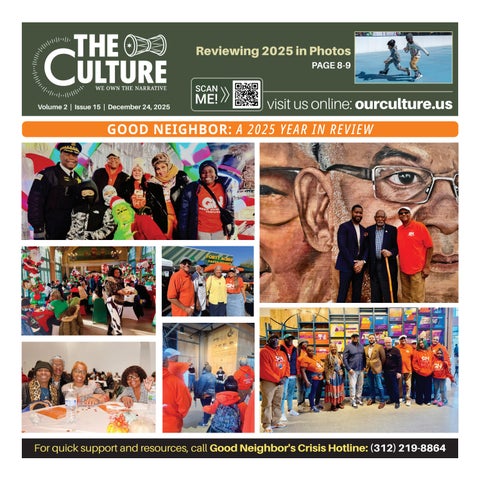
• Community health and wellness visits • Assistance with doctor appointments for community members On The Cover A collection of photographs documenting the Good Neighbor Campaign's progress in 2025. | PROVIDED
2 THE CULTURE • December 24, 2025
Whatever the need, we are always ready to help our neighbors in any capacity we can. Together, we can build a healthier, safer, and more connected community. Thank you for being the best part of the West Side on this journey. If you’d like to volunteer, donate, or learn more, please contact us at (773) 786-0249.
VANESSA DEAVER Content Creator
A Servant Leader Guided by Faith
Honoring Community Wellness Director James Coleman BY GOOD NEIGHBOR STAFF For The Culture “This company is built on faith.” From the very beginning, James Coleman has led with faith at the center of every decision, every meeting, and every step forward. His leadership is not defined by position, but by purpose—a calling rooted in prayer, humility, and an unwavering belief in the people of Chicago’s West Side. Mr. Coleman does not move without seeking God’s guidance. Because of that grounding, his impact reaches far beyond programs or policies. It reaches hearts. It restores dignity. It strengthens spirits. His leadership is anchored in compassion and spiritual insight, touching the lives of seniors, youth, families, and those who too often feel unseen or forgotten. He is a servant leader in the truest sense—standing in the gap for people in need of support, hope, and direction. At the same time, Mr. Coleman collaborates closely with elected officials, community part-
ners, and residents to ensure that the voices of the West Side are heard, respected, and effectively represented. His ability to move between grassroots care and institutional leadership reflects a rare commitment to both faith and accountability. To the staff, he is more than a director. He is a mentor, a guide, a protector, and a living example of what true leadership looks like. He sees potential in people before they see it in themselves and encourages each person to rise into the purpose God has placed within them. His commitment to transformation extends beyond today’s work—it is part of a legacy recognized far beyond the neighborhood. In 2007, the Chicago Tribune highlighted Mr. Coleman’s extraordinary efforts to guide formerly incarcerated individuals, restore families, and help returning citizens rebuild their lives with dignity. His compassionate leadership became a model of what is possible when someone chooses to believe in those whom society has counted out. The world saw what the commu-
Rev. James Coleman, the Community Wellness Director, at his desk in December. | KENN COOK JR.
nity already knew: his impact is deep, wide, and enduring. Mr. Coleman has built more than programs. He has built a legacy of faith, courage, love, and service. A legacy we honor. A legacy we proudly uphold. A legacy that continues to shape generations.
Because of his vision and heart, the West Side is stronger, more connected, and filled with hope. His work has changed neighborhoods, uplifted families, and inspired countless lives—including our own. His legacy is not just remembered. It is lived. It is respected. It is carried forward by all of us.
GOOD NEIGHBOR: THE YEAR IN PHOTOS
Community members get their blood pressure checked among other activities at a chair exercise event for seniors held each month at the Good Neighbor Campaign center in Austin. Good Neighbor collaborated on the program with Dr. Jakeiyah Triplett, shown bottom left leading a chair exercise with seniors and bottom right, far right, taking a person's blood pressure. | VANESSA DEAVER
December 24, 2025
• THE CULTURE 3
GOOD NEIGHBOR: THE YEAR IN PHOTOS
Senior citizens enjoy a game of cards during one of Good Neighbor Campaign's monthly Senior Game Nights. | VANESSA DEAVER
Community members enjoy one of the Good Neighbor Campaign's monthly Stepping With the Seniors events. | VANESSA DEAVER
Raffle winners during Good Neighbor Campaign's Senior Game Day hold up their prizes. The event was held monthly in 2025. | VANESSA DEAVER
Good Neighbor Campaign collaborated with ShowerUp in October to give out free showers to community members in need. | VANESSA DEAVER
Community members register during the Chicago Grab & Go Free Hot Meal event hosted each month in 2025 by Good Neighbor Campaign in collaboration with Chi Care Chicago. | VANESSA DEAVER
4 THE CULTURE • December 24, 2025
GOOD NEIGHBOR: THE YEAR IN PHOTOS
Chanel Martinez, seated, with graduates from Good Neibhor Campaign's Parent Mentor Program in October. | VANESSA DEAVER
In August, the Good Neighbor Campaign marched in Congressman Danny K. Davis' 45th Annual Back to School Picnic and Parade. | VANESSA DEAVER
In the summer, Good Neighbor hosted a community town hall on mental health and wellness. | PROVIDED
Young people play during a Grill & Chill event Good Neighbor Sponsored at PopGrove on Madison Street. The events were held monthly during the summer. | VANESSA DEAVER
Good Neighbor Campaign hosts monthly meetings. In October, Good Neighbor invited Great Lakes Credit Union representatives, including Wilane Boone, to discuss financial literacy. | VANESSA DEAVER
December 24, 2025
• THE CULTURE 5
A
BY QUINN MYERS Block Club Chicago
lderpeople on Dec. 20 passed the final spending portions of the so-called alternative budget proposal that made its way through City Council despite sharp objections from Mayor Brandon Johnson and his allies. The overall package avoids implementing a corporate head tax while making a full advanced pension payment, two provisions the group of alderpeople backing the proposal identified as among their top priorities. The passage of the 2026 budget is a major rebuke of the mayor by the City Council, although Johnson could still issue a veto or attempt to amend it in various ways. Complicating that decision is a year-end deadline to pass a balanced budget. If the City Council does not do so, Chicago would face an unprecedented government shutdown that could interrupt an array of city services. To pay for its various changes from the mayor’s original budget plan, the alternative proposal legalizes video gambling machines, increases the shopping bag tax from 10 cents to 15 cents, adds a 1.5 percent tax on retail liquor sales and expands congestion fee zones for rideshares. It also allows for ads to be placed on city-owned bridge houses and light poles. The plan also calls for a capped increase to a city leasing tax, the sale of city debt, and allowing “augmented reality” licensing on city properties, such as through games like Pokemon Go. Unlike earlier versions, the alternative budget that passed Saturday does not include a garbage tax hike, nor does it replace a borrowing plan for firefighter backpay or make cuts to Johnson’s proposed expansion of the city’s youth hiring programs. Proponents on Saturday admitted the proposal could be improved, but that it presented what they believe is the best path forward for the city’s fiscal health. “It’s not perfect, but it is a good budget, and one that we can work with. And if we keep involved post-2025 and work together as a collective, it’ll be good for the city of Chicago,” Ald. Pat Dowell (3rd) said. Johnson and his budget team have maintained the alternative proposal is deeply unbalanced and could lead to a $163 million deficit next year. The mayor has raised specific concerns over the debt sale stipulation, which he has said is unfeasible and “immoral.” Still, Johnson has so far stopped short of confirming that he will issue a veto. He previously
6 THE CULTURE • December 24, 2025
City Council Passes 2026 Budget: Here Are the Major Fees and Changes
Mayor Brandon Johnson could still veto the alternative spending plan, which includes a shopping bag tax increase, a new retail liquor fee, and a small property tax hike to help fund the public library system
ed the budget on the council floor, with several saying it would lead to midyear cuts or a potential credit downgrade. That wasn’t enough to stop the appropriations ordinance passing by a 30-18 vote. “This budget relies on revenue assumptions that are uncertain, unstable and unsustainable,” said Ald. Jessie Fuentes (26th). “It assumes revenue will materialize without sufficient evidence, and it pushes real costs into the future through one-time fixes. That is not responsible budgeting. It’s wishful thinking.” Below, read about some of the fee increases and other changes included in the budget that passed City Council on Dec. 20.
SHOPPING BAG FEE INCREASE Under the alternative budget, Chicago’s tax on single-use checkout bags would rise from 10 cents to 15 cents, with one cent going back to the retailer. This is the second year in a row the bag tax has been hiked: Johnson’s 2025 budget raised it from 7 to 10 cents. Chicago’s checkout bag tax was put into place in 2017 and impacts both plastic and paper bags.
PROPERTY TAX HIKE FOR LIBRARIES
Ald. Matthew O’Shea (19th), Ald. Gilbert Villegas (36th), Ald. Anthony Beale (9th), Ald. Scott Waguespack (32nd) and Ald. Raymond Lopez (15th) gather after a City Council meeting on Dec. 10, 2025. | COLIN BOYLE/ BLOCK CLUB CHICAGO
threatened he would veto any budget that includes a garbage fee hike or a property tax increase. On Friday, the mayor asked the council to consider a last-minute “compromise” plan that would move forward with the head tax, make the full advanced pension payment and
allow a casino to open at Midway Airport in lieu of legalizing video gambling machines citywide. That proposal was blocked by Johnson’s council opponents and it has not yet been revived. Progressive alderpeople on Saturday blast-
After promises from alderpeople and Johnson to the contrary, next year’s budget will include a small property tax hike after all. A last-minute measure sponsored by Ald. Daniel La Spata (1st) and backed by City Council members across the ideological spectrum will raise the property tax levy for the Chicago Public Library by about $9 million to fund currently vacant staff positions and security guard roles that were set to be cut in next year’s budget. The cost per household will vary, but Ald. Raymond Lopez (15th) said it would amount to about an $11 increase, on average, for homeowners next year. Alderpeople defended the hike this week as necessary to ensure libraries continue to offer their current services and hours across the city. “I think the way we restore trust with our residents in government is when they know what their dollar is paying for, and they value what their dollar is paying for,” La Spata said. “And I think you can truly and definitely say that about our libraries.” The passed budget proposal also maintains the library’s $10 million collections budget, which is used to purchase books and pay for subscriptions and other assets.
RETAIL LIQUOR TAX The budget also includes a new flat fee on off-premise liquor and beer sales. The 1.5 percent tax would affect retail sales of liquor, beer and wine, but not those sold directly to customers drinking at bars or dining at restaurants. The fee was reduced from an earlier 3 percent proposal. The potential revenue projections tied to the liquor tax is another area of dispute between Johnson’s administration and the alternative council-backed budget. Alderpeople estimate the change would bring in $6 million next year for the city, but the mayor’s budget team said in a presentation on Wednesday they believe it could actually lead to a loss of more than $4 million. “By imposing a rate of 1.5 [percent] on off-premise liquor, we will actually see a revenue loss, because that’s less than what our effective tax rate is today,” budget director Annette Guzman said. Regardless of the dueling projections, the liquor industry remains opposed to any fee increase and has said implementing the change starting in the new year would be overly burdensome on businesses. “The revised proposal still raises one of the highest alcohol taxes in the nation and asks working families to pay nearly 12 percent in
regressive sales taxes amid an affordability crisis,” an umbrella group called the Chicago Alcohol Tax Coalition said in a statement this week.
SALE OF CITY DEBT One of the most controversial additions to the alternative budget has been a proposal to sell city debt to outside collectors, which some alderpeople estimate could bring in about $90 million in revenue next year. The stipulation doesn’t specify how that debt could be collected, which would be left to the “executive branch” to implement, said Ald. Gilbert Villegas (36th), who noted that Johnson’s original budget already relies on revenue from increased debt collection. The proposal to actually sell off city debt, however, has been sharply criticized by some alderpeople, activists and Johnson himself. “Balancing [the budget] off the backs of working people, particularly selling off debt and setting up a situation where working people and poor people are going to be harassed and berated by debt collectors, that is not the right approach,” Johnson said on Thursday. That point was echoed by a coalition of activists during a City Hall press conference Friday morning, who still urged the City Council to adopt a corporate head tax next year instead of the debt collection scheme.
Mayor Brandon Johnson arrives during a City Council meeting on Dec. 19, 2025. | COLIN BOYLE/BLOCK CLUB CHICAGO
“We either balance this budget by choosing the fiscally responsible investment from large corporations in Chicago who will pay more taxes, or burden struggling residents — or have a budget crisis in six months,” said Itohan Osaigbovo, an organizer with a group called Chicago Black Voter Project. Alderpeople backing the alternative budget have disputed that selling debt would have to mean hounding people with high outstanding water bills or other city bills. “This doesn’t have to be about picking on the little guy. There’s a lot of folks out there that owe us lots of money that can certainly afford to pay, and have chosen not to because our debt collection has been lax,” said Ald. Brendan Reilly (42nd), the Downtown alderperson who is also running for Cook County Board president.
VIDEO GAMBLING LEGALIZATION Activists hold a press conference on Dec. 19, 2025 at City Hall calling on alderpeople to reject a revenue stipulation to sell city debt as part of the 2026 budget. | COLIN BOYLE/BLOCK CLUB CHICAGO
Under the alternative budget, video gambling terminals will be legalized at bars and restaurants across the city.
Backers estimate it would bring in $6.8 million in 2026 as operators start paying the necessary license fees, although Ald. Anthony Beale (9th), one of the proposal’s most ardent supporters, said the revenue would be far greater in the years to come. “Once is up and operational, it could bring us between $65 and $100 million a year. That’s a lot of money. I don’t see Bally’s [casino] bringing that kind of money into the city,” Beale said Saturday, later adding that he believed it would be three to six months before the machines are up and running across the city. Bally’s is currently operating its temporary casino in River North and working to open the permanent Chicago casino in River West. Like other portions of the alternate budget proposal, the Johnson administration disagrees the change would bring in the projections Beale and others are expecting. That’s partially because under previous agreements with the company, the city would lose a $4 million community benefits payment from Bally’s if video gambling machines are legalized, the city’s CFO Jill Jaworski said this week.
December 24, 2025
• THE CULTURE 7
REVIEWING THE YEAR IN PHOTOS
In September, community members gathered for the official unveiling of "The Bloom of Resilience," a mural by Austin native Shawn Michael Warren that graces the front of the Aspire Center for Workforce Innovation in Austin. | FILE
In the spring, Westside Health Authority erected a synthetic ice rink outside Aspire for young people to enjoy ice skating during the Easter holiday. Even the Easter Bunny made an appearance. | FILE
8 THE CULTURE • December 24, 2025
REVIEWING THE YEAR IN PHOTOS PHOTOS BY KENN COOK JR.
In May, West Side Block Club Association President Talei Thompson and other organizers hosted the Second Annual Community March for Peace that featured a parade and live music.
On Juneteenth, Chicago Mayor Brandon Johnson and other elected officials, nonprofit executives, and community leaders cut the ribbon on the Aspire Center for Workforce Innovation.
December 24, 2025
• THE CULTURE 9
Poll: Two-Thirds of Respondents Unaware of Chicago’s Elected School Board
All 21 seats will be up for election on Nov. 3, 2026 BY BECKY VEVEA Chalkbeat Chicago
Roughly two-thirds of Chicagoans surveyed don’t know that the city now elects school board members, according to a new poll commissioned by the parent advocacy group Kids First Chicago and conducted by NORC at the University of Chicago. Of 1,361 Chicago adults surveyed, just 10% could name their school board representative, the poll results showed. Awareness of the shift to an elected school board was high-
er among Chicago Public Schools parents and lower among young people and those who identify as Black and Latino. It was also lower in certain parts of the city, particularly on the west and southwest sides. The findings come two months before potential candidates can start circulating petitions to get on the ballot for Chicago Board of Education in 2026. All 21 seats will be up for election on Nov. 3, 2026; 20 are elected from specific districts and one school board president will be elected citywide. A former school board appointee and CPS parent has already declared his candidacy for the board president seat and a handful of current board members have told Chalkbeat they plan to run.
10 THE CULTURE • December 24, 2025
Chicago held its first school board elections in 2024 with voters choosing 10 members to join 11 mayoral appointees on a new 21-member Board of Education. More than half of registered voters cast ballots for a school board representative, which some observers considered “pretty impressive” in the context of school board elections, which often suffer from very low turnout. Micaelan Valesky, manager of data science for Kids First Chicago, said the results indicate “a major information gap around one of the most significant changes in CPS governance in decades.” “This highlights a need for both targeted and widespread outreach, providing bilingual resources that explain when the
election is, how the transition works, what power the Board of Education has, and who the prospective board members are,” Valesky said. According to the Chicago Board of Elections, people interested in running for school board in 2026 can begin collecting signatures from voters in their district on Feb. 24. They must file at least 500 valid signatures between May 18 and 26 in order for their name to be printed on the ballot. Candidates for school board president must collect at least 2,500 valid signatures from across the city. Becky Vevea is the bureau chief for Chalkbeat Chicago. Contact Becky at bvevea@ chalkbeat.org.
Group Planning 2,000 Affordable Homes For South, West Sides Wins $10 Million Chicago Prize Reclaiming Chicago plans to use its prize winnings to fund a project to build homes on a 17-acre site in Chicago Lawn
A
By MICHAEL LIPTROT Block Club Chicago
n affordable housing nonprofit looking to build 2,000 new and refurbished homes has been named the winner of the Chicago Prize, which comes with a $10 million grant. The Pritzker Traubert Foundation awarded the 2025 Chicago Prize on Dec. 16 to Reclaiming Chicago, a nonprofit collective that is working to bring 2,000 affordable homes to South and West side neighborhoods including Back of the Yards, North Lawndale, Chicago Lawn and Roseland. “This news is going to help us accelerate our innovation. … We’re not just building homes, we’re building community for families,” said Raul Raymundo, CEO and co-founder of The Resurrection Project. “We want to make sure that families understand that when they’re buying a piece of property, they’re not just buying a home, they’re buying part of the community.” Reclaiming Chicago works by transforming city-owned lots into single-family homes, with construction largely funded through private and philanthropic donations. In 2021, the city sold vacant lots to the groups for $1 each. Last year, the city approved plans for Reclaiming Chicago to build homes on 500 city-owned lots across four neighborhoods. The group’s members started on that effort earlier this year, working to build 250 homes in a 27-block radius in Back of the Yards. “The city grows when their communities are healthy. The city grows when they can invest in communities to get better and have families build wealth so that the city can prosper as well,” Raymundo said. The $10 million Chicago Prize grant will help Reclaiming Chicago expand its efforts to build more affordable housing on the South and West sides, officials said. A 17-acre site at 74th Street and Talman Avenue in Chicago Lawn is slated to be purchased using funds from the Chicago Prize, according to project leaders and the prize announcement. Prize funds will also go towards the construction of homes at the site, to be sold with most prices affordable for families earning 80-120 percent of the area’s median income. “This investment validates what residents across our neighborhoods have long believed: that our communities deserve the chance to grow, and that homeownership should be within reach for working families,” said Jeff Bartow, Southwest Organizing Project executive director, in a statement. Southwest Organizing Project is a member of the Reclaiming Chicago consortium. “The Chicago Prize will help us accelerate construction and create wealth that stays in the community.” Reclaiming Chicago was one of four finalists for this year’s Chi-
The Pritzker Traubert Foundation awarded Reclaiming Chicago the prize 0Tuesday. The coalition of community leaders, developers, and organizers are working to build or rehab 1,000 homes on the South Side and 1,000 homes on the West Side. | PROVIDED
cago Prize. Other finalists included a mixed-use development in Bronzeville known as the Cottage Grove Corridor Collective, a North Lawndale resource center, and a plan to transform the 95th Street commercial corridor in Roseland and Pullman. Finalists for the project receive a $650,000 matching grant to continue their work. This is the third Chicago Prize winner since the award began in 2020. In 2023, the Sankofa Wellness Village won the prize for its efforts to bridge the life expectancy gap in Garfield Park and the greater West Side. Always Growing Auburn Gresham, a healthy living center, renewable energy, and urban farm campus, won the first $10 million award in 2020. Awarding the prize to Reclaiming Chicago will help the city address the issue of affordable housing, which is at a “crisis level in the United States,” said Penny Pritzker, cofounder and Trustee of the Pritzker Traubert Foundation, in a statement. “With this investment, we are supporting community leaders
who are working to create more affordable housing in Chicago Lawn and finding opportunities to bring down the high cost of delivering new housing,” Pritzker said. Reclaiming Chicago is a collective or organizations and nonprofits including United Power for Action and Justice, Chicago Neighborhood Initiatives, Southwest Organizing Project, The Resurrection Project, Precious Blood Ministry of Reconciliation, Foundation for Homan Square, Elevate Energy, Hope Center Foundation, Lawndale Christian Development Corporation and the Illinois Facilities Fund.
Read More Read more Block Club Chicago stories at blockclubchicago.org. Contact reporter Michael Liptrot at michael@blockclubchi.org.
December 24, 2025
• THE CULTURE 11
12 THE CULTURE • December 24, 2025