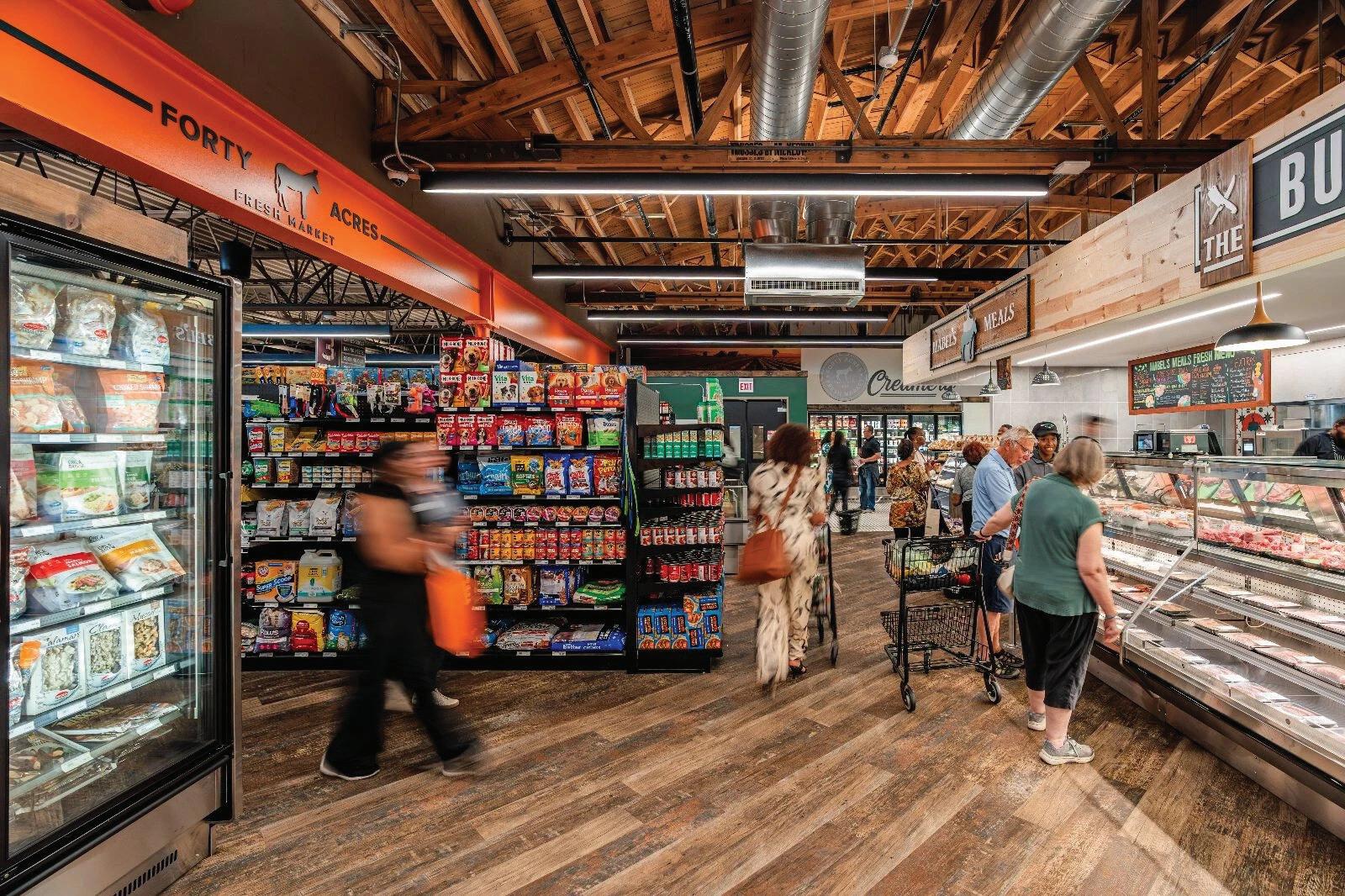
West Side Farmers Markets Launch In June For 2026 Season
Head to markets in Austin, North Lawndale, and Garfield Park for fresh produce, baked goods, and artisan wares
By MICHAEL LIPTROT Block Club Chicago
The farmers’ market season is almost in full swing.
On the West Side, you can shop for fresh produce, locally made goods and more at markets in Austin, North Lawndale, and Garfield Park throughout the summer. Here’s more information on each weekly market.
AUSTIN
The Austin Town Hall Farmers Market is 1-6 p.m. every Thursday, rain or shine, from June through October outside the building at 5610 W. Lake St.
The market features food and artisan vendors, plus community resources. The market, sponsored by Austin Coming Together, is on Lake Street between Parkside Avenue and Central Avenue, in front of the Austin Town Hall building.
The market’s objective is to “create access to fresh produce, support the local economy by purchasing from food artisans and other
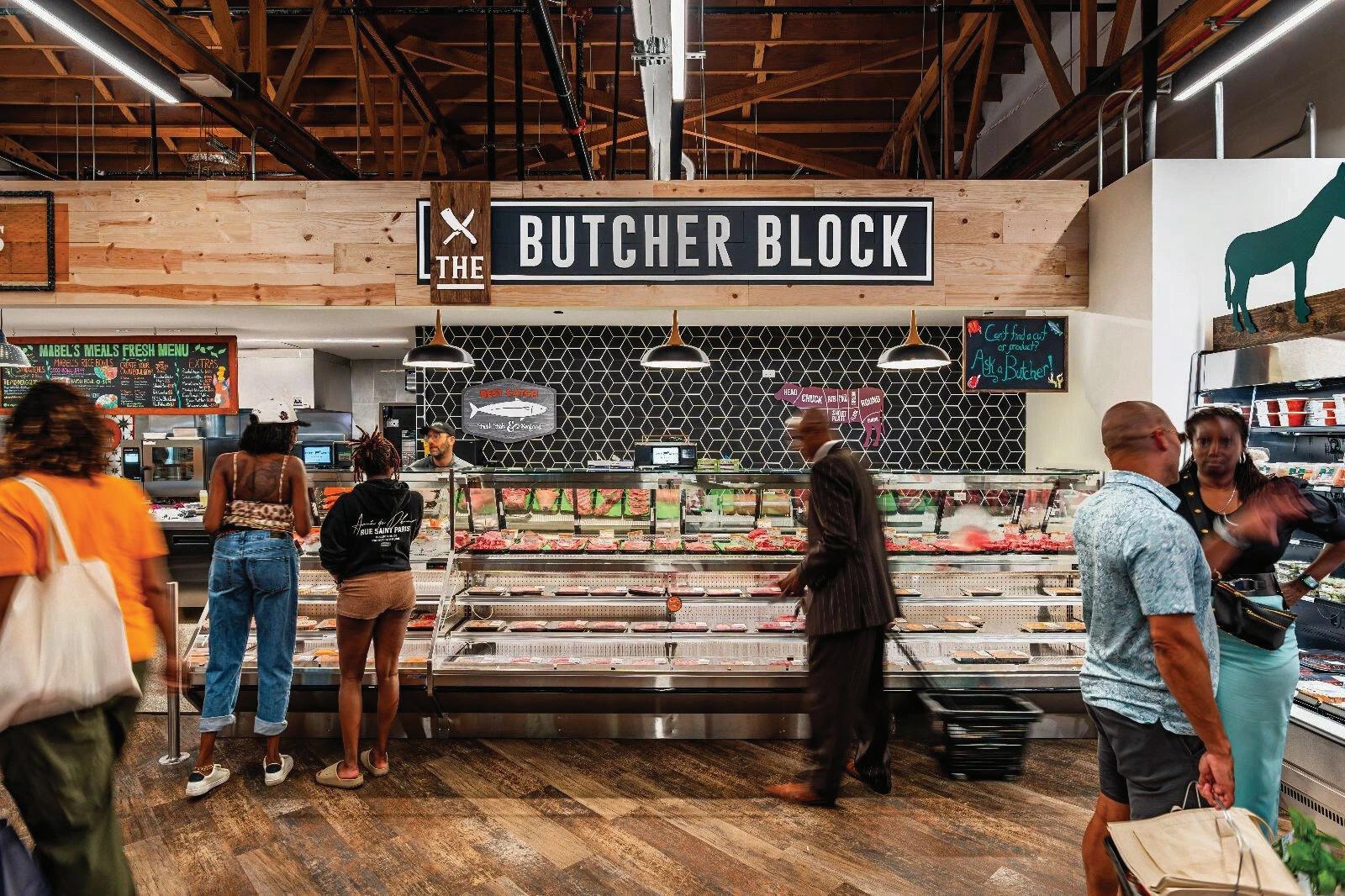
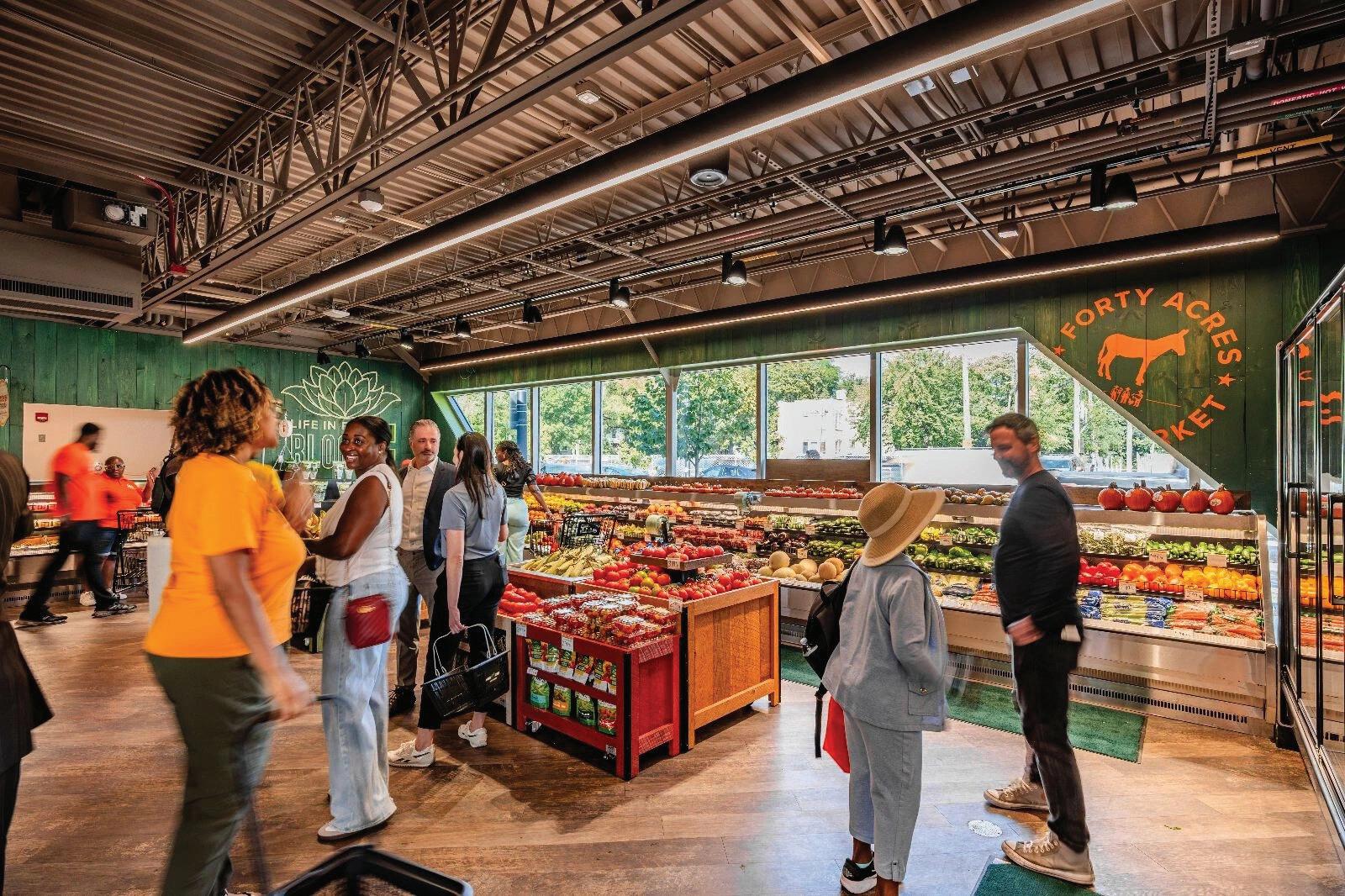
businesses,” according to its website. Vendors for this year’s season have not been announced yet. Last year’s vendors included Forty Acres Fresh Market, Soul Kitchen Chicago and Sweet Comfort Creations. To apply to be a vendor, visit austintownhallcitymarket.com or email austintownhall. citymarket@gmail.com.
NORTH LAWNDALE
The North Lawndale Community Farmers Market kicks off June 13 and runs noon-4 p.m. every Saturday through Oct. 31 at Bible Way Apostolic Faith Church, 1807 S. Kostner Ave.
The market is hosted by Community First Foundation, a Christian organization dedicated to tackling chronic health conditions affecting communities of color. Vendors for this year have not been announced. For more information, visit communityfirstfoundationinc.com/farmers-market.
GARFIELD PARK
The Garfield Park Neighborhood Market is launching its summer season on June 13 and has markets every second and fourth Saturday of each month from June to October. The market, operated by the Garfield Park Community Council, will have its final indoor
market of the season on Saturday. All markets take place at the Hatchery at 135 N. Kedzie Ave., with the outdoor market happening on the Hatchery Plaza, according to the council’s website.
Vendors sell “value-added products,” including okra and relish, and members of The Hatchery, a food incubator, also sell baked goods, healthy, hypoallergenic bath and body products, and innovative foods, according to the market.
Vendors for the outdoor season have not been announced yet. To apply, visit gpcommunitycouncil.org/programs/neighborhood-market.
On The Cover
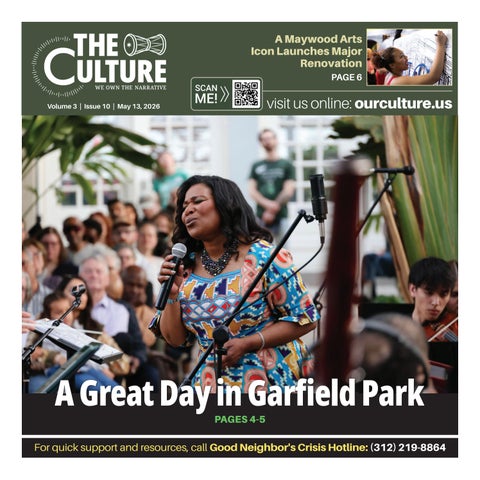
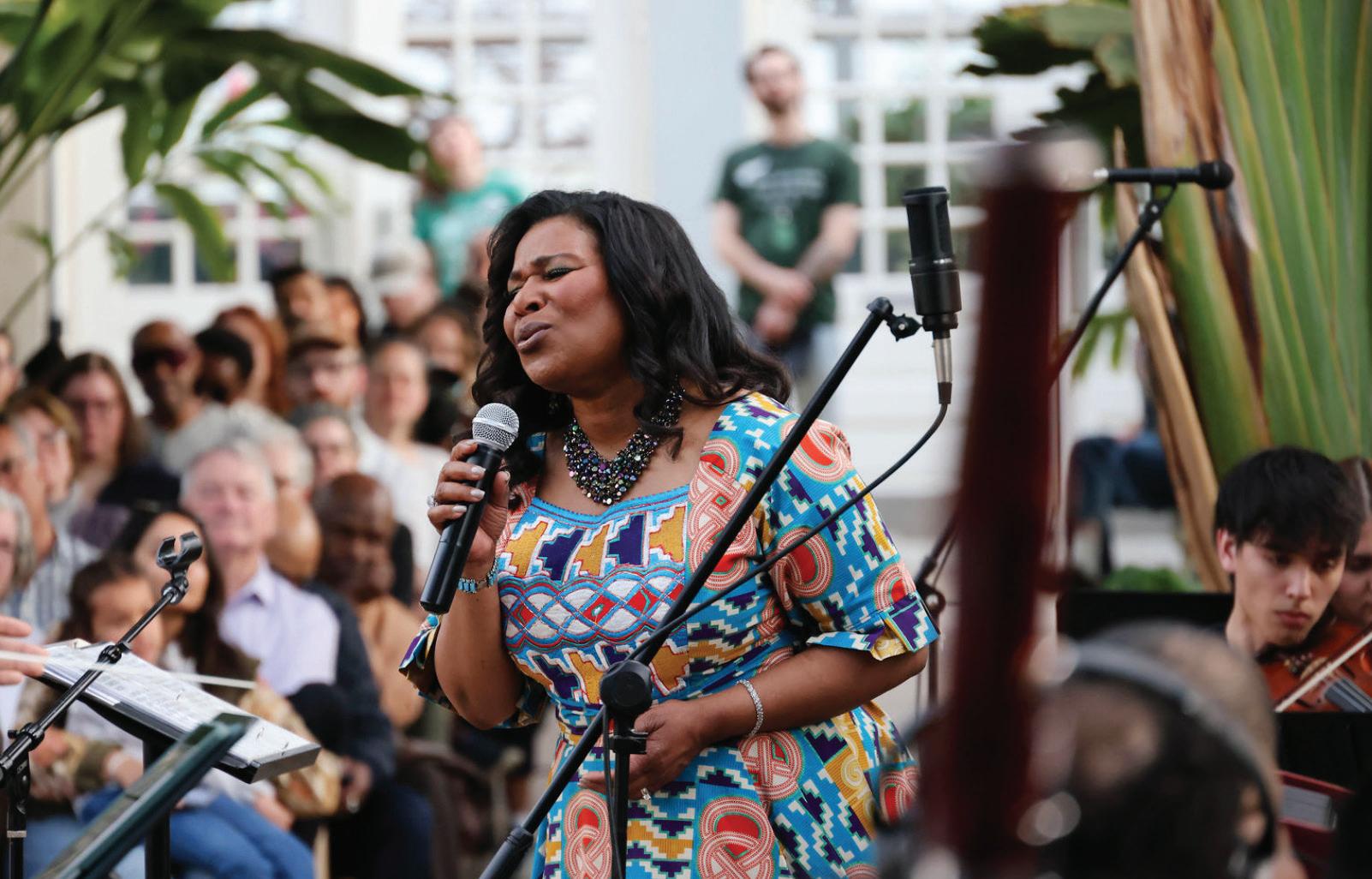
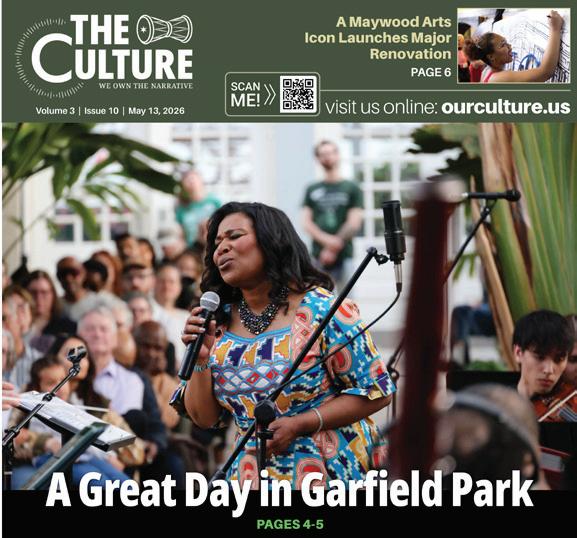
Renowned jazz vocalist Tammy McCann pays tribute to Dinah Washington with “What a Difference a Day Makes.” | PHOTO BY JOHN HARRIS
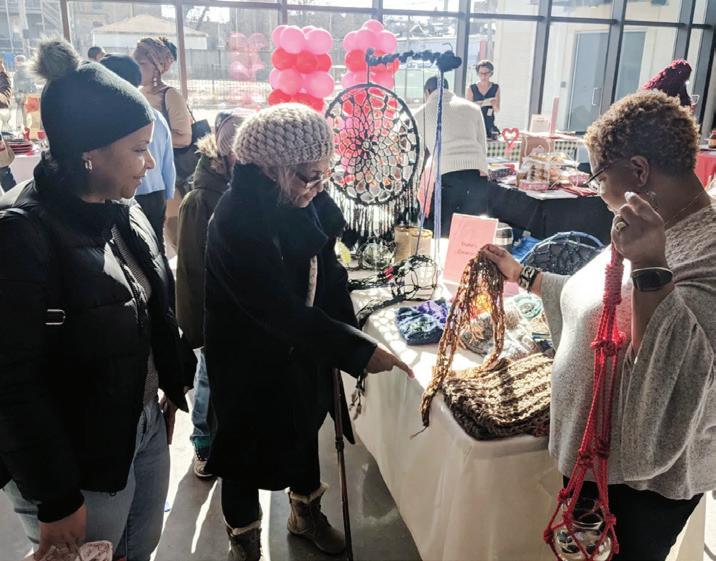
A vendor shows off jewelry at The Hatchery Saturday. | SARAH CONWAY/ BLOCK CLUB CHICAGO
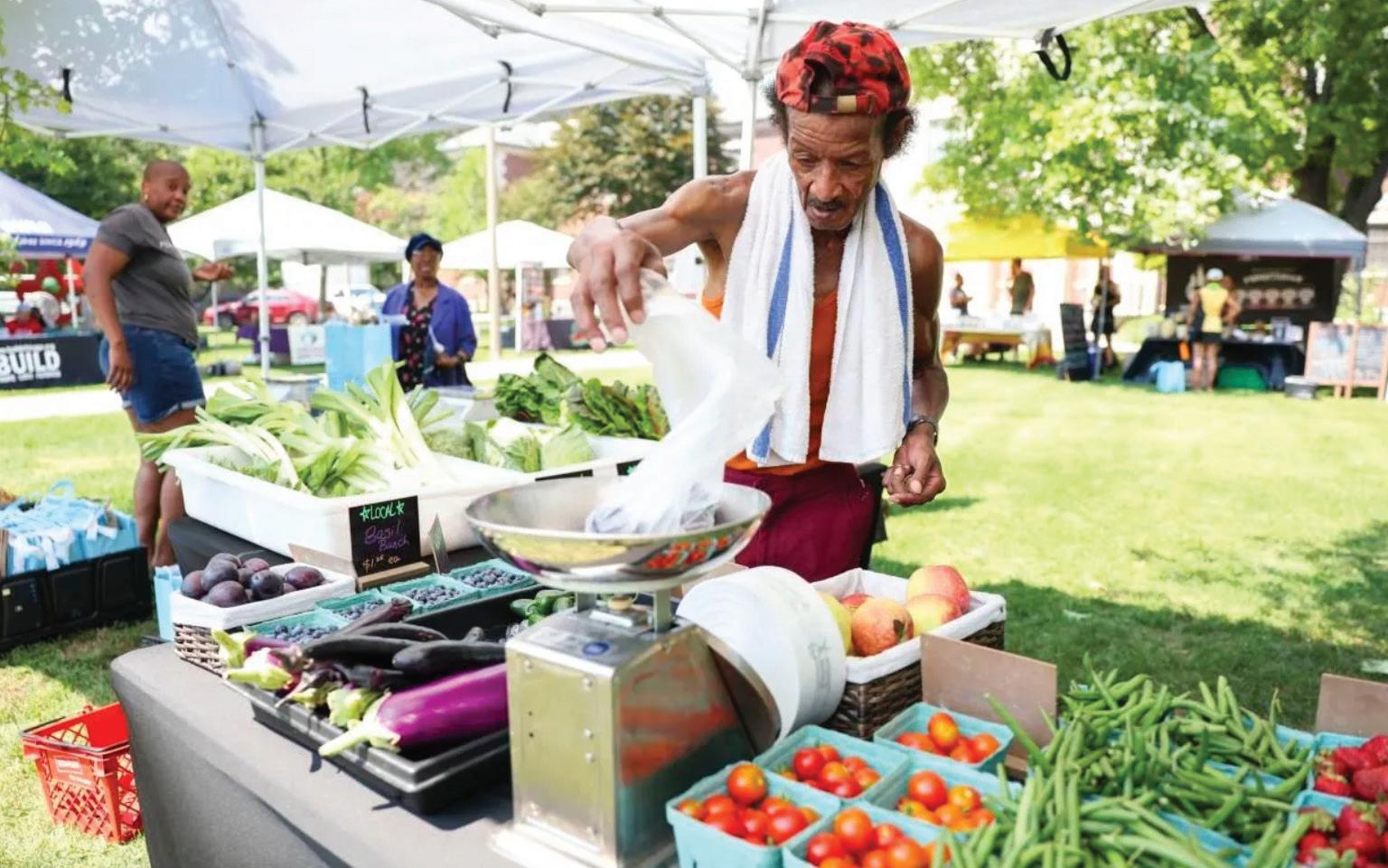
An Austin Town Hall Farmers Market visitor weighs produce at a stand. | FACEBOOK/AUSTIN TOWN HALL FARMERS MARKET
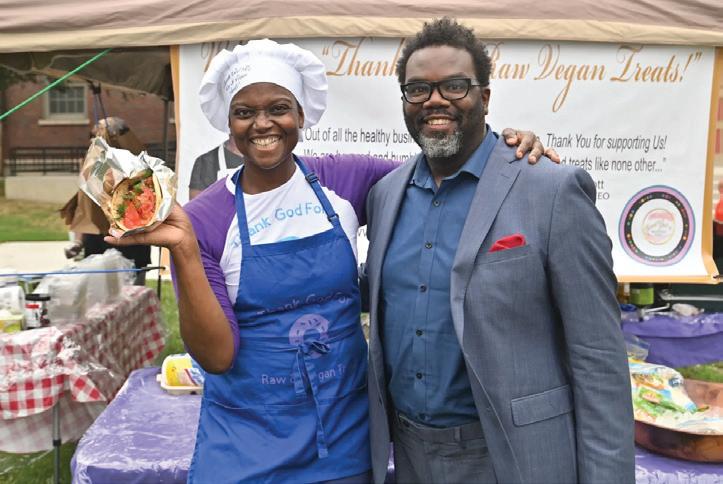
Michelle Scott, director of the new North Lawndale Community Farmers Market, poses with Brandon Johnson at the Austin Town Hall Farmers Market, where she was a vendor from 2021-2023..
PROVIDED/MICHELLE SCOTT
IN PHOTOS
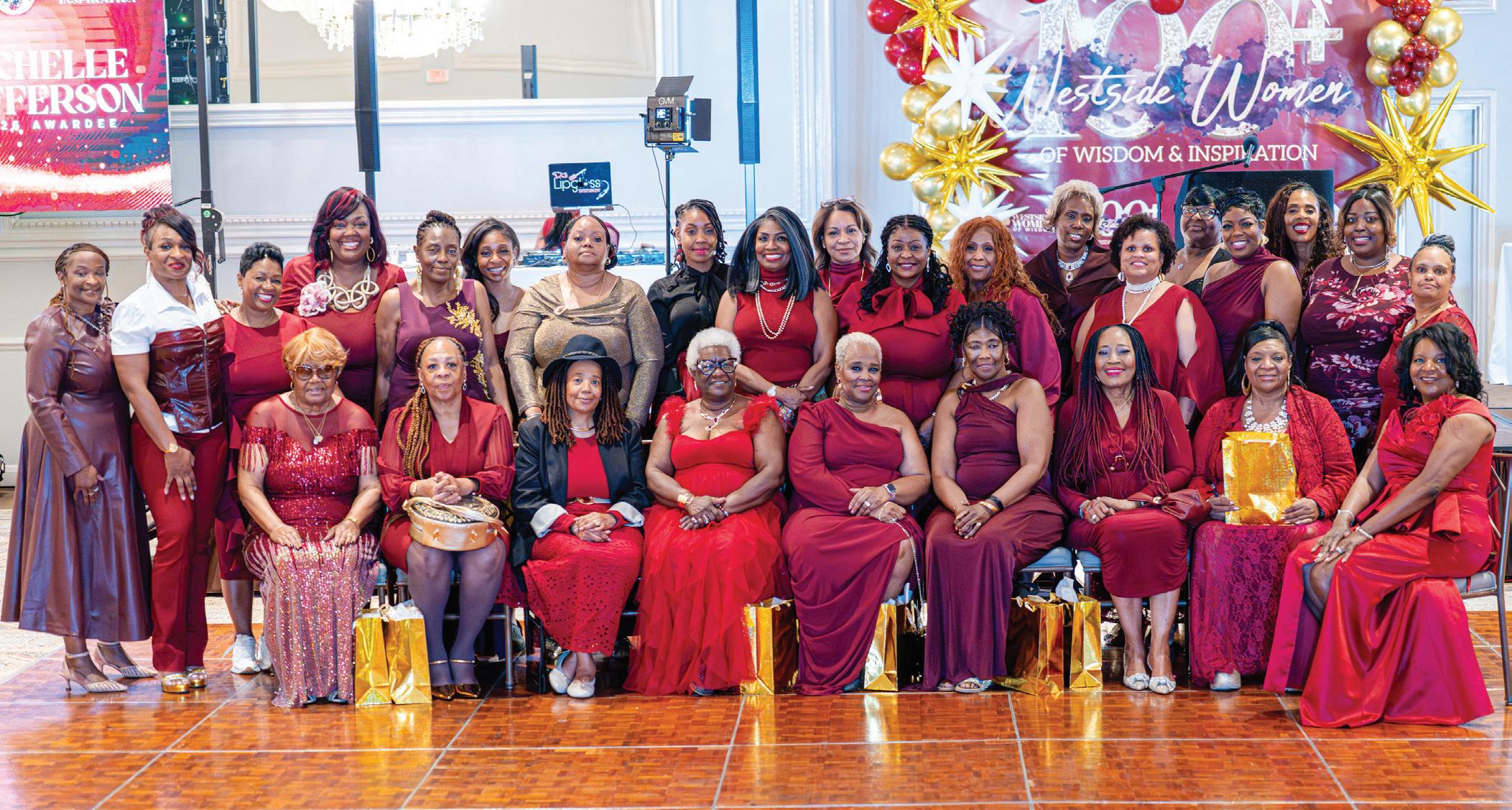
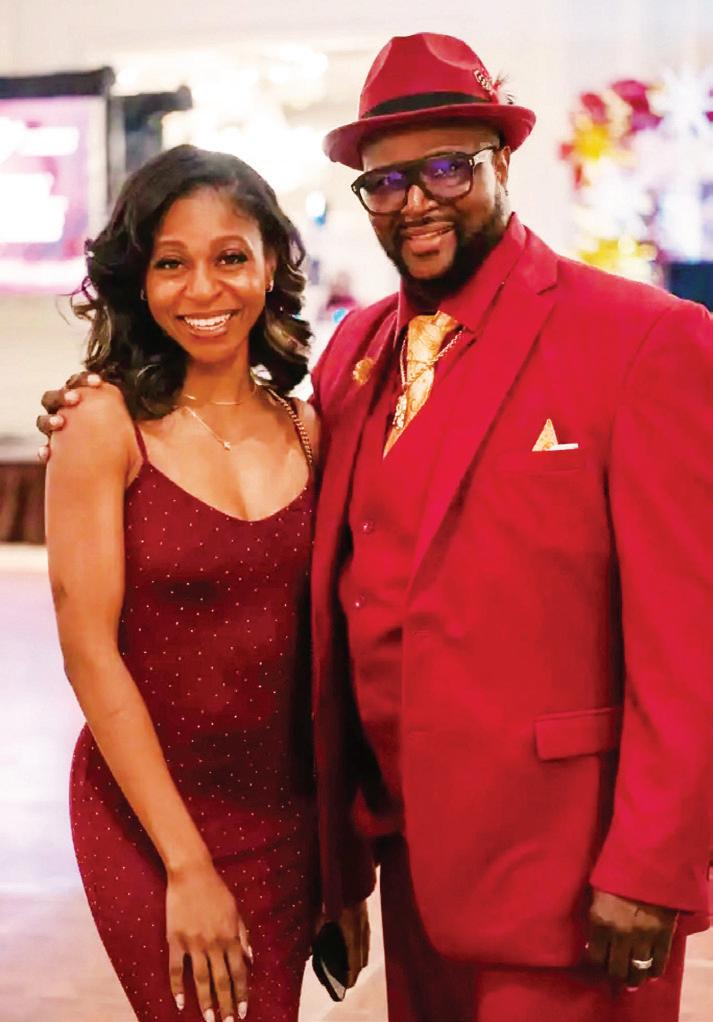
Williams-Thurmond, founder of DW Provision Consulting Services and a board member of organizations including the Leaders Network, Austin Coming Together, and Project Exploration, hosted the 7th Annual Recognition of West Side Women of Wisdom & Inspiration on April 26 at Drury Lane in Oak Brook Terrace. Pictured are some of the roughly three dozen women she honored. | PROVIDED
Deborah
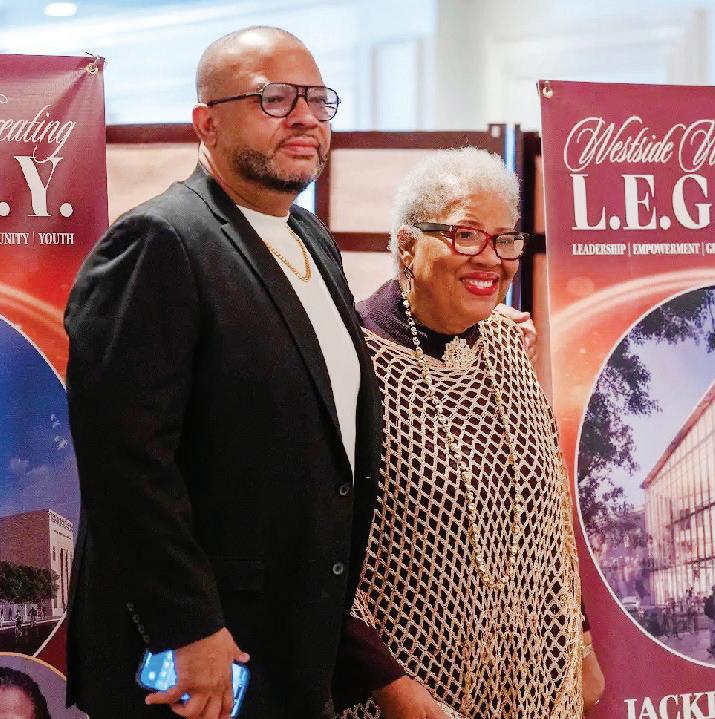
Jacqueline Reed, one of the honorees, with her son, Westside Health Authority CEO Morris Reed. | PROVIDED
Janiece Williams and Larry Thurmond at the event. | PROVIDED
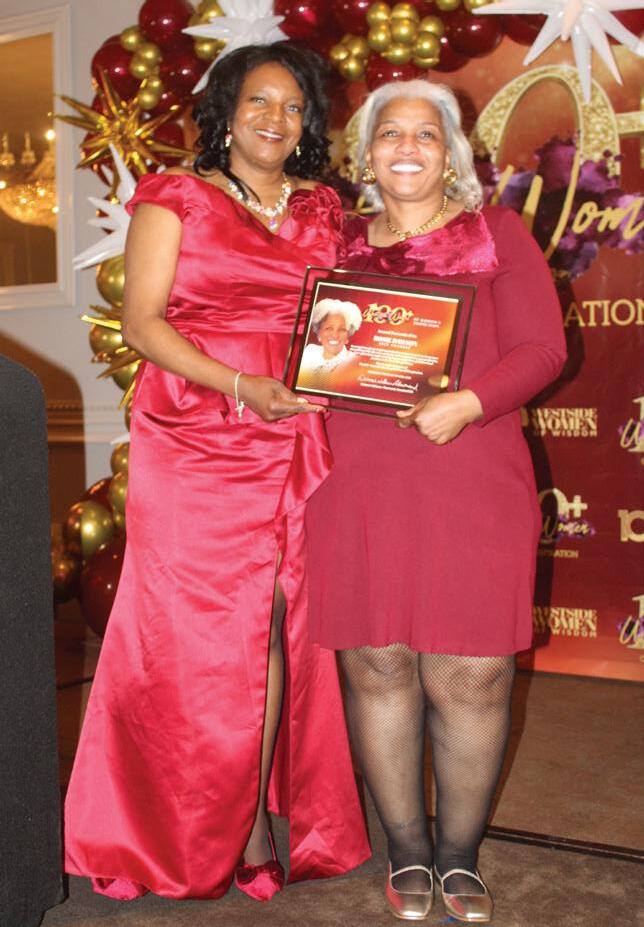
Deborah Williams-Thurmond and honoree Rosie Dawson, the property director at Westside Health Authority. | PROVIDED
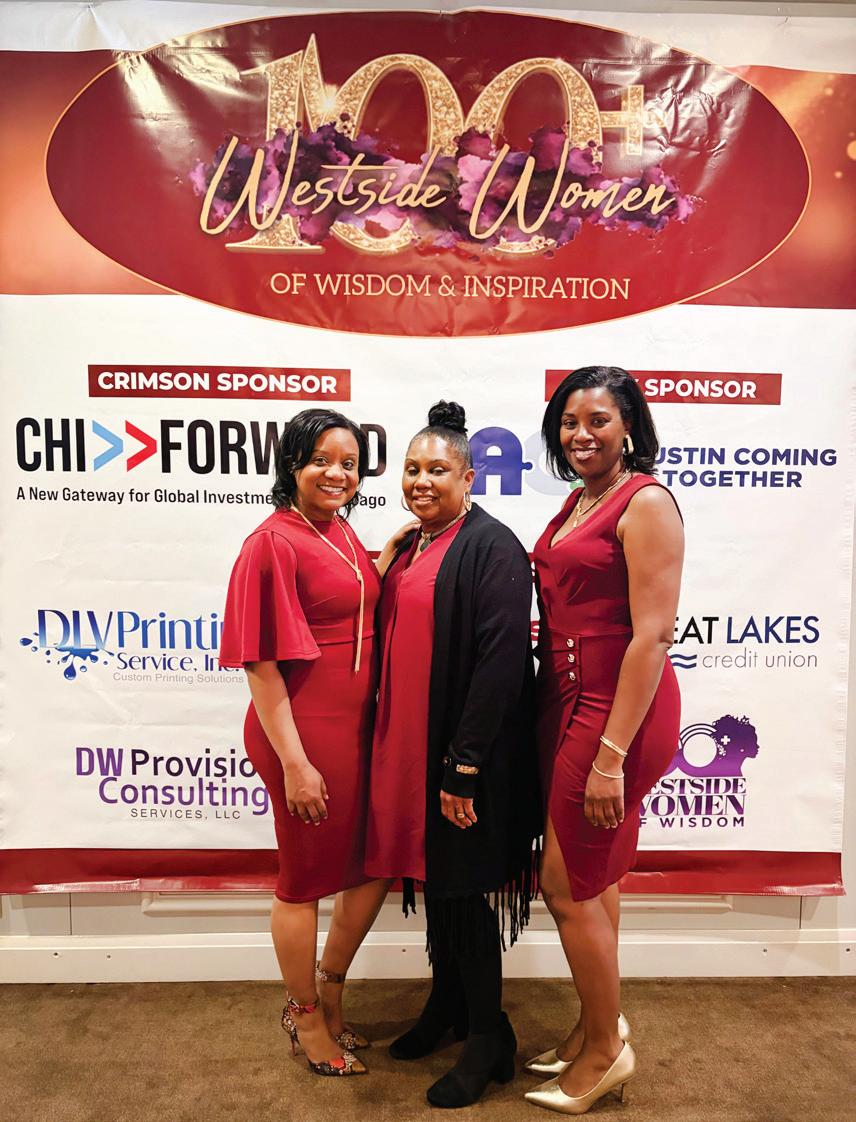
Kesha Forest, Vernita Johnson, and Khalilah Johnson at the April 26 event in Oak Brook Terrace. | PROVIDED
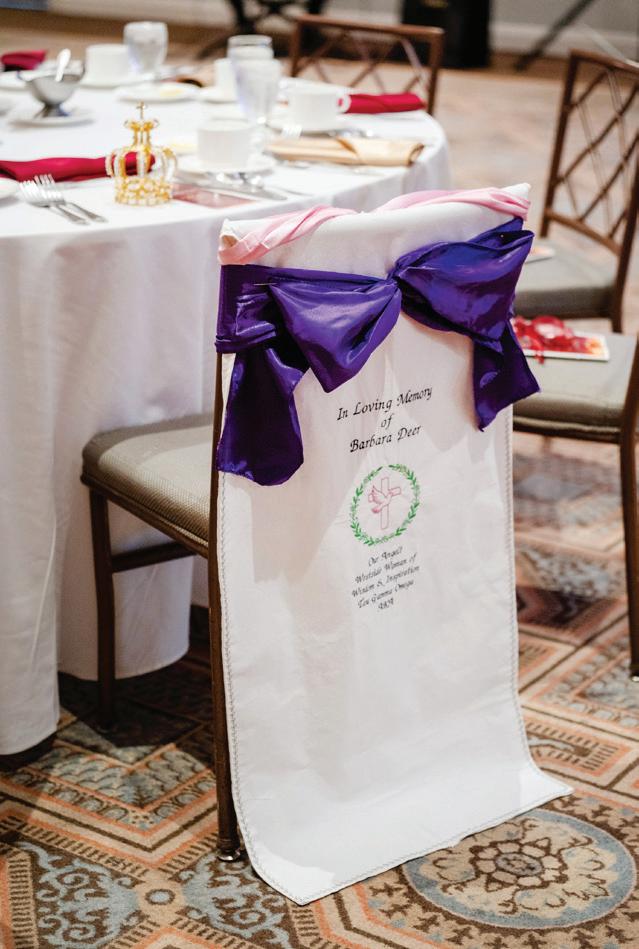
A chair dedicated to the memory of the late Barbara Deer, one of the honorees who died in April. | PROVIDED
Chicago West Community Orchestra Honors City’s Jazz Legacy During International Jazz Day Celebration
Featuring acclaimed vocalist Tammy McCann, the Garfield Park Conservatory performance also showcased local musicians
BY STAFF
The Culture
As jazz musicians moved through nearly a century of Chicago music history inside the Garfield Park Conservatory last month, the performance doubled as both a concert and a tribute to the city that helped shape the sound of modern jazz.
“Chicago to the World: A Jazz Celebration,” presented on April 28 by the Chicago West Community Music Center (CWCMC) Community Orchestra, was part of Chicago’s monthlong observance of the 15th Annual International Jazz Day. This year marked the first time Chicago served as the event’s global host city, culminating in an All-Star Global Concert at the Lyric Opera of Chicago on April 30.
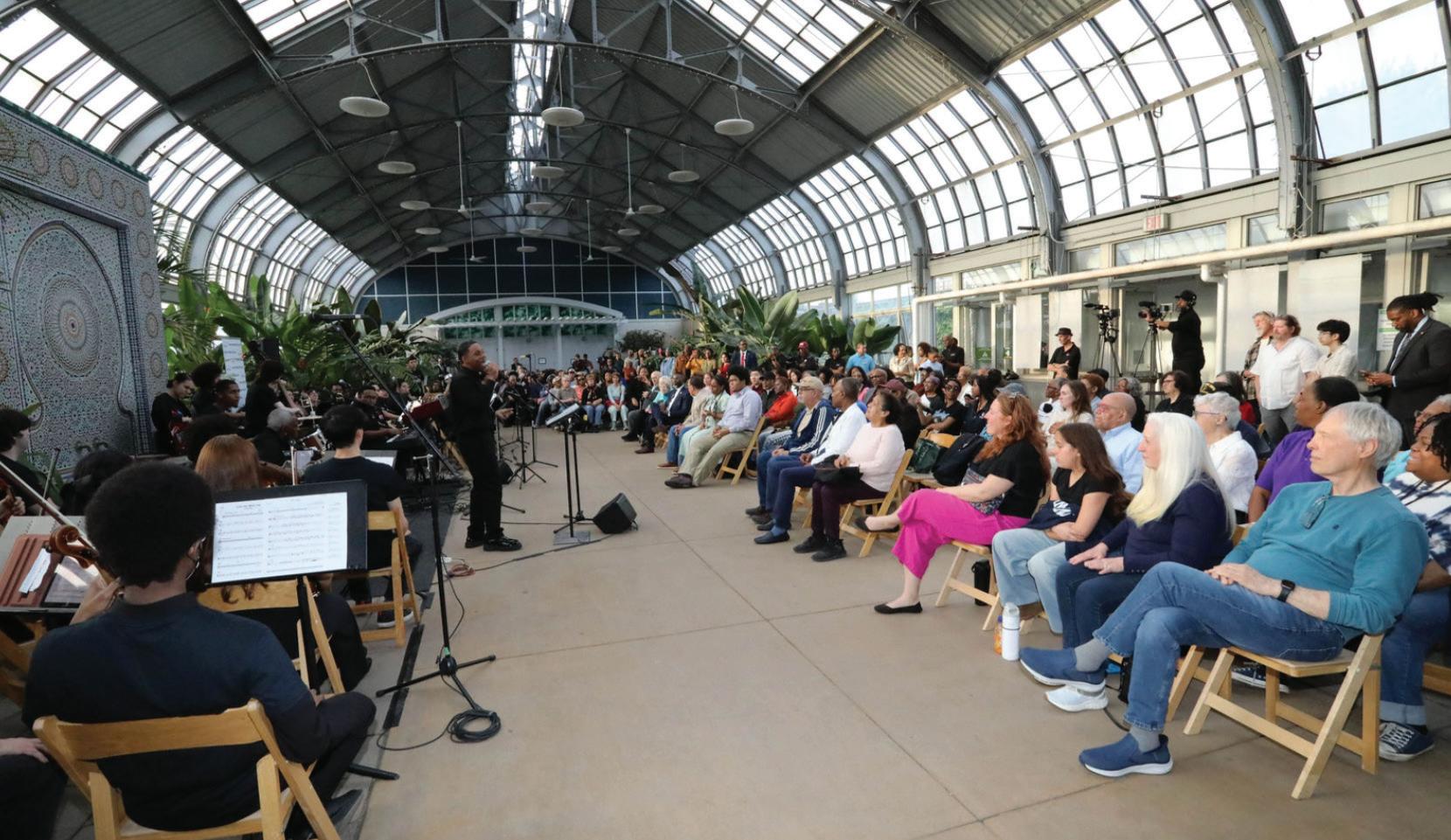
Jazz fans pack the Garfield Park Conservatory on April 28 for an International Day of Jazz Concert hosted by the Chicago West Community Center. | JOHN HARRIS
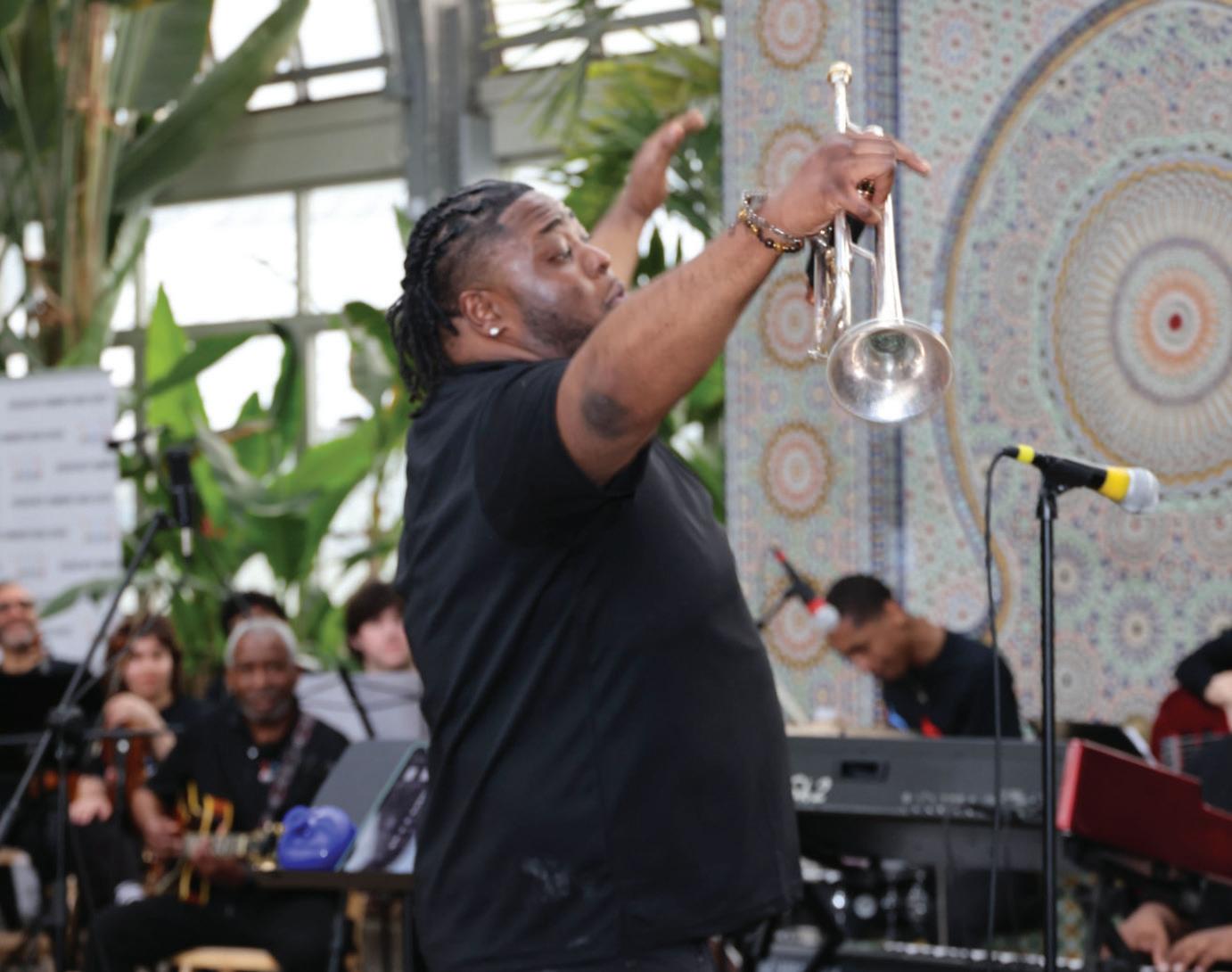
Conductor and instructor Isaac Armstead leads the Chicago West Community Music Center Community Orchestra during the International Day of Jazz Concert on April 28. | JOHN HARRIS
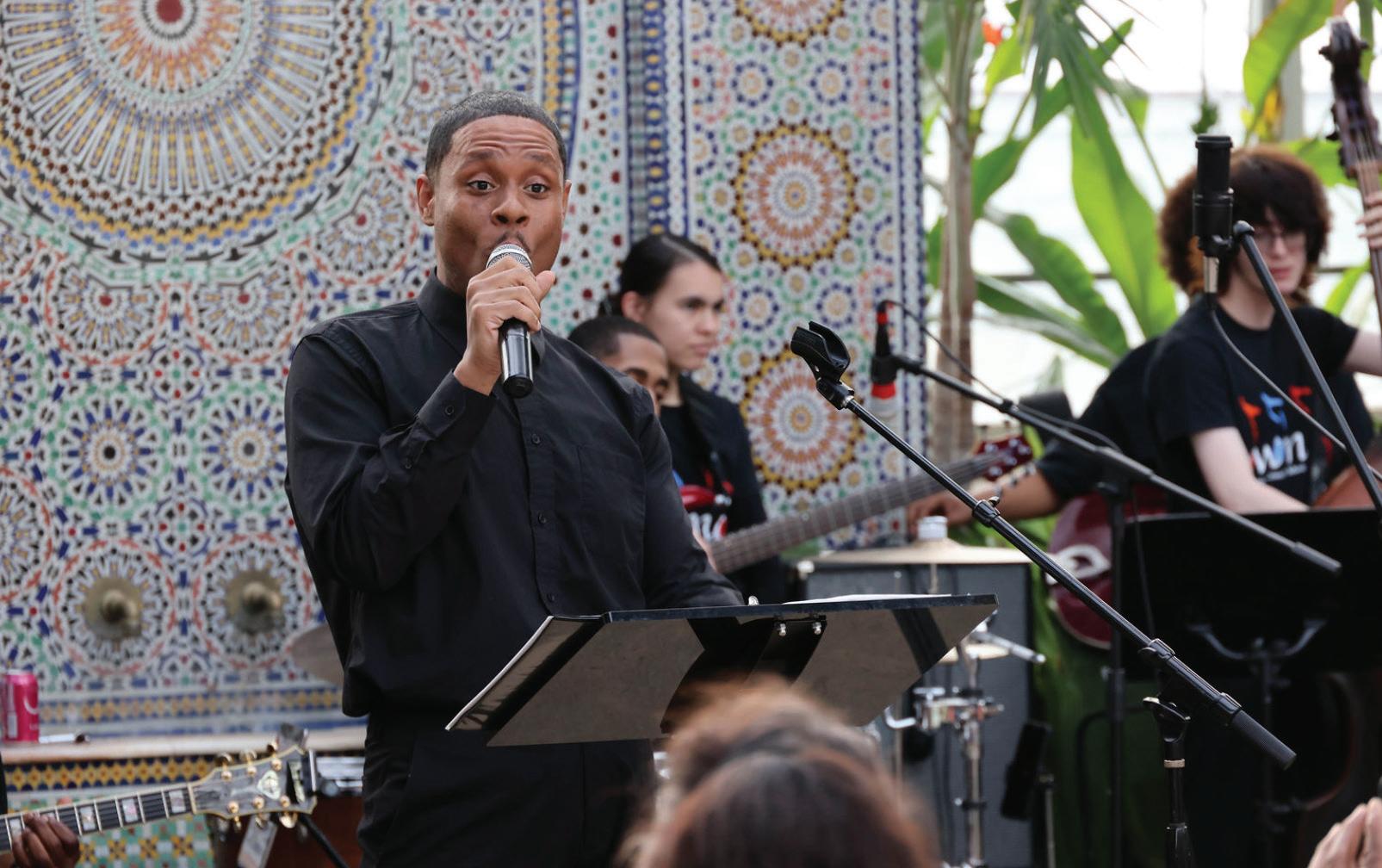
Chicago singer Deonte Baker since the classic, "(Get Your Kicks on) Route 66," originally recorded by the Nat King Cole Trio. | JOHN HARRIS
For Howard Sandifer, who co-founded Chicago West with his wife, Darlene, participating in the international celebration felt like a natural fit for a city with Chicago’s musical lineage.
“We felt that it was a very important event to take place in Chicago given the history of the musicians who have come through here and are still here,” Sandifer said in a recent interview.
Sandifer said he first learned in 2025 that Chicago would host International Jazz Day
and reached out to the city’s Department of Cultural Affairs and Special Events (DCASE) last fall to express interest in participating.
The concert traced the evolution of jazz in Chicago through a chronological setlist spanning traditional jazz, big-band arrangements, progressive styles, and contemporary interpretations rooted in the jazz tradition.
“The story in terms of jazz in Chicago started in 1922 when Louis Armstrong got off the Illinois Central coming from New Or-
leans,” Sandifer said. “He changed the face of popular music, not just jazz.”
The program also highlighted contemporary artists carrying that legacy forward, including modern Chicago musicians such as pianist Jamal “Jamire” Stampley, whose work blends experimentation with classic jazz forms.
Renowned jazz vocalist Tammy McCann joined the orchestra as a featured guest performer. The event also drew prominent public officials, including Mayor Brandon
Johnson and Lt. Gov. Juliana Stratton.
Chicago West is now preparing for its next major performance, an annual spring concert on May 16 at the Garfield Park Conservatory. The event will include a morning recital by the organization’s West Side Instructional String and Harps Program, followed by an afternoon orchestral performance that revisits selections from “Chicago to the World” as “a gift from Chicago,” Sandifer said.
For more information on CWCMC, visit cwcmc.org.
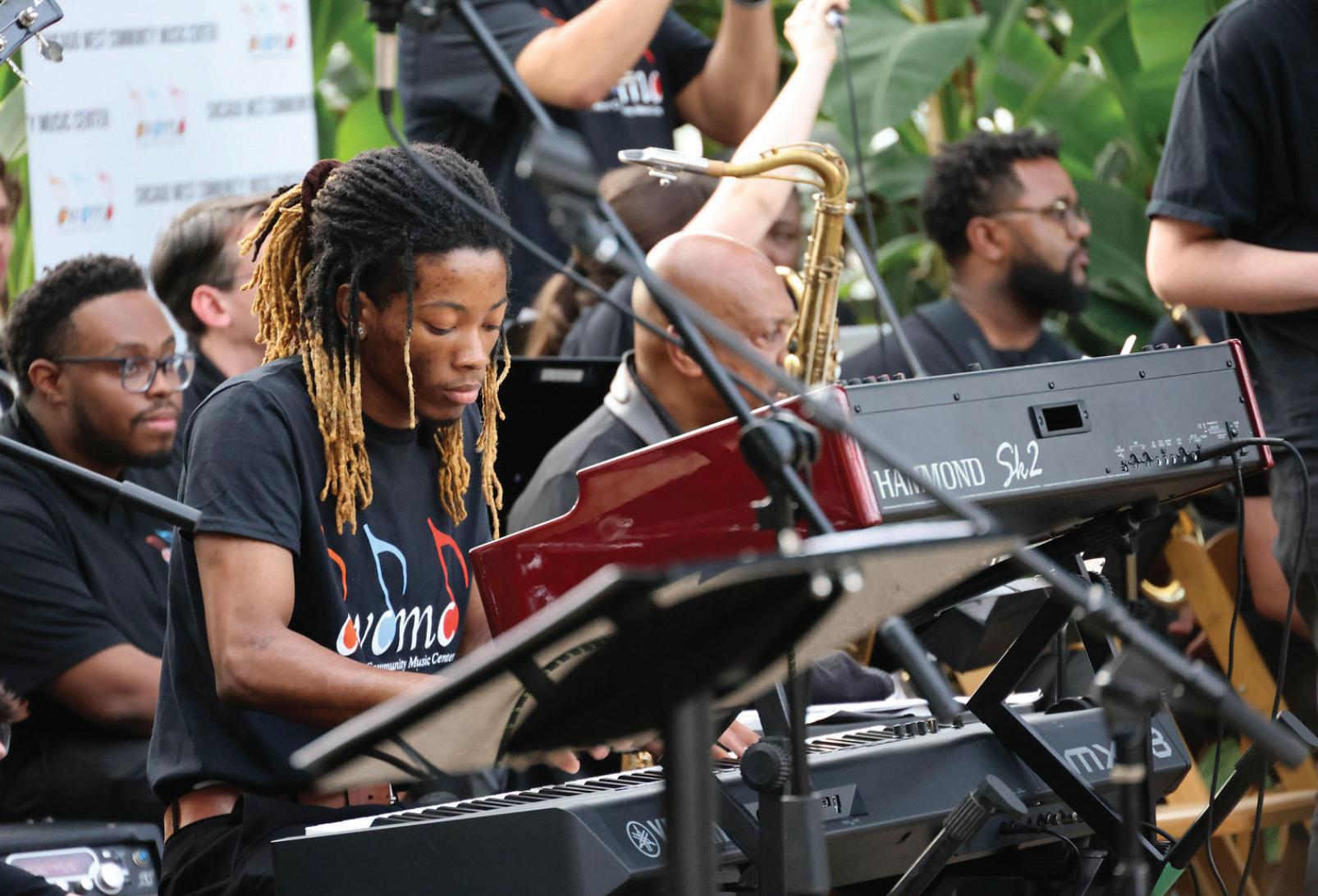
Keyboardist Jordan Miller jamming at the concert. | JOHN HARRIS
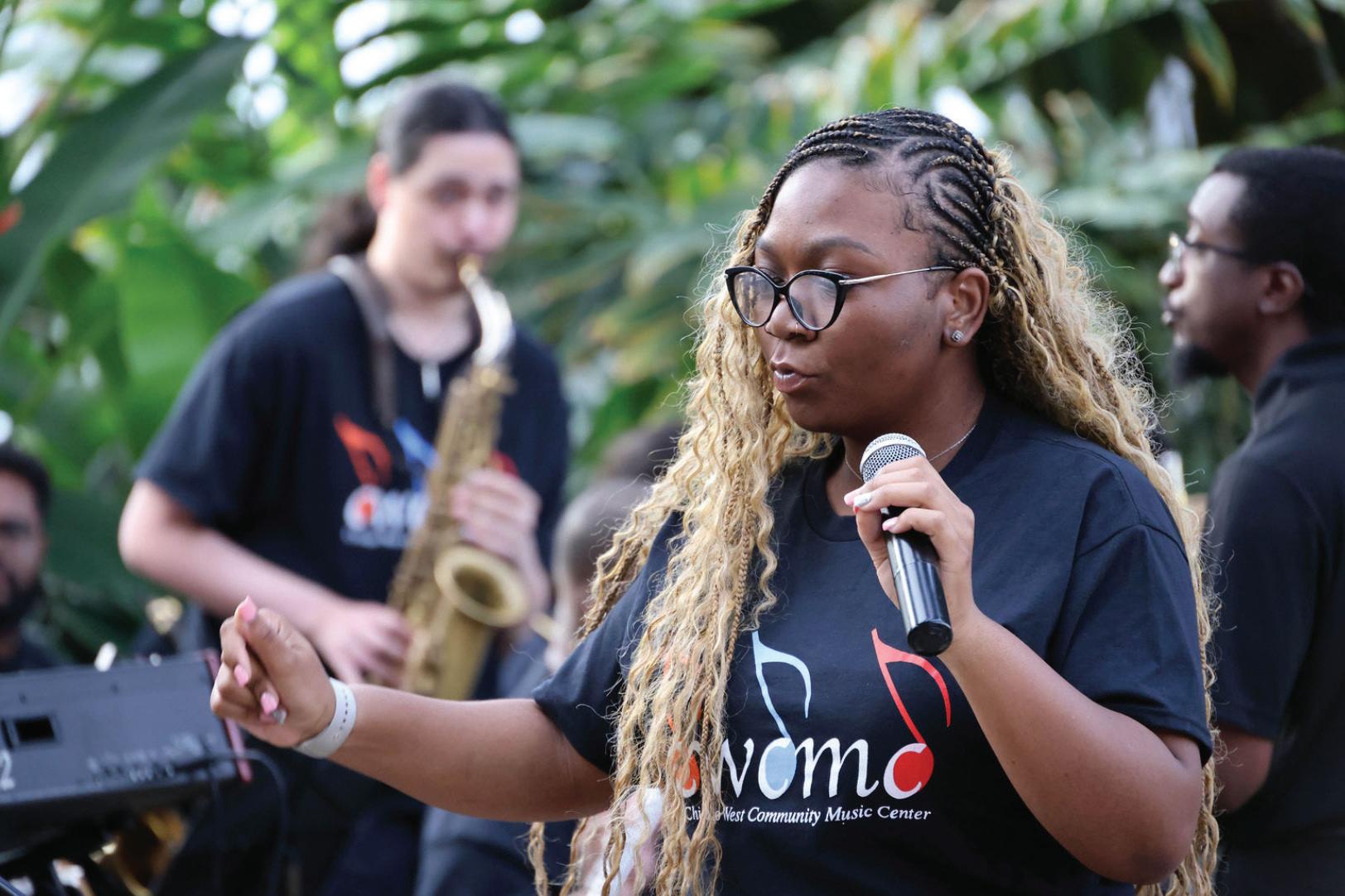
Singer Brianna Courts, a Chicago West Community Center alum, performs at the concert. | JOHN HARRIS
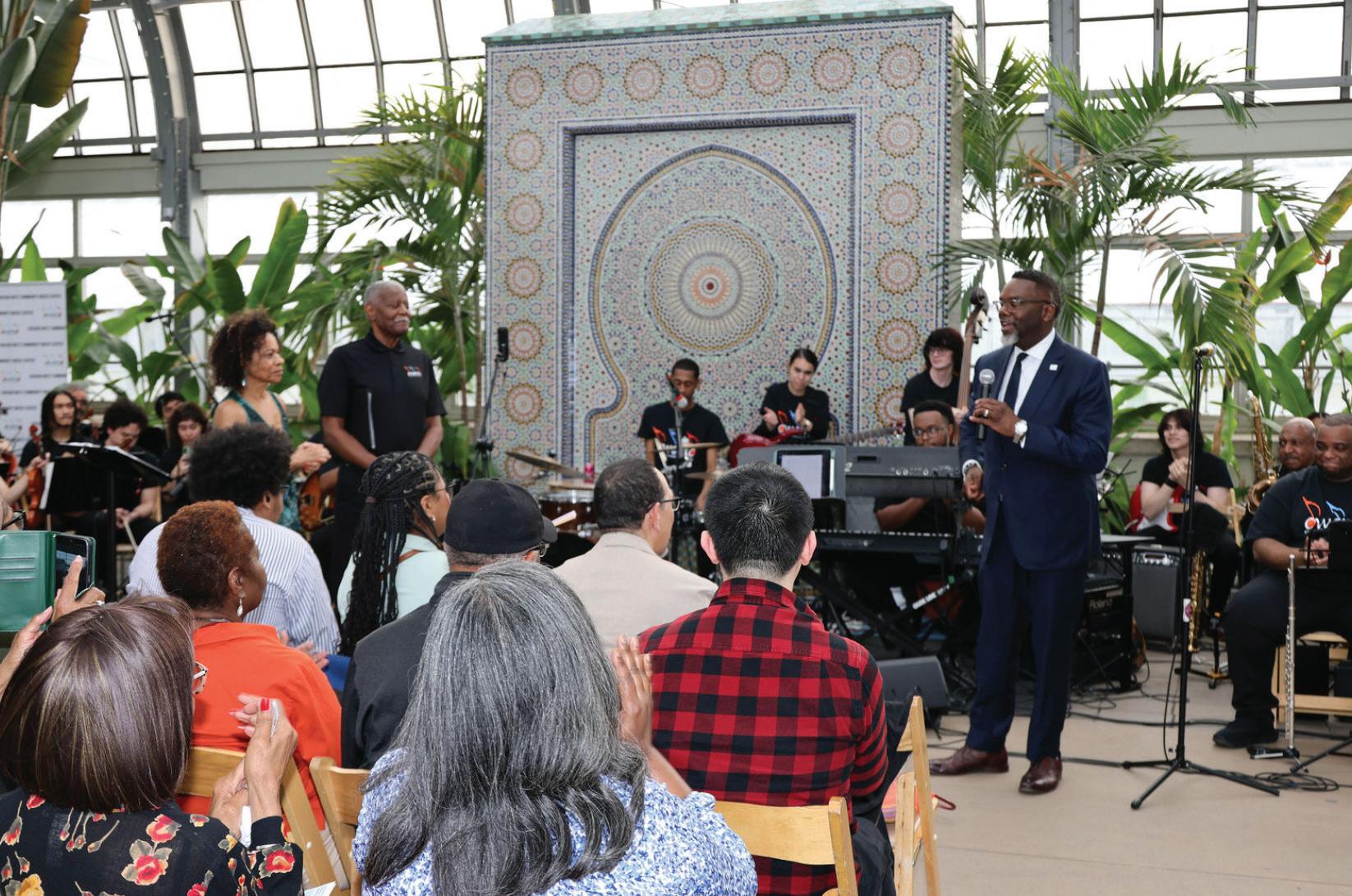
Chicago West Community Music Center cofounders Howard and Darlene Sandifer (seen standing far left) look on as Mayor Brandon Johnson, a longtime CWCMC supporter, speaks during the International Day of Jazz Concert on April 28. | JOHN HARRIS
Lt. Gov. Juliana Stratton in attendance at the concert.
| JOHN HARRIS
Maywood Fine Arts Launches Renovation of Historic Downtown Home
Upgrades to the century-old former bank at 5th and Lake will expand classrooms, modernize facilities, and preserve a cornerstone of Maywood’s arts community
BY MICHAEL ROMAIN
The Culture
At the corner of 5th Avenue and Lake Street, a familiar building in the heart of Maywood is preparing for a new chapter.
Maywood Fine Arts (MFA), the long-running nonprofit that has introduced generations of local children across the Greater West Side to dance, music, theater and visual art, officially kicked off a major renovation of its main building on April 30. The structure, a former bank, has stood as a fixture in the village’s downtown for roughly a century, according to MFA leaders.
The renovation, expected to begin later this month and wrap up around September, will modernize the building’s interior while preserving the historic exterior that many residents recognize.
“This isn’t just a renovation—it’s an expansion of a home,” said Katherine Buz, MFA’s new executive director and a longtime drama instructor with the organization for more than 20 years. “It’s a physical manifestation of our commitment to the Maywood community.”
Maywood Fine Arts was founded in 1979 by Ernie and Lois Baumann, initially offering dance and tumbling classes before expanding into a wide range of arts programming. Today, the organization serves more than 500 individual students, with total enrollments nearing 800, as many young people take multiple classes. Students come from a range of West Side and west suburban communities, including Austin, Garfield Park, Maywood, and Bellwood, among others.
The announcement of the renovation comes just months after the death of Ernie Baumann, who remained a central figure in the organiza-
tion for decades.
During the kickoff event, Illinois House Speaker Emanuel “Chris” Welch reflected on growing up next door to the Baumanns and watching the program take shape.
“I was there when they started,” Welch said. “They sparked something in me I didn’t even know was there.”
While the building’s exterior—defined by its stone façade, vertical columns, and rows of large windows—will remain intact, the interior will be significantly reworked to better serve students and staff.
Rebecca Woll, MFA’s development manager, said the project will increase the number of usable classrooms from seven to about 11.
“With the extra rooms, we can serve more kids, hire more teachers and expand what we offer,” Woll said.
Plans include reconfiguring the third floor to create a more open layout, including a new reception area, while maintaining key structural elements. The second-floor art studio will be upgraded with improved lighting and new workspaces. Music classrooms will also be modernized.
Administrative offices will be reorganized, including a new conference room overlooking the intersection of 5th and Lake. The project will also bring a much-needed infrastructure upgrade: a new HVAC system. The building currently does not have central air conditioning.
The $4.5 million renovation is being supported by a combination of public and private funding, including roughly $3.5 million in state capital funds secured with the help of Welch and State Sen. Kimberly Lightford.
Buz said that support helped unlock additional private investment and made the project possible.
For students, the changes mean more space to learn and grow.
“Our teachers helped us believe in each other,” said MFA student Olivia Serdin during the ceremony. “This renovation isn’t just changing a building—it’s shaping our future.”
Kira Jai McGhee, another student performer, said the expanded facilities will allow young people to continue “growing, learning and reaching for bigger dreams.”
For Lois Baumann, the renovation reflects years of planning finally coming to life. MFA leaders noted that a master plan created more than a decade ago is now being fully realized— and even surpassed.
“This building will be here to serve the children of Maywood for another 100 years,” Buz said.
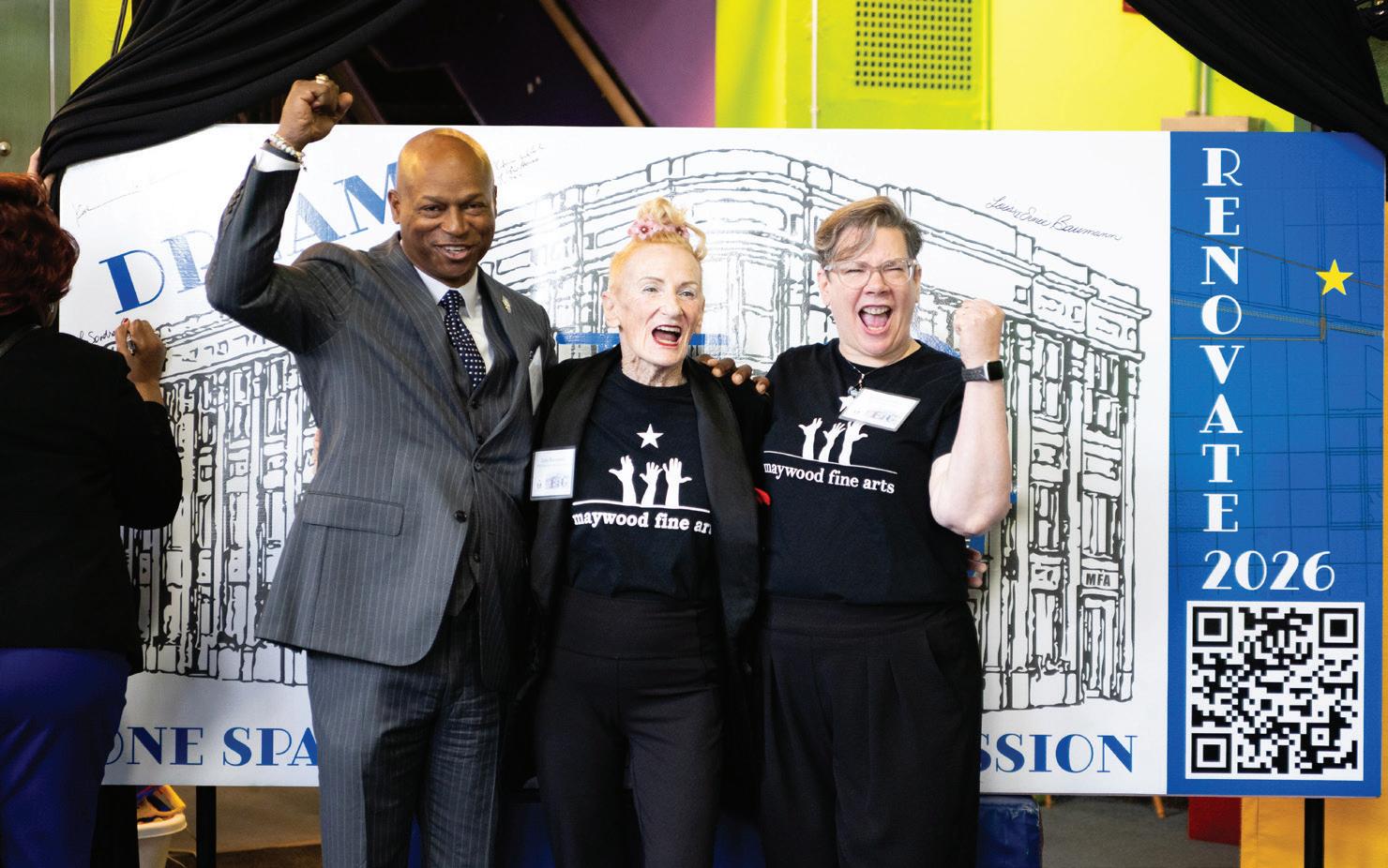
Illinois House Speaker Emanuel “Chris” Welch, Louis Baumann, and Katherine Bus during Maywood Fine Arts’ Renovation Kickoff Ceremony on April 30 in Maywood. | SPOONER BAUMANN
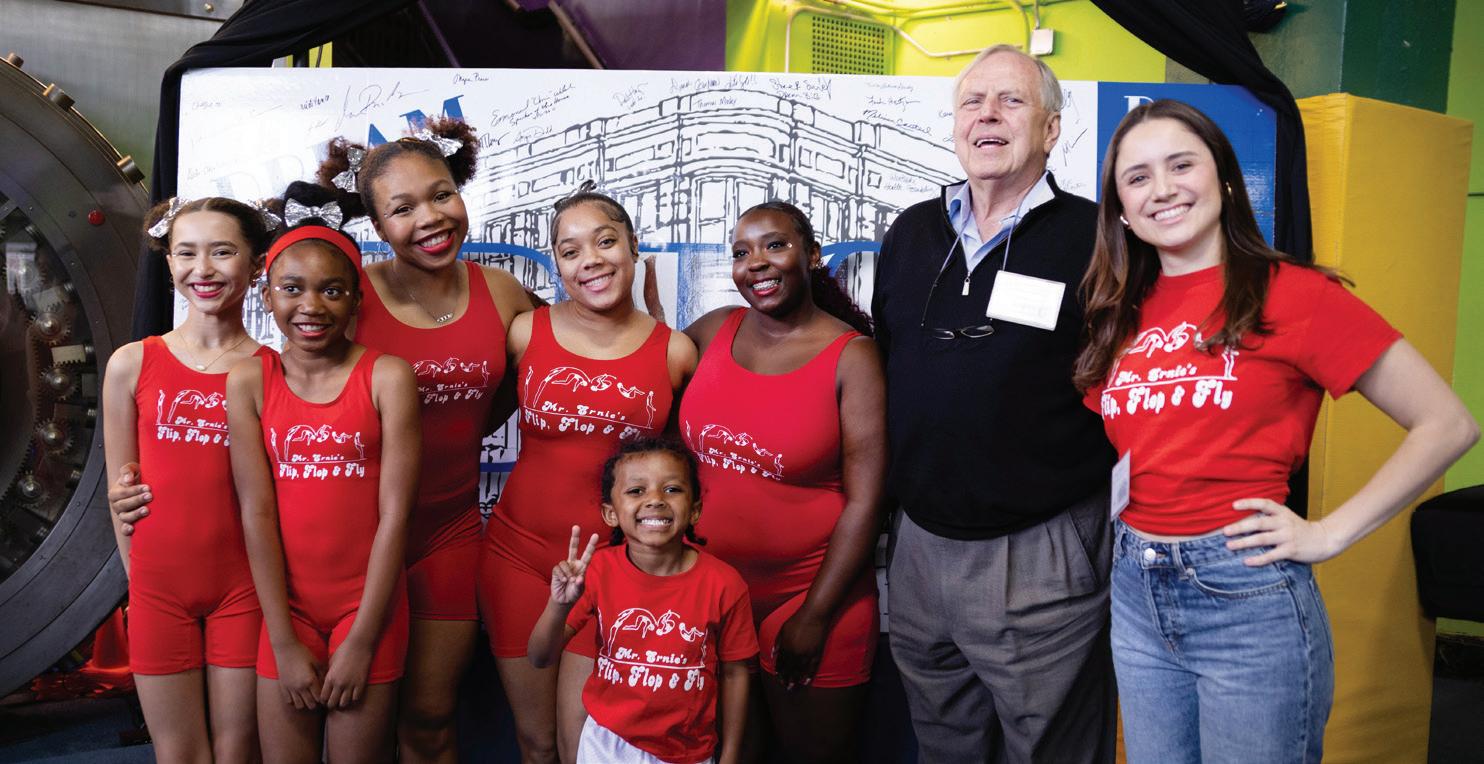
Maywood Fine Arts students and supporters can expect upgraded facilities after a $4.5 million renovation project expected to wrap up later this year. | SPOONER BAUMANN
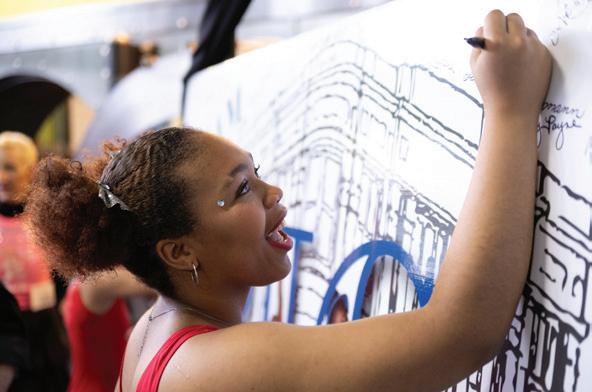
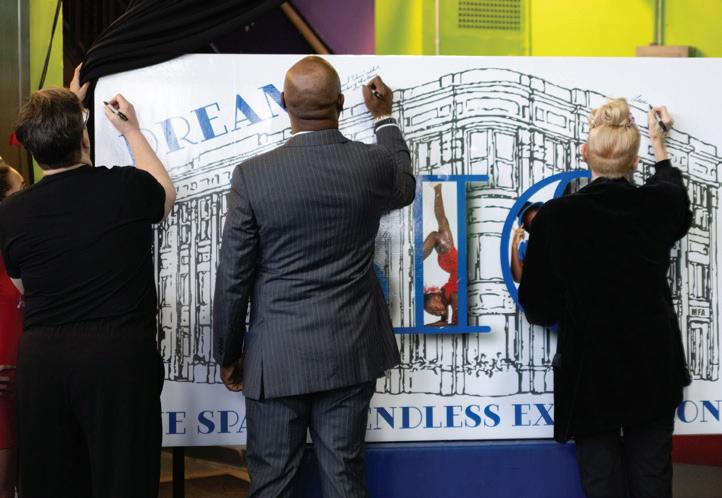
Bus, Welch, and Baumann sign their names to a rendering of the outside of the former bank building that houses Maywood Fine Arts. | SPOONER BAUMANN
‘Made On The West Side’ Showcases Student Art from Local Elementary Schools
The exhibit, which opened May 8 at Third City Studio, features self-portraits and other works by K-8 students that address their experiences living on the West Side
By MICHAEL LIPTROT
Block Club Chicago
West Side students are the stars of the latest exhibit at a gallery located in an up-and-coming Austin arts district.
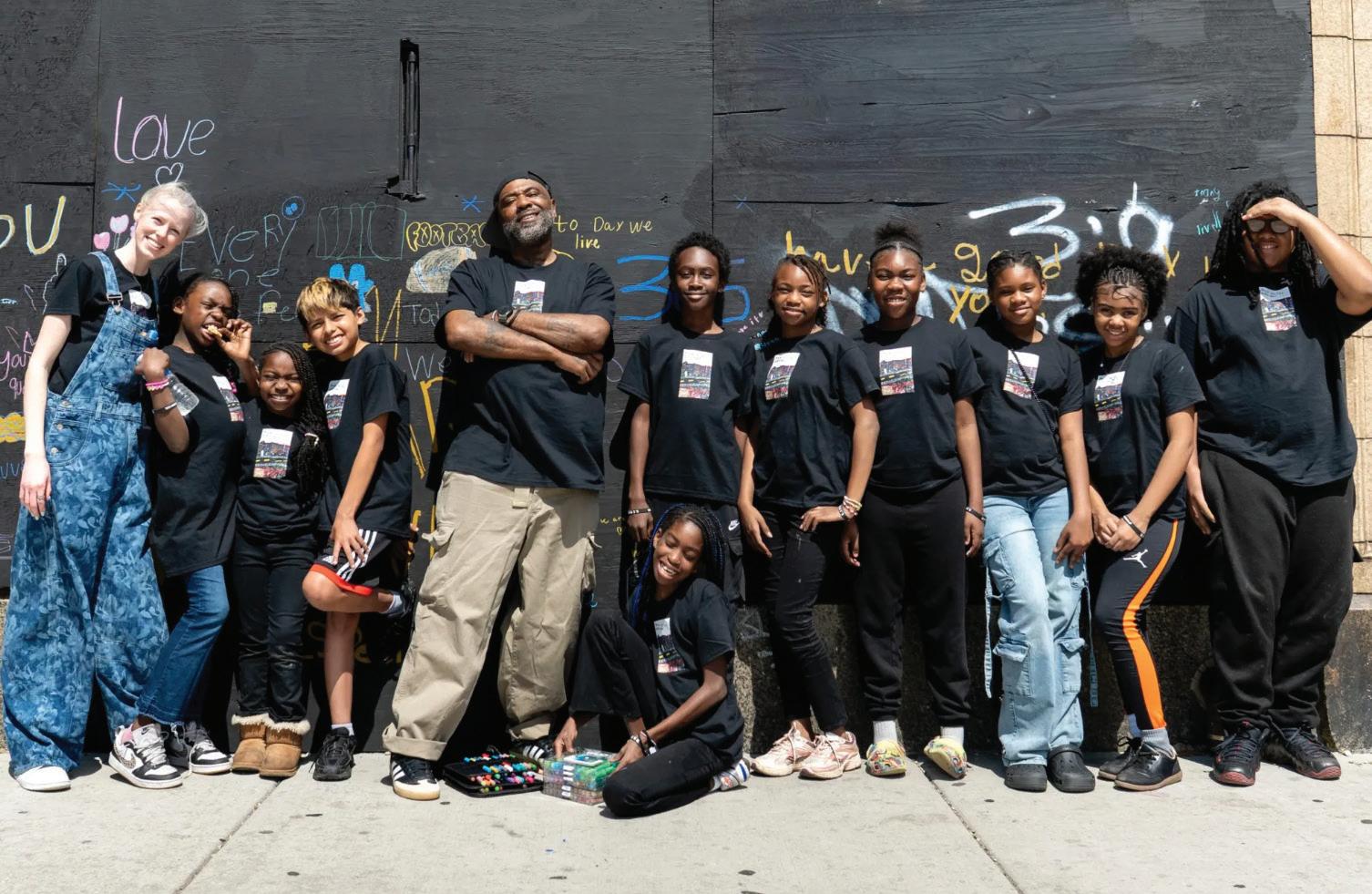
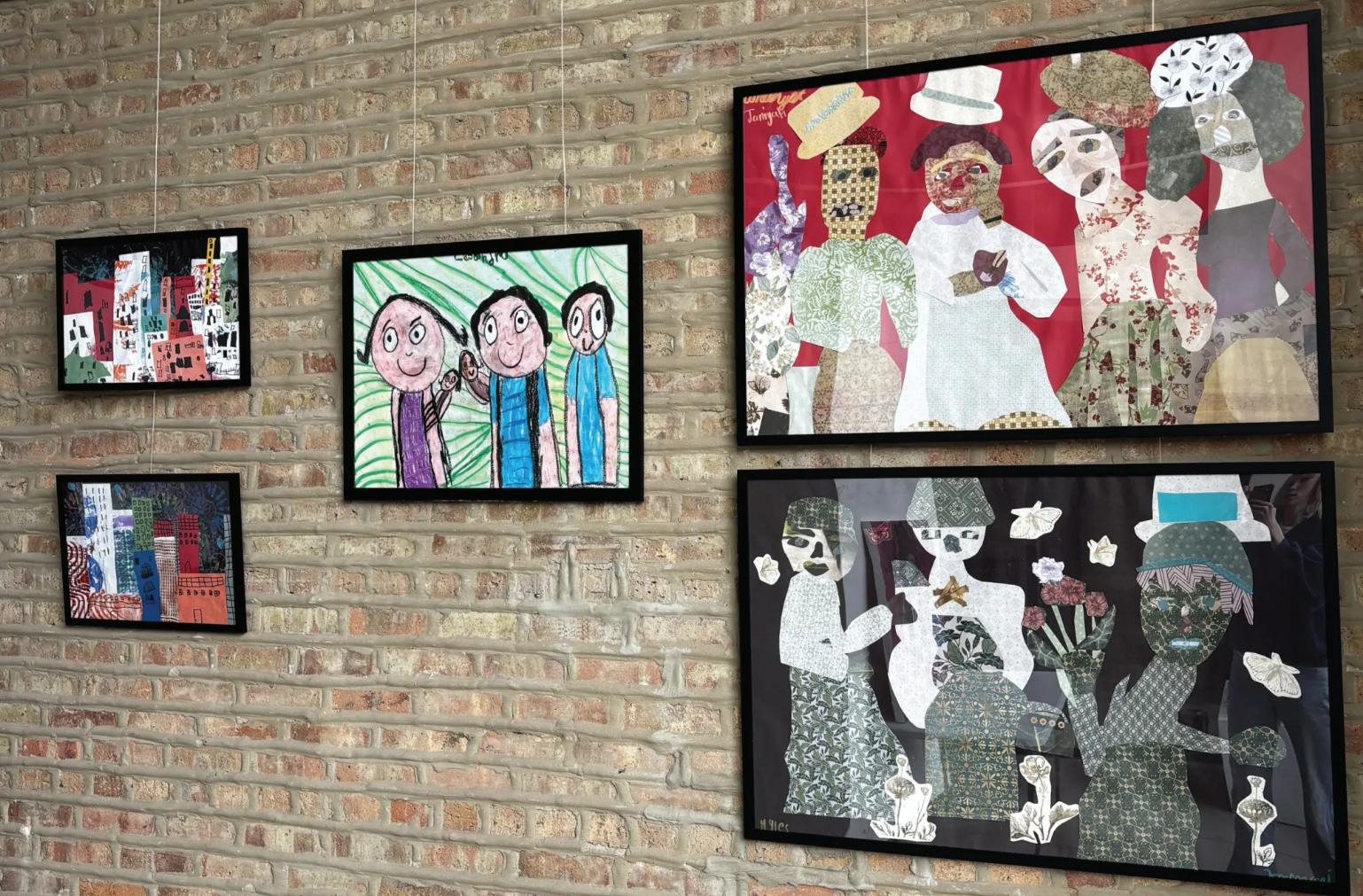
“Made on the West Side” features art from students at seven West Side public schools that speaks to the students’ creativity, passions, and lived experiences growing up in Chicago, said Hailey Rodden, art teacher at Henry H. Nash Elementary in Austin and the exhibit’s curator.
The exhibit — which opened May 8 at Third City Studio, 5538 W. North Ave., and runs through July 6 — is also inspired by longstanding disparities in arts access and Chicago Public Schools’ representation of West Side students in citywide art showcases.
Much of the student art featured in the exhibit is self-portraits, family portraits, and the city’s built environment, with the students tackling subjects like self-affirmation and belonging. Large-scale pieces include a mural and a paper collage inspired by Bisa Butler, an artist acclaimed for her innovative quilt portraits capturing Black life.
For Rodden, seeing West Side students’ work displayed provides visibility to their experiences.
“Their art is their self-expression,” Rodden said. “It’s their outlet, creativity, and critical thinking, and you can see that very evidently in their work. It’s stuff they enjoy, stuff that they are passionate about and proud of.”
The art in the exhibit was made by students in kindergarten through 8th grade at the following schools:
• Chalmers STEAM Elementary School, 2745 W. Roosevelt Road
• Emiliano Zapata Elementary Academy, 2728 S. Kostner Ave.
• Henry H. Nash Elementary School, 4837 W. Erie St.
• Joseph Lovett Elementary School, 6333 W. Bloomingdale Ave.
• Robert Nathaniel Dett Elementary School, 2131 W. Monroe St.
• Willa Cather Elementary School, 2908 W. Washington Blvd.
• Wilma Rudolph Elementary Learning Center, 1628 W. Washington Blvd.
The Third City Studio gallery follows an earlier public art exhibit Rodden created to highlight work from students who were overlooked for CPS’s arts showcases.
CPS students have, for years faced disparities in access to art education and opportunities. Schools that are rated as below CPS standards for art education are primarily concentrated on the South and West sides.
For the 2023-2024 school year, 45 percent of all CPS students had access to high-quality art education, Block Club previously reported. While 59 percent of white students were able to access high-quality art education in their CPS schools, only 36 percent of Black students had such access. Last year, CPS officials told Block Club the district planned to introduce equity metrics into the selection process for its student art festivals and the citywide arts exhibition starting this school year.
After two years of seeing many of her students highlighted at CPS’s All-City Visual Arts Exhibition, last year Rodden saw only one student honored and, in response, launched her own gallery at Garfield Park’s Legler Library to showcase their work.
This year, Rodden said two Nash students’
| PROVIDED
art pieces were selected for the citywide showcase, and six students were selected for a performance. Rodden said she plans to continue creating avenues for West Side students to have their work displayed.
“We wanted to create more spaces for students to show work in a real-world context,” Rodden said.
Third City Studio opened in October. An art studio, gallery, classroom, and event space,
Third City highlights local artists, supports school programs, and offers artists-in-residence opportunities, ownership said. The studio and an upcoming cafe next door are the first in what organizers have dubbed the North Austin Arts District, a multiphase plan to overhaul a mixed-use complex spanning the 5500 block of West North Avenue. For more information on “Made on the West Side,” visit thirdcitystudio.org.
Hailey Rodden (left) art teacher at Nash Elementary, Tony Collins (with arms folded), a teacher with Chicago Arts Partnerships in Education, pose with children involved in the “Made On The West Side” exhibit.
“Made on the West Side” is an exhibit opening May 8 at Third City Studio, 5538 W. North Ave. | PROVIDED
BY STAFF
The Culture
Many civil rights advocates are viewing the U.S. Supreme Court’s recent decision in Louisiana v. Callais as the latest step in a decades-long effort to weaken the Voting Rights Act of 1965 — one of the most important laws produced by the Civil Rights Movement.
The ruling centers on Louisiana’s congressional map and whether the state could legally create a second majority-Black congressional district after years of legal challenges over racial representation. In a 6-3 decision, the Court’s conservative majority ruled against the map, arguing that race cannot be used too heavily when drawing political boundaries, even when states say they are trying to comply with the Voting Rights Act.
The decision highlights a deep philosophical divide that has shaped the Court’s voting-rights rulings for years.
Conservative justices have increasingly argued that America has changed dramatically since the Jim Crow era and that extraordinary federal oversight of elections is no longer necessary. Liberal justices, meanwhile, argue that racial discrimination in voting never disappeared — it simply evolved into more subtle forms.
No one expressed that tension more clearly than the late Justice Ruth Bader Ginsburg in her famous dissent from the Court’s 2013 ruling in Shelby County v. Holder.
“Throwing out preclearance when it has worked and is continuing to work to stop discriminatory changes,” Ginsburg wrote, “is like throwing away your umbrella in a rainstorm because you are not getting wet.”
For many voting-rights advocates, that quote has become a warning about what has unfolded over the last decade.
To understand why the Callais decision matters, it helps to understand how the Voting Rights Act has gradually been weakened over time.
When Congress passed the law in 1965, it gave the federal government powerful tools to stop racial discrimination in elections, especially in Southern states with long histories of suppressing Black voters.
One of the law’s strongest provisions was something called “preclearance.” Under preclearance, certain states and counties with histories of discrimination had to get approval from the federal government before changing
Supreme Court’s Latest Voting Rights Decision Continues Long Rollback of Civil Rights Era Protections
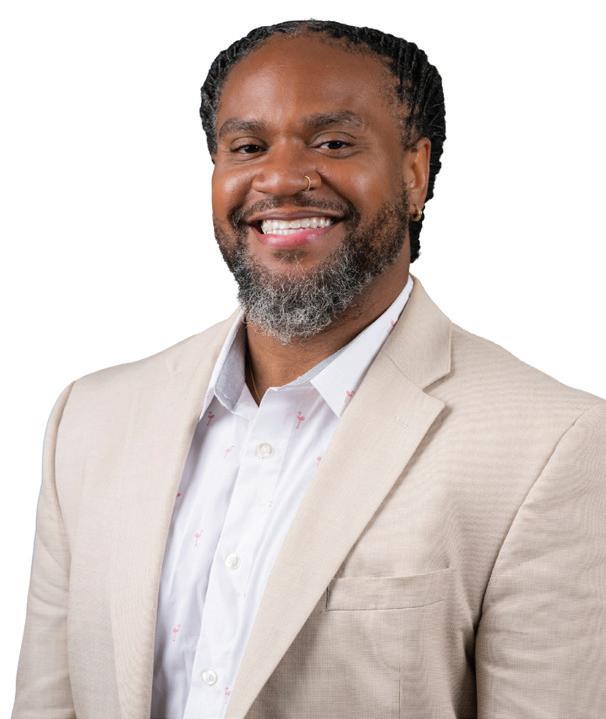
Rep. Danny K. Davis says the recent Louisiana v. Callais decision
‘further erodes critical safeguards that protect voters’
election laws, polling places, district maps, or voting procedures.
For decades, civil rights groups argued that preclearance stopped countless discriminatory policies before they could take effect.
But over time, the Supreme Court’s conservative wing began narrowing those protections.
In the 1980 case City of Mobile v. Bold-
en, the Court made it harder to challenge discriminatory election systems by requiring proof of intentional racism rather than simply discriminatory outcomes. Congress later responded by strengthening the Voting Rights Act through amendments.
Then, during the 1990s, the Court began scrutinizing majority-Black voting districts more aggressively in cases like Shaw v. Reno,
arguing that race could not become the dominant factor in drawing districts.
The biggest turning point came in 2013 with Shelby County v. Holder. In that case, the Court struck down the formula used to determine which states had to follow preclearance rules. Without that formula, preclearance effectively stopped functioning.
Writing for the majority, Chief Justice John
Pillars of the Supreme Court of the United States. | JESSE COLLINS/UPSLASH
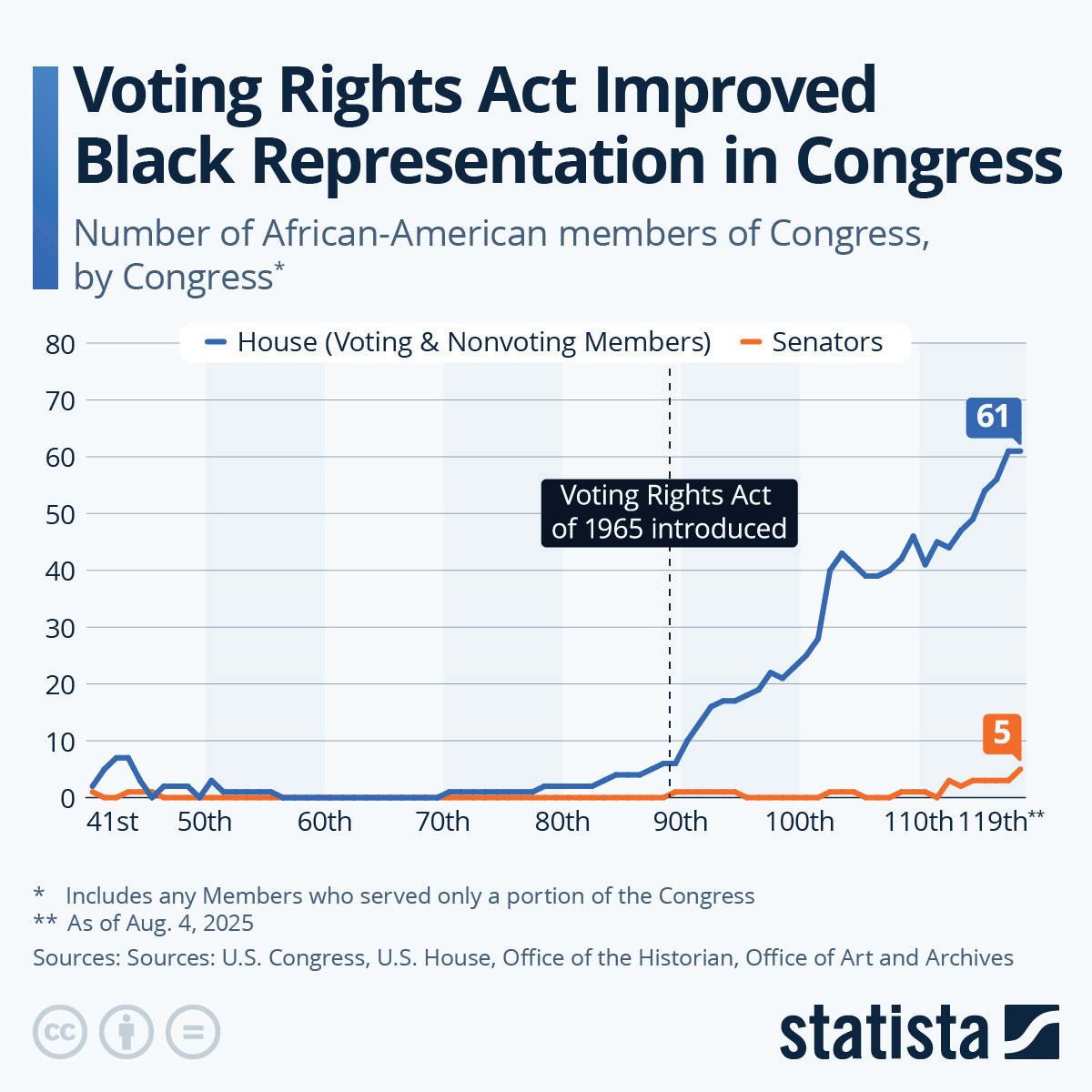
Black Representation in Congress since 1965
The United States Supreme Court has narrowed parts of the Voting Rights Act of 1965, a landmark statute introduced during the civil rights era to prohibit racial discrimination in voting. The ruling, Louisiana v. Callais, announced on April 29, makes it harder to challenge redistricting plans because they are racially discriminatory.
The following chart shows how Black representation in Congress increased significantly after the Voting Rights Act was introduced in 1965. At the start of the 89th Congress, there were just six African American members of the House. This figure more than tripled to 21 by the 99th Congress in 1985, including 20 representatives and one non-voting delegate. Representation has continued to rise, reaching 61 African American members of the House at the start of the 119th Congress in 2025, along with five African American senators - the highest number recorded at the beginning of a Congress in the Senate. While progress has been made and the 119th Congress is the most racially and ethnically diverse in U.S. history, representation still does not reflect the broader population. This is especially evident in the Senate, where five of 100 senators are African American, compared with roughly 14 percent of the U.S. population identifying as Black or African American. Critics of the ruling warn that the erosion of the Voting Rights Act could reverse the gains in minority representation achieved in recent decades.
— Anna Fleck, Statista
Roberts argued that conditions in the South had improved enough that the federal government could no longer treat certain states differently based on decades-old data.
Civil rights organizations strongly disagreed, arguing that the ruling opened the door for a wave of restrictive voting laws and aggressive redistricting efforts.
In the years after Shelby, many states passed stricter voter ID laws, reduced polling locations, changed mail voting rules, or redrew districts in ways critics said diluted Black political power.
The Court continued down that path in 2021 with Brnovich v. Democratic National Committee, which made it harder to challenge voting restrictions under another section of the Voting Rights Act.
Then came Louisiana v. Callais.
Supporters of Louisiana’s map argued the
state was trying to comply with previous Voting Rights Act rulings by creating fairer representation for Black voters in a state where African Americans make up roughly one-third of the population.
But the Court’s conservative majority said the map relied too heavily on race and therefore violated constitutional principles.
Critics say the decision could make it significantly harder to create or preserve majority-Black districts moving forward — especially across the South.
For conservatives, these rulings represent a move toward what they call “colorblind” constitutional principles and equal treatment under the law.
For liberals and civil rights advocates, however, the Court is dismantling protections that remain necessary because racial inequality in voting and representation still exists.
The Supreme Court’s decision issued today is a serious blow to the principle that every American—regardless of race, background, or zip code—deserves equal protection under the law when it comes to voting rights. This ruling threatens to further erode critical safeguards that protect voters, particularly Black communities and other minority groups, and opens the door to unfair congressional redistricting that dilutes the voices of the many in favor of the few.
At a time when our nation should be strengthening access to the ballot, this
decision moves us backward. It deepens divisions, undermines confidence in our democratic institutions, and risks making hard-won civil rights protections meaningless.
I stand in strong disagreement with this ruling and join the NAACP, the American Civil Liberties Union, and civil rights advocates across the country in calling for immediate action. Congress must act to restore and strengthen voting rights protections and ensure that every voice is heard and every vote counts.
Our democracy depends on it.
Congressman Davis calls the decision a ‘serious blow’
Rebuilding From Within: Using Hope and Self-Efficacy to Heal Through Trauma
BY DR. DEONDRE’ RUTUES
Columnist
As a business psychologist, much of my work focuses on helping people develop the internal tools necessary to navigate adversity, setbacks, and change. In fact, my dissertation research focused on Psychological Capital — often called PsyCap — and its ability to influence human development, performance, and well-being positively. During Mental Health Awareness Month, I believe it is important that we talk not only about trauma itself, but also about the psychological resources that help people heal from it.
HOPE: THE ABILITY TO SEE A FUTURE AGAIN
Hope is not pretending everything is okay. Hope is the ability to believe there is still a pathway forward, even after hardship.
One of the dangerous effects of trauma is that it can create emotional paralysis. People begin to feel stuck. According to the Substance Abuse and Mental Health Services Administration (SAMHSA), trauma exposure is strongly connected to feelings of hopelessness, helplessness, and emotional withdrawal.
I often tell people this: when individuals stop believing things can improve, they also stop investing in themselves.
Many people in our communities carry trauma every day. Sometimes it comes from violence, poverty, grief, instability, incarceration, discrimination, or simply years of chronic stress. Trauma impacts more than emotions; it can also reshape how people see themselves, how they see others, and whether they believe a better future is even possible.
That is where Psychological Capital becomes important.
Psychological Capital is built on four core components: Hope, Self-Efficacy, Resilience, and Optimism. Research has shown that these psychological resources are connected to improved mental health, coping ability, motivation, and overall life outcomes. In this inaugural column, I want to focus on Hope and Self-Efficacy because these are often the first things trauma attacks.
Hope matters because it helps people reconnect to goals, purpose, and possibility. Sometimes rebuilding hope starts with something small:
• Setting one realistic goal
• Creating a daily structure
• Having honest conversations
• Finding mentors or positive influences
• Celebrating progress instead of perfection
One strategy I encourage is asking: “What is one thing I still have control over today?”
Trauma can make life feel overwhelming, but small wins help rebuild momentum.
SELF-EFFICACY: REBUILDING THE BELIEF THAT “I CAN”
Self-efficacy is the belief in your ability to
succeed, adapt, or overcome challenges. Trauma often damages this belief.
After repeated disappointments, instability, or painful experiences, people may begin to question their own capabilities. They stop applying for opportunities. They stop speaking up. They stop believing their decisions matter.
Research from the National Institute of Mental Health shows that chronic stress and trauma can negatively affect confidence, emotional regulation, and decision-making. But self-efficacy is not fixed; it can be developed.
Communities can strengthen self-efficacy by:
• Teaching practical skills
• Providing encouragement and support
• Creating environments where mistakes become learning opportunities
• Helping people accomplish manageable goals
• Exposing youth and adults to examples of success that feel relatable
One exercise I recommend is creating an “evidence list.” Write down moments when you survived difficult situations, solved problems, or pushed through adversity. Trauma has a way of making people forget their own strength.
Healing is not only about addressing pain. It is also about rebuilding belief. Hope allows people to see possibilities again, and self-efficacy helps them believe they are capable of reaching them.
In my next column, Part 2 of this series, I’ll focus on Resilience and Optimism and how communities can continue building psychological tools for healing and growth.
PHOTO BY ROSIE KERR/UNSPLASH
Chicago Youth Works Opens Applications for Thousands of Summer Jobs for Youth Ages 14–24
City leaders say the expanded, newly rebranded youth employment initiative is part of broader violence prevention strategy
BY STAFF The Culture
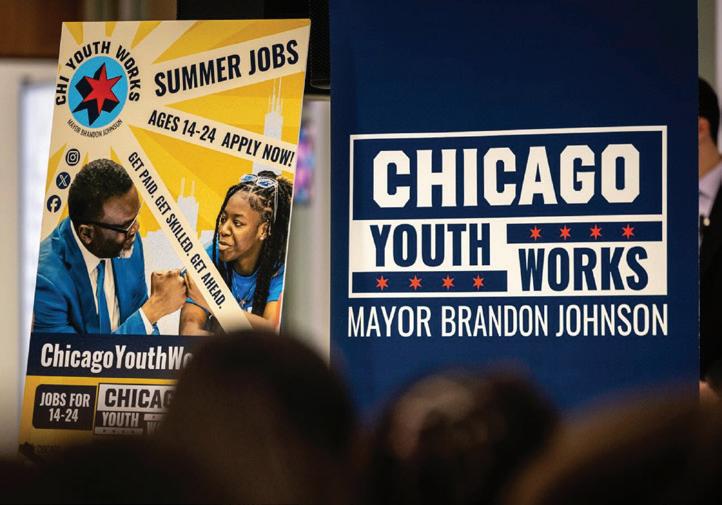
Chicago teens and young adults can now apply for paid summer jobs, internships, and career training opportunities through the city’s newly rebranded Chicago Youth Works program, formerly known as One Summer Chicago.
Applications are open now through May 29 for Chicago residents ages 14 to 24. The city expects to connect more than 29,000 young people with employment opportunities this summer through partnerships with community organizations, businesses, and city agencies.
Mayor Brandon Johnson announced the revamped initiative in March alongside the Department of Family and Support Services, describing youth employment as both an economic and public safety investment.
“Young people are Chicago’s future,” Johnson
months,” Johnson said during the launch event at Back of the Yards College Prep High School.
According to the city, youth participants helped shape the new branding, slogan, and visual identity for the initiative. The new slogan — “Get Paid. Get Skilled. Get Ahead.” — is intended to emphasize career development and long-term opportunity alongside summer income.
Officials also say the program has significantly expanded under Johnson’s administration. The city estimates more than 31,000 young people secured jobs through the initiative last year, with tens of millions of dollars distributed in wages.
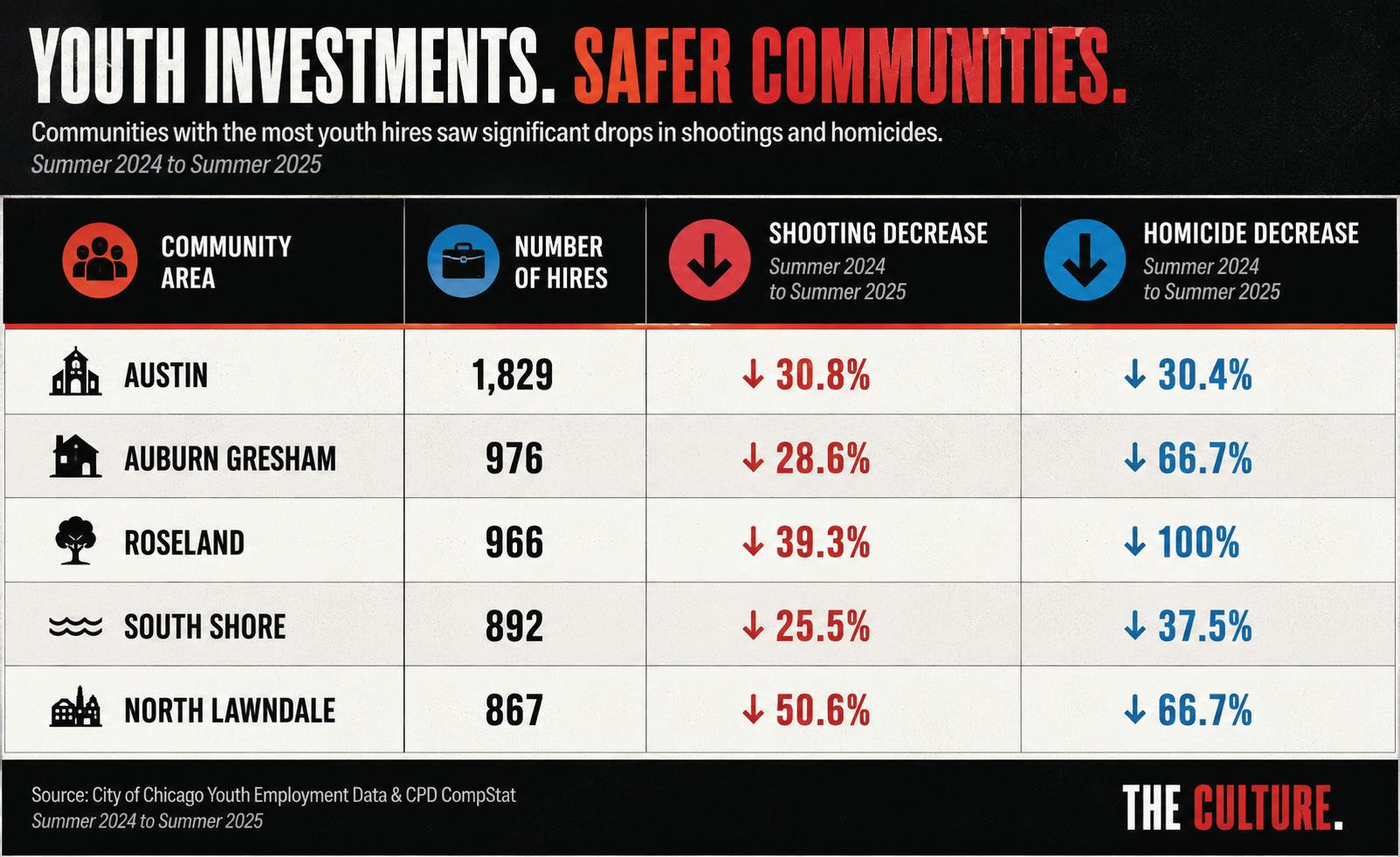
In a statement, city officials said “the top five communities with the most hires last year include two West Side and three South Side neighborhoods, with Austin leading the way at 1,892 hires. The City tracked double-digit declines in shootings and homicides in the communities where the largest number of youth were hired. “
How to Apply
| HICAGO YOUTH WORKS
said in a statement announcing the program launch. “Chicago Youth Works goes beyond summer jobs. It offers real-world experience, leadership development, and a chance for young Chicagoans to make a difference in their communities.”
City officials say the rebrand reflects significant changes to the longtime program, including an effort to create year-round employment pathways and stronger workforce development opportunities.
“The new name makes it clear that we are working to provide youth employment opportunities that extend beyond the summer
The Johnson administration has increasingly framed youth employment as a violence prevention strategy, particularly in neighborhoods disproportionately impacted by shootings and economic disinvestment.
Young people can apply online at chicagoyouthworks.org. Applicants can explore opportunities in fields including healthcare, construction, arts and culture, technology, education, community development, and public service. The deadline to apply is May 29.
City officials say the rebrand reflects significant changes to the longtime program, including an effort to create year-round employment pathways and stronger workforce development opportunities..
WEST SIDE LIVES
Everybody Loves Ms. G
BY MICHAEL ROMAIN
The Culture
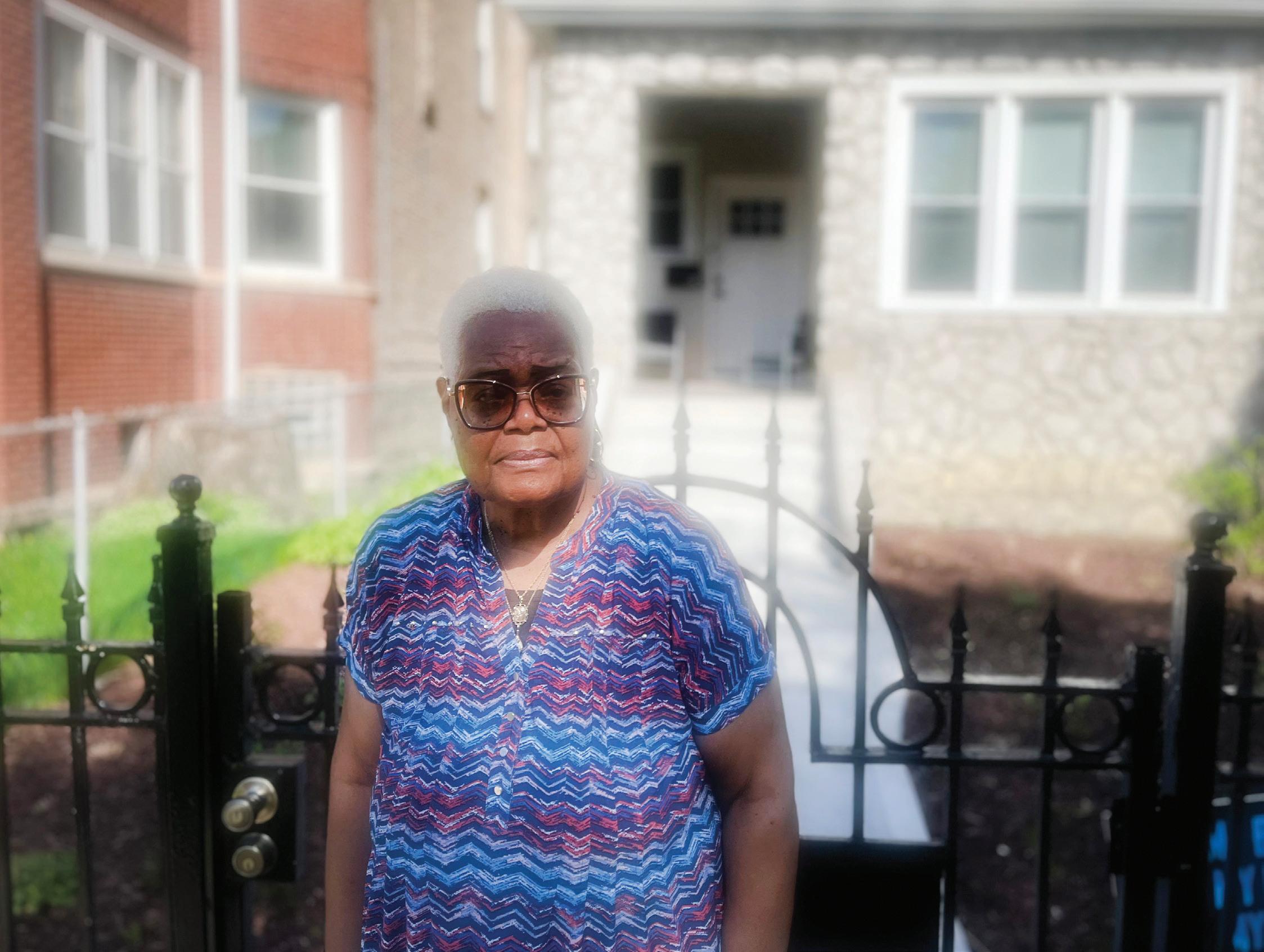
Diana Graham, 83, has lived on Lotus for 57 years. She’s the president of the Lotus for Action Block Club. At a recent block club convention and job fair hosted by the 15th District Police Station, Graham reflected on decades of organizing and relationship-building in Austin.
PLANTING SEEDS
“I worked hard to establish this. I’m trying to get more young people engaged, so when I step down, I will have planted my seed here to get people involved to keep our community safe, clean, and drug-free. It’s really not as hard as it seems. I’ve been president on my block since 2006. We’ve come a long way. We have more block clubs involved now than we ever have. People are interested, but we need more people. They’ll do the club for a couple of years or five years, and then it shuts down.
“Now, I’m in the L’s: Laramie, Long, Lotus, Lockwood — and we’re the only ones who still got the club out of all the Ls.”
“EVERYBODY
LOVES MS.
G”
“When you establish a relationship with young people — I got a relationship with just about everybody in the Austin area. They respect me, always have, since they were little
kids. I’m to the point where I’m not afraid of you. You’re the same little kid I used to feed, send to school when your mom didn’t have any money. Now, you gotten grown, I’m supposed to be scared of you? Let’s be for real here now. But I love on them. Everybody loves Ms. G. I know how to talk to you.”
“We had an incident one Sunday night. About 10:30 p.m., 11 p.m., I hear this music. Everybody calls me. They think I’m Al Capone’s sister. They want me to go out there and handle it, right? I come outside in my gown at 11 o’clock. New people had moved in. I was calm. If you approach anybody in
a respectful manner, they will respond the same way. I went out there and said we have a sign that prohibits loud music on the street. I said, ‘See, you got your cups, your drinks, your party, you’re having a good time. You want to ring my bell and get a bag because I don’t want to see no cups on the ground in the morning when I get up.’ And they’re all laughing. It’s the way you talk to them. I didn’t do no cursing. It’s the way you do it.”
“A drug dealer told me once, he said, ‘Ms. Graham, you gotta be careful out here, because all the guys carry guns.’ I said, ‘Let me tell you, baby, everybody got a gun. I ain’t
about to be afraid because you got a gun.’ Learn to establish a relationship with young people, and they’ll want to work with you.”
THE PEOPLE ALWAYS COME BACK
“We don’t have any teens on the block anymore. They’ve all grown up and gone on. But they steady come back. Every year, I have a block club reunion for people who grew up on Lotus. It’s the relationship we built 30 years ago, 40 years ago, when they were young teenagers, that makes them want to come back.”
Diana Graham, or Ms. G as she's known in the Austin community, poses for a photo on the Lotus block where she's lived for nearly 60 years. | MICHAEL ROMAIN
West Siders Learn Tools and Techniques of Preserving Their Own Stories
At a May 9 workshop at Legler, residents explored how oral history can preserve firsthand accounts often missing from mainstream narratives about Black life
BY MICHAEL ROMAIN
The
Culture
Barbara Stewart still remembers the fear and uncertainty that swept across the West Side after the assassination of Dr. Martin Luther King Jr. in 1968. She was just 12 years old when riots erupted in North Lawndale, leaving entire commercial corridors in flames and communities reeling.
“The lights were off. The water was off. I walked home through all of this,” Stewart recalled.
But decades later, while watching the WTTW documentary series When the West Side Burned from her couch, Stewart said something felt missing. During a subsequent community screening of the documentary at historic Stone Temple Baptist Church in North Lawndale, she posed a pointed question to the filmmakers.
“As I was sitting on my couch watching, I felt that the film didn’t depict what happened to me,” Stewart said. “That film depicted what happened to white folk. It did not depict what happened to me as a 12-year-old girl. That’s why we need to tell our stories.”
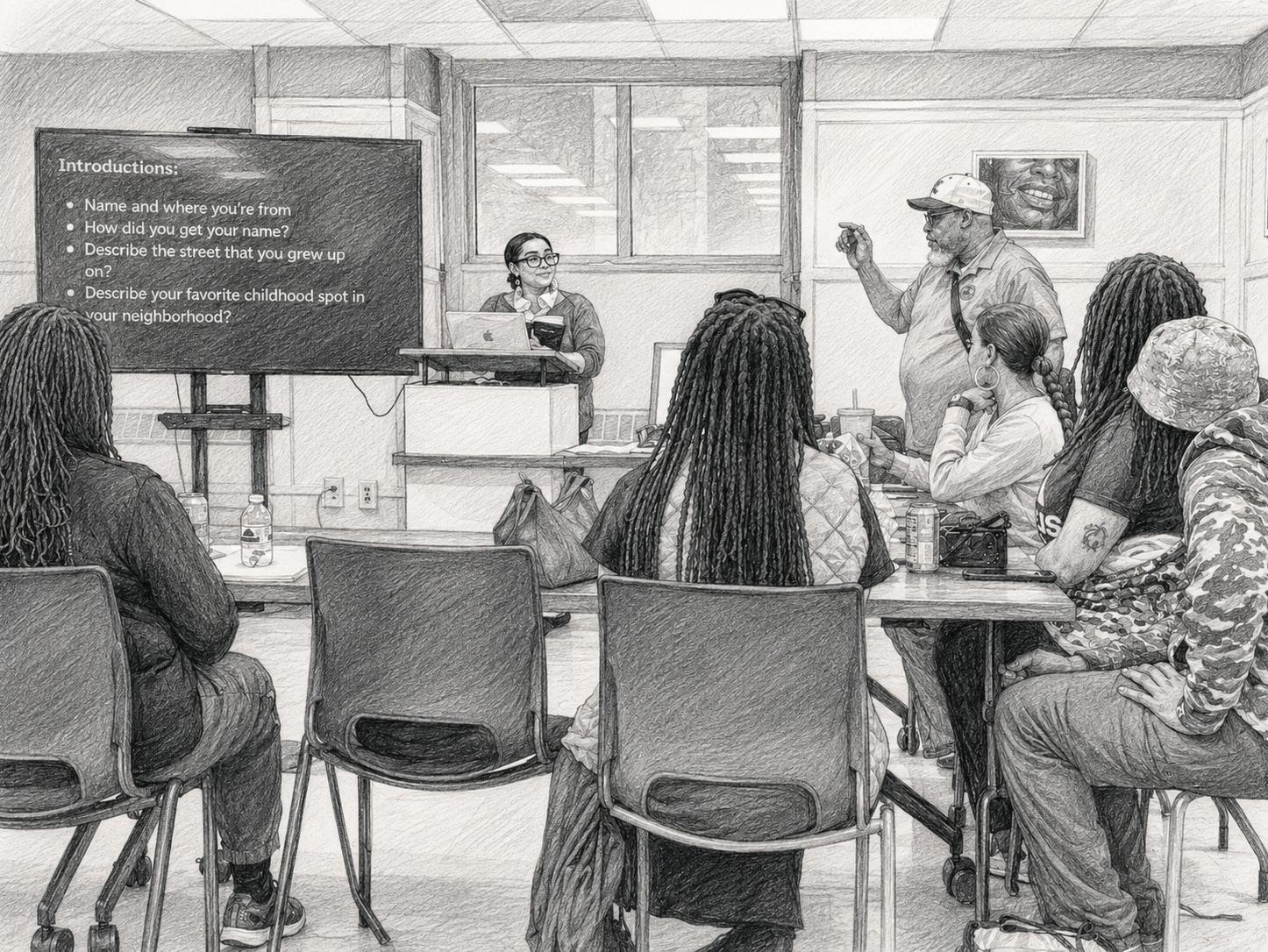
Stewart was among roughly two dozen people — from toddlers to elders — who gathered May 9 at Legler Regional Library in Garfield Park for a workshop designed to help community members preserve those stories before they disappear.
Hosted by the Black Lunch Table and the Westside Historical Collective, the workshop, “Oral History Fundamentals: Technology and Technique,” introduced participants to the basic tools and methods of oral history gathering
— from conducting interviews to preserving recordings and building community archives.
Kenn Cook Jr., a West Side photographer and founder of the Westside Historical Collective, said the event was the first in a planned twopart series aimed at equipping residents to document their own neighborhoods and lived experiences.
Facilitating the workshop was Dylan Lewis, programming assistant with the Black Lunch Table, a national nonprofit known for facilitating artist roundtables, oral history projects, and initiatives to expand documentation of Black artists and communities online, including through Wikipedia.
Lewis told attendees that oral history work begins with listening.
“We listen and we keep building on what we listen to,” Lewis said before asking participants to identify the people in their families who serve as keepers of family history. “There’s always history to be told.”
Throughout the session, Lewis highlighted several notable oral history projects that preserve firsthand accounts often omitted from mainstream historical narratives.
Among them was the Black Women Oral History Project at Harvard University, which interviewed dozens of Black women in their 70s, 80s, and 90s about family background, heritage, and life in America during the 20th century. Those interviews, Lewis said, provide future historians with a richer and more human understanding of the period than official records alone ever could.
Another example shared during the workshop was the oral history project produced by BOMB Magazine, which features Black visual
artists interviewing one another about their work and experiences. Lewis emphasized that oral history is not confined to academia but can emerge from neighborhoods, families, and local cultural spaces.
That hyperlocal approach resonated with Stewart, who participated in the East Garfield Park 40 Blocks Project, a neighborhood-based oral history initiative documenting life on the West Side. For Stewart, the workshop represented more than just technical training. It was part of a broader struggle over memory, representation, and who gets to define history.
Another oral history project Lewis shared was the Behind the Veil Oral History Project
at Duke University, which documents the experiences of people who lived under Jim Crow segregation.
Lewis described the archive as the world’s largest collection of Jim Crow oral histories and stressed the importance of preserving firsthand testimony in an era when historical memory is increasingly contested.
“Imagine if we only had the people who created Jim Crow laws writing about Jim Crow history?” Lewis said. “These are firsthand accounts of what happened. We’re in a moment where people are trying to say, ‘Oh, Jim Crow wasn’t that bad.’ These are people who can speak firsthand to the experience of living through it. That is crucial to our history not being erased.”
Learn More
Part two in the series, the “Memory Worker Workshop, will happen virtually on Thursday, May 28, at 6 p.m. Georgia Dusk, a southern liberation oral history group co-founded by Ashby Combahee and Dartricia Rollins, will facilitate the workshop.
Participants will learn the basics of oral histories, how to develop community-embedded oral history projects, how to design their own oral history projects, and
the methods and practices of conducting interviews.
These sessions are designed to support community members in becoming “memory workers,” people who help preserve and document their community’s stories and culture.
Registration is required. For more info, call (312) 746-7730 or email legler@chipublib.org.
Residents gather on May 9 at Legler Regional Library in Garfield Park for “Oral History Fundamentals: Technology and Technique,” a workshop hosted by the Black Lunch Table and Westside Historical Collective focused on preserving community memory through oral history and storytelling. | THE CULTURE
PERFORMANCE
Alysha Monique LIVE! | FRI 5/22
Chicago singer, songwriter, and multiinstrumentalist Alysha Monique brings her “high vibrations” sound to an intimate live set presented by Top Pop Productions in collaboration with The.BlkRoom. Monique, founder of Vocal Shed, blends soul, jazz, and contemporary R&B influences in a performance that organizers promise will “rock the house.” (The.BlkRoom, 7-10:30 p.m., tickets start at $17.85.)
Chicago West Community Music Center: Rock the House | THURS 5/21
Chicago West Community Music Center’s Community Orchestra takes over Millennium Hall for a live house music concert and fundraiser featuring special guest DJs and performances from young musicians and vocalists. Set beneath Cloud Gate in Millennium Park, the event continues CWCMC’s work cultivating music education and performance opportunities for West Side youth. (Millennium Hall, 11 N. Michigan Ave., 5:30-8:30 p.m.)
22nd Annual Proviso East Battle of the Bands | SAT 5/16
One of the west suburbs’ longstanding marching band traditions returns as Proviso
WHAT’S HAPPENING [ [
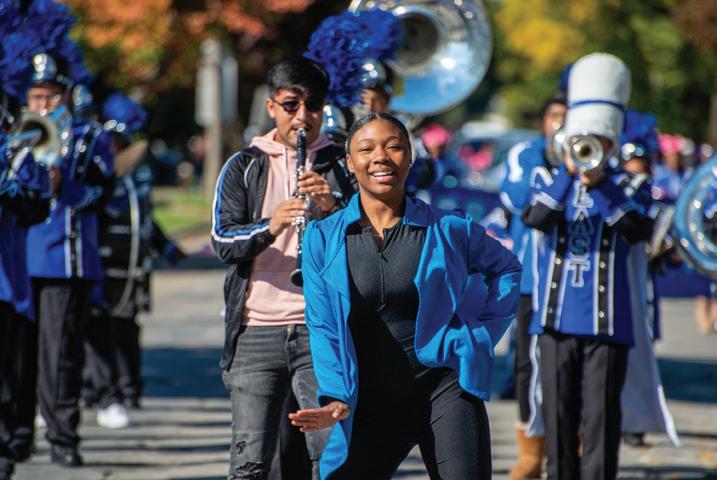
East hosts its annual Battle of the Bands showcase. Guest bands include Thornton Township High School, Oak Park High School (Michigan), Horace Mann Academy, and Morgan Park High School. The familyfriendly event celebrates drill team culture, musicianship, and competitive marching performance. (Proviso East High School Stadium, 807 S. First Ave., Maywood, noon-4 p.m.; tickets available online.)
The End of Reality | THROUGH 5/16
Following its Jeff Award-winning production of Rhinoceros, Theatre Y returns with the Chicago premiere of Richard Maxwell’s The End of Reality, a stark experimental work exploring alienation, perception, and contemporary American life. Known for minimalist staging and emotionally restrained performances, Maxwell’s work has become central to avantgarde theater in the United States. (Theatre Y, 3611 W. Cermak Rd., 3-6 p.m.)
COMMUNITY
Good Neighbor Campaign Pop Grove Grill & Chill | FRIDAYS THROUGH 5/29
The Good Neighbor Campaign and Westside Health Authority host weekly Grill & Chill gatherings featuring free food, drinks, music, games, and community fellowship on the West Side. Organized in partnership with the Cook County Justice Advisory Council, the recurring outdoor social aims to bring neighbors together in a relaxed atmosphere throughout the month of May. Transportation assistance is available for attendees who need a ride. (4445 W. Madison St., Fridays in May — 5/1, 5/8, 5/15, 5/22, and 5/29, 3-7 p.m.; free.)
Women’s Health & Wellness Yoga Brunch | SAT 5/23
The NAACP Chicago Westside Branch hosts
its annual Women’s Health & Wellness Yoga Brunch featuring a beginner yoga class, guided soundbath, and seated brunch conversation focused on health issues impacting Black women. Complimentary yoga mats will be available for registered attendees while supplies last. Presented in partnership with BAM! Yoga, the Chicago Park District, and State Rep. Yolonda Morris. (Douglass Park Fieldhouse, 1401 S. Sacramento Dr., 11 a.m.-2 p.m.; free with registration.)
Steppin’ With the Seniors | FRI 5/29
Westside Health Authority and the Good Neighbor Campaign host an afternoon of music, dancing, food, and fellowship for seniors featuring DJ Rockin Ron. The free community gathering invites elders to celebrate Chicago stepping culture in a relaxed social setting, with transportation assistance available for attendees who need a ride. (5437 W. Division St., 1-3 p.m.; free admission, RSVP requested.)
FOOD + CULTURE
A Taste of Black Excellence | SAT 5/16 Chef Ora and Urban Excellence present an evening celebrating Black culture, cuisine, and community featuring a six-course curated dinner, live entertainment, networking, and “The Caviar Experience,” an educational tasting exploring caviar history and flavor profiles. Additional featured chefs include Chef Chris of Everything Counts and pastry chef Chef Trinity of Sensational Sugars. Audience participation line dancing will also be part of the festivities. (Cafe 322 Urban Bistro, 2600 S. 13th Ave., Broadview, 5-8 p.m.)
ART
Portal to Peace Opening Reception | SAT 5/16
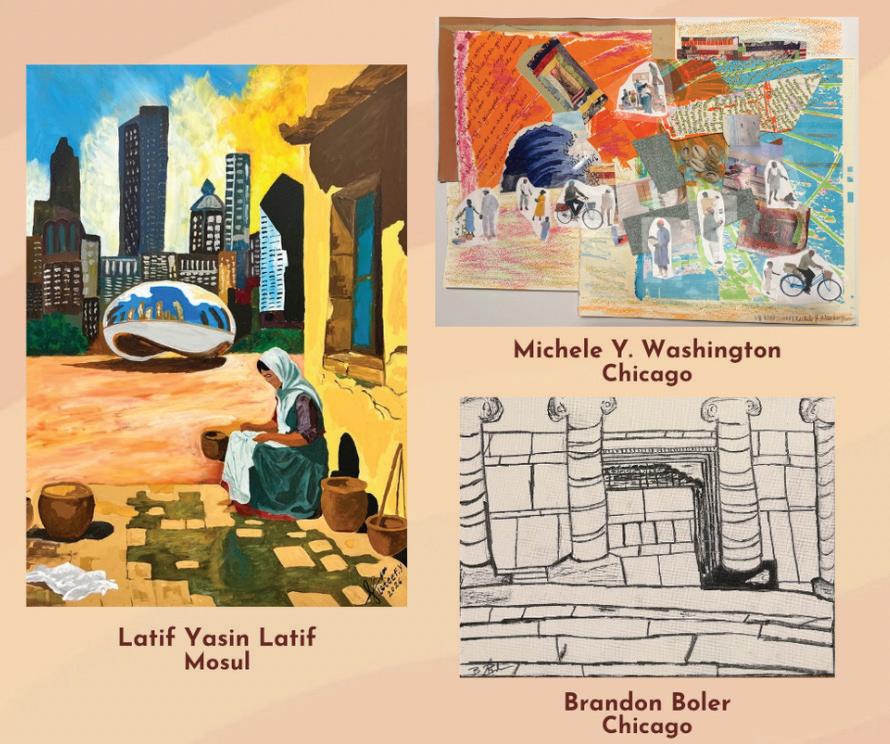
This opening reception launches Portal to Peace, a cross-cultural exhibition connecting Chicago, Mexico, and Iraq through visual art and exchange. The exhibition, located at Douglas Boulevard and Central Park Avenue features original works from Mosul, reproductions of Chicago artists’ work exhibited abroad, and new collaborative pieces emerging from the international project. The exhibition remains on view through June 8. (Starling by Duo, 3243 W. 16th St., 11 a.m.-2 p.m.)
Black Boy Joy | THROUGH 5/16
Artist Lavota Alexander’s Black Boy Joy exhibition has been extended through May 16 at the Lawndale Pop-Up Spot. Using colorful, childlike imagery and playful visual language, the exhibition centers Black childhood, imagination, family, and affirmation in a moment when representations of Black joy remain politically and culturally significant. The show continues the Pop-Up Spot’s mission of highlighting community-rooted art and neighborhood-based cultural programming. (Lawndale Pop-Up Spot, 3601 W. Douglas Blvd.; through May 16.)
LITERATURE
OH MOTHER Poetry Reading | SUN 5/17 Oak Park Art League’s seasonal poetry reading series celebrates motherhood in all forms through readings centered on gratitude, memory, and maternal bonds. The afternoon includes featured poets alongside an open mic inviting audience members to share original work in a welcoming community setting. (Oak Park Art League, 720 Chicago Ave., Oak Park, 2-4 p.m.)
Want to Submit an Event?
If you know of exciting arts and cultural events happening on the West Side and the west suburbs, send the event information (including date(s), time(s), venue, and ticket link to ourculture.us/ contact-us. While we try our best to be accurate, check with the event organizers because details may have changed since the time of print publication.