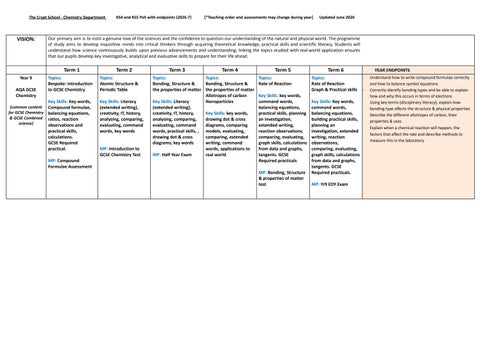
VISION:
Our primary aim is to instil a genuine love of the sciences and the confidence to question our understanding of the natural and physical world. The programme of study aims to develop inquisitive minds into critical thinkers through acquiring theoretical knowledge, practical skills and scientific literacy Students will understand how science continuously builds upon previous advancements and understanding; linking the topics studied with real-world application ensures that our pupils develop key investigative, analytical and evaluative skills to prepare for their life ahead.
AQA GCSE Chemistry
(common content for GCSE Chemistry & GCSE Combined science)
Topics: Bespoke: Introduction to GCSE Chemistry
Key Skills: Key words, Compound formulae, balancing equations, ratios, reaction observations and practical skills, calculations. GCSE Required practical.
MP: Compound Formulae Assessment
Topics: Atomic Structure & Periodic Table
Key Skills: Literacy (extended writing), creativity, IT, history, analysing, comparing, evaluating, command words, key words
MP: Introduction to GCSE Chemistry Test
Topics:
Bonding, Structure & the properties of matter
Key Skills: Literacy (extended writing), creativity, IT, history, analysing, comparing, evaluating, command words, practical skills, , drawing dot & cross diagrams, key words
MP: Half Year Exam
Topics:
Bonding, Structure & the properties of matter
Allotropes of carbon
Nanoparticles
Key Skills: key words, drawing dot & cross diagrams, comparing models, evaluating, comparing, extended writing, command words, applications to real world
Topics: Rate of Reaction
Key Skills: key words, command words, balancing equations, practical skills, planning an investigation, extended writing, reaction observations, comparing, evaluating, graph skills, calculations from data and graphs, tangents. GCSE Required practicals
MP: Bonding, Structure & properties of matter test
Topics: Rate of Reaction
Graph & Practical skills
Key Skills: Key words, command words, balancing equations, building practical skills, planning an investigation, extended writing, reaction observations, comparing, evaluating, graph skills, calculations from data and graphs, tangents. GCSE Required practicals.
MP: Yr9 EOY Exam
- Understand how to write compound formulae correctly and how to balance symbol equations
- Correctly identify bonding types and be able to explain how and why this occurs in terms of electrons
- Using key-terms (disciplinary literacy), explain how bonding type affects the structure & physical properties
- Describe the different allotropes of carbon, their properties & uses
- Explain when a chemical reaction will happen, the factors that affect the rate and describe methods to measure this in the laboratory
Year 10 Triple
AQA GCSE Chemistry
Topics:
Bonding & Structure & maths skills revision
Quantitative Chem Pt1
Key Skills: standard form, significant figures, rounding, percentages, ratios, calculations, estimating, balancing equations, moles, comparing, evaluating, analysing, practical skills, key words, command words, application to industrial process. GCSE Required practical.
MP: Quantitative test
Topics: Metal reactivity series
Electrolysis
Quantitative Chem Pt2
Key Skills: comparing, evaluating, analysing, balancing equations, key words, command words, explaining, application to industrial process. Standard form, significant figures, rounding, percentages, ratios, calculations, estimating, moles, practical skills.
GCSE Required practical
MP: Reactivity series & Electrolysis test
Topics: Chemical changesAcids and Salts
Key Skills: IT, pH probe, key words, balancing equations, practical skills, planning an investigation, extended writing, command words, reaction observations, comparing, evaluating, moles, ratios, calculations.
GCSE Required practical
MP: Half Year Exam
Topics: Energy changes
Using Earth’s resources
- green chemistry
Revision for EOY Exam
Key Skills: Graph skills, calculations, planning an investigation, command words, analysis, evaluation, balancing equations, moles, significant figures, ratios. application to industrial process
GCSE Required practical
Topics: Organic Chemistry Pt1
Year 10
Combined
AQA GCSE
Combined Science: Trilogy
Topics:
Bonding & Structure & maths skills revision Quantitative Chemistry
Key Skills: standard form, significant figures, rounding, percentages, ratios, calculations, estimating, balancing equations, moles, comparing, evaluating, analysing, practical skills, key words, command words, application to industrial process.
MP: Quantitative Chemistry Test
Topics:
Metal reactivity series
Extracting metals from Ores
Key Skills: comparing, evaluating, analysing, balancing equations, key words, command words, explaining, application to industrial process. Practical skills.
GCSE Required practical
Topics:
Electrolysis Chemical changes
Key Skills: IT, pH probe, key words, balancing equations, practical skills, planning an investigation, extended writing, command words, reaction observations, comparing, evaluating, moles, ratios, calculations.
GCSE Required practical
MP: Reactivity series Exam Qs
Topics:
Acids and Salts Revision for EOY Exam
Key Skills: IT, pH probe, key words, balancing equations, practical skills, planning an investigation, extended writing, command words, reaction observations, comparing, evaluating, moles, ratios, calculations. Command words and exam technique. GCSE Required practical
Key Skills: Drawing structures, key terms, analysis, evaluation, command words, balancing equations, volumes of gases, reaction observations, extended writing, application to industrial processes.
Topics: Chemistry of the Atmosphere
MP: Exam Week : AQA Paper 1
Key Skills: Key words, command words, balancing equations, comparing, evaluating data, graph skills, calculations from data and graphs, IT, extended writing, debating, application to current global issues – pollution, climate change & global warming
MP: Organic Pt1 & Chemistry of the atmosphere test
- To analyse and evaluate chemical reactions mathematically using a variety of formulae, to successfully calculate moles, masses, concentrations, yields, atom economy and gas volumes
- Know and understand why metals can be ranked in terms of reactivity; how it is utilised in reactions and in extraction of metals from ores
- Describe how electricity is used to breakdown ionic compounds to reform elements, the type of reactions occurring and how to test for the products
- Understand the pH scale in terms of H+ concentration, the difference between weak and strong acids
- Describe detailed methods to make salts from acids
- Describe reactions in terms of bond energy changes.
- Know how metal reactivity and electrolysis can be utilised as a chemical cell to produce an electric current
- Understand the basis of fuel cells and be able to compare them to batteries and conventional fuels
- To draw simple organic molecules and functional groups, and explain their properties
- Describe the evolution of the atmosphere and the modern problems that are affecting the balance of gases and life on Earth; explain some measures and possible new methods which could be deployed to mitigate the effect of the changing balance of these gases
Topics: Energy changes in chemical reactions
Key Skills: Graph skills, calculations, planning an investigation, command words, analysis, evaluation, balancing equations, moles, significant figures, ratios. GCSE Required practical
Topics:
Chemistry of the atmosphere
Key Skills: Key words, balancing equations, comparing, evaluating data & looking for patterns, practical skills graph skills, calculations from data and graphs, IT, debating, application to current global issues –pollution, climate change & global warming
- To analyse and evaluate chemical reactions mathematically using a variety of formulae, to successfully calculate moles, masses & concentration
- Know and understand why metals can be ranked in terms of reactivity; how it is utilised in reactions and in extraction of metals from ores
- Describe how electricity is used to breakdown ionic compounds to reform elements, the type of reactions occurring and how to test for the products
- Understand the pH scale in terms of H+ concentration, the difference between weak and strong acids
- Describe a detailed method to make salts from acids
- Describe reactions in terms of bond energy changes.
MP: Half Year Exam
MP: Exam Week : AQA Combined Chemistry Paper 1
MP: Chemistry of the atmosphere test
- Describe the evolution of the atmosphere and the modern problems that are affecting the balance of gases and life on Earth
Year 11 Triple AQA GCSE Chemistry
Topics: Organic Chemistry Pt2
Rate of reaction - the extent of chemical change
Key Skills: Drawing structures, key terms, analysis, evaluation, balancing equations, ratios, application to industrial processes & application to unfamiliar processes, link to natural processes.
MP: Organic Chemistry Pt2 Test
Topics:
Extent of chemical change - Haber process
Using Earth’s resources
- water treatment
Revision for Mock exam
Key Skills: comparing, evaluating, analysing, key terms, analysis, evaluation, balancing equations, ratios, application to industrial processes & application to unfamiliar processes. Exam skills, command words, key terms
MP: Extent of Chemical Change assessment
MP: Mock Exam: AQA Paper 1
Year 11
Combined
AQA GCSE Combined Science: Trilogy
Topics:
Organic Chemistry
Rate of reaction - the extent of chemical change
Key Skills: Drawing structures, key terms, analysis, evaluation, balancing equations, ratios, application to industrial processes & application to unfamiliar processes, link to natural processes.
MP: Organic Chemistry Test
Topics:
Analytical Chemistry Revision for Mock exam
Key Skills: command words, key terms, reaction observations. GCSE required practical. Exam skills, command words, key words, extended writing
MP: Extent of Chemical
Change assessment
MP: Mock Exam: AQA Combined Chemistry
Paper 1
Topics:
Chemical Analysis
Using Earth’s resources
- corrosion & metal extraction
Key Skills: practical skills, ionic equations, reaction observations, key words, extended writing, application to industrial process. GCSE Required practical.Evaluating data & interpreting graphs. Application to current global issuessustainability
MP: Analytical Chemistry assessment
Topics: Using Earth’s resources
- water treatment, metal extraction & green chemistry
Key Skills: comparing and evaluating data, analysing, key words, extended writing. Evaluating data & interpreting graphs. Application to current global issuessustainability
MP: Module 10 assessment
Topics:
Revision for Mock Exam
Using Earth’s resourcesmaterials
Specific maths and practical skills revision
Key Skills: Exam skills, command words, key terms. Planning, modifying and improving practical methods. Evaluating data & interpreting graphs, mole calculation revision.
Topics:
Revision of modules 1-5, Paper 1 Revision of modules 6-10, Paper 2
Key Skills: Exam skills, command words, subject specific key words, time management, written practical skills, evaluating and interpreting data, core skills. High level question analysis, linking topics and concepts
- Understand and explain the formation and reactions of organic compounds
- Link structure of organic compounds to their physical and chemical properties, including understanding of pH scale
- Analyse and evaluate data on our diminishing finite resources, including order of magnitude estimations, and carry out Life Cycle Assessments to evaluate new materials
- Understand how a reversible reaction in a closed system can reach equilibrium and understand how its position can be altered
- Successfully write compound formulae; know charges of complex ions and be able to balance symbol equations
- Use different analytical techniques to identify unknown substances
- Application of the scientific process to industrial scaling
- Complete understanding of all eight Required Practical Activities
- Confidently analyse, interpret and manipulate data
- Be able to answer high demand questions by linking knowledge from different topics and applying it to unfamiliar situations
MP: Mock Exam 2- AQA Paper 2
Topics:
Revision for Mock Exam
Specific maths and practical skills revision
Key Skills: Exam skills, command words, key terms. Planning, modifying and improving practical methods. Evaluating data & interpreting graphs, mole calculation revision.
MP: Mock Exam- AQA Combined Chemistry Paper 2
Topics:
Revision of modules 1-5, Paper 1
Revision of modules 6-10, Paper 2
Key Skills: Exam skills, command words, subject specific key words, time management, written practical skills, evaluating and interpreting data, core skills. High level question analysis, linking topics and concepts
- To draw simple organic molecules and explain their properties
- Analyse and evaluate data on our diminishing finite resources, including order of magnitude estimations, and carry out Life Cycle Assessments to evaluate new materials
- Understand how a reversible reaction in a closed system can reach equilibrium and understand how its position can be altered
- Successfully write compound formulae; know charges of complex ions and be able to balance symbol equations
- Application of the scientific process to industrial scaling
- Complete understanding of all six Required Practical Activities
- Confidently analyse, interpret and manipulate data
- Be able to answer high demand questions by linking knowledge from different topics and applying it to unfamiliar situations
Teacher1
Module 2: Foundations in Chemistry
Topics:
Electrons & bonding
Shapes of molecules & Intermolecular forces
Key Skills:
Understanding models, development of scientific thinking, analysis, evaluation, extended writing, application of knowledge to properties, 3D drawing, angles. Practical skills.
MP: Shapes & IMF assessment
Module 2 Foundations in Chemistry
Topics:
Atoms, Ions and Compounds
Amount of Substance
Key Skills:
Writing formulae, changing the subject of an equation, working with standard form and significant figures, using ratios, fractions, percentages, practical skills.
MP: Baseline test
MP: Calculationsassessment
Module 4 Core Organic chemistry & analysis
Topics:
Basic concepts in Organic Chemistry Alkanes & Alkenes
Key Skills: IUPAC rules, ratios, logical thinking & patterns, visualisation & drawing in 3D, analysis, evaluation, extended writing, radical substitution mechanism, electrophilic addition mechanism, application of structure to properties. Practical skills.
MP: Module 2 test (Ch 5-6)
Module 3 Periodic table & energy
Topics:
Acids and Redox The Periodic Table
Key Skills:
Using algebraic equations and solving them, plotting variables from experimental data, drawing and using the gradient of a tangent to a curve to measure rate, recognising and explaining patterns, analysing experimental data, practical skills
MP: Module 2 test (Ch 2-4)
Module 4 Core Organic chemistry & analysis
Topics: Alcohols Haloalkanes Organic Synthesis
Key Skills: IUPAC rules, logical thinking, drawing & visualisation in 3D, analysis, evaluation, nucleophilic substitution mechanism, application of structure to properties. Ethics, environmental concerns. Practical skills.
MP: January Assessment
Module 3 Periodic table & energy
Topics: Reactivity Trends Enthalpy
Key Skills: Using algebraic equations and solving them, plotting variables from experimental data, recognising and explaining patterns, evaluating, analysing experimental data, logical thinking, practical skills
MP: January Assessment
Module 4 Core Organic chemistry & analysis
Topics:
Organic Synthesis
Mass & IR Spectroscopy
Key Skills: Practical skills, purification techniques, analysis, logical thinking & looking for patterns, identification, data analysis, application of data and spectra to structure.
Module 4 Core Organic chemistry & analysis
Topics: Spectroscopy Revision
Key Skills: Analysis, logical thinking & looking for patterns, identification, data analysis, application of data and spectra to structure.
Exam skills, command words, understanding mark schemes
Module 6 Organic Chemistry & analysis
Topics: Aromatic chemistry
Directing groups
Key Skills: Understanding models, development of scientific thinking, IUPAC rules, logical thinking, analysis, evaluation, extended writing, nucleophilic substitution mechanism, application of structure to properties. Practical skills.
- Apply new terminology and concepts to previous understanding of structure and bonding
- Describe how the shape and polarity of molecules gives rise to their properties
- Understand that these properties can relate to forces that exist between or within molecules
- Apply new ideas about sigma- and pi-bonds to explain bonding and reactivity of organic molecules
- Be able to represent and name organic molecules and functional groups using IUPAC nomenclature
- Represent the reactions of different organic molecules in terms of reaction mechanisms, reagents and conditions
- Investigate the reactions of organic molecules using a variety of practical equipment and techniques
- Be able to apply knowledge of practical organic chemistry techniques in written exams
- Identify the structure of organic molecules using spectrometry and spectroscopy
MP: Alcohol to Organic synthesis test
MP: EOY Exam-Paper 2
MP: Cambridge Chemistry Challenge
Module 3 Periodic table & energy
Topics: Equilibrium and Reaction Rates
Key Skills:
Applying the conservation of energy principle, data analysis, logical thinking, interpreting diagrams, looking for patterns, drawing and using the gradient of a tangent to a curve, constructing enthalpy cycles, calculating constants, practical skills
MP: Enthalpy & Rates of Reaction Test
Module 3 PT & energy
Module 5 Physical chemistry
Topics: Revision Equilbrium Rates of reaction
Key Skills: Exam skills, command words, understanding mark schemes
Drawing and using the gradient of a tangent to a curve, calculating constants
MP: EOY Exam-Paper 1
Module 5 Physical chemistry
Topics: Rates of Reaction
Key Skills: logarithms and their inverse, algebraic equations, plotting experimental data, graphical analysis, working with indices, practical skills
- To have a deep understanding of atomic, isotopic and ionic structure in terms of subatomic particles and be able to interpret this using mass spectrometry
- To analyse and evaluate chemical reactions mathematically in terms of determining their formulae, moles, mass, volume, yie d, and ratios through manipulating mathematical equations appropriately
- To be able to apply and explain a range of practical and analytical techniques to identify chemical species and determine mass, concentration, energy change by experiment
- Use the Periodic Table to describe and explain in detail a wide range of trends n the properties, bonding and structure of elements think ng in Groups (horizontal) and Periods (lateral)
- To understand and explain the trends in reactivity of Group 2 and Group 7 elements and their uses
- To understand how energy (enthalpy) plays a fundamental role in driving chemical reactions and to be able to calculate and measure this by experiment and theoretically using Hess’ Law
MP: Cambridge Chemistry Challenge
- To articulate and exp ain how reactions can be manipulated to affect the rate of reaction and pos tion of chemical equilibrium, and to express this position mathematically.
OCR(A) A-level Chemistry
Module 6 Organic Chemistry & analysis
Revision of arenes & reactions
Yr13 Organic Chemistry
Teacher1
Carbonyls, carboxylic acids,esters and acyl chlorides
Key Skills:
IUPAC rules, logical thinking, analysis, evaluation, electrophilic substitution mechanism, nucleophilic addition mechanism, application of structure to properties.
3D-visualisation and drawing. Practical skills.
MP: Module 1,2,4 assessment
Module 5: Physical chemistry & transition elements
Acids, Bases and pH Buffers, Neutralisation
Key Skills:
Changing the subject of, substituting numbers into, and solving algebraic equations, plotting experimental data, graphical analysis, logical thinking, calculating constants, using indices practical skills
MP1: Module 1,2,3 assessment
Module 6 Organic Chemistry & analysis
Amines, amino acids, amides & chirality
Condensation polymers
Key Skills:
IUPAC rules, logical thinking, looking for patterns, analysis, evaluation, nucleophilic addition mechanism, application of structure to properties.
3D-visualisation and drawing. Practical skills.
MP: November Assessment
Paper 2 Organic exam
Module 6 Organic Chemistry & analysis
Organic synthesis, Synthetic routes
Functional group analysis
Key Skills:
IUPAC rules, logical thinking & looking for patterns, analysis, evaluation, visualisation, extended writing. Practical skills.
MP: RSC Olympiad
Module 6 Organic Chemistry & analysis
Carbon-13 NMR
Proton-NMR
Key Skills: Analysis, evaluation, identification, visualisation, mathematical skills, logical thinking & problem solving
MP: Mock Paper 2
Module 6 Organic Chemistry & analysis
Chromatography
Combined Techniques
Synoptic concepts
REVISION
Key Skills: Analysis, evaluation, identification, visualisation, mathematical skills, logical thinking & problem solving. Exam skills, command words, subject specific key words, application, evaluation, practical skills, application of knowledge to a variety of unfamiliar molecules and reactions.
MP: Mock Paper 3
Module 5: Physical chemistry & transition elements
Enthalpy and Entropy Redox and Electrode Potentials
Key Skills: Analysis, evaluation, applying conservation of energy, logical thinking, Changing the subject of, substituting numbers into, and solving algebraic equations, plotting experimental data, graphical analysis, practical skills
MP: November Assessment Paper 1 Physical exam
Module 5: Physical chemistry & transition elements
Redox and Electrode Potentials
Key Skills:
Analysis, evaluation, applying conservation of energy, logical thinking, Changing the subject of, substituting numbers into, and solving algebraic equations, plotting experimental data, graphical analysis, practical skills
MP: MOCK Paper 1
MP: RSC Olympiad
Module 5: Physical chemistry & transition elements
Transition Elements
Key Skills:
Changing the subject of, substituting numbers into, & solving algebraic equations, graphical analysis, interpreting data, logical thinking, applying principles to unfamiliar electrochemical cells, stereochemistry & links to organic chemistry. Practical skills
Module 5: Physical chemistry & transition elements
Synoptic concepts
REVISION – modules 2, 3, 5 and practical techniques
Key Skills: Exam skills, command words, subject specific key words, application, evaluation, practical skills
- Recall and explain the synthesis of organic functional groups; their typ cal reactions and propert es
- Full understand ng of how reactions happen and be able to apply these to unfamiliar situations
- Be able to identify and explain optical isomerism, and ch rality
- Be able to explain and show mechanisms for extending the carbon chain n aliphatic and aromatic molecules
- Investigate and explain how to practically synthesise molecules containing functiona groups from Yr12 and 13
- To purify an organic solid and to test for the functional groups and purity
- Compose multi-stage synthetic routes for preparing organic compounds
- Effectively use carbon-13 and proton-NMR in connection with previous analytical technique to correctly identify complex organic molecules
- Be able to combine knowledge from all modules to successfully answer synoptic/unfamiliar quest ons
MP: Mock Paper 3
- To apply mathematical skills to analyse chemical reactions quantitatively in terms of equilibrium, rates and energy for the first time.
- To determine by calculat on the extent, speed and feasib lity of chemical reactions
- To evaluate the quantitative effects of temperature, pressure and concentration on the rate of reaction and chemical equilibrium, and understand how these can be manipulated to control industrial processes
- To understand the importance of acids, bases and pH in chemical and bio ogical processes
- To calculate pH of strong acids, weak acids, alkalis and buffer solutions and analyse pH curves
- To understand the role of buffers in maintaining blood pH as a case study for the essential role of acids and bases to health and wellbeing
- To determine whether chemical reactions are feasible and spontaneous by applying the pr nciples of energy and entropy and studying electrode potential and electrochemistry
- To understand the importance of redox reactions in electrochemical cel s, including fuel cells and those used to power portable devices (batteries)
- To develop pract cal skills with techniques including continuous mon tor ng, measuring pH using pH meter, redox titrations, measuring potent al difference of electrochemical cells
- To understand in detail the chemistry of the transition metals/d-block elements, including the colours, shapes and react ons of their ons, how complexes form, and how and why chemical and physical properties change in the centre of the Periodic Table