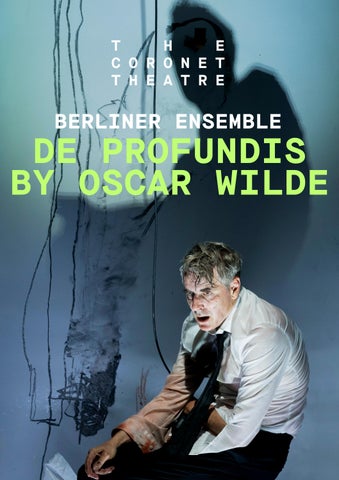
BERLINER ENSEMBLE
DE PROFUNDIS BY OSCAR WILDE
WELCOME TO LONDON’S INTERNATIONAL THEATRE The Coronet Theatre is a reimagined architectural and design jewel, originally built as a grand Victorian Playhouse, now a pioneering home for international, cross-disciplinary arts. Curated by Artistic Director Anda Winters, over the past decade it has become a significant cultural landmark. Known for world and UK premieres, its mission is to bring artists and art forms from around the world, championing work that would not otherwise be seen. The programme enables access for diverse audiences to world-class theatre, dance, music, film and visual arts through co-productions, commissions, and invited works. Centrally situated in London’s Notting Hill, The Coronet has two main spaces: The Auditorium and The Print Room Studio. With the additional performances and exhibitions in the bar, the atmospheric upper rooms, and basements, the whole building is a living global showcase.
BERLINER ENSEMBLE DE PROFUNDIS BY OSCAR WILDE DIRECTED BY OLIVER REESE & PERFORMED BY JENS HARZER From the Berliner Ensemble, award-winning German actor Jens Harzer performs Oscar Wilde’s De Profundis. Directed by Berliner Ensemble Artistic Director Oliver Reese, this masterful performance captures Wilde’s impassioned reflection on his life and society. In 1895, Oscar Wilde was sentenced to two years in prison – for being provocative; for loving men, for not hiding his true self and for defying convention. His trial was meant to be a warning to others – against the crime of homosexuality and his irrepressible drive for freedom and recognition. While imprisoned, he wrote a long, impassioned letter to his estranged young lover, Lord Alfred Douglas. Later published as De Profundis, Wilde’s letter describes the unbearable pains and blissful pleasures of his love, as well as his views on art, Christianity, and incarceration, and a society that doesn’t tolerate what it doesn’t understand. De Profundis is the last outcry of a broken but untamed spirit. Bankrupt and shunned by society, Wilde writes with literary mastery about contempt and loneliness, about pride and pain. What remains when everything that a person once was is taken away from them?
CAST & CREATIVE TEAM Text
Oscar Wilde
Direction
Oliver Reese
Performer
Jens Harzer
Stage Design
Hansjörg Hartung
Costume Design
Elina Schnizler
Music
Jörg Gollasch
Lighting Design
Steffen Heinke
Dramaturgy
Johannes Nölting
German Translation
Mirko Bonné
Photos
Jörg Brüggemann
“When one has weighed the sun in the balance, and measured the steps of the moon, and mapped out the seven heavens star by star, there still remains oneself." Oscar Wilde
DIRECTORS’ NOTE Oliver Reese I have been waiting to adapt and direct Oscar Wilde's De Profundis for over two decades now. To me, this love-and-hate letter is one of the greatest works of art not only in the English language. Its beauty and vigour, its precision and excessiveness, the abyss and the heavens of what it means to be a lover and an artist, the attempt to live with oneself under the worst conditions — all of this has accompanied me for a large part of my artistic career. But there was always something missing. Only last year, when a brilliant new German translation by the poet Mirko Bonnè succeeded in carrying Wilde's mesmerising language into an adequate German version, the thought of staging it returned. But how does one speak these lines without losing oneself in them? Then, as fortune rarely allows in one's career, Jens Harzer, bearer of the Iffland-Ring, the most important and influential honour for actors in the German-speaking world, came to work at the Berliner Ensemble, and, as it happened, had never performed a monologue before. That is when I knew. This text, though written by a famous author, belongs to no stage tradition and to no performance canon. We didn't know whether it would find its audience, but we knew we had to try.
We plunged into it together and understood that this text, so much more than a letter, a confession, a philosophical treatise, a sermon to a fallen angel, belongs on stage. But how does one stage a life, not just its words? As Oscar Wilde's life was destroyed by the British society of the Victorian age, we felt it would not be possible to re-enact Wilde's most tragic last years. Instead, our attempt was to incorporate the musicality and logical coherence of his thoughts as if it were a score: a composition of free jazz that carries Jens through the precipices of Oscar's life. When we started, we would never have dreamed that we, after more than forty sold-out shows in Berlin and invitations to festivals in Hamburg, Vienna and Salzburg, would be able to bring Oscar home to London with this series of performances at the Coronet Theatre.
BERLINER ENSEMBLE Berliner Ensemble is one of the most renowned and long-standing theatres in Germany. Named after Bertolt Brecht’s and Helene Weigels world-famous company, Berliner Ensemble has written theatre history. Throughout its more than 125-year history, the theatre on Schiffbauerdamm has always addressed issues of current social relevance, and from the 2017/18 season, the beginning of Oliver Reese’s tenure as Artistic Director, Berliner Ensemble once again places a stronger focus on contemporary texts and topics. In the tradition of its former Artistic Directors, Bertolt Brecht and Heiner Müller, and under its current director Oliver Reese, Berliner Ensemble directs its attention on theatre that reflects upon our present times – not only in its productions but also in numerous discourse formats that provide space to address and reflect on politically relevant issues.
BERLINER ENSEMBLE AT THE CORONET THEATRE THE TIN DRUM (2020) An adaptation of Günter Grass's novel was brought to London in February 2020 - the first visit from the Berliner Ensemble to London since 2006. Performed solely by Nico Holonics and directed by Oliver Reese: a story of Nazism, post-war guilt and the German Psyche told through the lens of Oskar - a child who refuses to grow beyond the age of three. It recieved stellar reviews.
STRANGER THAN THE MOON (2024) The Berliner Ensemble returned in 2024 to tell us the story of its own founder - Bertolt Brecht – in his own words, using his poems, songs, biographical notes and video to create a kind of concert portrait to convey his life.
The Tin Drum; Photo: Birgit Hupfeld
The Tin Drum; Photo: Birgit Hupfeld
Stranger than the Moon; Photo: JR Berliner Ensemble
1895: CHRONICLE OF A SCANDAL BY ANTONIA HÄNSCH
At the height of his career, Oscar Wilde was sentenced in 1895 to two years in prison with hard labour. His private life became public, and was portrayed as scandalous. Here, we present an overview of the events of this significant year in Wilde’s life.
At the age of 40, Oscar Wilde had achieved his breakthrough: On January 3, 1895 , his play An Ideal Husband premiered in London, followed by The Importance of Being Earnest on February 14. These successful performances made the writer a star of the London art scene. He had previously gained a certain reputation through lectures and newspaper articles. In 1890/91, his novel The Picture of Dorian Gray was published, which, despite poor reviews, garnered initial attention in London. Four days later, on February 18 , the Marquess of Queensberry – father of Wilde’s lover, Lord Alfred Douglas – placed a calling card in Wilde’s club, publicly calling him a “posing sodomite.” This was a serious accusation, as homosexuality was not only frowned upon but also illegal in Victorian England. The married Wilde and the 16-years-younger aristocratic student Alfred Douglas, nicknamed “Bosie,” met in 1891 and had a relationship. Douglas introduced him to the luxurious life of the upper class – they threw parties, dined in expensive restaurants, and travelled through Europe and North Africa – but also to the red-light district, where he introduced him to prostitutes, some of whom were underage. Wilde lived beyond his means and paid all the expenses. The public and theatres reacted to Queensberry’s accusations and considered cancelling Wilde’s plays. Bosie, who had been estranged from his father for years, persuaded the already heavily indebted Wilde to file a libel suit against the Marquess. On April 5, after two days of trial, he was acquitted, as he was able to prove through witness testimony and private investigators that Wilde had committed homosexual acts. Wilde paid the court costs and was arrested immediately afterward.
On April 26, his trial for “gross indecency” began. Letters and partially manipulated witness statements were presented as evidence in court. Wilde had previously had several opportunities to flee abroad and thus escape conviction, but declined, believing he would win. On May 25, he was sentenced to the maximum penalty: two years of solitary confinement and hard labour. Shortly afterward, the Marquess initiated bankruptcy proceedings against Wilde. He lost all his possessions and the rights to his work. After several months in various prisons, he was transferred to Reading Gaol in November 1895 , where he had to serve his sentence despite several pleas for clemency.
JENS HARZER Jens Harzer has been a member of the Berliner Ensemble since the 2025/26 theatre season. Born in Wiesbaden in 1972, he trained as an actor at the Otto Falckenberg School in Munich. From 1993, he spent 16 years as a member of Dieter Dorn’s company, first at the Munich Kammerspiele and later at the Bavarian State Theatre in Munich. He also appeared as a guest at venues including the Schaubühne in Berlin, the Deutsches Schauspielhaus in Hamburg, Schauspiel Frankfurt, the Salzburg Festival, the Deutsches Theater in Berlin and the Burgtheater in Vienna. During these years, he worked with directors including Dieter Dorn, Peter Zadek, Andrea Breth, Herbert Achternbusch, Luc Bondy and Jürgen Gosch. In 2009, Harzer moved to the Thalia Theater in Hamburg, where he worked with, among others, Dimiter Gotscheff, Stefan Pucher, Luk Perceval and Leander Haußmann. For his role as the Marquis de Posa in Schiller’s Don Carlos, directed by Jette Steckel, he was named “Actor of the Year” for the second time in 2011. Since 2018, Jens Harzer has regularly appeared as a guest at Johan Simons’ Schauspielhaus Bochum. In film, he has worked with directors including Michael Verhoeven, Hans-Christian Schmid, Bülent Akinci and, most recently, Tom Tykwer, Wim Wenders and Hermine Huntgeburth. In addition to numerous national and international prizes and awards, Jens Harzer has, since 2019, been the holder of the Iffland-Ring, succeeding Bruno Ganz. It is one of the highest distinctions awarded to theatre actors in the German-speaking world.
Photo: Julian Baumann
OLIVER REESE Oliver Reese was born in 1964 in Schloss Neuhaus near Paderborn. After studying Modern German Literature, Theatre Studies and Comparative Literature in Munich, he worked as an assistant director at Münchner Kammerspiele, Düsseldorfer Schauspielhaus and Bayerisches Staatsschauspiel, where he took the position of dramaturg in 1989. In 1991, he was appointed head dramaturg at Theater Ulm. From 1994 to 2001, Oliver Reese was head dramaturg at Maxim Gorki Theater Berlin. Following this, he was appointed head dramaturg and deputy artistic director of Deutsches Theater Berlin (DT) by artistic director Bernd Wilms. During his time at DT, he worked with directors like Hans Neuenfels, Robert Wilson, Michael Thalheimer and Jürgen Gosch. In 2008, Deutsches Theater was voted to be Theatre of the Year. During the 2008/2009 season, Oliver Reese was DT’s interim artistic director and the theatre was invited to present Jürgen Gosch’s production of Die Möwe (The Seagull) at the Berlin Theatertreffen. From 2009 to 2017, Oliver Reese was artistic director of Schauspiel Frankfurt. During his tenure there, he raised the audience number to record levels with a repertory that ranged from the classics to the most recent contemporary drama. After eight years at Schauspiel Frankfurt, Oliver Reese took up his position as artistic director of Berliner Ensemble from the 2017/18 season. This marked his return to Berlin, where he had previously created theatre for 15 years.
Photo: Julian Baumann
DET NORSKE TEATRET
SKODESPELET BY JON FOSSE
(THE PLAY)
G W A N T O N1 G8
AMBIGUOUS DANCE COMPANY’S
BORAM KIM
AN EXHILARATING DANCE SOLO. A BODY PUSHED TO ITS LIMIT.
NON-ORDINARY SERVICES
D_ANTIDOTE & PALINGENESIS 28-31 Oct
A DOUBLE-BILL FROM AWARD-WINNING TAIWANESE DANCE COMPANY
ONE ARTIST. TWO AIS. AN IMMERSIVE CONCERT GENERATED IN REAL TIME.
<FRANKENTACIT> TACIT GROUP
THE CORONET THEATRE TEAM Artistic Director & CEO Anda Winters
Box Office Assistant Ivana Dieli
Audience Experience Manager Giudi Di Gesaro
Duty Managers Francesca Battinieri, Annabelle Gardner, Joanna Papanastassiou, Aylin Rodoplu, Hazel Townsend
Company & Production Coordinator Emma Smith Consultant Producer Hetty Shand Finance Manager Andrew Michel General Manager Andy McDonald Lead Technician Louis Williams Marketing Manager (Freelance) Elliot Hall Poetry Coordinator Marion Manning PR Consultant Sharon Kean Producer Daphne Seale Producing & Marketing Assistant Esme Bishop Theatre Administrator / PA to the Artistic Director Vihaan Chandy
Front of House Staff Matilda Badziak, Eugénie Bakker, Samya Bose-Rosling, Theo Chen, Stephanie Christodoulidou, Marcello Crisci, Merilee Ettia-Russell, Cheryl Fairon, Katrina Foster, Trey Francis, Thea Gavanski, Alessandra Gonnella, Hugo Gregg, Li Ikoku-Smith, Dane Kostic, Emma Laird-Craig, Maria Lisberg-Jonasson, Aija Miranda, Hamza Mullick, Andreane Rellou, Robert Veng, Kajsa Wiberg-Norquist Trustees Linda Bernhardt, Mike Fisher, Mimi Gilligan, Jane Quinn, Anda Winters, Bill Winters (Chair) Thank you to our patrons for their generous support: Honorary Trustee Mimi Gilligan Cupola Mike Fisher and T. S. Eliot Foundation Club Room Tom and Maarit Glocer, Julia and Scott Rochester, and Jane Quinn
BECOME A FRIEND BE PART OF LONDON’S INTERNATIONAL THEATRE
FROM JUST £10 PER MONTH
103 NOTTING HILL GATE LONDON W11 3LB HELLO@THECORONETTHEATRE.COM +44 (0) 20 3642 6606 thecoronettheatre.com Instagram: @thecoronettheatre Twitter @coronetthetre