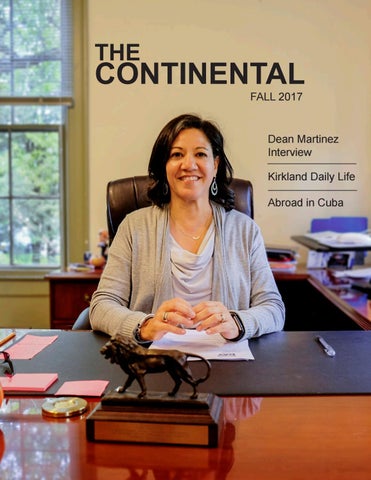
THE
CONTINENTAL FALL 2017
Dean Martinez Interview Kirkland Daily Life Abroad in Cuba
THE CONTINENTAL @contmag Contmag@hamilton.edu The Continental issuu.com/hamiltoncontinental
THE CONTINENTAL | FALL 2017 | 1
ON THE HILL 6
TABLE OF CONTENTS
OPINION 14
FEATURES 24
TRAVEL 30
ENTERTAINMENT 36
LIFESTYLE 44
2 | THE CONTINENTAL | FALL 2017
THE CONTINENTAL | FALL 2017 | 3
EDITOR’S NOTE The start of a new year at college can always feel a bit overwhelming; regardless of how you spent your summer vacation, the demands created by a combination of classes, jobs, clubs, and schoolwork can be both exhilarating and exhausting. Thus, after returning to Hamilton from our semesters abroad, both of us were excited but nervous to take on our new roles at Editors-in-Chief; however, we soon found that having worked with The Continental for years, dedicating time to making the best magazine possible feels less like an obligation and more like a familiar, comfortable process. And as we began our final year at Hamilton, we found ourselves really wanting to slow down and appreciate the community we’ve lived in for the past 3 years, both on and off the Hill. With this issue, we were able to look both forward to the future with Features Editor Thomas Duda’s interview with new Dean of Students Terry Martinez, and back to our roots as a college with a look back on daily life at Kirkland College. Creativity and hard work aren’t difficult to come by at Hamilton, and we’re happy that we could highlight students’ achievements with articles on student research projects and Paula Ortiz’s documentary film work. Although we are not primarily a humor magazine, we like to leave space for some humor pieces; so, discover where you’ll be settling in for a long night of studying in Lifestyle Editor Grant Hamilton’s “Where To Study On-Campus” infographic, and if you’ve ever found yourself wondering exactly how Hamilton’s governance works, look no further than Caroline Langan and Lucy Marr’s “Hamilton Governance for Dummies.” We also found several off-campus initiatives we felt deserved more attention; Entertainment Editor Julie Katter discusses the history of the Players of Utica, and Krissi Kim highlights the ways Hamilton students can get involved with Utica’s various refugee organizations. We would have nothing to publish if it weren’t for our absolutely incredible, dedicated staff. Our writers, editors, photography, and layout team went above and beyond this fall, and we can’t thank them enough for the passion and professionalism that they showed. Our goal with every issue is to spotlight some aspects of Hamilton that generally fly under the radar, and we hope that after reading, you’ll have learned something about our community that you didn’t know before. Enjoy!
& 4 | THE CONTINENTAL | FALL 2017
CONTRIBUTORS EDITORS-IN-CHIEF Olivia Paradice ‘18 Alex Scheuer ‘18
CREATIVE DIRECTOR Anika Huq ‘19
DIRECTOR OF PHOTOGRAPHY Kennie Zhou ‘20
SECTION EDITORS Meredith LaBelle ‘19 | On the Hill Caroline Langan ‘18 | Opinion Thomas Duda ‘18 | Features Maura Colley ‘19 | Travel Grant Hamilton ‘18 | Lifestyle Julie Katter ‘18 | Entertainment
EDITORS AT LARGE
Philip Marks ‘21 Krissi Kim ‘21
SOCIAL MEDIA MANAGER Erin Bryant ‘21
LAYOUT DESIGNERS
Anika Huq ‘19 Levana Lyu ‘21 Dan Tu ‘20 Will Von Weise ‘19 Jianyi Yang ‘21 Chenchen Zhao ‘19
PHOTOGRAPHERS Alex Chalk ‘20 Penelope Hoopes ‘20 Stephana Lim ‘21 Lily Yangchen ‘20 Kennie Zhou ‘20
WRITERS
Lucy Marr ‘18 Marisa Cooke ‘20 Caroline Langan ‘18 Genevieve Shuster ‘20 Katie Weinzierl ‘21 Sam Fogel ‘19 Thomas Duda ‘18 Anya Nugent ‘18 Bianca MacDonald ‘21
Andy Letai ‘19 Maura Colley ‘19 Natalie Basta ‘19 Krissi Kim ‘21 Grant Hamilton ‘18 Louis Dzialo ‘19 Philip Marks ‘21 Erin Bryant ‘21 Julie Katter ‘18 Audrey Darnis ‘18
THE CONTINENTAL | FALL 2017 | 5
A DAY IN THE LIFE OF A KIRKLAND STUDENT GENEVIEVE SHUSTER ‘20
In the ten years before Kirkland College and Hamilton College merged, hundreds of women enjoyed a quality education and found a wonderful home at Kirkland. These women remain an integral part of Hamilton’s legacy. Janet Watrous, a member of the Kirkland Charter class and current pastor from Binghamton, New York, graciously agreed to share her Kirkland experience in an effort to paint a vibrant picture of a day in the life of a Kirkland student.
6 | THE CONTINENTAL | FALL 2017 | ON THE HILL
ON THE
HILL
ON THE HILL | THE CONTINENTAL | FALL 2017 | 7
WAKING UP ON THE NORTH SIDE 8 | THE CONTINENTAL | FALL 2017
Kirkland College was located on the north side of Hamilton’s current campus which had only three dorms in Kirkland’s early days: Major, Minor, and Macintosh. Janet lived in Major her first year and Minor her second; she has especially fond memories joking around with friends in Major. Today’s Hamilton students often throw on a favorite Hamilton or Kirkland sweatshirt in the morning. Kirkland students enjoyed spirit wear as well, but Janet’s personal favorite piece is a little more eclectic than a sweatshirt— a green Kirkland hardhat, which she has kept to this day!
GRABBING A BITE Kirkland students spent a great deal of time on the Hamilton campus— especially during the first year, when the only dining options were on Hamilton campus. McEwen was but a figment of the imagination; so Kirkland students journeyed to the south side of campus for sustenance, rain or shine. According to Janet, this communal eating served as an important unifier in the first year. Preferences for one side of campus or another didn’t seem to develop until the dining options expanded, “I think it was after there were more options for eating, for example, that perhaps students developed a preference for one side of College Rd. or the other,” noted Janet.
GOING TO CLASS HANGING OUT Hamilton and Kirkland students socialized together on both sides of campus, enjoying the individual amenities each campus had to offer. Janet described some of her personal favorite spots to enjoy with friends, “The Bristol Campus Center was a meeting place with both Kirkland and Hamilton friends…I played a fair amount of tennis and skated on Sunday afternoons at the college rink.” Some of Janet’s favorite spots were even on the Hamilton side of campus, “My favorite spot on the campus was the Bristol Campus Center, and second favorite was the chapel.
Kirkland and Hamilton students didn’t just interact in the dining hall; each campus was home to it’s own set of departments and classes that students from either campus could partake in. Kirkland College brought with it the additions of creative writing, art, and social science departments. According to Janet, sharing classes was one of the ways Kirkland and Hamilton students connected; “I made friends with a several Hamilton students through classes with them, eating at the refectory, etc. I enjoyed a wide range of friendships.” Janet’s favorite class she took at Hamilton was a poetry class— she even babysat that professor’s children a few times in true liberal arts fashion.
THE CONTINENTAL | FALL 2017 | 9
The Kirkland women are known for their intellectual prowess and pioneering spirit. Although Janet transferred to the University of East Anglia, in Norwich, England after studying there for her semester abroad, I believe that she fostered her propensity for embracing the new during her time at Kirkland. In the process of explaining where life had taken her since her time at Kirkland, she affirmed her legacy as a Kirkland woman, “I was drawn to “doing a new thing” without feeling I had to abandon what had come before.”
10 | THE CONTINENTAL | FALL 2017
Growth for the Hamilton Community Garden By Samantha Fogel ‘19
In
volvement in Hamilton College’s Community Garden has ebbed and flowed since its foundation in 2007. Although the garden has taken a brief hiatus for the past year, Talea ShakunBerkelhammer ’20 and Jack Anderson ’18 are spearheading a movement for a garden revitalization project this semester.
In
an interview with ShakunBerkelhammer, she elaborated on the goals for the community garden. “This is a regenerative plan,” she began, “this semester, our first priority is getting the funding we need and setting up a system of support from the students and faculty as well as forming a relationship with physical plant.” Already, over 100 students have emailed ShakunBerkelhammer and Anderson, expressing interest. A committee of students are currently working on the project and budget proposal to bring to Physical Plant and the Levitt Center. 25 people have signed up to commit a week of their time to the garden once it gets going in the spring. “It’s wonderful to see that people care that much,” said ShakunBerkelhammer.
THE CONTINENTAL | FALL 2017 | 11
T
he garden will put heavy emphasis on community with participation from a myriad of different groups, including wellness and physical education classes, local high school students, and refugee populations from Utica.
S
hakun-Berkelhammer explained the purpose of the community garden. “Our goal is to make the garden an integral part of the community as well as academics. We want it to be a place that people frequent and spend time at and see the fruits of their labor. We often chase after intangible and impossible goals at Hamilton like the perfect GPA. But there are few things as concrete and tangible as seeing the food that you grow. The Hamilton Community Garden is about simultaneously caring for the earth and for the people.”
E
xpected to transition to a permaculture model, the new garden will rely heavily on perennial crops. Perennial crops are particularly appealing to the garden because they continue to grow year after year with minimal maintenance, not to mention their environmental benefits for the soil. Shakun-Berkelhammer explains that this provides security for the garden when interest and activity from the student body lags. “We’re not omitting annuals, we’re just reducing the quantity,” she clarifies. “If we don’t have someone in place to take care of the garden this summer, we don’t want to set the food up for failure.” We can expect to see perennial crops such as artichokes, fruit and nut trees, and gooseberries.
To get involved email tshakunb@hamilton.edu or jdanders@hamilton.edu.
12 | THE CONTINENTAL | FALL 2017
CARING FOR THE EARTH AND FOR THE PEOPLE
To
many students here at Hamilton, faith and religion are incredibly i m p o r t a n t a s p e c t s o f d a i l y l i f e . L u c k i l y, t h e C h a p l a i n c y a t H a m i l t o n offers a wide range of services to support all students of many different faiths, such as study groups, observance of holy days, experiences of prayer and meditation, interfaith engagement, and opportunities to learn about ideas different from your own. It also exists to embrace inclusivity and spiritual diversity. The many faculty members that are a part of the Chaplaincy include Jeff McArn, Anat Guez, Mireille Koukjian, John Croghan, and many more, all having backgrounds in different religions and beliefs. Jeff McArn, the College Chaplain, explained that “for a small campus, we have some good resources, such as a Muslim prayer room, a Meditation Room, and a beautiful chapel for Christian services,” but that he would like to “build in more time for chaplaincy staff to be available on campus for the building of interfaith community.” This would allow the students of the many different religions represented at Hamilton to come together and learn more about the each other. He also stated that his favorite thing about the Chaplaincy is the “building of community at our college which has some center of meaning, some investigation around values, and inviting the consideration of living life guided by that meaning and those values.” Although faculty members are the main leaders of the Chaplaincy at Hamilton, there are also many religious student organizations around campus. Some of these groups include Fellow-
ship of Christian Athletes (FCA), Hillel, and Muslim Student Association (MSA). Karl Koster, a leader of FCA, explained that his favorite thing about being a part of the Chaplaincy is “the opportunity to experience my own journey of faith in the presence of other believers.” He also stated that he wished “the groups and programs appeared more fun and exciting from the outside” because of how fulfilling they are. Another student organization leader, Abigail Tulchinsky of Hillel, remarked that “all the groups under the Chaplaincy really support each other” and that “having a religious organization on campus is having a group of people to share a similar cultural and religious identity with” is what makes the Chaplaincy so special to her. The Chaplaincy itself may seem like a mystery to many students on campus. But not only does it offer religious services and student organizations, it allows students a peaceful space to reflect and meditate. So, stop by the Chapel, take some time to step back from your busy life, and get to know the incredible individuals involved with the Chaplaincy here at Hamilton. THE CONTINENTAL | FALL 2017 | 13
OPINION
guide p e t s y b p e t s A
to
! n o i t a r t s i n i m ad s ’ n o t l i m a H g n di
understan
n o t l i m Ha e c n a n r e v Go
It takes a lot for a college to run smoothly when the weather is usually below freezing. It’s like whenever you’re feeling under the weather, the weather is probably feeling even more under the weather. It’s easy to coexist with all the adults who work in the random buildings you only hear ghost stories about, but it’s our job to show you what they really do!
Lucy Marr ‘18 Caroline Langan ‘18 14 | THE CONTINENTAL | FALL 2017
PRESIDENT: David Wippman PERKS
REALITY
Plenty of exercise! Biking, kayaking, rock climbing, you name it!
Responsible for the organization and administration of Hamilton
Free apparel
Recommend new initiatives and policies to the Board of Trustees
Guaranteed Instagram fame
Submit an annual budget to the Board and execute the approved budget
Booze with alumni, enough for them to give their $$$ away
Fundraising
Meet and take pictures with famous alumni
VP & DEAN OF STUDENTS: Terry Martinez
PERKS Parts the sea of students upon approach from mere fear of authority Housing that every student once dreamed of living in
REALITY Focus on student activities, student leadership and engagement, intellectual and personal growth, a safe living and learning environment, and community building activities Focus on student affairs and activities, a safe living and learning environment, student growth, and student leadership and involvement Act as a liaison between students and the school, advocating for student interests Oversee the office that collaborates with students, staff, faculty, parents and community partners to support students in reaching their academic and personal success
THE CONTINENTAL | FALL 2017 | 15
ASSISTANT DEAN OF STUDENTS FOR RESIDENTIAL LIFE: Travis Hill PERKS Giving out points #MakeItRain Enough confiscated beer to sponsor a town-wide pong tournament *watch your elbows* Grab popcorn and watch chaos ensue and friend groups tear apart during housing lottery szn
REALITY Responsible for the residential program and supervision of the assistant director and two Area Directors Coordinate housing assignments, the opening and closing of residence halls, and the recruitment and training of student Resident Advisors. Direct new student orientation Serve as a judicial hearing officer
ASSOCIATE DEAN FOR STUDENTS FOR HEALTH AND SAFETY: Jeff Landry PERKS public schadenfreude (get to drop the hottest email of the year: Summary of Code of Student Conduct Violations and Sanctions) who knows where the confiscated marijuana goes? ;) park wherever you want, you have campo wrapped around your finger obtain enough candles for all the aromatherapy your heart desires
REALITY Set, enforce, and determine the appropriate mechanisms for violations of the Student Code of Conduct Serve as the judicial coordinator Chair the Student Concerns Committee and Hamilton Emergency Response team
16 | THE CONTINENTAL | FALL 2017
Oversee Campus Safety, Counseling and Psychological Services, and Student Health Services
BOARD OF TRUSTEES PERKS
REALITY
When searching for restaurants on Yelp, you can filter to only show restaurants with 4 $$$$
Work with the President and top administrators to make strategic plans and goals, approve and establish major policies, and oversee the budget
When online shopping, views price from high to low Feeling famous while on the Hill
Work to protect and preserve Hamilton’s reputation and mission Secure funds and donate
ASSOCIATE DEAN OF STUDENTS FOR ACADEMICS: Stephen Orvis PERKS Let your hardo side free! Knowingly laugh when you see half the freshmen class sign up for Econ
REALITY Coordinate the academic advising program and serves as a resource for faculty advisors Chair of the Committee on Academic Standing (CAS) Consult with the chair of the Honor Court on cases THE CONTINENTAL | FALL 2017 | 17
Who among us has never taken a college tour?
18 | THE CONTINENTAL | FALL 2017
By Marisa Cooke '20
Moments
Chances are, not many. Most likely, most of us can’t even remember how many we’ve been on, due either to the sheer number we’ve taken or the fact that we’ve erased our memories of the laborious college process. However, many of us probably remember the moment on our tours when we realized we’d be happy here at Hamilton, although we may not realize that the tour guide played a large role in that decision . Being a tour guide comes with its fair share of sweet, infuriating, and amusing stories. When interviewed for this piece, Jared Mandelbaum ‘18 said, “I gave a tour to a kid who was completely disinterested in Hamilton and really rude. He took a brownie from Commons and shoved the whole thing in his mouth and, after receiving a thorough description of one of the KTSA theaters from the architect who happened to be there and being asked if he was interested in theater, he simply replied, ‘No.’” Luckily, for every story about a rude visitor, there’s a great one like Kaitlyn’s. Kaitlyn Thayer ‘19 told us about her first ever tour, saying, “I was walking by Euphoria with my prospective student and her father when they remembered that they had a Euphoria smoothie coupon in their admissions folder. They then insisted that they buy me a smoothie with it! It was a great smoothie and a great way to start off tour guiding!” Sometimes the stories are just downright funny. Kuhan Mahendraraj ‘18 talked about a recent tour, where “the mom I was with began talking to my professor (who happened to be walking her baby next to us) about genetically modified citrus fruit in Florida, and how there are secret facilities where they test stuff. So, it actually makes sense in context, because it was my Food and Philosophy Professor and we were talking about GMOs.” From bad manners to uncommon kindness, from generous parents to conspiracy theorist parents, Hamilton tour guides have seen it all. Tour guides are like ambassadors—they introduce Hamilton to people who often don’t know much about it and have to make the campus look as appealing as possible. This requires them to be knowledgeable about everything from the concentrations offered to the species of trees on campus.
Tour Guide Stories
Memorable “
From bad manners to uncommon kindness, from generous parents to conspiracy theorist parents, Hamilton tour guides have seen it all. Tour guides are like ambassadors —they introduce Hamilton to people who often don’t know much about it and have to make the campus look as appealing as possible. This requires them to be knowledgeable about everything from the concentrations offered to the species of trees on campus.
And, they do it all while walking backwards!
”
THE CONTINENTAL | FALL 2017 | 19
PERSPECTIVES ON THE HAMILTON HOOK-UP CULTURE “Where are you going after this?” and “Want to go up the Hill?” are common questions heard during Hamilton nights out. The “hook-up culture” is widely discussed on the Hamilton campus. However, many of these conversations are
centered around the heterohook-up
sexual
experience.
At
a small school that en-
ly
express
courages students to freetheir
sexuality,
it is important to hear from
LGBTQ+ In
this
ilton
students as well.
article,
students
four
Ham-
speak
their
minds and share their opinions on the hook-up culture for
Here
LGBTQ+
students.
is what they had to say:
CAROLINE LANGAN ‘18
HOW WOULD YOU DESCRIBE THE HOOK-UP CULTURE AT HAMILTON TO SOMEONE WHO DOESN’T ALREADY KNOW ABOUT IT?
Student One (identifies as a gay woman):
Student Three (identifies as a bisexual woman): “Since Hamilton is a small school, the hookup culture gets a little incestuous. From my experiences as well as my friends’ experiences, the hooking-up takes place on weekends when students have social lubricants.”
“Pervasive, heteronormative, and centered around a culture of drinking.”
Student Four (identifies as a gay man):
Student Two (identifies as a gay man):
“For straight people the hook-up culture is a very active thing. People are always hooking-up with people on weekends, and especially because of Hamilton’s size, there is a lot of overlap and competition. For gay people, it is kind of the same but on a much smaller scale.”
“The hook-up culture is very unique at Hamilton for the gay population because it’s so small that every knows (or knows of) almost everyone. However, it is not a ‘community’ as much as it just a random assortment of people in all different social scenes that occasionally hook up.” 20 | THE CONTINENTAL | FALL 2017
HOW DO YOU MEET SEXUAL PARTNERS ON THIS CAMPUS?
Student One:
“Earlier on in my Hamilton career, I struggled to really figure this question out. None of my friends or teammates were gay, and I really just did not know of any other gay people. I am a femme, which means that I do not have the physical appearance that is stereotypically associated with a lesbian. With age, I have become more comfortable with my identity and I have been able to branch out and explore it. At this stage in my Hamilton career, most people on this campus who know me, know that I am gay. With the mystery element eliminated, I have far less obstacles in finding sexual partners. That is not to say that it is not difficult still, as I cannot just go to the VT every weekend night and magically find someone to go home with each time. The pool is much smaller, and it takes much more time and effort.”
Student Two:
“Grindr is the biggest way to meet people to hook-up with. Very rarely are people set up by a friend, or meet them at the bar or party. Most of it is done online because so many people are closeted.”
Student Three:
“Most of my hook-ups have occurred after a night out, whether it be after an Annex party or a suite party.”
Student Four:
“I mostly find out about other gay people through word of mouth — again this school is so small so word travels fast.”
THE CONTINENTAL | FALL 2017 | 21
WHAT ARE THE BIGGEST CHALLENGES OF THE HOOK-UP CULTURE ON THIS CAMPUS, ESPECIALLY NOT BEING HETEROSEXUAL?
Student One:
“At times, it is very difficult to meet sexual partners, especially ones that I am mutually interested in. Additionally, the issue of heteronormativity is crippling at times. The amount of times a heterosexual male has approached me and made inappropriate comments exoticizing my sexuality are innumerable.
Student Two:
It gets lonely because while there is a network of gay people, there isn’t really a support system. Generally, if you’re talking to/hooking-up with someone, you don’t really acknowledge them if you see them around campus or out on the weekends. It can be hard knowing other gay people, but still feeling isolated because you don’t really bond with them.
Student Three: “One of the biggest challenges as a bisexual
woman is that people often call it ‘a phase.’ Additionally, when I was younger, boys asked me to make out with other girls, which got old and annoying really quickly.”
Student Four:
“The biggest challenges are meeting people I actually enjoy and click with; a lot of the times people will want to set me up with another gay guy simply because we are both gay, yet there is no attraction there. Even though this school is relatively liberal and open minded, I don’t think most people are fully comfortable seeing two guys flirt and kiss at a bar or party, which is annoying.”
22 | THE CONTINENTAL | FALL 2017
HOW DO YOU THINK THE HOOK-UP CULTURE FOR HETEROSEXUAL STUDENTS DIFFERS FROM YOUR EXPERIENCE?
Student One:
“From my experience, it is a completely different ball game. I think it makes LGBTQ students more prone to enter into relationships, as to avoid the hook-up culture.”
Student Two:
“It’s all mostly online and very secretive given the amount of closeted people. There isn’t anything more than small talk before or after. Nobody is getting set up by a friend, nobody is flirting at the bar. It’s like you go home, check grindr, then make moves then.”
Student Three: “It’s
much easier to find a sexual partner for heterosexual students.”
Student Four:
“Most of my heterosexual friends hook up with people on a semi-regular basis and with people they find attractive or interesting. For me, of people I have gotten with, I’ve truly enjoyed very few of them.”
A
note from
The Continental: The
students who were
interviewed speak to their own experiences, and not for the entire community with which they may identify.
Continental
The
fully recognizes that there are a myriad of
equally valid, other identities that are not represented in this article.
This
article is only meant to provide
insight to some of the social experiences of specific
LGBTQ+ students on campus.
THE CONTINENTAL | FALL 2017 | 23
DEAN TERRY MARTINEZ by Thomas Duda ‘18
This year, Hamilton welcomes Terry Martinez as our new Dean of Students. Ms. Martinez is originally from New York City, but has lived in upstate New York on-and-off for twenty years now. Before coming to Hamilton, she held positions at Johns Hopkins University, Columbia University, and Ithaca College. Ms. Martinez sat down with The Continental recently to talk about adjusting to her new position, her goals, how she sees her role, and her thoughts on the problems facing the college today. 24 | THE CONTINENTAL | FALL 2017
Q: Can you tell me a little bit about your goals in the short term and in the long term? There are a couple of things that I’m taking a look at. As I approach this experience, I want to make sure that we have a healthy and safe campus. I want to make sure that our campus is diverse and inclusive of that diversity, and that we are providing meaningful opportunities for engagement for our students in the out-of-classroom experience, and think about how that dovetails with the classroom experience. Then, I have some priorities. The priorities for me, in my conversation with David Wippman, is to make sure that our sexual misconduct policy is one that is following best practices, that is caring for our students and making sure that it’s fair and safe for our students. The second area is really around diversity and inclusion, to think about how we receive members of this community and how we can all learn from each other. Q: Do you hope to be something of the voice of the students’ voice in the administration? To edge the administration towards where the students want to go? I think so. I think that I can use my influence, based on my position, to think about my experience and my expertise on student development and community building, and to leverage policies and direction, but at the same to hear from students directly about their experiences and to lend voice to those students. I hear from students that they don’t feel like they have a voice in this community, and that disturbs me. Q: So obviously you’re aware of some of the ongoing issues regarding social spaces on campus. A substantial portion of the student body feels frustrated and left out of the process. How do you specifically plan to address these issues in order to maintain an engaged and happy community? With respect to some of the issues with social spaces on campus, I think we need to identify more spaces on campus, other than the ones
that we identify as social spaces. I know the issue of the co-op has come up a couple of times, and I know that the students who were frustrated around that have been having conversations with Travis Hill from Residential Life to really look at those spaces and think about how we can come to some middle ground on the use for those spaces. We don’t want to lock them off, we don’t want them abused, we want students to have a social life around those spaces, but I want to make sure that those spaces are used in healthy and safe ways. I think by having conversations and understanding each other’s perspectives, we’ll find the right fit for us. Q: What are your thoughts on Secretary of Education Betsy DeVos’s decision to roll back Obama-era policies for universities, giving colleges the option to put a greater burden of proof on accusers in Sexual Misconduct cases? That’s a difficult one. It’s wrapped up in politics, which is something that I’m not interested in engaging in. I am interested in making sure that we have a process in place that is fair to all students that is clear and consistent in each of our cases so that we’re treating students fairly throughout that process. I don’t know where she’s going to ultimately land, after she has the public comment period. We are educational institutions, we are not courts of law and I think that the direction that she’s heading in is going to send a chill on campuses across country and might stop students coming forward to report sexual misconduct, so that’s what concerns me. Q: Is there anything else that you’d like people on this campus to know about you? I’m looking forward to continuing to engage. I have been invited to meetings, I’ve been invited to have lunch with students, dinner with students, to attend events, musicals and athletic events at the invitation of students and I love that I’m getting to know the full breadth of the student experience. So I welcome more opportunities to do that.
THE CONTINENTAL | FALL 2017 | 25
STEM Anya Nugent ‘18
Research that You Don’t Know About
EMILY TEICHMAN ’18
ROBERT TAYLOR ‘19
Emily Teichman ’18 is a Neuroscience and Physics major, currently working on her neuroscience thesis project with Professors Herm Lehman and Siobhan Robinson. Her project examines the connections between mice, depression, and the microbiome, or the microorganisms of a particular environment. Her goal is to prove that mice and humans have similar models of depression. Teichman’s research expands off of previous research on how human depression is transferred to mice, however her work solely deals with mouse-to-mouse interactions. She states that the best part of doing research at Hamilton is the combination of autonomy and supports she has received from her professors.
Robert Taylor ’19 is a Physics major, who spent this past summer at Hamilton doing a research project with Professors Brian Collet and Gordon Jones. His project consisted of characterizing a Rubidium magnetometer, or a device used to measure the density of magnetic dipole moments in a magnetic material, to improve its functionality. His experiment mainly involved sending a laser beam through some filters, which control the intensity of the laser, and a Rubidium cell that excites electrons. Although he never quite met the goal of the project, Taylor states that he liked diving deeper into a topic he wouldn’t have learned in class and becoming comfortable working with an instrument he never had used before.
26 | THE CONTINENTAL | FALL 2017
SAMANTHA BENEVELLI ‘18 Samantha Benevelli ’18 is a Physics and Economics major, currently working on her physics thesis with Professors Gordon Jones and Brian Collett. Benevelli’s project seeks to build a model for the speed of a neutron, which eventually will become an integral part of a larger experiment being conducted at the National Institute of Standards and Technology (NIST). Her experiment consists of building a movable platform with two spinning choppers that chop a neutron beam. This apparatus allows her to obtain a more complete model and, hopefully, reduce potential systematic error. Benevelli says that this project has taught her how to ask insightful questions and be more comfortable with making mistakes and learning how to fix them.
LAUREN KLEI ‘18
ERIN LEWIS ‘18
Lauren Klei ’18 is Neuroscience major who is currently doing her thesis research with Professor Vikranth Rao Bejjanki. Last year, Klei took a class on learning with Professor Bejjanki that piqued her interest in learning. Klei’s project is based off of a small branch of neuroscience literature that attempts to prove how training and practice on one task can lead to slow improvement on another, somewhat related task. Typically, these experiments are done with videogames and show how they improve one’s ability to perform perceptual processing tasks. Klei is conducting a similar experiment to show how practicing baseball batting can better one’s visual discrimination and perception abilities.
Erin Lewis ‘18 is a Chemistry major who is currently working on her thesis with Professor Adam Van Wynsberghe. Her thesis research seeks to understand recent antiviral resistance in the flu through simulations of the complete binding trajectory of small molecules to surface proteins on the flu. She states that she enjoys the independence of her research and the fact that she can say that she completed it herself. This project has helped her improve her critical thinking skills, creativity, determination, and patience when something goes wrong in her experiment.
THE CONTINENTAL | FALL 2017 | 27
In celebration of the Halloween season, I spoke with Wayne Gentile and Mike Jones, the assistant directors of Campus Safety, to get their take on Hamilton’s paranormal side. They told me their stories about the spooky phenomena that they’ve seen and heard in their time. The Anderson-Connell Alumni Center has been the site of a few haunting incidents. Gentile’s most memorable experience was a sweep of the building after midnight. As he stood in the empty office, phones suddenly began ringing one by one. Gentile said there “had to be four or five phones all ringing. The lights wouldn’t come on.” After flipping the light switch multiple times to no avail, the lights finally came on, at the exact moment that all the phones stopped ringing simultaneously. Gentile told me about an incident in Buttrick Hall when, while performing renovations, a contractor refused to work by himself. He claimed that whenever he was working, he felt someone breathing on his neck, though there was nobody else present. The phantom breath certainly can’t be explained by the air conditioning system, since that’s exactly what the contractor was there to install.
28 | THE CONTINENTAL | FALL 2017
Two Campus Safety officers have at separate times reported hearing a mysterious voice coming from the second floor of Root Hall. In both cases, the voice faded when the officer moved to the second floor, and no radio or other sound source was present. Jones described the sound as “a voice, but you couldn’t tell what it was saying.” Another officer identified it as sounding like someone chanting in Latin. Both instances took place late at night, with nobody else in the building. The identity of the speaker and the actual words said remain a mystery. No catalogue of Hamilton hauntings would be complete without discussing the dearly departed Minor Theatre. Once a military infirmary, and now the residential Morris House, Minor Theatre was the home of the Theatre department before the KTSA existed, and was infamously haunted—particularly when it came to the chains hanging above the stage. Gentile related the tale of a local reporter doing a story on Campus Safety’s ghost tours of Hamilton, whose filming was interrupted by the sound of rattling chains. At another point, when alone in Minor Theatre, Jones observed a single chain
rattling far above his head, in “dead air” with no breeze to explain the movement. Jones reflected that of all the paranormal places on campus, “I had probably the weirdest experiences in Minor Theatre.” Students have also encountered the Minor Theatre ghost, especially those active in Hamilton theatre. According to Eliza Burwell, of the class of 2017, “the ghost’s name is Connie, and she was a nurse there back when Minor Theatre was the infirmary.” Burwell has firsthand experience with Connie—she once turned out all the lights and locked up the theatre, only to discover all the lights had turned back on by the time she walked home to North.
Jones and Gentile admit that the idea of active ghosts is questionable, and that there are rational explanations for most of the incidents. “Most of the time it’s the building settling,” said Jones. “But there’s that 1 percent of the time when something happens, when you’re at a complete loss for why you’re hearing what you’re hearing.” In the end, it’s impossible to know for sure what’s going on. As Jones put it, “I would love to see or prove definitively one way or the other. But there’s only one way to find out, and I’m not in a hurry to get there.”
THE CONTINENTAL | FALL 2017 | 29
T R A V E L
30 | THE CONTINENTAL | FALL 2017
Refugee Organizations in Utica by Krissi Kim ‘21
I
magine building a new life in a completely unfamiliar environment where people speak a strange language, with little-to-no knowledge of the culture, and no friends or family to assist you. This kind of experience is not as far away as you may think. In Utica, a city less than 10 miles from Hamilton’s campus, there are more than 15,500 refugees creating new homes. These people came to Utica in the hopes of building a better future for themselves and their family. Resettling into a new life is no easy task. Now, as refugee families are struggling to adjust to new lifestyles in Utica, we students at Hamilton College have the ability and a unique opportunity to help.
BOCES BOCES offers a variety of educational programs, services, and support for people in Utica. The adult and continuing education program provided by BOCES is especially well-known. Hamilton’s Project SHINE, directed by the Levitt Center, is specifically working with the ESL (English as a second language) program of BOCES. Students participating in Project SHINE
visit the BOCES center once a week, tutoring non-native English speakers, most of whom are refugees and immigrants. In addition to acting as English tutors, students also help adult students prepare for citizenship exams. While adjusting to a new country, language is often the highest and most vital barrier for people to overcome. By participating in Project SHINE, you can help people in a huge way, while catching a glimpse of these refugees’ lives and cultures.
Mohawk Valley Resource Center for Refugees The MVRCR is one of the largest refugee centers in Utica. The organization strives to provide resources to refugees and immigrants by offering services such as: interpretation & translation, adult learning, job placement, and relocation assistance. The resource center also serves 4 BOCES centers in the region to provide academic support for refugees. Hamilton students can volunteer with the MVRCR just by completing a simple volunteer application on their website (mvrcr.org).
Midtown Utica Community Center (MUCC) The MUCC aims to foster a diverse community in Utica. The center’s mission is to “act as a bridge between the refugee community and the community as a whole, and seek to connect people in our city with each other.” To support the refugee and low-income population of Midtown Utica, the MUCC provides various services and programs dealing with academics, health, the arts, and media. Currently, Hamilton’s HAVOC provides opportunities to volunteer with refugee families through the MUCC. Student volunteers play games with young children and help older kids study for the SAT and ACT. So, if you like kids, want to build experience in education, or are simply looking for a chance to help refugee families, this is the volunteer opportunity for you! Students can also get involved in different fields of volunteering for the MUCC by filling out a survey on their website (midtownutica.org).
THE CONTINENTAL | FALL 2017 | 31
Studying Around the Cuba Travel Ban by Maura Colley ‘19
I
n January of 2015, the Obama administration softened travel restrictions to Cuba, allowing only certain visitors access to the nation. Cuban Americans visiting family, journalists, US government officials, and citizens visiting for educational or cultural purposes were allowed to travel to Cuba without prior 32 | THE CONTINENTAL | FALL 2017
approval. Then in July of 2015, the Cuban and American administrations officially established diplomatic relations for the first time in 54 years. Now, under the Trump administration, these diplomatic relations could be heading south, as the US government is evacuating some citizens and beginning to restrict travel once again.
Hamilton’s study abroad program in Cuba, however, will continue, marking the second year of students leaving the hill to spend a semester in Cuba. The Continental got a chance to talk with one such student, Max Hernandez, a junior who is currently studying in Havana.
What’s the living situation like? I’m living in a program-sponsored residence with seven other American students. A lovely retired woman named Maria lives in an apartment next to mine, and she cooks and cleans for us. Maria’s granddaughter, Milady, helps Maria cook and clean the residence during the day. We are also joined by another neighbor in our building named Roberto. The trio gives us a very accurate glimpse of Cuban daily life. Where are you studying? I’m currently taking two history classes at the University of Havana. I’m also taking two classes through a Cuban state-operated organization named Casa de Las Americas. It’s essentially a think-tank that promotes the art and culture scenes from North, South, and Central America. Are you in classes with Cuban students? If so, what has that been like? All of my classes have at least a handful of Cuban students. My classes at the University of Havana are especially interesting. First, there’s no AC in the academic buildings. Then there’s the fact that the students sit in the same classroom all day, with a rotation of different professors teaching classes for the concentration. As a result, there’s a fascinating group dynamic, with distinct friend groups sitting around the classroom.
Lastly, the students will freely interrupt the professor if they don’t understand a concept. Have you gotten a sense of how Cubans view the current US administration? I would say an overwhelming majority of Cubans disapprove of the Trump Administration. I’m not at all surprised, given the recent reversal of Obamaera policy by the Trump Administration. The Obama Administration opened new channels of tourism and business activity in Cuba and naturally the Cuban economy responded with an increase the number of people employed in the tourism and business sectors. However, Cuba has started to experience a decrease in both the business and tourism sectors due to the Trump Administration, and many people fear losing their newly created jobs in the near future. Naturally this has contributed to a sense of ill-will towards citizens of the USA. I am often treated with contempt when people learn that I live in the United States. What kind of impression do you think most Cubans have of the US more generally? There seems to be a divide between younger and older Cuban generations, and their respective impressions of the USA. Older Cubans see the USA as a land of imperialism and injustice. This outlook is clearly reminiscent of many of the ideas surrounding the Cuban revolution. However, younger Cubans see the USA as a land
of culture and innovation. Younger Cubans are very in tune with trends in the USA. In fact, young Cubans love to listen to billboard chart music and watch popular Netflix programs. Have you met other international students while you’ve been in Cuba? I’ve met international students from China, Germany, and Britain. Interestingly enough, I’m told there is a group of North Korean exchange students at the University of Havana. I’m curious to meet them. Would you recommend this program to other Hamilton students? Yes, I would absolutely recommend this program to other Hamilton students. The program handled all the necessary paperwork (visa, flights, etc.). To be completely forthright, I wouldn’t recommend Cuba if you’re looking for a semester of traveling and friends. Many things that I have previously taken for granted are considered luxuries here, such as milk, elevators, air conditioning, and running water. In addition to extremely scarce resources, the socialist propaganda has created a completely different philosophy on life. Living in Havana up to this point has challenged many of own beliefs. It’s been such a humbling yet rewarding experience to learn how many opportunities I’ve been afforded, and I can truly say that these four months in Cuba will play an integral role in my outlook on life. THE CONTINENTAL | FALL 2017 | 33
Brunching Off The Hill By Natalie Basta ‘19
34 | THE CONTINENTAL | FALL 2017
“Brunch” should be the next word of the year. The meal has a cult-like following: weekend brunch-goers fill New York City street corners, eggs Benedict and avocado toast have taken over Instagram, and I bet brunch foods even make it to your daydreams in class. But the brunch craze isn’t just in the big city – you’ll find plenty of restaurants in Clinton and New Hartford that are (quite literally) feeding the frenzy. While Hamilton College may feel like it’s
in a bubble surrounded by only corn and cows, fresh pastries, “pop-able” yolks, and acai bowls are never far. Don’t limit yourself to Dunkin’ Donuts with an unsatisfactory, premade breakfast sandwich — cure those Sunday Scaries by indulging in a long, delicious brunch. Where, you ask? We’d suggest trying Bite, Cafe CaNole, Charlie’s Place, and Peter’s Cornucopia.
Bite
Have you ever been stuck between savory and sweet? Eggs or pancakes? Craved sugar-filled pastries? Utica’s “Bite” does it all. This restaurant has a trendy brunch aesthetic that attracts tons of young foodies and, of course, Hamilton students. Bite’s blueberry pancakes leave customers speechless – but don’t forget to try the omelets or avocado toast while you’re there. On the way out, grab a homemade pastry from Bite’s back-door bakery. You will leave full, happy, and ready to tackle a busy week of work.
Cafe CaNole
Who needs Little Italy when you have the fresh warm Italian pastries at Cafe CaNole? Cannolis, eclairs, and cupcakes – oh my! Cafe CaNole’s famous “Cronoles” usually sell out by early afternoon, so get there quick and try the original, raspberry, cinnamon apple, or cinnamon sugar-filled treat. But don’t stop there: Cafe CaNole also offers specialty sandwiches, pastas, and flatbreads for lunch after 11am.
Charlie’s Place
On any given Saturday or Sunday past 10am., Hamilton students will find many friendly faces at Charlie’s. A tiny, bustling diner in Clinton, Charlie’s large coffee mugs, cliché signs, and heaping plates of warm food make you feel right at home. From sunny-side-up to scrambled to omelets, Charlie’s has the perfect egg breakfast for you. When asked why she likes the place, a Charlie’s regular answered, “it’s like you’re sitting at your grandma’s table eating a breakfast that’s definitely not healthy, but definitely delicious.”
Peter’s Cornucopia
Nestled in a busy New Hartford shopping center, Peter’s Cornucopia – a health store complete with organic produce and vegan snacks – seems out of place. However, before 11am, Peter’s offers acai bowls, tropical smoothies, soothing almond milk lattes, and deluxe egg breakfast options that transport you out of your busy exam schedule and mentally prepare you and your tummy for the week to come. Make sure to check out the chocolate wall, and create the study snack of your dreams with dark chocolate-covered almonds, chocolate espresso beans, dried fruits, and (organic, obviously) gummy bears. THE CONTINENTAL | FALL 2017 | 35
ENTERTAINMENT SHE MAKES MONEY MOVE
36 | THE CONTINENTAL | FALL 2017
T
WOMEN IN RAP AUDREY DARNIS ’18
Don’t get comfortable with your egregiously male-dominated rap scene because women rappers are making deservedly popular and phenomenally bumping tunes. Take Cardi B, whose “Bodak Yellow” is an absolute banger of a track guaranteed to make anyone hype. The track hit number one on the Billboard charts this past September, making Cardi B the first woman rapper to sit in the number one position since Lauryn Hill’s wondrous “Doo Wop (That Thing)” over nineteen years ago. Similarly, hardcore rapper Young M.A has attained great popularity with all of the heat that is “OOOUUU” — a bass-heavy, beat-driven track from her 2017 release, Herstory. As fantastic as Cardi B and Young M.A are, there exist many other women rappers who have yet to breach the mainstream, but whose talents are wildly impressive.
Sammus, or S∆MMUS, is a contemporary rapper glowing with talent and cultivated rhymes. She hails from Ithaca, New York and is currently pursuing a PhD in Science and Technology at Cornell University. Sammus’ rhymes are intellectual, emotional, and purposeful. Sammus names her identification as a nerd as one of many influences on her music. Her name hails from the strong woman video game character Samus of the Metroid game series. Both video gaming and rap are androcentric industries — industries centered around men — and Sammus directly challenges this androcentrism by assertively proclaiming herself as a talented and knowledgeable woman of color within these industries.
THE CONTINENTAL | FALL 2017 | 37
Her newest album from 2016, Pieces In Space, is nothing short of marvelous. It is bass-heavy, beautiful, powerful, witty, emotional, and genuine. Some of her songs take a jazzier influence, such as “1080p (feat. Jean Grae).” Most of her tracks, however, have delectable bass riffs and satisfying, pungent beats, such as “Comments Disabled,” and “Headliner.” I saw her live last year, as she opened along with Elucid for a Milo concert in Ithaca. Her stage presence was fantastic; her words, rhymes, and emotions were palpable throughout her energetic and entertaining set.
The opening track of Sammus’ Pieces In Space features Latasha Alcindor, or LA, who is a talented and snarky rapper. LA released Teen Nite at Empire this past June in 2017, and the album is an experimental, dance-inducing beauty. Her voice is sharp with enunciated and emphasized consonants; her sharpness emulates the strong beats in her production. LA’s genre is certainly much more reminiscent of trap rap such as Cardi B’s. LA is commanding, spiteful, and bold in her brilliant rhymes. LA tracks well worth checking out include “Revoke Thee,” Don’t Be Mad,” and “Glo Up.”
38 | THE CONTINENTAL | FALL 2017
A large assumption about the rap industry is that good rap only comes from the United States. IAMDDB, hailing from the UK, proves this sentiment wrong. Her voice is stunningly gorgeous and dashingly smooth, and even reminiscent of SZA — another artist who, if you don’t already know, you need to educate yourself on. IAMDDB released an EP this past September 2017 entitled Hoodrich Vol. 3, and its production, flow, and lyricism make for an incredibly cohesive and masterful album.
Another extremely talented rapper and performer is Brooklyn artist Chelsea Reject, who fabricates the paragon of vibes in her tunes. Reject performed at Hamilton in September 2017 as an opener for Milo, and most concert attendees were blown away by her stage presence, tranquil flow, and delectable production. Her album CMPLX essentially encapsulates the word chill. Stand-out tracks on the album include “47,” “Everything’s Change,” and “Viiibes.” Her production, flow, and overall essence is similar to that of Joey Bada$$’s 1999 mixtape, one of my all time favorite mixtapes. Cardi B, Young M.A, Sammus, Latasha Alcindor, IAMDDB, SZA, and Chelsea Reject remain only a handful of women rappers who have been blessing our world with talent. Seek out diversity in the music that you listen to if you don’t already, as supporting musicians of varying intersecting identities is essential if you consider yourself someone who values diversity. These rappers are certainly a great place to start.
THE CONTINENTAL | FALL 2017 | 39
PAULA ORTIZ
40 | THE CONTINENTAL | FALL 2017
MEDITATION AND FILM: The Documentaries of Paula Ortiz Bianca Macdonald ‘21
After reading a novel by filmmaker David Lynch at the age of 15, Paula Ortiz (‘18) discovered her two passions: meditation and film. She was instantly intrigued, and entered into both practices soon after. While she ultimately decided not to study film inside the classroom here at Hamilton (she has never taken a Cinema class), Paula has made quite impressive advances in her study of film outside of the classroom. To date she has filmed three documentaries; two of which are completed and in the process of being submitted to film festivals. Before getting involved with film, Paula says that she had “a very rigid conception of what documentary should be.” However, after studying the work of Stan Brakhage and other avant garde filmmakers who show abstract emotion through documentaries, she became inspired to follow suit. Three summers ago, after completing her freshman year, Paula drove about two hours from her hometown in Ecuador to the city of Otavalo to begin the process of creating her first film. Living, filming, and interviewing all on her own in Otavalo, Paula’s goal was to not only capture the rich history of the town’s textile industry, but also to capture the beauty of its landscape through meditative film.
“One of the first times I felt deeply in love was when I saw Imbabura, the main mountain of the area. I felt this deep connection and understanding at that moment, and it just felt like a really beautiful meditation.” Imbabura became the primary inspiration for her first film, and continued to take on a dominant role in the backdrop of the film. When asked about her greatest challenges in filmmaking, Paula mentions the constant awareness of her role as an outsider. “I don’t look like an Ecuadorian. People would call me ‘gringa’, which means foreigner, and try to sell me things. A lot of people could be rude or unwelcoming, but so many others were incredibly open, generous, and willing to connect and share their story.” In order to acknowledge her role cinematically as an outsider in the community, Paula noticed that she tended to place the camera a little below eye-level when conducting interviews. By using this angle, she hoped to uplift and empower her subjects, so they knew that she was willing to learn from them, and that they were the ones in control. Another technique she plays with in her work is the use of static shots. “I like to reward the patient viewer, to test how long I can hold their attention and vision”.
Paula’s work on these films has been no easy feat, and there have been many days where she felt it was impossible. While spending six hours a day editing her first project (in addition to regular coursework), she approached Film Professor Scott Macdonald, who has been “one of the most important people (she’s) met here, and probably in (her) life as well.” When she expressed her doubt about being able to complete her projects, Scott replied, “Let the work you’re doing heal you.” This remark has stuck with Paula ever since; when everything in life seems so out of control, she knows that her ability to create allows her to be totally in control of at least this one thing. As for her future work, next semester Paula plans to finish editing her most recent film, which she shot this summer in Mexico. Her plans after Hamilton remain up open for opportunity; she says “for now I just hope to be as centered and as at peace as possible.”
THE CONTINENTAL | FALL 2017 | 41
Utica’s Theatrical Gem Julie Katter ‘18 The oldest theater group in New York state, the Players of Utica, is prospering right here in Hamilton’s backyard. Shrouded in rich history and an arson mystery, the Players of Utica remains a fixture in the national theater scene. The year was 1910. Informal theatrical gatherings around the Utica area began to take place in the homes of wealthy Utica residents. As more meetings transpired, they began to call themselves The Amusement Club. Men and women of the club met to sing popular songs and informally act out old plays, such as Miss Matilda’s School, which “was an excuse for singing popular songs in juvenile dress.” Four years later, The Amusement Club performed plays such as The Workhouse Ward, at The New Century Club in the heart of Utica on Genesee Street. One evening in 1914, a member of a once-famous production company, Schubert, invited the cast to perform these plays in New York City. After that night, The Amuse-
42 | THE CONTINENTAL | FALL 2017
ment Club of Utica garnered national attention. Little by little, the Amusement Club became a theatrical hub drawing comedians and actors from renowned theatrical institutions ranging from the Harvard theater department to various New York City comedy clubs. With all this attention, the club needed to expand. In 1929, they purchased the The New Hartford Movie Theater. There, they created a small theatre with 500 seats, an orchestra pit, a switchboard, and a fly gallery 30 feet high. For the next 30 years, the club performed over 100 plays and developed a close connection to the surrounding community. With productions such as Showboat, South Pacific, Oklahoma, Detective Story, and Death of a Salesman the entire Utica community was invited to participate in all aspects of theater including acting, viewing, and production. By the mid 20th century, Utica was a notable and key location in upstate New York due to the extension of a major railroad line connecting New York
City to Syracuse and the Great Lakes. The canals and railroads of Utica were key transportation aids for industries such as furniture, textiles and lumber. Utica’s national recognition helped The Amusement Club grow during this time as people from all over the country were passing through Utica. They renamed themselves the ‘Players of Utica’ as their membership and audience quickly grew. Yet, not all paths to success are direct. Fast forward to 1999 when a major fire destroyed the Players’ growth. On May 5th, 1999, thirty-foot flames engulfed their building while firefighters worked to protect nearby buildings because the fire at hand was out of control. Everything, including furniture, costumes, props, a piano, and memorabilia was lost. All that was left were ashen timbers and the frame of a chimney that the club had intended to remove anyway. According to their website, the fire of 1999 remains the largest unsolved arson fire in Oneida County.
After almost a decade of fundraising and performing in makeshift theaters, on October 31, 2003, Players of Utica held a groundbreaking ceremony. Their new theatre is located on State Street in Utica. They raised more than $1.2 million to complete the theatre. Today the Players’ mission is the same as it was in 1910: “To afford the residents of the Greater Utica area the opportunity to enjoy, study, and actively participate in live amateur theatre.” Upcoming events include: A Midsummer’s Night Dream in November, The Game’s Afoot in February, and Godspell in the April. And if you’re interested in any aspect of theatre, you could volunteer! From thriving on-stage to working as part of a stage crew on a production, anyone’s service is worthwhile at Players of Utica.
THE CONTINENTAL | FALL 2017 | 43
LIFE STYLE
44 | THE CONTINENTAL | FALL 2017
LOUIS DZIALO ‘19
AN APPEAL FOR SUNDAY FASHION
G
one are the Sunday mornings of old, when it was socially acceptable to saunter into Commons in athletic shorts and flip-flops. Similarly frowned upon are Lululemon pants and/ or any kind of Under Armour/Nike Elite dry-FIT shirt. And don’t try to play anyone by saying that your “athleisure” ensemble is a result of going to/ coming from Blood Fitness Center at 9:30 AM. God forbid we should be made to bear witness to last night’s unholy Sunset Blush/Tony’s calzone combo, making its second appearance after less than a quarter hour of physical exertion. We are not all that daft.
THE CONTINENTAL | FALL 2017 | 45
SUNDAY COMMONS Frankly —
aside from thirty minutes of screaming “It’s a sixties party, etc.,” under a large white sheet every August — Sunday Commons breakfast is the closest the Hill comes to a society event. It is the space where Hamilton’s best and brightest gather on a weekly basis, amongst the putrid green walls and over rancid hot water advertised as coffee, to talk of the weekend’s goings on. It is where anxious eyes and fast-moving mouths tell us who was where with so-and-so on Friday and who was seen walking up from Bundy early Sunday morning (despite not living there). Most notably, it is where lazy eyes and tired heads turn and quietly gawk at the freshly formed duos of late-Saturday night, new arrivals who have silently trod up the Hill together on the awkward suggestion by one or the other that they “get some eggs.”
BRUNCH
And yet, amongst a spectacle of collegiate pageantry befitting David Attenborough’s narration, we have fallen into the collective rut of misinformed fashion as drab and unbefitting as the pea green of the walls around us. We are trapped by conformity, unable to shed the markers of our respective groups, even when our stage demands we rise to the occasion fashionably. Large middle tables are populated by the grey breathable tees of Hamilton Athletics and “Property of some such department” under a horizontal buff stripe. The side tables and back rooms fare little better. There we find an almost self-satirizing spattering of Clinton Pottery mugs, thrifted trench coats, fake furs, and Birkenstocks.
WHY SHOULD THE HIGH AND DARING OUTFITS OF A SATURDAY NIGHT OUT AT THE ANNEX, THE VT, OR DON’S NOT TRANSLATE THEMSELVES TO SUNDAY BRUNCH AT COMMONS? 46 | THE CONTINENTAL | FALL 2017
My question to the reader is simple: why should the high and daring outfits of a Saturday night out at the Annex, the VT, or Don’s not translate themselves to Sunday brunch at Commons? Fall is here, and soon winter will be creeping up the Hill, bringing with it the greatest gift that fashion has to offer: layers. And no, that does not mean wearing your Canada Goose over running shorts and a teeshirt; nice try. So, next time you wake up on Sunday morning, with your head throbbing from last night’s Sidewalk Slammers, put in the extra effort and wear something daring to Commons. Lord knows it is nearly all we have left before G-Road goes subfree.
S
Frozen Flamingo’s First Winter Erin Bryant ‘21
A substantial fifty-three percent of Hamilton’s Class of 2021 calls the frosty Northeastern United States home. While about two thirds of the world has never seen snow, most Hamilton students have experienced it by the time they come to campus. However, for the students who have not, winter is a mystical event that inspires both wonder and fear. Years upon years of holiday movies contribute to the illusion that snow always presents itself as a brilliant white powder, soft and luxurious. While it promises snow angels, sledding, and general merriment, Northerners complain of how hard, dirty, and unmanageable it is, warning of the dangers of yellow snow and black ice. Nevertheless, naive students daydream of building snowmen and finally being able to live out their childhood dreams of having a “White Christmas,” just as Bing Crosby describes. In this beautiful winter wonderland, hot chocolate is not a luxury, but a necessity, and cuddling up by the fire is a mode of survival. Fear derives from being unprepared and the looming threat of frostbite. Winter clothes rarely exist in places that lack seasons, creating a peculiar challenge for incoming students attempting to get ahead of the cold. Subjected to the horror of online shopping, students scour Amazon for potentially ill-fitting and useless garments. Likewise, spaghetti-strapped tank tops and flip-flops infrequently cost more than $20, but a quality coat can range anywhere from $150 to $900. Locals, being accustomed to the weather, all disagree on what clothing is actually necessary for life in Upstate New York. They do unanimously agree that seasonal fashion, complete with boots and scarves, is both adorable and cozy. During the winter break, returning to warmth and sunshine, though shocking, will be greatly welcomed. After experiencing a true winter, perhaps (as the cynical Northerners insist), it will become disenchanting.
THE CONTINENTAL | FALL 2017 | 47
Late-Night Snack Options (and the Lack Thereof) Philip Marks ‘21 What are your late-night snack options in a town where even McDonald’s closes at midnight? The solution to this unending problem is vending machines — the answer to your prayers and the bane of your wallet. When you find one, its flickering lights draw you in, pulling at your deprived stomach. The problem is that these money-suckers are far and few. Some students walk halfway across campus to KJ just to drop two bucks on Peanut Butter M&M’s that they will likely finish by the time they get back to their dorm. Here at The Continental, we strive to answer the hard questions, like where the heck are these things? The Burke Library is home to countless overwhelmed students and is otherwise known as the epicenter of vending machines, as its first floor is home to no less than four. However, a lesser known base of indulgence is the ground floor of the Science Center. The two machines hidden here are perhaps the most wellstocked pair on campus, overflowing with candy and caffeinated beverages. 48 | THE CONTINENTAL | FALL 2017
Anyone who has ever felt peckish on the Dark Side knows about the KJ trio, located between the first floor classrooms and the atrium. While they may be the most frequented vending machines, they are certainly not in the best shape. Legend has it that the lemonade on the first row of the middle machine has stood there since it was installed. If you cross Martin’s Way to the Schambach Center, you can find another pair across from the McEwen stairs. This is a great option for those who spend hours reading in Opus. While these four spots cover most of the typical study areas, they do nothing to assuage the gripping hunger of tired young students emotionally attached to the idea of not leaving their dorm. Unfortunately, most of them are out of luck. However, if you are in Carnegie, Morris, or Root, go grab yourself a soda and snap out of it. The basement of Morris is a real gem, halffull of only the most sugar-heavy, exceptionally caffeinated beverages that can help spark a couple hours of chemically induced energy. It really seems to be dumb luck whether or not a building has a vending machine. Standard sophomore dorms may celebrate, while some of the best suites go lacking. However, if you are searching for one, they are almost always located in a basement, near the laundry room, and out of sight until you enter the door, (Exhibit A: Bristol Center basement). And remember, sometimes that which you seek lies in plain sight. The single most versatile vending machine at Hamilton lies behind the Diner’s cash register, a place where most students refuse point blank to spend money. Oddly enough, the healthiest vending machine is found by the stairs outside the Diner. So the next time you are feeling hungry and discouraged at 1:00 AM, remember that vending machines will always be there for you. Unless they are not. Or unless you are bored of always getting a large Kit Kat. Because the one thing you will discover soon after their locations is that our vending machine suppliers seriously lack creativity in the snack department.
THE CONTINENTAL | FALL 2017 | 49
50 | THE CONTINENTAL | FALL 2017
THE CONTINENTAL | FALL 2017 | 51
52 | THE CONTINENTAL | FALL 2017
@contmag Contmag@hamilton.edu The Continental issuu.com/hamiltoncontinental