Vol 44
Issue 07
La jeunesse
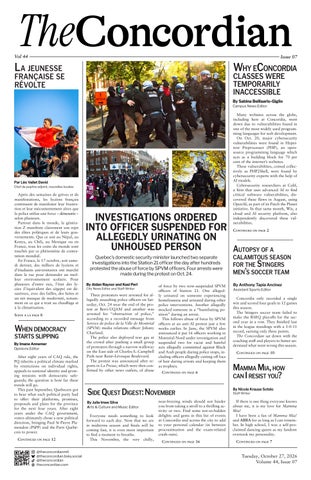
Why eConcordia classes were temporarily inaccessible
française se révolte
By Sabina Bellisario-Giglio Campus News Editor
Many websites across the globe, including here at Concordia, went down due to vulnerabilities found in one of the most widely used programming languages for web development. On Oct. 20, major cybersecurity vulnerabilities were found in Hypertext Preprocessor (PHP), an opensource programming language which acts as a building block for 70 per cent of the internet’s websites. These vulnerabilities, coined collectively as PHP2Shell, were found by cybersecurity experts with the help of AI models. Cybersecurity researchers at Calif, a firm that uses advanced AI to find critical software vulnerabilities, discovered these flaws in August, using OpenAI, as part of its Patch the Planet initiative. In that same month, Wiz, a cloud and AI security platform, also independently discovered these vulnerabilities.
Par Léo Vallet David
Chef de pupitre adjoint, nouvelles locales
Après des semaines de grèves et de manifestations, les lycéens français continuent de manifester leur frustration et leur mécontentement alors que la police utilise une force « démesurée » selon plusieurs. Partout dans le monde, la génération Z manifeste clairement son rejet des élites politiques et de leurs gouvernements. Que ce soit au Népal, au Kenya, au Chili, au Mexique ou en France, tous les coins du monde sont touchés par ce phénomène de contestation mondial. En France, le 17 octobre, soit samedi dernier, des milliers de lycéens et d’étudiants universitaires ont marché dans la rue pour demander un meilleur environnement scolaire. Pour plusieurs d’entre eux, l’état des lycées (l’équivalent des cégeps) est désastreux, avec des failles, des fuites et un net manque de modernité, notamment en ce qui a trait au chauffage et à la climatisation. Suite à la page 8
When democracy starts slipping By Imane Annemer Opinions Editor
After eight years of CAQ rule, the PQ inherits a political climate marked by restrictions on individual rights, appeals to national identity and growing tensions with democratic safeguards; the question is how far these trends will go. This past September, Quebecers got to hear what each political party had to offer: their platforms, promises, proposals and plans for the province for the next four years. After eight years under the CAQ government, voters ultimately chose a new political direction, bringing Paul St-Pierre Plamondon (PSPP) and the Parti Québécois to power. Continued on page 12 @theconcordianmtl @theconcordian.bsky.social @theconcordian theconcordian.com
investigations ordered into officer suspended for allegedly urinating on unhoused person Autopsy of a Continued on page 2
Quebec’s domestic security minister launched two separate investigations into the Station 21 officer the day after hundreds protested the abuse of force by SPVM officers. Four arrests were made during the protest on Oct. 24.
By Aidan Raynor and Kasi Peri City News Editor and Staff Writer
Three protesters were arrested for allegedly assaulting police officers on Saturday, Oct. 24 near the end of the protest at Berri-UQAM and another was arrested for “obstruction of police,” according to a recorded message from Service de police de la Ville de Montréal (SPVM) media relations officer Johany Charland. The police also deployed tear gas at the crowd after pushing a small group of protesters through a narrow walkway on the East side of Charles-S.-Campbell Park near René–Lévesque Boulevard. The protest was announced after reports in La Presse, which were then confirmed by other news outlets, of abuse
of force by two now-suspended SPVM officers of Station 21. One allegedly urinated on someone experiencing homelessness and urinated during other police interventions. Another allegedly mocked someone in a “humiliating position” during an arrest. This follows abuse of force by SPVM officers at an anti-AI protest just a few weeks earlier. In June, the SPVM also announced it put 16 officers working in Montréal-Nord under investigation and suspended two for racist and hateful acts allegedly committed against Black and Arab people during police stops, including officers allegedly cutting off locs of hair during arrests and keeping them as trophies. Continued on page 6
Side Quest Digest: November By Julia Imee Silva Arts & Culture and Music Editor
Everyone needs something to look forward to each day. Now that we are in midterms season and finals will be coming fast, it is even more important to find a moment to breathe. This November, the very chilly,
near-freezing winds should not hinder you from taking a stroll to a thrilling activity or two. Find some not-so-hidden delights and gems in this list of events at Concordia and across the city to add to your personal calendar (in between procrastination and the exam-related crash-outs). Continued on page 16
calamitous season for the Stingers men’s soccer team By Anthony Tapia Ancinez Assistant Sports Editor
Concordia only recorded a single win and scored four goals in 12 games this season. The Stingers soccer team failed to make the RSEQ playoffs for the second year in a row. They finished last in the league standings with a 1-0-11 record, earning only three points. The Concordian sat down with the coaching staff and players to better understand what went wrong this season. Continued on page 10
Mamma Mia, how can I resist you? By Nicole Krause Sotelo Staff Writer
If there is one thing everyone knows about me, it is my love for Mamma Mia! I have been a fan of Mamma Mia! and ABBA for as long as I can remember. In high school, I was a self-proclaimed dancing queen as my fandom overtook my personality. Continued on page 7
Tuesday, October 27, 2026 Volume 44, Issue 07
2
Tuesday, Oct. 27, 2026 | campus@theconcordian.com
Wondering why your eConcordia classes were temporarily inaccessible? Many websites across the globe, including here at Concordia, went down due to vulnerabilities found in one of the most widely used programming languages for web development. By Sabina Bellisario-Giglio Campus News Editor @_sabbell_
Continued from cover. On Oct. 21, the threat of these potential attacks caused many government-operated websites here in Quebec, including the Société de transport de Montréal (STM), the Société des alcools du Québec (SAQ) and the Société de l’assurance automobile du Québec (SAAQ), to be temporarily out of service because as a patch released by PHP was deployed to resolve the potential issues. As of publication, the city of Montre-
al’s website is back online but still shows a warning message that it is under maintenance. The government of Canada’s website also displays a similar message, warning that certain pages and services may be temporarily unavailable. Francis Mignacca, a first-year cybersecurity engineering student at Gina Cody, explained how hackers could exploit these vulnerabilities. “Once the website overloads with memory, it would crash, and when that crash happens, some memory would be left over from the crash instead of all being deleted,” Mignacca said. “And then hackers would be able to hijack that old memory when new memories come in and they would be able to run code that would steal information.” Even eConcordia, Concordia University’s online learning platform for online credited courses, temporarily shut down its services. On Oct. 21 at 3 p.m., eConcordia sent out an email explaining that it had “temporarily suspended access to eConcordia course website as a precautionary measure, effective immediately” due to the PHP2Shell vulnerabilities and
CSU council kills Reuse Program’s and Homeroom’s fee levy applications Councillors expressed concerns over the groups’ links with the Concordia administration and claimed these services should be funded by the university, not students. By Felix-Antoine Beauchemin Editor-in-Chief @fa.beauchemin.journalisme
Concordia Student Union (CSU) councillors approved referendum questions on fee levy increases for four student groups: The Concordian, Art Matters, the CSU Legal Information Clinic (LIC) and Honey’s Soupe Populaire. The vast majority of the CSU’s Oct. 21 regular council meeting (RCM), which lasted nearly five hours, focused on the review of fee levy referendum questions. The Reuse Program includes the Concordia University Centre for Creative Reuse (CUCCR), Fripe Concordia and the Dish Project. It sought the creation of a $0.23-per-credit fee levy to help make Concordia a “zero-waste campus” and continue to expand its services across both campuses.
Correction:
However, it is not a student group, but rather part of Concordia’s Office of Sustainability, which raised concerns with multiple councillors. Because of this, certain councillors highlighted that, if implemented, the fee levy could not be reversed in a later referendum and that students could not opt out of it, which is not the case for student groups’ fee levies. Other councillors also argued that, because it is part of the Concordia administration, the university itself should fund the Reuse Program, not mandatory student fees. After 40 minutes of questioning and deliberation, the council rejected the application. Homeroom, which is part of Concordia’s Office of Student Life and Engagement, faced similar concerns from councillors. Homeroom offers socialization and accompaniment opportunities for new students and helps students with mental health through student facilitators, who meet weekly with the 600–700 students registered in the program. Nearly 80 per cent of Homeroom’s budget of $270,000 comes from Quebec’s Higher Education Ministry, although that funding will expire at the end of the current school year. As such, the program was requesting the creation
Campus News
Computers located in the Webster Library in the Sir George Williams campus. Archive Photo by Catherine Reynolds // Vol. 39–40 Photo Editor
went on to write that it was “[taking] these precautionary steps to protect the security of your data and the eConcordia platform.” “That’s really good because this vulnerability, it would have just stolen your login information,” said Mignacca when explaining why websites like eConcordia made their services inaccessible. “Something that could have happened is, if you tried logging in before [eConcordia] shut [its website] down, [hackers] probably would have been able to steal your information, your login credentials, your email and your password for that specific site,” he explained. An email was sent out by eConcordia explaining that access was restored to the website around two hours later. Concordia was not the only university affected. Many other collegiate
platforms in Quebec were affected, including Moodle, McGill University and Université de Laval. While AI was used to find these vulnerabilities, Mignacca still warned about the use of AI in cybersecurity. “So OpenAI, open-source AI can be used by anyone,” he said, “so these hackers could also use it and then that becomes a race in terms of, if you could find the vulnerabilities, the hackers can find the vulnerabilities.” Last month, Concordia hosted a panel on AI use in cybersecurity. Panellists such as Jordan Saint-Cliver, a security and crisis management specialist and former attack coordinator in the French Army, highlighted that AI has significantly lowered the barrier to entry for cyberattacks, but that AI models can also improve cybersecurity protocols and responses to cyberattacks.
of a $0.29-per-credit fee levy. The CSU council rejected the application after 40 minutes of questions and deliberation. Certain councillors argued Concordia should fund Homeroom, since it is part of the Office of Student Life and Engagement. Others had concerns that not all students, notably student activists who have been vocal against the Concordia administration, may not feel welcome at Homeroom. However, Homeroom program supervisor Paige Hilderman explained that the Office of Student Life and Engagement’s management did not interfere with the program’s daily operations. “As of next year, we wouldn’t exist in the same capacity,” Hilderman said when a councillor asked what would happen to the program if the fee levy were rejected. “We might be able to operate at a much more reduced capacity, like crazy reduced, because that’s about half the budget that we’re looking for, right? And so much of it is the student facilitators’ wage, because the only wage that’s covered by the university is the coordinator.” Homeroom currently employs 15 student facilitators. The Concordian has not received a fee levy increase since 2007. It is seeking to increase the levy from $0.19 to $0.30 per credit. Art Matters’ fee levy has not increased since it was created 26 years ago. The group is vying for an increase from $0.08 to $0.12 per credit. The LIC is requesting an increase from $0.31 to $0.61 per credit. Honey’s Soupe Populaire is asking to create a $0.15-per-credit fee levy. All these referendum questions
also include clauses that tie the fee levies to inflation and would kick in only for the Fall 2027 semester. They will be on the ballot for the Fall 2026 CSU by-elections, for which all undergraduate Concordia students will be eligible to vote Nov. 9–11. Last fall, the CSU council had blocked both Art Matters’ and the LIC’s fee levy applications before they could be put to students for a vote through referendum. An application from a group of students trying to revive the Concordia coop bookstore was also rejected prior to the RCM, as it was deemed incomplete. It notably used the previous bookstore’s incorporation documents — which ceased operations years ago — despite the group claiming it was a new, separate entity. It did so because it had not yet obtained its own incorporation documents, which are necessary to apply for the creation of a fee levy. With help from Councillor Marcus Peters, the group tried to have the decision overturned, but it was still rejected after long deliberations between councillors and executives. Many raised concerns about the project’s feasibility or argued that the group did not meet all eligibility requirements to create a fee levy. The meeting adjourned at 11:20 p.m.
The Concordian wishes to issue a correction for its article titled “Starting over together,” published in Volume 44, Issue 5. It stated that all 184 refugees WUSC had helped resettle in Canada in 2025–2026 were through the Student Refugee Program. It is actually 153 of them. The Concordian apologizes for this mistake.
Campus News
Tuesday, Oct. 27, 2026 | campus@theconcordian.com
A closer look: the Howarth Lab Meet the Concordia researchers working with Nobel Prizerecognized materials and exploring their potential for impactful applications. By Clara Diniz Contributor @claraavd
If you go to the third floor of the Applied Science Hub at the Loyola campus, you’ll find Ashlee Howarth and her students “baking” materials whose remarkable properties have attracted academic attention with the 2025 Chemistry Nobel Prize: metal–organic frameworks (MOFs). In Howarth’s words, MOFs are sponge-like materials made of metal and organic building units. Their tiny “holes,” or pores, can trap different molecules, making them useful for many industrial applications. Researchers can tune these materials at the atomic level, tailoring them for specific purposes. Howarth is one of Canada’s leading researchers in the field of MOFs. In 2018, Forbes named her to its 30 Under 30 science list for her work using MOFs to remove radioactive contaminants from wastewater and detoxify warfare agents. But finding Howarth in a lab today is anything but a surprise. Her passion for science began at an early age. “I decided that I wanted to be a scientist actually when I was pretty young,” she told The Concordian. “In elementary school, I always used to participate in science fair projects,” she explained. I often got to go to the local and provincial and national competitions where I could interact with scientists who were judges at those competitions, [...] and I always really liked that experience and the experience of doing the science project.” When it was time to choose a career, she initially thought she wanted to be a medical doctor. Today, as a different kind of doctor — she holds a PhD in chemistry from the University of British Columbia — Howarth has come back full circle to why she fell in love with science. “I always thought I would be a doctor, she recalled. “That’s the science career that I wanted. But then after the first year of university, I really didn’t like my biology classes, and I didn’t like most of the classes outside of chemistry. That’s what led me back to chemistry, which is interesting because, like all my science fair projects in elementary school and high school, were chemistry projects looking back at it, but I didn’t piece that together back then.” After earning her PhD, she took a postdoctoral position at Northwestern University under the supervision of renowned MOF researchers Joseph T. Hupp and Omar K. Farha. Howarth joined Concordia University in 2018 and currently serves as an associate professor and research chair. Since inaugurating her lab, she has built a vibrant and diverse research group of about 15 students, including undergraduate, master’s and PhD students.
Today, she prides herself on having built a research team with diverse scientific and cultural backgrounds. “It’s really important to have people from diverse backgrounds, not only in terms of what type of chemistry they’ve done in their undergraduate or master’s degree because that’s important too, but also just diverse cultural backgrounds and diverse perspectives because then they can bring all of that to the team,” she said.
“
“And having all those diverse perspectives not only helps with creating a nicer environment, but it helps with creating a team that has a really good foundation of knowledge in a wide variety of topics,” Howarth added.
”
Her research focuses on creating new rare earth metal-based MOFs and investigating rare earth- and zirconium-based MOFs for different applications. When asked why she chose to work on MOFs, Howarth pointed to a desire to bridge fundamental science and real-world applications. While she enjoyed the fundamental aspects of her PhD research, she was drawn to research with clear practical applications for her postdoctoral position. “It was clear to me that [MOFs] was the perfect topic; it merged all my passions in organic chemistry, lots of great fundamental science to be done, materials chemistry, and then so many broad applications and things that actually are being applied,” she said. A similar motivation attracted Robert Horne, a 24-year-old PhD student, to the Howarth Lab in January 2026. During his master’s studies at the University of New Brunswick, he worked on a project involving using a MOF to harvest water from air. That experience triggered his interest in these sponge-like materials and their potential impact. When choosing a research area for his PhD, he was excited by the opportunity to synthesize MOFs for such impactful applications. “I got interested in MOFs when the group that I was doing my master’s in started shifting towards being more of a MOF lab, and I got to work on a project making some MOFs,” he told The Concordian. “Even though it was a side project, I just thought that it was a really cool research area with a lot of potential for different applications and to make an actual difference in the world.” The Howarth Lab is actively exploring the use of MOFs for the detoxification of chemical warfare agents such as mustard gas, the removal of radioactive ions from wastewater from nuclear power plants and the capture of carbon dioxide from the atmosphere. All these applications rely on the abil-
3
Dr. Ashlee Howarth, one of Canada’s leading researchers in the field of metal-organic frameworks (MOFs), has built a vibrant and diverse research group with around 15 students at Concordia, including undergraduate, master’s, and PhD students. Photo courtesy of Ashlee Howarth
ity of MOFs’ tiny pores to trap and interact with different molecules. Horne is working on a project that uses MOFs as photocatalysts for the degradation of warfare agents. “Professor Howarth’s group felt like a great fit because they combined all of the areas of research that I liked,” he said when explaining what drew him to the Howarth Lab. “They combined the MOFs with the applications and photophysics, and I felt that the project that I wanted to work on was a great combination of everything.” As a first-year PhD student, Horne has enjoyed his experience in the program so far. “I’ve learned a lot, more than I ever thought that I would, and the research has been very fulfilling and challenging, and I love the group, and I love the city, so it’s been a very positive experience so far,” he added. Nathan Fischer, 27, first encountered MOFs during his bachelor’s in chemical physics at the University of Waterloo. He chose Howarth’s group for her reputation as an excellent mentor. “I sort of realized that I was a difficult person to work with, and so I asked [my previous supervisor] at the end of the thesis project, ‘Who do you think I should go work for?’ And he gave me three names in Canada, and one of them was Ashlee. I was like, ‘This is the kindest person that I could go work for,’” he explained. Now in the third year of his PhD studies, Fischer highlighted how much he has learned about patience and resilience. “It feels very different than how I usually do things, which is just like make something and then make it just working enough that it’s useful and then move on,” he told The Concordian. “Whereas I think in academia you have to abundantly prove every part of something first, and that’s been quite difficult to get used to. [...] I’m slowly learning the usefulness of that patience.” Lavinia Trifoi, 33, another PhD student at the Howarth Lab, first learned about MOFs during her master’s studies at Toronto Metropolitan University. She quickly became fascinated by the endless possibilities these materials offer. In her words, “MOFs are like LEGO pieces but at the molecular scale. You have an endless combination of building blocks, and changing those pieces allows us to create materials with different structures and unique properties.” While searching online for potential PhD supervisors, Trifoi discovered that the Howarth Lab was the perfect fit for her research interests. “When I was searching for professors across Canada, Dr. Howard came as a top contender and a top MOF chemist in Canada,” she told The Concordian.
“When looking at her past education and her past publications, she definitely is an expert in the field and has pioneered a lot of really cool new research.” Trifoi then packed her bags and moved from Toronto to Montreal to join the group. Now in the fifth year of her PhD, she reflects positively on her graduate school experience. “It’s been a very, very positive experience overall. It has taught me a lot about chemistry,” she said. “It has taught me a lot of growth, not only within the academic field, but also a lot of personal growth, a lot of leadership skills, time management.” Even though it is challenging, Trifoi also likes the work in and of itself. “I feel like MOFs are really cool, but trying to be an expert in MOFs is definitely more than I bargained for, she said. It’s definitely a very complex field. [...] It’s just a lot of design at the molecular level, which is sometimes really hard to wrap my head around, because you are essentially designing for things you cannot see. But it’s a very, very interesting field, very modular, and has a lot of applications.” When asked about the future of MOFs, Howarth was enthusiastic. She said the vast number of possible metal-linker combinations leaves countless opportunities for discovery. Some MOFs are already being commercialized, including in carbon dioxide capture facilities. Despite these advances, further work is needed to optimize the materials and processes for their industrial deployment. Just as MOFs can be built from countless combinations, Howarth envisions a future that will require an equally diverse community of researchers, bringing together chemists, engineers, materials scientists and other experts to advance MOFs from the lab to industry.
Ashlee Howarth, one of Canada’s leading researchers in the field of metal-organic frameworks (MOFs). Photo courtesy of Ashlee Howarth
City News 4 PSPP announces $28M in emergency funding for homelessness, preventative measures to follow Tuesday, Oct. 27, 2026 | city@theconcordian.com
The premier said this was only a first step and that preventative measures to solve homelessness will follow an early 2027 summit on homelessness. Aidan Raynor
City News Editor
In his first official announcement as Quebec premier, Paul St-Pierre Plamondon unlocked $28 million in emergency funding for winter shelters, $18 million of which will go to Montreal. “You have growing numbers of people without a roof,” St-Pierre Plamondon said on Oct. 23 at Accueil Bonneau in the Old Port of Montreal.
“
“The cost of emergency measures will also grow and that’s what’s happening today. We’re merely covering an emergency situation because we have 5,000 just in Montreal — 5,000 persons without a roof.”
”
Montreal Mayor Soraya Martinez Farrada said where the money is going exactly will be unveiled later, but the political posturing of St-Pierre Plamondon is a welcome change from the past. “The most important thing for me is that we have a premier dedicated to the homelessness situation and the crisis that we’re living in and that political posture is a huge difference,” said Martinez Ferrada. Answering for both of them, St-Pierre Plamondon said they have already discussed ways to reduce the paperwork required of housing advocates and community organizations to access grants through either the city or the province. He said the announced funding is only the first step toward his goal of halving homelessness in the province. The next phase will come after a summit early in 2027 to address the causes of homelessness. “I hope that the summit, with the help of people who have an expertise, will bring us to a strategy where we go to the causes, the roots of what’s going on right now,” he said. “Today, it’s really just to cope and make sure that people have a warm spot during this winter.”
PSPP will continue with one of two Montreal city council requests for housing support
At the monthly council meeting on Oct. 19, Montreal city council adopted a motion presented by Projet Montréal urging the province to cap rent increases at the average inflation rate over the last three years and create a mandatory provincial rent registry.
Premier Paul St-Pierre Plamondon (right) in Montreal’s Old Port alongside Montreal Mayor Soraya Martinez Ferrada (centre) and Stéphane Paquet (left), minister responsible for Montreal. Photo by Aidan Raynor // City News Editor // @aidanjraynor
When asked about the registry, StPierre Plamondon initially said his government would implement it, then added that it would study it. But his hesitation came not from a lack of desire to track rent increases, but from questioning the honesty of landlords when reporting to the registry. “Is it really going to stop owners from changing the rent when they have someone who’s leaving who had a very normal rent from 15 years ago? Is it really going to stop them? That’s the question, but I mean, we’re favourable. We’re gonna study it and anything we can do to make the situation more affordable and acceptable to everyone in terms of the prices of the rents, we’re gonna do it.” Projet Montréal councillor Élise Tan-
guay said transparency among tenants is the most important factor in keeping landlords accountable for unreasonable rent increases. She said the province taking it on would force landlords to compile and report, rather than put it on tenants to report it to voluntary rent sites like Vivre en Ville’s. She says this voluntary measure is not enough to make noticeable change in a city with renters making up 60 per cent of its residents. “[Vivre en Ville]’s not enough, and what they prove with that with that registry, which is voluntary, is that it’s possible to do it,” Tanguay told The Concordian in an interview on Oct. 22 ahead of the announcement.
Canada and Europe set PQ cabinet shrinks from previous government to further alliance in Montreal on Oct. 29–30
After Carney’s trip to the European Parliament to announce intentions for Canada to become closer with the European bloc, the two will meet again in Montreal to announce furthering ties in both research and higher education. Aidan Raynor
City News Editor
On Oct. 29–30 in Montreal, Prime Minister Mark Carney will meet with European Union (EU) leaders to announce the next steps in partnership between the EU and Canada, including student mobility and increased research funding. Since Carney was elected in 2025, Canada has strengthened ties with Europe through multiple agreements as it tries to diversify away from a hostile United States. The bulk of the partnerships already announced focused on defence and trade. However, during his visit to the European Parliament (EP) in September, Carney announced he was seeking further inclusion in two EU programs that could dramatically affect Canada’s postsecondary sector: Erasmus+ and Horizon Europe. As previously reported by The Concordian, Erasmus+ could significantly expand student mobility to and from Europe, but regional access to the continent and credit standardization remain to be seen.
Further integration into Horizon Europe, the bloc’s key funding program for research and innovation, could bring expanded benefits to Canada’s research universities and Canadian researchers. Canada is already involved in the global arm of the research program, allowing “researchers and innovators across sectors (e.g., academia, industry, etc.) to receive funding and join and lead research consortia with European and other international partners in a scale not currently available through Canadian programs,” wrote Innovation, Science and Economic Development Canada spokesperson Riyadh Nazerally in a statement to The Concordian. Nazerally added that furthering Canada’s involvement in Horizon will “deepen collaboration with Europe in high-priority areas such as digital, emerging, and clean technologies.”
The Concordian will be reporting live from inside the summit on Oct. 29–30 to learn more about what is in store for Canadian universities.
Parti Québécois ministers will have more files than previous governments as PSPP follows through with a plan for the province to do more with less. Aidan Raynor
City News Editor
Paul St-Pierre Plamondon swore in 22 ministers, plus a president and a party whip, on Oct. 21 — six fewer than the previous cabinet of 28. A smaller Parti Québécois (PQ) cabinet means ministers will be responsible for more portfolios. On top of that, many of them have never even been members of the National Assembly (MNA) before. They hold these ministerial positions on top of their committee membership and regular MNA duties. For example, Elsie Lefebvre is the minister responsible for higher education in the province, but she is also the minister responsible for housing, the status of women and the Lanaudière region. Another prominent minister is Marie-Claude Sarrazin, who will serve as justice minister but also the minister responsible for Anglophone relations, access to information and protection of personal privacy, intergovernmental affairs, secularism, fighting discrimination against LGBTQ+ people and the fight against racism. St-Pierre Plamondon nominated Catherine Gentilcore as his deputy pre-
mier, minister of immigration and integration and the minister responsible for Quebec’s accession to independence. She will have the difficult tasks of reducing annual permanent immigration to Quebec to 35,000 people — compared to 60,000 in 2025 — and drafting the question for an eventual referendum on Quebec independence. The minister responsible for Montreal, Stéphane Paquet, has less on his plate than others with his only other title being that of minister of economic development, innovation and energy. As university infrastructure across Quebec, including Concordia University, continues to mount in repair costs, Nicolas Marceau, the finance minister of both St-Pierre Plamondon and the last PQ premier, Pauline Marois, will also be responsible for infrastructure. Quebec’s lieutenant governor, Manon Jeannotte, watched the swearing-in from her office across the street from the National Assembly. This is the first time in the province’s history that the lieutenant governor has not been present in the National Assembly to sign cabinet nominations as the Constitution requires. After accepting St-Pierre Plamondon’s demand that she not attend she instead signed the cabinet nominations remotely.
City News
Tuesday, Oct. 27, 2026 | city@theconcordian.com
Albertans may have voted to stay in Canada, but they still have grievances
Unlike in Quebec, the federalists prevailed resoundingly, but the nine other questions tell a different story of the province’s satisfaction with Canada. Aidan Raynor
City News Editor
Alberta voted resoundingly in favour of remaining in Canada, so much so that the results are now one of the clearest majorities ever found in a secession referendum globally, with nearly 75 per cent supporting the remain side. But whether to remain part of Canada was only one of 10 questions asked to Albertans on Oct. 19. The other nine questions focused on expanding Alberta’s immigration powers and broader constitutional issues like Senate reform and the makeup of the Supreme Court. While the results of the sovereignty question was resound-
ingly clear, the results of the other nine show Albertans are still not satisfied with their place in the federation. John Santos, a data scientist at Alberta pollster Janet Brown Opinion Research, said the results aligned with pre-election polling, but the other nine questions received more “yes” support than he expected. Santos said the results also reflect historic regional support for separation too. Central Alberta voted more favourably to leaving, in keeping with its traditionally separatist undercurrent that elected Alberta’s only separatist, Gordon Kessler, to its legislature in 1982. Kessler lost his seat just nine months after winning it. “I would say that this sort of has the vibe of being within the historical range,” said Santos in an interview with The Concordian. “If we look at the areas where the option to was the strongest, like a lot of that was in central Alberta. And that’s where the historic Olds-Didsbury, and current Olds-Didsbury-Three Hills District, is located.”
Carney fast-tracks new pipeline as climate change worsens Analyzing the environmental and economic costs of the Pacific Link pipeline, the first project to be designated in national interest under Bill C-5. Eric Klempan Contributor @eric.klempan
Prime Minister Mark Carney has announced the fast-tracking of Pacific Link, growing Canada’s fossil fuel production as the Canadian Climate Institute warns the country is straying from climate targets. The pipeline’s designation as a “project of national interest” will allow it to circumvent legal approval processes, including environmental assessments. Alberta Premier Danielle Smith calls it “the largest pipeline build-out we’ve seen in decades.” Pacific Link will run from Bruderheim, Alta. to Roberts Bank Terminal in B.C., south of Vancouver. It is set to export an additional one million barrels of oil a day to Asia, thus lowering Canada’s dependence on the U.S., according to the prime minister’s office. In June, the Canadian Climate Institute estimated that the memorandum of understanding signed between Alberta and the federal government would add roughly 20 megatonnes of emissions to the atmosphere each year. To put that 20 megatonnes into perspective, the Canadian Climate Institute
has reported that Canada’s emissions increased from 440 megatonnes in 2024 to 691 megatonnes in 2025. The country’s current goal is to lower emissions to below 440 megatonnes by 2030, making this pipeline project a step backwards in decarbonization as the government doubles down on growing oil and gas, the country’s largest polluting industry. “It makes no economic sense and it’s a climate bomb, so we need to resist,” Mike Morrice, presumptive leader of the Green Party of Canada, told The Concordian in an exclusive interview. “The U.N. has made clear that the climate crisis is a code red for humanity, and Pacific Link is 45 billion more dollars of our money to worsen the very crisis that we’re in.” Local consequences of the pipeline include threats to wildlife and the risk of oil spills, according to a federal government-ordered review panel on the construction of Roberts Bank Terminal 2, the proposed B.C. container terminal to accommodate increased tanker traffic from the pipeline. “The Panel’s assessment concludes that there would be effects on the quality of life of local populations, including health and quality of experience during commercial and recreational activities,” reads the report, published in 2020. Among others, it pointed to significant adverse effects on local Indigenous populations and significant harm to biodiversity and certain local wildlife, such as the orca population. To reduce climate risks, the federal government has proposed the Pathways Project: a carbon capture system
5
Welcome to Alberta sign on in Crowsnest Pass, Alta. Archive photo by Aidan Raynor // City News Editor // @aidanjraynor
What defines an Alberta separatist?
Jared Wesley, a political science professor at the Univer- s i t y of Alberta, said Alberta separatists have more in common with MAGA Republicans and Brexiters than they do with their separatist counterparts in Quebec. “Separatist leaders want everyone to believe that separatism is rooted in some pioneer settler spirit that dates back to the early 20th century, but the reality is the modern separatist movement is a far-right populist one. It has more in common with MAGA and Brexit than it does with earlier forms of Western alienation or Quebec separatism,” he said in an interview with The Concordian. Wesley said he spent the months leading up to the referendum speaking with leaders and organizers from Alberta’s immigrant community. They told him immigrants in Alberta were experiencing discriminatory speech directed at them in public, and even sometimes acts of hate. “The premier opened the space for this by creating questions that allowed some Albertans to vote on which of their neighbours deserve rights and which don’t,” said Wesley.
Separation on campus
Matthew Johnson, editor-in-chief of the University of Calgary student paper, The Gauntlet, said most students he spoke with on campus told him they were annoyed the referendum was happening in the first place. While most had a clear understanding of the question of whether to hold a referendum or not, he said many were less knowledgeable about the other nine. “What was interesting was that the ones who declined to interview with us were mentioning the fact that they didn’t even know about the other nine questions,” said Johnson in an interview with The Concordian. Johnson said some students did not wholly reject questioning constitutional reform. He also said some students felt targeted by the immigration questions. “There were some who definitely felt really disappointed and hurt seeing the first five questions and kind of what that means for their place in Alberta.”
that would reduce emissions by storing 16 megatonnes of CO2 each year starting in 2045. Carney has also pledged $1.2 billion for marine protection, including an oil spill response plan. But some cliThe Pacific Link pipeline from North of Edmonton to Vancouver. Graphic mate experts don’t believe the plan is route by Georgios Pantazopoulos // Contributor Stewart. enough. In a statement provided to The Con“There is no effective way to really clean up an oil spill. You know, you can cordian, Natural Resources Canada usually get like 10–20 per cent of it,” noted that, based on its projections, desaid Keith Stewart, senior energy strate- mand for Alberta’s crude oil is sufficient gist at Greenpeace Canada. “We’re say- to justify Pacific Link. “While the Governor in Council ing to the salmon and the orcas, ‘you got to take a hit for the team.’ And that has considered the fact that there are team is oil and gas profits. It’s not you a range of projections for long-term crude oil demand, from both public and I.” According to the Scotia Growth In- and private sources, sufficient demand stitute, Pacific Link is projected to cost is expected to exist for the new pipeupwards of $43.7 billion, 90 per cent line,” wrote Christian Tessier, manager of which is currently publicly owned — of media relations at Natural Resources 45 per cent by Alberta and 45 per cent Canada. “For example, demand in the by the federally owned Trans Mountain Asia-Pacific region is expected to reCorporation. Carney also announced main comparatively resilient, creating a that “Indigenous communities will be strong market for Canadian oil exports offered a minimum of 10 per cent own- and supporting investment in pipeline infrastructure through toll revenues.” ership interest” in the project. Eby’s failed snap election gamble will “We estimate that the Pacific Link will create 140,000 jobs across the coun- mean an easier path for Pacific Link try,” said Carney when he announced through British Columbia On Saturday, Oct. 24, B.C.’s New the pipeline’s status as a project of national interest on Oct. 1. “It will gen- Democratic Party’s razor-thin majority erate over $20 billion in GDP per year government led by David Eby fell to the and over $100 billion in government B.C. Conservatives led by Lorne Doerkson, who calls Pacific Link one of his revenue by 2060.” However, considering how many top priorities. The day after the win, the premier-descountries are now moving toward renewable energy, demand for oil could ignate said his first phone calls as prelower significantly by the time the proj- mier would be to Carney and Smith to discuss his support for Pacific Link. He ect is completed in the mid-2030s. “Betting on a new pipeline now is like also supports expanding B.C.’s liquefied buying a blockbuster video franchise natural gas exports. just as Netflix is coming on stream. It’s a really bad bet for our economy,” said
6
City News
Tuesday, Oct. 27, 2026 | city@theconcordian.com
Four arrests made during protest against Montreal police misconduct Hundreds protested outside Station 21 near Berri-UQAM, where an SPVM officer was suspended after allegedly urinating on an unhoused person and another for mocking a suspect during arrest. Aidan Raynor and Kasi Peri
City News Editor and Staff Writer
Continued from cover. According to reporting by The Canadian Press, it was revealed that the SPVM knew it had a “radicalized” subculture present in its Montréal-Nord station before making the misconduct public. The protest on Oct. 24 began around 2:30 p.m. across from Station 21 in a park where community leaders gave speeches to the crowd of a few hundred. Police officers, including six on horseback, flanked the outsides of the group during the speeches; small confrontations erupted between protesters and the police, but nothing escalated at that time. “I was here because they’re fucking pissing on everyone,” said one protester to The Concordian. Concordia University professor Ted Rutland, who spoke to the crowd be-
Protester getting help after being exposed to tear gas fired by the SPVM. Photo by Aidan Raynor // City News Editor // @aidanjraynor
fore it left the park, said the incident of the officer urinating on someone experiencing homelessness is “just the tip of the iceberg.” “No one here was shocked to hear that a police officer abused, humiliated, brutalized an unhoused person and many unhoused people and uploaded the video to a faraway chat group,” said Rutland in an interview with The Concordian during the protest. “We know this happens all the time, this happens every day and this has happened throughout Montreal history.” He said protests like Saturday’s are important for two reasons: one, to “express collectively that we know this isn’t one thing,” that this incident is not a problem with one officer but a systemic one throughout the SPVM; and two, the chance for people to recognize each other and build relationships and to “build towards a strength of resistance that forces politicians to change even though they don’t want to.” Rutland’s research focuses on the police’s relationships to communities in Montreal through community organizations and outreach at events. He said these relationships often divide communities and that their purpose is to create consent for increased policing powers. “You have one side of the community that’s targeted by the police that is resisting and one side that is on the side of the police. And so one of the things that we can do to better fight against these injustices is to attack those community engagement practices and bring those community organizations and community members back onto the side of the resistance,” he said. The protest weaved its way from Station 21 eastbound down Ontario Street, directed by SPVM officers blocking access to certain roads with cars, on foot with shields and by bike. The protesters were flanked by officers in riot gear and on bikes as they moved through the area. The crowd was followed by multiple SPVM vehicles: two vans, one marked and one not, a car and a motorcycle. One van was equipped with cameras on its roof and delivered warnings to the crowd of when the SPVM were going to escalate. The group eventually passed through Charles-S.-Campbell Park, where officers pushed a small group of protesters
Protester gather across from SPVM Station 21 near Berri-UQAM where the suspended officer was stationed. Photo by Aidan Raynor // City News Editor // @aidanjraynor
Many protesters signs condemned the SPVM allegedly urinating on an unhoused Montrealer. Photo by Aidan Raynor // City News Editor // @aidanjraynor
near the back of the crowd through a narrow, temporary construction passage. There, officers deployed tear gas after pushing one protester into a dumpster and chased protesters down De Champlain Street, knocking one down with a shield. The protester who was knocked down immediately got back up and regrouped with the others on René– Lévesque Boulevard. Group members attended to those affected by the tear gas with medical supplies and bottles of milk to reduce its effects. Protesters were then turned around by a SPVM roadblock on De Lorimier Avenue and continued back through the Gay Village on Sainte-Catherine. Upon reaching Beaudry metro station, the front of the group ducked into the station while the rest stalled for a moment before continuing on to Berri-UQAM, where the protest ended at around 5:45 p.m.
Quebec’s internal security minister calls for investigation
Protesters clash with SPVM officers as police push the group through a narrow passage. The SPVM fired tear gas at the group a few moments later. Photo by Aidan Raynor // City News Editor // @aidanjraynor
On Oct. 25, the recently appointed minister of internal security, Guy Jr. Lapointe, announced he has tasked Quebec’s police ethics commissioner, Michel Desgroseilliers, and the Bureau of Independent Investigations (BEI) to investigate the suspension of the officer who allegedly urinated on someone experiencing homelessness and urinated during other police interventions. “This is not a vote of no confidence in the Service de police de la Ville de Montréal, nor is it a questioning of the quality of the investigation. Rather, it is a
matter of transparency. It is clear to me that, in this specific case, the investigation must be conducted by an external entity in order to maintain public trust. In Quebec, we have an Independent Investigations Office (Bureau des enquêtes indépendantes) that was created with precisely this objective in mind,” reads the statement provided from the minister. Lapointe, who earned his police technology degree from John Abbott College in the West Island, previously led the media and communications department of the provincial police force and was the strategic advisor and head of communications at the BEI.
City Hall’s response
In response to the allegations of mocking and urinating on an unhoused person, Montreal city council approved a motion on Oct. 19 to summon Montreal police chief Fady Dagher before city council. The official opposition at city hall, Projet Montréal, presented a motion to have Dagher appear before city council within the week to answer for these allegations. The motion was adopted only after Mayor Soraya Martinez Farrada’s Ensemble Montréal removed the oneweek stipulation, saying the investigation should follow its due course. “We’re talking about cutting hair and we’re talking about peeing on people, seriously?” Projet Montréal leader Ericka Alneus told reporters. “What will be done completely to stop those behaviours?”
Music
Tuesday, Oct. 27, 2026 | artsculture@theconcordian.com
Mamma Mia, how can I resist you? (L to R) Grant Reynolds (Sky), and Juliette M. Ojeda (Sophie Sheridan). Photo courtesy of Joan Marcus
Continued from cover. When I heard that the North American Tour of Mamma Mia! was going to be in town for its 25th anniversary, I knew I was going to go to great lengths to attend the show. So I dusted off my platform boots, put on my denim overalls and made my way to Place des Arts for its opening night show in Montreal on Oct. 13. The show opens the day before Sophie’s wedding in Greece as she searches for her real father. After reading her mother’s (Donna) diary, Sophie discovers that her quest may prove to be more difficult with three potential fathers: Sam, Bill and Harry. She invites all three of them to her wedding without Donna’s knowledge. The invitations resurface old memories and stories. Having watched Mamma Mia!: The Musical six times and the movie maybe over a thousand, I can confidently say that I am well versed in every edition. However, my expertise fails me when it comes to the American version. Being used to the original English version, it was interesting and pleasant to see, hear and rediscover the musical
from a fresh point of view. This was the funniest Mamma Mia! production I have seen yet. The punchlines, the cast’s chemistry, the public interactions, the vocal techniques and the artistic choices made this production so playfully fun. Script choices matter in terms of subject and audience and a handful of lines were adapted to the local slang of the country where it is produced. This time, the adapted lingo catered to American slang, which was new to me. Broadway Across Canada’s production is the best compared to the Spanish and French adaptations because the script feels familiar and contemporary. A line that resonated with me was when Donna said to Sky, “You’re not marrying my daughter smelling like a frat house,” as well as her use of the word “shenanigans” to describe Sophie’s wedding.
Mamma Mia!: The Musical celebrates its 25th anniversary with a tour across North America. be funnier than the ones I’ve seen before. Their onstage friendship mirrored real companionship and hardship as they comforted Donna with light-hearted humour. From dangerously swinging off a hairdryer to goofy dancing and crawling on the floor, the performances were accurate. I was crying from so much
7
By Nicole Krause Sotelo Staff Writer @nicky.krs
Dominic Young (Pepper), Jalynn Steele (Tanya), and the Company of Mamma Mia!’s 25th Anniversary Tour. Photo courtesy of Joan Marcus
(L to R) Lena Owens (Lisa), Juliette M. Ojeda (Sophie Sheridan), and Maddie Garbaty (Ali). Photo courtesy of Joan Marcus
vivacity during “Waterloo” and “Dancing Queen,” as well as Ojeda’s overall performance were some of the best versions yet. Throughout the show, I found some of my favourite moments in numbers such as “Dancing Queen,” “Under Attack” and “Voulez-vous.” New favourites joined my list as well, like the arrival of the three fathers to the villa, the family photo during the wedding and Tanya and Rosie’s chemistry throughout the show. Aside from the spotlight issue at the beginning of the show during Sophie’s “Honey Honey,” this production was spectacular and reminded me why Mamma Mia! means so much to me and so many fans. ABBA’s songs bring a feelgood motion and the plot flows with the nostalgic tunes like sunlight on a shoreline. Mamma Mia! lets the audience escape into the beauty of madness. It showcases the duality of reality through love, chosen family, dancing, tragedy and a spectacular wardrobe.
Juliette M. Ojeda (Sophie Sheridan), and the Company of Mamma Mia!’s 25th Anniversary Tour. Photo courtesy of Joan Marcus
The chemistry between Donna’s best friends, Tanya (Jalynn Steele) and Rosie (Carly Sakolove), was out of this world; their performance of “Chiquitita” cemented their onstage synergy. From there, I immediately knew the rest of the (L to R) Leland Burnett (Bill Austin), Victor Wallace (Sam Carmichael), and Rob show was going to Marnell (Harry Bright). Photo courtesy of Joan Marcus
laughter; it made me want to join them on stage and be their friend, too. As for their vocal technique, I was mind-blown. The integrity of the cast was spectacular when it came to singing. I have to say that Jalynn Steele, Jessica Crouch and Juliette M. Ojeda stood out the most. Alongside Mazz Murray’s rendition of Donna in the West End production (2019-2025), Steele’s version of “Does Your Mother Know,” Crouch’s
(L to R) Jalynn Steele (Tanya), Carly Sakolove (Rosie), and Jessica Crouch (Donna Sheridan). Photo courtesy of Joan Marcus
QUICKSPIN: Dopamine Chamber — Fontaines D.C.
Chasing pleasure and escaping reality, Fontaines D.C. explores a new sound on Dopamine Chamber. By Samantha Rainone Contributor @samrainone
Fontaines D.C. have not been known to offer comfortable listening, but Dopamine Chamber challenges their listeners in a new way. Trading their earlier post-punk urgency for darker electronics and sprawling arrangements, the five-piece Dublin rock band delivers a record that feels both refreshing and unsettling. The lead single “Marianne” brilliantly introduces their new sound with its
captivating atmosphere and layered production. “Demolition” further draws listeners into hazy, disorienting soundscapes, extending the dreamlike sense of unease. Meanwhile, “Tongue” explores unfamiliar sonic territory, experimenting with layered electronics and atmospheric production unlike any other song on the record. Building on the sonic experimentation of their 2024 album, Romance, Dopamine Chamber pushes further into synth-driven territory. Fontaines D.C. set out to make an album void of heavy guitar work, which created the raw intensity that defined their previous sound. The absence is certainly a loss for listeners, as it is offset by heavy basslines and pounding drum sequences that make the record feel repetitive and lacklustre.
This shift is most apparent in the album’s pop-focused moments. Tracks like “Mimesis” and “Japan” mark the album’s most significant departure from the band’s identity, embracing a distinctly made-for-radio sound. Lyrically, Dopamine Chamber examines how people chase pleasure and distraction while struggling to feel connected to the world around them. On track 7, “One Man,” frontman Grian Chatten hauntingly sings, “Dopamine chamber just trying to kill the pain, you can’t escape the feeling once you’ve given it a name,” establishing the tension between pleasure and emotional escape. “Where is Gone?” featuring Rosalía beautifully introduces the band’s first collaboration, broadening the group’s sound without sacrificing the record’s darker edge. “Intimate” closes the album with
melancholic talk-singing similar to the opening track, “Six Shot Morning.” As the final note fades, the listener is left sitting with the record’s exploration of desire, disconnection and emotional vulnerability. Trial Track: “One Man” Score: 7.5/10
Dopamine Chamber Album Cover. Courtesy of Spotify
8
Pages Francos
Mardi 27 octobre 2026 | pagesfrancos@theconcordian.com
La jeunesse française se révolte Après des semaines de grèves et de manifestations, les lycéens français continuent de manifester leur frustration et leur mécontentement, alors que la police utilise une force « démesurée » selon plusieurs.
Par Léo Vallet David
Chef de pupitre adjoint, nouvelles locales @leov.david
Suite de la page couverture Ce mouvement, qui avait pris son envol plus tôt en septembre, a réuni plus de 500 000 manifestants partout en France le 17 octobre, selon le ministère de l’Intérieur français. Au Québec, la seule fois où une manifestation avait égalé ce chiffre était en 2019, lorsque Greta Thunberg est venue à Montréal pour la marche du climat, comme le rapportait La Presse à l’époque. La situation en France n’est pas prête de se calmer. Mathis Yé, un étudiant de 19 ans en deuxième année d’études supérieures, explique cette mouvance par un événement survenu plus tôt cette année. À la suite du passage de la loi sur l’interdiction du téléphone portable à l’école au lycée, les élèves ne pouvaient plus utiliser leurs téléphones intelligents et ont donc « levé les yeux », selon M. Yé. Selon lui, les élèves ont ensuite découvert l’état des lycées et des infrastructures, ce qui a poussé plusieurs d’entre eux à exprimer leur frustration. Mais cette problématique ne date pas d’hier. D’après Amphitrite, étudiante de 20 ans en psychologie à l’université, la situation est une accumulation de plusieurs coupures, notamment au niveau du personnel et des enseignants, mais aussi au niveau du nombre de places disponibles pour les élèves en maîtrise et dans divers programmes éducatifs. La convergence de tous ces problèmes a ainsi entraîné, selon les deux étudiants, les lycéens et les étudiants universitaires à manifester dans les rues de multiples villes françaises dont Paris, Limoges, Montpellier, Lyon, Rennes, et la liste s’allonge. Si les manifestations sont multiples et que les images de violence circulent dans les médias comme BFMTV, CNews et TF1, la majorité d’entre elles sont en réalité très pacifiques, avec « une allure de bon enfant », selon M. Yé.
En partenariat avec et financé par L’Organe
« J’ai vu un graphique, il y a quelques jours de cela, en fait, les revendications des lycéens sur 20 minutes, on a entendu deux minutes de revendications des lycéens et une bonne quinzaine de minutes sur les violences », raconte Kellian, 22 ans, et étudiant en audiovisuel. Selon lui, cela n’est pas du tout représentatif de la réalité. Si les médias traditionnels parlent beaucoup de la France et des manifestations qui en découlent, il n’en reste pas moins que d’autres pays sont actuellement très actifs sur le front protestataire. En Albanie, par exemple, des vidéos circulent sur les réseaux sociaux montrant de jeunes Albanais tentant de pénétrer dans des bâtiments gouvernementaux. Mais il y en a aussi au Québec, où la polyvalente Saint-Jérôme a suspendu 78 élèves pour des raisons toujours inconnues. Des mouvements de foule et des actes de vandalisme ont toutefois été rapportés. Le Québec n’a toujours pas eu de grands mouvements menés par la génération Z. Cependant, la question n’est pas de savoir si, mais plutôt quand ce mouvement atteindra la province et le reste du pays. Le 26 octobre, le premier ministre du Québec, Paul St-Pierre Plamondon, s’est entretenu avec le président français Emmanuel Macron par téléphone. « Je lui ai exprimé tout le soutien et la solidarité du gouvernement du Québec et notre condamnation des troubles fomentés par l’ultragauche. Je lui ai assuré que le peuple québécois n’avait pas de doute que la France saura trouver le chemin de la paix sociale et du dialogue respectueux, une voie de passage qui sera utile pour tout l’Occident à la
lumière de la polarisation croissante dans chacune de nos démocraties », a déclaré M. St-Pierre Plamondon sur les réseaux sociaux après leur appel.
Un jeune brandit un drapeau de la France à la manifestation du 17 octobre, à Paris. Il est entouré de plusieurs jeunes ayant l’air assis. Photo courtoisie de @seamphitrite
Des milliers de manifestants se rassemblent à la Place de la Bastille, à Paris, lieu symbolique de la Révolution française. Photo courtoisie de Mathis Yé
Un escadron de la gendarmerie mobile française tenant un mégaphone et regardant des manifestants. Photo courtoisie de Mathis Yé
Des manifestants ont grimpé sur le Monument à la République, brandissant un drapeau de la France, assis sur la statue représentant la liberté, faisant écho à la devise française, lors des manifestations du 17 octobre. Photo courtoisie de @seamphitrite
Un manifestant allume un fumigène et agite un drapeau rouge. Photo courtoisie de @seamphitrite
Un enfant saute sur une trottinette devant des agents de la gendarmerie mobile française. Photo courtoisie de @seamphitrite
Pages Francos
Mardi 27 octobre 2026 | pagesfrancos@theconcordian.com
En partenariat avec et financé par L’Organe
Quoi retenir des dernières élections provinciales? Le PQ fait certes son retour au gouvernement, mais avec seulement 28 % des voix, il n’obtient pas non plus un mandat fort.
Par Marie-Laurence Roy-Miquelon Collaboratrice @ _marielooo
En tant qu’étudiante en science politique à Concordia, j’entends souvent parler de la politique canadienne, américaine ou même européenne. Pourtant, lors de la campagne électorale pour les élections provinciales au Québec en septembre dernier, j’ai remarqué que plusieurs étudiants autour de moi ne s’y intéressaient pas particulièrement. De mon côté, j’ai trouvé la campagne électorale particulièrement captivante. À travers les prédictions instables, les résultats inattendus et la réorganisation totale de l’Assemblée nationale, je trouve que la dernière élection québécoise nous offre des pistes d’analyse qui méritent notre attention.
Le Parti Québécois obtient un gouvernement minoritaire : un résultat décevant pour le parti
Le 5 octobre dernier, les Québécois et Québécoises se sont rendus aux urnes
pour élire leurs 127 députés. Le Parti Québécois (PQ) a remporté les élections avec 60 sièges à l’Assemblée nationale, formant ainsi un gouvernement minoritaire, une majorité relative obtenue avec seulement 28,02 % du vote populaire. Ces résultats restent plutôt décevants pour le PQ, qui menait dans les intentions de vote depuis des années, étant donné que Paul St-Pierre Plamondon, le chef du parti, espérait fortement obtenir un gouvernement majoritaire. Selon lui, l’obtention d’une majorité des sièges aurait permis au parti d’avoir une réelle chance de tenir ses promesses. Malgré le discours optimiste du chef après la fin du dépouillement des votes, on peut imaginer qu’il aurait de loin préférer obtenir un gouvernement majoritaire. Il faut se rappeler qu’au Québec, les gouvernements minoritaires sont très rares. Le Parti Québécois, sous la direction de St-Pierre Plamondon, forme le quatrième gouvernement minoritaire de l’histoire politique québécoise. Il est aussi le parti ayant obtenu le plus faible score populaire jamais enregistré pour un parti au pouvoir. Avec moins de 30 % des voix et trois autres partis d’opposition, l’Assemblée nationale est particulièrement fragmentée.
La question référendaire
Qu’est-ce qui a donc poussé la popu-
lation québécoise vers cette division du vote? Selon moi, l’une des principales raisons de ces résultats est la question référendaire. Au cours de toute sa campagne, le Parti Québécois a promis que, s’il était élu, il tiendrait un référendum sur l’indépendance du Québec dans un premier mandat, mais après le départ de Donald Trump de la Maison-Blanche. Cette promesse divise la société québécoise. Selon les dernières projections de l’agrégateur de sondages Qc125, seulement 30 % de la population québécoise est en faveur de l’indépendance du Québec. Ce résultat ressemble à peu près au pourcentage du vote populaire obtenu par le PQ. Bien qu’on ne puisse pas nécessairement établir un lien de causalité entre les deux, une corrélation peut tout à fait exister.
La question d’identité
J’ai aussi observé que plusieurs opposants du Parti Québécois critiquent le fait que les valeurs fondamentales du parti ont beaucoup changé depuis sa fondation, notamment depuis que Paul St-Pierre Plamondon en est le chef. Dans une réponse écrite à The Concordian, Simon Bertrand, professeur en science politique à l’université Concordia, a mis en lumière quelques constats : « Le PQ sous [René] Lévesque était plus étroitement associé à une vision sociale-démocrate. Le projet national était porté par une volonté de modernisation économique et des valeurs assez marquées de solidarité sociale. Sous PSPP, il est plus difficile de savoir où loge le PQ sur l’axe gauche-droite. » « On veut certainement préserver les fondements de la social-démocratie québécoise, mais on fait certaines incursions sur des thèmes plus marqués à droite (efficacité de l’État, réduire la bureaucratie). Il y a aussi beaucoup d’ac-
9
cent sur l’idée de protéger et préserver la nation et les valeurs dites québécoises, telles que la laïcité », a-t-il ajouté. Est-ce que le Parti Québécois s’est trop tassé vers la droite pour certains électeurs de gauche? Où est-ce que le parti a trop misé sur un nationalisme identitaire qui a refroidi certains électeurs? Ce sont des questions que je me pose, mais auxquelles il est difficile de répondre pour l’instant. En premier lieu, bien que seulement 26 % des Québécois se considèrent comme de centre-droit ou de droite selon un sondage de Pallas Data datant de juillet, l’entrée du Parti conservateur du Québec à l’Assemblée nationale n’est pas anodine. Ce parti, qui depuis sa fondation en 2009 n’avait jamais réussi à élire un seul député, a remporté 19 sièges le 5 octobre dernier. Le Parti Québécois s’est donc peutêtre trop tassé à droite pour certains électeurs indépendantistes qui ont préféré voter pour Québec solidaire, mais il ne s’est pas assez transformé pour aller chercher les électeurs conservateurs. En deuxième lieu, la critique du nationalisme identitaire du PQ demeure importante. Selon moi, certains électeurs, notamment des partisans de Québec solidaire et du Parti libéral du Québec, se sentent moins concernés par la définition d’une nation québécoise telle que présentée par le Parti Québécois lors de la campagne électorale. Ceux-ci reprochent au PQ un discours nationaliste dangereusement fondé sur une identité ethnique et linguistique. En somme, les prochains mois risquent d’être agités à l’Assemblée nationale. Entre la scène parlementaire divisée, la résistance persistante à un référendum et les débats sur l’identité québécoise, il ne manque pas de sujets!
Le Forge FC donne le coup de grâce au CF Montréal Le CF Montréal s’est incliné à domicile face au Forge FC en finale du Championnat canadien, point d’exclamation d’une saison à oublier. Par Anthony Tapia Ancinez Chef de pupitre adjoint, sports @_anthonytapia
Disputée le 21 octobre, cette finale était le dernier espoir du CF Montréal pour sauver les meubles d’une saison ratée de bout en bout, alors qu’il se trouve actuellement au dernier rang de la Conférence Est de la MLS. Après 120 minutes de jeu et un match nul 1–1, les deux équipes ont eu besoin d’une séance de tirs au but pour se départager, qui ont eu lieu devant les ultras du bleu-blanc-noir. Les deux arrêts du gardien de Forge, Dimitry Bertaud, et le tir au but vainqueur de Manjrekar James ont fait déborder la patience des partisans. Quelques secondes après avoir perdu aux tirs au but, certains partisans du CF Montréal ont commencé à lancer des fumigènes, des engins pyrotechniques et autres objets sur le terrain en signe de mécontentement.
Le Forge FC de Hamilton devient la première équipe de la Première ligue canadienne (PLC) à remporter la Coupe des Voyageurs, qui réunit tous les clubs professionnels et certains clubs semi-professionnels du Canada. Ils avaient déjà eu la chance de disputer la finale de 2020, reportée à 2022 en raison de la COVID-19, mais ils s’étaient alors inclinés 5-4 aux tirs au but face au Toronto FC. « Ce club rêve toujours les choses en grand; nous visons toujours haut. Nous allons continuer sur cette lancée. Quoi que nous réserve l’avenir, nous continuerons à viser encore plus grand», a déclaré l’entraîneur du Forge FC Bobby Smyrniotis à One Soccer après le match. L’équipe hamiltonienne s’est qualifiée automatiquement pour la Coupe des champions de la CONCACAF. Ce tournoi réunit les meilleures équipes des pays d’Amérique du Nord et d’Amérique centrale. Le Forge FC y a déjà participé à trois reprises. Lors de la finale, l’écart de niveau entre une équipe de la MLS et une autre de la PLC était évident. Malgré le fait que le Forge soit la meilleure équipe de l’histoire de la PLC et que le CF Montréal soit dans les bas-fonds du classement de la MLS, l’équipe québécoise a démontré une bien meilleure qualité de jeu, avec 10 tirs contre trois seulement
Quelques secondes après avoir perdu aux tirs au but, des partisans du CF Montréal ont commencé à lancer des objets sur le terrain en signe de mécontentement. Photo par Anthony Tapia Ancinez // Chef de pupitre adjoint, sports // @_anthonytapia
pour Forge. Le CF Montréal a dominé dans le jeu malgré l’expulsion en début de deuxième demie de Bryan Vera, après une simulation dans la surface de réparation adverse qui lui a valu un deuxième carton jaune. Le bleu-blanc-noir a donc dû se débrouiller en infériorité numérique pendant 64 minutes. Le gardien de Forge, Dimitry Bertaud, a sauvé les siens à plusieurs reprises pendant le match. L’international congolais a fait huit arrêts, dont un penalty arrêté en première mi-temps au profit du meilleur buteur de Montréal, Prince Owusu, et deux autres lors des tirs au but. Quelques jours après la défaite, l’un des groupes de partisans du CF Mon-
tréal, le 1642MTL, a annoncé par un communiqué sur les réseaux sociaux, la cessation immédiate de toutes ses activités de soutien au CF Montréal jusqu’à la fin de la saison, pour protester contre la gestion du club, tant sur le terrain qu’en dehors. « Au-delà des résultats sportifs, c’est toute une culture de supporters qui, année après année, subit les conséquences des échecs d’une direction qui nous avait pourtant fait rêver à un avenir meilleur dans la désormais célèbre lettre du 23 juillet 2025 des frères Saputo et de Gabriel Gervsais », peut-on lire dans le communiqué.
10
Sports
Tuesday, Oct. 27, 2026 | sports@theconcordian.com
The family behind Concordia’s flag football team’s success
Concordia’s flag football team’s success comes from years of hard work and a strong family culture. By Marie Latifpour Moozar Contributor @marie_moozar
The flag football season just ended, with the Stingers enjoying broadly positive results despite a playoff quarterfinal exit. Although the Stingers fell to UQAM Citadins 27–13 in the playoff quarterfinals on Oct. 25, the team can still look back on a strong season, finishing second in its division in the regular season. The team’s success comes at a time when the sport itself is gaining more recognition, especially over the past two years. The sport will be making its Olympic debut at the 2028 Los Angeles Olympic Games.
U Sports is officially adding women’s flag football as a pilot sport next year; it will operate under the U Sports structure and can develop competition and championship requirements. Regardless of the sudden recognition at the international level, the road hasn’t always been easy for the team. The women’s flag football team officially joined the Stingers last year. The team worked hard to earn recognition as a true varsity team after years as a club. “We were still overseen by the RSEQ; they handled our schedule, provided the referees, and took care of all that, but we were considered a club rather than a varsity team,” said Frédérique Paul, the defensive captain for the Stingers. “Unfortunately, the girls couldn’t just be players; they also had to contribute in other ways,” head coach Alexis Labonté told The Concordian. As a club, the players had to rely on funding from the Concordia Student Union (CSU) and were responsible for covering certain expenses themselves,
Autopsy of a calamitous season for the Stingers men’s soccer team Concordia only recorded a single win and scored four goals in 12 games this season. Continued from cover. “We’re a young side. We’re fielding five, six, first-year players every game in the starting lineup. That’s hard when you’re going up against other teams that have veteran guys in the lineup. Some growing pains, but we knew that was going to be the case this year,” said Concordia’s director of soccer Greg Sutton. The Stingers have only three players in Quebec’s League One, the province’s highest semi-professional level. Other RSEQ teams have multiple League One players, even in their reserve squads. This made competition extremely difficult for the Stingers.
By Anthony Tapia Ancinez Assistant Sports Editor @_anthonytapia
“There’s a big difference in calibre, so we need to bring that gap down so we are recruiting at the League One level as well,” he added. During the offseason, The Concordian sat down with Sutton to learn more about the recruitment process. He said that the previous year had the best team on paper, but it did not reflect on the field, which is why they went on to do massive recruitment. “We had to make some changes from last year. We weren’t in a place where
including their coaches’ salaries. Since becoming a part of the Stingers organization, the team has seen a few changes: they can book field time in advance, get access to the Stingers bus and experience the recognition of being a varsity team. These factors, often taken for granted in other varsity sports teams, make an enormous difference in the team’s day-to-day. However, additional resources do not explain the team’s success. According to Paul, the team’s greatest strength is their unity. “I think what really makes the difference is the fact that we play as a unit,” he said. “It’s a part of our team’s values.” For Labonté, the team’s culture has been key in its growth. “When they went out on the field to practice and play games, I think there was this sense of pride, of being able to say, ‘I’m really part of the team,’” she explained. “I think that has always helped our team grow and bring in competition and talent.” The team’s success is also evident at the international level, with players like Sara Parker and Caroline Moquin-Joubert earning spots on Canada’s national team. According to Labonté, the growing success brings valuable experiences back to the team. “It definitely adds something. It brings knowledge, and sometimes that little spark, that extra something that can make a team special and help it win major games,” he said. Despite the team’s recent success, the we were very pleased with the way that the outlook was forming for us going forward. And so we let a lot of guys go last year because they just didn’t have the right attitude, just the right mentality of what we expected.” When D’Otolo was promoted to head coach this summer, he had two weeks to prepare for preseason, where the Stingers went undefeated. However, with a lot of the team being composed of new recruits and his limited involvement in the recruitment process this year, it took time for him and the coaching staff to get to know the players. “It takes time to get to know the players [...] We understand who plays better in each position and situation. It’s all stuff that we can’t do when we get a bunch of 20 new kids on the roster two weeks before the season,” said D’Otolo.
Where did things go wrong?
The defence took a bit of a fall, making it one of the main reasons for the team’s lack of success. They made numerous errors that cost them most of the games this season. They conceded 29 goals in 12 games. “There was positive in the game, we played well with the ball. I think it was
“There’s a discrepancy in the quality of players in terms of what other teams have compared to what we have.” — Head coach Mario D’Otolo Stinger’s men’s soccer team at their home opening game against Université de Laval’s Rouge et Or on Sept 6. Archive photo by Hannah Nobile // Photo Editor // @hannahnobile
Frédérique Paul in action during the season // Photo courtesy of Frédérique Paul
head coach believes it is important to remember the sacrifices of previous generations of players. “It’s about recognizing that these women did an enormous amount of work. First, to get a university team, and second, to make sure they had the means to perform on the field, whether that was equipment or the resources they needed. These women had to fight for so much, almost just to have their place here, although they did receive help from different people along the way,” he expressed. The persevering history of the women’s flag football team fosters stronger connections in both the team and their successes. “We call it a family, not a team,” said Paul. more defensively that we missed. There were concentration errors, maybe lack of experience [...] conceding goals that should not have happened,” said defender and team co-captain Maxime Doutre. Another main reason was the physicality. D’Otolo explained that the team is very young and “the smallest squad physically in the league.” The rookies were introduced to an intensity level that forced them to learn and adapt quickly. The lack of experience on the team strongly affected confidence on the field. The offence showed its own struggles; it managed only four goals, the fewest scored by any team in the league this season by a wide margin. UQAM, the next worst offence, scored 15 goals in 12 games. The Stingers’ only win of the season came on Oct. 7, a 2–1 victory over UQAM. D’Otolo highlights the team’s fighting mentality despite being unable to qualify for the playoffs a week ago. “When you lose this many games, it’s so easy to give up and to stop fighting. We are in the position that we are and every game we are still in the game. They are still fighting; they are not being blown out [...] the fact that the players keep showing up means that the players are not quitting on us,” D’Otolo said. Sutton and D’Otolo have already started planning on recruitment for the next season. “We’re going to have to make sure that we recruit in the right direction as well with positional needs. We’ve already had a couple recruiting meetings with our staff going over the targets [...] We’ve already had some good talks with some recruits, and really promising, and guys that we know will come in and add value right away. And that’s our goal now going into the offseason when that starts,” said Sutton.
Sports
Tuesday, Oct. 27, 2026 | sports@theconcordian.com
Onto the next shift After last year’s national championship loss, the Stingers women’s hockey team is ready to bounce back with new changes and the familiar guidance of head coach Julie Chu. By Florence Hamel Sports Editor @florencehamell
When Stingers defender Camille Richard was asked how she felt in the days that followed the national championship loss, she didn’t sugarcoat it: “Disappointment. Big disappointment.” The 3–2 loss in last season’s U Sports Women’s Hockey Championship Final left a mark on the Concordia Stingers. Their rivals, the Université de Montréal Carabins, delivered the blow, adding salt to the wound. “We don’t like them, they don’t like us,” Carabins forward Ann-Sophie Bédard declared in a post-game interview with CBC, summing up the rivalry. As the team prepares for the 2026–27 season, it is no secret that the devastating loss is fresh on their minds. “I really think that this year we’re going to use it for motivation,” said alternate captain Émilie Lussier. “We want to prove that we’re going to bounce back from this.”
New leaders
With six graduating players, eight players will be eligible to lace up for the team this season, while returning players have bigger skates to fill. The departure of tenured players like Jessymaude Drapeau, Jordyn Verbeek and Émilie Lavoie left a legacy consisting of multiple conference championships and five national championship appearances. They brought home two wins in 2022 and 2024. This year’s leadership core consists of alternate captains Émilie Lussier (F), Courtney Rice (F), Rachel McIntyre (D) and Rosalie Parent (F). Head coach Julie Chu is proud of the team’s alternate captains. “I think they all work off of each other. They all step up at different times when needed, and they’ve done a really nice job in this preseason,” she shared in an interview with The Concordian. “They care and they’re trying to do the best they can to guide and support the team. And it’s been really fun to work with them.” Newly appointed captain Camille Richard is leading the team this season. Richard is a 6’1” defender with a style resembling the Professional Women’s Hockey League’s (PWHL) Minnesota Frost’s Lee Stecklein: a tall and reliable defender. Lussier believes that Richard brings a lighter presence in the locker room, especially after a loss. “Camille, she doesn’t like to lose. But she’s still able to put her ego aside and just talk to us in the room. She’s still going to be friendly and she can lighten the mood,” Lussier said. For Richard, her positivity and leadership come naturally. “I think it’s my personality. I also have flaws, but I think it’s one of my strengths. I reset quickly after a defeat,”
11
she said. “Sometimes, I have to be angry. It’s not in my temperament but I have to bring more grit. I have to push the girls. That’s my challenge.” When asked which player was best at rallying the troops with an aggressive and motivating speech, she didn’t have to think too much. “Émilie Lussier,” Richard stated. “She has a temperament that’s stronger than mine. She’s going to say exactly what you need to hear,” she added.
An icon behind the bench
Head coach Julie Chu’s known optimistic kindness sets the tone for her players; it is a defining quality that leads her team to success. Lussier describes her coach as “the most positive girl I’ve ever seen in my life.” “There is always a solution to everything [with Chu],” she said. “And honestly, I’m really not patient. And I think that having Julie repeat to me, ‘be patient, be patient, it will come.’ It really helps me both personally and for the team.” Richard shared a like-minded statement.
“
“All the decisions she’s going to make, I respect them,” she asserted. “To know that you’re going to come back to the bench and even if it’s not your best shift, that it’s going to stay light and positive, it allows us to play more confidently.”
”
Chu started working with the Stingers women’s hockey team in 2014 and became head coach during the 201617 season. She is a six-time coach of the year winner; that is more than any other RSEQ hockey coach in the history of the league. Chu is considered to be one of the best coaches in the RSEQ. Her playing career was equally impressive. As captain of the Harvard Crimson, Chu won the Patty Kazmaier Award in 2007, given to the best player in NCAA Division I women’s hockey. Notable players such as Jennifer Botterill, Kendall Coyne and Ann-Renée Desbiens have also received this tro-
Camille Richard, Stingers defender and new captain during a pre-season matchup against the Carabins // Photo by Hannah Nobile // Co-photo Editor // @hannahnobile
The Stingers were unable to beat Université de Montréal goaltender Maude Desroches in a 4–0 loss to the Carabins during their home opener on Oct. 24. Photo by Hannah Nobile // Contributor // @ricky.takes.pics
phy. Additionally, Chu has won two Clarkson Cups and four Olympic medals.
What’s next?
A key factor in success as a hockey player is tje ability to stay in the moment. While hockey players are often reminded of the importance of staying grounded,Chu understands the future prospects on her team foreseeing their future careers in Europe or in the PWHL. “I think the biggest thing is to understand what everyone’s goals are,” she said. “How do we get you there?” Through her leadership and guidance, Chu wants to help her players reach a
professional career, as she did for Stingers alumna Émilie Lavoie. Drafted to the Montreal Victoire, Lavoie became the second Stinger ever drafted in the PWHL, after Emmy Fecteau by the New York Sirens. Seeing a former teammate reach this level of achievement makes the dream feel real for current players. “Of course I think about it,” shared Lussier. “And of course, when there are a lot of people around you and they ask you, of course you’re going to think about it. But I think the most important thing is to stay focused on my season.” Richard keeps her eyes on the prize in her last eligible year. “For sure it’s a dream. I would have that as a final goal. I do think about it, but I’m also really focused on the season. Maybe I’ll think about it later in the season.” The Stingers’ 2026–27 regular season got off on the wrong foot with 6–2 and 4–0 losses against the Bishop’s University Gaiters and the Université de Montréal Carabins, on Oct. 16 and Oct. 25 respectively.
The Stingers women’s hockey teams celebrates a goal during the pre-season// Photo by Hannah Nobile // Co-photo Editor // @ hannahnobile
12
Opinions
Tuesday, Oct. 27, 2026 | opinions@theconcordian.com
When democracy starts slipping: The PQ and Quebec’s political crossroads After eight years of CAQ rule, the PQ inherits a political climate marked by restrictions on individual rights, appeals to national identity and growing tensions with democratic safeguards; the question is how far these trends will go. Imane Annemer Opinions Editor @_minoucha_4_
Continued from cover. The electoral campaign was particularly revealing; throughout the debates and press conferences, party leaders made statements that seemed to align more with the beliefs of figures like Mobutu Sese Seko than with Canada’s democratic institutions. Some of these remarks raise questions that go beyond ordinary political disagreement: how far can a government go in the name of national identity and when do its promises begin to challenge the very democratic principles it claims to defend? To be clear, I am not comparing Quebec’s government to an outright dictatorship. Rather, I want to highlight how seemingly small political decisions can mark the beginning of a slippery slope toward democratic erosion. In this case, it is important to understand that Paul St-Pierre Plamondon isn’t introducing entirely new ideas; eight years of CAQ government have shaped today’s political climate and set the stage for the PQ’s proposed reforms. What we are seeing is not necessarily a sudden shift, but an extension of ideas that have gradually become normalized over the past eight years. In fact, in 2019, the CAQ passed Bill 21, prohibiting certain public-sector employees, including many teach-
ers, from wearing religious symbols at work. Justified on the grounds of secularism and gender equality, the law was shielded from certain challenges under the Charter of Rights and Freedoms by using the notwithstanding clause. This marked an important shift in Quebec politics: restrictions on religious expression became law, while the use of exceptional constitutional powers became normalized. By establishing this precedent, the CAQ helped create a political climate in which further restrictions could be proposed and defended. The concern is not secularism itself, but how collective values can justify limiting individual rights. With this context in mind, the question becomes: how will the current PQ government build on this political legacy? One of the central themes of St-Pierre Plamondon’s campaign has been secularism. He pledged to renew the use of the notwithstanding clause where necessary and to challenge any Supreme Court ruling that invalidates elements of Quebec’s secularism laws. He also committed to maintaining Bills 9, 21 and 94 on secularism in the province. These promises raise concerns about judicial oversight, especially when Quebec’s government has already signalled its willingness to shield contested legislation from challenges based on fundamental rights. Of course, challenging a court ruling through lawful means is not inherently authoritarian. However, defending a political position differs from systematically limiting the very institutions meant to hold those in power accountable. After all, what better way to avoid being told you’ve crossed a line than to weaken the authority of those drawing it? Moreover, the PQ proposed a series of measures to further strengthen secularism in Quebec. These include banning the wearing of religious symbols in primary schools, ending certain forms of public funding for religious schools, prohibiting partnerships between schools and places of worship, increas-
ing oversight of religious organizations, documenting religious influence in schools and strengthening measures to address the involvement of minors in religious sects. These proposals spur important discussions about freedom of religion, equality and the limits of state authority: should children have to remove a visible expression of their faith to access public education? Although the proposed rule would apply to all religions, its effects would not be equal in practice, particularly for Muslim girls who wear the hijab and Sikh children who wear turbans as expressions of their faith. While the PQ argues that these measures protect children from religious pressure, they also make it difficult to see whether the state is truly protecting children’s freedom of conscience or interfering with their freedom to practise their religion. Protecting children should not mean forcing them to choose between their education and their beliefs. In a democracy, elected governments have a mandate to implement their political vision, but that mandate should not exempt them from judicial scrutiny. The question is whether judicial independence is recognized as an essential democratic safeguard or treated as an obstacle when judges challenge the government’s agenda. In March 2026, St-Pierre Plamondon criticized what he described as the Supreme Court’s increasingly expansive role, arguing that its unelected judges were influenced by the dominant ideology of the Liberal Party of Canada. His criticism reflects a fundamental debate: should electoral victories give governments the freedom to bypass constitutional safeguards? This question is particularly relevant in Quebec, where the first-past-thepost electoral system means a party can win the most seats without receiving a majority of the popular vote, or in the case of the PQ, gain power with less than 30 per cent of the popular vote. If electoral victories do not always reflect majority support, how can they justify
weakening the institutions designed to protect individual rights? Judicial independence is not inherently opposed to democracy; it helps ensure that political power has limits, even when those limits are inconvenient for the government in power. Beyond his policies, PSPP’s rhetoric also reveals the political environment he is helping to shape and the message he conveys to Quebecers. Statements such as « On va faire le ménage » (we will do a clean-up), claims that Quebec is in peril, and the association of immigration with the province’s problems contribute to a narrative of crisis in which certain groups are portrayed as threats to the nation. His criticism of the media and legal institutions, alongside his claims of censorship and promotion of the notwithstanding clause, also raises questions about how institutions meant to hold political power accountable are presented to the public. These statements do not automatically prove authoritarian intent, but they reflect patterns often associated with authoritarian rhetoric: creating urgency, identifying internal enemies, and offering strong leadership as the solution. Because political power is not exercised through policy alone, a leader’s language matters too; it can shape who the public fears, which institutions it trusts, and how much authority it is willing to accept in the name of protecting Quebec.
Graphic by Hannah Nobile// Co-Photo Editor // @hannahnobile.
The national question remains unanswered What is Québec’s national question? Québec hasn’t signed Canada’s constitution but doesn’t want independence and clearly doesn’t care for autonomism — what now? Éric Figueira Rodrigues Simard Contributor @eric.f.r.simard
Québec’s “question nationale” has dominated Québec politics since the Quiet Revolution and the death of French-Canadian survivalism. This theme will most likely continue to raise questions that any political or cultural actor must answer before engaging sensibly with Québec society. That is why Concordia students should understand
its fundamentals as participating members of the community that forms Québec. The question asks: What should be the future status of Québec to Canada? It may seem like a banal question if you do not consider yourself Québécois; however, it underpins every position a public figure takes in the province. It’s a question about the future of Quebec society and what will determine its collective fate. The stakes are high when the theme is considered nationally significant. This question exists because of a few fundamental debates that have already been answered. Quebec citizens already see themselves as part of a society with a natural right to determine its
aspirations. That means it also has a superfluous definition of itself in terms of identity. Subsequently, it also assumes that whatever decision Québec, as a society, undertakes must be made collectively; that is why there is a quest for consensus on what the answer should be. The constitutional conflict is not yet resolved, as none of the three universally recognized answers to this question (autonomism, sovereignty and federalism) have been widely accepted as solutions for the province. Counterarguments may say that Québec voted twice against in-
dependence, but that shouldn’t be taken as an answer to the question. In fact, Québec has not signed the Constitution, which is the legislative text that organizes Canada. Québec has, by referendum, refused the Constitution and has voted out governments that failed to negotiate Québec’s interests within Canada, both federally and provincially. The return of debates on sovereignty shouldn’t be seen as a temporary discussion. Independence will always be an option and simply wishing it away will not work; federalists, autonomists and sovereignists need to offer a credible and long-lasting answer to the national question instead of maintaining the status quo, which a simple analysis shows cannot hold. Graphic by Hannah Nobile// Co-Photo Editor // @ hannahnobile.
Opinions
Tuesday, Oct. 27, 2026 | opinions@theconcordian.com
Dear insurance companies: a satirical open letter to the medical industrial complex
Concordia’s health insurance & co. hereby cancel coverage plans to better protect their revenues and keep profit margins safe Alexandra Montenegro Nodarse Staff Writer The Accordian
Disclaimer: this article is farcical and nonsensical, but, unfortunately, not entirely made up; it reflects the realities many patients face. Reader discretion is advised.
Dear insurance companies, I hope this letter finally reaches you; it’s been submitted three or four times already. Thank you for teaching us that having coverage and being covered are two entirely different concepts: the first is a monthly payment, the second, an elaborate existential question, usually answered after several forms, phone calls, receipts, signatures and a kind reminder that the document we sent was somehow the wrong version of the correct document. Your prior authorization process is especially inspiring! It transforms a prescription into a quest. Ready for an adventure? First, the doctor explains why a treatment is necessary.
Then, the patient explains why the doctor’s explanation is necessary. Finally, a mysterious, distant office carefully examines whether the necessity is sufficiently necessary. Somewhere in this approval process, the person who needs care becomes a courier travelling back and forth between clinics, pharmacies, client portals and elaborate customer service menus. If only you made them user-friendly! You have also perfected the vanishing reimbursement trick. Now you see me, now you don’t! When a claim enters the system, it gets a number, a status and perhaps even a green check mark. Then, voilà! It turns into dust
Graphics by Zelda Dover // Graphics Editor // @ xeirilia
13
in the administrative mist. If the patient asks what happened, they are kindly invited to resubmit the same evidence over and over again, ideally with greater enthusiasm and a smaller sample file size each time. Of course, none of this systemic mess should be interpreted as discouragement! On the contrary, the bureaucratic maze is simply an invaluable opportunity for growth and character development. Every rejected claim builds resilience — how inspirational! Every unexplained delay strengthens great virtues: patience, humility, modesty and gratitude, one mental breakdown at a time. Every hour spent on hold teaches us concentration, multitasking and the meditative value of instrumental music interrupted by a pre-recorded AI voice insisting that the call is very, very important. Still, allow me to make one unreasonable request. If people must pay for a benefit, perhaps access shouldn’t depend on their ability to outlive bureaucracy? Illness already consumes time, money and energy; administrative confusion shouldn’t become an additional symptom. Thank you so much for your 24/7 online support. P.S.: What brand is the car you bought with the money from delayed reimbursements?
Me, myself and I It’s easy to get caught in a cycle of worry, but living a life of service and generosity is the key to unlocking happiness. Rita Kamel
Assistant Opinions Editor
In the summer of 2025, I went on a mission trip to Kenya with my church and it was one of the best experiences of my life. I have to admit that my trip didn’t start out well. When I first landed, I was so tired that all I wanted was to shower and sleep. We were 13 girls sharing a bathroom and I didn’t like that — I missed my bed, I was grumpy and very much out of my comfort zone. The first two days, our group went on a safari and it was an awesome experience. I had so much fun, yet my mind was preoccupied with other concerns: did I bring enough money; how would I wash my clothes; what would we eat today?
But once we actually started service, I realized how selfish I was being; I finally understood how small my problems were compared to the people I met. There was so much poverty, but also an extreme joy that didn’t immediately make sense to me. The people we met had a sense of contentment that has put me to shame. This trip taught me that it is so easy to get distracted by my own needs and to be self-centred — but serving others made me press pause on my list of worries and realize that my neighbours’ needs were more urgent. In his book, The Art of Loving, Erich Fromm says: “Giving is more joyous than receiving, not because it is a deprivation, but because in the act of giving lies the expression of my aliveness.” This is exactly what I witnessed in Kenya: people stopped us in the street, invited us into their homes, and offered us food. That wasn’t because they had extra — they were offering us all they had and they did it with a big smile. A 2017 study published in The National Library of Medicine found a link between generosity and happiness. The participants of the study were divided
Photos by Rita Kamel; Photo collage by Hannah Nobile//Assistant opinions; co-photo editor.
into two groups and given a weekly allowance for four weeks. The first group was asked to spend it on themselves, while the second group was asked to spend it on somebody else. After comparing the two groups, the study found that the more generous group was happier. But on a separate note, generosity should come with humility and selfcare. One of my favourite authors is C.S. Lewis, who once said that “True humility is not thinking less of yourself; it is thinking of yourself less.” We should fill our own cups so that we can pour into others. We cannot give what we don’t have.
It’s been almost a year and a half since my trip, and it is safe to say it has changed my brain chemistry for the better. My time in Kenya taught me that giving isn’t about how much money we have; kindness and consideration are sometimes far more valuable gifts. I really miss the sense of community that I witnessed in Kenya and I can’t help but imagine how wonderful our society would be if we started taking better care of one another and fully giving without always thinking about the price of our service.
14
Arts & Culture
Tuesday, Oct. 27, 2026 | artsculture@theconcordian.com
A curated calendar for responsible gallivanting and dilly dallying in the city this November. By Julia Imee Silva | Arts & Culture and Music Editor | @liaa.imee
Until
Nov.15
F(R)ICTION: ART AND GAMES
The eighth ELEKTRA Biennale perceives game design as a medium for contemporary art expression, platforming various artists whose creative work does exactly that. Through art installations, workshops and games, share a space with about forty artists to explore the intersections of video games and contemporary art. More details on the ELEKTRA Montréal website.
Oct. 29 – Nov. 1
Midsummer Night Dreams ballet
Where: Salle Wilfrid-Pelletier, Place des Arts | 175 Sainte-Catherine St. West, Montreal Time: 2 p.m. and 8 p.m. Guillaume Côté reimagines William Shakespeare’s ancient Greek forest while preserving the play’s mystery. In a deeply human, embodied way, four young lovers are forced to reckon with their relationships as a mischievous figure tests them in this ballet. Step into a night on a wild landscape, quickly transformed by chaos and enchantment. More details on Les Grands Ballets’ website.
3–4
Concordia EPIC Used Book Fair
Where: Library Building atrium, SGW Time: 8 a.m. to 8 p.m.
Books have souls that speak to you when you pick them up. At Concordia’s EPIC Used Book Fair, browse through hundreds of donated, pre-loved books that will add colour to your life as much as your purchase will add colour to the next person’s; all proceeds raised at the fair go directly toward a scholarship fund that helps the next generation of Concordia students. More details on the Concordia website.
4–15
Cocktails & Connections: Archival Edition Where: L’ideal Bar & Contenus | 151 Ontario St. E., Montreal Time: 6 p.m. to 10 p.m. In an annual tradition, the Concordia Fashion Business Association (CFBA) is once again hosting its fashion networking event, Cocktails & Connections. Spend the night discovering what is possible in the fashion industry alongside like-minded individuals and professionals. More details on the CFBA Instagram.
18–21
6–8
Ludicon: The ultimate board game convention
Where: Palais des Congrès | 201 Viger Avenue W., Montreal “An immersive celebration of tabletop gaming like no other!” Dive into thrilling gameplay and friendly competition at Ludicon, Montreal’s annual board game convention, with numerous tabletop games to choose from. From demos and exhibits to a weekend-long play-to-win contest, the convention welcomes everyone for an adventure right on your tabletop. More details on the Ludicon website.
13–29
Salon du livre de Montréal (& dans la ville)
With its 49th edition, the Salon du livre showcases the largest collection of francophone books in North America, featuring literature from Quebec and all over the world. Browse books, meet and discover new authors and have the time of your life. Attend events across the city and visit the fair at the Palais des Congrès from Nov. 25 to 29. More details on the Salon du livre website.
15–28 “Don’t Bunch My Panties” CINEMANIA
This francophone film festival screens an eclectic selection of over a hundred films, ranging from feature-length fiction and documentaries to short films. One of the oldest and most important French-language film festivals in North America, it cements Montreal and Quebec’s cultural influence in the industry. More details on the CINEMANIA website.
Note
6
Where: VAV Gallery, SGW Time: 9 a.m. to 9 p.m. The VAV is exploring queerness in its Fall 2026 special programming exhibition, drawing from the expression, “don’t get your panties in a bunch” that dismisses individuality and forces it to be toned down. With artworks deemed out of the norm, loud and expressive, the exhibition features artists who “celebrate queerness in all of its glory.” More details at @vavgallery on Instagram.
M for Montreal Four days of musical discovery may be one way to warm your heart in the nearly freezing weather. In its 21st edition, M for Montreal creates an immersive experience in the city’s emerging and local music scenes and venues, showcasing both Canadian and international artists. More details on the M for Montreal website.
29
Remembering ACT UP Montreal
Where: Centre des Mémoires Montréalaises | 1210 Saint-Laurent Blvd., Montreal Time: 2 p.m. to 3:30 p.m. Join a guided tour of Active Grieving: The Aesthetic Activism of ACT UP Montréal, one of MEM’s current exhibitions that tackles Montreal’s historical movement that transformed the struggle against HIV/AIDS in the city, giving audiences a chance to put faces to the names of those who kept the collective memory alive. More details on the MEM website.
26–27
The Nightmare Before Christmas in Concert
Where: Maison symphonique de Montréal | 1600 Saint-Urbain St., Montreal Time: 7:30 p.m. Tim Burton’s classic stop-motion animated film, The Nightmare Before Christmas, comes to life with a live orchestra performing its captivating soundtrack. Conducted by Ben Palmer, the Orchestre symphonique de Montréal gives a fresh new experience to a world where pumpkins sing and snow falls in the most uncanny way possible. More details on the Orchestre symphonique de Montréal website.
See the full cultural calendar at theconcordian.com. None of the events mentioned in this calendar paid any money or offered The Concordian anything to be featured. Graphics by Zelda Dover // Graphics Editor // @xeirilia
Arts & Culture
Eat the rich, watch them
drown
By Veronica Rebuli
Assistant Arts & Culture Editor @veronicaareb
Television went from selling us the fantasy of wealth to selling us the spectacle of its collapse. At its core, the American Dream has always involved a little envy. For decades, popular culture gave that envy somewhere to go: sprawling primetime soap operas. Shows like Dynasty (1981) and Dallas (1978) transformed wealth into a fantasy, making opulence desirable to the average viewer. The lives of the rich have always made for compelling television. But somewhere between the shoulder-padded dresses and dysfunctional family dynamics, the fantasy began to shift. Wealth remained an irresistible image, but its owners became difficult to admire.
In an era of consumption and economic anxiety, the rich have become more than objects of aspiration; they have morphed into targets of satire, suspicion and, in some stories, outright revenge. This appetite for watching the wealthy unravel is hardly new. It simply reflects a longstanding fascination with what happens when the meticulously crafted world of the elites is exposed to the public. The pleasure is not in seeing wealth disappear, but perhaps in discovering what it conceals. The most compelling stories about the rich often come not from outsiders looking in, but from those invited inside. In 1975, American novelist Truman
Capote offered a look into the lives of his “swans” with “La Côte Basque, 1965,” an excerpt from his unfinished novel Answered Prayers, published in Esquire. The piece was a thinly veiled account of the New York socialites he’d befriended and affectionately dubbed his “swans.” Capote turned their shared secrets into a literary spectacle, turning their carefully maintained discretion into public gossip. Nearly half a century later, Ryan Murphy’s Feud: Capote vs. the Swans (2024) brought the scandal to a new generation, revisiting a well-known tension between the allure of high society and the desire to expose its secrets. The story endures because Capote stood on both sides of the divide: an outsider who gained access to an exclusive world, yet also an insider whose betrayal turned that world against him. Today, the fascination with the private lives of the wealthy has found a new home in film and television, offering the spectacle with a side of gloating. From the Roy family’s power struggles in Succession (2018) to the privileged elites quietly watching their lives unravel in The White Lotus (2021–), the rich are no longer simply figures to envy; they have become characters to scrutinize, ridicule and root against. In Succession, much of that satisfaction comes from watching the Roys experience power struggles. For Paula Estévez-Pérez, a fan of the series, “seeing them finally have to work and fight for something in their life that isn’t simply gifted to them is very satisfying to see and entertaining.” For audiences, the appeal lies not only in seeing privilege exposed, but in watching those who seem untouchable finally fall apart. Maybe audiences never stopped envying the rich; they just got tired of watching them have all the fun.
Tuesday, Oct. 27, 2026 | artsculture@theconcordian.com
Reel Picks: “When passion becomes corruption” In the middle of midterms season, may these films serve as a reminder to take a breather and tone down the stress.
By Nicole Rose Celso | Staff Writer | Letterboxd: @makislap
Black Swan (2010) Run Time: 1h 48min Where to watch: Disney+ Themes: Dance, Perfectionism, Thriller Directed by Darren Aronofsky, known for psychologically intense and disturbing films, Black Swan is a psychological thriller that follows ballerina Nina Sayers’ (Natalie Portman) descent into paranoia and self-destruction. Winning the Academy Award for Best Actress in a Leading Role for her performance, Natalie Portman perfectly portrays Nina’s obsession and paranoia as a dancer in the prestigious ballet industry. Nina spirals under immense pressure to meet the artistic director’s standards for his production of the Swan Lake ballet after being chosen to play the dual role of White and Black Swan; this ultimately leads her into a series of hallucinations. As Nina struggles to achieve the Black Swan’s dark persona, she slowly loses her mind as the role takes over her daily life. The film does a great job depicting how an uncontrollable drive for perfectionism can slowly kill one’s character. Nina’s compulsion to portray the role of Black Swan perfectly parallels the mental corruption the character models. Rating: 4.5/5
Whiplash (2014) Run Time: 1h 47min Where to watch: Crave Themes: Music, Obsession, Ambition Damien Chazelle’s psychological drama Whiplash follows drummer Andrew Neiman’s (Miles Teller) ambitious climb to the top ranks of an elite music conservatory. In hopes of achieving that goal, he proves himself worthy to join Terence Fletcher’s class, an infamously intense jazz conductor. Andrew endures Terence’s abusive mentorship, who convinces him that talent should not be celebrated, but instead should be tested through extreme pressure and harsh pedagogy. In his pursuit of greatness, Andrew isolates himself from anything he deems a distraction, including his family and loved ones. As he pushes himself to meet Terence’s standards, he fails to acknowledge the abuse and continues to put success and ambition before his own well-being. Without realizing it, Andrew falls into an all-consuming obsession to get his tempo right. Whiplash is a cautionary tale that inspires viewers to contemplate whether it is worth losing yourself on the path to greatness. Rating: 5/5
Challengers (2024) Run Time: 2h 11min Where to watch: Crave Themes: Sports, Rivalry, Romance
Graphic by Veronica Rebuli // Assistant Arts & Culture Editor // @veronicaareb
Luca Guadagnino’s Challengers is a romantic sports drama revolving around a trio of tennis players: Tashi Duncan (Zendaya), Patrick Zweig (Josh O’Connor) and Art Donaldson (Mike Faist). After suffering a career-ending injury, Tashi becomes her husband Art’s coach, transforming him from a mediocre player into a Grand Slam champion. But after Art experiences a losing streak, Tashi forces him to do a challenger event, where he faces off against her former boyfriend, Patrick. Zendaya portrays Tashi as a desperate, competitive prodigy who loses her identity and agency after her tennis career ends abruptly. When her ability to win herself is stripped from her, she projects her obsession with winning onto Art’s career and lives vicariously through his achievements. Tashi’s control and manipulation of both Art and Patrick’s careers make Challengers a dark film about passion; her obsession with moulding Art’s tennis career mirrors her unhealthy coping mechanisms after losing her own. Rating: 4/5
15
chase n sed ay be bed you the lem s hester
ake initials mmy efore
ion g title n its
foul" c
by e an
d fish msky
sdom r you f in uble
Apple? ?
e, ly
007 s) venir
Games PARANORMAL ACTIVITY By Edan Haramati The Ultimate Crossword Wizard 1
2
3
4
5
12
13
16
17
19
6
7
8 14
21
23 27
31
32
36
22
28 33
34
40
51
41
42
45
46
43 47
49
52
53
58
59
62
63
65
35 38
48 50
30
15
37
44
29
11
24
26
39
10
18
20
25
9
54 60
55
56
57
61 64
66
67
ACROSS
DOWN
1. Impartial or balanced, to a francophone 5. Nintendo console discontinued in 2013 8. Frustrated cry 12. Like somebody that doesn’t dress up for Halloween 13. You might find one in the grey boxes around this puzzle 15. Thousand-year-old Chinese dynasty 16. “____ it out!” (Tell me already!) 17. “Wonderwall”group 18. School for communicating with the deaf (and an anagram of “Saul”) 19. The most creepy (like the grey boxes in this puzzle) 21. An FX show where you may often hear the line “Yes, chef!” 23. Prof’s helpers 24. Suffix for señor 25. Rubble and wreckage 28. Who ______ Roger Rabbit? (1988 film) 31. Bird enclosure 32. First episode, in TV speak 34. Have __ __ with (know somebody) 36. “___ Way You Want It” (1980 Journey song) 37. Apt name for a fish 38. Political org. for Zohran Mamdani 39. Proof of purchase abbreviation 41. Those opposed 43. Food that may be served in a bed 44. Class where you might debate the Trolley Problem 46. Snack who’s mascot is Chester Cheetah 48. Make a mistake 49. Ambulance initials 50. What a mummy likely was, before his mummification 54. Famous song title spelled out in its lyrics 58. “No ____, no foul” 59. Glossy fabric 61. Feel sore 62. Fascinated by 63. Marks for life 64. Sound from an electric fan 65. Scottish girl 66. Garden pond fish 67. Author Chomsky
20 Unit for corn 41 Unlike this 22 "What's your ___?" answer, Subscribe to our pitch (How far are directionally list to receive story you?) 42 Glossy finishes pitches every week, 25 The monster 43 What you do after straight in your inbox! mash, or dying in Minecraft • Oct. 30 - H.544 Transylvania twist 45 Lyricist Gershwin 26 Land a 47 Middle of • Nov. 6 -for H.655.03 50-Across summer? • Nov. 13 H.544 27 Pisces or Taurus 50 Uncle from The • Nov. 20of-acid H.544 28 Type found Fresh Prince of in spinach -> Fridays at 4 p.m. in theBel-Air Hall Building 29 Break up 51 "Pitch Perfect" 30 Proverbial "dead" actress ___ Mae music genre Lee appropriate for 52 ____ and Crafts this puzzle 53 Break into the 31 Lightning digital mainframe McQueen, for 54 "Distubia" singer example nickname 33 On fire 55 Repeat (March 21 – April Cancer Libra (September 23 – October 22) 35 Aries When doubled, a 19) 56 Seeds used in (June 22 – July 22) Speak up formove what you want, closed smoothies Protect your peace of mind, ignore that Don’t play the game if you don’t dance mouths don’t get fed. Also, that text text (but answer your mom). Make time understand the rules. You should coupled with the 57 Semester you’ve been waiting for will arrive, but for the things you care about. perhaps sit this one out. "whip" 60 Concept in don’t answer too quickly. 40 Portable soup Chinese Leo (July 23 – August 22) Scorpio (October 23 – November 21) container philosophy Taurus (April 20 – May 20) Communicate, communicate and You’re in the spotlight queen. Halloweek
1. Otherwise 2. Rubberneck 3. Boustan competitor 4. Words of wisdom from Mother Mary, when you find yourself in times of trouble 5. Huh? 6. Core of an Apple? 7. __ __ a crime? (Sade song) 8. First US state, alphabetically 9. Ascend 10. Fancy party 11. ____glass 13. ______ girl (2007 drama series) 14. Concert souvenir 20. Unit for corn 22. “What’s your ___?” (How far are you?) 25. The monster mash, or Transylvania twist 26. Land for a 50-Across 27. Pisces or Taurus 28. Type of acid found in spinach 29. Break up 30. Proverbial “dead” music genre appropriate for this puzzle 31. Lightning McQueen, for example 33. On fire 35. When doubled, a dance move coupled with the “whip” 40. Portable soup container 41. Unlike this answer, directionally 42. Glossy finishes 43. What you might do after dying in Minecraft 45. Lyricist Gershwin 47. Middle of summer? 50. Uncle from The Fresh Prince of Bel-Air 51. “Pitch Perfect” actress ___ Mae Lee 52. ____ and Crafts 53. Break into the digital mainframe 54. “Distubia” singer nickname 55. Repeat 56. Seeds used in smoothies 57. Semester 60. Concept in Chinese philosophy
PITCH MEETINGS RELOCATED
Horoscopes
Get up and hold your head high. Get the work done now, it’ll be worth it. Look back to your past, you wouldn’t want it to repeat.
has just started, show off those costumes. Keep a close eye on your wallet, you wouldn’t want to lose it.
Gemini (May 21 – June 21) Keep things simple. Don’t overthink or overcomplicate it. Take a breather and lighten your workload twin.
Virgo (August 23 – September 22) It’s getting bad, set your screentime limit. You shouldn’t be spending that much time on your phone. Instead, spend it with your loved ones.
communicate. Don’t make decisions without fully understanding each side. And stay out of trouble.
Capricorn (December 22 – January 19) Shake things up but do so carefully. Get creative in the first half of the week. The best solutions are the ones that you wouldn’t expect. Aquarius (January 20 – February 18) Wanting stability doesn’t mean youre losing your independence. Good things come to those who wait.
Sagittarius (November 22 – December 21) Pisces (February 19 – March 20) Be there for the people who need you. Have you considered a clown costume? It’s imperative you answer the phone. Go Make your friends laugh. Through chaos crazy this Halloweekend. Your hangover comes enlightment, don’t let the 5 p.m. cure: brunch with the besties. sunset bring you down.
2026/27 Masthead Editor-in-Chief: Managing Editor: Creative Director: Campus News Editor: Assist. Campus News Editor: City News Editor: Assist. City News Editor: Assist. City News Editor: Sports Editor: Assist. Sports Editor: Assist. Music Editor:
Félix-Antoine Beauchemin Anthony Maruca Tamara Galinato Sabina Bellisario-Giglio Saima Mazumder Aidan Raynor Chloe Rose Stuart-Ulin Léo Vallet David Florence Hamel Anthony Tapia Ancinez Aidan Flanagan
Arts & Culture and Music Editor: Assist. Arts&Culture Editor: Opinions Editor: Assist. Opinions Editor: Pages Francos Coordinator: Copy Editor: Copy Editor: Co-Photo Editor: Co-Photo Editor: Video Editor:
Julia Imee Silva Veronica Rebuli Imane Annemer Rita Kamel Zaineb Karkachi Cristina Lijoi Carlotta Dave Max Paster Hannah Nobile Kira Minall
Assist. Video Editor: Graphics Editor: Production Manager: Head of Social Media: Podcast Editor: Board of Directors Members:
Ines Talis Zelda Dover Angeline Duong Frédérique Dumouchel Meghri Ghazarian Hadassah Alencar James Fay Saskia Wodarczak Sakib Hossain