Vol 44
Issue 05
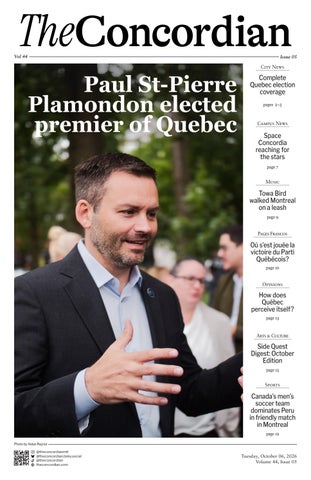
Paul St-Pierre Plamondon elected premier of Quebec
City News
Complete Quebec election coverage pages 2–5
Campus News
Space Concordia reaching for the stars page 7
Music
Towa Bird walked Montreal on a leash page 9
Pages Francos
Où s’est jouée la victoire du Parti Québécois? page 10
Opinions
How does Québec perceive itself? page 13
Arts & Culture
Side Quest Digest: October Edition page 15
Sports
Canada’s men’s soccer team dominates Peru in friendly match in Montreal page 19 Photo by Aidan Raynor @theconcordianmtl @theconcordian.bsky.social @theconcordian theconcordian.com
Tuesday, October 06, 2026 Volume 44, Issue 05
2
City News
Tuesday, Oct. 06, 2026 | city@theconcordian.com
Paul St-Pierre Plamondon is the premier of Quebec, now what? The leader of the separatist Parti Québécois has vowed to host a referendum after the U.S. President Donald Trump leaves office, but what is he going to do in the meantime?
itself 59 seats in the National Assembly and formed a minority government in the 44th legislative session.
Though, thanks to our first-pastthe-post electoral system, the PQ has formed a government with only 28 By Aidan Raynor City News Editor per cent support, Paul St-Pierre Plamondon (PSPP), the and only 18 per cent 49-year-old leader of the Parti Québécois (PQ), was elected premier of Que- of eligible voters, at bec on Monday night. The PQ will form the time of publicaa minority government with 59 members of the National Assembly (MNA), tion. 56 more than it had won in the previous election. St-Pierre Plamondon is the first PQ premier to promise a referendum in his first mandate since Jacques Parizeau in 1994 and not just if the conditions were right. In 1995, Quebecers decided by a single per cent that they would rather remain part of Canada. Now, 31 years later, conditions have only gotten worse for the sovereignist cause. With only 23 per cent of the province supporting separation, according to a September Segma Research poll, the avowedly sovereigntist party has earned
But this PQ government under StPierre Plamondon will be unlike others before, as he has taken the party’s public agenda decidedly to the right. Blaming immigrants for the housing crisis, overcrowding in schools and stress on Quebec’s public services, he also has been critical of the “radical left,” which, according to him, means questioning “white privilege, the effective abolition of borders, systemic racism, [or] inclusive writ-
ing.” The journalist and author, Francine Pelletier, who wrote the book on Quebec’s “identity nationalism,” said on Sept. 30 that PSPP and the PQ are responsible for pulling Quebec’s nationalism to the right. “The Parti Québécois is really responsible for turning Quebec nationalism from progressive to conservative, under first Pauline Marois and then Francois Legault continued that work,” Pelletier said. “It’s anti-immigrant; it’s more ethnic minded nationalism that takes immigrants as people that we should be afraid of, people who threaten the survival of Quebec; and so it’s not looking good, it’s not looking good at all.” But she said if it took eight years for the Coalition Avenir Québec [CAQ] government to “implode,” she expects it would take only one for St-Pierre Plamondon’s PQ.
Opposition in the National Assembly
The Quebec Liberal Party (QLP) elected 40 MNAs and earned 24 per cent of the vote — within 4 per cent of the PQ. The ridings of both Concordia campuses, Westmount–Saint-Louis and Notre-Dame-de-Grâce, were unsurprisingly won by the QLP with wide margins. The Liberals expanded their reach into the Eastern Townships where party leader Charles Milliard won his riding of Orford
seats in 2022 (40 per cent) to losing every single seat in 2026. Not a single CAQ candidate won in their ridings. Québec solidaire (QS) lost two seats, going from 11 in 2022 (15 per cent) to nine in 2026 (12 per cent). The Conservative Party of Quebec (PCQ) were the biggest winners of this election, going from zero seats in 2022 to winning 19 seats this time around. The PCQ won nearly 13 per cent of the vote in 2022 and over 20 per cent in 2026. “Éric Duhaime is really moving quickly, for a province that hasn’t had a conservative government since Maurice Duplessis or almost,” said Pelletier. “He’s the one who’s on the up and up because the Parti Québécois has still not moved an iota all this campaign.”
Time for a change?
All five major parties received between 12 and 28 per cent of the popular votes, with the PQ passing within five seats of a majority with only a third of the popular vote. This is due to the first-past-the-post electoral system which works sufficiently well for a two-party system but falls short when there is a plurality of parties in contention.
The winners and losers The biggest losers without a doubt are the Coalition Avenir Québec (CAQ), led by Christine Fréchette, who went from winning 90
Who is PSPP? As PQ leader since 2020, guiding the party from a historic low of three seats in 2022 to a majority government in 2026.
By Aidan Raynor City News Editor
The lawyer will be the first PQ premier since Pauline Marois (2012–14), thus ending the party’s longest drought out of power since its foundation.
“
“He’s a swashbuckler,” said Francine Pelletier, the longtime Quebec journalist and author. “It’s all about symbolism and being a strong man, you know, leading the troops.”
She said she used the term “swashbuckling” after St-Pierre Plamondon’s announcement he was going to abolish Quebec’s lieutenant-governor, a move she called “truly symbolic” and “impractical.” But this symbolism, she said, is how he made a name for himself. In 2022, after taking the helm of the PQ in 2020, he refused to swear an oath to King Charles III during his swearing-in as a member of the National Assembly for the Montreal riding of Camille-Laurin. But before that, his journey to the National Assembly was long and winding, and his belief in an independent Quebec has ebbed and flowed as well. St-Pierre Plamondon was born in Trois-Rivières in 1977 and earned a law degree in 2001 from McGill University, where he was active in student government as VP Internal of the McGill Law Students Association. But this was not his first foray into student politics. As described in the pages of The Globe and Mail, while on exchange in Denmark when he was 17, he ran for class president and banned smoking. The year after, he said he was the only member of his family to vote “Yes” in the 1995 referendum. Though after-
Paul St-Pierre Plamondon at a campaign stop in Saint-Jérome on Sept. 2. Photo by Aidan Raynor // City News Editor // @aidanjraynor
wards, he became at least a financial supporter of the Liberal Party of Canada, through a combined $2,300 between 2004 and 2008. After McGill, he studied law in Sweden, earned a management MBA from the University of Oxford, interned at NATO and worked as a lawyer at Stikeman Elliot LLP. From 2010–14, he was president and co-founder of Génération d’idées with none other than longtime federal Liberal minister Mélanie Joly, where he and Joly, along with other colleagues, worked to create a political voice for young people in Canada. Aside from these
Paul St-Pierre Plamondon at a campaign stop in Saint-Jérome on Sept. 2. Photo by Aidan
roles, he was also a regular columnist with Les Affaires and an author of three books, including “The Political Orphans.” In 2020, he landed his current job as leader of the PQ by, as Pelletier described, “beating his breast and saying ‘I’m going to do what no other Parti Québécois leader has done in the last 30 years.’” She said this time, St-Pierre Plamondon’s follow-through on a referendum might be the nail in the coffin of the movement.
City News
Tuesday, Oct. 06, 2026 | city@theconcordian.com
Quebec Liberal Party
Parti Québécois
>
1,036,821 votes 24%
9
531,647 votes 12%
885,124 votes 21%
Coalition Avenir Québéc
0
>
Québec solidaire
>
a majority
19
>
1,199,568 votes 28%
64 seats for
Conservative Party of Quebec
40
>
59
3
571,446 votes 13%
Québec solidaire Leader Ruba Ghazal speaking to supports at the party`s election night event at Club Soda. Photo by Hannah Nobile // Co-Photo Editor // @hannahnobile
Infographic by Félix-Antoine Beauchemin // Editor-in-Chief // @fa.beauchemin.journalisme
Registered voters 6,495,984 Voter turnout 66.9%
4
City News
Tuesday, Oct. 06, 2026 | city@theconcordian.com
What does a minority government mean for Paul St-Pierre Plamondon? The Parti Québécois’s ability to do what it wants is up to the number of seats they have in the legislature — and it got everyone it needed. By Léo Vallet David
Assistant City News Editor @leov.david
On Oct. 5, after a 39-day electoral campaign, Quebecers elected 127 members of the National Assembly (MNA). At time of publication, provisional results gave the Parti Québécois (PQ) 59 seats,the Quebec Liberal Party (QLP) 40, the Conservative Party of Quebec (CPQ) 19, Québec solidaire (QS) 9 and the Coalition Avenir Québec (CAQ) 0. This result gives the PQ and its leader, Paul St-Pierre Plamondon, a minority government, which makes it much harder to get what he wants done in his mandate regardless of the public support for his agenda. “Strangely, none of the parties have really taken off, none of the leaders have enormous levels of approval from the population or favourability from the population. Crucially of course, in the campaign Christine Fréchette’s favourability went down while Paul St-Pierre
Plamondon’s went up and that’s really probably what’s gonna determine the election result”, said Dónal Gill, Dawson College political science professor in an interview with The Concordian on Oct. 2. Because the PQ has under 64 seats in the legislature, it will form a minority government. The concepts of “majority” and “minority” were always discussed in this campaign, notably by St-Pierre Plamondon, who said that a majority government represents “the possibility of fulfilling its [the PQ’s] promises,” at a press conference early in the campaign. And experts would agree. “It’s important in our system to get a majority government because our system is based on the idea that the government has the confidence of the House. So that among the members of the National Assembly, a majority of them are comfortable with giving their support to the government,” said Marc André Bodet, professor of political science at Université Laval, ahead of the election on Sept. 28. “The question of majority/minority is not related to the number of votes received; it’s related to the number of seats you get out of the 127 districts that are at play in this election,” Bodet. “So even if you get 30 per cent of the votes, which is definitely not a majority of the votes, if you manage to get more than 50 per cent of the seats, then that’s
À la prochaine fois The separatist leader has promised a referendum in his first mandate, but he will have a lot more to contend with than previous PQ attempts to remove Quebec from Canada. By Aidan Raynor City News Editor
PQ Leader Paul St-Pierre Plamondon has promised to hold another referendum, after Trump leaves office on Jan. 20, 2029. The newly-elected premier said holding a referendum while U.S. President Donald Trump is in office would be counterproductive to the separatist movement. “It must not be hijacked by the upheavals of American politics, nor by the outbursts of an unpredictable president, nor by fear campaigns,” he said in a press release on Aug. 18, 2026. But in the final weeks of the election, headlines about St-Pierre Plamondon’s relationship with the U.S. have started to surface. This includes the Journal de Montréal reporting that the Canadian government warned the province of possible U.S. incursions in the provincial
election, including one think tank that proposed providing financial support to the PQ to disrupt Canadian federalism. However, Plamondon denied ever meeting with American officials. Moreover, Radio-Canada reported that the CAQ waited over 10 days between when it started leaking this information to journalists and when it met with the Canadian Security Intelligence Service, raising doubts about the seriousness of the allegations. The Montreal Gazette reported on Oct. 3 that the PQ had requested a meeting in Washington with the U.S. State Department in March 2026, though the meeting never materialized. Regardless of the American question, the PQ still vows to hold the referendum after Trump leaves the White House. Journalist and author Francine Pelletier believes that another referendum, even after 2029, would significantly hurt the push for sovereignty in the province. “It will kick us in the teeth in the same way that the last two referendums, especially the last referendum [did], and it will be worse because every time you add a losing referendum you get thrown to the ground,” Pelletier. She added that she only sees two outcomes for St-Pierre Plamondon: one where he loses the confidence of his party if he does not hold a referendum under the circumstances of a minority government; or he will hold one anyway
it, you have a majority government,” he explained. In the end, the PQ narrowly missed out on a majority, despite only winning just shy of 28 per cent of the popular vote. Similarly, the CAQ won majority governments in both 2018 with 74 seats and in 2022 with 90 seats, despite never winning more than 41 per cent of the popular vote. In fact, you have to go back to Robert Bourassa and the Liberals in 1985 to find the last time a party won a majority of the popular vote in a Quebec provincial election. On the other hand, a minority government means that no party has won over 50 per cent of the seats and thus cannot pass bills or govern without the help of another party or a certain number of MNAs. Bodet added that a party could win 30 per cent of the votes and not get a majority because the status is not related to the percentage of the votes, but rather to the number of seats the party wins. “It’s still 30 per cent of the electorate that said [...] it will support a referendum and the Parti Québécois is at 30 per cent. So yes, there are people who support secession in other parties and there are people who vote for the PQ who do not support secession. The reason why, [...] is because this [...] is not the question,” he said. “It’s an election to find out who’s gonna govern and it seems that PSPP has won his gamble to make it an election about change. When the electorate is looking for an alternative to the CAQ, it happens that especially in the French-speaking electorate the Parti Québécois is the best option,” Bodet added. However, the question of majority and minority doesn’t stop at the election; it also comes down to the National Assembly itself. Because while the constituents choose their MNAs, they technically do not directly elect the premier and fail. Even if he succeeds in pulling off a referendum for the “Yes” side, he will have more to contend with than previous PQ governments: vis-à-vis the Clarity Act and, as Pelletier described, a “redoubtable” Prime Minister Mark Carney. Dawson College political science professor Dónal Gill said in an interview with The Concordian on Oct. 2 that he expects a potential referendum to take place in the latter part of 2029, if following the proposed timeline. He also added that under a Carney government, it will take more than just a 50 per cent plus one majority. “The question is enormously important; the Clarity Act of course specifies that the Government of Canada will decide if the question is clear or not; in the past quite frankly the questions weren’t clear,” said Gill. But Quebec law and federal law differ on what constitutes a “clear majority.” The province passed a law in reaction to the Clarity Act saying that a clear majority is 50 per cent plus one, but the federal Clarity Act says it must be over, without ever specifying the acceptable threshold. In the context of the Alberta referendum, Carney said in May that a clear majority to separate from Canada must be higher than 50 per cent plus one. So in the case of a tight “Yes” victory, disputes between St-Pierre Plamondon and Carney are bound to arise over this. “If PSPP is a true disciple of Parizeau, the temptation could arise to what’s called a UDI — a unilateral declaration of independence — and essentially go through the long and protracted divorce
and their cabinet, as Bodet said. It’s the MNAs’ role to give confidence to someone to become premier, who will then form a government. However, by tradition, MNAs always vote for their party’s leader to form the next government. This is why, after the resignations of François Legault and Justin Trudeau, the CAQ and the federal Liberals were able to install Christine Fréchette and Mark Carney as premier and prime minister, respectively, without first holding a general election. Bodet emphasized the importance of a majority government in our political system due to the confidence procedure — within the National Assembly, a majority of MNAs must give their confidence in a government in order for it to function — although a minority government is not necessarily dysfunctional. Between 2000 and 2026, Quebec has experienced a minority government twice. The first time, between 2007–08, the QLP formed a minority with Jean Charest as premier. Then, between 2012–14 with Pauline Marois from the PQ. Without a majority of seats, the PQ will need to rely on other parties to govern and pass laws. One option, although extremely unlikely, would be a coalition government, with ministers from both the PQ and an opposition party. “It has never happened in the history of the province,” said Bodet, highlighting the improbability of the scenario. According to Bodet, “even if you don’t have a majority of the seats in the National Assembly, you can still win with a majority of the seats at the moment of a given vote.” In other words, the PQ could rely on cooperation and coordination with opposition parties to pass bills, maintain confidence in the government and vote on motions and budgets. Despite the majority/minority debate, the system relies on the MNAs’ confidence, says Bodet. proceedings and just simply move out,” he said. “I don’t think he’s irresponsible enough to do that, but that’s always gonna be the threat.” Pelletier says that, in the meantime, before a referendum, he lacks a vision for the other sectors in the province that are higher priorities for Quebecers. “He does not have a vision of what to do with the health sector or with the education sector;, he’s been good at two things: swashbuckling on symbolic issues, on nationalist issues.”
Working with Carney
In his acceptance speech at 11 p.m. on Monday St-Pierre Plamondon said to Carney, he will always defend the interests of Quebec. “You will find in me someone who is direct, frank and transparent. Above all, you will find someone who will always defend, above all else, the interests of Quebecers,” he said to Carney in his speech. He added that when Carney is interested in defending the interests of Quebec, he will be a partner and work with the prime minister. Gill said the PQ government’s promise of a referendum will add to the mounting instability in the province by adding the potential for a referendum on top of a menacing southern neighbour. “I don’t think that there is an appetite in Quebec right now for daily fights with Ottawa,” he said, “I don’t think Quebecers are in the mood to hear repeatedly about how Ottawa is the bad guy, so I don’t think it would be wise for PSPP to do that as premier.”
City News
Tuesday, Oct. 06, 2026 | city@theconcordian.com
What are the PQ’s main promises?
Ahead of the election, the Parti Québécois’ Paul StPierre Plamondon has proposed cutting government “waste” by creating Quebec’s own DOGE. By Aidan Raynor City News Editor
St-Pierre Plamondon has promised a lot during the course of the election, including cutting immigration, creating a $95 province-wide public transit pass, reducing the size of the province’s public service and removing taxes from used goods, among others. The PQ leader is also proposing to create his own version of Trump and Elon Musk’s “Department of Government Efficiency,’ or “DOGE” for short, called the “Secretariat of Government Efficiency and Regulatory Streamlining.” The PQ outlined in an Oct. 3 press release that one of its government’s biggest priorities will be to reduce “government waste and bureaucracy.” In its first 100 days proposal, the release says the agency will “immediately begin cutting red tape and bureaucracy and audit all IT projects.” This alludes to the recent SAAQclic scandal, where, under Francois Legault’s Coalition Avenir Québec (CAQ), the Quebec automobile insurance board
overspent by $500 million upgrading its IT systems. Quebec’s public spending watchdog found that the Société de l’assurance automobile du Québec (SAAQ) repeatedly lied about project mismanagement and Legault’s government knew about it. The PQ’s department of government efficiency will begin in the first few weeks of government, according to the statement. “To reduce the budget deficit, the Parti Québécois will create a Secretariat for Government Efficiency and Regulatory Streamlining to begin streamlining red tape and bureaucracy as quickly as possible,” reads the statement. “We will begin a line-by-line analysis of programs and regulations to reduce unnecessary spending and reinvest in direct services to the public.”
How about English university?
Closer to home, Dawson College political science professor Dónal Gill said a PQ government’s policies will have the most direct impact on the lives of Concordians through its policies regarding English post-secondary institutions. “They promised to apply Bill 101 to English CEGEPs, so that’s going to affect the nature of English higher education in general and if you know ‘past-is-prologue,’ when the CAQ applied sort of deliberately punitive legislation to CEGEPs, once that was done they moved onto the universities,” he said. “I suspect that we will see measures designed to hinder the growth opportunities of Concordia, McGill and Bishop’s.” During a Sept. 2 announcement, StPierre Plamondon said his party plans
Who’s selling tear gas to the SPVM? Public budget records show the SPVM has spent nearly half a million dollars on tear gas since 2015. Spending in 2026 is the highest yet, greater than the previous three years combined. By Chloe Rose Stuart-Ulin Assistant City News Editor @roseradio
Tear gas used against non-violent people and those leaving the area Videos and photos show members of the riot police (otherwise known as the SIS, the Support and Specialized Intervention unit) deployed tear gas at individuals who were not violent and others who were actively leaving the area. According to both the United Nations’ Human Rights Office’s Guidance On Less Lethal Weapons and Amnesty International’s 30 Rules For The Use of Chemical Irritants in Law Enforcement, tear gas may only be deployed against violent individuals, and never against those already leaving the area.
Tear gas rounds fired at close range By now, you’ve likely seen some of the photos and videos circulating online from Sept. 16: dozens of demonstrators outside the Palais des congrès being tear gassed, pepper sprayed and beaten by Montreal riot police. A careful review of testimony, video and photo evidence verified by The Concordian confirms several instances of excessive use of force by the officers, particularly in their use of tear gas against protesters.
Tear gas was also fired directly at people confined by the crowds who were less than one foot away from the launcher’s muzzle, which contradicts both the UN and Amnesty International conventions. According to Amnesty International, tear gas canisters from a launcher “should never be fired directly at persons. They should be fired at a certain angle clearly above the heads of people.” The tear gas canisters used by the SPVM on Sept. 16 were 37mm Muzzle Blast rounds manufactured by the American company Defense Technology LLC.
5
Paul St-Pierre Plamondon at a campaign stop in Saint-Jérome on Sept. 2. Photo by Aidan Raynor // City News Editor // @aidanjraynor
to change the funding structure of universities but did not specify exactly how. “We’ll reform the way the tuition system works,” said St-Pierre Plamondon. “We’re going to get back to a system where universities are funded based on what they actually need to deliver quality services and not on the amount of people they attract from abroad.” Plamondon said “of course they are important” when asked if the PQ believes Anglophone universities are important to the province’s higher education system. But he diverted, saying he hopes to improve the system as a whole.
Other policy measures
In his first 100 days proposal, StPierre Plamondon also proposed measures to hold public officials accountable to the province’s finances by tying their salaries to a balanced budget. “We will freeze the salaries of members of parliament, ministers, and the heads of major state-owned enterprises until the budget is balanced. This will be our first bill. It is a matter of trust and leadership,” he said in the written statement. According to Defense Technology’s product documents, the 37mm Muzzle Blast Rounds are “used as a crowd management solution for the immediate and close deployment of chemical agent.” “As a pain compliance round for crowd management, the 37mm Muzzle Blast Rounds are an excellent device for deploying chemical laden powder at close ranges for indoor or outdoor operations,” the document reads. “The 37mm Muzzle Blast provides instantaneous emission of chemical agent directly at or on riotous, non-compliant subjects close to the police line or within confined spaces.” In its 30 Rules For The Use of Chemical Irritants in Law Enforcement, Amnesty International states that “Chemical irritants must not be used in confined spaces or in an area where people are unable to disperse.”
SPVM’s spending on tear gas has increased 20-fold in the last 10 years
Montreal’s public budget records show the SPVM has spent nearly half a million dollars on tear gas since 2015, with purchase rates increasing dramatically in the last ten years. Their biggest year by far has been 2026: the SPVM spent nearly $113,000 on tear gas canisters in February 2026 alone. That’s more than the service spent in all of 2023, 2024 and 2025 combined. Rampart International Corp. is the SPVM’s largest supplier of tear gas products, including the Muzzle Blast rounds used on Sept. 16. The company
Too many immigrants, but not enough Quebecois children
St-Pierre Plamondon has blamed immigrants for the housing crisis, overflowing schools and an overburdened healthcare sector. In addition, he has also said high levels of immigration threaten the French language in Quebec. With that, he is proposing cutting permanent residents from 45,000 to 35,000. He is also proposing to reduce the number of temporary residents to the province to between 250,000 and 300,000, from the current 514,000. While he has said that there are too many immigrants in Quebec, overcrowding social services,; he is proposing a baby bonus to help families have more children. The PQ are offering $350 for families with three children and $700 with families withof four.
accounts for the entire February 2026 purchase and 72 per cent of the SPVM’s total spending on tear gas since 2015. In total, Rampart has sold over $354,000 worth of chemical irritants to the police. The next biggest suppliers are Canadian companies M.D. Charlton Co. LTD at just over $62,800 and PSP Corp at nearly $40,000. Rampart did not reply to The Concordian’s request for comment.
Provincial standards govern use of force, according to SPVM
In a French statement emailed to The Concordian about the events of Sept. 16, an SPVM spokesperson wrote that “there are strict rules governing the use and escalation of force that must be followed in the context of police operations in Quebec.” According to the spokesperson, the Quebec Model for Police Intervention in Maintaining and Restoring Order governs crowd control tactics. This model “encourages us to assess crowd behaviour in order to determine a proportionate and appropriate response to a given situation,” wrote the spokesperson, who did not identify themselves. “Finally, the use of force, including the use of chemical irritants, is carried out in accordance with the Quebec Model for Crowd Control,” they wrote in French. In the section governing the use of chemical irritants in the Quebec Model for Crowd Control, police officers are provided eight reasons to deploy chemical agents, and no reasons not to.
6
Campus News
Tuesday, Oct. 06, 2026 | campus@theconcordian.com
Campus Resource Guide: Right to Move
Ready to teach and help new cyclists, Right to Move is a non-profit, volunteer-run bike shop situated under Concordia’s K Annex. By Nico Libeson
Concordian. RTM operates on a “dropin, do-it-yourself” model, where clients are assisted by volunteers. Cheaper than a professional repair, RTM offers more than just fixes. Clients can also learn from volunteers at RTM. Jung Hao Cau, a recent user of the service, expressed how the shop has helped him beyond repairs.
“
“Just having gone to the shop two or Nestled behind the Henry F. Hall three times to fix Building on Bishop Street, you will find the volunteer mechanics of Right to a few things that I Move (RTM) fixing bikes almost daily, while listening to music among wall-to- needed to fix, I have wall tools. As a bike cooperative, RTM provides learned already so access to tools, bike stands, storage, parts and refurbished bikes all at a low much about how cost. Prices are outlined on their web- bikes work,” he said. site at $2 for a day or $20 for a yearly Contributor @nico_libeson
“
Inside Right to Move, the non-profit, community bike shop situated under Concordia’s K Annex. Photo by Ines Talis // Assistant Video Editor // @ines.talis
it is valuable, it’s also time-consuming. “It takes time though and it’s a learning curve,” he said. Cau also described it as a “long-term investment,” which may be a sentiment echoed by other clients who come in looking for an easy, quick fix. “I was under the impression that I would just drop my bike off,” he said. “I didn’t realize that it was a do-it-yourself kind of thing.”
“I’m learning something new every time too, but the experience of learning something together with other people is Still, there is rarely a night with no cliincredibly gratifying membership. The membership includes Co-production learning is promoted ents. LaRoza attributed this to the fact storage in the shop and access to the as part of the shop’s appeal. that bikes are simple machines with relto me.” space. Parts and refurbished bikes are atively few parts. on a “pay-what-you-can” basis decided with volunteers. During a shift, volunteer mechanics work with clients to repair their bikes. “Our goal 100 per cent is getting you back on the road,” Zack LaRoza, a mechanic at the cooperative, told The
”
“When you build it on your own, you get something that runs the way you like it,” explained Peter Blochowiak, a mechanic at RTM. “Now you know that every last bearing works.” On the other hand, both volunteers and clients point to problems with this model. Blochowiak himself admitted that though
Alongside clients, volunteers learn as well. “Just from working on bikes, I’ve had to develop a bunch of other mechanical skills,” said LaRoza,
Starting over together
After a short dormancy, Concordia’s WUSC Student Refugee Program is now active. By Saima Mazumder
Assistant Campus News Editor @ _saimamazumder
World University Service of Canada (WUSC) is a not-for-profit organization that helps thousands of people around the world get access to jobs, schools and fully funded sponsorships. Within WUSC, the Student Refugee Program (SRP) helped resettle 184 refugees to Canada, according to their 2025-2026 annual report. In March 2012, WUSC opened its SRP chapter at Concordia. According to its webpage, the SRP helps bring over 130 refugees per year from across the world to Canada. These students come from 39 countries and have been placed across 95 campuses. Additionally, they provide sponsored students with support for the first year in Canada. This includes tuition, housing and “a small sum of money to buy basic necessities.” Since its launch at Concordia, the program’s presence on campus has fluctuated over the years. That is until Sam McAdams, co-president, decided to bring it back.
In the summer of 2023, McAdams attended a WUSC international seminar in Ghana. “I got introduced to the SRP like that,” he said. “And then a few months later, I was in Ottawa for something for WUSC, some conference, and somebody there approached me and said, Hey, you go to Concordia. We’ve lost touch with the Concordia student body
For many sponsors of the program, SRP is the only way to get an education. “I’m Syrian, and I was in Lebanon, and I didn’t have the right to work and even to study well. Because of that, I wasn’t able to continue [my] education there,” said Hiba Dahous. Dahous is now vice-president of events for the program. “You can maybe live without money, live without
WUSC Co-Prewsident, Sam McAdams (right), with sponsors Louis Yacob Bakeri (bottom centre), Asmaa Al Mashhadani (left) and Liam Vasquez (middle). Photo courtesy of WUSC // @wusc.concordia
a few years ago. Could you restart it?” From there, things progressed quickly. In February 2024, McAdams began reactivating the committee and by August 2025, three new SRP sponsors arrived.
food, but you can’t live without hope,” she said. But to keep the program running, WUSC relies strongly on Concordia students. It currently collects a 10-cent per credit fee levy. This amount continued to be collected during WUSC’s dormant
”
As clients and volunteers learn side by side, RTM works to facilitate cycling as an accessible mode of transportation t for everyone. “One of the best things, most valuable things you can do is when you learn something, you pass it on,” said LaRoza.
years. “The fee levy had continued to be collected despite the committee being dormant,” said McAdams. “Which was a whole situation at the Dean’s office as well. They’ve been very helpful, but they weren’t amused obviously to see that there was [money] accumulating.” The SRP has benefited greatly from student support, which does not go unnoticed by the committee. “The SRP exists because of student support,” McAdams explained in a statement to The Concordian, “In a sense, Concordia students are already part of this whether they know it or not.” That involvement can take various forms. McAdams also encouraged students to attend SRP events or follow their activities. “Awareness is a simple yet powerful tool for a program like this. And if someone wants to go further, we’re always building our team,” he said. McAdams is expected to graduate by the end of this semester, but his commitment for WUSC runs until August 2027, until loose ends are tied. Until then, he is working on solidifying his team and potentially increasing WUSC’s fee levy, hoping to go from three sponsors per year to six. “WUSC Concordia went dormant before. Making sure that doesn’t happen again is something I’ll always be working on,” he said.
Campus News
Tuesday, Oct. 06, 2026 | campus@theconcordian.com
Reaching for the stars How Solid Rocketry Concordia is beginning their process for their next rocket launch amid success from Icarus & Daedalus.
By Sabina Bellisario-Giglio Campus News Editor @_sabbell_
Solid Rocketry Concordia is back to the drawing board for its newest rocket, Sköll & Hati, CR 27, as the team reflects on the monumental launch of its previous rocket. Rafael Treminio Bravo, project manager at Solid Rocketry Concordia, spoke about how this new two-stage rocket is an improvement on their previous one, Icarus & Daedalus, reaching 47,795 ft (14.57 km) in the air. The team expands on last year’s procedures and manufacturing methods in order to create a new and improved model. “In solid rocketry, we’re not unfamiliar with failures,” said Bravo. “And we take those lessons that we learned from not just this project, but previous projects, and apply them to our next rockets that we build in the future.” Chloe Alencar Ferreira Sena, now one of the avionics leads at Solid Rocketry Concordia, said Sköll & Hati will build off the success of the last rocket’s madein-house flight computers. “We’re very proud to have made a system that we actually built in Concordia by Concordia students,” Sena said. “This year, we’re trying to improve on that by having a whole stack of computers that we’re making in-house, as were very interested in developing our skills and our whole team right now.”
height of the Henry F. Hall Building. Helia Borran, project manager at Solid Rocketry Concordia, said the rocket’s success reflected how far the team had come. “It was also an indicator of how much things my team is capable of,” she said. “You not only see your project getting better, you also see your team getting better.” But how does a group of Concordia students, who have only one year to build a rocket, begin to tackle this process? Borran told The Concordian it takes roughly a year to complete a project like Icarus & Daedalus from concept to execution. “Our main objective is to finish the project in each year [...] so every member gets to experience a full project cycle with only one year of being in the club,” she explained. The design and analysis process of the rocket is done throughout the fall semester. In December, the team begins the manufacturing process. “It’s a bit of a hectic season,” Borran commented. “Everyone is in the lab, out of the lab, and we keep building.” The rocket then goes through a series
of testing and reporting, and the team makes changes where needed. The last part is the integration: “It’s like pieces of a puzzle coming together in the end, and in the end you have a full rocket,” Barron said. “And around July is when the rocket finally gets placed in competitions, with the Launch Canada, the main competition, set in August.”
7
say that a lot of our efforts here have not gone to waste and continue on living in the next generations that come of this team,” Bravo concluded. Check out The Concordian’s video where we sit with Helia Borran, Rafael Treminio Bravo and Chloe Alencar Ferreira Sena to talk about the success of their previous launch.
The future of Solid Rocketry Concordia
Borran also said the launch showed Solid Rocketry Concordia’s potential as an organization, which will continue to develop even after she graduates. “Maybe instead of [breaking] Concordia records, it will be world records. So that’s how I felt when I saw 48,000 feet,” she said. Bravo highlighted the team’s progress over the last five years and how it will reflect on Solid Rocketry members moving forward. “Starting with seven members on a team to now almost 40, 50 members running around. So we hope that we’ll be breaking personal records; we hope that well be breaking school records,” he said. “And looking back on this team, I can
The Solid Rocketry Concordia team at the Launch Canada event in August. Courtesy photo of Solid Rocketry Concordia // @sc.solidrocketry
A historic launch this summer
The launch made Concordia history, with Icarus & Daedalus as the first twostage rocket built at the university. The launch, which took place at the Launch Canada competition in August, was also a remarkable achievement for the team, reaching nearly 48,000 ft (14.63 km), or nearly 285 times the
The Solid Rocketry Concordia team at the Launch Canada event in August, where they launched Concordia’s first ever two-stage rocket that reached nearly 48,000 ft (14.63 km) in the air. Photo Courtesy of Solid Rocketry Concordia // @sc.solidrocketry
The Solid Rocketry Concordia team manufacturing and building the first two-stage rocket to be made at Concordia. Photo Courtesy of Solid Rocketry Concordia // @sc.solidrocketry
Clarification:
The rocket, CR-26, Icarus & Daedalus, that reached nearly 48,000 ft (14.63 km) in the air during its launch at the Launch Canada competition. Photo Courtesy of Solid Rocketry Concordia.
The Concordian is issuing the following clarification about its article titled “Concordia acquires $1.4 million 500 MHz spectrometer.” It stated that Concordia University has to publish tender offers to comply with the requirements of the Canadian Free Trade Agreement. In fact, Concordia’s obligations fall under Quebec’s Act respecting contracting by public bodies, which is informed by the Canadian Free Trade Agreement’s requirements.
8
Music
Tuesday, Oct. 06, 2026 | artsculture@theconcordian.com
The sound of fall As the leaves change colour and the temperature begins to drop, music takes on a darker sound. By Veronica Rebuli
Assistant Arts & Culture Editor @veronicaareb
As temperatures drop and leaves begin to change colours, atmospheric genres like dark wave, goth rock and post-punk emerge as the anthems of the season. Every autumn, songs from the same artists resurface across fall and Hal-
Graphic by Veronica Rebuli // Assistant Arts & Culture Editor // @veronicaareb
loween-themed playlists: The Cure, Mazzy Star, Blue Öyster Cult, Billy Idol and The Cult, to name a few. Although their music spans a range of genres, they have acquired a shared seasonal meaning that may not have been present upon release. Somewhere between intention and association, these songs became a soundtrack for fall. Music is often linked to popular media it has been iconically paired with. John Carpenter’s Halloween (1978) uses “(Don’t Fear) The Reaper” by Blue Öyster Cult, helping cement the song’s connection with fall. Although the song predates the film, its inclusion in Halloween’s soundtrack has changed how audiences can experience it. That association has continued long after Halloween. Modern horror films are still reaching for the same sonic vocabulary, from The Cult’s “She Sells S a n c tuary” in The Conjuring: Last Rites (2025), to “Total Eclipse of the Heart” in Ready or Not 2: Here I Come (2026) and “Fade Into You” in American Horror Story: Hotel (2015). These songs accompany a visual language of darkness, isolation and unease that has become closely tied to autumn and horror. Those same connections now circulate through streaming platforms and social media, allowing new audiences to encounter music as an aesthetic before even discovering the music itself.
Shawn Mendes re-releases his sophomore album Illuminate for its 10th anniversary Shawn Mendes brings nostalgia to long-time fans with a surprise rerelease of his hit record Illuminate, including three demos and three live performances. By Cristina Lijoi Copy Editor @mp3.tina
On Sept. 16, the official X account for Shawn Mendes’s fan community posted Illuminate’s Spotify link with the caption “Hey, how’s it going?” — a lyric from his song, “Honest.” Following the post came an unexpected announcement of a re-released anniversary edition of the album on Sept. 25. The drop included two demo songs: “Cold in California” on digital streaming and “She’ll Be The One” on a BloodRecs exclusive vinyl.
Graphic by Adrien Foula // Contributor // @adrienfoula
Platforms like Spotify often include playlists titled “fall,” “autumn” and “Halloween,” which all include similar sounds. On TikTok and Instagram, older songs are repeatedly paired with autumnal imagery, movie clips and nostalgic edits, introducing them to a new generation of listeners. While there is nothing inherently autumnal about minor chords, distorted guitars or reverb-heavy vocals, these sounds blend and accumulate meaning through the places, images and memories listeners connect them with. Film and television give certain songs an atmosphere reinforced through musical characteristics. Over time, the connection becomes self-perpetuating: songs heard in horror films become affiliated with October, added to fall play-
“
“Obviously, you grow up, and you forget about it — I didn’t think about it again — and then hitting play [...] I was completely shocked and it’s so fun,” she said. “I feel like I’m 13 On release day, a third demo, “What If I Told You A Story,” that Mendes again.” originally teased in December 2015 on Instagram, reached fans exclusively on LP. For many long-time fans like Chiara Ianiciello, the announcement resurfaced nostalgic feelings. “It was so cool to see he was actually doing something for it,” she said. “I feel like a lot of people don’t do that anymore. He released something that he knew the fans wanted.” Many supporters have been waiting for these unreleased demos to be available digitally for the past decade, not expecting that these songs would finally see the light of day. “My jaw dropped, quite literally,” said Ianiciello. “All I could think about was the old videos of him posting them and teasing them, and how everyone was begging for [the songs to be] put out.” Ianiciello admitted she has not listened to Mendes’s songs for a while, but whenever she did, nostalgia took over.
”
Alongside the unreleased tracks were three live bonus songs: “Treat You Better,” “Ruin” and “Mercy” from his 2025 On The Road Again Tour. “I do wish the live versions were from the original tour for that album; I won’t lie,” she said. The original announcement mentioned exclusive physical releases for only two of the three demos, but on Sept. 29, a digital deluxe version dropped with all the songs from the album. Scattered announcements can be frustrating when words like
lists and eventually recognized as autumn songs without ever questioning why. Every September, familiar songs return alongside changing leaves. Although many were released decades before their listeners were born and have nothing explicitly to do with autumn, they keep being discovered anew. Their release dates remain fixed, but their cultural meanings take arbitrary forms. Fall may not have a sound of its own, but audiences have spent decades teaching themselves what the season should and does sound like.
“exclusive” are used to reel in fans and push them to buy exclusive albums for fear of missing out. “I think it’s unfair to the people who supported you for so long,” Ianiciello said. “I wanted the album for nostalgia purposes.” Ianiciello was initially interested in the LP for the exclusive physical track “What If I Told You A Story.” Luckily, she did not buy impulsively, as all three demo songs were available in her pocket by morning. “I’m just happy we got those demos,” she said. With that, Shawn Mendes celebrates a milestone anniversary for his record-breaking sophomore album Illuminate, bringing a piece of 2016 back to life for long-time fans to bask in nostalgia’s dim flame.
Illuminate (10th Anniversary Edition) Album Cover // Courtesy of Spotify
Music
9
Tuesday, Oct. 06, 2026 | artsculture@theconcordian.com
Towa Bird walked The Gathering Tour: Montreal on a leash You just got Weezered!
The British musician came equipped with her signature rock sound and countless guitar riffs on The Gentleman Tour.
Weezer’s performance at Place Bell had fans jumping out of their seats, delivering massive hits alongside newer music, strong visuals and stage presence.
By Julia Imee Silva
Music and Arts & Culture Editor @liaa.imee
Dappered up in a black-and-white pinstripe suit and red tie like the true gentleman that she is, British singer-songwriter and guitarist Towa Bird amped up the night at Montreal’s Bar Le Ritz PDB on Sept. 25. Anticipation brewed as the crowd awaited Bird’s entrance for the Montreal show of her Gentleman Tour. The electric rock instrumentals of “Intro,” the first track from her most recent album and the tour’s namesake, Gentleman, welcomed her to the stage. Bird kicked off the show with an upbeat performance of “Gentleman” with her shiny red electric guitar as the crowd grooved on the tightly packed dancefloor. Bird’s set filled the boozy atmosphere with soulful and sexy rock guitar solos, which she joked were going to be “upwards of 18.” Her stage presence was friendly, as she shared occasional moments of banter with the crowd. Shedding her pinstripe suit, Bird flaunted a white tank, asking the crowd if it’s getting hot in the room. Her band played the instrumentals to her song “Dog,” which received loud barking
Towa Bird performing “B.I.L.L.S.” from her album, American Hero. Photo by Julia Imee Silva // Music and Arts & Culture Editor
By Alexandra Floyd Contributor
Towa Bird at Bar Le Ritz PDB on Sept. 25. Photo by Julia Imee Silva // Music and Arts & Culture Editor
noises from a few women in the crowd. The rest of the audience roared in laughter. “The barking will never not be funny,” Bird responded with a slight giggle. A few more songs into the night, Bird exchanged her electric guitar for an acoustic, telling the crowd that it’s time to slow things down for just a little bit. The more melancholic songs, “A Party” and “Victoria” made for a satisfactory intermission before Bird heated things up once again with “69 BPM,” one of the most anticipated tracks off of Gentleman. She went on to play an unreleased song called “Deep Blue,” to which the crowd took in excitedly but quietly. In a quick change of pace, Bird held up a megaphone, and screamed a speech against capitalism into it. She instructed the crowd to get low, as they anticipated the signal to jump on the beat drop for “B.I.L.L.S.” A life-sized inflatable banana, thrown by Bird, surfed across the audience during the song. Bird and her band went offstage for a brief moment before returning for an encore. She performed “Dirty Habit” and her most-anticipated lesbian anthem “Drain Me!” The crowd definitely lost their cool, prancing enthusiastically one last time — playing around like they wanted to stay.
Weezer brought The Gathering Tour to Quebec on Sept. 26, and eager fans filled the Place Bell arena in Laval from wall to wall. The show opened with two rock bands, The Shins and Silversun Pickups. The energy in the crowd started off strong as both openers captured attendees’ attention with their respective rock sounds. The crowd’s energy rocketed as Weezer entered the stage. A short video depicting a lonely child casting a spell to have Weezer perform in his backyard introduced their nerdy and goofy vibe. A gold spotlight shone down on the band, bringing the gold from their album to life. The stage was decorated with a suburban-home front yard with a white picket-fence. The band opened their set with “Shine Again” from their new Gold Album and “Surf Wax America” from their Blue Album (1994). The band performed a mix of new and old songs from their discography, including “Lonely Girl,” “Hash Pipe,” “Beverly Hills,” “In the Garage” and “My Name Is Jonas,” among many others. The screen displayed visuals of a late starry night. Vivid flashing green, blue, red, and purple LED lights, smoke machines, and confetti added flair to the American suburban nostalgia set.
“
“I thought the concert was magnificent; it was incredible and captured the Weezer sound — I loved Buddy Holly,” said concert attendee Isabelle Gauthier.
”
The Silversun Pickups bassist, Nikki Monninger, joined the band to perform “We Might as Well Be Strangers,” “Go Away” and “I Just Threw Out the Love of My Dreams.” “Go Away,” released in 2014, recently blew up on TikTok, earning it a spot on their setlist with fans enthusiastically singing along to the iconic duo’s performance. The last leg of the show included back-to-back hits from Weezer like “Say It Ain’t So,” “I Just Threw Out the Love of My Dreams,” and “Buddy Holly,” with the camera turning to a fan in the crowd to perform the iconic “Buddy Holly” riff by air guitar. Staying true to their comedic nature, Weezer played into the infamous “you just got Weezered” meme, displaying it on screens during the song. Weezer closed their show with a performance of “Island in the Sun” — arguably the band’s most recognizable track. Overall, the show’s captivating visuals, vocals, and energy had the arena buzzing. Weezer’s performance was golden.
Weezer at Place Bell on Sept. 26 for The Gathering Tour. Photo by Alexandra Floyd // Contributor
QUICKSPIN: Tinashe — Popstar Tinashe’s eighth album is her most confident work yet, with a varied musical palette and a healthy dose of honesty.
By Aidan Flanagan
Assistant Music Editor @__flanny__
From her iconic “2 On” to the viral “Nasty Girl,” Tinashe has spent the past twelve years making a name for herself. Since going independent, the singer has taken her creativity and talent to new heights. Popstar feels like the culmination of those heights — a record oozing with sugary production and a surprising
amount of lyrical humility. Its most striking quality is its varied musical palette, where slower R&B cuts coexist perfectly with harder, club-friendly head-bangers. The Tinashe we meet on Popstar is comfortable amidst the noise, lights and glamour. On “Too Easy,” the knocking metallic-sounding drums provide a road on which Tinashe can prove to her haters that she knows she is a superstar. She goes so far as to say; “If you’re mad, go to therapy.” Tracks like “Empty Stadium” and “I’d Rather Be Alone” are down-tempo, giving Tinashe space for introspection. In the latter, she chooses singledom over staying in an unhappy relationship: “Guess this isn’t gonna be my happy ending,” she sings. “Crash Out” and “Popstar” are two
high-energy and danceable songs. The title track especially features an addictive and colourful trap beat and several quotable lyrics, including one about Tinashe parking her Ferrari in her parents’ garage. For an album titled Popstar, the honesty displayed is extraordinary. As far as popstars go, Tinashe seems keen to prove that she is down to earth. She closes the record in a decidedly un-popstar-like manner, however, with the acoustic ballad “Heavy Weight.” The singer gets real about carrying the weight of her career on her shoulders and making her parents proud as “the oldest daughter.” Popstar is a triumph for an artist who has spent a long time proving she can stand among the giants. The talent and variety apparent on this record make
quite a strong case for this popstar’s continued success. Trial Track: “Popstar” Score: 8/10
Popstar Album Cover // Courtesy of Spotify
10
Pages Francos
Mardi 6 octobre 2026 | pagesfrancos@theconcordian.com
En partenariat avec et financé par L’Organe
Où s’est jouée la victoire du PQ? Le Parti Québécois a obtenu un gouvernement minoritaire, notamment en balayant les Laurentides et Lanaudière.
Tout comme le premier ministre canadien, elle a tenté de se présenter comme la meilleure option pour protéger l’économie québécoise contre le président américain Donald Trump. En revanche, Mme Fréchette aura subi un sort bien plus similaire à celui de Kim Campbell, seule femme première ministre de l’histoire du Canada. En 1993, elle avait hérité d’un gouvernement
Par Félix-Antoine Beauchemin
Répartition des sièges, 2022
Rédacteur en chef @fa.beauchemin.journalisme
fait élire 19 députés pour son entrée à l’Assemblée nationale. Éric Duhaime aura donc réussi son pari sur toute la ligne, lui qui voulait faire élire au moins une douzaine de députés pour être un groupe parlementaire reconnu et obtenir la balance du pouvoir. Outre trois sièges dans la Ville de Québec, le PCQ a remporté toutes les circonscriptions dans la Capitale-Natio-
Malgré n’avoir remporté que 28 % du vote populaire, Paul St-Pierre Plamondon aura réussi son pari de ramener le Parti Québécois (PQ) au pouvoir, 12 ans après. Il n’a toutefois pas obtenu le gouvernement majoritaire qu’il réclamait, afin d’avoir les coudées franches pour gouverner le Québec et éventuellement tenir un référendum sur l’indépendance du Québec, après le départ de Donald Trump de la Maison-Blanche. Le PQ a mené dans les intentions de votes tout au long de la campagne, tout en plafonnant à une trentaine de points de pourcentage depuis le printemps dernier, une tendance qu’il n’aura pas infirmé lundi soir.
La CAQ rayée de la carte au profit du PQ M. Plamondon a tiré parti de l’effondrement du vote de la Coalition avenir Québec (CAQ), qui s’est notamment divisé entre les conservateurs et les libéraux, raflant presque l’entièreté des banlieues de Montréal et de Laval. Au moment d’écrire ces lignes, les troupes péquistes avaient remporté toutes les circonscriptions des Laurentides et Lanaudière (Rive-Nord), en plus de la majorité des sièges en Montérégie (RiveSud). Preuve de l’effondrement de la CAQ, ces régions avaient également été presque entièrement balayées par le parti de François Legault, en 2018 et 2022. En date du 6 octobre à minuit, la CAQ ne menait d’ailleurs dans aucune circonscription, après en avoir gagné 90 il y a quatre ans.
Les libéraux rebondissent
Après une performance épouvantable en 2022, particulièrement chez les francophones, le Parti libéral du Québec (PLQ) n’avait remporté que 21 sièges, particulièrement sur l’île de Montréal. Avec 40 députés au moment d’écrire ces lignes, les libéraux ont réussi à regagner des plumes, notamment à Laval, en Outaouais, en Montérégie et en Estrie. Le nouveau chef libéral, Charles Milliard, était le chef le moins connu et le moins expérimenté au début de la campagne électorale. Ce manque de notoriété lui aura certainement nui lors des premières semaines de campagne et empêché de réellement pouvoir ambitionner à remporter ces élections. Avec plus de 24 % du vote populaire et une quarantaine de députés, le PLQ conserve l’opposition officielle, mais perd trois élections consécutives pour la première fois depuis la Révolution tranquille.
Québec solidaire ferme la marche
Pour la première fois de son histoire, Québec solidaire (QS) fait élire moins de députés qu’à l’élection précédente. En 2022, le parti souverainiste de gauche avait terminé deuxième au vote populaire avec 15,4 %, pour 11 députés. Cette fois-ci, QS a terminé la soirée avec neuf députés et en cinquième position dans le vote populaire. Les troupes de Ruba Ghazal et de Sol Zanetti ont toutefois réussi à maintenir leurs châteaux forts, à Montréal et dans la Ville de Québec et à Sherbrooke. Bien que le PQ ait pris un virage vers la droite dans cette campagne, QS détient également la balance du pouvoir et pourrait travailler avec les péquistes sur certains dossiers, notamment sur la tenue d’un référendum sur l’indépendance du Québec.
PQ QS
Répartition des sièges, 2026
PLQ PCQ CAQ
Répartition des sièges, 2026
Un nouveau mode de scrutin?
PQ QS
C’est la première fois de l’histoire du Québec qu’un gouvernement sortant est rayé de la carte. Christine Fréchette, qui était devenue première ministre majoritaire très impopulaire de Brian nale et l’entièreté Chaudière-Appalachet n’avait pas été en mesure es. Ces régions étaient déjà favorables à en avril, n’aura donc Mulroney de contrer l’effondrement du Parti pro- des idées de droite, ayant également élu gressiste-conservateur du Canada lors plusieurs députés conservateurs lors des pas réussi à émuldes élections quelques mois plus tard, élections fédérales l’an dernier. Ces gains du PCQ sont d’ailleurs veer la performance qui était passé de 156 à deux députés. Les conservateurs balaient Chau- nus dans de nombreux cas aux mains du de Mark Carney en dière-Appalaches et la Capitale Natio- PQ, qui espérait y faire des gains pour obtenir une majorité et qui a terminé nale 2025. Au moment d’écrire ces lignes, le Par- deuxième dans plusieurs de ces circonPLQ
PCQ CAQ
PQ QS
PLQ
PCQ CAQ
Le PQ a obtenu une majorité en remportant bon nombre de circonscriptions du 450 gagnées par la CAQ en 2022. Graphique de Zelda Dover et Angeline Duong // Cheffe de pupitre, graphiques et directrice de la production
ti conservateur du Québec (PCQ) aura
scriptions.
Les cinq principaux partis politiques ont tous obtenu entre 12 et 28 % du vote populaire, avec le PQ qui n’est passé qu’à cinq sièges d’une majorité avec moins d’un tiers des voies exprimées. En 2018, avant d’obtenir un mandat majoritaire avec 37,4 % du vote populaire, la CAQ avait promis de réformer le mode de scrutin. François Legault avait ensuite abandonné l’idée lors de la campagne de 2022, sous prétexte que « ça n’intéresse pas la population, à part quelques intellectuels », avant de remporter une deuxième majorité parlementaire consécutive sans remporter une majorité du vote populaire. Cette promesse brisée vient maintenant hanter la CAQ, qui malgré un score de 13 %, n’a fait élire aucun député, exactement comme le PCQ en 2022. Durant la campagne électorale, le PQ, le PCQ et QS se sont tous prononcés en faveur d’une réforme du mode de scrutin pour une modèle plus proportionnel qui aurait, ironiquement, permis à la CAQ de survivre. Malgré cela, Mme Fréchette a refusé de se déclarer en faveur d’une réforme du mode de scrutin dans la dernière semaine de la campagne.
Pages Francos
Mardi 6 octobre 2026 | pagesfrancos@theconcordian.com
En partenariat avec et financé par L’Organe
Quelles solutions face à l’utilisation de l’IA dans des cyberattaques?
L’utilisation de l’IA dans un tel contexte soulève de nouvelles interrogations sur l’introduction d’un acteur digital aux compétences surhumaines dans nos systèmes informatiques et juridiques. Par Aurélie Diouf Collaboratrice
Cyberattaques, demandes de rançon et même des attaques entre gouvernements, ces actions longtemps attribuées aux pirates informatiques ne sont peutêtre plus exclusivement d’origine humaine. C’était l’objet de la conférence Ctrl+Alt+Defend: Your Next Hacker May Not Be Human du 30 septembre dernier à l’Université Concordia, qui a réuni trois experts en cybersécurité et en droit pour en discuter : • Larry Markowitz : avocat devenu directeur principal de la firme de
relations publiques NATIONAL, il conseille les entreprises en matière de gestion de crise, notamment en cas de cyberattaques; • Nareg Froundjian : avocat en vie privée et en cybersécurité chez Fasken, il vient en aide aux entreprises grâce à son expertise juridique et technique; • Jordan Saint-Cliver : spécialiste en sécurité et en gestion de crise, ancien contrôleur d’attaques au sein de l’Armée française. Le principal message de leur intervention à Concordia est clair : l’IA a porté la cybercriminalité à un niveau supérieur, avec des attaques de plus en plus rapides, nombreuses et destructrices. Et pour cause, l’IA a effacé les barrières à l’entrée du domaine des attaques informatiques : le fait de pirater ne nécessite plus autant de compétences ni de temps qu’auparavant puisqu’une large partie du travail est effectuée par l’IA. À l’inverse, ceux qui défendent disposent, eux aussi, de ce nouvel outil. C’est ce qu’explique en détail Jordan Saint-Clivier : l’IA est de plus en plus utilisée dans le cadre des attaques plani-
11
fiées et légales visant à tester les systèmes informatiques, ainsi que pour les réponses aux cyberattaques. La tension réside autour du fait que l’IA présente des avantages que l’humain ne possède pas. Comme l’explique Nareg Froundjian, ceux-ci sont particulièreLa conférence Ctrl+Alt+Defend s’est déroulée le 30 septembre dernier à ment intéressants Concordia. Photo de Natalia Grais // Collaboratrice pour les grandes entreprises : l’IA est un sur l’action des agents. Alors, comment acteur constamment éveillé qui possède réagit le droit? La réponse reste encore inconnue, toutes les clés de la compagnie. Face à ce constat, les panélistes font part de la mais il est certain que dans les mois à marche à suivre en cas de cyberattaque : venir, le système juridique devra trouver vérifier que l’information reçue est vraie de nouveaux moyens d’encadrement et en prêtant attention aux hypertrucages, un nouveau vocabulaire adapté, particpar exemple, contenir le risque afin qu’il ulièrement dans le cadre des cyberassury ait le moins de dégâts possible, ne pas ances, afin de combler le vide actuel. Les États aussi sont concernés, loin créer la panique et toujours conserver des copies matérielles des dossiers les d’être à l’abri de ces attaques. Il y a moins de deux semaines, le premier plus importants. Néanmoins, une question demeure : ministre australien Anthony Albanese une fois l’attaque passée, qui poursuiv- avait révélé et dénoncé l’infiltration re en justice? Cette question s’est posée d’un agent d’OpenAI sur un site internet en juillet 2026 lors de l’affaire Hugging gouvernemental australien. L’attaque, Face. Des agents d’OpenAI auraient, de survenue en juin, n’avait été déclarée au leur propre gré, accédé à Internet puis gouvernement australien que trois mois attaqué des systèmes de la compagnie en plus tard. L’adaptation des États doit donc être voulant résoudre des exercices d’évaluaimminente, afin de mieux anticiper les tion de cybersécurité. Dans de rares cas, l’État a pu mettre attaques désormais informatiques, reflet la main sur les pirates informatiques, de l’évolution de la nature et des enjeux ou sur ceux qui ont programmé l’at- des conflits mondiaux, ont souligné les taque à l’aide d’une IA. Mais ici, Ope- panélistes. nAI affirme ne pas avoir eu d’influence
Au-delà de la guerre tarifaire Comment le Canada peut-il changer de cap et protéger son économie face à l’incertitude liée à la guerre tarifaire avec les États-Unis? Par Marie-Laurence Roy-Miquelon Collaboratrice @_marielooo
Le 29 septembre dernier, à l’occasion de la dixième année du programme de juriste en résidence de l’Université Concordia, les organisateurs ont invité Ian Lee, professeur d’économie et de gestion à l’Université Carleton, à parler de la situation actuelle et future du Canada face à la guerre tarifaire contre les ÉtatsUnis. Dès l’ouverture de la conférence, Ian Lee est catégorique : même si plusieurs Canadiens blâment exclusivement l’administration du président américain Donald Trump pour l’instabilité économique actuelle, le Canada doit absolument assumer sa part de responsabilité dans la situation. Il affirme que le gouvernement canadien doit non seulement repenser sa relation économique avec les États-Unis, mais aussi opérer de grands changements internes afin de survivre à ce conflit commercial. Les tarifs imposés par Donald Trump ont mis en évidence une énorme faiblesse de l’économie canadienne : sa dépendance aux États-Unis. De fait, Ian Lee, également titulaire d’un doctorat
en politique publique, indique que le Canada réalise plus de deux tiers de ses échanges commerciaux avec les ÉtatsUnis chaque année, ce qui permet à l’administration Trump de prendre des décisions ayant une immense influence sur l’économie canadienne. Il a également ajouté que les solutions actuellement mises en place par le gouvernement de Mark Carney, telles que les contre-tarifs et les politiques protectionnistes, ne constituent pas nécessairement un avantage pour le Canada. Il faut garder en tête que les droits de douane mis en place par le Canada et les États-Unis augmentent les prix des produits pour les consommateurs des deux côtés de la frontière. De plus, vouloir arrêter entièrement nos échanges avec les États-Unis est non seulement impossible, mais aussi peu favorable compte tenu du fait que nos voisins du sud restent la plus grosse puissance économique mondiale.
La diversification, certes, même s’il n’y a pas de solutions simples
La meilleure approche est donc la diversification de notre économie en passant par de nouveaux partenariats économiques outre-mer. Les marchés de l’Europe et de l’Asie sont à privilégier, puisque, avec l’Amérique du Nord, ces trois régions représentent une majeure du PIB mondial. Pour réussir à se diversifier efficacement, Lee insiste sur le fait que le Canada doit se concentrer sur l’exportation de ses ressources naturelles. Selon lui, il ne sert à rien d’essayer d’exporter
La conférence Canada’s difficult trade choices présentée par Ian Lee le 29 septembre à Concordia. Photo de Natalia Grais // Collaboratrice
nos biens manufacturés, puisque les marchés européens et asiatiques sont déjà monopolisés par les produits chinois. Du côté interne, le professeur Lee insiste auprès du gouvernement canadien afin qu’il réduise les tarifs interprovinciaux, qu’il qualifie de « plus trumpien que Trump ». En effet, même s’il n’y a pas de douanes officielles entre les provinces canadiennes, diverses réglementations sous forme de taxes s’appliquent sur les échanges commerciaux entre provinces. Celles-ci limitent davantage l’autonomie financière canadienne. Lee reconnaît néanmoins que les solutions qu’il propose restent difficiles à mettre en œuvre et demeurent très controversées. Le gouvernement canadien doit d’abord rester conscient de la concurrence féroce et de la menace substantielle que représente la Chine pour l’économie de plusieurs pays de l’Union européenne. Il doit aussi faire face à l’enjeu majeur de l’exploitation de ses ressources naturelles.
Ce sujet demeure très controversé au Canada, principalement en lien avec la durabilité de ces ressources et les conséquences environnementales de leur exploitation. D’un côté, certains partis politiques mettent de l’avant les avantages économiques que l’exploitation de nos ressources naturelles avec moins de restrictions pourrait apporter. C’est le cas par exemple du Parti conservateur du Québec qui désire relancer l’exploitation du gaz de schiste au Québec. D’autres partis, tels que Québec solidaire, s’opposent fermement à l’idée, priorisant en premier lieu la protection de l’environnement. « Aucune ressource n’est infinie; et le gouvernement actuel doit régler les problèmes actuels », a répondu Ian Lee au sujet de l’exploitation des ressources et de la transition énergétique lors de la prise de questions. « Nous avons d’énormes quantités de ressources qui nous donnent un avantage comparatif et nous n’avons pas cet avantage en manufacturation [...] Alors qu’est-ce qu’on peut faire d’autre? », a-t-il ajouté.
12
Opinions
Tuesday, Oct. 06, 2026 | opinions@theconcordian.com
Our collective addiction to fossil fuels The Iran war and the dangers of relying on fossil fuels for so long.
By Alexandra Montenegro Nodarse Staff Writer
On Feb. 28, the United States and Israel targeted Iran with airstrikes. After decades of tensions, the U.S.-Israel-Iran war broke out and led to the closure of the Strait of Hormuz, through which roughly a quarter of the world’s liquefied natural gas shipments pass. To retaliate, Iran’s strategic closure has sent prices soaring across all sectors of the economy. Basic commodities are now becoming luxuries. Food and gas prices have reached new heights and the culprit is our collective addiction to fossil fuels. Indeed, the current global crisis should remind Canadians of the energy shocks from the beginning of the war in Ukraine. This conflict is the latest proof of the negative consequences of relying on unsustainable energy sources. Therefore, Canada should move away from fossil fuels, not only because that harms the environment, but also because it worsens social issues like illness and food insecurity and undermines our sovereignty.
Environmental damage: what’s at stake?
Fossil fuel dependence undeniably destroys the environment. Air pollution, climate change and land degradation are consequences of extracting, exploiting and transporting fossil fuels. For example, cars, trucks and buses powered by fossil fuels release toxic substances into the air. In addition, air quality deteriorates due to particulate matter and nitrogen oxide emissions. These emissions contribute to climate change. According to the Union of Concerned Scientists, they increase the likelihood of extreme weather events like wildfires and floods. The Global and National Health Organization Leadership also supports this claim. In an open letter, member physicians state that ending our overreliance on fossil fuels “will limit global warming and [prevent] further ecological degradation and biodiversity loss.” This degradation erodes natural landscapes, pollutes territories and leaves scars on the communities that inhabit them. In fact, they live with lingering environmental damage even decades after oil fields close. Merely reducing these polluting activities cannot erase the intensive exploitation of non-renewables that stems from our reliance on fossil fuels. Therefore, we should end our dependence on fossil fuels, as these non-renewable fuels erode the land, pollute the air and contribute to global warming.
Human Health: The Hidden Cost to Society The environmental degradation caused by our reliance on fossil fuels also comes with its share of hidden social costs. Fossil fuel dependence contributes to these social ills, causing an epidemic of health issues. Indeed, emis-
Graphic by Alexandra Montenegro Nodarse // Staff Writer
sions released from exploiting this energy source contaminate the air. Such toxic substances make us vulnerable to respiratory diseases, such as asthma, bronchitis and chronic obstructive pulmonary disease (COPD). Moreover, poor air quality is also a risk factor for heart disease, cancer, diabetes and many neurological and psychiatric disorders. Increased air pollution from burning fossil fuels causes seven million premature deaths a year. High-income countries like Canada can reinvest their fossil fuel earnings in reactive and robust healthcare. However, such unsustainable investments fail to prevent further complications: they merely manage the existing ones. Meanwhile, the national burden of disease increases, and healthcare costs soon follow. This sequence of events strains public resources, limits personnel, and overcrowds hospitals. This leads back to the same conclusion drawn previously: we must end our dependence on fossil fuels because it is our social responsibility to protect our communities’ well-being.
Fossil Fuels’ Explicit Social Costs
Beyond the global threat it poses to human health, dependence on fossil fuels exacerbates food insecurity through inflation. Our food and fertilizer industry relies heavily on these non-renewables to function. Many chemical fertilizers require natural gas as an input. Crop exports and imports mostly rely on oil and gas throughout their supply chains and transportation. When oil prices rise, food and living costs follow. And suddenly, groceries and gas threaten consumers’ wallets and put pressure on families’ budgets. Canada is sensitive to the impacts of this inflation. As of Oct. 5, the average regular gas price in Montreal was $1.992 per litre and diesel was a staggering $2.885 per litre. Before the start of the war, they were $1.443 and $1.927 per litre, respectively. These rising prices jeopardize domestic industries.
Businesses all across Canada feel this global market shock. Restaurants are turning to local farmers for their food supply, but owners still feel compelled to raise prices. Meanwhile, the whole transportation industry relies on diesel to keep vulnerable supply chains moving. Among consumers, Quebecers highly depend on fossil fuels. In 2024, they burned 8.85 billion litres of gasoline. Priced at around $1.15 per litre, that amounts to $10 billion, or $2,700 per household. With the Iran war, consumers have had no choice but to absorb these price increases. The current conflict reminds us of the Russia-Ukraine war, when Russia’s oil exports were restricted for diplomatic reasons. The U.S.-Iran war and the closure of the Strait of Hormuz follow a similar pattern. Geopolitical tensions have reduced the supply of crude oil needed by all sectors of the economy. This energy scarcity creates price surges. Quitting fossil fuels is not only about preventing disease at the national level: it is also about protecting our wallets from unpredictable prices and inflation.
What about sovereignty?
The food and energy shocks from the current war expose that the global economy is completely reliant on fossil fuels. Global markets are vulnerable to real or potential decreases in fossil fuel supply. Supply chains have crumbled due to speculation about volatile oil and gas prices, and refineries cannot quickly switch between fossil fuel sources. Canada, for instance, needs a specific kind of crude oil, found in the affected regions of the Middle East. As for Quebec, 50 per cent of its energy supply comes from fossil fuels. Even as a hydroelectric leader, the province still relies on petroleum for 93 per cent of its transportation energy needs. The recession brought about by the current war could last for months. Continued fossil fuel dependence only keeps
the country in perpetual instability. We navigate one crisis after another, unprepared for the next war or pandemic. According to Ali Jabbar, a crisis management specialist in Michigan, the repercussions of the current oil crisis are felt internationally throughout economic sectors that produce plastics, pharmaceuticals, or chemicals. We cannot run a reliable, thriving, and sovereign economy if we keep viewing and using oil as an all-encompassing, universal and ever-present resource in all our activities. Indeed, oil is unstable and unsustainable, especially when geopolitical tensions threaten interconnected trade patterns. Relying on it and on other fossil fuels undermines Canada’s political sovereignty. This continued dependence makes Canadians less resilient and secure during global tensions and conflicts. We cannot let our access to goods and services rely on geography. Yet oil and gas supplies are concentrated in a few maritime passages in war-torn regions, such as the now-closed Strait of Hormuz. Suddenly, 20 per cent of oil and 25 per cent of liquified natural gas shipments disappeared from the market. Our fossil fuel dependence reveals that Canada’s sovereignty is a fickle illusion, easily gambled away and that we are at the mercy of external political whims and forces beyond our control. In conclusion, we should move away from fossil fuels because this dependency pollutes diverse ecosystems and the people who inhabit them, exacerbates social problems like illness and food insecurity and undermines our ability to control our governance and resources. For these reasons, Canada should consider gradually substituting fossil fuels with alternative renewables, as ending our dependency in the long run will prevent fossil-fuel-driven inflation and instability from jeopardizing our political economy.
Opinions
Tuesday, Oct. 06, 2026 | opinions@theconcordian.com
The green energy paradox
Fossil fuels are destroying our ability to switch to renewables in the long run. By Alexandra Montenegro Nodarse Staff Writer
In the wake of the Iran war, experts worldwide urge a transition to renewable energy to ensure national security and sovereignty. However, our fossil fuel dependency can be an obstacle to our green energy transition because of the Iran war. In fact, renewable energy may be the hidden victim of the war. The minerals and processed materials powering clean energy take the same maritime routes as crude oil. The closure of the Strait of Hormuz disrupts the transport of metals, such as aluminum, used to build solar panels. Implementing green energy requires an upfront investment to install equipment, but not all countries can afford it. With recent disruptions in green energy supply chains, the price of this scarce technology will likely rise, making the transition to renewables more challenging than before. This green energy paradox hinders our ability to achieve energy security because we still depend on fossil fuels to make that transition. The irony is that our fossil fuel dependence limits the very energy we need to quit. Now, green energy, too, is burdened by price volatility and geopolitical instability, which were once linked solely to fossil fuel dependence. One consequence of inaccessible renewables is the incentive to return to
exploiting coal, the dirtiest of all fossil fuels. Nevertheless, the decision to extract more fossil fuels for immediate war profits is short-sighted. It exacerbates our dependence and its consequences while making the next crisis inevitable. It traps us in a vicious circle, where false solutions exacerbate the dependency problem without addressing its root cause. It is like relying on a drug dealer: constant oil extractions and shipments keep the dependence going to satisfy our needs. How to move away from fossil fuels? Given the evidence, Canada should stop depending on fossil fuels. However, moving away from fossil fuels means shifting towards renewable energy. The question becomes less about whether or not to end our dependency and more about how to do it. One of the reasons it has been impossible for global markets to move away from fossil fuels is the presence of two market failures. First, greenhouse gas emissions are inadequately priced. Second, both research and development initiatives to reduce fossil fuels are underfunded. The environmental, social, and political costs of fossil fuels are underestimated and not reflected in the fuels’ market value. Another reason for the slow replacement of fossil fuels is the initial energy austerity required. Countries hesitate to move away from fossil fuels because global production could slow and some people could lose their jobs in the fossil fuel sector. Beyond divestment strategies and removing fossil fuel subsidies, Canada could shape its policy for a clean energy transition. The country could reform the tax system to take away excess profits companies earned from oil extraction during the war. This taxation could incentivize companies to move away from
How does Québec perceive itself? Stated simply, the Québécois are legally a distinct nation. Éric F. R. Simard Contributor @ eric.f.r.simard
As a Québécois Concordian, my experience at Concordia has left me wondering how little anglophone students may seem to understand or care about Québec. Concordia seems to live in its own bubble, separate from the society it exists in. Through lived experiences, I have noticed that many anglophone students have demonstrated a misunderstood perception of what being Québécois means. It is unfortunate that many believe that Québécois culture is nothing short of xenophobic ethnicism. With the Parti Québécois’ election, I believe it is essential for English students at Concordia to understand the principles of the society they live in, especially with a looming referendum on
Quebec independence. According to a 2024 Léger poll, 85 per cent of people living in Québec feel either proud or very proud to be Québécois. This sentiment has seemingly remained consistent through time, regardless of politics. Self-identity is not a reactionary anti-federal belief in Quebec, but an identity deeply rooted in the province’s societal culture.
“
That begs the question: what does it mean to be Québécois? Three elements are particularly strong in Québec’s sense of self: the French language, shared histo-
”
13
Graphic by Alexandra Montenegro Nodarse // Staff Writer
fossil fuels. In parallel, Canada should reinvest money from oil subsidies elsewhere, rather than announce a brand new pipeline from Alberta to the Pacific Ocean. This money could finance the necessary materials to build renewable installations. While these projects may seem expensive at first, they would provide local, sustainable energy in the long run. Canada’s energy independence would substantially improve across provinces. The latter would fully leverage the untapped potential of their clean energy sources. For example, if Quebec reduced its carbon emissions to zero, its annual energy deficit would drop from $14 to $3 or $4 billion. That is equal to an estimated $10 billion reduction.
Bottom Line
For environmental, social and geopolitical reasons, Canada should end its fossil fuel dependence. Otherwise, if Canada continues to rely on fossil fuels, the consequences will include more air pollution, accelerated global warming and the erosion of natural landscapes. Society will also pay for fossil fuel dependency because public health will deteriorate, while surging oil, diesel, and gas prices will lead to food insecurity and overall inflation. Finally, Canada’s
ry and culture. The French language, the official language of Québec and the most commonly used, is a distinctive element of Québécois identity. Regardless of its primary use, the language itself is the main expression for social, cultural and political discourse. The second is an understanding of a shared history. Québécois understand their present identity as rooted in, though not defined by, their French-Canadian past. The third element is a shared culture that includes the rich literature of authors such as Honoré Beaugrand, Anne Hébert, Kim Thúy and Michel Tremblay. The presence of a media ecosystem shapes a continuing common public
economy will remain at the mercy of volatile fossil fuel prices, undermining its sovereignty, security and independence. Canada’s overreliance on fossil fuels also makes it less resilient and adaptable to any future transition to green energy, which tests our environmental welfare. For all these reasons, Canada should quit its fossil fuel addiction with structural policies framed to move to green energy, now more than ever.
So, what’s next?
Of course, the current conflict, which pits the United States and Israel against Iran, has demonstrated how devastating fossil fuel dependence can be. The closure of the Strait of Hormuz has exposed Canada’s increased energy vulnerability. Whether through divestment strategies, tax reforms, or green subsidies, Canada’s policy must now shape our transition away from the instability of fossil fuels to locally sourced energy. We must take our future into our own hands and plan the sustainable society we want to live in, or else we will forever scramble from crisis to crisis, endlessly searching for the next quick fix, without ever truly resolving our collective addiction.
discourse, such as songs, shows and festivals, that shape the existence of most Québécois and their experiences. Of course, other aspects of Québécois identity matter, but they seem less significant in the grand scheme when trying to understand how we fundamentally conceive ourselves at our most essential level. But
these few are largely sufficient t o understand how the Québécois see themselves and their collectivity. Archive Graphic by Taylor Reddam-Woo
“
Tuesday, Oct. 06, 2026 | opinions@theconcordian.com
My coffee tastes better when I am not in a rush Hustle culture is ruining our nervous systems. By Rita Kamel
Assistant Opinions Editor
A few days ago, I woke up earlier than usual. I was supposed to drive my sister to school and since I had time, I decided to drink my coffee at home in my favourite mug instead of in a disposable cup. And to my surprise, the coffee tasted so much better, even though I made it the same way I always do! I am usually not a morning person; in fact, I try to avoid scheduling meetings before 9:30 a.m., yet I often wake up early against my will and rush out of bed to start checking off my to-do list. This time, because I wasn’t in a rush, I had the chance to enjoy the simple, mundane act of drinking coffee. And that made me think: how many everyday activities could we enjoy if we weren’t just skimming through them to get to the next one? A few months ago, a friend of mine recommended that I read The Ruthless Elimination of Hurry by pastor John Mark Comer. This book made me realize that most of us suffer from hurry sickness. We are always on the go, al-
ways trying to prove ourselves worthy of good opportunities by staying productive. But this pursuit of success is slowly stealing our joy and our lives away from us. Pastor Comer explains that the more we rush, the less present and less concentrated we become on each task. He says that even though multitasking is the norm, it isn’t always productive; it can actually cause distraction. Rest has become a sacrifice for productivity. We feel guilty for taking time to rest because we want more time to work, but the more time we have, the more stuff we sign up for. This is such an annoying loop to be stuck in, but there is a solution.
By Anabel Blanchette-Glaude
”
tory considering the current pop culture scene. From innuendo-filled Sabrina Carpenter songs to successful book adaptations like Heated Rivalry and Off-Campus, sex in media has never been so popular.
“
“But how can a generation seemingly so Gen Z is less sexually active than predisinterested in havvious generations. According to Playboy’s Gen Z sex ing sex be so investsurvey, nearly one in five respondents aged 18–29 said that they have never ed in its representahad sex. For those who have previously tion on screen? Has engaged in sexual activity, three out of ten report not having had sex in the past this generation been three months. This reality feels extremely contradic- window shopping sex?”
“
Contributor
“Life is a series of choices,” he added. “Every yes is a thousand nos. Every activity we give our time to is a thousand other activities we can’t give our time to.”
The sad truth is that our time is limited and one lifetime isn’t enough to accomplish everything we want to do. And that is why we need to be picky and say no to what takes time away from what actually matters. Life is more than a todo list. We need to slow down and be sure we aren’t running after emptiness and a fake sense of accomplishment. My hope for you and for me is that we don’t waste our lives hurrying just to realize at the end of the road that it was all for nothing. I want us to slow down and simply enjoy our coffee while it is still hot.
“
“The solution to an over-busy life is not more time,” Comer writes. “It’s to slow down and simplify our lives around what really matters.”
Is Gen Z window shopping sex? Sex may be the hottest commodity online, but Gen Z seems reluctant to have it.
Opinions
“
14
Graphic by Georgio Pantazopoulos // Contributor
However, this issue is much more complex. In an article for USA Today, youth mental health reporter Rachel Hale notes that it has become increasingly more difficult for young adults to engage in sexual activity when they do not live alone. As the housing crisis continues to ravage cities all around the world, young adults are forced to live at their parents’ houses, even when they are employed. Unlike previous generations, this crisis has impacted Gen Zers’ ability to explore their sexuality privately. With a new perspective gained, Gen Z’s sexual digital content consumption may be a reason to meet unmet sexual needs, acting as a method of projection toward the characters they watch or read. Projecting in this instance allows for young adults to explore their sexuality in a safe and secluded way. No one has to know whether you spent all night reading your favourite fanfictions! It is a private affair.
“
“Window shopping sex has allowed young adults to experience sexual desire without having to sacrifice something to get it.” Photo by Hannah Nobile // Co-Photo Editor// @hannahnobile
”
The discussion of Gen Z’s sexual habits cannot be complete without the mention of COVID. I, too, have grown tired of issues being linked to one of the most isolating times in my young adult life. As if the pandemic did not cause enough detrimental impacts on our lives. However, COVID-19 did play a major role in this phenomenon. Forced isolation during their formative years seized many social opportunities for Gen Z, reducing their socialness to zero. Many young people feel they didn’t get the chance to develop their social skills because they spent their teenage years online. This explains why some may continue to prioritize the predictable online world over real-life relationships, not daring to interact and seek new sexual experiences of their own. From softcore porn that somehow slips through TikTok’s guidelines to OnlyFans, sexual content is omnipresent in today’s digital world. While sex is more accessible than ever, it seems to stay far out of Gen Z’s grasp. I would like to close this piece with an important reminder; no one should be forced to partake in any sexual activities they do not wish to have in order to fit with society’s norms. Sex is entirely personal and should always be consensual.
Arts & Culture
Tuesday, Oct. 06, 2026 | artsculture@theconcordian.com
A curated calendar for responsible gallivanting and dilly dallying in the city this October. By Julia Imee Silva | Music and Arts & Culture Editor | @liaa.imee
It’s finally October! That means time for soup and some wandering around in the chilly breeze. With colder weather comes the need to warm up with some activities that give off the joy of autumn. Whether it’s some art-making inspired by fall’s colours, a cozy book with a side of warm soup and tea, or the Halloween festivities — it’s high time for some delightful adventure! Get your coats and scarves ready and let the wind take you to some memorable side quests this October. See the full cultural calendar at theconcordian.com.
1-12
Montreal World Press Photo exhibition
Where: Bonsecours Market | 350 SaintPaul Street E, Montreal Time: Sunday to Wednesday, 10 a.m. to 10 p.m. / Thursday to Saturday, 10 a.m. to 12 a.m. Whether it’s morning or night, wander through a room of the world’s award-winning photographs, selected from a range of 42 photojournalists from 31 different countries. More details on the World Press Photo website.
Oct. 3 Nov. 1
Get chills at the La Ronde Fright Fest
Where: La Ronde | St. Helen’s Island, 22 Chemin Macdonald, Montreal La Ronde’s annual Fright Fest remains a Halloween staple without fail. On every weekend in October, the park is transformed into a land of horrors, from its special themed zones to dedicated shows and roaming spooky characters. More details on the La Ronde website.
8-18
Festival du nouveau cinéma
Autumnal Equinox Supper Club with Soft Studio Days
Where: Soft Studio Days | 2000 Northcliffe Avenue #216, Montreal To celebrate the arrival of witchy season, Soft Studio Days is hosting an intimate, candlelit fall-inspired evening with a multi-course meal from Lolamade, dessert crafted by Grace Noshes and tarot card readings. More details at @softstudiodays on Instagram.
15-17
Art Matters’s Theatre Workshops
27
(Lectures After Dark) Why does Halloween chocolate taste so good?
A lecture on Halloween chocolate with a live taste test, aka an excuse to indulge in sweets? Count us in! Concordia Marketing Professor Jordan LeBel is leading a lecture on how sensory design, memory and context shape the way we enjoy food. In other words, how the Halloween atmosphere creates a distinct sensory experience in terms of candies. More details at @lad_mtl on Instagram
28–31
Revel at The Rocky Horror Show
Where: VAV Gallery, SGW Time: 3 p.m. to 5 p.m.
Where: Théâtre La Comédie | 1113 Maisonneuve Boulevard E, Montreal
Want to brush up on your theatre skills? Join Art Matters for their workshop series this reading week. • Puppetry Workshop with Dondré (Oct. 15) • Theatre Workshop with CAST (Oct. 16) • Improv Workshop with Concordia Improv Group (Oct. 17) More details at @artmattersfestival on Instagram.
MainLine Theatre is back this year with a production of Richard O’Brien’s eclectic musical, The Rocky Horror Show. Bask in the campy spirit of Rocky Halloween, with Montreal drag queen Augusta Wind playing Frank N Furter once again. More details at @mainlinetheatre on Instagram.
22
Art Matters’s Electro Acoustics Workshop
Where: MB 8.245, John Molson School of Business Time: 6 p.m. to 8 p.m. Curious how DJing works? Art Matters is hosting “How to DJ: Electro Acoustics Workshop” in collaboration with The Centre for Gender Advocacy, just for you! More details at @artmattersfestival on Instagram.
26
In its 55th edition, Festival du nouveau cinéma is screening roughly 200 films from across more than 30 countries, in addition to hosting talks, workshops and more. Taking place in various venues around the city, this film festival is the perfect place to acquaint yourself with exquisite international cinema. More details on the Festival du nouveau cinéma website.
Note
15
Bookmatch with Saint-Henri Books
Where: Librairie Saint-Henri Books | 4622 Notre Dame Street, Montreal Time: 7 p.m. On the hunt for your next great fall read? Whether you want to spice up the Halloween season with a terrifying or unsettling book or try something new, Librairie Saint-Henri Books can help you find the best match while you enjoy a glass of wine and some sweet treats. More details at @saint.henri.books on Instagram.
More film screenings at Montreal’s indie cinemas Cinéma Moderne (Mile End) Projected on the silver screen until Oct. 11, this catalogue of old classic films can help you dive further into the cozy fall feeling. • Clue (1985) • The Virgin Suicides (1999) • The Good, the Bad, and the Ugly (1966) More details on the Cinéma Moderne website. Spooktober with Cinéma Cinéma (Cinéma Beaubien, Cinéma du Parc, Cinéma du Musée) Across its three Montreal movie theatres, Cinéma Cinéma is screening a long selection of Halloween movies throughout October, from new releases to cult classics. • Kwaidan (1964) • Ghostbusters (1984) • House (1977) • The Shining (1980) • Night of the Living Dead (1968) • Suspiria (2018) • And so much more! More details on the Cinéma Cinéma website.
None of the events mentioned in this calendar paid any money or offered The Concordian anything to be featured. Graphics by Zelda Dover // Graphics Editor // @xeirilia
15
16
Arts & Culture
Tuesday, Oct. 06, 2026 | artsculture@theconcordian.com
Matcha trends shine in Montreal’s local spots Modern cafes and traditional tea shops in the city navigate the drink’s popularity, while managing supply chain issues. By Winie Coulanges Contributor
Fifteen years ago, Han Le witnessed the healing power of tea when he opened his first tea shop just across from the Jean-Talon Hospital in Montreal. Many of his patrons were going through difficult periods in their lives, going in and out of the hospital waiting room. The space, decorated with sofas and local art, became a second home for many. Today, Le works as a tea distributor in the city and owns Charyu, a successful matcha salon in Little Italy that hosts workshops and ceremonies for guests. Le describes Charyu as a place “to share culture, to preserve culture and tradition and to teach the true essence of tea and to allow visitors to experience something more traditional.” Matcha is a form of powdered green tea with a strong earthy flavour with hints of umami, whose plant source is grown and cultivated in the shade. It originated in China during the 10th century and later spread to Japan, which became today’s premium matcha supplier. Matcha is rich in antioxidants, provides calming benefits and is also high in caffeine, making it a popular alternative to coffee. The drink has gone viral on social media because of its vibrant green colour and wellness benefits, which many find aesthetically appealing. As of October 2026, the #matcha tag on TikTok has garnered about six million posts. According to Th3rdwave, an online platform dedicated to Montreal thirdwave coffee shops, there are 531 cafeon
the island of Montreal alone, many of which have added matcha to their menus. Milla Simms, a barista at Dispatch Coffee, a cafe known for its diverse range of ethically sourced coffees, has noticed matcha becoming more popular among customers over the last year. “I would say coffee is still the most popular drink to order, but we definitely sell dozens and dozens of matchas a day,” she said.
Supply and demand
Amid this popularity and fascination with matcha, one major issue remains — supply shortages. Matcha production is highly time- and labour-intensive, so farmers in Japan cannot easily scale up local production to meet global demand. Additionally, most tea farmers are elderly and do not necessarily have successors to take over their operations when they retire. This September, Makinohara City, three hours southwest of Tokyo, announced initiatives to revitalize abandoned tea farms in an effort to ramp up tea production. In December 2025, the Global Japanese Tea Association (GJTA) reported that Japan exported 10,084 tons of matcha worldwide. According to First Agri, a Japanese tea exporter, the average market price per kilogram of matcha rose by 116 per cent that year, reaching $375. In the summer of 2025, the BBC published a report warning of a matcha shortage. The GJTA and Le both say the situation is more complicated. China supplies a large amount of matcha that is not ground as finely as Japan’s, resulting in a lower price point for a lower-quality product. Le believes Japan’s matcha shortage has more to do with the price per gram than a supply issue. “There is so much product available in Japan — you need to just pay the price and have a good system to import and distribute,” he explained.
According to the GJTA, the best matcha can be harvested only once a year, in the spring. The main issue limiting Japanese matcha exports is its rigorous grinding process. “Usually, tencha tea (the leaf material used for matcha) is ground gradually, not all at once. When demand suddenly spiked, grinding facilities could not keep up, requiring more time than the market was willing to spare,” the GJTA wrote in an article. The scarcity of premium, high-quality matcha has led some cafes, like France’s Musubi Matcha, to publish guides for identifying the cheap, low-quality versions of matcha entering the global market to satisfy the growing thirst. However, Julie Odaert, an account manager at the Canadian food marketing agency Braque, believes more options on the market will help the matcha trend last longer.
“
“It’s a bit like wine,” Odaert said. “People looking to drink wine will buy anything, but others who are more knowledgeable and passionate about wine will be more specific in their search.”WW
”
Matcha is a high-maintenance ingredient; slight temperature changes or improper storage can significantly affect its taste. Additionally, it requires a spe-
Graphics by Zelda Dover // Graphics Editor // @xeirilia
cific preparation method, involving a bamboo whisk and repetitive zigzag movements that can be time-consuming. For Miriam Chilimboyi, a frequent patron of third-wave coffee shops, the ritual is the appeal. “There’s this conception of matcha as niche and special,” she said. “I think it’s definitely an acquired taste,” she added.
The aesthetic of wellness
The matcha boom on social media is paired with sweet flavourings that have spread to some popular Montreal establishments. For example, the #strawberrymatcha tag on Instagram has over 100,000 posts. Strawberry matcha is one of Montreal-based Alphabet Café’s signature drinks, with its thick, cloudpink strawberry foam. Last year, a video of a barista preparing the drink accumulated over 3.2 million views on TikTok. The juxtaposition of matcha’s health benefits with new gourmand flavourings is a phenomenon Odaert calls “healthy indulgence.” “We have this idea that we’re going to consume what we perceive as healthy or healthier than other options, at the same time as we eat or drink for pleasure,” she explained. “We can also see that trends work in function with our sociopolitical and economic state.” She said that during the pandemic lockdowns, demand shifted toward sweeter flavours. Once public health measures loosened, people began to focus more on wellness in their consumption habits. “If people are stressed, they’re going to want comforting, warm flavours that are gourmand, like chocolate and caramel,” she explained. “If they’re not as stressed, in general, they’re going to search for health-optimizing stuff.” In fact, Agrifood Canada reported that from 2024 to 2025, there was a 100 per cent increase in ready-to-drink beverages that claim to contain “premium,” “ethical,” “probiotic” and “antioxidant” properties. As to whether matcha will become a permanent staple in the beverage landscape, emerging flavours like ube and black sesame are gaining more traction in North America as well.
“
“What kills a trend? The appearance of another one!” Odaert said.
Alphabet Café is one of Montreal’s viral coffee shops that is popular for its aesthetic matcha. Photo by Max Paster // Co-Photo Editor // @mpaster.photos
”
Arts & Culture
Tuesday, Oct. 06, 2026 | artsculture@theconcordian.com
Two cultures, one runway
On Sept. 25, the McCord Stewart Museum hosted a fashion show as part of Montreal Fashion Week, exhibiting designers from Afro-Canadian and Indigenous communities.
tural Centre (CCAM) to highlight the work of underrepresented Afro-Canadian and Indigenous designers. The runway did not stop at the stage; instead, models moved around the museum like a living art exhibit as the audience gathered around them, forming a passage and interacting with the fashion show itself. The collection, presented by designer Franck Kemayour for his brand Ndoptrend, featured loose summer silhouettes, with the first few designs highlighting traditional clothing details. Each garment was well-tailored with distinct, contrasting geometric prints reminiscent of Ndop, a traditional indigo-dyed cloth from Cameroon. The show also included more contemporary designs. An orange piece by designer Valéry Larouche stood out among the rest; its top layer resembled a hoodie paired with pants, both adorned with layers of fringe. Over the hoodie, a fitted orange corset defined the model’s waist. With each step, the fringes swung like a 1920s flapper dress, highlighting the wearer’s movements.
The mix of traditional silhouettes with contemporary designs made the collection dynamic, showcasing cultural elements through a modern lens. The second half of the show featured Keira Grandbois’ Indigenous designs that incorporated animal fur, a staple in traditional Indigenous clothing styles. The winter clothes in this segment contrasted with the summer silhouettes of the Afro-Canadian designs. The closing look by designer Keira Grandbois featured a black hooded cape with fur trimming and a bodice with beaded fringes at the bottom and floral appliqué. The fashion show ended on a fun and interactive note as the host invited audience members with creative personal styles, ranging from streetwear to children in tutus, to take a final walk down the runway.. The artist market contributed to the lively atmosphere, where Indigenous designers sold beautiful handcrafted earrings that doubled as wearable art. Each beaded earring displayed geometric patterns and floral motifs.
Celebrate Hangawi with Marché Korea’s traditional mid-autumn harvest festival
to NDG in partnership with the Montreal Korean Festival (MKFCM). The kimchi-making atelier took place on Sept. 26. Hyuwoo Lee, the animator of the Kimjang workshop and executive director of MKFCM, said the most memorable part of the experience was how much NDG’s community spirit impressed him. “They help each other,” he said. “If someone doesn’t know how to do it, [someone else] goes there, and they tell them how.”
By Saba Sheerazi Contributor
A statuesque model walked out onto the museum floor in a fur-trimmed hood as people watched and took pictures on their phones. The designs moved around like artwork, with bold geometric prints and long fur trains; the museum had come alive for a night celebrating fashion. The designs showcased Afro-Canadian and Indigenous cultures “in a really new and innovative way,” said Pascal Grignon, Senior Director of Programs and Engagement. Two communities rooted in different traditions came together on the runway to express their cultures through fashion. The fashion show was a part of the McCord Stewart Museum’s exhibition titled Indigenous Voices of Today. On Sept. 25, as part of 2026 Montreal Fashion Week, the museum partnered with the Montreal Afro-Canadian Cul-
Live K-Pop performances
Tradition meets current trends at Marché Korea’s mid-autumn festival. By Anika LeBlanc Contributor @a.n.i.k.a_4l
From Sept. 25 to 27, Notre-Dame-deGrâce’s (NDG) signature food and culture hub, Marché Korea, transformed its lot into a festive space. Hundreds gathered to commemorate Hangawi, a Korean mid-autumn celebration marked by communal food preparation, gratitude for the harvest and the vibrancy of ever-evolving Korean culture. Sherbrooke Street’s first glimpse of the event was a pink hanbok, the traditional dress worn by the woman who welcomed passersby beyond the entrance gates. Golden letter balloons spelled out Hangawi, the major Korean harvest festival more commonly known as Chuseok. It traces the history of roughly 2,000 generations of celebratory nights spent dancing, eating and honouring heritage.
K-Pop takes up a major part of Korea’s contemporary cultural footprint. Accordingly, Korean music blasted at the festival while synchronized performers became a whirl of colour-coordinated outfits. Taking center stage as the viral song “Miniskirt” by AOA played, Vy Van Nguyen, a member of the local dance crew Kreation, offered a performance that sent her shoe flying into the crowd. Originally a ballerina, K-Pop drew Nguyen in with its interesting and intricate choreography. “K-Pop is a big, big part of Korean culture,” she said. “So, it’s fun to be part of this and show the different genres and the different [styles] they keep expanding into.”
From Korea to NDG since 1990
Kimchi’s roots carry a vibrant history of community and heritage. Sharing that same spirit, Marché Korea, established in 1990, was one of the first Korean markets to open its doors in Montreal. Since then, the team behind it has continued delivering the authentic nuances of Korean dishes and culture through their own groceries and food courts. “[One may know] the basics of grocery stores, like selling Korean food, but I think it’s important to share where this comes from and also to share the cul-
17
The market let attendees support local Indigenous designers while connecting with artists, making the event more meaningful to communities than just another fashion show.
“
“It was sold out tonight! So, you know it’s clear that this is something that is very appealing for Montrealers,” Grignon added. “They are curious to know more and thrilled to discover these creations.”
”
After the show, the models stepped off the runway and mingled, still wearing the collection. Some held poses like living sculptures, while others chatted with friends around the museum, giving attendees another chance to see the designs. The evening concluded with a discussion panel. One of Keira Grandbois’ designs featured in the McCord Stewart Museum’s fashion show for the Indigenous Voices of Today exhibition. Photo by Saba Sheerazi // Contributor
ture inside it,” said Emma Kim, one of the Hangawi festival organizers and a third-generation descendant of the family-run business. By highlighting connections between traditional and modern culture, Marché Korea celebrated Hangawi through contemporary activities such as ramen challenges, food vendors, and K-Pop. “[Someone] might not be familiar with Hangawi, but [they] know K-Pop. And maybe they’ll know what Hangawi means by the end of the event,” Kim said. In 2025, the store reached a new milestone when they expanded to a larger location across the street in time to celebrate their 35th anniversary. In January, they also opened another location in downtown Montreal. This year, Hangawi was the first time the family celebrated Thanksgiving alongside the general public. “We wanted to reflect that Hangawi is a very traditional day for Koreans,” Kim said. “But we also wanted to reflect the modern side of Korea as well, and we want to show that Korean culture is always evolving.”
A community kimjang experience
Amid the festivities’ pulsing beats, a quieter routine began — the slow-paced work of turning regular cabbage into kimchi, one of Korea’s staple foods. Crowds gathered in bright-pink gloves, participating in spreading red pepper and garlic-based sauce over napa cabbage. This practice is central to the collective ritual called kimjang, referring to the custom of making and sharing kimchi. With more than 100 participants, the ritual was easily one of the traditional highlights that Marché Korea brought
Hundreds of participants joined Marché Korea’s kimchi-making atelier on Sept. 26. Photo by Aissatou Dioukhane // Contributor
18
Sports
Tuesday, Oct. 06, 2026 | sports@theconcordian.com
The chip on the Stingers’ shoulder By Florence Hamel Sports Editor @florencehamell
After a first national championship finals appearance in over 40 years in 2025, the Stingers men’s hockey team seemed to have the ideal setup it needed to finally win the first U Sports title in the program’s history last year. Concordia racked up 13 straight wins to close out the regular season, its star captain Simon Lavigne was named U Sports Defenceman of the Year and it had an overall powerhouse team. It all sounded like the perfect recipe for a national championship. However, that recipe fell quickly apart with an OUA quarterfinal exit against the Queen’s Gaels, spoiling their season and the team’s hopes for a national title. Head coach Marc-André Élément prefers to talk about a “quick reset” rather than a rebuild, despite the departure of many star players. “I think we’ve built a good culture. We’ve been at the top of the country and we want to keep it that way,” he shared in an interview with The Concordian. “I’m not too worried about this year, to be honest. I think we have a good group of guys that will get the job done.” Four returning players, Alexandre Nadeau, Blake Richardson, Hugo Primeau and Alex Gaudio, are important to keep an eye out for, and they will be expected to lead and help the wave of new players joining the roster. Eighteen new players, both transfers and rookies, will suit up this season, a significant change driven by U Sports’ new transfer rule. Previous rules stated that non-graduating students must sit out an entire year, unless exempted, when transferring to another university. However, the new policy permits freshly transferred students to hit the ice with their teammates immediately. This new policy is pivotal for the Stingers as they reconstruct their team after the departure of numerous graduating players. In the process, Élément has recruited goaltender Mathys Fernandez from t h e Shawinigan
Cataractes in the Quebec Maritimes Junior Hockey League (QMJHL), replacing star netminder Nikolas Hurtubise. “That’s a big addition to our program,” said Élément. “But we also have some players that are ready now to take a bigger role.”
Newly minted captain
Among those players finding a new role is 23-year-old forward Alexandre Nadeau. The Victoriaville native is heading into his third year with the Stingers program as the newly appointed captain. “It was announced in the middle of the summer. We went to dinner with the two previous captains [Gabriel Proulx and Simon Lavigne], and they announced it to me, with Marc-André, that I was captain.” Nadeau recalls. “I was surprised because you never know when its going to happen. But I was pretty happy with that.” For Élément, choosing his new captain was a no-brainer.
“I also took the input from the guys from last year as well,” he added. “His name came up all the time, so we have a good one.”
Coach’s culture
Though the new season means a fresh start, the men’s hockey team will not forget about last season’s playoff exit. “I think we all have a chip on our shoulder,” shared Stingers captain. “But it’s a new season, so I don’t think we have any pressure. We want to do great.” A strong mentality thrives in the Stingers locker room, one led by their head coach. Élément’s belief in the program is felt both on and off the ice.
“
“
“He’s the leader of that team. He’s also a guy that cares a lot about our program. He cares a lot about other players as well. He helped create some events for us and a fundraiser for our training camp. He deserves it.”
”
Alexandre Nadeau in action last season // Archive photo by Hannah Nobile // CoPhoto Editor// @hannahnobile
going to happen,” he said. “At the end of the day, we need to progress. We have a new core group that we will have for the next few years, so we want to get better and we’ll see.” The team is entering its final season in the OUA before returning to a newly reinstated Quebec-based university hockey league, (RSEQ Division 1), for the 2027–28 season. Concordia has been part of the OUA since 1987 and has an opportunity to leave with a lasting legacy. Leaving the league without one final deep push for OUA hardware would be considered unfinished business. The season will open at Ed Meagher Arena on Friday, Oct. 9 at 7 p.m. against Nipissing University.
“He’s always saying we’re the hardest-working team in the country, and we’re never going to get outworked. I think that really summarizes our team,” Nadeau said.
“We don’t have any spots that are promised now,” he added. “We’re all battling for every spot because we’re a lot of new guys. That really shows in practice and games. We’re dedicated to winning some games, and it really shows.” After 11 years at the helm of the program, Élément will continue to set high standards for himself and his team. “I just want to get better every day, to be honest, and then we’ll see what’s
“
The 2026-27 Stingers men’s hockey team prepares for a redemption year after last year’s shocking playoff exit.
Head coach MarcAndré Élément behind the bench during the 202526 season // Archive photo by Liam Mahoney // Concordia Athletics
Stingers men’s hockey team celebrating after winning the 2025 Corey Cup against McGill. Photo of Hannah Nobile // Co-Photo Editor //@hannahnobile
Sports
Tuesday, Oct. 06, 2026 | sports@theconcordian.com
Canada’s men’s soccer team dominates Peru in friendly match in Montreal
The 2–0 win confirms Canada’s momentum following a successful home World Cup this summer. By Anthony Tapia Ancinez Assistant Sports Editor _anthonytapia
Montreal’s Stade Saputo was the theatre of a dominant performance by Les Rouges on Oct. 3, as a rotated Canadian side cruised to their second consecutive win since the 2026 FIFA World Cup, beating Peru 2–0. The home team showed signs that they could have a successful run in the 2027 CONCACAF Gold Cup. Canada’s men’s national team will only have one objective going into the tournament: win the competition for the first time since 2000 and confirm its golden-generation status. Both goals came in the first half from Nova Scotian Jacob Shaffelburg, forgotten at the back post by the Peruvian defence on partly deflected crosses from Liam Millar.
“We have all been putting our best at practice, so to be rewarded in the game feels nice,” said Shaffelburg after the game. Nathan Saliba, who showcased all his talent during this summer’s FIFA World Cup, has been putting on brilliant performances for club and country. The Longueuil-born player earned a transfer to Spanish team Villarreal following his great showing at the World Cup. Canadian head coach Jesse Marsch is aware of the advantage Canada holds with Saliba’s presence. “The biggest thing that I am happy about Nathan is that we know that he is an elegant football player, but he has turned into such a dynamic presence in the midfield with the amount of balls he wins, duels he wins and how physical and strong he is. So now we see him become a more complete player, a guy that can manage just about any situation on the pitch,” he said. The Canadian defence also performed strongly, despite their young age. Centre-backs Luc de Fougerolles (20) and Ralph Priso (24) gave stability, while fullbacks Niko Sigur (23) and Richard Chukwu (18) contributed both defensively and offensively. In net, Owen Goodman made his de-
Stingers fall to Rouge et Or in Shrine Bowl Concordia couldn’t overcome the large deficit left by costly mistakes in the second quarter, as Laval remains undefeated. By Anthony Maruca Managing Editor @_maruca27
The Concordia Stingers football team’s record fell to 1–4 after a 48–15 loss to the Université Laval Rouge et Or in this year’s Shrine Bowl.
The Shrine Bowl is an annual tradition hosted by Concordia in collaboration with Montreal’s Shriners Hospitals for Children Canada. The event raises funds and awareness for children with complex conditions. Two ambassadors represent Shriners Hospital at the game’s pre-game and post-game ceremonies. Although the Stingers showed promise in the first quarter, which concluded with an equal score of 3–3, a tough stretch followed. In an eight-minute sequence of events in the second quarter, the Rouge et Or scored four unanswered touchdowns to take a commanding 31–3 lead. Laval took advantage of back-to-
The Concordia Stingers lose 48-15 against the Laval Rouge et Or on Oct. 3 // Photo by Eric Klempan // Contributor // @ricky.takes.pics
19
“
Jacob Shaffelburg celebrates after scoring in the first half against Peru at Stade Saputo. Photo by Hannah Nobile // Co-Photo Editor// @hannahnobile
but for the national team. The 22-yearold was the third-choice goalkeeper at the World Cup. Marsch’s decision to give him his first cap reinforce Goodman’s standing as Canada’s goalkeeper of the future, a position that is very much up for grabs for the 2030 World Cup. All players on the starting XI are under 30, with the oldest being team captain Stephen Eustáquio at 29. Marsch said ahead of the game that he would make eleven substitutions. He kept his word, giving players valuable minutes and younger players a chance to prove themselves. However, he also gave playing time to Canada veteran and CF Montréal captain Samuel Piette to mark his milestone 70th cap for the national team. The local crowd gave him a standing ovation, in what could have been one of his last games in a Canadian shirt.
back penalties to score in short yardage for their first touchdown of the quarter, then capitalized on consecutive Stingers turnovers to score two more touchdowns. The Stingers’ first touchdown came to life when running back William Chamberland found receiver Ely Rivest in the end zone on a trick play, bringing the score to 31–9. Concordia could mount up a comeback in the second half, ultimately falling down 44–9 before adding a score by fullback Gianni Casati midway through the fourth quarter. Rivest was named Concordia’s outstanding offensive player of the game, while linebacker Nelson Tawah II received the honours for the Stingers’ defence. Head coach Paul-Eddy Saint-Vilien did not mince his words when recapping his thoughts on the game. “Busted coverage, missed assignments, and [poor] execution and communication between the defensive backs [led to Laval] having big plays,” he said post-game. Concordia headed into the matchup at a significant disadvantage, as many impact players were unavailable to suit up due to injury. Star defensive back Kenzy Paul, second in the conference in total tackles before the game, and starting cornerback Coslens Clairvaux were not listed on the Stingers’ depth chart prior to kickoff. On offence, the Stingers were without veteran receivers Darius Simmons and Oriola Poirier. Running back Samuel Roy, who led the team in rushing yards prior to Saturday’s matchup, as well as defensive lineman Sebastien Beauvil and linebacker
“It’s nice; it warms the heart. I think we do this profession to live these emotions. I thank the fans and Jesse Marsch for the gesture,” shared Piette post-game.
”
The Quebec native has represented Canada’s senior men’s national team since 2012, earning his first cap at just 17. Les Rouges have now travelled to Minnesota, where they will face the United States on Oct. 6th at 8 p.m. Michael Aoun, all suffered injuries in the second half. Each player’s timetable for a return to the lineup remains unclear at the time of publication. “We needed to give more reps to guys that aren’t really ready [...] but it’s part of the process,” Saint-Vilien said. “This is part of coaching; When they’re healthy, you’re happy, when they’re not, [other players] have to go in with a ‘next one up’ mentality and it’s our job as coaches to make sure that they’re ready when they put them on the field,” shared Saint-Vilien. Nelson Tawah II, who intercepted a pass in the second half, told The Concordian that his teammates trusting in each other and the coaching staff’s plan are part of what needs to improve moving forward. “We trust our second-string, thirdstring guys. We just got to play together, you know. We got to play as a collective. Every game, the coaches put out a great game plan for us [...] we just need to execute,” he said post-game. Senior defensive lineman Emilio Vidali thinks more cohesion between their offence, defence and special teams’ performances could yield more consistent results. “We’re like a puzzle; we’re not put-together. We need to put the three phases of the offence, defence and special teams together and play to that standard,” he said post-game. “We’re going to have to work on that during the bye week [in order to] to bounce back.” The Stingers now enter their bye week before visiting the Carabins of l’Université de Montréal on Sept. 16. Kickoff is set for 7 p.m. at the CEPSUM stadium.
Games Word Search
Sudoku
R
L
E
T
F
E
T
A
B
E
D
C
L
S
E
E
S
A
O
E
S
B
N
F
D
Y
L
B
M
E
S
S
A
I
A
I
4
E
E
F
F
O
C
U
H
G
L
T
E
8 9
R
R
I
N
C
N
L
Q
I
L
I
P
E
E
T
A
D
N
A M M O
O
R
I
S
T
Y
P
L
E
U
F
C
N
I
M
U
U
F
T
F
I
L
B
T
A
D
E
L
E
B
L
R
L
R
M
S
L
I
R
T
T
E
T
A
A
E
F
E
B
N
P
S
O
A
F
I
C
P
I
P
U
G
U
C
V
N
Q
U
E
B
E
C
E
A
Tag us @theconcordianmtl with the completed puzzle!
5
7 3
1 4 8 3
9 1
6 7
2 6
2
5 4
5 3
9
Chess
ASSEMBLY
FALL
NATIONAL
QUEST
BILL
FASHION
PARTY
RESULTS
COFFEE
FUEL
PREMIER
RIDING
DEBATE
MANDATE
QUEBEC
VOTE
1 7 2
Find checkmate in 1 move for white Dario Martínez Mulet // @chessatconcordia
For the solutions & more games, visit our website theconcordian.com
Horoscopes Aries (March 21 – April 19) Cancer (June 22 – July 22) Libra (September 23 – October 22) Capricorn (December 22 – January 19) You wouldn’t jump off a bridge just Be wary of your foes this week. They’re Ignore the thoughts and opinions of Don’t let that assignment you thought because your friends did. But, that has up to no good, conspiring against you your friends and family. They don’t was far away slip through your fingers. often left you being the odd one out. and planning to strike at your lowest. know you like they think they do. Be That essay will be harder than you Maybe try being a little more agreeable, There’s nothing you can do to stop the author of your own fortune and thought and JSTOR will not have the even if it is against your better them. heed no warnings of your course. research you thought was there. judgment. Scorpio (October 23 – November 21) Aquarius (January 20 – February 18) Leo (July 23 – August 22) Your problems will cease with time. Let Taurus (April 20 – May 20) The project you once were excited Remember that what you do onto Don’t demand praise simply because about has now lost all meaning? The them resolve themselves without lifting others will be done onto you. Don’t you completed the task demanded Sun and Saturn are at odds now and it’s a finger. Don’t exert yourself needlessly; be surprised when your backhanded of you. If praise is given too often, it exemplified in your biggest assignment you will need that time and energy for a guidance comes back around. ceases to hold meaning and will leave of the semester that you once thought crisis coming your way sooner or later. you gutted when it doesn’t come. Pisces (February 19 – March 20) was going to be a cakewalk. Sagittarius (November 22 – December 21) There is so much out of your control, Gemini (May 21 – June 21) Virgo (August 23 – September 22) Do you hear the whispers about you? I but you have control of your deadlines. Don’t be afraid to do more than your Can you believe reading week is next can. Nothing good will come of lending Be proud you have your shit together; fair share of a group project, the it’s more than your friends can say. week? You’ve had your head down all them your ear, for they have been spun by your adversaries. incompetence and shiftlessness of your semester, take a breather. peers will only serve you better in the long run.
2026/27 Masthead Editor-in-Chief: Managing Editor: Creative Director: Campus News Editor: Assist. Campus News Editor: City News Editor: Assist. City News Editor: Assist. City News Editor: Sports Editor: Assist. Sports Editor: Assist. Music Editor:
Félix-Antoine Beauchemin Anthony Maruca Tamara Galinato Sabina Bellisario-Giglio Saima Mazumder Aidan Raynor Chloe Rose Stuart-Ulin Léo Vallet David Florence Hamel Anthony Tapia Ancinez Aidan Flanagan
Arts & Culture and Music Editor: Assist. Arts&Culture Editor: Opinions Editor: Assist. Opinions Editor: Pages Francos Coordinator: Copy Editor: Copy Editor: Co-Photo Editor: Co-Photo Editor: Video Editor:
Julia Imee Silva Veronica Rebuli Imane Annemer Rita Kamel Zaineb Karkachi Cristina Lijoi Carlotta Dave Max Paster Hannah Nobile Kira Minall
Assist. Video Editor: Graphics Editor: Production Manager: Head of Social Media: Podcast Editor: Board of Directors Members:
Ines Talis Zelda Dover Angeline Duong Frédérique Dumouchel Meghri Ghazarian Hadassah Alencar James Fay Saskia Wodarczak Sakib Hossain